
Submitted:
01 July 2026
Posted:
02 July 2026
You are already at the latest version
Abstract
In the aviation sector, spare parts management plays a critical role in mitigating aircraft downtime caused by stockouts while supporting the efficient and sustainable use of resources in maintenance operations. It involves a range of inventory control methodologies combined with spare parts demand forecasting, which is particularly challenging due to the stochastic nature of component failures. Beyond ensuring operational readiness, effective spare parts management can contribute to sustainability by reducing excess inventory, minimizing waste from obsolete components and optimizing storage and transportation requirements within Maintenance, Repair and Overhaul (MRO) systems. The integration of resource-efficient inventory strategies and accurate demand forecasting has the potential to enhance both supply chain resilience and environmental performance. This study provides a systematic review of recent approaches to spare parts management and evaluates their contribution to sustainability in the aviation industry. A structured literature review was conducted, including the identification, screening and analysis of studies published between 2010 and 2025. The review of 16 selected studies highlights the growing relevance of aligning demand forecasting with spare parts management, enabling more efficient inventory decisions that improve aircraft availability while supporting resource efficiency and sustainability objectives in MRO operations. This study contributes by consolidating current knowledge on sustainable spare parts management practices and identifying key areas for future research in aviation supply chains.
Keywords:
sustainability
; sustainable aircraft MRO
; spare parts management
; demand forecasting
; aviation industry
1. Introduction
Spare parts management aims to ensure stock levels that secure the availability of the required spare parts at the required time at the lowest possible cost [1]. Beyond supporting operational performance, effective spare parts management contributes to the sustainable use of resources by reducing unnecessary inventory, minimizing waste generation, and improving the efficiency of maintenance operations. Inventory buffers help mitigate demand fluctuations [2] and avoid stockouts and aircraft downtimes [3], known as Aircraft On Ground (AOG). Some companies prefer to maintain excessive inventories [4], increasing storage and holding costs [5] and potentially resulting in part deterioration, obsolescence, and material waste [6] to deal with the uncertainty of demand. Consequently, inventory decisions have both economic and environmental implications, as surplus stock requires additional warehousing resources, energy consumption, transportation activities, and eventual disposal. For aviation companies, where spare parts often represent substantial capital investments, spare parts management seeks to achieve high customer service levels [7] while maintaining the minimum inventory necessary [8] and balancing inventory and holding costs [9]. Accurate inventory planning therefore supports not only operational reliability and financial performance but also sustainability objectives associated with resource efficiency and waste reduction. Aircraft maintenance is performed to ensure reliability and, consequently, aircraft availability [10].
Preventive maintenance (PM), also referred as scheduled maintenance [11], is conducted before failures occur to reduce failure probability and material degradation [12]. Since PM is deterministic in nature [13], spare parts planning can be based on the direct assessment of component requirements associated with planned maintenance actions. Such predictability facilitates inventory optimization, reducing unnecessary stock accumulation and improving resource utilization. Corrective maintenance (CM), known in aviation as unscheduled maintenance [11], is performed only after a failure occurs and is therefore stochastic in nature [13]. The uncertainty associated with CM reduces forecasting accuracy due to the difficulty of predicting the required spare part types, quantities, and timing. Supply chain disruptions can be observed when there are significant discrepancies between spare parts planning and actual spare parts requirements.
When demand intervals are short, spare parts demand may be classified as erratic (high demand variance) or smooth (low demand variance), whereas longer demand intervals lead to lumpy (high variance) or intermittent (low variance) demand patterns [14]. Based on these demand characteristics, different forecasting methods can be applied [15]. Improving forecasting accuracy is particularly important from a sustainability perspective, as it helps avoid both stock shortages and excessive inventories, thereby reducing waste, unnecessary logistics activities, and resource consumption throughout the supply chain.
Aircraft spare parts demand uncertainty, driven by variations in demand intervals and demand variability, creates additional challenges for forecasting. Spare parts demand forecasting techniques are generally classified as quantitative and qualitative [16]. Examples of quantitative methods include the weighted moving average, exponentially weighted moving average, and Croston’s method [9], while qualitative approaches rely on expert judgement and operational experience from suppliers [17] and airlines [9]. Since aircraft availability depends heavily on spare parts availability [18], accurately predicting future requirements is essential. Effective forecasting supports maintenance planning, inventory optimization, and sustainable asset management by ensuring that resources are available when needed while minimizing excess inventory and associated environmental impacts. Nevertheless, spare parts demand forecasting remains challenging [19], largely due to demand uncertainty [20]. This study focuses on how spare parts demand has been characterized, identifies spare parts management approaches, and analyses how aircraft maintenance demand is incorporated into spare parts management practices. Particular attention is given to the potential contribution of demand forecasting and inventory planning to operational efficiency and sustainability in aviation Maintenance, Repair and Overhaul (MRO) activities. Although spare parts management plays an important role in the aviation industry, sustainability has become fundamental over the years. Nowadays airlines are aware of the value of being sustainable [21]. The sustainability of the airline companies lies not only in environmental matters but also in the economic processes related with aircraft operation and maintenance and in the efficiency of the aircraft parts supply chain. To better understand the impact that the supply chain has on sustainability, this study analyzes methods used in aircraft parts management and how those methods potentially contribute to enhance sustainability in the aviation industry. The paper is organized into five sections: Introduction, Methods (research strategy and research questions), Results (findings from the selected studies), Discussion (critical analysis of the reviewed literature and obtained results), and Conclusion (summary of findings and recommendations for future research).
2. Methods
To analyze spare parts management in the aviation Maintenance, Repair and Overhaul (MRO) industry, this literature review intends to answer the following research questions:
- How is spare parts demand characterized in the aviation MRO industry?
- What are the methods used in spare parts management in the aviation MRO industry?
- How is aircraft maintenance demand considered in aircraft spare parts management?
- How does aircraft parts management impact sustainability in the aviation industry?
Different methods have been tested and used in inventory management in the aviation industry to deal with the uncertainty of aircraft spare parts demand and achieve inventory optimization. Some methods focus on inventory improvement through inventory strategies while considering aircraft maintenance demand as a relevant aspect of inventory planning. Many of these methods seem to have the potential to create substantial impact on different aspects of aircraft parts supply chain sustainability. Although the number of articles that conjointly address spare parts management, maintenance demand and supply chain sustainability is very limited, sustainability is implied in several studies where the supply chain sustainability is expected to be achieved by applying the proposed methods.
This literature research is a compilation of research findings that link sustainability with aircraft parts management and maintenance in the aviation industry. The keywords used for the research were: “aircraft spare parts” OR “spare parts demand” OR “spare parts inventory” OR “spare parts management” AND “aviation industry” OR “aircraft industry” AND “aircraft maintenance” AND “sustainability” and the search was carried out in ScienceDirect, Taylor&Francis, Emerald and IEEE. Concerning spare parts demand forecasting and stock planning methods, no method is defined as the most efficient among other methods in the aviation industry and a limited number of studies address spare parts management, maintenance demand and sustainability conjointly.
3. Results
The results of this literature review are presented by: i) reference, ii) country, iii) year of publication, iv) objectives, v) methods applied and developed to meet the proposed objectives and vi) results. The methods classification according to their objectives and focus is summarized in Figure 2. Therefore, the conclusions of this work answer the proposed research questions regarding the spare parts management in the maintenance aviation industry.
3.1. Characterization of Spare Parts Demand in the Aviation MRO Industry
The approach to spare parts management is contingent upon the type of maintenance actions being performed. Whether the schedule of maintenance actions is previously known or not dictates the methods used for spare parts planning.
Requirement-based approaches are applied for scheduled maintenance as material demands are deterministic whereas spare parts demand forecasting techniques are used for unscheduled maintenance resultant from sudden parts failure, stochastic by nature.
Different distribution of maintenance actions [27] and the existence of several aircraft components subject to potential failure [35] are contributing factors to the uncertainty of spare parts demand. The perceptions and references made by the studies included in this literature review answer the first research question by characterizing spare parts demand in the aviation industry as predominantly intermittent [24,28,29,32,36], erratic [32] or lumpy [24,28,32,36].
3.2. Methods Used in Spare Parts Management in the Aviation MRO Industry
Research analysis of the existing literature concerning spare parts management and the methods applied reveals that spare parts management leverages to distinct methods to attain parts planning improvement. The methods used can be unprecedented but many of these methods are often reconfigurations of traditional well-established methods. A comparative performance analysis between methods allows the delineation of each method results considering different demand patterns and operational contexts. The compilation and differentiation of these methods by their objectives and results answers the second research question.
Although scheduled maintenance actions are prone to lower operational variance regarding material requirements, they remain susceptible to forecasting errors that can disrupt stock balance and compromise operational availability.
The information derived from scheduled maintenance and repairs can enhance parts planning and methods like 2S can promote forecasting errors reduction. For the very-slow and slow moving spare parts categories, 2S outperforms other known methods such as CR [36].
Still within the scope of scheduled maintenance, this type of maintenance when used as advance demand information to handle spare parts intermittent and lumpy demand patterns can potentially reduce costs [27].
While scheduled maintenance offers advantages regarding spare parts planning a significant set of maintenance actions are indeed unscheduled given the stochastic nature of failure of aircraft parts. Many methods strive to achieve spare parts management optimization by accommodating spare parts demand intermittency, irregularity or lumpiness while aiming for stock enhancement.
For intermittent demand patterns Bootstrap method presents accurate results [24]. Obtaining forecast demand values for a given service level can be possible by providing decision support systems that help material managers with Bootstrap method.
Combining the non-parametric empirical method with the extreme value theory extrapolation can also be used for spare parts forecasting [31].
Similar to the relevance of integrating information from maintenance actions on spare parts forecasting, historical and testing data integration on Bayesian predictions produce accurate results within aircraft fleets establishment [32]. Computer-based inventory management systems, such as Inventory Management System [23], have been tested and parts aging may be considered for inventory management [34].
In the scope of inventory management, stock level definition can be made using ZIP-METRIC since this method has shown better results than METRIC [30]. Models based in METRIC are nevertheless known for good outcomes on optimal decisions regarding spare parts and repairs [37]. Models that are able to incorporate operator requirements as time-window fill requirements are applied for inventory optimization and control [33].
The integration of information may also be achieved by using spare parts as maintenance estimation indicators to enhance the perception of the expected maintenance impact [28].
To avoid stock shortage preventive strategies as high demand parts prediction can be applied although higher costs can result from their application. The application of multi-stage stochastic programming models may lead to better outcomes [35].
While spare parts demand forecasting seems foundational baseline for many spare parts management strategies, spare parts classification systems, like AHP models [29], can help secure operational availability while combining neural networks to forecast spare parts demand and ABC classification [22] can improve inventory management in general and decision making in particular.
3.3. Spare Parts Management and Maintenance Demand
Spare parts demand and maintenance demand are often addressed independently [28] despite parts demand reliance on maintenance demand. Considering that spare parts demand is inherently dependent upon maintenance actions where these parts are required, studies recommend that information originated from maintenance work should be integrated into spare parts management [27,36].
This integration of information from service demands, maintenance resources and uncertain maintenance demand can be challenging to maintenance providers and affect the maintenance planning [26].
Studies pertinent to the third research question substantiate the assumption that there are indications that spare parts planning should be linked to maintenance [35]. By linking spare parts demand with maintenance demand, relevant maintenance data can be used to inventory planning and demand forecasting to avoid operational disruptions. The lack of spare parts inventory may preclude the execution of some maintenance actions where spare parts are critical to replace failed aircraft parts. The need for parts replacement may be sudden and urgent and the spare parts demand commonly rises from the replacement of defective parts [37]. Those replacements can take place during scheduled on unscheduled maintenance actions, although on condition maintenance actions [27] and due dates [35] are well-known spare parts demand triggers of spare parts demand. The uncertainty of maintenance demand comes therefore from the stochastic nature of the majority of maintenance actions [28], triggered by sudden parts failure and urgent need for replacement.
To avoid spare parts stockout and maintenance actions deferral caused by the absence of critical spares, spare parts management resorts to demand forecasting. The accuracy of these predictions concerning spare parts is critical for maintenance actions that are unexpected [24] since these actions seem more prone to cause AOG given the uncertainty related to parts failure and subsequent requirements.
Under the premise that integrating spare parts demand with maintenance demand can enhance stock planning and secure the availability of resources for maintenance actions, studies suggest different methods that aim to address this integration of information.
In this context, the integration of information concerning maintenance may be particularly useful for spare parts planning and ADI based-methods [27] facilitate stock control and cost reduction. The link between spare parts availability and maintenance demand is addressed with FRAME [28] and information regarding planned maintenance can be integrated with 2S method [36].
Avoiding material waste is essential for maintenance companies to minimize costs, enhance service level and increase overall sustainability. The integration of information regarding parts life cycle and parts aging may also be beneficial to stock planning. Forecasting impending demand based on the failure distribution of parts can be done with non-linear programming models [34].
Multi-criteria classification for spare parts management [29] within maintenance and repair organizations also demonstrate the benefits of information integration.
The management of intralogistics in MRO companies can benefit from this integration creating increased parts availability. Cyber-Physical Intralogistics systems can improve decision-support capacity [23] and some methods use enterprise data to optimizing MRO spare parts management under maintenance demand uncertainty [26].
3.4. Aircraft Parts Management and Sustainability in the Aviation Industry
Operational efficiency is nowadays considered conjointly with the sustainability of the operations. Some methods are used to optimize aircraft parts management and enhance the service level of the companies. Many of these methods ultimately reinforce the sustainability of the supply chain and maintenance actions by strengthening logistics processes, securing parts availability for maintenance actions and minimizing waste, carbon emissions and costs.
The determination of high value items may be essential to plan for parts in a way that economic efficiency is taken into account [22]. Avoiding high holding costs resulting from excessive procurement is crucial. Stochastic programming models that focus on MRO spare parts procurement, overhaul and planning can also enhance spare parts planning [26]. A positive impact on the supply chain’s sustainability can be yield by these strategies since cost savings are particularly important in an industry where some spare parts present high costs. ADI-based forecasting methods can also help airlines reduce these costs [27] and frameworks like FRAME can similarly promote economic sustainability by considering costs alongside with materials and manpower [28]. Inventory management systems are able to reduce overstock [25] contributing to waste reduction.
Resource coordination and utilization [23], definition of stock levels that are closer to real stock needs [30], improving prediction accuracy [22,32] and reducing forecast errors [36], avoid substantial waste, material deterioration and obsolescence.
Decision support systems that enhance material management on the use of forecasting methods [24], inventory management systems [25] and applied models [26,34] have the potential to impact parts management and the sustainability of the operations.
Operational efficiency can also be achieved by methods that consider different aspects simultaneously, such as materials [28]. AHP models that focus on operational criticality, technical characteristics and supply characteristics have shown accuracy in spare classification [29], which in turn strengthens the supply chain resistance and enables an accurate spare parts planning, since some of these methods may also take into account aircraft routes, lead times and suppliers.
Different methods and models exert a substantial impact on supply chain sustainability. Inventory improvement can be achieved with the application of methods using extreme value theory [31], models that incorporate operator requirements [33] and models that integrate operations planning with spare parts logistics for third-party maintenance providers [35]. Furthermore, choosing adequate spare and repair channels can have an impact on aircraft availability and spare costs [37]. One of the main challenges of these approaches is aligning operational readiness with sustainable practices.
4. Discussion
The subsequent subsections discuss the topics addressed concerning the research questions and the analysis made of the articles included in this study.
The analysis delineates the challenges inherent in spare parts demand forecasting, defines the methods used for spare parts management in maintenance, repair and overhaul contexts and infers how the strategic integration of these frameworks can facilitate and reinforce sustainability in the aviation industry.
4.1. Spare Parts Demand Forecasting Challenges
Resource decisions concerning spare parts requirements are commonly based on the forecast of aircraft spare parts. The process of forecasting is essential [38] in these contexts and fundamental in supply chain planning [39].
Forecasting these parts can be challenging due to the uncertainty of the nature of their demand. While scheduled maintenance actions facilitate proactive resource allocation of resources and unscheduled maintenance actions are prone to cause abrupt spare parts requirements and AOG events, any maintenance action can potentially cause sudden peaks of demand.
As a result of the uncertain nature of demand (which is particularly known on corrective maintenance), the forecast of the optimal quantity to order or to be kept in stock is based on methods that may not be aligned to real stock needs.
Demand forecasting may be associated with high costs and high complexity. Large amounts of spare parts in the supply chain [40] increase the challenges of stock planning and some forecasting methods use data not always consistent with actual quantities of parts used [17].
Increased costs can be associated with large stocks [37], a safety strategy that some airlines use to secure spare parts availability [22] and avoid stockout of parts that can increase downtime [41].
The lumpiness of demand in particular [42] and non-smooth demands [2] in general can be particularly challenging for stock planning and some methods struggle to obtain adequate quantity and intervals forecasting. Spare parts forecasting challenges, like demand size variation [43], are faced by different industries [44]. Systems that avoid errors inherent when certain demand forecasting methods are applied to demand with intermittent behavior [45] are noticed by studies.
Considering the different types of maintenance actions and how unscheduled maintenance actions are particularly prone to result in sudden peaks of demand, it is crucial for maintenance providers to prepare for eventual unscheduled actions and therefore plan spare parts stock accordingly. These sudden peaks in demand are difficult to forecast by time series methods that resort to historical data [27].
The uncertainty of spare parts demand in the aviation industry, exacerbated by pervasive scarcity of methods that are applicable to all types of spare parts demand, seem to contribute to stock planning limitations. The lack of information integration between spare parts demand and maintenance demand can equally prevent stock optimization.
The identification of the drivers of demand irregular behavior becomes essential to achieve accurate forecasts of spare parts demand: unbalanced task distribution of maintenance tasks may cause intermittency [27], while failure mode and fleet size may be more associated with lumpy demand patterns [46].
Nevertheless, supply chain challenges are not limited to forecasting difficulties given demand patterns. In fact, other factors contribute to the complexity of creating an efficient supply chain: external providers lead time [35], end-of-life phase management [47], equipment re-design, system modifications resulting in parts becoming redundant [48] are equally challenging to address.
Generating aircraft maintenance schedules necessary to spare parts planning with the use of Genetic Algorithms [49], simulation-based optimization approaches to spare parts forecasting [42] and approaches that resort to data mining [50] may be useful to promote forecasting accuracy and stock planning.
4.2. Methods Used in Spare Parts Management in the Maintenance Aviation Industry
Diverse forecasting methods are used in spare parts management, including MA, ES, CR, SBA, TSB, ZF and NF [36] but not all of these methods consider critical aspects that influence spare parts demand. For instance, repair processes, known as one of the causes of intermittency and lumpiness of demand [36], are not always considered by forecasting methods.
Since some of these methods present inherent constraints and not all of them can be applied to certain demand distributions, result based analysis of these methods is preferable for slow-moving items [51].
Time series forecasting methods, for example, present a reactive behavior to new factors and may be unable to predict sudden changes in demand [27]. Spare parts demand may present periods when it is non-existent. Traditional methods (e.g., ES and MA [52]) may not be recommended for periods with zero demand. Even the methods that are able to deal with demand intermittency (CR updates the demand size and occurrence interval when there is a period with positive demand [36,53]) may present some limitations [53]. Some of these limitations are addressed by SBA that deflates CR forecast [36].
All maintenance activities (inspection, monitoring, routine maintenance, overhaul, rebuilding and repair [12]) need to be considered when planning for spare parts stock since each maintenance action may require distinct spare parts.
Because there are so many factors linked to maintenance that are intrinsically relevant to spare parts stock planning, forecast error reduction is crucial and it can be achieved by 2S using planned maintenance and repair operations information [36], while structured shared information could be advantageous to inventory management [27].
Real-time condition monitoring [54] can help spare parts forecasting since it enables dynamic control of the spare parts stock. Creating robust maintenance scheduling through the adaptation of a Genetic Algorithm can potentially lead to reduction in costs associated with maintenance and ultimately impact on spare parts management since airlines use maintenance schedules information to address future needs [49].
Automated methods that determine policies and deal with large quantities of spare parts show promising results on inventory control at component repair shops [33].
Using AHP method has also been used in spare parts management [29,55,56], being useful to address Multi Criteria Decision Making (MCDM) problems.
Regarding the costs associated with maintenance and management and the strategies for their reduction, some spare parts inventory optimization systems have been designed [57].
The use of different methods for similar contexts is noticeable, which reflects the lack of a spare parts management method established and indisputably considered as the most reliable in the maintenance aviation industry.
The classification of key items, through ABC methodology [22], has been tested on the improving of spare parts management in different industries [58]. It is also important to consider that some spare parts are repairable, which can promote economic and environmental circularity. However, repairable parts are associated with long lead times [59].
Studies on expendable and consumable categories present different models [60] that may be applied for slow moving parts.
4.3. Spare Parts Management and Maintenance Demand
Maintenance performance can be affected by spare parts management [23] since maintenance may require spare parts and spare parts requirements only result from maintenance actions [25]. Maintenance secures operational safety [61]. Spare parts inventories serve maintenance planning [34], being essential in the maintenance of inoperative aircraft [62]. However, the execution of maintenance actions is constrained by prompt availability of spare parts, being these actions hindered by how inventories are managed [63]. Spare parts have to be available when needed [64]. This brings additional challenges to spare parts stock planning as studies underscore the fact that each component has a specific maintenance plan [65] and therefore different components will cause different demand patterns. Parts availability alignment with maintenance schedules is essential. When spare parts are unavailable for parts replacement during maintenance actions, these actions become compromised and AOG events are expected to happen. To avoid operational disruptions, planning for future needs is considered vital for airlines [66].
An accurate spare parts management is crucial given the benefits that come from efficient parts planning.
Studies emphasize the existence of a trade-off between preventing downtime (suitable redundancy level) and system restoration (suitable spare parts inventory) [67].
Downtime should be avoided being the most critical element of the total cost [68]. Besides, the level of aircraft availability is dependent on spare parts availability [69]. Preventive strategies to avoid downtime must focus on the optimization of spare parts planning so spare parts stock is secured and maintenance actions are expeditiously executed.
Spare parts demand is often addressed without considering the demand for maintenance [28]. This dissociation yields numerous operational challenges adversely impacting service level and aircraft availability. AOG events represent higher costs related to acquisitions from external suppliers, impacting the company’s budget [24] and resulting in uncertainty to the spare parts planning due to lead time and capacity [35].
For companies, the definition of management strategies are conditioned by cost [70] since they have a budget that can be significantly impacted by demand peaks.
These strategies can benefit from the integration of information from spare parts demand and maintenance demand. By integrating this information, accurate replenishment of parts can be achieved [71]. Compliance with airworthiness requirements is ensured through data traceability [72], which translates data integration advantages. Parts planning can also be made by using information deriving from maintenance schedules [49]. The integration of maintenance information can reduce costs [27] and enhance service level. Some machine learning algorithms may be applied to optimize spare parts supply, being Random Forest the one who presented better results against Decision Tree and Support Vector Machine [73].
4.4. Aircraft Parts Management and Sustainability in the Aviation Industry
Sustainability has been addressed in the aviation industry regarding the management of aircraft parts (particularly the transportation of spare parts [74]), the recycling [75], the design of aircraft components [76] and aircraft fuel [77,78,79].
Aviation spare parts supply chain is nowadays expected to ensure environmental sustainability [80]. However, the challenges related with sustainability are particularly noticeable in the aviation industry [81]. Supply chain models have presented limitations when there is a need to assess conjointly procurement, risk factors, transportation and inventory [82].
Predicting spare parts requirements is often complex [83]. Aircraft spare parts irregular demand presents significant challenges to the forecasting of these parts, but it also increases the complexity of managing their purchase, transportation and storage. These supply chain processes require a high level of coordination and may have a relevant impact on sustainability. Inventory management has a crucial role in the pursuit of sustainability since inaccurate stock decisions may lead to excessive stock, waste of material, increased warehousing requirements, higher resource consumption and material obsolescence and degradation. Repairing and reusing spare parts can reduce some of the industrial waste [84] so companies resort to spare parts reuse after their repair.
Mitigation of parts waste and unnecessary overproduction can be observed when accurate forecasting methods are applied in spare parts planning since methods like the ones presented in [24,31,36] help prevent incorrect estimations of spare parts requirements.
Studies reinforce that aircraft recycling is considered to be fundamental towards sustainability [85], focusing on how aircraft materials can be recycled and reused.
Studies point out that companies are more concerned with sustainability [21] and transportation systems that resort to renewable energy and reverse logistic can translate into a green supply chain management [80].
AOG events and parts stockouts prompt emergency horizontal transfers between maintenance bases [86] or urgent spare parts transportation strategies to avoid operational disruption. These transfers can represent higher costs to the supply chain and increase carbon footprint. Robust safety stocks planning directly impacts the supply chain transportation associated costs and energy consumption, since avoiding AOG events enables parts to move via slower and planned routes.
Addictive manufacturing may also present advantages concerning cost and transportation emissions reduction [74]. In the military context, addictive manufacturing can also have a relevant impact on responsiveness and sustainability [87].
Besides the strategies used to avoid unnecessary transportation of aircraft parts and therefore avoidable emissions, circular economy has become an eminent approach to achieve sustainability [88] although challenging to implement in the aviation industry [81].
Multi-echelon inventory optimization models that strategically determine an optimal spare parts stock allocation to maximize aircraft availability while reducing costs [37] seem to have the potential to contribute to a sustainable supply chain by decreasing unnecessary parts transportation and lead times.
Studies refer the challenges of implementing circular supply chains [89]. Specific methodologies assess the circularity performance in the aviation industry and focus on aircraft components and how aviation related indicators relate with resource management decisions [88].
Supply chain resilience can be achieved through localized processing and recycling facilities while enhancing sustainability [75]. Managing end-of-supply risks may be done by using proportional hazard models [90].
Sustainable supply chains and maintenance practices enhance service level and help companies aim for long-term alignment with airworthiness certifications, safety and environmental regulations.
5. Conclusions
The purpose of this literature review is to examine spare parts management within the aviation Maintenance, Repair and Overhaul (MRO) sector, with particular attention to the role of demand forecasting and maintenance information in inventory planning.
Spare parts demand in the aviation industry is frequently characterized by irregular, intermittent, and lumpy patterns, which contribute significantly to the difficulty of obtaining accurate forecasts. These forecasting challenges not only affect operational performance and aircraft availability but also influence the sustainability of maintenance operations, as inaccurate inventory decisions may lead to excessive stock levels, increased warehousing requirements, higher resource consumption, and material obsolescence.
Traditional forecasting methods continue to support the estimation of inventory requirements; however, they present limitations when dealing with the uncertainty and complexity of aviation spare parts demand. Their adaptation and continuous improvement can help reduce unnecessary inventory, optimize resource utilization, minimize waste generation, and maintain high service levels. The continued application of different forecasting approaches and inventory models highlights the absence of a clear consensus regarding the most effective methods for aviation spare parts management. This diversity of approaches also suggests opportunities to integrate sustainability criteria into inventory decision-making, balancing economic efficiency, operational reliability, and environmental performance.
The review demonstrates that establishing stronger links between aircraft maintenance demand and spare parts management is essential for improving inventory planning. Better integration of maintenance information can contribute to more accurate forecasting, reduced inventory excesses, lower logistics and storage requirements, and enhanced lifecycle management of aircraft components. Nevertheless, significant gaps remain in the literature regarding the identification of the most effective methods for incorporating maintenance demand information into spare parts management models.
By identifying and analyzing existing approaches that consider maintenance demand, this study contributes to closing an important research gap and provides a structured overview of current knowledge in the field. Although the review covers a broad period (2010–2025), the increasing number of publications demonstrates growing academic and industrial interest in the relationship between maintenance demand and spare parts management. The principal limitation of this review relates to the scope of studies retrieved through the selected databases. This limitation was mitigated through a systematic review methodology designed to ensure broad coverage of relevant literature and to address the proposed research questions.
Future research should further investigate the relationship between spare parts management and maintenance demand, particularly from a sustainability perspective. Comprehensive analysis of how maintenance demand information can support forecasting and inventory decisions would help aviation organizations achieve more resource-efficient and resilient spare parts management systems. Such advances have the potential to improve service levels and aircraft availability while simultaneously reducing inventory-related waste, unnecessary resource consumption, and the environmental footprint of aviation MRO operations, thereby supporting broader sustainability objectives within the aerospace sector.
Author Contributions
Conceptualization, Margarida Brito, Duarte Dinis and Ana Barroso; methodology, Margarida Brito; validation, Duarte Dinis and Ana Barroso; formal analysis, Margarida Brito; investigation, Margarida Brito; data curation Margarida Brito; writing—original draft preparation, Margarida Brito; writing—review and editing, Duarte Dinis and Ana Barroso; visualization, Margarida Brito; supervision, Duarte Dinis and Ana Barroso; funding acquisition, Duarte Dinis and Ana Barroso. All authors have read and agreed to the published version of the manuscript. Please turn to the CRediT taxonomy for the term explanation. Authorship must be limited to those who have contributed substantially to the work reported.
Funding
Duarte Dinis and Ana Barroso acknowledge the Portuguese Fundação para a Ciência e a Tecnologia (FCT) for its financial support via the project UID/00667/2025 (UNIDEMI). Duarte Dinis also acknowledges FCT for the financial support under the project UID/00097/2025 (CEGIST).
Data Availability Statement
The original contributions presented in this study are included in the article/supplementary material. Further inquiries can be directed to the corresponding author(s).
Conflicts of Interest
The authors declare no conflicts of interest.
References
- Haroun, A.E.; Duffuaa, S.O. Maintenance Organization. In Handbook of Maintenance Management and Engineering; Ben-Daya, M., Duffuaa, S.O., Raouf, A., Knezevic, J., Ait-Kadi, D., Eds.; Springer: London, 2009; pp. 3–15. [Google Scholar] [CrossRef]
- Şahin, M.; Eldemir, F.; Turkyilmaz, A. Inventory Cost Minimization of Spare Parts in Aviation Industry. Transp. Res. Procedia 2021, vol. 59, 29–37. [Google Scholar] [CrossRef]
- Dendauw, P.; Goeman, T.; Claeys, D.; Turck, K.D.; Fiems, D.; Bruneel, H. Condition-based critical level policy for spare parts inventory management. Comput. Ind. Eng. 2021, vol. 157, 107369. [Google Scholar] [CrossRef]
- Hafner, Y.; Bock, J.; Keppler, C.; Fottner, J. Evaluation model for cooperative inventory pooling-systems. Procedia CIRP 2021, vol. 104, 253–258. [Google Scholar] [CrossRef]
- Singh, V.P.; Ganguly, K.K. A supporting framework for estimating trade-off between cost and availability at equipment level: development and application in the aircraft MRO industry. Prod. Plan. Control 2024, vol. 35, 808–823. [Google Scholar] [CrossRef]
- Ruan, M.; Luo, Y.; Li, H. Configuration model of partial repairable spares under batch ordering policy based on inventory state. Chin. J. Aeronaut. 2014, vol. 27, 558–567. [Google Scholar] [CrossRef]
- Cakmak, E.; Guney, E. Spare parts inventory classification using Neutrosophic Fuzzy EDAS method in the aviation industry. Expert Syst. Appl. 2023, vol. 224, 120008. [Google Scholar] [CrossRef]
- Yu, V.F.; Salsabila, N.Y.; Siswanto, N.; Kuo, P.-H. A two-stage Genetic Algorithm for joint coordination of spare parts inventory and planned maintenance under uncertain failures. Appl. Soft Comput. 2022, vol. 130, 109705. [Google Scholar] [CrossRef]
- Regattieri, A.; Gamberi, M.; Gamberini, R.; Manzini, R. Managing lumpy demand for aircraft spare parts. J. Air Transp. Manag. 2005, vol. 11, 426–431. [Google Scholar] [CrossRef]
- Kinnison, H.; Siddiqui, T. Aviation Maintenance Management, Second Edition, 2nd ed.; McGraw-Hill Education: New York, N.Y, 2013. [Google Scholar]
- Dinis, D.; Barbosa-Póvoa, A.; Teixeira, Â.P. Valuing data in aircraft maintenance through big data analytics: A probabilistic approach for capacity planning using Bayesian networks. Comput. Ind. Eng. 2019, vol. 128, 920–936. [Google Scholar] [CrossRef]
- Márquez, A.C. “The Maintenance Concept,” in The Maintenance Management Framework: Models and Methods for Complex Systems Maintenance; Springer London: London, 2007; pp. 69–76. [Google Scholar] [CrossRef]
- Ben-Daya, M.; Duffuaa, S.O.; Raouf, A.; Knezevic, J.; Ait-Kadi, D. (Eds.) Handbook of Maintenance Management and Engineering; Springer London: London, 2009. [Google Scholar] [CrossRef]
- Syntetos, A.A.; Boylan, J.E.; Croston, J.D. On the categorization of demand patterns. J. Oper. Res. Soc. 2005, vol. 56, 495–503. [Google Scholar] [CrossRef]
- Diallo, C.; Ait-Kadi, D.; Chelbi, A. Integrated Spare Parts Management. In Handbook of Maintenance Management and Engineering; Ben-Daya, M., Duffuaa, S.O., Raouf, A., Knezevic, J., Ait-Kadi, D., Eds.; Springer London: London, 2009; pp. 191–222. [Google Scholar] [CrossRef]
- Yang, Y.; Liu, W.; Zeng, T.; Guo, L.; Qin, Y.; Wang, X. An Improved Stacking Model for Equipment Spare Parts Demand Forecasting Based on Scenario Analysis. Sci. Program. 2022, vol. 2022, 1–15. [Google Scholar] [CrossRef]
- Guo, F.; Diao, J.; Zhao, Q.; Wang, D.; Sun, Q. A double-level combination approach for demand forecasting of repairable airplane spare parts based on turnover data. Comput. Ind. Eng. 2017, vol. 110, 92–108. [Google Scholar] [CrossRef]
- Ren, H.; Chen, X.; Chen, Y. “Chapter 2 - Basic Concepts,” in Reliability Based Aircraft Maintenance Optimization and Applications; Ren, H., Chen, X., Chen, Y., Eds.; Academic Press, 2017; pp. 19–36. [Google Scholar] [CrossRef]
- Affonso, T.B.; Conceição, S.V.; Muniz, L.R.; De Freitas Almeida, J.F.; De Lima, J.C. A new hybrid forecasting method for spare part inventory management using heuristics and bootstrapping. Decis. Anal. J. 2024, vol. 10, 100415. [Google Scholar] [CrossRef]
- Rezaei, H.; Baboli, A.; Shahzad, M.K.; Tonadre, R. A new methodology to optimize target stock level for unpredictable demand of spare parts: A Case Study in Business Aircrafts’ Industry. IFAC-Pap. 2018, vol. 51, 538–543. [Google Scholar] [CrossRef]
- Szent István University, Faculty of Economics and Social Sciences, Páter Károly street 1., 2100 Gödöllő, Hungary, K. Mészáros, M. F. Gergely, Szent István University, Faculty of Economics and Social Sciences, Páter Károly street 1., 2100 Gödöllő, Hungary, M. Czikkely, and Szent István University, Faculty of Economics and Social Sciences, Páter Károly street 1., 2100 Gödöllő, Hungary, SUSTAINABILITY OF THE SUPPLY CHAIN OF SERVICES IN AVIATION. presented at the 4th International Scientific Conference – EMAN 2020 – Economics and Management: How to Cope With Disrupted Times, 2020; pp. 121–128. [CrossRef]
- Ramírez, X.S.; Solorio, X.G.; Paredes, M.P.; Sifuentes, C.T. Proposal for an Improvement Model to Reduce Aircraft Spare Parts Overstock Based on ABC Methodology and Neural Network Forecasting in an Air Service Company in Peru. 2024 Congreso Internacional de Innovación y Tendencias en Ingeniería (CONIITI), Bogotá, Colombia, 2024; IEEE; pp. 1–6. [Google Scholar] [CrossRef]
- Chen, Q.; Li, M.; Xu, G.; Huang, G.Q. Cyber-physical spare parts intralogistics system for aviation MRO. Adv. Eng. Inform. 2023, vol. 56, 101919. [Google Scholar] [CrossRef]
- Baisariyev, M.; et al. “Demand forecasting methods for spare parts logistics for aviation: a real-world implementation of the Bootstrap method”. Procedia Manuf. 2021, vol. 55, 500–506. [Google Scholar] [CrossRef]
- Al-Momani, H.; Al Meanazel, O.T.; Kwaldeh, E.; Alaween, A.; Khasaleh, A.; Qamar, A. The efficiency of using a tailored inventory management system in the military aviation industry. Heliyon 2020, vol. 6, e04424. [Google Scholar] [CrossRef] [PubMed]
- Qin, Y.; Ma, H.-L.; Chan, F.T.S.; Khan, W.A. A scenario-based stochastic programming approach for aircraft expendable and rotable spare parts planning in MRO provider. Ind. Manag. Data Syst. 2020, vol. 120, 1635–1657. [Google Scholar] [CrossRef]
- Zhu, S.; Jaarsveld, W.V.; Dekker, R. Spare parts inventory control based on maintenance planning. Reliab. Eng. Syst. Saf. 2020, vol. 193, 106600. [Google Scholar] [CrossRef]
- Dinis, D.; Barbosa-Póvoa, A.; Teixeira, Â.P. A supporting framework for maintenance capacity planning and scheduling: Development and application in the aircraft MRO industry. Int. J. Prod. Econ. 2019, vol. 218, 1–15. [Google Scholar] [CrossRef]
- Ayu Nariswari, N.P.; Bamford, D.; Dehe, B. Testing an AHP model for aircraft spare parts. Prod. Plan. Control 2019, vol. 30, 329–344. [Google Scholar] [CrossRef]
- Costantino, F.; Di Gravio, G.; Patriarca, R.; Petrella, L. Spare parts management for irregular demand items. Omega 2018, vol. 81, 57–66. [Google Scholar] [CrossRef]
- Zhu, S.; Dekker, R.; Van Jaarsveld, W.; Renjie, R.W.; Koning, A.J. An improved method for forecasting spare parts demand using extreme value theory. Eur. J. Oper. Res. 2017, vol. 261, 169–181. [Google Scholar] [CrossRef]
- Yongquan, S.; Xi, C.; He, R.; Yingchao, J.; Quanwu, L. Ordering decision-making methods on spare parts for a new aircraft fleet based on a two-sample prediction. Reliab. Eng. Syst. Saf. 2016, vol. 156, 40–50. [Google Scholar] [CrossRef]
- Van Jaarsveld, W.; Dollevoet, T.; Dekker, R. Improving spare parts inventory control at a repair shop. Omega 2015, vol. 57, 217–229. [Google Scholar] [CrossRef]
- Gu, J.; Zhang, G.; Li, K.W. Efficient aircraft spare parts inventory management under demand uncertainty. J. Air Transp. Manag. 2015, vol. 42, 101–109. [Google Scholar] [CrossRef]
- Kazemi Zanjani, M.; Nourelfath, M. Integrated spare parts logistics and operations planning for maintenance service providers. Int. J. Prod. Econ. 2014, vol. 158, 44–53. [Google Scholar] [CrossRef]
- Romeijnders, W.; Teunter, R.; Van Jaarsveld, W. A two-step method for forecasting spare parts demand using information on component repairs. Eur. J. Oper. Res. 2012, vol. 220, 386–393. [Google Scholar] [CrossRef]
- Sun, L.; Zuo, H. Multi-echelon inventory optimal model of civil aircraft spare parts. In 2010 Chinese Control and Decision Conference; IEEE: Xuzhou, China, 2010; pp. 824–828. [Google Scholar] [CrossRef]
- Yang, Y.; Sun, L.; Guo, C. Aero-Material Consumption Prediction Based on Linear Regression Model. Procedia Comput. Sci. 2018, vol. 131, 825–831. [Google Scholar] [CrossRef]
- Wang, Y.; Wang, X.; Liu, A. Digital Twin-driven Supply Chain Planning. Procedia CIRP 2020, vol. 93, 198–203. [Google Scholar] [CrossRef]
- Mobarakeh, N.A.; Shahzad, M.K.; Baboli, A.; Tonadre, R. Improved Forecasts for uncertain and unpredictable Spare Parts Demand in Business Aircraft’s with Bootstrap Method. IFAC-Pap. 2017, vol. 50, 15241–15246. [Google Scholar] [CrossRef]
- Kharlov, A.; Tolujevs, J.; Ovezmyradov, B. “Suitability of Inventory Policies for Supply of Spare Parts in Aviation Industry,” in Reliability and Statistics in Transportation and Communication, vol. 913. In Lecture Notes in Networks and Systems; Kabashkin, I., Yatskiv, I., Prentkovskis, O., Eds.; Springer Nature Switzerland: Cham, 2024; vol. 913. pp. 201–208. [Google Scholar] [CrossRef]
- Sharma, P.; Kulkarni, M.S.; Yadav, V. A simulation based optimization approach for spare parts forecasting and selective maintenance. Reliab. Eng. Syst. Saf. 2017, vol. 168, 274–289. [Google Scholar] [CrossRef]
- Wang, W.; Syntetos, A.A. Spare parts demand: Linking forecasting to equipment maintenance. Transp. Res. Part E Logist. Transp. Rev. 2011, vol. 47, 1194–1209. [Google Scholar] [CrossRef]
- Babai, M.Z.; Chen, H.; Syntetos, A.A.; Lengu, D. A compound-Poisson Bayesian approach for spare parts inventory forecasting. Int. J. Prod. Econ. 2021, vol. 232, 107954. [Google Scholar] [CrossRef]
- Croston, J.D. Forecasting and Stock Control for Intermittent Demands. Oper. Res. Q. 1970-1977 1972, vol. 23, 289–303. [Google Scholar] [CrossRef]
- Lowas, A.F.; Ciarallo, F.W. Reliability and operations: Keys to lumpy aircraft spare parts demands. J. Air Transp. Manag. 2016, vol. 50, 30–40. [Google Scholar] [CrossRef]
- Hur, M.; Keskin, B.B.; Schmidt, C.P. End-of-life inventory control of aircraft spare parts under performance based logistics. Int. J. Prod. Econ. 2018, vol. 204, 186–203. [Google Scholar] [CrossRef]
- Márquez, A.C. “Maintenance Management Characterization: Process, Framework and Supporting Pillars,” in The Maintenance Management Framework: Models and Methods for Complex Systems Maintenance; Springer London: London, 2007; pp. 11–40. [Google Scholar] [CrossRef]
- Weide, T.V.D.; Deng, Q.; Santos, B.F. Robust long-term aircraft heavy maintenance check scheduling optimization under uncertainty. Comput. Oper. Res. 2022, vol. 141, 105667. [Google Scholar] [CrossRef]
- Choi, B.; Suh, J.H. Forecasting Spare Parts Demand of Military Aircraft: Comparisons of Data Mining Techniques and Managerial Features from the Case of South Korea. Sustainability 2020, vol. 12, 6045. [Google Scholar] [CrossRef]
- Teunter, R.H.; Duncan, L. Forecasting intermittent demand: a comparative study. J. Oper. Res. Soc. 2009, vol. 60, 321–329. [Google Scholar] [CrossRef]
- Van Wingerden, E.; Basten, R.J.I.; Dekker, R.; Rustenburg, W.D. More grip on inventory control through improved forecasting: A comparative study at three companies. Int. J. Prod. Econ. 2014, vol. 157, 220–237. [Google Scholar] [CrossRef]
- Syntetos, A.A.; Boylan, J.E. On the bias of intermittent demand estimates. Int. J. Prod. Econ. 2001, vol. 71, 457–466. [Google Scholar] [CrossRef]
- Keivanpour, S.; Kadi, D.A. The Effect of ‘Internet of Things’ on Aircraft Spare Parts Inventory Management. IFAC-Pap. 2019, vol. 52, 2343–2347. [Google Scholar] [CrossRef]
- Nurcahyo, R.; Malik, F.M.; Farizal. Aircraft spare parts inventory management using multi-criteria classification with AHP approach. In 2017 4th IEEE International Conference on Engineering Technologies and Applied Sciences (ICETAS); IEEE: Salmabad, 2017; pp. 1–5. [Google Scholar] [CrossRef]
- Rad, T.; Shanmugarajan, N.; Wahab, M.I.M. Classification of critical spares for aircraft maintenance. In ICSSSM11; IEEE: Tianjin, China, 2011; pp. 1–6. [Google Scholar] [CrossRef]
- Song, G.; Ke-qiang, H.; Yu-ming, H.; Wen-fang, Q. Control modeling of an aircraft spare parts inventory and the optimal study. In Proceedings of the 2011 Chinese Control and Decision Conference (CCDC), May 2011; pp. 3644–3646. [Google Scholar] [CrossRef]
- Gong, J.; Luo, Y.; Qiu, Z.; Wang, X. Determination of key components in automobile braking systems based on ABC classification and FMECA. J. Traffic Transp. Eng. Engl. Ed. 2022, vol. 9, 69–77. [Google Scholar] [CrossRef]
- Hekimoğlu, M.; Kök, A.G.; Şahin, M. Stockout risk estimation and expediting for repairable spare parts. Comput. Oper. Res. 2022, vol. 138, 105562. [Google Scholar] [CrossRef]
- Larin, D. “Defining the Best Model to Forecast Aviation Spare Parts with Little Transaction History,” in Reliability and Statistics in Transportation and Communication, vol. 195. In Lecture Notes in Networks and Systems; Kabashkin, I., Yatskiv, I., Prentkovskis, O., Eds.; Springer International Publishing: Cham, 2021; vol. 195. pp. 227–234. [Google Scholar] [CrossRef]
- De Pater, I.; Mitici, M. Predictive maintenance for multi-component systems of repairables with Remaining-Useful-Life prognostics and a limited stock of spare components. Reliab. Eng. Syst. Saf. 2021, vol. 214, 107761. [Google Scholar] [CrossRef]
- Sheng, J.; Prescott, D. Optimising spare parts provision and inspection intervals for an aircraft fleet undergoing cannibalisation. Saf. Reliab. 2016, vol. 36, 88–105. [Google Scholar] [CrossRef]
- Bülbül, P.; Bayındır, Z.P.; Bakal, İ.S. Exact and heuristic approaches for joint maintenance and spare parts planning. Comput. Ind. Eng. 2019, vol. 129, 239–250. [Google Scholar] [CrossRef]
- Vaughan, T.S. Failure replacement and preventive maintenance spare parts ordering policy. Eur. J. Oper. Res. 2005, vol. 161, 183–190. [Google Scholar] [CrossRef]
- Kontrec, N.Z.; Milovanović, G.V.; Panić, S.R.; Milošević, H. A Reliability-Based Approach to Nonrepairable Spare Part Forecasting in Aircraft Maintenance System. Math. Probl. Eng. 2015, vol. 2015, 1–7. [Google Scholar] [CrossRef]
- Kenzhevayeva, Z.; Katayeva, A.; Kaikenova, K.; Sarsembayeva, A.; Babai, M.Z.; Tsakalerou, M.; Papadopoulos, C.T. Inventory control models for spare parts in aviation logistics. FAIM 2021, vol. 55, 507–512. [Google Scholar] [CrossRef]
- Sleptchenko, A.; Van Der Heijden, M. Joint optimization of redundancy level and spare part inventories. Reliab. Eng. Syst. Saf. 2016, vol. 153, 64–74. [Google Scholar] [CrossRef]
- Regattieri, A.; Giazzi, A.; Gamberi, M.; Gamberini, R. An innovative method to optimize the maintenance policies in an aircraft: General framework and case study. J. Air Transp. Manag. 2015, vol. 44–45, 8–20. [Google Scholar] [CrossRef]
- Ren, H.; Chen, X.; Chen, Y. Reliability based aircraft maintenance optimization and applications. In Shanghai Jiao Tong University Press Aerospace Series; Academic press: San Diego, 2017. [Google Scholar]
- Cardeal, G.; Leite, M.; Ribeiro, I. Decision-support model to select spare parts suitable for additive manufacturing. Comput. Ind. 2023, vol. 144, 103798. [Google Scholar] [CrossRef]
- Zhang, W.; He, S.; Zhang, X.; Zhao, X. Joint optimization of job scheduling, condition-based maintenance planning, and spare parts ordering for degrading production systems. Reliab. Eng. Syst. Saf. 2024, vol. 252, 110447. [Google Scholar] [CrossRef]
- Ho, G.T.S.; Tang, Y.M.; Tsang, K.Y.; Tang, V.; Chau, K.Y. A blockchain-based system to enhance aircraft parts traceability and trackability for inventory management. Expert Syst. Appl. 2021, vol. 179, 115101. [Google Scholar] [CrossRef]
- Nafiurridha; Choiruddin, A. Classifying MRP Strategy of Aircraft Spare Parts Using Supervised Machine Learning. Procedia Comput. Sci. 2024, vol. 234, 470–477. [Google Scholar] [CrossRef]
- Sheikh, M.F.; Padmanabhan, R.; Hadid, M.; Kerbache, L. Towards Additive Manufacturing Enabled Sustainable Spare Parts Supply Chain: A Multi-Objective MILP Model for Cost and Carbon Emissions Minimization. Procedia Comput. Sci. vol. 253, 952–963, 2025. [CrossRef]
- Nikou, S.; Santema, S. Sustaining aviation: A decision-tree framework for recycling aircraft cabin interiors. J. Air Transp. Manag. 2026, vol. 136, 103038. [Google Scholar] [CrossRef]
- Anagnostopoulou, A.; Sotiropoulos, D.; Sioutis, I.; Tserpes, K. Sustainability-Driven Design Optimization of Aircraft Parts Using Mathematical Modeling. Aerospace 2026, vol. 13, 95. [Google Scholar] [CrossRef]
- Grimme, W.; Kumar, S. The green energy transition in air transport – an analysis of supply chains for hydrogen and sustainable aviation fuels. Transp. Res. Procedia 2026, vol. 94, 67–78. [Google Scholar] [CrossRef]
- Keyvandarian, A.; Pirnia, M.; Scott, D. Robust optimal design of sustainable aviation fuel supply chain. Comput. Ind. Eng. 2026, vol. 216, 111929. [Google Scholar] [CrossRef]
- Liang, Y.Y.; Shahabuddin, M.; Ahmed, S.F.; Tan, J.X.; Ali, S.M. Optimizing sustainable aviation fuel supply chains: challenges, mitigation strategies and modeling advances. Fuel 2025, vol. 402, 135972. [Google Scholar] [CrossRef]
- Akhmatova, M.-S.; Deniskina, A.; Akhmatova, D.-M.; Kapustkina, A. Green SCM and TQM for reducing environmental impacts and enhancing performance in the aviation spares supply chain. Transp. Res. Procedia 2022, vol. 63, 1505–1511. [Google Scholar] [CrossRef]
- Wiesner, M.; Mügge, J.; Steiner, J.; Klumski, J.; Riedelsheimer, T.; Lindow, D.-I.K. Integrating Circular Economy Practices in Aviation: Requirements Analysis for the Exchange of Material and Product Information to improve Circularity in the Aviation Industry. Procedia CIRP 2025, vol. 136, 462–467. [Google Scholar] [CrossRef]
- Dorgham, M.; Hadid, M.; Kerbache, L.; Baldacci, R. Optimization of Air Navigation Spare Parts Supply Chain. Procedia Comput. Sci. 2026, vol. 277, 2261–2270. [Google Scholar] [CrossRef]
- Wang, J.; Pan, X.; Wang, L.; Wei, W. Method of Spare Parts Prediction Models Evaluation Based on Grey Comprehensive Correlation Degree and Association Rules Mining: A Case Study in Aviation. Math. Probl. Eng. 2018, vol. 2018, 1–10. [Google Scholar] [CrossRef]
- Tracht, K.; Mederer, M.; Schneider, D. Queueing of Seasonally Demanded Spare Parts in a Repair Shop of a Closed-Loop Supply Chain. In Advances in Sustainable Manufacturing; Seliger, G., Khraisheh, M.M.K., Jawahir, I.S., Eds.; Springer Berlin Heidelberg: Berlin, Heidelberg, 2011; pp. 371–376. [Google Scholar] [CrossRef]
- Habib, M.A.; Subeshan, B.; Kalyanakumar, C.; Asmatulu, R.; Rahman, M.M.; Asmatulu, E. Current Practices in Recycling and Reusing of Aircraft Materials and Equipment. Mater. Circ. Econ. 2025, vol. 7, 12. [Google Scholar] [CrossRef]
- Wang, R.; Qin, Y.; Sun, H. Research on Location Selection Strategy for Airlines Spare Parts Central Warehouse Based on METRIC. Comput. Intell. Neurosci. 2021, vol. 2021, 4737700. [Google Scholar] [CrossRef] [PubMed]
- den Boer, J.; Lambrechts, W.; Krikke, H. Additive manufacturing in military and humanitarian missions: Advantages and challenges in the spare parts supply chain. J. Clean. Prod. 2020, vol. 257, 120301. [Google Scholar] [CrossRef]
- Paletti, L.; Markatos, D.; Pantelakis, S.; Filippatos, A. Assessing Circularity Performance in Aircraft Component Design using ISO 59004:2024. J. Circ. Econ. 2026, vol. 4. [Google Scholar] [CrossRef]
- Mügge, J.; et al. “Establishing digital data ecosystems for circular economy solutions in the automotive and aviation industries”. Procedia CIRP vol. 135, 1373–1378, 2025. [CrossRef]
- Li, X.; Dekker, R.; Heij, C.; Hekimoğlu, M. Assessing End-Of-Supply Risk of Spare Parts Using the Proportional Hazard Model. Decis. Sci. 2016, vol. 47, 373–394. [Google Scholar] [CrossRef]
Figure 1.
Literature research, screening and articles analysis.
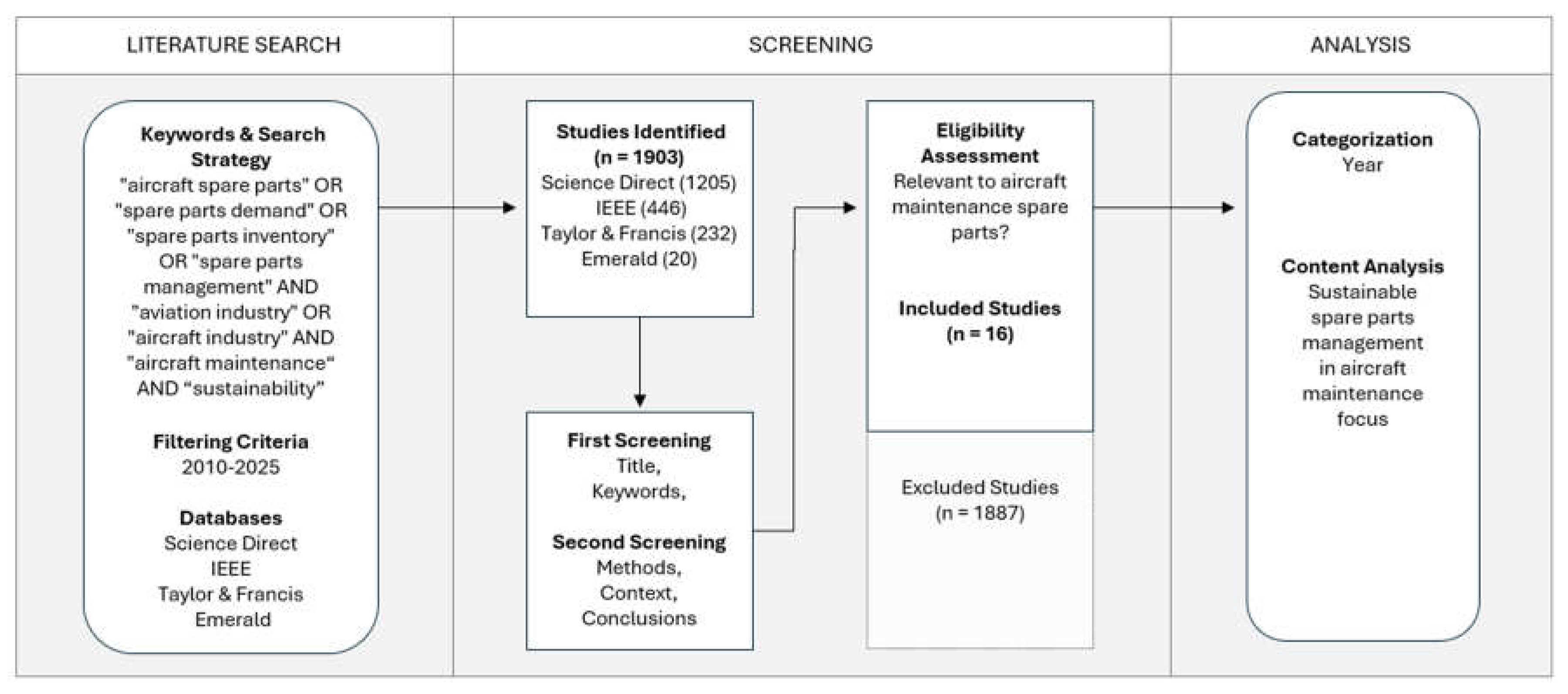
Figure 2.
Methods classification according to their objectives and focus.
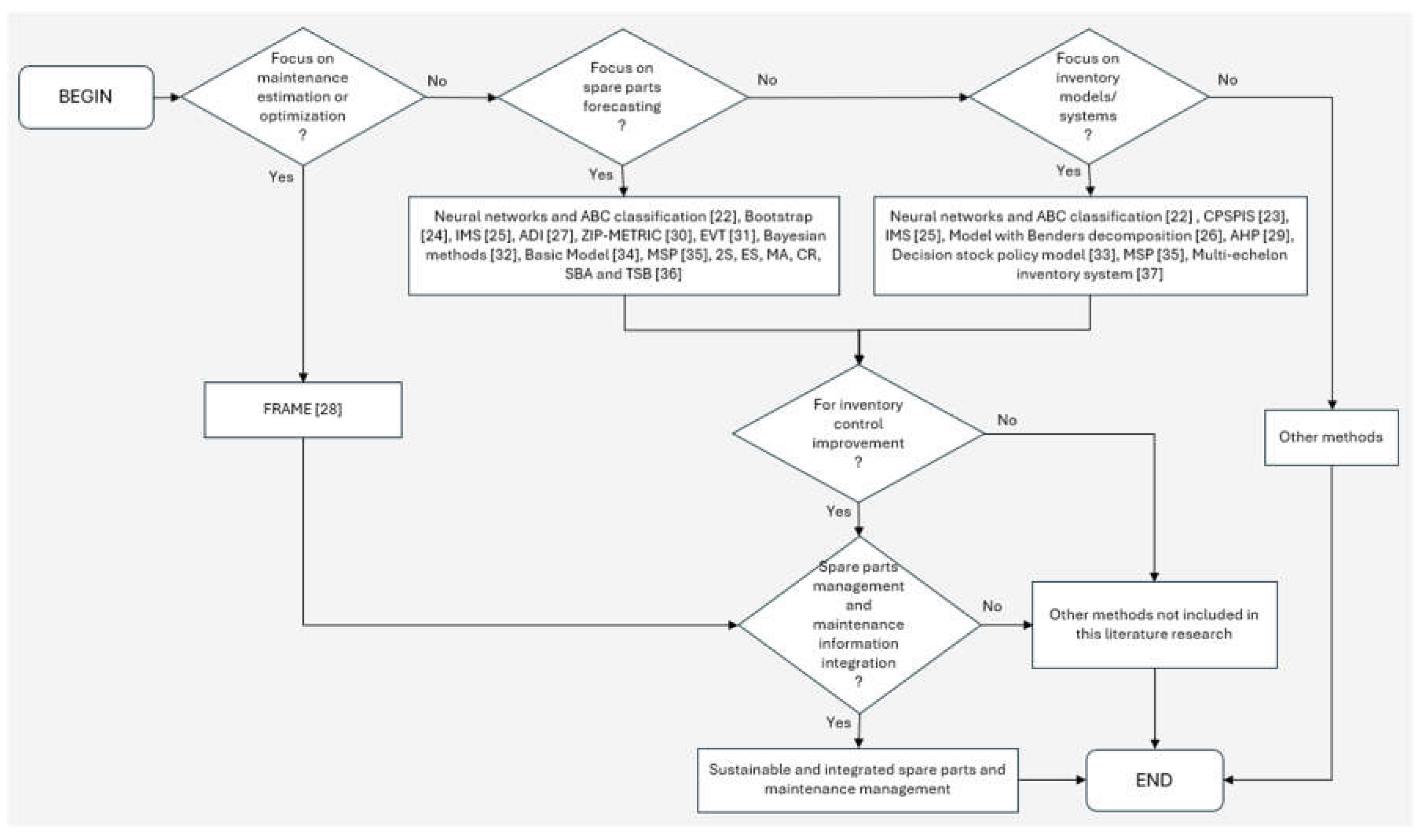

Table 1.
Articles included in the literature review.
| Ref. | Country | Year | Objectives | Methods | Results |
|---|---|---|---|---|---|
| [22] | Peru | 2024 | Ensures effective inventory classification | Neural networks for forecasting spare parts demand. ABC methodology. | Demand forecast accuracy improvement. |
| [23] | China | 2023 | Addresses Spare Parts Intralogistics (SPI) synchronization problems. | Demonstration case (spare parts management department at company H). The company’s SPI uses delivery points to support maintenance work. Visits and interviews (7 participants: requesters, end-users and SPI teams). Implementation of Cyber-Physical Spare Parts Intralogistics System (CPSPIS). | Resource utilization is improved with CPSPIS. SPI business processes synchronization is facilitated with CPSPIS. Work efficiency can be improved given the ability of CPSPIS to synchronize business processes and resources. |
| [24] | Kazakhstan, France and Greece |
2021 | Tests the Bootstrap method and develops a Decision Support System. | Implementation of the Bootstrap forecasting method. Test if the prediction of the Bootstrap method corresponds to real demand, given selected lead times. Regression analysis. Development of a Decision Support System so that maintenance personnel can obtain relevant information. | For spare parts with intermittent demand pattern, the Bootstrap method showed very accurate results. For spare parts with lumpy demand, the Bootstrap method results were not as highly accurate as with spare parts with intermittent demand pattern. |
| [25] | Jordan | 2020 | Sets an inventory management system. Improves operational availability. | Inventory Management System customization. Integration of Maintenance Management Systems. |
Demonstrated that Inventory Management Systems (IMS) can be developed for systems‘ maintenance. The IMS increases efficiency, forecast accuracy for distinct time lengths and reduces cases of AOG, being useful to calculate inventory quantity needs and to highlight deficiency of materials. |
| [26] | China, Hong Kong | 2020 | Proposes a model and approach that assists MRO procurement and overhaul management and minimizes the impact of uncertain maintenance demands. | Stochastic model. Benders decomposition algorithm. Comparion between the Benders decomposition algorith and a default branch-and-bound algorithm. Computational experiment and analysis. | The effectiveness of the proposed algorithm was demonstrated. Benders decomposition algorithm increases convergence speed. |
| [27] | Belgium and the Netherlands |
2019 | Creates a forecasting mechanism to estimate the distribution of spare parts demand. Develops an inventory control method. | Data analysis (data from Fokker Services and Netherlands Railways). Comparative evaluation between the proposed approach and benchmarks. Use of maintenance information as a source of Advance Demand Information (ADI) for spare parts inventory control. |
The Advanced Demand Information (ADI)-based forecast showed better results than time series methods concerning forecast accuracy. ADI presented advantages in Root Mean Square Error and Mean Absolute Deviation. The proposed approach avoids redundant inventory and has the potential to reduce costs by 23% (train maintenance) to 51% (aircraft maintenance). |
| [28] | Portugal | 2019 | Suggests a Framework for Aircraft Maintenance Estimation (FRAME). | Application of a 3-Dimensional Maintenance Data Analysis method. Use of maintenance estimation indicators to assess expected maintenance potential impact (e.g., spare parts quantity). Quantitative assessment of aircraft maintenance projects from a Portuguese MRO. | FRAME addresses spare parts management problem by integrating maintenance activities planning/scheduling and resources availability (e.g., spare parts). Unscheduled maintenance work can be 198% of scheduled workload. Throughout the duration of the service life of an aircraft, there is an increase of the ratio between unscheduled and scheduled workloads. |
| [29] | Indonesia and UK |
2019 | Maintains aircraft operational availability and reduces downtime. |
Develop a multi-criteria model for aircraft spare parts based on 9 interviews (3 from airlines, 3 from engineering and maintenance department and 3 from the material department). Classification test. Data analysis (1267 part numbers). Comparison between the Analytical Hierarchy Process (AHP) model and current practice (Mathematical model, Mathematical and Engineering adjustment) and Current Inventory. |
Considering the MRO dependency on spare parts availability, the proposed AHP model leads to a practical aircraft spare parts classification, by aggregating qualitative and quantitative criteria. AHP classification accuracy is high, since its outcome is consistent with current precise methods. AHP vs Math Model: 80.6% similarity. AHP vs Math Model and Engineering Adjustment Method: 97.6% similarity. AHP vs Current inventory: 63.7% similarity. |
| [30] | Italy | 2017 | Suggests a model to optimize inventory allocation for spare parts with irregular demand. | Presentation of METRIC. Single-site model analysis where a machine may represent an aircraft (possible scenario representation of a maintenance outsourcing service). Proposal and application of Zero-Inflated Poisson and Multi Echelon Technique for Recoverable Item Control (ZIP-METRIC). Data analysis (1745 items of an airline). Simulation study. Item classification for ZIP-METRIC and METRIC. |
METRIC-like models may present accuracy limitations for high irregular demand. ZIP-METRIC defines an inventory level closer to a real case when compared to METRIC. ZIP-METRIC presents better performance compared to the traditional Poisson-based approach. |
| [31] | The Netherlands |
2017 | Proposes (for spare parts) a Lead Time Demand forecasting method. | Development of the empirical Extreme Value Theory method as a combination of the non-parametric empirical method and empirical Extreme Value extrapolation. Simulation study (CM demand only or combined with PM demand). Empirical study (automotive case and aircraft case). | Simulation results indicated that the empirical Extreme Value Theory method performs relatively well but presents some challenges when there is limited demand history. When compared to the empirical method, the proposed method improves inventory performance. |
| [32] | China | 2016 | Presents an approach for spare parts ordering. | Analysis of policies for spare parts and demand ordering decisions (new aircraft fleet). Failure time and number prediction. Classical and Bayesian methods results analysis. Analysis of data (supplier) and maintenance records (airlines). |
Bayesian prediction outcomes were more accurate (by including testing and historical data). Fleet size and the length of the prediction interval affect spare parts demand rate. |
| [33] | The Netherlands |
2015 | Supports inventory analysts. |
Development of a model and an algorithm for inventory support. Computational analysis. Implementation of a spare parts algorithm in a decision-support system at a repair shop (Fokker Services). Comparison results analysis between the implemented method and a benchmark method. | Repair shop performance must be measured not on spare parts level, but on component repair level. The benchmark method was unable to achieve the intended performance for 52% of the highly critical components and showed costs 33% higher. Inventory control improvement with the implementation of the method at the repair shop. |
| [34] | Canada | 2014 | Creates a spare parts inventory model. Reduces downtime and high inventory holding cost. |
Presentation of a basic model and development of an improved model. Results analysis for iterative and general algebraic modeling system approaches. Numerical examples. Sensitivity analysis on how the optimal solution is affected. Comparison of models (basic vs improved). | Computational results show that inventory cost can be significantly reduced with the proposed basic model. Compared to traditional methods, the proposed mathematical models may be more appropriate because they consider parts aging and focus on impending demands. |
| [35] | Canada | 2014 | Addresses spare parts logistics (third-party maintenance provider). | Development of models: deterministic and stochastic. Numerical experiments. Comparison between the multi-stage stochastic programming model, the mean-value deterministic model and a robust optimization (deterministic worst-case scenario) model. |
It was concluded that the spare parts inventory plan must be coordinated with maintenance operations. The robust optimization model suggested higher costs. The deterministic model lacks efficiency on spare parts order quantity. MSP model performed better compared to mean-value deterministic and robust optimization models. |
| [36] | The Netherlands |
2012 | Proposes a method that considers spare parts demand and what type of component is repaired. | Data analysis (Fokker Services). Consideration of 3 spare parts categories (very-slow, slow and fast moving). Studied methods: Two-Step (2S), Simple Exponential Smoothing (ES), Moving Average (MA), Croston (CR), Syntetos-Boylan Approximation (SBA), Teunter-Syntetos-Babai (TSB), Zero Forecast (ZF) and Naïve Forecast (NF). Comparative study (forecasting methods results). Simulation study (2S and ES). |
By using information from planned maintenance and repairs, 2S may reduce forecasting errors by up to 20%. 2S helps distinguish changes on demand: component demand vs needs for parts per repair. In the empirical study, 2S did not outperform ES. The performance measure (Root Mean Square Error, Mean Absolute Deviation and Mean Error) showed that for very-slow and slow-moving spare parts, 2S produced close results to ES, MA and TSB and outperformed CR. For fast moving spare parts, 2S, ES, MA, CR, SBA and TSB produced close results. |
| [37] | China | 2010 | Determines spare parts stock level (multi-item and multi-echelon system) | Allocation of average demand to distinct line stations. Implementation of a model based on METRIC model. Marginal analysis. Numerical example. | Driving backorders to a minimum is nearly smiliar to maximizing product availability. The proposed approach efficiency is observed on the computational results. |
Disclaimer/Publisher’s Note: The statements, opinions and data contained in all publications are solely those of the individual author(s) and contributor(s) and not of MDPI and/or the editor(s). MDPI and/or the editor(s) disclaim responsibility for any injury to people or property resulting from any ideas, methods, instructions or products referred to in the content. |
© 2026 by the authors. Licensee MDPI, Basel, Switzerland. This article is an open access article distributed under the terms and conditions of the Creative Commons Attribution (CC BY) license (http://creativecommons.org/licenses/by/4.0/).
Copyright: This open access article is published under a Creative Commons CC BY 4.0 license, which permit the free download, distribution, and reuse, provided that the author and preprint are cited in any reuse.


