

Submitted:
30 June 2026
Posted:
01 July 2026
You are already at the latest version
Abstract
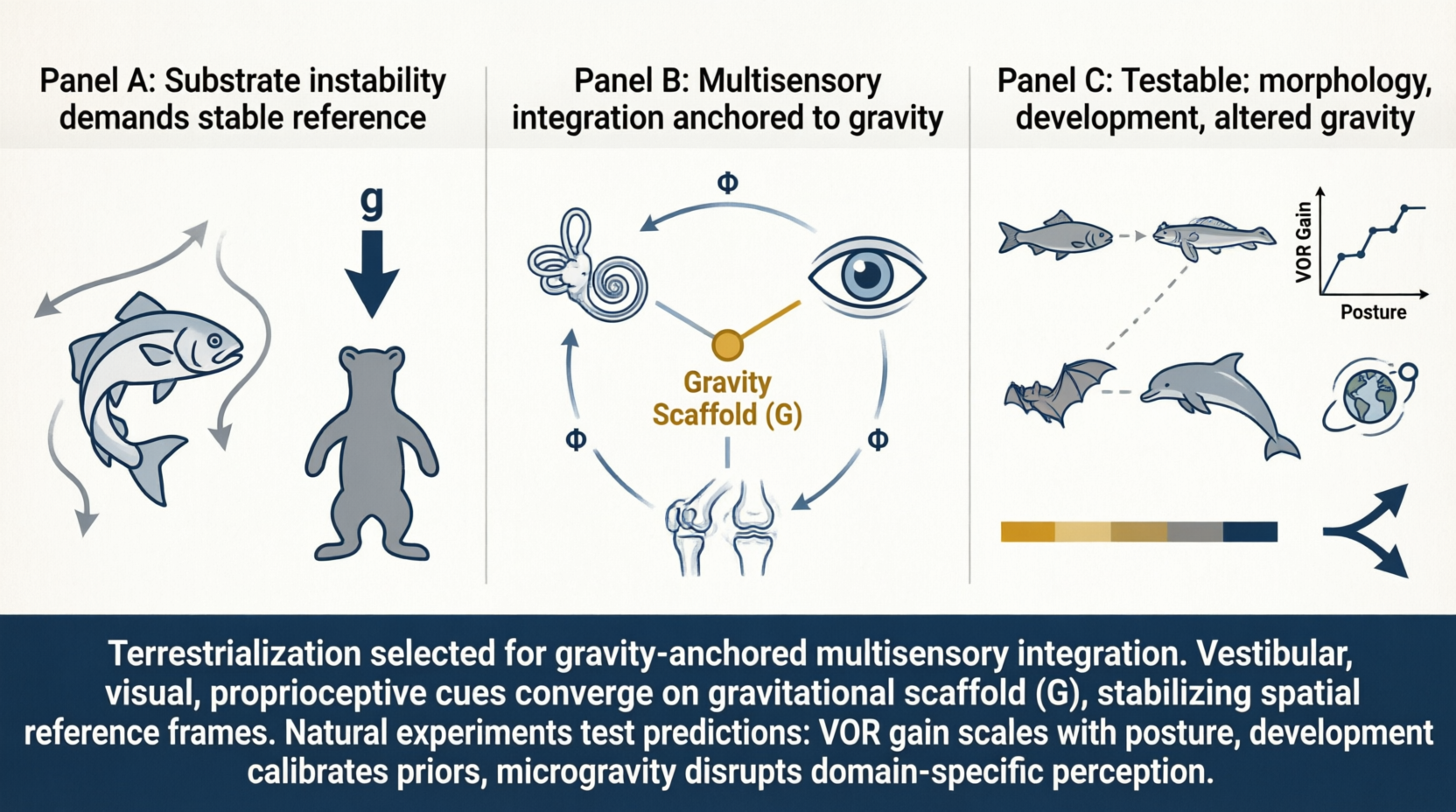
How vertebrate nervous systems establish stable spatial reference frames remains a central question in comparative neuroscience, vestibular biology, and embodied cognition. Modern neuroscience explains upright perception through multisensory calibration rather than the literal inversion of retinal images, yet the evolutionary origins of gravity-anchored spatial organization remains incompletely understood. This paper proposes a comparative evolutionary hypothesis: terrestrialization progressively increased selective pressure for stable gravity-referenced multisensory integration, favoring tighter coordination among vestibular, visual, proprioceptive, and postural systems. The framework does not claim that gravity uniquely determines perception, nor that all vertebrate spatial organization derives solely from terrestrial locomotion. Instead, it proposes that gravitational vertical became an evolutionarily privileged calibration scaffold under conditions of sustained weight-bearing instability and substrate-dependent locomotion. Evidence is reviewed across aquatic, amphibious, terrestrial, arboreal, aerial, and secondarily aquatic vertebrates. Natural comparative cases are interpreted as evolutionary perturbation tests rather than linear progressions. The framework is intentionally comparative and phenomenological: it offers a structured evolutionary scaffold that generates operational predictions concerning vestibular organization, altered-gravity adaptation, developmental plasticity, and comparative neuroanatomy.
Keywords:
gravity-referenced spatial integration
; vertebrate spatial orientation
; multisensory calibration
; vestibular system
; terrestrialization
; evolutionary entrenchment
; ontogenetic calibration
; ecological modulation
; comparative neuroscience
; postural stabilization. vestibular refinement
; sensory weighting
; locomotor demands
; developmental scaffolding
; state-dependent modulation
; mosaic evolutionary reorganization
; aquatic vertebrates
; terrestrial vertebrates
; arboreal locomotion
; aerial navigation
; secondarily aquatic mammals
; amphibious ecology
; evolutionary hypothesis
; comparative method
; embodied cognition
; predictive processing
; bayesian multisensory integration
; sensorimotor calibration
; vestibulospinal stabilization
Introduction
Spatial orientation in vertebrates depends on the integration of vestibular, visual, proprioceptive, and motor signals into stable multisensory reference frames. Contemporary neuroscience explains upright perception not as the literal inversion of retinal images, but as the outcome of dynamic sensorimotor calibration and embodied environmental interaction (Held & Hein, 1963; Gibson, 1979; Cullen, 2012). Despite substantial progress in vestibular physiology and multisensory neuroscience, an important evolutionary question remains unresolved: why did gravitational vertical become such a privileged organizing reference in many vertebrate nervous systems?
The present work proposes a comparative evolutionary hypothesis: terrestrialization progressively increased selective pressure for stable gravity-referenced multisensory integration. In aquatic environments, buoyancy partially buffers sustained gravitational loading and reduces the biomechanical cost of postural instability. On land, organisms must continuously stabilize body orientation relative to gravitational vertical while coordinating gaze, balance, and locomotion against substrate-dependent perturbations. The central proposal is ecological: sustained terrestrial weight-bearing and postural instability favored increasingly stable gravity-referenced integration systems.
This paper does not claim that gravity uniquely determines perception, nor that all observed vertebrate differences derive solely from terrestrialization. Likewise, the framework does not revive historical “image inversion” interpretations of vision. Modern neuroscience already explains upright perception through multisensory calibration. The present work asks whether the long evolutionary history of terrestrial stabilization shaped how these calibration systems became organized across vertebrate lineages.
The framework is comparative, because it examines broad vertebrate transitions; ecological, because it relates sensory organization to locomotor environment; and developmental, because it treats gravity exposure as a scaffold for ontogenetic calibration.
Conceptual Framework
The present hypothesis proposes that gravity functions as an evolutionarily privileged calibration signal because terrestrial locomotion imposes persistent demands for postural stabilization. This does not imply that gravity overrides all other sensory systems, nor that all vertebrates organize space identically. Instead, the framework proposes a graded ecological relationship between locomotor context and gravity-referenced integration (Table 1).
Importantly, vestibular organization is not functionally static. Neurophysiological evidence demonstrates that vestibular processing is dynamically modulated by behavioral state and contextual demands. Carriot et al. (2015) showed that vestibular neuronal responses differ substantially during active versus passive motion, indicating flexible sensory gating rather than rigid signal transmission. Complementing this, Merfeld, Zupan, & Peterka (1999) demonstrated that humans maintain an internal model of gravitational vertical that is continuously updated and computationally separable from inertial acceleration. Angelaki & Cullen (2008) further reviewed the neural mechanisms by which vestibular systems resolve the otolith ambiguity between gravity and linear acceleration in a context-dependent manner. Together, these findings support the broader plausibility of dynamically weighted gravity-referenced integration rather than fixed gravitational encoding. The present framework extends this principle evolutionarily, proposing that ecological and locomotor demands shaped how such weighting systems became calibrated across vertebrate lineages.
Several established neuroscientific frameworks are compatible with this interpretation, including predictive processing (Friston, 2005; Clark, 2013), Bayesian multisensory integration (Ernst & Banks, 2002; Körding & Wolpert, 2004), embodied cognition (Gibson, 1979; Varela et al., 1991), and vestibular sensorimotor neuroscience (Cullen, 2012; Uchino & Kushiro, 2011). The framework complements rather than replaces these models. Its contribution is evolutionary and comparative: it proposes a structured explanation for why gravity-aligned priors may have become strongly entrenched in many terrestrial lineages.
Aquatic Baseline and Early Vertebrate Organization
Aquatic vertebrates operate under fundamentally different mechanical constraints than terrestrial organisms. Because buoyancy partially offsets sustained gravitational loading, stabilization demands are distributed across hydrodynamic flow, body inertia, visual horizon tracking, and lateral-line sensing. Spatial orientation therefore emerges from multiple partially redundant systems rather than from continuous weight-bearing stabilization against gravity alone.
Fish vestibular systems are highly functional and deeply conserved, but their ecological context differs fundamentally from that of terrestrial vertebrates. Many pelagic species experience relatively continuous fluid support, reducing the requirement for persistent gravitational postural correction. This does not eliminate gravity sensitivity — otolith organs remain ancient and essential vertebrate structures — but it likely alters the relative weighting of vestibular, hydrodynamic, and visual stabilization systems.
Comparative vestibular morphology supports this interpretation. Aquatic taxa often exhibit greater variability in semicircular canal geometry than terrestrial mammals and birds (Graf & Baker, 1985; Yopak et al., 2019). Such variability may reflect reduced selective pressure for highly constrained decomposition of rotational axes relative to gravitational vertical.
These comparative patterns lead the framework to predict that aquatic vertebrates should generally exhibit more flexible gravity weighting, greater dependence on distributed sensory stabilization, and less constrained vestibular geometry than fully terrestrial taxa. These trends are probabilistic rather than deterministic and require phylogenetically controlled empirical evaluation.
Terrestrialization and Vestibular Refinement
The transition from water to land fundamentally altered vertebrate biomechanics. Organisms had to support body mass continuously against gravity while coordinating locomotion across mechanically irregular substrates. This introduced persistent demands for stable gaze, dynamic balance, head-righting correction, and continuous postural compensation.
Under these conditions, stable gravity-referenced integration likely became increasingly adaptive. The framework predicts that terrestrialization favored tighter semicircular canal organization, enhanced otolith–canal coupling, stronger vestibulospinal stabilization, and increasingly robust multisensory calibration around gravitational vertical. Comparative studies are broadly consistent with this trend: many terrestrial vertebrates frequently exhibit more constrained canal orthogonality, larger canal radii, and stronger vestibulo-ocular stabilization than many aquatic taxa (Jones & Spells, 1963; Cox & Jeffery, 2010; Ekdale, 2016).
The framework does not propose a linear evolutionary progression toward an ideal vestibular system. Burrowing species, arboreal species, aerial navigators, and upright bipeds each impose distinct stabilization requirements. The relevant claim is ecological scaling rather than universal refinement. For detailed comparative vestibular morphology, see Appendix C.
Comparative Ecological Modulation
Turtles: Intermediate Terrestrial Stabilization
Turtles provide an informative intermediate case. Brichta et al. (1988) demonstrated that turtle semicircular canals approach idealized geometry more closely than many aquatic vertebrates. Riddell (2014) later showed that membranous ducts are substantially more orthogonal than surrounding bony canals and that the utricle and horizontal duct are nearly co-planar (median angle of 12.365◦, n = 4). These findings are consistent with moderate terrestrial vestibular refinement while preserving conservative ancestral
geometry. For detailed vestibular morphology, see Appendix C, Sections C.2 and C.3.
Arboreal Modulation
Arboreal locomotion imposes persistent postural instability due to compliant branches, vertical descent, and discontinuous supports. Toussaint et al. (2025) found that primates frequently adopt upright postures during descent, raising the possibility that enhanced gravity-consistent calibration emerged partly within complex canopy environments before the appearance of full terrestrial bipedalism. The framework predicts that arboreal specialists should exhibit enhanced vestibulocerebellar integration, rapid gravity-consistent recalibration, and strong dynamic coupling between vestibular and visual stabilization systems. For extended discussion, see Appendix B, Section B.4.
Aerial and Inverted Systems
Flying vertebrates challenge simplistic terrestrial interpretations of gravity-referenced integration because they navigate highly dynamic three-dimensional environments. The framework predicts that aerial systems should exhibit flexible, state-dependent vestibular weighting rather than rigid gravity dependence. Bats provide one of the strongest comparative cases: recent work demonstrates robust otolith-mediated tilt responses alongside reduced passive angular vestibulo-ocular reflexes during lowactivity states (Chang et al., 2026), consistent with behavioral-state modulation of gravity weighting — flexible gravity-consistent calibration rather than diminished or fixed encoding. For detailed treatment, see Appendix B, Section B.3.
Natural Experiments and Mosaic Reversions
Dolphins: The Return to Water
Secondarily aquatic mammals provide powerful comparative tests because they relax terrestrial gravitational demands while retaining mammalian ancestry. Dolphins exhibit reduced semicircular canal dimensions, near-complete optic chiasm crossing, and complex hemispheric lateralization (Ketten, 1992; Tarpley et al., 1994; Marino et al., 2007). This combination suggests mosaic evolutionary reorganization: peripheral vestibular systems adapt toward aquatic mechanics while central organizational features remain partially retained. The framework predicts that ecological reversions should frequently produce uneven restructuring rather than uniform reversion. For extended analysis, see Appendix B, Section B.2 and Appendix C, Section C.4.
Penguins and Dual-Medium Stabilization
Penguins combine upright terrestrial ancestry with highly specialized aquatic locomotion. The framework predicts state-dependent gravity weighting: terrestrial walking should favor stronger vestibulo-gravitational stabilization, while underwater propulsion may shift weighting toward visual flow and hydrodynamic cues. This makes penguins particularly valuable for testing whether gravity-referenced integration can be behaviorally reweighted within a single organism without requiring complete vestibular reorganization. For extended discussion, see Appendix B, Section B.2.
Amphibious and Transitional Ecologies
Mudskippers, crocodilians, and semi-aquatic taxa exhibit mixed stabilization strategies combining aquatic and terrestrial sensory organization, supporting the broader proposal that gravity weighting scales continuously with ecological demands rather than discrete habitat categories. For additional discussion, see Appendix B, Section B.5.
Developmental Calibration
The framework proposes that gravity-referenced integration is partially scaffolded by early sensorimotor experience. Head-righting reflexes, postural stabilization, vestibuloocular calibration, and weight-bearing locomotor exploration all provide gravity-consistent feedback during ontogeny.
The framework draws an explicit distinction between two processes. Evolutionary entrenchment refers to the long-term genetic scaffolding of gravity-referenced reference frames through lineage-specific developmental programs — a consequence of sustained selection over evolutionary timescales. Ontogenetic calibration refers to individual-level tuning of cue weighting through gravity-consistent sensorimotor experience during critical developmental windows. These two processes are distinct: evolutionary entrenchment sets the scaffold; ontogenetic calibration tunes the weights within it.
Direct experimental evidence for the selective developmental sensitivity of gravityreferenced organization comes from prenatal spaceflight studies. Ronca et al. (2008) showed that pregnant rats exposed to orbital microgravity produced offspring with delayed vestibular-mediated righting behavior, altered gravistatic afferent branching, and modified autonomic vestibular responses, while angular acceleration pathways remained comparatively preserved. This selective dissociation between otolith and canal pathways under prenatal microgravity provides direct experimental support for the framework’s prediction: altered developmental gravity exposure disrupts gravityconsistent calibration specifically, without globally dismantling vestibular organization.
The framework accordingly predicts that altered gravity environments during ontogeny will disrupt gravity-referenced calibration timing and adaptation rates, without necessarily erasing the species-typical scaffold established by evolutionary entrenchment. For detailed developmental considerations, see Appendix B, Section B.6.
Quantitative and Operational Framework
To operationalize the comparative hypothesis, Appendix E introduces a simplified phenomenological framework linking vestibular geometry, ecological modulation, and multisensory stabilization. The central operational quantities are as follows.
The canal orthogonality index:
where are semicircular canal normal vectors. Lower values of O indicate more orthogonal canal arrangements and reduced rotational cross-axis coupling. Perfect orthogonality corresponds to O = 0.
The vestibular transfer function:
where ω(t) represents angular motion input, M encodes the vestibular transformation geometry determined by canal arrangement, and r(t) represents the reconstructed rotational reference state used for downstream gravity-referenced stabilization computations.
The ecological modulation coefficient:
where P represents postural instability, L locomotor dimensionality, H habitat complexity, and B buoyancy or substrate support. The neurophysiological evidence reviewed in Section 2 (Carriot et al., 2015; Merfeld et al., 1999; Angelaki & Cullen, 2008) suggests that Γ is not a static species-level constant but is itself dynamically adjusted according to behavioral context — consistent with the prediction that gravity weighting scales with locomotor demands rather than being fixed.
Γ = f(P, L, H, B),
The developmental stabilization prior, updated through gravity-consistent sensorimotor exposure:
where η is a learning rate and Eg(t) represents gravity-consistent sensorimotor exposure during ontogeny. This formulation is phenomenological: it captures the partial scaffolding of gravity-referenced integration by developmental experience without specifying the neural implementation.
S(t + 1) = S(t)+η Eg(t),
These quantities are operational variables for generating testable comparative predictions — not complete mechanistic descriptions. A detailed mathematical treatment is provided in Appendix E.
Predictions and Candidate Tests
The framework generates experimentally tractable predictions:
- Upright or dynamically unstable species should exhibit stronger baseline gravityreferenced integration.
- Arboreal and aerial species should show enhanced state-dependent vestibular modulation.
- Secondary aquatic lineages should exhibit mosaic rather than uniform vestibular reorganization.
- Altered gravity environments should selectively disrupt gravity-consistent calibration while leaving unrelated perceptual systems comparatively preserved (Ronca et al., 2008; Wang et al., 2022).
- Developmental gravity manipulations should alter gravity-consistent calibration timing and adaptation rates.
These predictions are non-trivial: each is paired with a specific alternative outcome that would favor competing explanations. Detailed discrimination criteria and paired alternative predictions are tabulated in Appendix A, Section A.8.
Limitations and Open Questions
Several limitations constrain the present work. Comparative vestibular datasets remain taxonomically incomplete, with substantial sampling bias toward model organisms. Fossil vestibular inference relies heavily on bony endocasts that incompletely capture membranous labyrinth organization (Evers et al., 2019). Many ecological variables covary, including locomotor speed, body size, sensory specialization, developmental timing, and phylogenetic inertia. The framework remains phenomenological: it does not specify a complete neural mechanism for how gravity-referenced priors emerge computationally. Finally, many observed patterns may partially reflect general multisensory plasticity, locomotor optimization, developmental constraint, or phylogenetic inheritance rather than gravity-specific organization alone.
Additional discussion of alternative explanations, theoretical context, limitations, and falsifiability criteria is provided in Appendix D.
Conclusions
Rather than treating gravity as a universal determinant of perception, this paper proposes that gravitational vertical became an evolutionarily privileged calibration scaffold under sustained terrestrial postural demands. The framework integrates anatomy, ecology, development, vestibular physiology, and evolutionary transitions into a unified comparative hypothesis of gravity-referenced spatial integration.
The scaffold operates at two levels: evolutionary entrenchment, through lineage-specific developmental programs that establish the reference frame across generations; and ontogenetic calibration, through gravity-consistent sensorimotor experience that tunes cue weighting within that scaffold. These are distinct processes, and the framework predicts accordingly — prenatal microgravity disrupts the calibration without erasing the scaffold; ecological reversions modify the peripheral hardware without eliminating the central priors.
Whether this scaffold ultimately reflects a robust comparative pattern, a contingent evolutionary trend, or a partially useful heuristic remains an empirical question. The framework is intended not as a completed theory, but as a structured comparative research program designed to generate operational predictions, comparative tests, and falsifiable hypotheses concerning the evolution of vertebrate spatial integration.
References
- Angelaki, D. E.; Cullen, K. E. Vestibular system: the many facets of a multimodal sense. Annual Review of Neuroscience 2008, 31, 125–150. [Google Scholar] [CrossRef] [PubMed]
- Berthoz, A. The Brain’s Sense of Movement; Harvard University Press, 1997. [Google Scholar]
- Brichta, A. M.; Acuña, D. L.; Peterson, E. H. Planar relations of semicircular canals in awake, resting turtles, Pseudemys scripta. Brain, Behavior and Evolution 1988, 32(4), 236–245. [Google Scholar] [PubMed]
- Carriot, J.; Jamali, M.; Brooks, J. X.; Cullen, K. E. Integration of canal and otolith inputs by central vestibular neurons is subadditive for both active and passive self-motion. Journal of Neuroscience 2015, 35(8), 3555–3565. [Google Scholar] [CrossRef] [PubMed]
- Chang, H. H. V.; Capshaw, G.; Skandalis, D.; Moss, C. F.; Cullen, K. E. Bat eye movements resolve a long-standing question in gaze control. Current Biology 2026, 36(8), 2137–2145.e2. [Google Scholar] [CrossRef] [PubMed]
- Clark, A. Whatever next? Predictive brains, situated agents, and the future of cognitive science. Behavioral and Brain Sciences 2013, 36(3), 181–204. [Google Scholar] [CrossRef] [PubMed]
- Cox, P. G.; Jeffery, N. Semicircular canals and agility: The influence of size and shape measures. Journal of Anatomy 2010, 216(1), 37–47. [Google Scholar] [CrossRef] [PubMed]
- Cullen, K. E. The vestibular system: Multimodal integration and encoding of self-motion. Nature Reviews Neuroscience 2012, 13(10), 695–710. [Google Scholar]
- Ekdale, E. G. Form and function of the mammalian inner ear. Journal of Anatomy 2016, 228(2), 324–337. [Google Scholar] [PubMed]
- Ernst, M. O.; Banks, M. S. Humans integrate visual and haptic information in a statistically optimal fashion. Nature 2002, 415(6870), 429–433. [Google Scholar] [CrossRef] [PubMed]
- Evers, S. W.; Neenan, J. M.; Ferreira, G. S.; Werneburg, I.; Barrett, P. M.; Benson.
- Neurovascular anatomy of the protostegid turtle Rhinochelys pulchriceps and comparisons of membranous and endosseous labyrinth shape in an extant turtle. Zoological Journal of the Linnean Society 2019, zlz063. [CrossRef]
- Felsenstein, J. Phylogenies and the comparative method. The American Naturalist 1985, 125(1), 1–15. [Google Scholar] [CrossRef]
- Friston, K. A theory of cortical responses. Philosophical Transactions of the Royal Society B 2005, 360(1456), 815–836. [Google Scholar] [CrossRef]
- Gibson, J. J. The Ecological Approach to Visual Perception; Houghton Mifflin, 1979. [Google Scholar]
- Graf, W.; Baker, R. The vestibuloocular reflex of the adult flatfish. Journal of Neurophysiology 1985, 54(4), 887–899. [Google Scholar] [CrossRef] [PubMed]
- Held, R.; Hein, A. Movement-produced stimulation in the development of visually guided behavior A theoretical and comparative study of the functional dependence of the semicircular canal upon its physical dimensions. In Journal of Comparative and Physiological Psychology;Proceedings of the Royal Society B; Jones, G. M., Spells, K. E., Eds.; 1963; Volume 56, 5) 157(969, p. 872–876 403–419. [Google Scholar]
- Ketten, D. R. The marine mammal ear: Specializations for aquatic audition and echolocation. In The Evolutionary Biology of Hearing; Springer, 1992; pp. 717–750. [Google Scholar]
- Körding, K. P.; Wolpert, D. M. Bayesian integration in sensorimotor learning. Nature 2004, 427(6971), 244–247. [Google Scholar] [CrossRef] [PubMed]
- Marino, L. Cetaceans have complex brains for complex cognition. PLoS Biology 2007, 5(5), e139. [Google Scholar] [CrossRef] [PubMed]
- Merfeld, D. M.; Zupan, L.; Peterka, R. J. Humans use internal models to estimate gravity and linear acceleration. Nature 1999, 398, 615–618. [Google Scholar] [CrossRef]
- Riddell, C. D. Functional Morphology of the Vestibular End Organs in the Red-eared Slider Turtle, Trachemys scripta elegans. Master’s thesis, Ohio University, 2014. Available online: http://rave.ohiolink.edu/etdc/view?acc_num=ohiou1399473186.
- Ronca, A.; Fritzsch, B.; Bruce, L. L.; Alberts, J. R. Orbital spaceflight during pregnancy shapes function of mammalian vestibular system. Behavioral Neuroscience 2008, 122(1), 224–232. [Google Scholar] [CrossRef] [PubMed]
- Tarpley, R. J.; Gelderd, J. B.; Bauserman, S.; Ridgway, S. H. Optic nerve decussation in the bottlenose dolphin. Journal of Morphology 1994, 222, 91–102. [Google Scholar] [CrossRef] [PubMed]
- Toussaint, S. L. D.; Youlatos, D.; Nyakatura, J. A. Kinematics and morphological correlates of descent strategies in arboreal mammals suggest early upright postures in euprimates. eLife 2025, 14, e108268. [Google Scholar]
- Uchino, Y.; Kushiro, K. Differences between otolith- and semicircular canalactivated neural circuitry in the vestibular system. Neuroscience Research 2011, 71(4), 315–327. [Google Scholar] [CrossRef] [PubMed]
- Varela, F. J.; Thompson, E.; Rosch, E. The Embodied Mind: Cognitive Science and Human Experience; MIT Press, 1991. [Google Scholar]
- Wang, Y.; Zhang, X.; Wang, C. Modulation of biological motion perception in humans by gravity. Nature Communications 2022, 13, 2765. [Google Scholar] [CrossRef] [PubMed]
- Yopak, K. E.; McMeans, B. C.; Mull, C. G. Comparative brain morphology of the Greenland and Pacific sleeper sharks and its functional implications. Scientific Reports 2019, 9, 10022. [Google Scholar] [CrossRef] [PubMed]

Table 1.
Graded ecological relationship between locomotor context and predicted gravity-referenced integration. Entries represent directional hypotheses, not deterministic classifications.
Table 1.
Graded ecological relationship between locomotor context and predicted gravity-referenced integration. Entries represent directional hypotheses, not deterministic classifications.
| Ecological Context | Predicted Gravity-Referenced Integration |
| Fully aquatic | Lower and more flexible weighting |
| Amphibious / benthic | Intermediate weighting |
| Fully terrestrial | Stronger baseline integration |
| Arboreal / aerial | Dynamic or state-dependent weighting |
| Secondary aquatic | Mosaic reorganization |
Disclaimer/Publisher’s Note: The statements, opinions and data contained in all publications are solely those of the individual author(s) and contributor(s) and not of MDPI and/or the editor(s). MDPI and/or the editor(s) disclaim responsibility for any injury to people or property resulting from any ideas, methods, instructions or products referred to in the content. |
© 2026 by the authors. Licensee MDPI, Basel, Switzerland. This article is an open access article distributed under the terms and conditions of the Creative Commons Attribution (CC BY) license (http://creativecommons.org/licenses/by/4.0/).
Copyright: This open access article is published under a Creative Commons CC BY 4.0 license, which permit the free download, distribution, and reuse, provided that the author and preprint are cited in any reuse.


