

Submitted:
29 June 2026
Posted:
01 July 2026
You are already at the latest version
Abstract
The rapid expansion of generative artificial intelligence (GenAI) in higher education has intensified debates concerning misinformation, media literacy, academic integrity, higher education governance and regulatory approaches. This study develops a systematic literature review (SLR) following PRISMA 2020 guidelines to examine how recent literature and higher education governance address the relationships between GenAI, misinformation, media literacy, AI literacy and educational governance within university contexts. The review integrated empirical studies, systematic and scoping reviews, institutional documents, university policies and international regulatory frameworks through a comparative thematic synthesis and evidence-based extraction strategy. Findings indicate a persistent tension between the pedagogical opportunities associated with GenAI and the epistemic, ethical and informational risks linked to synthetic content production and informational dependency. The review also shows that media literacy, AI literacy and critical thinking emerge as recurrent educational responses to AI-mediated misinformation. Furthermore, substantial differences were identified across governance frameworks and international regulatory approaches. The conclusions suggest that GenAI governance requires integrated approaches capable of connecting higher education governance, critical pedagogies and evaluative competencies within increasingly AI-supported educational ecosystems.
Keywords:
generative artificial intelligence
; misinformation
; media literacy
; AI literacy
; higher education
; geopolitical governance
1. Introduction
The rapid expansion of generative artificial intelligence (GenAI) is reshaping higher education across teaching, assessment, research and governance contexts. In only a few years, AI systems capable of generating text, images, audiovisual content and synthetic information have moved from experimental technologies to widely accessible educational tools, transforming how students and educators interact with information, knowledge production and digital learning environments [1,2]. This accelerated integration has intensified debates regarding educational innovation, pedagogical adaptation and institutional transformation, while simultaneously generating growing concern about misinformation, informational reliability and ethical governance.
Recent literature commonly frames generative AI as a dual educational phenomenon. On the one hand, several studies identify opportunities associated with personalised learning, pedagogical support, academic assistance and literacy-oriented educational innovation [2,3]. On the other hand, multiple studies associate GenAI with epistemic vulnerability, synthetic misinformation, algorithmic opacity and emerging risks affecting information credibility and educational trust [4,5]. This contrast is especially relevant in higher education contexts, where AI-generated outputs commonly intersect with assessment practices, academic integrity, institutional accountability and digital participation.
Within this evolving landscape, misinformation has become one of the most recurrent concerns identified across recent educational and governance-oriented literature. Studies focused on synthetic media, deepfakes and AI-generated information often suggest that higher education institutions are facing new challenges related to verification practices, credibility assessment and responsible digital participation [6,7]. Beyond technological approaches, several authors argue that these risks cannot be addressed exclusively through technological detection mechanisms because the educational implications of GenAI are also connected to media literacy, AI literacy and critical evaluation competencies [8,9].
Recent studies also point to growing institutional concern surrounding governance adaptation and ethical AI implementation. International organisations, university frameworks and policy-oriented studies progressively emphasise transparency, institutional accountability and responsible AI use as necessary dimensions of educational governance [10,11]. However, the reviewed evidence also suggests substantial variation in how institutions and geopolitical contexts conceptualise these challenges. While some governance frameworks prioritise regulatory oversight and academic integrity enforcement, others foreground pedagogical flexibility, literacy development and critical educational adaptation.
Despite the growing volume of literature on generative AI in education, important analytical fragmentation remains. Existing studies frequently examine misinformation, literacy, governance, ethics or adaptation separately rather than through integrated comparative perspectives [4,5,12]. Similarly, university governance documents and international policy frameworks are often discussed independently from empirical educational research, limiting broader understanding of how governance and pedagogical responses intersect within AI-driven higher education environments [10,11].
In response to these limitations, the present study develops a systematic literature review (SLR) examining the relationships between generative AI, misinformation, media literacy, AI literacy and educational governance in higher education. The review integrates empirical studies, systematic and scoping reviews, university governance frameworks and international policy documents through a comparative thematic synthesis approach. By combining educational, ethical and governance-oriented perspectives, the study seeks to identify recurrent patterns, tensions and emerging literacy-oriented responses associated with responsible GenAI implementation in higher education contexts.
2. Methodology
2.1. Research Design
This study was developed as a Systematic Literature Review (SLR) following the PRISMA 2020 guidelines for transparent evidence identification, screening, eligibility assessment and synthesis [13]. The review combined systematic retrieval procedures with thematic qualitative synthesis to examine the intersections between generative artificial intelligence (GenAI), misinformation, media literacy, AI literacy, educational governance structures and higher education.
The adoption of an SLR design responded to the accelerated expansion of research on generative AI across educational technology, communication, ethics and governance domains, which has generated fragmented conceptual and methodological approaches [1,12]. Recent literature has begun to frame misinformation resilience, critical literacy and regulatory approaches as interconnected priorities within contemporary higher education governance debates [4,5].
Accordingly, the review was designed as an interpretative and comparative SLR integrating thematic synthesis, qualitative evidence extraction, governance-oriented comparative analysis and structured analytical coding procedures [14]. This methodological approach was considered particularly appropriate because it enabled the integration of empirical studies, systematic and scoping reviews, governance frameworks, university policies and international regulatory documents within a single comparative analytical structure.
The methodological architecture also aligns with recent publication tendencies identified in systematic reviews published in educational communication journals, where PRISMA-based evidence selection is often combined with thematic coding and interpretative synthesis of heterogeneous forms of evidence [15].
2.2. Research Objectives
This systematic literature review examines how recent educational research and governance frameworks are addressing the implications of generative artificial intelligence in higher education, particularly in relation to misinformation, media literacy, AI literacy and higher education governance. The review seeks to analyse how generative AI is being conceptualised within contemporary educational debates, identify the principal pedagogical risks and broader concerns related to ethics and information reliability associated with its adoption, and examine the institutional and literacy-oriented responses proposed to address these challenges. The study also aims to compare emerging governance tendencies across geopolitical and policy environments and to synthesise the educational implications associated with responsible generative AI implementation.
2.3. Research Questions
This review was guided by four interconnected research questions concerning the educational, ethical and governance-related implications of generative artificial intelligence in higher education. The study examined how recent literature conceptualises the relationship between generative AI, misinformation and media literacy (RQ1), which educational and governance risks are most frequently identified (RQ2), what pedagogical and institutional responses are being proposed to address these challenges (RQ3), and how universities and international organisations are developing governance frameworks for responsible AI integration (RQ4).
The formulation of these questions responded to recurring patterns identified across recent literature reviews, governance documents and international policy frameworks, particularly regarding misinformation resilience, AI literacy, critical thinking, higher education governance, ethical governance, institutional accountability and educational adaptation.
2.4. Search Strategy and Corpus Identification
The corpus was constructed through a structured search and selection strategy combining peer-reviewed scientific literature, systematic and scoping reviews, governance documents, university AI policies and international educational frameworks. The review prioritised documents published between 2023 and 2026 due to the accelerated expansion of generative AI technologies in educational settings during this period.
Search was conducted between January and March 2026 using multidisciplinary and education-oriented academic databases, including Scopus, Web of Science, ERIC and Google Scholar. Additional policy documents were identified through targeted searches of university governance repositories, OECD documentation, European Commission policy databases and university websites. Search procedures combined Boolean operators and thematic descriptor clusters associated with generative AI, misinformation, media literacy, AI literacy, governance and higher education.
Search procedures were organised around thematic clusters directly associated with the analytical objectives of the study: (1) generative AI and misinformation; (2) media literacy and critical thinking; (3) AI literacy and digital competencies; (4) governance and institutional regulation; (5) academic integrity and assessment; (6) ethical and policy-oriented frameworks; and (7) higher education responses.
The review incorporated both academic and institutional documentation because recent literature frequently emphasises that generative AI governance in education cannot be understood exclusively through empirical educational research, but must also consider policies, international governance frameworks and regulatory adaptation processes. Policies and governance frameworks were treated as grey literature sources and were screened separately from peer-reviewed scientific publications.
Search strategies were iteratively refined during preliminary screening to incorporate recurring terminology and emerging governance-related descriptors identified in the selected literature.
The search strategy incorporated combinations of descriptors associated with generative AI, misinformation, disinformation, media literacy, AI literacy, higher education, academic integrity, governance, critical thinking and institutional policy. Search descriptors and thematic search clusters are presented in Table 1.
Example search equation:
("generative AI" OR "GenAI" OR "large language models")
AND ("misinformation" OR "disinformation" OR "synthetic media")
AND ("higher education" OR university OR "teacher education")
AND ("media literacy" OR "AI literacy" OR governance)
The final corpus consisted of empirical studies, systematic and scoping reviews, policy documents, guidelines, governance frameworks and educational strategy reports. Governance records and scientific literature sources were subsequently differentiated during thematic evidence extraction procedures to strengthen analytical traceability and comparative synthesis consistency. Inclusion and exclusion criteria applied during screening and eligibility assessment are summarised in Table 2.
2.5. Inclusion and Exclusion Criteria
Documents were included when they addressed generative AI within educational contexts and examined dimensions related to misinformation, media literacy, AI literacy, governance or institutional adaptations. The review prioritised studies and documents focused on higher education, teacher education or university governance environments, particularly when they incorporated empirical findings, conceptual synthesis, policy recommendations or guidelines. Only accessible full-text documents suitable for systematic evidence extraction were considered eligible for inclusion.
The review incorporated both scientific and institutional documentation because governance-oriented educational responses to generative AI now emerge through university frameworks, university policies and international regulatory initiatives rather than exclusively through empirical journal publications. This combined evidence strategy was considered necessary to capture the educational, ethical and governance-related complexity associated with generative AI implementation in higher education.
Documents were excluded when they lacked educational relevance, focused exclusively on technical AI development without pedagogical or governance implications, presented insufficient methodological transparency, or lacked accessible full-text documentation.
The inclusion of governance frameworks and policy documents was methodologically justified because existing literature identifies adaptation, ethical regulation and policy development as central dimensions of responsible generative AI implementation in higher education [10,11,16].
The analysed sources were analytically divided into two complementary evidence layers. The first corresponded to governance and policy records, including university AI policies, governance frameworks and international regulatory documents. The second incorporated scientific and conceptual literature addressing misinformation, media literacy, AI literacy, governance, ethics and pedagogical adaptation. Due to their distinct analytical functions, institutional records were subjected to a dedicated PRISMA-oriented screening process, whereas scientific literature sources were comparatively synthesised through thematic evidence extraction matrices.
2.6. Screening and Eligibility Process
The screening process was conducted through sequential phases involving initial identification, duplicate removal, title and abstract screening, full-text assessment and thematic eligibility verification. Screening procedures prioritised conceptual relevance, educational applicability, governance implications and the availability of sufficient evidence for thematic analysis. Attention was devoted to studies and institutional documents addressing misinformation-related educational risks, media literacy interventions, governance responses and ethical implementation frameworks.
The review incorporated two analytically differentiated evidence layers: governance and policy records, and scientific and conceptual literature. Due to their distinct analytical functions, institutional records were systematically screened and represented through a dedicated PRISMA-oriented workflow, whereas scientific literature sources were comparatively synthesised through thematic evidence extraction matrices.
Figure 1 presents the PRISMA 2020 flow diagram corresponding to the institutional governance and policy corpus reviewed during the screening and eligibility process.
Full-text screening prioritised conceptual relevance, educational applicability, governance implications and systematic evidence extraction procedures. Attention was devoted to documents addressing misinformation-related educational risks, media literacy interventions, governance responses and ethical implementation frameworks associated with generative AI adoption in higher education.
Following eligibility assessment, the analysed studies were organised into thematic analytical clusters to facilitate comparative synthesis, systematic coding and qualitative thematic interpretation. Thematic categorisation incorporated studies related to LLMs, games and misinformation; AI literacy and critical thinking; educational risks and informational bias; governance frameworks; international policy documents; and university governance across geopolitical regions.
2.7. Data Extraction and Coding Procedures
Data extraction followed a systematic qualitative coding strategy designed to strengthen evidentiary transparency and analytical consistency throughout the review process. Rather than relying exclusively on bibliometric metadata, the analysis prioritised direct evidence extraction from literature review sections, findings/results sections, discussion-oriented interpretation and conclusions/prospects identified within the reviewed corpus.
To facilitate comparative synthesis and thematic analysis, differentiated evidence extraction matrices were developed to organise literature synthesis, findings, discussion-oriented interpretation and conclusions.
Each matrix incorporated source identification, thematic categorisation, page references, supporting excerpts and analytical synthesis linked to the reviewed full-text documentation.
This approach was adopted to maximise evidentiary transparency, source alignment, analytical coherence and methodological reproducibility throughout the review process. The extraction strategy helped reduce unsupported interpretation and strengthen analytical consistency by linking thematic synthesis to supporting textual evidence identified in the reviewed full-text sources.
Coding categories emerged iteratively through comparative thematic analysis of the analysed sources, following interpretative thematic coding principles commonly associated with qualitative synthesis approaches [17]. The final analytical dimensions incorporated misinformation and disinformation, media literacy, AI literacy, critical thinking, academic integrity, ethical governance, institutional regulation, trust and transparency, pedagogical adaptation and educational resilience. These dimensions guided both the comparative synthesis process and the organisation of the thematic extraction matrices.
To strengthen analytical consistency, thematic coding and evidence extraction were cross-checked during successive stages of the review process through collaborative author verification.
The analytical coding categories and thematic dimensions used during evidence extraction and qualitative synthesis procedures can be seen in Table 3.
To operationalise the comparative synthesis process, differentiated extraction matrices were developed for each analytical stage of the review. These matrices enabled the systematic organisation of conceptual synthesis, empirical findings, discussion-oriented interpretation and conclusions/prospects while maintaining clear connections to the reviewed full-text sources. Table 4 summarises the structure and analytical function of the evidence extraction matrices used during the review process.
2.8. Analytical Strategy
The analytical strategy combined thematic synthesis with comparative interpretative analysis to examine recurrent patterns, tensions and emerging governance trajectories within higher education AI governance research. Rather than summarising studies individually, the review prioritised cross-document comparison and thematic integration of educational concerns together with broader ethical and governance implications associated with generative AI implementation in higher education.
This analytical approach was informed by recent literature suggesting that generative AI should be examined simultaneously as an educational opportunity and as a source of epistemic, ethical and informational risk. Consequently, the comparative synthesis focused on university responses, governance frameworks, literacy-oriented interventions, misinformation resilience strategies and models of pedagogical adaptation identified across recent research.
Cross-document comparison also enabled the identification of regional governance differences, contrasting priorities and distinct educational responses across policy environments. Analytical attention was devoted to university governance frameworks, OECD and European policy orientations, academic integrity models and media literacy interventions because these dimensions appeared frequently throughout both scientific and institutional documentation.
The synthesis process integrated empirical evidence, conceptual reviews and governance documents within a single comparative analytical structure. This mixed-evidence strategy strengthened interpretative depth, policy relevance and international comparability while facilitating the identification of convergences and divergences across educational and governance contexts.
2.9. Methodological Rigour and Traceability
Methodological rigour was reinforced through PRISMA-based screening procedures, thematic evidence matrices, direct PDF-based evidence extraction and evidence-based analytical synthesis. All analytical statements presented throughout the review were derived from supporting textual evidence and systematically organised extraction matrices. Methodological consistency was reinforced through systematic evidence extraction, comparative thematic synthesis and close alignment between analytical interpretation and the reviewed full-text sources.
This procedure was especially relevant because the review integrated heterogeneous forms of evidence, including empirical studies, systematic and scoping reviews, governance frameworks, university policy documents and international educational reports. The resulting methodological architecture strengthened analytical reproducibility, evidence transparency and thematic synthesis consistency while supporting comparative interpretation across educational and governance contexts.
Table 5 summarises the distribution of reviewed documents according to document type and institutional orientation identified throughout the corpus selection and evidence extraction process.
Generative AI tools were used during the drafting and language refinement stages of the manuscript. All analytical decisions, evidence selection, thematic coding, interpretation processes and final revisions were conducted and verified by the authors.
The institutional PRISMA corpus (n = 131 reviewed records) was used to identify, verify and compare governance frameworks across geopolitical regions. Table 5 reports the final analytical corpus (n = 54 documents) incorporated into the thematic synthesis and manuscript development.
3. Theoretical Framing
3.1. Generative AI, Misinformation and Media Literacy in Higher Education
Recent literature frames generative AI as a disruptive educational technology whose implications extend beyond instructional innovation to questions of epistemic trust, information credibility and media literacy. Bibliometric and systematic reviews show that research on GenAI in education has expanded rapidly, but also that the field remains conceptually dispersed across ethics, assessment, literacy, governance and pedagogical transformation [1,12]. This fragmentation is particularly relevant for higher education, where GenAI is simultaneously presented as a tool for learning support and as a source of informational uncertainty requiring critical evaluation and institutional mediation [2,3].
Within this emerging literature, misinformation constitutes one of the most persistent areas of concern. Several reviews and conceptual studies identify GenAI as a technology capable of intensifying the production, circulation and apparent credibility of synthetic or misleading information [4,5,7]. However, the literature does not position GenAI only as a threat. A more nuanced line of work suggests that AI systems may also support misinformation detection, awareness and verification practices when embedded within critical pedagogical frameworks [18,19]. These tensions are central to current debates surrounding GenAI. GenAI appears both as an amplifier of epistemic risk and as a possible component of educational responses to misinformation.
Media literacy and AI literacy emerge as the main conceptual bridges between these two positions. Cox [9] argues that responsible GenAI literacy cannot be reduced to effective prompting, since it also requires ethical awareness, algorithmic understanding and critical evaluation. Similarly, Annapureddy et al. [8] conceptualise GenAI literacy as a multidimensional competence involving technical, evaluative and ethical capacities. These approaches contrast with more instrumental views of AI adoption in education, because they foreground the need for learners to understand not only how to use AI tools, but also how to assess the reliability, limitations and social consequences of AI-generated outputs.
Existing scholarship, therefore, suggests that higher education cannot address GenAI-related misinformation through technological detection alone. Visual media literacy, critical media education and game-based interventions are presented as complementary strategies for strengthening learners' capacity to recognise manipulated, synthetic or misleading content [6,20,21,22]. From a critical perspective, this implies that media literacy in GenAI environments should be understood less as a narrow skill set and more as an epistemic and civic practice linked to verification, judgement and responsible participation in digital information ecosystems.
3.2. Educational, Ethical and Governance-Related Risks
Recent studies identify a second major line of concern around the educational, ethical and governance-related risks associated with GenAI adoption. Systematic reviews consistently foreground academic integrity, bias, transparency, privacy and institutional accountability as recurring challenges in educational implementation [12,16]. These risks are not presented as isolated technical problems, but as institutional challenges that affect assessment design, trust in knowledge production and the credibility of academic work.
Academic integrity appears as one of the most visible concerns, particularly in relation to authorship, disclosure and assessment validity. Studies and policy analyses suggest that universities are gradually shifting from prohibition-oriented approaches toward more differentiated models based on declaration of use, responsible integration and redesign of assessment practices [10,23]. However, this transition remains uneven, since some documents prioritise control and compliance, whereas others emphasise pedagogical adaptation and critical AI literacy.
Ethical risk is also closely linked to trust. Research on educators' perceptions shows that confidence in GenAI depends not only on tool performance, but also on transparency, institutional guidance and perceived reliability of AI-generated outputs [16]. While several frameworks normalise AI-supported educational practices and encourage responsible integration, the findings simultaneously indicate that governance structures, teacher preparation and assessment policies have not always evolved at the same pace [10,11]. This imbalance reveals a broader tension between accelerated technological adoption and uneven institutional readiness.
A further concern involves informational dependency. Several studies warn that students may use GenAI as a convenient educational assistant without sufficiently evaluating accuracy, source quality or epistemic reliability [9,18,24]. In contrast to literacy-oriented approaches that emphasise reflective verification and critical evaluation, some educational practices risk reinforcing passive reliance on automated outputs and reducing independent judgement. From a critical perspective, this issue is particularly relevant for media literacy because misinformation is no longer encountered exclusively through external digital platforms; it can also be generated, reformulated and legitimised within everyday academic activities. Consequently, the educational implications of GenAI extend beyond unauthorised content production and involve the potential weakening of verification habits, evaluative autonomy and epistemic responsibility.
3.3. Institutional, Pedagogical and Literacy-Oriented Responses
The selected sources show that institutional responses to GenAI-related misinformation are organised around three complementary dimensions: governance, pedagogical redesign and literacy development. Institutional documents tend to emphasise disclosure, academic integrity and responsible use policies, while educational studies more frequently foreground critical thinking, media literacy and learner agency [9,10,12]. This distinction is important because it reveals a tension between regulatory containment and educational transformation.
Pedagogical responses are especially visible in studies that examine active and experiential learning strategies. Game-based and narrative interventions are presented as promising approaches for improving misinformation awareness because they allow learners to experience the mechanisms through which false or misleading information circulates [20,21,22]. These approaches contrast with more restrictive or correction-oriented models of misinformation education that primarily emphasise content verification, compliance or post-hoc detection mechanisms [19]. Rather than treating misinformation as an isolated informational anomaly, participatory interventions situate verification within reflective, context-based and socially mediated learning environments.
Literacy-oriented responses also extend beyond traditional media literacy. Recent studies argue that students need to develop AI literacy, algorithmic literacy and critical evaluation competencies to understand how GenAI systems produce, distort or legitimise information [8,9]. In this sense, media literacy and AI literacy are not competing frameworks but mutually reinforcing dimensions: media literacy supports the evaluation of information environments, whereas AI literacy helps learners interrogate the technical, ethical and epistemic conditions under which AI-generated content is produced.
Nevertheless, the corpus also suggests that literacy-based responses are insufficient without institutional support. Critical literacy initiatives require assessment policies, teacher preparation and governance frameworks capable of legitimising responsible AI use while discouraging uncritical dependence [11,16].
The most robust institutional responses therefore appear to be hybrid: they combine regulation with pedagogical innovation and literacy development, rather than relying exclusively on detection technologies or prohibition-oriented policies.
3.4. Governance Frameworks and International Regulation
University regulation and international governance frameworks constitute another major dimension of the reviewed literature. Across the selected sources, universities and supranational organisations frame GenAI not only as a pedagogical issue, but also as a governance challenge requiring ethical oversight, regulatory adaptation and institutional accountability [11,25]. This shift reflects the growing recognition that educational responses to GenAI cannot rely exclusively on individual teacher practices, since the implications of AI-generated misinformation extend to trust, assessment legitimacy and public confidence in higher education systems.
Despite this shared concern, existing research reveals important differences across governance approaches. European frameworks tend to prioritise ethical regulation, transparency and institutional accountability, particularly in relation to risk management and responsible AI deployment [26]. In contrast, several North American university policies emphasise pedagogical flexibility, responsible experimentation and adaptive governance rather than strict regulatory control. Meanwhile, some Asia-Pacific governance documents focus more strongly on operational implementation, institutional coordination and strategic integration of AI technologies within educational systems. These differences suggest that governance models are shaped not only by technological concerns, but also by broader educational cultures and policy traditions.
The literature also highlights tensions between institutional control and pedagogical autonomy. Many university policies prioritise academic integrity, disclosure obligations and assessment regulation, especially in response to fears of plagiarism, authorship ambiguity and misinformation risks [10,27]. However, other frameworks argue that overly restrictive governance may limit pedagogical innovation and prevent students from developing responsible AI-use competencies through guided educational practice. This divergence reflects a broader debate within the corpus regarding whether governance should primarily function as risk containment or as a mechanism for supporting critical and ethical AI integration.
International governance reports additionally foreground equity and educational resilience. OECD and World Bank documents frequently stress that AI-related educational inequalities may intensify when institutions lack adequate literacy initiatives, governance structures or technological access [11,28].
Consequently, governance is more closely connected to questions of social justice, inclusion and digital participation. Within this perspective, media literacy and AI literacy are positioned not merely as technical educational outcomes, but as conditions for equitable participation in AI-mediated information environments.
3.5. Toward an Integrated Framework for Generative AI, Literacy and Governance
The literature reviewed here jointly suggests that generative AI in higher education should not be understood through isolated technological, pedagogical or regulatory perspectives. Instead, the corpus points toward a closely linked relationship between misinformation, literacy development, governance and educational resilience. Across empirical studies, systematic reviews and frameworks, GenAI is commonly presented as a technology capable of simultaneously expanding educational opportunities and intensifying epistemic vulnerabilities [4,5].
One of the clearest patterns emerging from the review is the convergence between literacy-oriented and governance-oriented responses. Studies focused on media and AI literacy alongside broader forms of critical evaluation consistently argue that learners require stronger evaluative competencies to navigate synthetic information environments [8,9,29]. Governance documents recognise that regulation alone is insufficient without pedagogical strategies capable of fostering responsible AI use and critical engagement with AI-generated content [10,11]. This convergence suggests that literacy and governance should not be treated as separate dimensions, but as mutually reinforcing components of educational adaptation.
However, the literature also reveals unresolved tensions. Some approaches continue to prioritise academic integrity enforcement and risk mitigation, whereas others advocate more flexible and literacy-oriented models of AI integration. Similarly, while several studies present GenAI as a potential support tool for misinformation detection and educational innovation, others emphasise the risks of over-reliance, informational dependency and reduced epistemic scrutiny [18,24]. These tensions indicate that educational responses to GenAI remain in a transitional phase characterised by conceptual negotiation rather than stable consensus.
Taken together, the reviewed studies support the need for a multilevel analytical perspective capable of connecting pedagogical practices, literacy development and governance frameworks within the same interpretative structure [9,10,11]. From this perspective, misinformation resilience depends not only on technological verification mechanisms, but also on institutional accountability, ethical regulation and the cultivation of critical educational competencies [4,5]. The literature therefore frames generative AI governance as an educational issue that extends beyond regulation itself and intersects directly with democratic participation, informational trust and the future organisation of higher education systems [25,28].
4. Results
4.1. Generative AI, Misinformation and Media Literacy
The existing literature consistently identifies misinformation and information credibility as central dimensions of contemporary generative AI debates in higher education. Across empirical studies, systematic reviews and institutional reports, generative AI is consistently associated with the accelerated production and circulation of synthetic or misleading information, particularly in digital learning and communication environments [4,5,7]. However, the reviewed studies do not frame misinformation exclusively as a technological problem. Instead, the findings position misinformation resilience as an educational issue connected to media literacy, critical evaluation and responsible AI use.
Several studies report that media literacy interventions can strengthen students' ability to identify misleading or manipulated content in AI-driven information environments. Research focused on visual misinformation and synthetic media highlights that learners require specialised verification strategies to evaluate AI-generated images, videos and multimodal content circulating through social media ecosystems [6]. Similarly, studies centred on critical media education and digital literacy suggest that misinformation awareness improves when learners are encouraged to critically interrogate algorithmic information flows and the credibility of AI-generated outputs [29,30].
Comparative synthesis also reveals increasing interest in pedagogical interventions designed to operationalise misinformation awareness through active learning approaches. Game-based and narrative-oriented studies report that participatory learning environments can improve engagement with misinformation-related educational content and encourage more reflective evaluation of information credibility [20,21,22]. Rather than treating misinformation as an isolated informational anomaly, these studies position misinformation resilience within broader processes of digital participation, critical literacy and educational adaptation.
The findings reveal an ambivalent relationship between generative AI and misinformation. While several studies identify risks associated with synthetic information production and informational dependency, others indicate that AI tools may also support misinformation detection and verification processes under appropriate literacy conditions [18,19].
The reviewed findings therefore suggest that educational outcomes depend less on the technology itself than on the critical competencies, governance structures and pedagogical frameworks through which AI systems are integrated into higher education environments.
4.2. Educational, Ethical and Governance-Related Risks
Several studies identify academic integrity, ethical governance and informational reliability as the most recurrent institutional risks associated with generative AI integration in higher education. Across empirical studies and institutional analyses, concerns frequently emerge regarding authorship transparency, assessment validity, algorithmic bias and the credibility of AI-generated information [10,12,16]. These risks are not discussed as isolated technical limitations, but as structural educational challenges affecting trust, pedagogical practice and governance adaptation.
Academic integrity appears particularly prominent throughout the corpus. Several institutional and policy-oriented studies report that universities perceive generative AI as requiring revised disclosure norms, assessment redesign and clearer guidance regarding responsible educational use [27,31]. However, higher education institutional responses differ substantially across governance frameworks and educational contexts. Some governance frameworks prioritise restrictive regulation and integrity enforcement, whereas others emphasise educational adaptation, transparency and literacy-oriented integration strategies [10,32,33].
Ethical concerns also recur across both empirical and institutional documentation. The literature consistently identifies bias, institutional accountability and transparency as central governance challenges, especially in relation to AI-generated content reliability and decision-making processes [12,34]. Several studies further suggest that ethical governance cannot be reduced to technical regulation alone because educational implementation also depends on institutional culture, pedagogical interpretation and user trust.
Trust constitutes another recurring dimension across the findings. Studies focused on educators and students report ambivalent attitudes toward generative AI systems, combining perceptions of educational usefulness with concerns regarding reliability, overdependence and informational uncertainty [16,35]. This imbalance is especially visible in studies examining higher education contexts, where participants often recognise the practical benefits of AI-supported learning while simultaneously questioning the accuracy, transparency and epistemic authority of AI-generated outputs.
Governance-related risks extend beyond plagiarism or unauthorised use. Several studies suggest that generative AI may influence broader educational practices related to critical evaluation, verification habits and knowledge construction [24,36]. Consequently, the educational risks identified throughout the literature involve not only control and academic integrity, but also the possibility that learners become increasingly less engaged in reflective judgement and independent evaluation processes.
4.3. Institutional, Pedagogical and Literacy-Oriented Responses
Several studies indicate a growing range of institutional, pedagogical and literacy-oriented responses developed to address the educational and informational challenges associated with generative AI. Across the corpus, universities and institutions combine governance frameworks with literacy initiatives and pedagogical adaptation strategies rather than relying exclusively on restrictive regulation or technological detection mechanisms [10,11].
Responses frequently prioritise disclosure policies, assessment adaptation and responsible AI-use guidelines. Several university governance documents recommend that students explicitly declare generative AI use in academic tasks, particularly in assessment and research-related activities, while also encouraging educators to redesign evaluation practices in response to AI-assisted content generation [32,37]. Several studies suggest that these governance approaches aim not only to prevent academic misconduct, but also to establish clearer norms regarding transparency, institutional accountability and ethical AI integration.
Pedagogical adaptation constitutes another recurrent response identified throughout the corpus. Studies examining classroom interventions report that misinformation awareness and critical evaluation improve when learners participate in interactive, reflective and literacy-oriented activities rather than passive information consumption models [21,22]. Narrative-based and gamified approaches appear especially relevant because they situate misinformation detection within contextualised learning environments that encourage students to critically engage with AI-generated information and algorithmic communication practices.
The findings also show that literacy-oriented responses integrate media and AI literacy into broader educational resilience frameworks that emphasise critical evaluation and reflective engagement. Several studies argue that students require competencies extending beyond technical AI use, including the ability to verify information, evaluate credibility and recognise the limitations of AI-generated outputs [8,9]. In this context, literacy is frequently framed as both an educational and civic competence connected to responsible participation in digital information ecosystems.
Nevertheless, across the board institutional and pedagogical responses remain uneven across educational contexts. Some governance frameworks strongly emphasise compliance, integrity enforcement and assessment control, whereas others prioritise pedagogical flexibility, literacy development and critical engagement with AI systems [32,33,38]. This divergence indicates that higher education institutions are still negotiating how to balance innovation, governance and educational autonomy in relation to generative AI adoption [10,11].
4.4. Governance Frameworks and International Regulation
The reviewed documents reveal increasing institutional and international efforts to develop governance frameworks capable of regulating generative AI integration in higher education.
Across university policies, international reports and governance-oriented studies, transparent governance practices and greater institutional accountability emerge as recurring regulatory priorities [10,11]. However, the findings also indicate substantial variation in how institutions and geopolitical regions conceptualise the relationship between governance, pedagogy and AI-related informational risks.
European and international governance frameworks tend to emphasise ethical regulation, institutional accountability and risk management. Documents associated with the European Commission and the European Union frequently frame generative AI governance within questions related to transparency, human oversight and responsible technological deployment [25,26].
Similarly, OECD reports position AI governance as closely linked to educational equity, digital resilience and ethical safeguards, particularly in contexts where misinformation and algorithmic opacity may affect public trust and educational participation.
In contrast, several North American university policies adopt more flexible and pedagogically adaptive approaches. Rather than prioritising restrictive regulation alone, these frameworks frequently emphasise responsible experimentation, contextual guidance and disclosure-based governance models [33,39]. The findings examined suggest that these approaches seek to integrate AI literacy and pedagogical innovation into institutional governance rather than treating generative AI exclusively as a compliance issue.
The revised corpus also identifies distinctive governance tendencies across other geopolitical contexts. Some Asia-Pacific frameworks foreground strategic implementation, operational coordination and standardisation of AI-related practices, particularly in relation to research writing, assessment and administrative regulation [40,41]. Meanwhile, several Latin American and social justice-oriented frameworks place stronger emphasis on critical pedagogy, digital inequality and ethical educational adaptation [38,42]. These findings suggest that governance models are shaped not only by technological concerns, but also by broader educational traditions, priorities and sociopolitical contexts.
The comparative synthesis additionally reveals that governance frameworks extend beyond regulation toward broader educational resilience strategies. Governance discussions integrate academic integrity together with media and AI literacy, framing them as interconnected dimensions rather than separate policy areas.
4.5. Integrated Comparative Patterns Across the Literature
The comparative synthesis reveals several recurring patterns connecting generative AI, misinformation, literacy and governance across higher education contexts. First, the literature consistently frames generative AI as both an educational opportunity and a source of epistemic and informational risk.
Although many studies recognise the pedagogical potential of AI-supported learning, the findings simultaneously identify growing concerns regarding misinformation, informational dependency, transparency and educational trust [24,35]. This duality appears across empirical studies, governance documents and systematic reviews, suggesting that higher education institutions approach generative AI through simultaneously innovative and precautionary perspectives.
Second, literacy-oriented responses emerge as one of the most stable areas of convergence throughout the corpus. Studies consistently emphasise the importance of media and AI literacy alongside critical evaluation skills for responding to AI-generated misinformation and assessing the credibility of AI-generated content [8,9,29]. Despite differences in terminology and institutional orientation, the literature broadly converges in emphasising that technical AI skills alone are insufficient without reflective evaluation and ethical awareness.
A third recurring pattern concerns the growing integration of governance and pedagogy. Policies extend beyond restrictive regulation and plagiarism control toward broader governance models incorporating disclosure practices, assessment redesign and responsible AI-use guidance [10,37].
At the same time, pedagogical studies emphasise the importance of active learning, gamified interventions and critical educational practices capable of operationalising misinformation resilience in classroom settings [21,22]. These findings suggest that governance and pedagogy are becoming gradually interconnected dimensions of educational adaptation rather than isolated institutional domains.
However, comparative synthesis also reveals important tensions across the reviewed literature. Some approaches prioritise regulation, compliance and integrity enforcement, whereas others emphasise pedagogical flexibility and literacy-oriented integration [10,27,33]. Similarly, while international governance frameworks frequently foreground institutional accountability and ethical oversight, several empirical studies highlight the importance of learner agency, critical participation and contextual educational adaptation [11,21,25]. These divergences indicate that no unified governance model has yet emerged and that higher education institutions continue to negotiate the balance between innovation, regulation and educational autonomy.
The findings support the development of an integrated analytical perspective connecting misinformation resilience, literacy development, governance and pedagogical adaptation within the same educational framework [4,5,9].
A notable tension emerging across the literature concerns the contrast between governance models prioritising control and those emphasising pedagogical flexibility and literacy development. This can be seen in Figure 2 which presents the governance framework through a thematic synthesis model derived from comparative analysis. It illustrates how governance, literacy and educational resilience interact across AI-mediated higher education environments.
Note. The figure presents a conceptual synthesis derived from the comparative thematic analysis of the reviewed literature on generative AI, misinformation and literacy in higher education. It models the dynamic relationships between global governance frameworks (e.g. UNESCO, OECD, EU AI Act), institutional governance mechanisms (university policies, oversight structures and disclosure norms) and classroom-level pedagogical implementation (AI literacy, assessment redesign, academic integrity, critical thinking, misinformation resilience and social justice–oriented practices). The framework is intended as an interpretative analytical model of how governance, literacy and educational resilience interact across AI-mediated higher education contexts, rather than as a causal or quantitative representation.
5. Discussion
5.1. Generative AI, Misinformation and Epistemic Vulnerability
The analysis indicates that the expansion of generative AI in higher education is associated with concerns regarding epistemic vulnerability, informational trust and the stability of digital learning environments. Although many studies recognise the educational usefulness of AI-supported systems, the literature consistently indicates that misinformation-related risks are becoming increasingly intertwined with routine pedagogical practices rather than remaining external communication problems [4,5]. This shift is particularly significant because it situates misinformation within everyday educational interactions, including assessment, research support and AI-assisted content production.
Across the reviewed evidence, misinformation is not interpreted solely as a technological malfunction or a problem of inaccurate outputs. Instead, several studies position AI-mediated misinformation as part of broader transformations affecting credibility assessment, verification habits and learners' relationships with automated information systems [9,24]. From this perspective, the main challenge identified throughout the corpus is not simply whether AI systems can generate misleading content, but whether students and educators possess sufficient critical and evaluative competencies to recognise the limitations of AI-generated information.
The reviewed studies also reveal tensions between technological efficiency and reflective educational practice. While some findings indicate that AI systems may support misinformation detection and verification under appropriate literacy conditions [18,19], other studies emphasise the risks associated with informational dependency and reduced epistemic scrutiny. These tensions suggest that the educational implications of generative AI depend less on technological capability itself than on the pedagogical and institutional contexts in which AI systems are integrated.
Another important pattern emerging from the reviewed evidence concerns the growing relevance of multimodal misinformation. Research focused on synthetic media, manipulated images and AI-generated audiovisual content consistently highlights that visual verification requires competencies extending beyond traditional text-based literacy approaches [6]. This finding reinforces the argument that media literacy in generative AI environments involves multimodal evaluation practices capable of addressing synthetic visual, textual and hybrid forms of information manipulation.
The reviewed evidence indicates that misinformation resilience in higher education cannot be reduced to isolated fact-checking interventions or technological detection mechanisms. Instead, the literature consistently suggests that educational responses require integrated approaches combining critical literacy, ethical awareness and institutional guidance capable of strengthening students' evaluative autonomy within AI-supported information environments.
5.2. Educational, Ethical and Governance Tensions
Recent literature reveals persistent tensions between educational innovation, institutional control and ethical governance in relation to generative AI adoption. Although universities recognise the pedagogical potential of AI-supported systems, the literature consistently indicates that institutional responses remain strongly shaped by concerns regarding academic integrity, transparency and informational reliability [10,12]. As a result, governance debates frequently oscillate between restrictive regulation and more adaptive educational approaches.
One of the clearest tensions identified across the reviewed studies concerns the relationship between integrity enforcement and pedagogical flexibility. Several frameworks foreground disclosure requirements, assessment redesign and responsible-use policies as mechanisms for maintaining academic credibility in AI-driven learning environments [27,31]. However, other studies warn that excessively restrictive governance may reduce opportunities for students to develop reflective and responsible AI-use competencies through guided educational practice. This divergence suggests that institutions continue to negotiate whether governance should function primarily as a regulatory safeguard or as a pedagogical support structure.
The literature also highlights important tensions surrounding trust and institutional accountability. Findings focused on educators and students consistently show ambivalent attitudes toward generative AI systems, combining perceptions of educational usefulness with concerns regarding opacity, bias and reliability [16,35]. These concerns appear particularly relevant in higher education contexts because AI-generated outputs intersect with assessment, research writing and knowledge production processes. Consequently, the reviewed corpus suggests that institutional trust depends not only on technical performance, but also on governance transparency and the clarity of their guidance.
Ethical governance emerges throughout the corpus as another area characterised by conceptual uncertainty rather than stable consensus. Several studies frame transparency, institutional accountability and fairness as essential principles for responsible AI implementation, particularly in relation to bias mitigation and educational equity [12,34]. Nevertheless, documents differ considerably in how these principles are operationalised. Some governance frameworks prioritise procedural regulation and compliance-oriented approaches, whereas others emphasise critical literacy, educational autonomy and participatory adaptation strategies.
The findings challenge the assumption that regulations alone can adequately address misinformation-related educational risks. The evidence therefore suggests that higher education institutions are not merely regulating technological tools, but redefining broader relationships between pedagogy, institutional authority and epistemic responsibility. From this perspective, governance-related tensions reflect deeper educational debates concerning how universities should balance innovation, institutional accountability and critical participation in AI-supported learning environments.
5.3. Literacy-Oriented Educational Responses and Pedagogical Adaptation
A recurring pattern across the literature reviewed is the increasing convergence of media and AI literacy initiatives with broader forms of critical thinking in response to generative AI-related risks. Across empirical studies, governance documents and literacy-oriented interventions, the literature repeatedly suggests that technical AI proficiency alone is insufficient for navigating AI-driven information environments [8,9]. Instead, recent studies frame evaluative judgement, verification practices and ethical awareness as central competencies for higher education contexts.
The prominence of literacy-oriented responses also reflects dissatisfaction with purely technological approaches to misinformation mitigation. Several studies indicate that automated detection systems and restrictive controls may reduce some immediate risks, yet they do not necessarily strengthen learners' capacity to critically interpret AI-generated content or recognise synthetic misinformation [21,22]. Consequently, many of the reviewed interventions shift attention toward participatory and reflective learning environments designed to cultivate critical engagement rather than passive compliance.
This tendency is particularly visible in studies examining gamified and narrative-based pedagogical approaches. The reviewed findings suggest that experiential learning models can improve misinformation awareness by exposing learners to contextualised information dynamics and encouraging reflective interpretation of algorithmically mediated communication [20,22]. These approaches differ substantially from transmission-oriented literacy models because they frame misinformation resilience as an active educational process connected to participation, interpretation and ethical judgement.
Despite these developments, the sources indicate that literacy-oriented adaptation remains uneven across institutions. Some university frameworks strongly emphasise responsible use declarations and integrity-oriented governance, whereas others place greater emphasis on critical pedagogy, AI literacy and educational experimentation [32,38,39]. This divergence suggests that literacy development is not yet fully integrated into governance structures and often depends on local pedagogical initiatives rather than coordinated educational policy [11,33].
The reviewed literature additionally reveals that literacy-oriented responses now incorporate broader social and civic dimensions. Media literacy, AI literacy and critical evaluation are frequently connected to questions of democratic participation, informational trust and digital resilience rather than being framed exclusively as classroom competencies [29,30]. From this perspective, pedagogical adaptation is interpreted not simply as curriculum adjustment, but as part of a wider educational effort to prepare learners for AI-supported information ecosystems characterised by uncertainty, synthetic content and contested credibility.
5.4. Comparative Governance Models and International Divergence
The comparative synthesis reveals substantial differences in how institutional and geopolitical contexts conceptualise generative AI governance in higher education. Although transparency, institutional accountability and responsible integration emerge as recurring concerns throughout the reviewed studies, existing research indicates that governance approaches vary considerably according to traditions, regulatory cultures and educational priorities. These divergences indicate that no singular governance model currently dominates the higher education landscape.
European governance frameworks consistently foreground ethical regulation, institutional accountability and risk management. Documents associated with the European Commission and the European Union frequently frame generative AI within broader regulatory concerns related to transparency, human oversight and responsible technological deployment [25,26]. Within these approaches, governance is closely linked to institutional accountability and precautionary regulation, particularly in relation to educational trust and misinformation risks.
By contrast, several North American university frameworks adopt more flexible and adaptive governance approaches. Rather than prioritising restrictive control alone, these policies frequently emphasise contextual guidance, responsible experimentation and pedagogical adaptation [33,39]. The reviewed evidence suggests that these approaches are more likely to frame governance as a mechanism for supporting innovation and literacy development rather than primarily as a compliance structure.
The literature also identifies distinctive tendencies across Asia-Pacific and Latin American contexts. Some Asia-Pacific higher education governance documents prioritise operational implementation, coordination and standardised regulation of AI-assisted practices, especially in research writing and assessment contexts [40,41]. In contrast, several Latin American and social justice-oriented frameworks emphasise critical pedagogy, inequality reduction and ethical educational transformation [38,42]. These differences suggest that governance models are shaped not only by technological concerns, but also by broader sociocultural understandings of education, regulation and digital participation. More importantly, they reflect differing assumptions about the relationship between institutional authority, pedagogical autonomy and technological risk.
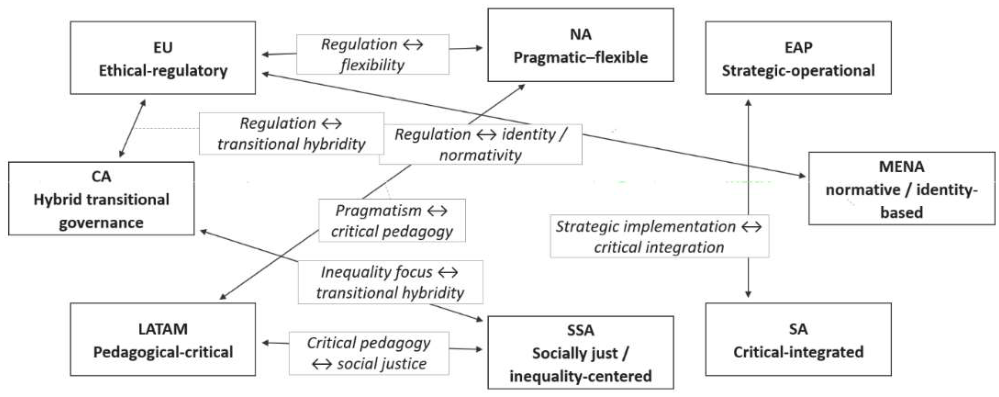
Importantly, the literature reviewed does not present these governance orientations as mutually exclusive. Instead, comparative analysis indicates the existence of hybrid and transitional approaches combining regulation, literacy development, pedagogical adaptation and flexibility. Figure 2 illustrates these comparative tendencies and highlights the conceptual tensions identified between dominant governance orientations across geopolitical contexts.
Figure 3.
Conceptual geopolitical map of dominant governance models for generative AI in higher education. Note. The figure represents a heuristic comparative synthesis derived from thematic analysis of governance tendencies identified across the documents. Nodes represent dominant governance orientations associated with different geopolitical contexts, whereas arrows indicate conceptual relationships and tensions between governance approaches. The figure is analytical rather than geopolitical and does not represent political borders, quantitative magnitudes or hierarchical classifications.
Figure 3.
Conceptual geopolitical map of dominant governance models for generative AI in higher education. Note. The figure represents a heuristic comparative synthesis derived from thematic analysis of governance tendencies identified across the documents. Nodes represent dominant governance orientations associated with different geopolitical contexts, whereas arrows indicate conceptual relationships and tensions between governance approaches. The figure is analytical rather than geopolitical and does not represent political borders, quantitative magnitudes or hierarchical classifications.
5.5. Toward an Integrated Governance-Literacy Framework
Current literature frames generative AI governance in higher education as dependent on the interaction between institutional regulation, literacy development and pedagogical adaptation rather than isolated technological interventions. Across the corpus, misinformation resilience often emerges as a multidimensional educational challenge involving ethical governance, critical evaluation and institutional accountability simultaneously [4,5,11]. This convergence indicates that educational responses to generative AI are increasingly moving toward integrated governance-literacy models rather than narrow technical solutions.
The reviewed evidence also suggests a growing convergence between literacy-oriented educational strategies and governance frameworks. Institutional documents gradually incorporate media and AI literacy into broader discussions concerning academic integrity, responsible AI use and educational trust [9,10]. Moreover, multiple pedagogical studies emphasise that misinformation resilience cannot be achieved through governance mechanisms alone without strengthening learners' evaluative autonomy and critical engagement with AI-generated content.
Another recurring pattern concerns the relationship between educational resilience and flexibility. Some governance approaches continue to prioritise regulation, disclosure and enforcement, particularly in response to concerns surrounding misinformation, authorship ambiguity and informational reliability [10,27]. However, other studies suggest that excessive dependence on restrictive governance may reduce opportunities for critical experimentation and literacy development within educational environments [9,11]. This inconsistency reflects a broader transitional phase in which institutions are attempting to balance innovation, institutional accountability and pedagogical autonomy.
The comparative synthesis additionally highlights that governance models remain deeply influenced by broader educational and sociopolitical contexts. Ethical-regulatory frameworks, adaptive pedagogical models and social justice-oriented approaches coexist across the literature, frequently reflecting distinct institutional priorities and governance traditions [25,26,28]. Rather than converging toward a unified international model, the reviewed studies suggest that higher education institutions are developing context-dependent governance strategies shaped by differing conceptions of risk, responsibility and educational transformation [10,11].
Figure 4 synthesises the relationships identified throughout the review between generative AI, misinformation, literacy-oriented institutional responses, governance structures and educational resilience. The model integrates recurring dimensions identified across empirical studies, regulatory frameworks and systematic reviews and illustrates how governance and literacy operate as interconnected components of educational adaptation in AI-supported higher education contexts.
6. Conclusions and Prospects
The evidence suggests that generative AI is now transforming higher education not only through technological innovation, but also through its influence on information credibility, pedagogical practices and governance [4,5]. The reviewed literature consistently presents generative AI as a dual phenomenon: a potential educational resource capable of supporting learning and participation, and simultaneously a source of epistemic, ethical and informational vulnerability [24,35]. This duality constitutes one of the most recurrent patterns identified throughout the review and helps explain why debates surrounding generative AI are increasingly connected to misinformation resilience, media literacy and governance adaptation.
The findings also suggest that educational responses to AI-driven informational risks now emphasise media and AI literacy alongside critical evaluation and reflective thinking [8,9,29]. The reviewed studies consistently foreground the importance of evaluative competencies capable of helping learners interrogate the reliability, limitations and implications of AI-generated content. In this context, recent studies place growing emphasis on literacy-oriented approaches as more sustainable educational responses than purely technological or compliance-based solutions [21,22]. Rather than relying exclusively on automated detection mechanisms or restrictive regulatory control, many of the reviewed interventions emphasise reflective participation, verification practices and ethical engagement in digital environments shaped by AI systems.
At the institutional level, the reviewed evidence reveals substantial variation in governance approaches. While some frameworks prioritise institutional accountability, transparency and academic integrity enforcement, others foreground pedagogical flexibility, literacy development and responsible experimentation [10,11]. These divergences suggest that higher education institutions are still negotiating how to balance innovation, regulatory approaches and educational autonomy in contexts where governance models remain under active development. The reviewed evidence further indicates that governance responses are shaped by broader educational cultures and policy traditions, particularly across European, North American, Asia-Pacific and Latin American contexts [25,26].
The comparative synthesis also highlights that generative AI governance extends beyond questions of plagiarism or assessment control. Across the analysed studies, governance is gradually connected to broader concerns regarding democratic participation, informational trust, ethical governance, institutional accountability and educational resilience [5,16]. Consequently, the analysed literature suggests that responsible AI implementation requires integrated approaches capable of connecting educational governance structures, literacy-oriented pedagogies and critical educational practices within the same analytical framework.
Several future research directions also emerge throughout the findings. Many studies emphasise the need for longitudinal research examining how students and educators develop AI literacy and evaluative competencies over time [8,9]. The corpus additionally points toward the importance of investigating the long-term effects of generative AI on assessment practices, trust and misinformation resilience in higher education environments [10,31]. Other studies call for further comparative analysis of governance models across geopolitical contexts, particularly regarding the relationship between regulatory approaches, pedagogical adaptation and educational equity [11,28].
This review presents some limitations that should be considered when interpreting the findings. First, the rapid evolution of generative AI technologies and educational governance frameworks means that university policies and scientific literature may change substantially over short periods of time. Second, the reviewed incorporated heterogeneous forms of evidence, including empirical studies, institutional documents and policy frameworks, which differ in methodological scope and analytical orientation. Third, access to university policies’ documentation varied across geopolitical contexts, potentially affecting the comparative representation of regional governance approaches. Despite these limitations, the review provides an integrative analytical perspective on the relationships between generative AI, misinformation, literacy and governance in higher education.
The educational implications of generative AI extend beyond isolated technological or regulatory responses and increasingly require integrated frameworks connecting governance, critical literacy and pedagogical adaptation within higher education systems. The absence of a dominant governance model across higher education contexts could indicate that institutions are still negotiating the balance between innovation, institutional accountability and pedagogical autonomy in AI-supported learning environments.
Supplementary Materials
The following supporting information can be downloaded at the website of this paper posted on Preprints.org.
Funding
This research received no external funding.
Institutional Review Board Statement
Not applicable.
Informed Consent Statement
Not applicable.
Data Availability Statement
The original contributions presented in this study are included in the article/Supplementary Material. Further inquiries can be directed to the corresponding author.
Conflicts of Interest
The authors declare no conflict of interest.
References
- Ng, S.-L.; Ho, C.-C. Generative AI in education: Mapping the research landscape through bibliometric analysis. Information 2025, 16(8), 657. [Google Scholar] [CrossRef]
- Intorsureanu, I.; Oprea, S.-V.; Bâra, A.; Vespan, D. Generative AI in education: Perspectives through an academic lens. Electronics 2025, 14(5), 1053. [Google Scholar] [CrossRef]
- Costa, C.; Murphy, M. Generative artificial intelligence in education: (What) are we thinking? Learn. Media Technol. 2025, 1–13. [Google Scholar] [CrossRef]
- Fulsher, A.; Pagkratidou, M.; Kendeou, P. GenAI and misinformation in education: A systematic scoping review of opportunities and challenges. AI Soc. 2026, 41, 1373–1385. [Google Scholar] [CrossRef]
- Park, S.; Nan, X. Generative AI and misinformation: A scoping review of the role of generative AI in the generation, detection, mitigation and impact of misinformation. AI Soc. 2026, 41, 1501–1515. [Google Scholar] [CrossRef]
- Aljalabneh, A. A. Visual media literacy: Educational strategies to combat image and video disinformation on social media. Front. Commun. 2024, 9, 1490798. [Google Scholar] [CrossRef]
- López-Borrull, A.; Lopezosa, C. Mapping the impact of generative AI on disinformation: Insights from a scoping review. Publications 2025, 13(3), 33. [Google Scholar] [CrossRef]
- Annapureddy, R.; Fornaroli, A.; Gatica-Perez, D. Generative AI literacy: Twelve defining competencies. Digit. Gov. Res. Pract. 2025, 6(1), 13:1–13:21. [Google Scholar] [CrossRef]
- Cox, A. Algorithmic literacy, AI literacy and responsible generative AI literacy. J. Web Librariansh. 2024, 18(3), 93–110. [Google Scholar] [CrossRef]
- Alduais, A.; Qadhi, S.; Chaaban, Y.; Khraisheh, M. Utilizing generative AI responsibly and ethically for research purposes in higher education: A policy analysis. Ser. Rev. 2025, 51(3–4), 120–170. [Google Scholar] [CrossRef]
- OECD-Education International. Opportunities, guidelines and guardrails for effective and equitable use of AI in education; OECD Publishing, 2023. [Google Scholar]
- García-López, I. M.; Trujillo-Liñán, L. Ethical and regulatory challenges of generative AI in education: A systematic review. Front. Educ. 2025, 10, 1565938. [Google Scholar] [CrossRef]
- Page, M. J.; McKenzie, J. E.; Bossuyt, P. M.; Boutron, I.; Hoffmann, T. C.; Mulrow, C. D.; et al. The PRISMA 2020 statement: An updated guideline for reporting systematic reviews. BMJ 2021, 372, n71. [Google Scholar] [CrossRef] [PubMed]
- Thomas, J.; Harden, A. Methods for the thematic synthesis of qualitative research in systematic reviews. BMC Med. Res. Methodol. 2008, 8, 45. [Google Scholar] [CrossRef] [PubMed]
- Snyder, H. Literature review as a research methodology: An overview and guidelines. J. Bus. Res. 2019, 104, 333–339. [Google Scholar] [CrossRef]
- Lelescu, A.; Sava, S.; Grosseck, G.; Malita, L. Exploring trust in generative AI for higher education institutions: A systematic literature review focused on educators. Humanit. Soc. Sci. Commun. 2025, 12, 1961. [Google Scholar] [CrossRef]
- Braun, V.; Clarke, V. Using thematic analysis in psychology. Qual. Res. Psychol. 2006, 3(2), 77–101. [Google Scholar] [CrossRef]
- Peng, W.; Meng, J.; Ling, T.-W. The media literacy dilemma: Can ChatGPT facilitate the discernment of online health misinformation? Front. Commun. 2024, 9, 1487213. [Google Scholar] [CrossRef]
- Spearing, E. R.; Gile, C. I.; Fogwill, A. L.; Prike, T.; Swire-Thompson, B.; Lewandowsky, S.; Ecker, U. K. H. Countering AI-generated misinformation with pre-emptive source discreditation and debunking. R. Soc. Open Sci. 2025, 12, 242148. [Google Scholar] [CrossRef] [PubMed]
- Devasia, N.; Lee, J.H. The role of narrative in misinformation games. Harv. Kennedy Sch. Misinformation Rev. 2024, 5(5). [Google Scholar] [CrossRef]
- Mateus, J.-C.; Etesse, M.; Vásquez-Cubas, D.; Monard, E.; Cappello, G. Enhancing media literacy in higher education: An experimental study on misinformation through a gamified intervention in Peru. Int. J. Commun. 2026, 20, 838–862. [Google Scholar] [CrossRef]
- Tang, H.; Sun, S.; Nie, K.; Li, A.; Sergeeva, A.; LC, R. Breaking the news: Taking the roles of influencer vs. journalist in a LLM-based game for raising misinformation awareness. Proc. ACM Hum.-Comput. Interact. 2025, 9(GAMES), GAMES005. [Google Scholar] [CrossRef]
- Perkins, M. Academic integrity considerations of AI Large Language Models in the post-pandemic era: ChatGPT and beyond. J. Univ. Teach. Learn. Pract. 2023, 20(2), 07. [Google Scholar] [CrossRef]
- Nally, D. AI-informed pedagogy for a post-truth era. Digit. Soc. 2025, 4, 76. [Google Scholar] [CrossRef]
- European Commission. Digital Education Action Plan 2021–2027: Resetting education and training for the digital age (Communication COM (2020) 624 final). 2020. Available online: https://education.ec.europa.eu/sites/default/files/document-library-docs/deap-communication-sept2020_en.pdf.
- European Union. Regulation (EU) 2024/1689 of the European Parliament and of the Council of 13 June 2024 laying down harmonised rules on artificial intelligence (Artificial Intelligence Act). Official Journal of the European Union. 2024. Available online: http://data.europa.eu/eli/reg/2024/1689/oj.
- Peterson, S. Addressing student use of generative AI in schools and universities through academic integrity reporting. Front. Educ. 2025, 10, 1610836. [Google Scholar] [CrossRef]
- World Bank. AI revolution in education: What you need to know (Digital Innovations in Education Brief No. 1); International Bank for Reconstruction and Development / The World Bank, 2024. [Google Scholar]
- Sonni, A. F.; Mau, M.; Akbar, M.; Putri, V. C. C. AI and digital literacy: Impact on information resilience in Indonesian society. Journal. Media 2025, 6(3), 100. [Google Scholar] [CrossRef]
- Pedroche-Santoveña, I.; Feliz-Murias, T. Critical media education with and in generative AI: Design-based research on #PinchaLaBurbuja. Vis. Rev. 2025, 17(6), 209–232. [Google Scholar] [CrossRef]
- O’Dea, X.; Bale, R.; Chiu, Y.-L. T.; Suleymenova, K.; Tinker, A.; Stoker, R. Ethical uses of generative AI in assessment: Student perceptions in UK contexts. Eval. Rev. 2025, 1–25. [Google Scholar] [CrossRef] [PubMed]
- Queen’s University Belfast. QUB guidance on the use of AI in assessment – 2025–26. 2025. [Google Scholar]
- University of California; Berkeley. GenAI guidance for instructors 2025. Academic Senate, Berkeley Division, 2025. [Google Scholar]
- Reina Marín, Y.; Cruz Caro, O.; Carrasco Rituay, A. M.; Guimac Llanos, K. A.; Tarrillo Perez, D.; Sánchez Bardales, E.; Alva Tuesta, J. N.; Chávez Santos, R. Ethical challenges associated with the use of artificial intelligence in university education. J. Acad. Ethics 2025, 23, 2443–2467. [Google Scholar] [CrossRef]
- Wang, F.; Li, N.; Cheung, A. C. K.; Wong, G. K. W. GenAI we trust: An investigation of university students’ reliance on and resistance to generative AI in language learning. Int. J. Educ. Technol. High. Educ. 2025, 22(1), 59. [Google Scholar] [CrossRef]
- Nasr, N. R.; Tu, C.-H.; Werner, J.; Bauer, T.; Yen, C.-J.; Sujo-Montes, L. Exploring the impact of generative AI ChatGPT on critical thinking in higher education. Educ. Sci. 2025, 15(9), 1198. [Google Scholar] [CrossRef]
- University of Edinburgh. Guidance for working with generative AI (“GenAI”) in your studies. 2024. [Google Scholar]
- Universidad de Chile. Orientaciones de uso de inteligencia artificial generativa en docencia y evaluación. 2025.
- Stanford University. Worksheet for creating your AI syllabus statement. Stanf. Teach. Commons s.f. Available online: https://teachingcommons.stanford.edu/sites/g/files/sbiybj27001/files/media/file/worksheet-for-creating-your-ai-course-policy.pdf.
- Peking University School of Transnational Law. AI policy for academic and educational use. 2024. [Google Scholar]
- Universiti Malaya. Academic policy guidelines for artificial intelligence use in teaching and learning. 2025.
- Universidad de Puerto Rico. Certificación institucional sobre el uso responsable de inteligencia artificial generativa. 2025.
Figure 1.
PRISMA 2020 flow diagram of institutional policy records reviewed for the international systematic review on generative AI governance in higher education. Note. Figure 1 presents the PRISMA 2020 flow diagram for policy and governance records reviewed in the systematic analysis of generative AI governance in higher education. Scientific and conceptual literature sources were analysed separately through thematic evidence extraction matrices and are therefore not enumerated in this figure. Official PDF documents (n = 35) were treated as full-text verification sources linked to included institutional records rather than as independent PRISMA phases.
Figure 1.
PRISMA 2020 flow diagram of institutional policy records reviewed for the international systematic review on generative AI governance in higher education. Note. Figure 1 presents the PRISMA 2020 flow diagram for policy and governance records reviewed in the systematic analysis of generative AI governance in higher education. Scientific and conceptual literature sources were analysed separately through thematic evidence extraction matrices and are therefore not enumerated in this figure. Official PDF documents (n = 35) were treated as full-text verification sources linked to included institutional records rather than as independent PRISMA phases.
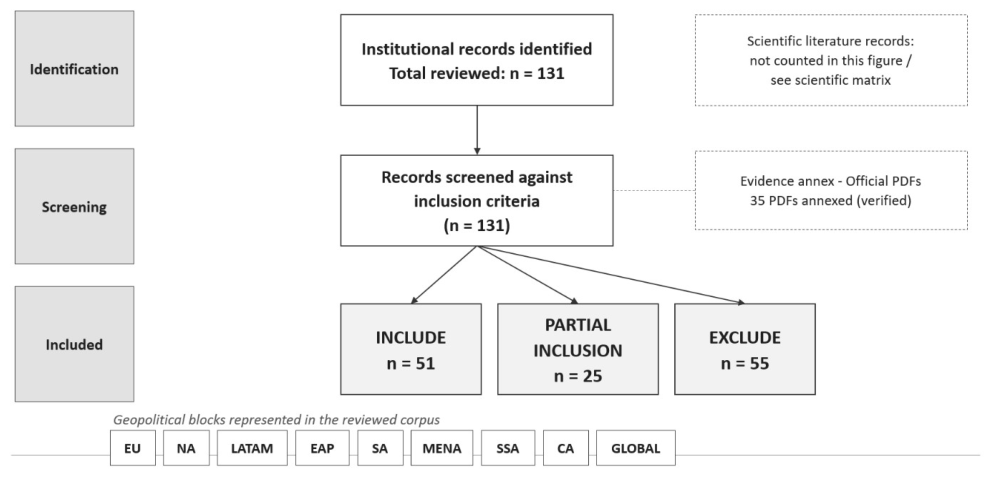
Figure 2.
Multilevel governance framework for generative AI in higher education.
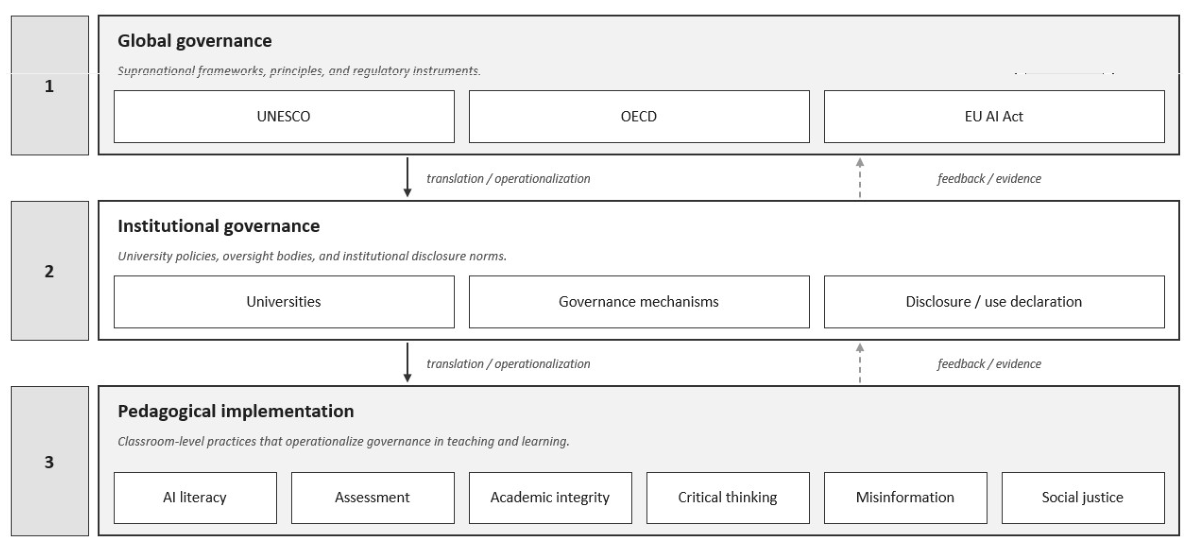
Figure 4.
Thematic synthesis model connecting generative AI, misinformation, literacy and governance dimensions. Note. The figure represents a conceptual synthesis derived from the comparative thematic analysis of the literature. The model integrates recurring relationships identified between generative AI, misinformation risks, literacy-oriented educational responses, university policies and pedagogical adaptation processes in higher education contexts. The figure is intended as an interpretative analytical model.
Figure 4.
Thematic synthesis model connecting generative AI, misinformation, literacy and governance dimensions. Note. The figure represents a conceptual synthesis derived from the comparative thematic analysis of the literature. The model integrates recurring relationships identified between generative AI, misinformation risks, literacy-oriented educational responses, university policies and pedagogical adaptation processes in higher education contexts. The figure is intended as an interpretative analytical model.
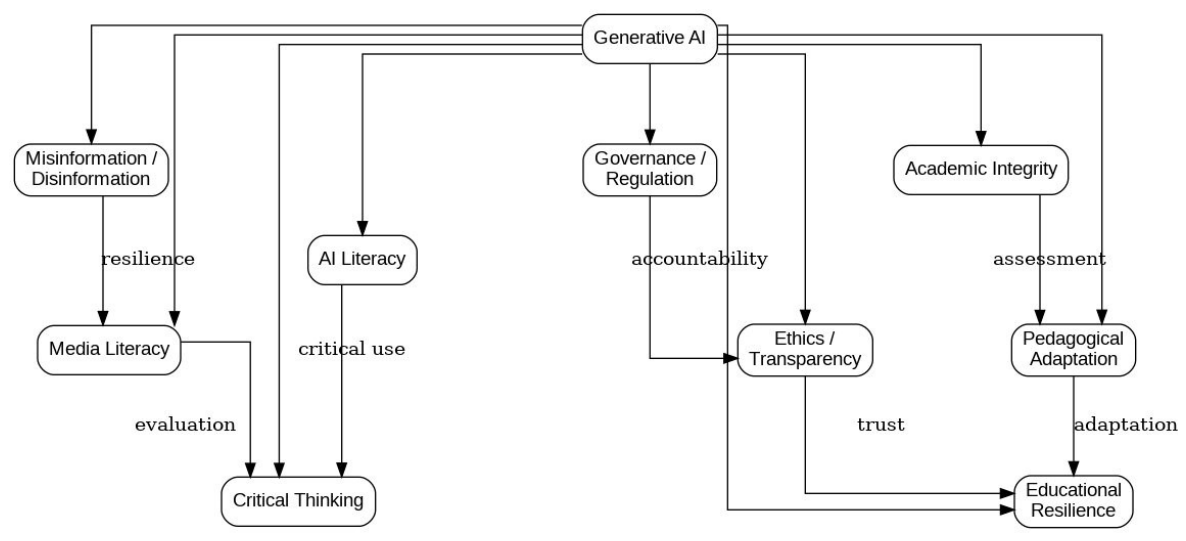

Table 1.
Search descriptors and thematic search clusters used during corpus identification.
| Thematic cluster | Representative descriptors |
| Generative AI and misinformation | “generative AI”, “misinformation”, “disinformation”, “deepfake”, “synthetic media” |
| Media literacy and critical thinking | “media literacy”, “critical thinking”, “digital literacy”, “fact-checking” |
| AI literacy and competencies | “AI literacy”, “AI competencies”, “responsible AI”, “critical evaluation” |
| Governance and institutional regulation | “governance”, “institutional policy”, “academic integrity”, “AI framework” |
| Higher education adaptation | “higher education”, “teacher education”, “assessment”, “pedagogical adaptation” |
| Ethical and regulatory approaches | “ethics”, “transparency”, “accountability”, “responsible AI use” |
Note. Search descriptors were iteratively refined according to thematic recurrence identified during corpus screening and comparative evidence extraction.
Table 2.
Inclusion and exclusion criteria applied during screening and eligibility assessment.
| Inclusion criteria | Exclusion criteria |
| Educational relevance related to generative AI | Purely technical AI studies without educational implications |
| Focus on misinformation, literacy, governance or ethics | Documents lacking conceptual or methodological relevance |
| Higher education, teacher education or institutional contexts | Inaccessible full-text documents |
| Empirical studies, systematic reviews, governance reports or institutional policies | Documents without identifiable educational or governance dimensions |
| Full-text accessibility for evidence extraction | Duplicate or redundant documents |
Note. Institutional governance documents and university policies were included because recent literature consistently identifies regulatory adaptation and governance development as central dimensions of responsible generative AI integration in education.
Table 3.
Analytical coding categories and thematic dimensions used during evidence extraction.
| Analytical dimension | Operational focus | Examples identified in the corpus |
| Misinformation and disinformation | AI-generated misinformation, synthetic media, verification challenges | Deepfakes, synthetic content, misinformation resilience |
| Media literacy | Critical interpretation of digital and AI-generated information | Fact-checking, verification strategies, visual literacy |
| AI literacy | Competencies associated with responsible AI use | Critical evaluation, ethical awareness, AI competencies |
| Critical thinking | Reflective evaluation and judgement | Critical evaluation of AI outputs and information credibility |
| Academic integrity | Responsible AI use in assessment and authorship | Disclosure policies, plagiarism concerns, assessment redesign |
| Ethical governance | Institutional accountability and responsible implementation | Transparency, bias mitigation, ethical oversight |
| Institutional regulation | Governance frameworks and policy adaptation | University AI policies, governance guidelines |
| Trust and transparency | Reliability and credibility perceptions | Trust in AI systems, transparency requirements |
| Pedagogical adaptation | Teaching and assessment transformation | AI-supported learning, gamified interventions |
| Educational resilience | Capacity to respond to informational risks | Misinformation resilience and literacy-oriented interventions |
Note. Coding categories emerged iteratively through comparative thematic analysis of empirical studies, systematic reviews, institutional frameworks and policy documents included in the reviewed corpus.
Table 4.
Structure of evidence extraction matrices and analytical reference fields.
| Extraction matrix | Main analytical purpose | Core traceability fields |
| Literature review matrix | Conceptual and theoretical synthesis | Source, thematic category, page, excerpt |
| Results matrix | Empirical findings and reported outcomes | Extracted findings, page reference, supporting evidence |
| Discussion matrix | Comparative interpretation and analytical synthesis | Comparative interpretation, implications, supporting evidence, page reference |
| Conclusions and prospects matrix | Future directions and educational implications | Synthesised conclusions, future directions, page reference |
Note. All matrices were developed using direct PDF-based extraction procedures to maximise evidentiary transparency, source-to-claim traceability and analytical reproducibility.
Table 5.
Distribution of reviewed documents according to document type and institutional orientation.
Table 5.
Distribution of reviewed documents according to document type and institutional orientation.
| Document type / source | Frequency (n) | Percentage (%) | Representative institutional and publication contexts |
| Scientific journal articles | 26 | 48.1 | Indexed journals in educational technology and communication studies (e.g., Education Sciences, Frontiers in Education, AI & Society) |
| University policies and institutional guidelines | 21 | 38.9 | Higher education governance frameworks (e.g., Stanford, UC Berkeley, UNAM, University of Bologna) |
| International and governmental reports | 6 | 11.1 | International governance and educational policy frameworks (e.g., European Commission, OECD, World Bank) |
| Preprints and open repositories | 1 | 1.9 | Open-access research repositories (e.g., arXiv) |
| Total | 54 | 100.0 | Reviewed corpus included in the systematic analysis |
Note. Table developed through systematic categorisation and thematic verification of the reviewed corpus. Percentages were rounded to one decimal place.
Disclaimer/Publisher’s Note: The statements, opinions and data contained in all publications are solely those of the individual author(s) and contributor(s) and not of MDPI and/or the editor(s). MDPI and/or the editor(s) disclaim responsibility for any injury to people or property resulting from any ideas, methods, instructions or products referred to in the content. |
© 2026 by the authors. Licensee MDPI, Basel, Switzerland. This article is an open access article distributed under the terms and conditions of the Creative Commons Attribution (CC BY) license.
Copyright: This open access article is published under a Creative Commons CC BY 4.0 license, which permit the free download, distribution, and reuse, provided that the author and preprint are cited in any reuse.


