
Submitted:
29 June 2026
Posted:
30 June 2026
You are already at the latest version
Abstract
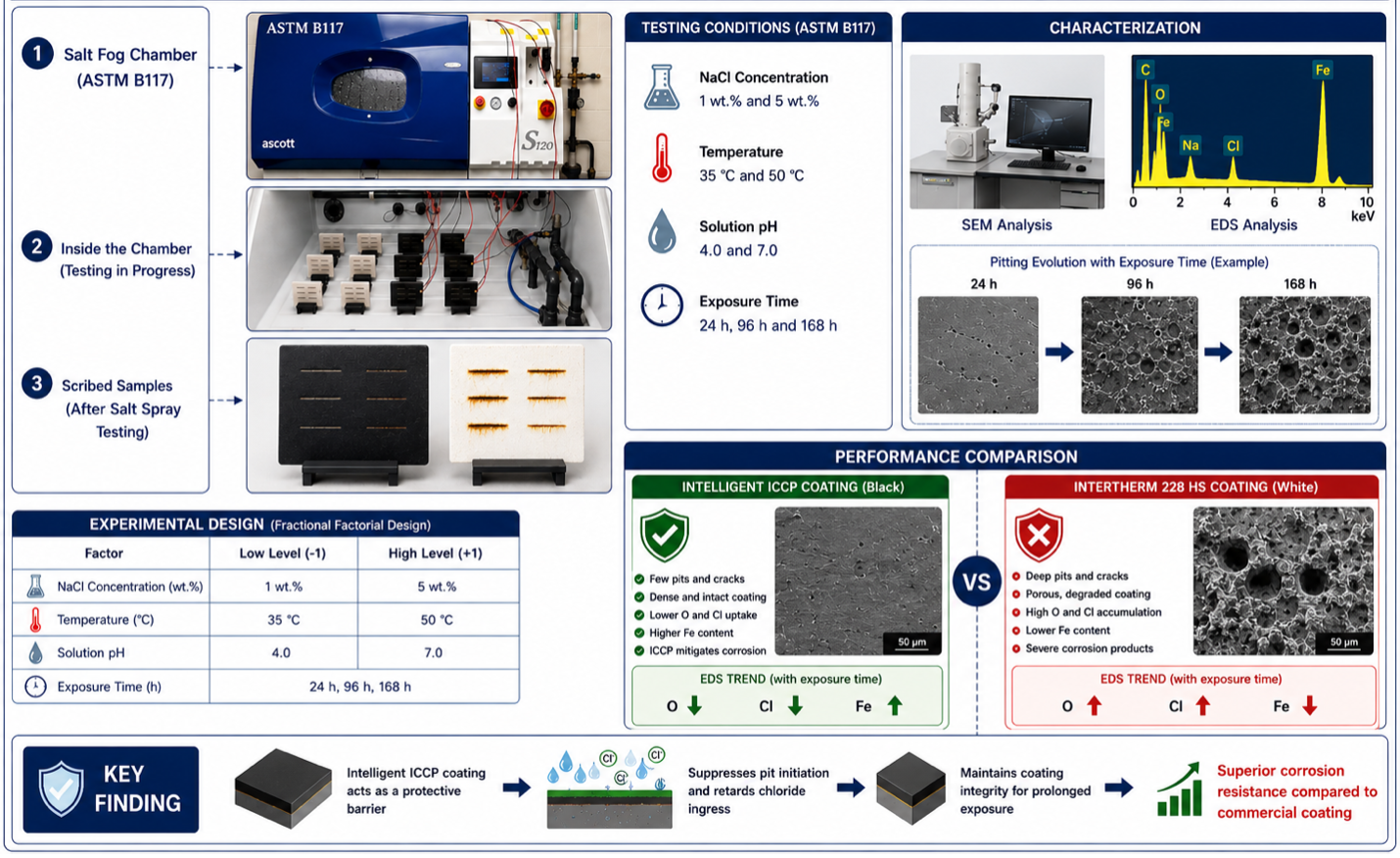
Corrosion of carbon steel in chloride-rich environments remains a critical challenge for marine and industrial applications, necessitating the development of durable protective coating systems. This study evaluates the corrosion resistance of an intelligent coating in comparison with the commercial coating Intertherm 228 HS under accelerated salt spray exposure following ASTM B117. Coated carbon steel specimens were subjected to 1 and 5 wt.% NaCl solutions at pH 4 and 7, temperatures of 35 and 50°C, and exposure durations of 24, 96, and 168 h. Corrosion behavior and coating degradation were characterized using scanning electron microscopy (SEM) and energy-dispersive spectroscopy (EDS). The results demonstrate that corrosion severity increases with chloride concentration, acidic conditions, elevated temperature, and prolonged exposure. SEM analysis revealed the progressive formation of pits, perforations, and corrosion products, while EDS showed increasing oxygen and chlorine contents accompanied by a decline in iron content, indicating accelerated coating deterioration and substrate corrosion. Compared with the commercial coating, the intelligent coating exhibited superior resistance to chloride-induced degradation, maintaining greater surface integrity and delaying corrosion propagation under all exposure conditions. These findings highlight the strong influence of environmental parameters on coating performance and demonstrate the potential of intelligent coatings to provide enhanced long-term corrosion protection for carbon steel structures operating in aggressive chloride-containing environments.
Keywords:
corrosion resistance
; salt spray testing (ASTM B117)
; protective intelligent coatings
; scanning electron microscopy
Copyright: This open access article is published under a Creative Commons CC BY 4.0 license, which permit the free download, distribution, and reuse, provided that the author and preprint are cited in any reuse.


