

Submitted:
30 June 2026
Posted:
30 June 2026
You are already at the latest version
Abstract
Amomum villosum Lour., a medicinal plant within the Zingiberaceae family, has not yet had its molecular mechanisms governing flowering time investigated. The florigen activation complex (FAC), which include PEBP, FD/bZIP, and GRF proteins, is crucial for controlling flowering time control in model plants. In this study, we identified 13 PEBP, 5 FD, and 19 GRF genes within the A. villosum genome. Our analyses included phylogenetic assessment, conserved motif characterization, gene structure examination, and promoter cis-regulatory element prediction. Protein-protein interactions among these three families were predicted through cross-species analysis and validated using yeast two-hybrid assays. Significantly, an AREB3-like FD protein (AvFD5) and a GRF protein (AvGRF13) were found to directly interact with specific PEBP members, whereas canonical FD-like proteins (AvFD1 and AvFD4) did not exhibit detectable interactions, differing from the classical rice FAC model (Hd3a-14-3-3-OsFD1). This study represents the first systematic characterization of FAC core gene families in A. villosum and, more broadly, within the Zingiberaceae family, thereby laying the groundwork for understanding flowering time regulation in this economically important plant family.
Keywords:
Amomum villosum
; Zingiberaceae
; florigen activation complex
; PEBP gene family
; FD gene family
; GRF gene family
1. Introduction
Amomum villosum Lour., also refferred to as Wurfbainia villosa, is a perennial herbaceous plant within the genus Amomum Roxb. of the Zingiberaceae family [1]. The dried mature fruits of this plant, known as Amomi Fructus (AF, or “Sharen” in Chinese), are extensively utilized in traditional Chinese medicine due to their pharmacological properties, which include soothing the fetus, relieving diarrhea, and enhancing appetite [2]. Furthermore, AF is a preferred component in teas, preserved fruits, beverages, liquors, as well as in cosmetics and food additives [3]. Consequently, A. villosum, as the botanical source of AF, has been recognized by the China Food and Drug Administration as a species with both medicinal and food applications in China [3]. A. villosum propagates seedlings through two methods: sexual propagation via seeds and asexual propagation through division. Seedlings propagated asexually by division reach the reproductive growth stage 2–3 years post-planting, whereas those propagated sexually by seeds require 3–4 years to bloom [4]. Therefore, the plant’s extensive growth cycle, coupled with small-scale, decentralized cultivation by individual growers, presents considerable challenges to the sustainable development of the industry [5].
The transition from vegetative to reproductive growth in angiosperms, known as flowering, is a crucial process governed by a complex network of environmental cues, endogenous signals, and genetic programs [6]. Among the various regulatory pathways, the photoperiod pathway is fundamental in regulating flowering time, with its core components being highly conserved across plant species [7]. At the central of this pathway is the florigen activation complex (FAC), which comprises three essential components: FLOWERING LOCUS T (FT)-like proteins, which are members of the phosphatidylethanolamine-binding protein (PEBP) family; FD-like bZIP transcription factors; and 14-3-3 proteins, also referred to as GENERAL REGULATORY FACTORS (GRFs) [8,9,10]. The FAC is responsible for activating downstream floral meristem identity genes such as APETALA 1 and FRUITFULL, thereby initiating floral development [11].
The PEBP family is divided into three primary subclades: FT-like, TERMINAL FLOWER 1 (TFL1)-like, and MOTHER OF FT AND TFL1 (MFT)-like. FT-like proteins facilitate flowering by forming the FAC, whereas TFL1-like proteins function as floral repressors by competing for FAC components to form a florigen repression complex [12,13]. Members of the FD family, which are part of the bZIP transcription factor family, are crucial interaction partners of PEBP proteins and are mainly expressed at the shoot apical meristem [14]. The 14-3-3 (GRF) proteins act as highly conserved scaffolding proteins that bridge FT and FD, aiding in the formation of the FAC [10]. Within this complex, FD is phosphorylated at its C-terminal SAP motif by calcium-dependent protein kinases, which allows for 14-3-3 binding, while the C-terminal region of 14-3-3 interacts with FT [15,16].
Recent transcriptomic analyses have been utilized to explore the flowering mechanism of A. villosum. Zhu et al. conducted RNA-seq on rhizomes, stems, and leaves of A. villosum during both vegetative and flowering stages, identifying 3061 differentially expressed genes and 43 key genes associated with flowering [17]. Another study reported the existence of distinct early-flowering A. villosum plants, which are capable of flowering and fruiting within their first year of planting [5]. Transcriptomic analysis identified an FD homologue gene, AvFD1, which exhibited high expression in stolon tips and flower buds, indicating its potential role as a positive regulator of flowering initiation [5,18]. These studies have provided valuable transcriptomic resources and preliminary molecular insights into the regulation of flowering in this species. Nevertheless a comprehensive genome-wide identification and characterization of the core FAC component gene families—PEBP, FD/bZIP, and GRF—has not yet been conducted in A. villosum. This gap hinders the understanding of the molecular mechanism of flowering and, consequently, the breeding of early-flowering and high-yielding A. villosum varieties.
In this study, we systematically identified and characterized the PEBP, FD, and GRF gene families within the A. villosum genome. Our analyses encompassed their physicochemical properties, chromosomal localization, phylogenetic relationships, gene duplication events, conserved motifs, gene structures, and promoter cis-regulatory elements. Furthermore, we predicted protein-protein interactions (PPI) among PEBP, FD, and GRF proteins through cross-species PPI analysis and validated selected interactions using yeast two-hybrid (Y2H) assays. Our findings reveal that an ABA-responsive element binding protein 3 (AREB3)-like FD protein (AvFD5) and a GRF protein (AvGRF13) directly interact with specific PEBP members in A. villosum, whereas the canonical FD-like proteins (AvFD1 and AvFD4) exhibited no detectable interactions. This interaction pattern diverges from the classical rice FAC model (Hd3a-14-3-3-OsFD1). In summary, this study provides a comprehensive foundation for understanding the molecular mechanisms by which the FAC regulates flowering time in A. villosum and offers valuable resources for future functional studies in this medicinal plant.
2. Results
2.1. Identification of AvPEBPs, AvFDs, and AvGRFs in A. villosum
Through the integration of Hidden Markov Model (HMM) and BLAST searches, all potential members of the AvPEBP, AvFD, and AvGRF gene families were identified within the A. villosum genome. Following the elimination of redundancies, 13 AvPEBP, five AvFD, and 19 AvGRF genes were identified. Each familiy member was subsequently named according to its chromosomal location. The 37 genes were subjected to analysis for amino acid (aa) sequence length, protein isoelectric point (pI), molecular weight (MW), and subcellular localization (Figure 1, Table S1). The results showed that the three gene families in A. villosum possess distinct yet characteristic physicochemical properties.
2.1.1. AvPEBP Family
In the A. villosum genome, 13 AvPEBP proteins were identified. Table S1 and Figure 1 illustrate that the length of these proteins ranged from 167 aa for AvPEBP9 to 429 aa for AvPEBP10, with an average length of 198 aa. Notably, AvPEBP10, at 429 aa, was considerably longer than the other proteins, which predominantly ranged from 167 to 183 aa, except for AvPEBP1, which measured 273 aa. The MW of AvPEBPs varied between 18.86 kDa (AvPEBP13) to 48.13 kDa (AvPEBP10), with an average MW of 22.09 kDa. The pI spanned from 5.17 (AvPEBP10) to 9.49 (AvPEBP12), averaging 7.96. Among these proteins, eight were categorized as basic proteins (pI > 8.00: AvPEBP1, AvPEBP3, AvPEBP4, AvPEBP6, AvPEBP7, AvPEBP8, AvPEBP12, and AvPEBP13), four as neutral or weakly acidic (pI 6.73–7.81: AvPEBP2, AvPEBP5, AvPEBP9, and AvPEBP11), and one as acidic (AvPEBP10, pI = 5.17). All AvPEBP proteins demonstrated negative Grand Average of Hydropathy (GRAVY) values, indicating their hydrophilic properties. In terms of subcellular localization, seven AvPEBP proteins were found in the cytoplasm, five in chloroplasts, and one in the extracellular space.
2.1.2. AvFD Family
Following the exclusion of redundant transcripts and potential pseudogenes that lacked either the bZIP domain or the SAP motif (L[X]-R[QL]-R[H]-X-X-S[T]-A[GCTM]-P[ISQE]) in the C-terminal region, five members of the AvFD gene family were identified within the A. villosum genome. As illustrated in Figure 1, these five AvFD proteins exhibited a length range from 210 aa (AvFD1) to 480 aa (AvFD3), with an average of 333 aa. Their MW varied from 23.08 kDa (AvFD1) to 54.04 kDa (AvFD3), averaging 37.13 kDa. The pI values ranged from 6.09 (AvFD5) to 9.80 (AvFD2 and AvFD4), with an average pI of 8.52. Among these proteins, three were classified as basic (pI > 8.00: AvFD2, AvFD3, and AvFD4), while two were neutral or weakly acidic (AvFD1: pI = 7.88; AvFD5: pI = 6.09). Consistent with AvPEBPs, all AvFD proteins demonstrated hydrophilic properties, as indicated by negative GRAVY values. Subcellular localization analysis indicated that four AvFD proteins were localized to the nucleus, whereas one was targeted to chloroplasts (AvFD3).
2.1.3. AvGRF Family
The 19 AvGRF proteins exhibited lengths ranging from 100 aa for AvGRF12 to 431 aa for AvGRF5, with a mean length of 245 aa. Their MW varied from 11.43 kDa for AvGRF12 to 47.60 kDa for AvGRF5, averaging 29.15 kDa (Table S1). The theoretical pI values of AvGRF proteins spanned from 4.69 for AvGRF6 to 6.57 for AvGRF10, with an average pI of 5.15 (Figure 1, Table S1). All 19 AvGRF members were classified as neutral proteins. Furthermore, predictions indicated that all AvGRF proteins are hydrophilic, as evidenced by their negative GRAVY values. Regarding subcellular localization, seven AvGRF proteins were found in chloroplasts, six in the plasma membrane, five in the cytoplasm, and one in the nucleus; notably, four proteins exhibited dual localization in both nucleus and plasma membrane (Figure 1, Table S1).
2.2. Chromosomal Localization and Collinearity Analysis of AvPEBP, AvFD, and AvGRF Genes
In order to examine the chromosomal distribution of the identified AvPEBP, AvFD, and AvGRF genes in A. villosum, all 37 genes were mapped onto the chromosomes utilizing the genome annotation. As illustrated in Figure 2, these genes are distributed across 21 chromosomes. Among the three families, the AvGRF family exhibited the most extensive distribution, with 19 members located on 15 chromosomes. The AvPEBP family, comprises 13 members, was distributed on 11 chromosomes. The AvFD family, consisting of five members, was distributed on five chromosomes (Figure 2A).
Intra-species collinearity analysis identified that 19 AvGRFs participated in four pairs of segmental duplications: AvGRF8/AvGRF14, AvGRF9/AvGRF17, AvGRF10/AvGRF15, and AvGRF12/AvGRF16. Phylogenetic classification indicated that, except for the exception of the AvGRF10/AvGRF15 pair, which is categorized under Group II (minor clade), the other three pairs of segmentally duplicated genes are classified under Group I (major clade). Furthermore, two collinear relationships were detected within the AvFD family (AvFD1/AvFD4, AvFD3/AvFD5), and one collinear pair was identified in the AvPEBP family (AvPEBP1/AvPEBP13) (Figure 2B).
To elucidate the evolutionary trajectory and origin of the AvPEBP, AvFD, and AvGRF family members, collinearity maps were constructed by comparing A. villosum with Arabidopsis thaliana and three monocotyledonous plants: Musa acuminata, Canna indica, and Zingiber officinale (Figure 2C). The AvPEBPs displayed 33, 9, and 38 homologous gene pairs with M. acuminata, C. indica, and Z. officinale, respectively, which is significantly higher than the single homologous gene pairs identified between A. villosum and A. thaliana. Similarly, AvFDs exhibited 22, 5, and 19 homologous gene pairs, while AvGRFs showed 81, 21, and 54 homologous gene pairs with M. acuminata, C. indica, and Z. officinale, respectively. No collinearity was detected with A. thaliana for the AvFD and AvGRF family genes. This pattern can be attributed to the fact that A. villosum, M. acuminata, C. indica, and Z. officinale all belong to the order Zingiberales, indicating a closer evolutionary relationship with other species within the same order. Additionally, as a monocotyledonous plant, A. villosum exhibits a relative distant evolutionary relationship with dicotyledonous species such as A. thaliana.
2.3. Phylogenetic Analysis of AvPEBP, AvFD, and AvGRF Families in A. villosum
Phylogenetic trees were generated employing three distinct methodologies: Neighbor-Joining (NJ), Bayesian Inference (BI), and RAxML. The topological structures exhibited substantial congruence among these three methods. Figure 3 illustrates the RAxML tree, while the NJ and BI trees are depicted in Supplemtary Figure 1, Figure 2, Figure 3, Figure 4, Figure 5 and Figure 6.
2.3.1. AvPEBP Family
The gymnosperm Ginkgo biloba (QBG49376.1) served as the outgroup. Reference sequences from A. thaliana (AtFT, AtTSF, AtTFL1, AtATC, AtBFT, AtMFT) and O. sativa (OsFTL2/5/8/9/11/12/13, OsMFT1/2, RCN1–4) were incorporated. As illustrated in Figure 3A, all 13 AvPEBP sequences were consistently categorized into three primary clades.
- The FT-like clade comprised eight AvPEBP members: AvPEBP2, AvPEBP4, AvPEBP5, AvPEBP6, AvPEBP8, AvPEBP9, AvPEBP10, and AvPEBP11. These sequences were grouped with AtFT/AtTSF and OsFTL2/5/8/9/11/12/13. Within this clade, monocot (AvPEBP and OsFTLs) and dicot (AtFT/AtTSF) sequences were intermixed, not forming distinct subclades. The branch support values for this clade were as follows: NJ bootstrap values varied from 10 to 90, BI posterior probabilities were 1.00 for most internal branches, and RAxML bootstrap values ranged from 25 to 99.
- The TFL1-like clade comprised three AvPEBP members: AvPEBP3, AvPEBP7, and AvPEBP12. These members clustered with AtTFL1, AtATC, AtBFT, and rice RCN1–4. NJ bootstrap values for this clade varied from 2 to 74, while the BI posterior probabilities were 1.00 for most branches.
- The MFT-like clade included two AvPEBP members: AvPEBP1 and AvPEBP13, which clustered with AtMFT and OsMFT1/OsMFT2. NJ bootstrap values for this clade ranged from 32 to 89, and BI posterior probabilities ranged from 0.9927 to 0.9993.
2.3.2. AvFD Family
The AtbZIP68 and AtbZIP16 sequences were utilized as outgroups. The study incorporated AvFD family sequences from various species, including monocots such as rice, wheat, maize, bamboo, and A. villosum; dicots such as pea, alfalfa, London plane, tobacco, kiwifruit, wild loquat, and citrus; gymnosperms such as loblolly pine and white spruce; and a fern, Selaginella moellendorffii. As illustrated in Figure 3B, all sequences were systematically categorized into two primary clades.
- The FD-like clade. This clade comprised AvFD1, AvFD2, and AvFD4, which were grouped with canonical FD/FDP members. These included AtFD/bZIP1, AtFDP, and other dicot FD homologs such as MtFDa/b, PsVEG2, NtFD1/3/4/α, EdFD1/2, PaFDL1/2, AcFD.
- The AREB3-like clade. This clade consisted of AvFD3 and AvFD5, which were associated with AREB/ABF/ABI5-type transcription factors. These factors were involved in ABA signaling and stress responses and included AtAREB3, AtABI5, AtAREB1/2/3, AtABF1/3, OsTRAB1, PtABI5, and SmABI5A.
2.3.3. AvGRF Family
The 14-3-3 protein from Amborella trichopoda (GF14epsilon) served as the outgroup. Reference sequences from A. thaliana (AtGRF1–14) and O. sativa (OsGF14a–h) were incorporated. As illustrated in Figure 3C, all 19 AvGRF sequences were systematically categorized into two primary clades, aligning with findings from a prior comparative genomic study in plants [19].
- Group I (major clade). This group comprised 12 AvGRF members: AvGRF1, AvGRF2, AvGRF4, AvGRF5, AvGRF6, AvGRF8, AvGRF9, AvGRF12, AvGRF14, AvGRF16, AvGRF17, and AvGRF18. These sequences were clustered with the majority of AtGRF homologs from Group I (AtGRF1–8, AtGRF12) and OsGF14a/OsGF14f. Within this clade, AvGRF2, AvGRF8, and AvGRF14 formed a subclade with AtGRF7 (GRF7/14-3-3v). The branch support values for this clade were as follows: NJ bootstrap values ranged from 5 to 100, BI posterior probabilities were 1.00 for most major branches, and RAxML bootstrap values ranged from 1 to 98.
- Group II (minor clade). This group comprised the remaining seven AvGRF members: AvGRF3, AvGRF7, AvGRF10, AvGRF11, AvGRF13, AvGRF15, and AvGRF19. These sequences were associated with AtGRF9, AtGRF10, AtGRF11, AtGRF14 (members of Group II in Arabidopsis), as well as OsGF14g/OsGF14h. The NJ bootstrap values for this clade ranged from 11 to 85, while the RAxML bootstrap values varied from 18 to 82.
2.4. Phylogenetic and Structural Characterization of the AvPEBP Family
To elucidate the evolutionary relationships within the AvPEBP family in A. villosum, a RAxML phylogenetic tree was reconstructed using the full-length protein sequences of 13 AvPEBP proteins. As depicted in Figure 4A, the tree delineated three well-supported clades, each corresponding to established functional subfamilies: FT-like, TFL1-like, and MFT-like. The FT-like clade comprised eight AvPEBP members: AvPEBP2, AvPEBP4, AvPEBP5, AvPEBP6, AvPEBP8, AvPEBP9, AvPEBP10, and AvPEBP11. The TFL1-like clade included three AvPEBP members: AvPEBP3, AvPEBP7, and AvPEBP12. The MFT-like clade consisted of two AvPEBP members: AvPEBP1 and AvPEBP13.
Analysis of motif architecture identified ten conserved motifs (Motifs 1–10) present in all 13 AvPEBP proteins (Figure 4B). The presence of Motifs 1–10 in each AvPEBP protein indicates substantial functional conservation within the AvPEBP gene family. Importantly, no significant variation in motif composition was detected among the three clades. This suggests that the functional divergence among FT-like, TFL1-like, and MFT-like subfamilies may result from specific amino acid substitutions within conserved motifs, rather than from the presence or absence of entire motifs.
Domain annotation has confirmed that all 13 AvPEBP proteins possess the conserved PEBP superfamily domain (cl00227), which constitutes the primary structural characteristic of phosphatidylethanolamine-binding proteins. It is noteworthy that AvPEBP10 also includes a PTZ00184 superfamily domain (cl33172) encompassing residues 281–418, implying a potential functional specialization of this protein beyond the standard PEBP role. No additional auxiliary domains were identified in the other AvPEBP members, suggesting that the core PEBP domain is adequate for their fundamental biochemical activities (Figure 4C).
Analysis of gene structure, as depicted in Figure 4F, indicates significant structural divergence among members of the AvPEBP family. Specifically, AvPEBP1 comprises five exons, while AvPEBP2 through AvPEBP9 and AvPEBP11 through AvPEBP13 each consist of four exons. AvPEBP10, however, contains six exons, demonstrating distinct intron–exon organization patterns. Within the group of four-exon members, AvPEBP2, AvPEBP3, AvPEBP4, AvPEBP6, AvPEBP8, and AvPEBP11 exhibit variation in their UTR arrangements. Conversely, AvPEBP5, AvPEBP7, AvPEBP9, AvPEBP12, and AvPEBP13 not only share the same exon count of four but also lack both the 5′ and 3' UTRs.
To identify potential cis-regulatory elements involved in the transcriptional regulation of AvPEBP genes, we performed an in silico analysis of approximately 2 kb genomic sequences upstream of the transcription start site of all 13 AvPEBP genes, utilizing the PlantCARE database (Figure 4D–E). These cis-regulatory elements were categorized into six functional groups: hormone-responsive, stress-related, promoter-related, light-responsive, development-related, and site-binding-related elements, as detailed in Supplementary Table S2. Among the promoters of all 13 AvPEBP genes, the CAAT-box and TATA-box (promoter-related elements) were the most prevalent and universally present. Light-responsive elements were also extensively distributed, with Box 4 and G-box appearing multiple times across most gene promoters. Notably, the abscisic acid-responsive element (ABRE) and CGTCA-motif/TGACG-motif (methyl jasmonate-responsive elements) were enriched in the majority of AvPEBP gene promoters, indicating a potential involvement of AvPEBP genes in hormone signaling pathways. Additionally, the presence of stress-related elements such as anaerobic response element (ARE) and low-temperature response element (LTR) suggests a possible role for AvPEBP genes in environmental stress adaptation.
2.5. Phylogenetic and Structural Characterization of the AvFD Family
In order to elucidate the evolutionary relationships within the AvFD proteins of A. villosum, a RAxML phylogenetic tree was reconstructed using the full-length protein sequences of five AvFD proteins. As depicted in Figure 5A, the phylogenetic analysis identified distinct and well-supported clades: AREB3-like and FD-like.
Analysis of motif architecture, as depicted in Figure 5B, identified ten conserved motifs (Motifs 1-10) among the five AvFD proteins. Both AvFD3 and AvFD5 exhibit Motifs 1-8, indicating substantial functional conservation. In contrast, AvFD1 and AvFD4 possess Motifs 1, 3, 5, 9, and 10, but lack Motifs 2, 4, 6, 7, and 8. AvFD2 is characterized by the presence of only Motifs 1, 3, 5, and 9, missing Motifs 2, 4, 6, 7, 8, and 10. This variation in motif composition implies considerable functional divergence within the AvFD family, aligning with their phylogenetic classifications: AvFD3 and AvFD5 belonging to the AREB3-like clade, AvFD1 and AvFD4 to the FD-like clade, and AvFD2 to the FDP-like clade.
Domain annotation, as depicted in Figure 5C, indicates that all five AvFD proteins possess conserved domains, albeit with varying compositions. Both AvFD3 and AvFD5 exhibit two conserved superfamily domains: the HFD_SF superfamily (cl45933) and a bZIP superfamily (cl21462). In AvFD3, the HFD_SF domain is located between residues 68 and 149, while the bZIP domain is situated between residues 418 and 465. Conversely, in AvFD5, the HFD_SF domain spans residues 38 to 132, and the bZIP domain extends from residues 373 to 419. In contrast, AvFD1, AvFD2, and AvFD4 each contain only a single bZIP superfamily domain (cl21462), which spans residues 143 to 196, 184 to 238, and 208 to 257, respectively. The exclusive presence of the HFD_SF domain in AvFD3 and AvFD5 implies a potential functional specialization of these two proteins beyond the fundamental bZIP-mediated regulatory roles.
Analysis of gene structure analysis, as depicted in Figure 5F, indicates significant structural divergence among the AvFD family members. Both AvFD1 and AvFD2 comprise three exons each, whereas AvFD4 consists of four exons. In contrast, AvFD3 and AvFD5 each contain eight exons, demonstrating unique intron-exon organization patterns. Although AvFD1 and AvFD2 share the same number of exons, they differ in their UTR configurations: AvFD1 includes a 3' UTR but lacks a 5' UTR, while AvFD2 is devoid of both 5’ and 3' UTRs. AvFD3, with its eight exons, features a 5' UTR but no 3' UTR. Conversely, AvFD5 also has eight exons but lacks a 5' UTR and includes a 3' UTR. AvFD4, which contains four exons, is characterized by the presence of a 5' UTR and the absence of a 3' UTR.
To identify potential cis-regulatory elements involved in the transcriptional regulation of AvFD genes, we conducted an in silico analysis of approximately 2 kb genomic sequences upstream of the transcription start site for all five AvFD genes, utilizing the PlantCARE database (Figure 5D-E). These cis-regulatory elements were categorized into six functional groups: hormone-responsive, stress-related, promoter-related, light-responsive, development-related, and site-binding-related elements, as detailed in Supplementary Table S2. Among the promoters of all five AvFD genes, the CAAT-box and TATA-box, which are promoter-related elements, were the most prevalent and consistently present. Light-responsive elements were also extensively distributed, with Box 4 and G-box appearing multiple times across several gene promoters. Notably, the enrichment of ABRE and CGTCA-motif/TGACG-motif in all five AvFD gene promoters suggests a potential involvement of AvFD genes in hormone signaling pathways. Additionally, the presence of stress-related elements such as ARE and LTR indicates a possible role for AvFD genes in environmental stress adaptation.
2.6. Phylogenetic and Structural Characterization of the AvGRF Family
To elucidate the evolutionary relationships within the AvGRF family in A. villosum, a RAxML phylogenetic tree was reconstructed using the full-length protein sequences of 19 AvGRF proteins. As depicted in Figure 6A, the phylogenetic analysis identified two distinct and well-supported clades, designated as Group I and Group II. Group I comprises 12 AvGRF members, specifically AvGRF1, AvGRF2, AvGRF4, AvGRF5, AvGRF6, AvGRF8, AvGRF9, AvGRF12, AvGRF14, AvGRF16, AvGRF17, and AvGRF18. In contrast, Group II includes the remaining seven members: AvGRF3, AvGRF7, AvGRF10, AvGRF11, AvGRF13, AvGRF15, and AvGRF19.
Analysis of the motif architecture, as depicted in Figure 6B, identified ten conserved motifs (Motifs 1-10) among the 19 AvGRF proteins. The presence of Motifs 1-10 in the majority of AvGRF proteins indicates significant functional conservation within the AvGRF family. It is noteworthy that members of Group I typically possess the complete set of Motifs 1-10. In contrast, certain members of Group II, such as AvGRF10, AvGRF15, AvGRF3, AvGRF7, AvGRF13, AvGRF11, and AvGRF19, display variations in motif composition, notably the absence of specific motifs like Motif 2 or Motif 8. This variation in motif composition implies functional divergence between the two primary clades, aligning with their phylogenetic classifications.
Domain annotation identified that all 19 AvGRF proteins possess the conserved 14-3-3 superfamily domain (cl02098 or cl45988), which constitutes the defining structural characteristic of AvGRF proteins (Figure 6C) . Notably, AvGRF5 contains two additional domains: an H15 superfamily domain (cl00073) spanning residues 10-76, and a PHA03378 superfamily domain (cl33729) spanning residues 103-177. Similarly, AvGRF10 includes an additional Virulence_fact superfamily domain (cl16383) spanning residues 61-116. In contrast, the other AvGRF members contain only the core 14-3-3 superfamily domain, suggesting that this domain alone is adequate for their fundamental biochemical functions. The exclusive presence of auxiliary domains in AvGRF5 and AvGRF10 implies potential functional specialization of these two members beyond the standard 14-3-3-mediated regulatory functions.
Analysis of gene structure, as depicted in Figure 6F, indicates significant structural divergence among members of the AvGRF family. Specifically, AvGRF1 and AvGRF19 each contain a single exon. In contrast, AvGRF4 and AvGRF16 comprise three and four exons, respectively. AvGRF2, AvGRF6, AvGRF9, and AvGRF17 each consist of six exons, while AvGRF3, AvGRF5, AvGRF10, AvGRF11, and AvGRF15 each contain seven exons. Additionally, AvGRF7, AvGRF8, AvGRF13, AvGRF14, and AvGRF18 each have five exons, and AvGRF12 is characterized by three exons, demonstrating distinct intron-exon organization patterns. The arrangements of UTRs also varied among members. AvGRF1 and AvGRF19 lack both 5’ and 3’ UTRs. Conversely, AvGRF2, AvGRF4, AvGRF7, AvGRF11, AvGRF13, AvGRF15, AvGRF17, and AvGRF18 possess both 5’ and 3’ UTRs. AvGRF3, AvGRF5, and AvGRF9 also contain both UTRs, whereas AvGRF6, AvGRF8, and AvGRF10 have only a 3’ UTR. AvGRF12 contains solely a 5′ UTR, AvGRF14 lacks both UTRs, and AvGRF16 possesses both UTRs.
To identify potential cis-regulatory elements involved in the transcriptional regulation of AvGRF genes, we conducted an in silico analysis of approximately 2 kb genomic sequences upstream of the transcription start site for all 19 AvGRF genes, utilizing the PlantCARE database (Figure 6D–E). These cis-regulatory elements were categorized into six functional groups: hormone-responsive, stress-related, promoter-related, light-responsive, development-related, and site-binding-related elements, as detailed in Supplementary Table S2. Among the promoters of all 19 AvGRF genes, the CAAT-box and TATA-box, which are promoter-related elements, were the most prevalent and universally present. Light-responsive elements were also extensively distributed, with Box 4 and G-box appearing multiple times across most gene promoters. Notably, the enrichment of ABRE and CGTCA-motif/TGACG-motif in the majority of AvGRF gene promoters suggests a potential involvement of AvGRF genes in hormone signaling pathways. Additionally, the presence of stress-related elements such as ARE and LTR indicates a possible role for AvGRF genes in environmental stress adaptation.
2.7. PPI Characteristics of FD, GRF, and PEBP Family Proteins
We constructed PPI networks to examine potential interactions among AvFD, AvGRF, and AvPEBP family members, along with their associated regulators. These networks were developed using high-confidence interaction pairs, with a confidence score exceeding 800, derived from A. thaliana and O. sativa homologs via the STRING database.
2.7.1. Interactions Predicted from A. thaliana Homologs
Figure 7 illustrates that strong predicted interactions, with a score of 950, were identified between several FD-like proteins (AvFD1, AvFD2, and AvFD4) and various FT-like members (AvPEBP2, AvPEBP5, AvPEBP6, AvPEBP8, and AvPEBP10). This suggests that FD-like proteins may form stable complexes with FT-like proteins to regulate pathways related to flowering. Additionally, AvFD3 and AvFD5 demonstrated high-confidence interactions, with scores ranging from 851 to 876, with multiple SAPK/SRK2E proteins, including SAPK3, SAPKA, SAPK7, and SRK2E. This implicates their potential involvement in abiotic stress signaling cascades.
Comprehensive interaction profiling has demonstrated that the majority of PEBP members function as central hubs, engaging with ribosomal proteins and various regulatory proteins, as illsutrated in Figure 7. These interactions include those with large subunit proteins (RL23, RL33, RL34, RM46, RM47, RM51), small subunit proteins (RS5, RT06, RT29, RK5), as well as Y6344 (score = 963), ORYA (scores = 823–834), and RD21B/C (scores = 823–834). Furthermore, AvPEBP2, AvPEBP5, AvPEBP6, AvPEBP8, and AvPEBP10 displayed moderate-to-strong interactions (scores = 802–821) with AP1, PAR1, MAD50, and UTP6, indicating their potential roles in developmental or RNA processing regulation.
The predictions derived from Arabidopsis suggest that, PEBP members serves as versatile hubs within FD-FT (flowering), FD-SAPK (stress), and PEBP-ribosomal (translation) modules, although experimental validation is still required.
2.7.2. Interactions Predicted from O. sativa Homologs
To enhance the prediction based on Arabidopsis, we develped a PPI network utilizing high-confidence interaction pairs (score > 800) identified from O.sativa homologs via the STRING database (Figure 8).
As depicted in Figure 8, significant predicted interactions (score = 997) were identified among several GRF members (AvGRF2, AvGRF5, AvGRF14, and AvGRF18) and two FT-like proteins (AvPEBP2 and AvPEBP5). These GRF proteins also demonstrated high-confidence interactions with UPL5 (score = 850) and SOQ1 (score = 800), indicating their potential roles in ubiquitination and chloroplast quality control pathways. Additionally, AvGRF8 exhibited interactions with UPL5 (score = 850) and SOQ1 (score = 800), thereby further expanding this regulatory network.
In alignment with the findings from Arabidopsis, the majority of PEBP members functioned as central hubs, engaging with a common array of ribosomal and regulatory proteins (Figure 8). Notably, AvPEBP1 through AvPEBP8, as well as AvPEBP10 through AvPEBP13, demonstrated significant interactions with RR2, RT29, RK27, RK5, RS5, RM46, RT35, and Y6344. Among these interactions, the association between Y6344 and all AvPEBP members was the most robust, with a score of 913, consistently observed in both rice and Arabidopsis datasets.
FD-SAPK interactions were corroborated in the rice dataset (Figure 8). AvFD3 and AvFD5 demonstrated high-confidence interactions with SAPK2 (score = 828) and SAPK3 (score = 864), reinforce the conserved function of FD-like proteins in stress signaling.
The rice-based network identified additional GRF-associated interactions not present in the Arabidopsis dataset, underscoring the importance of employing multiple reference species for cross-species PPI prediction. This findings suggest that monocot-specific regulatory mechanisms may be more effectively captured using rice as a reference.
2.8. Y2H Assays Validating Pairwise Interactions Between AvGRF/AvFD and AvPEBP Proteins
To empirically confirm the protein–protein interactions predicted by the cross-species PPI analysis, Y2H assays were conducted to evaluate pairwise interactions among selected AvGRF/AvFD and AvPEBP proteins (Figure 9). The study involved six AvGRF members (AvGRF4, AvGRF6, AvGRF13, AvGRF15, AvGRF16, and AvGRF17), four AvFD members (AvFD1, AvFD3, AvFD4, and AvFD5), and five AvPEBP members (AvPEBP1, AvPEBP3, AvPEBP4, AvPEBP6, and AvPEBP8) to examine AvGRF–AvPEBP and AvFD–AvPEBP interactions.
The results of transactivation assays demonstrated that none of the selected AvPEBPs exhibited transactivation activity, with the exceptation of AvEPBP8. Specially, transactivation activity was observed in the C terminus (68-183 aa) of AvPEBP8 (Figure 9). Consequently, further interaction assays were conducted between the N terminus (1-67 aa) of AvPEBP8 and other AvFDs and AvGRFs. Among the combinations tested, only a few demonstrated positive interactions. The most robust interaction was identified between AvGRF13–AvPEBP3, which exhibited growth on DDO+X+A, TDO+X+A, and QDO+X+A media, signifying the activation of all three reporter genes: HIS3, ADE2, and lacZ. The AvGRF4–AvPEBP6 paring grew on DDO+X+A and TDO+X+A media, with blue color development on both, yet did not grow on QDO+X+A medium. The AvGRF16–AvPEBP1 interaction exhibited growth and blue color solely on DDO+X+A medium, with no growth observed under higher-stringency conditions. All other GRF–PEBP combinations tested, including those involving AvGRF6, AvGRF15, AvGRF17, and additional pairings with AvPEBP members, did not grow on selective media, indicating an absence of detectable interactions under the assay conditions.
In examing the interactions between AvFD and AvPEBP proteins, AvFD5 exhibited positive interactions with several PEBP members, although the interaction strengths varied. Specifically, the combinations AvFD5–AvPEBP1 and AvFD5–AvPEBP6 demonstrated growth and blue coloration on both DDO+X+A and TDO+X+A media, yet failed to grow on QDO+X+A medium. Conversely, AvFD5–AvPEBP4 and AvFD5–AvPEBP8 (1–67 aa) showed growth and blue coloration exclusively on DDO+X+A medium, with no growth observed under more stringent conditions. No interaction was observed for AvFD5–AvPEBP3 on any selective medium. Furthermore, all other tested combinations, including those involving the remaining AvFD members (AvFD1, AvFD3, and AvFD4) with various AvPEBP members, as well as the other AvGRF members with AvPEBPs, did not exhibit growth on selective media, indicating an absence of detectable interactions under the assay conditions.
3. Discussion
The fruit-setting rate is a significant agronomic trait in the cultivation of A. villosum, as it directly impacts the economic returns for cultivators. Various factors can influence the fruit-setting rate, with flowering time being the most critical. An inappropriate flowering time, whether too early, too late, or with a flowering period that is overly concentrated or dispersed, can result in a substantial reduction in the fruit-setting rate.
Studies have shown that the induction of flowering time occurs in the shoot apical meristem (SAM) of plants. At the SAM, FT proteins, which are synthesized in the leaves and transported to the SAM, interact with 14-3-3 proteins and the bZIP transcription factor FD to form the FAC, thereby inducing the expression of flowering genes [8,9,10]. As essential components of the FAC, FT, 14-3-3, and FD belong to the PEBP, GRF, and FD families, respectively. In this study, we performed a genome-wide characterization of these three gene families in A. villosum, which will provide a foundation for elucidating the flowering mechanism of A. villosum.
3.1. Phylogenetic Divergence, Structural Characteristics, and Functional Specialization
Phylogenetic analysis has caterogized the 13 AvPEBP members into three conserved clades: FT-like (comprising eight members), TFL1-like (comprising three members), and MFT-like (comprising two members) (Figure 4A). This classfication aligns with the established functional divergence of the PEBP family in angiosperms [13]. The number of FT-like members in A. villosum (n = 8) is significantly greater than that in Arabidopsis (n = 2), indicating a lineage-specific expansion of FT-like genes within the Zingiberales lineage. This expansion may faciliate the precise regulation of flowering time under varying environmental conditions through functional redundancy or subfunctionalization [20]. Notably, AvPEBP10 possesses a distinctly elongated C-terminus (429 aa compared to 167–183 aa in other members) (Figure 4C,), suggesting that this unique structural characteristic may impact specialized functions. The three TFL1-like members are likely to function as floral repressors by competing with FT for FD binding, thereby forming the florigen repression complex [12]. The MFT-like clade, containing only two members, is consistent with the low copy number of MFT genes in Arabidopsis and rice [13], as well as other plants [21], suggesting a non-redundant role in seed germination and developmental transitions [22]. It should be mentioned that no significant variation in motif composition was observed among the three PEBP clades (Figure 4B). This observation suggests that functional divergence among FT-like, TFL1-like, and MFT-like subfamilies likely results from specific amino acid substitutions within conserved motifs, rather than from the presence or absence of entire motifs. This finding aligns with previous reports indicating that single amino acid changes in the PEBP domain can alter FT/TFL1 activity [23].
The five AvFD members are categorized into two primary clades: FD-like (AvFD1, AvFD2, AvFD4) and AREB3-like (AvFD3, AvFD5) (Figure 5A), indicating functional diversification between flowering regulation and stress responses. The FD-like clade clusters is closely associated with AtFD and retains the complete bZIP domain, identifying them as core FD factors involved in flowering in A. villosum. Conversely, the AREB3-like clade is associated with AtAREB3 (Figure 3B), a crucial transcription factor in ABA signaling that regulates drought and osmotic stress responses [24]. Although these proteins also possess intact bZIP domains, divergent motifs are observed across all five AvFD members (Figure 5B). Specifically, AvFD3 and AvFD5 (AREB3-like) contain Motifs 1–8, whereas AvFD1/AvFD4 (FD-like) lack Motifs 2, 4, 6, 7, and 8, and AvFD2 includes only Motifs 1, 3, 5, and 9, indicating a more streamlined motif repertoire within the FD-like clade. This progressive reduction in motif composition likely reflects functional specialization: the AREB3-like clade retains the most complete motif set for stress signaling, while the FD-like and FDP-like clades have streamlined their motif repertoire for more specialized flowering-related functions. Additionally, the promoter regions of AREB3-like members are enriched with ABRE and MeJA-responsive elements, suggesting a primary role in stress responses rather than flowering regulation. This functional dichotomy likely reflects subfunctionalization following gene duplication events [25].
GRFs, as plant-specific transcription factors, are integral in leaf development, floral organ formation, seed development, and plant responses to abiotic stresses [26]. In this study, the 19 AvGRF members were categorized into Group I (12 members) and Group II (seven members) (Figure 6A), aligning with the established bipartite classification of the GRF family in plants [27]. The AvGRF family size in A. villosum (n = 19) is comparable to that in other monocots, such as rice (n = 15) and maize (n = 19) [28], as well as several dicots, such as Helianthus annuus (n = 17) [29], indicating that this family has remained relatively stable throughout Zingiberales evolution. Notably, Group I members of the AvGRF family generally possess a complete set of Motifs 1–10, whereas Group II members exhibit variations, particularly lacking Motif 2 or Motif 8. This differential motif composition implies that Group I may represent the evolutionarily conserved GRF core, while Group II members have diverged and potentially acquired specialized regulatory functions. Furthermore, chromosomal mapping revealed that the GRF family is widely distributed across 15 chromosomes (Figure 2A), suggesting that GRF genes may have experienced more frequent segmental duplication events or a longer evolutionary history of dispersal.
3.2. PPI Predictions and Comparison of FAC Assembly Mechanisms Between Rice and A. villosum
Cross-species PPI analysis identified several conserved interaction modules. Notably, most members of the AvPEBP family function as central hubs, interacting with a consistent set of ribosomal proteins (RL23, RL33, RL34, RS5, RT29, RK5, Y6344) in both Arabidopsis and rice datasets. This finding implies a previously underestimated role for PEBP proteins in the regulation of translation. Among these interactors, Y6344 (AT5G63440), part of the evolutionarily conserved yet functionally uncharacterized UPF0235 family, demonstrated the strongest interaction with multiple AvPEBP members, with scores of 963 in Arabidopsis and 913 in rice. Recent characterizations have identified UPF0235 proteins as thermostable nucleic acid-binding proteins with a distinctive α+β fold [30]. The robust interaction between AvPEBPs and Y6344 indicates a potential involvement of PEBP proteins in nucleic acid-associated processes, meriting further investigation.
In the Arabidopsis dataset, robust predicted interactions were identified between FD-like proteins (AvFD1, AvFD2, AvFD4) and FT-like PEBP members, with a score of 950, aligning with the established FD-FT heterodimer paradigm that governs flowering time in angiosperms (Figure 7) [9]. Nevertheless, subsequent Y2H assays failed to detect direct interactions between these FD-like proteins (AvFD1, AvFD2, AvFD4) and any tested PEBP members under the specified experimental conditions (refer to Section 2.8). This indicates a discrepancy between cross-species predictions and experimental validation under the current assay conditions. Furthermore, high-confidence interactions between AvFD3/AvFD5 and multiple SAPK/SRK2E proteins were consistently predicted in both Arabidopsis (scores 851–876) and rice (scores 828–864). This strongly suggests that AREB3-like FD proteins may act as transcription factors downstream of ABA signaling, thereby regulating stress-responsive gene expression.
Notably, GRF interactions exhibited significant differences between the two reference species: the Arabidopsis dataset did not reveal any reliable GRF interactions , whereas the rice dataset indicated strong predicted interactions between multiple GRF members and FT-like proteins (score 997), as well as with UPL5 (a ubiquitin E3 ligase) (score 850) and SOQ1 (a chloroplast quality control protein) (score 800). This species-specific detection likely reflects the closer phylogenetic relationship of A. villosum, a monocot, to rice than to Arabidopsis. Furthermore, PPI predictions results based on variable plant species dateset could be more confrimable. The biological significance of E3 ligase-14-3-3 interactions in plants has been recently confirmed by a pivotal study demonstrating that the rice E3 ligase OsPUB20 directly ubiquitinates and degrades 14-3-3 proteins OsGF14f and OsGF14c via the 26S proteasome pathway, thereby negatively regulating rice immunity against Magnaporthe oryzae [31]. This finding substantiates the plausibility of our predicted GRF-UPL5 interaction in A. villosum and implies that such interactions may play a role in stress-responsive regulation, complementing the FD-SAPK stress module identified in this study. The predicted interactions between GRF proteins and UPL5 and SOQ1 suggest potential roles for GRF proteins in protein degradation and chloroplast homeostasis. Given that the E3 ligase-14-3-3 interaction mechanism was only recently reported in plants [31], our prediction of a similar interaction in A. villosum is timely and novel. To our knowledge, this observation has not been previously reported in plants.
The PPI data provide additional evidence for the functional divergence of FD clades. Specifically, FD-like proteins (AvFD1, AvFD2, AvFD4) demonstrated strong interactions with FT-like proteins. In contrast, AREB3-like proteins (AvFD3, AvFD5) did not exhibit detectable interactions with FT-like proteins but showed high-confidence interactions with SAPK/SRK2E stress signaling kinases. This distinct partitioning of interaction partners reflects their phylogenetic classification and differences in motif composition, strongly indicating that FD gene duplication and subsequent subfunctionalization resulted in the separation of flowering-related (FD-like) and stress-related (AREB3-like) functions in A. villosum.
In rice, the FAC is formed as a ternary complex comprising Hd3a (FT homolog), 14-3-3 protein, and OsFD1 (FD homolog) (Figure 8). The 14-3-3 proteins function as intracellular receptors, facilitating the interaction between Hd3a and OsFD1 [10]. This tripartite model is recognized as the standard for FAC assembly in rice and other monocots, where FD-like proteins, which belong to the FD clade, are the primary interaction partners of FT-like proteins.
Cross-species PPI predictions and Y2H assays revealed that, in contrast to the classical rice FAC model, only a limited number of FD–PEBP and GRF–PEBP combinations demonstrated detectable interactions under the tested experimental conditions. Notably, the AREB3-like protein AvFD5, as opposed to the FD-like proteins AvFD1 and AvFD4, interacted with PEBP members. Interestingly, a recent study demonstrated that AtAREB3 shares a redundant function with AtFD in flowering at the SAM [32], highlighting the complexity of the FAC. Further investigation is required to determine whether AvAREBs, for example, AvFD5, are involved in flowering. Furthermore, the GRF protein AvGRF13 exhibited a strong direct interaction with AvPEBP3, whereas AvGRF4 showed a weak interaction with the same PEBP member. These results imply that the stable assembly of the FAC complex in A. villosum may require additional unknown components, specific post-translational modifications, auxiliary factors, or other unresolved mechanisms, suggesting a potential divergence from the classical rice paradigm (Hd3a/14-3-3/OsFD1). To comprehensively elucidate the precise mechanism of FAC assembly in A. villosum, future investigation should include co-immunoprecipitation assays, ternary complex reconstitution experiments, and systematic screening for post-translational modifications or auxiliary factors.
4. Materials and Methods
4.1. Identification and Physicochemical Property Analysis of PEBP, FD, and GRF Gene Families in A. villosum
The genome data of A. villosum (WVV) utilized in this study were sourced from our previous research [33]. Protein sequences for the PEBP, FD, and GRF families were extracted from the dicot A. thaliana and the monocot O. sativa (Table S3). BLASTP searches were conducted against the WVV protein sequences using query sequences from A. thaliana and O. sativa, applying an E-value threshold of ≤ 1e⁻¹⁵. HMM profiles for the conserved domains of PEBP (PF01161), FD (PF00170), and GRF (PF00244) were obtained using the standalone InterProScan software version 5.63-95.0 based on the InterPro 95.0 database [34]. HMMER version 3.0 for Windows (http://hmmer.org/, accessed on January 9, 2025) was employed to identify candidate proteins within the A. villosum protein dataset, with an E-value threshold of ≤ 1e⁻¹⁵ [35]. Sequences identified through both HMMER and BLASTP were submitted to the NCBI Conserved Domain Database (CDD) (https://www.ncbi.nlm.nih.gov/cdd, accessed on January 9, 2025) to verify the presence of the respective domains.
The ExPASy ProtParam tool (http://web.expasy.org/protparam/, accessed on January 12, 2025) [36] was employed to predict physicochemical properties, such as MW, pI, and GRAVY. Additionally, subcellular localization predictions were conducted using WoLF PSORT (https://www.genscript.com/wolf-psort.html, accessed on January 12, 2025) [37].
4.2. Phylogenetic Analysis
Multiple sequence alignments of PEBP, FD, and GRF amino acid sequences (Table S3, S4) were conducted using MAFFT v7.520 [38] , employing the --localpair and --maxiterate 1000 options. Regions with poor alignment were excised using TrimAl v1.4 [35] with the parameters -gt 0.1 -cons 50. Phylogenetic trees were reconstructed through three distinct methodologies. First, NJ trees were derived using IQ-TREE v2.3 [39], with 1000 bootstrap replicates under the optimal model (JTT+I+G4), as determined by the ModelFinder module within IQ-TREE. Second, ML trees were generated using RAxML v8.2 [40], also with 1000 bootstrap replicates, under the PROTGAMMAJTT model. Third, BI trees were constructed using MrBayes v3.2 [41], applying the mixed amino acid model with gamma-distributed rate variation across sites. The Markov chain Monte Carlo (MCMC) chain was executed for 1,000,000 generations, with sampling every 1000 generations, and the initial 25% of samples were discarded as burn-in. Convergence was verified when the average standard deviation of split frequencies was below 0.01. All trees were visualized using FigTree v1.4.4 (http://tree.bio.ed.ac.uk/software/figtree/, accessed on May 12, 2026).
4.3. Chromosomal Localization and Collinearity Analysis
Utilizing the genome sequence and general feature format (GFF) file, a chromosome distribution map for the AvPEBP, AvFD, and AvGRF genes was constructed with TBtools v2.008 [42]. Genome sequences of Musa acuminata, Canna indica, and Zingiber officinale were obtained from NCBI. Collinearity files for each species pair were generated using the One Step MCScanX program in TBtools v2.008 [43]. The collinearity analysis was visualized through the Multiple Synteny Plot tool in TBtools v2.008 [43].
Genome annotations and protein sequences for AvPEBP, AvFD, and AvGRF from A. thaliana were sourced from the TAIR database (https://www.arabidopsis.org/download/, accessed on January 17, 2025). The genome annotation for Musa acuminata was retrieved from NCBI (https://www.ncbi.nlm.nih.gov/datasets/genome/GCF_036884655.1/, accessed on January 19, 2025), as were those for Canna indica (https://www.ncbi.nlm.nih.gov/datasets/genome/GCA_034359265.1/, accessed on January 19, 2025) and Zingiber officinale (https://www.ncbi.nlm.nih.gov/datasets/genome/GCF_018446385.1/, accessed on January 19, 2025).
4.4. Conserved Domain and Gene Structure Analysis
Utilizing the conserved domain data from the CDD [44], the conserved motifs of AvPEBP, AvFD, and AvGRF proteins were examined through the MEME online tool (http://meme-suite.org/tools/meme, accessed on January 27, 2025) [45]. The analysis was configured to predicte ten motifs, while all other parameters remained at their default settings. The gene structures of AvPEBP, AvFD, and AvGRF genes were depicted using TBtools v2.008 [43].
4.5. Analysis of Cis-Elements in Promoters
The 2000 bp upstream sequences of AvPEBP, AvFD, and AvGRF genes were extracted from the A. villosum genome. The cis-regulatory elements within the promoters were predicted using the online tool PlantCARE (http://bioinformatics.psb.ugent.be/webtools/plantcare/html/, accessed on June 5, 2025) [42], which facilitated the identification of their types, quantities, and potential functions. These elements were visualized using the Basic Biosequence View tool in TBtools v2.008 [43].
4.6. PPI Predictions
PPIs of AvPEBP, AvFD, and AvGRF proteins were predicted utilizing the STRING database (https://string-db.org/, accessed on September 12, 2025) [46]. Comprehensive protein-protein association data for two reference species, A. thaliana (taxon ID: 3702) and O. sativa (taxon ID: 4530), were obtained from the STRING database (https://string-db.org/cgi/download, accessed on January 18, 2025). These files included combined confidence scores for each interaction, ranging from 0 to 1000, with higher scores denoting greater confidence. Interaction partners of the orthologous proteins in A. thaliana and O. sativa were extracted from the downloaded STRING datasets. Only interactions with a combined score exceeding 800 were selected for further analysis. The resulting PPI networks were visualized using Cytoscape v3.10 [47].
4.7. Yeast Two-Hybrid Assay
PCR reactions utilized cDNAs from combined tissue samples of A. villosum as templates. The PCR protocol included an initial denaturation at 95°C for 3 min, followed by 32 cycles of denaturation at 95°C for 15 s, annealing at 64°C for 15 s, and extension at 72°C for 50 s, concluding with a final extension at 72°C for 5 min. Amplified products were verified through agarose gel electrophoresis and Sanger sequencing. Homologous recombination was conducted using pGADT7 and pGBKT7 plasmid vectors linearized by EcoRI, and the resulting products were transformed into DH5α E.coli for sequencing.
Transactivation analysis assays of AvPEBPs were conducted in the yeast strain Y2HGold utilizing the Yeastmaker Yeast Transformation System 2 (Takara, Tokyo, Japan). In the Y2H assays, plasmids containing the accurate sequences of AvPEBP, AvFD, or AvGRF were introduced into Y187 or Y2HGold yeast competent cells and subsequently plated on SD/-Leu and SD/-Trp solid media. Yeast mating was performed, and the potential co-transformants were screened on SD/-Trp/-Leu (DDO) selective solid medium, followed by verification via PCR. To further confirm protein-protein interactions, SD/-Ade/-Trp/-Leu (TDO)+X+A and SD/-His/-Ade/-Trp/-Leu (QDO)+X+A media were employed. The pGBKT7-53 + pGADT7-T pair served as a positive control, while the pGBKT7-Lam + pGADT7-T pair was used as a negative control. All primers used here were listed in Supplementary Table S4.
4.8. Generative AI Statement
No generative artificial intelligence (GenAI) tools were used in the design, execution, or writing of this study. Grammatical and formatting edits were performed manually or using standard word-processing software without the use of GenAI.
5. Conclusions
This study conducts the inaugural genome-wide identification of the PEBP, FD, and GRF gene families in a Zingiberaceae species, specially identifying 13 AvPEBP, 5 AvFD, and 19 AvGRF members in A. villosum. Phylogenetic analysis indicates that the classification of the AvPEBP family into FT-like, TFL1-like, and MFT-like clades aligned with previous studies in other plant species. The five AvFD members are categorized into two major clades: FD-like and AREB3-like, demonstrating functional diversification between flowering regulation and stress responses. The GRF family, comprising 19 members, is comparable in size to those in other monocots, suggesting relative stability throughout Zingiberales evolution. Further evidence of functional divergence and evolutionary dynamics among these three families is provided by analyses of motif composition, chromosomal distribution, collinearity, and promoter characterization. .
Cross-species PPI predictions and Y2H assays have revealed that, contray to the classical rice FAC model where FD-like proteins primarily interact with FT-like proteins, only a limited number of FD–PEBP and GRF–PEBP combinations demonstrated detectable interactions under the tested experimental conditions. Notably, the AREB3-like protein AvFD5, as opposed to the FD-like proteins AvFD1 and AvFD4, interacted with multiple PEBP members, while the GRF protein AvGRF13 exhibited a strong direct interaction with AvPEBP3. These observations imply that the FAC complex assembly in A. villosum may involve additional unknown components, specific post-translational modifications, or auxiliary factors, and that its assembly mechanism may differ from the classical rice paradigm (Hd3a/14-3-3/OsFD1). Future investigations, including co-immunoprecipitation assays, ternary complex reconstitution experiments, and systematic screening for post-translational modifications or auxiliary factors, are necessary to comprehensively elucidate the precise mechanism of FAC assembly in A. villosum.
Collectively, this study establishes a foundation for comprehending the regulation of flowering time in A. villosum and provides valuable resources for future functional studies in this medicinal plant.
Supplementary Materials
The following supporting information can be downloaded at the website of this paper posted on Preprints.org, Figure S1: Bayesian Inference phylogenetic tree of the PEBP family members in Amomum villosum, Arabidopsis thaliana, and Oryza sativa. Av: Amomum villosum; At: Arabidopsis thaliana; Os: Oryza sativa. The gymnosperm Ginkgo biloba (QBG49376.1) served as the outgroup; Figure S2: Neighbor-Joining phylogenetic tree of the PEBP family members in Amomum villosum, Arabidopsis thaliana, and Oryza sativa. Av: Amomum villosum; At: Arabidopsis thaliana; Os: Oryza sativa. The gymnosperm Ginkgo biloba (QBG49376.1) served as the outgroup; Figure S3: Bayesian Inference phylogenetic tree of the FD family members in Amomum villosum, Arabidopsis thaliana, and Oryza sativa. Av: Amomum villosum; At: Arabidopsis thaliana; Os: Oryza sativa. The AtbZIP68 and AtbZIP16 sequences were utilized as outgroups; Figure S4: Neighbor-Joining phylogenetic tree of the FD family members in Amomum villosum, Arabidopsis thaliana, and Oryza sativa. Av: Amomum villosum; At: Arabidopsis thaliana; Os: Oryza sativa. The AtbZIP68 and AtbZIP16 sequences were utilized as outgroups; Figure S5: Bayesian Inference phylogenetic tree of the GRF family members in Amomum villosum, Arabidopsis thaliana, and Oryza sativa. Av: Amomum villosum; At: Arabidopsis thaliana; Os: Oryza sativa. The 14-3-3 protein from Amborella trichopoda (GF14epsilon) served as the outgroup; Figure S6: Neighbor-Joining phylogenetic tree of the GRF family members in Amomum villosum, Arabidopsis thaliana, and Oryza sativa. Av: Amomum villosum; At: Arabidopsis thaliana; Os: Oryza sativa. The 14-3-3 protein from Amborella trichopoda (GF14epsilon) served as the outgroup; Table S1: Physicochemical properties of PEBP, FD and GRF family members of A. villosum; Table S2: The cis-acting elements identified in AvPEBP, AvFD and AvGRF promoters; Table S3: Sequences for phylogenetic analysis; Table S4: PEBP, FD and GRF family members identified in Amomum villosum; Table S5: Primers used in this study.
Author Contributions
Conceptualization, M.L., C.L. and J.W.; methodology, M.Q. and J.W.; software, M.L. and J.W.; validation, M.L., M.Q., C.L. and J.W.; formal analysis, M.L., M.Q., and J.W.; investigation, W.L. and C.L,; resources, W.L., J.H., and S.J.; data curation, M.L., M.Q., C.L. and J.W.; writing—original draft preparation, M.L. and J.W.; writing—review and editing, M.L., C.L. and J.W.; visualization, M.Q. and J.W.; supervision, C.L. and J.W.; project administration, C.L. and J.W.; funding acquisition, M.L., M.Q., Z.Z. and J.W.. All authors have read and agreed to the published version of the manuscript.
Funding
This research was funded by the Natural Science Foundation of Guangxi (2026GXNSFBA00640389); the Central Guidance on Local Science and Technology Development Fund of Guangxi (GK ZY24212031); Guangxi Qihuang Scholars Training Program (GXQH202402); Guangxi Appropriate Technology Development and Promotion Project of Traditional Chinese Medicine (GZSY2025006); Guangxi Zhuang Autonomous Region Traditional Chinese Medicine Administration Self-raised Funds Scientific Research Project (GXZYA20240006); Nanning Science Research and Technology Development Plan Project (20243046); Guangxi Key Laboratory of Medicinal Resources Protection and Genetic Improvement (KL2025ZZ03); Youth Qihuang scholars training program of Guangxi Botanical Garden of Medicinal Plants (202404).
Data Availability Statement
Data is contained within the article or supplementary material.
Conflicts of Interest
The authors declare no conflicts of interest. The funders had no role in the design of the study; in the collection, analyses, or interpretation of data; in the writing of the manuscript; or in the decision to publish the results.
Abbreviations
The following abbreviations are used in this manuscript:
| FAC | florigen activation complex |
| AF | Amomi Fructus |
| FT | FLOWERING LOCUS T |
| PEBP | phosphatidylethanolamine-binding protein |
| GRF | GENERAL REGULATORY FACTOR |
| TFL1 | TERMINAL FLOWER 1 |
| MFT | MOTHER OF FT AND TFL1 |
| Y2H | yeast two-hybrid |
| aa | amino acid |
| pI | isoelectric point |
| MW | molecular weight |
| GRAVY | Grand Average of Hydropathy |
| NJ | Neighbor-Joining |
| BI | Bayesian Inference |
| ABRE | abscisic acid-responsive element |
| ARE | anaerobic response element |
| LTR | low-temperature response element |
| GenAI | generative artificial intelligence |
References
- de Boer, H.; Newman, M.; Poulsen, A.D.; Droop, A.J.; Fér, T.; Thu Hiền, L.T.; Hlavatá, K.; Lamxay, V.; Richardson, J.E.; Steffen, K.; et al. Convergent Morphology in Alpinieae (Zingiberaceae): Recircumscribing Amomum as a Monophyletic Genus. TAXON 2018, 67, 6–36. [Google Scholar] [CrossRef] [PubMed]
- Chinese Pharmacopoeia, C. Pharmacopoeia of the People's Republic of China: 2025 ed; China Medical Science Press: Beijing, 2025; p. 272. [Google Scholar]
- Yang, P.; Zhao, H.; Wei, J.; Zhao, Y.; Lin, X.; Su, J.; Li, F.; Li, M.; Ma, D.; Tan, X.; et al. Chromosome-level Genome Assembly and Functional Characterization of Terpene Synthases Provide Insights into the Volatile Terpenoid Biosynthesis of Wurfbainia Villosa. Plant J. 2022, 112, 630–645. [Google Scholar] [CrossRef] [PubMed]
- Lin, M.; Tian, H. Review of Sexual Reproduction Characteristics of Amomum villosum. Subtrop. Plant Sci. 2015, 44, 83–86. [Google Scholar] [CrossRef]
- Zhu, Y.; Li, S.; Zhao, H.; Li, Q.; Wang, Y.; Yang, C.; Li, G.; Wang, Y.; Zhang, L. Transcriptome Sequencing-Based Analysis of Premature Fruiting in Amomum Villosum Lour. Biology 2025, 14, 883. [Google Scholar] [CrossRef] [PubMed]
- Aizaz, M.; Lubna, N.; Hashmi, S.S.; Khan, M.A.; Jan, R.; Bilal, S.; Kim, K.-M.; Al-Harrasi, A.; Asaf, S. Unraveling the Complexities of Flowering in Ornamental Plants: The Interplay of Genetics, Hormonal Networks, and Microbiome. Plants 2025, 14, 1131–1131. [Google Scholar] [CrossRef] [PubMed]
- Osnato, M.; Cota, I.; Nebhnani, P.; Cereijo, U.; Pelaz, S. Photoperiod Control of Plant Growth: Flowering Time Genes Beyond Flowering. Front. Plant Sci. 2022, 12, 805635. [Google Scholar] [CrossRef] [PubMed]
- Wigge, P.A.; Kim, M.C.; Jaeger, K.E.; Busch, W.; Schmid, M.; Lohmann, J.U.; Weigel, D. Integration of Spatial and Temporal Information During Floral Induction in Arabidopsis. Science 2005, 309, 1056–1059. [Google Scholar] [CrossRef] [PubMed]
- Abe, M.; Kobayashi, Y.; Yamamoto, S.; Daimon, Y.; Yamaguchi, A.; Ikeda, Y.; Ichinoki, H.; Notaguchi, M.; Goto, K.; Araki, T. FD, a bZIP Protein Mediating Signals from the Floral Pathway Integrator FT at the Shoot Apex. Science 2005, 309, 1052–1056. [Google Scholar] [CrossRef] [PubMed]
- Taoka, K.; Ohki, I.; Tsuji, H.; Furuita, K.; Hayashi, K.; Yanase, T.; Yamaguchi, M.; Nakashima, C.; Purwestri, Y.A.; Tamaki, S.; et al. 14-3-3 Proteins Act as Intracellular Receptors for Rice Hd3a Florigen. Nature 2011, 476, 332–335. [Google Scholar] [CrossRef] [PubMed]
- Taoka, K.; Ohki, I.; Tsuji, H.; Kojima, C.; Shimamoto, K. Structure and Function of Florigen and the Receptor Complex. Trends. Plant. Sci. 2013, 18, 287–294. [Google Scholar] [CrossRef] [PubMed]
- Zhu, Y.; Klasfeld, S.; Jeong, C.W.; Jin, R.; Goto, K.; Yamaguchi, N.; Wagner, D. TERMINAL FLOWER 1-FD Complex Target Genes and Competition with FLOWERING LOCUS T. Nat. Commun. 2020, 11, 5118. [Google Scholar] [CrossRef] [PubMed]
- Wickland, D.P.; Hanzawa, Y. The FLOWERING LOCUS T/TERMINAL FLOWER 1 Gene Family: Functional Evolution and Molecular Mechanisms. Mol. Plant 2015, 8, 983–997. [Google Scholar] [CrossRef] [PubMed]
- Jakoby, M.; Weisshaar, B.; Dröge-Laser, W.; Vicente-Carbajosa, J.; Tiedemann, J.; Kroj, T.; Parcy, F. bZIP Transcription Factors in Arabidopsis. Trends. Plant. Sci. 2002, 7, 106–111. [Google Scholar] [CrossRef] [PubMed]
- Collani, S.; Neumann, M.; Yant, L.; Schmid, M. FT Modulates Genome-Wide DNA-Binding of the bZIP Transcription Factor FD. Plant Physiol. 2019, 180, 367–380. [Google Scholar] [CrossRef] [PubMed]
- Kawamoto, N.; Sasabe, M.; Endo, M.; Machida, Y.; Araki, T. Calcium-Dependent Protein Kinases Responsible for the Phosphorylation of a bZIP Transcription Factor FD Crucial for the Florigen Complex Formation. Sci. Rep. 2015, 5, 834. [Google Scholar] [CrossRef] [PubMed]
- Zhu, Y.; Li, S.; Zhao, H.; Li, Q.; Wang, Y.; Yang, C.; Li, G.; Zhang, W.; Guan, Z.; Xiao, L.; et al. Transcriptomic Analysis Provides Insights into Flowering in Precocious-Fruiting Amomum Villosum Lour. Plants 2026, 15, 198. [Google Scholar] [CrossRef] [PubMed]
- Wang, D.; Zhu, Y.; Li, S.; Zhao, H.; Wang, C.; Li, Q.; Wang, Y.; Yang, C.; Li, G.; Wang, Y.; et al. Cloning, Expression, and Bioinformatics Analysis of the AvFD1 Gene in Amomum Villosum Lour. Biology 2025, 14, 457. [Google Scholar] [CrossRef] [PubMed]
- Cao, Y.; Han, Y.; Jin, Q.; Lin, Y.; Cai, Y. Comparative Genomic Analysis of the GRF Genes in Chinese Pear (Pyrus Bretschneideri Rehd), Poplar (Populous), Grape (Vitis Vinifera), Arabidopsis and Rice (Oryza Sativa). Front. Plant Sci. 2016, 7, 1750. [Google Scholar] [CrossRef] [PubMed]
- Pin, P.A.; Nilsson, O. The Multifaceted Roles of FLOWERING LOCUS T in Plant Development. Plant Cell Environ. 2012, 35, 1742–1755. [Google Scholar] [CrossRef] [PubMed]
- Huang, X.; Liu, H.; Wu, F.; Wei, W.; Zeng, Z.; Xu, J.; Chen, C.; Hao, Y.; Xia, R.; Liu, Y. Diversification of FT-like Genes in the PEBP Family Contributes to the Variation of Flowering Traits in Sapindaceae Species. Mol. Hortic. 2024, 4, 28. [Google Scholar] [CrossRef] [PubMed]
- Nakamura, S.; Abe, F.; Kawahigashi, H.; Nakazono, K.; Tagiri, A.; Matsumoto, T.; Utsugi, S.; Ogawa, T.; Handa, H.; Ishida, H.; et al. A Wheat Homolog of MOTHER OF FT AND TFL1 Acts in the Regulation of Germination. Plant Cell 2011, 23, 3215–3229. [Google Scholar] [CrossRef] [PubMed]
- Hanzawa, Y.; Money, T.; Bradley, D. A Single Amino Acid Converts a Repressor to an Activator of Flowering. Proc. Natl. Acad. Sci. U.S.A. 2005, 102, 7748–7753. [Google Scholar] [CrossRef] [PubMed]
- Yoshida, T.; Fujita, Y.; Sayama, H.; Kidokoro, S.; Maruyama, K.; Mizoi, J.; Shinozaki, K.; Yamaguchi-Shinozaki, K. AREB1, AREB2, and ABF3 Are Master Transcription Factors That Cooperatively Regulate ABRE-Dependent ABA Signaling Involved in Drought Stress Tolerance and Require ABA for Full Activation. Plant J. 2010, 61, 672–685. [Google Scholar] [CrossRef] [PubMed]
- Romera-Branchat, M.; Severing, E.; Pocard, C.; Ohr, H.; Vincent, C.; Née, G.; Martinez-Gallegos, R.; Jang, S.; Andrés, F.; Madrigal, P.; et al. Functional Divergence of the Arabidopsis Florigen-Interacting bZIP Transcription Factors FD and FDP. Cell Rep. 2020, 31, 107717–107717. [Google Scholar] [CrossRef] [PubMed]
- Zhang, X.; Liu, Q.; Liu, X.; Lin, H.; Zhang, X.; Zhang, R.; Chen, Z.; Zhang, X.; Tian, Y.; Xue, Y.; et al. Targeted Regulation of AhGRF3b by Ahy-miR396 Modulates Leaf Growth and Cold Tolerance in Peanut. Plants 2025, 14, 3203. [Google Scholar] [CrossRef] [PubMed]
- Liang, Y.; Ma, F.; Zhang, R.; Li, W.; Dang, J.; Su, H.; Li, B.; Hu, T.; Zhang, M.; Liang, Y.; et al. Genome-wide Identification and Characterization of Tomato 14-3-3 (SlTFT) Genes and Functional Analysis of SlTFT6 under Heat Stress. Physiol. Plant. 2023, 175, e13888. [Google Scholar] [CrossRef] [PubMed]
- Pan, R.; Wang, Y.; An, F.; Yao, Y.; Xue, J.; Zhu, W.; Luo, X.; Lai, H.; Chen, S. Genome-Wide Identification and Characterization of 14-3-3 Gene Family Related to Negative Regulation of Starch Accumulation in Storage Root of Manihot Esculenta. Front. Plant Sci. 2023, 14, 1184903. [Google Scholar] [CrossRef] [PubMed]
- Yun, S.; Zhang, X. Genome-Wide Identification and Characterization of Growth Regulatory Factor Gene Family in Helianthus Annuus and Functional Analysis of HaGRF2c. Plants 2025, 14, 3484. [Google Scholar] [CrossRef] [PubMed]
- Yadav, B.; Gaikwad, S.S.; Kumar, A.; Gupta, G.D.; Kumar, A.; Makde, R.D. Crystal Structure and Nucleic Acid Binding Activity of the Conserved UPF0235 Family Protein PF1765 from Pyrococcus Furiosus. Biochem Biophys. Res. Commun. 2025, 782, 152568. [Google Scholar] [CrossRef] [PubMed]
- Zhang, C.; Suttiviriya, P.; Wang, R.; He, F.; Tao, H.; Wang, D.; Wang, J.; Fang, L.; Hao, Z.; You, X.; et al. A Phosphorylation-Dependent Ubiquitination Switch Orchestrates Nuclear Immune Reprogramming upon Chitin Perception. Nat. Commun. 2026, 17, 2998. [Google Scholar] [CrossRef] [PubMed]
- Martignago, D.; da Silveira Falavigna, V.; Lombardi, A.; Gao, H.; Korwin Kurkowski, P.; Galbiati, M.; Tonelli, C.; Coupland, G.; Conti, L. The bZIP Transcription Factor AREB3 Mediates FT Signalling and Floral Transition at the Arabidopsis Shoot Apical Meristem. PLoS Genet 2023, 19, e1010766. [Google Scholar] [CrossRef] [PubMed]
- Finn, R.D.; Coggill, P.; Eberhardt, R.Y.; Eddy, S.R.; Mistry, J.; Mitchell, A.L.; Potter, S.C.; Punta, M.; Qureshi, M.; Sangrador-Vegas, A.; et al. The Pfam Protein Families Database: Towards a More Sustainable Future. Nucleic Acids Res. 2015, 44, D279–D285. [Google Scholar] [CrossRef] [PubMed]
- Paysan-Lafosse, T.; Blum, M.; Chuguransky, S.; Grego, T.; Pinto, B.L.; Salazar, G.A.; Bileschi, M.L.; Bork, P.; Bridge, A.; Colwell, L.; et al. InterPro in 2022. Nucleic Acids Res. 2022, 51, D418–D427. [Google Scholar] [CrossRef] [PubMed]
- Capella-Gutiérrez, S.; Silla-Martínez, J.M.; Gabaldón, T. trimAl: A Tool for Automated Alignment Trimming in Large-Scale Phylogenetic Analyses. Bioinformatics 2009, 25, 1972–1973. [Google Scholar] [CrossRef] [PubMed]
- Gasteiger, E. ExPASy: The Proteomics Server for in-Depth Protein Knowledge and Analysis. Nucleic Acids Res. 2003, 31, 3784–3788. [Google Scholar] [CrossRef] [PubMed]
- Horton, P.; Park, K.-J.; Obayashi, T.; Fujita, N.; Harada, H.; Adams-Collier, C.J.; Nakai, K. WoLF PSORT: Protein Localization Predictor. Nucleic Acids Res. 2007, 35, W585–W587. [Google Scholar] [CrossRef] [PubMed]
- Katoh, K.; Standley, D.M. MAFFT Multiple Sequence Alignment Software Version 7: Improvements in Performance and Usability. Mol. Biol. Evol. 2013, 30, 772–780. [Google Scholar] [CrossRef] [PubMed]
- Nguyen, L.-T.; Schmidt, H.A.; von Haeseler, A.; Minh, B.Q. IQ-TREE: A Fast and Effective Stochastic Algorithm for Estimating Maximum-Likelihood Phylogenies. Mol. Biol. Evol. 2014, 32, 268–274. [Google Scholar] [CrossRef] [PubMed]
- Stamatakis, A. RAxML Version 8: A Tool for Phylogenetic Analysis and Post-Analysis of Large Phylogenies. Bioinformatics 2014, 30, 1312–1313. [Google Scholar] [CrossRef] [PubMed]
- Ronquist, F.; Huelsenbeck, J.P. MrBayes 3: Bayesian Phylogenetic Inference under Mixed Models. Bioinformatics 2003, 19, 1572–1574. [Google Scholar] [CrossRef] [PubMed]
- Lescot, M. PlantCARE, a Database of Plant Cis-Acting Regulatory Elements and a Portal to Tools for in Silico Analysis of Promoter Sequences. Nucleic Acids Res. 2002, 30, 325–327. [Google Scholar] [CrossRef] [PubMed]
- Chen, C.; Chen, H.; Zhang, Y.; Thomas, H.R.; Frank, M.H.; He, Y.; Xia, R. TBtools: An Integrative Toolkit Developed for Interactive Analyses of Big Biological Data. Mol. Plant 2020, 13, 1194–1202. [Google Scholar] [CrossRef]
- Marchler-Bauer, A.; Bo, Y.; Han, L.; He, J.; Lanczycki, C.J.; Lu, S.; Chitsaz, F.; Derbyshire, M.K.; Geer, R.C.; Gonzales, N.R.; et al. CDD/SPARCLE: Functional Classification of Proteins via Subfamily Domain Architectures. Nucleic Acids Res. 2016, 45, D200–D203. [Google Scholar] [CrossRef] [PubMed]
- Bailey, T.L.; Boden, M.; Buske, F.A.; Frith, M.; Grant, C.E.; Clementi, L.; Ren, J.; Li, W.W.; Noble, W.S. MEME SUITE: Tools for Motif Discovery and Searching. Nucleic Acids Res. 2009, 37, W202–W208. [Google Scholar] [CrossRef] [PubMed]
- Szklarczyk, D.; Gable, A.L.; Lyon, D.; Junge, A.; Wyder, S.; Huerta-Cepas, J.; Simonovic, M.; Doncheva, N.T.; Morris, J.H.; Bork, P.; et al. STRING V11: Protein–Protein Association Networks with Increased Coverage, Supporting Functional Discovery in Genome-Wide Experimental Datasets. Nucleic Acids Res. 2018, 47, D607–D613. [Google Scholar] [CrossRef] [PubMed]
- Shannon, P.; Markiel, A.; Ozier, O.; Baliga, N.S.; Wang, J.T.; Ramage, D.; Amin, N.; Schwikowski, B.; Ideker, T. Cytoscape: A Software Environment for Integrated Models of Biomolecular Interaction Networks. Genome Res. 2003, 13, 2498–2504. [Google Scholar] [CrossRef] [PubMed]
Figure 1.
Physicochemical properties of the 37 identified AvPEBP, AvFD, and AvGRF proteins. The AvPEBP proteins are indicated in yellow, the AvFD proteins in pink, and the AvGRF proteins in blue.
Figure 1.
Physicochemical properties of the 37 identified AvPEBP, AvFD, and AvGRF proteins. The AvPEBP proteins are indicated in yellow, the AvFD proteins in pink, and the AvGRF proteins in blue.
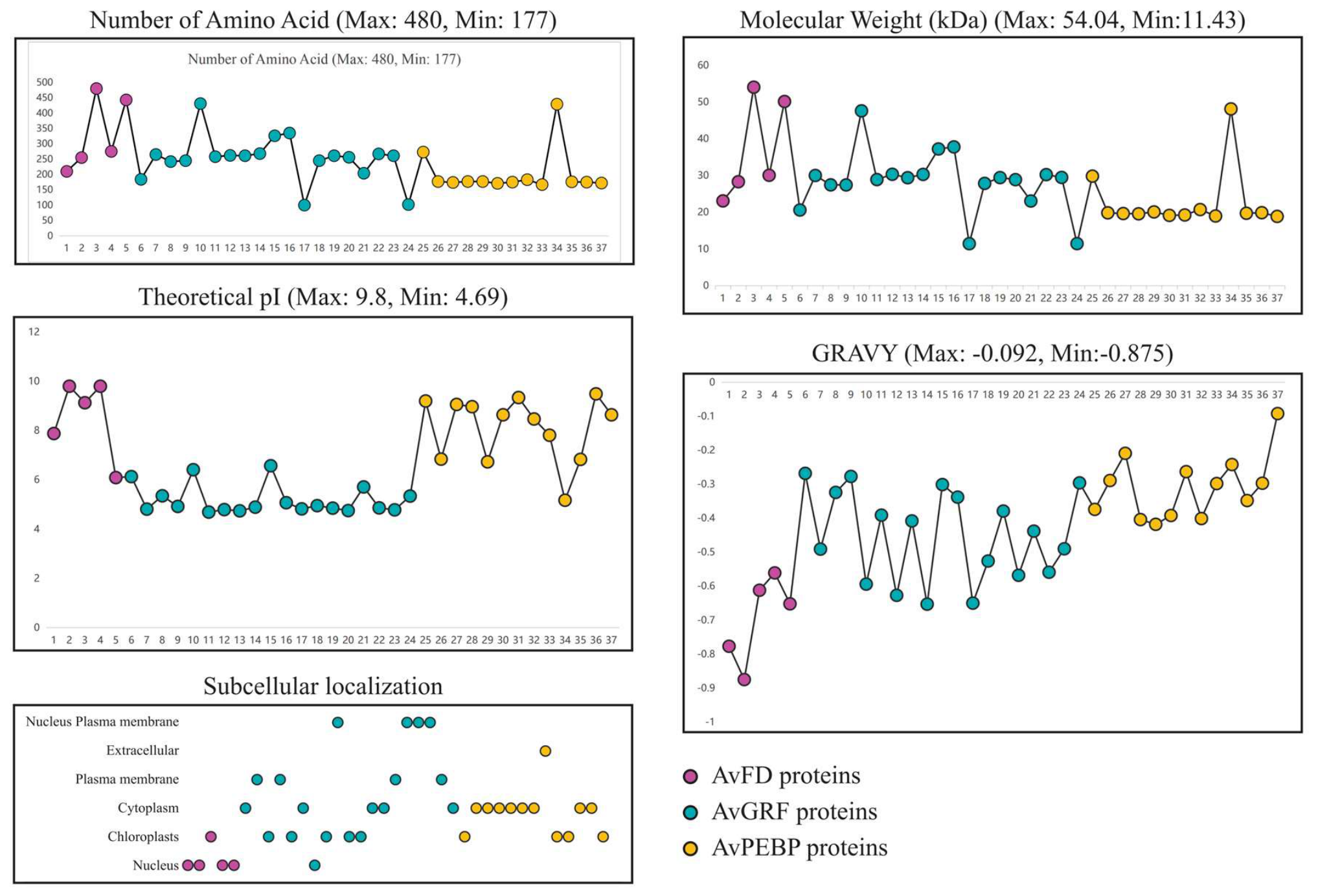
Figure 2.
Chromosomal localization and collinearity analysis of AvPEBP, AvFD, and AvGRF genes in A. villosum. (A) The chromosomal distribution of the 37 identified genes across 21 chromosomes; (B) The intra-species collinearity relationships among the three gene families; (C) Inter-species collinearity analysis between A. villosum and four reference species (Arabidopsis thaliana, Musa acuminata, Canna indica, and Zingiber officinale).
Figure 2.
Chromosomal localization and collinearity analysis of AvPEBP, AvFD, and AvGRF genes in A. villosum. (A) The chromosomal distribution of the 37 identified genes across 21 chromosomes; (B) The intra-species collinearity relationships among the three gene families; (C) Inter-species collinearity analysis between A. villosum and four reference species (Arabidopsis thaliana, Musa acuminata, Canna indica, and Zingiber officinale).
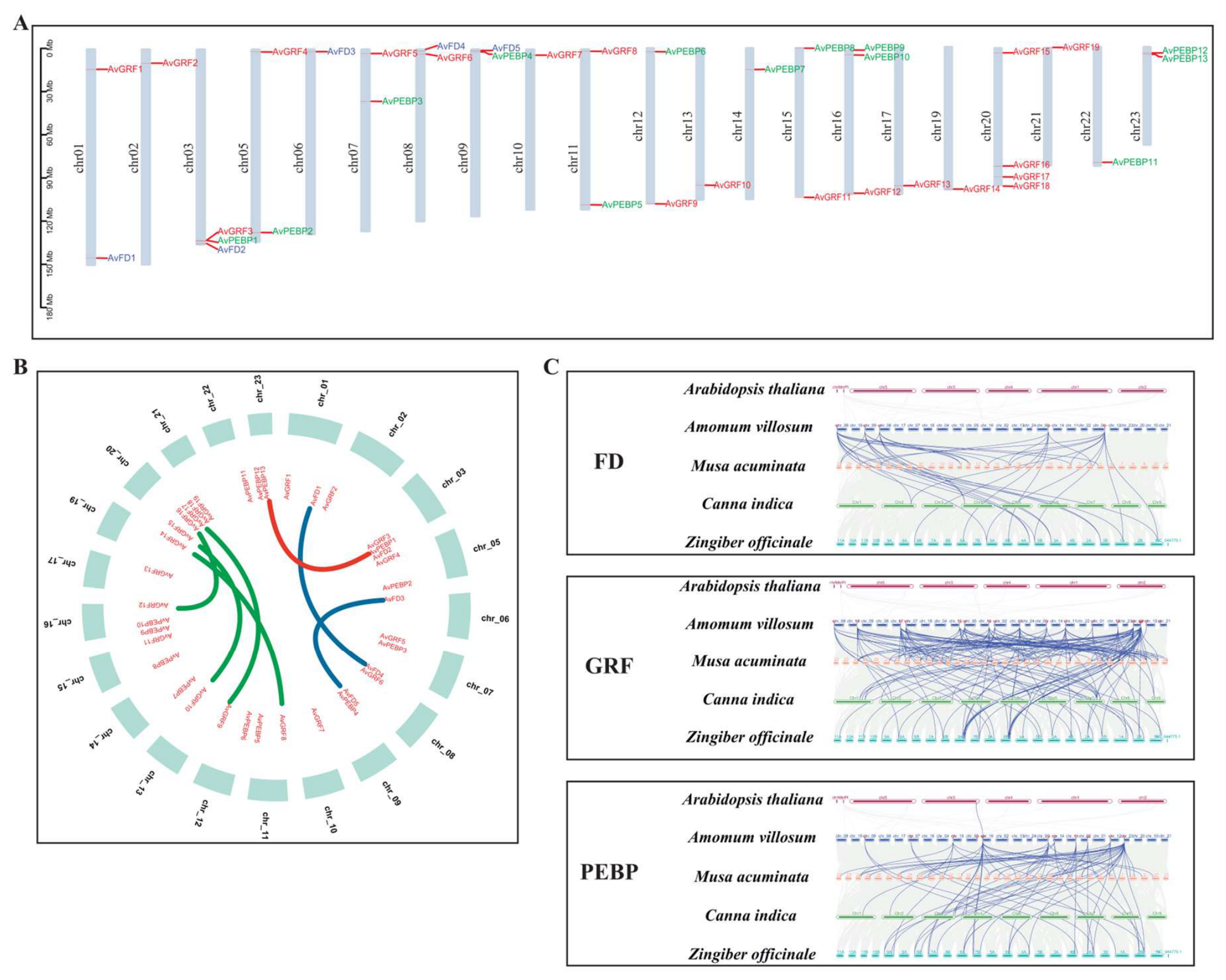
Figure 3.
RAxML-based phylogenetic trees of AvPEBP, AvFD, and AvGRF families in A. villosum. Red solid dots represent proteins derived from A. villosum. (A) AvPEBP family; (B) AvFD family; (C) AvGRF family.
Figure 3.
RAxML-based phylogenetic trees of AvPEBP, AvFD, and AvGRF families in A. villosum. Red solid dots represent proteins derived from A. villosum. (A) AvPEBP family; (B) AvFD family; (C) AvGRF family.
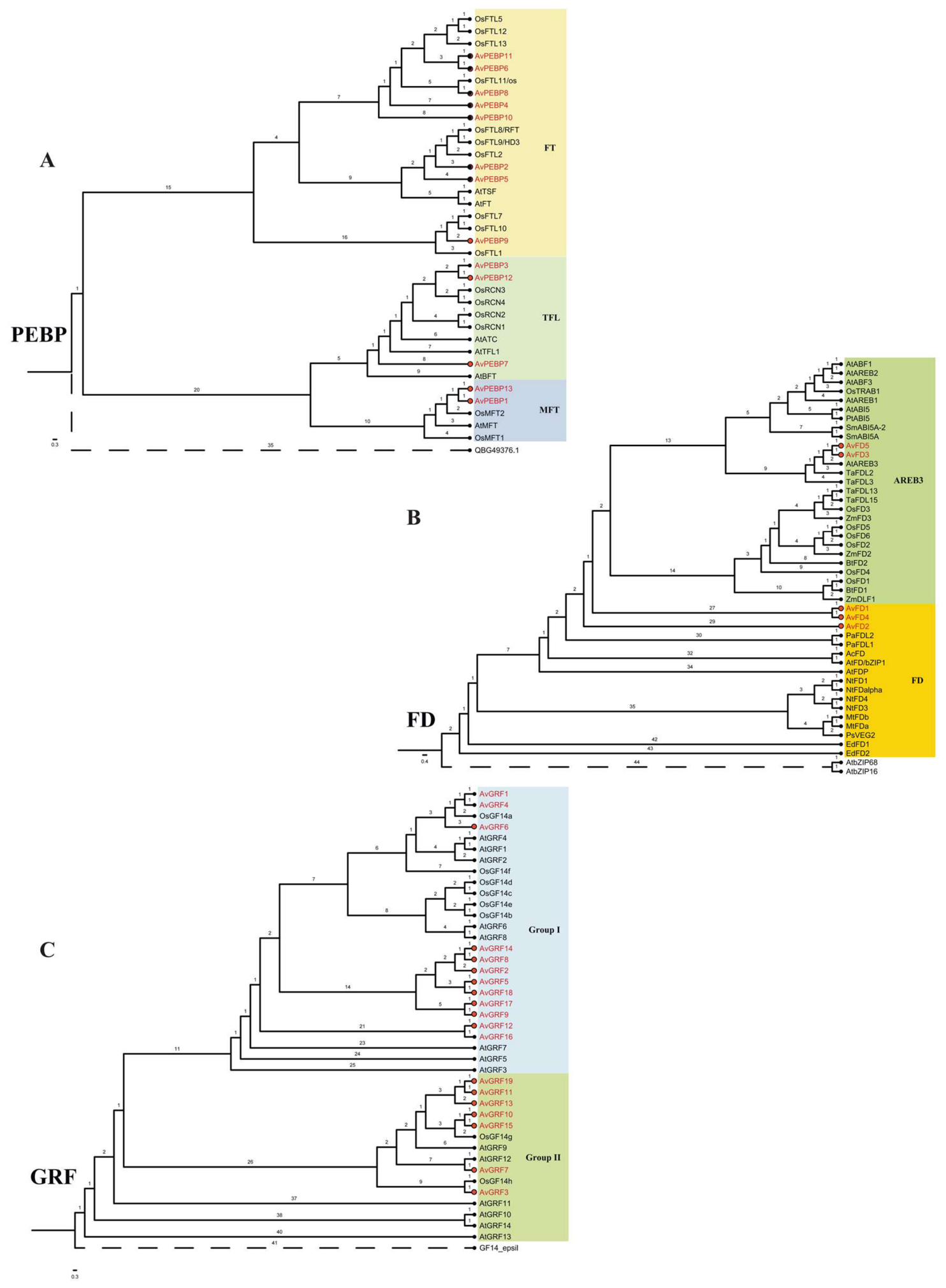
Figure 4.
Phylogenetic relationships and structural characterization of AvPEBP members in A. villosum. (A) Phylogenetic tree of the AvPEBP proteins from A. villosum; (B) Phylogenetic tree of AvPEBP proteins annotated with conserved motifs; (C) Conserved domain architecture of AvPEBP proteins; (D) The distribution of predicted cis-regulatory elements in AvPEBP promoter regions; (E) Distribution of cis-regulatory element categories in AvPEBP genes; (F) Gene structure, specifically exon–intron organization of AvPEBP genes.
Figure 4.
Phylogenetic relationships and structural characterization of AvPEBP members in A. villosum. (A) Phylogenetic tree of the AvPEBP proteins from A. villosum; (B) Phylogenetic tree of AvPEBP proteins annotated with conserved motifs; (C) Conserved domain architecture of AvPEBP proteins; (D) The distribution of predicted cis-regulatory elements in AvPEBP promoter regions; (E) Distribution of cis-regulatory element categories in AvPEBP genes; (F) Gene structure, specifically exon–intron organization of AvPEBP genes.
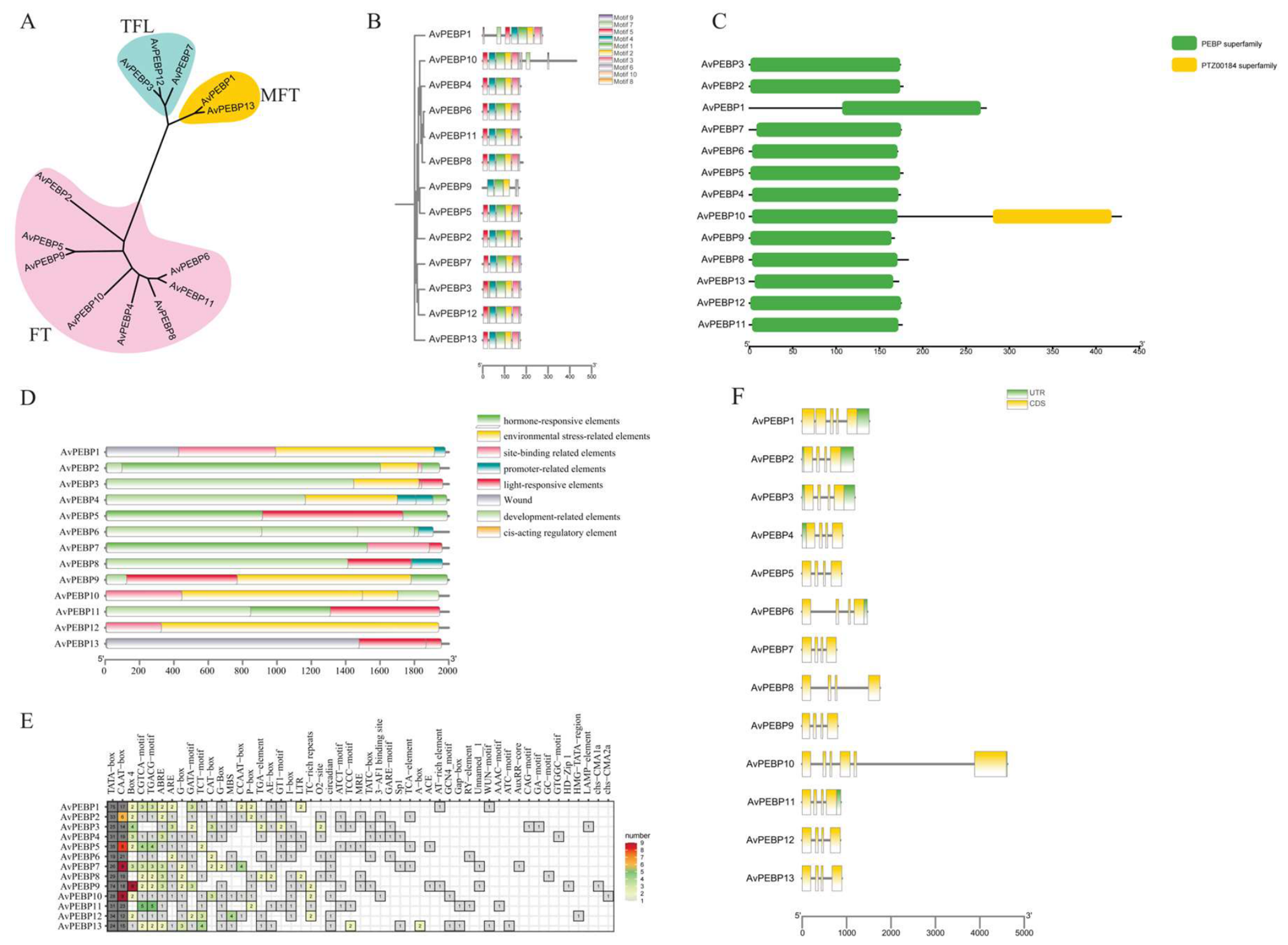
Figure 5.
Phylogenetic relationships and domain architecture of AvFD members in A. villosum. (A) Phylogenetic tree of AvFD proteins; (B) Phylogenetic tree of AvFD proteins annotated with conserved motifs; (C) Conserved domain architecture of AvFD proteins; (D) The distribution of predicted cis-regulatory elements in AvFD promoter regions; (E) Distribution of cis-regulatory element categories in AvFD genes; (F) Gene structure, specifically exon–intron organization of AvFD genes.
Figure 5.
Phylogenetic relationships and domain architecture of AvFD members in A. villosum. (A) Phylogenetic tree of AvFD proteins; (B) Phylogenetic tree of AvFD proteins annotated with conserved motifs; (C) Conserved domain architecture of AvFD proteins; (D) The distribution of predicted cis-regulatory elements in AvFD promoter regions; (E) Distribution of cis-regulatory element categories in AvFD genes; (F) Gene structure, specifically exon–intron organization of AvFD genes.
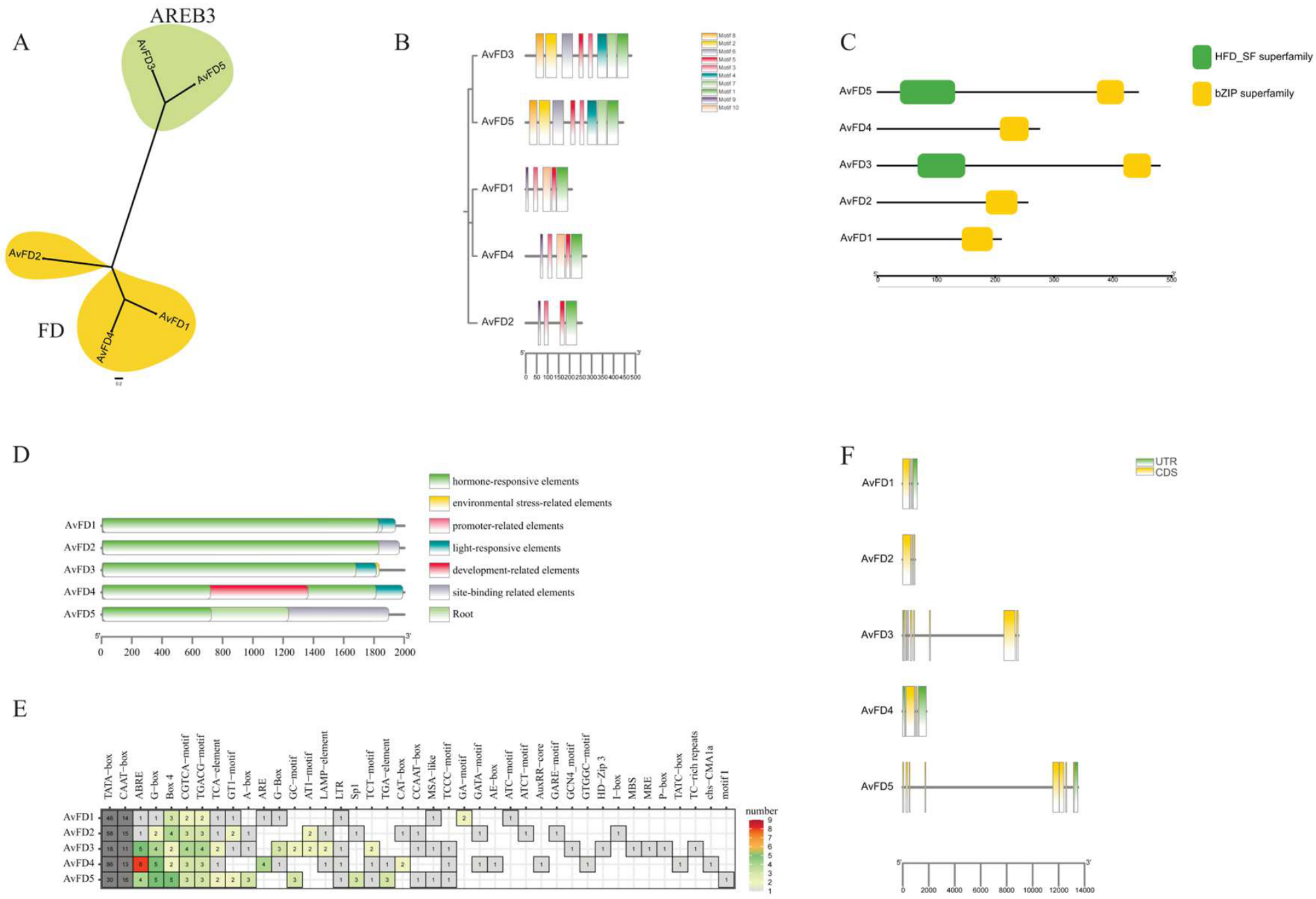
Figure 6.
Phylogenetic relationships and structural characterization of AvGRF members in A. villosum. (A) Phylogenetic tree of AvGRF proteins; (B) Phylogenetic tree of AvGRF proteins annotated with conserved motifs; (C) Conserved domain architecture of AvGRF proteins; (D) The distribution of predicted cis-regulatory elements in AvGRF promoter regions; (E) Distribution of cis-regulatory element categories in AvGRF genes; (F) Gene structure, specifically exon–intron organization, of AvGRF genes.
Figure 6.
Phylogenetic relationships and structural characterization of AvGRF members in A. villosum. (A) Phylogenetic tree of AvGRF proteins; (B) Phylogenetic tree of AvGRF proteins annotated with conserved motifs; (C) Conserved domain architecture of AvGRF proteins; (D) The distribution of predicted cis-regulatory elements in AvGRF promoter regions; (E) Distribution of cis-regulatory element categories in AvGRF genes; (F) Gene structure, specifically exon–intron organization, of AvGRF genes.
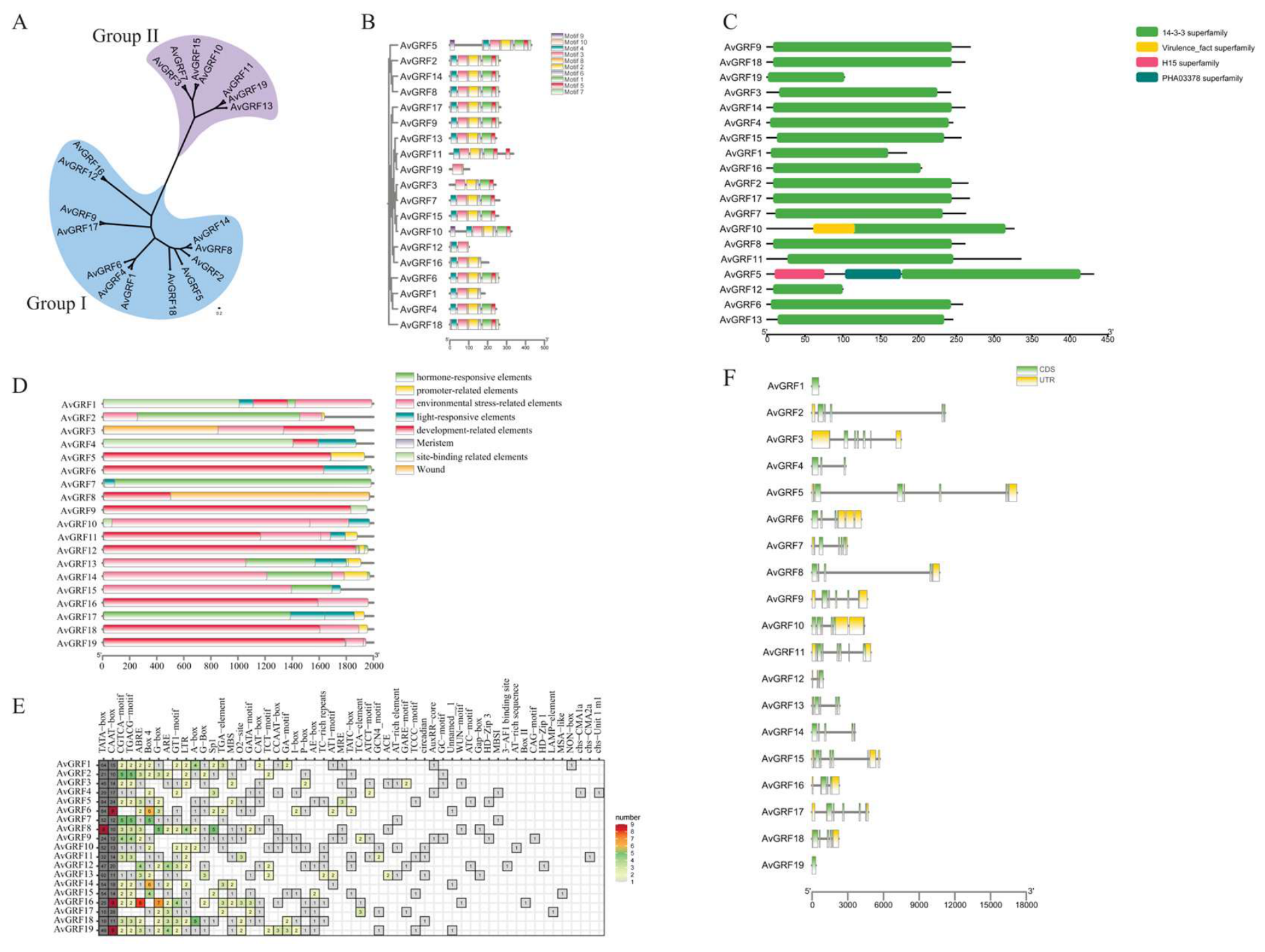
Figure 7.
Predicted PPI network of AvPEBP, AvFD, and AvGRF proteins based on A. thaliana homologs.
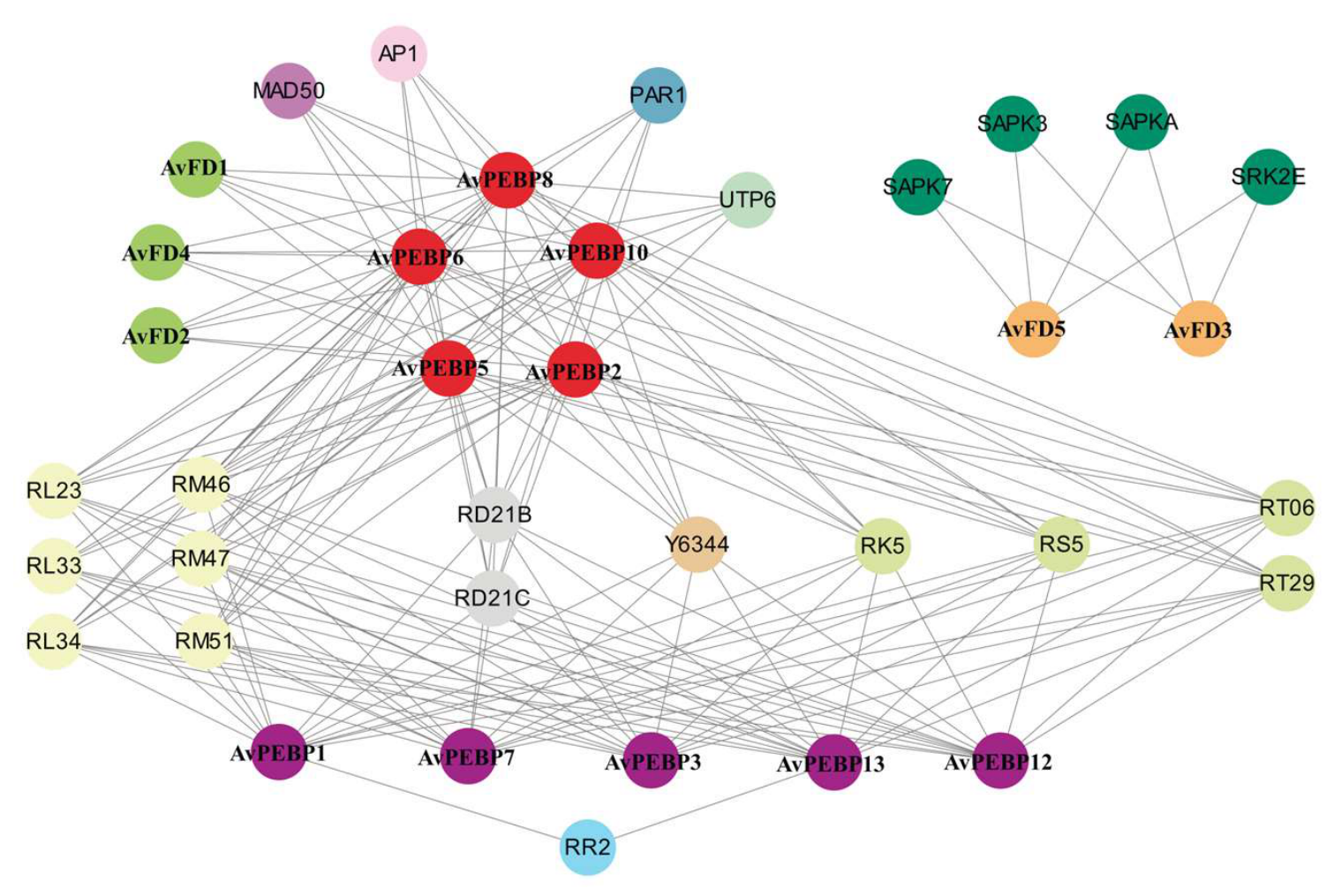
Figure 8.
Predicted PPI network of AvPEBP, AvFD, and AvGRF proteins based on O. sativa homologs.
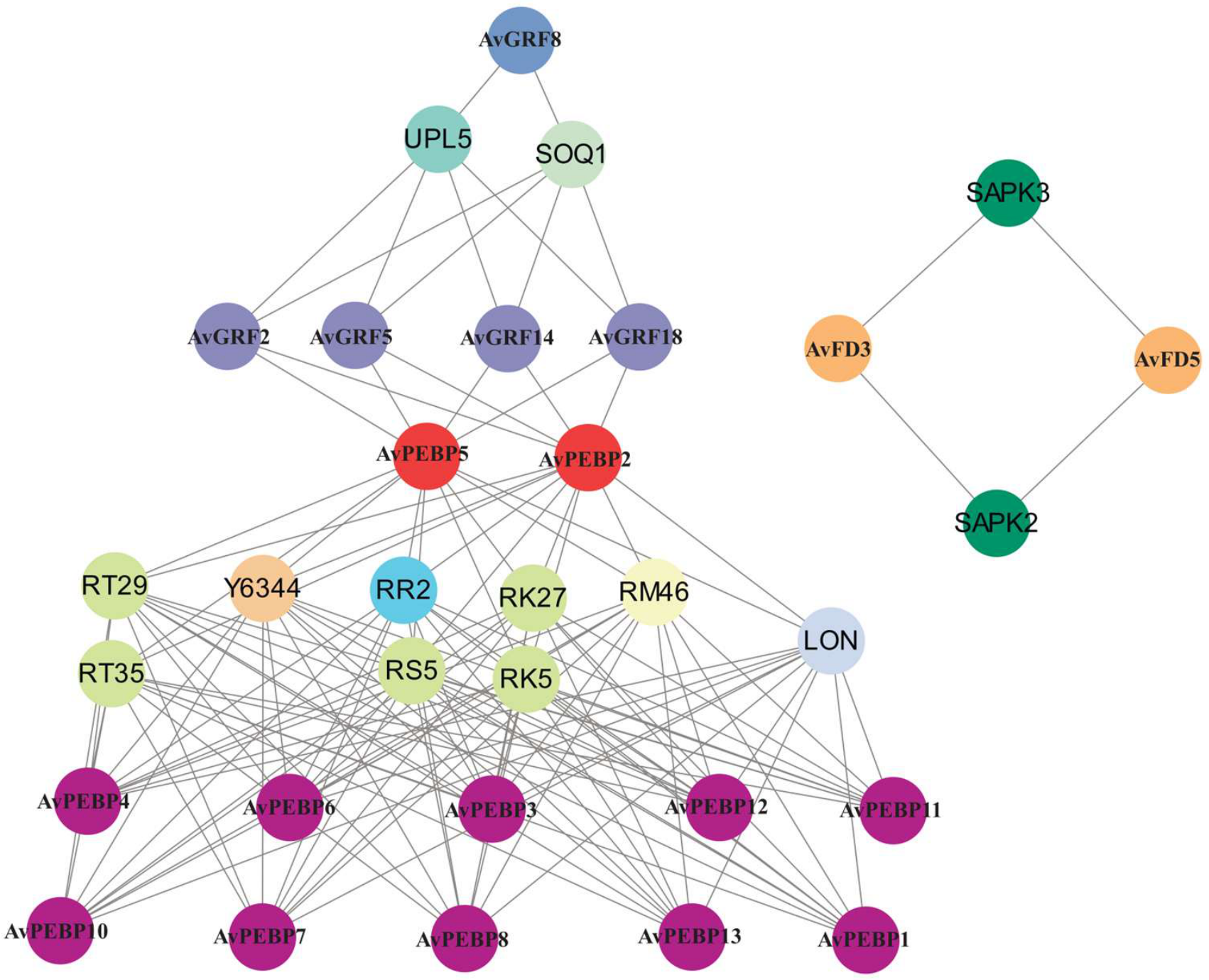
Figure 9.
Yeast two-hybrid assays validating pairwise interactions of AvGRF–AvPEBP and AvFD–AvPEBP. DDO: SD/-Trp/-Leu (transformation control); DDO+X+A: DDO supplemented with X-α-Gal and Aureobasidin A (AbA) for LacZ reporter detection; TDO+X+A: SD/-His/-Trp/-Leu with X-α-Gal and AbA for HIS3 reporter detection; QDO+X+A: SD/-Ade/-His/-Trp/-Leu with X-α-Gal and AbA for ADE2 reporter detection. .
Figure 9.
Yeast two-hybrid assays validating pairwise interactions of AvGRF–AvPEBP and AvFD–AvPEBP. DDO: SD/-Trp/-Leu (transformation control); DDO+X+A: DDO supplemented with X-α-Gal and Aureobasidin A (AbA) for LacZ reporter detection; TDO+X+A: SD/-His/-Trp/-Leu with X-α-Gal and AbA for HIS3 reporter detection; QDO+X+A: SD/-Ade/-His/-Trp/-Leu with X-α-Gal and AbA for ADE2 reporter detection. .
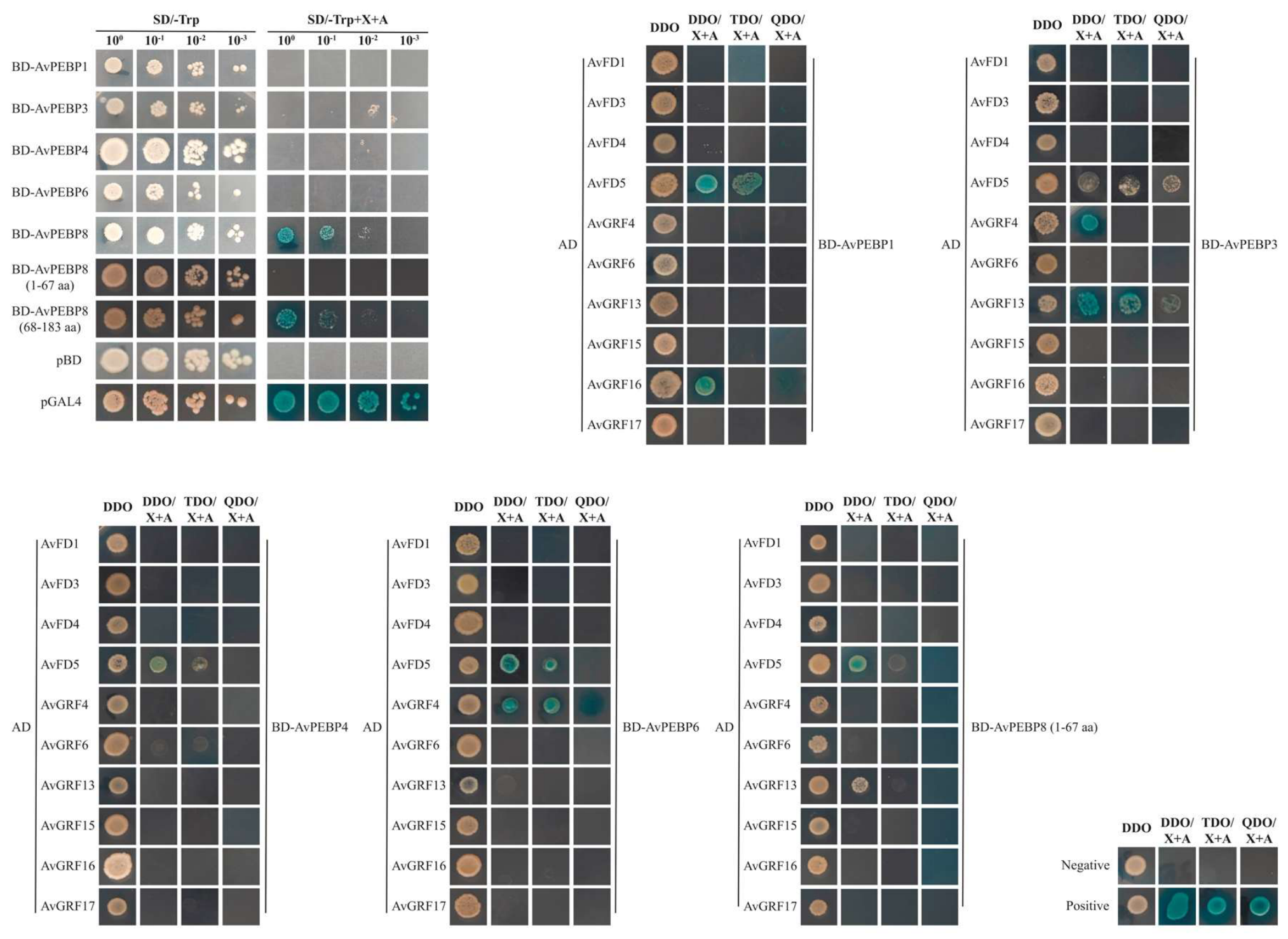
Disclaimer/Publisher’s Note: The statements, opinions and data contained in all publications are solely those of the individual author(s) and contributor(s) and not of MDPI and/or the editor(s). MDPI and/or the editor(s) disclaim responsibility for any injury to people or property resulting from any ideas, methods, instructions or products referred to in the content. |
© 2026 by the authors. Licensee MDPI, Basel, Switzerland. This article is an open access article distributed under the terms and conditions of the Creative Commons Attribution (CC BY) license (http://creativecommons.org/licenses/by/4.0/).
Copyright: This open access article is published under a Creative Commons CC BY 4.0 license, which permit the free download, distribution, and reuse, provided that the author and preprint are cited in any reuse.


