
Submitted:
30 June 2026
Posted:
30 June 2026
You are already at the latest version
Abstract
The emergence of biological membranes was a fundamental step in the origin of cellular life because compartmentalization enabled molecular concentration, selective interactions, and increasingly complex chemical evolution. Although fatty acids have traditionally been regarded as the principal constituents of primitive membranes, the origin of the hydrophilic scaffolds required for more stable amphiphilic systems remains incompletely understood. In this review, we propose that low-molecular-weight polyols—including ethylene glycol, glycerol, tetritols, and related sugar alcohols—were key structural building blocks in the formation of proto-lipids and protomembranes during a pre-phosphate stage of Earth history. Abiotic carbon chemistry is predicted to produce abundant polyols that readily undergo esterification, etherification, hydrogen bonding, and reversible complexation with borate species, thereby facilitating the assembly of structurally diverse amphiphiles. Borate-mediated stabilization of sugars and polyols may have promoted molecular selection, whereas sulfur-rich geochemical environments supplied chemically diverse amphiphiles and redox-active molecular systems. We further propose a pH-dependent evolutionary model in which acidic sulfur-rich environments favored sulfo-protolipids, near-neutral environments promoted mixed polyol–fatty acid membranes, and alkaline boron-rich systems facilitated borate-associated amphiphiles and dynamic supramolecular membrane organization. Hydrogels formed through polyol–borate interactions are suggested as transitional soft-matter systems linking molecular synthesis, compartmentalization, and the emergence of proto-informational assemblies. Modern glycolipids, sulfolipids, archaeal ether lipids, and calditol-containing tetraether membranes provide biological analogues supporting the structural versatility and evolutionary persistence of polyol-based membrane architectures. Although the proposed evolutionary framework remains hypothetical, it integrates prebiotic organic chemistry, membrane biophysics, borate coordination chemistry, sulfur geochemistry, and systems chemistry into a unified model that identifies experimentally testable pathways for the emergence of proto-lipids, protomembranes, and early protocellular organization during the pre-phosphate era.
Keywords:
origin of life
; protomembranes
; proto-lipids
; low-molecular-weight polyols
; borate
; sulfur
; hydrogels
; glycolipids
; pH-dependent evolution
; pre-phosphate Earth
; membrane selfassembly
; protocells
1. Introduction
The emergence of cellular membranes represents one of the most critical transitions in the origin of life [1,2,3,4]. Biological membranes not only define the boundaries of living systems but also provide compartmentalization, selective transport, energy transduction, and the physicochemical framework required for the evolution of increasingly complex biochemical processes [1,2,3,4,5,6,7,8,9]. Despite significant advances in origin-of-life research, the pathways leading from simple prebiotic amphiphiles to stable membrane-forming structures remain incompletely understood.
Current models of protocell formation commonly emphasize the spontaneous self-assembly of fatty acids and related amphiphilic molecules under plausible prebiotic conditions. Such systems readily form micelles, vesicles, and other supramolecular aggregates capable of encapsulating organic compounds [1,3,5,7,9,10,11,12]. However, primitive membranes composed solely of fatty acids are generally characterized by limited stability, sensitivity to environmental fluctuations, and restricted structural diversity. These limitations suggest that additional molecular components may have contributed to the emergence of more robust membrane architectures during early chemical evolution [2,4,6,10].
Among the numerous classes of prebiotic organic compounds, low-molecular-weight polyols occupy a particularly important position [1,6,13,14,15,16,17]. Polyols are readily generated through abiotic carbon-fixation pathways involving formaldehyde, glycolaldehyde, glyceraldehyde, and related intermediates. Experimental and theoretical studies indicate that such reactions produce complex mixtures dominated by ethylene glycol, glycerol, and tetritols, together with smaller quantities of higher polyols [1,6,14,17]. The abundance, chemical versatility, and multiple hydroxyl functionalities of these compounds make them attractive candidates as structural precursors for early complex lipids.
The incorporation of polyols into amphiphilic molecules represents a fundamental evolutionary step beyond simple fatty-acid membranes. Reactions between polyols and hydrophobic components can generate a wide variety of neutral lipids, glycolipids, and related amphiphiles possessing enhanced self-assembly properties [1,2,3,4,6,7,17]. Such molecules are capable of forming more stable membrane structures and may have facilitated the transition from primitive amphiphilic films to increasingly sophisticated protomembranes [1,2,3,4]. In this context, polyols can be viewed as key molecular building blocks that enabled the emergence of membrane complexity prior to the appearance of modern phospholipid-based systems.
An additional factor that may have influenced this process is boron chemistry [18,19]. Borate minerals are known to stabilize sugars and polyols through reversible complexation with cis-vicinal diol groups, thereby affecting molecular stability, distribution, and persistence in prebiotic environments [18,19,20,21,22,23]. Such interactions may have promoted the accumulation of specific polyol-rich molecular pools and indirectly contributed to the formation of early membrane-forming compounds [1]. Consequently, membrane evolution may have occurred during a pre-phosphate stage of chemical evolution in which polyols, amphiphiles, and borate complexes interacted within dynamic geochemical environments [1,6,17].
The objective of this review is to examine the potential role of low-molecular-weight polyols in the formation and evolution of protomembranes during the pre-phosphate era. Particular attention is given to their abiotic formation, theoretical distribution, interactions with boron species, incorporation into lipid structures, and possible contribution to the transition from primitive amphiphilic assemblies to the earliest membrane-bound protocellular systems.
2. The Pre-Phosphate Earth
The chemical environment of the early Earth differed profoundly from that of the modern biosphere [24,25,26,27]. Before the emergence of phosphate-dominated biochemistry, the planet was characterized by intense volcanic activity, extensive hydrothermal circulation, reducing to weakly oxidizing conditions, and a diverse inventory of inorganic compounds capable of participating in prebiotic reactions [28,29,30]. During this period, the availability and reactivity of chemical elements likely played a decisive role in determining the direction of molecular evolution.
Although phosphorus is an indispensable component of modern biological systems, its prebiotic availability has long been recognized as problematic. Most phosphorus on the primitive Earth was probably present in relatively insoluble mineral phases, limiting its immediate participation in aqueous prebiotic chemistry [31,32,33]. Consequently, many researchers have suggested that earlier stages of molecular evolution may have relied on alternative chemical systems before phosphate became incorporated into biological structures and metabolic processes [34,35,36,37].
Among the elements that may have played important roles during this pre-phosphate stage, sulfur and boron are particularly noteworthy [35,36,37]. Sulfur-containing minerals and hydrothermal fluids were widespread on the Hadean and early Archean Earth. Hydrogen sulfide, elemental sulfur, polysulfides, thiosulfates, and metal sulfides were abundant products of volcanic and hydrothermal activity [38,39,40,41]. These sulfur species participated in redox transformations, catalyzed organic reactions, and provided chemically active environments capable of supporting the synthesis and modification of organic molecules. Sulfur-rich settings have therefore been proposed as important locations for early molecular evolution [42,43,44].
At the same time, boron-bearing minerals were likely present in localized evaporitic, volcanic, and hydrothermal environments [45,46,47]. Unlike phosphorus, boron exhibits a unique affinity for compounds containing cis-vicinal diol groups, including sugars and polyols. Borate ions readily form reversible complexes with such molecules, increasing their stability and persistence in aqueous solutions [18,19,20,21,22,23]. Experimental studies have demonstrated that borate can protect carbohydrates from degradation and influence the distribution of reaction products formed during prebiotic synthesis [48,49,50,51]. These properties suggest that boron may have acted as a selective chemical factor during the earliest stages of organic evolution [50,51,52,53,54].
The interaction between sulfur-driven geochemistry and boron-mediated molecular stabilization may have generated a distinctive chemical landscape in which simple organic molecules accumulated and diversified. Within this environment, formaldehyde, glycolaldehyde, glyceraldehyde, sugars, and polyols could be synthesized, stabilized, and concentrated sufficiently to participate in subsequent self-assembly processes. Such compounds provided the molecular foundation for the emergence of increasingly complex amphiphilic systems and ultimately for the formation of protomembranes [1,6,17].
In this framework, the pre-phosphate Earth can be viewed as a transitional stage of chemical evolution dominated by simple organic compounds, polyols, amphiphiles, sulfur-mediated redox processes, and borate-stabilized molecular networks [1,6]. Rather than representing a fully developed biochemical world, this period constituted a preparatory phase during which the molecular building blocks of future biological membranes were generated and selected. The eventual incorporation of phosphate into membrane lipids and nucleic acids can therefore be regarded as a later evolutionary development that emerged from a pre-existing chemical system already enriched in polyols and amphiphilic structures [1,6].
Understanding the physicochemical processes that operated during the pre-phosphate Earth is essential for reconstructing the evolutionary pathway leading from simple organic molecules to membrane-bound protocellular systems [1,6]. In particular, the generation and accumulation of low-molecular-weight polyols may represent a crucial link between prebiotic chemistry and the emergence of the first stable protomembranes.
2.1. The Phosphorus Availability Problem in Prebiotic Evolution
Phosphorus is an indispensable component of modern biological systems and forms the structural backbone of nucleic acids, phospholipids, and numerous metabolic intermediates [55,56]. Nevertheless, the role of phosphorus during the earliest stages of chemical evolution remains a subject of considerable debate. Importantly, the central question is not whether phosphorus was present on the primitive Earth, but whether it was sufficiently available and reactive to participate extensively in prebiotic chemistry [55,56,57,58].
Geochemical evidence indicates that phosphorus was present from the earliest stages of Earth’s history, primarily in phosphate-bearing minerals and meteoritic materials [31,32,33]. However, most phosphate minerals exhibit limited solubility under many environmental conditions, restricting the concentration of bioavailable phosphorus in aqueous systems. Furthermore, phosphate activation presents an additional challenge because the formation of phosphodiester bonds generally requires energetically favorable conditions or activating agents [31,32,56,58].
In contrast, sulfur species were abundant and highly reactive in early volcanic and hydrothermal environments. Hydrogen sulfide, elemental sulfur, sulfates, sulfites, thiosulfates, and polysulfides participated in diverse redox reactions and continuously cycled through geological systems [34,35,36,37,38]. Similarly, boron-bearing minerals and dissolved borate species were capable of interacting directly with sugars and polyols through reversible complexation reactions, influencing molecular stability and selection [46,47]. Both sulfur and boron therefore possessed physicochemical properties that enabled active participation in prebiotic reaction networks.
These differences suggest that sulfur- and boron-mediated chemistry may have played disproportionately important roles during the earliest stages of molecular evolution, even though phosphorus was already present in the environment [59,60,61]. Sulfur contributed chemical diversity, redox activity, and molecular transformation, whereas boron promoted molecular stabilization and selective retention of specific carbohydrates and polyols [1,6]. In contrast, phosphate may have remained a relatively minor participant until suitable geochemical conditions enabled its concentration and incorporation into increasingly complex molecular systems [62,63,64,65].
Within this framework, the term “pre-phosphate era” does not imply the absence of phosphorus from the early Earth [66]. Rather, it refers to a stage of chemical evolution during which sulfur- and boron-mediated processes exerted greater influence on molecular organization, selection, and self-assembly than phosphate-dependent chemistry. The eventual emergence of phosphate-based nucleic acids and phospholipid membranes therefore represents a later evolutionary transition built upon pre-existing sulfur–boron chemical networks [62,63,64,65,66].
3. Abiotic Formation of Sugars and Polyols
The emergence of membrane-forming systems on the prebiotic Earth required not only amphiphilic molecules but also suitable hydrophilic structural components capable of generating increasingly complex lipid architectures [1,6,17]. Among the most plausible candidates are low-molecular-weight polyols, a diverse group of compounds containing multiple hydroxyl groups that occupy a central position in both modern biochemistry and hypothetical prebiotic reaction networks [1,67,68,69,70]. Understanding how these compounds could have formed under abiotic conditions is therefore essential for reconstructing the evolutionary pathway leading to protomembrane formation.
One of the earliest and most influential models for the abiotic generation of carbohydrates is based on the formose reaction originally described by Butlerov in the nineteenth century [71,72]. In aqueous alkaline media, formaldehyde undergoes a sequence of condensation and rearrangement reactions leading to the formation of increasingly complex carbon skeletons. The first critical intermediate is glycolaldehyde, which subsequently participates in autocatalytic aldol reactions to generate glyceraldehyde, tetroses, pentoses, hexoses, and other carbohydrates. Once initiated, this network is capable of producing a remarkably diverse mixture of sugars under conditions considered plausible for the primitive Earth [1,6,17].
Within this reaction sequence, glyceraldehyde occupies a particularly important position. As the simplest chiral sugar and a central intermediate of carbohydrate chemistry, glyceraldehyde provides a direct link between simple carbon compounds and more complex sugars [72,73,74,75,76]. Successive additions of formaldehyde or glycolaldehyde units generate higher aldoses, while parallel reduction reactions convert these aldehydes into the corresponding polyols. Consequently, the abiotic synthesis of sugars and polyols can be viewed as interconnected processes occurring within the same chemical network. The proposed evolutionary pathway can be summarized as follows [1,2,71,73]:
Formaldehyde → Glycolaldehyde → Glyceraldehyde → Sugars → Polyols
This sequence provides a plausible mechanism for the accumulation of both carbohydrates and polyhydric alcohols in prebiotic environments. Because aldehydes and sugars are susceptible to reduction under various geochemical conditions, the conversion of carbohydrates into corresponding polyols may have been a common process during early chemical evolution (Figure 1). Potential reducing agents include hydrogen, hydrogen sulfide, metal ions, mineral surfaces, and hydrothermal redox systems [77,78,79].
A notable feature of this model is that the resulting polyol distribution is predicted to be highly non-random. Chemical and mathematical analyses suggest that low-molecular-weight polyols dominate the reaction products, whereas compounds containing larger numbers of hydroxyl groups become progressively less abundant [1]. The theoretical distribution indicates that ethylene glycol represents approximately 40% of the total polyol pool, glycerol approximately 33%, and tetritols approximately 17%, together accounting for more than 90% of all polyols produced [1]. Polyols containing five or more hydroxyl groups are predicted to occur only in minor amounts (see Table 1). This distribution reflects both kinetic constraints within the reaction network and the tendency of larger carbohydrates to undergo cyclization and stabilization processes.
The predominance of ethylene glycol, glycerol, and tetritols has important implications for membrane evolution. These molecules possess physicochemical properties that make them particularly suitable as hydrophilic backbones for amphiphilic compounds. Their relatively small size, high solubility, multiple hydroxyl functionalities, and ability to undergo esterification or etherification reactions facilitate the formation of increasingly complex lipid structures. Consequently, these polyols may have served as the principal molecular scaffolds from which the earliest proto-lipids were assembled.
An additional factor influencing polyol accumulation may have been borate complexation. Sugars and higher polyols readily form reversible complexes with borate ions through cis-vicinal diol groups [17,19,20,80,81,82,83]. Such interactions can stabilize specific molecules while simultaneously altering their participation in ongoing reaction networks. Borate-mediated molecular selection may therefore have contributed to the observed predominance of lower polyols by removing certain sugars and highly hydroxylated compounds from the reactive pool. In this manner, boron chemistry could have influenced not only carbohydrate stability but also the overall composition of prebiotic organic mixtures [1,6].
Taken together, available chemical, experimental, and theoretical evidence supports the existence of a prebiotic polyol-rich environment dominated by ethylene glycol, glycerol, and tetritols [1]. These compounds provided a readily available reservoir of multifunctional building blocks capable of participating in the synthesis of increasingly complex amphiphilic molecules. The emergence of such a polyol world represents a critical transitional stage between simple prebiotic organic chemistry and the appearance of membrane-forming proto-lipids.
4. Borate Stabilization and Molecular Selection
Among the inorganic elements proposed to have influenced prebiotic chemical evolution, boron occupies a unique position because of its strong and selective interaction with compounds containing cis-vicinal diol groups [17,19,20,80,81,82,83]. Unlike most simple inorganic ions, borate species can form reversible covalent complexes with sugars, polyols, and other polyhydroxylated molecules, thereby affecting their stability, reactivity, and persistence in aqueous environments. These properties suggest that boron may have functioned as an important molecular selection factor during the pre-phosphate stage of Earth’s history [1,2].
Under neutral to mildly alkaline conditions, boric acid and borate ions readily react with vicinal diols to form cyclic borate esters. Such complexes are particularly favored for carbohydrates and polyols containing adjacent hydroxyl groups arranged in suitable stereochemical orientations. The resulting borate esters are dynamic and reversible, continuously forming and dissociating in response to changes in pH, temperature, ionic strength, and reactant concentrations [52,84]. This reversible behavior distinguishes borate chemistry from the more permanent covalent bonding characteristic of modern biological macromolecules.
One of the most important consequences of borate complexation is the stabilization of otherwise unstable carbohydrates. Experimental studies have demonstrated that borate can protect sugars from degradation and rearrangement reactions, thereby increasing their lifetime in aqueous solution. Ribose has received particular attention because of its central role in modern nucleic acids, but numerous other sugars and polyols exhibit similar stabilization effects [52,53]. Consequently, boron-rich environments may have served as natural reservoirs in which specific classes of polyhydroxylated compounds accumulated over time [84,85,86,87].
The interaction of borate with sugars and polyols may also explain the theoretical distribution patterns observed in prebiotic polyol synthesis. Polyols containing four or more hydroxyl groups readily form stable borate complexes, effectively removing a fraction of these compounds from the active reaction pool. As a result, continued chain extension and further molecular transformations become less probable. In contrast, smaller polyols such as ethylene glycol and glycerol exhibit weaker tendencies toward stable borate complex formation and therefore remain more readily available for subsequent chemical reactions. This mechanism provides a plausible explanation for the predominance of low-molecular-weight polyols predicted by chemical and mathematical models [1].
Beyond molecular stabilization, borate chemistry may have contributed to a broader process of chemical selection [52,53,84,85,86,87]. Prebiotic reaction networks likely generated highly complex mixtures containing thousands of organic compounds. Without selective mechanisms, such molecular diversity could hinder the emergence of organized chemical systems. Borate complexation introduces an element of selectivity by preferentially interacting with specific structural motifs, particularly cis-vicinal diol groups. In this way, boron may have acted as a primitive molecular filter, enriching certain compounds while reducing the effective complexity of the surrounding chemical environment.
The consequences of this selection process extend beyond carbohydrate chemistry. Polyols stabilized by borate interactions could persist long enough to participate in reactions with amphiphilic molecules, including fatty acids, fatty alcohols, and other hydrophobic compounds. Such reactions would facilitate the formation of increasingly complex lipid-like structures containing polyol backbones. Thus, boron-mediated molecular selection may have indirectly promoted the emergence of proto-lipids by preserving and concentrating the very compounds required for their synthesis [6,17,88].
The dynamic nature of borate ester formation introduces another important feature relevant to prebiotic evolution. Unlike modern phosphodiester bonds, borate esters form and dissociate reversibly under environmentally accessible conditions [18,19,20,21,22,23]. This reversibility allows continuous molecular exchange, adaptation, and self-organization within complex chemical systems [1,6,17,88]. Such behavior is consistent with the concept of a chemically dynamic pre-phosphate world in which molecular assemblies remained flexible and responsive to changing environmental conditions.
Collectively, these observations suggest that boron played a dual role during early chemical evolution. First, it stabilized sugars and polyols, increasing their persistence in prebiotic environments. Second, it acted as a selective agent that influenced the composition of emerging organic mixtures. Through these combined effects, borate chemistry may have helped establish the molecular inventory from which the earliest polyol-based amphiphiles and proto-lipids subsequently emerged.
4.1. pH-Driven Molecular Selection on the Pre-Phosphate Earth
One of the most important yet often overlooked factors influencing prebiotic chemical evolution is environmental pH [89,90]. The primitive Earth was not chemically uniform but consisted of diverse geochemical environments generated by volcanic activity, hydrothermal circulation, evaporitic processes, atmospheric interactions, and mineral weathering [89,90,91,92]. As a result, acidic, neutral, and alkaline habitats likely coexisted across the planetary surface, each favoring distinct classes of chemical reactions and molecular assemblies.
Within the framework proposed here, pH acted as a fundamental selective force that influenced molecular stability, reactivity, and self-organization long before the emergence of biological evolution. Different chemical domains promoted the accumulation of different molecular populations, thereby shaping the pathways leading toward proto-lipids, protomembranes, and ultimately proto-informational systems [1,2,6,17,88].
4.1.1. Acidic Domain: Sulfur-Driven Chemistry
Acidic environments were widespread in volcanic regions, sulfur-rich hydrothermal systems, and areas influenced by the oxidation of sulfur-containing gases. These settings were characterized by elevated concentrations of hydrogen sulfide, sulfur dioxide, elemental sulfur, sulfites, thiosulfates, and sulfates [93,94]. Sulfur species participated in diverse redox transformations and provided chemically reactive environments capable of modifying organic molecules.
Under acidic conditions, sulfur-containing compounds often exhibit greater stability than borate complexes. Consequently, sulfur-rich amphiphiles, thiols, thioesters, sulfolipids, and sulfur-containing carbohydrates may have accumulated preferentially within these environments [93,94,95,96]. Such molecules possess significant capacities for molecular recognition, redox activity, and self-assembly, potentially forming the earliest sulfur-dominated chemical networks. Acidic domains therefore represent plausible settings for the emergence of sulfur-based molecular organization and primitive information-processing systems.
4.1.2. Neutral Domain: Mixed Amphiphilic Chemistry
Neutral environments likely represented the most extensive regions of the prebiotic Earth, including shallow ponds, tidal zones, coastal environments, and many surface aqueous systems. These conditions favor the coexistence of diverse organic compounds and support a broad range of condensation, hydrolysis, and self-assembly reactions [97,98].
Within neutral environments, fatty acids, alcohols, polyols, sugars, and glycolipid-like molecules could coexist and interact [1,2,6]. The resulting mixed amphiphilic systems would have possessed enhanced structural diversity compared with purely sulfur- or boron-dominated chemistries. Neutral pH conditions are particularly favorable for the spontaneous formation of vesicles, bilayers, and related supramolecular assemblies. Consequently, these environments may have served as major sites for the emergence of polyol-containing proto-lipids and increasingly complex membrane structures.
4.1.3. Alkaline Domain: Boron-Driven Molecular Selection
Alkaline environments, particularly those associated with serpentinization-driven hydrothermal systems and evaporitic borate deposits, may have played a unique role in molecular selection [99,100,101]. Under alkaline conditions, boric acid is increasingly converted into borate species capable of forming reversible complexes with cis-vicinal diol groups present in sugars and polyols [1,6,17,88].
Borate complexation selectively stabilizes specific carbohydrates and polyhydroxylated compounds while simultaneously influencing their participation in ongoing reaction networks. Such interactions may have promoted the accumulation of ribose, polyols, and related molecules that otherwise would have remained unstable in aqueous solution. As a result, alkaline boron-rich environments may have functioned as natural molecular-selection systems capable of reducing chemical complexity and enriching particular classes of compounds [6,88].
The stabilization of polyols and sugars by borate chemistry also creates favorable conditions for the formation of borate-associated amphiphiles and dynamic supramolecular assemblies. These environments may therefore have contributed directly to the emergence of proto-lipids, protomembranes, and early proto-informational systems.
4.1.4. Integrated pH-Driven Evolutionary Model
Taken together, acidic, neutral, and alkaline environments may have functioned as complementary chemical domains operating simultaneously on the prebiotic Earth [102,103,104]. Rather than competing hypotheses, sulfur-rich and boron-rich chemistries may represent different components of a larger planetary-scale evolutionary system (Table 2).
Within this framework, pH-driven molecular selection represents a major organizing principle of prebiotic evolution. Sulfur-rich acidic environments promoted chemical diversity and redox activity, neutral environments facilitated amphiphilic self-assembly, and alkaline boron-rich environments enhanced molecular stabilization and selection [94,98,103]. The interaction of these domains may have generated the physicochemical conditions necessary for the emergence of polyol-derived proto-lipids, protomembranes, and the earliest stages of protocellular evolution.
4.2. Quantitative Aspects of Borate–Polyol Interactions
The role of boron in prebiotic chemistry extends beyond its qualitative ability to stabilize sugars and polyols [6,17,88]. The physicochemical properties of boric acid and borate ions provide a quantitative framework that helps explain why boron may have acted as an effective molecular selection factor during the pre-phosphate era.
In aqueous solution, boron is present primarily as boric acid, B(OH)3, which behaves as a weak Lewis acid rather than a classical Brønsted acid [105,106]. The equilibrium between boric acid and borate is governed by the reaction:
B(OH)3 + H2O ⇌ B(OH)4− + H+
The pKa of boric acid is approximately 9.2 at ambient temperature, indicating that borate formation becomes increasingly favored under mildly alkaline conditions. Consequently, borate-mediated molecular stabilization is expected to be most effective in environments with pH values above approximately 8–9, such as alkaline hydrothermal systems, evaporitic basins, and serpentinization-associated aqueous environments [107,108,109].
A unique feature of borate chemistry is its strong affinity for compounds containing cis-vicinal diol groups [18,19,20,21,22,23]. These structural motifs permit the formation of cyclic borate esters in which boron adopts a tetrahedral coordination geometry. The stability of the resulting complexes depends strongly on the stereochemical arrangement of hydroxyl groups. Molecules containing properly oriented cis-diols form substantially stronger complexes than compounds lacking such configurations.
Experimental studies have shown that equilibrium association constants for borate–diol interactions typically fall within the range [81,82,83,84]:
Log K ≈ 1–6
The preferential interaction of borate with cis-diol-containing molecules introduces an important element of molecular selection. Prebiotic reaction networks likely generated highly diverse mixtures of carbohydrates and polyols [1,6,14,17,88]. Borate complexation selectively stabilizes only a subset of these compounds, effectively reducing chemical complexity while increasing the persistence of molecules possessing favorable stereochemical arrangements. This process may have enriched specific sugars and polyols within localized boron-rich environments.
Particularly significant is the interaction between borate and ribose. Experimental studies have demonstrated that borate can stabilize ribose against degradation and rearrangement reactions more effectively than many alternative sugars [52,53,84,85,86,100]. Although ribose was only one component of complex prebiotic reaction mixtures, borate-mediated stabilization may have increased its relative abundance and persistence. Such selective stabilization has frequently been cited as a possible explanation for the eventual incorporation of ribose into RNA chemistry.
Borate complexation also influences the physicochemical behavior of amphiphilic systems. Polyol-containing amphiphiles, glycolipids, and carbohydrate-rich membrane precursors may undergo reversible borate ester formation, generating dynamic supramolecular networks [1,6,14,17,88]. These interactions can modify molecular organization, membrane stability, hydration properties, and self-assembly behavior. Because borate ester formation remains reversible under environmentally accessible conditions, such systems retain a high degree of adaptability while maintaining overall structural coherence.
The quantitative properties of borate chemistry therefore support the hypothesis that boron functioned not merely as a passive stabilizing agent but as an active molecular selector. Through pH-dependent complexation, preferential recognition of cis-vicinal diols, and stabilization of specific sugars and polyols, borate may have helped define the molecular inventory available for the emergence of proto-lipids [1,6,88], protomembranes, and early proto-informational systems during the pre-phosphate stage of chemical evolution.
5. Polyols as Structural Building Blocks of Proto-Lipids
The emergence of membrane-forming systems required the integration of hydrophilic and hydrophobic molecular components into stable amphiphilic structures. While fatty acids, fatty alcohols, and related hydrophobic molecules are widely recognized as plausible constituents of primitive membranes, the origin of the hydrophilic scaffolds necessary for more complex lipid architectures remains less thoroughly explored. Evidence from both theoretical models and modern biological systems suggests that low-molecular-weight polyols may have fulfilled this role during the pre-phosphate era.
Polyols possess several physicochemical characteristics that make them particularly suitable as structural building blocks for proto-lipids (Table 1). Their multiple hydroxyl groups provide numerous sites for esterification, etherification, hydrogen bonding, and metal-ion coordination. In addition, their high water solubility facilitates interaction between aqueous and hydrophobic phases, thereby promoting the formation of amphiphilic molecules. These properties enable polyols to function as molecular bridges linking hydrophobic chains to hydrophilic head groups.
Among the polyols predicted to dominate prebiotic environments, ethylene glycol, glycerol, and tetritols are of particular importance [1]. Chemical and mathematical models indicate that these compounds collectively account for more than 90% of the theoretical polyol pool generated through abiotic synthesis pathways. Their abundance would have greatly increased the probability of participation in lipid-forming reactions compared with less common higher polyols.
The simplest proto-lipids may have arisen through reactions between fatty acids and low-molecular-weight polyols [1,6,88]. Esterification of fatty acids with ethylene glycol could generate diol lipids, whereas reactions involving glycerol would produce glycerolipid analogues. Tetritols and other polyols containing additional hydroxyl groups could generate more structurally diverse amphiphilic molecules possessing multiple hydrophilic functionalities [1]. Such compounds would represent an evolutionary advance over membranes composed solely of free fatty acids because they combine hydrophobic domains with more sophisticated hydrophilic frameworks.
An important feature of polyol-derived proto-lipids is their structural diversity. Even relatively simple polyols can generate numerous molecular architectures depending on the number, position, and type of attached hydrophobic chains (Figure 1). This diversity increases substantially when sugars and borate-stabilized polyols are included in the reaction network. Consequently, early prebiotic environments may have contained extensive populations of amphiphilic molecules differing in size, polarity, flexibility, and self-assembly behavior.
Particularly significant are glycolipid-like structures generated through the association of sugars, polyols, and hydrophobic chains (1-17, Figure 1). Such molecules are widespread in modern organisms and are capable of forming highly ordered supramolecular assemblies. Their existence in contemporary biological systems suggests that polyol-based amphiphiles possess favorable physicochemical properties for membrane formation and long-term evolutionary persistence. The first complex lipids may therefore have resembled primitive glycolipids rather than modern phospholipids.
The evolutionary importance of polyol-derived proto-lipids becomes apparent when compared with simple fatty-acid membranes. Fatty-acid vesicles can form spontaneously under laboratory conditions; however, they often exhibit limited mechanical stability and high sensitivity to environmental variables such as pH, ionic strength, and temperature. Incorporation of polyol-based amphiphiles increases structural complexity and expands the range of possible intermolecular interactions. Hydrogen bonding between hydroxyl groups, together with interactions involving sugars and borate complexes, may have contributed to greater membrane stability and functional diversity.
Modern biological membranes provide indirect support for this hypothesis. Polyols serve as structural backbones in numerous classes of membrane lipids, including glycerolipids, glycolipids, ether lipids, and several specialized lipid families found in microorganisms, plants, and animals [1,2,3]. The widespread occurrence of polyol-derived lipids throughout contemporary life suggests that these molecules possess exceptional evolutionary utility. Their persistence across billions of years of biological evolution may reflect an ancient origin rooted in prebiotic chemistry.
In this framework, proto-lipids are not viewed merely as modified fatty acids but as products of an emerging polyol-rich chemical world. The incorporation of low-molecular-weight polyols into amphiphilic molecules represents a critical evolutionary transition linking simple prebiotic organic chemistry with the development of increasingly sophisticated membrane systems. These proto-lipids subsequently provided the molecular foundation for the assembly of the first protomembranes and the emergence of compartmentalized protocellular structures.
Figure 1 summarizes the central hypothesis developed throughout this review. It proposes that the abiotic production of sugars and polyols by Butlerov-type chemistry generated a diverse pool of vicinal diol-containing molecules capable of interacting with boric acid and borate under appropriate geochemical conditions [71,72]. Reversible borate complexation would have stabilized these otherwise labile carbohydrates while simultaneously enabling their association with simple amphiphilic molecules through dynamic borate ester formation (1-17). The resulting amphiphile–carbohydrate conjugates combine hydrophobic membrane-forming domains with highly hydrated polyol headgroups, providing a plausible route toward increasingly organized supramolecular assemblies [1,6,17,88]. Rather than representing isolated chemical reactions, the three panels illustrate successive stages in a continuous evolutionary sequence linking prebiotic organic synthesis, borate-mediated molecular stabilization, and the emergence of primitive membrane-forming systems. This framework forms the basis for the subsequent discussion of borate-associated protolipids, protocellular membranes, and the transition toward more complex prebiotic compartmentalization [1,6,88].
5.1. Modern Membrane Analogues Supporting the Polyol Hypothesis
Although the molecular composition of the earliest membranes remains unknown, modern biological systems provide valuable examples demonstrating the remarkable versatility of polyol-containing amphiphiles. Numerous contemporary membrane lipids incorporate polyols, carbohydrates, and sulfur-containing headgroups as essential structural components. These molecules illustrate how simple hydrophilic building blocks can generate stable membrane architectures and therefore offer useful analogues for evaluating possible pathways of protomembrane evolution [1,6,17].
5.1.1. Archaeal Tetraether Membranes
Among the most robust biological membranes known are those produced by Archaea [2,3,113,114,115,116,117]. Many thermophilic and acidophilic archaeal species synthesize glycerol-based tetraether lipids in which two glycerol molecules are connected by long isoprenoid chains to form membrane-spanning amphiphiles. Unlike conventional phospholipid bilayers, these tetraether lipids frequently assemble into continuous monolayer membranes exhibiting exceptional resistance to heat, acidity, oxidation, and mechanical stress [113,114,115,116,117].
The evolutionary significance of archaeal tetraethers lies in their demonstration that polyol-containing amphiphiles can generate highly stable membrane systems without requiring the structural organization characteristic of modern phospholipid bilayers. Their existence supports the broader concept that simple polyol-based lipid architectures may have been sufficient to produce durable membrane compartments during early evolution.
5.1.2. Calditol-Containing Membranes
Particularly relevant to the present hypothesis are calditol-containing tetraether lipids found in several thermoacidophilic archaea [118,119]. Calditol is a cyclic polyol closely related to sugar alcohols and serves as an integral component of specialized membrane lipids adapted to extreme environments. The incorporation of calditol increases hydrogen-bonding capacity, enhances membrane cohesion, and contributes to remarkable thermal and acid stability [118,119,120,121].
From an evolutionary perspective, calditol-containing membranes demonstrate that polyols can function not merely as auxiliary membrane components but as central structural elements within highly successful biological membranes [118,121]. These systems provide one of the strongest modern examples supporting the potential importance of polyol-rich amphiphiles during prebiotic membrane evolution.
5.1.3. Glycolipid Membranes
Glycolipids represent another important class of modern membrane constituents. These amphiphiles contain carbohydrate headgroups linked to hydrophobic lipid chains and are widespread throughout bacteria, archaea, plants, and animals. Glycolipids participate in membrane stabilization, molecular recognition, signaling, and supramolecular organization [122,123,124].
The structural similarity between glycolipids and the hypothetical carbohydrate-rich proto-lipids proposed in this review is particularly noteworthy. Both systems combine hydrophobic domains with highly hydroxylated headgroups capable of extensive hydrogen bonding. The widespread occurrence of glycolipids throughout contemporary life suggests that carbohydrate-based amphiphiles possess intrinsic physicochemical properties favorable for membrane formation and long-term evolutionary persistence [1,6,14,17,88].
5.1.4. Sulfolipids and Sulfur-Rich Membranes
Sulfolipids provide an additional biological analogue linking sulfur chemistry with membrane evolution. These molecules contain sulfate-bearing carbohydrate headgroups attached to lipid chains and occur in photosynthetic organisms, bacteria, and various extremophiles. Sulfolipids contribute to membrane organization, surface charge regulation, molecular recognition, and adaptation to environmental stress [125,126,127,128].
The existence of sulfolipids demonstrates that sulfur-containing amphiphiles can form stable and biologically functional membrane systems. Their ability to integrate sulfur chemistry with carbohydrate-rich headgroups is especially relevant to the proposed Sulfur–Boron Era model, in which sulfur-rich amphiphiles may have preceded the emergence of phosphate-dominated membranes.
5.1.5. Implications for Protomembrane Evolution
Collectively, archaeal tetraethers, calditol-containing lipids, glycolipids, and sulfolipids demonstrate that modern biology employs a wide variety of membrane architectures beyond conventional phospholipid bilayers [118,121,123,126,128]. A common feature of these systems is the extensive use of polyols, carbohydrates, and sulfur-containing functional groups to enhance membrane stability, molecular recognition, and environmental adaptability.
These observations do not imply that modern membrane lipids are direct descendants of specific prebiotic amphiphiles. Rather, they demonstrate that polyol-rich membrane architectures are chemically viable, evolutionarily successful, and capable of supporting life under a wide range of environmental conditions [1,6,14,17,88]. Consequently, contemporary membrane systems provide important support for the hypothesis that low-molecular-weight polyols may have served as key structural building blocks during the emergence of proto-lipids and protomembranes on the pre-phosphate Earth.
6. Emergence of Protomembranes
The transition from individual amphiphilic molecules to organized membrane structures represents one of the most significant steps in prebiotic evolution. While the synthesis of proto-lipids provided the molecular components required for membrane formation, the spontaneous self-assembly of these molecules into stable supramolecular architectures created the physical compartments necessary for the emergence of increasingly complex chemical systems [1,2,3,4]. The appearance of protomembranes therefore marks a fundamental transition between simple organic chemistry and protocellular organization.
Amphiphilic molecules possess an intrinsic tendency to minimize free energy in aqueous environments by segregating hydrophobic and hydrophilic regions. As a result, fatty acids, alcohols, glycolipids, and other amphiphiles spontaneously organize into micelles, vesicles, bilayers, and related structures. Numerous laboratory studies have demonstrated that even relatively simple amphiphilic compounds can self-assemble under environmentally plausible conditions [1,2,3,4,8,9,10,11,12,13,14,15,16,17]. Such behavior suggests that membrane formation may have been an inevitable consequence of increasing molecular complexity on the early Earth.
Primitive membranes composed exclusively of fatty acids likely represented the earliest stage of membrane evolution. These structures could form transient vesicles capable of encapsulating dissolved molecules and creating localized chemical microenvironments. However, fatty-acid membranes generally exhibit limited stability and are highly sensitive to pH, ionic composition, and temperature fluctuations [3,7,9]. Their permeability and mechanical properties may therefore have restricted their long-term evolutionary potential.
The incorporation of polyol-derived proto-lipids fundamentally altered these properties. Complex amphiphiles containing ethylene glycol, glycerol, tetritols, sugars, and related polyols introduced additional hydrogen-bonding capabilities and expanded the range of intermolecular interactions available within membrane assemblies [1,2,6]. Such molecules could generate more stable bilayer structures while simultaneously increasing membrane flexibility and structural diversity. As a result, polyol-containing membranes likely possessed significant advantages over simpler fatty-acid systems.
A particularly important consequence of polyol incorporation is the emergence of glycolipid-rich protomembranes [1,6,14,17]. Glycolipids are capable of forming highly ordered supramolecular assemblies through a combination of hydrophobic interactions and extensive hydrogen-bonding networks involving their carbohydrate and polyol moieties. These interactions contribute to membrane cohesion and may have enhanced resistance to environmental stress. In this respect, glycolipid-based protomembranes may represent an intermediate evolutionary stage between primitive fatty-acid vesicles and modern biological membranes.
Borate chemistry may have further influenced membrane organization. Polyol- and sugar-containing amphiphiles are capable of forming reversible borate complexes, creating dynamic supramolecular networks within membrane systems [6,14,17,88]. Such interactions could promote transient cross-linking, alter membrane permeability, and contribute to the formation of gel-like structures. The reversible nature of borate ester formation would allow membrane assemblies to adapt continuously to changing environmental conditions while maintaining overall structural integrity.
An additional level of complexity arises from the formation of hydrated amphiphilic networks and hydrogels. Polyol-rich molecules possess exceptional capacities for water retention and hydrogen-bond formation, facilitating the development of soft, highly hydrated materials capable of concentrating organic molecules. These hydrogel-like systems may have acted as transitional structures linking simple membrane assemblies with more sophisticated protocellular compartments [129,130,131,132,133]. By concentrating reactants while maintaining dynamic exchange with the surrounding environment, such systems could significantly enhance the probability of complex chemical reactions.
Compartmentalization provided by protomembranes would have generated numerous evolutionary advantages. Membrane-bound microenvironments can increase local concentrations of reactants, protect unstable molecules from dilution and degradation, establish chemical gradients, and permit selective exchange with the external environment [1,6,14,17]. These properties create favorable conditions for the emergence of increasingly complex reaction networks and represent essential prerequisites for the development of primitive metabolic systems.
Importantly, protomembranes should not be viewed as static structures. The earliest membrane systems were likely highly dynamic assemblies characterized by continuous molecular exchange, fusion, division, growth, and reorganization. Environmental fluctuations in temperature, pH, ionic composition, and hydration state would have constantly reshaped these assemblies, providing opportunities for molecular selection and evolutionary innovation [6,14,17,88]. In such a dynamic environment, membrane stability and adaptability became important determinants of long-term persistence.
The emergence of protomembranes therefore represents far more than a simple self-assembly phenomenon. It reflects the establishment of chemically distinct compartments capable of supporting increasingly organized molecular processes. Polyol-derived proto-lipids, borate-mediated interactions, and amphiphilic self-assembly together created the structural framework within which protocellular evolution could begin. These membrane systems provided the physical foundation for the subsequent appearance of informational polymers, primitive metabolic networks, and the earliest stages of cellular life [1,2,6,14,17,88].
Figure 2 illustrates how borate-mediated amphiphile–carbohydrate conjugates could organize into closed membrane-bound compartments under prebiotic conditions. The model integrates three fundamental structural elements: a hydrophobic alkyl interior that provides the permeability barrier, hydrophilic carbohydrate headgroups that interact with the aqueous environment, and reversible borate coordination at the membrane surface. Unlike permanent covalent cross-linking, borate–diol interactions are dynamic and environmentally responsive, allowing the membrane to maintain both structural integrity and adaptive flexibility. Such reversible supramolecular organization could enhance membrane cohesion, reduce leakage, and promote the formation of stable aqueous compartments while remaining capable of continuous reorganization in response to changes in pH, ionic composition, or borate availability. Although hypothetical, this architecture provides a plausible physicochemical model for the emergence of primitive protocellular membranes before the evolution of modern phospholipid bilayers, emphasizing the potential role of boron chemistry in coupling membrane formation with molecular organization during the proposed Sulfur–Boron Era.
6.1. Hydrogels as Transitional Structures Between Polyols, Protolipids, and Proto-RNA
One of the persistent challenges in origin-of-life research is explaining how simple organic molecules became organized into increasingly complex protocellular systems. Although the formation of amphiphilic membranes provides a mechanism for compartmentalization, the transition from freely dissolved organic compounds to stable membrane-bound structures remains incompletely understood. An important but often underappreciated intermediate stage may have involved the formation of hydrated polymeric networks and hydrogel-like materials.
Hydrogels are three-dimensional molecular assemblies capable of retaining large quantities of water while maintaining internal structural organization through hydrogen bonding, supramolecular interactions, reversible covalent linkages, and physical cross-linking. In modern biological systems, hydrogels are ubiquitous and play fundamental roles in extracellular matrices, biofilms, mucus layers, and intracellular phase-separated compartments [134,135,136,137]. Similar principles may have operated during prebiotic evolution [138,139,140,141].
Low-molecular-weight polyols possess physicochemical properties particularly favorable for hydrogel formation. Ethylene glycol, glycerol, tetritols, sugar alcohols, and carbohydrates contain multiple hydroxyl groups capable of establishing extensive hydrogen-bonding networks [6,14,17,88]. In concentrated aqueous environments, such molecules can generate highly hydrated supramolecular structures that differ significantly from ordinary solutions. These networks provide localized regions of reduced molecular mobility, enhanced molecular retention, and increased opportunities for intermolecular interaction.
Borate chemistry may have further promoted hydrogel formation. Borate ions readily form reversible cyclic esters with cis-vicinal diol groups present in sugars and polyols. Because a single borate species can interact with multiple hydroxyl-containing molecules, dynamic cross-linking networks may develop spontaneously under suitable alkaline conditions [130,131,132,133,134]. The resulting borate-polyol assemblies exhibit characteristics analogous to modern supramolecular hydrogels, including reversibility, environmental responsiveness, and self-healing behavior.
Within the framework proposed here, hydrogels represent a critical intermediate stage between molecular synthesis and membrane formation. The evolutionary sequence may be envisioned as:
Formaldehyde → Sugars → Polyols → Borate-Stabilized Polyols → Hydrogels → Proto-Lipids → Protomembranes → Proto-RNA Systems
In this model, hydrogel matrices function as molecular concentration devices. Unlike dilute aqueous solutions, hydrogel environments can accumulate sugars, amino acids, amphiphiles, sulfur-containing molecules, and metal ions within restricted volumes. Such concentration effects increase the probability of chemical reactions and facilitate the emergence of increasingly complex supramolecular assemblies.
Hydrogels may also provide a natural bridge between polyol chemistry and membrane formation. Amphiphilic molecules generated within hydrogel matrices are expected to self-organize into localized lipid-rich domains [142,143]. As amphiphile concentration increases, these domains may evolve into micelles, bilayer fragments, and eventually closed membrane compartments. Rather than forming directly from dilute solution, protomembranes may therefore have emerged from pre-existing hydrated molecular networks already enriched in organic building blocks [142,143,144,145,146].
The relationship between hydrogels and informational chemistry is equally significant. Hydrated polymeric matrices can retain sugars, nucleobase precursors, sulfur-containing compounds, and borate-stabilized carbohydrates while simultaneously reducing diffusion rates. Such conditions favor repeated molecular interactions and selective stabilization processes. In this respect, hydrogels may have served as primitive reaction chambers in which the earliest proto-informational systems evolved [142,144,146].
An additional advantage of hydrogel systems is their dynamic nature. Unlike crystalline minerals, hydrogels remain soft, hydrated, and responsive to environmental changes. Cycles of hydration and dehydration, temperature fluctuations, pH shifts, and variations in ionic strength continuously remodel their internal organization [140,142,143,144]. Such behavior provides opportunities for molecular selection and adaptive self-organization without requiring genetically encoded mechanisms.
Figure 3 presents the central conceptual framework of this review by integrating the major stages of the proposed Sulfur–Boron Era into a single evolutionary pathway. Rather than acting solely as a stabilizer of ribose, boron is proposed to participate throughout prebiotic evolution by reversibly coordinating with polyols, carbohydrates, amphiphiles, and emerging informational molecules. This coordination chemistry promotes molecular stabilization, self-assembly, hydrogel formation, membrane organization, and the development of confined reaction environments where increasingly complex chemical processes could occur [142,143,144,145,146]. Within this model, hydrogels occupy a pivotal intermediate position by bridging dissolved organic molecules and membrane-bound compartments, thereby concentrating reactants and facilitating the emergence of primitive metabolic and informational networks. The figure emphasizes that the origin of protocellular systems was likely a gradual, interconnected process involving molecular self-organization rather than a series of isolated events. Although this evolutionary pathway remains hypothetical, it provides a coherent physicochemical framework linking boron-rich geochemical environments with the emergence of stable compartments, proto-information systems, and ultimately functional RNA-based biology.
Hydrogels therefore occupy a unique position within the proposed Sulfur–Boron Era model. They connect the molecular world of sugars and polyols with the supramolecular world of membranes and informational polymers. By concentrating reactants, stabilizing molecular assemblies, facilitating amphiphile organization, and promoting repeated chemical interactions, hydrogel-like systems may have provided the missing physicochemical bridge linking prebiotic organic chemistry to the emergence of protocellular evolution.
7. From Protomembranes to Proto-Informational Systems
The emergence of protomembranes established the physical basis for compartmentalization, but increasingly complex protocellular systems also required mechanisms capable of organizing, preserving, and transmitting chemical information [147,148]. Membrane evolution and informational evolution were therefore likely interconnected processes that emerged simultaneously within the same dynamic prebiotic environments.
Polyol-rich protomembranes created localized microenvironments in which sugars, amphiphiles, amino acids, sulfur-containing compounds, and borate species could accumulate at concentrations substantially higher than those present in the surrounding aqueous medium. Such compartmentalization increased the probability of molecular interactions and promoted the formation of increasingly complex supramolecular assemblies [6,14,17]. These conditions may have facilitated the emergence of primitive informational systems that preceded modern nucleic acids.
One of the major challenges for prebiotic chemistry is the limited availability of soluble phosphate on the early Earth [66]. Much of the phosphorus inventory was likely locked within poorly soluble mineral phases, reducing its accessibility for nucleotide synthesis and phosphodiester bond formation. Consequently, earlier stages of molecular evolution may have relied on alternative chemical mechanisms before the emergence of phosphate-based informational polymers.
Among the most plausible alternatives are borate-mediated molecular assemblies. Borate ions possess a strong affinity for cis-vicinal diol groups and readily form reversible complexes with ribose and related sugars [14,17,18,21,22,23]. Under alkaline conditions, borate can stabilize ribose and promote the formation of dynamic supramolecular structures involving polyols and carbohydrates. Such interactions may have generated transient proto-informational systems in which reversible borate ester formation contributed to molecular organization and selective stabilization. Unlike modern RNA, these borate-associated assemblies would have remained highly dynamic, continuously assembling and dissociating in response to environmental fluctuations.
In parallel, sulfur-rich environments may have supported alternative forms of molecular organization. Volcanic and hydrothermal systems contained abundant sulfur species, including sulfide, polysulfides, thiosulfate, sulfite, and sulfate [149,150,151,152]. These compounds participate in diverse redox and coordination reactions capable of generating complex chemical networks. Sulfur-containing amphiphiles, sulfated carbohydrates, sulfur-rich peptides, and mineral-associated sulfur species may therefore have contributed to primitive systems of molecular recognition and chemical organization [150,152].
Environmental pH likely exerted a major influence on these processes. Alkaline conditions favored borate complexation and stabilization of ribose-containing assemblies, whereas acidic sulfur-rich environments promoted sulfur-driven reaction networks and sulfur-containing supramolecular structures [52,53,110]. Consequently, two complementary modes of prebiotic organization may have operated simultaneously:
Acidic environments → Sulfur chemistry →
Sulfur-associated molecular networks
Alkaline environments → Boron chemistry →
Borate-associated proto-informational systems
Although fundamentally different from modern nucleic acids, both systems may have represented important intermediate stages between simple organic chemistry and the emergence of true phosphate-based informational polymers. Their organization depended primarily on reversible chemical interactions rather than stable phosphodiester bonds.
The coexistence of proto-lipids, protomembranes, borate-stabilized sugars [52,53,110], and sulfur-containing molecular networks suggests that compartment formation and informational evolution were closely linked processes. Primitive membrane systems could concentrate and protect the molecular components required for increasingly complex chemical interactions, while emerging proto-informational networks contributed to the persistence and organization of protocellular assemblies [6,14,17,88].
Gradual incorporation of phosphate into these systems would ultimately have produced more stable nucleotide structures and phosphodiester-linked polymers. In this view, modern RNA emerged not as an isolated innovation but as the product of a prolonged evolutionary transition from earlier sulfur- and boron-mediated molecular networks operating within polyol-rich protomembrane compartments [153,154,155].
Thus, the transition from protomembranes to proto-informational systems was not a single event but a continuous evolutionary process involving increasing compartmentalization, molecular concentration, chemical cooperation, and structural stabilization. These developments established the physicochemical foundation upon which later phosphate-based informational and metabolic systems could emerge, ultimately leading to the appearance of fully developed cellular life.
8. Sulfur-Containing Molecules as Pre-Genetic Information Networks
One of the central assumptions of modern biology is that hereditary information is encoded within nucleic acids. However, before the emergence of phosphate-based RNA and DNA, earlier forms of molecular organization may have existed that performed some of the functions later associated with genetic systems [156,157,158,159]. During the sulfur-rich pre-phosphate stage of Earth history, sulfur-containing molecules may have contributed to primitive mechanisms of molecular recognition, chemical communication, and compositional inheritance. In this context, sulfur chemistry can be viewed not simply as a source of metabolic precursors but as a potential contributor to the earliest stages of information organization.
The concept of molecular information extends beyond nucleotide sequences. Information can be expressed through molecular composition, stereochemistry, spatial organization, reaction pathways, and self-assembly behavior. Modern biological systems provide numerous examples in which biologically meaningful information is encoded outside nucleic acids. Glycans, membrane lipids, protein conformations, and redox signaling networks all influence molecular recognition and cellular behavior. Similar principles may have operated during prebiotic evolution.
Sulfolipids are particularly relevant in this regard. These amphiphilic molecules contain sulfur-bearing head groups attached to hydrophobic chains and are capable of forming organized membrane structures [126,127,128]. Variations in chain length, degree of unsaturation, sulfur substitution, and molecular composition generate numerous structurally distinct assemblies. Such diversity influences membrane permeability, stability, phase behavior, and interactions with surrounding molecules. Consequently, primitive sulfur-containing membranes may have exhibited forms of compositional inheritance in which membrane characteristics were partially preserved during vesicle growth, fusion, and division [160,161,162,163,164].
Sulfated carbohydrates and sulfur-containing polyols provide another potential level of molecular organization. Modern biology demonstrates that sulfation patterns within carbohydrates function as highly selective recognition signals. The so-called “sugar code” illustrates that information can be encoded through molecular architecture rather than nucleotide sequence alone [165,166,167,168]. In prebiotic environments, sulfur-containing sugars and polyols may have generated structurally diverse molecular assemblies capable of selective interactions and self-organization. Such systems could have contributed to the emergence of increasingly complex chemical networks.
Sulfur-containing amino acids, thioesters, and sulfur-rich peptides may have added further organizational complexity. Sulfur readily participates in redox reactions, metal coordination, and reversible covalent interactions [169,170]. These properties enable the formation of dynamic catalytic and regulatory networks capable of responding to environmental fluctuations. Thioesters are particularly significant because they represent efficient energy-rich intermediates and may have served functions analogous to those later performed by phosphate-containing compounds in metabolism [169,170,171,172,173].
A defining characteristic of sulfur-based molecular networks is their dynamic nature. Unlike modern nucleic acids, which preserve information through stable covalent structures, sulfur-containing systems may have maintained organizational patterns through continuously evolving networks of molecular interactions [174,175,176,177,178]. Self-assembled membranes, sulfur-rich hydrogels, sulfated carbohydrates, and peptide assemblies could collectively generate emergent properties that persisted despite continual molecular turnover. In such systems, information would have been distributed throughout the network rather than localized within a single informational polymer.
Figure 4 summarizes the proposed diversity of sulfur-containing amphiphiles (18-30) that may have played a central role during an acidic phase of prebiotic evolution. In contrast to the borate-associated amphiphiles discussed in alkaline environments, these sulfo-protolipids are based on sulfate ester chemistry, which is expected to be more stable and chemically relevant under acidic hydrothermal conditions. The molecules combine hydrophobic alkyl or isoprenoid chains with sulfate-containing polar headgroups, producing amphiphiles capable of spontaneous self-assembly into membrane-like structures (18-30). Several of the proposed compounds resemble simplified analogues of modern archaeal ether lipids and glycolipids, suggesting that sulfur-based membrane chemistry may have preceded or paralleled the later emergence of phospholipid membranes. The incorporation of carbohydrate-derived headgroups further suggests that sulfur chemistry could have linked membrane assembly with the growing diversity of prebiotic sugars and polyols. Although these structures remain hypothetical, they provide a conceptual framework for understanding how sulfur-rich geochemical environments may have promoted the formation of stable, adaptive protocellular membranes. Together with the borate-associated systems described in later sections, these sulfo-protolipids (18-30) support the broader hypothesis that distinct pH-dependent chemical regimes on the early Earth generated complementary pathways for the evolution of primitive membrane architectures before the transition to phosphate-dominated biology.
The coexistence of sulfur-rich molecular systems with borate-stabilized sugars creates an intriguing evolutionary scenario. Sulfur-containing networks may have promoted molecular recognition, compositional selection, and supramolecular organization, whereas borate chemistry stabilized specific carbohydrates, particularly ribose and related polyols [1,6,17,88]. These complementary processes would have reduced chemical complexity while simultaneously increasing molecular organization. In this framework, sulfur and boron fulfilled distinct but cooperative roles during prebiotic evolution.
As borate-mediated stabilization increasingly favored particular sugar structures, especially cis-vicinal diol-containing carbohydrates, more persistent molecular assemblies could emerge [6,18,19,20,21]. This process may have provided a bridge between distributed sulfur-rich organizational networks and the more structured proto-informational systems associated with borate-stabilized carbohydrates. The eventual incorporation of phosphate into these evolving networks would then have produced the chemically stable phosphodiester backbone characteristic of modern RNA [179,180].
From this perspective, the transition to the RNA World was not the abrupt appearance of a completely new informational system. Rather, it represented a gradual evolutionary progression from distributed sulfur-based organizational networks toward increasingly precise and chemically stable forms of molecular information storage. Sulfur-containing molecules therefore may represent an important intermediate stage between non-living chemical self-organization and the emergence of true genetic systems (Figure 5).
Within the Sulfur–Boron Era model proposed here, sulfur-containing molecules acted as fundamental components of prebiotic organizational networks that linked compartmentalization, molecular recognition, and chemical evolution. Together with borate-mediated molecular selection, these systems may have established the physicochemical framework from which the first phosphate-based informational polymers ultimately emerged.
8.1. Integrated Evolutionary Scenario
The evolutionary sequence proposed in this review can be summarized as follows:
| Sulfur Earth ↓ Sulfur-containing lipids ↓ Sulfur-containing sugars and polyols ↓ Sulfur-containing amino acids ↓ Sulfopeptides and thioester networks ↓ Sulfur-rich organizational networks ↓ Borate selection and stabilization ↓ Polyol-rich proto-lipids ↓ Proto-membranes ↓ Borate-associated proto-informational systems ↓ RNA World ↓ Phosphate-based biology |
In this scenario, phosphorus is not viewed as the starting point of molecular evolution but rather as the culmination of a prolonged period of chemical innovation involving sulfur-rich reaction networks, borate-mediated molecular selection, compartmentalization, and progressive increases in molecular stability. The emergence of phosphate chemistry therefore represents the final stage of a transition from dynamic prebiotic organizational systems to the genetically encoded biology observed today.
Table 3 should remain here because it provides a concise comparison of potential sulfur-era analogues for several biological functions later dominated by phosphate chemistry. This table helps frame the Sulfur–Boron Era as a transitional evolutionary model rather than as a direct alternative to modern phosphate-based biology.
Figure 5 presents a conceptual model for one of the earliest membrane architectures that could have emerged in acidic sulfur-rich environments before the widespread incorporation of phosphate-containing lipids. Sulfo-protolipids are proposed to self-assemble spontaneously through hydrophobic interactions, producing closed vesicular compartments with aqueous interiors capable of concentrating dissolved organic molecules. Sulfate and sulfonate headgroups remain exposed to the surrounding aqueous phase, while the hydrocarbon chains form a continuous permeability barrier that separates the internal microenvironment from the external solution. Such membranes would have been dynamic and reversible, allowing growth, fusion, division, and continual structural reorganization in response to environmental fluctuations. Within the proposed Sulfur–Boron Era model, these sulfur-based membranes represent an evolutionary pathway complementary to borate-associated membrane systems that developed under alkaline conditions. Together, these two pH-dependent membrane strategies illustrate how distinct geochemical environments may have generated different classes of primitive amphiphilic assemblies before the eventual emergence of phosphate-based biological membranes. Although hypothetical, this model provides a plausible physicochemical framework linking sulfur-rich hydrothermal settings with the earliest stages of protocellular compartmentalization and prebiotic chemical evolution.
9. Neutral pH Domain: Polyol–Fatty Acid Proto-Lipids and Transitional Membranes
Between the acidic sulfur-dominated environments and the alkaline borate-rich systems proposed for the pre-phosphate Earth, a broad range of near-neutral aqueous environments (approximately pH 6.5–7.5) likely represented chemically favorable settings for the formation of mixed amphiphilic systems [181,182,183,184]. Shallow ponds, coastal lagoons, tidal flats, and many freshwater hydrothermal environments probably maintained pH values within this interval for prolonged periods, allowing diverse classes of organic molecules to coexist.
Unlike acidic environments, where sulfur-containing amphiphiles may have predominated, or alkaline systems, where borate complexation strongly influenced molecular selection, neutral conditions favored direct interactions between fatty acids and low-molecular-weight polyols. Fatty acids generated through abiotic synthesis or delivered by extraterrestrial sources could react with ethylene glycol, glycerol, tetritols, and related polyols to produce ester- and ether-linked amphiphiles exhibiting enhanced structural diversity and improved membrane-forming properties [1,2,3,7,9].
These mixed polyol–fatty acid proto-lipids possessed several physicochemical advantages over membranes composed exclusively of free fatty acids. The incorporation of polyol backbones increased hydrogen-bonding capacity, reduced membrane permeability, improved packing of hydrophobic chains, and enhanced mechanical stability [6,14,17]. Consequently, vesicles assembled from mixed amphiphiles would have exhibited greater resistance to fluctuations in ionic strength, hydration, and temperature than simple fatty-acid membranes.
Neutral pH also favored the spontaneous self-assembly of amphiphilic mixtures into bilayers and vesicles. Because borate ester formation was limited under these conditions and sulfur chemistry was less dominant than in acidic environments, membrane organization was governed primarily by amphiphilic interactions, hydrogen bonding, and hydrophobic effects [163,185,186,187]. These forces promoted the emergence of increasingly stable protocellular compartments capable of concentrating organic molecules while maintaining dynamic permeability [188,189,190,191].
Within the evolutionary framework proposed here, the neutral pH domain therefore represents a transitional stage linking sulfur-rich and borate-rich chemistries. Sulfur-containing amphiphiles produced under acidic conditions and borate-stabilized polyols generated in alkaline environments could both contribute to membrane formation within neutral environments, where mixed amphiphilic systems gradually evolved toward increasingly complex proto-lipids and protomembranes [1,2,6,14,17,88,191]. The three principal pH domains may therefore be summarized as follows (Table 4).
This model suggests that the neutral pH domain acted as the principal evolutionary bridge between the chemically specialized membrane systems of acidic and alkaline environments. Rather than representing an independent pathway, mixed polyol–fatty acid membranes may have integrated molecular components originating from both sulfur-rich and boron-rich geochemical settings, thereby providing the immediate precursors of increasingly sophisticated protocellular membranes [188,189,190,191].
Figure 6 illustrates a transitional stage in the proposed pH-driven evolution of prebiotic membranes. Under near-neutral conditions, neither sulfate nor borate chemistry is expected to dominate completely, allowing a wide variety of amphiphilic molecules (31-43) to coexist and participate in membrane formation. Simple fatty alcohols and fatty acids likely served as the earliest membrane-forming components, while esterification with glycerol and the incorporation of carbohydrate headgroups produced increasingly stable and structurally diverse amphiphiles. Several molecules shown in the figure resemble simplified analogues of modern glycerolipids and glycolipids, suggesting plausible evolutionary intermediates between primitive amphiphiles and contemporary biological membranes. Because neutral environments favor extensive hydrogen-bonding networks, these protolipids could assemble into dynamic bilayers capable of growth, fusion, and molecular exchange while remaining sufficiently stable to maintain compartmentalization. Within the Sulfur–Boron Era model, this intermediate membrane chemistry provides a bridge between sulfur-dominated membranes in acidic environments and borate-associated amphiphiles in alkaline settings, illustrating how changing geochemical conditions may have driven the progressive evolution of increasingly sophisticated protocellular membrane systems before the emergence of phosphate-based phospholipids.
The three environmental domains summarized in Table 5 represent complementary physicochemical settings that may have operated simultaneously on the prebiotic Earth rather than successive, mutually exclusive stages of evolution. Each pH domain favored distinct classes of amphiphilic molecules and membrane architectures through differences in molecular stability, reaction pathways, and self-assembly behavior. Acidic environments promoted sulfur-rich chemistry and the formation of sulfo-protolipid membranes, whereas alkaline environments favored borate-mediated stabilization of sugars and polyols, facilitating the emergence of borate-associated amphiphiles and structurally organized protomembranes. Between these two end-member systems, near-neutral environments provided favorable conditions for interactions between fatty acids and low-molecular-weight polyols, resulting in mixed amphiphilic membranes with improved structural stability and membrane-forming capacity.
Rather than representing independent evolutionary pathways, these membrane systems may have exchanged molecular components through environmental fluctuations, including wetting–drying cycles, hydrothermal circulation, volcanic activity, evaporation, and local pH changes. Such continuous physicochemical exchange would have promoted molecular selection, membrane remodeling, and increasing structural complexity. Within this framework, pH emerges as a major organizing principle of prebiotic membrane evolution, controlling not only molecular stability but also the distribution, composition, and adaptive properties of primitive amphiphilic assemblies.
The model therefore proposes that the earliest protocellular membranes were not derived from a single class of amphiphiles but evolved through the interaction of sulfur-rich, polyol-based, and borate-associated membrane systems. This integrated pH-dependent framework provides a plausible evolutionary bridge between simple prebiotic amphiphiles and the increasingly complex membrane architectures that ultimately supported protocellular organization and the emergence of phosphate-based biological membranes.
Figure 7 summarizes one of the central concepts developed in this review: that the evolution of primitive membranes was governed not by a single universal pathway but by multiple pH-dependent chemical environments operating simultaneously on the early Earth. Acidic hydrothermal systems likely favored sulfur-based amphiphiles stabilized by sulfur chemistry, whereas mildly neutral environments provided optimal conditions for the accumulation and self-assembly of fatty acids, glycerol derivatives, and low-molecular-weight polyols. In alkaline boron-rich settings, reversible borate–diol interactions introduced an additional level of molecular organization by stabilizing polyols and promoting the formation of borate-associated amphiphiles and protomembranes. Rather than representing isolated evolutionary routes, these three chemical domains were probably interconnected through geological cycling, including wet–dry episodes, fluctuations in pH and temperature, and transport between different mineral environments. Such continual exchange would have allowed molecular selection and increasingly efficient membrane architectures to emerge. Within this framework, protocells evolved through the integration of sulfur chemistry, polyol-based amphiphiles, and borate-mediated supramolecular organization, ultimately leading to stable compartments capable of supporting proto-metabolism, molecular information systems, and the transition to the phosphate-dominated RNA World.
9.1. Borate-Bridged Calditol-Containing Tetraether Protolipids
Borate-bridged amphiphile–carbohydrate conjugates provide a conceptual link between simple prebiotic surfactants and the highly specialized membranes of modern Archaea [2,192,193,194,195,196]. Earlier sections considered borate complexes formed between low-molecular-weight polyols and amphiphilic molecules, illustrating how reversible borate ester formation could stabilize vicinal diol-containing headgroups while preserving the amphiphilic character required for self-assembly. These dynamic conjugates represent plausible intermediates in the transition from simple molecular aggregates to increasingly robust membrane systems.
This concept can be extended to archaeal-type ether lipids containing calditol or related polyol headgroups. Calditol-containing diether and tetraether lipids possess multiple cis-vicinal hydroxyl groups that provide favorable coordination sites for borate, while their ether-linked isoprenoid chains confer exceptional chemical and thermal stability [118,197,198]. Reversible borate coordination at membrane surfaces may therefore generate supramolecular architectures in which borate acts as a dynamic cross-linking agent between neighboring lipid headgroups.
Unlike conventional phospholipid membranes, these hypothetical borate-associated tetraether membranes would combine several complementary stabilization mechanisms, including hydrolysis-resistant ether linkages, membrane-spanning tetraether cores, tightly packed isoprenoid chains, and reversible borate-mediated supramolecular organization. Such features could increase membrane cohesion, reduce proton leakage and water permeability, and improve resistance to thermal and chemical stress while maintaining the dynamic properties required for adaptive self-organization.
The proposed borate-bridged calditol-containing tetraether protolipids (44-47, Figure 8) therefore represent a plausible evolutionary intermediate between simple prebiotic amphiphilic assemblies and the highly specialized membranes of extant archaea. Beyond their structural role, reversible borate coordination may have promoted molecular clustering, selective compartmentalization, and concentration of reactive organic molecules at membrane interfaces, thereby facilitating increasingly complex prebiotic chemical processes.
Although these structures remain hypothetical, they considerably broaden the potential role of boron in prebiotic evolution. In addition to stabilizing carbohydrates such as ribose, borate may have contributed directly to membrane assembly and protocellular organization, linking boron-rich geochemical environments with the emergence of persistent, adaptive membrane systems capable of supporting early chemical evolution.
Figure 8 extends the borate-mediated membrane hypothesis from simple amphiphiles to membrane systems closely resembling those of extant archaea. Unlike conventional fatty acid membranes, archaeal tetraether lipids form membrane-spanning monolayers connected by chemically stable ether linkages, making them exceptionally resistant to hydrolysis, high temperatures, and extreme pH. In the proposed model, calditol headgroups provide multiple vicinal diol sites that can reversibly coordinate borate at both membrane surfaces, introducing an additional level of supramolecular stabilization (44-47). Because borate–diol interactions remain dynamic, membrane reinforcement would occur without rigid covalent cross-linking, allowing structural adaptation while increasing membrane cohesion and reducing proton leakage. The cyclopentane-containing analogues further illustrate how increasing membrane packing could have improved stability under hydrothermal conditions. Although these borate-bridged tetraether lipids remain hypothetical, they provide a plausible evolutionary bridge between simple borate-associated amphiphiles and the highly specialized membranes of modern archaea. This model considerably expands the proposed role of boron in prebiotic evolution by suggesting that reversible borate coordination may have contributed not only to carbohydrate stabilization but also to the emergence of exceptionally robust protocellular membranes capable of supporting increasingly complex biochemical evolution.
9.2. Amphiphile–Carbohydrate Conjugates and Protocell Relevance
Borate-bridged amphiphile–carbohydrate conjugates (48 and 49) provide a conceptual model for how reversible borate chemistry may have linked simple carbohydrates with primitive membrane-forming amphiphiles on the prebiotic Earth [6,14,17,88]. Through reversible ester formation with vicinal diols, borate can couple hydrophilic polyols or sugars to hydrophobic amphiphilic molecules, generating dynamic hybrid structures capable of self-assembly and environmental adaptation.
These conjugates combine hydrophobic membrane-forming domains with highly hydrated carbohydrate headgroups, producing amphiphilic architectures that may have promoted membrane stability, surface hydration, selective permeability, and supramolecular organization under fluctuating prebiotic conditions [88]. Because borate complexation is reversible and strongly influenced by pH, these assemblies would have remained dynamic rather than permanently cross-linked, allowing continual structural reorganization in response to changing environments.
Particularly noteworthy are ribose-containing conjugates, which establish a conceptual connection between membrane assembly and carbohydrates that later became central to RNA chemistry. Since borate is known to stabilize ribose under prebiotic conditions, reversible borate-mediated coupling of ribose to amphiphilic molecules suggests a possible physicochemical link between compartment formation and the emergence of informational molecules. At the same time, conjugates containing polyols such as mannitol demonstrate that this chemistry is not restricted to ribose but may represent a more general mechanism for organizing diverse carbohydrate-containing amphiphiles into membrane-associated supramolecular systems.
Although these structures remain hypothetical, they broaden the proposed role of boron in prebiotic evolution beyond carbohydrate stabilization alone. Borate-mediated amphiphile–carbohydrate conjugation may have simultaneously promoted molecular organization, membrane assembly, and protocellular compartmentalization, thereby providing a plausible physicochemical framework linking boron-rich environments with the emergence of increasingly complex prebiotic systems.
Figure 9 illustrates a possible mechanism by which borate coordination could have integrated two essential components of prebiotic chemistry: amphiphilic membrane-forming molecules and polyol-rich carbohydrates [88]. Oscillol provides an extended hydrophobic scaffold capable of participating in membrane assembly, whereas ribose and mannitol contribute hydrophilic headgroups containing multiple vicinal hydroxyl groups that readily undergo reversible borate complexation.
This combination produces amphiphilic conjugates with pronounced structural polarity and the potential to organize into membrane-associated supramolecular assemblies. The ribose-containing conjugate is particularly noteworthy because it establishes a conceptual connection between membrane formation and the carbohydrate that later became central to RNA, suggesting that borate may have simultaneously stabilized both primitive membranes and ribose-containing molecular precursors. The mannitol derivative demonstrates that this chemistry is not restricted to ribose but may represent a broader strategy for organizing diverse polyols into functional amphiphilic systems [199,200,201,202,203,204]. Although these conjugates remain hypothetical, they support the broader hypothesis that borate-mediated coordination chemistry could have linked carbohydrate stabilization, membrane self-assembly, and molecular compartmentalization within a common physicochemical framework, thereby facilitating the emergence of increasingly complex protocellular systems during the Sulfur–Boron Era.
Figure 10 presents a conceptual comparison between two membrane architectures: a stable archaeal glycolipid membrane (left) and a hypothetical borate–ribose–xanthophyll protolipid membrane (right). The archaeal membrane is shown as a covalently assembled lipid framework composed of tetraether isoprenoid chains and sugar headgroups, representing the exceptional structural stability of modern archaeal membranes under extreme environmental conditions. In contrast, the proposed protolipid membrane consists of oscillol (xanthophyll)-derived hydrophobic scaffolds bearing bulky methyl-branched hydrocarbon chains that pack tightly to form a continuous hydrophobic interior without structural gaps [88]. At both membrane surfaces, ribose molecules serve as polar headgroups and are reversibly interconnected through borate diester linkages, generating amphiphilic conjugates with two hydrophilic termini. This reversible borate coordination creates a chemically dynamic membrane interface capable of interacting with carbohydrates, nucleoside precursors, and other vicinal diol-containing molecules while maintaining overall membrane integrity. The model illustrates how borate-mediated supramolecular assembly could have produced adaptive, self-organizing protocellular membranes that combined the robustness of archaeal membrane architecture with the reversible chemistry required for prebiotic molecular evolution.
10. Conclusions
The emergence of biological membranes represents one of the most fundamental transitions in the origin of life because compartmentalization enabled the concentration, protection, and organization of increasingly complex chemical systems. Although fatty acids have traditionally been regarded as the principal building blocks of primitive membranes, the evidence reviewed here suggests that low-molecular-weight polyols may have played a much broader and previously underappreciated role during the earliest stages of membrane evolution.
Abiotic carbon chemistry is predicted to generate substantial quantities of ethylene glycol, glycerol, tetritols, and related polyols, providing an abundant reservoir of multifunctional molecules capable of participating in amphiphile formation. Their multiple hydroxyl groups facilitate esterification, etherification, hydrogen bonding, and reversible coordination with borate species, making them particularly suitable as hydrophilic scaffolds for increasingly complex proto-lipids. The widespread occurrence of polyol-containing membrane lipids throughout contemporary biology—including glycerolipids, glycolipids, sulfolipids, and archaeal ether lipids—further supports the exceptional structural versatility and evolutionary success of polyol-based amphiphiles.
Within the conceptual framework proposed here, membrane evolution proceeded within a chemically heterogeneous pre-phosphate Earth in which environmental pH exerted a major influence on molecular selection and self-assembly. Sulfur-rich acidic environments favored sulfur-containing amphiphiles and dynamic sulfo-protolipid membranes, near-neutral environments promoted mixed polyol–fatty acid proto-lipids and increasingly stable protomembranes, whereas alkaline boron-rich systems selectively stabilized sugars and polyols through reversible borate complexation, facilitating the emergence of borate-associated amphiphiles and supramolecular membrane organization. Rather than representing competing evolutionary scenarios, these complementary pH domains may have interacted continuously through geological and hydrological processes, collectively contributing to membrane diversification and increasing molecular complexity.
An important implication of this model is the central role assigned to hydrogels as transitional physicochemical systems linking molecular synthesis with compartment formation. Borate-cross-linked polyol networks may have concentrated organic molecules, promoted amphiphilic self-assembly, stabilized reactive intermediates, and created hydrated microenvironments favorable for increasingly organized chemical processes. Such dynamic soft-matter systems provide a plausible bridge between simple organic chemistry, protomembranes, and the earliest proto-informational assemblies.
The review also proposes that membrane evolution and informational evolution were closely interconnected. Borate-mediated stabilization of sugars, sulfur-rich molecular networks, and progressively more sophisticated membrane architectures may have collectively established the physicochemical conditions necessary for the emergence of primitive proto-informational systems, ultimately facilitating the evolution of phosphate-based RNA and modern cellular membranes. Although these hypotheses remain to be tested experimentally, they provide an integrated framework that connects geochemistry, supramolecular chemistry, membrane biophysics, and prebiotic molecular evolution.
Future research should focus on experimentally evaluating the formation, stability, permeability, and self-assembly properties of polyol-derived amphiphiles under realistic prebiotic conditions, particularly across different pH regimes and in the presence of borate and sulfur species. Such studies will help determine whether the proposed pH-dependent evolutionary model accurately reflects plausible pathways toward protocellular membrane formation.
Overall, the evidence summarized in this review supports the view that low-molecular-weight polyols were not merely secondary products of prebiotic chemistry but may have represented key structural building blocks in the emergence of proto-lipids and protomembranes during the pre-phosphate era. By integrating polyol chemistry, borate-mediated molecular selection, sulfur-rich geochemistry, hydrogel formation, and pH-dependent self-assembly into a unified evolutionary framework, this review provides a new perspective on one of the central problems in origin-of-life research and identifies experimentally testable hypotheses concerning the earliest stages of membrane evolution.
Author Contributions
Conceptualization, V.M.D.; methodology, V.M.D.; software, and investigation, V.M.D.; resources, V.M.D.; writing—original draft preparation, V.M.D.; writing—review and editing, V.M.D. All authors have read and agreed to the published version of the manuscript.
Funding
This research received no external funding.
Institutional Review Board Statement
Not applicable.
Informed Consent Statement
Not applicable.
Data Availability Statement
No new data were created or analyzed in this study.
Conflicts of Interest
The authors declare no conflicts of interest.
References
- Dembitsky, V.M.; Rosenberg, G.S.; Zanfera, V.M. The Evolutionary Pathway to the Biomembrane: The Role of Low Molecular Weight Polyols in the Formation of the Protomembrane; IEVRB RAS Editorial Department: Moscow, Russia, 2023; p. 128. [Google Scholar]
- Dembitsky, V.M. Ether lipids of the organic world: Formation and biotransformation. In Fats for the Future; Cambie, R.Q., Ed.; Ellis Harwood Series in Food Science and Technology; Van Nostrand Reinhold/Avi: London, UK, 1989; pp. 173–189. [Google Scholar]
- Deamer, D. Origins of Life Research: The Conundrum between Laboratory and Field Simulations of Messy Environments. Life 2022, 12, 1429. [Google Scholar] [CrossRef] [PubMed]
- Peretó, J. Prebiotic chemistry that led to life. In Handbook of Astrobiology; CRC Press: Boca Raton, FL, USA, 2019; pp. 219–233. [Google Scholar]
- Gómez-Márquez, J. The Origin of Life and Cellular Systems: A Continuum from Prebiotic Chemistry to Biodiversity. Life 2025, 15, 1745. [Google Scholar] [CrossRef] [PubMed]
- Dembitsky, V.M.; Terent’ev, A.O.; Scorei, I.R.I. Borate-Bridged Protolipids: A Prebiotic Route to Abiotic Membranes. Life 2026, 16, 714. [Google Scholar] [CrossRef] [PubMed]
- Deamer, D. The Role of Lipid Membranes in Life’s Origin. Life 2017, 7, 5. [Google Scholar] [CrossRef] [PubMed]
- Solé, R.; Kempes, C.; Stepney, S. Origins of Life: The Possible and the Actual. Philos. Trans. R. Soc. B Biol. Sci. 2025, 380, 20240281. [Google Scholar] [CrossRef]
- Monnard, P.A.; Deamer, D.W. Membrane Self-Assembly Processes: Steps toward the First Cellular Life. In The Minimal Cell: The Biophysics of Cell Compartment and the Origin of Cell Functionality; Springer: Dordrecht, The Netherlands, 2010; pp. 123–151. [Google Scholar]
- Gözen, I.; Köksal, E.S.; Põldsalu, I.; Xue, L.; Spustova, K.; Pedrueza-Villalmanzo, E.; Jesorka, A.; et al. Protocells: Milestones and Recent Advances. Small 2022, 18, 2106624. [Google Scholar] [CrossRef]
- Serra, R.; Villani, M. Modelling Protocells; Springer: Dordrecht, The Netherlands, 2017. [Google Scholar]
- Dzieciol, A.J.; Mann, S. Designs for Life: Protocell Models in the Laboratory. Chem. Soc. Rev. 2012, 41, 79–85. [Google Scholar] [PubMed]
- Poka, M.S.; Milne, M.; Wessels, A.; Aucamp, M. Sugars and Polyols of Natural Origin as Carriers for Solubility and Dissolution Enhancement. Pharmaceutics 2023, 15, 2557. [Google Scholar] [CrossRef] [PubMed]
- Dembitsky, V.M. Boronolipids. Vietnam J. Chem. 2025, 63, 373–384. [Google Scholar]
- Kurkowiak, K.; Emmerich, L.; Militz, H. Wood Chemical Modification Based on Bio-Based Polycarboxylic Acid and Polyols—Status Quo and Future Perspectives. Wood Mater. Sci. Eng. 2022, 17, 1040–1054. [Google Scholar]
- de Souza, F.M.; Kahol, P.K.; Gupta, R.K. Polyols from Sustainable Resources. In Polyurethane Chemistry: Renewable Polyols and Isocyanates; American Chemical Society: Washington, DC, USA, 2021; pp. 25–49. [Google Scholar]
- Dembitsky, V.M.; Terent’ev, A.O.; Gursky, M.E.; Baranin, S.V. Fascinating and Intriguing Biomolecules: The Chemistry of Boron Complexes with Carbohydrates, Glycolipids, and Steroids. Vietnam J. Chem. 2026, 64, 159–194. [Google Scholar]
- Pappin, B.; Kiefel, M.J.; Houston, T.A. Boron–Carbohydrate Interactions. In Carbohydrates—Comprehensive Studies on Glycobiology and Glycotechnology; InTech: Rijeka, Croatia, 2012; pp. 37–54. [Google Scholar]
- Dembitsky, V.M.; Al Quntar, A.A.A.; Srebnik, M. Natural and Synthetic Small Boron-Containing Molecules as Potential Inhibitors of Bacterial and Fungal Quorum Sensing. Chem. Rev. 2011, 111, 209–237. [Google Scholar] [PubMed]
- Scorei, R.; Cimpoiaşu, V.M. Boron Enhances the Thermostability of Carbohydrates. Orig. Life Evol. Biosph. 2006, 36, 1–11. [Google Scholar] [CrossRef] [PubMed]
- Dembitsky, V.M.; Smoum, R.; Al-Quntar, A.A.; Ali, H.A.; Pergament, I.; Srebnik, M. Natural Occurrence of Boron-Containing Compounds in Plants, Algae and Microorganisms. Plant Sci. 2002, 163, 931–942. [Google Scholar] [CrossRef]
- Dembitsky, V.M.; Terent’ev, A.O.; Baranin, S.V.; Gursky, M.E. Aromatic Compounds and Their Fascinating Boron Complexes as Potential Quorum Sensing Molecules. Vietnam J. Chem. 2025, 63, 883–911. [Google Scholar] [CrossRef]
- Dembitsky, V.M.; Terent’ev, A.O.; Stolbov, L.A.; Pogodin, P.V.; Filimonov, D.A.; Poroikov, V.V. Salicylic Acid and Its Boron Complexes as Quorum Sensing Molecules. Mol. Pharm. 2025, 22, 6499–6509. [Google Scholar] [CrossRef] [PubMed]
- Schopf, J.W. Earth’s Earliest Biosphere: Its Origin and Evolution; Princeton University Press: Princeton, NJ, USA, 1982. [Google Scholar]
- Pilcher, C.B. Biosignatures of Early Earths. Astrobiology 2003, 3, 471–486. [Google Scholar] [CrossRef] [PubMed]
- Levchenko, V.F.; Kazansky, A.B.; Sabirov, M.A.; Semenova, E.M. Early Biosphere: Origin and Evolution; The Biosphere: Moscow, Russia, 2012; p. 536. [Google Scholar]
- Fedonkin, M.A. Ancient Biosphere: The Origin, Trends and Events. Russ. J. Earth Sci. 2008, 10, 1–9. [Google Scholar] [CrossRef]
- Martin, R.S.; Mather, T.A.; Pyle, D.M. Volcanic Emissions and the Early Earth Atmosphere. Geochim. Cosmochim. Acta 2007, 71, 3673–3685. [Google Scholar] [CrossRef]
- Polat, A.; Hofmann, A.W.; Rosing, M.T. Boninite-Like Volcanic Rocks in the 3.7–3.8 Ga Isua Greenstone Belt, West Greenland: Geochemical Evidence for Intra-Oceanic Subduction Zone Processes in the Early Earth. Chem. Geol. 2002, 184, 231–254. [Google Scholar] [CrossRef]
- Colman, D.R.; Lindsay, M.R.; Amenabar, M.J.; Fernandes-Martins, M.C.; Roden, E.R.; Boyd, E.S. Phylogenomic Analysis of Novel Diaforarchaea Is Consistent with Sulfite but Not Sulfate Reduction in Volcanic Environments on Early Earth. ISME J. 2020, 14, 1316–1331. [Google Scholar] [CrossRef] [PubMed]
- Pasek, M.A. Rethinking Early Earth Phosphorus Geochemistry. Proc. Natl. Acad. Sci. USA 2008, 105, 853–858. [Google Scholar] [CrossRef] [PubMed]
- Walton, C.R.; Ewens, S.; Coates, J.D.; Blake, R.E.; Planavsky, N.J.; Reinhard, C.; Pasek, M.A.; et al. Phosphorus Availability on the Early Earth and the Impacts of Life. Nat. Geosci. 2023, 16, 399–409. [Google Scholar] [CrossRef]
- Ritson, D.J.; Mojzsis, S.J.; Sutherland, J.D. Supply of Phosphate to Early Earth by Photogeochemistry after Meteoritic Weathering. Nat. Geosci. 2020, 13, 344–348. [Google Scholar] [CrossRef] [PubMed]
- Farquhar, J.; Wing, B.A.; McKeegan, K.D.; Harris, J.W.; Cartigny, P.; Thiemens, M.H. Mass-Independent Sulfur of Inclusions in Diamond and Sulfur Recycling on Early Earth. Science 2002, 298, 2369–2372. [Google Scholar] [CrossRef] [PubMed]
- Canfield, D.E.; Raiswell, R. The Evolution of the Sulfur Cycle. Am. J. Sci. 1999, 299, 697–723. [Google Scholar] [CrossRef]
- Ranjan, S.; Todd, Z.R.; Sutherland, J.D.; Sasselov, D.D. Sulfidic Anion Concentrations on Early Earth for Surficial Origins-of-Life Chemistry. Astrobiology 2018, 18, 1023–1040. [Google Scholar] [PubMed]
- Fakhraee, M.; Crockford, P.W.; Bauer, K.W.; Pasquier, V.; Sugiyama, I.; Katsev, S.; Planavsky, N. The History of Earth’s Sulfur Cycle. Nat. Rev. Earth Environ. 2025, 6, 106–125. [Google Scholar] [CrossRef]
- Canfield, D.E.; Habicht, K.S.; Thamdrup, B. The Archean Sulfur Cycle and the Early History of Atmospheric Oxygen. Science 2000, 288, 658–661. [Google Scholar] [CrossRef] [PubMed]
- Domagal-Goldman, S.D.; Kasting, J.F.; Johnston, D.T.; Farquhar, J. Organic Haze, Glaciations and Multiple Sulfur Isotopes in the Mid-Archean Era. Earth Planet. Sci. Lett. 2008, 269, 29–40. [Google Scholar] [CrossRef]
- Kubota, Y.; Matsu’ura, F.; Shimizu, K.; Ishikawa, A.; Ueno, Y. Sulfur in Archean Komatiite Implies Early Subduction of Oceanic Lithosphere. Earth Planet. Sci. Lett. 2022, 598, 117826. [Google Scholar] [CrossRef]
- Eguchi, J.; Black, B.A.; Nisbet, E.G.; Moussallam, Y.; Georgeais, G. Secular Evolution of Mantle Sulfur Isotopes since the Archean. Geochem. Geophys. Geosyst. 2026, 27, e2025GC012858. [Google Scholar] [CrossRef]
- Kasting, J.F.; Zahnle, K.J.; Pinto, J.P.; Young, A.T. Sulfur, Ultraviolet Radiation, and the Early Evolution of Life. Orig. Life Evol. Biosph. 1989, 19, 95–108. [Google Scholar] [CrossRef] [PubMed]
- Wang, B.; Zuo, R.; Morrison, S.M. Data-Driven Discovery of Sulfur Mineralogy. Math. Geosci. 2025, in press. [Google Scholar] [CrossRef]
- Lee, J.; Keum, J.; Kim, T.; Lee, C.; Chariton, S.; Prakapenka, V.; Lee, Y.; et al. Thermal Evolution of the Sulfur-Rich Small Terrestrial Planetary Core as Inferred from the Experimental Study of the Fe–S–O–H System. J. Geophys. Res. Plan. 2026, 131, e2025JE009141. [Google Scholar]
- Helvacı, C. Borate Deposits: An Overview and Future Forecast with Regard to Mineral Deposits. J. Boron 2017, 2, 59–70. [Google Scholar]
- Bailey, D.G.; Lupulescu, M.V.; Darling, R.S.; Singer, J.W.; Chamberlain, S.C. A Review of Boron-Bearing Minerals (Excluding Tourmaline) in the Adirondack Region of New York State. Minerals 2019, 9, 644. [Google Scholar] [CrossRef]
- Bulut, G.; Aydın, Ş.B.; Perek, K.T.; Arslan, F. Enrichment of Boron Using Physical and Chemical Methods: A Review. Miner. Process. Extr. Metall. Rev. 2026, 47, 426–443. [Google Scholar]
- McClary, C.A.; Taylor, M.S. Applications of Organoboron Compounds in Carbohydrate Chemistry and Glycobiology: Analysis, Separation, Protection, and Activation. Carbohydr. Res. 2013, 381, 112–122. [Google Scholar] [CrossRef] [PubMed]
- van den Berg, R.; Peters, J.A.; van Bekkum, H. Selective Alkaline Oxidative Degradation of Mono- and Di-Saccharides by Hydrogen Peroxide Using Borate as Catalyst and Protecting Group. Carbohydr. Res. 1995, 267, 65–77. [Google Scholar] [CrossRef] [PubMed]
- Pappin, B.; Kiefel, M.J.; Houston, T.A. Boron–Carbohydrate Interactions. In Carbohydrates—Comprehensive Studies on Glycobiology and Glycotechnology; InTech: Rijeka, Croatia, 2012; pp. 37–54. [Google Scholar]
- Weser, U. Chemistry and Structure of Some Borate Polyol Compounds of Biochemical Interest. In Structure and Bonding; Springer: Berlin/Heidelberg, Germany, 2008; pp. 160–180. [Google Scholar]
- Ricardo, A.; Carrigan, M.A.; Olcott, A.N.; Benner, S.A. Borate Minerals Stabilize Ribose. Science 2004, 303, 196. [Google Scholar] [CrossRef] [PubMed]
- Furukawa, Y.; Horiuchi, M.; Kakegawa, T. Selective Stabilization of Ribose by Borate. Orig. Life Evol. Biosph. 2013, 43, 353–361. [Google Scholar] [CrossRef] [PubMed]
- Franco, A.; da Silva, J.A.L. Boron in Prebiological Evolution. Angew. Chem. Int. Ed. 2021, 60, 10458–10468. [Google Scholar]
- Gulick, A. Phosphorus as a Factor in the Origin of Life. Am. Sci. 1955, 43, 479–489. [Google Scholar]
- Walsh, C.T. Chemical Biology of Phosphorus; Royal Society of Chemistry: Cambridge, UK, 2020; Volume 13. [Google Scholar]
- Fernández-García, C.; Coggins, A.J.; Powner, M.W. A Chemist’s Perspective on the Role of Phosphorus at the Origins of Life. Life 2017, 7, 31. [Google Scholar] [CrossRef] [PubMed]
- Pasek, M. A Role for Phosphorus Redox in Emerging and Modern Biochemistry. Curr. Opin. Chem. Biol. 2019, 49, 53–58. [Google Scholar] [CrossRef] [PubMed]
- Scorei, R. Is Boron a Prebiotic Element? A Mini-Review of the Essentiality of Boron for the Appearance of Life on Earth. Orig. Life Evol. Biosph. 2012, 42, 3–17. [Google Scholar] [CrossRef] [PubMed]
- Roy, C.; Mondal, N.; Peketi, A.; Fernandes, S.; Mapder, T.; Volvoikar, S.P.; Ghosh, W.; et al. Geomicrobial Dynamics of the Trans-Himalayan Sulfur–Borax Spring System Reveals Mesophilic Bacteria’s Resilience to High Heat. J. Earth Syst. Sci. 2020, 129, 157. [Google Scholar]
- Mohamad, H.M.; Zakaria, S.N.F.; Sarjadi, M.S.; Musta, B.; Suro, S.M. Investigation of Physicochemical Properties of Tabin Mud Volcano. Front. Water Environ. 2025, 6, 45–53. [Google Scholar] [CrossRef]
- Brady, M.P.; Tostevin, R.; Tosca, N.J. Marine Phosphate Availability and the Chemical Origins of Life on Earth. Nat. Commun. 2022, 13, 5162. [Google Scholar] [CrossRef] [PubMed]
- Atlas, E.; Pytkowicz, R.M. Solubility Behavior of Apatites in Seawater. Limnol. Oceanogr. 1977, 22, 290–300. [Google Scholar] [CrossRef]
- Berner, R.A. Phosphate Removal from Sea Water by Adsorption on Volcanogenic Ferric Oxides. Earth Planet. Sci. Lett. 1973, 18, 77–86. [Google Scholar] [CrossRef]
- Pratt, A.J. The Curious Case of Phosphate Solubility. Chem. N. Z. 2006, 70, 78. [Google Scholar]
- Hao, J.; Li, X.; Ju, P.; Pasek, M. Active Redox Cycling of Phosphorus on the Early Earth. Nat. Commun. 2025, 16, 4596. [Google Scholar] [CrossRef] [PubMed]
- Sutton, S.M.; Pulletikurti, S.; Lin, H.; Krishnamurthy, R.; Liotta, C.L. Abiotic Aldol Reactions of Formaldehyde with Ketoses and Aldoses—Implications for the Prebiotic Synthesis of Sugars by the Formose Reaction. Chem 2025, 11, 102553. [Google Scholar] [CrossRef]
- Touster, O.; Shaw, D.R.D. Biochemistry of the Acyclic Polyols. Physiol. Rev. 1962, 42, 181–225. [Google Scholar] [CrossRef] [PubMed]
- Bieleski, R.L. Sugar Alcohols. In Plant Carbohydrates I: Intracellular Carbohydrates; Loewus, F.A., Tanner, W., Eds.; Springer: Berlin/Heidelberg, Germany, 1982; pp. 158–192. [Google Scholar]
- Cleaves, H.J. A Hypothesis for a Unified Mechanism of Formation and Enantioenrichment of Polyols and Aldaric, Aldonic, Amino, Hydroxy and Sugar Acids in Carbonaceous Chondrites. In Origins of Life: The Primal Self-Organization; Springer: Berlin/Heidelberg, Germany, 2011; pp. 37–55. [Google Scholar]
- Butlerow, A.M. Carbohydrates Undergo an Aldol Condensation Reaction with Formaldehyde. Compt. Rend. 1861, 52, 247–261. [Google Scholar]
- Butlerow, A. Bildung Einer Zuckerartigen Substanz Durch Synthese. Justus Liebigs Ann. Chem. 1861, 120, 295–298. [Google Scholar] [CrossRef]
- Mizuno, T.; Weiss, A.H. Synthesis and Utilization of Formose Sugars. In Advances in Carbohydrate Chemistry and Biochemistry; Academic Press: New York, NY, USA, 1974; Volume 29, pp. 173–227. [Google Scholar]
- Kopetzki, D.; Antonietti, M. Hydrothermal Formose Reaction. New J. Chem. 2011, 35, 1787–1794. [Google Scholar] [CrossRef]
- Weiss, A.H.; Socha, R.F.; Likholobov, V.A.; Sakharov, M.M. Formose Sugars from Formaldehyde. Appl. Catal. 1981, 1, 237–246. [Google Scholar] [CrossRef]
- Omran, A.; Menor-Salvan, C.; Springsteen, G.; Pasek, M. The Messy Alkaline Formose Reaction and Its Link to Metabolism. Life 2020, 10, 125. [Google Scholar] [CrossRef] [PubMed]
- Zhao, Y.; Biggs, T.D.; Xian, M. Hydrogen Sulfide (H2S)-Releasing Agents: Chemistry and Biological Applications. Chem. Commun. 2014, 50, 11788–11805. [Google Scholar]
- Carter, D.E. Oxidation–Reduction Reactions of Metal Ions. Environ. Health Perspect. 1995, 103 (Suppl. 1), 17–20. [Google Scholar] [PubMed]
- Buerge, I.J.; Hug, S.J. Influence of Mineral Surfaces on Chromium(VI) Reduction by Iron(II). Environ. Sci. Technol. 1999, 33, 4285–4291. [Google Scholar] [CrossRef]
- Makkee, M.; Kieboom, A.P.G.; van Bekkum, H. Studies on Borate Esters III. Borate Esters of D-Mannitol, D-Glucitol, D-Fructose and D-Glucose in Water. Recl. Trav. Chim. Pays-Bas 1985, 104, 230–235. [Google Scholar]
- Coddington, J.M.; Taylor, M.J. High-Field ^11B and ^13C NMR Investigations of Aqueous Borate Solutions and Borate–Diol Complexes. J. Coord. Chem. 1989, 20, 27–38. [Google Scholar]
- Henderson, W.G.; How, M.J.; Kennedy, G.R.; Mooney, E.F. The Interconversion of Aqueous Boron Species and the Interaction of Borate with Diols: A ^11B NMR Study. Carbohydr. Res. 1973, 28, 1–12. [Google Scholar]
- Maseda, M.; Miyazaki, Y.; Takamuku, T. Thermodynamics for Complex Formation of Boric Acid and Borate with Hydroxy Acids and Diols. J. Mol. Liq. 2021, 341, 117343. [Google Scholar] [CrossRef]
- Šponer, J.E.; Sumpter, B.G.; Leszczynski, J.; Šponer, J.; Fuentes-Cabrera, M. Theoretical Study on the Factors Controlling the Stability of the Borate Complexes of Ribose, Arabinose, Lyxose, and Xylose. Chem. Eur. J. 2008, 14, 9990–9998. [Google Scholar] [CrossRef] [PubMed]
- Umesh, R.; Harohally, N.V. Geochemical Settings at an Alkaline Hydrothermal Vent Stabilized Ribose: Evidence from Chemical Garden and Other Simulation Experiments. ACS Earth Space Chem. 2025, 9, 1871–1880. [Google Scholar] [CrossRef]
- Takahashi, Y.; Kim, H.J.; Benner, S.A.; Kakegawa, T.; Furukawa, Y. Ribose Accumulation in Borate-Rich Prebiotic Environments. Astrobiology 2026, 26, 99–107. [Google Scholar] [CrossRef] [PubMed]
- Scorei, I.R. Boron and the Three Evolutionary Stages of Life from Chemical Emergence to Digital Continuity. Discov. Life 2025, 55, 40. [Google Scholar] [CrossRef]
- Dembitsky, V.M.; Terent’ev, A.O. Boron–Vicinal Diol Xanthophyll Complexes as Emerging Photoprotective Adjuvants. Photochem 2026, 6, 22. [Google Scholar] [CrossRef]
- Gómez-Márquez, J. The Origin of Life and Cellular Systems: A Continuum from Prebiotic Chemistry to Biodiversity. Life 2025, 15, 1745. [Google Scholar] [CrossRef] [PubMed]
- Vázquez-Salazar, A. Complex and Messy Prebiotic Chemistry: Obstacles and Opportunities for an RNA World. Life 2026, 16, 240. [Google Scholar] [CrossRef] [PubMed]
- Tang, W.; Shi, X.; Shen, J.; Mao, H.; Wei, E.; Huang, B.; Zhao, Y.; et al. Metal-Ion Mediated Photolytic Regulation of Diphenylalanine Stability: Implications for Prebiotic Chemical Evolution. iScience 2026, 29. in press. [Google Scholar] [PubMed]
- Marlin, T.C.; Weber, J.M.; Sheppard, R.Y.; Perl, S.; Diener, D.; Baum, M.M.; Barge, L.M. Chemical Gardens as Analogs for Prebiotic Chemistry on Ocean Worlds. Chem 2025, 11. in press. [Google Scholar]
- Colman, D.R.; Lindsay, M.R.; Amenabar, M.J.; Fernandes-Martins, M.C.; Roden, E.R.; Boyd, E.S. Phylogenomic Analysis of Novel Diaforarchaea Is Consistent with Sulfite but Not Sulfate Reduction in Volcanic Environments on Early Earth. ISME J. 2020, 14, 1316–1331. [Google Scholar] [CrossRef] [PubMed]
- Amenabar, M.J.; Boyd, E.S. A Review of the Mechanisms of Mineral-Based Metabolism in Early Earth Analog Rock-Hosted Hydrothermal Ecosystems. World J. Microbiol. Biotechnol. 2019, 35, 29. [Google Scholar] [PubMed]
- Halevy, I.; Schrag, D.P. Sulfur Dioxide Inhibits Calcium Carbonate Precipitation: Implications for Early Mars and Earth. Geophys. Res. Lett. 2009, 36, L23301. [Google Scholar] [CrossRef]
- Fakhraee, M.; Crockford, P.W.; Bauer, K.W.; Pasquier, V.; Sugiyama, I.; Katsev, S.; Planavsky, N. The History of Earth’s Sulfur Cycle. Nat. Rev. Earth Environ. 2025, 6, 106–125. [Google Scholar] [CrossRef]
- Vignale, F.A.; Sánchez-García, L.; Carrizo, D.; Castillejos Sepúlveda, A.; Taubner, H.; Oriolo, S.; Farías, M.E.; et al. Seasonal Biogeochemical Variations in a Modern Microbialite Reef under Early Earth-Like Conditions. Commun. Earth Environ. 2025, 6, 751. [Google Scholar] [CrossRef]
- Matreux, T.; Schmid, A.; Rappold, M.; Weller, D.; Çalışkanoğlu, A.Z.; Moore, K.R.; Mast, C.B.; et al. Heat Flows Solubilize Apatite to Boost Phosphate Availability for Prebiotic Chemistry. Nat. Commun. 2025, 16, 1809. [Google Scholar] [CrossRef] [PubMed]
- Krissansen-Totton, J.; Arney, G.N.; Catling, D.C. Constraining the Climate and Ocean pH of the Early Earth with a Geological Carbon Cycle Model. Proc. Natl. Acad. Sci. USA 2018, 115, 4105–4110. [Google Scholar] [CrossRef] [PubMed]
- Toner, J.D.; Catling, D.C. Alkaline Lake Settings for Concentrated Prebiotic Cyanide and the Origin of Life. Geochim. Cosmochim. Acta 2019, 260, 124–132. [Google Scholar] [CrossRef]
- Kadoya, S.; Krissansen-Totton, J.; Catling, D.C. Probable Cold and Alkaline Surface Environment of the Hadean Earth Caused by Impact Ejecta Weathering. Geochem. Geophys. Geosyst. 2020, 21, e2019GC008734. [Google Scholar] [CrossRef]
- Schiedung, M.; Harrington, K.J.; Dupla, X.; Möller, B.; Facq, E.; Sweere, T.; Hemingway, J.D.; et al. Uncertainties of Enhanced Rock Weathering for Climate-Change Mitigation. Nat. Rev. Earth Environ. 2026, in press. 1–14. [Google Scholar]
- Arndt, N.T.; Nisbet, E.G. Processes on the Young Earth and the Habitats of Early Life. Annu. Rev. Earth Planet. Sci. 2012, 40, 521–549. [Google Scholar] [CrossRef]
- Halevy, I.; Bachan, A. The Geologic History of Seawater pH. Science 2017, 355, 1069–1071. [Google Scholar] [CrossRef] [PubMed]
- Lopalco, A.; Lopedota, A.A.; Laquintana, V.; Denora, N.; Stella, V.J. Boric Acid, a Lewis Acid with Unique and Unusual Properties: Formulation Implications. J. Pharm. Sci. 2020, 109, 2375–2386. [Google Scholar] [CrossRef] [PubMed]
- Zumreoglu-Karan, B.; Kose, D.A. Boric Acid: A Simple Molecule of Physiologic, Therapeutic and Prebiotic Significance. Pure Appl. Chem. 2015, 87, 155–162. [Google Scholar] [CrossRef]
- Sojo, V.; Herschy, B.; Whicher, A.; Camprubi, E.; Lane, N. The Origin of Life in Alkaline Hydrothermal Vents. Astrobiology 2016, 16, 181–197. [Google Scholar] [CrossRef] [PubMed]
- Kitadai, N.; Nakamura, R.; Yamamoto, M.; Takai, K.; Yoshida, N.; Oono, Y. Metals Likely Promoted Protometabolism in Early Ocean Alkaline Hydrothermal Systems. Sci. Adv. 2019, 5, eaav7848. [Google Scholar] [CrossRef] [PubMed]
- Herschy, B.; Whicher, A.; Camprubi, E.; Watson, C.; Dartnell, L.; Ward, J.; Lane, N.; et al. An Origin-of-Life Reactor to Simulate Alkaline Hydrothermal Vents. J. Mol. Evol. 2014, 79, 213–227. [Google Scholar] [PubMed]
- Benner, S.A. Understanding Nucleic Acids Using Synthetic Chemistry. Acc. Chem. Res. 2004, 37, 784–797. [Google Scholar] [CrossRef] [PubMed]
- Knoeck, J.; Taylor, J.K. Aqueous Boric Acid–Borate–Mannitol Equilibria. Anal. Chem. 1969, 41, 1730–1734. [Google Scholar]
- Alexzman, Z.A.; Ibrahim, M.L.; Annuar, N.H.R. A Short Review on Catalytic Hydrogenation of Fructose into Mannitol. J. Chem. Technol. Biotechnol. 2023, 98, 2618–2626. [Google Scholar] [CrossRef]
- Konings, W.N.; Albers, S.V.; Koning, S.; Driessen, A.J.M. The Cell Membrane Plays a Crucial Role in Survival of Bacteria and Archaea in Extreme Environments. Antonie Van. Leeuwenhoek 2002, 81, 61–72. [Google Scholar] [CrossRef] [PubMed]
- Gould, S.B. Membranes and Evolution. Curr. Biol. 2018, 28, R381–R385. [Google Scholar] [CrossRef] [PubMed]
- van Wolferen, M.; Pulschen, A.A.; Baum, B.; Gribaldo, S.; Albers, S.V. The Cell Biology of Archaea. Nat. Microbiol. 2022, 7, 1744–1755. [Google Scholar] [CrossRef] [PubMed]
- Kates, M. Membrane Lipids of Archaea. In New Comprehensive Biochemistry; Elsevier: Amsterdam, The Netherlands, 1993; Volume 26, pp. 261–295. [Google Scholar]
- Ulrih, N.P.; Gmajner, D.; Raspor, P. Structural and Physicochemical Properties of Polar Lipids from Thermophilic Archaea. Appl. Microbiol. Biotechnol. 2009, 84, 249–260. [Google Scholar] [CrossRef] [PubMed]
- Zeng, Z.; Liu, X.L.; Wei, J.H.; Summons, R.E.; Welander, P.V. Calditol-Linked Membrane Lipids Are Required for Acid Tolerance in Sulfolobus acidocaldarius. Proc. Natl. Acad. Sci. USA 2018, 115, 12932–12937. [Google Scholar] [CrossRef] [PubMed]
- Koga, Y.; Morii, H. Recent Advances in Structural Research on Ether Lipids from Archaea Including Comparative and Physiological Aspects. Biosci. Biotechnol. Biochem. 2005, 69, 2019–2034. [Google Scholar] [CrossRef] [PubMed]
- Stonik, V.A.; Makarieva, T.N.; Shubina, L.K.; Guzii, A.G.; Ivanchina, N.V. Structure Diversity and Properties of Some Bola-Like Natural Products. Mar. Drugs 2024, 23, 3. [Google Scholar] [CrossRef] [PubMed]
- Li, Y.; Ma, L.; Huang, S.; Chen, S.; Begum, S.; Ibrahim, N.; Liu, X.; et al. Roles of Mobile Genetic Elements and Biosynthetic Gene Clusters in Environmental Adaptation of Acidophilic Archaeon Ferroplasma to Extreme Polluted Environments. Front. Microbiol. 2025, 16, 1654373. [Google Scholar] [CrossRef] [PubMed]
- Jala, R.C.R.; Vudhgiri, S.; Kumar, C.G. A Comprehensive Review on Natural Occurrence, Synthesis and Biological Activities of Glycolipids. Carbohydr. Res. 2022, 516, 108556. [Google Scholar] [CrossRef] [PubMed]
- Curatolo, W. The Physical Properties of Glycolipids. Biochim. Biophys. Acta Rev. Biomembr. 1987, 906, 111–136. [Google Scholar] [CrossRef]
- Goodby, J.W.; Görtz, V.; Cowling, S.J.; Mackenzie, G.; Martin, P.; Plusquellec, D.; Fitremann, J.; et al. Thermotropic Liquid Crystalline Glycolipids. Chem. Soc. Rev. 2007, 36, 1971–2032. [Google Scholar] [CrossRef] [PubMed]
- Kim, E.; Kobayashi, K. Membrane Lipid Properties in Photosynthetic Responses to Environmental Changes. J. Exp. Bot. 2026, erag299. [Google Scholar] [PubMed]
- Harwood, J.L. Sulfolipids. In Lipids: Structure and Function; Academic Press: London, UK, 1980; pp. 301–320. [Google Scholar]
- Shimojima, M. Biosynthesis and Functions of the Plant Sulfolipid. Prog. Lipid Res. 2011, 50, 234–239. [Google Scholar] [CrossRef] [PubMed]
- Haines, T.H. Sulfolipids and Halosulfolipids. In Lipids and Biomembranes of Eukaryotic Microorganisms; Academic Press: London, UK, 1973; pp. 197–232. [Google Scholar]
- Martín-Alfonso, M.J.; Martínez-Boza, F.J.; Luckham, P.F. Bio-Based Guar–Borate Hydrogels: Processing Effects and Rheological Insights for High-Temperature Applications. J. Polym. Environ. 2025, 33, 4008–4021. [Google Scholar]
- Peters, G.M.; Skala, L.P.; Plank, T.N.; Oh, H.; Reddy, G.N.M.; Marsh, A.; Davis, J.T.; et al. G4-Quartet·M+ Borate Hydrogels. J. Am. Chem. Soc. 2015, 137, 5819–5827. [Google Scholar] [PubMed]
- Guan, Y.; Zhang, Y. Boronic Acid-Containing Hydrogels: Synthesis and Their Applications. Chem. Soc. Rev. 2013, 42, 8106–8121. [Google Scholar] [CrossRef] [PubMed]
- Yu, Y.; Zhang, L.; Hu, B.; Wang, Z.; Gu, Q.; Wang, W.; Wang, S.; et al. Borate Bonds-Containing pH-Responsive Chitosan Hydrogel for Postoperative Tumor Recurrence and Wound Infection Prevention. Carbohydr. Polym. 2024, 339, 122262. [Google Scholar] [PubMed]
- Wu, H.; Su, Q.; Zhou, R.; Yan, J.; Feng, Y.; Guan, C.; Gao, J.; et al. Synergistic Borate Crosslinking and Chain Entanglement for Mechanically Robust and Water-Rich Hydrogels. J. Colloid Interface Sci. 2025, in press. 138972. [Google Scholar] [CrossRef] [PubMed]
- Peppas, N.A.; Hoffman, A.S. Hydrogels. In Biomaterials Science, 4th ed.; Academic Press: London, UK, 2020; pp. 153–166. [Google Scholar]
- Zhang, Y.S.; Khademhosseini, A. Advances in Engineering Hydrogels. Science 2017, 356, eaaf3627. [Google Scholar] [CrossRef] [PubMed]
- Chirani, N.; Yahia, L.H.; Gritsch, L.; Motta, F.L.; Chirani, S.; Farè, S. History and Applications of Hydrogels. J. Biomed. Sci. 2015, 4, 2. [Google Scholar]
- Yang, D. Recent Advances in Hydrogels. Chem. Mater. 2022, 34, 1987–1989. [Google Scholar] [CrossRef]
- Morasch, M.; Liu, J.; Dirscherl, C.F.; Ianeselli, A.; Kühnlein, A.; Le Vay, K.; Braun, D.; et al. Heated Gas Bubbles Enrich, Crystallize, Dry, Phosphorylate and Encapsulate Prebiotic Molecules. Nat. Chem. 2019, 11, 779–788. [Google Scholar] [CrossRef] [PubMed]
- Khanum, R.; Satthiyasilan, N.; Tharumen, N.; Kee, T.P.; Mayer, C.; Menon, P.S.; Chandru, K.; et al. Prebiotic Gels as the Cradle of Life. ChemSystemsChem 2026, 8, e00038. [Google Scholar]
- Trevors, J.T. Hypothesized Origin of Microbial Life in a Prebiotic Gel and the Transition to a Living Biofilm and Microbial Mats. C. R. Biol. 2011, 334, 269–272. [Google Scholar] [CrossRef] [PubMed]
- Nogal, N.; Sanz-Sánchez, M.; Vela-Gallego, S.; Ruiz-Mirazo, K.; de la Escosura, A. The Protometabolic Nature of Prebiotic Chemistry. Chem. Soc. Rev. 2023, 52, 7359–7388. [Google Scholar] [CrossRef] [PubMed]
- Yang, D.; Peng, S.; Hartman, M.R.; Gupton-Campolongo, T.; Rice, E.J.; Chang, A.K.; Luo, D.; et al. Enhanced Transcription and Translation in Clay Hydrogel and Implications for Early Life Evolution. Sci. Rep. 2013, 3, 3165. [Google Scholar] [CrossRef] [PubMed]
- Li, B.; Liu, J.; Lyu, F.; Deng, Z.; Yi, B.; Du, P.; Li, Y.Y.; et al. Mineral Hydrogel from Inorganic Salts: Biocompatible Synthesis, All-in-One Charge Storage, and Possible Implications in the Origin of Life. Adv. Funct. Mater. 2022, 32, 2109302. [Google Scholar]
- Sarkar, S.; Das, S.; Dagar, S.; Joshi, M.P.; Mungi, C.V.; Sawant, A.A.; Rajamani, S.; et al. Prebiological Membranes and Their Role in the Emergence of Early Cellular Life. J. Membr. Biol. 2020, 253, 589–608. [Google Scholar] [CrossRef] [PubMed]
- D’Almeida, A.P.; Infante-Neta, A.A.; Arcanjo, M.R.A.; Albuquerque, T.L.D. Probiotics and Prebiotics in Dairy: Enhancing Health, Quality, and Sensorial Properties. Fermentation 2026, 12, 239. [Google Scholar] [CrossRef]
- Shvetsova, A.; Fiore, M. Chemical Routes to Primitive Membranes: Prebiotic Lipid Formation at the Origin of Life. Life 2026, 16, 497. [Google Scholar] [CrossRef] [PubMed]
- Massoth, M. From Physical Difference to Meaning: A Constructor-Theoretic Framework for Prebiotic Information in Casimir–Lifshitz-Coupled Protocell Clusters. arXiv 2026, arXiv:2604.20885. [Google Scholar]
- Chakraborty, P. Spontaneous Structured Intelligence via Biphasic Interfacial Redox-Chelation: Chakraborty’s Redox World Model for Prebiotic Non-Enzymatic Energy Cycle. Preprints 2025. [Google Scholar]
- Olson, K.R.; Straub, K.D. The Role of Hydrogen Sulfide in Evolution and the Evolution of Hydrogen Sulfide in Metabolism and Signaling. Physiology 2016, 31, 60–72. [Google Scholar] [CrossRef] [PubMed]
- Rickard, D.; Mussmann, M.; Steadman, J.A. Sedimentary Sulfides. Elements 2017, 13, 117–122. [Google Scholar] [CrossRef]
- Canfield, D.E.; Raiswell, R. The Evolution of the Sulfur Cycle. Am. J. Sci. 1999, 299, 697–723. [Google Scholar] [CrossRef]
- Bradley, A.S. Biogeochemistry of Sulfur. In The Role of Sulfur in Planetary Processes: From Cores to Atmospheres; Springer Nature Switzerland: Cham, Switzerland, 2026; pp. 617–645. [Google Scholar]
- Neveu, M.; Kim, H.J.; Benner, S.A. The “Strong” RNA World Hypothesis: Fifty Years Old. Astrobiology 2013, 13, 391–403. [Google Scholar] [CrossRef] [PubMed]
- Benner, S.A.; Kim, H.J.; Yang, Z. Setting the Stage: The History, Chemistry, and Geobiology behind RNA. Cold Spring Harb. Perspect. Biol. 2012, 4, a003541. [Google Scholar] [PubMed]
- Benner, S.A.; Ellington, A.D.; Tauer, A. Modern Metabolism as a Palimpsest of the RNA World. Proc. Natl. Acad. Sci. USA 1989, 86, 7054–7058. [Google Scholar] [CrossRef] [PubMed]
- Todd, Z.R. Sources of Nitrogen-, Sulfur-, and Phosphorus-Containing Feedstocks for Prebiotic Chemistry in the Planetary Environment. Life 2022, 12, 1268. [Google Scholar] [CrossRef] [PubMed]
- Li, Y.; Kitadai, N.; Nakamura, R. Chemical Diversity of Metal Sulfide Minerals and Its Implications for the Origin of Life. Life 2018, 8, 46. [Google Scholar] [CrossRef] [PubMed]
- Wächtershäuser, G. Origin of Life in an Iron–Sulfur World. In The Molecular Origins of Life; Cambridge University Press: Cambridge, UK, 1998; pp. 206–218. [Google Scholar]
- Goldford, J.E.; Hartman, H.; Marsland, R.; Segrè, D. Environmental Boundary Conditions for the Origin of Life Converge to an Organo-Sulfur Metabolism. Nat. Ecol. Evol. 2019, 3, 1715–1724. [Google Scholar] [CrossRef] [PubMed]
- Nes, W.R. Lipids in Evolution; Springer Science & Business Media: New York, NY, USA, 2012. [Google Scholar]
- Goddard-Borger, E.D.; Williams, S.J. Sulfoquinovose in the Biosphere: Occurrence, Metabolism and Functions. Biochem. J. 2017, 474, 827–849. [Google Scholar] [CrossRef] [PubMed]
- Hand, K.P.; Chyba, C.F.; Priscu, J.C.; Carlson, R.W.; Nealson, K.H. Astrobiology and the Potential for Life on Europa. In Europa; University of Arizona Press: Tucson, AZ, USA, 2009; pp. 589–629. [Google Scholar]
- Itoh, Y.H.; Sugai, A.; Uda, I.; Itoh, T. The Evolution of Lipids. Adv. Space Res. 2001, 28, 719–724. [Google Scholar] [CrossRef] [PubMed]
- Jacques, J.; Maryse, A.B.; Agnes, M.; Eric, M.; Roland, D. Origin and Synthesis of Galactolipid and Sulfolipid Head Groups. In Lipid Metabolism in Plants; CRC Press: Boca Raton, FL, USA, 2018; pp. 231–258. [Google Scholar]
- Vilanova, E.; Santos, G.R.; Aquino, R.S.; Valle-Delgado, J.J.; Anselmetti, D.; Fernandez-Busquets, X.; Mourão, P.A.S. Carbohydrate–Carbohydrate Interactions Mediated by Sulfate Esters and Calcium Provide the Cell Adhesion Required for the Emergence of Early Metazoans. J. Biol. Chem. 2016, 291, 9425–9437. [Google Scholar] [PubMed]
- Devínsky, F. Chirality and the Origin of Life. Symmetry 2021, 13, 2277. [Google Scholar] [CrossRef]
- Andrulis, E.D. Theory of the Origin, Evolution, and Nature of Life. Life 2012, 2, 1–105. [Google Scholar]
- Hooper, L.V.; Manzella, S.M.; Baenziger, J.U. The Biology of Sulfated Oligosaccharides. In Glycosciences: Status and Perspectives; Chapman & Hall: London, UK, 1997; pp. 261–276. [Google Scholar]
- de Duve, C. The Beginnings of Life on Earth. Am. Sci. 1995, 83, 428–437. [Google Scholar]
- de Duve, C. Clues from Present-Day Biology: The Thioester World. In The Molecular Origins of Life; Cambridge University Press: Cambridge, UK, 1998; pp. 219–236. [Google Scholar]
- Jakubowski, H. Homocysteine Editing, Thioester Chemistry, Coenzyme A, and the Origin of Coded Peptide Synthesis. Life 2017, 7, 6. [Google Scholar] [CrossRef] [PubMed]
- Hill, J. Sulfur and the Origins of Life. M.Sc. Thesis, University of Canterbury, Christchurch, New Zealand, 2000. [Google Scholar]
- Weber, A.L. Prebiotic Formation of Energy-Rich Thioesters from Glyceraldehyde and N-Acetylcysteine. Orig. Life Evol. Biosph. 1984, 15, 17–27. [Google Scholar] [PubMed]
- Kuila, S.; Nanda, J. Cysteine-Based Dynamic Self-Assembly and Their Importance in the Origins of Life. ChemSystemsChem 2024, 6, e202400022. [Google Scholar]
- Ofosu, D.B. Brimstone Life: The Role of Sulfur in the Origin of Life and Related Practical Applications. Ph.D. Dissertation, Saint Louis University, St. Louis, MO, USA, 2024. [Google Scholar]
- Vallée, Y.; Shalayel, I.; Ly, K.D.; Rao, K.R.; de Paëpe, G.; Märker, K.; Milet, A. At the Very Beginning of Life on Earth: The Thiol-Rich Peptide (TRP) World Hypothesis. Int. J. Dev. Biol. 2017, 61, 471–478. [Google Scholar] [CrossRef] [PubMed]
- Siqueira-Batista, R.; Alves-Ferreira, R.; Maroca-de-Avelar, R.L.P.; Mayrink, M.I.C.B.; Silva, E.; Gómez, F. Prebiotic Chemistry and Origin of Living Beings: Current State, Scientific Perspectives and (Bio)Ethical Issues. Front. Astron. Space Sci. 2026, 12, 1682489. [Google Scholar] [CrossRef]
- Mescall, K.A. The Chemical Origin of Life: An Exploration of Thioesters as Energy in the Prebiotic World. Ph.D. Dissertation, University of California, San Diego, CA, USA, 1994. [Google Scholar]
- Cech, T.R. The RNA Worlds in Context. Cold Spring Harb. Perspect. Biol. 2012, 4, a006742. [Google Scholar] [PubMed]
- Flores-García, A.A.; Hernandez-Rodriguez, A.; López-Brito, E.I.; Nava-Domínguez, D.F.; Pasapera, S.P.; Pazos-Murillo, R.F.; Vázquez-Salazar, A.; et al. Brave New RNA World(s): From Prebiotic Chemistry to Gene Regulation and RNA Technology. Front. Genet. 2026, 17, 1813517. [Google Scholar] [CrossRef] [PubMed]
- Vitas, M.; Dobovišek, A. A Possible Origin of Life in Nonpolar Environments. BioSystems 2025, 247, 105384. [Google Scholar] [PubMed]
- Michaelian, K. Non-Equilibrium Thermodynamic Foundations of the Origin of Life. Foundations 2022, 2, 308–337. [Google Scholar] [CrossRef]
- Westall, F.; Brack, A.; Fairén, A.G.; Schulte, M.D. Setting the Geological Scene for the Origin of Life and Continuing Open Questions about Its Emergence. Front. Astron. Space Sci. 2023, 9, 1095701. [Google Scholar] [CrossRef] [PubMed]
- Ono, C.; Sunami, S.; Ishii, Y.; Kim, H.J.; Kakegawa, T.; Benner, S.A.; Furukawa, Y. Abiotic Ribose Synthesis under Aqueous Environments with Various Chemical Conditions. Astrobiology 2024, 24, 489–497. [Google Scholar] [CrossRef] [PubMed]
- Gull, M.; Pasek, M.A. The Role of Glycerol and Its Derivatives in the Biochemistry of Living Organisms, and Their Prebiotic Origin and Significance in the Evolution of Life. Catalysts 2021, 11, 86. [Google Scholar] [CrossRef]
- Simoneit, B.R.T.; Rushdi, A.I.; Deamer, D.W. Abiotic Formation of Acylglycerols under Simulated Hydrothermal Conditions and Self-Assembly Properties of Such Lipid Products. Adv. Space Res. 2007, 40, 1649–1656. [Google Scholar] [CrossRef]
- Hanczyc, M.M.; Monnard, P.A. The Origin of Life and the Potential Role of Soaps. Lipid Technol. 2016, 28, 88–92. [Google Scholar] [CrossRef]
- Segré, D.; Ben-Eli, D.; Deamer, D.W.; Lancet, D. The Lipid World. Orig. Life Evol. Biosph. 2001, 31, 119–145. [Google Scholar] [CrossRef] [PubMed]
- Deamer, D. The Role of Lipid Membranes in Life’s Origin. Life 2017, 7, 5. [Google Scholar] [CrossRef] [PubMed]
- Luisi, P.L.; Walde, P.; Oberholzer, T. Lipid Vesicles as Possible Intermediates in the Origin of Life. Curr. Opin. Colloid Interface Sci. 1999, 4, 33–39. [Google Scholar] [CrossRef]
- Oró, J. Chemical Synthesis of Lipids and the Origin of Life. J. Biol. Phys. 1995, 20, 135–147. [Google Scholar] [CrossRef]
- Řezanka, T.; Kyselová, L.; Murphy, D.J. Archaeal Lipids. Prog. Lipid Res. 2023, 91, 101237. [Google Scholar] [CrossRef] [PubMed]
- Rattanasriampaipong, R.; Zhang, Y.G.; Pearson, A.; Hedlund, B.P.; Zhang, S. Archaeal Lipids Trace Ecology and Evolution of Marine Ammonia-Oxidizing Archaea. Proc. Natl. Acad. Sci. USA 2022, 119, e2123193119. [Google Scholar] [CrossRef] [PubMed]
- Liman, G.L.S.; Garcia, A.A.; Fluke, K.A.; Anderson, H.R.; Davidson, S.C.; Welander, P.V.; Santangelo, T.J. Tetraether Archaeal Lipids Promote Long-Term Survival in Extreme Conditions. Mol. Microbiol. 2024, 121, 882–894. [Google Scholar] [PubMed]
- Zhang, J.; Li, T.; Hong, Z.; Ma, C.; Fang, X.; Zheng, F.; Si, T.; et al. Biosynthesis of Hybrid Neutral Lipids with Archaeal and Eukaryotic Characteristics in Engineered Saccharomyces cerevisiae. Angew. Chem. Int. Ed. 2023, 62, e202214344. [Google Scholar]
- Ahangarian, N.; Umoh, U.E.; MacAdam, N.; MacDonald, A.; Granados, P.; Bentley, J.N.; Ventura, G.T.; et al. Archaeal Lipostratigraphy of the Scotian Slope Shallow Sediments, Atlantic Canada. Biogeosciences 2026, 23, 21–38. [Google Scholar] [CrossRef]
- Kimiran, A.; Çağ, M.M.; Doğruöz Güngör, N. Diversity of Archaea. In Microbial World: Bacteria and Archaea; Springer: Cham, Switzerland, 2026; pp. 93–134. [Google Scholar]
- Cezanne, A.; Drobnič, T.; Fiege, K.; Kuo, Y.W.; Parham, J.; Bale, N.J.; Baum, B.; et al. Bridging the Lipid Divide: Archaeal ESCRT-III Binds Phosphoinositol and Polarises the Cytokinetic Membrane. bioRxiv 2026. Preprint. [Google Scholar]
- Knoeck, J.; Taylor, J.K. Aqueous Boric Acid–Borate–Mannitol Equilibria. Anal. Chem. 1969, 41, 1730–1734. [Google Scholar]
- Davis, H.B.; Mott, C.J. Interaction of Boric Acid and Borates with Carbohydrates and Related Substances. J. Chem. Soc. Faraday Trans. 1 1980, 76, 1991–2002. [Google Scholar] [CrossRef]
- Nickerson, R.F. The Combining Ratio of Boric Acid and Alkali Borate with Mannitol. J. Inorg. Nucl. Chem. 1968, 30, 1447–1455. [Google Scholar] [CrossRef]
- Scorei, I.R.; Biţă, A.; Mogoşanu, G.D.; Hunter, J.M. Calcium Fructoborate: Unique among Other Boron–Carbohydrate Complexes from Nature: Biochemical Roles and Pharmacological Potential. (in press)
- Acar Can, S.; Harman, B.I.; Koseoglu, H. Enhanced Boron Removal with Polyols from Geothermal Waters by Ceramic Membrane. Int. J. Environ. Sci. Technol. 2025, 22, 17167–17188. [Google Scholar] [CrossRef]
- Dembitsky, V.M.; Baranin, S.V.; Terent’ev, A.O. 1,2-Diol Xanthophylls and Their Boron Complexes. MarineMedicine 2025, 1, 1–24. [Google Scholar] [CrossRef]
Figure 1.
Conceptual framework for the emergence of borate-associated protolipids from prebiotic polyol chemistry. (A) Schematic representation of the Butlerov (formose) reaction illustrating the progressive formation of carbohydrates and low-molecular-weight polyols from formaldehyde through glycolaldehyde, glyceraldehyde, and higher aldoses. These compounds constitute the principal hydrophilic building blocks available for borate complexation and subsequent amphiphile formation. (B) Representative prebiotic amphiphiles, including long-chain alcohols, fatty acids, glycerol ethers, and ether-linked glycolipid precursors that may have served as early membrane-forming molecules. (C) Proposed borate-mediated amphiphile–carbohydrate conjugates in which reversible borate ester formation links vicinal diol-containing carbohydrates to amphiphilic molecules, generating dynamic hybrid structures with enhanced potential for molecular organization and membrane self-assembly. Collectively, these pathways illustrate a possible progression from abiotic carbohydrate synthesis to borate-stabilized protolipids during the proposed pre-phosphate stage of chemical evolution.
Figure 1.
Conceptual framework for the emergence of borate-associated protolipids from prebiotic polyol chemistry. (A) Schematic representation of the Butlerov (formose) reaction illustrating the progressive formation of carbohydrates and low-molecular-weight polyols from formaldehyde through glycolaldehyde, glyceraldehyde, and higher aldoses. These compounds constitute the principal hydrophilic building blocks available for borate complexation and subsequent amphiphile formation. (B) Representative prebiotic amphiphiles, including long-chain alcohols, fatty acids, glycerol ethers, and ether-linked glycolipid precursors that may have served as early membrane-forming molecules. (C) Proposed borate-mediated amphiphile–carbohydrate conjugates in which reversible borate ester formation links vicinal diol-containing carbohydrates to amphiphilic molecules, generating dynamic hybrid structures with enhanced potential for molecular organization and membrane self-assembly. Collectively, these pathways illustrate a possible progression from abiotic carbohydrate synthesis to borate-stabilized protolipids during the proposed pre-phosphate stage of chemical evolution.
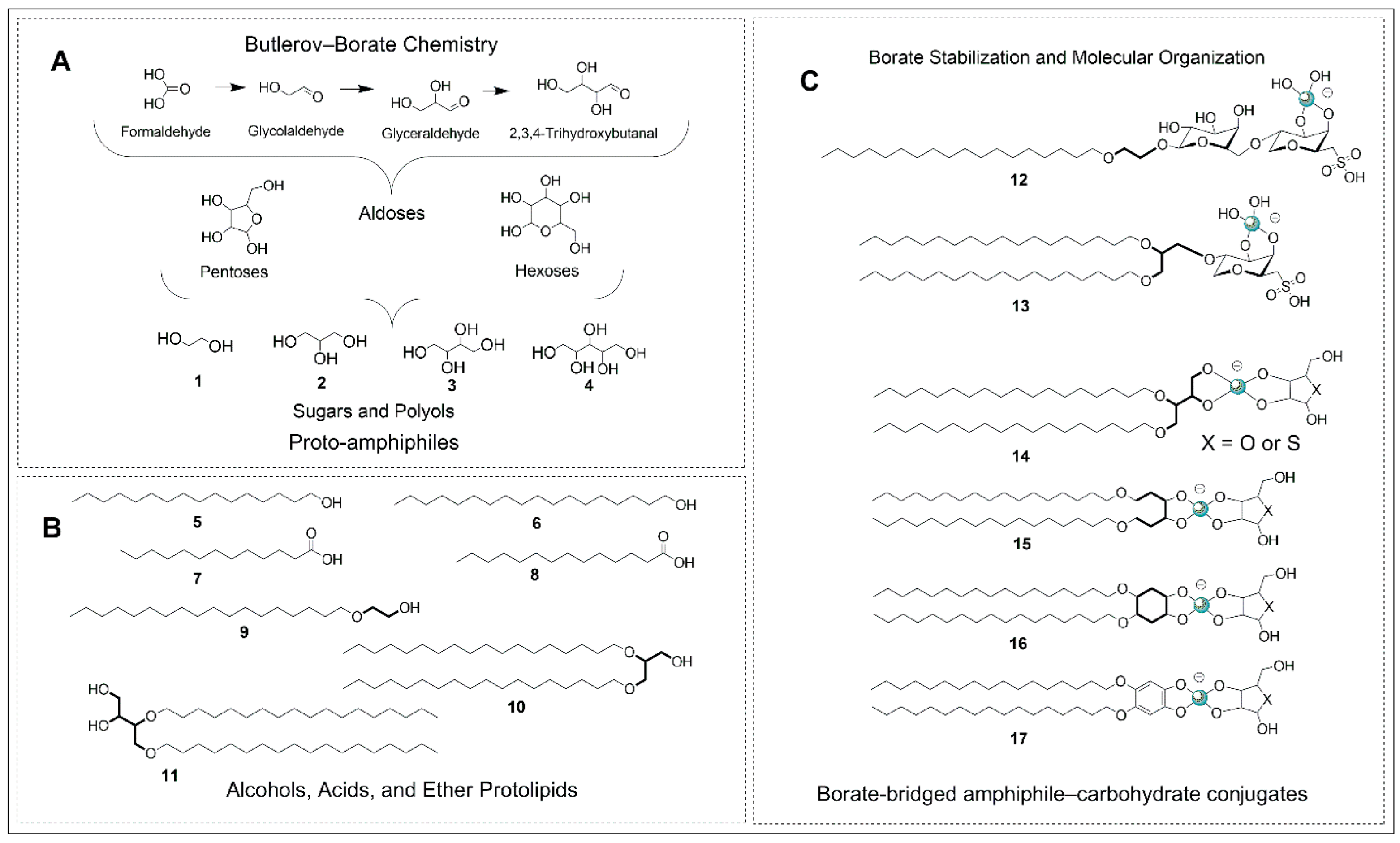
Figure 2.
Proposed membrane architecture formed by borate-bridged amphiphile–carbohydrate conjugates. The figure presents a conceptual model of a protocellular membrane assembled from borate-associated amphiphile–carbohydrate conjugates. The upper panel shows a top (extracellular) view of a closed vesicle in which hydrophilic carbohydrate headgroups are exposed to the surrounding aqueous environment, while the lower panel illustrates a cross-sectional view highlighting the organization of the membrane. Long hydrophobic alkyl chains form a densely packed membrane core, whereas carbohydrate headgroups containing vicinal diols remain hydrated at both membrane interfaces. Reversible borate coordination between neighboring carbohydrate moieties is proposed to generate dynamic supramolecular interactions that reinforce membrane organization without preventing structural flexibility. This model represents a hypothetical prebiotic protocell membrane in which borate chemistry contributes simultaneously to membrane stability, compartmentalization, and adaptive self-assembly.
Figure 2.
Proposed membrane architecture formed by borate-bridged amphiphile–carbohydrate conjugates. The figure presents a conceptual model of a protocellular membrane assembled from borate-associated amphiphile–carbohydrate conjugates. The upper panel shows a top (extracellular) view of a closed vesicle in which hydrophilic carbohydrate headgroups are exposed to the surrounding aqueous environment, while the lower panel illustrates a cross-sectional view highlighting the organization of the membrane. Long hydrophobic alkyl chains form a densely packed membrane core, whereas carbohydrate headgroups containing vicinal diols remain hydrated at both membrane interfaces. Reversible borate coordination between neighboring carbohydrate moieties is proposed to generate dynamic supramolecular interactions that reinforce membrane organization without preventing structural flexibility. This model represents a hypothetical prebiotic protocell membrane in which borate chemistry contributes simultaneously to membrane stability, compartmentalization, and adaptive self-assembly.
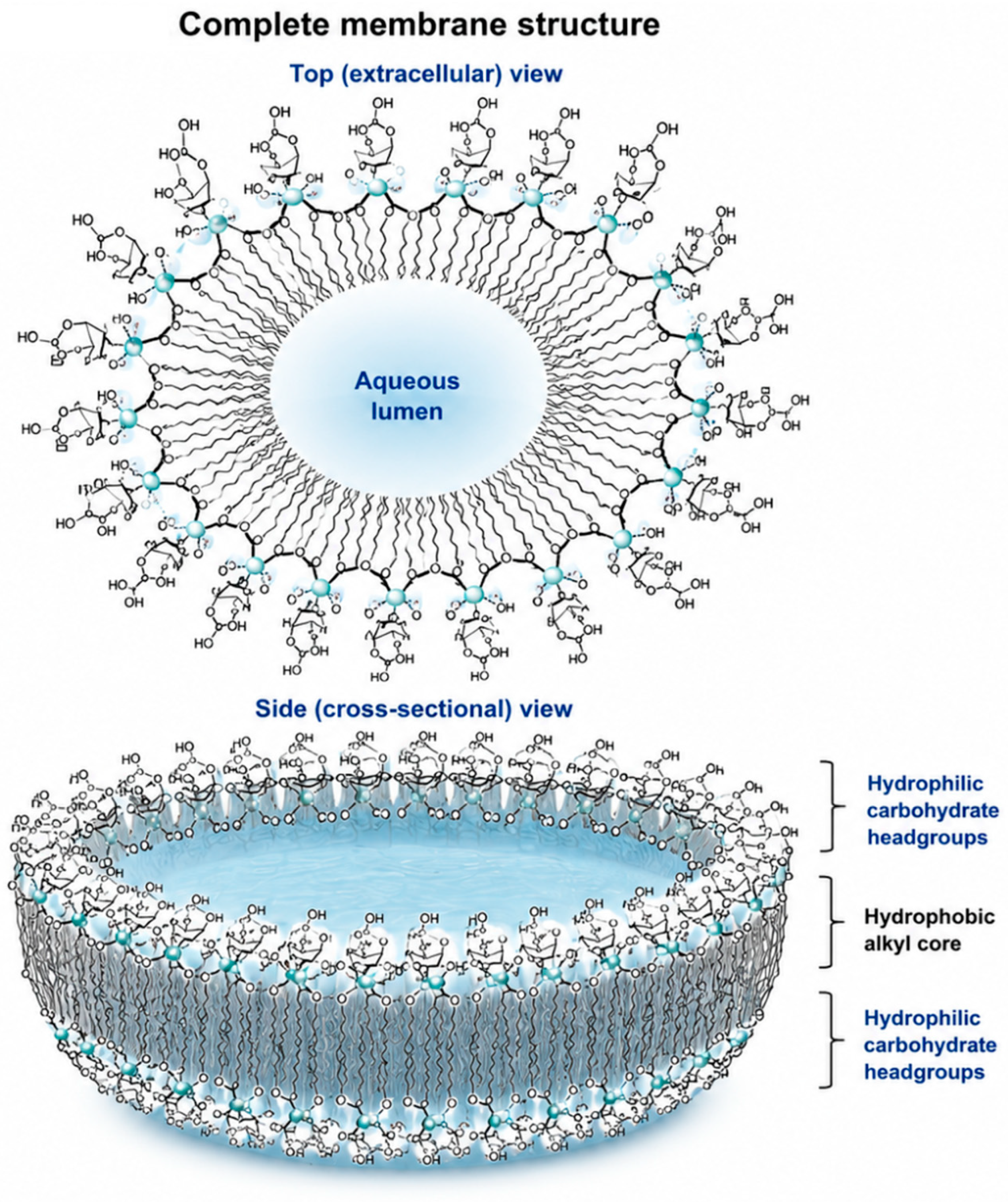
Figure 3.
Integrated conceptual model of boron-mediated prebiotic evolution from simple organic molecules to proto-information systems. The figure illustrates a proposed evolutionary sequence in which boron chemistry provides a unifying framework linking abiotic organic synthesis with the emergence of protocellular organization and primitive information systems. Formaldehyde-derived carbohydrates and polyols produced through Butlerov-type reactions are stabilized by reversible borate complexation, facilitating the formation of proto-lipids, hydrogels, and self-assembled protomembranes. Hydrogels create hydrated and chemically structured microenvironments that promote molecular concentration, compartmentalization, and selective interactions, while borate-associated proto-information systems emerge through the stabilization and organization of ribose and other vicinal diol-containing molecules. Together, these interconnected processes culminate in the transition toward the RNA World. The lower panels summarize the geochemical settings that may have supported these processes and highlight the multiple physicochemical roles of boron in prebiotic evolution.
Figure 3.
Integrated conceptual model of boron-mediated prebiotic evolution from simple organic molecules to proto-information systems. The figure illustrates a proposed evolutionary sequence in which boron chemistry provides a unifying framework linking abiotic organic synthesis with the emergence of protocellular organization and primitive information systems. Formaldehyde-derived carbohydrates and polyols produced through Butlerov-type reactions are stabilized by reversible borate complexation, facilitating the formation of proto-lipids, hydrogels, and self-assembled protomembranes. Hydrogels create hydrated and chemically structured microenvironments that promote molecular concentration, compartmentalization, and selective interactions, while borate-associated proto-information systems emerge through the stabilization and organization of ribose and other vicinal diol-containing molecules. Together, these interconnected processes culminate in the transition toward the RNA World. The lower panels summarize the geochemical settings that may have supported these processes and highlight the multiple physicochemical roles of boron in prebiotic evolution.
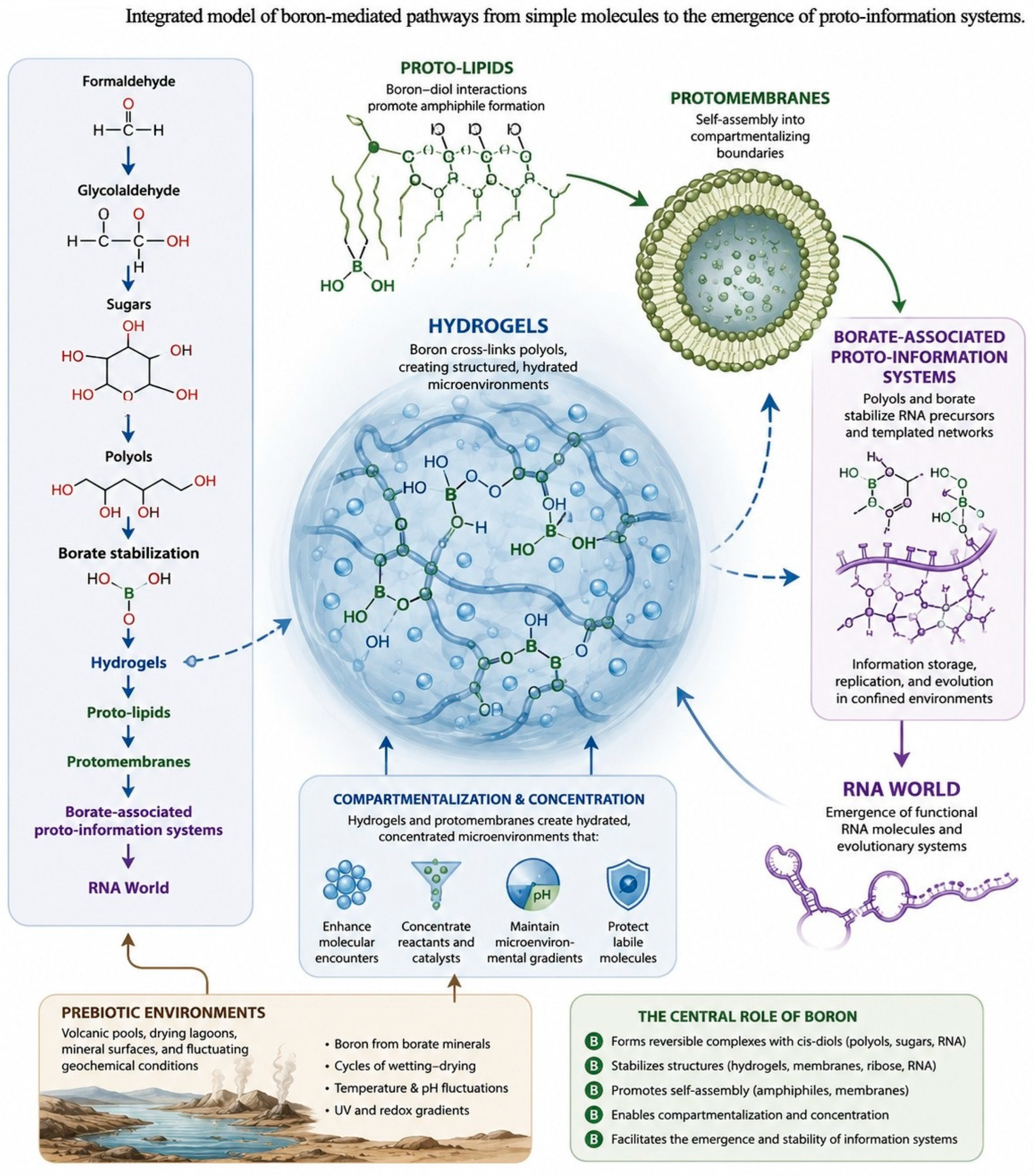
Figure 4.
Representative sulfo-protolipids proposed for membrane formation under acidic prebiotic conditions. The figure illustrates a series of hypothetical sulfo-protolipids representing membrane-forming amphiphiles that may have been favored in acidic environments on the early Earth. The proposed structures include sulfate esters of long-chain alcohols, ether lipids, glycerol derivatives, archaeal-like isoprenoid ethers, and sulfur-containing carbohydrate amphiphiles. Sulfate groups provide strongly hydrophilic headgroups, whereas long hydrocarbon or isoprenoid chains form hydrophobic membrane domains capable of self-assembly into micelles, bilayers, or vesicle-like structures. Together, these molecules illustrate the structural diversity of sulfur-containing amphiphiles that could have contributed to primitive membrane organization before the widespread availability of phosphate-based lipids.
Figure 4.
Representative sulfo-protolipids proposed for membrane formation under acidic prebiotic conditions. The figure illustrates a series of hypothetical sulfo-protolipids representing membrane-forming amphiphiles that may have been favored in acidic environments on the early Earth. The proposed structures include sulfate esters of long-chain alcohols, ether lipids, glycerol derivatives, archaeal-like isoprenoid ethers, and sulfur-containing carbohydrate amphiphiles. Sulfate groups provide strongly hydrophilic headgroups, whereas long hydrocarbon or isoprenoid chains form hydrophobic membrane domains capable of self-assembly into micelles, bilayers, or vesicle-like structures. Together, these molecules illustrate the structural diversity of sulfur-containing amphiphiles that could have contributed to primitive membrane organization before the widespread availability of phosphate-based lipids.
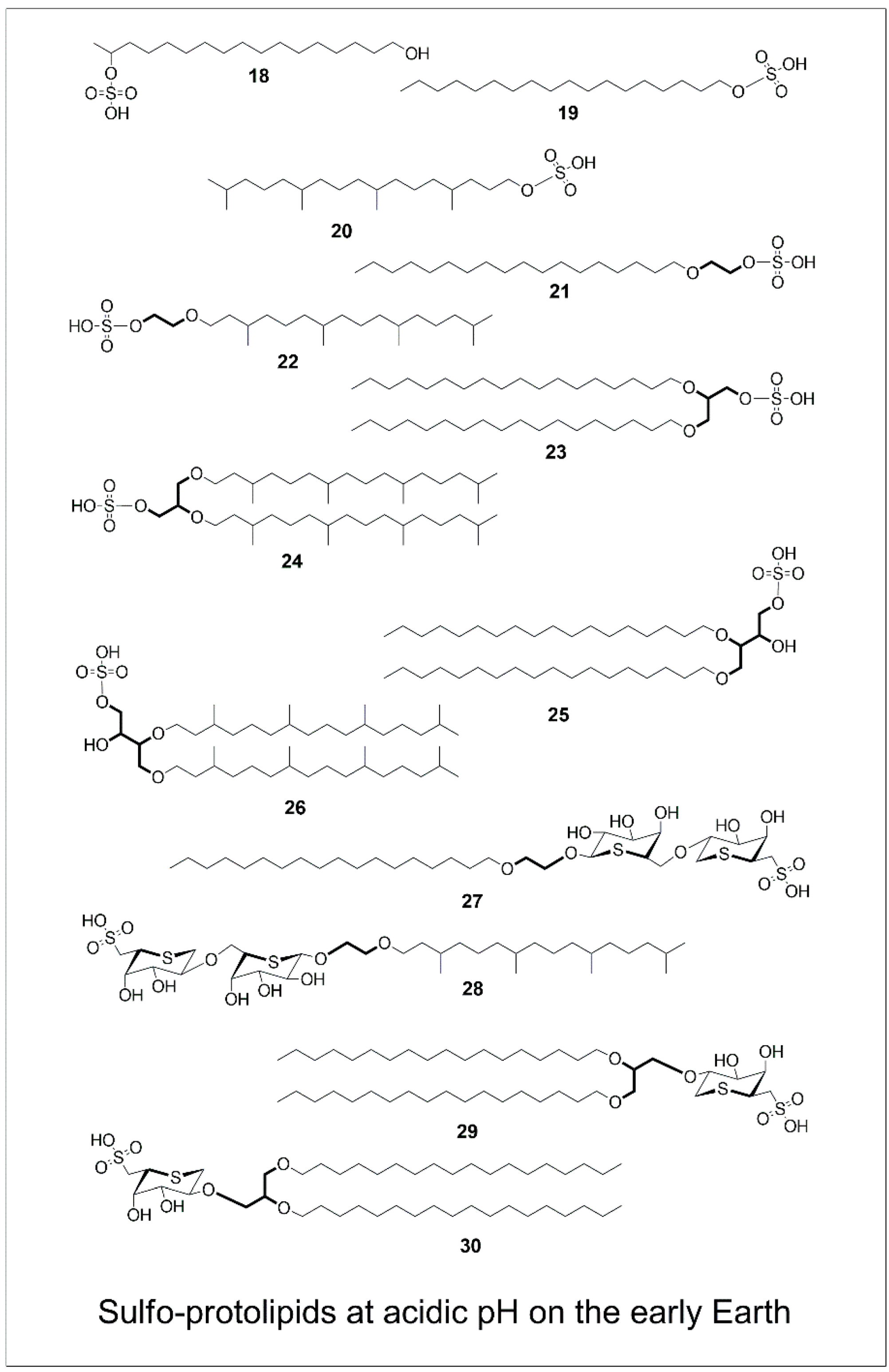
Figure 5.
Conceptual model of a proto-membrane composed exclusively of sulfo-protolipids under acidic prebiotic conditions. The figure illustrates a hypothetical protocellular membrane assembled entirely from sulfur-containing amphiphiles in acidic, sulfur-rich environments on the early Earth. Sulfo-protolipids possessing hydrophilic sulfate or sulfonate headgroups and hydrophobic alkyl chains spontaneously organize into a bilayer surrounding an aqueous internal compartment. The cross-sectional view highlights the arrangement of polar sulfur-containing headgroups at the membrane–water interfaces and densely packed hydrophobic chains within the membrane core. The surrounding panels summarize the physicochemical properties of the membrane, the geochemical conditions favoring its formation, and its potential biological significance as an early compartment capable of concentrating organic molecules and supporting primitive chemical evolution.
Figure 5.
Conceptual model of a proto-membrane composed exclusively of sulfo-protolipids under acidic prebiotic conditions. The figure illustrates a hypothetical protocellular membrane assembled entirely from sulfur-containing amphiphiles in acidic, sulfur-rich environments on the early Earth. Sulfo-protolipids possessing hydrophilic sulfate or sulfonate headgroups and hydrophobic alkyl chains spontaneously organize into a bilayer surrounding an aqueous internal compartment. The cross-sectional view highlights the arrangement of polar sulfur-containing headgroups at the membrane–water interfaces and densely packed hydrophobic chains within the membrane core. The surrounding panels summarize the physicochemical properties of the membrane, the geochemical conditions favoring its formation, and its potential biological significance as an early compartment capable of concentrating organic molecules and supporting primitive chemical evolution.
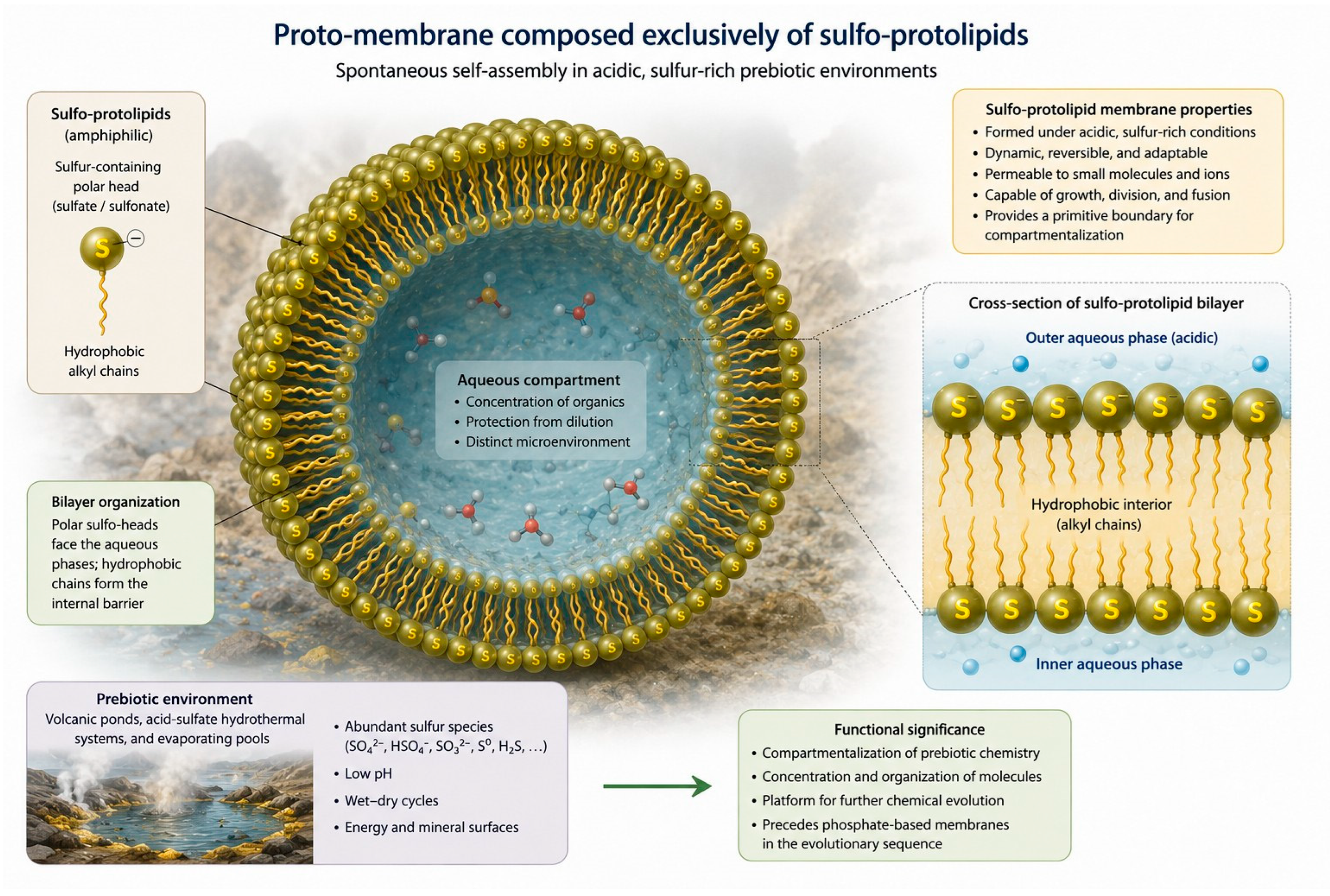
Figure 6.
Representative protolipids proposed for self-assembly under near-neutral prebiotic conditions (pH 6.5–7.5). The figure presents a series of hypothetical protolipids that may have been favored under mildly acidic to neutral environments on the early Earth. The proposed molecules include long-chain alcohols, fatty acids, mono- and diacylglycerols, glycerol esters, glycolipids, and mixed carbohydrate-containing amphiphiles. Compared with sulfur-rich amphiphiles favored under acidic conditions and borate-associated systems expected in alkaline environments, these compounds represent an intermediate class of membrane-forming molecules stabilized primarily through hydrophobic interactions and hydrogen bonding. Their structural diversity illustrates several plausible pathways toward increasingly complex amphiphilic assemblies capable of forming primitive bilayers and vesicular compartments.
Figure 6.
Representative protolipids proposed for self-assembly under near-neutral prebiotic conditions (pH 6.5–7.5). The figure presents a series of hypothetical protolipids that may have been favored under mildly acidic to neutral environments on the early Earth. The proposed molecules include long-chain alcohols, fatty acids, mono- and diacylglycerols, glycerol esters, glycolipids, and mixed carbohydrate-containing amphiphiles. Compared with sulfur-rich amphiphiles favored under acidic conditions and borate-associated systems expected in alkaline environments, these compounds represent an intermediate class of membrane-forming molecules stabilized primarily through hydrophobic interactions and hydrogen bonding. Their structural diversity illustrates several plausible pathways toward increasingly complex amphiphilic assemblies capable of forming primitive bilayers and vesicular compartments.
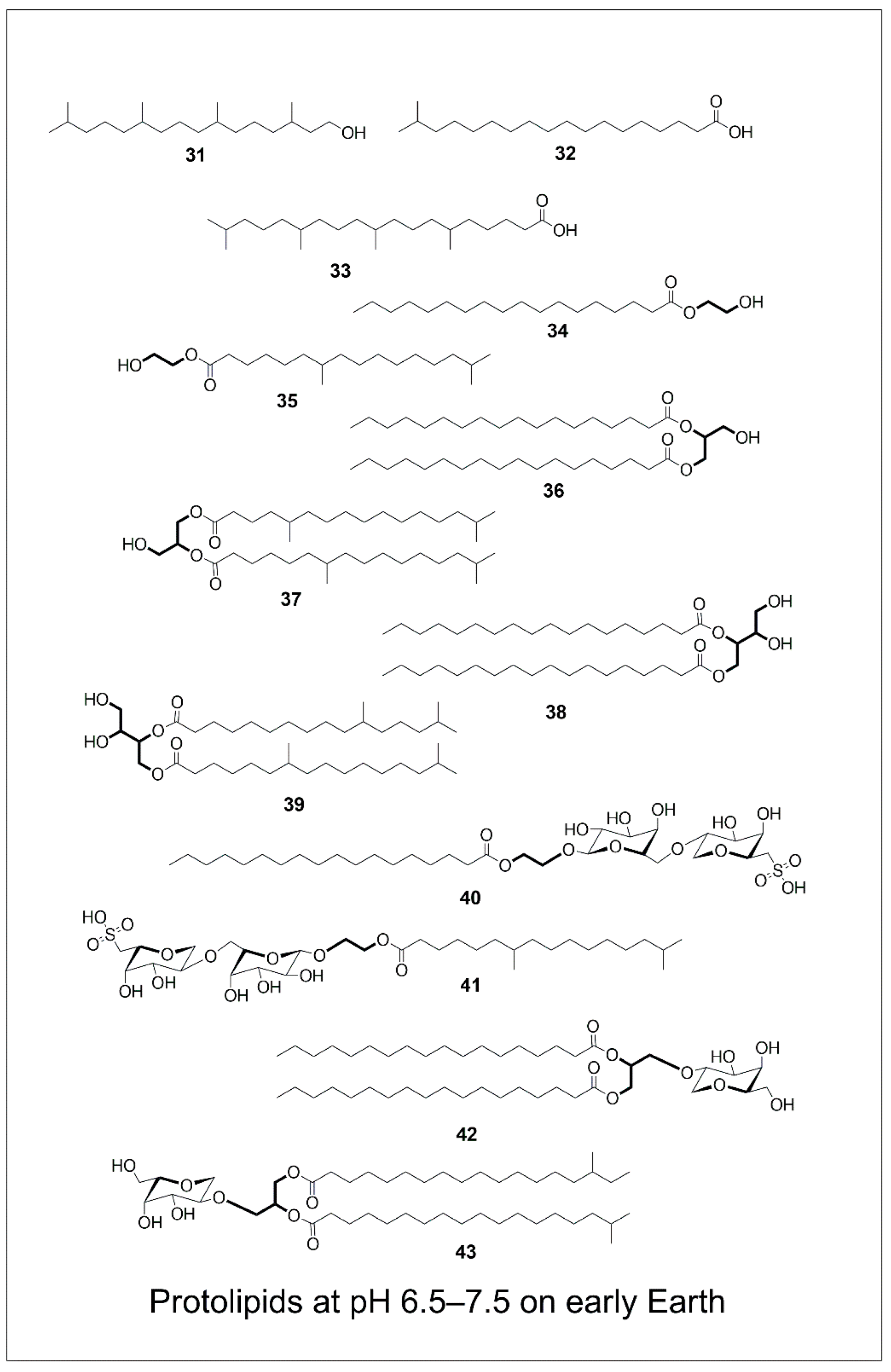
Figure 7.
pH-dependent model for the evolution of polyol-based protolipids and primitive membranes on the early Earth. The figure presents a conceptual model illustrating how distinct pH regimes on the early Earth may have promoted different pathways of amphiphile formation and membrane evolution. Three complementary geochemical domains are proposed: an acidic sulfur-rich environment favoring sulfo-protolipids, a broad near-neutral environment supporting mixed polyol–fatty acid amphiphiles, and an alkaline boron-rich environment promoting borate-associated polyol lipids. Each chemical domain is characterized by its dominant molecular interactions, representative membrane-forming amphiphiles, and corresponding membrane architectures. Environmental cycling between these pH regimes is proposed to drive molecular exchange, membrane remodeling, and the progressive evolution of increasingly stable protocellular systems that ultimately supported the emergence of proto-information systems and the RNA World.
Figure 7.
pH-dependent model for the evolution of polyol-based protolipids and primitive membranes on the early Earth. The figure presents a conceptual model illustrating how distinct pH regimes on the early Earth may have promoted different pathways of amphiphile formation and membrane evolution. Three complementary geochemical domains are proposed: an acidic sulfur-rich environment favoring sulfo-protolipids, a broad near-neutral environment supporting mixed polyol–fatty acid amphiphiles, and an alkaline boron-rich environment promoting borate-associated polyol lipids. Each chemical domain is characterized by its dominant molecular interactions, representative membrane-forming amphiphiles, and corresponding membrane architectures. Environmental cycling between these pH regimes is proposed to drive molecular exchange, membrane remodeling, and the progressive evolution of increasingly stable protocellular systems that ultimately supported the emergence of proto-information systems and the RNA World.
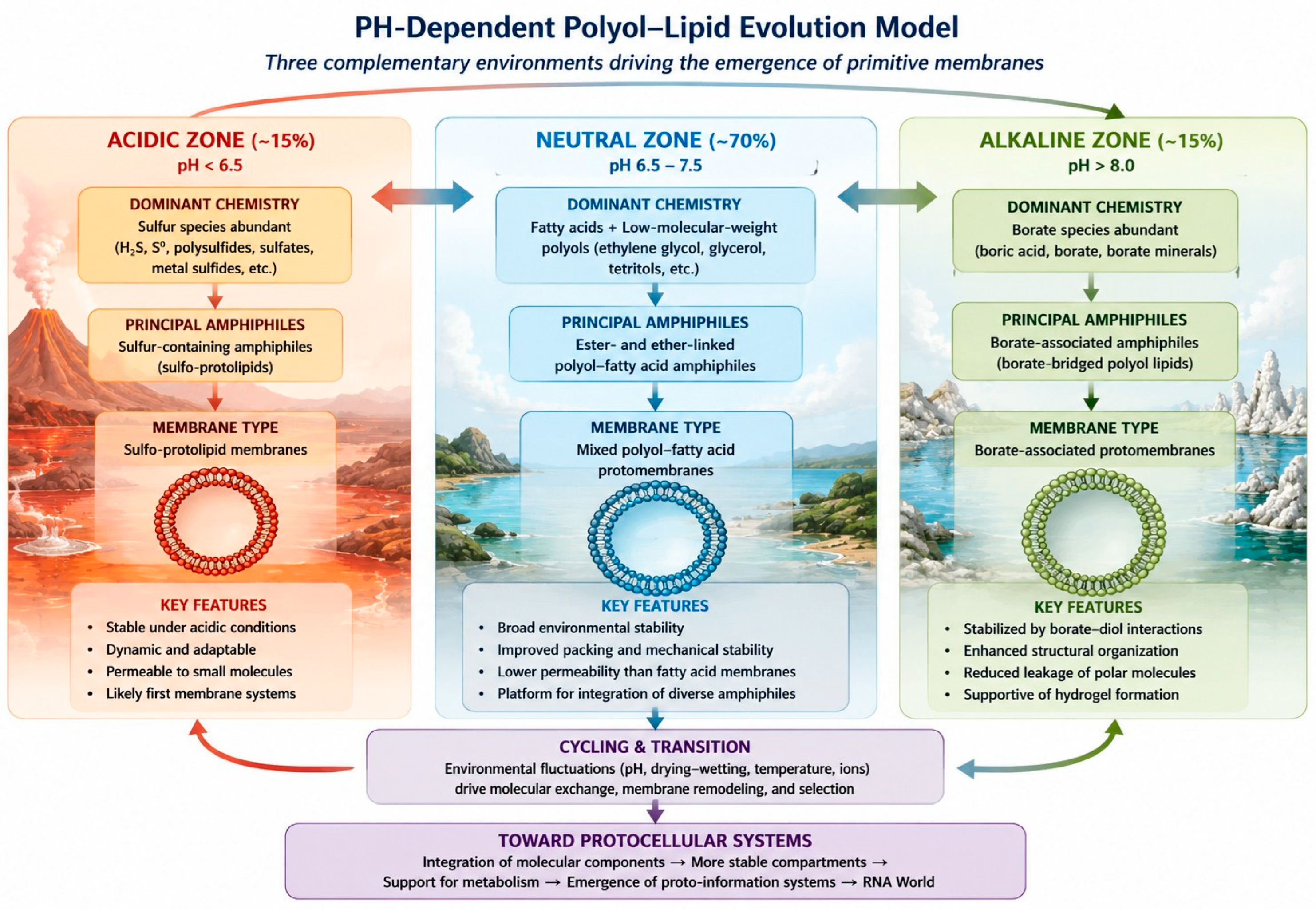
Figure 8.
Proposed borate-bridged calditol-containing tetraether protolipids as models for archaeal-like prebiotic membranes. The figure illustrates a series of hypothetical borate-associated tetraether lipids based on archaeal membrane architecture. Each structure contains membrane-spanning ether-linked biphytanyl chains terminated by calditol headgroups capable of forming reversible cyclic borate esters through coordination with vicinal hydroxyl groups. The proposed molecules include simplified tetraether lipids as well as variants containing cyclopentane rings within the hydrophobic core, representing structural adaptations that enhance membrane rigidity and thermal stability in modern archaea. Together, these borate-bridged tetraether lipids provide conceptual models for highly stable protomembranes that integrate archaeal ether chemistry with reversible borate–polyol interactions.
Figure 8.
Proposed borate-bridged calditol-containing tetraether protolipids as models for archaeal-like prebiotic membranes. The figure illustrates a series of hypothetical borate-associated tetraether lipids based on archaeal membrane architecture. Each structure contains membrane-spanning ether-linked biphytanyl chains terminated by calditol headgroups capable of forming reversible cyclic borate esters through coordination with vicinal hydroxyl groups. The proposed molecules include simplified tetraether lipids as well as variants containing cyclopentane rings within the hydrophobic core, representing structural adaptations that enhance membrane rigidity and thermal stability in modern archaea. Together, these borate-bridged tetraether lipids provide conceptual models for highly stable protomembranes that integrate archaeal ether chemistry with reversible borate–polyol interactions.
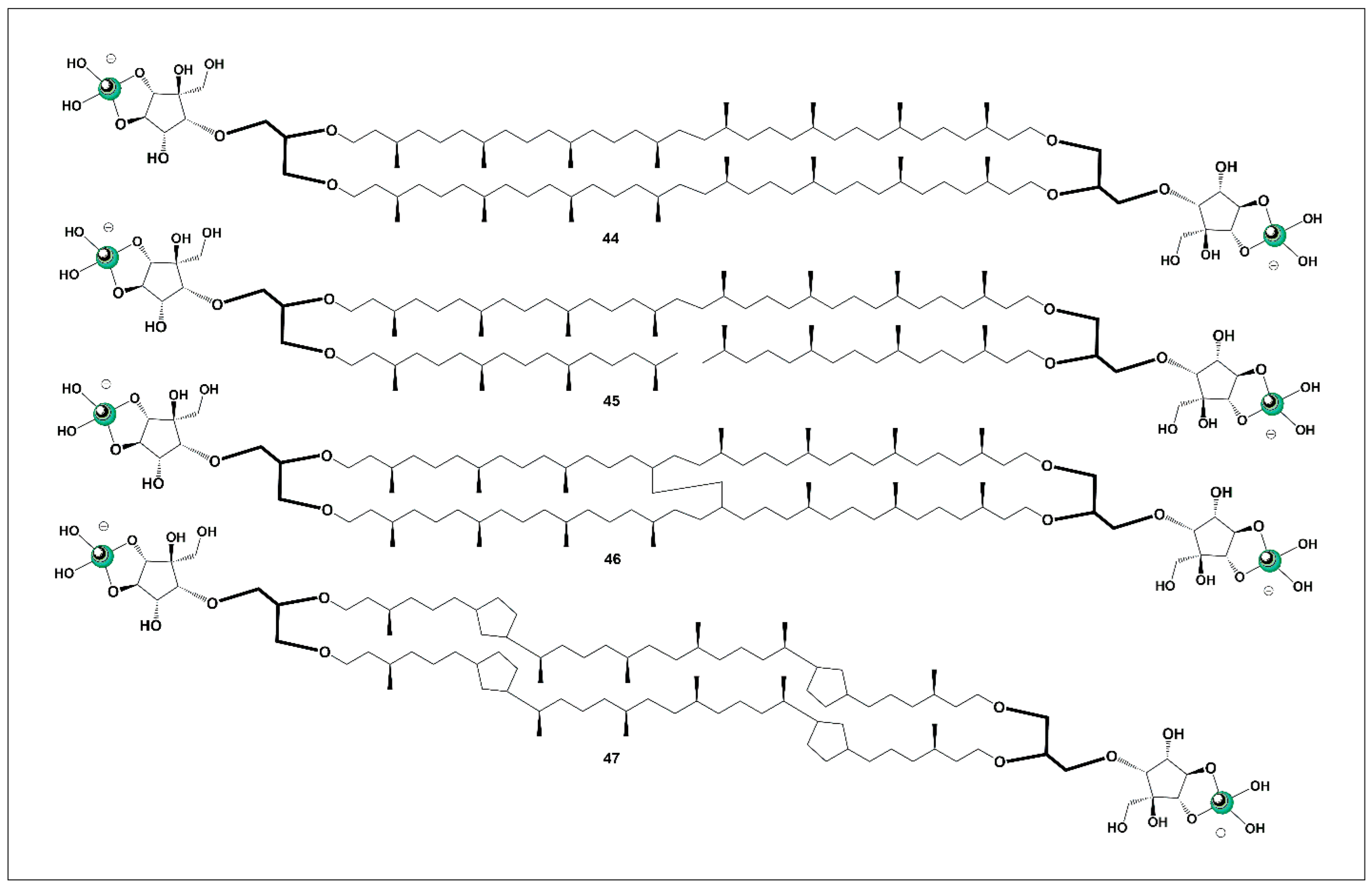
Figure 9.
Proposed borate-bridged amphiphile–carbohydrate conjugates as potential protolipids. The figure illustrates two hypothetical borate-mediated amphiphile–carbohydrate conjugates representing possible intermediates in prebiotic membrane evolution. Compound 48 depicts an oscillol–ribose conjugate, while compound 49 shows an analogous oscillol–mannitol conjugate. In both structures, reversible cyclic borate esters are formed through coordination of borate with vicinal diol groups present in the carbohydrate moieties and terminal hydroxyl groups of the amphiphilic xanthophyll oscillol. These hybrid molecules combine an extended hydrophobic polyene chain with highly hydrophilic carbohydrate headgroups, producing amphiphilic architectures capable of molecular self-assembly. The structures are presented as conceptual models illustrating how borate chemistry could have coupled carbohydrate stabilization with membrane formation during the proposed pre-phosphate stage of chemical evolution.
Figure 9.
Proposed borate-bridged amphiphile–carbohydrate conjugates as potential protolipids. The figure illustrates two hypothetical borate-mediated amphiphile–carbohydrate conjugates representing possible intermediates in prebiotic membrane evolution. Compound 48 depicts an oscillol–ribose conjugate, while compound 49 shows an analogous oscillol–mannitol conjugate. In both structures, reversible cyclic borate esters are formed through coordination of borate with vicinal diol groups present in the carbohydrate moieties and terminal hydroxyl groups of the amphiphilic xanthophyll oscillol. These hybrid molecules combine an extended hydrophobic polyene chain with highly hydrophilic carbohydrate headgroups, producing amphiphilic architectures capable of molecular self-assembly. The structures are presented as conceptual models illustrating how borate chemistry could have coupled carbohydrate stabilization with membrane formation during the proposed pre-phosphate stage of chemical evolution.
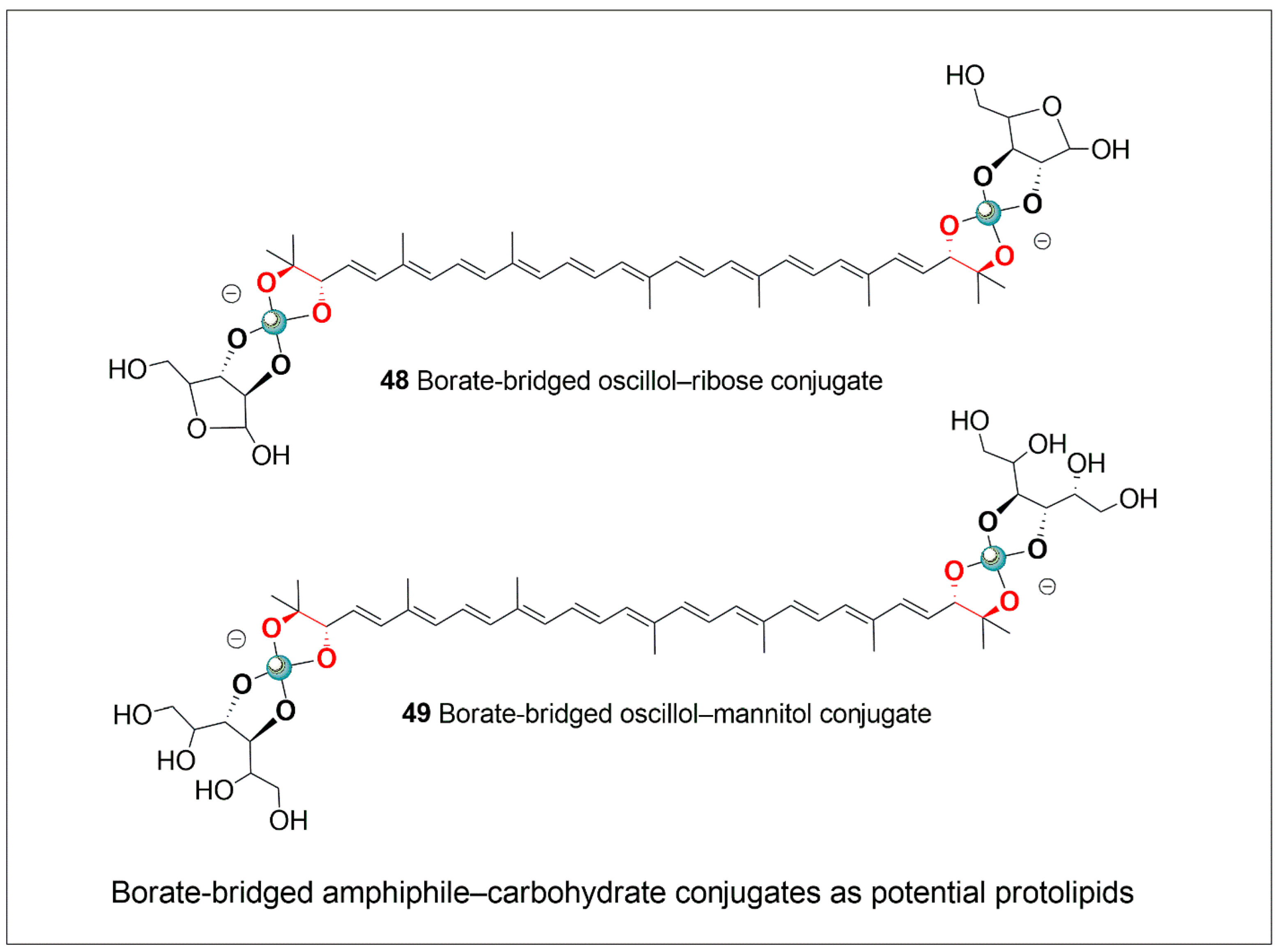
Figure 10.
Hybrid Archaea–Boron Chemistry Model. Conceptual comparison between the covalently stabilized glycolipid membrane of Archaea and a hypothetical borate–ribose–xanthophyll protolipid membrane proposed for prebiotic evolution. Archaeal glycolipids form a rigid tetraether membrane stabilized by covalent linkages, whereas the proposed protolipid membrane consists of oscillol-derived hydrophobic chains bearing ribose polar headgroups on both membrane surfaces. Reversible borate diester bridges connect adjacent ribose residues, producing dynamic amphiphilic conjugates with two hydrophilic termini while preserving a tightly packed, defect-free hydrophobic core. The model illustrates how borate-mediated supramolecular organization could generate chemically adaptive yet structurally stable protocellular membranes capable of supporting compartmentalization and early carbohydrate- and nucleotide-related chemistry before the emergence of modern phospholipid membranes.
Figure 10.
Hybrid Archaea–Boron Chemistry Model. Conceptual comparison between the covalently stabilized glycolipid membrane of Archaea and a hypothetical borate–ribose–xanthophyll protolipid membrane proposed for prebiotic evolution. Archaeal glycolipids form a rigid tetraether membrane stabilized by covalent linkages, whereas the proposed protolipid membrane consists of oscillol-derived hydrophobic chains bearing ribose polar headgroups on both membrane surfaces. Reversible borate diester bridges connect adjacent ribose residues, producing dynamic amphiphilic conjugates with two hydrophilic termini while preserving a tightly packed, defect-free hydrophobic core. The model illustrates how borate-mediated supramolecular organization could generate chemically adaptive yet structurally stable protocellular membranes capable of supporting compartmentalization and early carbohydrate- and nucleotide-related chemistry before the emergence of modern phospholipid membranes.
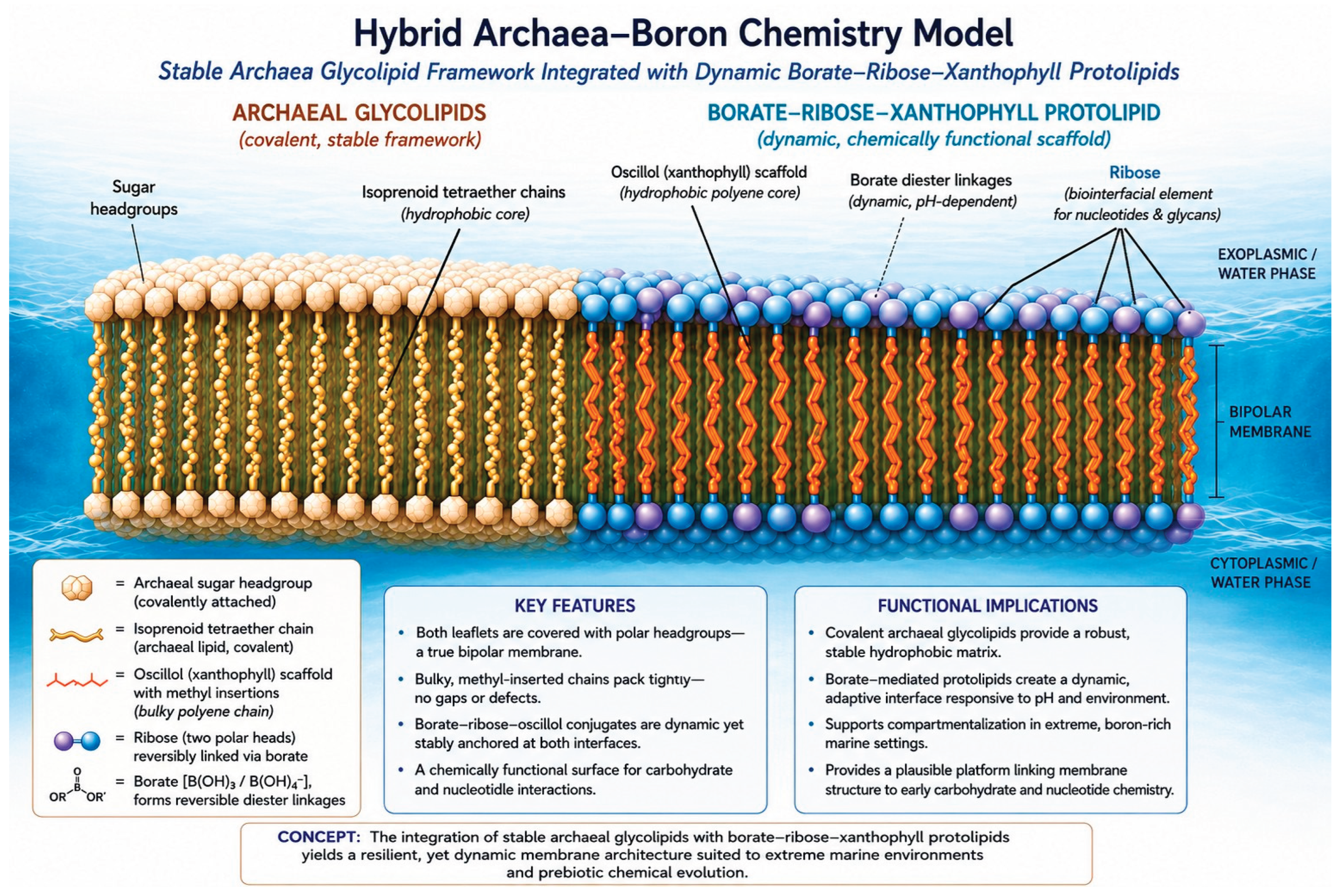

Table 1.
Predicted distribution of prebiotic polyols.
| Compound class | Approx. abundance |
|---|---|
| Ethylene glycol | 40% |
| Glycerol | 33% |
| Tetritols | 17% |
| Pentitols | 6% |
| Higher polyols | <4% |
Table 2.
Environmental Domains in the History of the Early Earth.
| Environmental Domain | Dominant Chemistry | Preferred Molecular Systems |
|---|---|---|
| Acidic | Sulfur | Thiols, thioesters, sulfolipids, sulfur-rich carbohydrates |
| Neutral | Mixed | Fatty acids, glycolipids, amphiphiles, proto-lipids |
| Alkaline | Boron | Polyols, sugars, borate complexes, proto-informational assemblies |
| Transition Zones | Sulfur–Boron Interactions | Borate-stabilized amphiphiles, proto-membranes, emerging informational systems |
Table 3.
Functions of Phosphorus and Sulfur and Various Geological Periods of the Earth.
| No | Modern phosphate role | Possible sulfur-era analogue |
|---|---|---|
| 1 | Structural linkage | Sulfate esters |
| 2 | Energy transfer | Thioesters |
| 3 | Catalysis | Metal-sulfur clusters |
| 4 | Molecular recognition | Sulfated sugars |
| 5 | Membrane organization | Sulfolipids |
| 6 | Network regulation | Sulfur redox chemistry |
| 7 | Information transfer | Sulfur-rich compositional networks |
Table 4.
Environmental domains and Principal membrane types.
| Environmental domain | Approximate pH | Dominant chemistry | Principal membrane type |
|---|---|---|---|
| Acidic | < 6.5 | Sulfur chemistry | Sulfo-protolipid membranes |
| Neutral | 6.5–7.5 | Fatty acids + polyols | Mixed polyol–fatty acid protomembranes |
| Alkaline | > 8.0 | Borate chemistry | Borate-associated protomembranes |
Table 5.
Comparative stability of various types of amphiphiles.
| Property | Fatty acid | Polyol lipid | Sulfolipid | Borate lipid |
|---|---|---|---|---|
| Stability | + | ++ | +++ | +++ |
| Hydrolysis | High | Moderate | Low | Moderate |
| Bilayer formation | Yes | Excellent | Excellent | Excellent |
| Hydrogen bonding | Low | High | High | Very high |
| pH tolerance | Narrow | Moderate | Acidic | Alkaline |
Disclaimer/Publisher’s Note: The statements, opinions and data contained in all publications are solely those of the individual author(s) and contributor(s) and not of MDPI and/or the editor(s). MDPI and/or the editor(s) disclaim responsibility for any injury to people or property resulting from any ideas, methods, instructions or products referred to in the content. |
© 2026 by the authors. Licensee MDPI, Basel, Switzerland. This article is an open access article distributed under the terms and conditions of the Creative Commons Attribution (CC BY) license (http://creativecommons.org/licenses/by/4.0/).
Copyright: This open access article is published under a Creative Commons CC BY 4.0 license, which permit the free download, distribution, and reuse, provided that the author and preprint are cited in any reuse.


