

Submitted:
29 June 2026
Posted:
30 June 2026
You are already at the latest version
Abstract
The restoration of tropical dry forest (TDF) faces low community integration and limited cultural relevance, especially in the territories of Afro-descendant communities. This study proposes a quantitative framework to systematize the biocultural memory contained in oral tradition as an input for the biocultural restoration of the TDF. A corpus of 401 works from the Afro-descendant community of the Patía Valley (Cauca, Colombia) was analyzed, coded in a multidimensional database of 10 categories. Three indices are proposed: the Biocultural Density Index (IDBC), the Biocultural Vulnerability Index (IVB), and an adaptation of Winter's framework for flora (IVBw), reported in a total version and a version restricted to wild/native species. The results identify the works of greatest biocultural density (IDBC max. = 84) and distinguish between cultivated/introduced species of high cultural value (Limón, Yuca, Caña de azúcar), unsuitable for ecological restoration of the TDF, and wild/native species (e.g., Caña brava, Cañafístula, Guayacán, Ceiba) that constitute the restorable core. Cultural practices are the hubs of the system, and traditional medicine is the most at risk of loss; food security concentrates 43% of the flora records. These findings provide replicable tools to integrate Afro-descendant biocultural knowledge into TDF restoration protocols.
Keywords:
biocultural restoration
; tropical dry forest
; biocultural memory
; oral tradition
; Afro-descendant communities
1. Introduction
Tropical dry forest (TDF) is one of the most threatened ecosystems on the planet and one of the most degraded in Colombia, with less than 10% of its original cover remaining [1,2]. The Patía Valley, in the southwest of the Department of Cauca, holds some of the most critical fragments: the smallest in the national territory and subject to the most intense anthropic pressures [3,4]. In this territory, ecological degradation overlaps with the historical exclusion of the Afro-descendant communities that inhabit it. Analyses of restoration projects in Colombia show that the territories of Afro-descendant Community Councils (Consejos Comunitarios) received barely between 0.9% and 10.1% of the compensatory measures derived from environmental licensing between 2012 and 2018 [5]. At the national scale, conventional ecological restoration has shown structural limitations: a low percentage of effective monitoring, scarce community integration and an absence of cultural relevance in its designs [6,7].
In response to these limitations, biocultural restoration proposes to recover not only plant cover but the reciprocal relationships between local communities and their territories [8,32]. This paradigm recognizes that ecosystems are not only biophysical configurations but spaces laden with memories, practices and worldviews [9,10,33]. An articulating concept is that of biocultural memory [11,35]. Quintero-Angel et al. [12] have shown that these memories constitute fundamental resources for environmental governance, while Salazar et al. [13] have documented how the biocultural memory of reciprocity operates as an active conservation mechanism. López and Macías [14] proposed ecological restoration as a customary process of Afro-Caucan communities and suggested adopting the biocultural value framework of Winter et al. [8].
Recent ethnobiological research has recognized the potential of cultural expressions—songs, myths, rituals, recipes, oral testimonies—as reservoirs of traditional ecological knowledge [15,16,38]. Winter, Lincoln and Berkes [17] proposed the social-ecological keystone concept and developed quantitative metrics to systematize culture–plant interactions (the quantum co-evolution unit, QCU) [40,41]. In the Patía, the bambuco patiano, the coplas, the alabaos, the medicinal narratives and the gritos de vaquería (cattle-herding calls) constitute oral genres in which observations on phenology, animal behavior, plant management, climatic cycles and ecosystem relationships are deposited. Nevertheless, a methodological gap persists: there are no quantitative tools that allow the biocultural knowledge contained in oral-tradition corpora to be systematized, prioritized according to its informational density, and connected to the operational needs of TDF restoration.
This study addresses that gap. A corpus of 401 works of Afro-Patían oral tradition is analyzed, coded in a multidimensional database. Three quantitative indices are proposed: IDBC, IVB and IVBw. This version introduces an explicit distinction between cultivated/introduced species and wild/native species: the former are repositories of cultural memory but do not constitute viable material for the ecological restoration of the TDF, whereas the latter form the restorable floristic core. The objective is to propose and evaluate a quantitative framework to systematize the biocultural memory contained in oral tradition as an input for TDF restoration, responding to the strategic lines of Colombia's National Program for the Conservation and Restoration of Tropical Dry Forest (PNCBST) [3].
2. Materials and Methods
2.1. Study Area
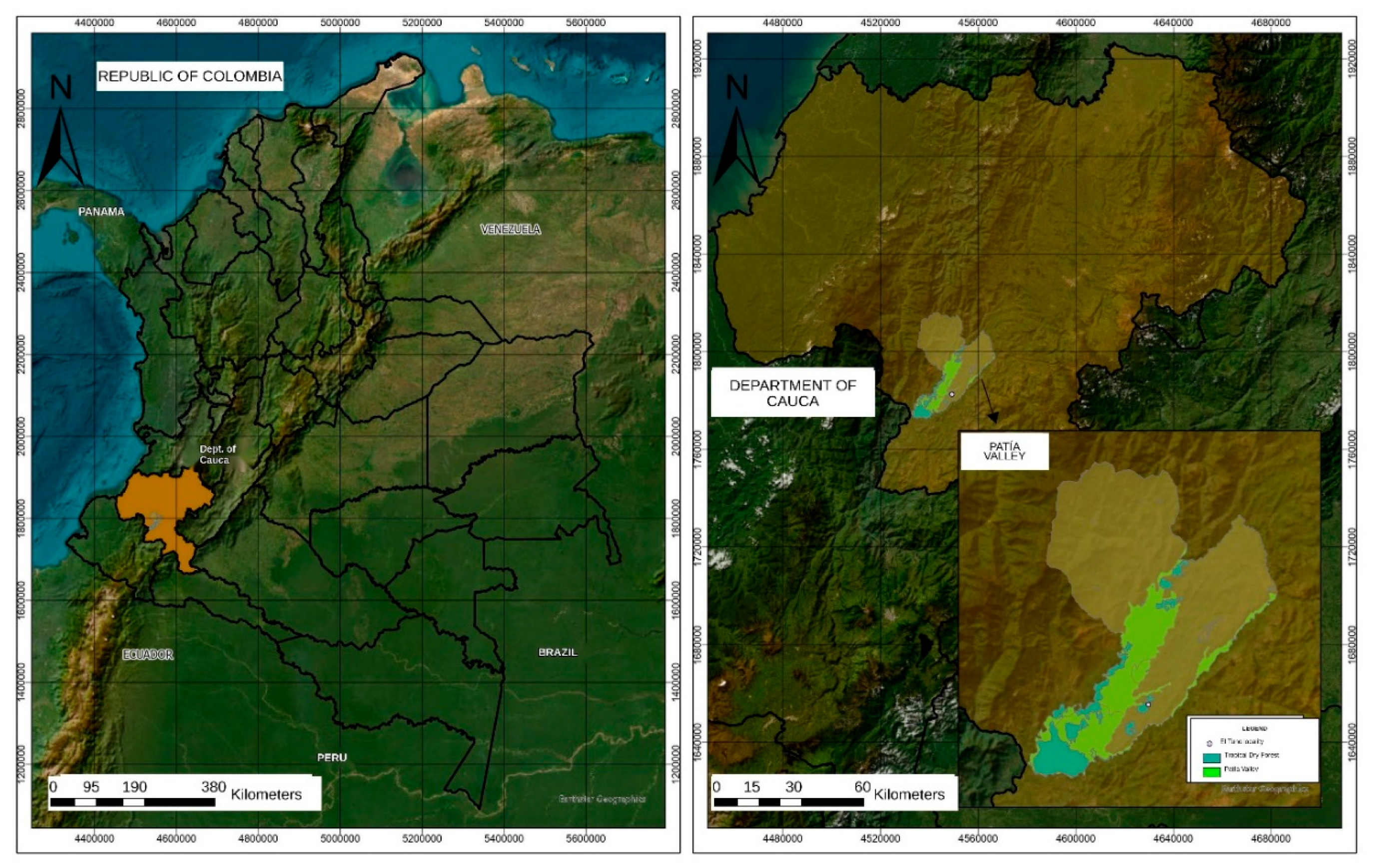
The research focuses on the Patía Valley and the El Tuno village, municipality of Patía, Department of Cauca, Colombia (approximately 2°04'N, 77°04'W). The Patía Valley is a dry inter-Andean enclave, situated between 600 and 900 m a.s.l., with a mean temperature of 28 °C and annual rainfall below 1000 mm [39]. The predominant ecosystem is the TDF, classified as the region in the most critical situation in the country [3,4]. The Afro-descendant community of El Tuno is regionally recognized as the epicenter of the musical tradition of the bambuco patiano.
Figure 1.
Location of the study area. Left: the Department of Cauca (orange) within the Republic of Colombia. Right: the Patía Valley and the El Tuno locality within the Department of Cauca. Projected coordinates; basemap: Earthstar Geographics.
Figure 1.
Location of the study area. Left: the Department of Cauca (orange) within the Republic of Colombia. Right: the Patía Valley and the El Tuno locality within the Department of Cauca. Projected coordinates; basemap: Earthstar Geographics.
2.2. Oral-Tradition Corpus
A corpus of 401 works of Afro-descendant oral tradition from the Patía Valley was compiled (2024–2025). The corpus integrates: (a) compilations by Albán Achinte [18,19,20]; (b) materials gathered by the first author from already-disseminated or public-domain works of oral and written tradition (without interviews or collection of data from living participants); and (c) works documented in regional publications and local archives. The inclusion criteria were: (1) belonging to the Afro-Patían oral or written tradition; (2) references to the territory, nature, cultural practices or local worldview; (3) availability of the full text. The corpus comprises 17 work types (poems, recipes, testimonies, songs, tales, coplas, alabaos, arrullos, sayings, salves, saetas, villancicos, religious, funeral and ritual chants). The full distribution by work type is presented in Figure S1 of the Supplementary Material.
2.3. Multidimensional Database and Coding Protocol
Each work was coded in a multidimensional database organized into 10 record categories: (1) Works (metadata); (2) Flora (common name, scientific name, botanical family, uses, narrative functions, ecological origin: wild/native or cultivated/introduced); (3) Fauna; (4) Landscapes; (5) Symbolism; (6) Sensory; (7) Themes; (8) Characters; (9) Culture (biocultural status: in use, persistent, lost/at risk, no data); and (10) Linguistics. Flora records with traditional use were classified by restoration dimension: food security, traditional medicine, material heritage, spirituality/ritual, agroecology and other/multiple. Taxonomic identification was based on Ramírez-Padilla et al. [21]. The cultivated/wild classification was carried out following Ramírez-Padilla et al. [21] and Pizano and García [22].
2.4. Biocultural Density Index (IDBC)
To quantify the concentration of biocultural knowledge per work:
where n_d,i is the number of records of dimension d in work i. The IDBC operates as an indicator of cumulative density.
IDBC_i = n_flora,i + n_fauna,i + n_landscape,i + n_culture,i + n_symbols,i + n_sensory,i + n_linguistic,i
2.5. Biocultural Vulnerability Index (IVB)
To identify the works that combine biocultural content with risk of loss:
where n_lost-practices,i is the number of cultural practices in the 'Past' period; IDBC_inverse,i = (max(IDBC) − IDBC_i)/max(IDBC); and pct_negative,i is the proportion of practices with a negative territorial valuation.
IVB_i = 0.35 × n_lost-practices,i + 0.35 × IDBC_inverse,i + 0.30 × pct_negative,i
2.6. Winter's Biocultural Value Index for Flora (IVBw): Total Version and Wild Version
To prioritize flora species, the framework of Winter et al. [8] was adapted following López and Macías [14]. For each species j:
where IC = cultural importance (n_works,j/N_flora), VU = use versatility, S = singularity (1 − IC), UC = conservation urgency (n_past,j/n_works,j). The harmonic mean penalizes extremely low values in any component.
IVBw_j = Harmonic Mean (IC_j, VU_j, S_j, UC_j)
Double computation of the IVBw. Following the first author's critical observation regarding the bias of the index when cultivated/introduced species are included, the IVBw is reported in two versions: (i) IVBw-total, over the full flora of the corpus; and (ii) IVBw-wild, restricted to wild/native TDF species following Ramírez-Padilla et al. [21] and Pizano and García [22]. The second version is the operational one for ecological restoration programs of the TDF.
2.7. Biocultural Network Analysis and Complementary Statistics
A bipartite co-occurrence network between species and cultural practices was built, computing degree and normalized betweenness centrality (igraph in R). In addition: Spearman correlations among the IDBC dimensions; Shannon index (H'); Poisson regression with n_flora as the response; Kruskal–Wallis among musical genres; correspondence analysis of themes vs. genres; and χ2 with standardized residuals. The analyses were performed in R (R Core Team, 2024) with readxl, dplyr, tidyr, ggplot2, ggraph, igraph, vegan, ca, MASS, broom and writexl.
3. Results
3.1. General Description of the Corpus
The corpus comprises 401 works, of which 282 (70.3%) have IDBC > 0. Poems constitute the most numerous category (n = 86; 21.4%), followed by dishes/recipes (69; 17.2%), oral testimonies (63; 15.7%), songs (42; 10.5%) and tales (40; 10.0%) (Figure S1). The database records 3,356 biocultural entries: 170 flora records (104 unique species), 162 fauna (111 unique species), 247 landscape, 539 symbolic, 444 sensory, 455 cultural practices, 513 thematic, 304 characters and 522 linguistic.

Table 1.
Distribution of corpus by work type with mean and median IDBC.
| Work type | n | % | Mean IDBC | Median IDBC |
| Poems | 86 | 21.4 | 4.2 | 2 |
| Recipes & dishes | 69 | 17.2 | 5.1 | 3 |
| Oral testimonies | 63 | 15.7 | 9.8 | 5 |
| Songs | 42 | 10.5 | 11.4 | 6 |
| Tales | 40 | 10 | 7.6 | 4 |
| Bambuco patiano | 28 | 7 | 12.6 | 9 |
| Coplas | 25 | 6.2 | 8.1 | 5 |
| Funeral chants (Alabaos) | 9 | 2.2 | 6.4 | 5 |
| Religious chants | 9 | 2.2 | 3.8 | 2 |
| Sayings | 9 | 2.2 | 1.9 | 1 |
| Lullabies | 6 | 1.5 | 4.5 | 3 |
| Other genres | 15 | 3.7 | 3.1 | 2 |
| Total | 401 | 100 | 6.3 | 2 |
3.2. Biocultural Density and Vulnerability of the Works
The mean IDBC of the corpus is 6.31 (median = 2, range = 0–84). Descarne leads the IDBC ranking (84), followed by Coplas de burla festiva (71), Las Cortamate (70), El Chancuco (59) and Río (52) (Figure 2a). The IVB identifies the works that combine high density with high risk of loss; Descarne also leads this index (IVB = 2.10), followed by Testimonio sobre el Valle del Patía (1.66), Descripción del Valle del Patía (1.63) and Historia del Patía (1.58). The upper-right quadrant of Figure 2b (high density + high vulnerability) identifies the works of greatest restorative urgency.
The Spearman correlations among the seven IDBC dimensions (Table 2) reveal significant positive associations among all dimensions, with the highest coefficients between culture–symbols (ρ = 0.635), sensory–symbols (ρ = 0.632), sensory–landscapes (ρ = 0.620) and culture–landscapes (ρ = 0.582). The lowest correlations correspond to fauna–flora (ρ = 0.184), suggesting that botanical and zoological records tend to appear in different works.
The Shannon index (H') shows that the works of greatest biological diversity partially coincide with those of greatest IDBC: Descarne leads with H' = 4.74, followed by Coplas de burla festiva (H' = 4.16) and Río (H' = 2.48).
3.3. Priority Species for Restoration: IVBw, Cultivated Species and Wild Species
Of the 170 flora records (104 species), 121 entries with taxonomic identification were found; 56 correspond to cultivated/introduced species and 37 to wild/native TDF species; 28 entries could not be classified with certainty (Figure S2).
IVBw-total version. The IVBw computed over the full set identifies as priorities Limón (Citrus limon, IVBw = 0.282), Yuca (Manihot esculenta, 0.211), Caña de azúcar (Saccharum officinarum, 0.204), Anís (Pimpinella anisum, 0.183) and Plátano (Musa paradisiaca, 0.168) (Table 3). These species are central to the peasant economy, ritual cuisine and the memory of the Patía Valley, but all are cultivated/introduced and are not suitable for the ecological restoration of the TDF: their maintenance corresponds to agroecological systems and traditional home gardens, not to the regeneration of the remnant forest cover [22,23].
IVBw-wild version. When the computation is restricted to the 37 wild/native TDF species, the hierarchy changes radically and a floristic core viable for ecological restoration emerges. The top positions are occupied by Caña brava (Gynerium sagittatum, a key riparian species), Arrayán (Myrcianthes sp.), Cañafístula (Cassia grandis), Guayacán (Handroanthus chrysanthus, emblematic of the TDF), Guácimo (Guazuma ulmifolia, a pioneer), Hiraca (Carludovica palmata), Ceiba (Ceiba pentandra), Cajeto (Amphilophium paniculatum/Citharexylum sp.), Bejucos (Bignonia spp., Serjania spp., Vitis tiliifolia), Barbasco (Tephrosia cinerea/purpurea/sinapou) and Garabato (Mimosa sp.) (Table 4). This short list is the one that should guide the operational restoration protocols for the Patía TDF.
The classification of flora records by restoration dimension (Figure 3) reveals that food security concentrates the largest proportion (73 records, 43%), followed by multiple uses (41; 24%), traditional medicine (26; 15%), material heritage (19; 11%), spirituality/ritual (6; 4%) and agroecology (5; 3%). The 'material heritage' dimension is dominated by wild species (caña brava, guadua, cajeto, totumo) that are suitable for restoration, whereas the 'food security' dimension is dominated by cultivated species (yuca, plátano, maíz, fruit trees) that should be channeled toward agroecology, not ecological restoration.
3.4. Biocultural Network: Structure and System Hubs
The complete biocultural network comprises 199 nodes (flora and fauna species and cultural practices). Cultural practices dominate the structure: Work (degree = 109; centrality = 0.276), Social (107; 0.257) and Religious (101; 0.199) are the system's mega-connectors. Among species, the hubs combine cultivated and wild species: Limón (degree = 11; cultivated), Caña brava (9; wild), Caña de azúcar (8; cultivated), Bejuco (8; wild), Yuca (7; cultivated). The complete list of the 20 main nodes is provided in Table S1 of the Supplementary Material.
The Poisson regression with floristic richness as the response variable shows that the culture and sensory dimensions are the strongest positive predictors of plant-species mentions, whereas symbols show a negative association. The model (log link) fitted flora mentions per work as a function of the other biocultural dimensions (overdispersion ratio = 1.10; the Poisson model was retained). Flora mentions increased significantly with culture (IRR = 1.26; 95% CI 1.13–1.40; p < 0.001), sensory (IRR = 1.22; 1.14–1.30; p < 0.001) and linguistic records (IRR = 1.15; 1.07–1.24; p < 0.001), and decreased significantly with symbolic records (IRR = 0.80; 0.72–0.90; p < 0.001). Fauna (IRR = 0.96; p = 0.20) and landscape records (IRR = 0.98; p = 0.68) were not significant.
3.5. Cultural Dimensions: Landscape, Sensoriality, Practices and Biocultural Status
The complete descriptive analyses of the landscape (Figure S3), sensory (Figure S4), cultural-practices-by-type (Figure S5) and biocultural-status (Figure S6) dimensions are presented in the Supplementary Material. The central results are: the most frequently mentioned landscape element is Water/River (n = 39); the dominant sensory record is the visual one (n = 169; 38.1%); the most frequent practice is Social (n = 116; 25.5%), followed by Work (64; 14.1%); and of the 455 practices, 55 (12.1%) were classified as lost or at risk. Traditional Medicine/Knowledge presents 6 practices lost versus 0 in use, indicating a body of knowledge in critical transition. The thematic analysis shows that Identity (n = 60) and Community (n = 47) are the most frequent themes; Afro-descendant female characters (n = 81) outnumber male ones (n = 51).
4. Discussion
4.1. Oral Tradition as a Quantifiable Biocultural Archive: Methodological Contribution
The results indicate that an extensive corpus of Afro-descendant oral tradition can be systematized through quantitative indices to generate operational tools for biocultural restoration. The central finding is that the 401 works of the Patía Valley do not constitute a scattered repertoire but an integrated biocultural system, as evidenced by the positive and significant Spearman correlations among all dimensions (ρ max. = 0.635 between culture and symbols). This result configures what we term Afro-diasporic Biocultural Memory (ABM) and extends the biocultural quantification framework proposed by Winter, Lincoln and Berkes [17] to the context of Afro-descendant oral tradition.
The IDBC and the IVB respond to a gap in the literature: although biocultural restoration has been conceptually defined [8,9] and documented in case studies [24,25], there were no quantitative tools specifically designed to extract restoration priorities from oral-tradition corpora. The two-dimensional density–vulnerability representation (Figure 2b) offers a prioritization criterion directly translatable into action.
4.2. Cultivated vs. Wild Species: The Ecological Limit of Restoration
Main finding of this version. The IVBw's discrimination between cultivated/introduced and wild/native species (Table 3 and Table 4) resolves a central ambiguity of the original framework of Winter et al. [8]. Applying the index without discrimination produces a ranking headed by species indispensable for food sovereignty but not for the ecological restoration of the forest. Limón, Yuca, Caña de azúcar, Plátano, Anís, Maíz and Arroz are privileged repositories of Afro-Patían biocultural memory—their presence in coplas, recipes, alabaos and testimonies is massive—but all are cultivated, mostly introduced (Limón and Caña de azúcar are from tropical Asia, Plátano from Southeast Asia, Anís from the eastern Mediterranean). An ecological restoration of the TDF based on these species would not produce tropical dry forest but agroecosystems. Their legitimate role within an integral strategy is that of the 'agroecology and food sovereignty' dimension of the PNCBST [3,34,36], not that of the 'restoration' dimension.
Wild species as the restorable core. The IVBw-wild version (Table 4) reveals a core of wild, native TDF species that combine documented ecological function [21,22] with anchoring in Afro-Patían biocultural memory. Caña brava (G. sagittatum) is riparian, a pioneer and raw material for quinchas and palenques (wattle constructions); Cañafístula, Guayacán, Guácimo, Ceiba, Samán and Matarratón are native TDF trees with ethnobotanical documentation (timber, shade, nitrogen fixation, edible fruits); the bejucos (B. spp., S. spp., V. tiliifolia, Smilax spp.) are native lianas of secondary forest; Barbasco (Tephrosia spp.) is a native legume with traditional ichthyotoxic (fish-poison) use. This short list is the one that should guide the operational restoration protocols for the Patía TDF.
Methodological implication. The cultivated/wild discrimination should become a standard parameter in any application of the framework of Winter et al. [8] to contexts where introduced species have high cultural visibility—that is, in most of Latin America. Keeping only the total version of the IVBw produces prioritization lists that direct resources toward crop conservation when the question posed is that of ecological restoration. The two versions of the index should be reported in parallel: the IVBw-total to prioritize food-sovereignty policies and culinary memory; the IVBw-wild to prioritize species in restoration plans.
4.3. Restorative Urgency: Knowledge at Risk and Biocultural Erosion
The joint analysis of the biocultural status of practices and of the IVBw-wild produces the most urgent diagnosis of the study. Traditional Medicine/Knowledge shows 6 lost practices and none in use, with 20 lacking data. The Religious practice accumulates 36 missing-data cases out of 60 (epistemological opacity). Resistance/Struggle shows the highest proportion of practices at risk (4 of 5). Afro-Patían medical-cosmological knowledge is simultaneously the most vulnerable and the most difficult to recover once lost. Wild species such as Barbasco, Bejuco and Cañafístula present maximum conservation urgency (UC = 1.0): every mention in the corpus is set in a past context, anticipating that the knowledge associated with these species is on the verge of oblivion. This finding resonates with Salazar et al. [13] on the Mapuche trafkintu and with Quintero-Angel et al. [12]: ritual-cosmological knowledge is the first to disappear [30].
4.4. The Biocultural Network as an Intervention Tool
The network analysis reveals that the structure of the Afro-Patían biocultural system is organized around cultural practices, not around species (Figure 4). Conventional restoration inventories prioritize by species, but in a biocultural system the most effective unit of intervention may be the cultural practice that articulates multiple species [37,43]. Within the plants, the ranking clearly separates the cultivated hubs (Limón, Caña de azúcar, Yuca) from the wild hubs suitable for restoration (Caña brava, Bejucos, Cañafístula). Only the wild hubs are simultaneously central nodes of the biocultural system and viable restoration material—a result analogous to the cultural keystone species concept of Garibaldi and Turner [26,42]. Hunt et al. [27] documented a similar pattern in the Galápagos.
4.5. Implications, Limitations and Future Directions
Policy implications. The results respond to two strategic lines of the PNCBST [3,29]. Line 3 (Restoration) requires technical tools for community-participation protocols [31] and species selection; the IDBC, the IVBw-wild and the biocultural network are such tools, and the list in Table 4 is directly operational. Line 4 (Sustainable Use) proposes identifying agroecological alternatives; the IVBw-total version identifies the priority crops for this line. Bartholomew et al. [28] have argued for the need for site-based biodiversity standards; the proposed indices contribute to the biocultural dimension of such standards.
Limitations. First, the IDBC assigns identical weight to all dimensions; differential weighting should be evaluated in future work. Second, the coding should be verified for inter-coder consistency. Third, the first author's critical observation regarding the bias of the IVBw toward cultivated species has been resolved in the present version through the double IVBw-total/IVBw-wild computation; however, the cultivated/wild classification was carried out through bibliographic consultation and must be validated in the field, and species with ambiguous status (e.g., Crescentia cujete – totumo, managed but also spontaneous in remnants; Psidium guajava – native but also widely cultivated) require specific botanical studies. Fourth, the network analysis uses co-occurrence per work as a proxy for biocultural relationship, which does not distinguish among causal, functional or narrative associations.
Future directions. (1) participatory validation of the IDBC, IVBw-total and IVBw-wild with the bearers of the oral tradition of the Patía Valley; (2) restoration trials based on the short list in Table 4; (3) development of monitoring indicators that integrate cultural and ecological dimensions; (4) application of the framework to other oral-tradition corpora of the Colombian TDF; and (5) specific strategies for the revitalization of medical-cosmological knowledge, identified as the area of greatest urgency.
5. Conclusions
The biocultural dimensions of the corpus are significantly correlated with one another, confirming that biocultural memory operates as an integrated system in which ecological knowledge, social practice, symbolism and sensoriality reinforce each other.
The IDBC and the IVB make it possible to identify both the works of greatest biocultural density and those of greatest restorative urgency, offering prioritization criteria directly applicable to the design of cultural-transmission and participatory-restoration programs.
The IVBw should be reported in two versions: the total version identifies the species of greatest biocultural value but is dominated by introduced crops (Limón, Yuca, Caña de azúcar, Plátano, Anís, Maíz, Arroz), central to food sovereignty but not to the ecological restoration of the TDF; the version restricted to wild/native species (Caña brava, Cañafístula, Guayacán, Guácimo, Ceiba, Cajeto, Bejucos, Barbasco, Hiraca, Guadua, Matarratón, Samán, Roble, Arrayán) constitutes the operational short list for restoration of the Patía TDF.
The biocultural network reveals that the system is organized around cultural practices and that only the wild hubs (Caña brava, Bejucos, Cañafístula) are simultaneously central nodes of the biocultural system and viable restoration material.
Medical-cosmological knowledge (traditional medicine, religious practice, ritual knowledge) is the area at greatest risk of disappearance and the one that no conventional ecological-restoration strategy is able to capture, constituting the most urgent intervention priority.
The main contribution of this work is methodological: it offers a replicable framework for converting oral-tradition corpora into quantitative inputs for biocultural restoration, with an explicit distinction between species suitable for ecological restoration and species of food sovereignty.
Supplementary Materials
The following supporting information can be downloaded at the website of this paper posted on Preprints.org. T The following supplementary materials are available online: Figure S1: Distribution of the corpus by work type; Figure S2: IVB-Winter by flora species; Figure S3: Landscape elements by type; Figure S4: Sensory records by type; Figure S5: Cultural practices by type; Figure S6: Biocultural status of cultural practices; Table S1: Top 20 nodes of the biocultural network by degree and centrality; Table S2: Complete list of 401 works with IDBC; Table S3: Complete IVB of the corpus; Table S4: Complete flora with scientific names, families, uses, restoration dimensions and ecological origin; Table S5: Shannon index by work; Dataset S1: Complete multidimensional database.
Author Contributions
Conceptualization, L.E.L.V.; methodology, L.E.L.V., H.V.V. and D.M.P.; software, F.A.M. and L.E.L.V.; validation, L.E.L.V., H.V.V. and D.M.P.; formal analysis, L.E.L.V. and F.A.M.; investigation, L.E.L.V.; resources, L.E.L.V.; data curation, L.E.L.V.; writing—original draft preparation, L.E.L.V.; writing—review and editing, H.V.V. and D.M.P.; visualization, L.E.L.V. and F.A.M.; supervision, H.V.V. and D.M.P.; project administration, L.E.L.V. All authors have read and agreed to the published version of the manuscript.
Funding
This research was supported by the PhD Program in Ethnobiology and Biocultural Studies of the Universidad del Cauca, the PhD Program in Environmental Sciences of the Universidad del Cauca, and the Vice-Rectorate for Research (VRI) of the Universidad del Cauca.
Institutional Review Board Statement
Ethics committee approval was not required. This study analyzes exclusively works of oral, literary and musical tradition that were previously compiled and published or in the public domain.
Informed Consent Statement
Not applicable. The study is based on the analysis of a corpus of works of oral, literary and musical tradition.
Data Availability Statement
The original data are included in the Supplementary Material and will be deposited in Zenodo under a CC-BY 4.0 license upon publication. DOI 10.5281/zenodo.20768028.
Acknowledgments
The authors thank the Afro-descendant community of the El Tuno village, the Son del Tuno collective, Adolfo Albán Achinte for his pioneering work in documenting the bambuco patiano, and the Universidad del Cauca.
Conflicts of Interest
The authors declare no conflicts of interest.
Abbreviations
| CI | Confidence Interval |
| IDBC | Biocultural Density Index |
| IRR | Incidence Rate Ratio |
| IVB | Biocultural Vulnerability Index |
| IVBw | Biocultural Vulnerability Index for flora (adapted from Winter et al.) |
| MBA | Afro-diasporic Biocultural Memory |
| PNCBST | National Program for the Conservation and Restoration of Tropical Dry Forest (Colombia) |
| QCU | Quantum Co-evolution Unit |
References
- Etter, A.; Andrade, A.; Nelson, C.R.; Cortés, J.; Saavedra, K. Assessing restoration priorities for high-risk ecosystems: An application of the IUCN Red List of Ecosystems. Land Use Policy 2020, 99, 104874. [Google Scholar] [CrossRef]
- González-M., R.; García, H.; Isaacs, P.; Cuadros, H.; López-Camacho, R.; Rodríguez, N.; Pérez, K.; Mijares, F.; Castaño-Naranjo, A.; Jurado, R.; et al. Disentangling the environmental heterogeneity, floristic distinctiveness and current threats of tropical dry forests in Colombia. Environ. Res. Lett. 2018, 13, 045007. [Google Scholar] [CrossRef]
- Ministerio de Ambiente y Desarrollo Sostenible. Programa Nacional para la Conservación y Restauración del Bosque Seco Tropical en Colombia. Plan de Acción 2020–2030; Ministerio de Ambiente y Desarrollo Sostenible: Bogotá D.C., Colombia, 2021. [Google Scholar]
- Vergara Varela, H.R. Patrones de la vegetación y tipos de uso de la tierra en el valle del Patía. Colomb. For. 2015, 18, 25–45. [Google Scholar] [CrossRef]
- Restrepo-Carvajal, I.C.; Clerici, N.; Alvarado, S.T. Assessing restoration strategies for the recovery of Colombian Moist Forests: A meta-analysis. Restor. Ecol. 2025, 33, e70085. [Google Scholar] [CrossRef]
- Murcia, C.; Guariguata, M.R. La restauración ecológica en Colombia: Tendencias, necesidades y oportunidades; Center for International Forestry Research (CIFOR): Bogor, Indonesia, 2014; ISBN 978-602-1504-35-2. [Google Scholar] [CrossRef]
- Aguilar-Garavito, M.; Isaacs-Cubides, P.; Peña-González, N.; Warren-Thomas, E. Challenges for policy and practice in meeting ambitious ecological restoration targets by 2030: A perspective from Colombia. Biol. Conserv. 2025, 302, 110973. [Google Scholar] [CrossRef]
- Winter, K.B.; Lincoln, N.K.; Berkes, F.; Alegado, R.A.; Kurashima, N.; Frank, K.L.; Pascua, P.; Rii, Y.M.; Reppun, F.; Knapp, I.S.S.; et al. Ecomimicry in Indigenous resource management: Optimizing ecosystem services to achieve resource abundance, with examples from Hawaiʻi. Ecol. Soc. 2020, 25, 26. [Google Scholar] [CrossRef]
- Ceccon, E. Restauración en bosques tropicales: Fundamentos ecológicos, prácticos y sociales; Centro Regional de Investigaciones Multidisciplinarias, UNAM: México D.F., México; Ediciones Díaz de Santos, 2013; ISBN 978-607-02-4574-9. [Google Scholar]
- Rozzi, R.; Rozzi, R.; Chapin, F.S., III; Callicott, J.B.; Pickett, S.T.A.; Power, M.E.; Armesto, J.J.; May, R.H., Jr. Earth Stewardship and the Biocultural Ethic: Latin American Perspectives. In Earth Stewardship: Linking Ecology and Ethics in Theory and Practice;Ecology and Ethics; Springer: Cham, Switzerland, 2015; Volume 2, pp. 87–112. [Google Scholar] [CrossRef]
- Toledo, V.M.; Barrera-Bassols, N. La memoria biocultural: La importancia ecológica de las sabidurías tradicionales; Icaria Editorial: Barcelona, Spain, 2008; p. 232 pp. ISBN 978-84-9888-001-4. [Google Scholar]
- Quintero-Angel, A.; López-Rosada, A.; Quintero-Angel, M.; Quintero-Angel, D.; Mendoza-Salazar, D.; Rodríguez-Díaz, S.C.; Orjuela-Salazar, S. Linking Biocultural Memory Conservation and Human Well-Being in Indigenous Socio-Ecological Production Landscapes in the Colombian Pacific Region. In Biodiversity-Health-Sustainability Nexus in Socio-Ecological Production Landscapes and Seascapes (SEPLS); Nishi, M., Subramanian, S.M., Gupta, H., Eds.; Springer: Singapore, 2022; pp. 35–59. [Google Scholar] [CrossRef]
- Salazar, G.; Reyes, M.; Kaulen-Luks, S.; Barrera, M.G.; Burgos, A.; Ibarra, J.T. Biocultural memory of reciprocity: The Mapuche trafkintu as social-ecological relationships of care and vindication. J. Ethnobiol. Ethnomed. 2025, 21, 59. [Google Scholar] [CrossRef] [PubMed]
- López Vargas, L.E.; Macías Pinto, D.J. La restauración ecológica biocultural: Proceso consuetudinario de las comunidades afrocaucanas. Rev. Interam. Investig. Educ. Pedagog. RIIEP 2025, 18, 247–266. [Google Scholar] [CrossRef]
- Alves de Siqueira, J.I.; Trindade Medeiros, M.F.; de Senna-Valle, L. A methodological proposal for the use of short stories regarding the biocultural memory as a pedagogical tool. Ethnobot. Res. Appl. 2020, 20(32), 1–9. [Google Scholar] [CrossRef]
- Ibarra, J.T.; Caviedes, J.; Barreau, A.; Pessa, N.; Valenzuela, J.; Navarro-Manquelef, S.; Pizarro, J.C. Escuchando a los abuelos: Transdisciplina, aves y gente para cultivar la memoria biocultural. Rev. Latinoam. Cienc. Soc. Niñez Juv. 2023, 20, 1–22. [Google Scholar] [CrossRef]
- Winter, K.B.; Lincoln, N.K.; Berkes, F. The Social-Ecological Keystone Concept: A Quantifiable Metaphor for Understanding the Structure, Function, and Resilience of a Biocultural System. Sustainability 2018, 10, 3294. [Google Scholar] [CrossRef]
- Albán Achinte, A. Pedagogías de la re-existencia. Artistas indígenas y afrocolombianos. In Pedagogías decoloniales: Prácticas insurgentes de resistir, (re)existir y (re)vivir. Tomo I; Walsh, C., Ed.; Ediciones Abya-Yala: Quito, Ecuador, 2013; pp. 443–468. ISBN 978-9942-09-169-7. [Google Scholar]
- Albán Achinte, A. Sabor, poder y saber: Comida y tiempo en los valles afroandinos del Patía y Chota-Mira; Editorial Universidad del Cauca: Popayán, Colombia, 2015; p. 317 pp. ISBN 978-958-732-170-8. [Google Scholar]
- Albán Achinte, A. Bambuco viejo: El pensamiento cotidiano afropatiano. In Prácticas creativas de re-existencia: Más allá del arte… el mundo de lo sensible; Ediciones del Signo: Buenos Aires, Argentina, 2017; pp. 121–137. ISBN 978-987-3784-36-1. [Google Scholar]
- Ramírez-Padilla, B.R.; Macías-Pinto, D.J.; Varona-Balcazar, G. Lista comentada de plantas vasculares del valle seco del río Patía, suroccidente de Colombia. Biota Colomb. 2015, 16(2), 1–50. [Google Scholar]
- Pizano, C.; García, H. (Eds.) El bosque seco tropical en Colombia; Instituto de Investigación de Recursos Biológicos Alexander von Humboldt: Bogotá, Colombia, 2014; p. 349 pp. ISBN 9789588343976. [Google Scholar]
- Bremer, L.L.; Falinski, K.; Ching, C.; Wada, C.A.; Burnett, K.M.; Kukea-Shultz, K.; Reppun, N.; Chun, G.; Oleson, K.L.; Ticktin, T. Biocultural Restoration of Traditional Agriculture: Cultural, Environmental, and Economic Outcomes of Lo‘i Kalo Restoration in He‘eia, O‘ahu. Sustainability 2018, 10, 4502. [Google Scholar] [CrossRef]
- Libby, R.; Sato, A.Y.; Alapai, L.; Brawner, W.P.; Carter, Y.Y.; Carter, K.A.; Tomich, K.; Ticktin, T. A Hawaiian Tropical Dry Forest Regenerates: Natural Regeneration of Endangered Species under Biocultural Restoration. Sustainability 2022, 14, 1159. [Google Scholar] [CrossRef]
- Burnett, K.M.; Ticktin, T.; Bremer, L.L.; Quazi, S.A.; Geslani, C.; Wada, C.A.; Kurashima, N.; Mandle, L.; Pascua, P.; Depraetere, T.; et al. Restoring to the future: Environmental, cultural, and management trade-offs in historical versus hybrid restoration of a highly modified ecosystem. Conserv. Lett. 2019, 12, e12606. [Google Scholar] [CrossRef]
- Garibaldi, A.; Turner, N. Cultural Keystone Species: Implications for Ecological Conservation and Restoration. Ecol. Soc. 2004, 9, 1. [Google Scholar] [CrossRef]
- Hunt, C.A.; Jones, M.E.; Bustamante, E.; Zambrano, C.; Carrión-Klier, C.; Jäger, H. Setting Up Roots: Opportunities for Biocultural Restoration in Recently Inhabited Settings. Sustainability 2023, 15, 2775. [Google Scholar] [CrossRef]
- Bartholomew, D.; Smith, P.; De Vitis, M.; Gann, G.; Mosyaftiani, A.; Abdalqader, H.; Abel, L.; Adhimabo, L.; Aerts, A.; Aggarwal, L.; et al. Open letter: The need for a site-based biodiversity standard measuring and certifying impacts from nature-based projects. Plants People Planet 2026, 1–9. [Google Scholar] [CrossRef]
- Alcázar, C.; Avella, A.; Norden, N.; Castellanos-Castro, C.; García-Villalobos, D.; Fajardo, Z.; Ospina, O.; García, H.; González-M, R. Apuesta nacional para la recuperación del bosque seco. In Biodiversidad 2020. Estado y tendencias de la biodiversidad continental de Colombia; Moreno, L.A., Andrade, G.I., Didier, G., Hernández-Manrique, O.L., Eds.; Instituto de Investigación de Recursos Biológicos Alexander von Humboldt: Bogotá, Colombia; Ficha 301, 2020. [Google Scholar]
- Berkes, F. Sacred Ecology, 4th ed.; Routledge: New York, NY, USA; London, UK, 2018. [Google Scholar] [CrossRef]
- Ceccon, E. La importancia del capital social en proyectos participativos de restauración ecológica. Let. Verdes Rev. Latinoam. Estud. Socioambientales 2024, 35, 45–64. [Google Scholar] [CrossRef]
- Ceccon, E.; Pérez, D.R. (Eds.) Más allá de la ecología de la restauración: Perspectivas sociales en América Latina y el Caribe; Sociedad Iberoamericana y del Caribe de Restauración Ecológica (SIACRE): Ciudad Autónoma de Buenos Aires, Argentina, 2016; p. 384 pp. ISBN 978-987-9132-51-7. [Google Scholar]
- Gavin, M.C.; McCarter, J.; Mead, A.; Berkes, F.; Stepp, J.R.; Peterson, D.; Tang, R. Defining biocultural approaches to conservation. Trends Ecol. Evol. 2015, 30, 140–145. [Google Scholar] [CrossRef] [PubMed]
- Langston, B.J.; Lincoln, N.K. The Role of Breadfruit in Biocultural Restoration and Sustainability in Hawai‘i. Sustainability 2018, 10, 3965. [Google Scholar] [CrossRef]
- Maffi, L.; Woodley, E. Biocultural Diversity Conservation: A Global Sourcebook; Routledge: London, UK, 2010; ISBN 978-1-84407-921-6. [Google Scholar] [CrossRef]
- Mena-Jiménez, F.; Blancas, J.; Moreno-Calles, A.I.; Ceccon, E.; Martínez-Garza, C.; López-Medellín, X.; Tegoma-Coloreano, A. Caracterización e importancia biocultural de los sistemas agroforestales de la Reserva de la Biósfera Sierra de Huautla, Morelos, México. Bot. Sci. 2024, 102, 102–127. [Google Scholar] [CrossRef]
- Morishige, K.; Andrade, P.; Pascua, P.; Steward, K.; Cadiz, E.; Kapono, L.; Chong, U. Nā Kilo ʻĀina: Visions of Biocultural Restoration through Indigenous Relationships between People and Place. Sustainability 2018, 10, 3368. [Google Scholar] [CrossRef]
- Rosero Morales, J.R. Memoria colectiva y narrativas canta-oradas como prácticas de re-existencia en el valle interandino del Patía, Colombia. Diálogo Andin. 2023, 70, 250–262. [Google Scholar] [CrossRef]
- Sarmiento, F.O.; Inaba, N.; Iida, Y.; Yoshida, M. Mountain Graticules: Bridging Latitude, Longitude, Altitude, and Historicity to Biocultural Heritage. Geographies 2023, 3, 19–39. [Google Scholar] [CrossRef]
- Winter, K.; McClatchey, W. Quantifying Evolution of Cultural Interactions with Plants: Implications for Managing Diversity for Resilience in Social-Ecological Systems. Funct. Ecosyst. Communities 2008, 2(Special(Issue 1), 1–10. [Google Scholar]
- Winter, K.; McClatchey, W. The Quantum Co-Evolution Unit: An Example of ‘Awa (Kava—Piper methysticum G. Foster) in Hawaiian Culture. Econ. Bot. 2009, 63, 353–362. [Google Scholar] [CrossRef]
- Winter, K.B.; Ticktin, T.; Quazi, S.A. Biocultural restoration in Hawaiʻi also achieves core conservation goals. Ecol. Soc. 2020, 25, 26. [Google Scholar] [CrossRef]
- Winter, K.B.; Beamer, K.; Vaughan, M.B.; Friedlander, A.M.; Kido, M.H.; Whitehead, A.N.; Akutagawa, M.K.H.; Kurashima, N.; Lucas, M.P.; Nyberg, B. The Moku System: Managing Biocultural Resources for Abundance within Social-Ecological Regions in Hawaiʻi. Sustainability 2018, 10, 3554. [Google Scholar] [CrossRef]
Figure 2.
Biocultural density and vulnerability of the corpus: (a) Top 20 works by IDBC; (b) Scatterplot of IDBC vs. IVB (n = 401, dashed lines = medians).
Figure 2.
Biocultural density and vulnerability of the corpus: (a) Top 20 works by IDBC; (b) Scatterplot of IDBC vs. IVB (n = 401, dashed lines = medians).
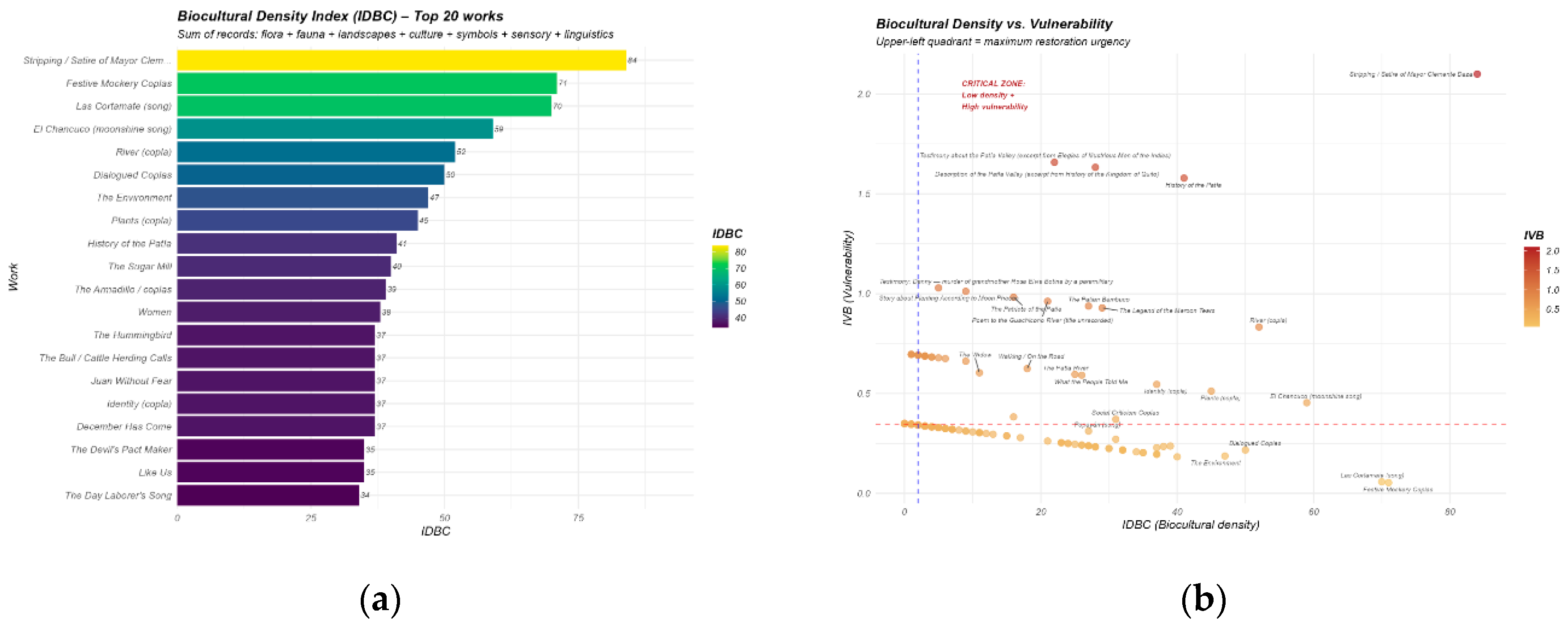
Figure 3.
Distribution of flora records by restoration dimension (n = 170).
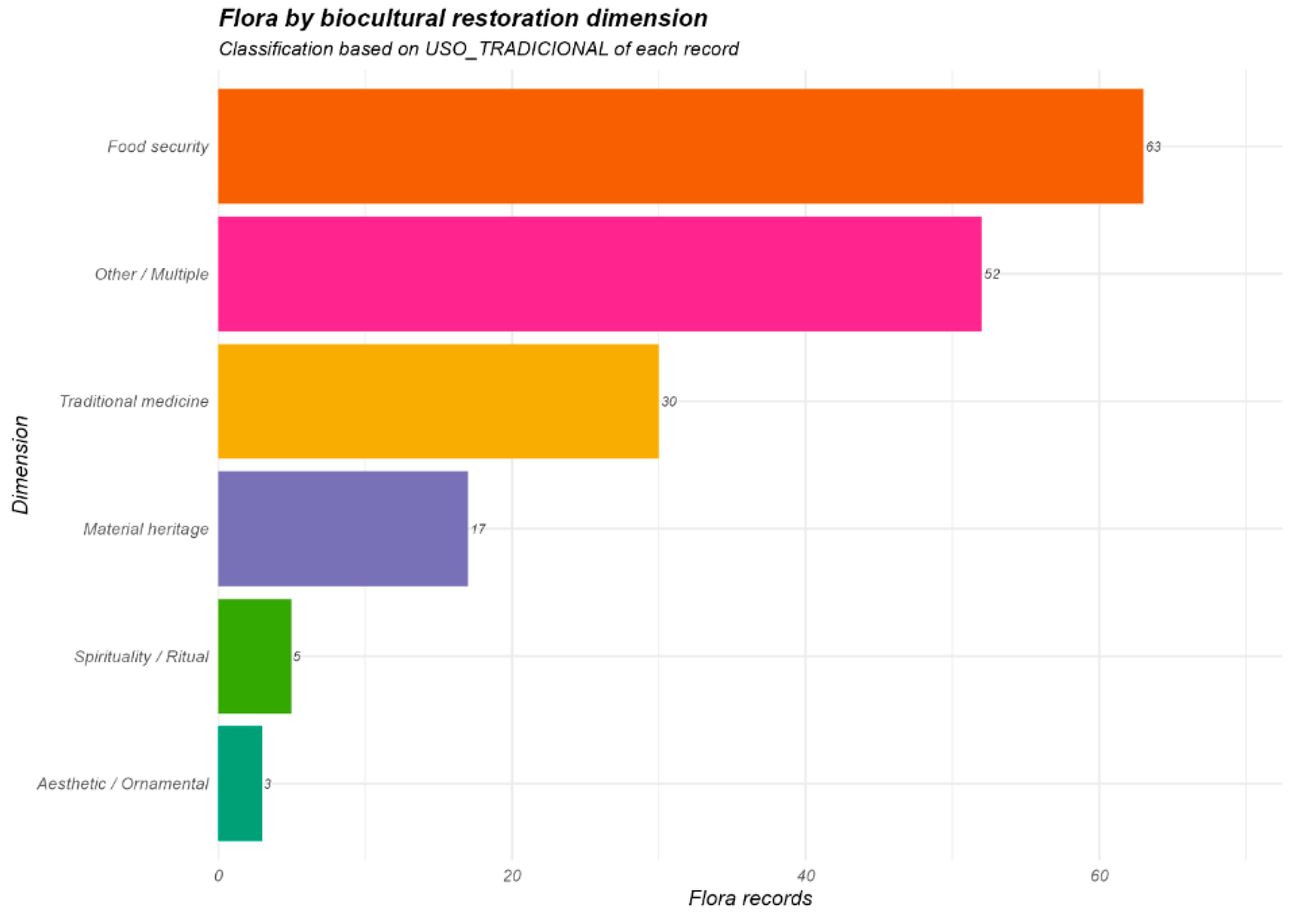
Figure 4.
Top 20 nodes of the biocultural network by degree. Asterisks (*) mark wild/native species suitable for TDF restoration.
Figure 4.
Top 20 nodes of the biocultural network by degree. Asterisks (*) mark wild/native species suitable for TDF restoration.
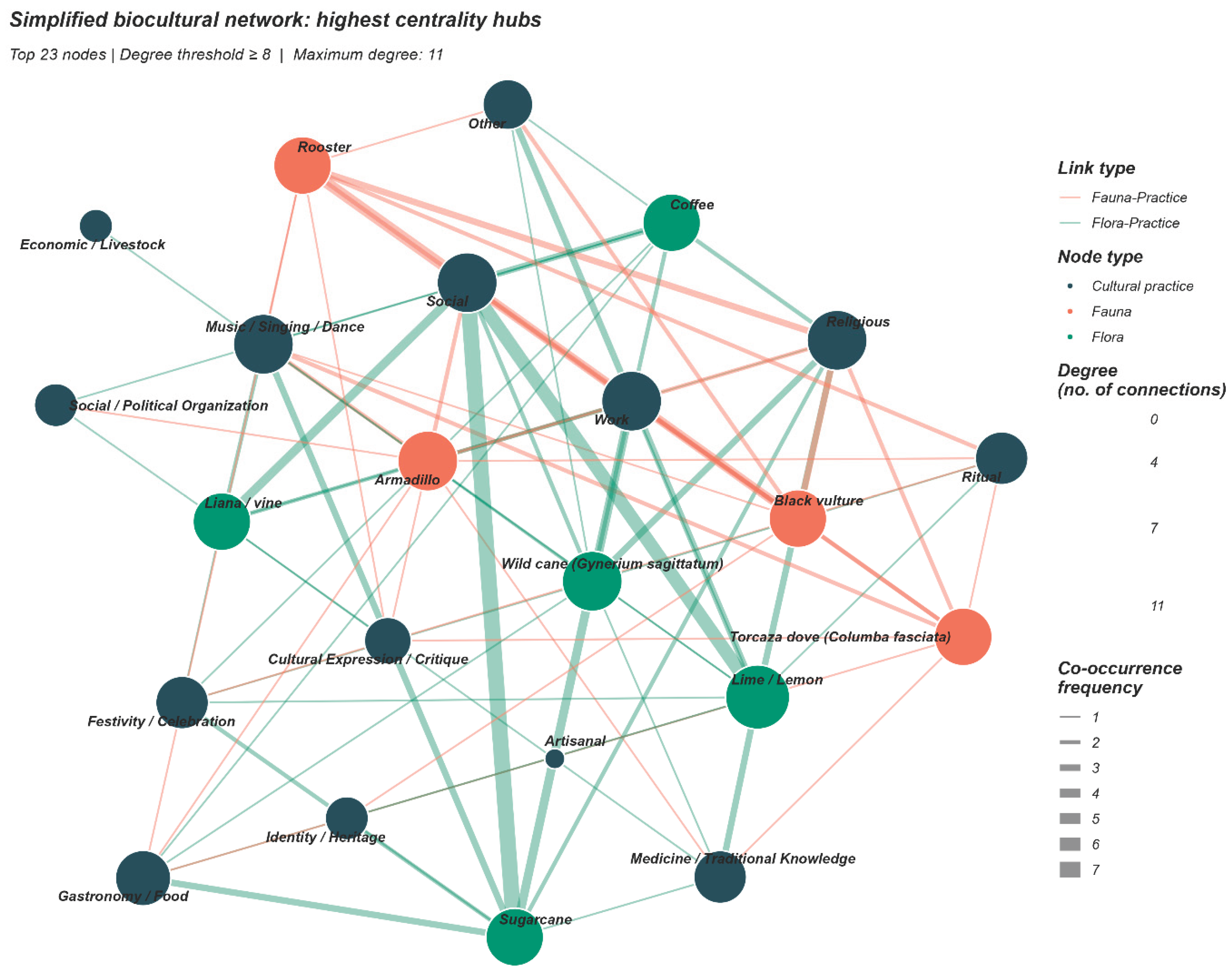
Table 2.
Spearman correlation matrix between the seven IDBC dimensions (n = 401 works).
| Dimension | Flora | Fauna | Landscape | Culture | Symbols | Sensory | Linguistic |
| Flora | 1.000 | 0.184 | 0.393 | 0.436 | 0.377 | 0.428 | 0.367 |
| Fauna | 0.184 | 1.000 | 0.351 | 0.365 | 0.380 | 0.388 | 0.366 |
| Landscape | 0.393 | 0.351 | 1.000 | 0.582 | 0.580 | 0.620 | 0.508 |
| Culture | 0.436 | 0.365 | 0.582 | 1.000 | 0.635 | 0.585 | 0.549 |
| Symbols | 0.377 | 0.380 | 0.580 | 0.635 | 1.000 | 0.632 | 0.548 |
| Sensory | 0.428 | 0.388 | 0.620 | 0.585 | 0.632 | 1.000 | 0.579 |
| Linguistic | 0.367 | 0.366 | 0.508 | 0.549 | 0.548 | 0.579 | 1.000 |
Table 3.
Top 15 flora species by IVBw—full corpus. Cultivated/introduced species are marked in italics: high cultural value but NOT suitable for ecological restoration of TDF (channel into agroecology/food sovereignty).
Table 3.
Top 15 flora species by IVBw—full corpus. Cultivated/introduced species are marked in italics: high cultural value but NOT suitable for ecological restoration of TDF (channel into agroecology/food sovereignty).
| Common name | Scientific name | n_works | n_uses | IC | VU | UC | IVBw |
| Limón | Citrus limon | 7 | 7 | 0.103 | 1.000 | 0.429 | 0.282 |
| Yuca | Manihot esculenta | 7 | 6 | 0.103 | 0.857 | 0.143 | 0.211 |
| Caña de azúcar | Saccharum officinarum | 6 | 6 | 0.088 | 0.857 | 0.167 | 0.204 |
| Anís | Pimpinella anisum | 4 | 4 | 0.059 | 0.571 | 0.500 | 0.183 |
| Plátano | Musa paradisiaca | 4 | 4 | 0.059 | 0.571 | 0.250 | 0.168 |
| Albahaca | Ocimum basilicum | 3 | 3 | 0.044 | 0.429 | 0.333 | 0.138 |
| Arroz | Oryza sativa | 3 | 3 | 0.044 | 0.429 | 0.333 | 0.138 |
| Maíz | Zea mays | 3 | 3 | 0.044 | 0.429 | 0.333 | 0.138 |
| Limón | Citrus aurantifolia | 2 | 2 | 0.029 | 0.286 | 1.000 | 0.101 |
| Arrayán | Myrcianthes sp. | 2 | 2 | 0.029 | 0.286 | 0.500 | 0.099 |
| Caña brava | Gynerium sagittatum | 2 | 2 | 0.029 | 0.286 | 0.500 | 0.099 |
| Maní | Arachis hypogaea | 2 | 2 | 0.029 | 0.286 | 0.500 | 0.099 |
| Algodón | Gossypium spp. | 1 | 1 | 0.015 | 0.143 | 1.000 | 0.052 |
| Barbasco | Tephrosia cinerea | 1 | 1 | 0.015 | 0.143 | 1.000 | 0.052 |
| Bejuco | Vitis tiliifolia | 1 | 1 | 0.015 | 0.143 | 1.000 | 0.052 |
Table 4.
Wild/native flora species suitable for ecological restoration of the TDF, ranked by IVBw and ecological role in the dry forest.
Table 4.
Wild/native flora species suitable for ecological restoration of the TDF, ranked by IVBw and ecological role in the dry forest.
| Common name | Scientific name | n_works | n_uses | IC | UC | IVBw | Ecological role |
| Arrayán | Myrcianthes sp. | 2 | 2 | 0.029 | 0.500 | 0.099 | Native fruit tree |
| Caña brava | Gynerium sagittatum | 2 | 2 | 0.029 | 0.500 | 0.099 | Riparian pioneer |
| Cañafístula | Cassia grandis | 1 | 1 | 0.015 | 1.000 | 0.052 | Native legume |
| Guayacán | Handroanthus chrysanthus | 1 | 1 | 0.015 | 1.000 | 0.052 | TDF emblematic tree |
| Guácimo | Guazuma ulmifolia | 1 | 1 | 0.015 | 1.000 | 0.052 | TDF pioneer |
| Hiraca | Carludovica palmata | 1 | 1 | 0.015 | 1.000 | 0.052 | Native palm-like |
| Guadua | Guadua angustifolia | 1 | 1 | 0.015 | 1.000 | 0.052 | Riparian bamboo |
| Bejuco | Serjania/Vitis/Bignonia spp. | 3 | 3 | 0.044 | 1.000 | 0.052 | Native lianas |
| Barbasco | Tephrosia cinerea/purpurea | 2 | 2 | 0.029 | 1.000 | 0.052 | Native legume/fish poison |
| Garabato | Mimosa sp. | 2 | 2 | 0.029 | 0.000 | 0.004 | Native legume (thorny) |
| Guayaba | Psidium guajava | 2 | 2 | 0.029 | 0.000 | 0.004 | Native fruit tree |
| Ceiba | Ceiba pentandra | 1 | 1 | 0.015 | 0.000 | 0.004 | TDF keystone tree |
| Cajeto | Amphilophium paniculatum/Citharexylum sp. | 2 | 2 | 0.029 | 0.000 | 0.004 | Native fiber & timber |
| Matarratón | Gliricidia sepium | 1 | 1 | 0.015 | 0.000 | 0.004 | Native nitrogen-fixer |
| Samán | Samanea saman | 1 | 1 | 0.015 | 0.000 | 0.004 | Native shade tree |
| Roble | Quercus humboldtii | 1 | 1 | 0.015 | 0.000 | 0.004 | Native hardwood |
Disclaimer/Publisher’s Note: The statements, opinions and data contained in all publications are solely those of the individual author(s) and contributor(s) and not of MDPI and/or the editor(s). MDPI and/or the editor(s) disclaim responsibility for any injury to people or property resulting from any ideas, methods, instructions or products referred to in the content. |
© 2026 by the authors. Licensee MDPI, Basel, Switzerland. This article is an open access article distributed under the terms and conditions of the Creative Commons Attribution (CC BY) license.
Copyright: This open access article is published under a Creative Commons CC BY 4.0 license, which permit the free download, distribution, and reuse, provided that the author and preprint are cited in any reuse.


