

Submitted:
29 June 2026
Posted:
30 June 2026
You are already at the latest version
Abstract
Gas chromatography–mass spectrometry (GC–MS) is widely used to separate, identify, and semi-quantify volatile and derivatizable semi-volatile constituents (mono-/sesqui-terpenoids, phenylpropanoids, fatty-acid derivatives) that carry the discriminatory chemical information needed for authentication and quality control of traditional Chinese medicinal materials (TCMMs). To frame the methodological landscape rather than merely list components, this synthesis draws on peer-reviewed GC–MS / HS‑SPME works mainly indexed in PubMed, Web of Science, and Scopus (focusing on the last decade), using searches built around keyword clusters (GC–MS, volatile oil, TCM authentication/QC, processing) and prioritizing studies that report separation conditions, pretreatment rationale, identification confidence (spectral match + retention index), and chemometric discrimination. The covered evidence shows GC–MS reliability depends less on instrument prestige than on upstream choices: pretreatment selectivity and thermal bias govern which labile markers survive; co-elution and matrix effects require explicit deconvolution/alignment; and identification confidence needs RI anchoring and, where possible, standard cross-checks, while inconsistent validation reporting and GC's intrinsic inaccessibility of strongly polar non-volatiles remain the main bottlenecks. When framed as a separation-first workflow—integrating optimized pretreatment (distillation/SPME/SFE), derivatization strategies, and multivariate modelling—GC–MS delivers verifiable chemical fingerprints to track geographical, batch, and processing-induced changes, supporting more comparable, regulation-ready QC protocols for TCMMs.
Keywords:
GC–MS
; separation science
; sample preparation
; traditional Chinese medicinal materials
; volatile oils
; authentication
; chemometrics
1. Introduction
The quality and consistency of traditional Chinese medicinal materials (hereafter TMMs / CMMs) depend on their chemical composition, in which the volatile and derivatizable semi-volatile fraction-notably mono-/sesqui-terpenoids, phenylpropanoids, and certain lipophilic markers such as fatty-acid methyl esters--plays a central role in species identity, aroma profile, and several bioactivity-linked properties. However, TMMs are chemically heterogeneous; their secondary-metabolite profiles vary with species, provenance, harvest timing, and post-harvest handling. Conventional release controls (organoleptic inspection, macroscopic/microscopic identification, and simple physicochemical checks) cannot resolve this chemical heterogeneity, which creates a bottleneck for quality-assurance programmes that must be evidence-based and reproducible.
Gas chromatography–mass spectrometry (GC–MS), and its hyphenated sampling interfaces (most notably headspace solid-phase microextraction, HS-SPME–GC–MS), address part of this bottleneck by combining chromatographic separation with mass-spectral identification, making it possible to profile the volatile/semi-volatile fraction at the sensitivity and resolution required for batch-to-batch comparison. Well-documented applications include the discrimination of closely related taxa[1] and the tracking of processing-induced changes in essential-oil-type profiles[2]. Nevertheless, GC–MS does not act alone: the chemical evidence it delivers is strongly conditioned by upstream choices—how the sample is prepared (steam/hydro-distillation, solvent extraction, supercritical CO₂ extraction, or headspace microextraction), whether thermolabile markers survive the chosen thermal regime, and how peak deconvolution, alignment, and identification confidence (library match plus retention-index anchor) are reported.
When GC–MS workflows are paired with multivariate chemometrics (principal component analysis; partial least squares–discriminant analysis; orthogonal projections, etc.), the resulting decision layer can support authentication, geographical/processing discrimination, and fingerprint-based consistency checks; yet the reliability of these classifications still rests on transparent, standardized reporting of separation conditions and identification criteria. Despite progress, recurring gaps remain: inconsistent validation culture, uneven identification confidence, and a tendency to treat GC–MS as a "component-listing" tool rather than as a separation-first, evidence-chain process.
Against this background, this review surveys recent advances in GC–MS-centred separation workflows for traditional Chinese medicinal materials, treating the analytical chain as a sequence in which upstream choices determine the quality of every downstream decision. The discussion is organised around the steps that most directly affect the usable chemical evidence: first, the separation and ionisation principles that make GC–MS selective for the volatile and derivatisable semi-volatile fraction; second, sample pretreatment and extraction strategies—ranging from conventional hydro-/steam distillation to solvent-based routes, solvent-free HS-SPME, and supercritical CO₂ extraction—where selectivity, thermal bias, and recovery control which markers survive into the chromatogram; third, data-processing operations (peak deconvolution, retention-time alignment, library matching) and their extension through chemometric discrimination; and fourth, the translation of these workflows into practical quality-control tasks, including component profiling, processing-effect tracking, and origin-related discrimination.
By returning throughout to the order pretreatment, then separation, then detection, then interpretation, the review clarifies what GC–MS can robustly deliver in this matrix class and, equally important, where its intrinsic boundary lies: polar, non-volatile constituents fall outside the native domain of gas-phase separation and are better served by complementary platforms rather than forced into a GC–MS narrative. Within this boundary, the article emphasises how method-level habits—not instrument prestige—drive comparability: the choice of pretreatment that preserves or sacrifices labile markers, the transparency of deconvolution and alignment criteria, and the discipline of identification confidence (library match strengthened by a retention-index anchor on the actual column and temperature programme, and, where the claim matters, a reference-standard cross-check). The overall objective is to organise the recent literature around a reproducible evidence chain so that GC–MS-derived chemical fingerprints become audit-ready inputs for authentication, batch consistency, and regulation-aware quality control of medicinal plant materials[3,4].
1. Technical Principles and Analytical Workflow of GC-MS in Traditional Chinese Medicine Research
1.1. GC-MS Technical Principles and Instrument Configuration
Gas chromatography–mass spectrometry (GC–MS) couples two functionally distinct units: a gas chromatograph, which separates volatile and derivatisable semi-volatile analytes based on partitioning between a mobile carrier gas and the stationary phase of a capillary column, and a mass spectrometer, which provides ionisation, mass analysis, and detection. In the GC step, compounds are vaporised and swept by an inert carrier gas (commonly helium) through the column; their elution order reflects volatility and the strength of interaction with the stationary phase, so that complex mixtures—such as herb-derived volatile/semi-volatile extracts—can be resolved into interpretable chromatograms.
In the MS unit, the most widely used ionisation mode for routine qualitative screening and library matching is electron ionisation (EI, typically at 70 eV), which generates reproducible fragmentation patterns that can be compared with reference spectra (e.g., NIST, Wiley). The resulting mass spectra provide a molecular ion region (when visible) and a set of diagnostic fragment ions that allow putative identification by library similarity scores, often strengthened by a retention index (RI) anchor on the actual column and temperature programme. For example, GC–MS profiling of plant materials commonly traces terpenoids, phenylpropanoid-related aromatics, and lipophilic markers (including fatty-acid derivatives such as FAMEs after methylation/derivatisation) that are compatible with gas-phase separation and that carry much of the discriminatory chemical information in essential-oil-type systems.
The physical interface between GC and MS—typically a heated transfer line—must maintain a temperature at or slightly above the upper end of the column temperature programme to prevent condensation of higher-boiling semi-volatiles before they reach the ion source; the ion source and quadrupole (or other analyser) region is then maintained under high vacuum to preserve beam definition and signal stability. Modern data systems record chromatograms and corresponding mass spectra simultaneously, and workstation software supports peak detection, deconvolution/background subtraction, library searching, and report generation, which together raise throughput and consistency when acquisition parameters and processing settings are documented and applied uniformly.
When the workflow is kept within its intended domain (volatile and derivatisable semi-volatile fractions), the pairing of chromatographic separation with mass-selective detection supplies the structural clues + relative-abundance pattern needed for marker screening, fingerprinting, and (with standards/calibration) quantitation. This capability underpins many authentication and quality-control schemes for traditional Chinese medicinal materials[5].
1.2. Sample Pretreatment Techniques
Sample pretreatment determines which fraction survives into the GC–MS channel; it is therefore the step that most strongly shapes the resulting “chemical profile.”
Steam/hydro-distillation remains the classical route to obtain an essential-oil-like isolate for pharmacopoeial-style volatile-oil work. It can recover mono-/sesqui-terpene hydrocarbons and many co-distilling oxygenates; however, prolonged exposure to hot water/steam increases the risk of thermal rearrangement, ester hydrolysis, or loss of the most volatile markers if condensation and collection conditions are not tightly controlled. For instance, essential oil from Heliotropium bacciferumleaves and stems obtained by steam distillation was subsequently characterised by GC–MS, with linalool, phytol, and related terpenoids reported among the constituents [6].
Solvent-based extraction (macerations, infusions, or liquid–liquid steps) widens the extracted pool to more lipophilic material, but also drags co-extracted matrix (waxes, pigments, non-volatiles) that can complicate later deconvolution and background; concentrates/evaporation steps must be managed to avoid selective loss of light volatiles. For example, ethanol-extracted Brassica oleraceavar. viridisleaf extracts analysed by GC–MS revealed a broad lipophilic profile that included compounds discussed in the literature as flavonoid-/phenolic-associated and fatty-acid-related signals [7]. Comparative work on Bupleurispecies also illustrates how extraction philosophy (e.g., hydrodistillation vs. supercritical fluid pathways) changes the recovered profile and downstream biological interpretation.
Headspace solid-phase microextraction (HS-SPME)–GC–MS reduces solvent use and often better preserves thermolabile headspace contributors, but its picture is partition-controlled: fibre coating, headspace temperature/time, sample moisture/salting, and vial atmosphere matter, and the result is not a “whole oil” in the distillation sense. HS-SPME–GC–MS applications include volatile profiling across Lauraceaegenera with explicit parameter optimisation (fibre type, extraction temperature, extraction time) [8], and fingerprint-led quality control of aroma/volatile systems such as fried pepper oils [9].
Supercritical CO₂ extraction (SFE) offers a tunable, low-residue alternative; extract composition shifts with pressure/temperature and any co-solvent, so “SFE = gentler” is only true when the method is documented (P, T, flow, co-solvent %, collection mode). Comparative SFE–HD discussions for Bupleuriagain show how the extraction path reshapes the GC–MS-visible fraction and related activity narratives .
1.3. Data Processing and Chemometric Methods
The processing of gas chromatography–mass spectrometry (GC-MS) data for qualitative and quantitative analysis in traditional Chinese medicine (TCM) involves several critical steps. Initially, raw chromatographic data undergo peak detection, deconvolution, and alignment to identify individual chemical constituents and their corresponding retention times. Quantitative analysis is subsequently performed, wherein peak areas or heights relative to internal or external standards are used to determine compound concentrations. Multivariate statistical methods, such as principal component analysis (PCA) and partial least squares discriminant analysis (PLS-DA), are then applied to interpret complex datasets, enabling sample differentiation based on chemical profiles and supporting quality control efforts [10]. This comprehensive workflow ensures the robust identification and quantification of bioactive compounds within complex herbal matrices.
Overlapping peaks in GC-MS chromatograms represent a significant challenge for accurate compound identification and quantification. Advanced chemometric techniques, such as multivariate curve resolution–alternating least squares (MCR-ALS), have been successfully employed to resolve co-eluted peaks by decomposing complex signals into pure component spectra and concentration profiles. For instance, MCR-ALS was employed to resolve ten major volatile compounds in Pogostemon cablin, facilitating the construction of chemical fingerprints for different plant parts and essential oils [10]. Other chemometric tools, including iterative orthogonal projection (IOP) and exploratory factor analysis (EFA), also assist in deconvoluting overlapping signals, thereby enhancing the reliability of qualitative and quantitative analyses in TCM research.
Database searching and spectral matching are indispensable tools for compound identification in GC-MS analysis. Mass spectral libraries, such as NIST and Wiley, provide reference spectra against which experimental data are compared using similarity scores. The integration of retention indices further enhances identification confidence. In complex TCM samples, combining spectral matching with chemometric classification models—including hierarchical cluster analysis (HCA) and orthogonal partial least squares discriminant analysis (OPLS-DA)—enhances discrimination among species or processing methods. For example, GC-MS coupled with chemometrics was used to differentiate Atractylodes species and identify characteristic chemical markers critical for quality evaluation. Such integrative approaches streamline the identification process and support authentication and quality control efforts.
Chemometric methods not only facilitate data interpretation but also enable the discovery of potential quality markers and biomarkers. By applying supervised techniques, such as PLS-DA and OPLS-DA, researchers can identify variables with high variable importance in projection (VIP) scores that contribute most to sample differentiation. These markers facilitate the rapid classification and quality assessment of herbal materials. For example, in a study of Amomum species, PLS-DA identified 11 differential metabolites serving as quality markers, while machine learning models further improved species identification accuracy [11]. This synergy between GC-MS data and chemometrics enhances the precision and efficiency of TCM quality control efforts.
In summary, the integration of GC-MS data processing with advanced chemometric techniques constitutes a comprehensive framework for the qualitative and quantitative analysis of traditional Chinese medicines. This approach overcomes challenges such as overlapping peaks and complex chemical profiles, enabling accurate compound identification, differentiation of species or processing methods, and the discovery of quality markers. The continuous development of spectral databases, deconvolution algorithms, and machine learning models holds promise for further improving the robustness and applicability of GC-MS in TCM authentication and quality evaluation.
1.4. Search Strategy and Scope
This review adopts a narrative (non-systematic) synthesis format; therefore, no PRISMA flowchart is included. Nevertheless, the search coverage follows a documented and reproducible protocol.
Searches were conducted in PubMed, Web of Science Core Collection, and Scopus for English-language records published up to June 2026, using keyword clusters constructed from the following three blocks:
(i) Technique: "gas chromatography–mass spectrometry" OR "GC–MS" OR "GC-MS" OR "HS-SPME-GC-MS"
(ii) Matrix: "traditional Chinese medicine" OR "Chinese medicinal material" OR "medicinal herb*"
(iii) Analytical target/application: "volatile oil" OR "essential oil" OR "terpenoid" OR "fatty acid methyl ester" OR "FAME" OR "derivatized lipid" OR "phenolic aroma" OR "fingerprint*" OR "authentication" OR "quality control"
At the title and abstract screening stage, the exclusion criteria comprised: (i) pure clinical trials or pharmacology-only studies lacking MS-based chemical characterization; (ii) non-original items, such as conference abstracts without full text and editorials; and (iii) studies whose primary discrimination or fingerprint claims relied on platforms outside the GC-MS-accessible volatile or semi-volatile space. Additionally, key primary studies and review bibliographies were hand-searched to identify additional relevant sources.
2. Application of GC-MS in the Identification of Components in Traditional Chinese Medicine Volatile Oils
2.1. Chemical Composition Analysis of Volatile Oils
Volatile oils, also referred to as essential oils, are complex mixtures predominantly composed of terpenoids—such as monoterpenes and sesquiterpenes—along with esters, alcohols, and other organic compounds. Typical constituents include monoterpenes, such as α-pinene, limonene, and linalool, as well as sesquiterpenes, including β-caryophyllene and α-bisabolol. These compounds contribute to the characteristic aroma and pharmacological activities of essential oils. For instance, studies on aromatic oils derived from plants such as thyme, sage, and lavender identified major terpenes, including thujone, cineole, camphor, α-caryophyllene, and linalool, which are recognized for their bioactive properties [12]. The chemical diversity of volatile oils is fundamental to their therapeutic and industrial applications.
In the context of traditional Chinese medicinal herbs, volatile oils extracted from plants such as Artemisia argyi, Bupleurum chinense, and Atractylodes species have been extensively analyzed by GC-MS. For example, the aromatic oil of Bupleurum chinense was found to be rich in terpenoids and aliphatic compounds, which were linked to its antiepileptic effects through the modulation of neurotransmitter pathways [13]. Similarly, Atractylodes species exhibited distinct volatile profiles, with characteristic markers such as hinesol, β-eudesmol, and atractylon, thereby enabling species differentiation and quality evaluation [1,13]. These findings underscore the importance of detailed chemical profiling for understanding the pharmacological basis of herbal medicines.
The chemical composition of volatile oils also exhibits significant variation depending on plant species, geographic origin, and the specific plant part used. For instance, a GC-MS-based analysis identified more than 40 volatile compounds in lavender essential oils from different regions of Greece, supporting the quality assessment and differentiation of lavender samples from various origins [14]. Similarly, essential oils of rose varieties (Jinbian, Kushui, and Pingyin) differed in their content of long-chain alkanes, organic acids, and esters, with chemometric analyses identifying markers for varietal discrimination [15]. Such regional and varietal differences are critical for standardizing herbal products and ensuring consistent therapeutic effects.
The volatile oil composition of medicinal plants, such as Salvia aegyptiaca and Glycyrrhiza foetida, further reflects their bioactive potential. Salvia aegyptiaca oil was characterized by a high total content of monoterpene derivatives, with tricyclene and limonene as major components; the high tricyclene content identifies this oil as a unique chemotype [16]. Glycyrrhiza foetida essential oil contained δ-cadinene and (E)-caryophyllene as major components, exhibiting antifungal and antibiofilm activities against Candida albicans and dermatophytes [17]. These examples highlight the link between chemical composition and biological efficacy in volatile oils.
The distribution of volatile oil components within different parts of a plant can also vary markedly, influencing both their chemical profiles and bioactivities. Studies on Alpinia katsumadai revealed that roots, fibrous roots, stems, leaves, and shells contained distinct volatile organic compounds, with differential antibacterial activities observed among these parts [18]. Similarly, the essential oil composition of Cymbopogon species showed variation between roots and leaves, with major compounds such as geraniol, citral, and α-elemol differing in concentration and enantiomeric distribution [19]. These intra-plant variations are important considerations in the selection and utilization of medicinal plant materials.
In summary, the chemical analysis of volatile oils from traditional Chinese medicinal herbs reveals a complex array of terpenoids, esters, and other compounds that vary by species, geographic origin, and plant part. GC-MS remains a pivotal tool for identifying these constituents, which underpin the pharmacological activities and quality control of herbal medicines. A thorough understanding of these chemical profiles facilitates species differentiation, quality evaluation, and the rational clinical application of herbs containing volatile oils.
2.2. Quantitative Analysis Methods for Volatile Oil Components
The establishment and validation of GC-MS quantitative methods for volatile oil components in traditional Chinese medicines have become increasingly sophisticated. For example, in the quality evaluation of Yanyangke mixture (YM), a GC-MS method was developed to identify 43 volatile components and establish a fingerprint for quality control. Subsequently, three key components were selected as active markers, and a GC content determination method was validated, demonstrating the feasibility of a rapid and effective quality evaluation of volatile oils in complex TCM prescriptions [20]. This approach highlights the importance of combining chemical fingerprinting with quantitative analysis to ensure the consistency and efficacy of volatile oils.
Comparative studies have also explored the application of internal standard and external standard methods in GC-MS quantification. In the analysis of Artemisiae Argyi Folium and its folk substitute Artemisiae Verlotori Folium, the internal standard method combined with multiple reaction monitoring (MRM) mode was employed to determine six major volatile components. This method enabled precise quantification and differentiation of volatile oils between the two Artemisia species [21]. Conversely, external standard methods remain widely used due to their simplicity but may be less robust in complex matrices.
Dynamic monitoring of volatile oil content changes during plant development or processing represents another critical aspect. For instance, the seasonal variation of volatile compounds in Zanthoxylum bungeanum fruit was monitored by GC-MS, revealing that volatile oil content increased gradually during fruit development, with key compounds such as (+)-limonene and linalool showing distinct trends. This dynamic profiling provided insights into the optimal harvest period for maximizing volatile oil yield and quality [22]. Similarly, studies on fresh versus dried ginseng volatile oils demonstrated that drying procedures alter the composition of volatile components, particularly through the evaporation of low-boiling compounds. These studies clarified the dominant components of fresh ginseng and their potential pharmacological effects, providing a basis for the application and development of fresh ginseng [23].
The integration of chemometric methods with GC-MS quantitative analysis further enhances the understanding of volatile oil content variations. In the differentiation and quality evaluation of Atractylodes species, GC-MS coupled with chemometric analysis identified 50 volatile components and quantified five characteristic markers. This approach enabled the discrimination of species based on volatile oil content and composition, thereby facilitating quality control and rational clinical application [1]. Such multivariate analyses provide a powerful tool for monitoring volatile oil content changes and ensuring authenticity.
Overall, the GC-MS quantitative analysis of volatile oils in TCMs involves method establishment and validation, comparison of internal and external standard methods, dynamic content monitoring during growth or processing, and the application of chemometrics to interpret complex data. These strategies collectively improve the accuracy, reliability, and applicability of volatile oil quantification in medicinal plant quality control.
2.3. Advances in Research on the Relationship Between Volatile Oil Components and Pharmacological Effects
The pharmacological activities of essential oils (EOs) are primarily attributed to their volatile monoterpenes and sesquiterpenes, which exhibit diverse bioactivities, including antimicrobial, anti-inflammatory, antioxidant, and anticancer effects. For example, the essential oil from Cinnamomum camphora leaves, rich in linalool and eucalyptol, demonstrated significant antibacterial activity against methicillin-resistant Staphylococcus aureus (MRSA) by damaging bacterial cell membranes and disrupting amino acid metabolism [24]. Similarly, the essential oil of Guatteria megalophylla, containing spathulenol and elemene isomers, showed potent anti-leukemia activity both in vitro and in vivo, inducing apoptosis in human promyelocytic leukemia cells [25]. These findings highlight the critical role of specific volatile constituents in mediating pharmacological effects.
In traditional Chinese medicine and other herbal systems, essential oils contribute synergistically within complex formulations. Studies on combined essential oils, such as the blend of Allium sativum and Curcuma longa oils, reported good antifungal efficacy against multiple phytopathogens [26]. Moreover, binary blends of essential oils from Piper aduncum, Melaleuca leucadendra, and Schinus terebinthifolius showed increased acaricidal activity against Tetranychus urticae, indicating that combinations of volatile compounds can potentiate bioactivity while maintaining compatibility with beneficial predatory mites [27]. These synergistic effects underscore the importance of studying essential oil components in the context of multi-component herbal preparations.
The chemical diversity of essential oils also influences their pharmacological profiles. For instance, the essential oils of Aucklandiae Radix and Vladimiriae Radix—two closely related medicinal herbs—differ in the content of specific sesquiterpenes: β-patchoulene is unique to Vladimiriae Radix, while β-eudesmol is present at higher levels in this species. These differences provide a theoretical basis for the preferential clinical use of Vladimiriae Radix from Sichuan [28]. Similarly, the major constituents of Trachyspermum ammi essential oil, including thymol, p-cymene, and γ-terpinene, exhibit distinct insecticidal activities, with thymol being the most potent [29]. These compositional variations affect not only efficacy but also the safety and specificity of essential oils in clinical and agricultural applications.
Emerging research integrates molecular approaches to elucidate the mechanisms underlying essential oil bioactivities. For example, miRNA-mediated regulation of monoterpene biosynthesis in Cinnamomum camphora was linked to key enzymes, such as geranyl diphosphate synthase, highlighting the post-transcriptional control of linalool production [30]. Additionally, molecular docking studies have identified interactions between essential oil components and fungal enzymes, providing mechanistic insights into antifungal actions [31]. Such integrative analyses advance our understanding of how volatile compounds exert their pharmacological effects at the molecular and cellular levels.
In summary, the pharmacological efficacy of essential oils is closely related to their volatile constituents, which act individually or synergistically to modulate biological targets. Advances in chemical profiling, bioactivity assays, and molecular biology have deepened insights into the therapeutic potential of essential oils in both traditional and modern medicine. Continued research on composition–activity relationships and the mechanisms of volatile oils will facilitate their rational application in clinical and agricultural settings.
3. Application of GC-MS Technology in the Analysis of Fatty Acids and Other Non-Volatile Components in Traditional Chinese Medicine
3.1. Derivatization and GC-MS Analysis of Fatty Acid Components
Fatty acid methylation is a pivotal derivatization technique that enables the analysis of fatty acids by GC-MS. This process typically converts fatty acids into their corresponding methyl esters, enhancing volatility and thermal stability, which are essential for GC-MS detection. Optimization of methylation conditions—such as reagent type, reaction time, temperature, and catalyst presence—is crucial to achieving complete conversion and reproducible results. For instance, the choice between acid or base catalysts and the selection of direct methylation or prior extraction steps can significantly influence the yield and profile of fatty acid methyl esters (FAMEs) detected by GC-MS. Such optimization ensures accurate qualitative and quantitative fatty acid profiling, as demonstrated in rat fecal matrices [32].
In the context of traditional Chinese medicines such as Huangqi (Astragalus membranaceus) and Heshouwu (Polygonum multiflorum), fatty acid profiling via GC-MS after methylation has been effectively applied to characterize their lipid components. For example, studies on Azadirachta indica seed oil—which shares fatty acid constituents with some medicinal herbs—demonstrated the conversion of unsaturated and saturated fatty acids into methyl esters with high yield and purity using optimized transesterification protocols. This approach allowed detailed GC-MS analysis revealing that oleic, linoleic, palmitic, and stearic acids are the major fatty acids in Melia azedarach seed oil, which was analyzed for potential use in biodiesel production [33].
Specifically, FAME analysis of Huangqi and Heshouwu has revealed distinct fatty acid profiles that can serve as chemical fingerprints for authentication and quality control. For instance, Egyptian and Indian ashwagandha (Withania somnifera) root extracts analyzed by GC-MS showed differences in fatty acid content, including n-hexadecanoic acid and octadecanoic acid methyl esters, which are important bioactive components [34].
Moreover, the derivatization step not only facilitates fatty acid analysis but also enables the detection of other related metabolites such as organic acids and sterols, which may co-exist in herbal extracts. For example, comprehensive phytochemical characterization of kidney vetch (Anthyllis vulneraria) using GC-MS after derivatization identified fatty acids alongside flavonoids and triterpenoids, illustrating the broad applicability of derivatization-GC-MS techniques in profiling complex herbal matrices [35]. This underscores the versatility of methylation derivatization in enhancing the detection of fatty acid components in traditional Chinese medicines.
In summary, fatty acid methylation is a critical preparatory step for GC-MS analysis of herbal fatty acids, enabling sensitive, accurate, and reproducible profiling. Optimized methylation protocols have been successfully applied to important medicinal herbs such as Huangqi and Heshouwu, providing valuable chemical information for authentication, quality control, and pharmacological studies. The integration of derivatization with GC-MS thus represents a powerful analytical approach in the study of fatty acid constituents in traditional Chinese medicines.
3.2. GC-MS Analysis of Phenolic Compounds and Other Bioactive Constituents
Phenolic compounds in traditional Chinese medicines are critical bioactive constituents with diverse pharmacological effects, including antioxidant, anti-inflammatory, and antimicrobial activities. Their extraction and identification often rely on advanced analytical techniques such as GC-MS. For example, combined GC-MS and HPLC-Q-TOF-MS analysis characterized the chemical profile of Dendrobium officinale fermentation liquid, detecting phenolic acids including gallic acid and protocatechuic acid among other chemical components [36]. Similarly, the ethanol extract of Dalbergia retusa was found to be rich in phenols and aromatic compounds by GC-MS, which correlated with its strong antifungal activity [37]. These studies highlight the importance of optimized extraction methods and GC-MS analysis for reliable phenolic compound identification in TCMs.
The analysis of aromatic and phenolic derivatives by GC-MS is essential for understanding the chemical complexity and bioactivity of herbal medicines. For instance, the volatile oils of Artemisia argyi, a commonly used TCM, contain eucalyptol, eugenol, and β-caryophyllene as major components, which have been studied via GC-MS/MS for their pharmacokinetics and tissue distribution in vivo [38]. Moreover, chemical profiling of Ugandan propolis using GC-MS identified phenolic acids such as caffeic acid and alkylresorcinols, which serve as chemical markers for geographic differentiation and quality control [39]. These aromatic compounds and their derivatives are often analyzed in combination with phenolics to provide a comprehensive chemical fingerprint of TCMs.
Integrating GC-MS with other spectroscopic and chromatographic techniques enhances the comprehensive analysis of phenolic and aromatic compounds. For example, the combined use of GC-MS and network pharmacology elucidated the active volatile components of Albiziae Flos and their potential antidepressant mechanisms [40]. Similarly, a study on Platycodonis Radix employed GC-MS alongside HPLC-QTOF-MS/MS and network pharmacology to identify triterpenoid saponins and volatile compounds, revealing their anti-inflammatory pathways [41]. Such integrative strategies enable the correlation of chemical constituents with biological activities, facilitating quality control and mechanistic understanding of TCMs.
The combination of GC-MS with solid-phase microextraction techniques, such as headspace SPME-GC-MS, offers solvent-free, sensitive, and automated analysis of phenolic and aromatic compounds. This approach was successfully applied to analyze isoeugenol in aquaculture products, demonstrating high sensitivity and stability [42]. Additionally, HS-GC-MS was used to profile the volatile oils of Albiziae Flos [40], and HS-SPME-GC-MS was employed to analyze changes in volatile components of a Tibetan medicinal preparation after ⁶⁰Coγ irradiation [43]. These methods improve the detection of low-volatility phenolics and aromatic compounds in complex herbal matrices.
In summary, GC-MS analysis of phenolic and aromatic compounds in TCMs involves optimized extraction, sensitive detection, and often integration with other analytical and computational methods. Phenolic acids, flavonoids, and aromatic terpenoids are frequently identified as key bioactive constituents. The use of advanced sample preparation techniques and combined analytical strategies enhances the reliability and depth of chemical profiling, supporting quality control and pharmacological research in traditional herbal medicines.
3.3. Advantages and Limitations of GC-MS in the Analysis of Complex TCM Components
Gas chromatography–mass spectrometry offers a powerful analytical platform for the simultaneous detection of multiple components in complex traditional Chinese medicine matrices. Its ability to separate and identify volatile and semi-volatile compounds enables comprehensive profiling of herbal medicines, as demonstrated in studies such as the analysis of Kai-Xin-San (KXS), where 105 volatile constituents were identified predominantly from Acori Tatarinowii Rhizoma, complementing the identification of 211 compounds by UPLC-Q-Orbitrap MS [44]. This multi-component detection capability facilitates quality control and pharmacodynamic substance basis studies by providing a broad chemical fingerprint of TCM formulations.
Despite these advantages, GC-MS faces challenges in analyzing thermally labile or non-volatile components inherent in many TCMs. For example, while essential oils and volatile compounds are well characterized by GC-MS, heat-sensitive constituents may degrade during analysis, limiting detection accuracy. This limitation necessitates careful sample preparation and, in some cases, derivatization to stabilize or volatilize analytes. Moreover, complex matrices may contain components that co-elute or interfere, complicating interpretation without advanced chromatographic techniques.
To overcome these challenges, derivatization techniques have been widely applied to extend GC-MS applicability. Chemical derivatization, such as silylation or methylation, improves the volatility and thermal stability of polar or thermally unstable compounds, enabling their detection and quantification. For instance, a methylation-assisted GC-MS strategy allowed comprehensive monosaccharide profiling in Polygonatum polysaccharides, overcoming limitations of conventional chromatographic methods [45]. Similarly, derivatization enhanced the detection of bromophenols, improving chromatographic separation and sensitivity [46]. These approaches expand the utility of GC-MS in TCM complex component analysis.
The integration of GC-MS with chemometric and multivariate statistical methods further enhances its analytical power. Studies on volatile oils from Yanyangke mixture demonstrated that combining GC-MS fingerprinting with PCA and HCA can differentiate batches, identify quality markers, and evaluate consistency [20]. Similarly, studies on Qiai from different harvest periods analyzed the dynamic changes of volatile components using GC-MS combined with PCA and OPLS-DA [47]. Such combined strategies enable the discrimination of subtle chemical differences in complex herbal matrices, supporting quality control and authentication.
In summary, GC-MS excels in simultaneous multi-component detection of volatile and semi-volatile constituents in TCMs, providing rich chemical information critical for quality evaluation. However, its limitations in analyzing thermally unstable or non-volatile compounds require complementary techniques such as derivatization or coupling with advanced chromatographic methods. The synergy of GC-MS with chemometrics and derivatization strategies significantly broadens its application scope in the comprehensive analysis of complex TCM components.
4. Application of GC-MS Technology in the Influence of Traditional Chinese Medicine Processing Techniques and Quality Control
4.1. Effects of Processing on Volatile Oil Composition
Processing methods, such as frying, steaming, and vinegar treatment, significantly influence the composition of volatile oils in traditional Chinese medicines. These methods can induce chemical transformations, including oxidation, rearrangement, and addition reactions, which alter the profile and relative content of volatile constituents. For example, sulfur fumigation of lily bulbs leads to the formation of sulfur-containing compounds through addition and rearrangement reactions, markedly changing their volatile profile compared with that of non-fumigated samples [48]. Such transformations can affect both the efficacy and safety of the resulting herbal products.
Studies on specific herbs, such as clove (Syzygium aromaticum) and Ligusticum chuanxiong (Chuanxiong), demonstrate that processing impacts key bioactive volatile compounds. Clove essential oil is rich in phenolic compounds and exhibits antimicrobial and antioxidant activities [49]. Similarly, Chuanxiong essential oil has been confirmed to possess anti-neuroinflammatory properties, which are associated with its volatile chemical composition [50].
Comparative analyses of processed and unprocessed herbs, such as Artemisia argyi and Atractylodes lancea, reveal that processing influences the relative abundance of terpenoids and other volatile compounds. For instance, the volatile oil content and composition of Artemisia argyi vary with harvest time and possibly processing, with monoterpenes and sesquiterpenes peaking at optimal harvest periods [47,51]. Processing methods may further modulate these profiles, thereby impacting pharmacological effects. Similarly, cultivated Atractylodes lancea from different regions shows significant variation in the relative content of major essential oil components [52].
In the case of cloves and other herbs rich in phenolic volatiles, processing can affect the stability and concentration of key constituents, such as eugenol, which is responsible for antimicrobial and anti-inflammatory activities. Cellulose fabric nanocomposite formulations incorporating clove have been developed and validated to possess antimicrobial and wound healing-promoting activities [49]. These findings underscore the importance of monitoring volatile oil changes during processing to ensure consistent quality and therapeutic effects.
Overall, processing methods induce qualitative and quantitative changes in the volatile oil components of TCMs, which can be effectively analyzed by GC-MS. Such analyses enable the identification of chemical markers for quality control and provide insights into optimizing processing techniques to preserve or enhance the medicinal properties of herbal materials.
4.2. Mechanisms of Component Transformation During Processing
The processing of traditional Chinese medicines often involves thermal treatments that induce complex chemical transformations, particularly in volatile oil components. Thermal decomposition and recombination reactions occur during heat processing, leading to the alteration of the original volatile constituents. For example, sulfur fumigation of lily bulbs causes chemical transformations through addition and rearrangement reactions, significantly changing the volatile profile and generating sulfur-containing compounds that serve as chemical markers to distinguish fumigated from non-fumigated samples [48]. Such thermally induced changes can affect both the quality and efficacy of herbal medicines.
In addition to thermal decomposition, processing can induce the generation or degradation of bioactive compounds. Studies on turmeric indicate that the GC-MS profile of volatile oils may be influenced by processing and storage conditions [53]. Similarly, the processing of Mume Fructus alters both volatile and non-volatile components: pulp processing increases certain bioactive compounds, while charcoal processing decreases them, indicating that different processing methods distinctly affect chemical composition and potential bioactivity [54].
The mechanisms underlying these transformations often involve oxidation, hydrolysis, and rearrangement reactions. For instance, in sulfur fumigation, the formation of sulfur-containing volatiles results from addition and rearrangement reactions of the original components [48]. GC-MS characterization of multiple aromatic medicinal plants has revealed interspecific variations in the proportions of monoterpenes and sesquiterpenes [55]. These chemical changes can modulate the pharmacological properties of the processed herbs.
Processing-induced changes also extend to the generation of new active or inactive metabolites. In the case of traditional formulas such as Kai-Xin-San, GC-MS analysis identified 105 volatile constituents mainly derived from Acori Tatarinowii Rhizoma [44]. Understanding these transformations is crucial for quality control and for optimizing therapeutic efficacy.
Taken together, the chemical transformations that occur during processing involve thermal degradation, recombination, and enzymatic or chemical reactions that alter volatile oils and other active constituents. These changes can be systematically characterized by GC-MS and related techniques, providing insights into the mechanisms of component transformation and guiding the development of processing methods that preserve or enhance medicinal quality.
4.3. GC-MS Applications in Quality Control of Traditional Chinese Medicines
Gas chromatography–mass spectrometry (GC-MS) has been widely applied in the quality control of traditional Chinese medicines, particularly for authenticating genuine materials, detecting adulteration, distinguishing geographical origins, and establishing standardized chemical fingerprints. One prominent application is the discrimination of genuine and counterfeit herbal medicines. For example, the differentiation of Acanthopanacis Cortex and Periplocae Cortex—two frequently confused dried barks with distinct clinical uses—was achieved by combining electronic nose technology with GC-MS analysis of volatile components. This approach identified 82 volatile compounds, with 24 serving as chemical markers to distinguish the two species, thereby enabling rapid and reliable quality control to prevent misuse [57].
GC-MS also plays a critical role in analyzing quality variations among different production batches and geographical origins of TCMs. The volatile profiles of Elsholtzia rugulosa from various origins in Yunnan Province were characterized by GC-MS combined with multivariate statistical analyses, such as PCA and HCA. Significant differences in volatile components were observed, allowing clear discrimination of samples from distinct regions. This study highlighted the influence of terpenoid metabolism on characteristic components and demonstrated the utility of GC-MS in origin identification and quality assessment [58]. Similarly, GC-MS analysis was employed to analyze the volatile profiles of turmeric samples from five major production areas in China, revealing that the volatile GC-MS profile may be influenced by storage and processing conditions [53].
The establishment of standardized chemical fingerprint profiles using GC-MS represents another important application for quality control. For instance, the volatile oil of the Yanyangke mixture, a multi-herbal TCM formula, was analyzed by GC-MS to identify 43 chemical components and establish a fingerprint. Chemometric methods, including cluster analysis and PCA, were employed to compare batch-to-batch variations and identify key marker compounds affecting quality. This integrated approach enabled the development of a rapid and effective quality evaluation system for the YM volatile oil, providing a reference for further research and quality assurance of complex TCM prescriptions [20]. Additionally, a comprehensive multicomponent characterization of Xiaoyao Wan, a classic TCM formula, combined GC-MS with other advanced techniques to identify 101 volatile organic compounds and quantify major active substances, thereby facilitating quality consistency evaluation across manufacturers [59].
In summary, GC-MS is a powerful analytical tool in TCM quality control, enabling the detection of adulteration, the discrimination of geographical origins, and the establishment of standardized fingerprints. Its integration with chemometric and multivariate statistical methods enhances the ability to monitor quality variations and ensure consistency. The identification of specific chemical markers through GC-MS supports the development of robust quality control systems tailored to the complex nature of herbal medicines.
5. Comprehensive Application of GC-MS Combined with Chemometrics in the Identification of Traditional Chinese Medicinal Materials
5.1. Overview of Chemometric Methods
Multivariate statistical methods, such as principal component analysis (PCA) and discriminant analysis (DA), are widely employed in the chemometric evaluation of complex chemical data derived from traditional Chinese medicines. PCA is an unsupervised technique that reduces data dimensionality by transforming original variables into principal components, thereby revealing intrinsic patterns and clustering tendencies among samples without prior knowledge of groupings. For example, PCA has been effectively applied to distinguish the volatile oil profiles of Yanyangke mixture batches, revealing differences in chemical composition and identifying quality markers [20]. DA, in contrast, is a supervised method that maximizes separation between predefined groups, facilitating the classification and discrimination of samples based on their chemical fingerprints.
Cluster analysis and pattern recognition techniques complement PCA and DA by grouping samples according to similarity measures, often visualized as dendrograms or heatmaps. Hierarchical cluster analysis (HCA) has been successfully used to classify essential oils from cultivated Atractylodes lancea according to geographic origin, revealing distinct chemical profiles linked to production areas [52]. Similarly, cluster analysis combined with PCA enabled the differentiation of Elsholtzia rugulosa origins; samples from Lijiang and Fumin were clearly separated based on volatile components, while samples from Dali and Yongsheng could be differentiated, albeit with some overlap [58]. These methods provide a robust framework for quality control and origin tracing of TCMs.
Pattern recognition methods extend beyond classification to identify the chemical markers responsible for sample differentiation. Orthogonal partial least squares discriminant analysis (OPLS-DA) is frequently used to select variables with high variable importance in projection (VIP) scores, pinpointing compounds that serve as potential quality markers. For instance, OPLS-DA identified hinesol, atractylon, and β-eudesmol as markers distinguishing Atractylodes lancea samples from different regions [52]. In another study, PCA and PLS combined with GC-MS fingerprinting differentiated Acanthopanacis Cortex and Periplocae Cortex by their volatile profiles, thereby supporting rapid and accurate species identification [57].
The integration of GC-MS chemical profiling with chemometric methods enhances the comprehensive evaluation of TCM quality by capturing both qualitative and quantitative variations. This approach has been applied to assess quality consistency across batches and manufacturers, as demonstrated in the analysis of Succus Bambusae oral liquids, wherein GC-MS fingerprints combined with similarity evaluation and multivariate statistics revealed significant batch-to-batch variability [60]. Such chemometric analyses enable the establishment of reliable quality control systems based on chemical composition patterns rather than single-component quantification.
Overall, chemometric methods, such as PCA, DA, cluster analysis, and pattern recognition, are indispensable tools in the analysis of complex GC-MS data from TCMs. They facilitate the discrimination of samples by origin, processing method, and quality, and enable the identification of characteristic chemical markers. The combined use of these methods supports the development of rapid, accurate, and objective quality evaluation strategies for traditional Chinese medicines.
5.2. Multivariate Analysis Applications of GC-MS Data
GC-MS combined with multivariate statistical analysis has become a powerful approach for the authentication and classification of traditional Chinese medicinal materials (TCMMs). In the context of TCMM origin discrimination, pattern recognition techniques, such as PCA and PLS-DA, are frequently employed to analyze complex GC-MS datasets. For example, volatile compound profiling of Elsholtzia rugulosa from different geographical origins demonstrated significant differences in chemical composition; PCA and HCA enabled clear discrimination between samples from Lijiang and Fumin, while samples from Dali and Yongsheng could be differentiated, albeit with some overlap [58]. This approach effectively reveals subtle chemical variations linked to environmental and cultivation factors, thereby facilitating reliable origin identification.
Beyond origin discrimination, GC-MS multivariate analysis is also applied to classify different species, varieties, and processing states of medicinal herbs. For instance, the volatile profiles of Schizonepetae Spica with different calyx colors were differentiated by GC-MS coupled with chemometrics, identifying key marker compounds, such as pulegone and 4,5,6,7-tetrahydro-3,6-dimethyl-benzofuran, that correlate with quality differences [61]. Similarly, Polygonatum kingianum processed by multiple steaming and roasting methods showed significant differences in the content of sugars, amino acids, and flavonoids; GC-MS data combined with PCA and HCA were used to analyze metabolic differences, while PLS-DA models based on FT-NIR data achieved high classification accuracy for different processing methods [2]. These studies highlight the utility of GC-MS multivariate analysis in the quality control and authentication of TCMMs by capturing chemical changes induced by species differences or processing.
In complex herbal matrices, GC-MS combined with multivariate analysis also enables the qualitative and quantitative assessment of component changes. For example, the dynamic variation of aroma compounds in Gannan navel orange during growth stages was characterized by HS-SPME-GC-MS and multivariate methods, identifying key markers, such as linalool and β-myrcene, that distinguish developmental phases [62]. Likewise, the volatile profiles of dark teas from different geographical regions were analyzed by HS-SPME-GC-MS and chemometrics, revealing 18 key aroma compounds that serve as indicators for classification [63]. These applications demonstrate that multivariate analysis of GC-MS data can effectively monitor compositional changes in complex samples, thereby supporting both qualitative and quantitative evaluations.
Quantitative and qualitative analyses of complex mixtures using GC-MS and multivariate statistics also extend to adulteration detection and component quantification in TCMMs and food products. For instance, the differentiation of lard from other animal fats was achieved by GC-MS n-alkane profiling combined with PCA, HCA, and PLS-DA, identifying tetracosane as a potential marker [64]. In addition, rapid non-destructive quantification of eugenol in curdlan biofilms was performed using an electronic nose combined with GC-MS and multivariate calibration models, illustrating the potential for quantitative analysis [65]. These examples underscore the versatility of GC-MS multivariate analysis in both qualitative classification and quantitative determination in complex matrices.
Overall, GC-MS data coupled with multivariate statistical methods, such as PCA, PLS-DA, and HCA, provide robust tools for the discrimination of TCMMs by origin, species, and processing state, as well as for the qualitative and quantitative analysis of complex herbal and food samples. This integrated approach enhances the accuracy and reliability of TCMM authentication and quality control, thereby supporting regulatory compliance and consumer safety.
5.3. Representative Case Studies
The application of GC-MS in the authentication of Cortex cinnamomi volatile oils for origin discrimination has been effectively demonstrated. For instance, studies on Cinnamomum cassia extracts obtained by supercritical CO₂ extraction revealed that the main chemical components include alcohol esters and terpenes, and specific compounds, such as cinnamaldehyde and γ-sitosterol, were identified as potential markers for anti-osteoporosis activity [66]. This highlights the capability of GC-MS to detect subtle chemical differences in volatile oils that correlate with geographic origin, thereby supporting the differentiation of Cortex cinnamomi from various production areas.
Building on this, the establishment of chemical fingerprint profiles for multiple traditional Chinese medicines based on their volatile oils has been achieved by combining GC-MS with chemometric methods. For example, the volatile oil of the Yanyangke mixture was analyzed by GC-MS, identifying 43 components and constructing a fingerprint that, when combined with cluster analysis and PCA, enabled the discrimination of batches and identification of quality markers [20]. Similarly, the essential oils of Zanthoxylum bungeanum and Zanthoxylum armatum were profiled by GC-MS, and characteristic chromatograms were established to distinguish between different fried pepper oils, with specific compounds serving as markers [9]. These cases illustrate the power of GC-MS fingerprinting to capture comprehensive chemical profiles for quality control and origin authentication.
The integration of GC-MS with chemometrics offers distinct advantages in the analysis of complex volatile mixtures from herbal medicines. Chemometric tools, such as PCA, HCA, and OPLS-DA, enhance the interpretability of GC-MS data by reducing dimensionality and identifying key discriminatory compounds. For instance, in the geographic differentiation of Atractylodes lancea essential oils, GC-MS combined with pattern recognition effectively classified samples into distinct groups based on their chemical composition, with compounds such as hinesol and atractylon serving as markers [52]. However, challenges remain, including the need for standardized sample preparation, variability in volatile compound stability, and the complexity of data interpretation when multiple components overlap or vary due to environmental factors.
Overall, these representative case studies demonstrate that GC-MS, when coupled with chemometric analysis, provides a robust approach for the authentication and quality evaluation of traditional Chinese medicines based on their volatile oil profiles. This combined methodology enables the identification of chemical markers linked to geographic origin and quality, thereby facilitating more objective and reproducible assessments. Continued refinement of analytical protocols and data processing techniques will further enhance the reliability and applicability of GC-MS in TCM authentication and quality control.
Conclusions
The conclusions presented herein are derived exclusively from peer-reviewed GC-MS and HS-SPME-GC-MS records retrieved and screened according to the documented search protocol and exclusion criteria defined in Section 1.4. No claims extend beyond the volatile and derivatizable semi-volatile domain accessible by gas-phase separation.
Upstream sample preparation choices dominate the analytical outcome. Across the reviewed literature, the discriminatory chemical information usable for authentication and quality control resides in the volatile and derivatizable semi-volatile fraction, including mono- and sesquiterpenoids, phenylpropanoid-related aromatics, and lipid-derived markers such as FAMEs. Whether these markers survive into the chromatogram depends less on instrument sophistication than on pretreatment selectivity and thermal bias. Specifically, hydro- or steam distillation can drive rearrangement or loss of labile constituents; solvent-based extraction broadens the analyte profile at the cost of a higher matrix background; and HS-SPME reduces thermal input and solvent load but introduces headspace partition bias and fiber-dependent selectivity, which must be documented and, for quantification purposes, stabilized with internal standards or matrix-matched calibration.
Ensuring identification confidence requires a deliberate methodological approach. Library similarity scores alone are insufficient for high-stakes discrimination tasks. A robust practice is to pair a similarity score with a retention index (RI) anchor obtained on the same column and temperature program and, where a marker decision is critical, to include a reference standard cross-check. Reproducibility across studies is further improved when deconvolution settings, baseline windows, and alignment rules are reported transparently, so that presence/absence calls are comparable across studies rather than anecdotal.
Chemometric analyses add value only when the input variables are trustworthy. Multivariate discrimination (PCA, PLS-DA, OPLS-DA) is most defensible when batch effects, injection order, and preprocessing choices are explicitly accounted for in the analytical narrative; otherwise, statistical separation risks encoding analytical drift or deconvolution artifacts rather than genuine chemical differences related to species, origin, or processing methods.
To advance GC-MS from a component-listing exercise to a regulation-aware quality tool, two key priorities emerge from the reviewed literature. First, standardize RI reporting and deconvolution transparency, including the stationary phase, temperature program, n-alkane series, RI tolerance, software/method version, and treated versus untreated blanks. Second, partition analytical tasks by separation capability: employ GC-MS (or HS-SPME-GC-MS) for the volatile and semi-volatile decision layer, and engage complementary platforms (notably LC-HRMS) for polar, non-volatile constituents. In this way, authentication and quality grading rest on a documented evidence chain rather than on a single-platform narrative.
Supplementary Materials
The following supporting information can be downloaded at the website of this paper posted on Preprints.org.
Author Contributions
Conceptualization, X.F. and X.M.; methodology, X.F., Y.W. and J.Y.; software, R.Z. and S.W.; validation, X.F., Y.Z. and M.W.; formal analysis, Y.H. and J.L.; investigation, X.F., Y.W., J.Y., R.Z., S.W., Y.Z., M.W., Y.H. and J.L.; resources, X.M.; data curation, X.F. and Y.W.; writing—original draft preparation, X.F.; writing—review and editing, X.M., Y.W. and J.Y.; visualization, R.Z. and S.W.; supervision, X.M.; project administration, X.M.; funding acquisition, X.M. All authors have read and agreed to the published version of the manuscript.
Funding
This research was funded by the Scientific Research Project of Anhui Provincial Department of Education: "Research on Innovative Rapid Detection Technology for Traditional Chinese Medicines Empowered by Deep Learning Based on GC-IMS", grant number 2025AHGXZK20162. The APC was funded by the authors.
Data Availability Statement
The data presented in this study are available within the article and its Supplementary Materials. Additional raw GC-MS chromatographic data and processed chemometric datasets generated during this review are available from the corresponding author upon reasonable request. No new experimental data were created in this review article; all data discussed are derived from previously published peer-reviewed sources as cited in the References section.
Acknowledgments
The authors thank the School of Chinese Materia Medica, Bozhou University, for providing access to literature databases and analytical resources. We acknowledge the contributions of all researchers whose peer-reviewed GC-MS and HS-SPME-GC-MS studies were cited in this review, as their work forms the foundation of the methodological synthesis presented herein. Special thanks to the editorial team of Separations for their guidance during the preparation of this manuscript.
Conflicts of Interest
The authors declare no conflicts of interest. The funders had no role in the design of the study; in the collection, analyses, or interpretation of data; in the writing of the manuscript; or in the decision to publish the results.
Appendix A. Search Strategy Documentation
This appendix provides additional details on the literature search methodology employed in this review, complementing the summary given in Section 1.4. The search was conducted as a structured but non-systematic scoping exercise to inform a narrative synthesis; it does not claim full PRISMA-compliant systematic coverage.
Search Databases and Coverage Period
- PubMed: 2015–June 2026
- Web of Science Core Collection: 2015–June 2026
- Scopus: 2015–June 2026
Complete Search String Example (PubMed)
("gas chromatography–mass spectrometry" OR "GC–MS" OR "GC-MS" OR "HS-SPME-GC-MS")
AND ("traditional Chinese medicine" OR "Chinese medicinal material" OR "medicinal herb*")
AND ("volatile oil" OR "essential oil" OR "terpenoid" OR "fatty acid methyl ester" OR "FAME" OR "derivatized lipid" OR "phenolic aroma" OR "fingerprint*" OR "authentication" OR "quality control")
Analogous strings were adapted for WoS and Scopus using platform-specific syntax.
Exclusion Criteria:
1.Pure clinical trials or pharmacology-only studies lacking MS-based chemical characterization.
2.Non-original items (conference abstracts without full text, editorials, book chapters).
3.Studies whose primary discrimination or fingerprint claims relied on platforms outside the GC-MS-accessible volatile / semi-volatile space (e.g., LC-MS-only studies without a GC-MS component).
4.Non-English-language publications.
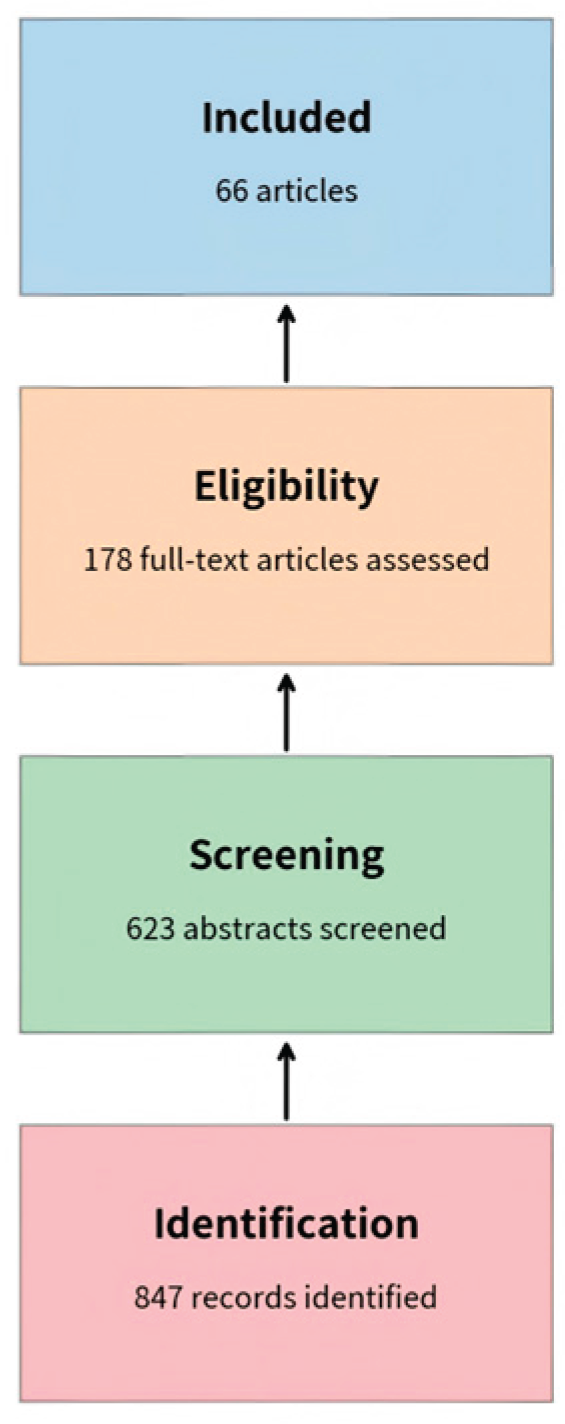
The literature selection process yielded 66 studies for final synthesis:
Initial records identified: 847
Records after duplicate removal: 623
Records screened at title/abstract level: 623
Full-text articles assessed for eligibility: 178
Studies included in final synthesis: 66.
Appendix B. Abbreviations and Nomenclature
The following abbreviations and terms are used throughout this review:
| Abbreviation | Full Term |
| GC-MS | Gas Chromatography–Mass Spectrometry |
| HS-SPME | Headspace Solid-Phase Microextraction |
| TCMM | Traditional Chinese Medicinal Material |
| TCM | Traditional Chinese Medicine |
| FAME | Fatty Acid Methyl Ester |
| RI | Retention Index |
| PCA | Principal Component Analysis |
| PLS-DA | Partial Least Squares–Discriminant Analysis |
| OPLS-DA | Orthogonal Projections to Latent Structures–Discriminant Analysis |
| HCA | Hierarchical Cluster Analysis |
| SFE | Supercritical Fluid Extraction (CO₂) |
| EI | Electron Ionization |
| VIP | Variable Importance in Projection |
| MCR-ALS | Multivariate Curve Resolution–Alternating Least Squares |
| IOP | Iterative Orthogonal Projection |
| EFA | Exploratory Factor Analysis |
| MRM | Multiple Reaction Monitoring |
References
- Ma Z, Liu G, Yang Z, et al. Species Differentiation and Quality Evaluation for Atractylodes Medicinal Plants by GC/MS Coupled with Chemometric Analysis. Chem Biodivers. 2023;20(8):e202300793. https://pubmed.ncbi.nlm.nih.gov/37485567/. [CrossRef]
- Xu Y, Yang M, Yang T, Yang W, Wang Y, Zhang J. Untargeted GC-MS and FT-NIR study of the effect of 14 processing methods on the volatile components of Polygonatum kingianum. Front Plant Sci. 14:1140691. Published 2023 None. https://pubmed.ncbi.nlm.nih.gov/37223798/. [CrossRef]
- Xie Q, Yuan H, Liu S, et al. Mid-Level Data Fusion Techniques of LC-MS and HS-GC-MS for Distinguishing Green and Ripe Forsythiae Fructus. Molecules. 2025;30(7). Published 2025 Mar 21. https://pubmed.ncbi.nlm.nih.gov/40286068/. [CrossRef]
- Zhao M, Xiao L, Linghu KG, et al. Comprehensive comparison on the anti-inflammation and GC-MS-based metabolomics discrimination between Bupleuri chinense DC. and B. scorzonerifolium Willd. Front Pharmacol. 13:1005011. Published 2022 None. https://pubmed.ncbi.nlm.nih.gov/36188603/. [CrossRef]
- Liu ZY, Wang XY, Cheng QQ, et al. Assessment of Quality in Essential Oil from Magnolia officinalis flos at Different Developmental Stages by Anatomy, GC-MS, and Chemometric Methods. J Oleo Sci. 2025;74(10):915-927. https://pubmed.ncbi.nlm.nih.gov/41034125/. [CrossRef]
- Aissaoui H, Mekkiou R, Mezhoud S, et al. Characterisation and comparison of volatile compounds in leaves and stems essential oils of Heliotropium bacciferum (forssk.), a medicinal plant native to Algeria, by gC-mS analysis. Nat Prod Res. :1-6. Published online Nov 17,2025. https://pubmed.ncbi.nlm.nih.gov/41248217/. [CrossRef]
- Ikuomola EO, Owu DU, Oka VO, Bisong SA, Paul-Chima UO, Aja PM. Gas Chromatography-Mass spectrometry (GC-MS) Revealed Bioactive Constituents of Brassica oleracea var. viridis (Collard Greens) Used to Treat Male Infertility in Uganda. F1000Res. 14:525. Published 2025 None. https://pubmed.ncbi.nlm.nih.gov/41098508/. [CrossRef]
- Wang Z, Liu H, Liu A, et al. Analysis of Differences in Volatile Components of Five Lauraceae Plants From Different Genera Based on HS-SPME-GC-MS. J Anal Methods Chem. 2025:9045731. Published 2025 None. https://pubmed.ncbi.nlm.nih.gov/40821680/. [CrossRef]
- Li J, Zhang Y, Cui Q, Zhang Z, Hou X. Quality Control of Fried Pepper Oils Based on GC-MS Fingerprints and Chemometrics. Foods. 2025;14(9). Published 2025 May 4. https://pubmed.ncbi.nlm.nih.gov/40361706/. [CrossRef]
- Wang C, Hong L, Gong W, Zhang Q, Li S, Zhao J. Comparative Analysis of Volatile Constituents in Different Parts and Essential Oil of Pogostemon cablin Using GC-MS Combined with Chemometrics. J AOAC Int. 2026;109(2):261-272. https://pubmed.ncbi.nlm.nih.gov/40974174/. [CrossRef]
- He G, Yang SB, Wang YZ. An integrated chemical characterization based on FT-NIR, and GC-MS for the comparative metabolite profiling of 3 species of the genus Amomum. Anal Chim Acta. 1280:341869. https://pubmed.ncbi.nlm.nih.gov/37858569/. [CrossRef]
- Kara K, Pirci G. Biplot analysis and correlations between changes in terpenes in calf milk and immune variables, performance and rumen variables. Sci Rep. 2025;15(1):35593. Published 2025 Oct 13. https://pubmed.ncbi.nlm.nih.gov/41083478/. [CrossRef]
- Li X, Liu Y, Wang S, et al. The Aerial Parts of Bupleurum Chinense DC. Aromatic Oil Attenuate Kainic Acid-Induced Epilepsy-Like Behavior and Its Potential Mechanisms. Biomed Res Int. 2022:1234612. Published 2022 None. https://pubmed.ncbi.nlm.nih.gov/35445130/. [CrossRef]
- Virgiliou C, Zisi C, Kontogiannopoulos KN, et al. Headspace gas chromatography-mass spectrometry in the analysis of lavender’s essential oil: Optimization by response surface methodology. J Chromatogr B Analyt Technol Biomed Life Sci. 1179:122852. https://pubmed.ncbi.nlm.nih.gov/34274641/. [CrossRef]
- Xu M, Cai J, Wang L, et al. Identification of Chemical Components in Three Types of Rose Essential Oils Based on Gas Chromatography-Mass Spectrometry (GC-MS) and Chemometric Methods. Molecules. 2025;30(9). Published 2025 Apr 29. https://pubmed.ncbi.nlm.nih.gov/40363781/. [CrossRef]
- Smaili T, Bendif H, Zedam A, Flamini G, Maggi F. A new chemotype with high tricyclene content from the essential oil of Salvia aegyptiaca L. growing in Algerian Pre-Sahara. Nat Prod Res. 2022;36(20):5364-5369. https://pubmed.ncbi.nlm.nih.gov/34044712/. [CrossRef]
- Al-Hmadi HB, Majdoub S, Chaabane-Banaoues R, et al. Chemical composition, antifungal and antibiofilm activities of essential oils from Glycyrrhiza foetida (Desf.) growing in Tunisia. Biomed Chromatogr. 2023;37(5):e5596. https://pubmed.ncbi.nlm.nih.gov/36740815/. [CrossRef]
- Chen J, Chen X, Zhang Y, et al. Insights Into the Composition and Antibacterial Activity of Different Parts of Alpinia katsumadai Hayata Based on HS-SPME-GC-MS and HS-GC-IMS. Rapid Commun Mass Spectrom. 2025;39(3):e9949. https://pubmed.ncbi.nlm.nih.gov/39606922/. [CrossRef]
- Dangol S, Poudel DK, Ojha PK, et al. Essential Oil Composition Analysis of Cymbopogon Species from Eastern Nepal by GC-MS and Chiral GC-MS, and Antimicrobial Activity of Some Major Compounds. Molecules. 2023;28(2). Published 2023 Jan 5. https://pubmed.ncbi.nlm.nih.gov/36677603/. [CrossRef]
- Liang X, Yang Z, Ma J, et al. Quality Evaluation of Volatile Oil in Yanyangke Mixture (YM) Based on GC-MS Fingerprint, GC Multicomponent Quantitative Analysis and Chemical Pattern Recognition Analysis. J Chromatogr Sci. 2024;62(4):301-310. https://pubmed.ncbi.nlm.nih.gov/37680137/. [CrossRef]
- Deng J, Wu TF, Zhong CC, et al. [Comparison on volatile components between Artemisiae Verlotori Folium and Artemisiae Argyi Folium based on GC-MS and chemometrics]. Zhongguo Zhong Yao Za Zhi. 2023;48(23):6334-6346. https://pubmed.ncbi.nlm.nih.gov/38211990/. [CrossRef]
- Qiu J, Gong Y, Lu S, et al. Seasonal changes of volatile compounds and odor evaluation of Zanthoxylum bungeanum ‘Hanyuan’ fruit during the development. BMC Plant Biol. 2025;26(1):65. Published 2025 Dec 7. https://pubmed.ncbi.nlm.nih.gov/41354782/. [CrossRef]
- Yang J, Yu Z, Li S, et al. Identification of Active Ingredients in Ginseng Volatile Oil: A Strategy Combining Computer Virtual Screening With Experimental Validation. Phytochem Anal. 2025;36(3):640-656. https://pubmed.ncbi.nlm.nih.gov/39540423/. [CrossRef]
- Chen J, Tang C, Zhang R, et al. Metabolomics analysis to evaluate the antibacterial activity of the essential oil from the leaves of Cinnamomum camphora (Linn.) Presl. J Ethnopharmacol. 253:112652. https://pubmed.ncbi.nlm.nih.gov/32035880/. [CrossRef]
- Costa RGA, Anunciação TAD, Araujo MS, et al. In vitro and in vivo growth inhibition of human acute promyelocytic leukemia HL-60 cells by Guatteria megalophylla Diels (Annonaceae) leaf essential oil. Biomed Pharmacother. 122:109713. https://pubmed.ncbi.nlm.nih.gov/31918282/. [CrossRef]
- Senouci H, Benyelles NG, Dib MEA, Costa J, Muselli A. Chemical Composition and Combinatory Antifungal Activities of Ammoides verticillata, Allium sativum and Curcuma longa Essential Oils Against Four Fungi Responsible for Tomato Diseases. Comb Chem High Throughput Screen. 2020;23(3):196-204. https://pubmed.ncbi.nlm.nih.gov/32072896/. [CrossRef]
- de Araújo MJC, da Câmara CAG, Born FS, de Moraes MM. Acaricidal activity of binary blends of essential oils and selected constituents against Tetranychus urticae in laboratory/greenhouse experiments and the impact on Neoseiulus californicus. Exp Appl Acarol. 2020;80(3):423-444. https://pubmed.ncbi.nlm.nih.gov/31950299/. [CrossRef]
- Yan X, Wang W, Chen Z, et al. Quality assessment and differentiation of Aucklandiae Radix and Vladimiriae Radix based on GC-MS fingerprint and chemometrics analysis: basis for clinical application. Anal Bioanal Chem. 2020;412(7):1535-1549. https://pubmed.ncbi.nlm.nih.gov/31915868/. [CrossRef]
- Bisrat D, Jung C. Insecticidal Toxicities of Three Main Constituents Derived from Trachyspermum ammi (L.) Sprague ex Turrill Fruits against the Small Hive Beetles, Aethina tumida Murray. Molecules. 2020;25(5). Published 2020 Mar 1.https://pubmed.ncbi.nlm.nih.gov/32121601/. [CrossRef]
- Rong H, Liu Q, Wu Z, et al. Integrative analysis of small RNA and degradome sequencing reveals the role of miRNAs in monoterpene biosynthesis in linalool-type Cinnamomum camphora. BMC Plant Biol. 2025;25(1):1536. Published 2025 Nov 11.https://pubmed.ncbi.nlm.nih.gov/41219833/. [CrossRef]
- Karmakar S, Suman S, Uchoi J, et al. Essential Oils of Alpinia officinarum and Alpinia zerumbet: Potential Fungistatic Action and Molecular Dynamics Perspectives. Chem Biodivers. 2025;22(10):e00221.https://pubmed.ncbi.nlm.nih.gov/40409754/. [CrossRef]
- Zhu JH, Mao Q, Wang SY, et al. Optimization and validation of direct gas chromatography-mass spectrometry method for simultaneous quantification of ten short-chain fatty acids in rat feces. J Chromatogr A. 1669:462958. https://pubmed.ncbi.nlm.nih.gov/35303574/. [CrossRef]
- Ameen M, Zafar M, Ahmad M, et al. Cleaner Biofuel Production via Process Parametric Optimization of Nonedible Feedstock in a Membrane Reactor Using a Titania-Based Heterogeneous Nanocatalyst: An Aid to Sustainable Energy Development. Membranes (Basel). 2023;13(12). Published 2023 Nov 27. https://pubmed.ncbi.nlm.nih.gov/38132893/. [CrossRef]
- Elghazaly MM, Gawaan YM, Abdelkader S, Radwan EH, El-Sayed HM. A comparative gas chromatography-mass spectrometry (GC-MS) profiling of Egyptian and Indian ashwagandha (Withania somnifera) root extracts. Sci Rep. 2025;15(1):41156. Published 2025 Nov 21. https://pubmed.ncbi.nlm.nih.gov/41272013/. [CrossRef]
- Lorenz P, Bunse M, Klaiber I, et al. Comprehensive Phytochemical Characterization of Herbal Parts from Kidney Vetch (Anthyllis vulneraria L.) by LC/MSn and GC/MS. Chem Biodivers. 2020;17(10):e2000485.https://pubmed.ncbi.nlm.nih.gov/32860459/. [CrossRef]
- Yu G, Xie Q, Su W, et al. Improvement of antioxidant activity and active ingredient of Dendrobium officinale via microbial fermentation. Front Microbiol. 14:1061970. Published 2023 None. https://pubmed.ncbi.nlm.nih.gov/36876081/. [CrossRef]
- Lv H, Wang Y, Qu M, et al. Anti-fungal Activity of Dalbergia retusa Extract on Gloeophyllum trabeum. Front Plant Sci. 13:906041. Published 2022 None. https://pubmed.ncbi.nlm.nih.gov/35880041/. [CrossRef]
- Hou MZ, Chen LL, Chang C, Zan JF, Du SM. Pharmacokinetic and tissue distribution study of eight volatile constituents in rats orally administrated with the essential oil of Artemisiae argyi Folium by GC-MS/MS. J Chromatogr B Analyt Technol Biomed Life Sci. 1181:122904. https://pubmed.ncbi.nlm.nih.gov/34479182/. [CrossRef]
- Kahwa I, Kaysser L, Wangalwa R, Billig S, Tusiimire J, Wiesner C. Chemical Profiling and Geographic Differentiation of Ugandan Propolis by GC-MS Through Chemometric Modelling. Molecules. 2025;30(22). Published 2025 Nov 16. https://pubmed.ncbi.nlm.nih.gov/41302492/. [CrossRef]
- Yang D, He D, Wang Y, et al. Exploration of Potential Antidepressant Active Ingredients of Albiziae Flos via HS-GC-MS, Chemometrics, and Network Pharmacology. J Anal Methods Chem. 2026:2885034. Published 2026 None. https://pubmed.ncbi.nlm.nih.gov/41773085/. [CrossRef]
- Li X, Yuan Y, Song Z, et al. Integrated Analysis of HPLC-QTOF-MS/MS GC-MS and Network Pharmacology Reveals the Effective Substance and Pharmacological Mechanism of Platycodonis Radix. Biomed Chromatogr. 2026;40(1):e70266. https://pubmed.ncbi.nlm.nih.gov/41319654/. [CrossRef]
- Rafson JP, Turnipseed SB, Casey C, De Bono A, Madson MR. Analysis and Stability Study of Isoeugenol in Aquaculture Products by Headspace Solid-Phase Microextraction Coupled to Gas Chromatography-Mass Spectrometry. J Agric Food Chem. 2024;72(25):14411-14418. https://pubmed.ncbi.nlm.nih.gov/38875496/. [CrossRef]
- Wang Z, An J, Daji R, et al. E-nose, HS-SPME-GC-MS and untargeted metabolomics reveal effects on 60Co gamma irradiation of Neng-An-Jun-Ning Pills: Changes in odor and chemical compositions. J Pharm Biomed Anal. 275:117446. https://pubmed.ncbi.nlm.nih.gov/41830714/. [CrossRef]
- Lin R, Yin J, Wu M, et al. Global identification and determination of the major constituents in Kai-Xin-San by ultra-performance liquid chromatography-quadrupole-Orbitrap mass spectrometry and gas chromatography-mass spectrometry. J Pharm Biomed Anal. 206:114385. https://pubmed.ncbi.nlm.nih.gov/34597841. [CrossRef]
- Xu L, Yao J, Wang Z, Xie S, Ou J, Wang B. A methylation-assisted gas chromatography-mass spectrometry strategy for comprehensive monosaccharide profiling in Polygonatum polysaccharides: Overcoming limitations of conventional chromatographic techniques. J Chromatogr A. 1759:466253. https://pubmed.ncbi.nlm.nih.gov/40730023. [CrossRef]
- Liu Y, Hou X, Li X, Liu J, Jiang G. Simultaneous determination of 19 bromophenols by gas chromatography-mass spectrometry (GC-MS) after derivatization. Talanta. 274:126015. https://pubmed.ncbi.nlm.nih.gov/38581850/. [CrossRef]
- Chang YQ, Xue ZJ, Yang GY, et al. [Dynamic changes of volatile components of Qiai from different harvest time based on GC-MS and chemometrics analysis]. Zhongguo Zhong Yao Za Zhi. 2020;45(10):2417-2424. https://pubmed.ncbi.nlm.nih.gov/32495601/. [CrossRef]
- Li P, Li J, Ding Y, et al. Influence of sulfur fumigation on the volatile composition of lily bulbs evaluated by HS-SPME/GC-MS and multivariate statistical analysis. J Sci Food Agric. 2025;105(8):4598-4608. https://pubmed.ncbi.nlm.nih.gov/40196924. [CrossRef]
- Parham S, Zargar Kharazi A. Cellulosic textile/clove nanocomposite as an antimicrobial wound dressing: In vitro and in vivo study. Colloids Surf B Biointerfaces. 217:112659. https://pubmed.ncbi.nlm.nih.gov/35763896/. [CrossRef]
- Zuo J, Zhang TH, Peng C, et al. Essential oil from Ligusticum chuanxiong Hort. Alleviates lipopolysaccharide-induced neuroinflammation: Integrating network pharmacology and molecular mechanism evaluation. J Ethnopharmacol. 2024;319(Pt 3):117337. https://pubmed.ncbi.nlm.nih.gov/37866462/. [CrossRef]
- Xu R, Ming Y, Li Y, et al. Full-Length Transcriptomic Sequencing and Temporal Transcriptome Expression Profiling Analyses Offer Insights into Terpenoid Biosynthesis in Artemisia argyi. Molecules. 2022;27(18). Published 2022 Sep 13. https://pubmed.ncbi.nlm.nih.gov/36144681/. [CrossRef]
- Song B, Wang W, Liu R, et al. Geographic Differentiation of Essential Oil from Rhizome of Cultivated Atractylodes lancea by Using GC-MS and Chemical Pattern Recognition Analysis. Molecules. 2023;28(5). Published 2023 Feb 27. https://pubmed.ncbi.nlm.nih.gov/36903461/. [CrossRef]
- Xu LL, Shang ZP, Lu YY, et al. Analysis of curcuminoids and volatile components in 160 batches of turmeric samples in China by high-performance liquid chromatography and gas chromatography mass spectrometry. J Pharm Biomed Anal. 188:113465. https://pubmed.ncbi.nlm.nih.gov/32683284/. [CrossRef]
- Wang S, Wei S, Zhu Y, et al. Comparative Investigation of the Differences in Chemical Compounds between Raw and Processed Mume Fructus Using Plant Metabolomics Combined with Chemometrics Methods. Molecules. 2022;27(19). Published 2022 Sep 26. https://pubmed.ncbi.nlm.nih.gov/36234881/. [CrossRef]
- Granda-Santos M, Reyna-Gonzales K, Torrejón-Valqui L, et al. Characterization of Terpenoids in Aromatic Plants Using Raman Spectroscopy and Gas Chromatography-Mass Spectrometry (GC-MS). Int J Mol Sci. 2025;26(23). Published 2025 Nov 21. https://pubmed.ncbi.nlm.nih.gov/41373415/. [CrossRef]
- Pantharos P, Sukcharoen P, Phadungrakwittaya R, Akarasereenont P, Booranasubkajorn S, Lumlerdkij N. Utilization of UPLC-PDA and GC-MS/MS coupled with metabolomics analysis to identify bioactive metabolites in medicinal turmeric at different ages for the quality assurance. Phytomedicine. 102:154157. https://pubmed.ncbi.nlm.nih.gov/35550222/. [CrossRef]
- Sun L, Wu J, Wang K, et al. Comparative Analysis of Acanthopanacis Cortex and Periplocae Cortex Using an Electronic Nose and Gas Chromatography-Mass Spectrometry Coupled with Multivariate Statistical Analysis. Molecules. 2022;27(24). Published 2022 Dec 16. https://pubmed.ncbi.nlm.nih.gov/36558097/. [CrossRef]
- Zheng C, Yang S, Huang D, et al. GC-MS combined with multivariate analysis for the determination of the geographical origin of Elsholtzia rugulosa Hemsl. in Yunnan province. RSC Adv. 2022;12(33):21287-21296. Published 2022 Jul 21. https://pubmed.ncbi.nlm.nih.gov/35975083/. [CrossRef]
- Yin J, Wu T, Zhu B, et al. Comprehensive multicomponent characterization and quality assessment of Xiaoyao Wan by UPLC-Q-Orbitrap-MS, HS-SPME-GC-MS and HS-GC-IMS. J Pharm Biomed Anal. 239:115910. https://pubmed.ncbi.nlm.nih.gov/38101240/. [CrossRef]
- Feng H, Li S, Hu Y, et al. Quality assessment of Succus Bambusae oral liquids based on gas chromatography/mass spectrometry fingerprints and chemometrics. Rapid Commun Mass Spectrom. 2021;35(24):e9200. https://pubmed.ncbi.nlm.nih.gov/34532912/. [CrossRef]
- Liu X, Zhang Y, Wu M, Ma Z, Cao H. Color discrimination and gas chromatography-mass spectrometry fingerprint based on chemometrics analysis for the quality evaluation of Schizonepetae Spica. PLoS One. 2020;15(1):e0227235. Published 2020 None. https://pubmed.ncbi.nlm.nih.gov/31910241/. [CrossRef]
- Ye Y, Zheng S, Wang Y. Analysis of aroma components changes in Gannan navel orange at different growth stages by HS-SPME-GC-MS, OAV, and multivariate analysis. Food Res Int. 175:113622.https://pubmed.ncbi.nlm.nih.gov/38128975/. [CrossRef]
- Chen G, Zhu G, Xie H, et al. Characterization of the key differential aroma compounds in five dark teas from different geographical regions integrating GC-MS, ROAV and chemometrics approaches. Food Res Int. 194:114928. https://pubmed.ncbi.nlm.nih.gov/39232540/. [CrossRef]
- Ain Syaqirah Sapian N, Aidilfitri Mohamad Roslan M, Mohd Hashim A, et al. Differentiation of lard from other animal fats based on n-Alkane profiles using chemometric analysis. Food Res Int. 164:112332. https://pubmed.ncbi.nlm.nih.gov/36737925/. [CrossRef]
- Han L, Zhu J, Fan X, et al. Rapid Non-Destructive Quantification of Eugenol in Curdlan Biofilms by Electronic Nose Combined with Gas Chromatography-Mass Spectrometry. Sensors (Basel). 2020;20(16). Published 2020 Aug 9. https://pubmed.ncbi.nlm.nih.gov/32784818/. [CrossRef]
- Zhao S, Wu Y, Qian Y, et al. Chemical profiling and identification of anti-osteoporosis chemical-markers of Cinnamomum cassia (L.) presl extracts using GC-MS and spectrum-activity analyses. Nat Prod Res. 2023;37(11):1902-1906. https://pubmed.ncbi.nlm.nih.gov/36098221/. [CrossRef]
Disclaimer/Publisher’s Note: The statements, opinions and data contained in all publications are solely those of the individual author(s) and contributor(s) and not of MDPI and/or the editor(s). MDPI and/or the editor(s) disclaim responsibility for any injury to people or property resulting from any ideas, methods, instructions or products referred to in the content. |
© 2026 by the authors. Licensee MDPI, Basel, Switzerland. This article is an open access article distributed under the terms and conditions of the Creative Commons Attribution (CC BY) license (http://creativecommons.org/licenses/by/4.0/).
Copyright: This open access article is published under a Creative Commons CC BY 4.0 license, which permit the free download, distribution, and reuse, provided that the author and preprint are cited in any reuse.