

Submitted:
29 June 2026
Posted:
30 June 2026
You are already at the latest version
Abstract
This paper examines how undergraduate engineering students describe collaboration, autonomy, and participation in a laboratory learning environment. Using de-identified responses from an end-of-term self-reflection survey (50 valid closed-ended responses), the study analyzes items on productive work arrangements, preferred lab formats, approaches to complex technical problems, question-asking, learning preferences, comfort in group settings, perceived disadvantage, and course redesign priorities. The results show a productive tension. Students strongly valued structured in-person laboratory learning, small-team work, hands-on experimentation, and accessible help-seeking. At the same time, 40.0% reported that their preferred learning style had placed them at a disadvantage at least occasionally, and 52.0% believed that students who prefer working alone are probably or definitely disadvantaged in group-heavy engineering curricula. The paper argues that inclusive engineering pedagogy should not ask instructors to choose between teamwork and individual autonomy. Instead, it proposes structured choice: small, purposeful teams combined with individual sense-making time, explicit role design, normalized question-asking, authentic engineering cases, and multiple routes for demonstrating contribution. The findings offer a compact pedagogical framework for making group-heavy laboratory education more inclusive without weakening hands-on rigor or collaborative professional preparation.
Keywords:
engineering pedagogy
; laboratory education
; collaboration
; autonomy
; group work
; structured choice
; inclusive teaching
; mechanical engineering education
1. Introduction
Engineering laboratories are often defended as naturally collaborative learning environments because students work with equipment, peers, and instructors while solving applied technical problems. Prior work on collaborative and cooperative learning has long associated structured peer interaction with improved student engagement and peer-supported problem solving; however, these benefits depend on how groups are structured, supported, and held accountable [1,2,3].
This collaborative character is pedagogically valuable: students encounter uncertainty, coordinate interpretations, compare data, and rehearse forms of professional engineering practice [4,5]. Yet group-heavy laboratory formats can also create hidden constraints. They may privilege students who are comfortable speaking quickly, negotiating social roles, asking public questions or adapting to a fixed team rhythm, while making other forms of participation less visible. The problem is not group work itself. Cooperative and active learning can improve engagement and achievement when it is intentionally structured [4,6]. The problem is the assumption that collaboration is automatically inclusive simply because students are placed in teams. In engineering education, students vary in how they enter complex problems, how much time they need to think before speaking, how they seek feedback, and how they show competence [7,8]. If group-heavy courses recognize only one style of participation, students may be formally included in a team while pedagogically marginalized by its norms. Recent work on LGBTQ+ inclusion in engineering education similarly argues that belonging is shaped not only by formal access to engineering programs, but also by institutional climates, cultural expectations, and the ways students negotiate whether their identities and participation styles are treated as legitimate within engineering spaces [9]. Building on this broader view of inclusion, the present study focuses on a more general pedagogical question: how group-heavy laboratory formats can support collaboration without marginalizing students whose learning preferences require more structure, reflection, or individual autonomy.
This paper uses student self-reflection survey data from an undergraduate engineering laboratory course to examine that tension. A related manuscript from the same course dataset focuses on spatial-temporal flexibility in laboratory design [10]. The present paper analyzes a distinct subset of items centered on learning preferences, problem-solving, question-asking, group participation, and course redesign. The central research question is: How can engineering laboratory pedagogy preserve the benefits of collaboration while making space for students whose learning and participation practices require more autonomy, reflection, or structure?
2. Conceptual Framing
The paper is framed by three complementary ideas. First, engineering laboratory learning is situated and embodied. Students learn not only disciplinary concepts but also the practices through which engineering work is organized: measurement, interpretation, troubleshooting, communication and judgment [4,5]. This makes collaboration important, but it also means that the organization of collaboration matters.
Second, student variability should be treated as a design condition rather than a problem to be corrected after difficulty appears. Universal Design for Learning argues for multiple means of engagement, representation, and action/expression so that rigorous learning environments can be accessible to more students [11]
In a laboratory, this implies that teamwork, written preparation, hands-on experimentation, feedback, and reporting should be designed as complementary routes into learning rather than as a single participation script.
Third, autonomy and relatedness are both important to motivation. Self-determination theory emphasizes autonomy, competence, and relatedness as conditions that support motivation and well-being [12]. In group-heavy laboratory pedagogy, these needs can conflict when students are expected to collaborate constantly without time for individual sense-making or when group participation is treated as evidence of competence. The alternative proposed here is structured choice: students are guided into collaborative engineering practice while also being given purposeful moments of individual preparation, reflection, and differentiated contribution.
From a learning-design perspective, effective group-heavy laboratory work requires alignment among motivation, prior knowledge, practice, feedback, and the social climate of the course [13]. Similarly, problem-based learning research suggests that open-ended technical problems can support deeper learning when students receive sufficient scaffolding and guidance rather than being left to manage complexity alone [14].
3. Method
The study draws on an end-of-term self-reflection survey administered in an undergraduate engineering laboratory course at a public university in the United States. The exported dataset contained 51 completed responses; after removing one invalid preview-coded response in the closed-ended fields, 50 valid responses were analyzed for the items reported in this paper. The survey was a reflective course-based instrument rather than a validated psychometric scale, so the findings are interpreted as a local case study of student perceptions rather than as generalizable estimates.
The present analysis focuses on survey items that were not central to the first manuscript from the dataset. These include productive work arrangement (Q1), preferred in-class environment (Q2), study location (Q3-Q4), preferred laboratory format (Q5), approach to complex problems (Q6), question-asking preference (Q7), feedback and concept-absorption preferences (Q8-Q10), group participation and perceived disadvantage (Q11-Q14), and course redesign priorities (Q20). Response-option labels were mapped from the Qualtrics survey instrument. The analysis is descriptive: counts and percentages were calculated for closed-ended items, and findings were interpreted in relation to the pedagogical design of group-heavy laboratory learning. Because no demographic data were collected, the paper makes claims about participation structures and learning conditions rather than about specific identity groups.

Table 1.
Key descriptive results from the remaining survey items.
| Survey dimension | Item(s) | Key descriptive result | Pedagogical interpretation |
|---|---|---|---|
| Work arrangement | Q1 | 82.0% selected small-team work; 14.0% preferred alternating individual and group work | Collaboration was valued, but primarily in bounded, small-team forms. |
| Lab format | Q5 | 86.0% selected structured in-person lab sessions with TA/instructor support | Students associated effective lab learning with embodied work and accessible guidance. |
| Problem approach | Q6 | 46.0% first think independently and then check with peers; 36.0% look for examples or reference materials first | Many students preferred individual sense-making before or alongside group interaction. |
| Question-asking | Q7 | 86.0% preferred asking questions frequently or occasionally | Help-seeking should be treated as a normal part of engineering practice. |
| Concept absorption | Q9/Q10 | 70.0% absorbed concepts best through hands-on experimentation; 68.0% identified as kinesthetic/active learners | Hands-on engagement remained central, but not as an unstructured substitute for guidance. |
| Group participation | Q11/Q14 | 90.0% felt somewhat or extremely comfortable contributing ideas; 92.0% felt heard or valued always or most of the time | The learning environment supported many students’ participation in group settings. |
| Pedagogical friction | Q12/Q13 | 40.0% reported frequent or occasional disadvantage from preferred learning style; 52.0% believed solo-preferring students are probably or definitely disadvantaged | Positive group experiences coexisted with concern about students whose participation styles do not match group-heavy norms. |
| Course redesign | Q20 | 42.0% prioritized real-world engineering case studies; 16.0% interactive lectures/simulations; 16.0% creative/exploratory lab components | Students wanted more authentic, applied and exploratory engineering work rather than simply more group work. |
Note: Percentages are based on valid closed-ended responses (n = 50).
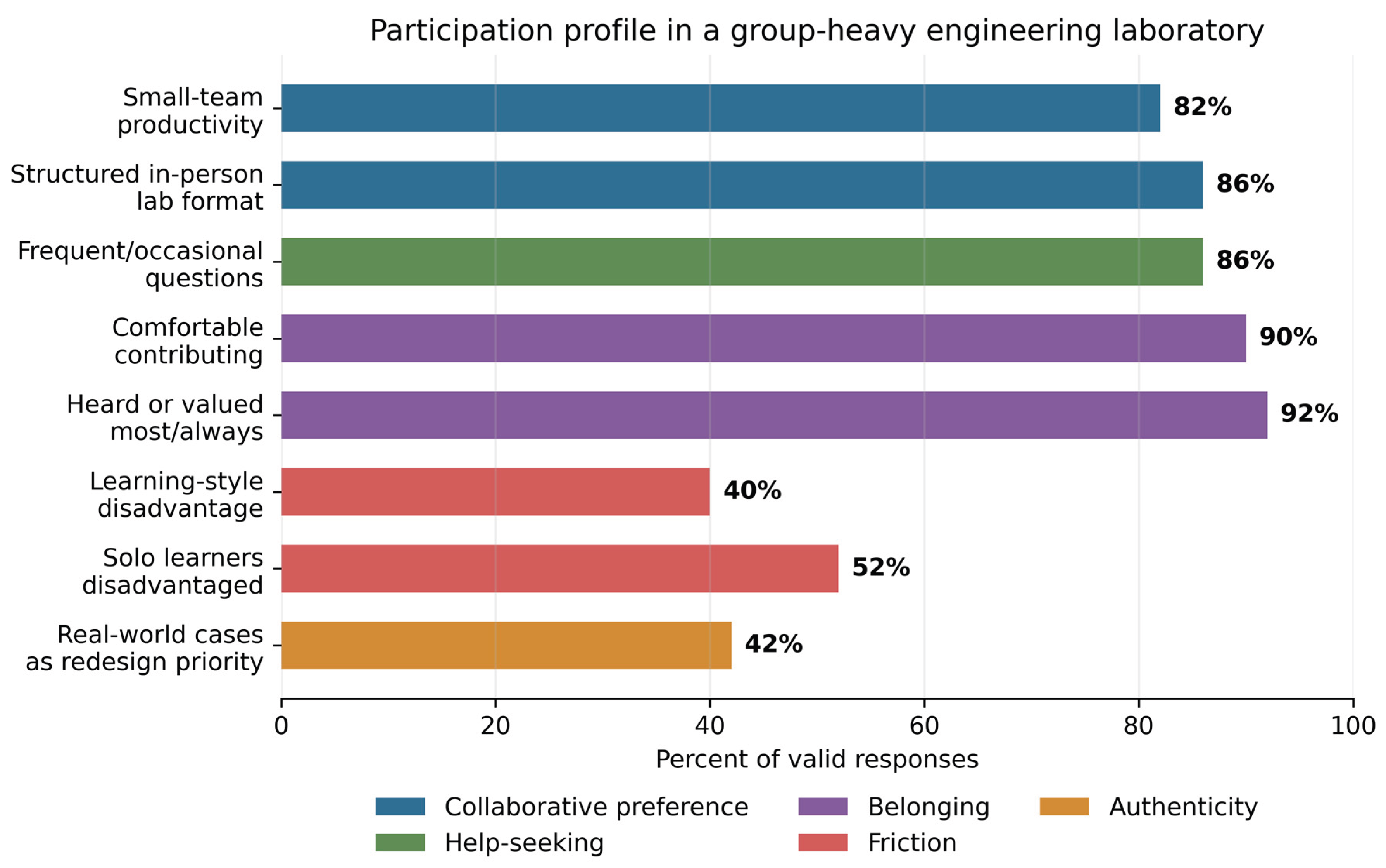
Figure 1.
Participation profile in a group-heavy engineering laboratory. The figure summarizes selected response clusters that define the central tension of the paper: strong support for structured collaborative laboratory learning coexists with concern that some participation styles may be disadvantaged.
4. Findings
4.1. Students Valued Collaboration, but in Bounded and Supported Forms
The clearest pattern was that students did not reject collaboration. When asked how they are most productive on a technical project, 82.0% selected working in a small team of two to three peers, while another 14.0% preferred alternating between individual and group work. Only 4.0% selected working alone with full autonomy. Similarly, 86.0% identified structured in-person lab sessions with a TA or instructor as the most effective lab format. These results suggest that the students valued collaborative, embodied learning when it was paired with structure and human support.
The group-participation items were also positive. Ninety percent of respondents reported being somewhat or extremely comfortable contributing ideas in group settings, and 92.0% reported feeling heard or valued during group lab work always or most of the time. A superficial reading could therefore conclude that the existing group-heavy environment was broadly successful. However, the remaining results complicate that conclusion.
This pattern is consistent with inclusion scholarship that defines inclusion not only as belonging to a group, but also as being able to contribute in ways that preserve one’s distinct strengths and working preferences [15].
4.2. Students Often Wanted Individual Sense-Making Before Collaboration
Students’ preferred approaches to complex technical problems indicate that collaboration was not the same as constant group processing. Forty-six percent reported that they typically think through complex problems independently and then check with peers if needed, while 36.0% first look for examples or reference materials. Only 14.0% immediately consult with a partner or group. This pattern suggests that many students benefit from a staged sequence: individual orientation, reference-supported sense-making, and then peer discussion.
Question-asking preferences reinforce this interpretation. Most students preferred to ask questions frequently or occasionally, which indicates that help-seeking was not rejected. Rather, the data suggest that help-seeking needs to be available without forcing all thinking to happen publicly and immediately. A group-heavy laboratory can therefore be inclusive when it creates predictable opportunities for questions after students have had enough time and scaffolding to formulate them.
4.3. Hands-on Learning Dominated, but it did not Eliminate Participation Differences
The survey also showed a strong orientation toward hands-on learning. Seventy percent reported absorbing technical concepts best through hands-on experimentation, and 68.0% identified their learning style in technical courses as kinesthetic and active. These findings support the importance of preserving embodied laboratory learning. However, they should not be interpreted as evidence that one pedagogy fits all students. Smaller groups selected analytical and structured learning (16.0%), visual and reflective learning (10.0%), or interpersonal and dynamic learning (6.0%).
This diversity matters because laboratory courses often translate hands-on learning into a narrow model of visible participation: speak during the lab, act quickly at the bench, share responsibility with a fixed team, and produce a standard report. Students may value hands-on work while still needing different entry points into that work. The design challenge is therefore not to replace laboratory participation with individualized study, but to make hands-on learning compatible with multiple legitimate forms of preparation, contribution, and reflection.
4.4. Positive Group Experiences Coexisted with Perceived Disadvantage
The most important tension appears in Q12 and Q13. Although most students felt comfortable and valued in group settings, 40.0% reported that their preferred learning style had put them at a disadvantage in engineering classes either frequently or occasionally. In addition, 52.0% believed that students who prefer working alone are probably or definitely at a disadvantage in group-heavy engineering curricula, while another 22.0% were unsure. This means that concern about disadvantage existed even in a cohort that reported relatively positive group experiences.
This tension is pedagogically significant. It suggests that a course can feel collaborative and supportive for many students while still communicating that certain ways of working are more legitimate than others. Students who need time to think privately, consult references, write out a problem, or prepare before speaking may not be opposed to teamwork. They may simply need group work to be structured so that individual reasoning becomes a valued part of collective performance rather than something that occurs outside the official learning process.
4.5. Redesign Priorities Pointed Toward Authenticity, not More Group Work Alone
When asked which feature they would emphasize in a course redesign, the largest group of students selected real-world engineering case studies (42.0%). Smaller groups selected interactive lectures or simulations (16.0%), creative or exploratory lab components (16.0%), and collaborative team-based challenges (12.0%). Solo project options and asynchronous lab materials were selected less often. The dominant redesign request was therefore not simply more autonomy or less teamwork. It was more authentic, applied, and exploratory engineering learning.
This matters because authenticity can help connect individual and group participation. Real-world cases can give teams a shared purpose, but they can also support differentiated contributions: one student can interpret data, another can check assumptions, another can build a diagram, another can compare alternative explanations, and another can prepare a concise technical argument. Authentic tasks make it easier to design roles that reflect engineering practice rather than an arbitrary division of labor.
5. Discussion: Structured Choice as Engineering Pedagogy
The findings point to a practical principle: group-heavy laboratory pedagogy should be structured enough to make collaboration equitable and flexible enough to preserve individual sense-making. This is not an argument against teamwork. Students overwhelmingly value small teams, in-person laboratory sessions, hands-on experimentation, and the ability to ask questions. The argument is that collaboration becomes more inclusive when instructors design how students enter, contribute to, and reflect on group work.
Structured choice has six implications for engineering laboratory courses (Table 2). First, teams should remain small enough for participation to be visible. Second, individual preparation should be built into the workflow before high-stakes group discussion. Third, roles should rotate and reflect meaningful engineering practices rather than a generic division of labor. Fourth, question-asking should be normalized through planned checkpoints. Fifth, authentic cases should be used to give group work a professional purpose. Sixth, assessment should recognize contribution through multiple forms: technical reasoning, data interpretation, troubleshooting, communication, and reflection.
Table 2.
Structured-choice principles for group-heavy engineering laboratory pedagogy.
| Design principle | Problem addressed | Pedagogical move |
|---|---|---|
| Small, purposeful teams | Large or unmanaged groups can hide unequal participation. | Use teams of two to three and define the shared task. |
| Individual sense-making before synthesis | Some students need time with examples or references before speaking. | Add short individual preparation moments before the group discussion. |
| Rotating engineering roles | Group work can become uneven or socially scripted. | Rotate roles such as data lead, assumptions checker, and communicator. |
| Normalized help-seeking | Questions can feel socially risky. | Use planned checkpoints and frame uncertainty as engineering practice. |
| Authentic case framing | Group work can feel artificial without a professional context. | Anchor labs in real-world engineering cases and design decisions. |
| Multiple evidence routes | Only visible talk or polished reports may count as a contribution. | Assess reasoning, troubleshooting, reflection, peer explanation, and communication. |
These principles align with inclusive teaching because they shift attention from whether students are placed in teams to how team participation is organized. A student who thinks quietly before speaking, prefers reference materials before discussion or contributes through careful checking rather than fast verbal response can still be treated as a legitimate engineering participant. At the same time, the approach preserves the professional value of collaboration by keeping students engaged in shared data, shared decisions, and shared explanations.
6. Limitations
This study has several limitations. It is based on one course at one institution, and the survey was designed for self-reflection rather than psychometric measurement. No demographic variables were collected, which prevents analysis of whether participation preferences or perceived disadvantage differed by gender, race, disability, first-generation status, employment, caregiving responsibilities, or other axes of inequality. The study also relies on closed-ended responses and does not include interviews or observations of group interaction. Future work should examine structured-choice interventions across multiple laboratory courses and combine survey, performance, and observational data.
A second limitation is that the paper reports student perceptions rather than direct measures of learning outcomes. However, perceptions are still pedagogically meaningful because students’ willingness to ask questions, contribute to groups and interpret themselves as legitimate participants affects how they use the learning opportunities available to them.
7. Conclusion
The findings show that group-heavy engineering laboratory pedagogy can be both a strength and a risk. Students in this case strongly valued small-team work, structured in-person laboratories, hands-on experimentation, and accessible help. Yet a substantial portion also perceived that some learning styles, especially preferences for more solitary or reflective work, can be disadvantaged in engineering classes. Inclusion, therefore, requires more than assigning students to groups.
The contribution of this paper is the concept of structured choice. Engineering educators can preserve the collaborative and embodied rigor of laboratory education while designing individual preparation, role clarity, help-seeking routines, authentic cases, and multiple evidence routes into the learning process. Such a design does not lower expectations. It clarifies how more students can participate in rigorous engineering work as capable contributors.
8. Ethics Statement
The data analyzed in this study consisted of existing, de-identified student self-reflection survey responses. The University of Minnesota Institutional Review Board office was consulted regarding the proposed secondary analysis. The IRB office advised that, because the responses could not be linked to individual students, the analysis of these secondary data did not qualify as human-subjects research and no IRB submission was required. Students were informed that their de-identified self-reflection responses may be analyzed in aggregate for educational research purposes.
9. Data Availability
The de-identified survey data are not publicly deposited because the dataset was collected in a small course-based educational setting and includes student responses that may carry re-identification risk. Aggregated results are reported in the manuscript. De-identified data may be made available by the author upon reasonable request, subject to institutional and ethical considerations.
References
- D. W. J. R. T. &. S. K. A. Johnson. Active Learning: Cooperation in the College Classroom; Interaction Book Co, 1991. [Google Scholar]
- Oakley, B.; Felder, R.M.; Brent, R.; Elhajj, I. Turning Student Groups into Effective Teams. J. Stud. Centered Learn. 2009, 2, 31–34. [Google Scholar]
- Dillenbourg, P. What do you mean by collaborative learning. In Collaborative-learning: Cognitive and Computational Approaches; Elsevier: Oxford, 1999; pp. 1–19. [Google Scholar]
- Feisel, L.D.; Rosa, A.J. The Role of the Laboratory in Undergraduate Engineering Education. J. Eng. Educ. 2005, 94, 121–130. [Google Scholar] [CrossRef]
- Lave, J.; Wenger, E. Situated learning: legitimate peripheral participation. In Learning in doing, Cambridge England; Cambridge University Press: New York, 1991. [Google Scholar]
- Prince, M. Does Active Learning Work? A Review of the Research. J. Eng. Educ. 2004, 93, 223–231. [Google Scholar] [CrossRef]
- Felder, R.M.; Brent, R. Understanding Student Differences. J. Eng. Educ. 2005, 94, 57–72. [Google Scholar] [CrossRef]
- Tanner, K.D. Structure Matters: Twenty-One Teaching Strategies to Promote Student Engagement and Cultivate Classroom Equity. CBE Life Sci. Educ. 2013, 12, 322–331. [Google Scholar] [CrossRef] [PubMed]
- Mirgolbabaei, H. LGBTQ+ inclusion, identity negotiation, and belonging in U.S. engineering programs: a systematized review. Front. Educ. 2026, 10, 1741958. [Google Scholar] [CrossRef]
- Mirgolbabaei, H. Flexible Space, Flexible Time: Engineering Students’ Inclusive Learning Conditions in Laboratory Classes. Preprint 2026, 1–17. [Google Scholar]
- CAST. CAST Universal Design for Learning Guidelines version 3.0. CAST. 2024. Available online: https://udlguidelines.cast.org/ (accessed on 19 June 2026).
- Ryan, R.M.; Deci, E.L. Self-Determination Theory and the Facilitation of Intrinsic Motivation, Social Development, and Well-Being. Am. Psychol. 2000, 55, 68–78. [Google Scholar] [CrossRef] [PubMed]
- Ambrose, S.A.; Bridges, M.W.; DiPietro, M.; Lovett, M.C.; Norman, M.K.; Mayer, R.E. How Learning Works: Seven Research-Based Principles for Smart Teaching, 1st ed.; Jossey-Bass: San Francisco, CA, 2010. [Google Scholar]
- Hmelo-Silver, C.E. Problem-Based Learning: What and How Do Students Learn? Educ. Psychol. Rev. 2004, 16, 235–266. [Google Scholar] [CrossRef]
- Shore, L.M.; Randel, A.E.; Chung, B.G.; Dean, M.A.; Holcombe Ehrhart, K.; Singh, G. Inclusion and Diversity in Work Groups: A Review and Model for Future Research. J. Manag. 2011, 37, 1262–1289. [Google Scholar]
Disclaimer/Publisher’s Note: The statements, opinions and data contained in all publications are solely those of the individual author(s) and contributor(s) and not of MDPI and/or the editor(s). MDPI and/or the editor(s) disclaim responsibility for any injury to people or property resulting from any ideas, methods, instructions or products referred to in the content. |
© 2026 by the authors. Licensee MDPI, Basel, Switzerland. This article is an open access article distributed under the terms and conditions of the Creative Commons Attribution (CC BY) license (http://creativecommons.org/licenses/by/4.0/).
Copyright: This open access article is published under a Creative Commons CC BY 4.0 license, which permit the free download, distribution, and reuse, provided that the author and preprint are cited in any reuse.