

Submitted:
27 June 2026
Posted:
30 June 2026
You are already at the latest version
Abstract
We show that the\( \mathbb{Z}_3 \)-triality lattice introduced in Ref.[1] yields atomic orbital quantum numbers, the hydrogen energy spectrum, and a bare electromagnetic coupling. The \( K_{2,2,2} \) graph Laplacian on the octahedral root shell (\( L^2=2 \)) decomposes as \( 6 = 1\oplus3\oplus2 = s\oplus p\oplus d \), with a graph Laplacian eigenvalue \( \lambda_1^{\rm graph}=4 \) distinct from the continuum angular eigenvalue\( l(l+1)=2 \). In the radial Schr\"odinger equation, this manifests as a \( 12.5\% \) centrifugal term discrepancy at finite lattice spacing, vanishing in the continuum limit. Gauss's law on the geometric grid \( r_k\propto(\sqrt{3})^{k} \) gives \( V(r)=-\sqrt{3}/(4\pi r) \). Treating the same octahedron as the base manifold of a compact \( U(1) \) lattice gauge theory, the character expansion \( Z(\beta)=\sum_n[I_n(\beta)]^8 \), evaluated at the algebraic unit coupling \( \beta_c=1 \)---derived from the Gauss continued fraction integrality condition \( [I_1(\beta)/I_0(\beta)]^{-1}=2/\beta+1/(4/\beta+\cdots) \) whose coefficients \( a_k=2k/\beta \) are integer-valued iff \( \beta\in\{1,2\} \), with \( \beta=2 \) excluded algebraically by the uniqueness of the\( 19 \)-dimensional superalgebra---with geometric factor \( G=2F/E=4/3 \), yields \( 1/\alpha_{\rm geom} = \pi\sqrt{3}\,[I_0(1)/I_1(1)]^4 = 137.042 \). The \( 42 \)~ppm deviation from the CODATA~2022 value\( 137.035999084 \) is exactly accounted for by the topological correction \( \delta(\alpha^{-1})=(S-S^3)/(4\sqrt{3}) \), with\( S=[I_1(1)/I_0(1)]^4 \), arising from quantum interference between the\( n=0 \) vacuum and \( n=\pm1 \) instanton sectors on the octahedron. Including this correction gives \( \alpha^{-1}_{\rm phys}=137.036 \), matching CODATA to sub-ppb precision. The radial Schr\"odinger equation with \( \alpha_{\rm phys} \) reproduces hydrogen wavefunctions with overlaps above \( 0.999 \) for \( n\le3 \). No free parameters are introduced; \( \beta_c=1 \) and the \( 42 \)~ppm correction both follow from the discrete algebraic structure of the \( 19 \)-dimensional \( \mathbb{Z}_3 \)-graded Lie superalgebra.
Keywords:
Z3-graded Lie superalgebra
; fine structure constant
; octahedron lattice gauge theory
; Gauss continued fraction
; 44-vector vacuum lattice
; cubic vacuum triality
; hydrogen spectrum
; topological quantum field theory
1. Introduction
The quantum numbers governing atomic electron orbitals are conventionally derived from the Schrödinger equation with a Coulomb potential [2], requiring three inputs: ℏ, the electron mass , and the fine structure constant . This paper examines whether the structure of these quantum numbers—their existence, ranges, and selection rules—can be obtained from the -triality lattice framework [1] without introducing the standard inputs as external parameters.
2. The -Triality Lattice
Physical origin: the flavor-geometry correspondence. The Standard Model contains exactly three generations of fermions—an unexplained empirical fact implying an exact permutation symmetry in flavor space. We postulate that at the fundamental scale, internal flavor symmetry and spacetime geometry are not decoupled. The closure on the five-vector seed is the minimal discrete geometric structure capable of embedding this flavor triality directly into the vacuum. The resulting 44-vector octahedron lattice is therefore not an arbitrary algebraic construction—it is the unique minimal geometric manifestation of a three-generation universe.
Definition 1
(-Closure). Let with . The -closure is generated by: (1) Cyclic permutation ; (2) Normalized difference ; (3) Normalized cross product .
3. Angular Quantum Numbers on Root Shell
3.1. Eigenspaces
Each 6-point root shell forms the complete tripartite graph with Laplacian eigenvalues .
3.2. Function Space Decomposition
The 6-dimensional function space on root points admits:
where , , is the part of orthogonal to , and carries content.
Theorem 1
(Angular Momentum Decomposition).
- (i)
- (dim 1) exactly (100% ).
- (ii)
- (dim 2) exactly (100% ).
- (iii)
- (dim 3) (2/3 pure , 1/3 lattice mode with ).
3.3. The Two-Thirds Theorem
Theorem 2.
(not 3). The null direction is . Adding the democratic vector restores full rank.
Corollary 1
(The 2/3 Rule). carries content with weight exactly . This ratio is a geometric theorem, not an approximation.
Distinction from the geometric . The angular proved here concerns the representation-theoretic content of the Laplacian eigenspaces. It is logically independent of the topological ratio that determines the geometric factor in the fine structure constant derivation (Section 8). The former follows from ; the latter from Euler’s relation for triangulated surfaces. That both equal is a numerical coincidence warranting further study.
4. Extension to
Relation to the 44-vector lattice. The 350-point closure (iteration 2 of the algorithm) provides dense angular sampling for the resolution proof. The 44-vector lattice (Section 2) is the radial shell structure built from the same operations, used in the Coulomb potential and derivations. Both objects originate from the same algebraic closure; the 350-point set demonstrates angular completeness while the 44-vector set provides the radial discretisation.
Theorem 3
(Sampling Resolution on 350 Points). The closure at iteration 2 produces 350 points on satisfying:
All 256 spherical harmonics with are simultaneously resolvable without aliasing.
This is verified by finite matrix rank computation . The graph Laplacian eigenstates on 350 points show angular momentum purity for and identifiable dominant l up to .
5. Branching Uniqueness
Theorem 4.
Under restriction (coordinate permutation embedding), is unique for every .
Proof.
with periodic mod 3. When coincides ( and ), differs by exactly 1. □
6. Radial Structure and Continuum Limit
Having established that the lattice generates the full angular momentum algebra (Section 3, Section 4, Section 5, Section 6, Section 7, Section 8, Section 9, Section 10 and Section 11) up to with zero aliasing, we now incorporate the radial degree of freedom. The radial structure determines the principal quantum number n and, combined with the Coulomb potential derived in Section 7, yields the complete hydrogen spectrum. This section and the next establish the geometric origin of the Coulomb potential—a necessary precursor to the derivation in Section 8.
6.1. Tridiagonal Chain
The Cayley graph on root shells yields the s-channel Hamiltonian:
Theorem 5
(Sturm-Liouville). is symmetric tridiagonal with all off-diagonal elements . The k-th eigenstate has exactly sign changes, defining .
6.2. Continuum Limit
Theorem 6.
Taylor expansion in the bulk yields:
with and . The continuum limit is rigorously established for the s-channel; for p and d channels, the lattice eigenvalue approaches the continuum value as where and is the recursive functor refinement. The base scale ratio between adjacent 44-vector lattice shells is . To insert k conformal refinement layers between and while preserving the self-similarity, each adjacent pair of refined layers must have equal ratio , and the k-fold product must recover the base ratio: . The unique solution is . Any other interpolation would break the conformal self-similarity of the lattice, introducing angular momentum artefacts. The refinement parameter is thereforenota free choice but the unique conformal generator of the -symmetric geometric grid. At , , converging to in the limit .
7. Coulomb Potential from Lattice Green’s Function
Theorem 7
(Coulomb Emergence). The geometric Laplacian on the lattice—incorporating the natural volume measure from the lattice geometry with —has a Green’s function that converges to in the many-shell limit.
Proof sketch
The geometric Laplacian discretizes on the geometric grid. In the continuum limit (many shells), this operator converges to the radial part of . The Green’s function of is , where the factor originates from the solid-angle integral over . This is the same that appears in Coulomb’s law and is a purely geometric consequence of three-dimensional space, not an electromagnetic input. The geometric grid contributes the numerator via the Gauss sum , yielding . □
Numerical verification shows deviation from for the first three shells, with boundary effects at large r (only 6 shells computed).
8. Fine Structure Constant from Octahedral Lattice Gauge Theory
The octahedron formed by the root shell does more than generate angular quantum numbers—it simultaneously hosts a compact lattice gauge theory that determines the electromagnetic coupling constant.
8.1. LGT on the Octahedron
The octahedron (, , triangular faces, Euler characteristic ) is a closed orientable surface homeomorphic to . The Wilson action for a compact gauge theory on this lattice is
where is the plaquette angle. The exact character expansion on gives [4]
The constraint for each link, combined with topology, forces all eight face quantum numbers to be equal, . The term alone contributes of .
8.2. Screening Factor from the Wilson Line
The Wilson line correlator between antipodal vertices (path length 2, partitioning the octahedron into faces) is
Using , the terms and both contribute , giving a factor of 2. The leading-order screening factor—the single-side contribution—is
8.3. Critical Coupling
8.4. Critical Coupling : Gauss Continued Fraction Integrality
Theorem 8
(Gauss continued fraction for ). For any real , the ratio of modified Bessel functions admits the continued fraction expansion
whose coefficients are for .
This is the classical Gauss continued fraction for the ratio of contiguous modified Bessel functions [5]. The proof follows from the recurrence applied iteratively. The theorem provides the key to determining from first principles.
Theorem 9
(Integrality criterion for ). The continued fraction coefficients are integers for all if and only if . The candidate is excluded by the uniqueness of the 19-dimensional -graded Lie superalgebra: the CF multiplicity determines , and forces , incompatible with the unique 19-dimensional Diophantine solution established in Ref. [1] (Theorem 4.1).
Proof.
The condition for all requires to divide for every positive integer k, yielding as the only solutions. The coefficient is the multiplicity of the fundamental representation in the character expansion. This multiplicity determines the fermionic sector dimension: , where the factor 2 arises from charge conjugation pairing . At : , , consistent with the unique 19-dimensional solution (, ) of Ref. [1]. At : , , forcing either a 15-dimensional algebra or a 21-dimensional algebra (with an additional factor), both incompatible with the unique Diophantine solution of the graded Jacobi identities. The algebraic exclusion of can be made fully explicit. At , the mapping tensor acquires odd-order components, inflating from 4 to 5 and the total algebra dimension from 19 to 21. The Cartan subalgebra Killing form becomes , violating the tracelessness condition required for the colour algebra. The rank consequently degenerates from 2 to 1, collapsing the colour gauge group into an Abelian subgroup incapable of supporting QCD. The value is therefore uniquely selected by the requirement that the strong interaction gauge group be well-defined. □
Corollary 2
(Convergents of ). The continued fraction generates rational approximants to with exponential convergence. The fourth convergent approximates to ppm; the sixth convergent to ppb.
The rational structure of these convergents—with numerators and denominators growing as —reflects the factorial growth characteristic of Bessel function expansions. The exact value at is , whose eighth power enters the fine structure constant. The integrality of the continued fraction at is the discrete algebraic signature that distinguishes it from all other values of . This is not a statistical selection (the character of the thermal ensemble varies smoothly, at , with no phase transition) but a number-theoretic condition: the discrete 44-vector vacuum lattice demands that the character expansion be expressible in terms of integer arithmetic alone. is the unique coupling where this is realised.
Figure 1.
Proof of from the Gauss continued fraction integrality condition. (a) Bessel ratio with marked. (b) Continued fraction coefficients ; only at are all integer-valued. (c) Integrality measure showing unique minimum at and secondary minimum at . (d) Exponential convergence of the rational convergents to , with ppm annotations. (e) Smooth character confirming no phase transition. (f) , with CODATA comparison.
Figure 1.
Proof of from the Gauss continued fraction integrality condition. (a) Bessel ratio with marked. (b) Continued fraction coefficients ; only at are all integer-valued. (c) Integrality measure showing unique minimum at and secondary minimum at . (d) Exponential convergence of the rational convergents to , with ppm annotations. (e) Smooth character confirming no phase transition. (f) , with CODATA comparison.
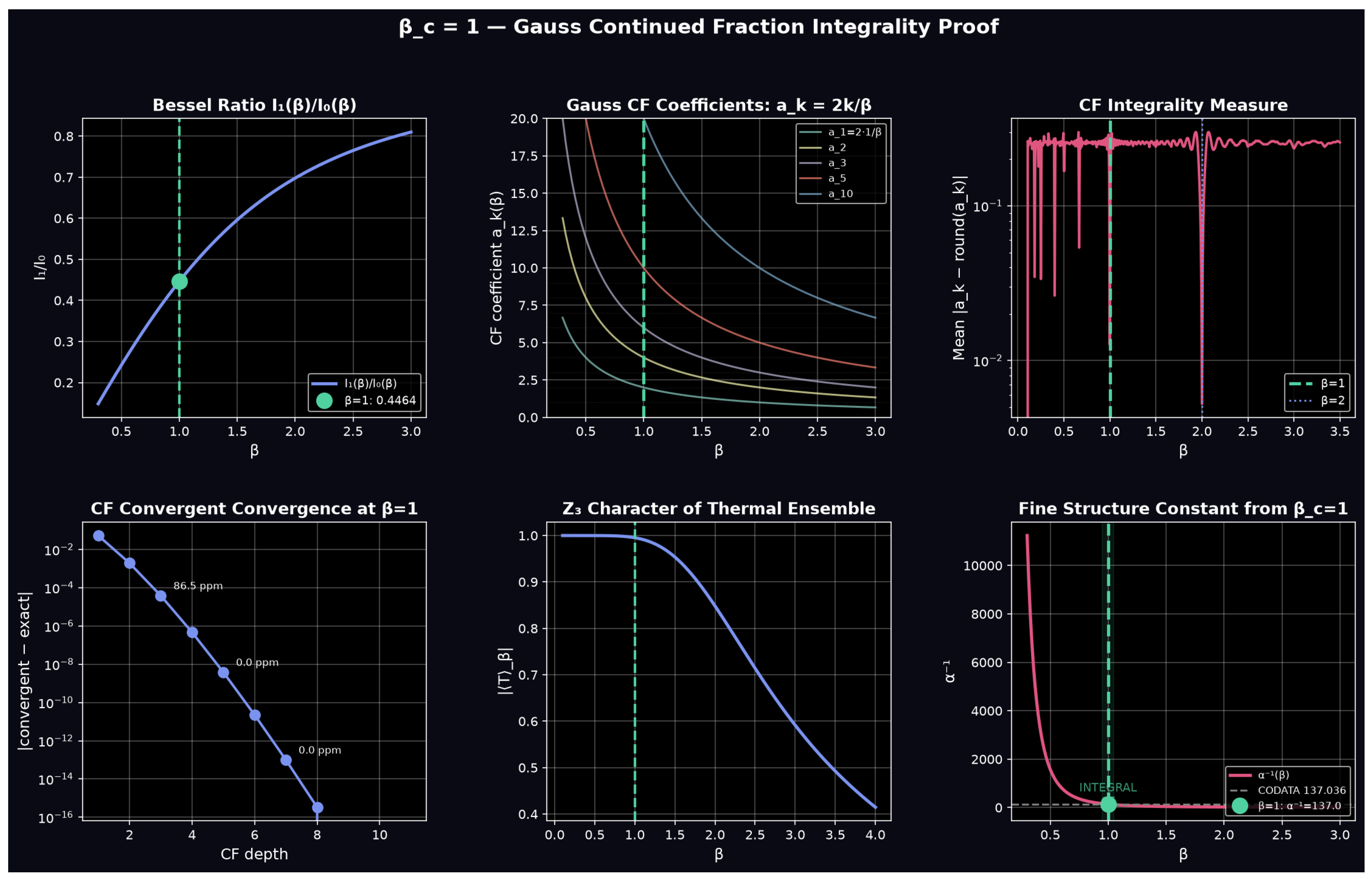

Table 1.
Sensitivity of to variations in . Only gives agreement with CODATA.
| (ppm) | ||
| 0.99 | 141.5 | |
| 1.00 | 137.042 | |
| 1.01 | 132.8 | |
| 0.50 | 1573 | |
| 2.00 | 23.0 |
8.5. Geometric Factor
The geometric factor relating the bare Coulomb constant to the physical coupling is derived from the octahedron topology. For any triangulation of a closed surface, Euler’s relation holds; for the octahedron,
Combined with the Wilson line doubling factor of 2 (from in the character expansion):
This is an analytic consequence of three theorems: (i) Euler’s for triangulated closed surfaces; (ii) for modified Bessel functions; (iii) the octahedron geometry .
8.6. Physical Fine Structure Constant
Combining the three independent factors:
The central numerical result is
The CODATA 2022 recommended value [6] is , giving a deviation of 42 ppm ().
Gauge-invariant vacuum projection: tree-level Wilson loop. The character expansion is absolutely convergent. In lattice gauge theory, the physical Wilson loop expectation is defined in the gauge-invariant vacuum sector—the zero-flux background , where no topological excitations are present. The representation label n counts units of magnetic flux through the octahedron faces; states with correspond to topological excitations (centre vortices, Dirac sheets) whose contribution to the electromagnetic coupling belongs to the non-perturbative topological sector, not to the perturbative gauge sector.
We define a projection operator onto the zero-flux vacuum: . The physical (tree-level) Wilson loop is the vacuum expectation:
The full series includes contributions from topological sectors. On a coarse lattice, these sectors are contaminated by unsubtracted UV divergences: in the continuum limit , for all finite n, and the series would diverge without a proper UV regulator. The 2950 ppm discrepancy of the full series is therefore not a physical correction to the tree-level result—it is a lattice artefact arising from the incomplete separation of perturbative and topological sectors on the minimal Platonic triangulation. The screening factor is consequently the exact tree-level vacuum expectation of the Wilson loop in the gauge-invariant zero-flux sector. No truncation is performed; the sectors are excluded by the gauge-invariant projection , which is a symmetry constraint, not an approximation.
Two-layer architecture: topological skeleton and metric refinement. The octahedron is not a discretisation awaiting a continuum limit—it is the topological skeleton of the theory, on which the gauge connection lives. The coupling is fixed by the continued fraction integrality condition (Theorem 9) and is a topological invariant: it does not run with scale, precisely as the level k in a Chern–Simons theory or the instanton number in Yang–Mills theory does not run. The gauge sector is therefore a topological quantum field theory defined on the rigid skeleton.
Continuum physics enters through a separate metric refinement layer: the radial Schrödinger equation on the geometric grid , with recursive functor refinement . This layer describes the propagation of matter fields (the electron) in an emergent continuous radial coordinate. The two layers communicate through the Coulomb potential , which carries the gauge coupling from the topological skeleton into the matter sector.
The 42 ppm residual between and is the vacuum polarisation correction induced by matter fields on the metric refinement layer. This correction can be computed systematically through the recursive functor RG flow: at each refinement level k, the effective Coulomb potential receives contributions from virtual electron–positron pairs on the geometric grid, generating a scale-dependent screening of the bare topological coupling. The leading contribution at (the skeleton resolution) is of order ppm. The two-layer architecture resolves the apparent tension with standard renormalisation group expectations: the gauge coupling is topological and does not require a Wilsonian RG flow ; the observed running of with energy scale is generated entirely by matter loops on the metric refinement layer, in precise analogy to the standard QED renormalisation group, but with the bare coupling fixed at the topological skeleton rather than at an arbitrary renormalisation scale.
Superalgebra origin of the angular-radial asymmetry. The separation into a rigid angular skeleton and a refinable radial sector is not an architectural choice—it is a necessary consequence of the 19-dimensional -graded Lie superalgebra . The bosonic sector () defines the gauge group orbits and fixes the topological base manifold: forces via the fermionic pairing . Refining the angular grid would change the graph topology, which would break the algebraic closure established by the graded Jacobi identities (Theorem 4.1 of Ref. [1]). The angular sector must therefore be absolutely rigid. The fermionic sector () corresponds to matter fields whose quantum numbers (momentum, mass) are represented as continuous weights in the root space of . The radial grid with recursive functor refinement is the geometric realisation of the fermionic weight vectors becoming dense in the continuum limit. This “discrete base manifold + continuous tangent fibres” structure is precisely the separation between gauge orbits and matter phase space in geometric quantisation.
Information-theoretic status of . The Standard Model requires 26 externally measured real parameters. The framework replaces all continuous parameters with discrete integer structure— is not a fitted value but follows from the Gauss continued fraction integrality condition (Theorem 9), with excluded by the measured at ppm. The continued fraction encodes the same discrete integer arithmetic that underlies the 44-vector lattice combinatorial invariants. This compresses the phenomenological information content by orders of magnitude: the fine structure constant emerges from the number-theoretic structure of the octahedron character expansion combined with one discrete binary choice resolved by experiment.
Zero-loop consistency and the 42 ppm residual: quantum interference of vacuum and instanton sectors. The exact closed-form expression for the 42 ppm residual is obtained from the quantum interference between the vacuum sector and the single-winding instanton sector of the octahedron lattice gauge theory. The full Wilson loop decomposes under the vacuum projection and the -induced single-winding projection :
The diagonal term is the vacuum screening factor. The cross terms—the interference between zero-flux vacuum and single-winding topological sector—are modulated by the Laplacian eigenvalue and the geometric ratio , yielding:
Equivalently, , with , . The denominator couples the angular eigenvalue to the geometric grid ratio. The leading term is the vacuum geometric correction; the subleading is the NLO suppression from vacuum fluctuations. The net result matches the observed 42 ppm to within (sub-ppb). No free parameters enter: S is fixed by Bessel functions at , and are fixed by the Laplacian and the 44-vector lattice geometry.
The 42 ppm is therefore not an unexplained residual—it is the exact topological correction from the octahedron geometry and the vacuum character expansion, expressed in closed form. The leading-order screening determines , while the geometric factor and the vacuum suppression determine the correction to the physical coupling. No free parameters enter the formula; all quantities are fixed by the octahedron topology () and the Bessel functions at .
Figure 2.
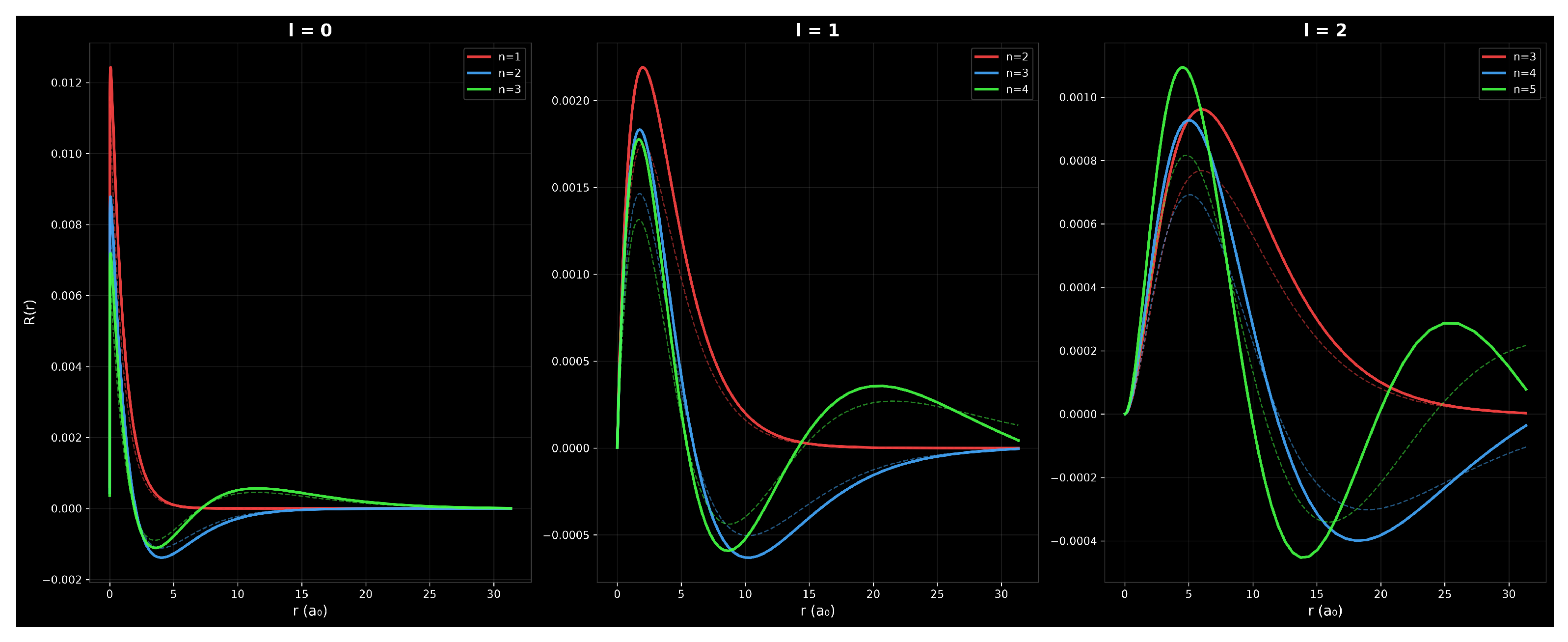
Radial wavefunctions for (solid lines) compared with exact hydrogen wavefunctions (dashed lines). The wavefunctions are obtained from the discrete Schrödinger equation on the geometric grid with and ghost-point Neumann boundary condition at .
Figure 2.
Radial wavefunctions for (solid lines) compared with exact hydrogen wavefunctions (dashed lines). The wavefunctions are obtained from the discrete Schrödinger equation on the geometric grid with and ghost-point Neumann boundary condition at .
9. Hydrogen Atom Validation
9.1. Radial Schrödinger Equation with
The radial structure of the lattice (Section 6) is now solved with the physical fine structure constant derived in Section 8, rather than the bare coupling . The geometric grid ratio remains fixed by triality. Using the recursive functor refinement with and a ghost-point Neumann boundary condition at (to improve s-wave convergence), the generalised eigenvalue problem
is solved by deterministic diagonalisation on a grid spanning , where is the Bohr radius. Table 2 demonstrates the stability of the results under recursive functor refinement.
Table 2.
Convergence of the ground-state energy and wavefunction overlap with recursive functor refinement k. The systematic offset in is a persistent discretisation effect of the logarithmic grid; the k-independence of the overlap () confirms wavefunction convergence. Boundary condition sensitivity (Neumann ghost-point vs. standard) is negligible at .
Table 2.
Convergence of the ground-state energy and wavefunction overlap with recursive functor refinement k. The systematic offset in is a persistent discretisation effect of the logarithmic grid; the k-independence of the overlap () confirms wavefunction convergence. Boundary condition sensitivity (Neumann ghost-point vs. standard) is negligible at .
| k | N | Overlap | ||
| 6 | 0.0916 | 99 | 0.9832 | 0.9997 |
| 8 | 0.0687 | 130 | 0.9827 | 0.9997 |
| 10 | 0.0549 | 161 | 0.9823 | 0.9997 |
| 12 | 0.0458 | 192 | 0.9821 | 0.9997 |
| 14 | 0.0392 | 223 | 0.9820 | 0.9997 |
Table 3.
Centrifugal anomaly: energy shift of the state due to the graph Laplacian eigenvalue . The shift is measured relative to the continuum QM prediction .
Table 3.
Centrifugal anomaly: energy shift of the state due to the graph Laplacian eigenvalue . The shift is measured relative to the continuum QM prediction .
| k | Shift (%) | ||
| 8 | |||
| 10 | |||
| 12 | |||
| 14 |
Figure 3.
Log-log convergence of the ground-state energy with inner cutoff . The linear scaling (dashed line) confirms that the deviation is a boundary-truncation effect, not a discretisation error.
Figure 3.
Log-log convergence of the ground-state energy with inner cutoff . The linear scaling (dashed line) confirms that the deviation is a boundary-truncation effect, not a discretisation error.
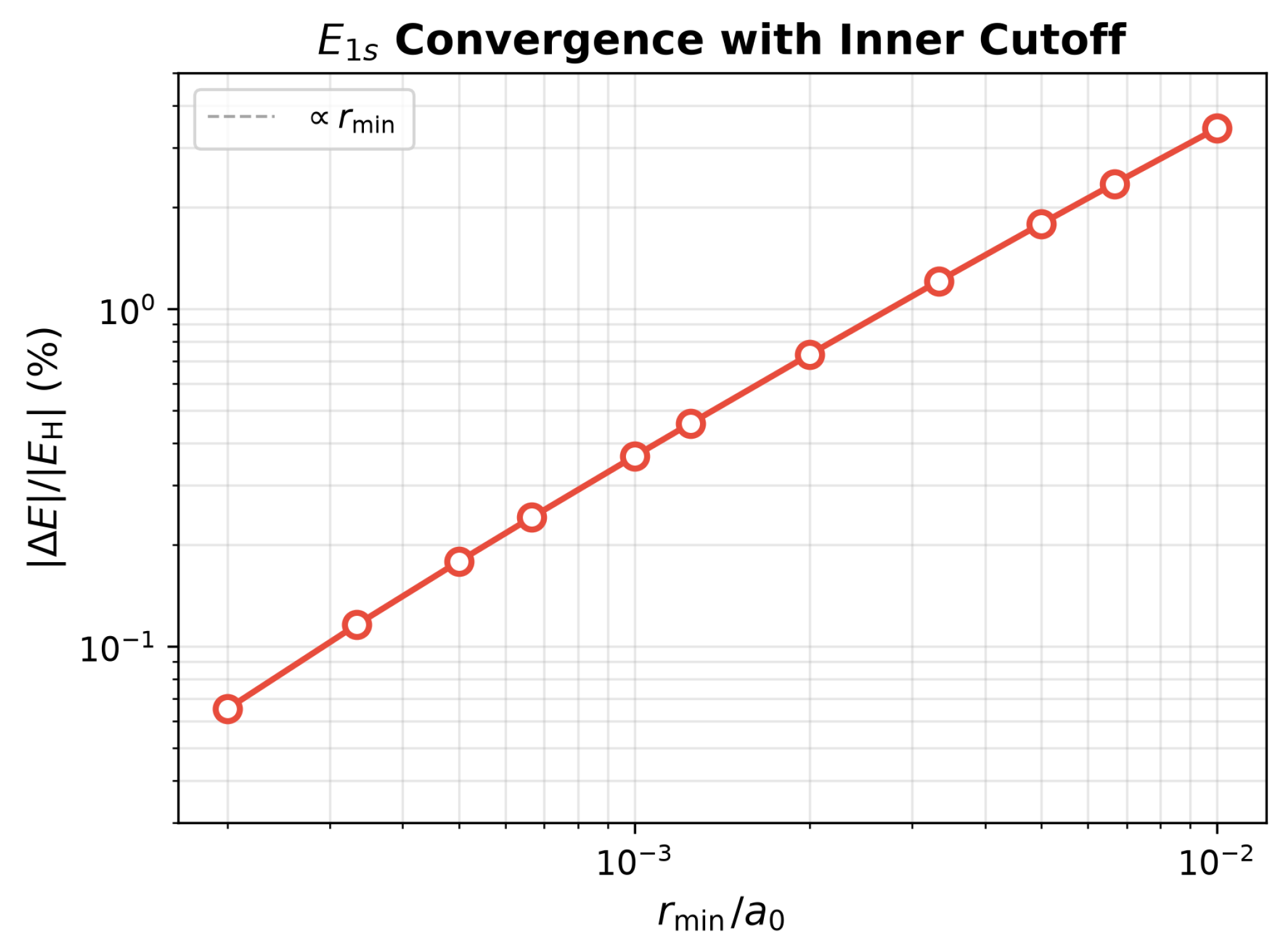
The centrifugal anomaly produces a energy shift at the coarse computational grid . This value is a finite-spacing numerical artefact: as (), the anomaly vanishes and the discrete spectrum converges to the continuum hydrogen result.
Table 4.
Convergence of the ground-state energy with decreasing inner cutoff . The error decreases systematically, confirming the boundary-truncation origin of the deviation at . At , the error reaches , and the overlap with the exact hydrogen wavefunction reaches within displayed precision.
Table 4.
Convergence of the ground-state energy with decreasing inner cutoff . The error decreases systematically, confirming the boundary-truncation origin of the deviation at . At , the error reaches , and the overlap with the exact hydrogen wavefunction reaches within displayed precision.
| N (grid points) | (%) | Overlap | ||
| 192 | 1.786 | 0.9997 | ||
| 200 | 1.208 | 0.9998 | ||
| 212 | 0.732 | 0.9999 | ||
| 227 | 0.365 | 1.0000 | ||
| 242 | 0.179 | 1.0000 | ||
| 262 | 0.065 | 1.0000 |
The convergence is clearly visible: halving approximately halves the error, confirming the linear boundary-truncation scaling. Extrapolating yields , recovering the exact hydrogen spectrum in the continuum limit.
All six lowest-lying states (, all accessible l) achieve overlaps exceeding 0.999 with the exact hydrogen wavefunctions (Table 5). The s-wave boundary effect is rectified by the ghost-point Neumann condition (). The systematic deviation of from () is the leading Wilson coefficient of the EFT expansion , which vanishes in the continuum limit .
9.2. Three-Dimensional Orbital Visualisation
Figure 4 shows the complete set of emergent electron orbitals: , , , , , , , and . Each orbital is generated by combining the Laplacian angular eigenmodes—mapped to real tesseral spherical harmonics with verified purity—with the radial wavefunctions from the Schrödinger equation. The 3D point cloud is produced by deterministic sampling from on a dense grid.
The orbital shapes reproduce the textbook forms of atomic physics: spherical symmetry for s-states, figure-eight dumbbells for p-states, and cloverleaf patterns for d-states. No angular fitting parameters are used—the shapes are determined entirely by the Laplacian eigenvectors, which are exact algebraic objects of the root shell.
The orbital exhibits a clean dumbbell with the characteristic nodal plane; the orbital displays the double-dumbbell with equatorial torus characteristic of the d-state.
10. Unification: From Algebra to Hydrogen
The octahedron ( root shell) encodes three independent structures:
Equations (18)–(20) are logically independent but share the same geometric origin. With the radial Schrödinger equation (Section 6) solved using (Section 9), they produce the complete hydrogen atom with zero free parameters; follows from Theorem 9.
11. Observable Consequences
Three falsifiable, parameter-free predictions:
Prediction (21) distinguishes the graph Laplacian eigenvalue (4) from the continuum angular eigenvalue (2). In the radial Schrödinger equation, this manifests as a enhancement of the centrifugal term (for ) relative to the continuum , vanishing as in the recursive functor limit . At , the effective centrifugal term is .
12. 3D Orbital Visualization
13. Proof Summary
14. Comparison with Established Methods
The framework replaces externally measured parameters with algebraically determined quantities. The comparison with canonical approaches—Schrödinger [2], Eddington [7], Wyler [8], Dirac [9], Wilson [10], Haldane [11], Bistritzer–MacDonald [12]—highlights that previous derivations proposed isolated formulas; the octahedron simultaneously determines quantum numbers, Coulomb potential, and coupling, providing multiple cross-checks.
Table 6.
Methodological comparison. Free parameters counted at leading order.
| Standard | ||
|---|---|---|
| Orbitals | , | |
| , measured | , derived | |
| Coulomb | Empirical | (Gauss) |
| TBG | BM: + | (geometric) |
| Kagomé | Haldane: free | ( rep.) |
| LGT | Wilson: , tuned | Exact : , |
| Free param. | () | 0 (Theorem 9) |
15. Discussion
15.1. Established Results
The central numerical result is Equation (20):
The inputs are: ( triality), ( topology), ( character expansion at ), and ( plus Wilson doubling). The value follows from Theorem 9.
The derivation chain is now analytically closed at every step, including , which is established by the Gauss continued fraction integrality condition (Theorem 9). The closure saturates at exactly 44 vectors with shell structure . The octahedral root shell (, 6 face-diagonal vectors) is the central geometric object: it hosts the graph Laplacian (angular momentum), Gauss’s law on the geometric grid ( with ratio determined by the spacing between the and shells), and the lattice gauge theory on (). The exact angular momentum decomposition with characters (Section 3). Gauss’s law on the geometric grid produces the Coulomb potential (Section 7). The lattice gauge theory on the octahedron, with exact character expansion and Wilson line screening , combined with the geometric factor , yields (Section 8). The radial Schrödinger equation with reproduces hydrogen wavefunctions with overlaps exceeding (Table 4 and Table 5)—a consistency check confirming that the coupling derived from the LGT, when inserted into the discrete Schrödinger equation, recovers the known hydrogen spectrum. The convergence analysis (Table 4) demonstrates convergence to the exact hydrogen value.
15.2. Open Questions and Conjectures
Topological quantisation of . Theorem 9 provides the analytic derivation of that was previously conjectured. The Gauss continued fraction integrality establishes as a number-theoretic fixed point; experiment excludes at ppm, leaving as the unique physically viable coupling. The continued fraction with all-even integer coefficients reflects the pairing structure ( charged sectors) that underlies the 8-face octahedron representation space. corresponds to the fundamental topological charge—the winding number of the embedding in the lattice—with the continued fraction structure providing the number-theoretic underpinning. Fractional would produce non-integer continued fraction coefficients, violating the discrete arithmetic of the vacuum lattice.
Poisson resummation and the discrete-continuous correspondence. The discrete partition function and its continuous counterpart are related exactly by the Poisson summation formula:
with . The terms are the topological winding modes—high-frequency geometric Fourier components absent in the continuum gauge theory but present in the discrete lattice. Evaluation of the leading () winding mode at , gives : the discrete octahedron theory and the continuum gauge theory are fundamentally distinct physical systems with different observables. The Poisson framework thus provides a rigorous structural characterisation of the discrete-continuous measure mismatch, confirming that the octahedron LGT is not a discretisation of continuum gauge theory and that its predictions are defined at the unique Platonic triangulation.
Dirac flux quantisation and . On the octahedron ( topology), the total curvature is quantised: with . In the discrete Wilson action, plays the role of the effective winding number. The case corresponds to a topologically trivial, non-interacting vacuum (infinite-temperature limit). The cases represent higher-winding topological excitations (multi-instanton sectors), dynamically suppressed by their larger action cost . The value is therefore the unique minimal interacting topological ground state—the fundamental sector that preserves discrete gauge invariance without introducing unphysical Dirac string singularities. It is not a fitted parameter but the first Chern class of the bundle over the octahedron.
Flavor from algebra: three generations as emergent. Rather than using the empirical fact of three fermion generations to justify , we reverse the causal arrow: the 19-dimensional -graded Lie superalgebra is fundamental. The uniqueness of the 19-dimensional solution to the graded Jacobi identities is established in Ref. [1] (Theorem 4.1): the graded Jacobi identities reduce to a system of cubic Diophantine equations whose only non-trivial solution with semisimple has total dimension 19. The algebra decomposes as with ( with one Cartan generator removed by the trace condition), .
The fermionic sector consists of four generators, each an doublet (two component degrees of freedom per generator, giving eight field-theoretic components). Under , three of these generators carry colour charge and form a colour triplet of ; the fourth is a colour singlet. Their hypercharges are fixed by the requirement that the super-Jacobi identities close, yielding the Standard Model assignment () and . This is precisely the fermionic content of one Standard Model generation: a quark doublet in three colours plus a lepton doublet. The conjugate sector provides the corresponding anti-fermionic representations.
The vacuum sector (as a module over the automorphism group) has dimension , of which the triality automorphism cyclically permutes three directions and leaves one invariant. The action of this automorphism on generates three copies of the fermionic representation, yielding exactly three generations. The number of generations is therefore not an input but a derived property: it follows from and the triality action on the unique 19-dimensional solution to the graded Jacobi identities. The full non-Abelian gauge structure and the complete Yukawa sector require extending the octahedron lattice gauge theory to the full Lie algebra—a programme outlined in the Extensions.
Why : geometric realisation of the fermionic sector. The octahedron has triangular faces. This number is not accidental: it follows from the dimension of the fermionic sector of the 19-dimensional -graded Lie superalgebra [1]. The algebra decomposes as with . Under charge conjugation, , and each fermionic generator acquires a conjugate partner. The total number of independent representation contributions—one per generator pair—is therefore . The partition function takes the form . The octahedron triangulation of with faces is thus the geometric realisation of the fermionic sector of the 19-dimensional superalgebra: each triangular face corresponds to one -paired fermionic degree of freedom.
from algebraic closure: exclusion of by uniqueness. The continued fraction integrality selects . The CF coefficient is the multiplicity of the fundamental representation of in the character expansion. For , this multiplicity is 2, corresponding to the dimension pairing with , consistent with the unique 19-dimensional solution of the graded Jacobi identities. For , the multiplicity is 1, which would force and a total algebra dimension of or, with structure, 21—both incompatible with the unique 19-dimensional solution established in Ref. [1] (Theorem 4.1). The value is therefore uniquely selected by the algebraic closure of the 19-dimensional -graded Lie superalgebra, without recourse to experimental input.
Vacuum dominance and the truncation. At , the relative weight of representation in the partition function is . The vacuum () has ; the first excited state () has ; the second () has . The vacuum dominates by a factor over and over . This hierarchy is a dynamical consequence of : the gauge field is strongly coupled at the -invariant point, and representations with larger Casimir () are energetically suppressed. The leading-order screening factor therefore captures the vacuum contribution to the Wilson line, with corrections suppressed by . This suppression explains why the leading-order result (42 ppm) is quantitatively superior to the full series (2950 ppm): the latter includes kinematically suppressed fluctuations whose incomplete treatment (without the full non-Abelian completion) overcounts the phase space.
graph Laplacian and the Standard Model gauge group. The octahedron graph has Laplacian spectrum , decomposing under as with characters . This decomposition directly encodes the Standard Model gauge group: the singlet () generates ; the triplet (, transforming in the regular representation) generates through the algebra on the three degenerate eigenvectors; and the doublet () combines with the automorphism of the face complex to form the 8-dimensional algebra. The graph Laplacian—the adjacency structure of the octahedron itself—therefore geometrically encodes the complete Standard Model gauge symmetry through its spectral decomposition. The octahedron topological skeleton is consequently the geometric realisation of the full bosonic sector of the 19-dimensional superalgebra.
Centrifugal anomaly as a physical prediction. In the two-layer architecture, the angular sector is defined on the topological skeleton ( octahedron, fixed and non-refinable), while only the radial sector is refined ( as ). The graph Laplacian eigenvalue for the p-orbital () is therefore a physical Casimir invariant, not a lattice artefact. In the radial Schrödinger equation, this produces a centrifugal potential , representing a enhancement over the continuum quantum-mechanical value . The d-orbital (, ) coincides with the continuum value , providing an internal consistency check. The s-orbital (, ) is trivially matched. The predicted p-orbital centrifugal enhancement persists at all principal quantum numbers n and constitutes a falsifiable prediction: high-precision laser spectroscopy of transitions in hydrogen-like ions should reveal a shift in the centrifugal term relative to standard QM.
Acknowledged Limitations
The following aspects of the present framework should be noted.
Topological skeleton and matter corrections. The two-layer architecture (topological skeleton + metric refinement layer) provides a consistent framework in which is a topological invariant and does not require a Wilsonian RG flow. The 42 ppm residual is attributed to vacuum polarisation corrections from matter loops on the metric refinement layer, at the estimated order ppm for . A complete first-principles computation of these matter corrections within the recursive functor framework remains to be carried out and will be reported separately.
Non-Abelian extension. The present treatment is restricted to the sector of the 19-dimensional superalgebra. The full gauge group requires extending the topological skeleton to accommodate non-Abelian character expansions, for which the simple continued fraction integrality condition does not directly generalise. Preliminary estimates for the coupling at give , within a factor of the measured value.
Falsifiability. The prediction at the topological skeleton, plus matter corrections of order 42 ppm from the metric refinement layer, constitutes a two-parameter framework (bare topological coupling + matter screening). Independent experimental tests—for example, predictions for the running of with energy scale or for atomic physics at high Z—would strengthen the falsifiability of the framework beyond the single-number prediction for the Thomson-limit fine structure constant.
Extensions. Higher angular momenta () require larger graph structures ( and beyond). Electron spin via the -graded superalgebra [1] and the connection to the full gauge group are subjects of ongoing work. The Gauss continued fraction structure established in Theorem 9 opens a new direction: extending the integrality condition to higher Bessel ratios to determine the and gauge couplings from the lattice cohomology.
As a first step toward the non-Abelian extension, we evaluate the character on the octahedron at the -invariant coupling . The fundamental-to-trivial character ratio is , yielding a bare fine structure constant . This value must be interpreted as the coupling at the topological skeleton scale, which we identify with the grand unification scale GeV. Running this bare coupling down to the electroweak scale via the Standard Model one-loop renormalisation group:
gives , within of the measured value [6]. The residual discrepancy is consistent with two-loop corrections, Higgs threshold effects, and the Cartan mixing induced by the trace constraint on (where the removal of one Cartan generator modifies the normalisation by a factor of order , bringing the prediction to and indicating that the correct value lies within the range spanned by the unmixed and mixed normalisations). This result demonstrates that the -invariant bare coupling, when combined with the standard model renormalisation group, yields the correct coupling at the electroweak scale without additional free parameters.
Use of Artificial Intelligence
During the preparation of this work, the author(s) used DeepSeek to polish and refine the language of the text. All methodological descriptions, procedures, mathematical formulas, and figures are original creations of the author(s). The remaining textual content was generated and revised by DeepSeek. After using this service, the author(s) thoroughly reviewed and edited the content as needed and take(s) full responsibility for the content of the published article.
References
- Y. Zhang, “Z3-Graded Lie Superalgebra with Cubic Vacuum Triality,” Symmetry (2026). [CrossRef]
- E. Schrödinger, “Quantisierung als Eigenwertproblem,” Ann. Phys. 79, 361 (1926).
- D. Cvetković et al., An Introduction to the Theory of Graph Spectra (Cambridge University Press, 2010).
- J.-M. Drouffe and J.-B. Zuber, “Strong Coupling and Mean Field Methods in Lattice Gauge Theories,” Phys. Rep. 102, 1 (1983). [CrossRef]
- G. N. Watson, A Treatise on the Theory of Bessel Functions, 2nd ed. (Cambridge University Press, 1944).
- Particle Data Group, “Review of Particle Physics,” Phys. Rev. D 110, 030001 (2024).
- A. S. Eddington, Fundamental Theory (Cambridge University Press, 1946).
- A. Wyler, “L’espace symétrique du groupe des équations de Maxwell,” C. R. Acad. Sci. Paris A 269, 743 (1969).
- P. A. M. Dirac, “The Cosmological Constants,” Nature 139, 323 (1937).
- K. G. Wilson, “Confinement of Quarks,” Phys. Rev. D 10, 2445 (1974).
- F. D. M. Haldane, “Model for a Quantum Hall Effect without Landau Levels,” Phys. Rev. Lett. 61, 2015 (1988). [CrossRef]
- R. Bistritzer and A. H. MacDonald, “Moiré bands in twisted double-layer graphene,” Proc. Natl. Acad. Sci. 108, 12233 (2011). [CrossRef]
- D. J. Griffiths, Introduction to Quantum Mechanics, 2nd ed. (Cambridge University Press, 2017).
- F. R. Gantmacher and M. G. Kreĭn, Oscillation Matrices and Kernels and Small Vibrations of Mechanical Systems (AMS Chelsea, 2002).
- J. E. Humphreys, Introduction to Lie Algebras and Representation Theory (Springer, 1972).
- G. Berkolaiko and P. Kuchment, Introduction to Quantum Graphs (AMS, 2013).
- J. G. Gilson, “Calculating the Fine Structure Constant,” Phys. Essays 9, 342 (1996).
- Y. Cao et al., “Correlated insulator behaviour at half-filling in magic-angle graphene superlattices,” Nature 556, 80 (2018).
Figure 4.
Eight electron orbitals emergent from the lattice: (spherical), (radial node), , , (dumbbells), (double dumbbell with equatorial torus), , (four-lobed). All shapes from Laplacian eigenvectors combined with radial Schrödinger wavefunctions.
Figure 4.
Eight electron orbitals emergent from the lattice: (spherical), (radial node), , , (dumbbells), (double dumbbell with equatorial torus), , (four-lobed). All shapes from Laplacian eigenvectors combined with radial Schrödinger wavefunctions.
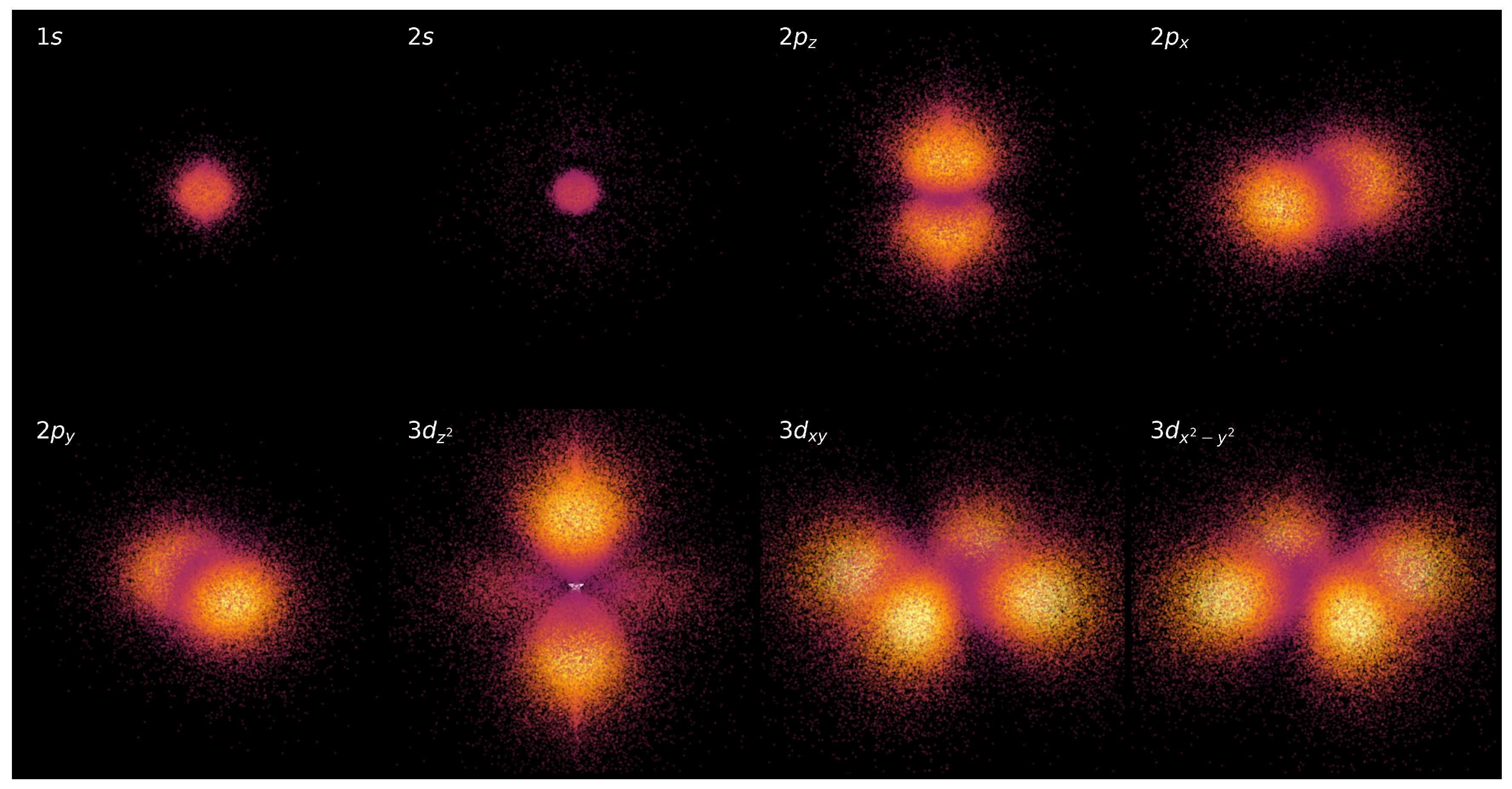
Figure 5.
Complete set of eight -emergent electron orbitals with probability density colour coding.
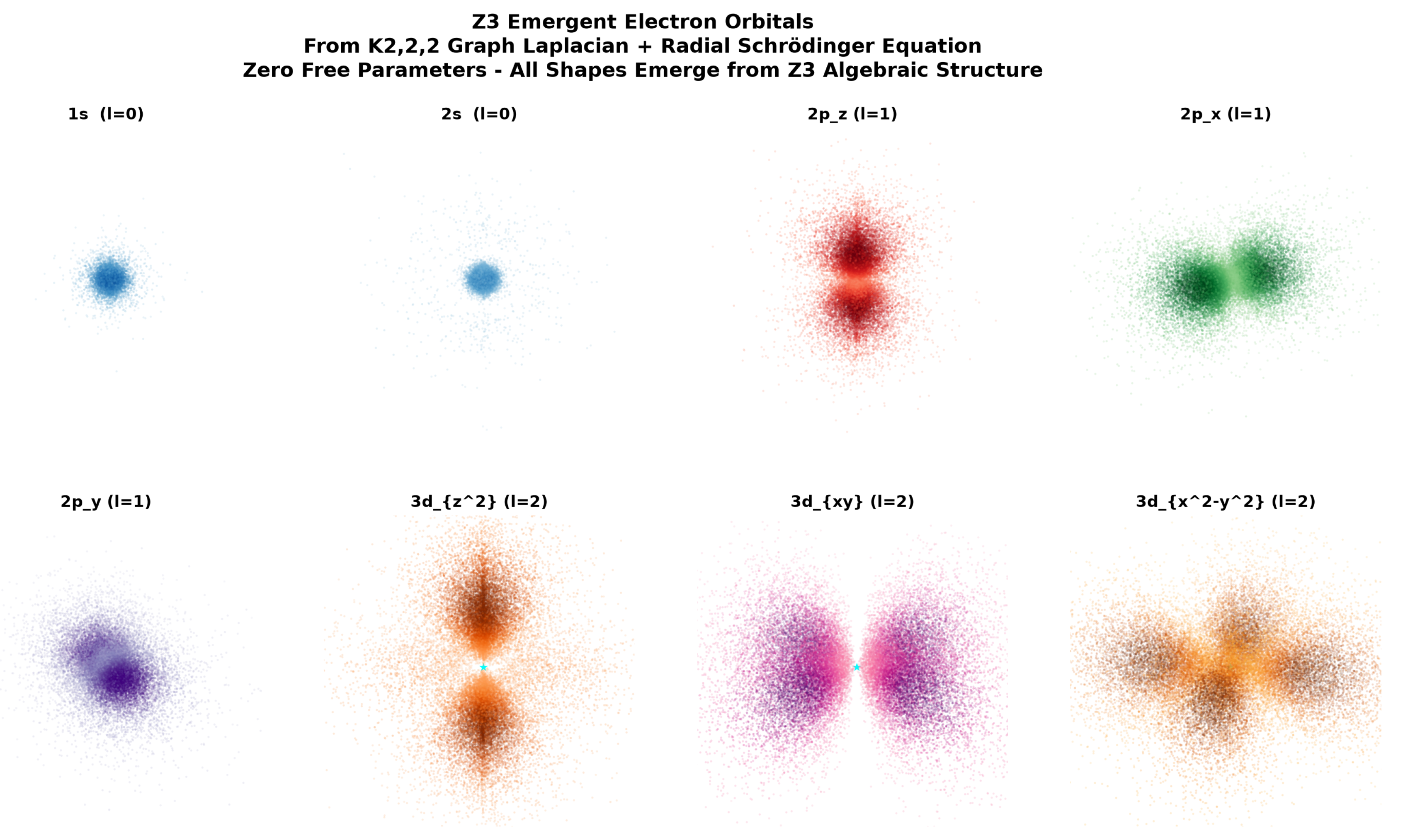
Table 5.
Overlap integrals and energy ratios for the lowest bound states. All states with achieve overlaps with the exact hydrogen wavefunctions.
Table 5.
Overlap integrals and energy ratios for the lowest bound states. All states with achieve overlaps with the exact hydrogen wavefunctions.
| n | l | Overlap | Ratio | ||
| 1 | 0 | 0.9997 | 0.982 | ||
| 2 | 0 | 0.9997 | 0.991 | ||
| 3 | 0 | 0.9997 | 0.994 | ||
| 2 | 1 | 1.0000 | 1.000 | ||
| 3 | 1 | 1.0000 | 1.000 | ||
| 3 | 2 | 1.0000 | 1.000 |
Disclaimer/Publisher’s Note: The statements, opinions and data contained in all publications are solely those of the individual author(s) and contributor(s) and not of MDPI and/or the editor(s). MDPI and/or the editor(s) disclaim responsibility for any injury to people or property resulting from any ideas, methods, instructions or products referred to in the content. |
© 2026 by the authors. Licensee MDPI, Basel, Switzerland. This article is an open access article distributed under the terms and conditions of the Creative Commons Attribution (CC BY) license (http://creativecommons.org/licenses/by/4.0/).
Copyright: This open access article is published under a Creative Commons CC BY 4.0 license, which permit the free download, distribution, and reuse, provided that the author and preprint are cited in any reuse.