

Submitted:
29 June 2026
Posted:
30 June 2026
You are already at the latest version
Abstract
An entropy-based solubility parameter-translated Soave-Redlich-Kwong equation of state (eSPT-SRK EoS) was developed that incorporates two correction parameters which can be linearly correlated with the critical compressibility factor of pure substances. The correlated results gave an average relative deviation (ARD) value of 5.4 % at the critical density for a database of 28 widely-used chemicals. Estimation of liquid densities at standard temperature and pressure conditions gave ARD values of 5.8 % compared with the original SRK EoS of 22.2 %. The eSPT-SRK EoS was applied to calculate thermodynamic properties (entropy, fugacity, cohesive energy density) and was found to be reliable for estimating entropy-based Hansen-type solubility parameters (eHSP). The eSPT-SRK EoS was compared with a corrected form of the entropy-based solubility parameter-traslated Peng-Robinson EoS (eSPT-PR EoS) and both functional forms were found to give reliable eHSP values. Therefore, the formulation methodology can be applied to other cubic equations of state for specialized fluid mixtures.
Keywords:
critical molar volume
; liquid density
; equation of state
; critical compressibility factor
; Soave-Redlich-Kwong (SRK) EoS
; entropy-based Solubility Parameter (eSP)
; volume translated
1. Introduction
Soave-Redlich-Kwong (SRK) equation of state (SRK EoS) [1] is widely used by scientists and engineers as well as Peng-Robinson EoS (PR EoS) [2] to predict high-pressure phase diagrams for manufacturing products. The prediction is mainly based on critical properties not only for pure substances, but also for multiple mixtures. The utility of SRK EoS is very wide for simulation of both super- and sub- critical processes [3,4,5,6] and for petroleum industries [7,8].
However, both SRK EoS and PR EoS have low prediction ability for both liquid and critical densities, especially for high polar substances like ethanol, methanol and water. Therefore, volume-translated cubic EoS has been previously proposed by researchers [9,10,11,12] to improve volumetric representation.
Recently, entropy-based solubility parameter (eSP) to be calculated at arbitrary temperature and pressure conditions based on Hildebrand solubility parameter (SP) obtained at ambient temperature and pressure conditions was applied to development of entropy-based solubility parameter-translated PR EoS (eSPT-PR EoS) [13]. Thus, the prediction accuracy of both pure substance liquid and critical densities was improved, however, it is difficult for both fugacity and entropy to be calculated analytically using departure functions as its present form. From this point of view, a new technique is necessary for addressing these issues.
In the beginning of this work, the SRK EoS was applied to overcome these issues. The added eSP translation correction that treats both fugacity and entropy calculations is applied to the modified SRK EoS and denoted as eSPT-SRK EoS. In the eSPT-SRK EoS, new constants C, D, E and F were added to the EoS and the resulting C and D values were generalized with fundamental properties of chemical species. The other universal constants (E and F) were determined with selected data. Finally, entropy-based Hansen-type solubility parameters (eHSP) were calculated according to the functional form of the eSPT-SRK EoS. Furthermore, we corrected the eSPT-PR EoS with comparison to the developed eSPT-SRK EoS.
2. Materials and Methods
As in the previous study [13], we selected 27 substances generally used in chemistry. We plussed carbon dioxide because carbon dioxide shows gaseous state in the ambient temperature and pressure conditions. Thus, total 28 substances were used in EoS development. Critical properties and acentric factors are listed in Table 1. The Hildebrand solubility parameter (SP) is generally evaluated at ambient conditions [14] and is defined for organic compounds by Equation (1):
In Equation (1), is the cohesive energy and is the molar volume of the liquid. Usually, the Hildebrand SP is calculated at a SATP condition (298.2 K and 101.3 kPa), where is the enthalpy of vaporization and is the molar volume of gas.
The eSP [15,16] defined in Equation (2) is more widely used not only for multiple phases such as vapor and liquid phases, but also for homogeneous supercritical fluid phases. The eSP is defined as:
In Equation (2), s is the molar entropy and a Maxwell relationship is used to determine its volumetric dependence.
In the critical point (cp), the thermodynamic relationship is given as follows [17]:
In the calculation of , the end point of saturated vapor pressure curve differentiated by temperature as shown in Equation (4) was used, which is referred to in ref. [18].
In Equation (3), the was calculated for each equation of state. In Equation (5), average relative deviation (ARD) was defined as follows:
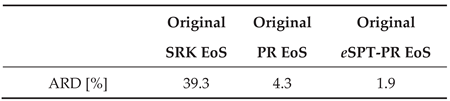
In Table 2, the thermodynamic relationship shown in Equation (3) was assessed for the 28 substances selected in this work. The ARD () values were 39.3% for the original SRK EoS [1], 4.3% for the original PR EoS [2] and 1.9% for the original eSPT-PR EoS [13], respectively. Due to the high ARD () value for the original SRK EoS compared with the other EoSs, function forms were examined for its improvement.
By applying the concepts of both SRK EoS and eSPT-PR EoS, the equation denoted as eSPT-SRK EoS was parameterized as follows:
In Equation (6), C, D, E and F were newly introduced into the eSPT-SRK EoS, though the original SRK EoS has C = D = 0 and E = F = 1.
One can obtain the fugacity coefficient from the departure function (Equation (7)) by substitution of Equation (6):
where f and z are fugacity and compressibility factor, respectively. The resulting expression for the fugacity coefficient can be expressed as follows:
Entropy can be calculated from the departure function, (Equation (9)):
where IG is ideal gas state at constant T, respectively and can be calculated by substituting in Equation (6) as follows:
The resulted entropy difference for gas or liquid phase can be expressed as follows:
Thus, both fugacity and entropy calculated at any conditions with the eSPT-SRK EoS, which overcomes issues in the original eSPT-PR EoS as conditions approach the ideal gas state. The corrected form of the eSPT-PR EoS is given in the Appendix.

Table 2.
ARD () values in 28 selected chemicals.
 |
For eSPT-SRK EoS parameters ac and b in Equation (6), a constant C was introduced as follows:
The a(T) function of original SRK EoS was adopted and is described by Equation (15):
In Eq (15), Tr is a reduced temperature (= T/TC). For eSPT-SRK EoS, pure parameters in Equation (13), in Equation (14) and , , in Equation (15) were redetermined by fitting to experimental data for the compounds in the database.
The objective function for data fitting was chosen to be dimensionless as follows:
where is value at a standard temperature (T0 = 298.2 K) as calculated with Equation (17) or Equation (18), respectively. Equation (18) is the Clapeyron equation and value can be calculated with the eSPT-SRK EoS as follows:
In Equation (16), arbitrary weights were used to adjust each term to have the same order of magnitude.
Average relative deviation (ARD) of the calculated properties was defined as follows.
3. Results and Discussion
Substance-dependence C and D parameters in Equation (6) were correlated against the critical compressibility factor (zc) as shown in Equations (21) and (22), respectively:
The five pure parameters ( in Equation (13), in Equation (14) and , , in Equation (15)) and constant C0, C1, D0 and D1 in Equations (21) and (22) were determined by properties of the selected 28 chemicals (Table 1) using the objective function in Equation (16) by a least-squares method. Namely, a total 11 parameters including E and F in Equation (6) were simultaneously fitted. The resulting parameters are listed in Table 2 and detailed results are given in Table 3.
The eSPT-SRK EoS compared favorably with the original eSPT-PR EoS (Table 3). In Table 4, four pure substances (n-hexane, CO2, methanol and water) were predicted with the eSPT-SRK EoS given by Equations (6) at several (T, P) conditions and compared with the pc-SAFT EoS [19]. For water, the pc-SAFT EoS was fit to an intermediate isotherm of NIST data (523.15 K) and then was applied to calculate densities at the other stated conditions.
In the calculation of ARD [%], values from the NIST chemistry webbook [20] were used for reference as follows:
ARDs of liquid densities of the eSPT-SRK EoS (Table 4) were comparable with those of both the eSPT-PR EoS and pc-SAFT EoS for two non-polar substances (n-hexane, CO2), but were higher than those of pc-SAFT EoS for two polar substances (methanol, water). On the other hand, ARDs of gas densities were much lower for the eSPT-SRK EoS than the eSPT-PR EoS (Table 4). The pc-SAFT EoS is neither a cubic equation nor a fixed-degree polynomial; instead, it incorporates statistical-mechanical integral terms that enable accurate description of substance properties in the critical region. All cubic EoS have a cubic critical isotherm and a quadratic coexistence curve [17] unlike that of the pc-SAFT EoS. Nevertheless, the generalized form of the eSPT-SRK EoS in this work improves gaseous density representation compared with the eSPT-PR EoS (Table 4).
Table 2.
Pure parameters in orignial SRK EoS and eSPT-SRK EoS given by Equation (6).
| a0 | b0 | KC1 | KC2 | KC3 | ||
| Original SRK EoS [1] |
0.42748 | 0.08664 | 0.48 | 1.574 | -0.176 | |
|
eSPT-SRK EoS (This work) |
0.21407 | 0.044749 | -0.050191 | 2.48002 | -1.29804 | |
| C1 | C0 | D1 | D0 | E | F | |
| Original SRK EoS [1] |
0 | 0 | 0 | 0 | 1 | 1 |
|
eSPT-SRK EoS (This work) |
-39.9554 | 1.56665 | -1.27049 | 0.31888 | 0.679395 | 2.38633 |
28 substances selected in this work. The results showed that eSPT-SRK EoS was compared well with the original eSPT-PR EoS, although the deviations in eSPT-SRK EoS were slightly higher than those in the original eSPT-PR EoS. However, eSPT-SRK EoS improved the reliability compared with the original SRK EoS.
For comparison of the entropy-based Hansen-type solubility parameter with the eSPT-SRK EoS, Equation (6) was differentiated with temperature to give:
In the eSPT-SRK EoS, polar and hydrogen bond terms were defined by the following equations:
where subscript EoS is the calculation with the eSPT-SRK EoS in this case.
The relationship between and of which value was taken consideration of corresponding to the same contribution of in the and that between and of which value was taken consideration of corresponding to the same contribution of in the were respectively investigated as shown in Figure 2 and Figure 3. In Figure 2, the was quadratically linked to the in HSP (R2 = 0.4546), although some deviations between them were observed. In Figure 3, the was found to be strongly correlated to the in HSP (R2 = 0.9543). Thus, we summarized that an eHSP concept was developed as shown in the following predictive forms
From the positive correlations observed in both Figure 2 and Figure 3, we found the next relationships:
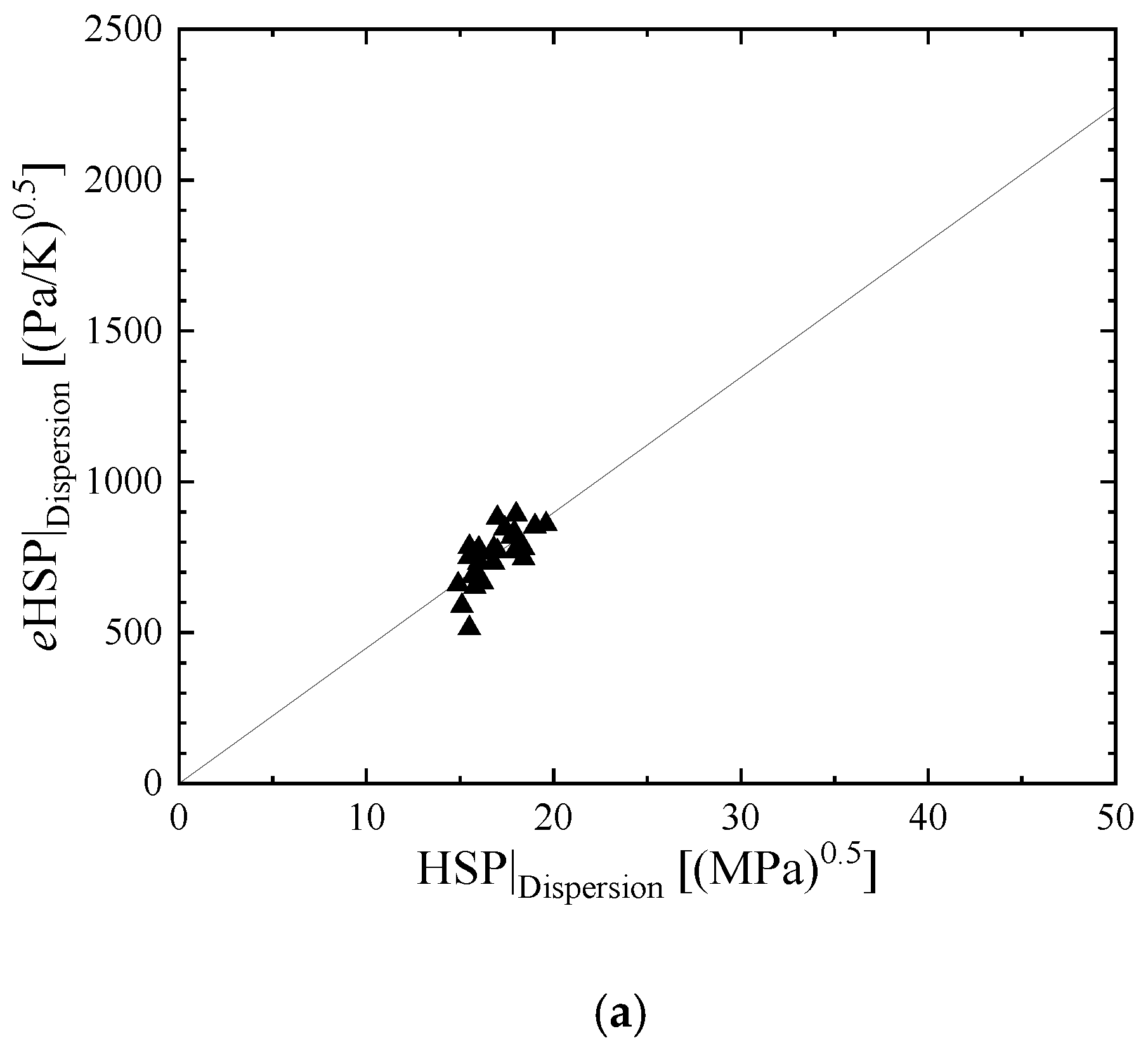
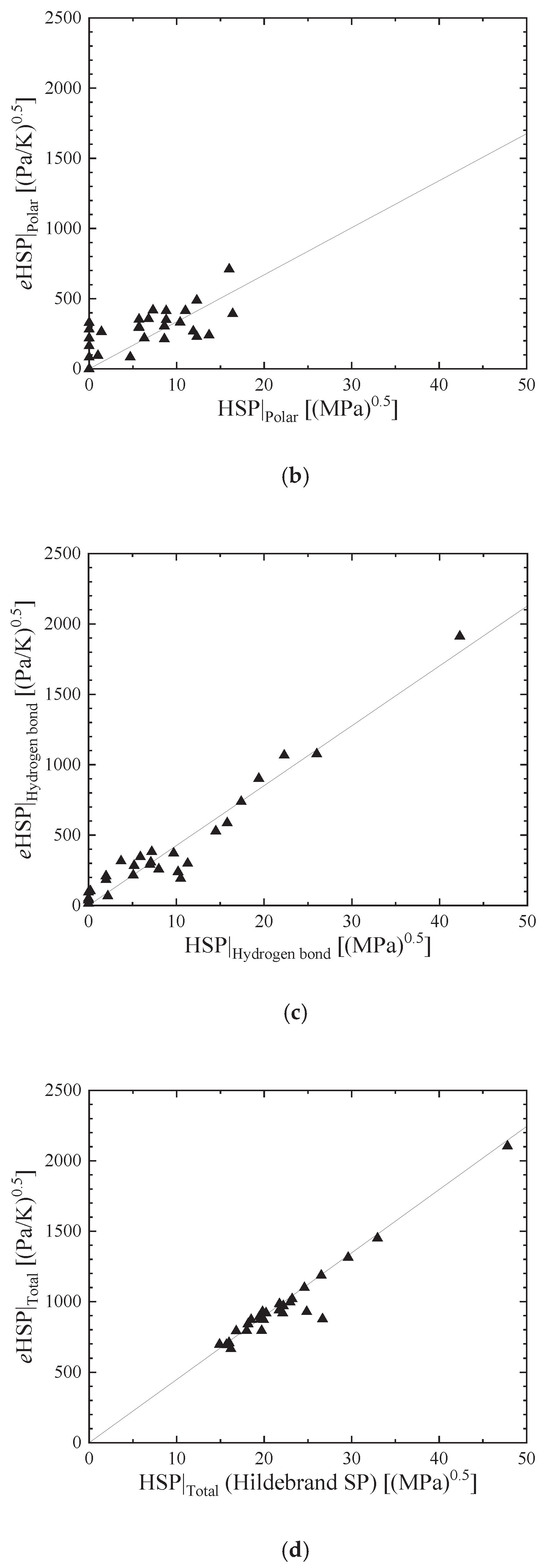
Table 5 shows the eHSP values for the selected 28 chemicals. The prediction with the eSPT-SRK EoS was well correlated with the original HSP data [21]. Figure 5 shows relationship between the predicted eHSP and original HSP at 298.2 K and 0.1013 MPa. Each term denoted “Dispersion”, “Polar”, “Hydrogen bond”, respectively showed linearity between predicted eHSPs and the original HSP. Tus, the method to calculate eHSP with the eSPT-SRK EoS was developed. The present prediction method with the eSPT-SRK EoS is applicable to the calculation of HSP values under arbitrary temperature, pressure, and mixture composition conditions. Results with the corrected form of the eSPT-PR EoS gave similar results to the eSPT-SRK EoS.
Table 3.
ARDs calculated with eSPT-SRK EoS from experimental data values.
| No. | Substance | Group |
ARD () [%] |
ARD () [%] |
||
|---|---|---|---|---|---|---|
| 1 | Water | Water | 1.3 | (2.4)1 | 1.2 | (1.4)1 |
| 2 | Ethylene Glycol | Alcohol | 4.1 | (2.7)1 | 0.9 | (2.2) 1 |
| 3 | N-Methyl-2-pyrrolidone | Cyclic Compound | 2.3 | (0.9)1 | 9.0 | (1.5) 1 |
| 4 | Methanol | Alcohol | 0.3 | (6.5)1 | 5.8 | (1.2) 1 |
| 5 | Ethanol | Alcohol | 5.4 | (7.5)1 | 3.6 | (1.8) 1 |
| 6 | Dimethyl Sulfide | Sulfur compound | 1.3 | (4.6)1 | 3.1 | (2.4)1 |
| 7 | 1-Propanol | Alcohol | 7.9 | (6.5)1 | 0.1 | (2.1) 1 |
| 8 | N,N-Dimethylformamide | Nitrogen compound | 10.7 | (6.1)1 | 18.6 | (0.9) 1 |
| 9 | 1-Butanol | Alcohol | 8.9 | (5.6)1 | 1.4 | (2.2) 1 |
| 10 | 2-Butanol | Alcohol | 7.0 | (5.7)1 | 0.0 | (2.1) 1 |
| 11 | Pyridine | Aromatic | 2.3 | (2.5)1 | 7.9 | (2.6) 1 |
| 12 | Cyclopentanone | Ketone | 4.8 | (8.0)1 | 10.5 | (1.4) 1 |
| 13 | Acetophenone | Ketone | 4.3 | (2.5)1 | 3.8 | (2.3) 1 |
| 14 | Dichloromethane | Halide | 2.8 | (0.1)1 | 2.7 | (2.4) 1 |
| 15 | Dimethyl Carbonate | Carbonate | 2.1 | (2.8)1 | 2.1 | (1.9) 1 |
| 16 | Cyclohexanone | Ketone | 3.7 | (5.8)1 | 11.0 | (1.4) 1 |
| 17 | Acetone | Ketone | 3.4 | (2.2)1 | 5.6 | (1.6) 1 |
| 18 | Tetrahydrofuran | Aromatic | 6.2 | (7.9)1 | 1.6 | (2.2) 1 |
| 19 | Benzene | Aromatic | 4.6 | (4.0)1 | 4.8 | (2.4) 1 |
| 20 | Toluene | Aromatic | 5.1 | (2.8)1 | 3.9 | (2.3) 1 |
| 21 | 1-Decanol | Alcohol | 4.3 | (2.8)1 | 3.2 | (2.2) 1 |
| 22 | Trans-Decahydronaphthalene | Aromatic | 11.8 | (4.9)1 | 6.5 | (2.4) 1 |
| 23 | Cyclohexane | Cyclic Compound | 5.5 | (4.5)1 | 6.7 | (2.5) 1 |
| 24 | Tetradecane | Alkane | 0.4 | (4.6)1 | 4.2 | (1.8) 1 |
| 25 | 1-Decene | Alkene | 6.6 | (2.9)1 | 0.1 | (2.1) 1 |
| 26 | Decane | Alkane | 4.3 | (0.6)1 | 0.2 | (2.1) 1 |
| 27 | Hexane | Alkane | 2.8 | (3.3)1 | 4.6 | (2.4) 1 |
| 28 | Carbon Dioxide | Inorganic Carbon | - | - | 7.8 | (2.6) 1 |
| - | - | Average | 5.2 | (4.0)1 | 4.7 | (2.0)1 |
1 Values obtained with the original eSPT-PR EoS (predictive form) [13] (in parentheses).
Table 4.
Prediction of properties for four pure chemicals with eSPT-SRK EoS given by Equation (6) at several (T, P) conditions. For water, the pc-SAFT EoS [19] was fit to an intermediate isotherm (523.15 K) for parameter determination.
Table 4.
Prediction of properties for four pure chemicals with eSPT-SRK EoS given by Equation (6) at several (T, P) conditions. For water, the pc-SAFT EoS [19] was fit to an intermediate isotherm (523.15 K) for parameter determination.
| n-Hexane |
eSPT-SRK EoSARD () [%] |
eSPT-SRK EoSARD () [%] |
Original eSPT-PR EoSARD () [%] |
Original eSPT-PR EoSARD () [%] |
pc-SAFT EoSARD () [%] |
pc-SAFT EoSARD () [%] |
|---|---|---|---|---|---|---|
| (Tr = 0.8, Pr = 0.8) | 9.1 | - | 1.8 | - | 2.2 | - |
| (Tr = 1.15, Pr = 1.2) | - | 10.5 | - | 23.9 | - | 2.6 |
| CO2 |
eSPT-SRK EoSARD() [%] |
eSPT-SRK EoSARD() [%] |
Original eSPT-PR EoSARD() [%] |
Original eSPT-PR EoSARD() [%] |
pc-SAFT EoSARD() [%] |
pc-SAFT EoSARD() [%] |
| (Tr = 0.8, Pr = 0.8) | 12.3 | - | 1.1 | 6.0 | - | |
| (Tr = 1.2, Pr = 1.2) | - | 3.9 | - | 19.0 | - | 5.1 |
| Methanol |
eSPT-SRK EoSARD() [%] |
eSPT-SRK EoSARD() [%] |
Original eSPT-PR EoSARD() [%] |
Original eSPT-PR EoSARD() [%] |
pc-SAFT EoSARD() [%] |
pc-SAFT EoSARD() [%] |
| (Tr = 0.8, Pr = 0.8) | 12.6 | - | 3.5 | - | 0.53 | - |
| (Tr = 1.2, Pr = 1.2) | - | 0.5 | - | 43.7 | - | 1.7 |
| Water |
eSPT-SRK EoSARD() [%] |
eSPT-SRK EoSARD() [%] |
Original eSPT-PR EoSARD() [%] |
Original eSPT-PR EoSARD() [%] |
pc-SAFT EoS*ARD() [%] |
pc-SAFT EoS*ARD() [%] |
| (Tr = 0.8, Pr = 0.8) | 18.0 | - | 3.9 | - | 0.09 | - |
| (Tr = 1.2, Pr = 1.2) | - | 5.3 | - | 42.3 | - | 1.5 |
* mi 1.59364, σ [Å] 2.46841,εi/kT [K] 235.681, kAB 0.071007,εAB/kT [K] 3387.68.
Figure 1.
Thermodynamic relationship, Equation (3), assessed for four types of equations of state for 28 substances (Table 1).
Figure 1.
Thermodynamic relationship, Equation (3), assessed for four types of equations of state for 28 substances (Table 1).
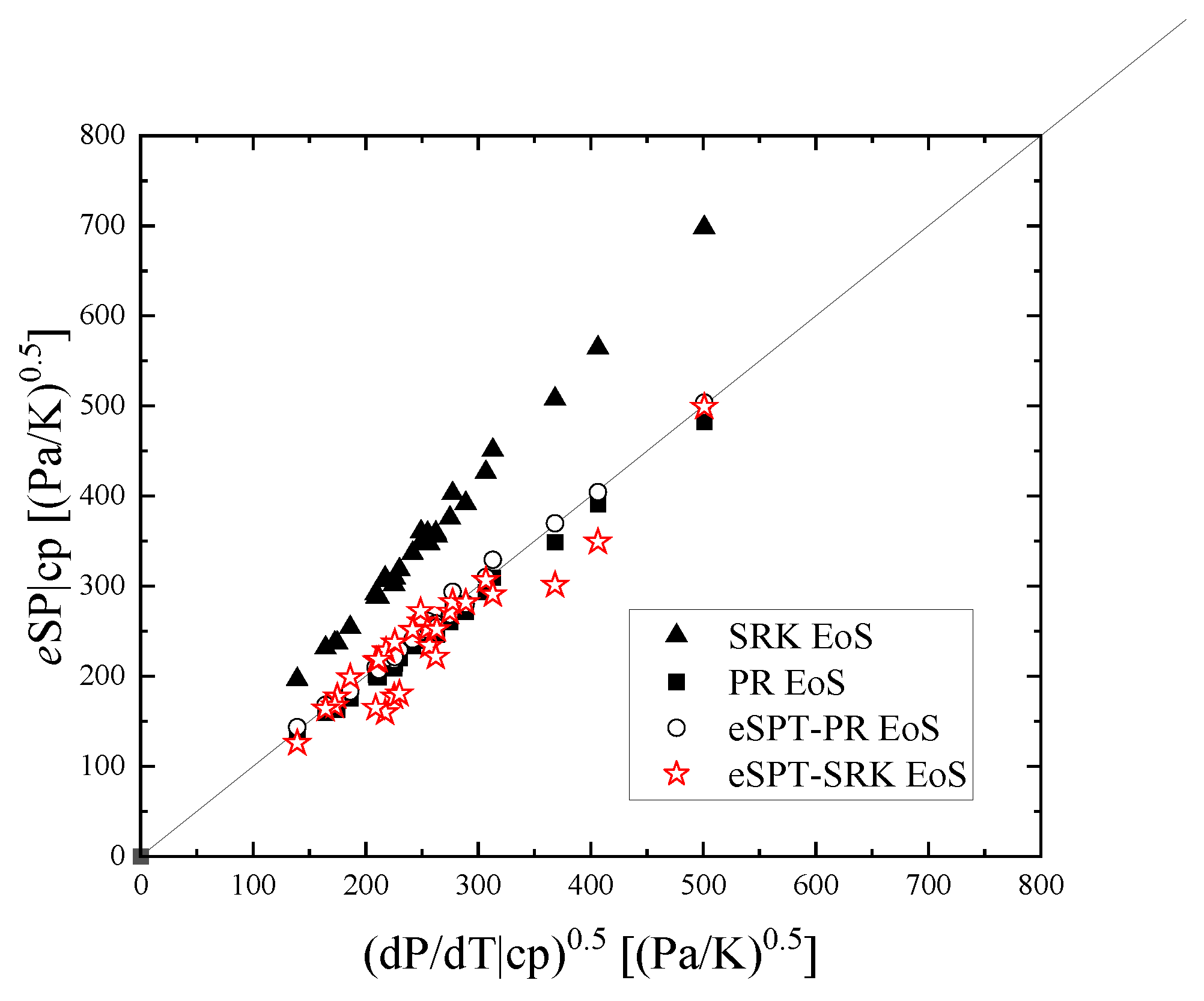
Table 5.
Entropy-based Hansen solubility parameter (eHSP) of 28 selected chemicals (Table 1).
Table 5.
Entropy-based Hansen solubility parameter (eHSP) of 28 selected chemicals (Table 1).
| No. | Substance |
[(Pa/K)0.5] |
[(Pa/K)0.5] |
[(Pa/K)0.5] |
|---|---|---|---|---|
| 1 | Water | 682.0 (514.5)1 | 704.0 (710.2)2 | 1861 (1912)3 |
| 2 | Ethylene Glycol | 748.4 (880.2)1 | 484.3 (414.2)2 | 1145 (1076)3 |
| 3 | N-Methyl-2-pyrrolidone | 781.3 (891.3)1 | 533.9 (229.0)2 | 312.5 (381.7)3 |
| 4 | Methanol | 669.5 (588.8)1 | 545.4 (488.6)2 | 988.8 (1067)3 |
| 5 | Ethanol | 706.9 (650.7)1 | 393.7 (413.6)2 | 867.9 (901.8)3 |
| 6 | Dimethyl Sulfide | 604.9 (746.5)1 | 539.1 (392.9)2 | 335.3 (238.8)3 |
| 7 | 1-Propanol | 714.6 (731.6)1 | 303.7 (355.9)2 | 777.1 (737.9)3 |
| 8 | N,N-Dimethylformamide | 649.6 (845.0)1 | 511.5 (240.9)2 | 421.9 (298.4)3 |
| 9 | 1-Butanol | 703.0 (778.0)1 | 250.4 (298.5)2 | 694.2 (586.5)3 |
| 10 | 2-Butanol | 690.9 (758.2)1 | 249.3 (294.5)2 | 634.1 (528.7)3 |
| 11 | Pyridine | 859.5 (852.7)1 | 398.1 (349.2)2 | 266.9 (345.1)3 |
| 12 | Cyclopentanone | 744.1 (832.0)1 | 494.7 (268.0)2 | 216.2 (283.8)3 |
| 13 | Acetophenone | 848.3 (859.1)1 | 372.2 (212.9)2 | 160.1 (315.7)3 |
| 14 | Dichloromethane | 796.2 (769.4)1 | 341.9 (418.1)2 | 332.5 (307.3)3 |
| 15 | Dimethyl Carbonate | 705.2 (783.5)1 | 391.3 (304.9)2 | 441.3 (371.4)3 |
| 16 | Cyclohexanone | 795.8 (818.4)1 | 281.7 (218.6)2 | 228.0 (215.7)3 |
| 17 | Acetone | 677.2 (751.4)1 | 454.4 (330.7)2 | 305.8 (290.4)3 |
| 18 | Tetrahydrofuran | 771.0 (778.4)1 | 261.6 (353.1)2 | 367.1 (258.3)3 |
| 19 | Benzene | 866.8 (779.5)1 | 0.0 (329.5)2 | 94.22 (209.3)3 |
| 20 | Toluene | 833.9 (777.3)1 | 64.86 (264.8)2 | 92.66 (183.1)3 |
| 21 | 1-Decanol | 644.3 (765.0)1 | 189.3 (83.38)2 | 422.8 (191.9)3 |
| 22 | Trans-Decahydronaphthalene | 793.1 (770.0)1 | 0.0 (163.8)2 | 0.0 (93.80)3 |
| 23 | Cyclohexane | 790.8 (731.0)1 | 0.0 (282.6)2 | 9.413 (104.1)3 |
| 24 | Tetradecane | 667.0 (666.2)1 | 0.0 (0.0)2 | 0.0 (14.71)3 |
| 25 | 1-Decene | 700.6 (698.7)1 | 44.34 (95.09)2 | 97.55 (66.88)3 |
| 26 | Decane | 695.1 (687.9)1 | 0.0 (82.85)2 | 0.0 (50.07)3 |
| 27 | Hexane | 696.2 (659.4)1 | 0.0 (219.0)2 | 0.0 (39.11)3 |
| 28 | Carbon Dioxide | 18.42 (-)1 | 1.706 (-)2 | 1.408 (-)3 |
1 Prediction with Equation (31), 2 Prediction with Equation (29) and 3 Prediction with Equation (30) (in parentheses).
Figure 2.
Relationship in Equation (29) between and .
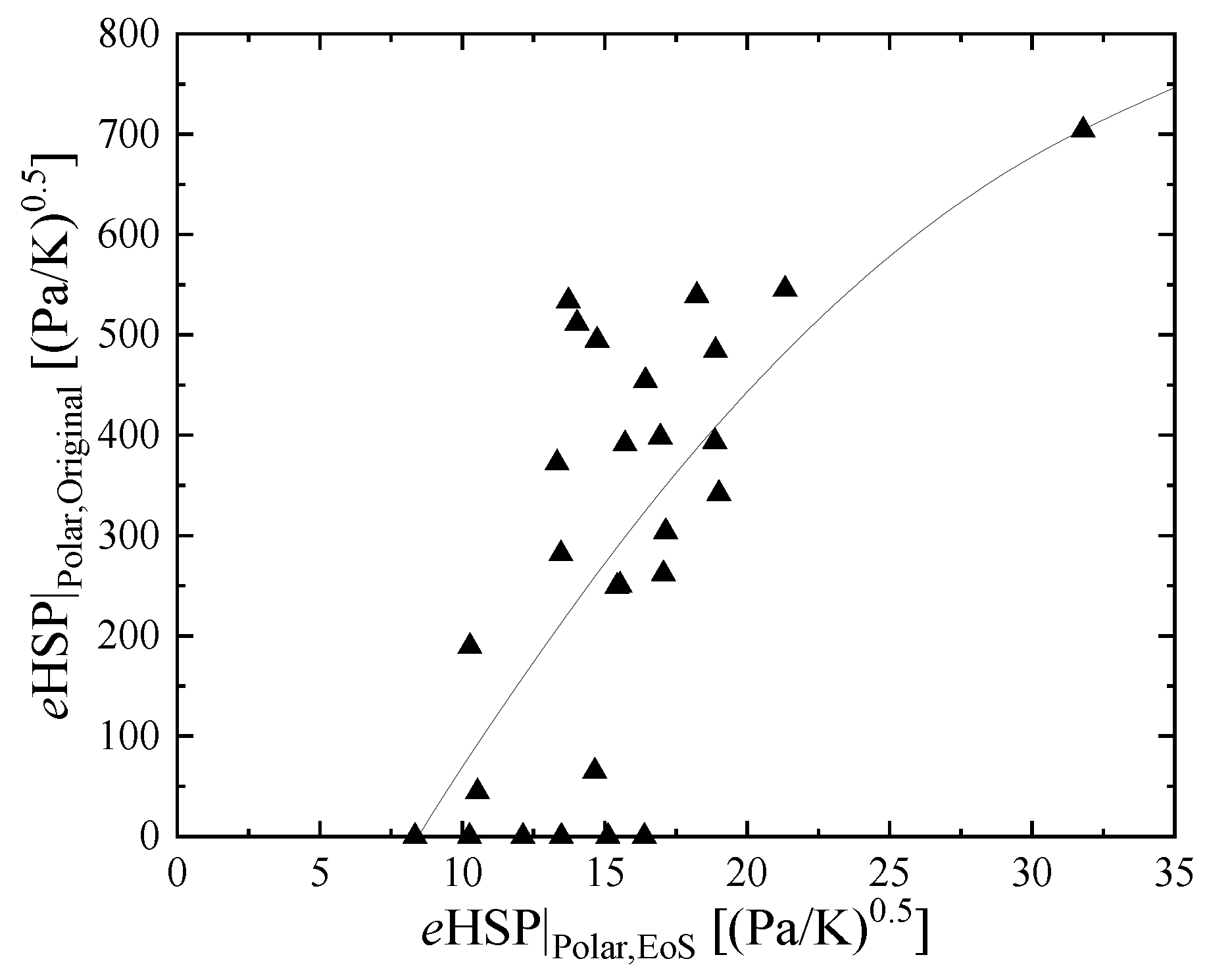
Figure 3.
Relationship in Equation (30) between and .
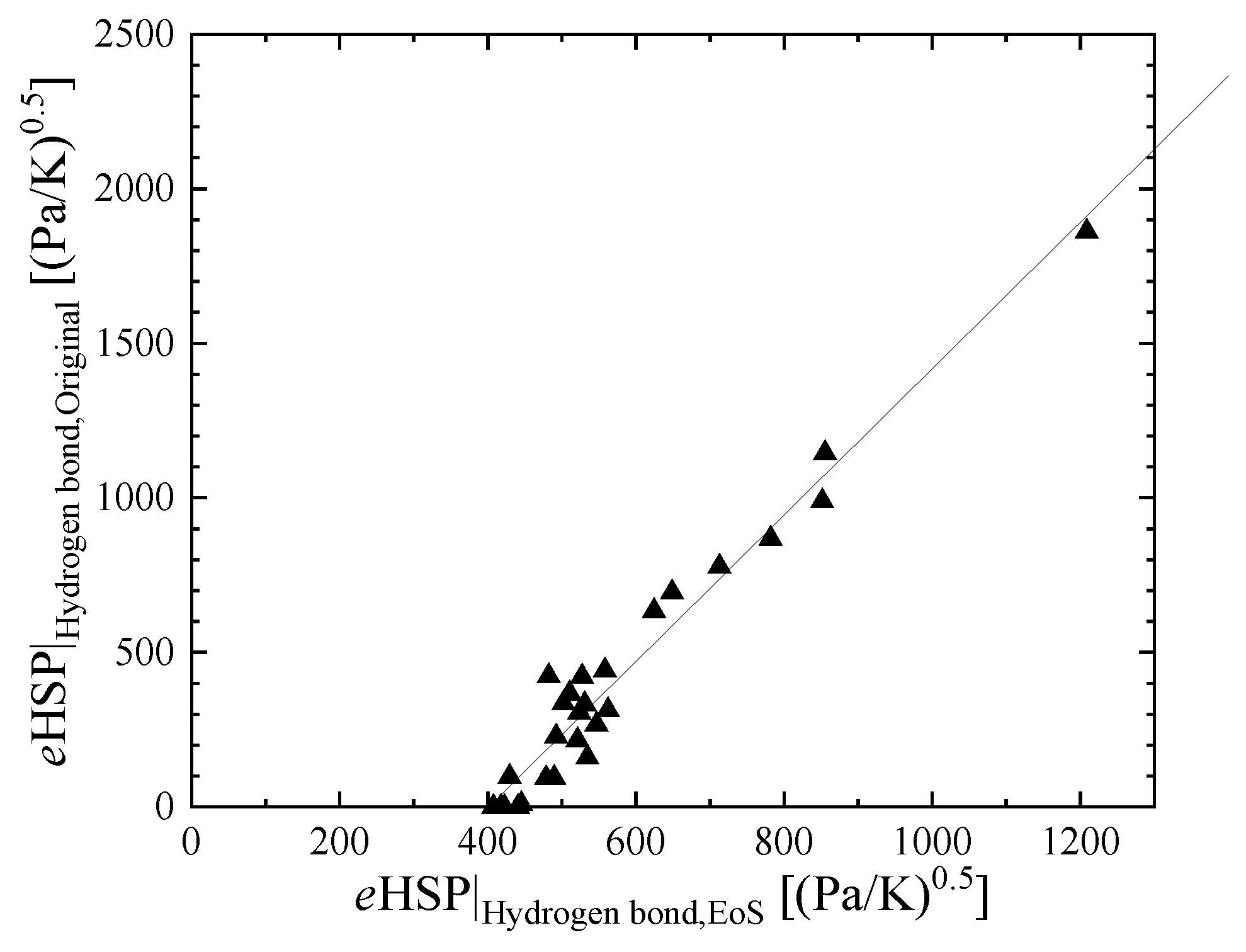
Figure 4.
Relationship between the predicted eHSP and original HSP. (a) vs. (R2 = 0.993), (b) vs. (R2 = 0.783), (c) vs. (R2 = 0.969), (d) vs. (Hildebrand SP) (R2 = 0.995).
Figure 4.
Relationship between the predicted eHSP and original HSP. (a) vs. (R2 = 0.993), (b) vs. (R2 = 0.783), (c) vs. (R2 = 0.969), (d) vs. (Hildebrand SP) (R2 = 0.995).
4. Conclusions
A translation type of correction (eSP) was applied to develop an alternative form of the popular Soave-Redlich-Kwong equation. The resulting eSPT-SRK EoS showed good correlation results for both liquid molar volumes and critical molar volumes. Thermodynamic expressions of the eSPT-SRK EoS and the corrected eSPT-PR EoS are simple and have closed forms. In the eSPT-SRK EoS, the additional constants C and D correlate with the compressibility factor ZC which gives a convenient predictive form. The eHSP values estimated with either the eSPT-SRK EoS or the eSPT-PR EoS can be used to estimate conditions required for extractions and separations that are at conditions far removed from atmospheric pressure and ambient temperature.
Author Contributions
Conceptualization, M.O. and R.L.S.; methodology, H.I.; software, M.O.; validation, N.Y. and H.K.; formal analysis, M.O.; investigation, N.Y.; resources, M.O.; data curation, R.L.S.; writing—original draft preparation, M.O.; writing—review and editing, R.L.S.; visualization, M.O. and R.L.S.; supervision, H.I.; project administration, H.I.; funding acquisition, M.O. All authors have read and agreed to the published version of the manuscript.
Acknowledgments
This work was supported by Process Science Project of Ministry of Education, Culture, Sports, Science and Technology, Grant Number JPMXP0219192801. This result was also obtained as a result of a grant project (JPNP20004) from the New Energy and Industrial Technology Development Organization (NEDO). This research was financially supported by Grant-in-Aid for Scientific Research (B) 21H01685, Grant-in-Aid for Scientific Research (C) 17K06884, Amano Institute of Technology, KOSÉ Cosmetology Research Foundation, Lotte Foundation, Mukai Science and Technology Foundation, Tobe Maki Foundation and Urakami Foundation for Food and Food Culture Promotion. We thank Mr. Ryo Takahashi who checked the derivation of eSPT-SRK EoS.
Conflicts of Interest
The authors declare no conflicts of interest.
Appendix A
The original eSPT-PR EoS was parameterized as follows:
The equation denoted as the corrected eSPT-PR EoS was parameterized as follows:
In Equation (A2), D, E and F were newly introduced into the corrected eSPT-PR EoS, though the original PR EoS has C = D = 0 and E = F = 1.
In this way, one can obtain the fugacity coefficient from the departure function (Equation (A3)) by substitution of Equation (A2):
where f and z are fugacity and compressibility factor, respectively. The resulting expression for the fugacity coefficient can be expressed as follows:
Entropy can be calculated from the departure function, (Equation A5):
where G and IG are gas state and ideal gas state at constant T, respectively and can be calculated by substituting in Equation (A2) as follows:
The resulted entropy difference for gas or liquid phase can be expressed as follows:
For the corrected eSPT-PR EoS parameters ac and b in Equation (A2), a constant C was introduced as same as the eSPT-PR EoS as follows:
The a(T) function of original PR EoS was adopted and is described by Equation (A11):
Substance-dependence C and D parameters in Equation (A2) were correlated against the critical compressibility factor (zc) as shown in Equations (A12) and (A13), respectively:
The five pure parameters ( in Equation (A9), in Equation (A10) and , , in Equation (A11)) and constant C0, C1, D0 and D1 in Equations (A12) and (A13) in the corrected eSPT-PR EoS were determined by properties of the selected 28 chemicals (Table A1) using the objective function in Equation (17) by a least-squares method. Namely, a total 11 parameters including E and F in Equation (A2) were simultaneously fitted. The resulting parameters are listed in Table A1 and detailed results are given in Table A2.
For comparison of the entropy-based Hansen-type solubility parameter with the corrected eSPT-PR EoS, Equation (A2) was differentiated with temperature to give:
In the eSPT-PR EoS, polar and hydrogen bond terms were defined by the following equations:
where subscript EoS is the calculation with the corrected eSPT-PR EoS.
We summarized that an eHSP concept was developed as shown in the following predictive forms.
We found the next relationships:
Table A1.
Pure parameters in original PR EoS, original eSPT-PR EoS in Equation(A1) and corrected form of eSPT-PR EoS Equation (A2).
Table A1.
Pure parameters in original PR EoS, original eSPT-PR EoS in Equation(A1) and corrected form of eSPT-PR EoS Equation (A2).
| a0 | b0 | KC1 | KC2 | KC3 | |
|---|---|---|---|---|---|
| Original PR EoS Equation (A2) |
0.42748 | 0.08664 | 0.48 | 1.574 | -0.176 |
| Original eSPT-PR EoS Equation (A1) |
0.51119 | 0.09079 | 0.34687 | 1.93487 | -0.25698 |
| (Corrected form) eSPT-PR EoS Equation (A2) (This work) |
0.38072 | 0.068528 | 0.083872 | 1.88117 | -0.098695 |
| C1 | C0 | D1 | D0 | E | F | |
| Original PR EoS Equation (A2) |
0 | 0 | 0 | 0 | 1 | 1 |
| Original eSPT-PR EoS Equation (A1) |
-27.6704 | 8.73306 | - | - | - | - |
| (Corrected form) eSPT-PR EoS Equation (A2) (This work) |
-0.11977 | -1.28759 | -0.055128 | 0.0150978 | 0.90113 | 1.12935 |
Table A2.
ARDs calculated with the corrected eSPT-PR EoS from experimental data values.
| No. | Substance | Group |
ARD () [%] |
ARD () [%] |
||
|---|---|---|---|---|---|---|
| 1 | Water | Water | 7.7 | (2.4)1 | 0.4 | (1.4)1 |
| 2 | Ethylene Glycol | Alcohol | 1.0 | (2.7)1 | 1.7 | (2.2) 1 |
| 3 | N-Methyl-2-pyrrolidone | Cyclic Compound | 7.3 | (0.9)1 | 10.6 | (1.5) 1 |
| 4 | Methanol | Alcohol | 6.9 | (6.5)1 | 6.7 | (1.2) 1 |
| 5 | Ethanol | Alcohol | 2.8 | (7.5)1 | 3.3 | (1.8) 1 |
| 6 | Dimethyl Sulfide | Sulfur compound | 9.7 | (4.6)1 | 0.8 | (2.4)1 |
| 7 | 1-Propanol | Alcohol | 7.3 | (6.5)1 | 1.8 | (2.1) 1 |
| 8 | N,N-Dimethylformamide | Nitrogen compound | 21.3 | (6.1)1 | 15.8 | (0.9) 1 |
| 9 | 1-Butanol | Alcohol | 8.1 | (5.6)1 | 2.0 | (2.2) 1 |
| 10 | 2-Butanol | Alcohol | 6.6 | (5.7)1 | 2.7 | (2.1) 1 |
| 11 | Pyridine | Aromatic | 7.2 | (2.5)1 | 0.1 | (2.6) 1 |
| 12 | Cyclopentanone | Ketone | 3.2 | (8.0)1 | 10.6 | (1.4) 1 |
| 13 | Acetophenone | Ketone | 1.4 | (2.5)1 | 2.5 | (2.3) 1 |
| 14 | Dichloromethane | Halide | 4.7 | (0.1)1 | 0.9 | (2.4) 1 |
| 15 | Dimethyl Carbonate | Carbonate | 0.7 | (2.8)1 | 4.0 | (1.9) 1 |
| 16 | Cyclohexanone | Ketone | 4.9 | (5.8)1 | 11.6 | (1.4) 1 |
| 17 | Acetone | Ketone | 4.7 | (2.2)1 | 5.8 | (1.6) 1 |
| 18 | Tetrahydrofuran | Aromatic | 10.2 | (7.9)1 | 0.8 | (2.2) 1 |
| 19 | Benzene | Aromatic | 10.1 | (4.0)1 | 0.1 | (2.4) 1 |
| 20 | Toluene | Aromatic | 7.3 | (2.8)1 | 1.2 | (2.3) 1 |
| 21 | 1-Decanol | Alcohol | 0.5 | (2.8)1 | 4.2 | (2.2) 1 |
| 22 | Trans-Decahydronaphthalene | Aromatic | 11.8 | (4.9)1 | 1.0 | (2.4) 1 |
| 23 | Cyclohexane | Cyclic Compound | 12.8 | (4.5)1 | 0.3 | (2.5) 1 |
| 24 | Tetradecane | Alkane | 7.7 | (4.6)1 | 10.9 | (1.8) 1 |
| 25 | 1-Decene | Alkene | 3.3 | (2.9)1 | 6.0 | (2.1) 1 |
| 26 | Decane | Alkane | 1.0 | (0.6)1 | 6.0 | (2.1) 1 |
| 27 | Hexane | Alkane | 8.9 | (3.3)1 | 0.8 | (2.4) 1 |
| 28 | Carbon Dioxide | Inorganic Carbon | - | - | 1.3 | (2.6) 1 |
| - | - | Average | 6.6 | (4.0)1 | 4.2 | (2.0)1 |
1 Values obtained with the original eSPT-PR EoS (predictive form) [13] (in parentheses).
References
- Soave, G., Equilibrium constants from a modified Redlich–Kwong equation of state, Chem. Eng. Sci., 1972, 27, 1197–1203. [CrossRef]
- Peng, D.-Y.; Robinson, D.B., A new two-constant equation of state, Ind. Eng. Chem. Fundam. 1976, 15, 59-64. [CrossRef]
- Heidemann, R.A.; Khalil, A.M., The calculation of critical points, AIChE J., 1980, 26, 769-779. [CrossRef]
- Maeta, Y.; Ota, M.; Sato, Y.; Smith, R.L.; Inomata, H., Measurements of vapor–liquid equilibrium in both binary carbon dioxide–ethanol and ternary carbon dioxide–ethanol–water systems with a newly developed flow-type apparatus, Fluid Phase Equilib. 2015, 405, 96-100. [CrossRef]
- Huron M.; Vidal J., New mixing rules in simple equations of state for representing vapour-liquid equilibria of strongly non-ideal mixtures, Fluid Phase Equilib. 1979, 3, 255-271. [CrossRef]
- Michelsen, M.L., A modified Huron-Vidal mixing rule for cubic equations of state, Fluid Phase Equilib. 1990, 60, 213-219. [CrossRef]
- Holderbaum, T.; Gmehling, J., New mixing rules in simple equations of state for representing vapour-liquid equilibria of strongly non-ideal mixtures, Fluid Phase Equilib. 1991, 70, 251-265. [CrossRef]
- Ota, M.; Morohashi, K.; Abe, Y.; Watanabe, M.; Smith, R.L.; Inomata, H., Replacement of CH4 in the hydrate by use of liquid CO2, Energy Conv. Manag., 2005, 46, 1680–1691. [CrossRef]
- Péneloux A.; Rauzy E.; Fréze R., A consistent correction for Redlich-Kwong-Soave volumes, Fluid Phase Equilib. 1982, 8, 7-23. [CrossRef]
- Ahlers, J.; Gmehling, J., Development of an universal group contribution equation of state. I. Prediction of liquid densities for pure compounds with a volume translated Peng-Robinson equation of state, Fluid Phase Equilib. 2001, 191, 177-188. [CrossRef]
- Tsai, J-C.; Chen, Y-P., Application of a volume-translated Peng-Robinson equation of state on vapor-liquid equilibrium calculations, Fluid Phase Equilib. 1998, 145, 193-215. [CrossRef]
- Schmid, B.; Gmehling, J., Present status of the group contribution equation of state VTPR and typical applications for process development, Fluid Phase Equilib., 2016, 425, 443-450. [CrossRef]
- Ota, M.; Yang, N.; Komatsu H.; Inomata, H.; Smith, R.L., Entropy-based solubility parameter-translated Peng-Robinson equation of state (eSPT-PR EoS), Liquids, 2025, 5, 21. https://www.mdpi.com/2673-8015/5/3/21.
- Hildebrand, J. H.; Scott, R.L., The Solubility of Nonelectrolytes, 3rd ed.; Reinhold Pub. Corporation: New York, USA, 1950.
- Ota, M.; Hashimoto, Y.; Sato, M.; Sato, Y.; Smith, R.L.; Inomata, H., Solubility of flavone, 6-methoxyflavone and anthracene in supercritical CO2 with/without a co-solvent of ethanol correlated by using a newly proposed entropy-based solubility parameter, Fluid Phase Equilib. 2016, 425, 65-71. [CrossRef]
- Ota, M.; Sugahara S.; Sato, Y.; Smith, R.L.; Inomata, H.; Vapor-liquid distribution coefficients of hops extract in high pressure CO2 and ethanol mixtures and data correlation with entropy-based solubility parameters, Fluid Phase Equilib. 2017, 434, 44-48. [CrossRef]
- Levelt Sengers J. M. H., From Van der Waals’ equation to the scaling laws, Physica 1974, 73, pp. 73-106. [CrossRef]
- Elliott, J.R.; Diky, V.; Knotts IV, T.A.; Wilding, W.V., The Properties of Gases and Liquids, 6th ed.; Mc Graw Hill: New York, USA, 2023, pp. 687-747.
- Gross, J.; Sadowski, G., Perturbed-Chain SAFT: An Equation of State Based on a Perturbation Theory for Chain Molecules, Ind. Eng. Chem. Res. 2001, 40, pp. 1244-1260. [CrossRef]
- NIST chemistry Webbook (https://webbook.nist.gov/chemistry/fluid).
- Hansen, C. M., Hansen Solubility Parameters: A User’s Handbook, Second Ed.; CRC Press: Boca Raton, USA, 2007.
Table 1.
Fundamental properties of 28 selected chemicals.
| No. | Substance |
M 1 [g/mol] |
TC2 [K] |
PC 3 [MPa] |
ρC4 [kg/m3] |
ω5 [-] |
ρL at SATP [kg/m3] |
Hildebrand SP at SATP [MPa0.5] |
eSP at SATP [(Pa/K)0.5] |
|---|---|---|---|---|---|---|---|---|---|
| 1 | Water | 18.015 | 647.1 | 22.064 | 321.98 | 0.345 | 997.0 | 48.0 | 2780 |
| 2 | Ethylene Glycol | 62.068 | 719 | 8.2 | 331.91 | 0.521 | 1110.1 | 34.5 | 1997 |
| 3 | N-Methyl-2-pyrrolidone | 99.131 | 721.6 | 4.52 | 319.78 | 0.373 | 1026.1 | 30.3 | 1754 |
| 4 | Methanol | 32.042 | 512.5 | 8.084 | 273.86 | 0.566 | 789.6 | 29.5 | 1710 |
| 5 | Ethanol | 46.068 | 514 | 6.137 | 274.21 | 0.644 | 785.9 | 26.4 | 1530 |
| 6 | Dimethyl Sulfide | 62.134 | 503.04 | 5.53 | 309.12 | 0.194 | 842.6 | 26.3 | 1525 |
| 7 | 1-Propanol | 60.095 | 536.8 | 5.169 | 274.41 | 0.621 | 799.5 | 24.6 | 1422 |
| 8 | N,N-Dimethylformamide | 73.094 | 649.6 | 4.42 | 279.00 | 0.318 | 944.5 | 24.0 | 1388 |
| 9 | 1-Butanol | 74.122 | 563.1 | 4.414 | 271.51 | 0.588 | 804.0 | 23.3 | 1349 |
| 10 | 2-Butanol | 74.122 | 535.9 | 4.188 | 274.53 | 0.581 | 802.3 | 22.6 | 1311 |
| 11 | Pyridine | 79.1 | 619.95 | 5.63 | 311.42 | 0.239 | 978.0 | 21.8 | 1263 |
| 12 | Cyclopentanone | 84.116 | 624.5 | 4.6 | 326.03 | 0.288 | 944.2 | 21.1 | 1222 |
| 13 | Acetophenone | 120.149 | 709.6 | 4.01 | 311.27 | 0.383 | 1023.5 | 20.9 | 1210 |
| 14 | Dichloromethane | 84.933 | 510 | 6.08 | 459.10 | 0.199 | 1318.2 | 20.4 | 1180 |
| 15 | Dimethyl Carbonate | 90.078 | 548 | 4.5 | 358.88 | 0.385 | 1063.2 | 20.3 | 1176 |
| 16 | Cyclohexanone | 98.143 | 653 | 4 | 315.57 | 0.299 | 942.7 | 20.1 | 1167 |
| 17 | Acetone | 58.079 | 508.1 | 4.7 | 272.67 | 0.307 | 785.6 | 19.8 | 1145 |
| 18 | Tetrahydrofuran | 72.106 | 540.15 | 5.19 | 321.90 | 0.225 | 880.0 | 19.1 | 1108 |
| 19 | Benzene | 78.112 | 562.05 | 4.895 | 305.13 | 0.21 | 873.0 | 18.8 | 1089 |
| 20 | Toluene | 92.138 | 591.75 | 4.108 | 291.58 | 0.264 | 863.9 | 18.3 | 1060 |
| 21 | 1-Decanol | 158.281 | 688 | 2.308 | 245.40 | 0.607 | 821.0 | 17.8 | 1032 |
| 22 | Trans-Decahydronaphthalene | 138.25 | 687 | 3.2 | 288.02 | 0.299 | 866.7 | 17.0 | 987.0 |
| 23 | Cyclohexane | 84.159 | 553.8 | 4.08 | 273.24 | 0.208 | 773.1 | 16.7 | 967.1 |
| 24 | Tetradecane | 198.388 | 693 | 1.57 | 221.17 | 0.643 | 759.3 | 15.9 | 920.9 |
| 25 | 1-Decene | 140.266 | 616.6 | 2.223 | 240.18 | 0.48 | 738.2 | 15.9 | 918.1 |
| 26 | Decane | 142.282 | 617.7 | 2.11 | 230.60 | 0.492 | 726.6 | 15.5 | 899.9 |
| 27 | Hexane | 86.175 | 507.6 | 3.025 | 232.28 | 0.301 | 656.0 | 15.0 | 868.0 |
| 28 | Carbon Dioxide | 44.01 | 304.21 | 7.383 | 464.57 | 0.224 | - | - | 18.54 6 |
1M: Molar mass, 2Tc: Critical temperature, 3 Pc: Critical pressure, 4ρc: Critical density, 5ω: Acentric factor. 6 The calculation used the eSPT-SRK EoS.
Disclaimer/Publisher’s Note: The statements, opinions and data contained in all publications are solely those of the individual author(s) and contributor(s) and not of MDPI and/or the editor(s). MDPI and/or the editor(s) disclaim responsibility for any injury to people or property resulting from any ideas, methods, instructions or products referred to in the content. |
© 2026 by the authors. Licensee MDPI, Basel, Switzerland. This article is an open access article distributed under the terms and conditions of the Creative Commons Attribution (CC BY) license.
Copyright: This open access article is published under a Creative Commons CC BY 4.0 license, which permit the free download, distribution, and reuse, provided that the author and preprint are cited in any reuse.


