

Submitted:
25 June 2026
Posted:
29 June 2026
You are already at the latest version
Abstract
Abstract
Background: Caffeine toxicity represents a growing public health challenge due to the widespread availability of highly potent formulations. Ingestions of 3–10 grams can be fatal, with serious toxicity occurring at plasma concentrations 15 mg/L or greater. This review provides a framework explaining its diverse clinical consequences.
Methods: A comprehensive literature search was conducted across PubMed, Scopus, and Google Scholar using AI-assisted tools, prioritizing clinical, forensic, toxicokinetic, and molecular mechanism studies while excluding chronic moderate consumption.
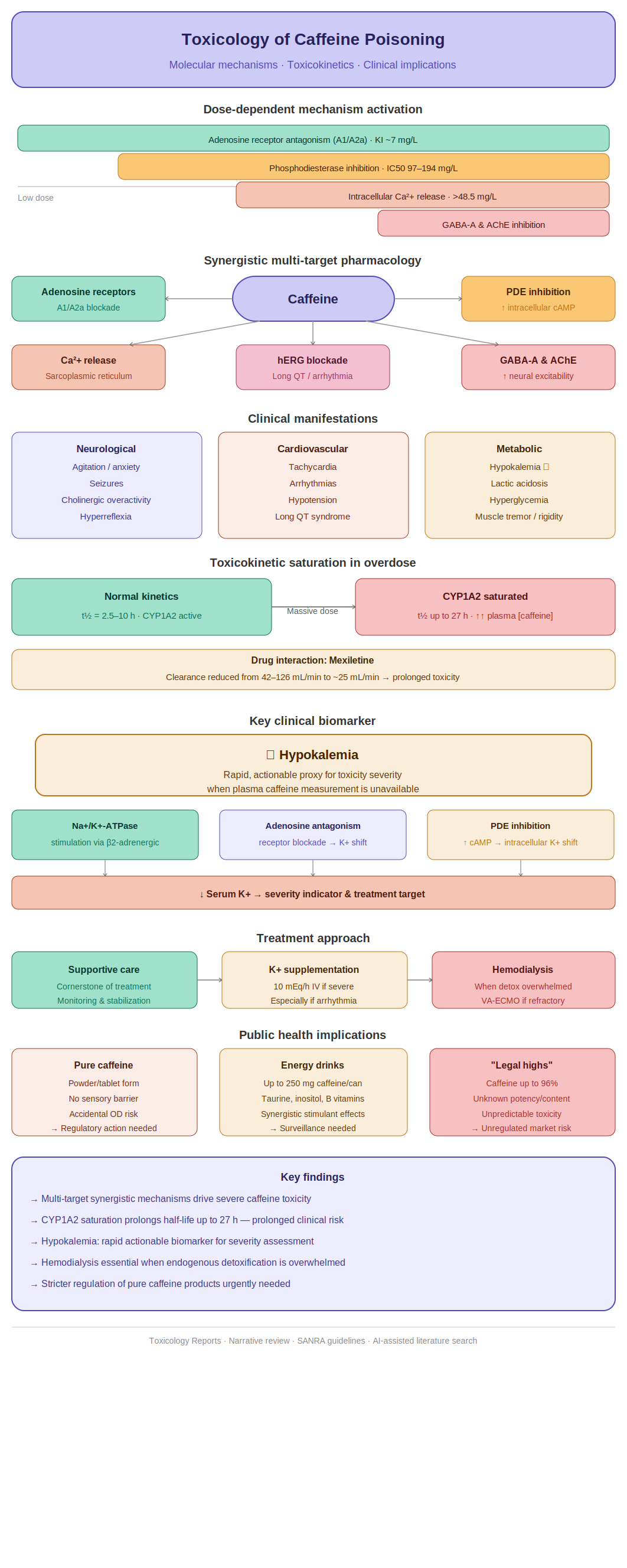
Results: Caffeine toxicity is dose-dependent, progressing from adenosine receptor antagonism to phosphodiesterase inhibition, intracellular calcium release, and GABA-A antagonism. In overdose, these mechanisms interact synergistically to cause severe neurological, cardiovascular, and metabolic complications. Furthermore, the CYP1A2 metabolic system becomes saturated, prolonging the elimination half-life up to 27 hours and causing a disproportionate rise in plasma concentrations. Interactions with drugs like mexiletine drastically reduce clearance.
Conclusions: Severe poisoning stems from complex, synergistic molecular interactions. Hypokalemia serves as a promising, actionable clinical biomarker for severity assessment. When massive ingestions saturate endogenous detoxification, hemodialysis becomes essential for survival. Unregulated markets for pure caffeine require stricter regulatory interventions and intensified clinical surveillance.
Keywords:
caffeine poisoning
; toxicokinetic
; adenosine receptor antagonism
; hypokalemia
; phosphodiesterase inhibition
; hemodialysis
1. Introduction
Caffeine, or 1,3,7-trimethylxanthine, stands as the most consumed psychoactive compound globally, forming an integral part of the daily routine of millions of people. Its roots in society date back millennia, with historical records suggesting tea consumption in China as early as 2737 BC and the introduction of coffee to Ethiopia or the Arabian Peninsula around the ninth century AD. Although these early narratives are often shrouded in mythology, confirmed evidence places tea consumption in China 2,100 years ago and coffee infusions around 1000 AD. The isolation of caffeine as an active component was achieved in 1819, and its full synthesis was completed in 1895.
Today, caffeine is predominantly consumed through popular beverages such as coffee and tea, but it is also a key ingredient in energy drinks and certain pharmaceuticals. A significant contemporary concern is the increasing ease with which pure caffeine, available in powder or tablet form, can be acquired through mainstream commerce. This increased accessibility, along with a wider range of caffeine-containing products, has intensified the debate about their safety, potential toxicities, and interactions with other substances. The ubiquitous nature of caffeine demands a thorough understanding of its clinical toxicology, pharmacokinetics, and interactions to mitigate the associated health risks.
Caffeine toxicity presents a growing public health challenge, requiring special attention. While moderate consumption is generally considered safe, serious toxicities may arise with plasma caffeine concentrations of 15 mg/L or greater [1,2,3,4]. Concentrations above 50 mg/L are considered toxic, and those above 80 mg/L are considered lethal [1,2]. Acute ingestion of 3 to 10 grams of caffeine in a short period of time can be fatal. A forensic study conducted in Sweden revealed that 1% of 5000 autopsies had caffeine levels above 10 mg/L, and over a period of 16 years, 20 cases showed levels above 80 mg/L, with arrhythmias being the most common cause of caffeine-related death [3]. This evidence underscores the critical need to thoroughly understand the toxicology of caffeine and its clinical implications, given the potential for serious and fatal outcomes.
The convergence of widespread consumption, the increasing availability of highly potent forms that circumvent the self-limiting nature of traditional beverages, and the clear evidence of serious and lethal outcomes, elevates caffeine intoxication from a mere adverse effect to a significant and growing public health concern [5,6]. The ease of accidental overdose with the pure forms, in particular, demands urgent attention in terms of public awareness and possible regulatory interventions.
2. Methods
2.1. Search Strategy and Data Sources
This narrative review was developed and structured in accordance with the SANRA (Scale for the Quality Assessment of Narrative Review Articles) guidelines to ensure transparency and scientific rigor in the reporting of the evidence presented [7].
A comprehensive literature search was conducted across electronic databases, including PubMed/MEDLINE, Scopus, and Google Scholar, using artificial intelligence (AI) tools to assist in the systematic identification and initial selection of relevant peer-reviewed articles published to date. The search strategy focused on identifying literature related to the mechanisms, clinical manifestations, and management of caffeine poisoning. Search terms included "caffeine poisoning," "caffeine toxicity," "energy drinks," "adenosine receptor antagonism," "hypokalemia," and "extracorporeal removal". Additionally, official reports and safety guidelines from the U.S. Food and Drug Administration (FDA), the European Food Safety Authority (EFSA) and the Spanish Observatory on Drugs and Addictions (OEDA) were reviewed to incorporate regulatory perspectives on pure caffeine and energy drink components.
Study selection and inclusion criteria: articles were considered for inclusion if they provided significant data on the toxicology of caffeine. The selection criteria prioritized:
- Clinical and forensic case reports detailing lethal or severe intoxications.
- Pharmacokinetic and toxicokinetic studies exploring metabolic saturation and half-life alterations.
- Experimental research on the molecular mechanisms of toxicity, such as adenosine receptor antagonism and phosphodiesterase inhibition.
2.2. Exclusion Criteria
Studies were excluded if they focused primarily on the chronic effects of moderate caffeine consumption without a toxicological focus, or if they were redundant publications of previously reported cases.
2.3. Data Extraction and Author Consensus
The authors independently screened titles and abstracts for relevance to the review's objectives. Full-text articles were then evaluated to ensure they addressed the core pillars of the manuscript: molecular mechanisms of toxicity, toxicokinetic profiles, and the resulting clinical implications involving neurological, cardiovascular, and metabolic complications. Disagreements regarding article selection were resolved through discussion and mutual agreement among the authors, ensuring that the final selection provided a comprehensive and updated overview for healthcare professionals.
3. Results
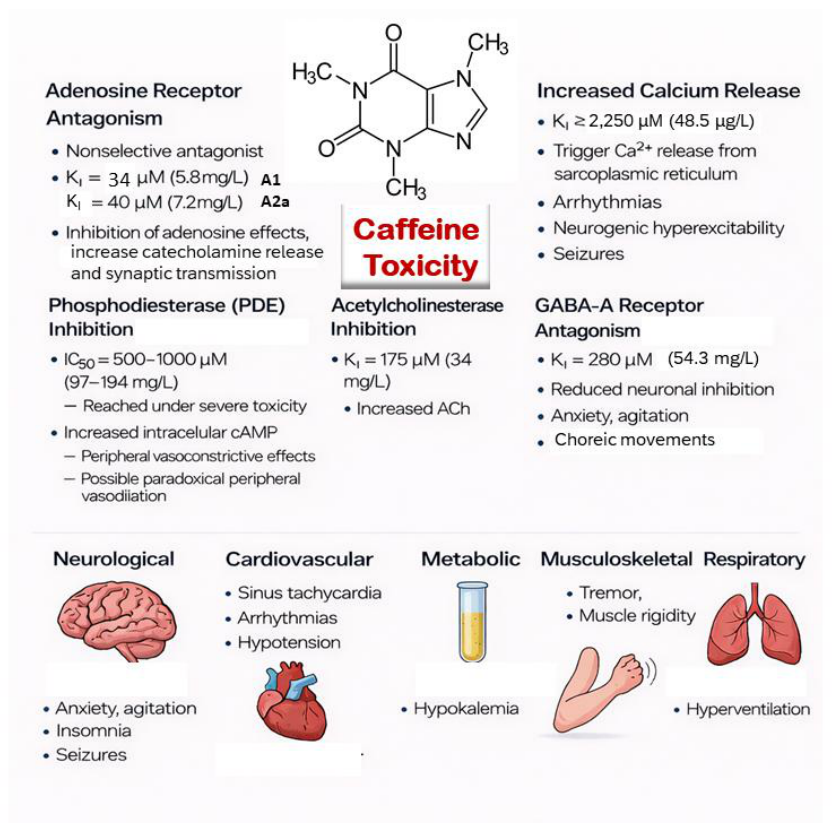
The pharmacological mechanisms of caffeine are intrinsically dependent on the dose consumed, a fundamental principle for understanding the progression of its clinical manifestations, from mild stimulation to severe toxicity [4,8]. Figure 1 illustrates the main mechanisms of action of caffeine and their associated systemic effects. Caffeine exerts its effects through multiple molecular pathways, which are progressively activated as its concentrations increase in the body.
3.1. Adenosine Receptor Antagonism
The main pharmacological effect of caffeine is its action as a non-selective antagonist of adenosine receptors (A1, A2a, A2b and A3). As shown in Figure 1, the inhibition constants (KI) are 34 μM (6.8 mg/L) for A1 receptors and 40 μM (7.2 mg/L) for A2a receptors. This antagonism disrupts the normal physiological effects of adenosine, which include sleep regulation, cardiovascular function, and neurotransmission. The direct consequence of this inhibition is an increase in catecholamine release and an alteration of synaptic transmission, contributing to the stimulant effects of caffeine [4,9,10].
3.2. Phosphodiesterase (PDE) inhibition
At higher concentrations, typically achieved in cases of severe toxicity, caffeine inhibits the enzyme phosphodiesterase (PDE). The IC50 for this effect is between 500-1000 μM (97-194 mg/L), levels that are associated with severe toxicity. This inhibition results in an increase in intracellular cyclic adenosine monophosphate (cAMP). The implications of this increase in cAMP include peripheral vasodilation, which paradoxically can lead to hypotension in situations of severe overdose [4].
3.3. Increased Intracellular Calcium Release
At very high concentrations, specifically above 2,250 μM (equivalent to 48.5 mg/L), caffeine triggers the release of calcium from the intracellular deposits of the sarcoplasmic reticulum. This increase in intracellular calcium contributes significantly to the occurrence of cardiac arrhythmias, neuromuscular hyperexcitability and seizures [11].
3.4. Inhibition of Potassium Channels (hERG)
Hypokalemia is frequently observed during caffeine overdose is thought to result primarily from stimulation of the Na+/K+-ATPase pump [12]. Although this electrolyte disturbance is commonly attributed to β2-adrenergic activation secondary to catecholamine release, additional mechanisms may contribute, including adenosine receptor antagonism and phosphodiesterase inhibition, particularly in severe intoxication [4,13]. At very high concentrations, caffeine blocks hERG in an open state. That can cause long QT syndrome and arrhythmias [4,14].
Rapid correction of hypokalemia is paramount. Potassium supplementation (e.g., 10 mEq/hour intravenously) is given, particularly in patients with symptomatic hypokalemia, especially in the presence of muscle weakness, ventricular arrhythmias, abnormal T waves, or prolonged QTc intervals (15).
3.5. GABA-A Receptor Antagonism
At toxic concentrations (KI = 280 μM or 54.3 mg/L), caffeine acts as an antagonist of GABA-A receptors, resulting in decreased neuronal inhibition [4,9,16]. This mechanism can directly contribute to the occurrence of seizures, agitation, and cholinergic overactivity, exacerbating the neurological effects of intoxication.
3.6. Acetylcholinesterase Inhibition
Also, at toxic concentrations (KI= 175 μM or 34 mg/L), caffeine can inhibit the enzyme acetylcholinesterase. This inhibition results in increased availability of acetylcholine (ACh) in synapses, which may contribute to the cholinergic overactivity seen in cases of severe poisoning [17].
Caffeine exhibits multi-target pharmacology, meaning that the clinical presentation of severe intoxication is not due to a single pathway, but to a complex synergistic interaction of several mechanisms. This inherent complexity makes clinical diagnosis difficult and calls for a comprehensive and supportive treatment approach that addresses the various symptomatic pathways, rather than relying on a single specific antidote. Understanding this overlapping mechanistic landscape is critical to anticipating and managing the full spectrum of potential clinical manifestations.
3.7. Pharmacokinetics and Toxicokinetics of Caffeine. Absorption, Distribution, Metabolism and Elimination
Caffeine is rapidly and almost completely absorbed in the gastrointestinal tract, reaching peak plasma concentrations usually 30 to 120 minutes after oral ingestion [18]. Once absorbed, it is widely distributed throughout the body, easily crossing the blood-brain barrier and the placenta [19]. Its average volume of distribution is 0.7 L/kg. Protein binding is low (10-35%) [20]. Caffeine metabolism is primarily hepatic, largely mediated by the cytochrome P450 1A2 (CYP1A2) enzyme system. This enzyme is responsible for converting caffeine into three main metabolites: paraxanthine (84%), theobromine (12%), and theophylline (4%) [19,21]. Importantly, paraxanthine, the most abundant metabolite, is itself psychoactive and contributes to the overall effects of caffeine [4].
The elimination half-life of caffeine in healthy adults ranges from 2.5 to 10 hours [17], but can vary significantly due to a variety of factors, including genetic polymorphisms of CYP1A2, the presence of liver disease, pregnancy, and drug interactions [16]. For example, people who slowly metabolize caffeine due to variations in CYP1A2 may experience prolonged effects and increased susceptibility to adverse events.
3.8. Pharmacokinetic Alterations in Overdose
In overdose situations, the pharmacokinetic profile of caffeine can be drastically altered. High doses have the potential to saturate metabolic pathways, leading to a prolongation of the elimination half-life and maintenance of high plasma concentrations. A documented case illustrates this phenomenon: a 25-year-old Japanese woman who intentionally ingested 5.9 g of caffeine had an apparent terminal elimination half-life of 27 hours during the first two days of hospitalization, a substantially longer duration than the typical half-life. In this case, plasma concentrations of caffeine and its main metabolite, paraxanthine, remained significantly elevated for prolonged periods, highlighting the difficulty in managing these poisonings [21,22,23].
This half-life extension has critical clinical implications. Metabolic saturation means that the body's ability to process and eliminate the drug is overwhelmed, leading to a disproportionate increase in the concentration of the drug and a significantly extended duration of its action, even after initial ingestion. Clinically, this directly dictates the need for prolonged observation of the patient, the limited efficacy of activated charcoal in single doses if absorption has already occurred, and, most importantly, the need to consider aggressive extracorporeal elimination methods (such as hemodialysis) due to insufficient natural detoxification mechanisms in the body [20]. This understanding is critical to the effective management of severe caffeine intoxication. These prolonged half-lives require continuous monitoring and often intensified elimination strategies in cases of severe poisoning.
3.9. Drug Interactions with Drugs
Caffeine's interactions with various medications stem primarily from its influence on the activity of the CYP1A2 enzyme. Drugs that inhibit CYP1A2, such as fluoroquinolones, fluvoxamine, and mexiletine, can significantly reduce caffeine elimination, resulting in elevated caffeine levels and an increased risk of toxicity. Conversely, drugs that induce its activity, such as carbamazepine and phenobarbital, can speed up caffeine metabolism [16,21].
A particularly noticeable and serious interaction may occur with mexiletine, a class 1B antiarrhythmic drug. Co-ingestion of high doses of caffeine and mexiletine can lead to profound toxicity [24,25]. The case of a 20-year-old woman who ingested 18 g of caffeine and 3500 mg of mexiletine has been documented, resulting in severe intoxication characterized by hypokalemia, lactic acidosis, and hemodynamic instability. The clearance of caffeine calculated from blood concentrations between 35.5 h and 59.5 h after arrival, when hemodialysis (HD) was not performed, was 25.3 mL/min, which was significantly reduced compared to the estimated clearance range of 42–126 mL/min for a physically healthy adult. If HD had not been performed, it might have taken longer to wean off VA-ECMO due to reduced caffeine clearance in the presence of mexiletine [26].
3.10. Interactions with Drugs of Abuse and New Psychoactive Substances ('Legal Highs')
There is growing concern about the simultaneous intake of energy drinks and caffeine with illicit drugs and New Psychoactive Substances (NPS), often referred to as 'legal highs'. These substances are marketed as legal alternatives to traditional illicit drugs and may contain undeclared or variable amounts of psychoactive compounds, including high concentrations of caffeine.
Studies have revealed that many products sold as "legal highs" contain caffeine as their main or only active pharmacological ingredient, sometimes in very high percentages (up to 96%) [27]. The stimulant effects of caffeine can be perceived as similar to those of weaker recreational drugs, making it an attractive, albeit dangerous, component in these unregulated products. The combination of caffeine with other stimulants present in NPS or drugs of abuse can cause exaggerated sympathomimetic effects, increasing the risk of cardiotoxicity, seizures and serious psychological disorders [28]. Patients presenting with acute recreational drug toxicity should be evaluated for possible concomitant intake of high-dose caffeine, as this can significantly influence clinical presentation and management strategies. The lack of clear labelling and quality control in the market for "legal highs" poses a substantial risk to public health due to unpredictable doses of caffeine and potential interactions with other undisclosed psychoactive compounds.
3.11. Additional Components of Energy Drinks (Taurine, Inositol, Glucuronolactone)
Beyond their high caffeine content, energy drinks often contain other stimulants such as guarana (a significant source of caffeine), taurine, B vitamins, and sugar. The synergistic effects of these various ingredients, combined with caffeine, can amplify their stimulant properties and increase the risk of adverse interactions. Some energy drinks can contain up to 250 mg of caffeine per container [29].
Taurine is an amino acid present in the CNS, striated muscle, and lungs. It is known to increase excitatory potentials in synapses and axons by acting on low-voltage calcium channels, similar to tetanus stimulation [30]. It shortens the reaction time to stimuli, enhances the feeling of well-being and improves sociability, effects that are enhanced by alcohol. Although it interacts with inositol and caffeine, the European Food Safety Authority (EFSA) has concluded that the levels of taurine used in energy drinks do not pose a safety concern [31,32,33].
Inositol, a component of the vitamin B complex and part of the cell membrane phospholipids, is involved in the regulation of cell membrane responses, thus enhancing the effects of taurine and caffeine. Inositol can also induce a state of mania independently [4].
Glucuronolactone (D-glucurone-γ-lactone) is a naturally occurring substance in the human body that is a structural part of connective tissues and is involved in detoxification processes [34]. EFSA determined in 2009 that exposure to glucuronolactone from regular consumption of energy drinks is not a safety concern, with a no-observed-adverse-effect level of 1000 mg/kg/day. EFSA also considers glucuronolactone unlikely to interact with caffeine, taurine, alcohol or the effects of exercise [31].
The situation of energy drinks and "legal highs" reveals a complex and subtle public health challenge. The danger goes beyond a simple caffeine overdose, encompassing the unpredictable and amplified toxicity that arises from combining caffeine with other stimulants in energy drinks, the masking of alcohol intoxication (leading to increased risky behaviour and more severe outcomes), and the profound risk posed by unregulated "legal highs" with their unknown potency and undisclosed psychoactive compounds. Consumers are often unaware of the true drug burden or the potential for severe synergistic toxicity, complicating clinical evaluation and management. This points to a critical need for more robust public awareness campaigns, regulatory oversight of both energy drink formulations and the "legal drug" market, and increased clinical surveillance for co-management.
4. Discussion
The findings of this review show that severe caffeine poisoning cannot be explained by a single mechanism, but rather by the combined effect of several pathways that become progressively engaged as plasma concentrations rise. At high doses, caffeine is no longer simply a stimulant; it affects multiple systems at once, which helps explain why the clinical picture can be so variable and, at times, difficult to manage. In practice, this means we are not dealing with a simple toxidrome, but with a complex poisoning in which neurological, cardiovascular, and metabolic disturbances overlap.
From a clinical perspective, one of the most useful observations from this review is the consistent association between caffeine overdose and hypokalaemia. Although it is not a specific marker, serum potassium may offer a rapid and accessible clue to the severity of intoxication, particularly when direct caffeine measurement is not immediately available. Another important point is the prolongation of the half-life in massive overdoses: once metabolism becomes saturated, the clinical course no longer follows the usual pattern, and patients may remain with elevated concentrations for much longer than expected. This requires prolonged observation and means the duration of risk should not be underestimated.
The experience with pharmacological interactions, such as the one described with mexiletine, also reminds us that caffeine poisoning should rarely be interpreted in isolation. The patient’s context, concomitant medication, and the possibility of co-ingestion can substantially change the clinical course. For that reason, a careful medication history remains one of the most valuable tools in these cases. In severe or refractory presentations, haemodialysis should be considered early, not merely as a rescue measure, but as a reasonable part of management when endogenous elimination is insufficient.
Beyond the bedside, this review also points to a public health problem that deserves greater attention. The availability of pure caffeine in powder or tablet form removes the sensory barrier that exists with ordinary beverages and makes accidental massive ingestion more likely. Added to this is the presence of caffeine in unregulated products, energy drinks, and mixtures with other stimulants, which increases uncertainty about the actual dose and the risk of combined toxicity. In this sense, the issue is not only pharmacological, but also regulatory and educational.
4.1. Limitations
This study has several limitations that should be kept in mind. As a narrative review, the selection of the literature may still be affected by a degree of bias, even when guided by a framework such as SANRA. In addition, much of the available evidence comes from isolated case reports or small series, which limits the strength of the conclusions. It is also true that the use of AI-assisted tools in the literature search may have improved efficiency, but it does not completely remove the possibility of selection bias. For these reasons, some of the associations described here should be interpreted with caution.
4.2. Future Research Directions
Looking ahead, prospective multicentre studies would be useful to validate severity markers such as hypokalaemia and to define more clearly when extracorporeal elimination should be initiated. Further pharmacokinetic studies are also needed to better understand how caffeine metabolism becomes saturated in overdose and how factors such as age, pregnancy, liver disease, and genetic variability influence this process. In parallel, stricter surveillance of the actual caffeine content in energy drinks and unregulated products would help quantify the real-world burden and inform more effective preventive measures.
5. Conclusions
Caffeine remains a ubiquitous compound in modern society, offering both perceived benefits and significant health risks, particularly in overdose scenarios and among vulnerable populations. The ease of access to highly concentrated caffeine products and the burgeoning energy drink market have introduced new dimensions to its clinical toxicology. For healthcare professionals, it is paramount to understand the dose-dependent mechanisms of action, which range from antagonism of adenosine receptors at low concentrations, to inhibition of phosphodiesterase, increased intracellular calcium release, antagonism of GABA-A receptors, and inhibition of acetylcholinesterase at toxic concentrations. The severe clinical presentation of caffeine poisoning is not the result of a single pathway but rather a complex synergistic interaction of these multiple molecular mechanisms.
It is also crucial to understand the intricate pharmacokinetics influenced by genetic and environmental factors, as well as the complex interactions with other substances, including medications (such as mexiletine) and new psychoactive substances. In overdose situations, the CYP1A2 metabolic system becomes saturated, shifting kinetics and significantly prolonging the elimination half-life—documented up to 27 hours—which leads to a disproportionate increase in plasma concentrations.
In this context, hypokalemia has emerged as a promising and actionable clinical biomarker for the rapid assessment of toxicity severity. Although supportive care remains the cornerstone of treatment, advanced interventions such as hemodialysis are critical and essential in severe cases where endogenous metabolic pathways are overwhelmed by saturation.
To mitigate the growing burden of caffeine-related morbidity and mortality, it is essential to implement ongoing public health initiatives and establish stricter regulatory measures on pure caffeine products. It is imperative to address the specific risks associated with mixing energy drinks with alcohol and the inherent dangers posed by the unregulated market for "legal highs". Future research should focus on optimizing therapeutic strategies for severe poisoning, identifying new biomarkers for early detection, and elucidating the long-term health consequences of chronic high-dose caffeine consumption.
Conflicts of Interest
The authors declare that they have no competing interests.
Declaration of generative AI and AI-assisted technologies in the manuscript preparation process
During the preparation of this work, the author(s) used ClaudeAI to assist in the bibliographic search process and to facilitate the graphic design and visualization of Figure 1. The author(s) reviewed and edited the output as needed and take full responsibility for the content of the published article.
References
- Cappelletti, S.; Piacentino, D.; Fineschi, V.; et al. Caffeine-related deaths: manner of deaths and categories at risk. Nutrients 2018, 10(5), 611. [Google Scholar] [CrossRef]
- Maiese, A.; La Russa, R.; Del Fante, Z.; et al. Massive β1-adrenergic receptor reaction explains irreversible acute arrhythmia in a fatal case of acute pure caffeine intoxication. Cardiovasc Toxicol. 2021, 21(1), 88–92. [Google Scholar] [CrossRef]
- Thelander, G.; Jönsson, A.K.; Personne, M.; et al. Caffeine fatalities—do sales restrictions prevent intentional intoxications? Clin. Toxicol. (Phila) 2010, 48(4), 354–358. [Google Scholar] [CrossRef]
- Willson, C. The clinical toxicology of caffeine: a review and case study. Toxicol. Rep. 2018, 5, 1140–1152. [Google Scholar] [CrossRef]
- Beauchamp, G.A.; Johnson, A.R.; Crouch, B.I.; et al. A retrospective study of clinical effects of powdered caffeine exposures reported to three US poison control centers. Clin. Toxicol. (Phila) 2016, 54(5), 467. [Google Scholar] [CrossRef]
- U.S. Food and Drug Administration. Pure and highly concentrated caffeine. FDA: Silver Spring (MD), 2018. Available online: https://www.fda.gov/food/dietary-supplement-products-ingredients/pure-and-highly-concentrated-caffeine817 (accessed on 2020 Feb 1).
- Baethge, C.; Goldbeck-Wood, S.; Mertens, S. SANRA—a scale for the quality assessment of narrative review articles. Res. Integr. Peer Rev. 2019, 4, 5. [Google Scholar] [CrossRef]
- Daly, J.W.; Shi, D.; Nikodijevic, O.; et al. The role of adenosine receptors in the central action of caffeine. Pharmacopsychoecologia 1994, 7, 201–213918. [Google Scholar] [PubMed]
- Ribeiro, J.A.; Sebastião, A.M. Caffeine and adenosine. J. Alzheimers Dis. 2010, 20 (Suppl 1), S3–S15. [Google Scholar] [CrossRef]
- Górska, A.M.; Gołembiowska, K. The role of adenosine A1 and A2A receptors in the caffeine effect on MDMA-induced DA and 5-HT release in the mouse striatum. Neurotox. Res. 2015, 27(3), 229–245. [Google Scholar] [CrossRef]
- Porta, M.; Zima, A.V.; Nani, A.; et al. Single ryanodine receptor channel basis of caffeine’s action on Ca2+ sparks. Biophys. J. 2011, 100(4), 931–938. [Google Scholar] [CrossRef]
- Magkos, F.; Kavouras, S.A. Caffeine use in sports, pharmacokinetics in man, and cellular mechanisms of action. Crit. Rev. Food Sci. Nutr. 2005, 45(7-8), 535–562. [Google Scholar] [CrossRef]
- Reid, J.L.; Whyte, K.F.; Struthers, A.D. Epinephrine-induced hypokalemia: the role of beta adrenoceptors. Am. J. Cardiol. 1986, 57(12), 23F–27F. [Google Scholar] [CrossRef]
- Zheng, J.; Zhao, W.; Xu, K.; et al. Interaction among hERG channel blockers is a potential mechanism of death in caffeine overdose. Eur. J. Pharmacol. 2017, 800, 23–33. [Google Scholar] [CrossRef]
- Tsuji, T.; Kuriyama, A.; Hata, R.; et al. Serum potassium level as a biomarker for acute caffeine poisoning. Acute Med. Surg. 2020, 7(1), e568. [Google Scholar] [CrossRef]
- Kardos, J.; Blandl, T. Inhibition of a gamma aminobutyric acid A receptor by caffeine. Neuroreport 1994, 5(10), 1249–1252. [Google Scholar] [CrossRef]
- Pohanka, M.; Dobes, P. Caffeine inhibits acetylcholinesterase, but not butyrylcholinesterase. Int. J. Mol. Sci. 2013, 14(5), 9873–9882. [Google Scholar] [CrossRef]
- Newton, R.; Broughton, L.J.; Lind, M.J.; et al. Plasma and salivary pharmacokinetics of caffeine in man. Eur. J. Clin. Pharmacol. 1981, 21(1), 45–52. [Google Scholar] [CrossRef]
- Chen, X.; Ghribi, O.; Geiger, J.D. Caffeine protects against disruptions of the blood-brain barrier in animal models of Alzheimer’s and Parkinson’s diseases. J. Alzheimers Dis. 2010, 20 (Suppl 1), S127–S141. [Google Scholar] [CrossRef]
- Holstege, C.P.; Hunter, Y.; Baer, A.B.; et al. Massive caffeine overdose requiring vasopressin infusion and hemodialysis. J. Toxicol. Clin. Toxicol. 2003, 41(7), 1003–1007. [Google Scholar] [CrossRef]
- Carrillo, J.A.; Benitez, J. Clinically significant pharmacokinetic interactions between dietary caffeine and medications. Clin. Pharmacokinet. 2000, 39(2), 127–153. [Google Scholar] [CrossRef]
- Kamiya, Y.; Adachi, K.; Sekine, M.; et al. Pharmacokinetic modeling of caffeine overdose: estimation of terminal elimination half-life and clearance for severe poisoning. J. Pharm. Health Care Sci. 2021, 7, 20. [Google Scholar] [CrossRef]
- Adachi, K.; Beppu, S.; Terashima, M.; et al. Pharmacokinetics of caffeine self-administered in overdose in a Japanese patient admitted to hospital. J. Pharm. Health Care Sci. 2021, 7, 36. [Google Scholar] [CrossRef]
- Joeres, R.; Klinker, H.; Heusler, H.; et al. Influence of mexiletine on caffeine elimination. Pharmacol. Ther. 1987, 33(1), 163–169. [Google Scholar] [CrossRef]
- Wang, G.K.; Russell, C.; Wang, S.Y. Mexiletine block of wild-type and inactivation-deficient human skeletal muscle hNav1.4 Na+ channels. J. Physiol. 2004, 554 Pt 3, 621–633. [Google Scholar] [CrossRef]
- Kohara, S.; Kamijo, Y.; Kyan, R.; et al. Severe caffeine poisoning with mexiletine successfully treated by extracorporeal methods. Am. J. Emerg. Med. 2024, 86, 190.e5–190.e7. [Google Scholar] [CrossRef]
- Davies, S.; Lee, T.; Ramsey, J.; et al. Risk of caffeine toxicity associated with the use of “legal highs” (novel psychoactive substances). Eur. J. Clin. Pharmacol. 2012, 68(4), 435–439. [Google Scholar] [CrossRef]
- Gurley, B.J.; Steelman, S.C.; Thomas, S.L. Multi-ingredient, caffeine-containing dietary supplements: history, safety, and efficacy. Clin. Ther. 2015, 37(2), 275–301. [Google Scholar] [CrossRef]
- Wolk, B.J.; Ganetsky, M.; Babu, K.M. Toxicity of energy drinks. Curr. Opin. Pediatr. 2012, 24(2), 243–251. [Google Scholar] [CrossRef]
- Chepkova, A.N.; Doreulee, N.; Yanovsky, Y.; et al. Long-term enhancement of corticostriatal neurotransmission by taurine. Eur. J. Neurosci. 2002, 16(8), 1523–1530. [Google Scholar] [CrossRef]
- European Food Safety Authority (EFSA). Scientific opinion of the Panel on Food Additives and Nutrient Sources added to Food: the use of taurine and D-glucurono-gamma-lactone as constituents of the so-called “energy” drinks. EFSA J. 2009, 7(2), 935. [Google Scholar] [CrossRef]
- Aguilar, F.; Charrondiere, U.R.; Dusemund, B.; et al. Scientific opinion of the Panel on Food Additives and Nutrient Sources added to Food: the use of taurine and D-glucurono-gamma-lactone as constituents of the so-called “energy” drinks. EFSA J. 2009, 935, 1–31. [Google Scholar] [CrossRef]
- Seidl, R.; Peyrl, A.; Nicham, R.; et al. A taurine and caffeine-containing drink stimulates cognitive performance and well-being. Amino Acids 2000, 19(3), 635–642. [Google Scholar] [CrossRef]
- Tamura, S.; Tsutsumi, S.; Ito, H.; et al. Effects of glucuronolactone and the other carbohydrates on the biochemical changes produced in the living body of rats by hard exercise. Jpn. J. Pharmacol. 1968, 18(1), 30–38. [Google Scholar] [CrossRef]
Figure 1.
Pharmacodynamic mechanisms and clinical manifestations of caffeine toxicity. Overview of the pharmacological actions and systemic physiological effects of caffeine at toxic levels. The upper panel illustrates molecular mechanisms, including non-selective antagonism of adenosine receptors (A1 and A2a), inhibition of phosphodiesterase (PDE) leading to increased intracellular cAMP, and calcium release from the sarcoplasmic reticulum. At critical concentrations, inhibition of acetylcholinesterase and GABA-A receptor antagonism are observed. The lower section details the resulting clinical manifestations by system: neurological (anxiety, seizures), cardiovascular (tachycardia, arrhythmias), metabolic (hypokalemia), musculoskeletal (tremor, muscle rigidity), and respiratory (hyperventilation). KI and IC50 values indicate the concentrations required to trigger these specific effects.
Figure 1.
Pharmacodynamic mechanisms and clinical manifestations of caffeine toxicity. Overview of the pharmacological actions and systemic physiological effects of caffeine at toxic levels. The upper panel illustrates molecular mechanisms, including non-selective antagonism of adenosine receptors (A1 and A2a), inhibition of phosphodiesterase (PDE) leading to increased intracellular cAMP, and calcium release from the sarcoplasmic reticulum. At critical concentrations, inhibition of acetylcholinesterase and GABA-A receptor antagonism are observed. The lower section details the resulting clinical manifestations by system: neurological (anxiety, seizures), cardiovascular (tachycardia, arrhythmias), metabolic (hypokalemia), musculoskeletal (tremor, muscle rigidity), and respiratory (hyperventilation). KI and IC50 values indicate the concentrations required to trigger these specific effects.
Disclaimer/Publisher’s Note: The statements, opinions and data contained in all publications are solely those of the individual author(s) and contributor(s) and not of MDPI and/or the editor(s). MDPI and/or the editor(s) disclaim responsibility for any injury to people or property resulting from any ideas, methods, instructions or products referred to in the content. |
© 2026 by the authors. Licensee MDPI, Basel, Switzerland. This article is an open access article distributed under the terms and conditions of the Creative Commons Attribution (CC BY) license.
Copyright: This open access article is published under a Creative Commons CC BY 4.0 license, which permit the free download, distribution, and reuse, provided that the author and preprint are cited in any reuse.