
Submitted:
25 June 2026
Posted:
29 June 2026
You are already at the latest version
Abstract
Abstract
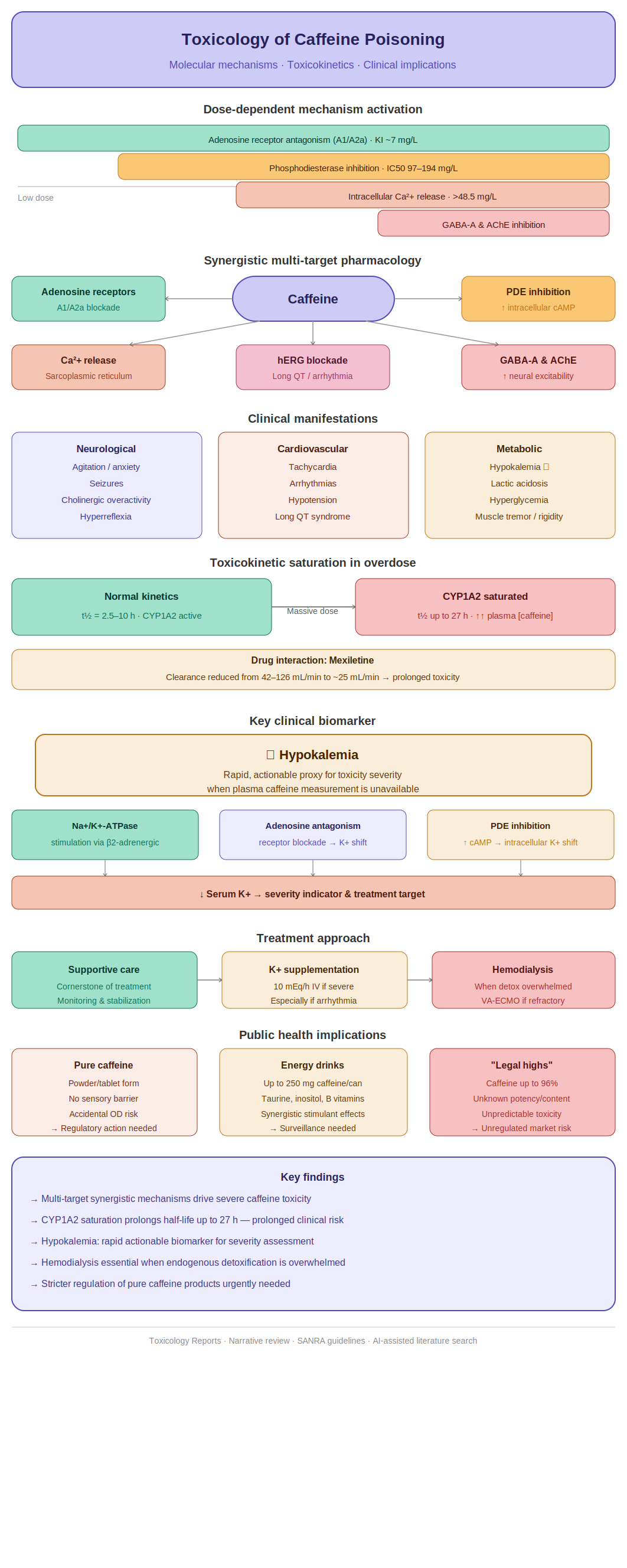
Background: Caffeine toxicity represents a growing public health challenge due to the widespread availability of highly potent formulations. Ingestions of 3–10 grams can be fatal, with serious toxicity occurring at plasma concentrations 15 mg/L or greater. This review provides a framework explaining its diverse clinical consequences.
Methods: A comprehensive literature search was conducted across PubMed, Scopus, and Google Scholar using AI-assisted tools, prioritizing clinical, forensic, toxicokinetic, and molecular mechanism studies while excluding chronic moderate consumption.
Results: Caffeine toxicity is dose-dependent, progressing from adenosine receptor antagonism to phosphodiesterase inhibition, intracellular calcium release, and GABA-A antagonism. In overdose, these mechanisms interact synergistically to cause severe neurological, cardiovascular, and metabolic complications. Furthermore, the CYP1A2 metabolic system becomes saturated, prolonging the elimination half-life up to 27 hours and causing a disproportionate rise in plasma concentrations. Interactions with drugs like mexiletine drastically reduce clearance.
Conclusions: Severe poisoning stems from complex, synergistic molecular interactions. Hypokalemia serves as a promising, actionable clinical biomarker for severity assessment. When massive ingestions saturate endogenous detoxification, hemodialysis becomes essential for survival. Unregulated markets for pure caffeine require stricter regulatory interventions and intensified clinical surveillance.
Keywords:
caffeine poisoning
; toxicokinetic
; adenosine receptor antagonism
; hypokalemia
; phosphodiesterase inhibition
; hemodialysis
Copyright: This open access article is published under a Creative Commons CC BY 4.0 license, which permit the free download, distribution, and reuse, provided that the author and preprint are cited in any reuse.


