
Submitted:
30 June 2026
Posted:
01 July 2026
You are already at the latest version
Abstract
Self-directed speech is a well-established aspect of human cognition, although its relationships with self-processes such as self-consciousness, self-rumination, mindfulness, self-concept clarity, and self-esteem remain poorly understood. The present study aimed to synthesize existing empirical findings to clarify how individual differences in self-directed speech relate to self-processes. Guided by PRISMA-informed systematic review procedures, this narrative review examined studies published between 2000 and 2025 that reported correlations between validated self-report measures of self-directed speech and selective self-processes. Relationships across 15 included studies showed low to moderate significant correlations suggesting that thinking about private self-aspects, reflecting and ruminating about the self, clarifying one’s self-concept, engaging in mindfulness, and mind wandering are associated with more or less frequent self-reported use of various forms of speech-for-self. Results also supported the notion that positive self-talk is linked to higher self-esteem and self-reflection whereas negative self-talk is connected to lower self-esteem and self-rumination. These findings are in line with the view that self-directed speech constitutes a central mechanism of self-construction and self-processing. Future research should focus on longitudinal and experimental designs, greater conceptual consistency, and broader cultural representation.
Keywords:
self-directed speech
; inner speech
; private speech
; self-talk
; self-processes
; self-awareness
; self-consciousness
; self-reflection
; self-rumination
; self-concept clarity
; self-esteem
; self-regulation
; mindfulness
; mind wandering
1. Introduction
1.1. Overview
The self represents a multidimensional construct which includes all conceivable private and public self-aspects, such as thoughts, emotions, sensations, motives, behaviors, skills, physical appearance, and so forth (Carver, 2002; Gillihan & Farah, 2005; Fenigstein, 1987; Morin, 2006). Importantly, a self can exist without it being aware of its own existence (Morin & Everett, 1990b). Arguably, several non-human animals possess a self that adaptively guides their responses for survival purposes, but these creatures lack explicit knowledge of their internal states and external attributes. Self-awareness, defined as the ability to become the object of one’s own attention and process self-referential information (Duval & Wicklund, 1972), is precisely what allows the self to apprehend its own content and existence.
Once in a state of self-awareness, human beings can either self-reflect or self-ruminate (Trapnell & Campbell, 1999). Self-reflection consists of a genuine, healthy curiosity about one’s self and is associated with functional processes such as self-regulation, self-knowledge, high self-esteem, and attribution of mental states to others (“Theory-of-Mind”; ToM). Self-rumination is characterized by repetitive, uncontrollable, and negative thoughts about the self and is linked to self-criticism, self-doubt, self-blame, anxiety, and depression (Mor & Winquist, 2002) – all of which impede the aforementioned processes related to self-reflection (e.g., Joireman, Parrott & Hammersla, 2002). Other self-processes that emerge from self-awareness include mental time travel (e.g., autobiography and episodic future thinking), self-concept formation, mindfulness, mind wandering, and self-handicapping (Morin, 2017).
One tenacious question pertains to the cognitive nature of self-processes. How does the self get access to itself and engage in self-reflection or self-rumination? Arguably, self-processes such as remembering one’s past, planning one’s future, acquiring and organizing self-information, and self-criticizing, must be mentally performed in some format or another so as to allow complex interactions between various forms of self-representations. One tentative answer has been that language is particularly fit to perform such operations (Borghi & Fernyhough, 2023; Fernyhough & Borghi, 2023; Morin, 2005, 2018, 2024; Neuman & Nave, 2010; Skipper, 2023)—and more specifically, the self-directed use of language. Three types of self-directed speech are commonly distinguished: inner/covert speech, private/overt speech, and self-talk, which can be either covert or overt (Alderson-Day & Fernyhough, 2015). Self-directed speech is seen as a process which allows the self to verbally label and articulate its internal states such as needs and sensations, as well as objectively identify and evaluate its behaviors such as potential courses of actions and skills required for such actions (Morin, 2024). Alternatively, the self can be seen as a problem to be solved (Who am I? How do I feel? Why did I do this?), where inner speech represents a cognitive tool assisting this problem-solving process the same way it has been shown to help solve a wide variety of other problems (Morin, 1995).
Several lines of empirical evidence support this postulated connection between self-directed speech and general self-awareness. To illustrate, inner speech loss following brain dysfunction produces self-reflection deficits (Morin, 2009; Skipper, 2023). One can observe an increased activation of brain areas sustaining inner speech during completion of self-reflection tasks such as endorsement of personality traits, autobiography, and future-oriented thinking (Morin & Hamper, 2012). Studies employing thought-listing procedures report frequent inner speech about the self (Morin & Racy, 2022).
The evidence of particular interest in the current paper is the observation of significant positive correlations between self-report measures of self-directed speech and various self-related constructs (e.g., Brinthaupt, Hein & Kramer, 2009; Morin, Everett, Turcotte & Tardif, 1993; Racy, Morin & Duhnych, 2019). Although this type of evidence remains mute in terms of causality, it supports the general idea that participants who report often taking to themselves (about themselves) also perceive frequently engaging in self-reflection or self-rumination as well as other self-processes, and vice versa.
1.2. The Current Study
The present work offers a systematic review of all existing studies that present correlations between self-report measures of self-directed speech (i.e., inner speech, private speech, self-talk) and self-processes (e.g., self-reflection, mindfulness, self-esteem). The current review uniquely focuses on self-report questionnaires and excludes all other methods such as task performance, thought listing and sampling, articulatory suppression, brain imaging data, and so on. We do not report studies which correlated measures of self-directed speech among themselves, or measures of self-processes among themselves, as this is beyond the scope of the review (for examples of such reviews, see DaSilveira, DeSouza & Gomes, 2015; Racy, Morin & Hagerty, 2022). We tried to include as many self-processes as possible in our review (for an exhaustive list see Morin, 2017) but elected to omit some deemed less important and more derivative of other more central constructs (e.g. self-monitoring, self-discipline, insight). As well, and as will be described in the Methods section, some self-processes such as self-agency, self-recognition, metacognition, and autobiography had to be excluded because no self-report measures assessing them exist. Finally, some other self-processes are assessed with self-report questionnaires (e.g., self-knowledge, self-control, ToM) but have never been correlated with self-directed speech measures in published studies and thus also had to be excluded. Below we introduce the remaining self-processes included in the review.
1.3. Select Self-Processes and Proposed Links to Self-Directed Speech
1.3.1. Self-Consciousness
Self-consciousness consists in a natural disposition to engage in self-referential thinking more or less frequently (Fenigstein, Scheier & Buss, 1975). Importantly, self-consciousness can refer to both self-reflection and self-rumination—the original construct is mute in that respect (Trapnell & Campbell, 1999). Fenigstein and colleagues (1975) identified two dimensions of self-consciousness. Private self-consciousness involves a tendency to attend to one’s internal states, such as thoughts, feelings, and bodily sensations, whereas public self-consciousness refers to the awareness of oneself as a social object, including concern about how one is perceived by others. DeSouza, DaSilveira and Gomes (2008) describe inner speech as the dynamic engine of self-consciousness, enabling internal dialogues that reflect on the past, evaluate the present, and imagine future scenarios. It is suggested that self-directed speech likely plays a central role in supporting the two dimensions of self-consciousness by facilitating ongoing self-directed thoughts about private and public self-aspects. Consequently, positive correlations between self-directed speech and both private and public self-consciousness should be reported in the literature.
1.3.2. Self-Reflection and Self-Rumination
As seen earlier, self-reflection represents a more constructive form of self-consciousness (Trapnell & Campbell, 1999). Some proposed that self-directed speech allows individuals to gain metacognitive access to their thoughts, allowing them to identify connections and interpret personal experiences (Langland-Hassan, 2020; Vicente & Martinez-Manrique, 2011). Self-directed speech should thus positively correlate with self-reflection, especially self-reinforcement and other overall positive forms of self-talk. One can predict the opposite pattern of associations for self-rumination, the more intrusive and dysfunctional type of self-attention. That is, self-directed speech of a more negative quality, such as self-criticism or social assessment, should positively correlate with rumination, whereas positive self-talk should not. Although unclear in terms of valence, Nalborczyk, Perrone-Bertolotti, Baeyens, Grandchamp, and colleagues (2017) have observed increased orofacial movements during ruminative episodes, suggesting more frequent inner speech activity during such episodes.
1.3.3. Mindfulness
Mindfulness can be defined as attention to oneself in the present in a non-judgmental way (Bishop, Lau, Shapiro, Carlson, et al., 2004). It is common to distinguish two main forms of mindfulness: awareness (observing/describing self-experiences) and acceptance (accepting them as such in a non-evaluative, non-reactive fashion) (Cardaciotto, Herbert, Forman, Moitra, & Farrow, 2008). There is some evidence linking mindfulness-awareness to inner speech frequency. For example, individuals high in reflective awareness (a trait closely tied to mindfulness awareness) tend to use self-talk more frequently than those low on this trait (Verhaeghen & Mirabito, 2021). Mindfulness acceptance, in contrast to awareness, is postulated to exhibit significant negative correlations with more critical and evaluative forms of self-talk, as the goal is to shut down the inner voice.
1.3.4. Mind Wandering
Mind wandering refers to the experience of having thoughts that are unrelated to the immediate task at hand or the external environment (Smallwood & Schooler, 2006). These unrelated thoughts are often self-referential and are estimated to take up roughly 30-50% of waking hours (Klinger, 2009). Mind wandering can include thoughts about one’s past or future, daydreams, internal rehearsals, replaying conversations, or planning (Latinjak, 2018). Diaz, Van Der Sluis, Benjamins, Stoffers, and colleagues (2014) identified both verbal and visual components within mind wandering episodes, along with themes such as planning, health, and bodily awareness. Studies of the Default Mode (when participants are asked to lie still with eyes closed, which frequently induces episodes of mind wandering) and future-oriented thinking (also closely related to mind wandering) report significant instances of inner speech (D’Argembeau, Renaud & Van der Linden, 2011; Mazoyer, Zago, Mellet, Bricogne, et al., 2001). These findings suggest that self-directed speech may play a role in mind wandering and that positive correlations between the two constructs are expected to be observed.
1.3.5. Self-Concept Clarity
Self-concept clarity refers to the extent to which an individual’s self-concept is clearly and confidently defined, internally consistent, and stable over time (Campbell, 1990; Campbell & Lavallee, 1993). There are reasons to believe that self-concept clarity and self-directed speech are meaningfully related: people with low self-concept clarity might use self-talk more actively to figure themselves out, whereas people with high self-concept complexity might need less self-talk, the self-clarifying work having already been accomplished (Racy & Morin, 2024). Hence the prediction of a negative correlation between the two constructs.
1.3.6. Self-Esteem
Self-esteem is defined as a person’s overall sense of worthiness and plays a pivotal role in shaping one’s mental health and well-being (Baumeister, 1993; Rosenberg, 1975). Although self-esteem and self-directed speech are both central components of self-related functioning, the empirical relationship between them remains unclear. Some studies suggest that self-talk, especially when self-reinforcing, may play a role in supporting high self-esteem in childhood and adolescence (Yaratan & Yucesoylu, 2010). However, Jones (2020) examined whether distanced self-talk (an adaptive form of self-talk used for emotion regulation) could influence self-esteem and did not find consistent and replicable patterns. In light of this, we either expect to find no significant association between self-report measures of self-directed speech and self-esteem, or a positive correlation between self-talk of a positive nature (such as self-reinforcement) and high self-esteem, and a negative association between negative self-directed speech (such as self-criticism) and low self-esteem.
1.3.7. Self-Regulation
One last self-process which will be examined in relation to self-directed speech is self-regulation, the control of one’s behavior, emotions, and thoughts in pursuit of long-term goals (Baumeister & Vohs, 2003). Vygotsky (1943/1962) primarily saw inner speech as a self-regulating tool, and a large body of literature indicates that this is indeed the case (e.g., Winsler, 2009). To illustrate, the performance of children on the Tower of London task (a measure of planning, a critical part of self-regulation) is significantly lower when private speech is blocked using articulatory suppression (Lidstone, Meins & Fernyhough, 2010). Also using articulatory suppression, Tullett and Inzlitch (2010) produced self-control deficits in adults on a “go/no-go” task, where participants had to respond by pressing a button when seeing a “go” signal, and not respond when seeing a “no-go” signal. We thus expect to observe positive correlations between self-report measures of self-directed speech and self-regulation.
1.4. Hypotheses
Based on existing theoretical and empirical work presented above, the present study tested the following hypotheses:
(a) Self-Consciousness: Positive correlations are predicted between self-directed speech and both private and public self-consciousness, reflecting the role of speech-for-self in self-focused attention.
(b) Self-reflection: Self-report measures of self-directed speech should positively correlate with self-reflection, especially self-reinforcement and other overall positive forms of self-talk.
(c) Self-Rumination: Self-report measures of self-directed speech, particularly negative forms such as self-criticism, should be positively correlated with self-rumination, given its repetitive and critical nature.
(d) Mindfulness: The relationship between self-directed speech and mindfulness is expected to vary by facet. While self-report measures of mindfulness-awareness should positively correlate with self-report measures of self-directed speech, the opposite pattern should be observed for mindfulness-acceptance, reflecting a quieter mental stance (Grzybowski & Brinthaupt, 2022).
(e) Mind-wandering: Self-report measures of self-directed speech should be positively correlated with self-report measures of mind-wandering, as it is postulated that internally generated, self-referential thoughts often take a verbal form.
(f) Self-Concept Clarity: Self-report measures of self-directed speech should be negatively correlated with self-report measures of self-concept clarity. Individuals with a less clearly defined sense of self may rely more on self-talk to organize or clarify their identity. Those with a clear self-concept might not need to talk to themselves about who they are, as this work has already been done (de Sousa, Sellwood, Spray, Fernyhough, Bentall, 2016).
(g) Self-Esteem: On one hand, perhaps because self-esteem represents a current overall self-evaluation rather than the process of arriving at that evaluation, we anticipate no significant correlation between self-report scales of self-directed speech and self-esteem. On the other hand, and equally plausible, we also expect to find positive correlations between self-report measures of self-directed speech and high self-esteem when self-talk is of a positive nature, and negative associations with low self-esteem when self-directed speech is mostly negative in its content.
(h) Self-regulation: Given the large body of research showing causal associations between self-directed speech and self-regulation, we expect to observe positive correlations between self-report measures of self-directed speech and self-regulation.
Of note, we do not expect different associations between self-directed speech and self-processes as a function of the former being internal (inner speech), aloud (private speech), or a mixture of both (self-talk).
2. Methods
2.1. Systematic Review Procedure
A systematic review procedure was conducted using the Preferred Reporting Items for Systematic Reviews and Meta-Analyses (PRISMA) guidelines (Liberati, Altman, Tetzlaff, Mulrow, et al., 2009). Searches were conducted on Web of Science Core Collection (via Clarivate), ProQuest (via the University of Lethbridge access), and Google Scholar. A first phase consisted of the identification of all existing validated self-report measures of self-directed speech and self-processes. Table 1 presents these measures. To illustrate, for self-processes, searches included keywords such as “self-consciousness” (or “self-concept”, “self-knowledge”, “mindfulness”, etc.) and “self-report”, “questionnaire”, “scale”, “measure”, assessment”, and so forth. Searches for self-directed speech were comparable—for example: “inner speech” (or “self-talk”, “internal dialogue”, “private speech”, “internal monologue”, etc.) and “self-report”, “questionnaire”, “scale”, “measure”, assessment”, and so forth.
In a second phase, searches were conducted to identify correlational studies of interest. Searches included keywords such as “Self-Talk Scale”, “STS” (or “General Inner Speech Questionnaire”, “GISQ”, etc.), and “Self-Concept Clarity Scale”, “SCCS”, (or “Rumination-Reflection Questionnaire”, “RRQ”, etc.), and so forth. Studies were eligible for inclusion if they reported at least one correlation between a self-directed speech measure and a self-process measure. As a result, several self-report measures were excluded (those followed by an asterisk in Table 1). All remaining measures are described in the next section.
To ensure contemporary and relevant coverage of the literature, studies published between 2000 and 2025 were included. Only reports published in English, as well as both peer-reviewed articles and dissertations were eligible, while unpublished manuscripts and conference presentations were excluded. (For a synthesis of conference presentations pertaining to correlations between self-report questionnaires of self-directed speech and self-processes, see Morin, in press.)
Study selection followed a two-stage process (see Figure 1 in the Results section). First, the second author screened titles and abstracts of all search results, identifying potentially eligible studies. Second, the full text of each potentially eligible article was reviewed to confirm whether it reported a numerical correlation between a self-talk measure and a self-process measure. Data extraction from eligible studies was also completed by the second author. The extracted data were entered into a Notion spreadsheet and double-checked for consistency. No automation tools were used for data collection.
The primary outcomes of interest were the Pearson correlation coefficients (r) and their corresponding p-values reported between self-talk and self-process self-report measures. If multiple correlations were available for the same construct pairing, all were extracted and reported. Pearson’s r was used to quantify the strength and direction of associations between variables of interest. The magnitude of correlations was generally interpreted according to conventional thresholds: negligible (.1 or lower), small (.1–.3), moderate (.3–.5), and large (.5 or higher), allowing for meaningful interpretation of the effect sizes (Akoglu, 2018).
2.2. Self-Directed Speech Measures
2.2.1. Self-Talk Scale (STS)
The STS (Brinthaupt et al., 2009) assesses both inner speech and private speech. It aims to quantify the self-reported frequency of when and why participants may talk to themselves out loud or in silence for self-regulatory purposes. The 16-item scale uses a 5-point Likert scale ranging from 1 (never) to 5 (very often). Factor analysis revealed the existence of four subscales: social assessment (evaluating interactions with others), self-reinforcement (feeling good about oneself when something positive has happened), self-criticism (disapproving or negatively analyzing one’s own behavior), and self-management (deciding what to say or do). Examples of statements corresponding to the factors include “I talk to myself when I want to analyze something that someone recently said to me” (social assessment), “I talk to myself when I’m proud of something I’ve done” (self-reinforcement), “I talk to myself when I should have done something differently” (self-criticism), and “I talk to myself when I’m mentally exploring a possible course of action” (self-management). Test-retest reliability over a three-month period demonstrated good reliability, with a significant correlation r = .69 (p <.001).
2.2.2. General Inner Speech Questionnaire (GISQ)
The GISQ (Racy et al., 2019) resulted from the use of a thought-listing procedure asking participants to freely report their inner speech experiences in an open format. The most frequently reported topics included negative emotions, problem-solving, planning, time-management, self-motivating/enhancing speech, emotional control, and when being alone/bored. These and other most often reported topics were then selected to create the 57-item GISQ, which exhibits good internal consistency (α = .94) and moderate correlations with other self-related measures. The GISQ uses a 5-point Likert-scale ranging from 0 (never) to 5 (all the time). Example statements include “I talk to myself about positive emotions”, “I talk to myself in order to control emotions”, and “I talk to myself when I am driving”.
2.2.3. Self-Verbalization Questionnaire (SVQ)
The SVQ (Duncan & Cheyne, 1999) is a 27-item instrument designed to assess different self-regulatory functions associated with private speech based on Vygotsky’s (1943/1962) work. Items are rated on a 7-point Likert scale ranging from 1 (strongly disagree) to 7 (strongly agree), including items such as “I sometimes think out loud to myself when I’m proofreading something I’ve written” and “I sometimes verbalize my thoughts when I’m trying not to get angry”. Four factors were identified that align with the Vygotskian framework. Spatial search refers to spatial orientation and search, behavioural-organizational refers to manual motor and organizational processes, cognitive-attentional includes memory, attention, and problem-solving, and affective involves the expression or control of emotions. Factors demonstrated high internal consistency (average r = .80) as well as significant test-retest reliabilities (average r = .73). One single total score is calculated.
2.2.4. Inner Speech Scale (ISS)
The ISS (Siegrist, 1995) is an 18-item questionnaire designed to measure the self-reported frequency of inner speech used to self-reflect. Participants are asked to indicate their level of agreement with each statement using a 6-point Likert scale ranging from 1 (strongly disagree) to 6 (strongly agree). Examples of items include “Inner conversations help me to understand myself better” and “In difficult situations I sometimes say to myself ‘You can handle this; you’ll do alright’”. Internal reliability was found to be high (α = .93) (Siegrist, 1995). In an adapted Chinese version, the ISS exhibited high internal consistency (α = .82) as well as test-retest reliability (r = 0.66, p < .001) (Ren, Wang & Jarrold, 2016).
2.2.5. Varieties of Inner Speech Questionnaire (VISQ) and Varieties of Inner Speech Questionnaire-Revised (VISQ-R)
The 26-item VISQ (McCarthy-Jones & Fernyhough, 2014) and its 35-item VISQ-R (Alderson-Day, Mitrenga, Wilkinson, McCarthy-Jones & Fernyhough, 2018) assess inner speech phenomenology. Inspired by Vygotsky’s (1943/1962) developmental theory, these self-report questionnaires evaluate key dimensions of dialogical (inner speech as back-and-forth conversation vs. monologue), condensed (abbreviated vs. expanded inner speech), other people (whether one hears other voices besides one’s own), evaluative/critical (checking in on one’s behaviors), and (only for the VISQ-R) positive/regulatory (encouraging or self-reinforcing thoughts). Both questionnaires use a 7-point Likert scale ranging from 1 (never) to 7 (all the time). An example item from the dialogical subscale is “My thinking in words is more like a dialogue with myself, rather than my own thoughts in a monologue”. A sample question from the condensed inner speech subscale is “My thinking to myself in words is like shorthand notes, rather than full, proper, grammatical English”. An example item from the other people subscale is “I experience the voices of other people asking me questions in my head”. An example of the evaluative/critical subscale is “In my head I talk to myself in a critical way”. And lastly, a sample positive/regulatory question is “I calm myself down by talking silently to myself”. The subscales of the original VISQ showed high internal reliability (Cronbach’s α > .80) and moderate test–retest reliability (>.60) (Alderson-Day et al., 2018). In an adapted Chinese version (Ren et al., 2016), the VISQ had moderate internal reliability (α = 0.76). Both VISQ and VISQ-R have been instrumental in linking inner speech characteristics to psychological traits and conditions, including anxiety, depression, and hallucination-proneness.
2.2.6. Automatic Thoughts Questionnaire-Revised (ATQ-R)
The ATQ-R (Kendall, Howard & Hays, 1989) is a self-report measure designed to assess the frequency of automatic thoughts that spontaneously occur in everyday life. The assumption is that thoughts take the form of inner speech. The 5-point (“not at all” to “all the time”) ATQ-R measures self-reported frequency of cognitive self-statements associated with depressed mood and comprises 30 negative self-statements such as “What’s the matter with me?”, and 10 reverse-scored self-verbalizations associated with positive affect, such as “I feel good”. The ATQ-R total score is obtained by inverting the 10 non-negative items and summing all items; a higher score indicates a higher frequency of depressive thinking.
2.2.7. Functions of Dialogues-Revised Questionnaire (FUND-R)
The FUND-R (Puchalska-Wasyl & Zarzycka, 2023) is a 24-item scale assessing six functions of internal dialogues: analyzing (internal dialogue assessing situations), bonding (inner dialogue allowing one to experience closeness with another person), self-knowing (internal dialogue that aims to help understand one’s identity), fantasizing (internal dialogue associated with dreams and escapism), ruminating (negative, repetitive internal dialogue), and testing (dialogue associated with strengthening one’s argument to prepare for real situations). Example statements include “My internal dialogue is a way to find out the truth about me and my life” and “My internal dialogue makes me feel worse”. The scale utilizes a 5-point Likert scale ranging from 1 (strongly disagree) to 5 (strongly agree). Acceptable reliability was shown with Cronbach’s alpha being above .73.
2.3. Self-Report Questionnaires of Self-Processes
2.3.1. Self-Concept Clarity Scale (SCCS)
The SCCS (Campbell et al., 1996) looks at the stability of one’s self-concept. The 12-item scale utilizes a 5-point Likert scale ranging from 1 (strongly disagree) to 5 (strongly agree), with items such as “My beliefs about myself often conflict with one another” and “Sometimes I think I know other people better than I know myself” (both reversed scores). The SCCS has been found to have high internal reliability (alpha =.87).
2.3.2. Rumination and Reflection Questionnaire (RRQ)
The RRQ (Trapnell & Campbell, 1999) measures two factors of self-focused attention: rumination and reflection. While both factors are internalized processes focused on the self, they are distinct in that rumination is associated with neuroticism and reflection is associated with openness to experiences. The self-report measure contains 24 items, with each subscale consisting of 12 items, measured on a 5-point Likert scale ranging from 1 (totally disagree) to 5 (completely agree). Higher scores are associated with greater tendencies on the dimension. An example of an item from the rumination subscale is “Sometimes it is hard for me to shut off thoughts about myself”, and an example from the reflection subscale is “I love analyzing why I do things”. The internal consistency reliability is good (Cronbach’s α = .90 for the rumination subscale and .91 for the reflection subscale).
2.3.3. Philadelphia Mindfulness Scale (PHLMS)
The PHLMS (Cardaciotto et al., 2008) measures mindfulness using a 20-item scale assessing self-reported awareness and acceptance. The first component of this scale aims to measure mindful awareness, which is described as the monitoring of experiences in the present moment, rather than thinking about the past or future. An example of an item measuring mindful awareness is “When I am startled, I notice what is going on inside my body”. The second component is acceptance, which constitutes experiencing the present moment with an attitude of openness, allowing thoughts to appear without judgment or action. An example of a reverse-scored item is “I try to distract myself when I feel unpleasant emotions”. Using a 5-point Likert scale ranging from 1 (never) to 5 (very often), the scale demonstrated good internal consistency (awareness subscale α = .86, acceptance subscale α = .91).
2.3.4. Five Facets Mindfulness Questionnaire (FFMQ)
The FFMQ (Baer, Smith, Hopkins, Krietemeyer & Toney, 2006) was developed through several validation studies wherein five available mindfulness questionnaires were subjected to factor analysis to create one 39-item self-report measure. Items are rated on a 5-point Likert scale ranging from 1 (never or very rarely true) to 5 (very often or always true). The instrument assesses five facets of mindfulness: (a) observing, which is the tendency to notice and attend to experience; (b) describing, being able to label an experience with words; (c) acting aware, being able to concentrate; (d) non-judging, being able to notice experience without assigning meaning; (e) non-reacting, similar to non-judging, being able to notice experiences without reacting. Two examples of items are “When I take a shower or bath, I stay alert to the sensations of water on my body” (observing) and “When I have distressing thoughts or images, I am able just to notice them without reacting” (non-judging). The FFMQ has strong psychometric properties, with high internal consistencies (Cronbach’s α ranging from .75 to .93).
2.3.5. Mind Wandering Questionnaire (MWQ)
The MWQ (Mrazek, Phillips, Franklin, Broadway & Schooler, 2013) is a 5-item self-report questionnaire that assesses the experience of random thoughts not remaining on a single topic for an extended period of time. One example of an item is “I mind wander during lectures or presentations”. The scale utilizes a six-point Likert scale ranging from 1 (almost never) to 6 (almost always). The questionnaire displays high internal consistency (Cronbach’s α = .85) and convergent validity with measures related to mind wandering.
2.3.6. Self-Consciousness Scale-Revised (SCS-R)
The SCS-R (Scheier & Carver, 1985) is a 23-item self-report measure of private self-focus (the tendency to think about things that are more internal in nature, such as beliefs and values), public self-focus (noticing things that are outwardly apparent to others such as looks, tone of voice, demeanour, etc.), and social anxiety (an apprehensive reaction resulting from fear of evaluation when focusing on the public self). Only the first two subscales are considered in our reporting of the results. The measure uses a 4-point Likert scale ranging from 1 (not like me at all) to 4 (a lot like me). An example of private self-consciousness item is “I’m always trying to figure myself out”. An example of public self-consciousness item is “I’m usually aware of my appearance”. The SCS-R demonstrates good internal consistency (α = .75 for private self-consciousness and α = .84 for public self-consciousness) as well as stability over time.
2.3.7. Self-Regulation Questionnaire (SRQ)
The SRQ (Brown, Miller & Lawendowski, 1999) assesses participants perceived ability to execute internally desired behaviour. The questionnaire consists of 63 items utilizing a 5-point Likert scale ranging from 1 (strongly disagree) to 5 (strongly agree) and underlies 7 subscales: (a) informational input, the ability to integrate information from the environment (“I usually keep track of my progress toward my goals”); (b) self-evaluation, noticing how one is acting in comparison to personal goals and desires (“My behavior is similar to that of my friends”); (c) instigation to change, being able to evaluate discrepancies between current and desired states (“Others tell me that I keep on with things too long”); (d) search for alternatives in order to reduce such discrepancies (“If I wanted to change, I am confident that I could do it”); (e) planning for change, the strategies or actions for carrying plans of change (“I have trouble making up my mind about things”); (f) implementation of strategies for change, actually acting out said plans (“I have so many plans that it’s hard for me to focus on any one of them”); and (g) goal attainment evaluation plan (“I reward myself for progress toward my goals”). Carey, Neal and Collins (2004) found test-retest reliability for the total SRQ was high (r=.94, p < .001) and internal consistency of the scale was also high (α = .91).
2.3.8. Rosenberg Self-Esteem Scale (RSES)
The RSES (Rosenberg, 1989) is a 10-item self-report scale that asks participants to rate their level of agreement ranging from 1 (strongly agree) to 4 (strongly disagree) with statements describing their general emotional evaluation of themselves. Examples of items include “On the whole, I am satisfied with myself,” and “I feel I do not have much to be proud of” (reverse-coded). The RSES is one of the most popular measures of global self-esteem, with good psychometric structure (Sinclair, Blais, Gansler, Sandberg, et al., 2010). The RSES is usually scored so that higher scores mean higher self-esteem, and vice versa (but see note in Table 2). Studies have tested its validity across 53 nations, showing cross-cultural invariance (Schmitt & Allik, 2005). While reports of internal reliability vary, Rosenberg (1979) reported high internal consistency (α = .92).
3. Results and Discussion
3.1. Study Selection
The database search described in 2.1 yielded a total of 236 published articles. As seen earlier, there were no results that met the inclusion criteria for several self-report measures, that is, included studies had to present correlations between self-report measures of self-directed speech and self-processes. As shown in Figure 1, after removing duplicates and screening, 15 studies were included for final review. Some studies were not included due to the manipulation of outcome measures. More specifically, using the STS, Carroll (2022) reported correlations for positive and negative self-talk rather than the original subscales of social assessment, self-criticism, self-reinforcement, and self-management. McGillivray and McCabe (2007) adapted both the RSES and ATQ-R for use with individuals with intellectual disabilities and were thus excluded. Verhaeghen and Mirabito (2022) created their own subscale using factor analysis for VISQ and SVQ and, therefore, were excluded.
Correlations reported below were obtained from the 15 included studies testing healthy English-speaking consenting male and female university students from the US, UK, Canada, Turkey, Germany, and Poland. Testing was done either online using an internet platform or in an in-person group setting where a questionnaire package was administered, which typically included a consent form, demographics, self-report questionnaires, and a debriefing form.
3.2. Self-Directed Speech and Self-Esteem
Table 2 presents correlations between various self-directed speech measures and the RSES. Overall, results support our predictions. Since self-esteem is postulated to be well developed (i.e., not “under construction”) in young adults, we did not expect observing significant associations between frequency of self-reported speech-for-self and current self-evaluation. Two studies used the VISQ and VISQ-R and reported significant negative correlations of -.20 and -.47 between the evaluative subscale of these measures and the RSES, supporting the view that the higher self-esteem is, the less self-reported evaluative inner speech there is, and vice-versa. Other phenomenological aspects of inner speech (dialogical, condensed, containing others’ voice) were not significantly associated with self-esteem.
Consistent with the above, four studies employed the STS and found significant negative correlations ranging from -.12 to -.50 between the self-criticism subscale and the RSES, as well as between the social assessment subscale and the RSES, ranging from -.11 to -39. Social assessment is seen here as underlying some form of self-criticism. Significant positive correlations ranging from .16 to .37 were observed between the self-reinforcement subscale and the RSES, with one study (Uzman & Celik, 2022) reporting a non-significant association. The self-management subscale and the RSES did not correlate significantly. Finally, and as expected, one study using the ATQ-R found a significant positive association of .50 (reversed, see note in Table 2) and a significant negative link of -.55 (also reversed) between the positive and negative dimensions of automatic thoughts and the RSES, suggesting that high self-esteem correlates with positive self-reported inner speech, and vice-versa.
Overall trends indicated that evaluative, critical, socially comparative, and negative self-talk appear to be associated with lower self-esteem. Further, positive or reinforcing self-talk seems to be associated with higher self-esteem, though this relationship is weaker and less consistent. The asymmetry suggests that self-esteem may be more strongly shaped by negative self-evaluative processes than by self-affirmation, aligning with cognitive theories emphasizing the disproportionate impact of negative information on self-perception, also known as the negativity bias (Vaish, Grossmann & Woodward, 2008).
3.3. Self-Directed Speech and Mindfulness
present correlations observed between self-directed speech and mindfulness measures. Two studies used the FFMQ, which assesses five dimensions of self-reported mindfulness. Here we focus on three subscales of greater theoretical interest. The observing subscale yielded non-significant associations with all four STS subscales as well as self-reported positive and negative thoughts as assessed by the ATQ-R, implying that the tendency to notice and attend to experience does not particularly involves self-verbalisations. Significant but low positive correlations (e.g., .12) and non-significant correlations were found between the describing subscale and the STS subscales, which is somewhat surprising as we expected stronger associations between self-talk and the tendency to label experiences with words. However, small significant positive and negative correlations were found between the describing FFMQ subscale and both positive and negative thoughts subscales of the ATQ-R, instead implying a modest association between verbalizing experiences both in positive and negative tones.

Table 3.
Correlations observed between self-directed speech and mindfulness measures. Notes: n = sample size; FFMQ = Five-Facets Mindfulness Questionnaire; GISQ = General Inner Speech Questionnaire; PHLMS = Philadelphia Mindfulness Scale; STS = Self-Talk Scale.
Table 3.
Correlations observed between self-directed speech and mindfulness measures. Notes: n = sample size; FFMQ = Five-Facets Mindfulness Questionnaire; GISQ = General Inner Speech Questionnaire; PHLMS = Philadelphia Mindfulness Scale; STS = Self-Talk Scale.
| Self-speech | Mindfulness | Correlations | Study | p-value | n |
| STS | FFMQ | Describing: - Self-reinforcement = -.06 - Self-management = .09 - Self-criticism = .12* - Social assessment = .11* Observing: - Self-reinforcement = .08 - Self-management = .05 - Self-criticism = −.01 - Social assessment = .05 Acting with awareness: - Self-reinforcement = .19** - Self-management = -.08 - Self-criticism = −.19** - Social assessment = −.18* Non-judging: - Self-reinforcement = .17* - Self-management = -.16* - Self-criticism = −.29** - Social assessment = −.20** Non-reactivity: - Self-reinforcement = .10 - Self-management = .04 - Self-criticism = −.08 - Social assessment = −.03 |
Grzybowski & Brinthaupt (2022) | * p < .05 ** p < .01 |
342 |
| ATQ-R | FFMQ | Describing: - Positive = −.19** - Negative = .29** Observing: - Positive = .07 - Negative = .12 Acting with awareness: - Positive = .21** - Negative = −.31** Non-judging: - Positive = .30** - Negative = −.34** Non-reactivity: - Positive = .21** - Negative = −.17** |
Grzybowski & Brinthaupt (2022) | * p < .05 ** p < .01 |
342 |
| STS | PHLMS | Aware: - Social assessment = .18* - Self-reinforcement = .14** - Self-criticism = .21* - Self-management = .21* Accept: - Social assessment = -.29* - Self-regulation = .03 - Self-criticism = -.36* - Self-management = -0.18* |
Racy & Morin (2024) | * p < .01 ** p < .05 |
227 |
| GISQ | PHLMS | Aware = .31* Accept = -.38* |
Racy et al. (2020) | * p < .001 | 227[1] |
As predicted, the subscale non-judging exhibited significant low negative correlations with the self-criticism and social assessment subscales of the STS (e.g., -.29), suggesting that noticing experience without assigning meaning is incompatible with critical self-verbalizations, and vice-versa. More difficult to interpret was the observation of significant low positive correlations (e.g., .17) between the non-judging subscale and the self-reinforcement and self-management subscales of the STS. Finally, the awareness subscale of the PHLMS (in essence the equivalent of the describing/observing subscales of the FFMQ) correlated significantly and positively with the GISQ (.31) as well as all STS subscales (e.g., .21), suggesting that the monitoring of experience in the present moment may be associated with self-verbalizations. The acceptance subscale correlated significantly and negatively with the GISQ (-.38) and social assessment/self-criticism subscales of the STS (-.29/-.36), supporting the view that mindfulness-acceptance may be linked to a tendency to silence the inner voice.
3.4. Self-Directed Speech and Other Self-Processes
Table 4 present correlations observed between self-directed speech and all remaining self-processes of interest. Total scores on the GISQ, SVQ, STS, and ISS as well as most FUND-R subscales significantly and positively correlated ranging from .12 to .40 with both subscales of rumination and reflection as assessed by the RRQ, indicating that speech-for-self moderately accompanies both healthy and dysfunctional aspects of self-focused attention.
As predicted, total scores on the GISQ, SVQ, and ISS as well as most VISQ and STS subscales significantly and negatively correlated ranging from -.17 to -.37 with the SCCS, suggesting that individuals with a clear self-concept might not need to talk to themselves about who they are, and vice-versa. It seems plausible that frequent self-directed speech plays a role in one’s effort to make sense of oneself (Morin & Everett, 1990a). Forms of self-talk involving social assessment, self-criticism, and self-management appear incompatible with a stable sense of self (Racy & Morin, 2024). Not surprisingly, individuals with low self-concept clarity are more likely to engage in rumination and report greater emotional instability and distress (Xiao, Xu, Zhao, Zhao, Zhang, et al., 2025).
As hypothesized, significant moderate to high positive associations were observed between the GISQ and SCS-R total scores (.52) as well as between the private subscale of the SCS-R and all four STS subscales ranging from .24 to .35. However, we did not predict non-significant correlations between the STS and public self-consciousness subscales. This could signify that self-directed speech use is more often associated with introspection on one’s mental states and other conceptual (private) self-aspects rather than on more perceptual (public) self-aspects. This would be consistent with the role ascribed to inner speech in abstract concept formation, including self-related concepts (Borghi & Fernyhough, 2023), as well as the observation of increase activation of brain areas sustaining inner speech use when participants engage in conceptual (e.g., autobiography) rather than perceptual (e.g., self-recognition) self-referential tasks (Morin & Hamper, 2012).
In one study (Racy & Morin, 2024), modest significant positive correlations were reported between the MWQ and GISQ (.23) as well as the STS subscales of social assessment, self-criticism, and self-management (e.g., .22), suggesting that mind wandering, or the generation of thoughts unrelated to a current task, may take a verbal form. The same study presented mostly non-significant or low significant positive correlations (e.g., .16) between the SRQ and GISQ as well as the STS subscales. These results are unexpected given that we predicted much higher positive correlations between self-report measures of self-directed speech and self-regulation based on the large body of research demonstrating often causal links between these two constructs. As far as the GISQ is concerned, one tentative explanation is that only a fraction of its items pertains to self-regulatory inner speech.
5. Conclusions
5.1. Overview
The examination of the role played by self-directed speech in the development of self-awareness is not new (see Table 1 in Morin, 2005) and dates back to Mead (1934), Vygotsky (1943/1962), and several other contemporary thinkers. What is more recent is an effort to gather empirical support to this idea (see Table 2 in Morin, 2024). One specific line of evidence was the focus of the current paper: the observation of significant positive associations between self-report measures of self-directed speech and self-related constructs. Following a rigorous search procedure guided by PRISMA, we identified 15 published articles reporting correlations between eight self-report measures of inner speech, private speech, and self-talk, and eight self-related constructs. With some exceptions, results showed low to moderate significant correlations, partially suggesting that thinking about private self-aspects, reflecting and ruminating about the self, clarifying one’s self-concept, engaging in mindfulness, and mind wandering are associated with more or less frequent self-reported use of various forms of speech-for-self. Results also at least partially supported the notion that positive self-talk was linked to higher self-esteem and self-reflection whereas negative self-talk was connected to lower self-esteem and self-rumination. Said differently, evaluative and critical forms of self-talk were often linked to more maladaptive outcomes, whereas positive or reinforcing self-talk was generally associated with healthier outcomes, although this latter finding was less robust.
5.2. Limitations and Future Research
Several limitations apply to the present study. We relied on self-report measures, which are notoriously problematic (Brinthaupt & Erwin, 1992). Beyond the classic social desirability issue (Paulhus, 1984), one almost unavoidable difficulty is that such measures ask participants to report on their selves, yet people are much less self-knowledgeable that we would naively think (e.g., Vazire & Carlson, 2010), impeding self-report accuracy. Also, items created to design self-report inventories may reflect theorists’ own biases regarding what they think a construct is as opposed to what the construct really is. Another limitation is that the reviewed literature relied heavily on university student samples and predominantly Western populations, which restricts the generalizability of results.
The observation that multiple self-report measures of speech-for-self and self-processes have never been correlated in published articles suggests that more work is need in that direction. More specifically, future research should aim to broaden the range of self-processes examined in relation to self-directed speech. Although the present review sought to include constructs such as self-control, self-knowledge, ToM, and self-efficacy, no studies meeting the inclusion criteria examined these processes using established measures. This absence highlights a substantial gap in the literature and indicates that many theoretically relevant self-processes remain understudied in relation to self-directed speech.
Also, it would be fruitful to compare the magnitude of correlations between measures of self-processes and other cognitive processes beyond self-directed speech, such as mental imagery. There are good reasons to suspect an involvement of autoscopic mental imagery in self-awareness (Morin & DeBlois, 1989). And finally, future studies would benefit from moving beyond cross-sectional correlational designs to establish causal relationships between facets of self-directed speech and specific self-processes. Longitudinal and experimental designs could help clarify whether specific forms of self-talk contribute to changes in self-processes, or whether these self-processes shape the content and function of self-talk. To illustrate, one could assess different types of self-talk (e.g., using the STS subscales of self-reinforcement, self-criticism, etc.), apply an intervention such as mindful acceptance, and re-assess self-talk types to see which specific subscale results significantly changed. Expanding research to more diverse cultural contexts and non-student populations would strengthen the generalizability of findings. Collectively, such efforts would contribute to a more comprehensive and theoretically integrated understanding of how self-directed speech operates within the broader landscape of self-processes.
| [1] | he n for both Racy & Morin (2023) and Racy et al. (2020) is the same because both publications used the same dataset but reported correlations among different measures. |
References
- Alderson-Day, B., & Fernyhough, C. (2015). Inner speech: Development, cognitive functions, phenomenology, and neurobiology. Psychological Bulletin, 141(5), 931–965. [CrossRef]
- Alderson-Day, B., Mitrenga, K., Wilkinson, S., McCarthy-Jones, S., & Fernyhough, C. (2018). The varieties of inner speech questionnaire—Revised (VISQ-R): Replicating and refining links between inner speech and psychopathology. Consciousness and cognition, 65, 48–58. [CrossRef]
- Akoglu H. (2018). User’s guide to correlation coefficients. Turkish Journal of Emergency Medicine, 18(3), 91–93. [CrossRef]
- Baer, R.A., Smith, G.T., Hopkins, J., Krietemeyer, J., & Toney, L. (2006). Using self-report assessment methods to explore facets of mindfulness. Assessment, 13(1), 27-45.
- Baumeister, R.F. (1993). Self-esteem: The puzzle of low self-regard. Plenum Press. [CrossRef]
- Baumeister, R.F., & Vohs, K.D. (2003). Self-regulation and the executive function of the self. In M.R. Leary, & J.P. Tangney (Eds.), Handbook of self and identity (pp. 197-217). The Guilford Press.
- Bishop, S.R., Lau, M., Shapiro, S., Carlson, L., Anderson, N.D., Carmody, J., Segal, Z.V., Abbey, S., Speca, M., Velting, D., & Devins, G. (2004). Mindfulness: A proposed operational definition. Clinical Psychology: Science and Practice, 11(3), 230–241. [CrossRef]
- Borghi, A.M., & Fernyhough, C. (2023). Concepts, abstractness and inner speech. Philos Trans R Soc Lond B Biol Sci., 378(1870), 20210371. [CrossRef]
- Brinthaupt, T.M., & Erwin, L.J. (1992). Reporting about the self: Issues and implications. In T.M. Brinthaupt & R.P. Lipka (Eds.), The self: Definitional and methodological issues. SUNY series, studying the self (pp. 137–171). Albany: State University of New York Press.
- Brinthaupt, T.M., Hein, M.B., & Kramer, T.E. (2009). The Self-Talk Scale: Development, factor analysis, and validation. Journal of Personality Assessment, 91(1), 82–92. [CrossRef]
- Brown, J.M., Miller, W.R., & Lawendowski, L.A. (1999). The Self-Regulation Questionnaire. In L. VandeCreek & T.L. Jackson (Eds.), Innovations in clinical practice: A source book (Vol. 17, pp. 281–292). Professional Resource Press/Professional Resource Exchange.
- Campbell, J.D. (1990). Self-esteem and clarity of the self-concept. Journal of Personality and Social Psychology, 59(3), 538–549. [CrossRef]
- Campbell, J.D., & Lavallee, L.F. (1993). Who am I? The role of self-concept confusion in understanding the behavior of people with low self-esteem. In R.F. Baumeister (Ed.), Self-esteem: The puzzle of low self-regard (pp. 3–20). Plenum Press. [CrossRef]
- Campbell, J.D., Trapnell, P.D., Heine, S.J., Katz, I.M., Lavallee, L.F., & Lehman, D.R. (1996). Self-concept clarity: Measurement, personality correlates, and cultural boundaries. Journal of Personality and Social Psychology, 70(1), 141–156. [CrossRef]
- Cardaciotto, L., Herbert, J.D., Forman, E. M., Moitra, E., & Farrow, V. (2008). The assessment of present-moment awareness and acceptance: The Philadelphia Mindfulness Scale. Assessment, 15(2), 204–223. [CrossRef]
- Carey, K.B., Neal, D.J., & Collins, S.E. (2004). A psychometric analysis of the self-regulation questionnaire. Addictive Behavior, 29(2), 253-60. [CrossRef]
- Carver, C.S. (2002). Self-awareness. In M.R. Leary & J.P. Tangney (Eds.), Handbook of self and identity (pp. 179– 196). New York: Guilford Press.
- D’Argembeau, A., Renaud, O., & Van der Linden, M. (2011). Frequency, characteristics and functions of future-oriented thoughts in daily life. Applied Cognitive Psychology, 25, 96-103. [CrossRef]
- DaSilveira, A., DeSouza, M.L., & Gomes, W.B. (2015). Self-consciousness concept and assessment in self-report measures. Frontiers in Psychology, 6, 930. [CrossRef]
- de Sousa, P., Sellwood, W., Spray, A., Fernyhough, C., & Bentall, R.P. (2016). Inner speech and clarity of self-concept in thought disorder and auditory-verbal hallucinations. The Journal of Nervous and Mental Disease, 204(12), 885-893. [CrossRef]
- DeSouza, M. L., DaSilveira, A., & Gomes, W. B. (2008). Verbalized inner speech and the expressiveness of self-consciousness. Qualitative Research in Psychology, 5(2), 154-170. [CrossRef]
- Diaz, B.A., Van Der Sluis, S., Benjamins, J.S., Stoffers, D., Hardstone, R., Mansvelder, H.D., Van Someren, E.J., & Linkenkaer-Hansen, K. (2014). The ARSQ 2.0 reveals age and personality effects on mind-wandering experiences. Frontiers in psychology, 5, 271. [CrossRef]
- Duncan, R.M., & Cheyne, J.A. (1999). Incidence and functions of self-reported private speech in young adults: A self-verbalization questionnaire. Canadian Journal of Behavioural Science / Revue canadienne des sciences du comportement, 31(2), 133–136. [CrossRef]
- Duval, S., & Wicklund, R.A. (1972). A theory of objective self-awareness. Academic Press.
- Fenigstein, A. (1987). On the nature of public and private self-consciousness. Journal of Personality, 55, 543-554. [CrossRef]
- Fenigstein, A., Scheier, M.F., & Buss, A.H. (1975). Public and private self-consciousness: Assessment and theory. Journal of Consulting and Clinical Psychology, 43(4), 522–527. [CrossRef]
- Fernyhough, C., & Borghi, A.M. (2023). Inner speech as language process and cognitive tool. Trends in Cognitive Sciences, 27(12), 1180-1193. [CrossRef]
- Gillihan, S.J., & Farah, M.J. (2005). Is self special? A critical review of evidence from experimental psychology and cognitive neuroscience. Psychological Bulletin, 131(1), 76-97. [CrossRef]
- Grzybowski, J., & Brinthaupt, T.M. (2022). Trait mindfulness, self-compassion, and self-talk: A correlational analysis of young adults. Behavioral Sciences, 12(9), 300. [CrossRef]
- Joireman, J.A., Parrott, L., & Hammersla, J. (2002). Empathy and the self-absorption paradox: Support for the distinction between self-rumination and self-reflection. Self and Identity 1, 53–65. [CrossRef]
- Jones, J.L. (2020). Self-talk and self-esteem: Do non-first person parts of speech influence affective components of the self-concept? Doctoral dissertation, University of California, Berkeley.
- Kendall, P.C., Howard, B.L. & Hays, R.C. (1989). Self-referent speech and psychopathology: The balance of positive and negative thinking. Cognitive Therapy and Research, 13, 583–598. [CrossRef]
- Klinger, E. (2009). Daydreaming and fantasizing: Thought flow and motivation. In K.D. Markman, W.M.P. Klein, & J.A. Suhr (Eds.), Handbook of imagination and mental simulation (pp. 225–239). Psychology Press.
- Langland-Hassan, P. (2020). Inner speech. Wires Cognitive Science, 12(2). [CrossRef]
- Latinjak, A.T. (2018). Athletes’ self-reports on mind wandering while practicing sports: An exploratory two-study project. Journal of Clinical Sport Psychology, 12(3), 432-447. [CrossRef]
- Liberati, A., Altman, D.G., Tetzlaff, J., Mulrow, C., Gøtzsche, P.C., Ioannidis, J.P., Clarke, M., Devereaux, P.J., Kleijnen, J., & Moher, D. (2009). The PRISMA statement for reporting systematic reviews and meta-analyses of studies that evaluate healthcare interventions: Explanation and elaboration. BMJ, 339, b2700. [CrossRef]
- Lidstone, J.S.M., Meins, E., & Fernyhough, C. (2010). The roles of private speech and inner speech in planning during middle childhood: Evidence from a dual task paradigm. Journal of Experimental Child Psychology, 107, 438-451.
- Mazoyer, B., Zago, L., Mellet, E., Bricogne, S., Etard, O., Houdé, O., Crivello, F., Joliot, M., Petit, L., & Tzourio-Mazoyer, N. (2001). Cortical networks for working memory and executive functions sustain the conscious resting state in man. Brain Research Bulletin, 54(3), 287-98. [CrossRef]
- McCarthy-Jones, S., & Fernyhough, C. (2014). The varieties of inner speech: Links between quality of inner speech and psychopathological variables in a sample of young adults. Consciousness and Cognition, 23, 40–41. [CrossRef]
- Mead, G.H. (1934), Mind, Self, and Society. Chicago: University of Chicago Press.
- Mor, N., & Winquist, J. (2002). Self-focused attention and negative affect: A meta-analysis. Psychological Bulletin, 128(4), 638–662.
- Morin, A. (in press). Relationships between self-talk and self-reflective processes. In Self-awareness and cognition: New perspectives from cognitive sciences. Springer/Nature.
- Morin, A. (2024). Inner speech involvement in self-processes: Rationale, evidence, dissenters, and applications. In A. Medeiros do Nascimento & A. Roazzi (Eds.), The reinvented self in a post-pandemic world: Cross-Cultural Psychological Perspectives. Editora CRV.
- Morin, A. (2018). The self-reflective functions of inner speech: Thirteen years later. In P. Langland-Hassan & A. Vicente, Eds., Inner speech: New voices. Oxford: Oxford University Press.
- Morin, A. (2017). Toward a glossary of self-related terms. Frontiers in Psychology, 8, 280. [CrossRef]
- Morin, A. (2009). Self-awareness deficits following loss of inner speech: Dr. Jill Bolte Taylor’s case study. Consciousness and Cognition, 18(2), 524-529.
- Morin, A. (2006). Levels of consciousness and self-awareness: A comparison and integration of various neurocognitive views. Consciousness and Cognition, 15(2), 358-371.
- Morin, A. (2005). Possible links between self-awareness and inner speech theoretical background, underlying mechanisms, and empirical evidence. Journal of Consciousness Studies, 12, 4-5.
- Morin, A. (1995). Characteristics of an effective internal dialogue in the acquisition of self-information. Imagination, Cognition and Personality, 15(1), 45-58.
- Morin, A., & Racy, F. (2022). Frequency, content, and functions of self-reported inner speech in young adults: A synthesis. In P. Fossa (Ed.), Inner speech, culture and education. Springer.
- Morin, A., & Hamper, B. (2012). Self-reflection and the inner voice: Activation of the left inferior frontal gyrus during perceptual and conceptual self-referential thinking. The Open NeuroImaging Journal, 6, 78-89.
- Morin, A., & Everett, J., Turcotte, I., & Tardif, G. (1993). Le dialogue intérieur comme médiateur cognitif de la conscience de soi privée: Une mesure de l’activité de se parler à soi-même à propos de soi et une étude. La Revue Québécoise de Psychologie, 14(2), 3-19.
- Morin, A., & Everett, J. (1990a). Inner speech as a mediator of self-awareness, self-consciousness, and self-knowledge: A hypothesis. New Ideas in Psychology, 8(3), 337–356. [CrossRef]
- Morin, A., & Everett, J. (1990b). Conscience de soi et langage intérieur: Quelques spéculations. Philosophiques, XVII-2, 169-188.
- Morin, A., & DeBlois, S. (1989). Gallup’s mirrors: More than an operationalization of self-awareness in primates? Psychological Reports, 65, 287-291.
- Mrazek, M.D., Phillips, D.T., Franklin, M.S., Broadway, J.M., & Schooler, J.W. (2013). Young and restless: Validation of the Mind-Wandering Questionnaire (MWQ) reveals disruptive impact of mind-wandering for youth. Frontiers in Psychology, 4, 560. [CrossRef]
- Neuman, Y., & Nave, O. (2010). Why the brain needs language in order to be self-conscious. New Ideas in Psychology, 28(1), 37-48. [CrossRef]
- Nalborczyk, L., Perrone-Bertolotti, M., Baeyens, C., Grandchamp, R., Polosan, M., Spinelli, E., Koster, E., & Lœvenbruck, H. (2017). Orofacial electromyographic correlates of induced verbal rumination. Biological Psychology, 127, 53-63.
- Paulhus, D.L. (1984). Two-component models of socially desirable responding. Journal of Personality and Social Psychology, 46(3), 598–609. [CrossRef]
- Puchalska-Wasyl, M.M., & Zarzycka, B. (2023). Why do we have internal dialogues? Development and validation of the Functions of Dialogues–Revised Questionnaire (FUND-R). Journal of Constructivist Psychology, 36(3), 273–297. [CrossRef]
- Racy, F., Morin, A., & Duhnych, C. (2019). Using a thought listing procedure to construct the general inner speech questionnaire: An ecological approach. Journal of Constructivist Psychology, 33(4), 385-405. [CrossRef]
- Racy, F., & Morin, A. (2024). Relationships between self-talk, inner speech, mind wandering, mindfulness, self-concept clarity, and self-regulation in university students. Behavioral Sciences, 14(1), 55. [CrossRef]
- Racy, F., Morin, A, & Hagerty, J. (2022). Validity and reliability of representative inner speech questionnaires. Psychological Reports, 127(2), 994-1002. [CrossRef]
- Ren, X., Wang, T., & Jarrold, C. (2016). Individual differences in frequency of inner speech: Differential relations with cognitive and non-cognitive factors. Frontiers in Psychology, 7, 1675.
- Rosenberg, M. (1965). Society and the adolescent self-image (Vol. 11, p. 326). Princeton, NJ: Princeton university press.
- Rosenberg, M. (1979). Components of Rosenberg’s self-esteem scale. Conceiving the self. New York: Basic Books.
- Scheier, M.F., & Carver, C.S. (1985). The Self-Consciousness Scale: A revised version for use with general populations. Journal of Applied Social Psychology, 15(8), 687–699. [CrossRef]
- Schmitt, D.P. & Allik, J. (2005). Simultaneous administration of the Rosenberg Self-Esteem Scale in 53 nations. Journal of Personality and Social Psychology, 89 (4), 623-642.
- Siegrist, M. (1995). Inner speech as a cognitive process mediating self-consciousness and inhibiting self-deception. Psychological Reports, 76(1), 259-265. [CrossRef]
- Sinclair, S.J., Blais, M.A., Gansler, D.A., Sandberg, E., Bistis, K., & LoCicero, A. (2010). Psychometric properties of the Rosenberg Self-Esteem Scale: Overall and across demographic groups living within the United States. Evaluation and The Health Professions, 33(1), 56–80. [CrossRef]
- Skipper, J.I. (2022). A voice without a mouth no more: The neurobiology of language, consciousness, and mental health. Neuroscience & Biobehavioral Reviews, 140, Article 104772.
- Smallwood, J., & Schooler, J. W. (2006). The restless mind. Psychological Bulletin, 132(6), 946–958. [CrossRef]
- Trapnell, P., & Campbell, J. (1999). Private self-consciousness and the five-factor model of personality: Distinguishing rumination from reflection. Journal of Personality and Social Psychology, 76, 284–304. [CrossRef]
- Tullett, A.M., & Inzlicht, M. (2010). The voice of self-control: Blocking the inner voice increases impulsive responding. Acta Psychologica, 135, 252-256.
- Vaish, A., Grossmann, T., & Woodward, A. (2008). Not all emotions are created equal: The negativity bias in social-emotional development. Psychological Bulletin, 134(3), 383-403. [CrossRef]
- Vazire, S., & Carlson, E.N. (2010). Self-knowledge of personality: Do people know themselves? Social and Personality Psychology Compass, 4, 605-620. [CrossRef]
- Verhaeghen, P., & Mirabito, G. (2021). When you are talking to yourself, is anybody listening? The relationship between inner speech, self-awareness, wellbeing, and multiple aspects of self-regulation. International Journal of Personality Psychology, 7, 8-24. [CrossRef]
- Vicente, A., & Manrique, F.M. (2011). Inner speech: Nature and functions. Philosophy Compass, 6(3), 209-219. [CrossRef]
- Vygotsky, L.S. (1943/1962). Thought and language. MIT: Cambridge.
- Winsler, A. (2009). Still talking to ourselves after all these years: A review of current research on private speech. In A. Winsler, C. Fernyhough, & I. Montero (Eds.), Private speech, executive functioning, and the development of verbal self-regulation (pp. 3–41). New York: Cambridge University Press.
- Xiao, M., Xu, M., Zhao, F., Zhao, M., Zhang, X., & Han, L. (2025). How does self-concept clarity affect self-control? The mediating effect of rumination. Current Psychology, 44(8), 7069-7081. [CrossRef]
- Yaratan, H., & Yucesoylu, R. (2010). Self-esteem, self-concept, self-talk and significant others’ statements in fifth grade students: Differences according to gender and school type. Procedia, Social and Behavioral Sciences, 2(2), 3506-3518. [CrossRef]
Figure 1.
PRISMA flow diagram.
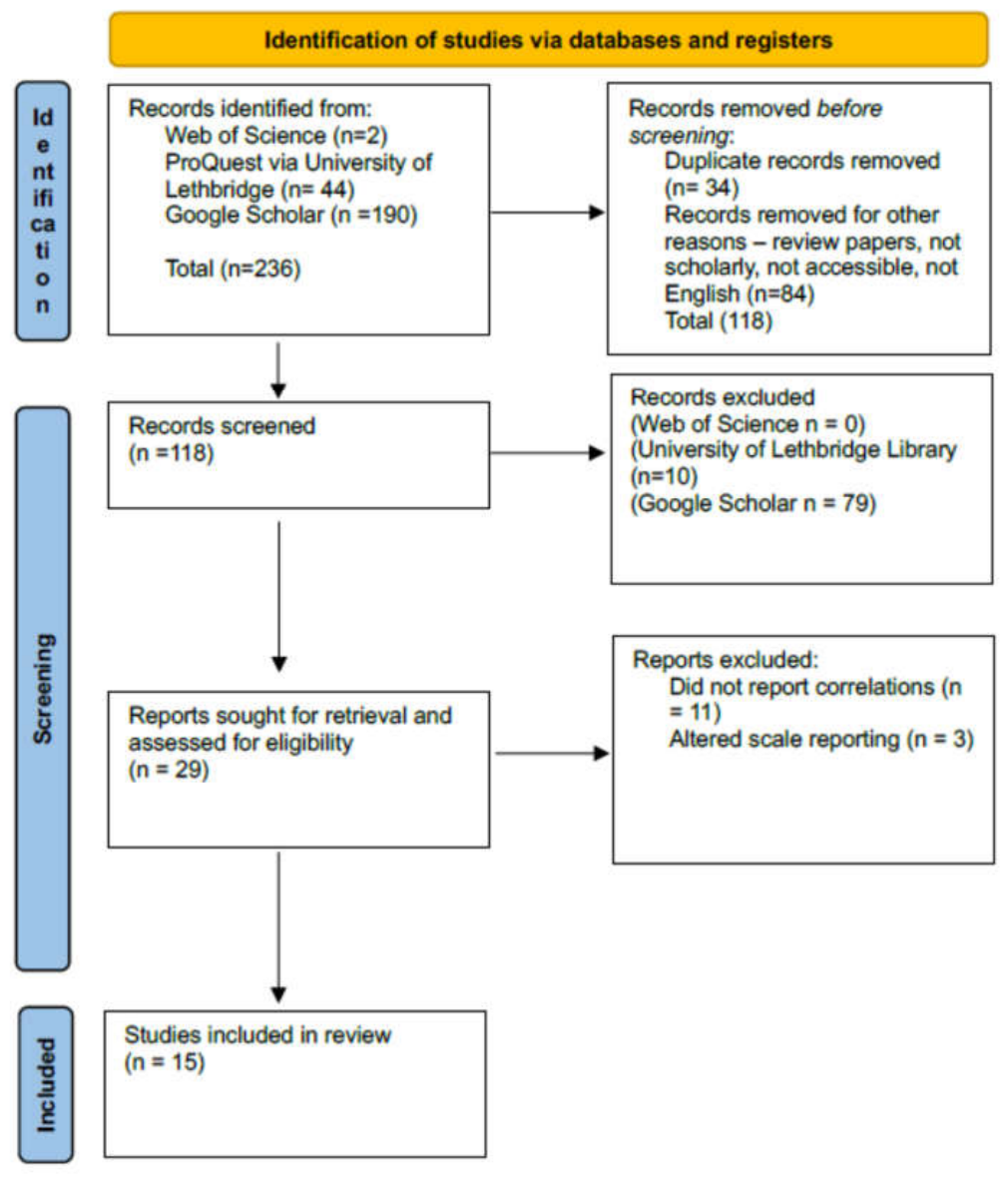
Table 1.
Existing self-report measures of self-directed speech and self-processes.
| Self-directed speech | Self-process |
| Internal Dialogical Activity Scale-Revised (IDAS-R)* | Self-Concept Clarity Scale (SCCS) |
| Varieties of Inner Speech Questionnaire (VISQ) | Five Facets Mindfulness Questionnaire (FFMQ) |
| Varieties of Inner Speech Questionnaire-R (VISQ-R) |
Mind Wandering Questionnaire (MWQ) |
| Self-Verbalization Questionnaire (SVQ) | Philadelphia Mindfulness Scale (PHLMS) |
| Automatic Thoughts Questionnaire-Revised (ATQ-R) | Self-Regulation Questionnaire (SRQ) |
| Self-Talk Scale (STS) | Self-Control Scale (SCS)* |
| Nevada Inner Experience Questionnaire (NIEQ)* | Rosenberg Self-Esteem Scale (RSES) |
| General Inner Speech Questionnaire (GISQ) | Integrative Self-knowledge Scale (ISKS)* |
| Inner Speech Scale (ISS) | Mentalization Scale (mentS)* |
| Functions of Dialogues-Revised (FUND-R) | Self-Consciousness Scale (SCS)* |
| Self-Consciousness Scale-Revised (SCS-R) | |
| Rumination-Reflection Questionnaire (RRQ) | |
| Theory of Mind Inventory (ToMI)* | |
| Levels of Self-Criticism Scale (LOSC)* | |
| Self-Reflection and Insight Scale (SRIS)* |
Table 2.
Correlations observed between various self-directed speech measures and the RSES. Notes: n = sample size; ATQ-R = Automatic Thoughts Questionnaire-Revised; STS = Self-Talk Scale; VISQ = Varieties of Inner Speech Questionnaire; VISQ-R = Varieties of Inner Speech Questionnaire-Revised; RSES = Rosenberg Self-Esteem Scale. 1 Both Alderson-Day et al. (2018) and Scherrer (2009) reverse-coded the RSES so that a high score signifies low self-esteem and vice-versa. Hence, the valence of correlations in both studies are also reversed.
Table 2.
Correlations observed between various self-directed speech measures and the RSES. Notes: n = sample size; ATQ-R = Automatic Thoughts Questionnaire-Revised; STS = Self-Talk Scale; VISQ = Varieties of Inner Speech Questionnaire; VISQ-R = Varieties of Inner Speech Questionnaire-Revised; RSES = Rosenberg Self-Esteem Scale. 1 Both Alderson-Day et al. (2018) and Scherrer (2009) reverse-coded the RSES so that a high score signifies low self-esteem and vice-versa. Hence, the valence of correlations in both studies are also reversed.
| Self-speech | Correlations with RSES | Study | p-value | n |
| VISQ | Dialogic = -.10 Evaluative = -.20* Other people = -.18* Condensed = -.02 |
Alderson-Day et al. (2014) | *p <.05 | 156 |
| VISQ-R | Dialogic = .05 Evaluative = .47*1 Other people = .19* Condensed = .03 Positive = -.151 |
Alderson-Day et al. (2018) | *p < .001 | 377 |
| STS | Social assessment = -.28** Self-criticism = .55** Self-reinforcement = .35** Self-management = -.15 |
Batarfi et al. (2022) | **p < .01 *p < .05 |
100 |
| STS | Social assessment = -.12* Self-criticism = .-26** Self-reinforcement = .16*** Self-management = .05 |
Brinthaupt et al. (2009) | *p < .05 **p < .01 ***p < .001 |
287 |
| STS | Social assessment = -.39** Self-criticism = -.50** Self-reinforcement = .37** Self-management = -.16 |
Camarasu (2020) | *p < .05 **p < .01 |
90 |
| STS | Social assessment = -.11* Self-criticism = -.12** Self-reinforcement = .06 Self-management = -.04 |
Uzman & Celik (2022) | p < .05 | 332 |
| ATQ-R | Positive = -.50** Negative = .55** |
Scherrer (2009) | *p < .05 **p <.01 |
26 |
Table 4.
Correlations observed between various self-directed speech and self-processes measures. Notes: n = sample size; GISQ = General Inner Speech Questionnaire; ISS = Inner Speech Scale; MWQ = Mind Wandering Questionnaire; RRQ = Rumination-Reflection Questionnaire; SCCS = Self-Concept Clarity Scale; SCS-R = Self-Consciousness Scale-Revised; STS = Self-Talk Scale; SVQ = Self-Verbalization Questionnaire; FUND-R = Functions of Dialogues-Revised Questionnaire.
Table 4.
Correlations observed between various self-directed speech and self-processes measures. Notes: n = sample size; GISQ = General Inner Speech Questionnaire; ISS = Inner Speech Scale; MWQ = Mind Wandering Questionnaire; RRQ = Rumination-Reflection Questionnaire; SCCS = Self-Concept Clarity Scale; SCS-R = Self-Consciousness Scale-Revised; STS = Self-Talk Scale; SVQ = Self-Verbalization Questionnaire; FUND-R = Functions of Dialogues-Revised Questionnaire.
| Self-speech | Self-process | Correlations | Study | p-value | n |
| STS | SCS-R | Private: - Total = .37*** - Social assessment = .35*** - Self-criticism = .24*** - Self-reinforcement = .28*** - Self-management = .34*** Public: - Total = .13* - Social assessment = .11 - Self-criticism = .11 - Self-reinforcement = .11 - Self-management = .10 |
Brinthaupt et al. (2009) | *p < .05 **p < .01 ***p < .001 |
287 |
| GISQ | SCS-R | - Total = .52* - Private = .47* - Public = .44* |
Racy et al. (2020) | p <.001* | 227 |
| VISQ | SCCS | - Dialogic = -.22* - Condensed = -.18 - Other People = -.19 - Evaluative/motivational = -.23* |
De Sousa et al. (2016) | *p < .05 |
80 |
| STS | SCCS | Social assessment = -.28* Self-reinforcement = .07 Self-criticism = -.37* Self-management = -.17* |
Racy & Morin (2024) | *p <.001 | 227 |
| GISQ | SCCS | -.25* | Racy & Morin (2024) | *p <.01 | 227 |
| ISS | SCCS | -.26* |
Schneider et al. (2005) | p < .01* | 200 |
| SVQ | SCCS | -.21* | Schneider et al. (2005) | p < .01* | 200 |
| FUND-R | RRQ | Rumination: - Analyzing = .12* - Bonding = .04 - Self-knowing = .10 - Fantasizing = .23*** - Ruminating = .36*** - Testing = .15** Reflection: - Analyzing = .42*** - Bonding = .17** - Self-knowing = .41*** - Fantasizing = .26*** - Ruminating = -.07 - Testing = .38*** |
Puchalska-Wasyl & Zarzycka (2023) | *** p <.001 **p <.01 *p <.05 |
341 |
| GISQ | RRQ | Rumination = .29* Reflection = .28* |
Racy et al. (2020) | *p < .001 | 227 |
| SVQ | RRQ | Rumination = .09 Reflection = .12* |
Uttl et al. (2011) | *p < .5 | 380 |
| STS | RRQ | Rumination = .26* Reflection = .26* |
Uttl et al. (2011) | *p < .5 | 380 |
| ISS | RRQ | Rumination = .31* Reflection = .40* |
Uttl et al. (2011) | *p < .5 | 380 |
| GISQ | MWQ | .23* | Racy et al. (2020) | *p < .001 | 227 |
| STS | MWQ | Social assessment = .26* Self-reinforcement = .02 Self-criticism = .22* Self-management = .18* |
Racy & Morin (2024) | *p <.001 | 227 |
| STS | SRQ | Social assessment = -.16* Self-reinforcement = .21 Self-criticism = -.14* Self-management = .01 |
Racy & Morin (2024) | *p <.001 | 227 |
| GISQ | SRQ | -.05 | Racy & Morin (2024) | Non-significant | 227 |
Disclaimer/Publisher’s Note: The statements, opinions and data contained in all publications are solely those of the individual author(s) and contributor(s) and not of MDPI and/or the editor(s). MDPI and/or the editor(s) disclaim responsibility for any injury to people or property resulting from any ideas, methods, instructions or products referred to in the content. |
© 2026 by the authors. Licensee MDPI, Basel, Switzerland. This article is an open access article distributed under the terms and conditions of the Creative Commons Attribution (CC BY) license (http://creativecommons.org/licenses/by/4.0/).
Copyright: This open access article is published under a Creative Commons CC BY 4.0 license, which permit the free download, distribution, and reuse, provided that the author and preprint are cited in any reuse.


