

Submitted:
29 June 2026
Posted:
30 June 2026
You are already at the latest version
Abstract
Background/Objectives:
Anti-PD(L)1 immune checkpoint inhibitors (ICI) provide durable responses in nearly 50% of patients with advanced Merkel cell carcinoma (MCC). However, for those progressing on first-line ICI, optimal subsequent therapy remains unclear. Although presumed to have limited benefit, the efficacy of rechallenge with anti-PD(L)1 alone has not been formally reported. We assessed real-world outcomes of patients within a Seattle-based MCC repository who received this salvage approach.
Methods:
Among 106 patients who received salvage therapy after first-line ICI progression, 16 underwent single-agent ICI monotherapy rechallenge during salvage. Patients progressing >3 months after their last immunotherapy dose were excluded. Outcomes included progression-free survival (PFS), disease-specific survival (DSS), and objective response rate (ORR).
Results:
The median time from end of first-line ICI to anti-PD(L)1 rechallenge was 51 days (IQR 22-92). Most patients switched between PD-1 and PD-L1 inhibitors (n=11), while others were rechallenged with the same agent (n=3) or a different PD-1 inhibitor (n=2). One of 16 patients experienced a partial response with the same PD-1 inhibitor (ORR 6%; 95% CI: 0.2-30%) at 3 months after rechallenge followed by progression 10 months after rechallenge. Median PFS was 2.2 months (95% CI: 1.3-5.1 months), and median DSS was 14.7 months (95% CI: 10.4-NR).
Conclusions:
These data suggest that rechallenge with anti-PD(L)1 monotherapy confers minimal and short-lived benefit in ICI-refractory MCC, reinforcing the need to develop alternative salvage strategies. Future trials for ICI-refractory MCC mandating an ICI-monotherapy arm are unlikely to be appealing to patients or physicians based on a low chance of clinical benefit for this approach.
Keywords:
immune checkpoint inhibitor
; immunotherapy
; neuroendocrine and adrenal tumor
; radiotherapy/radioimmunotherapy
; relapse
1. Introduction
Merkel cell carcinoma (MCC) is an uncommon and aggressive skin cancer associated with exposure to extensive ultraviolet light, advanced age, and immunosuppression. The incidence of MCC is approximately 3,200 new cases per year in the United States and rising [1]. In the United States, around 80% of MCCs are induced by the Merkel cell polyomavirus (MCPyV), and the remaining 20% arise exclusively from mutations from ultraviolet radiation [2]. Approximately 40% of MCC patients experience disease recurrence and patients with advanced disease typically require systemic therapy [3].
Prior to 2017, cytotoxic chemotherapy was first-line treatment for advanced MCC. Though chemotherapy induces a response in about 60% of patients, durability is typically short-lived. Only ~5% of patients experience continued benefit from chemotherapy at 1-2 years [4].
In 2017, the first anti-programmed death-ligand-1 (anti-PD-L-1) immune checkpoint inhibitor (ICI), avelumab, was approved for use in the United States by the FDA, followed by the approvals of pembrolizumab (anti-PD-1 in 2018) and retifanlimab (anti-PD-1 in 2023). Anti-PD(L)1-ICI quickly overtook chemotherapy as the preferred first-line treatment for advanced MCC, with durable responses in ~50% of patients with MCC at 2 years. Since the introduction of ICI, there has been a >2-fold increase in survival at the population level for advanced MCC [5].
However, for the 50% who progress on first-line ICI, multidisciplinary input for salvage strategies is essential because there is no clear second-line option for treatment once ICI resistance develops. Salvage options often involve a combination ICI (e.g., addition of a CTLA-4 inhibitor) and radiation or surgery based on the disease progression pattern. However, enrollment in a clinical trial if feasible is often preferred in this setting. Trials for ICI-refractory MCC often test whether a novel agent can augment an anti-PD(L)1 agent (e.g., the MATRiX trial testing an ATR inhibitor ± avelumab; NCT05947500) [6].
Although presumed to have limited benefit, the efficacy of rechallenge with anti-PD(L)1 monotherapy has not been formally reported for patients with ICI-refractory MCC. In order to better contextualize outcomes from combination therapy trials in ICI-refractory disease, it is important to understand the potential benefit attributable to anti-PD(L)1-ICI alone in this setting. Thus, we assessed real-world outcomes of ICI-refractory patients within a Seattle-based MCC repository who received this salvage approach.
2. Materials and Methods
In brief, this is a retrospective analysis of a Seattle-based MCC observational repository with an eligibility cutoff of August 16, 2024. The repository was re-queried on May 13, 2025 to update available follow-up and outcomes. This repository was approved by the Institutional Review Board at Fred Hutch Cancer Center (IRB #6585, Seattle, WA, USA). Eligible patients were those who had progressed during or after first-line ICI and received salvage for MCC. Full original study criteria are available in the previously published study [7]. For the present study, the cohort consisted of a subset of patients who received anti-PD(L)1 monotherapy rechallenge. These patients progressed either while receiving first-line anti-PD(L)1 or within 12 weeks of their last dose.
Details of interventional treatments starting from initiation of first-line ICI to last follow-up date were captured. Characteristics of treatments, including start and end dates and objective responses with corresponding dates were extracted. Each eligible patient also had their electronic medical record manually reviewed for quality control and to construct the case descriptions included in this study.
2.1. Statistical Analysis
Time 0 for all analyses was defined as the initiation date of anti-PD(L)1 monotherapy rechallenge. Outcomes were progression free survival (PFS), disease-specific survival (DSS), and objective response rate (ORR). Progression-free survival (PFS) was defined as the duration from initiation of ICI rechallenge until next PD or death from any cause. Disease-specific survival (DSS) was defined as the duration from initiation of ICI rechallenge until death from MCC. Attribution of death to MCC was determined using clinical records from Seattle and collaborating medical teams based on the treating physician’s determination of the cause of death. Cause of death was classified as due to MCC, non-MCC, or unknown. In the case of unknown cause of death, DSS was censored at the time of death (n=3). Overall response rate (ORR) was defined as the fraction of patients that experienced an objective response (PR or CR) after initiation of ICI rechallenge before next PD or death divided by the total number of evaluable patients.
All statistical analyses were conducted using R version 4.5.0 (R Foundation for Statistical Computing, Vienna, Austria). PFS and DSS probabilities were estimated using the Kaplan-Meier estimator. Median PFS and DSS were estimated as the time corresponding to a 50% event-free probability on the Kaplan-Meier curve.
3. Results
At study initiation, there were 1848 MCC patients in the Seattle MCC registry, of which 334 patients received ICI for MCC (Figure 1) [7]. From these 334 patients, 106 underwent at least one salvage therapy after progressing on first-line anti-PD(L)1, thus meeting original study inclusion criteria [7].
Among these 106 patients, 16 had progressed within 12 weeks of their last dose of first-line ICI and received single-agent anti-PD(L)1 rechallenge during their salvage therapy course. This subset was not separately analyzed in the initial study [7].The median time to rechallenge after progression on first-line anti-PD(L)1 ICI was 51 days [IQR 22–92]).
A swimmer plot summarizing the number of systemic treatments received preceding rechallenge, and the anti-PD(L)1 rechallenge course of these patients is depicted in Figure 2. A corresponding per-patient summary is available in Table 1.
Median PFS was 2.2 months (95% CI: 1.3-5.4), and median DSS was 14.7 months (95% CI: 10.4-NR) (Figure 3). Median follow-up time from ICI rechallenge initiation was 12.5 months (IQR 5-21). Most patients switched between PD-1 and PD-L1 inhibitors (8 PD-L1 to PD-1; 3 PD-1 to PD-L1); 3 were rechallenged with the same agent and 2 switched to a different PD-1 inhibitor.
One of 16 patients in this study experienced an objective response (ORR 6%, 95% CI: 0.2-30%; partial response with same PD-1 inhibitor) to single-agent anti-PD(L)1 rechallenge, with progression 6 months thereafter. This case is described below.
3.1. Patient #1 (Responder)
A man in his 60s who presented with stage IV MCC involving the thyroid and left inguinal and pelvic lymph nodes experienced a complete radiographic response after 7 months of first-line pembrolizumab. His course was complicated by immune-related inflammatory arthritis, which was well controlled with prednisone 10 mg daily. At month 11, while still receiving pembrolizumab and low-dose prednisone, his disease recurred in the thyroid, pelvic lymph nodes, and newly perirenal region. Because this occurred during concurrent immunosuppression rather than with fully intact antitumor immunity, his ICI-refractory designation should be interpreted with caution. Pembrolizumab was discontinued at month 12 with the development of immune-related pancreatitis, managed with high-dose prednisone (100 mg daily, tapered) and mycophenolate mofetil (1 g twice daily).
Pembrolizumab was restarted at month 20 (261 days after discontinuation), defining time 0 for rechallenge; immunosuppression had been de-escalated to prednisone 7.5 mg daily beforehand. The patient experienced a partial response at 3 months of rechallenge (month 23), but the disease progressed approximately 10 months into rechallenge (month 30). Pembrolizumab was continued while local salvage was pursued, including radiation to bilateral renal metastases (25 Gy in 5 fractions). Recurrent immune-related arthritis of the same and new joints required low-dose prednisone, methotrexate, and tocilizumab. Pembrolizumab was discontinued after approximately 18 months of rechallenge (month 38) due to a combination of disease progression and treatment-related adverse events.
4. Discussion
For patients with ICI-refractory MCC, there remains a large unmet need for effective second-line therapies following progression on anti-PD(L)1 agents. Multiple ongoing clinical trials aim to address this gap; however, many incorporate continued anti-PD(L)1 therapy as part of the treatment backbone. In this setting, it is important to delineate the contribution of the prior ICI, on which the patient has already progressed, versus the added investigational therapy. Careful interpretation is required to ensure that any observed clinical benefit is attributable to the novel agent or combination strategy, rather than residual or confounding effects of continued ICI therapy. In this cohort, outcomes were dismal for patients who underwent a single-agent anti-PD(L)1 monotherapy rechallenge salvage strategy. Only 1 of 16 patients experienced a transient ~3-month partial response upon anti-PD(L)1 only rechallenge, suggesting that this monotherapy salvage strategy confers minimal benefit in the ICI-refractory setting. It also suggests that this approach is not an attractive or feasible trial arm for randomization in future MCC trial designs.
ICI rechallenge is a rational strategy for “late progressors” (when progression occurs >3 months after cessation of therapy), but the logic is weaker when disease progresses while drug is still present [7,8,9]. Anti-PD-1 antibodies can persist on T cells for over two months, so progression within this window more likely reflects true ICI-resistance rather than a late progression [10]. Since the literature defines ICI resistance inconsistently, and including late progressors may inflate apparent rechallenge response rates, we required documented progression within 12 weeks of the last dose of PD-1 pathway blockade for inclusion.
ICI rechallenge has been previously evaluated across multiple solid tumors, with overall modest efficacy outside of select clinical contexts. A systematic review including 3,579 patients reported a pooled ORR of 18.4%, with higher response rates observed among patients who previously benefited from ICI and those with longer initial treatment durations, suggesting that retained immune sensitivity is a key predictor of response [11]. Consistent with this, retrospective data in metastatic renal cell carcinoma (RCC) demonstrated an ORR of 23% with rechallenge, with responses enriched among prior responders but still observed in a minority of patients overall [12]. Importantly, these ICI rechallenge studies included cases where the ICI rechallenge mechanism were different (e.g., CTLA-4 instead of PD-1 inhibition). In MCC, the addition of a CTLA-4 inhibitor to anti-PD(L)1 therapy has been associated with an ORR of ~30% [13]. Therefore, we believe that these numbers would be even lower had it been limited to the same mechanistic class of ICI as in our study.
Prospective evidence further limits enthusiasm for routine anti-PD(L)1 rechallenge following progression. In the phase 3 CONTACT-03 trial, continuation of PD-(L)1 blockade with atezolizumab in combination with cabozantinib did not improve progression-free or overall survival and increased toxicity compared to cabozantinib monotherapy in patients with RCC [14]. In contrast, higher response rates have been reported in melanoma patients rechallenged after prior disease control rather than progression (ORR 55%) [15]. Collectively, these data indicate that anti-PD(L)1 ICI monotherapy rechallenge has limited benefit in ICI-refractory disease, supporting the need for alternative salvage approaches.
The sole responder in our cohort highlights the complexity of defining and managing ICI-refractory MCC in the setting of significant immune-related toxicity and concurrent immunosuppression. Although the patient technically met criteria for ICI-refractory disease at the time of progression, this occurred while receiving also systemic immunosuppressive therapy for immune-related adverse events, which may have attenuated antitumor immune activity. Rechallenge with pembrolizumab resulted in a meaningful but transient partial response for ~10 months, suggesting that some degree of immune sensitivity was retained despite prior progression. However, the eventual disease progression and repeated immune-related adverse events in this patient spotlights the limited durability of benefit with ICI rechallenge in this context. Consistent with broader experience in ICI-refractory MCC, effective disease control ultimately required a multimodal salvage approach incorporating continued immunotherapy alongside localized treatments such as radiation, reflecting the need for multidisciplinary salvage strategies in this challenging population. As noted in prior studies, a combination of radiation with ICI as salvage has been associated with survival benefit [7,16].
4.1. Limitations of Study
There are several limitations to this study. Given the study’s retrospective design of a single-center observational database, it is subject to selection bias. As a high-volume specialty referral care center for Merkel cell carcinoma with ready access to specialized care, patients may experience quicker turnaround and benefitted from readily available multidisciplinary input; generalizing results beyond this setting should be performed with caution. Such high-volume centers have been associated with improved survival outcomes in national database studies [17].
Furthermore, the small sample size of patients who underwent anti-PD(L)1 monotherapy rechallenge (n=16) limits statistical power. It also restricts the ability to perform subgroup analyses to identify clinical or treatment-related factors associated with response, such as prior duration of benefit from first-line ICI or immune-related toxicity history. Therefore, the findings may not fully capture the heterogeneity in outcomes across different patient subsets.
5. Conclusions
These findings suggest that anti-PD(L)1 monotherapy rechallenge after progression on first-line anti-PD(L)1 therapy provides minimal clinical benefit in patients with ICI-refractory MCC, with responses being rare and generally short-lived. In this cohort, most patients experienced rapid disease progression despite retreatment, reinforcing the limited utility of this strategy once resistance to initial ICI therapy has developed. After progression on first-line ICI, changing single-agents within the same mechanistic class is not an adequate salvage strategy.
These results have implications for clinical practice and trial design. In the salvage setting, emphasis should shift towards alternative multidisciplinary approaches, including combination immunotherapy (e.g., addition of anti-CTLA-4), novel agents (e.g., ATR inhibition), and multimodal strategies (e.g., addition of radiation to ICI). Additionally, future clinical trials in ICI-refractory MCC should likely avoid inclusion of an ICI monotherapy control arm, as the low likelihood of meaningful benefit may limit both patient and clinician enthusiasm for enrollment.
Funding
Supported in part by the National Institutes of Health/National Cancer Institute, Maryland, USA, P01 CA225517 and P30 CA015704, the MCC Patient Gift Fund at UW, and the Kelsey Dickson Team Science Courage Research Award: Advancing New Therapies for Merkel Cell Carcinoma (MCC). The funders had no role in the design of the study; in the collection, analyses, or interpretation of data; in the writing of the manuscript; or in the decision to publish the results.
Institutional Review Board Statement
The study protocol was reviewed and approved by the Institutional Review Board at Fred Hutch Cancer Center (FHCC IRB #6585, Seattle, WA, USA), ensuring compliance with the Helsinki Declaration’s ethical principles. All patients provided written informed consent before study entry.
Informed Consent Statement
Informed consent was obtained from all subjects involved in the study.
Data Availability Statement
The data underlying this article will be shared on reasonable request to the corresponding author.
Acknowledgments
We thank the patients for participating in this study and the support of the MC3 Institute.
Conflicts of Interest
PC reports no competing interests. YZ reports no competing interests. DH reports research funding from GE Healthcare, outside the submitted work. RB reports no competing interests. TA reports no competing interests. EH has received research funding (Institution) from Bristol Myers Squibb, NiKang Therapeutics, Neoleukin Therapeutics, Pfizer, ImCheck Therapeutics, Replimune, AstraZeneca, Gilead, Immunocore, Cullinan Oncology, Kezar Life Sciences, Consulting fees – Eisai Co. PN has served as a consultant for EMD Serono, Merck, and Sanofi/Regeneron; his institution has received research funding from Bristol-Myers Squibb and EMD Serono.
References
- Paulson, K.G.; Park, S.Y.; Vandeven, N.A.; Lachance, K.; Thomas, H.; Chapuis, A.G.; Harms, K.L.; Thompson, J.A.; Bhatia, S.; Stang, A.; et al. Merkel cell carcinoma: Current US incidence and projected increases based on changing demographics. J. Am. Acad. Dermatol. 2018, 78, 457–463.e452. [Google Scholar] [CrossRef] [PubMed]
- Feng, H.; Shuda, M.; Chang, Y.; Moore, P.S. Clonal integration of a polyomavirus in human Merkel cell carcinoma. Science 2008, 319, 1096–1100. [Google Scholar] [CrossRef] [PubMed]
- McEvoy, A.M.; Lachance, K.; Hippe, D.S.; Cahill, K.; Moshiri, Y.; Lewis, C.W.; Singh, N.; Park, S.Y.; Thuesmunn, Z.; Cook, M.M.; et al. Recurrence and Mortality Risk of Merkel Cell Carcinoma by Cancer Stage and Time From Diagnosis. JAMA Dermatol. 2022, 158, 382–389. [Google Scholar] [CrossRef] [PubMed]
- Iyer, J.G.; Blom, A.; Doumani, R.; Lewis, C.; Tarabadkar, E.S.; Anderson, A.; Ma, C.; Bestick, A.; Parvathaneni, U.; Bhatia, S.; et al. Response rates and durability of chemotherapy among 62 patients with metastatic Merkel cell carcinoma. Cancer Med. 2016, 5, 2294–2301. [Google Scholar] [CrossRef] [PubMed]
- Paulson, K.G.; Park, S.Y.; Bhatia, S.; Hippe, D.S.; Nghiem, P. Improved survival at the population level for patients with advanced Merkel cell carcinoma following availability of immunotherapy. J. Am. Acad. Dermatol. 2025, 93, 89–94. [Google Scholar] [CrossRef] [PubMed]
- Bhakuni, R.; Hall, E.T.; Gooley, T.; Mowery, Y.M.; Ansstas, G.; Brohl, A.S.; Burgess, M.A.; Dimitrova, M.; Gao, L.; In, G.K.; et al. MATRiX: A randomized phase II trial of tuvusertib (ATR inhibitor) with or without avelumab in advanced anti-PD(L)-1 refractory Merkel cell carcinoma. J. Clin. Oncol. 2026, 44, LBA9514–LBA9514. [Google Scholar] [CrossRef]
- Ch’en, P.Y.; Zhang, Y.; Hippe, D.S.; Akaike, T.; Miller, N.J.; Church, C.; Lachance, K.; Finberg, A.; Gooley, T.; Hall, E.; et al. Real-world outcomes of patients receiving salvage therapies for immune checkpoint inhibitor-resistant Merkel cell carcinoma: a rationale for future clinical trials. J. Immunother. Cancer 2025, 13. [Google Scholar] [CrossRef] [PubMed]
- Kluger, H.; Barrett, J.C.; Gainor, J.F.; Hamid, O.; Hurwitz, M.; LaVallee, T.; Moss, R.A.; Zappasodi, R.; Sullivan, R.J.; Tawbi, H.; et al. Society for Immunotherapy of Cancer (SITC) consensus definitions for resistance to combinations of immune checkpoint inhibitors. J. Immunother. Cancer 2023, 11. [Google Scholar] [CrossRef] [PubMed]
- Kluger, H.M.; Tawbi, H.A.; Ascierto, M.L.; Bowden, M.; Callahan, M.K.; Cha, E.; Chen, H.X.; Drake, C.G.; Feltquate, D.M.; Ferris, R.L.; et al. Defining tumor resistance to PD-1 pathway blockade: recommendations from the first meeting of the SITC Immunotherapy Resistance Taskforce. J. Immunother. Cancer 2020, 8. [Google Scholar] [CrossRef] [PubMed]
- Brahmer, J.R.; Drake, C.G.; Wollner, I.; Powderly, J.D.; Picus, J.; Sharfman, W.H.; Stankevich, E.; Pons, A.; Salay, T.M.; McMiller, T.L.; et al. Phase I study of single-agent anti-programmed death-1 (MDX-1106) in refractory solid tumors: safety, clinical activity, pharmacodynamics, and immunologic correlates. J. Clin. Oncol. 2010, 28, 3167–3175. [Google Scholar] [CrossRef] [PubMed]
- Abushukair, H.M.; Al-Kraimeen, L.M.; Saeed, A. Predictors of response to immune checkpoint inhibitors (ICI) rechallenge post-disease progression in solid tumors: A systematic review and meta-analyses. J. Clin. Oncol. 2022, 40, 2612–2612. [Google Scholar] [CrossRef]
- Ravi, P.; Mantia, C.; Su, C.; Sorenson, K.; Elhag, D.; Rathi, N.; Bakouny, Z.; Agarwal, N.; Zakharia, Y.; Costello, B.A.; et al. Evaluation of the Safety and Efficacy of Immunotherapy Rechallenge in Patients With Renal Cell Carcinoma. JAMA Oncol. 2020, 6, 1606–1610. [Google Scholar] [CrossRef] [PubMed]
- Akaike, T.; Jabbour, A.J.; Goff, P.H.; Park, S.Y.; Bhatia, S.; Nghiem, P. Merkel cell carcinoma refractory to anti-PD(L)1: utility of adding ipilimumab for salvage therapy. J. Immunother. Cancer 2024, 12. [Google Scholar] [CrossRef] [PubMed]
- Pal, S.K.; Albiges, L.; Tomczak, P.; Suárez, C.; Voss, M.H.; de Velasco, G.; Chahoud, J.; Mochalova, A.; Procopio, G.; Mahammedi, H.; et al. Atezolizumab plus cabozantinib versus cabozantinib monotherapy for patients with renal cell carcinoma after progression with previous immune checkpoint inhibitor treatment (CONTACT-03): a multicentre, randomised, open-label, phase 3 trial. Lancet 2023, 402, 185–195. [Google Scholar] [CrossRef] [PubMed]
- Nardin, C.; Hennemann, A.; Diallo, K.; Funck-Brentano, E.; Puzenat, E.; Heidelberger, V.; Jeudy, G.; Samimi, M.; Lesage, C.; Boussemart, L.; et al. Efficacy of immune checkpoint inhibitor (ICI) rechallenge in advanced melanoma patients responders to a first course of ICI: A multicenter, national, retrospective study of the French group of skin cancers (GCC). J. Clin. Oncol. 2022, 40, 9529–9529. [Google Scholar] [CrossRef]
- Alam, R.; Menon, A.A.; Ch’en, P.Y.; Jabbour, A.J.; Gooley, T.A.; Hippe, D.S.; Bhakuni, R.; Miller, N.; Lachance, K.; Park, S.Y.; et al. Clinical benefit of adding radiation for immune checkpoint inhibitor-refractory Merkel cell carcinoma: A 27-patient analysis. J. Invest Dermatol. 2026. [Google Scholar] [CrossRef] [PubMed]
- Cheraghlou, S.; Agogo, G.O.; Girardi, M. The impact of facility characteristics on Merkel cell carcinoma outcomes: A retrospective cohort study. J. Am. Acad. Dermatol. 2023, 89, 70–80. [Google Scholar] [CrossRef] [PubMed]
Figure 1.
Flow chart of patient cohort selection.
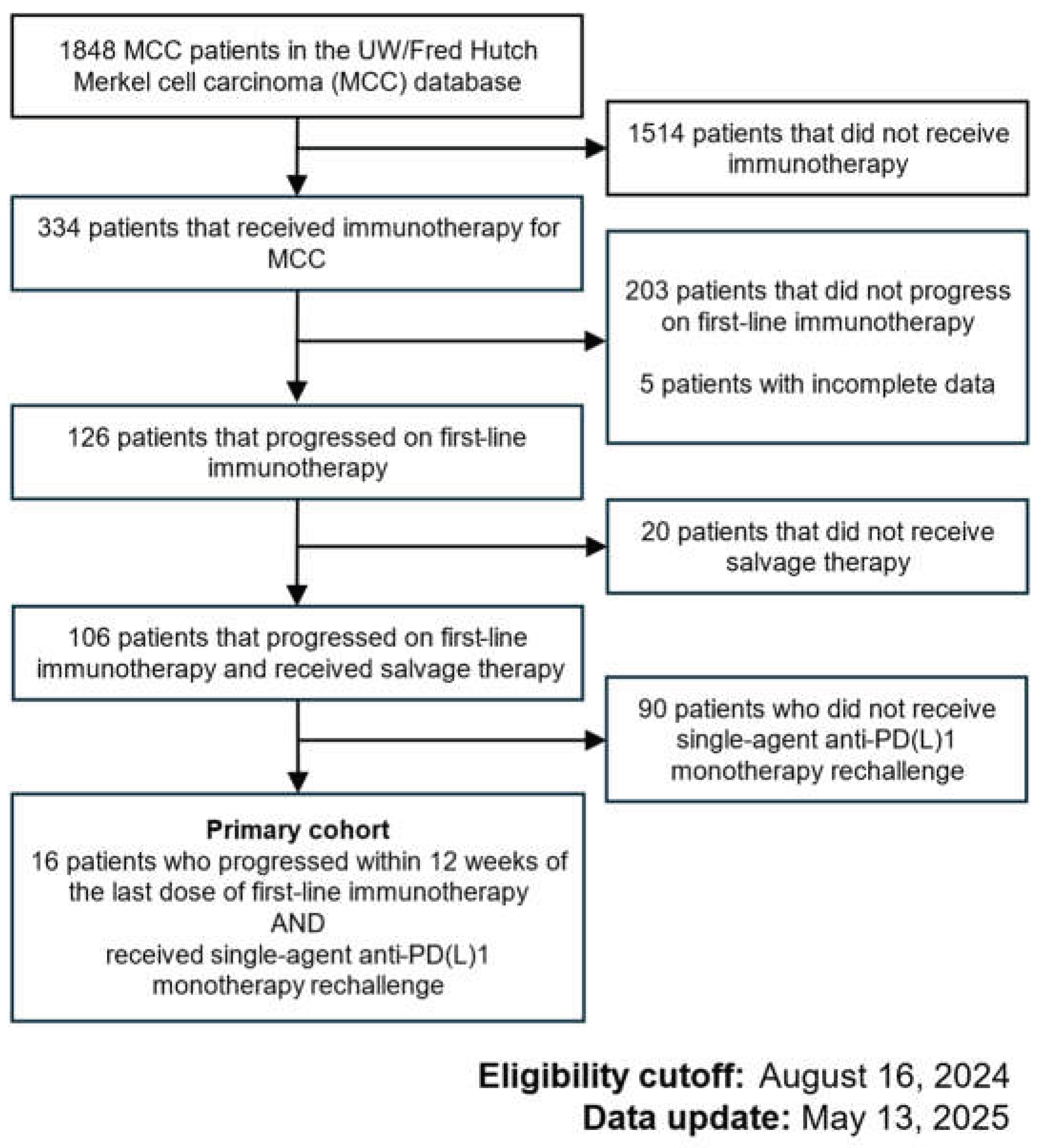
Figure 2.
Swimmer plot of 16 patients who received anti-PD(L)1 ICI monotherapy rechallenge following progression on anti-PD(L)1 ICI, ordered by duration of benefit and time to progression.
Figure 2.
Swimmer plot of 16 patients who received anti-PD(L)1 ICI monotherapy rechallenge following progression on anti-PD(L)1 ICI, ordered by duration of benefit and time to progression.
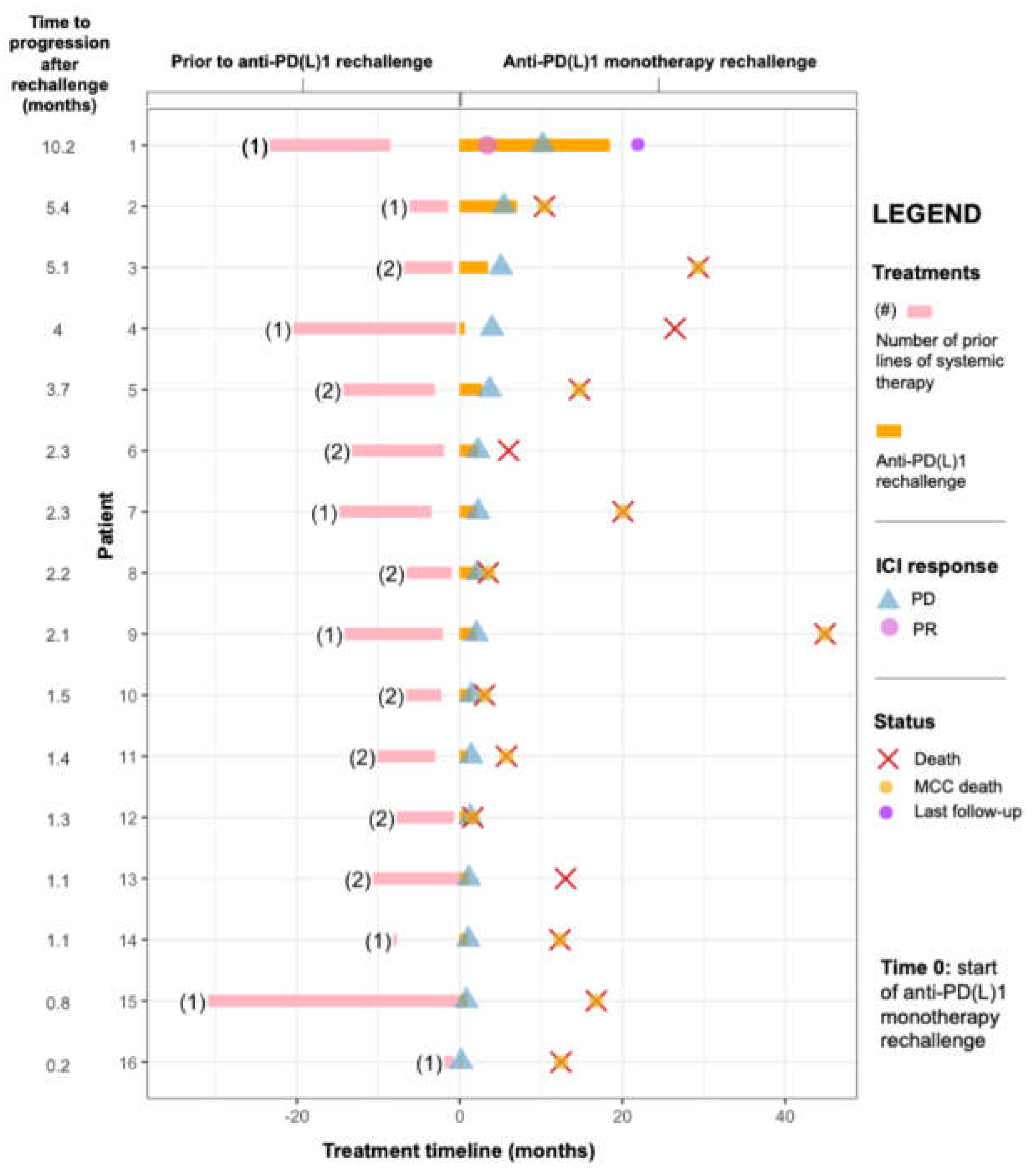
Figure 3.
Survival outcomes of patients receiving anti-PD(L)1 rechallenge, time 0: rechallenge start.
Figure 3.
Survival outcomes of patients receiving anti-PD(L)1 rechallenge, time 0: rechallenge start.
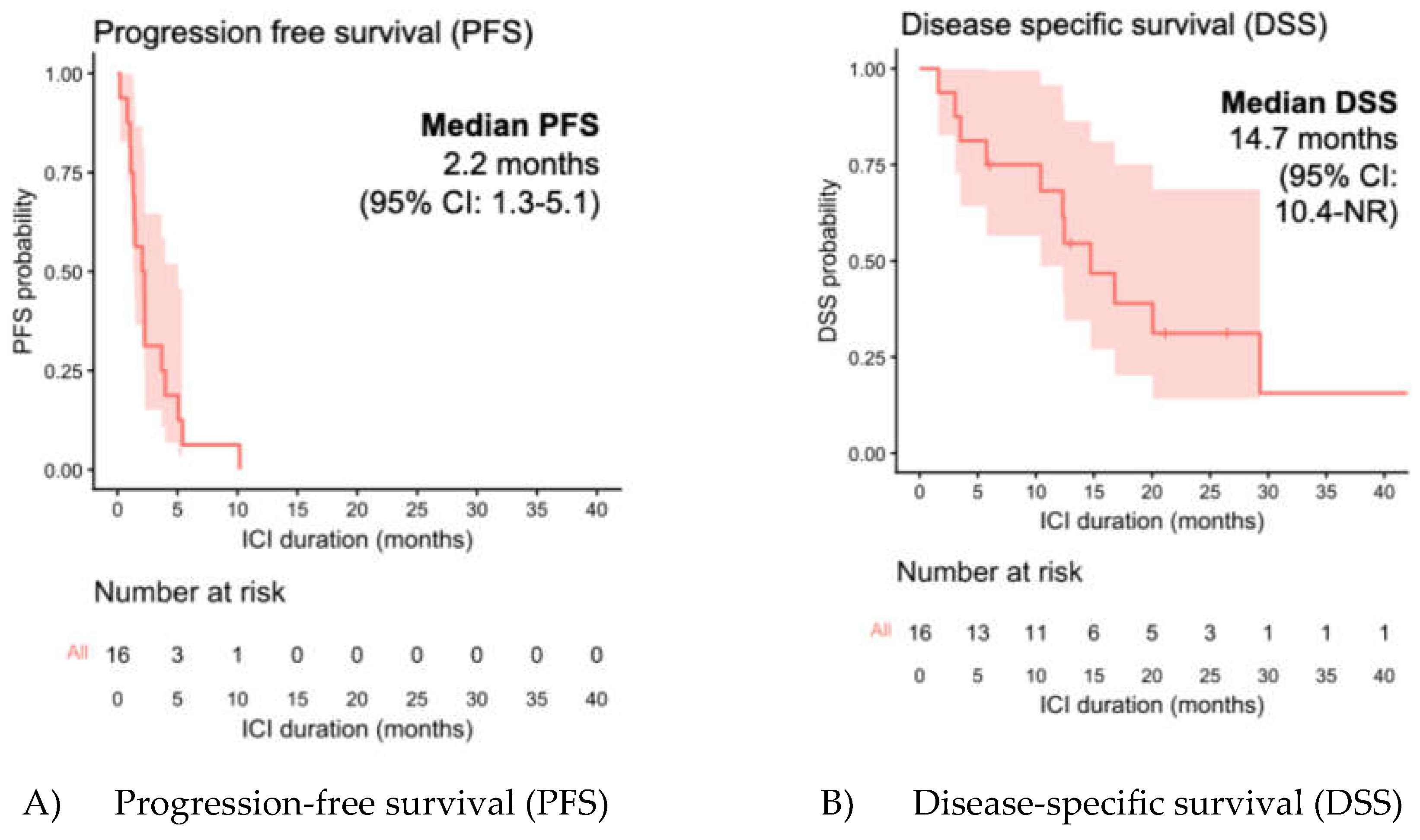

Table 1.
Summary table of 16 patients with MCC who received anti-PD(L)1 rechallenge after progression.
Table 1.
Summary table of 16 patients with MCC who received anti-PD(L)1 rechallenge after progression.
| Patient ID | Age/sex at ICI rechallenge | Anti-PD(L)1 ICI agent | ICI duration (months) | 1st ICI best response | Time to rechallenge from last ICI dose (days) | Anti-PD(L)1 mechanism change? | ICI rechallenge agent | ICI rechallenge duration (months) | ICI rechallenge best response |
|---|---|---|---|---|---|---|---|---|---|
| 1 | 70M | Pembrolizumab | 15 | CR | 261 | PD-1 → PD-1 (no change) | Pembrolizumab | 18 | PR: 6 months |
| 2 | 76F | Pembrolizumab | 4 | PD | 43 | PD-1 → PD-L1 | Avelumab | 7 | PD |
| 3 | 76F | Pembrolizumab | 2 | PD | 26 | PD-1 → PD-1 (no change) | Pembrolizumab | 3 | PD |
| 4 | 59M | Avelumab | 20 | PR | 12 | PD-L1 → PD-1 | Pembrolizumab | 0, 1 dose | PD |
| 5 | 73M | Pembrolizumab | 9 | PR | 93 | PD-1 → PD-1 (no change) | Nivolumab | 2 | PD |
| 6 | 73F | Atezolizumab | 6 | SD | 58 | PD-L1 → PD-1 | Pembrolizumab | 2 | PD |
| 7 | 71F | Pembrolizumab | 11 | PD | 105 | PD-1 → PD-1 (no change) | Pembrolizumab | 2 | PD |
| 8 | 67M | Avelumab | 0 | PD | 30 | PD-L1 → PD-1 | Nivolumab | 2 | PD |
| 9 | 60F | Nivolumab | 12 | CR | 62 | PD-1 → PD-1 (no change) | Pembrolizumab | 2 | PD |
| 10 | 83F | Avelumab | 1 | PD | 69 | PD-L1 → PD-1 | Pembrolizumab | 1 | PD |
| 11 | 71M | Avelumab | 1 | PD | 92 | PD-L1 → PD-1 | Pembrolizumab | 1 | PD |
| 12 | 71M | Pembrolizumab | 2 | PD | 21 | PD-1 → PD-1 (no change) | Pembrolizumab | 1 | PD |
| 13 | 62F | Avelumab | 7 | PD | 0 | PD-L1 → PD-L1 | Avelumab | 1 | PD |
| 14 | 23F | Nivolumab | 0 | PD | 234 | PD-1 → PD-L1 | Avelumab | 1 | PD |
| 15 | 73M | Pembrolizumab | 31 | PR | 0 | PD-1 → PD-L1 | Avelumab | 1 | PD |
| 16 | 46M | Avelumab | 1 | PD | 22 | PD-L1 → PD-1 | Nivolumab | 0, 1 dose | PD |
Disclaimer/Publisher’s Note: The statements, opinions and data contained in all publications are solely those of the individual author(s) and contributor(s) and not of MDPI and/or the editor(s). MDPI and/or the editor(s) disclaim responsibility for any injury to people or property resulting from any ideas, methods, instructions or products referred to in the content. |
© 2026 by the authors. Licensee MDPI, Basel, Switzerland. This article is an open access article distributed under the terms and conditions of the Creative Commons Attribution (CC BY) license (http://creativecommons.org/licenses/by/4.0/).
Copyright: This open access article is published under a Creative Commons CC BY 4.0 license, which permit the free download, distribution, and reuse, provided that the author and preprint are cited in any reuse.


