
Submitted:
29 June 2026
Posted:
29 June 2026
You are already at the latest version
Abstract
In this paper, a numerical method was used to study the dielectric recovery characteristics underwater discharge. The Keller-Miksis equation was used to study the bubble evolution, considering the internal thermodynamic parameters. The temperature and pressure inside the bubble was estimated the second breakdown voltage. The calculated results showed the precise values for second breakdown voltage and recovery time. The second breakdown voltage was determined by the variation in internal temperature and pressure in gradual expansion-contraction stage, as well as in the initial collapse stage. The calculated voltages were in good agreement with the experimental results. The viscosity has effect on the recovery time, the lower viscosity results in a considerably shorter recovery time, while surface tension has little effect.
Keywords:
dielectric recovery
; underwater discharge
; numerical method
; viscosity
; surface tension
1. Introduction
In recent years, with the rapid development of pulsed power technology, the controllability and reliability of liquid pulsed discharge have been significantly improved. As a liquid dielectric medium, dielectric characteristic of water relies on the high-density uniformity of its physical properties. Bubbles generated during the discharge process form “air gap defects” in water, which destroy the uniformity of the water medium [1,2,3,4]. Due to the low insulation strength of gases, bubbles become the weak link in the entire insulation system. Even at post-breakdown, residual bubbles remain in water for a long time, thereby impeding the complete dielectric recovery.
Research on underwater discharge has been conducted on several key aspects, including the pre-discharge, breakdown, shock wave propagation, bubble pulsation, and dielectric recovery processes [5,6,7,8,9].Among these physical processes, bubble pulsation acts as the dominant factor governing the post-breakdown dielectric recovery of water, since the low-density vapor inside the bubble significantly reduces the breakdown strength of the gap. Dielectric recovery characteristics—including dielectric recovery voltage and recovery time—are critical parameters for evaluating the self-recovery performance of the medium, and exert a significant influence on repetitive-frequency underwater discharge [10]. Studies have shown that the duration of bubbles (or density variations) typically spans several milliseconds, whereas the lifetime of discharge plasma is merely a few microseconds.
Extensive studies have been carried out on the dynamic characteristics of cavitation bubbles from both experimental and numerical perspectives, laying a solid theoretical foundation for this work. Ma et al.[11] studied how different boundaries affect spark bubble dynamics, revealing the effects of shape and distance on bubble behavior . Li et al. [12] linked bubble pulsation periods to their maximum size, noting the influence of electrode structure .In terms of liquid physical property effects, Luo et al. [13]generated cavitation bubbles via spark discharge combined with high-speed photography and pressure measurement, and found that elevated viscosity prolongs the collapse period of cavitation bubbles, increases the rebound radius, and alters the energy distribution of bubbles. Based on the Gilmore equation and VOF model, Sami et al. [14] conducted numerical simulations of cavitation bubble growth and collapse near a rigid wall, finding that surface tension has no significant effect on bubble collapse. Zhang et al[15]. established a unified bubble dynamics theory considering multiple physical factors, which improved the prediction accuracy of bubble migration and collapse pressure pulses compared with previous models. These studies have well established the effects of boundary conditions, electrode geometry, and liquid properties on cavitation bubble dynamics; however, most were not coupled with dielectric recovery analysis for underwater discharge gaps.
As a core component of pulsed power modulators, liquid dielectric switches directly determine the operational stability. The systematic investigation into water post-breakdown phenomena was pioneered by Xiao et al. [16], who first characterized the plasma afterglow, shock wave emission, and millisecond-scale vapor bubble evolution in micro-gap water switches using Schlieren imaging and pulse-probe techniques. Experimental studies concerning density variation and dielectric recovery in high-pressure CO₂have been previously reported by Yang et al. [17].They clarified two distinct recovery mechanisms dominated by bubble pulsation and density relaxation respectively, and confirmed that the supercritical phase has shorter recovery time and higher steady-state recovery rate. For water media, They obtained the three-stage law of dielectric recovery through double-pulse method, and divided the recovery process into complete recovery, second oscillation bubble effect and first oscillation bubble effect, directly confirming that bubble pulsation is the core factor determining the dielectric recovery process of water. Our team has previously conducted experimental studies on the bubble pulsation and dielectric recovery characteristics of underwater discharge [18]. Using the double-pulse method, we obtained the variation law of the second breakdown voltage with bubble pulsation. Furthermore, we simulated and analyzed the bubble pulsation process using a modified Rayleigh-Plesset (R-P) model, and investigated the influence of internal bubble pressure on the second breakdown voltage under isothermal conditions[19]. However, the simplified R-P model has limited accuracy in describing the liquid compressibility effect, especially in the collapse stage where the bubble wall velocity approaches the sound speed, and the isothermal assumption also deviates from the actual situation of dramatic temperature rise inside the bubble during collapse. In addition, the existing research has not systematically revealed the quantitative regulation law of key liquid physical parameters such as viscosity and surface tension on the dielectric recovery process.
Currently, a more sophisticated model is required to analyze the key influencing factors of bubble pulsation and dielectric recovery. Specifically, it is necessary to simulate and calculate the second breakdown voltage during the bubble collapse stage while considering the temperature change inside the bubble. To address the above research gaps,we established the Keller-Miksis equation to describe bubble pulsation,which can more accurately characterize the liquid compressibility effect in the strong collapse stage of bubbles. On this basis, we analyzed the changes in internal bubble pressure and temperature from the maximum radius to the initial collapse stage, and calculated the second breakdown voltage in initial collapse stage by introducing a temperature-corrected Paschen’s law. Additionally, the effect of viscosity and surface tension on the recovery time was further considered. The quantitative influence laws of viscosity and surface tension on bubble pulsation characteristics and dielectric recovery time are clarified respectively. This study proposes a dielectric recovery characteristic model for underwater discharge, providing a simulation basis for investigating the influencing factors of repetitive-frequency underwater discharge.
2. Brief Describe of Experiment
This study follows the previous work based on the bubble evolution simulation perspective, and describes related experimental investigations. To validate the model, the experimental data are obtained from pulsed power discharges in water implemented by a magnetic pulse compression (MPC) circuit. The experimental setup employs stainless steel sphere-to-sphere electrodes with a fixed gap of 0.05mm. The water quality parameters include the following: density of water =1000, surface tension coefficientσ= 0.0728 N/m, viscosityμis 0.001 Pa·s, temperature of water is 293 K, ambient pressure = 0.1 MPa. More technical details can be found in references [18,19].
The measured results of the bubble shape are presented in Figure 1. The whole process of first bubble pulsation lasted approximately 770μs. As can be seen in Figure 1, from initiation to 145μs, the bubble changed rapid expansion, as indicated by the red line; and from 145μs to 600μs , the bubble changed gradually from expansion to contraction, as indicated by the blue line; while in the collapse stage; from 600 μs to 770 μs, the bubble exhibited drastic changes in radius and velocity. During the collapse stage, compared with last collapse-rebound stage (from 700μs to 770μs ), the changes in bubble radius and velocity are much slower in the initial collapse stage (from 600μs to 700μs). The initial collapse stage is indicated by the purple line, and the last collapse-rebound stage is indicated by the green line, as shown in Figure 1.
3. Model Construction and Validation
3.1. Model Assumption
In order to focus on bubble pulsation and dielectric recovery, the theoretical model is based on the following assumptions: (1) The bubble is a symmetric sphere. (2) The effects of gravity are negligible. (3) The vapor inside the bubble is an ideal gas. (4) The water is regards as compressible medium.
3.2. Model of Cavitation Bubble
In this paper, the Keller-Miksis equation is used to establish bubble model for describing bubble pulsation in compressible medium. The equation is expressed as follows[20],
Where, μ is the viscosity of water, σ is surface tension, both the two parameters vary the internal pressure, maintain bubble expansion and affect the bubble radius.
This paper uses a theoretical model that accounts for the bubble internal temperature T distribution. The bubble internal pressure and temperature are expressed as [21,22],
The symbols in the equations are defined as follows: is the vapor pressure inside the bubble, is the rate of change of the vapor pressure inside the bubble with respect to time, is the vapor temperature inside the bubble, is the rate of change of the vapor temperature inside the bubble with respect to time, is the specific gas constant of water vapor,andis the net condensation rate (mass flux) per unit area per unit time. is the adiabatic index of the vapor, is the non-equilibrium interphase mass transfer efficiency coefficient, and is the ambient temperature of the liquid in the far field.
3.3. Solution Method
The computational model employed in this study to characterize the bubble pulsation process is centered on the K-M equation. Combined with the governing formulas for the variations of internal pressure and temperature inside the bubble as well as gas-liquid mass transfer, it constitutes a set of strongly nonlinear and multi-physics coupled equations.
On account of the rapid motion of the bubble wall and the interactive effects of multiple physical factors including surface tension and viscosity involved in the equations, no analytical solution can be acquired via direct derivation. Thus, numerical calculation is adopted to resolve the temporal evolution of the bubble radius, motion velocity, internal pressure and internal temperature.
The fourth-order Runge-Kutta algorithm is selected in this paper to solve the above coupled equations. This algorithm boasts high computational accuracy and stability in addressing transient dynamic problems such as bubble evolution, and can precisely reproduce the variation patterns throughout the whole process of bubble expansion and contraction. In the calculation process, the viscosity and surface tension of water, as critical physical parameters, are directly introduced into the K-M equation for computation, with their effects fully incorporated into the solution of bubble motion.
3.4. Bubble Model Validation
Based on the established numerical model of cavitation bubble, we traced the evolution of first bubble pulsation, and plotted the bubble radius and bubble velocity in Figure 2. The model results agree well with the experimental values.
Figure 3 showed the calculation results of internal pressure and temperature in the bubble. The pressure and temperature changed very small from 145 μs to 600 μs, and bubble temperature is almost equal to ambient temperature of water (293 K); while the pressure and temperature increased drastically in the initial collapse. The calculated pressure and temperature inside the bubble provide support for the calculation of the second breakdown voltage in section 3.4.
3.5. Calculation of Second Breakdown Voltage and Validation
In our previous paper[19], we employ the bubble-triggering mechanism to explain the second breakdown, especially in gradual expansion-contraction. It is assumed that the temperature inside the bubble is equal to the ambient water temperature, i.e., the breakdown occurs under isothermal conditions. Subsequently, we utilize the empirical formula of Paschen’s law to obtain the variation law between the second breakdown voltage and the pressure inside the bubble in gradual expansion-contraction. In this paper, we improve the empirical formula of Paschen’s law and correlate the second breakdown voltage with the temperature and pressure inside the bubble.
Core calculation formula for breakdown voltage:
Gas number density correction formula (adapted for sealed bubble):
Where is the vapor pressure inside the bubble, is the vapor temperature inside the bubble,as stated before, d is the interelectrode distance, A is the ionization correlation coefficient, B is the ionization cross-section correlation coefficient, γ is the secondary emission coefficient (the yield of electrons from positive ion impact on the cathode, which is normally on the order of ), represents the Boltzmann constant, with a value of ,εi is the ionization potential (12.62eV), σ is the ionization cross section [24].
The second breakdown voltage is mainly determined by pressure and temperature inside the bubble. Considering the gap distance was fixed at 0.05 mm in the experiment, the second breakdown voltage was calculated as a function of time delay based on equation (4)-(7), and plotted as square in Figure 4.
Figure 4 compares the measured breakdown voltage with the calculation from different theoretical models. The measured experimental data (blue line) exhibit a U-shaped profile. In gradual expansion stage (145μs-390μs), a slight reduction in pressure lead to a decrease in the breakdown voltage; when bubble reach the maximum radius, bubble becomes to gradual contraction stage (390μs-600μs), the breakdown voltage increases slightly as the bubble pressure rises.
As shown in Figure 4, the temperature-dependent model (purple line) captures this U-shaped profile reasonably well. While the calculated voltage in the isothermal model (red line) is much lower than the one in temperature variation in the initial collapse stage (600μs-700μs), and the bubble temperature change from 322.5 K to 389.4 K.
This differences between the two model can be explained as following, as the temperature rises for a sealed bubble, the thermal motion of vapor molecules becomes intense, and the frequency of electron-molecule collisions increases significantly. The energy of electrons is frequently consumed during these collisions, the density of high-energy electrons (energy≥gas ionization energy) is insufficient to trigger a sustained avalanche. Therefore, a higher voltage needs to be applied to increase the electric field strength, forcing electrons to accelerate to the ionization threshold. As a result, the breakdown voltage increases as bubble temperature rises.
The paper calculated the second breakdown voltage in the first bubble pulsation, including the gradual expansion-contraction stage and initial collapse stage. While in the last collapse-rebound stage, the bubble morphology is significantly effected by the electrode structure[25], meanwhile, the shockwave and water jet have a significant impact on the temperature and pressure in the bubble[26]. Therefore, the final collapse–rebound stage is not considered in the calculation.
4. The Effect of Water Quality Parameters on Bubble Pulsation
At post breakdown, the recovery time is mainly determined by the first and second bubble pulsation[18]. Given that the evolution of bubble dynamics is intrinsically coupled with the thermodynamic properties of the surrounding liquid medium, it is imperative to quantitatively evaluate the sensitivity of these parameters. Among these, viscosityμand surface tensionσare the two dominant factors that directly participate in the damping term and driving pressure term of the K-M equation (Eq. 1).
This section aims to investigate the individual effects of viscosity and surface tension on bubble pulsation. By isolating these variables, we seek to clarify how they modulate the energy dissipation process of the bubble wall and subsequently influence the dielectric recovery time, thereby providing theoretical guidance for optimizing the repetition rate of underwater discharge devices through water quality regulation.
4.1. Effect of Viscosity on Bubble Pulsation
Three typical values are selected to investigate the variation of viscosity on bubble pulsation and dielectric recovery, namely 0.5 mPa·s, 1.002 mPa·s, and 3.0 mPa·s. As shown in Figure 5 (a) and (b), viscosity suppresses bubble pulsation. Under low viscosity (0.5 mPa·s), the bubble experiences the larger maximum radius (4.19 mm), and the shorter collapse time (768μs) , accompanied by the higher peak wall velocity. In contrast, high viscosity (3.0 mPa·s) strongly damps the motion, resulting in reduced pulsation amplitude, a gentler collapse, and lower velocity peaks. The viscosity dissipates the kinetic energy of bubble motion and impedes interface movement.
4.2. The Effect of Surface Tension on Bubble Pulsation
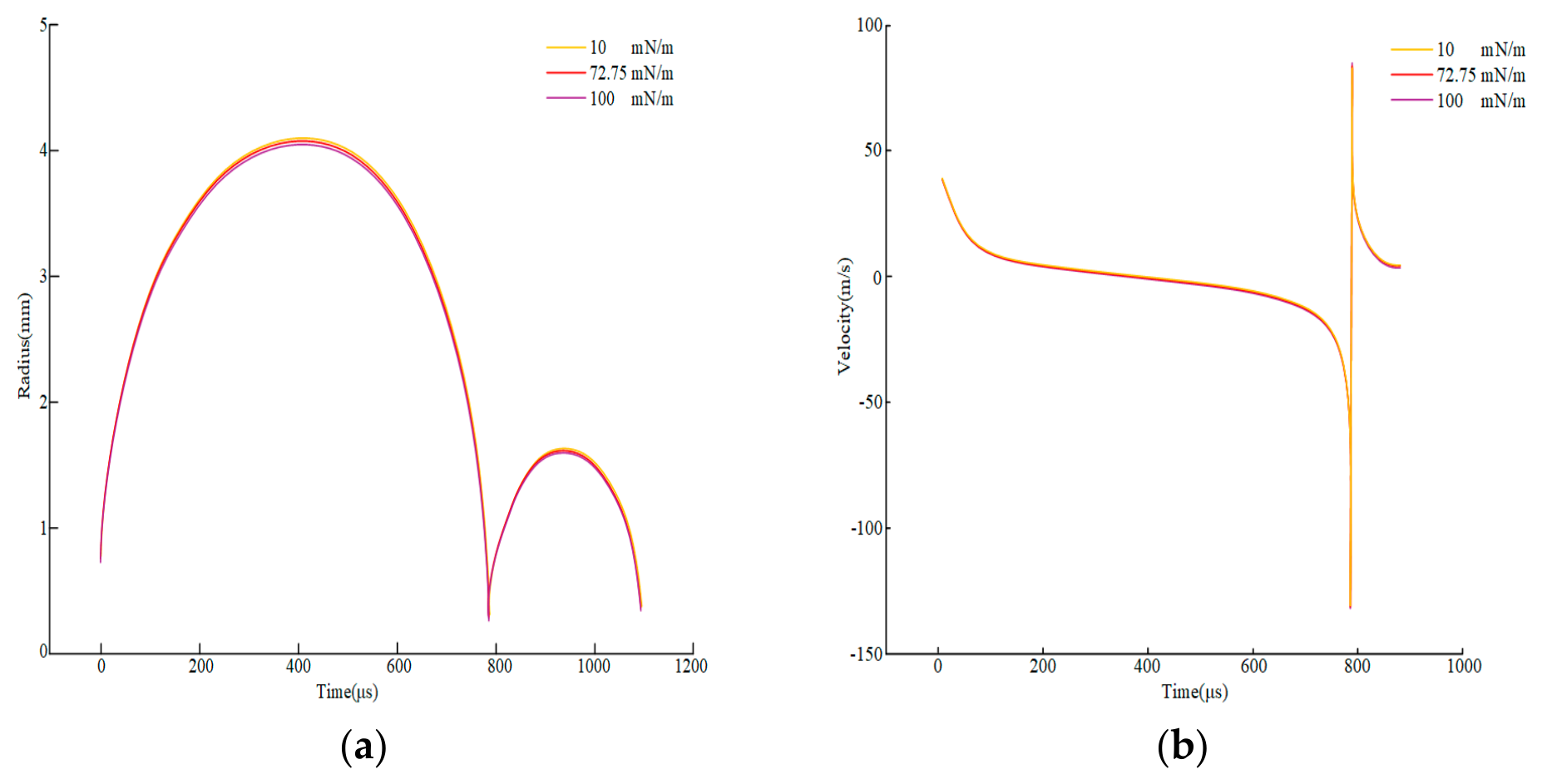
As shown in Figure 6(a), increasing the surface tension from 10 mN/m to 100 mN/m only slightly suppresses bubble expansion: the maximum radius of the first pulsation decreases from 4.15 mm to 4.09 mm,The first and second insulation recovery times of the three curves are almost identical. Regarding the bubble wall velocity (Figure 6(b)), the three curves almost completely overlap during the expansion phase, showing only minor discrepancies at the first collapse peak and the initial stage of the second expansion: the maximum collapse velocity increases slightly from -130.21 m/s to -131.93 m/s, and the initial expansion velocity rises from 83.22 m/s to 84.94 m/s.
This phenomenon stems from the differing dominant force mechanisms during high-energy discharge in microgaps. The energy injected at the initial discharge stage is extremely high, causing fluid inertial forces to play an absolutely dominant role. In contrast, the constraining effect of surface tension on the interface becomes comparatively weak, making it difficult to effectively regulate the intense bubble motion. Meanwhile, the electrode boundaries within the confined space impose strong restrictions on bubble growth, further diminishing the influence of surface tension. Therefore, at the current research scale and energy level, surface tension is not a core factor governing the macroscopic bubble dynamics.
5. Conclusions
A numerical model of bubble evolution underwater discharge is established, and its effect on the dielectric recovery characteristics have been studied. The following results have been obtained.
- (1)
- The K-M model can describe the bubble dynamics, the results suggest that the calculated model could provide a precise value of dielectric recovery.
- (2)
- Compared to gradual expansion-contraction stage, the pressure and temperature in initial collapse stage increased dramatically. The dynamics variation of pressure and temperature determines the variation of the second breakdown voltage. The calculated second breakdown voltage is in good agreement with the measured value.
- (3)
- Different water quality parameters exhibit distinct effects on the dielectric recovery time. The viscosity significantly effect the recovery time—with lower viscosity leading to a considerably shorter recovery time. The surface tension has a negligible effect.
References
- Sun, A.; Huo, C.; Zhuang, J. Formation Mechanism of Streamer Discharges in Liquids: a Review. High Volt. 2016, 1, 74–80. [Google Scholar] [CrossRef]
- Wang, H.; Zhang, C.; Zhang, S.; Guo, K.; Shao, T. Electrohydraulic effect of microsecond pulsed discharge in transformer oils. High Volt. 2025, 10, 137–145. [Google Scholar] [CrossRef]
- Wen, X.; Yang, Y.; Zhou, Z.; Xu, G. Study on the vapor density of the residual spark channel generated by microsecond-pulsed underwater spark discharges. Aip Adv. 2025, 15, 085121. [Google Scholar] [CrossRef]
- Li, C.; Shao, J.; Li, Y.; Yu, Y. Simulation of the Streamer Propagation in the Transformer Oil with Bubbles. IEEE T. Dielect. El. In. 2024, 31, 1367–1375. [Google Scholar] [CrossRef]
- Akiyama, M.; Yang, Z.; Gnapowski, S.; Hamid, S.; Hosseini, R.; Akiyama, H. Observation of underwater streamer discharges produced by pulsed power using high-speed camera. IEEE T. Plasma Sci. 2014, 42, 3215–3220. [Google Scholar] [CrossRef]
- Oshita, D.; Hosseini, S. H. R.; Okuda, Y.; Miyamoto, Y.; Sakugawa, T.; Katsuki, S.; Akiyama, H. Time-Resolved High-Speed Visualization and Analysis of Underwater Shock Wave Focusing Generated by a Magnetic Pulse Compression Unit. IEEE T. Plasma Sci. 2012, 40, 2395–2400. [Google Scholar] [CrossRef]
- Akiyama, H.; Akiyama, M. Pulsed discharge plasmas in contact with water and their applications. IEEJ T. Electr. Electr. 2021, 16, 6–14. [Google Scholar]
- Li, S.; Zhang, A. M.; Han, R. Experimental and Numerical Study of Two Underwater Explosion Bubbles: Coalescence, Fragmentation and Shock Wave Emission. Ocean Eng. 2019, 190, 106414. [Google Scholar] [CrossRef]
- Zhao, Y.; Liu, Y.; Zhang, H.; Ren, Y.; Lin, F. Analysis of the bubble-pulsation process of underwater high current pulsed discharge. J. Appl. Phys. 2022, 131, 1–19. [Google Scholar] [CrossRef]
- Ruma; Lukes, P.; Aoki, N.; Spetlikova, E.; Hosseini, S. H. R.; Sakugawa, T.; Akiyama, H. Effects of pulse frequency of input power on the physical and chemical properties of pulsed streamer discharge plasmas in water. J. Phys. D. Appl. Phys. 2013, 46, 125202. [Google Scholar] [CrossRef]
- Ma, C.; Shi, D.; Li, C.; He, D.; Li, G.; Lu, K. Numerical study of the pulsation process of spark bubbles under three boundary conditions. J. Mar. Sci. Eng. 2021, 9, 619. [Google Scholar] [CrossRef]
- Li, N.; Huang, J.; Lei, K.; Chen, J.; Zhang, Q. The characteristic of the bubble generated by underwater high-voltage discharge. J. Electrostat. 2011, 69, 291–295. [Google Scholar] [CrossRef]
- Luo, J.; Fu, G.; Xu, W.; Zhai, Y.; Bai, L.; Li, J.; Qu, T. Experimental study on attenuation effect of liquid viscosity on shockwaves of cavitation bubbles collapse. Ultrason. Sonochem. 2024, 111, 107063. [Google Scholar] [CrossRef] [PubMed]
- Samiei, E.; Shams, M.; Ebrahimi, R. A novel numerical scheme for the investigation of surface tension effects on growth and collapse stages of cavitation bubbles. Eur. J. Mech. B-Fluid. 2011, 30, 41–50. [Google Scholar] [CrossRef]
- Zhang, A. M.; Li, S. M.; Cui, P.; Li, S.; Liu, Y. L. A Unified Theory for Bubble Dynamics. Phys. Fluids. 2023, 35, 033323. [Google Scholar] [CrossRef]
- Xiao, S.; Kolb, J.; Kono, S.; Katsuki, S.; Joshi, R. P.; Laroussi, M.; Schoenbach, K. H. High Power Water Switches: Postbreakdown Phenomena and Dielectric Recovery. IEEE T. Dielect. El. In. 2004, 11, 604–612. [Google Scholar] [CrossRef]
- Yang, Z. B.; Hosseini, S.H.R.; Kiyan, T.; Gnapowski, S.; Akiyama, H. Post-breakdown Dielectric Recovery Characteristics of High-pressure Liquid CO₂including Supercritical Phase. IEEE T. Dielect. El. In. 2014, 21, 1089–1094. [Google Scholar] [CrossRef]
- Yang, Z.; Cao, H.; Hao, J.; Hosano, H.; Katsuki, S.; Akiyama, H.; Zhang, C. Post-breakdown dielectric recovery characteristics of water for high repetitive switch. IEEE T. Dielect. El. In. 2020, 27, 909–914. [Google Scholar] [CrossRef]
- Yang, Z.; Li, H.; Yu, Y.; Wang, J. Numerical Study on the Effects of Cavitation Bubble Evolution on Dielectric Recovery Characteristics of Water. IEEE Acces 2026, 14, 49742–49749. [Google Scholar] [CrossRef]
- Geng, H.; Chen, T.; Chen, J.; Huang, B.; Wang, G. Temperature effects on single cavitation bubble dynamics under the free field condition: Experimental and theoretical investigations on water. Ultrason. Sonochem. 2025, 120, 107520. [Google Scholar] [CrossRef] [PubMed]
- Chen, J.; Chen, T.; Geng, H.; Huang, B.; Cao, Z. Investigation on dynamic characteristics and thermal effects of single cavitation bubble in liquid nitrogen. Phys. Fluids. 2024, 36. [Google Scholar] [CrossRef]
- Theofanous, T.; Biasi, L.; Isbin, H. S.; Fauske, H. A theoretical study on bubble growth in constant and time-dependent pressure fields. Chem. Eng. Sci. 1969, 24, 885. [Google Scholar] [CrossRef]
- Galli, G.; Hamrita, H.; Jammes, C.; Kirkpatrick, M. J.; Odic, E.; Dessante, P.; Molinie, P. Paschen’s law in extreme pressure and temperature conditions. IEEE T. Plasma Sci. 2019, 47, 1641–1647. [Google Scholar] [CrossRef]
- Yang, Y.; Cho, Y. L.; Fridman, A. Bubble and electronic initiation mechanism. In Plasma Discharge in Liquid: Water Treatment and Applications; CRC Press: Boca Raton, FL, USA, 2012; pp. 34–37. [Google Scholar]
- Zhao, J.; Bai, P.; Wang, J.; Wang, Y.; Cao, S. Dynamics of bubble collapse near rigid boundaries with different curvatures. Phys. Fluids. 2025, 37, 033302. [Google Scholar] [CrossRef]
- Akiyama, M.; Yang, Z.; Gnapowski, S.; Hosseini, S. H. R.; Akiyama, H. Observation of underwater streamer discharges produced by pulsed power using high-speed camera. IEEE T. Plasma Sci. 2014, 42, 3215–3220. [Google Scholar] [CrossRef]
Figure 1.
Temporal evolution of (a) bubble radius and (b) bubble velocity.
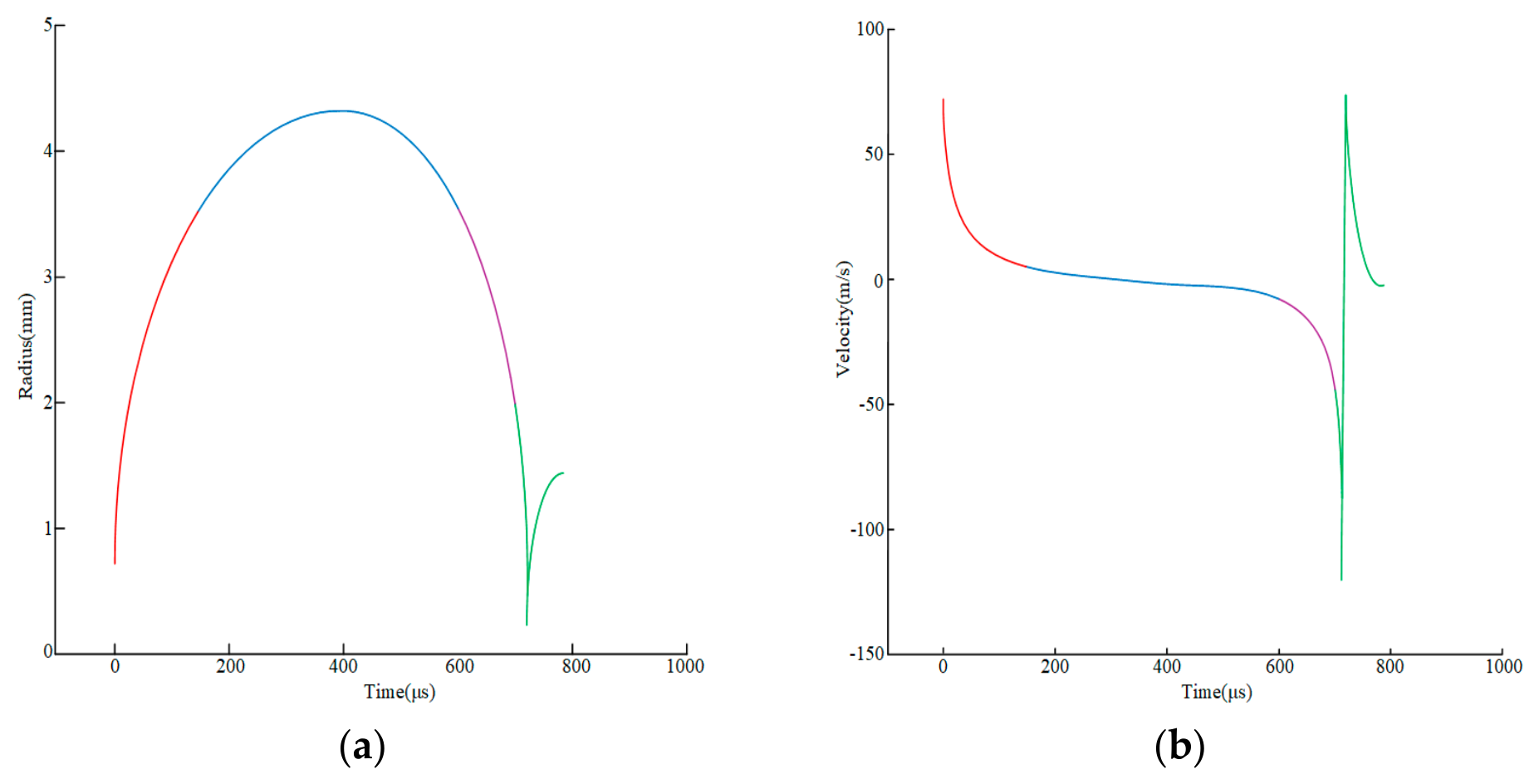
Figure 2.
Comparison between experiment and model, (a) bubble radius and (b) bubble velocity.
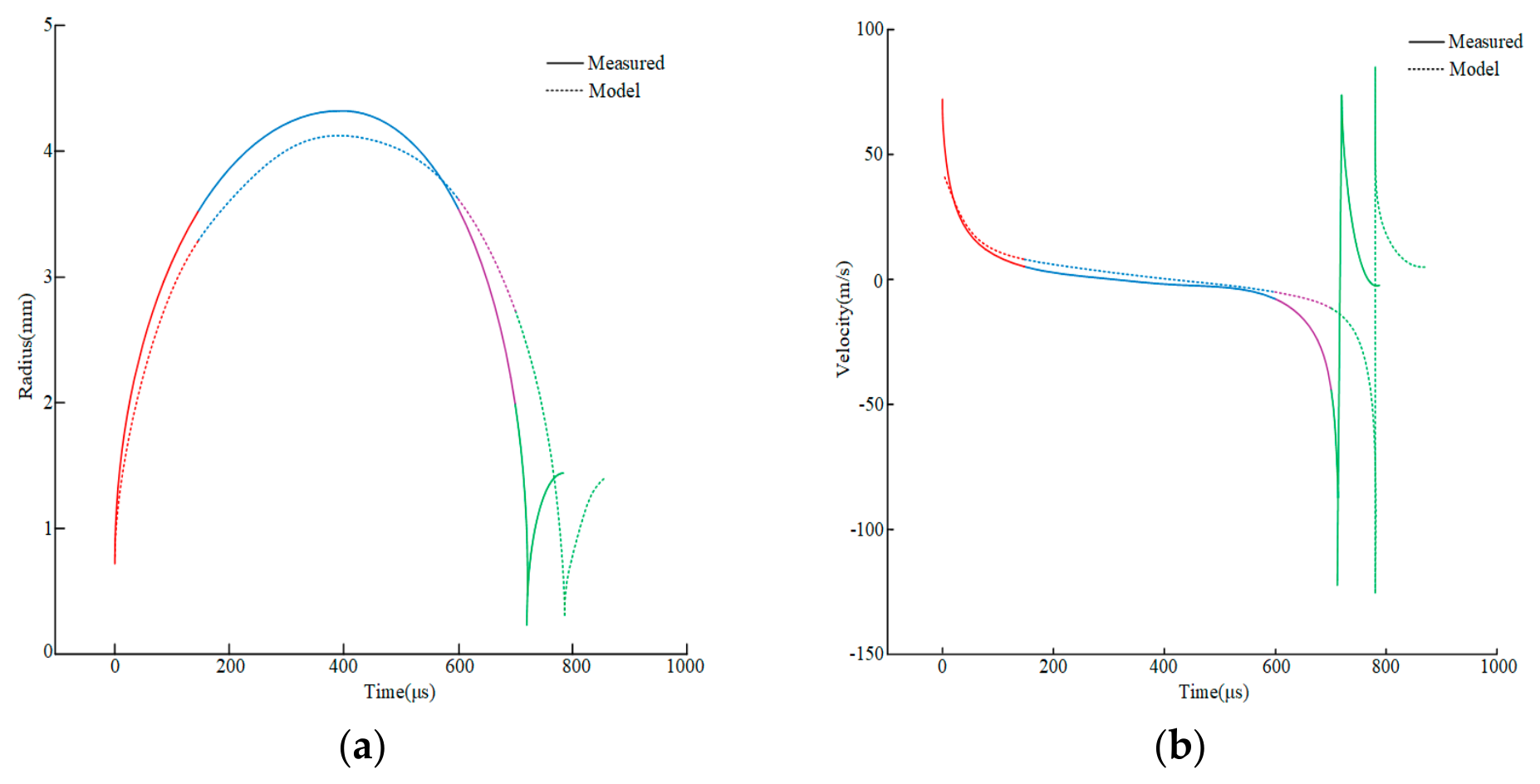
Figure 3.
Temporal evolution of pressure(a) and temperature (b) inside the bubble.
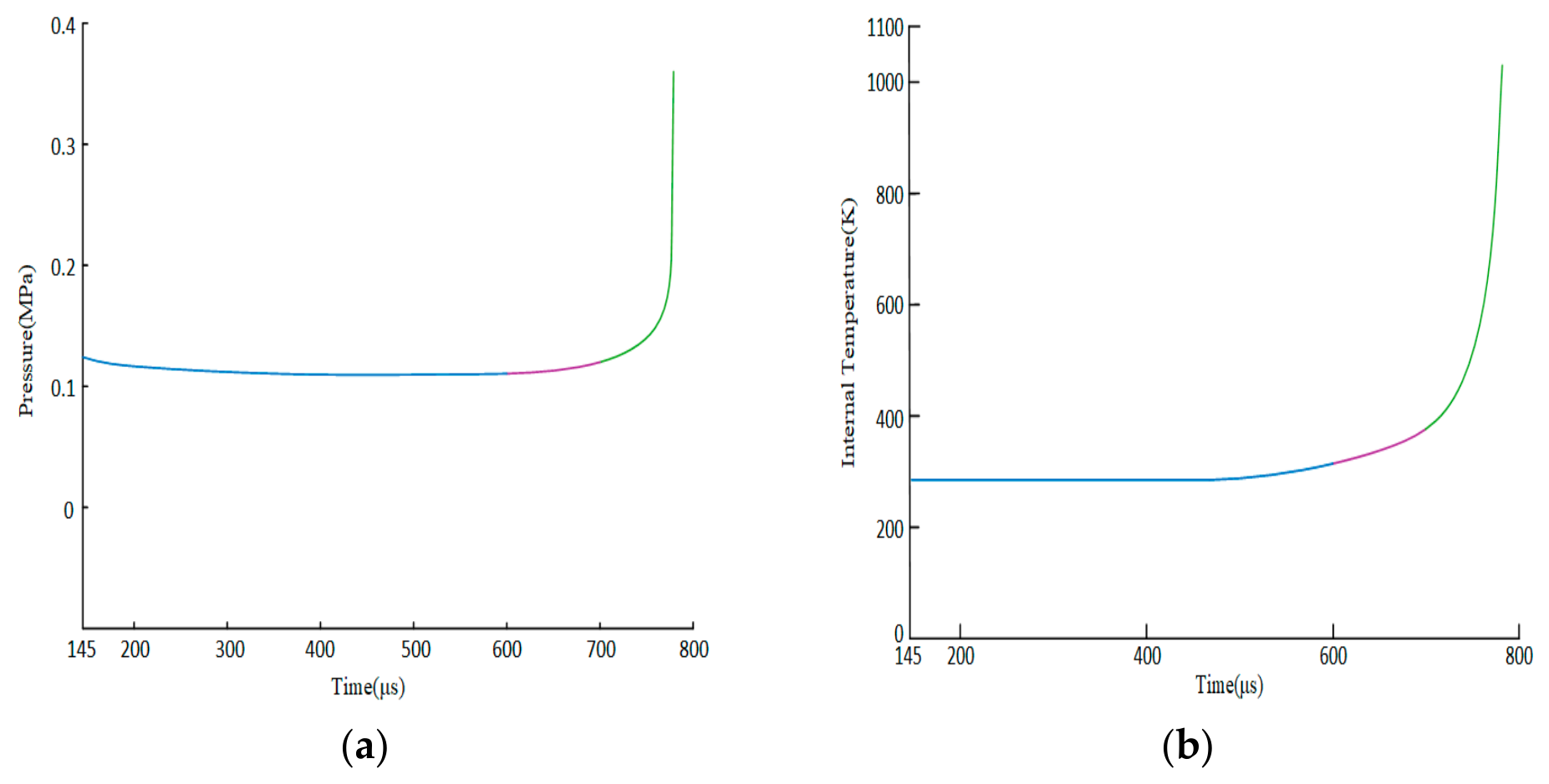
Figure 4.
Comparison of the calculated second breakdown and experimental values.
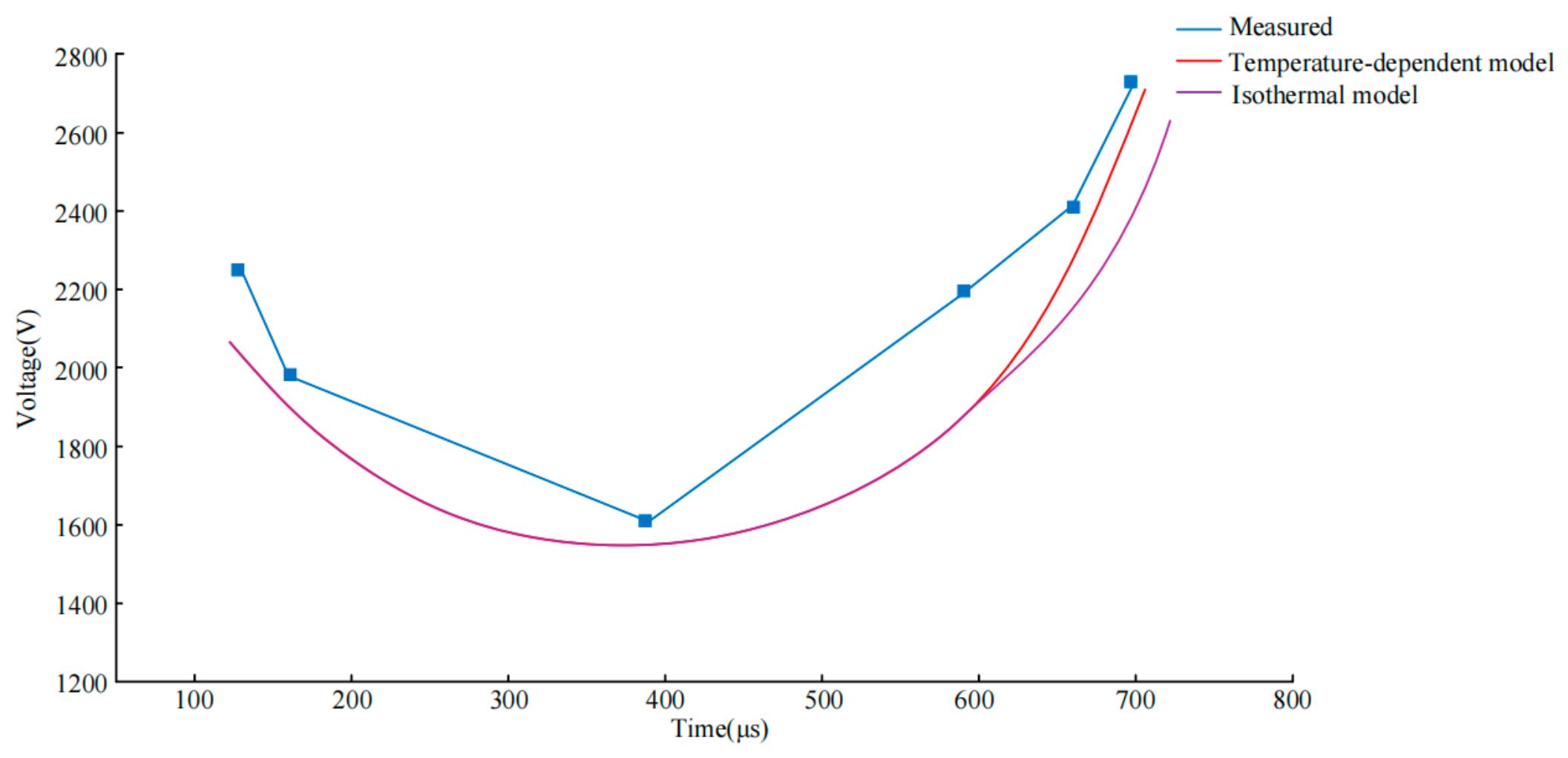
Figure 5.
Bubble radius evolution (a) and bubble wall velocity evolution (b) under different viscosities.
Figure 5.
Bubble radius evolution (a) and bubble wall velocity evolution (b) under different viscosities.
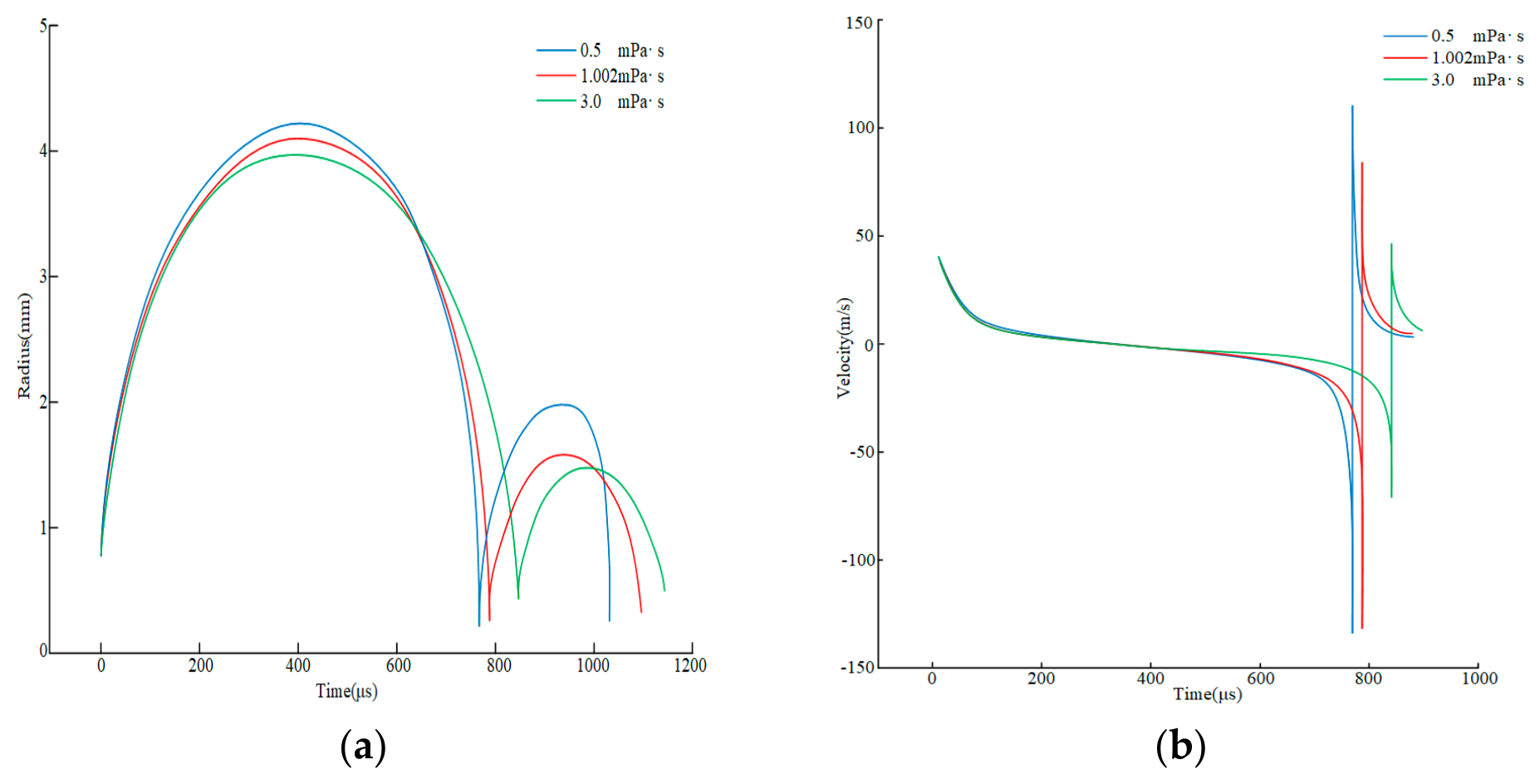
Figure 6.
Bubble radius evolution (a) and bubble wall velocity evolution (b) under different surface tension.
Figure 6.
Bubble radius evolution (a) and bubble wall velocity evolution (b) under different surface tension.
Disclaimer/Publisher’s Note: The statements, opinions and data contained in all publications are solely those of the individual author(s) and contributor(s) and not of MDPI and/or the editor(s). MDPI and/or the editor(s) disclaim responsibility for any injury to people or property resulting from any ideas, methods, instructions or products referred to in the content. |
© 2026 by the authors. Licensee MDPI, Basel, Switzerland. This article is an open access article distributed under the terms and conditions of the Creative Commons Attribution (CC BY) license (http://creativecommons.org/licenses/by/4.0/).
Copyright: This open access article is published under a Creative Commons CC BY 4.0 license, which permit the free download, distribution, and reuse, provided that the author and preprint are cited in any reuse.


