

Submitted:
29 June 2026
Posted:
29 June 2026
You are already at the latest version
Abstract
This paper investigates the use of parametric inverted chain models (ICMs) as pedagogical tools for teaching structural design to architecture students. A mixed-method action research study was conducted at the University of Belgrade – Faculty of Architecture through an educational intervention that integrated analog and digital form-finding within a learning-by-doing framework. The intervention combined physical hanging-chain models with computational simulations using Spider3D, a custom Grasshopper plugin developed for ICM simulation. Data collected through surveys, knowledge assessments, focus-group discussions, reflective journals, and instructor observations indicate that the approach improved students’ understanding of structural behavior, equilibrium forms, and the relationship between form and force. Participants reported increased confidence in structural reasoning, greater engagement with structural design concepts, and a stronger appreciation of structure as a generator of architectural form. The combination of physical and computational workflows enabled students to develop both intuitive and analytical perspectives on structural performance. The study demonstrates that parametric ICMs can function not only as form-finding tools but also as effective pedagogical instruments that support experiential learning, structural intuition, and creative exploration. The findings highlight the potential of integrating research-led digital tools into architectural education to strengthen the connection between structural design, computation, and creative practice.
Keywords:
architectural design
; structural design
; structural geometry
; form-finding
; parametric modelling
; inverted chain models
; spatial structures
; equilibrium forms
; catenary structures
; architectural education
; experiential learning
1. Introduction
Inverted chain models (ICMs) are well-established form-finding tools used in the design of funicular structures such as arches, vaults, domes, shells, and other form-active systems [1,2]. In these structures, geometry enables efficient load transfer, embodying the principle that form follows force [3,4]. Owing to their structural efficiency and reduced material consumption, funicular forms have gained renewed interest in contemporary sustainable construction.
The generation of such forms requires form-finding techniques, which differ fundamentally from conventional top-down design approaches. Rather than determining a structure for a predefined geometry, form-finding begins with boundary conditions, loads, and performance requirements and searches for an equilibrium shape [5]. This process often results in structurally efficient solutions that minimize material use while producing expressive architectural forms [6].
Among form-finding methods, ICMs are particularly valuable because they provide intuitive and rapid representations of equilibrium forms. Their educational potential has been demonstrated through numerous workshops and teaching experiments involving both physical and digital hanging models. Examples include the reconstruction of Gaudí’s hanging models by researchers from Stuttgart and Delft [7,8], multidisciplinary workshops at MIT exploring particle-spring systems [9], full-scale catenary experiments at the Oslo School of Architecture and Design [10], and various educational initiatives integrating analog and computational form-finding into architecture and engineering curricula [11,12,13,14,15,16].
Despite these developments, teaching structural design to architecture students remains challenging. Structural concepts are often taught analytically, which can limit students’ intuitive understanding of structural behavior and the relationship between form and force. Consequently, numerous educational approaches have been proposed to improve structural reasoning, engineering intuition, and student engagement [17,18,19].
This paper investigates the pedagogical value of teaching structural design through parametric ICMs within a learning-by-doing framework. By combining physical modeling and computational form-finding, students can directly explore the relationship between geometry, loads, and structural performance while developing both analytical and intuitive understanding of equilibrium forms [20,21].
To examine the educational potential of this approach, an action-research study was conducted in which a teaching intervention based on analog and digital ICMs was implemented and evaluated. The study addresses the following research questions:
- How does the use of ICMs affect students' understanding of structural principles?
- In what ways do ICMs enhance spatial and structural reasoning in architectural education? and
- What are students' perceptions of using analog and digital modelling tools?
Unlike educational studies that have primarily focused on either physical hanging models or digital form-finding tools, this research integrates analog and parametric inverted chain models within a research-led educational framework. The study contributes to the field by combining physical model-making, computational simulation through the Spider3D plugin, and reflective learning activities in a single pedagogical intervention. Furthermore, it evaluates the educational impact of this approach using a mixed-method action-research methodology, linking structural learning outcomes with contemporary theories of experiential, constructivist, and reflective learning. In doing so, the paper positions parametric ICMs not only as form-finding tools but also as instructional media for developing structural intuition, computational literacy, and form-active design thinking in architectural education.
2. Inverted Chain Models
2.1. Concept and Applications
The catenary, recognized as an optimal architectural form since ancient times, was mathematically defined in the 17th century. It is the equilibrium shape assumed by a perfectly flexible, uniform chain suspended under its own weight. The curve follows the principle of static equilibrium and minimum potential energy. After Jungis disproved Galileo’s claim that the curve was parabolic, Huygens introduced the term catenary in 1960, and Gregory formulated its mathematical equation in 1698 [22].
The development of thrust-line theory during 19th century provided a theoretical basis for understanding equilibrium forms in masonry structures theory [22,23,24,25], and graphic statics brought about new progress. Building on those advances, Milankovitch [26] developed a comprehensive theory of thrust lines for masonry arches [27], establishing foundations for the analysis and optimization of arches and vaults.
The principle of deriving compression structures from inverted hanging chains originated from Hooke's famous anagram of [28]. When inverted, a hanging chain forms an arch capable of carrying the corresponding load primary through compression. This principle was put into practice in the design and assessment of arches, vaults, domes, and shell structures and became one of the earliest form-finding methods in architecture. The use of catenary curves and thrust lines for shaping masonry structures is discussed extensively by Graefe [29] and Huerta [30].
A well-known example of the application of inverted chain models (ICMs) is the work of Gaudí [1,31,32]. Between 1888 and 1890, he employed a poly-funicular hanging model to design Colònia Güell crypt, using equilibrium models not only to verify structural stability but also to generate architectural form. The same principles are evident in the design of the Sagrada Familia (perhaps the most famous building designed using form-finding techniques), where structural geometry emerges directly from force distribution.
Physical form-finding techniques gained renewed importance during the twentieth century. Isler employed hanging models and other analog methods to generate highly efficient reinforced concrete shell structures with minimal thickness [2,17,33,34]. Similarly, Otto and the Institute of Lightweight Structures (IL) at the University of Stuttgart developed experimental form-finding approaches inspired by natural processes [35,36]. Otto regarded physical models as essential design instruments and frequently combined them with emerging computational methods. ICMs were used in projects such as the Multihalle Mannheim grid shell [37,38,39] and influenced later lightweight structures, including the Japan Pavilion for Expo 2000 [40].
Another important contributor was Sergio Musmeci, whose work emphasized the relationship between form and force as the basis of structural design [2]. Musmeci viewed physical models as tools for visualizing mathematical principles and anticipated a collaborative design process in which digital technologies would support human creativity [41,42].
From the late 20th century onward, advances in numerical methods and computer-aided design gradually shifted form-finding from physical to digital environments. Research focused on the development of methods such as the Force Density Method (FDM) [43,44], Dynamic Relaxation (DR) [45,46,47], and Particle-Spring (PS) systems [48]. These approaches enabled efficient simulation of equilibrium forms and provided designers with greater control over geometry, loading, and material behavior.
The digitalization of form-finding also stimulated the development of computational methods for masonry and shell structures. Heyman’s equilibrium principles [49] inspired approaches such as Thrust Network Analysis (TNA) [50] and the Thrust Surface Method [51], while researchers including Kilian [9], Rippmann et al. [52], and Piker [53] expanded computational form-finding tools for architectural design. As a result, form-finding has become increasingly accessible to architects, contributing to renewed interest in form-active structures and structurally informed design processes.
2.2. Techniques
ICMs used in the simulation of spatial structures may consist of individual chains or chain networks. By connecting discrete elements into a polygonal network and applying loads at nodes, curved equilibrium surfaces can be approximated. Form-finding techniques may be classified as analog or digital depending on the simulation medium.
2.2.1. Analog Techniques
Analog ICMs are physical models used to explore relationships between form and force. Typically constructed from chains, cable nets, textiles, or other flexible materials attached to rigid supports, they provide an intuitive and interactive means of investigating equilibrium forms [54]. Their primary value lies in enabling designers to directly observe the effects of boundary conditions, loading, and topology on structural behavior.
The construction of analog models is inherently iterative. Modifications to supports, element lengths, or topology affect the entire system, requiring repeated adjustments before a satisfactory equilibrium form is achieved. Although such models provide valuable insights into structural behavior and geometric relationships, they are labor-intensive to construct, difficult to measure accurately, and challenging to scale.
A further limitation is the absence of real-time information about internal forces during the form-finding process. Material properties, thickness variations, buckling effects, and nonlinear behavior can only be approximated, reducing the accuracy of physical simulations. Nevertheless, analog models remain valuable in conceptual design and education because they offer a tangible understanding of equilibrium, proportions, and spatial relationships that can later be refined through computational methods [9].
2.2.2. Digital Techniques
Digital form-finding techniques simulate the behavior of physical models through numerical methods, enabling more precise analysis and greater flexibility in manipulating geometry, loading conditions, and material properties. Their outputs can be directly integrated into structural analysis and digital fabrication workflows.
Methods commonly used for ICM simulations belong to two principal groups: geometric stiffness methods, such as the Force Density Method (FDM), and dynamic equilibrium methods, including Dynamic Relaxation (DR) and Particle-Spring (PS) systems. Among these, PS systems have become particularly popular because they provide efficient approximations of hanging-chain behavior while supporting interactive design exploration [48].
One of the earliest architectural tools based on the PS approach was CADenary, developed at MIT, which enabled interactive simulations of suspended equilibrium forms [9,48]. Since then, numerous tools have been developed within modeling environments such as Rhinoceros and Blender. Examples include Spider3D, Flexhopper, Gravity Shell, and Kangaroo Physics, which allow designers to generate, visualize, and modify equilibrium geometries in real time.
Among these tools, Kangaroo Physics is widely used in architectural practice and education because of its interactive simulation environment. Additional software, such as Millipede and Karamba3D, extends these workflows by enabling structural analysis and performance evaluation. Together, these digital tools facilitate the integration of form generation, structural assessment, and design optimization within a single computational environment.
2.3. Educational Foundations
The educational intervention presented in this study is grounded in learning theories that emphasize active participation, reflection, and knowledge construction through experience [55,56,57,58,59]. These perspectives are particularly relevant to architectural education, where learning often occurs through iterative processes of exploration, experimentation, and design.
One of the most influential frameworks is experiential learning theory, developed by David Kolb [55], which conceptualizes learning as a cyclical process consisting of concrete experience, reflective observation, abstract conceptualization, and active experimentation. Rather than acquiring knowledge through passive instruction, learners develop understanding by engaging directly with tasks and reflecting on the outcomes of their actions. The educational workflow implemented in this study closely follows this cycle. Students first constructed physical hanging-chain models (concrete experience), observed and evaluated their behavior (reflective observation), interpreted structural principles through digital simulations (abstract conceptualization), and subsequently refined their designs through iterative exploration (active experimentation).
The intervention is also informed by constructivist perspectives on learning, which view knowledge as actively constructed rather than transmitted. According to Piaget [56] and later constructivist scholars, learners develop understanding through interaction with physical and conceptual environments. In architectural education, this implies that structural concepts are more effectively understood when students engage directly with form, material, and behavior rather than solely through theoretical instruction. The use of physical and digital inverted chain models provides opportunities for students to construct their own understanding of equilibrium, force distribution, and structural performance through exploration and experimentation.
A closely related concept is Schön's theory of reflective practice [58], which emphasizes learning through action and reflection within design processes. Schön describes design as a reflective conversation with materials and representations, in which understanding emerges through iterative cycles of making, testing, and modifying. The form-finding exercises conducted in this study encouraged precisely such interactions. Students continuously adjusted support conditions, mesh topologies, and geometric parameters while evaluating the resulting equilibrium forms, thereby engaging in reflective design thinking.
The intervention also draws upon constructionist ideas proposed by Papert [59], who argued that learning is enhanced when learners create tangible artefacts that can be tested, discussed, and refined. Physical chain models, digital simulations, and design proposals functioned as learning artefacts through which students externalized and evaluated their understanding. The transition between analog and digital representations further strengthened this process by allowing students to compare different modes of representation and analysis.
Finally, recent research [60,61] in embodied cognition suggests that spatial and structural understanding can be enhanced through physical interaction with models and materials. In architectural education, tactile engagement with physical models has been shown to support the development of intuition regarding geometry, scale, proportion, and structural behavior. The combination of hands-on model making, and computational simulation employed in this study therefore provides complementary pathways for understanding complex structural phenomena.
Taken together, these theoretical perspectives suggest that learning structural design is most effective when students actively engage in cycles of making, observing, reflecting, and redesigning. The educational intervention presented in this paper applies these principles through the combined use of analog and digital form-finding tools, enabling students to develop both intuitive and analytical understandings of structural behavior.
3. Materials and Methods
This study employed a mixed-method action research approach to investigate the effectiveness of parametric inverted chain models (ICMs) as a pedagogical tool for teaching structural design to architecture students. Combining quantitative and qualitative methods enabled the assessment of both measurable learning outcomes and students’ subjective experiences, including engagement, conceptual understanding, and structural reasoning.
3.1. Participants
The study was conducted at the University of Belgrade – Faculty of Architecture (UBFA) and involved one postgraduate student enrolled in the course Design Theory and Practice and 30 undergraduate students enrolled in the elective course Form-finding of Spatial Structures. The undergraduate students were selected through purposive sampling to ensure that all participants had a foundational knowledge of architectural design and structural systems, while having limited prior exposure to physical or digital form-finding methods, particularly ICMs.
The nature and purpose of the research were explained to all students, and involvement in a data collection was voluntary. Consent was obtained in line with ethical research guidelines, and ethical approval for the study was granted by the UBFA Research Ethics Committee. All participants were assured of confidentiality, and their data were anonymized prior to analysis. Furthermore, students were informed that their academic performance would not be affected by their participation and that it would have no impact on course grades or academic standing.
3.2. Educational Intervention
The intervention integrated postgraduate research and undergraduate teaching through a learning-by-doing framework and was conducted in two phases.
3.2.1. Phase 1: Development of Spider3D
As part of the postgraduate course Design Theory and Practice, a student investigated inverted chain models (ICMs) as design tools through a semester-long research project. The study consisted of two parts:
- Review research: analysis of computational procedures and tools for simulating ICMs, with the objective of selecting an appropriate method for computational form-finding.
- Plugin development: creation of custom Grasshopper components for Rhinoceros that simulate ICMs using the Particle-Spring (PS) method.
The resulting plugin, Spider3D, was subsequently employed in the undergraduate educational intervention.
3.2.2. Phase 2: Form-Finding of Spatial Structures
Within the course Form-finding of Spatial Structures the teaching intervention was organized with the following aims:
- introduce analog and digital ICM form-finding techniques;
- evaluate the educational applicability of Spider3D; and
- explore the influence of mesh topology on equilibrium forms.
Learning objectives included developing an intuitive understanding of tension and compression, enhancing spatial and structural reasoning, and applying form-finding principles to architectural design.
The teaching intervention was delivered over five weeks (each 2 hours) and structured as follows:
- Week 1 – Introduction to catenary structures, historical precedents, and contemporary form-finding applications.
- Week 2 – Construction of physical hanging-chain models using chains, custom supports, and mirrors for visual inversion.
- Week 3 – Digital reconstruction and simulation of analog models using Rhinoceros, Grasshopper, Spider3D, and Millipede.
- Week 4-5 – Development of a conceptual pavilion design informed by form-finding and structural analysis.
Students documented the process through reflective journals, sketches, photographs, and video recordings.
The assignment focused on a catenary vault spanning 36 × 36 m and supported at discrete points. The load case was limited to self-weight. Students worked in groups of up to four members and prepared both physical and digital models for analysis.
To investigate the influence of topology on equilibrium form, each group was assigned a different mesh configuration (triangular, square, or hexagonal). These regular tessellations correspond to standard digital mesh topologies and enabled comparison of structural behavior resulting from different network arrangements.
Figure 1 summarizes the research-led teaching workflow.
3.3. Data Collection
Data were collected using multiple complementary methods.
Qualitative data were gathered through:
- Surveys using a 5-point Likert scale was used to evaluate students’ self-reported attitudes, confidence, and engagements in learning structural design before and after using ICMs (see Appendix A.1).
- Pre- and post-intervention tests were administered to assess students’ conceptual understanding of structural principles and form behavior including., load paths, tension/compression, equilibrium (see Appendix A.2).
- Design project evaluations were conducted using rubric focusing on structural clarity, innovation, and form-material congruence.
Qualitative data were gathered through:
- Focus groups discussions were conducted post-intervention to gather qualitative feedback on learning experience and explore students’ deeper reflection using semi-structured interview (see Appendix B.1).
- Reflective journals maintained by students weekly in written or visual form (e.g., sketches, diagrams, photo and video material) were collected and analyzed for evidence of conceptual development as well as to capture individual learning process, insights, and challenges (see Appendix B.2).
- Observation notes maintained by the instructor during class sessions to document student engagement, group dynamics, comprehension, collaboration, and problem-solving behavior (see Appendix B.3). These notes are then utilized to triangulate with other data.
3.4. Data Analysis
Quantitative data were analyzed using descriptive statistics to identify trends in students' perceptions of learning outcomes, compare pre- and post-intervention test scores, and evaluate the overall effectiveness of the educational intervention. Survey responses and knowledge-assessment results were summarized using measures of central tendency and percentage distributions. To assess learning gains, pre- and post-test scores were compared statistically, and effect sizes were calculated to evaluate the magnitude of observed changes.
Qualitative data obtained from focus-group discussions, reflective journals, and instructor observations were analyzed using thematic analysis following the procedure proposed by Braun and Clarke [62]. The analysis consisted of six stages: (1) familiarization with the data through repeated reading of transcripts and written reflections; (2) generation of initial codes; (3) identification of candidate themes; (4) review and refinement of themes; (5) definition and naming of themes; and (6) preparation of thematic summaries and illustrative quotations. Coding was conducted using MaxQDA Analytics Pro. Codes emerging from different data sources were compared and merged to identify recurring patterns and ensure consistency across datasets. To improve reliability, a subset of the qualitative dataset was independently coded by two researchers. Differences in coding were discussed until consensus was reached, and the coding framework was subsequently refined and applied to the remaining dataset.
To enhance the credibility of the findings, methodological triangulation was employed by combining survey results, knowledge assessments, focus-group discussions, reflective journals, and instructor observations. The convergence of findings across multiple data sources strengthened the validity of the interpretations and reduced dependence on any single method of data collection.
3.5. Limitations, Validity and Reliability
Several limitations should be acknowledged. First, the study was conducted with a relatively small sample (n = 30) at a single institution, which limits the generalizability of the findings. Second, the intervention was implemented over a short period and therefore does not capture long-term retention of structural knowledge or transfer of learning into subsequent design studios. Third, part of the evidence relies on self-reported perceptions obtained through surveys, reflective journals, and focus-group discussions, which may be influenced by response bias. Finally, because the workshop instructors were also involved in the research process, observer bias cannot be entirely excluded despite the use of triangulation and peer review procedures. Future studies should involve larger and more diverse cohorts, longitudinal assessment, and comparative evaluation of alternative form-finding pedagogies.
Methodological triangulation was employed by combining surveys, knowledge tests, focus-group discussions, reflective journals, and instructor observations. The convergence of findings across multiple data sources enhanced the credibility of the results and reduced dependence on any single method of data collection. To ensure reliability, all assessment instruments (tests and rubrics, observations) were peer-reviewed by two structural design instructors, minimizing also instructor bias.
4. Results
4.1. Artifacts
4.1.1. Spider3D
Spider3D is a Grasshopper plugin developed by Graovac, one of the authors, as a form-finding tool for simulating catenary chain networks using the Particle-Spring (PS) method. The plugin was created to support the exploration of inverted chain models (ICMs) within a parametric design environment and was used as the primary digital tool in the educational intervention.
In the PS approach, particles representing concentrated masses are connected by elastic springs. Under the influence of gravity and other applied loads, the network deforms until an equilibrium configuration is reached. By iteratively updating particle positions and spring forces, the system approximates equilibrium forms suitable for the design of funicular structures. The method enables the simulation of self-weight effects and other loading conditions, allowing the generation of equilibrium geometries from initially non-equilibrium networks.
Spider3D was developed in C# within the Rhinoceros/Grasshopper environment (Figure 2) and provides an interactive platform for generating, modifying, and evaluating catenary structures. Unlike general-purpose physics engines, such as Kangaroo, it is specifically tailored to the simulation of chain networks and equilibrium geometries, enabling efficient control of geometric and material parameters. The ability to visualize iterative simulations provides users with insight into the behavior and convergence of the system.
The plugin is organized into three groups of components corresponding to the simulation workflow:
- Pre-processor tools for constructing anchor points, chain networks, and various load cases. These tools provide the flexibility to define multiple scenarios, such as point loads, linear loads, or distributed loads, enabling tailored simulations of different design conditions.
- Processing tools for executing simulation. Two primary components handle postprocessing – one that generates only the final equilibrium geometry, and the other that provides a dynamic visualization of each iterative step, allowing for an in-depth understanding of the convergence process.
- Post-processing tools for extracting additional data from the simulation, manipulate the resulting geometry, and streamline outputs for further modifications or integration with structural analysis tools. Post-processing ensures that the simulated geometry is not only visually informative but also structurally viable for engineering applications.
In addition to these core functionalities, Spider3D also includes a set of utility and preset components that enhance usability and workflow efficiency. These utilities allow users to replicate standard setups quickly, while the presets serve as starting points for more complex simulations (Figure 2).
Through real-time feedback and parametric control, Spider3D allows users to investigate the influence of support locations, load distributions, and material properties on structural form. This capability proved particularly valuable in the educational intervention, enabling students to compare physical and digital form-finding processes and explore the relationship between geometry and structural behavior.
Spider3D shares similarities with existing form-finding environments such as Kangaroo, one of the most widely used physics engines within Grasshopper. Both tools enable the simulation of particle-spring systems and the exploration of equilibrium geometries through interactive modeling. However, while Kangaroo is designed as a general-purpose physics solver capable of simulating a wide range of physical phenomena, Spider3D was developed specifically for the generation and analysis of catenary chain networks and inverted chain models. Its workflow, predefined components, and visualization tools are tailored to educational and design applications involving funicular structures. This specialization reduces model setup complexity and allows students to focus on structural principles and form-finding processes rather than on configuring a broader physics simulation environment.
4.1.2. Inverted Chain Models
During the task students produced two main outcomes: (1) analogue and digital form-finding mediums, and (2) structural and architectural design proposals.
Form-finding mediums. Students first explored equilibrium forms using small-scale analogue hanging chain models. These physical models served as a foundational step in exploring the principles of funicular forms and structural equilibrium. Design exploration done through analog models included form manipulation by changing support position while maintaining the load type, load distribution, and material topology. The models were constructed using metal chains suspended from a support frame with adjustable anchor points. By modifying support positions while maintaining constant loading conditions and mesh topology, students investigated the influence of boundary conditions on equilibrium geometry. The resulting configurations served as the basis for subsequent digital simulations.
In the next step, analog models were recreated digitally using Spider3D. Simulations employed the same geometric parameters, mesh topologies, node resolution, and material characteristics as the physical models.
For the increased precision the simulation was run for 15000 iterations with the minimal final node displacement goal. Upon completion of the simulation, the displaced chain network was generated and used for further structural analysis performed using Millipede plugin to determine the dominant load path for each resulting morphology.
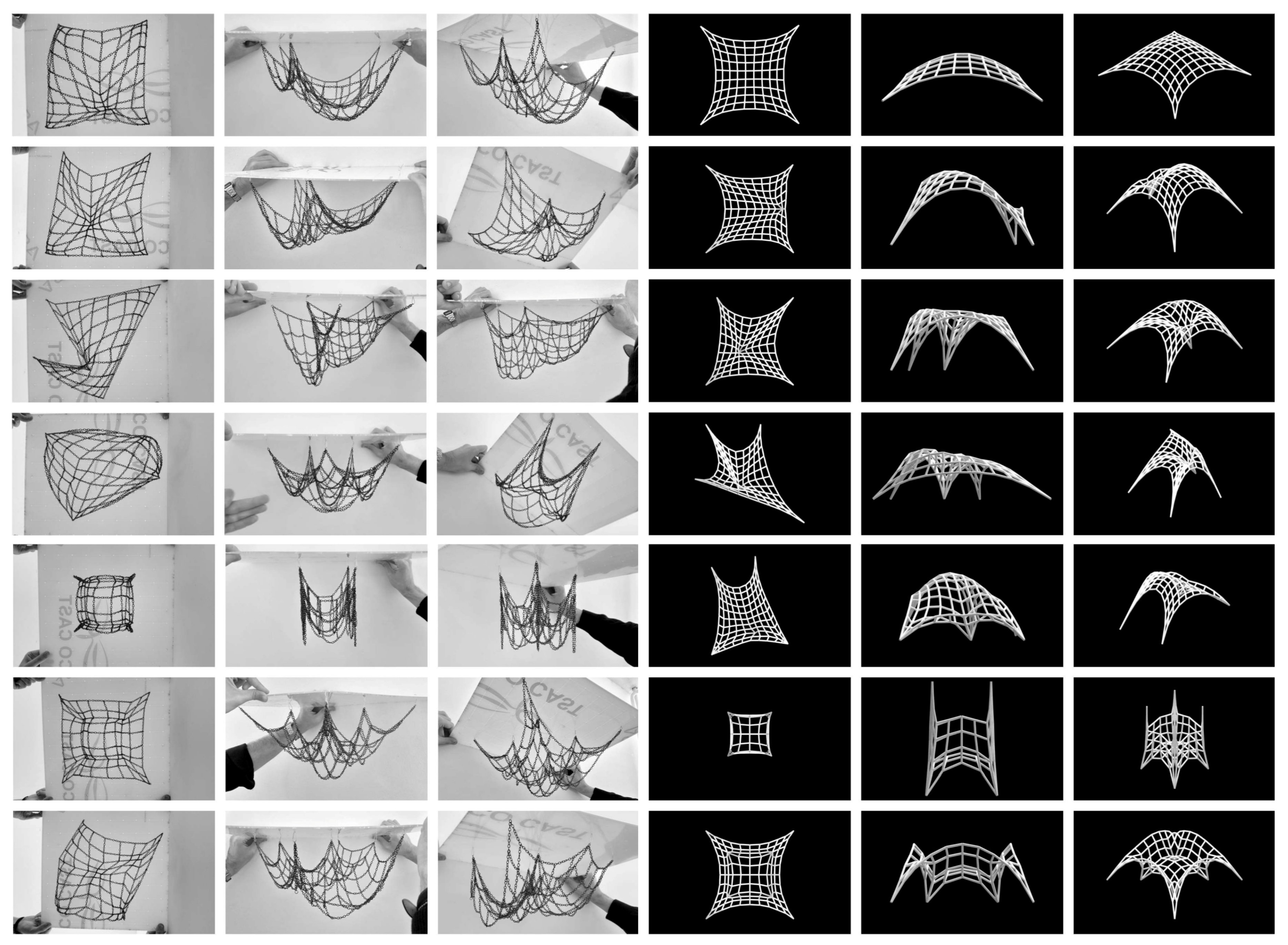
Form exploration. After producing form-finding mediums students started explorations by varying model parameters – anchor points. This exercise allowed students to understand the relationship between geometric configuration, structural behavior, and equilibrium forms. The objective was to comprehend the relationship between forces and form, as well as what happens to form when various mesh topologies are employed, and to compare the outcomes among groups.
During the analog form-finding phase, several anchors point configurations were explored for each cable network while maintaining a consistent load case. This approach enabled a fast and intuitive method of assessing the approximate catenary geometry. The results of this phase showed significant variations in the final geometry across different network topologies. This variation is exceptionally pronounced when comparing models with only corner point anchors due to the maximal cable length. This highlighted the significant influence of boundary conditions on the resulting structural form.
The digital simulations closely reproduced the behavior observed in the physical models. However, unlike the physical chains, the numerical models incorporated elastic behavior, resulting in localized stretching near support points and corresponding force concentrations. These effects highlighted the importance of material properties in predicting structural performance.
The simulations also revealed measurable differences between mesh topologies. The triangular network, characterized by the highest chain density, exhibited the smallest global deflection, whereas the hexagonal network produced the greatest height. The difference in maximum height between these configurations reached 6.4%, indicating that mesh topology significantly influences equilibrium geometry and structural behavior (Figure 3).
Although the resulting analog and digital forms were similar, they were not identical. Springs near the supports often have more pronounced deformations, which is a consequence of the fact that all the forces acting in the particles are suspended on the supports and can be corrected by locally increasing the stiffness of the chains. Variations arose from the elastic behavior of the digital model and simplifications in load distribution, where equal masses were assigned to all particles regardless of chain length. Nevertheless, both approaches consistently demonstrated the influence of topology and boundary conditions on form generation.
Design exploration. In the final phase, students applied the acquired knowledge to the design of temporary pavilion structures. The activity enabled students to apply the structural lessons they had learned in a real-world setting, since the location was chosen to be a plateau in front of the building of the Technical Faculty in Belgrade, Serbia. Using both analog and digital ICMs, they explored the interaction between structural performance and architectural expression. The exercise encouraged students to integrate structural considerations into conceptual design and demonstrated the potential of form-finding as a creative design method.
The comparison of analog and digital workflows highlighted complementary advantages. Physical models provided an intuitive understanding of equilibrium, proportions, and spatial relationships, while digital models enabled rapid modification, topology management, structural analysis, and performance evaluation. Together, they supported a deeper understanding of the relationship between form, force, and structural efficiency.
A significant finding of the study is that mesh topology significantly influences both equilibrium geometry and force distribution. The results suggest that topology optimization can be as important as geometric optimization when designing funicular structures. Consequently, effective form-finding should be understood as an integrated process that combines geometric exploration, topology definition, and structural evaluation.
Figure 4.
Examples of structural form explorations using analog and digital ICMs.
4.2. Experience Evaluation
The entire educational experience of learning about structures through the development of model-making and design exploration skills was perceived as positive by the students. Results of the pre- and post-intervention survey (Table 1; Appendix A, Table A1.), completed by 30 students, indicate that hands-on learning activities contribute substantially to student engagement and understanding of structural concepts.
Following the intervention, students reported increased confidence in their understanding of structural behavior, with the mean score rising from 3.87 ± 0.68 to 4.57 ± 0.50. Their ability to distinguish between tension and compression systems also improved (from 3.93 ± 0.83 to 4.43 ± 0.63), as did their understanding of the role of form-finding in structural efficiency (from 3.90 ± 1.21 to 4.43 ± 0.68). The largest improvement was observed in familiarity with inverted chain models, which increased from 3.57 ± 1.25 to 5.00 ± 0.00. Students also expressed a stronger intention to apply ICMs in future design projects, with mean scores increasing from 3.40 ± 1.04 to 3.93 ± 0.98. In addition, participants reported more positive attitudes toward both physical and digital modeling tools and increasingly perceived structural design as a creative component of architectural design rather than a constraint on creativity.
Students consistently identified physical models as valuable tools for understanding structural principles. At the same time, the introduction of parametric digital tools improved their perception of the usefulness of computational methods for visualizing and interpreting structural behavior. Participants also reported a shift in their perception of structural design, increasingly viewing it as a creative component of architectural design rather than a constraint on creativity.
The knowledge assessment conducted before and after the intervention further confirmed improvements in students’ understanding of structural principles (Figure 5; Appendix A, Table A2). A paired-samples t-test showed a statistically significant increase in performance from pre-test (M = 7.53, SD = 2.26) to post-test (M = 8.80, SD = 1.79), t(29) = 4.75, p < 0.001. The effect size, calculated using Cohen's d, was 0.87, indicating a large educational effect. These results suggest that the intervention contributed substantially to students' understanding of structural principles and equilibrium-based design concepts. This suggests that the observed improvement was not only statistically significant but also educationally meaningful.
Additional insights were obtained through focus-group discussions, reflective journals, and instructor observations (see Appendix B). As the assignment was completed in groups, the 30 students were organized into seven teams (five groups of four students and two groups of five students). Each group maintained a reflective journal throughout the intervention, resulting in seven journal entries. Following completion of the workshop, one focus-group discussion was conducted with each group. In addition, two instructors recorded a total of 98 observation notes documenting student engagement, collaboration, and problem-solving activities. Thematic analysis identified 97 relevant statements from a corpus of 240 coded qualitative responses, from which 21 themes were derived and subsequently consolidated into six principal categories (Table 2).
Analysis of focus-group discussions, journals, and observations revealed six recurring themes describing students' learning experiences. The most frequently reported benefit was an improved intuitive understanding of structural forces (87%). Students emphasized that physical models provided a direct and tangible understanding of the relationship between form and force. Learning through making (80%) emerged as another dominant theme, with participants highlighting the value of constructing, testing, and refining both physical and digital models. Creative application (77%) reflected students’ appreciation of form-finding as a design method capable of linking structural performance and architectural expression.
Students also reported acquiring new digital skills (63%), particularly through the use of Spider3D and parametric modeling tools. Additional themes included visual-spatial engagement (23%), where students valued the ability to assess proportions and spatial relationships, and material logic (17%), where students recognized the influence of material properties on structural behavior.
Taken together, the survey results, knowledge assessments, focus-group discussions, and observations indicate that the combination of analog and digital form-finding methods can effectively support both conceptual understanding and creative exploration. The complementary use of physical and computational models enabled students to explore structural behavior, evaluate design alternatives, and develop a more integrated understanding of the relationship between form, force, material behavior, and architectural design. These findings suggest that parametric ICMs can serve not only as form-finding tools but also as effective pedagogical media for developing structural intuition, computational literacy, and form-active design thinking in architectural education.
5. Discussion
5.1. Parametric ICMs as Instruction Vehicles
The findings suggest that parametric inverted chain models (ICMs) can serve as effective instructional vehicles for teaching structural design in architecture. The combination of analog model-making, digital simulation, and reflective analysis enabled students to develop a more integrated understanding of the relationship between form, force, material behavior, and structural performance.
One of the most significant outcomes of the intervention was the development of an intuitive understanding of structural principles. The results indicate that students benefited from an iterative learning cycle in which they first constructed physical models, subsequently replicated and analyzed them digitally, and finally refined their designs based on feedback. This process aligns with learning-by-doing approaches and experiential learning theories, where knowledge is constructed through direct engagement with physical and digital artefacts. The observed increase in students’ confidence and conceptual understanding suggests that form-finding exercises can make abstract structural concepts more accessible to architecture students.
The findings are consistent with Kolb's experiential learning theory [55], which proposes that learning occurs through a cycle of concrete experience, reflective observation, abstract conceptualization, and active experimentation (Figure 6). Students first engaged with physical hanging-chain models, observed their structural behavior, translated these observations into digital simulations, and subsequently refined their designs through iterative experimentation. The reported increase in confidence from 18% to 43% and improvement in test scores suggests that the repeated movement between physical experience and analytical reflection facilitated deeper learning than would be expected from lecture-based instruction alone.
The study also highlights the educational value of combining analog and digital methods. Physical models provided immediate tactile feedback and enabled students to directly observe the relationship between geometry and equilibrium. Digital simulations, on the other hand, facilitated rapid modification, visualization, and structural evaluation. Rather than replacing one another, the two approaches proved complementary. Students frequently reported that constructing physical models helped them understand the logic behind the digital simulations, while digital tools enabled deeper exploration of structural behavior and design alternatives.
The educational benefits of physical modeling may also be interpreted through the perspective of embodied cognition. This theory suggests that understanding is influenced by bodily interaction with physical objects and environments. Students repeatedly emphasized the value of manipulating chain models and directly observing their behavior under gravity. The prominence of themes related to intuitive understanding of structural forces (87%) suggests that tactile interaction with physical models contributed significantly to the development of structural intuition. Such experiences made otherwise abstract concepts, such as equilibrium, force flow, and load transfer, visible and tangible. The findings therefore suggest that physical models continue to play an important role in structural education despite the growing availability of computational tools.
The introduction of Spider3D contributed to this process by providing an accessible environment for parametric exploration. Through real-time feedback and interactive simulations, students were able to investigate the effects of support conditions, topology, and geometric variation on equilibrium forms. The ability to compare multiple design alternatives encouraged experimentation and promoted an evidence-based design process. In this sense, the digital tool functioned not merely as a modeling environment but as a learning platform supporting exploration and reflection.
The prominence of the themes 'learning through making' (80%) and 'intuitive understanding of structural forces' (87%) supports constructivist perspectives on learning [56], according to which knowledge is actively constructed through interaction with physical and conceptual environments. Rather than receiving structural principles as abstract information, students developed their understanding through manipulation of models, observation of equilibrium behavior, and comparison of alternative design solutions. The emergence of themes related to intuitive understanding and learning through making indicates that students constructed knowledge through direct engagement with structural phenomena.
The findings also resonate with Papert's constructionist perspective [59], which emphasizes learning through the creation of meaningful artefacts. Throughout the intervention, students produced physical chain models, digital simulations, and design proposals that served as external representations of their developing understanding. These artefacts enabled students to test ideas, communicate design intentions, and evaluate structural behavior. The prominence of themes such as learning through making and acquisition of new skills suggests that knowledge emerged not only through observation but also through the active construction and refinement of tangible design outcomes. The digital artefacts produced through Spider3D simulations further reinforced this constructionist learning process by enabling students to externalize, test, and refine structural concepts.
The intervention further reflects Schön's concept of reflective practice [58]. Students continuously modified support conditions, topology, and geometry while evaluating the consequences of these decisions. This iterative process resembles Schön's “reflection-in-action,” where understanding develops through a continuous dialogue between the designer and the design medium.
Another important finding concerns the shift from form-finding to form-active design thinking. Rather than treating structural analysis as a verification step applied after design decisions had been made, students increasingly approached structure as a generator of architectural form. The exploration of different mesh topologies demonstrated that structural behavior is influenced not only by geometry but also by the organization of the structural network itself. This encouraged students to consider structural logic as a creative design parameter and to integrate performance considerations into the early stages of design development. This shift suggests that students increasingly perceived structure not as a constraint imposed on architectural form but as an active driver of design generation.
The intervention also connected experimental exercises with architectural precedents, including the work of Gaudí, Isler, Otto, and Musmeci. Linking historical examples to hands-on experimentation helped students understand that form-finding is not merely a technical procedure but a design methodology with a long tradition in architecture. This contextualization supported the transfer of knowledge from abstract models to architectural applications and reinforced the relevance of structural thinking within contemporary design practice.
From a pedagogical perspective, the results indicate that combining physical modeling, computational simulation, and reflective practice can enhance engagement, improve structural reasoning, and support creative exploration. Such approaches encourage students to synthesize analytical and intuitive modes of thinking while developing the technical and conceptual skills required for contemporary architectural practice. Collectively, these findings suggest that parametric ICMs provide a framework through which architectural students can simultaneously develop structural understanding, computational literacy, and design creativity.
An additional benefit of the intervention was the integration of postgraduate research and undergraduate teaching. The development of Spider3D within a master's-level research project created an opportunity to validate the software in an educational setting while simultaneously exposing undergraduate students to ongoing research activities. This vertical integration of research and teaching increased student motivation and demonstrated how computational design tools can emerge from academic research and be transferred into educational practice. Such integration not only validates research outputs through educational application but also familiarizes students with contemporary research methodologies and computational design workflows.
Nevertheless, several limitations should be acknowledged. The study was conducted with a relatively small cohort of students at a single institution and over a limited period of time. In addition, part of the evidence is based on self-reported perceptions obtained through surveys and focus-group discussions, which may be influenced by response bias. Future research could investigate the long-term effects of this approach, compare different form-finding tools and pedagogical strategies, and evaluate its applicability in broader architectural and engineering education contexts.
5.2. Further Research Directions
While the present study demonstrates the educational value of parametric inverted chain models (ICMs), several opportunities exist for further research and development. One limitation concerns the scalability of physical models. Although equilibrium geometries can be scaled proportionally, physical models are subject to material and geometric constraints that may affect accuracy. Digital simulations partially address these limitations; however, their precision remains dependent on modeling assumptions, numerical methods, and software capabilities.
Future research could investigate improvements in computational form-finding tools, particularly through the integration of machine learning techniques for topology optimization and design-space exploration. Such approaches may support automated generation and evaluation of structurally efficient forms while expanding opportunities for design exploration.
Another promising direction involves the development of hybrid digital–physical workflows. Technologies such as augmented reality (AR), photogrammetry, and digital twin methodologies could be integrated with ICMs to enable real-time comparison between physical and computational models. Similarly, sensor-based feedback systems capable of measuring tension, deformation, or displacement could provide quantitative data for evaluating structural behavior during form-finding experiments.
From an educational perspective, future studies could investigate the integration of ICM-based exercises within architectural design studios rather than stand-alone structural courses. Embedding form-finding activities into studio environments may encourage students to consider structural performance, material behavior, and constructability from the earliest stages of design development. In addition, interdisciplinary learning environments involving architecture and engineering students could promote collaboration and strengthen understanding of the relationships between architectural and structural design.
Further experimentation with alternative modeling materials, including textiles, elastic membranes, and flexible 3D-printed components, may expand the range of structural behaviors that can be explored through physical models. Linking small-scale form-finding models with digital fabrication workflows, such as laser cutting, CNC fabrication, and additive manufacturing, could also strengthen the connection between conceptual exploration and constructable architectural solutions.
Finally, future research may extend the application of the presented educational framework beyond funicular structures. Similar approaches could be explored for teaching the design of grid-shells, tensile membrane structures, bending-active systems, and other form-active structural typologies. Such investigations would contribute to a broader understanding of how computational and physical modeling can support structural education in architecture.
6. Conclusions
This paper presented and evaluated an educational approach for teaching structural design concepts to architecture students through the use of parametric inverted chain models (ICMs). The approach integrated postgraduate research and undergraduate teaching within a learning-by-doing framework, combining physical model-making, digital simulation, structural analysis, and design exploration. Through the development and implementation of the Spider3D plugin, students were introduced to both analog and computational form-finding methods and encouraged to explore the relationship between form, force, material behavior, and structural performance.
The results demonstrate that the proposed approach effectively supports the understanding of structural principles and equilibrium forms. Survey responses, knowledge assessments, and qualitative feedback indicate improvements in students’ confidence, conceptual understanding, structural reasoning, and ability to relate geometry to structural behavior. The combination of physical and digital workflows proved particularly valuable, enabling students to develop both intuitive and analytical perspectives on structural design.
The study further showed that parametric ICMs can function not only as form-finding tools but also as pedagogical instruments that encourage experimentation, reflection, and creative exploration. By engaging with different mesh topologies, support conditions, and design alternatives, students began to perceive structure as a generator of architectural form rather than merely a technical constraint. The integration of historical precedents, computational tools, and hands-on experimentation helped contextualize structural concepts within architectural practice.
An additional contribution of the study is the demonstrated integration of research and education through the development and validation of a custom digital tool within the teaching process. This vertical integration of postgraduate research and undergraduate learning created opportunities for both educational innovation and the evaluation of emerging design technologies.
Overall, the findings suggest that combining analog and digital form-finding methods provides an effective framework for teaching structural design in architecture. Such approaches support the development of structural intuition, computational literacy, and design creativity, while strengthening the connection between architectural education, research, and professional practice.
Supplementary Materials
The following supporting information can be downloaded at: https://www.food4rhino.com/en/app/spider, Software: Spider3D.
Author Contributions
Conceptualization, J.M.; methodology, J.M.; software, O.G.; validation, J.M., O.G., M.Žu., J.I., M.Ži. and R.O.; formal analysis, O.G., J.M., M.Žu. and J.I.; investigation, J.M., O.G.; resources, J.M. and O.G.; data curation, J.M., M.Ži., O.G.; writing—original draft preparation, J.M.; writing—review and editing, J.M., M.Žu., O.G., J.I., M.Ži., and R.O.; visualization, J.M., M.Žu., M.Ži. and O.G.; project administration, J.M. and R.O.; funding acquisition, R.O. All authors have read and agreed to the published version of the manuscript.
Funding
This research was funded by the Ministry of Education, Science and Technological Development of the Republic Serbia, grant number 451-03-68/2020-14/200090. The research was carried out under the research lab of the University of Belgrade, Faculty of Architecture—Laboratory for Innovative Structures in Architecture (LISA).
Data Availability Statement
Not applicable.
Conflicts of Interest
The authors declare no conflicts of interest. The funders had no role in the design of the study; in the collection, analyses, or interpretation of data; in the writing of the manuscript; or in the decision to publish the results.
Abbreviations
The following abbreviations are used in this manuscript:
| ICM | Inverted Chain Model |
| CAD | Computer-aided Design |
| FEA | Finite Element Analysis |
| PS | Particle Spring |
| DR | Dynamic Relaxation |
| IDE | Integrated Development Environment |
Appendix A
Appendix A.1
Survey Questionnaire has a format of 5-Points Likert Scale (1 = Strongly Disagree, 5 = Strongly Agree). Survey was administered before and after the teaching module to compare shifts in perception.

Table A1.
Survey Questionnaire (Pre & Post Intervention).
| No. | Statement | |
|---|---|---|
| 1 | I feel confident understanding how spatial structures behave under load. | 1 2 3 4 5 |
| 2 | I can identify the difference between compression and tension in a form. | 1 2 3 4 5 |
| 3 | I enjoy learning about structural design. | 1 2 3 4 5 |
| 4 | I understand the role of form-finding in structural efficiency. | 1 2 3 4 5 |
| 5 | I am familiar with inverted chain models (ICMs). | 1 2 3 4 5 |
| 6 | I find physical models helpful for understanding structural principals. | 1 2 3 4 5 |
| 7 | I am likely to apply ICM concepts in my future design work. | 1 2 3 4 5 |
| 8 | Structural design enhances my creativity rather than limits it. | 1 2 3 4 5 |
| 9 | Digital tools help me visualize and understand structural behavior. | 1 2 3 4 5 |
| 10 | I feel more engaged when hands-on learning is part of the course. | 1 2 3 4 5 |
Appendix A.2
Pre- and post-intervention test is a 10-to-15-minute knowledge assessment that had a format of short answers and multiple-choice questions. Test is graded out of 10 points for before/after comparison.
Table A2.
Pre- and post-intervention test.
| No. | Sample Questions |
|---|---|
| 1 | When a chain is suspended between two fixed points, the resulting curve is:
|
| 2 | If you invert the shape of the chain and make it out of brick, stone, or concrete blocks, the resulting structure primarily transfers loads through:
|
| 3 | The main advantage of inverted chain models (ICMs) is that:
|
| 4 | Changing the position of the chain supports primarily affects:
|
| 5 | Which of the following digital tools most closely simulates the physical behavior of inverted hanging models?
|
| 6 | Explain how the inverted chain model (ICM) demonstrates concept form follows force. |
| 7 | Explain the significance of form-finding in architectural design. |
Appendix B
Appendix B.1
Focus Group discussion was in a semi-structured format, conducted in a small group (4 students), approximate 30 minutes. Discussions were audio recorded (with consent) and transcribed for thematic coding.
Opening Questions:
- What was your initial understanding of structural design before this workshop?
- How did the use of physical models (chains) change your understanding?
Core Questions:
- What was your experience using inverted chain models in design?
- Did you feel the hands-on process helped you understand structural forces better?
- What challenges did you face using the model?
- How did this compare to learning through lectures or software alone?
Closing:
- What you use this technique in your own design work?
- What would you change or improve about the workshop experience?
Appendix B.2
Reflective Journal Prompts:
- What did I learn today about how structures behave?
- How did working with the physical model help (or not help) my understanding?
- What surprised me about the form that emerged from the model?
- How would I apply these structural insights in a real design project?
- What questions or challenges remain for me?
Appendix B.3
Observation Notes Criteria/Checklist:
- Students actively engaging with the models
- Evidence of peer discussions/collaboration
- Questions asked that show structural thinking
- Difficulty with concepts
- Use of sketches or diagrams during work
- Creativity in design interpretation
- Integration of ICM learnings in final design.
References
- Huerta, S. El cálculo de estructuras en la obra de Gaudí. Ing. Civ. 2003, 130, 121–133. [Google Scholar]
- Boller, G.; D'Acunto, P. Structural Design via Form Finding: Comparing Frei Otto, Heinz Isler and Sergio Musmeci. In History of Construction Cultures: Proceedings of the 7th International Congress on Construction History (7ICCH 2021), Lisbon, Portugal, 12–16 July 2021; CRC Press: Boca Raton, FL, USA, 2021; Volume 2, pp. 431–438. [Google Scholar]
- Engel, H. Structure Systems, 3rd ed.; Hatje Cantz: Ostfildern, Germany, 2007. [Google Scholar]
- Songel, J.M. Form Follows Forces: Building Funicular Models to Show How Gravity Shapes Form. In EDULEARN15 Proceedings: 7th International Conference on Education and New Learning Technologies; IATED Academy: Barcelona, Spain, 2015; pp. 621–626. [Google Scholar]
- Lewis, W.J. Tension Structures: Form and Behaviour; Thomas Telford: London, UK, 2003. [Google Scholar]
- Shea, K. Generative Design: Blurring the Lines between Architect, Engineer and Computer. Archit. Des. 2003, 73(4), 116–121. [Google Scholar]
- Graefe, R. The catenary and the line of thrust as a means for shaping arches and vaults. In Physical models: Their historical and current use in civil and building engineering design; Addis, B., Ed.; Wiley: Hoboken, NJ, USA, 2020; pp. 79–126. [Google Scholar] [CrossRef]
- Tomlow, J. Das Modell: Antoni Gaudís Hängemodell und seine Rekonstruktion (IL 34). Ph.D. Thesis, Institut für Leichte Flächentragwerke (IL), Universität Stuttgart, Stuttgart, Germany, 1989. [Google Scholar]
- Kilian, A. Linking Digital Hanging Chain Models to Fabrication. In Fabrication: Examining the Digital Practice of Architecture, Proceedings of the 23rd Annual Conference of the Association for Computer Aided Design in Architecture (ACADIA) and the 2004 Conference of the AIA Technology in Architectural Practice Knowledge Community; University of Waterloo School of Architecture Press: Cambridge, ON, Canada, 2004; pp. 110–125. [Google Scholar]
- Hensel, D.S.; Bover, B.G. Nested Catenaries. J. Int. Assoc. Shell Spat. Struct. 2013, 54, 39–55. [Google Scholar]
- Coelho, R.F.; Tysmans, T.; Verwimp, E. Form Finding & Structural Optimization: A Project-Based Course for Graduate Students in Civil and Architectural Engineering. Struct. Multidisc Optim. 2014, 49, 1037–1046. [Google Scholar] [CrossRef]
- Adriaenssens, S.; Pauletti, R.M.O.; Stockhusen, K.; Gabriele, S.; Magrone, P.; Varano, V.; Lochner-Aldinger, I. A Project-Based Approach to Learning Form Finding of Structural Surfaces. Int. J. Space Struct. 2015, 30, 297–305. [Google Scholar] [CrossRef]
- Naboni, R. Form-Finding to Fabrication of Super-Thin Anisotropic Gridshell. In Proceedings of the Blucher Design Proceedings; Editora Blucher: Buenos Aires, Argentina, December 2016; pp. 418–425. [Google Scholar]
- Borgart, A.; Li, O.; Eigenraam, P. Manufacture and Loading Test of Reinforced Gypsum Shells Generated from Hanging Models—A Workshop Developed at Delft University of Technology. In Proceedings of the IASS Symposium 2018: Creativity in Structural Design; International Association for Shell and Spatial Structures: Madrid, Spain, 2018; pp. 1–8. [Google Scholar]
- Henriques, G.C.; Franco, J.M. Gridshells: Integrating Design with Structural Performance in Early Design Stages, Using Formal and Informal Knowledge. GT Proj. 2021, 17, 81–95. [Google Scholar] [CrossRef]
- Güzelci, O.Z.; Sousa, J.P.; Xavier, J.P. Integrated Structural and Environmental Form-Finding: A Teaching Experiment. Nexus Netw. J. 2022, 24, 247–264. [Google Scholar] [CrossRef] [PubMed]
- Chilton, J. The Engineer's Contribution to Contemporary Architecture: Heinz Isler; Thomas Telford: London, UK, 2000. [Google Scholar]
- Whitehead, R. Rebuilding a Framework for Learning: Rethinking Structural Design Instruction in an Architectural Curriculum. In Proceedings of the Structures Congress 2015; American Society of Civil Engineers: Portland, Oregon, 17 April 2015; pp. 2600–2612. [Google Scholar] [CrossRef]
- Milošević, J. Generating form-active spatial structures: A guide to design with models, 1st ed; University of Belgrade – Faculty of Architecture: Belgrade, Serbia, 2026. [Google Scholar]
- Block, P.; Kilian, A.; Pottmann, H. Steering of form – New integrative approaches to architectural design and modeling. Comput. Aided Des. 2015, 61, 1. [Google Scholar] [CrossRef]
- Hensel, M.U. Performance-Oriented Architecture: Rethinking Architectural Design and the Built Environment; AD Primers, 1st ed.; John Wiley & Sons, Incorporated: New York, 2013; ISBN 9780470973318. [Google Scholar]
- Heyman, J. Hooke’s Cubico–Parabolical Conoid. Notes Rec. R. Soc. Lond. 1998, 52, 39–50. [Google Scholar] [CrossRef]
- Moseley, H. On a New Principle in Statics, Called the Principle of Least Pressure. Philos. Mag. Ser. 3 1833, 3(15), 285–288. [Google Scholar] [CrossRef]
- Moseley, H. The Mechanical Principles of Engineering and Architecture; John Weale: London, UK, 1843. [Google Scholar]
- Benvenuto, E. An Introduction to the History of Structural Mechanics; Springer New York: New York, NY, 1991; ISBN 9781461277514. [Google Scholar]
- Milankovitch, M. Theorie der Druckkurven. Zeitschr. Math. Phys. 1907, 55, 1–27. [Google Scholar]
- Foce, F. Milankovitch's Theorie der Druckkurven: Good Mechanics for Masonry Architecture. Nexus Netw. J. 2007, 9, 185–210. [Google Scholar] [CrossRef]
- Hooke, R. A Description of Helioscopes, and Some Other Instruments; John Martyn: London, UK, 1676. [Google Scholar]
- Graefe, R. The Catenary and the Line of Thrust as a Means for Shaping Arches and Vaults. In PHYSICAL MODELS; Addis, B., Ed.; Wiley, 2020; pp. 79–126. ISBN 9783433032572. [Google Scholar]
- Huerta, S. Mechanics of Masonry Vaults: The Equilibrium Approach. In Historical Constructions: Possibilities of Numerical and Experimental Techniques; University of Minho: Guimarães, Portugal, 2001; pp. 47–69. [Google Scholar]
- Collins, G.R.; Bassegoda Nonell, J. The Designs and Drawings of Antoni Gaudí; Princeton University Press: Princeton, NJ, USA, 1983. [Google Scholar]
- Tomlow, J. Gaudí’s Reluctant Attitude towards the Inverted Catenary. Proc. Inst. Civ. Eng.-Eng. Hist. Herit. 2011, 164, 219–233. [Google Scholar] [CrossRef]
- Isler, H. New shapes for shells. Bull. Int. Assoc. Shell. Struct. 1961, n. 8, 123–130. [Google Scholar]
- Boller, G.; Beckh, M.; Schützeichel, R.; Schwartz, J.; Stalder, L. Heinz Isler: Built Experiments – Entrepreneurial Networks; gta Verlag: Zurich, Switzerland, 2025. [Google Scholar]
- Hennicke, J. Sonderforschungsbereich Weitgespannte Flächentragwerke (Eds.). Gitterschalen: Bericht über das japanisch-deutsche Forschungsprojekt S. T. I., durchgeführt von Mai 1971 bis Mai 1973 = Grid shells (Mitteilungen / Universität Stuttgart, Sonderforschungsbereich 64, Weitgespannte Flächentragwerke, IL 10), Universität Stuttgart: Stuttgart, 1975; ISBN 9783782820103.
- Otto, F.; Rasch, B. Finding form: Towards an architecture of the minimal, 5th ed.; (S. Schanz, Deutscher Werkbund Bayern, & Museum Villa Stuck, Eds.; 5th ed.); Ed. ; Axel Menges: Fellbach, 2006; ISBN 9783930698660. [Google Scholar]
- Happold, E.; Liddell, W.I. Timber Lattice Roof for the Mannheim Bundesgartenschau. Struct. Eng. 1975, 53(3), 99–135. [Google Scholar]
- Institut für Leichte Flächentragwerke, null; Sonderforschungsbereich Weitgespannte Flächentragwerke, null Multihalle Mannheim; 1978. [CrossRef]
- Liddell, I. Frei Otto and the Development of Gridshells. Case Stud. Struct. Eng. 2015, 4, 39–49. [Google Scholar] [CrossRef]
- Dickson, M. On Frei Otto's Philosophy of Widespan Lightweight Structures. In Widespan Roof Structures; Barnes, M., Dickson, M., Eds.; Thomas Telford: London, UK, 2000; pp. 17–30. [Google Scholar] [CrossRef]
- Musmeci, S. Il Calcolo Elettronico e la Creazione di Nuove Forme Strutturali. In Architettura & Computer; Zevi, M., Ed.; Bolzoni: Rome, Italy, 1972; pp. 149–166. [Google Scholar]
- Musmeci, S. Ponte sul Basento a Potenza. Ind. Ital. Cem. 1977, (2), 77–98. [Google Scholar]
- Schek, H.-J. The Force Density Method for Form Finding and Computation of General Networks. Comput. Methods Appl. Mech. Eng. 1974, 3, 115–134. [Google Scholar] [CrossRef]
- Linkwitz, K. Formfinding by the “Direct Approach” and Pertinent Strategies for the Conceptual Design of Prestressed and Hanging Structures. Int. J. Space Struct. 1999, 14, 73–87. [Google Scholar] [CrossRef]
- Barnes, M.R. Form-Finding and Analysis of Tension Space Structures by Dynamic Relaxation. Ph.D. Thesis, City University London, London, UK, 1977. [Google Scholar]
- Barnes, M.R. Form-Finding and Analysis of Prestressed Nets and Membranes. Comput. Struct. 1988, 30, 685–695. [Google Scholar] [CrossRef]
- Barnes, M.R. Form Finding and Analysis of Tension Structures by Dynamic Relaxation. Int. J. Space Struct. 1999, 14, 89–104. [Google Scholar] [CrossRef]
- Kilian, A.; Ochsendorf, J. Particle-Spring Systems for Structural Form Finding. J. Int. Assoc. Shell Spat. Struct. 2005, 46, 77–84. [Google Scholar]
- Heyman, J. The Masonry Arch; Ellis Horwood: Chichester, UK, 1982. [Google Scholar]
- Block, P. Thrust Network Analysis: Exploring Three-Dimensional Equilibrium. Ph.D. Thesis, Massachusetts Institute of Technology, Cambridge, MA, USA, 2009. [Google Scholar]
- Fraddosio, A.; Lepore, N.; Piccioni, M.D. Thrust Surface Method: An Innovative Approach for the Three-Dimensional Lower Bound Limit Analysis of Masonry Vaults. Eng. Struct. 2020, 202, 109846. [Google Scholar] [CrossRef]
- Rippmann, M.; Lachauer, L.; Block, P. Interactive Vault Design. Int. J. Space Struct. 2012, 27, 219–230. [Google Scholar] [CrossRef]
- Piker, D. Kangaroo: Form Finding with Computational Physics. Archit. Des. 2013, 83, 136–137. [Google Scholar] [CrossRef]
- Bechthold, M. Innovative Surface Structures: Technologies and Applications; Taylor & Francis: New York, NY, USA, 2008. [Google Scholar]
- Kolb, D.A. Experiential Learning: Experience as the Source of Learning and Development; Prentice-Hall: Englewood Cliffs, NJ, USA, 1984. [Google Scholar]
- Piaget, J.; Inhelder, B. The Psychology of the Child; Basic Books: New York, NY, USA, 1972. [Google Scholar]
- Bruner, J.S. Toward a Theory of Instruction; Harvard University Press: Cambridge, MA, USA, 1966. [Google Scholar]
- Schön, D.A. The Reflective Practitioner: How Professionals Think in Action; Basic Books: New York, NY, USA, 1983. [Google Scholar]
- Papert, S. Mindstorms: Children, Computers, and Powerful Ideas; Basic Books: New York, NY, USA, 1980. [Google Scholar]
- Oxman, R. Think-Maps: Teaching Design Thinking in Design Education. Des. Stud. 2004, 25, 63–91. [Google Scholar] [CrossRef]
- Salama, A.M. Spatial Design Education: New Directions for Pedagogy in Architecture and Beyond, 2nd ed.; Routledge, 2016; ISBN 9781315610276. [Google Scholar]
- Braun, V.; Clarke, V. Using Thematic Analysis in Psychology. Qual. Res. Psychol. 2006, 3, 77–101. [Google Scholar] [CrossRef]
Figure 1.
Educational workflow of the intervention.
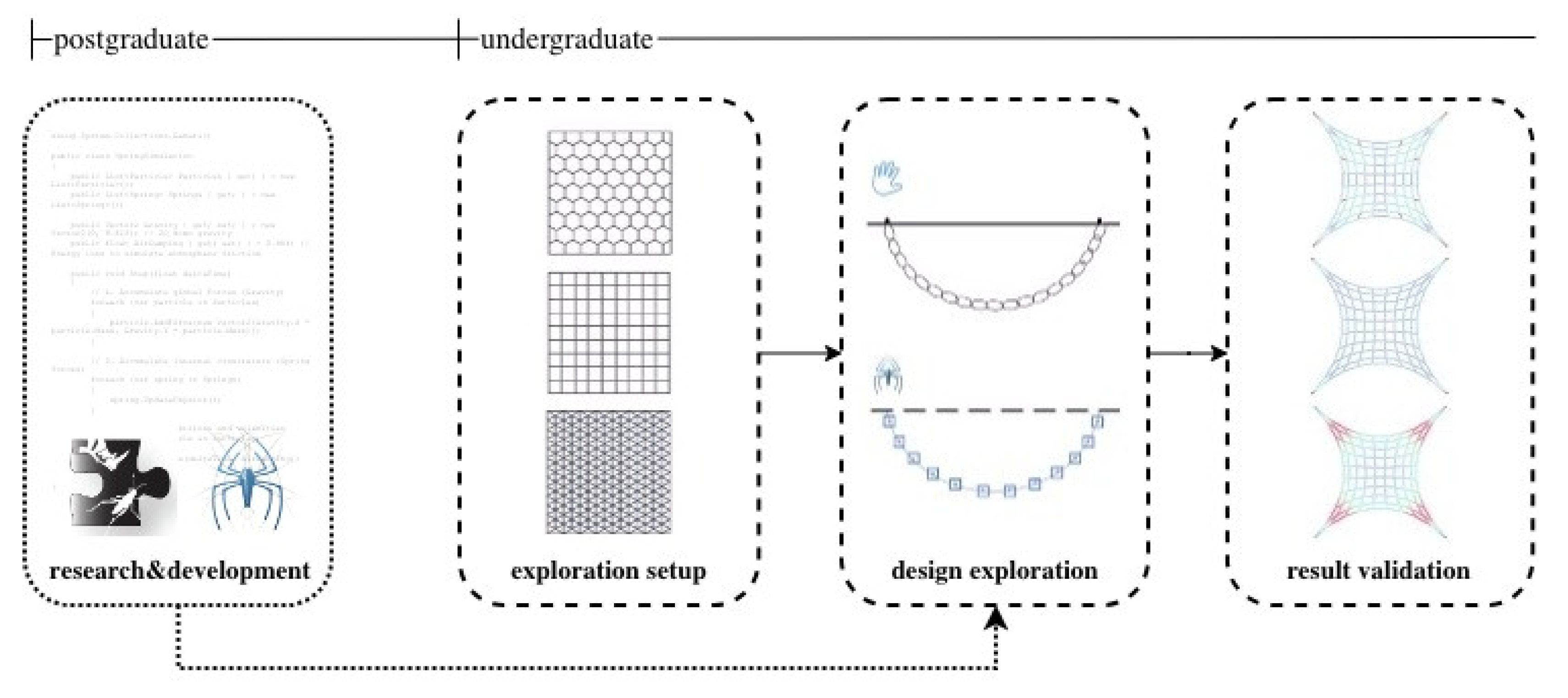
Figure 2.
Structure of the Spider3D plugin and simulation workflow.
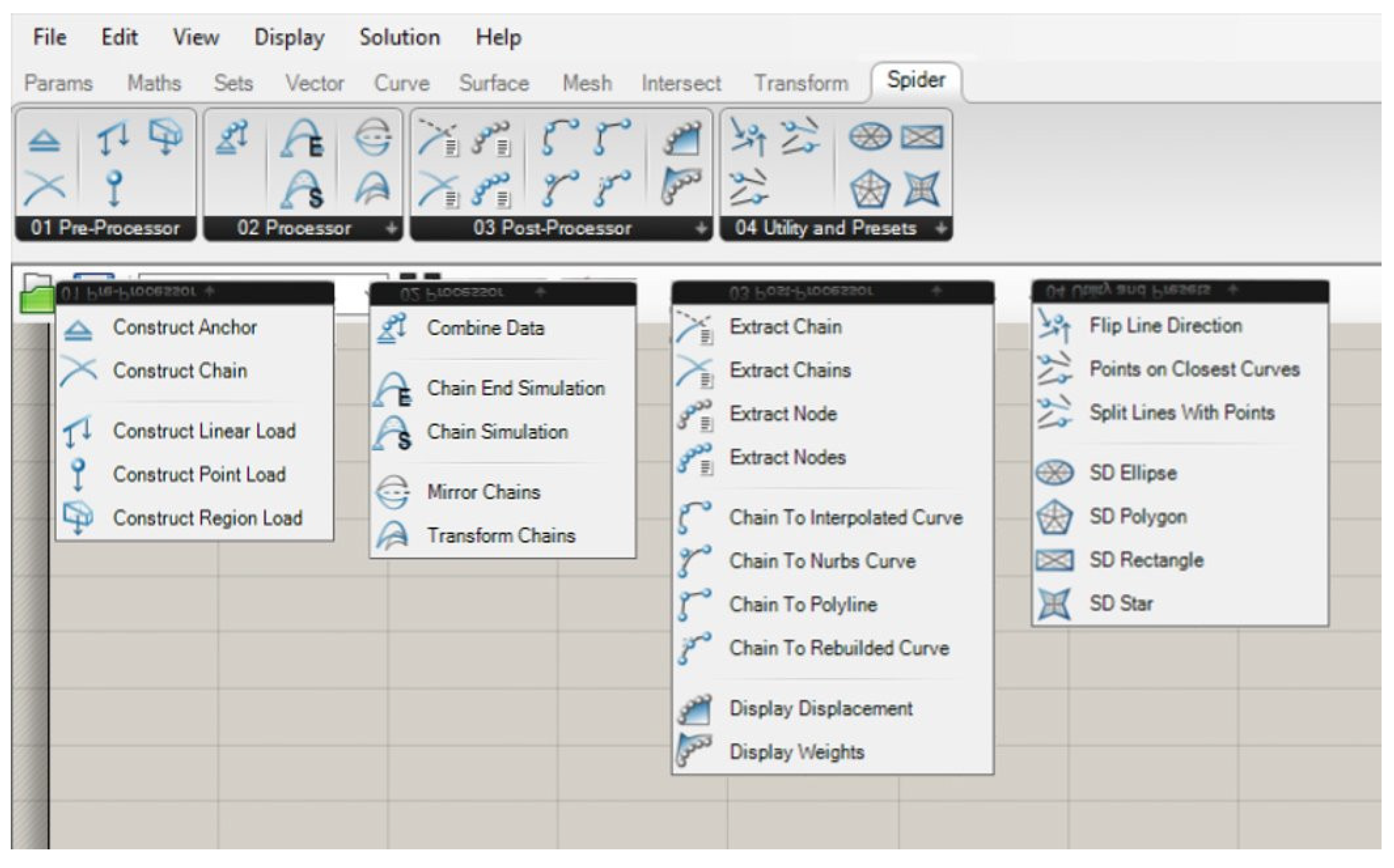
Figure 3.
Comparison of equilibrium forms generated using different chain-network topologies.
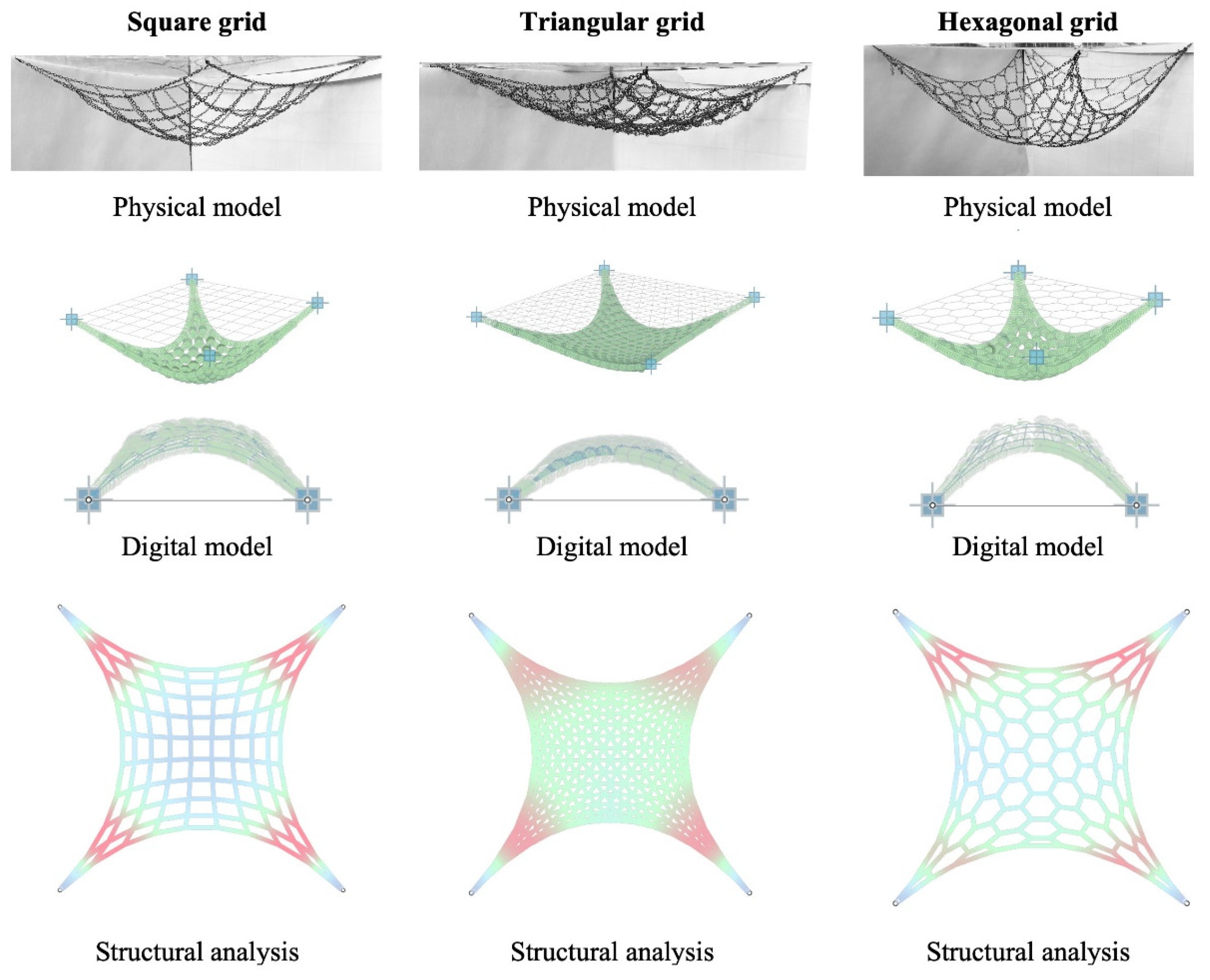
Figure 5.
Comparison of pre- and post-intervention knowledge-assessment results. The mean score increased from 7.53 to 8.80, with an average learning gain of 1.27 points.
Figure 5.
Comparison of pre- and post-intervention knowledge-assessment results. The mean score increased from 7.53 to 8.80, with an average learning gain of 1.27 points.
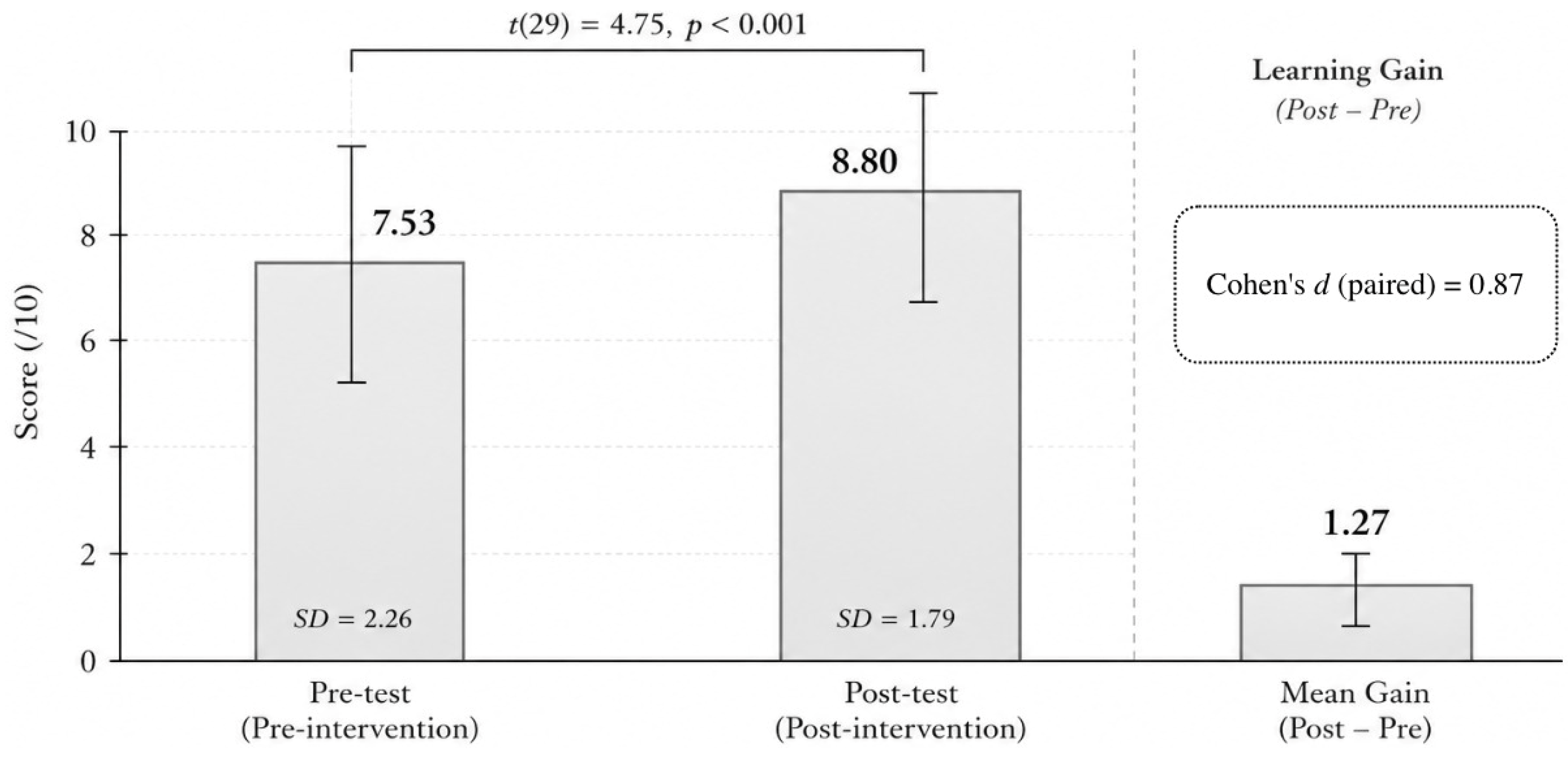
Figure 6.
Educational workflow of the intervention aligned with Kolb’s experiential learning cycle.
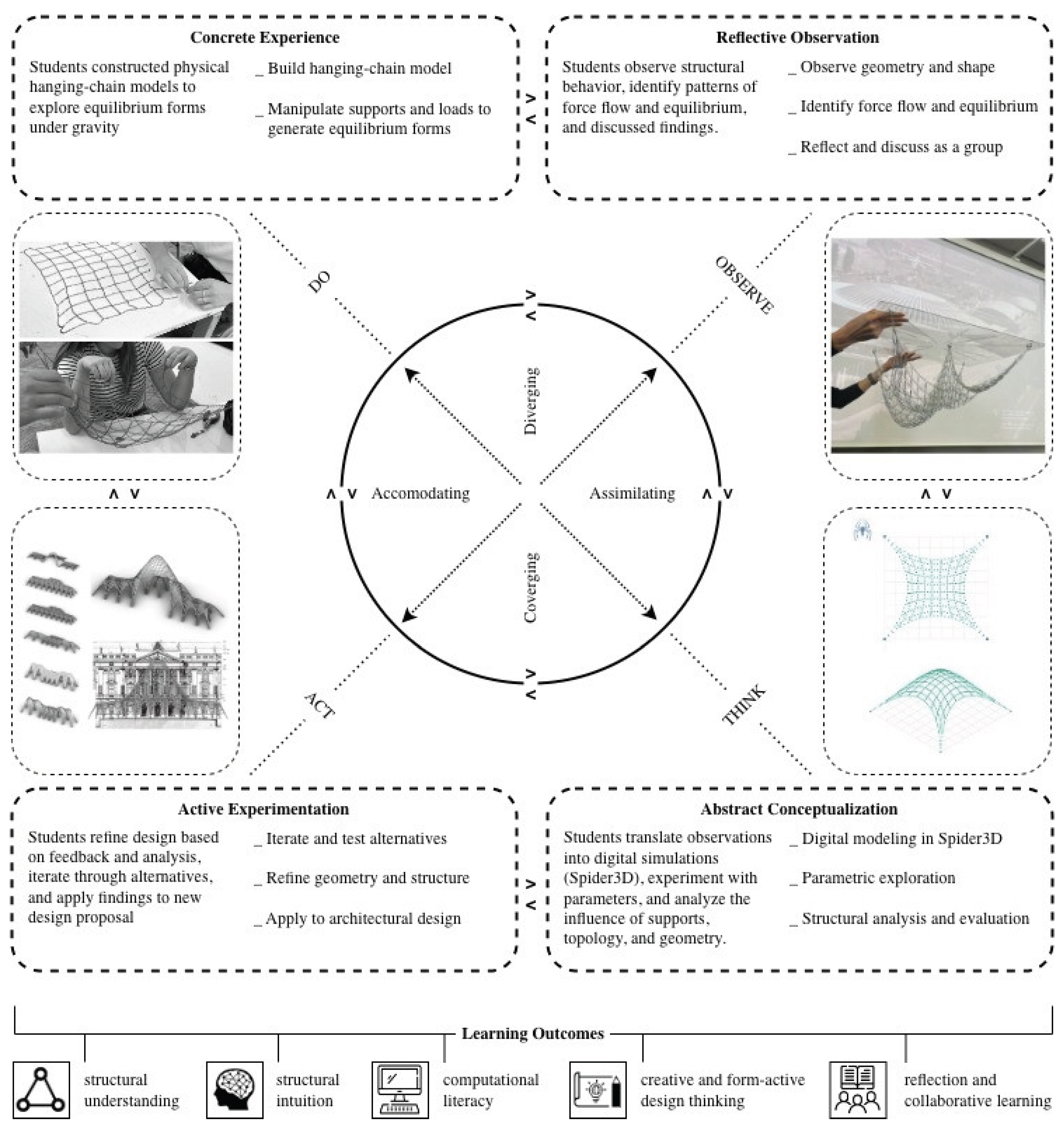
Table 1.
Summary of the principal changes in students’ perception and self-assessed competencies before and after the intervention.
Table 1.
Summary of the principal changes in students’ perception and self-assessed competencies before and after the intervention.
| Survey Item | Before (Mean ± SD) | After (Mean ± SD) | Change |
|---|---|---|---|
| Confidence in understanding structural behavior | 3.87 ± 0.68 | 4.57 ± 0.50 | +0.70 |
| Understanding tension/compression | 3.93 ± 0.83 | 4.43 ± 0.63 | +0.50 |
| Interest in structural design | 4.70 ± 0.65 | 4.87 ± 0.43 | +0.17 |
| Understanding the role of form-finding in structural efficiency | 3.90 ± 1.21 | 4.43 ± 0.68 | +0.53 |
| Familiarity with ICMs | 3.57 ± 1.25 | 5.00 ± 0.00 | +1.43 |
| Perceived usefulness of physical models for understanding structural principles | 4.47 ± 1.07 | 4.77 ± 0.43 | +0.30 |
| Intention to apply ICMs in future design projects | 3.40 ± 1.04 | 3.93 ± 0.98 | +0.53 |
| Perception of structural design as creative component of architecture | 4.50 ± 0.68 | 4.67 ± 0.48 | +0.17 |
| Perceived usefulness of digital tools | 4.47 ± 0.82 | 4.73 ± 0.52 | +0.27 |
| Perceived impact of hands-on learning on student engagement | 4.87 ± 0.43 | 4.90 ± 0.40 | +0.03 |
Table 2.
Main themes emerging from students’ reflections on learning structural design using parametric ICMs.
Table 2.
Main themes emerging from students’ reflections on learning structural design using parametric ICMs.
| Main Category | Frequency (%) | Illustrative quote (IQ) |
|---|---|---|
| (Intuitive) understanding structural forces | 87% | IQ1: Physical models offer tactile and intuitive understanding of form and force. |
| Learning through making | 80% | IQ2: Although at times it was frustrating to make an analog model, and improvements asked for patience, it helped us understand both vault behavior and the logic of the digital model. |
| Creative application | 77% | IQ3: Iterative form exploration helped bridge the gap between conceptual design and construction, allowing structural and aesthetic criteria to be developed simultaneously. |
| Acquisition of new skills | 63% | IQ4: Although it was my first experience with Spider3D, the workflow was accessible and motivated me to further develop my parametric design skills. |
| Visual-spatial engagement | 23% | IQ5: Creating physical models is useful during the early stages of design for identifying equilibrium forms and evaluating spatial qualities such as proportion, functionality, and spatial relationships. |
| Material logic | 17% | IQ 6: Making analog model helped me realize that the properties of the obtained form are largely a consequence of the characteristics of the material used for modelling. |
Disclaimer/Publisher’s Note: The statements, opinions and data contained in all publications are solely those of the individual author(s) and contributor(s) and not of MDPI and/or the editor(s). MDPI and/or the editor(s) disclaim responsibility for any injury to people or property resulting from any ideas, methods, instructions or products referred to in the content. |
© 2026 by the authors. Licensee MDPI, Basel, Switzerland. This article is an open access article distributed under the terms and conditions of the Creative Commons Attribution (CC BY) license (http://creativecommons.org/licenses/by/4.0/).
Copyright: This open access article is published under a Creative Commons CC BY 4.0 license, which permit the free download, distribution, and reuse, provided that the author and preprint are cited in any reuse.


