

Submitted:
23 June 2026
Posted:
29 June 2026
You are already at the latest version
Abstract
Solid organ transplantation faces a persistent clinical paradox: under similar HLA matching and standardized immunosuppressive protocols, recipient outcomes diverge markedly—some patients develop progressive chronic rejection, while a minority maintain stable graft function even after immunosuppression withdrawal (operational tolerance). This observation suggests that transplant outcomes are not determined simply by drug intensity but may reflect intrinsic stability differences within the local immune system of the graft. We propose a unifying framework in which graft fate is governed by the dynamic balance between local Treg‑mediated immunoregulatory capacity and a long‑term reservoir of donor‑reactive effector progenitor cells. PD‑1⁺TCF‑1⁺ progenitor exhausted (Tpex)‑like cells, along with tissue‑resident memory T cells (TRM) and other self‑renewing subsets, may collectively constitute this reservoir. Under sustained alloantigen exposure, a subset of donor‑reactive T cells enters a long‑lived, self‑renewing state, forming a persistent latent reservoir that gradually modifies the local immune microenvironment and constrains the regulatory space for Tregs. When this local immune balance is disrupted, the system may undergo abrupt, irreversible state transitions, manifesting as acute or chronic graft rejection. This framework places transplant immunity within the broader biological spectrum of chronic antigen persistence and offers an integrated perspective for understanding immune tolerance, rejection, and their clinical heterogeneity.
Keywords:
solid organ transplantation
; immune tolerance
; Treg
; Tpex-like cells
; chronic rejection
; immune stability
; NK cells
1. Introduction: An Unresolved Clinical Paradox
Solid organ transplantation is a standard treatment for end-stage organ failure. However, even under modern immunosuppressive strategies, long-term graft survival remains limited and highly variable: 5-year survival rates are approximately 70–85% for kidney, 70–75% for heart, and only 50–60% for lung transplants [1]. More strikingly, under similar HLA matching and immunosuppressive regimens, some recipients inexorably progress to chronic rejection, whereas a minority maintain stable graft function even after immunosuppression reduction or withdrawal (operational tolerance) [2].
This paradox strongly suggests that the balance between rejection and tolerance is not a simple linear function of drug dosage but a nonlinear process co-determined by the recipient's intrinsic immune status and external triggers.
The current paradigm faces three major challenges:
Abruptness of acute rejection: Rejection can occur suddenly even under standard immunosuppression, a feature consistent with state transitions across a critical boundary [3].
Insidious progression of chronic rejection: Chronic rejection advances slowly over months to years, characterized by graft fibrosis and vasculopathy [4].
Irreversibility after tolerance breach: Withdrawal of immunosuppression often triggers rejection rebound, and once tolerance is lost it is extremely difficult to restore.
These features—abruptness, insidious progression, and irreversibility—are hallmarks of a system with multiple stable states and non-linear transitions, rather than a continuous, linear variable. This perspective shifts the central question from "How much immunosuppression is enough?" to "What determines the stability of the local immune balance within the graft?"
2. A Unifying Perspective: Chronic Antigen Persistence as a Biological Spectrum
We place transplant immunity within the broader context of chronic antigen persistence. Across different diseases, the immune system confronts distinct antigenic environments:

Table 1.
Comparison of chronic antigen persistence across different biological scenarios.
| Scenario | Antigen nature | Antigen kinetics | Clearable | Outcome direction |
| HBV infection | Foreign virus | Persistent | Yes (antiviral) | Immune clearance or chronicity [5] |
| Tumour | Mutated self-antigens | Continuously evolving | No (unless cured) | Immunoediting → escape [6] |
| Pregnancy | Semi-allogeneic fetal antigens | Time-limited (delivery) | Yes (natural withdrawal) | Immune tolerance maintained [7] |
| Solid organ transplant | Allogeneic HLA | Lifelong persistent | No (without graft loss) | Immune tolerance or rejection |
The unique feature of transplantation is that the antigen derives from a "surgically implanted foreign tissue" that persists lifelong without a natural termination mechanism. Unlike infections or tumours, the alloantigen cannot be eliminated by therapy without sacrificing the graft itself. Hence, the system demands a particularly high level of immune stability, and once destabilised, spontaneous recovery is most difficult.
3. Core Mechanistic Framework: Local Immune Competition between Treg and Effector Progenitor Cells
3.1. The Key Force for Tolerance Maintenance – Treg
Regulatory T cells (Treg) are the central cell population maintaining graft tolerance. Their function depends not only on cell number but also on their functional status within the local tissue microenvironment [8,9]. Treg maintain immune homeostasis primarily through: suppressing effector T-cell activation, modulating helper T-cell responses, indirectly inhibiting B-cell antibody responses, and regulating antigen-presenting cell activity. Critically, the efficacy of Treg is highly contextual, dependent on their ability to access and persist within the graft's tissue microenvironment, where they compete for local survival signals and antigen-presenting niches with other infiltrating cells, particularly the donor-reactive T-cell pool.
3.2. The Potential Force for Rejection – Effector Progenitor Populations as a Candidate Reservoir
Under continuous alloantigen stimulation, a subset of donor-reactive CD8⁺ T cells does not terminally exhaust but instead differentiates into a long-lived, self-renewing precursor exhausted state. PD-1⁺TCF-1⁺ progenitor exhausted (Tpex)-like cells, along with tissue-resident memory T cells (TRM) and other self-renewing subsets, may collectively constitute a persistent "latent effector reservoir" [10,11,12]. While these cells do not directly cause tissue injury, they can gradually remodel the local immune milieu and restrict the effective regulatory space for Tregs.
Importantly, we emphasize that direct evidence for Tpex-like cells driving chronic rejection in solid organ transplantation remains limited. Most of our current understanding derives from studies in chronic viral infection, cancer, and—more recently—allogeneic hematopoietic stem cell transplantation [10,11,12]. In the GVHD setting, within affected tissues, a small number of TCF-1⁺ progenitor T cells—functionally analogous to Tpex—can locally maintain a larger effector pool through continuous self-renewal and differentiation [12]. This tissue-resident progenitor population preferentially engrafts, expands, and differentiates into effectors upon transfer, suggesting that similar mechanisms may operate in solid organ allografts. However, this remains a hypothesis requiring direct validation in the transplant setting.
3.3. Definition of Local Immune Balance
The local immune state of the graft is determined by the dynamic interplay between these forces. We propose that the Treg–effector progenitor balance is fundamentally a functional competition for access to local survival signals, cytokines (such as IL-2), and antigen-presenting niches within the graft microenvironment [13,14]. Tpex-like cells and TRM are proposed as candidate cellular substrates on the effector progenitor side of this balance, but the framework remains agnostic to the precise identity of the progenitor population and is designed to accommodate future refinement as single-cell and lineage-tracing data accumulate.
When Treg dominates, the system remains stable in a tolerance state; when the balance shifts toward effector progenitor cells, the system progressively loses stability; when the shift reaches a critical extent, the system may undergo a nonlinear transition toward rejection. The precise critical point of this balance is influenced by individual immune background, HLA matching, inflammatory burden, and other factors, and awaits calibration through prospective cohort studies.
4. NK Cells: Early Innate Immune Sentinels
4.1. The Dual-Signal Mechanism of NK Cell Activation
NK cell activation does not rely on antigen-specific recognition but is determined by the net balance between inhibitory and activating signals. Physiologically, inhibitory receptors (KIR, NKG2A) on NK cells engage self-MHC-I molecules, transmitting a "do not kill" signal [15,16]. When target cells downregulate or lose MHC-I expression—a "missing-self" state—this inhibitory signal is relieved. Simultaneously, stress-induced ligands such as MICA/B on target cells are recognized by activating receptors like NKG2D, delivering an activating signal. When activating signals override inhibitory signals, NK cells initiate cytotoxicity and secrete pro-inflammatory cytokines including IFN-γ and TNF-α [15,16].
4.2. Impact of Graft Stress Ligand Variability
In the early post-transplant period, ischaemia-reperfusion injury, surgical trauma, and infection can significantly upregulate the expression of NKG2D ligands such as MICA/B on graft cells [17]. Clinical studies have demonstrated that anti-MICA antibodies are associated with adverse outcomes in heart transplant recipients, including increased acute rejection and cardiac allograft vasculopathy [18]. The role of MICA as a target for antibody-mediated rejection in transplantation has also been reviewed [19]. Even with identical HLA matching, differences in ischaemia time, donor age, and baseline status lead to variable stress ligand expression, which can alter the activation threshold of recipient NK cells. This provides a mechanistic explanation for divergent rejection outcomes under apparently similar HLA and immunosuppressive conditions.
4.3. Recipient NK Cell Intrinsic Heterogeneity
Individual differences in NK cell biology arise from two principal sources:
First, KIR/HLA genotype diversity. KIR genes, which encode inhibitory receptors, are highly polymorphic, and the NK cell repertoire of each recipient perceives a unique baseline "inhibitory signal" intensity when encountering the same donor graft. Recent evidence indicates that alloreactive adaptive NK cells—characterized by iKIR-HLA mismatches—are present in kidney transplant patients and may contribute to allograft microvascular inflammation [20]. The concept that KIR-HLA mismatching may affect renal allograft outcome has been discussed for over a decade [21]. When the donor lacks the HLA ligands corresponding to the recipient's inhibitory KIRs—a "missing-self" state—the risk of microvascular inflammation and chronic rejection may be elevated.
Second, functional heterogeneity of NK cell subsets. High-dimensional mass cytometry has identified a specific NK cell subset co-expressing NKG2A and KIR that exhibits the strongest response to allogeneic stimulation. This hyper-responsive phenotype persists even under post-transplant immunosuppression. Importantly, pre-transplant levels of Ksp37—a cytotoxic mediator released by this subset—correlate significantly with long-term post-transplant renal function decline [22].
4.4. Cross-talk between NK Cells and the Treg–Effector Progenitor Balance
NK cell activation influences the Treg–effector progenitor balance through interlinked pathways [13,14,23,24]:
IL-2 competition: Activated NK cells consume local IL-2 via their intermediate-affinity IL-2Rβγ, thereby limiting the availability of this critical survival and expansion factor for Tregs, which depend on high-affinity IL-2Rαβγ. While Tregs are preferentially supported at low IL-2 concentrations through their high-affinity receptor, excessive IL-2 consumption can still impair Treg maintenance [13,14].
Cytokine microenvironment remodelling: Activated NK cells secrete IFN-γ and TNF-α, which upregulate MHC expression on graft cells and promote dendritic cell maturation, indirectly enhancing the priming efficiency of donor-reactive T cells [23].
Direct Treg modulation: Tregs can suppress NK cell function through cell-contact mechanisms and secretion of TGF-β and IL-10. Conversely, in inflammatory settings, activated NK cells can eliminate dysfunctional Tregs through NKG2D-mediated recognition of stress ligands expressed on Tregs [24].
Framework integration: NK cells constitute an "innate immune pre-activation window" that precedes adaptive immune responses. Their early activation status, through IL-2 competition and cytokine microenvironment remodeling, directly shapes the starting point and subsequent trajectory of the Treg–effector progenitor balance.
5. Dynamic Features of Graft Rejection
5.1. Acute Rejection: Crossing the Threshold
Acute rejection typically occurs when a trigger pushes a system that is already near a critical point across the boundary, manifesting in two principal settings:
Early immune activation advantage: Residual donor antigen-presenting cells within the graft can directly activate recipient T cells, triggering rapid immune expansion that can overwhelm local Treg suppressive capacity within a short period [25].
Inflammatory trigger effect: Inflammatory events such as infection or ischaemia-reperfusion injury can significantly alter the local immune environment—through enhanced damage-associated molecular patterns (DAMPs) and pathogen-associated molecular patterns (PAMPs) signals—abruptly disrupting a balance that was already near the critical point [17]. This explains the clinical phenomenon of "rejection with adequate drug levels," where an inflammatory event provides the final push for a state transition, rather than a simple failure of drug concentration.
Key feature: acute rejection is often not gradual but a "state transition across a boundary."
5.2. Chronic Rejection: Long-Term Immune Niche Drift
Chronic rejection more closely resembles a "slow destabilisation process." Under sustained alloantigen stimulation, effector progenitor populations may progressively accumulate in the graft, while Treg effective suppressive capacity gradually declines [4]. This process is fundamentally a long-term immune microenvironment remodelling, not simply the cumulative effect of individual inflammatory events. Recent single-cell studies of kidney transplant rejection have begun to deconstruct this heterogeneity, revealing distinct immune cell subpopulations associated with rejection [26]. Treg dysfunction also indirectly contributes to antibody-mediated rejection by releasing the Tfh–B-cell axis from regulation [27].
5.3. Involvement of Humoral Immunity
Declining Treg function may also indirectly affect B-cell responses, increasing donor-specific antibody production, which further amplifies tissue injury. Recent single-cell RNA sequencing of kidney transplant biopsies from patients with antibody-mediated rejection has revealed distinct immune cell landscapes, including inflammatory macrophage activation and fibroblast subpopulations involved in fibrosis-related pathways [26], highlighting the complexity of cellular interactions in rejection. Thus, cellular and humoral immunity are coupled within this framework.
6. Clinical Prediction Framework
To facilitate clinical translation, the abstract concept of "Treg–effector progenitor balance" can be conceptually mapped to three measurable axes:
Treg functional index: peripheral blood Treg percentage + CD25 expression density + IL-10 secretion capacity (flow cytometry)
Effector progenitor burden: PD-1⁺TCF-1⁺CD8⁺ T-cell percentage + donor-reactive TCR clonal abundance (flow cytometry + TCR sequencing)
NK activation index: KIR/NKG2D expression ratio + serum Ksp37 level (flow cytometry + ELISA)
The composite trend of these three conceptual indices (rather than any single absolute value) reflects the local immune balance state. The specific weighting and alert thresholds await calibration through prospective cohort studies.
The framework generates the following testable predictions:
Prediction 1 (dynamic risk): Recipients with a persistently declining or consistently low Treg–effector progenitor balance during the first year post-transplant are at significantly increased risk of chronic rejection within 3 years, independent of standard clinical parameters (drug levels, DSA status).
Prediction 2 (inflammatory trigger effect): During periods of acute inflammatory burden (e.g., infection), recipients whose local immune balance shifts rapidly are at increased risk of acute rejection in the short term [17]. If immune balance changes show no temporal association with rejection, the "inflammatory trigger" mechanism would be falsified.
Prediction 3 (features of operational tolerance): Operationally tolerant recipients exhibit significantly higher Treg/Breg ratios compared to non-tolerant recipients [28]. Importantly, the framework further predicts that these individuals should exhibit not only higher Treg/Breg ratios but also a persistently reduced effector progenitor burden despite continued alloantigen exposure. This distinguishes the framework from purely suppressive-centric models.
Prediction 4 (strong falsification condition): If a prospective cohort identifies a substantial number of recipients simultaneously meeting: (a) persistently shifted Treg–effector progenitor balance below the critical point; (b) no DSA; (c) no significant inflammatory events; (d) maintained standard immunosuppression—yet still maintain stable long-term graft function (>3 years)—then the core hypothesis of this framework would be fundamentally challenged.
Prediction 5 (NK cell preconditioning effect): Among well-HLA-matched recipients, the combination of (a) high recipient pre-transplant NKG2D⁺NK cell frequency; (b) prolonged donor cold ischaemia time (>12 hours); and (c) high donor graft MICA/B expression will be associated with significantly increased risk of acute rejection within 6 months post-transplant, independent of DSA status.
7. Limitations and Framework Boundaries
The framework primarily addresses T-cell-mediated adaptive immune rejection. Its explanatory power may be limited in the following contexts:
Antibody-mediated rejection (AMR)-dominant cases: While Treg dysfunction may indirectly contribute through the Tfh–B-cell axis, the effector phase of AMR—complement activation, endothelial injury—involves dynamics distinct from the core variables of this framework.
Ischaemia-reperfusion injury or drug toxicity as dominant drivers: When innate immune activation or tissue injury predominates, the Treg–effector progenitor balance may not fully capture the system state.
Non-Treg-dependent tolerance mechanisms: In cases where tolerance is maintained through PD-1/PD-L1 or other non-Treg pathways, the framework's explanatory reach may be partial.
Whether Tpex-like cells truly act as a rejection precursor reservoir in transplantation requires further validation through TCR lineage tracing and single-cell sequencing [10,11]. Recent studies in allogeneic hematopoietic stem cell transplantation have provided proof-of-concept evidence: using parabiosis and tracking over 1,200 alloreactive T cell clones, researchers identified a tissue-resident TCF-1⁺ progenitor population that locally maintains GVHD [12]. This finding strongly supports the plausibility of analogous mechanisms in solid organ transplantation, but direct evidence in the latter context remains to be established. Similarly, while tissue-resident memory T cells (TRM) have been identified in lung, kidney, and other allografts and are associated with rejection outcomes [8,29,30], their relationship to Tpex-like cells and their specific role in driving chronic rejection require further investigation. Direct quantification of the local immune microenvironment still lacks mature methods. The precise critical threshold of the immune balance state requires calibration through large-scale prospective cohort studies. The description of rejection as a "state transition" is a heuristic, kinetic metaphor intended to provide an interpretative framework; its strict physical attributes (e.g., critical slowing down, bifurcation structure) await empirical longitudinal verification.
8. Conclusion
Immune tolerance in solid organ transplantation is not a static state but a stable structure maintained by the dynamic balance between local Treg immunoregulatory capacity and the donor-reactive effector progenitor reservoir. When this local immune balance is progressively disrupted, the system may undergo abrupt or gradual state transitions, manifesting as acute or chronic rejection.
Transplantation, as the extreme scenario of an "artificially introduced, lifelong irreversible antigen," offers an ideal model for testing the predictive boundaries of this theoretical framework. Beyond providing an integrated explanatory perspective, this framework suggests a paradigm shift in clinical monitoring: moving from solely measuring drug levels and donor-specific antibodies to dynamically assessing the local intragraft immune balance. This may pave the way for early, mechanism-based interventions to prevent state transitions and promote durable graft survival. This framework places transplant immunity within the broader biological spectrum of chronic antigen persistence and provides an integrated explanatory perspective for understanding immune tolerance and rejection.
Figure Legends
Figure 1.
State space of graft immune stability. The immune state space is defined by effector progenitor burden (x-axis) and local regulatory capacity (y-axis). NK activation acts as a driving vector that can shift the system toward the critical boundary. The space is divided into three regions: tolerance zone (regulatory capacity dominant, blue), critical zone (system susceptible to transition, purple), and rejection zone (effector progenitor burden dominant, red). The critical zone corresponds to hysteresis—once the system enters the rejection zone, spontaneous return is difficult.
Figure 1.
State space of graft immune stability. The immune state space is defined by effector progenitor burden (x-axis) and local regulatory capacity (y-axis). NK activation acts as a driving vector that can shift the system toward the critical boundary. The space is divided into three regions: tolerance zone (regulatory capacity dominant, blue), critical zone (system susceptible to transition, purple), and rejection zone (effector progenitor burden dominant, red). The critical zone corresponds to hysteresis—once the system enters the rejection zone, spontaneous return is difficult.
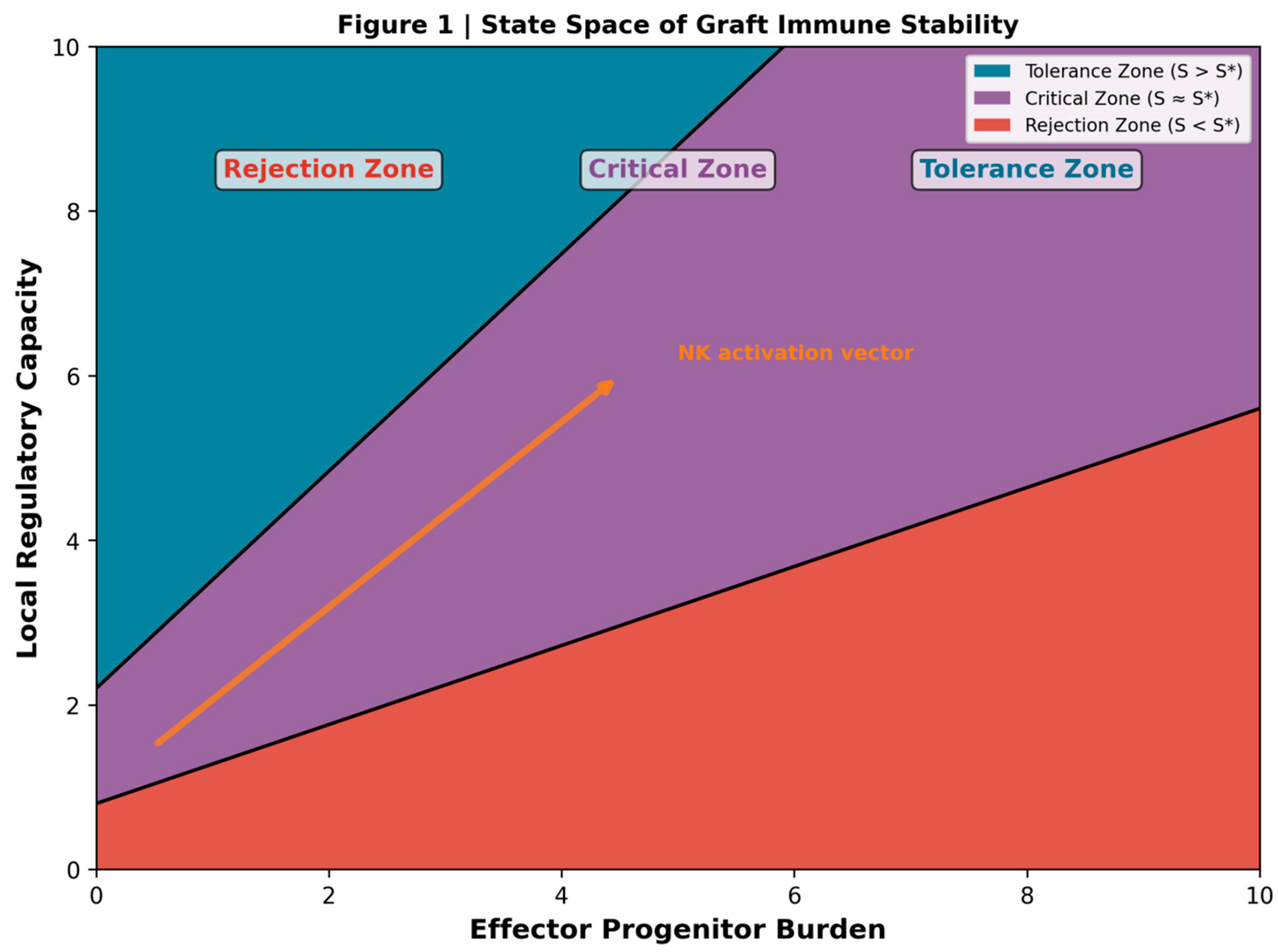
Figure 2.
Temporal evolution of local immune balance after transplantation. Three representative patterns: (A) stable tolerance—immune balance remains above critical (green); (B) critical fluctuation—balance oscillates near the boundary (purple); (C) rejection progression—balance progressively shifts below critical (red).
Figure 2.
Temporal evolution of local immune balance after transplantation. Three representative patterns: (A) stable tolerance—immune balance remains above critical (green); (B) critical fluctuation—balance oscillates near the boundary (purple); (C) rejection progression—balance progressively shifts below critical (red).
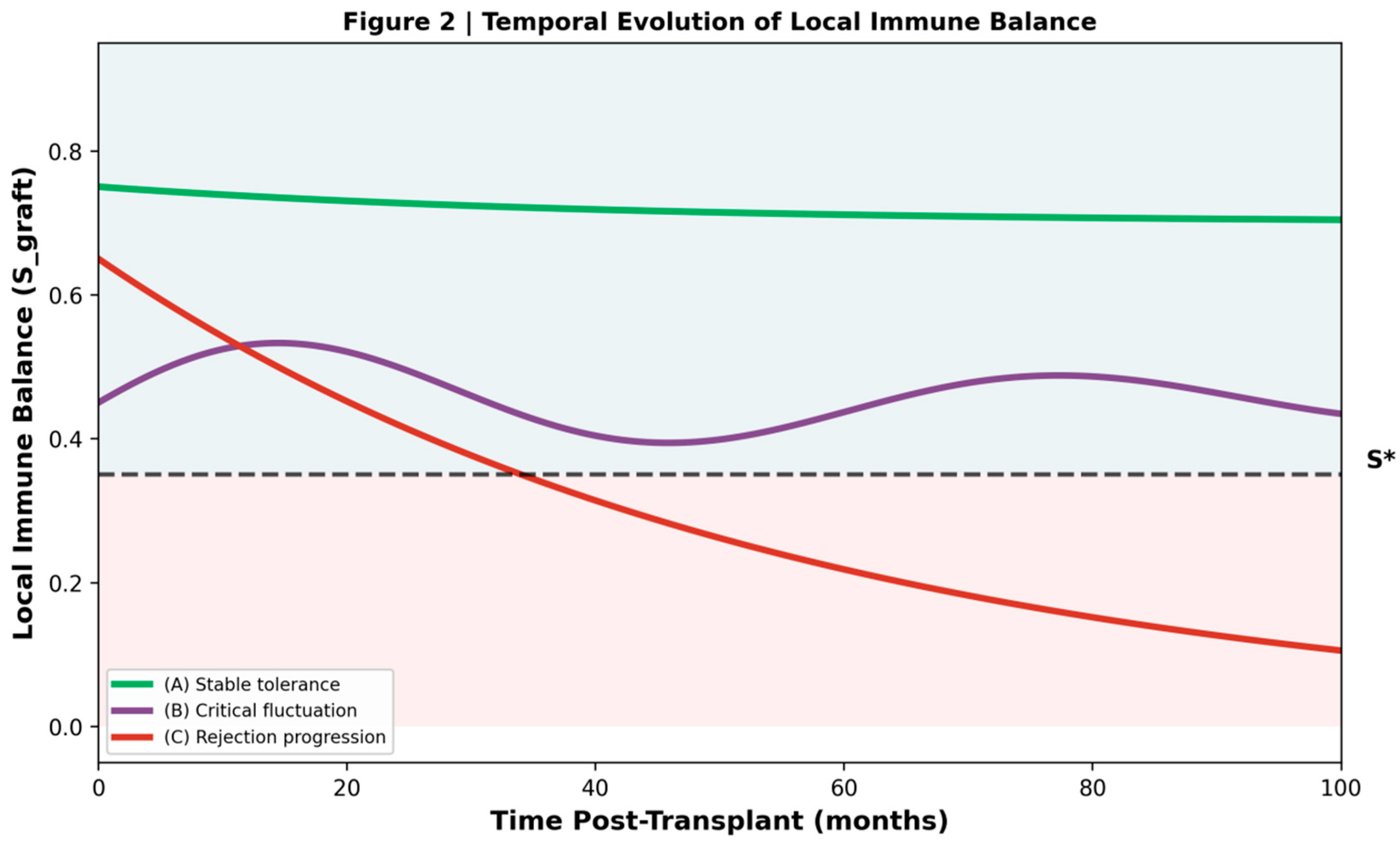
Figure 3.
Clinical stratification value of local immune balance. (A) Graft survival stratified by immune balance status; (B) non-linear threshold relationship between 6-month immune balance and subsequent rejection risk—sigmoidal shape consistent with a state transition rather than linear accumulation.
Figure 3.
Clinical stratification value of local immune balance. (A) Graft survival stratified by immune balance status; (B) non-linear threshold relationship between 6-month immune balance and subsequent rejection risk—sigmoidal shape consistent with a state transition rather than linear accumulation.
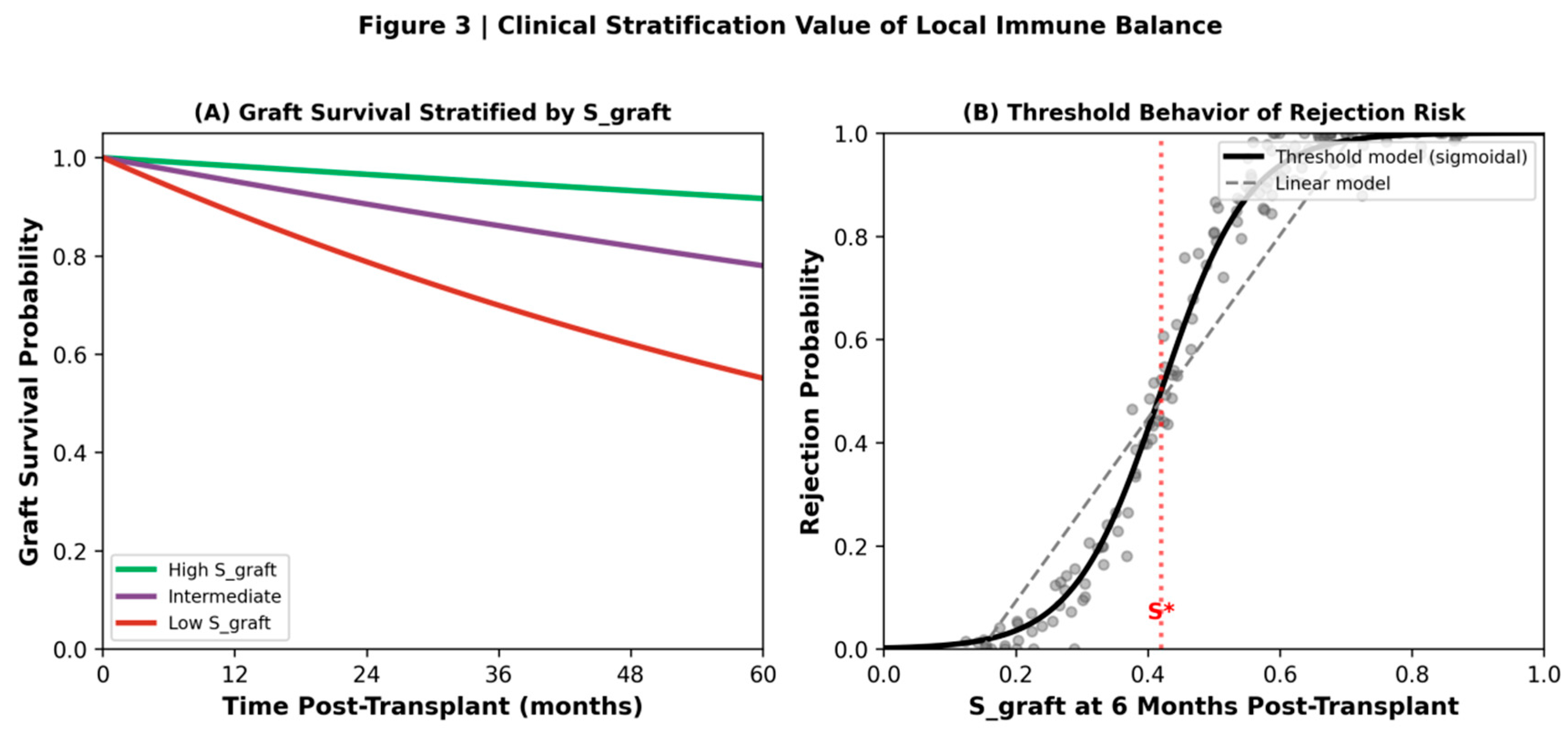
Figure 4.
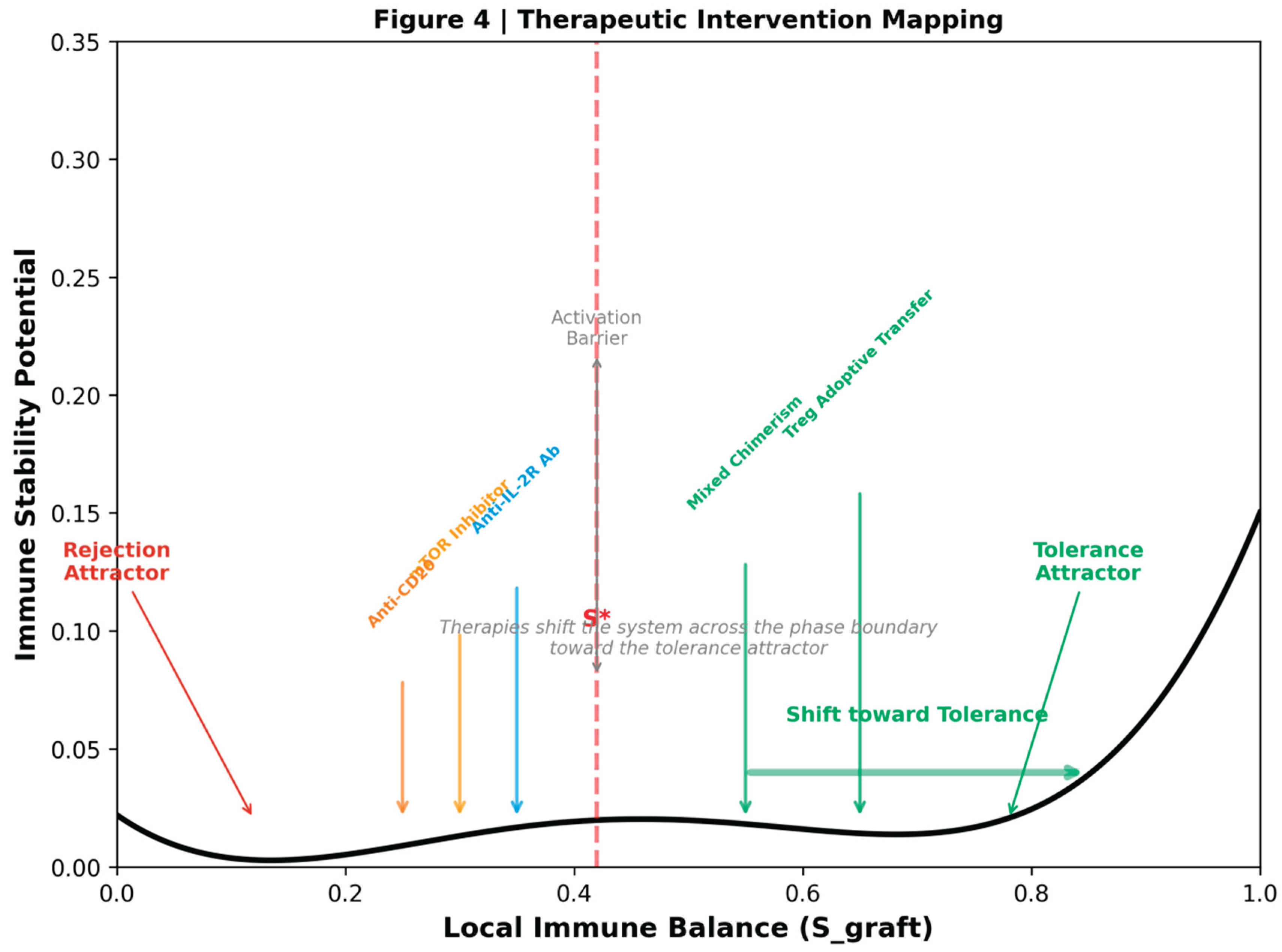
Therapeutic intervention mapping. Different clinical strategies shift the system toward the tolerance zone by influencing local immune balance. Treg adoptive transfer and mixed chimerism enhance immunoregulatory capacity; anti-IL-2 receptor antibodies, mTOR inhibitors, and anti-CD20 reduce rejection-driving pressures.
Figure 4.
Therapeutic intervention mapping. Different clinical strategies shift the system toward the tolerance zone by influencing local immune balance. Treg adoptive transfer and mixed chimerism enhance immunoregulatory capacity; anti-IL-2 receptor antibodies, mTOR inhibitors, and anti-CD20 reduce rejection-driving pressures.
Supplementary Materials
The following supporting information can be downloaded at the website of this paper posted on Preprints.org.
Funding
None.
Conflicts of interest
None declared.
Ethics approval
Not applicable (theoretical study; no human or animal experiments involved).
Data availability
No new experimental data were generated.
AI use statement
The author used AI-assisted tools (large language models) for language polishing, literature
retrieval, and preliminary formatting suggestions during the preparation of this manuscript. All scientific
content, theoretical reasoning, interpretations, and final approval are the sole responsibility of the author.
References
- Lentine, K.L.; Smith, J.M.; Hart, A.; et al. OPTN/SRTR 2020 Annual Data Report: Kidney. Am. J. Transplant. 2022, 22 Suppl 2, 21–136. [Google Scholar] [CrossRef] [PubMed]
- Newell, K.A.; Asare, A.; Kirk, A.D.; et al. Identification of a B cell signature associated with renal transplant tolerance in humans. J. Clin. Invest. 2010, 120(6), 1836–1847. [Google Scholar] [CrossRef] [PubMed]
- Feinerman, O.; Veiga, J.; Dorfman, J.R.; Germain, R.N.; Altan-Bonnet, G. Variability and robustness in T cell activation from regulated heterogeneity in protein levels. Science 2008, 321(5892), 1081–1084. [Google Scholar] [CrossRef] [PubMed]
- Solez, K.; Colvin, R.B.; Racusen, L.C.; et al. Banff 07 classification of renal allograft pathology: updates and future directions. Am. J. Transplant. 2008, 8(4), 753–760. [Google Scholar] [CrossRef] [PubMed]
- Bertoletti, A.; Ferrari, C. Adaptive immunity in HBV infection. J. Hepatol. 2016, 64((1) Suppl, S71–S83. [Google Scholar] [CrossRef] [PubMed]
- Schreiber, R.D.; Old, L.J.; Smyth, M.J. Cancer immunoediting: integrating immunity's roles in cancer suppression and promotion. Science 2011, 331(6024), 1565–1570. [Google Scholar] [CrossRef] [PubMed]
- Joo, J.S.; Lee, D.; Hong, J.Y. Multi-Layered Mechanisms of Immunological Tolerance at the Maternal-Fetal Interface. Immune Netw. 2024, 24(4), e30. [Google Scholar] [CrossRef] [PubMed]
- Sakaguchi, S.; Yamaguchi, T.; Nomura, T.; Ono, M. Regulatory T cells and immune tolerance. Cell. 2008, 133(5), 775–787. [Google Scholar] [CrossRef] [PubMed]
- Wood, K.J.; Sakaguchi, S. Regulatory T cells in transplantation tolerance. Nat. Rev. Immunol. 2003, 3(3), 199–210. [Google Scholar] [CrossRef] [PubMed]
- Im, S.J.; Hashimoto, M.; Gerner, M.Y.; et al. Defining CD8+ T cells that provide the proliferative burst after PD-1 therapy. Nature 2016, 537(7620), 417–421. [Google Scholar] [CrossRef] [PubMed]
- McLane, L.M.; Abdel-Hakeem, M.S.; Wherry, E.J. CD8 T cell exhaustion during chronic viral infection and cancer. Annu Rev. Immunol. 2019, 37, 457–495. [Google Scholar] [CrossRef] [PubMed]
- Sacirbegovic, F.; et al. Graft-versus-host disease is locally maintained in target tissues by resident progenitor-like T cells. Immunity 2023, 56(2), 369–385.e6. [Google Scholar] [CrossRef] [PubMed]
- Boyman, O.; Sprent, J. The role of interleukin-2 during homeostasis and activation of the immune system. Nat. Rev. Immunol. 2012, 12(3), 180–190. [Google Scholar] [CrossRef] [PubMed]
- Klatzmann, D.; Abbas, A.K. The promise of low-dose interleukin-2 therapy for autoimmune and inflammatory diseases. Nat. Rev. Immunol. 2015, 15(5), 283–294. [Google Scholar] [CrossRef] [PubMed]
- Ljunggren, H.G.; Kärre, K. In search of the 'missing self': MHC molecules and NK cell recognition. Immunol. Today 1990, 11(7), 237–244. [Google Scholar] [CrossRef] [PubMed]
- Lanier, L.L. NK cell recognition. Annu Rev. Immunol. 2005, 23, 225–274. [Google Scholar] [CrossRef] [PubMed]
- Fishman, J.A. Infection in organ transplantation. Am. J. Transplant. 2017, 17(4), 856–879. [Google Scholar] [CrossRef] [PubMed]
- Kauke, T.; Kaczmarek, I.; Dick, A.; et al. Anti-MICA antibodies are related to adverse outcome in heart transplant recipients. J. Heart Lung Transplant. 2009, 28(4), 305–311. [Google Scholar] [CrossRef] [PubMed]
- Zou, Y.; Stastny, P. The role of major histocompatibility complex class I chain-related gene A antibodies in organ transplantation. Curr. Opin. Organ Transplant. 2009, 14(4), 414–418. [Google Scholar] [CrossRef] [PubMed]
- Alari-Pahissa, E.; Federico-Vega, J.; Ataya, M.; et al. Alloreactive adaptive natural killer cells in renal transplantation: Potential contribution to allograft microvascular inflammation. Am. J. Transplant. 2025, 25(8), 1657–1669. [Google Scholar] [CrossRef] [PubMed]
- Rajalingam, R.; Gebel, H.M. KIR-HLA mismatching in human renal allograft transplantation: emergence of a new concept. Am. J. Transplant. 2011, 11(9), 1771–1772. [Google Scholar] [CrossRef] [PubMed]
- Ruan, D.F.; Fribourg, M.; Yuki, Y.; Park, Y.H.; Martin, M.P.; Yu, H.; Kelly, G.C.; Lee, B.H.; de Real, R.M.; Lee, R.; Geanon, D.; Kim-Schulze, S.; Chun, N.; Cravedi, P.; Carrington, M.; Heeger, P.S.; Horowitz, A. High-dimensional analysis of NK cells in kidney transplantation uncovers subsets associated with antibody-independent graft dysfunction. JCI Insight 2024, 9(21), e185687. [Google Scholar] [CrossRef] [PubMed]
- Vivier, E.; et al. Functions of natural killer cells. Nat. Immunol. 2008, 9(5), 503–510. [Google Scholar] [CrossRef] [PubMed]
- Dean, J.W.; et al. Innate inflammation drives NK cell activation to impair Treg activity. JCI Insight 2020, 108, 102417. [Google Scholar] [CrossRef] [PubMed]
- Benichou, G.; Thomson, A.W. Direct versus indirect allorecognition pathways: on the right track. Am. J. Transplant. 2009, 9(4), 655–656. [Google Scholar] [CrossRef] [PubMed]
- Wen, N.; Wu, J.; Li, H.; Liao, J.; Lan, L.; Yang, X.; Zhu, G.; Lei, Z.; Dong, J.; Sun, X. Immune landscape in rejection of renal transplantation revealed by high-throughput single-cell RNA sequencing. Front Cell Dev. Biol. 2023, 11, 1208566. [Google Scholar] [CrossRef] [PubMed]
- Nankivell, B.J.; Alexander, S.I. Rejection of the kidney allograft. N Engl. J. Med. 2010, 363(15), 1451–1462. [Google Scholar] [CrossRef] [PubMed]
- Süsal, C.; Alvarez, C.M.; Benning, L.; et al. The balance between memory and regulatory cell populations in kidney transplant recipients with operational tolerance. Clin. Exp. Immunol. 2024, 216(3), 318–330. [Google Scholar] [CrossRef] [PubMed]
- Fu, J.; Sykes, M. Emerging Concepts of Tissue-resident Memory T Cells in Transplantation. Transplantation 2022, 106(6), 1132–1142. [Google Scholar] [CrossRef] [PubMed]
- Snyder, M.E.; et al. Modulation of tissue resident memory T cells by glucocorticoids after acute cellular rejection in lung transplantation. J. Exp. Med. 2022, 219(4), e20212059. [Google Scholar] [CrossRef] [PubMed]
Disclaimer/Publisher’s Note: The statements, opinions and data contained in all publications are solely those of the individual author(s) and contributor(s) and not of MDPI and/or the editor(s). MDPI and/or the editor(s) disclaim responsibility for any injury to people or property resulting from any ideas, methods, instructions or products referred to in the content. |
© 2026 by the authors. Licensee MDPI, Basel, Switzerland. This article is an open access article distributed under the terms and conditions of the Creative Commons Attribution (CC BY) license (http://creativecommons.org/licenses/by/4.0/).
Copyright: This open access article is published under a Creative Commons CC BY 4.0 license, which permit the free download, distribution, and reuse, provided that the author and preprint are cited in any reuse.


