

Submitted:
28 June 2026
Posted:
30 June 2026
You are already at the latest version
Abstract
Socio-ecological systems (SES) in island territories are characterised by strong interdependence between human activities and fragile ecosystems, where governance constraints and sector-based management regularly hinder effective biodiversity conservation. This study intends to identify scientific advances that have been most effective in reconciling these dynamics between 2015 and 2025. A systematic review was conducted following the PRISMA 2020 framework, analysing research methods, socio-ecological interactions, governance arrangements, and thematic research trends across the literature. The results show a clear shift from predominantly ecological and sectoral-specific approaches toward more integrative and participatory SES frameworks, with mixed-methods designs, co-management strategies, and the incorporation of local knowledge emerging as the most effective advances. However, important gaps continue, particularly in the operationalisation of SES frameworks, the assimilation of climate change, and the strengthening of science–policy interfaces. Overall, the findings show that successful reconciliation between human activities and biodiversity conservation in island contexts depends on participatory and adaptive governance, institutional resilience, and the integration of diverse social and ecological values, highlighting the need for more transdisciplinary and practice-driven research.
Keywords:
island
; socioecological systems (SES)
; conservation
; ecosystem-based management
; governance and policy integration
1. Introduction
Island territories are often regarded as privileged natural laboratories for exploring the intricate relationships between social - ecological systems (SES). However, they face significant challenges, including reliance on natural resources, environmental vulnerability, and internal and external economic pressures [1,2]. Addressing these challenges needs an integrated approach that combines ecological knowledge, social perceptions, and governance frameworks. Such strategies aim to overcome mismatches between ecological and institutional scales, mitigate conflicts of use and reduce socioeconomic vulnerabilities [3,4].
Numerous studies conducted in regions such as the Pacific, Caribbean, Atlantic, and Mediterranean, illustrate that island SES are characterized by a high degree of interdependence among human communities, fragile ecosystems, and limited governance structures [1,2,5]. For instance, the case of Easter Island underscores how ongoing socio-ecological deficiencies undermine marine conservation efforts, revealing critical structural limitations in local governance [3]. Moreover, exclusionary decision-making processes have generated tensions in the management of protected areas in the Galapagos, emphasizing the importance of participatory approaches for enhancing the effectiveness of conservation systems [6,7].
Perceptions, values, and methods of use natural resources by different stakeholders play a crucial role in shaping the sustainability of SES in islands [6,8]. Emerging conflicts often result from the divergence between economic and cultural interests, as well as ecological dynamics. For example, interactions between humans and giant tortoises in Santa Cruz, in the Galapagos Islands, generate conflicts between biodiversity conservation and local livelihoods. Tortoises increasingly enter agricultural areas, causing crop damage and economic losses for farmers [8,9], or the resistance of artisanal fishermen to new coastal management strategies [6]. Consequently, the consideration/integration of the different local stakeholders ‘perceptions are essential for understanding socio-ecological resilience, institutional legitimacy, and the acceptance of conservation measures [10,11].
Environmental crises and extreme events can highlight both the resilience and vulnerability of island communities, as illustrated by the 2021 submarine volcanic eruption off La Palma (Canary Islands, Spain), which severely disrupted artisanal fisheries and local livelihoods in coastal communities such as Tazacorte [12]. Issues such as water scarcity in highly touristic islands [13] and the pressures on marine resources governance in tropical archipelagos [14,15], underscore the urgent need to incorporate ecological, social, and institutional knowledge into public policy decisions.
Adaptive and interconnected governance structures that facilitate collaboration among diverse stakeholders, from local communities to transnational institutions, are essential for addressing the complexities of SES in islands and for advancing effective and equitable conservation efforts [4,16,17]. Recent methodological and theoretical approaches have emerged to address these challenges. Network analysis and spatial modelling improve understanding of ecosystem services, resource flows and economic benefits [16,17], while participatory methods and deliberative techniques, are effective in revealing conflicts and identifying shared solutions in human–wildlife relationships [17]. In parallel, these approaches have also been applied to uncover and address governance related disputes, particularly in the context of marine and coastal management [6,9]. Some authors highlight traditional knowledge and biocultural approaches as important advances for restoring sustainable practices and strengthening local stewardship [18], others emphasize that persistent power asymmetries and exclusionary decision-making processes continue to operate as structural barriers, limiting the effectiveness of these approaches even in islands [7].
Despite notable progress in SES research addressing natural resource conservation and management, considerable challenges remain in identifying the most effective strategies for reconciling human activities with biodiversity conservation in islands [1,3,19]. Community-based and co-managed governance models are frequently lauded as exemplars of high performance, particularly in contexts where local stakeholders exercise substantial decision-making authority and governance frameworks are adaptive and contextually responsive [2,4,10,18]. Conversely, hierarchical planning paradigms based on scientific modelling, spatial planning instruments, and ecosystem service valuation, remain prominent as effective mechanisms for coordinating conservation interventions across multiple scales and mitigating cumulative impacts within complex insular systems [17,20,21,22]. However, the specific conditions under which these different approaches yield success or encounter limitations, as well as their relative efficacy across varied island contexts, have not been comprehensively synthesised [23,24,25]. This lack of synthesis represents a significant lacuna within the scholarly literature. While a multitude of empirical studies detail isolated instances of success or failure, there remains a limited comparative understanding of which scientific advancements in SES research have generated the most robust and generalisable outcomes [26,27].
Considering the identified gap, the present study undertakes a systematic review of scientific advancements in socio-ecological systems as applied to small island territories, from 2015 to 2025, adhering to the Preferred Reporting Items for Systematic Reviews and Meta-Analyses (PRISMA) 2020 guidelines [28]. Small islands present an especially conducive context for SES research, as pronounced dependences on natural resources, restricted spatial scale, and heightened ecological fragility, serve to intensify feedback mechanisms between anthropogenic activities and ecosystem dynamics [1,3,29]. These attributes render the impacts of governance and conservation interventions more immediate and discernible than those observed in continental settings [7,12].
Therefore, the principal objective of this review is to ascertain which SES-based approaches have demonstrated greater efficacy in reconciling human activities with biodiversity conservation, and to delineate the specific social, ecological, and institutional conditions underpinning their success. Through the synthesis of empirical findings, conceptual innovations, and documented conservation outcomes, this review directly engages with the central research question: ‘Which scientific advances in socio-ecological systems (SES) have proven most effective in harmonising human activities and biodiversity conservation in island regions over the past decade?’ The insights presented here aim to advance a more nuanced and operationally relevant understanding of how socio-ecological systems (SES) frameworks can support transformative and equitable conservation outcomes in island contexts, while also identifying tools and approaches to address the challenges associated with their implementation in these territories.
2. Materials and Methods
2.1. Literature Search
Following the PRISMA 2020 guidelines as a way to ensure transparency, reproducibility, and methodological rigour [28], we conducted a systematic review of the literature designed to identify, select and synthesise, scientific literature addressing socio-ecological systems (SES) applied to the conservation and management of natural resources on islands.
The bibliographic research was conducted in 2025, covering a ten-year period of scientific publications from January 2015 to 31 May 2025. This period was selected to capture scientific developments following the consolidation of SES frameworks in conservation science, and the adoption of the 2030 Agenda for Sustainable Development, which marked a shift towards integrated SES approaches in environmental governance. Two international bibliographic databases were consulted: Scopus (Elsevier) and the Web of Science Core Collection (Clarivate Analytics). These databases were selected due to their broad disciplinary coverage and their relevance to environmental sciences, conservation biology, and sustainability research.
The search was focused on peer-reviewed journal articles, excluding grey literature (e.g., reports, theses, conference proceedings) to ensure consistency in scientific quality and methodological robustness. Publications were limited to articles written in English, as the dominant scientific language, although publications in other languages such as French and Portuguese were not discarded. These languages reflect the research done on islands around the world ensuring the representativeness of English-speaking, French-speaking, and Portuguese-speaking, island territories.
The search terms were developed iteratively, based on terminology commonly used in the literature on SES and conservation, and were applied to titles, abstracts, and keywords through the Topic of Search (TS) field. Truncation (*) and Boolean operators (AND, OR) were used to maximise the sensitivity of the retrieval while maintaining conceptual specificity. The final search string was structured as follows: TS=(marine protected area* OR MPA management OR terrestrial protected area* OR protected area* OR conservation) AND (socioecological system* OR social-ecological system* OR human-environment interaction*) AND (small island developing states OR ‘SIDS’ OR oceanic island* OR archipelago).
2.2. Eligibility Criteria
Studies were included in the review if they met all of the following criteria:
1. Focus on SES – Explicit conceptual or analytical use of socioecological systems, socioecological interactions, or human-nature coupling;
2. Island context – Empirical focus on small oceanic islands or archipelagos, excluding continental islands and continental coastal systems;
3. Relevance to conservation – Direct relevance to biodiversity conservation, protected area management, ecosystem services, or natural resources governance;
4. Outcome assessment – Reporting of integrated ecological, social, governance, or SES outcomes using qualitative, quantitative, or mixed indicators; and
5. Peer-reviewed publication – Articles published in indexed scientific journals between 2015 and 2025.
For the purposes of this review, the terms “island” and “archipelago” are defined in accordance with the international standard articulated by the United Nations Convention on the Law of the Sea (UNCLOS). An island is a naturally formed landmass surrounded by water, which remains above water at high tide and can sustain human living or economic activity. An archipelago, by contrast, is conceptualized as a collection of islands whose geographical, ecological, and socio-economic linkages constitute an integrated territorial system [30].
Moreover, studies were excluded if:
1. They focused exclusively on continental islands or continental systems;
2. They addressed islands only as marginal case studies, without SES analysis;
3. They were purely conceptual or theoretical, with no application to island systems;
4. There was no access to the full versions of the texts; and
5. They were grey literature or non-peer-reviewed documents.
All records retrieved from Scopus and Web of Science were exported in CSV (Comma-Separated Values) format and uploaded to the Rayyan systematic review platform for screening and management. The selection process was conducted in three sequential steps: I. removal of duplicates; II. screening by title, abstract, and keywords, based on eligibility criteria; III. screening of the full text to confirm conceptual relevance, island specificity, and application of SES.
2.3. Data Extraction Analysis and Synthesis
Data extraction was performed using Elicit Pro (an AI-assisted research tool designed to support systematic reviews). The software was used exclusively to assist in the retrieval and organisation of information, while all inclusion decisions and analytical judgements were made by the authors.
For each article, the following information was extracted: geographic location and type of island; conservation or management context; applied SES conceptual framework or model; governance arrangements and stakeholder involvement; reported ecological, social, and institutional outcomes; methodological approaches used (Appendices I).
The selected studies were analysed using a qualitative comparative synthesis, focusing on identifying recurring SES approaches, governance models, methodological innovations, and conservation outcomes in different island contexts. This analytical framework allowed for comparison between heterogeneous case studies and facilitated the identification of patterns, trade-offs, and conditions under which SES-based approaches were most effective in reconciling human activities and biodiversity conservation in island systems.
2.4. Data Management and Reproducibility
All extracted data and analytical workflows were organised into a structured data base. GitHub was used for version control and documentation of analytical scripts, while Google Colab supported data cleaning, exploratory analysis, and visualisation.
3. Results
This systematic review identified and analysed peer-reviewed scientific articles published between 2015 and 2025, that explicitly emphasise socio-ecological systems’ (SES) approaches for small islands. After removing duplicates and applying inclusion and exclusion criteria, the final dataset consists of studies involving social and ecological components, addressing the reconciliation of human activities with biodiversity conservation on islands.
Following the first step (removal of duplicates), 626 articles remained for screening. After screening titles and abstracts, 229 articles met the initial inclusion criteria. Full-text versions of all 229 articles were obtained, including subscription-based publications, either through institutional access or by direct contact with the authors.
Screening of full texts resulted in a final set of 105 articles, which constituted the dataset used for data extraction and synthesis. The study selection process is summarised in the PRISMA flow diagram (Figure 1).
The results are structured around four analytical dimensions derived from the data extraction process: (i) temporal and disciplinary distribution of the publications, (ii) methodological approaches and analytical frameworks, (iii) types of socio-ecological interactions, and (iv) social and ecological variables addressed.
3.1. Temporal and Disciplinary Distribution of Research on SES in Small Islands
The temporal distribution of publications in the period of 2015 and 2025 shows a fluctuating pattern with an overall increase in scientific output (Figure 2). The number of annual publications varies over the period, with higher values observed at the end of the 2010s and the beginning of the 2020s. An apparent decrease in 2025 should be interpreted with caution, as it probably reflects incomplete indexing for that year rather than a real decline in the research activity in this area.
Overall, with the exception of 2025, the number of publications in this field of research applied to small oceanic islands, varies between six in 2015 and 16 in 2021, with an annual average of approximately 10 articles per year. This confirms a moderate variability among the number of articles published along the 10 years sampled. The observed peaks and troughs indicate that discrete events may have exerted an influence on particular years, resulting in episodic increases (notably in 2021 and 2024) and pronounced declines in 2025. Despite these oscillatory patterns, from a broader perspective, the analysis reveals no significant systematic increase or decrease over the period in question; instead, the trend remains essentially stationary, with the temporal dynamics of the series predominantly governed by interannual fluctuations around a mean value of approximately 9–10 occurrences.
In Figure 3, we can see the distribution of publications by scientific journal. In a universe of sixty-four journals, SES articles concerning small oceanic islands are predominantly published in interdisciplinary journals focused on environmental management, conservation and sustainability. These include: Ocean and Coastal Management, Sustainability, Marine Policy, Ambio, Frontiers in Marine Science, Society & Natural Resources, Journal of Environmental Management. The majority of the remaining journals contributed with only one or two publications on this subject. These “Other journals”, comprise titles such as Island Studies Journal, Oryx, Pacific Conservation Biology, Ecological Indicators, Environmental Science & Policy, Tourism Management, and World Development, among others. This distribution reflects the cross-cutting nature of research on socio-ecological systems in islands, which generally encompasses ecology, governance and natural resource management.
3.2. Methodological Approaches and Analytical Frameworks in Island SES Research
The studies analysed employ a variety of methodological approaches to address the complexity of socio-ecological systems in island regions (Figure 4). Mixed methods using both quantitative and qualitative approaches, are the most frequently used (58%), followed by strictly quantitative (22%) or qualitative (20%) studies.
Mixed-methods studies combine quantitative data (e.g., ecological indicators, spatial analysis, surveys) with qualitative information (e.g., interviews, participant observation, document analysis), allowing for the simultaneous examination of ecological processes and social dynamics. Quantitative studies focus mainly on measuring ecological change, resource use patterns, and environmental impacts, while qualitative approaches emphasise governance arrangements, stakeholder perceptions, and Indigenous and Local Knowledge (ILK).
In terms of analytical frameworks, the literature shows a tendance for integrated socio-ecological systems’ frameworks, participatory and co-management approaches, resilience-based assessments, and spatially explicit analyses. These frameworks are often applied in combination, reflecting the need to capture the interactions between human activities and ecological processes in island environments.
3.2.1. Methodological Approaches Applied to SES
Table 1 presents the distribution of the 105 reviewed articles according to the dominant type of data processing employed in each study. For this classification, narrative-based processing, refers to approaches grounded in qualitative interpretation, including interviews, document analysis, and thematic or content analysis. Spatial-based processing encompasses studies using geographic or spatially explicit data (e.g., GIS and remote sensing). Participatory–deliberative processing includes methods based on stakeholder engagement and collective knowledge production (e.g., workshops and participatory mapping). Model-based processing refers to the use of mathematical, simulation, or system-dynamics models. Finally, statistical-based processing includes studies primarily relying on quantitative statistical analyses. A small number of studies (2) could not be clearly classified into any of these categories due to insufficient methodological specification.
The results indicate a marked predominance of narrative-based processing (65 studies), demonstrating that research on SES in island regions has been largely oriented towards qualitative, interpretive, and context-specific analyses. In comparison to this dominant category, spatial-based processing (13 studies) and participatory deliberative processing (11 studies), are less frequently represented. Model-based processing (8 studies) and statistical-based processing (6 studies) account for the smallest proportions of the sample when compared to all other categories.
3.2.2. Analytical Frameworks Applied to Island SES Studies
Regarding the analytical frameworks, retrieved studies predominantly adopt integrative approaches to conceptualise SES in island contexts (Table 2). Island socio-ecological management approaches are most frequent (57 studies), incorporating diverse methods such as spatial analysis (e.g., GIS-based tools), statistical and modelling techniques (e.g., Principal Component Analysis (PCA), Generalized Linear Mixed Effects Models (GLMMs), Bayesian models), and participatory decision-support frameworks (e.g., Analytic Hierarchy Process (AHP), ecosystem-based management). In parallel, SES island frameworks (30 studies) provide more structured conceptual foundations, often adapting established models (e.g., Institutional Analysis and Development (IAD), coupled SES frameworks), with emphasis on feedback, cross-scale dynamics, and governance performance. Despite these differences, both categories integrate ecological processes, social dimensions, and governance systems, although Island socio-ecological management approaches are more consistently operationalised, while SES frameworks remain less frequently translated into empirical applications.
In contrast, more specialised frameworks are less frequently represented. Participatory and co-management frameworks are identified in six studies, reflecting approaches that explicitly emphasise stakeholder engagement and shared governance mechanisms. Ecosystem services assessment frameworks are identified in five studies and focus on the identification, mapping, and valuation of ecosystem services using participatory approaches and spatial tools (e.g., Social Values for Ecosystem Services (SolVES), Maximum Entropy model (MaxEnt), Public Participation Geographic Information Systems (PPGIS)), supported by frameworks such as the adaptive cycle and panarchy. Resilience assessment frameworks, reported in four publications, focus on the adaptability and response capacity of socio-ecological systems to environmental and social disturbances, combining quantitative methods, ecological indicators, and governance-based approaches.
Frameworks with a stronger operational and spatial focus are comparatively scarce. Marine spatial planning is identified in two studies, and conservation planning specifically designed for island contexts appear in only one study, indicating a limited application of spatially explicit decision-support tools.
3.3. Types of socio-ecological interactions and governance models
The analysis of socio-ecological interactions across the reviewed studies reveals a strong concentration of research on system-specific interactions, particularly those related to tourism, fisheries, and biodiversity conservation (Figure 5). The most represented categories include: Tourism-Based Socio-Ecological Systems (22), Marine Resource Use and Fisheries Systems (22), and Conservation and Biodiversity Management Systems (22), indicating a clear emphasis on sectors directly linked to marine and coastal resources.
Governance and institutional dynamics emerge as recurrent transversal dimensions across multiple socio-ecological interactions, cumulative to sector-specific systems. Although governance-related processes are embedded in several categories, only seven studies explicitly place governance arrangements, institutional structures, and policy processes, at the centre of the analysis. This pattern suggests that governance is more frequently addressed as an underlying component shaping socio-ecological interactions rather than an independent object of investigation. The results highlight the pervasive influence of institutional and policy dimensions across island SES, while also indicating that governance-centred analyses remain comparatively limited.
In contrast, categories such as Community-Based and Participatory Systems (10), Socio-Cultural and Knowledge-Based Interactions (8), and Climate and Environmental Change Interactions (6), are less frequently represented. The studies within these categories typically address stakeholder engagement, traditional ecological knowledge, and adaptive responses to environmental change, indicating that social, cultural, and adaptive dimensions are comparatively underexplored relative to resource-based systems. Additionally, Agricultural and Land-Based Livelihood Systems (4) and Pollution and Environmental Degradation Systems (1) exhibit very low representation. The content of these categories suggests a limited focus on land-based activities, environmental contamination, and non-marine stressors, reinforcing the predominance of marine-oriented research and highlighting a gap in the integration of land–sea interactions.
A small number of studies were classified under Conceptual and Theoretical Interactions (3), encompassing research that primarily employs SES as an analytical or conceptual framework. These studies include discussions on adaptive capacity, human–environment integration, and power dynamics, as well as one case in which no explicit socio-ecological interaction was defined.
3.4. Social and Ecological Variables Addressed in Studies of Island Socio-Ecological Systems
The reviewed literature covers a wide range of social and ecological variables tackled in SES studies performed on islands (Figure 6). On the social dimension, the most frequently analysed variables include social well-being and perception, community participation and social engagement, governance and policy, livelihoods and economic activities. On the ecological dimension, biodiversity and habitat conservation is by far the most common analysed, followed by the marine and coastal ecosystems, and ecological integrity and natural resources, variables.
4. Discussion
Revisiting the main objective of this study: to critically evaluate scientific advancements achieved between 2015 and 2025 in the application of SES frameworks to island territories, this discussion brings together thematic, methodological, and analytical findings to assess the current state of the field, highlighting a significant gap in progress toward more comprehensive and operational socio-ecological models.
4.1. Methodological Approaches and Analytical Frameworks in Island SES Research
The results reveal a dominant methodological pattern in island socio-ecological systems (SES) research from 2015 to 2025, with mixed-methods approaches prevailing (58%), followed by quantitative (22%) and qualitative (20%) studies. This pattern underscores the growing adoption of methodological integration to address the complexity inherent in island SES. The findings also show that the most effective advances in reconciling human activities with biodiversity conservation are not associated with isolated methods, but with approaches capable of simultaneously analysing ecological processes, social dynamics, and governance structures. In island contexts where spatial constraints, resource limitations, and strong human–environment interactions coexist, such integration becomes essential [24,31,32].
The distribution of methodological approaches presented in Table 1 provides a more detailed understanding of this pattern by revealing a strong predominance of narrative-based processing (65 studies), compared to spatial (13 studies), participatory–deliberative (11 studies), model-based (8 studies), and statistical approaches (6 studies). This result indicates that, despite the recognised importance of integration highlighted in Figure 4, SES research in island contexts remains largely based on qualitative and interpretative analyses.
It is interesting to notice that, while narrative-based approaches are essential for understanding governance systems, local knowledge, and socio-cultural dynamics [2,33,34], their predominance suggests a limited development of predictive, spatially explicit, and model-based tools capable of supporting operational decision-making [16,35,36]. As a result, although significant advances have been made in conceptualising socio-ecological interactions, the capacity to translate this knowledge into actionable strategies for reconciling human activities with biodiversity conservation remains comparatively underdeveloped [3,7,14]
Mixed-method approaches emerge from the results as the most operationally relevant strategy for linking ecological data with human behaviour and decision-making processes. Studies such as Poti et al. [37] demonstrate how combining binary logistic regression with qualitative analysis allows for a more comprehensive understanding of conservation-related behaviours, such as turtle egg consumption. Similarly, Burbano and Meredith [6] show that integrating surveys and interviews provides critical insight into stakeholder perceptions during marine spatial planning in the Galapagos Marine Reserve.
The effectiveness of these approaches lies in their ability to connect different dimensions of SES. This is particularly evident in studies that integrate ecological, spatial, and social data. Collins et al. [38] combined inspection records, interviews, and focus groups with social network analysis to identify drivers of illegal fishing and support marine protected area management. Cavada-Blanco et al. [17] developed socio-ecological networks to analyse how economic benefits from coral reefs are distributed among stakeholders. These examples illustrate how methodological integration supports a more systemic understanding of interactions between human activities and biodiversity, which is central to address the research question of this review (Which scientific advances in socio-ecological systems (SES) have proven most effective in harmonising human activities and biodiversity conservation in island regions, over the past decade?).
Participatory components within mixed-method approaches further strengthen the contribution of SES research to conservation outcomes. The results indicate that stakeholder engagement is not merely a methodological choice, but a key condition for effective governance in island SES. This is evident in studies that combine participatory methods with empirical and modelling approaches to address concrete conservation challenges. Benitez-Capistros et al. [8] used the nominal group technique (NGT) to facilitate dialogue and reduce human–wildlife conflict in the Galapagos, while Vandenberg et al. [39] combined surveys and ethnographic interviews to assess the socio-cultural and food security impacts of coral restoration. Pittman et al. [21] integrated interviews with trophic models to evaluate governance scenarios associated with Fish Aggregating Devices. By linking local knowledge, socio-cultural dimensions, and decision-support tools, participatory mixed-method designs enhance the practical relevance of SES research for conservation governance.
Although less prevalent, quantitative approaches significantly expand the analytical and predictive capacity of island SES research by enabling the exploration of ecological dynamics, spatial conflicts, and future system trajectories. Rather than focusing exclusively on descriptive analyses, these methods provide tools to explore and anticipate socio-ecological responses under different management scenarios. Spatially explicit approaches based on Public Participation Geographic Information Systems (PPGIS), for example, have been used to identify tourism-related conflicts and reveal the importance of spatial heterogeneity in planning processes [40]. Similarly, ecosystem and Bayesian state-space models have contributed to understanding the combined effects of climate variability and fishing pressure on ecological systems in the Galapagos [41,42]. Simulation approaches, such as Monte Carlo models, further strengthen this predictive dimension by evaluating trade-offs between tourism, food security, and biodiversity conservation in island contexts such as Palau [43]. Collectively, these studies demonstrate the growing relevance of quantitative methods for supporting evidence-based and forward-looking management strategies.
Qualitative approaches, which represent 20% of the studies, play a complementary but essential role by providing insight into governance systems, cultural values, and local ecological knowledge. The results show that these approaches are particularly important for understanding how conservation policies are perceived and implemented in practice. Benitez-Capistros et al. [9] used the nominal group technique (NGT) and participatory plural appraisal (PRA) to map socio-ecological interactions, while Unsworth et al. [44] relied on expert consultations to assess seagrass ecosystem dynamics. Fioravanso and Nicolodi [15] analysed governance structures and institutional conflicts, and Luat-Hū‘eu et al. [45] reconstructed biocultural relationships using archival sources. Maestro et al. [46] further contributed by evaluating management effectiveness in protected areas through qualitative methods. These studies highlight that conservation outcomes in island SES are strongly influenced by social and institutional contexts, which cannot be captured through quantitative analysis alone.
Collectively, the results reveal that the most clear scientific advance in island SES research over the last decade is the shift toward methodological pluralism and integration. This integration enables a more comprehensive understanding of socio-ecological interactions and provides a stronger basis for designing strategies that reconcile human activities with biodiversity conservation.
The distribution of analytical frameworks presented in Table 2 reinforces the methodological patterns identified in Section 3.2 (Methodological approaches and analytical frameworks in Island SES research). The predominance of island socio-ecological management frameworks (57 studies) and SES-based frameworks adapted to island systems (30 studies) indicates that most studies adopt integrative approaches to conceptualise the interactions between ecological processes, social actors, and governance systems. These frameworks are specifically designed to analyse the complexity of SES and to support the reconciliation of human activities with biodiversity conservation. Their widespread use reflects the recognition that conservation challenges in island environments cannot be addressed through isolated ecological or social perspectives but require integrated analytical structures.
Frameworks such as panarchy [31,47] and ecosystem-based management [14] illustrate how system dynamics, cross-scale interactions, and governance processes, are incorporated into SES research. Their dominance in the literature suggests that scientific advances have focused on improving the conceptualisation of complex systems and their adaptive capacity. Participatory and co-management frameworks, although less frequent (6 studies), play a critical role in translating SES concepts into practice. As indicated in the results, these frameworks emphasise stakeholder engagement and shared decision-making, which are essential for achieving socially acceptable and ecologically effective conservation outcomes. Methods such as the NGT [9,34], participatory mapping, and PPGIS [5,40,48] enable the integration of local knowledge into planning processes and help identify spatial conflicts and trade-offs.
Other frameworks identified in the results, including ecosystem services, resilience assessment, marine spatial planning (MSP), and conservation planning, appear less frequently but highlight an important trend towards the diversification of analytical tools. These approaches are often associated with decision-support systems, such as the maestro model [46], the Global Standard for Nature-based Solutions™ [49], and multi-criteria methods like Fuzzy Delphi Method (FDM) and Analytic Hierarchy Process (AHP) [50]. Trade-off frameworks [51] further illustrate how SES research is increasingly oriented towards evaluating competing objectives between human activities and conservation. However, the limited representation of spatial planning and operational frameworks in the results suggests that, despite advances in conceptual integration, the translation of SES knowledge into practical decision-making tools remains underdeveloped. This gap is particularly relevant in island contexts, where spatial constraints and resource use pressures require precise and actionable management strategies. Existing applications, such as MSP (guided by UNESCO frameworks) including recent island case studies such as São Tomé and Príncipe [24], remain relatively scarce.
Overall, scientific advances in analytical frameworks have been primarily oriented towards improving the conceptual and integrative understanding of island SES, while operational and decision-oriented applications are less developed. This imbalance highlights an important limitation in the field, as the effectiveness of SES approaches in reconciling human activities with biodiversity conservation ultimately depends on their capacity to support concrete management actions.
4.2. Types of Socio-Ecological Interactions and Governance Arrangements
The results reveal a marked concentration of socio-ecological interactions within a limited set of sectors, namely tourism, fisheries, and biodiversity conservation (all with 22 studies), highlighting a strong sectoral orientation in island SES research. This pattern reflects the structural dependence of island systems on marine and coastal resources, which consistently emerge in the literature as the primary foundation of local economies and livelihoods. In these contexts, ecological integrity and economic activities are tightly intertwined, reinforcing the inherently dynamic and feedback-driven nature of island SES [19,52]. To further explore the structure of these interactions, a conceptual network diagram was developed (Figure 7), illustrating both the connectivity and relative centrality of key socio-ecological domains.
As shown in Figure 7, socio-ecological interactions are organised around a central core consisting of tourism, fisheries, and biodiversity conservation, which exhibit the highest levels of connectivity with other domains. This centrality reflects the strong empirical focus of the literature on marine-based and sector-specific systems. However, it is important to note that centrality in the network does not necessarily imply effectiveness but rather indicates research attention and analytical emphasis. This raises the possibility of a structural bias in SES research towards economically visible and data-rich sectors, potentially at the expense of less visible but equally critical dimensions [10,53,54].
Surrounding this core, governance systems, community-based approaches, and socio-cultural interactions, function as intermediary domains, linking ecological processes with social organisation and institutional dynamics. These domains play a critical integrative role, as they mediate the relationships between human activities and ecological outcomes. Despite this, governance-related interactions appear less frequently as a primary focus (7 studies), suggesting that governance is often treated as an implicit or secondary dimension. This is particularly significant given that the literature consistently identifies governance quality including participation, institutional fit, and stakeholder inclusion, as a key determinant of conservation effectiveness [6,7]. The relative underrepresentation of governance as an explicit analytical focus therefore points to an important gap between recognised best practices and their systematic incorporation into SES research.
The network structure also reveals that community-based and participatory systems (10 studies), as well as socio-cultural and knowledge-based interactions (8 studies), remain comparatively underexplored. This is noteworthy in light of the central objective of this review, as a substantial body of literature emphasises that local knowledge, cultural practices, and stakeholder engagement are essential for achieving socially legitimate and ecologically effective conservation outcomes [45,55]. Participatory and bottom-up governance approaches have shown to enhance compliance, reduce conflicts, and improve the long-term sustainability of conservation strategies [24,27,56]. The limited representation of community-based and participatory systems and knowledge-based interactions, suggest a disconnection between the approaches identified as most effective and their empirical application in island SES research.
In contrast, domains such as climate and environmental change interactions (6 studies), land-based systems (4 studies), and pollution-related interactions (1 study) are less integrated into the network. While these factors are widely recognised as drivers of change in island systems, their limited integration into socio-ecological analyses indicates that current SES research may not fully capture the complexity of cross-scale and cross-system interactions. This is particularly evident in the strong marine bias observed in the literature, which tends to prioritise coastal and marine dynamics while underrepresenting terrestrial processes. Such imbalance constrains the understanding of land–sea interactions, which are fundamental to island sustainability. Processes such as land-use change, sedimentation, and pollution have direct and cascading impacts on coastal and marine ecosystems, as emphasised in ridge-to-reef frameworks [57,58], yet remain insufficiently integrated into SES analyses.
A particularly notable feature of the network is the position of conceptual and theoretical interactions (3 studies) as an isolated node (Figure 7). This suggests that studies focusing on conceptual development such as system dynamics, adaptive capacity, and power relations remain largely disconnected from empirical analyses of socio-ecological interactions. While these contributions are essential for advancing SES as an analytical framework, their limited operationalisation reduces their capacity to inform decision-making in real-world contexts. This gap between theoretical development and empirical application represents a critical constraint for the evolution of SES research, particularly in island settings where context-specific and actionable knowledge is essential for effective governance.
Taken together, the structure of the network highlights that the most significant scientific advances in island SES are those that move beyond sector-specific analyses and foster integration across ecological, social, and governance dimensions. Advances that explicitly link conceptual frameworks with empirical applications, incorporate participatory and community-based approaches, and address cross-scale interactions, offer the greatest potential for reconciling human activities with biodiversity conservation.
The prominence of tourism- and fisheries-based systems further underscores their central role in shaping island socio-ecological dynamics, while simultaneously revealing the trade-offs that characterise these systems. Tourism, in particular, exemplifies this duality: it provides critical economic benefits and supports local livelihoods, but also contributes to habitat degradation, biodiversity loss, and increased system vulnerability [20,59]. Importantly, the literature suggests that the most effective SES approaches are not those that eliminate such trade-offs, but those that render them explicit, negotiable, and governable through inclusive and adaptive institutional arrangements [5,40].
Overall, the findings indicate that SES research on islands remains predominantly focused on marine-based and sector-specific systems, with comparatively limited development of integrative approaches that fully incorporate governance, social dynamics, and land–sea interactions. In relation to the central objective of this review, this suggests that the most effective scientific advances are those that operationalise integration across sectors, knowledge systems, and governance levels, while explicitly addressing trade-offs, power asymmetries, and the co-production of knowledge. Such approaches are essential for advancing from descriptive analyses towards actionable sustainability pathways in island socio-ecological systems [23,25].
4.3. Social and Ecological Variables in Island Socio-Ecological Systems
The results presented in Section 3.4 highlight that SES research on islands place a strong emphasis on variables related to human well-being, governance, participation, and livelihoods on the social side, and on biodiversity, marine ecosystems, and ecological integrity on the ecological side. This distribution reflects a growing recognition of the interdependence between social and ecological dimensions, which is central to understand how human activities can coexist with biodiversity conservation.
The prominence of social variables such as governance, participation, and perception aligns with the increasing focus on institutional capacity and stakeholder engagement in SES research. As shown in the literature, trust in institutions and social feedback mechanisms strongly influence compliance with environmental regulations and resource management practices [38,60]. In this context, social networks and collaborative structures play a critical role in enhancing system adaptability and resilience [4,10]. At the same time, the emphasis on ecological variables such as biodiversity and habitat conservation, reflects the continued importance of protecting ecosystem functions and services on island environments. However, the results suggest that these ecological dimensions are most frequently analysed in connection with human well-being and resource use, rather than isolated components. This reinforces the idea that the most effective SES approaches are those that integrate ecological integrity with social and economic considerations. The interaction between social and ecological variables is particularly evident in studies that address livelihoods and land-use dynamics. As highlighted in the literature, livelihood diversification and land-use structures are key determinants of resilience, often more influential than the formal designation of protected areas [58,60]. This suggests that conservation outcomes depend not only on ecological protection measures but also on the socio-economic conditions of local communities.
A key scientific advance identified in the literature is the increasing integration of different knowledge systems, including scientific, traditional, and local knowledge. Co-produced approaches involving researchers and local communities are recognised as essential for developing adaptive and context-specific management strategies [25]. Participatory tools such as Public Participation Geographic Information Systems (PPGIS) further support this integration by capturing spatial perceptions and identifying areas of ecological and social importance, thereby facilitating more inclusive and effective planning processes [22,40].
Overall, the results indicate that the reconciliation of human activities with biodiversity conservation on islands’ SES depends on the capacity to integrate social and ecological variables within flexible and inclusive governance systems. Approaches that promote participation, strengthen institutional trust, support livelihoods, and protect key ecosystems, are consistently associated with more effective and sustainable outcomes. This reinforces the central finding of this review: that scientific advances in SES are most effective when they move beyond disciplinary boundaries and incorporate the complex interactions that define island socio-ecological systems [4,18,19,20,22,25,52,55,56,60].
4.4. Synthesis of Thematic Advances and Research Priorities on Island SES
To synthesise the state of knowledge across the main thematic domains identified in this review, two standardised indices – the Knowledge Maturity Index (KMI) and the Future Research Priority Index (FRPI) – were developed, based on the frequency distribution of main findings, research gaps, and future research recommendations. These indices are presented in Table 3 as analytical tools specifically developed for this review to compare the relative maturity of knowledge and the intensity of future research needs across thematic domains. Their construction is conceptually informed by approaches used in systematic mapping and research-prioritisation studies, which seek to identify evidence concentrations, knowledge gaps, and emerging research priorities [61,62,63]. The thematic domains used in this section represent an analytical aggregation derived from thematic content categorisation of the reviewed studies. Categories were assigned based on recurring keywords and expressions identified in the sections related to main findings, research gaps, future research, and conclusion summaries, allowing for the grouping of studies into broader socio-ecological domains such as governance, livelihoods, biodiversity conservation, climate resilience, and science–policy integration.
The first index, referred to as KMI, captures the degree to which existing research in each thematic category is consolidated. It is calculated as the ratio between the number of main findings and the total number of empirical entries and identified gaps: KMI = Main findings / (Main findings + Research gaps). The second index, the FRPI, measures the extent to which the literature emphasises the need for further investigation in each thematic domain. It is calculated using the same denominator as the maturity index but replacing the numerator with the number of future research recommendations: FRPI = Future research / (Main findings + Research gaps). Both metrics (main findings and future research) are derived from systematic content analysis of the reviewed literature. “Main findings” correspond to empirically grounded results, such as observed changes in resource use, conservation outcomes, and management effectiveness, while “future research recommendations” reflect recurring needs identified by authors, including improving policy implementation, understanding socio-cultural drivers, and strengthening integrated socio-ecological management approaches.
Together, these indices provide a robust and comparable framework to assess both the consolidation of knowledge and the intensity of research demand across thematic areas. In the case of the knowledge maturity index, values approaching 1 reflect a higher degree of consolidated empirical evidence relative to identified research gaps, whereas lower values indicate that the theme is predominantly characterised by unresolved gaps. Conversely, for the future research priority index, higher values indicate a stronger emphasis on the need for further investigation, while lower values suggest that the theme is comparatively less prioritised in terms of future research.
In interpretative terms, themes characterised by low maturity and high future priority can be identified as “critical research cores”, where scientific development remains limited but urgently needed. This approach strengthens the analytical consistency of Table 3 and supports a more systematic identification of priorities for advancing socio-ecological systems research in island contexts.
The results reveal a clear concentration of research efforts in the domain of governance and policy, combining a high number of empirical findings (49) with the highest levels of identified gaps (52) and future research recommendations (54). This pattern indicates that governance has emerged as the central axis of socio-ecological systems research in island contexts, reflecting its critical role in mediating interactions between human activities and biodiversity conservation. As demonstrated in the literature, institutional trust, legitimacy of regulations, and stakeholder participation are key determinants of conservation effectiveness [26,60,64]. Participatory and polycentric governance approaches, further contribute to conflict mitigation and institutional resilience [17,35], reinforcing the idea that self-organised systems tend to be more adaptive than centralised management structures.
However, the relatively moderate maturity index associated with governance (≈0.49), combined with its high future priority (≈0.54), indicates that this field remains in a transitional phase. While there has been significant progress in diagnosing institutional challenges and proposing participatory arrangements, the literature still lacks robust evidence on the implementation, monitoring, and long-term effectiveness of these governance models. This gap is directly relevant to the central question of this review, as it suggests that the reconciliation of human activities with biodiversity conservation depends not only on identifying governance structures, but on operationalising them in real-world contexts.
In contrast, in the domains of community and livelihoods and biodiversity and ecosystem conservation, the index “maturity” is, respectively, 0.67 and 0.57, showing higher levels of knowledge consolidation, reflecting a more established empirical understanding of the relationships between ecological processes and human well-being. Studies have consistently shown that conservation measures, such as marine protected areas, can enhance ecological indicators like biomass and species abundance, but these benefits do not automatically translate into improved livelihoods or social equity [54,65]. Similarly, the resilience of socio-ecological systems is strongly influenced by livelihood diversification, cultural values, and local perceptions [8,10,53]. These findings reinforce the importance of integrated and biocultural approaches, where ecological conservation is aligned with social justice and community well-being [66,67].
Despite these advances, the results also reveal critical gaps in several key domains. Environmental education and awareness, climate change and resilience, and science–policy integration exhibit very low levels of maturity, with particularly limited empirical evidence. The near absence of studies addressing education and youth engagement suggests a lack of focus on the social learning processes necessary to sustain long-term behavioural change. Similarly, the limited integration of climate change into SES research contrasts with the high vulnerability of island systems to climate-related impacts [68,69].
The case of science–policy integration is particularly notable, as it presents the lowest maturity (0) but the highest future priority (1), indicating a critical gap between knowledge production and its application in decision-making processes. This is further highlighted by the lack of standardised monitoring frameworks and the limited availability of social data to support integrated planning [24,38]. Additional challenges include the underrepresentation of youth in governance processes [70] and the absence of consistent methodologies for updating ecological and biological indicators [25,71].
Taken together, these findings point to a broader structural limitation in SES research on islands: while significant progress has been made in understanding socio-ecological interactions and governance systems, the translation of this knowledge into operational, scalable, and adaptive management strategies, remains insufficient. Addressing this limitation requires strengthening transdisciplinary approaches that integrate scientific, local, and policy knowledge systems [72], as well as expanding participatory governance models [17,18].
5. Conclusions
This systematic review demonstrates that the most significant scientific advances in the application of socio-ecological systems (SES) to small islands between 2015 and 2025 are associated with increasingly integrative approaches that combine ecological, social, and governance dimensions. Rather than relying on isolated disciplinary perspectives, the literature shows a shift towards methodological pluralism, participatory governance, and the co-production of knowledge as essential strategies for reconciling human activities with biodiversity conservation in island contexts.
The findings further reveal that SES research remains strongly concentrated on marine-based and sector-specific systems, particularly tourism and fisheries, while governance processes, socio-cultural dimensions, climate change, and land-sea interactions remain comparatively underexplored. Although important progress has been made in understanding socio-ecological complexity, persistent limitations remain in the operationalisation of SES approaches, particularly regarding predictive tools, spatial planning, and the translation of scientific knowledge into decision-making processes.
Overall, this review highlights that effective conservation in island socio-ecological systems depends on integrated, adaptive, and context-specific approaches capable of addressing ecological processes alongside social dynamics, institutional structures, and local livelihoods. Future advances in the field will require stronger transdisciplinary collaboration, improved science–policy integration, and greater emphasis on actionable management frameworks that can support both biodiversity conservation and sustainable human development in island regions.
Author Contributions
For research articles with several authors, a short paragraph specifying their individual contributions must be provided. The following statements should be used “Conceptualization, G.M. and A.V.; methodology, G.M.; software, G.M.; validation, G.M., C.P., D. C and A.V.; formal analysis, G.M.; investigation, G.M.; resources, G.M., C.P., D.C., and A.V.; data curation, G.M.; writing—original draft preparation, G.M.; writing—review and editing, C.P., D.C., H.C. and A.V.; visualization, C.P., D.C., and A.V.; supervision, H.C. and A.V.; project administration, G.M.; funding acquisition, G.M. and A.V. All authors have read and agreed to the published version of the manuscript. Authorship must be limited to those who have contributed substantially to the work reported.
Funding
G.M. is the recipient of a PhD scholarship from Fundação para a Ciência e Tecnologia, Ministério da Ciência, Tecnologia e Ensino Superior, Portugal, with reference: PRT/BD/154936/2023, DOI: https://doi.org/10.54499/PRT/BD/154936/2023. This work was also supported by FCT, I.P., the Portuguese national funding agency for science, research, and technology, under the Projects UIDB/50027/2020 and UID/50027 (CIBIO—Açores). DC benefits from a PhD scholarship from Fundo Regional da Ciência e Tecnologia (FRCT – Açores), Regional Government of Azores, Program PROSCIENTIA, with the reference M3.1.a/F/011/2021.
Informed Consent Statement
Not applicable.
Data Availability Statement
The data presented in this study are available on request from the corresponding author.
Acknowledgments
During the preparation of this study, the authors used Elicit Pro (licensed version) and the Rayyan (premium version) platform for the purposes of assisting in the systematic retrieval and organization of relevant literature. It is important to note that these tools were used exclusively for information management; all inclusion and exclusion decisions, as well as all analytical judgements and data interpretations, were performed solely by the authors. The authors have reviewed and edited the output and take full responsibility for the content of this publication.
Conflicts of Interest
The authors declare no conflicts of interest. The funders had no role in the design of the study; in the collection, analyses, or interpretation of data; in the writing of the manuscript; or in the decision to publish the results.
References
- Gil, A. Thematic Section: Sustainable development and environmental conservation in the Outermost European Regions. Isl. Stud. J. 2016, 11(1), 5–8. [Google Scholar] [CrossRef]
- Glaser, M.; Breckwoldt, A.; Deswandi, R.; Radjawali, I.; Baitoningsih, W.; Ferse, S.C.A. Of exploited reefs and fishers – A holistic view on participatory coastal and marine management in an Indonesian archipelago. Ocean Coast Manag. 2015, 116, 193–213. [Google Scholar] [CrossRef]
- Aburto, J.A.; Gaymer, C.F. Struggling with social-ecological mismatches in marine management and conservation at Easter Island. Mar. Policy 2018, 92, 21–9. [Google Scholar] [CrossRef]
- Berdej, S.M.; Armitage, D.R. Bridging Organizations Drive Effective Governance Outcomes for Conservation of Indonesia’s Marine Systems. PLOS ONE 2016, 11(1), e0147142. [Google Scholar] [CrossRef] [PubMed]
- Aswani, S.; Diedrich, A.; Currier, K. Planning for the Future: Mapping Anticipated Environmental and Social Impacts in a Nascent Tourism Destination. Soc. Nat. Resour. 2015, 28(7), 703–19. [Google Scholar] [CrossRef]
- Burbano, D.V.; Meredith, T.C. Conservation Strategies Through the Lens of Small-Scale Fishers in the Galapagos Islands, Ecuador: Perceptions Underlying Local Resistance to Marine Planning. Soc. Nat. Resour. 2020, 33(10), 1194–212. [Google Scholar] [CrossRef]
- Burbano, D.V.; Meredith, T.C.; Mulrennan, M.E. Exclusionary decision-making processes in marine governance: The rezoning plan for the protected areas of the ‘iconic’ Galapagos Islands, Ecuador. Ocean Coast Manag 2020, 185, 105066. [Google Scholar] [CrossRef]
- Benitez-Capistros, F.; Camperio, G.; Hugé, J.; Dahdouh-Guebas, F.; Koedam, N. Emergent conservation conflicts in the Galapagos Islands: Human-giant tortoise interactions in the rural area of Santa Cruz Island. PLOS ONE 2018, 13(9), e0202268. [Google Scholar] [CrossRef] [PubMed]
- Benitez-Capistros, F.; Couenberg, P.; Nieto, A.; Cabrera, F.; Blake, S. Identifying Shared Strategies and Solutions to the Human–Giant Tortoise Interactions in Santa Cruz, Galapagos: A Nominal Group Technique Application. Sustainability 2019, 11(10), 2937. [Google Scholar] [CrossRef]
- Bueno, P.F.; Schiavetti, A. The influence of fisherman scale in the resilience of socio-ecological systems: An analysis using Q methodology. Ocean Coast Manag 2019, 169, 214–24. [Google Scholar] [CrossRef]
- Castrejón, M.; Defeo, O. Perceptions and attitudes of residents toward small-scale longline tuna fishing in the Galapagos Marine Reserve: conservation and management implications. Front Mar. Sci. 2023, 10, 1235926. [Google Scholar] [CrossRef]
- De La Cruz-Modino, R.; Piñeiro-Corbeira, C.; Gutiérrez-Barroso, J.; González-Cruz, C.; Barreiro, R.; Batista-Medina, J.A.; et al. Small but strong: Socioeconomic and ecological resilience of a small European fishing community affected by a submarine volcanic eruption. Ocean Coast Manag 2022, 223, 106124. [Google Scholar] [CrossRef]
- Bois, P.; Pham, L.A.; Gaucherel, C. May a highly touristic tropical island sustain water resources? Navigating troubled waters to berth on a safe shore. Ambio 2025, 54(2), 364–78. [Google Scholar] [CrossRef] [PubMed]
- Fassina, C.M.; Telles, D.H.Q.; Mazzuco, A.C.A. Governance challenges for the newest Brazilian marine protected areas: Preliminary considerations for stakeholder participation. Ocean Coast Manag 2020, 185, 105067. [Google Scholar] [CrossRef]
- Fioravanso, A.G.; Nicolodi, J.L. Governança ambiental em áreas marinhas protegidas: o contexto do Arquipélago de Fernando de Noronha, Brasil. Desenvolv. E Meio Ambiente 2021, 58. [Google Scholar] [CrossRef]
- Andréfouet, S.; Derville, S.; Buttin, J.; Dirberg, G.; Wabnitz, C.C.C.; Garrigue, C.; et al. Nation-wide hierarchical and spatially-explicit framework to characterize seagrass meadows in New-Caledonia, and its potential application to the Indo-Pacific. Mar. Pollut. Bull. 2021, 173, 113036. [Google Scholar] [CrossRef] [PubMed]
- Cavada-Blanco, F.; Cróquer, A.; Yerena, E.; Rodríguez, J.P. Flow of Economic Benefits From Coral Reefs in a Multi-Use Caribbean Marine Protected Area Using Network Theory. Front Mar. Sci. 2021, 8, 671024. [Google Scholar] [CrossRef]
- Filous, A.; Lennox, R.J.; Beaury, J.P.; Bagnis, H.; Mchugh, M.; Friedlander, A.M.; et al. Fisheries science and marine education catalyze the renaissance of traditional management (rahui) to improve an artisanal fishery in French Polynesia. Mar. Policy 2021, 123, 104291. [Google Scholar] [CrossRef]
- Pazmiño, A.; Serrao-Neumann, S.; Low Choy, D. Towards Comprehensive Policy Integration for the Sustainability of Small Islands: A Landscape-Scale Planning Approach for the Galápagos Islands. Sustainability 2018, 10(4), 1228. [Google Scholar] [CrossRef]
- Martínez-Fernández, J.; Esteve-Selma, M.Á.; Banos-Gonzalez, I.; Sampedro, C.; Mena, C.; Carrión-Tacuri, J. Managing the Galapagos National Park: A Systemic Approach Based on Socio-ecological Modeling and Sustainability Indicators. In Socio-ecological Studies in Natural Protected Areas [Internet]; Ortega-Rubio, A., Ed.; Springer International Publishing: Cham, 2020 [cited 2025 Nov 11; pp. 187–214. Available online: http://link.springer.com/10.1007/978-3-030-47264-1_11.
- Pittman, J.; Tam, J.C.; Epstein, G.; Chan, C.; Armitage, D. Governing offshore fish aggregating devices in the Eastern Caribbean: Exploring trade-offs using a qualitative network model. Ambio 2020, 49(12), 2038–51. [Google Scholar] [CrossRef] [PubMed]
- Virtanen, E.A.; Käyhkö, N.; Khamis, Z.; Muhammad, M.J.; Muumin, H.; Habib, M.; et al. Filling in socio-ecological knowledge gaps to support marine spatial planning in data-scarce areas: Example from Zanzibar. Conserv Sci. Pract. 2025, 7(1), e13284. [Google Scholar] [CrossRef]
- Holzer, J.M.; Adamescu, C.M.; Cazacu, C.; Díaz-Delgado, R.; Dick, J.; Méndez, P.F.; et al. Evaluating transdisciplinary science to open research-implementation spaces in European social-ecological systems. Biol. Conserv. 2019, 238, 108228. [Google Scholar] [CrossRef]
- Nuno, A.; Madruga, L.; Cameron, A.; Airaud, F.; Andrade, C.; Nazaré, L.; et al. Establishing a Marine Protected Area network using a Marine Spatial Planning approach: A reflection on practical challenges and opportunities for social–ecological integration. Conserv Sci. Pract. 2024, 6(10), e13196. [Google Scholar] [CrossRef]
- Rouget, M.; Fenouillas, P.; Cazal, E.; Caubit, M.; Ajaguin Soleyen, C.; Balard, E.; et al. From planning to implementation: a multi-stakeholder partnership for managing plant invasions in tropical island ecosystems. Biol. Invasions 2024, 26(12), 4381–99. [Google Scholar] [CrossRef]
- Gorris, P.; Glaser, M. Information Transmission Capacity and Robustness of Natural Resource Governance Networks in Brazil and Indonesia: A Comparative Analysis. Hum. Ecol. Rev. 2021, 26(2), 85–102. [Google Scholar] [CrossRef]
- King, C.; Adhuri, D.S.; Clifton, J. Marine reserves and resilience in the era of COVID-19. Mar. Policy 2022, 141, 105093. [Google Scholar] [CrossRef] [PubMed]
- Page, M.J.; McKenzie, J.E.; Bossuyt, P.M.; Boutron, I.; Hoffmann, T.C.; Mulrow, C.D.; et al. The PRISMA 2020 statement: an updated guideline for reporting systematic reviews. BMJ 2021, n71. [Google Scholar] [CrossRef] [PubMed]
- Fernandes, J.P.; Guiomar, N.; Gil, A. Strategies for conservation planning and management of terrestrial ecosystems in small islands (exemplified for the Macaronesian islands). Env. Sci. Policy 2015, 51, 1–22. [Google Scholar] [CrossRef]
- Zittis, G.; Zoumides, C.; Zemah-Shamir, S.; Tase, M.; Zotos, S.; Demirel, N.; et al. Insular ecosystem services in peril: a systematic review on the impacts of climate change and other drivers. Clim. Change 2025, 178(7), 127. [Google Scholar] [CrossRef]
- Holdschlag, A.; Ratter, B.M.W. Caribbean island states in a social-ecological panarchy? Complexity theory, adaptability and environmental knowledge systems. Anthropocene 2016, 13, 80–93. [Google Scholar] [CrossRef]
- Ng, K.; Borges, P.; Phillips, M.R.; Medeiros, A.; Calado, H. An integrated coastal vulnerability approach to small islands: The Azores case. Sci. Total Env. 2019, 690, 1218–27. [Google Scholar] [CrossRef] [PubMed]
- Sulaiman, U.; Wilkins, D.E.; Rahmawati, R.; Subair, S.; Bakri, W.; Suban, A.; et al. Contribution of Local Wisdom of the Bajo Tribe to Preserve Indonesia’s Mangrove Forests. Acad. J. Interdiscip. Stud. 2023, 12(3), 264. [Google Scholar] [CrossRef]
- Paredes, F.; Flores, D.; Figueroa, A.; Gaymer, C.F.; Aburto, J.A. Science, capacity building and conservation knowledge: The empowerment of the local community for marine conservation in Rapa Nui. Aquat. Conserv Mar. Freshw. Ecosyst. 2019, 29(S2), 130–7. [Google Scholar] [CrossRef]
- Niz, W.C.; Laurino, I.R.A.; Freitas, D.M.D.; Rolim, F.A.; Motta, F.S.; Pereira-Filho, G.H. Modeling risks in marine protected areas: Mapping of habitats, biodiversity, and cultural ecosystem services in the southernmost atlantic coral reef. J. Env. Manag. 2023, 345, 118855. [Google Scholar] [CrossRef] [PubMed]
- Niemiec, R.M.; Asner, G.P.; Brodrick, P.G.; Gaertner, J.A.; Ardoin, N.M. Scale-dependence of environmental and socioeconomic drivers of albizia invasion in Hawaii. Landsc. Urban Plan 2018, 169, 70–80. [Google Scholar] [CrossRef]
- Poti, M.; Long, S.L.; Rusli, M.U.; Mohd Jani, J.; Hugé, J.; Dahdouh-Guebas, F. Changing trends and perceptions of sea turtle egg consumption in Redang Island, Malaysia. Ecol. Soc. 2021, 26(4), art14. [Google Scholar] [CrossRef]
- Collins, C.; Nuno, A.; Broderick, A.; Curnick, D.J.; De Vos, A.; Franklin, T.; et al. Understanding Persistent Non-compliance in a Remote, Large-Scale Marine Protected Area. Front Mar. Sci. 2021, 8, 650276. [Google Scholar] [CrossRef]
- Vandenberg, J.; Humphries, A.; Garcia-Quijanoa, C.; Moore, A.; Pollnac, R.; Abdullah, S. Assessing Indicators and Limitations of Food Security Objectives in Coral Reef Restoration. Conserv Soc. 2021, 19(1), 68–79. [Google Scholar] [CrossRef]
- Lechner, A.M.; Verbrugge, L.N.H.; Chelliah, A.; Ang, M.L.E.; Raymond, C.M. Rethinking tourism conflict potential within and between groups using participatory mapping. Landsc. Urban Plan 2020, 203, 103902. [Google Scholar] [CrossRef]
- Riofrío-Lazo, M.; Reck, G.; Páez-Rosas, D.; Zetina-Rejón, M.J.; Del Monte-Luna, P.; Reyes, H.; et al. Food web modeling of the southeastern Galapagos shelf ecosystem. Ecol. Indic. 2021, 132, 108270. [Google Scholar] [CrossRef]
- Stier, A.C.; Olaf Shelton, A.; Samhouri, J.F.; Feist, B.E.; Levin, P.S. Fishing, environment, and the erosion of a population portfolio. Ecosphere 2020, 11(11), e03283. [Google Scholar] [CrossRef]
- Wabnitz, C.C.C.; Cisneros-Montemayor, A.M.; Hanich, Q.; Ota, Y. Ecotourism, climate change and reef fish consumption in Palau: Benefits, trade-offs and adaptation strategies. Mar. Policy 2018, 88, 323–32. [Google Scholar] [CrossRef]
- Unsworth, R.K.F.; Ambo-Rappe, R.; Jones, B.L.; La Nafie, Y.A.; Irawan, A.; Hernawan, U.E.; et al. Indonesia’s globally significant seagrass meadows are under widespread threat. Sci. Total Env. 2018, 634, 279–86. [Google Scholar] [CrossRef] [PubMed]
- Luat-Hū‘eu, K.K.; Winter, K.B.; Vaughan, M.B.; Barca, N.; Price, M.R. Understanding the co-evolutionary relationships between Indigenous cultures and non-native species can inform more effective approaches to conservation: the example of pigs (pua’a; Sus scrofa) in Hawai‘i. Pac. Conserv Biol. 2021, 27(4), 442–50. [Google Scholar] [CrossRef]
- Maestro, M.; Pérez-Cayeiro, M.L.; Reyes, H.; Chica-Ruiz, J.A. Analysis of the Management of Protected Areas in Galapagos: 60 Years after Its Declaration as a National Park. Sustainability 2024, 16(15), 6532. [Google Scholar] [CrossRef]
- Pérez-Orellana, D.C.; Delgado, L.E.; Marin, V.H. The adaptive cycle and the ecosystem services: a social-ecological analysis of Chiloé Island, southern Chile. Ecol. Soc. 2020, 25(4), art34. [Google Scholar] [CrossRef]
- Johnson, D.N.; Van Riper, C.J.; Chu, M.; Winkler-Schor, S. Comparing the social values of ecosystem services in US and Australian marine protected areas. Ecosyst. Serv. 2019, 37, 100919. [Google Scholar] [CrossRef]
- Le Gouvello, R.; Cohen-Shacham, E.; Herr, D.; Spadone, A.; Simard, F.; Brugere, C. The IUCN Global Standard for Nature-based SolutionsTM as a tool for enhancing the sustainable development of marine aquaculture. Front Mar. Sci. 2023, 10, 1146637. [Google Scholar] [CrossRef]
- Hsiao, C.Y.; Kuo, C.M.; Tuan, C.L. Island Ecological Tourism: Constructing Indicators of the Tourist Service System in the Penghu National Scenic Area. Front Ecol. Evol. 2021, 9, 708344. [Google Scholar] [CrossRef]
- O’Connor Robinson, M.; Selfa, T.; Hirsch, P. Navigating the Complex Trade-Offs of Pesticide Use on Santa Cruz Island, Galapagos. Soc. Nat. Resour. 2018, 31(2), 232–45. [Google Scholar] [CrossRef]
- Schmitz, M.F.; Arnaiz-Schmitz, C.; Herrero-Jáuregui, C.; Díaz, P.; Matos, D.G.G.; Pineda, F.D. People and nature in the Fuerteventura Biosphere Reserve (Canary Islands): socio-ecological relationships under climate change. Env. Conserv 2018, 45(1), 20–9. [Google Scholar] [CrossRef]
- Schutter, M.S.; Hicks, C.C.; Phelps, J.; Belmont, C. Disentangling ecosystem services preferences and values. World Dev. 2021, 146, 105621. [Google Scholar] [CrossRef]
- Gilchrist, H.; Rocliffe, S.; Anderson, L.G.; Gough, C.L.A. Reef fish biomass recovery within community-managed no take zones. Ocean Coast Manag 2020, 192, 105210. [Google Scholar] [CrossRef]
- Luetz, J.M.; Nunn, P.D. (Eds.) Beyond Belief: Opportunities for Faith-Engaged Approaches to Climate-Change Adaptation in the Pacific Islands [Internet]; Springer International Publishing: Cham, 2021; Available online: https://link.springer.com/10.1007/978-3-030-67602-5.
- Thaman, B.; Icely, J.D.; Fragoso, B.D.D.; Veitayaki, J. A comparison of rural community perceptions and involvement in conservation between the Fiji Islands and Southwestern Portugal. Ocean Coast Manag 2016, 133, 43–52. [Google Scholar] [CrossRef]
- Gómez-Andújar, N.X.; Hernandez-Delgado, E.A. Spatial benthic community analysis of shallow coral reefs to support coastal management in Culebra Island, Puerto Rico. PeerJ 2020, 8, e10080. [Google Scholar] [CrossRef] [PubMed]
- Quiros, T.E.A.L.; Croll, D.; Tershy, B.; Fortes, M.D.; Raimondi, P. Land use is a better predictor of tropical seagrass condition than marine protection. Biol. Conserv. 2017, 209, 454–63. [Google Scholar] [CrossRef]
- Kurniawan, F.; Adrianto, L.; Bengen, D.G.; Prasetyo, L.B. Vulnerability assessment of small islands to tourism: The case of the Marine Tourism Park of the Gili Matra Islands, Indonesia. Glob. Ecol. Conserv 2016, 6, 308–26. [Google Scholar] [CrossRef]
- Matera, J. Livelihood diversification and institutional (dis-)trust: Artisanal fishing communities under resource management programs in Providencia and Santa Catalina, Colombia. Mar. Policy 2016, 67, 22–9. [Google Scholar] [CrossRef]
- Robinson, K.; Saldanha, I.; Mckoy, N. Frameworks for Determining Research Gaps During Systematic Reviews. [PubMed]
- José De Oliveira, O.; Francisco Da Silva, F.; Juliani, F.; César Ferreira Motta Barbosa, L.; Vieira Nunhes, T. Bibliometric Method for Mapping the State-of-the-Art and Identifying Research Gaps and Trends in Literature: An Essential Instrument to Support the Development of Scientific Projects. In Scientometrics Recent Advances [Internet]. IntechOpen; Kunosic, S., Zerem, E., Eds.; 2019; Available online: https://www.intechopen.com/books/scientometrics-recent-advances/bibliometric-method-for-mapping-the-state-of-the-art-and-identifying-research-gaps-and-trends-in-lit.
- Khalil, H.; Welsh, V.; Grainger, M.; Campbell, F. Guidance to undertaking systematic evidence maps. Env. Int. 2025, 204, 109827. [Google Scholar] [CrossRef] [PubMed]
- Di Cintio, A.; Sulanke, E.; Genio, S.D.; Niccolini, F.; Sbragaglia, V.; Visintin, F.; et al. Investigating artisanal fishers’ support for MPAs: Evidence from the Tuscan Archipelago (Mediterranean Sea). Mar. Policy 2024, 167, 106260. [Google Scholar] [CrossRef]
- Patankar, V.; D’Souza, E.; Alcoverro, T.; Arthur, R. For traditional island communities in the Nicobar archipelago, complete no-go areas are the most effective form of marine management. Ocean Coast Manag. 2016, 133, 53–63. [Google Scholar] [CrossRef]
- Delevaux, J.M.S.; Stamoulis, K.A.; Kurashima, N.; Trauernicht, C.; Ticktin, T.; DeMaagd, N.; et al. Scaling biocultural initiatives can support nature, food, and culture from summit to sea. npj Ocean Sustain 2025, 4(1), 5. [Google Scholar] [CrossRef]
- Gon, S.; Tom, S.; Woodside, U. ʻĀina Momona, Honua Au Loli—Productive Lands, Changing World: Using the Hawaiian Footprint to Inform Biocultural Restoration and Future Sustainability in Hawai‘i. Sustainability 2018, 10(10), 3420. [Google Scholar] [CrossRef]
- McGinley, K.A.; Robertson, G.C.; Friday, K.S. Examining the Sustainability of Tropical Island Forests: Advances and Challenges in Measurement, Monitoring, and Reporting in the U.S. Caribbean and Pacific. Forests 2019, 10(11), 946. [Google Scholar] [CrossRef]
- Schmutter, K.; Nash, M.; Dovey, L. Ocean acidification: assessing the vulnerability of socioeconomic systems in Small Island Developing States. Reg. Env. Change 2017, 17(4), 973–87. [Google Scholar] [CrossRef]
- Mohd Noor, M.I.; N. Alagappar, P.; Then, A.Y.H.; Justine, E.V.; Lim, V.C.; Goh, H.C. Perspectives of youths on cultural ecosystem services provided by Tun Mustapha Park, Malaysia through a participatory approach. Env. Educ. Res. 2023, 29(1), 63–80. [Google Scholar] [CrossRef]
- Guardia, E.D.L.; Giménez-Hurtado, E.; Defeo, O.; Angulo-Valdes, J.; Hernández-González, Z.; Espinosa–Pantoja, L.; et al. Indicators of overfishing of snapper (Lutjanidae) populations on the southwest shelf of Cuba. Ocean Coast Manag 2018, 153, 116–23. [Google Scholar] [CrossRef]
- Supriatna, J.; Shekelle, M.; Fuad, H.A.H.; Winarni, N.L.; Dwiyahreni, A.A.; Farid, M.; et al. Deforestation on the Indonesian island of Sulawesi and the loss of primate habitat. Glob. Ecol. Conserv 2020, 72 24, e01205. [Google Scholar] [CrossRef]
Figure 1.
Flow diagram of the methodology and selection process used in the systematic review (n = number of articles).
Figure 1.
Flow diagram of the methodology and selection process used in the systematic review (n = number of articles).
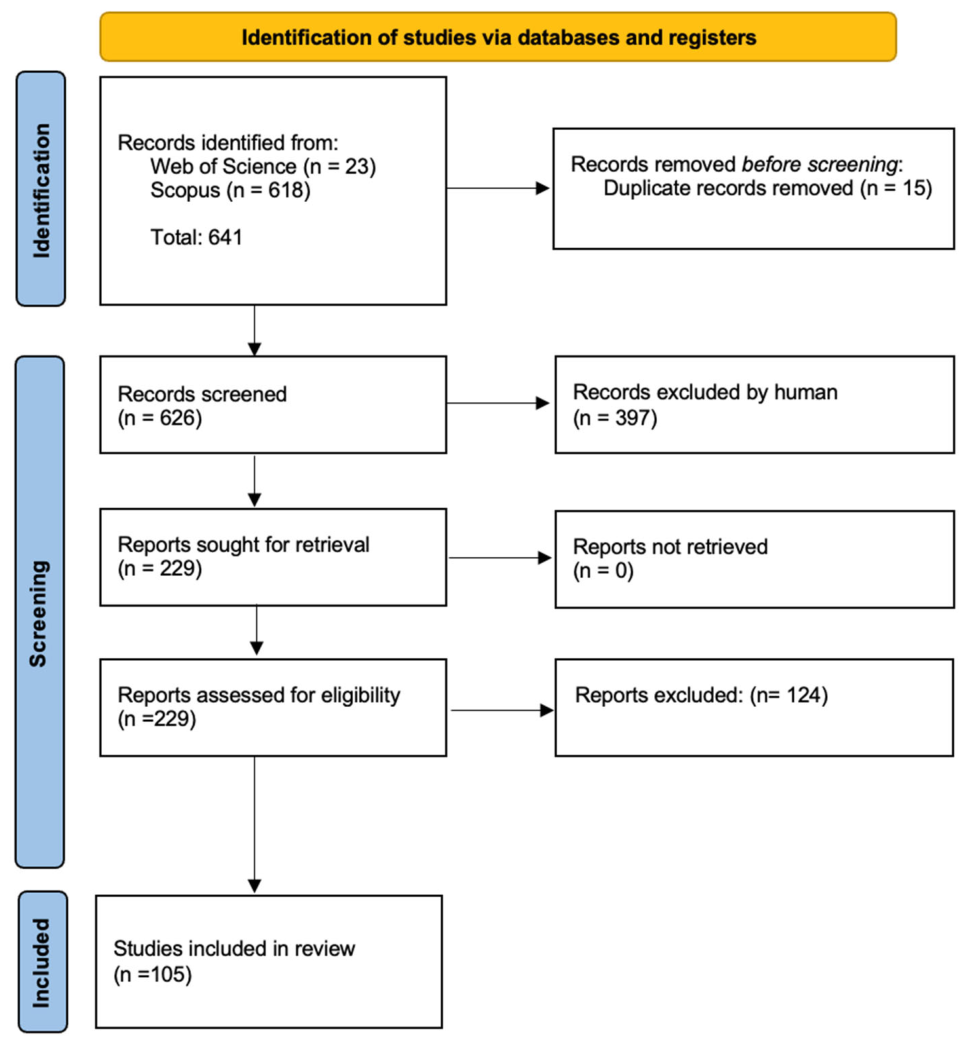
Figure 2.
Temporal distribution of the number of publications on SES in small oceanic islands in the period 2015-2025.
Figure 2.
Temporal distribution of the number of publications on SES in small oceanic islands in the period 2015-2025.
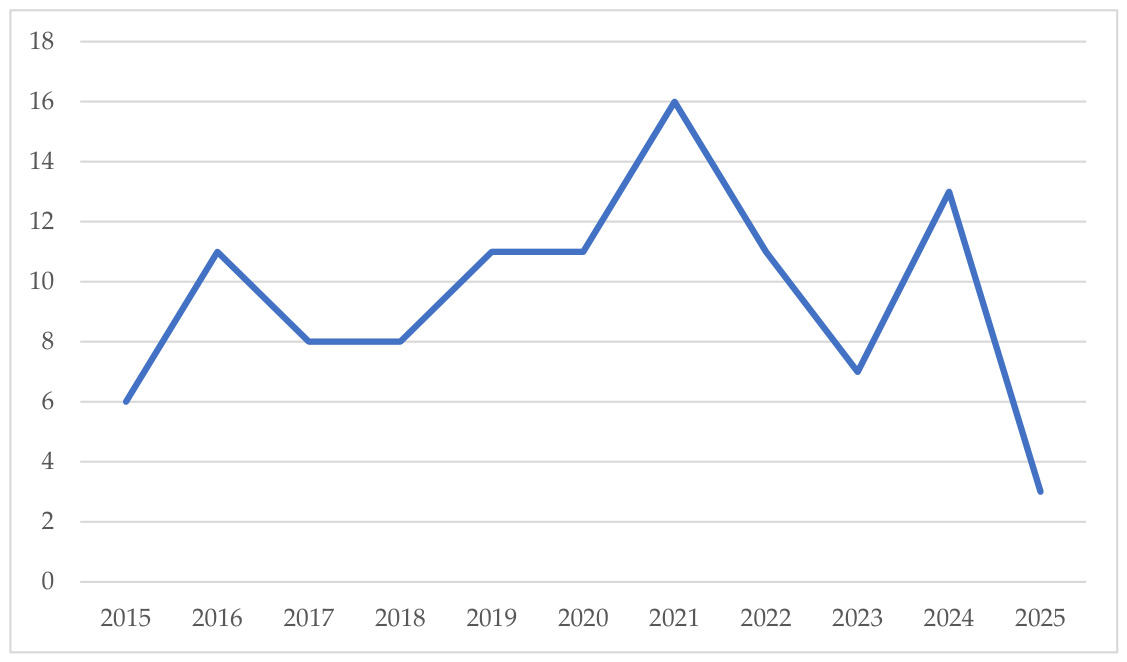
Figure 3.
Frequency of the articles published on SES in small oceanic islands, in scientific journals over the period 2015-2025. Journals with only one or two publications were grouped into “Other journals” (n=total number of journals).
Figure 3.
Frequency of the articles published on SES in small oceanic islands, in scientific journals over the period 2015-2025. Journals with only one or two publications were grouped into “Other journals” (n=total number of journals).
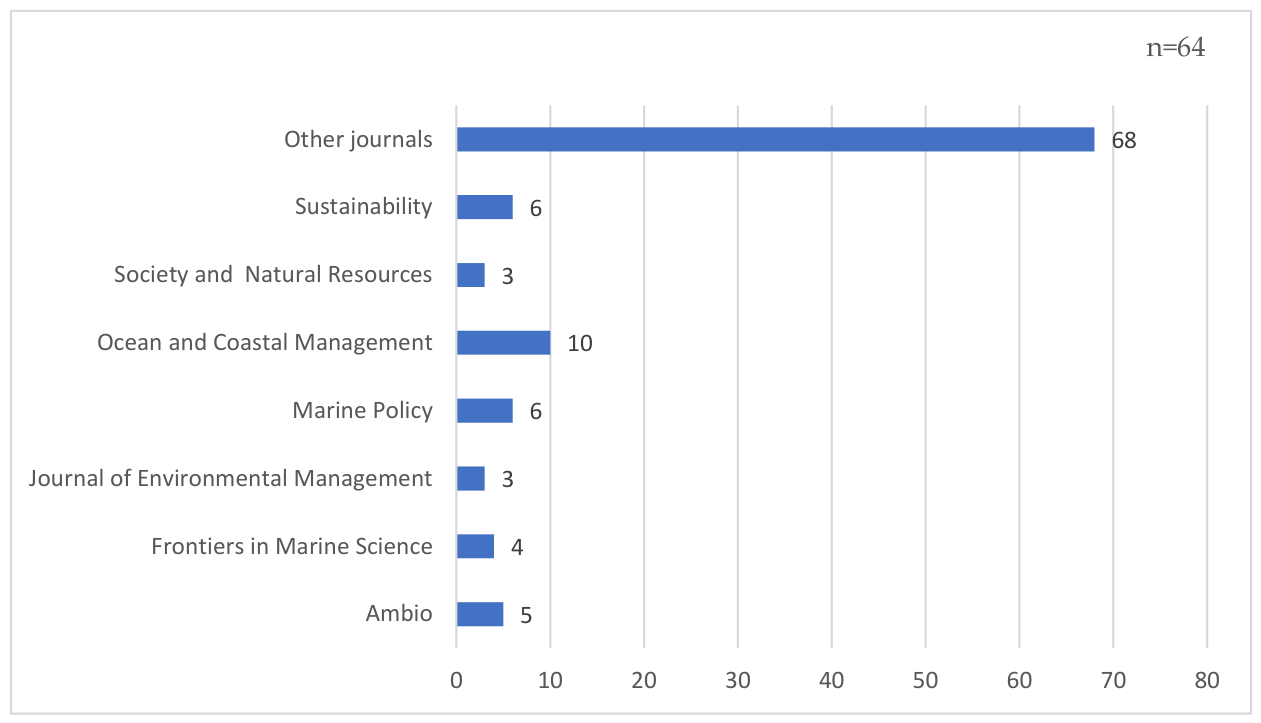
Figure 4.
Percentage of the types of methodological approaches conducted on insular SES studies, in the period of 2015–2025.
Figure 4.
Percentage of the types of methodological approaches conducted on insular SES studies, in the period of 2015–2025.
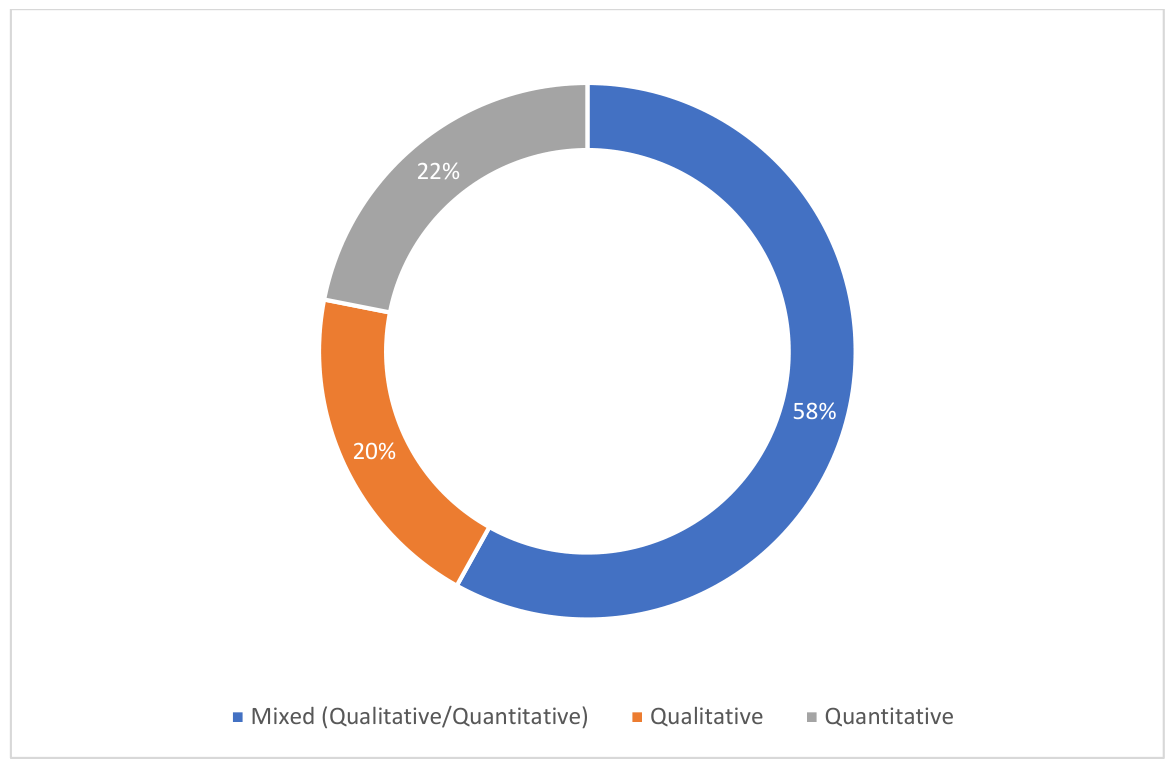
Figure 5.
Absolute frequency of scientific articles grouped by 10 socio-ecological categories in oceanic islands, during the period 2015–2025.
Figure 5.
Absolute frequency of scientific articles grouped by 10 socio-ecological categories in oceanic islands, during the period 2015–2025.
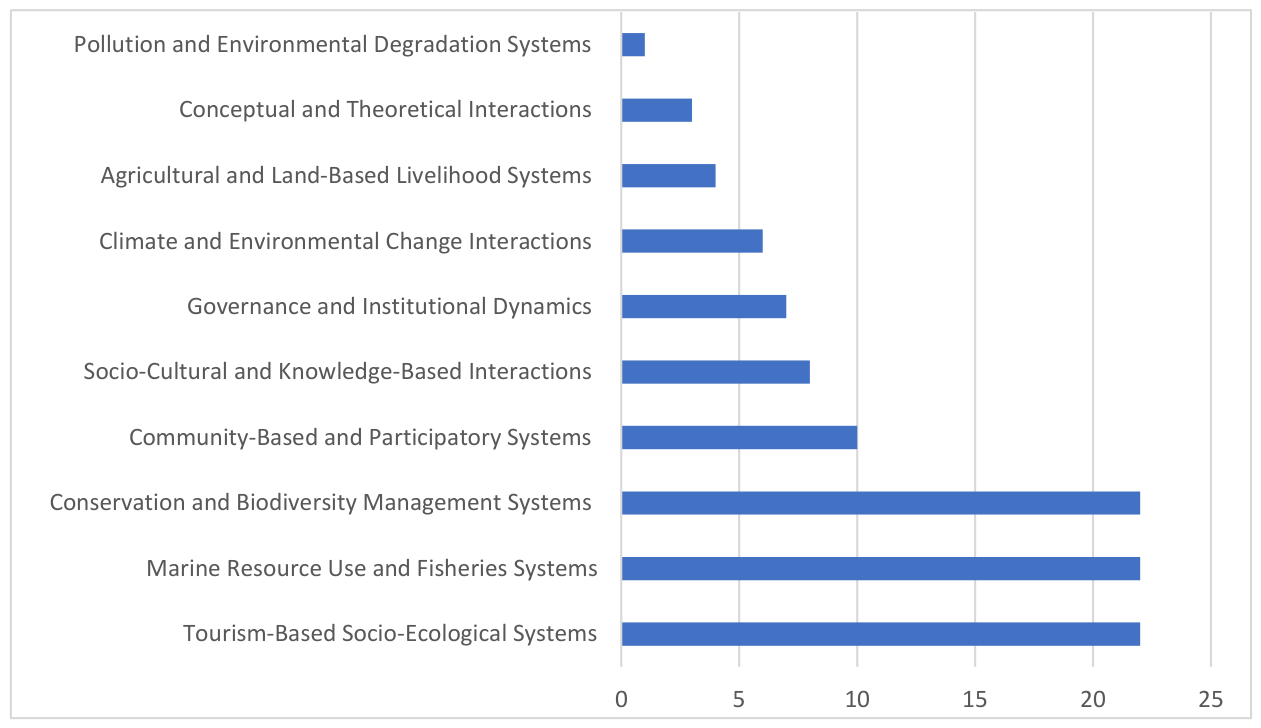
Figure 6.
Absolute frequency of dominant Social (six) and Ecological (five) categories, among the 105 articles in island SES, found in the literature published during the period of 2015-2025.
Figure 6.
Absolute frequency of dominant Social (six) and Ecological (five) categories, among the 105 articles in island SES, found in the literature published during the period of 2015-2025.
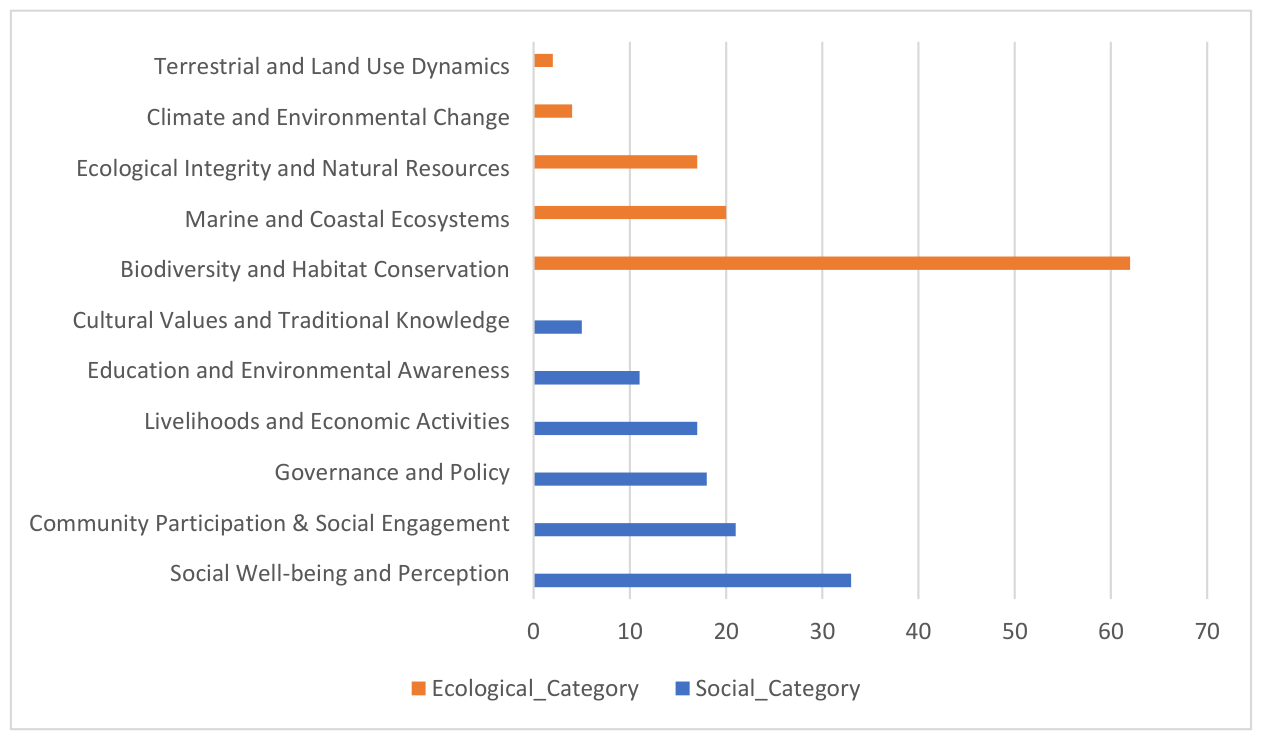
Figure 7.
Conceptual network of socio-ecological interactions in island systems: Node size reflects the frequency with which each category interacts with others, that is, the number of articles published per socio-ecological interaction category; the lines linking any two categories, represent interactions identified across the reviewed studies. The network illustrates the relative centrality and connectivity of socio-ecological domains, rather than the strength or magnitude of interactions.
Figure 7.
Conceptual network of socio-ecological interactions in island systems: Node size reflects the frequency with which each category interacts with others, that is, the number of articles published per socio-ecological interaction category; the lines linking any two categories, represent interactions identified across the reviewed studies. The network illustrates the relative centrality and connectivity of socio-ecological domains, rather than the strength or magnitude of interactions.
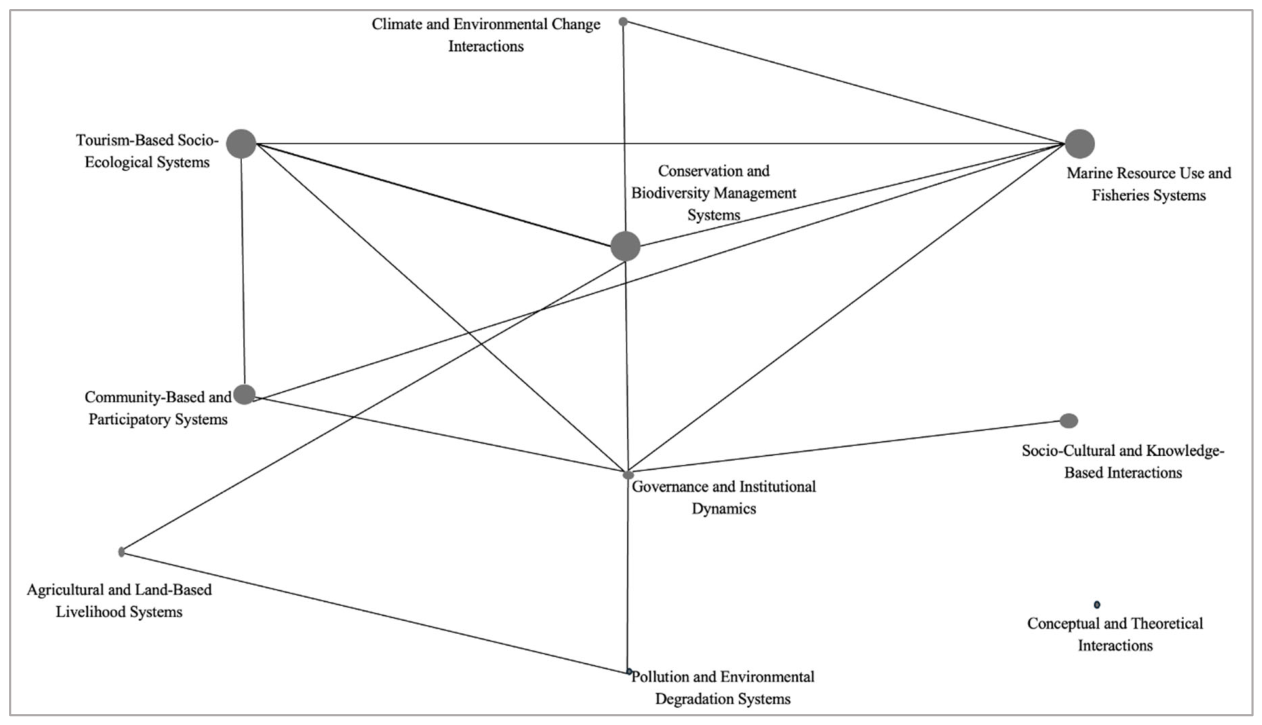

Table 1.
Distribution of the analysed articles according to the dominant type of data processing used in SES research, in islands (2015–2025; n = 105 studies). The analysis is structured according to the dominant type of data processing employed in each investigation.
Table 1.
Distribution of the analysed articles according to the dominant type of data processing used in SES research, in islands (2015–2025; n = 105 studies). The analysis is structured according to the dominant type of data processing employed in each investigation.
| Narrative-based processing type | Number of studies |
| Narrative-based processing | 65 |
| Spatial-based processing | 13 |
| Participatory–deliberative processing | 11 |
| Model-based processing | 8 |
| Statistical-based processing | 6 |
| Unclassified | 2 |
| Total | number of studies= 105 |
Table 2.
Distribution of the analysed articles according to the analytical frameworks applied in studies of SES on islands, over the period 2015–2025. Frameworks are classified according to their dominant conceptual and operational orientation.
Table 2.
Distribution of the analysed articles according to the analytical frameworks applied in studies of SES on islands, over the period 2015–2025. Frameworks are classified according to their dominant conceptual and operational orientation.
| Framework category | Number of studies |
| Island socio-ecological management | 57 |
| SES-based frameworks specifically adapted to island systems | 30 |
| Participatory / co-management | 6 |
| Ecosystem services assessment | 5 |
| Resilience assessment | 4 |
| Marine spatial planning | 2 |
| Conservation planning (island context) | 1 |
| Total | number of studies= 105 |
Table 3.
Integrated synthesis of the main findings, research gaps, and future research, for the identified thematic domains on island socio-ecological systems (SES), showing the calculated values of the Knowledge Maturity Index (KMI) and the Future Research Priority Index (FRPI) (Period of analysis 2015–2025). For each domain, the corresponding number of articles where that domain was identified to be the main finding, the research gap, or the future research need, is represented in each of the first three columns.
Table 3.
Integrated synthesis of the main findings, research gaps, and future research, for the identified thematic domains on island socio-ecological systems (SES), showing the calculated values of the Knowledge Maturity Index (KMI) and the Future Research Priority Index (FRPI) (Period of analysis 2015–2025). For each domain, the corresponding number of articles where that domain was identified to be the main finding, the research gap, or the future research need, is represented in each of the first three columns.
| Domains | Main findings | Research Gaps | Future Research | KMI | FRPI |
| Governance and Policy | 49 | 52 | 54 | 0.49 | 0.54 |
| Community and Livelihoods | 18 | 9 | 11 | 0.67 | 0.41 |
| Biodiversity and Ecosystem Conservation | 24 | 18 | 12 | 0.57 | 0.29 |
| Education and Awareness | 1 | 2 | 0 | 0.33 | 0.00 |
| Climate Change and Resilience | 2 | 6 | 3 | 0.25 | 0.38 |
| Science-Policy Integration | 0 | 1 | 1 | 0.00 | 1.00 |
Disclaimer/Publisher’s Note: The statements, opinions and data contained in all publications are solely those of the individual author(s) and contributor(s) and not of MDPI and/or the editor(s). MDPI and/or the editor(s) disclaim responsibility for any injury to people or property resulting from any ideas, methods, instructions or products referred to in the content. |
© 2026 by the authors. Licensee MDPI, Basel, Switzerland. This article is an open access article distributed under the terms and conditions of the Creative Commons Attribution (CC BY) license (http://creativecommons.org/licenses/by/4.0/).
Copyright: This open access article is published under a Creative Commons CC BY 4.0 license, which permit the free download, distribution, and reuse, provided that the author and preprint are cited in any reuse.


