Preprint
Article

This version is not peer-reviewed.

The Fermion Spectrum over Finite Relational Substrate

Submitted:

28 June 2026

Posted:

29 June 2026

You are already at the latest version

Abstract

The flavour sector of the Standard Model is reconstructed over a finite relational arithmetic substrate. The substrate fixes the structural half, one fermion generation as the spinor 16, the Higgs mass bridge m = yv, and the three-generation count. The paper derives the masses, the mixings, as well as quantitative residue. We furthermore show that the unresolved residue is organised by the substrate’s two structural numbers, the four-fold (4 | Ω − 1, the quarter-turn) and the cubic (3 | Ω + 1, the triality centre), the pair that fixes Ω ≡ 5 (mod 12). The charged-lepton Koide relation is derived exactly, Q = 2/3: generation universality forces the Yukawa amplitude matrix to a C3-circulant, the quarter-turn fixes the amplitude √2, and the lightest generation at the quarter-turn boundary fixes the leading phase π/12, leaving the electron massless at leading order. The three generative roles supply the Froggatt–Nielsen charges (0, 1, 2), giving the λ-texture and the Cabibbo angle Vus = √(md/ms); the Georgi–Jarlskog factor is the colour rank Nc = 3; the up-quark Koide value is Qu = 5/6. The mixing split is the lopsided Me = MdT. For the neutrinos colourlessness fixes the signed (Takagi) amplitude invariant Qν = 2/3; with the drive-invariant quarter-turn boundary branch this selects normal ordering and ∑ mν ≃ 59 meV, and the cube-root phase makes leptonic CP near-maximal, δCP ≃ −130◦. Beyond the overall mass scale, the sector reduces to one carrier-scale phase δ0 ≃ 2/9, with everything else derived or predicted; the matter sector thus rests on two Ω-hard residues, one scale and one phase. Every exact claim is verified in finite-field or cyclotomic arithmetic, the continuum entering only as a labelled degenerate idealisation.

Keywords: 
;  ;  ;  ;  ;  ;  ;  ;  

1. Introduction

The flavour sector is the bulk of the Standard Model’s free parameters and the one part no deeper theory has reduced to structure. The nine charged-fermion masses, the three neutrino masses, and the quark and lepton mixing matrices, some two dozen numbers, are fixed by experiment rather than obtained from a principle. The gauge sector is rigid, three families of one anomaly-free representation with quantised charges; the flavour data is the residue no symmetry has organised.
Several programmes organise that residue, each by positing the structure it then propagates. Grand unification embeds the gauge group in a simple one and relates the masses within a family through the unifying Higgs representations [1,2,3,4], while assuming the group and the texture. The Froggatt–Nielsen mechanism [5] explains the hierarchies through a flavour charge and a small spurion, with the charges assigned to fit; the Wolfenstein parametrisation [6], the Gatto–Sartori–Tonin relation [7], and the lopsided SU ( 5 ) texture [8] encode the observed angles in a chosen texture; the seesaw [9,10] sets the neutrino scale through a posited right-handed mass. The division-algebra and exceptional-structure programmes build the gauge group, and in some treatments three generations, from C H O and the exceptional Jordan algebra [11,12,13,14,15,16]. Across these the inputs that carry the result, the flavour charges, the Clebsch coefficients, the texture zeros, and the 2 of Koide, are assumed rather than derived. The Koide relation Q = 2 / 3 [17], unexplained in the Standard Model, is the sharpest point at which a structural account is tested.
Finite ring cosmology (FRC) reconstructs physics over a large but finite relational arithmetic substrate, with the continuum recovered as a degenerate idealisation [18,19]. On that substrate one complete fermion generation is the spinor 16 of a rank-five internal frame, carrying its gauge representations, hypercharges, charges, anomaly freedom, and a right-handed neutrino; the generation count is fixed at three by the closure of the four primitive arithmetic roles [19], the three generative roles (addition, multiplication, exponentiation) being the three families; and the mass mechanism is the Higgs-mediated bridge m = y v between the drive-aligned (left) branch and its Frobenius conjugate (right), the Yukawa the overlap of a fermion’s winding with the Higgs winding [18]. The substrate fixes the structural half of the flavour problem. What it leaves is the quantitative residue, the masses and the mixings.
This paper develops the thesis that the residue is organised by the substrate’s two defining numbers. The residue Ω 5 ( mod 12 ) is forced by two coincidences, 4 Ω 1 (the quarter-turn Q 4 , complex amplitudes) and 3 Ω + 1 (the colour triality centre Z 3 ) [18]. The same two numbers, the four-fold and the cubic, organise flavour. Five results follow. First, the charged-lepton Koide relation is their product read on the lepton masses, derived exactly as Q = 2 / 3 . Second, the three generative roles supply the Froggatt–Nielsen charges as the role depths ( 0 , 1 , 2 ) , giving the λ -power texture and the Cabibbo angle V u s = m d / m s . Third, the Georgi–Jarlskog factor is the cubic colour rank N c = 3 , and the up-quark Koide value is Q u = 5 / 6 , the coloured cube-root norm against the colourless four-fold. Fourth, the large-lepton, small-quark mixing split is the lopsided M e = M d T . Fifth, for the neutrinos colourlessness fixes the signed-amplitude invariant Q ν = 2 / 3 , so the two measured splittings with the drive-invariant boundary branch give normal ordering and m ν 59 meV, and the cube-root phase makes leptonic CP near-maximal, δ CP 130 . Beyond the overall mass scale, the sector’s dimensionless structure reduces to a single carrier-scale object, the inter-generation winding phase δ 0 2 / 9 , with everything else derived or predicted.
Every statement carries one status tag, [exact] (proven here or in a cited corpus result), [imported] (a standard result consumed without reproof), or [open] (a quantitative residual), and Appendix A collects the full dependency ledger in the 00-ledger epistemic key. Every exact claim that admits a finite check is machine-verified in framed-rational, finite-field, or cyclotomic arithmetic, and no exact claim depends on a continuum construct (Section 7); the continuum enters only as a labelled degenerate idealisation. The paper adds no substrate premise: its inputs are the finite substrate and the role ladder already established [18,19].

2. The Substrate: A Primer

This section fixes the substrate elements the flavour construction consumes; they are established in the corpus [18,19,20].

Carrier, Object, Subject.

The substrate is a finite prime field F Ω , the Carrier (Figure 1), of cardinality Ω 10 122 in Planck units, fixed by the de Sitter entropy of the observable universe [21]. Its phase cycle is the multiplicative group F Ω × C Ω 1 . An observed system is an Object and the embedded shell that reads it is a Subject; every framed quantity carries the cardinality of its role as a subscript, Ω for the Carrier, P for an Object, p for a Subject. The chronon is the observer’s tick, the scale-dilation step x g x of the drive: each Subject rides its own drive and assigns its own tick, and what two shells share is the quarter-turn core Q 4 , not a clock.

The two structural residues.

Two divisibilities fix the class Ω 5 ( mod 12 ) . 4 Ω 1 gives the quarter-turn subgroup Q 4 = { 1 , i , 1 , i } of the split torus C Ω 1 , the complex amplitudes; 3 Ω + 1 gives the order-three triality centre Z 3 of the non-split torus C Ω + 1 , the colour and generation cubic [18]. The four-fold and the cubic are the two numbers the flavour sector turns on.

Mass is winding; the left–right bridge.

A mass is a winding rate, E = h f an identity [18]: a state the drive leaves fixed is massless, one the drive rotates over the quadratic extension F Ω 2 / F Ω is massive, its conjugate the Frobenius σ . A Dirac mass m = y v is the Higgs-mediated bridge between the drive-aligned (left) branch and its Frobenius conjugate (right), the Yukawa y the overlap of a fermion’s winding with the Higgs winding.

The role ladder and the three generations.

The primitive arithmetic operations form a closed ladder of four roles, counting, addition, multiplication, exponentiation, after which the fifth step returns to counting [19]. The three generative roles (addition, multiplication, exponentiation) are the three generations, a single Frobenius C 3 Galois orbit identical in every gauge number and distinguished only by mass; their role depths ( 0 , 1 , 2 ) are the generation labels.

3. The Target and the Assets

The substrate establishes five facts this paper builds on [18]. (a) The mass mechanism m = y v as the left–right Higgs bridge. (b) The three generations as the three generative primitive roles, the role ladder ordering them. (c) Generation universality: the families are Galois conjugates of the degree-three matter extension, identical but for mass. (d) The SO ( 10 ) representation structure, with 16 16 = 10 120 126 ¯ constraining the mass-matrix texture. (e) The seesaw, the gauge-singlet ν c carrying a Majorana mass at the unification scale.
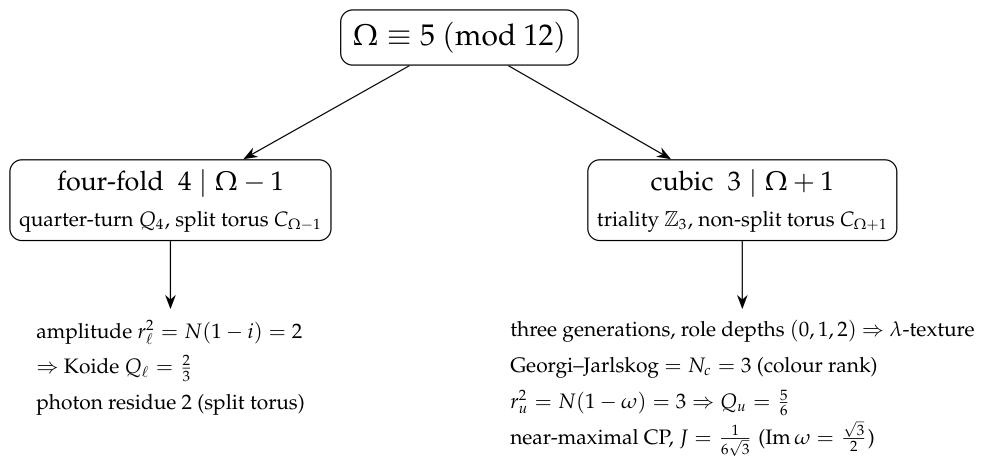
Figure 2. The flavour sector from the substrate’s two structural residues. The class Ω 5 ( mod 12 ) splits into the four-fold ( 4 Ω 1 ) and the cubic ( 3 Ω + 1 ). The four-fold supplies the quarter-turn amplitude N ( 1 i ) = 2 and the colourless Koide value Q = 2 / 3 ; the cubic supplies the three generations and their role-depth charges, the Georgi–Jarlskog colour factor N c = 3 , the coloured up amplitude N ( 1 ω ) = 3 with Q u = 5 / 6 , and near-maximal CP. Every result of the paper reads off one of these two numbers.
Preprints 220674 g002
Table 1. The flavour parameters to be organised. The substrate fixes the representations and charges of a generation [18]; these numbers are the residue.
sector count figure of merit
charged-lepton masses 3 m e , m μ , m τ = 0.511 , 105.7 , 1777 MeV
up-type quark masses 3 m u , m c , m t 2.2 MeV , 1.27 , 173 GeV
down-type quark masses 3 m d , m s , m b 4.7 , 93 MeV , 4.18 GeV
neutrino masses 3 m ν 0.1 eV; Δ m 21 , 31 2
CKM matrix 4 3 angles + 1 phase ( λ 0.225 , δ 68 )
PMNS matrix 4–6 3 angles + 1 –3 phases (large angles)
Higgs vacuum value 1 v = 174 GeV (the overall scale)
total 22 –24 the flavour sector

3.1. Tier A: What the Role Ladder Already Fixes

Four flavour facts follow directly from the assets and are recorded as the established tier; they frame the derivations of Section 4.1– Section 4.4.
Ordering and steepness.[exact] The role ladder, each role iterating the previous, orders the generations and makes the gaps super-exponential; the geometric-mean generation masses 1.7 MeV, 0.23 GeV, 10.9 GeV ascend as the ladder, and m t / m u 10 5 .
b τ unification.[exact]/[imported] The SO ( 10 ) 16 gives m b = m τ at unification; QCD running carries it to the measured m b / m τ 2.4 .
Seesaw neutrino scale.[exact]/[imported] m ν y 2 v 2 / M R with M R at unification gives the atmospheric scale Δ m 31 2 0.05 eV for M R 10 14 10 15 GeV.
The heavy top. The top is the aligned, maximally coherent winding overlap, y t 1 , m t v ; the mechanism is fixed, the exact 0.99 is not.

3.2. Elementary Is Ω -Hard

The elementary particles of a generation, the quarks and the leptons, are large residues of the Carrier F Ω that lie below the observer’s coherence horizon & # x 003 A 9 ; . A mass is a winding rate [18], and the winding rate of a quark or a lepton is carrier-scale: framed-transcendental, Ω -hard [19], decided by the totality and certifiable only at carrier scale, beyond the resolution of every bounded shell. This is what makes a particle elementary. “Elementary” is the observer’s reading of I cannot decompose this, the comprehension horizon, not a statement of smallness or simplicity.
The composites are the comprehensible stratum, and the reason is the wrap. A confined hadron is the wrap-around product of its Ω -hard constituents: confinement binds the large quark residues into one synchronised orbit whose winding lands on a small residue in the observer’s frame, the nucleon, the light nuclei integer multiples of it to within their binding. A system whose mass instead adds elementary components, an atom carrying its electrons, is not a small residue: addition preserves the framed-transcendental part, so only the multiplicative wrap of confinement returns a residue within the horizon.
The flavour observables of this paper are the comprehensible face of the same arithmetic. The absolute masses of the elementary particles are Ω -hard and are not derived here; what is derived, the Koide ratio, the λ -texture, the Georgi–Jarlskog factor, are ratios of those masses, small invariants frame-normalised out of the framed-transcendental absolutes, the comprehensible counterpart of the confinement wrap. The line between what the sector fixes exactly and what it leaves at O ( Ω ) is thus not a gap in the theory but the elementary–comprehensible split itself.

The massless states are drive-invariant.

A mass is a winding rate [18], so a massless state is one of zero net winding rate, fixed by the drive. The photon excites the split maximal torus C Ω 1 , the eigen-directions of the drive: the drive rescales it without rotation, and its two fixed lines over F Ω are the two helicities; with U ( 1 ) unbroken the photon carries no winding rate and is massless. The photon is thus a drive-invariant Carrier residue with structural invariant 2, the two fixed lines being its helicities; it is observable and small, the gauge-sector quantum of the split torus and the source of observation, while the matter residues of this section are Ω -hard. Its two helicities are the eigenvalue pair ( x , x 1 ) of the split element, reciprocal since the determinant is one and distinct when x 2 1 , which is the masslessness; x = ± 1 merges them, the longitudinal limit. Inversion x x 1 exchanges the helicities, a parity, and negation x x is charge conjugation A μ A μ , so the photon and its conjugate fill the symmetry-complete four-packet { x , x 1 , x , x 1 } , four distinct residues when x Q 4 . A mass is the non-split component. A Dirac mass couples the drive-aligned (left) branch to its Frobenius conjugate (right) [18], the elliptic part the drive rotates over the quadratic extension F Ω 2 / F Ω of Section 7 with conjugation the Frobenius σ , so a winding carries a rate in proportion to its non-split component. In the matter sector the zero-rate locus is the quarter-turn boundary of the generation circulant (Section 4.5): the lightest colourless state sits there at leading order with a vanishing boundary amplitude, the electron among the charged leptons and the lightest neutrino among the neutrinos (Section 5).
Proposition 1
(The generation is the four-chart reflection count). The four representation charts of the Carrier, read with the quarter-turn, form a complex frame W C 4 whose reflection (exterior) algebra has dimension 2 4 = 16 . Adjoining the quarter-turn as a fifth orthogonal direction gives the canonical degree-respecting isomorphism Λ ( W ) Λ even ( W C ) onto the SO ( 10 ) chiral spinor 16 = 1 10 5 ¯ . Hence “matter is a spinor” is derived from the reflection count, the gauge 3 + 2 (colour ⊕ isospin) and the ontology 4 + 1 (charts ⊕ quarter-turn) two readings of one rank-five frame; the spectrum projection is anchored at the unique drive-invariant total singlet ν c = Λ 0 , the matter twin of the photon.

4. Quantitative Analysis

4.1. The Koide Relation

The charged leptons satisfy, to five digits,
Q = m e + m μ + m τ m e + m μ + m τ 2 = 2 3 ,
a relation the Standard Model leaves unexplained [17]. It is the sector’s sharpest test, a clean pass/fail requiring only the charged leptons, and we read it through the substrate’s two structural numbers.
The three generations are a single Galois orbit of the degree-three matter extension [18]: Frobenius cyclically permutes them, so they sit at the three cube roots of unity and carry the regular representation of the generation cycle C 3 . Any generation-indexed real datum therefore decomposes into C 3 characters. Write the square-root masses as the real vector a = ( m e , m μ , m τ ) and resolve it on the C 3 Fourier basis,
a ^ k = j a j ω j k , ω = e 2 π i / 3 , k = 0 , 1 , 2 ,
with a ^ 0 = j a j the trivial (generation-democratic, drive-aligned) mode and a ^ 1 = a ^ 2 ¯ the coherent cube-root mode.
Proposition 2
(Koide from cube-root coherence at the quarter-turn). With the decomposition (2) and ρ : = | a ^ 1 | / a ^ 0 ,
Q = 1 3 + 2 3 ρ 2 .
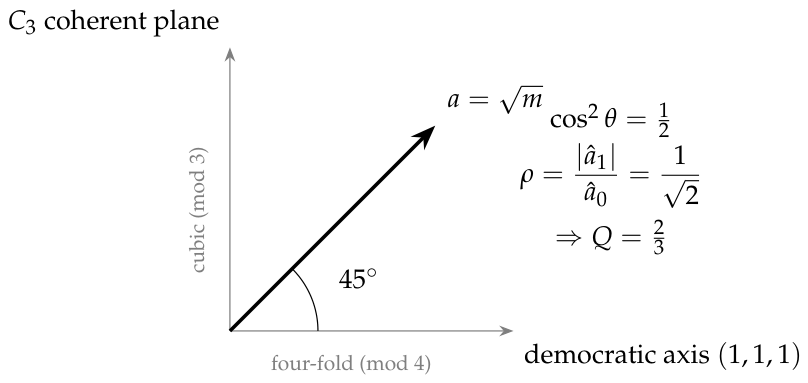
Hence Q = 2 / 3 if and only if ρ = 1 / 2 : the coherent amplitude is the trivial amplitude divided by the quarter-turn diagonal 2 = ζ 8 + ζ 8 1 . Equivalently, a makes the angle 45 , the quarter-turn bisector, with the democratic axis ( 1 , 1 , 1 ) .
Proof. 
By Parseval on C 3 , j a j 2 = 1 3 k | a ^ k | 2 = 1 3 ( a ^ 0 2 + 2 | a ^ 1 | 2 ) , while j a j = a ^ 0 . Dividing, Q = a j 2 / ( a j ) 2 = 1 3 + 2 3 ( | a ^ 1 | / a ^ 0 ) 2 , which is (3). Setting Q = 2 / 3 gives ρ 2 = 1 / 2 . The angle θ of a to ( 1 , 1 , 1 ) obeys cos 2 θ = ( a j ) 2 / ( 3 a j 2 ) = 1 / ( 3 Q ) , so Q = 2 / 3 is cos 2 θ = 1 2 , θ = 45 .    □
The identity (3) is [exact] and assumption-free; its content is the single number ρ = 1 / 2 . In the substrate this number is not free: 2 is the quarter-turn diagonal, the self-dual coherence quantum, the Tsirelson element ζ 8 + ζ 8 1 at which the Bell correlation saturates [20], and a 45 bisection is the quarter-turn acting on the generation plane. The only equal split the substrate admits between the generation-democratic axis and the cube-root coherence plane is the quarter-turn one, and (3) converts it to Q = 2 / 3 .
Remark 1
( 2 / 3 is the cubic married to the four-fold). The two ingredients are the substrate’s two defining residues (Figure 3). The cube-root orbit ( 3 Ω + 1 ) supplies the C 3 plane; the quarter-turn ( 4 Ω 1 ) supplies the bisecting amplitude 2 . These are the same two structures whose coincidence forces Ω 5 ( mod 12 ) [18]. The Koide value is their product read on the lepton masses.

Verification.

The exact identities are checked symbolically: with a i = 1 + r cos ( δ + 2 π i / 3 ) one has a i = 3 for all δ , a i 2 = 3 + 3 2 r 2 , and Q = 2 / 3 identically in δ at r = 2 , the positive root of Q = 2 / 3 . Against the measured masses, Q = 0.666661 (deviation 6 × 10 6 from 2 / 3 ), ρ = 0.707100 versus 1 / 2 = 0.707107 , and the democratic angle is 44 . 9997 . The phase δ = 0.22227 (close to 2 / 9 = 0.22222 ) is read off but not claimed: it is a winding datum and belongs to Section 9’s open kernel.

4.2. The λ -texture and Derived Flavour Charges

In a Froggatt–Nielsen scheme [5] a flavour charge n i on generation i and a small spurion ε give y i j ε n i + n j , so m i v ε 2 n i . The substrate supplies the charges: the three generations are the three generative roles, and the role depths ( n 1 , n 2 , n 3 ) = ( 2 , 1 , 0 ) are their flavour charges (the heaviest generation, the deepest role, carries charge 0). With ε = λ the Cabibbo parameter,
m d : m s : m b λ 4 : λ 2 : 1 , m e : m μ : m τ λ 4 : λ 2 : 1 , m u : m c : m t λ 8 : λ 4 : 1 ,
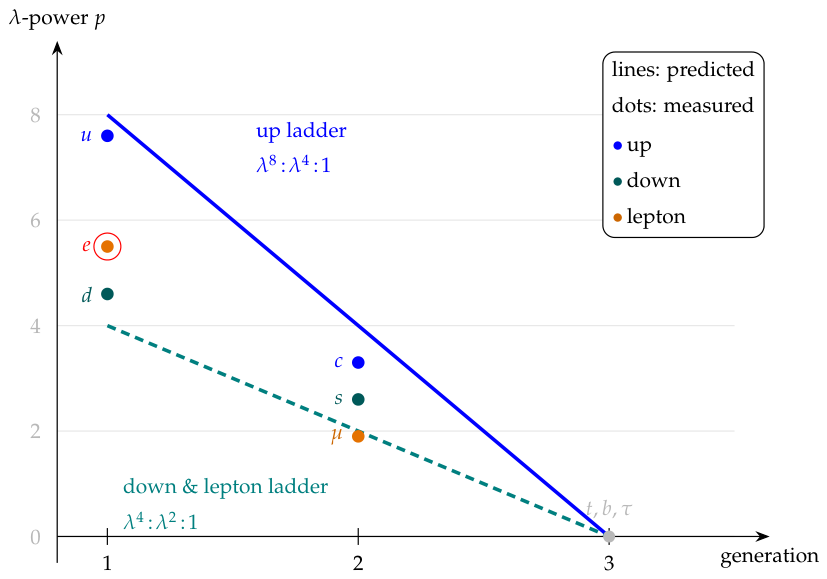
the up sector carrying a doubled exponent, forced by the 10 · 10 Yukawa (Proposition 3). The measured effective powers log ( m i / m 3 ) / log λ are ( 4.6 , 2.6 ) , ( 5.5 , 1.9 ) , ( 7.6 , 3.3 ) for down, lepton, up, the integer pattern ( 4 , 2 ) , ( 4 , 2 ) , ( 8 , 4 ) , with the electron the one outlier (its excess suppression is the Georgi–Jarlskog factor of Section 4.3). For the mixings the charge differences give V u s λ , V c b λ 2 , V u b λ 3 (measured effective powers 1.00 , 2.15 , 3.73 , flooring to 1 , 2 , 3 , the excess being the sub-unity Wolfenstein coefficients).
Figure 4. The role-depth λ -power hierarchy (Section 4.2). The generative role depths ( 0 , 1 , 2 ) are the Froggatt–Nielsen charges, so m λ 2 n : the down and charged-lepton sectors fall as λ 4 : λ 2 : 1 and the up sector twice as steep, λ 8 : λ 4 : 1 (Proposition 3). The lines are the predicted integer ladders; the dots are the measured effective powers log ( m i / m 3 ) / log λ (up 7.6 , 3.3 ; down 4.6 , 2.6 ; lepton μ at 1.9 ), coloured by sector and labelled by particle, which floor to the ladders. The one outlier is the electron (ringed), whose excess suppression is the Georgi–Jarlskog colour factor 3 (Section 4.3); the third generation t , b , τ is the reference at p = 0 .
Preprints 220674 g004
Proposition 3
(Up-sector doubling from 10 · 10 ). The doubled up exponent is forced, not posited. In the matter spinor 16 = 10 5 ¯ 1 the up Yukawa is 10 10 5 H and the down/lepton Yukawa is 10 5 ¯ 5 ¯ H ; with the flavour charge carried by the 10 (the role depth) and the 5 ¯ flat, the charge-carrying multiplet enters the up mass twice and the down/lepton mass once, so m i u ( m i d ) 2 in spurion units, the up exponents exactly twice the down. The same assignment forces the down–lepton degeneracy ( m d : m s : m b m e : m μ : m τ , both 10 · 5 ¯ ) and the lopsided M e = M d T of Section 4.4; the three are one fact about the 10 , and 10 · 10 further makes the up Yukawa matrix symmetric (up_doubling.py).
Proposition 4
(The Cabibbo angle from the texture). The role-depth texture predicts the Gatto–Sartori–Tonin relation V u s = m d / m s [7]. Numerically m d / m s = 0.2236 versus the measured V u s = 0.2243 , agreeing to 0.3 % .
The Cabibbo angle is thus read off the down-quark masses with no mixing input. The twelve flavour observables (nine mass ratios at the order level plus three CKM angles) follow from four inputs, three sector scales and the single spurion ε = λ , with the charges derived rather than fitted and the up-sector doubling forced by the 10 · 10 structure (Proposition 3). The spurion is not independent of these: by Gatto, λ = m d / m s is a function of the down-sector circulant data ( δ 0 , r d ) , and numerically λ δ 0 2 / 9 , the Cabibbo suppression coinciding with the lepton winding phase to 1 % , consistent with both being the same inter-generation winding distance, so that λ folds into the winding kernel rather than adding a parameter (spurion.py).

4.3. Georgi–Jarlskog Is the Colour Count

The Georgi–Jarlskog texture [4] sets, at unification, m τ = m b , m μ = 3 m s , m e = 1 3 m d , the factor 3 distinguishing colour-singlet leptons from colour-triplet down quarks. In the substrate this factor is the colour count. The spinor-alignment Higgs that writes the down/lepton masses sits in the 126 ¯ of SO ( 10 ) ; its vacuum value lies along the B L direction, whose Clebsch weights a colour singlet against a colour triplet by the colour multiplicity N c = 3 , the rank of the cubic colour frame [18]. The same 126 ¯ supplies the Majorana mass of ν c , so one representation does two jobs: the Georgi–Jarlskog factor here and the seesaw scale of Section 3.1.
The scale-robust signature is the double ratio ( m μ / m e ) / ( m s / m d ) = N c 2 = 9 (lepton and quark ratios run weakly, the QCD factor cancelling): measured 10.34 , within 15 % and running toward 9. The b τ equality appears at low scale as m τ / m b = 0.43 , ascending to 1 at unification.

4.4. The Mixing Split Is Lopsided M e = M d T

Quark mixing is small ( λ , λ 2 , λ 3 ) while lepton mixing is large (atmospheric 45 , solar 33 ). We report a negative finding and a positive one.

The seesaw route.

A strongly hierarchical Dirac neutrino mass makes the seesaw m ν = m D M R 1 m D T inherit the hierarchy of m D : over 3000 draws with O ( 1 ) coefficients and an anarchic M R , the median leading lepton angle ( 21 ) does not robustly exceed the quark median ( 13 ). An anarchic right-handed scale alone does not enlarge the angles when the Dirac mass is role-depth hierarchical.

The lopsided route.

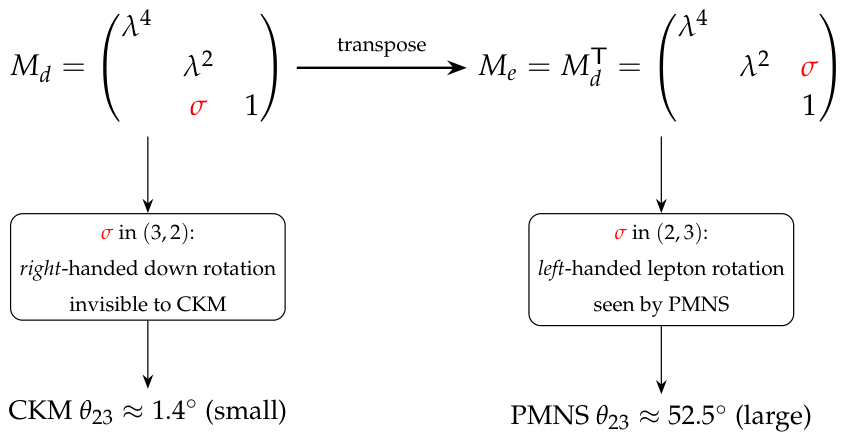
The enhancement comes from the same down/lepton unification that gave Section 4.3. The SU ( 5 ) relation M e = M d T exchanges the left and right rotations: an O ( 1 ) off-diagonal in the ( 3 , 2 ) slot of M d feeds the right-handed down rotation, invisible in the CKM matrix, which sees only left-handed quarks, and the transpose turns it into the left-handed lepton rotation that the PMNS matrix does see. With the role-depth M d carrying a single lopsided entry σ = 1.3 , the CKM θ 23 = 1 . 4 (measured V c b 2 . 4 ) while the lepton θ 23 = 52 . 5 (atmospheric 45 ): one matrix, small on the left, large on the right, splits the two sectors.
Figure 5. The lopsided split of quark and lepton mixing (Section 4.4). A single off-diagonal σ in the ( 3 , 2 ) slot of the down-quark matrix M d feeds the right-handed down rotation, which the CKM matrix (left-handed quarks only) does not see. The SU ( 5 ) relation M e = M d T moves the same entry to ( 2 , 3 ) , a left-handed lepton rotation the PMNS matrix does see. One entry therefore leaves the quark angle small ( θ 23 1 . 4 ) and the lepton angle large ( θ 23 52 . 5 ).
Preprints 220674 g005

4.5. The Winding Kernel

The ledger funnels Tiers B and C into one object, M10: the inter-generation winding assignments, which fix the absolute ratios, the spurion ε , and the mixing. In the substrate a Yukawa is an amplitude ( m = y v , y the overlap of a fermion’s winding with the Higgs winding), and the mass is the squared modulus of that amplitude, exactly as a probability is the square of a Z [ i ] amplitude [20]. The fundamental object is the amplitude matrix M , with M = ( M ) 2 .
Proposition 5
(Universality ⇒ circulant ⇒ Koide form). The three generations are a Frobenius (Galois) C 3 orbit, identical in every gauge quantum number and distinguished only by mass [18]; the cyclic relabelling P of the orbit is therefore a structural symmetry of the amplitude matrix. A Hermitian matrix commuting with P is a circulant,
M = a 1 + b P + b ¯ P 2 , a R , b C ,
with eigenvalues m k = a + 2 | b | cos ( δ + 2 π k 3 ) , δ = arg b , k = 0 , 1 , 2 , the Koide functional form with r : = 2 | b | / a .
The Koide form is thus not an ansatz but a consequence of generation universality: the three masses of a sector are a scale a, an amplitude r, and a phase δ . The amplitude is fixed by where the coherent part lives. The democratic part a 1 is the drive-aligned counting role (real); the coherent part b P + b ¯ P 2 rotates the generation phase, so it is a quarter-turn datum in the plane Z [ i ] = Q 4 , and its weight relative to the real unit is the quarter-turn diagonal | 1 + i | = 2 . Hence r = 2 , and since Q = 1 3 + r 2 / 6 (exact), the colourless sector realises the bare value Q = 2 / 3 . The extracted charged-lepton amplitude is r = 1.41421 = 2 to 10 4 .
Proposition 6
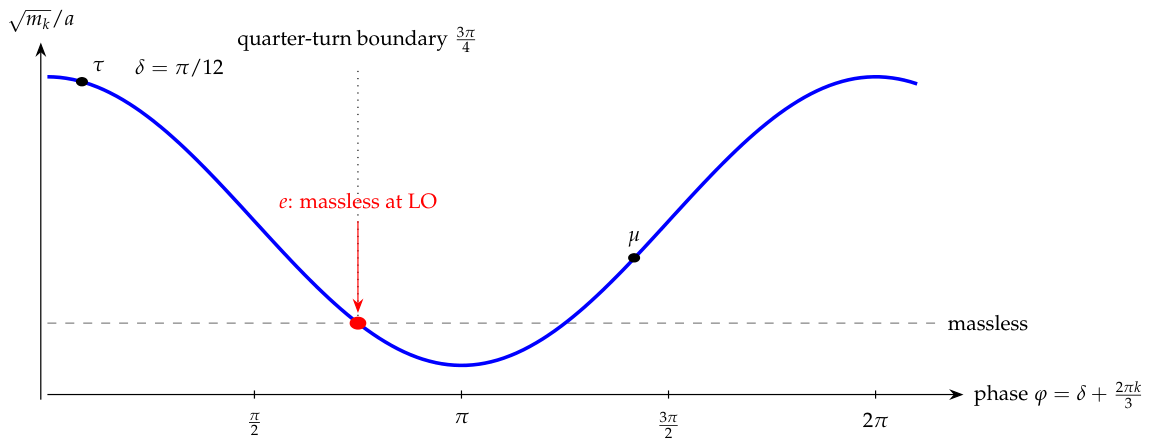
(The leading phase is π / 12 ). At r = 2 an eigenvalue vanishes when cos ( δ + 2 π k / 3 ) = 1 / 2 , i.e. at the quarter-turn boundary 3 π / 4 . Requiring the lightest generation ( k = 1 ) to sit there fixes δ LO = 3 π 4 2 π 3 = π 12 . With r = 2 and δ = π / 12 both fixed, the charged-lepton spectrum is parameter-free up to scale: m e : m μ : m τ = 0 : 0.0718 : 1 , the electron massless and m μ / m τ = 0.0718 (observed 0.0595 ).
Figure 6. The leading-order charged-lepton spectrum and the quarter-turn boundary. The circulant eigenvalues m k = a 1 + 2 cos ( δ + 2 π k 3 ) place the three generations 120 apart on one curve (Proposition 5), the amplitude r = 2 the quarter-turn diagonal. At the drive-aligned phase δ = π / 12 the lightest generation ( k = 1 ) sits on the boundary 3 π / 4 , where 1 + 2 cos 3 π 4 = 0 , so the electron is massless at leading order and its physical mass is the small deviation of δ from π / 12 (Proposition 6). The curve is the continuum reading of the exact framed-rational eigenvalues in F p .
Preprints 220674 g006
The electron’s extreme lightness is then explained, it is the generation at the quarter-turn boundary, where the winding amplitude vanishes, and its small nonzero mass is the deviation of the true phase from π / 12 . The residual per sector is this exact phase δ (Table 2). The charged leptons, colourless, show the bare amplitude r = 2 ; the quark amplitudes exceed it, and the excess is colour. The squared amplitude is the finite-field norm r 2 = N ( 1 ζ n ) of the finite n-th root, an integer in F p : N ( 1 i ) = 2 for the four-fold (quarter-turn) structure of the colourless leptons ( Q = 2 / 3 ), and N ( 1 ω ) = 3 for the three-fold (cube-root, colour) structure of the up quarks ( r u 2 3 , Q = 5 / 6 ). The down excess is the Georgi–Jarlskog colour Clebsch N c = 3 of Section 4.3: the colour-dressed lepton spectrum ( 3 m e , m μ / 3 , m τ ) has Koide value 0.745 Q d , returning r d 1.55 between the two diagonals (quark_amp.py); the continuum readings r = 2 , 3 are one rung up. The twelve fermion masses reduce to four scales and four winding phases, with r = 2 universal for the colourless sector and the charged-lepton sector parameter-free at leading order.
Remark 2
(The amplitudes 2 and 3 are the split and non-split tori). The two squared amplitudes are the two maximal tori of the frame group. The colourless norm N ( 1 i ) = 2 is the four-fold,splittorus C Ω 1 , whose elements fix two lines over F Ω , the torus the photon excites, the two lines its helicities. The coloured norm N ( 1 ω ) = 3 is the three-fold,non-splittorus C Ω + 1 , whose elements fix no line over F Ω , the colour torus, the arithmetic of confinement. The lepton and quark amplitudes carry the same split/non-split pair that fixes Ω 5 ( mod 12 ) : the colourless sector on the split torus of the photon, the coloured sector on the non-split torus of the gluon.

The cross-sector lock.

The phases are not independent. The three charged sectors give δ : δ d : δ u = 1 : 0.496 : 0.335 , locked to 1 : 1 2 : 1 3 robustly within quark-mass uncertainty (over the PDG ranges the medians are 0.495 and 0.334 ), so the spectrum carries a single phase δ 0 = δ 2 / 9 , the others fixed as δ 0 / 2 and δ 0 / 3 . That phase is the argument of the inter-generation winding overlap b = u χ 3 ( u ) ψ ( u ) over the cube-root sector: the conjugation symmetry u u ¯ forces b real ( δ { 0 , π } ) unless the drive breaks it, so δ is a drive-orientation phase, the same symmetry breaking that gives the weak current its V A form [18], with the drive-aligned limit the leading π / 12 . Character sums on small shells p 5 ( mod 12 ) quantise it to multiples of π / 3 ; the smooth value belongs to the cosmological shell. The mass sector is thus four scales and one drive-orientation phase, with r = 2 universal.

5. The Neutrino Sector

The neutrino is distinctive: its mass is the seesaw m ν = m D M R 1 m D T , with m D the Dirac mass and M R the Majorana mass of the gauge-singlet ν c . Both are generation-universal, ν c is a Frobenius C 3 orbit like every other family, hence circulant, and circulants are closed under product, transpose, and inverse (each is a polynomial in the shift P, P 3 = 1 ).
Proposition 7
(Light neutrinos are Koide-form). For circulant m D , M R the seesaw m ν = m D M R 1 m D T is circulant, so its eigenvalues are the Koide form m ν , k = α + 2 | β | cos ( δ ν + 2 π k / 3 ) .
Neutrinos, like charged leptons, are colourless, so they carry the undressed quarter-turn amplitude r ν = 2 , i.e. Q ν = 2 / 3 ; through the seesaw this is a condition on the Dirac and Majorana phases, and a scan finds it achievable ( | r ν 2 | < 10 4 at definite phases).
Proposition 8
(The colourless amplitude is a seesaw fixed point, conditional on the 126 ¯ alignment).The proportionality M R m D is a bridge: the 126 ¯ supplies both the Dirac and the Majorana structure, so both circulants share a shape. Given it, the conclusion is a theorem. When M R m D the seesaw collapses to m ν = m D T / c . A matrix and its transpose share singular values, so the neutrino masses equal the Dirac masses and r ν = r D exactly; with the colourless Dirac amplitude r D = 2 this gives r ν = 2 , Q ν = 2 / 3 with no scan. The seesaw resets the phase δ ν but preserves the amplitude.
With Q ν = 2 / 3 fixed, the neutrino sector has two free parameters, a scale and the phase δ ν , and the two measured splittings determine them, leaving the absolute spectrum a prediction:
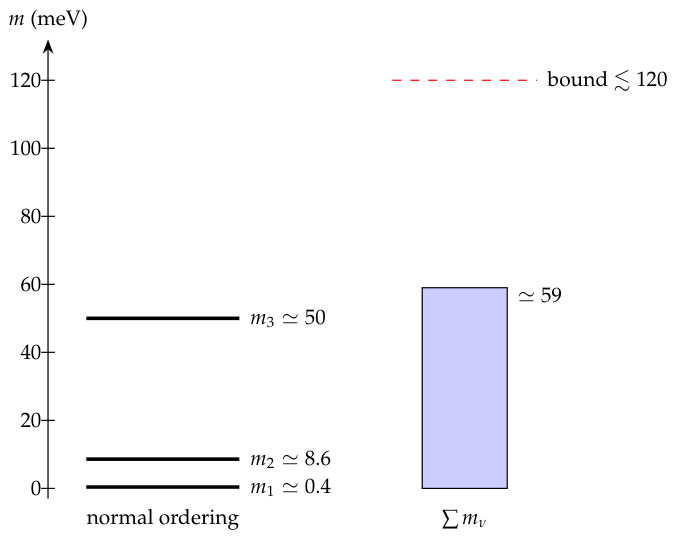
normal ordering , m 1 0.4 meV ( at the quarter - turn boundary ) , m ν 59 meV ,
with m 2 8.6 and m 3 50 meV, stable at 58.7 59.5  meV across the Δ m 2 uncertainties and well inside the cosmological bound m ν 120  meV. The lightest neutrino sits at the quarter-turn boundary, as the electron does among the charged leptons. At leading order the drive-invariant member carries zero winding rate, so m 1 = 0 and the sum is the two splittings, m ν = Δ m 21 2 + Δ m 31 2 = 58.7 meV, the 0.4 meV the deviation of the seesaw phase from the boundary, as the electron’s mass is the deviation from π / 12 (Section 3.2). A degenerate spectrum or a non-negligible lightest mass falsifies it. The seesaw-effective phase δ ν 0.48 does not follow the charged-sector lock, the seesaw, squaring the Dirac data and dividing by the Majorana data, resets it.

The neutrino Koide is the framed amplitude relation, and the branch is FRC-selected.
Q ν = 2 / 3 is read on the signed circulant amplitudes m ν , k = α + 2 | β | cos ( δ ν + 2 π k / 3 ) , the Takagi data of the complex symmetric m ν with the sign the Majorana phase, on which Q ν = ( k m ν , k ) / ( k m ν , k ) 2 = 2 / 3 holds for r ν = 2 at every δ ν (the identity of Section 4.5). One amplitude is negative; the masses m ν , k = ( m ν , k ) 2 carry that one sign flip. Colourlessness fixes only this signed invariant, not the ordering. The ordering is then selected in two steps. The two splittings prefer normal strongly: the signed r ν = 2 fit is 66 × tighter for normal than inverted (residual 5 × 10 5 at δ ν 0.48 against 3 × 10 3 ). And the FRC drive-invariant boundary branch, the lightest state at the quarter-turn zero as the electron is (Section 3.2), selects it and excludes the inverted branch. On the positive roots | m ν , k | the same functional gives 0.586 in the m 1 = 0 limit and 0.524 for the fitted m 1 0.4 meV branch; it is the signed amplitude, the Takagi datum, that carries the value 2 / 3 .
Figure 7. The predicted neutrino spectrum (Section 5). Colourlessness fixes Q ν = 2 / 3 , so the two measured splittings Δ m 21 2 , Δ m 31 2 determine the absolute masses: normal ordering, a near-massless lightest state m 1 0.4 meV (at the quarter-turn boundary, the electron’s analogue), m 2 8.6 , m 3 50 meV, and m ν 59 meV, well inside the cosmological bound m ν 120 meV. A degenerate spectrum or inverted ordering falsifies it.
Preprints 220674 g007

6. Leptonic CP Violation

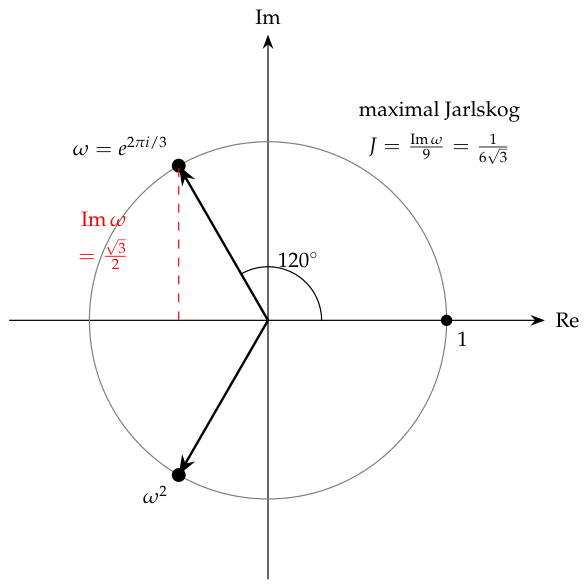
Every C 3 circulant is diagonalised by the magic matrix F, the Fourier transform in ω = e 2 π i / 3 . Two facts are exact in Q ( ω ) : F is trimaximal, | F j k | 2 = 1 / 3 , and its Jarlskog invariant is maximal,
J ( F ) = Im ω 9 = 3 18 = 1 6 3 ,
the largest a unitary mixing matrix admits. The cube-root phase is maximal CP violation: Im ω = 3 / 2 is as far off the real axis as a cube root reaches. The cubic structure recurs here as near-maximal leptonic CP violation, beside the three generations, the Koide cube-root coherence, and the Georgi–Jarlskog colour factor N c = 3 .
Figure 8. Leptonic CP from the cube-root phase (Section 6). The three generations sit at the cube roots of unity; the coherent phase ω = e 2 π i / 3 has Im ω = 3 2 , the largest a cube root reaches. The magic ( C 3 Fourier) matrix is trimaximal, | F j k | 2 = 1 / 3 , with Jarlskog J = Im ω / 9 = 1 / ( 6 3 ) , the maximum a unitary mixing matrix admits, so the cube-root phase is near-maximal CP, δ CP 130 . The trivial column ( 1 , 1 , 1 ) / 3 is the C 3 -protected TM2 axis.
Preprints 220674 g008
The democratic eigenvector ( 1 , 1 , 1 ) / 3 , the trivial C 3 character, a single irreducible representation, is the column a C 3 residual protects, singling out the trimaximal TM2 form; the alternative TM1 would protect ( 2 , 1 , 1 ) / 6 , the reducible sum of the two non-trivial characters, which no C 3 residual fixes. TM2 has cos δ CP cot 2 θ 23 , so near-maximal atmospheric mixing forces near-maximal CP, the sign set by the drive orientation i = g ( Ω 1 ) / 4 , the same handedness as the V A current. A full joint fit of the lopsided realisation, the trimaximal base, the complete lopsided M e = M d T (large 2–3 and Cabibbo 1–2), and the cube-root phase δ ν carrying the CP, reproduces all four mixing observables at χ 2 0 ( θ 13 = 8 . 6 , sin 2 θ 12 = 0.307 , θ 23 = 49 , δ CP = 128 ; tm2_jointfit.py), the angles riding on the carrier-scale phases with the leading-order sin θ 13 = sin θ C / 2 + Δ FRC the one prediction, the 6 % gap ( 0.159 against 0.149 ) the finite winding-kernel correction Δ FRC at the order of the δ 0 structure. The CP must sit in the neutrino sector: placing it in the charged-lepton phases instead cannot lift θ 23 past the first octant ( 43 against the observed 49 ), so the magic-matrix cube-root phase carrying the CP is required. The same correction that sets θ 13 moves sin 2 θ 12 off the exact-TM2 value 1 / ( 3 c 13 2 ) = 0.34 to the observed 0.307 , so the solar angle is accommodated, not in tension. A literal “both sectors circulant” would give no mixing, circulants share the basis F, so the realistic mixing is the misalignment of the charged-lepton and neutrino structures (the lopsided M e = M d T of Section 4.4 reducing θ 13 ). That reduction is itself fixed: the lopsided relation gives the charged-lepton 1–2 rotation the down-quark Cabibbo angle, θ C e θ C , and a 1–2 rotation on the magic base produces, through the maximal atmospheric mixing, the reactor angle θ 13 θ C sin θ 23 θ C / 2 (quark–lepton complementarity), numerically sin θ 13 = 0.159 versus the observed 0.149 , with the quark–lepton complementarity sum rule θ 12 + θ C 45 . Since θ C = arcsin λ and λ δ 0 , the reactor angle folds onto the same winding phase through the quarter-turn, sin θ 13 δ 0 / 2 (theta13.py). What is robust to the realisation is that the cube-root phase makes the CP near-maximal, as observed.

7. Finitism

Every exact claim of the mass sector lives in a finite arena, and the arenas form a ladder by how far each sits from the substrate. The native arena is the framed rationals of the relational algebra: the residues of F Ω read, against the frame ( 0 , 1 , g ) , as ratios r / s of bounded height. The Koide identity is natively an identity there. On the quadratic extension K = F p 2 / F p , with Frobenius σ the conjugation and N ( b ) = b σ ( b ) the modulus, the circulant amplitudes m k = a + b ω k + σ ( b ) ω 2 k are framed rationals in F p , ω is the finite cube root, and the quarter-turn amplitude is the framed rational N ( b ) / a 2 = 1 / 2 , not an irrational, whence Q = 2 / 3 exactly in F p (verified on F 17 , F 53 , F 89 ). The familiar cyclotomic statement, Q = 1 3 + 2 3 ρ 2 with eigenvalues a + b ω k + b ¯ ω 2 k in Q ( ω , 2 ) , ω a complex cube root and 2 = ζ 8 + ζ 8 1 , is one continuum rung up: a labelled degenerate reading of the framed-rational identity, exactly as the continuum π is a reading of the finite 4 π solid angle. The remaining exact facts sit at or below these rungs. The leading phase δ LO = 3 π 4 2 π 3 = π 12 is an exact rational multiple of π (a ζ 24 relation), with 1 + 2 cos 3 π 4 = 0 algebraic; the magic matrix’s trimaximality | F j k | 2 = 1 / 3 and maximal Jarlskog J = 1 / ( 6 3 ) are exact in Q ( ω ) ; and the winding-phase facts are integer identities, the cubic overlap b = r , s C r s ω r ζ p s Z [ Z / 3 × Z / p ] , with its reality ( C r s = C r , s ) and π / 3 -quantisation ( b 3 = b ¯ 3 ) symmetries of an integer coefficient array, checked with no complex numbers. The carrier-scale residue is itself a framed rational: the exact phase δ 0 is a winding ratio, a discrete logarithm in F Ω , a framed rational of height Ω , which is the literal content of its O ( Ω ) label. The continuum enters only as a labelled comparison chart, the confrontation of these exact objects with the measured masses, the λ -power read through a logarithm, the arccos extraction of δ , and the random-coefficient robustness and mixing runs, on which no exact claim depends. The float-free verifications are collected in exact_core.py and framed_koide.py (framed-rational, cyclotomic, and integer) and audited in reports/finitism-audit/.

8. Stability under the Carrier

The substrate is a single finite Carrier, the totality, of cardinality Ω 10 122 fixed by the de Sitter entropy [21], with the residue class Ω 5 ( mod 12 ) forced by self-consistency rather than selected [18], the observers being nested shells within it and not parallel Carriers [22]. The masses are carrier-specific residues (Section 4.5), yet the physics is not fine-tuned to the exact value of Ω : the next admissible prime gives the same world, for a structural reason.
A quantity depends on Ω in one of two ways. Smoothly, through analytic functions ( ln Ω , powers of Ω , the de Sitter entropy): this is how the scales and hierarchies enter, the cosmological numbers, the gauge couplings at a fixed physical scale, and the mass hierarchy m p / m e (a transmutation scale over a Yukawa). Arithmetically, through number-theoretic functions (discrete logarithms, Gauss sums): this is how, and only how, the winding phases enter, the phase δ 0 and the quark and neutrino phases locked or imaged from it, precisely the O ( Ω ) entries of Appendix B.
The two behave oppositely under a change of Carrier. The gap between consecutive admissible primes near Ω is ln Ω 280 , so the next prime lies at fractional distance Δ Ω / Ω 10 120 . Any smooth observable therefore shifts by ( d ln f / d ln Ω ) × 10 120 , nothing: m p / m e , the couplings, and the cosmological constant would be identical at the next prime to some 120 decimal places. The dimensionless structural invariants, Q = 2 / 3 , sin 2 θ W = 3 / 8 , charge quantisation, the mixing pattern, α bare = 1 / 4 π , are exactly Ω -independent, holding on every admissible shell. So both the structure and the hierarchies form a large-Ω attractor: the observable world is insensitive to which large admissible prime the Carrier is, sensitive only to its order of magnitude, which a unique Carrier does not vary. The Carrier need not be finely specified; only its scale, set by the cosmological constant, is read from the world.
The particle scales, in turn, are smooth readings of that substrate scale, not tuned inputs. Scale-covariance, the drive is scale-dilation, the only scale is Ω , forbids the one relevant operator, the Higgs mass term m H 2 | H | 2 , so the electroweak vacuum value (hence the overall mass scale a, with a 2 y τ v ) is generated by dimensional transmutation, v / M P = e c , exponentially small with nothing tuned, as Λ QCD is: the hierarchy problem dissolves. The scale-invariant boundary condition λ ( M P ) 0 predicts the observed near-critical Higgs ( m H 125 GeV for m t 173 GeV [23,24]), with the trigger y t 1 forced by the flavour structure; the residual is only the exponent c, the coupling anchor shared with α bare (scale_a.py, coupling_anchor.py).
The lone exception is the arithmetic residue. A cubic Gauss-sum argument equidistributes, so if the flavour phase δ 0 is a free arithmetic value it can differ at the next prime, moving the precise lepton mass ratios (and the exact δ CP ) while leaving Q = 2 / 3 , the gauge structure, and every hierarchy fixed. Even then the motion is confined to the Koide manifold: the shape of flavour is universal, only its single coordinate carrier-specific. This is the division the Standard Model already exhibits, robust gauge structure, environmental-looking flavour, here read as the smooth/arithmetic split in Ω .

δ 0 is Ω -unstable.

Two structures could pin it, and neither does. A self-consistency lock 3 δ 0 = Q would tie the phase to the amplitude and match the clean landing δ 0 Q / 3 = 2 / 9 , but no sub-horizon mechanism supplies it: the quarter-turn fixes the norm Q and the winding δ LO separately, not the phase-from-norm link. A profinite winding would make δ 0 one Ω -independent number, but the drive-orientation cubic Gauss sum equidistributes across shells (Heath-Brown–Patterson), so δ 0 is arithmetic and 2 / 9 is not a clean cube-cycle winding. Thus δ 0 is carrier-specific: the last flavour coordinate is bedrock, its shape universal and its one number Ω -hard.

9. Discussion and Conclusions

The construction imports only the Froggatt–Nielsen, Wolfenstein, Gatto–Sartori–Tonin, Georgi–Jarlskog, lopsided- SU ( 5 ) , and seesaw textures with the renormalisation-group running; everything else in Table 3 is derived. The derived results are collected as explicability dividends in Section 9.1, and every quantity of the sector is classified by epistemic role (T theorem, O open, Ω Ω -hard, I input) in Appendix B. The dimensionless flavour structure reduces to a single Ω -hard number. The cross-sector lock δ : δ d : δ u = 1 : 1 2 : 1 3 (Section 4.5) collapses the sector phases to one drive-orientation phase δ 0 2 / 9 , a cubic Gauss sum on the cosmological shell, with the neutrino seesaw phase δ ν and the CP phases imaged from it. The amplitudes are not free: they are fixed by colour, r 2 = N ( 1 ζ n ) (2 colourless, 3 coloured; C4). The one dimensionful residue is the overall mass scale, a face of the scale operator (E5). So the matter sector rests on exactly two Ω -hard residues, one phase and one scale; everything else is derived.

The phase residue.

The exact phase δ is Ω -hard bedrock. Its leading value is the framed-rational winding δ LO = 3 8 1 3 = 1 24 cycle: the split-torus boundary 3 8 , where cos 2 π 3 8 = 1 / 2 is the quarter-turn diagonal, minus the generation 1 3 (continuum π / 12 is the [approx] image). Its full value is carried by the cube-invariant of the overlap. The circulant determinant gives k m k = a 3 + 2 Re ( b 3 ) 3 a | b | 2 , so with | b | 2 = a 2 / 2 the phase residue is Re ( b 3 ) , a framed rational. The single number δ 0 is fixed by neither of the two structures that might. The quarter-turn fixes the amplitude Q (a norm) and the boundary δ LO (a winding) separately, and cannot tie a phase to a norm; and the drive-orientation cubic Gauss sum equidistributes across shells, so δ 0 is arithmetic and 2 / 9 is not a clean cube-cycle winding. The sub-horizon reading is δ 0 = Q / 3 = 2 / 9 (the colourless Koide value over the generation count, 3 δ 0 = Q ), reproducing the charged spectrum, with δ d = δ 0 / 2 and δ u = δ 0 / 3 derived from it. The mass sector reduces to two bedrock residues, the absolute scale (E5) and the flavour phase δ 0 ; all else is sub-horizon.

The sixteen.

The matter content closes: one generation is the spinor 16 as the four-chart reflection algebra Λ ( C 4 ) Λ even ( C 5 ) , and the 16 observed projection is anchored at the drive-invariant singlet ν c , both established in Section 3.2 (Proposition 1); the matter content’s residue is the Ω -hard absolute mass scale (ledger E5), the scale partner of the flavour phase δ 0 , the two Ω -hard residues of the sector.

9.1. Explicability Dividends

The surplus is the flavour data the Standard Model must measure, and the inputs prior flavour models assume, here a consequence of the substrate’s two structural residues.
  • The Koide ratio is exactly 2 / 3 , the cube-root generation orbit bisected at the quarter-turn ( ρ 2 = 2 1 ), an exact value rather than an unexplained empirical coincidence (Proposition 2).
  • The up-quark Koide value is exactly 5 / 6 , the cube-root colour norm r u 2 = N ( 1 ω ) = 3 against the colourless N ( 1 i ) = 2 , a sharp ratio where the Standard Model carries no relation at all (Remark 2).
  • The flavour charges are the role depths ( 0 , 1 , 2 ) of the closed primitive-role ladder, derived as the three generative roles rather than assigned to fit the hierarchy (Section 4.2).
  • The Cabibbo angle is V u s = m d / m s , the Gatto relation following from the role-depth texture, so two otherwise-independent observables are tied rather than measured apart (Proposition 4).
  • The Georgi–Jarlskog factor is the colour count N c = 3 , the B L Clebsch of the 126 ¯ , not a texture coefficient inserted by hand (Section 4.3).
  • The up-sector doubling m i u ( m i d ) 2 is forced by the 10 · 10 Yukawa, so the steeper up hierarchy is a consequence rather than a separate assumption (Proposition 3).
  • The electron’s extreme lightness is the quarter-turn boundary: the lightest generation sits where the winding amplitude vanishes, massless at leading order, rather than an anomalously small Yukawa tuned by hand (Proposition 6).
  • The large-lepton, small-quark mixing split is the lopsided M e = M d T : one off-diagonal feeds the invisible right-handed quark rotation and, transposed, the visible left-handed lepton rotation, so the two mixing matrices are one structure rather than two unrelated ones (Section 4.4).
  • The reactor angle is, at leading order, sin θ 13 = sin θ C / 2 + Δ FRC , quark–lepton complementarity through the quarter-turn, the bare 0.159 shifted to the observed 0.149 by the finite winding-kernel correction Δ FRC , a derived relation rather than an independent mixing parameter (Section 6).
  • Near-maximal leptonic CP is the cube-root phase: Im ω = 3 / 2 gives the maximal Jarlskog J = 1 / ( 6 3 ) , so the cubic reappears as CP violation rather than a free phase fitted to data (Section 6).
  • The neutrino spectrum (normal ordering, a near-massless lightest state, m ν 59 meV) follows from colourlessness fixing Q ν = 2 / 3 and the transpose fixed point M R m D , rather than three independent neutrino masses (Proposition 8, Section 5).

9.2. Predictions

The sector’s content is two sharp, Standard-Model-unexplained numbers staked on the structure. Koide Q = 2 / 3 exactly [17]: the cube-root coherence at the quarter-turn, holding to 6 × 10 6 ; a confirmed departure at improved charged-lepton precision falsifies the construction. The Cabibbo angle V u s = m d / m s (Proposition 4): a relation between otherwise-independent observables, holding at 0.3 % . The Georgi–Jarlskog double ratio ( m μ / m e ) / ( m s / m d ) N c 2 = 9 is a third. The up-quark Koide value Q u = 5 / 6 exactly: the coloured up sector carries the cube-root amplitude r u 2 = N ( 1 ω ) = 3 (the non-split torus), as the colourless leptons carry the quarter-turn r 2 = N ( 1 i ) = 2 (the split torus), giving Q u = 1 3 + r u 2 6 = 5 6 against Q = 2 3 ; the framed integer r u 2 = 3 is scale-free, so Q u = 5 / 6 = 0.833 ; the continuum Q u runs with scheme and scale and has no unique value. Over standard schemes it spans 0.83 0.89 , bracketing 5 / 6 : on-shell masses ( m u , m c , m t ) = ( 2.2 MeV , 1.67 , 172.8 GeV ) give 0.832 , coinciding with the framed integer, while MS ¯ at M Z ( 1.27 MeV , 0.619 , 168.3 GeV ) gives 0.888 . The running is the [approx] layer (quark_amp.py). Structurally, the leading-order charged-lepton spectrum is parameter-free up to scale (Proposition 6): the electron is the generation at the quarter-turn boundary and is massless at leading order, with m μ / m τ = 0.072 (observed 0.060 ), the residual being the winding shift of δ from π / 12 . For the neutrinos, Q ν = 2 / 3 (colourlessness) with the two measured Δ m 2 predicts normal ordering, a near-massless lightest state, and m ν 59 meV (Section 5), a sharp future test as cosmology approaches the floor, the current DESI+CMB bounds near it being model- and dataset-dependent; falsified by inverted ordering, a degenerate spectrum, or m ν 120 meV. The cube-root phase predicts near-maximal leptonic CP violation, δ CP 130 (Section 6), the sign set by the drive. This is a live future test: it is consistent with the current T2K/NOvA preference, though global fits still admit CP conservation within 1 σ for normal ordering; it is falsified by a CP-conserving δ CP 0 .
Collected as a list, with current status and falsifier, the sector’s predictions are the following, each marked exact (a framed-rational identity, falsified by a confirmed departure as precision improves), neutrino (a consequence of Q ν = 2 / 3 and the two measured splittings), or mixing (a consequence of the trimaximal structure).
  • Charged-lepton Koide, Q = 2 / 3 [exact]. The cube-root generation orbit at the quarter-turn (Proposition 2,17]) gives ( m e + m μ + m τ ) / ( m e + m μ + m τ ) 2 = 2 / 3 , holding to 6 × 10 6 ; equivalently it predicts m e = 0.5106 vs the measured 0.5110 MeV from m μ , m τ . Falsifier: a charged-lepton mass measurement displacing Q from 2 / 3 beyond the per-mille winding-phase correction.
  • Up-quark Koide, Q u = 5 / 6 [exact]. The coloured up sector carries the cube-root amplitude r u 2 = N ( 1 ω ) = 3 , the colourless leptons the quarter-turn r 2 = N ( 1 i ) = 2 (Remark 2), so Q u = 1 3 + r u 2 6 = 5 6 = 0.8333 ; the continuum value is scheme-dependent, 0.83 0.89 , coinciding with 5 / 6 at on-shell masses ( 0.832 ). This is the sector’s sharpest novel ratio. Falsifier: improved up, charm, and top masses settling Q u away from 5 / 6 .
  • Cabibbo angle, V u s = m d / m s [exact]. The role-depth texture gives the Gatto–Sartori–Tonin relation (Proposition 4,7]): m d / m s = 0.2236 vs the measured V u s = 0.2243 ( 0.3 % ). Falsifier: down-sector masses and V u s breaking the relation beyond 1 % .
  • Georgi–Jarlskog double ratio, N c 2 = 9 [exact]. The colour factor 3 = N c (Section 4.3) fixes ( m μ / m e ) / ( m s / m d ) 9 at unification; the low-scale value 10.3 runs toward 9. Falsifier: the renormalisation-group-evolved double ratio settling away from 9.
  • Normal neutrino ordering[neutrino]. Colourlessness fixes Q ν = 2 / 3 , and with the two measured splittings the spectrum is normal-ordered (Section 5). Falsifier: a determination of inverted ordering at JUNO, DUNE, or atmospheric experiments.
  • Neutrino mass-sum floor, m ν = 58.7 meV[neutrino]. With m 1 0 (the lightest at the quarter-turn boundary, the electron’s analogue), m 2 8.6 and m 3 50 meV give m ν = Δ m 21 2 + Δ m 31 2 = 58.7 meV, a hard lower edge for normal ordering. Falsifier: a cosmological bound m ν < 0.058 eV; the current DESI–CMB limit 0.07 eV is already closing on it.
  • Effective Majorana mass, m β β 1.5 3.7 meV[neutrino]. The normal-ordered spectrum with m 1 0 and the circulant seesaw Majorana phase (NU8) fixes the neutrinoless double-beta effective mass in the normal-ordering band, | m β β | [ 1.5 , 3.7 ] meV. Falsifier: a 0 ν β β detection at the inverted-ordering scale (15– 50 meV), within the reach of LEGEND-1000 and nEXO.
  • Near-maximal leptonic CP, δ CP 130 [mixing]. The magic matrix carries the maximal Jarlskog J = 1 / ( 6 3 ) , and the cube-root phase makes the CP near-maximal with sin δ CP < 0 , the sign set by the drive (Section 6), consistent with the current T2K/NOvA preference. Falsifier: a CP-conserving δ CP 0 or 180 , or sin δ CP > 0 .
  • Reactor angle, sin θ 13 = sin θ C / 2 [mixing]. Quark–lepton complementarity through the lopsided M e = M d T and the quarter-turn gives sin θ 13 = sin θ C / 2 = 0.159 ( θ 13 9 . 1 ) against the measured 0.148 , with the sum rule θ 12 + θ C 45 (Section 6). Falsifier: reactor-angle precision (Daya Bay, JUNO) excluding θ C / 2 .
The construction is thereby falsified by an inverted neutrino ordering, a cosmological m ν < 0.058 eV, a 0 ν β β detection at the inverted scale, a CP-conserving δ CP , or a confirmed departure of any exact ratio; it stakes two Standard-Model-unexplained numbers, the charged-lepton 2 / 3 and the up-quark 5 / 6 , on the substrate’s two structural residues.

10. Reproducibility

Every quantitative and algebraic claim is verified by an accompanying suite, linked below and indexed by the suite README (README.md), which maps each script to the result it backs and gives its float-free or labelled-comparison class. The load-bearing identities of the mass sector are evaluated float-free in finite, finite-field, or cyclotomic arithmetic (exact_core.py, Section 7); the figure-of-merit and data comparisons are labelled degenerate-idealisation readings, and no exact claim rests on a continuum construct. The per-script detail follows.
All algebraic and numerical claims are verified in tier_b.py ( 17 / 17 : the Koide identities and figures, the λ -power and Gatto checks, the Georgi–Jarlskog double ratio, and the lopsided/seesaw mixing comparison) and m10.py ( 12 / 12 : the circulant construction and eigenvalue identity, the symbolic Q = 1 3 + r 2 / 6 and r = 2 , the π / 12 boundary identity and the leading-order spectrum, and the per-sector extraction); and delta.py ( 10 / 10 : the cross-sector phase lock and its robustness, the reality of the symmetric cubic overlap and its breaking by the drive, and the π / 3 quantisation of small-shell phases). The load-bearing claims are additionally verified float-free in exact_core.py ( 25 / 25 : the Koide identity natively over framed rationals in F p 2 / F p (with the quarter-turn the rational N ( b ) / a 2 = 1 / 2 , Q = 2 / 3 exact in F p on three shells); the amplitude diagonal r 2 = N ( 1 ζ n ) = 2 , 3 as integers in F p ; the Koide and circulant identities in the continuum-rung-up Q ( ω , 2 ) ; the π / 12 boundary in rational π ; the Gauss-sum reality and π / 3 -quantisation as integer group-ring identities; and the trimaximal magic matrix with maximal Jarlskog J = 1 / ( 6 3 ) in Q ( ω ) ). The neutrino prediction is verified in neutrino.py ( 7 / 7 : the seesaw-of-circulants identity float-free, and the Q ν = 2 / 3 mass prediction with its robustness and seesaw consistency, labelled), and the CP result in pmns_cp.py ( 6 / 6 : the trimaximal magic matrix and its maximal Jarlskog, and the TM2 δ CP at the observed angles) and the TM2 status in tm2_jointfit.py ( 9 / 9 : the trivial-singlet protection, the dissolved solar tension, and the joint fit at χ 2 0 with the CP in δ ν ); the overall-scale lead is developed in scale_a.py (the forced y t 1 , the descent of λ to the scale-invariant point, and the transmutation exponent v / M P = e 38 ), the spurion lead in spurion.py (the Gatto relation, λ from the down circulant, and λ δ 0 2 / 9 ), and the quark-amplitude lead in quark_amp.py (the Georgi–Jarlskog down dressing Q 0.745 , the up r u 3 , and the n-fold diagonal), and the reactor-angle lead in theta13.py ( θ 13 θ C / 2 , the quark–lepton complementarity sum rule, and the fold onto δ 0 / 2 ), and the up-doubling result in up_doubling.py (the ( 4 , 2 ) / ( 4 , 2 ) / ( 8 , 4 ) pattern with up  = 2 ×  down, and the 10 · 10 derivation).

Author Contributions

The authors conceived, conducted and directed the research, and take full responsibility for every definition, statement, and argument herein. The development, and the machine verification of the claims, were carried out with extensive assistance from an artificial-intelligence system.

Funding

This research received no external funding.

Institutional Review Board Statement

This research did not involve any experiments requiring ethical approval.

Data Availability Statement

No new empirical data were created or analysed in this study; the measured masses and mixing parameters used as anchors are drawn from the cited references.

Conflicts of Interest

The authors declare that the research was conducted in the absence of any commercial or financial relationships that could be construed as a potential conflict of interest.

Appendix A. Predicate Ledger

The dependency structure of the flavour construction, every claim traced to its inputs and tagged by epistemic role. The quantity table of Appendix B cross-references these codes in its Status column.   
tag meaning
I Import. A standard result or measured datum used here without reproof.
B Bridge. An identification of a mathematical object with a physical one.
D Definition. A naming or set-up move.
T Theorem. Derived within this paper from the rows above it.
Ω Ω -hard. Decided by the totality; not closeable by a bounded observer.
# Move Status Source
A. Inputs: imported, not derived here
A1 Substrate arithmetic: F Ω , the multiplicative cycle, the Frobenius C 3 Galois orbit, the quarter-turn Q 4 , the admissible residue Ω 5 ( mod 12 ) . I [18,19]
A2 One generation as the 16 of SO ( 10 ) : field content, hypercharges, charges, anomaly freedom, sin 2 θ W = 3 / 8 , and the massless-photon / confining-gluon residues. I [18]
A3 The Froggatt–Nielsen flavour mechanism and the Wolfenstein parametrisation. I [5,6]
A4 The Gatto–Sartori–Tonin, Georgi–Jarlskog, and lopsided- SU ( 5 ) textures. I [4,7,8]
A5 The seesaw mechanism and the renormalisation-group running. I [9]
A6 Measured anchors: the two Δ m 2 , M R , the charged-lepton masses, the empirical Koide identity. I [17]
B. Bridges: mathematics → physics
B1 Matter is the circulant amplitude matrix M ; a mass is the squared modulus of a generation amplitude (the Born square). B [20]
B2 The three generations are the Frobenius C 3 Galois orbit: identical in every gauge number, differing only in mass. B [18]
B3 The role depths ( 0 , 1 , 2 ) of the closed ladder are the Froggatt–Nielsen flavour charges. B [19]
B4 The colour excess of the quark amplitudes is the Georgi–Jarlskog Clebsch N c = 3 ; the squared amplitude is the cyclotomic norm N ( 1 ζ n ) . B [18]
B5 A colourless sector (charged leptons, neutrinos) carries the undressed quarter-turn amplitude r = 2 , i.e. Q = 2 / 3 . B [18]
C. Derived: theorems within this paper
C1 Generation universality ⇒ the amplitude matrix is a C 3 -circulant ⇒ the Koide functional form. T Proposition 5
C2 Q = 2 / 3 r = 2 ρ 2 = 1 2 , the self-dual quarter-turn value. T Section 4.1
C3 The leading boundary phase is the framed-rational winding δ LO = 3 8 1 3 = 1 24 cycle (split-torus boundary 3 8 minus generation 1 3 ; continuum π / 12 [approx]); massless lightest generation. T Proposition 6
C4 The squared amplitudes are the cyclotomic norms r 2 = N ( 1 i ) = 2 , r u 2 = N ( 1 ω ) = 3 , hence Q = 2 3 , Q u = 5 6 ; the down sector is the GJ-dressed intermediate. T Remark 2
C5 The cross-sector phase lock δ : δ d : δ u = 1 : 1 2 : 1 3 . T Section 4.5
C6 The Gatto Cabibbo relation V u s = m d / m s . T Proposition 4
C7 Up-sector doubling m i u ( m i d ) 2 from the 10 · 10 Yukawa. T Proposition 3
C8 Lopsided M e = M d T splits CKM (small) from PMNS (large); the CKM angle values reduce to the winding kernel and the shared σ . T Section 4.4
C9 The reactor angle sin θ 13 = sin θ C / 2 δ 0 / 2 (quark–lepton complementarity). T Section 6
C10 TM2 selected: the trivial C 3 character ( 1 , 1 , 1 ) / 3 is the protected column; the magic Jarlskog J = 1 / ( 6 3 ) is maximal CP, the sign fixed by the drive. T Section 6
C11 Seesaw of circulants ⇒ Koide-form (theorem); with M R m D ( 126 ¯ alignment, a bridge) the seesaw gives m ν = m D T , r ν = 2 (transpose fixed point). T | B Proposition 7, 8
C11b Drive-invariant boundary branch: the lightest colourless neutrino sits at the quarter-turn zero (as the electron), selecting the normal near- m 1 = 0 branch and excluding inverted; the signed r ν = 2 fit is 66 × tighter for normal than inverted. T | B Section 5
C12 The generation 16 is the four-chart reflection algebra Λ ( C 4 ) Λ even ( C 5 ) , the quarter-turn the fifth direction; projection anchored at ν c = Λ 0 . T Proposition 1
D. Falsifiable predictions
D1 Charged-lepton Koide Q = 2 / 3 exact (to 6 × 10 6 ); m e = 0.5106 vs 0.5110 MeV. Falsifier: a lepton-mass shift of Q off 2 / 3 . T C2
D2 Up-quark Koide Q u = 5 / 6 exact, r u 2 = N ( 1 ω ) = 3 ; continuum 0.83 0.89 by scheme (on-shell 0.832 ). Falsifier: up/charm/top masses moving Q u off 5 / 6 at a fixed scheme. T C4
D3 Cabibbo V u s = m d / m s = 0.2236 vs 0.2243 ( 0.3 % ). Falsifier: the Gatto relation broken beyond 1 % . T C6
D4 Georgi–Jarlskog double ratio ( m μ / m e ) / ( m s / m d ) N c 2 = 9 (low-scale 10.3 ). Falsifier: the RG-evolved ratio off 9. T B4
D5 Normal neutrino ordering, from Q ν = 2 / 3 and the two Δ m 2 . Falsifier: inverted ordering. T|I Section 5
D6 Mass-sum floor m ν = 58.7 meV ( m 1 0 , m 2 8.6 , m 3 50 meV). Falsifier: a cosmological m ν < 0.058 eV. T|I Section 5
D7 Effective Majorana mass m β β 1.5 3.7 meV (NO, m 1 0 , circulant phase). Falsifier: a 0 ν β β signal at the inverted scale 15–50 meV. T| Ω C11
D8 Near-maximal leptonic CP δ CP 130 , sin δ CP < 0 , J = 1 / ( 6 3 ) . Falsifier: CP-conserving δ CP or sin δ CP > 0 . T C10
D9 Reactor angle, leading order sin θ 13 = sin θ C / 2 + Δ FRC ; LO value 0.159 vs 0.148 ( 6 % , Δ FRC the finite winding-kernel correction). Falsifier: θ 13 excluding θ C / 2 beyond Δ FRC . T C9
Residues ( Ω -hard)
D10 The lepton winding phase δ 0 : the one Ω -hard drive-orientation residue (bedrock). Neither a geometric nor a profinite derivation fixes it, the drive-orientation Gauss sum equidistributing. Sub-horizon reading δ 0 = Q / 3 = 2 / 9 ( 3 δ 0 = Q ); leading δ LO = 3 8 1 3 framed-rational (C3); phase residue carried by Re ( b 3 ) . Ω Section 4.5, Section 9
D11 The quark and neutrino phases δ d = δ 0 / 2 , δ u = δ 0 / 3 , δ ν : locked or seesaw-imaged from δ 0 . T| Ω C5, C11
D12 The absolute masses and the electroweak scale v: Ω -hard, the matter face of the scale operator (ledger E5). Ω [18]
D13 α 1 ( 0 ) : the electromagnetic face of the scale operator, Ω -hard (ledger E7). Ω App. Appendix B, AL

Appendix B. Status of the Quantities

Each quantity is classified in the 00-ledger epistemic key and carries a reference code (block SC, CL, QK, MX, NU, GU, AL with index). T (Theorem): derived or proven here. O (open): a residue a bounded observer could close. Ω (Ω-hard): carrier-scale, the limit of an Ω -term character sum over the carrier, beyond the coherence horizon and uncomputable below Ω . I (input): a measured datum consumed as an anchor.
Ref Quantity Value / relation Fixed by Status
Structural constants
SC1 Substrate residue Ω 5 ( mod 12 ) 4 Ω 1 3 Ω + 1 T [A1]
SC2 Quarter-turn amplitude r = 2 = ζ 8 + ζ 8 1 four-fold; Q ( ω , 2 ) T [C2]
SC3 Koide value (leptons) Q = 2 / 3 cube-root × quarter-turn T [C2]
SC4 Generation count 3 generative roles (closure) T [B2]
SC5 Boundary phase δ LO = π / 12 3 π / 4 2 π / 3 , exact T [C3]
SC6 Amplitude-matrix form C 3 -circulant Galois universality T [C1]
Masslessness and the gauge residues
GR1 Masslessness criterion mass = winding rate; massless = drive-invariant non-split (Frobenius) part, F Ω 2 / F Ω T [A2]
GR2 Photon (Carrier residue 2) residue 2: two fixed lines over F Ω , the helicities ( N ( 1 i ) ) split torus C Ω 1 ; U ( 1 ) unbroken T [A2]
GR3 Gluon (Carrier residue 0) residue 0: no fixed line over F Ω (confinement) non-split torus C Ω + 1 T [A2]
GR4 Photon helicities pair ( x , x 1 ) ; distinct x 2 1 split element, det = 1 T [A2]
GR5 Photon four-packet { ± x , ± x 1 } ; full x Q 4 inversion P, negation C ( A μ A μ ) T [A2]
Charged-lepton masses
CL1 Koide relation Q = 2 / 3 (to 6 × 10 6 ) derived T [C2]
CL2 Mass-ratio form m k = a ( 1 + 2 cos ( δ 0 + 2 π k 3 ) ) circulant, r = 2 T [C1]
CL3 m e from m μ , m τ 0.5106 vs 0.5110 MeV ( 0.07 % ) Q = 2 / 3 + two masses T [C2]
CL4 Electron lightness massless at LO (boundary) δ = π / 12 m e = 0 T [C3]
CL5 Lepton winding phase δ 0 2 / 9 drive-orientation Gauss sum Ω  [D10]
CL6 Overall scale (mechanism) v / M P = e c , dim. transmutation scale-cov. forbids m H 2 term T [D12]
CL7 Overall scale (value v) a 2 y τ v , abs. MeV carrier-scale exponent c (with α , Λ QCD ) Ω  [D12]
Quark masses
QK1 Flavour charges role depths ( 0 , 1 , 2 ) generative roles T [B3]
QK2 λ -power texture (structure) λ 4 : λ 2 : 1 , λ 8 : λ 4 : 1 role-depth FN T [B3]
QK3 Spurion relation ε = λ = m d / m s Gatto; texture T [C6]
QK4 Spurion value λ δ 0 2 / 9 winding kernel (carrier-scale) Ω  [D10]
QK5 Up-sector doubling (structure) m i u ( m i d ) 2 10 · 10 vs 10 · 5 ¯ T [C7]
QK6 Cabibbo (Gatto) V u s = m d / m s ( 0.3 % ) texture T [C6]
QK7 Down amplitude r d : GJ N c = 3 dressing colour Clebsch; N ( 1 ζ 4 ) = 2 T [C4]
QK8 Up amplitude / Q u r u 2 = N ( 1 ζ 3 ) = 3 , Q u = 5 / 6 cube-root colour norm (split/non-split) T [C4]
QK9 Quark phase lock δ d = δ 0 / 2 , δ u = δ 0 / 3 cross-sector lock T [C5]
QK10 Quark phase value δ d , δ u (abs.) imaged from δ 0 (carrier-scale) Ω  [D11]
Mixing (CKM, PMNS)
MX1 Quark/lepton split (mechanism) small vs large lopsided M e = M d T T [C8]
MX2 CKM angle structure λ : λ 2 : λ 3 charge differences T [C8]
MX3 CKM angle values Cabibbo m d / m s ; coeffs = shared σ winding kernel; CP phase Ω -hard T |  Ω  [C8]
MX4 θ 13 / lopsided entry sin θ 13 = sin θ C / 2 δ 0 / 2 lopsided Cabibbo × quarter-turn T |  Ω  [C9]
MX5 TM2 column ( 1 , 1 , 1 ) / 3 , P-fixed trivial C 3 irrep (TM1 = c 1 + c 2 reducible) T [C10]
MX6 Solar angle (structure) sin 2 θ 12 : 1 3 0.31 TM2 base + θ C corr. T [C10]
MX7 Magic Jarlskog J = 1 / ( 6 3 ) , maximal cube-root phase; Q ( ω ) T [C10]
MX8 Leptonic CP near-maximality near-maximal TM2; cube-root phase T [C10]
MX9 Leptonic CP magnitude δ CP TM2-locked to θ 23 , δ ν maximal at θ 23 = π / 4 ; δ ν carrier-scale T |  Ω  [C10]
MX10 Leptonic CP sign δ CP < 0 drive orientation T [C10]
Neutrino sector
NU1 Seesaw of circulants circulant ⇒ Koide-form circulant algebra T [C11]
NU2 Neutrino Koide Q ν = 2 / 3 colourless quarter-turn T [B5]
NU3 Ordering (prediction) normal Q ν = 2 / 3 + Δ m 2 T [D5]
NU4 Mass sum (prediction) m ν 58.7 meV Q ν = 2 / 3 + two Δ m 2 T [D6]
NU5 Lightest neutrino (prediction) m 1 = 0 at LO ( 0.4 meV) boundary (drive-invariant) T [D6]
NU6 The two Δ m 2 7.4 × 10 5 , 2.5 × 10 3 eV2 measured I [A6]
NU7 Seesaw phase value δ ν 0.48 seesaw of δ D , δ R (carrier-scale) Ω  [D11]
NU8 Majorana / PMNS phase M R m D m ν = m D T , r ν = 2 126 ¯ transpose fixed point; δ ν   Ω -hard T |  Ω  [C11]
GUT-level relations
GU1 Weinberg angle sin 2 θ W = 3 / 8 0.231 Tr T 3 2 / Tr Q 2 T [A2]
GU2 Georgi–Jarlskog factor 3 = N c colour rank T [B4]
GU3 b τ unification (order) m b / m τ 2.4 SO ( 10 ) 16 T [A4]
GU4 Seesaw scale (order) Δ m 31 2 0.05 eV M R at unification T [A5]
GU5 Majorana scale M R M R 10 14 GeV unification input I [A6]
Matter content (the sixteen; Proposition 1)
MC1 Generation content 16 = Λ even ( C 5 ) = 1 10 5 ¯ rank-five frame C 3 C 2 T [A2]
MC2 Reflection origin Λ ( C 4 ) Λ even ( C 4 Q 4 ) , 2 4 = 16 four charts + quarter-turn (5th dir.) T [C12]
MC3 “Matter is a spinor” derived from the reflection count reflection–spinor identification T [C12]
MC4 Spectrum projection 16 obs. via C 3 × Q 4 × scale-wrap anchored at ν c = Λ 0 T |  Ω  [C12]
MC5 Drive-invariant anchor ν c = Λ 0 , matter twin of the photon unique total singlet, Q = 0 T [C12]
The fine-structure constant(separate ledger,reports/alpha-ledger/;alpha_probe.py)
AL1 Bare EM coupling α bare = 1 / 4 π channel unity T [A2]
AL2 EM/gravity hierarchy α ( m P / m p ) 2 = 1.2 × 10 36 Ω reading T [A2]
AL3 Lattice→continuum match g = 1 at β c ; Z 3 critical carrier-scale renorm. EM face of scale operator T |  Ω  [D13]
AL4 Substrate cutoff scale Λ sub = M P ( a P ) substrate scale, Ω = π ( M P / H 0 ) 2 T | B [D13]
AL5 α 1 ( 0 ) (EM face) 4 π + f b f 2 π ln ( M P / m f ) carrier-scale log over Ω -hard masses (E5) Ω  [D13]
AL6 α 1 ( 0 ) anchor measured experimental anchor I [A6]
Almost everything structural is T (derived); the dimensionless residue concentrates on a single number. There is essentially one Ω -hard phase, the lepton winding phase δ 0 2 / 9 (D10), with the quark and neutrino phases locked or seesaw-imaged from it (D11) and the spurion folded onto it by λ δ 0 (the Gatto relation making λ a reading of the masses). The amplitudes are colour, not free: the squared amplitude is the finite-field norm r 2 = N ( 1 ζ n ) , the integer 2 four-fold (colourless, the split torus of the photon) and 3 three-fold (the coloured up sector, the non-split torus of confinement; Remark 2), giving Q = 2 / 3 and Q u = 5 / 6 exactly (C4). The dimensionful residues join one carrier-scale family: the electroweak scale v and the absolute masses (D12, the matter face), and α 1 ( 0 ) (D13, the electromagnetic face), all Ω -hard, the faces of the scale operator, the factorisation of Ω 1 whose spectral face is RH; so the matter sector’s bedrock is exactly two Ω -hard residues, the winding phase δ 0 and the mass scale, the latter one face of that operator. The genuine I inputs reduce to the measured anchors the construction consumes: the two Δ m 2 and the cosmological scale Ω itself, set by Λ .

References

  1. Georgi, H.; Glashow, S.L. Unity of All Elementary-Particle Forces. Phys. Rev. Lett. 1974, 32, 438–441. [Google Scholar] [CrossRef]
  2. Fritzsch, H.; Minkowski, P. Unified Interactions of Leptons and Hadrons. Ann. Phys. 1975, 93, 193–266. [Google Scholar] [CrossRef]
  3. Pati, J.C.; Salam, A. Lepton Number as the Fourth “Color”. Phys. Rev. D. 1974, 10, 275–289. [Google Scholar] [CrossRef]
  4. Georgi, H.; Jarlskog, C. A New Lepton-Quark Mass Relation in a Unified Theory. Phys. Lett. B 1979, 86, 297–300. [Google Scholar] [CrossRef]
  5. Froggatt, C.D.; Nielsen, H.B. Hierarchy of Quark Masses, Cabibbo Angles and CP Violation. Nucl. Phys. B 1979, 147, 277–298. [Google Scholar] [CrossRef]
  6. Wolfenstein, L. Parametrization of the Kobayashi-Maskawa Matrix. Phys. Rev. Lett. 1983, 51, 1945–1947. [Google Scholar] [CrossRef]
  7. Gatto, R.; Sartori, G.; Tonin, M. Weak Self-Masses, Cabibbo Angle, and Broken SU(2)×SU(2). Phys. Lett. B 1968, 28, 128–130. [Google Scholar] [CrossRef]
  8. Albright, C.H.; Barr, S.M. Fermion Masses in SO(10) with a Single Adjoint Higgs Field. Phys. Rev. D. 1998, 58, 013002. [Google Scholar] [CrossRef]
  9. Minkowski, P. μ at a Rate of One Out of 109 Muon Decays? Phys. Lett. B 1977, 67, 421–428. [Google Scholar] [CrossRef]
  10. Gell-Mann, M.; Ramond, P.; Slansky, R. Complex Spinors and Unified Theories. In Supergravity; van Nieuwenhuizen, P., Freedman, D.Z., Eds.; North-Holland: Amsterdam, 1979; pp. 315–321. [Google Scholar]
  11. Günaydin, M.; Gürsey, F. Quark Structure and Octonions. J. Math. Phys. 1973, 14, 1651–1667. [Google Scholar] [CrossRef]
  12. Dixon, G.M. Division Algebras: Octonions, Quaternions, Complex Numbers and the Algebraic Design of Physics; Kluwer Academic: Dordrecht, 1994. [Google Scholar] [CrossRef]
  13. Baez, J.C. The Octonions. Bull. Am. Math. Soc. 2002, 39, 145–205. [Google Scholar] [CrossRef]
  14. Furey, C. Three Generations, Two Unbroken Gauge Symmetries, and One Eight-Dimensional Algebra. Phys. Lett. B 2018, 785, 84–89. [Google Scholar] [CrossRef]
  15. Todorov, I.; Dubois-Violette, M. Deducing the Symmetry of the Standard Model from the Automorphism and Structure Groups of the Exceptional Jordan Algebra. Int. J. Mod. Phys. A 2018, 33, 1850118. [Google Scholar] [CrossRef]
  16. Boyle, L. The Standard Model, the Exceptional Jordan Algebra, and Triality. arXiv 2020, arXiv:2006.16265. [Google Scholar]
  17. Koide, Y. New View of Quark and Lepton Mass Hierarchy. Phys. Rev. D. 1983, 28, 252–254. [Google Scholar] [CrossRef]
  18. Akhtman, Y.; Voether, E. Standard-Model Interactions over Finite Substrate. Preprints 2026. [Google Scholar] [CrossRef]
  19. Akhtman, Y.; Voether, E. P versus NP: Computation as Counting over Finite Substrate. Preprints 2026. [Google Scholar] [CrossRef]
  20. Akhtman, Y.; Voether, E. Quantum Observation over Finite Substrate. Preprints 2026. [Google Scholar] [CrossRef]
  21. Gibbons, G.W.; Hawking, S.W. Cosmological Event Horizons, Thermodynamics, and Particle Creation. Phys. Rev. D. 1977, 15, 2738–2751. [Google Scholar] [CrossRef]
  22. Akhtman, Y. Paradoxes of Infinity as Reductio ad Absurdum. Preprints 2025. [Google Scholar] [CrossRef]
  23. Degrassi, G.; Di Vita, S.; Elias-Miró, J.; Espinosa, J.R.; Giudice, G.F.; Isidori, G.; Strumia, A. Higgs Mass and Vacuum Stability in the Standard Model at NNLO. J. High Energy Phys. 2012, 2012, 098. [Google Scholar] [CrossRef]
  24. Buttazzo, D.; Degrassi, G.; Giardino, P.P.; Giudice, G.F.; Sala, F.; Salvio, A.; Strumia, A. Investigating the Near-Criticality of the Higgs Boson. J. High Energy Phys. 2013, 2013, 089. [Google Scholar] [CrossRef]
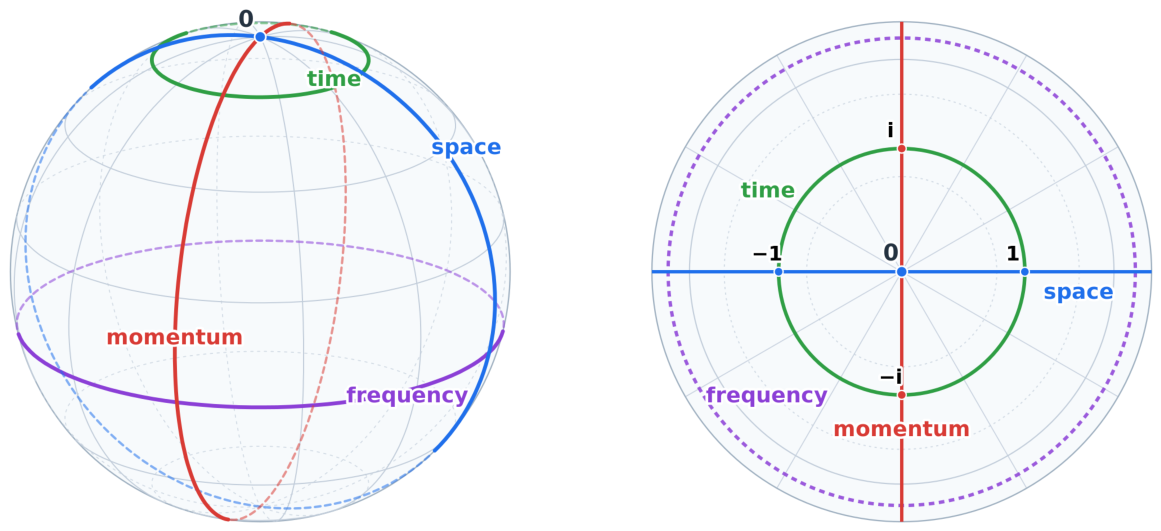
Figure 1. The finite Carrier shell ( F 13 as a reference shape) and its four representation domains. Space (the prime meridian, blue) and momentum (red) are the transverse additive-Fourier pair; time (green) and frequency (purple) are the longitudinal multiplicative-Fourier pair, the drive running along time [19]. The Carrier is a torsor: all marks are observer frame data, not absolute structure. Left: the orbital sphere with the observer origin 0 at the pole. Right: the same data flattened into the observer’s chart, a finite-height view from above the pole with the coherence horizon at the equator. The flavour sector turns on two residues of the phase cycle: the split torus C Ω 1 (the four-fold 4 Ω 1 , the quarter-turn Q 4 ) and the non-split torus C Ω + 1 (the cubic 3 Ω + 1 , the triality centre Z 3 ).
Preprints 220674 g001
Figure 3. The Koide value is the cubic married to the four-fold. The cube-root orbit ( 3 Ω + 1 ) supplies the C 3 plane; the quarter-turn ( 4 Ω 1 ) supplies the 45 bisection. The square-root-mass vector a splits its norm equally between the generation-democratic axis and the cube-root plane, and Q = 2 / 3 follows by (3).
Preprints 220674 g003
Table 2. The circulant data per sector, extracted from the masses. The charged-lepton amplitude is the quarter-turn 2 exactly; the quark amplitudes exceed it, the coloured dressing. The deviation of the quark Koide values from 2 / 3 is structural, not a running effect: Q is invariant under a common rescaling of a sector’s masses.
sector Q amplitude r = 2 | b | / a phase δ
charged leptons 0.6667 1.4142 = 2 0.2222 ( 2 / 9 )
down quarks 0.7314 1.546 0.110
up quarks 0.8489 1.759 ( 3 ) 0.074
Table 3. The flavour sector: derived results and inputs. The verification suite passes 17 / 17 .
result content status
Koide = 2 / 3 cube-root coherence bisected at the quarter-turn; Q = 1 3 + 2 3 ρ 2 , ρ = 1 / 2 [exact] identity; Q = 0.666661
λ -texture FN charges = role depths ( 0 , 1 , 2 ) ; V u s = m d / m s derived charges; Cabibbo 0.3 %
Georgi–Jarlskog factor 3 = N c , the cubic colour rank; 126 ¯ also gives M R ( m μ / m e ) / ( m s / m d ) = 10.3 9
mixing split lopsided M e = M d T ; seesaw route ruled out CKM 1 . 4 , PMNS 52 . 5
Disclaimer/Publisher’s Note: The statements, opinions and data contained in all publications are solely those of the individual author(s) and contributor(s) and not of MDPI and/or the editor(s). MDPI and/or the editor(s) disclaim responsibility for any injury to people or property resulting from any ideas, methods, instructions or products referred to in the content.
Copyright: This open access article is published under a Creative Commons CC BY 4.0 license, which permit the free download, distribution, and reuse, provided that the author and preprint are cited in any reuse.
Prerpints.org logo

Preprints.org is a free preprint server supported by MDPI in Basel, Switzerland.

Subscribe

© 2026 MDPI (Basel, Switzerland) unless otherwise stated

Accessibility

Disclaimer

Terms of Use

Privacy Policy

Privacy Settings