
Submitted:
25 June 2026
Posted:
29 June 2026
You are already at the latest version
Abstract
Hypnotic hypoalgesia effectively reduces various types of pain, but its neurophysiological mechanisms remain unclear. EEG and somatosensory event-related potentials (SERPs) can help elucidate how hypnotic suggestions influence pain processing across sensory, emotional, and cognitive domains.
This review synthesizes evidence on EEG oscillatory activity and SERP correlates in hypnotic pain modu-lation and interprets the findings through predictive coding and active inference frameworks.
The review integrated relevant studies on EEG frequency-band oscillations, SERPs, and the modulation of pain by hypnosis, focusing on a convergent neurophysiological account of hypnotic pain modulation rather than on individual studies.
Research indicates that hypnotic hypoalgesia is associated with concerted changes across multiple EEG frequency bands. Theta activity is linked to focused internal attention and the maintenance of sugges-tion-consistent representations, while increased alpha activity may indicate inhibitory sensory gating and reduced nociceptive gain. Beta oscillations enhance pain relief in cognitive and motor functions, while de-creased gamma activity indicates reduced significance of pain signals. SERP findings show that hypnotic suggestions primarily affect late evaluative components (e.g., P200/P250, P300) rather than early sensory elements, suggesting changes in salience attribution and affective-cognitive appraisal rather than uniform suppression of nociceptive input.
Predictive coding and active inference explain how hypnotic suggestions change pain-related expectations and bodily perceptions. This insight is key to enhancing personalized pain management and guiding future neuroscience research.
Keywords:
hypnotic hypoalgesia
; pain modulation
; EEG
; somatosensory event-related potentials
; predictive coding
; active inference
; theta
; alpha
; beta
; gamma
; hypnotizability
; clinical hypnosis
1. Introduction
Pain is considered a complex experience, comprising the sensory–discriminative, affective–motivational, and cognitive-evaluative components, which are subserved by distinct yet dynamically interacting neural networks that integrate nociceptive input with attention, expectation, memory, affect, contextual meaning, as well as broader emotional and sociocultural factors [1,2,3].
Since hypnosis can selectively influence different components of pain depending on the content of the veiculated suggestions, pain modulation via hypnosis represents an important method that can potentially be used in patient-centered clinical practice. Rainville and colleagues [4], using classic positron emission tomography (PET), reported that suggestions delivered to influence pain unpleasantness modulated activity in the anterior cingulate cortex (ACC) without commensurate changes in the somatosensory cortex. Contrarily, in a later study, Hofbauer et al. [5] observed that the activity of the primary somatosensory cortex was more directly modulated by suggestions focused on pain intensity. Recent research, including work by Desmarteaux et al. [6], supports the view that hypnotic suggestions can differentially target the sensory and affective-evaluative components of pain. These findings indicate that hypnotic hypoalgesia is not a nonspecific effect of a neutral induction per se, but rather that hypnotic pain modulation is suggestion-specific.
The clinical benefits of hypnotic hypoalgesia are well established. Hypnosis can reduce acute procedural pain, experimental pain, and several forms of clinical pain, with larger effects generally observed in individuals with medium-to-high hypnotizability [7,8,9,10]. However, how hypnotic suggestions alleviate pain is not fully understood. It is improbable that hypnotic hypoalgesia can be explained solely by distraction, relaxation, or response bias. Current experimental evidence indicates that hypnosis affects multiple levels of pain processing, including oscillatory coordination, attentional control, affective appraisal, agency, and the conscious integration of bodily sensations.
Electroencephalography (EEG) is particularly useful for exploring these mechanisms because it offers, through various signal analysis methods, a temporal resolution of about one millisecond. In addition, the EEG enables analysis of both ongoing oscillatory activity and stimulus-locked evoked responses to noxious stimulation. Signal processing of EEG oscillatory activity typically examines changes in classic frequency-band oscillations, such as theta (4–8 Hz), alpha (8–13 Hz), and gamma (>35 Hz). In addition, somatosensory event-related potentials (SERPs) provide ordered response indices of sensory encoding, salience detection, and evaluative processing. Together, these methods allow us to investigate whether hypnotic hypoalgesia influences early nociceptive encoding, later cognitive-affective appraisal, or both [11].
Predictive coding (PC) and active inference offer a useful theoretical framework for integrating and explaining EEG/SERPs findings. The brain actively constructs plausible hypotheses about incoming sensory information [12]. According to a PC perspective, the brain is an active player rather than a passive receiver of sensory inputs. Perception is not a passive encoding of sensory input, but an inferential process in which prior expectations and incoming sensory input are combined in the brain while accounting for uncertainty [13]. In PC models, prediction errors signal mismatches between predicted and actual input, and their influence depends on precision, that is, the estimated reliability or gain assigned to sensory signals or prior beliefs [14,15,16]. According to a PC view, pain is not viewed as a direct readout of nociceptive input but as an inferential process arising from the integration of sensory signals with prior expectations and precision-weighted prediction errors (i.e., nociceptive input is interpreted in light of expectations, threat appraisals, contextual meaning, and prior beliefs about bodily state) [17,18,19]. In the context of hypnotic hypoalgesia, PC theories suggest that hypoalgesia suggestions presented during hypnosis can modify higher-order generative models. This alteration changes expectations about bodily sensations and affects how incoming pain signals are processed [20,21,22,23,24].
This review aims to synthesize neurophysiological data on hypnotic hypoalgesia, focusing on EEG frequency-band oscillations and SERP responses, and to provide a qualitative interpretation of these findings within the frameworks of predictive coding (PC) and active inference (for more detailed information on PC theory, see Supplementary Materials). The review is structured around patterns of evidence rather than simply presenting a catalog of studies. This strategy is necessary since the literature contains convergent, dissociated, and mixed findings: some studies show parallel reductions in pain and neurophysiological markers; others show subjective analgesia without early ERP changes; still others indicate that hypnosis and distraction can produce similar pain reductions through different neural paths (for a literature review, see [11]). The main argument presented here is that hypnotic suggestion of hypoalgesia primarily affects the salience, precision, and evaluative integration of nociceptive input, rather than uniformly suppressing the initial sensory encoding.
This narrative review seeks to provide a PC interpretative perspective on how hypnotic suggestions can alter pain processing at sensory, affective, and cognitive levels. Through this integrative approach, the current review aims to highlight how electrophysiological markers in the light of PC accounts can bridge basic neuroscience with clinical practice. It may inform the mechanisms, efficacy, and optimization of hypnosis-based pain interventions, potentially contributing to the development of more effective, personalized, and evidence-based clinical pain treatments [25,26].
2. EEG Oscillatory Correlates of Hypnotic Hypoalgesia
EEG and magnetoencephalography (MEG) are complementary techniques for recording brain activity. The EEG reflects the brain's rhythmic electrical activity, while MEG measures its magnetic activity. Both methods are associated with neural oscillations, which are usually categorized into the following classic EEG frequency bands: delta, theta, alpha, beta, and gamma. EEG expresses the electrical activity of cortical pyramidal neurons, and is sensitive to both radial and tangential currents, whereas MEG is sensitive to tangential magnetic fields. The former provides information on neural dynamics and the latter on spatial sensitivity [27]. Although EEG bands should not be interpreted too strictly, they provide useful language for describing how neural systems coordinate perception, attention, memory, affective evaluation, and cognitive activity.
Pain-evoked oscillatory responses typically include EEG alpha and beta suppression, increases in theta and gamma, and enhancement in sensorimotor, insular, and cingulate regions [28,29,30]. These responses are not dependent on pain intensity; they are instead influenced by factors such as attention, expectation, arousal, stimulus intensity, task demands, and emotional significance.
Oscillatory changes are often described in terms of event-related synchronization (ERS) or event-related desynchronization (ERD) of oscillatory power across multiple frequency bands [31]. The functional significance of ERS and ERD responses is dependent on the frequency band in which they occur. The occurrence of an ERS response in the alpha frequency band is usually interpreted as an indicator of inhibition or reduced information processing in cortical areas that are not relevant to the task. This response can also be seen as a temporary disengagement of the brain region from active information processing [32]. Conversely, an ERD response in the alpha range indicates a decrease in relative power compared to baseline, decreased synchrony within local neural networks, and typically reflects increased cortical engagement, reflecting enhanced processing demands from the incoming stimulus [33,34,35]. Importantly, both ERS and ERD capture local, frequency-specific changes in synchrony rather than interactions between distant brain regions [31]. An ERS in the gamma frequency band is frequently linked to stimulus-feature binding, sensory integration, and conscious awareness, although gamma activity can also be influenced by attention and motor artifacts [30,36,37,38].
Pain modulation through hypnotic suggestions is likely to reflect a reorganization of multiple brain processes involving distinct frequency oscillations, rather than a single gamma-band oscillation. Hypnotic suggestions may reorganize the balance between slow-wave attentional control, sensory gating, and fast-wave sensory-evaluative integration.
2.1. Theta Oscillations and Hypnotic Responsiveness
Theta activity has been closely linked to factors such as susceptibility to hypnosis, focused attention, imagination, working memory, and creativity. Mark Jensen and his team have advanced an interesting "slow wave hypothesis," according to which higher slow-wave activity (theta, alpha, or both) is significantly associated with enhanced responsiveness to hypnotic suggestions and may serve as a predictor of which individuals will benefit most from hypnotic treatment [39,40]. If this hypothesis is valid, increased theta activity observed during hypnotic hypoalgesia may reflect the ongoing process of effectively facilitating the delivered suggestions for pain relief, thereby helping to focus attention on a positive internal experience of reduced discomfort.
One important finding comes from the study by Houzé et al. [41], among various comparisons between conditions, time-frequency analysis of EEG activity revealed a significant difference between distraction and hypnotic hypoalgesia in the theta domain. Although the authors observed that both pain control methods successfully reduced pain, they found that these procedures influenced theta activity differently: distraction lowered frontal-midline theta, while hypnotic hypoalgesia enhanced it. This finding is important because it shows that hypnotic hypoalgesia is more than just a form of distraction. Hypnotic hypoalgesia requires maintaining a sustained attentional focus on internal experiences and mental imagery models driven by suggestion. In contrast, distraction effectively reduces pain by redirecting attention away from harmful sensory input.
Clinical work also supports a role for theta, although the evidence remains preliminary. Mark Jensen et al. [42] examined whether theta-enhancing neurofeedback or mindfulness training could improve subsequent self-hypnosis treatment in patients with multiple sclerosis and chronic pain, fatigue, or both. Left-anterior theta neurofeedback was associated with larger improvements in pain, sleep disturbance, pain interference, and depression following hypnosis treatment. In contrast, mindfulness meditation was associated with larger improvements in pain acceptance. These findings are consistent with the likelihood that theta enhancement may facilitate hypnotic analgesia, but they should be interpreted cautiously because of the small sample size (n=32) and clinical heterogeneity. However, this approach shows promise for customizing hypnotic interventions to individual neural profiles. This personalization could lead to improved pain management outcomes in clinical populations. Further research is necessary to clarify how theta neurofeedback enhances hypnotic suggestibility and analgesic efficacy. Such studies are crucial for refining these targeted interventions.
Other evidence complicates the theta hypothesis. Rousseaux et al. [43] used virtual-reality hypnosis and reported decreased delta and increased theta activity beginning at the onset of painful electrical pulses. These observations highlight an interesting trend across the two low-frequency EEG bands, likely influenced by the hypnotic induction method and the specific approach used to deliver painful stimuli. Importantly, other studies have shown no consistent increase in theta activity during hypnosis, even among highly hypnotizable individuals [44,45]. In some reviews, it is therefore emphasized that theta is not a simple biomarker of hypnotizability or hypnotic condition [46,47]. A reasonable conclusion can be that enhanced theta activity plays a significant role in the induction of hypnotic hypoalgesia and in sustaining analgesic expectations, especially when suggestions involve mental imagery requiring focused internal attention. However, it is important to note that changes in theta are heavily influenced by context, the nature of the suggestions, and the analytical methods employed.
Within a PC conceptualization, perception relies on the relative precision assigned to descending predictions and ascending sensory evidence. During hypnosis, suggestions for pain relief may enhance the effect of prior expectations about bodily sensations and reduce the influence of pain signals on the conscious experience of pain [14,15,20,21,22,24]. Accordingly, suggestions that the stimulated body part is numb, distant, protected, or less threatening may establish an alternative generative model of bodily sensation. Thus, the rise in theta activity during hypnotic hypoalgesia can be seen as a direct reflection of the implementation process of suggestion-driven priors, rather than merely indicating a suppression of prediction error. Theta activity may contribute to this process since theta enhancement has been linked to focused internal attention, maintenance of suggestion-consistent representations, and working memory, functions that are central to both hypnotic responding and top-down modulation of pain [39,40,41,48,49]. Theta activity should be considered a marker of attention and an electrophysiological measure of prediction error. This caution is necessary because findings on theta waves during hypnosis vary across studies. They can depend on factors such as hypnotizability, task demands, induction procedure, type of suggestion, and contextual factors [40,46,47].
2.2. Alpha Oscillations and Inhibitory Sensory Gating
Original research shows that increased alpha activity may help reduce pain perception [50]. This association is likely because enhanced alpha-band oscillations (8–12 Hz) seem to inhibit irrelevant sensory information, making more capacity available for processing relevant information [51,52]. Thus, a notable rise in alpha activity during hypnotic hypoalgesia provides strong support for the idea that alpha-band oscillations play a vital role in gating relevant information by functionally inhibiting irrelevant (undesired, painful) sensory information [53].
Some studies report increases in alpha activity, while others report decreases or no change in hypnotic hypoalgesia, a finding that appears to depend on hypnotizability levels, the specific suggestions used, and recording sites [54]. On this line, De Pascalis and collaborators [55] in a study on placebo hypoalgesia (PH) treatment in waking and hypnosis conditions, reported that during waking, the enhancement of the relative left-parietal alpha2 (10-12 Hz) power directly influenced the enhancement in pain reduction, and, indirectly, through the mediating positive effect of subjective involuntariness. Instead, the enhancement of left temporoparietal alpha2 power to PH in hypnosis influenced pain reduction only through the mediation of the subjective involuntariness. This distinction is theoretically important because it suggests that PH during waking and hypnosis involves different processes of top-down regulation and reinforces the need to examine hypnosis and its effects on pain perception via neurophysiological mechanisms. This line of research can help us implement effective pain management techniques that significantly improve the quality of life for people in pain.
In another study using virtual-reality hypnosis, Rousseaux et al. [43] found a significant increase in EEG power in the 5–11 Hz band, overlapping with theta and lower alpha frequencies, which was associated with reduced perceived pain intensity.
Steriade et al. [56], Llinás et al. [57], and Ward [58] emphasize the importance of thalamocortical circuits in synchronizing neural oscillations and improving sensory information transmission. Thus, research on how changes in synchronization among these circuits may provide a core framework for understanding hypnosis's influence on attention, perception, and conscious awareness. In this context, Keppler [59] hypothesized that hypnotic hypoalgesia is not simply due to a reduction in the perceived intensity of pain signals, but rather to how we perceive and experience pain at a conscious level. The idea that hypnotic hypoalgesia may originate from an inhibitory mechanism is consistent with the concept that increased low-frequency brain activity, particularly in the theta and alpha bands, can enhance an individual's susceptibility to hypnosis [39,60] and improve responsiveness to hypnotic suggestions [40].
Because alpha oscillations have been linked to functional inhibition, cortical gating, and reduced sensitivity of task-irrelevant sensory channels [51,52,53,61], the PC interpretation of alpha-band activity is relatively clear but should be expressed cautiously. Alpha enhancement may indicate a decrease in sensory gain or a lower level of precision allocated to nociceptive input [14,62,63]. In other words, incoming pain signals may still be present, but their effective influence on higher-level inference is reduced. In the domain of pain, alpha activity has been linked to decreased pain perception and sensory inhibition. This view supports the idea that enhancing alpha-band activity may lead to hypoalgesia by reducing the effects of incoming nociceptive signals [43,50,55,64]. Nevertheless, alpha activity is not specific to hypnosis or hypoalgesia; it may indicate sensory gating, attentional inhibition, cortical idling, or other processes depending on the context [32,51,52,54,65,66,67]. Consequently, alpha activity should be viewed as a component of a larger multiband and network-level pattern, rather than being considered an autonomous indicator of hypnotic pain control [39,40,47,68].
2.3. Beta Oscillations and Cognitive-Sensorimotor Set
Although beta band activity (13-35 Hz) has received less attention in hypnotic analgesia research than theta, alpha, and gamma bands, clinical research findings outside hypnosis suggest an important role for beta oscillations, particularly in clinical populations. In addition, beta rhythms are crucial for understanding pain modulation because they are associated with sensorimotor integration, cognitive control, and the maintenance of current perceptual or motor tasks [69,70,71]. Beta activity suppression is commonly observed following noxious stimulation, particularly in sensorimotor regions, suggesting enhanced sensory processing or a change in the sensorimotor state [29,72,73].
In hypnosis, beta modulation may indicate the maintenance or reconfiguration of suggestion-driven bodily expectations. A hypoalgesic suggestion requires participants to maintain a modified interpretation of their bodies and their body's sensations over time. This modification may involve changes in beta-band activity associated with the maintenance of a new cognitive–sensorimotor set. Original studies on hypnotizability indicated increased activity in the high-theta, high-alpha, and beta bands among individuals with high hypnotizability during emotional imagery in hypnosis, especially in the right parietal regions [74]. In the same research line, EEG studies suggest that hypnosis leads to changes in frontal functional organization and connectivity. These changes include patterns associated with hypofrontality, dissociated control, and altered executive monitoring [75,76,77]. Such research findings indicate that beta activity may play a role in sustaining attentional focus, imagery-related tasks, and control processes during hypnosis, especially when suggestions involve maintaining an altered sense of body awareness.
Recent clinical EEG findings provide additional support for a multiband interpretation on hypnotic modulation of pain. In a high-density EEG study, Kumar et al. [78] assessed hypnosis-related resting-state EEG activity in patients with fibromyalgia and chronic pain undergoing hypnosis. These authors observed that, during the hypnosis condition (suggestion to relive a pleasant autobiographical memory), there was an increase in theta power in the left parietal and occipital sites, an increase in beta power in the frontal and left temporal sites, and an increase in slow-gamma power in the frontal and left parietal sites. These findings underscore that hypnosis in chronic pain may reorganize large-scale multiband activity even when immediate pain relief is not evident.
From a PC perspective, beta oscillations may reflect the stabilization of a current generative model or cognitive set. Beta activity is associated with maintaining the current sensorimotor or cognitive state and with exerting top-down control over ongoing processing [62,69,70,71,79]. Accordingly, beta modulation during hypnotic hypoalgesia may indicate the maintenance of analgesic expectations or the reorganization of prefrontal control mechanisms that support suggestion-driven bodily perceptions [20,23,24,75,76,77,80]. However, this interpretation remains indirect, as beta-band mechanisms have been tested less systematically in hypnotic analgesia than compared to late ERP components or effects in the theta, alpha, and gamma bands. Beta activity should therefore be included in the theoretical conceptualization, but it should not be given the same evidential weight as the more extensively studied electrophysiological markers of hypnotic pain modulation [11,40,47,81].
2.4. Gamma-Band Dynamics, Pain Salience, and Conscious Integration
Although gamma band oscillations (35–100 Hz) has been generally regarded as a marker of fine-grained neural integration [82,83] and sensory feature binding (the binding-by-synchronization hypothesis) [84], current EEG research on the neural correlates of nociceptive pain has well established the essential role of high-frequency EEG activity in the gamma band in pain processing [85].
Multiple EEG studies have shown a link between gamma power and subjective pain intensity reports, indicating a strong relationship between EEG gamma activity and the perceived pain intensity e.g., see [28,86,87], stimulus strength, particularly in sensorimotor cortex and pain-related networks [28,30,86,87,88]. These findings highlight gamma oscillations as a key indicator of pain processing. They are particularly relevant to hypnotic hypoalgesia, as effective analgesic suggestions may diminish the integration of nociceptive signals into the conscious experience of pain.
Croft et al. [89] found that gamma activity predicted subjective pain ratings in a non-hypnotic control condition. However, this relationship was no longer present during hypnosis in highly hypnotizable participants. In the same research vein, De Pascalis et al. [90] reported that phase-ordered gamma responses to painful stimulation were positively associated with subjective pain ratings in waking, but this relationship disappeared during hypnotic hypoalgesia. In this study, gamma responses were reduced under hypnotic hypoalgesia, especially in high and medium-hypnotizable participants. These findings indicate that hypnosis may separate gamma-band activity from the experience of pain, thereby changing the typical relationship between nociceptive processing and perceived pain.
Hypnotic hyperalgesia provides a complementary perspective. For example, Valentini et al. [91] reported that suggestions of hyperalgesia and hypoalgesia modulated subjective pain intensity and unpleasantness in highly hypnotizable participants. Hyperalgesic suggestions increased perceived pain and were associated with increased P2 amplitudes and gamma-band synchronization in response to nociceptive laser stimulation. This reverse pattern supports the view that hypnotic suggestions can increase or decrease the salience and evaluative weight of pain-related input depending on the direction of the suggestion.
In hierarchical PC views, gamma activity has been associated with bottom-up communication during sensory processing and local cortical sensory integration, in the meanwhile, beta synchronization affords feedback communication, refining top-down predictions for a more dynamic understanding of sensory experiences [62,79,92,93]. However, theoretical work also indicates caution when interpreting gamma oscillations as specific carriers of prediction errors [62,79,93,94,95]. This interpretation is crucial for understanding pain, as research has demonstrated a strong link between gamma-band activity and nociceptive processing and self-reported pain intensity. Furthermore, studies on pain modulation during hypnosis have shown that in cases of hypnotic hypoalgesia, there is a decrease in gamma activity and a disconnection between gamma responses and pain ratings [28,30,86,87,89,90,91]. However, this interpretation requires caution. Gamma activity is also strongly influenced by selective attention, arousal, task demands, motor activity, microsaccades, muscle artifacts, and analytic procedures, and therefore cannot be treated as a specific marker of prediction error [36,96,97,98,99,100]. Thus, gamma reductions or gamma–pain decoupling should be seen as evidence that hypnosis alters the sensory-evaluative integration or salience of nociceptive input, rather than as direct proof that nociceptive prediction errors have been suppressed.
2.5. Multiband and Network Dynamics
The most reliable conclusion from the oscillatory literature is that hypnotic hypoalgesia arises from a complex interplay among multiple electromagnetic oscillations in the brain, rather than from a single frequency [11].
Enhanced theta activity could be supportive of a strong focus on internal thoughts, improving working memory, and helping maintain imaginative suggestions during hypnosis and pain management [40,41,101,102].
Alpha activity could play a key role in sensory gating, i.e., in filtering out distractions and managing pain signals, functional inhibition, and reduced nociceptive gain or precision, thereby limiting the impact of task-irrelevant or pain-related sensory input on higher-level processing [51,52].
Beta activity may play a crucial role in refining the ongoing cognitive-sensorimotor set, which stabilizes bodily expectations in alignment with suggestions during hypnosis [70,71,78,79].
Gamma activity may indicate the significance, conscious awareness, and sensory-evaluative integration of pain-related signals. However, this interpretation should be approached with caution, as gamma activity is also influenced by attention, focused arousal, and analytical processes [28,30,36,86,87,89,90,91].
These multiple frequency oscillatory bands involved in pain and its modulation do not operate independently. Pain perception and hypnotic modulation depend on distributed interactions among somatosensory cortices, insula, anterior cingulate cortex, prefrontal regions, thalamocortical loops, and descending pain-modulatory systems [1,2,3,29,103].
Cross-frequency coupling presents a promising yet underexplored approach for understanding how these oscillatory processes might interact. Theta-gamma coupling aligns predictions with sensory experiences, while alpha-gamma and alpha-beta interactions promote sensory inhibition and enhance top-down sensory control [53,104,105,106,107,108].
While direct evidence linking cross-frequency coupling to reduced pain during hypnosis is currently limited, this manuscript highlights it as a significant and promising area for future research. It has the potential to open the way for a deeper understanding of pain management through hypnosis [11,39,47,109].
3. Somatosensory Event-Related Potentials and Hypnotic Modulation of Pain
Research shows that early components of somatosensory event-related potentials (SERPs) reflect the initial processing of nociceptive input and are associated with activity in somatosensory and operculo-insular systems involved in pain encoding [19,110,111]. In contrast, later SERP components, such as P200/P250, N2, and P300, are linked to attentional allocation, salience attribution, expectancy, context updating, and affective appraisal [110,111,112,113].
Across studies, hypnotic hypoalgesia more consistently modulates late than early SERP components. SERP studies demonstrate that hypnotic suggestions of hypoalgesia and hyperalgesia can respectively increase or decrease SERP responses and the salience of nociceptive stimulation [91,114,115,116]. Reductions in P200/P250, P300, and vertex-complex amplitudes are linked to subjective pain relief, suggesting decreased processing of nociceptive information [43,114,115,117,118,119,120]. However, other studies show that subjective analgesia can occur without significant changes in early sensory event-related potential (SERP) components [41,121,122,123,124,125], suggesting pain perception can be altered even when early nociceptive encoding is preserved.
Conversely, there are also studies indicating that effective hypnotic suggestions in highly hypnotizable individuals can reduce both early and late components of the spontaneous electrical activity of the reticular activating system (SERP) [43,116,126,127]. Such findings are compatible with stronger top-down modulation of nociceptive precision and sensory gain. Furthermore, cases in which pain relief occurs without clear SERP changes suggest that additional mechanisms, including oscillatory network dynamics, interoceptive inference, autonomic regulation, agency-related processes, and metacognitive appraisal, may contribute to hypnotic analgesia [24,55,124,125,128].
4. Predictive Coding and Active Inference Accounts
PC models propose that perception emerges from reciprocal interactions between top-down predictions and bottom-up prediction errors, with higher levels of the cortical hierarchy generating predictions about the causes of sensory input and lower levels transmitting mismatch signals when incoming evidence deviates from those predictions [13,15,63,129]. According to a PC view, the brain continuously estimates the hidden causes of sensory input and updates its perceptual hypotheses whenever new evidence is discrepant with its previous expectations [13,15,130]. The process of precision weighting is essential for understanding how prediction errors and prior expectations affect perception. When sensory prediction errors are prominent and effective, they significantly enhance sensory inference, driving essential updates required for continuous learning and adaptation. On the contrary, possessing robust prior expectations, such as those for pain relief, powerfully influences and transforms the incoming sensory information, leading to significant reductions, reshaping, or reinterpretations of the sensory experience [14,15,131].
Pain is well-suited for PC analysis because nociceptive input is influenced by expectation, threat, attention, emotion, prior learning, and context [19,132]. Placebo analgesia, nocebo hyperalgesia, chronic pain, and fear learning are representative phenomena demonstrating that pain is a multifaceted experience that extends well beyond the mere intensity of nociceptive signals [17,18,19,103]. For example, it is clearly accepted that hypnotic hypoalgesia operates through inferential mechanisms, induced by the explicit use of suggestions to create alternative bodily experiences. These experiences clearly involve sensations of numbness, distance, and protection, as well as a notably reduced sense of threat from the painful body part [4,5,20,24,133].
Three predictive-coding perspectives are particularly relevant to understanding the brain mechanisms underlying hypnotic suggestions and the hypnotic modulation of pain (for more details, see paragraphs S2-S2.4 in the Supplementary Materials).
The first framework is the Simulation–Adaptation Theory of Hypnosis, which posits that hypnotic analgesia arises from sustained cognitive simulation and focused attention on pain representations that align with the suggested directives. This process results in an adaptive downregulation of the precision of pain-related prediction errors [21].
The second view is based on Jamieson's PC explanation of hypnotic suggestion phenomena. It emphasizes the primary importance of the participant's acceptance of response expectancies. According to this perspective, hypnotic suggestions are most effective when incorporated into higher-order predictions about bodily state and interoceptive experience [20,22,23].
The third account, proposed by Martin and Pacherie [24], focuses on active inference, highlighting the concepts of agency and involuntariness. According to this view, effective hypnotic responses are perceived as involuntary due to strong expectations. This powerful influence reduces the need for voluntary monitoring or executive correction, leading to a smoother, more enjoyable experience.
The insula and cingulate system play a key role across these predictive-coding, active-inference, and hypnotic-analgesia frameworks. Activity in the posterior insula has been linked to sensory-interoceptive representation and awareness of bodily states, including pain [134,135,136]. In contrast, the anterior insula integrates bodily signals with salience, cognitive control, and emotion processes [135,137]. The ACC plays a central role in the motivational and emotional aspects of pain, in monitoring conflicts, in processing salience, and in regulating control [4,138,139]. Together, the insula and cingulate systems contribute to detecting and predicting bodily threats, as well as to updating pain-related beliefs and expectations [19,140]. In cases of chronic pain, it is known that ongoing prediction errors and inappropriate precision weighting play a crucial role in the persistence of pain, regardless of whether peripheral nociceptive input is reduced or ambiguous [132,141,142]. Effective hypnotic suggestions can recalibrate these systems. They significantly reduce threat expectations, enhance feelings of safety, and transform the interpretation of bodily sensations [4,20,24,133].
Active inference extends predictive coding by emphasizing action. In this framework, prediction errors can be minimized not only by adjusting beliefs but also by altering the environment to make sensory input or the body perception more consistent with prior predictions [143,144]. In the context of pain, protective actions and avoidance or withdrawal can be seen as our body's way of safeguarding itself and working towards restoring its well-being [145,146]. In chronic pain, however, protective behaviors may become maladaptive if they reinforce threat expectations and maintain pain-related avoidance. Hypnotic analgesia may therefore operate by changing both perception and action tendencies, e.g., the body part may be experienced as numb, safe, distant, or protected, and the patient may reduce defensive monitoring or protective actions [24,147].
This framework emphasizes the significant role of subjective involuntariness in hypnotic responding, both in practice and theory. Involuntariness, as the fundamental suggestion effect of hypnotic responding, is directly linked to shifts in agency, metacognitive awareness, and distinct control experiences [24,148,149]. When patients feel that an analgesic response is occurring involuntarily, they tend to trust the suggested bodily state more. For example, the suggestion "your hand is becoming numb" can be more powerful when the numbness happens spontaneously, rather than through conscious effort. This interpretation aligns with findings that during hypnotic placebo hypoalgesia, faster alpha (alpha2) activity plays a key role in reducing pain by influencing our perceptions of control [55].
5. Integrated Evidence Patterns
The literature examined in this review highlights several recurring patterns that help organize seemingly diverse findings.
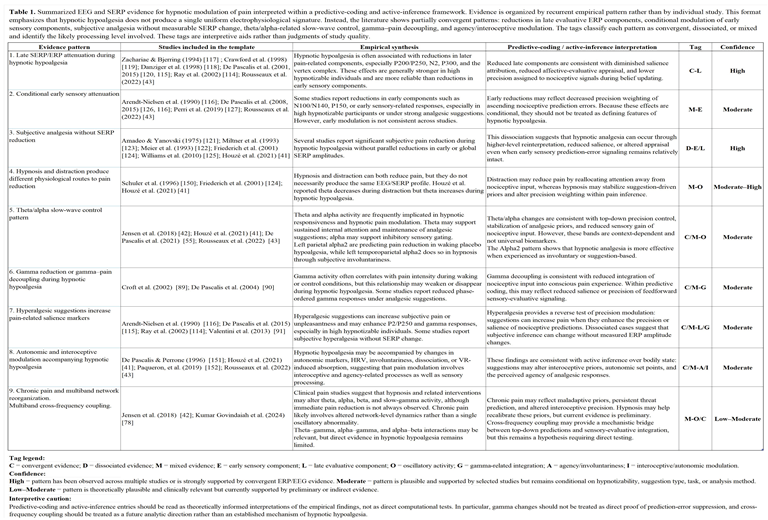
1. Several studies demonstrate a consistent late-evaluative response pattern that is sensitive to pain modulation during hypnosis, in which a reduction in subjective pain is associated with decreases in the late components of the event-related potential (ERP), specifically the P200/P250, P300, and vertex-complex responses. These observations support the hypothesis of reduced salience attribution and diminished evaluative processing of nociceptive information [43,114,115,117,118,119,120]. In terms of predictive coding models, these findings suggest a diminished effect of salience-weighted nociceptive prediction errors and a heightened role for analgesic expectations in the conscious experience of pain [14,15,19].
2. Some studies report reductions in early components such as N100/N140, P150, or earlier sensory-related responses (e.g., N20), especially in highly hypnotizable participants or under strong analgesic suggestions [43,115,116,126,127]. However, early SERP modulation is inconsistent across studies and is not considered here a defining feature of hypnotic hypoalgesia.
3. A pattern is characterized by the dissociation between subjective hypoalgesia and relatively preserved early sensory responses. Numerous studies unequivocally demonstrate that pain reduction can occur even in the absence of significant changes in early- or mid-latency SERP components [41,121,122,123,124,125]. This shows that higher-order processes such as reinterpretation, expectancy, interoceptive inference, agency, and metacognition can fundamentally alter the pain experience without requiring significant suppression of nociceptive encoding [20,24,128].
4. Another set of studies has shown that although both hypnotic hypoalgesia and distraction reduce pain, these suggestions do not necessarily produce similar EEG or SERP changes consequent to pain reduction [41,124,150].
5. Another pattern concerns the relationship between EEG oscillatory activity and pain-control mechanisms. Changes in EEG bands—theta, alpha, beta, and gamma—distinguish hypnotic hypoalgesia from other forms of pain modulation, such as distraction. Enhanced theta activity clearly indicates a strong connection between pain relief, focused internal attention, and the effective maintenance of represented expectations [41,42,43]. Enhanced alpha waves are associated with sensory gating, significant inhibitory control, and pain reduction, mediated by subjective involuntariness [55]. Beta activity is found to stabilize cognitive-sensorimotor sets, while gamma activity is observed fundamentally tied to sensory salience and the bottom-up integration of sensory evaluations [28,30,51,52,53,70,71,86].
6. A recurring finding is the reduction or disappearance of the association between gamma activity and subjective pain reports during hypnotic hypoalgesia, suggesting altered integration of nociceptive signals into conscious awareness [89,90]. However, gamma activity should be interpreted cautiously because it is influenced by attention, arousal, motor activity, and analytical procedures [30,36,86,97].
7. Studies comparing hypnotic hypoalgesia and hyperalgesia show that hypnotic suggestions can either reduce or amplify the perception and subjective significance of painful stimuli, all depending on the delivered specific suggestion [91,114,115,116].
8. Hypnotic hypoalgesia may be paralleled by changes in autonomic markers, i.e., heart rate variability (HRV), heart rate (HR), skin conductance response (SCR), and subjective measures such as involuntariness, dissociation, or Virtual Reality-induced absorption, suggesting that pain modulation involves interoceptive and agency-related processes as well as sensory processing [41,43,151,152].
9. Finally, Clinical pain studies demonstrate robust evidence that hypnosis and related interventions can significantly influence theta, alpha, beta, and slow-gamma brain activity. It is evident that chronic pain is primarily driven by altered network dynamics, rather than by a single oscillatory abnormality. In addition, the interplay of pain and hypnosis involves interactions among multiple oscillatory bands. Specific interactions, such as theta-gamma, alpha-gamma, and alpha-beta, are highly relevant. However, there remains a need for more direct evidence regarding hypnotic hypoalgesia [42,78].
These patterns are summarized in Table 1. The table is organized by evidence pattern rather than by individual study because this better reflects the state of the literature. Individual studies vary in sample size, hypnotizability selection, stimulation method, type of suggestion, ERP/EEG measure, and analytic approach. A pattern-based organization allows convergent, dissociated, and mixed results to be interpreted without forcing all findings into a single mechanism.
The evidence indicates that hypnotic hypoalgesia should be viewed as a complex modulation of pain processing, rather than merely a reduction in nociceptive input. This modulation appears to involve several factors:
(1) Changes in late evaluative processing, which are evidenced by alterations in the components of late auditory event-related potentials (SERP/ERP) associated with the detection of salience, affective appraisal, and context updating.
(2) Oscillatory precision control, shown through changes in theta, alpha, beta, and gamma brain wave bands that may help regulate attention, enhance sensory perception, and integrate pain-related signals.
(2) Regulation of autonomic and interoceptive processes.
(3) A diminished connection between nociceptive input and the conscious experience of pain.
Collectively, these findings suggest that hypnotic hypoalgesia is best understood as a multidimensional modulatory process involving sensory, attentional, affective, and evaluative processes, rather than merely a simple suppression of nociceptive input [11,14,20,128].
6. Clinical Implications
A predictive-coding perspective offers an unifying framework for psychopathology and several clinically relevant implications for the application of hypnosis in pain management.
(1) Hypnotic hypoalgesia should not be seen merely as a form of distraction. While distraction primarily reduces pain by directing attention away from nociceptive input [153,154,155], hypnotic suggestions can change the meaning, significance, and interpretation of bodily sensations. This is achieved by reshaping expectations and perceptions of the body [4,5,20,21,24,133].
(2) The content of hypnotic suggestions appears clinically important. Neuroimaging findings indicate that suggestions targeting pain intensity and unpleasantness may engage partially distinct neural mechanisms involving somatosensory and cingulate systems [4,5]. Consequently, hypnotic interventions may benefit from being tailored to the specific sensory, emotional, cognitive, and motivational dimensions of a patient's pain experience [19,103,132,142,156].
(3) Agency, expectancy, and involuntariness appear to be important therapeutic factors. From an active-inference perspective, strong analgesic expectations can function as high-level predictions about bodily state, reducing the need for deliberate control and leading suggested responses to be experienced as automatic or involuntary. In this view, altered experiences of agency reflect the successful implementation of predictions that are consistent with suggestions, guide perception and behavior, and minimize prediction error [24,143,144]. Active inference accounts suggest that effective hypnotic responding decreases defensive monitoring and unhelpful protective behaviors while increasing feelings of safety, control, and self-efficacy [24,143,144,145,146]. Such mechanisms may be particularly relevant in chronic pain, where threat-related expectations and avoidance behaviors contribute to symptom persistence [19,132].
(4) Hypnosis and mindfulness may represent complementary rather than competing interventions. Mindfulness-based approaches can be seen as a metacognitive training serving to enhance and facilitate awareness of pain-related expectations and habitual interpretations [157,158], whereas hypnosis may help establish alternative bodily models characterized by safety, numbness, distance, cooling, protection, or enhanced control [20,24,42].
(5) Although EEG biomarkers, neurofeedback, and virtual-reality-assisted hypnosis show promise in enhancing hypnotic responsiveness and providing pain relief, the existing evidence is not substantial enough to support their routine use as independent clinical predictors or therapeutic methods [11,40,42,43,47,159].
Future research should integrate neurophysiological measures with assessments of expectancy, hypnotizability, pain phenotype, emotional distress, and functional outcomes to develop more personalized and effective hypnosis-based interventions [8,133,160,161].
6.1. Limitations and Prospective Research Directions
Here are some points, including the main points, summarizing the limitations of the current review and outlining the prospective direction for experimental clinical research.
(1) A general limitation of this narrative review lies in the methodological heterogeneity of the studies examined. The generalizability of the current PC interpretative account is limited by small sample sizes, inconsistent measures of hypnotizability, varying procedures, different types of pain tested, and diverse methods for EEG preprocessing and analysis e.g., see [39,40,47]. Some studies do not clearly distinguish between the effects of hypnotic induction and those of analgesic suggestion, making it difficult to determine whether observed changes reflect hypnosis per se, relaxation, absorption, expectancy, response motivation, or the specific content of the suggestion e.g., see [162,163,164,165,166,167]. Furthermore, relatively few hypnosis studies have employed advanced EEG signal analysis methods such as source localization, functional network connectivity, and cross-frequency couplings e.g., see [39,47,68,168].
(2) PC and active inference explanations were limited because they were derived as theoretically informed interpretations of the reported empirical findings rather than as direct computational tests. It is advisable that, in future clinical research, researchers test predictive-coding hypotheses directly from recorded data rather than treating them only as post hoc interpretations. First, studies should more clearly distinguish the effects of hypnotic induction from those of suggestion. In addition, in future studies, a clear distinction in direction and content of suggestions is essential because predictive-coding accounts predict that the direction and content of suggestions should determine whether pain-related priors are strengthened, weakened, or reinterpreted [4,5,166]. Clinical trials should therefore compare suggestions targeting pain intensity, unpleasantness, threat, safety, agency, and bodily ownership.
(3) By combining assessments of, e.g., subjective pain and unpleasantness, absorptive ability and other contextual measures, such as expectancy, individual pain sensitivity, emotional distress, with measures of SERP amplitude and latency, time-frequency analysis of ERS/ERS, source localization, autonomic indices, and computational modeling, future studies should investigate how hypnotic hypoalgesia to phasic pain affects the accuracy of pain-related predictions. For instances: (i) amplitude reductions in late SERP components may be used as an index of altered salience and evaluative updating; (ii) enhanced EEG theta and alpha activity consequent to hypnotic hypoalgesia can be used to indicate, respectively, improved attention and enhanced sensory filtering; (iii) a gamma–pain decoupling can indicate less integration of pain signals into conscious experience [41,55,89,90,115]. The use of a formal PC computational modeling approach can disclose whether clinical improvement stems mainly from reduced sensory precision, heightened prior precision, altered interoceptive inference, changes in agency, or more than one of these factors.
(4) Research should examine whether mindfulness and hypnosis can be combined sequentially. Based on the previously mentioned studies [42,157,158], one testable clinical hypothesis is that mindfulness-based monitoring may increase metacognitive awareness of pain-related prior predictions. At the same time, hypnotic treatment may introduce higher-precision alternative priors that support active inference and bodily reinterpretation. Following a possible protocol, patients would first be trained to voluntarily evaluate their pain-related sensations and threat appraisals via mindfulness or neurofeedback, and then use hypnotic suggestions to construct safer bodily models, such as numbness, protection, distance, or confidence in movement. Such a protocol would be especially relevant for chronic pain patients with high threat expectations and maladaptive avoidance.
(5) Clinical trials must adhere to rigorous methodological guidelines. It is important to employ computational Bayesian modeling to estimate prediction errors precisely. Future research must involve adequate sample sizes, standardized hypnotizability assessments, preregistered hypotheses, active control groups, and longitudinal follow-ups. In chronic pain research, it is essential to determine whether hypnotic suggestions lead to long-lasting changes in patient beliefs about pain, confidence in movement, autonomic function, and activities of daily living, rather than simply providing temporary pain relief. Studies should integrate subjective pain ratings with EEG data, SERPs, and autonomic markers, and fMRI in parallel with source- and network-level analyses of EEG. For example, hypotheses derived from a PC modeling framework should be examined by manipulating expectations, precision, uncertainty, and the content of suggestions, and then assessing the effects on pain-relief duration and quality of life.
7. Conclusions
This literature review offers valuable insights into the effects of hypnotic hypoalgesia on EEG patterns, sensory event-related potentials (SERPs), and the interactions between brain regions involved in pain processing. Contrary to the oversimplified idea that hypnotic suggestion completely blocks initial pain signals, the evidence demonstrates that hypnotic hypoalgesia primarily affects later evaluative components of SERPs and the dynamic relationship between brain activity and our subjective experience of pain.
Research indicates that EEG theta and alpha activity support, respectively, sustained internal attention and inhibitory control, while beta activity helps maintain analgesic cognitive sets. Gamma activity is associated with the conscious integration of pain signals. Later SERP waves, such as P200/P250, P300, and the vertex complex, are more effectively influenced by hypnotic pain relief than earlier sensory waves.
This review uses a PC and active inference framework to offer conceptually informed interpretations of original neurophysiological findings on pain modulation through hypnosis. It is concluded that hypnotic analgesia effectively recalibrates the balance between expectation-driven suggestions and nociceptive signals.
References
- Garcia-Larrea, L.; Bastuji, H. Pain and consciousness. Prog. Neuro-Psychopharmacol. Biol. Psychiatry 2018, 87, 193–199. [Google Scholar] [CrossRef] [PubMed]
- Apkarian, A.V.; Hashmi, J.A.; Baliki, M.N. Pain and the brain: specificity and plasticity of the brain in clinical chronic pain. Pain 2011, 152, S49. [Google Scholar] [CrossRef] [PubMed]
- Morton, D.L.; Sandhu, J.S.; Jones, A.K.P. Brain imaging of pain: state of the art. J. Pain Res. 2016, 10.2147/JPR.S60433, 613–624. [Google Scholar] [CrossRef] [PubMed]
- Rainville, P.; Duncan, G.H.; Price, D.D.; Carrier, B.; Bushnell, M.C. Pain affect encoded in human anterior cingulate but not somatosensory cortex. Science 1997, 277, 968–971. [Google Scholar] [CrossRef] [PubMed]
- Hofbauer, R.K.; Rainville, P.; Duncan, G.H.; Bushnell, M.C. Cortical representation of the sensory dimension of pain. J. Neurophysiol. 2001, 86, 402–411. [Google Scholar] [CrossRef] [PubMed]
- Desmarteaux, C.; Streff, A.; Chen, J.-I.; Houzé, B.; Piché, M.; Rainville, P. Brain Responses to Hypnotic Verbal Suggestions Predict Pain Modulation. Front. Pain Res. 2021, 2–2021. [Google Scholar] [CrossRef] [PubMed]
- Milling, L.S.; Valentine, K.E.; LoStimolo, L.M.; Nett, A.M.; McCarley, H.S. Hypnosis and the alleviation of clinical pain: a comprehensive meta-analysis. Int. J. Clin. Exp. Hypn. 2021, 69, 297–322. [Google Scholar] [CrossRef] [PubMed]
- Thompson, T.; Terhune, D.B.; Oram, C.; Sharangparni, J.; Rouf, R.; Solmi, M.; Veronese, N.; Stubbs, B. The effectiveness of hypnosis for pain relief: A systematic review and meta-analysis of 85 controlled experimental trials. Neurosci. Biobehav. Rev. 2019, 99, 298–310. [Google Scholar] [CrossRef] [PubMed]
- Hilgard, E.R. The alleviation of pain by hypnosis. Pain 1975, 1, 213–231. [Google Scholar] [CrossRef] [PubMed]
- Jensen, M.P. The neurophysiology of pain perception and hypnotic analgesia: implications for clinical practice. Am. J. Clin. Hypn. 2008, 51, 123–148. [Google Scholar] [CrossRef] [PubMed]
- De Pascalis, V.; De Benedittis, G. Experimental pain modulation via hypnosis: Neurophysiological perspectives. In International Review of Neurobiology: Hpypnosis Part A, 2025/10/30 ed.; Terhune, D.B., Jamieson, G.A., De Pascalis, V., Eds.; Academic Press: London, 2025; Vol. 184, pp. 83–127. [Google Scholar]
- Gregory, R.L. Knowledge in perception and illusion. Philos. Trans. R. Soc. B Biol. Sci. 1997, 352, 1121. [Google Scholar] [CrossRef] [PubMed]
- Clark, A. Whatever next? Predictive brains, situated agents, and the future of cognitive science. Behav. Brain Sci. 2013, 36, 181–204. [Google Scholar] [CrossRef] [PubMed]
- Feldman, H.; Friston, K.J. Attention, uncertainty, and free-energy. Front. Hum. Neurosci. 2010, 4, 215. [Google Scholar] [CrossRef] [PubMed]
- Friston, K.J. The free-energy principle: a unified brain theory? Nat. Rev. Neurosci. 2010, 11, 127–138. [Google Scholar] [CrossRef] [PubMed]
- Friston, K.J. Prediction, perception and agency. Int. J. Psychophysiol. 2012, 83, 248–252. [Google Scholar] [CrossRef] [PubMed]
- Büchel, C.; Geuter, S.; Sprenger, C.; Eippert, F. Placebo Analgesia: A Predictive Coding Perspective. Neuron 2014, 81, 1223–1239. [Google Scholar] [CrossRef] [PubMed]
- Geuter, S.; Boll, S.; Eippert, F.; Büchel, C. Functional dissociation of stimulus intensity encoding and predictive coding of pain in the insula. elife 2017, 6, e24770. [Google Scholar] [CrossRef] [PubMed]
- Wiech, K. Deconstructing the sensation of pain: The influence of cognitive processes on pain perception. Science 2016, 354, 584–587. [Google Scholar] [CrossRef] [PubMed]
- Jamieson, G.A. A unified theory of hypnosis and meditation states: The interoceptive predictive coding approach. In Hypnosis and Meditation: Towards an Integrative Science of Conscious Planes; Raz, A., Lifshitz, M., Eds.; Oxford University Press: New York, NY, 2016; pp. 313–342. [Google Scholar]
- Zahedi, A.; Lynn, S.J.; Sommer, W. Cognitive simulation along with neural adaptation explain effects of suggestions: a novel theoretical framework. Front. Psychol. 2024, 15–2024. [Google Scholar] [CrossRef] [PubMed]
- Jamieson, G.A. Interoceptive predictive coding, active inference and the generation of hypnotic suggestion responses. In International Review of Neurobiology: Hypnosis Part B; D.B.Terhune, G.A.J., De Pascalis, V., Eds.; Academic Press.: New York, 2025; Vol. 185, pp. 31–57. [Google Scholar]
- Jamieson, G.A. An insula view of predictive processing in hypnotic responses. Psychol. Conscious. Theory Res. Pract. 2022, 9, 117. [Google Scholar] [CrossRef]
- Martin, J.R.; Pacherie, E. Alterations of agency in hypnosis: A new predictive coding model. Psychol. Rev. 2019, 126, 133. [Google Scholar] [CrossRef] [PubMed]
- Milling, L.S.; Valentine, K.E.; LoStimolo, L.M.; Nett, A.M.; McCarley, H.S. Hypnosis and the Alleviation of Clinical Pain: A Comprehensive Meta-Analysis. Int. J. Clin. Exp. Hypn. 2021, 69, 297–322. [Google Scholar] [CrossRef] [PubMed]
- Machado, R.S.; Silva, J.C.; Silva, A.S. Efficacy of hypnosis in the management of non-procedural pain: systematic review. BrJP 2021, 4, 268–275. [Google Scholar] [CrossRef]
- Hari, R.; Puce, A. Meg-EEG primer; Oxford University Press, 2023. [Google Scholar]
- Hauck, M.; Lorenz, J.; Engel, A.K. Attention to painful stimulation enhances γ-band activity and synchronization in human sensorimotor cortex. J. Neurosci. 2007, 27, 9270–9277. [Google Scholar] [CrossRef] [PubMed]
- Ploner, M.; Sorg, C.; Gross, J. Brain rhythms of pain. Trends Cogn. Sci. 2017, 21, 100–110. [Google Scholar] [CrossRef] [PubMed]
- Gross, J.; Schnitzler, A.; Timmermann, L.; Ploner, M. Gamma oscillations in human primary somatosensory cortex reflect pain perception. PLoS Biol. 2007, 5, e133. [Google Scholar] [CrossRef] [PubMed]
- Pfurtscheller, G.; Lopes da Silva, F.H. Event-related EEG/MEG synchronization and desynchronization: basic principles. Clin. Neurophysiol. 1999, 110, 1842–1857. [Google Scholar] [CrossRef] [PubMed]
- Palva, S.; Palva, J.M. Functional roles of alpha band network activity in local and large-scale cortical networks. Front. Psychol. 2011, 2. [Google Scholar] [CrossRef] [PubMed]
- Hu, L.; Peng, W.; Valentini, E.; Zhang, Z.; Hu, Y. Functional features of nociceptive-induced suppression of alpha band electroencephalographic oscillations. J. Pain 2013, 14, 89–99. [Google Scholar] [CrossRef] [PubMed]
- Neuper, C.; Wörtz, M.; Pfurtscheller, G. ERD/ERS patterns reflecting sensorimotor activation and deactivation. Prog. Brain Res. 2006, 159, 211–222. [Google Scholar] [CrossRef] [PubMed]
- Schnitzler, A.; Gross, J.; Timmermann, L. Synchronised oscillations of the human sensorimotor cortex. Acta Neurobiol. Exp. 2000, 60, 271–287. [Google Scholar] [CrossRef]
- Fries, P. Neuronal gamma-band synchronization as a fundamental process in cortical computation. Annu. Rev. Neurosci. 2009, 32, 209–224. [Google Scholar] [CrossRef] [PubMed]
- Hipp, J.F.; Engel, A.K.; Siegel, M. Oscillatory synchronization in large-scale cortical networks predicts perception. Neuron 2011, 69, 387–396. [Google Scholar] [CrossRef] [PubMed]
- Tallon-Baudry, C.; Bertrand, O. Oscillatory gamma activity in humans and its role in object representation. Trends Cogn. Sci. 1999, 3, 151–162. [Google Scholar] [CrossRef] [PubMed]
- Jensen, M.P.; Adachi, T.; Hakimian, S. Brain Oscillations, Hypnosis, and Hypnotizability. Am. J. Clin. Hypn. 2015, 57, 230–253. [Google Scholar] [CrossRef] [PubMed]
- Jensen, M.P.; Barrett, T.D. The Role of Electroencephalogram-Assessed Bandwidth Power in Response to Hypnotic Analgesia. Brain Sci. 2024, 14, 557. [Google Scholar] [CrossRef] [PubMed]
- Houzé, B.; Streff, A.; Piché, M.; Rainville, P. Spinal and supraspinal modulation of pain responses by hypnosis, suggestions, and distraction. Am. J. Clin. Hypn. 2021, 63, 329–354. [Google Scholar] [CrossRef] [PubMed]
- Jensen, M.P.; Battalio, S.L.; Chan, J.F.; Edwards, K.A.; Day, M.A.; Sherlin, L.H.; Ehde, D.M. Use of neurofeedback and mindfulness to enhance response to hypnosis treatment in individuals with multiple sclerosis: results from a pilot randomized clinical trial. Int. J. Clin. Exp. Hypn. 2018, 66, 231–264. [Google Scholar] [CrossRef] [PubMed]
- Rousseaux, F.; Panda, R.; Toussaint, C.; Bicego, A.; Niimi, M.; Faymonville, M.E.; Nyssen, A.S.; Laureys, S.; Gosseries, O. Virtual reality hypnosis in the management of pain: Self-reported and neurophysiological measures in healthy. 2022. [Google Scholar] [CrossRef]
- Hiltunen, S.; Karevaara, M.; Virta, M.; Makkonen, T.; Kallio, S.; Paavilainen, P. No evidence for theta power as a marker of hypnotic state in highly hypnotizable subjects. Heliyon 2021, 7. [Google Scholar] [CrossRef] [PubMed]
- Zech, N.; Seemann, M.; Hansen, E. Hypnosis measured with monitors of anesthetic depth–EEG changes during the test for Harvard Group Scale of Hypnotic Susceptibility. Front. Psychol. 2023, 14, 1267658. [Google Scholar] [CrossRef] [PubMed]
- Halsband, U.; Wolf, T.G. Current neuroscientific research database findings of brain activity changes after hypnosis. Am. J. Clin. Hypn. 2021, 63, 372–388. [Google Scholar] [CrossRef] [PubMed]
- Landry, M.; Lifshitz, M.; Raz, A. Brain correlates of hypnosis: A systematic review and meta-analytic exploration. Neurosci. Biobehav. Rev. 2017, 81, 75–98. [Google Scholar] [CrossRef] [PubMed]
- Klimesch, W. EEG alpha and theta oscillations reflect cognitive and memory performance: a review and analysis. Brain Res. Rev. 1999, 29, 169–195. [Google Scholar] [CrossRef] [PubMed]
- Jensen, O.; Tesche, C.D. Frontal theta activity in humans increases with memory load in a working memory task. Eur. J. Neurosci. 2002, 15, 1395–1399. [Google Scholar] [CrossRef] [PubMed]
- Peng, W.; Babiloni, C.; Mao, Y.; Hu, Y. Subjective pain perception mediated by alpha rhythms. Biol. Psychol. 2015, 109, 141–150. [Google Scholar] [CrossRef] [PubMed]
- Klimesch, W. Alpha-band oscillations, attention, and controlled access to stored information. Trends Cogn. Sci. 2012, 16, 606–617. [Google Scholar] [CrossRef] [PubMed]
- Foxe, J.J.; Snyder, A.C. The role of alpha-band brain oscillations as a sensory suppression mechanism during selective attention. Front. Psychol. 2011, 2, 154. [Google Scholar] [CrossRef] [PubMed]
- Jensen, O.; Mazaheri, A. Shaping functional architecture by oscillatory alpha activity: gating by inhibition. Front. Hum. Neurosci. 2010, 4, 186. [Google Scholar] [CrossRef] [PubMed]
- Gruzelier, J.H. A theory of alpha/theta neurofeedback, creative performance enhancement, long distance functional connectivity and psychological integration. Cogn. Process. 2009, 10, 101–109. [Google Scholar] [CrossRef] [PubMed]
- De Pascalis, V.; Scacchia, P.; Vecchio, A. Influences of hypnotic suggestibility, contextual factors, and EEG alpha on placebo analgesia. Am. J. Clin. Hypn. 2021, 63, 302–328. [Google Scholar] [CrossRef] [PubMed]
- Steriade, M.; McCormick, D.A.; Sejnowski, T.J. Thalamocortical oscillations in the sleeping and aroused brain. Science 1993, 262, 679–685. [Google Scholar] [CrossRef] [PubMed]
- Llinás, R.; Ribary, U.; Contreras, D.; Pedroarena, C. The neuronal basis for consciousness. Philos. Trans. R. Soc. B Biol. Sci. 1998, 353, 1841–1849. [Google Scholar] [CrossRef] [PubMed]
- Ward, L.M. The thalamic dynamic core theory of conscious experience. Conscious. Cogn. 2011, 20, 464–486. [Google Scholar] [CrossRef] [PubMed]
- Keppler, J. Shedding light on the fundamental mechanism underlying hypnotic analgesia. Ann. Palliat. Med. 2018, 7, 17076–17176. [Google Scholar] [CrossRef]
- Brady, B.; Stevens, L. Binaural-Beat Induced Theta EEG Activity and Hypnotic Susceptibility. Am. J. Clin. Hypn. 2000, 43, 53–69. [Google Scholar] [CrossRef] [PubMed]
- Bemani, S.; Sarrafzadeh, J.; Dehkordi, S.N.; Talebian, S.; Salehi, R.; Zarei, J. The analysis of spontaneous electroencephalogram (EEG) in chronic low back pain patients compared with healthy subjects. Med. J. Islam. Repub. Iran. 2023, 37, 128. [Google Scholar] [CrossRef] [PubMed]
- Bastos, A.M.; Usrey, W.M.; Adams, R.A.; Mangun, G.R.; Fries, P.; Friston, K.J. Canonical microcircuits for predictive coding. Neuron 2012, 76, 695–711. [Google Scholar] [CrossRef] [PubMed]
- Friston, K.J. A theory of cortical responses. Philos. Trans. R. Soc. B Biol. Sci. 2005, 360, 815. [Google Scholar] [CrossRef] [PubMed]
- Ecsy, K.; Brown, C.A.; Jones, A.K.P. Cortical nociceptive processes are reduced by visual alpha-band entrainment in the human brain. Eur. J. Pain 2018, 22, 538–550. [Google Scholar] [CrossRef] [PubMed]
- Alhajri, N.; Boudreau, S.A.; Graven-Nielsen, T. Angular gyrus connectivity at alpha and beta oscillations is reduced during tonic pain–Differential effect of eye state. NeuroImage Clin. 2022, 33, 102907. [Google Scholar] [CrossRef] [PubMed]
- Cantero, J.L.; Atienza, M.; Salas, R.M.; Gómez, C.M. Brain spatial microstates of human spontaneous alpha activity in relaxed wakefulness, drowsiness period, and REM sleep. Brain Topogr. 1999, 11, 257–263. [Google Scholar] [CrossRef] [PubMed]
- Furman, A.J.; Meeker, T.J.; Rietschel, J.C.; Yoo, S.; Muthulingam, J.; Prokhorenko, M.; Keaser, M.L.; Goodman, R.N.; Mazaheri, A.; Seminowicz, D.A. Cerebral peak alpha frequency predicts individual differences in pain sensitivity. Neuroimage 2018, 167, 203–210. [Google Scholar] [CrossRef] [PubMed]
- De Pascalis, V. EEG oscillatory activity concomitant with hypnosis and hypnotizability. In International Handbook of Clinical Hypnosis; Julie, H., Linden, G.D.B., Sugarman, Laurence I., Varga, Katalin, Eds.; Routledge: London, 2024. [Google Scholar] [CrossRef]
- Kopell, N.; Whittington, M.A.; Kramer, M.A. Neuronal assembly dynamics in the beta1 frequency range permits short-term memory. Proc. Natl. Acad. Sci. 2011, 108, 3779–3784. [Google Scholar] [CrossRef] [PubMed]
- Engel, A.K.; Fries, P. Beta-band oscillations—signalling the status quo? Curr. Opin. Neurobiol. 2010, 20, 156–165. [Google Scholar] [CrossRef] [PubMed]
- Spitzer, B.; Haegens, S. Beyond the status quo: a role for beta oscillations in endogenous content (re) activation. eneuro 2017, 4. [Google Scholar] [CrossRef] [PubMed]
- Ploner, M.; Gross, J.; Timmermann, L.; Pollok, B.; Schnitzler, A. Oscillatory activity reflects the excitability of the human somatosensory system. Neuroimage 2006, 32, 1231–1236. [Google Scholar] [CrossRef] [PubMed]
- De Martino, E.; Casali, A.; Casarotto, S.; Hassan, G.; Couto, B.A.; Rosanova, M.; Graven-Nielsen, T.; de Andrade, D.C. Evoked oscillatory cortical activity during acute pain: Probing brain in pain by transcranial magnetic stimulation combined with electroencephalogram. Hum. Brain Mapp. 2024, 45, e26679. [Google Scholar] [CrossRef] [PubMed]
- Crawford, H.J.; Clarke, S.W.; Kitner-Triolo, M. Self-generated happy and sad emotions in low and highly hypnotizable persons during waking and hypnosis: laterality and regional EEG activity differences. Int. J. Psychophysiol. 1996, 24, 239–266. [Google Scholar] [CrossRef] [PubMed]
- Gruzelier, J.H. Redefining hypnosis: theory, methods and integration. Contemp. Hypn. 2000, 17, 51–70. [Google Scholar] [CrossRef]
- Fingelkurts, A.A.; Fingelkurts, A.A.; Kallio, S.; Revonsuo, A. Hypnosis induces a changed composition of brain oscillations in EEG: a case study. Contemp. Hypn. 2007, 24, 3–18. [Google Scholar] [CrossRef]
- Jamieson, G.A.; Woody, E. Dissociated control as a paradigm for cognitive neuroscience research and theorizing in hypnosis. In hypnosis and conscious states: The cognitive neuroscience perspective; Jamieson, G.A., Ed.; Oxford University press: NY, 2007; pp. 111–129. [Google Scholar]
- Kumar Govindaiah, P.; Adarsh, A.; Panda, R.; Gosseries, O.; Malaise, N.; Salamun, I.; Tshibanda, L.; Laureys, S.; Bonhomme, V.; Faymonville, M.E. Exploring electrophysiological responses to hypnosis in patients with fibromyalgia. Brain Sci. 2024, 14, 1047. [Google Scholar] [CrossRef] [PubMed]
- Arnal, L.H.; Giraud, A.L. Cortical oscillations and sensory predictions. Trends Cogn. Sci. 2012, 16, 390–398. [Google Scholar] [CrossRef] [PubMed]
- Gruzelier, J.H. Frontal functions, connectivity and neural efficiency underpinning hypnosis and hypnotic susceptibility. Contemp. Hypn. 2006, 23, 15–32. [Google Scholar] [CrossRef]
- Jensen, M.P.; Tan, G.; Chua, S.M. Pain intensity, headache frequency, and the behavioral activation and inhibition systems. Clin. J. Pain 2015, 31, 1068–1074. [Google Scholar] [CrossRef] [PubMed]
- Fries, P.; Nikolić, D.; Singer, W. The gamma cycle. Trends Neurosci. 2007, 30, 309–316. [Google Scholar] [CrossRef] [PubMed]
- Singer, W.; Gray, C.M. Visual feature integration and the temporal correlation hypothesis. Annu. Rev. Neurosci. 1995, 18, 555–586. [Google Scholar] [CrossRef] [PubMed]
- Engel, A.K.; Singer, W. Temporal binding and the neural correlates of sensory awareness. Trends Cogn. Sci. 2001, 5, 16–25. [Google Scholar] [CrossRef] [PubMed]
- Elsayed, M.; Swee, S.K.; Chiang, T.S. The Pain Signals: A Systematic Review on the Electroencephalogram of the Nociceptive Pain. Eng. Lett. 2023, 31. [Google Scholar]
- Schulz, E.; May, E.S.; Postorino, M.; Tiemann, L.; Nickel, M.M.; Witkovsky, V.; Schmidt, P.; Gross, J.; Ploner, M. Prefrontal gamma oscillations encode tonic pain in humans. Cereb. Cortex 2015, 25, 4407–4414. [Google Scholar] [CrossRef] [PubMed]
- Zhang, Z.G.; Hu, L.; Hung, Y.S.; Mouraux, A.; Iannetti, G.D. Gamma-band oscillations in the primary somatosensory cortex—a direct and obligatory correlate of subjective pain intensity. J. Neurosci. 2012, 32, 7429–7438. [Google Scholar] [CrossRef] [PubMed]
- Nickel, M.M.; May, E.S.; Tiemann, L.; Schmidt, P.; Postorino, M.; Dinh, S.T.; Gross, J.; Ploner, M. Brain oscillations differentially encode noxious stimulus intensity and pain intensity. Neuroimage 2017, 148, 141–147. [Google Scholar] [CrossRef] [PubMed]
- Croft, R.J.; Williams, J.D.; Haenschel, C.; Gruzelier, J.H. Pain perception, hypnosis and 40 Hz oscillations. Int. J. Psychophysiol. 2002, 46, 101–108. [Google Scholar] [CrossRef] [PubMed]
- De Pascalis, V.; Cacace, I.; Massicolle, F. Perception and modulation of pain in waking and hypnosis: functional significance of phase-ordered gamma oscillations. Pain 2004, 112, 27–36. [Google Scholar] [CrossRef] [PubMed]
- Valentini, E.; Betti, V.; Hu, L.; Aglioti, S.M. Hypnotic modulation of pain perception and of brain activity triggered by nociceptive laser stimuli. Cortex 2013, 49, 446–462. [Google Scholar] [CrossRef] [PubMed]
- Bastos, A.M.; Vezoli, J.; Bosman, C.A.; Schoffelen, J.M.; Oostenveld, R.; Dowdall, J.R.; De Weerd, P.; Kennedy, H.; Fries, P. Visual areas exert feedforward and feedback influences through distinct frequency channels. Neuron 2015, 85, 390–401. [Google Scholar] [CrossRef] [PubMed]
- Michalareas, G.; Vezoli, J.; Van Pelt, S.; Schoffelen, J.M.; Kennedy, H.; Fries, P. Alpha-beta and gamma rhythms subserve feedback and feedforward influences among human visual cortical areas. Neuron 2016, 89, 384–397. [Google Scholar] [CrossRef] [PubMed]
- Sedley, W.; Gander, P.E.; Kumar, S.; Kovach, C.K.; Oya, H.; Kawasaki, H.; Howard, M.A., III; Griffiths, T.D. Neural signatures of perceptual inference. elife 2016, 5, e11476. [Google Scholar] [CrossRef] [PubMed]
- Vinck, M.; Uran, C.; Dowdall, J.R.; Rummell, B.; Canales-Johnson, A. Large-scale interactions in predictive processing: oscillatory versus transient dynamics. Trends Cogn. Sci. 2025, 29, 133–148. [Google Scholar] [CrossRef] [PubMed]
- Yuval-Greenberg, S.; Tomer, O.; Keren, A.S.; Nelken, I.; Deouell, L.Y. Transient induced gamma-band response in EEG as a manifestation of miniature saccades. Neuron 2008, 58, 429–441. [Google Scholar] [CrossRef] [PubMed]
- Muthukumaraswamy, S. High-frequency brain activity and muscle artifacts in MEG/EEG: A review and recommendations. Front. Hum. Neurosci. 2013, 7–2013. [Google Scholar] [CrossRef] [PubMed]
- Ray, S.; Maunsell, J.H.R. Different origins of gamma rhythm and high-gamma activity in macaque visual cortex. PLoS Biol. 2011, 9, e1000610. [Google Scholar] [CrossRef] [PubMed]
- Scheeringa, R.; Fries, P.; Petersson, K.M.; Oostenveld, R.; Grothe, I.; Norris, D.G.; Hagoort, P.; Bastiaansen, M.C.M. Neuronal dynamics underlying high-and low-frequency EEG oscillations contribute independently to the human BOLD signal. Neuron 2011, 69, 572–583. [Google Scholar] [CrossRef] [PubMed]
- Senkowski, D.; Talsma, D.; Herrmann, C.S.; Woldorff, M.G. Multisensory processing and oscillatory gamma responses: effects of spatial selective attention. Exp. Brain Res. 2005, 166, 411–426. [Google Scholar] [CrossRef] [PubMed]
- Jensen, M.P.; Adachi, T.; Tomé-Pires, C.; Lee, J.; Osman, Z.J.; Miró, J. Mechanisms of Hypnosis: Toward the Development of a Biopsychosocial Model. Int. J. Clin. Exp. Hypn. 2015, 63, 34–75. [Google Scholar] [CrossRef] [PubMed]
- Jensen, M.P. Brain oscillations and diurnal variations in hypnotic responsiveness—a commentary on “Diurnal Variations in Hypnotic Responsiveness: Is There an Optimal Time to be Hypnotized?”. Int. J. Clin. Exp. Hypn. 2016, 64, 137–145. [Google Scholar] [CrossRef] [PubMed]
- Tracey, I.; Mantyh, P.W. The cerebral signature for pain perception and its modulation. Neuron 2007, 55, 377–391. [Google Scholar] [CrossRef] [PubMed]
- Buzsáki, G. Rhythms of The Brain; Oxford University Press Inc.: NewYork 2006.
- Canolty, R.T.; Edwards, E.; Dalal, S.S.; Soltani, M.; Nagarajan, S.S.; Kirsch, H.E.; Berger, M.S.; Barbaro, N.M.; Knight, R.T. High Gamma Power Is Phase-Locked to Theta Oscillations in Human Neocortex. Science 2006, 313, 1626–1628. [Google Scholar] [CrossRef] [PubMed]
- Canolty, R.T.; Knight, R.T. The functional role of cross-frequency coupling. Trends Cogn. Sci. 2010, 14, 506–515. [Google Scholar] [CrossRef] [PubMed]
- Buzsáki, G.; Wang, X.J. Mechanisms of Gamma Oscillations. Annu. Rev. Neurosci. 2012, 35, 203–225. [Google Scholar] [CrossRef] [PubMed]
- Roux, F.; Uhlhaas, P.J. Working memory and neural oscillations: alpha–gamma versus theta–gamma codes for distinct WM information? Trends Cogn. Sci. 2014, 18, 16–25. [Google Scholar] [CrossRef] [PubMed]
- Jones, H.G.; Rizzo, R.R.N.; Pulling, B.W.; Braithwaite, F.A.; Grant, A.R.; McAuley, J.H.; Jensen, M.P.; Moseley, G.L.; Rees, A.; Stanton, T.R. Adjunctive use of hypnosis for clinical pain: a systematic review and meta-analysis. PAIN Rep. 2024, 9, e1185. [Google Scholar] [CrossRef] [PubMed]
- Bromm, B.; Lorenz, J. Neurophysiological evaluation of pain. Electroencephalogr. Clin. Neurophysiol. 1998, 107, 227–253. [Google Scholar] [CrossRef] [PubMed]
- Garcia-Larrea, L.; Frot, M.; Valeriani, M. Brain generators of laser-evoked potentials: from dipoles to functional significance. Neurophysiol. Clin. Neurophysiol. 2003, 33, 279–292. [Google Scholar] [CrossRef] [PubMed]
- Treede, R.D.; Lorenz, J.; Baumgärtner, U. Clinical usefulness of laser-evoked potentials. Neurophysiol. Clin. Neurophysiol. 2003, 33, 303–314. [Google Scholar] [CrossRef] [PubMed]
- Polich, J. Updating P300: an integrative theory of P3a and P3b. Clin. Neurophysiol. 2007, 118, 2128–2148. [Google Scholar] [CrossRef] [PubMed]
- Ray, W.J.; Keil, A.; Mikuteit, A.; Bongartz, W.; Elbert, T. High resolution EEG indicators of pain responses in relation to hypnotic susceptibility and suggestion. Biol. Psychol. 2002, 60, 17–36. [Google Scholar] [CrossRef] [PubMed]
- De Pascalis, V.; Varriale, V.; Cacace, I. Pain modulation in waking and hypnosis in women: event-related potentials and sources of cortical activity. PLoS ONE 2015, 10, e0128474. [Google Scholar] [CrossRef] [PubMed]
- Arendt-Nielsen, L.; Zachariae, R.; Bjerring, P. Quantitative evaluation of hypnotically suggested hyperaesthesia and analgesia by painful laser stimulation. Pain 1990, 42, 243–251. [Google Scholar] [CrossRef] [PubMed]
- Zachariae, R.; Bjerring, P. Laser-induced pain-related brain potentials and sensory pain ratings in high and low hypnotizable subjects during hypnotic suggestions of relaxation, dissociated imagery, focused analgesia, and placebo. Int. J. Clin. Exp. Hypn. 1994, 42, 56–80. [Google Scholar] [CrossRef] [PubMed]
- Danziger, N.; Fournier, E.; Bouhassira, D.; Michaud, D.; De Broucker, T.; Santarcangelo, E.; Carli, G.; Chertock, L.; Willer, J.C. Different strategies of modulation can be operative during hypnotic analgesia: a neurophysiological study. Pain 1998, 75, 85–92. [Google Scholar] [CrossRef] [PubMed]
- Crawford, H.J.; Knebel, T.; Kaplan, L.; Vendemia, J.M.C.; Xie, M.; Jamison, S.; Pribram, K.H. Hypnotic analgesia: 1. Somatosensory event-related potential changes to noxious stimuli and 2. Transfer learning to reduce chronic low back pain. Int. J. Clin. Exp. Hypn. 1998, 46, 92–132. [Google Scholar] [CrossRef] [PubMed]
- De Pascalis, V.; Magurano, M.R.; Bellusci, A.; Chen, A.C.N. Somatosensory event-related potential and autonomic activity to varying pain reduction cognitive strategies in hypnosis. Clin. Neurophysiol. 2001, 112, 1475–1485. [Google Scholar] [CrossRef] [PubMed]
- Amadeo, M.; Yanovski, A. Evoked potentials and selective attention in subjects capable of hypnotic analgesia. Int. J. Clin. Exp. Hypn. 1975, 23, 200–210. [Google Scholar] [CrossRef] [PubMed]
- Meier, W.; Klucken, M.; Soyka, D.; Bromm, B. Hypnotic hypo-and hyperalgesia: divergent effects on pain ratings and pain-related cerebral potentials. Pain 1993, 53, 175–181. [Google Scholar] [CrossRef] [PubMed]
- Miltner, W.H.R.; Braun, C.; Revenstorf, D. Nociception ist nicht gleich Schmerz. Eine Studie ueber schmerzreizkorrelierte hirnelektrische Protentiale unter Hypnose (Nociception is not equivalent to pain. A study on pain-related brain electrical potentials while hypnotized). Hypn. Und Kognit. 1993, 10, 22–34. [Google Scholar]
- Friederich, M.; Trippe, R.H.; Özcan, M.; Weiss, T.; Hecht, H.; Miltner, W.H.R. Laser-evoked potentials to noxious stimulation during hypnotic analgesia and distraction of attention suggest different brain mechanisms of pain control. Psychophysiology 2001, 38, 768–776. [Google Scholar] [CrossRef]
- Williams, J.D.; Croft, R.J.; Ferdinand, J.; Gruzelier, J.H. Hypnotic analgesia affects the processing of painful stimuli. Aust. J. Clin. Exp. Hypn. (Online) 2010, 38, 77. [Google Scholar] [CrossRef] [PubMed]
- De Pascalis, V.; Cacace, I.; Massicolle, F. Focused analgesia in waking and hypnosis: effects on pain, memory, and somatosensory event-related potentials. Pain 2008, 134, 197–208. [Google Scholar] [CrossRef] [PubMed]
- Perri, R.L.; Rossani, F.; Di Russo, F. Neuroelectric evidences of top-down hypnotic modulation associated with somatosensory processing of sensory and limbic regions. Neuroimage 2019, 202, 116104. [Google Scholar] [CrossRef] [PubMed]
- Seth, A.K.; Friston, K.J. Active interoceptive inference and the emotional brain. Philos. Trans. R. Soc. B Biol. Sci. 2016, 371, 20160007. [Google Scholar] [CrossRef] [PubMed]
- Rao, R.P.N.; Ballard, D.H. Predictive coding in the visual cortex: a functional interpretation of some extra-classical receptive-field effects. Nat. Neurosci. 1999, 2, 79–87. [Google Scholar] [CrossRef] [PubMed]
- Hohwy, J. The predictive mind; OUP Oxford, 2013. [Google Scholar]
- Adams, R.A.; Shipp, S.; Friston, K.J. Predictions not commands: active inference in the motor system. Brain Struct. Funct. 2013, 218, 611–643. [Google Scholar] [CrossRef] [PubMed]
- Ongaro, G.; Kaptchuk, T.J. Symptom perception, placebo effects, and the Bayesian brain. PAIN 2019, 160, 1–4. [Google Scholar] [CrossRef] [PubMed]
- Jensen, M.P.; Patterson, D.R. Hypnotic approaches for chronic pain management: Clinical implications of recent research findings. Am. Psychol. 2014, 69, 167–177. [Google Scholar] [CrossRef] [PubMed]
- Garcia-Larrea, L. The posterior insular-opercular region and the search of a primary cortex for pain. Neurophysiol. Clin. Neurophysiol. 2012, 42, 299–313. [Google Scholar] [CrossRef] [PubMed]
- Craig, A.D. How do you feel—now? The anterior insula and human awareness. Nat. Rev. Neurosci. 2009, 10, 59–70. [Google Scholar] [CrossRef] [PubMed]
- Craig, A.D. How do you feel? Interoception: the sense of the physiological condition of the body. Nat. Rev. Neurosci. 2002, 3, 655–666. [Google Scholar] [CrossRef] [PubMed]
- Menon, V.; Uddin, L.Q. Saliency, switching, attention and control: a network model of insula function. Brain Struct. Funct. 2010, 214, 655–667. [Google Scholar] [CrossRef] [PubMed]
- Bush, G.; Luu, P.; Posner, M.I. Cognitive and emotional influences in anterior cingulate cortex. Trends Cogn. Sci. 2000, 4, 215–222. [Google Scholar] [CrossRef] [PubMed]
- Shackman, A.J.; Salomons, T.V.; Slagter, H.A.; Fox, A.S.; Winter, J.J.; Davidson, R.J. The integration of negative affect, pain and cognitive control in the cingulate cortex. Nat. Rev. Neurosci. 2011, 12, 154–167. [Google Scholar] [CrossRef] [PubMed]
- Seth, A.K. Interoceptive inference, emotion, and the embodied self. Trends Cogn. Sci. 2013, 17, 565–573. [Google Scholar] [CrossRef] [PubMed]
- Edwards, M.J.; Adams, R.A.; Brown, H.; Pareés, I.; Friston, K.J. A Bayesian account of ‘hysteria’. Brain 2012, 135, 3495–3512. [Google Scholar] [CrossRef] [PubMed]
- Van den Bergh, O.; Witthöft, M.; Petersen, S.; Brown, R.J. Symptoms and the body: taking the inferential leap. Neurosci. Biobehav. Rev. 2017, 74, 185–203. [Google Scholar] [CrossRef] [PubMed]
- Friston, K.J.; Parr, T.; De Vries, B. The graphical brain: Belief propagation and active inference. Netw. Neurosci. 2017, 1, 381–414. [Google Scholar] [CrossRef] [PubMed]
- Pezzulo, G.; Rigoli, F.; Friston, K.J. Active inference, homeostatic regulation and adaptive behavioural control. Prog. Neurobiol. 2015, 134, 17–35. [Google Scholar] [CrossRef] [PubMed]
- Seymour, B.; Mancini, F. Hierarchical models of pain: Inference, information-seeking, and adaptive control. NeuroImage 2020, 222, 117212. [Google Scholar] [CrossRef] [PubMed]
- Vlaeyen, J.W.S.; Linton, S.J. Fear-avoidance and its consequences in chronic musculoskeletal pain: a state of the art. Pain 2000, 85, 317–332. [Google Scholar] [CrossRef] [PubMed]
- Jensen, M.P.; Sherlin, L.H.; Fregni, F.; Gianas, A.; Howe, J.D.; Hakimian, S. Baseline brain activity predicts response to neuromodulatory pain treatment. Pain Med. 2014, 15, 2055–2063. [Google Scholar] [CrossRef] [PubMed]
- Woody, E.Z.; Sadler, P. Dissociation theories of hypnosis. In The Oxford Handbook of Hypnosis: Theory, Research, and Practice; N.M.a.B., A., Ed.; Oxford University Press Inc.: New York, 2008; pp. 81–110. [Google Scholar]
- Terhune, D.B.; Cleeremans, A.; Raz, A.; Lynn, S.J. Hypnosis and top-down regulation of consciousness. Neurosci. Biobehav. Rev. 2017, 81, 59–74. [Google Scholar] [CrossRef] [PubMed]
- Schuler, G.; Braun, C.; Miltner, W.H.R.; Revenstorf, D. Evozierte Potentiale unter hypnotischer Analgesie und Ablenkung bei Schmerz. Hypn. Kognit. 1996, 13, 79–98. [Google Scholar]
- De Pascalis, V.; Perrone, M. EEG asymmetry and heart rate during experience of hypnotic analgesia in high and low hypnotizables. Int. J. Psychophysiol. 1996, 21, 163–175. [Google Scholar] [CrossRef] [PubMed]
- Paqueron, X.; Musellec, H.; Virot, C.; Boselli, E. Hypnotic glove anesthesia induces skin temperature changes in adult volunteers: A prospective controlled pilot study. Int. J. Clin. Exp. Hypn. 2019, 67, 408–427. [Google Scholar] [CrossRef] [PubMed]
- Eccleston, C.; Crombez, G. Pain demands attention: A cognitive–affective model of the interruptive function of pain. Psychol. Bull. 1999, 125, 356. [Google Scholar] [CrossRef] [PubMed]
- Villemure, C.; Bushnell, M.C. Cognitive modulation of pain: how do attention and emotion influence pain processing? Pain 2002, 95, 195–199. [Google Scholar] [CrossRef] [PubMed]
- Buhle, J.T.; Stevens, B.L.; Friedman, J.J.; Wager, T.D. Distraction and Placebo Two Separate Routes to Pain Control. Psychol. Sci. 2012, 0956797611427919. [Google Scholar]
- Jensen, M.P.; Jamieson, G.A.; Lutz, A.; Mazzoni, G.; McGeown, W.J.; Santarcangelo, E.L.; Demertzi, A.; De Pascalis, V.; Bányai, É.I.; Rominger, C.; et al. New directions in hypnosis research: strategies for advancing the cognitive and clinical neuroscience of hypnosis. Neurosci. Conscious. 2017. [Google Scholar] [CrossRef] [PubMed]
- Lutz, J.; Brühl, A.B.; Scheerer, H.; Jäncke, L.; Herwig, U. Neural correlates of mindful self-awareness in mindfulness meditators and meditation-naïve subjects revisited. Biol. Psychol. 2016, 119, 21–30. [Google Scholar] [CrossRef] [PubMed]
- Laukkonen, R.E.; Slagter, H.A. From many to (n) one: Meditation and the plasticity of the predictive mind. Neurosci. Biobehav. Rev. 2021, 128, 199–217. [Google Scholar] [CrossRef] [PubMed]
- Jensen, M.P.; Sherlin, L.H.; Askew, R.L.; Fregni, F.; Witkop, G.; Gianas, A.; Howe, J.D.; Hakimian, S. Effects of non-pharmacological pain treatments on brain states. Clin. Neurophysiol. 2013, 124, 2016–2024. [Google Scholar] [CrossRef] [PubMed]
- McKernan, L.C.; Connors, E.L. Hypnosis and chronic pain. 2023, 10.1037/0000347-005. [Google Scholar] [CrossRef]
- Kosek, E. 18 Chapter: Medical Management of Pain. Mech. Manag. Pain Phys. Ther.-E-BOOK 2025, 242. [Google Scholar]
- Kirsch, I. Clinical hypnosis as a nondeceptive placebo: Empirically derived techniques. Am. J. Clin. Hypn. 1994, 37, 95–106. [Google Scholar] [CrossRef] [PubMed]
- Kirsch, I. Hypnosis and placebos: response expectancy as a mediator of suggestion effects. An. De Psicol. 1999, 15, 99–110. [Google Scholar]
- Oakley, D.A.; Halligan, P.W. Hypnotic suggestion: opportunities for cognitive neuroscience. Nat. Rev. Neurosci. 2013, 14, 565–576. [Google Scholar] [CrossRef] [PubMed]
- Lynn, S.J.; Laurence, J.R.; Kirsch, I. Hypnosis, Suggestion, and Suggestibility: An Integrative Model. Am. J. Clin. Hypn. 2015, 57, 314–329. [Google Scholar] [CrossRef] [PubMed]
- Landry, M.; Raz, A. Hypnosis and Imaging of the Living Human Brain. Am. J. Clin. Hypn. 2015, 57, 285–313. [Google Scholar] [CrossRef] [PubMed]
- Landry, M.; Raz, A. Neurophysiology of hypnosis. In Handbook of medical and psychological hypnosis: Foundations, applications, and professional issues; Elkins, G.R., Ed.; Springer Publishing Company: New York, 2016; pp. 19–28. [Google Scholar]
- Jensen, M.P. EEG-Assessed Bandwidth Power and Hypnotic Analgesia. In The Routledge International Handbook of Clinical Hypnosis; Julie, H., Linden, G.D.B., Sugarman, Laurence I., Varga, Katalin, Eds.; Routledge, 2024; pp. 376–389. [Google Scholar] [CrossRef]
Disclaimer/Publisher’s Note: The statements, opinions and data contained in all publications are solely those of the individual author(s) and contributor(s) and not of MDPI and/or the editor(s). MDPI and/or the editor(s) disclaim responsibility for any injury to people or property resulting from any ideas, methods, instructions or products referred to in the content. |
© 2026 by the authors. Licensee MDPI, Basel, Switzerland. This article is an open access article distributed under the terms and conditions of the Creative Commons Attribution (CC BY) license (http://creativecommons.org/licenses/by/4.0/).
Copyright: This open access article is published under a Creative Commons CC BY 4.0 license, which permit the free download, distribution, and reuse, provided that the author and preprint are cited in any reuse.


