

Submitted:
26 June 2026
Posted:
29 June 2026
You are already at the latest version
Preprints on COVID-19 and SARS-CoV-2
Abstract
The use of the non-thermal electromagnetic waves to inactivate viruses has been proposed by a few groups; how microwave irradiation may alter virus infectivity is still object of investigation. In fact, the alleged transformation of a microwave photon into a phonon, in water or in organic media, has never been demonstrated. Microwave energy absorption in these media leads to heating, which generates many thermal phonons across a wide frequency spectrum, not a single coherent phonon at a specific frequency, able to produce an alleged Structure Resonance Energy Transfer (SRET) as strong as to break the capsid of a virion. The effective conversion of a single microwave photon to a single GHz phonon in water and/or organic media has been sometimes supposed but never demonstrated. However, there is still some emphasis on using non-thermal electromagnetic fields to destroy viruses. Hence, this paper poses the question: can human-safe microwave irradiation inactivate respiratory viruses?
Keywords:
virus inactivation
; microwave irradiation
; non-thermal microwave
; influenza
; SARS-COV-2
; radiofrequency exposure
1. Introduction and Aim of the Paper
The contagion due to droplets and/or aerosol emitted by the normal human activities of breathing and speaking, as well as by coughing and sneezing, has been widely studied in the past, [1,2,3,4,5,6,7,8,9,10,11,12,13], with a peak of interest during the Covid-19 period.
The standard strategies of virus disinfection use high temperatures, chemical agents and ultraviolet rays, the latter generally in the UV-C1 band (), [14,15,16,17,18].
In recent years an alternative approach has been proposed by a few groups. It is based on electromagnetic fields, in particular, microwaves. The pertaining leading papers are by a group of researchers from the Taiwan University, [19,20,21]. Despite the hypothesis shown in [19,20,21] and in some ensuing papers analyzed in the following, how non-thermal microwaves affect the virus infectivity is an unresolved problem today.
Hence, we intend to comment on the alleged inactivation of respiratory viruses by human-safe, non-thermal microwave. The analysis in [22] confirms some general problems in the worldwide research assessment and presents proposals aimed at fixing these problems in Sections 4, 5 and 6 of [22], to which the interested reader is addressed.
From a general point of view, this paper is aimed to stress the need for correcting actions on misleading publications, as tested by the ERROR (Estimating the Reliability & Robustness Of Research) project launched in 2024 by the University of Bern [23]. In fact, increasingly misleading and fabricated publications as well as real fakes are produced [24], with rapid broadcasting on the Internet and spreading into the most critical literature, the medical one.
The paper is organized as follows. Section 2 shortly resumes the biophysical context. Section 3 analyses and criticizes the pertaining publications whenever needed. Section 4 shows a quantitative exam of the literature on viruses’ inactivation by microwaves radiation. Section 5 shows and criticizes a proposal for electromagnetic modelling and for the evaluation of the field intensity level needed. Comments and conclusions are presented in Section 6.
2. The Threat of Respiratory Viruses
Humans produce respiratory droplets ranging from about to about [3]. Smaller aerosols () are buoyant in air, and thus can be affected by the air flow, which can move them over metric distances. On the other hand, droplets with a diameter quickly fall (Figure 1, CC BY 4.0 license).
Aerosols and droplets produced by an infected individual may contain infectious viruses (Figure 1).
The most dangerous interval for infected particles is between (, the typical size of a respiratory virion) and , sometimes extended to larger droplets up to in diameter. Estimates based on average SARS-COV-2 viral loads in sputum indicate that one minute of loud conversation could generate over aerosols containing virions. Assuming the high viral titers for infected super emitters (with a viral load 100 times higher than the average), this results in over virions in droplets emitted per minute of conversation [3].
A diameter of represents the limit for the largest particle size that can remain suspended in still air for more than from a height of . These particles reach to from the emitter (typically depending on the velocity of the airflow) and can be inhaled.
The size diameter distribution of respiratory aerosols, as reported in [6], is multimodal with peaks around , , , and , each one from a different generation site, production process, and expiratory activity. The smaller the size, the deeper the aerosols originate in the respiratory tract. A larger mode centered at for talking and for coughing originates mainly from the oral cavity and lips. Most exhaled aerosols are , with a large fraction for most respiratory activities, including those produced during breathing, talking, and coughing. Normal breathing has been shown to release up to aerosol particles per litre of exhaled air [6].
In samples collected from influenza patients while breathing, talking, and/or coughing, more than half of the viral RNA was found in aerosols to . In still air, a aerosol takes to settle to the ground from a height of , whereas a aerosol can remain suspended in air for a time greater than h [6].
In [7] it is shown that in quiescent ambient air, respiratory particles of take approximately to fall to the ground from a height of ; a respiratory particle takes to fall from a height of and a particle takes h to fall the same height. This timescale leaves ample time for transport and inhalation exposure at long distance. The related infection problems are discussed in [8,9,10,11,12,13].
In [10] it is shown that droplets/aerosol for long-range airborne transmission generally support a one-virion assumption for most viral load ranges. However, for short-range airborne transmission, the impact of multi-virion aerosols on infection risk must be considered. Finally, [12] points out the predominance of small particles () within infectious aerosols. Table 1 shows the main parameters for the Influenza A and SARS-COV-2 viruses [25,26].
To define a sanitization process capable of destroying viruses, the European Regulation (EN 14476) fixed an inactivation threshold in viral titer of at least . This means that on initial viral particles, a maximum of particle survives, i.e., an inactivation rate of is requested.
3. Proposals To Inactivate Viruses by Electromagnetic Irradiation
3.1. Thermal/Non-Thermal Effects for Deactivation of Viruses
In principle, electromagnetic waves can produce thermal or non-thermal effects (by some alleged physical resonance) on viruses.
Thermal effects increase the surrounding temperature, inducing drastic changes in the virus morphologies capable of inactivating them. In [27] the potential use of electromagnetic radiation is analyzed for thermal inactivation of pathogens within aerosolized droplets on the micrometre length scale. For saline solutions, the Authors of [27] found that inactivation is significantly enhanced for frequencies in the range , due to the increase of the saline solution’s electrical conductivity over this frequency range.
In [28], a preliminary study analyses the possibility to use heating due to the strong absorption of the radiation around to destroy SARS-COV-2 and related viruses (like the operation of a microwave oven). A thermal disinfection at for , for and for is effective to strongly reduce SARS-COV-2 (coronavirus) infectivity by at least . The nucleo-capsid protein of SARS-COV-2 is completely denatured in at . All results in [28] are obtained with coronaviruses in suspension.
The deactivation of viruses based on non-thermal effects is analyzed and reviewed in [29], where important recommendations are reported regarding the research directions for the future, as follows.
- a)
- “The development of an effective and specific method/equipment that can detect the nonthermal effects of MWs can be repeated by anyone. The debate about the nonthermal effects is due to the lack of an effective method/equipment that can detect the nonthermal effects of MWs directly”.
- b)
- “Experiments should be repeated in different laboratories with the same function. This kind of academic activity can ensure the effectiveness of the discussion of the existence of non-thermal effects based on experimental phenomena”.
- c)
- “The nonthermal effects should be explained from the microcosmic angle, namely, in terms of molecules, atoms, and electrons. Each researcher in a related study field should try to explain the essence, not only report his or her experimental findings, even if the statement about the essence differs from the statements of other researchers”.
- d)
- “A universal mechanism should be extracted. The proposed mechanisms of the nonthermal effects of MWs differ from one another because researchers have different research backgrounds and knowledge structures. These mechanisms cannot explain all or most experimental phenomena. Thus, it is necessary to establish a universal mechanism”.
3.2. Literature on the Inactivation of Viruses: 2009–2015
To describe the mechanism to absorb far infrared radiation by solid nanoparticles of titanium dioxide (), the Authors in [30] considered a model in which the electrons move outwards leading to a shell of negative charge surrounding the nanoparticle with its interior slightly positive. A simplifying assumption is that the nanoparticle has such an outer shell of negative charge, with total charge equal to while the interior of the nanoparticle is positively charged, so that the nanoparticle is neutral overall. Hence, to describe the power absorption of a nanoparticle due to the interaction with an external e.m. field, they used a simply damped mass-spring model (see Appendix B). In this case (solid nanoparticles of , i.e., a crystalline solid matter in a highly ordered, periodical three-dimensional lattice structures), photon to phonon conversion is possible. On the other hand, in irregular organic structures this conversion is limited to the random generation, by each e.m. photon, of many thermal phonons, as in the well-known microwave oven.
In [31], modelling viruses as spherical particles immersed in a medium, low-frequency vibrational modes were calculated using the elastic continuum theory. In 2008, a group of researchers from the National Taiwan University described a resonance-enhanced dipolar interaction between terahertz photons and confined acoustic phonons in nanocrystals [32]. From the measured transmission spectra, they observed that the photon frequency of the resonant absorption is inversely proportional to the diameter of the nanocrystals and agrees with that of alleged dipolar active confined acoustic vibration (CAV) modes. Considering the elastic properties of viruses [33], they derived the alleged resonance frequency as: where is the longitudinal sound velocity and is the diameter of the particle. This concept was later taken up again and applied to viruses, [34] and [35]. For Influenza A (Table 1) with , and , the derived resonance frequency is about
According to some proposals to inactivate viruses by electromagnetic irradiation [19,20,21], virions resonate (in a so-called confined acoustic dipolar mode) with electromagnetic waves of the same frequency, thus leading to an alleged structure resonance energy transfer (SRET), that is, a transformation of electromagnetic waves into confined acoustic vibrations (CAVs), inducing the fracture of the virus structure.
The assumptions of SRET and CAVs come, as said, from forerunner papers [19,20,21]. The proposal of a microwave resonant absorption (MRA) to CAVs is first found in [19] (2009), where microwave absorption peaks in virions are attributed to dipolar coupling, causing CAVs of viruses to modify the dipole moments and resulting in some microwave resonant absorption (MRA). For example, to Enterovirus 71 (diameter ) a resonant absorption is alleged at ; to Influenza A virus (diameter ) around , with a higher order mode at .
In [20] it is shown that the hydration levels on the capsid surface of viruses can affect the bandwidth of the MRA induced by CAVs. Viscous water could strongly damp the vibration and decrease the quality factor of dipolar modes, see also Appendix B.
Some Comments
The analysis proposed in [21] (by the same National Taiwan University as [19,20] and [32]) is based upon the undemonstrated hypothesis that a spherical virus is “like a homogeneous sphere but with opposite and equal charges in the core and shell regions” (page 3 of [21]). Another not-scientific claim is shown in the introduction of [21]: “Theoretically this SRET process is an efficient way to excite the vibrational mode of the whole virus structure due to a 100% energy conversion of a photon into a phonon of the same frequency”. Following this approach, a mechanical model (the damped mass-spring model, Appendix B) is used, or, better, misused, to estimate the microwave power threshold for virus inactivation, arbitrarily mixing electromagnetic science with mechanics.
In [21], the microwave absorption spectrum of Influenza A H3N2 viruses (diameter ) showed a resonance peak at (see Section 5.1). A low inactivation level () of H3N2 viruses was observed when illuminating the viral solution by , microwave. The inactivation was obtained at power density roughly times higher than the IEEE Microwave Safety Standard value for people in open public space [36], that for frequencies in the range is given by the formula: . At , this limit corresponds to as much as (). Note that most National regulations establish much lower limits than IEEE; in Germany and France the limit is (), in Poland, Switzerland and Italy the limit is (), a value recently extended (Italian Law no. 214/2023for compatibility with the 5G system) to , i.e., about . Therefore, the value of in [21] is times higher than the Italian regulations.
3.3. Literature on the Inactivation of Viruses: 2015–2025
The Authors of the recent paper [37], using an adapted co-planar waveguide (CPW), studied which frequencies could potentially neutralize SARS-COV-2 virus-like particles. They showed that treatments with an exposure time from two to ten minutes at frequencies between and with an electric field as large as reduced infectivity but did not alter the main structures of coronaviruses, i.e., the Spike, Nucleocapsid, Envelope and Membrane proteins.
They concluded that: “These findings do not support a physical resonance model that destroys virus particles and/or viral proteins. However, we cannot entirely rule out the possibility that the frequencies used in our study did not physically rupture virus particles. Future studies should seek to address this using electron microscopy”.
Starting from the fact that the Spike (S) protein on the surface of the viral membrane is responsible for the viral entry into host cells, the discovery of methods to inactivate the entry of SARS-COV-2 through disruption of the S protein binding to its cognate receptor on the host cell has been analyzed in [38] and [39] from the same research group at the Air Force Research Laboratory in USA. By a Molecular Dynamics (MD) simulator, [38] explores the effects of electric field orientations on spike proteins of SARS-CoV-2 virions. In [39], the dynamic motion of SARS-COV-2 spike protein has been simulated and a resonance frequency at to the intrinsic vibration of the spike protein (which is different from the previously proposed viral shell-core dipole model) has been identified, and the Authors reiterate “measuring natural vibrational frequencies of a single virion in a biological environment is challenging. Assigning structural features to measured spectra is even more difficult”.
Some Comments
From the above analysis, we underline that the recommendations proposed in [29] (see Section 3.1) are not respected and different experimental and simulation studies on measuring the natural vibrational frequencies for SARS-COV-2 have estimated different resonant frequencies. Moreover, some recent articles show a strong emphasis and hype on the use of microwaves to deactivate viruses. This is the case of [40], that deserves some comments.
First, its Authors declared that, after an automated search providing 305 papers, only 16 were considered: of course, such a low number makes the review in [40] of little interest. Note that a more extensive review of twenty-two publications before 2022 is available in [41], a paper which is not discussed at all in [40].
Second, [40] has an advertising style with as much as thirteen similar sentences (e.g.,: the microwave technology … within the GHz range … adhering to strict regulatory standards … has emerged as a … method for mitigating the airborne transmission of … respiratory viruses including SARS-COV-2…), all declaring an alleged inactivation of respiratory viruses by microwave. Nothing is written in [40] about its (uncommented) Reference N. 11, i.e., the paper [42] by Cantu et al., which mentions about a inactivation effectiveness only, versus the much larger values for clinically significant biocides, typically as said.
Finally, in the Summary and Introduction of [40] we read: “Non thermal microwave (MW) irradiation has emerged … through selective resonance energy transfer (SRET) … disrupts viral structures through vibrational resonance mechanisms … to strengthen infection prevention …. Microwave resonant absorption (MRA) … arises when MW frequencies align with the Confined acoustic vibration (CAV) modes of spherical or rod-shaped virions … this technology operates at MW power density significantly below … 100 W/m2”. On the other hand, in Table 1 of [43] the Influenza A virus H3N2 in solution was irradiated in a frequency range of : a 100% inactivation ratio was achieved at an alleged resonance frequency of with a power density as large as .
Voices out of such a chorus are in [42] and [46,47,48,49]. In [42], we read: “From this study, we cannot prove that SRET is occurring .... However, we did find that the overall effect appeared to be much less defined than in previous publications. This would suggest that another mechanism can account for the loss of viral infectivity during RF exposure” and “Therefore, at this time we cannot recommend the use of RF technologies to neutralize coronavirus …”.
Summing up, we underline (with some computations shown in the rest of this article) the fact, obvious to a layman, that waves better interact with objects whose size is not too small with respect to their wavelength: an e.m. wave of centimeter length presents a very weak interaction with micrometer (or nanometer) objects such as the aerosol particles, see also Appendix A.
4. Quantitative Exam of the Literature on the Inactivation of Viruses Using Microwaves
By Scopus, one of the largest multidisciplinary bibliographic and citation databases of the scientific literature (https://www.scopus.com/pages/home#basic), we implemented a search in the papers (time span: 2008–2025) based on the words: viruses inactivation, microwaves resonant absorption, Confined Acoustic Vibrations, Structure Resonance Energy Transfer (with the acronyms CAV and SRET) in the title or in the abstract or in the keywords.
After manual refinement and adding other relevant documents found in the References of the previous papers, 49 documents have been selected. They include References: [19,20,21,35,37,38,39,40,41,42,43,46,47,48,49,50,51,52,53,54,55,56,57,58,59,60,61,62,63,64,67,68,69,70,71,72,73,74,75,76,77,78,79,80,81,82,83,84,85]. Figure 2 shows the number of these publications year by year.
The publications are distributed as follows: Journal , Conference Proceeding and, finally, one Report and one Patent . The year 2023 shows the maximum interest, obviously related to the Covid-19 pandemic in the years 2020-2022.
The distribution for country is led by the United States, Italy and Taiwan.
Figure 3 shows the number of articles by Authors with at least three publications. The most prolific Authors are Sun C. K., Chen Y. J. and Tsai Y. C. (from the Department of Electrical Engineering and Graduate Institute of Photonics and Optoelectronics, National Taiwan University, Taipei, Taiwan), and Manna A., Bia P. and Losardo M. (from Elettronica S.p.A, Rome, Italy).
In 2026 two papers [44,45] have been published. In [44], the alleged inactivation ability of the SRET is proposed, once again, as an efficacy sanitization technology against several enveloped viruses, including SARS-COV-2 and Influenza A.
In [45], investigations are presented on the interaction between microwave radiation and bovine coronavirus (BCoV) with the aim to better elucidate the roles of thermal and non-thermal effects in radio frequency (RF)-induced viral inactivation. Despite viruses being exposed to high RF electric field amplitudes (), the results revealed no statistically significant reduction in virus survival. These findings underscore the frequency dependence of microwave inactivation mechanisms and highlight the need for further studies at higher frequencies.
5. On the Proposals for Electromagnetic Modelling of Virions in View of Their Inactivation
5.1. Modelling the Electromagnetic Interaction
In [21] it is hypothesized that viruses, like Influenza A, can be modelled with a spherical structure that resonates at microwave frequencies (order of a few ). Such a resonant absorption mechanism is assumed through dipolar coupling with some alleged confined acoustic vibrations.
This modelling treats virions as spherical homogeneous nanoparticles whose resonance absorption frequencies are those predicted by the elastic continuum theory. Mixing the electromagnetic science with the mechanics, a damped mass-spring system, with a mass , a stiffness of the spring and a damping coefficient , is used to model the virions (see Figure 4a), ignoring the water around the virions (droplets, aerosols).
In Figure 4b the model is simplified as a dipole with an external shell (capsid, negatively charged) and an internal core (positively charged) forming a spherical capacity where is the dielectric permittivity between the core and the capsid.
In a damped mass-spring system (described in Appendix B), the movement along the direction due to an external stimulus, i.e., the force , is regulated by the well-known differential equation:
With the harmonic stimulus generated from an electric field, the force where is the charge on the virion and is the incident electric field strength, the solution of Equation (1) results (see Equation (B11) in Appendix B):
where and are the amplitude and the phase of the frequency response of the system (see Appendix B), normally expressed in terms of three parameters: the undamped resonance frequency , the damping ratio and the quality factor of the resonator .
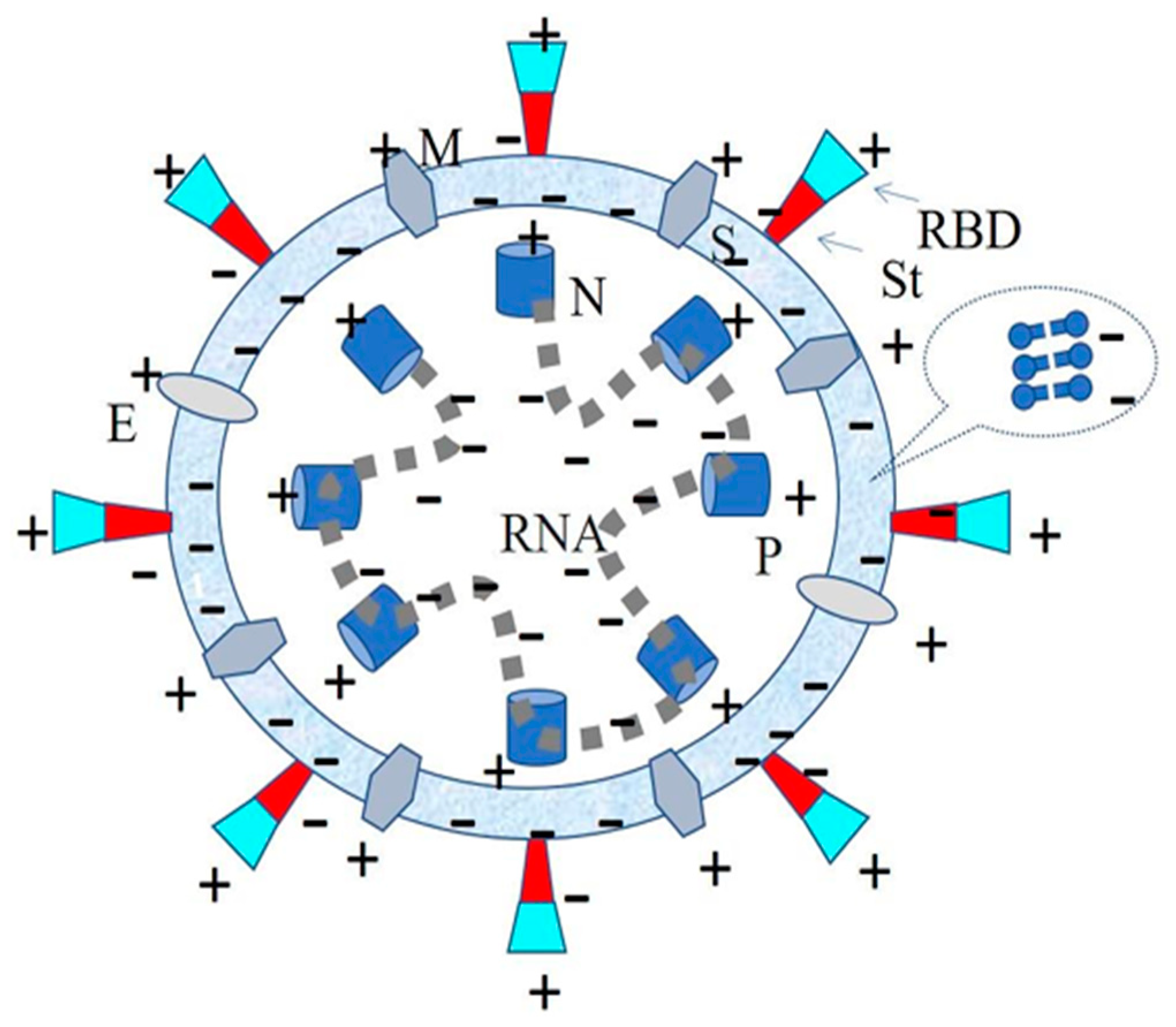
In [65], a much more realistic (and complicated) model for the charge distribution of a SARS-COV-2 virion is described as shown in Figure 5 (from [65], CC BY 4.0 license).
In this model the charge distribution is unevenly distributed and it is related to the main components of the virus, i.e.,: RNA, nucleocapsid proteins (N), membrane phospholipids (P), membrane proteins (E and M), and surface spike proteins (S), with the characteristic receptor-binding domain (RBD) and stalk (St), mostly covering the main functional subunits of the spike protein, S1 and S2.
Using such a model, for SARS-COV-2 virus the total charge of the virus has been estimated equal to , [65], and many resonant frequencies (see also Appendix B.2) result.
5.2. Overall Evaluation of the Alleged Electric
to Inactivate Viruses
With virions modelled as a damped mass-spring system (Figure 4), an attempt to estimate the threshold of the electric field able to inactivate viruses is described in [21], where the induced stress on the virion at the resonance frequency , i.e., , is assumed to be at least twice the maximum value of the force, i.e., , (that from Equation (2) is equal to ) over the 58% of the shell region in the equatorial plane of the spherical virus, i.e., , where is the radius of the virus. In formula:
where is the charge, is the quality factor of the resonant model, is the incident electric field strength and is the amplitude of the frequency response of the system at the resonance frequency. The second equality comes from: (see Equation (B8) in Appendix B).
Inverting Equation (3), the alleged threshold () of the electric field results:
where , and the charge depend on the particular virus.
The radius and are set from the literature. [21] shows an attempt to estimate the charge and the other parameters such as and by some experimental data of the microwave absorption spectrum of viruses. In general, an absorption experiment requires an electromagnetic source (over the frequency range ) and an electromagnetic detector. In [21] a sample of viruses is posted between the source and the detector; in the presence of the sample, the detector records the measured power, . Then the power is measured without the sample, , for control purposes.
The ratio defines the absorption spectrum of the virus. The latter is less than one for two reasons: (i) scattering and (ii) absorption. However, absorption strongly dominates because the Rayleigh scattering cross section from a single nanoparticle (virus) is proportional to the sixth power of the diameter, while the absorption cross section is proportional to the third power, see Appendix A.
The value of corresponding to the maximum of estimates the resonance frequency , while the ratio between and the Full-Width at Half-Maximum (FWHM) of , i.e., estimates the quality factor .
In [21] the charge has been estimated equalling, at the resonance frequency , the theoretical absorption section (see Equation (B18) in Appendix B, which we report here for convenience):
with the experimental one, , being given by the measurements. In Equation (5) is the mass of the virus, is the dielectric permittivity, the relative permittivity of the medium and the speed of light.
In [21], experimental data of the microwave absorption spectrum have provided , and . By this procedure the estimated value of the charge is and, for H3N2 virus with radius and from [66], the threshold of the electric field is .
This result obtained in [21] deserves some comments.
The value of the estimated charge represents a never demonstrated, non-realistic quantity. The common values of reported in literature are of the order of . For SARS-COV-2, [65] indicates the value (a value times lower). Applying Equation (4) with a lower, more realistic charge the electric field threshold results huge, above the one of the dielectric breakdowns in air, approximately of .
This result is confirmed in [48] and [49], where an atomic-scale Molecular Dynamics model has been developed for the SARS-COV-2 viral surface to estimate the electric field necessary to rupture the viral membrane via dipole shaking of the virus. The absorption spectrum was evaluated and found to be essentially flat, i.e., no strong absorption was found in the GHz band (see also Appendix B.2). The investigation of the mechanical resiliency of the viral membrane by introducing uniaxial strains in the system showed no pore formation (no puncturing) in the membrane for strains up to 50%.
Such a situation requires , where is the radius of the virion and the maximum displacement relative to the centre of the virion at , i.e., from Equation (2):
In [49] (the supplementary Information of [48]) a band was considered with the following parameters for the virion: radius , (total charge on the virion), () and . Choosing the lowest frequency, i.e., , and , the field-intensity for the rupture was minimized. From these data, by Equation (4), the enormous value results of , which is an order of magnitude less than one estimated in [48], but still above the dielectric breakdown in air ().
These findings further support the hypothesis that dipole shaking is not a viable mechanism for the inactivation of viruses.
In fact, the Authors of [48] concluded that RF disinfection of enveloped viruses would occur only once sufficient heat was transferred to the virus via a thermal mechanism and not by direct action (shaking) of the RF field oscillations on the viral membrane.
5.3. Patents on the Inactivation of Respiratory Viruses by Non-Thermal Microwave Devices
- a)
- U.S. patent No. 6,268,200 “Biotherapeutic Virus Attenuation Using Variable Frequency Microwave Energy”, Publication/Grant Date July 31, 2001, and Expiration Date January 15, 2019 (normal expiration after twenty years). IPC Classification A61L 2/00 (Sterilization/disinfection of special particles). The patent is for viral inactivation (attenuation) of lyophilized biotherapeutic products—such as blood-derived proteins or biologics—using variable frequency microwave (VFM) energy, selectively coupling water molecules inside the capsid—a thermally targeted mechanism. Assignee: Baxter International, Inc. and Lambda Technologies, Inc.
- b)
- U.S. patent Application No. 2001/0070624A1, Mar. 24, 2011, “Microwave resonant Absorption Method and Device for Viruses Inactivation”. In the Summary we read: “... a non-thermal method of inactivating the virus through microwave resonant absorption”. Assignee: National Taiwan University, Taipei City, TW (appl. no. 12/562,591). This patent is not active anymore, as it was abandoned.
- c)
- EP4181966A1 “Microwave disinfection system and method” [35], Application filed by the Company Elettronica SpA on 2023-05-24, granted on 2024-06-26. From this patent we quote: “The sanitisation rate becomes much higher ... when treatment is carried out in an aerosol. In this regard, the Applicant also carried out a second set of experimental aerosol inactivation tests of a solution containing SARS-COV-2 using the following test parameters: 8-10 GHz band; 10 MHz steps; 3.2 s dedicated to each individual frequency for a total of 12 min of treatment; incident signal with a field amplitude of 100 V/m. … The above aerosol tests showed an inactivation percentage of SARS-COV-2 equal to 83%”.
6. Comments and Conclusions
For a field intensity of and an exposure of 2 min, a computation of the absorption cross section in Appendix A shows that the transferred energy to a droplet of water is too weak to generate any significant effect: it increases its temperature only by negligible amounts, ranging from to (see Table A4), i.e., no significant effects are expected.
In papers [21,40,55,56,61], without any theoretical confirmation, a mechanism is supposed that transfers microwave energy to the virion via an alleged microwave resonant absorption through dipolar coupling with confined acoustic vibrations (CAV’s) thanks to some assumed Structure Resonance Energy Transfer (SRET), with microwave photons transformed into phonons maintaining their frequency and their energy. The alleged transformation of a microwave photon into a phonon at the same frequency reduces its wavelength (in water, assuming a velocity of ) of a figure close to . An microwave photon, becoming a phonon within the droplet, should change its wavelength from to about . This assumption is the only way to arrive in the resonance region for a significant part of the droplets or of the viruses. In fact, in [35] the Table at page 10, shown in the “Description of preferred embodiments of the invention”, expresses the resonance condition by the formula , with (in GHz) and where (in nm) is the size of the virus.
To the best of our knowledge, a transformation, in water or in organic media, of a microwave photon into a phonon in the interval has never been physically demonstrated and can hardly happen. Instead, microwave energy absorption in these media leads to heating, which generates many thermal phonons across a wide frequency spectrum, not a single coherent phonon at a specific frequency. The precise, effective conversion of a single microwave photon to a single phonon is a frontier of quantum research experimentally conducted in engineered systems (see for instance [86,87]), not in some bulk material such as water and organic media.
In [71] a single pair of charges (equivalent to a single mass in the spring-mass model) is assumed ignoring the more complicated structure of a virion (Figure 5); moreover, some confusion between absorption and scattering is present such as in the following wrong sentence: “The effective absorption cross-section is therefore “, thus leading to wrong computations of the cross section and of the viral titer.
Other unclear points in the approach of the aforementioned papers are related to the simulation of droplets containing virions. In [61] we read: “All experimental procedures were carried out at a controlled temperature of 21 °C” and “The A(H5N1) viral suspension was aerosolized using a commercially available aerosol generator (Omron, Kyoto, Japan) to produce particles up to 1 μm in size within a 32 L plastic, air-proof container. This aerosolization process was designed to mimic the natural airborne transmission of the virus, simulating the droplets and aerosols that would be produced during respiratory events such as coughing, sneezing, or talking”.
Test with aerosolization at is arbitrary when the emission of droplets-aerosols from the respiratory systems starts—of course—around . Moreover, the size distribution of droplets in the test, which results from the Omron aerosol generation, can be completely different from the biological one, see [88], where we read: “Aerosols (< 5 μm) containing SARS-COV-2 ... or SARS-COV-1 ... were generated with the use of a three-jet Collison nebulizer and fed into a Goldberg drum to create an aerosolized environment. The inoculum resulted in cycle-threshold values between 20 and 22, similar to those observed in samples obtained from the upper and lower respiratory tract in humans”.
Note that, a inactivation of viruses does not imply a reduction of risk. As recalled in Section 2, breathing produces roughly 1000 droplets per minute, not considering sneezing (40,000 droplets) and coughing (3,000 droplets) [7].
Finally, we read in [89]: “The most recent development in disinfection systems is radiation-based systems. This category includes microwave, infrared (IR), and UV-C systems. Microwave-based and IR-based systems typically operate in an indirect manner. Namely, the microwaves (or radio-frequency waves) excite water, which thermally heats and destroys the spike glycoprotein. Thus, microwave radiation can be considered a moist thermal disinfection. Similarly, since IR sources are thermal sources, IR-systems can act as either dry or moist thermal systems”. No mention is made of any non-thermal-microwave effect on the virions.
Summing up, we believe that the proposed inactivation by means of radiated human safe microwaves has no significant effects on infecting droplets nor on viruses within the droplets.
The findings in this paper agree with a possible and reasonable layman opinion[1]: if microwave levels are as low as not damage the living cells of the humans, they will hardly damage respiratory viruses in the air.
Author Contributions
Conceptualization, G.G.; formal analysis, G.G. and G.P.; investigation, G.P.; writing—original draft preparation, G.P.; writing—review and editing, G.P.; supervision, G.G.; All authors have read and agreed to the published version of the manuscript.
Funding
This research received no external funding.
Institutional Review Board Statement
Not applicable.
Data Availability Statement
No data is associated with this article.
Acknowledgments
None.
Conflicts of Interest
The authors do not declare any conflict of interest.
Abbreviations
The following abbreviations are used in this manuscript:
| CAV | Confined Acoustic Vibration |
| CPW | Co-Planar Waveguide |
| ERROR | Estimating the Reliability & Robustness Of Research |
| IEEE | Institute of Electrical and Electronics Engineers |
| MD | Molecular Dynamics (simulator) |
| MRA | Microwave Resonant Absorption |
| SARS-COV-2 | Severe Acute Respiratory Syndrome COronaVirus 2 |
| SRET | Structure Resonance Energy Transfer |
| UV-C1 | Ultra-Violet radiation |
Appendix A—A Recall on e.m. Phenomena Related to Microwave Radiation on Water Droplets
As electromagnetic radiation propagates through the atmosphere, it interacts with particles, which in the present context, are mainly droplets of water (diameter, ). These interactions result primarily in the form of scatter and absorption.
When a target is illuminated by an incident wave having a power density , it will scatter/absorb a portion of the wave. The degree to which a “target” can scatter or absorb electromagnetic radiation is described through its cross section an equivalent area used to describe by what extent the radiation interacts with the target.
There are three different types of cross section: the scattering cross section , the absorption cross section and the extinction cross section (in radar applications a fourth type is considered, i.e., the backscattering cross-section or radar cross section).
The cross section multiplied by the power density of the incident wave is equal to total amount of power removed from the electromagnetic wave through this process. In formula: with (absorption), or (scattering) or (extinction).
The German physicist Gustav Mie formulated (1908) a complete scattering/absorption theory [90], which describes the interaction of electromagnetic waves with spherical dielectric particles. When the droplet radius and the wavelength of the e.m. radiation satisfy the condition (i.e., particles with a small radio-electric size) the Mie formulas are well approximated by the much simpler Rayleigh ones:
with and the complex refractive index of water droplets. The parameter is related to the relative dielectric constant by: , and depends on the wavelength and on the temperature.
A dimensionless parameter is the Mie efficiency of absorption (resp., scattering ), equal to the ratio between the absorption/scattering cross section and the physical cross section, i.e., .
Note that from Equations (A1) and (A2), the ratio is proportional to making the scattering contribution negligible w.r.t. the absorption one when .
A.1. Evaluation of The Microwave Radiation on Water Droplets
In the microwave region, with wavelengths from () to (), at the ordinary temperature of (), the values of , and for pure water are shown in Table A1, [91].
For , and , using Equation (A2) and Equation (A4), we get the values of and shown in Table 2. For , the absorption cross section is of the order of , i.e., is still negligible w.r.t. the physical cross section of about . Data shown in Table A2 agree with [91].

Table A1.
Complex refractive index of water droplets , and .
|
|
|
|
|
|
Table A2.
Absorption cross section and efficiency of water droplets.
Multiplying by the incident power density we get the absorbed power . Considering an illumination (or exposure) time we get the absorbed energy .
Table A3 shows the values of and for with a power density , corresponding to , i.e., the upper permitted limit (at these frequencies) for radiation in the presence of persons (according to some national regulations including Italy).
Table A3.
Absorbed power and absorbed energy .
| with | ||||||
Among the standard strategies to inactivate viruses there is the use of UV-C radiation (). At a wavelength between and , the complex refractive index of water at shows the imaginary part of the order of (see the web site Refractive Index.info), i.e., pure water is largely transparent in the UV range, meaning that very little absorption occurs. UV-C radiation normally works with a power density of corresponding to , that compared with the RF density power of (i.e., ) results significantly lower and near close to the human-safe limit.
Equation (A5) describes the increase of temperature (in Kelvin), when a droplet of water of mass ( is the density equal to ) is exposed to the e.m. wave for a time (in seconds) is:
where is the specific heat of water.
From Equation (A2), the absorption cross section depends on the third power of , hence is independent of , and depends on the irradiated power density , the exposure time , the wavelength and the parameter of water which depends on the temperature.
Considering three power density values, i.e., , () and () and an exposure time of , we get for the values shown in Table A4. It is to be noticed that only the highest, non-personnel-safe intensity of shows a small, possibly biologically significant increase of temperature for the shortest wavelengths.
Table A4.
The increase , Equation (A5), the droplet is exposed for a time of .
|
|
|
|
|
Appendix B—The Damped Mass-Spring System Applied to Virions
B.1 The Case of a Single Mass (Single Pair of Charge)
Figure B1 shows a damped mass-spring system, where is the mass of the body, denotes the stiffness of the spring and is the damping coefficient. The movement by an external stimulus (the force of an actuator) is by the combined compliance of the body, the spring and the damper.
Figure A1.
A damped mass-spring system.
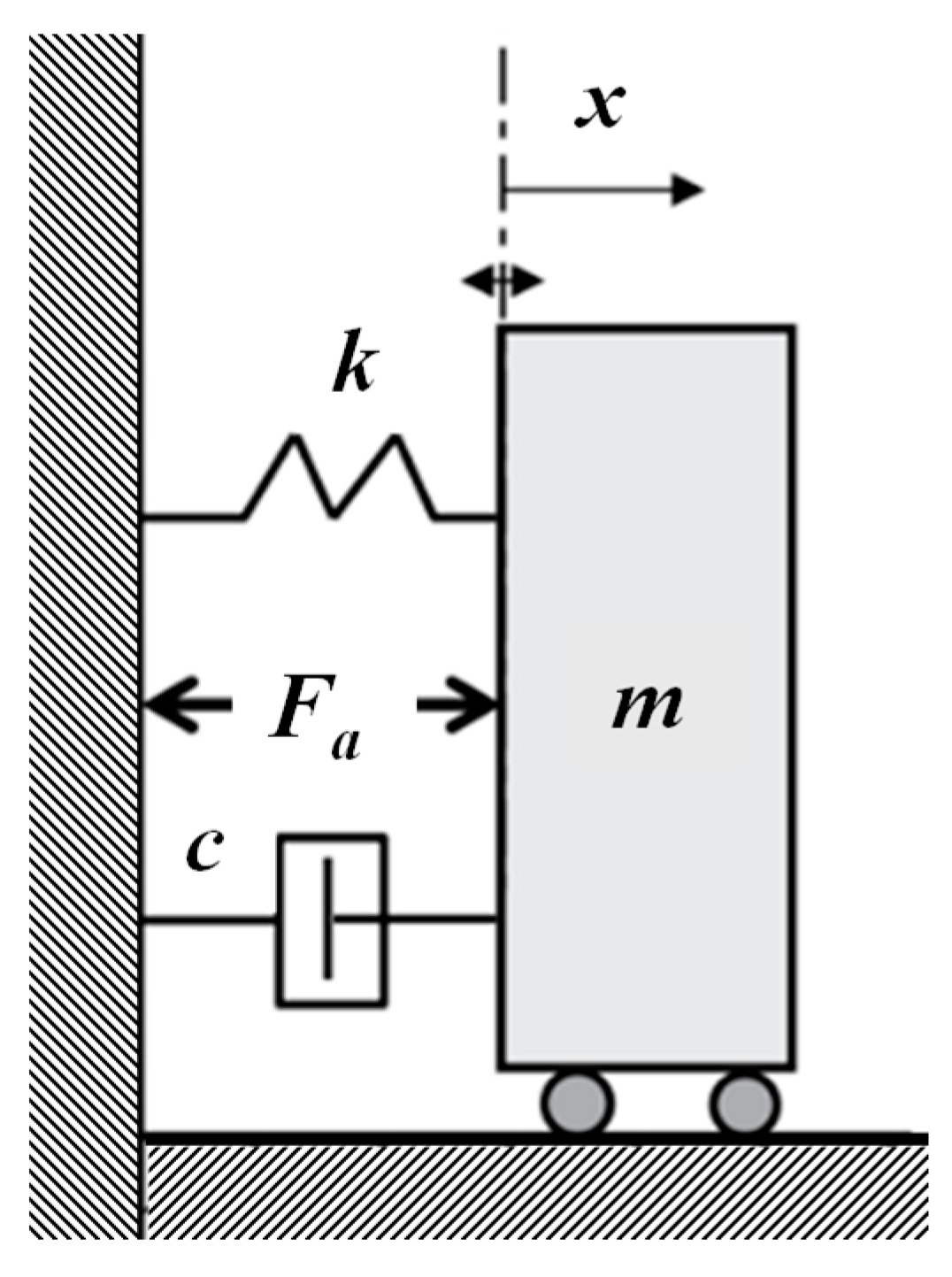
According to Newton’s laws, the force balance between and the resulting reaction forces is:
Using the Laplace transform, the differential Equation (B1) becomes:
From the Equation (B2), we derive the transfer function of the system, where (with the imaginary unit):
To qualify Equation (B3), three entities are introduced:
A fourth equivalent entity is:
Hence, Equation (B3) becomes:
To evaluate the permanent frequency response, we pose in Equation (B5):
The magnitude of is:
Without damping () the response becomes infinite at , and the frequency is the undamped natural frequency (or undamped resonance frequency) of the mass-spring system without damping. The system resonates when a periodic frequency of the stimulus force equals .
In presence of damping, at we have:
where the quality factor of the damped mass-spring system quantifies the ability of a resonator to sustain its vibration over an extended duration of time.
From Equation (B6), the phase of results:
At , the phase is zero, while at the phase is . Increasing the phase will be more negative, reaching at .
For real and sinusoidal stimulus, i.e., , the corresponding solution of Equation (B1) results:
Summing up, the permanent solution has the same frequency of the stimulus, with an amplitude related to and a delay related to the phase .
The instantaneous power absorption can be evaluated by the product between the force and the velocity of the mass along : .
Hence, the instantaneous power absorption is:
and the average power absorption from the system is:
At resonance frequency:
Being (see Equation (B8)), we have:
Modelling a virion as a spherical homogeneous nanoparticle whose resonance absorption frequencies are those predicted by the elastic continuum theory, with the harmonic stimulus generated from an electric field , of Equation (B1) becomes where is the charge, is the incident electric field strength and the product equals the parameter of Equation (B15). Hence, Equation (B15) becomes:
Introducing the power flux due to the e.m. field :
where is the impedance of the (non-magnetic) medium, and are the magnetic and the dielectric permittivity, with the relative permittivity of the medium, the ratio defines the theoretical absorption section:
where is the speed of light.
B.2 The Case of Multiple Masses (Pairs of Charge)
A virion can be realistically represented by more than two opposite electric charges, corresponding, in the frame of this model, to Figure B2 in the case of two pairs of charges (a double damped mass-spring system). Even in the over-simplified case with , the frequency response related to is obtained solving an equation system in place of the single expression Equation (B2).
For the system in Figure B2, with masses , mass matrix , and an interconnecting spring , stiffness matrix , the natural frequencies are found by solving the generalized eigenvalue problem [92,93]:
Figure 2.
A double damped mass-spring system.
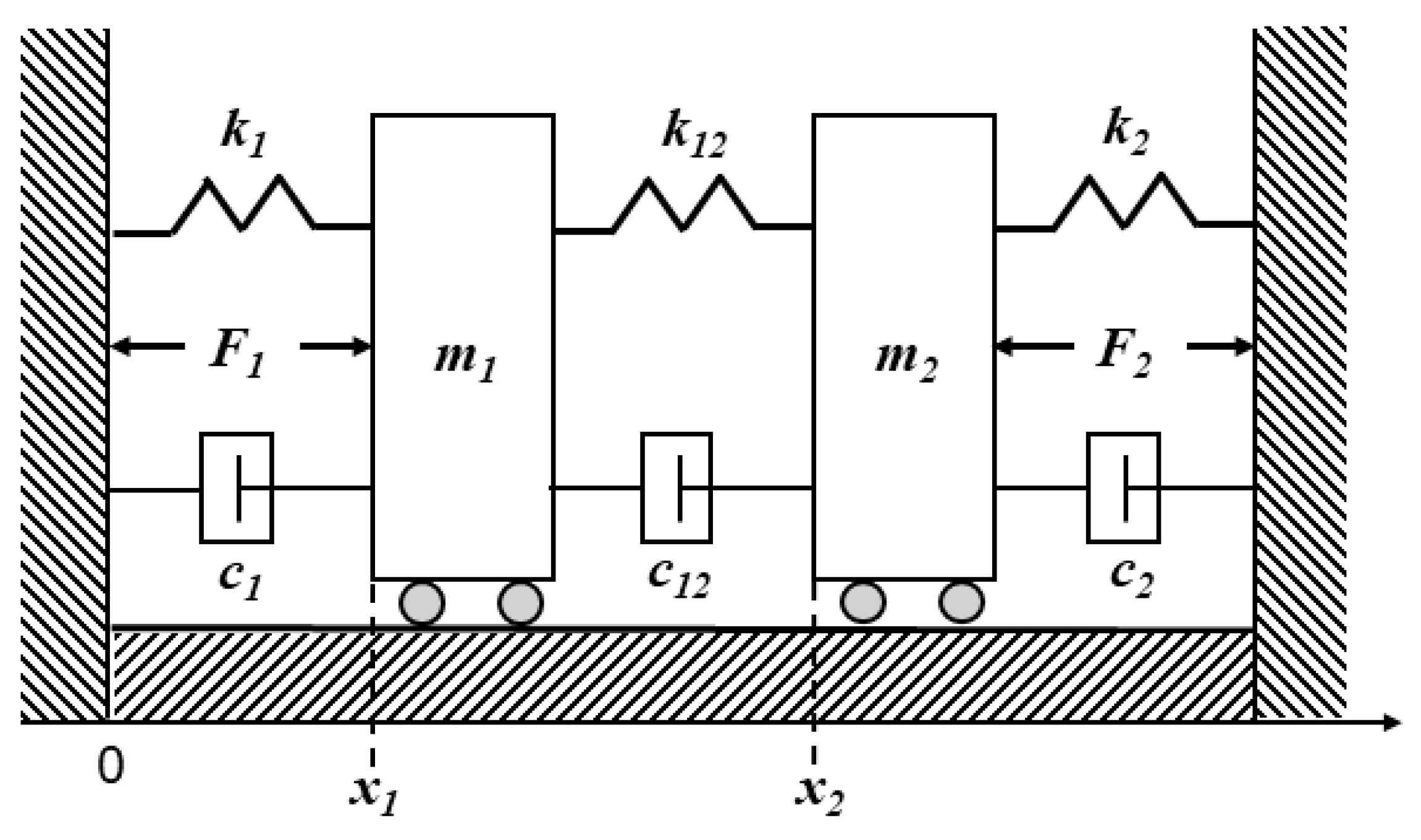
In general, a system with pairs has sets of parameters. For identical masses connected in a line by identical springs with stiffness , the resonance frequencies are given by solving Equation (B19) with and matrices. It results:
The model of identical springs hardly applies (Figure 5) to virions: the number of poles for the transfer function equivalent to Equation (B6) increases quadratically with .
| 1 | Maybe this optimistic layman has secured in a wall of a 5m x 5m room a microwave inactivation device (https://www.e4.life/it/prodotti/e4life-ambient/) at the height of 1.5m. Worried about the safety of the e.m. field strength, he has put some furniture behind the wall to block the human access, closer to the device, to the first metre out of the five meters path in front of the wall. Considering the Italian regulations, he estimates (in the free space approximation) that for a field intensity of 6 V/m at the beginning of such a "safe area" (that has a range extension of 4m) the field is linearly decreasing up to the final value of 1.2 V/m. Hence, he wonders about the inactivation rate of respiratory viruses at 1.2 V/m and considers that an influenza virus with a diameter of 100 nm, modelled as a couple of 5000 e-charges 50 nm apart, receives an electromotive force too low to produce any effect. Then, he reads the lower part of Table I of [43] and finds that the field intensities needed to inactivate (from 38% to 95%) the respiratory viruses lie in the region of hundred V/m with a peak of 400 V/m. He remains perplexed. |
References
- Milton, D.K.; Fabian, M.P.; et al. Influenza Virus Aerosols in Human Exhaled Breath: Particle Size, Culturability, and Effect of Surgical Masks. PLoS Pathogens 2013, 9(3): e1003205. 2013. [CrossRef] [PubMed]
- Lee, J.; Yoo, D.; Ryu, S.; Ham, S.; Lee, K.; et al. Quantity, Size Distribution, and Characteristics of Cough-generated Aerosol Produced by Patients with an Upper Respiratory Tract Infection. Aerosol and Air Quality Research 2019, 19: 840–853. [CrossRef]
- Prather, K.A.; Wang, C.C.; Schooley, R.T. Reducing transmission of SARS-CoV-2. Science 2020, Vol. 368, Issue 6498, pp. 1422-1424. [CrossRef] [PubMed]
- Zhdanov, V.P.; Kasemo B. Virions and respiratory droplets in air: Diffusion, drift, and contact with the epithelium. BioSystems 2020, 198, 104241. [CrossRef] [PubMed]
- Luisetto, M.; Nili, B.A.; et al. Bioaerosols and Coronavirus Diffusion, Transmission, Carriers, Viral Size, Surfaces Properties and Other Factor Involved. Clinical Cases in Medicine 2021; 1(1):1004. https://www.medtextpublications.com/open-access/bioaeresols-and-coronavirus-diffusion-transmission-carriers-viral-size-surfaces-properties-707.pdf.
- Wang, C.C.; Prather, K.A.; et al. Airborne transmission of respiratory viruses. Science 2021, Vol 373, Issue 6558 https://www.science.org/doi/10.1126/science.abd9149.
- Randall, K.; Ewing, E.T.; et al. How did we get here: what are droplets and aerosols and how far do they go? A historical perspective on the transmission of respiratory infectious diseases. Interface Focus 2021; 11 (6): 20210049. [CrossRef] [PubMed]
- Anand, S.; Krishan, J.; et al. A comprehensive modelling approach to estimate the transmissibility of coronavirus and its variants from infected subjects in indoor environments. Scientific Reports 2022, Vol. 12, Article number: 14164. https://www.nature.com/articles/s41598-022-17693-z.
- Bagheri, G.; Schlenczek, O.; et al. Size, concentration, and origin of human exhaled particles and their dependence on human factors with implications on infection transmission. Journal of Aerosol Science 2023, 168, 106102. [CrossRef]
- Pan Cheng; Wei Jia; et al. Quantifying multi-virion aerosols in respiratory infection transmission. Journal of Hazardous Materials 2024, 480, 2024, 136040. [CrossRef] [PubMed]
- Wei, J.; Li, Y. Airborne spread of infectious agents in the indoor environment. American Journal of Infection Control 2016, 44, S102-S108. [CrossRef] [PubMed]
- Fennelly, K.P. Particle sizes of infectious aerosols: implications for infection control. The Lancet Respiratory Medicine 2020, 8: 914–24. July 24, 2020. [CrossRef] [PubMed]
- Rajiv Dhand; Jie Li Coughs and Sneezes: Their Role in Transmission of Respiratory Viral Infections, Including SARS-CoV-2. American Journal of Respiratory and Critical Care Medicine 2020, Vol. 202, Issue 5, 651–659. [CrossRef] [PubMed]
- Heilingloh, C.S.; Aufderhorst, U.W.; et al. Susceptibility of SARS-CoV-2 to UV irradiation. American Journal of Infection Control 2020, 48: 1273–1275. [CrossRef] [PubMed]
- Storm, N.; McKay, L.G.A.; Downs, S.N.; et al. Rapid and complete inactivation of SARS-CoV-2 by ultraviolet-C irradiation. Scientific Reports 2020, 10, 22421. [CrossRef] [PubMed]
- Biasin, M.; Bianco, A.; Pareschi, G.; et al. UV-C irradiation is highly effective in inactivating SARS-CoV-2 replication. Scientific Reports 2021, 11, 6260. [CrossRef] [PubMed]
- Duan, S.M.; Zhao, X.S.; et. al. Stability of SARS coronavirus in human specimens and environment and its sensitivity to heating and UV irradiation. Biomedical and Environmental Sciences 2003, 16(3): 246-55. https://pubmed.ncbi.nlm.nih.gov/14631830/.
- Inagaki, H.; Saito, A.; Sugiyama, H.; Okabayashi, T.; Fujimoto, S. Rapid inactivation of SARS-CoV-2 with deep-UV LED irradiation. Emerging Microbes & Infection 2020, 9(1):1744-1747. [CrossRef] [PubMed] [PubMed Central]
- Tzu-Ming Liu; Hung-Ping Chen; Li-Tzu Wang; et al. Microwave resonant absorption of viruses through dipolar coupling with confined acoustic vibrations. Applied Physics Letters 2009, 94, 043902, Research Article. [CrossRef]
- Tzu-Ming Liu; Hung-Pin Chen; et al. Effects of hydration levels on the bandwidth of microwave resonant absorption induced by confined acoustic vibrations. Applied Physics Letters 2009, 95, 173702. [CrossRef]
- Szu-Chi Yang; Huan-Chun Lin; et al. Efficient Structure Resonance Energy Transfer from Microwaves to Confined Acoustic Vibrations in Viruses. Scientific Reports 2015, 5, 18030. [CrossRef] [PubMed]
- Galati, G.; Pavan, G.; Daum, F. From the Rise and Fall of Quantum Radar to Proposed Improvements of Research Assessment. Technium Social Sciences Journal 2026, 80(1), 347–371. [CrossRef]
- Estimating the Reliability & Robustness of Research (ERROR project) by the University of Bern: https://error.reviews. (accessed on 16 June 2026).
- Stokel-Walker, C. Scientists invented a fake disease. AI told people it was real. Nature 2026, Vol. 652. https://www.nature.com/articles/d41586-026-01100-y.
- Shaopeng Wanga; Xiaonan Shan; et al. Label-free imaging, detection, and mass measurement of single viruses by surface plasmon resonance. PNAS 2010, vol. 107, n. 37. [CrossRef] [PubMed]
- Yinon, M. Bar-On; Avi Flamholz; Rob Phillips, Ron Milo SARS-CoV-2 (COVID-19) by the numbers. eLife 2020, 9:e57309. [CrossRef] [PubMed]
- Tilley, B.S.; Hoff, B.W.; Luginsland, J.W.; Wharmby, A.; Thomas, R. On thermal inactivation of pathogens in aerosolized droplets through electromagnetic heating. Journal of Applied Physics 2021, 130(18), 184701. [CrossRef]
- Cutolo, M.A.; Migliaccio, A.; Altucci, L.; et al. An Innovative High Frequency Hyperthermia Approach against SARS-Cov-2 and Related Virus: Feasibility Analysis. Archives of Clinical and Biomedical Research 2021; 5 (4): 569-580. [CrossRef]
- Nannan Wang; Wenhui Zou; et al. Study and application status of the nonthermal effects of microwaves in chemistry and materials science—a brief review. RSC Advances 2022, 12, 17158–17181. [CrossRef] [PubMed]
- Murray, D.B.; Netting C.H.; et al. Far infrared absorption by acoustic phonons in titanium dioxide nanopowders. Journal of Nanoelectronics and Optoelectronics 2006, Vol. 1, Number 1, pp. 92-98. [CrossRef]
- Talati, M.; Jha P.K. Acoustic phonon quantization and low-frequency Raman spectra of spherical viruses. Physical Review E 2006, E 73, 011901. [CrossRef] [PubMed]
- Tzu-Ming Liu; Ja-Yu Lu; Hung-Ping Chen; et al. Resonance-enhanced dipolar interaction between terahertz photons and confined acoustic phonons in nanocrystals. Applied Physics Letters 2008, 92, 093122, 2008. [CrossRef]
- Stephanidis, B.; Adichtchev, S.; et al. Elastic Properties of Viruses. Biophysical Journal 2007, Vol. 93, 1354-1359. [CrossRef] [PubMed]
- Barbora, A.; Minnes, R.; Targeted antiviral treatment using non-ionizing radiation therapy for SARS-CoV-2 and viral pandemics preparedness: Technique, methods and practical notes for clinical application. PLoS ONE 2021, 16(5): e0251780. [CrossRef] [PubMed]
- European Patent: Microwave disinfection system and method. Patent EP-4181966-B1, 2024. https://pubchem.ncbi.nlm.nih.gov/patent/EP-4181966-B1.
- IEEE International Committee on Electromagnetic Safety—IEEE Standards for Safety Levels with Respect to Human Exposure to Electric, Magnetic, and Electromagnetic Fields, 0 Hz to 300 GHz. IEEE Std C95.1™-2019.
- Pantoja, C.; Acosta, F.M.; Granatir, S.; et al. Electromagnetic waves destabilize the SARS-CoV-2 Spike protein and reduce SARS-CoV-2 Virus-Like particle (SC2-VLP) infectivity. Scientific Reports 2025, 15:16836. [CrossRef] [PubMed]
- Zhifeng Kuang; John Luginsland; et al. Molecular dynamics simulations explore effects of electric field orientations on spike proteins of SARS-CoV-2 virions. Scientific Reports 2022, 12:12986. [CrossRef] [PubMed]
- Zhifeng Kuang; John Luginsland; et al. Identifying resonant frequencies of viruses for microwave-based detection and inactivation of pathogenic viruses. Scientific Reports 2025. [CrossRef] [PubMed]
- Brusaferro, S.; Brunelli, L.; et al. Microwave irradiation for airborne virus inactivation: Evidence and future perspectives. Journal of Infection 2025, 91, 106537. [CrossRef] [PubMed]
- Mazzaro, G.J.; Gallagher, K.A. Viruses Illuminated by Radio Frequencies: A Review of Openly Published Literature. DEVCOM ARL-MR-1069. https://apps.dtic.mil/sti/html/trecms/AD1190815/index.html.
- Cantu, J.C., Butterworth, J.W., Mylacraine, K.S.; et al. Evaluation of inactivation of bovine coronavirus by low-level radiofrequency irradiation. Scientific Reports 2023, 13, 9800. [CrossRef] [PubMed]
- Sadreian, M.; Kabakova, I.; et al. Virus inactivation by matching the vibration resonance. Applied Physics Reviews 2024, 11, 021324. [CrossRef]
- Bia, P.; Filisetti, A.; Losardo, M.; Manna, A. Inactivation of Respiratory Syncytial Virus in Aerosols by Means of Selected Radiated Microwaves. MDPI Applied Sciences 2026, 16, 3253. [CrossRef]
- Cohick, Z.W.; Hoff, B.W.; Revelli, D.; et al. Evaluation of 4.0 GHz RF Exposure Effects on Bioaerosols Containing Bovine Coronavirus. Bioelectromagnetics 2026, 1–8. [CrossRef] [PubMed]
- Echchgadda, I.; Cantu, J.C.; Butterworth, J.; Roach, W.P.; Ibey, B.L. Evaluation of Viral Inactivation on Dry Surface by High Peak Power Microwave (HPPM) Exposure. Bioelectromagnetics 2023, 44(1-2). [CrossRef] [PubMed]
- Cantu, J.C.; Echchgadda, I.; Butterworth, J.W.; Roach, W.P.; Ibey, B.L. Investigation of Viral Inactivation by High Peak Power Microwave (HPPM) Exposure in Solution. Bioelectromagnetics 2025, 46(6), e70015. [CrossRef] [PubMed]
- Parker, J.E.; Rodriguez, R.A. Development of a charged model of the SARS-CoV-2 viral surface. Biochimica et Biophysica Acta (BBA)—Biomembranes 2023, Vol. 1865, Issue 4, 184136. [CrossRef] [PubMed]
- Parker, J.E., Rodriguez, R.A. Supplementary Information: Development of a Charged Model of the SARS-CoV-2 Viral Surface. Available online at (accessed on 16 June 2026). [CrossRef]
- Sun, C.K.; Tsai, Y.C.; et al. Resonant Dipolar Coupling of Microwaves with Confined Acoustic Vibrations in a Rod-shaped Virus. Scientific Reports 2017, 7, 4611. [CrossRef] [PubMed]
- Calabrò, E.; Magazù, S. Viruses Inactivation Induced by Electromagnetic Radiation at Resonance Frequencies: Possible Application on SARS-CoV-2. World Journal of Environmental Biosciences 2021, 10(1), 1-4. [CrossRef]
- Xiao, Y.; Zhao, L.; Peng, R. Effects of electromagnetic waves on pathogenic viruses and relevant mechanisms: a review. Virology Journal 2022, 19(1):161. [CrossRef] [PubMed]
- Arbeitman, C.R.; Rojas, P.; Ojeda-May, P.; et al. The SARS-CoV-2 spike protein is vulnerable to moderate electric fields. Nature Communications 2021, 12, 5407. [CrossRef] [PubMed]
- Wang, P.J.; Pang Y.H.; Huang, S.Y. et al. Microwave resonant absorption of SARS-CoV-2 viruses. Scientific Reports 2022, 12, 12596. [CrossRef] [PubMed]
- Manna, A.; De Forni, D.; et al. SARS-CoV-2 Inactivation in Aerosol by Means of Radiated Microwaves. MDPI Viruses 2023, 15, 1443. [CrossRef] [PubMed]
- Manna, A.; De Forni, D.; et al. Endemic Respiratory Viruses Inactivation in Aerosol by Means of Radiated Microwaves. Medical Research Archives 2023, vol. 11, no. 10. [CrossRef]
- Taylor, G.J.; Margueritat, J.; Saviot, L. Comment on Manna et al. SARS-CoV-2 Inactivation in Aerosol by Means of Radiated Microwaves. Viruses 2023, 15, 1443. 15(10), 2110. [CrossRef] [PubMed]
- Manna, A.; De Forni, D.; Bartocci, M.; Sangiovanni Vincentelli, A.; Lori, F. Reply to Taylor et al. Comment on “Manna et al. SARS-CoV-2 Inactivation in Aerosol by Means of Radiated Microwaves. Viruses 2023, 15, 1443”. Viruses 2023, 15(10), 2111. [CrossRef] [PubMed]
- Bartocci, M.; Bia, P.; Manna, A.; Pasculli, N. SARS-CoV-2 and H1N1 Inactivation in Aerosol by Means of Radiated Microwaves with Novel Setup. IEEE Antennas and Propagation Society AP S International Symposium Digest, 14-19 July 2024, Florence, Italy. [CrossRef]
- Losardo, M.; Bia, P.; Manna, A.; Privitera, G.P.; Brusaferro, S. H1N2 Swine Flu Inactivation in Aerosol by Means of Radiated Microwaves. Proc. of the Intern. Conference on Electromagnetics in Advanced Applications, ICEAA. 8-12-September 2025, Palermo, Italy. [CrossRef]
- Bia, P.; Losardo, M.; Manna, A.; Brusaferro, S.; Privitera, G.P.; Vincentelli, A.S. Selected microwave irradiation effectively inactivates airborne avian influenza A(H5N1) virus. Scientific Reports 2025, vol. 15, n. 1. [CrossRef] [PubMed]
- Caselli, F.; Bia, P.; Losardo, M.; Losardo, M.; Manna, A.; Bisegna, P. Generalized Single-Degree-of-Freedom Model to Study Viral Inactivation by Radiated Microwaves. IEEE Trans. on Biomedical Engin. 2025. [CrossRef] [PubMed]
- Losardo, M.; Simonetti, M.; Bia, P.; Verratti, M.; Rasam, H. Evaluating the Efficacy of Microwave Sanitization in Reducing SARS-CoV-2 Airborne Contagion Risk in Office Environments. MDPI Applied Sciences 2025, 15(12), 6940. [CrossRef]
- Yi Xiao; Hui Wang; Haoyu Wang; et al. Inactivation efficacy and mechanism of 9.375 GHz electromagnetic wave on coronavirus. Virology 2024, 598, 110165. [CrossRef] [PubMed]
- Pawłowski, P.H.; Zielenkiewicz, P. The role of electric charge in SARS-CoV-2 and other viral infections. AIMS Biophysics 2024, Vol. 11, Issue 2: 166-188. https://www.aimspress.com/article/doi/10.3934/biophy.2024011.
- Sai Li; Eghiaian, F.; Sieben, C.; et al. Bending and Puncturing the Influenza Lipid Envelope. Biophysical J. 2011, Vol. 100, Is. 3, 2, 637-645. [CrossRef] [PubMed]
- Wang, P.J.; Huang, T.W.; Chen, Y.J.; Sun, C.K. Implementation of a coplanar-waveguide chip for the measurement of EM wave absorption spectrum of SARS-Cov-2 virus. In Proc. SPIE 11975, Advances in Terahertz Biomedical Imaging and Spectroscopy, 1197506, 2022. [CrossRef]
- Xiao, Y.; Peng, R.; Wang, H.; Liu, W.; Zhao, L. Inactivation of β-coronavirus MHV-A59 by 2.8 GHz microwave. Medicine 2024, 103(47). [CrossRef] [PubMed]
- Gavriloaia, M.R.; Novac, E.; Gavriloaia, B.M. Modeling of S Glycoprotein SARS-CoV-2 as Microwave Dielectric Resonator. In Proc. of the 13th Intern. Conf. on Electronics Computers and Artificial Intelligence. 1-3 July 2021, Pitesti, Romania. [CrossRef]
- Heli, H.; Sahraei, A.; Asadi, R.; et al. A New Setup for Microwave Exposure to Pathogenic Samples. Iran J. Sci. Technol. Trans. Electr. Eng. 2024, 48, 1353–1360. [CrossRef]
- Falcon-Gomez, E.; Gonzalez-Posadas, V.; Segovia-Vargas, D. Virus Detection in the Microwave Regime Through an Antenna Workbench. In Proc. of 18th European Conference on Antennas and Propagation, EUCAP 2024. 17-22 March 2024, Glasgow, U.K. [CrossRef]
- Wu, Y.; Yao, M. In situ airborne virus inactivation by microwave irradiation. Chin. Sci. Bull. 2014, 59(13): 1438–1445. [CrossRef] [PubMed]
- Siddharta, A.; Pfaender, S.; Malassa, A.; Goffinet, C.; Steinmann, E. Inactivation of HCV and HIV by microwave: A novel approach for prevention of virus transmission among people who inject drugs. Scientific Reports 2016, 6, 36619. [CrossRef] [PubMed]
- Hung, W.T.; Tung, J.J.; Chen, S.Y. A focusing reflect array and its application in microwave virus sanitizer. Radio Science 2014, 49(10). [CrossRef]
- Sun, C.K.; Tsai, Y.C.; Kao, C.L.; Lo, C.F.; Chen, Y.J. Structure resonance energy transfer from e.m. wave to rod-like virus. In Proc. of International Conference on Infrared Millimeter and Terahertz Waves. 25-30 Sept. 2016, Copenhagen, Denmark. [CrossRef]
- Youssef, K.; Shoukralla, E.S.; Hanna, V.K.; Elkorany, A.S. Safe microwave inactivation of airborne viruses using compact smart antenna. In Proc. of ICEEM 2021, 3-4 July 2021, Menouf, Egypt. [CrossRef]
- Hoff, B.W.; Cohick, Z.W.; Tilley, B.S.; Roach, W.P.; Shiffler, D.A. Observed Reductions in the Infectivity of Bioaerosols Containing Bovine Coronavirus under Repetitively Pulsed RF Exposure. IEEE Trans. on Biomedical Engineering 2023, 70(2). [CrossRef]
- Gastón Sanglier Contreras; Eduardo José López Fernández; et al. Biophysical Methods for Locating the Resonance Frequency of the Virus. Key Factor in the Fight Against Covid-19. Contemporary Engineering Sciences 2020, Vol. 13, no. 1, 233—245. [CrossRef]
- Tuan Anh Nguyen; Ram K. Gupta A view from nano and space technologies: Can gigahertz waves destroy or spread viruses? Kenkyu Journal of Nanotechnology & Nanoscience 2021, 7:04-13 2021. ISSN: 2455-183X.
- Kossenas, K.; Podilchak, S.K.; Comiteet, D.; al. A Methodology for Remote Microwave Sterilization Applicable to the Coronavirus and Other Pathogens Using Retrodirective Antenna Arrays. IEEE Journal of Electromagnetics, RF and Microwaves in Medicine and Biology 2022, vol. 6, no. 1, pp. 41-51. [CrossRef] [PubMed]
- Sayidmarie, K.H.; Mohammed, B.; Mohammed, A.J.; Abbosh, A. Combating Coronavirus Using Resonant Electromagnetic Irradiation. IEEE J. of Electromagnetics, RF and Microwaves in Medicine and Biology 2022, vol. 6, no. 4, pp. 477-484. [CrossRef] [PubMed]
- Banting, H.; Goode, I.; et al. Electromagnetic deactivation spectroscopy of human coronavirus 229E. Scientific Reports 2023, 13:8886, Vol: (1234567890). [CrossRef] [PubMed]
- Peng-Jui Wang; Yu-Hao Pang; et al. Microwave resonant absorption of SARS-CoV-2 viruses. Scientific Reports 2023, 12:12596. [CrossRef] [PubMed]
- Hsin-Yi Tsai; Yu-Hsuan Lin; et al. Reduction of Viral and Bacterial Activity by Using a Self-Powered Variable-Frequency Electrical Stimulation Device. MDPI Micromachines 2023, 14, 282. [CrossRef] [PubMed]
- Afaghi, P.; Lapolla, M.A.; Ghandi, K. Denaturation of the SARS-CoV-2 spike protein under non-thermal microwave radiation. Scientific Reports 2021, 11:23373. [CrossRef] [PubMed]
- Shi-fan Qi; Jun Jing Magnon-assisted photon-phonon conversion in the presence of structured environments. Phys. Rev. A 2021, 103, 043704. [CrossRef]
- Dandan Ma; Yuzhe Ma; et al. Energy conversion materials need phonons. The Innovation 2024, Vol. 5, Issue 6, 2024, 100709. https://www.sciencedirect.com/science/article/pii/S2666675824001474.
- Neeltje van Doremalen; Trenton Bushmaker; et al. Aerosol and Surface Stability of SARS-CoV-2 as Compared with SARS-CoV-1. New Engl. J. of Med. 2020, Vol. 382 N. 16, 1564-1567. [CrossRef] [PubMed]
- Maria Soler; Alexis Scholtz; et al. Engineering photonics solutions for COVID-19. Special Collection: Coronavirus and Photonics APL Photonics 2020, 5, 090901. [CrossRef] [PubMed]
- Mie, G. Beitrage zur Optik Trüber Medien, speziell kolloidaler Metallosungem. Ann. Physik 1908, 25(3), 377–445. https://onlinelibrary.wiley.com/doi/epdf/10.1002/andp.19083300302.
- Mätzler, C. Effects of Rain on Propagation, Absorption and Scattering of Microwave Radiation Based on the Dielectric Model of Liebe. Rep. 2002-10, Institute of App. Phys., Univ. of Bern, June 2002. https://www.researchgate.net/publication/303607688_Effects_of_Rain_on_Propagation_Absorption_and_Scattering_of_Microwave_Radiation_Based_on_the_Dielectric_Model_of_Liebe.
- Haym Benaroya; Mark Nagurka, Seon Mi Han Mechanical Vibration: Theory and Application. Rutgers University Press, 2022, ISBN 1978831072, 9781978831070.
- Peters, G.; Wilkinson, J.H. Ax = λBx and the Generalized Eigenproblem. SIAM Journal on Numerical Analysis 1970, 7:4, 479-492 . [CrossRef]
Figure 1.
Airborne transmission of respiratory viruses, from [6] (Creative Commons Attribution 4.0 International, CC BY 4.0 license).
Figure 1.
Airborne transmission of respiratory viruses, from [6] (Creative Commons Attribution 4.0 International, CC BY 4.0 license).
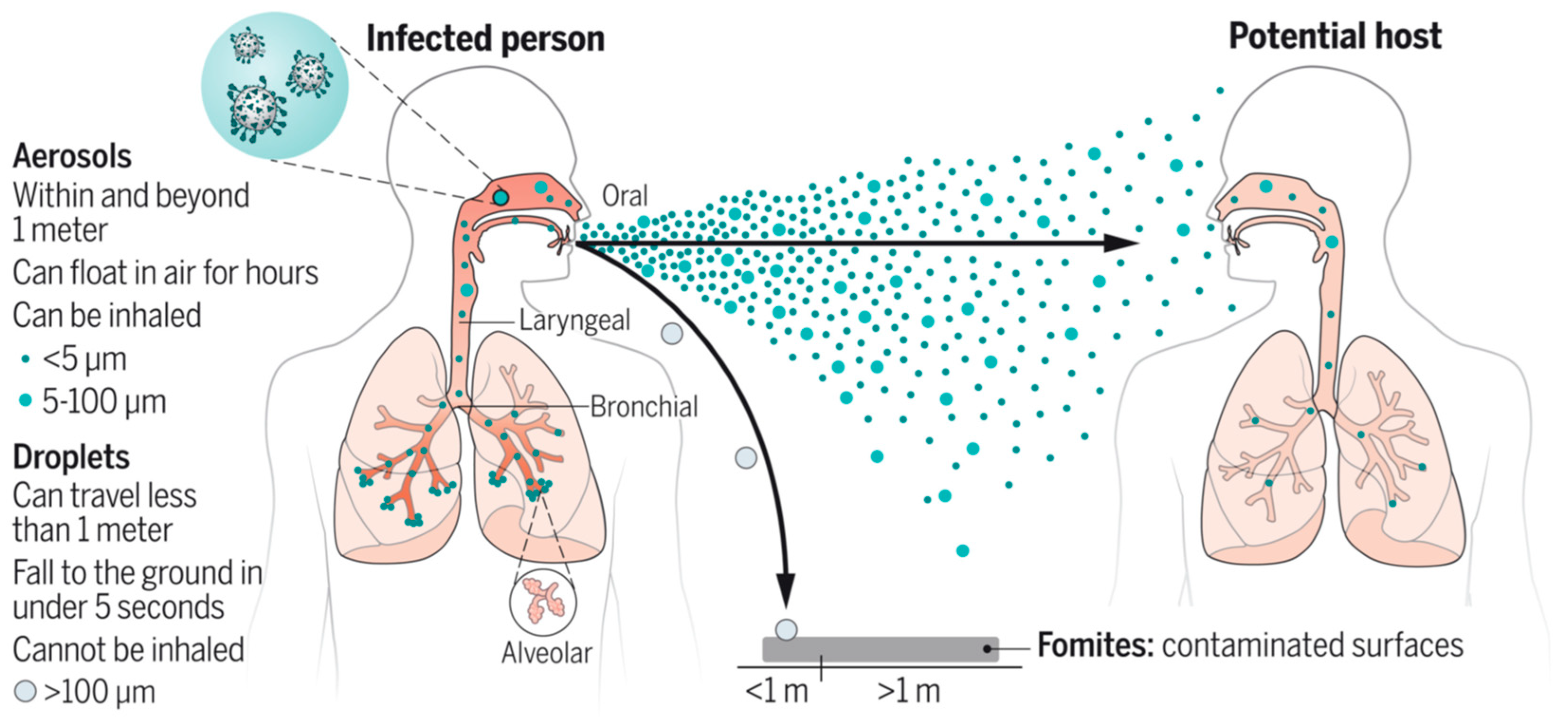
Figure 2.
Articles related to viruses’ inactivation by radiated microwaves, year by year from 2008 to 2025.
Figure 2.
Articles related to viruses’ inactivation by radiated microwaves, year by year from 2008 to 2025.
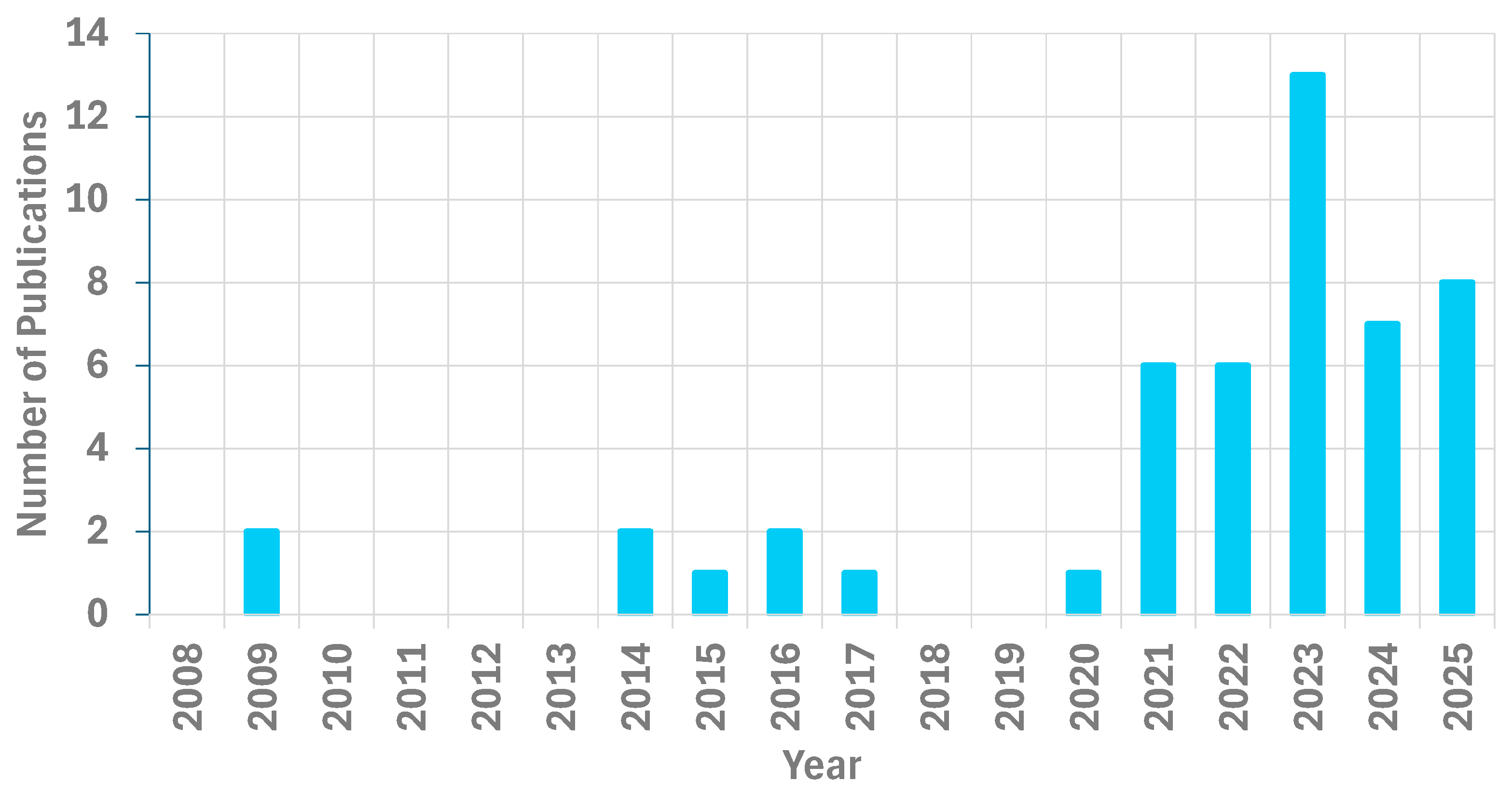
Figure 3.
Articles on viruses’ inactivation by radiated microwaves by Authors.
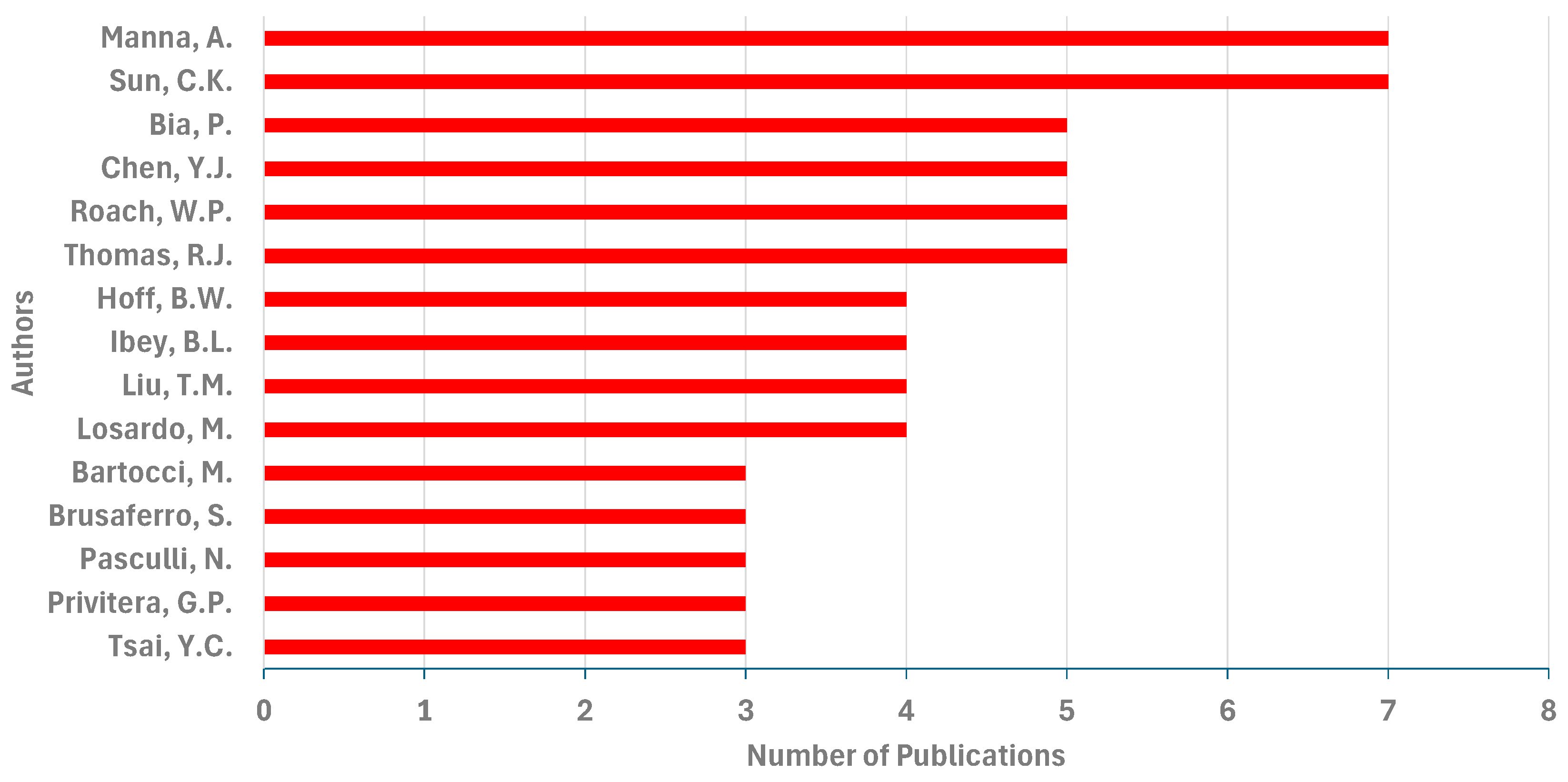
Figure 4.
(a) A dynamic model of a virion in liquid water with relative permittivity . (b) Simplified model as a dipole with an external shell (capsid, negatively charged) and an internal core (positively charged).
Figure 4.
(a) A dynamic model of a virion in liquid water with relative permittivity . (b) Simplified model as a dipole with an external shell (capsid, negatively charged) and an internal core (positively charged).
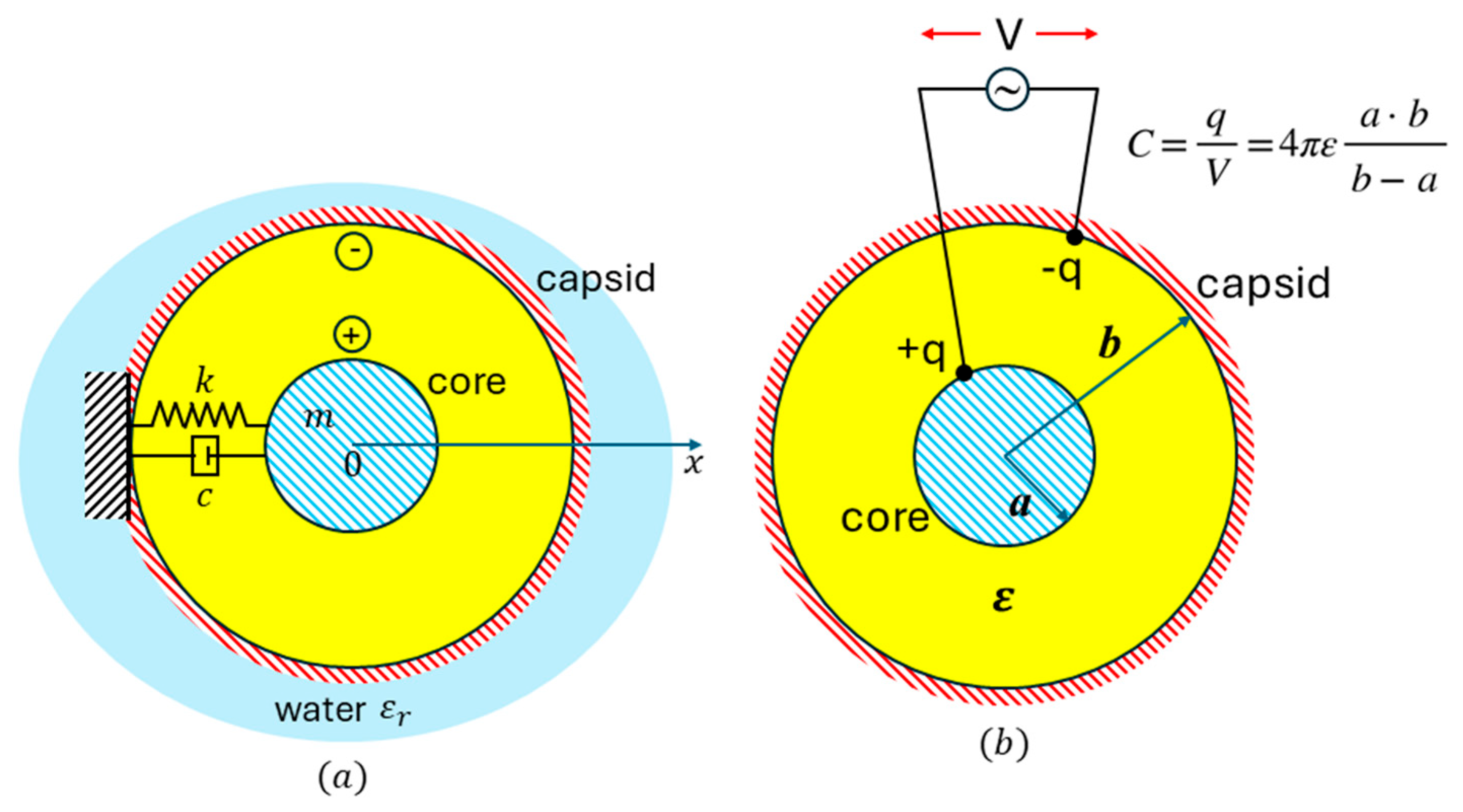
Figure 5.
Spherical approximation of a SARS-COV-2 virus (secondary and tertiary structure are neglected) with the charge distribution. (From [65], Creative Commons Attribution 4.0 International, CC BY 4.0 license).
Figure 5.
Spherical approximation of a SARS-COV-2 virus (secondary and tertiary structure are neglected) with the charge distribution. (From [65], Creative Commons Attribution 4.0 International, CC BY 4.0 license).
Disclaimer/Publisher’s Note: The statements, opinions and data contained in all publications are solely those of the individual author(s) and contributor(s) and not of MDPI and/or the editor(s). MDPI and/or the editor(s) disclaim responsibility for any injury to people or property resulting from any ideas, methods, instructions or products referred to in the content. |
© 2026 by the authors. Licensee MDPI, Basel, Switzerland. This article is an open access article distributed under the terms and conditions of the Creative Commons Attribution (CC BY) license (http://creativecommons.org/licenses/by/4.0/).
Copyright: This open access article is published under a Creative Commons CC BY 4.0 license, which permit the free download, distribution, and reuse, provided that the author and preprint are cited in any reuse.