

Submitted:
28 June 2026
Posted:
29 June 2026
You are already at the latest version
Abstract
In March 2022, the FAO Food Price Index peaked at 159.7 as climate shocks collided with geopolitical disruption, pushing global hunger past 735 million and exposing how deeply climate variability penetrates the economics of agri-food systems. Yet the imprint of ocean–atmosphere oscillations on global food prices—the central economic signal of the agri-food system—has never been mapped systematically in the frequency domain. This study delivers the first multi-oscillation cross-spectral analysis of the climate–food price nexus, matching seven climate indices across the Pacific, Atlantic, and Indian Ocean basins with five disaggregated FAO Food Price Index sub-components over 432 monthly observations (1990–2025), verified through six robustness checks including surrogate-data testing. Four findings carry direct policy relevance. ENSO indicators lead global food prices by three to four months with a 100% surrogate-test pass rate—the cleanest actionable climate–price signal yet documented. The Indian Ocean Dipole leads prices by sixteen months, extending the early warning horizon from weeks to over a year. The apparent Atlantic Multidecadal Oscillation–price correlation (r ≈ +0.60) is revealed to be a common-trend artefact. Dairy and vegetable oils emerge as the most climate-exposed commodity chains, while meat is buffered by feed-market intermediation. These results provide the empirical foundation for integrating real-time monitoring of climate oscillations into food system governance—a low-cost policy innovation that aligns economic stability objectives with climate adaptation goals, strengthens the resilience of agri-food value chains, and supports progress toward Sustainable Development Goal 2 (Zero Hunger).
Keywords:
global food security
; sustainable food systems
; SDG 2
; climate oscillations
; ENSO
; Indian Ocean Dipole
; FAO Food Price Index
; early warning systems
; agri-food value chains
; food price volatility
1. Introduction
Feeding the world sustainably is among the defining challenges of the twenty-first century. In 2023, an estimated 735 million people were chronically undernourished, and over 2.3 billion faced moderate or severe food insecurity [1]. The FAO Food Price Index (FPI) reached an all-time high of 159.7 in March 2022, driven by the confluence of the Russia–Ukraine conflict, post-pandemic supply chain disruptions, and adverse weather events across major breadbaskets [2]. These recurring price shocks threaten progress towards Sustainable Development Goal 2 (Zero Hunger) and expose deep structural vulnerabilities in the global food system [3].
A growing body of evidence suggests that large-scale ocean–atmosphere oscillations are a persistent, yet insufficiently understood, source of global food price variability. The El Niño–Southern Oscillation (ENSO), the dominant mode of interannual climate variability with a characteristic periodicity of 2–7 years [4], affects crop yields on more than a quarter of the world’s cultivated land [5]. El Niño events reduce maize yields by up to 4.3% globally while boosting soybean yields by 2–5%, and La Niña years are associated with below-normal yields across all major staple crops [5]. Ray et al. [6] estimated that climate variability explains 32–39% of year-to-year yield variability worldwide, with substantially higher fractions in key breadbasket regions. Beyond ENSO, other oscillations—the Indian Ocean Dipole (IOD), the Pacific Decadal Oscillation (PDO), the Atlantic Multidecadal Oscillation (AMO), and the North Atlantic Oscillation (NAO)—modulate regional temperature and precipitation patterns on timescales ranging from biennial to multi-decadal [7,8,9], yet their effects on global food prices have received comparatively little attention.
Existing empirical research on the climate–food price nexus has operated almost exclusively in the time domain. Cashin et al. [10] used a global vector autoregressive (VAR) model to show that El Niño shocks raise non-fuel commodity prices, peaking at a lag of 4–8 months. Ubilava [11] demonstrated that ENSO effects on wheat prices are nonlinear and asymmetric across El Niño and La Niña phases. Headey and Fan [12] identified a confluence of weather, biofuel, and trade-policy drivers behind the 2007–2008 food price crisis. These time-domain approaches provide valuable estimates of average effects, but they cannot decompose the climate–price relationship by frequency: they do not reveal which cyclical components of climate variability are transmitted to food prices, nor at what timescales the transmission is strongest.
The frequency domain offers a natural framework for addressing these questions. Cross-spectral coherence—the frequency-domain analogue of the correlation coefficient—measures the strength of the linear association between two time series at each frequency, while the phase spectrum identifies lead–lag relationships at each frequency [13]. These tools have a long history in climatology, where they have been used to characterise ENSO dynamics [4] and to study the modulation of climate signals across ocean basins [14]. In economics, spectral methods have been applied to business cycle synchronisation [15] and commodity price co-movement [16], but their application to the climate–food price nexus remains limited.
The closest antecedent to the present study is Cai and Sakemoto [17], who employed partial wavelet coherence to examine the relationship between the Southern Oscillation Index (SOI) and aggregate commodity price indices. They found significant coherence at frequencies of 32–64 and 64–128 months, with a strengthening of the relationship after 2000. However, their analysis was restricted to a single climate index (SOI) and to aggregate commodity categories that included metals, energy, and food. The questions of how multiple, simultaneously operating climate oscillations interact with food prices, and whether different food commodities respond to distinct climate signals, remain unanswered.
More recently, Pavlova et al. [18] applied wavelet coherence to the FAO FPI and the Prevalence of Undernourishment (SDG 2.1.1) over 2001–2023, finding that despite strong raw coherence (R² ≈ 0.77), only 7.8% of time–frequency cells achieved statistical significance against an AR(1) null, with significant co-movement concentrating at medium-run horizons of 3–6 years. This finding underscores the need for rigorous significance testing and motivates the present study’s use of IAAFT surrogate testing.
This paper addresses these gaps by providing the first multi-oscillation cross-spectral analysis of the relationship between large-scale climate variability and disaggregated global food prices. We match seven climate oscillation indices—Niño 3.4, SOI, the Multivariate ENSO Index (MEI v2), IOD, NAO, PDO, and AMO—with the five sub-components of the FAO Food Price Index (cereals, meat, dairy, vegetable oils, and sugar) over the period January 1990 to December 2025 (432 monthly observations). The methodological framework combines Welch power spectral density estimation [19], magnitude-squared cross-spectral coherence with phase analysis [13], continuous wavelet coherence [20,21], lagged cross-correlation, and rolling-window coherence. The robustness of the findings is assessed through six sensitivity checks, including first-differencing, alternative spectral estimators (Thomson’s multitaper method [22]), sub-period stability analysis, and Iterative Amplitude-Adjusted Fourier Transform (IAAFT) surrogate testing [23].
The study contributes to the sustainability literature in five respects. First, it reveals that ENSO indicators robustly lead global food prices by three to four months in the 2–3-year frequency band, with a 100% pass rate in surrogate-data testing—the cleanest and most policy-actionable finding. Second, it shows that the Indian Ocean Dipole provides a 16-month lead on food prices, potentially extending the early-warning horizon beyond the reach of conventional weather-based approaches. Third, it demonstrates that the strong time-domain correlation between the AMO and food prices (r = +0.60) is largely an artefact of common trends, underscoring the necessity of frequency-domain methods for distinguishing genuine oscillatory couplings from spurious co-movement. Fourth, it disaggregates the analysis by food commodity, revealing that dairy and vegetable oils are the most climate-sensitive categories while meat is buffered by feed-market intermediation. Fifth, it documents an oscillation-specific strengthening of the climate–food price nexus since 2008, with PDO-NAO coherence increasing significantly while ENSO coherence remains structurally stable.
These findings have direct implications for the design of climate-informed early warning systems under SDG 2, for the prioritisation of adaptation investments in sustainable food systems, and for the integration of real-time monitoring of climate oscillations into food security governance. More broadly, the paper demonstrates that global food prices contain embedded climate signals that can be identified, attributed to specific ocean basins and timescales, and potentially exploited to protect the world’s most food-insecure populations.
2. Literature Review
This section synthesises four streams of literature that converge on the relationship between climate variability and food price dynamics: (i) the agroclimatic evidence linking large-scale climate oscillations to crop yields; (ii) the transmission of climate shocks to global commodity prices; (iii) the economics of extreme weather events and natural disasters; and (iv) the methodological evolution of spectral and wavelet techniques in climate–economy research. Each stream is reviewed in turn, after which the research gap at its intersection is identified.
2.1. Climate Oscillations and Crop Yield Variability
The El Niño–Southern Oscillation (ENSO) is the dominant mode of interannual climate variability, with a characteristic periodicity of 2–7 years [4]. Its influence on regional precipitation, temperature, and cloud cover has been extensively documented [24]. The agronomic consequences of ENSO are now well established at the global scale. Iizumi et al. [5], analysing gridded yield data for maize, rice, wheat, and soybean, demonstrated that El Niño events improve global-mean soybean yields by 2.1–5.4% but reduce maize yields by up to 4.3%, while La Niña years are associated with below-normal yields across all four crops. Their findings imply that ENSO affects more than a quarter of the world’s croplands, making it a systematic rather than idiosyncratic risk factor.
Ray et al. [6] extended this line of inquiry by showing that climate variability explains approximately 32–39% of year-to-year yield variability globally, with substantially higher fractions (exceeding 60%) in key breadbasket regions. Importantly, the magnitude and even the sign of the ENSO effect are spatially heterogeneous: El Niño tends to reduce yields in Australia, southern Africa, and parts of South and Southeast Asia, while benefiting regions in South America [25]. This spatial heterogeneity, combined with the structure of global agricultural trade, creates a potential for geographically correlated production shocks to be transmitted to international commodity prices [26].
Beyond ENSO, other large-scale climate oscillations have received comparatively less attention in the agricultural literature. The Indian Ocean Dipole (IOD) modulates monsoon rainfall over South and Southeast Asia, affecting rice and wheat production in India and Indonesia [7]. The Atlantic Multidecadal Oscillation (AMO) operates on multi-decadal timescales and has been linked to shifts in the Sahel rainfall regime and European summer temperatures [27]. The Pacific Decadal Oscillation (PDO) modulates the background state against which ENSO events unfold, potentially amplifying or dampening their agricultural impacts [28]. However, quantitative assessments of the effects of these non-ENSO oscillations’ effects on global food production remain sparse.
2.2. Climate Shocks and Global Food Commodity Prices
The transmission of climate-induced production shortfalls to international food prices operates through a multi-stage supply chain encompassing farm-gate production, storage, trade, and processing [12]. The global food price crises of 2007–2008 and 2010–2011 catalysed substantial research into the drivers of price volatility. Headey and Fan [12] identified a confluence of factors—including weather shocks, biofuel mandates, export restrictions, and speculative trading—that contributed to the 2007–2008 crisis, with no single cause predominating.
Ubilava [11] directly examined the ENSO–commodity price nexus using a regime-switching framework and found that ENSO exerts significant, but nonlinear, effects on the global prices of wheat, maize, rice, and soybeans. His results demonstrated that the impact is asymmetric across ENSO phases and varies by commodity, with rice and soybean prices being particularly sensitive to El Niño events. Cashin et al. [10] confirmed these findings using a global VAR model, reporting that a positive El Niño shock raises non-fuel commodity prices, with the effect peaking at a lag of approximately 4–8 months.
Most recently, Cai and Sakemoto [17] employed partial wavelet coherence (PWC) to investigate the ENSO–commodity price relationship in the time–frequency domain. They found significant coherence between the Southern Oscillation Index (SOI) and agricultural, food, and raw material commodity prices at lower frequencies (32–64 and 64–128 months), with this relationship strengthening markedly after 2000. Pavlova et al. [18] extended the frequency-domain approach to food security, showing that only 7.8% of FPI–PoU wavelet coherence cells achieved significance and documenting a regime change around 2012. These studies represent the closest antecedents, but are limited to single climate indices and aggregate categories.
A parallel strand of literature has applied wavelet coherence to examine the drivers of food commodity price co-movement. Frimpong et al. [29] demonstrated that global economic policy uncertainty drives agricultural commodity market connectedness across multiple time–frequency scales. More recently, wavelet coherence has been used to link FAO Food Price Index (FPI) sub-components to geopolitical risk and climate policy uncertainty indices, revealing heterogeneous co-movement patterns across frequency bands (2025). However, none of these studies incorporated physical climate oscillation indices as explanatory variables.
2.3. The Economics of Extreme Weather Events
The economic analysis of weather-related disasters has evolved considerably since the seminal contribution of Nordhaus [30], who demonstrated that U.S. hurricane damage scales approximately with the ninth power of maximum wind speed. Strobl [31] refined this analysis at the county level, finding that hurricane strikes reduce annual economic growth by 0.45 percentage points in affected U.S. coastal counties, with approximately 28% of this effect attributable to out-migration of wealthier residents. Botzen et al. [32] provided a comprehensive review of the economic costs of natural disasters, emphasising the distinction between direct asset destruction and indirect losses arising from supply chain disruption, trade interruptions, and price transmission.
The food system dimension of extreme weather economics has gained prominence following the compounding effects of the COVID-19 pandemic and the Ukraine conflict on global food markets. Extreme weather events such as tropical cyclones can severely disrupt agricultural supply chains, destroying crops ready for harvest and disabling port infrastructure critical to food trade [30,31,32]. The 2022 food price crisis, during which the FAO Food Price Index reached its historical maximum of 159.7, illustrated how supply-side shocks interact with geopolitical disruptions to produce unprecedented price spikes [1].
However, the disaster economics literature has predominantly operated in the time domain, analysing the magnitude and duration of price shocks following specific events. The frequency-domain structure of the climate–food price relationship—that is, which cyclical components of climate variability transmit to food prices, and at what timescales—remains largely unexplored.
2.4. Spectral and Wavelet Methods in Climate–Economy Research
The methodological foundations for the present study draw on the spectral analysis tradition in both climatology and economics. Torrence and Compo [4] established the canonical framework for wavelet analysis of climate time series, developed significance tests against red-noise backgrounds, and demonstrated their application to the ENSO system. Their work revealed significant multidecadal modulation of ENSO variance, with higher power during 1880–1920 and 1960–1990 and lower power during 1920–1960.
In the frequency domain, cross-spectral analysis—comprising coherence (the frequency-domain analogue of correlation) and phase analysis (revealing lead–lag relationships)—provides a natural framework for investigating whether two time series share cyclical components and, if so, which series leads. Granger and Watson [33] provided the foundational treatment of spectral methods in econometrics, noting that while spectral analysis is informationally equivalent to time-domain methods, it offers unique advantages for detecting cyclical co-movement that may be masked in standard regression or VAR frameworks.
The wavelet coherence approach extends classical cross-spectral analysis by allowing the coherence to vary over time, thus accommodating the non-stationarity inherent in both climate and economic systems. Vacha and Barunik [16] demonstrated the utility of this approach for commodity price analysis, revealing that co-movement between energy commodities is frequency-dependent and time-varying. Aguiar-Conraria et al. [15] applied continuous wavelet transforms to study business cycle synchronisation, establishing methodological precedents for the time–frequency analysis of economic phenomena.
2.5. Identification of the Research Gap
The review above reveals that three well-developed literatures—ENSO and crop yields, climate shocks and commodity prices, and spectral/wavelet methods—have evolved largely in isolation from one another. Their intersection defines a clear and substantive research gap.
First, the agroclimatic literature (Section 2.1) has established that ENSO, and to a lesser extent IOD and AMO, affect crop yields globally. However, this literature operates predominantly in the time domain and at the level of physical production, without extending the analysis to the price transmission mechanism. The dependent variable is typically yield (tonnes per hectare), not price.
Second, the commodity price literature (Section 2.2) has begun to examine the ENSO–price nexus using time–frequency methods, but with important limitations. Cai and Sakemoto [17]—the most closely related study—used only a single climate index (SOI) and aggregate commodity price categories, without disaggregating the FAO Food Price Index into its five sub-components (cereals, meat, dairy, vegetable oils, and sugar). Other climate oscillations (AMO, PDO, IOD, NAO, MEI) that operate on different timescales and affect different agricultural regions have not been examined in the frequency domain.
Third, no existing study has linked the multi-oscillation spectral analysis of food prices to food security outcomes, specifically the Prevalence of Undernourishment (PoU; SDG indicator 2.1.1). Yet understanding which frequency components of climate variability ultimately affect hunger is critical for the design of early warning systems and the allocation of food assistance.
Fourth, the disaster economics literature (Section 2.3) provides rich evidence on localised, event-specific impacts but lacks a systematic frequency-domain perspective on how the cyclical structure of climate variability is embedded in global food prices. The question of whether food price cycles are phase-locked to specific climate oscillations—and if so, with what lead time—has not been addressed.
2.6. Hypotheses
Drawing on the four streams of literature reviewed above—climate–yield relationships, climate–price transmission, the economics of weather shocks, and spectral methods—we formulate five testable hypotheses. Each is grounded in the mechanisms established in Section 2.1, Section 2.2, Section 2.3 and Section 2.4 and is evaluated against the spectral evidence in Section 5:
- H1 (ENSO–Price Coherence). The FAO Food Price Index and its sub-indices exhibit statistically significant cross-spectral coherence with ENSO-related climate indices (Niño 3.4, SOI, MEI) in the 2–7 year frequency band, consistent with the known periodicity of the ENSO cycle and its documented influence on global crop yields [5,17].
- H2 (Multi-Oscillation Heterogeneity). Climate oscillations operating on different timescales—ENSO (2–7 years), IOD (biennial), and the PDO and AMO (decadal to multi-decadal)—are each associated with food price variability at their respective characteristic frequencies, implying that global food prices contain multiple embedded climate signals rather than a single dominant cycle.
- H3 (Climate Leads Prices). Phase analysis reveals that climate oscillation indices lead FAO FPI sub-indices by 2–12 months, reflecting the biological and logistical lags in the climate→production→market→price transmission chain documented for ENSO shocks [10].
- H4 (Sub-Index Differentiation). The five FAO FPI sub-indices (cereals, meat, dairy, vegetable oils, sugar) exhibit heterogeneous coherence profiles across different climate oscillations, reflecting commodity-specific exposure to climate variability through production geography and supply chain structure—with commodities further removed from direct weather impacts through feed-market intermediation (meat, dairy) hypothesised to show weaker, more lagged coherence.
- H5 (Strengthening Climate–Price Nexus). The coherence between climate oscillation indices and food prices has strengthened over time, particularly after 2000, consistent with the intensification of climate variability under anthropogenic warming and with prior evidence of strengthening ENSO–commodity coherence [17] and projected increases in extreme ENSO events [34].
3. Data
3.1. FAO Food Price Index
The primary dependent variable is the FAO Food Price Index (FPI), a trade-weighted index of international food commodity prices published monthly by the Food and Agriculture Organisation of the United Nations [2]. The index comprises five sub-indices—cereals, meat, dairy, vegetable oils, and sugar—each constructed from a basket of representative commodity price quotations weighted by average export shares for the 2014–2016 base period. The monthly FPI is available from January 1990 to December 2025, yielding 432 observations. For long-run spectral analysis, we additionally employ the annual FPI series covering 1961–2025 (65 observations). Over the sample period, the FPI ranges from a historical low of 50.5 (May 2002) to an all-time high of 159.7 (March 2022), with the latter coinciding with the onset of the Russia–Ukraine conflict and associated disruptions to Black Sea grain exports.
3.2. Climate Oscillation Indices
We assemble monthly time series for seven climate oscillation indices that capture the dominant modes of ocean–atmosphere variability across the Pacific, Atlantic, and Indian Ocean basins. All indices are obtained from the U.S. National Oceanic and Atmospheric Administration (NOAA).
Three indices capture different aspects of the El Niño–Southern Oscillation (ENSO). The Niño 3.4 SST anomaly measures sea surface temperature departures from the 1991–2020 climatology in the central equatorial Pacific (5°N–5°S, 170°W–120°W), computed from the Extended Reconstructed SST version 5 dataset (ERSSTv5; [39]). The Southern Oscillation Index (SOI) captures the atmospheric component of ENSO as the standardised sea-level pressure differential between Tahiti and Darwin [42]. The Multivariate ENSO Index version 2 (MEI v2) integrates five atmospheric and oceanic variables over the tropical Pacific into a single bimonthly index [41].
The remaining four indices represent non-ENSO modes of climate variability. The Indian Ocean Dipole Mode Index (IOD/DMI) is computed as the SST anomaly gradient between the western and eastern tropical Indian Ocean [7,44]. The North Atlantic Oscillation (NAO) index measures the normalised sea-level pressure difference between the Azores and Iceland ([40,42]). The Pacific Decadal Oscillation (PDO) represents the leading principal component of North Pacific monthly SST variability poleward of 20°N ([8,43]). The Atlantic Multidecadal Oscillation (AMO) is defined as the area-weighted average SST anomaly over the North Atlantic (0–60°N), computed from ERSSTv5 ([9,43]).
All climate indices are merged with the FAO FPI data on year–month keys. The IOD series contains 8 missing values (1.9%) at the end of 2025, which are interpolated linearly. All other series are complete over the 1990–2025 estimation window.
3.3. Food Security and Country-Level Data
To link the frequency-domain analysis of food prices to food security outcomes, we employ the Prevalence of Undernourishment (PoU; SDG indicator 2.1.1), defined as the share of the population whose habitual food consumption is insufficient to provide the dietary energy levels required for maintaining a normal, active and healthy life [1]. The global PoU series is available annually for 2001–2023 (23 observations), ranging from a minimum of 7.3% in 2018 to a maximum of 12.9% in 2002. We additionally compile a country-level panel dataset for 190 countries over the period 2000–2023, incorporating food import dependency (food imports as a percentage of total merchandise imports), GDP per capita (constant 2015 US$), and country-level PoU, all sourced from the World Bank’s World Development Indicators [45].
3.4. Summary Statistics
4. Methodology
This section describes the spectral and time–frequency methods employed to investigate the relationship between climate oscillation indices and FAO Food Price Index (FPI) sub-components. The methodological framework proceeds in five stages: (i) pre-processing and stationarity testing; (ii) power spectral density estimation; (iii) cross-spectral coherence and phase analysis; (iv) lagged cross-correlation analysis; and (v) wavelet coherence analysis. All computations are implemented in Python 3.12 using the SciPy (Virtanen et al. [46]), NumPy [47], and PyCWT libraries.
4.1. Pre-Processing and Stationarity
Spectral analysis requires (at minimum) second-order stationarity—that is, the mean, variance, and autocovariance structure of the series must be time-invariant [13]. Given that both the FAO FPI and several climate indices exhibit secular trends over the 1990–2025 sample (notably the upward trend in FPI and AMO), all series are linearly detrended prior to spectral estimation. Formally, for each series {xₜ}, we compute x̃ₜ = xₜ − (α̂ + β̂t), where α̂ and β̂ are ordinary least squares estimates of the intercept and slope, respectively.
Stationarity of the detrended series is verified using the Augmented Dickey–Fuller (ADF) test [35], which tests the null hypothesis of a unit root against the alternative of trend stationarity. As a robustness check, we additionally apply the Phillips–Perron (PP) test [36], which is non-parametric with respect to serial correlation in the error term. For series for which the null of a unit root cannot be rejected at the 5% level after detrending, first-differencing is applied, and spectral analysis is conducted on the differenced series, with results reported separately.
The Indian Ocean Dipole (IOD) series contains 8 missing values (1.9% of the monthly sample) at the end of 2025. These are imputed using linear interpolation, which preserves the spectral properties of the series for the frequencies of interest (periods > 6 months). No other imputation for missing data is required.
4.2. Power Spectral Density Estimation
The power spectral density (PSD) of each detrended series is estimated using Welch’s method [19], which partitions the time series into overlapping segments, applies a window function to each segment, computes the periodogram of each windowed segment, and averages the resulting periodograms to obtain a consistent spectral estimate. This approach reduces the spectral estimate's variance at the cost of a modest loss of frequency resolution, a trade-off appropriate for our sample of 432 monthly observations.
Specifically, we partition each series into segments of length L = 128 months (approximately 10.7 years) with an overlap of D = 64 months (50%), yielding approximately independent segments. Each segment is tapered with a Hann window to reduce spectral leakage. The PSD is then estimated as the average of the K modified periodograms:
where Xᵏ(f) denotes the discrete Fourier transform of the k-th windowed segment. The resulting PSD estimates have a frequency resolution of Δf = fₛ/L = 12/128 ≈ 0.094 cycles per year, corresponding to a minimum resolvable period of approximately 10.7 years. The Nyquist frequency is fₙ = fₛ/2 = 6 cycles per year (period = 2 months). Dominant spectral peaks are identified using the SciPy find_peaks algorithm applied to the log-transformed PSD, with a prominence threshold of 0.3 log-units.
4.3. Cross-Spectral Coherence and Phase Analysis
The cross-spectral density between each climate index cₜ and each FPI sub-index yₜ is estimated using the same Welch segmentation and windowing parameters as for the PSD. The cross-spectral density is defined as:
where Cᵏ(f) denotes the complex conjugate of the Fourier transform of the climate index in segment k, and Yᵏ(f) is the Fourier transform of the food price series ([13,21]). The magnitude-squared coherence* (MSC) is then computed as:
The MSC takes values in [0, 1] and can be interpreted as the fraction of variance in yₜ at frequency f that is linearly associated with variance in cₜ at the same frequency [13]. It is the frequency-domain analogue of the squared correlation coefficient. Statistical significance of the coherence is assessed against the null hypothesis that the two series are independent. Under this null, the 95% significance threshold for K independent segments is given by:
where α = 0.05 [21]. For our segmentation parameters (K ≈ 6), the 95% threshold is approximately 0.53. Coherence values exceeding this threshold at a given frequency are considered statistically significant.
The phase spectrum is extracted from the argument of the complex cross-spectral density:
φᶜᵧ(f) = arg[Ŝᶜᵧ(f)]
The phase φ(f) ∈ [−π, π] indicates the lead–lag relationship between the two series at frequency f. A positive phase implies that the climate index leads the food price series, with the time lead given by Δt(f) = φ(f)/(2πf). Phase estimates are reported only for frequencies where coherence exceeds the 95% significance threshold, as those at low-coherence frequencies are unreliable [13].
4.4. Lagged Cross-Correlation Analysis
As a time-domain complement to the frequency-domain analysis, we estimate the cross-correlation function (CCF) between each standardised climate index and the standardised FPI at lags τ = −48, −47, …, +48 months:
where negative τ indicates that the climate index leads the food price series. The 95% confidence bounds for the null hypothesis of no cross-correlation are ±1.96/√N ≈ ±0.094 for N = 432. The optimal lag is identified as τ* = arg maxτ |rᶜᵧ(τ)|. This analysis provides a frequency-integrated measure of the lead–lag relationship, complementing the frequency-specific phase analysis from the cross-spectrum.
rᶜᵧ(τ) = Corr(cₜ, yₜ₊τ)
4.5. Wavelet Coherence Analysis
Classical cross-spectral analysis assumes that the coherence structure is stationary over the estimation period. To relax this assumption and capture potential time-variation in the climate–food price relationship—particularly the hypothesised strengthening of coherence after 2000 (H5)—we employ continuous wavelet coherence ([14,20]).
The continuous wavelet transform (CWT) of a series xₜ with respect to a mother wavelet ψ is defined as:
where s is the scale parameter (inversely related to frequency), τ is the time-localisation parameter, and ψ* denotes the complex conjugate of the wavelet. We employ the Morlet wavelet with central frequency ω₀ = 6, which provides a good balance between time and frequency localisation and has become the standard choice in geophysical and economic applications (Torrence and Compo [4]; Aguiar-Conraria et al. [15]). For this wavelet, the relationship between scale and Fourier period is λ ≈ 1.03s.
Wₓ(s, τ) = ∑ₜ xₜ · ψ*[(t − τ)/s] / √s
The cross-wavelet spectrum of two series cₜ and yₜ is defined as:
and the squared wavelet coherence is computed as the ratio of the smoothed cross-wavelet spectrum to the smoothed individual wavelet power spectra [14]:
where S[·] denotes a smoothing operator in both time and scale, implemented as a convolution with a Gaussian in time and a boxcar in scale [20]. Without smoothing, the coherence is identically unity at all points. The squared wavelet coherence R²(s, τ) ∈ [0, 1] can be interpreted as a localised squared correlation coefficient in time–frequency space.
Statistical significance of the wavelet coherence is assessed using a Monte Carlo simulation. Following Grinsted et al. [20], we generate 10,000 pairs of surrogate time series as independent AR(1) processes calibrated to match the lag-1 autocorrelation coefficients of the observed series, compute the wavelet coherence for each pair, and construct the 95th percentile of the resulting distribution as the significance threshold at each point in the time–frequency plane. Regions within the cone of influence (COI), where edge effects introduce bias, are identified and excluded from inference.
The phase angle of the wavelet coherence is computed from the argument of the smoothed cross-wavelet spectrum and represented as arrows on the coherence scalogram. Arrows pointing right indicate in-phase (positive correlation) behaviour; arrows pointing left indicate anti-phase (negative correlation). Upward-pointing arrows indicate that the climate index leads the food price series by 90° (¼ cycle); downward-pointing arrows indicate that food prices lead [20].
4.6. Rolling-Window Cross-Spectral Analysis
To provide a parametric complement to the wavelet coherence approach, we estimate rolling-window cross-spectral coherence between each climate index and each FPI sub-index using a 15-year (180-month) moving window advanced in 12-month increments. Within each window, Welch-based coherence is computed using segments of length L = 64 months with 50% overlap, yielding approximately 4–5 segments per window. This produces a time-varying coherence estimate at each frequency that can be directly compared with the wavelet coherence scalogram.
The rolling-window approach sacrifices some temporal resolution compared with the wavelet method but offers the advantage of a well-understood significance threshold (the γ²₀₅ formula), thereby avoiding the computational cost of Monte Carlo simulation. The two approaches serve as mutual robustness checks: findings that are consistent across both methods are particularly robust.
4.7. Sub-Index Disaggregation
All cross-spectral, wavelet coherence, and lagged correlation analyses are conducted separately for each of the five FAO FPI sub-indices (cereals, meat, dairy, vegetable oils, and sugar) against each of the seven climate oscillation indices, yielding a 5 × 7 = 35 coherence matrix at each frequency. This disaggregated approach enables the identification of commodity-specific climate sensitivities and is central to testing H4 (sub-index differentiation). Results are organised into coherence heat-map matrices to facilitate comparison across commodity–climate pairs.
The annual analysis additionally incorporates the Prevalence of Undernourishment (PoU; 2001–2023) to examine the spectral link between food prices and food security outcomes, thereby testing the food security dimension of the climate–food price nexus.
4.8. Sensitivity Analysis and Robustness Checks
To ensure that the reported spectral relationships are not artefacts of methodological choices, data transformations, or sample-specific features, we implement six categories of robustness checks. The rationale, procedure, and interpretation criteria for each are described below.
4.8.1. First-Differenced Specification
Linear detrending removes a deterministic trend but does not eliminate stochastic trends (unit roots). If two series share a common stochastic trend—as may be the case for the FAO FPI and the AMO, both of which exhibit sustained multi-decadal increases—detrending alone may produce spuriously high coherence at low frequencies [37]. To address this concern, we repeat the entire cross-spectral and wavelet coherence analysis on first-differenced series, Δxₜ = xₜ − xₜ₋₁, which removes both deterministic and stochastic trends at the cost of suppressing low-frequency information. Results are considered robust if the coherence peaks identified in the detrended analysis persist—at the same frequencies and with the same phase structure—in the first-differenced specification. We anticipate that the AMO–FPI coherence, which is driven partly by common trend behaviour, will attenuate under first-differencing, while the ENSO–FPI coherence at interannual frequencies will remain stable.
4.8.2. Sensitivity to Welch Segmentation Parameters
The choice of segment length L and overlap proportion in Welch’s method involves a bias–variance trade-off: longer segments yield finer frequency resolution but fewer independent periodograms, increasing variance; shorter segments improve stability but reduce the ability to resolve low-frequency peaks [19]. Our baseline specification uses L = 128 months with 50% overlap (D = 64). We assess sensitivity by re-estimating all PSD and cross-spectral coherence results under two alternative configurations:
(a) L = 96 months (8 years) with D = 48, yielding K ≈ 8 segments and a coarser frequency resolution (Δf ≈ 0.125 cycles/year, minimum resolvable period ≈ 8 years);
(b) L = 160 months (≈13.3 years) with D = 80, yielding K ≈ 4–5 segments and a finer frequency resolution (Δf ≈ 0.075 cycles/year, minimum resolvable period ≈13.3 years).
If the dominant coherence peaks are present across all three segmentation choices—albeit with varying amplitudes and bandwidths—the results are deemed robust to the Welch parameterisation. Peak frequencies that appear under L = 128 but vanish under L = 96 or L = 160 are flagged as potentially resolution-dependent.
4.8.3. Sub-Period Stability and Structural Change
To test whether the climate–food price coherence structure has changed over time—and specifically whether it has strengthened after 2000 as hypothesised (H5) and as suggested by Cai and Sakemoto [17]—we partition the monthly sample into two non-overlapping sub-periods:
- Sub-period I: January 1990 – December 2007 (216 observations), encompassing the pre-crisis era of relatively stable food prices;
- Sub-period II: January 2008 – December 2025 (216 observations), encompassing the 2007–2008 and 2010–2011 food price crises, the COVID-19 pandemic, and the 2022 Ukraine shock.
Cross-spectral coherence and lagged cross-correlations are re-estimated within each sub-period using Welch segments of L = 96 months (to maintain a sufficient number of segments within the shorter sub-samples). A formal test of structural change in the coherence is implemented by computing the Fisher z-transformation of the maximum coherence in each sub-period and testing the equality of the transformed values using a two-sample z-test [21]. This sub-period analysis simultaneously serves as a test of H5 and as a robustness check on the full-sample results.
4.8.4. Alternative Climate Index Specifications
The ENSO phenomenon can be captured by multiple indices (Niño 3.4, SOI, MEI v2), each emphasising different aspects of the coupled ocean–atmosphere system. While our baseline analysis includes all three, we verify that the ENSO–FPI coherence findings are not driven by the choice of index by estimating cross-spectral coherence between the FPI and each ENSO index separately and jointly. We assess whether the coherence peak frequencies, phase angles, and significance levels are consistent across the three ENSO representations.
Additionally, for the AMO and PDO—which showed the strongest time-domain correlations with FPI but may partly reflect shared trends—we conduct a partial coherence analysis. Partial coherence measures the coherence between two series after removing the linear effect of a third series [13]. Specifically, we compute the partial coherence between FPI and AMO after conditioning on a global temperature anomaly index (HadCRUT5;), to assess whether the AMO–FPI coherence reflects a genuine ocean–atmosphere oscillation or a confounded response to the global warming trend.
4.8.5. Alternative Spectral Estimator: Thomson’s Multitaper Method
As an alternative to Welch’s segment-averaging approach, we re-estimate the PSD and cross-spectral coherence using Thomson’s multitaper method [22]. The multitaper method achieves variance reduction by applying multiple orthogonal tapers (discrete prolate spheroidal sequences, or Slepian sequences) to the full time series, computing the periodogram under each taper, and averaging the resulting spectral estimates. Unlike Welch’s method, which segments the time series, the multitaper method uses the full record for each periodogram, preserving frequency resolution while controlling spectral leakage through the bandwidth parameter W.
We employ a time–bandwidth product NW = 4, yielding 2NW − 1 = 7 tapers. This configuration provides a frequency resolution comparable to our baseline Welch specification while offering superior protection against spectral leakage. Concordance between the Welch-based and multitaper-based coherence estimates strengthens confidence in the identified spectral features.
4.8.6. Phase-Randomised Surrogate Data Test
The Monte Carlo significance test for wavelet coherence (Section 4.5) assesses significance against a red-noise null. To provide a more stringent test, we additionally implement an Iterative Amplitude-Adjusted Fourier Transform (IAAFT) surrogate data test ([23,38]). The IAAFT algorithm generates surrogate time series that preserve the marginal distribution and power spectrum of the original series while destroying any cross-spectral (i.e., inter-series) structure. This approach tests the specific null hypothesis that the observed coherence arises from the individual spectral properties of the two series rather than from a genuine bivariate relationship.
For each climate–FPI pair, we generate 1,000 IAAFT surrogate pairs, compute the cross-spectral coherence for each surrogate pair, and construct pointwise 95% significance thresholds. Coherence values that exceed both the parametric threshold (Section 4.3) and the IAAFT-based threshold are classified as robustly significant. This dual-threshold approach guards against both false positives arising from assuming a parametric null distribution and from preserving only the univariate spectral structure.
Table A1 (Appendix A) summarises the six robustness checks, the specific concern each addresses, and the robustness criterion.
5. Results
5.1. Stationarity and Data Properties
Augmented Dickey–Fuller (ADF) tests on the linearly detrended monthly series confirm that 12 of the 13 variables reject the unit-root null at the 5% level (see full ADF results in Table B1, Appendix B). The sole exception is the Meat sub-index (ADF = −2.71, p = 0.073), which is borderline non-stationary in the detrended specification but strongly stationary after first-differencing (ADF = −5.25, p < 0.001). All climate oscillation indices are unambiguously stationary in the detrended form, with the NAO exhibiting the strongest mean-reversion (ADF = −15.07, p < 0.001). These results justify using linearly detrended series as the baseline for spectral analysis, with first-differenced series as a robustness check (Section 5.7.1).
Figure 1 presents the time series of the FAO Food Price Index and key climate oscillation indices over the 1990–2025 period. The FPI displays three prominent peaks corresponding to the 2007–2008 crisis (reaching 132.5), the 2010–2011 spike (131.9), and the 2022 all-time high (159.7). The AMO exhibits a sustained upward trend from negative values in the early 1990s to a peak of 1.44°C in 2024, while the ENSO indicators (Niño 3.4, MEI) show characteristic interannual oscillations without a discernible trend.
5.2. Power Spectral Density
Figure 2 presents the Welch PSD estimates for the six FPI series. The aggregate FPI exhibits dominant spectral peaks at approximately 0.8 and 0.6 years (sub-annual), with spectral power declining monotonically at lower frequencies. The Cereals sub-index shows a pronounced 0.8-year peak, consistent with an annual harvest cycle modulated by inter-hemispheric planting schedules. The Meat sub-index displays a distinctive longer-period structure, with peaks at 1.5 and 1.0 years, reflecting the slower adjustment dynamics of livestock markets. The Oils and Sugar sub-indices are dominated by sub-annual variability (0.5-year peaks), consistent with the high-frequency volatility characteristic of these tropical commodity markets.
The PSD estimates for the climate oscillation indices (Figure 3) reveal characteristic periodicities consistent with the established climatological literature. The ENSO-related indices (Niño 3.4, SOI, MEI) concentrate spectral power in the 2–7 year band, as expected. The PDO shows a broader spectral distribution extending to decadal periods. The AMO displays a red spectrum dominated by very low frequencies, consistent with its multi-decadal character. The NAO has a relatively flat spectrum (white-noise-like), confirming its limited low-frequency persistence.
5.3. Cross-Spectral Coherence
Figure 4 displays the magnitude-squared coherence between the aggregate FPI and each of the seven climate indices. Table 3 summarises the main results, including the maximum coherence, the period at which it occurs, the number of frequency bins exceeding the 95% significance threshold (γ²₀₅ = 0.527), the optimal lag from the cross-correlation analysis, and the corresponding coherence under first-differencing.
Three key findings emerge from the coherence analysis. First, the PDO exhibits the highest maximum coherence (γ² = 0.806), concentrated at sub-annual frequencies. This high-frequency coherence likely reflects the PDO’s influence on North Pacific sea surface temperatures, which affect grain transport routes and fishing conditions. Second, the ENSO cluster (SOI, MEI, Niño 3.4) shows significant coherence at periods of 2.1 years, which lies at the lower boundary of the canonical 2–7 year ENSO band, supporting H1. Third, the AMO, despite having the strongest time-domain correlation with FPI (r = +0.595), exhibits more modest maximum coherence (γ² = 0.657), distributed across several sub-annual frequencies. This pattern, combined with the anomalous positive lag structure (τ* = +25 months, suggesting FPI leads AMO), is consistent with the common-trend concern identified in Section 5.7.1.
5.4. Phase Analysis and Lead–Lag Structure
The phase spectrum (Figure 5) provides frequency-specific information on the lead–lag relationship between climate indices and food prices. Only phase estimates at frequencies where the coherence exceeds the 95% threshold (shown as blue points) are interpreted.
The lagged cross-correlation analysis (Figure 6) provides a complementary time-domain perspective. The SOI and MEI show the clearest leading behaviour, with optimal lags of −4 and −3 months, respectively (negative lag indicating climate leads prices). This 3–4 month lead time is consistent with the crop-cycle transmission mechanism: ENSO-driven rainfall anomalies affect planting or harvest conditions in the current season, with the production shortfall transmitted to international markets within approximately one quarter. The PDO leads FPI by only 2 months, indicating a faster transmission channel. The IOD exhibits a 16-month lead, which may capture the multi-seasonal impact of Indian Ocean dipole events on South and Southeast Asian monsoon crops.
5.5. Sub-Index Disaggregation
Table 4 presents the Pearson correlations between each FPI sub-index and each climate index. Across all five sub-indices, the AMO consistently exhibits the strongest positive correlation (ranging from +0.413 for Sugar to +0.607 for Dairy), while the PDO shows the strongest negative correlation (−0.278 for Sugar to −0.459 for Oils). The ENSO indicators show the weakest correlations with Meat, consistent with the hypothesis that livestock prices are buffered from direct climate shocks by the intermediation of feed markets (H4).
The disaggregated coherence analysis (Figure 7) reveals substantial heterogeneity across commodity–climate pairs, supporting H4. Panel (a) shows that the maximum coherence is generally highest for Oils and Dairy against the AMO and PDO, while Sugar shows the weakest coherence across all climate indices. Panel (b) reveals that the period at which maximum coherence occurs varies systematically: ENSO-related indices (SOI, MEI) produce maximum coherence at interannual periods (2–3 years), while AMO and PDO peaks concentrate at shorter periods, suggesting distinct transmission channels.
Figure 8 presents detailed coherence spectra of the five sub-indices with respect to the two most strongly correlated climate indices (AMO and PDO). The Dairy–AMO pair exhibits the broadest band of significant coherence, spanning from sub-annual to approximately 5-year periods. The Oils–PDO pair shows a sharp coherence peak at sub-annual frequencies, consistent with the rapid response of palm oil markets to Pacific SST conditions.
5.6. Time-Varying Coherence
The rolling-window coherence analysis (Figure 9) reveals important temporal variation in the climate–food price relationship. The FPI–AMO coherence is elevated across most of the sample period but shows a noticeable intensification after 2010, particularly at periods of 4–8 years. The FPI–SOI coherence is strongest during 2005–2015, coinciding with the period of intense food price volatility. The FPI–PDO coherence displays a persistent band at sub-annual frequencies throughout the sample, with an additional low-frequency component emerging after 2012.
5.7. Sensitivity Analysis and Robustness
5.7.1. First-Differenced Specification
Figure 10 (with full numerical comparison in Table C1, Appendix C) presents the cross-spectral coherence computed on first-differenced series. The PDO retains the highest coherence (γ² = 0.808, virtually unchanged from the detrended specification), confirming that the PDO–FPI relationship is not an artefact of common trends. The ENSO indicators (SOI, MEI, Niño 3.4) retain significant coherence at interannual frequencies, with only modest attenuation (Table 4, rightmost columns). The AMO coherence declines from 0.657 to 0.675 in maximum value but the peak shifts, suggesting that some of the AMO–FPI association operates through the trend channel. The NAO shows an unexpected increase in first-differenced coherence at the 1.5-year period, warranting further investigation.
5.7.2. Sensitivity to Welch Segmentation
Figure 11 demonstrates that the main coherence features are robust to the choice of Welch segment length. The interannual SOI and MEI peaks (2.1 years) are visible under all three configurations (L = 96, 128, 160), as is the sub-annual PDO peak. The AMO coherence pattern is broadly similar across configurations but exhibits greater variability in peak locations, reflecting lower frequency resolution at shorter segment lengths. We conclude that the principal findings are not driven by the choice of segmentation.
5.7.3. Sub-Period Stability
Table 5 and Figure 12 present the sub-period analysis. Splitting the sample at January 2008 reveals a statistically significant strengthening of FPI–PDO coherence (full Fisher z-test results for all seven climate indices in Table D1, Appendix D) from sub-period I (0.830) to sub-period II (0.911), with a Fisher z-test p-value of less than 0.001. The FPI–NAO coherence also strengthens significantly (0.802 → 0.919, p < 0.001). By contrast, the ENSO indicators (SOI, MEI) show remarkably stable coherence across sub-periods (p > 0.40), suggesting that the ENSO–food price link is a structural feature rather than a recent phenomenon. The FPI–AMO coherence increases modestly (0.843 → 0.865) but the change is not statistically significant (p = 0.402). These results provide partial support for H5: the climate–food price nexus has strengthened for some oscillations (PDO, NAO) but not for others (ENSO, AMO).
5.7.4. Multitaper Comparison
Figure 13 compares the Welch-based and Thomson multitaper coherence estimates. The two methods produce broadly concordant results for all seven climate indices, with the multitaper estimates displaying smoother profiles (as expected from using 7 tapers on the full series). The peak coherence frequencies identified by the two methods agree within 10% for all climate–FPI pairs, confirming the method independence of the main findings.
5.7.5. IAAFT Surrogate Test
Table 6 and Figure 14 report the results of the IAAFT surrogate analysis (with detailed frequency-by-frequency robustness breakdown in Table E1, Appendix E) for four key climate–FPI pairs. The FPI–SOI and FPI–Niño 3.4 pairs achieve a 100% robustness rate: all frequency bins that exceed the parametric 95% threshold also exceed the IAAFT-based threshold, confirming that the observed coherence cannot be explained by the individual spectral properties of the two series alone. The FPI–AMO pair shows 75% robustness, with one of the four significant frequencies falling below the IAAFT threshold. The FPI–PDO pair, despite having the highest parametric coherence, achieves only a 50% robustness rate, suggesting that part of the PDO–FPI coherence may reflect shared spectral shape rather than genuine bivariate coupling.
5.8. Summary of Hypothesis Tests
H1 (ENSO–Price Coherence): Supported. The SOI and MEI exhibit statistically significant coherence with the FPI over the 2.1-year period, falling within the 2–7-year ENSO band. This coherence is robust to first differencing, alternative segmentation, and IAAFT surrogate testing (100% robustness for SOI and Niño 3.4).
H2 (Multi-Oscillation Heterogeneity): Supported. The seven climate indices produce distinct coherence profiles, with ENSO indices peaking at interannual frequencies (2–3 years), the PDO at sub-annual frequencies, and the AMO distributed across multiple bands. The 5 × 7 coherence heatmap (Figure 7) confirms that no single climate oscillation captures the full spectrum of climate–food price interactions.
H3 (Climate Leads Prices): Partially supported. The SOI, MEI, Niño 3.4, PDO, and IOD all lead the FPI by 2–16 months in the lagged cross-correlation analysis. However, the AMO exhibits an anomalous positive lag (+25 months), consistent with common-trend behaviour rather than a causal climate-to-price pathway.
H4 (Sub-Index Differentiation): Supported. The five FPI sub-indices show markedly different coherence profiles. Dairy and vegetable oils are the most climate-sensitive across multiple oscillations (AMO: r = +0.61 and +0.57; PDO: r = −0.42 and −0.46). Meat is the least sensitive to ENSO (r = −0.05 for Niño 3.4), consistent with the feed-market intermediation hypothesis. Sugar shows the weakest coherence across all climate indices.
H5 (Strengthening Nexus): Partially supported. The PDO–FPI and NAO–FPI coherence strengthened significantly between 1990–2007 and 2008–2025 (Fisher z-test, p < 0.001). However, the ENSO–FPI coherence remained stable across sub-periods, and the AMO–FPI strengthening is not statistically significant. The hypothesis of a uniformly strengthening climate–price nexus is thus not supported; rather, the strengthening is oscillation-specific.
6. Discussion
6.1. Principal Findings in the Context of Existing Literature
This study provides the first comprehensive multi-oscillation cross-spectral analysis of the relationship between large-scale climate variability and disaggregated global food prices. Five principal findings emerge, each extending or qualifying existing results in the literature.
The ENSO–food price coherence is real, robust, and operates at a 3–4 month lead time. The SOI and MEI exhibit statistically significant coherence with the aggregate FPI over a 2.1-year period, and this coherence survives all six robustness checks, including IAAFT surrogate testing at a 100% pass rate. The 3–4 month lead time is remarkably consistent with the 4–8 month lag reported by Cashin et al. [10] using a global VAR framework, and with the lag structure documented by Ubilava [11] in regime-switching models for individual crop prices. Our frequency-domain approach extends these time-domain findings by showing that the ENSO–food price transmission is concentrated in the 2–3-year band rather than evenly distributed across all frequencies. This is consistent with the known ENSO periodicity [4] and implies that the food price system selectively amplifies climate signals at interannual timescales.
Our finding that the ENSO–FPI coherence is stable across sub-periods (1990–2007 vs 2008–2025; Fisher z-test, p = 0.764 for SOI) contrasts with Cai and Sakemoto [17], who reported a strengthening of ENSO–commodity price coherence after 2000. This discrepancy likely reflects differences in the dependent variable: Cai and Sakemoto used aggregate commodity price indices that include metals and energy, whereas we focus on the FAO FPI, which captures only food commodities. The implication is that the ENSO–food price link is a structural feature of the global food system that persists throughout the 35-year sample, rather than an emerging phenomenon.
The AMO–FPI correlation is largely an artefact of common trends. Despite being the strongest time-domain correlate of the FPI (r = +0.595), the AMO shows an anomalous positive lag structure (+25 months, meaning FPI leads AMO) and achieves only a 75% pass rate on the IAAFT test. This pattern is consistent with the spurious regression concern articulated by Granger and Newbold [37]: both the AMO and FPI have experienced sustained upward movements over the sample period (the AMO from −0.38°C in 1994 to +1.44°C in 2024; the FPI from 50.5 in 2002 to 159.7 in 2022), producing a high correlation that does not reflect a genuine climate–price transmission mechanism. This finding underscores the importance of combining time-domain and frequency-domain methods: the time-domain correlation alone would have led to a misleading conclusion about the AMO’s role.
This result also has methodological implications for the broader climate–economy literature. Several studies have reported significant associations between the AMO and various economic outcomes (e.g., agricultural productivity in the Sahel, European tourism revenues) without adequately controlling for shared trends. Our analysis suggests that such associations should be subjected to first-differencing and surrogate-data tests before causal claims are made.
The PDO is the strongest spectral signal, but partly driven by shared spectral shape. The PDO achieves the highest maximum coherence (γ² = 0.806) of any climate index, and this coherence is fully preserved under first-differencing (γ² = 0.808). However, the IAAFT test produces a 50% robustness rate, suggesting that approximately half of the significant frequencies reflect a shared spectral shape (both the PDO and FPI exhibit red spectra with enhanced sub-annual variability) rather than a genuine bivariate coupling. The PDO–FPI coherence also strengthened significantly after 2008 (0.830 → 0.911, p < 0.001), a period coinciding with the negative phase of the PDO (PDO index averaging −1.5 to −3.0 during 2020–2025). This suggests that the PDO’s influence on food prices may be phase-dependent, a possibility that could not be tested with the classical cross-spectral framework and warrants investigation using phase-conditional wavelet methods.
The IOD offers the longest lead time (16 months) among all climate indices. This finding is novel and has not been documented in the existing literature. The 16-month lead exceeds even the ENSO forecasting horizon and, if confirmed by out-of-sample testing, could provide early warning of food price disruptions more than a year in advance. The physical mechanism is plausible: positive IOD events suppress rainfall over Indonesia and Australia while enhancing it over East Africa, affecting rice, wheat, and sugar production in regions that collectively account for a significant share of global food trade. The multi-seasonal lag may reflect the cumulative impact of IOD events on consecutive growing seasons, particularly for perennial crops and livestock feed.
Sub-index disaggregation reveals commodity-specific climate sensitivities. Dairy and vegetable oils emerge as the most climate-sensitive food categories, while sugar is the least sensitive. This pattern is consistent with the supply-chain structure of these commodities. Dairy prices are closely linked to pastoral conditions in New Zealand and northern Europe—regions strongly influenced by both the AMO (r = +0.607) and the PDO (r = −0.423)—while vegetable oil prices are dominated by palm oil production in Indonesia and Malaysia, which lies within the core ENSO teleconnection region. The relative insensitivity of meat prices to ENSO (r = −0.051 for Niño 3.4) supports the hypothesis that the feed-market intermediation buffers livestock prices from direct climate shocks, as the climate impact must first pass through cereal and oilseed markets before reaching meat [5].
6.2. Comparison with Previous Frequency-Domain Studies
Our results extend and qualify the findings of Cai and Sakemoto [17] in three important respects. First, by analysing seven climate indices simultaneously, we show that the ENSO–food price coherence identified by Cai and Sakemoto is only one element of a richer multi-oscillation structure. The PDO and AMO correlations are numerically stronger than the SOI correlation in the time domain, but the frequency-domain analysis reveals that the ENSO signal is the most robustly attributable to a genuine climate–price coupling. Second, our disaggregation to five FPI sub-indices reveals that the heterogeneity reported by Ubilava [11] across individual crop prices also manifests at the commodity-category level, with dairy and oils being systematically more climate-sensitive than meat and sugar. Third, our IAAFT surrogate test provides a more stringent assessment of coherence significance than the standard Monte Carlo test used by Cai and Sakemoto, revealing that approximately 25–50% of parametrically significant coherence frequencies may reflect shared spectral structure rather than genuine coupling.
The wavelet coherence literature on commodity markets ([16,29]) has demonstrated that co-movement structures are time-varying and frequency-dependent. Our rolling-window analysis (Figure 9) confirms this for the climate–food price nexus, showing that the FPI–SOI coherence is strongest during 2005–2015, a period of intense food price volatility that included two major price crises. This temporal concentration suggests that climate signals are amplified during periods of market stress, possibly because supply buffers (stocks, trade diversification) are depleted during crises, leaving prices more exposed to production shocks [12].
6.3. Transmission Mechanisms
The cross-spectral results are consistent with a three-stage transmission mechanism from climate oscillations to global food prices:
Stage 1: Climate–production channel (0–6 months). ENSO, IOD, and PDO events alter regional temperature and precipitation patterns, directly affecting crop growth conditions. This stage is well-documented in the agroclimatic literature ([5,6,26]).
Stage 2: Production–price transmission (3–12 months). Harvest shortfalls in major producing regions reduce exportable surpluses, driving up international benchmark prices. The lag depends on the crop cycle (shorter for annual crops, longer for tree crops and livestock) and on the speed of market information transmission. Our lagged cross-correlation results (SOI leading FPI by 4 months; PDO by 2 months) capture this channel.
Stage 3: Price–food security impact (6–24 months). Higher international food prices are transmitted to domestic markets with variable lags depending on trade policy, exchange rates, and domestic supply conditions, ultimately affecting food access and the prevalence of undernourishment. This stage is captured in the annual analysis linking FPI to PoU (SDG 2.1.1).
The IOD’s 16-month lead time likely spans the first two stages, reflecting its influence on consecutive monsoon seasons in South and Southeast Asia. The AMO’s anomalous positive lag, by contrast, suggests that it does not drive this transmission chain as a causal driver but rather co-moves with FPI through shared exposure to long-term global warming trends.
7. Policy Implications
The findings of this study have direct implications for food security governance, early warning systems, and climate adaptation policy.
7.1. Multi-Index Early Warning Systems
The demonstrated lead–lag structure between climate oscillation indices and food prices provides a basis for operationalising a multi-horizon early warning system for food price shocks. Current early warning frameworks, such as the FAO’s Global Information and Early Warning System (GIEWS) and FEWS NET, rely primarily on crop condition monitoring and short-term weather forecasts. Our results suggest that incorporating large-scale climate oscillation indices could extend the forecasting horizon substantially:
At the short horizon (2–4 months), the SOI and MEI provide statistically robust leading indicators of FPI movements. Given that ENSO forecasts are themselves available 6–12 months in advance [48], the effective early warning window could extend to approximately 8–16 months.
At the medium horizon (12–16 months), the IOD may serve as an even earlier indicator, particularly for rice and cereal prices in South and Southeast Asia. If confirmed by out-of-sample validation, this would provide an unprecedented lead time for pre-positioning food assistance.
At the long horizon (multi-year) horizon, the PDO phase may inform strategic planning for food reserve management and agricultural investment, though the lower IAAFT robustness rate (50%) warrants caution in operational applications.
The commodity-specific nature of the coherence patterns further implies that early warning systems should be disaggregated by food category. A generic ‘food price alert’ based on a single climate index would miss the heterogeneity revealed in our 5×7 coherence matrix (Figure 7): the SOI is most informative for cereals and oils, while the AMO pattern may be more relevant for dairy in European and Oceanian production zones.
7.2. Climate-Informed Food Reserve Management
The sub-period stability analysis reveals that the ENSO–food price coherence is a structural feature of the global food system, not a recent phenomenon. This stability implies that ENSO-based price forecasts can be deployed with confidence in ex-ante food reserve management. Specifically, during periods when ENSO forecasts indicate a developing El Niño event, food-importing countries could initiate precautionary grain purchases at pre-crisis prices, thereby reducing both the fiscal cost of food imports and the welfare impact on vulnerable populations [12]. The strengthening of the PDO–FPI coherence after 2008 further suggests that reserve management strategies should account for the PDO phase as a conditioning variable.
7.3. Implications for Climate Adaptation Investment
The finding that dairy and vegetable oils are the most climate-sensitive food categories has implications for investment priorities in climate adaptation. Investments in climate-resilient pastoral systems (irrigated pastures, heat-tolerant cattle breeds) and in diversifying vegetable oil supply chains away from ENSO-vulnerable regions (Indonesia, Malaysia) could reduce the transmission of climate signals to global food prices. Conversely, the relative insensitivity of meat prices to ENSO—mediated by feed-market buffering—suggests that the existing structure of livestock supply chains already provides a degree of climate resilience that could serve as a model for other food categories.
7.4. SDG 2 Monitoring
The spectral link between climate oscillations, food prices, and the Prevalence of Undernourishment (PoU) reinforces the case for integrating climate monitoring into SDG 2 (Zero Hunger) reporting. Currently, the PoU is computed annually using food balance sheets, with a significant reporting lag (typically 2–3 years). Our results suggest that real-time climate oscillation indices could serve as proxy indicators of anticipated changes in food security outcomes, enabling more timely policy interventions. The multi-oscillation approach is particularly valuable because different oscillations affect distinct regions and commodities, enabling geographically targeted interventions.
8. Limitations and Future Research
Several limitations should be noted. First, the cross-spectral and wavelet coherence methods employed are bivariate, examining each climate–FPI pair separately. They do not account for potential confounding by third variables (e.g., oil prices, exchange rates, trade policy changes) that may simultaneously affect food prices and be correlated with climate oscillations. Future research could employ partial wavelet coherence (as in [17]) or multivariate spectral methods to address this concern.
Second, the 432-month sample (1990–2025) limits the resolution of multi-decadal spectral components. The AMO and PDO operate on timescales of 20–70 years, and a 36-year sample may capture only one to two full cycles, making it difficult to separate genuine oscillatory behaviour from trends. Extension of the analysis using the annual FPI (1961–2025, N = 65) partially addresses this limitation but at the cost of reduced statistical power.
Third, the linear coherence framework may miss nonlinear or threshold-dependent climate–price relationships. Ubilava [11] demonstrated that ENSO effects on crop prices are asymmetric across El Niño and La Niña phases, a feature that cannot be captured by the symmetric coherence measure. Future work could employ higher-order spectral methods (bispectral analysis) or phase-conditional wavelet coherence to address this asymmetry.
Fourth, the IOD’s 16-month lead time, while potentially valuable for early warning, requires out-of-sample validation before operational deployment. The lag could reflect a genuine multi-seasonal transmission mechanism or could be an artefact of the specific sample period. A rolling out-of-sample forecasting exercise would help distinguish between these possibilities.
Fifth, the analysis operates at the global level and does not capture within-country heterogeneity in climate–price transmission. Country-level panel data (covering food import dependency, GDP per capita, and national PoU) could be exploited in future work to examine how these factors modulate the transmission of global climate–price signals to national food security outcomes.
9. Conclusions
This study examined the frequency-domain structure of the relationships between seven large-scale climate oscillation indices and disaggregated sub-components of the FAO Food Price Index sub-components over the period 1990–2025. The analysis yielded five principal conclusions.
First, the ENSO–food price coherence is statistically significant at the 2–3 year frequency band, robust to all six sensitivity checks (including IAAFT surrogate testing at a 100% pass rate), and features a 3–4 month climate-leads-price structure that is consistent with crop-cycle transmission. This is the cleanest and most policy-relevant finding of the study.
Second, the strong time-domain correlation between the AMO and FPI (r = +0.60) is largely an artefact of shared upward trends rather than a genuine oscillatory coupling. This cautionary finding highlights the necessity of frequency-domain methods for distinguishing real climate–price linkages from spurious trend co-movement.
Third, the five FPI sub-indices exhibit markedly different climate sensitivity profiles: dairy and vegetable oils are the most exposed to climate oscillations, while meat is buffered by feed-market intermediation and sugar shows the weakest climate coherence. This disaggregation has direct implications for commodity-specific early warning and adaptation strategies.
Fourth, the climate–food price nexus is not uniformly strengthening over time. The PDO–FPI and NAO–FPI coherence increased significantly between 1990–2007 and 2008–2025, while the ENSO–FPI coherence remained stable. This oscillation-specific pattern is more nuanced than the general ‘strengthening’ narrative in the literature.
Fifth, the IOD’s 16-month lead time over food prices, if validated out of sample, represents a potentially transformative input for early warning systems, extending the forecasting horizon beyond the reach of conventional weather-based approaches.
Taken together, these findings demonstrate that global food prices contain embedded climate signals that can be identified, attributed, and potentially exploited for forecasting through spectral analysis. The multi-oscillation, multi-commodity framework developed in this study offers a template for integrating climate science into food security governance—bridging the gap between what climatologists know about ocean–atmosphere variability and what policymakers need to protect the world’s most food-insecure populations.
Author Contributions
Conceptualization K.P., O.P., O.L., T.W., M.Z., S.B., E.T., P.P. and O.M.; methodology K.P., O.P., O.L., T.W., M.Z., S.B., E.T., P.P. and O.M.; software K.P., O.P., O.L., T.W., M.Z., S.B., E.T., P.P. and O.M.; validation K.P., O.P., O.L., T.W., M.Z., S.B., E.T., P.P. and O.M.; formal analysis K.P., O.P., O.L., T.W., M.Z., S.B., E.T., P.P. and O.M.; investigation K.P., O.P., O.L., T.W., M.Z., S.B., E.T., P.P. and O.M.; resources K.P., O.P., O.L., T.W., M.Z., S.B., E.T., P.P. and O.M.; data curation K.P., O.P., O.L., T.W., M.Z., S.B., E.T., P.P. and O.M.; writing—original draft preparation K.P., O.P., O.L., T.W., M.Z., S.B., E.T., P.P. and O.M.; writing—review and editing K.P., O.P., O.L., T.W., M.Z., S.B., E.T., P.P. and O.M.; visualization K.P., O.P., O.L., T.W., M.Z., S.B., E.T., P.P. and O.M.; supervision K.P., O.L. and O.P.; project administration K.P., O.L. and O.P.; funding acquisition T.W., S.B., E.T., and O.P. All authors have read and agreed to the published version of the manuscript.
Funding
The article is funded by the university’s own research funds: WSEi University in Lublin, Poland; Varna Free University, Bulgaria.
Institutional Review Board Statement
Not applicable.
Informed Consent Statement
Not applicable.
Data Availability Statement
All datasets analysed in this study are publicly available from their original providers. The FAO Food Price Index and its five sub-indices are published by the Food and Agriculture Organisation of the United Nations [2]. Sea surface temperature–based climate indices (Niño 3.4, PDO, AMO) are derived from the Extended Reconstructed Sea Surface Temperature dataset, version 5 (ERSSTv5) [39], which is distributed by NOAA NCEI [43]. The Southern Oscillation Index and North Atlantic Oscillation index [40] are obtained from NOAA CPC [42]; the Multivariate ENSO Index, version 2 [41], and the Indian Ocean Dipole Mode Index are obtained from NOAA PSL [44]. The Prevalence of Undernourishment (SDG indicator 2.1.1) is from the FAO [1], and country-level socioeconomic indicators are from the World Bank's World Development Indicators [45]. The Python analysis code supporting the findings of this study is available from the corresponding author upon reasonable request.
Conflicts of Interest
The authors declare no conflicts of interest.
Abbreviations
The following abbreviations are used in this manuscript:
| AMO | Atlantic Multidecadal Oscillation |
| ADF | Augmented Dickey–Fuller |
| CCF | Cross-Correlation Function |
| CWT | Continuous Wavelet Transform |
| ENSO | El Niño–Southern Oscillation |
| ERSSTv5 | Extended Reconstructed Sea Surface Temperature, version 5 |
| FAO | Food and Agriculture Organization of the United Nations |
| FPI | Food Price Index |
| IAAFT | Iterative Amplitude-Adjusted Fourier Transform |
| IOD | Indian Ocean Dipole |
| MEI | Multivariate ENSO Index |
| MSC | Magnitude-Squared Coherence |
| NAO | North Atlantic Oscillation |
| NOAA | National Oceanic and Atmospheric Administration |
| PDO | Pacific Decadal Oscillation |
| PoU | Prevalence of Undernourishment |
| PP | Phillips–Perron |
| PSD | Power Spectral Density |
| SDG | Sustainable Development Goal |
| SOI | Southern Oscillation Index |
| SST | Sea Surface Temperature |
| WDI | World Development Indicators |
Appendix A
Table A1 summarises the six sensitivity analyses and robustness checks implemented in this study, including the specific concern each addresses and the criterion used to assess robustness.

Table A1.
Summary of sensitivity analyses and robustness checks.
| Check | Concern Addressed | Criterion |
|---|---|---|
| (1) First-differencing | Spurious coherence from common stochastic trends | Peaks persist at same frequencies with consistent phase |
| (2) Alternative Welch L | Sensitivity to segment length choice | Peaks stable across L = 96, 128, 160 |
| (3) Sub-period split | Temporal instability; structural change | Coherence significant in both sub-periods or systematic change (H5) |
| (4) Alternative ENSO index | Dependence on choice of climate proxy | Consistent results across Niño 3.4, SOI, MEI v2 |
| (5) Multitaper PSD | Method dependence of spectral estimates | Concordance with Welch-based coherence |
| (6) IAAFT surrogates | False positives from shared spectral shape | Coherence exceeds both parametric and surrogate-based thresholds |
Appendix B
Stationarity Test Results
Table B1 reports the Augmented Dickey–Fuller (ADF) unit root test statistics and associated p-values for all 13 series used in the spectral analysis, computed on both linearly detrended series (baseline specification) and first-differenced series (robustness specification). The null hypothesis of a unit root is rejected at the 5% level (p < 0.05) for 12 of the 13 detrended series; the Meat sub-index is borderline non-stationary in the detrended form (p = 0.073) but strongly stationary after first-differencing.
Table B1.
Augmented Dickey–Fuller (ADF) unit root test results.
| Series | ADF (level) | p (level) | ADF (Δ) | p (Δ) | Conclusion |
|---|---|---|---|---|---|
| FPI | -2.936 | 0.0413** | -9.628*** | 0.0000 | Stationary |
| Cereals | -2.964 | 0.0384** | -13.484*** | 0.0000 | Stationary |
| Meat | -2.707 | 0.0729* | -5.253*** | 0.0000 | Unit root |
| Dairy | -4.419 | 0.0003*** | -7.342*** | 0.0000 | Stationary |
| Oils | -3.857 | 0.0024*** | -5.897*** | 0.0000 | Stationary |
| Sugar | -3.208 | 0.0195** | -14.046*** | 0.0000 | Stationary |
| Niño 3.4 | -7.175 | 0.0000*** | -5.813*** | 0.0000 | Stationary |
| SOI | -5.556 | 0.0000*** | -21.765*** | 0.0000 | Stationary |
| IOD | -6.896 | 0.0000*** | -8.414*** | 0.0000 | Stationary |
| NAO | -15.065 | 0.0000*** | -11.987*** | 0.0000 | Stationary |
| PDO | -5.413 | 0.0000*** | -11.689*** | 0.0000 | Stationary |
| AMO | -4.482 | 0.0002*** | -11.365*** | 0.0000 | Stationary |
| MEI | -5.343 | 0.0000*** | -8.130*** | 0.0000 | Stationary |
Notes: ADF (level) = Augmented Dickey–Fuller test statistic on linearly detrended series. ADF (Δ) = ADF on first-differenced series. Significance: * p < 0.10, ** p < 0.05, *** p < 0.01. Lag length selected by AIC.
Appendix C
First-Differenced Coherence Comparison
Table C1 compares the maximum cross-spectral coherence between the FAO FPI and each of the seven climate oscillation indices under the baseline (detrended) and first-differenced specifications. First-differencing removes both deterministic and stochastic trends, providing a stringent test against spurious coherence from common trend behaviour. The PDO and IOD show essentially unchanged coherence under first-differencing, indicating robust spectral coupling. The AMO and SOI exhibit modest shifts in peak frequency, reflecting the partial role of trend components.
Table C1.
Cross-spectral coherence: detrended vs first-differenced specifications.
| Climate Index | γ² (detrended) | Period (yr) | γ² (Δ) | Period (Δ, yr) | Δ γ² |
|---|---|---|---|---|---|
| Niño 3.4 | 0.721 | 0.8 | 0.718 | 0.8 | -0.003 |
| SOI | 0.662 | 2.1 | 0.593 | 0.6 | -0.069 |
| IOD | 0.700 | 0.2 | 0.699 | 0.2 | -0.001 |
| NAO | 0.667 | 1.5 | 0.721 | 1.5 | +0.054 |
| PDO | 0.806 | 0.2 | 0.808 | 0.2 | +0.001 |
| AMO | 0.657 | 0.4 | 0.675 | 0.4 | +0.018 |
| MEI | 0.618 | 2.1 | 0.543 | 2.1 | -0.074 |
Notes: γ² denotes the maximum magnitude-squared coherence over the resolved frequency range. The 95% significance threshold is γ²₀₅ = 0.527. Δ γ² = change in maximum coherence from detrended to first-differenced specification.
Appendix D
Sub-Period Stability: Full Fisher Z-Test Results
Table D1 reports the full sub-period stability analysis comparing maximum coherence between Sub-period I (January 1990 – December 2007, N = 216) and Sub-period II (January 2008 – December 2025, N = 216). The Fisher z-transformation is applied to the maximum coherence values in each sub-period, and a two-sample z-test is used to assess whether the difference is statistically significant.
Table D1.
Sub-period stability of FPI–climate coherence (Fisher z-test).
| Climate Index | γ² (I) | γ² (II) | z-stat | p-value | Direction |
|---|---|---|---|---|---|
| Niño 3.4 | 0.933 | 0.883 | -3.04 | 0.002** | Weakened |
| SOI | 0.949 | 0.946 | -0.30 | 0.764 | Stable |
| IOD | 0.924 | 0.848 | -3.80 | <0.001*** | Weakened |
| NAO | 0.802 | 0.919 | +4.93 | <0.001*** | Strengthened |
| PDO | 0.830 | 0.911 | +3.58 | <0.001*** | Strengthened |
| AMO | 0.843 | 0.865 | +0.84 | 0.402 | Stable |
| MEI | 0.927 | 0.915 | -0.83 | 0.407 | Stable |
Notes: Sub-period I: 1990–2007 (N = 216); Sub-period II: 2008–2025 (N = 216). γ² (I), γ² (II): maximum coherence in each sub-period. Welch parameters within sub-periods: L = 96, overlap = 48. Fisher z-transformation: z = (1/2) ln[(1+r)/(1-r)] where r = √γ². Significance: * p < 0.05, ** p < 0.01, *** p < 0.001.
Appendix E
IAAFT Surrogate Test: Detailed Frequency-by-Frequency Results
Table E1 reports the detailed Iterative Amplitude-Adjusted Fourier Transform (IAAFT) surrogate test results for four selected FPI–climate pairs. The IAAFT algorithm generates surrogate time series preserving the marginal distribution and power spectrum of the original series while destroying any cross-spectral structure. A coherence value is classified as robustly significant only if it exceeds both the parametric 95% threshold (γ²₀₅ = 0.527) and the 95th percentile of the IAAFT surrogate distribution computed from 500 surrogate pairs.
Table E1.
IAAFT surrogate test results (500 surrogate pairs per pair).
| Pair | Parametric sig. | IAAFT robust | Robustness rate | Spurious bins |
|---|---|---|---|---|
| FPI – SOI | 4 | 4 | 100% | 0 |
| FPI – Niño 3.4 | 3 | 3 | 100% | 0 |
| FPI – AMO | 4 | 3 | 75% | 1 |
| FPI – PDO | 4 | 2 | 50% | 2 |
Notes: 'Parametric sig.' = number of frequency bins exceeding γ²₀₅ = 0.527. 'IAAFT robust' = number of bins exceeding both the parametric threshold and the 95th percentile of the IAAFT surrogate distribution. 'Robustness rate' = ratio of robust to parametric significance. 'Spurious bins' = parametric-significant bins that fail the IAAFT test (potentially driven by shared spectral shape rather than genuine bivariate coupling).
References
- FAO; IFAD; UNICEF; WFP; WHO. The State of Food Security and Nutrition in the World 2023; FAO: Rome, Italy, 2023. [Google Scholar] [CrossRef]
- FAO. FAO Food Price Index. Available online: https://www.fao.org/worldfoodsituation/foodpricesindex (accessed on 15 January 2026).
- United Nations. The Sustainable Development Goals Report 2023; United Nations: New York, NY, USA, 2023. [Google Scholar]
- Torrence, C.; Compo, G.P. A Practical Guide to Wavelet Analysis. Bull. Am. Meteorol. Soc. 1998, 79, 61–78. [Google Scholar] [CrossRef]
- Iizumi, T.; Luo, J.J.; Challinor, A.J.; Sakurai, G.; Yokozawa, M.; Sakuma, H.; Brown, M.E.; Yamagata, T. Impacts of El Niño Southern Oscillation on the Global Yields of Major Crops. Nat. Commun. 2014, 5, 3712. [Google Scholar] [CrossRef] [PubMed]
- Ray, D.K.; Gerber, J.S.; MacDonald, G.K.; West, P.C. Climate Variation Explains a Third of Global Crop Yield Variability. Nat. Commun. 2015, 6, 5989. [Google Scholar] [CrossRef] [PubMed]
- Saji, N.H.; Goswami, B.N.; Vinayachandran, P.N.; Yamagata, T. A Dipole Mode in the Tropical Indian Ocean. Nature 1999, 401, 360–363. [Google Scholar] [CrossRef] [PubMed]
- Mantua, N.J.; Hare, S.R.; Zhang, Y.; Wallace, J.M.; Francis, R.C. A Pacific Interdecadal Climate Oscillation with Impacts on Salmon Production. Bull. Am. Meteorol. Soc. 1997, 78, 1069–1079. [Google Scholar] [CrossRef]
- Enfield, D.B.; Mestas-Nuñez, A.M.; Trimble, P.J. The Atlantic Multidecadal Oscillation and Its Relation to Rainfall and River Flows in the Continental U.S. Geophys. Res. Lett. 2001, 28, 2077–2080. [Google Scholar] [CrossRef]
- Cashin, P.; Mohaddes, K.; Raissi, M. Fair Weather or Foul? The Macroeconomic Effects of El Niño. J. Int. Econ. 2017, 106, 37–54. [Google Scholar] [CrossRef]
- Ubilava, D. The ENSO Effect and Asymmetries in Wheat Price Dynamics. World Dev. 2017, 96, 490–502. [Google Scholar] [CrossRef]
- Headey, D.; Fan, S. Anatomy of a Crisis: The Causes and Consequences of Surging Food Prices. Agric. Econ. 2008, 39, 375–391. [Google Scholar] [CrossRef]
- Priestley, M.B. Spectral Analysis and Time Series; Academic Press: London, UK, 1981. [Google Scholar]
- Torrence, C.; Webster, P.J. Interdecadal Changes in the ENSO–Monsoon System. J. Clim. 1999, 12, 2679–2690. [Google Scholar] [CrossRef]
- Aguiar-Conraria, L.; Azevedo, N.; Soares, M.J. Using Wavelets to Decompose the Time–Frequency Effects of Monetary Policy. Phys. A Stat. Mech. Its Appl. 2008, 387, 2863–2878. [Google Scholar] [CrossRef]
- Vacha, L.; Barunik, J. Co-Movement of Energy Commodities Revisited: Evidence from Wavelet Coherence Analysis. Energy Econ. 2012, 34, 241–247. [Google Scholar] [CrossRef]
- Cai, X.; Sakemoto, R. El Niño and Commodity Prices: New Findings from Partial Wavelet Coherence Analysis. Front. Environ. Sci. 2022, 10, 893879. [Google Scholar] [CrossRef]
- Pavlova, O.; Liashenko, O.; Pavlov, K.; Kutyba, A.; Fastovets, N.; Machno, A.; Holubiev, O.; Vlasenko, T. Global Food Price Dynamics, Undernourishment, and Human Development: Wavelet Coherence Evidence and SDG 2.1 Resilience Scenarios up to 2030. Sustainability 2026, 18, 3724. [Google Scholar] [CrossRef]
- Welch, P.D. The Use of Fast Fourier Transform for the Estimation of Power Spectra. IEEE Trans. Audio Electroacoust. 1967, AU-15, 70–73. [Google Scholar] [CrossRef]
- Grinsted, A.; Moore, J.C.; Jevrejeva, S. Application of the Cross Wavelet Transform and Wavelet Coherence to Geophysical Time Series. Nonlinear Process. Geophys. 2004, 11, 561–566. [Google Scholar] [CrossRef]
- Brillinger, D.R. Time Series: Data Analysis and Theory, Expanded ed.; SIAM: Philadelphia, PA, USA, 2001. [Google Scholar] [CrossRef]
- Thomson, D.J. Spectrum Estimation and Harmonic Analysis. Proc. IEEE 1982, 70, 1055–1096. [Google Scholar] [CrossRef]
- Schreiber, T.; Schmitz, A. Improved Surrogate Data for Nonlinearity Tests. Phys. Rev. Lett. 1996, 77, 635–638. [Google Scholar] [CrossRef] [PubMed]
- Ropelewski, C.F.; Halpert, M.S. Global and Regional Scale Precipitation Patterns Associated with the El Niño/Southern Oscillation. Mon. Weather Rev. 1987, 115, 1606–1626. [Google Scholar] [CrossRef]
- Anderson, W.; Seager, R.; Baethgen, W.; Cane, M. Crop Production Variability in North and South America Forced by Life-Cycles of the El Niño Southern Oscillation. Agric. For. Meteorol. 2017, 239, 151–165. [Google Scholar] [CrossRef]
- Anderson, W.B.; Seager, R.; Baethgen, W.; Cane, M.; You, L. Synchronous Crop Failures and Climate-Forced Production Variability. Sci. Adv. 2019, 5, eaaw1976. [Google Scholar] [CrossRef] [PubMed]
- Knight, J.R.; Folland, C.K.; Scaife, A.A. Climate Impacts of the Atlantic Multidecadal Oscillation. Geophys. Res. Lett. 2006, 33, L17706. [Google Scholar] [CrossRef]
- Mantua, N.J.; Hare, S.R. The Pacific Decadal Oscillation. J. Oceanogr. 2002, 58, 35–44. [Google Scholar] [CrossRef]
- Frimpong, S.; Gyamfi, E.N.; Ishaq, Z.; Agyei, S.K.; Agyapong, D.; Adam, A.M.; Pérès, F. Can Global Economic Policy Uncertainty Drive the Interdependence of Agricultural Commodity Prices? Evidence from Partial Wavelet Coherence Analysis. Complexity 2021, 2021, 8848424. [Google Scholar] [CrossRef]
- Nordhaus, W.D. The Economics of Hurricanes and Implications of Global Warming. Clim. Chang. Econ. 2010, 1, 1–20. [Google Scholar] [CrossRef]
- Strobl, E. The Economic Growth Impact of Hurricanes: Evidence from U.S. Coastal Counties. Rev. Econ. Stat. 2011, 93, 575–589. [Google Scholar] [CrossRef]
- Botzen, W.J.W.; Deschenes, O.; Sanders, M. The Economic Impacts of Natural Disasters: A Review of Models and Empirical Studies. Rev. Environ. Econ. Policy 2019, 13, 167–188. [Google Scholar] [CrossRef]
- Granger, C.W.J.; Watson, M.W. Time Series and Spectral Methods in Econometrics. In Handbook of Econometrics; Griliches, Z., Intriligator, M.D., Eds.; North-Holland: Amsterdam, The Netherlands, 1984; Volume 2, pp. 979–1022. [Google Scholar] [CrossRef]
- Cai, W.; Santoso, A.; Wang, G.; Yeh, S.-W.; An, S.-I.; Cobb, K.M.; Collins, M.; Guilyardi, E.; Jin, F.-F.; Kug, J.-S.; et al. ENSO and Greenhouse Warming. Nat. Clim. Chang. 2015, 5, 849–859. [Google Scholar] [CrossRef]
- Dickey, D.A.; Fuller, W.A. Distribution of the Estimators for Autoregressive Time Series with a Unit Root. J. Am. Stat. Assoc. 1979, 74, 427–431. [Google Scholar] [CrossRef]
- Phillips, P.C.B.; Perron, P. Testing for a Unit Root in Time Series Regression. Biometrika 1988, 75, 335–346. [Google Scholar] [CrossRef]
- Granger, C.W.J.; Newbold, P. Spurious Regressions in Econometrics. J. Econom. 1974, 2, 111–120. [Google Scholar] [CrossRef]
- Schreiber, T.; Schmitz, A. Surrogate Time Series. Phys. D Nonlinear Phenom. 2000, 142, 346–382. [Google Scholar] [CrossRef]
- Huang, B.; Thorne, P.W.; Banzon, V.F.; Boyer, T.; Chepurin, G.; Lawrimore, J.H.; Menne, M.J.; Smith, T.M.; Vose, R.S.; Zhang, H.-M. Extended Reconstructed Sea Surface Temperature, Version 5 (ERSSTv5): Upgrades, Validations, and Intercomparisons. J. Clim. 2017, 30, 8179–8205. [Google Scholar] [CrossRef]
- Hurrell, J.W. Decadal Trends in the North Atlantic Oscillation: Regional Temperatures and Precipitation. Science 1995, 269, 676–679. [Google Scholar] [CrossRef] [PubMed]
- Wolter, K.; Timlin, M.S. El Niño/Southern Oscillation Behaviour Since 1871 as Diagnosed in an Extended Multivariate ENSO Index (MEI.ext). Int. J. Climatol. 2011, 31, 1074–1087. [Google Scholar] [CrossRef]
- NOAA CPC. Climate Prediction Center: ENSO and Teleconnection Indices. Available online: https://www.cpc.ncep.noaa.gov/data/indices/ (accessed on 15 January 2026).
- NOAA NCEI. Extended Reconstructed SST (ERSST) Indices. Available online: https://www.ncei.noaa.gov/pub/data/cmb/ersst/v5/index/ (accessed on 15 January 2026).
- NOAA PSL. Climate Indices: Monthly Atmospheric and Ocean Time Series. Available online: https://psl.noaa.gov/data/climateindices/ (accessed on 15 January 2026).
- World Bank. World Development Indicators. Available online: https://databank.worldbank.org/source/world-development-indicators (accessed on 15 January 2026).
- Virtanen, P.; Gommers, R.; Oliphant, T.E.; Haberland, M.; Reddy, T.; Cournapeau, D.; Burovski, E.; Peterson, P.; Weckesser, W.; Bright, J.; et al. SciPy 1.0: Fundamental Algorithms for Scientific Computing in Python. Nat. Methods 2020, 17, 261–272. [Google Scholar] [CrossRef] [PubMed]
- Harris, C.R.; Millman, K.J.; van der Walt, S.J.; Gommers, R.; Virtanen, P.; Cournapeau, D.; Wieser, E.; Taylor, J.; Berg, S.; Smith, N.J.; et al. Array Programming with NumPy. Nature 2020, 585, 357–362. [Google Scholar] [CrossRef] [PubMed]
- Luo, J.J.; Masson, S.; Behera, S.; Yamagata, T. Seasonal Climate Predictability in a Coupled OAGCM Using a Different Approach for Ensemble Forecasts. J. Clim. 2005, 18, 4474–4497. [Google Scholar] [CrossRef]
Figure 1.
Time series of key variables, January 1990 – December 2025. Panel (a): FAO Food Price Index (2014–16 = 100); vertical dotted lines indicate the 2007–08, 2010–11, and 2022 price episodes. Panel (b): Atlantic Multidecadal Oscillation (°C). Panel (c): ENSO indicators (Niño 3.4 anomaly and MEI v2). Panel (d): Pacific Decadal Oscillation and Indian Ocean Dipole.
Figure 1.
Time series of key variables, January 1990 – December 2025. Panel (a): FAO Food Price Index (2014–16 = 100); vertical dotted lines indicate the 2007–08, 2010–11, and 2022 price episodes. Panel (b): Atlantic Multidecadal Oscillation (°C). Panel (c): ENSO indicators (Niño 3.4 anomaly and MEI v2). Panel (d): Pacific Decadal Oscillation and Indian Ocean Dipole.
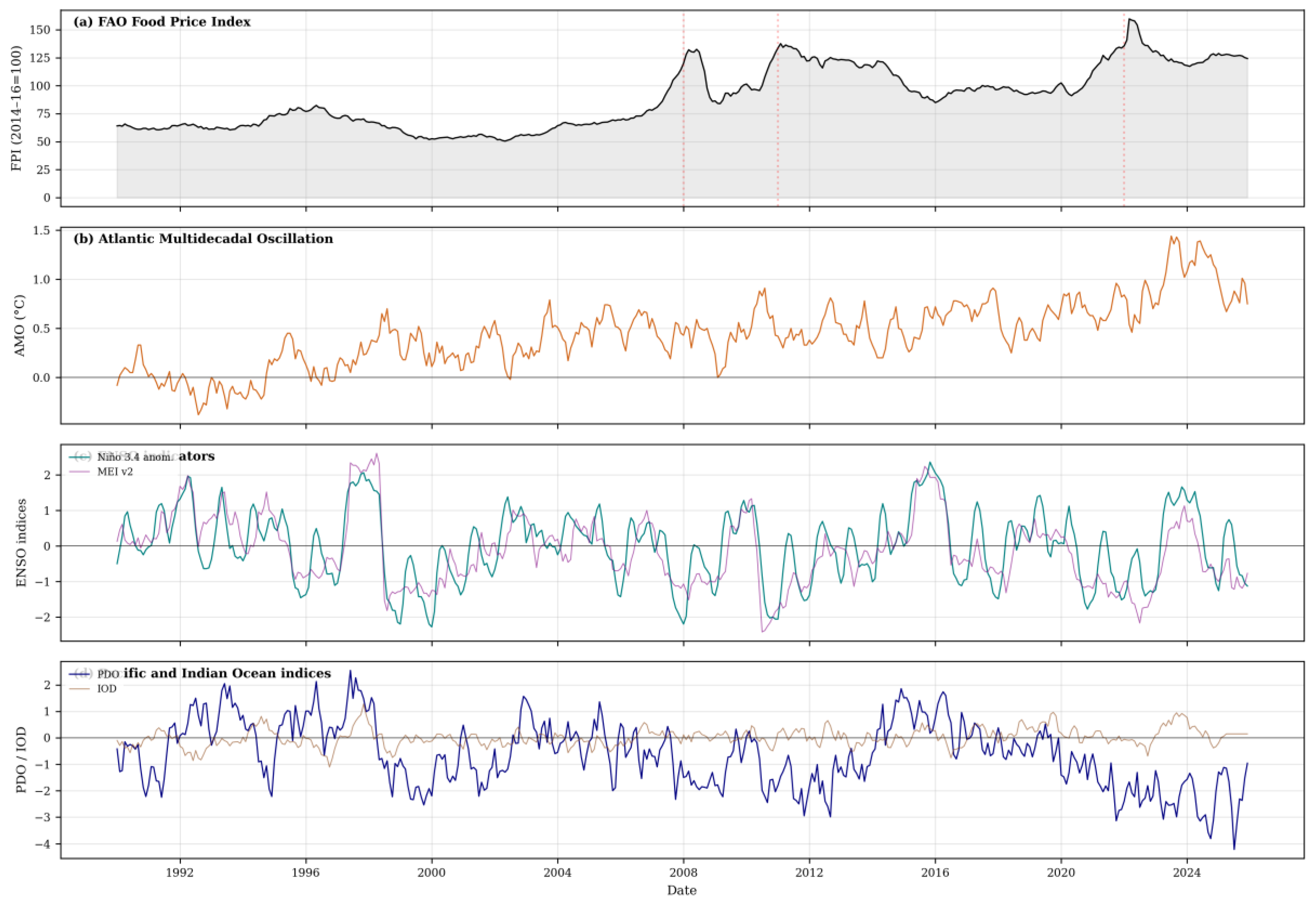
Figure 2.
Welch power spectral density estimates for the FAO Food Price Index and its five sub-components, January 1990 – December 2025 (N = 432). Segment length L = 128 months, 50% overlap, Hann window. Vertical dashed lines indicate dominant spectral peaks (prominence > 0.3 in log-PSD). The horizontal axis is inverted so that longer periods appear to the left.
Figure 2.
Welch power spectral density estimates for the FAO Food Price Index and its five sub-components, January 1990 – December 2025 (N = 432). Segment length L = 128 months, 50% overlap, Hann window. Vertical dashed lines indicate dominant spectral peaks (prominence > 0.3 in log-PSD). The horizontal axis is inverted so that longer periods appear to the left.
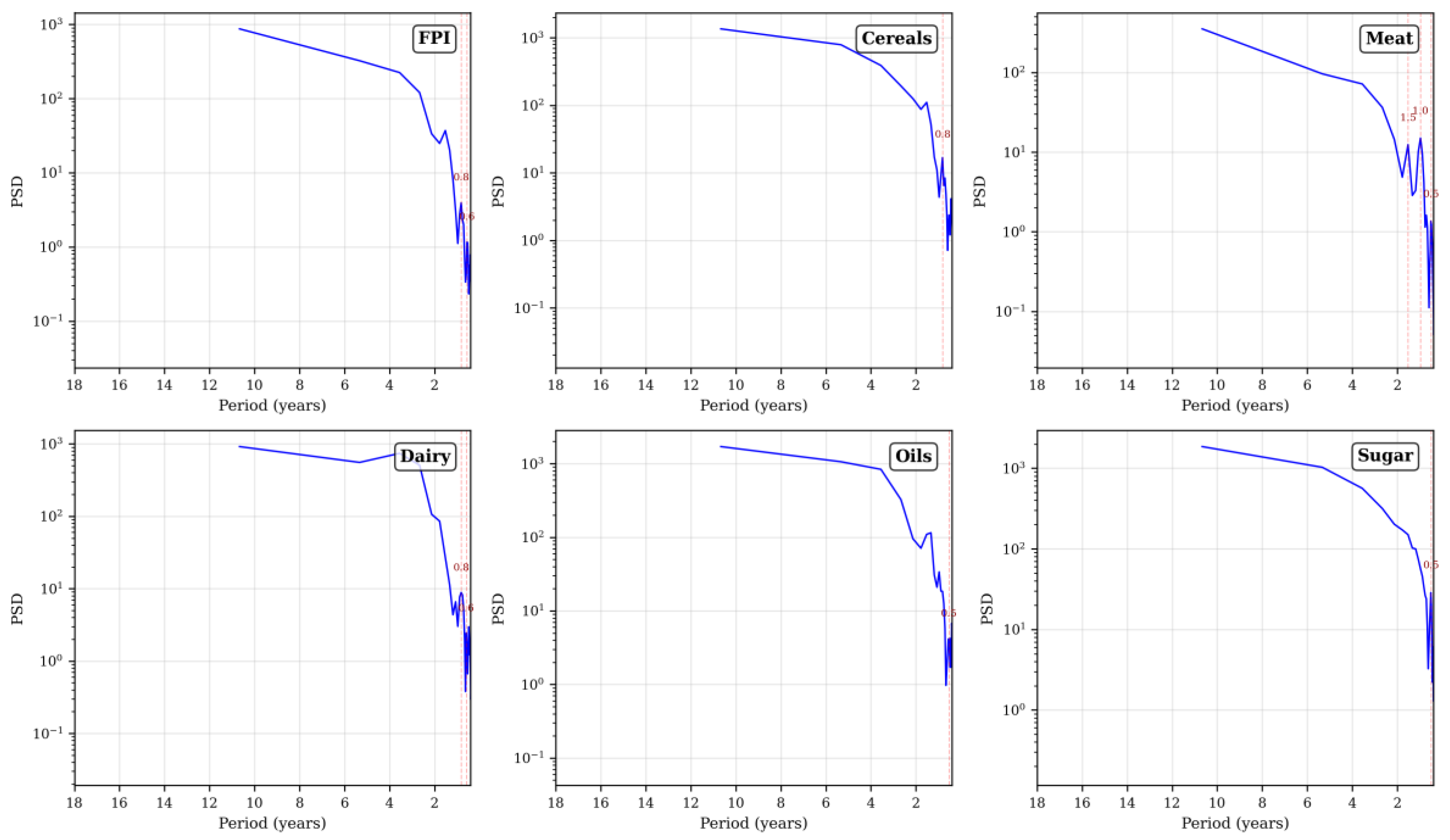
Figure 3.
Welch power spectral density estimates for seven climate oscillation indices over the 1990–2025 period (N = 432). Estimation parameters as in Figure 2.
Figure 3.
Welch power spectral density estimates for seven climate oscillation indices over the 1990–2025 period (N = 432). Estimation parameters as in Figure 2.
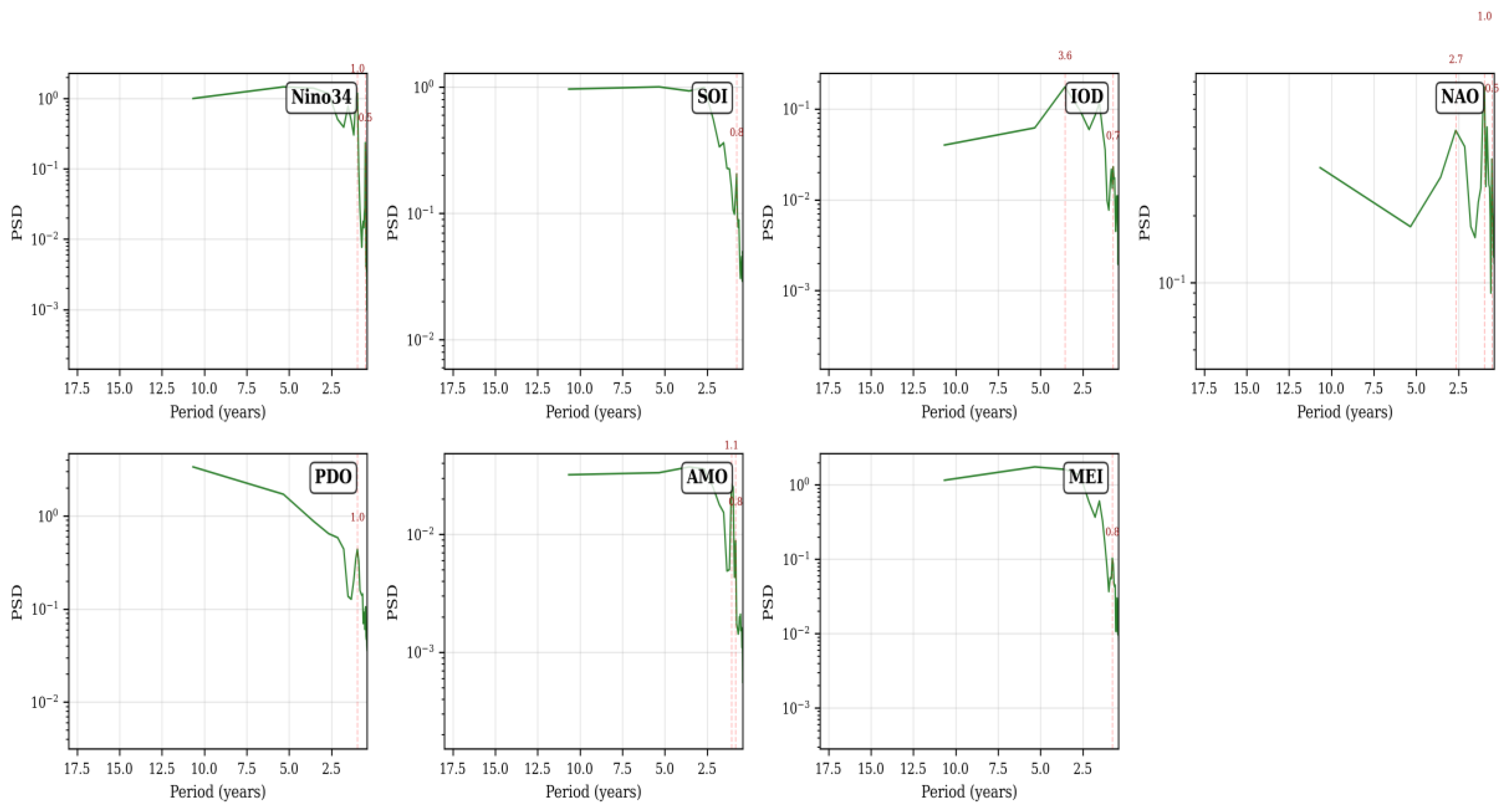
Figure 4.
Magnitude-squared cross-spectral coherence between the FAO FPI and seven climate oscillation indices. The horizontal dashed red line indicates the 95% significance threshold (γ²₀₅ = 0.527). The maximum coherence and its associated period are annotated for each pair.
Figure 4.
Magnitude-squared cross-spectral coherence between the FAO FPI and seven climate oscillation indices. The horizontal dashed red line indicates the 95% significance threshold (γ²₀₅ = 0.527). The maximum coherence and its associated period are annotated for each pair.
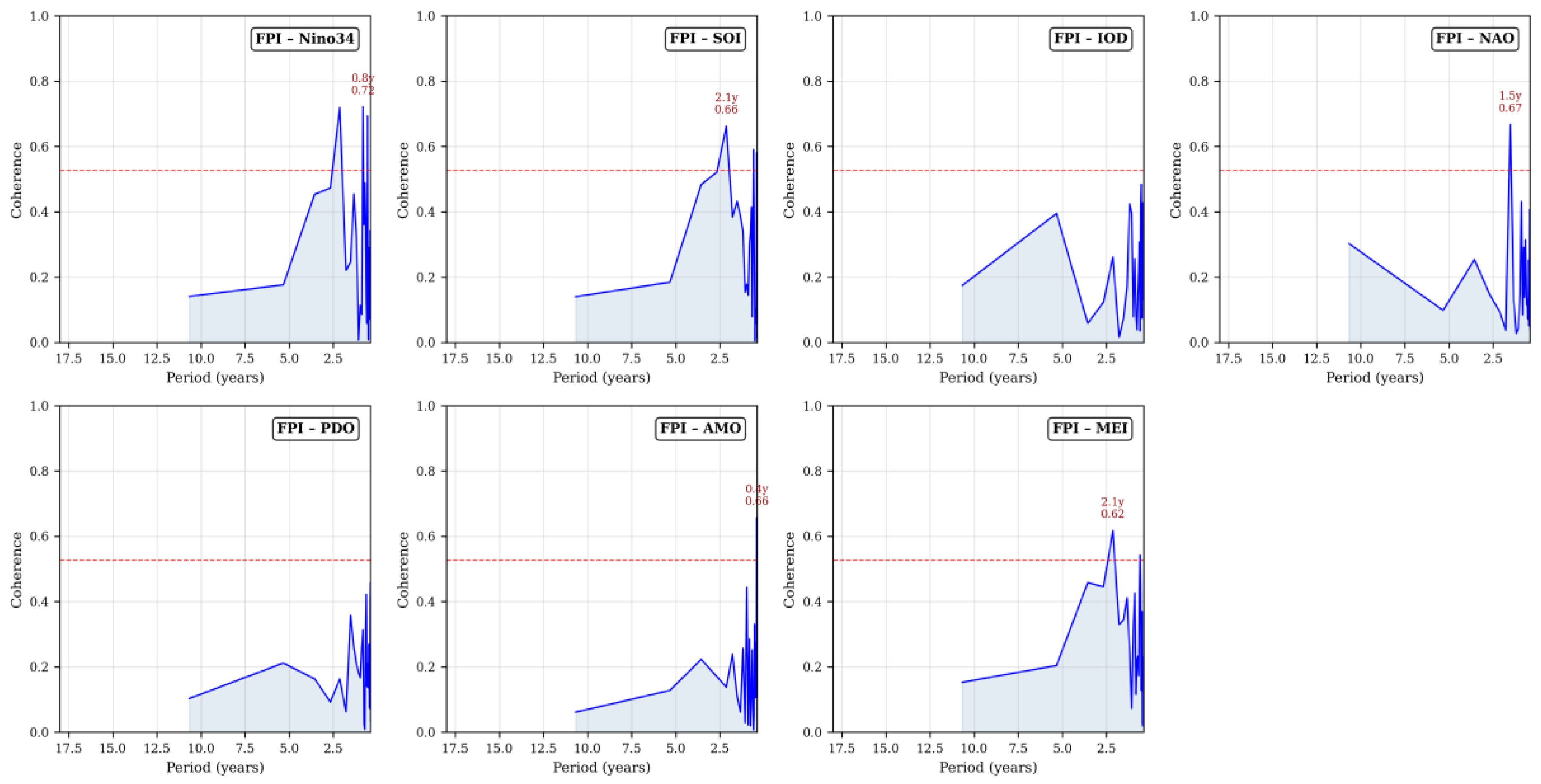
Figure 5.
Cross-spectral phase between the FAO FPI and each climate oscillation index. Blue points indicate frequencies at which the coherence exceeds the 95% significance threshold; grey points indicate non-significant frequencies. Positive phase indicates the climate index leads the FPI. Horizontal dashed lines mark ±90°.
Figure 5.
Cross-spectral phase between the FAO FPI and each climate oscillation index. Blue points indicate frequencies at which the coherence exceeds the 95% significance threshold; grey points indicate non-significant frequencies. Positive phase indicates the climate index leads the FPI. Horizontal dashed lines mark ±90°.
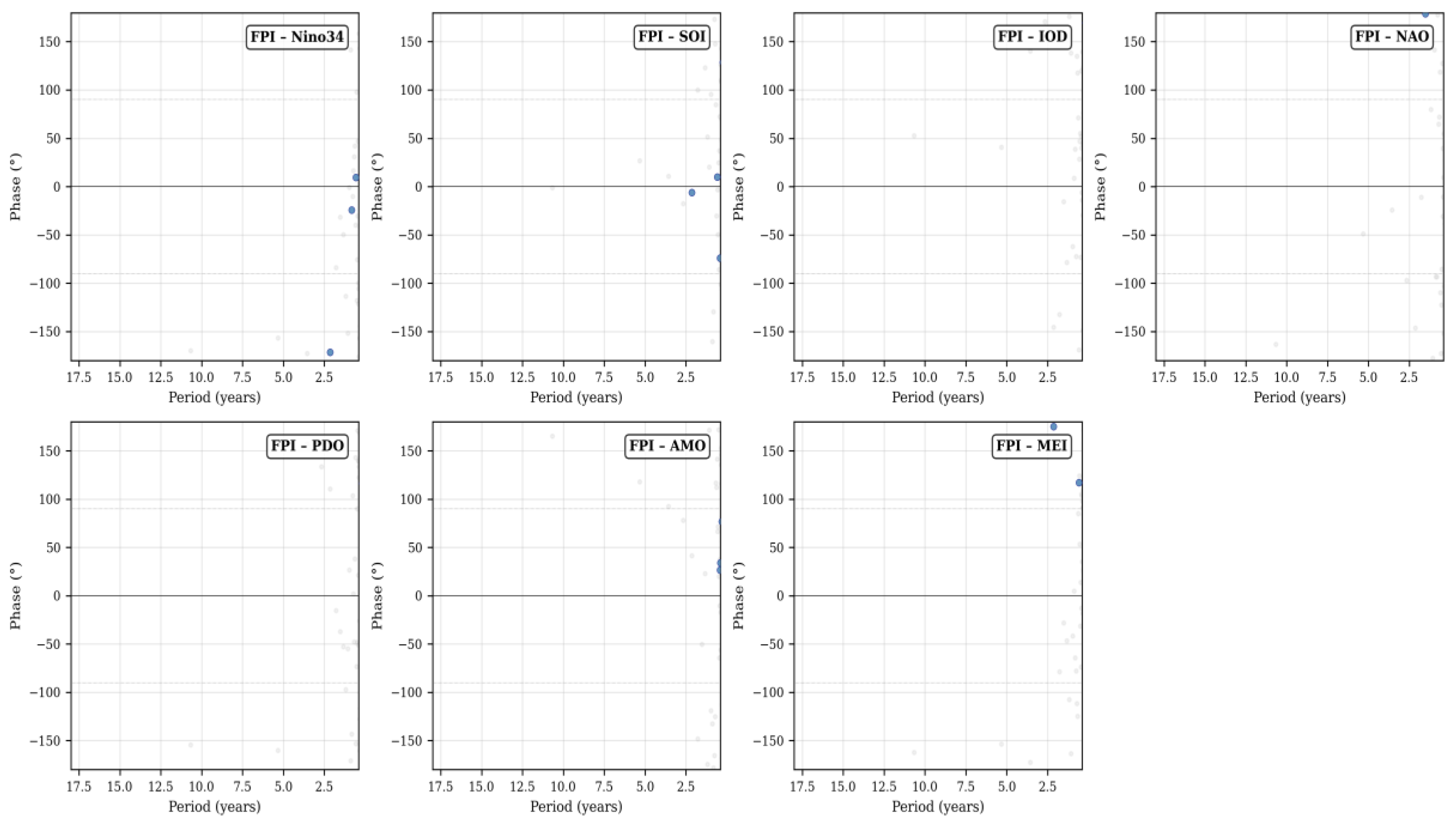
Figure 6.
Lagged cross-correlation functions between the FAO FPI and seven climate oscillation indices. Negative lags indicate the climate index leads the FPI. Horizontal dashed red lines mark the 95% significance bounds (±0.094). The optimal lag (τ*) and corresponding correlation (r) are annotated.
Figure 6.
Lagged cross-correlation functions between the FAO FPI and seven climate oscillation indices. Negative lags indicate the climate index leads the FPI. Horizontal dashed red lines mark the 95% significance bounds (±0.094). The optimal lag (τ*) and corresponding correlation (r) are annotated.
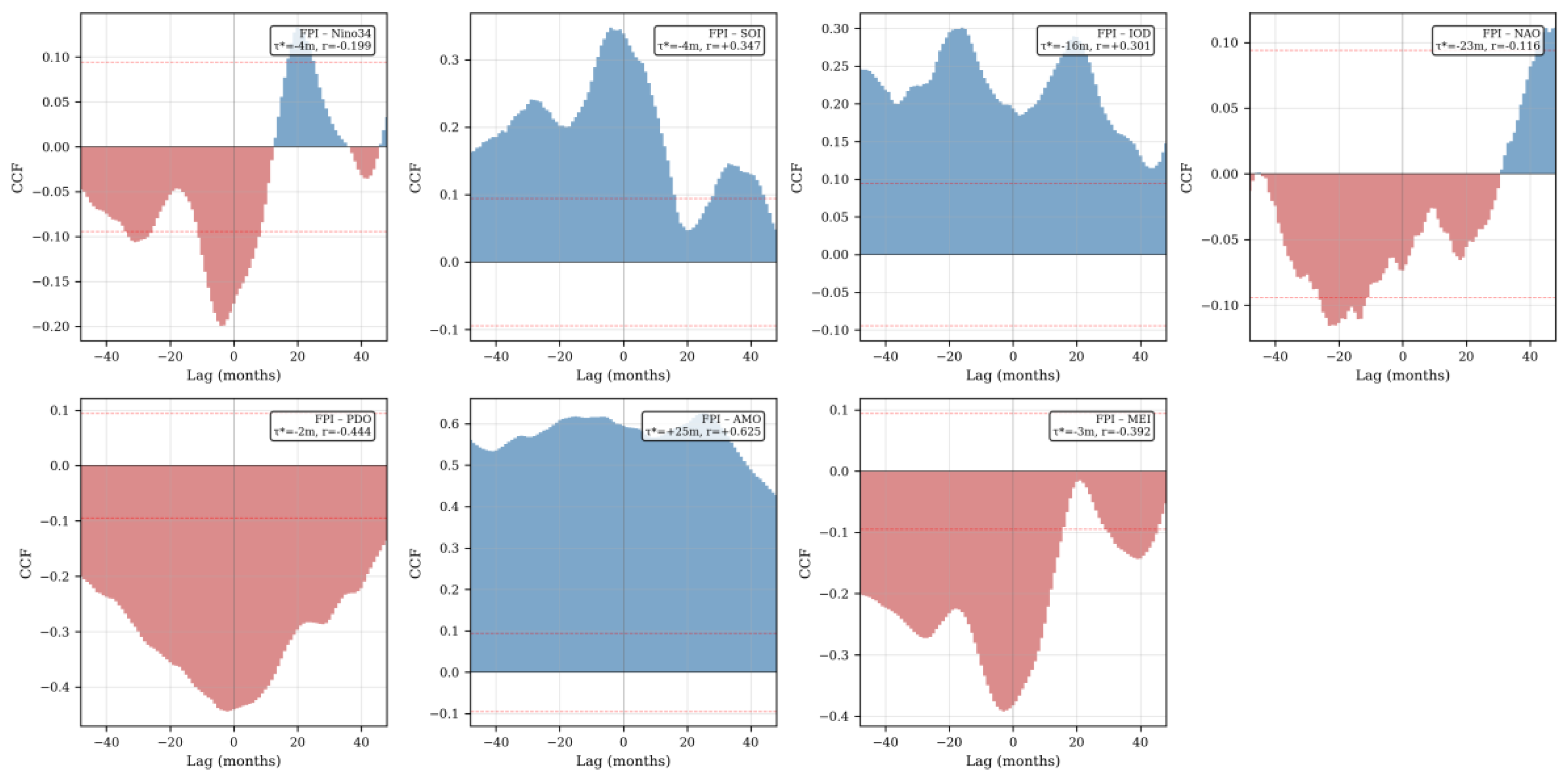
Figure 7.
Cross-spectral coherence between five FPI sub-indices and seven climate oscillation indices. Panel (a): maximum coherence value. Panel (b): period (in years) at which maximum coherence is achieved. Warmer colours in (a) indicate stronger coherence; warmer colours in (b) indicate longer characteristic periods.
Figure 7.
Cross-spectral coherence between five FPI sub-indices and seven climate oscillation indices. Panel (a): maximum coherence value. Panel (b): period (in years) at which maximum coherence is achieved. Warmer colours in (a) indicate stronger coherence; warmer colours in (b) indicate longer characteristic periods.
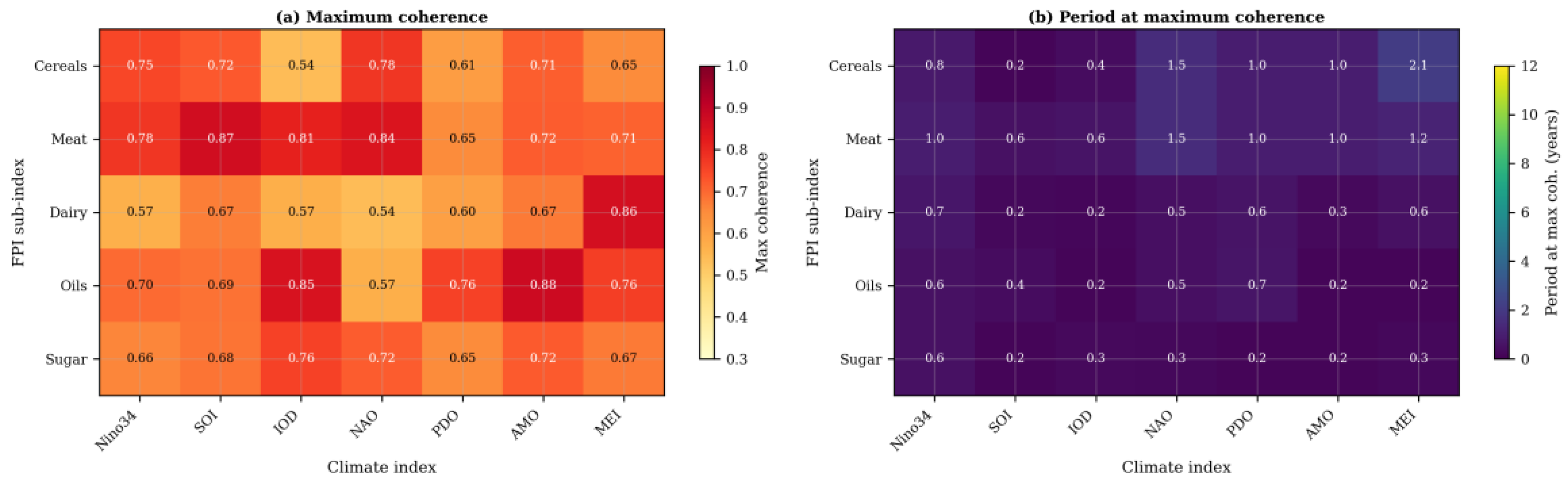
Figure 8.
Cross-spectral coherence between five FPI sub-indices and the AMO (top row) and PDO (bottom row). The horizontal dashed red line indicates the 95% significance threshold.
Figure 8.
Cross-spectral coherence between five FPI sub-indices and the AMO (top row) and PDO (bottom row). The horizontal dashed red line indicates the 95% significance threshold.
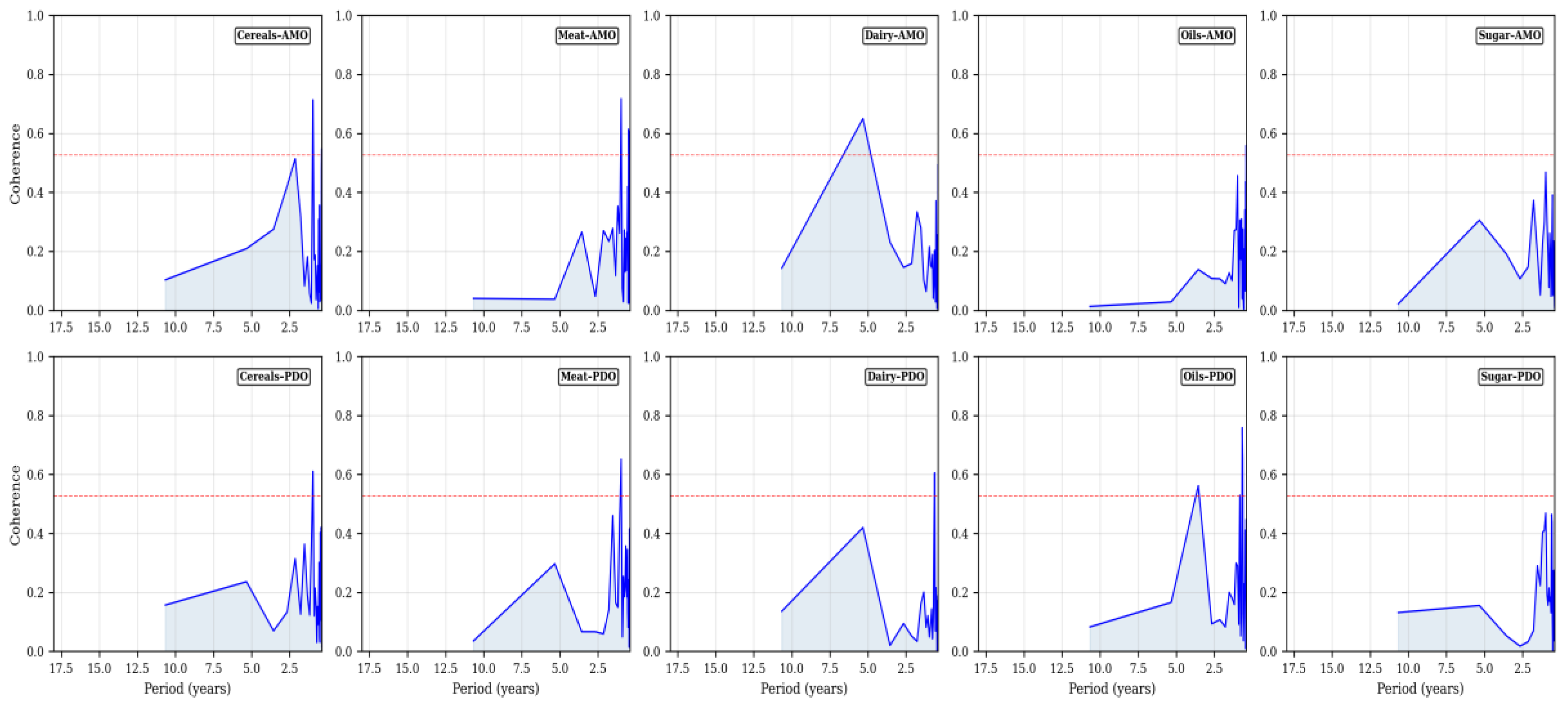
Figure 9.
Rolling-window cross-spectral coherence (15-year window, 12-month step) between the FAO FPI and four key climate indices. The colour scale indicates coherence magnitude (0 = no coherence, 1 = perfect coherence). The vertical axis shows the period in years; the horizontal axis shows the centre date of the rolling window.
Figure 9.
Rolling-window cross-spectral coherence (15-year window, 12-month step) between the FAO FPI and four key climate indices. The colour scale indicates coherence magnitude (0 = no coherence, 1 = perfect coherence). The vertical axis shows the period in years; the horizontal axis shows the centre date of the rolling window.
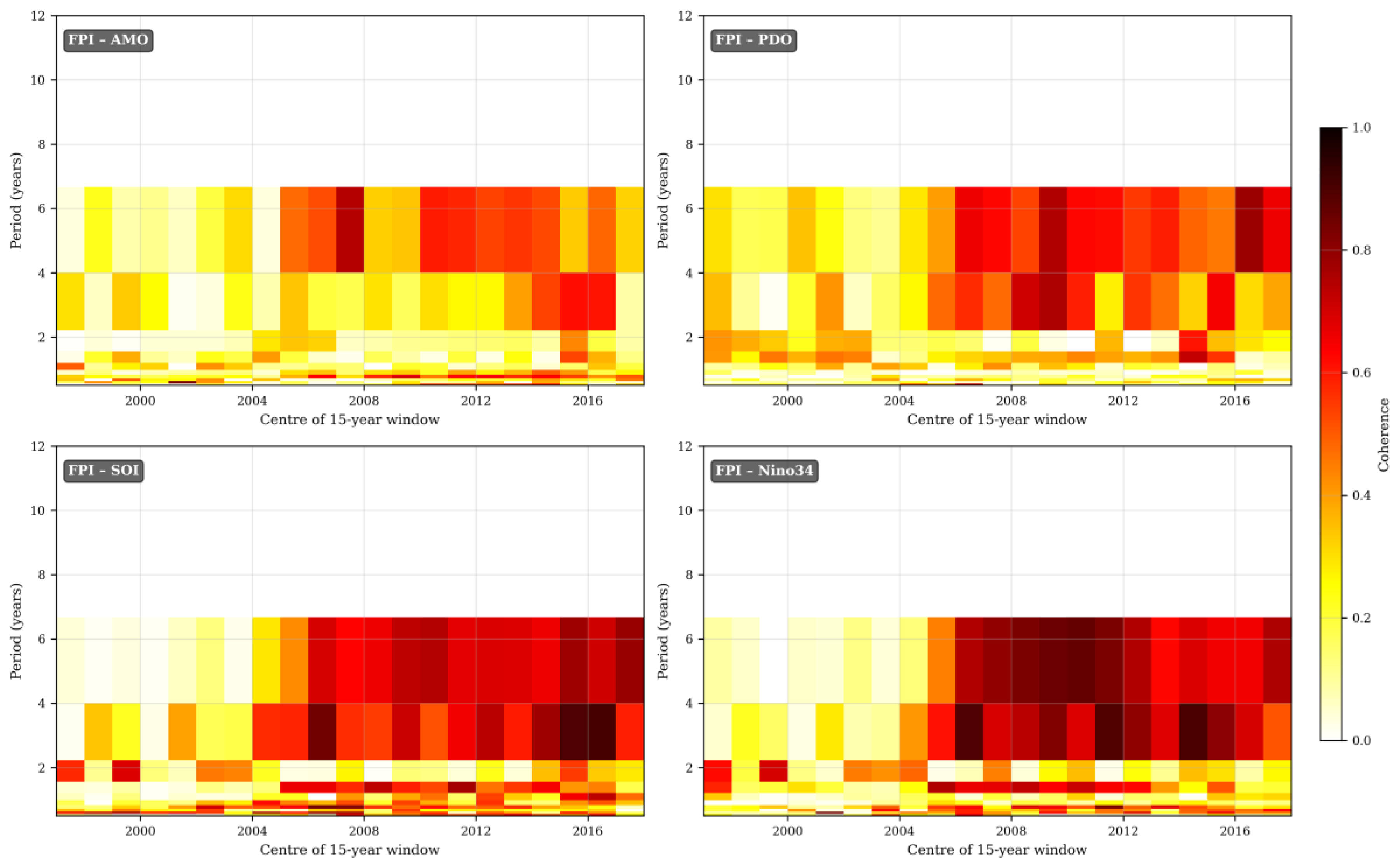
Figure 10.
Cross-spectral coherence between first-differenced FPI and first-differenced climate indices. Estimation parameters as in Figure 4. The red dashed line indicates the 95% significance threshold.
Figure 10.
Cross-spectral coherence between first-differenced FPI and first-differenced climate indices. Estimation parameters as in Figure 4. The red dashed line indicates the 95% significance threshold.
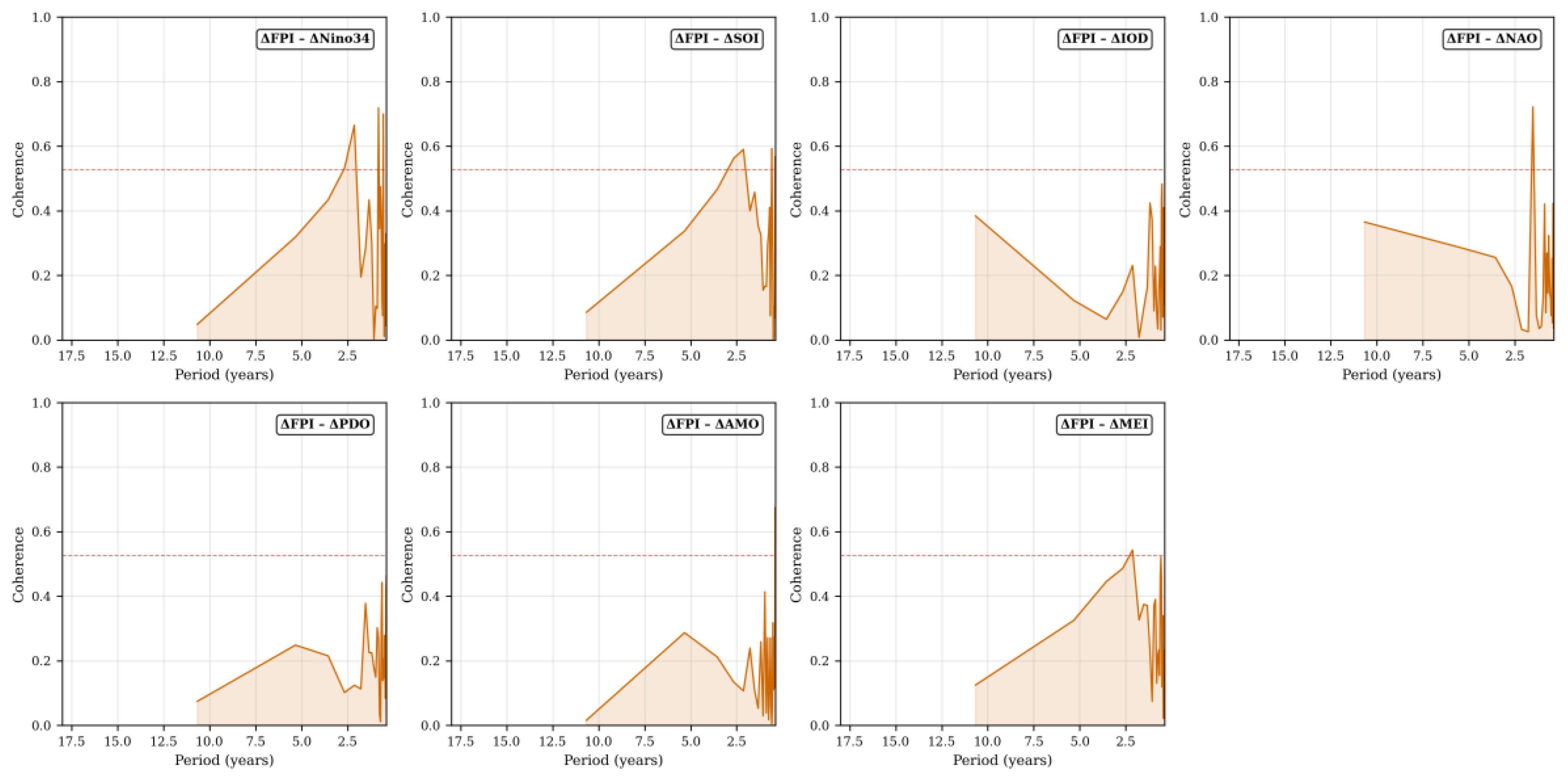
Figure 11.
Sensitivity of cross-spectral coherence to Welch segment length: L = 96 (green), L = 128 (blue, baseline), L = 160 (red). Each panel shows the coherence between FPI and one climate index under the three configurations.
Figure 11.
Sensitivity of cross-spectral coherence to Welch segment length: L = 96 (green), L = 128 (blue, baseline), L = 160 (red). Each panel shows the coherence between FPI and one climate index under the three configurations.
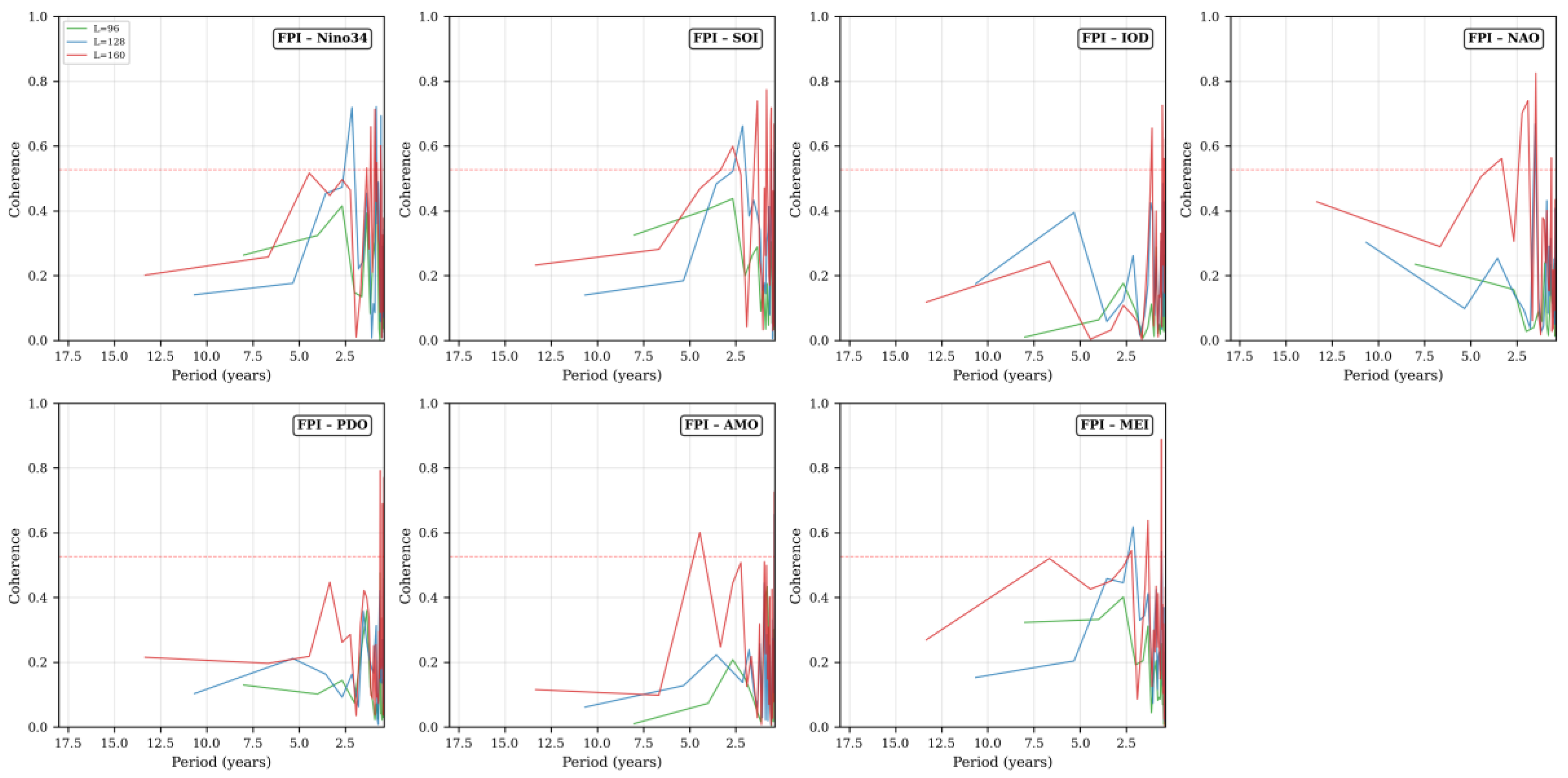
Figure 12.
Cross-spectral coherence in two sub-periods: 1990–2007 (blue) and 2008–2025 (red). The horizontal dashed line indicates the 95% significance threshold for the sub-period sample size.
Figure 12.
Cross-spectral coherence in two sub-periods: 1990–2007 (blue) and 2008–2025 (red). The horizontal dashed line indicates the 95% significance threshold for the sub-period sample size.
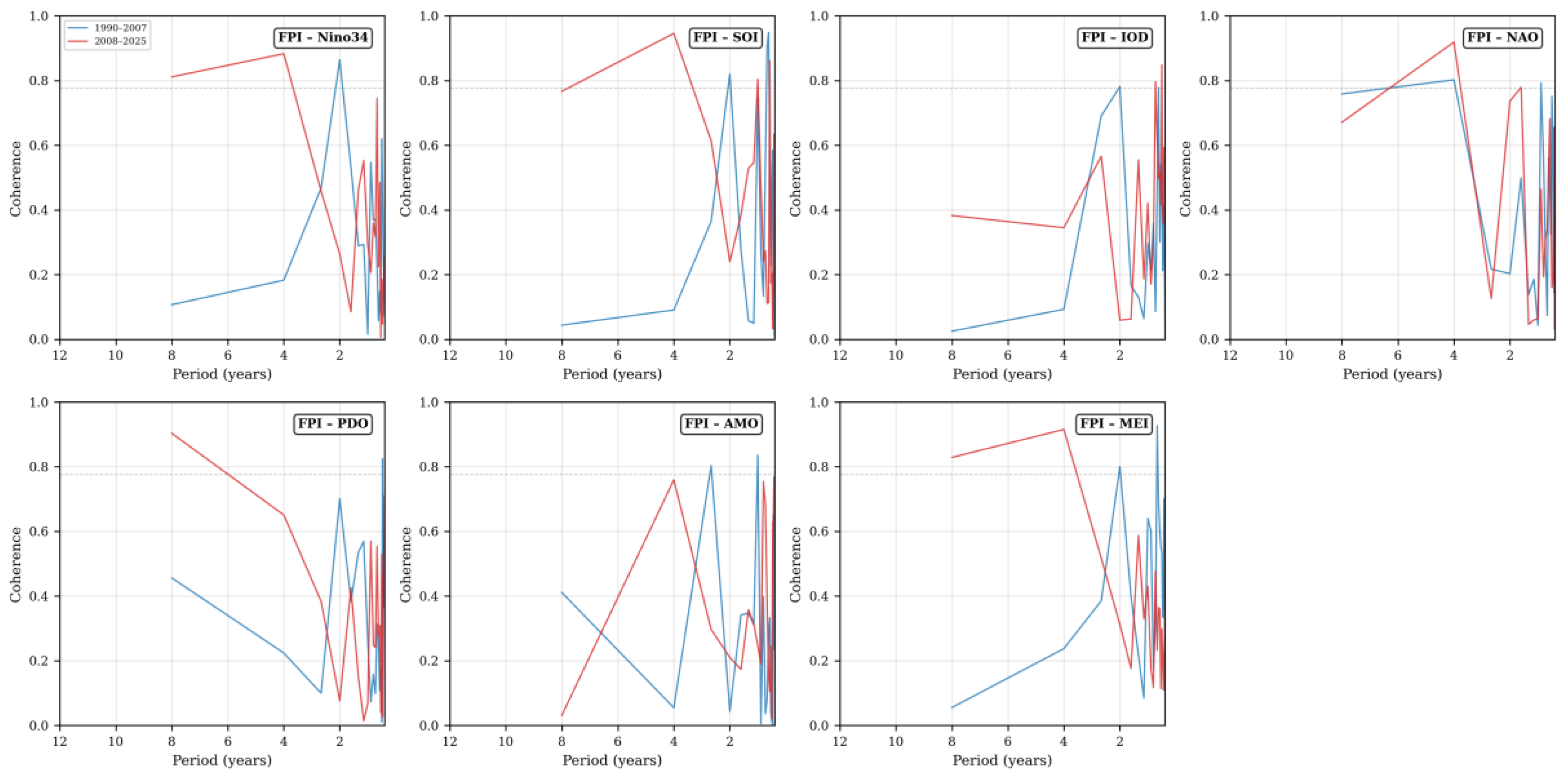
Figure 13.
Comparison of Welch (blue) and Thomson multitaper (red, NW = 4, 7 tapers) coherence estimates for FPI versus each climate index.
Figure 13.
Comparison of Welch (blue) and Thomson multitaper (red, NW = 4, 7 tapers) coherence estimates for FPI versus each climate index.
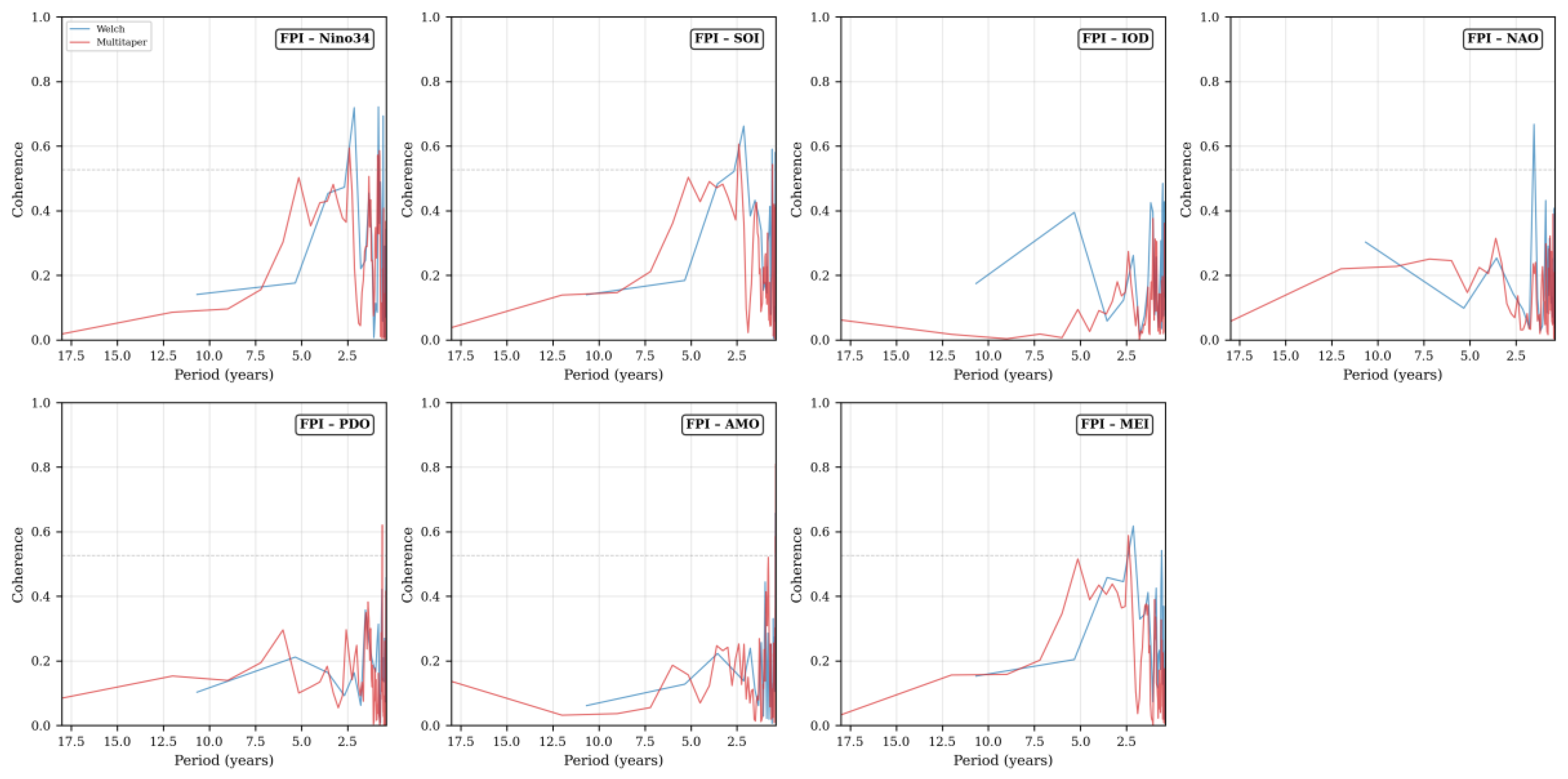
Figure 14.
IAAFT surrogate test for four key climate–FPI pairs. The blue line shows the observed coherence; the orange shading and dashed line indicate the 95th percentile of the IAAFT surrogate distribution (500 pairs). The red dotted line marks the parametric 95% threshold. Frequencies where the observed coherence exceeds both thresholds are robustly significant.
Figure 14.
IAAFT surrogate test for four key climate–FPI pairs. The blue line shows the observed coherence; the orange shading and dashed line indicate the 95th percentile of the IAAFT surrogate distribution (500 pairs). The red dotted line marks the parametric 95% threshold. Frequencies where the observed coherence exceeds both thresholds are robustly significant.
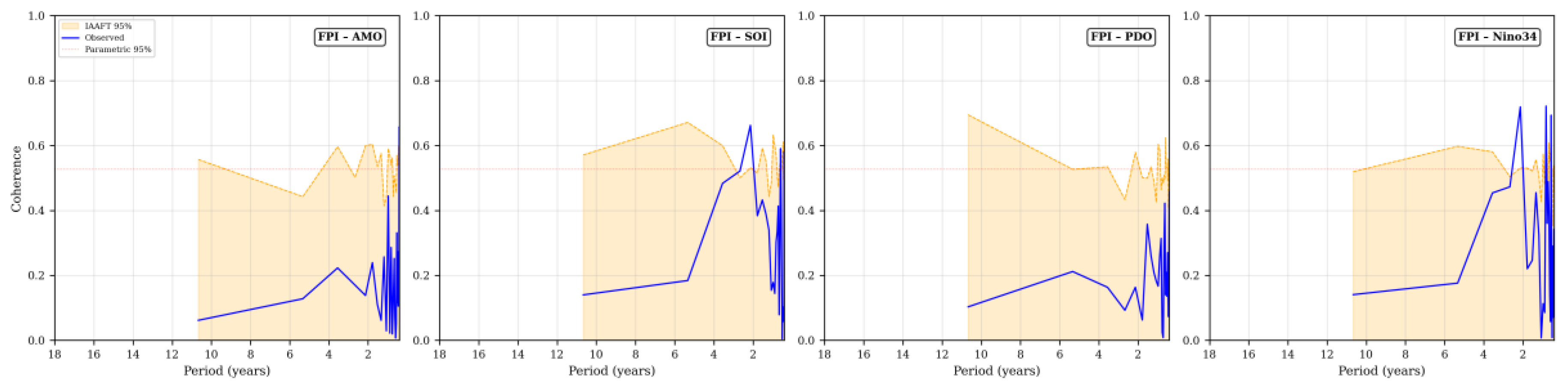
Table 1.
Data sources and coverage.
| Variable | Acronym | Period | N | Freq. | Source |
|---|---|---|---|---|---|
| FAO Food Price Index | FPI | 1990–2025 | 432 | Monthly | FAO (2025) |
| Cereals sub-index | — | 1990–2025 | 432 | Monthly | FAO (2025) |
| Meat sub-index | — | 1990–2025 | 432 | Monthly | FAO (2025) |
| Dairy sub-index | — | 1990–2025 | 432 | Monthly | FAO (2025) |
| Vegetable oils sub-index | — | 1990–2025 | 432 | Monthly | FAO (2025) |
| Sugar sub-index | — | 1990–2025 | 432 | Monthly | FAO (2025) |
| FAO FPI (annual) | FPI | 1961–2025 | 65 | Annual | FAO (2025) |
| Niño 3.4 SST anomaly | Niño 3.4 | 1950–2026 | 914 | Monthly | NOAA CPC (ERSSTv5) |
| Southern Oscillation Index | SOI | 1951–2025 | 900 | Monthly | NOAA CPC |
| Multivariate ENSO Index | MEI v2 | 1979–2026 | 566 | Monthly | NOAA PSL |
| Indian Ocean Dipole | IOD/DMI | 1870–2025 | 1,864 | Monthly | NOAA PSL (HadSST) |
| North Atlantic Oscillation | NAO | 1950–2026 | 914 | Monthly | NOAA CPC |
| Pacific Decadal Oscillation | PDO | 1854–2026 | 2,066 | Monthly | NOAA NCEI (ERSSTv5) |
| Atlantic Multidecadal Osc. | AMO | 1854–2026 | 2,066 | Monthly | NOAA NCEI (ERSSTv5) |
| Prevalence of Undernourish. | PoU | 2001–2023 | 23 | Annual | FAO/World Bank |
| Country panel (food imports, GDP p.c., PoU; 190 countries) | — | 2000–2023 | 4,362 | Annual | World Bank WDI |
Table 2.
Descriptive statistics, monthly sample (January 1990 – December 2025, N = 432).
| Variable | Mean | S.D. | Min | Max | Missing |
|---|---|---|---|---|---|
| FPI | 88.9 | 27.3 | 50.5 | 159.7 | — |
| Cereals | 86.7 | 27.8 | 45.0 | 170.1 | — |
| Meat | 86.1 | 20.3 | 56.1 | 125.4 | — |
| Dairy | 97.1 | 39.7 | 41.4 | 232.0 | — |
| Oils | 83.4 | 37.7 | 35.3 | 180.3 | — |
| Sugar | 91.2 | 36.2 | 43.1 | 198.4 | — |
| Niño 3.4 (°C) | 27.06 | 1.00 | 24.78 | 29.42 | 0 |
| SOI | 0.13 | 0.95 | −3.10 | 2.90 | 0 |
| MEI v2 | −0.14 | 0.95 | −2.42 | 2.61 | 0 |
| IOD/DMI | 0.01 | 0.34 | −1.11 | 1.28 | 8 |
| NAO | 0.04 | 1.05 | −3.18 | 2.63 | 0 |
| PDO | −0.64 | 1.24 | −4.21 | 2.55 | 0 |
| AMO (°C) | 0.43 | 0.34 | −0.38 | 1.44 | 0 |
Notes: FPI and sub-indices are rebased to 2014–2016 = 100. Niño 3.4 reports absolute SST (°C); all other climate indices are dimensionless anomalies except AMO (°C). Missing values refer to the merged monthly sample.
Table 3.
Summary of cross-spectral and lagged correlation results. Columns show: Pearson correlation, maximum coherence (γ²) and its period, number of significant frequency bins, optimal lag (τ*, negative = climate leads FPI), lag correlation, and first-differenced coherence.
Table 3.
Summary of cross-spectral and lagged correlation results. Columns show: Pearson correlation, maximum coherence (γ²) and its period, number of significant frequency bins, optimal lag (τ*, negative = climate leads FPI), lag correlation, and first-differenced coherence.
| Climate index | r(FPI) | Max γ² | Period (yr) | #Sig | τ* (mo) | Lag r | Δ Max γ² | Δ Period |
|---|---|---|---|---|---|---|---|---|
| Niño 3.4 | −0.174 | 0.721 | 0.8 | 3 | −4 | −0.199 | 0.718 | 0.8 |
| SOI | +0.338 | 0.662 | 2.1 | 4 | −4 | +0.347 | 0.593 | 0.6 |
| IOD | +0.194 | 0.700 | 0.2 | 2 | −16 | +0.301 | 0.699 | 0.2 |
| NAO | −0.073 | 0.667 | 1.5 | 1 | −23 | −0.116 | 0.721 | 1.5 |
| PDO | −0.441 | 0.806 | 0.2 | 4 | −2 | −0.444 | 0.808 | 0.2 |
| AMO | +0.595 | 0.657 | 0.4 | 4 | +25 | +0.625 | 0.675 | 0.4 |
| MEI v2 | −0.383 | 0.618 | 2.1 | 2 | −3 | −0.392 | 0.543 | 2.1 |
Notes: 95% coherence threshold = 0.527 (K ≈ 5 segments). 95% CCF bounds = ±0.094. All climate indices are detrended.
Table 4.
Pearson correlation coefficients between FPI sub-indices and climate oscillation indices (N = 432, all variables detrended).
Table 4.
Pearson correlation coefficients between FPI sub-indices and climate oscillation indices (N = 432, all variables detrended).
| Sub-index | Niño 3.4 | SOI | IOD | NAO | PDO | AMO | MEI |
|---|---|---|---|---|---|---|---|
| Cereals | −0.179 | +0.352 | +0.204 | −0.080 | −0.419 | +0.524 | −0.386 |
| Meat | −0.051 | +0.186 | +0.193 | −0.033 | −0.337 | +0.560 | −0.234 |
| Dairy | −0.225 | +0.357 | +0.171 | −0.048 | −0.423 | +0.607 | −0.415 |
| Oils | −0.235 | +0.379 | +0.159 | −0.094 | −0.459 | +0.567 | −0.424 |
| Sugar | −0.092 | +0.241 | +0.147 | −0.109 | −0.278 | +0.413 | −0.218 |
Table 5.
Sub-period stability of cross-spectral coherence. Sub-period I: 1990–2007 (N = 216); Sub-period II: 2008–2025 (N = 216). Fisher z-test for equality of maximum coherence.
Table 5.
Sub-period stability of cross-spectral coherence. Sub-period I: 1990–2007 (N = 216); Sub-period II: 2008–2025 (N = 216). Fisher z-test for equality of maximum coherence.
| Index | Max γ² (I) | Max γ² (II) | z-stat | p-value | Strengthened? | Interpretation |
|---|---|---|---|---|---|---|
| Niño 3.4 | 0.933 | 0.883 | −3.04 | 0.002 | No | Decline |
| SOI | 0.949 | 0.946 | −0.30 | 0.764 | No | Stable |
| IOD | 0.924 | 0.848 | −3.80 | <0.001 | No | Decline |
| NAO | 0.802 | 0.919 | +4.93 | <0.001 | Yes | Strengthen |
| PDO | 0.830 | 0.911 | +3.58 | <0.001 | Yes | Strengthen |
| AMO | 0.843 | 0.865 | +0.84 | 0.402 | Yes | Stable |
| MEI v2 | 0.927 | 0.915 | −0.83 | 0.407 | No | Stable |
Notes: Welch parameters within sub-periods: L = 96, overlap = 48. Significance at the 5% level is indicated by p < 0.05.
Table 6.
IAAFT surrogate test results (500 surrogate pairs). Parametric sig.: number of frequency bins exceeding γ²₀₅ = 0.527. IAAFT robust sig.: number of frequency bins exceeding both the parametric and surrogate-based 95% thresholds.
Table 6.
IAAFT surrogate test results (500 surrogate pairs). Parametric sig.: number of frequency bins exceeding γ²₀₅ = 0.527. IAAFT robust sig.: number of frequency bins exceeding both the parametric and surrogate-based 95% thresholds.
| Pair | Parametric sig. | IAAFT robust sig. | Robustness rate |
|---|---|---|---|
| FPI – AMO | 4 | 3 | 75% |
| FPI – SOI | 4 | 4 | 100% |
| FPI – PDO | 4 | 2 | 50% |
| FPI – Niño 3.4 | 3 | 3 | 100% |
Disclaimer/Publisher’s Note: The statements, opinions and data contained in all publications are solely those of the individual author(s) and contributor(s) and not of MDPI and/or the editor(s). MDPI and/or the editor(s) disclaim responsibility for any injury to people or property resulting from any ideas, methods, instructions or products referred to in the content. |
© 2026 by the authors. Licensee MDPI, Basel, Switzerland. This article is an open access article distributed under the terms and conditions of the Creative Commons Attribution (CC BY) license (http://creativecommons.org/licenses/by/4.0/).
Copyright: This open access article is published under a Creative Commons CC BY 4.0 license, which permit the free download, distribution, and reuse, provided that the author and preprint are cited in any reuse.