

Submitted:
27 June 2026
Posted:
29 June 2026
You are already at the latest version
Abstract
Large-scale water infrastructure across the East African Rift System faces severe structural degradation and capacity underutilization. This research presents a forensic engineering investigation into post-construction structural failures and lifecycle performance deficits at the multi-purpose Gerebsegen Dam in northern Ethiopia, positioning the findings within the macro-regional discourse on East African dam safety paradigms. Engineered with a 30-year design lifespan to provide municipal water to Mekelle city and irrigate a 500-hectare command area via a three-outlet pressure conduit configuration, the project exhibits a critical discrepancy between chronological age and operational efficiency. Though 12 years have elapsed since construction completion, the reservoir utilizes a mere 20% of its total design storage volume. This operational yield is restricted exclusively to municipal supply via just one active baseline pipeline, representing a 50% water supply transmission rate and a 0% infrastructural delivery rate for the planned 500-hectare irrigation network. Compounding these severe capacity utilization deficits, acute geotechnical instabilities prompted progressive longitudinal cracking and the partial collapse of the masonry gravity retaining structures flanking the left spillway abutment post-impoundment. Field diagnostics pinpointed an unallowable subsurface seepage rate of 0.568 m³/s bypassing the core via fractured dolerite channels, inducing massive back-of-wall hydrostatic pressures. To mitigate these structural risks, a regional-standard remedial engineering package is evaluated, featuring a structural replacement with a rigid, tapered cantilever reinforced concrete structure up to 7.20 m high, a 1,700.50 m³ upper-slope offloading excavation to a stable 45° profile, and a subsurface pressure-grouting curtain.
Keywords:
forensic engineering
; dam safety
; multi-purpose reservoir
; infrastructure capacity underutilization
; seepage mitigation
; east african rift system
1. Introduction
The strategic deployment of large-scale water storage assets across East Africa particularly within the complex geomorphological terrain of the Ethiopian Highlands and the East African Rift System is a fundamental pillar supporting regional climate resilience, smallholder food security, and long-term municipal water sustainability[1,2,3]. However, this rapid expansion of structural assets has increasingly collided with deep-seated geomechanical, hydraulic, and institutional distress [4]. While modern hydraulic engineering frameworks focus heavily on preventing macro-hydrologic overtopping events, forensic data indicates that a substantial proportion of dam safety incidents stem from localized geomechanical adjustments and hydrogeological oversights localized within ancillary spillway structures, adjacent natural flanks, and abutment retaining walls[5,6,7]. This physical vulnerability is further exacerbated by systemic administrative inefficiencies, project management discontinuities, and governance bottlenecks that prevent water assets from achieving their intended design utility[8].
This intersection of physical and operational vulnerability is heavily documented across sub-Saharan Africa's variable micro-climates. For example, regional experiences highlight that minor geomechanical discrepancies often propagate into major structural and socioeconomic failures [9,10]. In Kenya's Rift Valley region, unmanaged hydraulic forces have frequently triggered downstream scour damage and localized embankment slope instabilities along seasonal river passages[11,12]. Similarly, historical failures of masonry structures in weathered Tanzanian basements demonstrate that rigid gravity segments are poorly suited to absorb lateral earth shifts without internal pressure relief networks[13]. These macro-regional failure modes show that complex interactions at the boundary where artificial masonry or concrete anchors into variable, fractured natural rock masses require a shift from deterministic design standards toward modern limit state analysis[14].
The Gerebsegen Dam, situated on the Gabbat River at a baseline elevation of 1980 meters above sea level (UTM, WGS 84: 542000 E 1481500 N) within the Tigray region of Northern Ethiopia, exemplifies these dual technical and administrative challenges[8]. Built with a gross reservoir storage capacity of 25 million cubic meters (Mm3), the multi-purpose asset was engineered with a projected 30-year operational design life to serve a critical regional demographic[5]. The project fulfills a dual mandate: bolstering rural agricultural yields through downstream smallholder irrigation networks across a designated 500-hectare command area, and securing the municipal water supply of Mekelle city[5]. Operationally, this layout relies on a localized distribution configuration utilizing three distinct structural outlet conduits: one dedicated specifically to irrigation routing and two separate pipelines designed for municipal water treatment supply lines.
Despite its vital socioeconomic role, a profound discrepancy exists between the project’s chronological timeline and its operational efficacy. Although 12 years have elapsed since the completion of its construction representing nearly half of its intended design life the reservoir currently utilizes a mere 20% of its total water volume[5]. This minimal yield is directed exclusively toward municipal water supply through just one of the two installed water supply lines, meaning the municipal water delivery system functions at a tight 50% operational capacity. Meanwhile, the second municipal line remains completely inactive, and the infrastructure required to initiate the planned 500-hectare irrigation scheme has failed to materialize, resulting in a staggering 0% service delivery for agricultural development. Given that the project has nearly reached the midpoint of its intended design period while delivering only a fraction of its planned baseline utility, this systemic underperformance stands as a stark indicator of institutional mismanagement, professional irresponsibility, leadership incompetency, or the restrictive influence of patronage networks.
Compounding these institutional failures, immediate structural distress occurred post-impoundment. Severe, longitudinal open cracks quickly propagated along the left abutment flank of the spillway, culminating in progressive overturning, lateral displacement, and the ultimate structural failure of the stone masonry gravity retaining structures. These critical failures are attributed to intense lateral earth pressures compounded by a total lack of internal weep-hole drainage networks and massive, unmanaged subsurface seepage bypassing the core. By connecting the localized forensic data collected from the Gerebsegen site with systemic design and governance limitations identified across other East African infrastructures, this study advances the technical and administrative standards required to enforce long-term structural reliability and safety in complex sub-Saharan geomechanical environments.
1.1. East African Regional Context and Dam Safety Paradigms
Dam safety governance and technical execution across East Africa are undergoing a critical paradigm shift as regional water storage assets age, climate variability intensifies, and institutional delivery frameworks face intense scrutiny[15,16]. Historically, unreinforced stone masonry and gravity concrete configurations have been widely utilized for low-to-medium head water retention and spillway training structures across Ethiopia, Kenya, Uganda, and Tanzania due to the immediate socioeconomic benefits of using local labor and readily available regional materials[17]. However, modern forensic monitoring reveals that these rigid structures lack the structural flexibility and built-in internal drainage systems required to withstand the high hydrostatic forces and rapid pore-water pressure spikes characteristic of the region's highly weathered, fractured basaltic and dolerite rock formations[18,19].
This structural vulnerability is heavily highlighted by engineering failures across the East African Rift System (EARS), where complex regional tectonic histories create localized geomechanical anomalies[20,21]. For instance, forensic reviews of auxiliary structures in the weathered metamorphic baselines of Kenya's centralized rift basins show a repeated pattern of localized failure[22]. This occurs because rigid masonry components cannot easily adapt to the differential settlement or minor lateral shifts of natural slopes under saturated conditions[23].
Similarly, deep seepage anomalies and piping failures observed in unlined spillway channels within Ugandan basement complexes demonstrate that standard, deterministic geological assumptions often fail to identify hidden sub-surface micro-fractures and active hydraulic pathways[24]. Furthermore, during excavation stages for major water infrastructure projects in Tanzania such as the auxiliary works along the Rufiji River basin the sudden unloading of highly jointed rock masses frequently triggered retrogressive block movements, demonstrating how vulnerable steep construction cuts are when rock mass quality is poor[25].
These regional experiences show that the structural and operational distress at the multi-purpose Gerebsegen Dam is not an isolated event. Instead, it reflects a widespread regional issue where structural damage is concentrated directly at the interface where rigid, artificial masonry or concrete elements anchor into highly variable, weathered natural abutments, combined with a lack of institutional accountability during the operational phase of the asset.
When these structural interfaces are exposed to excessive subsurface flows such as the unallowable 0.568 m³/s seepage rate observed at Gerebsegen they quickly experience rapid pore-pressure build-up, accelerated shear strength degradation, and eventual structural collapse, while the administrative leadership fails to execute downstream distribution assets like the irrigation networks.
Addressing these systemic vulnerabilities requires updating regional design and governance standards. Workflows must shift away from simplified empirical rules and fragmented project execution. Instead, regional development bodies must integrate limit state structural checks, advanced limit equilibrium numerical simulations, mandatory subsurface seepage barriers like pressure-grouting curtains, and rigid, transparent lifecycle management protocols into standard engineering practice across Sub-Saharan Africa.
2. Materials and Methods
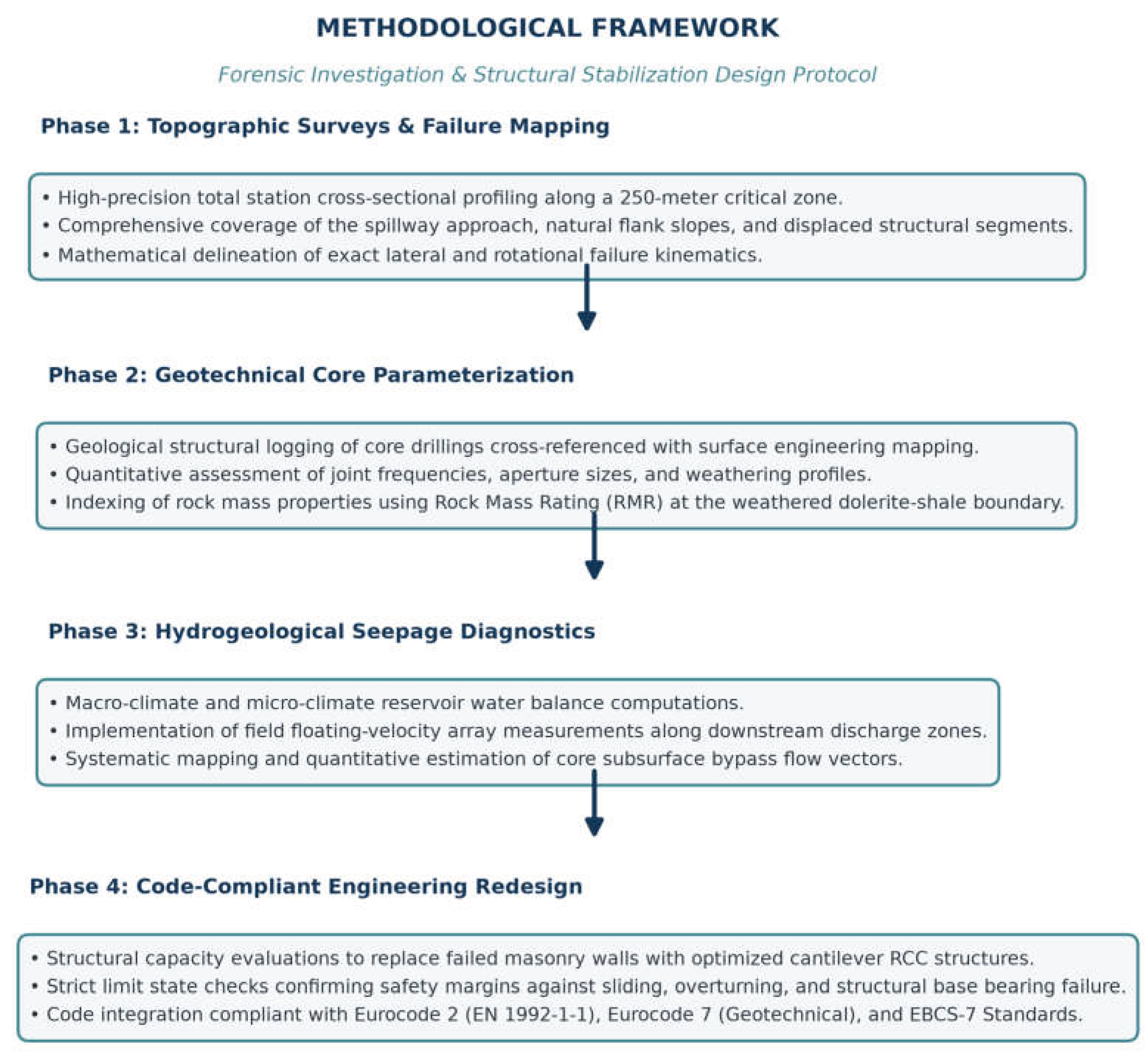
The forensic investigation and subsequent structural stabilization design for the Gerebsegen Dam spillway were executed via four deeply integrated technical phases:
- Topographic Surveys and Failure Mapping:High-precision total station cross-sectional profiling was completed along a 250-meter critical zone covering the spillway approach, natural flank slopes, and displaced structural segments to define exact lateral and rotational failure kinematics.
- Geotechnical Core Parameterization:Geological structural logging of core drillings was cross-referenced with surface engineering-geological mapping. Joint frequencies, aperture sizes, and weathering profiles were assessed to index the rock mass using the Rock Mass Rating (RMR) methodology, defining the structural properties at the weathered dolerite-shale boundary.
- Hydrogeological Seepage Diagnostics:Reservoir water balance computations were coupled with field floating-velocity array measurements along downstream discharge zones to map and quantify subsurface bypass vectors.
- Code-Compliant Engineering Redesign:Structural capacity evaluations were conducted to replace the failed gravity masonry walls with optimized cantilever reinforced concrete (RCC) configurations. Calculations were strictly based on Eurocode 2 (EN 1992-1-1), Eurocode 7 (Geotechnical Design), and the Ethiopian Building Code of Standards (EBCS-7: Foundations) to verify stability against sliding, overturning, and structural base bearing failure.
Figure 1.
Workflow methods.
2.1. Geographic Framework and Field Survey Mapping
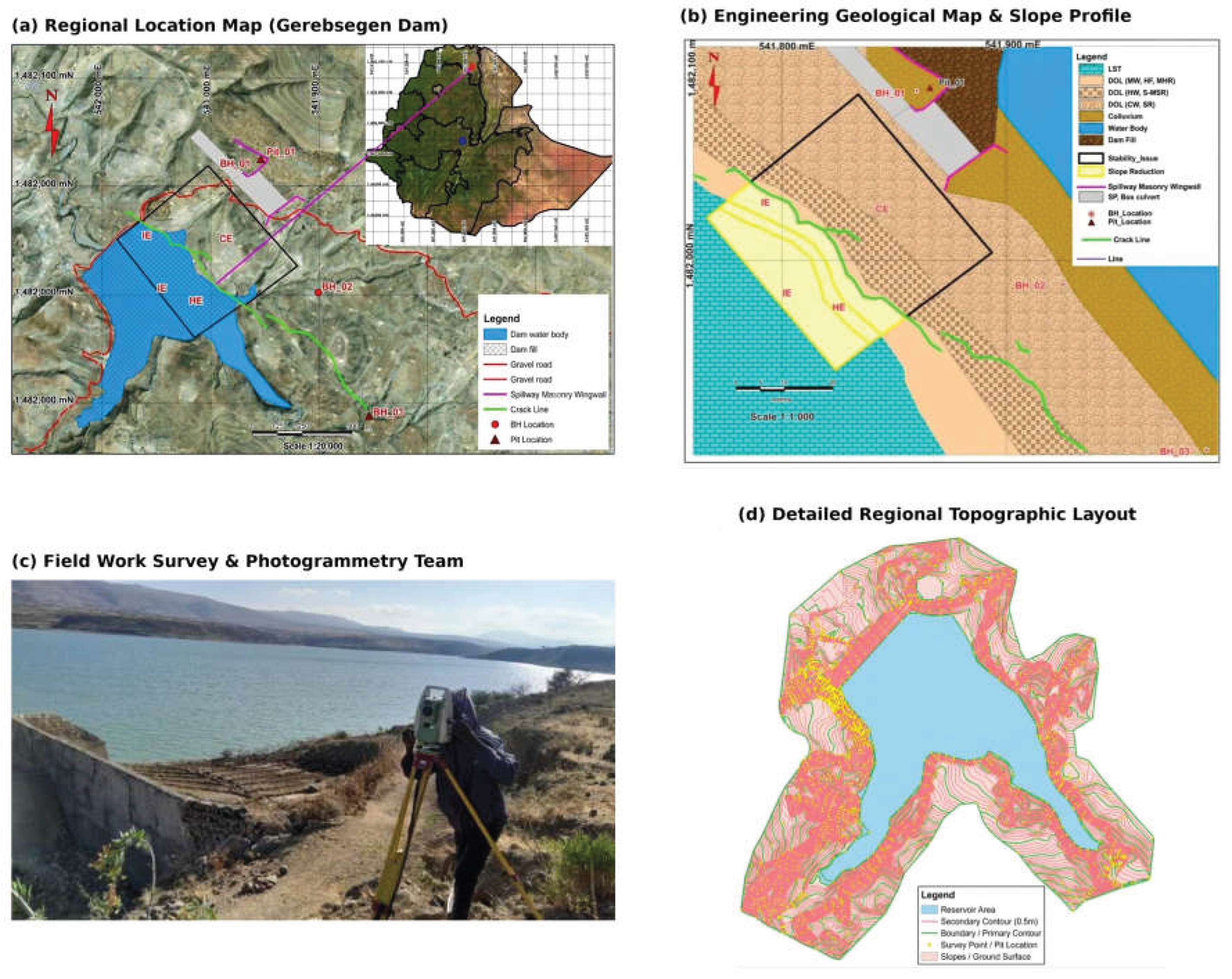
To capture the spatial and geometric nuances of the failure plane, the forensic team established a baseline coordinate matrix across the reservoir boundary. High-resolution satellite background datasets were leveraged to understand macro-structural trends.
Figure 2.
Geographic framework and field mapping of the study zone: (a) Regional location map of the Gerebsegen Dam within the Tigray Highlands of Ethiopia; (b) critical zone that needs slope reduction (yellow hatched polygon), main crack line (thick green line) and excavation classes, engineering geological map is used as background; (c) Photogrammetry document of the field work survey team establishing total station cross-sections across the distressed abutment; (d) Detailed regional topographic layout map outlining natural catchment gradients.
Figure 2.
Geographic framework and field mapping of the study zone: (a) Regional location map of the Gerebsegen Dam within the Tigray Highlands of Ethiopia; (b) critical zone that needs slope reduction (yellow hatched polygon), main crack line (thick green line) and excavation classes, engineering geological map is used as background; (c) Photogrammetry document of the field work survey team establishing total station cross-sections across the distressed abutment; (d) Detailed regional topographic layout map outlining natural catchment gradients.
3. Results and Discussion
3.1. Structural Sizing, Sizing Code Optimization, and Limit States
Forensic structural analysis indicated that the original stone masonry wall failed primarily due to insufficient base dimensioning and a lack of functional weep-hole drainage networks[5]. This structural arrangement allowed high hydrostatic pressure to develop behind the wall stem. To address these vulnerabilities, the failed section was replaced with a rigid cantilever reinforced concrete structure[26]. The upgraded system features a tapered stem profile designed to adapt to the natural terrain slope at 1861.20 m, with wall heights varying from a base baseline of 4.0 meters up to a maximum structural height of 7.20 meters.
Figure 3 summarizes the optimized geometric dimensions and structural reinforcement configurations designed for the critical 7.20-meter retaining structure according to limit state requirements based on the tabulated detailed structural parameters and compliance standards.
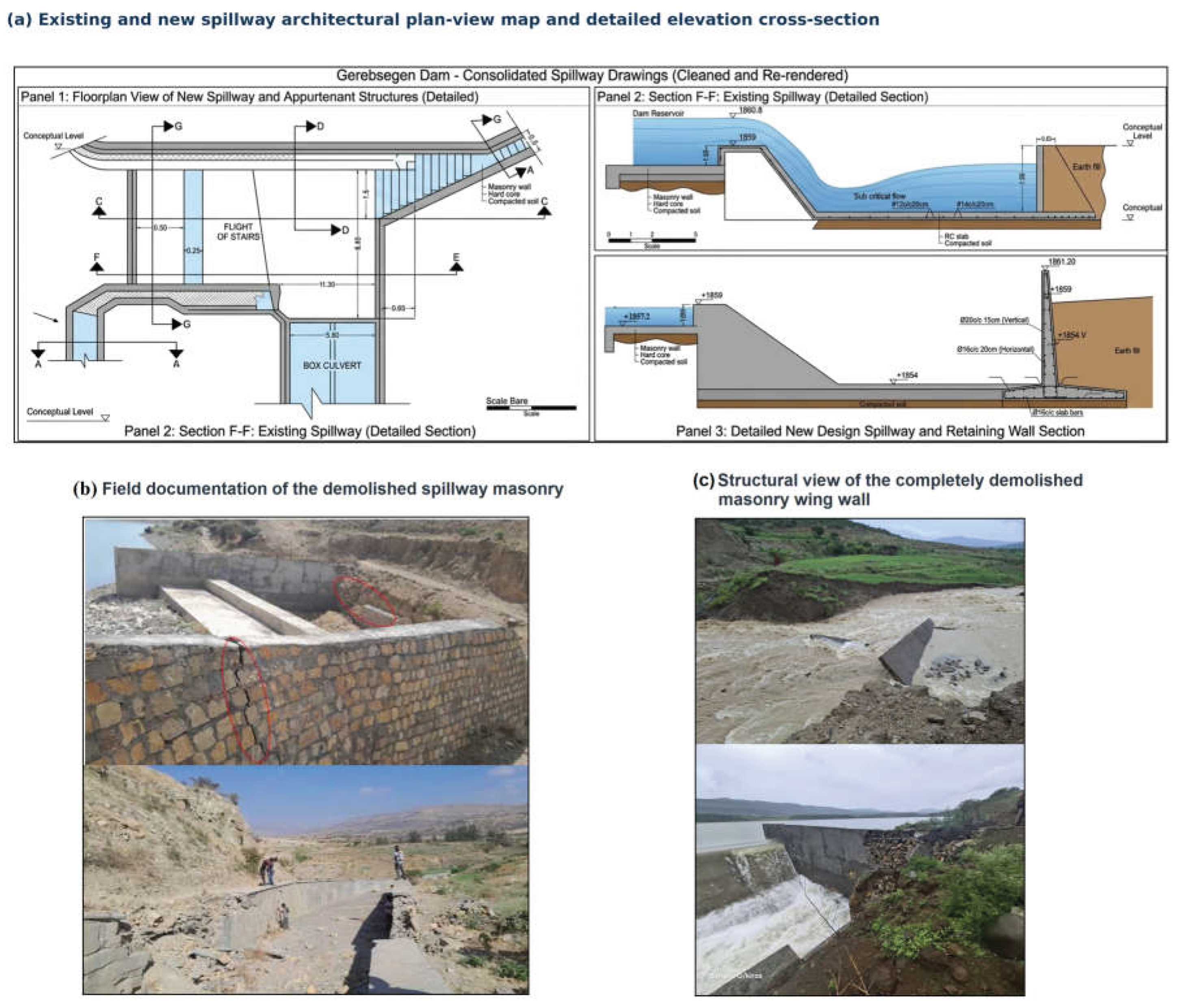
Figure 4 shows the engineering schematics and structural conditions of the retaining infrastructure, detailing: (a) the architectural plan-view map and elevation cross-section of the existing and new spillway; (b) field documentation of progressive lean and sliding displacement in the demolished spillway masonry retaining wall; and (c) a structural view of the completely demolished masonry wing wall layout exhibiting complete tensile separation under overturning forces.
3.2. Geological and Geotechnical Design Parameters
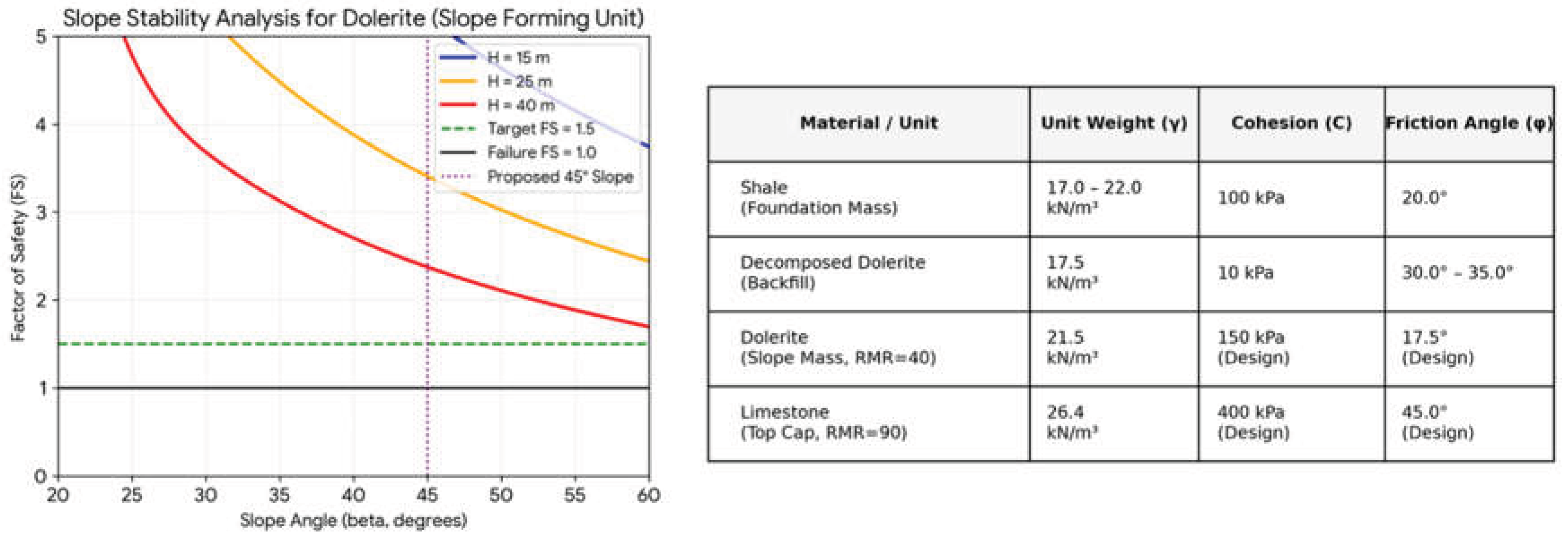
Based on the site investigation and previous design benchmarks, the geotechnical parameters for structural foundations, structural backfills, and lithological slope-forming models have been consolidated as shown in Figure 5 in the table format.
3.2.1. Mathematical Formulation for Slope Stability Analysis
Due to the "Poor Rock" classification of the structural dolerite block (RMR = 40), the mechanics governing slope instability are predominantly driven by continuous mass yielding rather than structurally controlled structural failures. To rigorously quantify the stability of this slope forming unit, a deterministic Limit Equilibrium Planar Failure Wedge Model was deployed to evaluate the Factor of Safety (FS). Under dry, idealized ambient conditions, where surface runoff is strictly controlled and tension cracks remain un-hydrostatically pressurized the standard multi-variable equilibrium formulation is expressed as Equation 1.
Within this governing framework, the geotechnical design parameters for the dolerite mass are defined by an effective cohesion (C) of 150 kPa, an internal rock friction angle (φ) of 17.5°, and a rock bulk unit weight (γ) of 21.5 kN/m³. The geometric boundary conditions are defined by the variable localized or global vertical cut height (H, in meters) and the programmed face slope excavation angle (β), which is proposed at an optimized geometry of 45.0°. Stability is fundamentally constrained by the kinematics of the system, where the theoretical critical failure plane dipping angle bounding the unstable wedge (ψ) must satisfy the geometric boundary criteria (φ < ψ < β).
Figure 5.
Factor of Safety (FS) curves versus Slope Angle (β) for varying Dolerite heights and Geotechnical Parameters.
Figure 5.
Factor of Safety (FS) curves versus Slope Angle (β) for varying Dolerite heights and Geotechnical Parameters.
3.2.2. Geo-mechanical Modeling and Slope Offloading
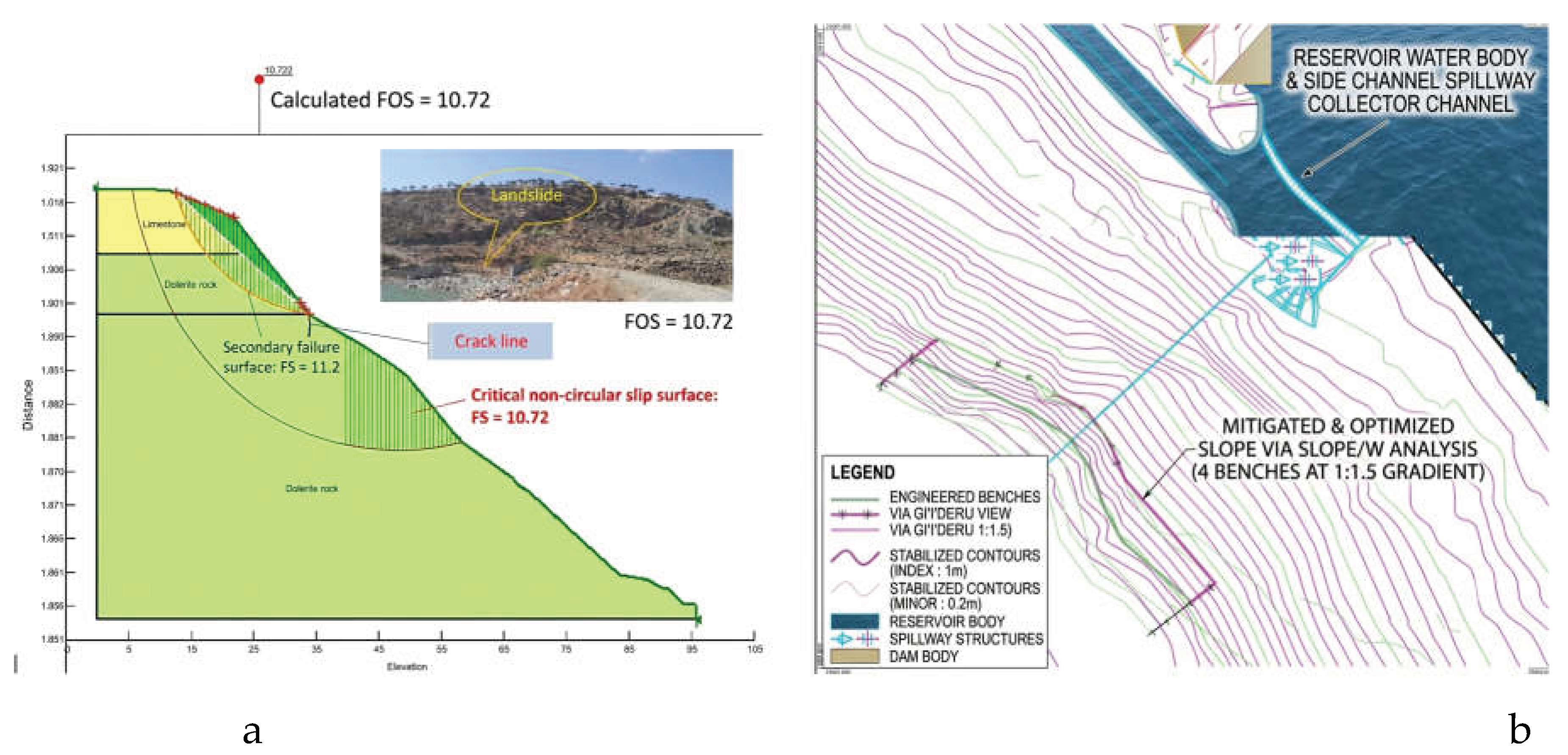
Geotechnical drilling cores revealed an upper stratum composed of highly fractured, weathered dolerite rock mass (indexed at a weak Rock Mass Rating of RMR = 40), underlain by a more competent, less deformable shale-tiny limestone interbed foundation layer. Limit equilibrium slope stability simulations performed in SLOPE/W yielded a nominal global static Factor of Safety of 10.722. While this global index indicates deep structural stability, detailed field mapping revealed extensive sub-surface micro-discontinuities and tensile crack networks propagating parallel to the spillway chute, causing localized wedge failure along the unmitigated construction cuts.
To eliminate this active driving force, an aggressive mass reduction campaign is required to reduce the slope profile above the primary crack boundary to a stable angle of 45°. This geometric modification requires the removal and disposal of 1,700.50 m³ of rock mass, split between 921.50 m³ of hard rock and 779.00 m³ of moderate-to-soft rock materials.
3.2.3. Operational and Construction Execution Specifications
To mitigate structural risks and guarantee global slope stability throughout the construction life cycle, excavation protocols must strictly adhere to operational constraints derived from the minimum Factor of Safety (FS) analytical envelopes. Ground-breaking and rock mass removal must execute systematically in a top-down sequence, progressing from the crest downward to the toe, to prevent the initialization of retrogressive slope failure profiles beneath un-cleared overhead catchments. Concurrently, surface grading and stabilization leveling at the programmed 45° profile must cleanly bisect the active crown crack line to structurally eliminate the tensile failure root zones driving secondary slope degradation. Finally, for vertical slope intervals exceeding an elevation threshold of 25m, structural catch benches featuring a minimum horizontal width of 4.0m must be integrated into the profile, or alternatively, active rock bolts and tensioned anchors must be deployed; this is dictated by the critical limit state ( ) approached by the unreinforced rock mass as the vertical cut height (H) reaches 40m.
Figure 7.
Geomechanical distress mapping and numerical limit equilibrium modeling: (a) Delineation of the potential active landslide boundary flanking the left shoulder of the spillway structure; (b) Quantitative SLOPE/W critical surface modeling indicating local wedge slip triggers and computed factor of safety boundaries under modified 45° offloading geometries.
Figure 7.
Geomechanical distress mapping and numerical limit equilibrium modeling: (a) Delineation of the potential active landslide boundary flanking the left shoulder of the spillway structure; (b) Quantitative SLOPE/W critical surface modeling indicating local wedge slip triggers and computed factor of safety boundaries under modified 45° offloading geometries.
3.3. Hydrogeological Seepage and Regional Micro-Climate Controls
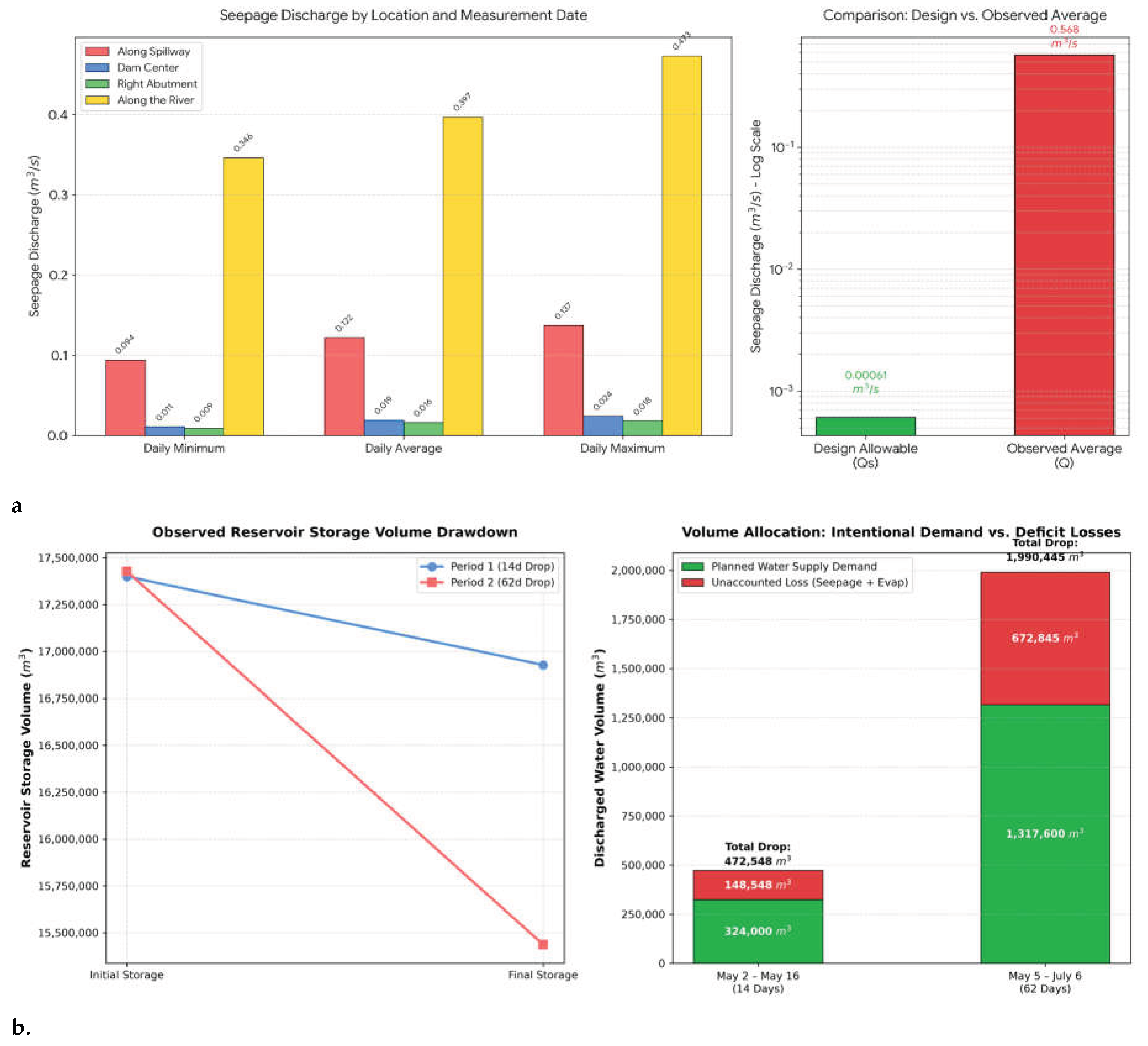
Hydrogeological assessments captured an average daily seepage discharge rate of 0.568 m³/s, substantially higher than the safe design baseline of 0.00061 m³/s. This high water loss indicates that considerable flows are bypassing the core via fractured rock paths directly adjacent to the spillway channel. This high subsurface flow accelerates local pore-water pressure build-up behind the retaining structures, adding significant hydrostatic pressures to the structural system. Consequently, implementing deep pressure-grouting curtains along both dam flanks is essential to stabilize the system.
Figure 8.
Photographic view documenting heavy unmitigated seepage discharge emerging from the left abutment rock strata directly into the river channel;
Figure 8.
Photographic view documenting heavy unmitigated seepage discharge emerging from the left abutment rock strata directly into the river channel;
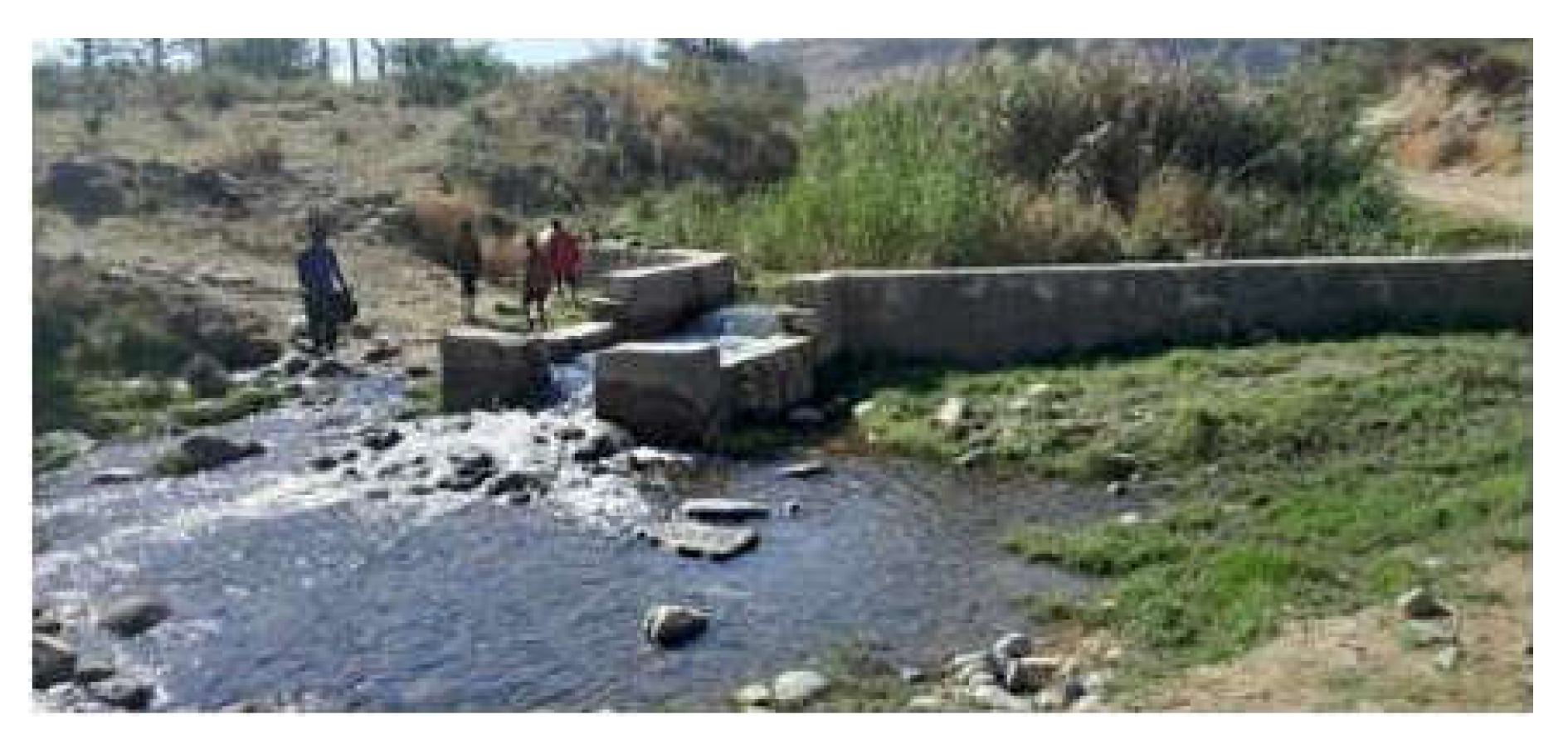
Figure 9.
Hydrogeological seepage tracking and reservoir volume balance analysis: (a) Field methodology setup displaying seepage measurement execution using the calibrated floating velocity array method; (b) Quantitative analysis curve demonstrating the discrepancies within the dam reservoir elevation-volume operational database caused by subsurface macro-porosity bypass.
Figure 9.
Hydrogeological seepage tracking and reservoir volume balance analysis: (a) Field methodology setup displaying seepage measurement execution using the calibrated floating velocity array method; (b) Quantitative analysis curve demonstrating the discrepancies within the dam reservoir elevation-volume operational database caused by subsurface macro-porosity bypass.
4. Conclusions and Recommendations
4.1. Conclusions
This research executed a comprehensive forensic engineering and structural lifecycle diagnosis of the multi-purpose Gerebsegen Dam in northern Ethiopia, uncovering a critical intersection of geomechanical, hydrogeological, and institutional failure mechanisms. A profound divergence is established between the project's chronological maturity and its socioeconomic asset utility. While the dam was explicitly engineered for a 30-year operational design life, 12 years have elapsed since construction completion with the reservoir delivering a mere 20% of its intended volumetric utility. This minimal output serves exclusively for municipal water supply through just one active pipeline representing a restricted 50% delivery rate for the municipal sector while the secondary pipeline remains completely dormant. Crucially, the planned 500-hectare smallholder agricultural irrigation scheme remains completely unexecuted, resulting in a 0% service delivery that points directly to deep-seated institutional mismanagement, administrative irresponsibility, leadership incompetency, or the restrictive outputs of localized patronage networks.
Compounding these operational and governing failures, the physical collapse and deep structural cracking observed along the left spillway abutment gravity retaining walls were driven by intense lateral earth pressures and unmanaged back-of-wall hydrostatic loads. Geomechanical kinematics reveal that the underlying slope-forming Dolerite unit possesses a "Poor Rock" classification (Rock Mass Rating, RMR = 40) with a low internal friction angle (φ = 17.5°), making steep vertical cuts highly dependent on its internal cohesion (C = 150 kPa). Without internal weep-hole relief networks, this configuration triggered progressive overturning and sliding along the structural interface. This geomechanical vulnerability was critically accelerated by hydrogeological short circuiting, where field diagnostics identified an unallowable, massive subsurface seepage rate of 0.568 m³/s bypassing the core via fractured dolerite channels. This preferential flow pathway caused both massive hydraulic volume loss and rapid pore-water pressure spikes behind the rigid stone masonry walls, leading to rapid shear strength degradation at the rock-structure boundary.
4.2. Recommendations
To mitigate these active physical failures, restore long-term structural safety, and reform project delivery frameworks across East African water infrastructure assets, several integrated engineering and administrative interventions must be systematically implemented. First, the vulnerable masonry structures must be completely replaced with a rigid, tapered cantilever reinforced concrete structure varying in height up to 7.20 meters, systematically designed to Eurocode 2 and EBCS-7 limit state standards. To eliminate driving forces above the main tension crack line, a 1,700.50 m³ upper-slope offloading excavation must be executed to achieve a stable 45° profile. Mechanically, a systematic subsurface pressure-grouting curtain alongside an upstream clay blanket must be deployed through the jointed dolerite formation. This barrier is essential to cut off preferential flow paths, reduce the excessive 0.568 m³/s seepage rate, and relieve destructive structural backpressure behind the newly constructed abutment wall.
On an administrative and operational level, regional authorities must immediately shift from a fragmented project execution model to an integrated lifecycle asset management protocol to rectify the severe capacity underutilization observed over the last 12 years. Leadership bodies must prioritize the immediate technical installation, testing, and commissioning of the dormant second municipal water transmission pipeline, elevating the municipal water supply delivery from its restricted 50% capacity to its full 100% design rate for Mekelle city. Concurrently, the regional governance framework must fast-track the funding and construction of the primary, secondary, and tertiary downstream distribution canals necessary to activate the completely unexecuted 500-hectare agricultural command area, thereby elevating the irrigation sector from 0% utility to full development.
Finally, to safeguard structural modifications and provide a data-driven early warning baseline against future failures, a comprehensive instrumentation array must be installed immediately across the rehabilitated spillway flanks. This active network must include multi-stage reservoir level staff gauges spanning elevations from 1835 m to 1864 m to correlate hydraulic head with structural stress, double flow monitoring V-notch arrays featuring distinct 50 L/s and 200 L/s discharge capacities to precisely track volumetric seepage trends, and a gridded network of vibrating-wire piezometers. The real-time integration of these devices is mandatory to enable early detection of pore-water anomalies and phreatic surface variations within the poor-rock dolerite slope units before they propagate into unmanageable structural failure cascades. Future multi-purpose water resource assets within the East African Rift System must standardize these limit state simulations, sub-surface seepage barriers, and instrumentation frameworks during primary design phases to ensure multi-outlet infrastructures deliver their planned socioeconomic utility across their designated lifecycle.
Declarations
Ethics Statement
The authors confirm that this study was conducted in strict accordance with the academic, scientific, and professional ethical standards mandated by the publisher. This research is based entirely on non-experimental field assessments, numerical simulation modeling, and institutional engineering data records obtained from public water agencies. It does not involve human participants, animal testing, or clinical trials; consequently, specific institutional review board (IRB) approval was not required.
Declaration of Competing Interest
The authors declare that they have no known competing financial interests, professional conflicts, or personal relationships that could have influenced the work reported in this paper.
CRediT: Authorship Contribution Statement
Mehari Gebreyohannes Hiben: Conceptualization, Methodology, Investigation, Formal Analysis, Data Curation, Writing Original Draft, Writing Review & Editing, Visualization, Validation, Project Administration. Asmerom Teame Gebresilassie: Methodology, Investigation, Data Curation, Formal Analysis, Validation, Writing Review & Editing. Abraha Adugna Ashenafi: Methodology, Investigation, Formal Analysis, Validation, Writing Review & Editing, Supervision.
Funding
The authors received no specific grant from any funding agency in the public, commercial, or not-for-profit sectors. The work was conducted independently as part of the authors' professional and academic research activities.
Acknowledgments
he authors would like to express their gratitude to the Tigray Water Works Study, Design and Supervision Enterprise, the Water and Energy Minister, Addis Ababa, Ethiopia, and the Addis Ababa Institute of Technology (AAiT) for providing access to technical project reports, hydrological records, and necessary engineering design data. We also thank the field technicians and local professionals who facilitated data collection and site inspections at the Gerebsegen embankment dam.
References
- Adeyeri, O.E. Hydrology and Climate Change in Africa: Quaternary Dynamics, Contemporary Challenges, and Future Resilience Pathways 2025. [CrossRef]
- Saidi, E.F. Increasing Resettlement of Desert Areas: The Conquest of Arid Environments Between Natural Constraints and Human Determination. 2025. [Google Scholar] [CrossRef]
- Nguru, W.; Ouedraogo, I.; Muriithi, C.; Karanja, S.; Kinyua, M.; Nduah, A. A Review of Land-and Water-Management Technologies for Resilient Agriculture in the Sahel: Insights from Climate Analogues in Sub-Saharan Africa 2025. [CrossRef]
- Hiben, M.G.; Ashenafi, A.A. Engineering Assessment of Gerusernay Embankment Dam: Hydrological, Geotechnical, and Construction Performance Analysis 2026. [CrossRef]
- TWWSDSE. Tigray Water Works Study, Design and Supervision Enterprise (TWWSDSE), Final Gerebsegen Dam Landslide and Spillway Study and Hydraulic Design Report. Mekelle Water Supply and Sewerage Service Office, 2024. [Google Scholar]
- Huseiny, M.; Kuntoro, A.A.; Nugroho, E.O.; Kusuma, M.S.B. Dam-break risk analysis and mitigation at Pidekso dam, Wonogiri Regency, Central Java, Indonesia. J. Water Manag Model 2024, 32. [Google Scholar] [CrossRef]
- Arifin, M.Z.; Purwana, Y.M.; Dananjaya, R.H. Seepage and Piping Control of Earth Fill Dam: (Case Study of Pidekso Dam Indonesia). In Int. Conf. Rehabil. Maint. Civ. Eng.; Springer, 2021; pp. 311–22. [Google Scholar] [CrossRef]
- Hiben, M. From Institutional Bankruptcy to Strategic Transformation: A Leadership Journey in Engineering and Public Governance 2026. [CrossRef]
- Aryal, J.P.; Rahut, D.B.; Marenya, P. Climate risks, adaptation and vulnerability in sub-Saharan Africa and South Asia. In Clim. Vulnerability Resil. Glob. South Hum. Adapt. Sustain. Futur.; Springer, 2021; pp. 1–20. [Google Scholar] [CrossRef]
- Hearn, G.J. Some of the geological challenges and opportunities associated with the dynamics of the Cenozoic East African Rift System. Q. J. Eng. Geol. Hydrogeol. 2022, 55, qjegh2021–060. [Google Scholar] [CrossRef]
- Poggi, V.; Durrheim, R.; Tuluka, G.M.; Weatherill, G.; Gee, R.; Pagani, M.; et al. Assessing seismic hazard of the East African Rift: a pilot study from GEM and AfricaArray. Bull. Earthq. Eng. 2017, 15, 4499–529. [Google Scholar] [CrossRef]
- Ongodia, J.E. Geotechnical engineering design of a tunnel support system-a case study of Karuma (600MW) hydropower project 2017. Available online: http://hdl.handle.net/11427/25498.
- Novelli, V.; Kloukinas, P.; De Risi, R.; Kafodya, I.; Ngoma, I.; Macdonald, J.; et al. Seismic mitigation framework for non-engineered masonry buildings in developing countries: application to Malawi in the East African rift. In Resilient Struct. Infrastruct.; Springer, 2019; pp. 195–223. [Google Scholar] [CrossRef]
- Borah, B.; Kaushik, H.B.; Singhal, V. Analysis and design of confined masonry structures: review and future research directions. Buildings 2023, 13, 1282. [Google Scholar] [CrossRef]
- Daokoru-Olukole, C.; Jacob, D.E.; Izah, S.C.; El-Harairy, A.; Fayiah, M.; Ogwu, M.C.; et al. Climate Change and Water Resources: Challenges and Adaptation Strategies. In Water Qual. Saf. Glob. South Chall. Solut. Future Dir.; Springer, 2026; pp. 25–59. [Google Scholar] [CrossRef]
- Schildkamp, M.; Silvestri, S.; Araki, Y. Rubble stone masonry buildings with cement mortar: design specifications in seismic and masonry codes worldwide. Front Built Env. 2020, 6, 590520. [Google Scholar] [CrossRef]
- Benon, E.; Atiah, E.A.; Githuku, C.; Mwai, M. Assessment of wormhole concretionary laterite stone for use in masonry construction. J. Ghana Inst. Eng. JGhIE 2025, 25, 69–75. [Google Scholar] [CrossRef]
- Prakash, I.; Pham, B.T. Geotechnical Forensic Investigations of a Gravity Dam: Addressing Seepage and Sliding Problems in the Basalt Foundations of Karjan Dam, Gujarat, India. J. Sci. Transp. Technol. 2024, 24–38. [Google Scholar] [CrossRef]
- Song, Y.; Zheng, J.; Ma, H.; Shao, Z.; Yang, J.; Shen, F.; et al. Study on uniaxial mechanical behavior and damage evolution mechanism of water-immersed mudstone. Sustainability 2023, 15, 12499. [Google Scholar] [CrossRef]
- Liu, Y.; Zhang, D.; Sun, R.; Yang, Z. Defect Characteristics and Failure Mechanisms of Railway Tunnels in the East African Rift System. Transp. Infrastruct. Geotechnol. 2026, 13, 83. [Google Scholar] [CrossRef]
- Jia, Z.; Ma, P.; Jiang, R.; Lu, Q.; Meng, Z.; Huang, W.; et al. Erosion and potential geological hazards chain in the East African Rift System controlled by volcanic sediments properties and geological structure. Geomorphology 2025, 480, 109755. [Google Scholar] [CrossRef]
- Smith, M. Stratigraphic and structural constraints on mechanisms of active rifting in the Gregory Rift, Kenya. Tectonophysics 1994, 236, 3–22. [Google Scholar] [CrossRef]
- Zheng, Y.; Wu, H.; Luan, X.; McCartney, J.S. Numerical simulation of rainfall-induced deformations of embankments considering the coupled hydro-mechanical behavior of unsaturated soils. Comput Geotech. 2024, 175, 106714. [Google Scholar] [CrossRef]
- Mahmood, N.S.; Alboresha, R.; Sulaiman, S.O.; Ansari, N.A. Seepage Problem Through the Foundation of a Spillway with Selected Treatment Methods. Math. Model Eng. Probl. 2022, 9. [Google Scholar] [CrossRef]
- Introducing a New Method for Calculating the Blocks Volume Caused by Joints Effect in Tunnels. Water Energy Abstr. 2006, 16. [CrossRef]
- Johnson, R.P.; Anderson, D. EN1994 Eurocode 4: Design of composite steel and concrete structures. Proc. Inst. Civ. Eng.-Civ. Eng. 2001, vol. 144, 33–8. [Google Scholar] [CrossRef]
Figure 3.
Gerebsegen spillway consolidated cantilever wall design synthesis.
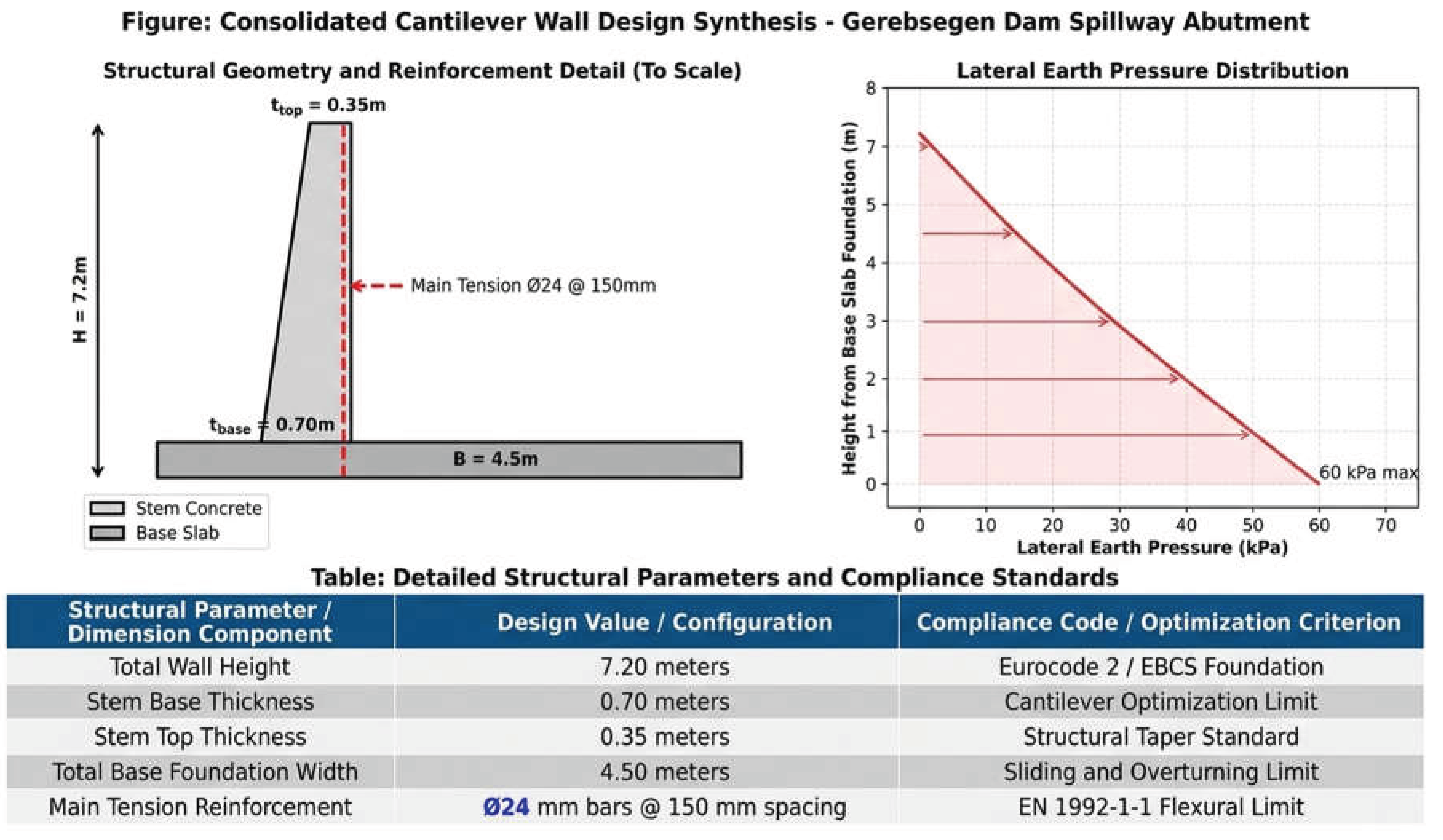
Figure 4.
Engineering schematics and structural conditions of the retaining infrastructure: (a) Existing and new spillway architectural plan-view map and detailed elevation cross-section; (b) Field documentation of the demolished spillway masonry retaining wall showing progressive lean and sliding displacement; (c) Structural view of the completely demolished masonry wing wall layout showing complete tensile separation under overturning forces.
Figure 4.
Engineering schematics and structural conditions of the retaining infrastructure: (a) Existing and new spillway architectural plan-view map and detailed elevation cross-section; (b) Field documentation of the demolished spillway masonry retaining wall showing progressive lean and sliding displacement; (c) Structural view of the completely demolished masonry wing wall layout showing complete tensile separation under overturning forces.
Disclaimer/Publisher’s Note: The statements, opinions and data contained in all publications are solely those of the individual author(s) and contributor(s) and not of MDPI and/or the editor(s). MDPI and/or the editor(s) disclaim responsibility for any injury to people or property resulting from any ideas, methods, instructions or products referred to in the content. |
© 2026 by the authors. Licensee MDPI, Basel, Switzerland. This article is an open access article distributed under the terms and conditions of the Creative Commons Attribution (CC BY) license (http://creativecommons.org/licenses/by/4.0/).
Copyright: This open access article is published under a Creative Commons CC BY 4.0 license, which permit the free download, distribution, and reuse, provided that the author and preprint are cited in any reuse.


