

Submitted:
26 June 2026
Posted:
29 June 2026
You are already at the latest version
Abstract
Background. Asthma pathophysiology spans immune mechanisms, epithelial biology, environmental exposures, microbiome, metabolism, neuroimmune circuits, and comorbidities, but the recent review literature is highly compartmentalized by domain. A systems-level representation of the current consensus on human asthma biology is lacking. Methods. A scoping review was conducted following PRISMA-ScR guidelines. Five databases (PubMed/MEDLINE, Scopus, Web of Science, Embase, Cochrane) were searched with seventeen thematic queries for reviews and systematic reviews published 2021–2026. After screening and full-text assessment, 251 human-evidence sources were included. Entities (nodes) and mechanistic connections (edges) were extracted, normalized, and classified by role (pathogenic, protective, mixed, therapeutic), biological level, and asthma subtype. Nodes were filtered by a pre-specified priority classification; the final network included Priority A nodes reported in ≥3 independent studies and all edges connecting included nodes reported in at least one study. Results. The network comprises 265 nodes and 1,632 edges, organized around 30 high-degree hubs and ten thematic clusters. Edges were 88.7% pathogenic, 9.7% protective, 1.5% mixed, and 0.2% therapeutic. The network is dominated by an epithelium-to-outcome axis rather than the canonical T2/non-T2 dichotomy; environmental, microbiome, metabolic, and comorbidity clusters are structurally integrated into core disease mechanism. Conclusions. The literature-derived network provides a reusable scaffold for systems-level research on asthma, operationalizes the treatable-traits framework, and makes explicit the integration of comorbidities and environmental determinants into core disease mechanism.
Keywords:
asthma
; network medicine
; scoping review
; pathophysiology
; systems biology
; immunology
1. Introduction
1.1. Burden and Clinical Heterogeneity of Asthma
Asthma is among the most prevalent chronic diseases worldwide, affecting an estimated 300 million individuals and causing approximately 1,000 deaths each day. Most of the deaths occur in low- and middle-income countries, and are preventable [1]. The incidence of the pathology is increasing in children among 0 and 9 years old [2]. Despite substantial therapeutic advances over the past two decades, including the widespread adoption of inhaled corticosteroids and the introduction of targeted biologic therapies, a sizeable proportion of patients continue to experience poor disease control, frequent exacerbations, and progressive loss of lung function [3,4]. The disease further imposes a considerable socioeconomic cost through direct healthcare utilization, lost productivity, and long-term disability [5,6,7].
Clinically, asthma is defined by variable airflow limitation, airway hyperresponsiveness, and chronic airway inflammation [8,9], with the history of typical respiratory symptoms that vary over time and can be worsened by exposure to specific triggers [10]. This apparent simplicity, however, conceals a remarkable degree of biological and clinical heterogeneity. Age of onset, trigger profile, inflammatory signature, comorbidity pattern, and therapeutic responsiveness differ markedly across patients, leading to the progressive recognition that asthma is not a single disease but rather an umbrella category comprising multiple endotypes and phenotypes [11,12,13,14].
1.2. Endotypes, Phenotypes, and the T2 Paradigm
Asthma is a complex disease made up of a number of disease variants with different underlying pathophysiologies. Two main inflammatory endotypes have been identified, which are defined as distinct disease entities with specific mechanisms within the asthma syndrome [15,16]. Type 2 (T2)-high asthma, driven by Th2 lymphocytes, type 2 innate lymphoid cells (ILC2), and the canonical cytokines interleukin (IL)-4, IL-5, and IL-13, accounts for the majority of allergic and eosinophilic forms and is the substrate against which most currently approved biologics are directed [17,18,19]. Non-T2 (T2-low) asthma, characterized by neutrophilic or paucigranulocytic inflammation, involvement of Th1 and Th17 pathways, and interleukin-17 and interleukin-6 signaling, remains poorly responsive to conventional therapies and constitutes a major unmet clinical need [16,20,21,22].
Within each endotype, several clinical phenotypes have been delineated, including allergic asthma, late-onset eosinophilic asthma, aspirin-exacerbated respiratory disease, exercise-induced asthma, obesity-associated asthma, and neutrophilic asthma of the adult smoker [12,23,24,25,26,27]. Severe asthma, defined by the need for high-intensity treatment to maintain control or by persistent uncontrolled disease despite such treatment, represents a particularly heterogeneous category, with its own constellation of molecular drivers, structural changes, and comorbidities [28,29,30]. Pediatric asthma displays additional specificities related to immune system maturation, respiratory viral infections, microbiome development, and environmental exposures during critical developmental windows [31,32,33,34,35].
1.3. Beyond the Airway: Systemic, Environmental, and Ecological Dimensions
Alongside the classical airway-centered view of asthma pathogenesis, an expanding body of evidence has established that asthma is embedded in a much broader network of systemic, environmental, and ecological determinants. Epithelial barrier dysfunction has emerged as a unifying upstream mechanism linking environmental exposures, alarmin release (thymic stromal lymphopoietin, IL-25, IL-33), and downstream type 2 and non-type 2 inflammatory cascades [36,37,38,39]. Dysbiosis of the airway and gut microbiome modulates immune development and inflammatory tone from early life onwards, with measurable consequences on asthma inception, severity, and exacerbation rate [40,41,42,43,44]. Obesity and the metabolic syndrome interact with pulmonary physiology, adipokine signaling, and systemic low-grade inflammation, shaping a distinct obese-asthma phenotype with its own therapeutic challenges [45,46,47,48].
Environmental exposures, including ambient air pollution (particulate matter, ozone, diesel exhaust particles), indoor allergens, tobacco smoke, and occupational agents, act both as direct triggers and as modulators of epigenetic programming, with demonstrable effects on prevalence, severity, and long-term trajectory [49,50,51,52,53,54]. Psychological and neurological comorbidities, including anxiety, depression, altered autonomic regulation, and alterations in neuroimmune circuits, further contribute to symptom burden and treatment adherence [55,56,57,58,59,60]. Finally, asthma frequently coexists with other atopic and non-atopic conditions, such as allergic rhinitis, chronic rhinosinusitis with nasal polyps, atopic dermatitis, gastro-esophageal reflux, obstructive sleep apnea, cardiovascular disease and other pathologies, in configurations that point towards shared immunological and structural substrates and crosstalks rather than coincidental co-occurrence [61,62,63,64,65,66].
1.4. The Limits of Compartmentalized Reviews and the Rationale for a Network-Based Synthesis
The expansion of molecular and clinical knowledge has been accompanied by a proliferation of narrative and systematic reviews, each typically focused on a specific axis of the disease: T2 cytokines and type 2 immunity [17,18,67,68,69,70], epithelial alarmins and barrier function [37,38], eosinophilic inflammation [71,72], neutrophilic inflammation [21], airway remodeling [8,73], microbiome [74,75], air pollution [49,50], obesity [12], pediatric asthma [31,32], severe asthma [4,28], or individual biologic targets [76,77]. While these reviews have been essential in consolidating domain-specific knowledge, their very specialization could fragment the biology of asthma into parallel storylines that rarely meet one another explicitly in the text. A reader interested in how, for instance, microbiome dysbiosis interacts with epithelial barrier dysfunction and contemporary downstream T2 cytokines is forced to reconstruct those connections manually across several reviews. Moreover, there is the possibility of connecting more precisely the molecular patterns, the arising of the pathophysiological networks, the consequent emerging symptoms, diseases and the connections with the environmental factors. This operates at a systemic level, integrating organ-focused perspectives into a whole-organism view.
Network medicine offers a complementary lens for this problem. Originally formalized in the context of human disease networks and interactome analyses [78,79], the approach represents biological knowledge as graphs in which nodes are entities (cells, molecules, processes, clinical phenotypes) and edges are the mechanistic or statistical relationships between them. Applied to a complex disease such as asthma, a network-based representation can make the connectivity structure of the disease explicit, highlight highly connected hubs that integrate multiple axes of pathogenesis, reveal clusters that correspond to biologically meaningful subsystems, and expose gaps in the literature where expected connections are absent or underreported.
The value of such a synthesis is not primarily computational. It is conceptual: by forcing every statement in the literature to be cast as an explicit node-edge pair, the approach exposes implicit assumptions, reconciles terminological inconsistencies across subfields, and provides a shared scaffold on which future experimental and clinical work can be positioned.
1.5. Objectives of the Present Work
The aim of the present scoping review is to systematically map the current state of knowledge on asthma pathophysiology, comorbidity, and pathogenic mechanisms as represented in recent review and systematic review articles, and to synthesize this knowledge in the form of an explicit network. Specifically, the objectives are:
To identify the biological entities (cells, molecules, pathways, structural components, environmental factors, comorbidities, and clinical phenotypes) consistently reported in the recent asthma literature, and to determine which of these are most robustly supported across independent sources.
To extract, normalize, and catalog the mechanistic connections reported between these entities, distinguishing pathogenic, protective, and mixed roles, and attributing each connection to the source or sources that report it.
To construct a literature-derived mechanistic network of asthma and to describe its overall structure, including the identification of high-connectivity hubs and the emergent thematic clusters.
To provide, as companion outputs, structured catalogs of uncertain or contested findings and of currently available therapeutic options, as they map onto the network.
The systemic network of asthma is multi-level, enabling clear connections between molecular mechanisms and emerging phenomena, and it is semantic: each connection has a direction and a type (pathogenic, protective, therapeutic, or mixed), and each node has a category (e.g., severe asthma, T2-high, T2-low). The semantic visualization enables direct usability of the network, supporting immediate learning by the reader.
The review adopts a scoping approach, following the Preferred Reporting Items for Systematic reviews and Meta-Analyses extension for Scoping Reviews (PRISMA-ScR) [80]. The scoping format is appropriate because the primary objective is to map the breadth of the evidence and its internal connectivity rather than to answer a single focused clinical question or to synthesize quantitative outcomes [81,82].
2. Materials and Methods
This scoping review was conducted and is reported in accordance with the PRISMA-ScR guidelines [80]. A completed PRISMA-ScR checklist is submitted with the manuscript as non-published material, in line with the journal policy. The methodological framework follows the approach originally proposed by Arksey and O'Malley [81] and subsequently refined by Levac and colleagues [83] and by the Joanna Briggs Institute [82], which is the reference standard for scoping reviews.
2.1. Protocol and Registration
Methodological decisions, eligibility criteria, data charting framework, and filtering rules were defined a priori at the outset of the work and consistently applied throughout the extraction and synthesis process; they are fully reported in the present Methods section to ensure transparency and reproducibility. The review protocol was not prospectively registered in a public registry such as the Open Science Framework or INPLASY. The absence of prospective protocol registration is acknowledged as a methodological limitation (Section 4.9). To offset this limitation, the complete dataset (nodes, edges, uncertain findings, and therapies) has been deposited on the Zenodo public repository under a CC BY 4.0 licence [84] (DOI 10.5281/zenodo.20832882).
2.2. Review Questions and Objectives
The review was structured around three core questions:
Q1. Which biological, clinical, and environmental entities are reported as components of asthma pathophysiology in the recent review literature, and with what level of consistency across independent sources?
Q2. Which mechanistic connections between these entities are described, and which roles (pathogenic, protective, mixed, therapeutic) are attributed to them?
Q3. What is the overall and systemic connectivity structure that emerges when these entities and connections are assembled into a single network, and which functional clusters can be identified within it?
2.3. Eligibility Criteria
Sources of evidence were eligible for inclusion if they met all the following criteria:
Publication type: review articles or systematic reviews (with or without meta-analysis).
Topic: asthma pathophysiology, immune mechanisms, endotypes or phenotypes, comorbidities, environmental triggers, clinical manifestations, or related pathogenic and protective mechanisms.
Publication window: 2021–2026, to reflect the most current understanding of asthma biology and to capture the impact of recent conceptual shifts (e.g., expansion of the alarmin axis, recognition of the epithelial barrier hypothesis, refinement of the T2 paradigm).
Language: English.
Accessibility: full text available in open access or through institutional access; sources for which full text could not be obtained despite these channels were excluded and are documented in the PRISMA flow diagram.
Evidence base: sources providing mechanistic or clinical evidence derived from human studies. Findings based exclusively on animal or cell-line models were excluded from data extraction. This exclusion is methodologically central and was enforced consistently throughout the extraction process to ensure that the resulting network reflects mechanisms with demonstrated human relevance, while acknowledging that much foundational asthma research originates from preclinical models.
2.4. Information Sources
Five electronic bibliographic databases were searched: PubMed/MEDLINE, Scopus, Web of Science, Embase, and Cochrane. Multi-database coverage was adopted to mitigate the known platform-specific retrieval biases of single-source searches and to ensure broad representation of the biomedical, clinical, and evidence-synthesis literature on asthma pathophysiology. Searches were conducted between September 2025 and March 2026. The date of the most recent search was 18 February 2026.
2.5. Search Strategy
Given the breadth of asthma pathophysiology and the exploratory nature of the review questions, an iterative block-search strategy was adopted, rather than a single compound Boolean query. This approach is explicitly supported by scoping review methodology [81,83] and was selected because it enables progressive refinement of the search as new thematic areas emerge from the reading of included sources.
Seventeen queries were executed, each filtered by article type (Review OR Systematic Review) and by publication date (2021–2026). The queries were designed to cover the main axes of asthma biology and clinical presentation. The full list of queries and the number of hits returned is reported in Table 1. Four additional string-based queries served as scoping probes during the search and their hits were fully included in the seventeen reported queries; they are therefore not listed separately to avoid double-counting.
2.6. Selection of Sources of Evidence
The selection process is summarized in the PRISMA 2020 flow diagram (Figure 1).
Title and abstract screening. The 15,623 records identified across the five databases were combined and screened by title and abstract against the eligibility criteria. Records whose focus on asthma pathophysiology, immune mechanisms, endotypes, comorbidities, or environmental determinants was clear from the title and abstract were retained; records duplicative of more recent and comprehensive sources within the same sub-topic, clearly outside the scope (e.g., epidemiological descriptive studies without mechanistic content, commentary or editorial pieces without primary review content, or narrowly clinical case series), or not review/systematic review in nature despite the filter were excluded. A total of 363 records were retained as potentially relevant after this step.
Full-text retrieval. Of the 363 records sought, 92 could not be retrieved in full text because they were not available in open access and no institutional subscription was available. These sources are listed in Online Resource 3 (ESM_3.xlsx), with their PubMed identifiers, to enable readers with institutional access to verify the non-inclusion and to consult them independently. The remaining 271 full-text reports were assessed for eligibility.
Full-text eligibility assessment. Twenty reports were excluded after full-text reading, of which 18 were identified as duplicates of already-included sources (partial index overlap between thematically adjacent queries that had escaped title-abstract deduplication) and 2 were off-topic after full reading. Aggregate counts by exclusion reason are reported in Online Resource 4 (ESM_4.xlsx); individual bibliographic entries for these excluded records were not retained during the review workflow, a limitation acknowledged in Section 4.9.
2.7. Data Charting Process
Data were charted into a structured multi-sheet spreadsheet that was iteratively adapted during the first forty source readings and then frozen. Each entry was manually verified by the author against the source article, with per-article controls of entry counts and systematic safeguards against extraction drift or errors. A large language model (Claude Opus 4.6, Anthropic) was used as a methodological collaborator for pattern recognition, synonym normalization, edge-list generation, internal consistency checks across sheets, and generation of the interactive HTML network visualization. The specific role of the language model is described in Section 2.13.
The charting framework comprises four linked sheets in the main database (Asthma_Network_Database.xlsx), plus a separate companion file (Asthma_Therapies_Database.xlsx) for therapeutic data, which answers a clinical rather than a mechanistic question. The file Asthma_Therapies_Database.xlsx contains a Therapies sheet of 767 entries with attributes including therapeutic category (e.g., biologic, inhaled corticosteroid, bronchodilator, non-pharmacological) and reported efficacy.
Nodes. Every biological, clinical, or environmental entity mentioned in each source was extracted as a node, with attributes including role (pathogenic, protective, mixed, therapeutic), biological level (1–4; see Section 2.8), applicable asthma subtype flags, the specific citation quoted from the source (with the original bibliographic reference number as it appears in the source, when provided), node priority (A/B/C; see Section 2.9), and source study.
Connections. Every mechanistic relationship described in each source between two or more entities was extracted as a narrative pathway (e.g., "IL-13 → SPDEF expression → ↑MUC5AC → Goblet cell hyperplasia"), with the same attributes as for nodes plus the directional structure of the pathway.
Uncertain findings. Findings reported with explicit caveats, contradictions between sources, or statements of ongoing controversy were extracted into a dedicated sheet rather than being included as edges in the network. These uncertain findings are complementary to the network: the network captures where the literature converges, whereas the Uncertain findings sheet captures where it diverges. This separation was a deliberate methodological choice: incorporating contradictory or unresolved findings as network edges would have introduced noise, blurring the signal of well-supported mechanisms. By keeping them in a parallel sheet, the productive frontier of the field remains fully documented and queryable, without compromising the interpretability of the network itself.
Summary. Database statistics and controlled vocabularies.
2.8. Data Items and Biological Level Framework
Each node was assigned a biological level reflecting its position in the pathophysiological hierarchy of asthma (Table 2). When a node spanned two domains (for example, an environmental agent acting through molecular mechanisms), the level associated with its dominant role in the network was retained.
The asthma subtype flags are Boolean fields indicating whether the entity was described in the cited source as applicable to the given subtype: T2-high/Allergic/Eosinophilic; T2-low/Neutrophilic; Severe asthma; Pediatric/Childhood; General (cross-phenotype). A single entity can be true for multiple subtypes; if an entity was described as applicable to both T2-high and T2-low asthma, it was reassigned to the General flag to avoid double-counting across mutually exclusive subtype categories.
Nodes originally extracted with variant names were normalized to canonical names through manual curation, using the shortest and most widely adopted form as canonical (e.g., "IL-13 (Interleukin-13)" and "IL-13" were merged into "IL-13"). Simplifications and assumptions made during this normalization step are documented in the project repository.
2.9. Node Priority Classification
To address the risk of network inflation — the inclusion of excessive numbers of nodes that reduce analytical interpretability without adding explanatory power — all nodes were classified into three priority tiers based on hierarchically applied criteria.
Priority A — Core network nodes. A node was assigned Priority A if it met at least one of the following:
Multi-study confirmation: the node appeared in three or more independent source articles with concordant biological role.
Hub structural role: the node functions as a convergence point for multiple pathophysiological modules, connecting at least two distinct biological domains (for example, innate immunity and remodeling, or environmental exposure and adaptive immunity).
Priority B — Secondary nodes. A node was assigned Priority B if it met at least one of: two-study confirmation with concordant biological role; bridge function connecting two otherwise disconnected modules even when supported by fewer than three studies (for example, a miRNA linking epithelial damage to ILC2 activation); or clinically relevant entity with documented association to disease severity, exacerbation risk, or treatment response.
Priority C — Peripheral nodes. A node was assigned Priority C if it met any of: intracellular intermediate within a well-characterized cascade without independent cross-module connections; isoform or sub-entity of a higher-order entity already represented (for example, individual collagen types I/III/V subsumed by ECM); single-source linear intermediary with a single unidirectional connection and no further ramification; purely technical or biomarker entity without direct pathophysiological role as a network effector.
Priority C nodes were retained in the full database for methodological transparency and for possible re-evaluation should future evidence accumulate, but were excluded from the final network figure.
2.10. Critical Appraisal of Individual Sources
Formal critical appraisal of the included sources was not performed, consistent with PRISMA-ScR guidance that makes appraisal optional for scoping reviews whose objective is to map the breadth of the evidence rather than to synthesize effect estimates [80,82]. The rationale for this decision is threefold. First, the aim of this review is descriptive: to map what the literature reports, not to grade its strength. Second, the included sources are themselves almost entirely secondary (reviews and systematic reviews), many of which already apply critical appraisal to their primary sources; a second layer of appraisal would be methodologically redundant. Even for narrative reviews without their own critical appraisal, the multi-source convergence requirement (≥3 independent sources per Priority A node) functions as a quality threshold that idiosyncratic claims cannot pass. Third, the network synthesis makes the strength of evidence operationally visible through the number of independent sources supporting each node and connection, which functions as an implicit, transparent appraisal signal that the reader can interpret directly from the data.
2.11. Synthesis of Results
The synthesis proceeded in three stages.
Stage 1. Entity normalization. Synonyms, abbreviations, and formatting variants were harmonized using a controlled vocabulary. For example, variants such as IL-13 / IL-13 (Interleukin-13), TH2 cells / Th2 cells, or ASM / Airway smooth muscle were fused into a single canonical label.
Stage 2. Edge construction. Narrative connections in the Connections sheet were algorithmically decomposed into directed edges (Source → Target). Where a pathway description contained intermediate entities not meeting inclusion criteria, the edge was preserved between the two nearest included entities (intermediate compression).
Stage 3. Network construction and descriptive metrics. The final network figure includes:
Nodes: all Priority A nodes (multi-study confirmation ≥3 independent sources, or hub structural role connecting distinct biological domains), together with the subset of Priority B nodes whose bridge function or clinical relevance justifies inclusion despite fewer than three supporting studies. Priority C nodes are retained in the full database (Section 2.9) but excluded from the network figure.
Edges: all relationships connecting two included nodes, reported in at least one included study.
This combination balances robustness of node identification — through multi-source convergence, which strengthens reliability and safeguards against idiosyncratic findings — with preservation of the mechanistic richness of the edge set. It also improves interpretability and visual readability, avoids network inflation, and keeps the architecture navigable without sacrificing the diversity of relationships reported in the literature. The threshold of one study for edges, as opposed to three for nodes, reflects the combinatorial nature of the edge space (the number of possible directed pairs among the 265 retained nodes is approximately 70,000): requiring multiple independent confirmations for each edge would have systematically eliminated genuine mechanistic patterns reported in specialized sources. The number of independent studies reporting each edge is retained as an attribute of the edge, allowing the reader to operationally distinguish a "core" robust sub-network from the full literature-derived network.
For each node, degree was computed as the number of incident edges in the final network. Thematic clusters were identified by neighborhood inspection around high-degree hubs, using the connectivity structure and role distributions as cues. A complementary community-detection algorithm was applied to the final network as a cross-validation step, identifying 15 fine-grained communities whose mapping onto the 10 narrative clusters is described in Section 3.5. Advanced centrality measures (betweenness, eigenvector, closeness) were not applied in this release and are identified as the natural next methodological step.
2.12. Contradiction Management
When an included source reported a finding that directly contradicted an established node or connection already in the database (for example, opposite directionality of regulation or opposite functional role under comparable conditions), the affected entity was transferred to the Uncertain findings sheet with an explicit description of the conflict, citations from all involved studies, and explanatory notes on the nature of the contradiction (for example, endotype-specific, context-dependent, dose-dependent). Nodes and connections supported by two or more concordant studies and no discordant study were designated validated network elements.
2.13. Use of Generative Artificial Intelligence
In accordance with the Springer Nature policy on the disclosure of generative artificial intelligence, the role of large language model assistance in the preparation of this work is reported here. A large language model (Claude Opus 4.6, Anthropic) was used as a methodological collaborator during the data charting and synthesis phases, specifically for: (i) assisting the extraction of entities and connections from included sources through iterative prompting and verification; (ii) constructing and refining the synonym dictionary for node normalization; (iii) formally verifying the edge list from narrative connections; (iv) assisting with the linguistic refinement of the manuscript; (v) generating and iteratively refining the interactive HTML network visualization code (D3.js-based) used to explore the final 265-node / 1,632-edge network. All inclusion decisions, eligibility judgments, charting choices, normalization rules, and network-construction thresholds were defined and approved by the authors. The language model was not used to screen records for eligibility, to perform critical appraisal, or to take final decisions on any content of the manuscript. All AI-assisted outputs were reviewed and verified by the authors, who take full responsibility for the content of this publication.
3. Results
3.1. Overview of the Included Literature
Of the 251 sources included in the scoping review, all were review articles or systematic reviews published between 2021 and 2026 that addressed asthma pathophysiology from at least one of the following perspectives: immune mechanisms and endotypes, epithelial and structural biology, comorbidities, environmental determinants, microbiome, obesity and metabolism, pediatric specificities, severe asthma, neuroimmune crosstalk, or therapeutic targets. Ten sources qualified as cornerstone integrative reviews that individually contributed entities or connections across more than four thematic axes of the network [3,8,18,28,29,33,36,37,74,85]. Twenty-seven sources were specifically focused on pediatric asthma or asthma inception across the life course, and 32 on severe, difficult-to-treat, or refractory asthma. Sixty-seven sources dealt wholly or primarily with environmental and climate determinants, 34 on microbiome and gut-lung axis, 26 on obesity and metabolic determinants, and 24 on neurological, psychological, or neuroimmune aspects of asthma.
3.2. The Asthma Network: Global Structure
After application of the inclusion criteria described in Section 2.11 (nodes of A-priority; nodes of B-priority; edges connecting two A- or B-priority nodes reported in at least one included study), the resulting network comprises 265 nodes and 1,632 edges (1,558 unidirectional and 74 bidirectional). The complete asthma network is shown in Figure 2. The full interactive version, with on-demand filtering by cluster, role, and subtype, is provided as Online Resource 1 (asthma_network.html, file name ESM_1.html).
Of 1,632 edges, 1,447 (88.7%) were classified as pathogenic, 158 (9.7%) as protective, 24 (1.5%) as mixed (i.e., reported with both pathogenic and protective effects across sources or contexts), and 3 (0.2%) as therapeutic. The prevalence of pathogenic edges reflects the dominant framing of the reviewed literature, which tends to report mechanistic connections in terms of disease-promoting pathways; protective edges predominantly concerned microbiota components, short-chain fatty acids, regulatory T cells, regulatory cytokines (IL-10, IL-37, TGF-β in specific contexts), breastfeeding, dietary components, and exercise-related pathways [25,43,101,102,103,104,105].
Of note, by examining the network, it is clear that protective mechanisms operate at multiple levels, reflecting a distributed, system-wide compensatory response that is partly mediated by protective environmental agents [106,107].
Edges are distributed heterogeneously across asthma subtypes (note that an edge may belong to more than one subtype if the supporting source describes the mechanism in several clinical contexts). T2-high/allergic/eosinophilic phenotypes accounted for 517 edges (31.7%), non-T2/neutrophilic for 186 (11.4%), severe asthma for 252 (15.4%), pediatric asthma for 285 (17.5%), and general or cross-phenotype for 1,085 edges (66.5%). The T2-high footprint in the network was approximately three times larger than the T2-low footprint, mirroring the long-standing asymmetry in the asthma literature, which has concentrated mechanistic attention on the type 2 axis and has relatively less well-characterized the non-type 2 pathways [6,17,20,21,22].
3.3. Hub Nodes: The Most Connected Entities
The 30 highest-degree nodes in the network represent the entities that integrate the largest number of mechanistic connections across the scoped literature. The hub list is provided in Online Resource 5 (ESM_5.xlsx). The hub distribution is consistent with a scale-free-like topology in which a small number of highly connected integrative nodes coexist with a large tail of sparsely connected peripheral entities [78,79]. The three leading hubs — eosinophils, asthma exacerbations, and IL-13 — operate at two different levels of biological description (cellular/molecular and clinical level), indicating that the network naturally integrates mechanistic and clinical tiers rather than separating them. Airway hyperresponsiveness (AHR) and FEV1 decline emerged as the principal functional-outcome hubs, confirming that the reviewed literature consistently routes mechanistic narratives towards these two physiological endpoints [3,9,108]. Airway barrier dysfunction ranked eighth, reflecting the recent conceptual shift towards an epithelium-centered view of asthma pathogenesis [37,38,109,110].
3.4. Thematic Clusters Emerging from the Network
Inspection of the neighborhood structure around high-degree hubs identified ten thematic clusters that cover the entire connectivity of the network. Each cluster groups nodes share dense internal connectivity and biological coherence, while maintaining inter-cluster edges that define the overall integrated architecture of the network.
The interactive HTML visualization (Online Resource 1) displays 15 fine-grained communities identified by unsupervised community-detection. For the present narrative synthesis, we group these into 10 thematic clusters guided by biological coherence: high-degree hubs were used as anchors and neighborhoods inspected for thematic affinity. The mapping between the visual network communities and the narrative clusters is provided in the next paragraphs of this section. Two visual communities ("Innate regulatory" and "Epigenetic & signaling") do not map onto a single narrative cluster but distribute across multiple ones (notably Clusters 2, 3, and 4), reflecting the cross-cutting nature of regulatory and signaling nodes in the network.
The ten clusters are presented in an upstream-to-downstream order following the epithelium-to-outcome axis described above: from the host-environment interface (Cluster 1) and the two immune cascades it activates (Clusters 2 and 3), through the structural consequences (Cluster 4) and systemic modulators (Clusters 5-8), to the comorbid extensions (Cluster 9) and the clinical manifestations (Cluster 10).
Cluster 1 — Epithelial barrier and alarmin axis. It integrates the airway epithelium, its structural constituents (tight junction proteins, E-cadherin), damage-associated molecular patterns (HMGB1, ATP, uric acid), and the three canonical alarmins (TSLP, IL-25, IL-33), together with their receptors and the epithelial-derived cytokines IL-1β, IL-6, and GM-CSF. Epithelial dysfunction is reported as the upstream initiator of most downstream inflammatory cascades in the network [18,37,38,39,108,109,110,111,112,113,114]. Edges from this cluster fan out densely into the T2 adaptive axis (Cluster 2), into the non-T2/neutrophilic axis (Cluster 3), and, critically, into both the environmental (Cluster 7) and microbiome (Cluster 5) clusters, indicating that the epithelium operates as the principal point of integration between host and environment [86,87].
Cluster 2 — Type 2 adaptive and effector immunity. It is the densest and most centrally located cluster in the network. It encompasses TH2 cells, ILC2, the canonical cytokines IL-4, IL-5, IL-9, and IL-13, immunoglobulin E and its high-affinity receptor, and the downstream effector cells (eosinophils, mast cells, basophils) together with their mediators (histamine, cysteinyl leukotrienes, prostaglandin D2, major basic protein, eosinophil peroxidase, eosinophil cationic protein, eosinophil extracellular traps) [17,18,36,67,68,71,89,115]. The heterogeneity of T-cell subsets contributing to type 2 immunity beyond the canonical TH2 framework — including TFH13, pathogenic TH2A, and TH2/TH17 dual-positive cells — has been increasingly characterized [69,70,88], and the involvement of mast cells in this cluster extends to mast cell activation syndromes that overlap with severe asthma phenotypes [91]. Within this cluster, eosinophils function as the integrative super-hub, connecting upstream T2 signaling with structural and functional downstream effects (airway remodeling, AHR, exacerbations, FEV1 decline), with novel perspectives on eosinophil biology in severe asthma continuing to emerge [90]. The cluster extends into the comorbidity cluster via allergic rhinitis, chronic rhinosinusitis with nasal polyps, eosinophilic esophagitis, and atopic dermatitis [66,116,117]. The therapeutic monoclonal antibodies targeting IgE, type 2 cytokines, and alarmin pathways — discussed in detail in Section 3.5 — also operate primarily within this cluster [118].
Cluster 3 — Non-type 2 and neutrophilic pathways. It organizes around neutrophils, TH17 cells, IL-17 family cytokines (IL-17A, IL-17F, IL-22), IL-6, IL-8 (CXCL8), IL-1β, and IL-23. Additional nodes include NETs, NLRP3 inflammasome activation, pyroptosis, and M1 macrophages [8,16,20,21,22,119,120,121]. It has fewer edges than Cluster 2 (257 vs 471 edges), but disproportionate connectivity to severe asthma and steroid-resistance nodes, consistent with the clinical observation that non-T2 asthma is both under-represented in the mechanistic literature and over-represented in treatment-refractory phenotypes. Strong edges to obesity (Cluster 6), tobacco smoke, and gut-lung axis components indicate that non-T2 inflammation is embedded in a broader systemic context rather than being an intrinsically airway-confined phenomenon. Macrophage polarization toward an M1 phenotype under air-pollution exposure provides a mechanistic bridge to Cluster 7, where particulate matter drives non-T2 inflammation through alveolar macrophage activation [122].
Cluster 4 — Airway remodeling and structural alterations. It groups airway smooth muscle (ASM), fibroblasts, myofibroblasts, extracellular matrix components (collagens, fibronectin, MMP-9, TIMPs), angiogenesis, goblet cell metaplasia, MUC5AC, epithelial-mesenchymal transition, basement membrane thickening, and subepithelial fibrosis [8,38,73,123,124,125,126,127]. This cluster is both the downstream convergence point of the T2 and non-T2 inflammatory axes and the substrate of long-term functional decline (FEV1 loss, fixed obstruction, ACO development). Edge density between this cluster and severe asthma is especially high, reflecting the consensus that structural remodeling is the principal biological substrate of irreversible airflow limitation [4,28,128]. Small airways dysfunction emerges as a specialized sub-hub [123,124]. Mechanosensitive calcium-regulatory pathways in ASM and the dynamics of immune senescence in chronic remodeling are additional layers recently characterized within this cluster [129,130].
Cluster 5 — Microbiome, gut-lung axis, and mucosal immunology. It comprises airway and gut microbiome composition, short-chain fatty acids (butyrate, propionate), secretory IgA, mucosal tolerance, gut-lung axis signaling, and early-life modifiers (C-section delivery, breastfeeding, formula feeding, antibiotic exposure, farm exposure, hygiene hypothesis constructs) [40,41,43,74,75,131,132,133,134,135,136]. The role of secretory IgA in mucosal tolerance is increasingly recognized as a major determinant of the protective output of this cluster [137], and host genetics interact with microbiome and environmental exposures through pathways that are still being mapped [138]. Probiotic-targeted interventions have emerged as a candidate therapeutic axis based on the dysbiosis-inflammation-oxidative stress link [139,140]. The gut mycobiome adds a parallel dimension, with airway mycosis contributing to non-canonical type 2 responses [141] and biofilm-mediated immune dysregulation representing a poorly characterized but mechanistically relevant phenomenon [142]. This cluster is a major source of protective edges (84 of 158 protective edges, ~53%). Respiratory viral infections, particularly rhinovirus and RSV, sit at the interface between this cluster and the exacerbation node [143,144,145,146,147]. The extensive recent literature on the gut-lung axis converges on dysbiosis-driven immune dysregulation as a unifying framework, with implications extending to the gut-lung-vascular axis in asthma-cardiovascular comorbidity [148,149,150,151].
Cluster 6 — Obesity and metabolic modifiers. Obesity and metabolic syndrome appear as a macro-hub coordinating adipokines (leptin, adiponectin), insulin resistance, type 2 diabetes, dyslipidemia, metabolic inflammation markers (CRP, IL-6), M1 macrophage polarization, and reduced responsiveness to inhaled corticosteroids [12,47,48,152,153,154,155,156,157,158]. The adipokine signaling axis — leptin acting as pro-inflammatory mediator, adiponectin as counter-regulator — is increasingly recognized as a node-specific therapeutic target [159,160], while lipid and sterol metabolism contribute independent layers of immune regulation within this cluster [161,162]. This cluster is characterized by a distinctive edge pattern: most connections are to non-T2/neutrophilic nodes (Cluster 3) rather than to the classic T2 axis (Cluster 2), and strong edges to mechanical-physiological nodes (dysanapsis, reduced lung compliance, EIB) and to the environmental cluster via air pollution synergy. This supports interpretation of obesity as a cross-cutting modifier acting on non-allergic pathways rather than a simple additive risk factor. In pediatric obese asthma, comorbidities cluster differently from adult obese asthma, suggesting a distinct sub-phenotype that requires dedicated stratification [163,164].
Cluster 7 — Environmental and ecological determinants. The widest cluster by range of entities, including outdoor air pollutants (PM2.5, PM10, NO2, ozone, diesel exhaust particles), indoor air pollutants (volatile organic compounds, bisphenol A, cleaning agents), tobacco smoke (active, second-hand, prenatal), e-cigarettes, pollen (amplified by climate and thunderstorm asthma), occupational agents, housing typologies, extreme weather events, climate change variables, and social determinants of health [49,50,51,52,53,165,166,167,168,169,170,171]. Outdoor air pollution acts both on incidence and on exacerbation rate, with consistent associations across geographic and demographic settings [99,172], and its impact on pediatric and childhood asthma is particularly well documented [98,100,173,174]. Indoor air pollution — volatile organic compounds, particulate matter, and biomass combustion products — exerts an independent burden, especially in vulnerable groups and in school environments [175,176,177,178,179]. Edges from this cluster dominantly target epithelial barrier dysfunction (Cluster 1) and epigenetic modifications, which then reverberate throughout the network [180]. Gene-environment interactions (GSTM1, CDHR3, 17q12-21, NRF2, aryl hydrocarbon receptor signaling) constitute an internal bridge to the structural/inflammatory clusters [181,182,183]. Beyond pollution, extreme weather events and climate change variables increasingly contribute to acute exacerbations [184,185], while housing typologies modulate chronic exposure burden [186], and physical activity-pollution interactions add a further layer of complexity in youth populations [187]. Air pollution also intersects with the alveolar compartment [188], with broader dysbiosis–lung disease pathways [44] and with multiple chemical sensitivity, a distinct but related entity in which environmental exposures drive systemic neuroimmune dysregulation [189,190]. Social determinants of health — environmental justice inequities, neighborhood-level exposure differences, and violence-related chronic stress — interact with biological pathways and shape both prevalence and severity [54,60,191]. Resolution mechanisms of pollution-induced inflammation represent a complementary therapeutic dimension still under characterization [192].
Cluster 8 — Neuroimmune and psychological axis. It groups airway neuroendocrine cells, neuropeptides (substance P, CGRP, VIP), neurotransmitters (acetylcholine, serotonin, dopamine, GABA, histamine acting neurally), the lung-brain axis, vagal afferent signaling, blood-brain barrier disruption, systemic low-grade neuroinflammation, anxiety and depression, alexithymia, breathlessness perception dissociated from bronchoconstriction, and circadian rhythm disruption [55,57,193,194,195,196,197,198,199,200,201]. Dysfunctional breathing patterns, particularly in pediatric populations, add a further behavioral layer to this cluster [202], and psychological interventions are emerging as candidate disease-modifying tools for adolescents with asthma [203]. Although the number of edges in this cluster is lower than in Clusters 1–7, the edge density relative to the number of nodes is comparable, indicating a well-delineated subsystem. The cluster shows a distinctive pattern of bidirectional connections to exacerbations and to symptom nodes (dyspnea, cough), suggesting that neuroimmune circuits modulate perception and behavioral response to airway inflammation in addition to participating in the inflammation itself. The mechanistic interface between neuroimmune signaling and airway remodeling represents a further axis of integration within this cluster [204].
Cluster 9 — Comorbidities and systemic associations. It organizes the major asthma comorbidities into a single integrated component: allergic rhinitis, chronic rhinosinusitis with or without nasal polyposis, atopic dermatitis, eosinophilic esophagitis, gastroesophageal reflux, obstructive sleep apnea, obesity (linking to Cluster 6), cardiovascular disease and hypertension, chronic kidney disease, osteoporosis, type 2 diabetes, anxiety and depression (linking to Cluster 8), asthma-COPD overlap, and food allergy [61,62,63,64,65,205,206,207,208,209,210]. In pediatric populations, the comorbidity profile differs from adult asthma and includes both allergic and non-allergic conditions clustering together [211,212]. Atopic dermatitis represents a particularly tight node, both as a co-existing T2 disease and as the upstream step of the atopic march, with distinct adult and pediatric manifestations [92,93,94,95]. Allergic rhinitis [213], cardiovascular comorbidity through coronary artery disease and IL-33/ST2-driven heart failure [214,215,216], and osteoporosis as a long-term skeletal complication [217] further illustrate the systemic reach of the cluster. The key observation is that comorbidities are not peripheral to the main network but deeply integrated: their edges terminate predominantly on core mechanistic nodes (T2 cytokines, epithelial barrier, airway barrier dysfunction, chronic low-grade inflammation, microbiome dysbiosis), not on separate clinical endpoints. This supports the reframing of asthma comorbidities as shared-mechanism conditions rather than coincidental co-occurrences. This integrated topology supports the case for moving beyond compartmentalized disease frameworks toward a systems-level representation, in which asthma and its comorbidities are approached as interconnected expressions of a shared mechanistic substrate. The network synthesis presented here provides the operational scaffold for such an integrated view.
Cluster 10 — Clinical expression and functional outcomes. Groups the clinical-functional manifestations: AHR, bronchoconstriction, FEV1 decline and airflow obstruction, exacerbations, wheezing, cough, dyspnea, chest tightness, sleep disturbance, exercise-induced bronchoconstriction, and patient-centered outcomes (fatigue, work impairment, quality of life) [3,9,25,108,218,219,220,221,222]. Receives the largest number of incoming edges (approximately 19% of all edges in the network). Its internal structure mirrors the heterogeneity of asthma presentations: pediatric-specific nodes (recurrent wheeze, early-onset phenotypes) and adult-specific nodes (fixed airflow limitation, late-onset eosinophilic phenotype, airway remodeling-dominant phenotypes) form partially separate sub-clusters within this final common pathway.
3.5. Companion Catalogues: Uncertain Findings and Therapies
The Uncertain Findings sheet of the master dataset contains 624 entries catalogued as reported with explicit caveats, inter-study contradictions, or ongoing debate. Additionally, 24 edges in the network (1.5%) were classified as mixed, representing entities or connections for which the reviewed literature reports both pathogenic and protective effects. These are discussed in Section 4.3.
The Therapies companion file (Asthma_Therapies_Database.xlsx) contains 767 entries kept separate from the network proper, consistent with the scoping decision to focus the network on pathogenic and protective biology. Each therapy entry is linked to one or more network nodes that it targets. Six therapeutic categories emerged: (1) inhaled corticosteroids and bronchodilators; (2) biologics directed at the T2 axis (anti-IgE: omalizumab; anti-IL-5/IL-5R: mepolizumab, reslizumab, benralizumab; anti-IL-4Rα: dupilumab; anti-TSLP: tezepelumab) [76,77,223,224,225,226,227,228]; (3) emerging non-T2-targeted therapies (anti-IL-6, anti-IL-17, JAK inhibitors, anti-alarmin combinations); (4) non-pharmacological interventions, including breathing techniques, pulmonary and exercise rehabilitation, dietary interventions targeting type 2 inflammation [229], broader nutritional approaches based on bioactive compounds [230,231], mineral and micronutrient supplementation including zinc and vitamin D [232,233,234], probiotics and prebiotics, and weight reduction in obese asthma; (5) comorbidity-directed treatments (CPAP for OSA-associated asthma, proton pump inhibitors for GERD-associated asthma, dupilumab for concomitant atopic dermatitis, allergen immunotherapy for allergic rhinitis-asthma); (6) treatable-traits-based personalized approaches [29,235,236,237]. Notably, approximately 72% of all therapeutic entities in the catalogue converge on nodes within Clusters 1 and 2 (epithelial/T2), with non-T2 and cross-cutting clusters substantially underserved by the current pharmacological pipeline.
3.6. Putting It All Together: An Integrated Systems-Level View of Asthma
Several structural observations follow directly from this integrated representation, independent of any further analysis. The network is connected: every entity in it links, directly or indirectly, to every other, indicating that the contemporary asthma literature, despite its surface fragmentation, can be assembled into a single coherent map. The 30 highest-degree hubs span four biological levels (cells, cytokines, structural alterations, clinical endpoints) and seven of the ten thematic clusters, indicating that asthma pathogenesis is integrated across scales rather than confined to one molecular axis. The principal organizing axis is epithelium-to-outcome rather than T2-vs-non-T2: the epithelial-alarmin cluster operates upstream as the integrator of environmental signals, the clinical-functional cluster operates downstream as the convergence point of all upstream pathways, and the T2 and non-T2 cascades appear as parallel transmission channels between these two poles. Comorbidities, microbiome, metabolism, and environmental determinants connect to core mechanistic nodes in depth rather than peripherally, indicating that they are constitutive components of asthma pathobiology rather than coincidental modifiers.
A further structural observation, made visible only by the integrated representation, concerns the existence of cross-cutting modules: computational community-detection on the network identified two fine-grained clusters — "Innate regulatory" and "Epigenetic & signaling" — that do not map onto a single thematic narrative cluster but rather distribute across the type 2 (Cluster 2), non-type 2 (Cluster 3), and remodeling (Cluster 4) axes. This pattern reflects the cross-cutting role of immune-regulatory cells (Tregs, M1/M2 macrophages, dendritic cells, IL-10) and of intracellular signaling-epigenetic machinery (NF-κB, STAT3, HDAC, MAPK, 17q12-21) as integrators across the canonical inflammatory subtypes. The detection of such modules — entities whose biological function is precisely that of operating across compartments — is a representative example of an emergent property accessible to the network synthesis approach but invisible, by construction, to compartmentalized reviews of a single axis.
4. Discussion
4.1. Principal Findings
This scoping review and network synthesis of 251 recent review-level sources produced an integrated map of asthma pathophysiology comprising 265 robustly reported entities and 1,632 mechanistic connections, organized around 30 highly connected hubs and ten coherent thematic clusters. Three principal findings stand out.
First, the asthma literature of the last five years, despite its apparent fragmentation, is internally coherent and can be assembled into a single connected graph without isolated components: every identified entity connects, directly or indirectly, to every other. This is neither trivial nor self-evident, given the historical separation between molecular immunology, epithelial biology, environmental health, microbiology, metabolism, and clinical phenotyping.
Second, the topology of the resulting network is compatible with a scale-free-like architecture [78,79], in which a small number of super-hubs integrate most of the connectivity while a long tail of specialized entities contributes local mechanistic detail. The top hubs do not belong to a single biological level: cells, cytokines, structural alterations, functional outcomes, environmental factors, and systemic conditions coexist in the top 30, demonstrating that the reviewed literature consistently crosses biological scales when describing asthma.
Third, the clustering structure departs from the canonical T2/non-T2 dichotomy in an important way. While Clusters 2 (T2 adaptive-effector) and 3 (non-T2/neutrophilic) emerge as distinct components, they do not function as mutually exclusive descriptions of the disease. The dominant flow pattern of the network supports an epithelium-to-outcome organizing axis: the clinical-functional cluster (Cluster 10) receives approximately 90% of its inter-cluster connections; the epithelial-alarmin cluster (Cluster 1) operates as a central integrator at the host-environment interface; and the T2 cluster functions as the dominant transmission channel, projecting 76% of its inter-cluster edges outward, with the densest projection toward the clinical-functional cluster.
Examined directly, T2 and non-T2 exchange only 10 reciprocal edges in the entire network, none of which are inhibitory. If the two cascades were truly mutually exclusive, the network would display inhibitory crosstalk between them; instead, the two clusters do not inhibit one another but ignore one another topologically. The two cascades therefore behave as biologically separable pathways sharing an upstream interface (the epithelium) and a downstream convergence point (the clinical-functional cluster), but operating without reciprocal interference along the way. This is consistent with the increasing clinical recognition of mixed-inflammation phenotypes, in which T2 and non-T2 inflammation coexist within the same patient.
Such absence of inhibitory exchange is not visible from compartmentalized reviews of either axis alone, which describe each cascade internally but cannot represent the structural relationship between them; the integrated network makes this absence measurable rather than inferred, updating the canonical dichotomic view of asthma without contradicting the underlying biology of either cascade.
4.2. The Emergent Architecture of Asthma: An Integrated View
The network makes explicit a view that the recent literature has approached but rarely formalized: asthma is organized as a multi-axis system in which at least six functionally distinct but mechanistically interconnected subsystems converge on a shared airway substrate. These subsystems are (i) the epithelial-alarmin interface with the environment; (ii) the adaptive-effector type 2 arm; (iii) the innate and non-T2 arm; (iv) the structural-remodeling arm; (v) the ecological arm comprising microbiome, early-life determinants, and mucosal immunity; (vi) the systemic-metabolic arm integrating obesity, metabolism, and systemic inflammation. A seventh subsystem, the neuroimmune axis, modulates and is modulated by the others. An eighth, the comorbidity axis, shares mechanistic substrates with all the others and is therefore best understood as an integrated component of asthma pathogenesis rather than a set of associated diseases [61,62,63,64].
The connectivity pattern suggests three general principles of asthma organization that are visible only in a network representation.
Principle 1 — The epithelium is the entry point, not only a damaged tissue. Every major external input (pollutants, allergens, viruses, microbiome shifts, tobacco smoke, ozone, diesel particles, occupational agents) reaches the rest of the network through the epithelial cluster. Airway barrier dysfunction ranks seventh among hubs despite being a relatively new conceptual entity, and the three alarmins (TSLP, IL-25, IL-33) and their downstream amplifier ILC2 are all in the top 30. This is consistent with the epithelial barrier hypothesis articulated in recent years [18,37,38,109,110] and reframes the epithelium from a passive target to the principal translator between environment and immune response.
Principle 2 — T2 and non-T2 are parallel channels, not opposed categories. As shown above, the two clusters exchange minimal direct connectivity (10 reciprocal edges, none inhibitory) but share common upstream inputs from the epithelial-alarmin cluster and common downstream outputs into the clinical-functional cluster. Several hubs (IL-33, IL-6, NF-κB, TNF-α, neutrophils in severe T2 asthma, eosinophils in some non-T2 contexts, steroid resistance) participate in both, and so-called paucigranulocytic asthma, historically the leftover phenotype, emerges in the network as a state of low activity on both channels rather than as a distinct endotype [16,22,23]. Mixed-type inflammation is the rule rather than the exception when both channels are simultaneously active.
Principle 3 — Comorbidities, environment, microbiome, and metabolism are not modifiers: they are constitutive. Their edges terminate on core mechanistic nodes in depth, not superficially. Removing these clusters from the network would reduce the degree of most top hubs by 30–50% and would disconnect major downstream outcomes. Interpreting the obese-asthma phenotype, the air-pollution-associated asthma, or the early-life microbiome-associated asthma as simple modifiers of an underlying asthma substrate underestimates their structural role.
Taken together, these three principles support a reading of asthma as a network-level adaptive reorganization of an integrated airway-immune-epithelial-metabolic-ecological system under environmental and systemic pressure, rather than a disease with one dominant mechanism plus contextual modifiers. This reading is compatible with, and gives an operational scaffold to, the treatable-traits framework [29,235,236] and with the growing consensus that asthma endotypes are overlapping functional states on a continuum rather than discrete categories [13,14,238].
4.3. Principal Uncertainties and Unresolved Findings
The 624 uncertain findings catalogued in the dataset represent the productive frontier of the field, where contemporary asthma research is still actively debating, and where future studies are most likely to reshape current understanding. Seven principal clusters of uncertainty emerge with particular clinical and scientific salience.
(i) Bidirectional and context-dependent mediators. Twenty-four edges were classified as mixed-role, reflecting explicitly contradictory reports of pathogenic versus protective effects across sources. Four specific mediators recur across these edges. Prostaglandin E2 and the eicosanoid axis exert opposing effects on airway smooth muscle tone, eosinophil recruitment, and airway remodeling depending on receptor subtype expression (EP2/EP4 mediate bronchodilation; DP2/CRTH2 are pro-inflammatory) [166,239,240]. Interferon signaling shows context-dependent roles in asthma exacerbations, viral defence, and Th2/Th17 balance: defective type I interferon responses during rhinovirus exacerbations are well documented, but whether augmenting IFN signaling is therapeutically beneficial depends critically on disease phase and dominant endotype [40,143,144]. Serotonin and other neuroimmune mediators (dopamine, GABA, substance P) are reported with opposite effects on ASM, eosinophils, and Th2 polarization, reflecting the recent emergence of the neuroimmune cluster as a relevant target of asthma biology [61,193,198]. IL-13 on the epithelium is classified as mixed because IL-13 induces goblet cell metaplasia and mucus hypersecretion while also promoting epithelial repair and barrier-related gene expression in specific contexts [17,37,226,241]; this has direct clinical implications for long-term use of anti-IL-13 and anti-IL-4Rα biologics.
(ii) Directionality of the obesity-asthma association. Whether obesity causes asthma, asthma promotes weight gain, or both share upstream determinants remains incompletely resolved, particularly across the pediatric and adult divide. Pediatric obese asthma and adult-onset obese asthma appear to involve distinct mechanistic signatures [31,242,243,244], suggesting that the "obese-asthma phenotype" is itself heterogeneous. The directionality question has direct therapeutic consequences: whether weight reduction should be considered a disease-modifying intervention or a symptomatic adjuvant depends on which direction of causation predominates.
(iii) Aetiology and boundaries of paucigranulocytic asthma. Paucigranulocytic asthma, historically the leftover phenotype, remains ill-defined mechanistically [16,22]. The network shows it as a state of low activity on both T2 and non-T2 channels rather than a distinct endotype. Whether this represents a genuinely distinct biological entity, a transient inter-phenotype state, or a classification artifact is unresolved, with direct implications for biologic selection and clinical trial stratification.
(iv) Bidirectional microbial taxa. Although the network captures Haemophilus influenzae, Moraxella catarrhalis, and Streptococcus pneumoniae predominantly as pathogenic drivers of exacerbations, type 2 cytokine induction, and neutrophilic inflammation [40,41,104], several included reviews note that the same taxa can act as protective commensals or as neutral bystanders in specific contexts. The network surfaces this ambiguity directly: intranasal pneumococcal conjugate vaccine (but not polysaccharide vaccine) expands Tregs in lymph nodes, lungs and spleen, suggesting that controlled exposure to S. pneumoniae antigens has immunoregulatory potential [104]; an inverse co-occurrence between Moraxella and Corynebacterium [75] suggests context-dependent rather than intrinsically pathogenic roles. Candida and other gut fungi show a similar pattern, predominantly associated with IL-4, ILC2, and IgE elevations [245,246,247], but counter-regulated by specific Lactobacillus strains producing fungicidal compounds [101]. The resolution of these context-dependent roles requires longitudinal, strain-resolved, and niche-aware microbiome studies, with strict control for age, antibiotic exposure, dose, and disease phase [75].
(v) Causality and interpretation of airway microbiome changes. Whether airway microbiome alterations reflect consequences of reduced airflow, disease biology, or prescribed therapies (selective pressures), versus active contribution to phenotypic heterogeneity, remains unresolved [75]. Unidirectional causality is unlikely in chronic disease; longitudinal and interventional studies, not cross-sectional association studies, are needed to disentangle this.
(vi) Biologic response prediction, remission criteria, and long-term safety. No universally accepted criteria for clinical remission on biologics currently exist: at least four distinct definitions (Menzies-Gow, ACAAI, SANI, SEPAR) coexist with varying thresholds for ACT/ACQ, lung function, inflammatory markers, and duration [237]. Significant improvements are observed in the placebo arms of pivotal trials, with reported placebo remission rates of 7.7% in QUEST and 21.9% in NAVIGATOR [223,237]. Moreover, the safety of biologics other than omalizumab during pregnancy remains poorly characterized: although the EXPECT registry (n=250) supports the gestational safety of omalizumab, human data on mepolizumab, reslizumab, benralizumab, dupilumab, and tezepelumab in pregnancy are essentially absent [196,223]. Long-term safety signals require continued monitoring, including a documented decline in mepolizumab-associated FEV1 improvement over 200 weeks [224], theoretical concerns about anti-tumorigenic eosinophil depletion [19], and the cardiovascular signal observed in the EXCELS cohort for omalizumab [65]. Together these gaps represent a critical limitation given the chronic nature of asthma.
Together, these six clusters of uncertainty define where the next wave of asthma research is likely to be most informative. The network-based representation makes them not only visible but queryable and updatable as new evidence accrues.
(vii) Exercise as protective hub versus acute trigger. The network captures exercise as one of the most consistently protective nodes, with 9 of 10 edges classified as protective, targeting AHR, airway remodeling, eosinophils, FeNO, FEV1, exacerbations, anxiety, depression, sleep, and breathlessness, with documented reductions in ICS requirement after sustained aerobic training [5,25,105]. Yet exercise can acutely trigger bronchoconstriction through hyperpnea-induced epithelial dehydration, mast cell degranulation, and release of histamine and cysteinyl leukotrienes [12,25]. The two roles operate on different time scales: acutely, exercise can precipitate EIB in patients with elevated baseline AHR; chronically, regular training reduces that same baseline AHR. The unresolved question is how to stratify EIB-susceptible patients against the much larger group for whom exercise should be actively encouraged as a disease-modifying intervention — a stratification that the integrated network shows is decisively skewed toward the protective role across the reviewed evidence.
4.4. Clinical and Translational Implications
Five implications follow from the network analysis. Hub-informed stratification: the hub list suggests a stratification strategy based on which hubs are dominantly active in a given patient, complementary to T2/non-T2 but going beyond it (e.g., epithelial-alarmin-dominant, obesity-metabolic-dominant, microbiome/early-life-dominant, remodeling-dominant, or mixed profiles). Therapy gap in non-T2 and cross-cutting clusters: approximately 72% of current therapies converge on T2 and epithelial clusters, while non-T2 asthma, remodeling-dominant asthma, obese asthma, and neuroimmune-driven symptom burden remain substantially underserved [8,16,20,22,46]. Treatable traits as a network-compatible framework: the treatable-traits approach [29,235,248] can be interpreted in network terms as the clinical recognition of active sub-clusters in the individual patient and the targeting of their respective hubs. Comorbidity as co-pathogenesis: the integrated position of the comorbidity cluster argues against managing asthma and its comorbidities in parallel silos; allergic rhinitis, chronic rhinosinusitis, atopic dermatitis, gastroesophageal reflux, obstructive sleep apnea, obesity, anxiety and depression share mechanistic nodes with core asthma biology and should be screened and treated as part of the same clinical problem. Systemic therapeutic targets: the network architecture invites the identification of therapeutic targets that operate not by blocking a single component of a molecular chain but as systemic modulators of the entire network, including comorbidities and inter-axis bridges. The cross-cutting modules ("Innate regulatory" and "Epigenetic & signaling") identified by community-detection in Section 3.5 are natural candidates for such targets, as their position across multiple inflammatory subtypes makes them potential leverage points for multi-axis intervention.
4.5. Pediatric Specificities, Life-Course, and Novel Mechanisms
The pediatric footprint in the network (285 pediatric edges) shows distinctive connectivity: respiratory viruses, early-life microbiome exposures, maternal and perinatal factors, environmental exposures during critical developmental windows, and atopic march are disproportionately represented. Preschool wheeze endotypes [33,249], pediatric severe asthma [31], obesity-related pediatric asthma [242,250], and national consensus on pediatric asthma management [251] each constitute well-defined sub-cluster signatures. Comorbidity-based endotype mapping has been independently proposed as a methodological precedent for the network approach used here [252]. The life-course perspective [35,128] integrates these pediatric-specific features with adult outcomes, supporting the view that trajectories, rather than cross-sectional phenotypes, should guide longitudinal management. Recently characterized mechanistic nodes — pyroptosis [253,254], ferroptosis [255,256,257], NLRP3 inflammasome activation, autophagy dysfunction, mitochondrial dysfunction [258], sterol and lipid metabolism, metabolomics-defined asthma signatures [159,259,260], extracellular vesicles [261], complement activation [262], and circadian rhythm regulation [263] — appear across multiple clusters as already-connected mechanistic bridges.
4.6. Strengths and Limitations
The main strengths of this work are: (i) Originality of the integrated representation. To our knowledge, this is the first literature-derived mechanistic network of human asthma to assemble, on a single connectivity scaffold and with explicit source attribution, the molecular, cellular, tissue, organ, clinical, environmental, microbial, metabolic, and neuroimmune dimensions of the disease. Existing reviews of asthma biology either concentrate on one mechanistic axis (e.g., type 2 cytokines, epithelial barrier, microbiome) or compile narrative syntheses without producing a structured queryable object. The present network spans all reviewed axes and renders them simultaneously interrogable.
(ii) Semantic richness of the connectivity. Each edge carries explicit metadata that goes beyond co-occurrence: direction (→ or ↔), functional role (pathogenic, protective, mixed, or therapeutic), asthma subtype attribution, and source-traceable citation. To our knowledge, no prior asthma network synthesis has combined these four semantic dimensions; this transforms the network from a topological diagram into an interpretable structured representation in which the meaning of every connection, not just its presence, is queryable.
(iii) Multilevel architecture. Every node carries an explicit biological level (molecular/cellular, pathophysiological/systemic, clinical, environmental), so that connections crossing scales — from environmental exposure to molecular signaling to tissue remodeling to clinical outcome — are made structurally visible. This contrasts with conventional network representations that operate within a single biological scale.
(iv) Scale and breadth of the scoped literature. The 251 included sources span the full spectrum of asthma biology over the most recent five-year period (2021–2026), capturing the contemporary reconceptualization of the disease (epithelial barrier hypothesis, alarmin axis expansion, comorbidity reframing, gut-lung axis, neuroimmune circuits).
(v) Strict exclusion of exclusively animal or cell-line evidence. The network reflects mechanisms with demonstrated human relevance — a methodological choice consistent with the documented translational gaps observed across multiple anti-cytokine biologic classes that succeeded in murine models but failed in human trials.
(vi) Companion catalogues of uncertain findings and therapies. The dedicated repository of 624 uncertain entries and 767 therapy entries makes the productive frontier of the field, and the current pharmacological landscape, simultaneously visible and queryable alongside the consolidated network. The complete dataset is publicly deposited on Zenodo, ensuring full independent verifiability and reuse.Four limitations apply: (1) No prospective protocol registration. Methodological decisions were defined a priori and consistently applied throughout the workflow, but not registered in OSF, INPLASY, or PROSPERO. To partially offset this limitation, the complete dataset has been deposited on the Zenodo public repository. (2) Incomplete full-text access. Ninety-two potentially relevant sources were not retrievable in full text and were therefore excluded (Online Resource 3). Although the proportion is non-trivial (approximately 25% of sources sought for retrieval), the records are individually traceable via their PubMed identifiers, allowing readers with institutional access to consult them independently. (3) Review-derived inheritance. The network inherits the biases of the reviewed literature: well-funded topics are over-represented, while emerging or clinically descriptive topics — particularly those covering symptoms and the modalities of their expression — are comparatively under-represented. (4) Descriptive metrics only. Node priority and thematic clusters were defined by inclusion rules and neighborhood inspection around high-degree hubs; formal community detection algorithms [78,79] and quantitative centrality measures beyond degree were not applied in this release and constitute the natural next methodological step. Individual bibliographic entries for the 20 records excluded at full-text review (18 duplicates and 2 off-topic) were not retained during the workflow; aggregate counts are reported in Online Resource 4.
5. Conclusions
This scoping review introduces, to our knowledge, the first literature-derived mechanistic network of human asthma to assemble, on a single connectivity scaffold and with explicit source attribution, the molecular, cellular, structural, clinical, environmental, microbial, metabolic, neuroimmune, and comorbidity dimensions of the disease, extracted from 251 peer-reviewed reviews and systematic reviews of the last five years. Three features distinguish this representation: it is integrated, mapping every reviewed axis onto a single graph rather than treating them in isolation; it is semantic, in that each of its 1,632 connections carries an explicit direction, functional role (pathogenic, protective, mixed, therapeutic), and source attribution; and it is multilevel, with every node anchored to a biological scale ranging from molecular signaling to environmental exposure. The resulting representation makes contemporary asthma biology, in its full reviewed extent, structurally visible and queryable.
Three conceptual implications follow. First, asthma emerges as a network-level adaptive reorganization of an integrated airway-immune-epithelial-metabolic-ecological system under environmental and systemic pressure, rather than a disease with one dominant mechanism plus contextual modifiers. Second, the canonical T2/non-T2 dichotomy is updated rather than overturned: the two cascades are biologically separable but not mutually exclusive, sharing a common upstream interface (the epithelium) and a common downstream convergence point (the clinical-functional cluster), with mixed-inflammation phenotypes becoming the expected rather than the exceptional case. Third, comorbidities, microbiome, metabolism, and environmental determinants are constitutive components of asthma pathobiology, not peripheral modifiers — a reframing that has direct clinical consequences for stratification, comorbidity screening, and intervention prioritization.
For researchers, the network provides a quantitative baseline against which more sophisticated network-medicine analyses — including algorithmic community detection, centrality measures, robustness analysis, and integration with molecular interactomes — can be built. The companion catalogues of uncertain findings and therapies map the productive frontier of the field and the areas where therapeutic innovation would address the largest unmet need. For clinicians, the cluster-based representation complements and operationalizes the treatable-traits framework, suggests a hub-informed stratification strategy that goes beyond the T2/non-T2 dichotomy, and argues for the integrated management of asthma and its comorbidities as a single co-pathogenetic problem. The explicit identification of mixed-role findings and of context-dependent effects provides a practical lens through which apparently contradictory literature reports can be reconciled.
Three priorities emerge as future directions: (i) the extension of the current descriptive network with formal computational network-medicine methods, to quantify hub robustness, identify modules with algorithmic rigor, and perform network-based drug repurposing analyses; (ii) the integration of the literature-derived network with primary datasets — omics profiles, biomarker-stratified clinical cohorts, real-world data from biologics registries — to move from a review-derived to a hybrid literature-plus-data network; (iii) the application of the same framework to other multi-factorial chronic diseases where literature fragmentation is analogous (chronic obstructive pulmonary disease, obesity-related disease, systemic autoimmune conditions), to test whether the principles identified here generalize beyond asthma.
Representing asthma as a network of human-relevant mechanistic evidence does not replace existing conceptual frameworks: it renders them simultaneously visible, comparable, and progressively improvable. The shift it operates — from compartmentalized review to integrated representation — is a small methodological step that opens a new vantage point on a disease whose complexity has long resisted single-axis description.
Data availability
The complete database supporting this scoping review, including the mechanistic network (Asthma_Network_Database.xlsx), the therapies companion database (Asthma_Therapies_Database.xlsx), the final edge list (EDGES_FINAL_NETWORK.xlsx), PRISMA documentation, supplementary tables (S1–S3), and the interactive HTML network visualization, is openly available at Zenodo under a CC BY 4.0 licence: https://doi.org/10.5281/zenodo.20832882
Competing Interests
The authors have no relevant financial or non-financial interests to disclose.
Ethics approval
Not applicable. This study is a scoping review of published literature and did not involve human or animal subjects.
Consent to participate
Not applicable.
Consent to publish
Not applicable.
Supplementary Materials
The following supporting information can be downloaded at the website of this paper posted on Preprints.org.
Author Contributions
Conceptualization: Sara Diani; Methodology: Sara Diani; Software: Sara Diani; Validation: Sara Diani, Zoe Bouslenko, Chiara De Angelis; Investigation: Sara Diani, Zoe Bouslenko, Chiara De Angelis; Formal analysis: Sara Diani; Resources: Sara Diani, Zoe Bouslenko; Data curation: Sara Diani; Writing – original draft: Sara Diani; Writing – review and editing: Sara Diani, Zoe Bouslenko, Chiara De Angelis; Visualization: Sara Diani; Supervision: Sara Diani; Project administration: Sara Diani; Funding acquisition: Sara Diani. All authors have read and agreed to the published version of the manuscript.
Funding
This research was supported by Fondazione BAM (Mantova, Italy) and Fondazione Comunità Mantovana (Mantova, Italy). The funders had no role in the design of the review; in the collection, analysis, or interpretation of data; in the writing of the manuscript; or in the decision to publish the results.
Acknowledgments
The authors thank Fondazione BAM (Mantova, Italy) and Fondazione Comunità Mantovana (Mantova, Italy) for their support of this research.
References
- Global Initiative for Asthma (2025) Global Strategy for Asthma Management and Prevention. Available online: https://ginasthma.org/wp-content/uploads/2025/11/GINA-2025-Update-25_11_08-WMS.pdf (accessed on 18 February 2026).
- GBD 2019 Diseases and Injuries Collaborators (2020) Global burden of 369 diseases and injuries in 204 countries and territories, 1990–2019: a systematic analysis for the Global Burden of Disease Study 2019. Lancet 396, 1204–1222. [CrossRef] [PubMed]
- Porsbjerg, C.; Melén, E.; Lehtimäki, L.; Shaw, D. Asthma. Lancet 2023, 401, 858–873. [Google Scholar] [CrossRef] [PubMed]
- Chung, K.F.; Dixey, P.; Abubakar-Waziri, H.; Bhavsar, P.; Patel, P.H.; Guo, S.; Ji, Y. Characteristics, phenotypes, mechanisms and management of severe asthma. Chin. Med. J. 2022, 135, 1141–1155. [Google Scholar] [CrossRef] [PubMed]
- ten Have, L.; Meulmeester, F.L.; de Jong, K.; ten Brinke, A. Patient-centred outcomes in severe asthma: fatigue, sleep, physical activity and work. Eur. Respir. Rev. 2025, 34, 240122. [Google Scholar] [CrossRef] [PubMed]
- Maspero, J.; Adir, Y.; Al-Ahmad, M.; Celis-Preciado, C.A.; Colodenco, F.D.; Giavina-Bianchi, P.; Lababidi, H.; Ledanois, O.; Mahoub, B.; Perng, D.W. Type 2 inflammation in asthma and other airway diseases. ERJ Open Res. 2022, 8, 00576–2021. [Google Scholar] [CrossRef] [PubMed]
- Bellou, V.; Gogali, A.; Kostikas, K. Asthma and Tobacco Smoking. J. Pers. Med. 2022, 12, 1231. [Google Scholar] [CrossRef] [PubMed]
- Tiotiu, A. Airway Remodeling in Asthma: Mechanisms, Diagnosis, Treatment, and Future Directions. Arch. Bronconeumol. 2025, 61, 31–40. [Google Scholar] [CrossRef] [PubMed]
- Habib, N.; Pasha, M.A.; Tang, D.D. Current Understanding of Asthma Pathogenesis and Biomarkers. Cells 2022, 11, 2764. [Google Scholar] [CrossRef] [PubMed]
- Hudler, A.; Holguin, F.; Sharma, S. Pathophysiology of Asthma-Chronic Obstructive Pulmonary Disease Overlap. Immunol. Allergy Clin. N. Am. 2022, 42, 521–532. [Google Scholar] [CrossRef] [PubMed]
- Sharma, S.; Gerber, A.N.; Kraft, M.; Wenzel, S.E. Asthma Pathogenesis: Phenotypes, Therapies, and Gaps: Summary of the Aspen Lung Conference 2023. Am. J. Respir. Cell Mol. Biol. 2024, 71, 154–168. [Google Scholar] [CrossRef] [PubMed]
- Gonzalez-Uribe, V.; Romero-Tapia, S.J.; Castro-Rodriguez, J.A. Asthma Phenotypes in the Era of Personalized Medicine. J. Clin. Med. 2023, 12, 6207. [Google Scholar] [CrossRef] [PubMed]
- Lourenço, L.O.; Ribeiro, A.M.; Lopes, F.D.T.Q.D.S.; Calvo Tibério, I.D.F.L.; Tavares-de-Lima, W.; Prado, C.M. Different Phenotypes in Asthma: Clinical Findings and Experimental Animal Models. Clin. Rev. Allergy Immunol. 2022, 62, 240–263. [Google Scholar] [CrossRef] [PubMed]
- Popović-Grle, S.; Štajduhar, A.; Lampalo, M.; Rnjak, D. Biomarkers in Different Asthma Phenotypes. Genes 2021, 12, 801. [Google Scholar] [CrossRef] [PubMed]
- Lötvall, J.; Akdis, C.A.; Bacharier, L.B.; Bjermer, L.; Casale, T.B.; Custovic, A.; Lemanske, R.F., Jr.; Wardlaw, A.J.; Wenzel, S.E.; Greenberger, P.A. Asthma endotypes: A new approach to classification of disease entities within the asthma syndrome. J. Allergy Clin. Immunol. 2011, 127, 355–360. [Google Scholar] [CrossRef] [PubMed]
- Feng, Y.; Liu, X.; Wang, Y.; Du, R.; Mao, H. Delineating asthma according to inflammation phenotypes with a focus on paucigranulocytic asthma. Chin. Med. J. 2023, 136, 1513–1522. [Google Scholar] [CrossRef] [PubMed]
- Harker, J.A.; Lloyd, C.M. T helper 2 cells in asthma. J. Exp. Med. 2023, 220, e20221094. [Google Scholar] [CrossRef] [PubMed]
- Ogulur, I.; Mitamura, Y.; Yazici, D. Type 2 immunity in allergic diseases. Cell. Mol. Immunol. 2025, 22, 211–242. [Google Scholar] [CrossRef] [PubMed]
- Howell, I.; Howell, A.; Pavord, I.D. Type 2 inflammation and biological therapies in asthma: Targeted medicine taking flight. J. Exp. Med. 2023, 220, e20221212. [Google Scholar] [CrossRef] [PubMed]
- Liu, T.; Woodruff, P.G.; Zhou, X. Advances in non-type 2 severe asthma: from molecular insights to novel treatment strategies. Eur. Respir. J. 2024, 64, 2300826. [Google Scholar] [CrossRef] [PubMed]
- Yamasaki, A.; Okazaki, R.; Harada, T. Neutrophils and Asthma. Diagnostics 2022, 12, 1175. [Google Scholar] [CrossRef] [PubMed]
- Ricciardolo, F.; Carriero, V.; Bertolini, F. Which Therapy for Non-Type(T)2/T2-Low Asthma. J. Pers. Med. 2021, 12, 10. [Google Scholar] [CrossRef] [PubMed]
- Heaney, L.G.; Llano, L.P.D.; Al-Ahmad, M.; Backer, V.; Busby, J.; Canonica, G.W. Eosinophilic and Noneosinophilic Asthma: An Expert Consensus Framework to Characterize Phenotypes in a Global Real-Life Severe Asthma Cohort. Chest 2021, 160, 814–830. [Google Scholar] [CrossRef] [PubMed]
- Oppenheimer, J.; Hoyte, F.C.L.; Phipatanakul, W.; Silver, J.; Howarth, P.; Lugogo, N.L. Allergic and eosinophilic asthma in the era of biomarkers and biologics: similarities, differences and misconceptions. Ann. Allergy Asthma Immunol. 2022, 129, 169–180. [Google Scholar] [CrossRef] [PubMed]
- Ora, J.; De Marco, P.; Gabriele, M.; Cazzola, M.; Rogliani, P. Exercise-Induced Asthma: Managing Respiratory Issues in Athletes. J. Funct. Morphol. Kinesiol 2024, 9, 15. [Google Scholar] [CrossRef] [PubMed]
- Thomson, N.; Polosa, R.; Sin, D. Cigarette Smoking and Asthma. J. Allergy Clin. Immunol. Pract. 2022, 10, 2819–2829. [Google Scholar] [CrossRef] [PubMed]
- Papadopoulos, N.G.; Miligkos, M.; Xepapadaki, P. A Current Perspective of Allergic Asthma: From Mechanisms to Management. Allerg. Dis. 2022, 268, 69–93. [Google Scholar] [CrossRef] [PubMed]
- Xie, C.; Yang, J.; Gul, A.; Li, Y.; Zhang, R.; Yasmeen, M.; Luo, S.; Mao, A.; Gu, X.; Ding, H. Immunologic aspects of asthma: from molecular mechanisms to disease pathophysiology and clinical translation. Front. Immunol. 2024, 15, 1478624. [Google Scholar] [CrossRef] [PubMed]
- Agache, I.; Eguiluz-Gracia, I.; Cojanu, C.; Laculiceanu, A.; Del Giacco, S.; Zemelka-Wiacek, M.; Kosowska, A.; Akdis, C.A.; Jutel, M. Advances and highlights in asthma in 2021. Allergy 2021, 76, 3390–3407. [Google Scholar] [CrossRef] [PubMed]
- Camiolo, M.J.; Kale, S.L.; Oriss, T.B.; Gauthier, M.; Ray, A. Immune responses and exacerbations in severe asthma. Curr. Opin. Immunol. 2021, 71, 1–7. [Google Scholar] [CrossRef] [PubMed]
- Fainardi, V.; Passadore, L.; Labate, M.; Pisi, G.; Esposito, S. An Overview of the Obese-Asthma Phenotype in Children. Int. J. Environ. Res. Public Health 2022, 19, 636. [Google Scholar] [CrossRef] [PubMed]
- Martin, J.; Townshend, J.; Brodlie, M. Diagnosis and management of asthma in children. BMJ Paediatr. Open 2022, 6, e001277. [Google Scholar] [CrossRef] [PubMed]
- Hillson, K.; Saglani, S.; Custovic, A. Preschool wheeze and asthma endotypes—implications for future therapy. Expert Rev. Respir. Med. 2024, 18, 1025–1039. [Google Scholar] [CrossRef] [PubMed]
- Conrad, L.A.; Cabana, M.D.; Rastogi, D. Defining pediatric asthma: phenotypes to endotypes and beyond. Pediatr. Res. 2021, 90, 45–51. [Google Scholar] [CrossRef] [PubMed]
- Melén, E.; Zar, H.J.; Siroux, V.; Shaw, D.; Saglani, S.; Koppelman, G.H.; Hartert, T.; Gern, J.E.; Gaston, B.; Bush, A. Asthma Inception: Epidemiologic Risk Factors and Natural History Across the Life Course. Am. J. Respir. Crit. Care Med. 2024, 210, 737–754. [Google Scholar] [CrossRef] [PubMed]
- Kato, A.; Kita, H. The immunology of asthma and chronic rhinosinusitis. Nat. Rev. Immunol. 2025, 25, 569–587. [Google Scholar] [CrossRef] [PubMed]
- Brightling, C.E.; Marone, G.; Aegerter, H.; Chanez, P.; Heffler, E.; Pavord, I.D.; Rabe, K.F.; Uller, L.; Dorscheid, D. The epithelial era of asthma research: knowledge gaps and future direction for patient care. Eur. Respir. Rev. 2024, 33, 240221. [Google Scholar] [CrossRef] [PubMed]
- Russell, R.; Boulet, L.P.; Brightling, C.; Pavord, I.; Porsbjerg, C.; Dorscheid, D.; Sverrild, A. The airway epithelium: an orchestrator of inflammation, a key structural barrier and a therapeutic target in severe asthma. Eur. Respir. J. 2024, 63, 2301397. [Google Scholar] [CrossRef] [PubMed]
- Calderon, A.A.; Dimond, C.; Choy, D.F.; Pappu, R.; Grimbaldeston, M.A.; Mohan, D.; Chung, K.F. Targeting interleukin-33 and thymic stromal lymphopoietin pathways for novel pulmonary therapeutics in asthma and COPD. Eur. Respir. Rev. 2023, 32, 220144. [Google Scholar] [CrossRef] [PubMed]
- Kloepfer, K.M.; Kennedy, J.L. Childhood respiratory viral infections and the microbiome. J. Allergy Clin. Immunol. 2023, 152, 827–834. [Google Scholar] [CrossRef] [PubMed]
- van Beveren, G.J.; Said, H.; van Houten, M.A.; Bogaert, D. The respiratory microbiome in childhood asthma. J. Allergy Clin. Immunol. 2023, 152, 1352–1367. [Google Scholar] [CrossRef] [PubMed]
- Liu, C.; Makrinioti, H.; Saglani, S.; Bowman, M.; Lin, L.L.; Camargo, C.A.; Hasegawa, K.; Zhu, Z. Microbial dysbiosis and childhood asthma development: Integrated role of the airway and gut microbiome, environmental exposures, and host metabolic and immune response. Front. Immunol. 2022, 13, 1028209. [Google Scholar] [CrossRef] [PubMed]
- Valverde-Molina, J.; García-Marcos, L. Microbiome and Asthma: Microbial Dysbiosis and the Origins, Phenotypes, Persistence, and Severity of Asthma. Nutrients 2023, 15, 486. [Google Scholar] [CrossRef] [PubMed]
- Agarwal, S.; Tomar, N.; Makwana, M.; Patra, S.; Chopade, B.A.; Gupta, V. Air pollution, dysbiosis and diseases: pneumonia, asthma, COPD, lung cancer and irritable bowel syndrome. Future Microbiol. 2024, 19, 1497–1513. [Google Scholar] [CrossRef] [PubMed]
- Althoff, M.D.; Gaietto, K.; Holguin, F.; Forno, E. Obesity-related Asthma: A Pathobiology-based Overview of Existing and Emerging Treatment Approaches. Am. J. Respir. Crit. Care Med. 2024, 210, 1186–1200. [Google Scholar] [CrossRef] [PubMed]
- Tashiro, H.; Kurihara, Y.; Kuwahara, Y.; Takahashi, K. Impact of obesity in asthma: Possible future therapies. Allergol. Int. 2024, 73, 48–57. [Google Scholar] [CrossRef] [PubMed]
- Park, J.W. Asthma Phenotype with Metabolic Dysfunction. Yonsei Med. J. 2022, 63, 1–11. [Google Scholar] [CrossRef] [PubMed]
- Sharma, V.; Cowan, D. Obesity, Inflammation, and Severe Asthma: an Update. Curr. Allergy Asthma Rep. 2021, 21, 46. [Google Scholar] [CrossRef] [PubMed]
- Lee, S.; Tian, D.; He, R.; Cragg, J.J.; Carlsten, C.; Giang, A.; Gill, P.K.; Johnson, K.M.; Brigham, E. Ambient air pollution exposure and adult asthma incidence: a systematic review and meta-analysis. Lancet Planet. Health 2024, 8, e1034–e1048. [Google Scholar] [CrossRef] [PubMed]
- Zhou, X.; Sampath, V.; Nadeau, K.C. Effect of Air Pollution on Asthma. Ann. Allergy Asthma Immunol. 2024, 132, 426–432. [Google Scholar] [CrossRef] [PubMed]
- Kelly, F.J.; Mudway, I.S.; Fussell, J.C. Air Pollution and Asthma: Critical Targets for Effective Action. Pulm. Ther. 2021, 7, 9–24. [Google Scholar] [CrossRef] [PubMed]
- Tuazon, J.A.; Kilburg-Basnyat, B.; Oldfield, L.M.; Wiscovitch-Russo, R.; Dunigan-Russell, K.; Fedulov, A.V.; Oestreich, K.J.; Gowdy, K.M. Emerging Insights into the Impact of Air Pollution on Immune-Mediated Asthma Pathogenesis. Curr. Allergy Asthma Rep. 2022, 22, 77–92. [Google Scholar] [CrossRef] [PubMed]
- Sampath, V.; Aguilera, J. Mechanisms of climate change and related air pollution on the immune system leading to allergic disease and asthma. Semin. Immunol. 2023, 67, 101765. [Google Scholar] [CrossRef] [PubMed]
- Grant, T.; Croce, E.; Matsui, E.C. Asthma and the social determinants of health. Ann. Allergy Asthma Immunol. 2022, 128, 5–11. [Google Scholar] [CrossRef] [PubMed]
- Peng, G.; Cheng, B.; Ding, R.; Dai, A. Research Trends and Hotspots on Asthma and Depression: A Bibliometric Analysis. J. Asthma Allergy 2024, 17, 1271–1285. [Google Scholar] [CrossRef] [PubMed]
- Silvestro, O.; Ricciardi, L.; Catalano, A.; Vicario, C.M.; Tomaiuolo, F.; Pioggia, G.; Squadrito, G.; Schwarz, P.; Gangemi, S.; Martino, G. Alexithymia and asthma: a systematic review. Front. Psychol. 2023, 14, 1221648. [Google Scholar] [CrossRef] [PubMed]
- Ritz, T.; Rosenkranz, M.; Celedón, J.; Davenport, P. Asthma: Biomedical and Psychobiological Perspectives. Psychosom. Med. 2025, 87, 428–444. [Google Scholar] [CrossRef] [PubMed]
- Tamayo, J.M.; Osman, H.C.; Schwartzer, J.J.; Ashwood, P. The influence of asthma on neuroinflammation and neurodevelopment: From epidemiology to basic models. Brain Behav. Immun. 2024, 116, 218–228. [Google Scholar] [CrossRef] [PubMed]
- Wang, Y.; Mou, Y.K.; Wang, H.R.; Song, X.Y.; Wei, S.Z.; Ren, C.; Song, X.C. Brain response in asthma: the role of "lung-brain" axis mediated by neuroimmune crosstalk. Front. Immunol. 2023, 14, 1240248. [Google Scholar] [CrossRef] [PubMed]
- Han, Y.Y.; Celedón, J.C. The effects of violence and related stress on asthma. Ann. Allergy Asthma Immunol. 2024, 133, 630–640. [Google Scholar] [CrossRef] [PubMed]
- Cardet, J.C.; Bulkhi, A.A.; Lockey, R.F. Nonrespiratory Comorbidities in Asthma. J. Allergy Clin. Immunol. Pract. 2021, 9, 4077–4088. [Google Scholar] [CrossRef] [PubMed]
- Hossny, E.; Adachi, Y.; Anastasiou, E.; Badellino, H.; Custovic, A.; El-Owaidy, R.; El-Sayed, Z.A.; Filipovic, I.; Gomez, R.M.; Kalayci, Ö. Pediatric asthma comorbidities: Global impact and unmet needs. World Allergy Organ. J. 2024, 17, 100909. [Google Scholar] [CrossRef] [PubMed]
- Ledford, D.K.; Kim, T.B.; Ortega, V.E.; Cardet, J.C. Asthma and respiratory comorbidities. J. Allergy Clin. Immunol. 2025, 155, 316–326. [Google Scholar] [CrossRef] [PubMed]
- Maule, M.; Olivieri, B.; Guarnieri, G.; De Franceschi, L.; Martinelli, N.; Vaia, R.; Argentino, G.; Vianello, A.; Senna, G.; Caminati, M. Hidden Comorbidities in Asthma: A Perspective for a Personalized Approach. J. Clin. Med. 2023, 12, 2294. [Google Scholar] [CrossRef] [PubMed]
- Listyoko, A.S.; Okazaki, R.; Harada, T.; Inui, G.; Yamasaki, A. Exploring the association between asthma and chronic comorbidities: impact on clinical outcomes. Front. Med. 2024, 11, 1305638. [Google Scholar] [CrossRef] [PubMed]
- Striz, I.; Golebski, K.; Strizova, Z.; Loukides, S.; Bakakos, P.; Hanania, N.; Jesenak, M.; Diamant, Z. New insights into the pathophysiology and therapeutic targets of asthma and comorbid chronic rhinosinusitis with or without nasal polyposis. Clin. Sci. 2023, 137, 727–753. [Google Scholar] [CrossRef] [PubMed]
- AlBloushi, S.; Al-Ahmad, M. Exploring the immunopathology of type 2 inflammatory airway diseases. Front. Immunol. 2024, 15, 1285598. [Google Scholar] [CrossRef] [PubMed]
- Cheng, L.; Sun, L. The Major Role of Type 2 Inflammation in Asthma: From the Perspective of Immunological Mechanism. BioMed Res. Int. 2026, 2026, 5663596. [Google Scholar] [CrossRef] [PubMed]
- Olsthoorn, J.H.; van Krimpen, J.W.; Hendriks, L.; Stadhouders, R. Chronic Inflammation in Asthma: Looking Beyond the Th2 Cell. Immunol. Rev. 2025, 330, e70010. [Google Scholar] [CrossRef] [PubMed]
- Ji, T.; Li, H. T-helper cells and their cytokines in pathogenesis and treatment of asthma. Front. Immunol. 2023, 14, 1149203. [Google Scholar] [CrossRef] [PubMed]
- Hussain, M.; Liu, G. Eosinophilic Asthma: Pathophysiology and Therapeutic Horizons. Cells 2024, 13, 384. [Google Scholar] [CrossRef] [PubMed]
- Boyce, J.A.; Eisenbarth, S.C. Defining and targeting mechanisms of eosinophilic inflammation in a new era of severe asthma treatment. J. Clin. Investig. 2024, 134, 182410. [Google Scholar] [CrossRef] [PubMed]
- Savin, I.; Zenkova, M.; Sen'kova, A. Bronchial Asthma, Airway Remodeling and Lung Fibrosis as Successive Steps of One Process. Int. J. Mol. Sci. 2023, 24, 16042. [Google Scholar] [CrossRef] [PubMed]
- Reza, M.I.; Ambhore, N.S. Inflammation in Asthma: Mechanistic Insights and the Role of Biologics in Therapeutic Frontiers. Biomedicines 2025, 13, 1342. [Google Scholar] [CrossRef] [PubMed]
- Huang, Y.J. The Microbiome in Asthma Heterogeneity: The Role of Multi-Omic Investigations. Immunol. Rev. 2025, 330, 70015. [Google Scholar] [CrossRef] [PubMed]
- Lindsley, A.W.; Lugogo, N.; Reeh, K.A.G.; Spahn, J.; Parnes, J.R. Asthma Biologics Across the T2 Spectrum of Inflammation in Severe Asthma: Biomarkers and Mechanism of Action. J. Asthma Allergy 2025, 18, 33. [Google Scholar] [CrossRef] [PubMed]
- Văruț, R.M.; Dop, D.; Radivojevic, K.; Trasca, D.M. Targeted Biologic Therapies in Severe Asthma: Mechanisms, Biomarkers, and Clinical Applications. Pharmaceuticals 2025, 18, 1021. [Google Scholar] [CrossRef] [PubMed]
- Barabási, A.-L.; Gulbahce, N.; Loscalzo, J. Network medicine: a network-based approach to human disease. Nat. Rev. Genet 2011, 12, 56–68. [Google Scholar] [CrossRef] [PubMed]
- Silverman, E.K.; Schmidt, H.H.H.W.; Anastasiadou, E.; Altucci, L.; Angelini, M.; Badimon, L.; Balligand, J.-L.; Benincasa, G.; Capasso, G.; Conte, F. Molecular networks in Network Medicine: Development and applications. WIREs Syst. Biol. Med. 2020, 12, e1489. [Google Scholar] [CrossRef] [PubMed]
- Tricco, A.C.; Lillie, E.; Zarin, W.; O'Brien, K.K.; Colquhoun, H.; Levac, D.; Moher, D.; Peters, M.D.J.; Horsley, T.; Weeks, L. PRISMA Extension for Scoping Reviews (PRISMA-ScR): Checklist and Explanation. Ann. Intern. Med. 2018, 169, 467–473. [Google Scholar] [CrossRef] [PubMed]
- Arksey, H.; O'Malley, L. Scoping studies: towards a methodological framework. Int. J. Soc. Res. Methodol. 2005, 8, 19–32. [Google Scholar] [CrossRef]
- Peters, M.D.J.; Godfrey, C.; McInerney, P.; Khalil, H.; Larsen, P.; Marnie, C.; Pollock, D.; Tricco, A.C.; Munn, Z. Best practice guidance and reporting items for the development of scoping review protocols. JBI Evid. Synth. 2022, 20, 953–968. [Google Scholar] [CrossRef] [PubMed]
- Levac, D.; Colquhoun, H.; O'Brien, K.K. Scoping studies: advancing the methodology. Implement. Sci. 2010, 5, 69. [Google Scholar] [CrossRef] [PubMed]
- Diani, S.; Bouslenko, Z.; De Angelis, C. The Asthma Universe: Mechanistic Network Dataset of Human Asthma Pathophysiology; Zenodo, 2026. [Google Scholar] [CrossRef]
- Cao, T.B.T.; Quoc, Q.L.; Jang, J.H.; Park, H.S. Immune Cell-Mediated Autoimmune Responses in Severe Asthma. Yonsei Med. J. 2024, 65, 194–201. [Google Scholar] [CrossRef] [PubMed]
- Zhang, Y.; Tian, S.; Wang, R.; Gao, X. Mucosal barrier in asthma pathogenesis. Front. Immunol. 2026, 17, 1671677. [Google Scholar] [CrossRef] [PubMed]
- Wang, Y.; Xiang, Z.; Zhu, J. Epigenetics and epithelium in children with asthma. Front. Med. 2025, 12, 1652746. [Google Scholar] [CrossRef] [PubMed]
- Gan, Q.; Zhu, Y.; Guo, Y.; Fu, G.; Zhang, X.B. T cell heterogeneity in asthma pathogenesis: from immunological mechanisms to biological targeted therapies. Front. Immunol. 2025, 16, 1658774. [Google Scholar] [CrossRef] [PubMed]
- Whetstone, C.E.; Amer, R.; Maqbool, S.; Javed, T.; Gauvreau, G.M. Pathobiology and Regulation of Eosinophils, Mast Cells, and Basophils in Allergic Asthma. Immunol. Rev. 2025, 331, 70018. [Google Scholar] [CrossRef] [PubMed]
- Candia, M.; Caminiti, C.; Vazquez, A. Exploring novel perspectives on eosinophilic inflammation in severe asthma. Biomark. Med. 2024, 18, 739–751. [Google Scholar] [CrossRef] [PubMed]
- Castells, M.C.; Giannetti, M.P.; Hamilton, M.J.; Novak, P.; Pozdnyakova, O.; Nicoloro-SantaBarbara, J.; Jennings, S.V.; Francomano, C.; Kim, B.; Glover, S.C. Mast Cell Activation Syndrome: Current understanding and research needs. J. Allergy Clin. Immunol. 2024, 154, 255–263. [Google Scholar] [CrossRef] [PubMed]
- Guttman-Yassky, E.; Renert-Yuval, Y.; Brunner, P.M. Atopic dermatitis. Lancet 2025, 405, 583–596. [Google Scholar] [CrossRef] [PubMed]
- Carr, S.; Pratt, R.; White, F. Atopic dermatitis. Allergy Asthma Clin. Immunol. 2024, 20, 63. [Google Scholar] [CrossRef] [PubMed]
- Thyssen, J.P.; Halling, A.S.; Schmid-Grendelmeier, P.; Guttman-Yassky, E.; Silverberg, J.I. Comorbidities of atopic dermatitis—what does the evidence say? J. Allergy Clin. Immunol. 2023, 151, 1155–1162. [Google Scholar] [CrossRef] [PubMed]
- Ramírez-Marín, H.A.; Silverberg, J.I. Differences between pediatric and adult atopic dermatitis. Pediatr. Dermatol. 2022, 39, 345–353. [Google Scholar] [CrossRef] [PubMed]
- Zhu, M.; Liu, X.; Jing, Q.; Yao, L.; Yao, X. Skin-lung axis in the atopic march: The immune link from skin to lungs. Chin. Med. J. Pulm. Crit. Care Med. 3. 2025. [Google Scholar] [CrossRef] [PubMed]
- Canaday, F.T.; Georas, S.N.; Croft, D.P. Examining the Impact of Air Pollution, Climate Change, and Social Determinants of Health on Asthma and Environmental Justice. Curr. Opin. Pulm. Med. 2024, 30, 302–309. [Google Scholar] [CrossRef] [PubMed]
- Mukharesh, L.; Phipatanakul, W.; Gaffin, J.M. Air pollution and childhood asthma. In Curr. Opin. Allergy Clin. Immunol.; 2023. [Google Scholar] [CrossRef] [PubMed]
- Madaniyazi, L.; Seposo, X. Outdoor air pollution and the onset and exacerbation of asthma. In Chronic Dis. Transl. Med.; 2021. [Google Scholar] [CrossRef] [PubMed]
- Reddy, K.R.B.K.; Basavaraj, G.V.; Anil Kumar, R.; Kabra, S.K. Impact of Air Pollution on Allergic Rhinitis and Asthma: Consensus Statement by Indian Academy of Pediatrics. Indian Pediatr. 2021, 58, 467–474. [Google Scholar] [CrossRef]
- Rastogi, S. Gut microbiome and human health: Exploring how the probiotic genus Lactobacillus modulate immune responses. Front. Pharmacol. 2022, 13, 1042189. [Google Scholar] [CrossRef] [PubMed]
- Lokossou, G.A.G.; Kouakanou, L.; Schumacher, A.; Zenclussen, A.C. Human Breast Milk: From Food to Active Immune Response With Disease Protection in Infants and Mothers. Front. Immunol. 2022, 13, 849012. [Google Scholar] [CrossRef] [PubMed]
- Cao, J.; He, K.; Chen, Z.; Xu, H.; Wei, J.; Yan, X.; Song, B. Interleukin-37 in respiratory diseases: molecular mechanisms and immune modulation. Front. Immunol. 2025, 16, 1675791. [Google Scholar] [CrossRef] [PubMed]
- Fraga-Silva, T.F.D.C.; Boko, M.M.M.; Martins, N.S.; Cetlin, A.A.; Russo, M.; Vianna, E.O.; Bonato, V.L.D. Asthma-associated bacterial infections: Are they protective or deleterious? J. Allergy Clin. Immunol. Glob. 2022, 2, 14–22. [Google Scholar] [CrossRef] [PubMed]
- Xiong, T.; Bai, X.; Wei, X.; Wang, L.; Li, F.; Shi, H.; Shi, Y. Exercise Rehabilitation and Chronic Respiratory Diseases: Effects, Mechanisms, and Therapeutic Benefits. Int. J. Chron. Obstruct. Pulmon. Dis. 2023, 18, 1251–1266. [Google Scholar] [CrossRef] [PubMed]
- Diani, S. A new model for chronic diseases. J. Med. Hypotheses 2018a, 113, 30–39. [Google Scholar] [CrossRef] [PubMed]
- Diani, S. Are diseases the best possible response of the complex living system to stimuli? Int. J. Hist. Philos. Med. 2018b, 8, 10802. [Google Scholar]
- Bradding, P.; Porsbjerg, C.; Côté, A.; Dahlén, S.E.; Hallstrand, T.S.; Brightling, C.E. Airway hyperresponsiveness in asthma: The role of the epithelium. J. Allergy Clin. Immunol. 2024, 153, 1181–1193. [Google Scholar] [CrossRef] [PubMed]
- Bao, Q.; Zhang, J.; Liu, D. The epithelial barrier: a Janus-faced regulator in allergic airway diseases from defense to inflammation. Front. Allergy 2025, 6, 1693611. [Google Scholar] [CrossRef] [PubMed]
- Mandanas, M.V.; Barrett, N.A. Epithelial sensing in allergic disease. Curr. Opin. Immunol. 2024, 91, 102490. [Google Scholar] [CrossRef] [PubMed]
- Dong, X.; Ding, M.; Zhang, J. Involvement and therapeutic implications of airway epithelial barrier dysfunction in type 2 inflammation of asthma. Chin. Med. J. 2022, 135, 519–531. [Google Scholar] [CrossRef] [PubMed]
- Raby, K.L.; Michaeloudes, C.; Tonkin, J.; Chung, K.F.; Bhavsar, P.K. Mechanisms of airway epithelial injury and abnormal repair in asthma and COPD. Front. Immunol. 2023, 14, 1201658. [Google Scholar] [CrossRef] [PubMed]
- Yang, Y.; Jia, M.; Ou, Y.; Adcock, I.M.; Yao, X. Mechanisms and biomarkers of airway epithelial cell damage in asthma: A review. Clin. Respir. J. 2021, 15, 1027–1045. [Google Scholar] [CrossRef] [PubMed]
- Borowczyk, J.; Shutova, M.; Brembilla, N.C.; Boehncke, W.H. IL-25 (IL-17E) in epithelial immunology and pathophysiology. J. Allergy Clin. Immunol. 2021, 148, 16–27. [Google Scholar] [CrossRef] [PubMed]
- Komlósi, Z.I.; van de Veen, W.; Kovács, N.; Szűcs, G.; Sokolowska, M.; O'Mahony, L.; Akdis, M.; Akdis, C.A. Cellular and molecular mechanisms of allergic asthma. Mol. Asp. Med. 2022, 85, 100995. [Google Scholar] [CrossRef] [PubMed]
- Nappi, E.; Paoletti, G.; Malvezzi, L.; Ferri, S.; Racca, F.; Messina, M.R.; Puggioni, F.; Heffler, E.; Canonica, G.W. Comorbid allergic rhinitis and asthma: important clinical considerations. Expert Rev. Clin. Immunol. 2022, 18, 747–758. [Google Scholar] [CrossRef] [PubMed]
- Chehade, M.; Dellon, E.S.; Spergel, J.M. Breakthroughs in understanding and treating eosinophilic gastrointestinal diseases presented at the CEGIR/TIGERs Symposium at the 2022 American Academy of Allergy, Asthma & Immunology Meeting. J. Allergy Clin. Immunol. 2023, 152, 1398–1411. [Google Scholar] [CrossRef] [PubMed]
- Eggel, C.L. Therapeutic monoclonal antibodies in allergy: Targeting IgE, cytokine, and alarmin pathways. Immunol. Rev. 2024, 328, 328–387. [Google Scholar] [CrossRef] [PubMed]
- Ni, F.X.; Wang, H.X.; Chen, P.S.; Chen, C.; Wang, P.Y.; Zhang, X.B.; Gan, Q. Pyroptosis-immune cell cross talk in asthma: From molecular mechanisms to precision therapeutics. Front. Immunol. 2025, 16, 1727122. [Google Scholar] [CrossRef] [PubMed]
- Britt, R.D., Jr.; Ruwanpathirana, A.; Ford, M.L.; Lewis, B.W. Macrophages Orchestrate Airway Inflammation, Remodeling, and Resolution in Asthma. Int. J. Mol. Sci. 2023b, 24, 10451. [Google Scholar] [CrossRef] [PubMed]
- Liye, L.; Hui, Z.; Fuchun, H.; Hua, L. Research progress of airway inflammation in asthma: A bibliometric analysis. Medicine 2024, 103, 38842. [Google Scholar] [CrossRef] [PubMed]
- Li, C.H.; Tsai, M.L.; Chiou, H.Y.C.; Lin, Y.C.; Liao, W.T.; Hung, C.H. Role of Macrophages in Air Pollution Exposure Related Asthma. Int. J. Mol. Sci. 2022, 23, 12337. [Google Scholar] [CrossRef] [PubMed]
- Siora, A.; Vontetsianos, A.; Chynkiamis, N.; Anagnostopoulou, C.; Bartziokas, K.; Anagnostopoulos, N.; Rovina, N.; Bakakos, P.; Papaioannou, A. Small airways in asthma: From inflammation and pathophysiology to treatment response. Respir. Med. 2024, 222, 107532. [Google Scholar] [CrossRef] [PubMed]
- Toumpanakis, D.; Usmani, O.S. Small airways in asthma: Pathophysiology, identification and management. Chin. Med. J. Pulm. Crit. Care Med. 2023, 1, 171–180. [Google Scholar] [CrossRef] [PubMed]
- Hassoun, D.; Rose, L.; Blanc, F.X.; Magnan, A.; Loirand, G.; Sauzeau, V. Bronchial smooth muscle cell in asthma: where does it fit? BMJ Open Respir. Res. 2022, 9, e001351. [Google Scholar] [CrossRef] [PubMed]
- Thiam, F.; Al Yazeedi, S.; Feng, K.; Phogat, S.; Demirsoy, E.; Brussow, J.; Abokor, F.A.; Osei, E.T. Understanding fibroblast-immune cell interactions via co-culture models and their role in asthma pathogenesis. Front. Immunol. 2023, 14, 1128023. [Google Scholar] [CrossRef] [PubMed]
- AbuJabal, R.; Ramakrishnan, R.K.; Bajbouj, K.; Hamid, Q. Role of IL-5 in asthma and airway remodelling. Clin. Exp. Allergy 2024, 54, 538–549. [Google Scholar] [CrossRef] [PubMed]
- Polverino, F.; Sin, D.D. The Developmental Origins of Asthma and COPD. Annu. Rev. Physiol. 2026, 88, 513–535. [Google Scholar] [CrossRef] [PubMed]
- Yao, Y.; Borkar, N.A.; Zheng, M.; Wang, S.; Pabelick, C.M.; Vogel, E.R.; Prakash, Y.S. Interactions between calcium regulatory pathways and mechanosensitive channels in airways. Expert Rev. Respir. Med. 2023, 17, 903–917. [Google Scholar] [CrossRef] [PubMed]
- Roth-Walter, F. Metabolic pathways in immune senescence and inflammaging: Novel therapeutic strategy for chronic inflammatory lung diseases. An EAACI position paper from the Task Force for Immunopharmacology. Allergy 2024, 79, 1089–1122. [Google Scholar] [CrossRef] [PubMed]
- Kim, Y.J.; Bunyavanich, S. Microbial influencers: the airway microbiome's role in asthma. J. Clin. Investig. 2025, 135, 184316. [Google Scholar] [CrossRef] [PubMed]
- Huang, Y.J.; Porsche, C.; Kozik, A.J.; Lynch, S.V. Microbiome-Immune Interactions in Allergy and Asthma. J. Allergy Clin. Immunol. Pract. 2022, 10, 2244–2251. [Google Scholar] [CrossRef] [PubMed]
- Boulund, U.; Thorsen, J.; Bisgaard, H. The role of the early-life gut microbiome in childhood asthma. Gut Microbes 2025, 17, 2457489. [Google Scholar] [CrossRef] [PubMed]
- Pfefferle, P.; Keber, C.; Cohen, R.; Garn, H. The Hygiene Hypothesis—Learning From but Not Living in the Past. Front. Immunol. 2021, 12, 635935. [Google Scholar] [CrossRef] [PubMed]
- Tian, C.; Yuan, X.; Li, X.; Li, Z. Understanding the link between respiratory microbiota and asthma. Am. J. Transl. Res. 2024, 16, 5411–5413. [Google Scholar] [CrossRef] [PubMed]
- Acevedo, N.; Alhamwe, B.A.; Caraballo, L. Perinatal and Early-Life Nutrition, Epigenetics, and Allergy. Nutrients 2021, 13, 724. [Google Scholar] [CrossRef] [PubMed]
- Scheurer, S.; Junker, A.C.; He, C.; Schülke, S.; Toda, M. The Role of IgA in the Manifestation and Prevention of Allergic Immune Responses. Curr. Allergy Asthma Rep. 2023, 23, 1105. [Google Scholar] [CrossRef] [PubMed]
- Tang, H.; Teo, S.M.; Sly, P.; Holt, P.; Inouye, M. The intersect of genetics, environment, and microbiota in asthma—perspectives and challenges. J. Allergy Clin. Immunol. 2021, 147, 740–750. [Google Scholar] [CrossRef] [PubMed]
- Kleniewska, P.; Pawliczak, R. The Link Between Dysbiosis, Inflammation, Oxidative Stress, and Asthma—The Role of Probiotics, Prebiotics, and Antioxidants. Nutrients 2024, 17, 16. [Google Scholar] [CrossRef] [PubMed]
- Chiu, C.J.; Huang, M.T. Asthma in the Precision Medicine Era: Biologics and Probiotics. Int. J. Mol. Sci. 2021, 22, 4528. [Google Scholar] [CrossRef] [PubMed]
- Li, E.; Rodriguez, A.; Luong, A.U.; Allen, D.; Knight, J.M.; Kheradmand, F.; Corry, D.B. The immune response to airway mycosis. Curr. Opin. Microbiol. 2021, 62, 45–50. [Google Scholar] [CrossRef] [PubMed]
- Yu, X.; Cho, W.C. Biofilm-mediated immune dysregulation in chronic pulmonary diseases: mechanisms and clinical implications. Front. Microbiol. 2025, 16, 1736384. [Google Scholar] [CrossRef] [PubMed]
- Jackson, D.J.; Gern, J.E. Rhinovirus Infections and Their Roles in Asthma: Etiology and Exacerbations. J. Allergy Clin. Immunol. Pract. 2022, 10, 673–681. [Google Scholar] [CrossRef] [PubMed]
- Price, A.; Kennedy, J. T-helper 2 mechanisms involved in human rhinovirus infections and asthma. Ann. Allergy Asthma Immunol. 2022, 129, 681–691. [Google Scholar] [CrossRef] [PubMed]
- Nakagome, Y. Innate Immune Responses by Respiratory Viruses, Including Rhinovirus, During Asthma Exacerbation. Front. Immunol. 2022, 13, 865973. [Google Scholar] [CrossRef] [PubMed]
- Du, X.; Yang, M. Unraveling the mechanisms of virus-induced asthma exacerbation: epithelial injury, immune dysregulation, and novel interventions. Chin. Med. J. Pulm. Crit. Care Med. 2025, 3, 003. [Google Scholar] [CrossRef] [PubMed]
- Ma, R.; Zhang, C.; Zhang, Y.; Tan, H.; Zhang, Y.; Li, Q.; Bai, Y.; Sun, X. The impact of respiratory syncytial virus on asthma development and exacerbation. Ann. Allergy Asthma Immunol. 2025. [Google Scholar] [CrossRef] [PubMed]
- Druszczynska, M. The Intriguing Connection Between the Gut and Lung Microbiomes. Pathogens 2024, 13, 1005. [Google Scholar] [CrossRef] [PubMed]
- Lv, J.; Zhang, Y.; Liu, S.; Wang, R.; Zhao, J. Gut-lung axis in allergic asthma: microbiota-driven immune dysregulation and therapeutic strategies. Front. Pharmacol. 2025, 16, 1617546. [Google Scholar] [CrossRef] [PubMed]
- Zhang, M.; Qin, Z.; Huang, C.; Liang, B.; Zhang, X.; Sun, W. The gut microbiota modulates airway inflammation in allergic asthma through the gut-lung axis related immune modulation: A review. Biomol. BioMed 2024, 25, 727–738. [Google Scholar] [CrossRef] [PubMed]
- Zimbru, C.; Rolla, R.; Ciprandi, G. Microbiota-Driven Immune Dysregulation Along the Gut-Lung-Vascular Axis in Asthma and Atherosclerosis. Biomedicines 2025, 14, 73. [Google Scholar] [CrossRef] [PubMed]
- Althoff, M.D.; Ghincea, A.; Wood, L.G.; Holguin, F.; Sharma, S. Asthma and Three Colinear Comorbidities: Obesity, OSA, and GERD. J. Allergy Clin. Immunol. Pract. 2021, 9, 3877–3884. [Google Scholar] [CrossRef] [PubMed]
- Tashiro, H.; Kuwahara, Y.; Takahashi, K. Gut-lung axis in asthma and obesity: role of the gut microbiome. Front. Allergy 2025, 6, 1618466. [Google Scholar] [CrossRef] [PubMed]
- Menegati, L.M.; de Oliveira, E.E.; de Castro Oliveira, B.; Macedo, G.C.; de Castro e Silva, F.M. Asthma, obesity, and microbiota: A complex immunological interaction. Immunol. Lett. 2023, 255, 10–20. [Google Scholar] [CrossRef] [PubMed]
- Grasemann, H.; Holguin, F. Oxidative stress and obesity-related asthma. Paediatr. Respir. Rev. 2021, 37, 35–42. [Google Scholar] [CrossRef] [PubMed]
- Argano, C.; Torres, A.; Orlando, V.; Cangialosi, V.; Maggio, D.; Pollicino, C.; Corrao, S. Molecular Insight into the Role of Vitamin D in Immune-Mediated Inflammatory Diseases. Int. J. Mol. Sci. 2025, 26, 4798. [Google Scholar] [CrossRef] [PubMed]
- To, M.; To, Y. Corticosteroid insensitivity in obese asthma: potential mechanisms and therapeutic perspectives. Front. Allergy 2025, 6, 1719900. [Google Scholar] [CrossRef] [PubMed]
- Huang, J.; Zhou, X.; Dong, B.; Tan, H.; Li, Q.; Zhang, J.; Su, H.; Sun, X. Obesity-related asthma and its relationship with microbiota. Front. Cell. Infect. Microbiol. 2024, 13, 1303899. [Google Scholar] [CrossRef] [PubMed]
- Wang, C. Leptin and Asthma: What Are the Interactive Correlations? Biomolecules 2022, 12, 1780. [Google Scholar] [CrossRef] [PubMed]
- Lim, J.Y.; Templeton, S.P. Regulation of lung inflammation by adiponectin. Front. Immunol. 2023, 14, 1244586. [Google Scholar] [CrossRef] [PubMed]
- Li, W.J.; Zhao, Y.; Gao, Y.; Dong, L.L.; Wu, Y.F.; Chen, Z.H.; Shen, H.H. Lipid metabolism in asthma: Immune regulation and potential therapeutic target. Cell. Immunol. 2021, 368, 104341. [Google Scholar] [CrossRef] [PubMed]
- Britt, R.D., Jr.; Lewis, B.W.; Ford, M.L. Sterols and immune mechanisms in asthma. J. Allergy Clin. Immunol. 2023a, 151, 47–59. [Google Scholar] [CrossRef] [PubMed]
- Chen, L.; Collado, K.; Rastogi, D. Contribution of systemic and airway immune responses to pediatric obesity-related asthma. Paediatr. Respir. Rev. 2021, 37, 7–14. [Google Scholar] [CrossRef] [PubMed]
- Lang, J.E. Contribution of comorbidities to obesity-related asthma in children. Paediatr. Respir. Rev. 2021, 37, 22–29. [Google Scholar] [CrossRef] [PubMed]
- Bronte-Moreno, O.; González-Barcala, F.J.; Muñoz-Gall, X.; Pueyo-Bastida, A.; Ramos-González, J.; Urrutia-Landa, I. Impact of Air Pollution on Asthma: A Scoping Review. Open Respir. Arch. 2023, 5, 100229. [Google Scholar] [CrossRef] [PubMed]
- Steffan, B.; Townsend, E.; Denlinger, L.; Johansson, M. Eosinophil-Epithelial Cell Interactions in Asthma. Int. Arch. Allergy Immunol. 2024, 185, 1033–1047. [Google Scholar] [CrossRef] [PubMed]
- Paciência, I.; Rufo, J.C.; Moreira, A. Environmental inequality: Air pollution and asthma in children. Pediatr. Allergy Immunol. 2022, 33, e13818. [Google Scholar] [CrossRef] [PubMed]
- Pacheco, S.E.; Guidos-Fogelbach, G.; Annesi-Maesano, I.; Pawankar, R.; D'Amato, G. Climate change and global issues in allergy and immunology. J. Allergy Clin. Immunol. 2021, 148, 1366–1377. [Google Scholar] [CrossRef] [PubMed]
- Annesi-Maesano, I.; Cecchi, L.; Biagioni, B.; Chung, K.F.; Clot, B.; Coen, M.C.; D'Amato, G.; Damialis, A.; Dominguez-Ortega, J.; Galàn, C. Is exposure to pollen a risk factor for moderate and severe asthma exacerbations? Allergy 2023, 78, 2121–2147. [Google Scholar] [CrossRef] [PubMed]
- Cecchi, L.; Musarra, A.; Jaubashi, K.; Marra, A.M.; Martini, M.; Papia, F.; Valenti, G.; Yang, B.; Vaghi, A.; Bilò, M.B. Pollen-induced asthma: diagnostic and therapeutic implications. Eur. Ann. Allergy Clin. Immunol. 2025, 57, 211–227. [Google Scholar] [CrossRef] [PubMed]
- Gruzieva, O. Air pollution, metabolites and respiratory health across the life-course. Eur. Respir. Rev. 2022, 31, 220038. [Google Scholar] [CrossRef] [PubMed]
- Hlophe, S.T.; Mphahlele, R.; Mortimer, K.; Masekela, R. Interventions to reduce the impact of outdoor air pollution on asthma: A systematic review. Afr. J. Thorac. Crit. Care Med. 2024, 30, 1992. [Google Scholar] [CrossRef] [PubMed]
- Han, K. Traffic-related organic and inorganic air pollution and risk of development of childhood asthma: A meta-analysis. Environ. Res. 2021, 194, 110493. [Google Scholar] [CrossRef] [PubMed]
- Malamardi, S.; Lambert, K.A.; Batra, M.; Tham, R.; Padukudru Anand, M.; Erbas, B. A systematic review of the evidence of outdoor air pollution on asthma hospital visits in children and adolescents in South Asia. Wellcome Open Res. 2021, 6, 18761. [Google Scholar] [CrossRef] [PubMed]
- Radbel, J.; Rebuli, M.; Kipen, H.; Brigham, E. Indoor air pollution and airway health. J. Allergy Clin. Immunol. 2024, 154, 835–846. [Google Scholar] [CrossRef] [PubMed]
- Maung, T.Z.; Bishop, J.E.; Holt, E.; Turner, A.M.; Pfrang, C. Indoor Air Pollution and the Health of Vulnerable Groups: A Systematic Review Focused on Particulate Matter (PM), Volatile Organic Compounds (VOCs) and Their Effects on Children and People with Pre-Existing Lung Disease. Int. J. Environ. Res. Public Health 2022, 19, 8752. [Google Scholar] [CrossRef] [PubMed]
- Conroy, E.R.; Phipatanakul, W.; Banzon, T.M. The Impact of the Indoor Environment on Childhood Asthma. Curr. Allergy Asthma Rep. 2025, 25, 11. [Google Scholar] [CrossRef] [PubMed]
- Mortelliti, C.L.; Banzon, T.M.; Vieira, C.Z.; Phipatanakul, W. Environmental Exposures Impact Pediatric Asthma Within the School Environment. Immunol. Allergy Clin. N. Am. 2022, 42, 743–760. [Google Scholar] [CrossRef] [PubMed]
- Dai, X. The relationship of early-life household air pollution with childhood asthma and lung function. Eur. Respir. Rev. 2022, 31, 220020. [Google Scholar] [CrossRef] [PubMed]
- Fan, F.; Zhao, Y.; Niu, J.; Li, Y.; Zhai, Y.; Wang, R.; Deng, Y.; Gao, X.; Gao, X. Immune and inflammatory mechanisms in asthma: insights into epigenetic modifications. Front. Immunol. 2025, 16, 1677552. [Google Scholar] [CrossRef] [PubMed]
- Dai, X.; Dharmage, S.C.; Lodge, C.J. Interactions between glutathione S-transferase genes and household air pollution on asthma and lung function. Front. Mol. Biosci. 2022, 9, 955193. [Google Scholar] [CrossRef] [PubMed]
- Yang, T.R.; Wan, R.J.; Tu, W.; Avvaru, S.N.; Gao, P.S. Aryl hydrocarbon receptor: Linking environment to aging process in elderly patients with asthma. Chin. Med. J. 2024, 137, 382–393. [Google Scholar] [CrossRef] [PubMed]
- Kelchtermans, J.; Hakonarson, H. The role of gene-ambient air pollution interactions in paediatric asthma. Eur. Respir. Rev. 2022, 31, 220094. [Google Scholar] [CrossRef] [PubMed]
- Luedders, J.; Poole, J.A.; Rorie, A.C. Extreme Weather Events and Asthma. Immunol. Allergy Clin. N. Am. 2024, 44, 35–44. [Google Scholar] [CrossRef] [PubMed]
- Makrufardi, F.; Manullang, A.; Rusmawatiningtyas, D.; Chung, K.F.; Lin, S.C.; Chuang, H.C. Extreme weather and asthma: a systematic review and meta-analysis. Eur. Respir. Rev. 2023, 32, 230019. [Google Scholar] [CrossRef] [PubMed]
- Howard, A.; Mansour, A.; Warren-Myers, G.; Jensen, C.; Bentley, R. Housing typologies and asthma: a scoping review. BMC Public Health 2023, 23, 16594. [Google Scholar] [CrossRef] [PubMed]
- Gudziunaite, S.; Mackintosh, K.A.; Davies, G.A. Global Trends in the Relationship Between Chronic Air Pollution Exposure, Physical Activity and Lung Function in Youth Aged 5–18 Years With and Without Asthma: A Systematic Review. Sports Med. Open 2025, 11, 856. [Google Scholar] [CrossRef] [PubMed]
- Sofia, C.; Parkin, J.G.H.; Bell, J.A.; Dean, L.S.N.; Edgeway, L.J.; Sayer, L.; Easton, N.H.C.; Davies, D.E.; Marshall, B.G.; Holgate, S.T. Air pollution and alveolar health. Eur. Respir. Rev. 2025, 34, 240280. [Google Scholar] [CrossRef] [PubMed]
- Molot, J.; Sears, M.; Anisman, H. Multiple Chemical Sensitivity: It's time to catch up to the science. Neurosci. Biobehav. Rev. 2023, 151, 105227. [Google Scholar] [CrossRef] [PubMed]
- Molot, J.; Sears, M.; Marshall, L.M.; Bray, R.I. Neurological susceptibility to environmental exposures: pathophysiological mechanisms in neurodegeneration and multiple chemical sensitivity. Rev. Environ. Health 2022, 37, 509–530. [Google Scholar] [CrossRef] [PubMed]
- Lee, J.X.; Phipatanakul, W.; Gaffin, J.M. Environment and the Development of Severe Asthma in Inner City Population. Curr. Opin. Allergy Clin. Immunol. 2023, 23, 179–184. [Google Scholar] [CrossRef] [PubMed]
- Marzec, J.M.; Nadadur, S.S. Inflammation resolution in environmental pulmonary health and morbidity. Toxicol. Appl. Pharmacol. 2022, 116070. [Google Scholar] [CrossRef] [PubMed]
- Kim, B.; Rothenberg, M.E.; Sun, X.; Bachert, C.; Artis, D.; Zaheer, R.; Deniz, Y.; Rowe, P.; Cyr, S. Neuroimmune interplay during type 2 inflammation: Symptoms, mechanisms, and therapeutic targets in atopic diseases. J. Allergy Clin. Immunol. 2024, 153, 879–893. [Google Scholar] [CrossRef] [PubMed]
- Wang, L.; Wang, H.; Yuan, Y.; Ye, W. Advances in pulmonary neuroendocrine cells and their cellular interactions in asthma pathogenesis. Front. Pharmacol. 2025, 16, 1725531. [Google Scholar] [CrossRef] [PubMed]
- Koster, C.S.; Lavitola, C.; Teodorescu, R.; Bakker, B.A.; Gosens, R. Neuroplasticity and neuroimmune interactions with type 2 inflammation in asthma. Eur. Respir. Rev. 2026, 35, 250159. [Google Scholar] [CrossRef] [PubMed]
- Bravo-Solarte, D.C.; Garcia-Guaqueta, D.P.; Chiarella, S.E. Asthma in pregnancy. Allergy Asthma Proc. 2023, 44, 24–34. [Google Scholar] [CrossRef] [PubMed]
- McLoughlin, R.F.; McDonald, V.M. The Management of Extrapulmonary Comorbidities and Treatable Traits, Obesity Physical Inactivity Anxiety and Depression in Adults With Asthma (2021) Front. Allergy 2, 735030. [CrossRef] [PubMed]
- Kaczyńska, K.; Zając, D.; Wojciechowski, P.; Jampolska, M. Regulatory Peptides in Asthma. Int. J. Mol. Sci. 2021, 22, 13656. [Google Scholar] [CrossRef] [PubMed]
- Chowdhury, N.U.; Guntur, V.P.; Newcomb, D.C.; Wechsler, M.E. Sex and gender in asthma. Eur. Respir. Rev. 2021, 30, 210067. [Google Scholar] [CrossRef] [PubMed]
- Wang, Z. Neuroimmune circuits in respiratory pathophysiology: decoding molecular crosstalk for precision therapeutic targeting. Ann. Med. 2026, 58, 2620337. [Google Scholar] [CrossRef] [PubMed]
- Wu, W.; Li, J.; Chen, S.; Ouyang, S. The airway neuro-immune axis as a therapeutic target in allergic airway diseases. Respir. Res. 2024, 25, 45. [Google Scholar] [CrossRef] [PubMed]
- Karkouli, G.; Douros, K.; Moriki, D.; Moutsatsou, P.; Giannopoulou, I.; Maratou, E.; Koumpagioti, D. Dysfunctional Breathing in Children: A Literature Review. Children 2024, 11, 556. [Google Scholar] [CrossRef] [PubMed]
- Rodríguez-Jiménez, E.; Martín-Ávila, J.; Valero-Moreno, S.; Pérez-Marín, M. Psychological Intervention Strategies in Adolescents with Asthma: A Review of the Literature. Children 2026, 13, 181. [Google Scholar] [CrossRef] [PubMed]
- Zhang, N.; Xu, J.; Jiang, C.; Lu, S. Neuro-Immune Regulation in Inflammation and Airway Remodeling of Allergic Asthma. Front. Immunol. 2022, 13, 894047. [Google Scholar] [CrossRef] [PubMed]
- Tattersall, M.; Jarjour, N.; Busse, P. Systemic Inflammation in Asthma: What Are the Risks and Impacts Outside the Airway? J. Allergy Clin. Immunol. Pract. 2024, 12, 849–862. [Google Scholar] [CrossRef] [PubMed]
- Rogliani, P.; Laitano, R.; Ora, J.; Beasley, R.; Calzetta, L. Strength of association between comorbidities and asthma: a meta-analysis. Eur. Respir. Rev. 2023, 32, 220202. [Google Scholar] [CrossRef] [PubMed]
- Khan, J.; Moran, B.; McCarthy, C.; Butler, M.W.; Franciosi, A.N. Management of comorbidities in difficult and severe asthma. Breathe 2023, 19, 230133. [Google Scholar] [CrossRef] [PubMed]
- Dey, S.; Eapen, M.S.; Chia, C.; Gaikwad, A.V.; Wark, P.A.B.; Sohal, S.S. Pathogenesis, clinical features of asthma COPD overlap, and therapeutic modalities. Am. J. Physiol. Lung Cell. Mol. Physiol. 2022, 322, L64–L83. [Google Scholar] [CrossRef] [PubMed]
- Fabozzi, A.; Bouloukaki, I.; Bonini, M.; Schiza, S.E.; Santus, P. Asthma-OSA overlap syndrome: A distinct endophenotype? Respir. Med. 2025, 229, 108344. [Google Scholar] [CrossRef] [PubMed]
- Grandes, X.A.; Manjunatha, R.T.; Habib, S.; Sangaraju, S.L.; Yepez, D. Gastroesophageal Reflux Disease and Asthma: A Narrative Review. Cureus 2022, 14, e24917. [Google Scholar] [CrossRef] [PubMed]
- Brew, B.; Osvald, E.; Gong, T. Paediatric asthma and non-allergic comorbidities: A review of current risk and proposed mechanisms. Clin. Exp. Allergy 2022, 52, 1035–1047. [Google Scholar] [CrossRef] [PubMed]
- Ronco, L.; Folino, A.; Goia, M.; Crida, B.; Esposito, I.; Bignamini, E. Do not forget asthma comorbidities in pediatric severe asthma! Front. Pediatr 2022, 10, 932366. [Google Scholar] [CrossRef] [PubMed]
- Rosenfield, L.; Keith, P.K.; Quirt, J.; Small, P.; Ellis, A.K. Allergic rhinitis. Allergy Asthma Clin. Immunol. 2024, 20, 74. [Google Scholar] [CrossRef] [PubMed]
- Garg, V.S.; Sojitra, M.H.; Ubhadiya, T.J.; Dubey, N.; Shah, K.; Gandhi, S.K.; Patel, P. Understanding the Link Between Adult Asthma and Coronary Artery Disease: A Narrative Review. Cureus 2023, 15, 43621. [Google Scholar] [CrossRef] [PubMed]
- Mehrabi Nasab, E.; Hassanzadeh Makoei, R.; Aghajani, H.; Azizi, M. IL-33/ST2 pathway as upper-hand of inflammation in allergic asthma contributes as predictive biomarker in heart failure. ESC Heart Fail 2022, 9, 3785–3790. [Google Scholar] [CrossRef] [PubMed]
- Zhou, Y.; Xu, Z.; Liu, Z. Role of IL-33-ST2 pathway in regulating inflammation: current evidence and future perspectives. J. Transl. Med. 2023, 21, 858. [Google Scholar] [CrossRef] [PubMed]
- Jha, S.; Kumar, M.; Agrawal, P. Osteoporosis in Asthma and COPD. Indian J. Orthop. 2023, 57, 200–208. [Google Scholar] [CrossRef] [PubMed]
- Harrison, O.K.; Marlow, L.; Finnegan, S.L.; Ainsworth, B.; Pattinson, K.T.S. Dissociating breathlessness symptoms from mood in asthma. Biol. Psychol. 2021, 165, 108193. [Google Scholar] [CrossRef] [PubMed]
- Wang, R.; Murray, C.S.; Fowler, S.J.; Simpson, A.; Durrington, H.J. Asthma diagnosis: into the fourth dimension. Thorax 2021, 76, 624–631. [Google Scholar] [CrossRef] [PubMed]
- Armeftis, C.; Gratziou, C.; Siafakas, N.; Katsaounou, P.; Pana, Z.D.; Bakakos, P. An update on asthma diagnosis. J. Asthma 2023, 60, 2104–2110. [Google Scholar] [CrossRef] [PubMed]
- Burge, A.T.; Gadowski, A.M.; Jones, A.; Romero, L.; Smallwood, N.E.; Ekström, M.; Reinke, L.F.; Saggu, R.; Wijsenbeek, M.; Holland, A.E. Breathing techniques to reduce symptoms in people with serious respiratory illness: a systematic review. Eur. Respir. Rev. 2024, 33, 240012. [Google Scholar] [CrossRef] [PubMed]
- Eijkemans, G.; Mommers, M.; Harskamp-van Ginkel, S.V.; Vrijkotte, T.J.; Ludvigsson, J.F.; Faresjö, T. Physical activity, sedentary behaviour, and childhood asthma: a European collaborative analysis. BMJ Open Respir. Res. 2024, 11, e001630. [Google Scholar] [CrossRef] [PubMed]
- Gyawali, B.; Georas, S.N.; Khurana, S. Biologics in severe asthma: a state-of-the-art review. Eur. Respir. Rev. 2025, 34, 240088. [Google Scholar] [CrossRef] [PubMed]
- Jackson, D.J.; Wechsler, M.E.; Brusselle, G.; Buhl, R. Targeting the IL-5 pathway in eosinophilic asthma: A comparison of anti-IL-5 versus anti-IL-5 receptor agents. Allergy 2024, 79, 2943–2952. [Google Scholar] [CrossRef] [PubMed]
- Parnes, J.; Molfino, N.; Colice, G.; Martin, U.; Corren, J.; Menzies-Gow, A. Targeting TSLP in Asthma. J. Asthma Allergy 2022, 15, 749–768. [Google Scholar] [CrossRef] [PubMed]
- Domingo, C.; Busse, W.W.; Hanania, N.A.; Ertugrul, M. The Direct and Indirect Role of IgE on Airway Epithelium in Asthma. Allergy 2025, 80, 919–935. [Google Scholar] [CrossRef] [PubMed]
- Schleich, F. Cytokine-targeted therapies for asthma and COPD. Eur. Respir. Rev. 2023, 32, 220193. [Google Scholar] [CrossRef] [PubMed]
- Itoga, M.; Tasaka, S. How to choose a biologic agent considering comorbidities of bronchial asthma. Respir. Investig. 2025, 101337. [Google Scholar] [CrossRef] [PubMed]
- Visser, E.; Ten Brinke, A.; Sizoo, D.; Pepels, J.J.S.; ten Have, L.; van der Wiel, E.; van Zutphen, T.; Kerstjens, H.A.M.; de Jong, K. Effect of dietary interventions on markers of type 2 inflammation in asthma: A systematic review. Respir. Med. 2024, 221, 107504. [Google Scholar] [CrossRef] [PubMed]
- Zafrilla, P.; Ballester, P.; Victoria-Montesinos, D.; Marhuenda, J.; García-Muñoz, A. Dietary Bioactive Compounds and Their Role in Allergy Prevention: A Comprehensive Review. Nutrients 2025, 17, 3506. [Google Scholar] [CrossRef] [PubMed]
- Zhang, P. The Role of Diet and Nutrition in Allergic Diseases. Nutrients 2023, 15, 3683. [Google Scholar] [CrossRef] [PubMed]
- Dinardo, G.; Indolfi, C.; Klain, A.; Grella, C.; Tosca, M.A.; Ruocco, E.; Miraglia del Giudice, M.; Ciprandi, G. The Role of Zinc in Pediatric Asthma and Allergic Rhinitis: Mechanisms and Clinical Implications. Nutrients 2025, 17, 2660. [Google Scholar] [CrossRef] [PubMed]
- Zajac, D. Mineral Micronutrients in Asthma. Nutrients 2021, 13, 4001. [Google Scholar] [CrossRef] [PubMed]
- El Abd, A.; Dasari, H.; Dodin, P.; Trottier, H.; Ducharme, F.M. Associations between vitamin D status and biomarkers linked with inflammation in patients with asthma: a systematic review and meta-analysis of interventional and observational studies. Respir. Res. 2024, 25, 2967. [Google Scholar] [CrossRef] [PubMed]
- Wu, W.; McDonald, V.M.; Wang, G.; Gibson, P.G. The value of treatable traits across the spectrum of adult asthma severity. Chin. Med. J. Pulm. Crit. Care Med. 2025, 2. [Google Scholar] [CrossRef] [PubMed]
- Matsunaga, K.; Koarai, A.; Koto, H.; Shirai, T.; Muraki, M.; Yamaguchi, M.; Hanaoka, M. Guidance for type 2 inflammatory biomarkers. Respir. Investig. 2025, 63, 273–288. [Google Scholar] [CrossRef] [PubMed]
- Principe, S.; Jarjour, N.N. Pro: Clinical remission in asthma—implications for asthma management. Eur. Respir. Rev. 2025, 34, 240181. [Google Scholar] [CrossRef] [PubMed]
- Ray, A.; Das, J.; Wenzel, S. Determining asthma endotypes and outcomes: Complementing existing clinical practice with modern machine learning. Cell Rep. Med. 2022, 3, 100857. [Google Scholar] [CrossRef] [PubMed]
- Qin, Z.; Chen, Y.; Wang, Y.; Xu, Y.; Liu, T.; Mu, Q.; Huang, C. Immunometabolism in the pathogenesis of asthma. Immunology 2024, 171, 1–17. [Google Scholar] [CrossRef] [PubMed]
- Liva, G.; Karatzanis, A.; Prokopakis, E. Review of Rhinitis: Classification, Types, Pathophysiology. J. Clin. Med. 2021, 10, 3183. [Google Scholar] [CrossRef] [PubMed]
- Nakagome, Y. The Possible Roles of IL-4/IL-13 in the Development of Eosinophil-Predominant Severe Asthma. Biomolecules 2024, 14, 546. [Google Scholar] [CrossRef] [PubMed]
- Reyes-Angel, J.; Kaviany, P.; Rastogi, D.; Forno, E. Obesity-Related Asthma in Children and Adolescents. Lancet Child Adolesc. Health 2022, 6, 713–724. [Google Scholar] [CrossRef] [PubMed]
- Tooba, R.; Wu, T.D. Obesity and asthma: A focused review. Respir. Med. 2022, 204, 107012. [Google Scholar] [CrossRef] [PubMed]
- Henrickson, S.E.; Hay, C. The impact of obesity on immune function in pediatric asthma. Curr. Opin. Allergy Clin. Immunol. 2021, 21, 202–215. [Google Scholar] [CrossRef] [PubMed]
- Zheng, X. Advances in the Gut-Lung Axis and Bronchial Asthma: From Mechanisms to Therapeutic Potential. Clin. Transl. Allergy 2025, 15, e70128. [Google Scholar] [CrossRef] [PubMed]
- Song, X.; Liang, J.; Lin, S. Gut-lung axis and asthma: A historical review on mechanism and future perspective. Clin. Transl. Allergy 2024, 14, e12356. [Google Scholar] [CrossRef] [PubMed]
- Kanj, A.; Skalski, J. Gut Mycobiome and Asthma. J. Fungi 2024, 10, 192. [Google Scholar] [CrossRef] [PubMed]
- Mansur, A.H. Management of difficult-to-treat asthma in adolescence and young adults. Breathe 2023, 19, 220025. [Google Scholar] [CrossRef] [PubMed]
- Binns, E.; Tuckerman, J.; Licciardi, P.V.; Wurzel, D. Respiratory syncytial virus, recurrent wheeze and asthma: A narrative review of pathophysiology, prevention and future directions. J. Paediatr. Child Health 2022, 58, 1741–1746. [Google Scholar] [CrossRef] [PubMed]
- Di Cicco, M.; Ghezzi, M.; Kantar, A.; Song, W.J.; Bush, A.; Peroni, D.; D'Auria, E. Pediatric obesity and severe asthma: Targeting pathways driving inflammation. Pharmacol. Res. 2023, 188, 106658. [Google Scholar] [CrossRef] [PubMed]
- Moral, L.; Asensi Monzó, I.; García Marcos, M.L.; Korta Murua, J.; Cortés Rico, O.; Rueda Esteban, S. Asma en pediatría: consenso REGAP. An. Pediatr. 2021, 95, 125. e1–125.e11. [Google Scholar] [CrossRef]
- Jia, G.; Zhong, X.; Im, H.K.; Schoettler, N.; Pividori, M.; Kyle Hogarth, D.; Sperling, A.I.; White, S.R.; Naureckas, E.T.; Lyttle, C.S. Discerning asthma endotypes through comorbidity mapping. Nat. Commun. 2022, 13, 33628. [Google Scholar] [CrossRef] [PubMed]
- Wu, Y.; Di, X.; Zhao, M.; Li, H.; Bai, L.; Wang, K. The role of the NLRP3 inflammasome in chronic inflammation in asthma and chronic obstructive pulmonary disease. Immun. Inflamm. Dis. 2022, 10, e750. [Google Scholar] [CrossRef] [PubMed]
- Feng, Y.; Li, M.; Yangzhong, X.; Zhang, X.; Zu, A.; Hou, Y.; Li, L.; Sun, S. Pyroptosis in inflammation-related respiratory disease. J. Physiol. Biochem 2022, 78, 909–923. [Google Scholar] [CrossRef] [PubMed]
- Li, M.; Li, M.; Hou, Y.; He, H.; Jiang, R.; Wang, C.; Sun, S. Ferroptosis triggers airway inflammation in asthma. Ther. Adv. Respir. Dis. 2023, 17, 17534666231208628. [Google Scholar] [CrossRef] [PubMed]
- Lv, X.; Dong, M.; Tang, W.; Qin, J.; Wang, W.; Li, M.; Teng, F.; Yi, L.; Dong, J.; Wei, Y. Ferroptosis, novel therapeutics in asthma. Biomed. Pharmacother. 2022, 153, 113516. [Google Scholar] [CrossRef] [PubMed]
- Lv, X.; Tang, W.; Qin, J.; Wang, W.; Dong, J.; Wei, Y. The crosslinks between ferroptosis and autophagy in asthma. Front. Immunol. 2023, 14, 1140791. [Google Scholar] [CrossRef] [PubMed]
- Qian, L.; Mehrabi Nasab, E.; Athari, S.M.; Athari, S.S. Mitochondria signaling pathways in allergic asthma. J. Investig. Med. 2022, 70, 863–882. [Google Scholar] [CrossRef] [PubMed]
- Wang, C.; Jiang, S.; Zhang, S.; Ouyang, Z.; Wang, G.; Wang, F. Research Progress of Metabolomics in Asthma. Metabolites 2021, 11, 567. [Google Scholar] [CrossRef] [PubMed]
- Xu, S.; Panettieri, R.A., Jr.; Jude, J. Metabolomics in asthma: A platform for discovery. Mol. Asp. Med. 2022, 85, 100990. [Google Scholar] [CrossRef] [PubMed]
- Cheema, N.A.; Castagna, A.; Ambrosani, F.; Argentino, G.; Friso, S.; Zurlo, M.; Beri, R.; Maule, M.; Vaia, R.; Senna, G. Extracellular Vesicles in Asthma: Intercellular Cross-Talk in TH2 Inflammation. Cells 2025, 14, 542. [Google Scholar] [CrossRef] [PubMed]
- Thomas, S.; Lajoie, S. Complement's involvement in allergic Th2 immunity: a cross-barrier perspective. J. Clin. Investig. 2025, 135, 188352. [Google Scholar] [CrossRef] [PubMed]
- Lu, M.; Cheng, F.; Zhao, X.; Wang, Z.; Chen, J.; Zhang, Y.; Huang, S.; Zhang, X.; Xue, Z.; Liu, Y. The Circadian Rhythm of Asthma Immune Metabolism. J. Immunol. Res. 2025, 2025, 3246881. [Google Scholar] [CrossRef] [PubMed]
Figure 1.
PRISMA 2020 flow diagram of source selection.
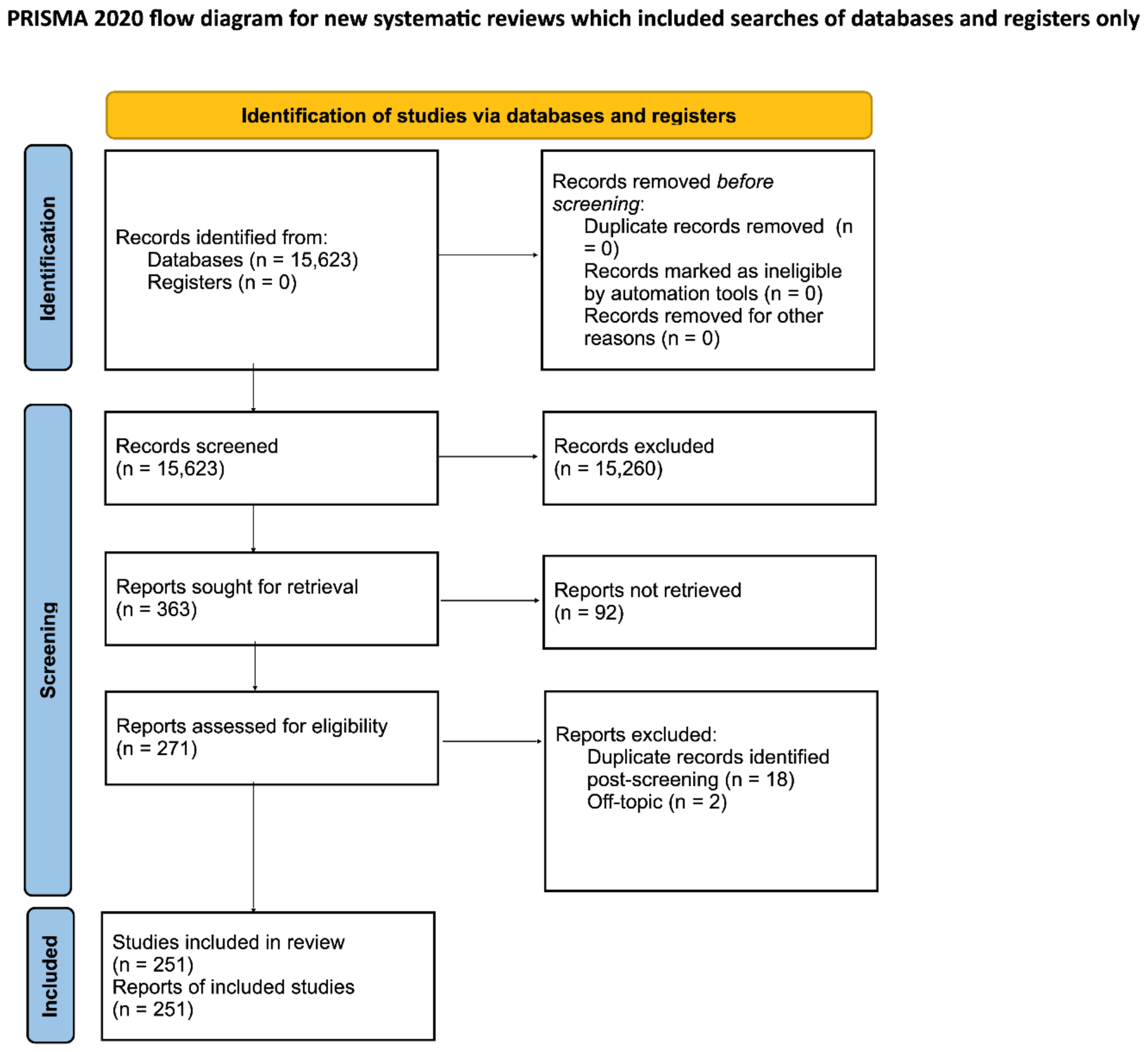
Figure 2.
The complete and multilevel systemic network of asthma.
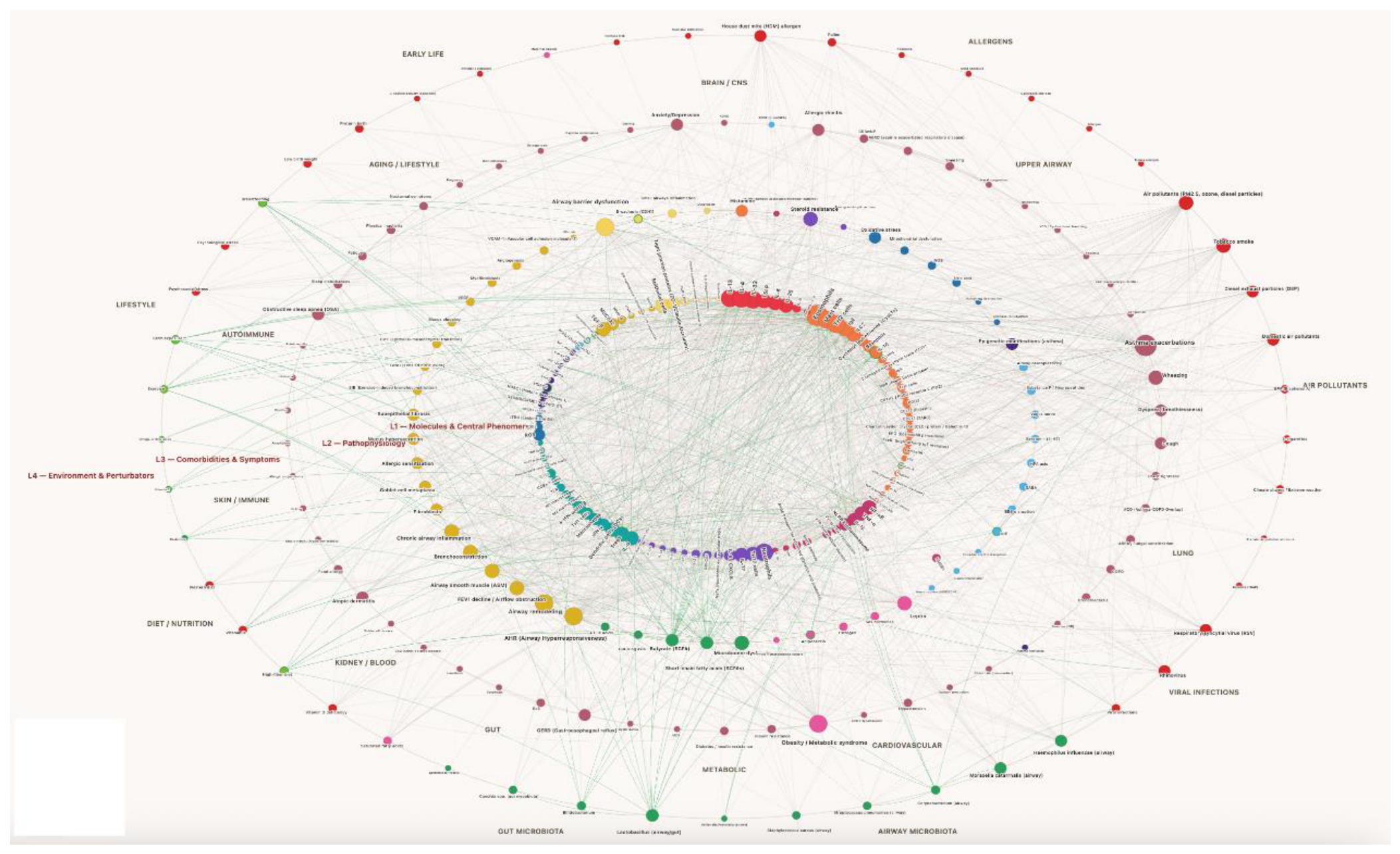

Table 1.
Search strategy: queries executed and records retrieved.
| # | Query | Records retrieved |
|---|---|---|
| 1 | asthma immunology | 2,624 |
| 2 | asthma immune pathways | 564 |
| 3 | asthma immune mechanisms | 1,016 |
| 4 | asthma inflammation | 2,372 |
| 5 | asthma systemic activation | 203 |
| 6 | asthma systemic pathways | 140 |
| 7 | asthma pathophysiology | 1,005 |
| 8 | asthma comorbidities | 687 |
| 9 | asthma environment | 1,028 |
| 10 | asthma environmental triggers | 186 |
| 11 | asthma air pollution | 396 |
| 12 | asthma symptoms | 3,551 |
| 13 | asthma symptoms and pathophysiology | 551 |
| 14 | asthma clinical manifestations | 331 |
| 15 | asthma phenotypes | 928 |
| 16 | asthma neurologic comorbidities | 16 |
| 17 | asthma psychological comorbidities | 25 |
| Total records retrieved | 15,623 |
No language filter was applied at the query level; non-English records were excluded at the screening stage.
Table 2.
Biological levels framework.
| Level | Domain | Examples |
|---|---|---|
| 1 | Molecular/cellular | cytokines, immune cells, receptors, transcription factors, intracellular signaling proteins within the respiratory tract |
| 2 | Pathophysiological processes and systemic activation | airway inflammation, airway remodeling, AHR, epithelial barrier dysfunction, systemic inflammation, metabolic dysregulation |
| 3 | Clinical/symptomatic | exacerbations, FEV1 decline, endotypes, comorbidities, symptoms |
| 4 | Environmental agents | allergens, pollutants, viruses, microbial exposures, tobacco smoke |
Disclaimer/Publisher’s Note: The statements, opinions and data contained in all publications are solely those of the individual author(s) and contributor(s) and not of MDPI and/or the editor(s). MDPI and/or the editor(s) disclaim responsibility for any injury to people or property resulting from any ideas, methods, instructions or products referred to in the content. |
© 2026 by the authors. Licensee MDPI, Basel, Switzerland. This article is an open access article distributed under the terms and conditions of the Creative Commons Attribution (CC BY) license (http://creativecommons.org/licenses/by/4.0/).
Copyright: This open access article is published under a Creative Commons CC BY 4.0 license, which permit the free download, distribution, and reuse, provided that the author and preprint are cited in any reuse.


