

Submitted:
26 June 2026
Posted:
29 June 2026
You are already at the latest version
Abstract
This study develops novel multicomponent Al–Mg–Si–Zr–Cu-based alloys for high-pressure die casting (HPDC) with improved mechanical properties and thermal sta-bility. Four compositions were designed through Zn and Cr additions, supported by thermodynamic modelling. Phase formation and microstructure were analysed by XRD and SEM/EDS, while density, electrical conductivity, hardness, and mechanical behaviour under tensile and compressive loading at room temperature and 200 °C were evaluated. Hardness increased from 166 to 214 HV3 with Zn and Cr due to the formation of complex intermetallic phases. The Al–Mg–Si–Zr–Cu alloy showed the best balance of strength and ductility under tensile loading, whereas Zn and Cr additions reduced tensile performance. In compression, Zn significantly improved strength, reaching an ultimate compressive strength of 697 MPa. Compared with the reference AlSi9Cu3 alloy, the new alloys achieved up to 30% higher yield strength, 13% higher ultimate tensile strength, and im-proved thermal stability. Among the studied compositions, Al72Mg10Si5Zr3Cu10 showed the best overall performance, while Al67Mg10Si5Zr3Cu10Zn10 was optimal for compres-sion-dominated applications.
Keywords:
aluminiun
; multicomponent
; high-pressure die casting
1. Introduction
The increasing demand for lightweight structural materials with enhanced mechanical performance and thermal stability has driven the development of advanced alloy design strategies. Among these, multicomponent alloy concepts have emerged as a promising approach, inspired by the compositional complexity paradigm originally introduced in high-entropy alloys. The extension of such principles to aluminium-based systems has recently attracted significant attention, aiming to exploit synergistic interactions between multiple alloying elements to tailor microstructure and properties [1]. However, unlike conventional high-entropy systems, aluminium multicomponent alloys must simultaneously preserve low density, good castability, and compatibility with established industrial processing routes.
High-pressure die casting (HPDC) is characterised by rapid solidification under applied pressure, leading to pronounced microstructural refinement [2]. Under these conditions, the formation of coarse equilibrium phases is reduced, while metastable and non-equilibrium intermetallics are favoured, often resulting in enhanced mechanical performance [3]. Cooling rates on the order of 102 °C/s significantly reduce secondary dendrite arm spacing and modify solute redistribution during solidification. Consequently, the resulting microstructures deviate markedly from equilibrium predictions, making phase identification and analysis of solidification pathways essential for understanding structure–property relationships [4].
From a compositional perspective, Al–Mg alloys exhibit excellent ductility and fracture resistance in the as-cast condition, although their limited castability restricts their industrial application. In contrast, Al–Si-based alloys dominate HPDC applications due to their superior fluidity and ability to produce complex geometries, with alloys such as AlSi9Cu3 being widely used. However, these alloys typically suffer a significant reduction in hardness at temperatures above 100–150 °C, mainly due to precipitate coarsening and solute redistribution within the aluminium matrix [5,6].
A potential strategy consists of combining the advantages of both systems. A potential strategy consists of combining the advantages of both systems. The addition of Mg promotes the formation of Mg2Si, at the expense of free silicon, modifying both the morphology and distribution of second-phase particles. In particular, Mg additions of approximately 3 wt.% are sufficient to suppress the formation of the acicular primary Si phases, favouring the formation of Mg2Si particles [7] instead. The characteristics of these particles strongly depend on the alloy composition, especially on maintaining an appropriate Mg/Si ratio close to the stoichiometric requirement for Mg2Si formation. When Mg and Si contents are sufficiently high, the alloy composition may shift towards the hypereutectic region of the Al–Mg2Si pseudo-binary system, leading to the formation of primary Mg2Si prior to α-Al solidification [8]. These particles are particularly beneficial for high-temperature performance due to their high melting temperature, low density, high hardness, and relatively high elastic modulus. Furthermore, compared to acicular silicon, Mg2Si provides a more favourable morphology, reducing stress concentration and enhancing matrix strengthening.
Cu addition promotes the formation of θ-Al2Cu and S-Al2CuMg strengthening phases [8], whose stability is strongly influenced by Mg content. Given the limited solubility of Cu in aluminium (around 4 wt.%), compositions close to this threshold are typically preferred to maximise solid-solution and precipitation strengthening, while avoiding the formation of coarse intermetallics. However, in highly alloyed systems, lower Cu contents may be more effective [9]. For instance, in AlSi10Mg alloys, the addition of 2 wt.% Cu has been reported to increase pore size [10], whereas in Al–Cu–Mg systems, increasing Cu content from 4 to 8 wt.% led to improvements of approximately 30% in UTS at room temperature (RT), and up to 62% at 300 °C, attributed to the formation of a higher density of fine strengthening phases [11]. Similarly, in Al–Mg alloys, increasing Cu content up to 6 wt.% has been associated with grain refinement, as well as simultaneous improvements in strength and ductility [12]. Zn is another promising alloying element. It helps modify the solidification process by reducing dendritic structures, promoting a more equiaxed morphology, and increasing the fraction of eutectic phases [13].
In Al–Mg–Cu alloys, Zn stimulates the precipitation of coherent T-Mg32(Al,Zn)49 phases, while suppressing S-Al2CuMg and β-Al3Mg2 phases, and promoting the dispersion of θ-Al2Cu [14].
The combined addition of Zn and Cu has shown particularly promising results. In Al–Mg alloys, the addition of approximately 6 wt.% Cu and 6 wt.% Zn led to the formation of MgZn2 and Al2CuMg phases, resulting in improved mechanical performance [15]. This final phase has been reported to improve the thermal stability of high-entropy alloys or multicomponent Al–Mg–Si–Cu alloys [16]. MgZn2 precipitates provide significant strengthening, particularly in the form of metastable η′ phases due to their high coherency and resistance to dislocation motion; however, their thermal stability is limited, as η′ tends to transform into the equilibrium η phase at elevated temperatures [17].
The Zn/Mg ratio plays a critical role in determining phase formation. At low Mg contents or low Zn/Mg ratios, strengthening is primarily associated with η-MgZn2 formation [15]. In contrast, higher Mg contents favour the formation of T-type phases, such as T-Mg32(Al,Zn)49. Additional phases, including T-Al2Mg3Zn3, T-Al2Mg3Zn3Cu3-x, or η-type Mg(Zn,Cu,Al)2, may also precipitate from depending on composition [18]. These more complex Zn-containing phases generally exhibit enhanced thermal stability, compared to metastable η′ precipitates, due to their compositional complexity and reduced diffusion kinetics. Higher Zn contents combined with lower Mg and Cu levels promote MgZn-rich phases instead of S-Al2CuMg [19]. Since η-MgZn2 dissolves more readily during heat treatments, coarse Al2CuMg particles may act as crack initiation sites [20]. Furthermore, Cu contents above approximately 2.5 wt.% tend to favour the S-phase formation rather than a dissolution in the matrix or precipitating as in T-type phases [18].
Microalloying additions such as Zr and Cr further influence microstructural stability. Zr promotes the formation of thermally stable Al3Zr dispersoids within the α-Al matrix, enhancing recrystallisation resistance and high-temperature stability [21]. However, due to its very low solubility in aluminium, high processing temperatures may be required, limiting its widespread application. In addition, Zr can form intermetallics such as Al3Zr or (Al,Si)3(Zr,Ti) during early solidification stages, whose morphology strongly affects mechanical properties. Typically, additions are limited to around 0.2 wt.% to avoid undesirable interactions with other elements [22].
Cr, on the other hand, contributes to the matrix strengthening and improves structural stability at elevated temperatures. It can also refine the microstructure and increase tolerance to Fe impurities compared to Al–Si–Mn systems [23]. However, Cr is rarely used in Al–Si alloys due to its tendency to form coarse intermetallic sludge particles in interdendritic regions, which can deteriorate mechanical properties [24,25].
In this context, the present work investigates the combined influence of Cu, Zn, Zr, and Cr additions (in the range of 5–10 wt.%) on Al–Si–Mg alloys, with an increased configurational complexity, leading to the design of multicomponent alloys processed by HPDC where the high cooling rates significantly modify the precipitation behaviour and the resulting microstructure. Particular emphasis is placed on understanding the interplay between composition, phase selection, and non-equilibrium solidification pathways. In doing so, this work helps bridge the gap between fundamental alloy design principles and their translation into industrial processing routes, paving the way for the development of next-generation lightweight structural materials.
2. Materials and Methods
2.1. Alloy Design
The alloy design strategy adopted in this study is based on a progressive modification of a conventional Al–Mg–Si system base alloy, selected due to its widespread use in the automotive industry and its excellent castability. The base alloy was first modified by the addition of Zr and Cu, and subsequently tailored through the incorporation of Zn and Cr, as shown in Figure 1, leading to the development of multicomponent alloys. This design approach aims to combine multiple strengthening mechanisms while preserving the fundamental solidification and precipitation behaviour of the base alloy.
Each alloying element was selected according to its specific role: Cu and Zn were introduced to enhance precipitation hardening, Cr to promote the formation of stable intermetallic phases, and contribute to microstructural refinement and improve the thermal stability, and Zr to provide dispersoid strengthening and improve thermal stability. The combined effect of these elements is expected to generate thermally stable obstacles to dislocation motion.
2.2. CALPHAD Methodology
Thermodynamic calculations under equilibrium and Scheil conditions reveal a strong compositional dependence of both phase selection and solidification pathways, highlighting the critical role of solute partitioning under non-equilibrium conditions.
To guide the alloy design, thermodynamic calculations were performed using FactSage software version 8.3 (2023) coupled with the FTlite database (2023). This methodology allowed the optimisation of elemental ratios according to the predicted phase formation. Particular attention was given to avoiding the formation of brittle primary silicon phases, as they may significantly deteriorate the mechanical performance of the alloys. Once the target compositions were defined, further simulations were carried out to analyse phase evolution under both equilibrium and Scheil solidification conditions.
Based on these results, four experimental multicomponent alloys, labelled H1–H4, were designed and subsequently manufactured. Their nominal chemical compositions are summarised in Table 1.
2.3. Materials and Casting Procedure
The raw materials were melted and chemically homogenized in a 500 kg electric furnace (EBC model, Dugopa, Spain). The initial metal charge was composed of AlSi9Cu3, AM60 and recycled AZ91 and Zamak 5, which served as base materials. Alloying elements were added through master alloys and specific additives, including zinc supplied as spherical pellets, metallurgical-grade silicon, Al–Mn (Mn80-Al20), Al–Cu (Cu80-Al20), Al-Cr (Cr80-20Al) and Al-Zr (80Zr-Al20) briquettes.
Zr and Cr were added at the initial stage of the melting process due to their high melting temperatures, followed by the addition of Si to promote its dissolution. Cu and Mn-containing master alloys were subsequently introduced, shortly before casting to minimize oxidation and element loss.
Once the target chemical composition for each alloy was achieved, the melt temperature was stabilized at 700 ºC. The molten alloys were then injected into a steel die preheated to 300ºC, using a 950 t HPDC machine (PT-650 model, Pretansa, Spain). After solidification, the castings were extracted from the die and immediately quenched in water at 50 °C to reduce internal stress. An overview of the HPDC setup and representative cast components produced under these conditions is presented in Figure 2.
The chemical composition of the alloys was analysed both prior to and after casting using inductively coupled plasma optical emission spectrometry (ICP-OES) with a SPECTROX spectrometer (Spectro, Germany), to verify compositional consistency during processing. In addition, local compositional analysis was performed by scanning electron microscopy coupled with energy-dispersive spectroscopy (SEM–EDS) at a magnification of 1000x. Prior to casting, no additional compositional modifications were introduced, as the aim of this work was to assess the as-cast performance of the alloys under conditions representative of industrial processing. To ensure melt cleanliness, a fluxing treatment was first carried out to facilitate oxide removal, followed by careful skimming of the melt surface. Subsequently, a degassing step using nitrogen (N2) was performed to minimize dissolved gases and enhance melt quality.
In addition to the production of different specimens by HPDC (tensile, wear samples), the alloys were also cast in commercial sand moulds for thermal analysis, to validate the number and relative fraction of the solidification phases predicted by thermodynamic calculations, as well as to identify their characteristic formation temperatures. Cooling curves were derived from temperature–time data collected during solidification using a high-speed data acquisition system (FieldLogger v1.5x, Novus Automation, Brazil) connected to a laptop, operating at a sampling rate of 10 Hz. To ensure reproducibility, each thermal analysis measurement was repeated at least three times. The experiments were carried out in a custom-designed metallic mould, yielding an average cooling rate of approximately 0.5 °C/s.
2.4. Microstructural Characterization
2.4.1. X-Ray Diffraction Analysis
Phase identification was conducted by X-ray diffraction (XRD) using a Philips X’Pert Pro MPD PW3040/60 diffractometer (Malvern Panalytical Ltd., United Kingdom) with Cu Kα radiation operating at 40 kV and 40 mA (1.6 kW). Diffraction patterns were acquired over a 2θ range of 10°–90°, with a step size of 0.02° and a counting time of 2 s per step. The crystalline phases were identified by comparison with reference patterns from the PDF-2 database of the International Centre for Diffraction Data (ICDD). The analyses were performed on samples extracted from the gauge section of the tensile specimens.
2.4.2. Optical and Scanning Electron Microscopy
Samples for metallographic analysis were prepared following standard preparation procedures, including selection of the extraction area, cutting, mounting, grinding, and polishing. Samples were extracted from the neck region of the tensile specimens to obtain representative microstructural information using a SiC disc cutter, model Mecatome T 255/300 (Presi, Grenoble, France). Subsequently, the samples were hot-mounted in resin using a MultiFast mounting press, model CitoPress-1 (Struers, Madrid, Spain). Finally, the samples were ground using SiC papers of different grit sizes (#240, #400, #600, #800, #1200, and #2500) and polished with a cloth and a 3 μm diamond suspension using a Mecatech 334 polishing machine (Presi, Grenoble, France).
The microstructure of each alloy was examined using an optical microscope (Leica DMI5000 M, Leica, Wetzlar, Germany) and a scanning electron microscope (Quanta 450, FEI, Hillsboro, OR, USA) equipped with energy-dispersive X-ray spectroscopy (EDS) for compositional analysis.The microstructure of each alloy was examined using an optical microscope (Leica DMI5000 M, Leica, Wetzlar, Germany) and a scanning electron microscope (Quanta 450, FEI, Hillsboro, OR, USA) equipped with energy-dispersive X-ray spectroscopy (EDS) for compositional analysis.
2.5. Physical Properties
The density of the alloys was determined using the Archimedean method with a high-precision balance (BC Memory, Orma, Milan, Italy) with an accuracy of 0.01 mg.
Porosity was estimated by comparing the experimental density with the theoretical density calculated from the actual alloy composition. At least three samples were analyzed for each condition to ensure reproducibility.
Electrical conductivity (EC) measurements were carried out using a portable Autosigma 3000 device. Up to five measurements were taken at different locations to ensure representativeness and reproducibility. Electrical conductivity is closely related to the amount of solute in solid solution and can be used as an indirect indicator of precipitation state, often exhibiting an inverse relationship with mechanical strength.
2.6. Mechanical Properties
2.6.1. Hardness
Vickers hardness tests were performed at RT according to ISO 6507-1 using a Shimadzu FV-700 hardness tester (Japan) with an applied load of 3 kgf. Measurements were taken from the surface towards the interior of the metallographic samples. A clear gradient was observed, with higher hardness values near the surface than in the core, which is consistent with the typical behaviour of HPDC components. This phenomenon is commonly associated with the formation of a refined surface layer (“skin”), characterized by very fine primary aluminium dendrites that enhance the mechanical response of the material [26]. The reported hardness values represent the average of five indentations per sample.
2.6.2. Tensile Properties
Tensile tests at RT were conducted in accordance with UNE-EN ISO 6892-1 using a universal testing machine (Instron 5500R6025, USA) with a load capacity between 1 and 100 kN. Temperature tensile tests at 200 °C were carried out following UNE-EN ISO 6892-2. Before testing, specimens were heated from RT to 200 °C over a period of 30 minutes and subsequently held at this temperature for 15 minutes using a controlled heating chamber (Instron 3119-007, USA).
The tensile specimens had a cylindrical geometry with a reduced gauge section. The overall length was 95 ± 0.2 mm, with a gauge length of 33 ± 0.2 mm and a gauge diameter of 6.325 ± 0.2 mm. The grip section was designed with an enlarged diameter of 11.85 ± 0.5 mm to facilitate gripping. Smooth transitions between the gauge section and the ends were incorporated to avoid stress concentration and promote uniform deformation within the gauge region. At least three specimens per alloy and condition were tested to ensure reproducibility.
2.6.3. Compressive Properties
Uniaxial compression testing was conducted at RT following the ASTM 9 standard. Test specimens with a cylindrical geometry (12 mm in diameter and 20 mm in length) were prepared by sectioning the ends of previously tested tensile samples. The experiments were conducted using the same universal testing machine employed for tensile testing (Instron 5500R6025, USA). A minimum of three tests per condition was performed to ensure consistent results.
2.6.4. Fracture Surface Analysis
The fracture surfaces obtained after tensile and compression testing were analyzed by scanning electron microscopy (SEM) at magnifications up to ×2500. Energy-dispersive X-ray spectroscopy (EDS) was also used to identify elemental distributions and characterise fracture mechanisms.
3. Results and Discussion
3.1. Chemical Composition and Casting Quality
In contrast, the compositions obtained from SEM-EDS displayed noticeable variations. These discrepancies arise mainly from the localized nature of SEM-EDS analysis, which is highly sensitive to microstructural heterogeneities, including primary and eutectic phases, intermetallic particles, and elemental segregation. Therefore, SEM-EDS data should be considered as local compositional information corresponding to specific regions of the microstructure, rather than a reflection of the overall alloy composition.
The measured chemical compositions of Cu, Zn, Cr and Zr were found to be slightly lower than the nominal values, which can be attributed to element losses and limited dissolution during melting. During processing, Zr and Cr exhibit relatively high stability in the aluminium melt; however, their limited solubility may lead to an incomplete dissolution or the formation of intermetallic phases. In contrast, Zn is more prone to losses, due to its high vapour pressure, which can result in partial evaporation during processing. On the other hand, although Cu is generally stable under these conditions, the slightly lower measured Cu content compared to the nominal value may be associated with incomplete homogenization during processing.

Table 2.
summarizes the chemical composition of the investigated alloys as determined by OES and SEM-EDS techniques. The OES results reflect the overall (bulk) composition of the materials and showed a good agreement with the nominal values used during alloy fabrication. Owing to its higher precision and larger sampling volume, OES provides a more representative and reliable measurement of the total alloying content.Table 2. Elemental composition of experimental alloys.
Table 2.
summarizes the chemical composition of the investigated alloys as determined by OES and SEM-EDS techniques. The OES results reflect the overall (bulk) composition of the materials and showed a good agreement with the nominal values used during alloy fabrication. Owing to its higher precision and larger sampling volume, OES provides a more representative and reliable measurement of the total alloying content.Table 2. Elemental composition of experimental alloys.
| Targeted Alloy | Ref. | Method | Al | Mg | Si | Cu | Zn | Cr | Zr | Others |
| Al72Mg10Si5Zr3Cu10 | H1 | OES | 76.3 | 9.9 | 3.6 | 7.6 | 0.6 | - | 1.9- | Balance |
| SEM | 72.8 | 12.2 | 5.2 | 7.9 | 1.35 | - | - | Balance | ||
| Al67Mg10Si5Zr3Cu10Zn10 | H2 | OES | 65.2 | 9.0 | 3.0 | 10.6 | 11.5 | - | 1.9 | Balance |
| SEM | 73.2 | 12.3 | 5.8 | 6.8 | 1.3 | - | - | Balance | ||
| Al66Mg10Si5Zr3Cu10Zn10Cr1 | H3 | OES | 70.9 | 7.6 | 2.7 | 8.3 | 9.3 | 0.6 | 1,9 | Balance |
| SEM | 63.7 | 10.7 | 4.5 | 7.6 | 8.9 | 0.8 | - | Balance | ||
| Al64Mg10Si5Zr3Cu10Zn10Cr3 | H4 | OES | 68.9 | 7.6 | 2.7 | 8.3 | 9.3 | 2.6 | 1.9 | Balance |
| SEM | 65.8 | 11.5 | 4.6 | 7.8 | 9.3 | 0.6 | 3.1 | Balance |
3.2. Solidification Behaviour and Thermal Analysis
Figure 3 shows a representative Scheil solidification path for the H4 alloy, while the complete set of predicted phases for all four alloys is summarised in Table 3.
Solidification across all alloys was dominated by the formation of the FCC α-Al matrix, which consistently constitutes the majority phase (62–73%), together with Zr-containing phases (ZrSi), and Mg2Si as the primary high-temperature intermetallic. This indicates that, despite increasing alloying complexity, the fundamental Al–Mg–Si solidification framework was preserved. However, the redistribution of solute elements during solidification strongly modified the nature and stability of secondary phases.
The predicted liquidus temperature by thermodynamic calculations spanned a wide temperature range, from approximately 1,253ºC, reflecting the early formation of Zr-bearing intermetallic phases. These phases formed well above the nucleation of the Al-rich matrix and therefore acted as primary solidification products rather than interdendritic constituents. In contrast, the effective solidification interval of the matrix was much narrower, with FCC-Al forming at about 559–571 ºC and the final solidification reactions occurring at approximately 487–507 °C. Phases predicted below 482 °C were therefore associated with post-solidification solid-state transformations.
For the H1 (Al–Mg–Si–Zr-Cu) alloy, both equilibrium and Scheil predictions showed a relatively simple solidification sequence, dominated by Mg2Si (~13%) and α-Al (~70–73%). Minor early precipitation of Zr-containing phases was predicted at higher temperatures but with a negligible fraction (~3%). The addition of Cu led to the formation of Cu-rich intermetallics, namely Al2Cu (~11%) and Al2CuMg (~5–9%), forming at ~507–512 °C. Only minor differences were observed under Scheil conditions, with a slight reduction in Al2CuMg fraction, indicating a limited microsegregation and solute redistribution, which was insufficient to significantly alter the phase selection pathway under non-equilibrium conditions.
The introduction of Zn in H2 (Al–Mg–Si–Zr-Cu-Zn) increased the complexity of the system. In addition to ZrSi, Mg2Si and the FCC matrix, equilibrium calculations predicted the formation of Zn-containing intermetallic phases such as Mg2Zn11 (4%), AlCuZn (14%) and MgZn2 (3%), mainly at temperatures below 482 °C. Under Scheil conditions, the phase assemblage was simplified, with a pronounced increase in the Mg2Zn11 fraction (19%) and the suppression of some equilibrium low-temperature phases. This behaviour reflected an enhanced interdendritic segregation under non-equilibrium conditions, concentrating Zn and Mg in the remaining liquid, and promoting Mg2Zn11 formation.
For the H3 (Al–Mg–Si–Zr-Zn–Cu–Cr) alloy, the presence of 1 wt.% Cr promoted the formation of several Cr-rich intermetallic phases (e.g., Al9Cr3Si (1%), Al11Cr2 (3%), Al7Cr (4%)) at relatively high temperatures, before or during the early stages of α-Al solidification. This indicates that Cr promoted the formation of thermally stable intermetallic compounds during the initial stages of solidification. Subsequently, the system evolved similarly to H2, with Mg2Si (13%) and FCC aluminium (65-69%) dominating the microstructure, and controlled Cu and Zn-rich phases such as Al2CuMg (15%), Mg2Zn11 (5%) and MgZn2 (3-4%) forming at later stages or below 482 °C. Under Scheil conditions, the phase assemblage was again simplified, with reduced diversity of Cr-containing phases and increased segregation-driven formation of Mg2Zn11. The differences between equilibrium and Scheil predictions suggested that some complex Cr-containing phases may be partially suppressed under rapid solidification conditions.
For the H4 (Al–Mg–Si–Zr–Cu–Zn–Cr, 3 wt.% Cr) alloy, the higher Cr content modified the solidification path. Under equilibrium conditions, a wide variety of intermetallic phases was predicted, including Cr-rich phases (Al11Cr2 ~3.5%, Al13Cr4Si4 ~7%), Cu-containing phases (Al2CuMg ~16%, Al7Cu ~9%), and Zn-rich phases such as Mg2Zn11 (~4%), AlCuZn (~17%), and MgZn2 (~3%). Additional phases such as ZrAl (~6%) and MgZn2Al (~6%) were also formed at lower temperatures. Under Scheil conditions, the phase assemblage is significantly simplified, with reduced fractions of most complex phases and a dominant presence of Mg2Zn11 (~11%). This indicated a strong solute segregation in the final liquid and kinetic suppression of many equilibrium low-temperature phases under rapid solidification conditions.
Overall, the comparison between equilibrium and Scheil predictions demonstrated that phase formation in these alloys was controlled by strong competition between thermodynamic stability and kinetic constraints imposed by rapid solidification. While equilibrium calculations predicted a highly complex intermetallic landscape, particularly at low temperatures, Scheil simulations revealed that non-equilibrium conditions favoured segregation-driven phase selection, dominated by Mg2Zn11 and a reduced set of intermetallics. This behaviour is consistent with the limited solid-state diffusion expected under high-pressure die casting conditions and provides a mechanistic basis for understanding the resulting microstructural heterogeneity and its implications for mechanical performance.
3.2.1. Cooling Curves and Phase Formation Temperatures
Figure 4 illustrates a representative cooling curve and the associated phase transformations for H4, and Table 4 summarizes the solidification temperatures obtained for the corresponding phases in the four experimental multicomponent alloys. Thermal analysis results revealed systematic changes in the solidification behaviour of the studied alloys as a function of alloying additions.
Alloy H1 showed the simplest solidification path, with a relatively narrow solidification interval and a final post-eutectic event around 502–505 °C, consistent with the formation of Cu-rich intermetallics such as Al2Cu and Al2CuMg. In addition, eutectic reactions occurred relatively close to the liquidus temperature, indicating a limited solute redistribution during solidification.
The addition of Zn in H2 shifted both the eutectic and post-eutectic reactions to lower temperatures and significantly decreased the solidus temperature, indicating enhanced solute enrichment in the interdendritic liquid and a broader solidification interval. The appearance of additional post-eutectic reactions, which were absent or less pronounced in H1, suggested the formation of Zn-rich intermetallic phases during the final stages of solidification, in agreement with the calculated appearance of Mg2Zn11, AlCuZn and MgZn2.
For H3 alloy, the higher preliminary nucleation temperature was consistent with the early formation of Cr-rich intermetallic compounds predicted by Thermo-Calc. However, the subsequent liquidus and eutectic events were expected to remain close to those of H2-H4, indicating that Cr mainly affected the early stages of solidification, while the later stages were still governed by the segregation of Zn-, Mg- and Cu-rich phases in the residual liquid.
In H4 alloy, the higher Cr content further modified the solidification path by promoting the early formation of Cr-rich intermetallic phases. The low solidus temperature, comparable to that of H2 and H3, indicated a strong tendency toward microsegregation. Unlike H1, the post-eutectic reactions occurred over a broader temperature range and without clear recalescence, suggesting a more gradual, diffusion-controlled formation of intermetallic phases. This behaviour is consistent with strong solute segregation and with the diffusion-controlled phase formation in the residual liquid.
Overall, the progressive decrease in solidus temperature from H1 to H4 indicated an increasing tendency toward microsegregation as the alloying complexity increased. These thermal analysis results support the thermodynamic predictions and provide experimental validation of the increasingly complex solidification sequences expected in the multicomponent alloys processed by HPDC.
3.3. Microstructural Characterisation
3.3.1. Phase Identification by XRD
Figure 5 presents the XRD patterns obtained for the four experimental multicomponent alloys. The base alloy (Al–Mg–Si–Zr–Cu) exhibited an aluminium matrix with a face-centered cubic (FCC) crystal structure (Fm3̅m), along with the Mg2Si and Al2CuMg phases, as well as the primary Al3Zr phase.
With the addition of Zn in the H2 alloy (Al–Mg–Si-Zr-Cu–Zn), the same phases were detected. However, no Zn-containing phases were identified, likely due to their low concentration in the alloy; any Zn-rich phases may be present at levels below the XRD detection limit.
In alloys H3 and H4, after the addition of Cr (1 wt.% and 3 wt.%, respectively), similar phases were observed, including the aluminium matrix, Mg2Si, and Al3Zr. However, the S-Al2CuMg phase transformed into Al2Cu, and Zn-containing phases such as MgZn2 were detected.
Although the Scheil simulation predicted the formation of Mg2Zn11, XRD analysis revealed the presence of MgZn2. This discrepancy can be attributed to the limitations of the Scheil model, which does not account for kinetic factors such as nucleation barriers and phase competition during rapid solidification. Under the high cooling rates associated with HPDC, phase selection is strongly influenced by kinetics, and MgZn2 may nucleate and grow preferentially, even if Mg2Zn11 is thermodynamically more stable. Furthermore, the presence of additional alloying elements such as Cu, Si, Cr, and Zr modified the local composition of the interdendritic liquid, promoting the formation of complex multicomponent phases. As a result, Mg2Zn11 formation may be suppressed or limited to fractions below the detection limit, while MgZn2 is retained in the final microstructure.
A possible explanation for the absence of MgZn2 in the XRD pattern of the H2 alloy containing Al2CuMg is the competitive consumption of Mg by the S-phase, which may reduce the amount of Mg available for the MgZn2 formation. When Al2CuMg is replaced by Al2Cu, a larger amount of Mg may remain available to react with Zn, thus increasing the fraction of MgZn2 to a level detectable by XRD. Previous studies suggest that increasing the Zn/Mg ratio (as in the H2 alloy) may lead to a reduction in the fraction of the MgZn2 phase [27].
It is noticeable that, in the 2θ ranges of 60–70° and around 78°, the intensity of the α-Al diffraction peaks decreased in H3 and H4 with the addition of Cr. This reduction suggests a lower matrix volume fraction, likely associated with increased precipitation of secondary phases and enhanced lattice distortion induced by higher alloying additions. Additionally, around 40°, the Mg2Si diffraction peak in H3 and H4 shifted toward higher 2θ values, indicating a reduction in interplanar spacing [28]. Simultaneously, the decrease in α-Al peak intensity and the rightward shift of the Mg2Si peak suggest that Cr addition modifies both the matrix/secondary-phase balance and the crystallographic state of the Mg2Si phase. In contrast to lattice expansion typically associated with solute incorporation, as reported in the literature, the observed rightward shift of the Mg2Si peak in H3 and H4 is more likely related to lattice distortion or microstrain effects rather than direct solute incorporation into the Mg2Si phase.
3.3.2. Optical and SEM+EDS Microstructures
Optical micrographs of the H1–H4 alloys are presented in Figure 6 and Figure 7, showing the characteristic microstructural features developed under HPDC conditions. In Figure 6, a clear distinction between the surface layer and the interior region was observed in all the alloys. The surface layer exhibited a more refined microstructure, along with a reduced presence of coarse intermetallic phases compared to the interior. This refined surface layer has been reported to exhibit improved mechanical properties.
Figure 7 shows the microstructure in the interior of the castings, where the cooling rate is lower. All alloys exhibited a predominantly a α-Al matrix with a relatively fine and homogeneous microstructure. A gradual decrease in grain size was observed from H1 to H3, from ~8.2 µm to ~4.7 µm, reflecting the grain refinement induced by the alloying additions. However, no further significant refinement was observed in H4, where the grain size remained essentially unchanged (~4.7 µm), suggesting a saturation of the refinement effect at higher Cr contents. Due to the high cooling rates inherent to HPDC, the formation of well-defined dendritic structures was largely suppressed, resulting in a compact morphology with a partially globular appearance. This microstructural gradient is consistent across all compositions and reflects the strong thermal gradients typical of HPDC processing.
Dark, polygonal particles were homogeneously distributed throughout the matrix and were attributed to the primary Mg2Si phase, based on their morphology and optical contrast. Their presence is consistent with thermodynamic predictions and their formation at relatively high temperatures during solidification.
Also, from H1 to H4, an increase in the number density and refinement of particles was observed, suggesting enhanced nucleation and/or restricted growth associated with the addition of Zn and Cr.
In the base alloy (H1), Mg2Si particles appeared relatively coarse and sparsely distributed. With the addition of Zn (H2), a slight increase in the amount of fine secondary phases was observed, particularly within the interdendritic regions, indicating enhanced solute segregation during the final stages of solidification. The addition of Cr in H3 and H4 led to a more pronounced refinement of the microstructure, with a higher number density of finer particles and a more homogeneous distribution of intermetallic phases throughout the matrix. In H4 (3 wt.% Cr), this effect becomes more evident, and some elongated or plate-like features, likely associated with Cr-rich intermetallics, were distinguished.
In addition to the primary Mg2Si particles, finer intermetallic constituents formed during the final stages of solidification were observed within the interdendritic or interglobular regions. These phases appeared as light grey features and were associated with Cu and Zn-rich compounds predicted by thermodynamic calculations. Their distribution was more pronounced in the alloys containing Zn (H2–H4), indicating increased segregation and solute enrichment in the remaining liquid during the last stages of solidification.
No significant differences in the overall α-Al matrix morphology were observed among the alloys. Minor casting defects, such as small shrinkage porosity, were occasionally detected, however, their fraction remained below 5%, and their size is typically below 20 µm, which is under the critical threshold typically reported for HPDC alloys. No clear correlation between porosity and alloy composition was observed [29,30].
It is also worth noting that Zr-containing phases were not clearly visible, likely due to their fine dispersion within the matrix. In the case of Cr-containing alloys (H3 and H4), these intermetallic phases were not easily distinguishable at lower Cr contents and only became more apparent in H4 (3 wt.% Cr), where darker grey particles could be observed.
SEM micrographs of the H1–H4 alloys at higher magnification are shown in Figure 8, revealing the distribution and morphology of the main intermetallic phases. In H1, the interdendritic regions were mainly composed of Al2CuMg, together with primary Mg2Si particles and the associated eutectic structure. Upon Zn addition (H2), Zn-containing phases, most likely corresponding to MgZn2 as identified by XRD, appeared within the interdendritic regions, coexisting with Al2CuMg. A significant change was observed in the Cr-containing alloys (H3 and H4), where the Cu-rich phase shifted from Al2CuMg to Al2Cu. This transition was accompanied by a more pronounced presence of MgZn2, suggesting a redistribution of Mg that favoured the formation of Zn-rich intermetallic phases. This behaviour indicates that, in H2, a considerable fraction of Mg was consumed by the Al2CuMg phase, limiting the amount of Mg available to form Mg–Zn compounds and possibly reducing their fraction below the detection limit of XRD. In contrast, in H3 and H4, the replacement of Al2CuMg by Al2Cu took place with a larger amount of Mg, available to combine with Zn, promoting the formation of MgZn2 in a detectable fraction. Additionally, Cr-containing intermetallics (Al7Cr) became visible, particularly in H4, where their density number increased. The presence of Al3Zr particles was also confirmed in the alloys with higher alloying additions.
To further clarify the elemental distribution, Figure 9 presents the corresponding EDS map of H4 alloy. The results indicated that Zn was mainly concentrated in the interdendritic regions, where it was spatially associated with Cu and Al. In some local areas, Zn was also found to co-localize with Mg, suggesting that Zn partitions into chemically complex interdendritic constituents during the final stages of solidification and may also contribute to the formation of Mg–Zn-rich phases. Therefore, although the local EDS signal reflects multiphase regions rather than a single stoichiometric compound, the combined SEM, EDS, and XRD results support the assignment of the Zn-bearing phase to MgZn2.
3.4. Mechanical Properties
3.4.1. Hardness Distribution
Figure 10 and Table 5 summarises the Vickers hardness (HV3) values of the investigated alloys, compared with those of an AlSi9Cu3 alloy produced under the same processing conditions. All experimental alloys exhibited significantly higher hardness than AlSi9Cu3 [8], indicating the strong strengthening effect of the multicomponent alloy design.
Among the investigated compositions, the H1 (Al-Mg-Si-Zr-Cu) base alloy exhibited the lowest hardness. Although it contains approximately 10 wt.% Cu, which is known to contribute to strengthening, the overall hardness remained limited compared to the other alloys. The presence of Zr contributed to strengthening through grain refinement and the formation of thermally stable particles; however, its effect was less pronounced than that of Zn or Cr additions. Previous studies on Al–Zn–Cu systems have shown that relatively high Cu contents are often required to significantly enhance hardness [31], yet the values obtained in the present work are comparable or higher due to the combined alloying strategy.
The addition of Zn to the base alloy led to a clear increase in hardness. This can be attributed to solid solution strengthening and, more importantly, to the formation of strengthening phases such as η-MgZn2 or complex Mg(Zn,Cu,Al)2 intermetallics. This behaviour is consistent with previous studies on Al–Cu–Zn alloy systems, where Zn promotes both precipitation and solid solution strengthening mechanisms [32]. Finally, the addition of Cr resulted in an additional increase in hardness [33].
As a result, hardness increased progressively from H1 to H4, from 166 HV3 to 214 HV3, with the largest increment occurring between the Cr-free and Cr-containing alloys (approximately 20%). However, the difference in hardness between H3 and H4 remains relatively small (≈1%) despite the higher Cr content in H4, indicating a saturation of the strengthening effect [33]. This behaviour can be attributed to the formation of coarser Cr-containing intermetallic particles and increased microsegregation during solidification at higher Cr levels, leading to a more heterogeneous microstructure. Consequently, the additional Cr did not result in a proportional increase in hardness, as also reflected by the higher scatter observed in H4.
Similar trends have been reported in other HPDC multicomponent Al–Mg–Si-based alloys, where the solubility of Cr is limited and its addition is typically restricted to low levels to control the formation of intermetallic phases [33]. In contrast, the present alloys achieved significantly higher hardness values, even when compared to conventional high-temperature Al–Si–Cu–Mg alloys [34].
3.4.2. Tensile Properties at RT and 200 °C
Table 6 presents the tensile engineering properties: yield strength (YS), ultimate tensile strength (UTS) and elongation (E), of the investigated multicomponent aluminium at RT and 200 ºC, while Figure 11 illustrates the evolution of these properties as a function of the combined addition of alloying elements.
At RT, the addition of 5 wt.% Zn (H2) to the base alloy H1 (AlMgSiZrCu) resulted in a clear deterioration of mechanical properties, with reductions of approximately 13% in YS, 7% in UTS, and 20% in elongation. This behaviour can be attributed to the influence of Zn on phase evolution. In particular, the formation of Mg–Zn and Mg–Zn–Cu intermetallic phases may consume part of the available Mg, leading to a redistribution of Mg from Mg2Si, which is the primary strengthening phase in Al–Mg–Si alloys [35], towards Zn-rich intermetallic phases and increasing microstructural heterogeneity. As a result, the overall strengthening effect was diminished. In addition, Zn tends to segregate in interdendritic regions during solidification, forming coarse Zn-rich particles that promote chemical heterogeneity and localized stress concentration sites, thereby degrading mechanical performance [36].
In this context, the Zn/Mg ratio plays a critical role in controlling solidification behaviour. Previous studies have shown that variations in this ratio significantly affect phase formation and defect susceptibility in Al–Mg–Zn systems [37]. Therefore, the increased Zn content in H2 likely modified the local solidification path and phase distribution, contributing to the observed reduction in tensile properties. This behaviour is consistent with earlier works reporting that the formation of complex Mg–Al–Zn–Cu intermetallic phases can be detrimental to mechanical performance [38].
The addition of Cr further modified the mechanical response of the alloys. For an addition of 1 wt.% Cr (H3), the yield strength increased by approximately 7%, while UTS decreased by about 11% and elongation by 25%. The increase in YS can be attributed to the formation of hard Al–Cr intermetallic particles (e.g., Al7Cr), which act as obstacles to dislocation motion and enhance resistance to plastic deformation. However, these particles tend to be relatively coarse and heterogeneously distributed, limiting their strengthening efficiency under tensile loading. As the Cr content increased to 3 wt.% (H4), further coarsening, agglomeration, and possible precipitation at grain boundaries occurred. As a result, their effectiveness in strengthening obstacles is reduced, leading to a decrease in the yield strength and a further deterioration of ductility.
Although some studies have reported improvements in ductility with small additions of Cr in Al–Zn–Mg–Cu alloy [39], the behaviour observed in the present work differed significantly. This discrepancy can be attributed to the higher Cr contents used (1–3 wt.% compared to ~0.3 wt.% in the literature), as well as to the increased compositional complexity of the investigated alloys (Al–Mg–Si–Zr–Cu–Zn–Cr). In such multicomponent systems, Cr promotes the formation of a higher volume fraction of intermetallic phases, including Al–Cr and Al–Cr–Fe–Mn particles, which become coarser and more heterogeneously distributed under HPDC conditions.
Furthermore, the combined presence of Zn and Cr enhances solute segregation and the formation of complex interdendritic constituents, resulting in an increased microstructural heterogeneity. Consequently, both strength and ductility may deteriorate despite the addition of Cr, particularly at higher concentrations, where the beneficial effects of grain refinement and particle strengthening are outweighed by the detrimental influence of coarse intermetallics and segregation [40].
When compared with the reference AlSi9Cu3 alloy [8], the investigated multicomponent alloys exhibited improvements of up to 30% in YS and 13% in UTS, while maintaining similar elongation values. Similarly, when compared with Al–Zn-based alloys containing similar Cu contents, the maximum tensile strength of the present alloys remained competitive or superior [31]. In addition, compared to other multicomponent Al–Mg–Si-based alloys alloyed with low levels of Cr, Sc, or Zr, the YS values obtained in this study were higher, although the UTS was slightly lower [33]. In addition, compared to Al–Mg–Si–Cu-based alloys with lower Cu contents, both YS and UTS of the investigated alloys were significantly improved, although in the case of Cr-containing alloys, the values are comparable.
A comparison between tensile properties and hardness revealed that they do not correlate directly. While hardness increased due to the higher volume fraction of intermetallic phases and precipitates, which acted as reinforcement phases and enhanced resistance to localized plastic deformation, these phases were often coarse, brittle, and heterogeneously distributed. As a result, they negatively affected the overall mechanical behaviour under tensile loading by acting as stress concentrators and promoting crack initiation [36].
At 200 °C, a general reduction in YS and UTS was observed for all alloys, while elongation tended to increase slightly, except for sample H4. H1 alloy showed a decrease of approximately 8% in YS and 7% in UTS, with a slight increase in elongation. The Zn-containing alloy (H2) exhibited reductions of 8% in YS and 9% in UTS. The alloy with 1 wt.% Cr (H3) showed a moderate decrease of 6% in YS and 2% in UTS, indicating improved thermal stability. In contrast, the alloy with 3 wt.% Cr (H4) exhibited more pronounced reductions of 13% in YS and 9% in UTS, while elongation remained nearly constant.
Compared to the reference AlSi9Cu3 alloy, which exhibits a significant degradation in mechanical performance at elevated temperature (with reductions of up to 40% in UTS), the multicomponent alloys demonstrated a superior thermal stability, retaining a higher fraction of their mechanical properties at 200 °C.
Similar improvements have also been reported when compared with other multicomponent HPDC alloys, where both RT and elevated temperature tensile properties were enhanced while maintaining comparable elongation values [41].
Overall, the Cu-containing alloy (H1) exhibited the best combination of mechanical properties at both RT and 200 °C, whereas the alloy with 1 wt.% Cr (H3) showed the highest thermal stability, with the smallest reduction in mechanical properties at elevated temperature. Nevertheless, the reductions observed in all alloys were relatively limited, indicating generally good thermal stability.
3.4.3. Compressive Behaviour
Table 7 presents the compressive engineering properties: yield strength (YS), ultimate compressive strength (UCT), and deformation (S) of the multicomponent aluminium at RT.
The results showed a progressive increase in maximum compressive stress from H1 to H4, accompanied by a reduction in the total strain. H1 alloy exhibited the lowest strength (592 MPa) but the highest deformability (6.3%), consistent with its more homogeneous macroscopic deformation and delayed strain localization.
The addition of Zn in the H2 alloy led to a significant increase in compressive strength (57% YS and 18% UCT) but also promoted an earlier strain localization and macroscopic cracking. This behaviour can be attributed to the combined effect of solid solution strengthening and the formation of Zn-rich intermetallic phases. In particular, the formation of Zn-rich intermetallic phases (e.g., Mg–Zn or Mg–Zn–Cu) and the increase in solid solution strengthening enhance resistance to plastic deformation under compressive loading. In addition, under compressive loading, crack opening is suppressed, allowing these hard intermetallic phases to contribute more effectively to load-bearing capacity. In addition, the effectiveness of these phases strongly depends on their size and distribution. Previous studies have reported that finely dispersed MgZn2 precipitates can improve ductility by avoiding stress concentration and promote a more homogeneous deformation [36]. In contrast, in the present alloys, Zn-rich phases are more likely to form as relatively coarse and interdendritic constituents, leading to microstructural heterogeneity. As a result, these phases acted as stress concentrators and limited the material’s ability to accommodate uniform plastic deformation, promoting earlier strain localization and reducing ductility.
With the incorporation of 1 wt.% Cr in H3, the YS and UCT values remained relatively stable, while the total strain decreased by approximately 15%. This behaviour suggests that the addition of Cr did not provide a significant further increase in strength under compressive loading but instead modified the deformation behaviour. In particular, Cr promoted the formation of Al–Cr intermetallic particles, which acted as obstacles to dislocation motion and contributed to strain localization. Although such particles may provide some strengthening, their effectiveness depends strongly on their size and distribution. In the present case, the reduction in ductility indicates that these particles limited the material’s ability to accommodate uniform plastic deformation. Furthermore, Cr influenced grain refinement and phase distribution, led to a more constrained deformation behaviour.
Finally, in H4 (3 wt.% Cr), the UCT remained comparable, while a slight decrease (≈9%) in YS is observed. This behaviour can be attributed to the increased formation of Cr-rich intermetallic phases with coarser size and more heterogeneous distribution. As the Cr content increased, these particles tended to agglomerate and may also segregate at grain boundaries [33], reducing their effectiveness as strengthening obstacles. At the same time, their coarse and brittle nature promoted stress concentration and facilitated crack initiation, thereby limiting both YS and S. This indicates that the strengthening effect of Cr tends to saturate, and may even become detrimental at higher concentrations, where the negative impact of microstructural heterogeneity outweighs the potential benefits of particle strengthening. This suggests that Cr does not significantly contribute to further strengthening but promotes the formation of Al–Cr intermetallic particles, which in the present alloys tend to be relatively coarse and heterogeneously distributed. Additionally, Cr influence grain refinement and phase distribution, leading to a more constrained plastic deformation.
H1 provided the best overall mechanical performance due to its superior compressive properties, together with the highest ductility and the most balanced compressive response. In contrast, H2 exhibited the highest UCT, making it a promising option for compression-dominated applications, although at the expense of reduced tensile performance and ductility.
Compared to the reference AlSi9Cu3 alloy, the H1 alloy exhibited a significant improvement in mechanical performance, with an increase of approximately 100% in YS and 129% in UCT, although accompanied by an 80% reduction in S [8]. The substantial increase in strength can be attributed to the higher alloying content and the formation of multiple strengthening phases, such as ZrSi, Mg2Si, and Al2CuMg, which contributed through both precipitation and solid solution strengthening mechanisms. However, this enhanced strengthening is associated with reduced deformability due to the higher volume fraction of hard intermetallic phases, which promote strain localization.
Compared with recently developed multicomponent HPDC Alloys [41], the compressive strength values of the present alloys were comparable in terms of maximum load-bearing capacity. However, those alloys generally exhibited higher deformation values, indicating a better balance between strength and ductility. Furthermore, when compared with Cantor-type alloys, the present alloys demonstrate a superior strength-to-density ratio, highlighting their potential for lightweight structural applications where high specific strength is required [42,43].
Overall, the mechanical behaviour is governed by the interplay between phase distribution, intermetallic morphology, and microstructural heterogeneity, which affect tensile and compressive responses differently.
3.5. Fracture Behaviour
3.5.1. Fracture Surfaces Under Tensile Loading
Figure 12 presents the fractography of the fracture surfaces of the 4 alloys studied after RT-tensile testing. The fracture surfaces exhibited a mixed fracture mode, with varying contributions of ductile and brittle features depending on composition.
Alloy H1 showed a relatively more homogeneous fracture surface, characterized by the presence of shallow dimples and microvoid coalescence, indicating a limited but more uniform plastic deformation before failure. This behaviour is consistent with its comparatively higher elongation and tensile strength, suggesting that the matrix can still accommodate some degree of plastic deformation despite the presence of intermetallic phases.
In contrast, the addition of Zn in H2 led to a more heterogeneous fracture surface, with flatter regions and a higher fraction of cleavage facets. Although some dimples were still observed, their distribution was less uniform, indicating reduced local plastic deformation. This is consistent with the lower elongation and tensile strength and can be attributed to the formation of Zn-rich intermetallic phases, which promoted stress concentration and facilitated crack initiation.
With the incorporation of 1 wt.% Cr in H3, the fracture surface showed a further increase in brittle features, with more pronounced cleavage planes and a reduced presence of dimples. In addition, a higher number of transgranular cracks could be observed, indicating that crack propagation preferentially occurs through the grains rather than along grain boundaries. This behaviour indicates a transition towards a more brittle fracture behaviour, in agreement with the reduced elongation (0.3%). The presence of Cr-containing intermetallic particles likely contributed to strain localization and limited the ability of the material to sustain uniform plastic deformation.
Finally, H4 exhibited the most brittle fracture behaviour, characterized by large cleavage facets and the presence of macroscopic cracks. Although some dimples were still visible, they were sparse and localized, indicating minimal plastic deformation prior to failure. This is consistent with its low elongation and reduced tensile strength. The formation of coarse and brittle Cr-rich intermetallic phases, together with increased microstructural heterogeneity, promoted early crack initiation and rapid crack propagation. The lower tensile strength observed in H4 compared to H3 is consistent with the presence of longer transgranular cracks, which indicate earlier crack initiation and more rapid crack propagation, characteristic of a more brittle fracture behaviour.
3.5.2. Fracture Surfaces Under Compressive Loading
Figure 13 presents the fractography of the fracture surfaces of the 4 studied alloys after RT-compressive testing. All alloys exhibited predominantly ductile fracture features, although the extent of plastic deformation decreased progressively from H1 to H4.
Alloy H1 exhibited a relatively homogeneous fracture surface characterized by the presence of slip lines and microvoid coalescence, indicating a ductile fracture mechanism. The surface appeared relatively smooth at the microscale, with evidence of plastic flow. This behaviour is consistent with its lower UTC and highest deformability, suggesting that the material can accommodate significant plastic deformation before failure.
In contrast, the addition of Zn in H2 resulted in a more heterogeneous fracture surface. Although dimples were still observed, their distribution was less uniform, and regions of cleavage-like facets became more apparent. This is consistent with the significant increase in compressive strength and the reduction in deformation, suggesting that the formation of Zn-rich phases enhances strength but limits the capacity for uniform plastic deformation.
With the addition of 1 wt.% Cr in H3, the fracture surface exhibited a mixed-mode behaviour, with both ductile and brittle features. Microvoids and dimples were still present, but more pronounced cleavage facets and fragmented regions could be observed, indicating increased strain localization. The presence of Cr-containing intermetallic particles likely contributed to the nucleation of damage and limited plastic deformation. This is consistent with the high compressive strength and further reduced deformability.
Finally, H4 showed the most localized deformation behaviour, with fracture surfaces characterized by larger cleavage regions and reduced dimple density. The presence of cracks and more pronounced brittle features indicated a quasi-brittle fracture mechanism under compression. Despite maintaining a high compressive strength, the H4 alloy exhibited the lowest deformability, suggesting that the increased Cr content promoted the formation of coarse intermetallic particles and enhanced microstructural heterogeneity, leading to early damage initiation and limited plastic flow.
3.6. Physical Properties
3.6.1. Density and Electric Conductivity
Table 8 summarizes the theoretical and measured density, porosity, and relative electrical conductivity (%IACS) values of the investigated alloys (H1–H4). It should be noted that the measured density values may be influenced by the presence of internal porosity. As shown in Table 8, the estimated porosity values for the investigated alloys ranged from approximately 1–3%, which is consistent with typical values reported for HPDC alloys [44]. A slight increase in porosity with increasing Cr content was observed, which can be associated with the formation of complex intermetallic phases and increased microstructural heterogeneity. However, no clear direct correlation between density and porosity was identified, indicating that density variations are mainly governed by compositional differences rather than porosity alone.
In particular, the gradual increase in density from H1 to H4 was attributed to the incorporation of heavier alloying elements such as Zn and Cr. At the same time, the presence of Mg2Si, which exhibited relatively low density, contributed to maintaining the overall density within a narrow range.
In terms of electrical conductivity, a progressive decrease was observed from H1 to H4, with values dropping from 17.6%IACS to 9.2%IACS. This reduction is consistent with the increasing alloying complexity and the addition of Zn and Cr, which enhance electron scattering [45]. Alloying elements in solid solution are known to strongly reduce electrical conductivity, whereas their effect is less pronounced when they are present as secondary phases. Therefore, the decrease in conductivity can be attributed to the combined effect of solute atoms and the formation of complex intermetallic phases [46].
From H1 to H2, the addition of Zn resulted in a reduction in conductivity, which can be associated with both solid solution strengthening and the formation of Zn-rich intermetallic phases (e.g., MgZn2 or Mg(Zn,Cu,Al)2), which exhibit lower conductivity. Additionally, increased segregation contributed to enhanced electron scattering.
For H3 and H4, the further decrease in conductivity is mainly related to the addition of Cr. Cr has a strong effect on electron scattering, both in solid solution and through the formation of Cr-containing intermetallic phases. Furthermore, the increased microstructural heterogeneity and the presence of fine and coarse intermetallic particles contributed to reducing the effective electron transport. As a result, the conductivity of these alloys was significantly lower than that of H1, although it remained within the expected range for multicomponent aluminium alloys. Also, in comparison with AlSi9Cu3, the values were comparable [8].
4. Conclusions
Four multicomponent Al-based alloys (H1–H4) were developed within the Al–Mg–Si–Zr-Cu–Zn–Cr system and evaluated for HPDC applications.
- Thermodynamic predictions using FACTSAGE, supported by thermal analysis, provided a reliable framework for understanding phase formation and solidification behaviour. These predictions were validated through experimental characterization using XRD and SEM/EDS.
- Microstructural and phase analyses confirmed that solidification was dominated by an α-Al matrix and Mg2Si phases, with the formation of Zr-, Cu-, Zn-, and Cr-containing intermetallics increasing from H1 to H4.
- The alloys exhibited similar densities (~2.77–2.92 g/cm3) and typical HPDC porosity levels (≈1–3%). Electrical conductivity decreased progressively due to increasing alloying content and enhanced electron scattering.
- Hardness increased from 166 to 214 HV3 with the addition of Zn and Cr. However, the strengthening effect of Cr tended to saturate due to the formation of coarse intermetallic particles.
- The system Al-Mg-Si-Zr-Cu showed the best tensile performance at both RT and 200 °C, while Al-Mg-Si-Zr-Cu-Zn and Al-Mg-Si-Zr-Cu-Zn-Cr reduced tensile properties, due to increased microstructural heterogeneity and brittle phase formation.
- Compressive strength was significantly enhanced by Zn addition, reaching ~700 MPa in H2, while ductility decreased with the addition of Cr alloying, maintaining a high compressive strength but promoting a strain localization.
- Overall, Al-Mg-Si-Zr-Cu provided the best balance of mechanical properties, whereas Al-Mg-Si-Zr-Cu-Zn was the most suitable for compression-dominated applications. Higher Cr contents increased hardness but reduced ductility and provided limited additional strengthening.
These results demonstrate the potential of Al–Mg–Si–Zr-Cu–Zn-based multicomponent alloys as promising alternatives to conventional HPDC alloys.
Future work will focus on optimizing the Al–Mg–Si–Zr-Cu–Zn alloy system and developing tailored heat treatments to further enhance its mechanical and tribological performance for advanced HPDC applications.
Author Contributions
Conceptualization, I.V. G. and J.A.I.; methodology, I.C.C. and I.H.H.; software, E.V.V.; validation, I.V.G. and J.A.I. ; formal analysis, I.C.C.; investigation, E.V.V., I.V.G. and J.A.I.; resources, I.C.C. and I.H.H.; data curation, E.V.V and J.A.I. ;writing—original draft preparation, E.V.V., I.C.C. and I.H.H.; writing—review and editing, I.V.G. and J.A.I..; visualization, J.A.I. ; supervision, I.V.G and J.A.I. ; project administration, I.V.G. ; funding acquisition, I.V.G. All authors have read and agreed to the published version of the manuscript.
Funding
This research was funded by Basque Government through the ELKARTEK, grant number KK-2024/00021 (H2MAT+), and KK-2025/00041 (DESGAS+).
Data Availability Statement
The original contributions presented in this study are included in the article. Further inquiries can be directed to the corresponding author.
Conflicts of Interest
The authors declare no conflicts of interest.
Abbreviations
The following abbreviations are used in this manuscript:
| HPDC | High Pressure Die casting |
| XRD | X-ray diffraction |
| SEM | Scanning Electron Microscopy |
| EDS | Energy Dispersive X-ray Spectroscopy |
| ICP-OES | Inductively Coupled Plasma Optical Emission Spectrometry |
| RT | Room temperature |
| YS | Yield Strength |
| UTC | Ultimate Tensile Strength |
| E | Elongation |
| UCT | Ultimate Compressive Strength |
| S | Deformation |
References
- Balaji, V.; Anthony, X. Development of high entropy alloys (HEAs): current trend., Heliyon 2024, 10, e26464. [CrossRef]
- Le, T.; Wei, Q.; Wang, J.; Jin, P.; Chen, M.; Ma, J. Effect of different casting techniques on the microstructure and mechanical properties of AE44-2 magnesium alloy. Mater. Res. Express 2020, 7, 116513. [CrossRef]
- Liu, L; Yang, W.; Zhao, K.; Zhang, T.; Jiang, B.; Zhang, Z.; Guo, E.; Kang, H.; Chen, Z.; Pan, L.; Wang, T. The effects of TiB2 on segregation bands, porosities and mechanical properties of hypoeutectic Al–Si alloys by high pressure die-casting. Mater. Charact. 2025, 221, 114741. [CrossRef]
- Bai, W.; Xu, Q.; Han, Z.; Fu, J.; Chen, B.; Zhao, H. Effect of microstructure heterogeneity on the mechanical properties and aging behavior of a die-casting Al-based entropy alloy. J. Mater. Sci. Technol. 2026, 265, 126-145. [CrossRef]
- Timelli, G.; Fabrizi, A.; Vezzu, S.; De Mori, A. Design of wear-resistant diecast AlSi9Cu3(Fe) alloys for high-temperature components. Metals 2019; 10 (1), 55. [CrossRef]
- Garibaldi, E.; Lemke, J.N.; Rovatti, L.; Baer, O.; Timelli, G.; Bonollo, F. High-temperature behaviour of high-pressure diecast alloys based on the Al-Si-Cu system: the role played by chemical composition. Metals 2018, 8 (5), 348. [CrossRef]
- Mandal, A.; Makhlouf, M. Chemical modification of morphology of Mg2Si phase in hypereutectic aluminium–silicon– magnesium alloys. Int. J. Cast Met. Res. 2010, 23, 303. [CrossRef]
- Villanueva, E.; Vicario, I.; Crespo, I.; Guraya, T.; Hurtado, I.; Albizuri, J. A new Al80Mg10Si5Cu5 multicomponent aluminium alloy: Microstructure, mechanical, and physical properties, J. Mater. Res. Technol. 2025, 37, 2418-2433. [CrossRef]
- Tan, P.; Sui, Y.; Jin, H.; Zhu, S.; Jiang, Y. Effect of Zn content on the microstructure and mechanical properties of as-cast Al-Zn-Mg-Cu alloy with medium Zn content. J. Mater. Res. Technol. 2022, 18, 10. [CrossRef]
- Long, S.; Gong, L.M.; Du, R.B.; Peng, P.; Zhang, C.; Wan, X.; Wang, S.Y.; Zhou, Y.T.; Dai, Q. W. Microstructural reconfiguration and multiphase strengthening in LPBF AlSi10Mg via supersaturated Cu in-situ alloying. J. Alloys Compd 2025, 1040, 183457. [CrossRef]
- Xiao, D.H.; Wang, J.N.; Ding, D.Y.; Chen, S.P. Effect of Cu content on the mechanical properties of an Al–Cu–Mg–Ag alloy. J. Alloys Compd. 2002, 343, 77-81. [CrossRef]
- Zhang, B.; Liaw, P.K.; Brechtl, J.; Ren, J.; Guo, X.; Zhang, Y. Effects of Cu and Zn on microstructures and mechanical behavior of the medium-entropy aluminum alloy. Alloys Compd. 2020, 820, 153092. [CrossRef]
- Zheng, J.; Hu, W.; Kong, J.; Du, X. Effect of Zinc Addition on the Microstructure and Properties of Al–Si–Cu–Mg Cast Alloy. Trans. Indian Inst. Met. 2024, 77, 3267–3277. [CrossRef]
- Zhang, Y.; Huang, R.; Sun, P.; Zheng, S.; Peng, Y.; Li, M. Effect of Zn Addition on Microstructure and Mechanical Properties of Aluminum Alloys. J. Mater. Eng. Perform. 2025, 35, 8078-8090. [CrossRef]
- Lei, C.; Wang, Q.; Tang, H.; Liu, T.; Li, Z.; Jiang, H.; Wang, K.; Ding, W. Effects of Mg content on microstructure and mechanical properties of low Zn-containing Al−xMg−3Zn−1Cu cast alloys. Trans. Nonferrous Met. Soc. China 2022, 32(3), 721-738. [CrossRef]
- Villanueva, E.; Vicario, I.; Crespo, I.; Guraya, T.; Hurtado, I. Development of a new ductile heat-treated multi-component aluminium by HPDC with high-performance properties for temperature applications. J. Alloys Compd. 2025, 1020, 179146. [CrossRef]
- Hongbang, S.; Yuanchun, H.; Yu, L.; Xianwei, R.; Zhengbing, X. Structural stabilities and thermal properties of η′-Mg2Zn5-xAl2+x and η-MgZn2 phase in Al–Zn–Mg alloy: first-principles calculation and quasi-harmonic Debye approximation. J. Mater. Res. Technol. 2021, 10, 840-852. [CrossRef]
- Mondal, C.; Kumar, A. On the nature of T(Al2Mg3Zn3) and S(Al2CuMg) phases present in as-cast and annealed 7055 aluminum alloy, Mater. Sci. Eng. A 2005, 391, (1-2), 367-376. [CrossRef]
- Li, L.; Ji, S.; Zhu, Q.; Wang, Y.; Dong, X.; Yang, W.; Midson, S.; Kang, Y. Effect of Zn Concentration on the Microstructure and Mechanical Properties of Al-Mg-Si-Zn Alloys Processed by Gravity Die Casting. Metall. Mater. Trans. A 2018, 49, 3247-3256. [CrossRef]
- Li, C.; Chen, Z.; Zeng, S.; Cheng, N.; Chen, T. Intermetallic phase formation and evolution during homogenization and solution in Al-Zn-Mg-Cu alloys. Sci. China Technol. Sci. 2013, 56(11), 2827-2838. [CrossRef]
- Robson, J.; Prangell, P. Dispersoid precipitation and process modelling in zirconium containing commercial aluminium alloys. Acta Mater. 2001, 49 (4), 599-613. [CrossRef]
- Bolibruchova, D.; Hajduch, P.; Bruna, M. Influence of Molybdenum, Zircon and Copper on Structure of Aluminum Alloy AlSi10Mg(Cu) (En Ac-43200). Manuf. Technol. 2018, 18(5), 709-718. [CrossRef]
- Xu, Y.; Zhang, Y.; Li, J.; Wang, P.; Wang, J,.; Chen, H.; Sun, H.; Zhan, H. Effects of Cr-addition on ageing response of an Al–Si–Mg die cast alloy. Mater. Sci. Eng. A 2023, 892, 146058. [CrossRef]
- Zihalova, M.; Bolibruchova, D.; Vojtech, D. Influence of vanadium and chromium addition on morphology and composition of iron based phases in AlSi10MgMn alloy. Commun 2015, 3, 92-97. [CrossRef]
- Timelli, G. Bonollo, F. The influence of Cr content on the microstructure and mechanical properties of AlSi9Cu3(Fe) die-casting alloys. Mater. Sci. Eng. A 2010, 528 (1), 273-282. [CrossRef]
- Otarawanna, S.; Gourlay, C.; Laukli, H.I.; Dahle, A.K. Formation of the surface layer in hypoeutectic Al-alloy high-pressure die castings. Mater. Chem. Phys. 2011, 130, 251. [CrossRef]
- Yin, H.; Wen, K.; Li, Z.; Li, X.; Li, Y.; Yan, L.; Yan, H.; Yu, M.; Zhang, Y.; Xiong, B. Effect of Zn/Mg ratio on the microstructure and mechanical properties of as-cast Al-Zn-Mg-Cu alloys and the phase transformation during homogenization. J. Mater. Res. Technol. 2023, 26, 3646-3660. [CrossRef]
- Gariboldi,E.; Sharma, A. Enhancing Thermal Stability and High-Temperature Properties of Foundry Al Alloys through Zr and/or Er as Minor Alloying Elements. Int. J. Metalcast. 2025, 19, 3552-3565. [CrossRef]
- Zhang, Y.; Lordan, E.; Dou, K.; Wang, S.; Fan, Z. Influence of porosity characteristics on the variability in mechanical properties of high pressure die casting (HPDC) AlSi7MgMn alloys. J. Manuf. Process. 2020, 56, 500-509. [CrossRef]
- Gaspar, S.; Majernik, J.; Tupaj, M.; Podaril, M. Comparison of porosity of casts produced by HPDC and VPDC technologies. MM Sci. J. 2022. [CrossRef]
- Suleiman, I. Y. Effect of Variation of Copper and Zinc Contents in Aluminium-Zinc-Copper Alloy. Int. J. Sci. Res. Sci. Eng. Technol. 2015, 1, 225-228.
- Shin, S. S.; Lim, K. M.; Park, I. M. Effects of high Zn content on the microstructure and mechanical properties of Al–Zn–Cu gravity-cast alloys. Mater. Sci. Eng. A 2017, 679, 340-349. [CrossRef]
- Prach, O.; Trudonoshyn, O.; Randelzhofer, P.; Korner, C.; Durts, K. Effect of Zr, Cr and Sc on the Al–Mg–Si–Mn high-pressure die casting alloys. Mater. Sci. Eng. A. 2019, 759, 603-612. [CrossRef]
- Toschi, S. Optimization of A354 Al-Si-Cu-Mg Alloy Heat Treatment: Effect on Microstructure, Hardness, and Tensile Properties of Peak Aged and Overaged Alloy. Metals 2018, 8, 961. [CrossRef]
- Pourgharibshahi, M.; Timelli, G. Surface-segregation mediated Mg2Si and Mg(Zn,Cu,Al)2 formation on primary α-Al phase during solidification of the hot-tear sensitive AA 7xxx aluminum alloys, Mater. Today Commun. 2023, 36, 106803. [CrossRef]
- Peng, J.; Yuan, S.; Wang, W.; Zhan, Y.; Gan, P.; Ji, J.; Zeng, J. Achieving high strength and plasticity in a novel Al-Zn-Mg-Cu-Y-Cr alloy via thermomechanical treatment. Mater. Sci. Eng. A 2025, 941, 148623. [CrossRef]
- Li, X.; Zhou, Y.; Yang, D.; Wang, J.; Li, M.; Wang, Z.; Tang, X.; Qin, X.; Nagaumi, H. Effect of Cu and Zn on microstructure and mechanical properties of Al-Mg-Si cast alloy, J. Alloys Compd. 2025, 1036, 181688. [CrossRef]
- Akuata, C. K.; Gunawan, F.R.; Suwanpinij, P. Zander, D. Microstructure Evolution and Localized Corrosion Susceptibility of an Al-Zn-Mg-Cu-Zr 7xxx Alloy with Minor Cr Addition. Materials 2023, 16, 946. [CrossRef]
- Sun, F.; Wen, X.; Sun, S.; Lu, Y.; Xiao, W.; Ma, C. Effects of Cr Addition on the Microstructure and Mechanical Properties of an Al–Si–Cu–Mg Alloy. Materials 2024, 17, 3607. [CrossRef]
- Yang, D.; Zhang, H.; Li, X.; Wu, Z.; Nagaumi,H.; Qin, K.; Guo, C.; Wang, P.; Wu, D.; Li, Z. Effect of Cr content on microstructure, mechanical properties and corrosion properties of Al–Zn–Mg–Cu alloys. J. Mater. Res. Technol. 2025, 39, 338-354. [CrossRef]
- Sanchez, J.M.; Galarraga, H.; Molino, E.; Albizuri, J.; Guraya, T.; Hudson, S. Microstructure and mechanical properties of two novel scrap tolerant Al65Cu10Mg10Si10Zn5 and Al80Cu5Mg5Si5Zn5 high entropy aluminum alloys, Intermetallics 2023, 162, 108023.. [CrossRef]
- Tabachnikova, E.D.; Laktionova, M.A.; Semerenko, Y.A.; Shumilin,S.E.; Podolskiy, A.V.; Tikhonovsky, M.A.; Miskuf, J.; Csach, K. Mechanical properties of the high entropy alloy Al0.5CoCrCuFeNi in various structural states at temperatures of 0.5–300 K, Low Temp. Phys. 2017, 43, 1108-1118. [CrossRef]
- Kim, Y.K.; Yang, S.; Lee, K.A. Superior Temperature-Dependent Mechanical properties and deformation behaviour of equiatomic CoCrFeMnNi high entropy alloy additively manufactured by selective laser melting, Sci. Rep. 2020, 10, 8045. [CrossRef]
- Gaspar, S., Majernik, J.; Tupaj, M.; Podaril, M. Comparison of porosity of casts produced by HPDC and VPDC technologies, MM Sci. J. 2022, 1, 5566-5570. [CrossRef]
- Huang, Y.Y.; Hu, Z.L.; Wang J.J. Research Progress on the Aluminum Alloy with High Thermal Conductivity. Appl. Mech. Mater. 2014, 574, 396-400. [CrossRef]
- Zhang, A.; Li, Y. Thermal Conductivity of Aluminum Alloys-A Review. Materials 2023, 16, 2972. [CrossRef]
Figure 1.
Schematic of strengthening mechanisms.
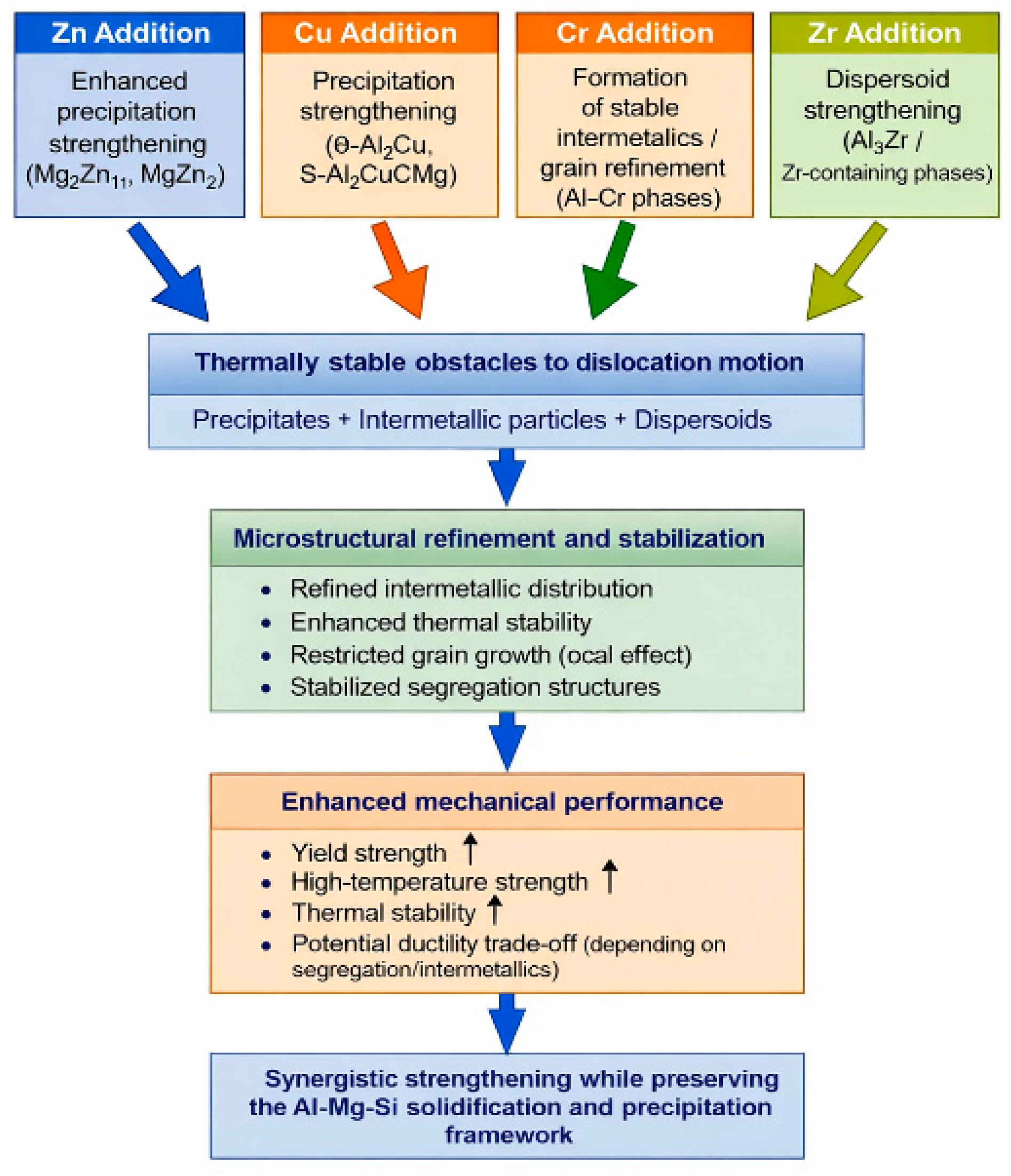
Figure 2.
Detail of HPDC process: (a) Resistance melting and holding furnace, (b) HPDC cellule, (c) casting samples, (d) tensile specimens.
Figure 2.
Detail of HPDC process: (a) Resistance melting and holding furnace, (b) HPDC cellule, (c) casting samples, (d) tensile specimens.
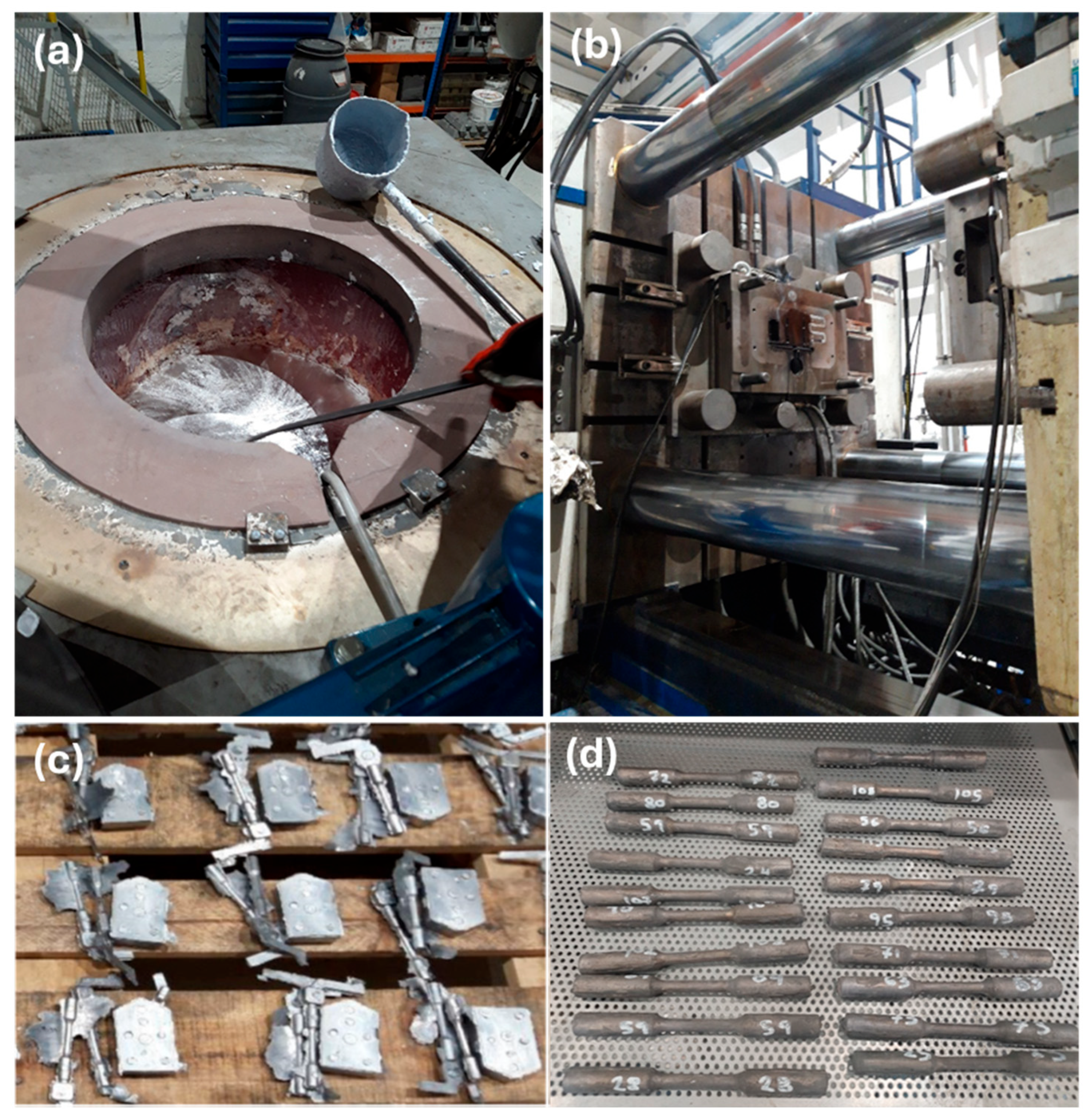
Figure 3.
Scheil solidification path of the Al–Mg–Si–Zr-Cu-Zn-Cr (H4) alloy.
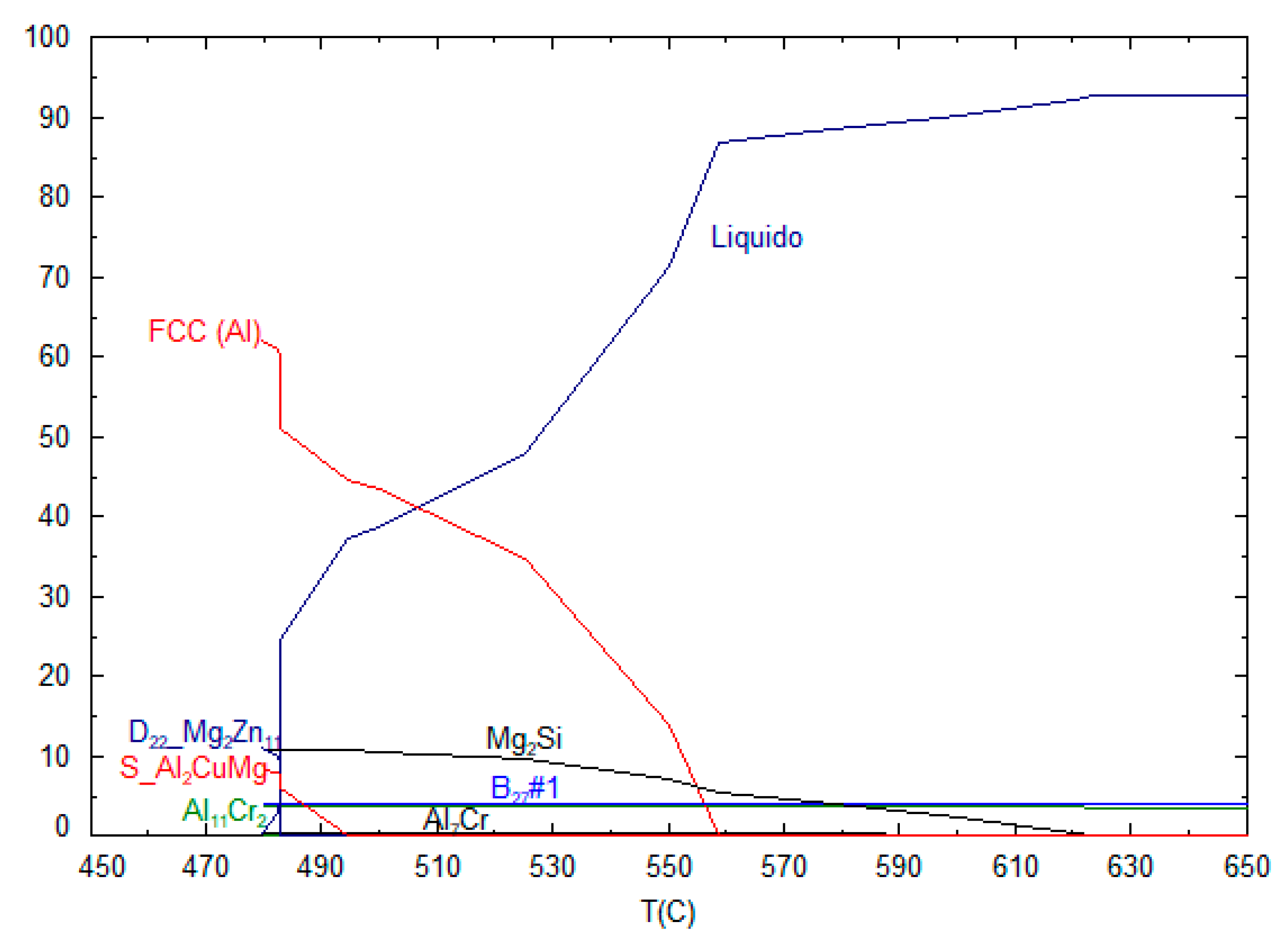
Figure 4.
Detail of main cooling parameters and phases in cooling curve a of H4.
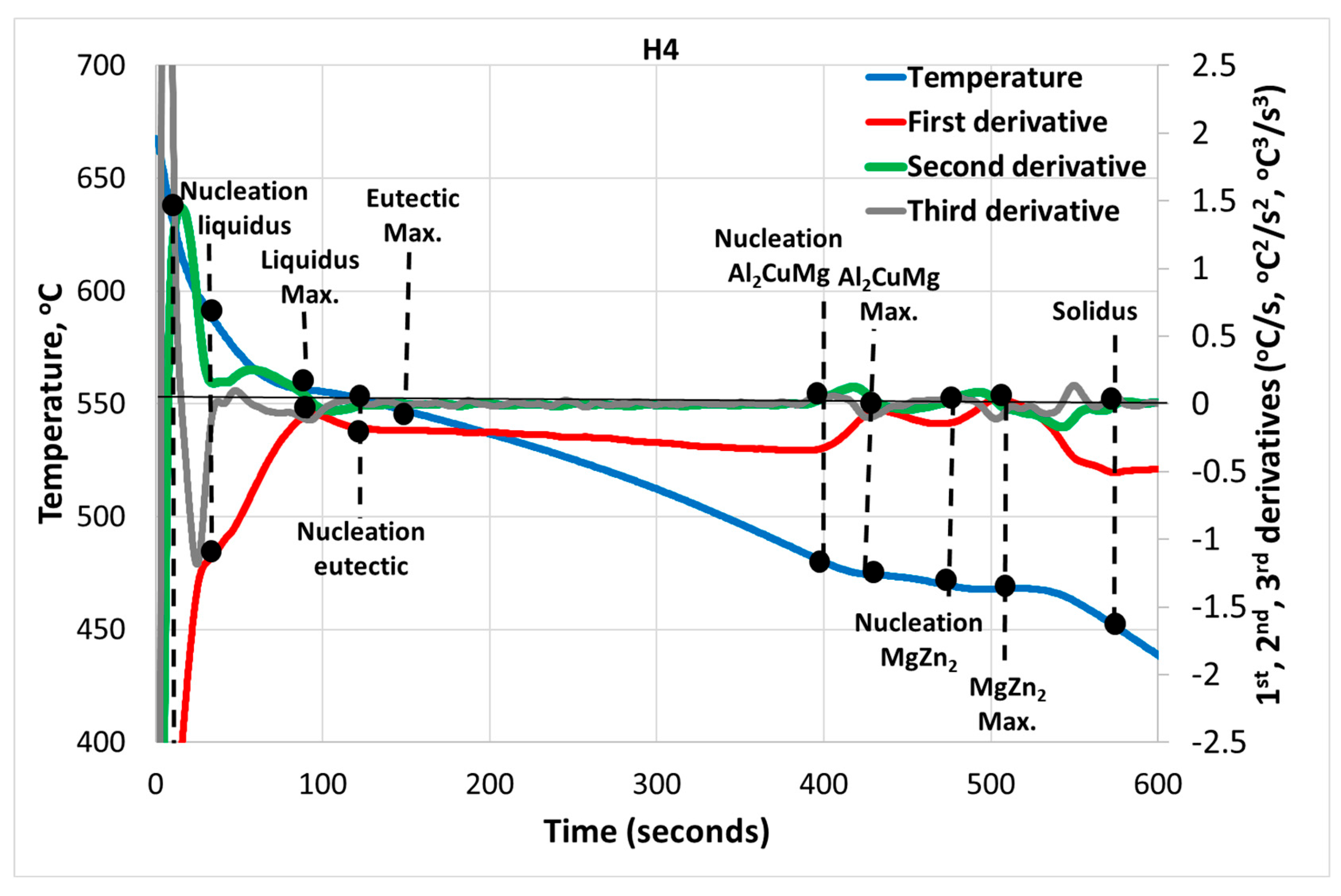
Figure 5.
XRD patterns of investigated alloys.
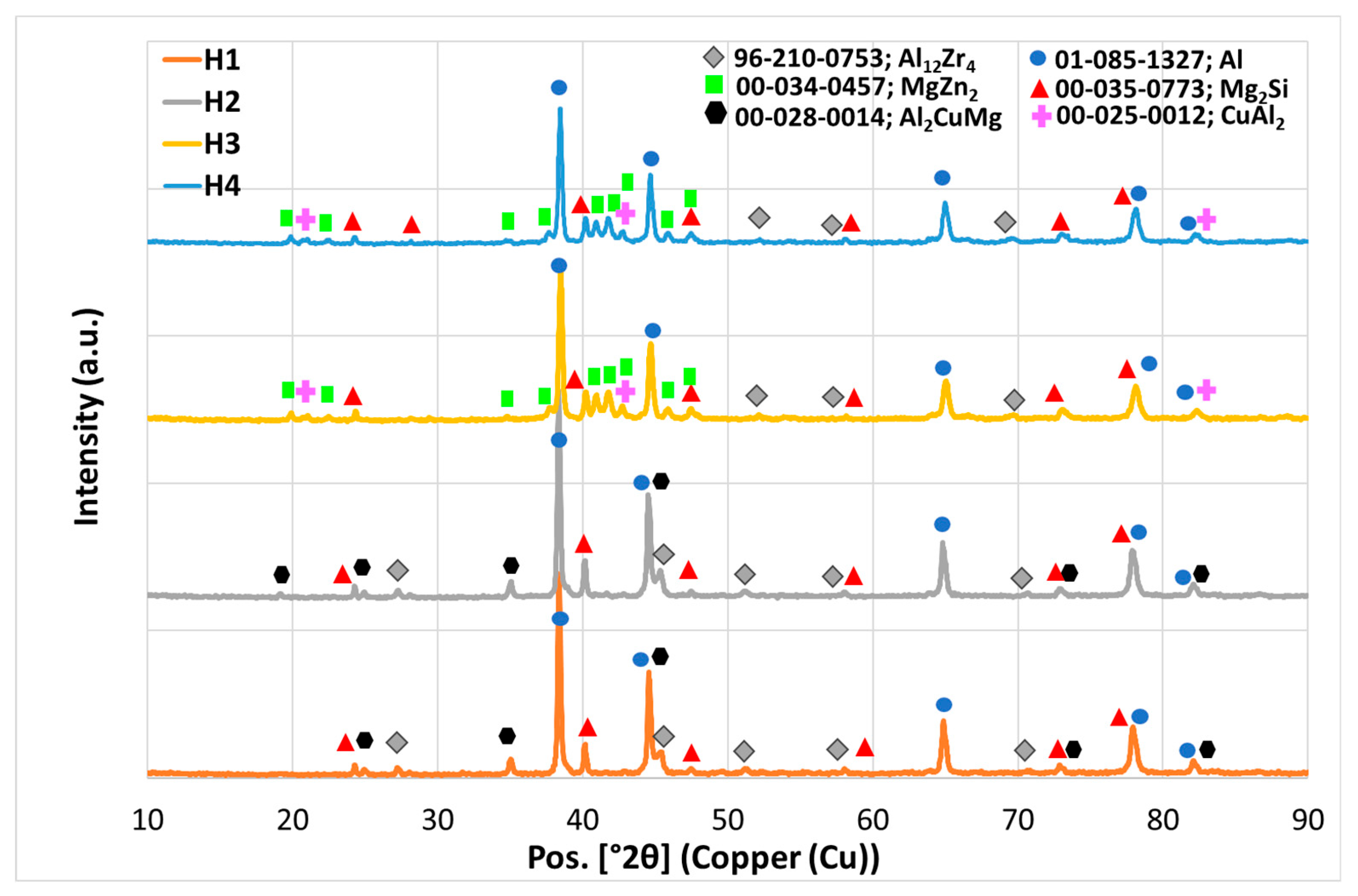
Figure 6.
x200 augmentations MO of the developed multicomponent aluminium alloys.
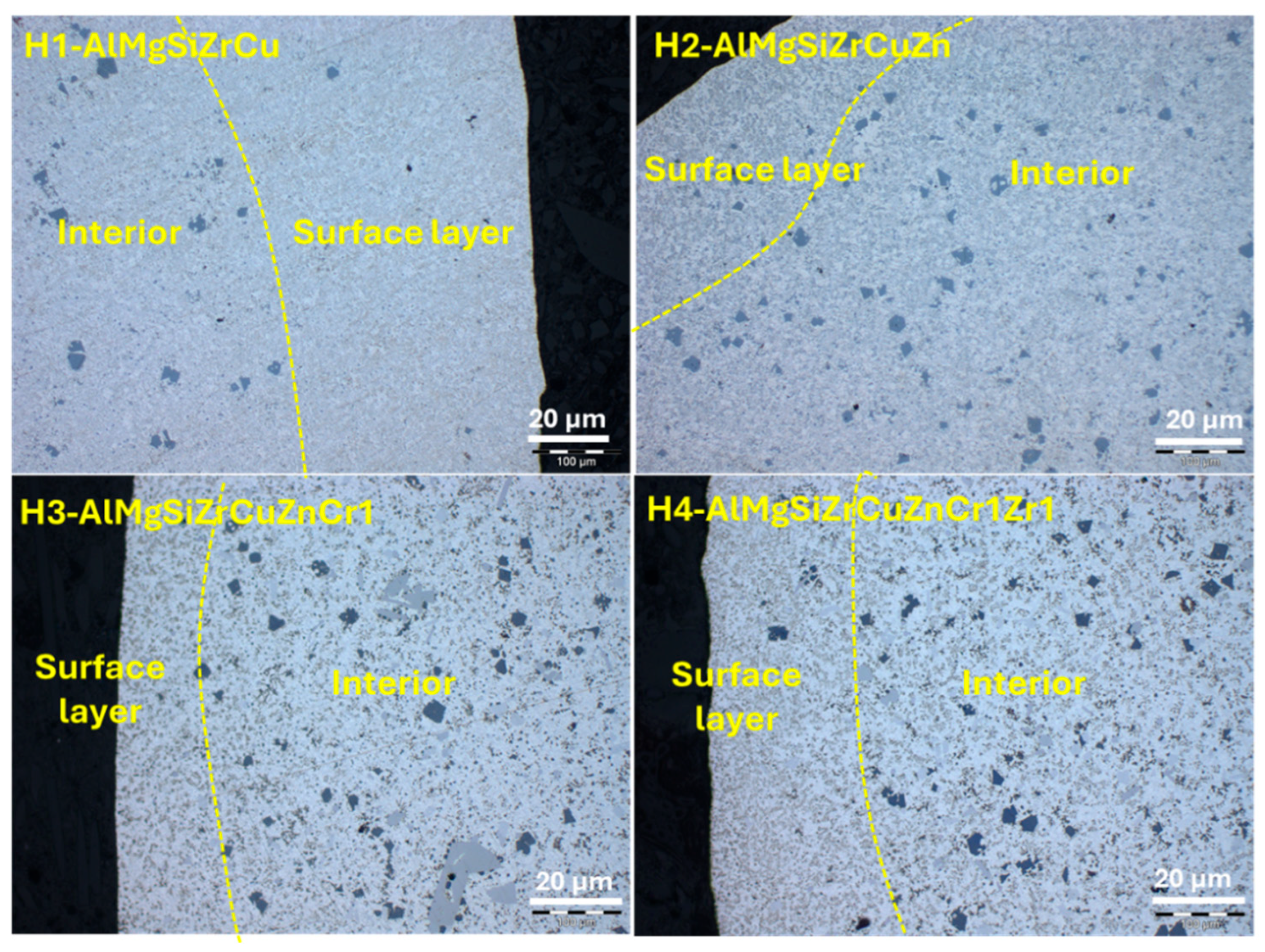
Figure 7.
x1000 augmentations MO of the developed multicomponent aluminium alloys (interior).
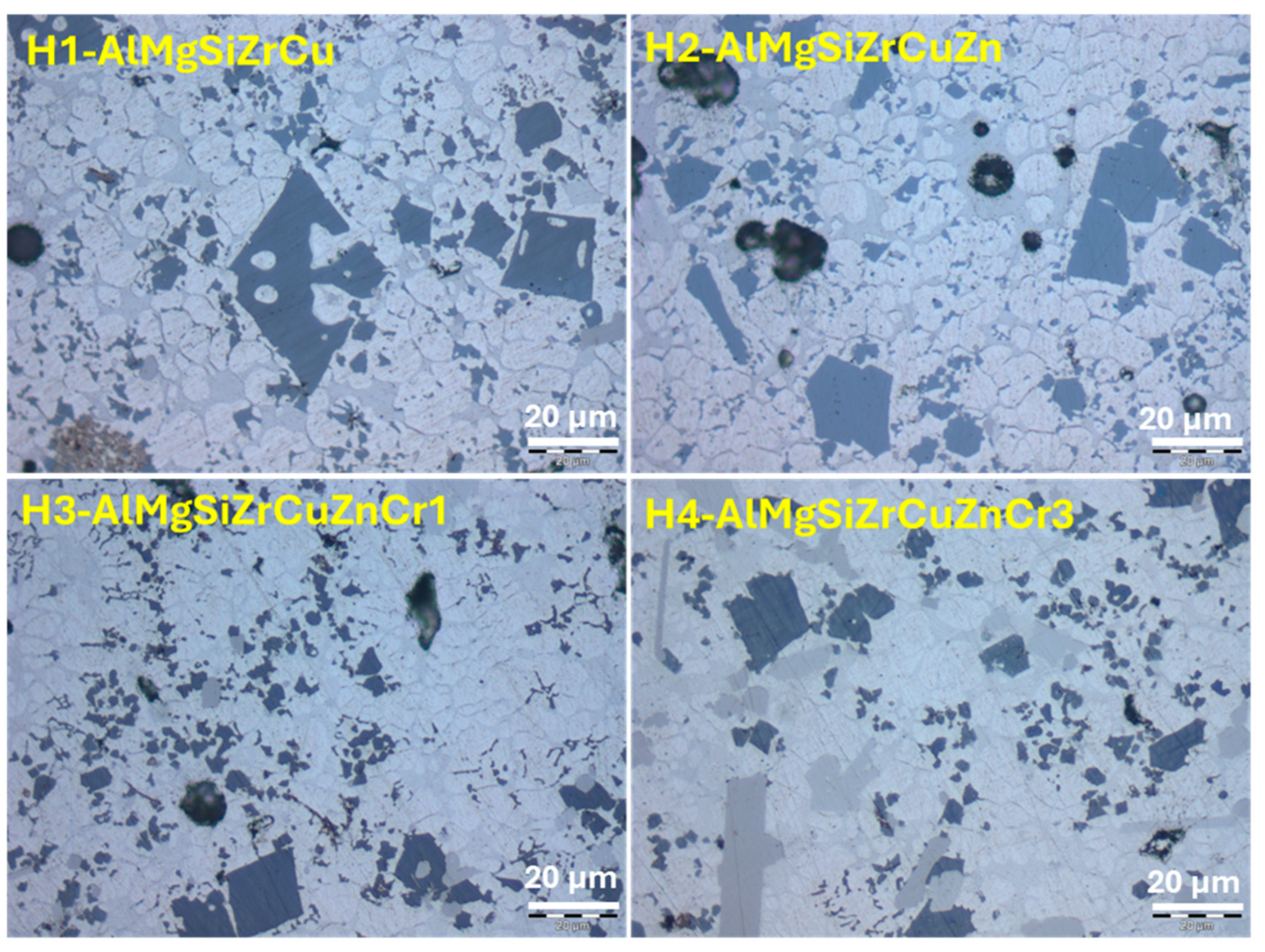
Figure 8.
x1000 SEM of the developed multicomponent aluminium alloys.
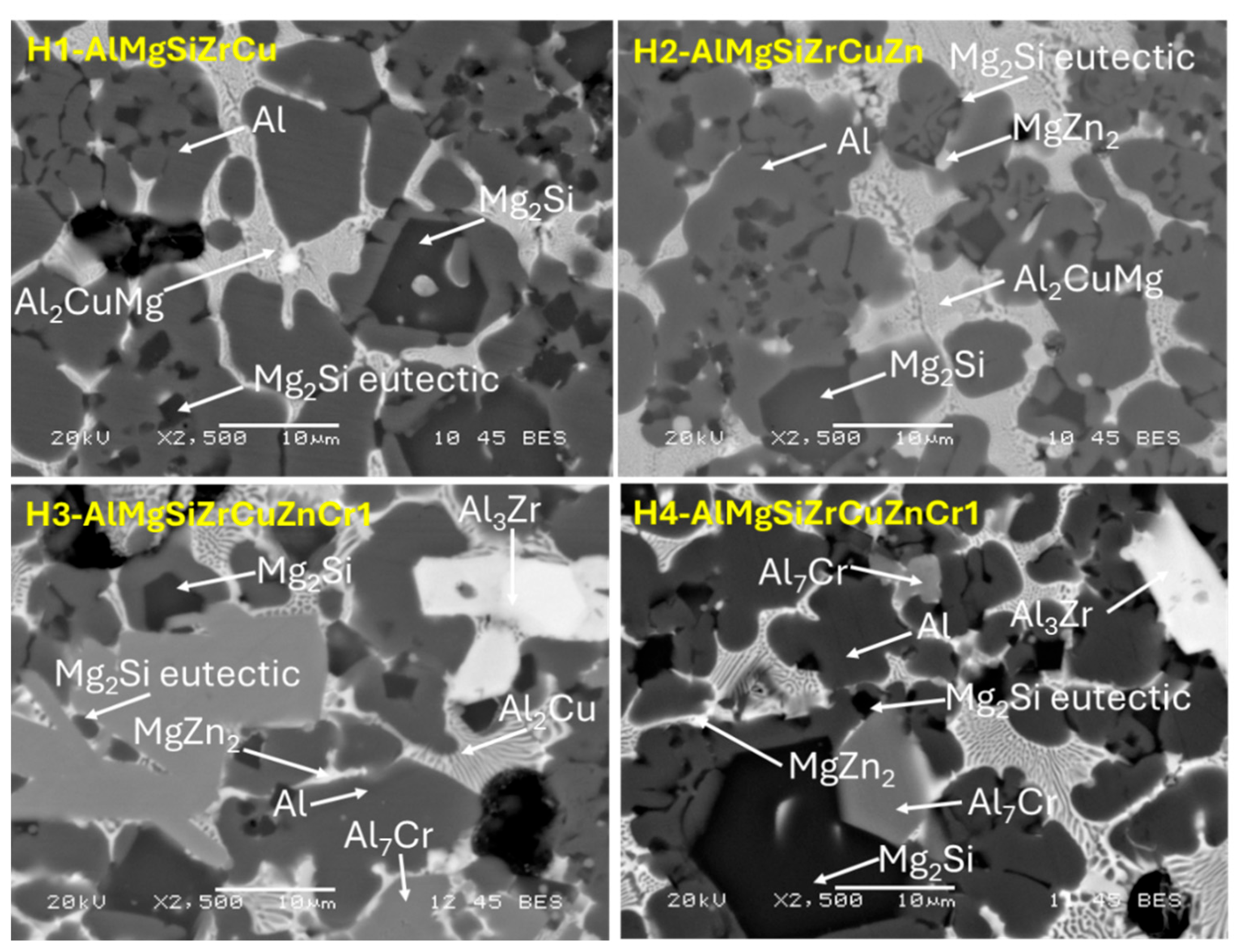
Figure 9.
SEM + EDS elemental mapping of H4.
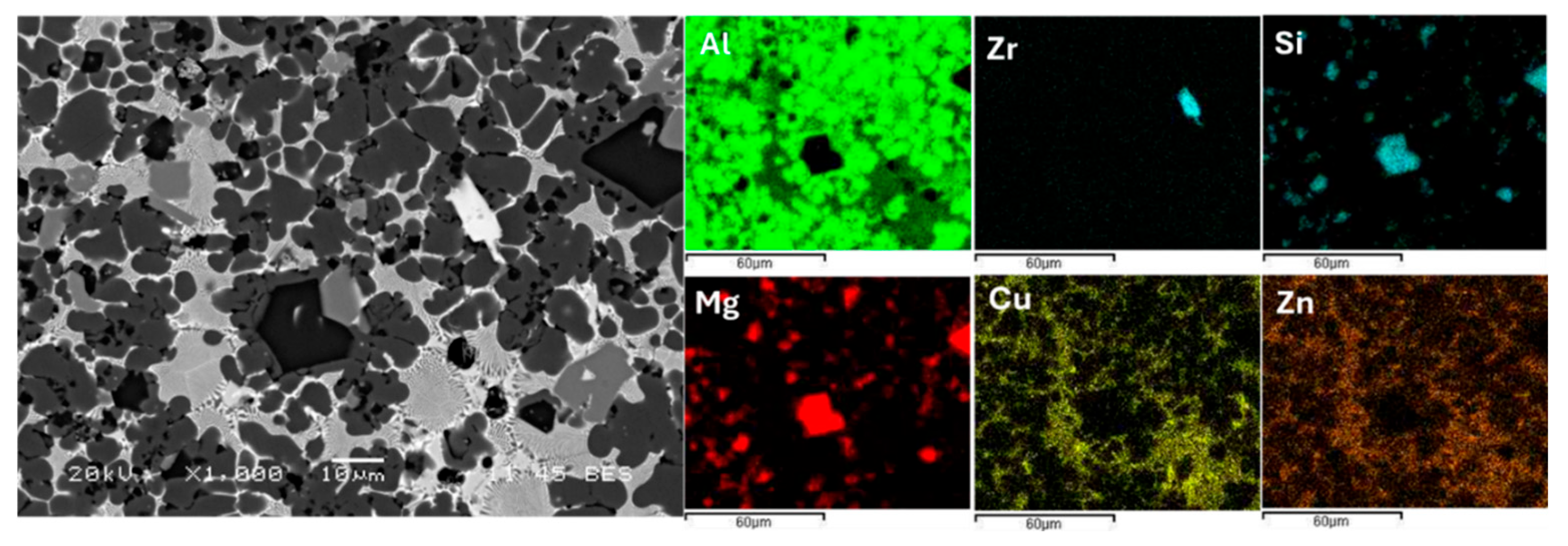
Figure 10.
Effect of combined alloying elements on hardness.
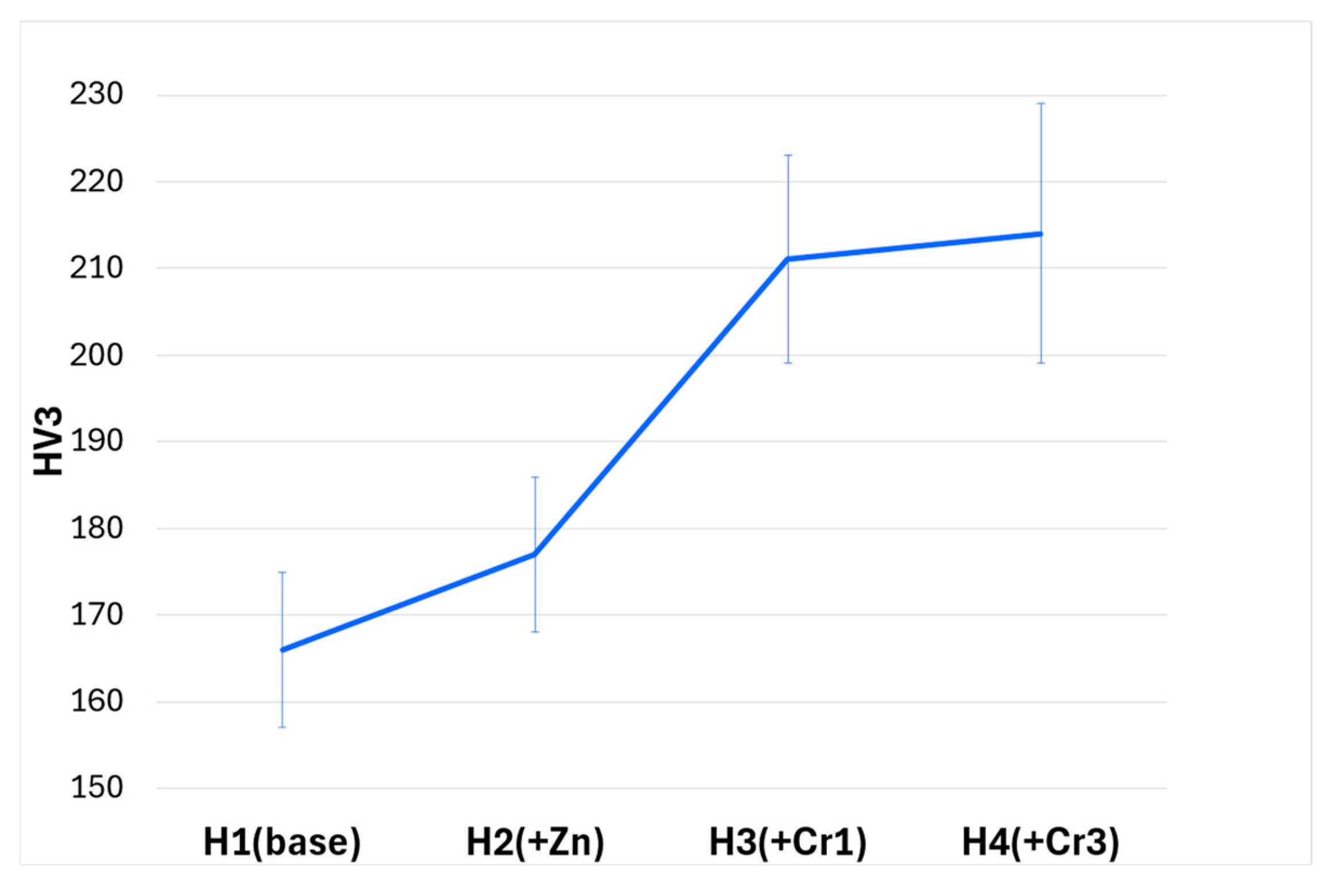
Figure 11.
Effect of combined alloying elements on tensile properties: (a) RT (b) 200ºC.
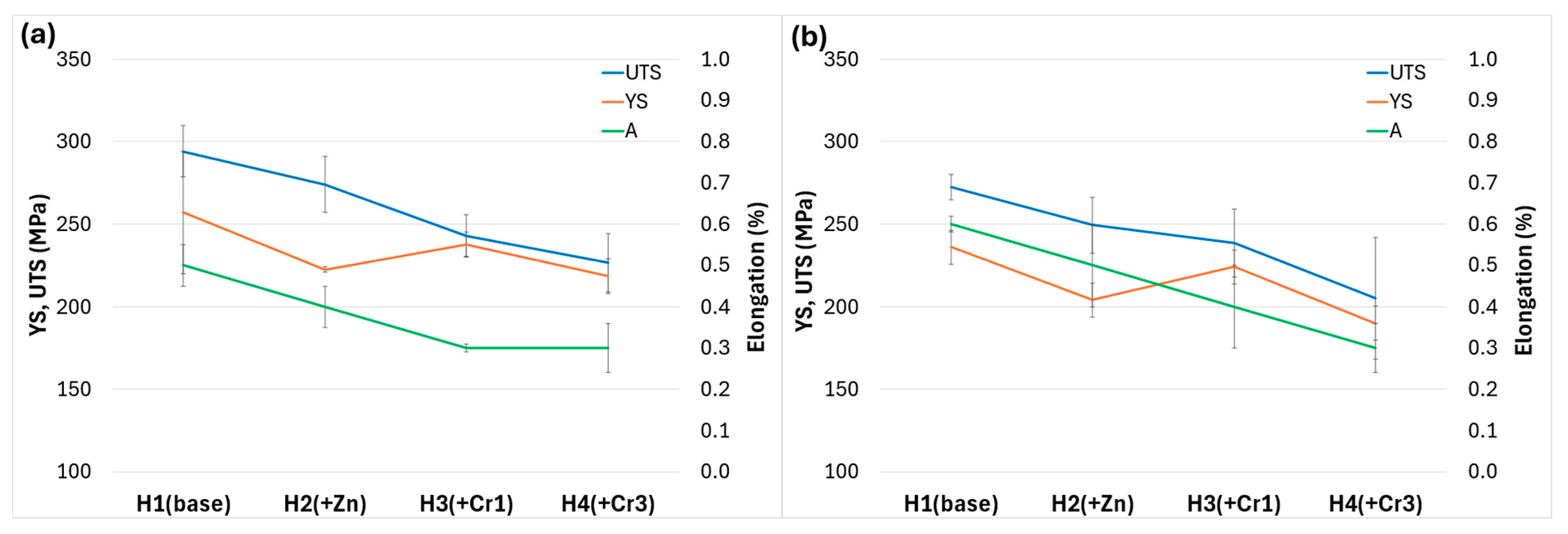
Figure 12.
SEM image at x2500 of fracture surface after tensile test at RT.
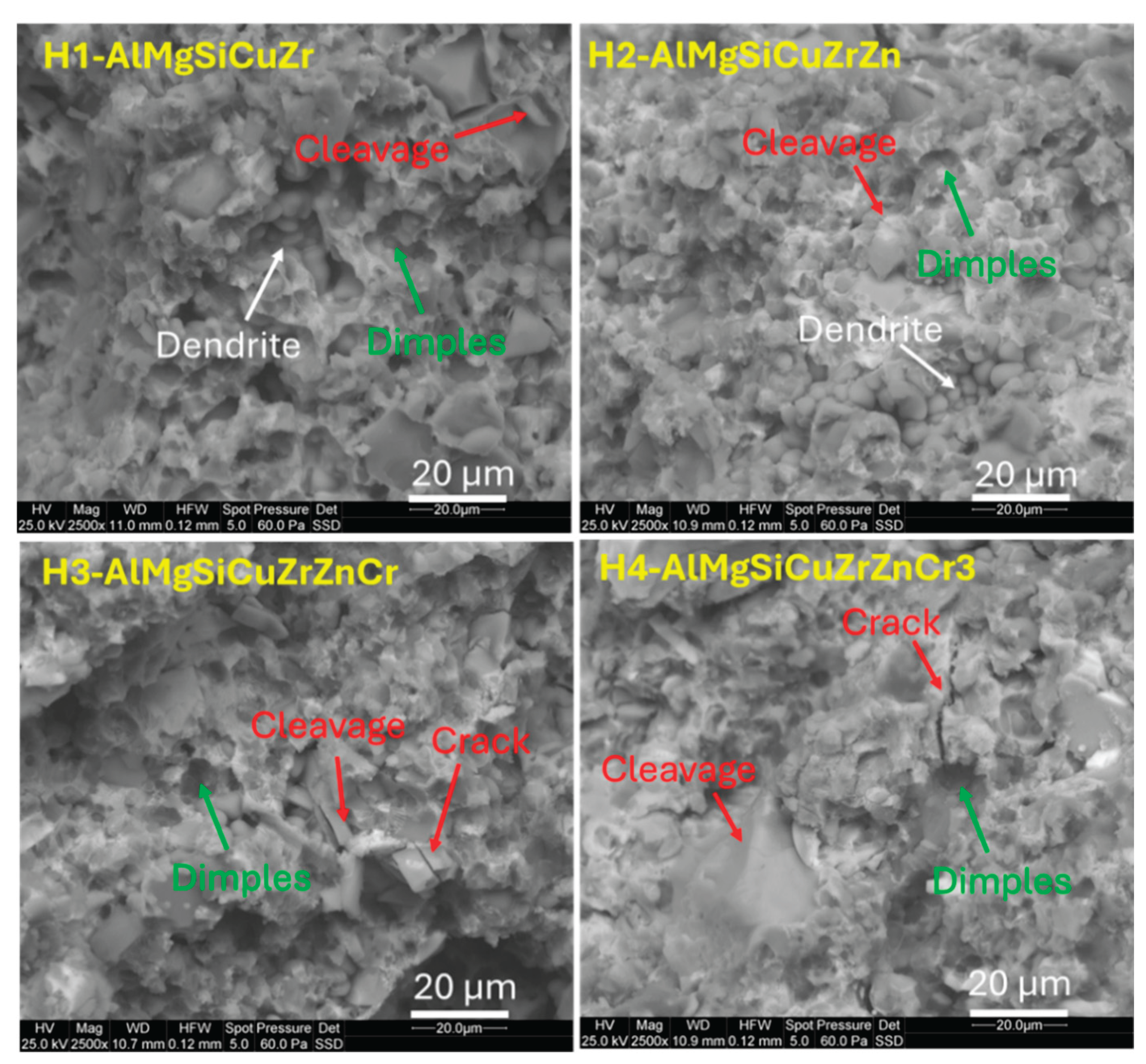
Figure 13.
SEM image at x2500 of fracture surface after compressive test at RT.
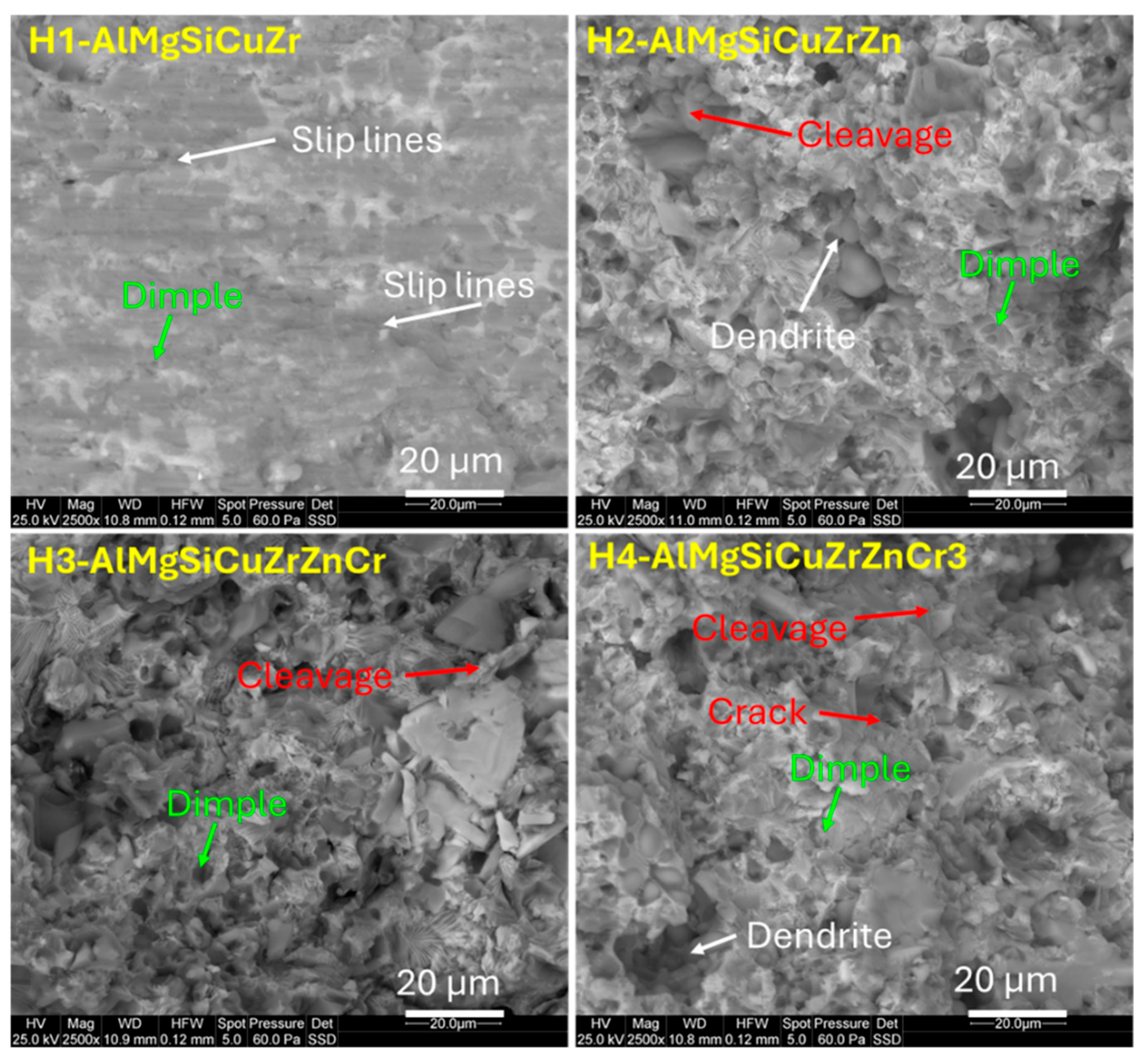
Table 1.
Nominal chemical composition of alloys.
| Alloy | Ref. | Al | Mg | Si | Zr | Cu | Zn | Cr |
| AlMgSiZrCu | H1 | 72 | 10 | 5 | 3 | 10 | - | - |
| AlMgSiZrCuZn | H2 | 67 | 10 | 5 | 3 | 10 | 5 | - |
| AlMgSiZrCuZnCr1 | H3 | 66 | 10 | 5 | 3 | 10 | 5 | 1 |
| AlMgSiZrCuZnCr3 | H4 | 64 | 10 | 5 | 3 | 10 | 5 | 3 |
Table 3.
Summary of FactSage-predicted phases under equilibrium and Scheil conditions.
| Alloy | Equilibrium Phases | Scheil Phases |
| H1 | ZrSi, Mg2Si, FCC, Al2Cu, Al2CuMg | ZrSi, Mg2Si, FCC, Al2Cu, Al2CuMg |
| H2 | ZrSi, Mg2Si, FCC, Al2Cu, Al2CuMg, Mg2Zn11, AlCuZn, MgZn2 | ZrSi, Mg2Si, FCC, Al2Cu, Mg2Zn11, Al5Cu2Mg8Si6 |
| H3 | ZrSi, Al9Cr3Si, Al11Cr2, Al7Cr, Mg2Si, FCC, Al13Cr4Si4, Al2CuMg, Mg2Zn11, MgZn2 | ZrSi, Al9Cr3Si, Al11Cr2, Mg2Si, Al7Cr, FCC, Al2Cu, Mg2Zn11 |
| H4 | ZrSi, Al11Cr2, Mg2Si, Al2CuMg, Al7Cu, Mg2Zn11, Al13Cr4Si4, AlCuZn, MgZn2, ZrAl, MgZn2Al | ZrSi, Al11Cr2, Mg2Si, Al7Cr, FCC, Al2CuMg, Mg2Zn11 |
Table 4.
TA characteristic phases and solidification temperatures for the investigated alloys.
| Solidification parameters | H1 | H2 | H3 | H4 |
| Tª nucleation liquidus (Tª Prel. Nuc.) | 628.7 | 615.6 | 630.2 | 628.7 |
| Tª nucleation liquidus (Tª Nuc. Liq.) FCC-Al | 597.8 | 581 | 596.5 | 596.1 |
| Tª maximum on the liquidus (Tª Max. Liq.) FCC-Al | 576.9 | 557.3 | 556.5 | 555.4 |
| Tª nucleation eutectic (Tª Nuc. Eut.) | 573.9 | 551.7 | 552.0 | 551.2 |
| Tª maximum on the eutectic (Tª Max. Eut) | 572.4 | 548.7 | 549.0 | 549.6 |
| Tª nucleation post-eutectic1 (Tª Nuc. PEut.1) | 502.1 | 476.1 | 474.8 | 482.7 |
| Tª maximum on the post-eutectic1 (Tª Max.PEut.1) | 505.1 | 474.5 | 474.3 | 474.1 |
| Tª nucleation post-eutectic2 (Tª Nuc. PEut.2) | - | 469.4 | 468.8 | 469.4 |
| Tª maximum on the post-eutectic2 (Tª Max.PEut.2) | - | 466.9 | 467.2 | 467.8 |
| Tª solidus | 487.4 | 446.3 | 447.0 | 447.8 |
Table 5.
Hardness values of investigated multicomponent alloys.
| Alloy | H1 | H2 | H3 | H4 | AlSi9Cu3 |
| HV3 | 166 ± 19 | 177 ± 9 | 211 ± 12 | 214 ± 35 | 103 |
Table 6.
Tensile test values of the investigated alloy tested at RT and 200ºC.
| RT | 200 ºC | |||||
| Alloy | YS (MPa) | UTS (MPa) | E (%) | YS (MPa) | UTS (MPa) | E (%) |
| H1 | 257 ± 37 | 294 ± 15.6 | 0.6 ± 0.1 | 236 ± 12 | 272 ± 7.6 | 0.6 ± 0.02 |
| H2 | 222 ± 1.7 | 274 ± 16.9 | 0.4 ± 0.1 | 204 ± 35.2 | 249 ± 16.9 | 0.5 ± 0.1 |
| H3 | 238 ± 7.4 | 243 ± 12.9 | 0.3 ± 0.01 | 224 ± 21 | 239 ± 20.5 | 0.4 ± 0.1 |
| H4 | 218 ± 7.4 | 227 ± 17.7 | 0.3 ± 0.06 | 190 ± 26 | 205 ± 36.7 | 0.3 ± 0.06 |
Table 7.
Compressive test values of the investigated alloy at RT.
| Alloy | YS (MPa) | UCS (MPa) | D (%) |
| H1 | 275 ± 17.2 | 592 ± 11 | 6.3 ± 1.01 |
| H2 | 433 ± 31.5 | 697 ± 19.1 | 4.6 ± 0.9 |
| H3 | 425 ± 24.2 | 696 ± 19.7 | 3.9 ± 0.4 |
| H4 | 386 ± 6.8 | 690 ± 11.4 | 3.8 ± 0.4 |
Table 8.
Physical properties of the investigated multicomponent alloys.
| Alloy | Theoretical density (g/cm3) | Real density (g/cm3) | Porosity (%) | % IACS |
| H1 | 2.77 | 2.72 ± 0.01 | 1.8% | 17.6 ± 1.39 |
| H2 | 2.86 | 2.90 ± 0.01 | 1.6% | 15.0 ± 0.87 |
| H3 | 2.88 | 2.89 ± 0.04 | 2.8% | 10.8 ± 1.32 |
| H4 | 2.92 | 2.92 ± 0.03 | 3.0% | 9.2 ± 1.36 |
Disclaimer/Publisher’s Note: The statements, opinions and data contained in all publications are solely those of the individual author(s) and contributor(s) and not of MDPI and/or the editor(s). MDPI and/or the editor(s) disclaim responsibility for any injury to people or property resulting from any ideas, methods, instructions or products referred to in the content. |
© 2026 by the authors. Licensee MDPI, Basel, Switzerland. This article is an open access article distributed under the terms and conditions of the Creative Commons Attribution (CC BY) license (http://creativecommons.org/licenses/by/4.0/).
Copyright: This open access article is published under a Creative Commons CC BY 4.0 license, which permit the free download, distribution, and reuse, provided that the author and preprint are cited in any reuse.