
Submitted:
25 June 2026
Posted:
26 June 2026
You are already at the latest version
Abstract
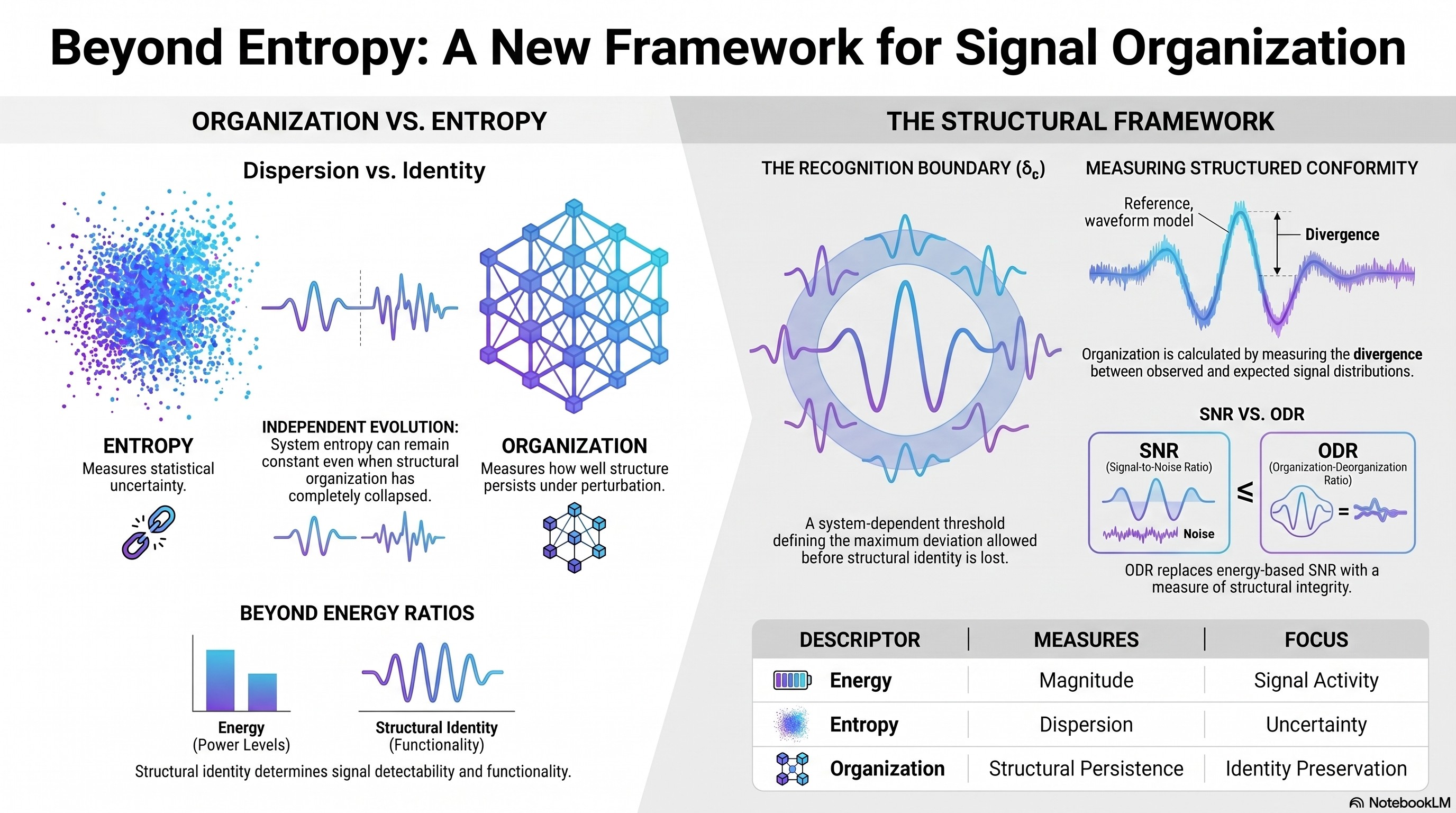
This work introduces a framework in which signals are represented as probability distributions over a generalized phase space, and organization is defined as a measure of structured conformity relative to an expected distribution. Existing approaches based on energy and entropy characterize magnitude and statistical dispersion but do not explicitly describe the persistence of structural configurations. The proposed methodology defines organization through occupancy deviation using divergence measures and introduces a recognition boundary that determines whether a structured configuration remains identifiable. The framework is illustrated through conceptual and quantitative examples, including structured pattern degradation, visual acuity limits, and channel constraints modeled as restricted observable regions. The results demonstrate that entropy and organization can evolve independently, with structural identity degrading even when entropy remains approximately constant. Additionally, observability is shown to be a critical factor, as insufficient contrast or measurement sensitivity may prevent structure recognition despite its physical presence. These findings support the interpretation of communication and sensing systems as processes governed by the preservation of recognizable structure rather than energy alone. The proposed formulation provides a complementary perspective to entropy-based methods for analyzing signal processing, detection, and communication systems.
Keywords:
organization
; entropy
; phase space
; Kullback–Leibler divergence
; structural conformity
; signal processing
; communication systems
; observability
; recognition boundary
Copyright: This open access article is published under a Creative Commons CC BY 4.0 license, which permit the free download, distribution, and reuse, provided that the author and preprint are cited in any reuse.


