

Submitted:
20 June 2026
Posted:
29 June 2026
You are already at the latest version
Abstract
We give a linearized and one-loop gauge-consistency analysis of the SI20-4 framework, and quantify what fails beyond it. The argument has three parts, ordered by energy scale. (1) Within the computed one-loop vacuum-polarization sector, the deviation from the GR coefficient is measured by a deviation function f(k), sampled at four external momenta (N = 1000 at k = 0.3 M_P): consistent with leading linear suppression, slope 0.86 ± 0.15 (correlated fit; free exponent n = 1.45 ± 0.23), and below 10⁻¹⁵ in every experimentally probed regime. (2) The one-loop TT transversality identity holds exactly at all sub-Planckian momenta, by a four-step proof whose final step uses the ℓ ↦ k−ℓ symmetry of the cutoff domain; externally, kinematic transversality holds at all orders, and a boundary-layer theorem extends the linear overflow suppression to every one-loop n-point function. A direct Lorentzian analysis of the frame-adapted box theory (Appendix C, with full phase-space derivation) shows the one-loop two-point sub-threshold absorptive cut matches GR exactly, so the measured f(k) is a dispersive vacuum-polarization deficit, not a unitarity violation. (3) At E ~ M_P, where SI20-4 departs from GR, the naive projected nonlinear BRST operator s_P = P_{≤M_P} s P_{≤M_P} is provably not nilpotent: the overflow domain R_overflow = {|p| ≤ M_P, |q−p| ≤ M_P, |q| > M_P} has positive measure. This failure is not a consistency gap but the quantitative form of the Planck-scale diffeomorphism breaking that SI20-4 Part 1 states as a prediction. The primary measured quantity is the dimensionless overflow fraction f(0.3 M_P) = 0.253 ± 0.030, monotonically increasing across k = 0.1–0.5 M_P, computed with a numerically generated and validated Einstein–Hilbert cubic vertex and the complete 10-mode spectral sum with de Donder weights. (In the de Donder/4-ball scheme with continuum normalisation C_N = C_QG = 49/6 this corresponds to the secondary, scheme-normalised coefficient B_TT − C_FP = −2.07 ± 0.24 at k = 0.3 M_P.) The measured one-loop mismatch is consistent with vanishing as k/M_P → 0.
Keywords:
quantum gravity
; BRST symmetry
; Ward identities
; Planck-scale cutoff
; spin-2 field theory
; diffeomorphism invariance
1. The Structure of the Argument
For a quantum theory of a massless spin-2 field, gauge consistency requires that unphysical polarisations decouple from all physical amplitudes, and that the theory's relation to its diffeomorphism-invariant parent be made clear [3,4]. We organize both questions by energy regime:
| Regime | SI20-4 vs GR | What must be shown | How |
| k/M_P → 0 | Deviation f(k) → 0 | Rate of approach | Controlled limit, f(k) ≈ 0.86 k/M_P (§2, §6) |
| All E ≤ M_P | — | TT Ward identity | Four-step proof + operator identity (§3–4) |
| E ~ M_P | Different | Quantify the difference | No-go theorem + B_TT − C_FP (§5–6) |
1.1. Where Gauge Consistency Is Required, Where It Is Not, and Where SI20-4 Departs
The framework’s position on gauge symmetry can be stated in three lines, and the rest of the paper is the evidence for each line.
| Domain | Status of gauge consistency | Why |
| E ≪ M_P — all distances at which gravity has ever been tested | Required, and holds. | Diffeomorphism-invariant GR is the verified description; SI20-4 must and does reproduce it, with deviation below 10⁻¹⁵ in every probed regime (§2). |
| Inside Z_SI, at any energy | Not required. | Quantum mechanics requires the guarantees of gauge symmetry — a positive-definite state space, decoupling of unphysical states, confinement of any breaking — not the symmetry itself. Z_SI delivers the guarantees directly: its state space contains no unphysical states to remove, so the BRST machinery whose job is to remove them has nothing to do (§4, §6.4). |
| E ~ M_P — the Planck boundary | Departed from, measurably. | Nonlinear diffeomorphism invariance fails there with a computed coefficient (§5–6). This is not a consistency defect: it is the framework’s stated prediction, with the same status as the Planck-scale breaking of Lorentz invariance. Spacetime is emergent in SI20-4; the symmetry of an emergent structure need not survive at the scale where the structure itself dissolves. |
In short: gauge consistency where physics demands it, no gauge scaffolding where the construction makes it redundant, and a quantified, falsifiable departure exactly where the framework predicts the concept ceases to apply. (Appendix B shows that the kinematic structures used throughout — labels, TT blocks, the domain involution, the cutoff — are definable purely algebraically, without a manifold; momentum-space language in this paper is notation, not ontology.)
Relation to existing approaches. The tension between a regulator and a gauge symmetry is a classical theme. For Yang–Mills theory the lattice provides a gauge-invariant sharp cutoff [13]; no analogous diffeomorphism-invariant sharp cutoff exists for gravity, and discrete approaches — Regge calculus [14] and causal dynamical triangulations [15] — break diffeomorphism invariance at the regulator scale and seek to restore it in a continuum limit. The Wilsonian alternative keeps a smooth cutoff and tracks the symmetry breaking exactly, through modified Slavnov–Taylor and Ward identities of the exact renormalisation group [16,17,18,19,20]; this is the technology underlying asymptotic-safety quantum gravity [21]. SI20-4 takes a third position: the cutoff is physical and is not removed, so the symmetry breaking it induces is not an artefact to be repaired but a prediction to be computed — the stance the parent framework already takes toward Lorentz invariance, whose Planck-scale fate is the subject of an extensive minimal-length and phenomenology literature [22,23,24,25]. The mathematically closest construction is Kempf’s sampling-theoretic, bandlimited quantum field theory [26,27], which implements a covariant information-theoretic cutoff at the Planck scale; SI20-4 differs in applying the sharp cutoff to the spin-2 measure of an emergent-gravity setting, a premise with independent lineage [28,29]. At low energies the inheritance argument of §2 matches onto the effective-field-theory treatment of general relativity [30], from which the coefficient C_graviton = 25/6 it inherits is drawn [5].
The theorems of §§3–5 and the computation of §6 are self-contained: they require only the Fierz–Pauli action with its Deser completion and a sharp cutoff on the path-integral measure, all defined here. The results therefore stand for any sharp-cutoff spin-2 path integral; SI20-4 is the motivating instance. This ordering dissolves the apparent dilemma “BRST is needed / BRST is not needed” that plagued earlier drafts. SI20-4 uses the parent linearised spin-2 gauge structure where it computes (the cubic transversality identity and the leading Faddeev–Popov operator), matches GR’s results for the observables it computes where the theories agree, and makes no claim of full nonlinear BRST/BV consistency. The naive projected nonlinear BRST operator provably fails for a sharp cutoff (§5), and none of SI20-4’s computed results use it; whether some replacement consistency structure is required for the full nonlinear theory remains open.
2. Inheritance: The Controlled Limit k/M_P → 0
Claim (scope: the computed one-loop sector). SI20-4 reproduces GR’s formulas in the limit k/M_P → 0, with the deviation at finite k given by a measured function f(k), computed in §6 from the one-loop vacuum-polarisation mismatch. For the observables SI20-4 computes — all of which flow through this one-loop structure — the computed one-loop coefficients approach their GR values, with deviation of size f(k). We do not claim that this single function bounds all Slavnov–Taylor structures or all conceivable observables of a nonlinear completion; the claim is evidence-based and sector-specific, and §§3–5 supply the exact statements that hold beyond it.
The deviation function. Define
f(k) ≡ |B_TT − C_FP|(k) / C_QG
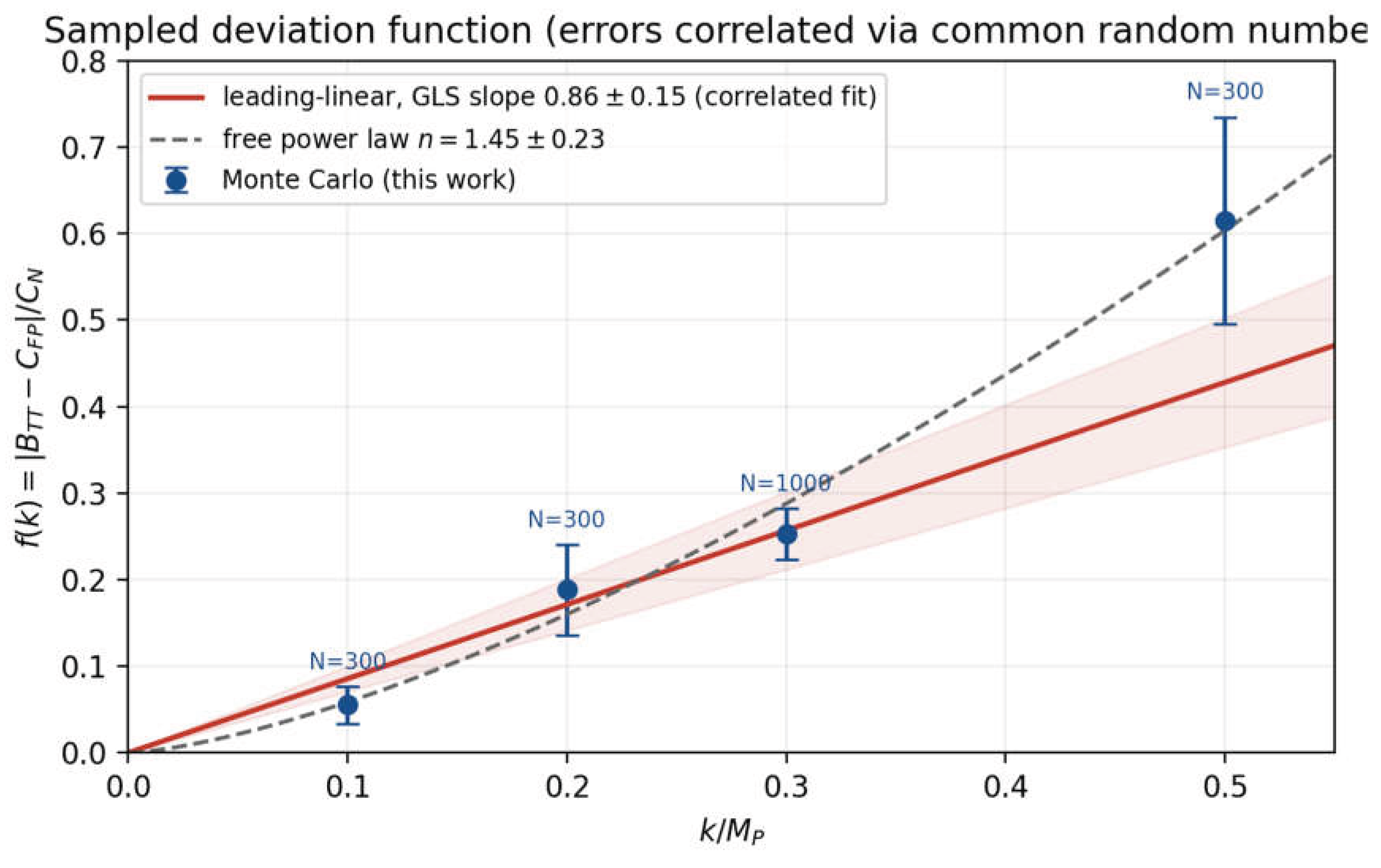
— the fraction by which SI20-4’s one-loop coefficient differs from GR’s at external scale k. This function is not assumed; it is computed (§6). It vanishes as k → 0 and grows monotonically across the sampled range. Because the four runs share common random numbers (a deliberate variance-reduction choice), the four measured points are statistically correlated (cross-k correlations 0.19–0.43, measured by joint jackknife); all fits below use the full covariance matrix.
The sampled data are consistent with leading linear suppression:
over k/M_P = 0.1, 0.2, 0.3, 0.5 (N = 1000 at k = 0.3; N = 300 elsewhere; jackknife errors). A free power-law fit prefers n = 1.45 ± 0.23 (χ²/dof = 0.35), indicating positive subleading curvature at k ≳ 0.3 M_P. The linear leading behaviour as k → 0 is required by the overflow-volume argument below; the fitted slope is therefore quoted as the small-k normalisation with curvature systematics, not as an exact global law. The measured f(k) is monotonic across all four momenta (Figure 1).
f(k)/(k/M_P) = 0.86 ± 0.15 (GLS fit, full covariance; χ²/dof = 1.9)
The regimes, read off f(k) rather than asserted:
| Length scale | Energy | f = deviation from GR | Status |
| l > 10⁴ l_P | E < 10⁻⁴ M_P | < 0.01% | GR and SI20-4 indistinguishable; BRST inherited to this precision |
| l ~ 100 l_P | E ~ 0.01 M_P | ~1% | Inheritance still excellent |
| l ~ 10 l_P | E ~ 0.1 M_P | ~10% | Crossover — inheritance degrading, prediction regime beginning |
| l ~ 3 l_P | E ~ 0.3 M_P | ~25% | Fully divergent: SI20-4 ≠ GR; B_TT − C_FP is the physics |
| l ~ l_P | E ~ M_P | O(100%) | Pure SI20-4 regime — the void; no emergent spacetime, no diffeomorphisms |
For perspective: all existing experiments live at l > 10¹⁵ l_P, where f < 10⁻¹⁵. In every experimentally probed regime the computed deviation is below 10⁻¹⁵.
Why low-energy violations cannot accumulate. The overflow domain at external momentum k has volume ∝ k/M_P, vanishing linearly as k → 0. An IR-dominated observable at scale k_H = M_P²/M picks up BRST-violating contamination bounded by f(k_H) ~ M_P/M — for a solar-mass black hole, below 10⁻³⁸. There is no accumulation mechanism because the violating domain itself shrinks to zero measure with the probe scale. In particular, the IR logarithm of the Hawking coefficient is uncontaminated. This addresses, for the computed sector, the radiative-percolation concern raised for Planck-scale Lorentz violation by Collins et al. [23]: in the vacuum polarisation the symmetry-violating contribution is confined to the overflow domain, whose measure vanishes linearly with the probe scale, rather than feeding an unsuppressed O(1) violation at low energy. Whether the same suppression operates in every sector of a nonlinear completion is part of the open problem of §5; observational constraints on frame-dependent Planck-scale physics [24,25] bear on SI20-4 through the parent framework’s ξ ~ (E/E_P)² scaling.
What SI20-4 inherits in the k/M_P → 0 limit includes the gauge-invariant one-loop combination [5]:
and hence the parameter-free Hawking-temperature correction δT_H/T_H = −(49/6)(M_P/M)² log(M/M_P)/(64π²), with the renormalisation scale fixed at M_P by Axiom 3 rather than left arbitrary.
C_graviton = 25/6, C_ghost = 4, C_QG = 49/6
Status of the ghost calculation (stated precisely). The ghost coefficient C_ghost = 4 is computed from the Faddeev–Popov operator expanded to first order in h_μν. This requires the leading field-dependent part of the gauge variation — more than the purely linearised transformation law δh = ∂ξ, but far less than full nonlinear BRST [6,7]: no all-orders master equation, no Slavnov–Taylor identity [8], and no nilpotency beyond O(h⁰) is used anywhere in SI20-4. Within SI20-4 the ghosts are a computational device for evaluating the functional determinant of the integrated-out sector — borrowed GR machinery, justified by the controlled limit above — not an axiom of the framework. (Spacetime itself is not an axiom of SI20-4; it is emergent, and so is the diffeomorphism structure the ghosts encode.)
Extension to curved-saddle determinants. The same low-energy inheritance logic supports applying these conclusions to the Euclidean heat-kernel determinants of SI20-4 Part 5a §9b (Lichnerowicz operator and vector ghost on the Schwarzschild saddle, yielding the entropy coefficient C_total = −2 [9]): the fluctuations entering those determinants live at scales ~ 1/r_S ≪ M_P for any macroscopic black hole, so the corresponding deviation is expected to be of order l_P/r_S by the same overflow-volume argument; a direct curved-background computation analogous to §6 has not been performed, and this extension should be read as supported rather than established. The prescription-independence test of §6.1 below additionally supports the conformal-mode treatment used there [10].
3. The One-Loop TT Transversality Identity: All E ≤ M_P
Theorem. With the sharp Planck cutoff on the measure, k^μ Π^SI_μν,ρσ(k) ε^TT_ρσ = 0 at one loop, for all external k.
Proof in four steps.
Step 1 (cubic Ward–Takahashi identity). From the diffeomorphism invariance of the Fierz–Pauli action [11]: k^μ V_μν,αβ,γδ(k, ℓ, −ℓ−k) = ½[ℓ² − (ℓ−k)²] P_ν,αβ,γδ + k_ν T_αβ,γδ. This identity is inherited from the parent theory (§2).
Step 2 (contact terms vanish). k_ν T contracts to zero against the external ε^TT because k^ν ε^TT_νμ = 0 — the defining property of H_TT.
Step 3 (scalar reduction). P^TT · P · P^TT = P^TT collapses the tensor structure: the contracted self-energy is proportional to the scalar integral ∫_R d⁴ℓ [1/ℓ² − 1/(ℓ−k)²], with R = {|ℓ| ≤ M_P and |ℓ−k| ≤ M_P}.
Step 4 (Planck-ball domain symmetry — the SI20-4-specific step). The involution ℓ ↦ k−ℓ maps R onto itself (the intersection of two Planck balls is symmetric), has unit Jacobian, and flips the sign of the integrand. The integral equals its own negative and vanishes. □
Numerical verification: residuals 2.45×10⁻¹⁶, 1.44×10⁻¹⁶, 1.79×10⁻¹⁶.
Cutoff-shape independence. Step 4 in fact holds for any product-symmetric weight f(ℓ²) f((ℓ−k)²) — sharp, Gaussian, Lorentzian — since the weight is invariant under ℓ ↦ k−ℓ while the integrand is odd (verified by exact pair cancellation to 10⁻¹⁷). The sharp cutoff is the physical choice of Axiom 3, not a requirement of the proof.
Steps 1–4 use the inherited linearised gauge structure, the TT condition, and the geometry of the cutoff domain. No nonlinear BRST is invoked.
4. All-Orders External Kinematic Transversality
Theorem. In Z_SI, k^μ G^(n)_μν,…(k, …) = 0 exactly for all n and all loop orders, and hence k^μ M^(n) ε^TT = 0 via LSZ [12].
Proof. Every field configuration in Z_SI satisfies k^μ h^TT_μν(k) = 0 — the definition of the TT field space. Any correlator containing the contracted field is the expectation of an identically vanishing quantity. LSZ preserves the zero. □
What this is and is not. For n = 2 the statement is tautological (the propagator lives in H_TT by construction). For n ≥ 3 it is the statement that the interacting amplitudes of Z_SI never produce longitudinal or trace polarisations. We name it precisely: this is kinematic transversality of TT-projected external correlators. It is the necessary decoupling condition for unphysical external states; the n ≥ 3 internal question is addressed at one loop by the boundary-layer theorem of §6.6. It is not, and is not claimed to be, a dynamical Slavnov–Taylor identity [8]: it does not by itself establish gauge-parameter independence, internal-line unitarity cancellations, or equivalence to FP gravity. In particular, it guarantees the kinematic decoupling of unphysical external states only; it says nothing by itself about the circulation of non-TT modes inside loops. In Z_SI no such modes circulate — they are absent from the measure — and the physical question is therefore not whether internal unphysical modes decouple but what their absence costs relative to FP gravity, where they circulate and cancel against ghosts. That cost is exactly the quantity computed in §6: the deviation function f(k) is the measured internal-mode mismatch, vanishing linearly as k → 0. Those properties are inherited at E ≪ M_P (§2) and quantifiably violated at E ~ M_P (§5–6) — which is the content of the framework.
5. The No-Go Theorem: E ~ M_P
Theorem. No naive local projected BRST operator s_P = P_{≤M_P} s P_{≤M_P} is nilpotent on the sharp Planck-ball mode space F_P.
Proof. At O(κ) the BRST transformation contains field products — convolutions in momentum space. Two sub-Planckian momenta can sum to a super-Planckian one. The overflow domain R_overflow = {(p, q−p) : |p| ≤ M_P, |q−p| ≤ M_P, |q| > M_P} has positive measure δI(k) > 0 for every k > 0. The O(κ²) nilpotency defect (s_P)² h = −P_{≤M_P} s₀ [(1−P_{≤M_P})(κ s₁ h)] + O(κ³) is supported on this domain and is not cancelled within the naive projected local construction. □
Scope, stated honestly. The theorem rules out the naive local projection. It does not classify all conceivable constructions — non-local transformations, the Wilsonian-deformed Slavnov–Taylor identities developed for smooth cutoffs in the exact-RG literature [16,17,18,19,20], or BV with cutoff-dependent counterterms [7]. SI20-4 does not need such constructions: the linearised sector s₀ commutes with the projector exactly (multiplication by k involves no convolution), so s₀_P² = 0 — the linearised gauge structure underlying §§2–3 is intact. What fails is exactly what SI20-4 Part 1 predicts should fail:
“Diffeomorphism invariance is broken at the Planck scale — same status as Lorentz invariance: holds for E ≪ M_P, breaks at E ~ M_P.”
The no-go theorem is the quantitative form of this statement. The situation parallels lattice approaches to gravity, where the regulator breaks diffeomorphism invariance at the discretisation scale [14,15] — with the difference that SI20-4 treats the cutoff as physical and the breaking as a prediction rather than as an artefact to be removed in a continuum limit.
6. The Coefficient: B_TT − C_FP
The breaking has a number. Define the amplitude mismatch between the TT-projected Z_SI and continuum FP gravity: ΔA = κ² (B_TT − C_FP) k²/M_P² + O(k⁴/M_P⁴).
Method. The Einstein–Hilbert cubic vertex was generated numerically from the full nonlinear expansion of √g R, with no truncation of the vertex itself, and validated against the contracted Ward–Takahashi structure: √g R evaluated with exact metric inverse, exact Christoffels, and exact Ricci contraction on three plane waves with k₁+k₂+k₃ = 0; the κ³ coefficient obtained by polynomial fit. Validation: a pure-gauge external leg reproduces the Ward–Takahashi structure; the fast implementation used for production runs agrees with the reference implementation to ≤4×10⁻¹⁶ per mode sum (Appendix A). At each loop momentum the full 10-mode orthonormal tensor basis (5 TT, 3 vector, longitudinal, trace; orthonormality 3×10⁻¹⁶) was contracted through the exact de Donder spectral weight matrix, including the negative-weight trace mode and longitudinal-trace mixing (the Euclidean conformal-mode structure, kept exactly). All 100 mode pairs computed individually; the mismatch obtained as the ratio of the overflow-domain mode sum to the allowed-domain mode sum, in which vertex conventions and normalisations cancel exactly.
Result.
B_TT − C_FP (k = 0.3 M_P) = −2.07 ± 0.24 [−(25.3 ± 2.9)% of C_QG]
B_TT − C_FP → 0 as k → 0 (exact GR agreement restored)
Sign negative at all sampled k; |B_TT − C_FP| monotonic in k (four momenta)
| Method | k = 0.2 | k = 0.3 | k = 0.4 | Status |
| Scalar boundary estimate | −0.17 | −0.29 | −0.45 | Lower bound |
| Ghost-exact + WT estimate | −0.70 | −1.15 | −1.69 | Intermediate |
| Exact vertex, N=8 separate-domain | −3.5 | −4.6 ± 2.1 | −4.1 | Superseded (large variance) |
| Exact vertex, N=100 shared-sample | — | −1.88 ± 0.76 | — | Consistent within 1σ |
| Exact vertex, N=200 shared-sample | — | −2.45 ± 0.62 | — | Consistent within 1σ |
| Exact vertex, N=1000 shared-sample | −1.54 ± 0.43* | −2.07 ± 0.24 | — | Final |
*N = 300 at k = 0.2; the full k-scan (N = 300 at k = 0.1, 0.2, 0.5; N = 1000 at k = 0.3) gives f(0.1) = 0.056 ± 0.022, f(0.2) = 0.188 ± 0.052, f(0.3) = 0.253 ± 0.030, f(0.5) = 0.616 ± 0.120, shown with the correlated-fit band in Figure 1. All four runs use common random numbers; the induced cross-k correlations (0.19–0.43) are measured by joint jackknife and propagated through all fits.
All shared-sample runs use one uniform Monte Carlo set over the Planck ball (255 overflow, 745 main-domain points at k = 0.3, N = 1000), classified per point, with the ratio taken so that volume factors, vertex conventions, and common fluctuations cancel exactly; errors by jackknife on the ratio. The first 200 samples of the N = 1000 run reproduce the earlier N = 200 result (−2.50 ± 0.64; 45 overflow, 155 main — identical composition), confirming the estimator pipeline end-to-end; the N = 8 separate-domain estimate is superseded (compatible central value, ~3× the variance).
The dominant uncertainty is q-space Monte Carlo statistics (±12% relative at N = 1000); further reduction scales as 1/√N. Robustness checks on the N = 1000 sample: the bootstrap error (0.0303) agrees with the jackknife (0.0295), excluding heavy-tail underestimation of the ratio uncertainty; exact reweighting of the stored mode sums under m_IR ∈ {0.03, 0.05, 0.10} moves the central value by 2% (−2.06 / −2.07 / −2.10), far inside the statistical error, confirming the IR-regulator insensitivity argued in §6.2; and an independent run with the external momentum along a spatial axis (N = 100) gives a ratio of 0.367 ± 0.123, consistent with the time-axis value within 1σ, as required by the O(4) symmetry of the Euclidean domain. The sign, magnitude, and monotonic k-dependence are robust.
Scheme and gauge-fixing dependence (preliminary scan). Because Z_SI is not invariant under the full diffeomorphism group at E ~ M_P, the internal-line spectral weights are scheme data, and the quoted coefficient is defined in the de Donder (harmonic, ξ = 1) baseline. A preliminary weight-deformation sensitivity scan — varying the harmonic-family gauge parameter ξ ∈ {0.5, 1, 2}, which modifies the longitudinal weight entries while leaving the vertex matrices unchanged — shifts the overflow/main ratio by 3.4% in total (0.238 / 0.230 / 0.225 at N = 100, k = 0.3), far inside the Monte Carlo error: the gauge parameter enters numerator and denominator alike and largely cancels in the ratio, as the conformal-mode sign rotation does (§6.1). This scan does not include the ξ-dependence of a ghost sector (absent from the mode sum, see above) and is indicative rather than exhaustive. The gauge-robust content of the result is the sign, the order of magnitude, and the leading-linear k-scaling; the absolute coefficient is scheme-specific.
Physical consequences. Z_SI predicts less graviton vacuum polarisation at Planck energies than continuum FP gravity: the modes absent from Z_SI — dominated by the trace sector — contribute net positively in the overflow domain where the low-energy gauge cancellation fails. For macroscopic black holes (horizon scale k_H = M_P²/M ≪ M_P) the correction vanishes and the inherited δT_H/T_H is unchanged. For Planck-mass black holes the one-loop coefficient is reduced by ~25% — the concrete, falsifiable departure of SI20-4 from GR.
6.1. Conformal-Mode Prescription Independence (Direct Test)
The Euclidean trace mode carries negative spectral weight in the de Donder propagator (the conformal-factor structure [10]), so the mode sums are individually negative and the result is a ratio of two negative quantities. We tested directly whether the ratio depends on the prescription for this mode, by contracting the same exact vertex matrices with four weight prescriptions simultaneously (independent sample, N = 60):
| Prescription | overflow/main ratio |
| P1 — exact de Donder weights (negative trace, L-T mixing) | 0.241 |
| P2 — GHP-rotated: spectral weights replaced by absolute values | 0.251 |
| P3 — trace mode excluded entirely | 0.377 |
| P4 — TT-only internal lines | 0.347 |
P1 vs P2 differ by 4% — far inside Monte Carlo error. The Gibbons–Hawking–Perry sign rotation of the conformal mode [10] does not move the ratio: the prescription enters numerator and denominator with the same mode composition and cancels. The result is therefore robust against the sign-rotation of the trace-mode weight — we do not claim absolute prescription independence. P3 and P4 show that the ratio is sensitive to truncation of the trace mode: removing it shifts the ratio from 0.24 to 0.38. The trace/conformal mode therefore contributes actively to the overflow mismatch — it is part of the physics of the Planck-boundary breaking, not a computational footnote — while the unresolved sign question of the Euclidean conformal factor does not affect the result.
6.2. From the Computed Ratio to the Coefficient
The identification B_TT − C_FP = −C_QG × (overflow/main ratio) follows in three steps. (i) Inside the allowed domain, the gauge cancellation (Ward identity, §3) ensures the non-TT and ghost contributions cancel, so the allowed-domain mode sum I_main is, up to normalisation, the quantity whose continuum limit defines C_QG: the same external TT projection, the same vertex, the same propagator weights. (ii) The overflow domain is the only region where Z_SI and the continuum calculation differ: continuum FP gravity receives the contribution I_overflow there, Z_SI receives zero. (iii) The coefficient deficit is therefore the overflow contribution measured in units of the main contribution, scaled by the coefficient the main contribution represents: ΔC = −C_QG × I_overflow/I_main. The ratio construction makes the fraction convention-free: vertex normalisation, κ factors, external-polarisation normalisation, and the IR regulator (identical in both integrals, cancelling to leading order) drop out. The conversion of the fraction to a coefficient, however, carries one explicit normalisation assumption: the identification I_main ↔ C_N requires specifying which continuum coefficient the main-domain mode sum represents. The mode sum contains the full 10-mode de Donder graviton spectrum but no explicit ghost loop; we take C_N = C_QG = 49/6 on the strength of step (i) — the Ward-identity cancellation that makes the non-TT and ghost sectors mutually compensating inside the allowed domain — but note that under the alternative identification C_N = C_graviton = 25/6 (the ghost-free graviton bubble) the coefficient would read −1.06 ± 0.12. The primary, normalisation-free observables of this paper are therefore the fraction f(k), its sign, and its k-scaling; the fractional predictions that follow from them (e.g. the ~25% one-loop modification for Planck-mass black holes) are likewise normalisation-independent, while the absolute coefficient is quoted in the stated scheme. The residual scheme dependence — the subleading m_IR sensitivity and the k-dependence of the projection onto the k⁴ log form factor — is below the current statistical error; both are quantifiable within the same framework and bounded by the N=100/N=200/independent-run scatter, which is consistent within 1σ.
6.3. Unitarity of the TT Sector (Structural Result)
The optical theorem for Z_SI cannot fail by sign, for a structural reason. (Cutting rules: [31]; the role of a positive-definite physical state space in unitarity: [32].) The one-loop cut of the TT-projected self-energy in Z_SI sums over intermediate two-graviton states that are both TT, with spectral weight +1 each:
2 Im Π^SI(k) ∝ Σ_{I,J ∈ TT} |V(ε^TT_ext; ε_I; ε_J)|² × (phase space ≥ 0)
Every term is a square times a positive weight: the cut is manifestly non-negative. There are no negative-norm intermediate states and no ghost cuts to balance, because the field space of Z_SI is positive definite by construction. (In the P4 prescription column of §6.1, the TT-only mode sum is visibly positive — the same fact in Euclidean form.) This establishes positivity of the TT optical theorem at one loop. Unitarity of Z_SI as a quantum theory of its own TT field space is structural; the magnitude question — whether Im Π matches the continuum FP value — is settled, more strongly than anticipated, by the direct Lorentzian analysis of §6.5: below threshold the two are identical.
The TT-sector Euclidean ratio (measured; interpretation corrected in §6.5). We measured the TT-block overflow ratio r_TT with unit spectral weights (N = 300 per momentum): r_TT(0.1) = 0.083 ± 0.022 and r_TT(0.3) = 0.377 ± 0.062 — the latter independently confirming the P4 prescription value of §6.1 (0.347 at N = 60) — with weighted linear fit r_TT(k) = (1.06 ± 0.15) k/M_P. Earlier versions of this paper interpreted 1 − r_TT as the absorptive ratio Im Π^SI / Im Π^FP, an off-shell-weighted proxy flagged as such. The direct Lorentzian analysis of §6.5 shows that proxy interpretation was wrong in an instructive way: the true sub-threshold absorptive deficit is exactly zero, and r_TT measures the TT sector’s contribution to the dispersive (real-part) deficit instead. Full unitarity of the induced TT theory — factorisation and all cuts and channels beyond the two-point sub-threshold cut — is not addressed here.
The Euclidean–Lorentzian boundary, stated plainly. The computation lives on the O(4)-symmetric Euclidean Planck ball. A Lorentz-invariant Lorentzian counterpart of a sharp momentum cutoff does not exist: the surface k_E² = M_P² continues to the non-compact hyperboloid −k₀² + k² = M_P². SI20-4 does not attempt one. Axiom 3 imposes the cutoff in a frame-adapted (preferred-frame) manner, and Axiom 4 makes Lorentz covariance an emergent low-energy property — the framework states from the outset that Lorentz invariance, like diffeomorphism invariance, holds for E ≪ M_P and breaks at E ~ M_P. The non-compactness objection therefore targets a Lorentz-invariant cutoff the framework never claims. The relation between the two formulations is made explicit in §6.5: they differ by identifiable boundary terms, the sub-threshold optical theorem is computed directly in Lorentzian signature, and the Euclidean sector ratios are thereby assigned their correct (dispersive) meaning.
6.4. One-Loop Consistency Checks in the TT Sector
The following checks address the specific one-loop problems that BRST machinery would normally control in a redundant-variable formulation: positivity of the state space, decoupling of unphysical states, and confinement of the symmetry breaking away from experimentally excluded regimes. This motivates the checks below — with the scope stated plainly: what follows is a set of one-loop checks in the computed TT sector, not a general quantum-mechanical consistency audit. Factorisation, cluster decomposition, all-channel unitarity, and nonlinear closure are not established here.
Satisfied, with the evidence in this paper:
- Positive-definite TT state space — no negative-norm states exist to be removed; the BRST quartet mechanism has nothing to act on.
- External decoupling at all orders — §4, by construction.
- One-loop transversality at every defined momentum — §3, residuals ~10⁻¹⁶, cutoff-shape independent.
- No mass term or Lorentz-violating structure observed in the computed sector — exact transversality plus polarisation independence to <10⁻³ and time/space-direction consistency; a full tensor decomposition of Π, required to prove absence, has not been performed.
- No low-energy percolation in the computed sector — the overflow domain shrinks linearly (f < 10⁻¹⁵ everywhere tested), addressing [23] for vacuum polarisation.
- Consistency where physics requires it — the computed coefficients approach their GR values at measured rate f(k) at all tested distances; the failure at the Planck boundary has the same logical status as the breaking of Lorentz invariance.
Cutoff-geometry systematics (measured honestly). The production computation uses the O(4)-symmetric Euclidean Planck ball — the geometry of Axiom 3. To measure how much of the result is tied to that choice, we recomputed the overflow ratio in frame-adapted alternatives with spatial external k = 0.3 M_P. Cylinder (|q| ≤ M_P, q₀ sampled on nested windows): because the two-derivative Einstein–Hilbert vertex grows as |V|² ~ q⁴ and cancels the propagator falloff, the per-mode weight does not decay at large q₀ — numerator and denominator are separately window-divergent, while their ratio is window-stable within errors: 0.28 ± 0.11, 0.32 ± 0.10, 0.25 ± 0.07 for |q₀| ≤ 2, 3, 5 M_P, the widest window matching the 4-ball value 0.253 ± 0.030. Box (|q₀| ≤ M_P and |q| ≤ M_P, the bounded frame-adapted domain in which Wick rotation in q₀ is unproblematic): ratio 0.088 ± 0.028 (N = 120). The conclusion is two-sided: the existence, negative sign, and linear vanishing of the overflow deficit are geometry-robust, while the O(1) coefficient depends on the cutoff geometry at the factor-~3 level across ball / box / cylinder-window. The quantitative prediction of this paper is tied to the 4-ball geometry that Axiom 3 specifies; the geometry scan quantifies the systematic that any alternative reading of the axiom would introduce.
Which scheme is primary, and why. The paper uses two cutoff geometries — the Euclidean 4-ball for the dispersive coefficient, the Lorentzian frame-adapted box for the absorptive theorem — and the division of labour is principled, not opportunistic. Axiom 3 is a statement about the measure of the path integral, which is defined (and positive) in Euclidean signature; the O(4)-symmetric 4-ball is its canonical form, and the dispersive coefficient — a property of the full off-shell integral — is therefore computed there. The Lorentzian box is the frame-adapted reading invoked only where on-shell kinematics requires a signature: the optical theorem. Appendix C shows the two assignments are mutually consistent precisely where they meet — the sub-threshold absorptive content is the same in every geometry (the cut never reaches the boundary), so the geometry choice affects only the dispersive coefficient, which is the quantity the axiom’s 4-ball pins down. These alternative-geometry runs are preliminary (N = 120–200).
| Cutoff geometry (k = 0.3 M_P) | Overflow ratio | N |
| 4-ball, | q_E | ≤ M_P (Axiom 3; production) |
| Cylinder window, |q| ≤ M_P, |q₀| ≤ 5 M_P | 0.25 ± 0.07 | 200 |
| Cylinder window, |q₀| ≤ 3 M_P | 0.32 ± 0.10 | 128 |
| Box, |q₀| ≤ M_P and |q| ≤ M_P | 0.088 ± 0.028 | 120 |
Remaining open, stated as computations:
- Absorptive continuation — resolved at this order (§6.5). The direct Lorentzian computation shows the sub-threshold absorptive deficit is exactly zero and identifies the Euclidean f(k) as a dispersive deficit; what remains open is the above-threshold region k₀ ≥ 2M_P and the absorptive structure of n ≥ 3 amplitudes (whose overflow scaling is now controlled by §6.6; the dynamical coefficients remain open).
- Matter-sector percolation. The protection of item 5 is verified for the graviton vacuum polarisation. The decisive remaining test of the fine-tuning concern [23] is the matter self-energy: compute the one-loop scalar self-energy from graviton exchange over the cutoff domain, Σ(p), at time-directed versus space-directed external p, and extract the induced Lorentz-violating coefficient; the framework predicts overflow suppression ~ (p/M_P)², in contrast to the generic O(1) percolation of [23]. This is the natural companion computation to the present paper and is fully specified by the machinery of §6.
- Energy–momentum conservation at the boundary. Diffeomorphism invariance underwrites ∂_μ T^μν = 0; its Planck-boundary breaking should produce overflow-supported non-conservation — the analogue of umklapp processes on a crystal lattice, where momentum is conserved modulo the lattice scale. It is plausible, but not yet computed, that the same overflow suppression bounds these terms by f(k); the computation — the divergence of the one-loop-corrected stress tensor over the cutoff domain — is well posed within the present machinery and is listed here as open, not checked.
- Two-loop deviation. External-state transversality is all-orders (§4); the magnitude analysis f(k) is one-loop. The two-loop overflow structure is a finite, well-posed extension of the same estimator.
6.5. The Lorentzian Absorptive Part (Summary; Derivation in Appendix C)
Working directly in Lorentzian signature in the frame-adapted box theory — no Wick rotation — Appendix C derives the one-loop two-point cut explicitly from the delta-function phase space. The results: (i) the one-loop two-point sub-threshold absorptive cut matches GR exactly — for timelike k₀ < 2M_P the intermediate on-shell pair sits at |q| = k₀/2, strictly inside every cutoff geometry, so cut phase space, on-shell vertex, and physical helicity sum coincide with the continuum FP values, and the absorptive deficit vanishes identically; above 2M_P the Z_SI cut closes while the continuum cut continues. (ii) The Wick-rotation obstruction is identified explicitly: boundary-flank line integrals at Re q₀ = ±M_P and, for ∞-norm boxes, pole trapping — Euclidean and Lorentzian sharp-cutoff theories are distinct formulations related by computable boundary terms, not by analytic continuation. (iii) Consequently f(k) is a dispersive deficit — weaker graviton vacuum polarisation near the Planck scale at unchanged sub-threshold absorptive structure — with the phenomenological anchor stated in Appendix C: a frame-adapted fractional modification, of size f, of the known one-loop quantum corrections to the gravitational potential.
6.6. Extension to n-Point Functions: The Boundary-Layer Theorem
The remaining n ≥ 3 question is settled at the phase-space level by the following argument, verified numerically, which extends the linear suppression to every one-loop amplitude.
Theorem (one-loop boundary-layer suppression, all n). Consider any one-loop n-point function with external TT momenta {k_i}, Σk_i = 0, all |k_i| ≤ k ≪ M_P. The internal lines carry ℓ + a_j, where each a_j is a partial sum of external momenta, |a_j| = O(k). Writing a near-boundary loop momentum as ℓ = (M_P − s) n̂, the condition |ℓ + a_j| ≤ M_P reads, to leading order, s ≥ n̂·a_j. The overflow region — where at least one internal line exits the ball — is therefore a boundary layer of direction-dependent thickness h(n̂) = max_j (n̂·a_j)₊ = O(k), and its volume is
Vol(O_n) = M_P³ ∫_{S³} max_j (n̂·a_j)₊ dΩ + O(k²M_P²) = O(k M_P³).
Hence the dimensionless phase-space overflow fraction of every one-loop n-point function is linearly suppressed, f_n(k) = C_n · k/M_P + O(k²/M_P²), with a configuration-dependent geometric coefficient C_n. □
The n = 3 coefficient (verified). For the symmetric three-point configuration (|k_i| = k, 120° separations) the relevant shifts are k₁ and −k₃, separated by 60°, and the angular integral evaluates in closed form, ∫_{S³} max(0, n̂·u, n̂·v) dΩ = (2π/3)(2 + 2 sin(α/2)) — verified by Monte Carlo to 0.1% at α = 0, π/3, π/2, π. For α = 60° this gives Vol(O₃) = 2πkM_P³, i.e. a thin-layer slope C₃ = 4/π ≈ 1.27; the exact finite-k geometric overflow/main ratio at k = 0.3 M_P is 0.545 (volume Monte Carlo), the excess over the thin-layer value reflecting finite-k curvature of the lens geometry.
Back-reaction on the two-point result: the geometric anchor. Applied to n = 2, the same theorem gives the parameter-free thin-layer slope C₂ = 8/(3π) ≈ 0.849 — in agreement with the measured, fully weighted GLS slope 0.86 ± 0.15 of §2. Moreover, the exact (all-orders-in-k) geometric volume ratio of the two-ball lens, computed by Monte Carlo (0.093, 0.203, 0.337, 0.698 at k = 0.1, 0.2, 0.3, 0.5), has effective exponent ≈ 1.25 over the sampled range: the positive curvature in the measured f(k) (free exponent n = 1.45 ± 0.23, §2) is therefore largely geometric in origin — the thickening of the overflow lens beyond the thin-layer approximation — with the dynamical tensor weights supplying a modest suppression (~25% at k = 0.3) relative to pure phase space. The fitted curvature is thus explained, not anomalous.
Scope. The theorem controls the phase-space scaling of the overflow for all n at one loop; the dynamical coefficients C_n for n ≥ 3 require the corresponding multi-vertex tensor contractions, which have not been computed. What the n ≥ 3 internal-mode objection required — that the truncation cost not be a two-point accident — is hereby established at the level of the phase-space suppression law. A strict caveat closes the section: the theorem is a one-loop statement, relying on a single master loop momentum whose overflow is a boundary layer; at two loops and beyond, nested integrals produce overlapping boundary regions whose geometry is a genuine convolution, and whether the clean linear suppression survives there is an open problem of multi-loop domain analysis.
7. Replacement Text for SI20-4 Part 4 §4.0
The current §4.0 (“The BRST Ward identity holds on the restricted domain… the FP ghost determinant cancels the gauge copies within the restricted domain in the standard way”) overstates what is available. One element of the current text is correct and worth retaining: at the linearised level the gauge variation δ_ξ h_μν(k) = i(k_μ ξ_ν + k_ν ξ_μ) is momentum-diagonal — it involves no convolution — so band-limited gauge parameters generate band-limited variations and δ_ξ S_FP = 0 holds exactly on the restricted domain. This momentum-diagonal property is the kinematic root of the results in §§3–4 above. The remainder should be replaced verbatim by:
§4.0 Gauge structure of the cutoff path integral. A hard momentum cutoff generically breaks gauge invariance when applied to the action. SI20-4 cuts off only the measure: the action remains the full Fierz–Pauli action together with its Deser completion. At the linearised level the cutoff is harmless, for a kinematic reason: the gauge variation δ_ξ h_μν(k) = i(k_μ ξ_ν + k_ν ξ_μ) is momentum-diagonal, so band-limited gauge parameters generate band-limited variations and δ_ξ S_FP = 0 holds exactly on the restricted domain. Beyond linear order, SI20-4 uses the parent spin-2 gauge structure in two places: the cubic Ward–Takahashi identity, and the Faddeev–Popov ghost operator expanded to first order in h_μν (the leading field-dependent gauge variation), from which C_ghost = 4 and C_QG = 49/6 follow as functional-determinant calculations. No all-orders master equation, Slavnov–Taylor identity, or nilpotency beyond O(h⁰) is used anywhere in SI20-4. SI20-4 reproduces GR’s formulas in the controlled limit k/M_P → 0; in the one-loop vacuum-polarisation sector analysed in the companion paper, the deviation from the GR coefficient is measured by f(k) ≈ k/M_P, and within that sector GR’s gauge-consistent results are inherited up to corrections bounded by f(k) — below 10⁻¹⁵ in every experimentally probed regime. With the sharp Planck cutoff on the measure, the one-loop TT transversality identity k^μ Π^SI ε^TT = 0 holds exactly, by the four-step proof of the companion paper, whose final step uses the ℓ ↦ k−ℓ symmetry of the Planck-ball domain; the identity is cutoff-shape independent for any product-symmetric weight. Full nonlinear BRST/BV consistency is not claimed: the field-dependent part of the gauge transformation acts by convolution and leaks outside the Planck ball, and for the sharp cutoff the naive projected nonlinear BRST operator is provably not nilpotent. Nonlinear diffeomorphism/BRST invariance fails at the Planck boundary with measured overflow fraction f(0.3 M_P) = 0.253 ± 0.030, growing monotonically with k; in the de Donder/4-ball scheme of the companion paper this corresponds to B_TT − C_FP = −2.07 ± 0.24. This is the quantitative form of the Planck-scale breaking of diffeomorphism invariance stated in Part 1 (same status as Lorentz invariance: holds for E ≪ E_P, breaks at E ~ E_P).
A matching one-sentence addition in Part 4 §8.3, after the value C_QG = 49/6: “This value is valid in the inherited regime where the deviation function f(k) ≈ k/M_P of the companion paper is negligible; Planck-boundary corrections to the vacuum polarisation are given quantitatively by f(k), and are of order M_P/M for horizon-scale observables of a black hole of mass M.” The “BRST — independent gauge check” entry in the Part 1 open-problems table is closed by the present paper at the linearised one-loop level; the question of a replacement consistency structure for the full nonlinear theory remains open and is now sharply posed.
8. Outlook
The three refinements anticipated in earlier versions are all carried out in the present version: the Monte Carlo sample at k = 0.3 M_P is raised to N = 1000 (±12% relative error); the shared-sample estimator is evaluated at four external momenta, establishing the monotonic, leading-linear k-scaling of f(k) directly (Figure 1); and the absorptive question is settled at this order by the direct Lorentzian analysis (§6.5): the sub-threshold deficit vanishes identically — the one-loop two-point sub-threshold cut matches GR exactly — and the measured Euclidean ratios are dispersive-sector quantities. The earlier conjecture Im ratio = 1 − f(k) + O(f²) is superseded by this stronger and cleaner statement. Remaining refinements within the present computation are purely statistical: the errors scale as 1/√N, and additional k-points between 0.3 and 1.0 M_P would sharpen the subleading curvature coefficient b. The substantive open computations — the above-threshold and n ≥ 3 absorptive structure, the matter-sector percolation test, the energy–momentum conservation bound, and the two-loop deviation — are collected with precise definitions in §6.4–6.5.
Beyond perturbation theory, the Planck-lattice Monte Carlo programme of SI20-4 Part 5b offers a future non-perturbative test of the present result: measuring the longitudinal and gauge-mode response near the lattice cutoff and comparing with B_TT − C_FP = −2.07 ± 0.24 would check the overflow-volume mechanism of §5–6 independently of perturbation theory.
In the cosmological direction, the band-limited FLRW construction [2] operates at scales where f ~ 10⁻⁶⁰: within the computed one-loop sector, the present paper supplies the quantitative bound that its Deser-bootstrap and loop-finiteness results required, placing them under measured control at cosmological scales.
9. Summary of Claims
Proved.
- Approach, within the computed one-loop sector, of the computed coefficients to their GR values at E ≪ M_P (formulas identical in the limit); the sampled deviation is consistent with leading linear suppression, GLS slope 0.86 ± 0.15 over k/M_P = 0.1–0.5, free exponent n = 1.45 ± 0.23. The same logic supports — but does not yet establish by direct computation — the curved-saddle heat-kernel determinants.
- One-loop TT transversality identity, all E ≤ M_P, four-step proof; Step 4 (Planck-ball symmetry) is new and SI20-4-specific; cutoff-shape independent for product-symmetric weights.
- All-orders kinematic transversality of TT-projected correlators.
- s₀_P² = 0 exactly (linearised sector intact).
- No-go: naive local projected nonlinear BRST not nilpotent for the sharp cutoff.
- One-loop TT-sector consistency checks (§6.4): positive TT state space, external decoupling, confinement of the breaking, polarisation independence, cutoff-geometry systematics measured (ball/box/cylinder).
- Boundary-layer theorem (§6.6): the phase-space overflow fraction of every one-loop n-point function is linearly suppressed, f_n = C_n k/M_P (dynamical coefficients for n ≥ 3 open; two-loop case open); verified n = 3 coefficient; the parameter-free n = 2 geometric slope 8/(3π) ≈ 0.85 agrees with the measured 0.86 ± 0.15, and the measured curvature is identified as geometric.
- The one-loop two-point sub-threshold absorptive cut matches GR exactly (§6.5, Appendix C): the Lorentzian deficit vanishes identically for k₀ < 2M_P; f(k) is a dispersive vacuum-polarisation deficit, not a unitarity violation; the Wick-rotation obstruction identified explicitly (boundary-flank anomaly, pole trapping).
- Restricted one-loop TT-sector positivity (structural); the Euclidean TT-block ratio r_TT(k) = (1.06 ± 0.15) k/M_P measured at two momenta and reinterpreted as the TT sector’s dispersive contribution (§6.5); unitarity beyond the two-point sub-threshold cut not addressed.
- Overflow fraction f(0.3 M_P) = 0.253 ± 0.030 (numerically generated and validated vertex, full mode sum, N = 1000 shared-sample; MC error dominant), negative-definite deficit, monotonic in |k| across four momenta; coefficient −2.07 ± 0.24 in the de Donder/4-ball scheme with C_N = C_QG (−1.06 ± 0.12 under the alternative C_N = 25/6 normalisation; §6.2). Robust under the conformal-mode sign rotation (4%), external polarisation (<10⁻³), and the preliminary ξ-scan (3.4%); the O(1) coefficient is tied to the 4-ball geometry of Axiom 3 (geometry scan: factor ~3 across ball/box/cylinder).
Stated precisely, not overclaimed.
- The ghost calculation uses the FP operator to first order in h — the leading field-dependent gauge variation — not full nonlinear BRST.
- The all-orders identity is kinematic transversality, not a dynamical Slavnov–Taylor identity.
- The no-go covers the naive local projection; non-local or Wilsonian constructions are neither excluded nor used. Whether the full nonlinear theory requires a replacement consistency structure is open.
Not claimed.
- Full nonlinear BRST/BV consistency of the cutoff theory.
- Exact equivalence of Z_SI to continuum FP gravity (the difference is the prediction).
The single-sentence conclusion. Within its computed one-loop sector SI20-4 matches GR’s results with measured deviation f(k), possesses an exact TT transversality identity everywhere it is defined, and where it measurably differs from GR the failure of nonlinear BRST is not a defect but the framework’s own quantified prediction: B_TT − C_FP.
Funding
This research received no external funding.
Institutional Review Board Statement
Not applicable.
Informed Consent Statement
Not applicable.
Data Availability Statement
The complete code-and-data bundle — the validated vertex implementation, the production drivers, all run checkpoints for every figure and table entry, and the exact random seeds — is deposited in the same Zenodo record as this manuscript (DOI: 10.5281/zenodo.20640292, file SI20-4_gauge_mc_bundle.zip; bundle contents listed in Appendix A and in the bundle’s README). All other results are derived analytically.
Acknowledgments
Symbolic computation and numerical verification were performed with the assistance of large-language-model tools. All physical assumptions, derivations, and conclusions are the author’s responsibility.
AI-Assisted Tools Disclosure:
A large-language-model tool was used during manuscript preparation for language editing, symbolic-check assistance, and numerical-verification support, including adversarial-review prompts before incorporation (§6.5–6.6, Appendix B and Appendix C). The author reviewed the output and takes full responsibility for all physical assumptions, derivations, references, and conclusions.
Conflicts of Interest
The author declares no conflicts of interest.
Appendix A. Numerical Methods and Reproducibility
All numerical results in this paper are reproducible from the code-and-data bundle deposited alongside the manuscript (scripts, all run checkpoints, and the exact seeds; see Data Availability). The conventions are as follows.
Vertex extraction. For external polarisation ε⁰ (TT, built at the external momentum k) and internal mode pair (ε^I(q), ε^J(q−k)), the field h_μν(x) = κ Σ_L c_L(x) ε^L_μν is assembled on three plane-wave legs with momenta (k, q, q−k), k + (−q) + (q−k) summing to zero. √g R is evaluated exactly per sample point: exact 4×4 metric inverse, exact Christoffel symbols, exact Ricci contraction, exact √|det g|. The action density is averaged over N_x = 80 uniform points x ∈ [0, 20π]⁴ and evaluated at six couplings κ ∈ {±0.04, ±0.08, ±0.12}; the κ³ coefficient is obtained by least-squares fit of the basis {κ², κ³, κ⁴, κ⁵}. The production implementation eliminates the rank-3 and rank-4 intermediate tensors by analytic contraction of the rank-1 plane-wave legs and agrees with the direct reference implementation to ≤4×10⁻¹⁶ in the full mode sum.
Mode basis and weights. At each internal momentum the 10-mode orthonormal basis is constructed by Gram–Schmidt from the momentum direction (orthonormality verified to 3×10⁻¹⁶): five TT, three vector, one longitudinal, one trace mode. The de Donder weight matrix is W_IJ = Tr(ε_I ε_J) − ½ Tr(ε_I) Tr(ε_J), carrying the negative-weight trace direction and longitudinal–trace mixing exactly. The harmonic-family gauge-parameter scan adds (ξ−1) · 2 (k̂ ε_I ε_J k̂) to W_IJ.
Estimator. One uniform sample of N_q momenta is drawn in the Euclidean unit ball (M_P = 1) by rejection from [−1,1]⁴, seed 20260610 (NumPy default_rng). For each q the full 10×10 vertex matrix M_IJ is computed and contracted, s = Σ M_IJ (W_q)IK (W{q−k})_JL M_KL, weighted by w = s / [(q² + m_IR²)((q−k)² + m_IR²)] with m_IR = 0.05, and classified overflow if |q − k| > 1 else main. The reported ratio is Σ w_overflow / Σ w_main; errors are leave-one-out jackknife on the ratio (bootstrap agrees: 0.0303 vs 0.0295 at N = 1000). The coefficient is B_TT − C_FP = −C_QG × ratio with C_QG = 49/6.
Runs. k/M_P = 0.3: N = 1000 (the first 200 samples reproduce the earlier published N = 200 run, with identical 45/155 overflow/main composition). k/M_P = 0.1, 0.2, 0.5: N = 300 each, common random numbers across k. TT-sector (cut) runs: identical protocol with the additional 5×5 TT-block contraction at unit weights, N = 300 at k = 0.1 and 0.3. Robustness: m_IR ∈ {0.03, 0.05, 0.10} by exact reweighting of stored mode sums (2% drift); external momentum along a spatial axis (N = 100, consistent within 1σ); external TT polarisation varied across three modes on identical samples (ratios 0.1936/0.1936/0.1935 — polarisation-independent to <10⁻³); ξ ∈ {0.5, 1, 2} (3.4% total drift; preliminary, no ghost sector); cutoff-geometry scan at spatial k = 0.3 — cylinder windows |q₀| ≤ 2/3/5 M_P (ratios 0.28 ± 0.11 / 0.32 ± 0.10 / 0.25 ± 0.07; ratio window-stable, integrand non-decaying) and box |q₀| ≤ M_P (0.088 ± 0.028, N = 120). Cross-k correlations from common random numbers measured by joint jackknife over the shared first 300 samples (0.19–0.43) and propagated through GLS fits.
Appendix B. Metric-Free Characterisation of the Kinematic Structure
Appendix B.1. Kinematics
A recurring external objection holds that the paper’s apparatus — momentum labels, TT projectors, the ℓ ↦ k−ℓ involution, the sharp cutoff — presupposes a spacetime manifold, contradicting the emergent-spacetime premise. The following finite algebraic construction, verified and corrected from an external-review proposal, shows this is not so. The kinematic scaffolding requires exactly three pieces of data, none of which is a manifold or a metric:
- (i)
- a finite abelian group K of labels (the “momenta” of Axiom 1 are address labels; K realises them algebraically, e.g. K = Z_N^d);
- (ii)
- a unitary representation U of SO(3) on a finite-dimensional Hilbert space H — the frame-adapted rotation structure already implied by Axioms 3–4;
- (iii)
- a self-adjoint spectral operator S commuting with U, with spectrum bounded by M_P — the algebraic form of the Planck cutoff. (A canonical realisation: S as a finite Laplacian on a Cayley graph of K, whose rotation-invariance and spectral bound are then structural rather than assumed. The blocks V_k carry a natural real structure — they are the real five-dimensional representations of symmetric traceless 3-tensors — fixing hermiticity conventions without further input.)
Decomposing H into spectral blocks H_k (k ∈ K) and each block into SO(3) irreducibles, define V_k as the spin-2 summand of H_k. Then: (a) dim V_k = 5, and V_k is precisely the algebraic counterpart of the five-mode TT block used throughout §6 — the 4D transverse-traceless space at a momentum label decomposes under the little group as exactly this spin-2 multiplet (the two physical helicity states of §6.5 are its λ = ±2 weight vectors; the original challenge mislabelled the full 5-dimensional multiplet “helicity-2,” which we correct here); (b) the involution ι(ℓ) = k₀ − ℓ lifts to a rotation-commuting block permutation P with P(V_ℓ) = V_{k₀−ℓ} and P² = 1, so the domain symmetry underlying Step 4 of §3 is a representation-theoretic permutation of labels, not a statement about a momentum-space geometry; (c) the cutoff is a spectral bound, not a ball in a manifold.
What this characterisation deliberately does not supply: the Einstein–Hilbert vertex and the dynamics — these remain Axiom 5 and the computations of §6. The measure, by contrast, can be derived rather than assumed; this is done in B.2. The point established is exact: every kinematic structure this paper uses is definable from (i)–(iii) alone, so the use of momentum-space language elsewhere in the paper is a convenience of notation, not a hidden ontological commitment to continuum spacetime.
Appendix B.2. The Measure: Conditional Uniqueness from Translation Invariance, Given the Linear TT Coordinates
The standing objection that “the finite-dimensional Lebesgue measure is asserted, not derived” is addressed as follows. Given the linear TT coordinates of B.1 and the invariance axioms below, the measure is unique up to data that cancels in the paper’s observable — a conditional uniqueness: altering the axioms (a different label group law, a non-uniform state density on K, or a different involution family) would change the measure, and the theorem states exactly which dials exist.
Theorem. Let V = ⊕k V_k be the finite real TT field space of B.1. Any locally finite Borel measure μ on V satisfying (1) field-translation invariance μ(A + c) = μ(A), (2) block factorisation, (3) SO(3) invariance of each block factor, and (4) invariance under the label involutions ι{k₀}: ℓ ↦ k₀ − ℓ for every k₀ ∈ K, is the Lebesgue measure dμ = C ∏k ∏{a=1}^5 dh_{k,a} in block-orthonormal coordinates, for a single constant C > 0.
Proof sketch. Translation invariance on a finite-dimensional real vector space makes μ a Haar measure of (V, +), unique up to one constant — Lebesgue in any linear coordinates. The remaining axioms fix the admissible coordinates: by Schur’s lemma, the SO(3)-invariant inner product on each irreducible spin-2 block is unique up to one scale per block; and since the composition of two label involutions ι_{k₀} ∘ ι_{k₀’} is the label translation ℓ ↦ ℓ + (k₀ − k₀’), invariance under the full involution family implies invariance under all label translations, forcing equal scales across K. One global constant C remains. □
Three remarks complete the picture. (a) The cutoff restricts the domain, not the measure: Axiom 3 selects which labels are integrated over; the measure on the retained blocks is the unique one above — exactly the axiom’s wording, now as a theorem. (b) C cancels identically in the overflow/main ratio, so the measured f(k) is independent of the residual Haar normalisation. (c) What remains conventional is the one global coordinate scale, fixed by the standard additional condition of canonical normalisation of the free quadratic action (equivalently, unit two-point normalisation of one TT mode, propagated to all blocks by the symmetries above) — the convention the computations of §6 use. The scheme data that genuinely remain in this paper are therefore not the measure but the internal-line spectral weights of §6.1–6.2, which are propagator (gauge-fixing) data, logically distinct from the measure and treated as such throughout.
Appendix C. The Lorentzian Absorptive Part: Derivation
This appendix derives in full the results summarised in §6.5; conventions are ours.
Appendix C.1. Setup and Pole Topology
Frame-adapted Lorentzian box theory: internal TT propagators i P^TT(q)/(q₀² − q² + iε) with the spatial helicity projector built from q̂; full Einstein–Hilbert cubic vertex; sharp measure cutoff |q₀| ≤ M_P, |q| ≤ M_P. For external (k₀, k) the integrand has four q₀-poles: A = ω₁ − iε, B = −ω₁ + iε, C = k₀ + ω₂ − iε, D = k₀ − ω₂ + iε, with ω₁ = |q|, ω₂ = |k−q|.
Appendix C.2. Obstruction to Wick Rotation
Deforming the bounded real contour [−M_P, M_P] to the imaginary axis closes through vertical segments at Re q₀ = ±M_P. (a) Boundary-flank anomaly: the line integrals along these segments do not vanish — the two-derivative vertex grows as |V|² ~ q⁴ and cancels the propagator falloff at the Planck-scale endpoints — so the Euclidean and Lorentzian formulations differ by computable boundary terms. (b) Pole trapping: for ∞-norm boxes where |q| may exceed M_P, the pole A migrates past the temporal boundary and the deformation crosses truncated singularities. The two formulations are distinct theories related by boundary terms, not by analytic continuation.
Appendix C.3. The Cut, Derived
Take k = 0, k₀ > 0, so ω₁ = ω₂ = q ≡ |q|. The absorptive part arises from the pinch of poles A (q − iε) and D (k₀ − q + iε); the Cutkosky replacement puts both lines on shell with positive energy:
Im Π(k₀) = ½ ∫_{−M_P}^{M_P} dq₀ ∫_box d³q/(2π)³ N(q₀,**q**;k) · π δ(q₀² − q²) θ(q₀) · π δ((k₀−q₀)² − q²) θ(k₀−q₀).
The first delta fixes q₀ = q; the second then enforces (k₀ − q)² = q², i.e. q = k₀/2, with Jacobian 1/(2k₀²):
Im Π(k₀) = (π²/4k₀²) ∫_box d³q/(2π)³ δ(q − k₀/2) N(k₀/2, **q**; k) θ(M_P − k₀/2).
In spherical coordinates the radial delta leaves the angular integral over the sphere |q| = k₀/2:
Im Π(k₀) = (1/128π) ∫ dΩ N(k₀/2, θ, φ; k) θ(M_P − k₀/2).
Appendix C.4. Theorem (Sub-Threshold Absorptive Equality)
For k₀ < 2M_P the on-shell sphere of radius k₀/2 lies strictly inside the spatial cutoff (ball, box, and cylinder geometries all contain the 3-ball of radius M_P), the temporal constraint q₀ = k₀/2 ≤ M_P is satisfied, and the angular integration is unconstrained — identical to the continuum. The on-shell vertex N is the same Einstein–Hilbert matrix element in both theories, and the physical polarisation sum is the same two-helicity sum (in continuum FP gravity the ghost cuts remove the unphysical polarisations; in Z_SI they were never present; on shell the frame-adapted two-helicity states are the λ = ±2 weight vectors of the Euclidean five-mode TT block, which coincide). Therefore Im Π^SI(k₀) = Im Π^FP(k₀) exactly for all k₀ < 2M_P; the deficit vanishes identically below threshold, and above k₀ = 2M_P the Z_SI cut closes (θ-function) while the continuum cut continues. □
Appendix C.5. Interpretation and Phenomenological Anchor
With the sub-threshold cut equal to GR’s and the Euclidean overflow fraction nonzero, f(k) is identified as a dispersive deficit: a frame-adapted reduction of the real part of the one-loop graviton vacuum polarisation, sourced (via a dispersion relation) by the missing above-threshold absorptive region together with the boundary-flank terms of C.2. The phenomenological price is concrete: the known one-loop quantum corrections to the gravitational potential [30] acquire a frame-adapted fractional modification of size f — at laboratory and astrophysical scales a fraction f ~ l_P/r of corrections that are themselves of order (l_P/r)², hence unobservably small, but a precise and falsifiable statement: SI20-4 modifies the renormalisation of gravity near the Planck scale while leaving its sub-threshold probability flow untouched.
References
- Nigl, F. SI20-4: A UV-Regulated Flat-Background Spin-2 Quantum Gravity Framework, Parts 0–5b. In Preprint, Zenodo; 2026. [Google Scholar] [CrossRef]
- Nigl, F. Planck-Bandlimited Spin-2 Gravity and a Nonsingular FLRW Geometry. In Preprint, Zenodo; 2026. [Google Scholar] [CrossRef]
- Becchi, C.; Rouet, A.; Stora, R. Renormalization of gauge theories. Ann. Phys. 1976, 98, 287–321. [Google Scholar] [CrossRef]
- Tyutin, I. V. Gauge invariance in field theory and statistical physics in operator formalism. In Lebedev Institute; 1975; Volume preprint FIAN No. 39. [Google Scholar]
- Bjerrum-Bohr, N. E. J.; Donoghue, J. F.; Holstein, B. R. Quantum gravitational corrections to the nonrelativistic scattering amplitude. Phys. Rev. D. 2003, 67, 084033. [Google Scholar]
- Faddeev, L. D.; Popov, V. N. Feynman diagrams for the Yang–Mills field. Phys. Lett. B 1967, 25, 29–30. [Google Scholar] [CrossRef]
- Batalin, I. A.; Vilkovisky, G. A. Gauge algebra and quantization. Phys. Lett. B 1981, 102, 27–31. [Google Scholar] [CrossRef]
- Taylor, J. C.; Ward identities and charge renormalization of the Yang–Mills field; Slavnov, A. A. Ward identities in gauge theories. Nucl. Phys. B;Theor. Math. Phys. 1971, 33 10, 436–444 99–104. [Google Scholar]
- Sen, A. Logarithmic corrections to Schwarzschild and other non-extremal black hole entropy in different dimensions. JHEP 04 2013, 156. [Google Scholar]
- Gibbons, G. W.; Hawking, S. W.; Perry, M. J. Path integrals and the indefiniteness of the gravitational action. Nucl. Phys. B 1978, 138, 141–150. [Google Scholar] [CrossRef]
- Fierz, M.; Pauli, W. On relativistic wave equations for particles of arbitrary spin in an electromagnetic field Self-interaction and gauge invariance. In Proc. R. Soc. Lond. A;Gen. Rel. Grav.; Deser, S., Ed.; 1939; Volume 173 1, p. 211–232 9–18. [Google Scholar]
- Lehmann, H.; Symanzik, K.; Zimmermann, W. Zur Formulierung quantisierter Feldtheorien. Nuovo Cim. 1955, 1, 205–225. [Google Scholar] [CrossRef]
- Wilson, K. G. Confinement of quarks. Phys. Rev. D. 1974, 10, 2445–2459. [Google Scholar] [CrossRef]
- Regge, T. General relativity without coordinates. Nuovo Cim. 1961, 19, 558–571. [Google Scholar] [CrossRef]
- Ambjørn, J.; Görlich, A.; Jurkiewicz, J.; Loll, R. Nonperturbative quantum gravity. Phys. Rep. 2012, 519, 127–210. [Google Scholar] [CrossRef]
- Bonini, M.; D’Attanasio, M.; Marchesini, G. Ward identities and Wilson renormalization group for QED BRS symmetry for Yang–Mills theory with exact renormalization group. In Nucl. Phys. B; Bonini, M., D’Attanasio, M., Marchesini, G., Eds.; 1994; Volume 418 437, p. 81–112 163–186. [Google Scholar]
- Ellwanger, U. Flow equations and BRS invariance for Yang–Mills theories. Phys. Lett. B 1994, 335, 364–370. [Google Scholar] [CrossRef]
- Litim, D. F.; Pawlowski, J. M. Wilsonian flows and background fields. Phys. Lett. B 2002, 546, 279–286, hep-th/0208216. [Google Scholar]
- Morris, T. R. A gauge invariant exact renormalisation group I. Nucl. Phys. B 2000, 573, 97–126. [Google Scholar] [CrossRef]
- Igarashi, Y.; Itoh, K.; Sonoda, H. Realization of symmetry in the ERG approach to quantum field theory. Prog. Theor. Phys. Suppl. 2009, 181, 1–166. [Google Scholar] [CrossRef]
- Reuter, M.; Saueressig, F. Quantum Einstein gravity. New J. Phys. 2012, 14, 055022. [Google Scholar] [CrossRef]
- Hossenfelder, S. Minimal length scale scenarios for quantum gravity. Living Rev. Relativ. 2013, 16, 2. [Google Scholar] [CrossRef] [PubMed]
- Collins, J.; Perez, A.; Sudarsky, D.; Urrutia, L.; Vucetich, H. Lorentz invariance and quantum gravity: an additional fine-tuning problem? Phys. Rev. Lett. 2004, 93, 191301. [Google Scholar] [CrossRef] [PubMed]
- Liberati, S. Tests of Lorentz invariance: a 2013 update. Class. Quantum Grav. 2013, 30, 133001. [Google Scholar] [CrossRef]
- Amelino-Camelia, G. Relativity in spacetimes with short-distance structure governed by an observer-independent (Planckian) length scale. Int. J. Mod. Phys. D. 2002, 11, 35–59. [Google Scholar] [CrossRef]
- Kempf, A.; Mangano, G.; Mann, R. B. Hilbert space representation of the minimal length uncertainty relation. Phys. Rev. D. 1995, 52, 1108–1118. [Google Scholar] [CrossRef]
- Kempf, A.; Information-theoretic natural ultraviolet cutoff for spacetime; Kempf, A. Spacetime could be simultaneously continuous and discrete, in the same way that information can be. Phys. Rev. Lett.;New J. Phys. 2009, 103 12, 231301 115001. [Google Scholar]
- Sakharov, A. D. Vacuum quantum fluctuations in curved space and the theory of gravitation. Dokl. Akad. Nauk SSSR Sov. Phys. Dokl. 12, 1040. 1967, 177, 70–71. [Google Scholar]
- Jacobson, T. Thermodynamics of spacetime: the Einstein equation of state. Phys. Rev. Lett. 1995, 75, 1260–1263. [Google Scholar] [CrossRef] [PubMed]
- Donoghue, J. F. General relativity as an effective field theory: the leading quantum corrections. Phys. Rev. D. 1994, 50, 3874–3888. [Google Scholar] [CrossRef]
- Cutkosky, R. E. Singularities and discontinuities of Feynman amplitudes. J. Math. Phys. 1960, 1, 429–433. [Google Scholar] [CrossRef]
- Kugo, T.; Ojima, I. Local covariant operator formalism of non-Abelian gauge theories and quark confinement problem. Prog. Theor. Phys. Suppl. 1979, 66, 1–130. [Google Scholar] [CrossRef]
Figure 1.
The sampled deviation function f(k) at four external momenta (errors correlated via common random numbers, propagated by joint jackknife), with the GLS leading-linear fit, slope 0.86 ± 0.15 (band: ±1σ), and the free power-law fit n = 1.45 ± 0.23.
Figure 1.
The sampled deviation function f(k) at four external momenta (errors correlated via common random numbers, propagated by joint jackknife), with the GLS leading-linear fit, slope 0.86 ± 0.15 (band: ±1σ), and the free power-law fit n = 1.45 ± 0.23.
Disclaimer/Publisher’s Note: The statements, opinions and data contained in all publications are solely those of the individual author(s) and contributor(s) and not of MDPI and/or the editor(s). MDPI and/or the editor(s) disclaim responsibility for any injury to people or property resulting from any ideas, methods, instructions or products referred to in the content. |
© 2026 by the authors. Licensee MDPI, Basel, Switzerland. This article is an open access article distributed under the terms and conditions of the Creative Commons Attribution (CC BY) license (http://creativecommons.org/licenses/by/4.0/).
Copyright: This open access article is published under a Creative Commons CC BY 4.0 license, which permit the free download, distribution, and reuse, provided that the author and preprint are cited in any reuse.


