

Submitted:
25 June 2026
Posted:
26 June 2026
You are already at the latest version
Abstract
Hydrolates are aqueous distillation byproducts generated during the production of essential oils from aromatic and medicinal plants. Although historically considered low-value residual streams, they contain water-compatible volatile and semi-volatile compounds, including oxygenated terpenes, phenolic derivatives, alcohols, aldehydes, and ketones, which may support antimicrobial, antioxidant, and complementary biological activities. This review critically examines hydrolates as sustainable phytochemical platforms for nano-enabled applications in food preservation, active packaging, and agriculture. Particular attention is given to the relationship between hydrolate composition, biological activity, technological limitations, and formulation strategies. The current evidence indicates that hydrolates should not be interpreted as diluted essential oils, but rather as chemically distinct aqueous systems with specific advantages, including compatibility with hydrophilic matrices, lower sensory intensity, and potential contribution to circular economy models. However, their practical application remains limited by compositional variability, low concentration of bioactive compounds, physicochemical and microbiological instability, lack of standardized production and characterization protocols, and limited validation under real application conditions. Nano-enabled systems, including nanoemulsions, liposomes, polymeric nanoparticles, nanogels, thermoresponsive matrices, and active films or coatings, may improve hydrolate stability, retention, controlled release, and functional performance. Nevertheless, hydrolate-specific evidence remains scarce, and many current perspectives are still extrapolated from studies on essential oils, plant extracts, or isolated natural compounds. Future research should prioritize quantitative bioactivity assessment, stability studies, realistic food and agricultural models, safety evaluation, scalability, regulatory planning, and sustainability analysis. Overall, hydrolate valorization through nano-enabled strategies represents a promising but still emerging pathway for transforming aqueous distillation byproducts into functional systems for sustainable applications.
Keywords:
hydrosols
; aromatic waters
; essential oil byproducts
; nanostructured delivery systems
; controlled release
; circular economy
1. Introduction
The increasing generation of agro-industrial byproducts has raised environmental, economic, and technological concerns, reinforcing the need for sustainable strategies focused on waste reduction, resource efficiency, and value-added applications [3,4]. In the essential oil industry, hydrodistillation and steam distillation generate not only essential oils, but also aqueous distillation fractions that often remain underutilized despite containing water-compatible bioactive compounds [1,2]. Within the context of circular economy and sustainable material development, these fractions represent promising phytochemical feedstocks for applications in food preservation, active packaging, and agriculture [1,2]. Their valorization becomes particularly relevant when combined with nano-enabled formulation strategies capable of improving stability, retention, controlled release, and functional performance [3,5].
Hydrolates, also referred to as hydrosols, floral waters, or aromatic waters, are aqueous co-products obtained during the hydrodistillation or steam distillation of plant materials [1,2]. Unlike essential oils, which are predominantly composed of hydrophobic volatile constituents, hydrolates contain diluted but functionally relevant water-compatible compounds, including oxygenated terpenes, phenolic derivatives, alcohols, aldehydes, and ketones [1,2]. This compositional profile gives hydrolates distinct physicochemical and biological characteristics, supporting their potential use in aqueous food matrices, edible coatings, active packaging materials, and agricultural spray systems [1,2].
During the last decade, several review articles have addressed hydrolates, hydrosols, and aromatic waters, mainly focusing on their volatile composition, biological properties, traditional uses, and potential applications in food, cosmetic, pharmaceutical, and agroforest sectors [1,2]. However, most available reviews remain predominantly descriptive and do not sufficiently connect hydrolate composition with technological performance, formulation strategies, or application-oriented limitations. In particular, the integration of hydrolates into nanostructured systems remains underexplored, despite the growing relevance of micro- and nanoencapsulation approaches for improving the stability, protection, delivery, and functionality of plant-derived bioactive compounds [3,5].
Therefore, the present review differs from previous publications by critically examining hydrolates as sustainable phytochemical platforms for the design of eco-friendly nanostructured systems. Rather than treating hydrolates only as aqueous byproducts of essential oil production, this review evaluates how their chemical composition, biological activity, and intrinsic limitations can be connected to nanoformulation strategies, including nanoemulsions, liposomes, polymeric nanoparticles, nanogels, and active packaging materials. This perspective is particularly relevant for food preservation and sustainable agriculture, where hydrolate-based nanostructures may contribute to safer, biodegradable, and resource-efficient technologies [3,5].
Hydrolates have been reported to exhibit antimicrobial, antioxidant, antifungal, repellent, and other complementary biological activities, depending on plant species, chemical profile, production conditions, and storage stability [1,2]. These properties support their potential use as natural aqueous bioactive systems for food preservation, active packaging, and sustainable agriculture. However, their practical effectiveness is frequently limited by low concentrations of active compounds, compositional variability, physicochemical and microbiological instability, and insufficient validation in real food matrices, packaging materials, greenhouse models, or field conditions. Therefore, the biological potential of hydrolates should be interpreted together with quantitative efficacy data, stability assessment, safety considerations, and application-specific performance.
Beyond direct application, hydrolates can be incorporated into nano-enabled systems and functional materials designed to improve retention, protect labile constituents, enable controlled release, and enhance interaction with target surfaces [3,5]. Nanoemulsions, liposomes, polymeric nanoparticles, nanogels, thermoresponsive matrices, and active films or coatings may provide technological strategies to overcome some intrinsic limitations of hydrolates. Nevertheless, hydrolate-specific evidence remains limited, and many current perspectives are still extrapolated from studies involving essential oils, plant extracts, or isolated natural compounds. This distinction is essential to avoid overstating the maturity of hydrolate-based nanotechnologies.
Despite increasing interest in hydrolates, current research remains fragmented, with many studies focusing separately on chemical composition, biological activity, sustainability, or formulation strategies [1,2]. Few reviews have critically integrated these aspects with nano-enabled approaches and application-oriented limitations. Therefore, a stronger connection between hydrolate composition, biological performance, formulation design, stability, safety, scalability, and real application conditions is needed to support their development as sustainable phytochemical platforms for food preservation, active packaging, and agriculture.
Therefore, this review critically examines hydrolates as sustainable plant-derived byproducts and emerging phytochemical platforms for nano-enabled applications. Emphasis is placed on their chemical composition, biological activities, intrinsic limitations, and potential integration into nanostructured systems designed to improve stability, controlled release, and functional performance. Particular attention is given to nanoformulation strategies relevant to food preservation, active packaging, and sustainable agriculture, while distinguishing hydrolate-specific evidence from extrapolations based on essential oils or other plant extracts. This approach aims to clarify the current state of the field, identify major knowledge gaps, and define future research priorities for the development of hydrolate-based nanotechnologies. A schematic representation of the proposed valorization pathway, highlighting the transition from plant biomass and hydrolate generation to nano-enabled systems and applications in food preservation, active packaging, and sustainable agriculture, is presented in Figure 1.
2. Hydrolates: Definition, Production and Physicochemical Aspects
2.1. Definition of Hydrolates
Hydrolates, also referred to as hydrosols, floral waters, herbal waters, or aromatic waters, are aqueous co-products obtained during the hydrodistillation or steam distillation of plant materials for essential oil extraction [1,2]. In contrast to essential oils, which are predominantly composed of hydrophobic volatile constituents, hydrolates consist mainly of distilled water enriched with low concentrations of water-soluble volatile and semi-volatile compounds, particularly oxygen-containing constituents, together with trace amounts of dispersed essential oil droplets [1]. This composition gives hydrolates characteristics of diluted aqueous aromatic fractions rather than simple essential oil residues.
From a terminological perspective, the terms hydrolate, hydrosol, aromatic water, herbal water, and floral water are frequently used interchangeably in the literature, although they are not always equivalent [1,6]. In general, hydrolate and hydrosol refer to the aqueous phase recovered after plant distillation, whereas floral water is often used more restrictively for distillates obtained from flowers. The term aromatic water may also include products that are not necessarily direct distillation co-products, such as diluted or formulated aromatic preparations. This lack of terminological standardization complicates comparison among studies and may create ambiguity regarding product origin, composition, and intended use. Therefore, in this review, the term hydrolate is used to designate the aqueous distillation co-product obtained during essential oil production, unless otherwise specified.
From a standardization perspective, ISO 9235:2021 includes aromatic water/hydrolate among aromatic natural raw materials and distinguishes distillation-derived aromatic waters from other aromatic preparations [6]. This distinction is important because true hydrolates differ from aqueous extracts, infused waters, or formulated aromatic waters produced by dilution or addition of fragrance ingredients. However, regulatory classification is generally determined by intended application and product claims rather than by the term hydrolate itself. For example, in cosmetic regulation, product classification depends on intended contact with external parts of the human body and the purpose of use, whereas the U.S. Food and Drug Administration also distinguishes cosmetics and drugs according to intended use and claims [7,8]. Thus, the same hydrolate may be considered a cosmetic ingredient, food-related ingredient, agricultural input, or component of an active packaging system depending on use, route of exposure, and functional claims. This regulatory ambiguity is particularly relevant for nano-enabled hydrolate formulations, which may require additional evaluation of composition, microbiological quality, stability, safety, and release behavior before practical application.
Although historically regarded as low-value byproducts and often discarded, hydrolates have gained increasing attention due to their bioactive potential, aqueous compatibility, and relevance for circular economy strategies [1,2]. Their mild composition, low concentration of volatile constituents, and ease of incorporation into aqueous formulations make them attractive for applications requiring safe, water-compatible, and functional ingredients. Nevertheless, their use in food, agricultural, packaging, or nano-enabled systems requires clear definition, standardized characterization, and application-specific safety assessment.
2.2. Production of Hydrolates
Hydrolates are primarily obtained during hydrodistillation or steam distillation, in which plant material is exposed to boiling water or steam, allowing volatile and semi-volatile compounds to be released, transported with the vapor phase, condensed, and recovered as a distillate [1,2]. After condensation, the distillate separates into two fractions: the essential oil phase and the aqueous phase, commonly referred to as the hydrolate or hydrosol. Although hydrolates are usually generated as co-products of essential oil extraction, they should not be considered merely residual waters, since they may retain trace amounts of essential oil droplets and water-soluble volatile constituents with biological and technological relevance [1,9].
The yield and chemical composition of hydrolates are strongly influenced by botanical and operational parameters, including plant species, plant organ, harvest stage, extraction time, temperature or heating regime, plant-to-water ratio, particle size, and condensation conditions [2,9,11]. These factors affect the partitioning of volatile compounds between the oil and aqueous phases and, consequently, determine the chemical profile and functional properties of the resulting hydrolate. For example, fractionated hydrolate collection during steam distillation of Urtica dioica showed marked changes in volatile content and composition along the distillation process, demonstrating that hydrolate quality is directly linked to process parameters [9]. Similarly, recent studies comparing conventional and alternative extraction conditions have shown that processing strategy can influence the composition and bioactive potential of distillation byproducts [10,11].
The production of hydrolates should therefore be interpreted as a process-dependent operation rather than a passive consequence of essential oil extraction. Short extraction times may limit the recovery of oxygenated and water-compatible compounds, whereas prolonged distillation can increase the extraction of more polar constituents but may also promote hydrolysis, degradation, or loss of thermolabile molecules. Pretreatment strategies, such as enzymatic treatment of plant biomass, may further modify mass transfer and volatile distribution during hydrodistillation, although their effects must be evaluated with appropriate controls and hydrolate-specific analytical methods [11]. Therefore, optimized processing conditions are essential to obtain hydrolates with reproducible composition and predictable functionality, particularly when they are intended for incorporation into nano-enabled systems, active packaging materials, or agricultural formulations.
Because hydrolate composition is strongly process-dependent, future studies should report distillation parameters in a standardized manner, including plant material characteristics, plant-to-water ratio, extraction time, temperature or heating regime, condensation conditions, hydrolate yield, pH, storage conditions, and major volatile constituents [1,2,9]. Such information is essential to compare results across studies and identify processing conditions that favor the recovery of bioactive water-soluble compounds. In this context, production parameters should be interpreted not only in terms of yield, but also according to their effects on chemical composition, microbiological quality, storage stability, and suitability for incorporation into nanostructured systems.
The main production parameters affecting hydrolate yield, chemical composition, stability, and suitability for nano-enabled applications are summarized in Table 1 [1,2,9,10].
As summarized in Table 1, hydrolate production parameters directly influence not only yield and chemical composition, but also the technological quality of the aqueous fraction. This is particularly important for nano-enabled applications, where reproducibility, stability, and chemical consistency are prerequisites for rational formulation design [1,2,9].
In contrast to essential oils, hydrolates preferentially retain more polar and water-affine constituents that remain dissolved or dispersed in the aqueous phase after condensation [1,2]. This compositional characteristic is particularly relevant for food, packaging, and agricultural systems, where compatibility with aqueous environments, uniform dispersion, and interaction with hydrophilic matrices are critical for functional performance.
2.3. Basic Chemical Composition
Hydrolates consist primarily of water enriched with low concentrations of volatile and semi-volatile compounds that are more polar and water-affine than those typically found in essential oils [1,2]. This compositional profile results from the preferential partitioning of hydrophilic and oxygenated constituents into the aqueous phase during hydrodistillation or steam distillation, leading to diluted but functionally relevant bioactive systems [1,13]. Therefore, hydrolates should be interpreted as chemically distinct aqueous fractions rather than as simple residual waters from essential oil production.
A critical point in hydrolate chemistry is that these aqueous fractions should not be considered diluted essential oils. Although both products originate from the same distillation process, their chemical profiles differ substantially because compound distribution is governed by volatility, polarity, water solubility, and phase partitioning [1,2]. Essential oils are generally enriched in hydrophobic monoterpene and sesquiterpene hydrocarbons, whereas hydrolates preferentially retain oxygenated and more water-compatible constituents, including alcohols, phenolic derivatives, aldehydes, ketones, and oxygenated terpenes [13]. As a result, the biological and technological behavior of hydrolates may differ from that of the corresponding essential oils, particularly in aqueous food matrices, edible coatings, spray formulations, and nanostructured hydrophilic systems.
To strengthen the interpretation of hydrolate composition, comparative data should be presented by plant species, plant organ, major constituents, and, when available, relative abundance or concentration values. Such comparison is essential because the functional performance of hydrolates cannot be predicted solely from the composition of the corresponding essential oils. Instead, the enrichment of more polar and oxygenated constituents in the aqueous phase should be considered a defining feature that influences antimicrobial activity, antioxidant potential, stability, sensory impact, and compatibility with nano-enabled delivery systems. The main chemical features of selected plant hydrolates and their relevance for nano-enabled applications are summarized in Table 2.
As shown in Table 2, the chemical composition of hydrolates must be interpreted as a key determinant of their technological potential rather than as a secondary characteristic of essential oil production. The predominance of oxygenated and water-affine compounds supports their compatibility with aqueous systems, but their generally low concentration also explains why direct application may result in limited or inconsistent biological performance [1,2,12]. From a nanoformulation perspective, these compositional features are relevant because they influence carrier selection, encapsulation or retention efficiency, release behavior, and interactions with food, packaging, or agricultural matrices.
The main chemical classes identified in hydrolates include alcohols, phenolic compounds, aldehydes, ketones, and oxygenated terpenes, although their distribution varies substantially according to plant species, plant organ, and distillation conditions [1,12,13]. Compared with essential oils, hydrolates are generally enriched in more polar and oxygen-containing constituents, resulting in distinct physicochemical behavior and biological performance [1,2]. Consequently, hydrolates should not be regarded as diluted essential oils, but rather as chemically distinct aqueous systems with specific functional characteristics.
This distinction is particularly relevant for food, packaging, and agricultural applications, where aqueous compatibility, dispersion behavior, and interaction with hydrophilic matrices are critical. The enrichment of hydrolates in water-affine and oxygenated compounds not only influences their bioactivity, but also supports their incorporation into hydrophilic formulations such as liquid foods, edible coatings, active films, sprayable agricultural treatments, and hydrolate-loaded nanostructured systems.
2.4. Factors Influencing Hydrolate Composition
The chemical composition of hydrolates is highly variable and results from the interaction of botanical, environmental, and processing factors [1,2]. Among these factors, botanical origin is generally the primary determinant, since plant species and genotype define the biosynthetic capacity for producing specific classes of volatile and semi-volatile compounds. Plant organ represents a second critical level of variability, as flowers, leaves, fruits, peels, bark, and stems may differ markedly in the abundance and distribution of oxygenated terpenes, phenolic derivatives, aldehydes, ketones, and alcohols [12,13]. Therefore, hydrolate variability should be interpreted as a hierarchical phenomenon involving botanical, ecological, and technological factors rather than as random compositional inconsistency.
Environmental conditions such as climate, soil characteristics, altitude, geographical origin, and seasonal variation further influence plant metabolism and secondary metabolite biosynthesis, thereby affecting hydrolate composition and biological activity [1,2]. As a result, hydrolates obtained from the same species but different origins or harvest periods may present distinct chemical profiles, which can influence their antimicrobial, antioxidant, sensory, and technological performance.
Processing parameters also play a decisive role in hydrolate composition. Variables such as extraction time, temperature or heating regime, plant-to-water ratio, particle size of the plant material, and condensation efficiency affect the partitioning of volatile constituents between the essential oil and aqueous phases [9,10]. For instance, fractionated collection during distillation has shown that both the qualitative and quantitative profiles of hydrolate volatiles may change throughout the process, indicating that hydrolate quality is strongly dependent on distillation conditions [9]. Extended extraction may favor the recovery of more polar and oxygenated compounds, whereas excessive heating or prolonged processing may contribute to hydrolysis, degradation, or loss of thermolabile constituents.
This variability has direct implications for the development of hydrolate-based nanostructured systems. Differences in polarity, concentration, pH, volatile composition, and chemical class distribution may affect carrier selection, encapsulation or retention efficiency, colloidal stability, and release behavior. Hydrolates enriched in oxygenated monoterpenes or phenolic derivatives may be more suitable for antimicrobial nanoemulsions, liposomes, or polymeric nanocarriers, whereas highly diluted or compositionally unstable hydrolates may require concentration, stabilization, or combination with other bioactive agents before nanoformulation.
From a practical perspective, the standardization of hydrolates should prioritize factors according to their impact on reproducibility and application performance. Botanical identity and plant organ should be considered primary sources of variability, followed by environmental and seasonal conditions, which influence secondary metabolite accumulation. Processing parameters, although secondary to plant origin, are critical technological variables because they determine the recovery, transformation, and stability of bioactive compounds in the aqueous phase. For nano-enabled applications, this hierarchy is particularly important, since poorly characterized variability may compromise formulation reproducibility, carrier performance, controlled release behavior, and biological efficacy.
2.5. Initial Limitations of Hydrolates
Despite their promising bioactive properties and sustainable origin, hydrolates present several intrinsic limitations that restrict their direct application in food, agricultural, and technological systems [1,2]. One of the main challenges is the low concentration of active compounds, since hydrosols generally contain trace levels of essential oil constituents and other water-soluble bioactives [2]. This dilute nature may reduce efficacy compared with more concentrated plant extracts or essential oils, meaning that higher application doses, concentration steps, or complementary formulation strategies may be required to achieve functional performance under practical conditions.
Physicochemical and microbiological instability also represent critical limitations. Because hydrolates are predominantly aqueous systems, they are susceptible to microbial contamination, oxidation, hydrolysis, pH changes, and loss or transformation of volatile constituents during storage [1,2]. These changes may alter not only the chemical profile but also antimicrobial and antioxidant performance, leading to inconsistent results among batches and studies. Therefore, shelf-life evaluation, microbiological monitoring, and chemical stability assessment should be routinely included in studies aiming to apply hydrolates in food, agricultural, packaging, or nano-enabled systems.
Compositional variability further limits standardization and large-scale use. Differences in botanical origin, harvest conditions, distillation parameters, collection fraction, storage time, and analytical methodology can result in substantial heterogeneity among hydrolate samples [1,2,9]. The lack of well-defined quality markers and standardized production protocols complicates industrial implementation and may limit regulatory acceptance, particularly in applications where reproducibility, safety, and batch-to-batch consistency are essential.
These limitations provide a strong rationale for the development of formulation-based strategies, particularly nano-enabled systems. Encapsulation in nanocarriers, incorporation into polymeric matrices, or immobilization within active films and coatings may reduce volatilization, protect sensitive compounds from degradation, improve retention, and enable more controlled release of bioactive constituents [3,5,15]. In this context, nanotechnology should not be presented as a merely innovative addition, but rather as a technological response to the intrinsic limitations of hydrolates. However, the effectiveness of these approaches depends on the availability of well-characterized hydrolates, standardized production protocols, and systematic evaluation of stability, release behavior, and biological performance before and after nanoformulation.
Collectively, these limitations highlight the need for integrated strategies combining standardized production, robust chemical characterization, microbiological quality control, and application-oriented formulation design. Such integration is essential to improve the stability, reproducibility, and functional performance of hydrolates and to support their use in food preservation, active packaging, and sustainable agricultural practices.
3. Analytical Characterization and Quality Control of Hydrolates for Nano-Enabled Applications
Analytical characterization is a critical step for transforming hydrolates from variable distillation byproducts into standardized functional ingredients suitable for technological and nano-enabled applications. Beyond identifying volatile and non-volatile constituents, analytical methods are essential to define quality markers, monitor batch-to-batch consistency, evaluate microbiological and physicochemical stability, and support regulatory and industrial requirements [1,2]. This is particularly important for hydrolate-based nanoformulations, since carrier selection, encapsulation or retention efficiency, colloidal stability, release behavior, and biological performance depend directly on the chemical and physicochemical properties of the hydrolate used as feedstock.
A comprehensive understanding of hydrolate composition requires complementary analytical techniques capable of characterizing both volatile and non-volatile constituents. Gas chromatography–mass spectrometry (GC–MS) remains the most widely used technique for the analysis of volatile compounds in hydrolates because it enables the identification and semi-quantitative determination of low-molecular-weight constituents, including alcohols, aldehydes, ketones, and oxygenated terpenes [1,12,13]. However, GC–MS is mainly suitable for volatile and thermally stable compounds, which limits its ability to characterize highly polar, non-volatile, or thermolabile constituents.
To address these limitations, complementary methods such as nuclear magnetic resonance (NMR), high-performance liquid chromatography (HPLC), and liquid chromatography–mass spectrometry (LC–MS) may be used to expand analytical coverage [2,13]. These techniques can support the characterization of polar and non-volatile compounds, including phenolic acids, flavonoids, and other hydrophilic constituents that may contribute to hydrolate bioactivity. The combined use of GC–MS with NMR, HPLC, or LC–MS strengthens chemical fingerprinting and improves the correlation between composition, stability, and functional properties.
For nano-enabled applications, analytical characterization should also define hydrolate quality markers. These markers may include major oxygenated terpenes, phenolic derivatives, alcohols, aldehydes, ketones, pH, conductivity, total dissolved solids, microbial load, and storage stability indicators. The selection of quality markers should be application-oriented: antimicrobial hydrolates should be characterized according to compounds associated with microbial inhibition, whereas hydrolates intended for active packaging or agricultural formulations should also be evaluated for volatility, compatibility with polymeric matrices, and stability under processing or storage conditions. Establishing such markers is essential to support reproducibility, formulation design, and future regulatory acceptance. The main analytical techniques relevant to hydrolate characterization, quality control, and nano-enabled formulation development are summarized in Table 3 [1,2,12,13,15,16].
As shown in Table 3, the characterization of hydrolates intended for nano-enabled applications requires an integrated analytical approach. Chemical profiling alone is insufficient; physicochemical, microbiological, thermal, and colloidal parameters must also be considered to ensure formulation stability, reproducibility, safety, and functional performance [1,2,13,15].
Spectroscopic, thermal, and morphological techniques are particularly relevant when hydrolates are incorporated into structured or nanostructured systems. FTIR can support the evaluation of functional groups and interactions between hydrolate constituents and polymeric or lipid-based matrices, whereas DSC and thermogravimetric analysis can provide information on thermal behavior, phase transitions, and matrix stability. Morphological techniques such as SEM and TEM are useful for evaluating surface structure, particle distribution, and system homogeneity, which can directly influence release behavior and functional performance in applied systems [15,16].
Despite the availability of these analytical tools, the lack of standardized methodologies remains a major limitation for hydrolate research and technological development. Differences in sample preparation, extraction conditions, analytical parameters, storage conditions, and data interpretation hinder comparison across studies and limit the establishment of reliable quality specifications. For nano-enabled applications, this limitation becomes even more critical because variability in hydrolate composition may directly affect particle size, encapsulation or retention efficiency, colloidal stability, release kinetics, and biological performance.
Therefore, analytical characterization should be integrated into the entire development pathway of hydrolate-based systems, from raw hydrolate production to nanoformulation and final application. A robust characterization strategy should combine chemical profiling, physicochemical quality control, microbiological assessment, and colloidal analysis of the resulting nanostructures. Such an integrated approach is essential to support reproducibility, industrial translation, regulatory acceptance, and the rational design of hydrolate-based nano-enabled systems for food preservation, active packaging, and sustainable agriculture.
4. Biological Activities of Hydrolates
The biological activity of hydrolates is closely associated with their chemical composition, particularly the presence of water-soluble volatile and semi-volatile compounds, oxygenated terpenes, phenolic derivatives, alcohols, aldehydes, and ketones [1,2,12,13]. However, the interpretation of these activities requires caution because hydrolates generally contain lower concentrations of bioactive compounds than essential oils, and their efficacy may vary substantially according to plant species, production conditions, storage stability, test concentration, and experimental model. Therefore, biological activity should be evaluated not only qualitatively, but also through quantitative parameters such as minimum inhibitory concentration (MIC), inhibition zone diameter, percentage of microbial reduction, antioxidant capacity, half-maximal inhibitory concentration (IC50), and dose–response behavior. This critical interpretation is essential to determine whether hydrolates can be used directly or whether nano-enabled strategies are required to improve stability, retention, controlled release, and functional performance.
A critical comparison of selected hydrolates, their major constituents, reported biological activities, experimental models, and application relevance is presented in Table 4. Whenever available, quantitative parameters such as MIC, inhibition zone diameter, IC50, or percentage inhibition should be included, since these values are essential to compare efficacy across studies and to distinguish promising hydrolates from those with only moderate or preliminary activity. This type of comparison is particularly important for nano-enabled applications, where the selection of an appropriate delivery system should be guided by both chemical composition and biological performance.
Among the reported biological activities, antimicrobial effects are among the most frequently investigated, particularly in relation to food preservation, plant protection, and microbial control [1,12,17]. However, the strength of evidence varies considerably among studies because different microbial strains, hydrolate concentrations, exposure times, and assay methods are used. Hydrolates derived from aromatic species rich in oxygenated and phenolic compounds, such as Thymus vulgaris, Origanum vulgare, Lavandula angustifolia, Rosmarinus officinalis, and related Lamiaceae species, are generally among the most promising candidates for antimicrobial applications [12,18]. Their activity is commonly associated with membrane perturbation, increased permeability, enzyme inhibition, and disruption of cellular homeostasis. Nevertheless, antimicrobial efficacy should be interpreted using quantitative endpoints, such as MIC, minimum bactericidal concentration (MBC), inhibition zone diameter, microbial log reduction, or percentage growth inhibition, rather than qualitative descriptions alone. In addition, Gram-positive bacteria are often more susceptible than Gram-negative bacteria due to differences in cell envelope structure, although this pattern is not universal and depends on hydrolate composition and test conditions. From a nanoformulation perspective, hydrolates with moderate but reproducible antimicrobial activity may be particularly relevant, since nano-enabled systems can improve retention, stability, contact with microbial cells, and controlled release at the target surface.
Antioxidant activity is another relevant property of hydrolates, especially for applications involving food preservation, active packaging, and protection against oxidative deterioration [2,12,18]. Hydrolates obtained from species containing phenolic derivatives, oxygenated terpenes, aldehydes, and alcohols may contribute to radical scavenging, inhibition of lipid oxidation, and reduction of oxidative stress-related reactions. However, antioxidant performance should be interpreted with caution because reported results depend strongly on the assay employed, such as 2,2-diphenyl-1-picrylhydrazyl (DPPH), 2,2’-azino-bis(3-ethylbenzothiazoline-6-sulfonic acid) (ABTS), ferric reducing antioxidant power (FRAP), oxygen radical absorbance capacity (ORAC), lipid oxidation models, or cellular antioxidant assays. In addition, values such as IC50, percentage inhibition, Trolox equivalent antioxidant capacity, or reduction in lipid oxidation markers should be reported to allow meaningful comparison among hydrolates. Although hydrolates are generally less concentrated than essential oils or solvent extracts, their aqueous compatibility may favor dispersion in hydrophilic food matrices and polymeric systems. In nano-enabled platforms, antioxidant hydrolates may benefit from improved retention, protection of labile constituents, and sustained release, particularly in active films, coatings, nanogels, and packaging systems designed to delay oxidative degradation.
Anti-inflammatory and cytoprotective effects have also been reported for selected hydrolates or hydrolate-derived fractions, particularly those containing phenolic compounds, flavonoids, bisabolol derivatives, or other oxygenated bioactives [13,21,22]. However, these activities are less directly connected to food preservation and agricultural applications and should therefore be interpreted as complementary evidence of hydrolate multifunctionality rather than as the central focus of this review. When included, anti-inflammatory or cytoprotective data should be supported by clearly defined experimental models, such as cell-based assays, enzyme inhibition tests, or inflammatory marker evaluation, together with quantitative endpoints. For nano-enabled applications, these findings may be relevant mainly when hydrolates are incorporated into biocompatible polymeric matrices, hydrogels, or films where mild bioactivity, low toxicity, and aqueous compatibility are required.
Taken together, the antimicrobial, antioxidant, and complementary bioactivities of hydrolates indicate their potential as multifunctional aqueous bioactive systems. However, their practical relevance depends on the strength of experimental evidence, the concentration required to achieve activity, the stability of the active compounds, and the ability to maintain performance under realistic application conditions. For this reason, hydrolates should not be evaluated only by the presence or absence of biological activity, but by their reproducibility, dose–response behavior, safety, compatibility with target matrices, and suitability for technological enhancement. Nano-enabled strategies may be particularly useful when hydrolates show promising but limited activity as free aqueous systems, since encapsulation or incorporation into structured matrices can improve retention, protection, and controlled release of bioactive compounds.
As shown in Table 4, most reported biological activities of hydrolates are still based on in vitro assays, while data obtained in real food matrices, packaging systems, greenhouse conditions, or field trials remain limited [1,2,19,20]. This evidence gap is critical because activity observed under simplified laboratory conditions may not be directly translated into practical applications. Therefore, hydrolates should be evaluated not only according to the presence of bioactive compounds, but also according to quantitative efficacy, reproducibility, safety, and performance under realistic application conditions.
Although selected hydrolates have also been investigated in cytotoxicity, genotoxicity, or biomedical-related models, these studies should be considered complementary rather than central to the scope of this review [21,22]. Their main relevance lies in demonstrating biocompatibility, mild bioactivity, and safety-related properties of hydrolate-derived compounds, which may inform the design of polymeric matrices, nanogels, films, or coatings. However, direct extrapolation from biomedical models to food, packaging, or agricultural applications should be avoided unless supported by specific validation in the target system.
Despite the promising biological properties reported for several hydrolates, comparison across studies remains limited by differences in plant origin, distillation conditions, storage time, assay methodology, tested concentration, and target organism or model [1,2,12]. This variability makes it difficult to establish clear efficacy rankings or universal mechanisms of action. Therefore, future studies should prioritize standardized experimental protocols, quantitative endpoints, dose–response evaluation, and direct comparison with conventional preservatives, essential oils, or synthetic agrochemicals when appropriate.
From an application perspective, hydrolates with reproducible antimicrobial or antioxidant activity represent the most relevant candidates for food preservation, active packaging, and sustainable agriculture. However, because many hydrolates show moderate activity as free aqueous systems, their practical use will likely depend on technological strategies capable of improving stability, retention, and controlled release. In this context, nano-enabled systems may serve as enabling platforms that transform hydrolates from variable bioactive byproducts into functional ingredients with improved performance and greater application potential.
5. Applications and Limitations of Free Hydrolates
Hydrolates have attracted increasing interest as multifunctional aqueous bioactive systems due to their chemical diversity, mild biological activity, and compatibility with sustainable production models [1,2]. However, their application potential differs considerably among sectors and depends on the strength of available evidence, regulatory requirements, compositional stability, and performance under real use conditions. In this section, free hydrolates are discussed as non-encapsulated and non-nanostructured aqueous systems, with emphasis on their direct use in food preservation, agricultural applications, and selected complementary fields. This distinction is important because the limitations observed for free hydrolates provide the technological rationale for the nano-enabled strategies discussed in the following section.
5.1. Food Preservation
Hydrolates have been investigated as natural aqueous bioactive systems for food preservation, particularly in response to the growing demand for safer preservation strategies, clean-label ingredients, and valorization of plant-derived byproducts [1,2,19]. Their antimicrobial and antioxidant properties may contribute to inhibiting spoilage and pathogenic microorganisms, reducing oxidative deterioration, and extending product shelf life. However, their effectiveness in food systems depends strongly on the food matrix, application method, hydrolate concentration, exposure time, storage conditions, and sensory acceptance. Therefore, hydrolates should not be considered universal substitutes for conventional preservatives, but rather as complementary preservation tools whose performance must be validated in specific food products and processing conditions.
Hydrolates obtained from aromatic plants, particularly Lamiaceae species, have been investigated against foodborne and spoilage microorganisms such as Listeria monocytogenes, Escherichia coli, Staphylococcus aureus, Salmonella spp., yeasts, and filamentous fungi [12,17,19]. Nevertheless, the practical relevance of these findings depends on whether the activity was observed in simplified in vitro assays or in real food matrices. In vitro inhibition does not necessarily predict performance in foods, where proteins, lipids, carbohydrates, pH, water activity, and storage temperature can reduce or modify antimicrobial efficacy. Therefore, studies should report the hydrolate concentration applied, microbial target, exposure time, storage conditions, and quantitative outcomes such as log colony-forming unit (CFU) reduction, inhibition zone diameter, MIC, MBC, or percentage growth inhibition.
In addition to antimicrobial effects, hydrolates may contribute to controlling oxidative deterioration in food systems, particularly when they contain phenolic derivatives, oxygenated terpenes, aldehydes, or alcohols with antioxidant potential [12,18]. However, antioxidant activity measured in chemical assays does not always translate directly into protection against lipid oxidation, pigment degradation, protein oxidation, or sensory deterioration in real foods. For this reason, studies involving hydrolates in food preservation should include application-oriented endpoints such as peroxide value, thiobarbituric acid reactive substances (TBARS), color stability, texture changes, microbial counts, and sensory acceptance during storage. This is particularly important because the aroma and flavor of hydrolates, although generally milder than those of essential oils, may still influence consumer acceptability.
Despite their potential, free hydrolates are often limited by the low concentration of bioactive compounds. In many cases, relatively high doses may be required to achieve antimicrobial or antioxidant effects, which can affect sensory quality, formulation cost, and technological feasibility. Therefore, free hydrolates may be more suitable as components of integrated preservation strategies than as direct replacements for conventional preservatives. Their use in hurdle technology, combined with refrigeration, mild thermal treatment, pH control, modified atmosphere packaging, edible coatings, or other natural antimicrobials, may enhance preservation efficacy while reducing the required dose. However, these combinations must be validated experimentally in real food systems.
5.2. Agricultural Applications
In agricultural systems, hydrolates have been explored as plant-derived aqueous bioactive inputs for crop protection, pest management, and disease control [1,2,23,25]. Their potential relevance is associated with antimicrobial, antifungal, antiphytoviral, repellent, insecticidal, and phytotoxic effects, depending on plant origin and chemical composition. However, the available evidence should be interpreted according to the experimental level at which activity was demonstrated. Laboratory assays can indicate inhibitory or repellent potential under controlled conditions, greenhouse studies provide intermediate validation under more realistic plant–pathogen or plant–pest interactions, whereas field trials are necessary to confirm persistence, efficacy, environmental behavior, and compatibility with agricultural practices.
Hydrolates derived from aromatic and medicinal plants may act against agricultural targets through multiple mechanisms, including inhibition of phytopathogenic microorganisms, disruption of fungal growth, repellency against insects, interference with pest behavior, antiphytoviral effects, and modulation of seed germination or plant development [23,25]. However, these effects must be interpreted according to the tested target and experimental endpoint. For antimicrobial and antifungal applications, studies should report quantitative parameters such as MIC, inhibition percentage, mycelial growth reduction, or disease severity reduction. For insecticidal or repellent applications, endpoints such as mortality, repellency percentage, median lethal concentration (LC50), or median effective concentration (EC50) are needed. For phytotoxic or allelopathic effects, germination rate, root elongation, biomass reduction, and crop selectivity should be evaluated. Such quantitative information is essential to determine whether free hydrolates can function as practical agricultural inputs or only as preliminary bioactive candidates.
Compared with conventional agrochemicals, free hydrolates may offer potential advantages related to biodegradability, aqueous compatibility, lower persistence, and reduced environmental burden. These characteristics make them attractive for sustainable agriculture, organic production systems, and integrated pest management strategies. However, these advantages should be balanced against practical limitations, including lower potency, shorter residual activity, variable composition, and sensitivity to environmental conditions. Their aqueous nature facilitates application by spraying or irrigation-compatible systems, but field performance may be reduced by dilution, rainfall, ultraviolet radiation, temperature fluctuations, evaporation, and rapid degradation of volatile constituents. Therefore, free hydrolates should be considered promising complementary tools for crop protection rather than direct replacements for conventional pesticides without field validation.
5.3. Cosmetic, Dermatological, Pharmaceutical, and Biomedical Uses
Cosmetic and dermatological applications represent some of the most established uses of hydrolates, mainly due to their mild composition, aqueous nature, sensory acceptability, and compatibility with topical formulations [1,2]. Hydrolates derived from species such as Rosa damascena, Lavandula angustifolia, and other aromatic plants are commonly associated with soothing, antioxidant, antimicrobial, and anti-inflammatory properties, supporting their incorporation into products such as toners, lotions, creams, and cleansers. Selected hydrolates have also been investigated in cytotoxicity, genotoxicity, or biomedical-related models, providing information relevant to safety, tolerability, and biocompatibility [21,22].
Although these applications are not the central focus of this review, they provide useful information regarding formulation compatibility, mild bioactivity, and safety-oriented assessment. These aspects may inform the development of hydrolate-containing polymeric matrices, films, coatings, and other hydrophilic systems. However, cosmetic, dermatological, pharmaceutical, or biomedical evidence should not be directly extrapolated to food, packaging, or agricultural applications without specific validation in the intended system.
5.4. Main Limitations of Direct Hydrolate Application
Across the different application sectors, the main limitation of free hydrolates is not the absence of biological potential, but the difficulty of translating this potential into reproducible and effective performance under real conditions. Their low concentration of active compounds, compositional variability, susceptibility to microbial contamination, limited storage stability, and sensitivity to environmental or processing conditions can restrict direct use in food preservation, packaging, and agricultural systems [1,2,9]. These limitations may lead to inconsistent biological activity, reduced shelf life, variable sensory effects, and limited persistence after application.
Another important challenge is the lack of standardized protocols for production, characterization, storage, and biological testing. Differences in plant material, distillation conditions, storage time, assay methodology, test concentration, and target matrix make it difficult to compare studies or establish clear efficacy thresholds. For food applications, validation in real matrices and sensory assessment are essential. For agricultural applications, greenhouse and field trials are required to evaluate persistence, rainfastness, phytotoxicity, crop selectivity, and non-target effects. Without such evidence, free hydrolates should be viewed as promising but incompletely validated bioactive systems.
These limitations explain why formulation strategies have become increasingly relevant for hydrolate valorization. The following section therefore focuses on nano-enabled systems as technological approaches designed to improve compound retention, protect labile constituents, control release, enhance interaction with target surfaces, and increase the practical performance of hydrolates in food preservation, active packaging, and sustainable agriculture.
6. Hydrolates in Nanotechnology: State of the Art and Advanced Strategies
The limitations associated with free hydrolates provide a strong rationale for their incorporation into nano-enabled systems. Although hydrolates are compatible with aqueous environments and may contain bioactive oxygenated compounds, their direct application is often restricted by dilution, compositional variability, susceptibility to microbial contamination, limited storage stability, volatility of some constituents, and inconsistent biological performance under real conditions [1,2]. In this context, nano-enabled strategies may contribute to transforming hydrolates from variable aqueous byproducts into more stable, standardized, and application-oriented bioactive systems, as conceptualized in Figure 2.
However, the current state of hydrolate-based nanotechnology must be interpreted critically. Nanostructured delivery systems have been extensively investigated for essential oils, plant extracts, phenolic compounds, and other natural bioactives, but studies specifically focused on hydrolates remain comparatively limited [3,5]. Therefore, a clear distinction is required between hydrolate-specific evidence and conceptual extrapolations from related plant-derived systems. This distinction is essential to avoid overstating the technological maturity of hydrolate-based nanoformulations and to identify realistic research priorities.
From a formulation perspective, hydrolates occupy a distinct position compared with essential oils and concentrated plant extracts. Their aqueous nature favors compatibility with hydrophilic carriers, polymeric networks, hydrogels, films, coatings, and sprayable systems, but their low concentration of active constituents may limit loading efficiency and biological performance. Therefore, the design of hydrolate-based nanostructures should consider not only carrier type, but also hydrolate composition, concentration strategy, matrix compatibility, retention efficiency, release kinetics, storage stability, and performance under target application conditions.
6.1. Rationale for Nano-Enabled Hydrolate Systems
Nano-enabled hydrolate systems should be understood as technological platforms designed to overcome specific limitations of free hydrolates rather than as generic carrier formulations. The main objectives include improving compound retention, reducing volatilization and degradation, protecting labile constituents, enhancing interaction with target surfaces, and enabling gradual or localized release of bioactive molecules [3,5]. These functions are especially relevant when hydrolates are intended for food surfaces, active packaging interfaces, plant leaves, or pathogen-contact sites, where biological activity often depends on persistence, localization, and controlled exposure.
Different nanostructured systems may address these limitations through distinct mechanisms. Nanoemulsions can improve dispersion and interfacial contact of volatile or semi-volatile hydrolate-derived compounds, whereas liposomes and polymeric nanoparticles may support retention and controlled release of hydrophilic or amphiphilic constituents. Nanogels and thermoresponsive matrices are particularly relevant for hydrolates because their hydrated polymeric networks are compatible with aqueous bioactive systems and may prolong surface residence time. Active films and coatings, in turn, can immobilize hydrolates or hydrolate-loaded carriers within biodegradable matrices, enabling localized antimicrobial or antioxidant activity in food preservation, packaging, or agricultural applications.
Nevertheless, the effectiveness of these systems must be demonstrated through hydrolate-specific experimental designs. Future studies should compare free hydrolates with nanoformulated hydrolates under equivalent conditions and should report particle size, polydispersity, surface charge, retention or encapsulation efficiency, colloidal stability, release behavior, storage stability, and biological activity after formulation. Application-oriented tests in food matrices, packaging materials, greenhouse models, or agricultural surfaces are also required to determine whether nanoformulation provides measurable advantages over direct hydrolate use.
Therefore, nano-enabled hydrolate systems should be evaluated according to both formulation performance and application relevance. A system should not be considered successful only because it forms nanoscale structures; it must also improve stability, release control, biological efficacy, safety, scalability, or compatibility with the intended matrix. This application-driven perspective is essential for positioning hydrolates as sustainable phytochemical platforms for nano-enabled strategies in food preservation, active packaging, and sustainable agriculture.
6.2. Nanoemulsions and Lipid-Based Systems
Nanoemulsions are among the most widely investigated nano-enabled systems for plant-derived bioactive compounds because they can improve dispersion, physical stability, interfacial contact, and controlled delivery [26,27]. Most available evidence, however, is based on essential oils or lipophilic plant extracts rather than hydrolates. This distinction is important because hydrolates are predominantly aqueous systems and contain lower concentrations of volatile and semi-volatile bioactives. Therefore, hydrolate-based nanoemulsions require specific formulation rationales, such as using hydrolates as the aqueous phase, incorporating hydrolate-derived water-soluble bioactives, or combining hydrolates with other natural antimicrobial or antioxidant compounds.
Hydrolate-specific evidence remains limited but demonstrates the potential value of this approach. For example, nanoemulsions prepared with Lavandula × intermedia hydrolate preserved the hydrolate chemical profile and showed antibacterial activity against Escherichia coli and Bacillus cereus, whereas the non-formulated hydrolate was inactive under the same conditions [28]. This type of comparative design is particularly relevant because it evaluates the free hydrolate and the nanoformulated system under equivalent conditions, allowing the technological contribution of nanoemulsification to be assessed more directly.
In food preservation and active packaging, hydrolate-based nanoemulsion strategies may improve the functionality of hydrolate-derived compounds by increasing dispersion, facilitating interaction with microbial cells, and promoting more uniform distribution at food or packaging interfaces. However, their performance depends strongly on formulation composition, droplet size, interfacial properties, hydrolate concentration, surfactant selection, and compatibility with the target matrix. For hydrolates, the main challenge is not only the formation of stable nanoscale droplets, but also the retention and effective delivery of relatively diluted water-compatible bioactive constituents. Therefore, hydrolate-based nanoemulsions should be evaluated in terms of physical stability, release kinetics, antimicrobial or antioxidant performance, sensory effects, and safety under the intended application conditions.
From an application perspective, hydrolate-based nanoemulsions may be useful for edible coatings, surface treatments, sprayable preservation systems, and active packaging materials. In these systems, the main objective is to improve the localization and persistence of hydrolate-derived bioactives at interfaces where microbial growth, oxidation, or contamination occurs. However, formulation design must consider the predominantly aqueous nature of hydrolates, the possible need for co-bioactives or stabilizers, and the compatibility of the system with food-contact or agricultural use. Future studies should therefore move beyond formulation feasibility and evaluate storage stability, release behavior, biological efficacy in target matrices, sensory impact, safety, and scalability.
Overall, nanoemulsions and lipid-based systems represent promising but still insufficiently validated platforms for hydrolate delivery. Their relevance for this field will depend on demonstrating measurable improvements over free hydrolates, including enhanced retention, improved biological efficacy, controlled release, and better performance in realistic food, packaging, or agricultural systems.
6.3. Liposomes and Polymeric Nanoparticles
Liposomes and polymeric nanoparticles represent relevant nano-enabled platforms for hydrolate incorporation because they can accommodate hydrophilic, amphiphilic, and low-molecular-weight bioactive compounds within structured carrier systems. Liposomes contain aqueous compartments surrounded by phospholipid bilayers, allowing the retention of water-compatible constituents, whereas polymeric nanoparticles can provide mechanical stability, tunable surface properties, and controlled release behavior [29,31]. These characteristics make both systems potentially suitable for hydrolate-derived bioactives, particularly when improved stability, retention, and gradual delivery are required.
For food preservation and active packaging, liposomes may be especially relevant because they have been investigated as carriers for functional food ingredients, plant extracts, and antimicrobial compounds, including applications aimed at protecting food products against spoilage during storage [29,30]. In hydrolate-based systems, the aqueous core of liposomes could theoretically retain polar oxygenated compounds, while the lipid bilayer may modulate interaction with hydrophobic or amphiphilic constituents present in trace amounts. However, hydrolates differ from concentrated extracts and essential oils because their active molecules are generally more diluted and may be more sensitive to changes in pH, ionic strength, and storage conditions. Therefore, hydrolate-loaded liposomes should be evaluated using comparative designs that include the free hydrolate as a control.
Polymeric nanoparticles may also provide useful strategies for hydrolate valorization, particularly when biopolymer-based systems are selected. Polysaccharide, protein, or shellac-based nanoparticles have been explored for the delivery and protection of food bioactives, especially compounds with limited stability, solubility, or bioavailability [32,33,34]. For hydrolates, polymeric nanoparticles may help retain diluted bioactive constituents, reduce volatility, protect labile molecules, and support localized or sustained release. Nevertheless, carrier selection must consider hydrolate composition, pH, ionic strength, compound polarity, polymer compatibility, food-contact safety, biodegradability, and scalability.
Despite their potential, hydrolate-specific studies using liposomes or polymeric nanoparticles remain scarce. Evidence from plant extracts, essential oils, and isolated bioactive compounds should therefore be used only as a conceptual basis rather than as direct proof of efficacy for hydrolates. Key parameters should include particle size distribution, polydispersity, surface charge, loading or retention efficiency, colloidal stability, storage stability, release profile, and biological activity before and after nanoformulation. In addition, application-oriented tests in food matrices, active films, coatings, or agricultural models are needed to determine whether these carriers provide practical advantages.
Overall, liposomes and polymeric nanoparticles should be considered promising but not yet established technologies for hydrolate-based applications. Their successful use will depend on demonstrating that nanoencapsulation improves measurable outcomes, such as stability, retention, release control, antimicrobial or antioxidant efficacy, matrix compatibility, and application performance, when compared with free hydrolates under equivalent experimental conditions.
6.4. Nanogels and Thermoresponsive Systems
Nanogels represent particularly relevant platforms for hydrolate incorporation because their hydrated polymeric networks are compatible with aqueous and hydrophilic bioactive systems. Unlike lipid-rich carriers, nanogels can retain water-compatible constituents within a three-dimensional matrix while allowing diffusion-controlled or stimuli-responsive release [35,36]. This characteristic is especially important for hydrolates, whose functional compounds are generally diluted, polar, and susceptible to degradation or volatilization. In principle, nanogels may improve hydrolate stability, prolong bioactive retention, and regulate release at food, packaging, or plant surfaces.
Food biopolymer-derived nanogels, including systems based on polysaccharides, proteins, or their combinations, have been explored as delivery platforms for bioactive compounds because of their swelling capacity, biocompatibility, tunable network structure, and potential compatibility with food-related applications [35,36]. For hydrolates, these characteristics are relevant because polymeric networks may support physical entrapment, hydrogen bonding, hydrophobic interactions, and ionic interactions with water-compatible constituents. However, hydrolates differ from concentrated extracts and isolated bioactives because their active compounds are present at low concentrations and may be affected by pH, ionic strength, microbial load, and storage conditions. Therefore, hydrolate-loaded nanogels should be evaluated using formulation parameters that reflect these specific characteristics.
Thermoresponsive systems may provide an additional strategy for hydrolate delivery because they can undergo sol–gel transitions in response to temperature changes. This behavior may allow application in a fluid state followed by in situ structuring on food surfaces, packaging materials, or plant tissues, improving retention and prolonging the release of hydrolate-derived bioactives. Although thermoresponsive polymers such as Pluronic F127 have been widely investigated in hydrogel and drug-delivery contexts, their application to hydrolate-based food, packaging, or agricultural systems should be evaluated according to application-specific requirements, including polymer concentration, gelation temperature, mechanical stability, release kinetics, safety, biodegradability, and compatibility with the target matrix.
In food preservation and active packaging, hydrolate-loaded nanogels may be especially useful when sustained release and surface retention are required. Their hydrated structure can facilitate incorporation into coatings, films, or gel-based interfacial layers, allowing gradual diffusion of antimicrobial or antioxidant constituents. Such systems may be advantageous for perishable products in which spoilage and oxidation occur mainly at the surface. However, their use in food systems requires evaluation of polymer safety, water retention, swelling behavior, mechanical properties, migration or release into the food matrix, and possible effects on texture or sensory quality [37,38].
For agricultural applications, nanogels and thermoresponsive matrices may also offer advantages by increasing residence time on plant surfaces, reducing wash-off, protecting labile compounds from environmental stress, and enabling gradual release under field conditions. However, these potential benefits remain largely conceptual for hydrolates and must be demonstrated through direct comparison with free hydrolates. Relevant parameters include adhesion to leaf surfaces, rainfastness, ultraviolet stability, phytotoxicity, non-target effects, release kinetics, and persistence under greenhouse or field conditions.
Overall, nanogels and thermoresponsive systems are highly compatible with the aqueous nature of hydrolates and may provide one of the most promising routes for improving their technological performance. Nevertheless, hydrolate-loaded nanogels remain poorly explored, and their effectiveness must be demonstrated through specific studies evaluating polymer–hydrolate interactions, loading or retention efficiency, swelling behavior, mechanical stability, release kinetics, storage stability, safety, and biological performance in target matrices.
6.5. Nano-Enabled Applications in Food Preservation and Active Packaging
Nano-enabled hydrolate systems are particularly relevant for food preservation and active packaging because microbial growth, oxidation, and quality deterioration often occur at interfaces, such as food surfaces, coating layers, and packaging materials. In these systems, the objective is not only to incorporate bioactive compounds, but also to regulate their location, retention, release rate, and interaction with the target matrix. This is important because free hydrolates may show limited persistence, rapid dilution, volatile loss, and inconsistent antimicrobial or antioxidant performance in complex food systems [1,2]. Therefore, nano-enabled strategies may help convert hydrolates from mild aqueous bioactive fractions into more functional preservation systems.
In food preservation, hydrolate-loaded nanoemulsions, liposomes, polymeric nanoparticles, nanogels, and nanostructured coatings may improve the distribution and persistence of hydrolate-derived bioactives at food surfaces. These systems can potentially increase compound retention, protect labile constituents, reduce volatilization, and promote gradual release during storage [26,27,37]. Such effects may be especially relevant for perishable foods in which microbial contamination and oxidative deterioration are surface-driven processes. However, hydrolate-based nanoformulations should be evaluated in real food matrices rather than only in model systems, since proteins, lipids, carbohydrates, pH, water activity, and storage temperature may strongly influence antimicrobial and antioxidant performance.
Active packaging represents one of the most promising application routes for hydrolate-based nano-enabled systems. Hydrolates or hydrolate-loaded carriers may be incorporated into biodegradable films, edible coatings, or polymeric matrices to provide localized antimicrobial or antioxidant activity. In this context, controlled release is a central design criterion, since excessive release may cause rapid loss of activity or undesirable sensory effects, whereas insufficient release may fail to inhibit microorganisms or oxidative reactions [15,37]. Therefore, the release profile should be adjusted according to the deterioration kinetics of the target food product and the expected storage conditions.
From a formulation perspective, the compatibility between hydrolate constituents and the packaging matrix is critical. Hydrolate incorporation may influence film mechanical properties, water vapor permeability, swelling behavior, optical properties, aroma release, and migration into the food matrix. For this reason, hydrolate-based active films and coatings should be evaluated not only for antimicrobial or antioxidant activity, but also for film integrity, barrier performance, release kinetics, food-contact safety, sensory acceptability, and scalability. These criteria are essential to determine whether the system provides a practical preservation advantage over direct hydrolate application.
Hydrolate-specific evidence in nano-enabled food and packaging applications remains limited. The study involving Lavandula × intermedia hydrolate nanoemulsions is relevant because it compared the free hydrolate and nanoformulated system and showed that nanoemulsion formulation could modify biological performance [28]. Nevertheless, most current knowledge still comes from studies involving essential oils, plant extracts, or isolated natural antimicrobials. Therefore, future studies should clearly distinguish direct hydrolate evidence from conceptual extrapolation and should use comparative designs including free hydrolate, unloaded carrier, and hydrolate-loaded nanostructure.
Overall, nano-enabled applications in food preservation and active packaging should be assessed through application-oriented endpoints. These include particle size, colloidal stability, retention or encapsulation efficiency, release behavior, microbial reduction, oxidative stability, sensory impact, migration behavior, packaging performance, and shelf-life extension. Only by integrating formulation characterization with real food or packaging validation will it be possible to determine whether hydrolate-based nano-enabled systems can move beyond conceptual potential toward practical preservation technologies.
6.6. Nano-Enabled Applications in Sustainable Agriculture
Nano-enabled hydrolate systems may offer relevant opportunities for sustainable agriculture, particularly when free hydrolates show promising biological activity but limited persistence under environmental conditions. In agricultural use, hydrolates are commonly envisioned as sprayable aqueous bioactive inputs for crop protection, pest management, or disease control. However, their direct performance may be limited by dilution, volatilization, ultraviolet exposure, rainfall, temperature fluctuations, and weak retention on plant surfaces [1,2]. Nano-enabled delivery systems may help address these limitations by improving adhesion, protecting labile compounds, reducing rapid losses, and enabling more sustained release at the target site.
Polymeric nanoparticles, nanoemulsions, liposomes, hydrogels, nanogels, and nanostructured coatings have been explored in agricultural nanotechnology as platforms for controlled delivery of natural compounds, essential oils, biopesticides, and other eco-friendly active agents [40,41,42]. Although most available evidence is still based on essential oils, botanical extracts, or conventional pesticide formulations, these systems provide a conceptual basis for hydrolate-based agricultural formulations. For hydrolates, the main formulation objective would be to retain diluted water-compatible bioactives on plant surfaces and prolong their interaction with phytopathogens, pests, or target tissues.
In crop protection, hydrolate-loaded nanocarriers could be designed to improve leaf surface residence time, reduce wash-off, and protect volatile constituents from rapid degradation. Such properties may be particularly relevant for antifungal, antibacterial, repellent, or antiphytoviral applications, where biological activity depends on local concentration and contact time. Controlled release may also reduce the need for repeated applications and may help maintain bioactive exposure over longer periods. However, these advantages must be demonstrated experimentally using hydrolate-specific formulations rather than inferred from studies involving essential oils or synthetic pesticides.
For agricultural applications, formulation performance should be evaluated using parameters that reflect field-relevant conditions. These include particle size, surface charge, colloidal stability in spray media, adhesion to leaves, rainfastness, release kinetics, ultraviolet stability, phytotoxicity, crop selectivity, non-target effects, and persistence under greenhouse or field conditions. Biological endpoints should also be target-specific. For plant pathogens, studies should report inhibition percentage, mycelial growth reduction, disease severity reduction, or pathogen load. For insecticidal or repellent applications, mortality, repellency, feeding inhibition, median lethal concentration, or median effective concentration should be determined. For phytotoxic or allelopathic effects, germination rate, root elongation, biomass reduction, and crop safety should be assessed.
Despite their potential, hydrolate-based nano-enabled agricultural systems remain at an early stage of development. The aqueous and diluted nature of hydrolates may complicate loading efficiency and may require concentration, combination with other natural bioactives, or incorporation into polymeric matrices capable of retaining hydrophilic constituents. In addition, agricultural nanoformulations must be designed with environmental compatibility in mind. Carrier materials should be biodegradable, safe for non-target organisms, compatible with agricultural practices, and scalable for field application. Therefore, the use of nano-enabled systems should be justified by measurable improvements in stability, retention, biological efficacy, dose reduction, or field persistence compared with free hydrolates.
Overall, nano-enabled applications in sustainable agriculture should be developed through application-oriented and environmentally responsible designs. Hydrolate-loaded systems may become useful tools within integrated crop protection strategies, but their practical relevance will depend on direct validation in greenhouse and field models, assessment of crop safety and non-target effects, and comparison with free hydrolates and conventional or commercial biopesticide treatments.
6.7. Comparative Analysis, Technology Readiness, and Emerging Trends
Compared with essential oil-based nanostructured systems, hydrolate-based nanoformulations present a distinct technological profile. Essential oils generally provide higher concentrations of hydrophobic bioactive compounds and stronger antimicrobial or antioxidant effects, but they also present limitations related to low water solubility, volatility, intense aroma, possible sensory rejection, and toxicity concerns at high concentrations [27,43]. Hydrolates, in contrast, are less concentrated but more compatible with aqueous matrices, hydrophilic polymers, nanogels, edible coatings, sprayable formulations, and active packaging systems [1,2]. This makes them attractive for applications in which mild bioactivity, water compatibility, lower sensory intensity, and incorporation into hydrophilic materials are required.
However, the lower concentration of active constituents in hydrolates means that nanoformulation should not be viewed only as a delivery strategy, but also as a performance-enhancing approach. Carrier selection must consider whether the objective is to improve retention, reduce degradation, regulate release, increase contact with target surfaces, or combine hydrolates with other natural bioactive agents. Therefore, hydrolate-based nanostructures should be evaluated according to both formulation parameters and application outcomes, including colloidal stability, retention or encapsulation efficiency, release behavior, biological efficacy, matrix compatibility, safety, sensory impact, and scalability.
From a technology readiness level (TRL) perspective, most hydrolate-based nano-enabled systems remain at an early stage. While nanoemulsions, liposomes, polymeric nanoparticles, nanogels, and active films are well-established platforms for essential oils, plant extracts, and isolated natural compounds, their application to hydrolates is still poorly validated [3,5,15]. In most cases, hydrolate-specific studies are limited to formulation feasibility or preliminary biological assays, with few data on long-term stability, release kinetics, real food performance, field persistence, safety, or industrial scalability. This low TRL should be clearly acknowledged to avoid presenting conceptual possibilities as established technologies.
Emerging trends in this field include the development of multifunctional hydrolate-based systems that combine bioactive retention, controlled release, biodegradability, and compatibility with food, packaging, or agricultural matrices. Particularly promising approaches include hydrolate-loaded nanogels, thermoresponsive matrices, active films, edible coatings, and hybrid systems combining hydrolates with other natural antimicrobials, antioxidants, or biopolymers [35,37,40]. These strategies may improve the practical performance of hydrolates while preserving their sustainability and aqueous compatibility. However, future studies should avoid presenting nano-enabled hydrolate systems only as conceptual extensions of essential oil nanotechnology and should instead provide quantitative evidence of formulation stability, release behavior, biological efficacy, safety, and application performance.
A comparative overview of nano-enabled systems suitable for hydrolate incorporation, including their formulation rationale, critical parameters, limitations, application relevance, and current evidence status, is presented in Table 5. This comparison highlights that systems with high aqueous compatibility, such as nanogels, thermoresponsive matrices, liposomes, films, and coatings, may be particularly relevant for hydrolates. Nevertheless, successful translation will depend on demonstrating measurable improvement over free hydrolates using application-oriented experimental designs.
Overall, the integration of hydrolates into nano-enabled systems represents a promising but still emerging research direction. Its main scientific value lies in transforming hydrolates from variable aqueous byproducts into more stable, standardized, and application-oriented bioactive platforms. Progress in this field will depend on comparative studies using free hydrolates as controls, standardized characterization protocols, realistic food or agricultural models, safety assessment, sustainability evaluation, and scalability analysis.
7. Sustainability and Circular Economy: Valorization of Hydrolates
The valorization of hydrolates should be interpreted within the broader context of circular economy, biomass efficiency, and sustainable processing. During essential oil production, hydrodistillation and steam distillation generate not only the concentrated oil fraction, but also large volumes of aqueous distillate that may retain water-soluble volatile and semi-volatile bioactive compounds [1,2]. When discarded or underused, this aqueous fraction represents both a loss of potentially valuable phytochemicals and an additional waste-management burden. Therefore, the recovery and technological use of hydrolates may contribute to improving resource efficiency, reducing waste, and expanding the value chain of aromatic and medicinal plant processing.
However, the sustainability of hydrolate valorization should not be assumed solely from their byproduct origin. It should be demonstrated through measurable indicators such as avoided disposal, reduction in synthetic additives or agrochemicals, additional product value, storage requirements, processing costs, energy and water use, and environmental impacts associated with formulation, transport, and final use [2,3]. In this context, life cycle assessment (LCA), techno-economic analysis, and comparative evaluation against conventional preservation or agricultural inputs are important tools for determining whether hydrolate-based systems provide real environmental and economic advantages.
From a green chemistry perspective, hydrolate valorization is aligned with principles such as waste prevention, use of renewable plant resources, safer product design, and reduction of unnecessary solvent use. Their aqueous nature may facilitate incorporation into water-based formulations, edible coatings, biodegradable films, hydrogels, and agricultural spray systems, potentially reducing reliance on synthetic additives or persistent agrochemicals. Nevertheless, when hydrolates are incorporated into nano-enabled systems, the sustainability profile must also consider the materials and processes used to produce the nanostructure. Biopolymer selection, surfactant type, energy demand, solvent use, biodegradability, safety, and end-of-life behavior should be evaluated to ensure that nanoformulation improves functionality without compromising environmental benefits [5,40].
The biorefinery concept provides a useful framework for understanding the potential value of hydrolates within integrated aromatic plant processing. Instead of considering essential oils as the only valuable product of distillation, a biorefinery-oriented approach promotes the simultaneous valorization of essential oils, hydrolates, and residual plant biomass. In this model, hydrolates may function as aqueous bioactive fractions for food preservation, active packaging, or agricultural use, while solid residues may be directed toward composting, extraction of additional compounds, bioenergy, or biomaterial production. Such integrated utilization could improve process efficiency and economic return, provided that hydrolate yield, chemical consistency, storage stability, market demand, processing costs, and application performance are adequately demonstrated.
The incorporation of hydrolates into nano-enabled systems may increase their technological and economic value by improving stability, retention, controlled release, and functional performance. This is particularly relevant because direct hydrolate application may be limited by dilution, degradation, microbial susceptibility, and inconsistent activity. By transforming hydrolates into more stable and application-oriented systems, nanoformulation can potentially expand their use in food preservation, active packaging, and sustainable agriculture. However, the sustainability of this strategy depends on whether the functional gains justify the additional materials, processing steps, energy demand, and costs associated with nanostructure production. Therefore, future studies should assess not only formulation performance, but also environmental compatibility, biodegradability, safety, scalability, and economic feasibility.
Despite these opportunities, several barriers still limit the large-scale valorization of hydrolates. Compositional variability, low concentration of active compounds, microbial susceptibility, limited shelf life, and lack of standardized quality specifications can compromise reproducibility and industrial adoption [1,2]. In addition, storage and transport of predominantly aqueous products may increase logistical costs and environmental burden if not properly optimized. Regulatory uncertainty also remains a major challenge, particularly when hydrolates are intended for food-contact materials, agricultural use, or nano-enabled applications. Therefore, commercialization requires not only demonstration of biological activity, but also evidence of product stability, safety, batch consistency, cost-effectiveness, regulatory compliance, and measurable sustainability benefits.
Overall, hydrolate valorization represents a promising pathway for increasing the efficiency of aromatic plant processing and converting aqueous distillation byproducts into functional materials. However, its contribution to circular economy should be demonstrated through quantitative and application-specific evidence rather than assumed from byproduct recovery alone. The most relevant future directions include standardized production, chemical and microbiological quality control, stability improvement, integration into biorefinery models, and development of nano-enabled systems based on safe, biodegradable, and scalable materials. In this context, hydrolates should be viewed not only as residual aqueous fractions, but as potentially valuable phytochemical feedstocks whose sustainability depends on reproducible functionality, economic feasibility, and measurable environmental benefit.
8. Challenges and Future Perspectives
Despite the growing interest in hydrolates as sustainable aqueous bioactive systems, their transition from laboratory studies to practical applications remains limited by scientific, technological, regulatory, and industrial barriers. The main challenges include compositional variability, low concentration of active compounds, limited physicochemical and microbiological stability, insufficient quantitative biological data, lack of standardized production and characterization protocols, and limited validation in real food, packaging, greenhouse, and field systems [1,2]. For nano-enabled applications, additional challenges arise from carrier selection, formulation reproducibility, colloidal stability, retention efficiency, release behavior, safety assessment, scalability, and regulatory acceptance [5,15,44]. Therefore, future research should move beyond descriptive reports of hydrolate composition and bioactivity toward integrated studies connecting chemical profile, formulation design, biological performance, safety, and application feasibility.
Compositional variability remains one of the most important barriers to hydrolate standardization and technological translation. This variability originates from differences in plant species, genotype, plant organ, geographical origin, harvest season, developmental stage, and distillation conditions [1,2,9]. For direct applications, such variability may lead to inconsistent antimicrobial, antioxidant, sensory, or technological performance. For nano-enabled systems, the impact may be even greater, since changes in pH, ionic strength, volatile composition, and bioactive concentration can affect carrier compatibility, particle size, retention efficiency, colloidal stability, and release behavior. Therefore, future studies should define quality specifications and marker compounds for each hydrolate type before formulation development.
The low concentration of bioactive compounds is another critical limitation affecting practical performance. Although synergistic interactions among water-soluble constituents may contribute to biological activity, many hydrolates require relatively high application doses to achieve antimicrobial or antioxidant effects. This can reduce feasibility by increasing formulation volume, affecting sensory properties, decreasing cost-effectiveness, or limiting consistency under real application conditions. For this reason, future studies should determine dose–response relationships, minimum effective concentrations, and performance thresholds in target matrices. Nano-enabled systems may help address this limitation by improving compound retention, protecting labile constituents, increasing interaction with target surfaces, and enabling localized or sustained release. However, such benefits must be demonstrated experimentally by comparing free hydrolates with nanoformulated systems under equivalent conditions.
Physicochemical and microbiological instability also represent major challenges for hydrolate application. Due to their high water content, hydrolates are susceptible to microbial contamination, oxidation, hydrolysis, pH changes, and loss or transformation of volatile constituents during storage [1,2]. These changes may reduce biological activity and compromise reproducibility. Although controlled storage, filtration, pasteurization, preservatives, or concentration steps may improve stability, these approaches may also affect composition, sensory properties, cost, or regulatory classification. Therefore, stability should be evaluated as a central quality attribute, including chemical profile, microbial load, pH, and biological activity during storage.
From a technological perspective, nano-enabled systems offer promising strategies to improve hydrolate stability, retention, and controlled release. However, this field remains at an early stage, and most available evidence is still derived from essential oils, plant extracts, or isolated bioactive compounds [3,5,15]. For hydrolates, key aspects such as loading or retention efficiency, carrier–compound interactions, particle size, surface charge, colloidal stability, release kinetics, and long-term storage performance remain insufficiently investigated. Future studies should therefore include free hydrolates as controls and demonstrate whether nanoformulation provides measurable advantages under equivalent experimental conditions.
Regulatory and scalability challenges also remain critical barriers. Hydrolates intended for food preservation, active packaging, or agricultural applications must meet requirements related to safety, composition, microbiological quality, reproducibility, and intended use. These requirements become more complex when hydrolates are incorporated into nano-enabled systems, since nanostructure properties, migration or release behavior, exposure route, and environmental fate may require additional evaluation [40,44]. Industrial translation will also depend on scalable production, batch-to-batch consistency, cost-effectiveness, shelf life, compatibility with existing food, packaging, or agricultural processes, and demonstrable improvement over simpler formulations.
A critical comparison of the main limitations, consequences, and proposed research priorities for hydrolate-based applications is presented in Table 6 [1,2,5,15,40,44]. This comparison highlights that hydrolates are better positioned as components of integrated and formulation-supported strategies rather than as direct replacements for conventional preservatives or agrochemicals. In this context, future research should prioritize standardized production, quantitative bioactivity assessment, realistic application models, safety evaluation, and nano-enabled systems designed with clear technological and regulatory objectives.
Interdisciplinary approaches will be essential to advance this field, particularly those integrating phytochemistry, nanotechnology, materials science, food science, agricultural science, toxicology, and sustainability assessment. Such integration is necessary to connect hydrolate composition with mechanisms of action, formulation behavior, biological performance, safety, and real application conditions. In particular, hydrolate-based nano-enabled systems should be developed through application-oriented designs rather than generic carrier selection, ensuring that each formulation addresses a clearly defined limitation, such as instability, low retention, uncontrolled release, or poor field persistence.
Overall, the future of hydrolate valorization depends on moving from descriptive studies toward translational research. Advances in standardization, quantitative bioactivity assessment, mechanistic understanding, nanoformulation design, safety evaluation, regulatory planning, scalability, and sustainability analysis will be critical to support practical applications. If these challenges are addressed, hydrolates may evolve from underutilized aqueous distillation byproducts into standardized phytochemical platforms for food preservation, active packaging, and sustainable agriculture.
Interdisciplinary approaches will be essential to advance this field, particularly those integrating phytochemistry, nanotechnology, materials science, food science, agricultural science, toxicology, and sustainability assessment. Such integration is necessary to connect hydrolate composition with mechanisms of action, formulation behavior, biological performance, safety, and real application conditions. In particular, hydrolate-based nano-enabled systems should be developed through application-oriented designs rather than generic carrier selection, ensuring that each formulation addresses a clearly defined limitation, such as instability, low retention, uncontrolled release, or poor field persistence.
Overall, the future of hydrolate valorization depends on moving from descriptive studies toward translational research. Advances in standardization, quantitative bioactivity assessment, mechanistic understanding, nanoformulation design, safety evaluation, regulatory planning, scalability, and sustainability analysis will be critical to support practical applications. If these challenges are addressed, hydrolates may evolve from underutilized aqueous distillation byproducts into standardized phytochemical platforms for food preservation, active packaging, and sustainable agriculture.
9. Conclusions
Hydrolates are increasingly recognized as sustainable aqueous byproducts of aromatic and medicinal plant distillation, with potential value as phytochemical platforms for food preservation, active packaging, and sustainable agriculture. Their composition, mainly characterized by water-compatible volatile and semi-volatile compounds such as oxygenated terpenes, phenolic derivatives, alcohols, aldehydes, and ketones, supports antimicrobial, antioxidant, and complementary biological activities. However, the evidence currently available indicates that hydrolates should not be interpreted as simple diluted essential oils, but rather as chemically distinct aqueous systems with specific advantages and limitations.
The main advantages of hydrolates include their compatibility with aqueous matrices, mild bioactivity, lower sensory intensity compared with essential oils, and alignment with circular economy principles through the valorization of distillation byproducts. Nevertheless, their practical application remains limited by compositional variability, low bioactive concentration, physicochemical and microbiological instability, limited quantitative bioactivity data, and insufficient validation in real food, packaging, greenhouse, and field systems. These limitations explain why direct application may be inconsistent and why formulation-based strategies are needed.
Nano-enabled systems offer a promising technological pathway to improve the stability, retention, controlled release, and functional performance of hydrolates. Nanoemulsions, liposomes, polymeric nanoparticles, nanogels, thermoresponsive matrices, and active films or coatings may help transform hydrolates from variable aqueous byproducts into more standardized and application-oriented bioactive systems. However, this field remains at an early stage, and most available evidence is still extrapolated from essential oils, plant extracts, or isolated natural compounds. Therefore, hydrolate-specific studies are essential to demonstrate whether nanoformulation provides measurable advantages over free hydrolates.
Future progress will depend on standardized production and characterization protocols, quantitative biological assessment, stability studies, realistic application models, safety evaluation, regulatory planning, scalability analysis, and sustainability assessment. Only by integrating phytochemistry, nanotechnology, materials science, food science, agricultural science, and circular economy approaches will it be possible to move hydrolates from underutilized distillation byproducts toward validated nano-enabled platforms for sustainable applications.
Author Contributions
Conceptualization, R.S.G. and E.V.C.; methodology, R.S.G. and E.V.C.; investigation, R.S.G.; data curation, R.S.G. and E.V.C.; formal analysis, E.V.C.; visualization, R.S.G.; supervision, R.S.G.; project administration, R.S.G.; writing—original draft preparation, R.S.G.; writing—review and editing, R.S.G. and E.V.C. All authors have read and agreed to the published version of the manuscript.
Funding
This research received no external funding.
Institutional Review Board Statement
Not applicable.
Informed Consent Statement
Not applicable.
Data Availability Statement
No new data were created or analyzed in this study. Data sharing is not applicable.
Acknowledgments
The schematic figures presented in this work were created using BioRender.com and Inkscape 1.4.2.
Conflicts of Interest
The authors declare no conflicts of interest.
References
- Tavares, C.S.; Gameiro, J.A.; Roseiro, L.B.; Figueiredo, A.C. Hydrolates: A review on their volatiles composition, biological properties and potential uses. Phytochem. Rev. 2022, 21, 1661–1737. [Google Scholar] [CrossRef]
- Almeida, H.H.S.; Fernandes, I.P.; Amaral, J.S.; Rodrigues, A.E.; Barreiro, M.-F. Unlocking the potential of hydrosols: Transforming essential oil byproducts into valuable resources. Molecules 2024, 29, 4660. [Google Scholar] [CrossRef] [PubMed]
- Rossi, Y.E.; Vanden Braber, N.L.; Díaz Vergara, L.I.; Montenegro, M.A. Bioactive ingredients obtained from agro-industrial byproducts: Recent advances and innovation in micro- and nanoencapsulation. J. Agric. Food Chem. 2021, 69, 15066–15075. [Google Scholar] [CrossRef] [PubMed]
- Mishra, B.; Mohanta, Y.K.; Reddy, C.N.; Reddy, S.D.M.; Mandal, S.K.; Yadavalli, R.; Sarma, H. Valorization of agro-industrial biowaste to biomaterials: An innovative circular bioeconomy approach. Circ. Econ. 2023, 2, 100050. [Google Scholar] [CrossRef]
- Pateiro, M.; Gómez, B.; Munekata, P.E.S.; Barba, F.J.; Putnik, P.; Kovačević, D.B.; Lorenzo, J.M. Nanoencapsulation of promising bioactive compounds to improve their absorption, stability, functionality and the appearance of the final food products. Molecules 2021, 26, 1547. [Google Scholar] [CrossRef] [PubMed]
- International Organization for Standardization. ISO 9235:2021; Aromatic Natural Raw Materials—Vocabulary. ISO: Geneva, Switzerland, 2021.
- European Parliament; Council of the European Union. Regulation (EC) No 1223/2009 of 30 November 2009 on cosmetic products. Off. J. Eur. Union 2009, L342, 59–209. [Google Scholar]
- U.S. Food and Drug Administration. Is It a Cosmetic, a Drug, or Both? Or Is It Soap? Available online: Https://www.fda.gov/cosmetics/cosmetics-laws-regulations/it-cosmetic-drug-or-both-or-it-soap (accessed on 5 June 2026).
- Krajewska, A.; Mietlińska, K. Determining the parameters of the stinging nettle (Urtica dioica L.) hydrolate distillation process. Molecules 2022, 27, 3912. [Google Scholar] [CrossRef] [PubMed]
- Kırkıncı, S.; Gercek, Y.C.; Baştürk, F.N.; Yıldırım, N.; Gıdık, B.; Bayram, N.E. Evaluation of lavender essential oils and by-products using microwave hydrodistillation and conventional hydrodistillation. Sci. Rep. 2024, 14, 20922. [Google Scholar] [CrossRef] [PubMed]
- Dent, M.; Penić, M.; Ninčević Grassino, A.; Aladić, K.; Jokić, S.; Jerković, I. Citrus peel hydrolates as by-products of hydrodistillation: Volatile characterisation and the role of enzymatic pretreatment. Molecules 2026, 31, 1118. [Google Scholar] [CrossRef] [PubMed]
- Popa, C.L.; Lupitu, A.; Moţ, M.D.; Copolovici, L.; Moisa, C.; Copolovici, D.M. Chemical and biochemical characterization of essential oils and their corresponding hydrolats from six species of the Lamiaceae family. Plants 2021, 10, 2489. [Google Scholar] [CrossRef] [PubMed]
- Politi, M.; Ferrante, C.; Menghini, L.; Angelini, P.; Flores, G.A.; Muscatello, B.; Braca, A.; De Leo, M. Hydrosols from Rosmarinus officinalis, Salvia officinalis, and Cupressus sempervirens: Phytochemical analysis and bioactivity evaluation. Plants 2022, 11, 349. [Google Scholar] [CrossRef] [PubMed]
- Ieri, F.; Cecchi, L.; Giannini, E.; Clemente, C.; Romani, A. GC–MS and HS-SPME-GC×GC-TOFMS determination of the volatile composition of essential oils and hydrosols by-products from four Eucalyptus species cultivated in Tuscany. Molecules 2019, 24, 226. [Google Scholar] [CrossRef] [PubMed]
- Sales, I.S.; Freitas, T.J.; Schappo, F.B.; Machado, B.A.S.; Nunes, I.L.; Ribeiro, C.D.F. Edible and essential oils nanoparticles in food: A review on the production, characterization, application, stability, and market scenario. Crit. Rev. Food Sci. Nutr. 2024, 64, 12420–12447. [Google Scholar] [CrossRef] [PubMed]
- Roy, S.; Min, S.-J.; Rhim, J.-W. Essential oil-added chitosan/gelatin-based active packaging film: A comparative study. J. Compos. Sci. 2023, 7, 126. [Google Scholar] [CrossRef]
- Garzoli, S.; Laghezza Masci, V.; Franceschi, S.; Tiezzi, A.; Giacomello, P.; Ovidi, E. Headspace/GC–MS analysis and investigation of antibacterial, antioxidant and cytotoxic activity of essential oils and hydrolates from Rosmarinus officinalis L. and Lavandula angustifolia Miller. Foods 2021, 10, 1768. [Google Scholar] [CrossRef] [PubMed]
- Xin, Z.; Wang, W.; Yang, W.; Li, Y.; Niu, L.; Zhang, Y. Investigation of volatile components and assessment of antioxidant potential in seven Lamiaceae plant hydrosols. Molecules 2024, 29, 145. [Google Scholar] [CrossRef] [PubMed]
- D’Amato, S.; Rossi, C.; Maggio, F.; Valbonetti, L.; Savini, V.; Paparella, A.; Serio, A. Antilisterial effectiveness of Origanum vulgare var. hirtum and Coridothymus capitatus essential oils and hydrolates alone and in combination. Foods 2024, 13, 860. [Google Scholar] [CrossRef] [PubMed]
- Ürgeová, E.; Uváčková, L.; Vaneková, M.; Maliar, T. Antibacterial potential of microwave-assisted extraction prepared hydrolates from different Salvia species. Plants 2023, 12, 1325. [Google Scholar] [CrossRef] [PubMed]
- Gerasimova, T.; Jovtchev, G.; Gateva, S.; Topashka-Ancheva, M.; Stankov, A.; Angelova, T.; Dobreva, A.; Mileva, M. Study on cytotoxic and genotoxic potential of Bulgarian Rosa damascena Mill. and Rosa alba L. hydrosols—In vivo and in vitro. Life 2022, 12, 1452. [Google Scholar] [CrossRef] [PubMed]
- Gateva, S.; Jovtchev, G.; Angelova, T.; Dobreva, A.; Mileva, M. The anti-genotoxic activity of wastewaters produced after water–steam distillation of Bulgarian Rosa damascena Mill. and Rosa alba L. essential oils. Life 2022, 12, 455. [Google Scholar] [CrossRef] [PubMed]
- Vrca, I.; Jug, B.; Fredotović, Ž.; Vuko, E.; Brkan, V.; Šestić, L.; Juretić, L.; Dunkić, V.; Nazlić, M.; Ramić, D.; Smole Možina, S.; Kremer, D. Significant benefits of environmentally friendly hydrosols from Tropaeolum majus L. seeds with multiple biological activities. Plants 2023, 12, 3897. [Google Scholar] [CrossRef] [PubMed]
- Malićanin, M.; Karabegović, I.; Đorđević, N.; Mančić, S.; Stamenković Stojanović, S.; Brković, D.; Danilović, B. Influence of the extraction method on the biological potential of Solidago virgaurea L. essential oil and hydrolates. Plants 2024, 13, 2187. [Google Scholar] [CrossRef] [PubMed]
- Nazlić, M.; Dunkić, V.; Dželalija, M.; Maravić, A.; Mandić, M.; Srečec, S.; Vrca, I.; Vuko, E.; Kremer, D. Evaluation of antiphytoviral and antibacterial activity of essential oil and hydrosol extracts from five Veronica species. Agriculture 2023, 13, 1517. [Google Scholar] [CrossRef]
- McClements, D.J.; Das, A.K.; Dhar, P.; Nanda, P.K.; Chatterjee, N. Nanoemulsion-based technologies for delivering natural plant-based antimicrobials in foods. Front. Sustain. Food Syst. 2021, 5, 643208. [Google Scholar] [CrossRef]
- Maurya, A.; Singh, V.K.; Das, S.; Prasad, J.; Kedia, A.; Upadhyay, N.; Dubey, N.K.; Dwivedy, A.K. Essential oil nanoemulsion as eco-friendly and safe preservative: Bioefficacy against microbial food deterioration and toxin secretion, mode of action, and future opportunities. Front. Microbiol. 2021, 12, 751062. [Google Scholar] [CrossRef] [PubMed]
- Martinelli, E.; D’Ippolito, G.; Di Fabio, G.; Iatta, R.; Leo, G.; Mastrorilli, P.; Barrese, E.; Silvestre, D.; Gorrasi, G.; Porta, A. Lavandula × intermedia essential oil and hydrolate: Evaluation of chemical composition and antibacterial activity before and after formulation in nanoemulsion. Ind. Crops Prod. 2020, 145, 112068. [Google Scholar] [CrossRef]
- Chai, C.; Park, J. Food liposomes: Structures, components, preparations, and applications. Food Chem. 2024, 432, 137228. [Google Scholar] [CrossRef] [PubMed]
- Rudzińska, M.; Grygier, A.; Knight, G.; Kmiecik, D. Liposomes as carriers of bioactive compounds in human nutrition. Foods 2024, 13, 1814. [Google Scholar] [CrossRef] [PubMed]
- Wang, B.; LvYe, J.; Yang, S.; Shi, Y.; Chen, Q. Critical review of food colloidal delivery system for bioactive compounds: Physical characterization and application. Foods 2024, 13, 2596. [Google Scholar] [CrossRef] [PubMed]
- Rosales, T.K.O.; Fabi, J.P. Valorization of polyphenolic compounds from food industry by-products for application in polysaccharide-based nanoparticles. Front. Nutr. 2023, 10, 1144677. [Google Scholar] [CrossRef] [PubMed]
- Han, M.; Liu, K.; Liu, X.; Rashid, M.T.; Zhang, H.; Wang, M. Research progress of protein-based bioactive substance nanoparticles. Foods 2023, 12, 2999. [Google Scholar] [CrossRef] [PubMed]
- Yang, J.; Jiang, Z.; Wang, Y.; Huang, H.; Zhang, H.; Yu, L.; Liu, L. Research progress on the nano-delivery systems of food-derived bioactive components. Food Biosci. 2024, 62, 105189. [Google Scholar] [CrossRef]
- Sharma, S.; Thakur, A.; Kaur, G.; Singh, B. Food biopolymers-derived nanogels for encapsulation and delivery of biologically active compounds: A perspective review. Food Hydrocoll. Health 2022, 2, 100079. [Google Scholar] [CrossRef]
- Barua, S.; Dhamsaniya, N.K.; Jadhav, S.B. Advances in the delivery of bioactive compounds using starch-based nanogels: Formation mechanism, contemporary challenges, and prospects. J. Agric. Food Res. 2024, 16, 101142. [Google Scholar] [CrossRef]
- Malekjani, N.; Karimi, R.; Assadpour, E.; Jafari, S.M. Control of release in active packaging/coating for food products; approaches, mechanisms, profiles, and modeling. Crit. Rev. Food Sci. Nutr. 2024, 64, 10789–10811. [Google Scholar] [CrossRef] [PubMed]
- Zhao, D.; Zhang, X.; Zhang, Y.; Xu, E.; Yan, S.; Xu, H.; Li, M. Recent advances in the fabrication, characterization and application of starch-based materials for active food packaging: Hydrogels and aerogels. Sustain. Food Technol. 2024, 2, 615–634. [Google Scholar] [CrossRef]
- Lupu, A.; Gradinaru, L.M.; Rusu, D.; Bercea, M. Self-healing of Pluronic F127 hydrogels in the presence of various polysaccharides. Gels 2023, 9, 719. [Google Scholar] [CrossRef] [PubMed]
- Mondéjar-López, M.; García-Simarro, M.P.; Navarro-Simarro, P.; Gómez-Gómez, L.; Ahrazem, O.; Niza, E. A review on the encapsulation of “eco-friendly” compounds in natural polymer-based nanoparticles as next generation nano-agrochemicals for sustainable agriculture and crop management. Int. J. Biol. Macromol. 2024, 280, 136030. [Google Scholar] [CrossRef] [PubMed]
- Ayllón-Gutiérrez, R.; Díaz-Rubio, L.; Montaño-Soto, M.; Haro-Vázquez, M.P.; Córdova-Guerrero, I. Applications of plant essential oils in pest control and their encapsulation for controlled release: A review. Agriculture 2024, 14, 1766. [Google Scholar] [CrossRef]
- Anjaneyulu, B.; Chauhan, V.; Mittal, C.; Afshari, M. Innovative nanocarrier systems: A comprehensive exploration of recent developments in nano-biopesticide formulations. J. Environ. Chem. Eng. 2024, 12, 113693. [Google Scholar] [CrossRef]
- Yammine, J.; Chihib, N.-E.; Gharsallaoui, A.; Ismail, A.; Karam, L. Advances in essential oils encapsulation: Development, characterization and release mechanisms. Polym. Bull. 2024, 81, 3837–3882. [Google Scholar] [CrossRef]
- EFSA Scientific Committee; More, S.; Bampidis, V.; Benford, D.; Bragard, C.; Halldorsson, T.; Hernández-Jerez, A.; Bennekou, S.H.; Koutsoumanis, K.; Lambré, C.; et al. Guidance on technical requirements for regulated food and feed product applications to establish the presence of small particles including nanoparticles. EFSA J. 2021, 19, e06769. [Google Scholar] [CrossRef] [PubMed]
Figure 1.
Hydrolate valorization pathway from plant biomass to nano-enabled systems and target applications. Hydrodistillation generates essential oil and hydrolate fractions, with hydrolates representing aqueous co-products containing water-compatible volatile and semi-volatile constituents. When underutilized, hydrolates may contribute to liquid waste generation, environmental burden, loss of added value, and linear waste pathways. Their valorization may support waste reduction, lower environmental impact, added-value generation, and circular economy strategies. Hydrolates can be incorporated into nano-enabled systems, including polymeric micelles, micelles, polymeric nanoparticles, liposomes, solid lipid nanoparticles, and active films/coatings, with potential applications in food preservation, active packaging, and sustainable agriculture.
Figure 1.
Hydrolate valorization pathway from plant biomass to nano-enabled systems and target applications. Hydrodistillation generates essential oil and hydrolate fractions, with hydrolates representing aqueous co-products containing water-compatible volatile and semi-volatile constituents. When underutilized, hydrolates may contribute to liquid waste generation, environmental burden, loss of added value, and linear waste pathways. Their valorization may support waste reduction, lower environmental impact, added-value generation, and circular economy strategies. Hydrolates can be incorporated into nano-enabled systems, including polymeric micelles, micelles, polymeric nanoparticles, liposomes, solid lipid nanoparticles, and active films/coatings, with potential applications in food preservation, active packaging, and sustainable agriculture.
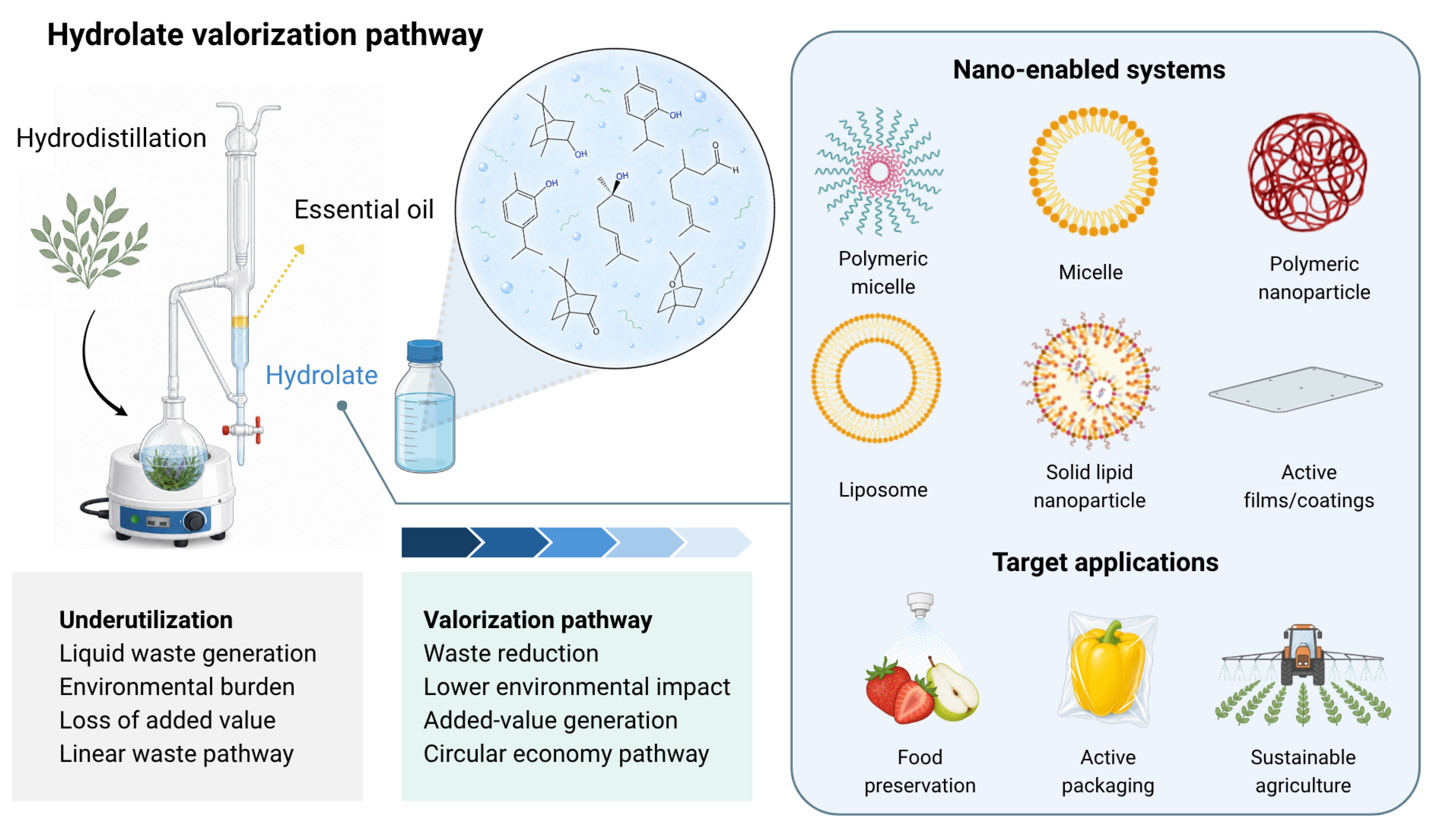
Figure 2.
Nano-enabled upgrading of hydrolates from free aqueous fractions to functional delivery systems. Free hydrolates may be limited by low bioactive concentration, volatile loss, instability, microbial susceptibility, and poor surface retention. Nano-enabled strategies, including liposomes, nanoemulsions, nanogels, polymeric nanoparticles, lipid nanoparticles, and active films/coatings, can improve retention, protection, controlled release, surface contact, and stability.
Figure 2.
Nano-enabled upgrading of hydrolates from free aqueous fractions to functional delivery systems. Free hydrolates may be limited by low bioactive concentration, volatile loss, instability, microbial susceptibility, and poor surface retention. Nano-enabled strategies, including liposomes, nanoemulsions, nanogels, polymeric nanoparticles, lipid nanoparticles, and active films/coatings, can improve retention, protection, controlled release, surface contact, and stability.
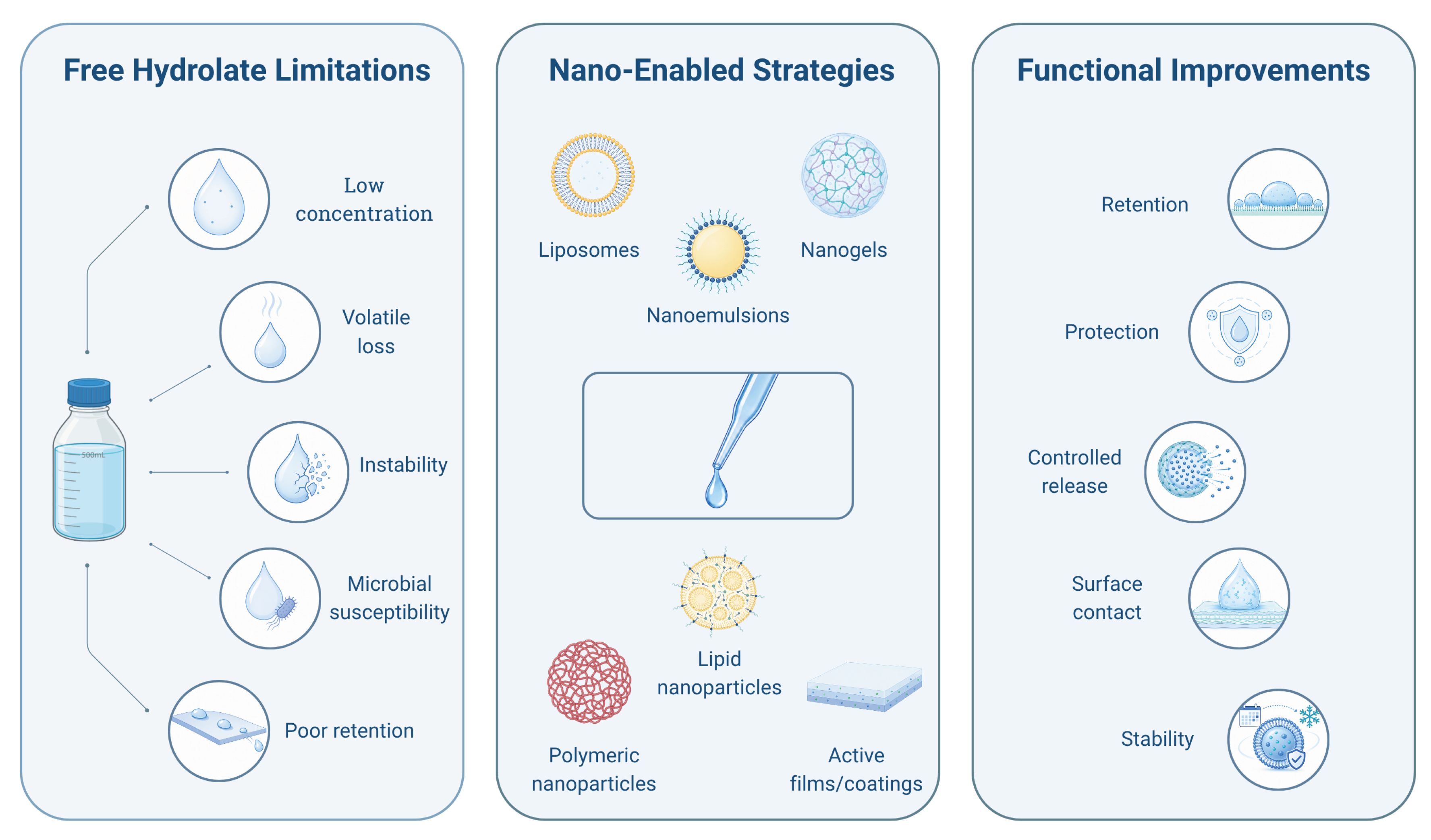

Table 1.
Main production parameters affecting hydrolate yield, chemical composition, stability, and suitability for nano-enabled applications.
Table 1.
Main production parameters affecting hydrolate yield, chemical composition, stability, and suitability for nano-enabled applications.
| Production parameter | Main effect on hydrolate properties | Potential consequence for application | Relevance for nano-enabled systems |
|---|---|---|---|
| Plant species and genotype | Determines the qualitative profile of water-soluble volatile and semi-volatile compounds | Strong influence on antimicrobial, antioxidant, and sensory properties | Defines the type and polarity of bioactive compounds available for encapsulation or retention |
| Plant organ | Leaves, flowers, fruits, peels, bark, or stems may generate hydrolates with distinct chemical profiles | Affects functional activity and application suitability | Influences compatibility with nanoemulsions, liposomes, polymeric nanoparticles, or hydrogels |
| Harvest season and developmental stage | Alters secondary metabolite biosynthesis and compound abundance | May cause batch-to-batch variability and inconsistent biological activity | Requires standardization before nanoformulation development |
| Plant-to-water ratio | Influences dilution, mass transfer, and concentration of hydrophilic volatile compounds | May affect bioactive concentration, pH, and sensory intensity | Determines whether concentration or encapsulation strategies are needed |
| Extraction time | Short extraction may reduce compound recovery, whereas prolonged extraction may increase recovery of polar constituents but also promote degradation | Impacts yield, composition, and functional performance | Affects loading or retention efficiency and reproducibility of hydrolate-based nanocarriers |
| Temperature or heating regime | Modulates volatilization, hydrolysis, and thermal degradation of labile constituents | May improve extraction efficiency or reduce quality if excessive | Important for preserving compounds intended for controlled release |
| Particle size of plant material | Influences surface area and mass transfer during distillation | May increase extraction efficiency but also favor degradation or suspended impurities | Affects clarity, filtration needs, and formulation stability |
| Condensation efficiency | Determines recovery of volatile and water-soluble compounds in the aqueous phase | Poor condensation may reduce yield and alter chemical profile | Influences reproducibility and concentration of compounds incorporated into nanostructures |
| Storage conditions after distillation | Affects microbial growth, oxidation, and chemical degradation | Determines shelf life and functional consistency | Critical for maintaining stability before incorporation into nano-enabled systems |
Table 2.
Comparative chemical features of selected plant hydrolates and their relevance for nano-enabled applications.
Table 2.
Comparative chemical features of selected plant hydrolates and their relevance for nano-enabled applications.
| Plant species | Plant part | Major hydrolate constituents | Reported abundance or concentration | Relevance for nano-enabled applications | Ref. |
|---|---|---|---|---|---|
| Lavandula angustifolia | Aerial parts/flowers | Linalool, terpinen-4-ol, -terpineol, borneol, and other oxygenated monoterpenes | Total phenolic content reported for lavender hydrolate: 10.63 mg gallic acid equivalents | Suitable for mild aqueous delivery systems, active coatings, and formulations requiring water-compatible oxygenated constituents | [12] |
| Rosmarinus officinalis | Leaves | 1,8-Cineole, camphor, borneol, verbenone, and linalool | Oxygenated monoterpenes: 70.4%; 1,8-cineole: 47.1%; camphor: 5.4%; borneol: 3.7%; verbenone: 2.8%; linalool: 2.0% | Relevant for antioxidant and antimicrobial nanoformulations intended for food preservation, coatings, and hydrophilic matrices | [13] |
| Thymus vulgaris | Aerial parts | Thymol, carvacrol, thymol methyl ether, and carvacrol methyl ether | Oxygenated monoterpenes: 93.68%; thymol: 62.96%; carvacrol: 21.48%; total phenolic content: 183.85 mg gallic acid equivalents | Promising for antimicrobial nanocarriers and active packaging systems due to phenolic oxygenated monoterpenes | [12] |
| Origanum vulgare | Aerial parts | 1-Octen-3-ol, caryophyllene oxide, linalool, -terpineol, spathulenol, eucalyptol, and terpinen-4-ol | Oxygenated monoterpenes: 55.63%; oxygenated sesquiterpenes: 24.03%; 1-octen-3-ol: 13.31%; caryophyllene oxide: 12.44%; linalool: 11.59%; -terpineol: 6.16% | Potential for nano-enabled antimicrobial systems, surface treatments, and active films targeting foodborne or spoilage microorganisms | [12] |
| Rosa damascena | Petals | -Citronellol, trans-geraniol, cis-geraniol, and phenylethyl alcohol | -citronellol: 28.7%; trans-geraniol: 16.44%; cis-geraniol: 10.81%; phenylethyl alcohol: 4.95% | Suitable for mild antioxidant, aromatic, and biocompatible hydrophilic formulations; relevant for polymeric matrices and nanogels requiring low-intensity bioactivity | [21] |
| Citrus spp. | Peels | -Terpineol, linalool, oxygenated monoterpenes, and alcohols | Recent citrus peel hydrolates were dominated by oxygenated monoterpenes and alcohols, with -terpineol and linalool as principal constituents; enzymatic pretreatment modulated volatile composition | Relevant for edible coatings, antifungal packaging, controlled-release systems, and valorization of citrus-processing residues | [11] |
| Eucalyptus spp. | Leaves | 1,8-Cineole, -terpineol, terpinen-4-ol, limonene, -pinene, and oxygenated monoterpenes | Oxygenated monoterpenes: 97.6–98.9%; 1,8-cineole up to 1.6 g in hydrosols of selected Eucalyptus species | Relevant for agricultural nanoformulations, sprayable systems, and plant-protection applications requiring water-compatible oxygenated volatiles | [14] |
Table 3.
Analytical techniques for hydrolate characterization and quality control in nano-enabled applications.
Table 3.
Analytical techniques for hydrolate characterization and quality control in nano-enabled applications.
| Technique | Main information obtained | Advantages | Limitations | Relevance for nano-enabled applications |
|---|---|---|---|---|
| GC–MS | Volatile and semi-volatile compounds, including alcohols, aldehydes, ketones, and oxygenated terpenes | High sensitivity for volatile compounds; useful for chemical fingerprinting | Limited detection of highly polar, non-volatile, or thermolabile compounds | Defines volatile quality markers and supports correlations between composition and antimicrobial or antioxidant activity |
| LC–MS / HPLC | Polar and non-volatile compounds, including phenolic acids, flavonoids, and other hydrophilic constituents | Complements GC–MS and expands analytical coverage toward water-soluble bioactives | Requires standards, optimized sample preparation, and method validation | Supports identification of compounds relevant for carrier selection, retention, and controlled release |
| FTIR | Functional groups, chemical fingerprints, and matrix interactions | Rapid, non-destructive, and useful for comparative screening | Limited molecular specificity when used alone | Useful for monitoring interactions between hydrolate constituents and polymeric or lipid-based matrices |
| UV–Vis | Absorbance changes, total phenolic-related signals, color variation, and degradation indicators | Simple, low-cost, and rapid | Low specificity and limited structural information | Useful for routine stability monitoring and preliminary antioxidant-related screening |
| pH and conductivity | Acidity, ionic strength, and physicochemical consistency | Simple, low-cost, and suitable for routine quality control | Does not identify specific compounds | Important for carrier compatibility, colloidal stability, and microbial stability |
| Microbiological analysis | Microbial load and contamination during storage | Essential for safety, shelf-life evaluation, and quality control | Time-consuming and dependent on culture conditions | Critical before incorporation into food, packaging, or agricultural nanoformulations |
| DLS | Particle size distribution and polydispersity of hydrolate-based nanostructures | Rapid assessment of colloidal size and homogeneity | Sensitive to dilution, aggregation, and sample preparation | Essential for evaluating nanoemulsions, liposomes, polymeric nanoparticles, and nanogels |
| Zeta potential | Surface charge and electrostatic stabilization | Useful for predicting aggregation tendency and colloidal stability | Interpretation depends on medium composition, ionic strength, and pH | Supports stability assessment of hydrolate-loaded nanocarriers |
| DSC / TGA | Thermal behavior, degradation profile, phase transitions, and interactions with matrices | Useful for evaluating films, coatings, hydrogels, and polymeric systems | Requires specialized equipment and careful interpretation | Relevant for active packaging, thermoresponsive matrices, and stability assessment |
| SEM / TEM | Morphology, surface structure, particle organization, and distribution within matrices | Provides visual evidence of structure and homogeneity | Requires sample preparation and may not fully represent hydrated systems | Useful for confirming morphology of films, nanoparticles, coatings, and nanostructured carriers |
Note: GC–MS, gas chromatography–mass spectrometry; LC–MS, liquid chromatography–mass spectrometry; HPLC, high-performance liquid chromatography; FTIR, Fourier-transform infrared spectroscopy; UV–Vis, ultraviolet–visible spectroscopy; DLS, dynamic light scattering; DSC, differential scanning calorimetry; TGA, thermogravimetric analysis; SEM, scanning electron microscopy; TEM, transmission electron microscopy.
Table 4.
Biological activities of selected plant hydrolates and their relevance for nano-enabled applications.
Table 4.
Biological activities of selected plant hydrolates and their relevance for nano-enabled applications.
| Plant species and part | Reported activity and experimental model | Quantitative endpoint or evidence level | Relevance for nano-enabled applications | Ref. |
|---|---|---|---|---|
| Lavandula angustifolia, flowers/aerial parts | Antibacterial and antioxidant activity evaluated using in vitro bacterial assays and radical-scavenging assays | Antibacterial inhibition assays and antioxidant capacity assays; total phenolic content reported for lavender hydrolate: 10.63 mg gallic acid equivalents ; mostly in vitro evidence | Candidate for mild antimicrobial coatings, nanoemulsions, liposomes, and hydrophilic delivery systems requiring low-intensity bioactivity | [12,17] |
| Rosmarinus officinalis, leaves | Antibacterial, antioxidant, and cytotoxicity screening using in vitro bacterial assays, radical-scavenging assays, and cell-based assays | DPPH: 75.84 mol Trolox equivalent dry weight; ABTS: 63.06 mol Trolox equivalent dry weight; FRAP: 27.57 mol Trolox equivalent dry weight; in vitro evidence | Relevant for antioxidant nanocarriers, active films, and coatings designed to delay oxidative deterioration | [13,17,18] |
| Thymus vulgaris, aerial parts | Antioxidant and antimicrobial potential evaluated using radical-scavenging assays and Lamiaceae hydrolate studies | DPPH: 174.04 mol Trolox equivalent dry weight; ABTS: 451.79 mol Trolox equivalent dry weight; FRAP: 204.02 mol Trolox equivalent dry weight; in vitro evidence | Promising for antimicrobial or antioxidant nanocarriers and active packaging due to phenolic oxygenated monoterpenes | [12,18] |
| Origanum vulgare var. hirtum, aerial parts | Antilisterial activity against sixteen Listeria monocytogenes strains from food and clinical origins | MIC values of 125–500 L ; reductions of approximately 1.2–1.7 log CFU after 60 min of exposure; in vitro evidence | Suitable for nano-enabled antimicrobial films, surface treatments, and food-contact coatings targeting foodborne pathogens | [19] |
| Coridothymus capitatus, aerial parts | Antilisterial activity against sixteen Listeria monocytogenes strains from food and clinical origins | MIC values of 125–500 L ; time-kill assays and membrane damage evaluation were performed; in vitro evidence | Relevant for antimicrobial nanoformulations and combined essential oil–hydrolate strategies for food preservation | [19] |
| Salvia spp., leaves | Antibacterial and antioxidant activity using hydrolates obtained by microwave-assisted extraction | MIC values reported in L ; antioxidant activity also evaluated; in vitro evidence | Useful model for hydrolate-based antimicrobial nanoformulations and for comparing extraction-dependent biological performance | [20] |
| Rosa damascena, petals | Cytotoxicity, genotoxicity, and cytoprotective potential evaluated using human lymphocytes, higher plant test systems, and animal cell models | Mitotic index, nuclear division index, chromosome aberrations, and micronucleus endpoints; low genotoxic risk reported at tested concentrations; in vitro and in vivo assays | Relevant mainly for safety-oriented hydrophilic formulations, polymeric matrices, and nanogels requiring mild bioactivity and biocompatibility | [21,22] |
| Tropaeolum majus, seeds | Multiple biological activities evaluated using environmentally friendly seed hydrosols | Antioxidant, antimicrobial, and cytotoxicity-related endpoints reported in the original study; mostly in vitro evidence | Potential model for hydrolate-based bioactive delivery systems, although direct food or agricultural nanoformulation studies are still needed | [23] |
| Solidago virgaurea, aerial parts | Antioxidant and antimicrobial potential evaluated using hydrolates obtained by different extraction approaches | Antioxidant and antimicrobial endpoints reported as a function of extraction method; in vitro evidence | Relevant for understanding how extraction strategy influences hydrolate bioactivity before incorporation into nanostructured systems | [24] |
Table 5.
Nano-enabled systems for hydrolate incorporation: formulation rationale, critical parameters, limitations, and application readiness.
Table 5.
Nano-enabled systems for hydrolate incorporation: formulation rationale, critical parameters, limitations, and application readiness.
| Nano-enabled system | Rationale and critical parameters | Main advantages | Main limitations and evidence status | Application relevance | Ref. |
|---|---|---|---|---|---|
| Nanoemulsions | May improve dispersion, interfacial contact, and retention of volatile or semi-volatile hydrolate-derived compounds. Critical parameters include droplet size, surfactant type, hydrolate concentration, physical stability, and release behavior | Improved distribution at food or plant surfaces; potential enhancement of antimicrobial and antioxidant effects | Hydrolates are predominantly aqueous and diluted; may require co-bioactives, stabilizers, or specific formulation strategies. Evidence remains mostly extrapolated from essential oil nanoemulsions, with few direct hydrolate studies | Edible coatings, sprayable systems, active packaging, and surface preservation | [26,27,28] |
| Liposomes | Aqueous compartments may retain water-compatible hydrolate constituents and support gradual release. Critical parameters include vesicle size, membrane composition, retention efficiency, surface charge, pH, ionic strength, and storage stability | Biocompatibility; suitability for hydrophilic and amphiphilic compounds; potential controlled release | Physical instability, lipid oxidation, limited retention of diluted bioactives, and sensitivity to medium composition. Direct comparison between free and liposome-loaded hydrolates is still needed | Active packaging, coatings, and food preservation systems | [29,30] |
| Polymeric nanoparticles | Polymeric matrices may protect hydrolate-derived compounds and modulate their release. Critical parameters include polymer type, particle size, surface charge, loading or retention efficiency, matrix compatibility, and biodegradability | Tunable release; improved structural stability; compatibility with films, coatings, and sprayable systems | Preparation complexity and possible safety, regulatory, or scalability constraints depending on polymer type. Evidence is mainly inferred from plant extracts, essential oils, and isolated bioactives | Antimicrobial films, coatings, and agricultural delivery systems | [32,33,34,40] |
| Nanogels | Hydrated polymeric networks are compatible with aqueous hydrolates and may enable sustained release. Critical parameters include polymer composition, swelling behavior, gel strength, hydrolate–polymer interactions, water retention, and release kinetics | High aqueous compatibility; retention of hydrophilic compounds; suitability for surface applications | Hydrolate-specific data remain limited; stability, swelling, and release behavior require optimization | Active coatings, biodegradable packaging, and plant surface retention systems | [35,36] |
| Thermoresponsive nanogels | Sol–gel transition may allow fluid application followed by in situ structuring on target surfaces. Critical parameters include gelation temperature, polymer concentration, mechanical stability, release profile, safety, biodegradability, and matrix compatibility | Improved retention; potential sustained release; adaptability to coatings and surface treatments | Temperature-dependent behavior and limited validation in food, packaging, and agricultural matrices. These systems remain at low technology readiness level | Smart coatings, active packaging, and agricultural spray or coating systems | [38,39] |
| Active films and coatings | Hydrolates or hydrolate-loaded nanocarriers may be immobilized within biodegradable matrices. Critical parameters include film composition, mechanical properties, water vapor permeability, migration, release kinetics, sensory effects, and food-contact safety | Localized activity; reduced volatilization; compatibility with food surface protection and postharvest systems | Possible effects on film properties, aroma, migration, sensory quality, and regulatory classification. Hydrolate-specific evidence remains limited | Food packaging, edible coatings, and postharvest protection | [15,37,38] |
Table 6.
Main limitations of hydrolates, practical consequences, and research priorities for nano-enabled applications.
Table 6.
Main limitations of hydrolates, practical consequences, and research priorities for nano-enabled applications.
| Limitation | Practical consequence | Proposed solution or research priority | Relevance for nano-enabled systems |
|---|---|---|---|
| Compositional variability | Inconsistent antimicrobial, antioxidant, sensory, and technological performance among batches | Standardize plant material, plant organ, harvest conditions, distillation parameters, storage conditions, and analytical quality markers | Essential for reproducible carrier selection, loading or retention efficiency, colloidal stability, and release behavior |
| Low concentration of bioactive compounds | Limited efficacy as standalone preservatives, packaging additives, or agricultural inputs | Determine dose–response behavior, minimum effective concentrations, and possible concentration or combination strategies | Nanoformulation may improve retention, localized delivery, and sustained release of diluted bioactives |
| Physicochemical instability | Loss of volatile compounds, oxidation, hydrolysis, pH changes, and reduced biological activity during storage | Monitor chemical profile, pH, microbial load, and bioactivity over time under defined storage conditions | Nanocarriers and polymeric matrices may protect labile compounds and improve storage stability |
| Microbial susceptibility | Reduced shelf life and possible safety concerns due to the aqueous nature of hydrolates | Apply filtration, pasteurization, preservatives, aseptic handling, or stabilization strategies when appropriate | Hydrolate-loaded systems must be microbiologically safe before use in food, packaging, or agriculture |
| Limited quantitative bioactivity data | Difficulty comparing studies and identifying the most promising hydrolates | Report MIC, inhibition percentage, antioxidant capacity, dose–response curves, and performance in target matrices | Quantitative endpoints are necessary to demonstrate improvement after nanoformulation |
| Limited validation in real systems | In vitro results may not translate into food, packaging, greenhouse, or field applications | Perform studies in real food matrices, active films, coatings, greenhouse assays, and field trials | Nano-enabled systems should be tested under realistic application conditions |
| Sensory impact | Aroma or flavor may limit application in food products even at moderate concentrations | Evaluate sensory acceptance and optimize dose, release rate, and matrix compatibility | Controlled release may reduce sensory impact while maintaining functional activity |
| Regulatory uncertainty | Unclear classification depending on use as food ingredient, packaging component, agricultural input, or nanoformulation | Define intended use, exposure route, safety requirements, nanostructure properties, and product claims early in development | Nano-enabled hydrolates may require additional evaluation of particle properties, migration, release, exposure, and safety |
| Scalability and cost | Laboratory-scale systems may not be economically or technically feasible for industrial use | Assess process scalability, raw material availability, storage, transport, cost-effectiveness, and compatibility with existing processes | Nanoformulation should provide measurable performance gains that justify added complexity |
| Limited sustainability evidence | Circular economy benefits may be assumed rather than demonstrated | Use quantitative sustainability indicators, economic analysis, life cycle assessment, and comparison with conventional alternatives | Nano-enabled systems should be designed with safe, biodegradable, scalable, and environmentally compatible materials |
Disclaimer/Publisher’s Note: The statements, opinions and data contained in all publications are solely those of the individual author(s) and contributor(s) and not of MDPI and/or the editor(s). MDPI and/or the editor(s) disclaim responsibility for any injury to people or property resulting from any ideas, methods, instructions or products referred to in the content. |
© 2026 by the authors. Licensee MDPI, Basel, Switzerland. This article is an open access article distributed under the terms and conditions of the Creative Commons Attribution (CC BY) license (http://creativecommons.org/licenses/by/4.0/).
Copyright: This open access article is published under a Creative Commons CC BY 4.0 license, which permit the free download, distribution, and reuse, provided that the author and preprint are cited in any reuse.