

Submitted:
25 June 2026
Posted:
26 June 2026
You are already at the latest version
Abstract
Metal–Organic Frameworks (MOFs) have undergone remarkable development in recent decades, transforming them into one of the most dynamic classes of emerging composite materials. These crystalline, porous coordination networks built from metal ions or metal clusters interconnected by organic linkers, form architectures with tunable porosity, large specific surface area, and chemical functionality. Due to their remarkable stability and customizable functionalities, the MOFs have attracted significant attention in recent years as promising materials for different applications. In 2025, Susumu Kitagawa, Omar Yaghi, and Richard Robson were awarded the Nobel Prize in Chemistry for pioneering the development of MOF crystalline materials with spacious internal cavities that can store, filter or catalyze molecules. This review systematically consolidates key developments since 2020 in the MOFs synthesis approaches, in their morphology and structures, luminescent properties and applications. The rapid yearly increase in MOFrelated publications, continuing strongly into 2026, reflects the growing global interest and highlights the rising importance of their design and applications. This trend motivates the central focus of this paper, which emphasizes the integrated use of MOFs in sensing, water treatment, and hydrogen storage. Finally, the future perspectives of MOF-based materials will be highlighted with the aim of providing guidelines for their further development and additional applications.
Keywords:
Metal-Organic Frameworks (MOFs)
; Nobel prize in chemistry
; sensing
; synthesis
; structure
; luminescent properties
; water treatment
; hydrogen storage
1. Introduction
The growing awareness of the negative effects of industrial and human activities on the environment, water resources and public health, has driven the development of new materials and strategies to mitigate the impact of these activities and guarantee environmental quality standards, today recognized as one of the most important social challenges. Among next generation materials, the Metal-Organic Frameworks (MOFs) have emerged as a focal point in materials science due to their remarkable structural tunability, enabling precise control over size, morphology, and porosity. MOFs are porous hybrid materials composed of both inorganic and organic components. These frameworks are three-dimensional networks formed through coordination bonds between metal ions and organic ligands/linkers, offering tunable porosity, large specific surface area, remarkable stability and customizable functionalities, making them highly promising for a wide spectrum of applications. By varying the choice of metal centers and organic linkers, it is possible to design an almost limitless array of MOF architectures with diverse structures and functionalities [1,2,3].
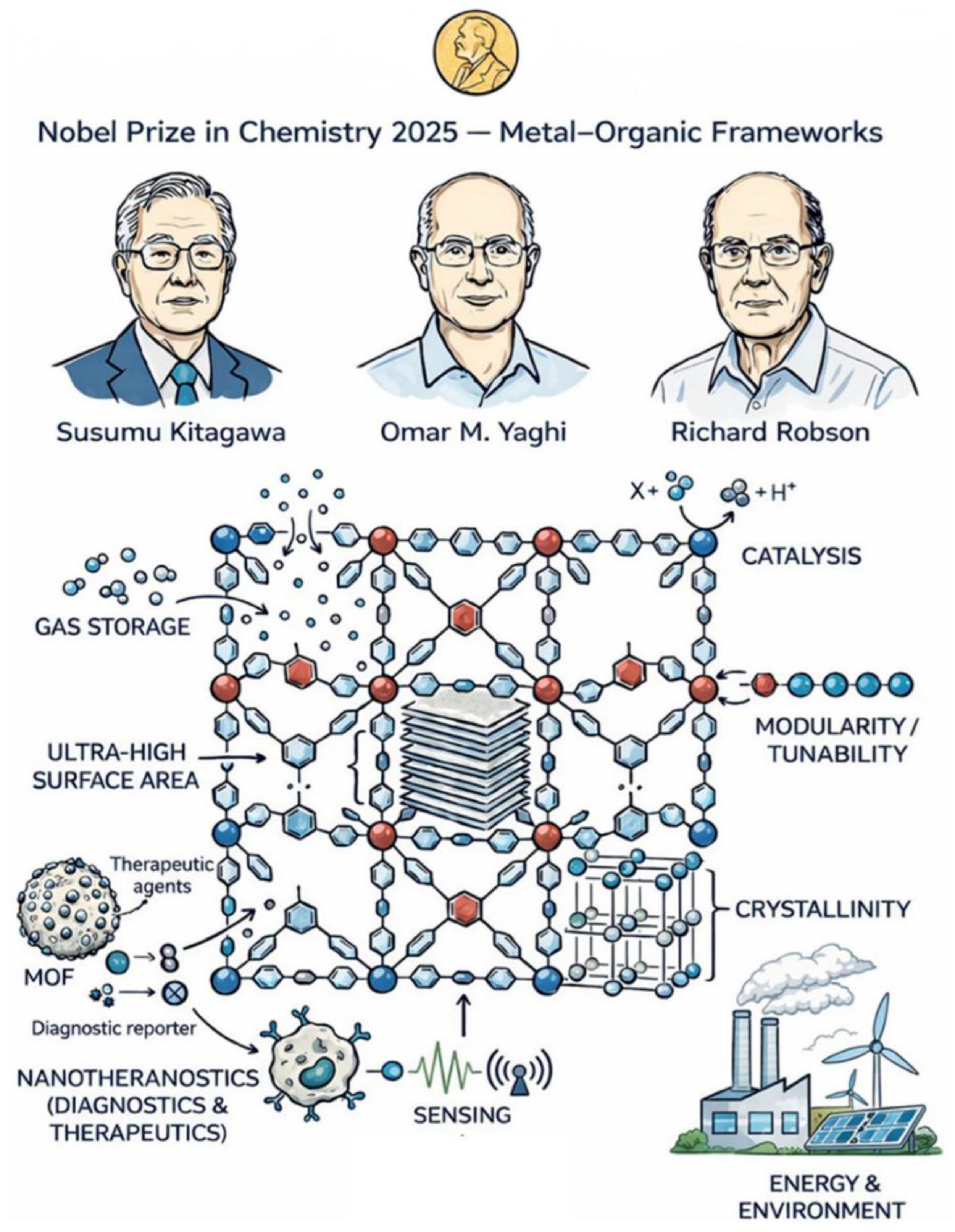
In 2025, Susumu Kitagawa, Omar Yaghi, and Richard Robson were awarded the Nobel Prize in Chemistry for pioneering the development of MOFs crystalline materials with spacious internal cavities that can store, filter or catalyze molecules (Figure 1). History traces back to 1989, when Richard Robson first explored a novel way of exploiting atomic properties by combining positively charged copper ions with a four-armed organic molecule whose terminal groups were naturally coordinated to copper. This approach resulted in a spacious, highly ordered crystal reminiscent of a diamond lattice with tiny cavities. Although Robson immediately recognized the potential of this architecture, its instability limited its practical usefulness. Between 1992 and 2003, Susumu Kitagawa and Omar Yaghi, working independently, established the foundations of modern MOF chemistry through a series of transformative breakthroughs. Kitagawa demonstrated that gases could diffuse freely through the porous network and proposed that MOFs could be engineered to exhibit mechanical flexibility [4]. Yaghi created exceptionally stable frameworks and proved they could be systematically modified through rational design to introduce new, tailored properties [5]. These advances laid the groundwork for the vast and rapidly expanding field of MOF research [6,7]
Their versatility has led to the development of more than 100,000 MOF variants, enabling applications from carbon capture and water harvesting to drug delivery and energy storage. Despite challenges in scaling the production, MOFs are now recognized as one of the most extensively studied material classes of the past two decades and have attracted significant interest for applications in catalysis, gas storage, gas separation, nanotheranostics (diagnostics and therapeutics), energy applications and environmental remediation [8,9].
Unlike conventional porous materials such as zeolites and activated carbons, MOFs exhibit superior chemical adaptability and structural diversity, enabling customized functions to satisfy specific technological requirements [10,11]. The unique characteristics of MOFs such as thermal stability, rigidity, structural flexibility, high void volume, large specific surface area, adjustable pore size, and uniform, tailorable cavities have attracted significant attention in research and development [12,13,14]. Moreover, their high density of active sites and catalytic activity make them promising candidates for hydrogen storage, organic pollutant removal, rechargeable batteries, sensor applications, and photocatalysis, including antibiotic degradation and CO₂ photoreduction [15,16,17,18,19,20,21].
Advances in synthesis techniques, such as solvothermal, microwave-assisted, and electrochemical methods, have significantly expanded the structure and performance of MOFs. Despite these achievements, challenges remain in stability, conductivity, and scalability. To overcome these limitations, the researchers have developed MOF composites by integrating them with polymers, graphene oxide, and metal oxides, thereby enhancing durability and functionality [22,23,24]. These innovations have broadened MOFs’ applications in energy conversion, sensing, and sustainable technologies, aligning with global priorities for environmental protection and resource efficiency [25,26,27]. Looking ahead, future directions include improving reproducibility, exploring defect engineering, and designing multifunctional composites. These efforts aim to unlock new possibilities in batteries, catalysis, and environmental remediation, positioning MOFs as key materials for next-generation industrial and scientific applications [28,29].
In recent years, numerous reviews have been published on MOFs across a wide range of application fields and performance assessments. However, many of these works focus on a single application domain. For example, Khezerlou et al. summarized the synthesis and the use of luminescent MOFs for sensing dipicolinic acid in biological and water samples [30], while Harjeet et al. [31], and Girhe et al. [32] reviewed MOFs and their composite-based solutions for hydrogen storage. Additionally, Wang, et al. [33] explored luminescent sensing platforms based on lanthanide MOFs, and Qiu et al. [34] investigated the integration of MOFs on sensing platforms for food safety intelligent detection.
Figure 1.
Schematic overview of metal–organic frameworks (MOFs) and their transformative impact on chemistry. The illustration highlights the foundational contributions of Susumu Kitagawa, Omar M. Yaghi, and Richard Robson, whose work established the principles of reticular chemistry and MOF design, and who were awarded the 2025 Nobel Prize in Chemistry for these contributions. Reproduced from Ref. [9] under Creative Commons CC BY license.
Figure 1.
Schematic overview of metal–organic frameworks (MOFs) and their transformative impact on chemistry. The illustration highlights the foundational contributions of Susumu Kitagawa, Omar M. Yaghi, and Richard Robson, whose work established the principles of reticular chemistry and MOF design, and who were awarded the 2025 Nobel Prize in Chemistry for these contributions. Reproduced from Ref. [9] under Creative Commons CC BY license.
Previous reviews have discussed different aspects relevant to this subject, including synthesis routes, structure, morphology and different applications of the MOF-based systems. However, these areas are usually treated from separate perspectives. In the present review, we connect them according to their integrated use in sensing, water treatment, and hydrogen storage This approach allows us to move beyond a simple comparison of reported performances and to focus on how synthesis conditions, metal ions or metal clusters, organic linkers, morphology, surface chemistry, porosity, adsorption, and various luminescent guests, jointly determine MOF`s behaviors.
2. Methods of Synthesis for MOFs
Different synthesis methods contribute to the variations of MOFs performance. Even when the same method is applied, changes in parameters such as energy input, pressure, and reaction time can significantly influence the resulting structures and properties. A wide range of techniques has been developed for MOF synthesis, including hydrothermal, solvothermal, sol-gel, microwave-assisted, and self-assembly methods. Consequently, careful selection of the synthesis approach, along with precise control of reaction conditions, is essential for tailoring the structure and functionality of MOFs.
2.1. Hydrothermal and Solvothermal Synthesis
Hydrothermal synthesis is based on the solubility of almost all of inorganic substances in water under elevated temperature and/or pression conditions followed by crystallization of dissolved substances in the fluid. Dissolution of precursors and subsequent precipitation of compounds with the desired composition occur in a closed system (reactor, autoclave), where pressure, temperature, pH and reagent selection collectively determine tunable morphology, controlled crystal growth, high phase purity and higher yield, in a short time [35]. Zheng et al. compared hydrothermal, reflux, vessel-based, and microwave-assisted methods to synthesize a particular structure, known as MOF-303, which appears particularly promising for water harvesting from desert air [36]. The hydrothermal method required 24 hours, the reflux and vessel methods needed from 4 to 8 hours, while microwave synthesis was the fastest, having being completed in 5 minutes.
This traditional synthesis approach, however, typically requires high temperatures, high pressures, a longer duration, and sometimes large amounts of environmentally unfriendly organic solvents. Moreover, it is unstable for the synthesis of large dimensional network structures due to the great hydration energy of the metal centers [37]. The growing commercial interest in MOFs leads to the necessity to reduce production costs, which requires optimizing synthesis protocols and moving from small-scale to large-scale processes [38].
Modulated hydrothermal method developed by Hu et al. helps to synthesize zirconium/hafnium-based MOFs in green environment (aqueous solutions) under mild (temperature ≤120 °C and pressure of 1 atm) and scalable conditions [39]. This method not only applies to the classical UiO-66-type and MOF-808-type MOFs, but also suits the design of new MOFs, such as NUS-6, NUS-8, NUS-36 and for doping nickel ions (Ni2+) into [Cu3(BTC)2(H2O)3]n (where BTC is benzene-1,3,5-tricarboxylate), or HKUST-1with a large specific surface area (1536 m2 g−1) [40]. Moreover, the TEOS&Mn-BTC-HY catalyst synthesized by this method successfully increased the yield from 21% of the input to 63%, compared with the TEOS&Mn-BTC catalyst synthesized by the traditional hydrothermal route [41].
Solvothermal method enables high yields and improves the growth of single-crystals, two issues which are crucial for establishing robust structural networks. Structure-directing agents, such as metal salts and organic linkers, facilitate crystal growth. Key synthesis parameters influencing crystal formation include the concentration of metal salts and organic connectors, the choice and modification of solvents, the selection of modulators, and process conditions such as temperature, reaction time, stirring speed, and cooling rate. This approach has been widely applied for the synthesis of numerous MOFs [42]. This is a relatively straightforward synthesis and a high-throughput route compared to other methods. In this process, the precursors, i.e., metal salt and organic linker, are dissolved in a high-boiling-point solvent such as N,N-dimethylformamide (DMF), diethylformamide (DEF), or water and heated in a glass vial or any other sealed vessel. Zr-terephthalate MOF UiO-66 is typically prepared by solvothermal synthesis in DMF, one of the few solvents able to dissolve terephthalic acid. However, the use of DMF is one of the major drawbacks for the transfer of UiO-66 to large-scale applications, since DMF is an expensive and toxic organic solvent [43]. The evolution of MOFs into 3D networks (frameworks) in precursor solutions is still unclear. The formation of secondary building units (SBUs) and the subsequent propagation of the MOF framework is still a debated topic among MOF researchers [44].
It remains challenging to determine the exact pathway followed in solution during prenucleation, nucleation, and subsequent crystal growth stages of MOF particles. To date, solvothermal methods have been employed to synthesize organoclay/Cu-MOF composites that form stable thin films on glassy carbon electrodes, enabling simultaneous electrochemical detection of deoxyepinephrine, acetaminophen, and tyrosine. Additionally, Ni/Co-MOFs with nanosheets-like or raspberry-like morphologies have been developed for high-performance flexible supercapacitors, offering a wide operational temperature range [45,46,47].
2.2. Sol-Gel Synthesis
Sol-gel synthesis is widely used to produce MOFs, ionic materials and single crystals. In this process, ions separated by an inert water gel diffuse easily, enabling the formation of large structures. Within the sol-gel network, silica (SiO₂) is typically derived from tetraethyl orthosilicate (TEOS) or tetramethyl orthosilicate (TMOS). Fundamentally, the sol-gel method involves forming a solution of colloidal particles that evolves into a solid interconnected network, characterized by submicrometer pores and polymer chains exceeding micrometer lengths in the liquid phase [48]. The structure and morphology of the resulting network are strongly dependent on precursor type, solvent choice, water ratio, pH, temperature, and reaction time. The sol-gel approach enhances MOF performance through: (1) molecular-scale interaction between MOF pore surfaces and sol-gel precursors, (2) controlled positioning or growth of MOF crystals on inorganic surfaces, (3) use of MOF crystals as templates in sol-gel processes, and (4) application of sol-gel-derived sacrificial inorganic templates to structure MOF-based architectures. These capabilities make sol-gel synthesis a promising route for developing advanced functional materials tailored for specific applications [49,50,51]. The transition from research to industrial applications further highlights the versatility and real-world potential of MOF-based gels [52].
For example, Zr-based metal-organic xerogels (Zr-MOGs) have been synthesized using a green sol-gel approach without organic and toxic solvents, with their crystallinity dependent on aging and drying temperatures [53]. Besides sol-gel method, advanced manufacturing technologies, like, direct ink writing and template-assisted methods, have shown significant progresses and a high potential for producing monolithic MOFs with tailored architectures and functionalities [54].
2.3. Microwave-Assisted Synthesis
Microwave-assisted synthesis employs microwave irradiation in specialized reactors and ovens, utilizing electromagnetic waves with frequencies between 0.3 and 300 GHz. During the process, the sample absorbs the radiation and undergoes self-heating, resulting in uniform and rapid temperature increases at levels significantly lower than those required in conventional furnaces. The method offers substantial energy savings and reduces reaction times due to the deep penetration of microwaves into precursor materials. This approach promotes rapid precursor decomposition and explosive nucleation, leading to the formation of nanoparticles with very small dimensions in drastically shortened synthesis times. A critical limitation of this approach lies in the selection of reactants: at least one precursor in the starting mixture must be capable of absorbing microwave radiation. Microwave synthesis is often combined with other methods, such as hydrothermal synthesis, to enhance efficiency and broaden its applications [55,56,57].
MOFs synthesized through microwave-assisted methods exhibit several enhanced properties, making them promising candidates for future industrial applications. One of the key advantages is the significantly reduced synthesis time, which directly benefits large-scale and industrial production. In addition, this method requires minimal solvent quantities and shorter heating periods, thereby lowering environmental impact. These features position microwave-assisted synthesis as a sustainable and efficient alternative for MOF production in the future [58]. Cadmium sulfide (CdS)–MIL-101(Fe) composites were successfully synthesized using a microwave-assisted heating method. CdS was incorporated into MIL-101(Fe) at varying concentrations to optimize efficiency in methylene blue (MB) photodegradation. The performed characterizations confirmed the formation and enhanced physicochemical properties of the heterojunction between CdS and the MIL-101(Fe) MOF [59]. Under carefully designed conditions obtained by numerical simulations, MIL-88B (Fe) was also synthesized by microwave assisted method to investigate how localized high-temperature domains within the microwave reactor influence the resulting crystal structure of MOFs [60].
2.4. Self-Assembly Method
Self-assembly methods, guided by forces such as electrostatic interactions, π–π stacking, and hydrogen bonding, enable the spontaneous formation of ordered structures. Unlike conventional preparation methods, this approach to synthesize MOF derivatives overcomes the limitations imposed by precursor synthesis conditions. It not only preserves the intrinsic properties of the materials but also offers enhanced control over the process and greater adaptability for various applications [61,62]. Fan et al. demonstrated that MOF polyhedral particles can undergo oriented self-assembly, forming ordered close-packed structures with a clear preferential orientation within the polymer film. This orientation is governed by the choice of casting solvent used on the water surface [63]. Lv et al. prepared CoNi-MOF in varying amounts of MXene by self-assembly, yielding MXene/CoNi-MOF composites series through high-temperature calcination under an inert atmosphere [64]. On other side, Zhou et al. synthesized Ni MOF-Ti3C2Tx composites via a microwave-assisted self-assembly technique and additional selenization at 600 °C for 2 hours under an inert atmosphere to produce NiSe2/NC/Ti3C2Tx [65].
3. Morphology and Structures of MOFs
Hierarchical MOFs and their derivatives, characterized by distinctive nanostructures, ultra-high porosity, and large specific surface areas, exhibit fascinating physicochemical properties that make them highly promising for environmental and energy-related applications [66,67,68]. Recent progress in tailoring MOF morphology and structure highlights the intrinsic relationship between structure and properties, with emphasis on the influence of precursors, substrates, and synthesis strategies. Notably, MOFs may exist in several morphologically distinct forms, and according to IUPAC, morphology is defined as the shape, optical appearance, or form of phase domains in substances, such as high polymers [69]. Dimensional control of MOFs, covering from bulk crystals to nanoscale architectures, is pivotal in shaping their performance in advanced energy conversion and storage systems, as downsizing enhances surface accessibility, ion and charge transport [70].
In this regard, the term morphology encompasses physical size, flatness, roundness, sphericity, fiber appearance, and particle aspect ratio. Based on these geometrical features, nanomaterials are commonly classified as zero-dimensional (0D), one-dimensional (1D), two-dimensional (2D), or three-dimensional (3D) [71,72,73,74].
A strategic goal in materials engineering is the synthesis of materials with predictable morphologies and tailored properties. However, while numerous studies have reported MOFs with diverse compositions, comparatively fewer have concentrated exclusively on morphology control [75]. The pore size, flexibility, topology, chemical functionality, redox activity, optical response, ion transport, and mechanical properties of metal-organic, covalent-organic, and hydrogen-bonded organic frameworks (MOFs, COFs, and HOFs), can all be tuned with an unusual degree of directness for solid materials [76].
Predicting the shape and size of MOFs at the nanoscale remains particularly challenging, even when the structure of an individual MOF unit is well understood, since a single framework can crystallize in multiple forms [77]. This complexity underscores the importance of achieving accurate regulation of MOF dimensions, shape, and porosity, which is critical for advancing their use in targeted applications [78]. The anisotropic nature of MOFs facilitates controlled growth along specific crystal faces, thereby enabling regulation of crystal dimensions [79]. To date, a wide variety of morphologically diverse MOFs have been reported, including spheres, cubes, cuboctahedra, octahedra, rods, filaments, sheets, and complex hierarchical structures such as flower-like assemblies [80]. However, most syntheses rely on the selection of specific building blocks to achieve scaffold structures with unusually large specific surface areas or other desired properties, and, as a result, the resulting morphologies are often random rather than deliberately designed [81]. This is not unexpected, as predicting the final shape of a material is inherently difficult, given that one MOF topology can crystallize into multiple distinct forms. True morphology control requires a carefully designed strategy that directs synthesis toward a preselected shape and size. Achieving such precision remains extremely challenging, particularly for complex architectures, and thus the first step toward effective morphology control is a thorough understanding of the chemical processes occurring at the molecular level [82]. Figure 2 presents the Scanning electron microscopy (SEM) images of the Mn-MOF precursors with different, i.e., spherical, leaf-like, rod-like, and cube-like, morphologies [83].
Several studies have highlighted transmission electron microscopy (TEM) as a powerful technique for probing the atomic structure and dynamic behavior of MOFs [84,85]. Zheng et al. discussed the challenges, methodological strategies, and advances of TEM methods, emphasizing their strong potential for future MOF studies as well as their contribution in structural analysis and dynamic evolution understanding. Structural differences in MOFs arise from distinct crystallization pathways, as it is shown in Figure 3, obtained by using high-resolution TEM (HRTEM) and integrated differential phase contrast scanning TEM (iDPC-STEM). BZIF-8-S forms a solid-state transformation at the ZIF-8 crystal surface, yielding highly crystalline structures with narrow pore windows (~3.4 Å for 6-rings and ~2.8 Å for 4-rings) that significantly restrict substrate diffusion. In contrast, BZIF-8-B crystallizes directly via electrostatic interactions with bio-macromolecules, producing mixed crystalline–amorphous phases and coordination defects that slow the crystallization but enhance the bioactivity [86].
The structural versatility of MOFs arises from the ability to combine diverse metal nodes, organic linkers, and functional guest species, thereby offering extensive avenues for rational design, synthesis, and post-synthetic modification. Within this context, sequential linker installation has emerged as a particularly innovative and indispensable strategy, enabling the precise incorporation of tailored properties and functionalities at the atomic scale [87]. The solubility and toxicity of the chosen metal salts and organic linkers for synthesized MOFs, as well as the problems with biocompatibility, are key issues for drug delivery applications [88]. Organic linkers play a central role in modulating the physicochemical properties of MOFs, influencing their electronic conductivity, thermal stability, hydrophobicity, and selectivity. In general, the most employed linkers are derived from carboxylic acids, imidazolates, and pyridines. Chemical structures of representative organic linkers such as carboxylate-based acids and imidazole derivatives are presented in Figure 4 [89]. Burigana et al. synthesized a series of multi variate MOFs containing 36 different organic linkers including amine, nitro, halide, naphthalene, alkyne, alkene, alkane, ether, phenyl, pyridine, thiophene, and amide groups with 27 unique functionalities [90].
4. Luminescent Properties of MOFs
In recent years, there has been a growing interest in the synthesis and investigation of different kinds of inorganic luminescent materials and their technological and biomedical applications. Most luminescent systems are built from a host matrix combined with an activator/optical center, yielding strong optical responses and diverse applications [91,92]. On other hand, organic dyes like zinc phthalocyanine, arylazo pyridone derivatives, and nanostructures such as carbon or graphene quantum dots incorporated into polymer and frameworks, have introduced new emission behaviors [93,94,95].
Recently, luminescent MOF-based materials have attracted increasing attention for their potential in sensor design. Their unique characteristics such as high porosity, large surface area, and precisely controlled structures make them particularly well-suited for sensing applications. These materials offer various luminescent properties, which can originate from metal ions, organic ligands, or guest species. Moreover, their structural versatility can be finely tuned through modifications of ligands, metal centers, or reaction conditions, further enhancing their adaptability to sensor development [96,97,98].
MOFs are particularly promising heterogeneous luminescent sensing materials due to their ligands, often aromatic and conjugated, enabling the appearance of absorption through π–π* in the ultraviolet and visible regions, while n–π* transitions and charge-transfer bands emerge upon incorporation of heteroatoms or donor-acceptor motifs [99,100]. As conjugation increases, absorption shifts toward longer wavelengths, extending into the visible and near-infrared regions [101].
Within these systems, processes such as excited-state proton transfer, charge transfer, and Förster resonance energy transfer are crucial for natural phenomena like photosynthesis and photocatalysis. Photoinduced charge transfer occurs when an excited donor molecule transfers an electron to an acceptor, a process often facilitated by complex ligands incorporating donor–acceptor bridges, which enhance luminescence in lanthanide-based MOFs [102,103]. The shielding of 4f electrons in lanthanides by inner subshells imparts distinctive optical properties, with energy transfer occurring through both f–f transitions and charge-transfer mechanisms. Notably, dynamic molecular rotors have been employed to construct smart lanthanide-MOF emitters that exhibit adaptive antenna effects that automatically align with different lanthanide ions. By adjusting the doping ratios of Gd(III) and Tb(III) with Eu(III) within Ln-MOFs, distinct energy transfer pathways are revealed, resulting in enhanced red-light emission [104,105].
5. Applications of the MOFs
5.1. MOFs as Luminescent Sensors
MOFs show significant promise in photoluminescent sensing, with special advantages for the detection, in biological and aqueous environments, of dipicolinic acid (DPA), which is the definitive biomarker for Bacillus anthracis (anthrax) spores [31]. Ln-MOFs have rapidly advanced in analytical applications covering environmental, food, drug, and clinical applications. While conventional techniques such as High-Performance Liquid Chromatography (HPLC), capillary electrophoresis, and Surface Enhanced Raman Scattering (SERS) offer high sensitivity, they are costly and complex, underscoring the need for more accessible, efficient, and selective DPA detection methods [106].
The relationship between fluorescence intensity and DPA concentration was examined using quantitative experiments with MOF-1. Gao et al. synthesized by the solvothermal method two 3D MOFs (MOF-1 and MOF-2) with different topologies, thermal stabilities and magnetic properties [107]. MOF 1 crystallizes in the monoclinic system and contains an elongated [CoO6] octahedron with two bound methoxy groups in the trans position. In contrast, the MOF-2 crystallizes in the tetragonal system and possess [MnO6] octahedron with two coordinated methoxy groups in the cis position As shown in Figure 5a, the addition of DPA (1 × 10⁻² M) to MOF-1 gradually increased the emission intensity and produced a blue shift. To track color changes, the CIE coordinates of MOF-1 emission spectra were calculated (Figure 5b), revealing a consistent shift from green to blue as the DPA concentration increases. This demonstrates the feasibility of quantitative DPA detection through luminescent color transformation, visible even to the naked eye under UV light. Figure 5c illustrates the linear correlation between MOF-1 emission intensity and DPA concentration. At low concentrations, the fluorescence enhancement follows the Stern-Volmer equation (I₀/I = 1 + Ksv[M]), yielding Ksv = 1.38 × 10⁴ M⁻¹ with R² > 0.98. The limit of detection, calculated as LOD = 3σ/K, was determined to be 0.025 μM. Figure 5d compares the emission intensities of different analytes with and without DPA in MOF-1-EtOH solution [106].
The cadmium-organic framework ({[Cd(FIA)(1,2-BPYH)]·(1,2-BPYH)} MOF 1) produced using solvothermal assembly of mixed ligands 5-(furan-2-yl)isophthalic acid (H2FIA) and (E)-1,2-bis(pyridin-3-ylmethyl)diazene (1,2-BPYH), delivers dual environmental functionalities: as a fluorescence probe for chlortetracycline (CTC) with high sensitivity (KSV = 1.164 × 10⁵ M−1, detection limit: 13.6 nM), and as a Congo red (CR) adsorbent in aqueous environments [108].
Several MOF-based materials have been investigated for their potential application as gas sensors, under varying concentrations of O₂, CO₂, C₃H₈, NO, H₂, ethanol, and methanol, as well as under different humidity conditions. Examples of MOF-based sensors include chemiresistive devices, field-effect transistor, Kelvin probe, capacitive, and optical gas sensors [109].
In addition, many of the reported luminescent MOFs exhibit sensitive and selective detection capabilities toward metal cations and anions, pharmaceuticals, pesticides, and nitroaromatic compounds, which are important environmental pollutants [110]. The sensitivity of functionalized MOF with a MIL-53 or DUT-5 toward Fe3+ is seen with a concentration lower than 5.6 × 10⁻⁶ mol L–1. The calculated LOD of 5.6 × 10⁻⁶ mol L–1 highlights its potential as a highly efficient iron nitrate sensor [111]. On other side, the MOFs with luminophores that exhibit electrochemiluminescent signals have drawn a lot of attention as emitters for the sensitive detection of heavy metals [112]. Recently, a di-functional electrochemiluminescent sensor utilizing Ru-MOFs and the strand-displacement-amplification reaction was proposed for the ultrasensitive detection of two heavy metal ions, Hg2+ and Ag+, using K2S2O8 as a co-reactant [113]. Antimagnetic metal ions, such as Zn²⁺, Cu²⁺, and Cd²⁺, are commonly used as MOF centers, while light-emitting organic ligands act as chromophores. Alternatively, luminescent metal ions like Eu³⁺ and Tb³⁺ can serve as the metal nodes with organic ligands, operating as antenna donors, enabling the formation of photoluminescent MOFs [114]. The potential of Dye@Eu-MOFs as fluorescent probes for volatile organic compound sensing has been demonstrated on different solvents (benzene, formaldehyde, ethylbenzene, butyl acetate, methylbenzene, paraxylene, benzyl alcohol, o-xylene, chlorobenzene, m-xylene, and acetaldehyde) under the same experimental conditions [115].
Moreover, luminescent MOFs (LMOF) have become promising sensing materials for biomedical use, especially for urine analysis. While MOF-based sensors are well studied for water remediation, chemical sensing, heavy-metal detection, and food-quality monitoring, their application in urine analysis is still emerging. Recent progress in biofluid sensing using metal and carbon nanomaterials highlights the potential of LMOFs, positioning them as a promising platform for advancing diagnostic accuracy and improving clinical outcomes [116].
Recent advances such as integrating MOFs with conductive carbon nanostructures, semiconductor quantum dots, metal nanoparticles, and polymer matrices have significantly improved sensitivity, signal amplification, and stability in humid or chemically complex environments. Techniques such as ratiometric fluorescence and multimodal detection further enhance sensing reliability by reducing background interference [117]. Organic environmental contaminants include nitroaromatic explosives, polycyclic aromatic hydrocarbons, and endocrine-disrupting chemicals, which present mutagenic, carcinogenic, or hormone-disrupting hazards. These pollutants originate from industrial activities, uncontrolled emissions, and emerging chemicals such as pesticides, bisphenols, dioxins, and antibiotics that interfere with endocrine function. Their broad impact highlights the need for advanced sensing platforms such as luminescent MOFs, whose strong detection sensitivity and analytical performance make them promising tools for monitoring toxic analytes. Integrating AI-guided design and machine-learning-enhanced sensing further strengthens the luminescent MOF-based quantification and expands their potential in environmental diagnostics [118].
Zhang et al. embedded various luminescent guests into a chiral MOF whose helical channels and π-active linkers create a confined cavity capable of transferring chirality. This confinement locks the guests into ordered stacks and enables short-range host–guest interactions that support Dexter-type triplet coupling, while vinyl-substituted guests undergo reversible [2+2] cycloaddition that alters excitonic behavior and reverses handedness. The combined framework–guest and guest–guest π-interactions, along with suppressed nonradiative decay, yield stable, switchable chiroptical signals with excitation-dependent behavior, demonstrating how confinement-induced stacking and excited-state coupling can program multimode circularly polarized luminescence for information display and encryption [119].
Near-infrared (NIR)-MOFs offer a tunable platform for bioimaging and sensing, enabled by rare-earth metal centers, π-conjugated or donor–acceptor ligands, and emissive guest molecules that together provide adjustable optical properties, strong tissue penetration, and low background interference. Their porous, programmable architectures also support ultrasensitive detection of pollutants and biomolecules. Remaining challenges include extending emission into the NIR-II region (>1200 nm), boosting quantum yields through improved molecular antennas and rigid frameworks, achieving precise nanoscale control via optimized synthesis, enhancing biocompatibility with surface coatings or hydrogel matrices, and developing theranostic systems that pair deep-tissue imaging with controlled therapy. As these issues are addressed, NIR-MOFs are positioned to become powerful multifunctional materials for biomedical imaging, diagnostics, and biosensing [120,121].
In conclusion, luminescent MOFs have emerged as highly tunable materials capable of addressing modern technological challenges, driven by the coordination flexibility, redox behavior, and intrinsic luminescence of lanthanide ions. Their multifunctionality covers corrosion protection, catalysis, energy storage, and sensing with recent advances demonstrating stable protective coatings, smart self-healing inhibitors, and highly sensitive detectors for ions, toxic species, and biomolecules. These complementary developments position luminescent MOFs as strong candidates for next-generation sensing technologies and broader applied materials research [122,123].
5.2. MOFs for Water Treatment
MOFs show strong potential in catalysis for pollutant degradation, water purification, and hazardous waste removal, and they are increasingly explored for next-generation energy storage systems, including supercapacitors, batteries, and hydrogen production [124,125].
The atmosphere contains an estimated 13,000 trillion liters of water in the form of vapor and microdroplets, representing a vast and underutilized resource for addressing global water scarcity. Existing air-derived water collection technologies include fog harvesting, dewing/refrigeration, and sorption-based atmospheric water harvesting. Fog harvesting, although efficient and bio-inspired, is restricted to regions with persistently high humidity, while dewing and refrigeration systems range from passive, low-energy designs to active, energy-intensive cooling approaches. Sorption-based atmospheric water harvesting has emerged as a particularly promising strategy for arid and water-stressed regions due to its simplicity, portability, and environmentally friendly operation. This method has gained increasing attention as a viable means of supplementing freshwater supplies where conventional sources are limited, unreliable, or contaminated. The process steps are as follow: the sorption-based atmospheric water harvesting captures atmospheric moisture at night under high humidity and low temperature, storing it within hygroscopic adsorbents; during the day, solar heat, electrical input, or magnetic stimulation drives desorption, releasing vapor that subsequently condenses into liquid water for collection [126,127].
Another issue concerns pharmaceutical residues, which have been increasingly detected in aquatic environments, reflecting their widespread use and environmental persistence. Commonly identified contaminants in wastewater include antibiotics such as ciprofloxacin, sulfamethoxazole, and tetracycline; anti-inflammatory drugs including ibuprofen, diclofenac, and naproxen; and antiepileptics such as carbamazepine. Additional classes of pharmaceuticals such as hormones, cytostatic agents, lipid-regulating drugs, and beta-blockers are also frequently reported [128,129]. The World Health Organization has expressed concern regarding the presence of these pollutants in water bodies, particularly due to their potential role in promoting antibiotic-resistant bacteria, which poses a significant threat to public health. The growing detection of pharmaceuticals in drinking-water sources underscores the urgent need for robust monitoring and effective remediation strategies to ensure water safety and protect human health [130,131,132].
MOFs have also shown strong potential for the adsorptive removal of heavy metals such as Pb²⁺ and Cd²⁺ from aqueous environments. Both pristine MOFs and MOF-based composites have demonstrated high efficacy in capturing these toxic ions, owing to their tunable porosity, abundant functional sites, and strong metal–ligand interactions. MOF materials functionalized with amide, urea, and amino groups exhibit strong adsorption toward Pb²⁺, while sulfonyl, amide, and amino groups enhance Cd²⁺ uptake. However, research on MOF-based systems capable of synergistically removing both ions remains limited, highlighting the need to introduce diverse active centers to improve selectivity. Most Pb-adsorbing MOFs reach equilibrium within 30 minutes, whereas Cd-targeting MOFs typically equilibrate within 60 minutes, and simultaneous Pb/Cd removal requires longer times due to competitive interactions. Adsorption behavior generally follows the Langmuir isotherm, and kinetics align with the quasi-second-order model, indicating monolayer chemisorption. The pH plays a critical role: Pb removal is optimal at pH 5–7, Cd at pH 6–7, and combined Pb/Cd removal at pH 5–6 [133].
Linear sweep voltammetry was employed to assess the electrocatalytic activity of the MOF catalysts, with measurements conducted in 1 M KOH using a standard three-electrode configuration. As shown in Figure 6a, the onset potentials of the three catalysts follow the order Fe/Mn-MOFs (1439.8 mV) < Fe/Co-MOFs (1449.8 mV) < Fe-MOFs (1458.8 mV), indicating that Fe/Mn-MOFs initiate the reaction most readily and therefore exhibit superior catalytic activity. At a current density of 10 mA·cm⁻², the corresponding potentials were 232.8 mV for Fe/Mn-MOFs, 248.8 mV for Fe/Co-MOFs, and 253.8 mV for Fe-MOFs, further confirming the enhanced performance of the Fe/Mn-based catalyst. Tafel curves of Fe-MOFs, Fe/Co-MOFs, and Fe/Mn-MOFs catalysts are presented in Figure 6b. This improvement is attributed to its higher crystallinity relative to Fe-MOFs and Fe/Co-MOFs, which promotes more efficient electron transport through the lattice, increases electrical conductivity, and ultimately enhances the overall catalytic activity. [134].
The surface atomic structure of self-supporting 2D MOF nanosheet arrays plays a decisive role in determining the density and intrinsic activity of catalytic sites. Defect engineering through the introduction of metal or ligand vacancies and heteroatom dopants such as P, S, or F disrupts lattice periodicity and generates coordinatively unsaturated sites that often function as highly active centers. These defects also modulate the local electronic environment, enabling more favorable adsorption–desorption energetics for key intermediate [135].
K. Ge and co-workers prepared undercoordinated 2D CoNi-MOF nanosheets via solvent modulation, which spontaneously reconstructed in 1M KOH to form CoNi-MOF@CoNi(OH)₂ enriched with oxygen-rich surface defects. These defects, together with the tuned d-band center of the bimetallic Ni-based MOF, optimized the electronic configuration of Ni sites and brought the Gibbs free energy of hydrogen adsorption closer to the thermodynamic ideal [136,137].
Multifunctional MOF membranes and systems with enhanced separation performance and broader practical applicability have recently attracted significant attention for advanced oil–water separation [138]. MOF@wood composites have emerged as a promising class of functional materials for water pollution treatment, leveraging the natural porosity, abundant functional groups, and mechanical robustness of wood to overcome the agglomeration and recovery limitations of traditional MOF powders. Integrating MOFs into wood substrates preserves the lightweight strength of wood while imparting large specific surface area, tunable pore structures, and strong adsorption and catalytic capabilities. MOF@wood composites have potential applications in wastewater remediation, including oil–water separation, antibiotic and drug removal, organic dye degradation, heavy-metal adsorption, and solar-driven evaporation [139]. Doping conventional MOFs with rare-earth elements such as Eu, Sm, Tb, and Yb significantly enhances their functionality, improving not only luminescent properties but also catalytic activity and gas-storage performance. These doped MOFs often surpass the capabilities of their undoped counterparts, underscoring the value of rare-earth incorporation in advancing high-performance MOF-based materials. Rare-earth-based MOFs show strong catalytic efficiency in degrading organic dyes and in detecting and removing a wide range of contaminants, including antibiotics, heavy metals, and inorganic anions [140].
More recently, covalent organic frameworks (COFs), a class of porous polymeric materials synthesized through the polymerization of organic building blocks, have gained significant attention owing to their high porosity, low density, tunable structures, uniform pore distribution, facile functionalization, and excellent chemical stability. Similar to MOFs, COFs can also be converted into porous carbons, enabling the preparation of COF-derived carbons (CDCs). The rapid development of MOFs, MOF-derived carbons (MDCs), COFs, and COF-derived carbons has positioned these materials as highly effective adsorbents for liquid-phase applications, including water purification. In particular, their use in the adsorptive removal of pharmaceutical contaminants has advanced quickly, driven by their large specific surface areas and abundant adsorption sites [141].
5.3. MOFs for Hydrogen Storage
As hydrogen energy becomes increasingly central to global carbon-neutrality strategies, the development of high-efficiency solid-state hydrogen-storage materials has gained critical importance. Hydrogen can be stored physically as either a gas or a liquid. Storage of hydrogen as a gas typically requires high-pressure tanks (350–700 bar). Storage of hydrogen as a liquid requires cryogenic temperatures because the boiling point of hydrogen at one atmosphere pressure is −252.8 °C. Hydrogen can also be stored on the surfaces of solids, for example on the surface of the MOFs (by adsorption), or within solids, for example in interstitial hydride (LaNi5H6), or in complex hydride (NaAlH4), or in forms of chemical hydrogen (NH3BH3) by absorption [142].
Hydrogen is widely regarded as a clean, renewable, and efficient alternative to fossil fuels, and MOFs have emerged as credible storage materials due to their unique characteristics [143,144]. Recent developments span multiple domains of green technology, including environmental remediation, sustainable energy conversion and storage, agricultural and food sciences, and biomedical engineering [145]. Although hydrogen-storage performance at ambient temperature remains limited, MOFs exhibit notably high storage capacities at low temperatures and elevated pressures, often surpassing 7 wt%, which exceeds the performance of many other porous materials [146].
Gravimetric energy density refers to the usable energy delivered per unit mass of a storage system. It captures the combined influence of hydrogen content and the efficiency of the host material, reflecting the system’s capability to provide practical, real-world energy output per kilogram under operating conditions. Based on energy content of liquid hydrogen fuel (~120 MJ/kg), it can be expressed as follows: Em (MJ/kg) = wt% (H2, kg) x 120 (MJ/kg) [31].
Recent work by Seyyedattar et al. provided a detailed analysis of hydrogen uptake behavior in MOFs, showing that adsorption enthalpy plays the dominant role, followed by specific surface area and operating temperature [147]. Although MOFs exhibit strong hydrogen-storage performance at cryogenic temperatures, their capacity at ambient conditions remains limited due to the inherently weak interactions between hydrogen molecules and MOF frameworks. To address this challenge, the rational design of MOFs with optimized microstructures and enhanced host–guest interactions has become essential. Findings consistently show that pore architecture and large specific surface areas are the central determinant of hydrogen-storage capacity, while the electronic characteristics of metal nodes and organic linkers strongly influence adsorption behaviour [148]. Strategies such as precise pore-size engineering, incorporation of open metal sites, functionalization of organic ligands, and introduction of nanoparticles have proven effective in strengthening MOF–hydrogen interactions and improving storage performance [149].
The targeted modifications, including ligand functionalization, incorporation of open metal sites, and linker substitution, improve adsorption efficiency and structural stability are essential for real-world deployment. Promising prototypes such as she-MOF-1 and MOF-650 demonstrated hydrogen capacities of 12.6 wt% and 10 wt%, respectively, under cryogenic conditions [31,146]. Typical MOFs such as M(BDC)(TED)0.5 (M = metal, BDC = 1,4-benzene dicarboxylate, TED = triethylenediamine) and HKUST-1 exhibit promising hydrogen-storage capacities under laboratory conditions [150,151].
However, their large-scale deployment remains constrained by the high cost of raw materials and the complexity of synthesis when scaled to industrial quantities. To address these limitations, recent studies have emphasized the need for sustainable, energy-efficient production routes. Proposed strategies for industrial-scale MOF manufacturing include comprehensive life-cycle assessments, evaluation of component costs, and careful consideration of toxicity, safety, washing, and activation requirements. These factors collectively determine the feasibility of transitioning MOFs from laboratory research to commercially viable hydrogen-storage materials [149]. Dependence of the total hydrogen capacity at 77 K on the different MOF’s Brunauer-Emmett-Teller (BET) specific surface area is shown in Figure 7. Maximum cryogenic uptake typically occurs at 20–50 bar. In microporous materials, pore size further influences the density of hydrogen stored within the pore volume [152]. For example, in comparision, MOF-210 is an ultra-porous metal-organic framework with the highest surface area (~ 6200 m2g-1) and highest gas storage capacities, while MOF-5 possesses a relatively modest specific surface area (~ 2300 m2g-1) for hydrogen storage, However, achieving high hydrogen-adsorption densities generally requires operating conditions of 40–100 bar and 77–100 K, owing to the weak physical interactions governing hydrogen physisorption [153].
As scientific innovation accelerates, several complementary strategies have emerged to enhance MOF-based hydrogen storage at room temperature. However, achieving comparable performance at near-ambient conditions (temperature ~298 K, and pressure 10–100 bar) remains a significant challenge [154].
A classical reticular chemistry continues to play a foundational role by enabling precise control over organic linkers and metal nodes, thereby achieving exceptionally large specific surface areas and pore architectures tailored to the molecular dimensions of hydrogen. Also, the incorporation of strong adsorption sites such as open metal sites, metallic nanoparticles, and metal hydrides has proven effective in tuning surface energetics within the optimal range of −15 to −25 kJ/mol, significantly improving room-temperature adsorption. However, iterative experimental optimization remains costly and time-consuming. The extensive body of reticular-chemistry data now provides a rich foundation for artificial-intelligence-driven discovery. AI models can generate candidate MOF structures, propose feasible synthesis routes, and predict hydrogen-storage performance and adsorption enthalpies, thereby reducing development costs and accelerating innovation. Guided by AI-assisted design, researchers have begun exploring industrial-scale performance through mass-production strategies, shaping techniques, and thermal-management approaches. This paradigm underscores the enduring importance of reticular chemistry while seamlessly integrating it with modern AI technologies, bringing practical room-temperature hydrogen storage closer to reality [155]. The evolution from early trial-and-error MOF design to today’s AI-driven discovery shows how data-driven methods now complement core principles of reticular chemistry. Foundational ideas such as decoupling topology from components and building infinite nets through strong bonds remain unchanged, and generative AI builds directly on them. Because MOFs are modular and data-rich, they form an ideal domain for GenAI, revealing how vast is the design space. Looking ahead, AI-designed MOFs may set new performance records, from ultraporous materials that capture and break down methane, to fast-cycling water-harvesting MOFs for arid regions, to CO₂-capture materials that enable cost-effective direct air capture. Several companies, including BASF and Svante, are already moving newly discovered MOFs toward industrial deployment [156].
Significant progress has also been made in developing competitive MOF-based hybrids. Incorporating carbon materials, for instance, can improve adsorption capacity, thermal stability, and thermal conductivity. MOF@MOF hybrids offer another promising way by integrating the structural advantages of two distinct MOFs into a single material, thereby enhancing selectivity and stability. Similarly, MOF@carbon hybrids retain the intrinsic benefits of MOFs while improving specific surface area, heat-transfer properties, and processability [157]. MIL-101(Cr), built from trimeric Cr(III) clusters and 2,4-benzene dicarboxylate linkers, is one of the most notable MOFs due to its exceptionally high specific surface area, zeolite-like architecture, and remarkable porosity. Its strong resistance to humidity, water vapor, and elevated temperatures makes it very robust for adsorption-based applications. Recent work shows that systematically doping this framework with Li⁺ ions further enhances its hydrogen-storage performance. Spectroscopic and structural analyses confirm successful Li⁺ incorporation, and the resulting improvement in uptake is attributed to stronger interactions between the embedded Li⁺ ions and hydrogen molecules [158]. Significant advancements have been achieved to date, driven by the synergistic combination of MOF architectures and tungsten compounds, such as tungsten carbide, tungsten oxide, tungsten sulfide, tungsten nitride, and tungsten phosphide, which promotes abundant exposure of active sites and enhances electrical conductivity. Despite these promising developments, several challenges remain for practical applications in electrochemical energy-storage and energy-conversion systems [159,160].
6. Conclusions and Future Perspectives
This paper systematically consolidates literature developments since 2020 on advances in synthetic approaches of MOFs, their morphology and structures, luminescent properties and applications. The unique characteristics of MOFs such as thermal stability, rigidity, structural flexibility, high void volume, large specific surface area, adjustable pore size, and uniform, tailorable cavities have attracted significant attention in research and development. A detailed discussion is given regarding the preparation methods, such as hydrothermal and solvothermal, sol–gel, microwave-assisted and self-assembly approaches. The main attention has been focused on their morphology, structural and luminescent properties, and on sensing, water treatment and hydrogen storage applications perspectives of these materials.
The challenges such as moisture sensitivity, limited long-term stability, and empirical design constraints continue to restrict large-scale deployment. Future research should prioritize the development of MOFs with enhanced chemical and structural stability under moisture, acidic environments, and elevated temperatures to expand their practical utility. Continued innovation in MOF-based hybrid systems, particularly those incorporating conductive materials such as graphene, carbon nanotubes, metal oxides, or metal sulfides, will be essential for improving charge transport, electrochemical performance, and long-term durability. Advancements in pore engineering, scalable synthesis, and AI-assisted material design will play a critical role in achieving both gravimetric and volumetric hydrogen-storage targets, enabling real-world applications in transportation, portable power, and large-scale energy infrastructure. Additionally, expanding MOF research toward green chemistry, precision agriculture, medical diagnostics, and environmental monitoring will support broader industrial adoption. Ultimately, future works for MOF technologies will rely on the synergy between computational design, sustainable fabrication, and targeted functional optimization to meet the demands of future environmental and energy challenges. In summary, these directions highlight the promising role of MOFs as next-generation materials.
Author Contributions
Conceptualization, D.M. and M.F.; methodology, D.M.; software, G.C.R. and M.F.; validation, D.M., G.C.R., and M.F.; resources, D.M. and M.F.; writing—original draft preparation, D.M. and M.F.; writing—review and editing, D.M., G.C.R., and M.F.; funding acquisition, D.M. and M.F. All authors have read and agreed to the published version of the manuscript.
Funding
This research was supported by the Ministry of Science, Technological Development and Innovation of the Republic of Serbia (grant number 451-03-33/2026-03/200017).
Data Availability Statement
This review article does not contain any original data. All data referenced in this article are publicly available from the sources cited in the references. No new datasets were generated or analyzed in this work.
Conflicts of Interest
The authors declare no conflicts of interest.
References
- Lv, W.; Song, Y.; Mo, Z. Synthesis of metal-organic framework-luminescent guest (MOF@LG) composites and their applications in environmental health sensing: A mini review. Talanta 2025, 283, 127105. [CrossRef]
- Yusuf, V.F.; Malek, N.I.; Kailasa, S.K. Review on metal–organic framework classification, synthetic approaches, and influencing factors: Applications in energy, drug delivery, and wastewater treatment. ACS Omega 2022, 7, 44507–44531. [CrossRef]
- Moon, S.; Al-Ghoul, M. Fractal MOF architectures: reaction–diffusion-mediated transmutation of crystalline scaffolds. Cryst. Eng. Comm. 2025, 27, 7282-7286. [CrossRef]
- Kumagai, H.; Kawata, S.; Kitagawa, S. Fabrication of infinite two-dimensional sheets of tetragonal metal(II) lattices: X-ray crystal structures and magnetic properties of [M(CA)(pyz)]n (M2+=Mn2+ and Co2+; H2CA=chloranilic acid; pyz=pyrazine)Inorg. Chim. Acta 2002, 337, 387-392, . [CrossRef]
- Yaghi, O.M.; Li,G.; Li, H. Selective binding and removal of guests in a microporous metal–organic framework. Nature 1995, 378, 703–706. [CrossRef]
- Popular Information, Nobel Prize Outreach, 2025. https://www. nobelprize.org/prizes/chemistry/2025/popular-information.
- Valavanidis, A. Nobel Prize, Chemistry 2025 Metal-Organic Frameworks (MOFs) crystalline porous polymers for versatile materials with tailorable structures. https://www.researchgate.net/profile/Athanasios-Valavanidis/publication/396387359.
- Li, S.; Ma, C.; Hou, J.; Yu, S.; Chen, A.; Du, J.; Chater, P.A.; Keeble, D.S.; Qiao, Z.; Zhong, C.; Keen, D.A.; Liu, Y.; Bennett, T.D. Highly porous metal-organic framework glass design and application for gas separation membranes. Nat. Commun. 2025, 16, 622. [CrossRef]
- Rodríguez, C.F.; Guzmán-Sastoque, P.; Rodríguez, J.E.; Sanchez-Hernandez, W.; Cruz. J.C. From words to frameworks: transformer models for metal–organic framework design in nanotheranostics. J. Nanotheranostics 2026, 7, 3; [CrossRef]
- Li, N.; Pang, J.; Lang, F.; Bu, X.-H. Flexible metal–organic frameworks: From local structural design to functional realization. Acc. Chem. Res. 2024, 57, 2279-2292. [CrossRef]
- Zeggai, F.Z.; Ait-Touchente, Z.; Bachari, K.; Elaissari, A. Investigation of metal-organic frameworks (MOFs): Synthesis, properties, and applications - An in-depth review. Chem. Phys. Impact 2025, 10, 100864. [CrossRef]
- Xie, F.; Guo, F.-A.; Wang, H.; Li, J. Flexible metal-organic frameworks for hydrocarbon separations. Coord. Chem. Rev. 2025, 541, 216831. [CrossRef]
- Liu, Z.; Lv, H.; Yan, M.; Li, S.; Fan, J.; Xu, Y.; Cheng, H.; Dimensional transition of rigid MOF induced by dynamic dihydrogen phosphate anion coordination for enhanced acetone sensing. Chem. Eng. J. 2026, 528, 172677. [CrossRef]
- Zhu, S.-Q.; Shua, J.-C.; Cao, M.-S. Tailorable MOF architectures for high-efficiency electromagnetic functions. Mater. Chem. Front. 2021, 5, 6444-6460. [CrossRef]
- Mussa, N.-S.; Toshtay, K.; Dumeignil, F. Recent developments in the field of MOF-based catalytic systems: A review. Appl. Catal. A-Gen. 2025, 708, 120555. [CrossRef]
- Agmas, T.D.; Alemu, M.A. Recent advancements in green hydrogen production and storage. Res. Mater. 2026, 30, 100928. [CrossRef]
- Tchinsa, A.; Hossain, M.F.; Wang, T.; Zhou, Y. Removal of organic pollutants from aqueous solution using metal organic frameworks (MOFs)-based adsorbents: A review. Chemosphere 2021, 284, 131393. [CrossRef]
- Geng, P.; Ji, B.; Guo, Y.; Xiao, C.; Wan, J.; Li, C.M. MOF-derived transition metal phosphides for rechargeable batteries. Chem. Eng. J. 2025, 516, 164033. [CrossRef]
- Jyoti, Dutta, T.; Kumar, P.; Jangra, R.; Sharma, A.K.; Singh, M.; Chaturvedi, P.; Sharma, S.; Garita, M.R.; Sharma, J.; Mishra, S.K. Recent advances in metal-organic framework-based fiber optic sensors and photodetectors: Synthesis, properties, and applications. Chem. Eng. J. 2025, 507, 160543. [CrossRef]
- Erum, J.K.E.; Alamgir, Yu, Y.; Gao, J. Recent progress in Zr-MOFs for antibiotic adsorption and photocatalysis. Sep. Purif. Technol. 2025, 363, 132138. [CrossRef]
- Feng, J.; Chen, S.; Lu, Z.; Bai, J. Metal–organic frameworks for photocatalytic CO2 reduction: Progress and prospects. ACS Appl. Mater. Interfaces 2025, 17, 60028–60054. [CrossRef]
- Huang, Y.-L.; Ping, L.-J.; Wu, J.; Li, Y.Y.; Zhou, X.-P. Increasing the stability of metal–organic frameworks by coating with poly(tetrafluoroethylene). Inorg. Chem. 2022, 61, 5092–5098. [CrossRef]
- Tapia, M.C.; Alamani, B.G.; Bae, T.-H. Enhancing hydrogen storage in MOF/graphene composites: The impact of graphene oxide and porous graphene oxide on adsorptive performance. Sep. Purif. Technol. 2025, 363, 132313. [CrossRef]
- Lau, A.; Feng, J.; Bossmann, S.H.; Sebastian, D.; Sorensen, C.M.; Novosselo, I.V. Continuous flow synthesis of MOF/nanocarbon composites. Nanoscale, 2026, 18, 10021-10028. [CrossRef]
- Shahid, I.; Solangi, N.H.; Andavar, R.; Ullah, F.; Sun, Y.; Kolachi, U.A.; Xie, J.; Li, X.; Pan, J. The design and structural evolution of MOF-derived composite and the applications for supercapacitors and (Li, Na, K, Zn) ion batteries. Chem. Eng. J. 2025, 514, 163273. [CrossRef]
- Quan, Y.; Shen, R.; Ma, R.; Zhang, Z.; Wang, Q. Sustainable and efficient manufacturing of metal-organic framework-based polymer nanocomposites by reactive extrusion. ACS Sustainable Chem. Eng. 2022, 10, 7216–7222. [CrossRef]
- Nagarajan, B.R.P.; Dhinasekaran, D.; Subramanian, B.; Rajendran, A.R. Multifunctional MOF-5/reduced graphene oxide electrodes for enhanced nonenzymatic glucose detection and supercapacitor performance in self-powered wearable devices. ACS Appl. Nano Mater, 2024, 7, 23999–24012. [CrossRef]
- Guo, J-; Chu, S.; Yuan, F.; Otake, K.-I,; Yao, M.S.; Kitagawa, S. Soft porous crystals: flexible MOFs as a new class of adaptive materials. Ind. Chem. Mater. 2025, 3, 651-680, . [CrossRef]
- Ullah, S.; Qin, Z.; Tariq, M.; Akhtar, A.; Shah, S.S.A.; Paul, A.; Gao, L.; Nazir, M.A. MOF/MXene composite for electrocatalysis: fundamentals, structure-activity relationship and energy conversion applications. Coord. Chem. Rev. 2026, 563, 218037. [CrossRef]
- Kayani, K.F.; Shatery, O.B.A.; Mohammed, S.J.; Ahmed, H.R.; Hamarawf, R.F.; Mustafa, M.S. Synthesis and applications of luminescent metal organic frameworks (MOFs) for sensing dipicolinic acid in biological and water samples: a review. Nanoscale Adv. 2025, 7, 13-41. [CrossRef]
- Harjeet, Srivastava, S. Frameworks for the future: metal organic frameworks and their composites based solutions for hydrogen storage. J. Energy Storage 2026, 148, 120346. [CrossRef]
- Girhe, P.; Barai, D.P.; Bhanvase, B.A. Gharat, S.H. A review on functional materials for hydrogen storage. Energy Storage 2025, 7, e70218. [CrossRef]
- Wang, X.; Jiang, Y.; Tissot, A.; Serre, C. Luminescent sensing platforms based on lanthanide metal-organic frameworks: Current strategies and perspectives. Coord. Chem. Rev. 2023, 497, 215454. [CrossRef]
- Qiu, Y.; Chen, W.; Ma, L.; Huang, C. AI-guided design of metal-organic frameworks and integrated sensing platforms for food safety intelligent detection. Coord. Chem. Rev. 2026, 552, 217506. [CrossRef]
- Hassan, R.; Abdel-Rahim, R.D.; Gouda, G.A.; Nagiub, A.M. Hydrothermal synthesis and optimization of hierarchical copper molybdate nanostructures for photocatalytic degradation of crystal violet and antimicrobial applications. Sci. Rep. 2026, 16, 1963. [CrossRef]
- Zheng, Z.; Nguyen, H.L.; Hanikel, N.; Li, K.K.-Y.; Zhou, Z.; Ma, T.; Yaghi, O.M. High-yield, green and scalable methods for producing MOF-303 for water harvesting from desert air. Nat. Protoc. 2023, 18, 136–156. [CrossRef]
- Letwaba, J.; Uyor, U.O.; Mavhungu, M.L.; Achuka, N.O.; Popoola, P.A. A review on MOFs synthesis and effect of their structural characteristics for hydrogen adsorption. RSC Adv. 2024, 14, 14233-14253. [CrossRef]
- Chakraborty, D.; Yurdusen, A.; Mouchaham, G.; Nouar, F.; Serre, C. Large-scale production of metal–organic frameworks. Adv. Funct. Mater. 2024, 34, 2309089. [CrossRef]
- Hu, Z.; Wang, Y.; Zhao, D. Modulated hydrothermal chemistry of metal–organic frameworks. Acc. Mater. Res. 2022, 3, 1106–1114. [CrossRef]
- Ju, C.; Li, Z.; Kang, Y.; Meng, F.; Zou, J.; Hu, Z. One-step modulated hydrothermal synthesis of nickel-doped HKUST-1 for improved hydrogen storage performance. Small Structure 2026, 7, e202500839. [CrossRef]
- Song, K; Zhou, X.; Ma, D.; Guo, X., Li, J.; Yang, S.; Xiao, P.; Chen, R.; Shi, J.-W. High-yield synthesis of quasi-MOF using synergistic modulated hydrothermal process for NH3-SCR of NOx. Process Saf. Environ. Prot. 2024, 191, 897–906. [CrossRef]
- Wang, Z.-B.; Chu, H.-Y.; Chang, M.; Wang, C.-C. Tailoring metal–organic frameworks: From morphological control to superstructure assembly. Coord. Chem. Rev. 2026, 554, 217606. [CrossRef]
- Agola, P.; Taddei, M. A water-based synthetic route to the metal–organic framework UiO-66 starting from PET-derived terephthalate esters. RSC Sustainability, 2026, 4, 466-476. [CrossRef]
- Taddei, M. van Bokhoven, J.A.; Ranocchiari, M. Influence of water in the synthesis of the zirconium-based metal–organic framework UiO-66: Isolation and reactivity of [ZrCl(OH)2(DMF)2]Cl. Inorg. Chem. 2020, 59, 7860–7868. [CrossRef]
- Mouafo-Tchinda, E.; Kemmegne-Mbouguen, J.C.; Nanseu-Njiki, C.P.; Langmi, H.W.; Kowenje, C.; Musyoka, N.M.; Mokaya, R. Solvothermal synthesis of organoclay/Cu-MOF composite and its application in film modified GCE for simultaneous electrochemical detection of deoxyepinephrine, acetaminophen and tyrosine. RSC Adv. 2023, 13, 20816-20829. [CrossRef]
- Bhoite, A.A.; Sawant, V.A.; Tarwal, N.L. Solvothermal synthesis of Ni/Co-based metal-organic framework with nanosheets-like structure for high-performance supercapacitor. Colloids Surf. A: Physicochem. Eng. Asp. 2024, 702, 134814. [CrossRef]
- Zorainy, M.Y.; Sheashea, M.; Kaliaguine, S.; Gobara, M.; Boffito, D.C. Facile solvothermal synthesis of a MIL-47(V) metal–organic framework for a high-performance Epoxy/MOF coating with improved anticorrosion properties. RSC Adv. 2022, 12, 9008-9022. [CrossRef]
- Özçakır, G.; Açıkgöz, Ç. Assessing the effect of utilizing different sol–gel precursors on the structural properties of ZIF-8/silica aerogel composites. Chem. Select. 2025, 10, e03421. [CrossRef]
- Diaz-Marquez, A.; Naskar, S.; Fan, D.; Eddaoudi, M.; Maurin, G. MOF surface morphology governs interfacial pore architecture and CO2 dynamics in mixed matrix membranes. Chem. Sci. 2025, 16, 19519-19531. [CrossRef]
- Hara, Y.; Manabe, K.; Nakanishi, K.; Kanamori, K. Sol–gel based structural designs of macropores and material shapes of metal-organic framework gels. Mater. Adv. 2021, 2, 4235-4239. [CrossRef]
- Wang, X.; Wang, Y.; Chen, L.; Xie, X.; Sun, J. Gel-state MOFs for environmental decontamination: Synthesis, application and optimization. Chem. Eng. J. 2024, 499, 156241. [CrossRef]
- Ramachandran, T.; Kalla, R.M.N.; Khan, R.; Ghosh, A.; Kumar, Y.A.; Lee, J.; Mouli, C.V.V. MOF-infused gels: A new era in advanced energy storage, adsorption, and environmental remediation. Surf. Interfaces 2025, 72, 107420. [CrossRef]
- Bahari, A.M.S.; Othman, S.Z.; Fadli, M.F.M.; Zulkifli, M.Z.A.; Biyamin, S.A.; M.A. Aspanut, I.Z.; Amin, N.; Misran, H. Facile synthesis of Zr-based metal-organic gel (Zr-MOG) using “green” sol-gel approach. Surf. Interfaces 2021, 27, 101469. [CrossRef]
- Muringaniza, D.; Zulu, L.; Marazani, L.G.; Mehlana, G. Recent progress in synthesis and applications of monolithic metal–organic frameworks. Mater. Adv. 2026, 7, 40. [CrossRef]
- Fang, X.; Choi, J.Y.; Lu, C.; Reichert, E.; Phama, H.T.B.; Park, J. From 0D to 2D: microwave-assisted synthesis of electrically conductive metal–organic frameworks with controlled morphologies. Chem. Sci. 2025, 16, 3168-3172. [CrossRef]
- Mansar, A.; Serier-Brault, H. Microwave-assisted synthesis to prepare metal-organic framework for luminescence thermometry. J. Solid State Chem. 2022, 312, 123183. [CrossRef]
- Beglau, T.H.Y.; Fei, Y.; Janiak, C. Microwave-assisted ultrafast synthesis of bimetallic nickel-cobalt metal-organic frameworks for application in the oxygen evolution reaction. Chem. Eur. J. 2024, 30, e202401644. [CrossRef]
- Phan, P.T.; Hong, J.; Tran, N.; Le, T.H. The properties of microwave-assisted synthesis of metal–organic frameworks and their applications. Nanomaterials 2023, 13(2), 352, . [CrossRef]
- Corona, A.R.; López, J.R.; Segura, R.R.; Garcia, M.M.M.; Flores, E.; Gattorno, G.R.; Gil, J.J.A. Microwave-assisted synthesis of CdS-MOFMIL-101(Fe) composite: Characterization and photocatalytic performance. Inorg. Chem. 2024, 63, 19536−19552. [CrossRef]
- Zhao, Z.; Li, H.; Zhao, K.; Wang, L.; Gao, X. Microwave-assisted synthesis of MOFs: Rational design via numerical simulation. Chem. Eng. J. 2022, 428, 131006. [CrossRef]
- Feng, S.; Wen, S.; Wang, R.; Yang, X.; Yuan, X.; Liu, Y.; Ma. J.; Li, Z. Mxene/MOF-derived composites with multidimensional nanostructures: Synthesis methods, performance, and applications in the field of energy storage. Nanomaterials 2025, 15(11), 841. [CrossRef]
- Feng, H.-T.; Lam, J.W.Y.; Tang, B.Z. Self-assembly of AIEgens. Coord. Chem. Rev. 2020, 406, 213142. [CrossRef]
- Fan, F.; Zhang, Z.; Zeng, Q.; Zhang, L.; Zhang, X.; Wang, T.; Fu, Y. Oriented self-assembly of metal–organic frameworks driven by photoinitiated monomer polymerization. RSC Adv. 2022, 12, 19406-19411. [CrossRef]
- Lv, Y.; Tian, J.; Chen, Z.; Wang, J.; Ma, L.-A.; Zhang, L.; Chen, S.; Wang, Q.; Ye, X. MXene/bimetallic CoNi-MOF derived magnetic-dielectric balanced composites with multiple heterogeneous interfaces for excellent microwave absorption. Chem. Eng. J. 2023, 478, 147413. [CrossRef]
- Zhou, Y.; Duan, Y.; Liu, Y.; Geng, Y.; Jin, Z.; Yu, L.; Li, S. The “two birds with one stone” strategy enhances the high corrosion resistance and electromagnetic wave absorption of NiSe2/NC/MXene composites. Appl. Surf. Sci. 2025, 691, 162621. [CrossRef]
- Shao, Z.; Shi, K.; Wei, J.; Zhou, L.; Han, D.; Gong J. Hierarchical MOFs and derivatives toward advanced electrode materials for electrochemical energy storage. Cryst. Eng. Comm. 2025, 27, 6697-6718. [CrossRef]
- Li, K.; Yang, J.; Gu, J. Hierarchically porous MOFs synthesized by soft-template strategies. Acc. Chem. Res. 2022, 55, 2235–2247. [CrossRef]
- Cai, G.; Yan, P.; Zhang, L.; Zhou, H.-C.; Jiang, H.-L. Metal–organic framework-based hierarchically porous materials: Synthesis and applications. Chem. Rev. 2021, 121, 12278–12326. [CrossRef]
- Łuczak, J.; Kroczewska, M.; Baluk, M.; Sowik, J. Mazierski, P.; Zaleska-Medynska, A. Morphology control through the synthesis of metal-organic frameworks. Adv. Colloid Interface Sci. 2023, 314, 102864. [CrossRef]
- Chattopadhyay, J.; Bag, B.; Paul, A.; Šljukić, B.; Santos, D.M.F. Size matters: controlling metal-organic framework (MOF) dimensions for advanced energy conversion and storage. Coord. Chem. Rev. 2026, 558, 217780. [CrossRef]
- Duan, J.; Sun, Y. Chen, X.; Zhao, C. A zero-dimensional nickel, iron–metal–organic framework (MOF) for synergistic N2 electrofixation. J. Mater. Chem. A 2020, 8, 18810-18815. [CrossRef]
- Shang, S.; Du, C.; Liu, Y.; Liu, M.; Wang, X.; Gao, W.; Zou, Y.; Dong, J.; Liu, Y.; Chen, J. A one-dimensional conductive metal-organic framework with extended π-d conjugated nanoribbon layers. Nat. Commun. 2022, 13, 7599. [CrossRef]
- Chakraborty, G.; Park, I.-H.; Medishetty, R.; Vittal, J.J. Two-dimensional metal-organic framework materials: synthesis, structures, properties and applications. Chem. Rev. 2021, 121, 3751–3891. [CrossRef]
- Mbonzhe, L.; Mushango, L.; Chatterjee, N.; Loots, L.; Oliver, C.L. Batisai, E. Three-dimensional metal–organic frameworks (MOFs) containing substituted diimide ligands: synthesis, structures and gas sorption studies. Cryst. Eng. Comm. 2024, 26, 3665-3671. [CrossRef]
- Suresh, K.; Kalenak, A.P.; Sotuyo, A.; Matzger. A.J. Metal-organic framework (MOF) morphology control by design. Chem. Eur. J. 2022, 28, e202200334. [CrossRef]
- Safarkhani, M.; Ojaghi, A.; Farzan, F.N.; Mohammadi, A.; Taghavimandi, F.; Umapathi, R.; Akrami-Hasan-Kohal, M.; Bencherif, S.A.; Shahbazi, M.-A.; Han, Roy, Y.-K.I.; Huh, Y.S. Coord. Chem. Rev. 2026, 560, 217805. [CrossRef]
- Sun, Z.; Li, T.; Mei, T.; Liu, Y.; Wu, K.; Le, W.; Hu, Y. Nanoscale MOFs in nanomedicine applications: from drug delivery to therapeutic agents. J. Mater. Chem. B 2023, 11, 3273-3294. [CrossRef]
- Chen, C.; Shen, L.; Wang, B.; Lu, X.; Raza, S.; Xu, J.; Li, B.; Lin, H.; Chen, B. Environmental applications of metal–organic framework-based three-dimensional macrostructures: A review. Chem. Soc. Rev. 2025, 54, 2208-2245. [CrossRef]
- Lu, Y.; Zhou, H.; Yang, H.; Zhou, Z.; Jiang, Z.; Pang, H. Anisotropy of metal–organic framework and their composites: properties, synthesis, and applications. J. Mater. Chem. A 2024, 12, 6243-6260. [CrossRef]
- Qin, L.; Zhao, S.; Fan, C.; Ye, Q. A photosensitive metal–organic framework having a flower-like structure for effective visible light-driven photodegradation of rhodamine B. RSC Adv. 2021, 11, 18565-18575. [CrossRef]
- Han, Z.; Yang, Y.; Rushlow, J.; Huo, J.; Liu, Z.; Hsu, Y.-C.; Yin, R.; Wang, M.; Liang, R.; Wang K.-Y.; Zhou, H.-C. Development of the design and synthesis of metal–organic frameworks (MOFs) – from large scale attempts, functional oriented modifications, to artificial intelligence (AI) predictions. Chem. Soc. Rev. 2025, 54, 367-395. [CrossRef]
- Suresh, K.; Carey, C.A.; Matzger, A.J. Metal–organic frameworks (MOFs) morphology control: recent progress and challenges. Cryst. Growth Des. 2024, 24, 2288–2300. [CrossRef]
- Bi, F.; Wang, Y.; He, J.; Qu, H.; Li, H.; Liu, B.; Wang, Y.; Zhang, X. Mn-MOFs with different morphologies derived MnOx catalysts for efficient co catalytic oxidation. Catalysts 2025, 15(12), 1145. [CrossRef]
- Huang, Z.; Grape, E.S.; Li, J.; Inge, A.K.; Zou, X. 3D electron diffraction as an important technique for structure elucidation of metal-organic frameworks and covalent organic frameworks. Coord. Chem. Rev. 2021, 427, 213583. [CrossRef]
- Yang, T.; Willhammar, T.; Xu, H.; Zou, X.; Huang, Z. Single-crystal structure determination of nanosized metal-organic frameworks by three-dimensional electron diffraction. Nat. Protoc. 2022, 17, 2389–2413. [CrossRef]
- Zheng, A.; Yin, K.; Pan, R.; Zhu, M.; Xiong, Y.; Sun, L. Research progress on metal–organic frameworks by advanced transmission electron microscopy. Nanomaterials 2023, 13(11), 1742. [CrossRef]
- Han, Z.; Yang, Y.; Rushlow, J.; Liang, R.-R.; Zhou, H.-C. Sequential linker installation in metal-organic frameworks. Acc. Chem. Res. 2024, 57, 3217−3226. [CrossRef]
- Liu, C.; Tian, C.; Guo, J.; Zhang, X.; Wu, L.; Zhu, L.; Du, B. Research progress of metal–organic frameworks as drug delivery systems. ACS Appl. Mater. Interfaces 2024, 16, 43156–43170. [CrossRef]
- Ribeiro, I.S.; Aquino, W.C.P.; Alfredo, L.H.M.; de Jesus, J.R. Metal–organic frameworks as multifunctional platforms for chemical sensors: advances in electrochemical and optical detection of emerging contaminants. Processes 2026, 14(6), 886; [CrossRef]
- Burigana, M.; Wang, H.; Nordlander, J.E.; Yaghi, O.M. Multivariate metal−organic framework-5 with 36 different linkers. Inorg. Chem. 2025, 64, 5561−5567. [CrossRef]
- Marinković, D.; Righini, G.C.; Ferrari, M. Lanthanide-doped REVO4 (RE = Y, Gd, Lu, La) phosphors: From synthesis to sensing applications. Sensors 2026, 26(9), 2660. [CrossRef]
- Marinković, D.; Vasiljević, B.; Tot, N.; Barudžija, T.; Scaria, S.M.L.; Varas, S.; Dell’Anna, R.; Chiasera, A.; Fickl, B.; Bayer, B.C.; Righini, G.C.; Ferrari, M. Microwave-assisted synthesis of visible light-driven BiVO4 nanoparticles: Effects of Eu3+ ions on the luminescent, structural, and photocatalytic properties. Molecules 2025, 30, 4757. [CrossRef]
- Vasiljević, B.R.; Odobaša, D.; Vujičić, I.; Budimir Filimonović, M.; Smits, K.; Mijin, D.; Marinković, D. Sustainable and fast synthesis of zinc-phthalocyanine for gamma radiation dosimeter application. Radiat. Phys. Chem. 2024, 222, 111816. [CrossRef]
- Marković, Z.; Dorontić, S.; Jovanović, S.; Kovač, J.; Milivojević, D.; Marinković, D.; Mojsin, M.; Todorović Marković, B. Biocompatible carbon dots/polyurethane composites as potential agents for combating bacterial biofilms: n-doped carbon quantum dots/polyurethane and gamma ray-modified graphene quantum dots/polyurethane composites. Pharmaceutics 2024, 16, 1565. [CrossRef]
- Milenković, M.; Mišović, A.; Jovanović, D.; Popović Bijelić, A.; Ciasca, G.; Romanò, S.; Bonasera, A.; Mojsin, M.; Pejić, J.; Stevanović, M.; Jovanović, S. Facile synthesis of L-cysteine functionalized graphene quantum dots as a bioimaging and photosensitive agent. Nanomaterials 2021, 11, 1879. [CrossRef]
- Gupta, G.; Thakur, A. A comprehensive review on luminescent metal-organic framework detectors. Mater. Today: Proc. 2022, 50, 1721-1725. [CrossRef]
- Lin, W.; Yi, L.; Ren, G.; Zhou, Q.; Pan, Q. Recent advances in lanthanide-based MOFs for luminescence detection. Dalton Trans. 2026, 55, 8446-8475. [CrossRef]
- Pöhls, J.F.; Weitz, R.T. MOFs and COFs in electronics: bridging the gap between intrinsic properties and measured performance. Adv. Func. Mater. 2025, e13932. [CrossRef]
- Han, Z.; Huo, J.; Zhou, H.-C. Function decoupling and modular platform: emerging design principles for MOF luminescent sensing. Acc. Chem. Res. 2026, 59, 1481–1488. [CrossRef]
- Wang, C.-Y.; Ma, L.; Wang, C.-C.; Wang, P.; Gutierrez, L.; Zheng, W. Light-response adsorption and desorption behaviors of metal-organic frameworks. Environ. Funct. Mater. 2022, 1, 49-66. [CrossRef]
- Zhang, B.; Xu, J.; Li, C.T.; Huang, H.L.; Chen, M.X.; Yu, M.H.; Chang, Z.; Bu, X.H. Facile tuned TSCT-TADF in donor-acceptor MOF for highly adjustable photonic modules based on heterostructures crystals. Angew. Chem. Int. Ed. 2023, 62, e202303262. [CrossRef]
- Wang, C.; Li, H.; Xue, J.; Chen, Y.; Wang, L.; Xu, X.; Wang, S.; Li, R. Lanthanide-based MOFs with metal-node-modulated energy transfer for multifunctional X-ray imaging platforms. Chem. Eng. J. 2025, 526, 171125. [CrossRef]
- Wang, H.-L.; Li, Y.-L.; Zou, H.-H.; Liang, F.-P.; Zhu, Z.-H. Smart lanthanide metal–organic frameworks with multicolor luminescence switching induced by the dynamic adaptive antenna effect of molecular rotors. Adv. Mater. 2025, 37, 2502742. [CrossRef]
- Huang, R.; Yu, Z.; Li, Z.; Lin, X.; Hou, J.; Hu, Z.; Zou, J. Photoluminescent metal-organic frameworks and their composites: Fundamentals, applications, and outlooks. Coord. Chem. Rev. 2025, 526, 216358. [CrossRef]
- Wu, N.; Bo, C.; Guo, S. Luminescent Ln-MOFs for chemical sensing application on biomolecules. ACS Sens. 2024, 9, 4402–4424. [CrossRef]
- Ru, J.; Shi, Y.-X.; Yang, Q.-Y.; Li, T.; Wang, H.-Y.; Cao, F.; Guo, Q.; Wang, Y.-L. A Benzothiadiazole-based Zn(II) metal–organic framework with visual turn-on sensing for anthrax biomarker and theoretical calculation. Molecules 2024, 29(12), 2755. [CrossRef]
- Gao, T.; Wang, X.-Z.; Gu, H.-X.; Xu, Y.; Shen, X.; Zhu, D.-R. Two 3D metal–organic frameworks with different topologies, thermal stabilities and magnetic properties. CrystEngComm. 2012, 14, 5905-5913. [CrossRef]
- Deng, N.; Yang, C.; Wang, K.; Ma, Y. Integrated Cd-MOF platform: Fluorescence detection of chlortetracycline and adsorptive of Congo red in aqueous environments. Mater. Today Chem. 2026, 51, 103292. [CrossRef]
- Zheng, J.; Xie, Y.; Li, W.-H.; Sun, Q.; Li, S.; Liu, Y.; Zhong, Z.; Tang, Z.; Zhao, D.; Metal–organic framework-based gas sensors: fabrication, mechanisms, and applications. Chem. Soc. Rev. 2026, 55, 1561-1614. [CrossRef]
- Kubiesa, K.; Kudelko, A. Insight into current research on luminescent metal–organic frameworks (MOFs) based on the 1,2,4-triazole scaffold. Appl. Sci. 2025, 15(22), 11943. [CrossRef]
- Othman, H.; Boldog, I.; Janiak, C. Synthesis of a luminescent aluminum-based MOF for selective iron(III) ion sensing. Molecules 2025, 30(20), 4146. [CrossRef]
- Sentic, M.; Trajkovic, I.; Manojlovic, D.; Stankovic, D.; Nikolic, M.V.; Sojic, N.; Vidic, J. Luminescent metal–organic frameworks for electrochemiluminescent detection of water pollutants. Materials 2023, 16(23), 7502. [CrossRef]
- Cui, J.; Xu, X.; Yang, C.; Wang, J.; Guo, Q.; Nie, G. A difunctional electrochemiluminescence sensor based on Ru-MOFs and strand-displacement-amplification reaction for ultrasensitive detection of Hg2+ and Ag+. Sens. Actuators B Chem. 2023, 378, 133141. [CrossRef]
- Zhang, Z.C.; Gu, Z.-G.; Zhang, J. Host–guest metal–organic frameworks-based long-afterglow luminescence materials. Molecules 2024, 29(13), 2989. [CrossRef]
- Li, W.; Liu, M.; Zhao, Y.; Fan, Y.; Li, Y.; Gao, H.; Li, H.; Gao, D.; Ning, Z. A ratiometric fluorescent probe dye-functionalized MOFs integrated with logic gate operation for efficient detection of acetaldehyde. Molecules 2024, 29(13), 2970. [CrossRef]
- Virender, B.M.; Gupta, R.K.; Pombeiro, A.J.L.; Ren, P. Advanced luminescent metal–organic framework (MOF) sensors engineered for urine analysis applications. Coord. Chem. Rev. 2024, 519, 216090. [CrossRef]
- Luo, Q.; Hu, Y.; Liu, Y.; Zhang, S.; Fan, B.; Wang, F.; Wang, X.; Zhou, J. MOF-based composite sensors for nitrogen-containing compounds: From selective capture to signal transduction. Coord. Chem. Rev. 2026, 560, 217912. [CrossRef]
- Ghorai, P.; Mondal, U.; Hazra, A.; Banerjee, P. Luminescent metal organic frameworks (LMOFs) and allied composites for the unveiling of organic environmental contaminants (explosive NACs, PAHs and EDCs) sensing through ‘Molecular recognition’: A chronicle of recent penetration and future modelling. Coord. Chem. Rev. 2024, 518, 216085. [CrossRef]
- Zhang, K.; Dan, N.; Zhang, R.Y.; Wei, J.; Tian, R.X.: Zhang, Y.; Fu, H.R.; Qiu, M.; Ma, L.F.; Zang, S.Q. Multi-stimuli-responsive circularly polarized luminescence with handedness inversion and near-infrared phosphorescence in chiral metal-organic framework platform for white light emission and information encryption. Adv. Sci. 2025, 12, 2502784. [CrossRef]
- Cai, L.; Zheng, X.; Deng, Z.; Lin, Q.; Xiang, F.; Gong, L.; Ye, Y.; Chen, B. Near-infrared-emissive metal-organic frameworks as novel scaffolds for bioimaging and sensing applications. Coord. Chem. Rev. 2026, 549, 217312. [CrossRef]
- Zheng, H.-Q.; Zhang, Q.; Cui, Y.; Qian, G. Near-infrared photonic metal–organic frameworks. Acc. Chem. Res. 2026, 59, 659–672. [CrossRef]
- Sadeghi, F.H.; Heydarinasa, H.; Haddadi-Asl, V.; Mohammadloo, H.E.; Ramezanzadeh, B. Lanthanide f-orbitals in MOFs: Unlocking multifunctionality for corrosion protection, energy storage, and smart sensing. Coord. Chem. Rev. 2026, 549, 217221. [CrossRef]
- Jiang, Y.; Lv, S.; Zhou, Z.; Kong, W.; Liu, J.; Zhang, Y.; Zhu, M.; Sun, Y.; Wu, S. Water-stable luminescent metal-organic frameworks: Sensing applications in aqueous environments. Coord. Chem. Rev. 2026, 547, 217124. [CrossRef]
- Xu, W.; Yaghi, O. Metal-organic frameworks for water harvesting from air, anywhere, anytime. ACS Central Sci. 2020, 6, 1348-1354. [CrossRef]
- Manikandan, V.; Kumar, J.V.; Elango, D.; Subash, V.; Jayanthi, P.; Dixit, S.; Singh, S. Metal-organic frameworks (mofs): Multifunctional platforms for environmental sustainability. Chem. Rec. 2025; 25, e202400257. [CrossRef]
- He, S.; Xia, Y.; Guo, Z. Recent advances of MOFs in sorption-based atmospheric water harvesting. Mater. Today Phys. 2026, 60, 101986. [CrossRef]
- Arjmandi, M.; Aytaç, E.; Khayet, M.; Hilal, N. Next-generation MOFs for atmospheric water harvesting: The role of machine learning techniques. Coord. Chem. Rev. 2026, 548, 217211. [CrossRef]
- Dzionek, A. β-Blockers in the environment: challenges in understanding their persistence and ecological impact. Molecules 2025, 30, 4630. [CrossRef]
- Hanikel, N.; Yaghi, O.M. Extracting pharmaceuticals from water using metal–organic frameworks. Nat Water 2023, 1, 418–419. [CrossRef]
- Babuji, P.; Thirumalaisamy, S.; Duraisamy, K.; Periyasamy, G. Human health risks due to exposure to water pollution: A review. Water 2023, 15, 2532. [CrossRef]
- Muambo, K.E.; Kim, M.-G.; Kim, D.-H.; Park, S.; Oh, J.-E. Pharmaceuticals in raw and treated water from drinking water treatment plants nationwide: Insights into their sources and exposure risk assessment. Water Res. X. 2024, 24, 100256. [CrossRef]
- Aziz, K.H.H.; Mustafa, F.S.; Hama, S.; Pharmaceutical removal from aquatic environments using multifunctional metal-organic frameworks (MOFs) materials for adsorption and degradation processes: a review. Coord. Chem. Rev. 2025, 542, 216875. [CrossRef]
- Wu, F.; Yuan, D.; Niu, Q.; Chen, D.; Zhu, X. Metal-organic framework (MOF) materials and functionalization for targeted adsorption of Pb and Cd in wastewater: Mechanisms, challenges, and future development prospects. Adv. Colloid Interface Sci.2025, 344, 103597. [CrossRef]
- Zhang, N.; Cui, P.; Zhang, J.; Qiao, Y. MOF-derived electrocatalysts for high-efficiency hydrogen production via water electrolysis. Catalysts 2025, 15, 579. [CrossRef]
- Yang, G.; Wang, A.; Han, S.; Huang, H.-H.; Wang, G.-M. Self–supporting 2D MOF nanosheet arrays for efficient electrocatalytic water splitting. Coord. Chem. Rev. 2026, 553, 217540. [CrossRef]
- Ge, K.; Geng, Y.; Zhao, Y.; Wang, Z.; Wang, J.; Guo, Y.; Yang, M.; Cui, H.; Hu, Y.; Shen, B.; Yang, Y. Environmental Reconstruction of undercoordinated 2D MOF based nickel for efficient urea oxygen reaction. Adv. Funct. Mater. 2025, 35, 2505346. [CrossRef]
- Abedi, R.; Darband, G.B.; Oveisi, A.R.; Daliran, S.; Fathollahi, A.; Garcia, H.; Engineering multidimensional carbon-based electrocatalysts for water splitting: From pristine nanostructures to MOF-, POP-, and MXene-hybrids. Coord. Chem. Rev. 2026, 549, 217371. [CrossRef]
- Cao, X.; Ji, Y.; Li, W.; Gao, H.; Wang, X.; Wang, G. Recent advances in MOF membranes for oil-water separation: From surface and pore engineering to multifunctional applications. Coord. Chem. Rev. 2026, 549, 217381. [CrossRef]
- Zhou, X.; Song, Y.; Wang, X.; Zou, D.; Jiang, S.; Sun, Q.; Ma, X. A green strategy for sustainable water treatment: performance and applications of MOF@wood composites. Coord. Chem. Rev. 2026, 554, 217599. [CrossRef]
- Priyanka, Kumar, A.; Bahadur, V.; Kumar, P. Multifunctional RE-MOFs in water decontamination: From detection to degradation. Inorg. Chem. Comm. 2025, 181, 115280. [CrossRef]
- Ahmed, I.; Lee, G.; Hye Jin Lee, Jhung, S.H. Adsorption of pharmaceuticals from water using metal-organic frameworks (MOFs), MOF-derived carbons, covalent-organic frameworks (COFs), COF-derived carbons: Comparison of the four adsorbents. Chem. Engin. J. 2024, 488, 151022. [CrossRef]
- https://www.energy.gov/cmei/fuels/hydrogen-storage.
- Yazdi, M.; Zarei, E.; Pirbalouti R.G.; Li, H. A comprehensive resilience assessment framework for hydrogen energy infrastructure development. Int. J. Hydrogen Energy 2024, 51, 928–947. [CrossRef]
- Behera, U.S.; Purohit, B.K.; Byun, H.-S. A comprehensive review of fossil-based hydrogen production: Technological integrations, environmental sustainability, and economic viability. Int. J. Hydrogen Energy 2025, 140, 627-652. [CrossRef]
- Liu, L.; Wang, Y.; Wang, X.; Yang, L. Advanced eco-friendly applications of metal–organic frameworks: From pollution control to energy and health technologies. Chem. Record 2026, 26, e202500298. [CrossRef]
- Yu, S.; Jing, G.; Li, S.; Li, Z.; Ju, X. Tuning the hydrogen storage properties of MOF-650: A combined DFT and GCMC simulations study. Inter. J. Hydrogen Energy 2020, 45, 6757-6764. [CrossRef]
- Seyyedattar, M.; Zendehboudi, S.; Ghamartale, A.; Afshar, M. Advancing hydrogen storage predictions in metal-organic frameworks: a comparative study of LightGBM and random forest models with data enhancement. Int. J. Hydrogen Energy 2024, 69, 158-172. [CrossRef]
- Batool, S.M.; Batool, S.S.; Aliashghar, B.; Thomsan, D.S.; Miranda, M.; Braaten, B.D.; Oduor, P.G. Structural modifications in metal–organic frameworks for CO2 adsorption and sensing through sustainable synthesis and emerging designs. Mater. Today Sustain. 2026, 34, 101321. [CrossRef]
- Liu; H.; Wang; R.; Zhang, H.; Wang; Z.; Wu, Y.; Wu, J.; Bai, H. Metal–organic frameworks for high-efficiency solid-state hydrogen storage: Design, synthesis, regulation, and prospects. Appl. Phys. Rev. 2026, 13, 011314. [CrossRef]
- Huynh, N.T.X.; Ngan, V.T.; Ngoc, N.T.Y.; Chihai, V.; Son, D.N. Hydrogen storage in M(BDC)(TED)0.5 metal–organic framework: physical insights and capacities. RSC Adv. 2024, 14, 19891-19902. [CrossRef]
- Madden, D.G.; O’Nolan, D.; Rampal, N.; Babu, R.; Çamur, C.; Shakhs, A.N.A.; Zhang, S.-Y.; Rance, G.A.; Perez, J.; Pietro, N.; Casati, M.; Cuadrado-Collados, C.; O’Sullivan, D.; Rice, N.P.; Gennett, T.; Parilla, P.; Shulda, S.; Hurst, K.E.; Stavila, V.; Allendorf, M.D.; Silvestre-Albero, J.; Forse, A.C.; Champness, N.R.; Chapman, K.W.; Fairen-Jimenez, D. Densified HKUST-1 monoliths as a route to high volumetric and gravimetric hydrogen storage capacity. J. Am. Chem. Soc. 2022, 144, 13729–13739. [CrossRef]
- Webb, C.J.; Humphries, T.D.; Teprovich, J.A.; Polanski, M.; Heere, M.; Li, H.-W.; Felderhoff, M.; Filinchuk, Y.; Dornheim, M.; Paskevicius, M.; Buckley, C.E. Jensen. T.R. Diverse hydrogen chemistry with perspectives for energy storage. Chem. Commun. 2026, 62, 4477-4495. [CrossRef]
- Adamu, H.; Bello, U.; Tafida, U.I.; Muhammad, K.Y.; Modu, K.A.; Amran, N.A.; Alam, Umair Qamar, M. Beyond batteries: Architecting materials through surface chemistry and engineering for revolutionizing hydrogen storage. J. Energy Storage 2026, 145, 119846. [CrossRef]
- Djokic, M.; Mendoza-Cortes, J.L. Multi-binding sites united in covalent-organic frameworks (MSUCOF) for H2 storage and delivery at room temperature. Energy Fuel 2023, 38, 4711-4720. [CrossRef]
- Qiao, L.; Lu, C.; Fan, W.; Xue, Z.; Wang, X.; Kang, Z.; Sun, D. Metal-organic framework for hydrogen storage: Advances and challenges brought by the new technologies. Int. J. Hydrog. Energy 2024, 93, 805-821. [CrossRef]
- Duan, C. Nandy, A.; Pal, S.C.; Yang, X.; Gao, W.; Du, Y.; Kraß, H.; Kang, Y.; Bernales, V.; Ye, Z.; Pyle, T.; Yang, R.; Gu, Z.; Schwaller, P.; Ma, S.; Sun, S.; Aspuru-Guzik, A.; Moosavi, S.M.; Wexler, R.; Zheng, Z. The rise of generative AI for metal-organic framework design and synthesis. Matter 2026, 9, 102748. [CrossRef]
- Jimenez-Lopez, L.; Ospino, R.M.; de Araujo, L.G.; Celzard, A.; Fierro, V. Latest developments in the synthesis of metal–organic frameworks and their hybrids for hydrogen storage. Nanoscale 2025, 17, 6390-6413. [CrossRef]
- Panchariya, D.K.; Kumar, E.A.; Singh, S.K. Lithium-ion-induced enhanced hydrogen uptake over MIL-101(Cr) metal-organic frameworks. Energy Techn. 2025, 13, 2500359. [CrossRef]
- Althobaiti, A.; Karim, M.R.; Mohammad, A.; Musa M.S.H.-E, Hassan, H.; Hussain, S.; Khan, K.; Roman, U. Hierarchical porous chromium metal-organic framework augmented with tungsten trioxide and carbon nanotubes as a binder-free electrode for asymmetric supercapacitors and hydrogen production. J. Alloys Compd. 2025, 1036, 181627 . [CrossRef]
- Gao, H.; Ma, Z.; Wang, C.; Zhang, L.; Zhang, Y. Modification strategies of metal organic framework-derived tungsten-based electrocatalysts for hydrogen evolution. J. Alloys Compd. 2026, 1060, 187219. [CrossRef]
Figure 2.
SEM images of the Mn-MOFs with different morphologies: (a) Mn-MOF-spheres, (b) Mn-MOF-leaf, (c) Mn-MOF-rod, and (d) Mn-MOF-cube. Reproduced from Ref. [83] under Creative Commons Attribution (CC BY) license.
Figure 2.
SEM images of the Mn-MOFs with different morphologies: (a) Mn-MOF-spheres, (b) Mn-MOF-leaf, (c) Mn-MOF-rod, and (d) Mn-MOF-cube. Reproduced from Ref. [83] under Creative Commons Attribution (CC BY) license.
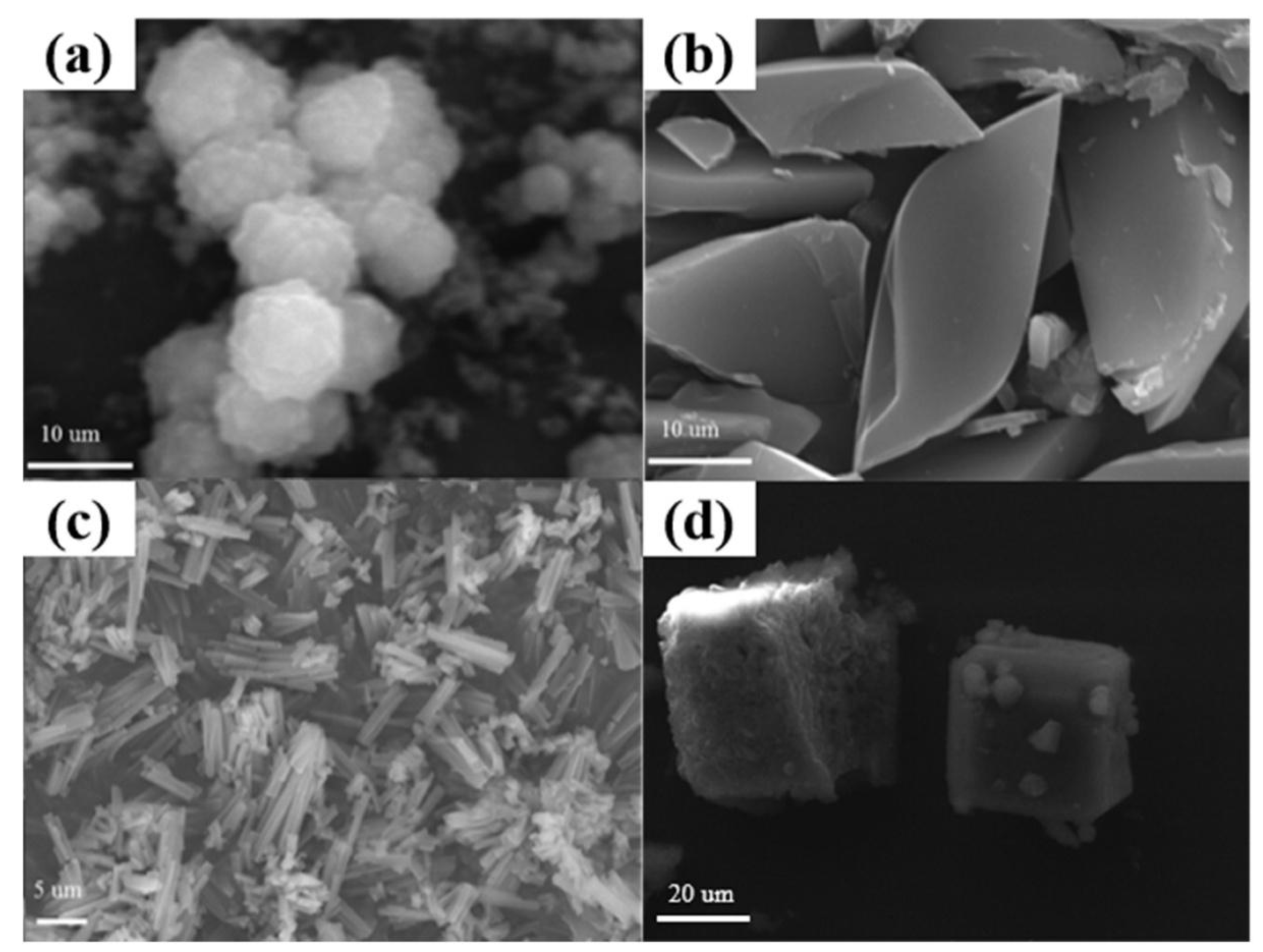
Figure 3.
HRTEM characterization under cryogenic temperatures of CO2@ZIF-8(Zn) and protein-ZIF-8(Zn) composites: (a–d) Host–guest structures within ZIF-8(Zn) viewed along <111> (a,b) and <001> (c,d) projection. (a,c) Left: CTF-corrected Cryo-TEM images of CO2-filled ZIF-8 particle. Middle: magnified image of a single ZIF-8-unit cell. HRTEM images with red dashed boxes in the middle are magnified images of the red dashed regions from images with red solid boxes on the left. Red arrows indicate density near the center of the unit cell. (b,d) Simulated structure of ZIF-8 with DFT-predicted binding site of CO2 indicated by red spheres in (a,c), respectively. and (e–g) iDPC-STEM images, corresponding FFT, and the structural analysis of the selected region (indicated by the same color) of BZIF-8-S from the <111> (e) and <100> (f), and BZIF-8-B from the <111> (g) zone axis. Red boxes and yellow boxes within the red boxes in (g) highlight the coordination defects and amorphous regions, respectively. Reproduced from Ref. [86] under Creative Commons Attribution (CC BY) license.
Figure 3.
HRTEM characterization under cryogenic temperatures of CO2@ZIF-8(Zn) and protein-ZIF-8(Zn) composites: (a–d) Host–guest structures within ZIF-8(Zn) viewed along <111> (a,b) and <001> (c,d) projection. (a,c) Left: CTF-corrected Cryo-TEM images of CO2-filled ZIF-8 particle. Middle: magnified image of a single ZIF-8-unit cell. HRTEM images with red dashed boxes in the middle are magnified images of the red dashed regions from images with red solid boxes on the left. Red arrows indicate density near the center of the unit cell. (b,d) Simulated structure of ZIF-8 with DFT-predicted binding site of CO2 indicated by red spheres in (a,c), respectively. and (e–g) iDPC-STEM images, corresponding FFT, and the structural analysis of the selected region (indicated by the same color) of BZIF-8-S from the <111> (e) and <100> (f), and BZIF-8-B from the <111> (g) zone axis. Red boxes and yellow boxes within the red boxes in (g) highlight the coordination defects and amorphous regions, respectively. Reproduced from Ref. [86] under Creative Commons Attribution (CC BY) license.
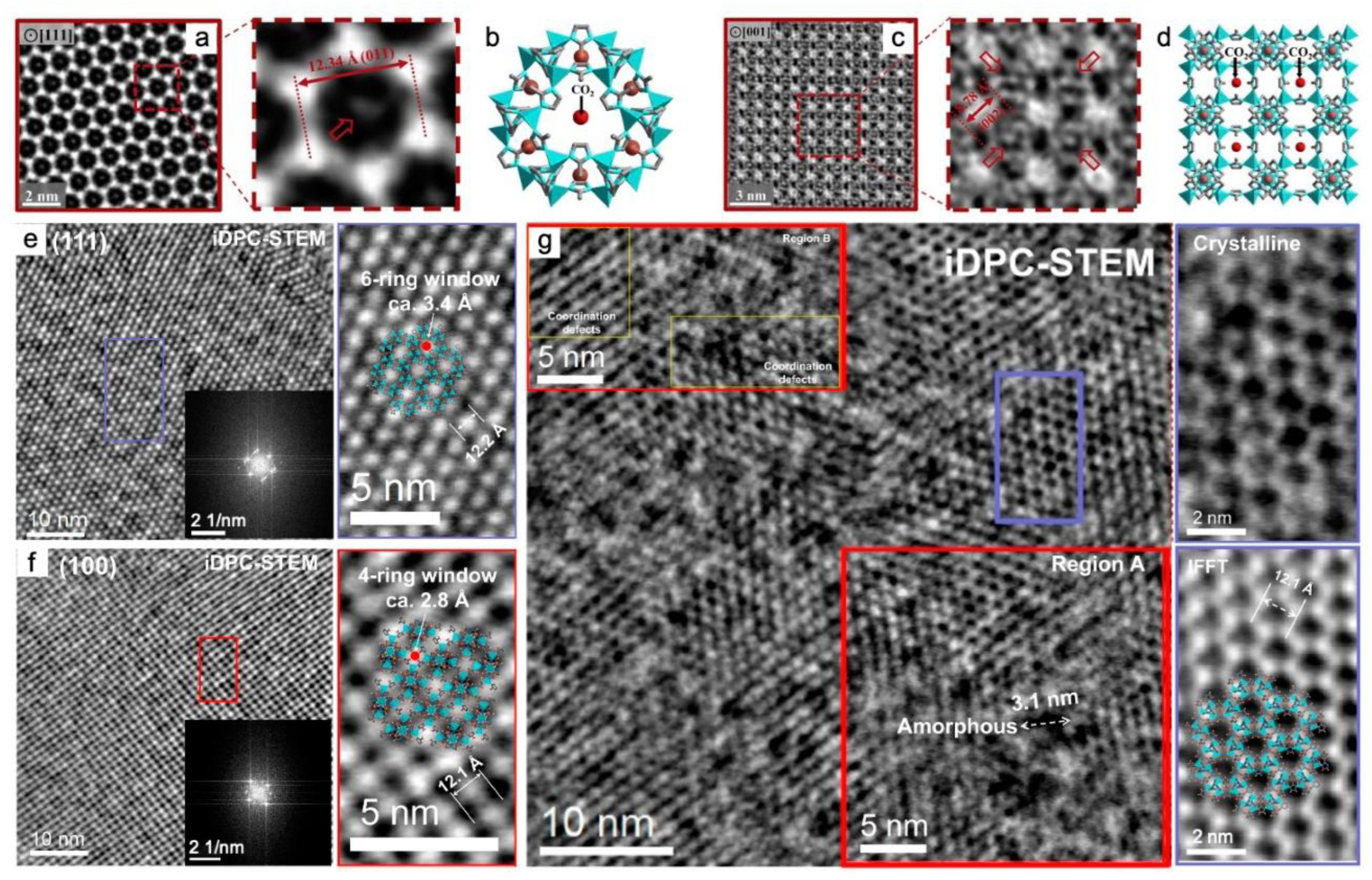
Figure 4.
Chemical structures of representative organic linkers: (A–C) carboxylate-based acids and (D–F) imidazole derivatives. Reproduced from Ref. [89] under Creative Commons Attribution (CC BY) license.
Figure 4.
Chemical structures of representative organic linkers: (A–C) carboxylate-based acids and (D–F) imidazole derivatives. Reproduced from Ref. [89] under Creative Commons Attribution (CC BY) license.
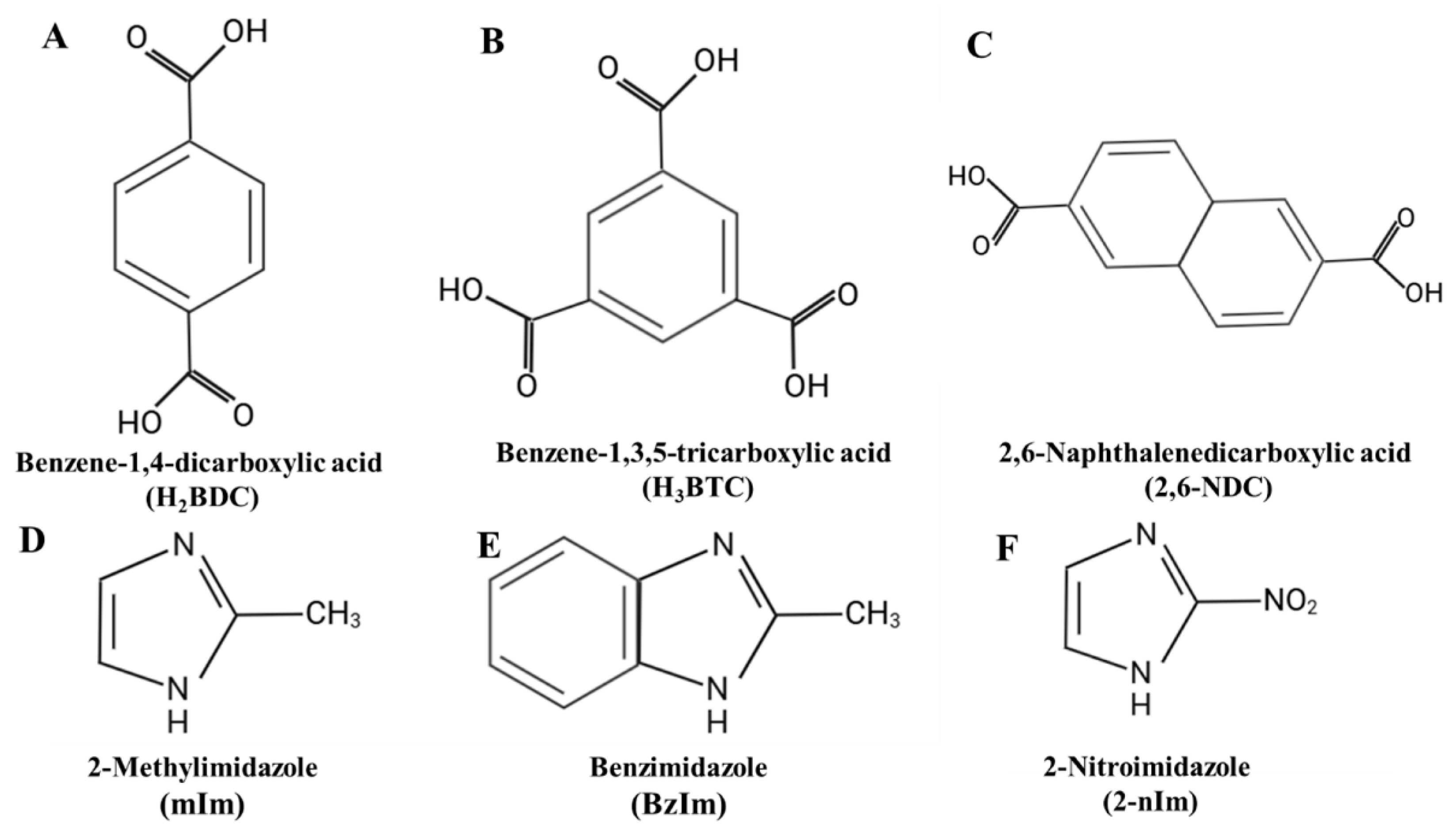
Figure 5.
(a) Titration experiments of MOF-1 with different volume of DPA (0–18 μL, 10−2 M; (b) CIE chromaticity diagram showing the color coordinates of MOF-1 and MOF-1 containing DPA; (c) Stern–Volmer plots of MOF-1 for sensing of DPA and the linear relationship between I0/I and concentrations of DPA; (d) comparison of emission intensities of different analytes with and without DPA in MOF-1-EtOH solution. Reproduced from Ref. [106] under Creative Commons Attribution (CC BY) license.
Figure 5.
(a) Titration experiments of MOF-1 with different volume of DPA (0–18 μL, 10−2 M; (b) CIE chromaticity diagram showing the color coordinates of MOF-1 and MOF-1 containing DPA; (c) Stern–Volmer plots of MOF-1 for sensing of DPA and the linear relationship between I0/I and concentrations of DPA; (d) comparison of emission intensities of different analytes with and without DPA in MOF-1-EtOH solution. Reproduced from Ref. [106] under Creative Commons Attribution (CC BY) license.
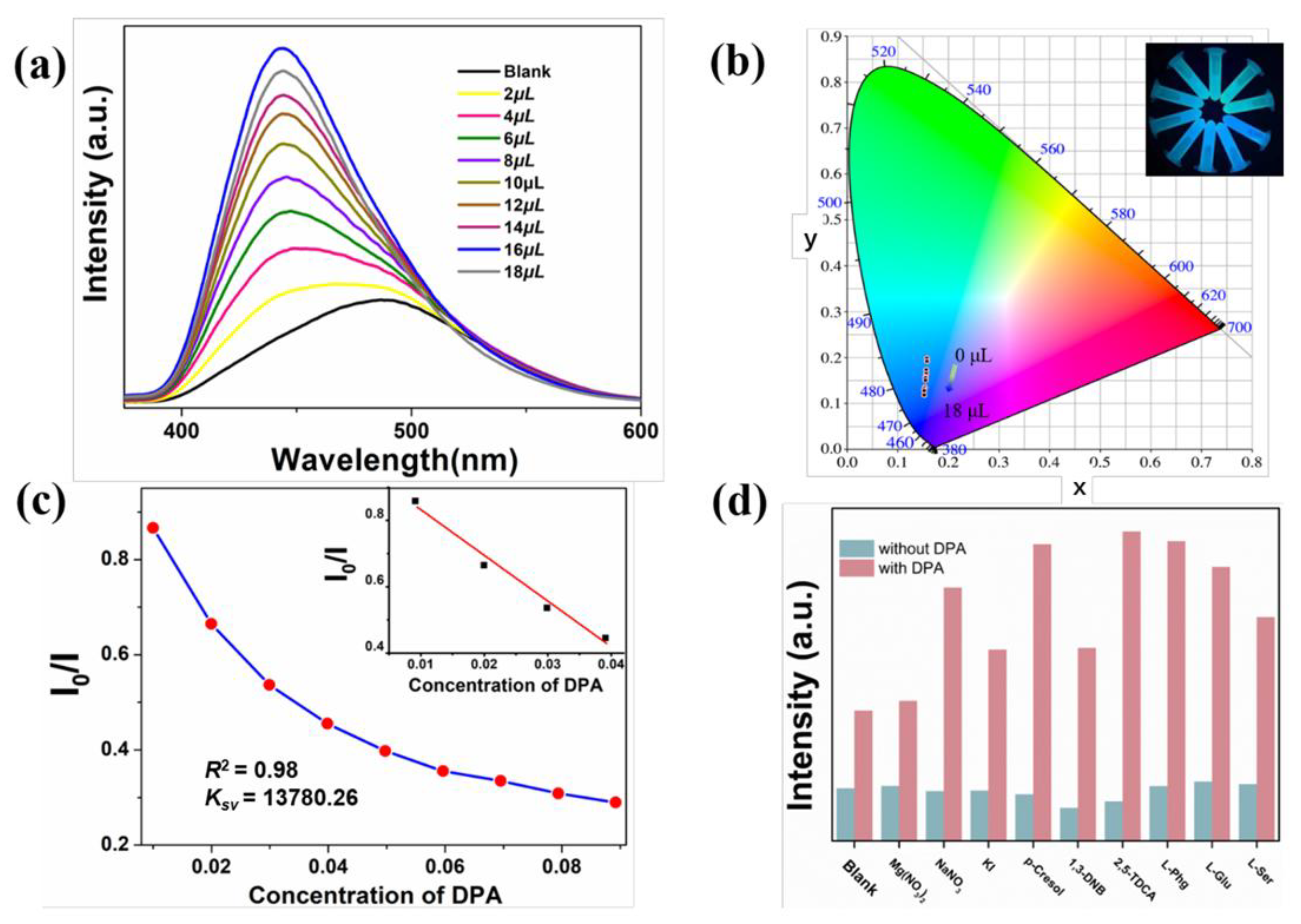
Figure 6.
(a) Oxygen evolution reaction polarization curves and (b) Tafel curves of Fe-MOFs, Fe/Co-MOFs, and Fe/Mn-MOFs catalysts. Reproduced from Ref. [134] under Creative Commons Attribution (CC BY) license.
Figure 6.
(a) Oxygen evolution reaction polarization curves and (b) Tafel curves of Fe-MOFs, Fe/Co-MOFs, and Fe/Mn-MOFs catalysts. Reproduced from Ref. [134] under Creative Commons Attribution (CC BY) license.
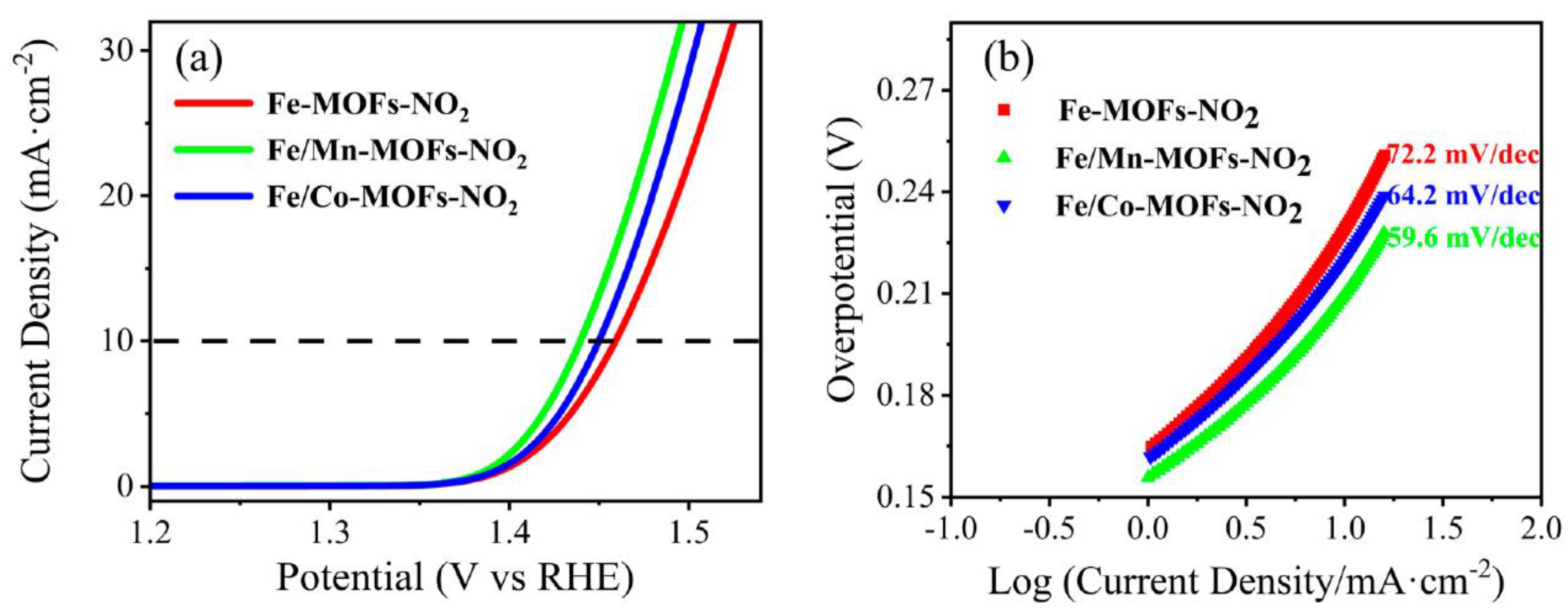
Figure 7.
Excess gravimetric hydrogen uptake for various MOFs at 20 bar or above and 77 K (data shown as circles). For comparison, the data for the best zeolite and activated carbon (AC) are also included (data shown as squares). Reproduced from Ref. [152] under Creative Commons Attribution 3.0 Unported Licence.
Figure 7.
Excess gravimetric hydrogen uptake for various MOFs at 20 bar or above and 77 K (data shown as circles). For comparison, the data for the best zeolite and activated carbon (AC) are also included (data shown as squares). Reproduced from Ref. [152] under Creative Commons Attribution 3.0 Unported Licence.
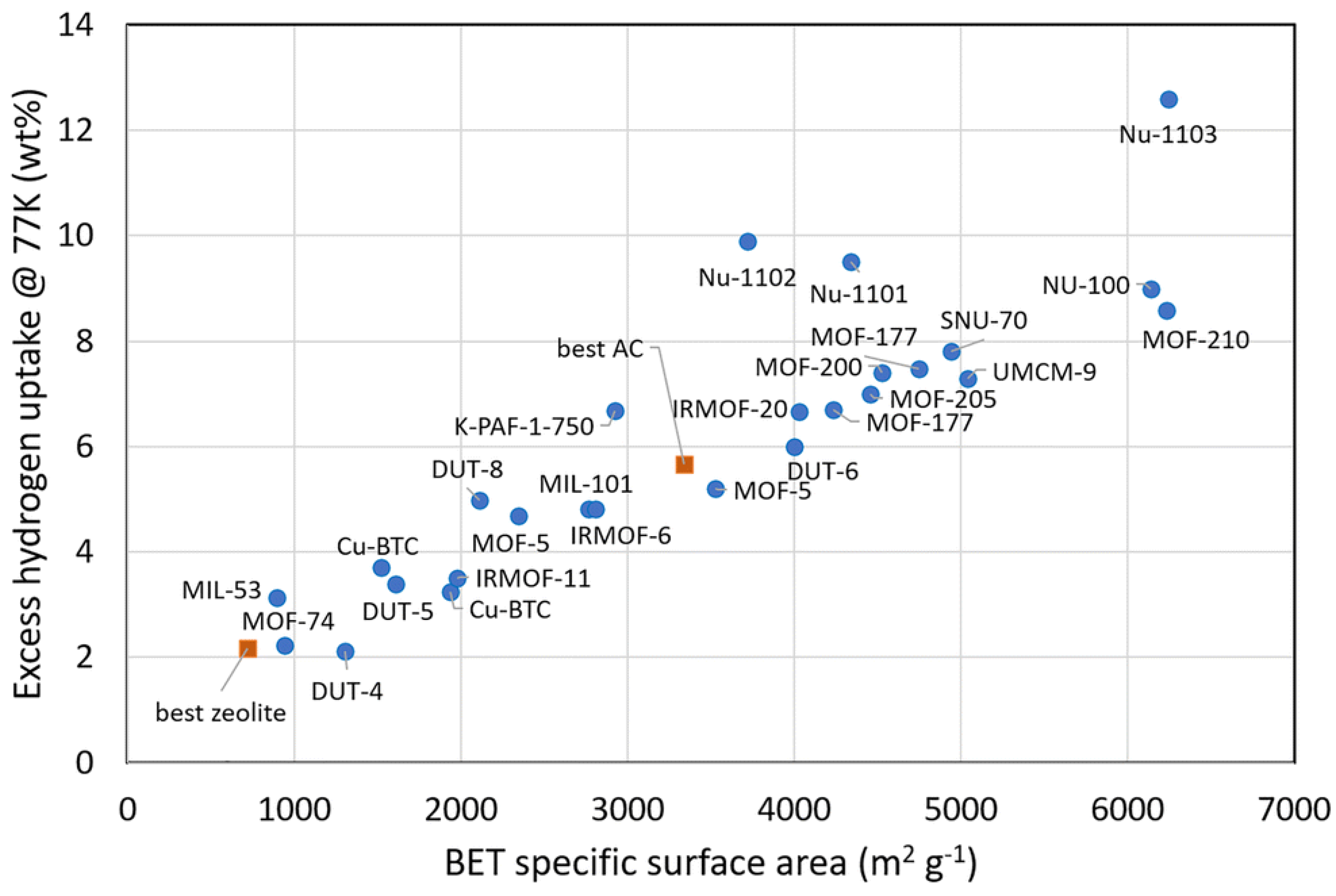
Disclaimer/Publisher’s Note: The statements, opinions and data contained in all publications are solely those of the individual author(s) and contributor(s) and not of MDPI and/or the editor(s). MDPI and/or the editor(s) disclaim responsibility for any injury to people or property resulting from any ideas, methods, instructions or products referred to in the content. |
© 2026 by the authors. Licensee MDPI, Basel, Switzerland. This article is an open access article distributed under the terms and conditions of the Creative Commons Attribution (CC BY) license.
Copyright: This open access article is published under a Creative Commons CC BY 4.0 license, which permit the free download, distribution, and reuse, provided that the author and preprint are cited in any reuse.


