
Submitted:
26 June 2026
Posted:
26 June 2026
You are already at the latest version
Abstract
Quantum uncertainty and wavefunction collapse remain among the most conceptually unresolved aspects of microscopic physics. Here, we investigate whether uncertainty and collapse-like electron localization may admit a complementary thermodynamic interpretation through recursive entropy-field dynamics. The electron is modeled as a dynamically evolving entropy field–geometry composed of structural, electromagnetic, and thermal entropy components maintained through continuous recursive interaction with the surrounding vacuum entropy field. Within this framework, uncertainty emerges from incomplete temporal accessibility to rapidly evolving recursive electron configurations occurring beneath experimentally accessible measurement timescales. Repeated recursive phase sampling naturally produces probabilistic measurement behavior and approximately Gaussian localization statistics. Electron–photon interaction is further modeled through phase-matched recursive entropy coupling, where repeated entropy transfer progressively reorganizes the electron entropy geometry toward localization. Numerical simulations reproduce finite-width Dirac-delta–like localization behavior, finite collapse thresholds, and nonzero collapse timescales, suggesting that wavefunction collapse may emerge as a finite recursive thermodynamic process rather than instantaneous projection. The framework further suggests that localization saturation may naturally redirect subsequent entropy transfer toward electron motion, scattering, and orbital restructuring.
Keywords:
quantum uncertainty
Statement of significance
Quantum mechanics predicts measurement outcomes with extraordinary precision, yet the physical mechanism underlying uncertainty and wavefunction collapse remains unresolved. This work proposes a complementary thermodynamic interpretation in which the electron is modeled as a rapidly evolving recursive entropy field geometry continuously interacting with its surrounding environment. Probabilistic measurement behavior emerges naturally from unresolved recursive phase sampling beneath experimentally accessible timescales, while electron localization arises through repeated phase-matched entropy transfer during electron–photon interaction. Numerical simulations reproduce finite-width Dirac-delta–like localization behavior and predict finite collapse timescales dependent on interaction conditions. The framework offers experimentally testable predictions and provides a new physical perspective on quantum uncertainty, localization, and measurement dynamics.
1. Introduction
Quantum mechanics provides one of the most successful predictive frameworks in science, accurately describing atomic structure, electron behavior, and electromagnetic interaction through the Schrödinger and Dirac equations. Yet despite this extraordinary success, the physical mechanism underlying wavefunction localization during measurement remains unresolved. Quantum uncertainty is formally described through operator relations and probabilistic measurement theory, while wavefunction collapse is commonly introduced as an effective postulate governing measurement outcomes (1–4). Decoherence theory has substantially clarified how environmental interactions suppress quantum coherence and promote effective classical behavior, yet the microscopic mechanism responsible for the localization of an individual electron during a specific measurement event remains debated (5–7). These unresolved questions continue to motivate investigation into whether deeper physical processes may underlie quantum uncertainty and localization.
A central difficulty in interpreting localization arises from the implicit assumption that the electron exists in a fixed probabilistic state between measurements. However, several foundational and dynamical interpretations of quantum behavior suggest that microscopic systems may possess unresolved internal structure or continuous evolution beneath experimentally accessible timescales (8–10). Motivated by this perspective, we investigate whether the electron may instead be described as a dynamically evolving entropy field undergoing continuous recursive interaction with its local environment. Within this framework, uncertainty emerges not from intrinsic randomness alone, but from incomplete temporal accessibility to rapidly evolving recursive entropy configurations. Localization is then interpreted as a finite dynamical process arising from structured interaction between the evolving electron-entropy field and an external perturbation, such as a photon.
In the present framework, the stationary electron in vacuum is initially modeled as a dynamically evolving entropy field composed of localized structural entropy (), correlated electromagnetic entropy (), and residual thermal entropy () undergoing continuous recursive interaction with the surrounding vacuum entropy field (). Under this idealized condition, the electron is not treated as a static localized object, but rather as a dynamically maintained recursive system in which entropy amplification and relaxation continuously reorganize the electron entropy geometry. Recursive evolution is represented through a nonlinear amplification process whereby local entropy configurations repeatedly self-organize and relax through weak sustained interaction with the surrounding vacuum environment. This recursive balance establishes the baseline entropy state of the electron in vacuum and provides the foundation for investigating uncertainty and localization dynamics.
The framework is then extended to interactions between the recursively evolving electron and an external entropy field, focusing here on the photon as a propagating perturbing structure possessing its own correlated entropy geometry. Rather than assuming instantaneous localization, the present study investigates whether repeated recursive interaction between the electron entropy field and an incident photon entropy field can naturally produce localization-like behavior through transient phase-matched entropy transfer. Specifically, we examine three related questions: (i) whether quantum uncertainty may emerge from unresolved recursive dynamics of the electron in vacuum, (ii) whether electron–photon interaction admits a thermodynamic interpretation through transient phase-matched recursive coupling, and (iii) whether wavefunction collapse may emerge as a finite recursive localization process exhibiting measurable dynamical signatures including entropy concentration, delta-like localization, and finite collapse timescales.
II. The Recursive Electron as a Dynamic Entropy Field
In the present framework, the electron is modeled as a dynamically evolving entropy field rather than a permanently localized point object. This description is motivated by the experimentally established wave–particle behavior of the electron and by longstanding efforts to interpret microscopic particles through underlying dynamical structure (10,11). In our previous work, we introduced a complementary thermodynamic framework—S-Theory—in which entropy is treated not merely as a statistical quantity but as a structured field capable of organizing physical reality through correlation and recursive evolution [12]. Within this formulation, the electron was modeled as an entropy-field (S-field) composed of three interacting components: a localized core entropy (), a structured electromagnetic entropy field (), and a residual thermal entropy field (), all embedded within a surrounding vacuum entropy background, given by
Here, denotes the extremely high correlated entropy associated with electron localization and structural persistence, governs strongly correlated entropy that extends electromagnetic accessibility of the electron, and reflects residual, fluctuating, less-correlated entropy coupled to the surrounding thermal and vacuum environment. The detailed physical construction and entropy-field geometry of these coupled components were developed previously [12], and only the aspects relevant to recursive measurement dynamics are summarized here. Unlike classical thermodynamic entropy, which primarily counts micro-configurational multiplicity, S-Theory extends entropy to include correlated entropy structures whose degree of correlation gives rise to geometry, localization (), and field organization (, ). In the broader S-Theory framework, entropy is interpreted through a generalized counting relation analogous to
where represents the number of microconfigurations of underlying correlated entropy components, rather than purely thermal arrangements [12]. Increasing correlation among these entropy configurations gives rise to progressively organized -vacuum- thermal - electromagnetic and matter-forming entropy structures. A more detailed formulation of this entropy-field interpretation is provided in our previous work [12].
The entropy field was represented through a normalized entropy density,
where denotes a characteristic maximum entropy scale of the local system, allowing entropy-field interactions to be modeled independently of dimensional scaling. The present framework further assumes that the stationary electron in vacuum exists in continuous recursive interaction with a surrounding vacuum entropy field (). Rather than representing a static object, the electron is interpreted as a dynamically maintained recursive system in which entropy continuously reorganizes through cycles of amplification and relaxation. Recursive evolution is modeled through the normalized nonlinear recursive fractal relation,
where represents the instantaneous local entropy density field configuration, the subsequent recursive state, and an external entropy contribution. For the stationary electron in vacuum considered here, the external recursive forcing term is identified with the surrounding vacuum entropy field,
Within this interpretation, recursion represents a continual process of entropy correlation and de-correlation through which the weak but spatially extended vacuum entropy field continuously drives reorganization among the electron entropy components. Through sustained recursive forcing by , entropy dynamically shifts between less-correlated thermal states (), coherent electromagnetic organization (), and localized structural persistence (). Regions of weakly correlated entropy associated with may progressively organize into a more coherent electromagnetic structure (), while stronger recursive correlation promotes localized structural persistence through . Because the stationary electron is assumed to exist in dynamic thermodynamic equilibrium with the surrounding vacuum entropy field, recursive localization must also permit relaxation. Otherwise, recursive amplification alone would progressively drive the electron toward permanent localization even in apparent rest. In the idealized reversible limit, entropy relaxation may be represented through an approximate inverse recursive evolution,
allowing the electron entropy geometry to relax toward a more expanded, less correlated configuration. Under this interpretation, the resting electron in a vacuum is maintained through continual recursive cycling between entropy correlation and relaxation rather than static equilibrium. Electron persistence, therefore, emerges not from static permanence but from sustained recursive maintenance through continuous entropy exchange with the surrounding vacuum environment. Consequently, under sustained interaction with the surrounding vacuum entropy environment, the stationary electron is interpreted as a dynamically maintained recursive equilibrium rather than a permanently fixed localized object. Even in apparent rest, weak but continuous interaction with induces ongoing recursive reorganization of the electron entropy geometry.
Figure 1 illustrates the representative recursive entropy-field geometry of the electron developed, including the coupled , , and distributions, with the svaccum field. Figure 2 represents the cross-sectional entropy profiles. Because recursive organization and relaxation occur continuously, the electron is proposed to cycle between comparatively expanded and compressed entropy states, producing alternating regimes of enhanced electromagnetic accessibility and localization. This recursive pulsing behavior establishes the baseline entropy state of the electron in vacuum and provides the physical foundation for uncertainty and localization dynamics developed in subsequent sections.
The recursive entropy dynamics naturally define two limiting configurations of the electron entropy field corresponding to expanded and compressed recursive states, as indicated in Figure 1 and Figure 2. In the expanded configuration (), the electron exhibits a broader entropy geometry dominated by extended and distributions, producing enhanced spatial accessibility and wave-like manifestation. By contrast, recursive compression drives increasing entropy correlation toward the localized structural component (), yielding a more compact configuration () associated with enhanced localization and particle-like accessibility. Importantly, these states are not interpreted as distinct physical entities, but rather as complementary phases of the same recursively evolving electron system. Under sustained interaction with the surrounding vacuum entropy environment, the electron is therefore proposed to undergo a continual recursive cycle of entropy expansion and compression,
as illustrated schematically in Figure 1 and Figure 2. Within this interpretation, wave-like and particle-like manifestations emerge as complementary accessibility states of a continuously evolving entropy geometry rather than mutually exclusive behaviors of a static point particle. The recursive entropy cycle further suggests the existence of an intrinsic dynamical timescale associated with the stationary electron. In conventional quantum theory, the electron possesses a characteristic Compton frequency,
corresponding to a period,
Within the present framework, this timescale is interpreted as the characteristic period of one complete recursive entropy cycle of the electron in equilibrium with the surrounding vacuum entropy field. Under this interpretation, the apparent stationary electron represents a rapidly evolving recursive system whose internal entropy geometry continuously reorganizes over timescales inaccessible to conventional detectors. This intrinsic recursive period becomes particularly important in the context of measurement, as it provides the characteristic timescale governing recursive phase sampling, electron–photon interaction, and finite localization dynamics developed in subsequent sections.
If the electron continuously evolves through rapidly changing recursive entropy configurations, then any finite-duration measurement samples only a limited subset of its accessible entropy geometry. Under such conditions, uncertainty may emerge naturally from incomplete temporal sampling of the evolving recursive state rather than from intrinsic indeterminacy alone. In this view, the experimentally observed probabilistic behavior of the electron reflects unresolved recursive phase sampling beneath accessible measurement timescales. This interpretation motivates the thermodynamic treatment of quantum uncertainty developed in the following section.
III. The Thermodynamic Origin of Quantum Uncertainty
Quantum uncertainty remains one of the most fundamental yet conceptually unresolved features of microscopic physics. In conventional quantum mechanics, repeated measurements of identically prepared electrons produce probabilistic outcomes governed by the uncertainty relation,
which limits simultaneous accessibility to position and momentum. Although the mathematical structure of quantum theory predicts measurement outcomes with extraordinary precision, the physical mechanism underlying why measurement outcomes appear probabilistic remains debated. If the electron exists as a continuously evolving recursive entropy field rather than a permanently localized object, then uncertainty may admit a complementary physical interpretation. Within the present framework, uncertainty is explored as a consequence of incomplete temporal access to rapidly evolving recursive entropy configurations occurring beneath experimentally accessible measurement timescales.
Within the present framework, the stationary electron is proposed to evolve continuously through rapidly changing recursive entropy configurations governed by its intrinsic recursive timescale (). Because experimentally accessible measurements occur over finite durations that are substantially longer than the characteristic recursive cycle of the electron, any individual observation samples only a limited subset of the evolving entropy geometry. Consequently, repeated measurements need not interrogate identical instantaneous electron configurations, even under nominally identical preparation conditions. Instead, each measurement accesses a different recursive phase of the evolving electron entropy field, producing variation in measured observables across repeated trials. Under this interpretation, probabilistic measurement outcomes emerge naturally from unresolved recursive phase sampling occurring beneath experimentally accessible temporal resolution rather than from intrinsic randomness alone.
Because the electron entropy geometry evolves continuously during recursive expansion and compression, different recursive phases naturally provide different spatial accessibility to measurement. During expanded recursive states (), the electron entropy field exhibits broader and distributions, producing a comparatively extended region over which interaction with a detector or external perturbation may occur. By contrast, recursive compression toward progressively concentrates entropy density toward the localized structural component (), reducing the accessible spatial extent of measurement. Under this interpretation, measurement does not sample a fixed electron position, but rather an evolving accessibility geometry whose spatial distribution depends on the instantaneous recursive phase of the electron at the moment of interaction.
To represent this evolving measurement accessibility, a phase-dependent accessibility field is introduced in which the probability of localization depends on the instantaneous recursive geometry of the electron entropy field. Accessibility is modeled as a weighted contribution of the coupled electron entropy components,
where the recursive weighting function governs the degree of entropy expansion and compression throughout the recursive cycle, and controls the comparatively weak contribution of the surrounding vacuum entropy field. Expanded recursive phases favor broader spatial accessibility, whereas compressed phases progressively restrict accessibility toward the localized entropy core. Figure 3 illustrates the limiting recursive accessibility geometries corresponding to expanded and compressed electron states. Under this interpretation, measurement samples a continuously evolving accessibility envelope rather than a permanently fixed spatial electron configuration.
To examine the consequences of unresolved recursive phase sampling, repeated electron measurements were simulated through a Monte Carlo ensemble in which individual measurements sampled different recursive phases of the evolving electron entropy field. For each emitted electron, a recursive phase was assigned, producing a distinct instantaneous accessibility geometry from which localization was probabilistically sampled. Figure 4 illustrates the resulting ensemble of collapse locations superimposed on the evolving electron entropy field. Measurements occurring during expanded recursive states preferentially sample broader spatial regions, whereas measurements occurring during compressed recursive phases become increasingly concentrated near the localized entropy core. Although individual recursive electron trajectories remain deterministic within the present framework, repeated unresolved phase sampling naturally generates statistical variability in measured outcomes.
configuration showing broad collapse accessibility. b) compressed configuration showing enhanced localization near the electron core.
Figure 5 shows the resulting positional distribution obtained from repeated recursive measurements. Remarkably, an approximately Gaussian measurement distribution emerges naturally without assuming probability as a fundamental property of the electron itself. Instead, probabilistic behavior appears as an emergent ensemble consequence of unresolved recursive entropy dynamics occurring beneath experimentally accessible timescales. Under this interpretation, the wavefunction may be viewed as a representation of recursively evolving measurement accessibility rather than a purely abstract probabilistic object.
Within the present framework, quantum uncertainty is therefore interpreted as a thermodynamic consequence of incomplete temporal accessibility to a rapidly evolving recursive entropy geometry. Because measurements sample only a finite subset of recursive electron phases, repeated observations naturally generate probabilistic distributions despite underlying recursive continuity. This interpretation does not alter the predictive structure of quantum mechanics, but instead proposes a complementary physical mechanism through which uncertainty may emerge from unresolved entropy dynamics beneath experimentally accessible timescales. If probabilistic accessibility arises from recursive electron evolution, then localization during measurement requires a physical interaction capable of reorganizing the evolving entropy geometry. The following section, therefore, investigates electron–photon coupling as a candidate mechanism for finite recursive localization and wavefunction collapse.
IV. Electron–Photon Coupling and Recursive Localization
If quantum uncertainty reflects incomplete temporal accessibility to a continuously evolving recursive electron entropy geometry, then localization during measurement requires a physical interaction capable of reorganizing the accessible entropy field. In conventional quantum mechanics, localization is introduced through measurement postulates or interaction with an external apparatus, yet the microscopic mechanism through which an individual electron becomes spatially localized remains debated (5–7). Within the present framework, measurement is interpreted as a recursive entropy interaction between the evolving electron entropy field and an external perturbing structure. Because photons mediate the majority of experimentally accessible electron measurements, the present study focuses specifically on electron–photon coupling as a candidate physical mechanism through which recursive localization may emerge.
Within the present framework, the photon is modeled as a propagating entropy structure dominated primarily by correlated electromagnetic entropy () with comparatively weak structural localization and residual thermal contribution. Because the photon is not permanently localized in the same manner as the electron, its entropy geometry is assumed to remain spatially extended during propagation. At experimentally relevant energies, the characteristic spatial extent of the photon entropy field is estimated to exceed that of the electron entropy geometry by several orders of magnitude, implying that electron–photon interaction occurs through prolonged overlap rather than instantaneous point-like contact. Consequently, during photon transit, the comparatively compact electron entropy field is effectively embedded within the larger propagating photon entropy envelope, producing a finite interaction window during which recursive coupling may occur. Figure 6 illustrates the relative entropy geometries of the electron and photon fields used in the present model.
Because the characteristic recursive timescale of the electron is substantially faster than the evolving phase state of the propagating photon entropy field, electron–photon interaction is proposed to occur through multiple recursive coupling opportunities during a single transit event. Although the photon entropy geometry changes comparatively slowly across the interaction interval, the rapidly evolving electron continuously cycles through recursive expansion and compression phases. Consequently, the electron repeatedly encounters transient windows of recursive compatibility with the incoming photon field. During these intervals, phase matching between compatible entropy geometries permits efficient transfer of correlated photon entropy into the evolving electron field, whereas mismatched recursive phases produce weak or negligible coupling. Under this interpretation, localization does not arise from a single instantaneous interaction, but instead emerges through a sequence of recursive phase-matched coupling events occurring across a finite interaction window.
, whereas the photon consists primarily of distributed , , and components. Only the local interaction region relevant to recursive coupling is shown.
During phase-matched recursive coupling, correlated electromagnetic entropy from the photon field is proposed to transfer progressively into compatible components of the evolving electron entropy geometry, particularly and . This transfer increases local entropy correlation within the electron field, progressively reorganizing the entropy geometry toward stronger central coherence. Because recursive amplification preferentially reinforces regions of higher correlation, successive coupling events naturally suppress weaker peripheral entropy distributions while increasing entropy density toward the localized structural component (). As recursive interaction proceeds, the electron entropy field therefore undergoes progressive narrowing accompanied by increasing central entropy concentration. Under this interpretation, localization emerges not through instantaneous projection, but through cumulative recursive entropy transfer in which repeated phase-matched interactions progressively converge the evolving electron entropy geometry toward a localized state.
To represent this process, recursive localization is modeled through a photon-coupled recursive amplification relation,
where represents the coupled photon entropy contribution and defines the phase-dependent recursive coupling efficiency during each interaction window. Because recursive compatibility varies dynamically throughout photon transit, coupling strength evolves continuously across successive recursive stages, producing intermittent intervals of strong and weak entropy transfer.
The phase-dependent recursive coupling dynamics are illustrated in Figure 7, where intervals of strong recursive compatibility are interspersed with comparatively weak or negligible interaction windows. Because recursive coupling efficiency depends on instantaneous compatibility between the evolving electron entropy geometry and the comparatively slow phase evolution of the photon entropy field, entropy transfer occurs intermittently rather than continuously throughout photon transit. Strong coupling intervals correspond to recursive phase matching, during which correlated photon entropy is efficiently transferred into the evolving electron field, whereas incompatible recursive phases contribute comparatively little localization forcing. As recursive interaction proceeds, progressive entropy transfer simultaneously reduces the available photon entropy reservoir, producing a gradual decrease in effective forcing strength across successive recursive stages.
An order-of-magnitude estimate further suggests that multiple recursive interaction opportunities are physically plausible during a single photon transit event. Because the characteristic recursive timescale of the electron () is substantially shorter than the effective interaction duration of the extended photon entropy field, a propagating photon may overlap with many recursive electron configurations during transit. The number of recursive opportunities may therefore be approximated as
suggesting that localization can emerge through repeated phase-matched recursive interactions rather than requiring a single instantaneous coupling event. Detailed estimates of recursive interaction timescales are discussed in the context of localization timing below.
4.1. Relative Timescales and Recursive Interaction Opportunities
The relative geometry of the photon and electron entropy fields further motivates consideration of their respective dynamical timescales during interaction. Although the photon entropy field may locally encompass the electron entropy geometry, the photon simultaneously propagates at the speed of light, thereby limiting the duration over which recursive coupling can occur. Electron–photon interaction, therefore, does not occur under static conditions, but rather within a finite transit interval determined by the characteristic interaction length scale and photon velocity. A central question consequently emerges: given the extremely short interaction time available, can recursive entropy amplification occur sufficiently rapidly to produce measurable localization?
The characteristic recursive timescale of the electron may be estimated through the Compton frequency,
which for the electron yields
corresponding to a recursive period of
Within the present framework, this period is interpreted as the characteristic timescale of one complete recursive entropy cycle of the electron in equilibrium with the surrounding vacuum entropy field. By contrast, the interaction duration between a propagating photon and the electron is constrained by the photon transit time across the effective interaction region,
where denotes the characteristic interaction length scale. For an interaction region comparable to the electron electromagnetic entropy envelope approaching atomic dimensions,
the corresponding photon transit time becomes
The approximate number of recursive entropy cycles available during photon transit is therefore
Thus, even within the extremely short interaction interval imposed by photon propagation at the speed of light, the electron may undergo on the order of twenty recursive entropy cycles during a single photon transit across an atomic-scale entropy envelope. This estimate suggests that photon-induced localization need not be interpreted as an instantaneous event, but may instead emerge through multiple recursive opportunities for entropy reorganization occurring within a finite interaction window.
Therefore, although the number of recursive opportunities remains finite, the existence of multiple electron recursive cycles within a single photon transit interval substantially alters the interpretation of localization. Rather than requiring an instantaneous transition between delocalized and localized states, electron–photon interaction may instead permit a sequence of rapid recursive entropy reorganizations occurring during transit. Under this interpretation, localization becomes a dynamically accessible outcome emerging through repeated recursive opportunities for entropy compression, thereby motivating closer examination of how finite interaction windows influence recursive coupling between the photon and electron entropy fields.
Successive phase-matched recursive coupling events progressively reorganize the electron entropy geometry toward increasing localization. Because recursive amplification preferentially reinforces regions of stronger entropy correlation, repeated photon-driven recursive forcing naturally suppresses weaker peripheral entropy distributions while concentrating entropy density toward the localized structural core. As interaction proceeds, the evolving electron entropy field exhibits progressive narrowing accompanied by increasing central entropy concentration and reduced spatial accessibility. Figure 8 illustrates this recursive localization process across successive recursive stages, showing how repeated phase-matched entropy transfer drives the electron entropy geometry toward an increasingly localized configuration. Importantly, localization arises here as a cumulative recursive process rather than an instantaneous measurement event, emerging through finite entropy transfer distributed across multiple recursive coupling opportunities. Successive phase-matched recursive coupling events progressively reorganize the electron entropy geometry toward increasing localization. Because recursive amplification preferentially reinforces regions of stronger entropy correlation, repeated photon-driven recursive forcing naturally suppresses weaker peripheral entropy distributions while concentrating entropy density toward the localized structural core. As interaction proceeds, the evolving electron entropy field exhibits progressive narrowing accompanied by increasing central entropy concentration and reduced spatial accessibility.
The recursive localization behavior further exhibits several mathematical characteristics associated with a finite-width approximation to the Dirac delta distribution, suggesting a thermodynamic interpretation of wavefunction collapse. In the ideal mathematical limit, the Dirac delta function is characterized by progressive narrowing of spatial width,
simultaneous amplification of peak magnitude,
and conservation of total integrated content,
The recursive localization simulations reproduce the finite physical analog of these behaviors: entropy width decreases progressively across recursive stages, central entropy density increases sharply, and integrated entropy remains conserved despite substantial geometric restructuring. Because physical systems possess finite interaction times and finite energy transfer, complete singular collapse is not expected. Instead, localization approaches a finite-width entropy kernel increasingly resembling a physically realizable approximation to Dirac-delta–like collapse as shown in Figure 9.
The distinction between Figure 8 and Figure 9 highlights two complementary interpretations of recursive localization. Figure 8 presents the recursive evolution of the electron entropy geometry using peak-normalized profiles, emphasizing the progressive narrowing and geometric compression of the physical electron entropy field during photon-driven recursive localization. By contrast, Figure 9 preserves total integrated entropy through area normalization, thereby exposing the mathematical structure of the localization process. Under this normalization, recursive narrowing is accompanied by rapid amplification of central entropy density while conserving the total entropy content of the evolving field. This behavior closely resembles the defining mathematical properties of the Dirac delta distribution, in which decreasing spatial width is compensated by increasing peak magnitude while preserving finite integrated area. Importantly, the present framework does not predict an ideal mathematical singularity. Because physical electron–photon interaction occurs through finite recursive coupling and limited entropy transfer, localization instead approaches a finite-width entropy kernel that increasingly resembles a physically realizable approximation to a Dirac delta function. In this sense, recursive localization may provide a thermodynamic interpretation of wavefunction collapse in which the probabilistic electron accessibility field progressively reorganizes toward a finite delta-like localization state rather than undergoing instantaneous projection. The emergence of delta-like behavior through recursive entropy dynamics therefore provides a mathematically recognizable bridge between recursive thermodynamic localization and conventional quantum collapse formalism.
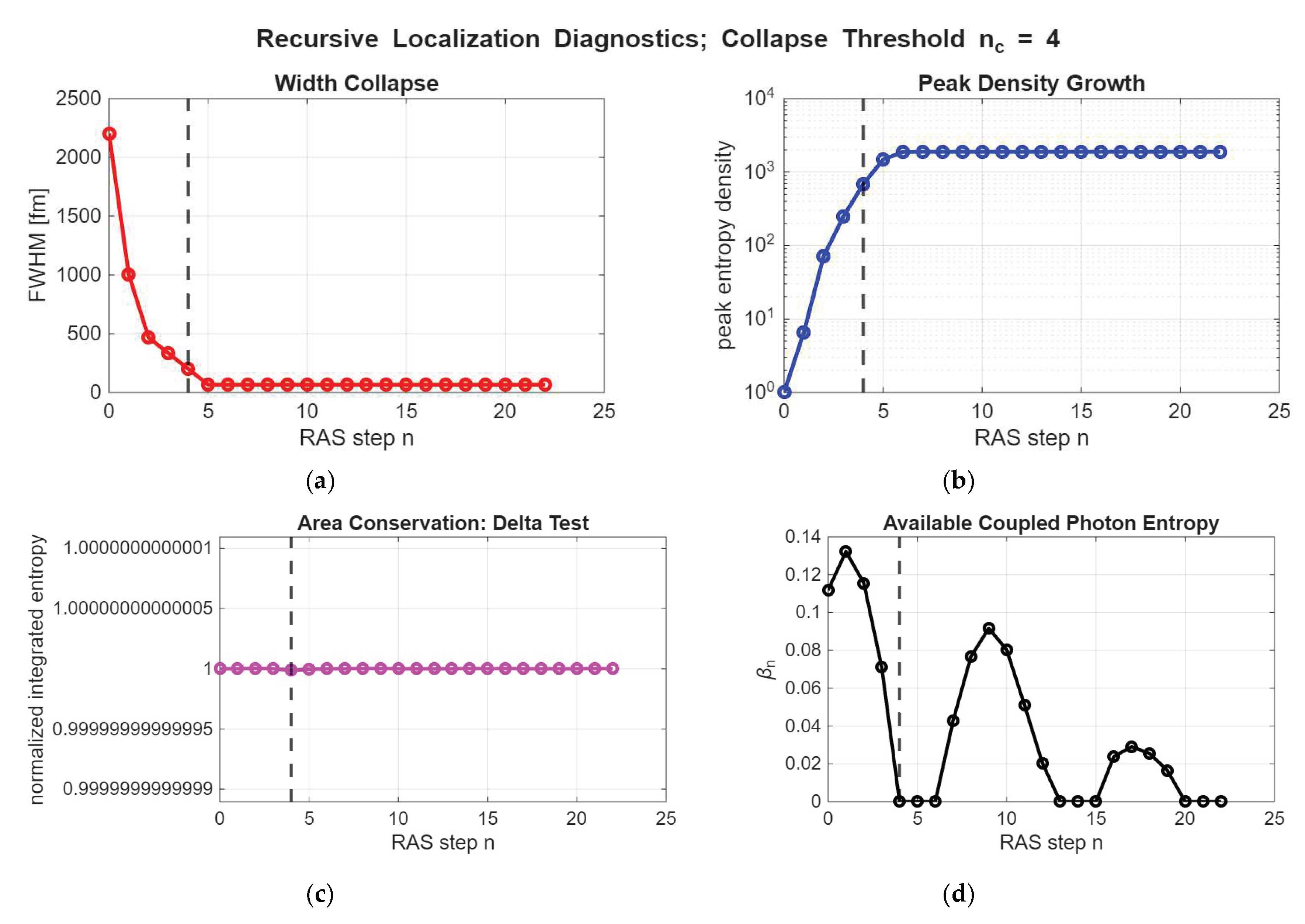
The quantitative signatures of recursive localization are summarized in Figure 10a-d through four independent diagnostics. First, the full-width-at-half-maximum (FWHM) decreases rapidly across early recursive stages, demonstrating accelerated spatial compression of the electron entropy geometry toward localization. Second, central entropy density exhibits nonlinear amplification before approaching saturation, reflecting progressive concentration of correlated entropy near the structural core. Third, the integrated entropy content remains approximately conserved throughout recursive evolution, indicating that localization arises through entropy redistribution and geometric reorganization rather than entropy creation or destruction. Finally, the effective photon entropy reservoir progressively decreases during recursive interaction, reflecting finite transfer of correlated electromagnetic entropy into the evolving electron field. Together, these diagnostics demonstrate that recursive electron–photon coupling naturally generates a finite-width localization process possessing the principal mathematical signatures associated with collapse-like behavior.
The recursive simulations further suggest that localization approaches a finite threshold rather than unlimited compression. While entropy concentration increases rapidly during the early recursive stages, localization begins to saturate after a small number of recursive amplification cycles ( in the present idealized case). Beyond this regime, additional phase-matched entropy transfer contributes progressively less toward localization and increasingly toward post-localization reorganization of the electron entropy state.
4.2. Finite Collapse Timing Prediction
Because recursive localization emerges through a finite number of phase-matched amplification stages rather than instantaneous projection, the present framework further predicts a characteristic localization timescale associated with measurement. If denotes the characteristic recursive timescale of the electron entropy field and represents the recursive threshold required to approach localization saturation, then the characteristic collapse interval may be estimated as
Using the recursive electron timescale introduced in Section II and the localization threshold obtained from the present simulations (), collapse is predicted to occur over a finite interval substantially shorter than experimentally accessible detector response times but nevertheless nonzero. Because recursive coupling efficiency depends on photon entropy content, interaction geometry, and recursive phase compatibility, localization timing may vary systematically across measurement conditions. Under this interpretation, wavefunction collapse is not fundamentally instantaneous, but instead represents a finite recursive thermodynamic process emerging through successive entropy-transfer events during electron–photon interaction. This prediction provides a potentially testable distinction between recursive entropy localization and purely projection-based interpretations of measurement.
Taken together, the present results suggest that localization may emerge as a finite recursive thermodynamic process governed by coupled entropy transfer between the electron and photon fields. Within this interpretation, quantum measurement corresponds not to instantaneous projection, but to progressive recursive reorganization of the evolving electron accessibility geometry through phase-matched entropy coupling. The resulting localization process naturally reproduces several experimentally recognizable features associated with wavefunction collapse, including probabilistic measurement behavior, finite localization thresholds, and delta-like spatial concentration. More broadly, the recursive localization dynamics illustrate a possible thermodynamic interpretation of organization and motion at the microscopic scale. Under this interpretation, recursive amplification and relaxation together provide a coupled mechanism through which localization, reversible entropy redistribution, and organized work may emerge naturally from microscopic interaction. In this sense, the recursive entropy dynamics explored here may represent a more general physical framework linking localization, motion, and entropy organization through finite reversible interaction.
V. Future Directions and Ongoing Extensions
Scattering, KE, and Post-Localization Dynamics: The present work has focused intentionally on an idealized localization limit in which coupled photon entropy is used predominantly for recursive electron confinement. Under realistic measurement conditions, however, localization is unlikely to consume the entirety of the coupled photon entropy reservoir. The present framework instead suggests that recursive localization approaches a finite threshold after a small number of recursive amplification stages, beyond which remaining correlated entropy may contribute to post-localization dynamics. These processes may include translational motion of the localized electron, redistribution of organized entropy into kinetic energy, residual scattered electromagnetic entropy, and orbital restructuring in bounded systems. Under this interpretation, kinetic and potential energy may emerge naturally as complementary manifestations of entropy organization, with localization corresponding to maximal entropy confinement and subsequent motion reflecting organized entropy transfer beyond localization saturation.
Orbital Transfer and Fine Structure: A second important extension concerns entropy-mediated orbital transitions in bound quantum systems. Because localization saturation is predicted to occur after finite recursive coupling, photon-driven recursive entropy transfer may continue to reorganize the post-localized electron entropy geometry within bounded electromagnetic environments. Such dynamics may provide a thermodynamic framework for understanding orbital transitions, excitation pathways, and radiative relaxation through recursive entropy redistribution rather than instantaneous state projection alone. Future work will investigate whether recursive entropy coupling may further clarify unresolved physical interpretations of fine structure, electron–photon resonance, and quantum transition probabilities within atomic systems.
Experimental Predictions and Testability: The recursive entropy framework additionally motivates experimentally testable predictions concerning finite localization timing and measurement-dependent collapse behavior. Because localization emerges through finite recursive amplification rather than instantaneous projection, collapse timescales are expected to depend systematically on photon entropy content, interaction geometry, and recursive phase compatibility. Advances in ultrafast measurement techniques may therefore permit future experimental interrogation of finite localization intervals and recursive coupling dynamics. More broadly, the present framework motivates investigation of whether recursive entropy organization may provide a complementary thermodynamic description underlying probabilistic measurement behavior across microscopic systems.
VI. Conclusions
The present study explored a thermodynamic interpretation of quantum uncertainty, wavefunction collapse, and electron–photon interaction through a recursive entropy-field framework. By modeling the electron as a dynamically evolving recursive entropy geometry composed of coupled structural, electromagnetic, thermal, and vacuum entropy components, uncertainty was interpreted as a consequence of incomplete temporal accessibility to rapidly evolving recursive configurations occurring beneath experimentally accessible measurement timescales. Under repeated unresolved recursive phase sampling, probabilistic measurement behavior and approximately Gaussian localization statistics emerged naturally without assuming probability as a fundamental property of the electron itself. The framework further proposed electron localization as a finite recursive entropy-transfer process mediated through photon coupling. Because the photon entropy field interacts with multiple recursive electron configurations during transit, localization was modeled as a sequence of phase-matched recursive amplification events rather than an instantaneous projection process. The resulting recursive localization dynamics reproduced several mathematical signatures associated with collapse-like behavior, including progressive narrowing, nonlinear entropy concentration, conservation of integrated entropy, and convergence toward a finite-width Dirac-delta–like localization kernel. The simulations further predicted finite localization thresholds and characteristic collapse timescales linked to the intrinsic recursive timescale of the electron. The present results do not replace the predictive structure of quantum mechanics but instead propose a complementary physical interpretation through which uncertainty and localization may emerge from unresolved recursive entropy dynamics beneath accessible measurement scales. More broadly, the work motivates future experimental and theoretical investigation into whether recursive entropy organization may provide a unifying thermodynamic framework for understanding measurement, electron dynamics, and entropy-mediated interactions across quantum systems.
Data Availability Statement
All numerical and simulation data are presented within the figures and text of this paper. The underlying MATLAB code for entropy field generation, recursive amplification, and collapse simulation is available from the corresponding author upon request for editorial or peer review.
References
- Schrödinger, E. Quantisierung als Eigenwertproblem. Ann. Phys. 1926, 79, 361–376. [Google Scholar] [CrossRef]
- Heisenberg, W. Über den anschaulichen Inhalt der quantentheoretischen Kinematik und Mechanik. Z. Phys. 1927, 43, 172–198. [Google Scholar] [CrossRef]
- Dirac, P.A.M. The Principles of Quantum Mechanics; Oxford Univ Press: Oxford, 1930. [Google Scholar]
- von Neumann, J. Mathematical Foundations of Quantum Mechanics; Princeton Univ Press: Princeton, NJ, 1955. [Google Scholar]
- Zurek, W.H. Decoherence, einselection, and the quantum origins of the classical. Rev. Mod. Phys. 2003, 75, 715–775. [Google Scholar] [CrossRef]
- Schlosshauer, M. Decoherence, the measurement problem, and interpretations of quantum mechanics. Rev. Mod. Phys. 2005, 76, 1267–1305. [Google Scholar] [CrossRef]
- Bassi, A.; Lochan, K.; Satin, S.; Singh, T.P.; Ulbricht, H. Models of wave-function collapse, underlying theories, and experimental tests. Rev. Mod. Phys. 2013, 85, 471–527. [Google Scholar] [CrossRef]
- Vedral, V. Decoding Reality: The Universe as Quantum Information; Oxford Univ Press: Oxford, 2010. [Google Scholar]
- Wheeler, J.A.; ed Zurek, W.H. Information, physics, quantum: The search for links. In Complexity, Entropy, and the Physics of Information; Addison-Wesley: Reading, MA, 1990; pp. 3–28. [Google Scholar]
- Hestenes, D. The zitterbewegung interpretation of quantum mechanics. Found. Phys. 1990, 20, 1213–1232. [Google Scholar] [CrossRef]
- de Broglie, L. Non-Linear Wave Mechanics: A Causal Interpretation; Elsevier, Amsterdam, 1960. [Google Scholar]
- Solomon, J.T. The Entropy Field Structure and the Recursive Collapse of the Electron: A Thermodynamic Foundation for Quantum Behavior. Quantum Rep. 2026, 8, 5. [Google Scholar] [CrossRef]
Figure 1.
Resting electron in vacuum as a recursive entropy cycle with the Compton period as a natural time scale.
Figure 1.
Resting electron in vacuum as a recursive entropy cycle with the Compton period as a natural time scale.
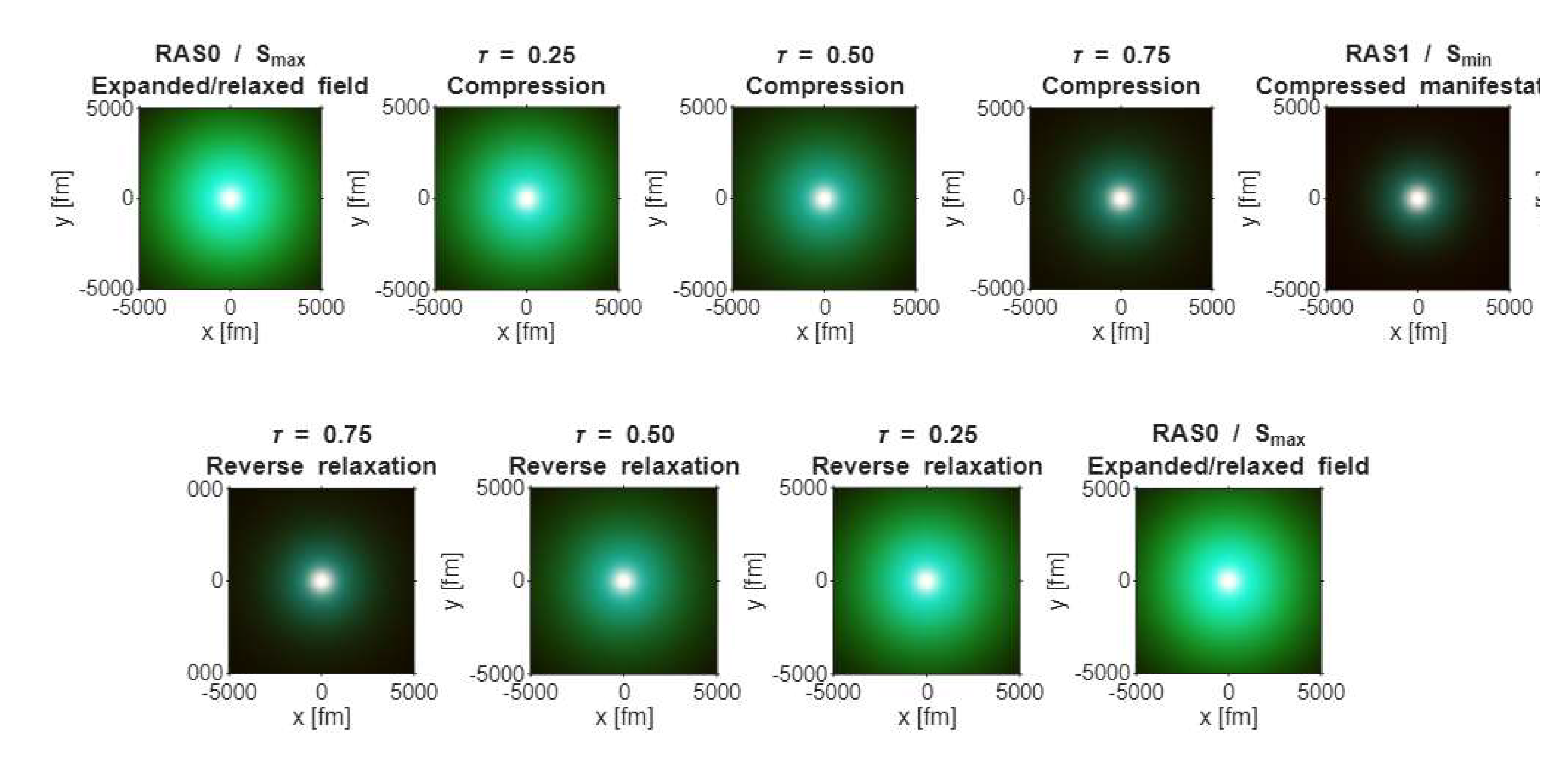
Figure 2.
presents cross-sectional entropy profiles demonstrating how entropy densities progressively converge during recursive compression.
Figure 2.
presents cross-sectional entropy profiles demonstrating how entropy densities progressively converge during recursive compression.
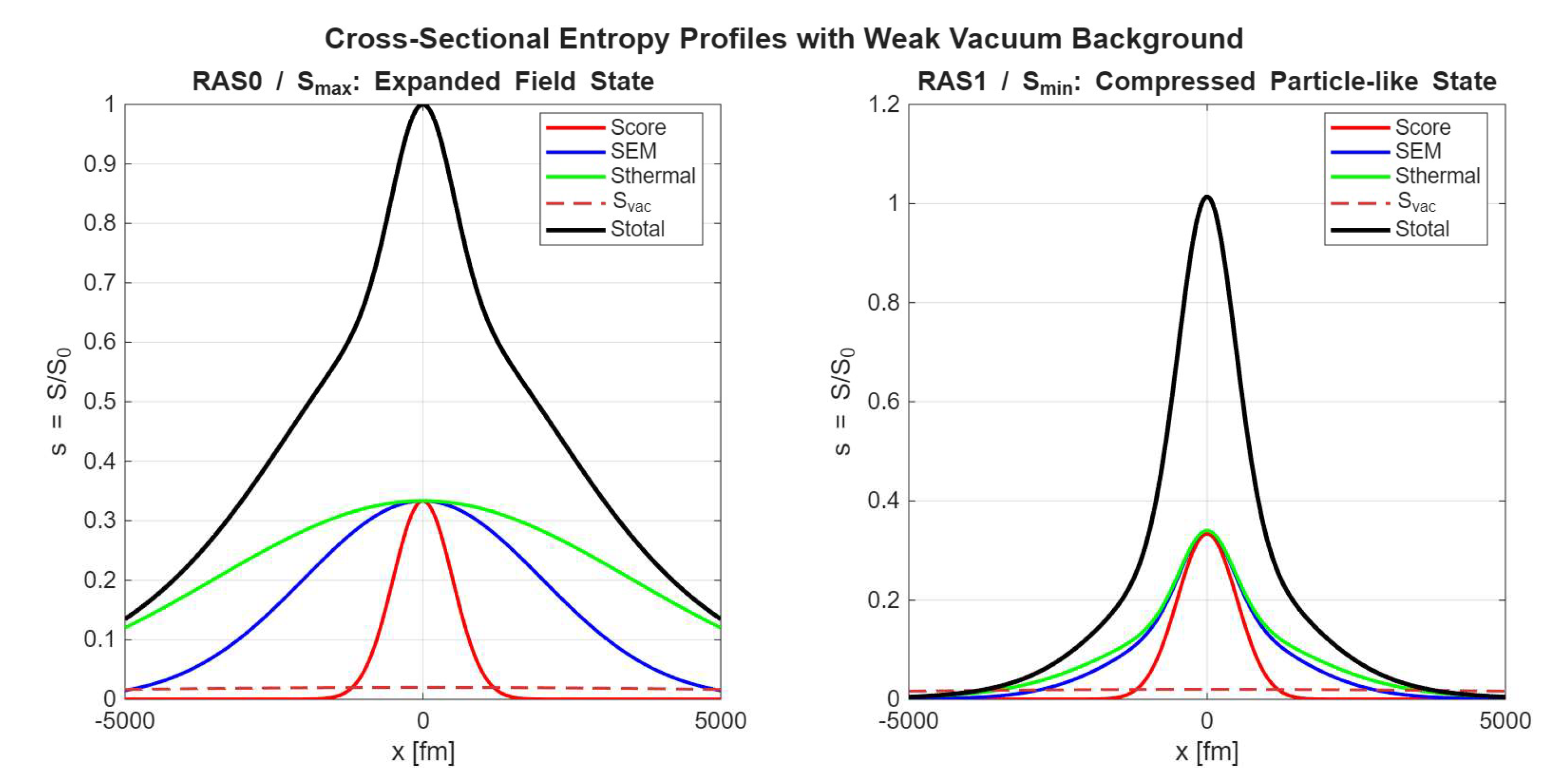
Figure 3.
Phase-dependent accessible electron entropy geometry used for collapse sampling. a): expanded
Figure 3.
Phase-dependent accessible electron entropy geometry used for collapse sampling. a): expanded
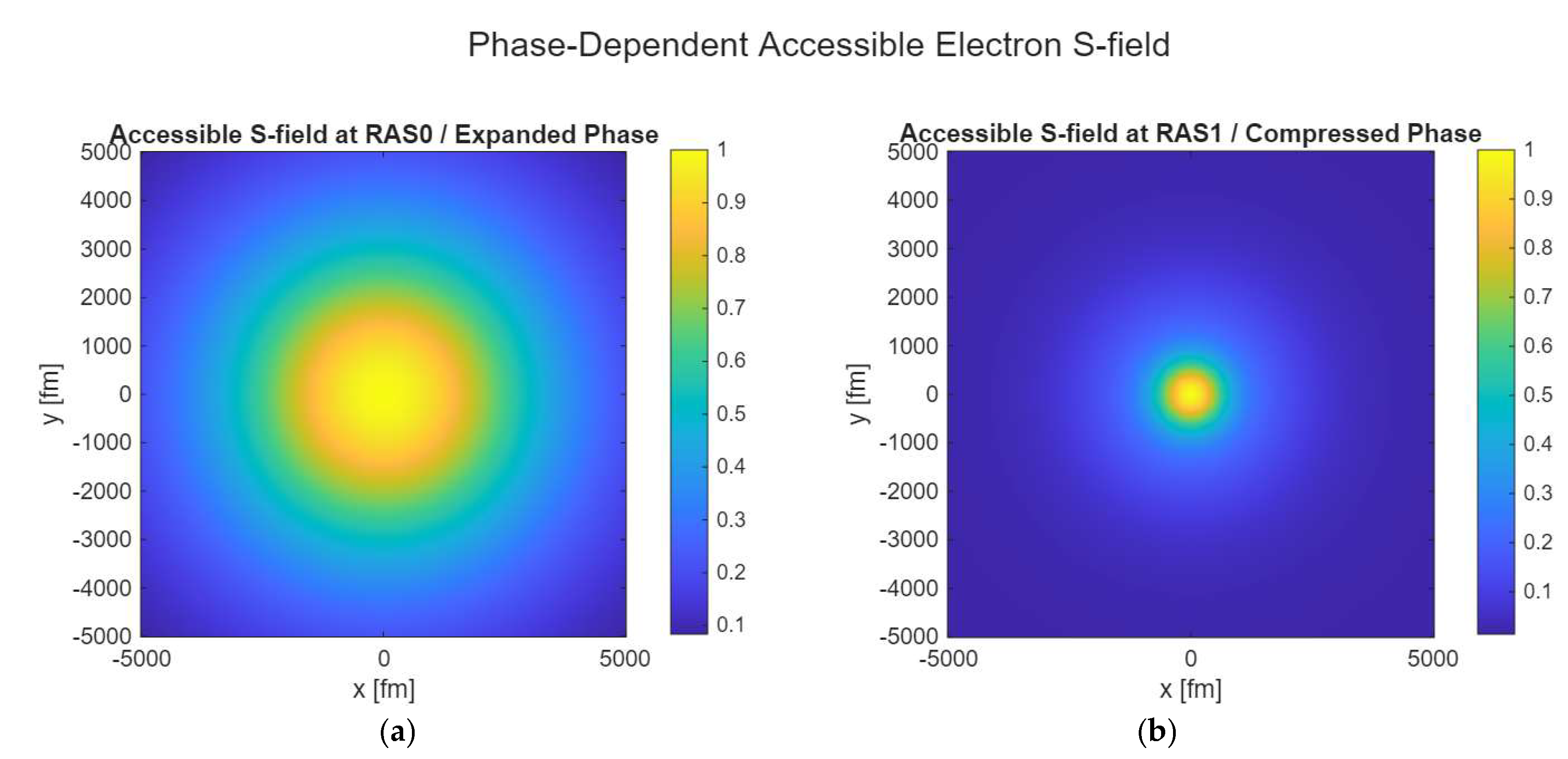
Figure 4.
simulated collapse events superimposed on the total electron entropy field background.
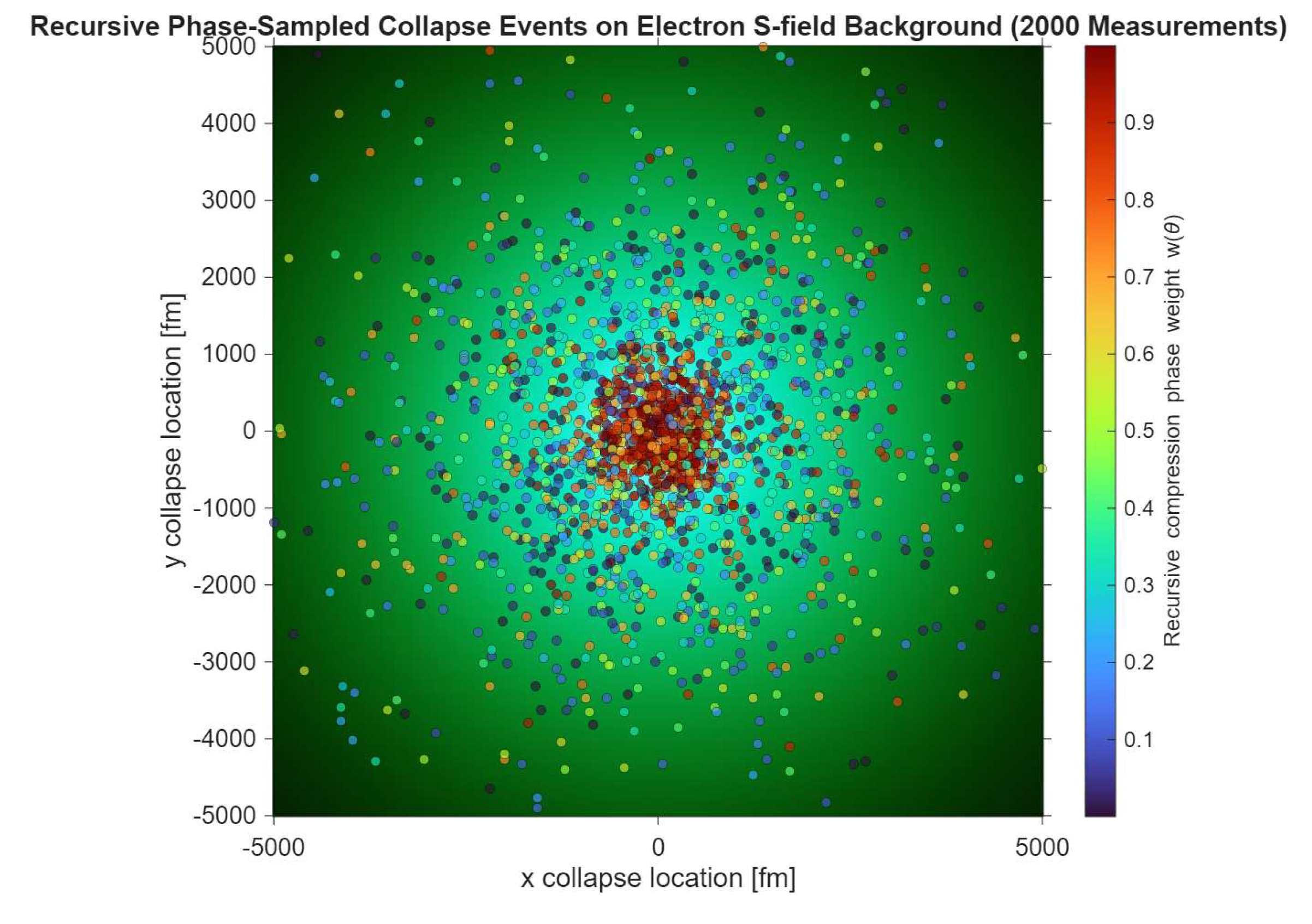
Figure 5.
shows the resulting position distribution generated from repeated recursive measurements.
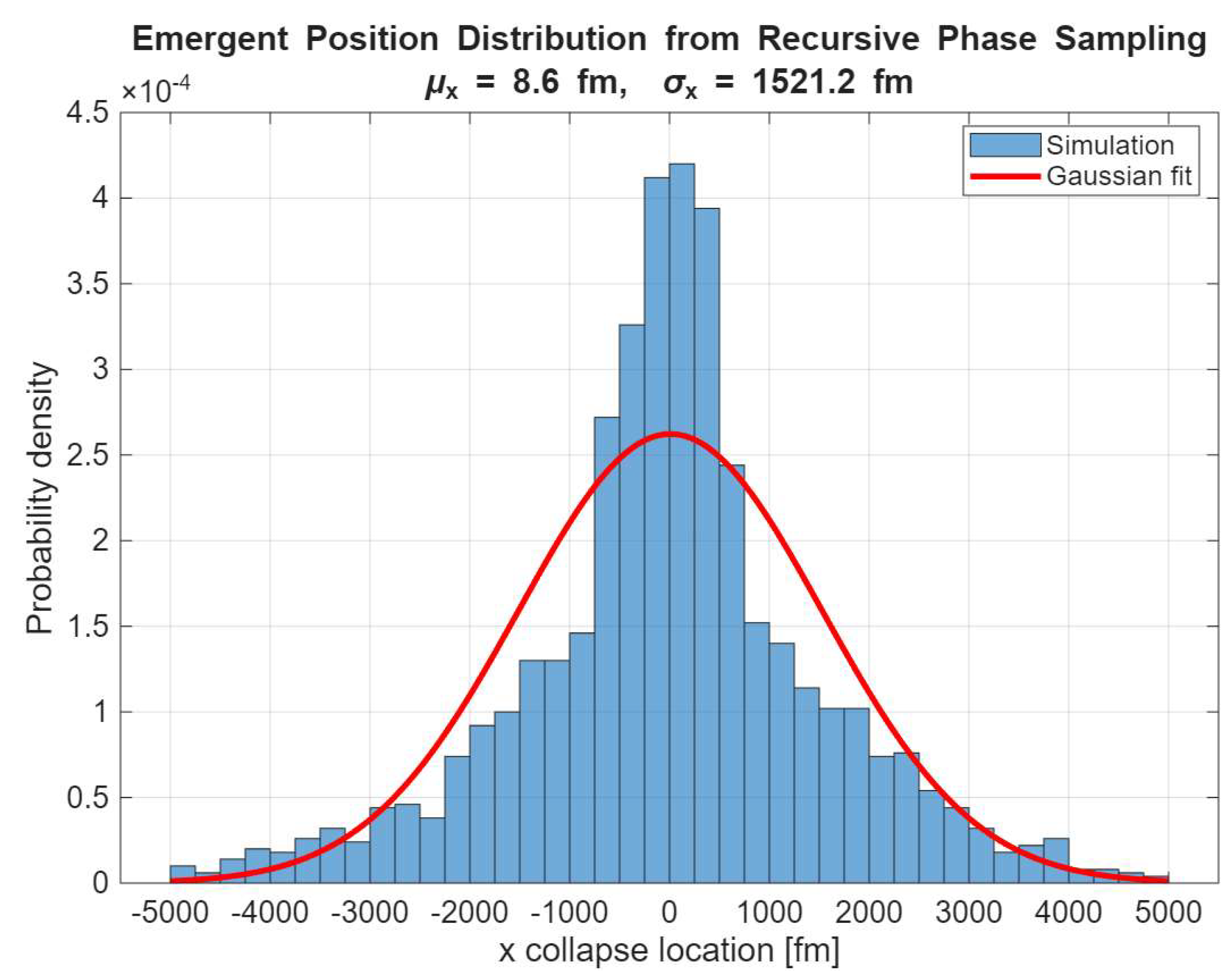
Figure 6.
Normalized entropy-field geometry of the electron and the local photon interaction envelope. Electron localization arises from a compact
Figure 6.
Normalized entropy-field geometry of the electron and the local photon interaction envelope. Electron localization arises from a compact
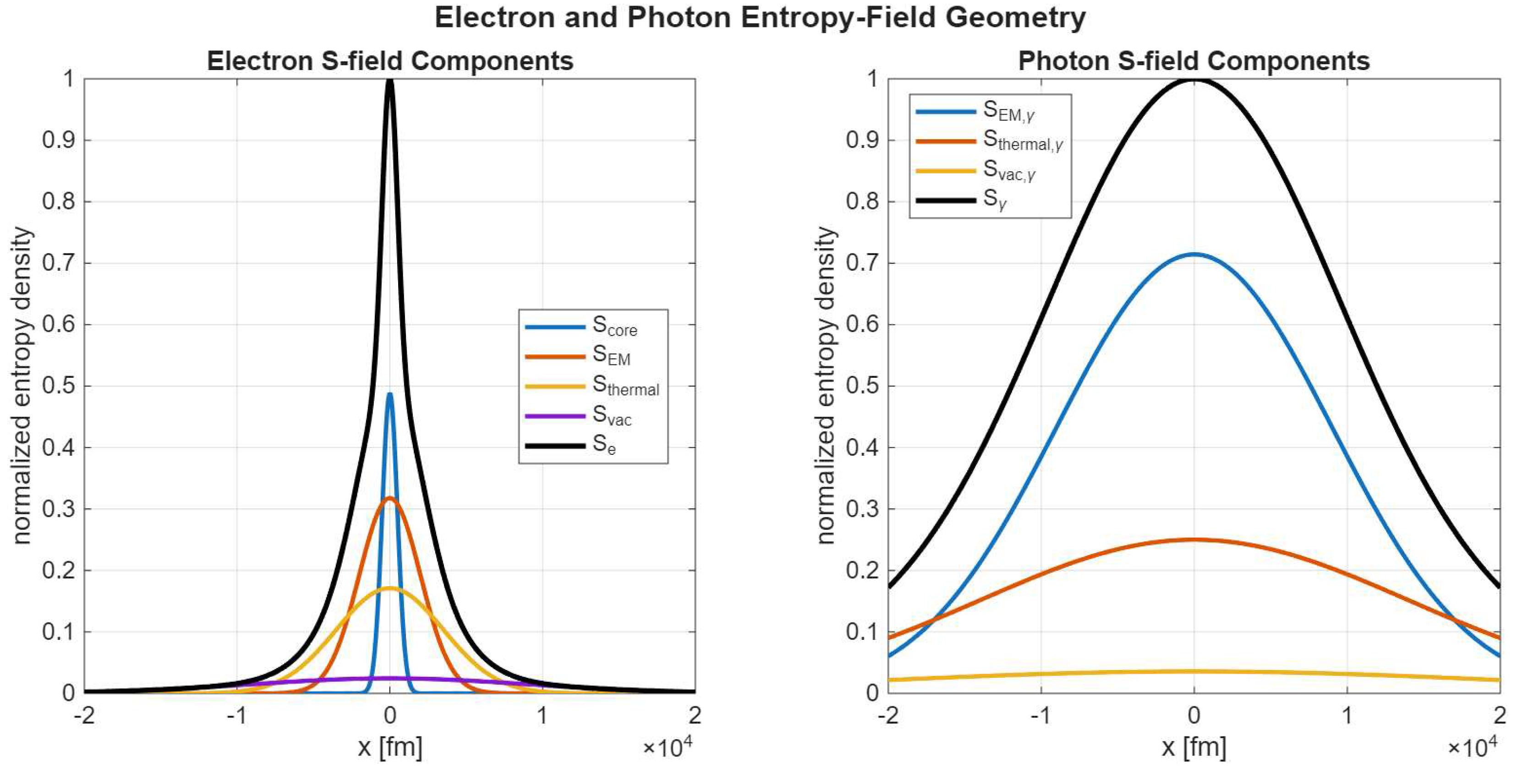
Figure 7.
Recursive phase-matched electron–photon coupling windows and progressive photon entropy depletion.
Figure 7.
Recursive phase-matched electron–photon coupling windows and progressive photon entropy depletion.
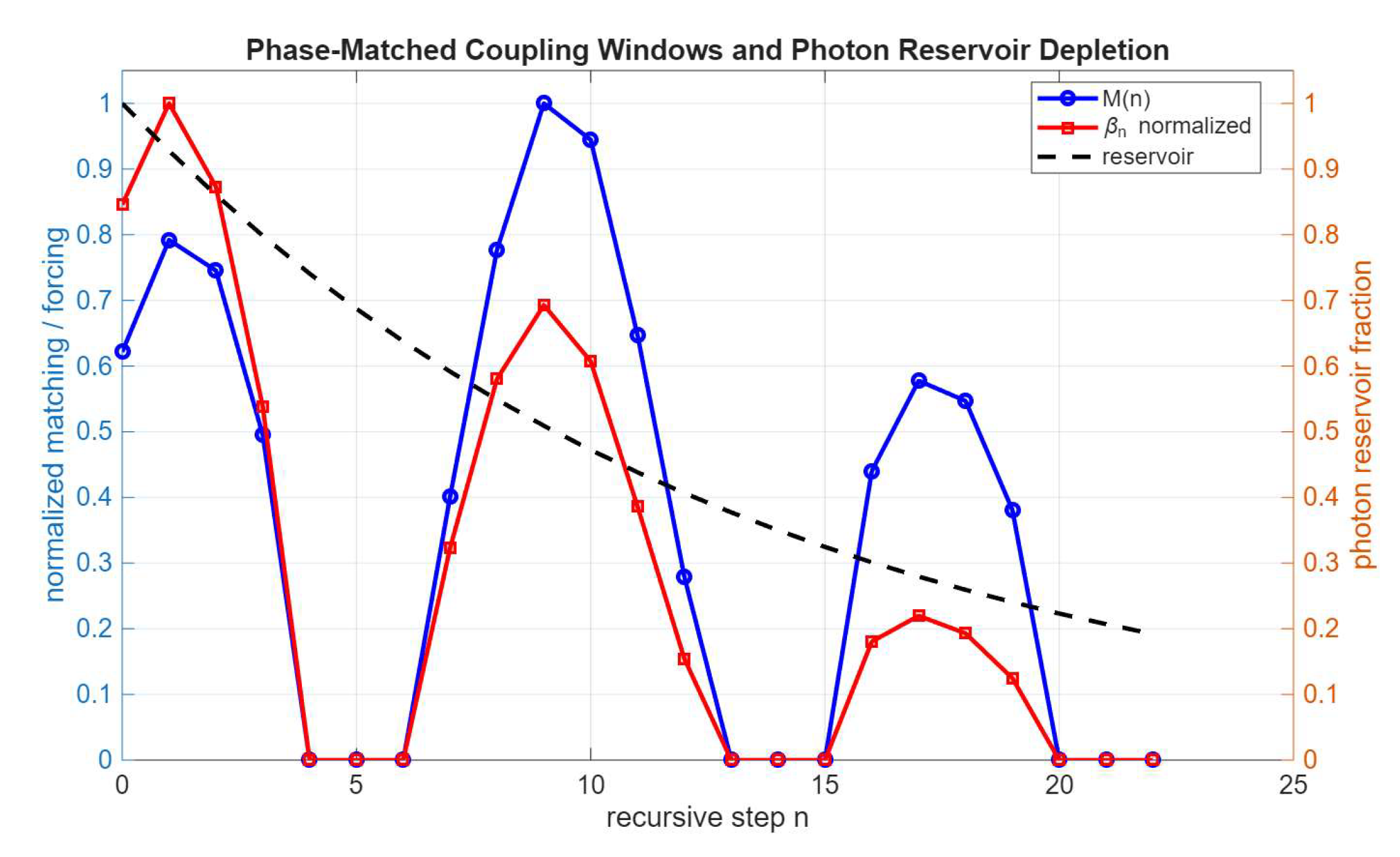
Figure 8.
The recursive localization process across successive recursive stages, showing how repeated phase-matched entropy transfer drives the electron entropy geometry toward an increasingly localized configuration.
Figure 8.
The recursive localization process across successive recursive stages, showing how repeated phase-matched entropy transfer drives the electron entropy geometry toward an increasingly localized configuration.
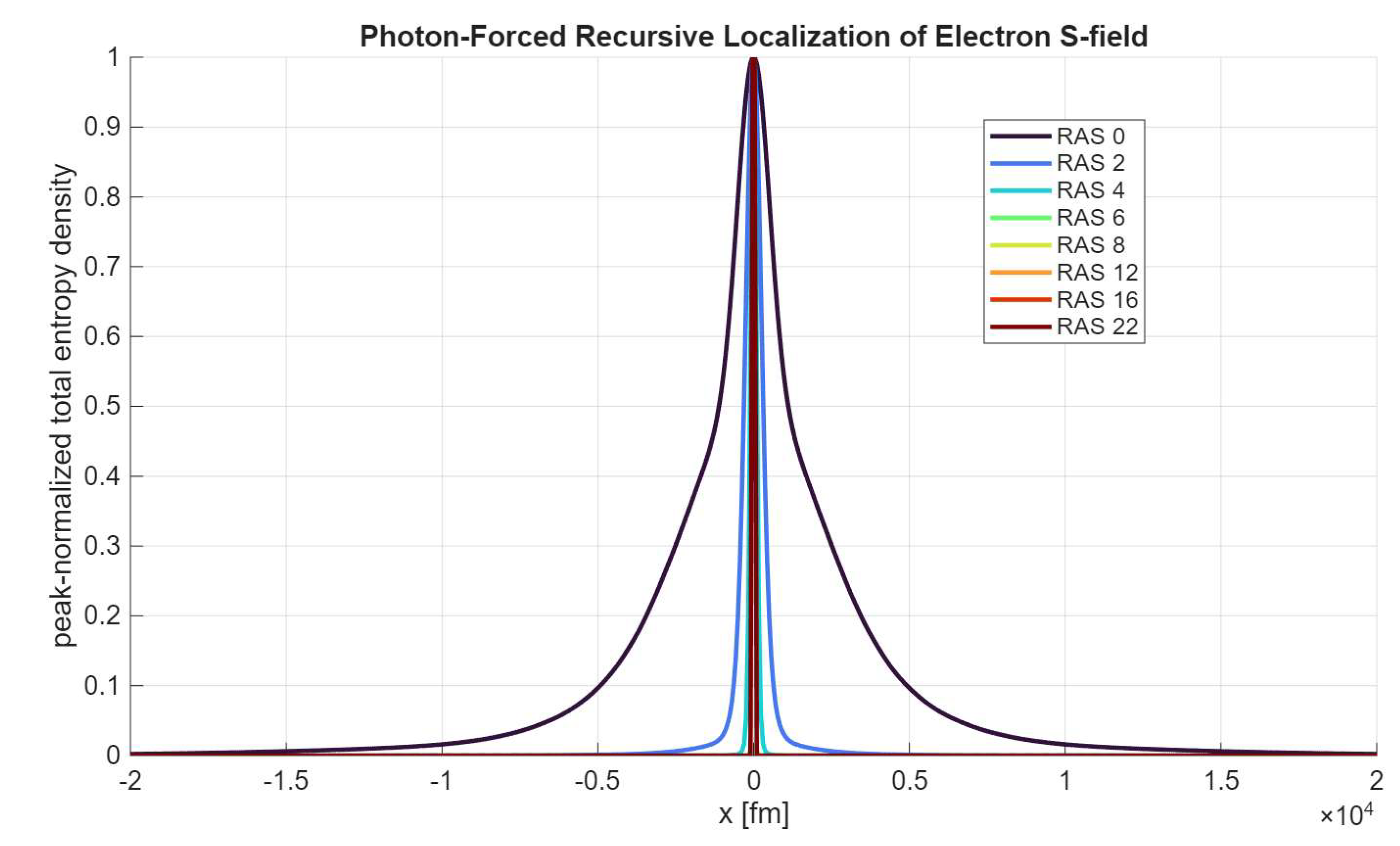
Figure 9.
Area-normalized recursive localization showing emergence of a finite-width Dirac-delta–like entropy kernel. Conservation of integrated entropy reveals the mathematical structure of recursive localization under photon-driven RAS compression.
Figure 9.
Area-normalized recursive localization showing emergence of a finite-width Dirac-delta–like entropy kernel. Conservation of integrated entropy reveals the mathematical structure of recursive localization under photon-driven RAS compression.
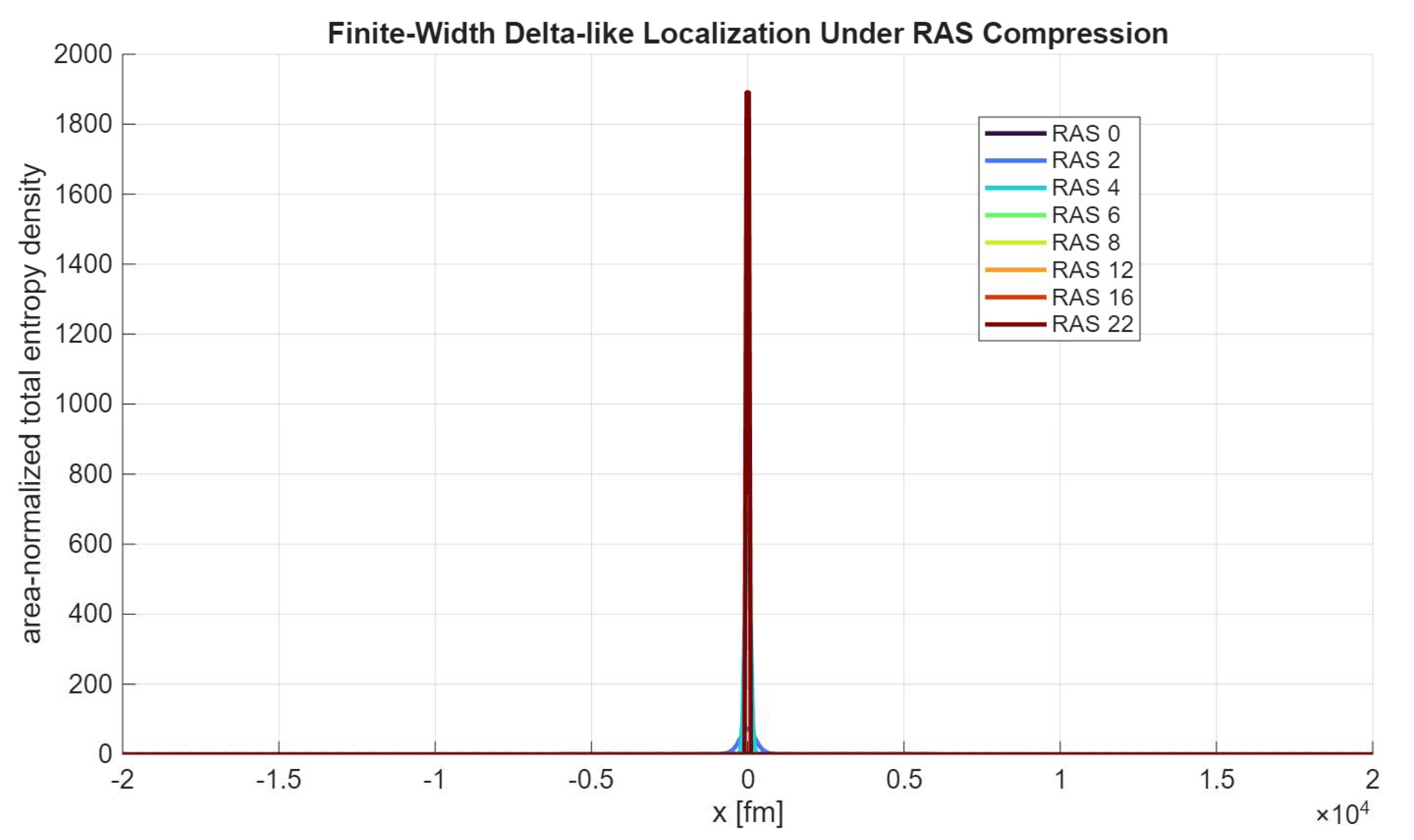
Figure 10.
The quantitative signatures of recursive localization: a) Width collapse b) Peak density growth c) Area conservation delta test c) Available photon entropy.
Figure 10.
The quantitative signatures of recursive localization: a) Width collapse b) Peak density growth c) Area conservation delta test c) Available photon entropy.
Disclaimer/Publisher’s Note: The statements, opinions and data contained in all publications are solely those of the individual author(s) and contributor(s) and not of MDPI and/or the editor(s). MDPI and/or the editor(s) disclaim responsibility for any injury to people or property resulting from any ideas, methods, instructions or products referred to in the content. |
© 2026 by the author. Licensee MDPI, Basel, Switzerland. This article is an open access article distributed under the terms and conditions of the Creative Commons Attribution (CC BY) license.
Copyright: This open access article is published under a Creative Commons CC BY 4.0 license, which permit the free download, distribution, and reuse, provided that the author and preprint are cited in any reuse.


