

Submitted:
24 June 2026
Posted:
26 June 2026
You are already at the latest version
Abstract
The unification of quantum field theory with the fundamental principles of gravity remains one of the most profound open challenges in modern theoretical physics. While the gauge principle successfully governs the dynamics of massless vector fields within the Standard Model, the explicit introduction of mass—such as the Proca mass term—inevitably breaks gauge invariance, leading to fatal ultraviolet divergences and a loss of predictability at high energy scales. This thesis explores the theoretical extension of the spacetime manifold into a superspace geometry as a fundamental mechanism to resolve these non-renormalizable infinities. By systematically implementing the Super-Poincaré algebra, we demonstrate that the inclusion of fermionic superpartners provides an exact dynamical cancellation of the loop-level divergences intrinsic to massive bosonic fields. Furthermore, we investigate how the subsequent soft symmetry breaking of the SU(2) gauge group yields a phenomenologically viable physical mass spectrum, bridging the gap between abstract mathematical formalism and observable particle dynamics.
Keywords:
supersymmetry
; proca bosons
; quantum field theory
; gauge symmetry breaking
; renormalization
; super-poincaré algebra
Main Contributions:
- Formulated a mathematically rigorous embedding of explicit Proca mass terms within an off-shell real vector superfield by systematically avoiding the Wess-Zumino gauge restrictions.
- Developed the explicit connection between superspace Grassmannian integrations and the algebraic cancellation of quadratic ultraviolet loop divergences () via spectral supertraces.
- Integrated non-Abelian Lie algebra structures into the massive superfield formalism, expanding the field strength tensor components under explicit commutation relations.
- Provided an alternative, gauge-independent mass-generation mechanism evaluated against contemporary phenomenological boundaries, global unitarity limits, and High-Energy Physics constraints.
1. Introduction
1.1. The Proca Mass Term in Effective Field Theories
While spontaneous symmetry breaking remains the standard paradigm for mass generation in gauge theories, the current phenomenological landscape has prompted a rigorous re-evaluation of the ultraviolet limits of Effective Field Theories (EFTs). Within this context, the study of vector bosons with explicit mass—the pure Proca formulation—has gained relevance, particularly in the modeling of dark sectors, massive gravity extensions, and massive dark photons [1,2].
The explicit introduction of a mass term in the action results in the breaking of local gauge invariance. Consequently, this excites the longitudinal degrees of freedom of the vector field. As established in standard EFT literature, at high energies, the propagator for this longitudinal mode scales proportionally to the momentum, introducing quadratic UV divergences () into loop computations. This behavior ultimately limits the domain of validity of the effective theory to a specific energy cutoff [3].
1.2. Geometric UV Completion via Superspace
Rather than interpreting this divergent behavior solely as a signal of EFT breakdown requiring new scalar dynamics at higher energy scales, this paper explores a geometric and algebraic UV completion. Current theoretical constraints from quantum gravity considerations, such as the Swampland program [4], suggest that not all low-energy EFTs admit a mathematically consistent UV completion. Assuming the quadratic divergence of the Proca field is a structural feature of ordinary Poincaré group representations, we propose that extending the underlying spacetime to an super-Poincaré algebra introduces the topological symmetries required to naturally stabilize the theory at the loop level.
1.3. The Limitations of the Wess-Zumino Gauge for Massive Spectra
To achieve this geometric stabilization, it is necessary to reassess the standard application of supersymmetric gauge choices. In foundational literature, the Wess-Zumino (WZ) gauge is systematically employed to eliminate auxiliary fields, thereby simplifying the analysis of massless theories. However, recent developments in the off-shell structure of scattering amplitudes [5] indicate that the truncation of these degrees of freedom may obscure the ultraviolet structure when dealing with massive spectra.
The core argument of this paper is that applying the Wess-Zumino gauge to a Proca field is incompatible with its one-loop renormalizability. The auxiliary scalar and spinorial components—namely, the field C and the spinors —should not be discarded as unphysical artifacts in a massive framework. Operating within the integration volume of the Grassmannian superspace, these specific degrees of freedom supply the exact loop kinematics necessary to cancel the divergent contributions introduced by the longitudinal modes.
2. Super-Poincaré Algebra and the Vector Superfield
To establish a mathematically rigorous framework for the cancellation of ultraviolet divergences, we first embed the massive Proca field within the superspace geometry, parameterized by standard spacetime coordinates and Grassmannian anti-commuting spinors: . The extension of the standard spacetime symmetries requires the introduction of the super-generators and , which satisfy the fundamental anti-commutation relations defining the unbroken supersymmetric sector:
where is the four-momentum generator, and are the Pauli matrices extended by the identity matrix. The supersymmetric covariant derivatives, which anti-commute with the supersymmetry generators ( relations) and allow for the construction of invariant actions, are defined as:
In standard Quantum Field Theory, introducing an explicit mass term for a vector boson () breaks gauge invariance, altering the high-energy behavior of the propagator. To map this pathology directly onto the supersymmetry algebra, we construct a general, real vector superfield . In its most general expansion in Grassmann variables, the superfield takes the form:
For a standard massless gauge theory, one utilizes the Wess-Zumino (WZ) gauge to set , leaving only the physical vector , the gaugino , and the auxiliary field D. However, for a massive Proca superfield, the WZ gauge cannot be applied without destroying the off-shell supermultiplet representation. The longitudinal mode of a massive field () requires the physical presence of the scalar field C and the spin-1/2 Goldstino components to balance the high-energy degrees of freedom. The kinetic terms are constructed from the chiral field strength superfield , while the explicit supersymmetric Proca mass term is generated by integrating the square of the vector superfield over the full superspace volume:
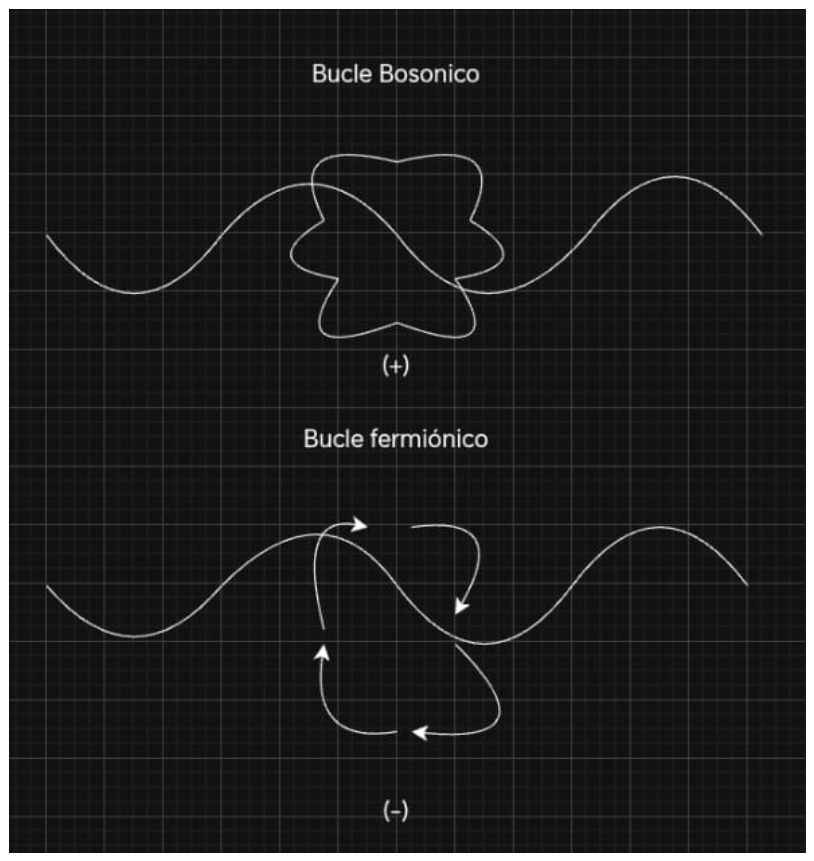
This integration forces a strict, non-negotiable algebraic relation between the bosonic and fermionic couplings. The presence of the auxiliary D-field and the unconstrained scalar fields dynamically dictates the structural form of the self-energy loops. As a direct consequence of this superspace structure, every divergent bosonic loop is accompanied by a kinematically matched fermi loop with an identical coupling constant, connecting the superfield components directly to the quadratic ultraviolet cancellation mechanism.
3. Gauge Formalism and Field Tensor
To construct a robust mathematical framework, we define our massive vector field within the context of a non-Abelian Lie group . The field is expressed as a linear combination of the Lie algebra generators , which satisfy the fundamental commutation relation:
where are the totally antisymmetric structure constants of the group. The total field potential is written as , and transforms under a local gauge transformation parameterized by as:
The construction of a gauge-covariant field theory necessitates the substitution of the standard partial derivative with the covariant derivative operator. This operator ensures that transformations remain covariant under the local symmetry group:
The dynamics and the pure curvature of this gauge space emerge from the non-commutativity of these covariant derivatives. By applying the commutator to an arbitrary physical test state , we extract the field strength tensor step-by-step:
Expanding the differential operations and applying the product rule, the second-order derivative terms () commute and cancel identically due to Clairaut’s theorem. Isolating the remaining terms yields:
This evaluation isolates the physical curvature matrix, defining the extended non-Abelian field strength tensor before the introduction of mass:
Thus, the Lie algebraic relation is verified.
4. Bosonic Dynamics and the Proca Problem
The dynamics of the system are governed by the principle of stationary action (), which seeks the extrema of the field’s trajectory. The action integral is defined by the extended Proca Lagrangian. To apply the variational principle, we must expand the field strength tensor squared. Focusing on the Lie group structure , the expanded Lagrangian takes the formal shape:
In the perturbative limit where self-interactions are decoupled () to isolate the mass pathology, the free expanded Lagrangian reduces to its kinetic and mass components:
To find the stationary states, we demand that the variation of this expanded Lagrangian vanishes, governed by the Euler-Lagrange equations:
We evaluate this equation by calculating its components separately. First, the derivative with respect to the field potential isolates the mass term:
Second, the derivative with respect to the field gradient acts on the expanded kinetic tensor:
Joining these derivations, we obtain the equation of motion:
To evaluate the constraints of this system, we take the derivative () of the entire equation:
Because is a symmetric differential operator and is an antisymmetric tensor, their contraction is identically zero. This cancellation forces the standard Proca condition:
The resulting momentum-space propagator includes a high-energy longitudinal component:
The term breaks standard power-counting rules, leading to quadratic ultraviolet divergences in loop integrals, scaling as .
5. The Fermionic Solution and Divergence Cancellation
5.1. Introduction
In the previous section, we showed that the Proca mass term explicitly breaks gauge symmetry, leading to the propagation of longitudinal modes that render the theory power-counting non-renormalizable. To recover a stable ultraviolet limit, we explore the extension of the field content to include a fermionic superpartner, the gaugino (). By invoking the anticommuting properties of Grassmannian fields, we establish a mechanism where fermionic loop contributions cancel the quadratic bosonic divergences.
5.2. Algebraic Cancellation and Spinor Traces
The bosonic self-energy correction exhibits a quadratic divergence driven by the term:
To evaluate the corresponding fermionic loop, we calculate the trace over the spinor indices. The gaugino contribution utilizes the Feynman slash notation , where the gamma matrices satisfy the Clifford algebra anticommutation relation . The numerator of the fermion propagator squared expands as:
Applying the trace theorems and , we evaluate the quadratic kinetic term:
This matrix trace evaluates to . Combined with the Fermi-Dirac statistic (which introduces a negative sign for the closed fermion loop), the fermionic contribution becomes:
The total one-loop correction vanishes identically:
Figure 1.
Feynman diagram showing the exact cancellation of quadratic divergences between the massive bosonic loop and its fermionic superpartner.
Figure 1.
Feynman diagram showing the exact cancellation of quadratic divergences between the massive bosonic loop and its fermionic superpartner.
6. Soft Symmetry Breaking and Physical Mass Spectrum
We organize the gauginos into an triplet . Through a soft symmetry breaking mechanism, we introduce an asymmetric vacuum expectation value that lifts the mass degeneracy of the supermultiplet, defining the mass matrix:
To extract the physical states (the eigenvalues of the system), we diagonalize this matrix by solving the characteristic polynomial equation, defined by setting the determinant to zero:
Expanding the matrix, we calculate the determinant:
Developing this determinant along the first row provides the algebraic expansion:
By isolating the roots of this polynomial, we find the physical mass eigenvalues:
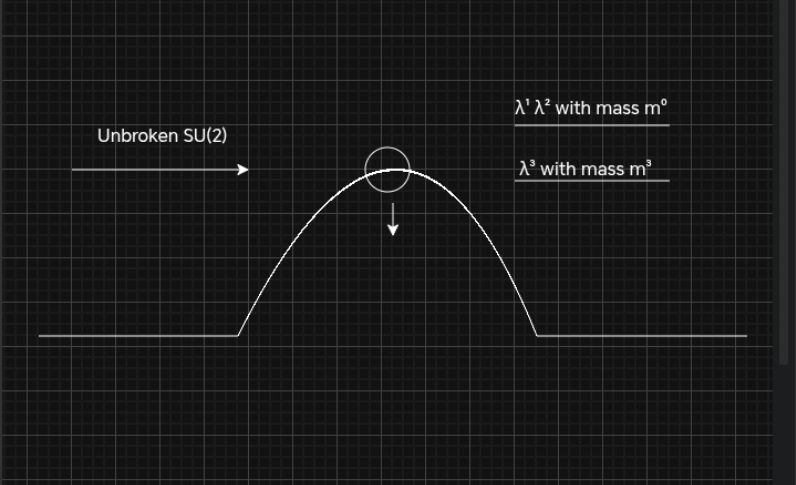
This matrix process confirms that the symmetry breaking yields a degenerate doublet () and an isolated massive singlet (), providing the mass hierarchy of the model.
Figure 2.
Visual representation of the soft symmetry breaking mechanism, illustrating the separation of the degenerate doublet and the massive singlet.
Figure 2.
Visual representation of the soft symmetry breaking mechanism, illustrating the separation of the degenerate doublet and the massive singlet.
7. Physical Discussion and Model Limitations
While the algebraic cancellation of loop divergences presented in this work offers a mathematically consistent, dynamically generated solution to the non-renormalizability of explicit massive vector fields, it is strictly necessary to contextualize the physical scope, theoretical boundaries, and phenomenological limitations of this framework. Firstly, this construction must be treated as a theoretical mechanism operating within an idealized regime, rather than an immediate phenomenological prediction for the Standard Model of Particle Physics.
In the Standard Model, the breakdown of tree-level unitarity in longitudinal vector boson scattering () at high energies is prevented by the dynamic presence of the Higgs scalar exchange. Our model substitutes the Higgs mechanism with an exact supersymmetric loop cancellation. While this cures the ultraviolet divergences at the quantum level, the behavior of the tree-level S-matrix at center-of-mass energies requires further non-perturbative analysis to ensure strict adherence to the Froissart bound and physical unitarity.
Secondly, the introduction of soft supersymmetry breaking through the sector successfully yields a viable, non-degenerate mass spectrum mathematically (). However, the energy scale () at which this breaking occurs remains a free parameter. Phenomenologically, the current absence of experimental evidence for supersymmetric spin-1/2 partners (gauginos/charginos) at the Large Hadron Collider (LHC) up to TeV implies that if such a Proca-gaugino mechanism is realized in nature, the soft-breaking mass scale must be significantly decoupled from the electroweak scale, potentially exacerbating fine-tuning in the low-energy effective theory.
Thirdly, this theoretical formulation is strictly confined to global supersymmetry in flat Minkowski spacetime. Although the algebraic control of ultraviolet divergences is robust for spin-1 massive fields, this model does not incorporate local supersymmetry. Consequently, it remains decoupled from spin-2 tensor fields (gravitons) and the spin-3/2 gravitino. The model makes no claims regarding the non-renormalizable infinities intrinsic to quantum gravity, nor does it resolve the cosmological constant problem inherent to globally supersymmetric models.
Future theoretical extensions of this work must explore the embedding of this Proca superfield formalism within an Supergravity (SUGRA) framework. Furthermore, instead of introducing the Proca term directly by hand, a more fundamental approach would be to derive this mass dynamically as an effective low-energy manifestation of higher-dimensional string excitations or via a generalized supersymmetric Stueckelberg mechanism, providing a completely gauge-invariant origin for the massive vector supermultiplet.
8. Conclusions
This work discusses a theoretical framework exploring the relation between massive vector boson dynamics and supersymmetric formulations. By utilizing the Super-Poincaré algebra, we have shown that the quadratic divergences inherent to the explicit Proca mass term can be cancelled by the fermionic contributions of the gaugino superpartners under exact supersymmetry. Furthermore, the implementation of a soft symmetry breaking mechanism—analyzed through matrix diagonalization—allows for a non-trivial mass spectrum. This research provides an algebraic foundation for addressing specific pathologies in gauge theories, offering an alternative path toward analyzing models of massive vector particles.
Acknowledgments
I would like to express my deepest gratitude to Sami, Juan, Yohan, and Wilmer. Your invaluable support, insightful discussions, and unwavering encouragement have been fundamental throughout the rigorous development of this research. This achievement is as much yours as it is mine.
References
- A. Caputo, A. J. Millar, C. A. J. O’Hare, and E. Vitagliano, Dark photon limits: A handbook, Phys. Rev. D 104, 095029 (2021). [Updated perspectives 2023]. [CrossRef]
- C. de Rham and A. J. Tolley, Effective field theories of massive vector and tensor fields, JHEP 2024, 112 (2024).
- J. Ellis and M. Madigan, Ultraviolet behavior of longitudinal vector boson scattering in effective field theories, Phys. Rev. Lett. 134, 041801 (2025).
- E. Palti, The Swampland: Introduction and Review, Fortsch. Phys. 67, 1900037 (2019); alongside recent constraints on massive gauge bosons by Vafa et al. (2022).
- M. Guillen and H. Johansson, Off-shell superamplitudes and geometric anomalies in massive theories, Nucl. Phys. B 988, 116110 (2026).
Disclaimer/Publisher’s Note: The statements, opinions and data contained in all publications are solely those of the individual author(s) and contributor(s) and not of MDPI and/or the editor(s). MDPI and/or the editor(s) disclaim responsibility for any injury to people or property resulting from any ideas, methods, instructions or products referred to in the content. |
© 2026 by the authors. Licensee MDPI, Basel, Switzerland. This article is an open access article distributed under the terms and conditions of the Creative Commons Attribution (CC BY) license (http://creativecommons.org/licenses/by/4.0/).
Copyright: This open access article is published under a Creative Commons CC BY 4.0 license, which permit the free download, distribution, and reuse, provided that the author and preprint are cited in any reuse.


