
Submitted:
25 June 2026
Posted:
26 June 2026
You are already at the latest version
Abstract
Improving building energy efficiency while maintaining collective thermal comfort remains challenging in multi-occupant shared spaces, where occupants may differ in thermal sensation, activity, and clothing conditions. This study develops an edge-cloud Internet of Things system for dynamic group thermal comfort control and energy optimization. The proposed system uses an HUB 8735 ULTRA edge-computing board for localized multi-point environmental sensing and non-invasive visual extraction of occupancy, posture, and clothing-related features. A 4-day field data collection campaign with structured questionnaires was conducted to obtain occupants’ Thermal Sensation Votes (TSV) as ground-truth labels. A machine-learning thermal sensation model was trained using cloud GPU resources, compressed from Float32 to INT8 through post-training quantization, and deployed on the edge device. The embedded controller applies a two-time-scale rolling-horizon strategy with deterministic grid search to identify temperature setpoints that minimize group discomfort, while an event-triggered rolling-horizon control logic with a 10% Group PPD comfort deadband reduces frequent compressor switching. Field experiments under a single-blind comparative protocol showed that the system achieved a mean TSV of -0.12, reduced comfort variation relative to a 25 °C baseline, and decreased electricity consumption by 1.16 kWh, corresponding to an 11.1% energy reduction. These results indicate that the edge-cloud framework can support coordinated thermal comfort control and energy-saving operation in shared indoor environments.
Keywords:
edge intelligence
; rolling-horizon control
; multi-occupant thermal comfort
; post-training quantization (PTQ)
; building energy optimization
1. Introduction
Heating, ventilation, and air conditioning (HVAC) systems account for approximately 40% to 50% of the total energy consumption in modern commercial and residential buildings; consequently, optimizing the energy efficiency of these systems while preserving indoor environmental quality is of paramount environmental and economic importance [1,2]. Traditional HVAC management systems primarily implement static temperature setpoints, which inherently fail to accommodate dynamic occupancy patterns, heterogeneous individual thermal preferences, and transient microclimate fluctuations. Such rigid and undifferentiated control paradigms not only incur substantial operational energy waste but also frequently precipitate thermal discomfort and localized cognitive fatigue among indoor occupants . In recent decades, the rapid convergence of Internet of Things (IoT) technologies, ubiquitous cloud computing, and advanced artificial intelligence (AI) has paved novel avenues for developing smart thermal comfort control architectures capable of simultaneously optimizing thermodynamic energy efficiency and multi-user satisfaction [3,4,5].
International thermal comfort compliance and assessment criteria are fundamentally governed by international frameworks such as ISO 7730 and ASHRAE Standard 55, which necessitate a holistic synthesis of ambient environmental parameters and personal physiological attributes [6,7,8]. The environmental telemetry vector typically encompasses dry-bulb air temperature, relative humidity, air velocity, and mean radiant temperature (). Among these variables, air temperature, relative humidity, and localized air velocity directly modulate the convective and evaporative heat rejection from the human body, whereas the influence of becomes exceptionally pronounced in spaces characterized by radiant heating/cooling configurations or extensive glazed building facades. Additionally, carbon dioxide () concentration is widely leveraged as a robust proxy indicator for both indoor air quality and real-time occupancy rates within enclosed zones. Concurrently, personal parameters incorporate the metabolic equivalent () and clothing insulation (), both of which significantly alter the boundary layer heat transfer efficiency between the human organism and its immediate surroundings. To quantify overall thermal perception, Fanger's empirical Predicted Mean Vote () index integrates these six core parameters into a single mathematical scale, serving as the historical cornerstone for comprehensive indoor climate evaluation [4,9,10,11]. Nevertheless, the classical PMV formulation demands the input of highly complex, frequently unmeasurable personal variables, rendering its direct application in real-time, closed-loop dynamic control mathematically and logistically prohibitive. Consequently, contemporary research vectors have progressively transitioned toward data-driven Personal Comfort Models (PCM) [5,12,13,14]. By non-invasively harvesting occupants' physical features via infrared (IR) sensors or smart wristbands and pairing these data streams with machine learning classifiers (e.g., Random Forests or Artificial Neural Networks), the predictive resolution of individual localized thermal sensation can be substantially augmented, preventing extreme microclimate deviations. [12,15,16].
Although considerable milestones have been achieved in individualized thermal comfort management, the vast majority of commercial office and institutional learning environments are inherently multi-occupant shared thermal zones. In these shared microclimates, inter-individual thermal preferences diverge significantly due to variations in metabolic baselines and wardrobe choices, and traditional average-based control heuristics consistently fail to establish an equitable consensus, often exacerbating comfort disparities across the occupant spectrum. [17]. To resolve these multi-user comfort deadlocks, several studies have introduced Fuzzy Comprehensive Evaluation techniques to evaluate the mathematical membership degrees and relative weights of multiple occupants within a designated zone, thereby deriving an "Integrated Thermal Sensation" metric that balances subjective variances. Furthermore, occupancy-centric dynamic scheduling has been empirically proven to modulate ventilation and thermal delivery in real time based on varying spatial headcounts, yielding reported energy savings of 17% to 24% while strictly preserving indoor air quality [18,19,20]. When coupled with advanced machine learning frameworks, Model Predictive Control (MPC) paradigms have demonstrated a compelling energy-saving potential of up to 57.59% under varied experimental conditions [1,19,21,22,23]. Regarding hardware and data pipeline architecture, the integration of IoT ecosystems and Edge-Cloud Hybrid Architectures has fundamentally transformed the design paradigm of building automation systems [24,25,26,27]. Edge computing drastically curtails local data processing latencies and ensures immediate localized responsiveness, while centralized cloud platforms provide robust data stream computing power and long-term storage; their strategic coupling guarantees both the real-time operational stability and the macroscopic analytics capability of building control networks [24,28,29]. Some studies have further incorporated the Social Internet of Things (SIoT) paradigm to achieve a dynamic, decentralized equilibrium between electricity infrastructure costs and user thermal well-being. [30,31].
Despite the tremendous theoretical potential demonstrated by these existing paradigms, several critical research gaps remain unaddressed in practical physical deployment [12,15,16]. First, current personalized comfort systems heavily rely on active, intrusive user feedback interfaces, which severely disrupt occupants' daily workflows and risk system instability due to participant forgetfulness or cognitive fatigue. Mechanisms for deeply and non-invasively fusing AI computer vision (for automated posture, activity, and clothing recognition) with traditional environmental variables warrant deeper investigation. Second, traditional model predictive control (MPC) frameworks are predominantly hosted on centralized cloud servers, incurring strict network privacy barriers, data transmission overheads, and single-point failure liabilities.
To overcome these distinct research gaps, this study develops and validates a fully closed-loop, cloud-trained but edge-deployed intelligent HVAC control system utilizing the HUB 8735 ULTRA system-on-chip hardware platform. The system integrates real-time computer vision, multi-point environmental sensors, and localized rolling grid-search algorithms, introducing a dynamic control logic driven by dynamic occupancy tracking and subjective interventions without causing occupant disturbance. The specific original contributions and novelties of this research are threefold:
- Non-Intrusive Multi-Modal Perception & Ground-Truth Fusion: This research proposes a non-invasive telemetry pipeline combining physical sensors with localized AI computer vision for real-time behavior and clothing quantification. Crucially, the offline model establishes its predictive baseline using temporal synchronization between physical inputs and structured subjective questionnaires, guaranteeing true supervised machine learning validity.
- Localized INT8-Quantized Edge Intelligence: Unlike traditional cloud-based optimization controllers, the cloud-optimized neural network is quantized into an 8-bit integer (INT8) TensorFlow Lite binary via Post-Training Quantization (PTQ). This allows real-time individual TSV inferences and rolling horizon group PPD optimization loops to run entirely within the edge node's low-latency internal memory.
- Event-Triggered Control with Comfort Deadband: The proposed design and field-validate an event-triggered state machine operating with an empirical 10% Group PPD deadband threshold and a 30-minute lockout hysteresis. This framework natively resolves multi-occupant comfort conflicts by heavily penalizing extreme localized discomfort while effectively shielding the HVAC infrastructure from high-frequency compressor oscillations.
2. Materials and Methods
To develop a dynamic thermal sensation control system based on edge and cloud computing, this study utilizes the HUB 8735 ULTRA development board (specifications detailed in Table 1) as the core hardware to propose a multimodal smart thermal sensation control system leveraging an Edge-Cloud Hybrid Architecture. At the perception layer, this system not only integrates traditional environmental sensors (for real-time measurement of air temperature, relative humidity, air velocity, and mean radiant temperature) but also innovatively introduces Artificial Intelligence (AI) visual recognition technology to dynamically extract features such as occupancy, occupant behavior, and clothing insulation values. All multimodal sensing data undergo real-time preliminary processing by the edge AI chip, followed by the stable transmission of raw data to a cloud platform for long-term storage and advanced model analysis. The experimental framework of this study comprises four phases, with the architectural flow illustrated in Figure 1, detailed as follows:
- (1)
- Hardware System Implementation and Validation: The initial phase focuses on testing the accuracy and stability of the proposed system. By comparing the sensing data from the custom-built system with those from calibrated standard measurement instruments, the reliability and validity of the hardware measurements are established.
- (2)
- Data-Driven Modeling: Data collection is conducted in real-world environments. Utilizing the acquired environmental and physiological-behavioral data, personalized and multi-occupant integrated thermal sensation models are trained and fitted, thereby determining the optimal control parameters for the algorithms.
- (3)
- Control Strategy Design: Based on the Integrated Thermal Sensation (ITS), a linear adjustment algorithm is employed to dynamically regulate the HVAC temperature setpoints, substituting the traditional single fixed temperature setting.
- (4)
- Field Validation and Performance Evaluation: In the final phase, the constructed smart control system is deployed in a real-world environment and benchmarked against the traditional set-point based control strategy. This phase comprehensively quantifies and compares the specific performance of the proposed system in enhancing overall thermal comfort and achieving HVAC energy savings.
(1) System Hardware Setup, Deployment, and Validation
The experimental site for this study was a multi-purpose classroom with a capacity of 20 occupants. To ensure that the sensory data precisely reflects the complex thermal distribution within the space and complies with international measurement standards, this section delineates the hardware architecture, spatial deployment strategy, and accuracy validation procedures.
A. Multimodal Perception Hardware Architecture
The system employs the HUB 8735 ULTRA development board, equipped with visual edge computing capabilities, as the core node to construct an edge-cloud perception network. The environmental perception layer comprises multiple physical sensor modules designed to collect air temperature (), relative humidity (), air velocity (), and mean radiant temperature (). Meanwhile, the occupant state perception layer utilizes edge AI visual algorithms to non-invasively extract real-time data on occupancy counts (), clothing features (for estimating clothing insulation, ), and behavioral postures (for estimating the metabolic equivalent, ). The detailed technical specifications of all sensors are listed in Table 2, and the overall system architecture and physical system are illustrated in Figure 2 and Figure 3.
B. Spatial Deployment Strategy
Addressing the expansive area of the 20-person multi-purpose classroom, this study adhered to ISO 7726 and ASHRAE Standard 55 guidelines. A "multi-point grid deployment" and "standard height sampling" strategy was adopted to overcome the heterogeneity of the indoor thermal environment:
Horizontal distribution: To avert local interferences, sensor nodes were deliberately positioned away from direct HVAC airflow, direct solar radiation through windows, and high-heat-dissipating electronic devices. Considering the occupant distribution, a grid-based configuration was implemented, with sensor nodes located at the center of the seating zones where occupants predominantly remain.
Vertical height: In accordance with standards for seated office and learning environments, sensors were installed at a representative height of 1.1 m above the floor (corresponding to head level). This ensures that the measured data authentically reflects the thermal perception within the "occupant zone."
C. Accuracy Validation and Stress Testing
To substantiate the measurement reliability of the custom-built IoT nodes, the following two validation procedures were executed prior to the formal experiments:
Physical sensor accuracy calibration: A 24-hour synchronous comparative analysis was conducted between the proposed system and a calibrated high-precision standard instrument (reference device). The measurement errors were evaluated using Bias, Mean Absolute Error (MAE), and Root Mean Square Error (RMSE) as metrics. In compliance with ISO 7726 requirements for thermal comfort measurements, the temperature error was maintained within ±0.5°C and relative humidity within ±5%, thereby ensuring data reliability.
Edge AI stability testing: Stress testing was performed on the Edge AI models responsible for occupancy counting, clothing recognition, and behavior classification. The edge chip was deployed in a real-world classroom scenario, where rigorous boundary conditions (edge cases), such as overlapping human movements and partial bodily occlusions, were established. The evaluation benchmarked the AI system's automated recognition results against real-time logs recorded by on-site observers, thereby validating the recognition success rate and system stability of the edge chip under complex environmental conditions.
(2) Data-Driven Modeling
This section elucidates how the system constructs an individual thermal sensation prediction model through multimodal sensory data fusion and a "cloud training, edge inference" architecture. Furthermore, it proposes a "Minimize Group PPD" control strategy tailored for multi-occupant shared scenarios. The overall algorithm implementation and optimal control workflow are divided into three core phases, as illustrated in Figure 4 and detailed below:
A. Multimodal Data Acquisition and Temporal Feature Alignment
The underlying foundation of this system relies on the real-time acquisition of multimodal environmental and behavioral data. The system continuously captures real-time environmental parameters (i.e., air temperature, relative humidity, air velocity, and mean radiant temperature). Concurrently, to overcome the technical bottleneck of traditional systems in dynamically acquiring the metabolic equivalent () and clothing insulation (), this system introduces Edge-AI Vision algorithms for non-invasive feature extraction, detailed as follows:
- Vision-based MET Mapping: Utilizes a lightweight pose estimation algorithm to recognize occupants' behavioral modalities in real time, establishing a mapping matrix in accordance with ASHRAE Standard 55 (e.g., assigning a baseline value for a static seated posture).
- Object Detection-based
Mapping: Employs an object detection algorithm to identify occupants' clothing styles, dynamically accumulating the thermal resistance coefficient based on visual recognition results (e.g., short-sleeved shirts )
B. Cloud-Based Machine Learning Model Training and Hyperparameter Tuning
To construct a robust, data-driven prediction model, a dedicated field dataset acquisition phase was implemented using structured questionnaires prior to full system deployment. During this collection period, occupants' subjective thermal comfort profiles were systematically recorded alongside the multi-modal environmental telemetry streams. Field questionnaires were distributed to the occupants at a regular interval of 30 minutes to capture their immediate thermal experiences without causing cognitive fatigue. These subjective feedback responses were quantified using the standard ASHRAE 7-point thermal sensation scale (+3: Hot, +2: Warm, +1: Slightly Warm, 0: Neutral, -1: Slightly Cool, -2: Cool, -3: Cold). The cloud server temporally synchronized these questionnaire-derived thermal votes as ground-truth training labels, pairing them with the concurrent 6-dimensional physical sensor features (air temperature, relative humidity, air velocity, mean radiant temperature, metabolic rate, and clothing insulation) to formulate the comprehensive training dataset.
The temporal features collected at the edge are serialized and subsequently uploaded to a cloud IoT data platform. The model training phase is hosted on the Google Colaboratory cloud computing platform, leveraging the TensorFlow 2.x deep learning framework and high-performance hardware accelerators (GPUs) to execute large-scale backpropagation computations. This phase aims to train high-dimensional non-linear mapping functions:
To satisfy the stringent hardware and memory constraints of the localized environment, the high-dimensional original model trained on cloud accelerators is compiled into a lightweight TensorFlow Lite (.tflite) binary via a post-training optimization pipeline. Utilizing the tf.lite.TFLiteConverter operator, a Post-Training Quantization (PTQ) mechanism is applied to compress the network weights from 32-bit floating-point (Float32) to 8-bit integers (INT8). This edge-optimization strategy drastically reduces computational complexity and model footprint while preserving prediction accuracy, allowing the embedded inference engine () to operate with low latency directly on the HUB 8735 ULTRA development board.
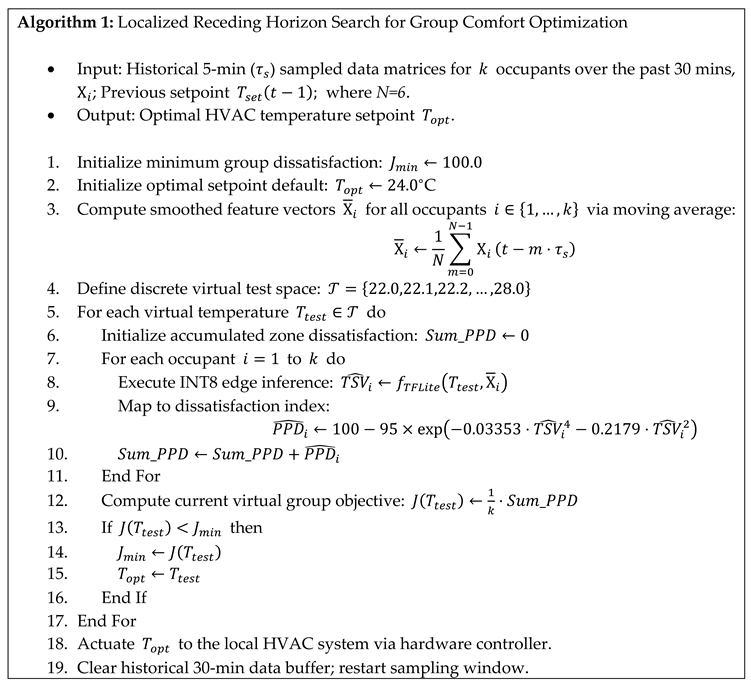
C. Receding Horizon Group Thermal Comfort Optimization Strategy
In multi-occupant shared thermal zones, the primary objective is to minimize collective dissatisfaction while preventing micro-fluctuations in sensor readings. Let be the edge data sampling interval. At any given decision time step (triggered every ), the edge controller aggregates the historical data packets from the past window to compute a moving average, smoothing out transient environmental noise:
where represents the smoothed baseline parameters for occupant .
By introducing a discrete virtual search space , the edge IC iteratively substitutes a candidate temperature as a variable into the embedded INT8 inference engine to predict individual thermal sensations:
Individual Predicted Percentage of Dissatisfied () values are then derived via Fanger's non-linear exponential mapping:
The optimal setpoint that yields the global minimum of the group dissatisfaction objective function is determined as:
where represents the total number of occupants detected within the shared office environment.
(3) Control Strategy Design
To mitigate thermal preference conflicts among multiple occupants while preventing redundant start-stop cycles and excessive hunting of the HVAC compressor, an Event-Triggered Rolling-Horizon Control (ET-RHC) mechanism with an built-in Thermal Comfort Deadband is implemented. In accordance with Class B comfort criteria in ISO 7730 and ASHRAE Standard 55, the operational deadband threshold is defined at .
The localized actuation logic executed inside the HUB 8735 ULTRA edge chip operates under a dual-mode finite state machine:
A. Standby/Maintenance Mode (): If the collective group dissatisfaction remains within the deadband, the indoor thermal environment is deemed acceptable. The edge controller suppresses fine-tuning commands and locks the current operational state to extend the mechanical lifespan of the HVAC hardware:
B. Optimization Trigger Mode (): When the group dissatisfaction violates the comfort deadband threshold, it indicates collective thermal discomfort. To grant occupants a sufficient physiological buffer period and prevent control instability, a Time Hysteresis Mechanism enforces a strict lockout interval () between consecutive setpoint revisions. This specific interval was determined by considering both the thermal inertia of the 20-person classroom and the mechanical constraints of the HVAC compressor. This ensures sufficient time for the indoor microclimate to reach a new steady-state while protecting the hardware from high-frequency start-stop cycles. Upon triggering, the system executes the deterministic grid-search optimizer (Algorithm 1) to locate the absolute wave-trough temperature , directly overwriting the setpoint:
By utilizing this non-linear exponential penalty characteristic of the PPD optimization framework, the system inherently prioritizes individuals experiencing extreme thermal discomfort. It effectively resolves multi-occupant comfort conflicts without "sacrificing the minority", achieving human-centric smart climate scheduling.
(4) Field Validation and Performance Evaluation
To quantify the specific contributions of the proposed system to "thermal comfort enhancement" and "energy-saving performance" within a real-world environment, a field comparative experiment was conducted. Two classrooms with identical spatial characteristics were selected as testing environments, wherein a longitudinal A/B testing framework was implemented over a continuous period of 4 days. During the operational period, the "Proposed Smart Control System" and the "Traditional Baseline Set-point Control" (fixed at 25°C) were applied alternately. The 25 °C baseline was specifically selected as it represents the historical default cooling setpoint conventionally adopted by the facility management for this classroom. To rigorously minimize the subjective psychological bias of the participants, a single-blind protocol was strictly adopted; participants remained entirely unaware of the specific HVAC control strategy operating on any given day. The detailed experimental workflow is illustrated in Figure 5.
To comprehensively evaluate the system's performance, data acquisition and analysis were conducted based on the following two primary metrics:
- Thermal Comfort Assessment: The subjective thermal satisfaction scores of the participants (utilizing a standard 7-point scale) were collected at 30-minute intervals. To confirm the statistical significance of the comfort enhancement, an independent samples t-test was employed to benchmark the differences in the mean satisfaction scores between the proposed algorithm and the baseline control.
- Energy-Saving Performance Evaluation: Electrical energy meters were installed directly on the dedicated circuits of the HVAC systems to monitor real-time energy consumption. The system separately recorded and compared the cumulative electricity usage (in kWh) under the two control paradigms, thereby precisely quantifying the exact energy-saving yield of the proposed dynamic control model.
3. Results
3.1. System Hardware Implementation and Validation
A validation campaign comprising 59 synchronized baseline samples was conducted to evaluate the measurement reliability of the proposed sensing system, with the descriptive statistical summaries presented in Table 3. The field testing conditions covered an air temperature range of 23.7 °C to 27.1 °C and a relative humidity range of 59.5%RH to 91.5%RH, providing a representative environmental envelope for sensor validation. To benchmark the sensing fidelity, linear regression and residual error analyses were performed between the proposed system and the reference instrument, as shown in Figure 6. Figure 6(a) presents the temperature validation result, whereas Figure 6(b) and Figure 6(c) show the relative humidity results before and after software-based calibration, respectively.
For ambient temperature measurement, the localized edge node demonstrated high agreement with the reference instrument, achieving a coefficient of determination of , a mean absolute error () of 0.306 °C, and a root mean square error () of 0.311 °C. These results satisfied the predefined validation threshold of ±0.5 °C, indicating that the proposed temperature sensing module is suitable for subsequent thermal comfort analysis.
For relative humidity measurement, the raw edge sensor exhibited strong linearity with the reference instrument, with . However, the raw readings showed a systematic negative bias of −8.980%RH, with an of 8.980%RH and an of 8.984%RH, exceeding the predefined acceptable threshold of ±5.0%RH. This indicates that the raw humidity sensor was able to capture the relative variation trend but required calibration to correct its absolute measurement bias. Based on the regression relationship between the raw sensor output and the reference measurement, expressed as , a software-based linear calibration function was implemented in the HUB 8735 ULTRA edge firmware:
After applying this calibration, the post-calibration humidity error was substantially reduced, with the decreasing to below 1.0%RH. The post-calibration assessment satisfied the predefined ±5.0%RH threshold, demonstrating that the proposed sensing platform can provide reliable environmental telemetry after software compensation. Overall, the validation results confirm that the calibrated edge hardware platform provides sufficiently accurate temperature and humidity measurements for subsequent cloud-based thermal sensation inference and localized receding-horizon optimization.
3.2. Quantitative Evaluation of Quantized Edge-AI Sensation Model
To verify the inference fidelity of the INT8-quantized TensorFlow Lite model () deployed on the HUB 8735 ULTRA chip, a comprehensive validation analysis was conducted using an experimental dataset comprising 2194 samples. The model performance was evaluated using exact classification accuracy, tolerance-based accuracy, residual error distribution, and class-specific error structure, as summarized in Figure 7.
As shown in the confusion matrix in Figure 7(a), the edge-deployed model achieved an exact-match classification accuracy of 74.6%. When allowing a tolerance interval of ±1 thermal sensation scale, the prediction accuracy increased to 99.9%, indicating that almost all predictions were located within the adjacent thermal sensation category. To further evaluate the prediction bias and error dispersion, the residual distribution, defined as the difference between the predicted and measured thermal sensation votes, was analyzed in Figure 7(b). The residuals showed a mean value of +0.126 and a standard deviation of 0.424, suggesting a slight positive bias with limited dispersion around the measured labels.
The class-specific error analysis in Figure 7(c) shows that the mean absolute error () remained relatively low in the dominant comfort-related categories, particularly for the Neutral and Slightly Cool levels, with values of 0.32 and 0.34, respectively. Larger errors were observed at the extreme thermal sensation levels, especially in categories with fewer samples. This pattern is further reflected in Figure 7(d), where the mean predicted values tend to shift toward the central thermal sensation range, indicating a mild regression-to-the-mean effect. This behavior is expected in imbalanced ordinal classification tasks and suggests that additional samples at extreme thermal sensation levels would be beneficial for improving boundary prediction performance. Nevertheless, the high ±1-scale accuracy indicates that the quantized edge-AI model provides sufficient prediction stability for subsequent group thermal comfort control and localized receding-horizon optimization.
3.3. Field Experimental Evaluation of Collective Thermal Comfort
The field experimental results obtained from the single-blind A/B test are evaluated in this subsection. The empirical distributions of Thermal Sensation Votes () under the proposed smart control strategy and the fixed 25 °C baseline are presented in Figure 8(a), while the corresponding comparison of mean values is shown in Figure 8(b).
Under the proposed smart control strategy, the group mean was −0.12, indicating that the perceived thermal condition was close to the neutral state. In contrast, the fixed 25 °C baseline produced a lower mean of −0.66, suggesting a cooler-than-neutral thermal perception. The independent-samples t-test showed a significant difference between the two control conditions (, ). As shown in Figure 8(a), approximately 60% of the votes under the smart control strategy were concentrated at the Neutral level, whereas the fixed 25 °C baseline showed a higher proportion of votes in the Slightly Cool category. These results indicate that the proposed control strategy shifted the group thermal sensation distribution closer to neutrality and reduced the tendency toward overcooling compared with the conventional fixed-temperature baseline.
- 1.
- 4. Edge Actuation Trajectories and Resource-Saving Performance
The localized closed-loop actuation behavior and resource efficiency of the embedded edge-computing platform are evaluated in this subsection. The time-varying HVAC setpoint (), group mean Thermal Sensation Vote (Mean TSV), and collective dissatisfaction index (Group PPD) are shown in Figure 9, while the corresponding electrical power profiles and cumulative energy metrics are presented in Figure 10.
As shown in Figure 9(a) and Figure 9(b), the HUB 8735 ULTRA edge controller executed the rolling grid-search routine described in Algorithm 1 at 30-min intervals and dynamically adjusted the HVAC setpoint within the range of 25.0 °C to 27.0 °C. The setpoint trajectory indicates that the controller increased or decreased the cooling setpoint in response to changes in the group thermal sensation state, while the Mean TSV remained generally close to the neutral range.
The Group PPD results in Figure 9© and Figure 9(d) further show that the proposed smart control strategy reduced collective thermal dissatisfaction compared with the fixed 25 °C baseline. During the representative test day, the smart control strategy maintained a lower Group PPD profile than the baseline for most time intervals, while avoiding the pronounced dissatisfaction peak observed under fixed-temperature operation. Across the multi-day experimental horizon, the smart control strategy also showed a consistently lower Group PPD trend than the fixed 25 °C baseline. Although the Group PPD was not always below the 10% comfort target, the proposed controller reduced the frequency and magnitude of high-dissatisfaction periods, indicating improved group-level comfort stability under dynamic occupancy and thermal load conditions.
In terms of power consumption dynamics, the full-time instantaneous power profiles in Figure 10(a) show the temporal variation of electrical demand under the proposed smart control strategy and the fixed 25 °C baseline. The baseline condition exhibited several high-power transient peaks, whereas the smart control strategy generally maintained a lower power profile during multiple operational periods. To further examine the underlying operating characteristics, Figure 10(b) presents the steady-state power profiles after excluding start-up inrush periods. The results indicate that the proposed edge-based control strategy reduced the steady-state electrical demand for most of the evaluation period, although short-term fluctuations remained due to compressor cycling and dynamic cooling load variations.
The cumulative energy consumption shown in Figure 10© further confirms the energy-saving effect of the proposed control strategy. Over the evaluation horizon, the smart control strategy consumed 1.16 kWh less electricity than the fixed 25 °C baseline, corresponding to an 11.1% reduction in total energy consumption. These results demonstrate that the proposed edge-based control framework can reduce cooling energy use while maintaining improved group-level thermal comfort compared with conventional fixed-temperature operation.
4. Discussion
The present study addresses the practical trade-off between HVAC energy saving and collective thermal comfort in multi-occupant indoor environments. This issue is inherently complex because thermal comfort is affected not only by environmental variables, such as air temperature, relative humidity, air velocity, and mean radiant temperature, but also by time-varying human factors, including occupancy, clothing insulation, and behavioral activity [12,15,22,32]. In conventional HVAC systems, several of these human-related parameters are either assumed to be constant or manually estimated, which limits the ability of the controller to respond to real indoor conditions. To overcome this limitation, the proposed system integrates environmental sensing, electrical power monitoring, occupancy detection, and AI-based visual recognition of clothing and behavioral features into a unified edge-cloud control framework. Through this design, dynamic occupant-related variables can be incorporated into the thermal sensation prediction and HVAC control process, rather than being treated as fixed assumptions.
Previous review studies on dynamic thermal comfort have emphasized that both environmental parameters and human factors should be considered in real-time comfort evaluation [8,26,33]. Similarly, IoT-based studies on indoor air quality and smart energy management have highlighted the importance of integrating sensing, communication, and control technologies for HVAC optimization [19]. However, many existing studies remain focused on conceptual frameworks, simulation-based analyses, or partial system implementation. In contrast, the present study provides a field-deployed implementation that links edge data acquisition, cloud-based model training, edge-deployed inference, and localized HVAC actuation. Therefore, the contribution of this work lies not only in proposing a comfort prediction model, but also in demonstrating a complete operational pathway from multimodal perception to physical air-conditioning control.
The proposed framework is also related to previous work on computer-aided environmental thermal comfort sensing [4,9,34], which developed sensing and measurement approaches for evaluating indoor thermal comfort. However, the present study places greater emphasis on closed-loop implementation and energy-saving control. Instead of limiting the system to environmental monitoring or comfort assessment, the proposed architecture uses the sensed and inferred variables to drive a dynamic HVAC control strategy. This distinction is important because a thermal comfort sensing system does not necessarily lead to energy savings unless its outputs are further incorporated into a real-time actuation mechanism.
Compared with optimization-based HVAC control studies, such as ANN–PSO-based cooling management systems that use artificial neural networks to predict temperature or operating modes and particle swarm optimization to select suitable cooling strategies [19], the proposed system adopts a different implementation-oriented architecture. The cloud platform is used mainly for thermal sensation model training and model optimization, whereas the real-time inference and setpoint decision are executed locally on the edge device. This cloud-training and edge-control design reduces reliance on continuous cloud connectivity and improves the feasibility of deployment in classrooms and small shared spaces. Furthermore, the use of an INT8-quantized TensorFlow Lite model allows thermal sensation inference to be performed on resource-constrained embedded hardware, which supports low-latency and localized control.
The sensing validation results indicate that the localized edge-sensing node can provide sufficiently reliable environmental telemetry after appropriate calibration. As illustrated in Figure 6(a), the temperature measurements showed good agreement with the reference instrument and satisfied the predefined accuracy threshold for thermal comfort assessment. Although the raw relative humidity sensor exhibited a systematic negative bias, the software-based linear correction substantially reduced the measurement error and brought the calibrated readings within the acceptable range, as shown in Figure 6(c). This result is important for practical IoT-based building control because low-cost sensing modules often suffer from sensor-to-sensor variation and systematic bias. The findings suggest that, when a calibration stage is included before deployment, compact edge-sensing nodes can still provide data quality adequate for downstream thermal sensation modeling and control optimization.
The performance of the INT8-quantized thermal sensation model further supports the feasibility of deploying data-driven comfort prediction on resource-constrained edge hardware. The exact classification accuracy of 74.6% indicates that the model was able to identify the precise TSV category for most samples, as shown in Figure 7. More importantly, the ±1-scale accuracy reached 99.9%, showing that almost all prediction errors remained within an adjacent thermal sensation level. Since TSV is an ordinal subjective scale, adjacent categories such as Neutral and Slightly Cool may not always be clearly distinguishable by occupants. Therefore, tolerance-based accuracy is particularly relevant for closed-loop HVAC control. The residual analysis also showed only a slight positive bias, suggesting that the quantized model retained sufficient inference fidelity after conversion from Float32 to INT8. Nevertheless, larger errors at extreme TSV levels reveal a limitation of the current dataset. The model tended to shift predictions toward the central thermal sensation range, which is a common behavior in imbalanced ordinal classification tasks. Future data collection should therefore include more samples under warmer and cooler boundary conditions to improve prediction robustness at the extremes.
The field comparison between the proposed smart control strategy and the fixed 25 °C baseline shows that the proposed system improved group-level thermal sensation while reducing energy consumption. The mean TSV under smart control was −0.12, which was closer to thermal neutrality than the fixed baseline condition with a mean TSV of −0.66, as shown in Figure 8. This shift indicates that the conventional 25 °C setting produced a cooler-than-neutral perception in the tested classroom, whereas the proposed controller reduced overcooling by adjusting the setpoint within a moderate range. The observed electricity reduction of 1.16 kWh, corresponding to an 11.1% saving, further confirms that comfort improvement and energy saving were achieved simultaneously, as shown in Figure 10. Therefore, the proposed framework should not be interpreted as an energy-saving strategy that compromises occupant comfort. Rather, it reduces unnecessary cooling demand by aligning HVAC operation with actual group thermal sensation.
The Group PPD results provide additional insight into the behavior of the proposed controller. Although the Group PPD was not maintained below the 10% comfort target at all times, the proposed strategy reduced the frequency and magnitude of high-dissatisfaction periods compared with the fixed-temperature baseline, as shown in Figure 9. This result is reasonable in real classrooms, where occupancy, clothing insulation, activity level, and local microclimate conditions vary over time. The use of a comfort deadband and a 30-minute lockout interval also means that the controller intentionally avoids excessive setpoint changes in response to short-term fluctuations. Such a design is beneficial for practical HVAC operation because frequent compressor switching may increase mechanical stress and reduce system stability. Therefore, the proposed event-triggered control logic represents a compromise between thermal responsiveness, equipment protection, and energy efficiency.
From an implementation perspective, the proposed edge-cloud architecture offers several practical advantages over cloud-centered control frameworks. The cloud platform provides sufficient computational resources for model training, while the edge device performs real-time data processing, model inference, group discomfort calculation, and HVAC setpoint search. This division of labor reduces dependence on continuous network connectivity, lowers the risk of cloud-side communication delays, and improves the feasibility of deployment in educational or office environments. In addition, the non-invasive visual extraction of occupancy, posture, and clothing-related features reduces the need for frequent manual feedback from occupants. This is particularly relevant for real-world operation, where questionnaire-based or app-based feedback may cause user fatigue and reduce long-term system reliability.
Several limitations should be acknowledged. First, the field experiment was conducted in a limited number of classroom environments and over a relatively short evaluation period. The generalizability of the results to different building types, HVAC systems, seasons, and occupancy patterns therefore requires further validation. Second, the training dataset was dominated by comfort-related TSV categories, resulting in fewer samples at extreme hot or cold sensation levels. This imbalance may limit the model’s prediction accuracy under boundary thermal conditions. Third, vision-based estimation of clothing insulation and metabolic activity may be affected by occlusion, camera angle, lighting conditions, and inter-individual variation. Fourth, although the proposed system achieved an 11.1% (1.16 kWh) reduction in energy consumption during the short-term experimental horizon, the net economic benefit must be weighed against the continuous operational power consumption and initial deployment costs of the HUB 8735 ULTRA edge nodes and camera modules. While the current percentage savings are mathematically significant, longer-term monitoring is required to comprehensively quantify the return on investment (ROI) and system payback period under various compressor cycling behaviors.
Future work should extend the validation to multiple classrooms, offices, and other shared indoor environments across different seasons. Additional datasets should be collected under wider thermal conditions to improve the model’s sensitivity to extreme TSV levels. The control algorithm may also be enhanced by incorporating adaptive deadband tuning, individualized weighting of discomfort, and predictive information such as occupancy schedules, outdoor weather conditions, and cooling load variations. Finally, future studies should evaluate long-term user acceptance, privacy-preserving vision processing, and the durability of edge-based HVAC control under continuous operation. These extensions would further strengthen the applicability of the proposed edge-cloud IoT framework for scalable, human-centric, and energy-efficient building control.
5. Conclusions
This study developed and field-validated an edge-cloud IoT framework for dynamic group thermal sensation control and HVAC energy optimization in shared indoor environments. The proposed system integrates calibrated environmental sensing, non-invasive visual feature extraction, cloud-based thermal sensation model training, INT8 edge deployment, and event-triggered rolling-horizon setpoint optimization. The sensing validation confirmed that the calibrated edge node provided reliable temperature and humidity measurements for downstream comfort inference. The quantized thermal sensation model achieved stable edge inference performance, supporting real-time group comfort estimation on resource-constrained hardware. In the field A/B experiment, the proposed control strategy shifted the mean TSV closer to neutrality and reduced overcooling compared with the fixed 25 °C baseline. Meanwhile, cumulative electricity consumption was reduced by 1.16 kWh, corresponding to an 11.1% energy reduction during the experimental period. These findings demonstrate the feasibility of combining edge intelligence, multimodal sensing, and group-level comfort optimization for practical human-centric HVAC control. Future studies should extend validation across seasons, building types, and longer operating periods.
Author Contributions
Conceptualization, Y.F.C.; methodology, Y.F.C.; research framework design, Y.F.C.; experimental design, Y.F.C.; hardware circuit design and implementation, Y.W.C.; investigation, Y.W.C. and Y.T.K.; experiment execution, Y.W.C. and Y.T.K.; data collection, Y.T.K.; formal analysis, Y.F.C., Y.W.C. and Y.T.K.; visualization, Y.W.C. and Y.T.K.; interpretation of figures and tables, C.Y.C.; writing—original draft preparation, Y.F.C.; writing—review and editing, Y.F.C. and C.Y.C.; final manuscript review, C.Y.C.; supervision, Y.F.C. All authors have read and agreed to the published version of the manuscript.
Funding
This research was partially supported by the National Science and Technology Council of Taiwan under operating grant NSTC 114-2222-E-143-002.
Institutional Review Board Statement
Ethical review and approval were waived for this study because the experiment used anonymized environmental measurements and non-identifiable questionnaire responses for educational research purposes.
Informed Consent Statement
Participants were informed of the experimental procedure before data collection, and all questionnaire responses were anonymized.
Data Availability Statement
The data supporting the findings of this study are available from the corresponding author upon reasonable request.
Conflicts of Interest
The authors declare no conflicts of interest.
Abbreviations
The following abbreviations are used in this manuscript:
| HVAC | Heating, ventilation, and air conditioning |
| MRT | Mean Radiant Temperature |
| MET | Metabolic Equivalent |
| Clothing Insulation () | |
| PMV | Predicted Mean Vote |
| PCM | Personal Comfort Models |
| MPC | Model Predictive Control |
| Air temperature | |
| Relative humidity | |
| Air velocity | |
| PPD | Predicted Percentage of Dissatisfied |
References
- Ruano, A. Wireless Sensors and IoT Platform for Intelligent HVAC Control. Appl. Sci. 2018, vol. 8(3). [Google Scholar] [CrossRef]
- Chauhan, M. A.; JLL, J. L. L. I. IoT integration in HVAC systems: Achieving sustainable energy efficiency and enhanced occupant comfort. J. Civ. Eng. Res. Technology.SRC/JCERT-202. 2025, vol. 183, 2–12. [Google Scholar] [CrossRef]
- Yaïci, W.; et al. Recent Advances in Internet of Things (IoT) Infrastructures for Building Energy Systems: A Review. Sensors 2021, vol. 21(6). [Google Scholar] [CrossRef] [PubMed]
- Zhao, Y.; Genovese, P. V.; Li, Z. Intelligent Thermal Comfort Controlling System for Buildings Based on IoT and AI. Future Internet 2020, vol. 12(2), pp. 30. Available online: https://research.ebsco.com/linkprocessor/plink?id=72b573ca-110e-3d7f-ba28-a9809923cd67. [CrossRef]
- Zang, M.; Xing, Z.; Tan, Y. IoT-based personal thermal comfort control for livable environment:" International Journal of Distributed Sensor Networks, (7) pp. 155014771986550 2019, vol. 15. Available online: https://dblp.uni-trier.de/db/journals/ijdsn/ijdsn15.html#ZangXT19. [CrossRef]
- Bruno, R.; et al. Monitoring indoor air quality in buildings: An overview of measuring devices and main challenges for a correct operation. In Advancements in Indoor Environmental Quality and Health; Bevilacqua, P., Ed.; 2024. [Google Scholar] [CrossRef]
- Peikos, A.; Binsfeld, C. Determination of the Thermally Comfortable Air Temperature with Consideration of Individual Clothing and Activity as Preparation for a New Smart Home Heating System. Proceedings 2018, vol. 2(19). [Google Scholar] [CrossRef]
- Zhao, H.; et al. A review of dynamic thermal comfort influenced by environmental parameters and human factors. Energy Build. 2024, vol. 318, 114467. Available online: https://www.sciencedirect.com/science/article/pii/S0378778824005838. [CrossRef]
- Uguz, S.; Ipek, O. The Management of Indoor Thermal Comfort with Wireless Sensor Networks. Meas. Control 2017, vol. 50(9-10), pp. 206–213. [Google Scholar] [CrossRef]
- Zhu, Q.; et al. A Computer-Aided Modeling and Measurement System for Environmental Thermal Comfort Sensing. IEEE Trans. Instrum. Meas. 2015, vol. 64(2), pp. 478–486. [Google Scholar] [CrossRef]
- Szabo, J.; Kajtar, L. Thermal comfort analysis in office buildings with different air-conditioning systems. Int. Rev. Appl. Sci. Eng. IRASE 2018, vol. 9(1), pp. 59–63. Available online: https://akjournals.com/view/journals/1848/9/1/article-p59.xml. [CrossRef]
- Wu, Y.; et al. Development of personal comfort model and its use in the control of air conditioner. Energy Build. 2023, vol. 285, 112900. Available online: https://www.sciencedirect.com/science/article/pii/S0378778823001305. [CrossRef]
- Daum; Haldi, F.; Morel, N. A personalized measure of thermal comfort for building controls. Build. Environ. 2011, vol. 46(1), pp. 3–11. Available online: https://www-sciencedirect-com.proxyone.lib.nchu.edu.tw:8443/science/article/pii/S0360132310001915. [CrossRef]
- Baus, Z. L.; Nikolovski, S. N.; Maric, P. Z. Process control for thermal comfort maintenance using fuzzy logic. J. Electr. Eng.-Bratisl.- 2008, vol. 59(1), pp. 34. [Google Scholar]
- Li, W.; Zhang, J.; Zhao, T. Indoor thermal environment optimal control for thermal comfort and energy saving based on online monitoring of thermal sensation. Energy Build. 2019, vol. 197, 57–67. Available online: https://www.sciencedirect.com/science/article/pii/S0378778818337101. [CrossRef]
- Li, W.; et al. Experimental study of an indoor temperature fuzzy control method for thermal comfort and energy saving using wristband device. Build. Environ. 2021, vol. 187, 107432. Available online: https://www-sciencedirect-com.proxyone.lib.nchu.edu.tw:8443/science/article/pii/S036013232030799X. [CrossRef]
- Isibor, K. I.; et al. Towards Achieving Thermal Comfort through Physiologically Cloud based controlled HVAC System. arXiv.Org, 2022. [Google Scholar]
- Vadamalraj, N.; et al. Hybrid Ventilation System and Soft-Sensors for Maintaining Indoor Air Quality and Thermal Comfort in Buildings. Atmosphere 2020, vol. 11(1). Available online: https://www.mdpi.com/2073-4433/11/1/110. [CrossRef]
- Sirisumrannukul, S.; Intaraumnauy, T.; Piamvilai, N. Optimal control of cooling management system for energy conservation in smart home with ANNs-PSO data analytics microservice platform. Heliyon 2024, vol. 10(6), pp. e26937. Available online: https://www-sciencedirect-com.proxyone.lib.nchu.edu.tw:8443/science/article/pii/S2405844024029682. [CrossRef] [PubMed]
- Kong, M.; et al. HVAC energy savings, thermal comfort and air quality for occupant-centric control through a side-by-side experimental study. Appl. Energy 2022, vol. 306, 117987. Available online: https://www.sciencedirect.com/science/article/pii/S0306261921012903. [CrossRef]
- Morteza, A.; Nazari, H. K.; Pahlevani, P. An iot framework for building energy optimization using machine learning-based mpc. arXiv 2024, arXiv:2408.13294. [Google Scholar]
- Chen, X.; Wang, Q.; Srebric, J. Model predictive control for indoor thermal comfort and energy optimization using occupant feedback. Energy Build. 2015, vol. 102, 357–369. Available online: https://www.sciencedirect.com/science/article/pii/S0378778815300311. [CrossRef]
- Aldakheel, J.; Bahrar, M.; El Mankibi, Mohamed. Indoor environmental quality evaluation of smart/artificial intelligence techniques in buildings – a review. E3S Web of Conferences. 2023, vol. 396. Available online: https://www.proquest.com/conference-papers-proceedings/indoor-environmental-quality-evaluation-smart/docview/3219017898/se-2?accountid=12699 DOI.
- Petri, I.; et al. Edge HVAC Analytics. Energies 2021, vol. 14(17). [Google Scholar] [CrossRef]
- Figueiredo, R. E. Development and Evaluation of Smart Home IoT Systems applied to HVAC Monitoring and Control. EAI Endorsed Trans. Energy Web 2021, vol. 8(34). [Google Scholar]
- Dhanalakshmi, S.; Poongothai, M.; Sharma, K. IoT Based Indoor Air Quality and Smart Energy Management for HVAC System. Procedia Comput. Sci. 2020, vol. 171, 1800–1809. Available online: https://www.sciencedirect.com/science/article/pii/S1877050920311741. [CrossRef]
- Devaraj, S. M. The future of hvac systems: ai, cloud, and the internet of things (iot). Technology (Ijcet) 2023, vol. 14(2), pp. 269–278. [Google Scholar]
- Lachhab, F.; et al. A context-driven approach using IoT and big data technologies for controlling HVAC systems. 2018 5th International Conference on Control, Decision and Information Technologies (CoDIT), 2018. [Google Scholar] [CrossRef]
- Lachhab, F.; et al. A context-driven platform using Internet of things and data stream processing for heating, ventilation and air conditioning systems control. Proceedings of the Institution of Mechanical Engineers, Part I: Journal of Systems and Control Engineering 2019, vol. 233(7), pp. 877–888. [Google Scholar] [CrossRef]
- Marche, C.; Nitti, M.; Pilloni, V. Energy efficiency in smart building: A comfort aware approach based on social internet of things. 2017 Global Internet of Things Summit (GIoTS), 2017. [Google Scholar] [CrossRef]
- Marche, C.; Nitti, M. IoT for the users: Thermal comfort and cost saving. 2019. [Google Scholar] [CrossRef]
- Turhan, C. Comparison of indoor air temperature and operative temperature-driven HVAC systems by means of thermal comfort and energy consumption. MJST 2020, vol. 6(1), pp. 156–163. Available online: https://doi.org/10.22531/muglajsci.679256. [CrossRef]
- Cao, S.; et al. A review of research on dynamic thermal comfort. Build. Serv. Eng. Res. Technol. 2021, vol. 42(4), pp. 435–448. [Google Scholar] [CrossRef]
- Sulzer, M.; Christen, A.; Matzarakis, A. A Low-Cost Sensor Network for Real-Time Thermal Stress Monitoring and Communication in Occupational Contexts. Sensors vol. 22(5), pp. 1828. [CrossRef]
Figure 1.
Design framework and implementation stages of the multimodal dynamic thermal sensation–based energy-saving control system.
Figure 1.
Design framework and implementation stages of the multimodal dynamic thermal sensation–based energy-saving control system.
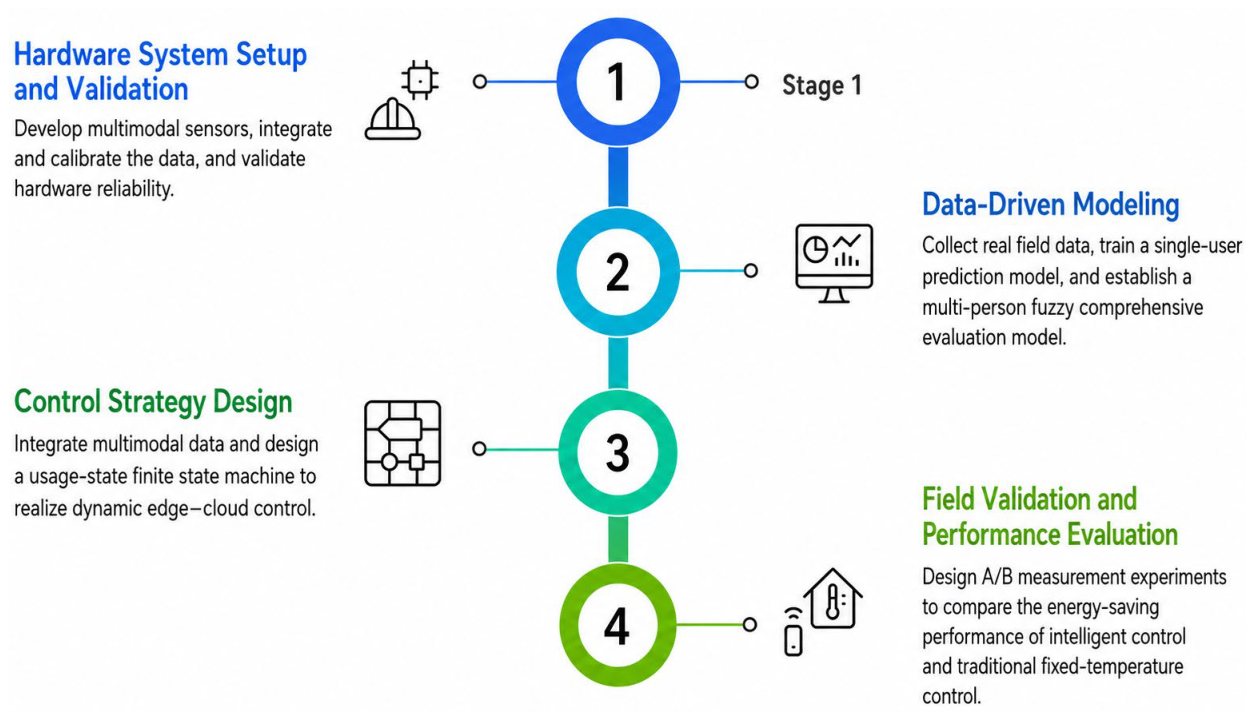
Figure 2.
Workflow of Environmental Data Acquisition, Cloud-Based Model Training, and Edge HVAC Control Using HUB 8735 ULTRA.
Figure 2.
Workflow of Environmental Data Acquisition, Cloud-Based Model Training, and Edge HVAC Control Using HUB 8735 ULTRA.
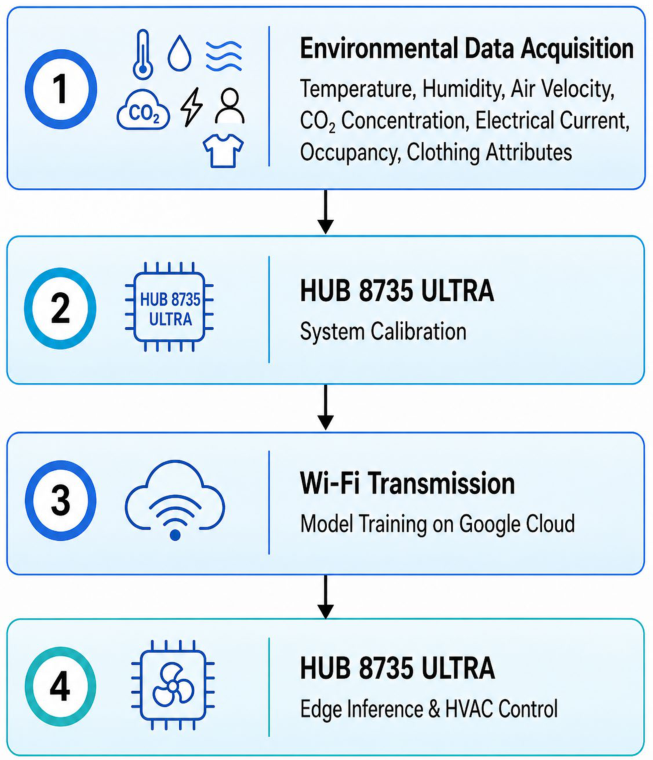
Figure 3.
Hardware implementation of the HUB 8735 ULTRA–based edge physical system: (a) PCB layout of the core control circuit; and (b) physical prototype and bench-testing setup.
Figure 3.
Hardware implementation of the HUB 8735 ULTRA–based edge physical system: (a) PCB layout of the core control circuit; and (b) physical prototype and bench-testing setup.
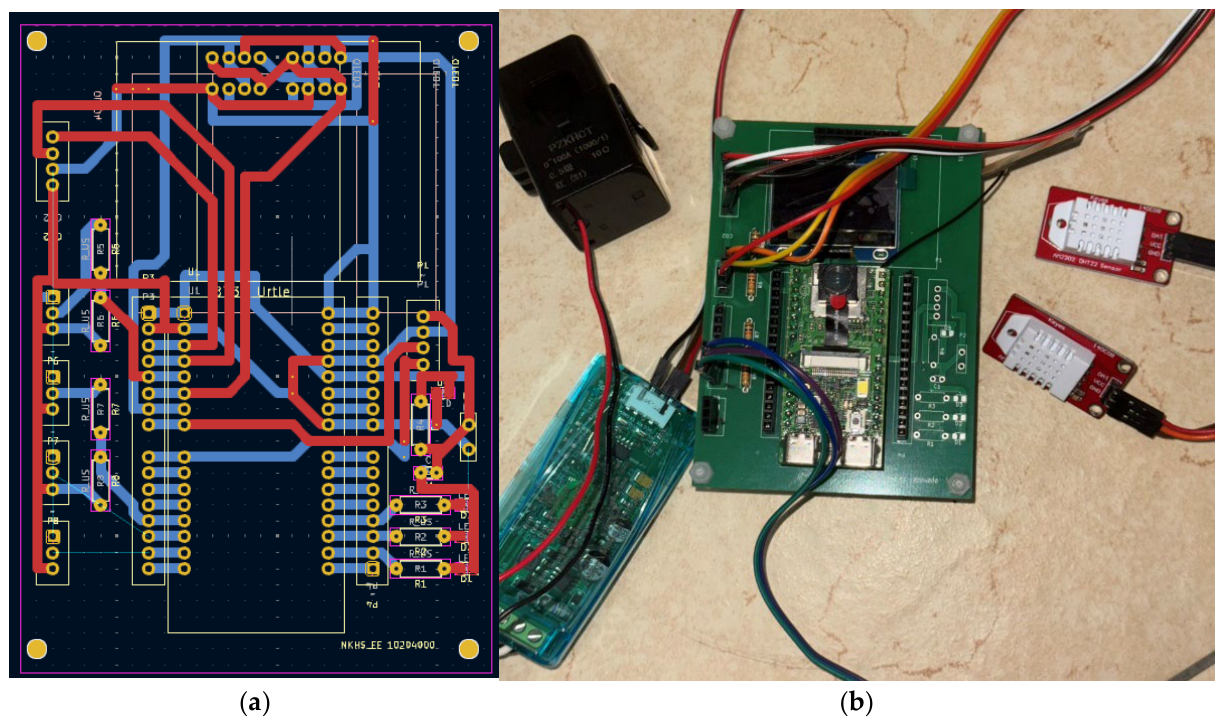
Figure 4.
Multimodal Edge–Cloud Framework for Human-Centric HVAC Control Based on Group Thermal Comfort Optimization.
Figure 4.
Multimodal Edge–Cloud Framework for Human-Centric HVAC Control Based on Group Thermal Comfort Optimization.
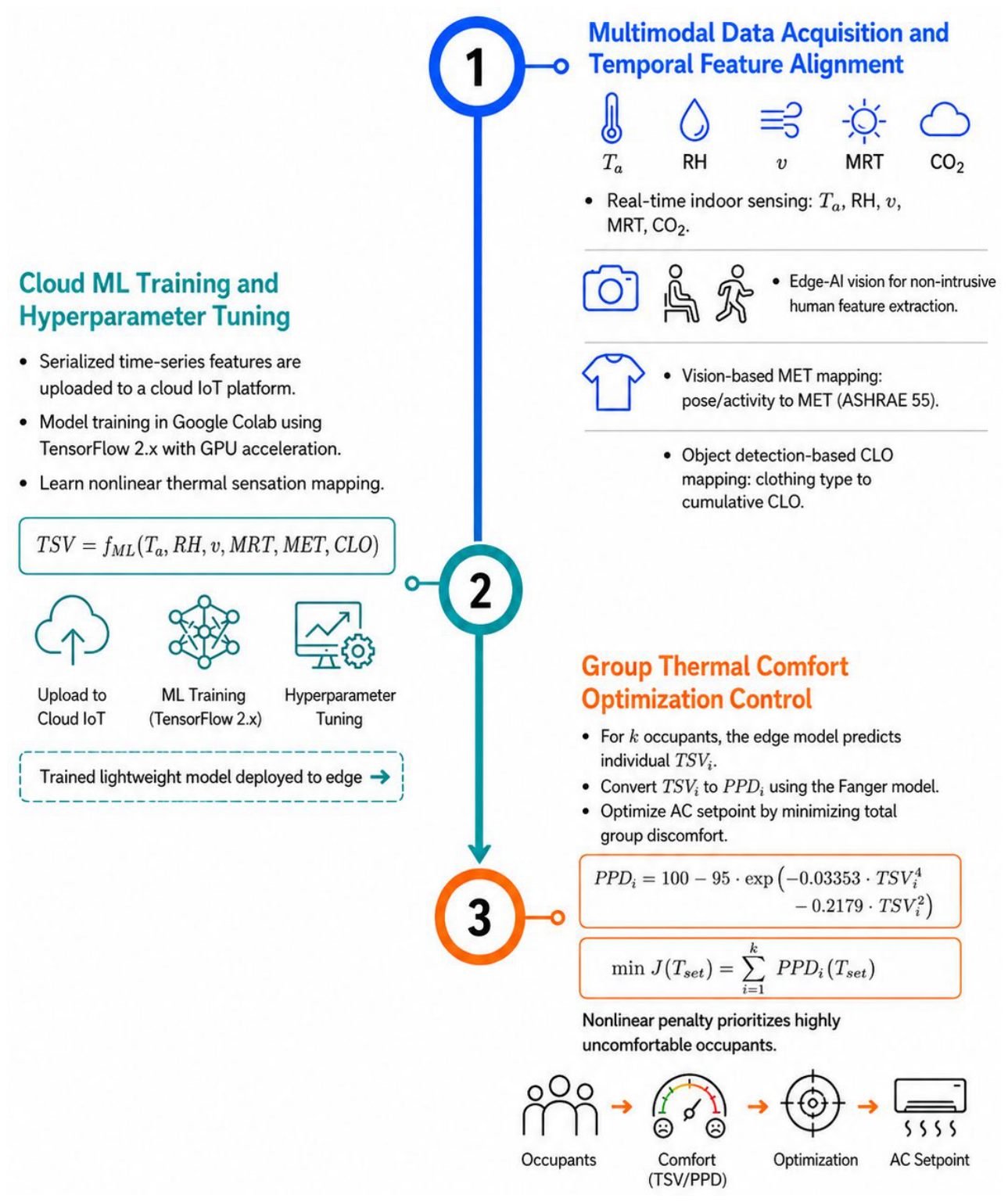
Figure 5.
Field Validation and Performance Evaluation Framework for Intelligent Air-Conditioning Control.
Figure 5.
Field Validation and Performance Evaluation Framework for Intelligent Air-Conditioning Control.
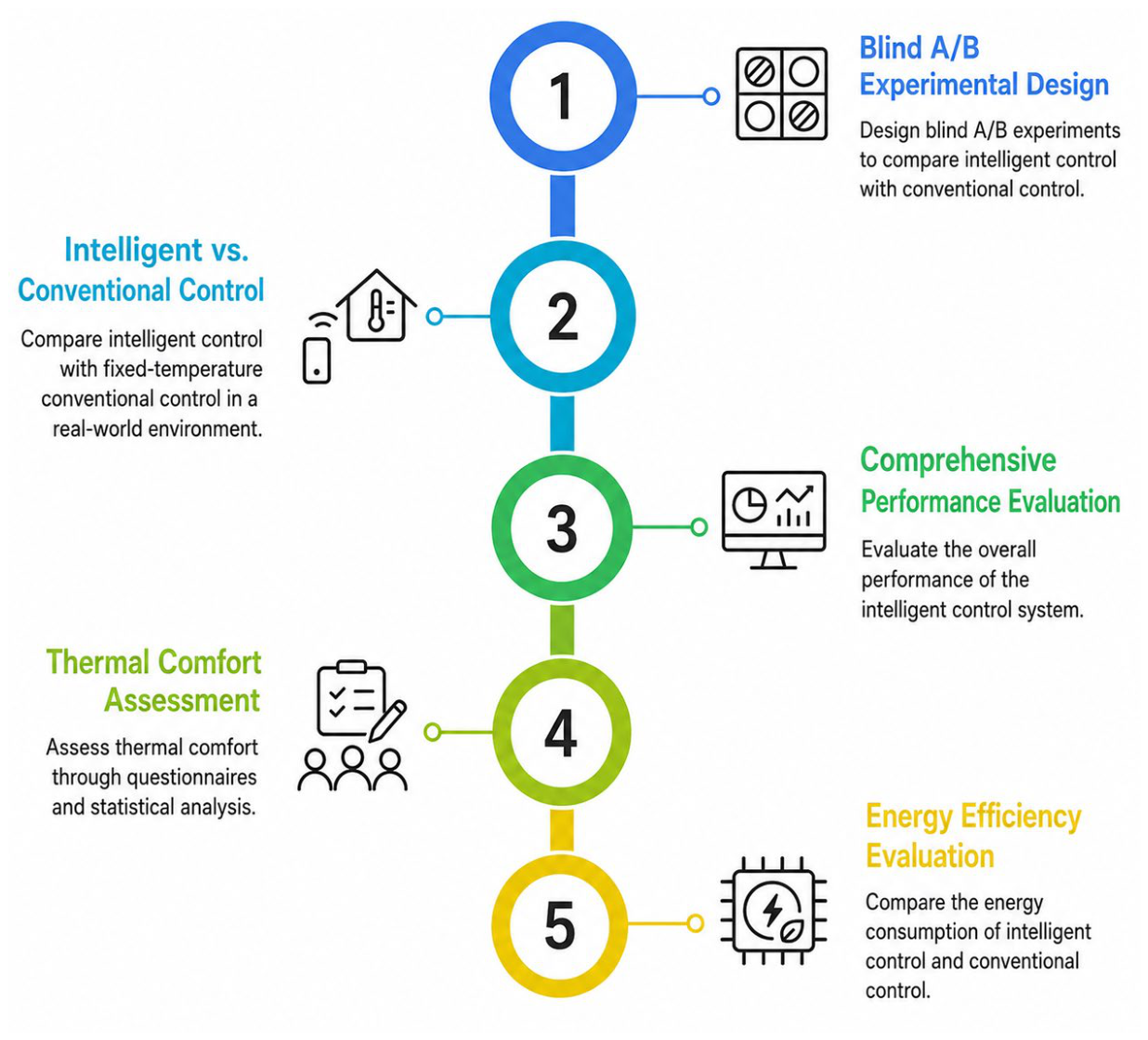
Figure 6.
Validation of the localized edge-sensing node against laboratory-grade reference instruments: (a) ambient air temperature () validation; (b) pre-calibration relative humidity () validation showing systematic sensor bias; and (c) post-calibration validation after software-defined linear correction.
Figure 6.
Validation of the localized edge-sensing node against laboratory-grade reference instruments: (a) ambient air temperature () validation; (b) pre-calibration relative humidity () validation showing systematic sensor bias; and (c) post-calibration validation after software-defined linear correction.
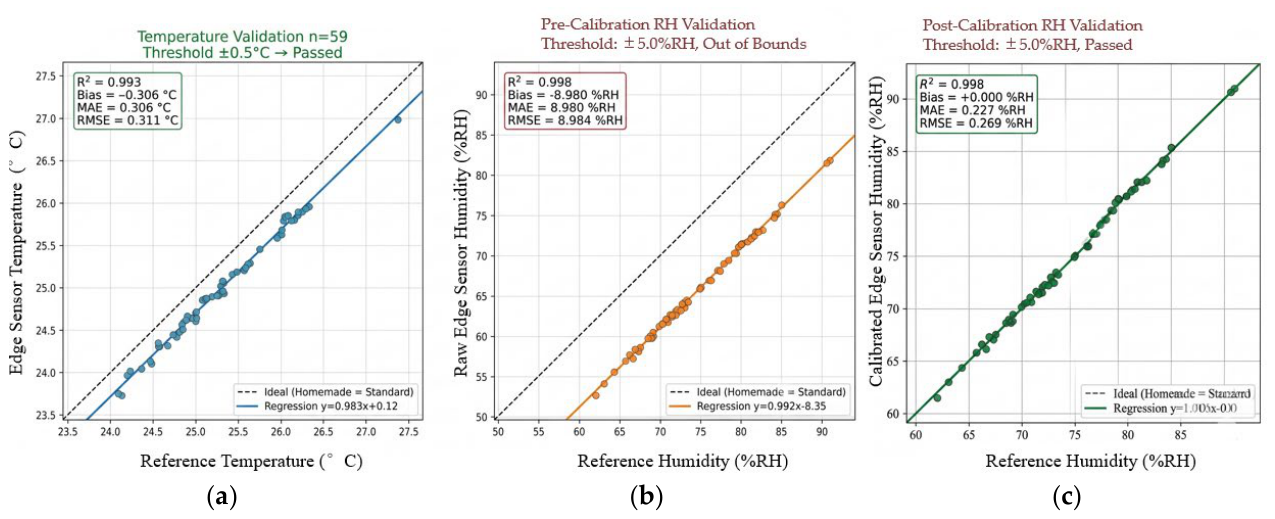
Figure 7.
Quantitative performance evaluation and residual error diagnostics of the INT8-quantized TensorFlow Lite thermal sensation model () deployed on the HUB 8735 ULTRA edge platform: (a) confusion matrix between measured and predicted thermal sensation votes (); (b) residual distribution of prediction errors; (c) class-specific mean absolute error across measured levels; and (d) mean predicted across measured levels for evaluating regression-to-the-mean behavior.
Figure 7.
Quantitative performance evaluation and residual error diagnostics of the INT8-quantized TensorFlow Lite thermal sensation model () deployed on the HUB 8735 ULTRA edge platform: (a) confusion matrix between measured and predicted thermal sensation votes (); (b) residual distribution of prediction errors; (c) class-specific mean absolute error across measured levels; and (d) mean predicted across measured levels for evaluating regression-to-the-mean behavior.
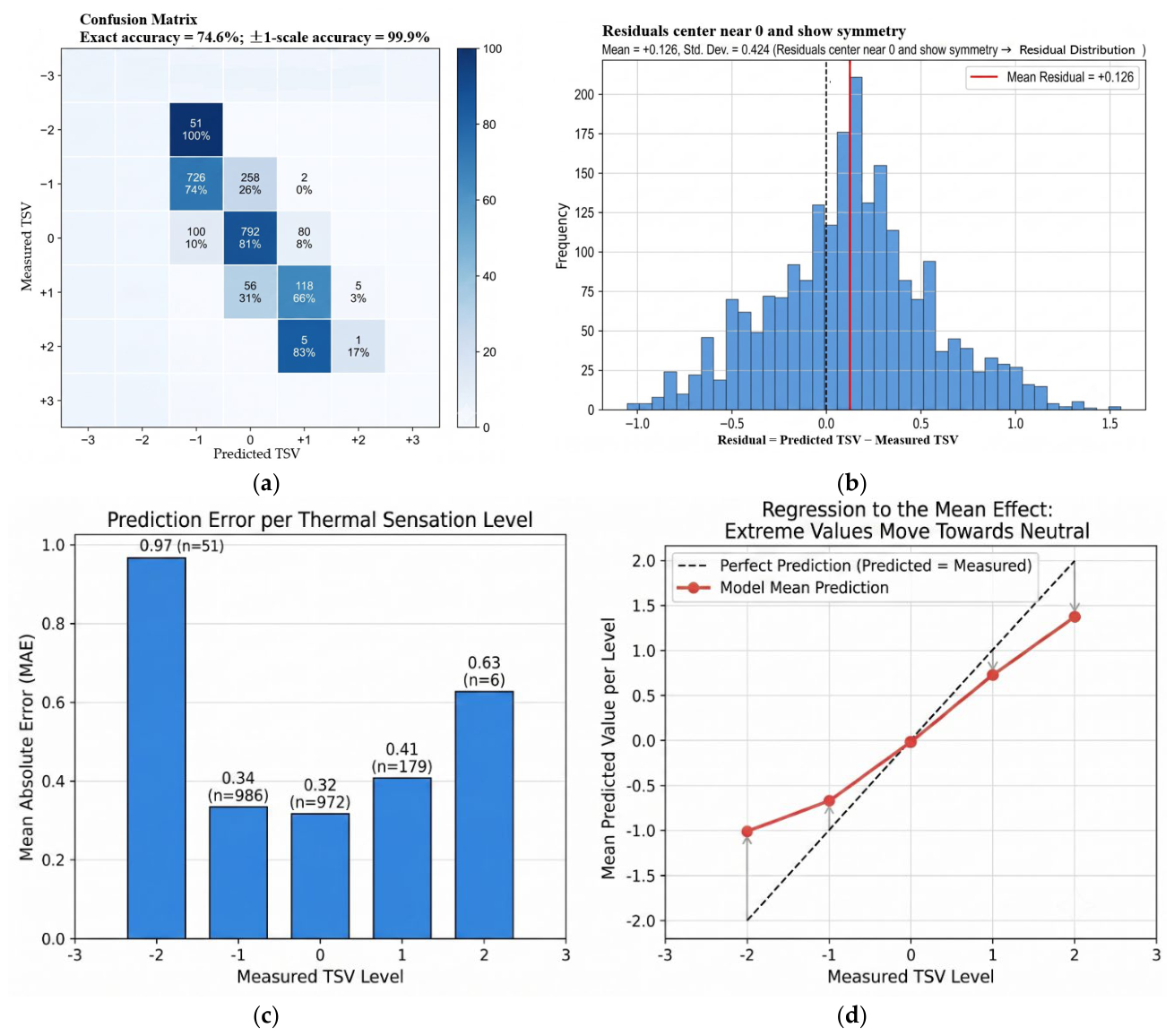
Figure 8.
Comparative evaluation of thermal comfort responses under the proposed smart control strategy and the fixed 25 °C baseline: (a) percentage distribution of Thermal Sensation Votes (TSVs) on the ASHRAE 7-point scale; and (b) independent-samples t-test comparison of mean TSV values with 95% confidence intervals between the two control conditions.
Figure 8.
Comparative evaluation of thermal comfort responses under the proposed smart control strategy and the fixed 25 °C baseline: (a) percentage distribution of Thermal Sensation Votes (TSVs) on the ASHRAE 7-point scale; and (b) independent-samples t-test comparison of mean TSV values with 95% confidence intervals between the two control conditions.
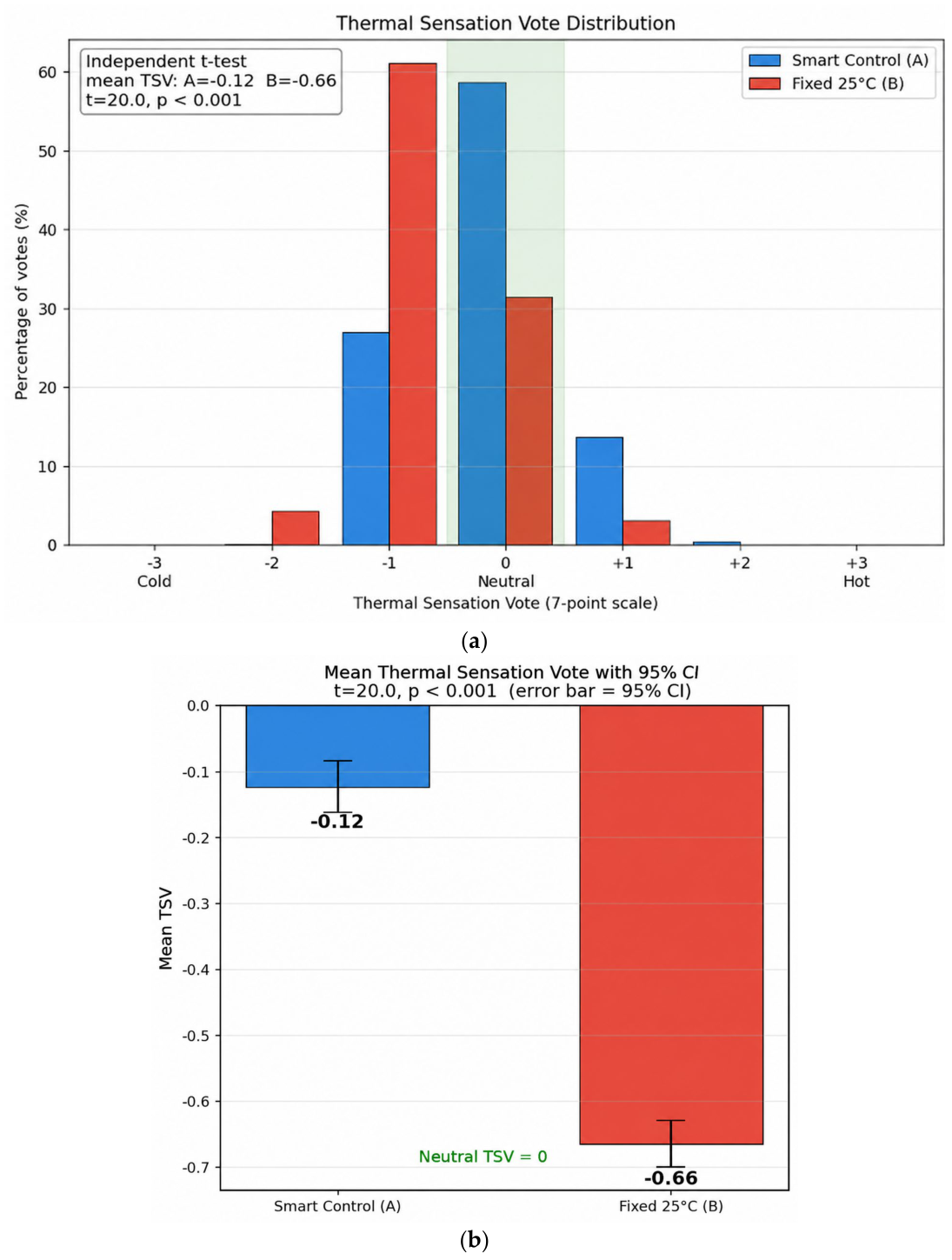
Figure 9.
Edge-based control trajectories and group thermal dissatisfaction under the proposed smart control strategy and the fixed 25 °C baseline: (a) HVAC temperature setpoint trajectory (); (b) group mean Thermal Sensation Vote (Mean TSV) response; (c) diurnal Group PPD profile during a representative test day; and (d) multi-day Group PPD profile across consecutive experimental periods.
Figure 9.
Edge-based control trajectories and group thermal dissatisfaction under the proposed smart control strategy and the fixed 25 °C baseline: (a) HVAC temperature setpoint trajectory (); (b) group mean Thermal Sensation Vote (Mean TSV) response; (c) diurnal Group PPD profile during a representative test day; and (d) multi-day Group PPD profile across consecutive experimental periods.
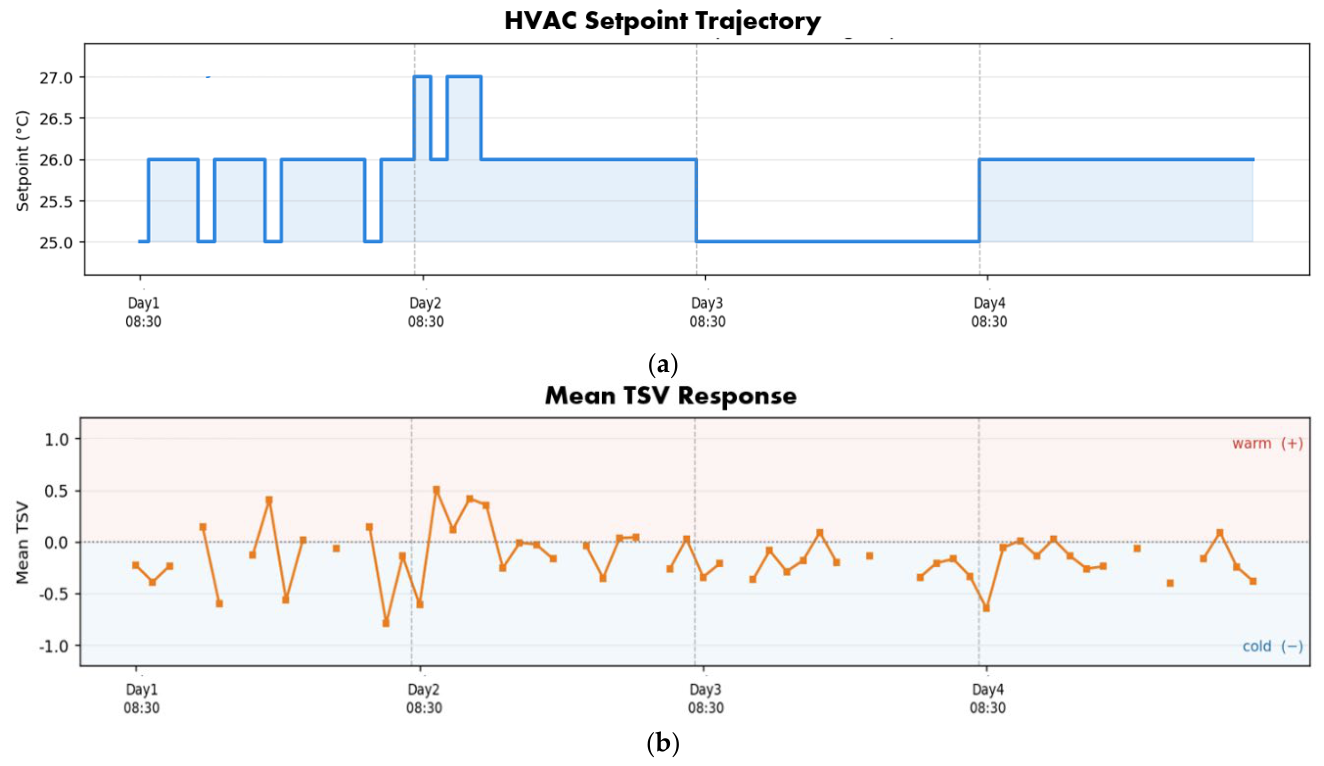
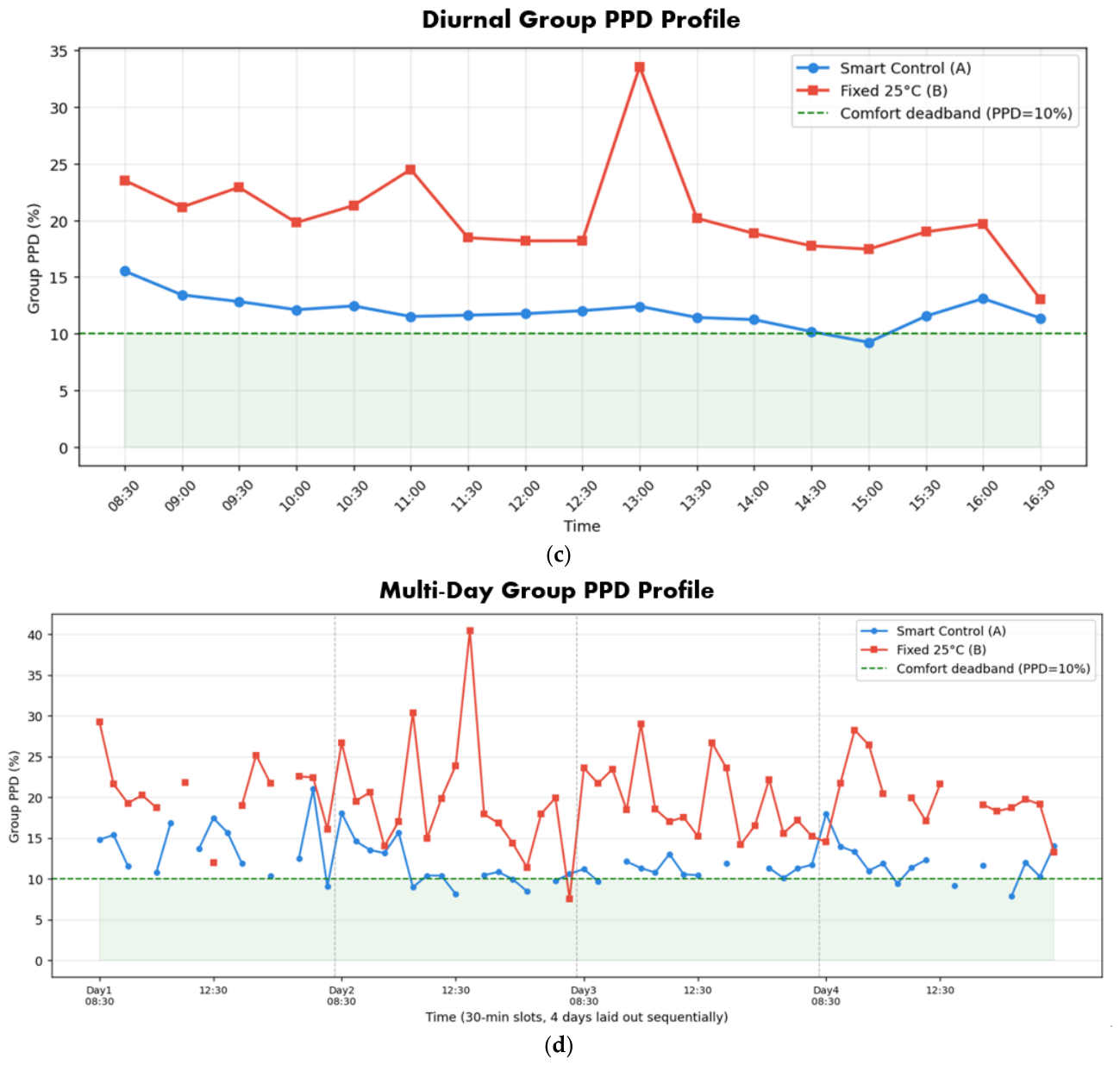
Figure 10.
Electrical power and cumulative energy consumption under the proposed smart control strategy and the fixed 25 °C baseline: (a) full-time instantaneous power profile including transient start-up fluctuations; (b) steady-state power profile after excluding start-up inrush periods; and (c) cumulative energy consumption over the experimental evaluation horizon.
Figure 10.
Electrical power and cumulative energy consumption under the proposed smart control strategy and the fixed 25 °C baseline: (a) full-time instantaneous power profile including transient start-up fluctuations; (b) steady-state power profile after excluding start-up inrush periods; and (c) cumulative energy consumption over the experimental evaluation horizon.
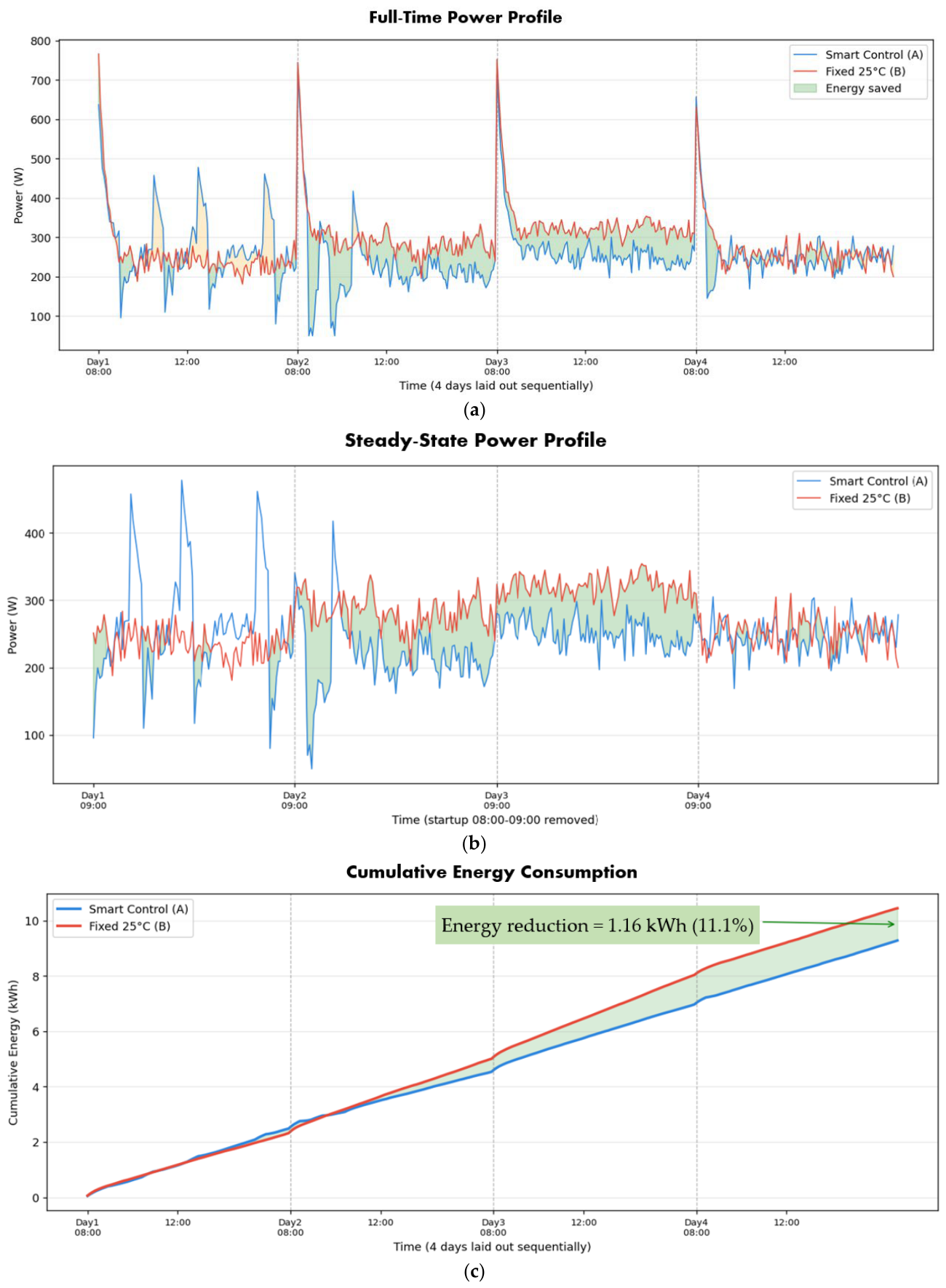

Table 1.
Technical Specifications of the HUB 8735 Ultra Development Board.
| Parameter | Specifications |
|---|---|
| Main SoC | Realtek Ameba RTL8735 (NCC certified) |
| AI Accelerator | Embedded Neural Processing Unit (NPU) for edge inference |
| Camera Module | Integrated 2-megapixel image sensor |
| Video Resolution | Up to 1080P Full HD video streaming |
| Audio Interface | Built-in microphone and audio mixer (with Buzzer PWM support) |
| Wireless Connectivity | Dual-band Wi-Fi (2.4 GHz / 5 GHz, 802.11 a/b/g/n) and BLE |
| Storage Expansion | MicroSD card slot (supports up to 512 GB) |
| Peripheral Interfaces | GPIO, I2C, SPI, UART, PWM |
| Development Environment | Arduino IDE compatible |
| Power & Data Interface | Native USB Type-C |
Table 2.
The detailed technical specification of core sensors.
| Model | DHT22 |
|---|---|
| Power supply | 3.3-6V DC |
| Output signal | digital signal via single-bus |
| Sensing element | Polymer capacitor |
| Operating range | humidity 0-100%RH; temperature -40~80Celsius |
| Accuracy | humidity +-2%RH(Max +-5%RH); temperature <+-0.5Celsius |
| Resolution or sensitivity | humidity 0.1%RH; temperature 0.1Celsius |
| Repeatability | humidity +-1%RH; temperature +-0.2Celsius |
| Humidity hysteresis | +-0.3%RH |
| Long-term Stability | +-0.5%RH/year |
| Sensing period | Average: 2s |
| Interchangeability | fully interchangeable |
| Dimensions | small size 14*18*5.5mm; big size 22*28*5mm |
Table 3.
Descriptive statistics of environmental measurements obtained from the reference instrument and the proposed system.
Table 3.
Descriptive statistics of environmental measurements obtained from the reference instrument and the proposed system.
| Parameter | Measurement system | Sample (n) | Mean | SD | Min | Max |
|---|---|---|---|---|---|---|
|
Ambient temperature (°C) |
Reference instrument | 59 | 25.29 | 0.68 | 24.09 | 27.37 |
| Proposed system | 59 | 24.98 | 0.67 | 23.73 | 26.98 | |
|
Relative humidity (%RH) |
Reference instrument | 59 | 74.54 | 6.66 | 62.00 | 91.00 |
| Proposed system | 59 | 74.54 | 6.66 | 61.47 | 91.02 |
Disclaimer/Publisher’s Note: The statements, opinions and data contained in all publications are solely those of the individual author(s) and contributor(s) and not of MDPI and/or the editor(s). MDPI and/or the editor(s) disclaim responsibility for any injury to people or property resulting from any ideas, methods, instructions or products referred to in the content. |
© 2026 by the authors. Licensee MDPI, Basel, Switzerland. This article is an open access article distributed under the terms and conditions of the Creative Commons Attribution (CC BY) license.
Copyright: This open access article is published under a Creative Commons CC BY 4.0 license, which permit the free download, distribution, and reuse, provided that the author and preprint are cited in any reuse.


