
Submitted:
25 June 2026
Posted:
26 June 2026
You are already at the latest version
Abstract
This study analyzes climate vulnerability and adaptive capacity in Mozambique, Malawi, and Madagascar from a gender perspective using survey data from 2,662 households. The Household Vulnerability Index was constructed using Principal Component Analysis. Cross-country and gender-group differences were assessed using ANOVA and Bonferroni post hoc tests, revealing significant cross-country disparities (p < 0.001). Mozambique exhibits the highest vulnerability severity and dispersion, driven by compound environmental exposure, elevated sensitivity, and constrained adaptive capacity. In contrast, Malawi — despite high physical exposure — presents the lowest overall vulnerability among the three countries, as stronger adaptive capacity offsets environmental risk. Madagascar occupies an intermediate position, with households clustered within the moderate vulnerability category, reflecting chronic sensitivity and limited adaptive capacity. While aggregated mean HVI scores are statistically identical between gender groups (F < 0.01; p = 0.980), categorical and variance analyses reveal heterogeneous distributions: male-headed households face direct occupational risk, whereas female-headed households contend with severe structural barriers to accessing adaptive resources. Agricultural extension services, institutional support, targeted training, climate-smart agriculture, and livestock assets constitute the primary drivers of resilience. These findings demonstrate that mean-based analyses mask gender disparities in vulnerability and highlight the need for context-specific, gender-responsive adaptation policies in Southern Africa.
Keywords:
climate vulnerability
; adaptive capacity
; household vulnerability index
; gender disparities
; Southern Africa
1. Introduction
The Southern African region is highly susceptible to the impacts of climate change due to the increasing frequency and intensity of droughts, floods, cyclones, and heatwaves, which severely compromise livelihoods, ecosystems, and infrastructure [1]. Climate change poses a significant threat to sustainable development in the region, particularly in countries characterized by substantial dependence on climate-sensitive sectors, widespread poverty, weak infrastructure, and limited adaptive capacity [2,3]. Recent projections indicate rising temperatures, more erratic rainfall patterns, and heightened exposure to extreme weather events across Southern Africa, with significant implications for agriculture, food security, water resources, and rural livelihoods [1,4].
Climate vulnerability denotes the extent to which households or systems are exposed to and unable to cope with the effects of climate variability [5]. According to the IPCC, vulnerability results from the interaction of three dimensions: exposure, sensitivity, and adaptive capacity [6]. Specifically, exposure refers to the extent to which households are subjected to climate hazards (cyclones, floods, and droughts), sensitivity reflects the degree to which livelihoods and living conditions are affected by such stressors, and adaptive capacity refers to the ability of households and communities to anticipate, respond to, and recover from climate shocks [7,8,9].
While sharing common climate risks, Mozambique, Malawi, and Madagascar exhibit distinct vulnerability profiles driven by institutional variations, socioeconomic conditions, and differential adaptive capacity. Mozambique is highly exposed to climate-related disasters — including tropical cyclones, floods, and droughts — due to its long coastline and extensive low-lying areas, conditions further compounded by high poverty rates [1,10,11]. Malawi, although landlocked, remains vulnerable due to its substantial dependence on rain-fed agriculture, recurrent flooding within the Shire Valley basin, high poverty levels, and limited livelihood diversification [4,12]. In Madagascar, climate vulnerability is compounded by cyclone events, chronic poverty, weak infrastructure, and the cumulative erosion of household assets through successive climate shocks [13,14].
Climate vulnerability is intrinsically linked to social-structural inequalities, particularly gender disparities. Existing evidence from Sub-Saharan Africa consistently shows that women are disproportionately affected by climate change due to unequal access to productive assets, land, education, climate information, financial services, agricultural technologies, and decision-making processes [5,15,16]. Consequently, female-headed households face systemic constraints in mobilizing resources and adopting adaptation strategies, thereby undermining their adaptive capacity and amplifying their vulnerability to climate shocks. Such inequalities are magnified in rural areas where households depend on climate-sensitive sectors such as agriculture, fisheries, and livestock [5,17,18].
Despite the growing literature on climate vulnerability, significant empirical gaps remain. Most existing studies focus either on specific countries or on isolated dimensions of vulnerability, offering limited comparative evidence across different national contexts. In particular, cross-country studies integrating exposure (EXP), sensitivity (SE), adaptive capacity (AC), and gender dimensions simultaneously remain scarce in Southern Africa. In addition, many vulnerability assessments focus primarily on the macro-level distribution of households, paying less attention to the dispersion, intensity, and heterogeneity of vulnerability across contexts. Consequently, households classified within the same vulnerability category may still experience disparate levels of vulnerability intensity and adaptive limitations.
To address these gaps, our study evaluates household climate vulnerability and adaptive capacity in Mozambique, Malawi, and Madagascar from a gender perspective through the construction of a Household Vulnerability Index (HVI) using Principal Component Analysis (PCA). By combining a comparative cross-country approach with a gender perspective, we examine how institutional conditions, livelihood structures, and gender inequalities influence household climate vulnerability across Southern Africa. Furthermore, we analyze how vulnerability intensity and dispersion vary across countries and household groups. This integrated framework extends beyond conventional single-country assessments by integrating micro-level household data across countries with distinct macroeconomic and institutional conditions.
2. Materials and Methods
2.1. Description of the Study Area
This study was conducted in three countries in Southern Africa: Mozambique (MOZ), Malawi (MWI), and Madagascar (MAD). The analysis focused on two areas in each country: Beira and Mossuril (Mozambique), Chikwawa and Nsanje (Malawi), and Marovoay and Manakara (Madagascar). These sites were selected to capture diverse socioeconomic and ecological contexts characterized by high exposure to climate risks, particularly tropical cyclones and floods, to enable a systematic comparative analysis (Figure 1).
2.1.1. Socioecological Context of Mozambique
Mozambique’s vulnerability is largely driven by its extensive Indian Ocean coastline, coupled with high exposure to tropical cyclones, floods, and recurrent droughts, compounded by elevated poverty rates [10,19,20]. These conditions place severe pressure on household livelihoods and food security. Data collection was conducted in the city of Beira (Sofala Province) and in the district of Mossuril (Nampula Province). Beira is a major coastal city and logistics hub, located in a low-lying area susceptible to flooding and cyclones [21,22]. Conversely, Mossuril represents a predominantly rural context, where livelihoods depend primarily on subsistence rain-fed agriculture and artisanal fishing [23].
2.1.2. Socioecological Context of Malawi
Malawi’s vulnerability stems from its heavy dependence on rain-fed agriculture, which is highly sensitive to climate variability [4,18]. Extreme weather events, including floods, droughts, and cyclones, have increased in frequency and intensity, particularly in the southern region [12]. Between 2010 and 2023, the country experienced multiple flood events, including the catastrophic floods of 2015, which displaced hundreds of thousands of people, and Cyclone Freddy in 2023, which triggered severe landslides and widespread agricultural destruction [24]. These events underscore the country’s high vulnerability to climate shocks. The research was conducted in the districts of Chikwawa and Nsanje, located within the Shire Valley basin—a region characterized by fertile lowlands that are highly susceptible to seasonal flooding [25]. The local economy relies predominantly on subsistence agriculture and artisanal fishing, in a context characterized by limited access to basic services and high poverty levels [12].
2.1.3. Socioecological Context of Madagascar
Madagascar is often cited as one of the most vulnerable countries to climate change, due to a combination of high exposure to extreme weather events and structural socioeconomic vulnerabilities [26]. The country faces frequent high-intensity tropical cyclones, particularly along the eastern coast, while droughts are also frequent across the country [13,27]. Cyclones account for approximately 85% of annual losses associated with natural disasters, affecting infrastructure, housing, agricultural systems, and livelihoods [27]. Recent events, such as cyclones Batsirai and Emnati (2022) and Freddy (2023) — which also struck Malawi and Mozambique — highlight the severity and geographic reach of these events and their substantial impacts on affected populations [13]. The study was conducted in Marovoay (northwestern region) and Manakara (southeastern coast). Marovoay is characterized by a dry tropical climate and an economy based on subsistence agriculture and livestock farming, while Manakara has a humid tropical climate and a more diversified agricultural economy [27,28].
2.2. Data and Sampling Design
The study adopted a three-stage sampling design, combining the purposive selection of communities with random household sampling to ensure adequate representativeness and comparability. In the first stage, two districts in each country were purposively selected based on their high vulnerability to cyclones and floods, as evidenced by historical and recent extreme weather events.
In the second stage, the most vulnerable localities within each district were purposively selected to capture contextual differences, ensuring adequate geographic coverage and accounting for spatial heterogeneity. In the third stage, households were randomly selected at the community level. The sample size in each locality was determined proportionally to the total number of households in each district, ensuring representative coverage across sites. Quantitative data collection was conducted using the KoboToolbox digital platform. During the surveys, informed consent was obtained from all participants, who were also informed about confidentiality and data protection procedures.
In Mozambique, data collection occurred in two phases: Mossuril in June 2024 (444 households) and Beira in August 2024 (667 households), yielding a total of 1,111 surveyed households. In Malawi, data collection was conducted in May 2024, resulting in a sample of 817 households. In Madagascar, data collection took place between October and November 2024, with a total sample of 734 households. In total, the study sample comprises 2,662 households distributed across the three countries analyzed (Table 1).
2.3. Data Analysis
Descriptive statistics — including means, frequencies, and standard deviations — were generated using Stata version 17 to characterize household socioeconomic and environmental conditions and assess variation across study areas. In addition to descriptive statistics, the HVI was constructed according to the methodology described below.
2.4. Construction of the Household Vulnerability Index
Composite indices are widely used in climate vulnerability studies; specifically, the HVI enables the simultaneous assessment of socioeconomic, institutional, and environmental factors associated with vulnerability [6,29]. Compared to single-indicator approaches, the HVI provides a more comprehensive assessment of climate vulnerability by incorporating the exposure, sensitivity, and adaptive capacity dimensions within a single analytical framework [8,9].
The HVI in this study is grounded in the IPCC conceptual framework, wherein climate vulnerability emerges from the interaction among exposure, sensitivity, and adaptive capacity. Within this framework, exposure denotes the degree to which households are subjected to extreme weather events such as cyclones and floods [29,30]; sensitivity refers to the extent to which households are affected by such events [31]; and adaptive capacity refers to households’ ability to anticipate, respond to, and recover from climate shocks [7,8,32]. Accordingly, higher exposure and sensitivity exacerbate vulnerability, whereas stronger adaptive capacity reduces it [33].
Before constructing the HVI, variables representing the three dimensions were selected based on the empirical literature related to cyclones and floods [8,34,35], as presented in Table 2. To ensure comparability across indicators with different units of measurement, all variables were standardized using z-scores prior to PCA (Equation 1). In Equation 1, represents the standardized value (z-score) of variable i for household j; Xij denotes the observed value of variable i for household j; refers to the mean of variable i; and Si denotes the standard deviation of variable i.
To determine the relative weights of the variables, PCA was used for dimensionality reduction and weight assignment. Data suitability for factor analysis was assessed using the Kaiser–Meyer–Olkin (KMO) test. Variables with KMO values below 0.50 were excluded from the final PCA; all retained variables met this minimum threshold (see Table A3).
Although PCA was conducted using the pooled database to ensure comparability across countries, the continuous indices were grouped into three categories (high, low, and moderate) using equal interval classifications derived from the observed minimum and maximum values of each index. The first principal component (PC1) was retained for each dimension because it explained the largest share of the total variance — accounting for 47.8% of variance in exposure, 46.7% in sensitivity, and 44.2% in adaptive capacity — and best represented the underlying structure of the indicators (see Table A4). This procedure is commonly used in vulnerability index construction studies [36,37,38]. The HVI was subsequently calculated by combining the three dimensions, according to the following expression:
In Equation 2, the term represents the exposure component, where Ykj corresponds to the normalized value of exposure-related variable k for household j, while Bk denotes the factor weight for exposure indicators. Similarly, the term denotes the sensitivity component, where Zlj corresponds to the normalized value of sensitivity-related variable l for household j, and Cl indicates the factor weight for sensitivity indicators. Finally, the term represents the adaptive capacity component, where Xij corresponds to the normalized value of adaptive capacity-related variable i for household j, and Ai denotes the factor weight for adaptive capacity indicators. Under this formulation, higher HVI values indicate greater household vulnerability, as exposure and sensitivity increase vulnerability while adaptive capacity reduces it. In this study, agricultural, livestock, and fishing losses were used as objective proxies for household exposure to climate shocks.
2.5. Statistical Analysis
Differences across countries and gender groups were assessed using tests appropriate to the measurement level of each variable. The chi-square (χ2) test was used to assess whether categorical variables were distributed differently across countries and household groups. To compare means across groups, one-way analysis of variance (ANOVA) was applied. The homogeneity of variances was assessed using Bartlett’s test prior to ANOVA. Whenever ANOVA indicated statistically significant differences, post hoc tests were performed using the Bonferroni method to identify pairwise differences between groups. Given sample sizes exceeding 700 households per country, ANOVA results are considered robust to departures from normality under the Central Limit Theorem. Statistical significance was set at 5% (α = 0.05).
3. Results and Discussion
3.1. Sociodemographic Characteristics of Households
Inferential statistics reveal highly significant heterogeneity across countries and gender groups (p < 0.001), reflecting structural variations in livelihood and demographic conditions (Table 3). Mozambique presents a younger household age distribution, whereas Madagascar shows a higher proportion of elderly household heads. Mozambique exhibits the highest educational attainment overall, whereas Malawi shows the highest reliance on primary-level education and the largest share of household heads with no formal schooling; educational deficits among female-headed households are most pronounced in Madagascar.
Regarding primary livelihoods, crop production, livestock, fishing, and self-employment constitute the dominant sources of income, though their distribution varies across countries. Malawi displays a strong dependence on crop production, whereas Madagascar presents a diversified livelihood structure. In Mozambique, male-headed households exhibit significantly higher participation rates in primary production (crop production, livestock, and fishing), whereas female-headed households exhibit higher participation in self-employment and informal economic activities.
3.2. Sensitivity Levels by Country and Gender
Sensitivity levels exhibit geographic contrasts, with high sensitivity peaking in Madagascar (30.4%), compared to Mozambique (13.5%) and Malawi (5.6%) (Table 4). This pattern suggests a stronger dependence on climate-sensitive livelihoods and more constrained socioeconomic conditions in Madagascar. These descriptive trends are confirmed by inferential analysis: the distribution of sensitivity categories differs markedly across countries (χ2(4) = 277.32; p < 0.001; Table 4). ANOVA also confirms significant differences in mean sensitivity scores (F = 163.90; p < 0.001) and heterogeneous variance across groups (Bartlett’s p < 0.001; Table A1).
Gender-related disparities in sensitivity are similarly pronounced. In Madagascar and Mozambique, the high-sensitivity category is dominated by male-headed households. In the pooled sample, 20.6% of male-headed households fall within the high-sensitivity category, compared to 11.6% of female-headed households (Table 5). Chi-square analysis confirms a significant association between household head gender and sensitivity category (χ2 (2) = 42.62; p < 0.001), corroborated by ANOVA results (F = 53.22; p < 0.001) and by significant variance heterogeneity between groups (Bartlett’s p < 0.001; Table A2). Within the sensitivity dimension, male-headed households score higher on variables associated with climate-dependent economic activities, such as agriculture, fishing, and livestock husbandry (Table 3). Consequently, the higher sensitivity index scores among male-headed households stem from direct engagement in climate-dependent livelihood activities rather than broader socioeconomic vulnerability.
In Madagascar, these patterns align with empirical studies highlighting the vulnerability of smallholder farming systems characterized by structural food insecurity, limited access to formal support mechanisms, and cyclonic shocks that trigger severe asset depletion [39]. In Mozambique, the moderate-to-high sensitivity levels corroborate documented socioeconomic vulnerabilities in coastal zones that depend on rain-fed agriculture, artisanal fishing, and livestock production [22]. Conversely, the lower sensitivity levels observed among households in Malawi—despite the country’s widespread reliance on rain-fed agriculture—point to the mitigating role of localized institutional frameworks and targeted agricultural support programs [40].
3.3. Exposure Levels by Country and Gender
The exposure analysis reveals pronounced structural and geographic variations across the three countries. High exposure is heavily concentrated in Malawi (58.3%) and Mozambique (35.0%), while Madagascar exhibits a lower proportion (27.3%) within this category (Table 4). Notably, the low-exposure category is negligible across all study areas (fewer than 2% of cases), demonstrating that exposure to climate risks constitutes a widespread structural condition. This pattern indicates that the vast majority of households reside within territories chronically vulnerable to environmental shocks.
Categorical exposure analysis indicates a robust country-level effect (χ2 (4) = 173.87; p < 0.001). Analysis of continuous exposure scores confirms these findings: mean exposure values differ significantly (F = 126.68; p < 0.001), with significant heteroscedasticity across groups (Bartlett’s p < 0.001). Bonferroni post hoc tests identify distinct geographic clusters: Malawi presents the highest exposure index, significantly distinct from both Madagascar and Mozambique, whereas the latter two countries display statistically comparable mean exposure levels (Table A1).
From a gender perspective, exposure differentials are moderate. In Mozambique, male-headed households exhibit a higher concentration in the high-exposure category (42.6%) than female-headed households (28.6%), whereas in Malawi both groups present statistically comparable proportions (56.3% and 59.9%, respectively). In Madagascar, high-exposure frequencies are lower for both groups, standing at 23.7% for female-headed and 32.1% for male-headed households (Table 5). Chi-square analysis confirms a statistically significant association between gender and exposure category in the pooled sample (χ2 (2) = 14.49; p < 0.001). Further, ANOVA confirms distinct mean exposure scores across groups (F = 29.85; p < 0.001; Table A2). This pattern suggests that male-headed households are engaged in livelihood systems more directly exposed to climate shocks.
Empirical literature from Malawi and Mozambique shows that smallholders are concentrated in geographic zones and production systems structurally susceptible to climate-induced asset erosion, notably low-yielding rain-fed farming, floodplains, and precarious coastal margins [25,41]. Our micro-level findings are consistent with these regional patterns, reinforcing the pervasive nature of climate exposure across the subregion. The negligible proportion of households within the low-exposure category across all countries and gender groups indicates that climate exposure represents a region-wide structural condition rather than an anomaly concentrated in specific demographic subgroups. This distribution concurs with macro-level assessments identifying Southern Africa as a climate hotspot characterized by compounding droughts, floods, cyclones, and multi-decadal rainfall variability that systematically destabilizes agrarian systems [11].
In Mozambique, coastal susceptibility to severe cyclone landfalls and concurrent flooding drives high systemic exposure, exacerbated by low-lying topography and subsistence coastal economies [1]. In Malawi, the combination of dependence on rain-fed agriculture and chronic seasonal flooding within the Shire Valley basin amplifies localized territorial exposure [4,12]. Conversely, Madagascar presents an empirical paradox: despite well-documented national-level climatic risk [26,27,42], our empirical indicators capture a lower relative exposure at the household level. This divergence highlights an important scalar nuance — the index reflects micro-level environmental stresses and direct asset impacts unique to the selected study sites, rather than reflecting aggregated national-level climate risk assessments.
3.4. Adaptive Capacity Across Countries and Gender
Cross-country comparisons reveal stark disparities in adaptive capacity (Table 4). Malawi presents the highest proportion of households in the high adaptive capacity category (12.0%), contrasting with Mozambique (1.4%) and Madagascar (1.4%), which exhibit considerably lower values. Conversely, Mozambique records the highest concentration within the low adaptive capacity category (56.6%), followed by Madagascar (37.1%). The high adaptive capacity category is notably underrepresented across the entire study region, accounting for just 4.7% of the pooled sample, indicating a systemic deficit in climate resilience. Chi-square analysis further confirms that the distribution of adaptive capacity categories differs significantly across countries (χ2 (4) = 310.26; p < 0.001). These results are corroborated by continuous adaptive capacity scores, which vary significantly across countries (F = 222.79; p < 0.001). Bonferroni post hoc comparisons confirm that all three country pairs differ significantly from one another (Table A1).
Gender disparities further differentiate adaptive capacity patterns. In the pooled sample, male-headed households are disproportionately represented in the high adaptive capacity category (7.2% vs. 2.6%), particularly in Malawi and Madagascar. In contrast, the gender gap in Mozambique is most evident at the lower end of the distribution, where 62.8% of female-headed households fall within the low adaptive capacity category, compared to 49.1% of male-headed counterparts. Chi-square analysis confirms that gender-based differences in adaptive capacity distributions are statistically significant across all countries (p < 0.001).
Corroborating the categorical analysis, male-headed households present significantly higher mean adaptive capacity scores (μ = 0.30) than female-headed households (μ = -0.24; p < 0.001). Variance also differs significantly by gender (Bartlett’s p < 0.001), with male-headed groups showing greater heterogeneity in adaptive capacity, whereas female-headed households are concentrated within lower and more homogeneous adaptive capacity levels (Table A2).
These findings indicate substantial cross-country disparities in the institutional and structural capacity to adapt to climate-related shocks. In Malawi, the relatively higher proportion of households within the high adaptive capacity category (12%) reflects broader access to institutional and community-based support systems, specifically extension services and training programs that improve households’ access to climate information and adaptation resources [18,40]. However, this capacity remains restricted to a minority, suggesting that, while these institutional frameworks exist, their operational scale is insufficient to move the remaining 88% of Malawian households beyond low-to-moderate adaptive capacity thresholds.
In contrast, in Mozambique, this capacity is severely undermined by limited rural infrastructure, weaker institutional coverage, and restricted access to technical and adaptation support services, particularly in vulnerable rural and coastal areas [22], thereby leaving high-exposure zones without institutional support to manage recurrent climate shocks. In Madagascar, adaptive capacity is structurally impeded by persistent rural poverty, limited livelihood diversification, weak institutional support mechanisms, and a strong dependence on climate-sensitive livelihoods [26], factors that collectively constrain adaptive capacity.
The negligible proportion of households within the high adaptive capacity category across all countries (averaging just 4.7% in the pooled sample) demonstrates that populations throughout the region face systemic, entrenched barriers in accessing the resources, services, and institutional support necessary to strengthen long-term resilience. Within the broader HVI framework, this widespread capacity deficit acts as a vulnerability multiplier, leaving households without sufficient adaptive capacity to offset existing environmental exposure, thereby exacerbating their overall vulnerability to climate shocks. This pattern aligns with macro-level evidence from Sub-Saharan Africa showing that limited access to extension services, climate information, productive assets, financial resources, and diversified livelihoods systematically undermines households’ coping mechanisms, particularly among vulnerable rural populations [4,15,18].
Beyond cross-country variations, the observed gender disparities demonstrate that female-headed households contend with severe, asymmetric constraints in accessing productive resources, institutional support, and adaptation opportunities, thereby lowering their adaptive capacity across all analyzed contexts [5,15,17]. These results reveal the multidimensional nature of vulnerability pathways: while male-headed households exhibit a higher direct sensitivity due to their primary economic activities, female-headed households face a significant adaptation deficit — illustrated by the concentration of 62.8% of female-headed households in the low adaptive capacity category in Mozambique — that prevents them from offsetting environmental risks. Household resilience depends not only on physical exposure and economic sensitivity but critically on the institutional and asset conditions that shape adaptive capacity.
3.5. Determinants of Adaptive Capacity
Factor loadings from the first principal component (PC1) identify the structural drivers of adaptive capacity across the study countries (Table 6). The analysis demonstrates that adaptive capacity is shaped by the interaction of socioeconomic, institutional, and infrastructural variables.
In Mozambique, the primary positive contributors comprise climate-smart agriculture (factor loadings = 0.41), access to agricultural extension services (0.34), participation in training programs (0.33), access to drainage infrastructure (0.26), and livestock adaptation practices (0.20). These results highlight the critical role of technical support, agricultural adaptation practices, and local infrastructure in enhancing adaptive capacity in areas chronically exposed to cyclones, floods, droughts, and coastal hazards. This finding aligns with the literature demonstrating that institutional extension support, targeted training, and climate-smart agricultural practices mitigate socioeconomic vulnerability by safeguarding household livelihoods within highly vulnerable coastal regions [22,43,44].
In Malawi, the first principal component is predominantly driven by training programs (0.40), access to agricultural extension services (0.39), the adoption of anticipatory actions (0.33), membership in climate-related groups (0.28), and access to emergency aid (0.27). These findings confirm the critical role of institutional advisory networks, anticipatory action frameworks, and collective social capital. This structural composition aligns with the literature demonstrating how community-driven institutions and informal support networks mitigate household-level climate risk within vulnerable river basin systems [18,40].
In Madagascar, the highest statistical weight is associated with liquid productive assets and autonomous coping strategies, namely livestock adaptation practices (0.44), livestock ownership (0.43), climate-smart agriculture (0.37), and an elevated housing location (0.32), while institutional extension services (0.27) exert less relative influence. These patterns indicate that under conditions of chronic rural poverty and weak institutional coverage, adaptation depends heavily on private asset holdings. The prominent role of livestock confirms that these assets serve as liquid assets that households mobilize to cope with climate shocks. These findings corroborate previous evidence regarding the structural constraints on Malagasy household resilience caused by asset-depletion dynamics [13,26].
Negative factor loadings further reveal structural gaps in adaptive capacity across the three countries. In Madagascar, access to drainage systems (−0.34) and access to cyclone early warning (−0.16) yielded the most pronounced negative loadings, suggesting that these infrastructure-dependent mechanisms are largely absent or operationally irrelevant within the sampled communities, and therefore fail to contribute to household adaptive capacity in that context. In Mozambique, previous experience with flooding (−0.38) and education level (−0.36) emerged as the strongest negative contributors, indicating that prior flood exposure does not translate into enhanced preparedness — likely reflecting reactive rather than anticipatory coping — while the negative loading on education level suggests that, in the specific institutional context of Mozambique’s coastal zones, formal schooling alone does not confer adaptive advantages without complementary access to technical support and productive resources. Collectively, these negative loadings demonstrate that the mere existence of certain assets or experiences does not automatically strengthen adaptive capacity; their effectiveness depends on the institutional and infrastructural context.
Synthesis of these findings reveals two distinct structural pathways within the HVI framework. In Malawi and Mozambique, institutional networks and collective support systems serve as the primary adaptive buffers against household vulnerability, enabling certain households to achieve moderate resilience despite severe environmental exposure. Conversely, Madagascar’s profile reflects structural fragility; the intersection of high climate sensitivity and low adaptive capacity is driven by an acute dependence on climate-sensitive livelihoods that formal institutional support mechanisms fail to mitigate. Consequently, while mainland households rely on institutional support structures to navigate climate shocks, Malagasy households must rely almost exclusively on private asset liquidation, indicating a systemic deficit in subregional climate resilience.
3.6. Household Vulnerability Index Across Countries and Gender
The range of HVI scores captures the magnitude and dispersion of household vulnerability across the three countries. HVI scores range from -3.82 to 6.41 in Mozambique, from -3.60 to 6.33 in Malawi, and from -3.21 to 5.09 in Madagascar (Table 7). Mozambique presents the broadest spread of HVI scores, followed by Malawi and Madagascar. This extensive dispersion indicates substantial intra-national heterogeneity, where highly resilient households coexist with households facing severe climate-related and livelihood constraints. Conversely, the narrower range in Madagascar reflects a pervasive and structurally homogeneous vulnerability profile, attributable to the scarcity of highly resilient households that could extend the upper range of the index. Accordingly, Mozambique displays the most pronounced internal disparities in socio-environmental conditions.
Results presented in Figure 2 visually corroborate these patterns at the country level. While Mozambique records the widest minimum-to-maximum range (Table 7), the boxplot indicates that Malawi’s whisker-to-whisker spread — driven by a long lower tail toward severe vulnerability outcomes — is comparably wide despite its lowest median HVI. Madagascar’s compact box and short whiskers confirm its narrow, homogeneous distribution.
The categorical distribution further clarifies these patterns. Mozambique records the highest proportion of households in the high-vulnerability category (26.0%), followed by Madagascar (17.4%) and Malawi (10.6%). In contrast, Malawi exhibits the highest proportion within the low-vulnerability category (19.2%), while Madagascar shows the highest concentration within the moderate vulnerability category (77.4%). The low-vulnerability category remains limited across all countries, further demonstrating that vulnerability is widespread across the analyzed contexts, even where severe vulnerability is less concentrated.
These national profiles reflect the combined effects of the three HVI dimensions analyzed in preceding sections. Mozambique exhibits a compounding effect of severe environmental exposure, elevated economic sensitivity, and constrained adaptive capacity, thereby driving its disproportionate prevalence of households within the high-vulnerability category. Conversely, Malawi, although characterized by relatively high exposure as detailed in Section 3.2, presents stronger adaptive capacity and lower sensitivity, which effectively reduces overall risk and suppresses the concentration of households in the high-vulnerability category. Madagascar combines lower exposure with higher sensitivity and limited adaptive capacity, explaining its high concentration within the moderate vulnerability category. This interdependence confirms the IPCC framework, which defines vulnerability as the dynamic interaction among exposure, sensitivity, and adaptive capacity [6].
Parametric analysis using ANOVA confirms highly significant cross-country differences in the composite HVI. Significant differences are observed not only in mean HVI scores (F = 97.95; p < 0.001) but also in score dispersion (Bartlett’s test, p < 0.001), indicating substantial variance heterogeneity across countries. Bonferroni post hoc comparisons reveal that mean HVI scores differ significantly between Mozambique and Malawi, whereas Mozambique and Madagascar exhibit statistically comparable mean HVI scores (Table A1). This pattern reflects the greater severity and wider heterogeneity of vulnerability observed in Mozambique compared to the lower vulnerability observed in Malawi. These cross-country differences reflect the underlying disparities in localized risk, asset accumulation, and institutional protection mechanisms.
Within the HVI framework, the contrasting country profiles reflect distinct pathways driven by the interaction among exposure, sensitivity, and adaptive capacity. In Mozambique, the highest vulnerability scores arise from the convergence of severe environmental exposure, elevated economic sensitivity, and a substantial institutional deficit. This structural vulnerability is further compounded by Mozambique’s macroeconomic position. With a projected Gross Domestic Product (GDP) per capita of USD 632 in 2026 — the fourth lowest in Africa — Mozambique ranks as the poorest of the three study countries [45]. This level of per capita income severely constrains public investment in adaptive infrastructure, rural extension services, social protection systems, and disaster risk reduction mechanisms, thereby deepening the institutional deficit that the HVI captures at the household level.
The combination of coastal hazards and landscape susceptibility amplifies vulnerability, particularly among households that depend heavily on climate-sensitive livelihoods and face severe constraints on formal adaptive resources. Our micro-level findings corroborate the literature identifying Mozambique’s low-lying coastal zone as a disaster-prone landscape [1,10]. In the present study, these conditions are particularly evident in Beira, where low-elevation urbanization magnifies flooding and cyclonic impact, and in Mossuril, where livelihoods depend largely on rain-fed agriculture and artisanal fishing [11,20,46]. Within the HVI framework, because Mozambique’s adaptive capacity is structurally deficient, it fails to counterbalance these compounding pressures, placing 26% of the households analyzed in the high-vulnerability category.
Conversely, Madagascar’s intermediate position within the moderate vulnerability category (77.4%) reflects the offsetting relationship among its vulnerability dimensions. Sampled areas in Madagascar exhibit lower direct physical exposure; however, this advantage is entirely offset by chronic sensitivity and constrained adaptive capacity, driven by recurrent climate shocks, rural poverty, and limited livelihood diversification [14,26,27]. Madagascar’s macroeconomic profile corroborates this pattern: with a projected GDP per capita of USD 656 in 2026 — the fifth lowest in Africa — its poverty level is only marginally higher than Mozambique’s [45]. This asymmetry demonstrates that Madagascar’s vulnerability is driven less by physical exposure and more by severe structural constraints affecting assets and institutional support. Within the HVI equation, the lower exposure values prevent the majority of households from being classified within the highest vulnerability category, yet their near-total deficit in adaptive capacity prevents any systemic recovery, anchoring the majority of households within the moderate vulnerability category.
In Malawi, the HVI demonstrates a clear buffering effect: although highly exposed through rain-fed agriculture and recurrent flooding in the Shire Valley basin [4,12,25], the country’s comparatively higher adaptive capacity offsets this risk. This finding is particularly notable given that Malawi’s projected GDP per capita of USD 733 in 2026 — the seventh lowest in Africa — places it only slightly above Mozambique and Madagascar in macroeconomic terms [45]. The fact that Malawi achieves comparatively better HVI outcomes despite comparable poverty levels suggests that institutional frameworks and community-based adaptation mechanisms can partially offset income constraints, underscoring the policy relevance of targeted institutional investment even under conditions of severe resource scarcity.
These dynamics account for why relatively high exposure does not translate into a high concentration of high-vulnerability households (only 10.6%), while producing the highest share of households within the low-vulnerability category (19.2%). The lower vulnerability observed in Malawi is thus directly attributable to the robust presence of agricultural extension systems, farmer organizations, community-based adaptation initiatives, and local preparedness mechanisms that reduce the combined exposure and sensitivity scores, strengthening household capacity to anticipate, respond to, and recover from climate-related shocks [18,40].
From a gender perspective, the categorical distribution of vulnerability reveals distinct asymmetries between male- and female-headed households. In the pooled sample, male-headed households account for a higher proportion in the high-vulnerability category (20.9%) than female-headed households (17.4%). At the country level, Mozambique exhibits the starkest divergence: the proportion of highly vulnerable households is markedly higher among male-headed households (31.1%) than among female-headed households (21.8%). In Malawi, conversely, female-headed households present a higher proportion in the high-vulnerability category (12.6%) than male-headed households (8.1%), while in Madagascar, gendered variations are negligible and concentrated around the moderate vulnerability category (Table 8). Chi-square test confirms statistically significant associations between gender and vulnerability categories in Malawi, Mozambique, and the pooled sample (p < 0.001), whereas no statistically significant association emerges in Madagascar (p = 0.465).
The continuous HVI scores further clarify this pattern. Average HVI levels are virtually identical between female- and male-headed households (F < 0.01; p = 0.980). However, HVI dispersion differs significantly between groups (Bartlett’s test, p < 0.001), indicating substantial differences in variance between the two groups. While aggregated means are statistically identical, the underlying variance structures diverge significantly (Table A2). Taken together, these findings demonstrate that gender-based disparities are highly visible within categorical profiles but masked when only aggregated continuous means are compared, thereby highlighting the limitations of mean-based comparisons for policy design.
Figure 3 disaggregates these patterns by gender within each country. The direction of the gender gap is not uniform: female-headed households present a marginally lower median HVI in Mozambique, a moderately higher median in Malawi, and a virtually identical median in Madagascar. This heterogeneity indicates that gender effects on vulnerability are conditional on national institutional and livelihood contexts rather than operating through a single, generalizable mechanism.
These gender differences are directly rooted in the distinct livelihood structures, exposure patterns, sensitivity conditions, and adaptive constraints observed across the analyzed contexts. Male-headed households are concentrated in climate-sensitive primary production sectors, such as agriculture, livestock production, and fishing (Table 3), a pattern that amplifies their direct exposure to climate-related production losses and drives their greater representation within the high-vulnerability categories.
The structural drivers behind these gendered patterns stem from the asymmetric composition of the HVI dimensions. Evidence from Sub-Saharan Africa indicates that female-headed households frequently face institutional barriers to accessing productive assets, agricultural technologies, and financial resources, which directly constrain their adaptive capacity [5,15,17]. In the present study, female-headed households are more concentrated in self-employment and informal livelihood activities (Table 3), characterized by unstable income and restricted institutional support. Within the HVI framework, these structural disadvantages generate a hidden vulnerability; even where the direct physical exposure score is lower, their structural deficit in adaptive capacity acts as a binding constraint that keeps 74.9% of female-headed households within the moderate vulnerability range.
Overall, the index reveals a clear gendered division of risk: male-headed households exhibit acute environmental exposure and direct livelihood sensitivity, while female-headed households contend with severe adaptive constraints. This distinction highlights how climate vulnerability manifests differently across groups. Male-headed households are more frequently represented in the high-vulnerability category due to immediate, direct occupational risks in climate-sensitive sectors. Conversely, female-headed households remain structurally disadvantaged, meaning that even minor climatic perturbations may destabilize their livelihoods given their limited resource base. These patterns confirm that climate vulnerability cannot be evaluated through physical hazards alone, but must be understood as the dynamic interaction between hazard exposure, economic sensitivity, and adaptive capacity.
Limitations: Several methodological limitations affect the interpretation of these findings. First, the cross-sectional nature of the data precludes the assessment of longitudinal shifts in household vulnerability. Second, while the HVI integrates multiple dimensions of climate risk, any composite index inherently simplifies nuanced social and institutional factors. Third, certain sensitivity indicators reflect household participation in climate-sensitive livelihoods rather than biophysical sensitivity. Consequently, observed gender differences in sensitivity reflect distinct livelihood exposures and resource dependencies, rather than evidence of greater overall vulnerability among male-headed households—especially given the substantial adaptive capacity deficits documented among female-headed households. Fourth, these empirical findings are context-specific and may not be generalizable to areas with substantially different socioeconomic and environmental conditions. Lastly, the HVI relies exclusively on quantitative data, omitting qualitative and ethnographic perspectives that could provide deeper contextual understanding of local social dynamics.
4. Conclusions
This study analyzes climate vulnerability and adaptive capacity across Mozambique, Malawi, and Madagascar from a gender perspective, demonstrating that household vulnerability is shaped by the interaction among exposure, sensitivity, and adaptive capacity within each country’s distinct institutional and socioeconomic contexts. Mozambique emerged as the most vulnerable country in the study region, exhibiting the highest vulnerability severity and score dispersion — driven by compound environmental exposure, high sensitivity, and structurally weaker adaptive capacity. In contrast, Malawi presents lower vulnerability despite relatively high exposure, demonstrating that robust adaptive capacity can effectively buffer the effects of physical exposure. Madagascar, although characterized by lower direct exposure at the micro-sampled scale, exhibits persistent sensitivity and limited adaptive capacity, illustrating how structural constraints anchor households within the moderate vulnerability category.
The results confirm that adaptive capacity plays a central role in household resilience to climate stress. Across the analyzed countries, institutional advisory networks—such as agricultural extension services and targeted training programs—alongside community-based initiatives and anticipatory action frameworks represent primary mechanisms supporting household resilience. Furthermore, the empirical evidence demonstrates that climate resilience is also shaped by physical infrastructure, climate-smart agriculture practices, and private asset holdings such as livestock, particularly in areas where formal institutional support is limited. Consequently, given that adaptation patterns vary substantially across countries, climate policies must tailor interventions to country-specific socio-institutional contexts rather than applying uniform strategies indifferent to local context.
Gender disparities are evident across the HVI dimensions, though their nature and direction vary by component. Female-headed households consistently exhibit constrained adaptive capacity, reflecting persistent inequalities in accessing productive assets, financial resources, and institutional support. At the same time, while male-headed households display higher occupational sensitivity due to their heavy concentration in climate-sensitive primary sectors, physical exposure is primarily shaped by geographic conditions rather than by gender dynamics. Although aggregated continuous HVI means were statistically identical between gender groups, their internal variance structures and distributions across vulnerability categories diverge significantly. These findings caution against aggregate, gender-blind policy analyses that mask extreme vulnerabilities.
The results underscore the need for integrated adaptation strategies, including targeted extension services, improved access to climate information, and support for off-farm livelihood diversification. Adaptation policies in Southern Africa must therefore prioritize context-specific, gender-responsive mechanisms that simultaneously strengthen local institutional frameworks and address the structural barriers faced by female-headed households to build sustained climate resilience.
Supplementary Materials
The following supporting information can be downloaded at the website of this paper posted on Preprints.org.
Author Contributions
N.B. was responsible for the conceptualization, literature review, data processing and analysis, and writing the original manuscript; L.A. contributed to funding acquisition, scientific supervision, and critical revision of the manuscript; B.C. and G.S. contributed to the data analysis, validation of the results, and manuscript review and editing. All authors have read and agreed to the published version of the manuscript.
Informed Consent Statement
Informed consent was obtained from all participants involved in this study.
Acknowledgments
This publication is part of the research project titled Resilience and Preparedness to Tropical Cyclones in Southern Africa (REPRESA), which is funded by the UK Foreign, Commonwealth & Development Office (FCDO) and the International Development Research Centre (IDRC) of Canada. The authors are grateful for the financial support provided by REPRESA and thank the governments and local communities of Madagascar, Malawi, and Mozambique for their collaboration during this study.
Conflicts of Interest
The authors declare no conflicts of interest.
Appendix A
Appendix A.1

Table A1.
Parametric analysis of differences in exposure, sensitivity, adaptive capacity, and household vulnerability across countries.
Table A1.
Parametric analysis of differences in exposure, sensitivity, adaptive capacity, and household vulnerability across countries.
| Indicator | Country | Mean | Std. dev. | F-statistic | p-value | Bartlett’s test (p-value) | Pairwise Differences |
|---|---|---|---|---|---|---|---|
| EXP | Mozambique | -0.17 | 1.11 | 126.68 | <0.001*** | <0.001*** | MAD ≈ MOZ; MAD ≠ MWI; MOZ ≠ MWI |
| Malawi | 0.46 | 0.96 | |||||
| Madagascar | -0.25 | 0.79 | |||||
| SE | Mozambique | -0.01 | 1.10 | 163.90 | <0.001*** | 0.001*** | MAD ≠ MWI; MOZ ≠ MWI; MOZ ≠ MAD |
| Malawi | -0.44 | 0.97 | |||||
| Madagascar | 0.54 | 1.06 | |||||
| AC | Mozambique | -0.57 | 1.27 | 222.79 | <0.001*** | <0.001*** | MOZ ≠ MWI; MOZ ≠ MAD; MAD ≠ MWI |
| Malawi | 0.75 | 1.65 | |||||
| Madagascar | 0.04 | 1.07 | |||||
| HVI | Mozambique | 0.38 | 1.85 | 97.95 | <0.001*** | <0.001*** | MOZ ≠ MWI; MOZ ≈ MAD; MAD ≠ MWI |
| Malawi | -0.74 | 1.96 | |||||
| Madagascar | 0.25 | 1.56 |
Note: Statistical significance levels: * p < 0.10; ** p < 0.05; *** p < 0.01. ≈ indicates no statistically significant difference, while ≠ indicates statistically significant differences based on Bonferroni post hoc comparisons.
Table A2.
Parametric analysis of differences in exposure, sensitivity, adaptive capacity, and household vulnerability by gender.
Table A2.
Parametric analysis of differences in exposure, sensitivity, adaptive capacity, and household vulnerability by gender.
| Indicator | Group | Mean | Std. Dev. | Mean Difference | F-statistic | p-value | Bartlett’s test (p-value) |
|---|---|---|---|---|---|---|---|
| EXP | Female | -0.10 | 1.04 | -0.22 | 29.85 | <0.001*** | 0.374 |
| Male | 0.12 | 1.01 | |||||
| SE | Female | -0.14 | 1.06 | -0.32 | 53.22 | <0.001*** | 0.001*** |
| Male | 0.18 | 1.16 | |||||
| AC | Female | -0.24 | 1.31 | -0.53 | 89.33 | <0.001*** | <0.001*** |
| Male | 0.30 | 1.58 | |||||
| HVI | Female | -0.001 | 1.74 | -0.002 | <0.01 | 0.980 | <0.001*** |
| Male | 0.001 | 2.04 |
Note: Statistical significance levels: * p < 0.10; ** p < 0.05; *** p < 0.01.
Table A3.
Kaiser–Meyer–Olkin (KMO) screening results for all candidate variables by vulnerability dimension.
Table A3.
Kaiser–Meyer–Olkin (KMO) screening results for all candidate variables by vulnerability dimension.
| Dimension | Variable | KMO value | Decision |
|---|---|---|---|
| Exposure | Lowland farming | 0.3836 | Excluded |
| Loss of fishing assets | 0.3136 | Excluded | |
| Crop loss | 0.5174 | Retained | |
| Livestock loss | 0.5175 | Retained | |
| Household size | 0.6359 | Retained | |
| Sensitivity | Age of household head | 0.5805 | Retained |
| Agricultural sales | 0.5257 | Retained | |
| Poor housing conditions | 0.5547 | Retained | |
| Repair the house | 0.5924 | Retained | |
| Dependence on crop production | 0.5266 | Retained | |
| Adaptive Capacity | Fisheries adaptation practices | 0.4472 | Excluded |
| Previous experience with flooding | 0.4933 | Excluded | |
| Education level | 0.5052 | Retained | |
| Livestock ownership (TLU) | 0.6323 | Retained | |
| Access to extension services | 0.6036 | Retained | |
| Participation in training | 0.6149 | Retained | |
| Membership in climate-related groups | 0.7177 | Retained | |
| Access to emergency aid | 0.7006 | Retained | |
| Access to cyclone early warning | 0.6077 | Retained | |
| Access to flood early warning | 0.6055 | Retained | |
| Access to drainage systems | 0.6584 | Retained | |
| Adoption of anticipatory actions | 0.6871 | Retained | |
| Climate-smart agriculture (CSA) | 0.6549 | Retained | |
| Livestock adaptation practices | 0.6447 | Retained |
Note: KMO values measure the sampling adequacy of each variable for PCA. Variables with KMO < 0.50 were excluded from the final analysis; all retained variables satisfied the minimum KMO threshold of ≥ 0.50.
Table A4.
Principal Component Analysis results: variance explained by the first principal component (PC1) for each vulnerability dimension.
Table A4.
Principal Component Analysis results: variance explained by the first principal component (PC1) for each vulnerability dimension.
| Dimension | No. of variables | PC1 Eigenvalue | Variance explained by PC1 (%) |
|---|---|---|---|
| Exposure | 4 | 1.713 | 47.8 |
| Sensitivity | 5 | 1.237 | 46.7 |
| Adaptive Capacity | 17 | 2.137 | 44.2 |
Note: PC1 was retained for each dimension on the basis of the Kaiser criterion (eigenvalue > 1.0). All analyses were conducted using unrotated principal components.
References
- Irish Aid Mozambique Country Climate Risk Assessment Report; Irish Aid, 2018.
- Mugiyo, H.; Magadzire, T.; Choruma, D.J.; Chimonyo, V.G.P.; Manzou, R.; Jiri, O.; Mabhaudhi, T. El Niño’s Effects on Southern African Agriculture in 2023/24 and Anticipatory Action Strategies to Reduce the Impacts in Zimbabwe. Atmosphere 2023, 14, 1692. [Google Scholar] [CrossRef]
- Mutengwa, C.S.; Mnkeni, P.; Kondwakwenda, A. Climate-Smart Agriculture and Food Security in Southern Africa: A Review of the Vulnerability of Smallholder Agriculture and Food Security to Climate Change. Sustainability 2023, 15, 2882. [Google Scholar] [CrossRef]
- Irish Aid Malawi Country Climate Risk Assessment Report. 2018.
- Awiti, A.O. Climate Change and Gender in Africa: A Review of Impact and Gender-Responsive Solutions. Front. Clim. 2022, 4, 895950. [Google Scholar] [CrossRef]
- McCarthy, J.J.; Change, Intergovernmental Panel on Climate (Eds.) Climate Change 2001: Impacts, Adaptation, and Vulnerability: Contribution of Working Group II to the Third Assessment Report of the Intergovernmental Panel on Climate Change; Cambridge University Press: Cambridge, UK; New York, 2001; ISBN 978-0-521-80768-5. [Google Scholar]
- Brooks, N.; Neil Adger, W.; Mick Kelly, P. The Determinants of Vulnerability and Adaptive Capacity at the National Level and the Implications for Adaptation. Glob. Environ. Change 2005, 15, 151–163. [Google Scholar] [CrossRef]
- Pandey, R.; Jha, S. Climate Vulnerability Index - Measure of Climate Change Vulnerability to Communities: A Case of Rural Lower Himalaya, India. Mitig. Adapt. Strateg. Glob. Change 2012, 17, 487–506. [Google Scholar] [CrossRef]
- Smit, B.; Wandel, J. Adaptation, Adaptive Capacity and Vulnerability. Glob. Environ. Change 2006, 16, 282–292. [Google Scholar] [CrossRef]
- INGD Study on the Impact of Climate Change on Disaster Risk in Mozambique; Instituto Nacional de Gestão de Calamidades: Maputo, 2016.
- World Bank Climate Risk Country Profile: Mozambique. 2025.
- USAID Malawi Climate Change Vulnerability Assessment. 2013.
- ACAPS Madagascar: Cyclone, Exposure, and Vulnerability. 2024.
- GIZ; KFW Climate Risk Profile: Madagascar.
- Jerneck, A. What about Gender in Climate Change? Twelve Feminist Lessons from Development. Sustainability 2018, 10, 627. [Google Scholar] [CrossRef]
- Mate, F. Gender Analysis in Disaster Risk Management in Mozambique; 2023. [Google Scholar]
- Anjum, G.; Aziz, M. Climate Change and Gendered Vulnerability: A Systematic Review of Women’s Health. Womens Health 2025, 21, 17455057251323645. [Google Scholar] [CrossRef] [PubMed]
- Nchanji, E.B.; Kabuli, H.; Nyamolo, V.O.; Cosmas, L.; Chisale, V.; Matumba, A. Gender Differences in Climate-Smart Adaptation Practices amongst Bean-Producing Farmers in Malawi: The Case of Linthipe Extension Planning Area. Front. Sustain. Food Syst. 2022, 6, 1001152. [Google Scholar] [CrossRef]
- Mozambique Red Cross Cyclone Gombe Situation Report; Mozambique Red Cross, 2022.
- World Bank Mozambique Poverty Assessment Report - 2023. 2023.
- Mandamule, U. Surviving After a Disaster: Post-Idai Resettlement, Land Access and Food (In)Security in Búzi, Sofala. Destaque Rural No 255 OMR 2023. [Google Scholar]
- World Bank Mozambique Country Climate and Development Report. 2022.
- Trentini, D. Nampula. In Oxford Research Encyclopedia of African History; Oxford University Press, 2024; ISBN 978-0-19-027773-4. [Google Scholar]
- Rooyen, M. van Malawi: Geographic Futures; Malawi, 2025. [Google Scholar]
- Coulibaly, J.Y.; Mbow, C.; Sileshi, G.W.; Beedy, T.; Kundhlande, G.; Musau, J. Mapping Vulnerability to Climate Change in Malawi: Spatial and Social Differentiation in the Shire River Basin. Am. J. Clim. Change 2015, 04, 282–294. [Google Scholar] [CrossRef]
- Rakotoarison, N.; Raholijao, N.; Razafindramavo, L.M.; Rakotomavo, Z.A.P.H.; Rakotoarisoa, A.; Guillemot, J.S.; Randriamialisoa, Z.J.; Mafilaza, V.; Ramiandrisoa, V.A.M.P.; Rajaonarivony, R.; et al. Assessment of Risk, Vulnerability and Adaptation to Climate Change by the Health Sector in Madagascar. Int. J. Environ. Res. Public. Health 2018, 15, 2643. [Google Scholar] [CrossRef] [PubMed]
- World Bank Madagascar Country Climate and Development Report; The World Bank, 2021.
- Institut National de la Statistique Statistical Yearbook 2020: Regional Data; Institut National de la Statistique, 2020.
- Kim, J.; Kwon, H. Calculation of a Climate Change Vulnerability Index for Nakdong Watersheds Considering Non-Point Pollution Sources. Appl. Sci. 2022, 12, 4775. [Google Scholar] [CrossRef]
- Elemam, D.; Hamam, E. Using the Vulnerability Index to Assess the Risk of Climate Change Impacts on Agricultural and Food Security. Alfarama J. Basic Appl. Sci. 2024, 0, 0–0. [Google Scholar] [CrossRef]
- El Gafy, I.; Grigg, N. Climate Change Vulnerability Index and Multi-Criteria Ranking Approach for Assessing the Vulnerability to Climate Change: Case Study Egypt. 2016. [Google Scholar]
- Payus, C.M.; Herman, F.; Sentian, J. Combined Climate Impacts and Vulnerability Index on Coastal Ecosystems in Prediction of Future Scenarios: Extended Sustainable Indicator Tool for Adaptive Strategy. SN Appl. Sci. 2022, 4, 222. [Google Scholar] [CrossRef]
- Cangüzel, A.; Coşkun Hepcan, Ç. Climate Change Vulnerability Assessment of Karşıyaka, İzmir. Nat. Hazards 2024, 120, 14869–14888. [Google Scholar] [CrossRef]
- Cools, J.; Innocenti, D.; O’Brien, S. Lessons from Flood Early Warning Systems. Environ. Sci. Policy 2016, 58, 117–122. [Google Scholar] [CrossRef]
- IPCC Climate Change 2022: Impacts, Adaptation, and Vulnerability. Contribution of Working Group II to the Sixth Assessment Report of the Intergovernmental Panel on Climate Change.; Cambridge University Press, 2022.
- Abdi, H.; Williams, L.J. Principal Component Analysis. WIREs Comput. Stat. 2010, 2, 433–459. [Google Scholar] [CrossRef]
- Jambu, M. Principal Components Analysis. In Exploratory and Multivariate Data Analysis; Elsevier, 1991; pp. 125–167. ISBN 978-0-12-380090-9. [Google Scholar]
- Jolliffe, I.T. Principal Component Analysis, 2nd ed.; 2002. [Google Scholar]
- Harvey, C.A.; Rakotobe, Z.L.; Rao, N.S.; Dave, R.; Razafimahatratra, H.; Rabarijohn, R.H.; Rajaofara, H.; MacKinnon, J.L. Extreme Vulnerability of Smallholder Farmers to Agricultural Risks and Climate Change in Madagascar. Philos. Trans. R. Soc. B Biol. Sci. 2014, 369, 20130089. [Google Scholar] [CrossRef] [PubMed]
- Francis, M.-T.; Julius, M.; Abdil, K.E.; Edwin, K. Determinants of Adoption of Multiple Climate Change Adaptation Strategies in Southern Malawi: An Ordered Probit Analysis. J. Dev. Agric. Econ. 2017, 9, 1–7. [Google Scholar] [CrossRef]
- World Bank Mozambique Country Climate and Development Report (CCDR Series); World Bank: Washington, DC, 2023.
- World Bank Country Climate and Development Report; World Bank: Washington, DC, 2023.
- Guimarães Nobre, G.; Towner, J.; Nhantumbo, B.; João Da Conceição Marcos Matuele, C.; Raiva, I.; Pasqui, M.; Quaresima, S.; Lemos Pereira Bonifácio, R.M. Ready, Set & Go! An Anticipatory Action System against Droughts. Nat. Hazards Earth Syst. Sci. 2024, 24, 4661–4682. [Google Scholar] [CrossRef]
- INGD Manual de Procedimentos Operacionais Padrão Para Acções Antecipadas à Cheias e Ciclones; Maputo, Mozambique, 2024.
- International Monetary Fund World Economic Outlook Database. IMF, 2026.
- Fobra, D.; Zaqueu, D.; João, J.; Mavundla, L.; dos Santos, H. Inequality and Poverty in Focus: A Comprehensive Analysis of Socioeconomic Reality in Sofala Province, Mozambique. REVES-Rev. Relações Sociais 2023, 06. [Google Scholar]
Figure 1.
Geographic location of study sites in Mozambique (Beira and Mossuril), Malawi (Chikwawa and Nsanje), and Madagascar (Marovoay and Manakara). Source: Authors.
Figure 1.
Geographic location of study sites in Mozambique (Beira and Mossuril), Malawi (Chikwawa and Nsanje), and Madagascar (Marovoay and Manakara). Source: Authors.
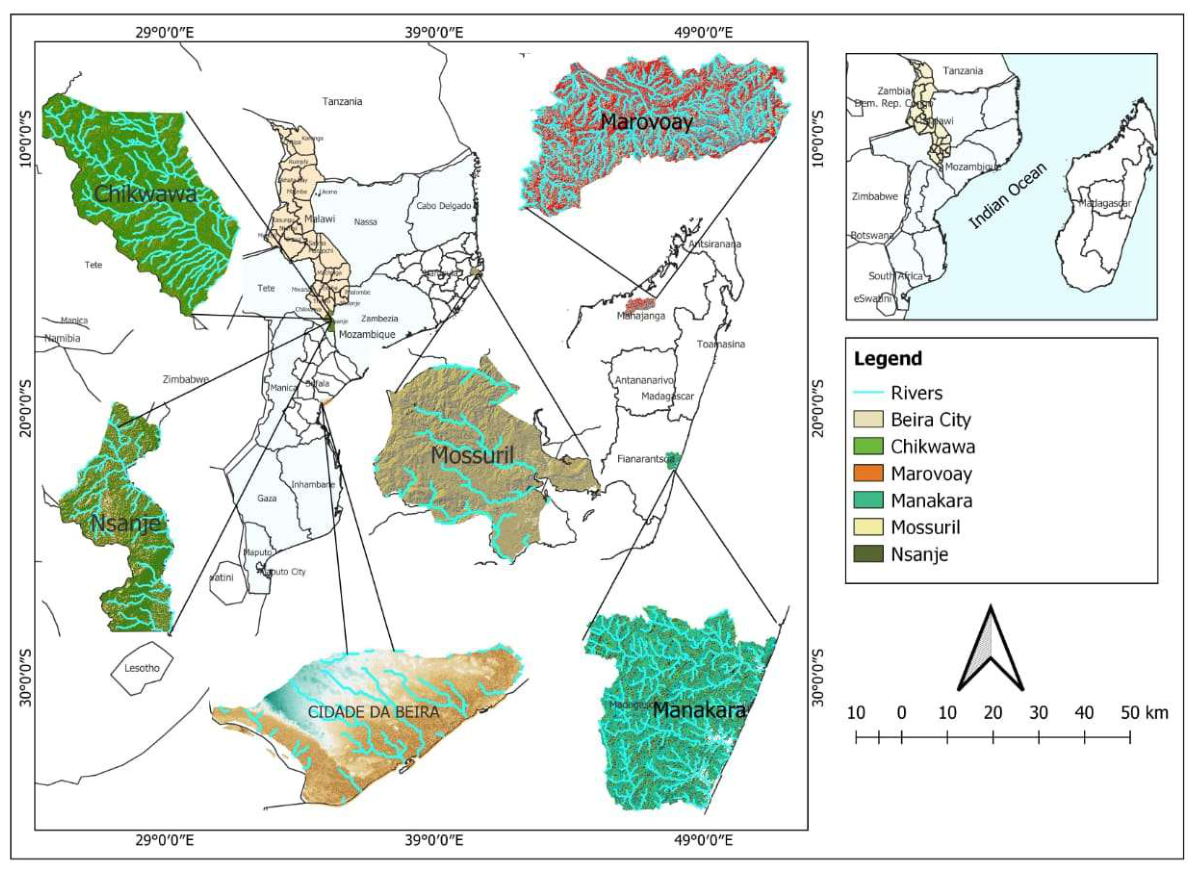
Figure 2.
Distribution of Household Vulnerability Index scores by country. Note: Higher HVI values indicate greater household vulnerability. Whiskers extend to 1.5 times the interquartile range; values beyond this range are plotted as outliers.
Figure 2.
Distribution of Household Vulnerability Index scores by country. Note: Higher HVI values indicate greater household vulnerability. Whiskers extend to 1.5 times the interquartile range; values beyond this range are plotted as outliers.
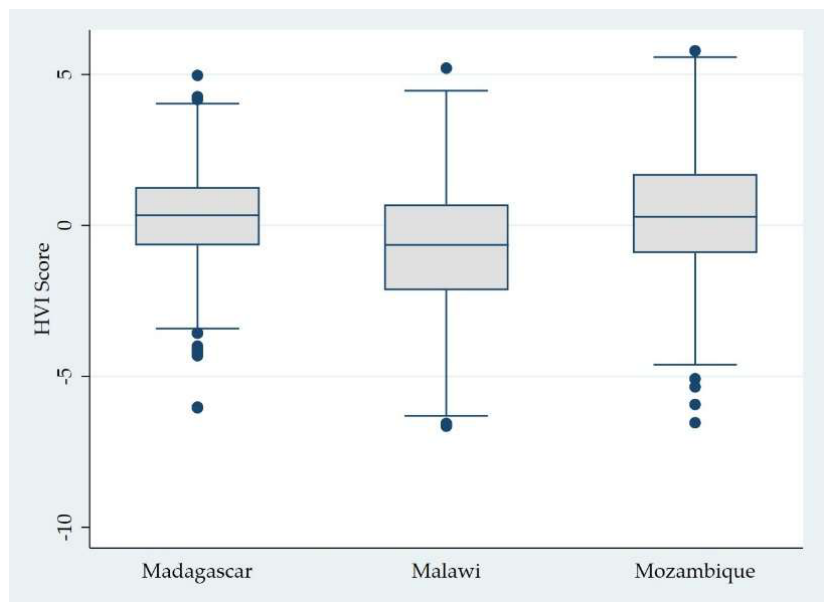
Figure 3.
Distribution of Household Vulnerability Index scores by country and gender.
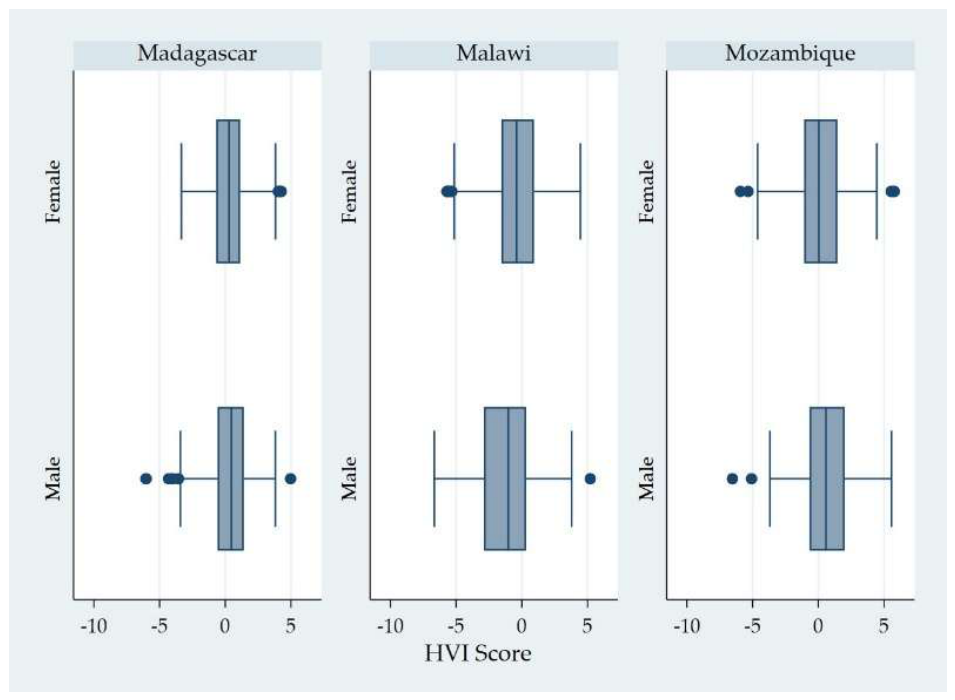
Table 1.
Study areas and household sample size by country.
| Country | Regions covered | Households surveyed |
|---|---|---|
| Madagascar | Manakara and Marovoay | 734 |
| Malawi | Nsanje and Chikwawa | 817 |
| Mozambique | Beira and Mossuril | 1,111 |
| Total | 2,662 |
Table 2.
Variables and indicators used in the construction of the Household Vulnerability Index.
| Dimension | Indicator | Variable description | Type of variable | Expected impact |
|---|---|---|---|---|
| AC | Education level | Educational attainment of the household head (0=Did not attend school; 1=Primary; 2=Secondary; 3=Tertiary). | Categorical | - |
| Livestock ownership | Total livestock assets expressed in Tropical Livestock Units (TLU). | Continuous | - | |
| Access to extension services | Access to agricultural extension services (1=Yes; 0=No). | Dummy | - | |
| Participation in training | Participation in capacity-building activities related to crop production, fishing, or livestock (1=Yes; 0=No). | Dummy | - | |
| Membership in climate-related groups | Participation in local groups addressing climate-related issues (1=Yes; 0=No). | Dummy | - | |
| Social support networks | Access to social support from relatives, friends or trusted individuals during shocks (1=Yes; 0=No). | Dummy | - | |
| Access to emergency aid | Access to emergency aid mechanisms (1=Yes; 0=No). | Dummy | - | |
| Access to cyclones EWs | Access to early warning systems for cyclones (1=Yes; 0=No). | Dummy | - | |
| Access to floods EWs | Access to early warning systems for floods (1=Yes; 0=No). | Dummy | - | |
| Elevated housing location | Dwelling located in an elevated or flood-protected area (1=Yes; 0=No). | Dummy | - | |
| Access to drainage systems | Access to drainage infrastructure to reduce water accumulation (1=Yes; 0=No). | Dummy | - | |
| Previous experience with flooding | Previous exposure to cyclones or floods (1=Yes; 0=No). | Dummy | ||
| Adoption of anticipatory actions | Adoption of preventive measures following past climate shocks (1=Yes; 0=No). | Dummy | - | |
| Climate-smart agriculture (CSA) | Adoption of climate-smart agricultural practices (1=Yes; 0=No). | Dummy | - | |
| Fisheries adaptation practices | Adoption of climate-resilient fishing practices (1=Yes; 0=No). | Dummy | - | |
| Livestock adaptation practices | Adoption of climate-resilient livestock practices (1=Yes; 0=No). | Dummy | - | |
| SE | Age | Age of the head of household (years). | Continuous | + |
| Agricultural sales | Engagement in the sale of agricultural products (1=Yes; 0=No) | Dummy | - | |
| Poor housing conditions | Poor structural condition of the dwelling (Poor=1, Otherwise=0). | Dummy | - | |
| Repair the house | Recent improvements or repairs to the dwelling (1=Yes;0=No). | Dummy | - | |
| Dependence on crop production | Household dependence on crop production as the primary source of income (1=Yes; 0=No). | Dummy | + | |
| EXP | Lowland farming | Farming activities located in flood-prone lowland areas (1=Yes; 0=No). | Dummy | + |
| Loss of fishing assets | Loss of fishing equipment due to climate shocks in the last 5 years (1=Yes; 0=No). | Dummy | + | |
| Livestock loss | Loss of livestock due to climate shocks in the last 5 years (1=Yes; 0=No). | Dummy | + | |
| Crop loss | Loss of agricultural production due to climate shocks in the last 5 years (1=Yes; 0=No). | Dummy | + | |
| Household size | Total number of household members. | Discrete |
Note: AC = Adaptive Capacity; SE = Sensitivity; EXP = Exposure.
Table 3.
Sociodemographic characteristics of surveyed households by country and gender (%).
| Dimension | Category | Female | Male | ||||||
|---|---|---|---|---|---|---|---|---|---|
| MAD | MWI | MOZ | Total | MAD | MWI | MOZ | Total | ||
| Age | 18–24 years | 17.5 | 11.9 | 20.9 | 17.2 | 8.3 | 4.4 | 14.1 | 9.6 |
| 25–34 years | 23.2 | 24.7 | 33.0 | 27.7 | 19.2 | 18.3 | 21.6 | 20.0 | |
| 35–44 years | 22.7 | 25.8 | 21.4 | 23.2 | 20.5 | 25.3 | 23.0 | 23.0 | |
| 45–59 years | 22.0 | 19.8 | 16.6 | 19.2 | 26.6 | 29.2 | 23.2 | 25.9 | |
| 60–74 years | 13.2 | 13.4 | 6.1 | 10.4 | 21.2 | 19.2 | 13.9 | 17.4 | |
| 75 years or older | 0.5 | 4.2 | 1.3 | 2.0 | 2.9 | 3.6 | 3.8 | 3.5 | |
| Education attainment | Did not attend school | 25.5 | 28.4 | 20.5 | 24.3 | 12.2 | 18.6 | 15.6 | 15.5 |
| Primary | 44.5 | 59.8 | 32.9 | 44.5 | 50.5 | 55.8 | 32.2 | 49.0 | |
| Secondary | 26.0 | 11.6 | 15.3 | 28.3 | 27.5 | 29.2 | 31.2 | 29.6 | |
| University | 0.0 | 0.0 | 3.3 | 1.4 | 0.0 | 0.0 | 5.7 | 2.5 | |
| Primary income | Formal employment (1=Yes) | 2.6 | 32.5 | 19.3 | 18.6 | 2.6 | 23.6 | 18.2 | 15.7 |
| Informal employment (1=Yes) | 9.6 | 40.2 | 22.8 | 24.4 | 10.2 | 46.4 | 20.2 | 25.5 | |
| Self-employed (1=Yes) | 81.8 | 0.0 | 20.5 | 31.5 | 83.7 | 0.0 | 16.4 | 29.3 | |
| Pensioner (1=Yes) | 1.2 | 1.3 | 1.5 | 1.4 | 1.9 | 1.9 | 2.2 | 2.0 | |
| Crop production (1=Yes) | 54.8 | 84.9 | 55.2 | 64.1 | 74.0 | 89.1 | 70.2 | 76.9 | |
| Fisheries (1=Yes) | 35.6 | 6.2 | 10.4 | 16.6 | 41.8 | 8.3 | 20.2 | 22.7 | |
| Livestock (1=Yes) | 10.4 | 9.2 | 25.0 | 16.1 | 25.3 | 9.7 | 46.6 | 29.8 | |
Note: MAD = Madagascar; MWI = Malawi; MOZ = Mozambique. Multiple responses permitted for primary income categories. χ2 tests indicate statistically significant cross-country and cross-gender variations across all sociodemographic characteristics (p < 0.01).
Table 4.
Cross-country distribution of exposure, sensitivity, and adaptive capacity categories (%).
| Dimension | Category | Madagascar | Malawi | Mozambique | Chi-square | p-value |
|---|---|---|---|---|---|---|
| SE | Low Sensitivity | 10.8 | 38.0 | 22.4 | 277.32 | <0.001*** |
| Moderate Sensitivity | 58.8 | 56.4 | 64.1 | |||
| High Sensitivity | 30.4 | 5.6 | 13.5 | |||
| EXP | Low Exposure | 0.6 | 0.4 | 1.1 | 173.87 | <0.001*** |
| Moderate Exposure | 72.1 | 41.3 | 64.0 | |||
| High Exposure | 27.3 | 58.3 | 35.0 | |||
| AC | Low Adaptive Capacity | 37.1 | 24.0 | 56.6 | 310.26 | <0.001*** |
| Moderate Adaptive Capacity | 61.5 | 64.0 | 42.1 | |||
| High Adaptive Capacity | 1.4 | 12.0 | 1.4 |
Note: AC = Adaptive Capacity; SE = Sensitivity; EXP = Exposure. Statistical significance levels: * p < 0.10; ** p < 0.05; *** p < 0.01.
Table 5.
Distribution of exposure, sensitivity, and adaptive capacity categories by country and gender.
Table 5.
Distribution of exposure, sensitivity, and adaptive capacity categories by country and gender.
| Dimension | Country | Gender | Low (%) | Moderate (%) | High (%) | Chi-square | p-value |
|---|---|---|---|---|---|---|---|
| SE | Madagascar | Female | 12.5 | 64.3 | 23.2 | 23.45 | <0.001*** |
| Male | 8.6 | 51.3 | 40.1 | ||||
| Malawi | Female | 38.4 | 55.0 | 6.7 | 2.56 | 0.278 | |
| Male | 37.5 | 58.3 | 4.2 | ||||
| Mozambique | Female | 26.6 | 66.0 | 7.5 | 46.06 | <0.001*** | |
| Male | 17.4 | 62.0 | 20.6 | ||||
| Pooled sample | Female | 26.3 | 62.1 | 11.6 | 42.62 | <0.001*** | |
| Male | 21.3 | 58.1 | 20.6 | ||||
| EXP | Madagascar | Female | 0.5 | 75.8 | 23.7 | 6.32 | 0.042** |
| Male | 0.7 | 67.2 | 32.1 | ||||
| Malawi | Female | 0.4 | 39.7 | 59.9 | 1.25 | 0.536 | |
| Male | 0.3 | 43.4 | 56.3 | ||||
| Mozambique | Female | 1.5 | 69.9 | 28.6 | 24.83 | <0.001*** | |
| Male | 0.6 | 56.8 | 42.6 | ||||
| Pooled sample | Female | 0.9 | 62.2 | 36.9 | 14.49 | 0.001*** | |
| Male | 0.5 | 55.4 | 44.1 | ||||
| AC | Madagascar | Female | 45.9 | 53.9 | 0.3 | 37.06 | <0.001*** |
| Male | 25.5 | 71.5 | 3.0 | ||||
| Malawi | Female | 29.7 | 63.4 | 6.9 | 36.26 | <0.001*** | |
| Male | 16.8 | 64.7 | 18.5 | ||||
| Mozambique | Female | 62.8 | 36.2 | 1.0 | 21.19 | <0.001*** | |
| Male | 49.1 | 49.1 | 1.8 | ||||
| Pooled sample | Female | 47.9 | 49.5 | 2.6 | 76.07 | <0.001*** | |
| Male | 33.1 | 59.7 | 7.2 |
Note: AC = Adaptive Capacity; SE = Sensitivity; EXP = Exposure. Statistical significance levels: *p < 0.10; **p < 0.05; ***p < 0.01.
Table 6.
Factor loadings and variable rankings from the first principal component (PC1) of adaptive capacity by country.
Table 6.
Factor loadings and variable rankings from the first principal component (PC1) of adaptive capacity by country.
| Indicator | Madagascar | Malawi | Mozambique | |||
|---|---|---|---|---|---|---|
| Score | Rank | Score | Rank | Score | Rank | |
| Education level | 0.07 | 8 | 0.21 | 9 | -0.36 | 14 |
| Livestock ownership (TLU) | 0.43 | 2 | 0.16 | 11 | 0.12 | 6 |
| Access to extension services | 0.27 | 5 | 0.39 | 2 | 0.34 | 2 |
| Participation in training | 0.07 | 8 | 0.40 | 1 | 0.33 | 3 |
| Membership in climate-related groups | -0.01 | 12 | 0.28 | 4 | 0.02 | 9 |
| Social support networks | 0.11 | 7 | 0.14 | 12 | 0.03 | 7 |
| Access to emergency aid | 0.15 | 6 | 0.27 | 5 | 0.03 | 7 |
| Access to cyclone EWS | -0.16 | 14 | 0.27 | 5 | -0.16 | 12 |
| Access to flood EWS | -0.14 | 13 | 0.25 | 8 | -0.33 | 13 |
| Elevated housing location | 0.32 | 4 | 0.09 | 13 | -0.14 | 11 |
| Access to drainage systems | -0.34 | 15 | 0.07 | 14 | 0.26 | 4 |
| Previous experience with flooding | 0.03 | 11 | 0.02 | 15 | -0.38 | 15 |
| Adoption of anticipatory actions | 0.07 | 8 | 0.33 | 3 | -0.13 | 10 |
| Climate-smart agriculture (CSA) | 0.37 | 3 | 0.26 | 7 | 0.41 | 1 |
| Livestock adaptation practices | 0.44 | 1 | 0.19 | 10 | 0.20 | 5 |
Note: Scores correspond to factor loadings from the PC1. Bold values indicate the five highest positive loadings contributing to adaptive capacity in each country. Negative loadings indicate variables that are inversely associated with PC1.
Table 7.
Household Vulnerability Index scores and categorical classification across countries.
| Country | HVI Categories | Lower HVI | Upper HVI | % |
|---|---|---|---|---|
| Madagascar | High vulnerability | -3.21 | 1.24 | 17.4 |
| Moderate vulnerability | -2.89 | 4.66 | 77.4 | |
| Low vulnerability | -1.12 | 5.09 | 5.3 | |
| Total | -3.21 | 5.09 | 100.0 | |
| Malawi | High vulnerability | -3.60 | 1.38 | 10.6 |
| Moderate vulnerability | -3.12 | 4.71 | 70.2 | |
| Low vulnerability | -0.37 | 6.33 | 19.2 | |
| Total | -3.60 | 6.33 | 100.0 | |
| Mozambique | High vulnerability | -3.82 | 2.29 | 26.0 |
| Moderate vulnerability | -3.61 | 3.66 | 69.0 | |
| Low vulnerability | -1.35 | 6.41 | 5.1 | |
| Total | -3.82 | 6.41 | 100.0 |
Note: Lower HVI and Upper HVI denote the observed minimum and maximum HVI scores within each vulnerability category. Categories are defined by equal-interval thresholds derived from the full HVI range per country.
Table 8.
Distribution of household vulnerability categories by country and gender (%).
| Country | Gender | High (%) | Moderate (%) | Low (%) | Chi-square | p-value |
|---|---|---|---|---|---|---|
| Madagascar | Female | 16.2 | 79.1 | 4.7 | 1.53 | 0.465 |
| Male | 18.9 | 75.2 | 6.0 | |||
| Malawi | Female | 12.6 | 75.4 | 12.0 | 35.43 | <0.001*** |
| Male | 8.1 | 63.6 | 28.3 | |||
| Mozambique | Female | 21.8 | 71.8 | 6.5 | 15.98 | <0.001*** |
| Male | 31.1 | 65.5 | 3.4 | |||
| Pooled sample | Female | 17.4 | 74.9 | 7.7 | 19.96 | <0.001*** |
| Male | 20.9 | 67.4 | 11.7 |
Note: Statistical significance levels: * p < 0.10; ** p < 0.05; *** p < 0.01.
Disclaimer/Publisher’s Note: The statements, opinions and data contained in all publications are solely those of the individual author(s) and contributor(s) and not of MDPI and/or the editor(s). MDPI and/or the editor(s) disclaim responsibility for any injury to people or property resulting from any ideas, methods, instructions or products referred to in the content. |
© 2026 by the authors. Licensee MDPI, Basel, Switzerland. This article is an open access article distributed under the terms and conditions of the Creative Commons Attribution (CC BY) license (http://creativecommons.org/licenses/by/4.0/).
Copyright: This open access article is published under a Creative Commons CC BY 4.0 license, which permit the free download, distribution, and reuse, provided that the author and preprint are cited in any reuse.