
Submitted:
25 June 2026
Posted:
26 June 2026
You are already at the latest version
Abstract
Dual-gauge railway systems are widely used in Spain to ensure interoperability between Iberian and standard gauges; however, the dynamic behavior of dual-gauge turnouts remains insufficiently characterized due to the scarcity of field measurements. This study presents an experimental campaign aimed at analyzing the vertical dynamic response of a dual-gauge turnout under real traffic conditions. The turnout was instrumented at seven critical sections using displacement transducers and accelerometers, together with a reference section on adjacent plain track, and a total of 68 train passages, including commuter and high-speed services, were analyzed according to train type and operating speed. The vertical displacement time histories and the acceleration signals recorded at the closure panel, together with their corresponding frequency spectra, are also examined to provide a complete characterization of the dynamic response in both the time and frequency domains.. Increasing operating speed leads to higher displacement levels and greater dispersion, whereas differences between train types primarily affect response magnitude rather than its spatial distribution. These findings demonstrate that the dynamic response of dual-gauge turnouts is mainly governed by local geometric discontinuities, providing experimental evidence to support condition monitoring strategies and the validation of vehicle–track interaction models.
Keywords:
switches and crossings
; dual-gauge turnouts
; dual-gauge track
; train-track interaction
; track monitoring
; condition monitoring
1. Introduction
Spain’s railway network is characterized by the long standing coexistence of two track gauges: the Iberian gauge (1,668 mm), historically adopted for the conventional network, and the European standard gauge (1,435 mm), introduced with the expansion of high-speed lines from the late 20th century onwards. This situation results in interoperability challenges and discontinuities at the interfaces between different gauge networks, leading to delays, increased costs, and operational inefficiencies.
To mitigate these discontinuities without duplicating infrastructure, the dual gauge track system has been developed. Dual-gauge track consists of three rails, one common rail and two rails that are closer to ensure compatibility between the Iberian and standard gauges on the same infrastructure. As of the 2026 network data, the state-owned railway network managed by the Spanish Railways Administrator (ADIF) includes approximately 324 km of dual gauge track, with the number of kilometers increasing year by year.
Within this system, dual-gauge turnouts emerge as one of the most critical and technically demanding elements, as they must simultaneously accommodate the geometric and dynamic requirements of two incompatible wheel–rail systems. In Spain, this dual-gauge turnouts have been progressively implemented on a large scale in several intermodal terminals and strategic freight nodes. In fact, it is estimated that the total number of dual-gauge turnouts installed ranges between 200 and 250 units. This allows terminals to serve traffic from the conventional Iberian network while also remaining compatible with the standard-gauge corridors.
In conventional turnouts, similar wheel–rail discontinuities are present, although with a lower degree of complexity and fewer interfaces. These discontinuities generate localized increases in interaction forces and stresses within the track infrastructure [1]. Thus, progressive degradation leads to increases in displacements, stresses, and load transfer between structural components [2], while track deterioration and increasing train loads further amplify dynamic impacts in these areas [3,4]. Collectively, these effects reinforce the need for continuous condition monitoring [5].
In this context, the condition assessment of conventional turnouts is commonly based on trackside visual inspection, complemented where necessary by monitoring systems that allow the structural and dynamic response of the infrastructure under traffic loading to be evaluated. Common sensing technologies include accelerometers [6,7], laser scanning systems [8], and diffuse ultrasonic wave-based sensors [9], whose performance can be further enhanced through the application of artificial intelligence techniques [10]. Within this framework, several field measurements studies have focused on the local mechanical response of track components, particularly sleepers, through direct instrumentation and dedicated experimental testing [11].
This need becomes even more relevant in dual-gauge turnouts, where the superposition of two track gauges introduces additional rails, reduced clearances, more constrained wheel guidance conditions and a greater number of discontinuities in the running surface. Compared with conventional turnouts, dual-gauge turnouts may adopt a wide range of layouts depending on the gauge assigned to the main and diverging routes, the side on which the third rail is located, and the hand of the turnout. When combined with the two possible positions of the third rail and the two possible diverging directions, these lead to 28 basic geometric configurations. This variability explains why mixed-gauge turnouts are not a single standardized layout, but rather a family of highly specific designs with different wheel-guidance conditions, rail discontinuities and maintenance requirements. Consequently, dual-gauge turnouts require particularly careful design, inspection and maintenance to ensure safe wheel guidance, ride quality and long-term durability under mixed traffic conditions.
However, the number of available experimental studies remains limited. This is mainly due to the relatively restricted implementation of dual-gauge solutions, which are commonly associated with specific interoperability needs, border sections, port accesses, intermodal terminals or highly localized network interfaces. Existing literature on dual-gauge track mainly addresses structural behavior [12], running stability [13], high-speed performance [14], and thermal buckling phenomena [15]. In [16], an experimental study was conducted on a dual-gauge track section, enabling the characterization of rail and sleeper behavior during train passage using accelerometers and displacement sensors connected to a data acquisition system.
Nevertheless, the experimental characterization of dual-gauge turnouts remains particularly limited. This gap is especially relevant in the Spanish context, where the progressive deployment of dual-gauge infrastructure in strategic corridors, port accesses and intermodal terminals has increased the operational importance of these elements.
This paper presents a recent experimental campaign carried out by the authors on a dual-gauge turnout of the DMM type (Mixed–Mixed Turnout) and an adjacent main-track section in Spain. The objective is to improve the understanding of the behavior of this type of railway infrastructure under real traffic conditions. Measurements were performed on both Iberian and standard gauge tracks, and the recorded data were analyzed in the time domain to characterize the dynamic behavior of the system.
The paper is structured as follows. First, the experimental setup is described, including the installed sensors and the data acquisition system. Then, the experimental results are presented and analyzed, covering the vertical displacement response across all instrumented sections and the acceleration response and frequency content at the closure panel.
2. Materials and Methods
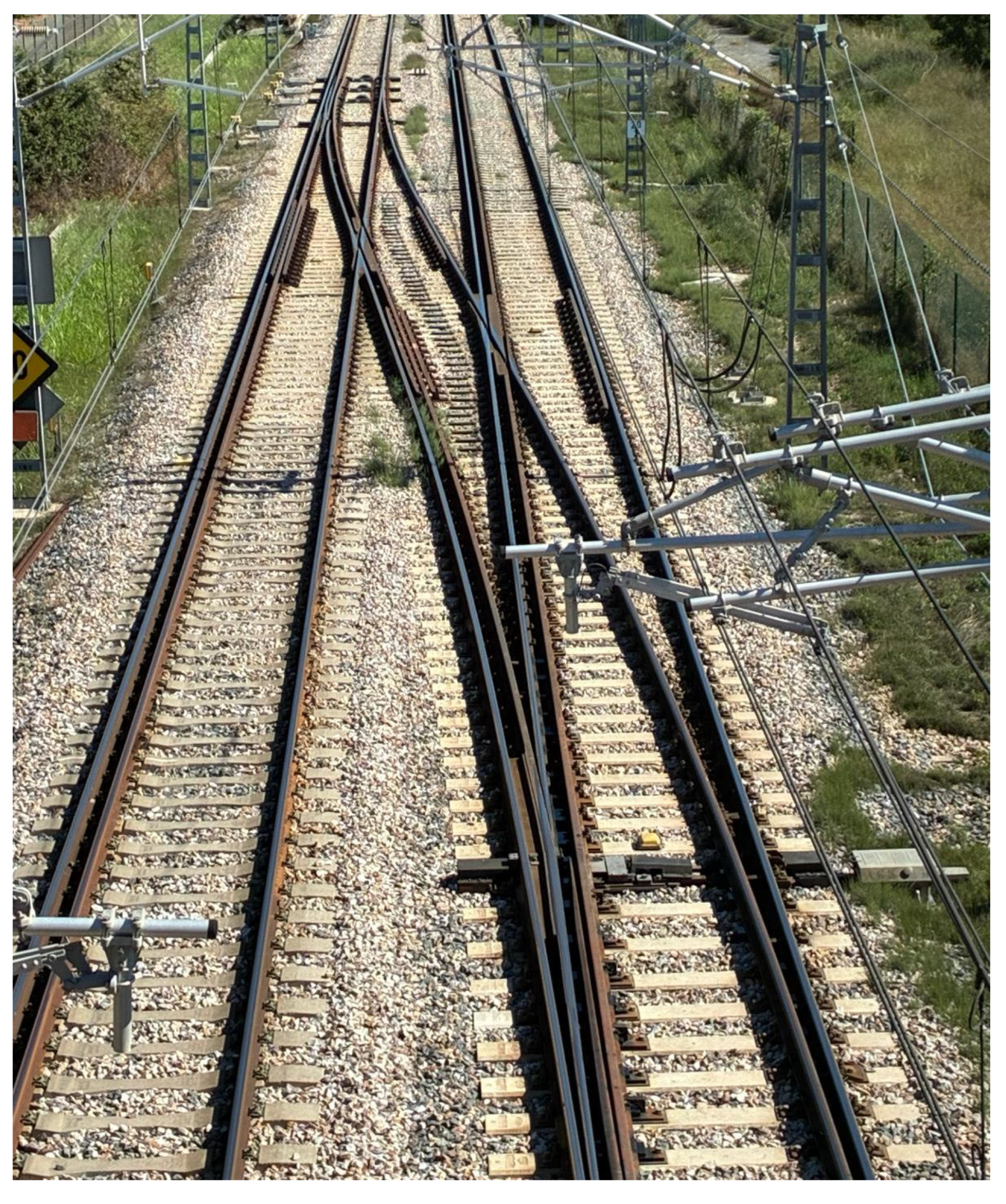
The experimental campaign was conducted on a dual-gauge turnout. The turnout corresponds to the type DMMDH-G-60-500-0.071-CM/CR-I-TC, designated according to the criteria established by ADIF [17]. The turnout is configured with UIC 60 rails, a diverging radius of 500 m, and a tangent value of 0.071, and is arranged as a left-hand turnout. Under regular service conditions, the turnout allows maximum operating speeds of up to 200 km/h along the through route, and 60 km/h along the diverging route.
The experimental section corresponds to a ballasted track whose superstructure characteristics are consistent with those reported in [16].
Figure 1.
Dual-gauge turnout (type DMMDH-G-60-500-0.071-CM/CR-I-TC).
2.1. Instrumented Sections
Seven cross-sections of the turnout are instrumented, together with an additional reference section on the main track. The selection of measurement locations is based on the presence of geometric and structural discontinuities relevant to the system dynamics. Figure 2 shows the different monitored sections, which are further described in Table 1.
Thus, the monitored areas include switch, closure, and crossing panels, together with an additional reference section on the main track. These are:
- Switch toes in all three rails.
- Obtuse crossing, where the rail of the wider gauge in the diverging track crosses the rail of the narrower gauge of the direct track. In this case, the difference between both gauges is 233 mm. This would mean a huge gap between the wing rail and the crossing nose, so this crossing also has moveable points which eliminates rail gaps and allows a continuous rolling path.
- Trimetallic welds, at the beginning and the end of the double-crossing frog.
- Double crossing frog. This element includes the crossing of the diverging rails of both track gauges with the direct common rail. In this case, both crossings are fixed, presenting a double discontinuity in the contact surface for the straight direction.
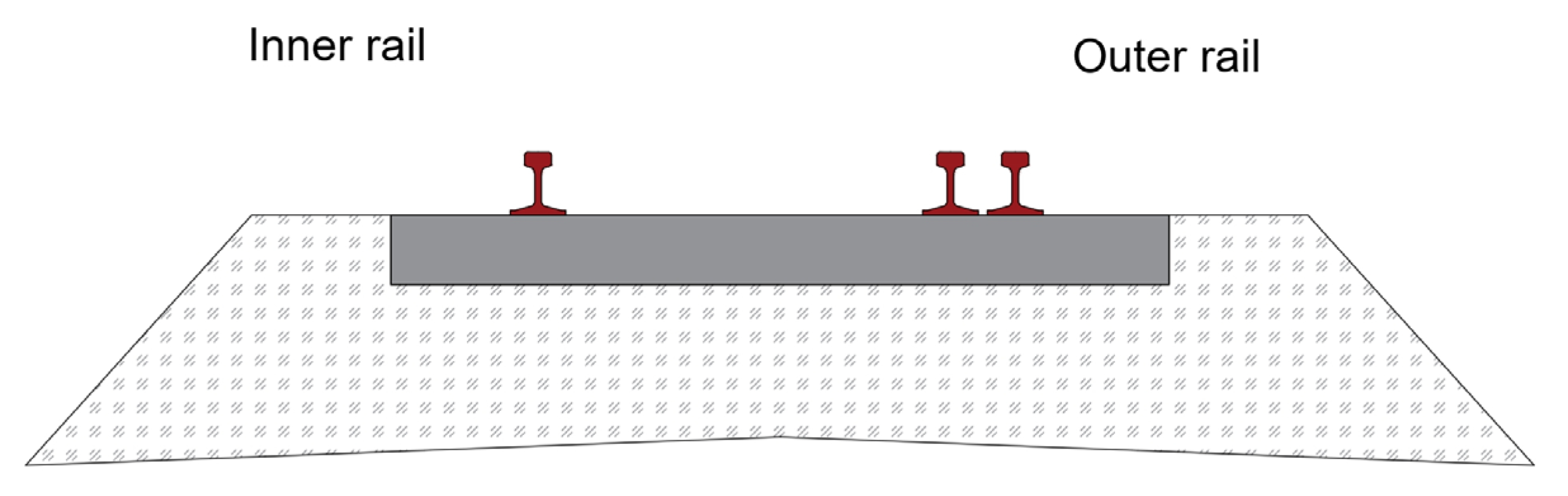
Figure 3.
Cross-sectional scheme of railway infrastructure.
2.2. Instrumentation and Measurement Systems
All monitored sections, except for Section S3, are instrumented with potentiometric displacement transducers to record the vertical deflection of the sleeper under passing trains. Section S3 is in the middle of the closure panel and presents no relevant discontinuities in the rolling path. Because of this, it is equipped with capacitive accelerometers, specifically intended to capture smaller vertical displacements compared to other monitored sections. Section SC is installed on the adjacent plain-track section and served as a reference section for the main line, providing a baseline response against which the behavior of the instrumented turnout sections could be assessed.
2.2.1. Characteristics of the Data Acquisition System and Sensors
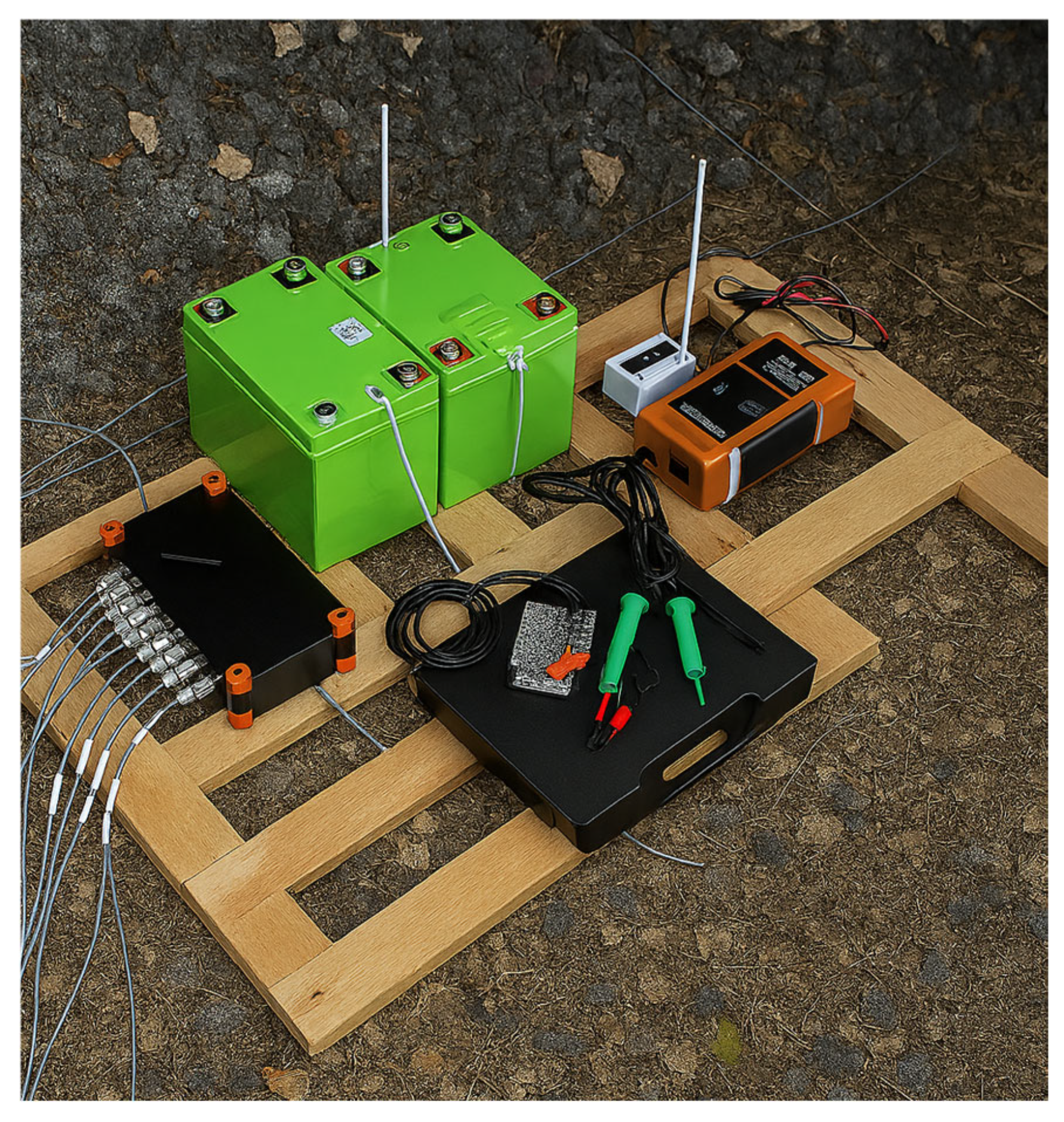
The complete measurement system, including the sensors, data acquisition unit, camera and laptop computer, was powered by solar panels and battery units. This configuration enabled autonomous operation at the test site in the absence of grid electricity, ensuring continuous data acquisition during the monitoring campaign.
Figure 4.
In-situ Data Acquisition System.
Within this autonomous field instrumentation system, fourteen potentiometric displacement transducers are installed to measure the vertical deflection of the track structure during train passage. The selected device is the PLS 50 5K MR displacement potentiometer, a linear position sensor that converts the relative movement of its measuring rod into an analogue electrical signal. This sensor model has a nominal measuring range of 50 mm and a potentiometric resistance of 5 kΩ, making it suitable for monitoring local track deflections under field conditions. In the present setup, these transducers are used to characterize the vertical displacement response of the turnout and the adjacent plain-track section under in-service traffic loading.
Figure 5.
Sensor Model PLS 50 5K MR.
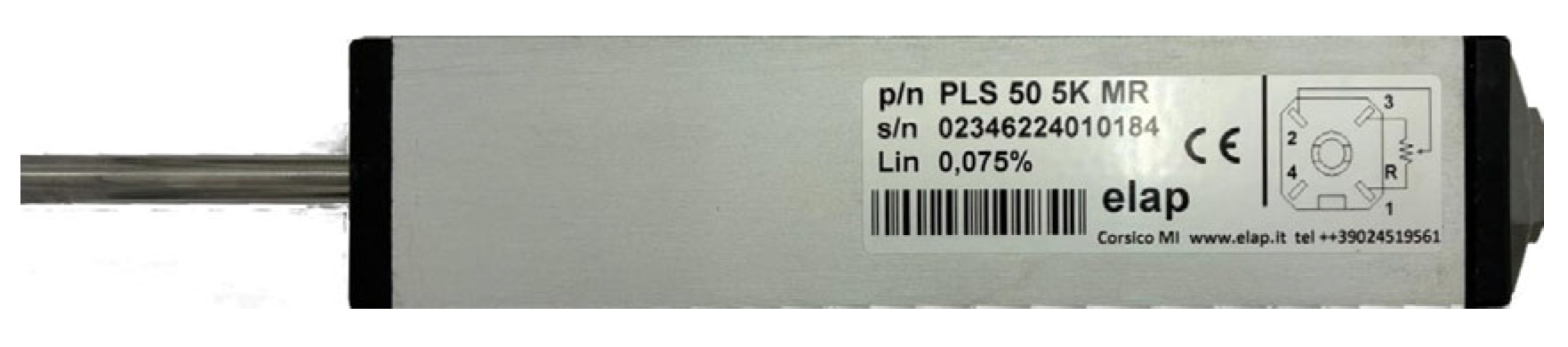

Table 2.
Key characteristics of the linear distance potentiometer Model: PLS 50 5K MR used in the experimental setup.
Table 2.
Key characteristics of the linear distance potentiometer Model: PLS 50 5K MR used in the experimental setup.
| Designation | Description |
| Model | PLS 50 5K MR |
| PLS | Sensor series |
| 50 | Nominal Stroke of 50 mm |
| 5K | Resistive value of 5 kΩ ±20% |
| MR | Output/connector type (spring return) |
Two capacitive accelerometers, model MEAS 4610-002 A191934, are installed to measure the high-frequency dynamic response of the turnout during train passage. These sensors have a measurement range of ±2 g, a sensitivity of 1000 mV/g and a full-scale analogue output of ±2 V. They operate with a DC supply voltage between 4 and 30 V and provide an approximate frequency response from 0 to 250 Hz.
Figure 6.
Sensor MEAS 4610-002 A191934.
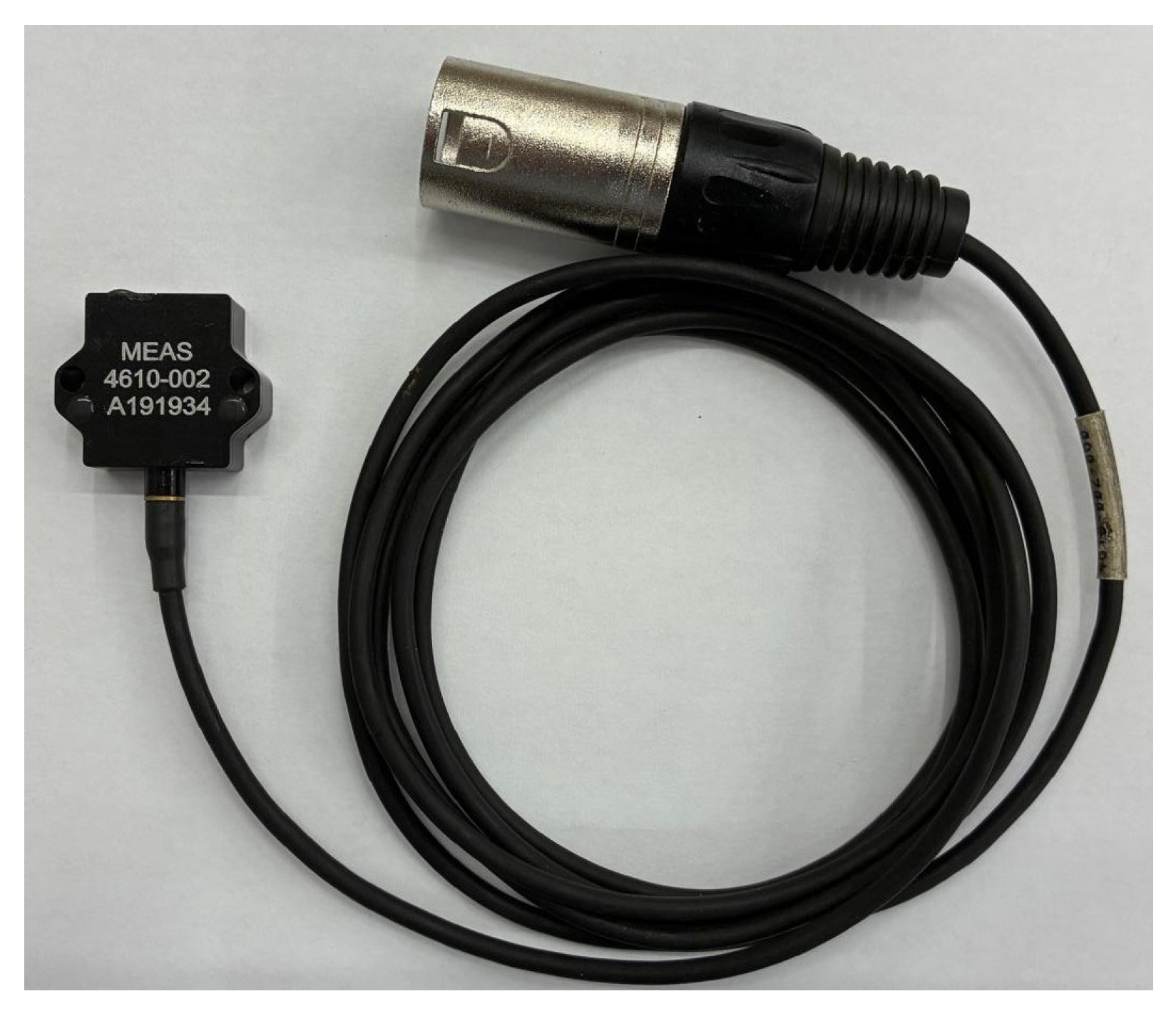
Table 3.
Key characteristics of the MEAS 4610-002 (A191934) sensor.
| Designation | Description |
| Model | MEAS 4610-002 A191934 |
| Range | ±2 g |
| Sensitivity | 1000 mV/g |
| Output | ±2 V (full scale) |
| Supply voltage | 4–30 V DC |
| Frequency range | approx. 0–250 Hz |
In addition, two data acquisition units are used to record the signals provided by the displacement transducers and accelerometers installed in the experimental setup. This equipment was selected because it allows simultaneous multi-channel acquisition with high sampling capability, which is particularly relevant for capturing both the low-frequency displacement response of the track structure and the higher-frequency dynamic response measured by the accelerometers. The unit is based on hybrid ADC architecture, combining high-dynamic and high-bandwidth acquisition modes, with a maximum simultaneous sampling rate of up to 15 MS/s and an analogue bandwidth of up to 5 MHz. Each unit includes eight input connectors, and enables sensor configuration, signal acquisition, visualization and storage during the monitoring campaign.
Figure 7.
SIRIUSi-XHS-PWR.
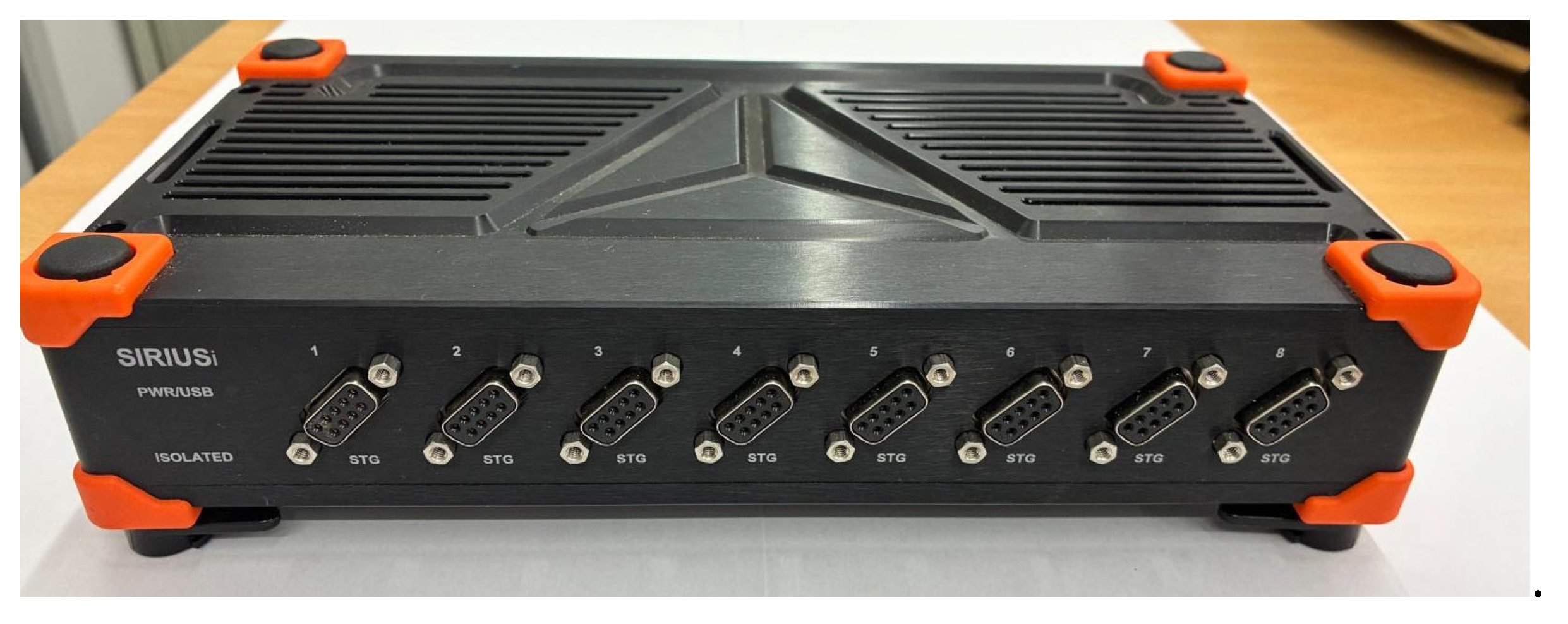
Table 4.
Main characteristics of the SIRIUSi-XHS-PWR data acquisition unit.
| Designation | Description |
| Model | SIRIUSi-XHS-PWR |
| ADC type | Hybrid ADC (high-dynamic / high-bandwidth) |
| Sampling rate | Up to 15 MS/s simultaneous |
| Analog bandwidth (−3 dB) | Up to 5 MHz |
| Number of connectors | 8 |
| Software | DewesoftX® included |
2.2.2. Installation of the Measurement System
Vertical displacement is measured as the relative movement between the upper surface of the sleeper and a local reference embedded in the ballast layer. For this purpose, each measurement point was equipped with a copper stake, 0.5 m in length and 1.5 cm in diameter, driven into the ballast between two consecutive sleepers. The stakes are installed at the sleeper ends, outside the external faces of the rails, in order to avoid interference with the running rails and to provide a stable reference for the displacement measurements.
Accordingly, the movable rod of each potentiometric displacement sensor is supported on the corresponding copper stake by means of a methacrylate plate, which provided a regular contact surface and ensured proper transmission of the relative movement to the sensor. The sensor bodies are fixed to the sleepers using wooden battens bonded to the upper sleeper surface, as shown in Figure 8. These battens are designed with sufficient flexural stiffness for their bending deformation to be considered negligible compared with the measured sleeper displacements.
Acceleration measurements are carried out exclusively in Section S3, where the aim is to characterize the local dynamic response of the turnout. The accelerometers are mounted directly on the upper surface of the sleeper using a high-adhesion double-sided fixing layer, ensuring adequate mechanical coupling between the sensor and the sleeper. This installation method enables the acceleration response induced by train passage, wheel–rail interaction and local discontinuities within the turnout area to be recorded with minimal interference from the mounting system. The installed accelerometers are shown in Figure 9.
Together with the displacement and acceleration measurements, an ActiveX webcam is connected to the computer to identify the time of each train passage and to cross-check it against the recorded data, allowing the rolling stock involved in each measurement to be verified.
All sensors and the webcam are controlled by the data acquisition software. The acquired signals are low-pass filtered at 300 Hz and sampled at a frequency of 1 kHz.
In order to enable automatic data registration, the following trigger conditions are simultaneously set:
- a displacement variation of 0.5 mm within 0.1 s;
- an absolute acceleration value exceeding 1 m/s².
These trigger conditions allow the measurement system to start recording automatically only when a train passage is detected. In particular, the combined use of displacement and acceleration thresholds ensures that data acquisition is activated exclusively by a real dynamic event affecting the turnout, rather than by background noise or minor environmental disturbances.
2.3. Experimental Campaign
The experimental campaign is carried out over two consecutive days, during which a total of 68 train passages are recorded. The observed traffic comprises commuter, long-distance and freight services, enabling the characterization of a representative range of dynamic loading conditions.
Table 5.
Observed traffic.
| Train type | Number of passages |
| Commuter train Serie 447 | 50 |
| Commuter train Serie 464 | 6 |
| High-speed/long-distance train Serie 130 | 8 |
| High-speed/long-distance train Serie 100 | 4 |
For the purposes of the analysis, the recorded trains are classified into two main groups: commuter services and high-speed/long-distance services. This classification is based on differences in operating speed, vehicle architecture and rolling stock characteristics, which are expected to influence the dynamic response of the vehicle–track system.
Within the commuter group, Series 447 and Series 464 trains are analyzed. Series 447 is a three-car electric multiple unit widely used in Spanish commuter services. It consists of two motor cars and one intermediate trailer car, resulting in a traction configuration concentrated in the end vehicles. The motor bogies follow a Bo′–Bo′ arrangement, whereas the intermediate trailer car is equipped with 2′–2′ bogies. The corresponding axle loads are approximately 14.18 t for the motor bogies and 13.2 t for the trailer bogies. By contrast, Series 464 belongs to the Civia family of commuter electric multiple units and represents a more recent vehicle concept. Its traction and mass distribution are more evenly distributed along the train, which may influence the way vertical loads and dynamic effects are transmitted to the track. The motor bogies are also of Bo′–Bo′ type, while the trailer bogies follow a 2′–2′ arrangement. Since the axle loads are of the same order of magnitude as those of Series 447, the comparison between both train types allows the influence of vehicle architecture, suspension characteristics and running speed on the measured track response to be assessed.
In addition to the distinction between rolling-stock types, commuter train passages are further classified according to their running speed. Two speed ranges are defined: below 65 km/h and above 65 km/h. This subdivision is introduced to evaluate the influence of speed on the measured dynamic response, independently of the vehicle type. The 65 km/h threshold is adopted as a practical boundary between lower-speed and higher-speed commuter passages within the experimental dataset, allowing speed-related effects on displacement and acceleration responses to be analyzed separately from those associated with train architecture.
The high-speed/long-distance group includes Series 100 and Series 130 trainsets, both of which operate in long-distance passenger services. These trains are considered separately from the commuter units because of their higher operating speeds, different vehicle architecture and distinct axle-load distribution. Series 130 is a variable-gauge, long-distance trainset composed of two power cars located at the ends of the train and eleven articulated Talgo-type passenger coaches. This articulated configuration reduces the number of running assemblies, contributes to a lower overall mass and improves running stability. The motor axles have an axle load of approximately 18 t, whereas the trailer wheelsets reach approximately 15.3 t. In the present experimental campaign, the recorded Series 130 passages correspond to Iberian-gauge operation, allowing the response of the turnout under long-distance traffic on the Iberian-gauge path to be characterized.
Series 100 is a high-speed trainset composed of two power cars located at the ends of the train and eight intermediate passenger cars equipped with articulated bogies. This configuration provides continuous guidance between adjacent vehicles and is representative of standard-gauge high-speed operation in Spain. The motor axles have an axle load of approximately 17.2 t, while the trailer wheelsets reach approximately 15.8 t. In the present experimental campaign, the recorded Series 100 passages correspond to standard-gauge operation.
3. Results
The aim of this section is to identify how the vertical sleeper response varies according to train type, operating speed, turnout location and rail position. To this end, the recorded passages are classified into two main groups: commuter trains and high-speed trains. This distinction enables the response of the track to be examined under different vehicle characteristics, axle-load distributions, suspension configurations and speed ranges.
Thus, three instrumented sections are analyzed: S2, located in the crossing area; S6, located at the switch toe; and SC, located on the main track and used as a reference section. The inclusion of SC allows the response measured within the turnout to be compared with that recorded in a conventional track section, thereby helping to isolate the influence of the turnout geometry on the observed displacement levels.
The results are presented in two complementary forms. First, representative vertical displacement time histories are shown for each traffic group and instrumented section, providing direct insight into the waveform structure and the repeatability of the rail response during individual train passages. Second, box-and-whisker plots grouped by train series and operating speed are used to summarize the statistical distribution of peak vertical displacements, evaluated separately for the inner and outer rails at sections S2, S6 and SC. This representation allows not only the median response to be compared, but also the variability, asymmetry and occurrence of high-amplitude events associated with each train group and measurement location. In addition, the acceleration time histories recorded at the closure panel and the corresponding frequency spectra of both the acceleration and the vertical displacement signals are examined in Section 3.3 to characterize the high-frequency dynamic behavior of the turnout.
3.1. Commuter Trains – Series 447 and 464.
Commuter train passages are analyzed separately for Series 447 and Series 464 and are grouped according to the operating speed. As mentioned before, two speed ranges are considered: passages at or below 65 km/h and passages exceeding 65 km/h. This subdivision allows the influence of speed to be assessed independently for each train series, avoiding the combined interpretation of responses that may be affected by both vehicle type and operating conditions. The threshold of 65 km/h is used to distinguish between lower-speed commuter passages and higher-speed passages within the recorded sample. In this way, the analysis can evaluate not only whether higher operating speeds lead to greater vertical displacements, but also whether they modify the dispersion of the response, the variability between passages and the occurrence of isolated high-amplitude events.
3.1.1. Operating Speed Below 65 km/h
Figure 10 compares the peak vertical rail displacements recorded at sections S2, S6 and SC for commuter trains, distinguishing between Series 447 and Series 464 units and between the inner and outer rails.
The results reveal a marked spatial dependency of the vertical response. At the turnout-related sections, S2 and S6, the inner rail consistently exhibits higher displacements than the outer rail, whereas the control section SC shows substantially lower values and a more balanced response between rails.
At S2, the median displacement of the inner rail is approximately twice that of the outer rail for both train series. This indicates that the crossing area induces a more demanding vertical response, with several high-amplitude events also observed. The contrast is even more pronounced at S6, located at the switch toe. In this section, the outer rail presents low and stable displacement values, while the inner rail reaches median values close to those observed at S2, together with a wider interquartile range. This behavior suggests the presence of a localized dynamic effect associated with the geometric and stiffness discontinuities of the switch toe.
By contrast, the control section SC presents considerably lower peak displacements, generally with median values below 0.30 mm and limited dispersion. This confirms that the higher response levels observed at S2 and S6 are mainly linked to the local turnout geometry rather than to the general behavior of the ballasted track under commuter traffic. Regarding the comparison between Series 447 and Series 464, no systematic difference in median displacement is observed across all sections. Although Series 464 shows slightly larger dispersion in some cases and Series 447 presents isolated high-amplitude events, the section location and rail position appear to have a stronger influence on the vertical response than the specific commuter train series.
In the legends of the vertical displacement time histories, trains are identified using a standardized code of the form T_HHMMSS_TTTTT_SERIES_V, where HHMMSS denotes the reference time, TTTTT the elapsed time in seconds until the train passage, SERIES the train series, and V the train speed in km/h.
Figure 11 present the vertical displacement time histories recorded at sections S2, S6 and SC for Series 447 commuter passages at speeds below 65 km/h, shown separately for the outer and inner rails. Each figure superimposes all recorded passages within this speed group, allowing the repeatability of the waveform and the range of response variability to be assessed directly in the time domain. The records illustrate the transient nature of the rail deflection under successive axle loads, with each loading cycle corresponding to the passage of a bogie. The inner rail at S2 and S6 exhibits consistently larger peak deflections and a wider spread among passages, whereas the outer rail and the control section SC show a more limited and repeatable response, in agreement with the statistical results discussed above.
3.1.2. Operating Speeds Exceeding 65 km/h
Figure 12 presents the box-and-whisker plots of peak vertical rail displacements for commuter train passages operating at speeds above 65 km/h. Overall, the results confirm the strong influence of the instrumented section and rail position on the vertical response, with the highest displacement levels concentrated on the inner rail at the turnout-related sections.
At S2, the inner rail shows the largest displacements, with median values of approximately 0.75–0.78 mm for both train series. Compared with lower-speed passages, a greater spread of the response is observed, particularly for Series 447, for which peak values close to 1.0 mm are recorded. By contrast, the outer rail exhibits considerably lower displacements, with median values around 0.25–0.30 mm, confirming the asymmetric response of the crossing area.
A similar pattern is observed at S6, located at the switch toe. The outer rail presents low and stable displacement values, with medians close to 0.16–0.18 mm. Conversely, the inner rail concentrates the highest response within this section, with median values around 0.65–0.70 mm. In this case, Series 447 shows a wider dispersion and includes peak values exceeding 1.0 mm, indicating that high-speed commuter passages may amplify localized dynamic effects at the switch toe.
At the control section SC, the vertical response is substantially lower than at S2 and S6, with median values generally ranging between 0.15 and 0.25 mm for both rails. The response is also more homogeneous, with no clear rail-dependent pattern and a lower overall dispersion. This behavior supports the interpretation that the larger displacements observed at S2 and S6 are mainly associated with the local geometric and stiffness discontinuities of the turnout, rather than with the general response of the ballasted track under commuter traffic.
Figure 13 show the corresponding displacement time histories for Series 447 passages at speeds above 65 km/h. Compared with the lower-speed group, the records show a narrower loading window and higher peak deflection values on the inner rail at S2 and S6, reflecting the more impulsive nature of the wheel–rail interaction at increased speed.
3.2. High-Speed Trains
Figure 14 presents the box-and-whisker plots of peak vertical rail displacements obtained for high-speed train passages, considering Series 100 and Series 130 units. The results show a marked dependence on the instrumented section and rail position, with the largest responses consistently concentrated on the inner rail at the turnout-related sections.
At S2, the inner rail exhibits the highest displacement levels, with median values ranging approximately from 0.75 to 0.90 mm. Series 130 shows the largest response in this section, including peak values exceeding 1.2 mm, which indicates the occurrence of high-amplitude events under specific passage conditions. By contrast, the outer rail presents substantially lower median values, around 0.33–0.36 mm, although Series 100 shows a wider dispersion, suggesting a more variable response at this rail.
At S6, the contrast between rails becomes even more pronounced. The outer rail shows low and stable displacements, with median values between 0.15 and 0.22 mm and limited dispersion. Conversely, the inner rail concentrates the largest response within the section, with median values of approximately 0.79 mm for Series 130 and about 1.05 mm for Series 100. The wider interquartile ranges observed for both train series, particularly for Series 100, suggest that the switch toe introduces a strong localized dynamic effect, probably associated with the combined influence of geometric discontinuities, local stiffness variations and vehicle–track interaction at high speed.
At the reference section SC, peak vertical displacements are notably lower than those recorded at S2 and S6. Median values range approximately from 0.30 to 0.42 mm for the inner rail and remain below 0.25 mm for the outer rail. The response is also more homogeneous, with lower variability than in the turnout sections. This confirms that the amplified displacements observed at S2 and S6 are mainly linked to the local singularities of the turnout rather than to the general response of the ballasted track under high-speed traffic. Overall, rail position and turnout location appear to govern the vertical displacement response more strongly than the train series itself, although Series 100 and Series 130 exhibit different levels of dispersion and extreme response depending on the section analyzed.
Figure 15 presents the vertical displacement time histories recorded at sections S2, S6 and SC during Series 130 high-speed train passages, distinguishing between the outer and inner rails. In comparison with the Series 447 commuter units, the response shows a distinct loading pattern associated with the articulated Talgo architecture, which results in a different axle distribution and wheel–rail loading sequence. The inner rail at S2 and S6 again experiences the highest vertical displacements, whereas the control section SC displays considerably lower and more repeatable responses. These observations are consistent with the trends identified in the statistical analysis of peak displacements.
3.3. Acceleration Response and Frequency Content
The acceleration signals recorded at the closure panel are analyzed to characterize the high-frequency dynamic behavior of the turnout. For each traffic group, the acceleration time history is presented together with the corresponding frequency spectra of both the acceleration and the vertical displacement signals at sections S2 (crossing), S6 (switch toe) and SC (control section).
3.3.1. Series 447 Operating Speed Below 65 km/h
Figure 16 presents the acceleration time-history recorded at the closure panel during the passage of train T_122711_07157_447_64 . The signal is concentrated within the train passage window and exhibits a markedly impulsive character, with peak acceleration values reaching approximately +11 m/s² and −13 m/s². Both rails display similar peak amplitudes, although the inner rail exhibits a slightly higher concentration of impulsive events, while the outer rail shows a more regular response throughout the passage.
The vertical displacement spectra are dominated by low-frequency components, with most of the spectral energy concentrated below approximately 4 Hz. The highest spectral amplitudes are observed on the inner rail at sections S2 and S6, particularly at the switch toe (S6), indicating a stronger dynamic response at these turnout locations. In contrast, the control section SC exhibits substantially lower amplitudes throughout the analyzed frequency range.
Figure 17.
Frequency spectra of vertical displacement and acceleration for commuter train passages at speeds ≤65 km/h: (a) S2 Crossing 2; (b) S6 Switch toe; (c) SC Main track (control section).
Figure 17.
Frequency spectra of vertical displacement and acceleration for commuter train passages at speeds ≤65 km/h: (a) S2 Crossing 2; (b) S6 Switch toe; (c) SC Main track (control section).
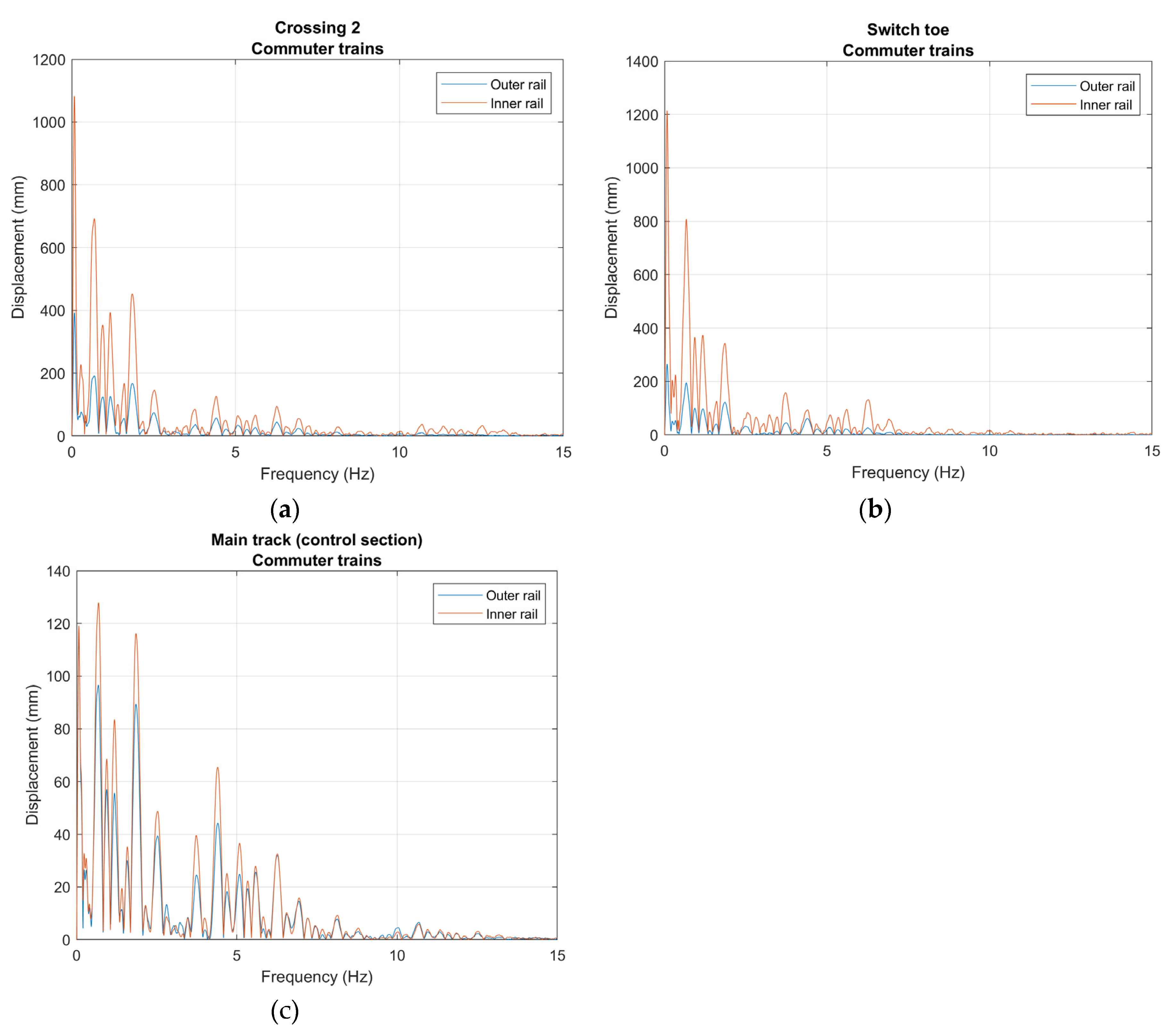
Figure 18 presents the frequency spectrum of the acceleration signal recorded at the closure panel. The spectral content extends up to 500 Hz, with energy distributed over a broad frequency range and no clearly dominant frequency component. Higher spectral amplitudes are generally observed on the inner rail between approximately 80 and 350 Hz. Above 400 Hz, the outer rail exhibits the largest spectral peaks, reaching values close to 390 m/s², whereas the inner rail remains comparatively lower in this frequency range.
3.3.2. Series 447 Operating Speed Above 65 km/h
Figure 19 presents the acceleration time history recorded at the closure panel during the passage of train T_115136_03513_447_114. The signal exhibits a pronounced impulsive character, with peak acceleration values reaching approximately +24 m/s² and −37 m/s². The most intense acceleration events are observed on the inner rail, particularly in the negative direction, whereas the outer rail shows slightly lower peak amplitudes and a more regular response. The magnitude of these peaks is notably higher than that observed for the lower-speed passage, reflecting the increased dynamic wheel–rail interaction associated with higher operating speeds.
The frequency spectra of the vertical displacement at sections S2, S6 and SC are shown in Figure 20 for train passages at speeds above 65 km/h. The spectral energy is shifted towards slightly higher frequencies compared with the lower-speed group, together with an increase in overall amplitude, particularly at the turnout-related sections S2 and S6. The control section SC also exhibits a moderate increase in spectral levels, although remaining lower than those observed at S2 and S6 across the full frequency range.
Figure 21 presents the frequency spectrum of the acceleration measured at the closure panel for Series 447 commuter trains operating at speeds above 65 km/h. The spectral energy is concentrated mainly between 250 and 320 Hz, where the highest amplitudes are observed in both rails. Above approximately 350 Hz, the outer rail exhibits a greater density of peaks and higher spectral amplitudes. This behavior reflects the broadband dynamic response generated by the wheel–rail interaction at the closure panel.
3.3.3. High-Speed Trains Series 130
Figure 22 presents the acceleration time history recorded at the closure panel during the passage of train T_180446_02920_130_133. The excitation extends over a relatively long-time window, reflecting the length of the Series 130 trainset. Peak acceleration values reach approximately ±20 m/s², with similar amplitudes on both rails. The response remains relatively uniform throughout the passage, consistent with the articulated configuration of the train.
Figure 23 presents the frequency spectra of the vertical displacement at the S2, S6 and SC for Series 130 high-speed train passages. In all three locations, the spectral energy is concentrated at low frequencies, with the most significant peaks occurring below approximately 10 Hz. The inner rail consistently exhibits higher amplitudes than the outer rail, particularly at Crossing 2 and the switch toe, where the largest displacement peaks are recorded. Although the spectral content extends up to 25 Hz, the amplitudes decrease markedly with increasing frequency, indicating that the dynamic response is dominated by low-frequency vibration modes.
Figure 24 presents the frequency spectrum of the acceleration measured at the closure panel for Series 130 high-speed trains. The spectral content extends up to 500 Hz and exhibits a broadband response. The inner rail shows the highest amplitudes at very low frequencies, whereas the outer rail presents the largest spectral peaks, particularly above 400 Hz. Several pronounced peaks are also observed around 80–100 Hz, indicating the contribution of multiple vibration modes to the dynamic response of the closure panel.
4. Discussion
The experimental results provide insight into the dynamic behavior of a dual-gauge turnout under operational railway traffic conditions. Rather than showing a uniform response along the track, the measurements reveal a clearly localized behavior, governed by the combined effect of turnout geometry, rail position, running speed and rolling stock characteristics. This is particularly relevant for mixed-gauge turnouts, where the coexistence of different running paths and structural discontinuities may lead to a more complex distribution of vertical response than in conventional plain track.
The most consistent finding is the concentration of the highest peak vertical displacements on the inner rail at the turnout-related sections. This pattern is observed for both commuter and high-speed traffic and indicates that the critical response is mainly controlled by the local geometry of the turnout. Sections S2 and S6, corresponding respectively to the crossing area and the switch toe, show the largest displacement levels and the greatest variability, whereas the reference section SC presents lower magnitudes and a more homogeneous response. This contrast suggests that the amplified response is not representative of the general behavior of the ballasted track, but is instead associated with local discontinuities in wheel–rail contact conditions, support stiffness and load transfer mechanisms within the turnout.
The influence of speed is also evident. For commuter traffic, passages above 65 km/h generally produce higher displacement levels and greater dispersion than lower-speed passages. This indicates that increasing speed does not only affect the magnitude of the response, but also increases its variability and the likelihood of high-amplitude events. From a dynamic perspective, this behavior may be related to the reduced time available for load redistribution, the amplification of vehicle–track interaction effects and the greater sensitivity of turnout singularities to transient loading conditions.
The acceleration response and frequency analysis provide additional insight into the turnout dynamics. Measurements at the closure panel reveal an impulsive response that intensifies with operating speed, with higher peak accelerations and broader excitation bandwidth. The displacement spectra are dominated by low-frequency components associated with track–ballast flexibility, whereas the acceleration response exhibits broadband content linked to localized wheel–rail interaction. Higher spectral amplitudes at the crossing and switch toe confirm these zones as sources of dynamic amplification. These results highlight the coexistence of structural response and impact phenomena governing turnout behavior.
When commuter and high-speed traffic are compared, high-speed trains generally lead to larger vertical displacements, particularly at S2 and S6. However, the differences between train series are less systematic than the differences associated with section location and rail position. Series 100 and Series 130 show different levels of dispersion and extreme response depending on the section analyzed, but the dominant factor remains the presence of local turnout singularities. This suggests that the structural and geometric characteristics of the turnout govern the location of the critical response zones, while rolling stock type and operating speed modulate the magnitude and variability of the measured displacements.
From an engineering perspective, these findings highlight the importance of monitoring turnout areas separately from ordinary track sections. In particular, the inner rail at the crossing and switch toe should be considered a priority location for condition assessment, since it systematically concentrates the highest displacement levels and the most variable response. The results also show that the analysis of median values alone is insufficient; dispersion and high-amplitude events must also be considered when evaluating the dynamic performance of mixed-gauge turnouts.
Although the results are based on a specific experimental campaign and should be interpreted considering the number of passages, train types and operating conditions recorded, the dataset provides valuable field evidence for the characterization of dual-gauge turnout behavior under real traffic. It also offers a useful basis for calibrating and validating numerical vehicle–track interaction models, particularly those aimed at reproducing the localized dynamic effects associated with switches and crossings in mixed-gauge railway infrastructure.
From a dynamic perspective, an increase in both displacement magnitude and dispersion is observed with increasing running speed. For commuter traffic, train passages exceeding 65 km/h result in higher displacement levels and greater variability compared to lower-speed passages. This trend is consistently identified at the turnout sections and indicates a higher sensitivity of the system under more demanding dynamic operating conditions.
A similar spatial response is identified when comparing commuter and high-speed traffic. High-speed trains (Series 100 and 130) generate displacement levels that are globally higher than those recorded for commuter services, particularly at the crossing and switch toe sections. Within the high-speed group, Series 100 and 130 show differences mainly in the magnitude and variability of the response.
Across all analyzed cases, the inner rail systematically concentrates the maximum displacement values, regardless of train category or speed range. This observation confirms the dominant role of turnout geometry in governing the location of critical response zones.
Overall, the results indicate that the dynamic behavior of the dual-gauge turnout is governed by the interaction between the ballasted track superstructure, the turnout geometry and the operational traffic conditions. The pronounced sensitivity observed in geometrically singular zones highlights the importance of their detailed monitoring and characterization. Furthermore, the experimental dataset obtained in this study provides a robust basis for the calibration and validation of numerical models aimed at reproducing the dynamic behavior of mixed-gauge turnouts under real traffic conditions.
5. Conclusions
This paper has presented the results of an experimental monitoring campaign carried out on a dual-gauge turnout under operational railway traffic conditions. The study provides experimental evidence of the vertical dynamic response of this type of infrastructure, for which field measurements remain scarce despite its increasing relevance in mixed-gauge railway networks, intermodal terminals and strategic interoperability corridors in Spain.
From a spatial perspective, the inner rail systematically exhibits higher displacement levels than the outer rail for all analyzed traffic conditions. The highest responses are consistently concentrated at the crossing and switch toe sections (S2 and S6), whereas the main track section (SC) shows lower displacement magnitudes and reduced variability, confirming its suitability as a reference condition.
The results also demonstrate a clear influence of running speed on the turnout response. Train passages at higher speeds, particularly above 65 km/h, lead to increased displacement levels and greater variability, a trend observed for both commuter and high-speed traffic. This behavior is accompanied by higher peak accelerations and a broader excitation bandwidth, reflecting intensified wheel–rail interaction at turnout singularities.
When comparing different traffic types, high-speed trains generate displacement levels that are globally higher than those recorded for commuter services. Differences between train series are mainly reflected in the magnitude and variability of the response, while the locations of the maximum responses along the turnout remain unchanged.
Overall, the experimental campaign provides a reliable and representative dataset describing the dynamic behavior of a dual-gauge turnout under real traffic conditions. The results can support the definition of targeted monitoring strategies, the identification of critical locations for maintenance planning and the calibration and validation of numerical vehicle–track interaction models aimed at reproducing the localized dynamic effects associated with switches and crossings in dual-gauge railway infrastructure. Future work should extend the analysis to longer monitoring periods, additional turnout configurations and complementary response variables, such as wheel–rail contact forces and track degradation indicators, in order to further improve the understanding of the long-term performance of mixed-gauge turnouts..
Supplementary Materials
The following supporting information can be downloaded at: the website of this paper posted on Preprints.org, Figure S1: title; Table S1: title; Video S1: title.
Author Contributions
Conceptualization, Vlad Cioara Avram and Ignacio Villalba Sanchis; methodology, Vlad Cioara Avram, Ignacio Villalba Sanchis and Pablo Salvador Zuriaga; software, Pablo Salvador Zuriaga.; formal analysis, Vlad Cioara Avram; investigation, Pablo Salvador Zuriaga, Ignacio Villalba Sanchis, Vlad Cioara Avram and Pablo Martinez Fernandez; data curation, Pablo Martinez Fernandez.; writing—original draft preparation, Vlad Cioara Avram.; writing—review and editing, Ignacio Villalba Sanchis; visualization, Vlad Cioara Avram; supervision, Ignacio Villalba Sanchis;. All authors have read and agreed to the published version of the manuscript.”.
Funding
Grant PID2024-159747OA-I00 funded by MICIU/AEI/ 10.13039/501100011033 and, as appropriate, by “ERDF A way of making Europe”, by “ERDF/EU”, by the “European Union” or by the “European Union NextGeneration EU/PRTR”.
Acknowledgments
The authors would like to thank ADIF and its personnel for their cooperation and support during the monitoring campaign. During the preparation of this manuscript, the authors used OpenAI ChatGPT- 5.5 for the purposes of polishing the English language and enhancing readability. The authors have reviewed and edited the output and take full responsibility for the content of this publication.”.
Conflicts of Interest
The authors declare no conflicts of interest. The funders had no role in the design of the study; in the collection, analyses, or interpretation of data; in the writing of the manuscript; or in the decision to publish the results.
Abbreviations
The following abbreviations are used in this manuscript:
| ADIF | Spanish Railways Administrator |
| DMM | Mixed–Mixed Turnout |
| UIC | International Union of Railways |
| ADC | Analog-to-Digital Converter |
| MICIU | Spanish Ministry of Science, Innovation and Universities |
| AEI | State Research Agency |
| ERDF | European Regional Development Fund |
| EU | European Union |
| PRTR | Recovery, Transformation and Resilience Plan |
References
- Chen, J.; et al. Wheel-Rail impact and vibration characteristic frequencies at High-Speed railway turnouts. Mech. Syst. Signal Process. 2024, 218, 111537. [Google Scholar]
- Bednarek, W. A. Influence of unsupported sleeper on static deflections of CWR track based on field investigations. Adv. Sci. Technol. Res. J. 2026, 20(1), 340–353. [Google Scholar] [CrossRef]
- Sayeed, Md. Abu; Shahin, Mohamed A. Three-dimensional numerical modelling of ballasted railway track foundations for high-speed trains with special reference to critical speed. Elsevier Ltd. 2016, 6, 55–65. [Google Scholar]
- Liu, Ganzhong; Li, Peng. Study on structural health monitoring of vertical vibration of ballasted track in high-speed railway. Springer Sci. Bus. Media Dtschl. GmbH 2021, 11, 451–463. [Google Scholar] [CrossRef]
- Liu, X.; Markine, V. L. Experimental tools for railway crossing condition monitoring (crossing condition monitoring tools). Measurement 2018, 129, 424–435. [Google Scholar] [CrossRef]
- Milošević, M. D. G.; Pålsson, B. A.; Nissen, A.; Nielsen, J. C. O.; Johansson, H. Reconstruction of sleeper displacements from measured accelerations for model-based condition monitoring of railway crossing panels. Mech. Syst. Signal Process. 2023, 192, 110225. [Google Scholar] [CrossRef]
- Powrie, W.; Milne, D.; Watson, G.; Lee, B.; Le Pen, L. Validation, interpretation and use of railway track acceleration data. Transp. Eng. 2025, 21, 100353. [Google Scholar] [CrossRef]
- Jing, G.; Siahkouhi, M.; Qian, K.; Wang, S. Development of a field condition monitoring system in high speed railway turnout. Measurement 2021, 169, 108358. [Google Scholar] [CrossRef]
- Wang, K.; et al. Diffuse ultrasonic wave-based structural health monitoring for railway turnouts. Ultrasonics 2020, 101, 106031. [Google Scholar] [CrossRef] [PubMed]
- Amin, M. A.; Najeh, T.; Sridharan, N. V.; Ghoul, A.; Karim, R. Enhancing railway infrastructure monitoring with AI: A machine learning approach for event detection. Transp. Eng. 2026, 23, 100414. [Google Scholar]
- Zakeri, Jabbar Ali; Sadeghi, Javad. Field investigation on load distribution and deflections of railway track sleepers. J. Mech. Sci. Technol. 2007, 21, 1948–1956. [Google Scholar] [CrossRef]
- Villalba Sanchis, I.; Franco, R. Insa; Martínez Fernández, P.; Salvador Zuriaga, P. Experimental and numerical investigations of dual gauge railway track behaviour. Constr. Build. Mater. 2021, 299, 123943. [Google Scholar] [CrossRef]
- Bureika, G.; Valba, D. Analysis of passenger train running stability on dual gauge track curves of line ‘Rail Baltica. In Transport Problems; 2020; Volume 2020, pp. 103–111. [Google Scholar]
- Cooper, S. Higher speed dual (broad and standard) gauge track. In CORE 2025: Conference on Railway Excellence: Kaitiaki - Guarding the Future; Engineers Australia: Auckland, 2025; pp. 476–488. [Google Scholar]
- Villalba Sanchis, I.; Insa, R.; Salvador, P.; Martínez, P. An analytical model for the prediction of thermal track buckling in dual gauge tracks. Proc. Inst. Mech. Eng. F. J. Rail Rapid Transit 2018 2018, 232, 2163–2172. [Google Scholar] [CrossRef]
- Villalba Sanchis, Ignacio; Insa Franco, Ricardo; Fernández, Pablo Martínez; Zuriaga, Pablo Salvador. Experimental and numerical investigations of dual gauge railway track behaviour. Constr. Build. Mater. 2021, 299, 123943. [Google Scholar] [CrossRef]
- ADIF. NAV 3-6-0.9 Designación de Aparatos de Vía ADIF NAV 3-6-0.9 PDF. Available online. (accessed on 11 May 2026).
Figure 2.
Monitored sections of dual-gauge turnout.
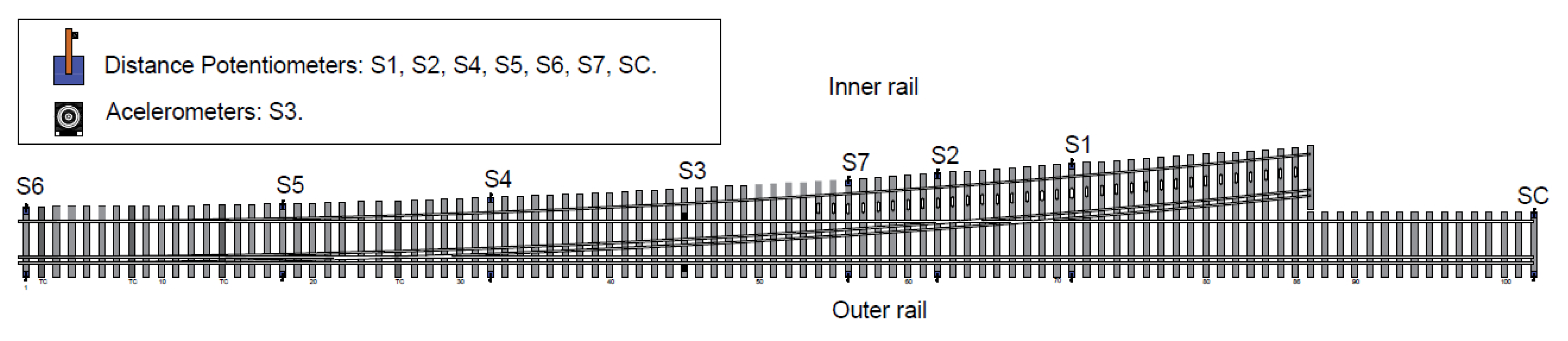
Figure 8.
View of displacement sensors.
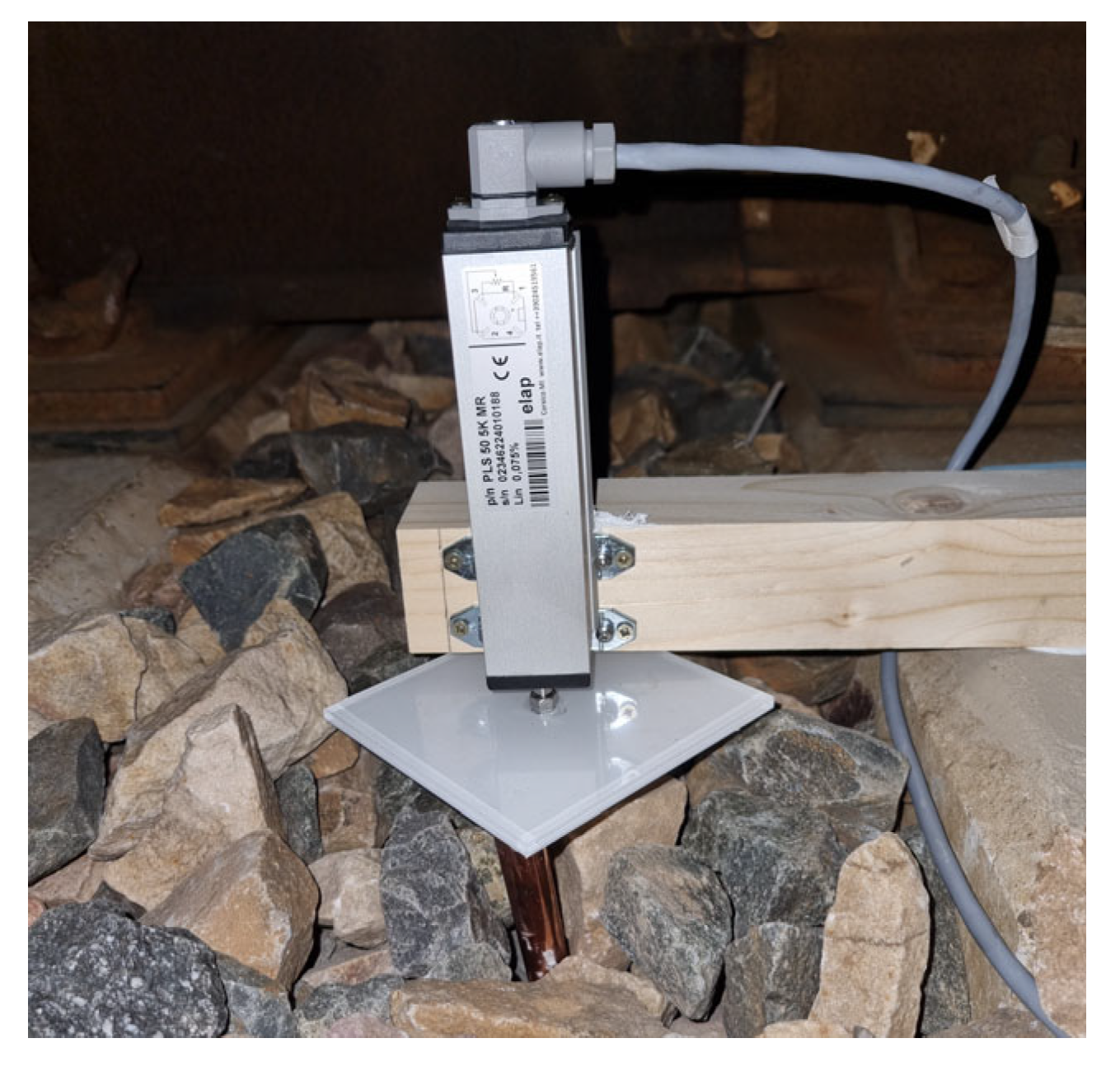
Figure 9.
View of accelerometer.
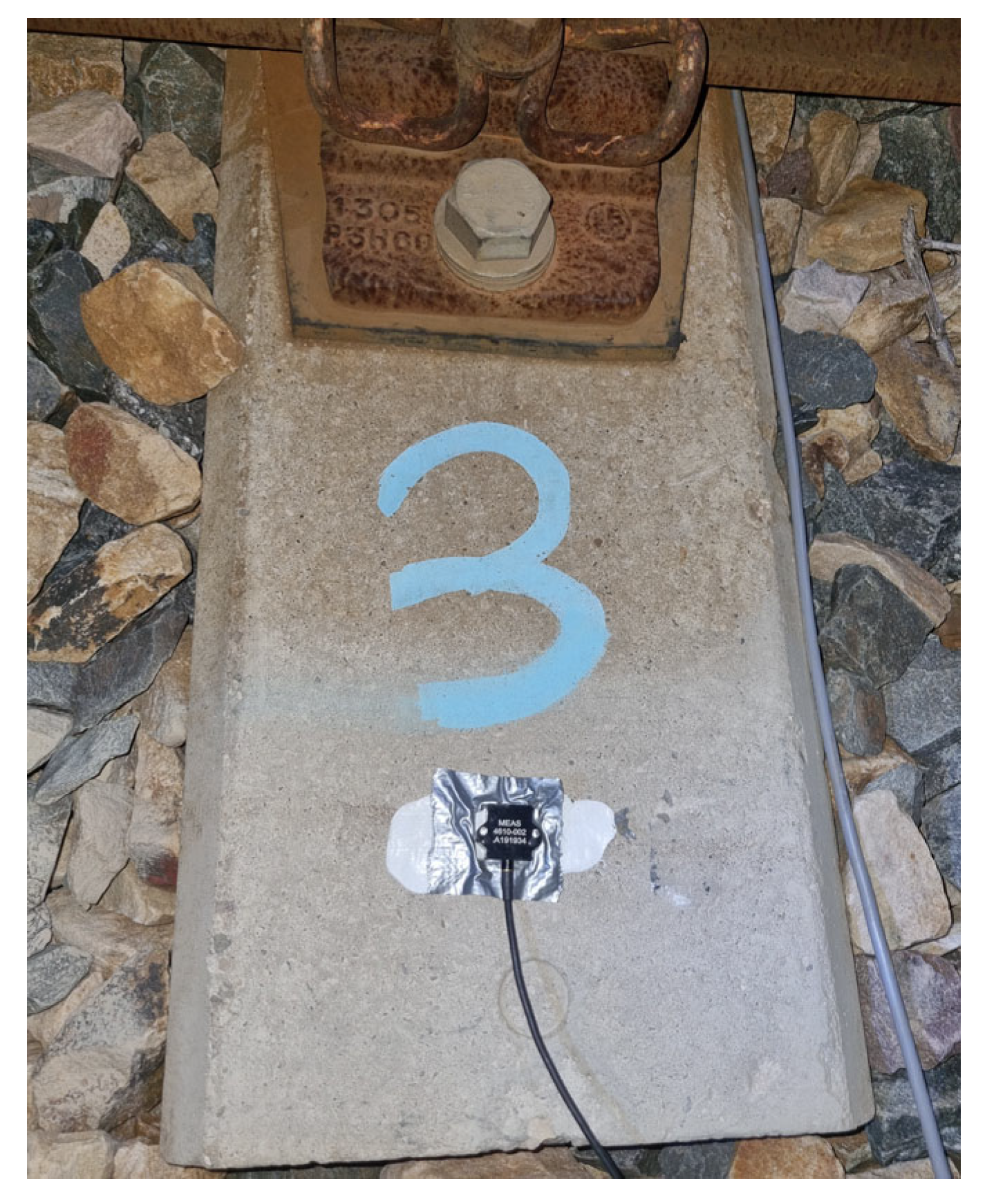
Figure 10.
Box-and-whisker plots of peak vertical rail displacements for commuter trains operating at speeds ≤ 65 km/h.
Figure 10.
Box-and-whisker plots of peak vertical rail displacements for commuter trains operating at speeds ≤ 65 km/h.
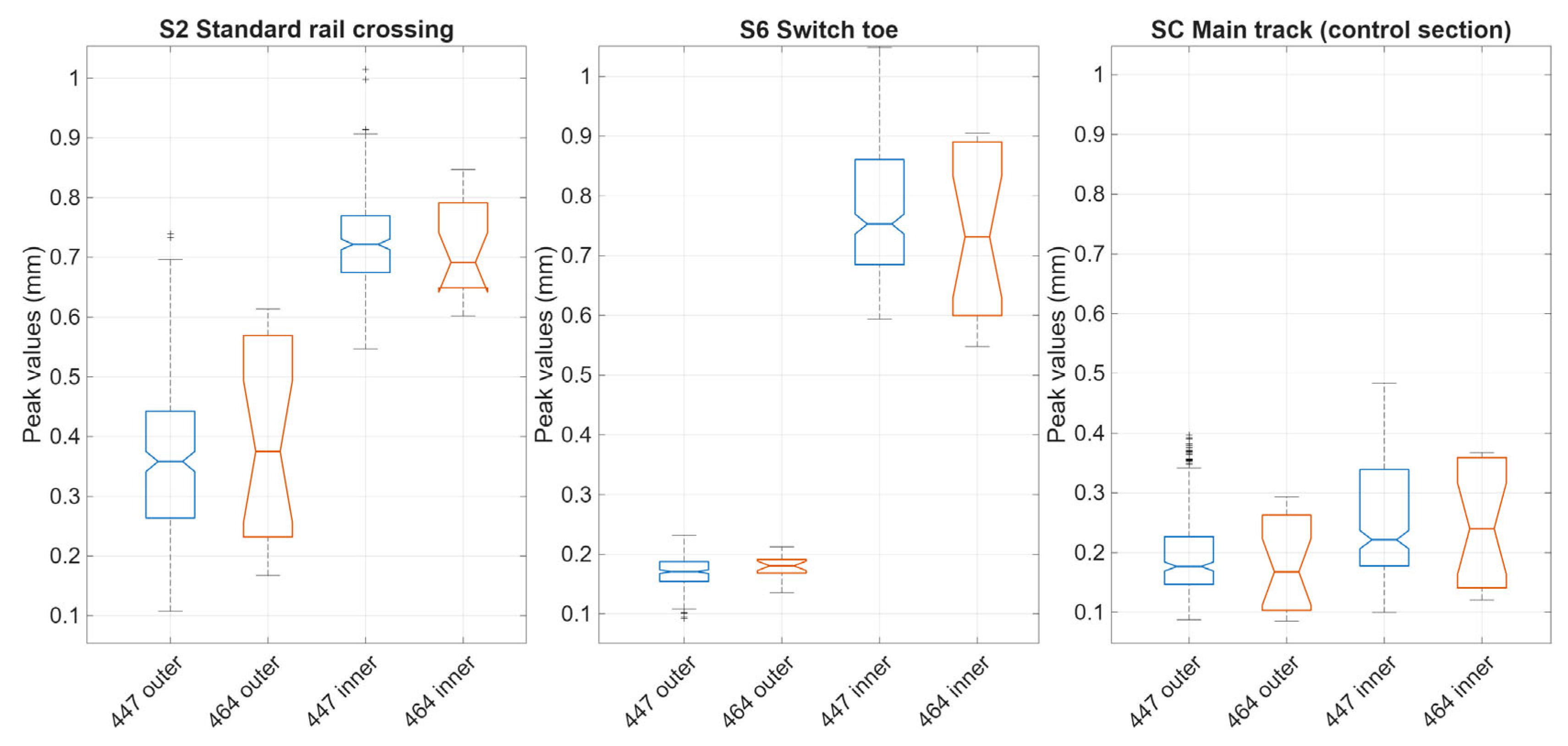
Figure 11.
Vertical displacement time histories recorded during Series 447 commuter train passages at speeds below 65 km/h. (a) Section S2, outer rail; (b) Section S2, inner rail; (c) Section S6, outer rail; (d) Section S6, inner rail; (e) Section SC, outer rail; (f) Section SC, inner rail.
Figure 11.
Vertical displacement time histories recorded during Series 447 commuter train passages at speeds below 65 km/h. (a) Section S2, outer rail; (b) Section S2, inner rail; (c) Section S6, outer rail; (d) Section S6, inner rail; (e) Section SC, outer rail; (f) Section SC, inner rail.
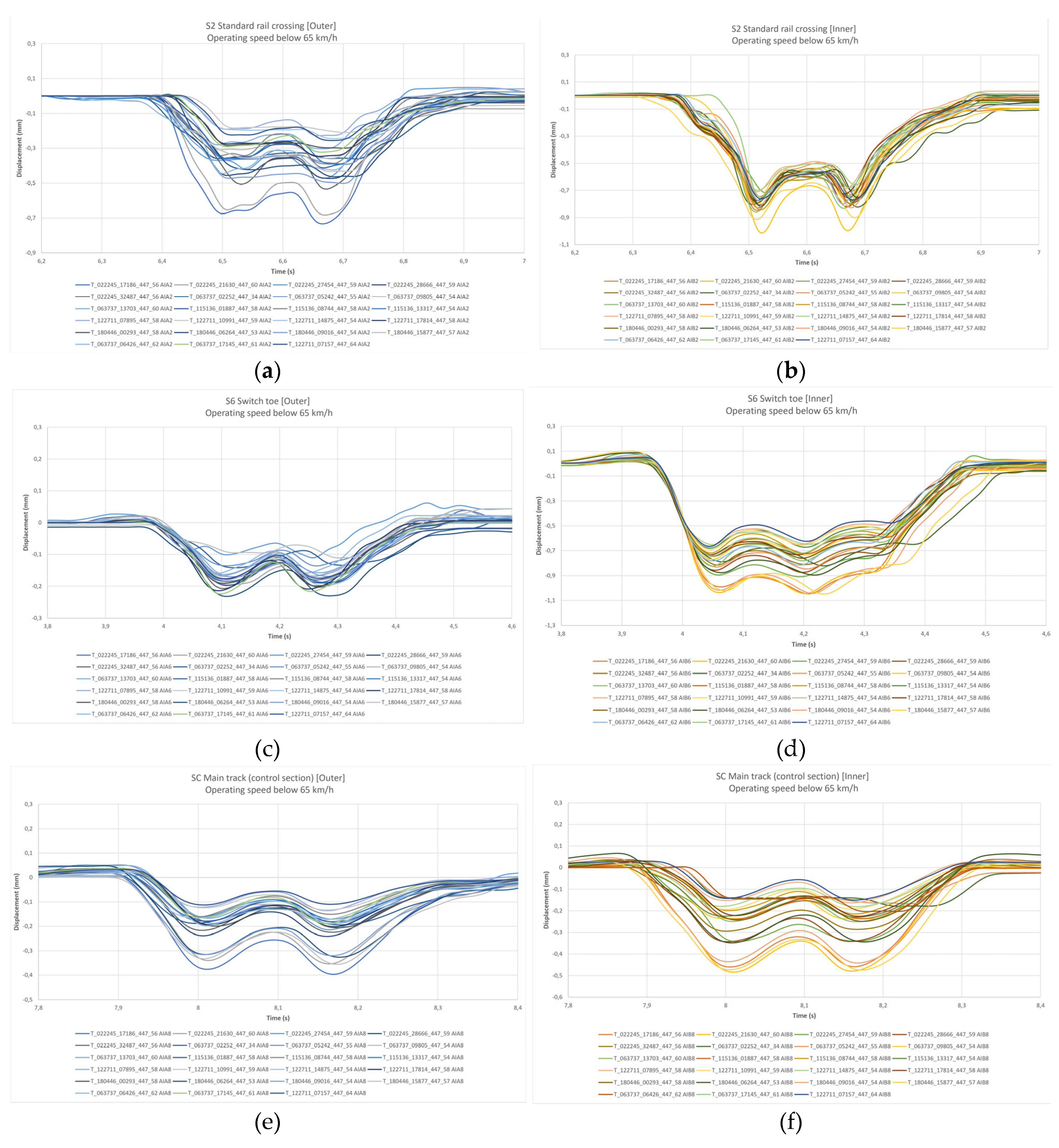
Figure 12.
Box-and-whisker plot for commuter trains operating at speeds exceeding 65 km/h.
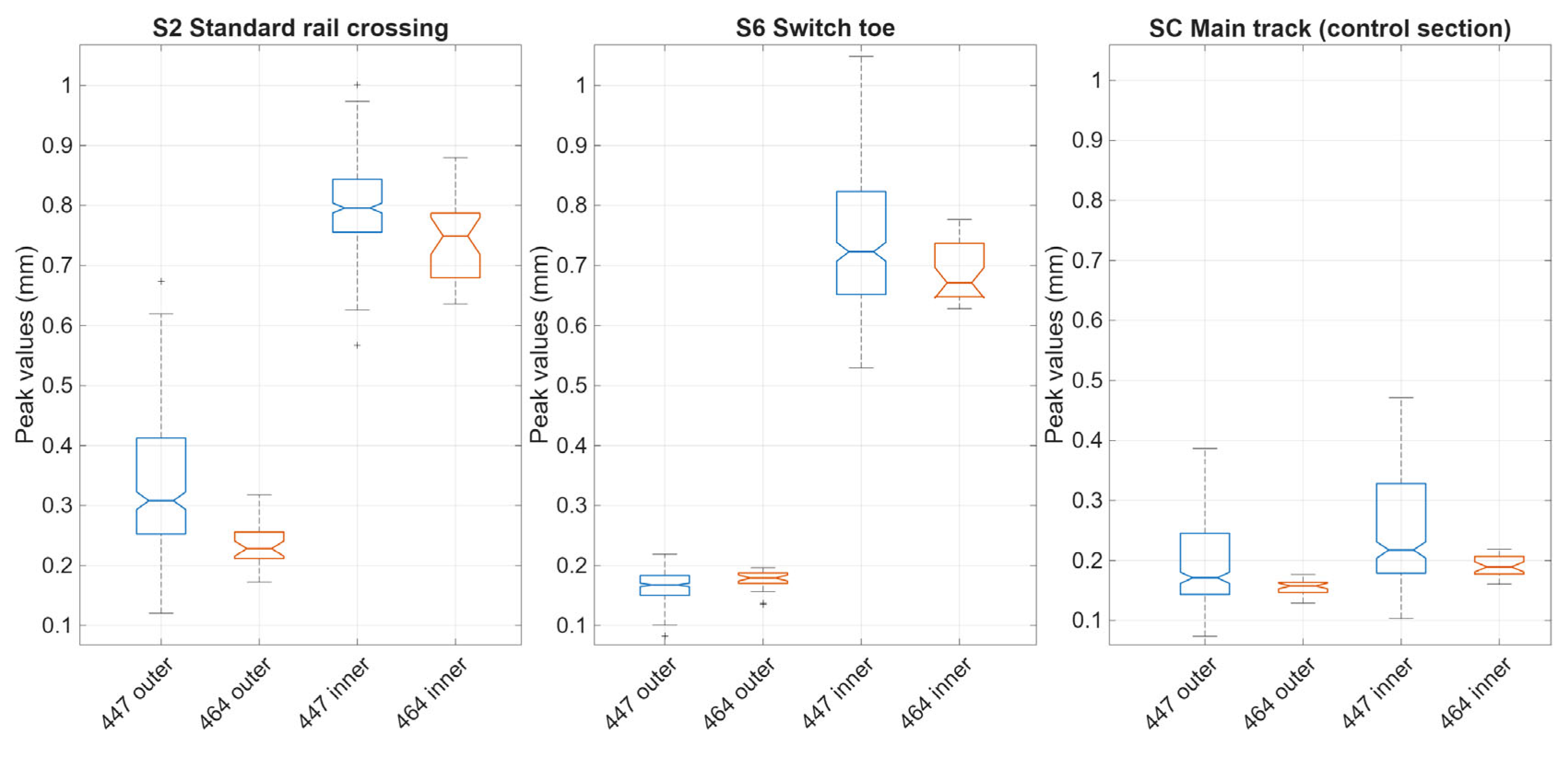
Figure 13.
Vertical displacement time histories recorded during Series 447 commuter train passages at speeds above 65 km/h. (a) Section S2, outer rail; (b) Section S2, inner rail; (c) Section S6, outer rail; (d) Section S6, inner rail; (e) Section SC, outer rail; (f) Section SC, inner rail.
Figure 13.
Vertical displacement time histories recorded during Series 447 commuter train passages at speeds above 65 km/h. (a) Section S2, outer rail; (b) Section S2, inner rail; (c) Section S6, outer rail; (d) Section S6, inner rail; (e) Section SC, outer rail; (f) Section SC, inner rail.
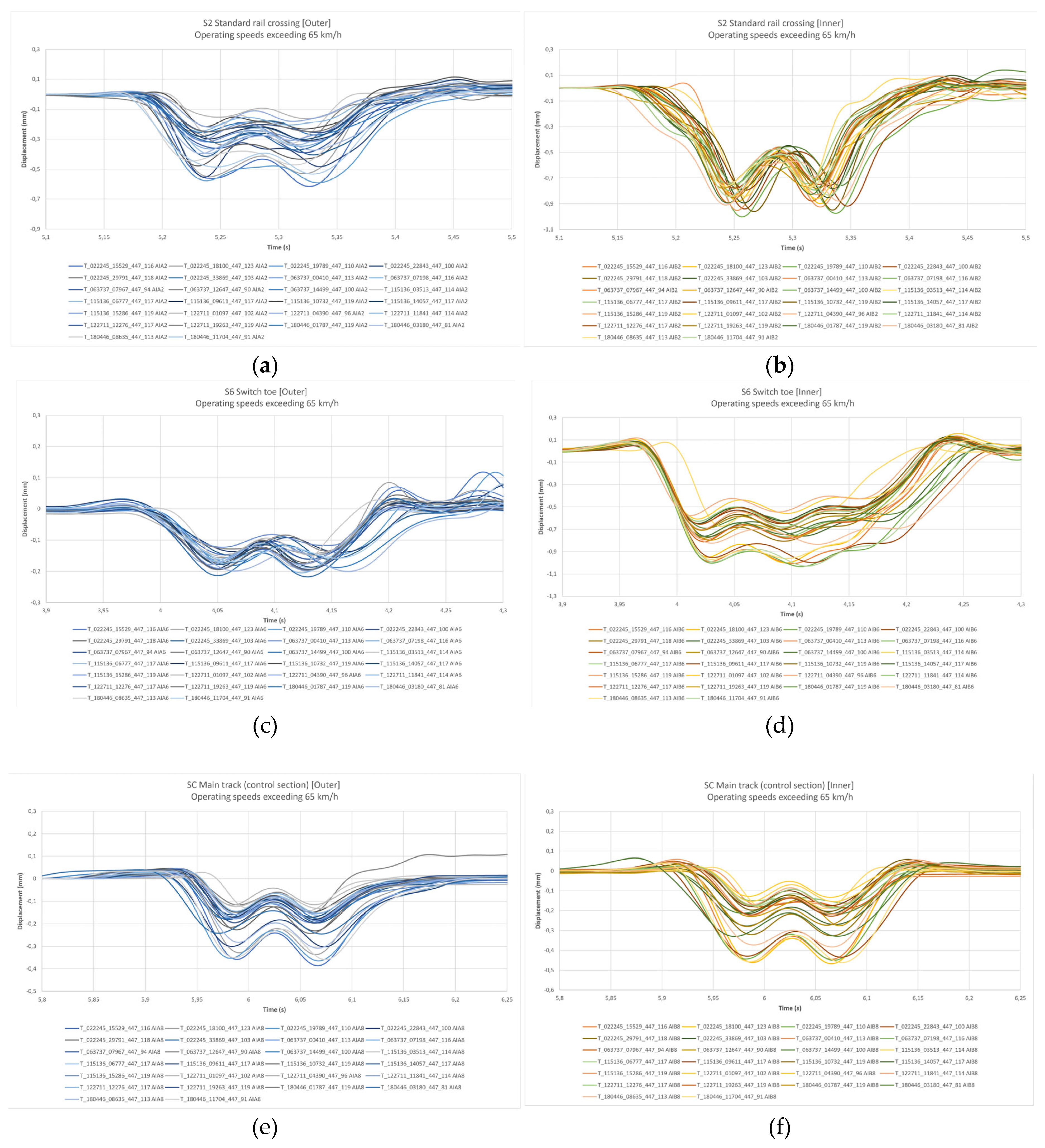
Figure 14.
Box-and-whisker plot for high-speed trains.
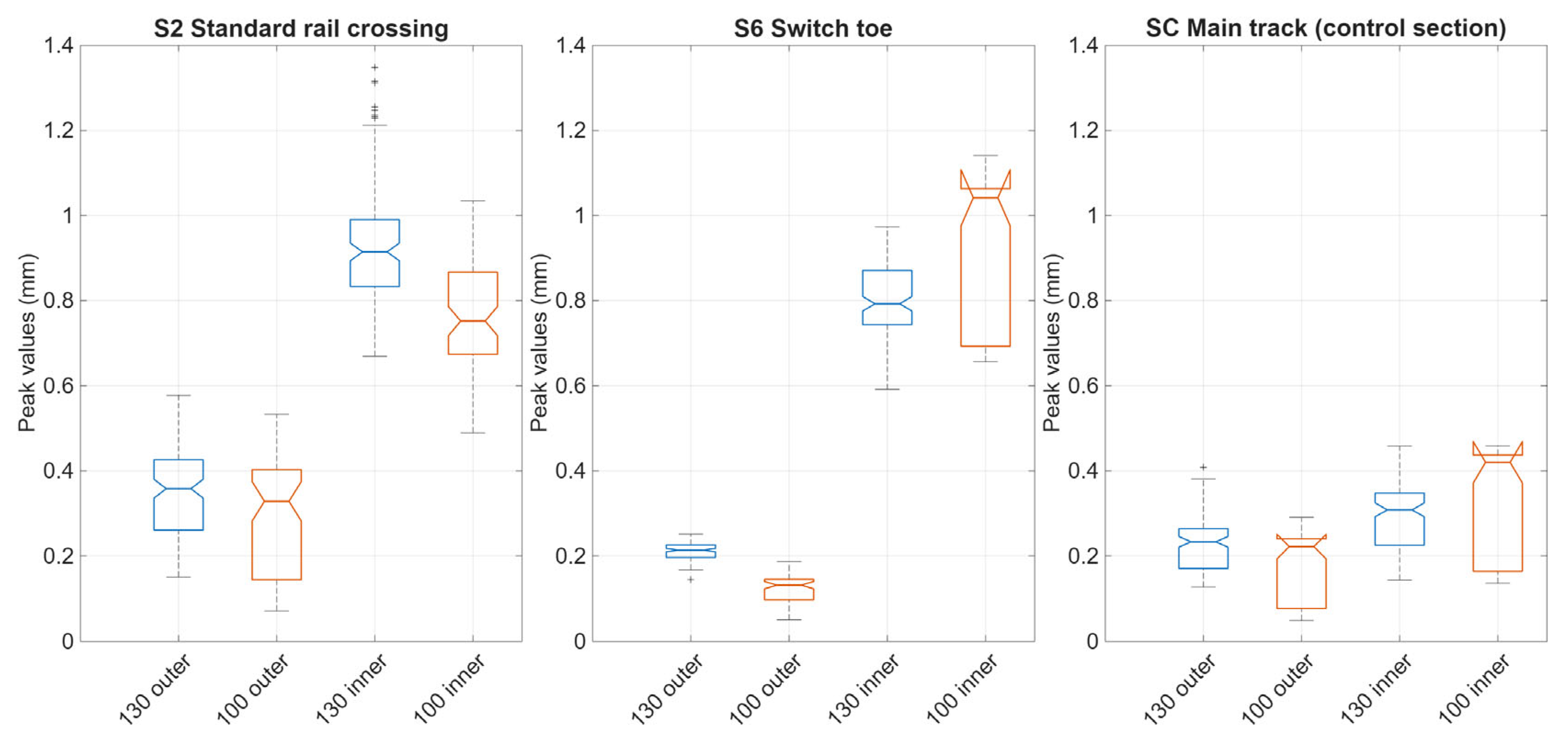
Figure 15.
Vertical displacement time histories recorded during high-speed Series 130 train passages. (a) Section S2, outer rail; (b) Section S2, inner rail; (c) Section S6, outer rail; (d) Section S6, inner rail; (e) Section SC, outer rail; (f) Section SC, inner rail.
Figure 15.
Vertical displacement time histories recorded during high-speed Series 130 train passages. (a) Section S2, outer rail; (b) Section S2, inner rail; (c) Section S6, outer rail; (d) Section S6, inner rail; (e) Section SC, outer rail; (f) Section SC, inner rail.
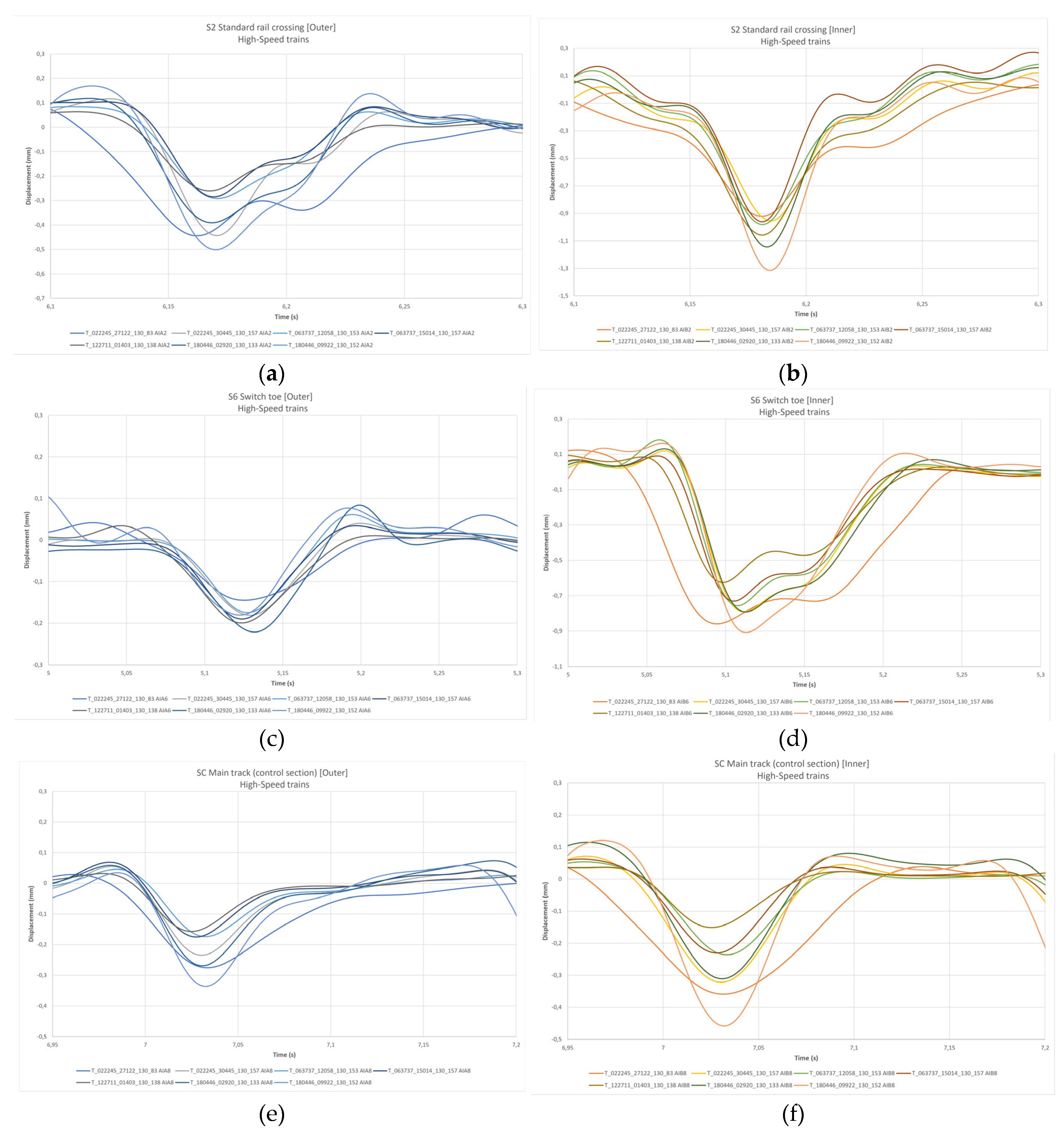
Figure 16.
Acceleration time history, closure panel, Series 447 ≤65 km/h.
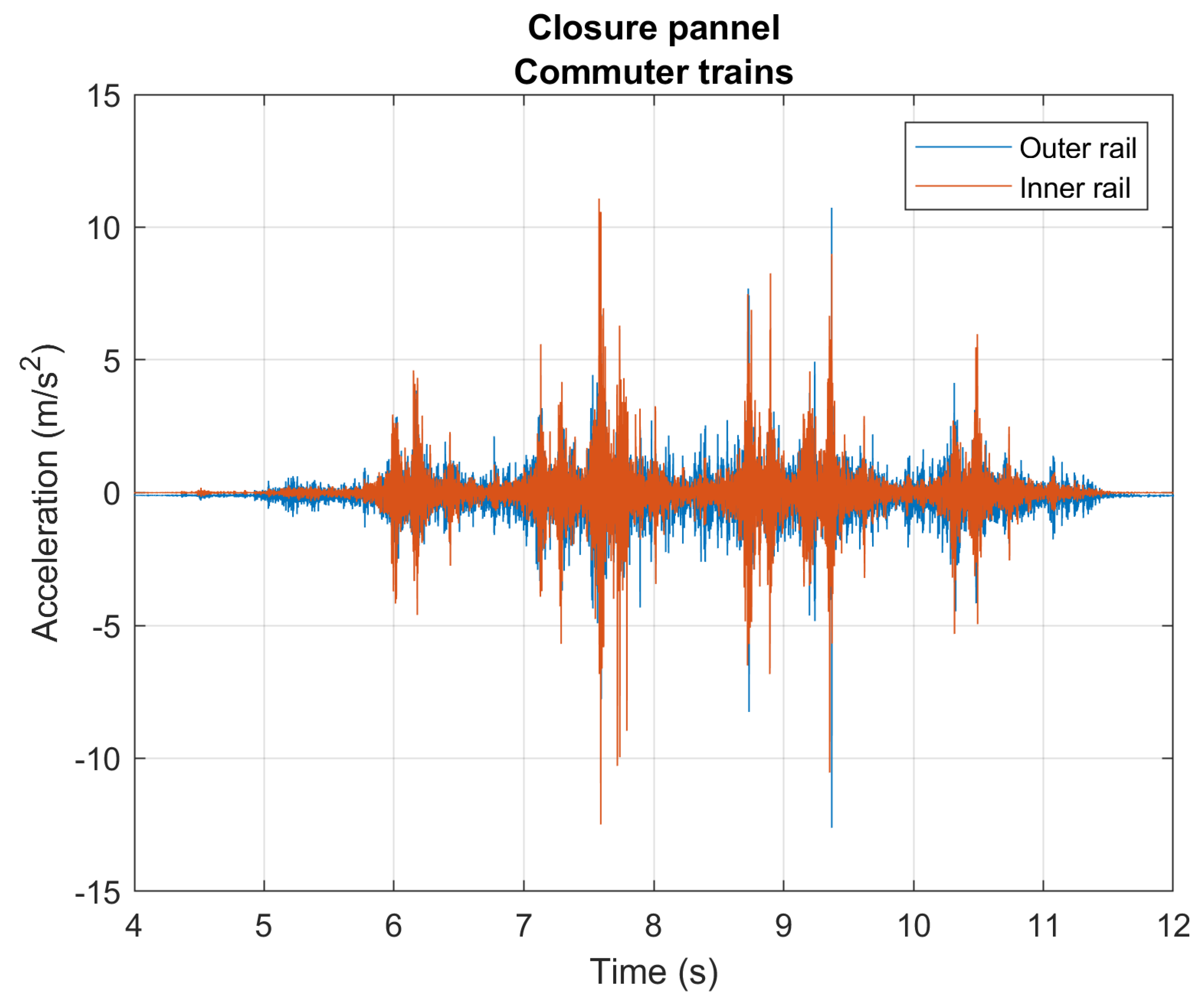
Figure 18.
Acceleration spectrum closure panel for commuter train passages at speeds ≤65 km/h.
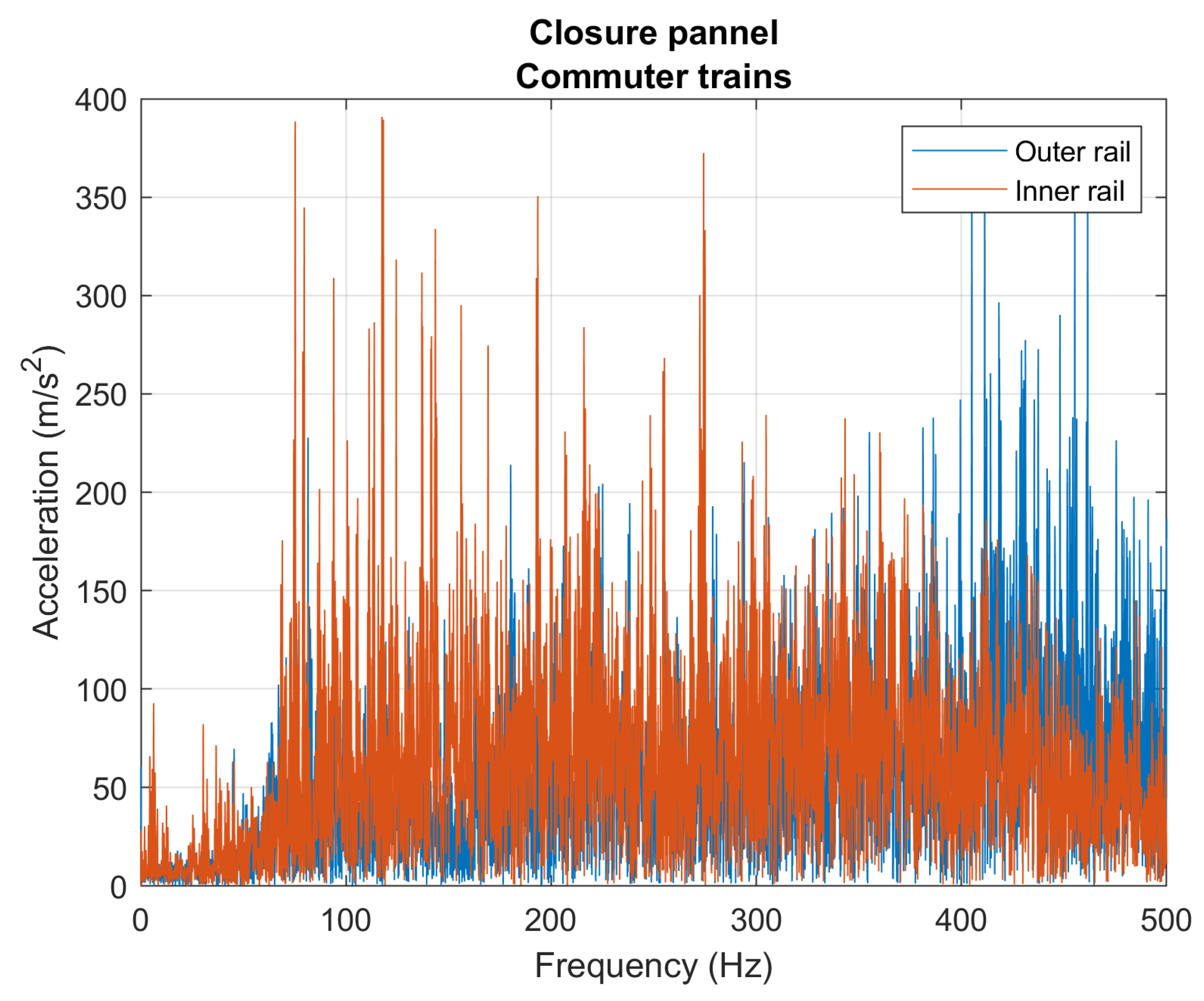
Figure 19.
Acceleration time history recorded at the closure panel for Series 447 commuter trains operating at speeds > 65 km/h.
Figure 19.
Acceleration time history recorded at the closure panel for Series 447 commuter trains operating at speeds > 65 km/h.
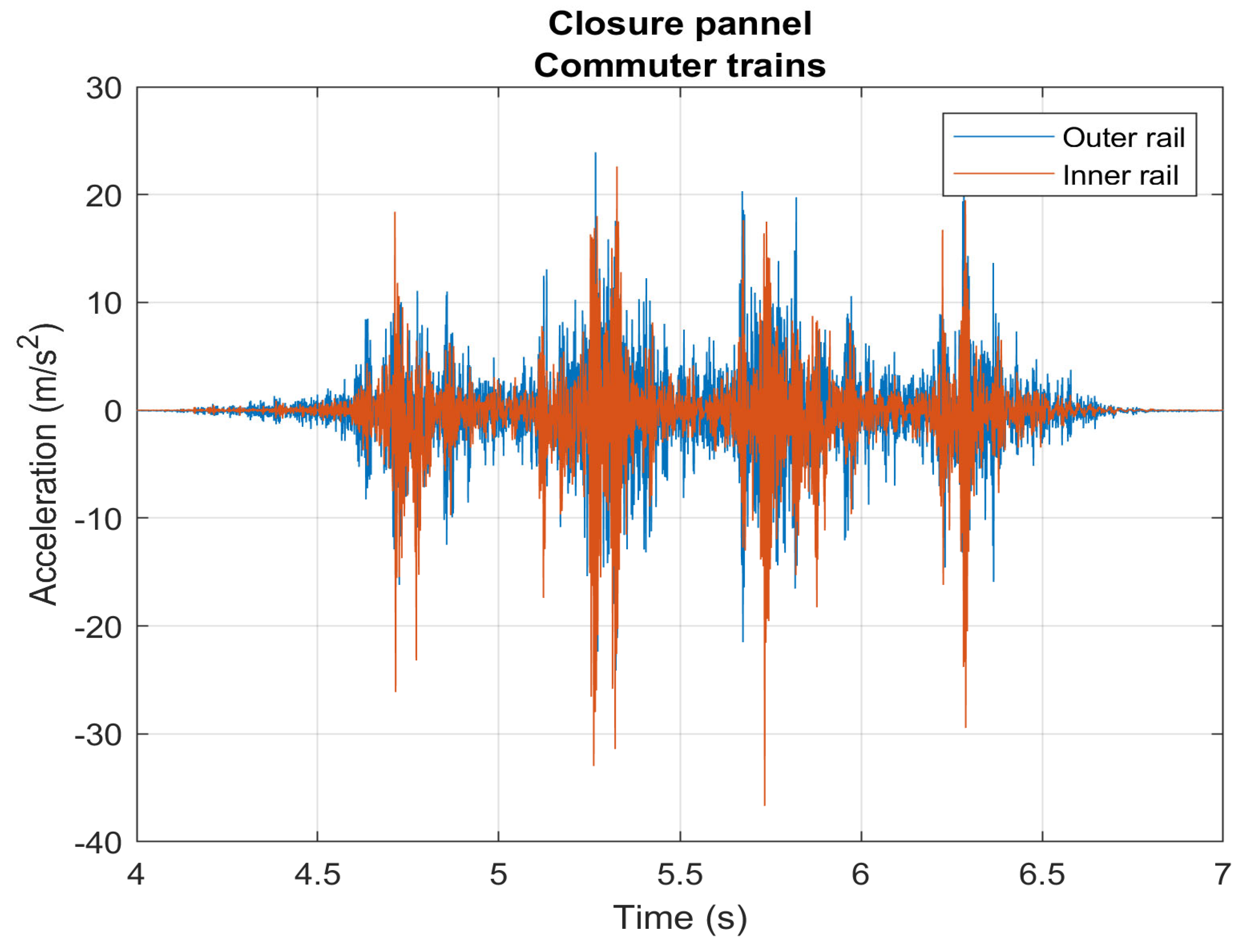
Figure 20.
Frequency spectra of vertical displacement and acceleration for commuter train passages at speeds above 65 km/h: (a) S2 Crossing 2; (b) S6 Switch toe; (c) SC Main track (control section).
Figure 20.
Frequency spectra of vertical displacement and acceleration for commuter train passages at speeds above 65 km/h: (a) S2 Crossing 2; (b) S6 Switch toe; (c) SC Main track (control section).
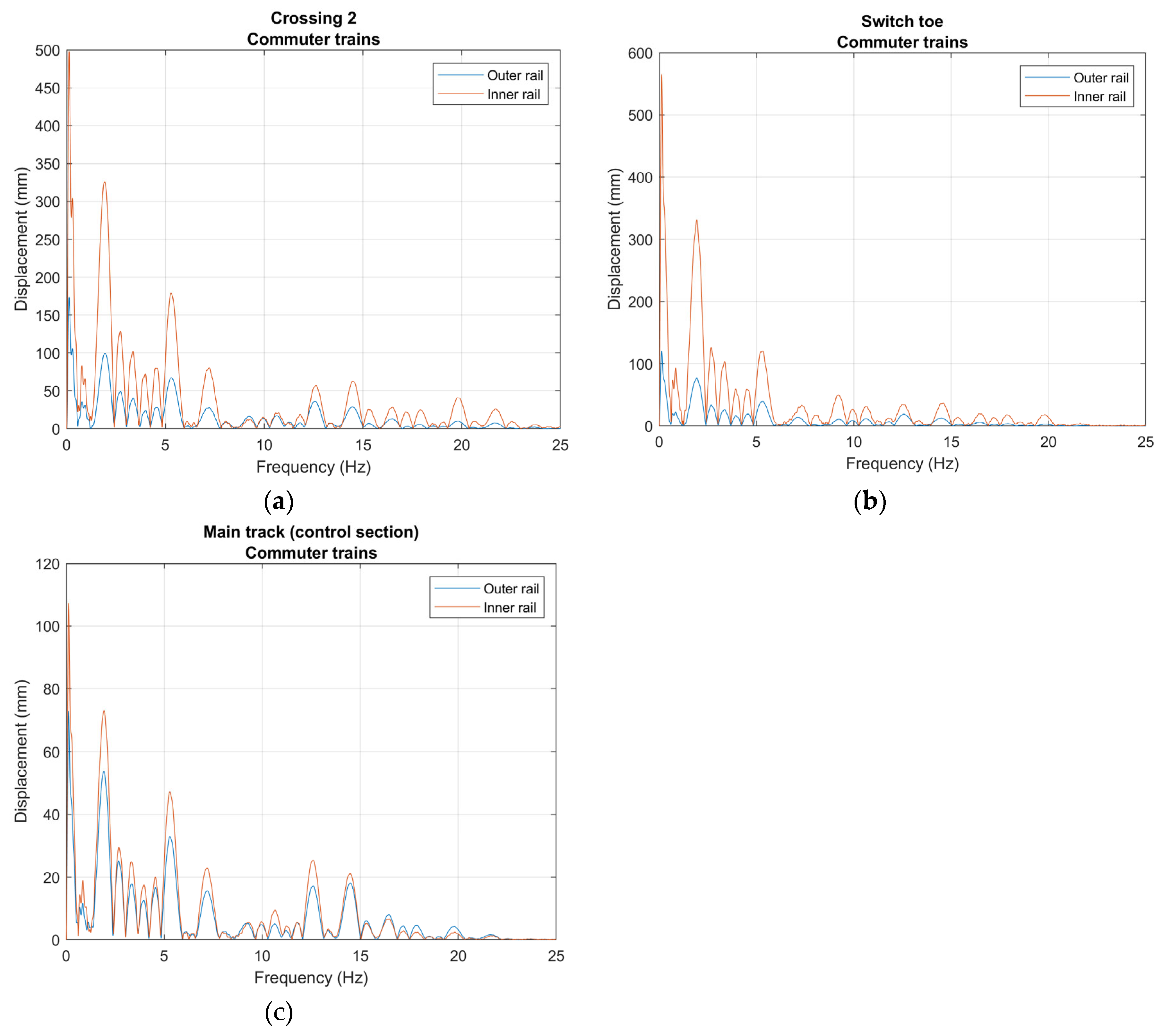
Figure 21.
Acceleration spectrum closure panel for commuter train passages at speeds >65 km/h.
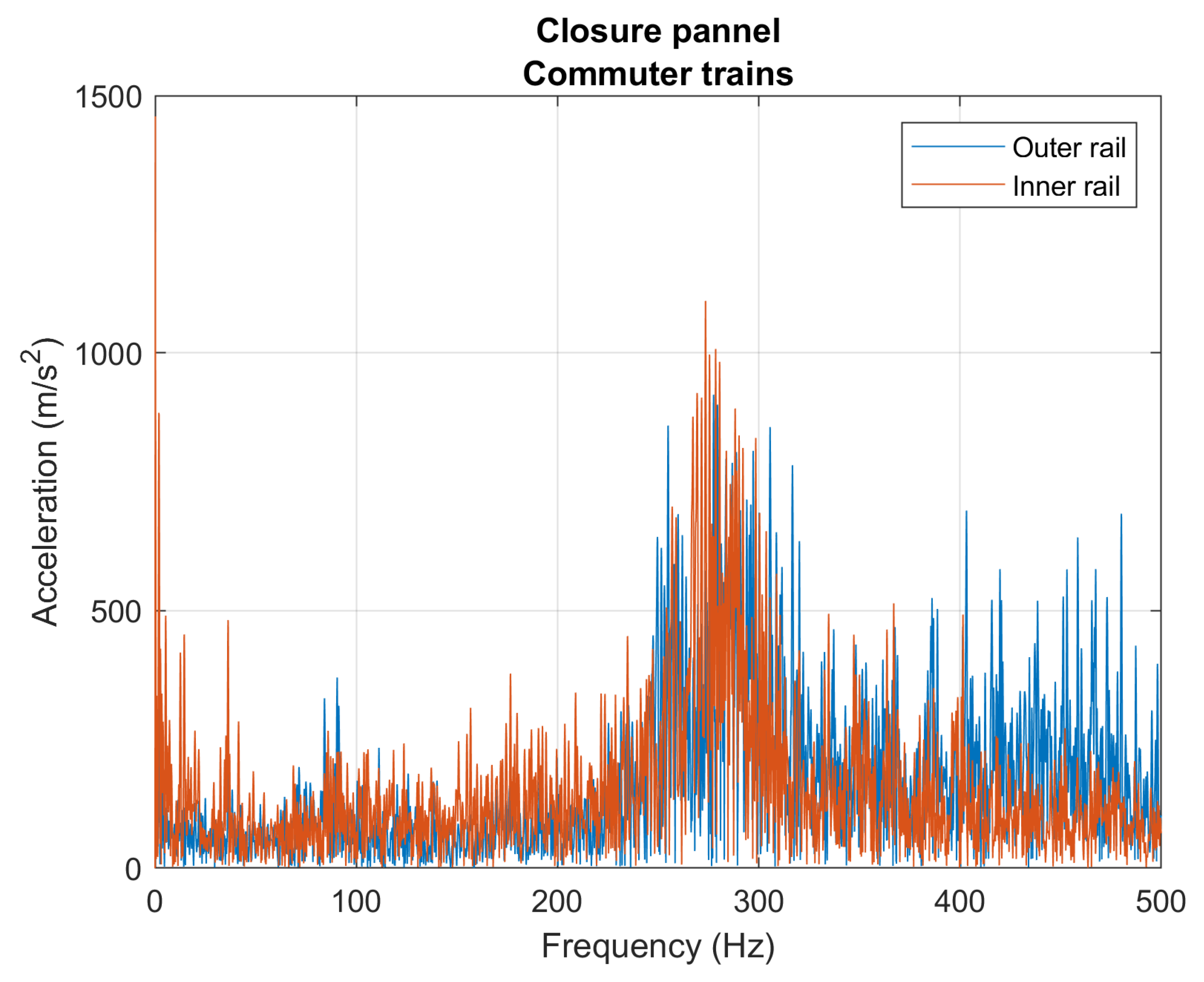
Figure 22.
Acceleration time history, closure panel, Series 130.
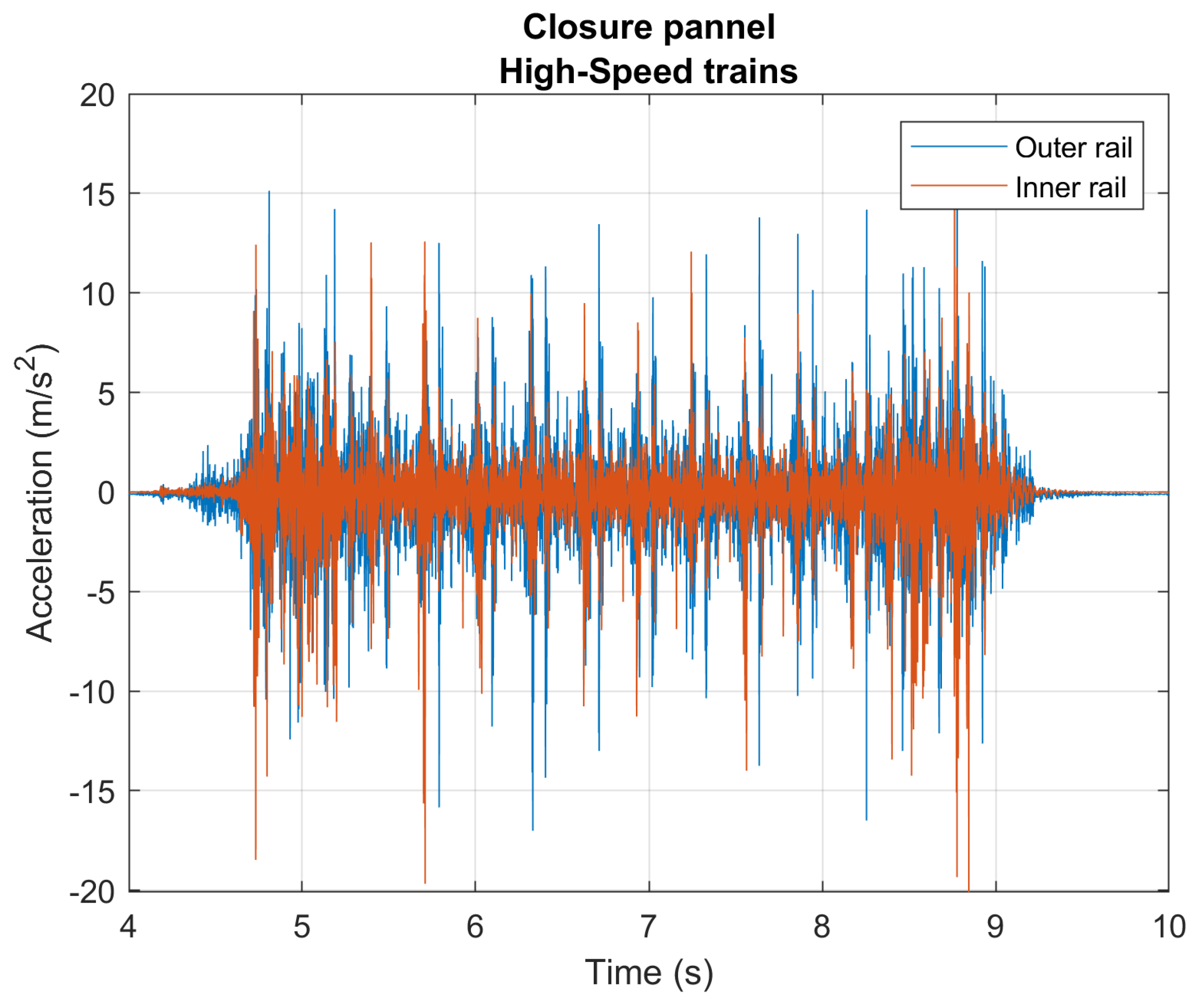
Figure 23.
Frequency spectra of vertical displacement and acceleration for Series 130 high-speed train passages: (a) S2 Crossing 2; (b) S6 Switch toe; (c) SC Main track (control section).
Figure 23.
Frequency spectra of vertical displacement and acceleration for Series 130 high-speed train passages: (a) S2 Crossing 2; (b) S6 Switch toe; (c) SC Main track (control section).
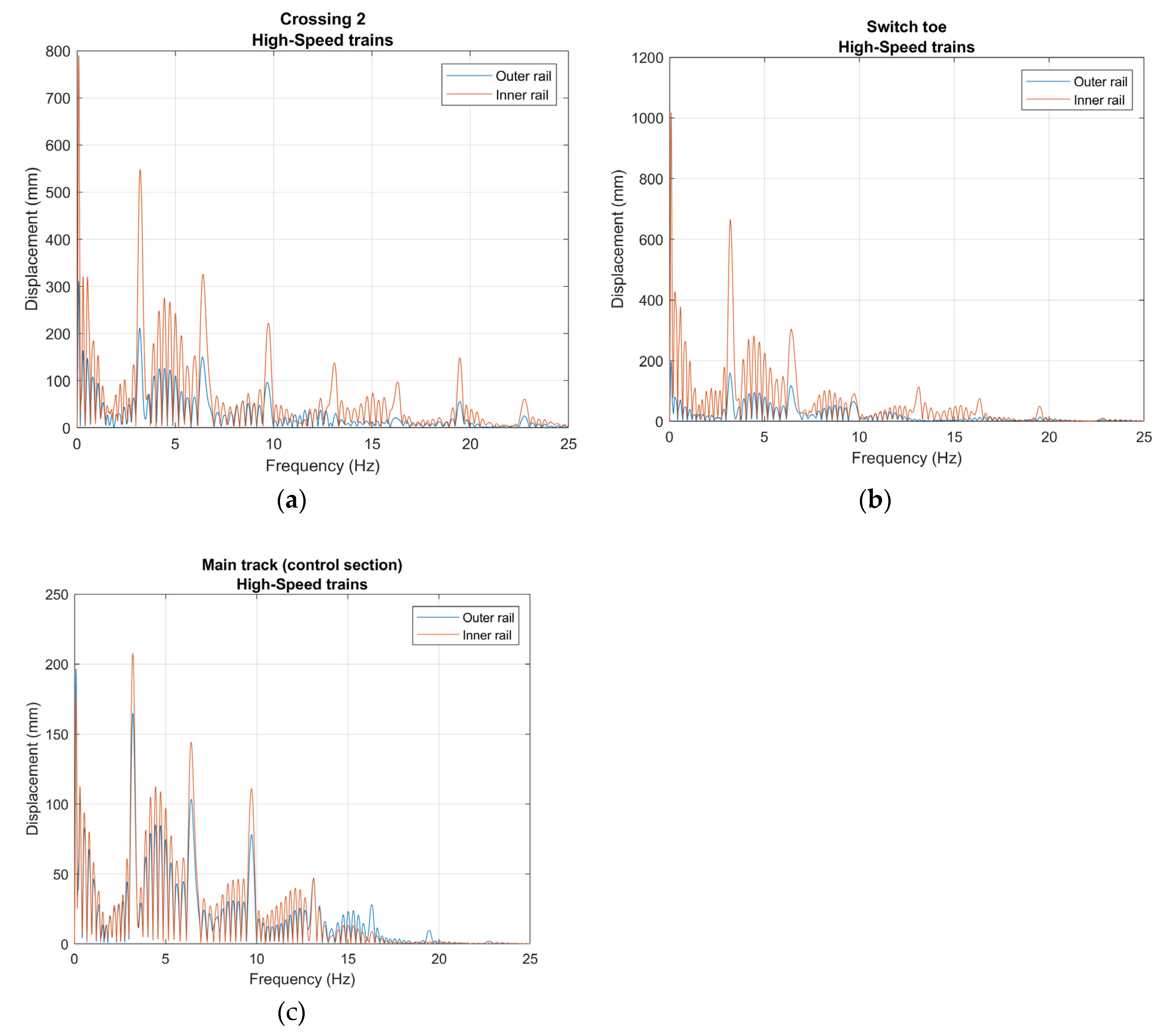
Figure 24.
Acceleration spectrum at the closure panel for Series 130 high-speed train passages.
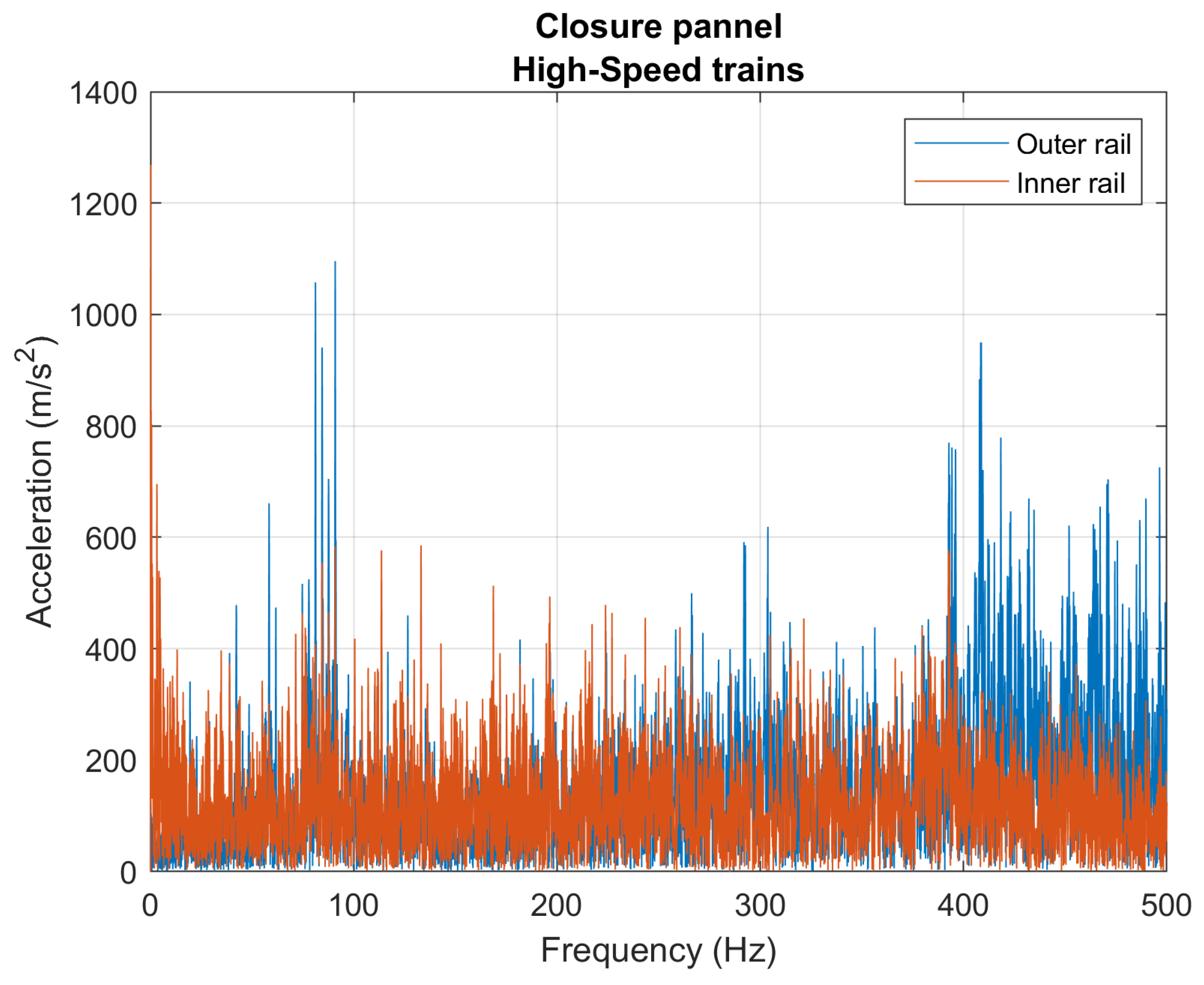
Table 1.
Definition and location of monitored sections.
| Section name | Measured variable | S&C section |
| S1 | Displacement (mm) | Iberian rail crossing |
| S2 | Displacement (mm) | Standard rail crossing / Crossing2 |
| S3 | Acceleration (m/s2) | Closure pannel |
| S4 | Displacement (mm) | Obtuse crossing |
| S5 | Displacement (mm) | Switch rail joint |
| S6 | Displacement (mm) | Switch toe |
| S7 | Displacement (mm) | Trimetallic weld |
| SC | Displacement (mm) | Main track (control section) |
Disclaimer/Publisher’s Note: The statements, opinions and data contained in all publications are solely those of the individual author(s) and contributor(s) and not of MDPI and/or the editor(s). MDPI and/or the editor(s) disclaim responsibility for any injury to people or property resulting from any ideas, methods, instructions or products referred to in the content. |
© 2026 by the authors. Licensee MDPI, Basel, Switzerland. This article is an open access article distributed under the terms and conditions of the Creative Commons Attribution (CC BY) license (http://creativecommons.org/licenses/by/4.0/).
Copyright: This open access article is published under a Creative Commons CC BY 4.0 license, which permit the free download, distribution, and reuse, provided that the author and preprint are cited in any reuse.


