
Submitted:
24 June 2026
Posted:
25 June 2026
You are already at the latest version
Abstract
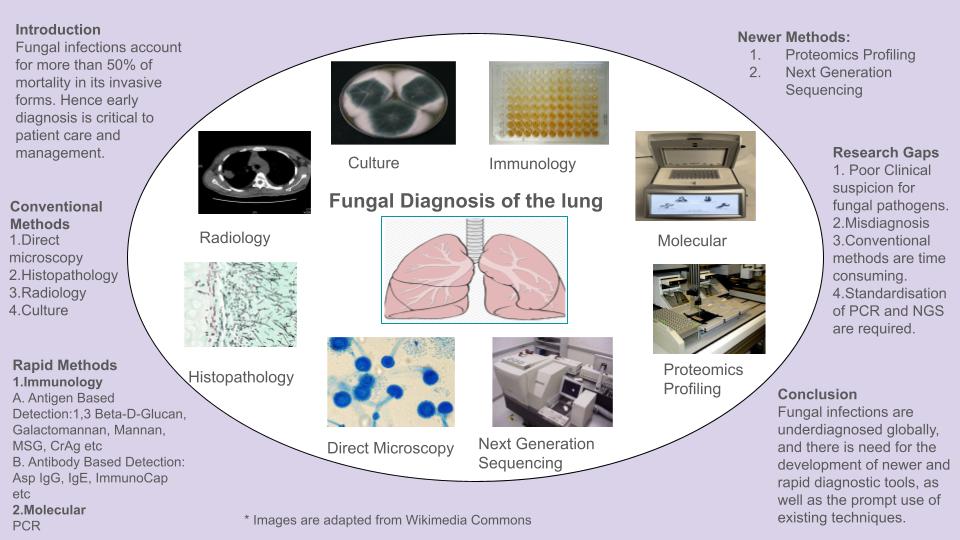
Purpose of Review: This review aims to document the diagnostic modalities available and related developments for the detection of pulmonary fungal infections which are mostly neglected when compared with pneumonia caused by bacteria and viruses. Recent Findings: There is a significant gap in the suspicion for fungal pneumonia among clinicians as they mimic other conditions such as tuberculosis. Furthermore, the laboratory diagnosis for these fungal pathogens mostly rely on conventional techniques and hence the need for standardisation of molecular methods such as PCR, next generation sequencing are being explored. Summary: Early diagnosis of fungal infections is a significant challenge and can be crucial to effective treatment and clinical outcomes. Several factors contribute to the roadblock in the diagnostic pathway, including time-consuming conventional assays like culture, the need for highly skilled laboratory personnel for histopathological examination, and the cross-reactivity of antigen-antibody assays. Although labour-intensive, conventional diagnostic methods, including histopathology and culture, continue to remain the gold standard. Studies have demonstrated that the advent of molecular tools and immunoassays could assist in laboratory diagnosis much more quickly and efficiently. Furthermore, metagenomic next-generation sequencing can provide significant breakthroughs in fungal diagnostics. This review has documented important research outputs concerning the diagnosis of pulmonary fungal pathogens in the past decade.
Keywords:
mycoses
; pathogenic fungi
; next-generation sequencing
; Aspergillus
; PCR
Copyright: This open access article is published under a Creative Commons CC BY 4.0 license, which permit the free download, distribution, and reuse, provided that the author and preprint are cited in any reuse.


