

Submitted:
24 June 2026
Posted:
25 June 2026
You are already at the latest version
Abstract
Computational generation of protein backbone geometry is a critical upstream step in de novo protein design, but the existing state of the art approaches typically requires large pretrained structure prediction networks, significant computing in frastructure, or complex probabilistic frameworks. Here we present a lightweight autoregressive generative model based on a Long Short-Term Memory network with a Mixture Density Network output head, trained directly on backbone phi and psi torsion angle sequences which were extracted from a non-redundant subset of the Protein Data Bank. Angles were encoded as sine-cosine pairs to handle circular periodicity, and a variable-length end-of-sequence mechanism was incorporated to enable generation of proteins of realistic and variable length. The Mixture Density Network output head with eight Gaussian mixture components was introduced to prevent mode collapse onto the mean of the Ramachandran distribution. This enabled the model to generate sequences with realistic secondary structure composition. A total of 1000 novel backbone scaffolds were generated and reconstructed as three dimensional polyalanine structures using EZScafold, then scored using Rosetta after energy minimisation. Generated scaffolds achieved significantly lower normalised Rosetta total scores than a control set constructed by randomly sampling angles from the training data pool (p < 0.001), demonstrating that the model captures meaningful sequential dependencies in backbone geometry beyond the marginal angle distribution alone. This demonstrate that a simple, accessible, and interpretable recurrent architecture can be used as an effective backbone generation engine pro ducing geometrically and energetically meaningful scaffolds ready for downstream sequence design pipelines.
Keywords:
protein backbone generation
; long short term memory
; mixture density network
; torsion angles
; de novo protein design
; ramachandran plot
; autoregressive generation
Introduction
Proteins are the fundamental molecular machines of life with roles ranging from catalysis and structural support to signal transduction and immune defence. The three-dimensional conformation of a protein determines its function and the ability to computationally generate novel protein backbone geometries is a critical step towards the broader goal of de novo protein design (Harteveld et al. 2022). Experimental methods like X-ray crystallography, cryo-electron microscopy and nuclear magnetic resonance spectroscopy have yielded tens of thousands of structures deposited in the Protein Data Bank (Berman et al. 2000), these approaches are time consuming, resource intensive and not universally applicable. The generation of plausible backbone geometries remains a challenge, which if solved efficiently would serve as a universal upstream component for any downstream protein design pipeline regardless of the sequence design strategy.
The backbone torsion angles phi and psi, systematically described by Ramachandran et al. (1963), provide a compact and physically meaningful representation of protein backbone geometry. As covalent bond lengths and bond angles along a polypeptide chain are rigid, the three-dimensional conformation are largely determined by these dihedral angles. The Ramachandran plot which maps the joint distribution of phi and psi angles across structures shows that real proteins occupy a limited subset of geometrically accessible conformational space clustering into well-defined regions corresponding to -helices, -sheets, and other structural elements. This observation underpins many computational approaches to structure prediction, validation and design (Lovell et al., n.d.). A backbone defined entirely by phi and psi angles would constitute a geometric scaffold onto which any compatible amino acid sequence may in principle be threaded using fixed backbone sequence designing tools or structure conditional language models such as ProteinMPNN (Dauparas et al. 2022). By creating a wide variety of structurally sound backbones, this method acts as a flexible foundation. It creates a ‘geometric blueprint’ that can easily be handed off to other modern design tools to finish the job.
This past decade has witnessed remarkable advances in deep learning-based approaches to protein structure modelling. AlphaFold2 (Jumper et al. 2021) represented a remarkable feat in the field, demonstrating near experimental accuracy in predicting protein monomer structures from sequence alone using a novel attention based architecture trained on evolutionary and structural data from the PDB. Subsequent work expanded structural coverage to the broader proteome (Tunyasuvunakool et al. 2021) and complementary protein language models such as ESM-2 have demonstrated that transformer architectures trained on hundreds of millions of protein sequences can learn deep representations of protein sequence-structure relationships without explicit structural supervision (Lin et al. 2023). Even with the current state of protein shape predictions, creating entirely new backbones from scratch or building structures that aren’t just copies of what nature have already evolved remains a challenge. This geometric foundation usually acts as the first step in providing the physical stage upon which all later sequence level design takes place.
Generative approaches to protein backbone design have advanced substantially in parallel with structure prediction. Diffusion based methods like RFdiffusion (Watson et al. 2023), have demonstrated impressive capabilities for unconditional and topology constrained backbone generation, binder design, and enzyme active site scaffolding by fine tuning the RoseTTAFold structure prediction network on backbone denoising tasks. Complementary attention-based diffusion models have been applied to the design of novel protein sequences and structures conditioned on secondary structure content (Ni et al. 2023) and independent diffusion frameworks not reliant on pretrained structure prediction networks have shown that experimentally realisable structures can be generated from random noise (Chu et al. 2024). While these state of the art have received amazing results, they carry substantial barriers. They require the fine tuning of large pretrained structure prediction networks, access to significant compute infrastructure or deep familiarity with complex probabilistic frameworks. This limits their accessibility for research groups without dedicated computational resources and makes them difficult to adapt, interpret, or extend for exploratory or domain-specific applications.
Recurrent neural networks, specifically Long Short-Term Memory networks (Hochreiter and Schmidhuber 1997) offer an alternative for generative protein backbone modelling, one that is lightweight, interpretable and broadly accessible. LSTMs are natively suited to sequential data, maintaining an internal memory state that keeps track of the relationships along the chain, mirroring the way a real protein develops as each new piece added forces the structure to twist and settle into a specific shape. Unlike diffusion models that operate in three-dimensional coordinate space and require equivariant architectures or SE(3)-invariant representations (Jumper et al. 2021; Yim et al. 2023), an LSTM trained on phi and psi angle sequences operates in a simple two-dimensional angular space, which needs no specialised geometric machinery and no pretrained structural encoder. This straightforward design offers several real-world benefits. Rather than relying on supercomputers or massive pre-trained models, these LSTMs can be trained on standard hardware and easily run using everyday deep learning software. Most importantly, the results they generate, sequences of torsion angles, speak the native language of structural biology, making them instantly understandable to researchers. Furthermore, because the generated output is a sequence of backbone dihedral angles rather than three-dimensional atomic coordinates, it is natively compatible with downstream tools for structure reconstruction, Ramachandran validation (Williams et al. 2018), sequence design via inverse folding, and energy minimisation, this makes it an exceptional component within any protein design workflow. Past work with LSTM architectures has already shown that recurrent networks are remarkably good at learning the patterns of protein angles from sequence data alone (Mataeimoghadam et al. 2020; Xu et al. 2021). Furthermore, more advanced ensemble models, which combine the ‘memory’ of bidirectional LSTMs with the depth of residual networks, have set the current high bar for accuracy in predicting these torsion angles (Xu et al. 2020). More recent lightweight approaches have demonstrated that competitive torsion angle prediction performance can be achieved with significantly reduced model complexity (Zhang et al. 2024), collectively suggesting that simple recurrent architectures retain substantial representational capacity for protein structural modelling. Despite this evidence, autoregressive LSTM-based approaches to backbone torsion angle generation as opposed to prediction from sequence remain unexplored.
In this work we present a lightweight LSTM-based generative model trained directly on backbone phi and psi torsion angle sequences, extracted from a non-redundant subset of the Protein Data Bank. We employ a sine-cosine encoding raw angles to eliminate the periodicity problem inherent in degree-based representations (Xu et al. 2021), incorporated an end-of-sequence mechanism to enable variable-length sequence generation. Training data was curated through secondary structure filtering and redundancy reduction using CD-HIT (Fu et al. 2012) at a 90% sequence identity threshold. Generated sequences are evaluated by Ramachandran analysis, providing a physically interpretable assessment of backbone geometry quality. This work is a proof of concept that a simple, accessible, and interpretable recurrent architecture can serve as an effective backbone generation engine, one that produces phi and psi angle sequences ready for immediate use in downstream sequence design, structural reconstruction, and experimental validation pipelines.
Results
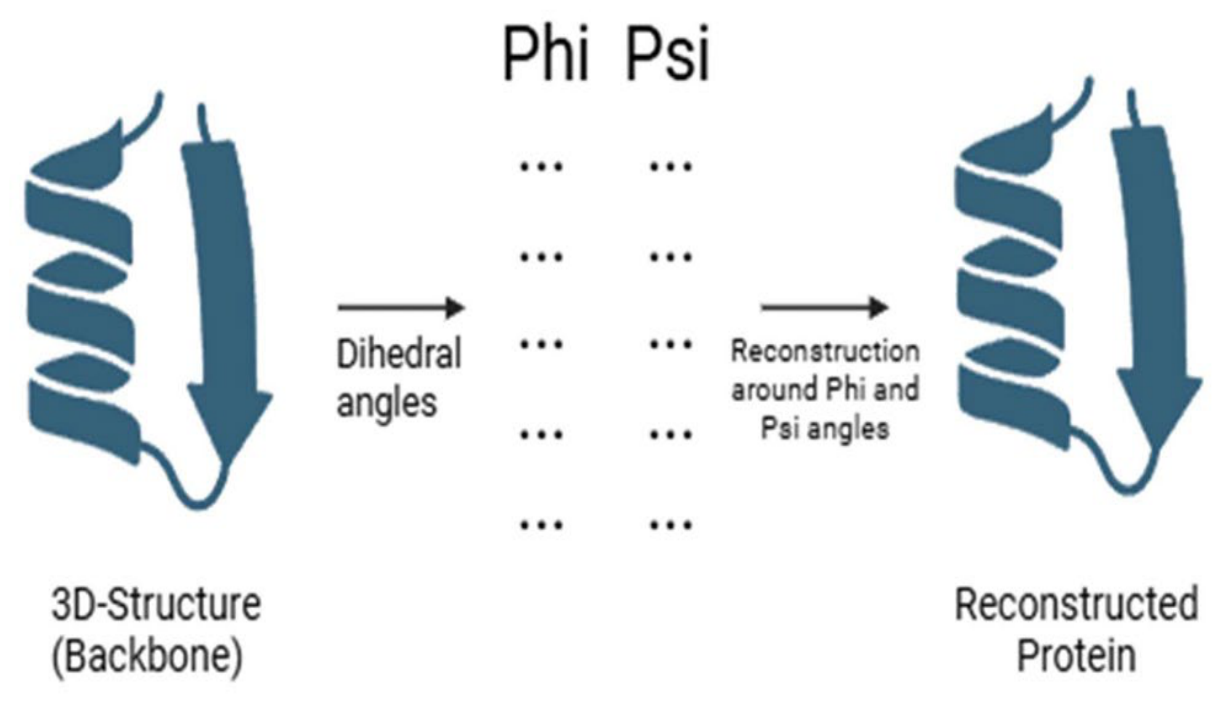
This demonstrates that the 3D structure of an entire protein can be reduced to its (phi) and (psi) backbone dihedral angles, from which the entire 3D backbone structure can be accurately reconstructed.
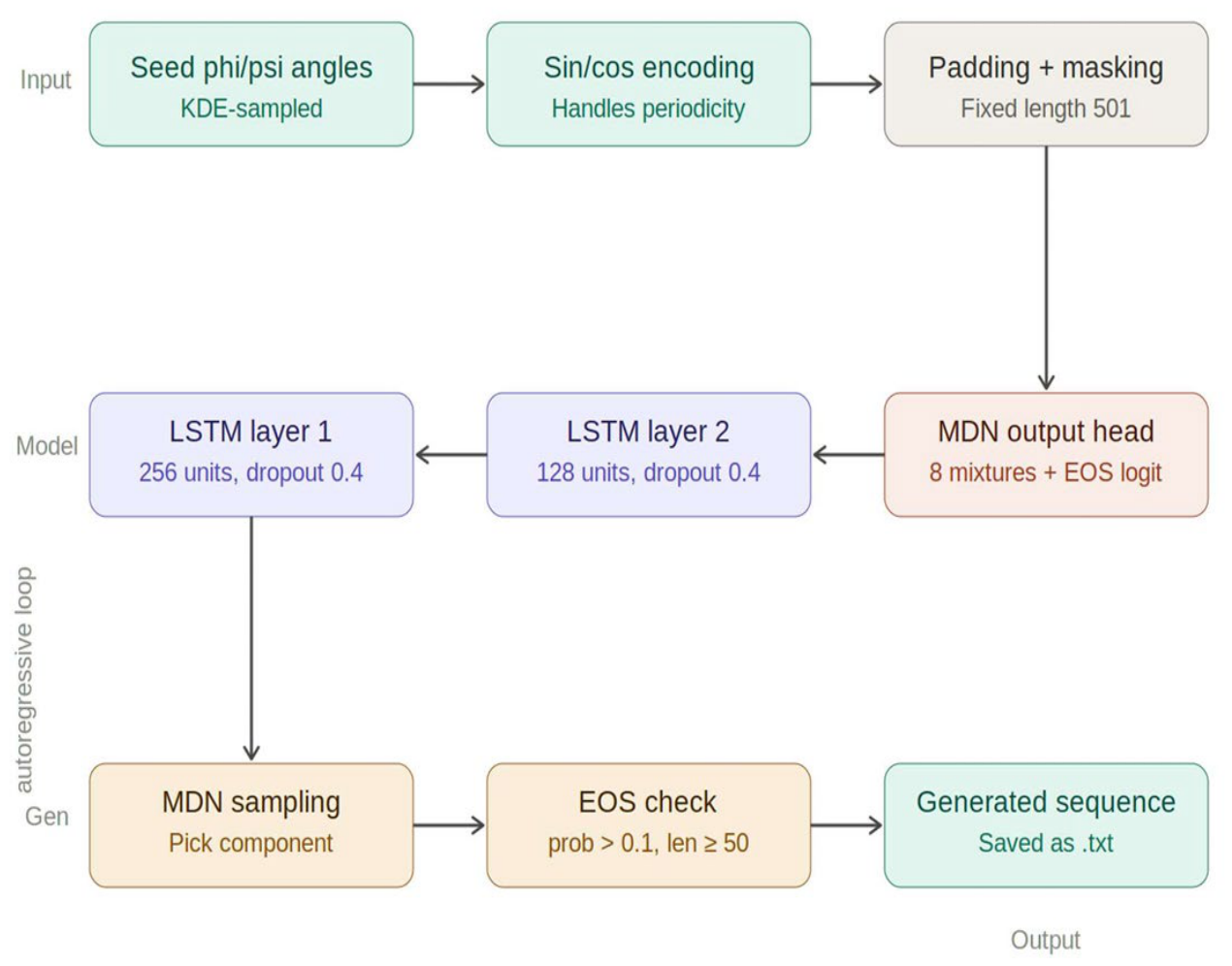
A schematic overview of the backbone generation pipeline. Input seed phi/psi angles sampled via kernel density estimation are encoded as sine-cosine pairs and padded to a fixed length of 501. The encoded sequence is passed through two stacked LSTM layers with dropout and L2 regularisation, followed by a Mixture Density Network output head predicting eight Gaussian mixture components and an end-of-sequence logit. At each generation step, angles are sampled from the predicted mixture and fed back autoregressively until the EOS probability exceeds the defined threshold, producing a variable-length phi/psi angle sequence saved for downstream structure reconstruction.
Generated Structures
A total of 1000 novel protein backbone scaffolds were generated autoregressively by the LSTM model with sequence lengths ranging from 50 to 500 residues. The phi psi angle sequences generated from this model were used to reconstruct three-dimensional polyalanine backbones using EZScafold. Visual inspection of these generated structures revealed a predominantly helical backbone conformation as seen in Figure 3 (C) and (D) which is consistent with the secondary structure distribution of the training dataset.
A total of 1000 control scaffolds were generated by randomly picking phi and psi angles from the training dataset and a random length between 50 and 500 was assigned to it to show an untrained baseline (Figure 3 (A) (B)).
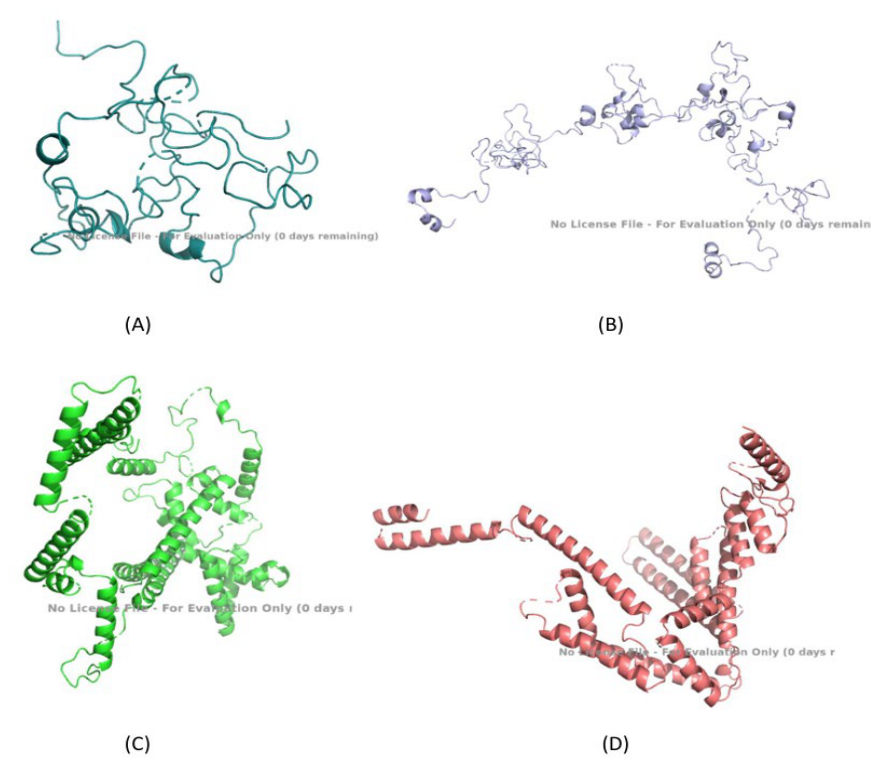
Generated scaffolds produced by the model (C)(D) and control scaffolds constructed by randomly picking angles from the training dataset (A)(B).
Ramachandran Analysis
The Ramachandran plot demonstrates that the model produces angles that occupy the major favoured regions of conformational space (Figure 4). The distribution confirms that the generated sequences predominantly occupy geometrically valid regions of the Ramachandran plot, indicating that the model was able to learn the fundamental geometric constraints of protein backbone geometry without these being explicitly enforced during training.
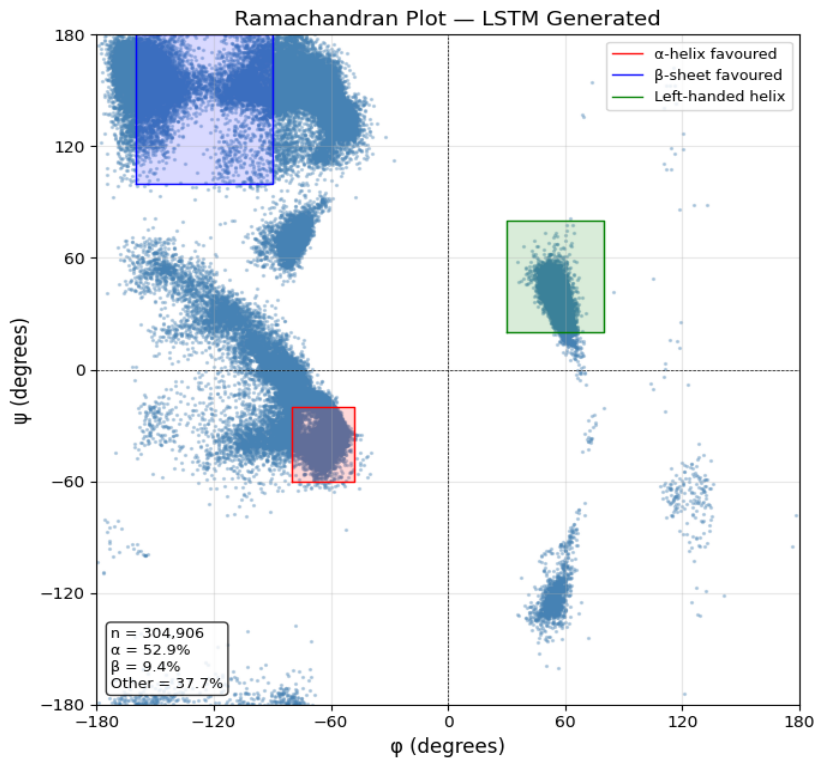
Ramachandran plot of LSTM-generated backbone residues (). Points represent individual phi/psi angle pairs sampled across all 1000 generated scaffolds. Coloured boxes indicate favoured conformational regions: alpha-helix favoured (red), beta-sheet favoured (blue), and left-handed helix (green).
Rosetta Score Comparison
The energetics of the scaffolds were assessed by scoring all structures using Rosetta. The scores of scaffolds generated using the LSTM model were compared against the control set. The score distribution was normalized by sequence length to account for the variable length generated scaffolds. As shown in Figure 5, the model generated scaffolds have a lower median normalized total score compared to that of the control structures. A two-sample t-test confirmed this difference was statistically significant (), providing strong evidence that the observed improvement in energetics is not attributable to random variation. These results indicate that the generated backbones have more favourable energetics, demonstrating that the model has captured the statistical regularities in backbone geometry.
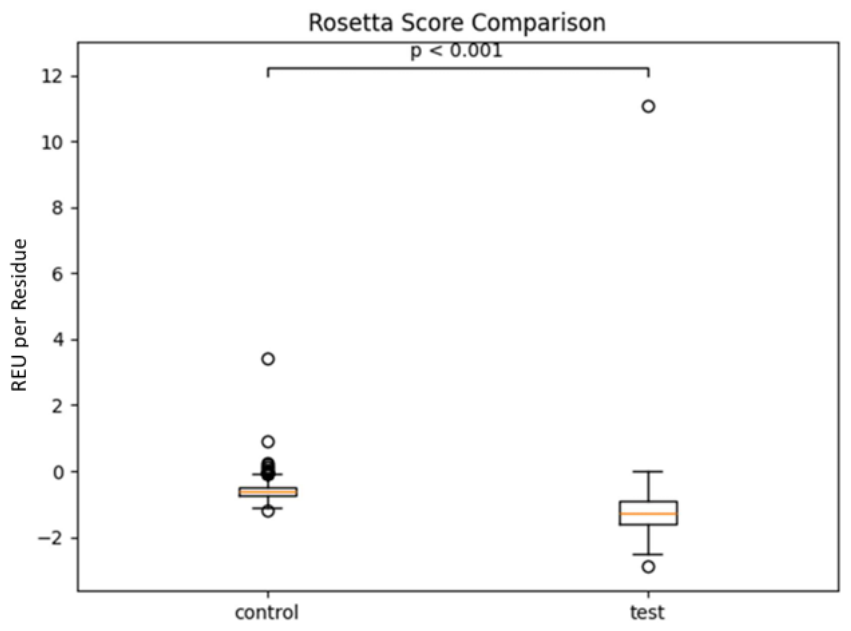
Comparison of normalised Rosetta total scores between LSTM-generated scaffolds (Test) and randomly sampled control structures (Control). Scores are normalised by sequence length (REU per residue). The horizontal bar indicates a statistically significant difference between groups (, two-sample t-test). Lower scores indicate more favourable backbone energetics.
Secondary Structure Composition
To assess the model generated backbones the percentage helix, sheet and loop residues per backbone was compared between the generated scaffolds and the randomly sampled control. The generated scaffolds showed a substantially higher helix content, with a median of approximately 40% helix residues compared to under 10% in the control () (Figure 6 (A)) and the loop content was markedly lower in the generated set, with a median of approximately 60% compared to over 90% in the control () (Figure 6 (B)), indicating that the model generates sequences with significantly more ordered secondary structure than would be expected by random angle sampling. The sheet content was low in both groups, though statistically higher in the generated scaffolds () (Figure 6 (C)), with the generated set showing a wider distribution and a small number of structures reaching above 10% sheet content. These results go to show that the LSTM model learned the backbone geometries that favour ordered secondary structure over the unstructured loops which are consistent with the angle distribution observed in real proteins.
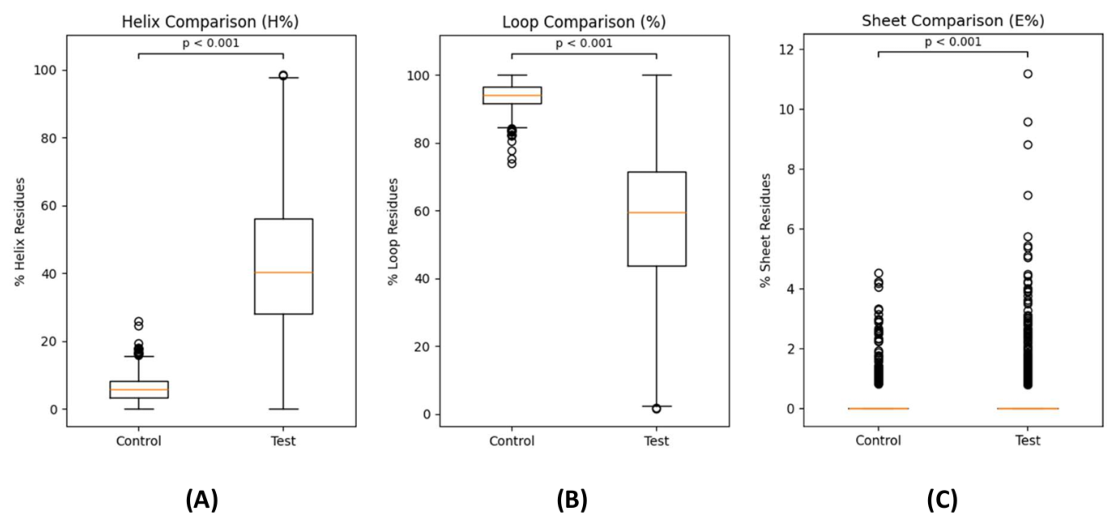
Comparison of secondary structure composition between LSTM-generated scaffolds (Test) and randomly sampled control structures (Control). Percentage of helix (H%), sheet (E%), and loop residues per scaffold are shown as boxplots.
Discussion
This work is a proof of concept that a simple recurrent neural network trained on backbone torsion angles can learn about protein geometries and generate new backbones that are energetically meaningful.
The most direct evidence comes from the Rosetta scoring comparison. The LSTM-generated scaffolds scored significantly better than the randomly sampled controls (), and this difference held up after normalising by sequence length. Since both sets were built from the same angle pool and put through the same structure reconstruction and relaxation pipeline, the only variable is whether the angles came from the model or from random sampling. The model consistently outperformed the control, indicating it has learned meaningful statistical regularities in backbone geometry beyond what random angle sampling can produce.
The secondary structure analysis reinforces this, as the generated scaffolds showed substantially higher helix content and lower loop content than the control set, both significant at . The sheet content, while low in both groups, was also significantly higher in the generated set, with a wider distribution suggesting the model occasionally produces beta-rich scaffolds alongside the predominantly helical output.
A key architectural decision that enabled these results was replacing the standard Dense output head with a Mixture Density Network. The initial model collapsed to a single dominant conformation regardless of seed, producing energetically poor scaffolds. The Mixture Density Network allowed the model to represent multiple conformational preferences simultaneously, which was necessary to generate the geometrically diverse scaffolds that ultimately achieved better Rosetta scores.
Overall, these results demonstrate that a lightweight and accessible recurrent architecture can be used as a viable backbone generation engine, producing scaffolds with favourable energetic profiles and realistic secondary structure content without requiring large pretrained networks or specialist compute infrastructure.
Methods
Data Collection and Curation
The entire Protein Data Bank (PDB) was downloaded. Each PDB file was parsed and inspected for the presence of nucleic acid residues which were identified by standard residue names such as adenine (DA), guanine (DG), cytosine (DC), thymine (DT), and their RNA equivalents (A, G, C, U) (Berman et al. 2000). Files containing any such residues were excluded, retaining only pure protein structures.
The filtered PDB files were then converted to DSSP format using mkdssp, from which the backbone dihedral angles phi and psi were extracted for each residue (Kabsch and Sander 1983; Touw et al. 2015). These files were then separated by chain, so that each individual protein chain was treated as an independent file. For this entire set of files, the amino acid sequences were extracted in FASTA format. CD-HIT was then run at a 90% sequence identity threshold to cluster redundant chains, retaining only one representative per cluster. This ensured that the final dataset contained only non-redundant unique protein chains (Li and Godzik 2006; Fu et al. 2012). Then from this set of unique non-redundant protein chains the phi and psi angles were extracted and stored as individual text files.
Data Preprocessing
The individual text files containing phi/psi angle pairs for each residue were read and processed. To deal with the circular periodicity of angles, each angle was encoded into its sine and cosine, giving a four-dimensional vector per residue (, , , ) (Mataeimoghadam et al. 2020; Xu et al. 2021). By removing the sharp jump that happens at +180/-180, this representation ensures that angles which are physically close to each other stay close together in the data. An end-of-sequence (EOS) token was appended after each protein sequence, and all sequences were padded to a fixed length of 501 (500 residues + 1 EOS) using a padding value of . The processed data was stored in a compressed HDF5 file for efficient training (Folk et al. 2011).
Model Architecture and Training
A two-layer stacked LSTM network (Hochreiter and Schmidhuber 1997) with 256 and 128 units respectively was trained, with dropout of 0.4 and L2 regularization applied to both layers to prevent overfitting (Abadi et al., n.d.). A custom loss function was used, combining negative log-likelihood over a Gaussian Mixture Model (MDN) with 8 mixture components for the four angle outputs, and binary cross-entropy on the EOS flag. The EOS signal was upweighted by a factor of 100 to compensate for the 500:1 class imbalance between body and EOS tokens. Training employed early stopping (Prechelt 1998), learning rate reduction on plateau, and model checkpointing callbacks, all implemented using the Keras deep learning framework with TensorFlow as the backend (Abadi et al., n.d.).
Backbone Generation
The trained model was used to autoregressively generate novel backbone angle pairs one residue at a time, following the teacher forcing paradigm used during training (Lamb et al. 2016). To provide seed angles a kernel density estimate (KDE) was constructed over the phi/psi distribution of 100 proteins that were sampled from the training set, and 10 phi/psi seed pairs were sampled per protein with a total of 1000 seed angles (Lovell et al., n.d.). Generation proceeded autoregressively from each seed using Von Mises sampling at each step to introduce controlled stochasticity, terminating either when the predicted EOS probability exceeded a defined threshold or when the sequence reached the maximum length cap. Each generated sequence was saved as a phi/psi angle file.
Control Generation
As a baseline control, 1000 synthetic protein sequences were constructed by randomly sampling phi/psi angle pairs directly from the full training angle pool without any model involvement. Each control sequence was assigned a random length between 50 and 500 residues, and angles were drawn independently with replacement from the pool, preserving the marginal angle distribution of the training data but removing all sequential context and learned dependencies. Structures were generated under identical conditions to the model output, allowing direct comparison between unguided random sampling and the trained model, isolating the contribution of learned sequential structure to protein quality.
Three-Dimensional Structure Reconstruction
The generated phi/psi angle files and the control phi/psi angle files were used to reconstruct three-dimensional protein backbone structures using EZScafold. Each angle file was processed independently, generating a polyalanine backbone of the corresponding length. The resulting structures were written as PDB files, with one backbone structure produced per generated angle sequence, yielding a total of 1000 generated backbone PDB files for downstream scoring and analysis.
Rosetta Scoring
All generated and control backbone structures were scored using Rosetta (Alford et al. 2017). Prior to scoring all the polyalanine backbones were relaxed to relieve steric clashes introduced during structure reconstruction. The resulting Rosetta total scores were recorded and normalised by sequence length to give a per-residue score, allowing direct comparison across scaffolds of variable length.
Author Contributions Statement
A.A.P. conceived the study, developed the computational pipeline, conducted all experiments, performed the analysis, and wrote the manuscript. D.N. supervised the project, provided guidance on the experimental workflow, and reviewed the manuscript. All authors reviewed and approved the final manuscript.
Competing Interests
The authors declare no competing interests.
Additional Information
The code used for this study is available at https://github.com/aashishap-hub/LSTM-Model-To-Generate-Proteins.
References
- Abadi, Martín, Paul Barham, Jianmin Chen, et al. n.d. TensorFlow: A System for Large-Scale Machine Learning.
- Alford, Rebecca F., Andrew Leaver-Fay, Jeliazko R. Jeliazkov, et al. 2017. “The Rosetta All-Atom Energy Function for Macromolecular Modeling and Design.” J. Chem. Theory Comput. 13 (6): 3031–48. [CrossRef]
- Berman, Helen M., John Westbrook, Zukang Feng, et al. 2000. “The Protein Data Bank.” Nucleic Acids Res 28 (1): 235–42. [CrossRef]
- Chu, Alexander E., Tianyu Lu, and Po-Ssu Huang. 2024. “Sparks of Function by de Novo Protein Design.” Nat Biotechnol 42 (2): 203–15. [CrossRef]
- Dauparas, J., I. Anishchenko, N. Bennett, et al. 2022. “Robust Deep Learning–Based Protein Sequence Design Using ProteinMPNN.” Science 378 (6615): 49–56. [CrossRef]
- Folk, Mike, Gerd Heber, Quincey Koziol, Elena Pourmal, and Dana Robinson. 2011. “An Overview of the HDF5 Technology Suite and Its Applications.” Proceedings of the EDBT/ICDT 2011 Workshop on Array Databases (New York, NY, USA), AD ’11, March 25, 36–47. [CrossRef]
- Fu, Limin, Beifang Niu, Zhengwei Zhu, Sitao Wu, and Weizhong Li. 2012. “CD-HIT: Accelerated for Clustering the Next-Generation Sequencing Data.” Bioinformatics 28 (23): 3150–52. [CrossRef]
- Harteveld, Zander, Jaume Bonet, Stéphane Rosset, Che Yang, Fabian Sesterhenn, and Bruno E. Correia. 2022. “A Generic Framework for Hierarchical de Novo Protein Design.” Proceedings of the National Academy of Sciences 119 (43): e2206111119. [CrossRef]
- Hochreiter, Sepp, and Jürgen Schmidhuber. 1997. “Long Short-Term Memory.” Neural Comput 9 (8): 1735–80. [CrossRef]
- Jumper, John, Richard Evans, Alexander Pritzel, et al. 2021. “Highly Accurate Protein Structure Prediction with AlphaFold.” Nature 596 (7873): 583–89. [CrossRef]
- Kabsch, Wolfgang, and Christian Sander. 1983. “Dictionary of Protein Secondary Structure: Pattern Recognition of Hydrogen-Bonded and Geometrical Features.” Biopolymers 22 (12): 2577–637. [CrossRef]
- Lamb, Alex, Anirudh Goyal, Ying Zhang, Saizheng Zhang, and Aaron Courville. 2016. Professor Forcing: A New Algorithm for Training Recurrent Networks. October 27. [CrossRef]
- Li, Weizhong, and Adam Godzik. 2006. “Cd-Hit: A Fast Program for Clustering and Comparing Large Sets of Protein or Nucleotide Sequences.” Bioinformatics 22 (13): 1658–59. [CrossRef]
- Lin, Zeming, Halil Akin, Roshan Rao, et al. 2023. “Evolutionary-Scale Prediction of Atomic-Level Protein Structure with a Language Model.” Science 379 (6637): 1123–30. [CrossRef]
- Lovell, Simon C., Ian W. Davis, W. Bryan Arendall, et al. n.d. Structure Validation by Cα Geometry: Φ,ψ and Cβ Deviation. [CrossRef]
- Mataeimoghadam, Fereshteh, M. A. Hakim Newton, Abdollah Dehzangi, et al. 2020. “Enhancing Protein Backbone Angle Prediction by Using Simpler Models of Deep Neural Networks.” Sci Rep 10 (1): 19430. [CrossRef]
- Ni, Bo, David L. Kaplan, and Markus J. Buehler. 2023. “Generative Design of de Novo Proteins Based on Secondary Structure Constraints Using an Attention-Based Diffusion Model.” Chem 9 (7): 1828–49. [CrossRef]
- Prechelt, Lutz. 1998. “Early Stopping - but When?” In Neural Networks: Tricks of the Trade, edited by Genevieve B. Orr and Klaus-Robert Müller. Springer. [CrossRef]
- Ramachandran, G. N., C. Ramakrishnan, and V. Sasisekharan. 1963. “Stereochemistry of Polypeptide Chain Configurations.” Journal of Molecular Biology 7 (1): 95–99. [CrossRef]
- Touw, Wouter G., Coos Baakman, Jon Black, et al. 2015. “A Series of PDB-Related Databanks for Everyday Needs.” Nucleic Acids Res 43 (January): D364–368. [CrossRef]
- Tunyasuvunakool, Kathryn, Jonas Adler, Zachary Wu, et al. 2021. “Highly Accurate Protein Structure Prediction for the Human Proteome.” Nature 596 (7873): 590–96. [CrossRef]
- Watson, Joseph L., David Juergens, Nathaniel R. Bennett, et al. 2023. “De Novo Design of Protein Structure and Function with RFdiffusion.” Nature 620 (7976): 1089–100. [CrossRef]
- Williams, Christopher J., Jeffrey J. Headd, Nigel W. Moriarty, et al. 2018. “MolProbity: More and Better Reference Data for Improved All-Atom Structure Validation.” Protein Science 27 (1): 293–315. [CrossRef]
- Xu, Gang, Qinghua Wang, and Jianpeng Ma. 2020. “OPUS-TASS: A Protein Backbone Torsion Angles and Secondary Structure Predictor Based on Ensemble Neural Networks.” Bioinformatics 36 (20): 5021–26. [CrossRef]
- Xu, Yong-Chang, Tian-Jun ShangGuan, Xue-Ming Ding, and Ngaam J. Cheung. 2021. “Accurate Prediction of Protein Torsion Angles Using Evolutionary Signatures and Recurrent Neural Network.” Sci Rep 11 (1): 21033. [CrossRef]
- Yim, Jason, Brian L. Trippe, Valentin De Bortoli, et al. 2023. “SE(3) Diffusion Model with Application to Protein Backbone Generation. arXiv.org.” February 5. https://arxiv.org/abs/2302.02277v3.
- Zhang, Buzhong, Meili Zheng, Yuzhou Zhang, and Lijun Quan. 2024. “DCMA: Faster Protein Backbone Dihedral Angle Prediction Using a Dilated Convolutional Attention-Based Neural Network.” Front. Bioinform. 4 (October). [CrossRef]
Disclaimer/Publisher’s Note: The statements, opinions and data contained in all publications are solely those of the individual author(s) and contributor(s) and not of MDPI and/or the editor(s). MDPI and/or the editor(s) disclaim responsibility for any injury to people or property resulting from any ideas, methods, instructions or products referred to in the content. |
© 2026 by the authors. Licensee MDPI, Basel, Switzerland. This article is an open access article distributed under the terms and conditions of the Creative Commons Attribution (CC BY) license (http://creativecommons.org/licenses/by/4.0/).
Copyright: This open access article is published under a Creative Commons CC BY 4.0 license, which permit the free download, distribution, and reuse, provided that the author and preprint are cited in any reuse.


