

Submitted:
24 June 2026
Posted:
25 June 2026
You are already at the latest version
Abstract
Traditional cultural heritage digitization frequently isolates historical motifs in static archives, limiting their functional reuse in contemporary manufacturing and product design. To address this limitation, this study proposes a three-layer framework that transforms physical cultural motifs into manufacturing-ready, semantically enriched digital assets. The digitization layer balances human-guided point-cloud modeling with script-based rendering to bypass conventional digital reconstruction bottlenecks, directly generating versatile two-dimensional vector paths and three-dimensional solid geometries. To prevent data fragmentation, a custom web ontology language-based schema preserves non-linear dependencies by explicitly connecting the generated point clouds and digital abstractions with their corresponding structural taxonomies and cultural semantics. Validated through a case study of thirteen Ainu motifs, the framework diffuses these relational assets via an open-access web repository and an autonomous generative design assistant powered by the model context protocol. The findings demonstrate that motifs from diverse cultural origins can effectively be digitized and meaningfully interconnected using the extensible schema, illustrating a highly practical approach for consuming cultural digital abstractions in downstream applications. Ultimately, this framework transitions motif preservation from retrospective archiving to active industrial utility, establishing a reproducible paradigm for integrating indigenous design history into both contemporary engineering workflows and interdisciplinary STEM education.
Keywords:
heritage preservation
; geometric reconstruction
; semantic ontology
; Ainu motifs
; digital assets
; product development
; generative design
1. Introduction
Cultural motifs (and/or patterns) represent vital expressions of human heritage and identity [1,2,3,4]. These design elements are deeply embedded in regional textiles, wood carvings, and historical artifacts. They communicate historical narratives and communal values across generations. As such, safeguarding these cultural expressions is essential to protect the diversity of indigenous design history [2,5]. Furthermore, cultural motifs often exhibit a high level of aesthetic and structural symmetry. Preserving the underlying geometric information ensures the survival of unique historical craftsmanship [5,6].
Numerous studies exist on the digitization and preservation of cultural heritage and traditional motifs. For instance, Abdullah et al. [7] applied mathematical approaches to analyze traditional Malaysian songket motif designs. Hasegawa et al. [8] utilized stochastic point-based rendering to visualize laser-scanned point clouds of various cultural heritage objects. Furferi et al. [9] developed a computational workflow to reconstruct 2.5D tactile models from two-dimensional historical paintings. Pan et al. [10] established an automatic recognition system for woven fabric patterns based on a structured pattern database. Minagawa et al. [11] developed a prototype clothing database that appends motif feature information to digitized historical garments, an approach subsequently extended by evaluating explicit digital data creation methods for traditional patterns [4]. Vargas Meza et al. [12] explored deep learning convolutional neural network architectures to digitally read and classify Ainu textile patterns. Puarungroj and Boonsirisumpun [13] implemented deep learning convolutional neural networks to recognize hand-woven fabric pattern designs. Zeng et al. [14] utilized a hierarchical cell-chain-form framework to structurally decompose and restore the geometric patterns of traditional architectural windows and doors into their constituent motifs. Additionally, Scopigno et al. [2] provided a comprehensive review of digital fabrication techniques used for cultural heritage artifacts. Kantaros et al. [15] evaluated the potential of three-dimensional scanning and printing technologies within the cultural heritage sector. Parisotto et al. [16] introduced a mathematical osmosis imaging model for multi-modal and multi-spectral data fusion in artwork conservation. Serna et al. [17] evaluated multi-sensor data fusion approaches—incorporating laser scanning, structured light, and photogrammetry—to optimize the three-dimensional digital reconstruction and documentation of cultural heritage objects. Ghosh et al. [6] devised an image processing-based technique to encapsulate the handcrafted imperfections and geometric paths of traditional Bangladeshi textile motifs. Bretti et al. [3] compiled a series of mathematical modeling and simulation techniques focused on artifact degradation and restoration. In the same vein, Tashi et al. [5] modeled the structural symmetry and geometry of traditional Ainu heritage motifs analytically using a recursive point-cloud creation system. Yadamragchaa and Ura [18] developed a mathematical modeling-driven method to systematically represent the composition and geometric primitives of Mongolian motifs and patterns. Furthermore, Bekiari et al. [19] developed the CIDOC Conceptual Reference Model (CRM), providing an event-centric reference ontology standard optimized for museum documentation and heritage archiving. In a nutshell, these diverse methodologies span from the explicit formalization of localized motif geometries to the holistic digital tracing of complete physical artifacts, collectively centering on retrospective preservation and documentation systems.
In contrast, limited research addresses the functional reintegration of digitized elements as reusable assets within active production environments. Concurrently, the expansion of digital fabrication has shifted industrial focus toward personalized product development and small-scale manufacturing [20,21,22,23,24,25,26,27,28,29]. Affordable manufacturing tools and open-source resources allow individuals and small enterprises to produce customized products directly from digital designs. This democratization of manufacturing drives the demand for flexible frameworks that bridge the gap between abstract concepts and fabrication. Within this context, transforming physical motifs into reusable digital assets offers an appealing pathway to add historical and commercial value to contemporary consumer products [5,20,29]. However, realizing this integration requires a complete, systematic pipeline that formalizes physical inputs into manufacturing-ready formats. This study addresses this specific requirement. Specifically, this study presents a computational framework designed to transform physical cultural motifs into manufacturing-ready digital assets. For better understanding, the remainder of this paper is structured as follows. Section 2 delineates the structural architecture of the proposed framework, outlining its layers, underlying research questions, and methodological choices to realize them. Section 3 demonstrates the practical realization and validation of these methods through a case study focusing on traditional Ainu motifs and textile patterns. Section 4 presents the results obtained from the case study. Section 5 critically discusses the findings. Finally, Section 6 provides the concluding remarks.
2. Framework
Building upon the foundational need to transform physical motifs into reusable digital assets established in the Introduction, this section details the proposed computational framework. Section 2.1 presents the overarching architectural layers; Section 2.2 formulates the specific computational and methodological research questions required to realize each layer; and Section 2.3 defines the systematic methodological choices adopted to address these questions effectively.
2.1. Architectural Overview
Figure 1 schematically illustrates the proposed framework for creating meaningful digital assets from physical motifs for end-application scenarios. As seen in Figure 1, this integration is realized across three distinct functional layers, namely, the digitization layer, the ontology modeling layer, and the application and service layer.
Within the digitization layer, the primary goal is to derive structured digital abstractions from raw physical motifs. This process is executed in two consecutive stages. In the first stage of digitization, the physical motif is distilled and represented as a foundational geometric blueprint designed to ensure that downstream transformations can be performed effortlessly. Consequently, this Stage I digitization operates as a generative ‘recipe’ that can be dynamically compiled into various digital data types whenever needed. A practical approach to implementing this primary representation involves generating discrete x,y point coordinates (or point clouds) for the motif geometries [5,29,30,31]. In the Stage II digitization phase, these primary coordinate points are systematically transformed into multiple specialized digital formats, such as scalable vector graphics (SVG), drawing exchange formats (DXF), and/or solid three-dimensional object meshes like OBJ, 3MF, and STL files, to satisfy diverse modern production requirements [29,31]. For instance, SVG are essential for two-dimensional manufacturing operations such as laser cutting and engraving, whereas solid meshes (OBJ, 3MF, and STL) are required for direct additive manufacturing. Furthermore, DXF provide the structural flexibility needed to alter, adapt, and integrate these motifs within existing product development workflows, ensuring interoperability with machining operations and broader computer-aided design tasks.
In the ontology modeling layer, the primary goal is to establish formal semantic relationships between the multi-format digital abstractions and the intrinsic taxonomy and semantics of the physical motifs. This intermediate layer normalizes motifs from diverse cultural histories within a singular framework. While conventional relational database schemas (e.g., SQL and JSON) can store standalone coordinate datasets and asset paths, they cannot map the complex, non-linear interdependencies between geometry, historical provenance, and craftsmanship. To facilitate advanced computational reasoning and prevent data fragmentation, the framework requires a data model that explicitly correlates abstract cultural meaning with corresponding digital variations. A practical approach involves constructing a semantic ontology schema governed by established interoperability standards. Populating this schema with cultural metadata, primary point clouds, and derived file formats yields the core ontological database.
The application and service layer utilizes the ontological database (outcome from the previous layer) to deploy the digitized assets across diverse end-use scenarios. Crucially, this layer establishes the operational requirement for multi-scenario diffusion, directly justifying the decoupled architecture of the underlying ontology. Because the semantic database isolates core motif attributes from rigid file formats, a single unified source of truth can feed distinct front-end applications simultaneously without creating schematic bottlenecks. Specifically, this layer supports semantic exploration and retrieval systems for contextual querying, integrates with generative design assistants to facilitate personalized manufacturing, and powers dedicated educational platforms for heritage exploration.
2.2. Research Questions
Nevertheless, for realizing each layer and its underlying processes, a set of computational and methodological questions evolve and must be answered. The questions (Q1–Q4) are as follows:
Q1. (Related to Digitization Layer: Stage I) What systems, tools, or computational methods are required to generate the discrete primary x,y point coordinates (or point clouds)?
Q2. (Related to Digitization Layer: Stage II) What type of systematic algorithmic approach can ensure that the primary point clouds are transformed into multiple digital abstractions (e.g., SVG, DXF, OBJ, 3MF, and STL)?
Q3. (Related to Ontology Modeling Layer) What ontology schema architecture is necessary to map and integrate the taxonomy, cultural semantics, primary point clouds, and derived multi-format digital abstractions into a unified ontological database?
Q4. (Related to Application and Service Layer) Given the formation of the ontological database, how can its structured data be dynamically utilized, remodeled, or diffused to serve the diverse operational requirements of the application and service layer?
2.3. Methodological Choices
In response to Q1, various approaches can be deployed. These typically include three-dimensional scanning-based methods [15,32], image-processing techniques [6,16], analytical and/or mathematical modeling methods [5,18,33,34], and interactive human-guided modeling methods [29,30,31]. Given that the primary objective is to obtain a clean, structured point set directly from the outset, the selected approach must be systematically efficient. Within this framework, system efficiency is defined as establishing direct structural control from the initial stage of the pipeline to eliminate the operational burdens of noise removal, manual post-processing, and specialized hardware dependencies. Furthermore, true system efficiency requires an automated, procedurally structured workflow that ensures seamless reproducibility across diverse shapes rather than localized, ad-hoc deployments. Following this rationale, this study adapts an interactive point-cloud modeling approach, as established in our previous works [29,31].
In response to Q2, various methods can be utilized to transform primary point data into functional digital abstractions. These typically involve reconstructing geometries through step-by-step manual feature extraction in commercial CAD platforms or writing custom geometric scripts within open-source programmable environments [35,36]. Given that the ultimate goal is to convert the point clouds into diverse manufacturing formats with optimal operational efficiency, the transformation pipeline must be highly streamlined. Within this framework, operational efficiency is defined as eliminating repetitive, manual modeling interventions while simultaneously mitigating the cognitive and computational burden associated with writing complex custom code from scratch [29,37,38,39]. Following this rationale, this study adapts a template-based script rendering approach leveraging the open-source parametric CAD platform OpenSCAD [40]. Specifically, a predefined set of modular functions and templates handles the point sets (x,y coordinates) as direct inputs to automatically compile them into multiple specialized digital formats, ensuring a highly consistent, automated, and easily deployable workflow, as established in our previous works [29,31].
In response to Q3, various schema methods can be deployed. These typically include utilizing established reference standards such as the event-centric CIDOC CRM [19] or building custom domain-specific structures using the Web Ontology Language (OWL). Given that the primary objective is to integrate localized cultural semantics alongside specific technical digitization outcomes, the selected data schema must be representationally comprehensive yet computationally lean. Within this framework, semantic alignment is defined as explicitly mapping the direct relationships between a motif’s cultural classification, the specific toolchain components, and the final digital assets. Furthermore, while standard documentation-focused frameworks (CIDOC CRM) offer robust historical archiving, they do not natively encapsulate modern engineering perspectives and multi-format software toolchains. Completely reconfiguring these extensive standard ontologies to accommodate raw geometric point-data and technical payloads introduces unnecessary structural complexity. Following this rationale, this study adapts a tailored, custom OWL-based ontology schema architecture to construct a lightweight, responsive ontological database.
In response to Q4, various deployment methods can be utilized to diffuse digitized assets into end-use scenarios. These typically include deploying standalone local directories, static database catalogs, or interactive application plug-ins. Given that the ultimate goal is to seamlessly integrate the digitized elements into active usage pipelines, the system delivery must maximize deployment efficiency. Within this framework, deployment efficiency is defined as providing a centralized, accessible user interface that directly retrieves cultural metadata and technical assets without manual extraction steps. Following this rationale, this study develops an interactive web-based dashboard application as a practical demonstration. Specifically, this dashboard queries the ontological data to present a unified workspace where users can contextually explore a motif’s taxonomy while directly retrieving its corresponding multi-format files.
As a proof of concept (PoC) to validate this framework and address the aforementioned questions, this study considers the digitization and semantic modeling of traditional Ainu motifs and patterns. The comprehensive case study illustrating these underlying methods is described in the following section.
3. Case Study
To practically demonstrate and validate the computational framework established in the previous section, this section details a comprehensive case study. Section 3.1 introduces the specific traditional Ainu motifs selected for this validation, outlining their structural taxonomy and cultural semantics. Subsequent sections document the step-by-step execution of the framework: Stage I digitization (Section 3.2), Stage II digitization (Section 3.3), the construction of the semantic ontology (Section 3.4), and the final deployment of these digitized elements into an active application environment (Section 3.5).
3.1. Ainu Motifs
The Ainu are the indigenous people of northern Japan, primarily centered around Hokkaido and its adjacent territories [4,5,11,12]. Traditional Ainu culture relies extensively on physical design motifs embedded in textiles (attush), wooden carvings, and garments to communicate historical narratives and spiritual values across generations. Because these patterns possess distinct geometric rules, they provide an ideal foundation for validating computational workflows. To verify the proposed framework, this case study evaluates a representative selection of traditional motifs reported in [4,5,11,12]. Table 1 outlines the faceted taxonomy and cultural context governing these targeted motifs.
As seen in Table 1, the selected motifs are classified according to two technical dimensions:
1. Compositional Complexity: Evaluates the structural hierarchy of the motif.
◦ ‘Elementary’ denotes an irreducible, single-element primitive design unit (e.g., Ayus, Morew, Sik, and Apapo-Pira(su)ke).
◦ ‘Synthetic’ represents a compound shape formed by mirroring or combining elementary units (e.g., Uren-Morew and Sik-Uren-Morew).
◦ ‘Combinatorial’ defines highly intricate, multi-layered patterns expanding on traditional rules across complex surface areas (e.g., C1, …, C6).
2. Geometric Structure: Classifies spatial alignment and mathematical balance.
◦ ‘Symmetrical’ designs follow strict reflectional or rotational constraints to establish an organized visual balance common in protective configurations like Ayus and Sik.
◦ ‘Asymmetrical’ designs utilize fluid trajectories that balance visual weight organically rather than mathematically, as seen in the spiral loops of Morew.
In addition, culturally, these classifications map directly to functional and narrative roles, as shown in Table 1. Primitives like ‘Ayus’ represent sharp thorn configurations embroidered on garment margins to ward off malevolent forces, while ‘Sik’ embodies the watchful presence of natural spirits. When elementary spirals are combined into dynamic, mirrored pairs like ‘Uren-Morew’, they formalize abstract concepts of equilibrium and pair dynamics. This granular taxonomical structure converts implicit historical craftsmanship into explicit, digital parameters suitable for computational modeling, when needed.
3.2. Point Cloud Modeling
As established in the methodological choice for Q1 (Section 2.3), the Stage I digitization phase—dedicated to generating the primary point-cloud representations of physical motifs—is executed using the Interactive Point-Cloud Modeling (IPCM) system [29]. The fundamental architecture of the IPCM framework centers on a modular series of subsystems that prioritize human cognition and geometric reasoning [30]. Instead of forcing a linear sequence, the system allows the user to dynamically combine modular systems based on the visual structure of the target motif. For direct manipulation, users interact with a digital canvas to generate clean coordinate sets utilizing Bézier-Bernstein, spline, or explicit geometric formulations. Concurrently, the system provides indirect manipulation modules—enabling operations such as translation, scaling, reflection, and rotation—to modify and combine these point paths procedurally. This human-guided, semi-automated workflow avoids hardware dependencies and image noise, offering a flexible workspace where complex patterns can be decomposed and reconstructed based on their internal symmetry and repetitive features [29,30,31].
To demonstrate this cognitive modeling workflow, consider the digitizing process for the ‘Sik’ motif (see Table 1). Figure 2 illustrates the step-by-step point-cloud construction sequence derived from a physical textile artifact reference. Recognizing the inherent bilateral and reflectional symmetry of the motif, the user’s cognitive strategy is to map only a single, repetitive upward curved segment, which can subsequently be mirrored and scaled to construct the complete point cloud. As such, the user deploys curve generation module (System A1) over the visual reference canvas, placing 5 interactive control points to generate a dense, sequenced path of 55 primary points via a Bézier-Bernstein formulation. Both the control vertices and the resulting dense coordinates are adjustable and update in real-time through direct canvas manipulation, allowing the user to alter the count and distribution parameters dynamically until the geometry matches the intent.
Once satisfied, the user exports the coordinate dataset and routes it into the transformation engine (System C) for indirect procedural manipulation, as shown in Figure 2. First, to satisfy explicit dimensional requirements, the path is scaled along the x-axis to fit precisely within a target bounding interval of [-25, 0]. While System C supports manual scaling coefficients, implementing this range-defined selection automatically rescales the primary coordinates while dynamically maintaining the aspect ratio. As seen in Figure 2, the scaled point set is mirrored across a vertical axis passing through the coordinate origin (x = 0). Finally, to generate the opposing bottom half of the geometry, the combined upper point sets are mirrored across a horizontal axis passing through a custom y-value of 250.375, which corresponds to the minimum y-bound of the upper curve. To facilitate these precise numerical selections, System C dynamically calculates and displays the absolute geometric bounding box attributes—including the minimum and maximum x and y values—immediately upon loading a point file into the transformation workspace. This real-time, data-driven feedback allows the user to accurately input reflection boundaries without manual calculation. The final reflection sequence shown in Figure 2 completes the Stage I digitization, producing a primary point cloud ready for Stage II digitization.
To understand the human cognition-based interactive modeling workflow better, consider the combinatorial motif ‘C4’ (see Table 1). Figure 3 illustrates its digitization sequence starting from a physical reference preserved on a traditional cloth wrapped around a wooden carving. Although this motif features structural symmetry similar to the ‘Sik’ motif shown in Figure 2, it contains much more complex and non-uniform geometric segments. Consequently, while modeling a single upward segment was sufficient before, a user must create consecutive segments here to fully realize the geometry. Figure 3 demonstrates one example of such a cognitive decomposition, where the user perceives one half of the design as a series of seven consecutive curves (Set 1 to Set 7). Therefore, seven individual point sets must be modeled to construct the full profile. While this structural interpretation can vary based on individual user cognition, the modular architecture of the IPCM system accommodates this variation to ensure complete design flexibility. For this implementation, the user utilizes the curve generation module (System A1) to model these consecutive point paths sequentially, with Figure 3 showing the related control vertices and dense generated points assigned to each segment. Furthermore, System A1 allows the user to define the exact number of segments (or sets) and specify whether positional connectivity (C0 continuity) should be dynamically enforced among them based on modeling requirements.
Once satisfied, the user exports the collective coordinate datasets and routes them into the transformation engine (System C) for indirect procedural manipulation, as shown in Figure 3. First, the consolidated point cloud is scaled along the x-axis to fit within a target bounding interval of [-25, 0] while maintaining its native aspect ratio. Following this scaling operation, the composite half-profile is mirrored across a vertical axis to construct the full bilateral pattern. Finally, the complete geometric set is realized using a vertical translation value of -490.868 within System C, which shifts all points downward to align the lowermost baseline coordinates exactly at y = 0. This final transformation step completes the Stage I digitization for this combinatorial pattern, yielding a primary point cloud ready for Stage II digitization.
Note that the explicit internal specifications of individual modules underlying the IPCM system, their comprehensive mathematical formulations, and detailed user instruction manuals fall outside the scope of this study. One may refer to the work [29] for an exhaustive documentation of these underlying algorithms. Concurrently, the operational software, along with its documentation, is openly hosted and available at: https://commons-repo.github.io/002-research/ (accessed on 16 June 2026).
3.3. Digital Abstraction from Point Cloud
As established in the methodological choice for Q2 (Section 2.3), the Stage II digitization phase—dedicated to transforming primary point clouds into multiple digital abstractions (e.g., SVG, DXF, OBJ, 3MF, and STL)—is executed using a template-based script rendering approach [29], leveraging the open-source parametric CAD platform OpenSCAD. Figure 4 illustrates this operational workflow using the points generated for the ‘Sik’ motif described in Section 3.2.
As seen in Figure 4, first, the raw coordinate data is formatted into a standardized array structure, using System E of the IPCM system. The resulting formatted text file containing the coordinates is subsequently included along with the core template file inside a standard script. As seen across Scripts 1–4 in Figure 4, the user calls different rendering functions (defined within the template), passing the point dataset and specific parameters as functional arguments. For instance, Script 1 invokes a path-following function (create_2d_path) by inputting the point variable alongside geometric parameters like width, fragments, and shape type. Once the rendering process is executed via these predefined functions, various specialized digital abstractions can be directly exported from the OpenSCAD environment. Specifically, the rendered outcomes from Script 1 and Script 3 correspond to two-dimensional vector layouts such as SVG and DXF, whereas Script 2 and Script 4 yield three-dimensional volumetric solid meshes including STL, OBJ, and 3MF files.
Similarly, Figure 5 illustrates this workflow for the combinatorial ‘C4’ motif (see Section 3.2). In this scenario, multiple formatted coordinate files are included concurrently within a single script to render the compound geometry as a vector drawing or an extruded solid through the respective execution of some functions (create_polygon and extrude_polygon) from the template.
A critical feature of this presented workflow is its capacity to generate multiple distinct digital abstractions and alternative structural representations from the same set(s) of points by utilizing the constructed template. For instance, comparing Script 1 and Script 3 in Figure 4 reveals that the exact same point cloud produces entirely different visual outcomes, a characteristic that also distinguishes the volumetric profiles generated by Script 2 and Script 4. This programmatic flexibility is vital for product development workflows, as it enables designers (or users) to evaluate and manipulate architectural forms from multiple design and engineering aspects using a single geometry source. Furthermore, the designer remains completely unburdened by low-level code generation, mathematical curve interpolation algorithms, or complex syntax debugging. Because the programmatic complexity is entirely abstracted by the background template, the computational and cognitive burdens [29,37,38,39] are eliminated from the design environment. From the outset, a designer can explore alternatives simply by invoking the high-level functions, entering the coordinate file, and understanding what function aligns with the specific fabrication intent.
Concurrently, the explicit operational details regarding the template, individual function behaviors, and step-by-step implementation manuals are detailed in the documentation hosted on the same online portal (also mentioned in Section 3.2): https://commons-repo.github.io/002-research/ (accessed on 16 June 2026).
3.4. Ontology Schema Modeling
As established in the methodological choice for Q3 (Section 2.3), the ontology modeling layer integrates the taxonomy, cultural semantics, primary point clouds, and derived digital abstractions into a unified ontological database. Up to this stage, the taxonomy and semantics details defined in Section 3.1, the primary point clouds generated in Section 3.2, and the digital files compiled in Section 3.3 exist only as independent entities in separate folders. While conventional database schemas can store standalone coordinate datasets and file paths, they cannot explicitly map the non-linear relationships connecting a motif’s cultural semantics (or meaning), its geometric taxonomy, and the specific software tools used in its digitization toolchain. To resolve this fragmentation, this study adapts a tailored, custom OWL-based ontology schema architecture. This lightweight approach avoids the structural complexity of extensive documentation standards like the CIDOC CRM [19], providing a clean database structure optimized for managing the digitized asset lifecycle.
To understand how this schema is designed to function, the ‘Sik’ motif can be analyzed as a representative template to illustrate how these multi-domain relationships are structured. As illustrated in the instance-level diagram of Figure 6, a specific motif like ‘Sik’ is modeled as an individual instance belonging to the ‘AinuMotif’ class, which hierarchically inherits from the core ‘CulturalMotif’ root class. To explicitly map the technical dimensions defined in Section 3.1, the schema organizes classifications hierarchically rather than as flat text tags. As traced in the Figure 6, ‘ElementaryMotif’ is built as a specialized subclass of ‘CompositionalComplexity’, while ‘SymmetricalGeometry’ is built as a subclass of ‘GeometricStructure’, with both branches rolling up to the abstract root class ‘ClassificationDimension’. Consequently, the ‘Sik’ instance is linked via a ‘characterizedBy’ object property to the specific facet nodes representing these terminal categories. This same relational strategy applies to the context parameters and file outputs visible in the diagram: the motif instance is linked via ‘hasContext’ to a semantic node holding its narrative values, and via ‘producesAsset’ to independent ‘DigitizedAsset’ subclasses tracking the exact file archives and their respective tool bindings (here, ‘IPCM_Online_System’ and ‘OpenSCAD_Template’).
Similarly, Figure 7 demonstrates this instance-level mapping for the combinatorial ‘C4’ motif. While it shares identical topological links to the ‘AinuMotif’ and ‘SymmetricalGeometry’ classes, the schema routes its compositional divergence by linking the instance directly to the ‘CombinatorialMotif’ subclass under the ‘CompositionalComplexity’ branch, while mapping its multi-set point data and generation code layers to their respective file repositories. Before observing the universal schema, these instance-level mappings (Figure 6 and Figure 7) establish the foundational modeling logic for the ontological database.
Figure 8 shows the ontology schema, shifting the perspective from specific localized instances to the abstract OWL class hierarchies, inheritance rules, and semantic constraints. As seen in Figure 8, this ontology schema formalizes a generalized structure capable of integrating diverse regional motif (or pattern) systems alongside their digital abstractions by decoupling abstract classification branches from underlying technical implementations. The schema explicitly defines cardinality mappings (highlighted within the relational property blocks), such as dictating that a single motif instance must link to exactly one cultural context and generate exactly three distinct digitized assets. Crucially, this decoupled architecture provides dual-ended expandability to accommodate future research requirements. On the cultural domain side, the schema can easily grow to include other regional motif lineages (e.g., the ‘RyukyuMotif’ class stub visible in the schema). Concurrently, on the engineering side, the ‘DigitizationTool’ class is structurally open to new methodology instances (e.g., analytical or mathematical modeling frameworks, image-processing pipelines, or three-dimensional scanning setups) without requiring modifications to the core relational predicates. This extensible schema ensures that any physical design element can be systematically classified, contextually described, and traced directly back to an evolving digitization toolchain through consistent relational properties.
3.5. Application
As established in the methodological choices for Q4 (Section 2.3), the final phase of the framework (Section 2.1) focuses on the deployment and utilization of the ontological database. While the custom OWL-based schema architecture provides rigorous semantic constraints and graph validation rules, directly parsing verbose XML/RDF data streams within client-side browser environments can introduce runtime processing overhead and latency. To mitigate this data retrieval bottleneck and maximize deployment efficiency, the framework implements a decoupled extraction pipeline that remodels the semantic graph elements into lightweight web assets. Within the scope of this PoC study, this remodeling strategy is practically evaluated by developing an interactive web-based dashboard, serving as an illustrative implementation example among the multiple application scenarios outlined in Figure 1.
Figure 9 schematically illustrates the underlying technical approach. As seen in Figure 9, the workflow begins with an ontology population script that instantiates the classes (discussed in Section 3.4) and generates the foundational OWL file as the ontological database. To transition this architecture to the web, an extraction script parses the OWL file. Utilizing a semantic parsing library, this script programmatically traverses the initialized individual nodes—such as the combinatorial ‘C4’ or elementary ‘Sik’ motif entries—to isolate their respective object properties (characterizedBy, hasContext, producesAsset) and extract their corresponding string literals (narrativeMeaning, zipFilePath). These extracted relationships are automatically compiled into an optimized key-value array and serialized as a nested JSON file, effectively safeguarding the underlying domain logic within a standard web-friendly data format. During the active runtime execution of this illustrative dashboard, an asynchronous client-side script executes a non-blocking fetch operation to load the serialized JSON payload into browser memory. The template engine subsequently runs dynamic data-binding routines to map these imported semantic records directly onto structural layout components built via HTML5 and styled through CSS3. Specifically, when an end-user interacts with the interface to query a targeted entry, the dashboard automatically processes the filtered JSON keys, updates the DOM display text with the corresponding narrativeMeaning metadata, and dynamically generates download links pointing to the underlying file directories for the Point Cloud, Generative Code, and Digital Abstraction archives. This automated layout demonstrates a frictionless pathway for designers and engineers to contextually explore a motif’s traditional taxonomy while directly retrieving manufacturing-ready assets.
4. Results
Following the structured execution of the case study methods, this section presents the consequent outcomes (or results). The results are categorized according to the functional layers they represent: Section 4.1 showcases the primary point clouds and diverse digital abstractions produced during the digitization layer; Section 4.2 details the populated knowledge graph resulting from the ontology modeling layer; and Section 4.3 illustrates the interactive web portal developed to facilitate the diffusion of these structured assets within the application and service layer. Finally, Section 4.4 outlines the open-access data repository where the generated digital files and semantic models are publicly hosted to ensure methodological reproducibility.
4.1. Point Cloud and Digital Abstraction
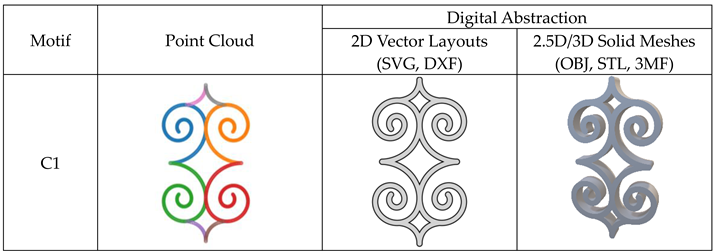
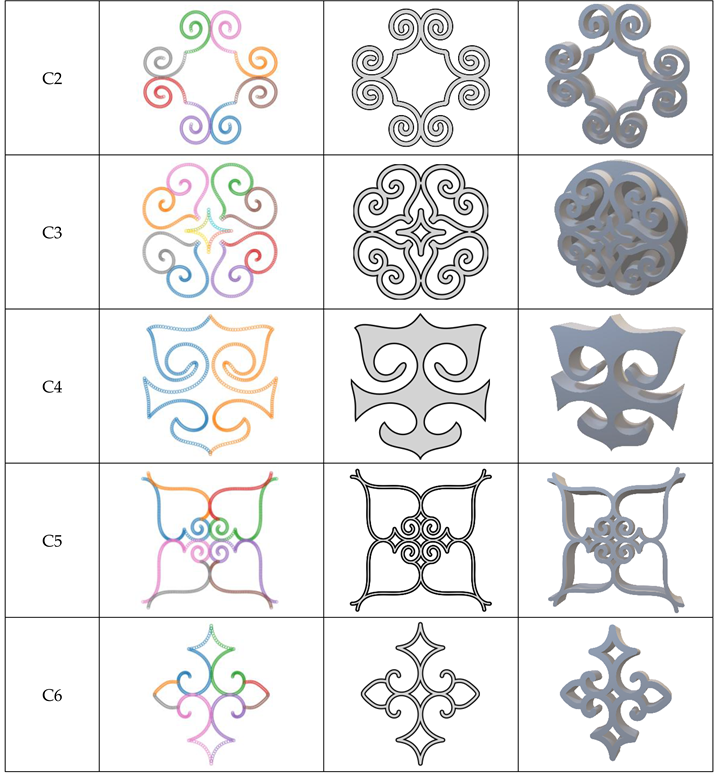
The digitization workflow (human-guided point-cloud modeling and script-based rendering detailed in Section 3.2 and Section 3.3, respectively) was applied to all thirteen Ainu motifs (see Table 1 in Section 3.1), realizing the digitization layer of the proposed framework (Section 2.1) and the related questions Q1 and Q2 (Section 2.2). Table 2, Table 3 and Table 4 present the corresponding results for the elementary, synthetic, and combinatorial motifs, respectively. Note that within the point cloud visualizations, the distinct colors denote the separate coordinate sets generated to construct each motif’s complete geometric profile.
4.2. Knowledge Graph
The ontology modeling workflow (detailed in Section 3.4) was executed to integrate the taxonomy, cultural semantics, and multi-format digital abstractions of all thirteen Ainu motifs (see Table 1, Table 2, Table 3 and Table 4), realizing the ontology modeling layer of the proposed framework (Section 2.1) and the related question Q3 (Section 2.2). Figure 10 presents the corresponding results, displaying the populated ontological knowledge graph alongside its established relational schema and instance-level cardinality.
As seen in Figure 10, the foundational nodes represent the core semantic classes, with the numerical values verifying the exact count of successfully ingested instances. For instance, the central ‘CulturalMotif’ class branches into the ‘AinuMotif’ subclass, registering the 13 distinct motif instances. Through explicit object properties, these instances are connected via the ‘hasContext’ relation to 13 ‘SemanticCulturalContext’ nodes, and via the producesAsset relation to exactly 39 ‘DigitizedAsset’ instances (systematically categorized into 13 ‘PointCloud’, 13 ‘GenerativeCode’, and 13 ‘DigitalAbstraction’ components). Additionally, the ‘characterizedBy’ relation systematically maps these motifs to their precise taxonomy under the ‘ClassificationDimension’ branch, formalizing their compositional complexity and geometric structure. Note that this decoupled, node-based architecture ensures structural scalability; because abstract cultural classifications are isolated from specific engineering toolchains, the database can dynamically evolve to accommodate additional cultural lineages (e.g., the ‘RyukyuMotif’ placeholder) or novel extraction methodologies without necessitating reconfiguration of the established relational rules. This forms the connected ontological database as the primary source of meaningful digital assets for cultural motifs.
4.3. Digital Asset Access Portal
The application deployment workflow (detailed in Section 3.5) was executed to diffuse the structured ontological data payload into the client-side system, realizing the application and service layer of the proposed framework (Section 2.1) and the related question Q4 (Section 2.2). Figure 11 presents the corresponding result, displaying a screenprint of the interactive web portal developed for accessing the meaningful digital assets derived from the motifs.
As seen in Figure 11, the web portal provides a centralized user interface designed to bridge the gap between abstract cultural heritage and active manufacturing environments. The interface incorporates interactive filtering controls, enabling users to dynamically query the repository based on the established taxonomical dimensions of cultural origin, compositional complexity, and geometric structure. Selecting these parameters triggers client-side data-binding routines that automatically filter, sort, and display the matching motif entries within the UI viewport. The populated matrix exposes the associated cultural metadata, displaying explicit string literals exclusively for the motif’s narrative meaning. Concurrently, the abstract category and sub-facet definitions derived from the ontology metadata are mapped onto the section headers and filter buttons as hover-able HTML tooltips (not shown in Figure 11), providing immediate semantic clarity during user exploration. To satisfy the diverse operational requirements of multi-scenario diffusion (detailed in Section 2.1), the system exposes dedicated download links for each rendered row, allowing direct retrieval of the primary point clouds, rendering scripts, and multi-format digital abstractions required for small-scale product manufacturing and design personalization.
4.4. Accessibility
To support methodological reproducibility, the digital assets generated in this study are publicly available. The dataset—including the OWL file, the serialized JSON payload, and the motif database containing the primary point clouds, rendering scripts, and multi-format digital abstractions—is hosted on a GitHub repository at: https://github.com/commons-repo/004-motif-assets.git (accessed on 23 June 2026). Additionally, the interactive web portal developed for the application and service layer is accessible at: https://commons-repo.github.io/004-motif-assets/ (accessed on 23 June 2026).
5. Discussion
The implementation of the proposed framework provides a comprehensive response to the core research questions (detailed in Section 2), systematically connecting the digitization, ontology modeling, and application layers. The digitization layer addresses questions Q1 and Q2 by balancing human-guided point-cloud modeling and script-based rendering to establish structural control and formalize raw physical profiles into versatile datasets. This progression is verified by the uniform output of two-dimensional vector tracks and three-dimensional solid geometries compiled across Table 2, Table 3 and Table 4 in Section 4.1. Transitioning to question Q3, the custom OWL ontology schema (Section 3.4) resolves information fragmentation by preserving the non-linear links between taxonomy, tools, and digital files, an architecture validated by the instance-level cardinality counts verified in the populated knowledge graph in Figure 10 (Section 4.2). Finally, the application deployment and extraction workflows (Section 3.5) address question Q4 by diffusing these populated semantic assets into an open-access platform for downstream engineering integration.
This end-to-end data utility is further demonstrated through a practical product design scenario, as shown in Figure 12. As seen in Figure 12, a designer personalizing a consumer product, such as a vase, queries the web portal using the taxonomical parameters defined in Section 3.1 and Table 1. Selecting the ‘Apapo-pira(su)ke’ motif exposes its botanical narrative context directly within the portal’s user interface, as previously shown in Figure 11. The designer extracts the linked asset archive to import the vector tracks or solid geometries into a localized CAD environment. These assets are then applied as a dimensional surface texture on the product model, yielding a culturally informed, color-rendered design profile, as shown in Figure 12. This workflow demonstrates how abstract heritage descriptions translate directly into functional fabrication inputs while maintaining precise interoperability with downstream manufacturing toolchains.
A second scenario highlights the framework’s capacity for automated knowledge interaction rather than static data retrieval, as shown in Figure 13. As seen in Figure 13, the underlying OWL file can be integrated with intelligent design environments by deploying a generative design assistant through the Model Context Protocol (MCP) directly within a cloud-enabled CAD application (here, Autodesk Fusion 360). When given natural language design intent, the assistant leverages the protocol to query the OWL model, programmatically traversing the class hierarchies and taxonomy constraints. Based on this semantic reasoning, the assistant identifies the appropriate motif and automatically retrieves its corresponding vector abstraction (the SVG file) directly into the design workspace. This relational interaction demonstrates the operational advantage of a query-able ontology over unmapped catalogs, while providing an extensible foundation where future lineages—such as the placeholder ‘RyukyuMotif’ stub formalized in Figure 8—can be integrated or cross-queried without altering core relational predicates.
Despite these documented outcomes, several technical boundaries remain within the current PoC deployment. First, the initial derivation of points coordinates depends on human cognition within the IPCM workspace, limiting automated processing speed during raw asset intake. Second, to optimize execution speeds within standard client-side browser viewports, the web repository interfaces with a pre-serialized static JSON payload rather than a live, dynamically queried SPARQL triple-store server environment. Third, while the ontological schema implements a distinct datatype property for detailed historical significance alongside basic narrative meanings, this property remains unpopulated across the active Ainu database records. For example, specific historical contexts—such as the apotropaic placement of the ‘Ayus’ primitive along garment borders to counter malevolent entities—remain structured as placeholder stubs rather than active query-able literals. Future initiatives will address these constraints by evaluating automated vision algorithms, transitioning the platform to a network-accessible semantic web service endpoint, and scaling the repository to encompass diverse multi-regional ethnic lineages.
6. Concluding Remarks
The transition from retrospective cultural preservation to active, manufacturing-driven integration represents a critical threshold in heritage management. Traditional digitization efforts frequently isolate historical designs in static archives, stripping them of their practical utility for modern engineering. To bridge this gap, this study proposed and implemented a three-layer framework designed to transform physical cultural motifs—demonstrated through 13 foundational Ainu patterns—into structured, semantically enriched digital assets. By systematically addressing the research questions (detailed in Section 2), this study contributes to the fields of computational design and cultural heritage preservation in the following specific areas:
◦ Operational Digitization and Asset Generation: By balancing human-guided point-cloud extraction with script-based rendering, the framework bypasses the manual reconstruction and noise-removal bottlenecks typical of traditional geometric reconstruction methods. This continuous workflow generates versatile, fabrication-ready outputs—including multi-format vector tracks and three-dimensional solid geometries—directly from foundational coordinate data.
◦ Relational Knowledge Modeling: Moving beyond flat database catalogs and fragmented file storage, the integration of a custom OWL schema preserves the non-linear dependencies between taxonomy, cultural semantics, software toolchains, and digital files. This decoupled architecture ensures that geometric data remains permanently linked to its narrative meaning and compositional rules, establishing a rigorous foundation for computational reasoning.
◦ Intelligent Knowledge Diffusion: The practical utility of the framework is realized through dual application interfaces. The deployment of an open-access web repository and an autonomous generative design assistant (via the MCP) enables designers to contextually query and retrieve multi-format assets. This facilitates the meaningful application of heritage motifs within modern product personalization and CAD workflows.
◦ Methodological Extensibility and Cross-Cultural Scalability: By establishing an end-to-end pipeline—from raw coordinate extraction to semantic application deployment—this study represents one of the initial efforts to formulate an extensible framework for heritage digitization. Unlike highly specialized, case-dependent digitization methods, the decoupled relational architecture permits the systematic integration of entirely distinct global traditions, establishing a clear pathway for future scaling to encompass diverse design lineages, such as Ryukyu motifs or Bangladeshi textile patterns.
Ultimately, by formalizing the conversion of raw cultural motifs (or patterns) into query-able, engineering-ready data, this framework transforms data digitization from a static archiving task into a generative industrial process. It establishes a reproducible methodology where regional design history is not merely protected, but actively utilized to infuse contemporary digital fabrication with authentic cultural value. Furthermore, this semantic integration bridges the historical humanities with technical disciplines, offering a functional paradigm for incorporating indigenous cultural understanding directly into Science, Technology, Engineering, and Mathematics (STEM) education.
References
- Cutting Edge | Protecting and preserving cultural diversity in the digital era. UNESCO.
- Scopigno, R.; Cignoni, P.; Pietroni, N.; et al. Digital Fabrication Techniques for Cultural Heritage: A Survey. Comput. Graph. Forum 2017, 36, 6–21. [Google Scholar] [CrossRef]
- Bretti, G.; Cavaterra, C.; Solci, M.; Spagnuolo, M. Mathematical Modeling in Cultural Heritage: MACH2021; Springer Nature Singapore: Singapore, 2023. [Google Scholar]
- Minagawa, M. [B03] アイヌ衣服・文様のデジタルデータ作成方法に関する検討 (Ainu ifuku monyou no dejitaru deeta sakusei houhou ni kansuru kentou) A Method of Digitizing Ainu Clothes and Embroidery Data. 2017, 1, 43–46. [Google Scholar] [CrossRef] [PubMed]
- Tashi; Ullah, A.S. Symmetrical Patterns of Ainu Heritage and Their Virtual and Physical Prototyping. Symmetry 2019, 11, 985. [Google Scholar] [CrossRef]
- Ghosh, A.K.; Yan, L.; Ura, S. Devising an Image Processing-Based Technique for Preserving Cultural Motifs. In: Proceedings of The 3rd International Conference on Japan-Bangladesh Research and Practice (JBRP2024). Online.
- Abdullah, N.; Nawawi, NMd; Legino, R.; Khalid, M.F.M. The Interesting Mathematical Approach Toward Analyzing Songket Design. In Proceedings of the International Symposium on Research of Arts, Design and Humanities (ISRADH 2014); Hassan, O.H., Abidin, S.Z., Anwar, R., Kamaruzaman, M.F., Eds.; Springer Singapore, Singapore, 2015; pp. 279–288. [Google Scholar]
- Hasegawa, K.; Li, L.; Okamoto, N.; et al. Application of Stochastic Point-Based Rendering to Laser-Scanned Point Clouds of Various Cultural Heritage Objects. IJAT 2018, 12, 348–355. [Google Scholar] [CrossRef]
- Furferi, R.; Governi, L.; Volpe, Y.; et al. From 2D to 2.5D i.e. from painting to tactile model. Graph. Model. 2014, 76, 706–723. [Google Scholar] [CrossRef]
- Pan, R.; Gao, W.; Liu, J.; Wang, H. Automatic recognition of woven fabric patterns based on pattern database. Fibers Polym. 2010, 11, 303–308. [Google Scholar] [CrossRef]
- Minagawa, M.; Tsurumaru, T.; Usuki, I. 民具資料のデジタル・アーカイブ化(第10報)文様の特徴情報を付加した衣服データベースの試作 (Mingu shiryou no dejitaru aakaibu-ka (dai 10-pou) Monyou no tokuchou jouhou wo fuka shita ifuku deeta beesu no shisaku); 日本教育情報学会年会論文集, 2013; pp. 438–441. [Google Scholar]
- Vargas Meza, X.; Zhang, Z.; Ochiai, Y. An exploration in digital techniques to read Ainu textile patterns. J. Cult. Herit. Manag. Sustain. Dev. 2026, 16, 204–227. [Google Scholar] [CrossRef]
- Puarungroj, W.; Boonsirisumpun, N. Recognizing Hand-Woven Fabric Pattern Designs Based on Deep Learning. In Advances in Computer Communication and Computational Sciences; Bhatia, S.K., Tiwari, S., Mishra, K.K., Trivedi, M.C., Eds.; Springer Singapore: Singapore, 2019; pp. 325–336. [Google Scholar]
- Zeng, C.; Pei, X.; Xie, Q. Research on Cell-Chain-Form graphical representation and restoration of traditional architectural windows and doors. npj Herit. Sci. 2025, 13, 577. [Google Scholar] [CrossRef]
- Kantaros, A.; Ganetsos, T.; Petrescu, F.I.T. Three-Dimensional Printing and 3D Scanning: Emerging Technologies Exhibiting High Potential in the Field of Cultural Heritage. Appl. Sci. 2023, 13, 4777. [Google Scholar] [CrossRef]
- Parisotto, S.; Calatroni, L.; Daffara, C. Mathematical osmosis imaging for multi-modal and multi-spectral applications in Cultural Heritage conservation. 2021. [Google Scholar] [CrossRef]
- Serna, C.G.; Pillay, R.; Trémeau, A. Data Fusion of Objects Using Techniques Such as Laser Scanning, Structured Light and Photogrammetry for Cultural Heritage Applications. In Computational Color Imaging; Trémeau, A., Schettini, R., Tominaga, S., Eds.; Springer International Publishing: Cham, 2015; pp. 208–224. [Google Scholar]
- Tsogtgerel, Y.; Ura, S. Mathematical Modeling-Driven Shape Digitization: A Perspective of Mongolian Motifs and Patterns. MCA 2026, 31, 42. [Google Scholar] [CrossRef]
- Bekiari C, Bruseker G, Doerr M, et al (2021) Definition of the CIDOC Conceptual Reference Model v7.1.1.
- Kaneko, K.; Kishita, Y.; Umeda, Y. Department of Precision Engineering, Graduate School of Engineering, The University of Tokyo 7-3-1 Hongo, Bunkyo-ku, Tokyo 113-8656, Japan (2018) Proposal for the Design of Personalization Procedure. IJAT 12:833–841. 12. [CrossRef]
- Dougherty, D. The Maker Movement. Innov. Technol. Gov. Glob. 2012, 7, 11–14. [Google Scholar] [CrossRef]
- Open-Source Lab. Elsevier. 2014.
- Armstrong, R. The Long Tail: Why the Future of Business Is Selling Less of More. Can. J. Commun. 2008, 33, 127–128. [Google Scholar] [CrossRef]
- Gershenfeld, N.A. Fab: the coming revolution on your desktop - from personal computers to personal fabrication, 1. ed.; Basic Books: New York, NY, 2005. [Google Scholar]
- Yao, X.; Lin, Y. Emerging manufacturing paradigm shifts for the incoming industrial revolution. Int. J. Adv. Manuf. Technol. 2016, 85, 1665–1676. [Google Scholar] [CrossRef]
- Westerlund, M.; Leminen, S.; Rajahonka, M. Designing Business Models for the Internet of Things. Technol. Innov. Manag. Rev. 2014, 4, 5–14. [Google Scholar] [CrossRef] [PubMed]
- Koren, Y. The global manufacturing revolution: product-process-business integration and reconfigurable systems; Wiley: Hoboken, New Jersey, 2010. [Google Scholar]
- Rayna, T.; Striukova, L. The Impact of 3D Printing Technologies on Business Model Innovation. In Digital Enterprise Design & Management; Benghozi, P., Krob, D., Lonjon, A., Panetto, H., Eds.; Springer International Publishing: Cham, 2014; pp. 119–132. [Google Scholar]
- Ghosh, A.K. An Open-Source CAD Framework Based on Point-Cloud Modeling and Script-Based Rendering: Development and Application. Machines 2026, 14, 107. [Google Scholar] [CrossRef]
- Tashi, Ullah AMMS, Kubo A (2020) Developing a Human-Cognition-Based Reverse Engineering Approach. In: JSME 2020 Conference on Leading Edge Manufacturing/Materials and Processing. American Society of Mechanical Engineers, Virtual, Online, p V001T01A003.
- Ghosh, A.K.; Yadamragchaa, T.; Tashi; Ura, S. An Efficient Human-Centered Digitization Method to Reverse Engineering: A Case of Cultural Motif Preservation. In In: Proceedings of the 11th International Conference on Leading Edge Manufacturing in 21st Century. JSME, Itoman, Okinawa, Japan, 2025. [Google Scholar]
- Boier-Martin, I.; Rushmeier, H. Reverse Engineering Methods for Digital Restoration Applications. J. Comput. Inf. Sci. Eng. 2006, 6, 364–371. [Google Scholar] [CrossRef]
- Tashi; Ullah, A.S.; Watanabe, M.; Kubo, A. Analytical Point-Cloud Based Geometric Modeling for Additive Manufacturing and Its Application to Cultural Heritage Preservation. Appl. Sci. 2018, 8, 656. [Google Scholar] [CrossRef]
- Kutari, L.D.; Ura, S. Improving reverse engineering processes using C-K theory of design. Res. Eng. Des. 2025, 36, 19. [Google Scholar] [CrossRef]
- Tashi; Ullah, A.S.; Kubo, A. Geometric Modeling and 3D Printing Using Recursively Generated Point Cloud. MCA 2019, 24, 83. [Google Scholar] [CrossRef]
- Tadokoro, F.; Ghosh, A.K.; Ura, S. On the effective co-creation of CAD models by leveraging generative artificial intelligence. Procedia CIRP 2025, 134, 663–668. [Google Scholar] [CrossRef]
- Gonzalez, J.F.; Pietrzak, T.; Girouard, A.; Casiez, G. Facilitating the Parametric Definition of Geometric Properties in Programming-Based CAD. In Proceedings of the 37th Annual ACM Symposium on User Interface Software and Technology. ACM, Pittsburgh PA USA, 2024; pp. 1–12. [Google Scholar]
- Gonzalez Avila, J.F.; Pietrzak, T.; Girouard, A.; Casiez, G. Understanding the Challenges of OpenSCAD Users for 3D Printing. In Proceedings of the CHI Conference on Human Factors in Computing Systems. ACM, Honolulu HI USA, 2024; pp. 1–20. [Google Scholar]
- Mahapatra, C.; Jensen, J.K.; McQuaid, M.; Ashbrook, D. Barriers to End-User Designers of Augmented Fabrication. In Proceedings of the 2019 CHI Conference on Human Factors in Computing Systems. ACM, Glasgow Scotland Uk, 2019; pp. 1–15. [Google Scholar]
- OpenSCAD — The Programmers’ Solid 3D CAD Modeller.
Figure 1.
Framework for creating meaningful digital assets from physical motifs for end application.
Figure 1.
Framework for creating meaningful digital assets from physical motifs for end application.
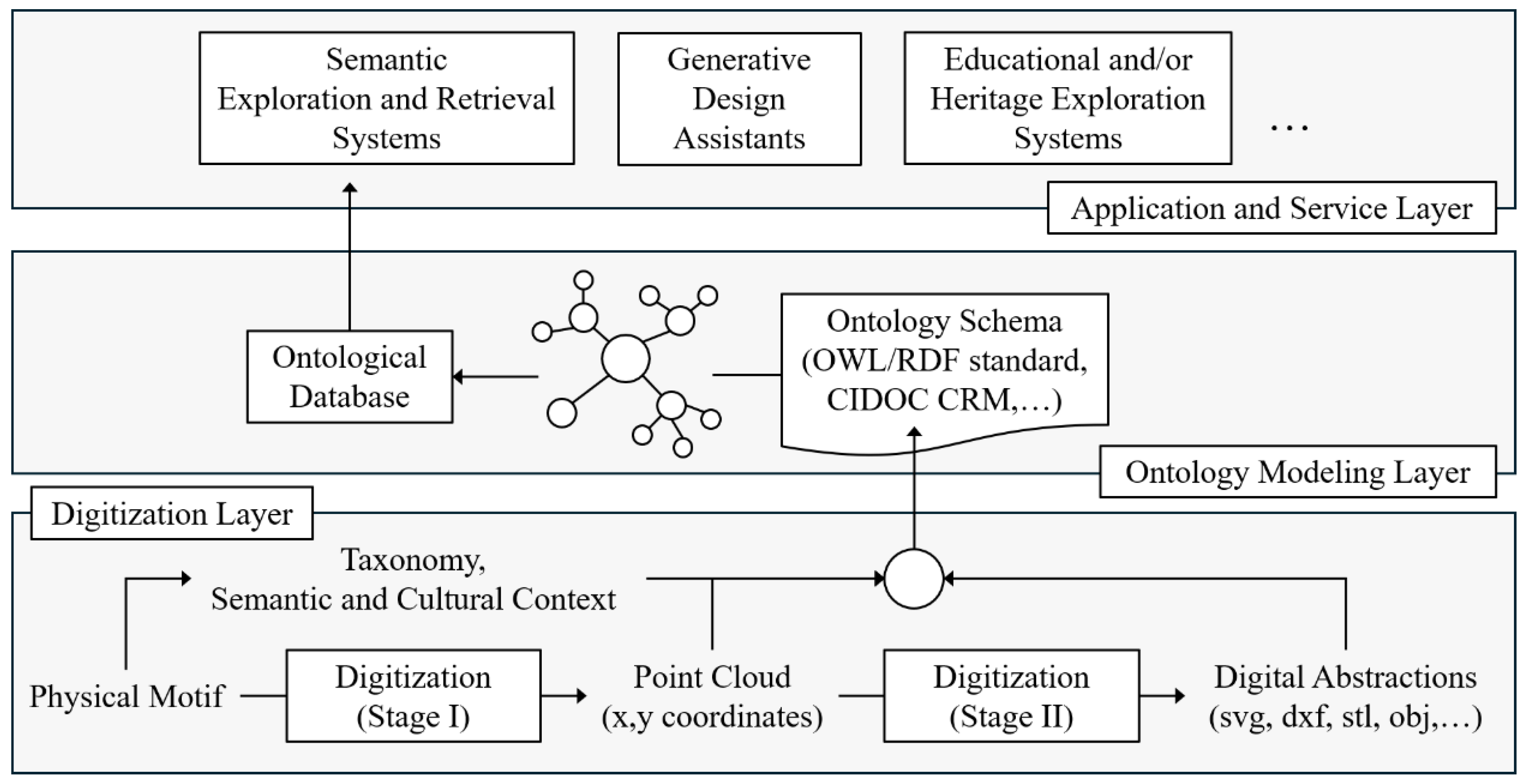
Figure 2.
Steps related to point-cloud-modeling of ‘Sik’ motif using the IPCM system. (Physical reference image source: https://hibinotanoshimi.net/coaster-ainu-embroidery/, accessed on 16 June 2026).
Figure 2.
Steps related to point-cloud-modeling of ‘Sik’ motif using the IPCM system. (Physical reference image source: https://hibinotanoshimi.net/coaster-ainu-embroidery/, accessed on 16 June 2026).
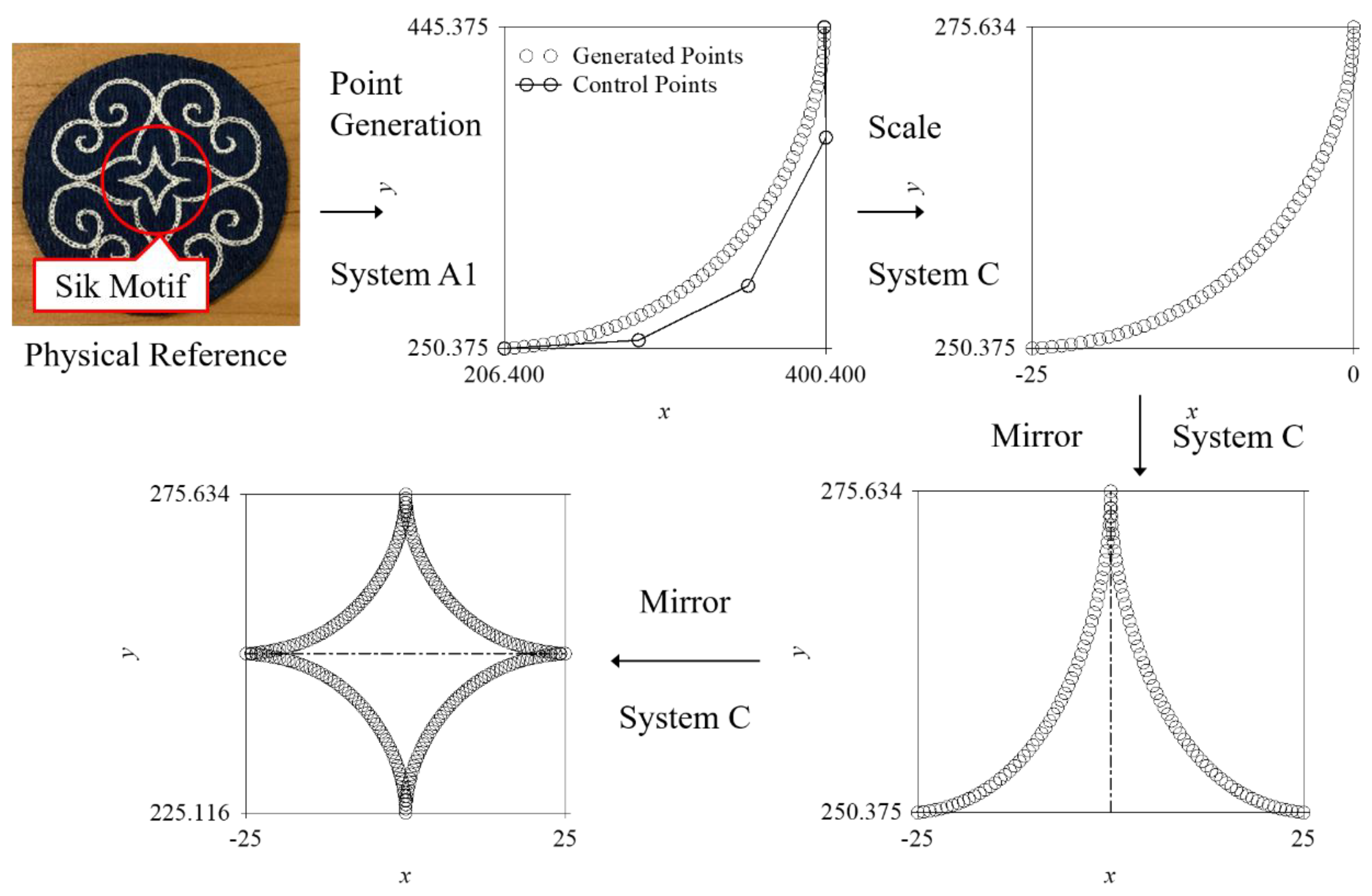
Figure 3.
Steps related to point-cloud-modeling of ‘C4’ motif using the IPCM system. (Physical reference image source: https://en.kushiro-lakeakan.com/overview/8585/, accessed on 16 June 2026).
Figure 3.
Steps related to point-cloud-modeling of ‘C4’ motif using the IPCM system. (Physical reference image source: https://en.kushiro-lakeakan.com/overview/8585/, accessed on 16 June 2026).
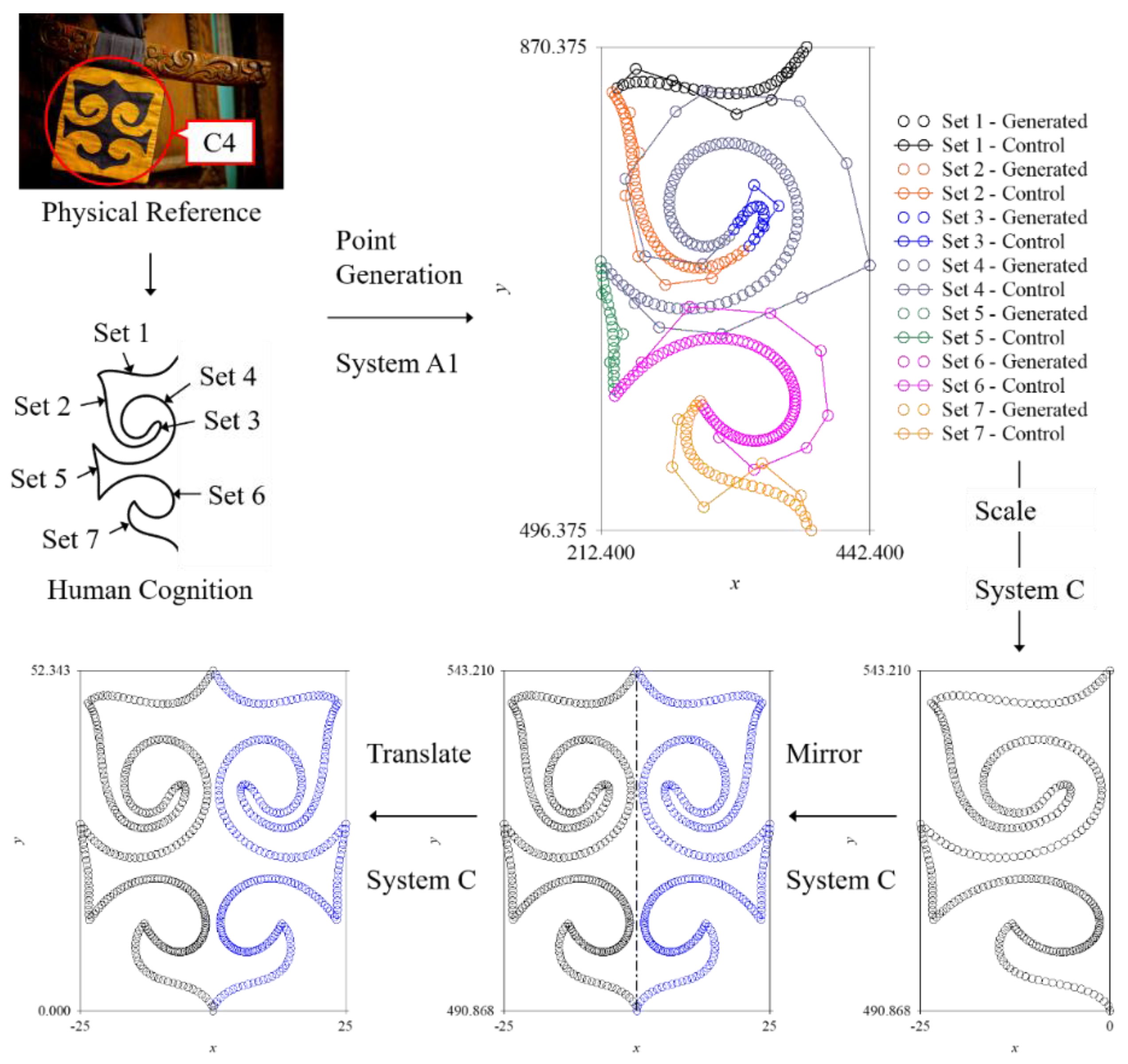
Figure 4.
Creating digital abstractions of ‘Sik’ motif.
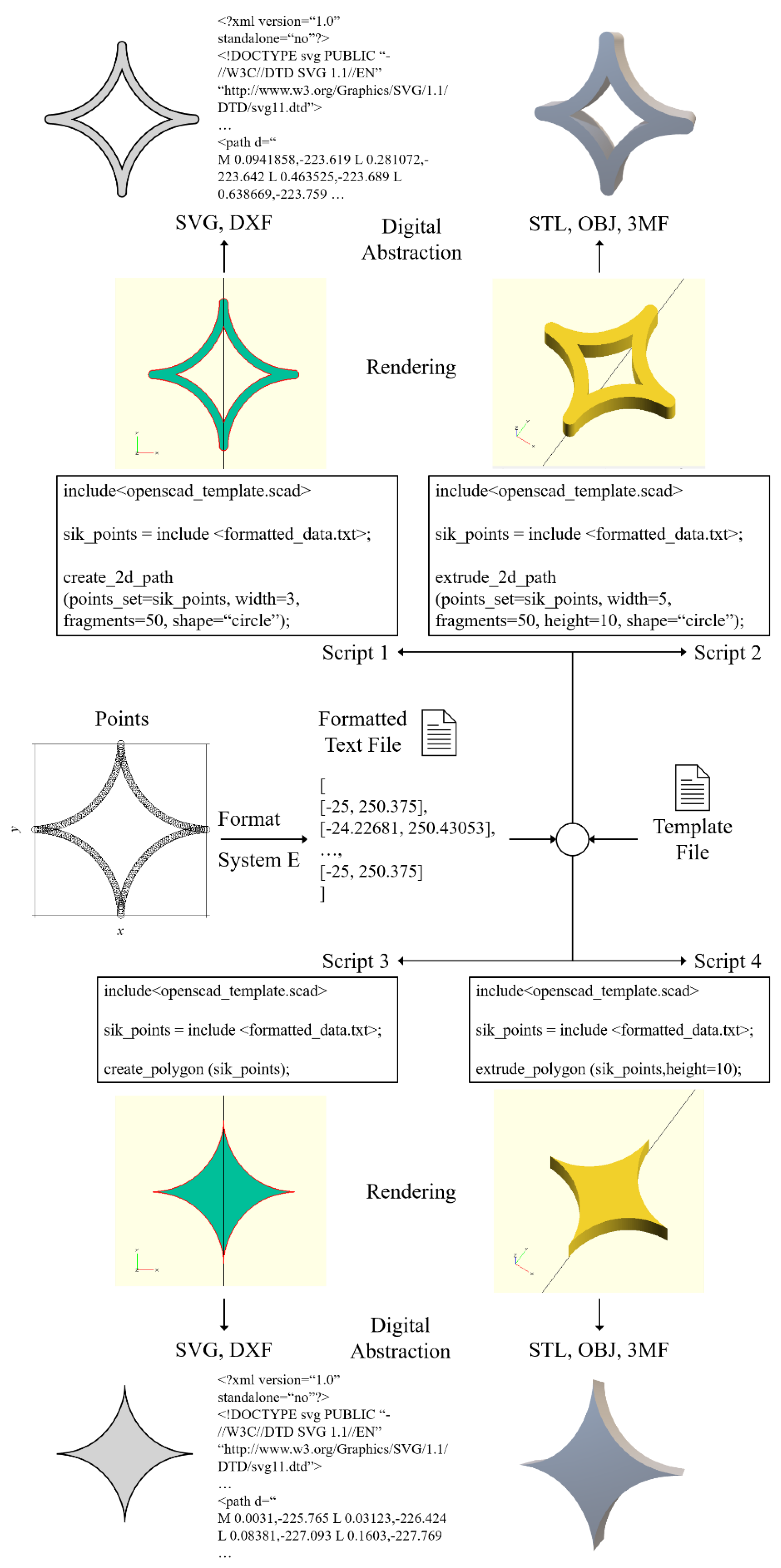
Figure 5.
Creating digital abstractions of ‘C4’ motif.
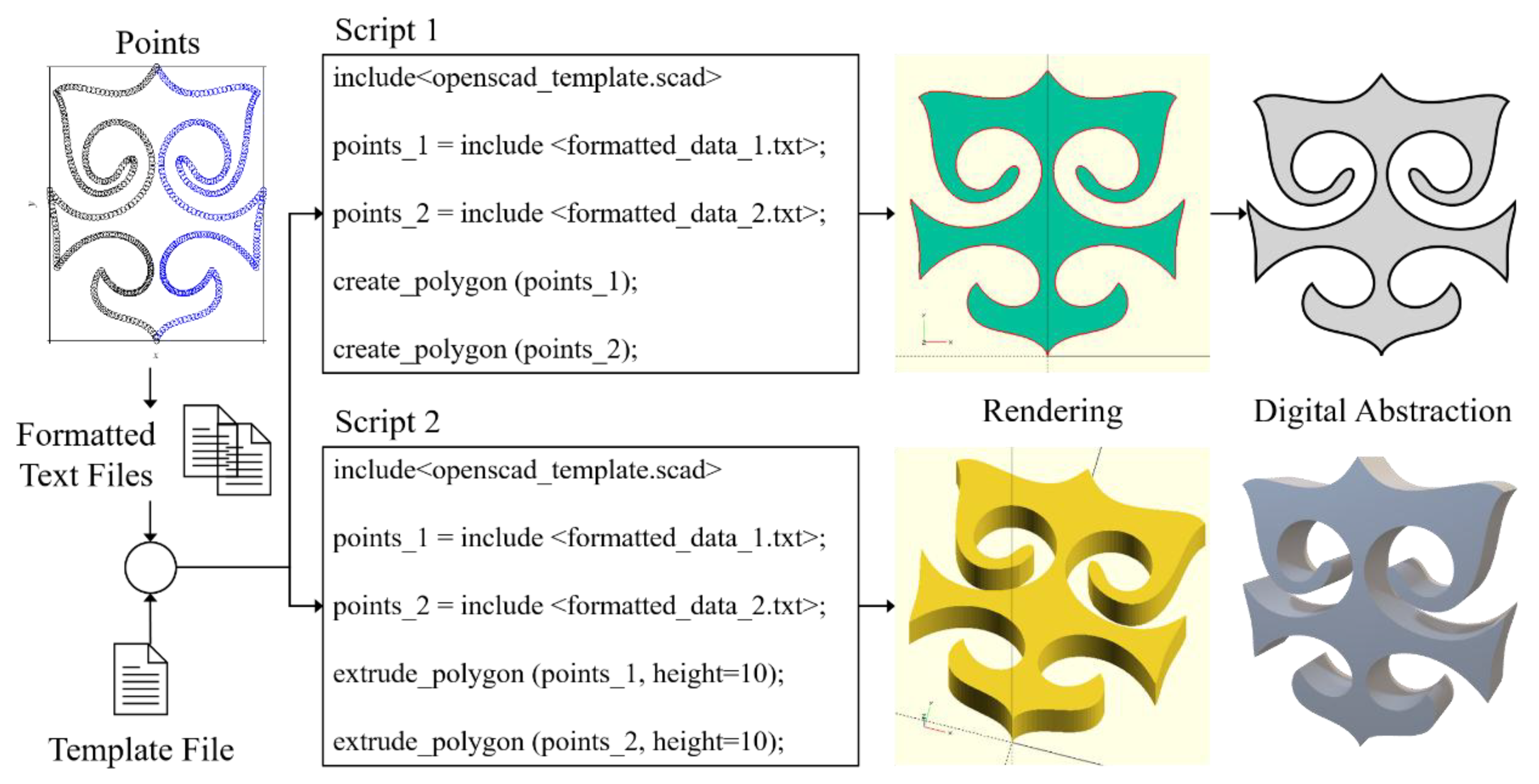
Figure 6.
Instance-level ontology schema for the ‘Sik’ motif.
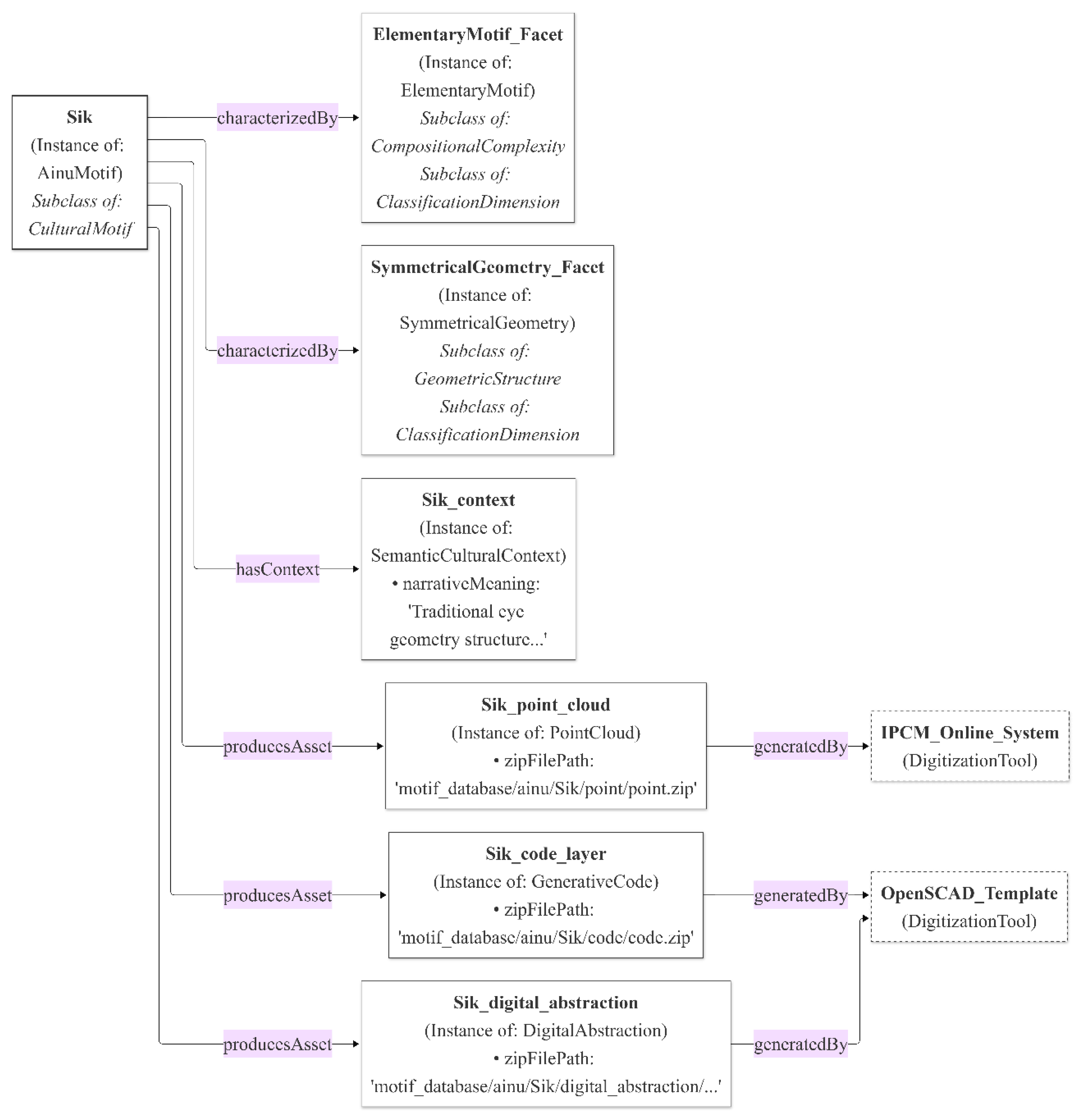
Figure 7.
Instance-level ontology schema for the ‘C4’ motif.
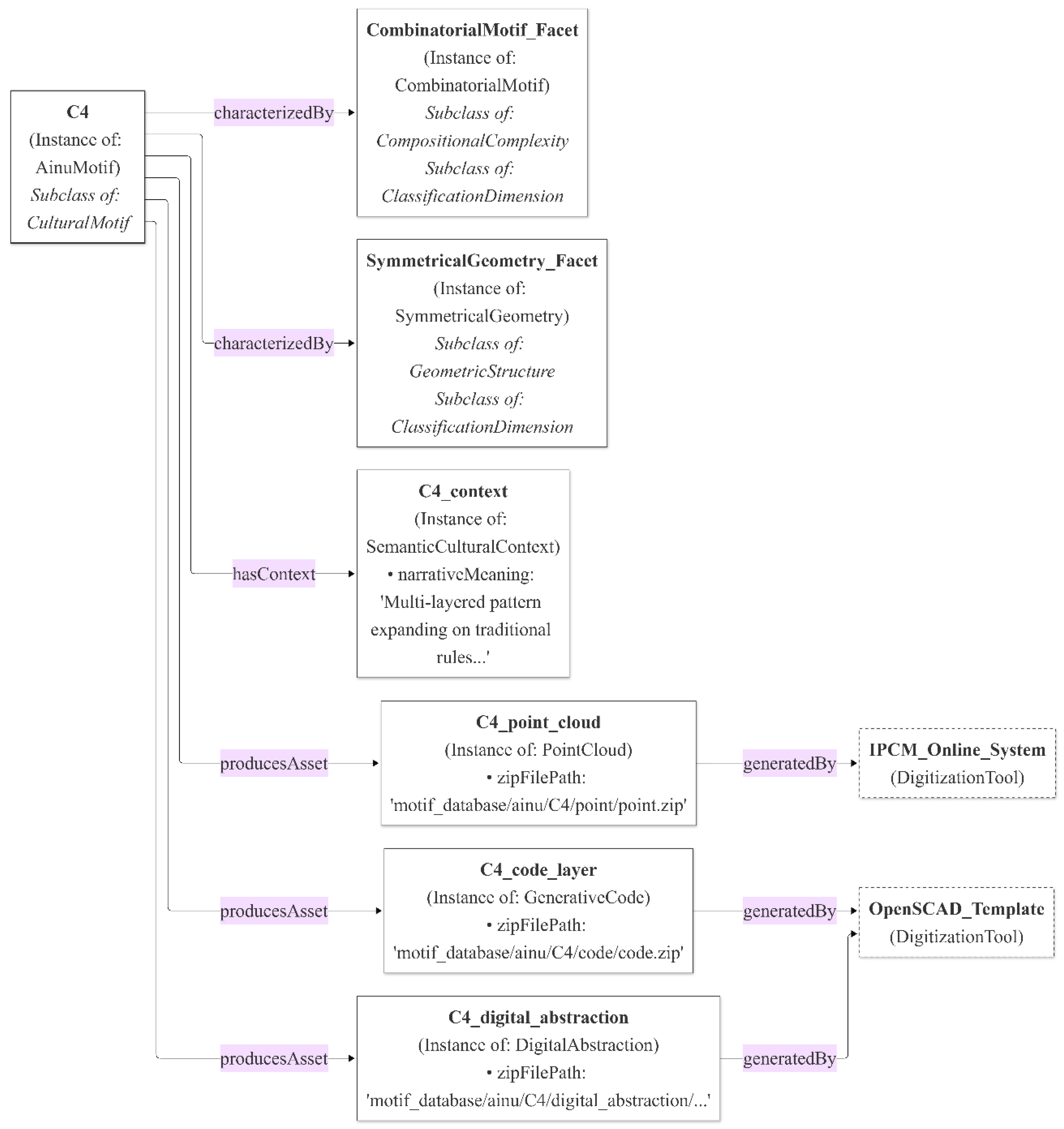
Figure 8.
Ontological schema for creating ontological database.
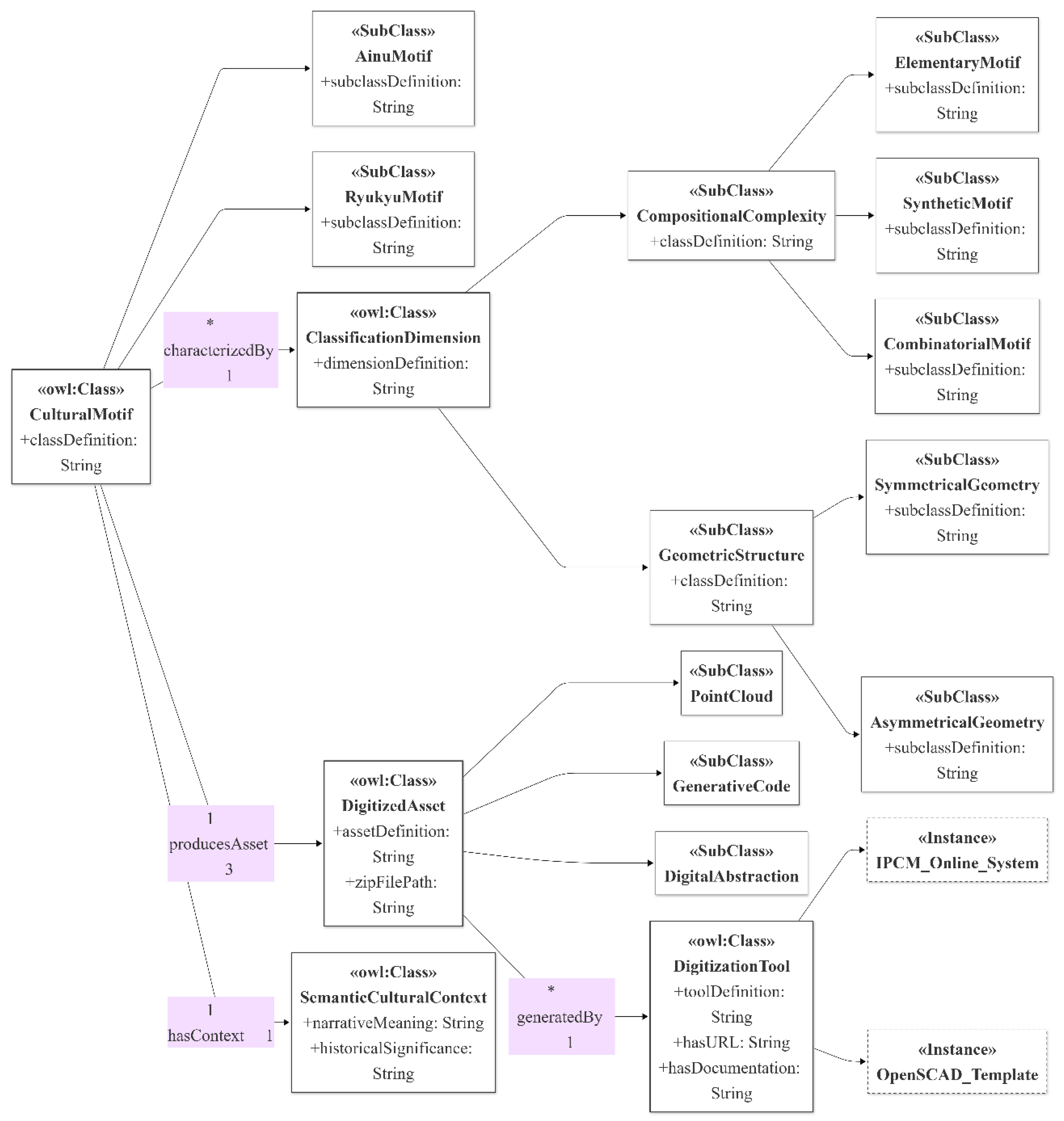
Figure 9.
Creating an interactive dashboard from the ontological database.
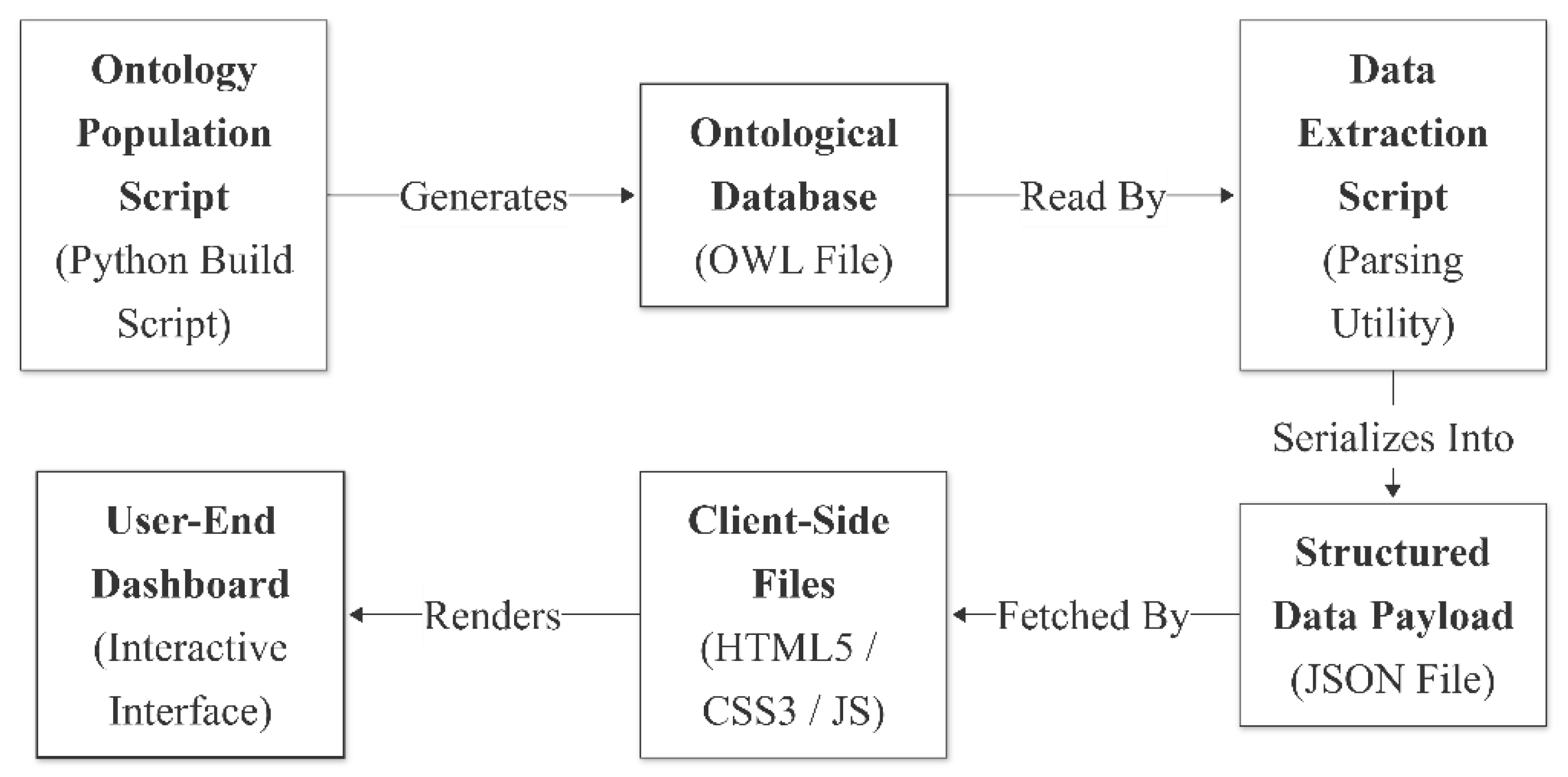
Figure 10.
Knowledge graph for cultural motifs.
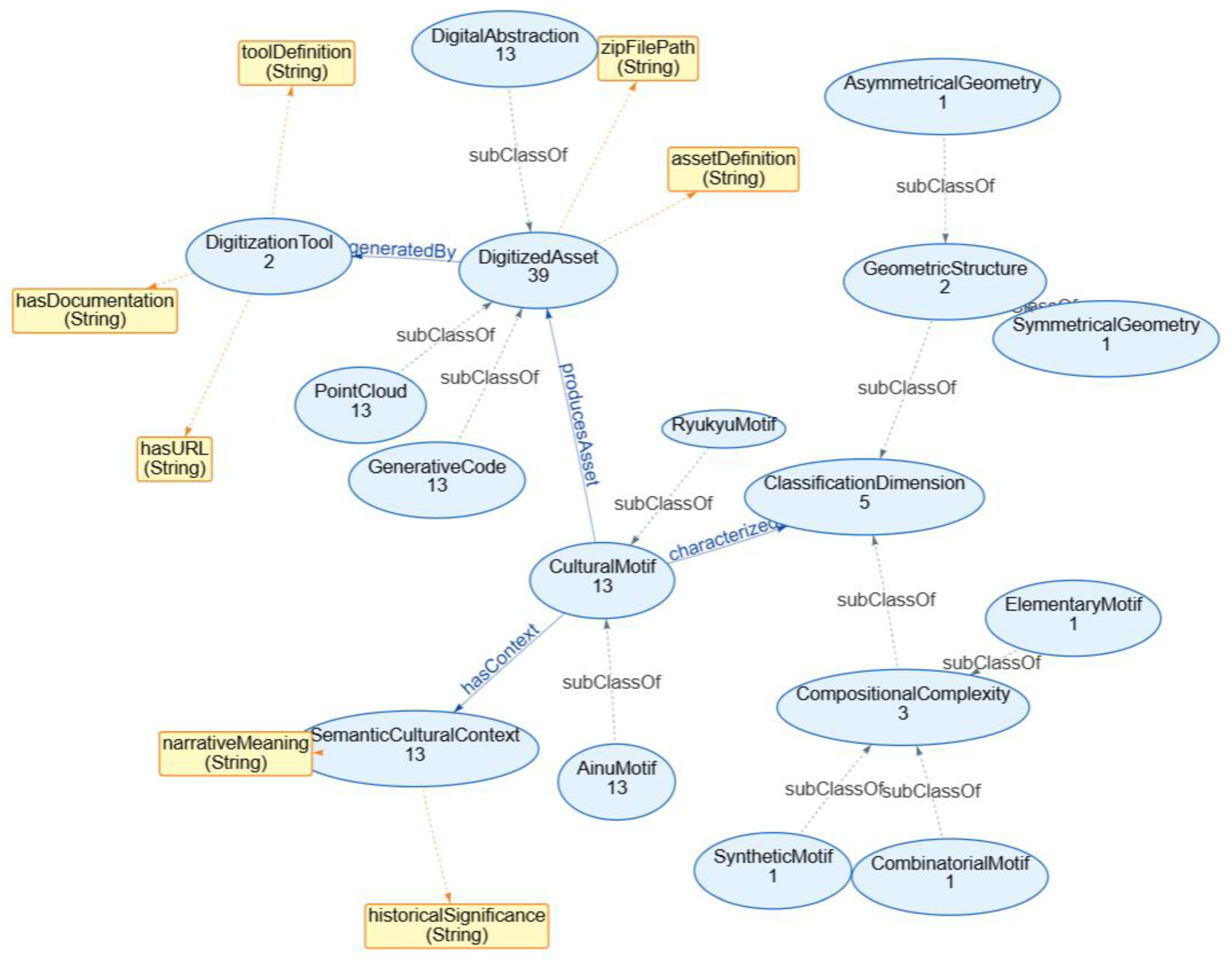
Figure 11.
Screen-print of the digital asset portal.
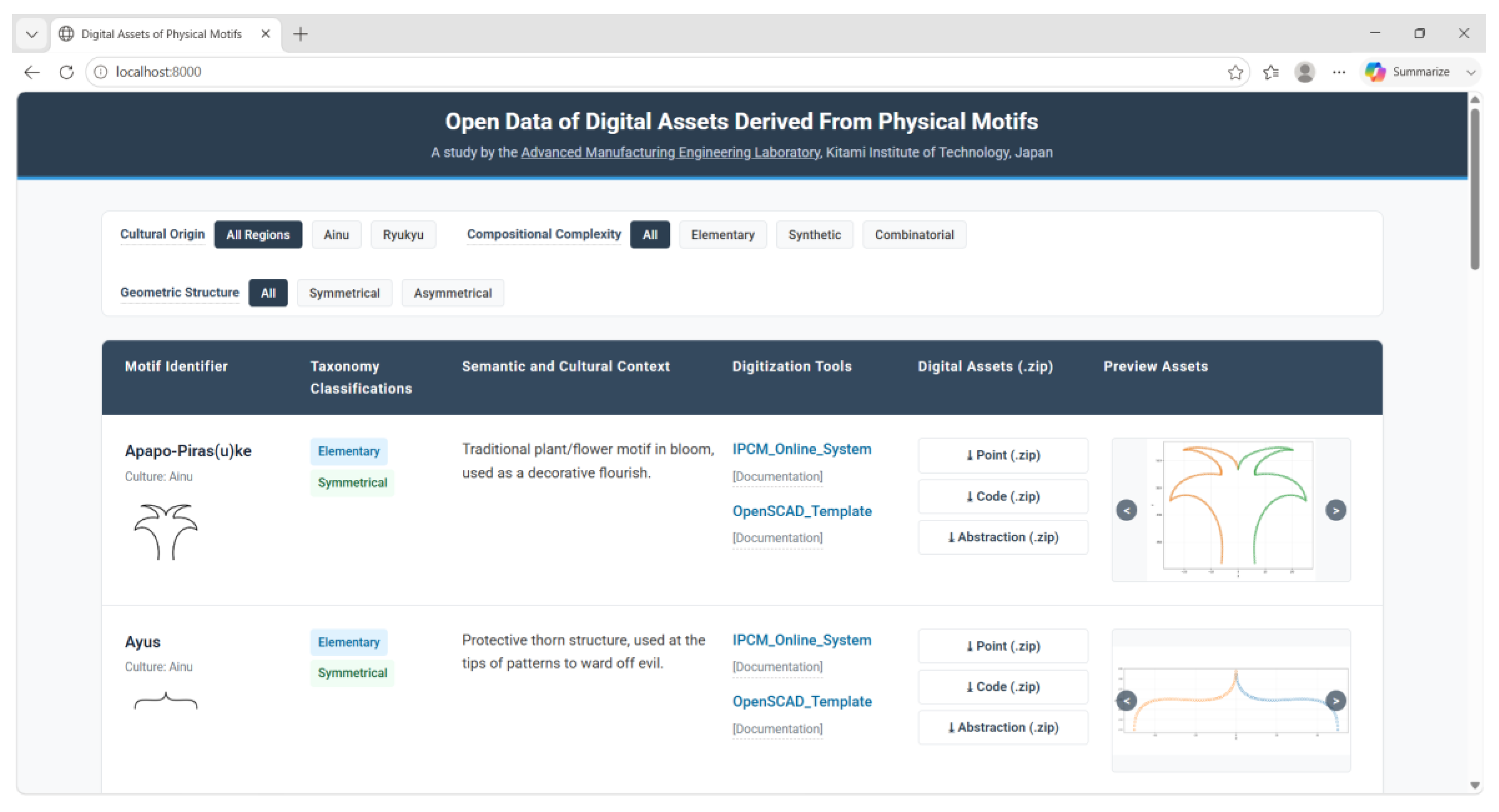
Figure 12.
Implementation of motif abstractions within a product customization context.
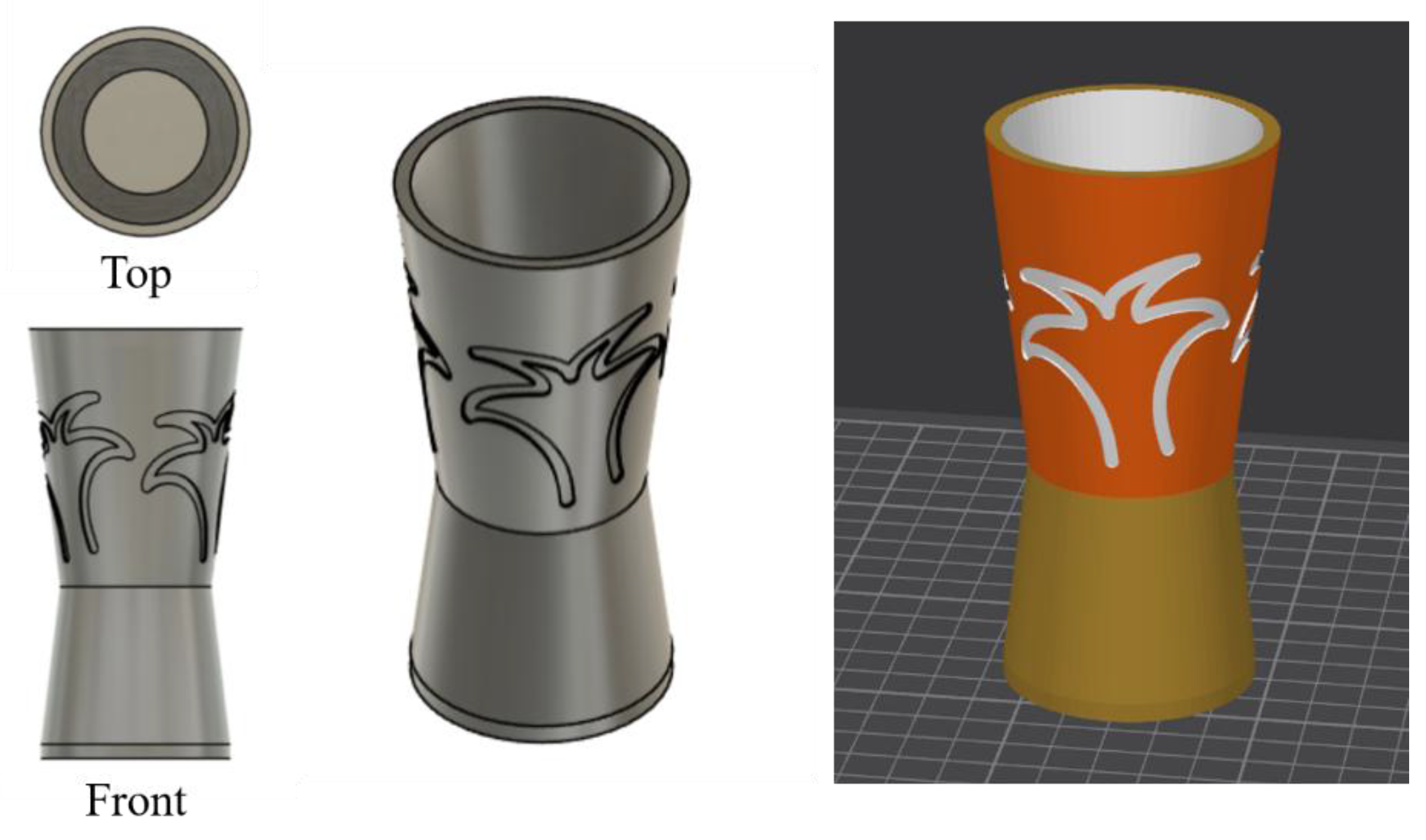
Figure 13.
Autonomous relational reasoning and geometry retrieval via a generative design assistant.
Figure 13.
Autonomous relational reasoning and geometry retrieval via a generative design assistant.
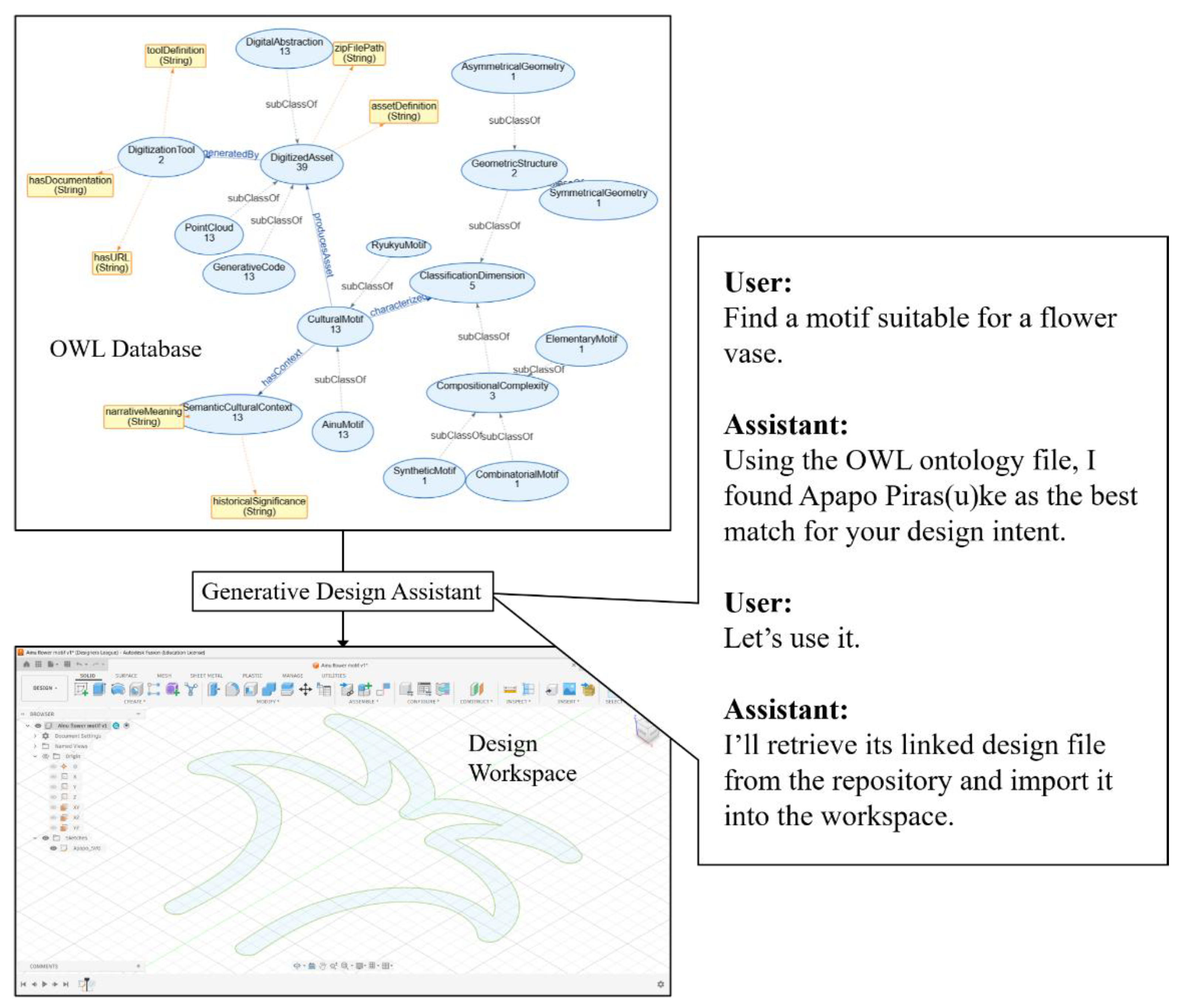

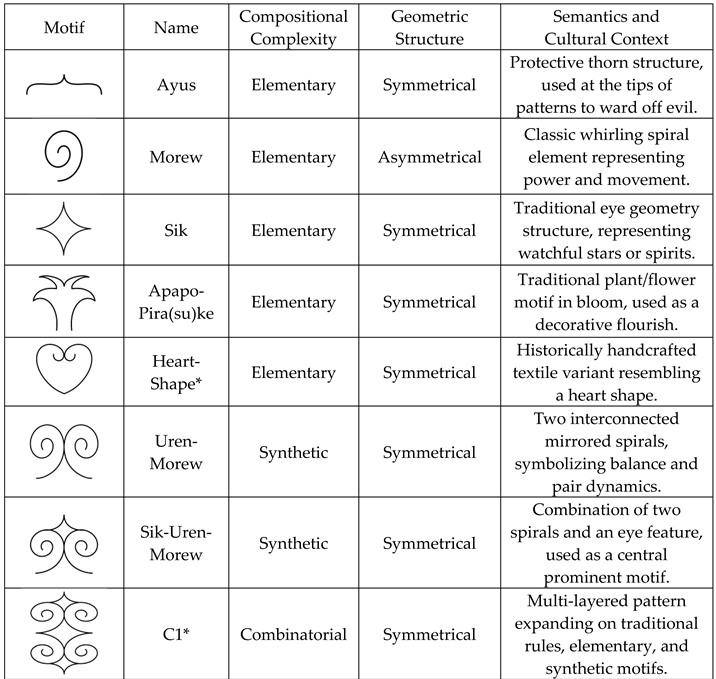
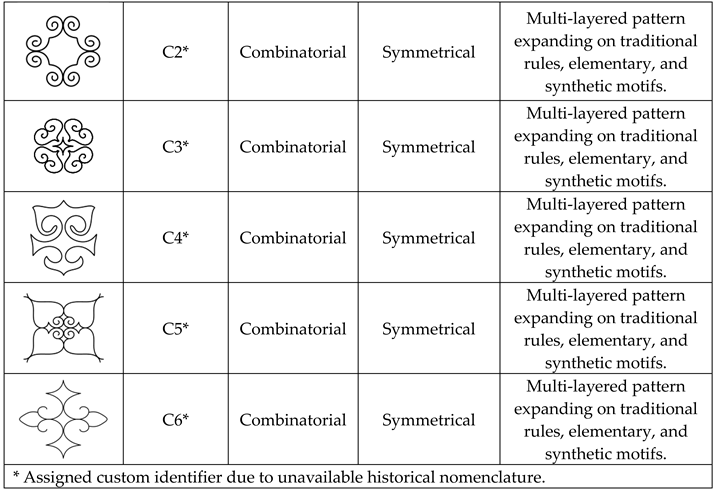
Table 2.
Results related to creating point cloud and digital abstraction from elementary Ainu motifs.
Table 2.
Results related to creating point cloud and digital abstraction from elementary Ainu motifs.
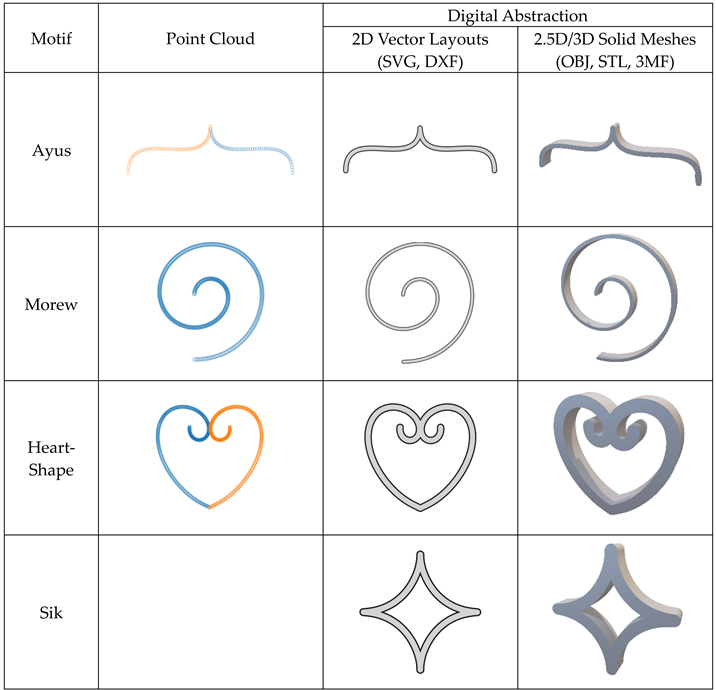
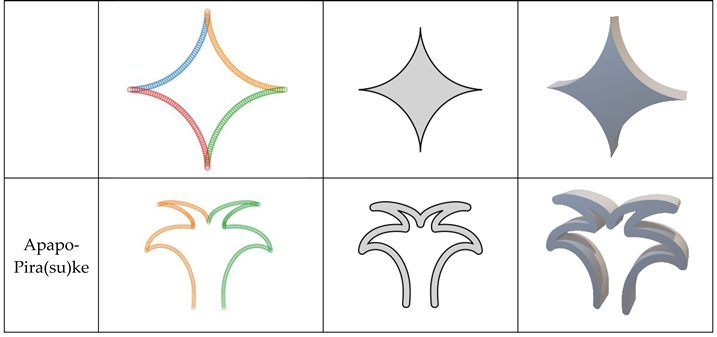
Table 3.
Results related to creating point cloud and digital abstraction from synthetic Ainu motifs.
Table 3.
Results related to creating point cloud and digital abstraction from synthetic Ainu motifs.
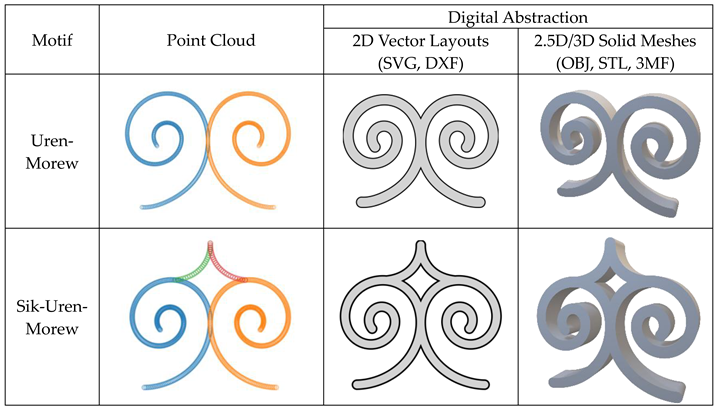
Table 4.
Results related to creating point cloud and digital abstraction from combinatorial Ainu motifs.
Table 4.
Results related to creating point cloud and digital abstraction from combinatorial Ainu motifs.
Disclaimer/Publisher’s Note: The statements, opinions and data contained in all publications are solely those of the individual author(s) and contributor(s) and not of MDPI and/or the editor(s). MDPI and/or the editor(s) disclaim responsibility for any injury to people or property resulting from any ideas, methods, instructions or products referred to in the content. |
© 2026 by the authors. Licensee MDPI, Basel, Switzerland. This article is an open access article distributed under the terms and conditions of the Creative Commons Attribution (CC BY) license.
Copyright: This open access article is published under a Creative Commons CC BY 4.0 license, which permit the free download, distribution, and reuse, provided that the author and preprint are cited in any reuse.


