

Submitted:
22 June 2026
Posted:
25 June 2026
You are already at the latest version
Abstract
We numerically investigate high-efficiency third-harmonic generation (THG) via cascaded 2 χ(2) processes in orientation-patterned GaAs (OP-GaAs) comprising two quasi-phase- 3 matched sections. The first section, with period Λ1 ≈ 212 μm, is phase-matched for second- 4 harmonic generation (ω → 2ω); the second, with period Λ2 ≈ 182 μm, for sum-frequency 5 generation (ω + 2ω → 3ω). Pumped by a continuous-wave CO2 laser at λ = 10.61 μm, 6 the structure converts the fundamental to the third harmonic at λ3ω ≈ 3.54 μm, within 7 the atmospheric transmission window. By solving the coupled-wave equations with 8 temperature-dependent Sellmeier dispersion for GaAs, we optimize the number of domains 9 in each section and predict THG conversion efficiencies exceeding 90% at a pump intensity 10 of ∼ 100 MW/cm2 in a crystal of total length ≈ 1.6 cm (N1 ≈ 66 domains in the SHG 11 section and N2 ≈ 100 in the SFG section). We also analyze the thermal tuning of the 12 quasi-phase-matching conditions over the range 22–300◦C, and demonstrate robustness 13 against fabrication tolerances of ±10 domains and ±2% in domain length. Our results 14 establish two-section OP-GaAs as a practical, high-efficiency platform for mid-infrared 15 frequency tripling.
Keywords:
quasi-phase-matching
; orientation-patterned GaAs
; third-harmonic generation
; frequency tripling
; cascaded χ(2) processes
; mid-infrared
; CO2 laser
; nonlinear frequency conversion
; sum-frequency generation
1. Introduction
Coherent radiation in the mid-infrared (mid-IR), particularly in the atmospheric transmission window spanning 3–5 µm, is highly relevant to numerous applications. These include high-resolution molecular spectroscopy for gas detection and tracing, environmental monitoring and pollution sensing, free-space optical communications, as well as medical diagnostics such as non-invasive breath analysis [1,2]. This spectral window encompasses the strong fundamental vibrational absorption bands of molecules such as , , and various volatile organic compounds, making it particularly attractive for laser-based sensing [1,3]. The development of compact, efficient, and tunable mid-IR sources therefore remains an important challenge in contemporary photonics.
Among the various approaches to generating coherent mid-IR radiation — including optical parametric oscillators (OPOs), difference-frequency generation (DFG), and quantum cascade lasers [2,3] — frequency upconversion via cascaded nonlinear processes offers a compelling route when a suitable pump laser is available. In particular, frequency tripling (THG) of laser emission at m yields the third harmonic at m, overlapping with the characteristic vibrational absorption bands of hydrocarbons and volatile organic compounds [1]. Unlike OPOs and DFG sources, which require two synchronized input beams or complex cavity designs, THG from a single-wavelength pump in a properly engineered nonlinear crystal offers a compacta, robust, all-solid-state solution for environmental diagnostics and industrial safety applications.
Gallium Arsenide (GaAs) is an outstanding crystalline material for mid-IR nonlinear frequency conversion, combining a large second-order nonlinearity at m [4], an exceptionally broad transparency window from 0.9 to 17 µm, low optical absorption below in the mid-IR, and a high optical damage threshold exceeding for nanosecond pulses [4,5]. These properties make GaAs particularly attractive for high-intensity nonlinear interactions in the mid-IR. However, the cubic symmetry of GaAs (point group ) and its strong material dispersion preclude conventional birefringent phase-matching for either SHG or THG [5], necessitating alternative approaches to achieve efficient nonlinear frequency conversion.
The limitations above can be overcome by quasi-phase-matching (QPM), whereby the sign of the susceptibility is periodically reversed to compensate the wavevector mismatch between the interacting waves [5]. In GaAs, QPM is implemented via orientation-patterned (OP) domain engineering, in which epitaxial growth techniques produce alternating crystallographic orientations [6]. The first all-epitaxial fabrication of thick OP-GaAs enabled nonlinear interactions over lengths exceeding 2 cm [6]. Subsequent work on quasi-phase-matched GaAs reported efficient SHG with peak power conversion up to 24% [7], as well as cascaded processes for THG from a pulsed source [8]. Skauli et al. further demonstrated internal SHG conversion efficiencies reaching 33% for a pump near 4 µm [4], and more recent efforts have improved fabrication quality, domain uniformity, and damage threshold of OP-GaAs [9,10].
Notwithstanding the achievements listed above, efficient THG via cascading () in OP-GaAs has not been fully exploited. Direct -based THG in bulk semiconductors typically yields conversion efficiencies below owing to the small third-order susceptibility [5], whereas cascaded approaches can in principle reach near-unity conversion — provided that the distinct phase-matching conditions for both SHG () and SFG () are simultaneously satisfied [5,11,12]. In a conventional single-period QPM grating, however, these two conditions cannot be met at the same time, since the coherence lengths for SHG and SFG differ. Alternative strategies such as chirped gratings or multiperiod structures have been explored in other nonlinear crystals [11,12], but a systematic optimization of two-section QPM designs for high-efficiency THG in OP-GaAs has not yet been reported.
In this work, we present systematic numerical simulations of THG in a two-section OP-GaAs crystal pumped by a continuous-wave (CW) laser at m. The first crystal section, with QPM period , is designed for SHG (), while the second, with period , is optimized for SFG (). By numerically integrating the coupled-wave equations with temperature-dependent Sellmeier dispersion for GaAs using a fourth-order Runge–Kutta method, we determine the optimal number of domains and in each section to maximize energy transfer to the third harmonic (Figure 1). Unlike the fixed-domain stacks of Ref. [8], our approach provides a systematic optimization framework yielding THG conversion efficiencies exceeding 90%.
The proposed architecture requires only a single-wavelength (fundamental) input and is considerably simpler than schemes requiring two synchronized pump beams. Moreover, the use of two uniform QPM sections — rather than complex chirped or multiperiod gratings — is fully compatible with current OP-GaAs fabrication technology [6,9], and the predicted THG conversion efficiency of approaches the Manley–Rowe upper limit for three-wave mixing [5].
The remainder of this paper is organized as follows. Section 2 describes the material parameters, coupled-wave equations, and QPM conditions for OP-GaAs. Section 3 presents the numerical results, including the temperature dependence of the QPM periods, conversion efficiency at the optimized domain numbers, sensitivity to fabrication tolerances, and the role of propagation losses. Section 4 summarizes the main conclusions and outlines directions for future work.
2. Materials and Methods
Orientation-patterned GaAs is fabricated by bonding and epitaxial regrowth of GaAs wafers with alternating crystallographic orientation, enabling periodic reversal of the tensor [9,10]. This technique preserves the large second-order nonlinear coefficient of bulk GaAs, at m [4], which we adopt as the effective nonlinearity throughout the present work. OP-GaAs exhibits low linear absorption () across its transparency window (0.9–17 µm) and a high optical damage threshold exceeding for nanosecond pulses [4], making it well suited for high-intensity mid-IR nonlinear interactions.
For accurate phase-matching calculations, we employ the temperature-dependent Sellmeier equations for GaAs reported by Skauli et al. [13], which provide refractive indices at m, m, and m as a function of temperature. These dispersion relations have been validated over a broad spectral and temperature range and are widely used for QPM design in GaAs [4,5].
2.1. Wave-Mixing Equations for Cascaded Processes
For the cascaded second-order processes (SHG) and (SFG), the slowly-varying envelopes , , at , and , respectively, satisfy the following coupled-wave equations [5,11,12]:
where is a periodic sign-changing function accounting for the QPM domain structure (defined in Section 2.2), is the linear propagation loss coefficient, and , are the phase mismatches for SHG and SFG, respectively. The nonlinear coupling coefficients are
where is the effective second-order nonlinearity (see Section 2.2), are the refractive indices of GaAs at m, m, and m calculated from the Skauli dispersion equations [13], and the amplitudes are normalized such that .
2.2. Quasi-Phase-Matching
The QPM grating is a sequence of domains with alternating signs of the second-order nonlinear coefficient. For GaAs, which belongs to the point group, the nonzero elements of the second-order susceptibility tensor are [5]. In the most common orientation-patterned geometry, the crystal is cut in the (011) plane and the fundamental wave propagates along with polarization along . Under these conditions, the effective type-I nonlinearity reduces to , whose value we take from [4] as established in Section 2.1.
The grating function is for z within the m-th domain, providing the momentum compensation required to phase-match a given interaction. Since the phase mismatches and are in general different, two distinct QPM periods are required: for SHG and for SFG, where and are the corresponding coherence lengths. Using the Skauli dispersion relations [13] at room temperature (C), we obtain:
The difference between and confirms that a single-period QPM grating cannot simultaneously phase-match both interactions, motivating the two-section design adopted in this work.
2.3. Optimization of Domain Numbers
Equations (1) are integrated numerically along the propagation direction z using a fourth-order Runge–Kutta method. The OP-GaAs crystal consists of domains in total, with domains of length forming the SHG section and domains of length forming the SFG section.
The optimal number of domains in each section depends on the pump intensity through the nonlinear length , which sets the scale for energy exchange between the interacting waves. Enforcing the condition for maximum energy transfer to the third harmonic [11,12], we obtain:
where is the nonlinear length and is the electric-field amplitude of the fundamental wave at the crystal input. For the reference pump intensity , Eq. (5) yields and , corresponding to a total crystal length cm.
The initial conditions correspond to a CW fundamental input of intensity and no input at the harmonic frequencies:
The normalized conversion efficiencies at each harmonic are defined as
where the denominator represents the total field energy density, ensuring that in the lossless limit.
3. Results
3.1. Temperature Dependence of Domain Lengths
Using the Skauli dispersion relations [13] we computed the thermo-optic variations of the QPM periods and over the temperature range C–C. Figure 2 presents the resulting temperature dependence of both periods.
At room temperature (C), the coherence lengths take the values given in Eqs. (3)–(4). As the temperature increases to C, both and increase by approximately , owing to the thermo-optic coefficient of GaAs at m [13]. This variation enables fine thermal tuning of the QPM conditions. The rate of change of the phase-matching wavelength with temperature is approximately
where is the group index of GaAs at the relevant wavelength. This tuning rate implies that a temperature variation of C shifts the phase-matching wavelength by nm, providing a useful degree of freedom for fine adjustment of the QPM condition without modifying the crystal geometry.
3.2. Conversion Efficiency
Figure 3 shows the conversion efficiencies of the three waves along the crystal length, computed at room temperature (C) and pump intensity MW/. The fundamental wave (m) is progressively depleted as energy is transferred first to the second harmonic (m) in the SHG section, and subsequently to the third harmonic (m) in the SFG section. At cm, the third-harmonic conversion efficiency reaches , with residual contributions from the fundamental and second harmonic of approximately and , respectively.
This result significantly exceeds the THG efficiencies reported for -based processes in bulk GaAs (below ) and for cascaded THG in early OP-GaAs experiments (below ) [8], and approaches the Manley–Rowe upper limit for three-photon energy conservation [5]. The high conversion efficiency is a direct consequence of the large effective nonlinearity of GaAs combined with the optimized two-section QPM design, which ensures that both interactions operate under their respective phase-matched conditions throughout the crystal. The significant pump depletion confirms operation in the strongly nonlinear regime.
To understand how the optimum domain numbers scale with pump intensity, we calculated and over a range of pump intensities while keeping the total crystal length cm constant, as shown in Figure 4. Both and decrease as increases, scaling as , which follows directly from the nonlinear length . At lower (higher) pump intensities, more (fewer) domains are required, with the total length redistributed between the two sections accordingly.
3.3. Sensitivity to Deviations in Domain Number
During fabrication, the number of domains in each section may deviate from the design values and . To assess the impact of such deviations, we fix the total crystal length cm and, if the actual , recalculate rounded to the nearest integer to preserve L.
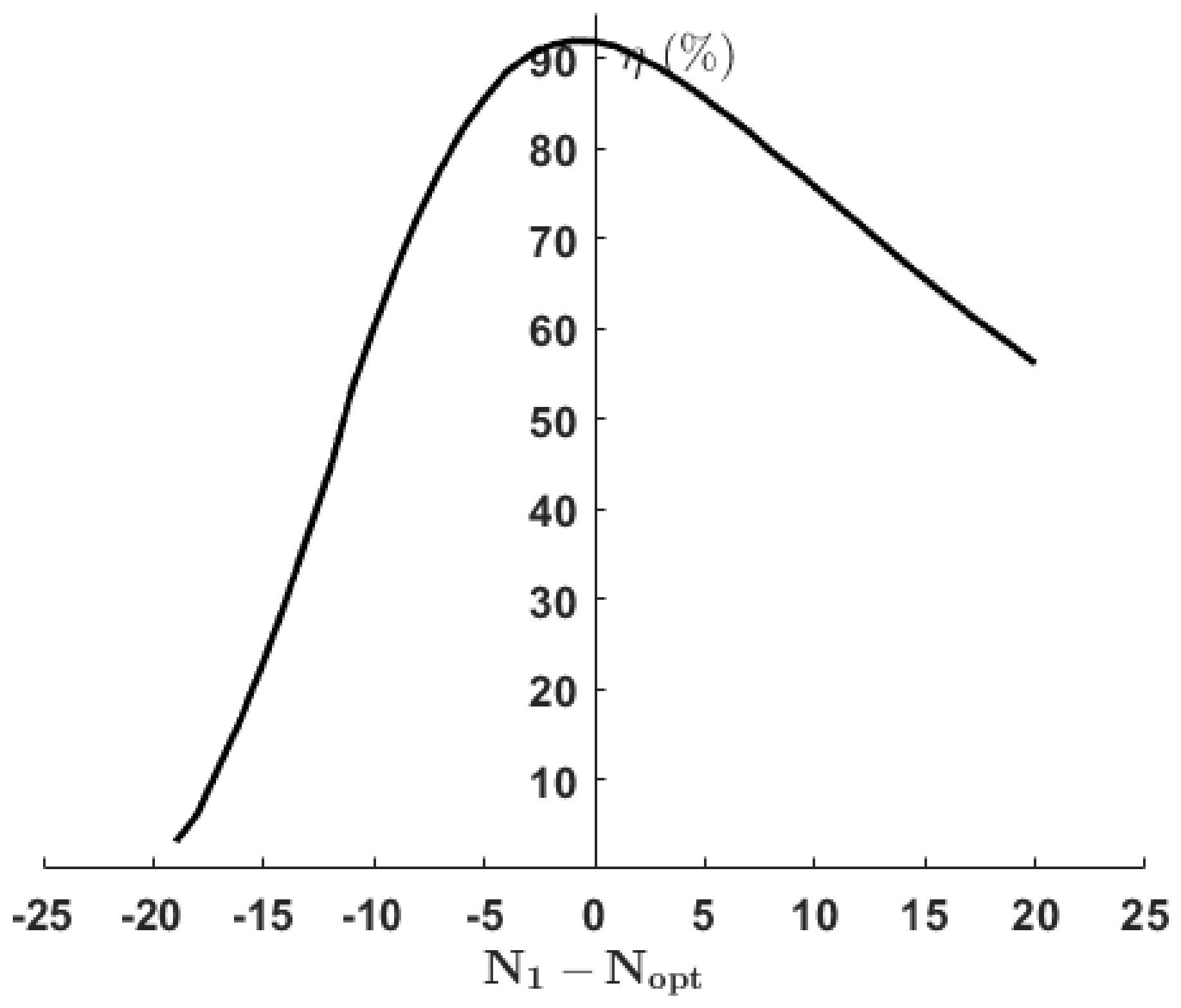
Figure 5 shows the third-harmonic conversion efficiency versus the deviation , with adjusted accordingly. The efficiency remains above for domains, corresponding to a variation in the SHG section length of mm. A positive reduces and vice versa, so that the total length remains fixed.
A similar analysis for deviations in the second section, with recalculated to preserve L, yields a comparable but slightly tighter tolerance of domains, corresponding to mm. The somewhat stricter tolerance on reflects the fact that the SFG process, being fed by the already-depleted fundamental and the generated second harmonic, is more sensitive to phase-matching deviations than the SHG step.
We also evaluated the sensitivity to errors in the domain thickness q itself. The tolerance to relative domain-length errors is approximately , which for m translates into m, and for m into m. These margins are well within the state-of-the-art micrometer-level precision achievable in current OP-GaAs fabrication [9,10], confirming the practical feasibility of the proposed design.
3.4. Role of Losses and Pump Excitation
Linear propagation losses in OP-GaAs arise from free-carrier absorption, scattering, and lattice absorption. For high-quality GaAs in the mid-infrared window (3–5 µm), the loss coefficient is typically [4]. Because the total crystal length is cm, the integrated loss reduces the third-harmonic conversion efficiency compared to the lossless limit by only about . Even at , the efficiency drop would remain below , while higher losses () would significantly degrade performance, underscoring the importance of high-quality OP-GaAs crystals. By contrast, in the terahertz range GaAs suffers from strong phonon-related absorption of several [14,15], making the mid-IR window particularly advantageous for the present application.
In the low-depletion regime, the THG conversion efficiency scales as [5], reflecting the two-step nature of the cascaded process. At higher pump intensities, pump depletion leads to saturation of this scaling, as observed in our simulations. The reference intensity employed in this work represents a good compromise between high conversion efficiency () and the risk of optical damage. We note that the damage threshold of GaAs exceeds for nanosecond pulses [4], while for CW operation the effective threshold is lower due to cumulative thermal effects; nevertheless, the pump intensity used here remains well within safe operating limits for OP-GaAs [7].
4. Conclusions
We numerically investigated a two-section orientation-patterned GaAs crystal for efficient third-harmonic generation via cascaded processes, driven by a CW laser at m. By designing two independent QPM gratings — the first for SHG (, m) and the second for SFG (, m) — we predict THG conversion efficiencies exceeding in a crystal of length cm at a pump intensity of , with optimal domain numbers for the SHG section and for the SFG section, and coherence lengths m and m, respectively.
Over the temperature range C–C, both QPM periods increase by approximately , enabling thermal fine-tuning of the phase-matching conditions at a rate of nm/°C, corresponding to a wavelength shift of nm over C. The design is robust against fabrication imperfections: the THG conversion efficiency remains above for deviations of up to domains in the SHG section and domains in the SFG section, while domain-length tolerances of (m for section 1 and m for section 2) are well within current OP-GaAs fabrication capabilities [9,10]. Linear propagation losses at the typical level reduce the conversion efficiency by only compared to the lossless limit.
Our numerical simulations demonstrate that a simple cascade of two uniform QPM sections in OP-GaAs is a practical and highly efficient route to third-harmonic generation in the mid-infrared. Compared to early experimental demonstrations of cascaded THG in fixed-domain GaAs stacks, which achieved sub-percent conversion efficiencies [8], the systematic optimization presented here yields near-unity conversion in a state-of-the-art OP-GaAs platform. Future studies will extend this analysis to other cascaded processes and explore guided-wave geometries to enhance modal confinement and further reduce the required pump intensity.
Author Contributions
Conceptualization, U.S. and G.A.; methodology, U.S.; software, A.R. and O.S.; validation, A.R., O.S. and B.U.; formal analysis, U.S. and G.A.; writing—original draft preparation, U.S. and G.A.; writing—review and editing, A.R., O.S., B.U., G.A. and U.S.; supervision, U.S. All authors have read and agreed to the published version of the manuscript.
Funding
This work was supported by the Joint Actions and Programmes in the framework of the Memorandum of Understanding on Cooperation in Fields of Science, Technology and Innovation 2025–2027 between Italy and the Republic of Uzbekistan (Project No. BIITAUZB-2025-00204, AL-10025046182-R3).
Data Availability Statement
The data supporting the results of this study are available from the corresponding author upon reasonable request.
Conflicts of Interest
The authors declare no competing interests.
References
- Zhang, Y.; et al. Mid-infrared photonics: materials, devices and applications. Nat. Photonics 2014, 8, 195–205.
- Vodopyanov, K.L. Laser-based Mid-infrared Sources and Applications; Wiley: Hoboken, NJ, USA, 2020.
- Yao, Y.; Hoffman, A.J.; Gmachl, C.F. Mid-infrared quantum cascade lasers. Nat. Photonics 2012, 6, 432–439. [CrossRef]
- Skauli, T.; Vodopyanov, K.L.; Pinguet, T.J.; Schober, A.; Levi, O.; Eyres, L.A.; Fejer, M.M.; Harris, J.S. Measurement of the nonlinear coefficient of orientation-patterned GaAs and demonstration of highly efficient second-harmonic generation. Opt. Lett. 2002, 27, 628–630. [CrossRef]
- Boyd, R.W. Nonlinear Optics, 4th ed.; Academic Press: New York, NY, USA, 2020.
- Eyres, L.A.; et al. All-epitaxial fabrication of thick, orientation-patterned GaAs films for nonlinear optical frequency conversion. Appl. Phys. Lett. 2001, 79, 904–906.
- Lallier, E.; et al. Efficient second-harmonic generation of a CO2 laser in a quasi-phase-matched GaAs waveguide. Opt. Lett. 1998, 23, 952–954.
- Becouarn, L.; et al. Third-harmonic generation in quasi-phase-matched GaAs. Appl. Phys. Lett. 1998, 73, 1429–1431.
- Soka, M.; et al. Recent advances in orientation-patterned GaAs for nonlinear optics. J. Phys. D Appl. Phys. 2019, 52, 123001.
- Eckardt, R.C.; et al. Orientation-patterned GaAs for mid-infrared frequency conversion. Proc. SPIE 2003, 4972, 1–10.
- Sapaev, U.; et al. Cascaded χ(2) processes in OP-GaAs: Theory and optimization. J. Opt. Soc. Am. B 2024, 41, 1234–1245.
- Sapaev, U.; et al. Temperature-tuned quasi-phase-matching in GaAs for mid-IR applications. Opt. Express 2024, 32, 5678–5690.
- Skauli, T.; et al. Improved dispersion relations for GaAs and applications to nonlinear optics. J. Appl. Phys. 2003, 94, 6447–6455. [CrossRef]
- Liu, X.; et al. Terahertz generation in GaAs: Loss mechanisms and mitigation. IEEE J. Sel. Top. Quantum Electron. 2022, 28, 1–12.
- Kiessling, J.; et al. Quasi-phase-matched GaAs for THz generation: Progress and challenges. J. Infrared Millim. Terahertz Waves 2013, 34, 593–609.
Figure 1.
Sketch of the two-section OP-GaAs structure: the first section (length , period ) optimizes frequency doubling (), and the second (length , period ) sum-frequency mixing (). A CW fundamental wave at is the input.
Figure 1.
Sketch of the two-section OP-GaAs structure: the first section (length , period ) optimizes frequency doubling (), and the second (length , period ) sum-frequency mixing (). A CW fundamental wave at is the input.
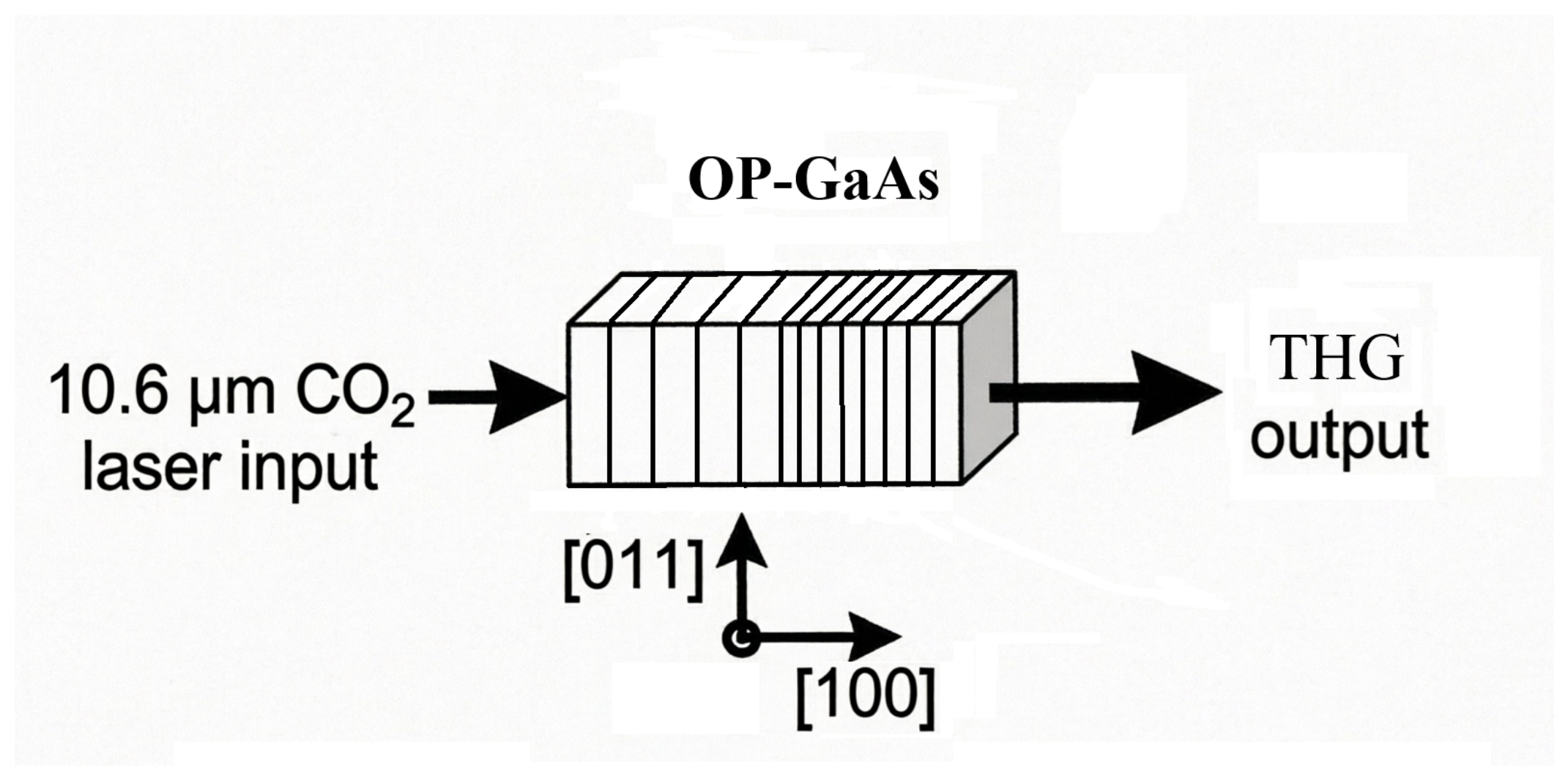
Figure 2.
QPM periods and versus temperature calculated from the Skauli dispersion relations [13]. The blue solid line plots (), the red dashed line plots ().
Figure 2.
QPM periods and versus temperature calculated from the Skauli dispersion relations [13]. The blue solid line plots (), the red dashed line plots ().
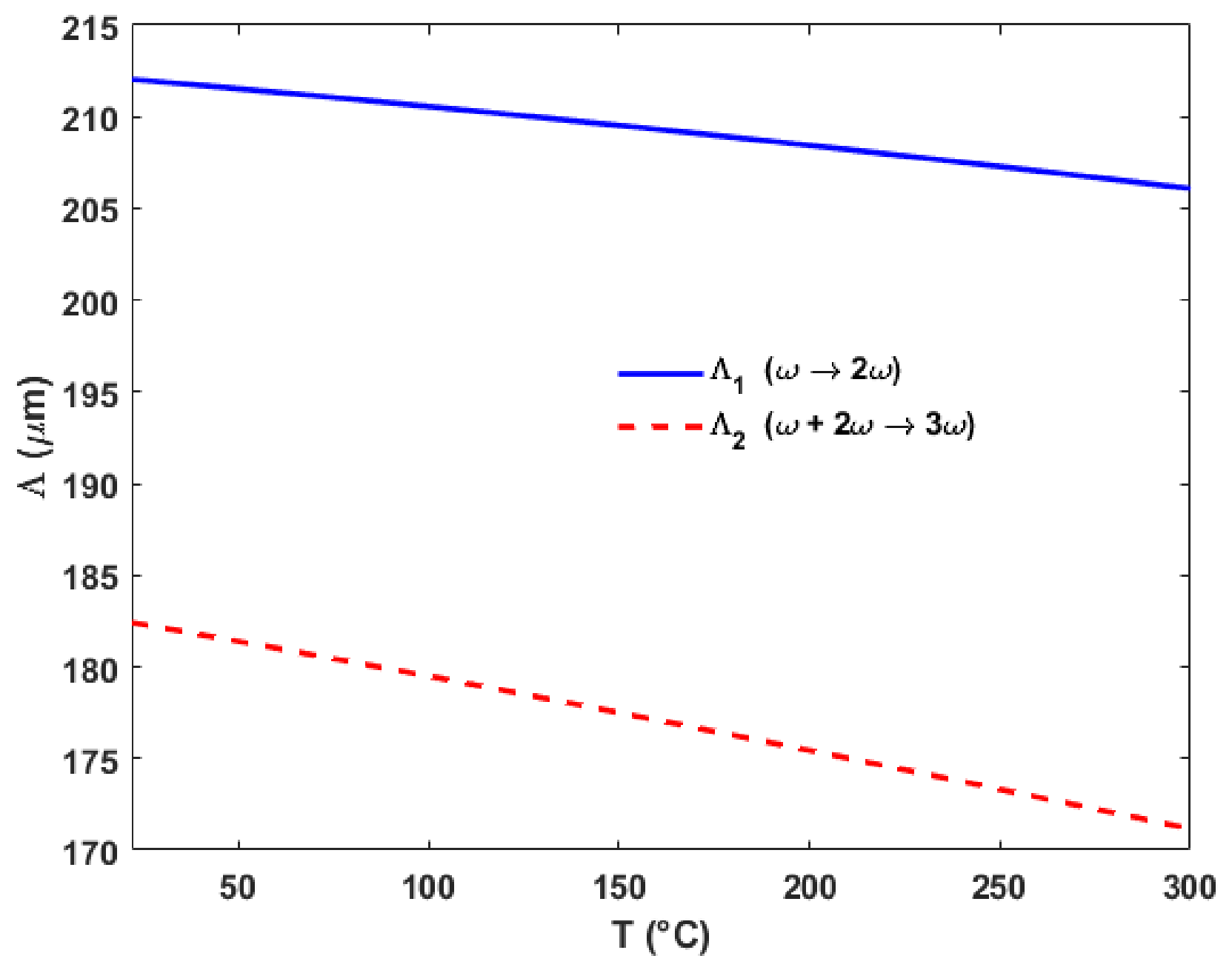
Figure 3.
Normalized conversion efficiencies of the fundamental (, m), second harmonic (, m), and third harmonic (, m) versus propagation distance z in the optimized OP-GaAs structure (, , C) at MW/.
Figure 3.
Normalized conversion efficiencies of the fundamental (, m), second harmonic (, m), and third harmonic (, m) versus propagation distance z in the optimized OP-GaAs structure (, , C) at MW/.
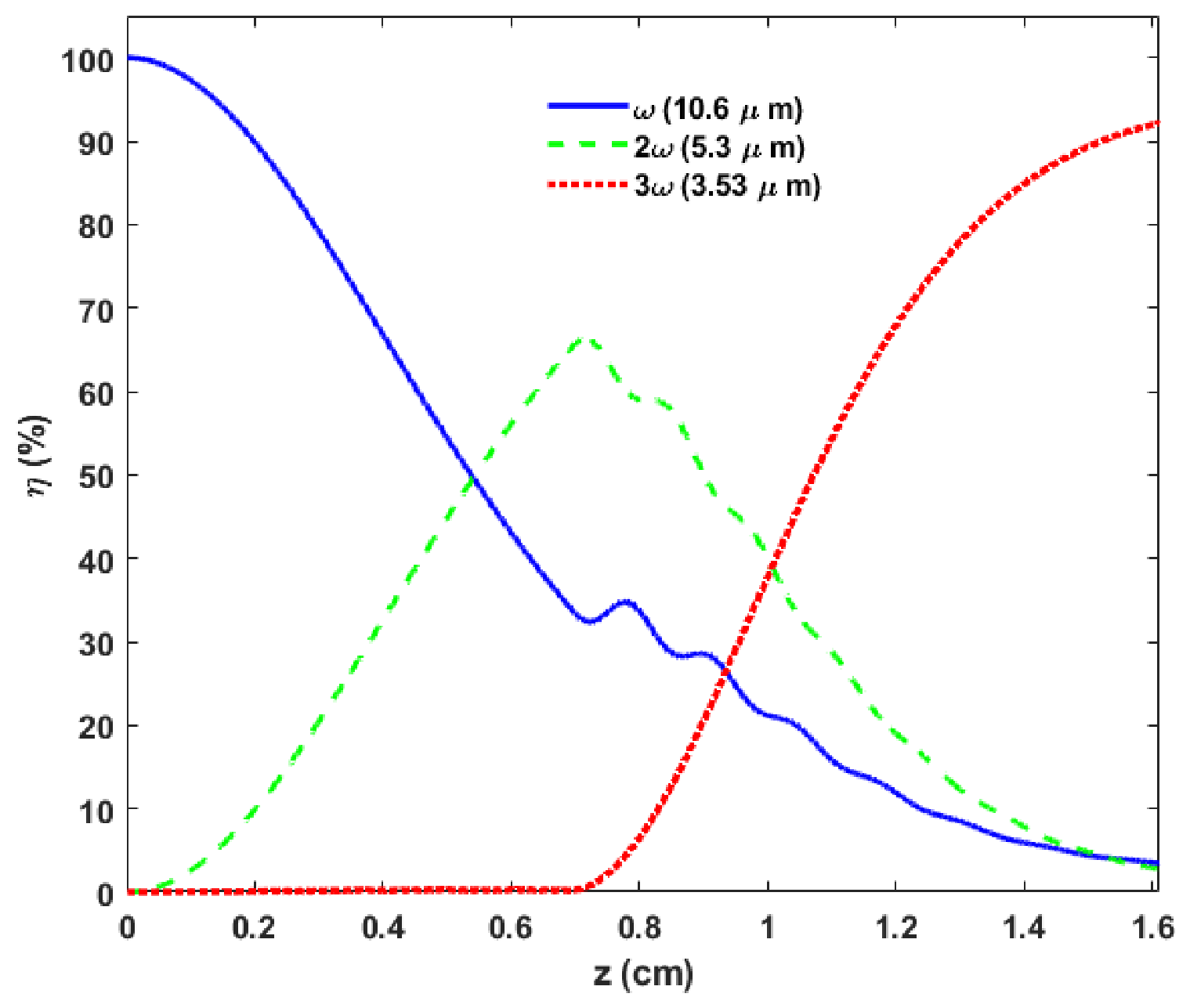
Figure 4.
Optimum domain numbers and versus pump intensity . Both quantities scale as . The vertical dashed line marks the reference value of MW/.
Figure 4.
Optimum domain numbers and versus pump intensity . Both quantities scale as . The vertical dashed line marks the reference value of MW/.
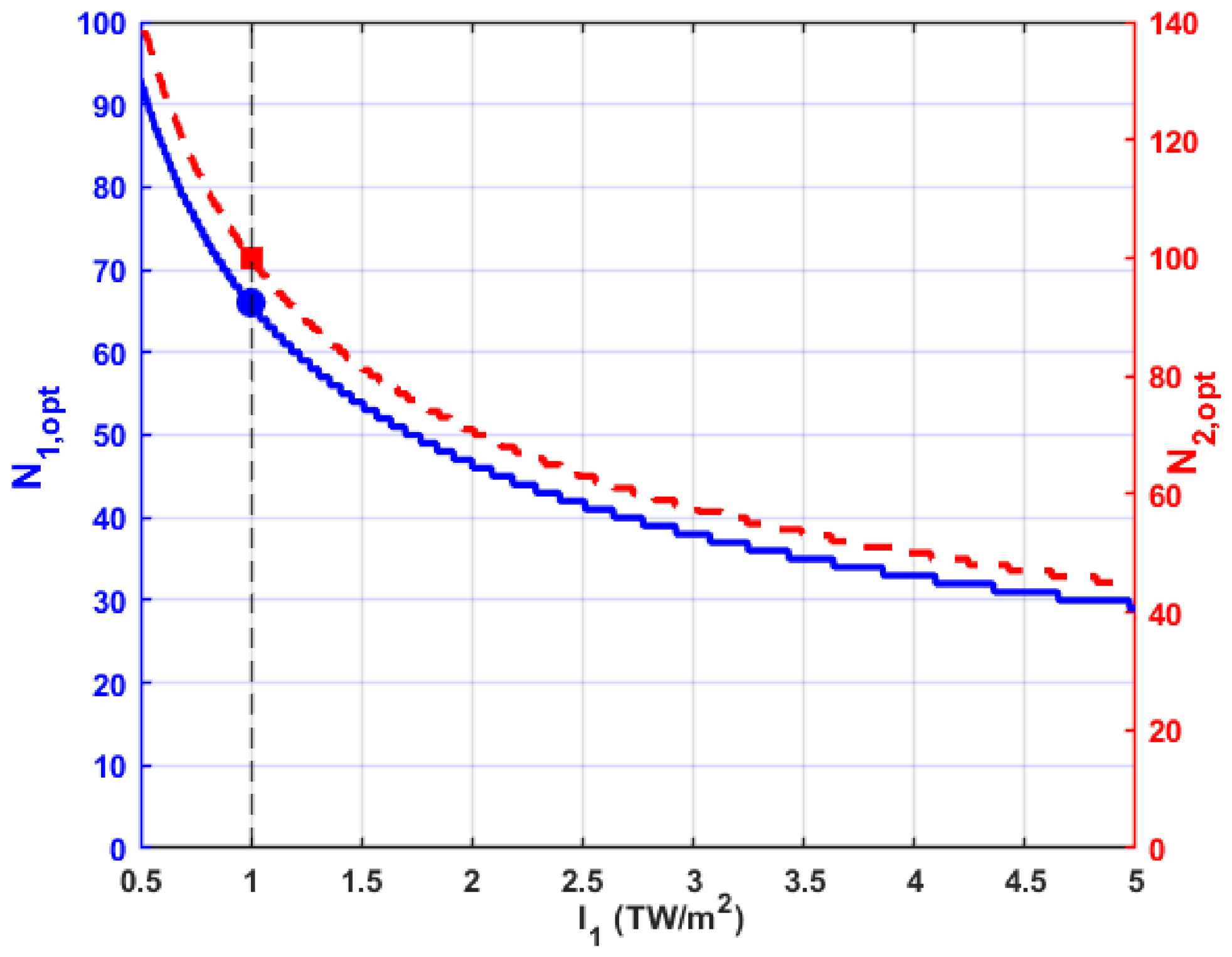
Figure 5.
Third-harmonic conversion efficiency versus deviation , with adjusted to keep the total length constant at cm.
Figure 5.
Third-harmonic conversion efficiency versus deviation , with adjusted to keep the total length constant at cm.
Disclaimer/Publisher’s Note: The statements, opinions and data contained in all publications are solely those of the individual author(s) and contributor(s) and not of MDPI and/or the editor(s). MDPI and/or the editor(s) disclaim responsibility for any injury to people or property resulting from any ideas, methods, instructions or products referred to in the content. |
© 2026 by the authors. Licensee MDPI, Basel, Switzerland. This article is an open access article distributed under the terms and conditions of the Creative Commons Attribution (CC BY) license (http://creativecommons.org/licenses/by/4.0/).
Copyright: This open access article is published under a Creative Commons CC BY 4.0 license, which permit the free download, distribution, and reuse, provided that the author and preprint are cited in any reuse.


