

Submitted:
04 August 2026
Posted:
05 August 2026
You are already at the latest version
Abstract
The fine-structure constant is usually treated as an empirical dimensionless coupling of quantum electrodynamics. This paper proposes a different interpretation: \(\alpha^{-1}\) is a universal geometric capacity of the neutral-parent structure from which electromagnetic read-out becomes possible. In this view, branch-level electric charge is not primitive; it is an oriented read-out of a resolved defect, while magnetic response is a loop-level holonomy read-out of the completed neutral parent. A neutral object may therefore have no net electric charge while still possessing magnetic holonomy capacity. The leading neutral-parent capacity is formulated as the stratified Haar capacity \[ \Omega_{P_0} = (2\pi)(2\pi^2)+\frac12(2\pi^2)+\frac12(2\pi) = 4\pi^3+\pi^2+\pi , \] with the product term representing the coupled \(U(1)\)-phase and \(SU(2)\)-spinorial interior and the half-weight terms representing marginal boundary strata of the unresolved parent. The novelty of the proposal is not the isolated leading expression, but its interpretation as a neutral-parent magnetic capacity and its embedding into a constrained carrier-interface correction hierarchy. The first self-exposure correction from the ordered Z3 → Z4 interface contributes \(-1/(24\Omega_{P_0})\), and the reduced magnetic Z4 → Z5 cross-interface transfer contributes \(-7/(5\Omega_{P_0}^{3})\). Thus \[ \alpha^{-1}_{geom} = \Omega_{P_0} - \frac{1}{24\Omega_{P_0}} - \frac{7}{5\Omega_{P_0}^{3}} = 137.0359991761696 . \] This differs from the CODATA 2022 value \(\alpha^{-1}_{\rm CODATA}=137.035999177(21)\) by approximately \(-8.3\times 10^{-10}\), corresponding to about \(-0.04\sigma\). The same adjacent-interface logic gives a rule-defined higher-order continuation, with successively suppressed terms at orders \(\Omega_{P_0}^{-5},\Omega_{P_0}^{-7},\ldots\). These terms are not introduced as fitted improvements, but as a conditional consistency check and as quantitative targets for future higher-precision measurements of \(\alpha^{-1}\). The result is presented as a structural conjecture: the leading capacity is formulated as a stratified Haar capacity, while a complete carrier-defect theorem for the interface corrections and their all-order persistence remains an open task.
Keywords:
fine-structure constant
; quantum electrodynamics
; fundamental constants
; magnetic holonomy
; geometric capacity
; Haar measure
; (U(1)) symmetry
; spinor structure
; carrier-defect theory
; quantum foundations
1. Introduction
The fine-structure constant is one of the central dimensionless constants of physics. In quantum electrodynamics (QED), it measures the dimensionless strength with which charged particles couple to the electromagnetic field. Operationally, is determined from high-precision measurements such as atomic recoil and the electron magnetic moment, together with the theoretical structure of QED [1,2,3,4,5]. Within the Standard Model, however, its numerical value is not derived; it is an input parameter.
This situation is not unusual in modern physics. The quantities observed in experiment are rarely identical to the simplest bare quantities appearing in a formal description. In quantum field theory, the vacuum is not an empty background: it carries fluctuations, polarization, and response. A bare charge or mass is not directly observed; the physical observable is obtained only after the excitation is embedded into the surrounding quantum-field response. This is the logic behind renormalization [6,7,8]. In general relativity, the metric is also not a passive stage. It responds to energy and momentum according to Einstein’s equation,
so the physical geometry seen by matter is inseparable from the dynamical response of the system. These familiar examples suggest a broad lesson: physical observables often arise as read-outs of an excitation together with the structure that supports, dresses, and makes it observable.
The present paper applies this lesson to the fine-structure constant. We ask whether is not merely a freely tunable low-energy coupling, but the observable normalization produced when electromagnetic readability is embedded into the carrier structure of spacetime itself. Here the “carrier” is not a material medium inside spacetime. It is spacetime understood process-theoretically: the rule-governed support of admissible continuation, phase comparison, orientation, and closure. In the Standard Model this carrier is already equipped, at the effective field-theory level, with a phase structure at each spacetime point [6,9,10]. The present proposal asks why the universal normalization of this everywhere-available electromagnetic phase read-out has the observed value of .
The central object considered here is a localized defect of this continuation process. A particle is not assumed to be a primitive point object inserted into a background spacetime. Rather, it is treated as the stable Lorentz-covariant read-out of a localized carrier defect after admissible continuation, closure, and phase structure become physically readable. In this sense, the proposal parallels the distinction between a bare parameter and a dressed physical observable: the neutral-parent defect is the pre-resolved carrier structure, while an observed charged or neutral particle is a branch-level read-out of that structure.
The proposed origin of is therefore not sought in ordinary spacetime geometry alone. It is sought in the capacity of a neutral parent defect to support electromagnetic readability before its resolved branches are observed as charged, neutral, weak, or hadron-facing channels. The neutral parent should not be interpreted as a literal particle simultaneously decaying into all possible channels. It is an unresolved admissibility archetype of the carrier structure from which different branch read-outs become possible.
The key physical shift is to treat magnetic response as more primitive than branch-level electric charge. Electric charge is an oriented read-out of resolved branch exposure. Magnetic response, by contrast, is a loop-level holonomy read-out of a closed defect. A neutral object can have no net electric charge while still carrying magnetic response:
The neutron is the familiar physical example. This motivates the possibility that the neutral parent need not be electrically charged in order to determine the universal electromagnetic normalization. It only needs to possess a loop-readable magnetic holonomy capacity.
In the present interpretation, a unit loop does not measure an isolated elementary charge. It reads the completed electromagnetic content of the neutral-parent defect: the carrier capacity that must be coherently supported before branch-level electromagnetic readability can occur. After branch resolution, different channels may expose different charge numbers,
including negative, positive, fractional, or zero values, but they do not reselect the universal electromagnetic normalization. The neutral parent fixes the common capacity; the resolved branch fixes only the oriented charge read-out. Thus different charged particles inherit the same fine-structure constant, while their charge factors may differ.
This point may be stated counterfactually. If the charged, neutral, weak, and hadron-facing channels were independent primitive sectors, there would be no intrinsic reason, within the present framework, for their -readability capacities to be identical. One would generically expect channel-dependent capacities and hence channel-dependent electromagnetic normalizations. The observed universality of electromagnetic coupling is normally expressed in gauge theory by the existence of a single low-energy coupling. The present proposal does not replace that statement. Rather, it proposes a pre-gauge structural reason why the same normalization is inherited by all electromagnetic branch read-outs.
We therefore seek a geometric-capacity formula for
as the magnetic holonomy capacity of the neutral parent:
The capacity is large because the phase loop is coupled to a nontrivial internal closure structure, including the polarized -type branch resolution and the nested hadron-facing closure hierarchy. Intuitively, one unit of phase circulation must coherently read a larger complex of linked closure processes. The effective branch-level electromagnetic response is therefore small because it is the reciprocal of this large capacity.
The leading numerical expression used in this paper,
has appeared previously in speculative discussions of the fine-structure constant, where it was observed to give a close approximation to [11,12,13]. The novelty of the present work is therefore not the isolated observation of this leading number. Rather, it is the proposed interpretation of as a neutral-parent magnetic capacity and the subsequent constrained correction hierarchy. In this sense, the present proposal attempts to convert a previously noticed numerical coincidence into a structured carrier-defect expansion.
After completing the present manuscript, the author became aware of an earlier BRISM preprint by Heinze, which proposed the same first corrected numerical form , with , but attributed the factor 24 to the dimension of an completion sector [14]. A subsequent BRISM paper interpreted X as an admissible phase-space capacity of an interface [15]. The present construction was developed independently and differs in both mechanism and continuation: X is obtained here as a stratified phase–spinor Haar capacity of a codimension-two neutral parent, is the ordered chamber count of the first closure-plus-exposure interface, and the additional term and higher-order tower arise from the adjacent-interface hierarchy. The overlap therefore concerns the two-term numerical approximation, while the structural derivation and the subsequent correction tower are distinct.
The main two-correction result proposed here is
This gives
Compared with the CODATA 2022 value
the residual is
or approximately relative to the quoted standard uncertainty [5].
This numerical agreement is not, by itself, a proof. The purpose of this paper is to formulate the structural principle, derive the leading capacity from a stratified phase–spinor embedding, identify the proposed geometric and monodromy origin of the correction terms, and show that the result is sufficiently constrained to motivate a full carrier-defect derivation. The higher-order continuation developed below is also presented conditionally: it shows how the same adjacent-interface rule would generate further terms if the carrier-interface hierarchy persists at higher monodromy order. QED remains the effective theory of branch-level electromagnetic dynamics after the value of is given. The present proposal addresses the prior question of why the universal dimensionless coupling inherited by QED has the observed value.
For clarity, the logical map of the paper is:
The paper is organized as follows. Section 2 summarizes the minimal carrier-defect vocabulary used in the paper. Section 3 introduces the neutral parent and explains why magnetic holonomy, rather than branch-level electric charge, is the relevant pre-resolution read-out. Section 4 relates this magnetic capacity to the electromagnetic coupling. Section 5 derives the leading capacity . Section 6 and Section 7 derive the first two proposed interface corrections, while Section 8 explains why the ingredients are not freely fitted to CODATA. Section 9 evaluates the formula numerically. Section 10 and Section 11 clarify the status of the neutral parent and its relation to magnetic moments. Section 12 develops the formal higher-order continuation and consistency check with the earlier adjacent-interface rule. Section 13 and Section 14 discuss the interpretation, limitations, and open derivational tasks, and Section 15 concludes. Technical details of the leading capacity and interface coefficients are given in Appendices A–C.
2. Background: Archetype Particle Theory and Carrier Defect Read-Out
The present calculation is formulated within the archetype particle theory developed in the preceding research program [16]. Since the fine-structure constant is here interpreted as a carrier-embedding invariant rather than as an adjustable dynamical coupling, we briefly state the concepts needed for the calculation. The purpose of this section is not to rederive the full particle theory, but to fix the dictionary, structural assumptions, and read-out logic used below.
2.1. Dictionary of Basic Concepts
Carrier process.
The word “carrier” does not denote a material medium inside spacetime. It denotes spacetime understood process-theoretically: the rule-governed support of admissible continuation, phase comparison, orientation, and closure. At the effective field-theory level, this carrier already supports local phase structure, including the phase used in QED [9,10,17]. In the present framework, ordinary Lorentz-covariant spacetime is the stable metric-level read-out of this deeper continuation structure.
Defect process.
A defect is a localized persistence pattern in the carrier process. A particle is therefore not treated as a primitive point object inserted into a background space. It is the stable Lorentz-covariant read-out of a localized process defect whose identity can be continued, closed, and recognized across admissible stages.
Codimension-two defect process.
After Lorentz-readable localization is available, the particle-relevant defect is primarily codimension two. Locally, the punctured normal fiber has the homotopy type
A loop linking the defect is therefore the natural probe of its identity. If the carrier supports phase read-out, this linking loop gives a phase closure,
Embedding.
An embedding is the way a localized process defect is supported, continued, and read out. At the pregeometric level, embedding means admissible placement inside a continuation process: which relations are preserved, which closures are allowed, and which read-outs remain stable. Only after Lorentz read-out does this become an ordinary spacetime-localized particle or field configuration.
Internal monodromy.
When the continuation process is carried around a defect, its internal state may close only after a finite sequence of admissible continuations. This finite closure structure is called internal monodromy and is denoted schematically by
These symbols encode finite continuation and closure structure inside the defect pocket.
The use of discrete monodromy at this level is intentional. Before Lorentz-covariant read-out, the defect pocket is not yet a differentiable internal manifold carrying the Standard Model groups and as its primary representation. Continuous gauge descriptions become meaningful after the process admits a Lorentz-compatible physical read-out. Thus the present framework does not replace the Standard Model groups by groups at the observable field-theory level. It uses finite monodromy to describe pregeometric internal closure, while the usual continuous gauge groups describe the effective field-theory layer [9,21,22].
branch resolution.
The first resolution of the neutral parent is written schematically as
The layer distinguishes complementary read-out directions of the parent. It is a branch-resolution layer, not yet a completed confinement-like support.
closure.
The first completed positive-side closure is threefold. In QCD language, color-neutral baryonic closure requires three color slots [23,24]. In the present process language, records the pregeometric threefold closure condition compatible with later color-neutral hadronic read-out. It should not be identified with the full color gauge group. Incomplete sectors are not asymptotic readable objects; completed closures can support baryonic read-out.
exposure.
The first magnetic self-exposure layer is
The slot is not a fourth color, a new family, or an independent external branch. It is the first exposure slot attached to a completed closure. This is why the first correction to the neutral-parent magnetic capacity begins at , rather than at .
Lorentz read-out.
The internal defect process becomes physical only after it admits a Lorentz-covariant read-out. A phase loop supplies the holonomy, while a spinorial particle read-out requires an admissible spin-frame lift,
Thus the minimal readable structure relevant here contains both
Physical observable.
A physical observable is a Lorentz-covariant metric-level read-out of a deeper continuation process. Electric charge, magnetic moment, mass, spin, and particle identity are therefore treated here as effective observables, not as primitive labels. They arise when the internal topological and monodromy structure of a defect becomes readable in the physical layer.
Neutral parent.
The neutral parent is the unresolved archetype of particle read-out. It should not be interpreted as a literal particle simultaneously decaying into all possible branch channels. It is an admissibility archetype whose branch structure can be resolved in different physical contexts. For example, ordinary neutron beta decay selects the energetically accessible channel
rather than simultaneously exposing electron, muon, and tau channels.
Magnetic holonomy.
Magnetic response is treated as a loop-level read-out of the continuation process. This is why it is taken to be more primitive in the present theory than branch-level electric charge. A neutral object can have no net electric charge while still carrying magnetic response,
The neutron is the familiar physical example. In this paper, the fine-structure constant is interpreted as the universal impedance required for neutral-parent magnetic holonomy to become readable after Lorentz-compatible branch resolution.
Capacity.
A capacity is a dimensionless measure of admissible read-outs of the continuation process. At the pregeometric defect-pocket level, finite possibilities are counted by their topological and monodromy structure. When compact continuous read-out groups are involved, the corresponding capacity is computed using normalized Haar measure [27,28]:
The leading neutral-parent capacity used below is therefore a stratified Haar capacity, not an ordinary spacetime volume. It combines finite monodromy content with the continuous phase and spin-frame measures that become available at the Lorentz-readable layer.
2.2. Pregeometric Counting and Equal Branch Weight
A recurring feature of the derivation is that admissible branches, ordered chambers, and closure possibilities are counted with equal weight. This is not meant as an ordinary statistical assumption. It is the symmetry-preserving measure on a finite pregeometric possibility space.
Inside the defect pocket, the primitive data are not lengths, angles, areas, or metric proportions. The primitive data are adjacency, continuation, branch structure, monodromy, and closure. Thus two admissible possibilities are distinguished by their topological role, not by metric size. A non-uniform weighting would require additional metric or dynamical information that is not present before Lorentz-covariant read-out.
This is analogous to the elementary topological fact that a small sphere and a large sphere have the same topological type. Topology remembers connectedness, boundary, winding, branch structure, and closure; it does not remember ordinary size [18,29]. Likewise, the internal carrier pocket treats admissible branches as discrete topological possibilities before any metric measure is available.
Therefore, if an unresolved parent admits N equivalent ordered chambers and no chamber is distinguished by the pregeometric data, the neutral-parent average assigns each chamber weight
The guiding rule is
Only after the defect is read out as a Lorentz-covariant observable can ordinary metric sizes, dynamical weights, and continuum probabilities enter.
2.3. Neutral Parent and Branch Read-Out
The first resolved structure of the neutral parent is written schematically as
The component represents the first two-sided branch resolution of the parent. It supports the lepton-side read-out, including a transverse charged channel and a neutral continuation channel. The nested component represents the positive-side continuation toward threefold closure.
This distinction is important. The layer separates complementary read-out directions, but it is not itself a completed closed support. The first completed positive-side support is the closure. Hence the first magnetic self-exposure correction begins at
The additional slot is not a fourth color or a new particle family. It is the first exposure slot attached to a completed threefold closure. Appendix B gives the corresponding chamber-count argument.
The neutral parent is therefore an admissibility archetype, not a simultaneous multi-channel decay object. A physical process selects the channel allowed by its energetic and embedding conditions. In this paper, is proposed to be a pre-resolution magnetic impedance of the neutral-parent embedding. It is inherited by branch-level electromagnetic phenomena after resolution, but it is not separately chosen for each branch.
2.4. Lorentz-Covariant Read-Out and the Leading Capacity
The internal monodromy structure of a defect is not directly observed as a hidden discrete object. Physical observables arise only after the defect admits a Lorentz-covariant read-out. A phase loop gives the holonomy, while a spinorial particle read-out requires the compact spin-frame lift
With the standard unit-radius normalization,
Thus a carrier-readable defect contains both a phase holonomy and a spinorial frame factor,
The Lorentzian particle description is therefore not abandoned; it is treated as the effective metric-level read-out of a deeper carrier-defect embedding.
The leading quantity used in this paper,
is not an ordinary spacetime volume. It is the leading stratified Haar capacity of the neutral-parent read-out space. The term
comes from the coupled phase and spinorial interior. The terms
come from the half-exposed spinorial and phase marginal strata of the unresolved neutral parent. Appendix A gives the corresponding stratified Haar-capacity theorem.
2.5. Magnetic Holonomy and the Role of
A central hypothesis of this paper is that magnetic response is more primitive than branch-level electric charge. Electric charge measures an oriented branch-level imbalance of the neutral parent. Magnetic moment, by contrast, measures loop-readable carrier circulation. A neutral object can therefore have no net electric charge while still possessing magnetic response,
The neutron provides the physical example. This observation motivates the interpretation of not as a number derived from an isolated electric charge, but as the universal impedance required for neutral-parent magnetic holonomy to become carrier-readable.
The proposed hierarchy is
QED remains the effective field theory governing electromagnetic dynamics after is given. The present theory addresses the prior structural question of why the dimensionless value of has its observed numerical value.
3. Neutral Parent and Magnetic Holonomy
The framework begins from a localized carrier-defect identity structure. Particle properties are not assumed as primitive labels; they are treated as Lorentz-readable observables produced by stable closure, continuation, and branch resolution. The unresolved neutral parent is denoted by
Its first resolved structure is written schematically as
The component represents the first two-sided branch resolution, supporting lepton-side read-outs such as charged-lepton and neutrino channels. The nested component represents the positive, hadron-facing continuation toward a completed threefold closure.
For the present calculation, should be understood as an unresolved admissibility archetype, not as a literal particle that simultaneously decays through all possible channels. A physical neutron, for example, realizes the lowest energetically accessible weak channel,
rather than exposing electron, muon, and tau channels at once [22,30]. More massive neutral excitations may open other weak channels, but a particular physical process resolves one kinematically and dynamically admissible channel at a time.
This distinction is important for the fine-structure constant. The value of should not be assigned separately to the lepton branch, the neutrino branch, or the hadron-facing branch. Nor should the leading capacity be multiplied by the number of possible flavor-family resolutions. In the present framework, is a pre-resolution electromagnetic normalization: a magnetic impedance of the neutral-parent carrier embedding that is inherited by branch-level electromagnetic read-outs after resolution.
The neutral parent has no net electric charge, but this does not imply that it has no electromagnetic readability. A closed carrier defect may possess loop-readable magnetic response even when its total electric charge vanishes. The neutron again provides the familiar physical example,
Thus the relevant pre-resolution structure is not bare electric charge, but magnetic holonomy: the loop-level response of a closed carrier defect. The proposed read-out hierarchy is
Electric charge is then interpreted as an oriented branch imbalance, whereas magnetic response measures loop-readable carrier circulation.
This interpretation is compatible with the absence of observed isolated magnetic monopoles. The claim is not that the neutral parent carries a magnetic charge. Rather, magnetic response is treated as a closure-based holonomy effect of the defect process, while ordinary electric charge appears only after branch-level read-out. The fine-structure constant is therefore proposed to measure the universal normalization required for this neutral-parent magnetic holonomy to become electromagnetic readability at the Lorentz-covariant branch level.
Figure 1 gives a minimal schematic of this branch-read-out structure, emphasizing that the neutral parent is an unresolved admissibility source rather than a collection of simultaneous decay products.
4. Connection to Electromagnetic Coupling
The proposed capacity should not be understood as an additional electric charge, nor as a replacement for the QED interaction vertex. In low-energy QED, the fine-structure constant measures the dimensionless strength with which a charged excitation couples to the electromagnetic field [1,6,31]. The present framework addresses a prior structural question: why the universal normalization of that coupling has its observed value.
The key distinction is between carrier normalization and branch charge read-out. Branch-level charge is not taken as primitive. It is an oriented read-out of a resolved neutral-parent structure. The pre-resolution object is instead the closed loop holonomy of the carrier defect: a loop-level readability structure that exists before resolved branches are assigned positive, negative, fractional, or neutral electric charge. The neutral parent therefore satisfies
but it may still possess a closed electromagnetic readability capacity.
This capacity does not measure electric charge directly. It measures how a unit carrier loop reads the electromagnetic content enclosed by the defect. Before branch resolution, opposite oriented exposures cancel inside the neutral parent. After resolution, the same carrier normalization is inherited by the exposed branches, while each branch carries its own charge read-out number,
Here may be negative, positive, fractional, or zero depending on the branch structure. The branch determines ; it does not reselect the universal electromagnetic normalization.
Accordingly, a charged branch is not a new source of an independent coupling. It is an oriented exposure of the same carrier-wide readability structure. The electromagnetic strength associated with branch i is therefore proportional to
not to a branch-dependent fine-structure constant . For example, a charged lepton branch may expose , a neutrino branch may expose , and a positively charged hadron branch may expose . Confined internal channels may carry fractional readability before forming integer-charge composite states. These different read-outs inherit the same carrier-wide normalization; branch resolution changes the representation of electromagnetic readability, not the value of .
The neutral-parent magnetic capacity therefore plays the role of an electromagnetic impedance, or normalization denominator. A unit branch-level charge does not couple with arbitrary strength. Its effective response is normalized by the completed carrier holonomy that must be coherently supported in order for electromagnetic readability to exist. We therefore identify the inverse fine-structure constant with the universal electromagnetic capacity,
or equivalently
In the present paper this capacity is the neutral-parent magnetic capacity,
The smallness of then has a direct interpretation. A unit loop does not read a simple isolated charge. It reads the completed neutral-parent defect, including the polarized lepton-facing sector, the neutral/weak sector, and the nested hadron-facing closure content associated with the interface hierarchy. The electromagnetic capacity is therefore a large count-like geometric capacity: it measures the amount of carrier structure that must be coherently supported for one unit of electromagnetic readability. The branch-level coupling is small because it is the reciprocal response of this large neutral-parent capacity,
This also explains, within the present framework, why the same is shared by different charged particles. If the charged, neutral, weak, and hadron-facing channels were independent primitive sectors, there would be no intrinsic reason for their -readability capacities to be identical. One would generically expect channel-dependent capacities and hence channel-dependent electromagnetic normalizations,
In standard gauge theory, the observed universality of electromagnetic coupling is expressed by the existence of a single low-energy coupling [9,10,32]. The present proposal does not replace that effective field-theory statement. It proposes a pre-gauge structural reason why the same normalization is inherited by all electromagnetic branch read-outs.
Thus QED remains the effective theory of electromagnetic dynamics after the value of is given. The neutral-parent construction addresses a different question: why the common dimensionless normalization of the electromagnetic interaction has the value it does.
5. Leading Neutral-Parent Embedding Capacity
The leading term is the proposed neutral-parent electromagnetic capacity before magnetic self-exposure corrections are included. It is built from the minimal compact read-out structures required by the framework. A codimension-two defect supplies a linking phase loop with Haar measure
while Lorentz-compatible spinorial read-out supplies the compact frame lift
These standard compact-group measures are used here as dimensionless read-out capacities, not as ordinary spacetime volumes [20,27,28].
The unresolved neutral parent is modeled as a stratified read-out space: a coupled phase–spinor interior together with two half-exposed marginal strata. Under this stratified-capacity assumption, the leading capacity is
Equivalently,
This expression should not be interpreted as the volume of a single smooth manifold. It is a stratified Haar capacity: the product term is the Haar measure of the coupled interior, while the two half-weight terms are the marginal phase and spinorial boundary contributions of the unresolved neutral parent. Appendix A states the corresponding conditional capacity theorem and its assumptions.
Numerically,
This already lies near the observed inverse fine-structure constant, but its residual relative to the CODATA 2022 value is still
Thus the leading stratified capacity captures the dominant scale but requires magnetic self-interface corrections to reach the observed value.
6. First Self-Exposure Correction:
The leading capacity describes the unresolved neutral-parent magnetic embedding before self-exposure. If this capacity is to become charge-readable, however, its magnetic holonomy must be exposed through a completed closure interface. In the present framework, the first such interface is
The reason is that is a branch-resolution layer rather than a completed confinement-like support. It distinguishes complementary read-out directions of the neutral parent, but it does not yet define a closed carrier-readable unit. The first completed positive-side support is threefold, in analogy with the three-slot color-neutral closure of baryonic configurations in QCD language [23,24]. Thus the first magnetic self-exposure is taken to be the exposure of a completed support:
The additional slot is not a fourth color and not a new particle branch. It is the first external magnetic read-out slot attached to a completed closure. The elementary interface therefore has four slots,
where denote the three closed support slots and denotes the exposure slot. Since the unresolved neutral parent has no preferred ordering before read-out, the first exposure is counted over the ordered chambers of this four-slot interface. An ordered chamber is an ordering of , so the chamber space is acted on freely and transitively by :
This is an ordered, non-quotiented chamber count. No cyclic or permutation quotient is taken at this first exposure stage, because the count is over unresolved ordered exposure alignments before a single Lorentz-readable alignment is selected. Appendix B gives the chamber-count argument in theorem form.
The first self-exposure correction is obtained by applying the uniform chamber weight to the inverse leading capacity. The chamber weight is
and the first self-readout scale is
Therefore
Its sign is negative because the exposure resolves part of the unresolved parent capacity into an externally readable channel. It is therefore a self-readout back-reaction on the leading capacity, not an additional independent capacity. The first corrected approximation is
Numerically,
The residual is reduced to
Thus the self-exposure term gives the dominant correction to the leading-capacity approximation, while leaving a smaller residual addressed by the next magnetic-interface transfer.
Figure 2 schematically illustrates how the embedded - read-out structure is carried by the next monodromy layer. The figure shows the four-slot exposure architecture; the full ordered chamber count is the set of all permutations of the three support slots and the exposure slot.
7. Reduced Magnetic Interface Transfer:
The next correction is different from the first self-exposure term. The first correction opens the external magnetic readability of a completed closure. After this exposure has occurred, the next layer should not be counted as a new independent external slot. Instead, the contribution is treated as an internal magnetic-interface relaxation of the already exposed but still closure-bound - domain.
For this reason the second correction is not governed by a new ordered-chamber average. It is inherited from the residual magnetic-interface hierarchy used in the magnetic-moment analysis. In that hierarchy, the higher closure-interface coefficients are
Hence
and
These coefficients are not fitted in the present alpha calculation. They are imported from the same closure-interface structure that organizes the magnetic-moment read-out. Appendix C summarizes the residual-interface rule and the derivation of and .
The alpha calculation, however, does not use the full baryonic magnetic response. It seeks the universal neutral-parent magnetic impedance. Thus the contribution must be reduced to the part that transfers across the relevant neutral-parent interface. The cross-interface transfer compares the numerator of the next interface with the numerator of the current interface:
The effective neutral-parent coefficient is therefore
Since this is the first internal self-readout correction after the external exposure has been opened, it enters at the next odd inverse-capacity order:
The inverse-cubic suppression expresses that this is not a first exposure of the parent, but a higher magnetic-interface relaxation of an already exposed closure domain.
Combining the leading capacity, the first self-exposure correction, and the reduced magnetic-interface transfer gives
Using
this becomes the explicit geometric-capacity expression
8. Independence and Non-Fitting of the Ingredients
It is important to separate the numerical agreement from the question of fitting. The proposed formula contains no adjustable real-valued parameter. Its three ingredients are fixed, within the neutral-parent magnetic-holonomy framework, by separate structural inputs: the leading stratified capacity, the ordered self-exposure chamber, and the reduced magnetic-interface transfer.
First, the leading capacity
is fixed by the stratified carrier embedding. The coupled phase–spinor interior contributes
while the two half-exposed marginal strata contribute
Thus the leading term is not chosen by comparison with the empirical value of . It follows from the assumed neutral-parent embedding with two half-exposed boundary strata.
Second, the first correction
is fixed by the ordered self-exposure chamber. The factor 24 is the order of the four-slot chamber permutation space,
not an adjustable denominator. The inverse-capacity suppression expresses that this is a self-exposure correction of an already completed capacity, rather than a new independent volume contribution.
Third, the second correction
is inherited from the reduced magnetic-interface transfer. The coefficient is obtained from the residual-interface coefficients of the and magnetic layers, not from a fit to the fine-structure constant. The inverse-cubic suppression expresses that this is the next self-readout correction of the same neutral-parent capacity, after the first external exposure has already occurred.
Consequently, the expression should be regarded as a constrained structural result, conditional on the neutral-parent embedding rules, rather than as a phenomenological fit. Altering any of the three inputs changes the result at once: omitting the exposure leaves a residual of order , retaining only that exposure leaves a residual of order , and the reduced transfer supplies the remaining correction at the present experimental scale. The agreement therefore depends on the simultaneous consistency of the leading stratified capacity, the ordered self-exposure count, and the reduced magnetic-interface transfer. This does not constitute a complete proof of the formula, but it shows that the numerical result is not obtained by freely tuning parameters to the CODATA value.
9. Numerical Evaluation
The staged numerical values are shown in Table 1. The first correction uses the chamber-weighted self-exposure term derived in Appendix B; the second uses the residual-interface coefficients summarized in Appendix C.
The staged calculation shows that the leading capacity already lies near the observed inverse fine-structure constant, but still differs from the CODATA 2022 central value by
The first self-exposure correction reduces the residual to
Thus the chamber-weighted self-exposure term captures the dominant correction to the leading capacity. The remaining residual is then addressed by the proposed reduced magnetic-interface transfer, giving
Compared with the CODATA 2022 recommended value
the final residual is
The parenthetical uncertainty corresponds to a standard uncertainty
so the residual is approximately
Thus the proposed formula lies well inside the current recommended uncertainty [5].
No adjustable real-valued parameter is fitted in this staged evaluation. The leading capacity is fixed by the neutral-parent stratified Haar construction, the factor 24 is fixed by the ordered chamber count, and the coefficient is obtained from the inherited residual magnetic-interface hierarchy through the neutral-parent cross-interface transfer. The numerical agreement should therefore be read as a test of the proposed structural construction, not as the result of parameter adjustment.
10. Neutral Parent as an Admissibility Archetype
The neutral parent should not be confused with a simultaneous multi-flavor decay object. It defines an admissibility architecture from which branch-level read-outs can be selected. A particular low-energy realization, such as neutron beta decay, selects the energetically open electron channel,
Muon and tau channels are not exposed in ordinary neutron decay because they are not kinematically accessible. They may be viewed, within the present framework, as higher-channel admissibilities of the same general parent architecture, not as simultaneous components of the low-energy neutron process.
This distinction matters for the alpha calculation. The leading capacity
is not multiplied by the number of possible flavor channels. It is the pre-resolution magnetic impedance of the parent embedding. Flavor-family structure belongs to later branch resolution, whereas the fine-structure constant is proposed to be selected earlier, at the level of neutral-parent magnetic readability.
Thus the parent contributes one normalized magnetic holonomy capacity, not three independent electromagnetic capacities. The correction coefficients are interface-transfer coefficients, not flavor-count multipliers. This is why the alpha formula uses the reduced cross-interface coefficient , rather than a direct multi-branch saturation factor.
11. Relation to Magnetic Moments
The proposed alpha formula is motivated by the same closure-interface logic that appears in magnetic-moment read-out. In the preceding magnetic-moment analysis, the higher closure interfaces
were shown to contribute systematic refinements to baryonic magnetic response [16]. In particular, that analysis introduced the residual magnetic-interface rule
which gives
These coefficients are therefore not introduced in the present paper to fit . They are imported as fixed structural coefficients from the previously developed magnetic-moment hierarchy and are summarized in Appendix C.
The present paper applies this magnetic-interface logic at the neutral-parent level. The difference is that is not treated as a baryonic magnetic-response ratio. It is interpreted as a universal electromagnetic capacity, or neutral-parent magnetic impedance. For this reason the full baryonic residual coefficient is not used directly. Instead, the relevant contribution is reduced through the neutral-parent cross-interface transfer
Thus the alpha correction uses the same interface coefficients derived in the magnetic-moment setting, but applies them to a different quantity: the universal neutral-parent capacity rather than a baryonic magnetic-moment ratio.
Consequently, the interface corrections in the alpha formula are strongly capacity-suppressed:
This explains why the first two interface terms dominate the alpha calculation, while higher closure layers may be more visible in baryonic magnetic-moment ratios. The connection to the earlier magnetic-moment paper is therefore structural, not phenomenological: both calculations use the same closure-interface hierarchy, but they read it out through different physical observables.
12. Higher-Order Interface Continuation and Consistency Check
The two correction terms used above are not isolated numerical adjustments. They can be embedded into a systematic hierarchy of carrier-interface corrections. This is important because the leading expression has appeared previously as a numerical approximation to . The distinctive feature of the present construction is that this leading capacity is supplemented by a constrained sequence of monodromy-interface corrections rather than by an unconstrained numerical fit.
The reason such a continuation is meaningful, within the present framework, is that these corrections are not ordinary low-energy radiative or threshold corrections. They are assigned to the pre-branch carrier-defect pocket in which the neutral parent is still unresolved. At that level there are no particle masses, external fields, or branch-specific charges available as independent inputs. The available data are instead the monodromy order, the carrier-facing chamber structure, and the adjacent-interface transition coefficients. The higher-order terms are therefore controlled by discrete interface-counting data rather than by additional phenomenological parameters. This is why the correction hierarchy can be continued formally without introducing new adjustable constants.
A useful consistency check comes from the adjacent-interface coefficient used in the earlier analysis [16]. In that setting, the transition coefficient associated with the adjacent interface takes the form
This gives, for example,
These are precisely the interface coefficients required by the magnetic capacity construction. In particular, the reduced coefficient used above is recovered by the same numerator-transfer rule:
Thus the second correction coefficient is not selected from the residual of ; it is inherited from the same adjacent-interface structure used in the earlier paper.
The same rule gives a formal higher-order continuation. Write each adjacent-interface coefficient in reduced form as
Here and denote the numerator and denominator of the coefficient for the interface . The reduced magnetic-transfer coefficient associated with the same interface is defined by comparing the numerator of the next adjacent-interface coefficient with the denominator of the present one:
This notation is meant to emphasize that the transfer coefficient is cross-interface: it is not an arbitrary coefficient attached to , but the part of the next interface that is inherited through the present denominator.
For the next two interfaces this gives
Equivalently,
Therefore the formal higher-order continuation of the capacity formula is
More generally, after the first self-exposure term, the correction hierarchy has the form
The powers reflect successive higher-interface suppressions. Since , the series is rapidly convergent; higher terms become extremely small.
Using the first two additional terms gives
This differs from the CODATA 2022 value by approximately , corresponding to about . Thus the higher-order continuation is not introduced to tune the present central value. The two-correction formula is already well inside the current CODATA uncertainty. Rather, the importance of the continuation is structural: the same interface rule that appeared in the earlier analysis generates a definite hierarchy of further corrections.
This continuation should nevertheless be understood as conditional. It does not by itself prove the infinite series. It shows that, if the same carrier-interface rule persists at higher monodromy order and if no new admissibility obstruction or branch-level coupling enters the pre-branch defect pocket, then the higher corrections are fixed rather than fitted. A complete derivation would still need to establish this persistence directly from the carrier-defect embedding structure.
Under that condition, the series provides a concrete way in which the present framework can be tested against future higher-precision determinations of . If experimental uncertainty is reduced below the scale of the and terms, the higher-order interface hierarchy will cease to be merely a formal consistency check and will become a quantitative target. In this sense, the series does not replace the leading result; it turns the carrier-capacity proposal into a sharper prediction program for future precision measurements.
13. Discussion
The proposed result may be summarized as the conditional identification
In this interpretation, the fine-structure constant is not first assigned to an isolated electric charge, nor is it selected independently on the lepton or hadron branch. It is a pre-resolution normalization of the neutral-parent carrier embedding. Branch-level electromagnetic phenomena inherit this normalization after the parent structure becomes Lorentz-readable.
The final expression has a staged structural interpretation:
The leading term
is the stratified -phase and -spinorial embedding capacity derived in Appendix A. The first correction
comes from the ordered self-exposure chamber derived in Appendix B. The second correction
comes from the reduced magnetic cross-interface transfer, using the residual magnetic-interface coefficients summarized in Appendix C. Thus the formula is presented not as a single isolated approximation, but as a sequence: leading neutral-parent capacity, first external exposure, and first internal magnetic relaxation of the exposed closure domain.
A notable feature of the second correction is that its basic coefficients are inherited from the magnetic-moment hierarchy rather than introduced to fit the fine-structure constant. In that hierarchy, the residual coefficients
appear in the closure-interface organization of the neutron–proton magnetic-moment ratio. The present alpha calculation does not modify those coefficients. It uses them through the neutral-parent cross-interface transfer
This inheritance reduces the freedom of the alpha formula: the same closure-interface numbers that organize hadronic magnetic-response structure also supply the first internal correction to the neutral-parent magnetic impedance.
Numerically, the result is striking:
Compared with the CODATA 2022 value
the residual is approximately , or about relative to the quoted standard uncertainty [5]. If the three structural ingredients
can be justified from the carrier-defect framework, then the result would suggest that is closer to a structural invariant than to a freely adjustable phenomenological parameter.
This interpretation also distinguishes the proposed alpha calculation from mass read-out. A mass is an energetic property of a realized defect configuration. It may depend on carrier stiffness, saturation cost, curvature response, boundary relaxation, and the scale of the relevant archetype loop. By contrast, the present alpha formula uses loop holonomy, compact-group Haar capacities, finite chamber counts, and closure-interface transfer rules. These ingredients are primarily topological and capacity-theoretic rather than metric-dynamical. In short,
whereas
This distinction is not meant to deny the dynamical role of the carrier. A complete theory must still specify an action or admissibility principle that allows and stabilizes the relevant defect sector. The point is that, once the relevant neutral-parent sector is fixed, the proposed value of is controlled by read-out capacity rather than by a tunable mass-scale parameter.
The role of magnetic response is clarified in the same way. Electric charge is treated as a branch-level imbalance of the neutral parent, whereas magnetic response is a loop-level carrier read-out. A neutral object can have no net electric charge while still possessing a magnetic moment. This motivates treating magnetic holonomy as closer to the carrier-level structure than isolated branch charge. The fine-structure constant is then interpreted as the universal impedance of neutral-parent magnetic readability, with ordinary electric charge appearing only after branch-level read-out.
The main risk of the proposal is numerical overfitting. A formula containing powers of , small rational coefficients, and inverse powers of a large capacity can accidentally approximate a measured constant. The present result should therefore not be judged by numerical agreement alone. Its credibility depends on whether the three structural inputs are independently motivated: the leading stratified Haar capacity , the ordered chamber factor , and the inherited magnetic-interface transfer giving . A limited diagnostic enumeration of nearby capacity-correction formulas was also performed, but it is used only as an anti-numerology check, not as a statistical proof. The fact that and are inherited from the magnetic-moment hierarchy is an important safeguard against pure numerology, but it does not complete the derivation. A full proof would require deriving the same sequence from a precise carrier-defect embedding theorem.
Finally, the proposal does not replace QED. QED remains the effective field theory describing electromagnetic dynamics once is given [6,7,31]. The present theory addresses a different question: why the dimensionless electromagnetic coupling has its observed numerical value. If the carrier-defect embedding argument can be made rigorous, then would be interpreted not as a freely adjustable parameter of low-energy dynamics, but as a geometric-capacity invariant of the neutral-parent read-out structure.
14. Scope and Limitations
The present result should be viewed as a structural conjecture rather than as a completed derivation. The numerical agreement is strong, the leading capacity is formulated as a conditional stratified-capacity theorem in Appendix A, and the interface coefficients are tied to a broader adjacent-interface hierarchy. These features make the proposal more constrained than an isolated numerical formula. Nevertheless, several steps remain before it can be regarded as a fully derived theory.
First, the identification of the stratified Haar capacity with the leading inverse electromagnetic impedance should be derived from a complete carrier-defect action or admissibility principle. Such a result would explain why the neutral-parent read-out capacity is not only a natural geometric quantity, but specifically the quantity inherited as .
Second, the factor should be derived from a formal theorem for the ordered exposure interface. The present paper motivates it through the four-slot chamber space , but a complete derivation should specify the corresponding orientation, averaging, and self-exposure rules intrinsically.
Third, the coefficient should be derived from a precise cross-interface transfer theorem linking the and magnetic layers. The present calculation imports this coefficient from the residual magnetic-interface hierarchy; a complete account should derive the neutral-parent reduction rule directly.
Fourth, the higher-order continuation should be derived rather than postulated. Section 12 gives a formal extension of the same adjacent-interface rule, producing a rapidly convergent sequence of corrections at orders . This continuation is useful as an internal consistency check and as a possible target for future higher-precision measurements. However, its all-order validity remains conditional on the persistence of the same carrier-interface rule inside the pre-branch defect pocket. A complete theory must show that no new admissibility obstruction, branch-level coupling, or additional geometric datum enters at higher monodromy order.
Fifth, the relation between the present capacity formula and ordinary renormalized QED parameters should be clarified more explicitly. The proposal does not claim to compute QED radiative corrections or replace renormalization. It addresses the prior question of why the universal dimensionless coupling inherited by QED has its observed value. A more complete account should explain how the carrier-capacity value is passed to the effective low-energy coupling used in standard precision calculations.
Finally, the proposal does not replace QED. QED remains the effective field theory describing electromagnetic dynamics after the value of is given. The present work addresses a prior structural question: why the universal dimensionless electromagnetic coupling has its observed numerical value.
15. Conclusions
We have proposed a geometric-capacity interpretation of the fine-structure constant based on neutral-parent magnetic holonomy. The central idea is that magnetic response is a loop-level carrier read-out, whereas electric charge is a branch-level imbalance. A neutral parent can therefore have no net electric charge while still selecting a universal electromagnetic impedance through magnetic holonomy.
The leading neutral-parent capacity is
As discussed above, this leading numerical expression has appeared previously in speculative discussions of the fine-structure constant [11,12,13]. The two-term approximation was also proposed earlier in the BRISM framework, with the factor 24 interpreted through an completion sector [14]. The distinct contribution of the present proposal is its independent neutral-parent derivation: the leading number is formulated as a stratified Haar magnetic capacity, the factor is obtained from the ordered closure-plus-exposure chamber space, and the same adjacent-interface rule generates the inverse-cubic term and the higher-order tower.
In the present construction, the leading term is derived in Appendix A as a stratified Haar capacity of a -phase and -spinorial embedding space. Including the first two interface corrections gives
Equivalently,
This yields
compared with the CODATA 2022 recommended value
The residual is approximately
or about relative to the quoted standard uncertainty.
The higher-order continuation developed in Section 12 strengthens the internal consistency of the proposal. The same adjacent-interface coefficient used in the earlier analysis generates the next correction coefficients, leading formally to
The additional terms are already smaller than the present experimental uncertainty scale and are therefore not introduced as fitted improvements. Their significance is structural: they show that the correction terms are not arbitrary residual adjustments, but belong to a systematic interface hierarchy. If future measurements of reach sufficient precision, the higher-order terms of this series provide definite quantitative targets.
The result should be read as a structural conjecture, not as a completed derivation. If the leading capacity and the interface coefficients can be derived rigorously from the carrier-defect embedding structure, then the fine-structure constant would be interpreted not as a freely adjustable low-energy parameter, but as a geometric-capacity invariant of neutral-parent magnetic readability. QED would remain the effective theory of electromagnetic dynamics, while the present framework would supply a proposed structural origin for the common value of its dimensionless coupling.
Data Availability Statement
The original contributions presented in this study are included in the article. Further inquiries can be directed to the corresponding author.
Conflicts of Interest
Bin Li is an employee of Silicon Minds Inc. The views expressed in this article are those of the author and do not necessarily represent the views of Silicon Minds Inc.
Appendix A. Derivation of the Leading Neutral-Parent Capacity
This appendix formulates the leading neutral-parent capacity
as a conditional stratified-capacity result. The purpose is not to introduce this number as a fitted expression, but to show how it follows from a minimal read-out space once the neutral parent is required to support both phase holonomy and compact spinorial frame read-out.
Appendix A.1. Codimension-two Holonomy and the U(1) Phase Factor
Let D be a stable codimension-two carrier defect. Locally, in the normal directions to D, the punctured normal fiber has the homotopy type
A small loop linking the defect therefore supplies the natural holonomy probe of the defect identity [18,19,20]. If the carrier admits phase read-out, the corresponding compact phase group is
With the standard geometric Haar-volume normalization on the angular coordinate,
Thus the factor is not an arbitrary insertion. It is the minimal phase-loop measure associated with a codimension-two holonomy probe. This convention is a geometric volume convention, not the probability-normalized Haar convention in which the total group measure would be set equal to one.
Appendix A.2. Spinorial Frame Lift and the SU(2) ≃ S3 Factor
A charge-readable carrier defect is not only a scalar phase object. Its local physical read-out must also be compatible with spinorial orientation. The relevant compact spinorial frame lift is
Using the unit-radius three-sphere normalization,
The compact factor used here should be understood as the rest-frame/internal spin-frame capacity associated with Lorentz-readable particle read-out. It is not a Haar volume of the full noncompact Lorentz group . Noncompact Lorentzian propagation belongs to the carrier-facing read-out layer; the compact factor records the spin-frame capacity entering the neutral-parent embedding count.
The leading unresolved read-out state of the neutral parent therefore contains both a phase coordinate and a compact spinorial frame coordinate,
At leading order, before interface corrections are included, these two read-out factors are treated as independent. The interior measure is therefore the product of the corresponding geometric Haar-volume measures,
so that
Appendix A.3. Why the Neutral Parent Is Treated as a Stratified Read-Out Space
The neutral parent is not modeled as one already resolved charged branch, nor as a simultaneous collection of all possible decay channels. It is an unresolved parent whose admissible read-out may later resolve into branch-level structures. Therefore its leading read-out space is not taken to be only the product manifold
Rather, it is modeled as a stratified space consisting of a coupled interior together with two marginal boundary exposures:
where
The two marginal strata represent half-exposed read-out directions of the unresolved neutral parent. One preserves the spinorial frame while the phase direction is unresolved; the other preserves the phase loop while the spinorial frame is unresolved. Since is neutral and unresolved, neither marginal stratum is counted as a full independent branch. Each enters with neutral-parent half-weight.
Thus the parent contributes one coupled phase–spinor interior plus two half-exposed marginal strata, not three independent copies of the same electromagnetic embedding. The half-weights are therefore part of the neutral-parent stratification assumption: they encode marginal exposure of an unresolved parent, not separate resolved particle channels.
Appendix A.4. Definition of the Stratified Haar Capacity
Define the neutral-parent stratified read-out space by
The leading stratified Haar capacity is
The factors encode the neutral-parent boundary weight: each marginal stratum is a half-exposed boundary of the unresolved parent, not a separate resolved particle branch.
Substituting the geometric Haar-volume normalizations
gives
The leading neutral-parent magnetic embedding capacity is therefore
Appendix A.5. Theorem Form
The preceding construction can be summarized as the following conditional capacity theorem.
Theorem A1
(Leading neutral-parent capacity). Let be a balanced codimension-two carrier defect whose charge-readable magnetic read-out requires a phase holonomy and a compact spinorial frame lift. Suppose that the unresolved neutral-parent read-out space is the stratified space
where the two marginal strata are inherited with neutral-parent half-weight. With the geometric Haar-volume normalizations
the leading stratified Haar capacity is
Hence
Proof.
A codimension-two defect has a linking circle, giving the phase holonomy group with geometric Haar-volume . Compact spin-frame read-out requires the lift , whose standard unit-radius Haar volume is . This compact factor is the internal/rest-frame spinorial capacity associated with Lorentz-readable read-out, not the volume of the full noncompact Lorentz group. At leading order the coupled unresolved interior is therefore , with product measure
The neutral parent is unresolved, so its marginal phase and spinorial exposures are not counted as full independent branches. They enter as half-weight boundary strata:
Adding the interior contribution and the two marginal contributions gives
□
Appendix A.6. Interpretation and Limitation
This result is a leading-capacity theorem, not an ordinary manifold-volume theorem. The quantity is a dimensionless stratified read-out capacity: it combines the product geometric Haar-volume measure of the coupled interior with the half-weight Haar-volume measures of the marginal parent strata. Terms of different geometric dimension are therefore not being added as ordinary volumes of one smooth manifold. They are being added as normalized contributions to a single neutral-parent read-out capacity.
Likewise, the compact factor should not be read as replacing Lorentz covariance by a compact Euclidean symmetry. It represents the compact spin-frame capacity needed for a localized defect to admit a spinorial particle read-out; Lorentzian propagation and the full carrier-facing field description enter only after read-out.
The remaining physical assumption is the identification of this leading stratified Haar capacity with the leading inverse electromagnetic impedance,
The subsequent and magnetic-interface corrections refine this leading capacity.
Appendix B. The Z3 → Z4 Self-Exposure Chamber
This appendix gives the chamber-count argument for the first self-exposure correction
The purpose is to show that the factor 24 is not introduced as a numerical fit. Within the proposed closure picture, it is the number of ordered chambers of the first exposure interface of a completed threefold carrier closure.
Appendix B.1. Why the First Exposure Begins at Z 3
The neutral parent first resolves through a -type branch structure. This layer distinguishes complementary read-out directions, but it is not yet a completed confinement-like carrier support. Thus there is no independent closed object at the level whose magnetic self-exposure would generate a chamber correction.
The first completed positive-side support is threefold. In QCD language, this parallels the fact that color-neutral baryonic closure requires three color slots [23,24]. In the present carrier language, this completed threefold support is denoted by . The first self-exposure layer is therefore the first lift of a completed closure into an externally readable interface:
The fourth slot is not a fourth color and not a new family. It is the external exposure slot required for magnetic read-out.
Appendix B.2. The Ordered Four-Slot Exposure Chamber
Let the three closed support slots of the completed carrier unit be
and let the first external magnetic exposure slot be
The elementary exposure interface is the four-slot set
Before read-out, the unresolved neutral parent does not distinguish a preferred ordering of these slots. An ordered exposure chamber is a bijection
Equivalently, the chamber space is the set of all orderings of four objects:
The symmetric group acts freely and transitively on . Hence
This is an ordered chamber count. The three support slots are treated as chamber positions of the completed closure, and the exposure slot is a distinct carrier-facing role. No quotient by a later cyclic or permutation equivalence is taken at this first exposure stage. Such a quotient would describe a different read-out convention and would change the correction. The present correction counts the unresolved ordered exposure alignments available before a single Lorentz-readable exposure alignment is selected.
Appendix B.3. Symmetric Chamber Weight
Because the parent is unresolved before exposure, no chamber is assigned a preferred weight. The natural symmetric measure on the ordered chamber set is therefore the uniform counting measure,
The first self-readout scale is the inverse leading capacity,
A single Lorentz-readable exposure alignment selected from the unresolved chamber space therefore carries the chamber weight . Hence
This form should not be read as averaging a constant over the chambers and then introducing a second average. Rather, the chamber space supplies the uniform primitive weight of one selected exposure alignment. Since there are 24 unresolved ordered alignments, the selected alignment has weight .
Appendix B.4. Negative Sign of the Correction
The sign of follows from its interpretation as a self-exposure back-reaction. The leading quantity is the unresolved neutral-parent magnetic embedding capacity before self-exposure. The first exposure interface does not add a new independent capacity; it resolves part of the parent capacity into an externally readable channel. The available unresolved capacity is therefore reduced:
The first corrected inverse electromagnetic impedance is consequently
The negative sign is therefore part of the capacity-reduction interpretation of self-exposure. The chamber count fixes the magnitude ; the sign follows from treating exposure as a resolution of previously unresolved parent capacity rather than as an additional independent capacity.
Appendix B.5. Theorem Form
The preceding argument may be summarized as the following conditional chamber-count result.
Theorem A2
( chamber correction). Let a completed threefold carrier support have slots
and let its first external magnetic exposure be represented by one additional slot ϵ. Suppose the unresolved neutral parent assigns no preferred ordering to the four-slot interface
Suppose further that the first exposure stage counts ordered chamber alignments before quotienting by any later carrier-readable equivalence. Then the ordered exposure chamber space is
and hence
If the first self-exposure scale is the inverse leading neutral-parent capacity , then the symmetric chamber-weighted self-exposure correction is
Proof.
The four-slot exposure interface contains the three closed support slots and one exposure slot:
An ordered chamber is an ordering of . The set of all such orderings is acted on freely and transitively by the symmetric group , so the number of ordered chambers is
Since the unresolved neutral parent has no preferred chamber, a selected Lorentz-readable exposure alignment carries the uniform chamber weight . Applying this weight to the inverse leading capacity gives
□
Appendix B.6. Interpretation
This result explains why the first correction begins at , not at . The layer is a branch-resolution layer and does not yet define a completed closed support. The layer is the first completed carrier closure, and the lift is its first exposure to an external magnetic read-out slot. The factor 24 is therefore the order of the ordered chamber group associated with this first closure-plus-exposure interface. The result is conditional on treating the first exposure as an ordered, non-quotiented chamber selection and on interpreting self-exposure as a reduction of unresolved parent capacity.
Appendix C. Residual Magnetic-Interface Coefficients
This appendix summarizes the residual magnetic-interface coefficients used in Section 7. Its purpose is limited: it shows that the coefficients
are not chosen to fit the fine-structure constant. They are inherited from the higher closure-interface hierarchy used in the magnetic-moment read-out. The use of these coefficients in the alpha calculation is therefore conditional on the same residual-interface rule.
Appendix C.1. Residual-interface Rule
After the first external exposure of a completed closure, the higher layers
are not new asymptotic particle sectors. They are residual magnetic-interface refinements of an already exposed closure domain. The one-sided residual coefficient for the interface
is taken to be
The term
represents the unresolved residual fraction of the next attempted continuation. Thus measures the one-sided fraction available to magnetic read-out after residual screening.
Equivalently, the same rule may be written in screened-continuation form. The mismatch between adjacent layers is
while the screened -layer exposure weight is
Then
Hence
This equivalent form makes explicit that the same coefficient can be viewed either as a screened residual fraction or as an adjacent-layer mismatch weighted by the screened exposure of the next layer.
The neutral-parent magnetic response is two-sided. The corresponding completed residual-interface coefficient is therefore
Appendix C.2. The Z4 → Z5 Coefficient
For the first internal residual interface,
we set . The one-sided coefficient is
The two-sided completion gives
Equivalently, using the screened-continuation form,
and
Therefore
and hence
Appendix C.3. The Z5 → Z6 Coefficient
For the next residual interface,
we set . The one-sided coefficient is
Equivalently,
so that
The two-sided residual-interface coefficient is therefore
Thus
are fixed by the residual-interface rule before the alpha calculation is introduced.
Appendix C.4. Cross-interface Transfer for the Alpha Correction
The fine-structure constant is not identified with a full baryonic magnetic-response ratio. It is interpreted as a neutral-parent magnetic impedance. Therefore the full residual coefficient
must be reduced to the part relevant for the neutral-parent capacity correction.
The proposed reduction is a cross-interface transfer from the layer toward the next residual layer . In the residual hierarchy, the numerator associated with the two-sided coefficient is 48, while the numerator associated with the next residual coefficient is 35. The neutral-parent transfer factor is therefore
The effective coefficient entering the alpha capacity correction is
This gives the second correction term
The inverse-cubic suppression reflects that this is not the first external exposure of the parent capacity, but a higher internal self-readout correction of an already exposed closure domain.
Appendix C.5. Interpretation
This appendix does not derive the leading neutral-parent capacity or the first chamber average. Those are treated separately in Appendices A and B. Its role is to show how the second coefficient
is obtained from the residual magnetic-interface hierarchy rather than introduced as an independent fit.
The coefficient is therefore not fitted to the fine-structure constant, but it is still conditional on the residual-interface and cross-interface transfer rules. A complete carrier-defect theory should derive these transfer rules intrinsically; in the present paper they are used as fixed structural inputs inherited from the magnetic-interface hierarchy.
Author Contributions
Bin Li is the sole author
Funding
This research received no external funding.
Data Availability Statement
No new data were created in this work.
Conflicts of Interest
Author Bin Li was employed by the company Silicon Minds, Inc. The company had no role in the design of the study; in the collection, analyses, or interpretation of data; in the writing of the manuscript; or in the decision to publish the results.
References
- J. Schwinger, “On Quantum-Electrodynamics and the Magnetic Moment of the Electron,” Phys. Rev. 73, 416–417 (1948).
- D. Hanneke, S. Fogwell, and G. Gabrielse, “New Measurement of the Electron Magnetic Moment and the Fine Structure Constant,” Phys. Rev. Lett. 100, 120801 (2008).
- R. H. Parker, C. Yu, W. Zhong, B. Estey, and H. Müller, “Measurement of the fine-structure constant as a test of the Standard Model,” Science 360, 191–195 (2018).
- L. Morel, Z. Yao, P. Cladé, and S. Guellati-Khélifa, “Determination of the fine-structure constant with an accuracy of 81 parts per trillion,” Nature 588, 61–65 (2020).
- P. J. Mohr, D. B. Newell, B. N. Taylor, and E. Tiesinga, “CODATA recommended values of the fundamental physical constants: 2022,” Rev. Mod. Phys. 97, 025002 (2025).
- M. E. Peskin and D. V. Schroeder, An Introduction to Quantum Field Theory, Westview Press, Boulder (1995).
- S. Weinberg, The Quantum Theory of Fields, Vol. I: Foundations, Cambridge University Press, Cambridge (1995).
- A. Zee, Quantum Field Theory in a Nutshell, 2nd ed., Princeton University Press, Princeton (2010).
- C. N. Yang and R. L. Mills, “Conservation of Isotopic Spin and Isotopic Gauge Invariance,” Phys. Rev. 96, 191–195 (1954).
- T. T. Wu and C. N. Yang, “Concept of Nonintegrable Phase Factors and Global Formulation of Gauge Fields,” Phys. Rev. D 12, 3845–3857 (1975).
- Várlaki, P.; Nádai, L.; Bokor, J. Number Archetypes and “Background” Control Theory Concerning the Fine Structure Constant. Acta Polytechnica Hungarica 2008, 5, 71–104.
- Várlaki, P.; Nádai, L.; Bokor, J. Twin Concept of Fine Structure Constant as the “Self Number-Archetype” in Perspective of the Pauli–Jung Correspondence. Acta Polytechnica Hungarica 2009, 6, 77–108.
- Łukaszyk, S. Graphene Introduces the Second Negative Fine Structure Constant. Preprints 2023, 2022120045.
- Heinze, S.C. Emergent Origin of the Fine-Structure Constant in the BRISM Interface: A Minimal π-Structure, SU(5) Leakage, and a 10-9-Level Agreement. Zenodo 2026, version 1.42 E. [CrossRef]
- Heinze, S.C. Phase Geometry, Emergent Gauge Structure, and the Structurally Derived Invariant X = 4π3 + π2 + π in BRISM. Zenodo 2026, version 1.16. [CrossRef]
- B. Li, “Particle Structure from Codimension-Two Carrier Closure,” Preprints 2026, 2026060775. In peer review at Symmetry. [CrossRef]
- H. Weyl, “Elektron und Gravitation. I,” Z. Phys. 56, 330–352 (1929).
- A. Hatcher, Algebraic Topology, Cambridge University Press, Cambridge (2002).
- R. Bott and L. W. Tu, Differential Forms in Algebraic Topology, Springer, New York (1982).
- M. Nakahara, Geometry, Topology and Physics, 2nd ed., Institute of Physics Publishing, Bristol (2003).
- H. Georgi, Lie Algebras in Particle Physics, 2nd ed., Westview Press, Boulder (1999).
- D. Griffiths, Introduction to Elementary Particles, 2nd ed., Wiley-VCH, Weinheim (2008).
- M. Gell-Mann, “A Schematic Model of Baryons and Mesons,” Phys. Lett. 8, 214–215 (1964).
- H. Fritzsch, M. Gell-Mann, and H. Leutwyler, “Advantages of the Color Octet Gluon Picture,” Phys. Lett. B 47, 365–368 (1973).
- E. P. Wigner, “On Unitary Representations of the Inhomogeneous Lorentz Group,” Ann. of Math. 40, 149–204 (1939).
- R. Penrose and W. Rindler, Spinors and Space-Time, Vol. 1: Two-Spinor Calculus and Relativistic Fields, Cambridge University Press, Cambridge (1984).
- B. C. Hall, Lie Groups, Lie Algebras, and Representations: An Elementary Introduction, 2nd ed., Springer, Cham (2015).
- A. Haar, “Der Massbegriff in der Theorie der kontinuierlichen Gruppen,” Ann. of Math. 34, 147–169 (1933).
- G. E. Bredon, Topology and Geometry, Springer, New York (1993).
- D. H. Perkins, Introduction to High Energy Physics, 4th ed., Cambridge University Press, Cambridge (2000).
- R. P. Feynman, QED: The Strange Theory of Light and Matter, Princeton University Press, Princeton (1985).
- S. Weinberg, The Quantum Theory of Fields, Vol. II: Modern Applications, Cambridge University Press, Cambridge (1996).
- A. Sommerfeld, “Zur Quantentheorie der Spektrallinien,” Annalen der Physik 51, 1–94 (1916).
- P. A. M. Dirac, “Quantised singularities in the electromagnetic field,” Proc. R. Soc. Lond. A 133, 60–72 (1931).
- T. Aoyama, M. Hayakawa, T. Kinoshita, and M. Nio, “Tenth-Order QED Contribution to the Electron g-2 and an Improved Value of the Fine Structure Constant,” Phys. Rev. Lett. 109, 111807 (2012).
- R. Bouchendira, P. Cladé, S. Guellati-Khélifa, F. Nez, and F. Biraben, “New Determination of the Fine Structure Constant and Test of the Quantum Electrodynamics,” Phys. Rev. Lett. 106, 080801 (2011).
- C. Itzykson and J.-B. Zuber, Quantum Field Theory, McGraw–Hill, New York (1980).
- Y. Aharonov and D. Bohm, “Significance of Electromagnetic Potentials in the Quantum Theory,” Phys. Rev. 115, 485–491 (1959).
- M. V. Berry, “Quantal Phase Factors Accompanying Adiabatic Changes,” Proc. R. Soc. Lond. A 392, 45–57 (1984).
- F. Wilczek and A. Zee, “Appearance of Gauge Structure in Simple Dynamical Systems,” Phys. Rev. Lett. 52, 2111–2114 (1984).
- T. Frankel, The Geometry of Physics: An Introduction, 3rd ed., Cambridge University Press, Cambridge (2011).
- E. H. Spanier, Algebraic Topology, McGraw–Hill, New York (1966).
- W. Fulton and J. Harris, Representation Theory: A First Course, Springer, New York (1991).
- H. Weyl, The Classical Groups: Their Invariants and Representations, Princeton University Press, Princeton (1946).
- J. J. Sakurai and J. Napolitano, Modern Quantum Mechanics, 2nd ed., Addison-Wesley, Boston (2011).
- D. J. Gross and F. Wilczek, “Ultraviolet Behavior of Non-Abelian Gauge Theories,” Phys. Rev. Lett. 30, 1343–1346 (1973).
- H. D. Politzer, “Reliable Perturbative Results for Strong Interactions?” Phys. Rev. Lett. 30, 1346–1349 (1973).
Figure 1.
Schematic of the neutral-parent read-out architecture. The neutral parent is an unresolved admissibility archetype, not a simultaneous multi-flavor decay object. The layer represents the first two-sided branch resolution, while the nested continuation leads toward the first completed positive-side closure. A physical process selects one admissible branch-level realization according to energetic and embedding conditions.
Figure 1.
Schematic of the neutral-parent read-out architecture. The neutral parent is an unresolved admissibility archetype, not a simultaneous multi-flavor decay object. The layer represents the first two-sided branch resolution, while the nested continuation leads toward the first completed positive-side closure. A physical process selects one admissible branch-level realization according to energetic and embedding conditions.
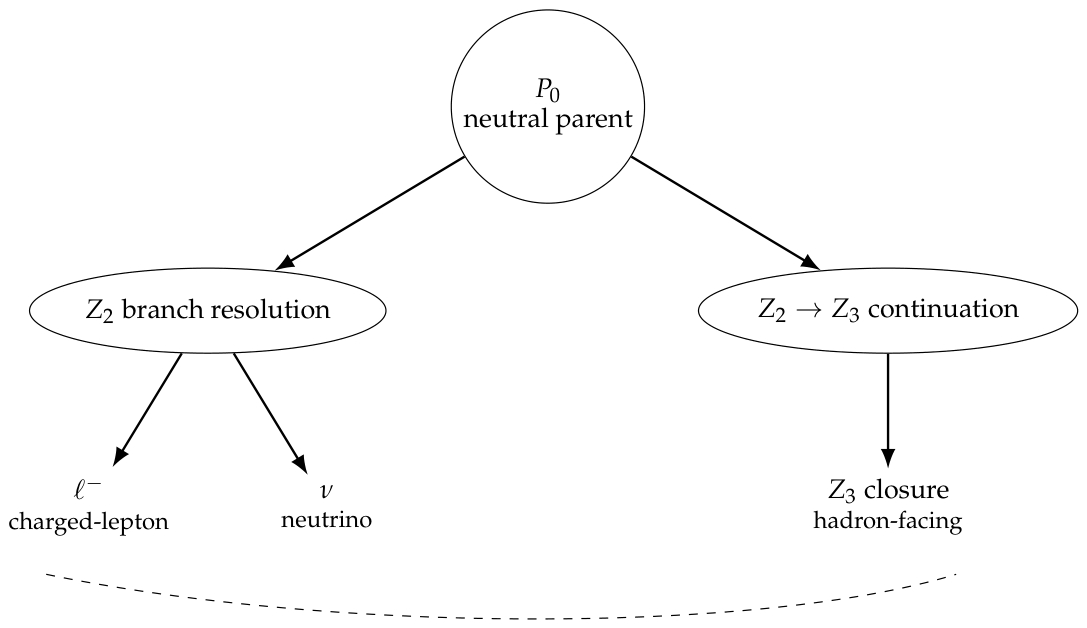
Figure 2.
Schematic monodromy chamber structure generated around the embedded - read-out architecture. The four chambers belong to the outer monodromy layer, not to the closure itself. The carrier-facing role is the external exposure slot attached to the completed threefold support. The full ordered exposure chamber space consists of all orderings of , giving and . The figure is a schematic combinatorial perspective intended to clarify the read-out structure; it should not be interpreted as a literal three-dimensional object embedded in ordinary space.
Figure 2.
Schematic monodromy chamber structure generated around the embedded - read-out architecture. The four chambers belong to the outer monodromy layer, not to the closure itself. The carrier-facing role is the external exposure slot attached to the completed threefold support. The full ordered exposure chamber space consists of all orderings of , giving and . The figure is a schematic combinatorial perspective intended to clarify the read-out structure; it should not be interpreted as a literal three-dimensional object embedded in ordinary space.
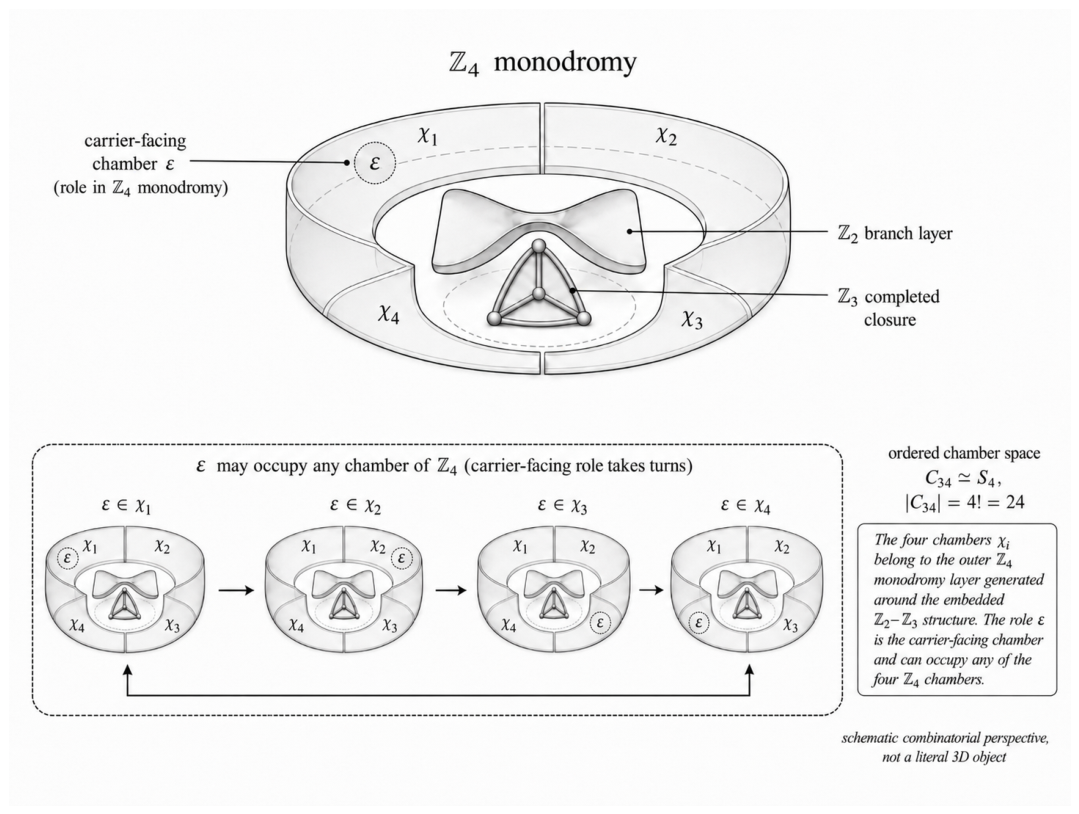

Table 1.
Staged neutral-parent magnetic-capacity approximation to . The leading term is the stratified Haar capacity of the neutral-parent embedding space. The first correction is the chamber-weighted self-exposure term. The second correction is the reduced magnetic-interface transfer.
Table 1.
Staged neutral-parent magnetic-capacity approximation to . The leading term is the stratified Haar capacity of the neutral-parent embedding space. The first correction is the chamber-weighted self-exposure term. The second correction is the reduced magnetic-interface transfer.
| Stage | Formula | Value |
|---|---|---|
| Leading capacity | ||
| First self-exposure | ||
| Reduced magnetic transfer |
Disclaimer/Publisher’s Note: The statements, opinions and data contained in all publications are solely those of the individual author(s) and contributor(s) and not of MDPI and/or the editor(s). MDPI and/or the editor(s) disclaim responsibility for any injury to people or property resulting from any ideas, methods, instructions or products referred to in the content. |
© 2026 by the authors. Licensee MDPI, Basel, Switzerland. This article is an open access article distributed under the terms and conditions of the Creative Commons Attribution (CC BY) license (http://creativecommons.org/licenses/by/4.0/).
Copyright: This open access article is published under a Creative Commons CC BY 4.0 license, which permit the free download, distribution, and reuse, provided that the author and preprint are cited in any reuse.


