

Submitted:
21 June 2026
Posted:
24 June 2026
You are already at the latest version
Abstract
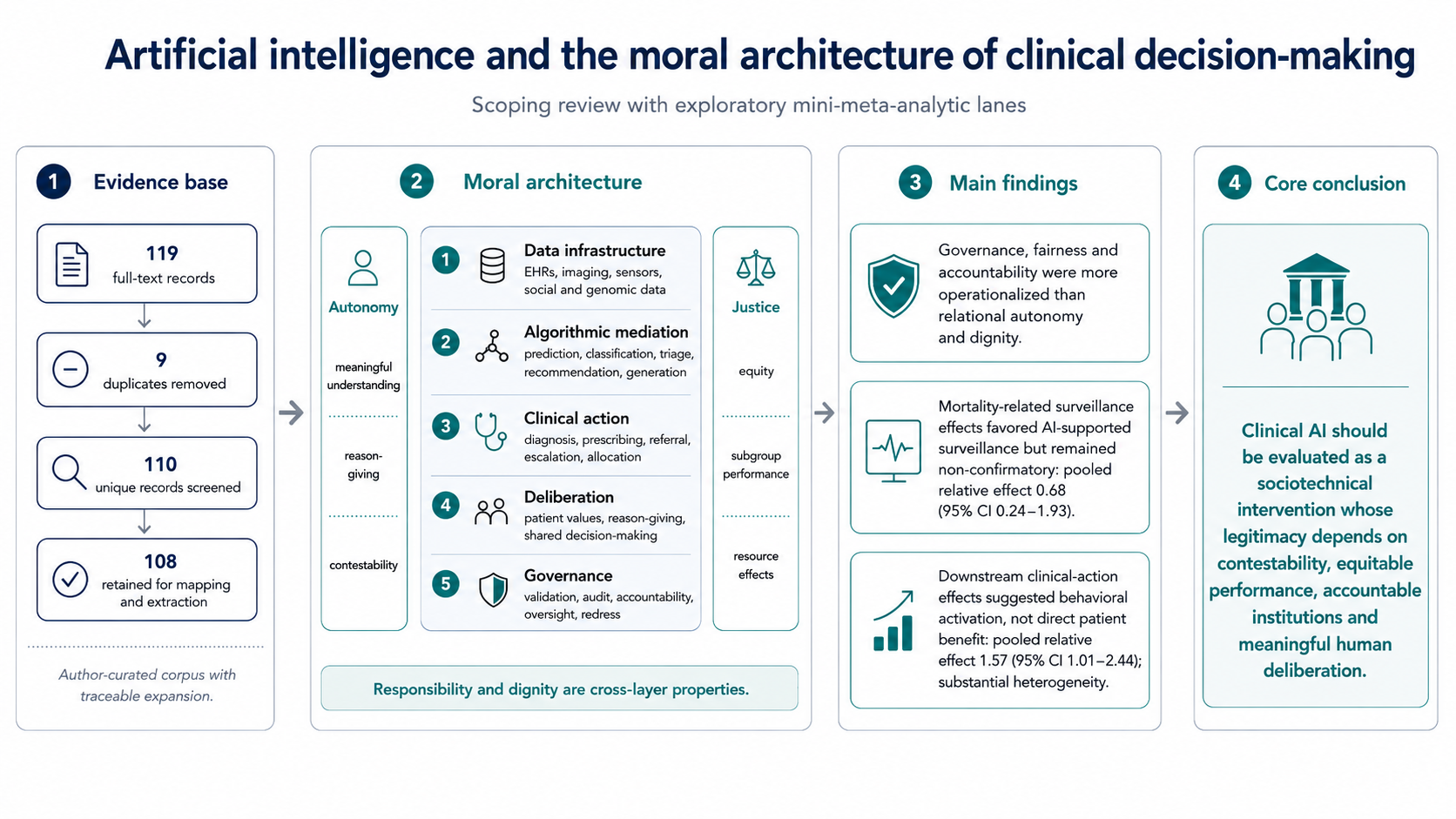
Artificial intelligence increasingly mediates diagnosis, prognosis, triage, prescribing and escalation of care, yet its ethical evaluation remains fragmented. We mapped scientific, bioethical and normative literature on patient autonomy, algorithmic justice, professional and institutional responsibility, and human dignity, using an author-curated corpus with traceable expansion. Of 119 full-text records, 108 were retained after deduplication and screening. The synthesis identified a recurrent imbalance: governance, fairness and accountability were more operationalized than relational autonomy and dignity. Two exploratory mini-meta-analytic lanes were feasible. Mortality-related surveillance effects were favorable under a conventional random-effects model but non-confirmatory with modified Hartung-Knapp inference. Downstream clinical-action effects suggested increased clinician activation, with substantial heterogeneity and no direct equivalence to patient benefit. Artificial intelligence should therefore be evaluated as a sociotechnical intervention whose legitimacy depends on contestability, equitable performance, accountable institutions and preservation of meaningful human deliberation.
Keywords:
artificial intelligence
; clinical decision-making
; bioethics
; algorithmic justice
; patient autonomy
; accountability
; human dignity
; scoping review
Copyright: This open access article is published under a Creative Commons CC BY 4.0 license, which permit the free download, distribution, and reuse, provided that the author and preprint are cited in any reuse.


