

Submitted:
24 June 2026
Posted:
24 June 2026
You are already at the latest version
Abstract
The rapid growth of electric mobility, renewable energy storage, and portable electronics has sharply increased global lithium demand, highlighting the environmental and socio economic drawbacks of conventional extraction methods such as hard rock mining and brine evaporation. These processes are land intensive, slow, water consumptive, and carbon intensive, underscoring the need for next generation materials that enable selective, circular and sustainable lithium recovery. Zeolite based adsorbents have emerged as strong candidates, due to their crystalline frameworks, tunable pore architectures, ion exchange functionality, and exceptional thermal and chemical stability. This review covers recent advances in natural and synthetic zeolites, and zeolite-based composites for lithium capture, with emphasis on guiding design principles governing Li⁺ adsorption capacity and selectivity, transport behavior, and adsorption mechanisms across diverse feedstocks such as brines, geothermal fluids, seawaters, and battery recycling leachates. Lastly, we discuss current challenges and emerging opportunities that will guide future research aimed at advancing zeolite-based adsorbents toward sustainable, next-generation lithium recovery technologies.
Keywords:
lithium recovery
; adsorption
; ion-exchange
; adsorbent
; zeolite
; material design
; sustainable process
; non-conventional lithium resources
1. Introduction
The rapid growth of electric vehicles, portable electronics, and grid-scale energy storage has driven a substantial increase in lithium (Li) demand. This surge is largely rooted in exceptional physicochemical properties of Li, including its highly negative redox potential, low atomic weight, high specific heat capacity, and superior energy density relative to other elements, making it the preferred charge carrier for electrochemical energy-storage technologies [1,2,3,4,5]. Although Li continues to serve a range of industrial applications, its dominant use today is in the production of Li-ion batteries for electric vehicles and stationary energy-storage systems (Figure 1). Correspondingly, global Li production has risen dramatically from approximately 3,700 metric tons (MT) in 1970 to over 100,000 MT in 2021, reflecting its central role in the ongoing energy transition [6,7]. Looking ahead, global Li demand is projected to exceed 2 million MT by 2030, with batteries expected to account for nearly 95% of total consumption [6,7].
Li sources are conventionally continental brines, hard-rock ores, and Li-bearing clays, which together form the foundation of today’s commercial Li supply (Figure 2) [8,9]. Continental brines occurring in closed-basin salars throughout Chile, Argentina and Bolivia constitute the largest and most mature resource, owing to their relatively high Li concentrations and established solar-evaporation extraction routes [10]. Hard-rock deposits, particularly spodumene-rich pegmatites in Australia, Canada, and China, represent the second major supply pathway and underpin a mature global mining and refining sector [10]. Li-bearing clays such as hectorite and smectite, abundant in the western United States and parts of Mexico are also recognized as conventional geological resources [10]. Although large-scale commercial Li extraction has been developed using conventional resources, this process suffers from several drawbacks including high energy-intensiveness, complex processing, high cost, and continuous depletion of Li resources [4]. Recently, non-conventional Li resources have attracted growing interests as potential pathways to expand global supply and strengthen regional security. Specifically, low-quality continental brines are generally considered a non-conventional Li source, which differs from high-grade salar brines [10,11]. Geothermal brines from high-enthalpy reservoirs offer the dual advantage of continuous fluid production and co-generation of renewable power, making them attractive candidates for integrated direct Li extraction [12]. Oilfield brines and produced waters generated during petroleum extraction represent another vast, but chemically complex resources, with Li concentrations that vary widely across basins [9]. Seawater contains an enormous total Li inventory, in spite of extremely low concentrations (~0.17 mg L-1) [3,13,14]. End-of-life Li-ion batteries are also increasingly recognized as secondary Li resources, forming a critical component of circular-economy strategies aimed at reducing reliance on primary extraction [15,16,17]. However, despite the enormous potential of these unconventional Li resources, recovering Li from them remains at early stage of development and continues to face significant technical challenges. Therefore, there is an urgent need to develop innovative Li separation methodologies that enable highly efficient and selective Li recovery from unconventional resources in a sustainable and economically viable manner.
To selectively separate Li from unconventional Li resources, several technologies have been developed over time, including precipitation, solvent extraction, membrane separation, electrochemical methods, and adsorption [4,7,11,12,14,15,18,19]. Precipitation is a simple and industrially viable method for recovering Li from solutions with high Li concentrations. However, it is generally less effective for brines with high magnesium-to-Li (Mg/Li) ratios. The process often requires substantial reagent consumption, generates large quantities of solid waste, and involves multiple purification steps to produce battery-grade Li products [19,20]. Solvent extraction offers high Li selectivity, relatively low energy requirements, and operational flexibility, making it well-suited for processing low-concentration Li streams. However, its effectiveness is frequently limited by interference from multivalent cations such as Ca2+ and Mg2+ and organic contaminants, the cost and stability of solvents, and equipment corrosion [4,19]. Membrane separation can effectively isolate Li through charge effects and size exclusion, but it is challenged by fouling, trade-off between selectivity and permeability, and limited treatment capacity in complex water matrices such as produced water [4,19]. Electrochemical technologies enable selective Li recovery from dilute and chemically complex solutions through redox-mediated ion intercalation or electrochemically driven ion transport. Despite these advantages, their practical deployment remains challenged by electrode degradation, parasitic side reactions, energy requirements, and difficulties associated with scaling up the process for real brine systems [4,19]. By contrast, adsorption-based separation has emerged as a leading strategy for Li recovery by providing (i) higher Li selectivity and recovery efficiency, (ii) cost-effectiveness, (iii) operational simplicity and scalability, and (iv) environmental sustainability, enabled by low chemical requirements, and minimal waste generation [2,3,4,7,11,12,15,18,19].
Adsorbents are of central importance in determining the performance of adsorption-based Li recovery processes, spanning both organic and inorganic material platforms. These materials are often referred to as Li-ion sieves (LIS), which selectively capture Li+ from multicomponent aqueous solutions through ion-exchange, surface complexation, or structural intercalation [1,2,4,16]. Organic adsorbents such as ion-exchange resin and polymeric materials have been employed for Li recovery, but their applications are hindered by relatively low Li selectivity, susceptibility to fouling, and limited reusability and stability under highly saline conditions [1,2,4]. Meanwhile, inorganic types of adsorbents such as Li manganese oxide (LMO)-based, Titanium (Ti)-based (LTO), and Aluminum (Al)-based adsorbents have been widely investigated in prior studies [1,2,3,19]. The Li recovery performances of these inorganic adsorbents are summarized in Table 1. Among these, LMO-based adsorbents (e.g., λ-MnO2 and Li2Mn2O5) are the most extensively studied, owing to their high Li selectivity, and well-defined spinel structures that preferentially intercalate Li+ over larger or multivalent cations. However, its performance deteriorates due to Mn dissolution-induced structural degradation under acidic conditions required for Li desorption [2,3,4]. LTO-based adsorbents such as Li2TiO3 and H2TiO3 offer high Li selectivity and superior structural stability with negligible metal leaching. Nevertheless, their implementation remains challenged by high synthesis costs, slow Li uptake rates, and lower Li adsorption capacity relative to LMO-based adsorbents [2,3,4]. Aluminum (Al)-based adsorbents consisting of LiCl/Al(OH)3 or Li-Al layered double hydroxides (LiAl-LDHs) provide additional pathways for Li+ capture via surface complexation and tunable anion-exchange sites. These materials deliver advantages such as simple synthesis, low-cost raw materials, and preparation under mild synthetic conditions. However, they generally exhibit lower Li adsorption capacity and poorer Li selectivity than LTO- and LMO-based adsorbents. Although Al-based adsorbents are typically more stable than LMO-based materials, gradual performance decline could be an issue due to the partial loss of active sites and structural changes during repeated adsorption-desorption cycles [2,3,4,19].
Zeolites are increasingly viewed as strong candidates for Li recovery because their crystalline, microporous frameworks offer highly tunable ion-exchange properties that can be engineered for Li⁺ selectivity [4,41,42]. Their well-defined pore structures, high surface areas, and negatively charged aluminosilicate frameworks create ion-exchange sites that can accommodate Li⁺. Zeolites also exhibit exceptional thermal and chemical stability, which hold potential for operations in harsh environments such as geothermal fluids, oilfield brines, and seawaters where many adsorbents degrade [43,44,45,46,47]. Moreover, zeolites are abundant, low-cost, and scalable, with a long industrial history in catalysis, separation and ion-exchange applications, strongly supporting their potential for deployment in large-scale Li recovery systems [42,48,49,50]. Collectively, these attributes (i.e., structural tunability, stability, selectivity, and economic viability) position zeolites as a promising platform for next-generation Li recovery technologies.
In this review, we present zeolites as a promising class of emerging adsorbents and systematically summarize recent progress in sustainable zeolite-based Li capture from non-conventional Li resources. We articulate five guiding design principles that shape Li+ adsorption capacity and selectivity, transport behavior, and adsorption mechanisms, and we also discuss current challenges that must be addressed to unlock the full potential of zeolite-based systems. Although several reviews have surveyed adsorption-based Li recovery [2,3,4,9,14,15,16,17,19], a comprehensive review and perspective that centers explicitly on zeolite-based strategies remains scarce. Thus, this review aims to drive innovation in zeolite-based materials and adsorption processes, positioning them as robust, scalable, and sustainable platforms for next-generation Li recovery.
2. Zeolite Adsorbents
2.1. What Are Zeolites?
Zeolites are crystalline, microporous aluminosilicates that are characterized by a pore architecture built by a three-dimensional (3D) network of linked TO4 tetrahedra (T = Si or Al) interconnected through O atoms. For a purely siliceous structure, the resulting structure is silica (SiO2), with a complete charge balance with the structure. Nonetheless, when Al atoms are incorporated into tetrahedrally coordinated silica framework, the 3+ charge of Al renders the zeolite framework negatively charged, due to charge difference between (AlO4)5- and (SiO4)4- tetrahedra (Figure 3a) [42,51]. This negative charge on zeolite framework is balanced by introducing extra-framework cationic species inside the structures of zeolite framework, keeping the overall framework neutral. These compensating cations can be metal cations. Noticeably, each Si-O-Al unit introduces a single negative charge on the zeolite framework, which is typically balanced by one monovalent charge-compensating cation (e.g., Na⁺, or K⁺). A single divalent cation such as Ca2+ or Mg2+ can be incorporated into zeolite lattices when two Al atoms are positioned near one another, and the framework presents two neighboring negative charges.
A defining feature of zeolites is their framework-derived porosity, which has garnered considerable scientific and industrial interest. The flexibility of the T-O-T (T = Si or Al) bond angles enables diverse spatial arrangements of the tetrahedral building units, giving rise to a wide variety of porous framework architectures. Zeolite pore structures are conventionally classified according to the size and geometry of their pore channel apertures, which are defined by the number of tetrahedral T atoms forming each ring (Figure 3b). To date, more than 240 distinct zeolite framework types have been identified. Based on pore aperture size, zeolites are commonly categorized as small-pore (6-membered ring (6-MR), and 8-MR), medium-pore (10-MR), and large-pore (12-MR) frameworks (Table 2) [52]. Examples of small-pore zeolites are SOD (with 6-MR and ~0.28 nm pores size) and LTA (with 8-MR and ~0.40 nm pore size), whereas medium-pore structures such as MFI exhibit channels with diameters of ~0.56 nm. Large-pore frameworks, including FAU, feature pore windows ranging from ~0.74 nm [51,52]. This pore size classification is fundamental because the effective pore diameter affecting adsorption behavior rely not only on crystallographic ring size but also on framework composition, temperature, and extra-framework cations, all of which can alter accessible free volume and transport properties of adsorbates within zeolite framework [53].
2.2. Natural and Synthetic Zeolites
Zeolites are generally classified as natural or synthetic zeolites, based on their origin. Both classes have been actively explored as adsorbents for Li recovery from a wide range of resource streams. Natural zeolites are formed from volcanic or sedimentary environments. Common natural zeolites include clinoptilolite, mordenite, chabazite, and analcime, as listed in Table 3. They are abundant, inexpensive, and readily available, making them attractive for large-scale adsorption and ion-exchange applications [54]. However, natural zeolites often possess variations in composition, crystallinity, and pore structure depending on their geological origin [54]. On the other hand, synthetic zeolites are produced with high purity through controlled synthesis, allowing precise tuning of pore size, Si/Al ratio (SAR), crystal morphology (size and shape), and extra-framework cation compositions for adsorption applications.
The desired type and properties of zeolites significantly are dependent upon the choice of synthesis methods (Figure 4) [51,53,55]. Zeolite synthesis is traditionally carried out by conventional hydrothermal crystallization [51]. In this route, a gel containing silica, alumina, water, and an alkali source is heated under pressure so that crystals form over time. Structure-directing agents (SDAs) are often added to guide the framework that develops. To date, hydrothermal synthesis remains the standard method for many common zeolites including SOD, CHA, LTA, MFI, BEA and FAU. But, conventional hydrothermal synthesis is slow and energy-intensive, and limited in structural and morphological control for certain types of zeolites [53,55]. Solvothermal synthesis follows synthetic principles similar to hydrothermal synthesis, but employs organic solvents instead of, or in combination with water. Solvothermal methods often provide improved control over crystal morphology (particle size and shape); however, are generally more expensive due to solvent costs and recovery requirements [55]. Ionothermal synthesis represents another alternative approach, in which ionic liquids serve as reaction media and, in some cases, as SDA for zeolite crystallization. This method enabled the preparation of unique zeolite and zeolite-type structures that are challenging to synthesize through conventional routes. However, the high cost of ionic liquids and the difficulty of product purification currently are major huddles for large-scale implementation [55].
To reduce energy consumption and chemical usage, minimize waste generation, and improve sustainability, various alternative synthetic approaches have been developed, including dry-gel conversion (DGC) and steam-assisted conversion (SAC) methods, microwave-assisted crystallization, seed-assisted routes, and the use of sustainable raw materials (Figure 4)[53,55,56,57]. For DGC or SAC methods, a solid precursor gel is exposed to water vapor or steam rather than being fully immersed in liquid. These vapor-phase routes often achieve high zeolite product yields and provide improved control over particle size. However, its narrower optimization windows of synthesis, compared to a hydrothermal method, could be an issue, associated with zeolite crystallization under vapor-phase [57]. To accelerate zeolite crystallization, microwave-assisted hydrothermal synthesis applies microwave irradiation to heat precursor gels rapidly and uniformly. This enhances nucleation rates, shortens crystallization times from days to hours, and often produces smaller, more uniform crystals with improved phase purity. Nevertheless, challenges associated with synthesis reactor design and scale-up have limited its widespread industrial adoption [55]. Seed-assisted synthesis utilizes the addition of seed crystals to reduce the induction period required for zeolite nucleation, in turn significantly reducing zeolite crystallization times. This seeding often improves zeolite phase selectivity and allows synthesis with reduced amounts of SDAs or even under SDA-free conditions. However, this synthetic strategy is generally limited to specific framework types and provides less flexibility in controlling zeolite structure [56]. The use of renewable and waste-derived raw materials has also become an important element of green and sustainable zeolite synthesis. Industrial by-products and agricultural wastes rich in silica and alumina, such as coal fly ash, rice husk ash, sugarcane bagasse ash, red mud, kaolin, and waste glass, can serve as effective alternative precursors. Converting these waste streams into zeolites simultaneously reduces landfill burdens, conserves natural mineral resources, and lowers production costs. However, challenges associated with feedstock heterogeneity, impurity management, and the control of zeolite framework composition and crystallinity remain to be addressed for sustainable zeolite synthesis [55,57].
3. Design Principles for Zeolite-Based Li Recovery
A coherent design platform for zeolite-based Li recovery emerges from five mutually reinforcing principles that steer Li⁺ adsorption capacity, selectivity, transport behavior, and adsorption mechanisms: (i) framework charge density tuned by the Si/Al ratio (SAR), (ii) framework topology and pore architecture, (iii) particle morphology (size and shape), (iv) integration of zeolites with other materials to form zeolite-based composite or hybrid materials, and (v) key operational design parameters, particularly temperature and solution pH (Figure 5). Each of these principles is discussed below, in light of recent research (Table 4) aimed at advancing sustainable and efficient Li recovery.
3.1. Framework Charge Density (Si/Al Ratio (SAR))
Framework charge density of zeolites (i.e., SAR) is a key determinant of Li+ uptake capacity and selectivity. When Al atoms are tetrahedrally coordinated into zeolite frameworks, a net negative charge is balanced by typically exchangeable cations such as Na⁺, K⁺, NH4+, H+, Ca²⁺, or Mg²⁺ in their micropore channels (Figure 3a).
Li extraction mechanism of zeolites principally originates from the ion-exchange process where Li+ from aqueous solutions replace these cations in zeolites [4,64]. According to Hoyer et al. [58], batch adsorption experiments were conducted across wide ranges of LiCl (0–750 mM) and NaCl (0.01–5 M) concentrations using natural zeolites that are mostly composed of 88-95% clinoptilolite. This study found that Li adsorption increased with increasing Li+ concentration and decreasing Na+ concentration, suggesting strong competition between Li⁺ and Na⁺ for exchange sites on zeolites. Maximum Li uptake of zeolites occurred at 750 mM LiCl and 0.01 M NaCl was ~3900 ppm, revealing high Li removal efficiency from solution (up to ~65%). This study demonstrates that low-cost zeolite adsorbents can remove Li from saline environments; however, their inherently low Li⁺ selectivity becomes a major limitation when high concentrations of competing cations (e.g., Na⁺, K⁺, Mg²⁺, and Ca²⁺) are present, as is typical in natural brines.
Framework charge density of zeolites is primarily determined by SAR [51,53]. Lower SAR values increase the negative charge of the aluminosilicate zeolite framework, thereby enhancing cation exchange capacity. For instance, Conte et al. investigated Li+ and Co2+ uptake for LIB leachate applications, and employed two FAU zeolites, i.e., 13X and NaY with SAR of 1.3, and 2.5, respectively, and both zeolites have Na+ as extra-framework cations [60]. In Li uptake experiments in the presence of single Li+ (with concentration of 20 mg L-1), Li removal of 78% and 60% were obtained on 13X and NaY, indicating that lower SAR increases higher Li capture capacity. Typically, high density of framework negative charge in low silica zeolites (i.e., low SAR) generally promotes the preferential adsorption of divalent and trivalent cations over monovalent ions. Diez and colleagues demonstrated this behavior, who assessed Li+ and Co2+ adsorption in mixed-ion solutions containing Li+ (20 mg L-1) and Co2+ (40 mg L-1) [61]. Both 13X (FAU with SAR of 1.2) and NaY (FAU with SAR of 2.7) showed a strong preference for Co2+, adsorbing ~24.0 mg g-1 of Co2+ whereas Li+ ion uptake was limited to only ~0.30 mg g-1 on both zeolites. Likewise, the preferential adsorption of Co2+ over Li+ was also found on low silica zeolites with SAR of 1.0–2.9 and various frameworks including LTA, FAU, LTF and EMT in the separation of Co2+ and Li+ from spent LiCoO2 batteries [65].
Types of extra-framework cations in zeolites have a substantial impact on Li uptake capacity. According to Navarrete-Casas et al., two synthetic zeolites of 5A (LTA with SAR of 1.0) and 13X possessing extra-framework cations of Na+ and H+ were chosen to study the ion-exchange of Li+ with Na+ and H+, respectively [64]. This study revealed that Li+ ion-exchange was reversible and occurred much more readily with Na+ than with H+. The replacement of Na+ by Li+ was more favorable both kinetically and thermodynamically, whereas ion-exchange of framework-associated H+ was less favorable due to stronger proton interactions with the zeolite lattice. As a result, Na-form zeolites of 5A and 13X exhibited significantly greater Li uptake (4.2 mg g-1 and 11.4 mg g-1, respectively) than their corresponding H-form zeolites (2.2 mg g-1 and 7.7 mg g-1, respectively) in adsorption experiments under identical conditions at 40°C. Another example involves 13X in Li recovery using synthetic and geothermal brine [44]. This work reported that ion-exchange of Li+–Na+ is dominant at Li+ concentrations of less than ~100–200 mg L-1. However, ion-exchange of H+–Na+ occurred predominantly at Li+ concentrations of greater than ~100–200 mg L-1, reducing Li adsorption capacity. Decrease in pH observed during Li adsorption by 13X under these conditions suggested that protons were somehow involved in the ion-exchange, and the authors proposed H+–Na+ ion-exchange at higher Li+ concentration. Given the wide range of exchangeable cations that can be incorporated into zeolites, therefore these examples illustrate that the nature of the extra-framework cation can act as a key factor governing Li⁺ adsorption performance.
3.2. Framework Topology and Pore Architecture
Framework topology and pore architecture are critical to zeolite-based Li recovery, as they govern how ion-exchange sites are arranged and accessed, how strongly steric exclusion occurs, and how easily Li+ ions move through the microporous network. These structural features ultimately determine Li+ capacity and selectivity against competing ions, while also defining kinetics and adsorption mechanism for Li+.
The choice of zeolite framework structures strongly dictates Li+ uptake capacity and mechanism. Specifically, zeolites 5A (LTA with SAR of 1.0; Na+ only as extra-framework cations prepared after ion-exchange between Na+–Ca2+) and 13X (FAU with SAR of 1.2) showed total cation-exchange capacities of 2.72 and 3.54 meq g-1, respectively, while Li capture of 5.0 mg g-1 and 11. 9 mg g-1 were observed for 5A and 13X, respectively under identical adsorption conditions [64]. This indicates that 13X has a greater Li+ ion-exchange capacity than 5A, despite possessing a higher SAR. Equilibrium isotherm analyses further revealed fundamentally different Li uptake mechanisms in the two zeolites. In zeolite 5A, only a single ion-exchange process was observed, with Li+ primarily occupying anionic sites located on the external surface and within the accessible pore network. In contrast, zeolite 13X displayed two sequential exchange processes: an initial exchange at external sites followed by a second, more extensive exchange step in which Li+ ions penetrated the three-dimensionally interconnected FAU supercages (~1.2 nm) and occupied internal framework sites. Consequently, the larger and more accessible pore system of the FAU framework enabled greater Li+ incorporation than the LTA framework.
Zeolite pore size is capable of precisely manipulating Li+ selectivity in brine solutions by constraining ion accessibility, dehydration requirements, and transport through the microporous framework. Wang et al. highlighted this principle by demonstrating that SOD zeolites achieve selective Li recovery from low-quality brines with low Li concentrations (< 100 mg L-1) and high Mg/Li ratios (> 100) [59], which remains challenging for conventional Li extraction technologies. The central premise of this work is that differences in ion-exchange kinetics between Li+ and Mg2+ could be used to achieve selective Li adsorption. This concept was evaluated using three Na-form zeolites with SOD (6-MR; 0.28 nm pore size), NaA (LTA; 8-MR; 0.41 nm pore size), and NaX (FAU; 12-MR; 0.74 nm pore size). As a result, small-pore SOD exhibited strong kinetic selectivity for Li+ over Mg2+ although zeolites typically favor adsorption of divalent cations such as Mg2+. This behavior arises from the narrow pores of SOD, which significantly slows the transport and ion-exchange of Mg2+, while allowing faster Li+ uptake. Specifically, SOD zeolites attained Li+ adsorption capacity of 2.7–3.7 mmol g-1 (= 18.7–25.7 mg g-1) under high Mg/Li ratio conditions, demonstrating excellent performance for selective Li capture from brines. To explain high Li+ selectivity of SOD, adsorption experiments combined with density functional theory (DFT) calculations were conducted, and the authors proposed three sequential steps governing ion-exchange processes: (i) dehydration of hydrated metal ions (i.e., Li+ or Mg2+), (ii) migration through zeolite pores, and (iii) exchange with Na+ located in zeolite framework. Li+ consistently shows lower energy barriers than Mg2+ across the three steps (i.e., dehydration, migration, and ion-exchange), while the higher dehydration energy and slower mobility of Mg2+ within SOD cages suppress its uptake (Table 5). Therefore, Li+/Mg2+ separation stems from kinetic control as the primary mechanism, rather than equilibrium thermodynamics.
a Hydration free energy is defined as the Gibbs free energy change for tansferring an ion from gas phase into aqueous solution. This thermodynamic quantity reflects both enthalpic contributions (ion-water interactions) and entropic contributions associated with water restructuring [72,75].
b Hydrated ionic potential represents the effective charge density of a hydrated ion in water, defined as the ionic charge divided by its hydrated radius. This parameter captures how strongly an ion attracts and organizes surrounding water molecules. Ions with higher hydrated ionic potential generate more strongly bound, highly ordered hydration shells, and therefore face greater dehydration energy barriers [76,77]. Conversely, ions with lower hydrated ionic potential interact more weakly with water, leading to looser hydration shells and easier dehydration [76,77].
c Hydration free energy and hydrated ionic potential are closely correlated because they both reflect the strength of ion-water interactions, but they represent distinct quantities. Hydrated ionic potential is a geometric-electostatic descriptor, while hydration free energy is a thermodynamic quantity. In general, higher hydrated ionic potential corresponds to more negative (i.e., stronger) hydration free energy [74,78].
Small pore zeolites, when paired with sustainable zeolite synthesis routes, offer a low-cost and scalable pathway for accomplishing high Li recovery from multicomponent brine solutions that contain Li+, Na+, K+, Ca2+ and Mg2+. Using various aluminosilicate wastes including feldspar, pyrophyllite, coal gangue and coal fly ash, Zhang et al. converted them into small-pore zeolites, i.e., hydroxycancrinite (CAN framework; 6-MR) [63]. It is worth noting that the crystallographic channel diameter of hydroxycancrinite is about 0.59 nm (Table 3), but the presence of OH- groups and extra-framework Na+ residing inside the channel can reduce the effective pore apertures to ~0.28-0.30 nm range [68,69], which is the size actually experienced by diffusing ions. The resulting hydroxycancrinite zeolite revealed high crystallinity, uniform microporosity, and abundant exchangeable Na+ sites with SAR of 1.1–3.8, providing a structurally favorable environment for selective Li+ uptake. Consequently, this zeolite exhibited Li loadings of 4.5 wt% Li2O in mixed-cation solutions, and up to 9.4 wt% Li2O in pure LiCl solution. Theses Li contents surpass those of many typically found in many high-grade hard-rock Li ores (~1.5–4 wt% Li2O), creating a dual benefit of a remarkable Li immobilization capacity and waste utilization.
3.3. Particle Morphology (Size and Shape)
Adsorbent particle morphology (size and shape) represents key design considerations for developing effective highly Li-selective adsorbents, as they govern the efficiency of ion transport and site accessibility. When particles are small, the intracrystalline diffusion path is short, allowing Li+ ions to reach adsorption active sites rapidly. Larger particles, in contrast, impose long diffusion pathways that slow Li+ transport and reduce the fraction of sites that can participate in adsorption within practical contact times. This relationship was clearly illuminated by Reich et al. [44], who evaluated zeolite 13X in powder and bead forms for Li recovery from geothermal brine. As a result, increasing zeolite grain size from powder to beads led to a 58% reduction in Li+ adsorption capacity, i.e., lowering capacity from 20.3 mg g-1 to 8.6 mg g-1. Similar results were also obtained for Li recovery from simulated battery leachates using 13X in powder and pellet forms [60]. Powdered 13X exhibited significantly faster Li+ uptake kinetics and a higher adsorption capacity than its pelletized counterpart. These differences were attributable to the shorter diffusion pathways and greater accessibility of ion-exchange sites in the powder form.
Zeolite particle shape could modulate Li adsorption performance by determining the external surface area and the accessibility of ion-exchange sites, although this aspect has received limited attention in literature. Morphologies such as plate-like, needle-like, or nanosheet structures would expose more surface Na+ sites and minimize the need for slow intracrystalline diffusion [79,80,81], enhancing Li+ uptake kinetics. On the contrary, aggregated morphologies sequester ion-exchange sites within the crystal interior, leading to slower and diffusion-limited adsorption [79,80,81].
These shape- and size-dependent characteristics are also similarly linked to adsorbent regeneration efficiency because regeneration involves the reverse ion-exchange process. The same structural features that enhance Li+ uptake, namely, smaller crystal size and more open particle shape, are likewise expected to accelerate Li+ release during regeneration by minimizing diffusion limitations and improving regenerant accessibility to ion-exchange sites [82]. This trend has already been reported in other metal ion-exchange applications in water treatment [48,83,84]. However, the specific influences of particle morphology (size and shape) on regeneration as well as Li+ desorption kinetics remain largely vague, underscoring the need for targeted studies to unravel these effects.
3.4. Integration with Other Materials (Zeolite-Based Composite)
Integrating zeolites with other materials can be an effective approach for recovering Li+ from various Li resources including geothermal water, brine, and salt lakes. Wisniewska et al. reported that natural and synthetic zeolites, combined with poly(acrylic acid) (PAA) polymers, resulted in enhanced Li selectivity from geothermal water in Poland [43]. The key idea is that PAA within zeolite-PAA hybrid adsorbents created a more favorable interface for capturing Li+ through polymer-Li metal complexation, in addition to Li uptake via ion-exchange processes within zeolite framework. It turned out that Li extraction is strongly dependent on the order of addition of PAA and Li+, where the way of the addition of polymer layer controls the accessibility of exchange sites and diffusion pathways. When PAA is allowed to adsorb or Li+ is pre-equilibrated before the second component is added, the resulting interfacial structure favors more efficient Li uptake by controlling both thermodynamic affinity and transport for Li in zeolite-based systems. Clinoptilolite-PAA composite provided the highest Li recovery from geothermal water, achieving approximately 50% Li removal from an initial concentration of about 10 mg L-1.
Zeolite-hydrogel composite was investigated for the simultaneous extraction of Li and arsenic (As) from geothermal waters [46]. The composite was prepared by combining natural clinoptilolite zeolites with sodium alginate and chitosan, two biopolymer-based hydrogel materials. The rationale behind the composite design was to integrate the ion-exchange capability of clinoptilolite with the adsorption properties and high-water affinity of alginate and chitosan hydrogels. The results showed that the composite performed poorly for direct Li extraction from untreated geothermal brine: it removed only ~5.5% of Li (with Li uptake of ~0.09 mg g-1). In contrast, the composite demonstrated promising As removal performance, reducing As concentrations by approximately 52%. The authors concluded that the composite’s strong affinity for As but weak uptake of Li is attributable to the preferential binding of As to the carboxylic and amine groups in chitosan and alginate, whereas these groups do not effectively coordinate Li+. Additionally, high silica concentrations in geothermal water can foul zeolite surfaces and block micropores, thereby reducing Li+ selectivity. To overcome low Li+ selectivity barriers in complex geothermal brine, the authors suggested that future improvements include surface modification, pretreatment of geothermal brine, incorporation of Li-selective functional groups, or modification of clinoptilolite zeolite.
Unlike zeolite-based Li recovery systems that rely on ion-exchange sites within zeolite pores, zeolite have also been used as primarily carriers or supporting materials that have no ion-exchange sites. Ding and coworkers illustrate this concept with salt lakes by anchoring crown ether ligands within nanofiber-containing zeolites, enabling crown ethers (CEs) to provide Li+ selective binding functionality, while preserving the vacancies of epoxy groups in CE essential for Li+ coordination [47]. Spectroscopic and computational analyses (e.g., Fourier transform infrared (FT-IR) spectroscopy, scanning electron microscopy (SEM), X-ray photoelectron spectroscopy (XPS), and density functional theory (DFT)) indicate that Li+ undergoes dsp3 hybridization, facilitating electron donation from CE-functionalized sites to coordinate with Li+ and form stable complexes. The material exhibited rapid adsorption kinetics, reaching equilibrium within 2.5 h and conforming to a pseudo-second-order kinetic model. Adsorption behavior of the adsorbent followed the Langmuir isotherm, consistent with monolayer adsorption, with a maximum capacity of 8.6 mg g-1. The composite material retained a capacity of 7.8 mg g-1 after five adsorption-desorption cycles, demonstrating strong regeneration stability. Overall, this work presents a promising strategy for designing selective, regenerable, and structurally tunable adsorbents for Li capture from complex brines.
Recently, composite Li adsorbents by growing LiAl-LDH on a ZSM-5 zeolite support have been reported, producing a hierarchical structure designed to improve Li+ selectivity, permeability, and structural stability in salt lake brines with high Mg/Li ratio (i.e., 7.6) and Li+ concentration of 388 mg L-1 [45]. The main takeaway is that the roles of ZSM-5 are (i) structural support to prevent collapse and aggregation of LiAl-LDH, (ii) enhanced diffusion of Li+ to activate adsorption sites via hierarchical structures, and (iii) increased surface area to provide uniform LDH dispersion. In this work, ZSM-5 zeolites with MFI topology and SAR of 40 were prepared by a seed-assisted synthesis using siliceous MFI zeolites. Since the high SAR (i.e., 40) of ZSM-5 was used, its contribution to Li+ capture was anticipated to be minimal. This composite achieved a Li adsorption capacity of ~6.2 mg g-1 for actual salt lake brine from Tibet. Kinetic analysis showed that adsorption followed the pseudo-second-order model, indicating that chemisorption is the dominant adsorption mechanism. More importantly, this adsorbent exhibited a Li+/Mg2+ separation factor (αLi/Mg) of 188.1, demonstrating strong Li selectivity. The material also maintained good recyclability during five repeated cycles of Li adsorption-desorption, amplifying its potential for practical Li extraction applications.
3.5. Operational Design Parameters
Operational parameters including temperature and solution pH have deep impacts on the efficiency of zeolite-based Li recovery by tuning both thermodynamics and mass-transfer kinetics. These design parameters define an optimal operational window, in which zeolite charge density, pore accessibility and Li+ transport are simultaneously maximized to accomplish high capacity and selectivity of Li recovery. Further details on these effects are provided below.
Temperature Effect
Temperature markedly affects zeolite-driven Li adsorption through both thermodynamic and kinetic factors. In order for hydrated Li+ ions to enter zeolite channels and reach ion-exchange sites, the hydrated Li+ ions have to partially shed their hydration shell (with a diameter of ~0. 69-0.76 nm) as they pass through size-restrictive pores for complete ion-exchange with resident cations (Table 5). In this respect, raising temperature generally weakens hydration, thereby promoting dehydration of hydration shell, and also enables faster diffusion of ions, facilitating ion-exchange with extra-framework cations (e.g., Na+, K+, or Ca2+) located in zeolite pores via favorable interactions between Li+-zeolites. Consistent with this temperature effect, Navarrete-Casas et al. also reported that elevating solution temperature increased from 10°C to 50°C resulted in higher Li+ adsorption capacities for both 5A and 13X zeolites [64] .
Typically, the magnitude and direction of temperature effect depend on the zeolite framework, exchangeable cation, zeolite dosage, and solution composition. Wang et al. evaluated NaA zeolite’s ability to capture metal ions in the mixture of Co2+ and Li+ (20 mmol L-1 each) for Li recovery from spent LiCoO2 batteries [85]. The authors showed that the removal rate of Co2+ using NaA increased continuously from 59.1% to 96.9% and 99.0% with increasing solution temperature from 0°C to 60°C and 90°C. In contrast, Li+ removal rate by NaA reached 5% at 90°C, while at temperatures of ≤ 60°C the removal rate remained zero. These findings allowed the authors to accomplish selective separation of Li+ and Co2+ from the spent batteries by keeping the adsorption at solution temperature of 60°C. This suggests that although higher temperatures improve NaA’s uptake capacity for both metal ions, the temperature-induced gains in ion-exchange overwhelmingly favor Co2+, of which divalent charge and reduced hydration constraints enable rapid uptake for Co2+ over Li+.
Moreover, it was reported that a temperature-regulated approach was effective in separating multiple metal ions from waste LiNi0.5Co0.2Mn0.3O2 batteries using NaA zeolites [67]. The authors showed that both solution temperature and zeolite dosage strongly influenced selective metal uptake, with NaA zeolites exhibiting ion-exchange preference of Mn2+ > Co2+ > Ni2+ > Li+. By sequentially adding NaA in the leachates, Mn2+ was removed first at 20°C, followed by Co2+ at 20°C, and then Ni2+ at 60°C. Recovery selectivities reached ~93% for Mn, 94% for Co, and 99% for Ni, while more than 95% of Li remained in solution, leading to substantial Li enrichment for effective Li separation from battery leachates.
Recently, manipulating ion-exchange temperature enabled priority extraction of Li+ and sequential recovery of divalent metals from retired LiNixCoyMn1-x-yO2 batteries using GIS zeolites (8-MR; pore dimensions of 0.31 nm × 0.45 nm and 0.26 nm × 0.49 nm) (Table 2) [62]. This strategy reverses the typical ion-exchange preference of zeolites, in which divalent metals preferentially outcompete Li+. Small-pore GIS zeolites showed 95% recovery of Li+ at 0°C, followed by 94% of Mn2+ at 40°C and 97% of Co2+ at 60°C, while 90% of Ni2+ remained in solution. The exceptional Li+ selectivity is attributable to its 2.5-fold faster diffusion rate, with respect to Mn2+, Co2+, and Ni2+, as evidenced by ion-exchange kinetics and molecular dynamics simulations.
pH Effect
Solution pH strongly influences zeolite-driven Li recovery because it directly modulates ion-exchange environment, ion diffusion, and competition between metal cations. For zeolite-based Li recovery systems, each zeolite is characterized by point of zero charge (PZC), which helps describe surface charge behaviors of zeolites at given solution pH [86]. PZC defines the pH at which surface carries zero net charge, making the transition between positively and negatively charged surface states. For instance, PZC values of clinoptilolite and NaX were determined to be 9.2 and 10.2 [43], respectively, while NaA had that of 4.2 [66].
When solution pH is below PZC of zeolites (typically at low pH conditions), surface hydroxyl groups of (Si-OH and Al-OH) of zeolites become protonated, H+ competes with Li+ for negatively charged framework sites, decreasing the number of available exchange sites for Li and resulting in reduced Li uptake capacity. This effect is especially pronounced for low SAR zeolites that possess high-cation exchange capacities for Li recovery [44,66]. However, strongly acidic (e.g., pH < 2) environment causes dealumination of zeolites, losing ion-exchangeable sites for Li recovery [44,87].
At solution pH above PZC of zeolites (typically at high pH conditions), deprotonation increases negative charge density on zeolite surface, thereby enhancing the electrostatic attraction of Li+ ions, facilitating their diffusion toward and into zeolites pores, and boosting Li+ adsorption on exchange sites within zeolites [43,58,86,88]. However, highly basic solutions (e.g., pH > 12) generate framework instability issues, i.e., desilication through hydrolysis of Si-O-Si bonds of zeolite framework [87,89], as revealed by prior reports on Li recovery from geothermal brine using zeolite 13X [44,46].
Solution pH also regulates Li recovery by modulating competitive ion behavior. Although Li+ retains a strongly bound hydration shell across a wide pH range, competing multivalent ions (e.g., Mg2+, and Ca2+) undergo pH-dependent hydrolysis and partial dehydration behavior. Under neutral to mildly alkaline conditions (i.e., pH 8-10), Mg2+ and Ca2+ ions begin forming hydrolyzed species or surface complexes [90,91], reducing their effective mobility and thereby making Li⁺ exchange kinetically more favored, as supported by Li et al. using SOD zeolites in the selective Li+ extraction from low-quality brines [59].
4. Limitations and Opportunities for Future Research
Despite notable progress in the development of zeolite-based adsorbents for recovering Li from sustainable resources, several key limitations persist. These challenges simultaneously define promising directions for future investigation and technology development (Figure 6), as detailed below.
Zeolite framework topology and charge density are key players of Li+ adsorption capacity and selectivity, and its transport behavior. Yet, despite the existence of more than 240 distinct zeolite frameworks and the tunability of SAR and extra-framework cations, their impacts on Li recovery performance remain largely underexplored. Strategic optimization of these structural and compositional variables could drastically improve Li+ ion-exchange performance of zeolites. To advance this effort, integrating machine learning-driven screening with high-fidelity simulations [92,93] and experimental validation represents a promising route for rapidly identifying zeolite structures with favorable charge environments for Li extraction.
Diffusion limitations and slow kinetics should be addressed. Zeolite frameworks with micropore channels (< 2 nm) can restrict ion transport and prolong equilibrium times. Diffusion limitations become particularly significant in larger zeolite crystals and pelletized adsorbents, where Li+ ions must travel longer distances to access exchange sites. Future efforts can be directed toward exploring nano-sized zeolites, hierarchical zeolites with dual micro- and meso-pores (> 2 nm), or zeolites with open architecture (e.g., zeolite nanosheets or layered zeolites) via controlled zeolite synthesis (Figure 4) to improve mass transport [57,79,80,89,94], while maintaining ion-exchange capability. In parallel, it is note-worthy that in real-world Li recovery systems, the use of finely divided particles complicates solid-liquid separation in batch processes, and fixed beds packed with very small particles suffer from excessive flow resistance, pressure-drop penalties, and diminished mechanical stability during continuous operation. Therefore, designing zeolite particle morphology (size and shape) should strike a balance between rapid ion-transport and the practical requirements of system operation.
Designing zeolite-based hybrid materials could create synergistic effects for Li recovery beyond what zeolites can achieve alone. By integrating zeolites with complementary components such as metal oxides (including existing LIS materials), carbons, or polymer networks, hybrid adsorbents can simultaneously improve adsorption affinity, mass-transfer kinetics, mechanical robustness, and regeneration efficiency. Although these advantages have been demonstrated in the previous section, the design space for zeolite-based hybrid architecture is still in its infancy. This research gap offers a promising avenue for future research aimed at engineering interfacial interactions, composite architecture, and multi-scale porosity to maximize Li+ selectivity, capacity, and cycling stability.
Zeolites are generally considered regenerable, according to extensive prior studies on zeolites in ion-exchange, catalysis and separation applications [53,55]. Relatively few studies have evaluated Li adsorption-desorption performance over extended cycles. Repeated regeneration may induce framework degradation, cation redistribution, fouling, or loss of active exchange sites, particularly when processing complex real brine containing organic matter, silica, and suspended solids. Thus, future research should focus on long-term cyclic testing, evaluation of structural stability, and identification of optimal Li+ desorption conditions using operational parameters such as temperature, solution pH, and desorption agents (e.g., NaCl, and Na2SO4). Developing energy-efficient and environmentally benign regeneration strategies will be a cornerstone of making zeolite-based Li recovery commercially viable.
A significant gap persists between batch adsorption experiments at a laboratory scale and continuous flow system designs required for industrial Li recovery. Limited attention has been received on developing Li recovery using zeolites in continuous operation configurations. These limitations open new opportunities to focus on important engineering considerations, for instance, zeolite adsorbent shaping, pressure drop, column operation, process economics supported by techno-economic analysis (TEA), and seamless integration with existing Li extraction infrastructure and technologies (e.g., solvent extraction, or membrane-based recovery).
Different Li sources pose distinct challenges for zeolite adsorbents to overcome. Specifically, salt lake brines contain high Li concentrations (200–7000 mg L-1) but suffer from extreme Mg/Li ratios of > 1000 [11,38,40,45]. Geothermal brines have moderate Li (10–100 mg L-1) with elevated temperatures that enhance kinetics but introduce scaling from Ca2+ or Si species and volatile contaminants [12,95]. Oil and gas produced waters having low Li content (1–100 mg L-1) present the most demanding conditions, owing to ultra-high salinity, hydrocarbon fouling, heavy metals, suspended solids, and variable compositions across reservoirs requiring site-specific pretreatment [96,97]. Battery leachates differ substantially from natural or geothermal brines, containing high concentrations of transition metals (Co2+, Ni2+, and Mn2+), Al3+, Fe3+, and residual organics that compete with Li+ for ion-exchange sites and can block zeolite pores [16,17]. Therefore, zeolite-based adsorbents should be engineered to withstand complex Li-bearing water matrices, reject multiple competing cations, and maintain pore accessibility in the presence of organic and inorganic foulants.
5. Conclusions
With global Li demand rising exponentially, the development of Li recovery technologies capable of accessing non-conventional resources, including salt lake, geothermal brine, seawater, spent battery leachate, and industrially produced water, has become increasingly urgent. Zeolite-based adsorption offers strong potential for these applications, owing to exceptional thermal and chemical stability of zeolites, and their well-defined porous architectures, tunable framework charge density and particle morphology (size and shape). In this review, we systematically summarize recent progress and remaining challenges in zeolite-based Li recovery from sustainable, non-traditional sources. We delineate the five guiding design principles that underpin effective zeolite-based Li recovery, and also discuss current limitations alongside emerging research opportunities. These insights will establish a rigorous foundation for accelerating the development of high-performance zeolite adsorbents and adsorption processes tailored to diverse and increasingly important Li-containing feedstocks. Therefore, these advancements will ensure that zeolite-based technologies evolve into scalable, robust and sustainable solutions for next-generation Li recovery.
Author Contributions
Conceptualization, H.J.C.; methodology, M.R.K., and H.J.C.; formal analysis, M.R.K., and H.J.C.; investigation, M.R.K., and H.J.C.; data curation, M.R.K., and H.J.C.; validation, M.R.K., and H.J.C.; visualization, H.J.C.; supervision, H.J.C.; project administration, H.J.C.; funding acquisition, H.J.C.; writing-original draft preparation, M.R.K., and H.J.C.; writing-review and editing, H.J.C. All authors have read and agreed to the published version of the manuscript.
Funding
This work was financially supported by the division of the vice president for research and the college of engineering, architecture and technology at Oklahoma State University.
Institutional Review Board Statements
Not applicable.
Informed Consent Statement
Not applicable.
Data Availability Statement
The original contributions presented in this work are included in the article. No new data were created or analyzed in this study.
Conflicts of Interest
The authors declare no conflicts of interest.
References
- Xu, J.; Wei, X.; Han, J.; Qin, W. Synthesis and Optimisation Mechanism of Functionalised Adsorption Materials for Lithium-Ion Extraction from Salt Water: A Review. Sep. Purif. Technol. 2024, 339, 126237. [Google Scholar] [CrossRef]
- Yu, H.; Naidu, G.; Zhang, C.; Wang, C.; Razmjou, A.; Han, D.S.; He, T.; Shon, H. Metal-Based Adsorbents for Lithium Recovery from Aqueous Resources. Desalination 2022, 539, 115951. [Google Scholar] [CrossRef]
- Hu, H.; Guo, X.; Yang, L.; Wu, Y.; Yang, G.; Luo, X. Adsorption Materials toward Highly-Efficient Lithium Extraction from Non-Conventional Lithium Sources. Adv. Mater. 2025, 37, 2506055. [Google Scholar] [CrossRef] [PubMed]
- Reich, R.; Slunitschek, K.; Danisi, R.M.; Eiche, E.; Kolb, J. Lithium Extraction Techniques and the Application Potential of Different Sorbents for Lithium Recovery from Brines. Mineral. Process. Extr. Metall. Rev. 2023, 44, 261–280. [Google Scholar] [CrossRef]
- Miatto, A.; Wolfram, P.; Reck, B.K.; Graedel, T.E. Uncertain Future of American Lithium: A Perspective until 2050. Environ. Sci. Technol. 2021, 55, 16184–16194. [Google Scholar] [CrossRef] [PubMed]
- Lithium Statistics and Information | U.S. Geological Survey. Available online: https://www.usgs.gov/centers/national-minerals-information-center/lithium-statistics-and-information (accessed on 21 June 2026).
- Murphy, O.; Haji, M.N. A Review of Technologies for Direct Lithium Extraction from Low Li+ Concentration Aqueous Solutions. Front. Chem. Eng. 2022, 4, 1008680. [Google Scholar] [CrossRef]
- Pan, S.-Y.; Haddad, A.Z.; Kumar, A.; Wang, S.-W. Brackish Water Desalination Using Reverse Osmosis and Capacitive Deionization at the Water-Energy Nexus. Water Res. 2020, 183, 116064. [Google Scholar] [CrossRef] [PubMed]
- Kumar, A.; Fukuda, H.; Hatton, T.A.; Lienhard, J.H. Lithium Recovery from Oil and Gas Produced Water: A Need for a Growing Energy Industry. ACS Energy Lett. 2019, 4, 1471–1474. [Google Scholar] [CrossRef]
- Munk, L.A.; Hynek, S.A.; Bradley, D.C.; Boutt, D.; Labay, K.; Jochens, H. Lithium Brines: A Global Perspective; 2016. [Google Scholar]
- Yang, S.; Wang, Y.; Pan, H.; He, P.; Zhou, H. Lithium Extraction from Low-Quality Brines. Nature 2024, 636, 309–321. [Google Scholar] [CrossRef] [PubMed]
- Stringfellow, W.T.; Dobson, P.F. Technology for the Recovery of Lithium from Geothermal Brines. Energies 2021, 14, 6805. [Google Scholar] [CrossRef]
- Wu, F.; Shivakumar, K.R.; Konhauser, K.O.; Alessi, D.S. Lithium Resources and Novel Strategies for Their Extraction and Purification. npj Mater. Sustain. 2025, 3, 30. [Google Scholar] [CrossRef] [PubMed]
- Kumar, A.; Naidu, G.; Fukuda, H.; Du, F.; Vigneswaran, S.; Drioli, E.; Lienhard, J.H. Metals Recovery from Seawater Desalination Brines: Technologies, Opportunities, and Challenges. ACS Sustain. Chem. Eng. 2021, 9, 7704–7712. [Google Scholar] [CrossRef]
- Liu, C.; Lin, J.; Cao, H.; Zhang, Y.; Sun, Z. Recycling of Spent Lithium-Ion Batteries in View of Lithium Recovery: A Critical Review. J. Clean. Prod. 2019, 228, 801–813. [Google Scholar] [CrossRef]
- Krishnan, M.R.; Alsharaeh, E.H. Ion-Sieve Adsorbents for Lithium Recovery from Battery Leachates: Separation Performance and Process Limitations. Sep. Purif. Technol. 2026, 137606. [Google Scholar] [CrossRef]
- Shi, H.; Zhang, J.; Ou, L. A Comprehensive Review on the Separation and Purification of Valuable Metals from the Leachate of Spent Lithium-Ion Batteries. Sep. Purif. Technol. 2025, 360, 130847. [Google Scholar] [CrossRef]
- Alera, A.C.; Benitez, J.P.; Fernandez, R.J.; Pascual, C.K.; Policarpio, F.; Lopez, E.C.R. Recent Advances in Lithium Extraction. Eng. Proc. 2024, 67, 52. [Google Scholar] [CrossRef]
- Mittal, H.; Shah, S.N.; Alsuwaidi, M.; Alfantazi, A. Lithium Recovery from Brines: A Comprehensive Review of Advanced Separation Technologies. Precis. Chem. 2026, prechem.5c00264. [Google Scholar] [CrossRef]
- Flexer, V.; Baspineiro, C.F.; Galli, C.I. Lithium Recovery from Brines: A Vital Raw Material for Green Energies with a Potential Environmental Impact in Its Mining and Processing. Sci. Total Environ. 2018, 639, 1188–1204. [Google Scholar] [CrossRef] [PubMed]
- Sun, S.-Y.; Song, X.; Zhang, Q.-H.; Wang, J.; Yu, J.-G. Lithium Extraction/Insertion Process on Cubic Li-Mn-O Precursors with Different Li/Mn Ratio and Morphology. Adsorption 2011, 17, 881–887. [Google Scholar] [CrossRef]
- Zhang, Q.-H.; Sun, S.; Li, S.; Jiang, H.; Yu, J.-G. Adsorption of Lithium Ions on Novel Nanocrystal MnO2. Chem. Eng. Sci. 2007, 62, 4869–4874. [Google Scholar] [CrossRef]
- Liu, L.; Zhang, H.; Zhang, Y.; Cao, D.; Zhao, X. Lithium Extraction from Seawater by Manganese Oxide Ion Sieve MnO2·0.5H2O. Colloids Surf. A Physicochem. Eng. Asp. 2015, 468, 280–284. [Google Scholar] [CrossRef]
- Ma, L.-W.; Chen, B.-Z.; Shi, X.-C.; Zhang, W.; Zhang, K. Stability and Li+ Extraction/Adsorption Properties of LiMxMn2−xO4 (M = Ni, Al, Ti; 0 ≤ x ≤ 1) in Aqueous Solution. Colloids Surf. A Physicochem. Eng. Asp. 2010, 369, 88–94. [Google Scholar] [CrossRef]
- Zheng, B.; Zeng, G.; Zhou, K.; Wu, L.; Zheng, Y. Stable Granular Li₄Mn₅O₁₂ Synthesized by Ammonia-Assisted Co-Precipitation: Achieving Minimal Mn Dissolution for Efficient Lithium Recovery from Low-Grade Brine. J. Environ. Chem. Eng. 2025, 13, 119129. [Google Scholar] [CrossRef]
- Song, L.; Liu, M.; Nian, M.; Yang, G. Preparation of HMn 2 O 4 Lithium-Ion Sieves with Low Manganese Dissolution Loss for Improved Cycling Stability. RSC Adv. 2024, 14, 19795–19805. [Google Scholar] [CrossRef] [PubMed]
- Ding, Y.; Nhung, N.T.H.; An, J.; Chen, H.; Liao, L.; He, C.; Wang, X.; Fujita, T. Manganese-Titanium Mixed Ion Sieves for the Selective Adsorption of Lithium Ions from an Artificial Salt Lake Brine. Materials 2023, 16, 4190. [Google Scholar] [CrossRef] [PubMed]
- Zhang, Q.-H.; Li, S.-P.; Sun, S.-Y.; Yin, X.-S.; Yu, J.-G. Lithium Selective Adsorption on Low-Dimensional Titania Nanoribbons. Chem. Eng. Sci. 2010, 65, 165–168. [Google Scholar] [CrossRef]
- Liu, J.; Zhang, Y.; Miao, Y.; Yang, Y.; Li, P. Alkaline Resins Enhancing Li+/H+ Ion Exchange for Lithium Recovery from Brines Using Granular Titanium-Type Lithium Ion-Sieves. Ind. Eng. Chem. Res. 2021, 60, 16457–16468. [Google Scholar] [CrossRef]
- Li, N.; Lu, D.; Zhang, J.; Wang, L. Yolk-Shell Structured Composite for Fast and Selective Lithium Ion Sieving. J. Colloid Interface Sci. 2018, 520, 33–40. [Google Scholar] [CrossRef] [PubMed]
- Moazeni, M.; Hajipour, H.; Askari, M.; Nusheh, M. Hydrothermal Synthesis and Characterization of Titanium Dioxide Nanotubes as Novel Lithium Adsorbents. Mater. Res. Bull. 2015, 61, 70–75. [Google Scholar] [CrossRef]
- Liu, J.; Xu, N.-C.; Shi, D.-D.; Cao, Y.; Zhang, T.-Y.; Zhong, K.-P.; Zhao, Q.; Bian, S.-J. Preparation, Characterization, and Adsorption Performance of H2TiO3 Lithium Ion Sieves with Homogeneous Nanoparticles: Kinetics, Thermodynamics, and Mechanism Analysis. ChemistrySelect 2024, 9, e202402440. [Google Scholar] [CrossRef]
- Xiong, S.; Lu, H.; Tang, K.; Yang, J.; Yang, C.; Shi, L.; Jiang, J.; Tang, A. First Granulation of H4Ti5O12 Lithium-Ion Sieve Using Two Different Binders for Selective Lithium Extraction. Ind. Eng. Chem. Res. 2025, 64, 18904–18916. [Google Scholar] [CrossRef]
- Wang, Q.; Yang, X.; Li, C.; Zhao, C.; Huang, Y.; Qiu, S.; Qin, Y.; Shi, C. Titanium-Based Lithium Ion Sieve Adsorbent H2TiO3 with Enhanced Li+ Adsorption Properties by Magnetic Fe Doping. Sep. Purif. Technol. 2024, 346, 127455. [Google Scholar] [CrossRef]
- Zhong, J.; Lin, S.; Yu, J. Li+ Adsorption Performance and Mechanism Using Lithium/Aluminum Layered Double Hydroxides in Low Grade Brines. Desalination 2021, 505, 114983. [Google Scholar] [CrossRef]
- Chen, J.; Lin, S.; Yu, J. High-Selective Cyclic Adsorption and Magnetic Recovery Performance of Magnetic Lithium-Aluminum Layered Double Hydroxides (MLDHs) in Extracting Li+ from Ultrahigh Mg/Li Ratio Brines. Sep. Purif. Technol. 2021, 255, 117710. [Google Scholar] [CrossRef]
- Li, Y.; Tang, N.; Zhang, L.; Li, J. Fabrication of Fe-Doped Lithium-Aluminum-Layered Hydroxide Chloride with Enhanced Reusable Stability Inspired by Computational Theory and Its Application in Lithium Extraction. Colloids Surf. A Physicochem. Eng. Asp. 2023, 658, 130641. [Google Scholar] [CrossRef]
- Zhang, L.; Zhang, T.; Zhao, Y.; Dong, G.; Lv, S.; Ma, S.; Song, S.; Quintana, M. Doping Engineering of Lithium-Aluminum Layered Double Hydroxides for High-Efficiency Lithium Extraction from Salt Lake Brines. Nano Res. 2024, 17, 1646–1654. [Google Scholar] [CrossRef]
- Zhang, L.; Li, Y.; Qiao, X.; Li, R.; Li, T.; Cheng, P.; Zhang, J.; Tang, N. Carbonate-Intercalated Aluminum Layered Double Hydroxide for High-Capacity Lithium Extraction. Desalination 2025, 615, 119307. [Google Scholar] [CrossRef]
- Zia, S.; Kashif, M.; Ge, H.; Zhao, K.; Guo, Y.; Deng, T. Advanced PDMS@Li/ZnAl-LDH Microspheres for Lithium Recovery from Qarhan Salt Lake Brine with High Mg/Li Disparity. Desalination 2025, 615, 119286. [Google Scholar] [CrossRef]
- Grifasi, N.; Ziantoni, B.; Fino, D.; Piumetti, M. Fundamental Properties and Sustainable Applications of the Natural Zeolite Clinoptilolite. Env. Sci. Pollut. Res. Int. 2025, 32, 27805–27840. [Google Scholar] [CrossRef] [PubMed]
- Baile, P.; Fernández, E.; Vidal, L.; Canals, A. Zeolites and Zeolite-Based Materials in Extraction and Microextraction Techniques. Analyst 2019, 144, 366–387. [Google Scholar] [CrossRef] [PubMed]
- Wiśniewska, M.; Fijałkowska, G.; Ostolska, I.; Franus, W.; Nosal-Wiercińska, A.; Tomaszewska, B.; Goscianska, J.; Wójcik, G. Investigations of the Possibility of Lithium Acquisition from Geothermal Water Using Natural and Synthetic Zeolites Applying Poly(Acrylic Acid). J. Clean. Prod. 2018, 195, 821–830. [Google Scholar] [CrossRef]
- Reich, R.; Danisi, R.M.; Kluge, T.; Eiche, E.; Kolb, J. Structural and Compositional Variation of Zeolite 13X in Lithium Sorption Experiments Using Synthetic Solutions and Geothermal Brine. Microporous Mesoporous Mater. 2023, 359, 112623. [Google Scholar] [CrossRef]
- Fang, D.; Suo, S.; Fu, D.; Liang, K.; Qiao, J.; Song, Z. An Aluminum-Based Adsorbent/Zeolite Molecular Sieve Composite for the Sorption of Lithium in the Salt Lake. RSC Adv. 2025, 15, 29089–29096. [Google Scholar] [CrossRef] [PubMed]
- Koza, M.; Mukti, M.; Tomaszewska, B. Zeolite-Hydrogel Composites for Lithium and Arsenic Extraction from Geothermal Waters. Arch. Environ. Prot. 2026, 16–27. [Google Scholar] [CrossRef]
- Ding, T.; Zheng, M.; Peng, S.; Nie, Z.; Lin, Y.; Wu, Q. Recovery of Lithium Ions From Salt Lakes Using Nanofibers Containing Zeolite Carriers. Front. Energy Res. 2022, 10. [Google Scholar] [CrossRef]
- Ofiera, L.M.; Kazner, C. Influence of Ammonium on the Adsorption and Desorption of Heavy Metals in Natural Zeolites. Processes 2025, 13, 2647. [Google Scholar] [CrossRef]
- Cho, H.J.; Xu, B. Enabling Selective Tandem Reactions via Catalyst Architecture Engineering. Trends Chem. 2020, 2, 929–941. [Google Scholar] [CrossRef]
- Vermeiren, W.; Gilson, J.P. Impact of Zeolites on the Petroleum and Petrochemical Industry. Top. Catal. 2009, 52, 1131–1161. [Google Scholar] [CrossRef]
- Cundy, C.S.; Cox, P.A. The Hydrothermal Synthesis of Zeolites: Precursors, Intermediates and Reaction Mechanism. Micropor Mesopor Mat. 2005, 82, 1–78. [Google Scholar] [CrossRef]
- Database of Zeolite Structures. Available online: https://www.iza-structure.org/databases/ (accessed on 21 June 2026).
- Cejka, J.; Corma, A.; Zones, S. Zeolites and Catalysis: Synthesis, Reactions and Applications; John Wiley & Sons, 2010. [Google Scholar]
- Wang, S.; Peng, Y. Natural Zeolites as Effective Adsorbents in Water and Wastewater Treatment. Chem. Eng. J. 2010, 156, 11–24. [Google Scholar] [CrossRef]
- Khaleque, A.; Alam, M.M.; Hoque, M.; Mondal, S.; Haider, J.B.; Xu, B.; Johir, M.A.H.; Karmakar, A.K.; Zhou, J.L.; Ahmed, M.B. Zeolite Synthesis from Low-Cost Materials and Environmental Applications: A Review. Environ. Adv. 2020, 2, 100019. [Google Scholar] [CrossRef]
- Iyoki, K.; Itabashi, K.; Okubo, T. Progress in Seed-Assisted Synthesis of Zeolites without Using Organic Structure-Directing Agents. Microporous Mesoporous Mater. 2014, 189, 22–30. [Google Scholar] [CrossRef]
- Liu, S.; Cheng, Z.; Li, B.; Zeng, H.; Liang, W.; Luo, Y.; Bai, Y.; Gao, H.; Pan, X.; Shu, X. Recent Advances in Biomass-Assisted Synthesis of Hierarchical Porous Zeolite. Mater. Today Sustain. 2024, 27, 100917. [Google Scholar] [CrossRef]
- Hoyer, M.; Kummer, N.-A.; Merkel, B. Sorption of Lithium on Bentonite, Kaolin and Zeolite. Geosciences 2015, 5, 127–140. [Google Scholar] [CrossRef]
- Wang, J.; Hao, Y.; Li, J.; Yang, J. Precise Li+ and Mg2+ Separation Enabled by Sodalite Ion Exchange Contribute to the Lithium Extraction from Low-Quality Brines. J. Hazard. Mater. 2025, 498, 139942. [Google Scholar] [CrossRef] [PubMed]
- Conte, N.; Gómez, J.M.; Díez, E.; Sáez, P.; Monago, J.I.; Espinosa, A.; Rodríguez, A. Sequential Separation of Cobalt and Lithium by Sorption: Sorbent Set Selection. Sep. Purif. Technol. 2022, 303, 122199. [Google Scholar] [CrossRef]
- Díez, E.; Redondo, C.; Gómez, J.M.; Miranda, R.; Rodríguez, A. Zeolite Adsorbents for Selective Removal of Co(II) and Li(I) from Aqueous Solutions. Water 2023, 15, 270. [Google Scholar] [CrossRef]
- Wang, J.; Hao, Y.; Li, J.; Yang, J. Priority Extraction of Li+ and Sequential Recovery of Divalent Metals from Retired LiNixCoyMn1–x–yO2 Batteries Using GIS Zeolite. ACS Sustain. Chem. Eng. 2025, 13, 6113–6120. [Google Scholar] [CrossRef]
- Zhang, H.; Wang, N.; Li, T.; Zeng, L.; Kang, Q.; Tao, L.; Xu, F.; Yang, C.; Li, H.; Liu, C. Transformation of Small Pore Sized Zeolite from Universal Silicates and Its Potential for Lithium Extraction. Silicon 2025, 17, 3469–3480. [Google Scholar] [CrossRef]
- Navarrete-Casas, R.; Navarrete-Guijosa, A.; Valenzuela-Calahorro, C.; López-González, J.D.; García-Rodríguez, A. Study of Lithium Ion Exchange by Two Synthetic Zeolites: Kinetics and Equilibrium. J. Colloid Interface Sci. 2007, 306, 345–353. [Google Scholar] [CrossRef] [PubMed]
- Wang, J.; Huo, X.; Zhang, F.; Wang, L.; Wang, X.; Li, J.; Yang, J. Separation of Cobalt and Lithium from Spent LiCoO2 Batteries Using Zeolite NaA and the Resulting Ion Exchange Product for N2/O2 Separation. Sep. Purif. Technol. 2023, 313, 123449. [Google Scholar] [CrossRef]
- Cheng, Q.; Wang, Y.; Liu, X.; Zhang, W.; Gao, P. Preferential Lithium Recovery and Temperature-Regulated Stepwise Desorption of Transition Metals from Simulated Spent NCM111 Leachate Using NaA Zeolite. Separations 2026, 13, 132. [Google Scholar] [CrossRef]
- Huo, X.; Wang, J.; Tang, X.; Li, J.; Yang, J. Stepwise Separation and Recovery of Metal Ions from Waste LiNi0.5Co0.2Mn0.3O2 Batteries Using a NaA Zeolite. ACS Sustain. Resour. Manag. 2024, 1, 970–977. [Google Scholar] [CrossRef]
- Mon, J.; Deng, Y.; Flury, M.; Harsh, J.B. Cesium Incorporation and Diffusion in Cancrinite, Sodalite, Zeolite, and Allophane. Microporous Mesoporous Mater. 2005, 86, 277–286. [Google Scholar] [CrossRef]
- Chukanov, N.V.; Vigasina, M.F.; Shendrik, R.Y.; Varlamov, D.A.; Pekov, I.V.; Zubkova, N.V. Nature and Isomorphism of Extra-Framework Components in Cancrinite- and Sodalite-Related Minerals: New Data. Minerals 2022, 12, 729. [Google Scholar] [CrossRef]
- Nightingale, E.R., Jr. Phenomenological Theory of Ion Solvation. Effective Radii of Hydrated Ions. J. Phys. Chem. 1959, 63, 1381–1387. [Google Scholar] [CrossRef]
- Shannon, R.D. Revised Effective Ionic Radii and Systematic Studies of Interatomic Distances in Halides and Chalcogenides. Found. Crystallogr. 1976, 32, 751–767. [Google Scholar] [CrossRef]
- Smith, D.W. Ionic Hydration Enthalpies. J. Chem. Educ. 1977, 54, 540. [Google Scholar] [CrossRef]
- Marcus, Y. Ionic Radii in Aqueous Solutions. Chem. Rev. 1988, 88, 1475–1498. [Google Scholar] [CrossRef]
- Marcus, Y. Thermodynamics of Solvation of Ions. Part 5.—Gibbs Free Energy of Hydration at 298.15 K. J. Chem. Soc. Faraday Trans. 1991, 87, 2995–2999. [Google Scholar] [CrossRef]
- Marcus, Y. Effect of Ions on the Structure of Water: Structure Making and Breaking. Chem. Rev. 2009, 109, 1346–1370. [Google Scholar] [CrossRef] [PubMed]
- Yang, Z.-H. The Size and Structure of Selected Hydrated Ions and Implications for Ion Channel Selectivity. RSC Adv. 2015, 5, 1213–1219. [Google Scholar]
- Mountain, R.D. Solvation Structure of Ions in Water. Int. J. Thermophys. 2007, 28, 536–543. [Google Scholar] [CrossRef]
- Shi, Y.; Beck, T.L. Absolute Ion Hydration Free Energy Scale and the Surface Potential of Water via Quantum Simulation. Proc. Natl. Acad. Sci. 2020, 117, 30151–30158. [Google Scholar] [CrossRef] [PubMed]
- Jeon, M.Y.; Kim, D.; Kumar, P.; Lee, P.S.; Rangnekar, N.; Bai, P.; Shete, M.; Elyassi, B.; Lee, H.S.; Narasimharao, K. Ultra-Selective High-Flux Membranes from Directly Synthesized Zeolite Nanosheets. Nature 2017, 543, 690–694. [Google Scholar] [PubMed]
- Roth, W.J.; Nachtigall, P.; Morris, R.E.; Čejka, J. Two-Dimensional Zeolites: Current Status and Perspectives. Chem. Rev. 2014, 114, 4807–4837. [Google Scholar] [CrossRef] [PubMed]
- Li, S.; Li, J.; Dong, M.; Fan, S.; Zhao, T.; Wang, J.; Fan, W. Strategies to Control Zeolite Particle Morphology. Chem. Soc. Rev. 2019, 48, 885–907. [Google Scholar] [CrossRef] [PubMed]
- Górka, A.; Bochenek, R.; Warchoł, J.; Kaczmarski, K.; Antos, D. Ion Exchange Kinetics in Removal of Small Ions. Effect of Salt Concentration on Inter- and Intraparticle Diffusion. Chem. Eng. Sci. 2008, 63, 637–650. [Google Scholar] [CrossRef]
- Nuić, I.; Trgo, M.; Vukojević Medvidović, N.; Ugrina, M. A Mass Transfer Analysis of Competitive Binding of Pb, Cd, and Zn from Binary Systems onto a Fixed Zeolite Bed. Int. J. Environ. Res. Public Health 2019, 16, 426. [Google Scholar] [CrossRef] [PubMed]
- Wen, D.; Ho, Y.-S.; Tang, X. Comparative Sorption Kinetic Studies of Ammonium onto Zeolite. J. Hazard. Mater. 2006, 133, 252–256. [Google Scholar] [CrossRef] [PubMed]
- Wang, J.; Huo, X.; Zhang, F.; Wang, L.; Wang, X.; Li, J.; Yang, J. Separation of Cobalt and Lithium from Spent LiCoO2 Batteries Using Zeolite NaA and the Resulting Ion Exchange Product for N2/O2 Separation. Sep. Purif. Technol. 2023, 313, 123449. [Google Scholar] [CrossRef]
- Kosmulski, M. Surface Charging and Points of Zero Charge; CRC press, 2009. [Google Scholar]
- Silaghi, M.-C.; Chizallet, C.; Raybaud, P. Challenges on Molecular Aspects of Dealumination and Desilication of Zeolites. Microporous Mesoporous Mater. 2014, 191, 82–96. [Google Scholar] [CrossRef]
- Sprynskyy, M.; Buszewski, B.; Terzyk, A.P.; Namieśnik, J. Study of the Selection Mechanism of Heavy Metal (Pb2+, Cu2+, Ni2+, and Cd2+) Adsorption on Clinoptilolite. J. Colloid Interface Sci. 2006, 304, 21–28. [Google Scholar] [CrossRef] [PubMed]
- Ancora, G.; Morari, F.; Brito, J.C.F.P.; Marchese, L.; Bisio, C.; Gianotti, E. Insights into the Role of Hierarchical Porosity in Zeolite Architectures for Selective Uptake of Metal Ions in Solution. RSC Adv. 2025, 15, 20092–20110. [Google Scholar] [CrossRef] [PubMed]
- Szymanek, K.; Charmas, R.; Piasecki, W. Investigations of Mechanism of Ca2+ Adsorption on Silica and Alumina Based on Ca-ISE Monitoring, Potentiometric Titration, Electrokinetic Measurements and Surface Complexation Modeling. Adsorption 2021, 27, 105–115. [Google Scholar] [CrossRef]
- Einaga, H. Hydrolysis of Magnesium (II) in 1.0 Mol Dm–3 Aqueous (Na, H) NO 3 Solution. J. Chem. Soc. Dalton Trans. 1977, 912–914. [Google Scholar] [CrossRef]
- Sastre, G.; Daeyaert, F. AI-Guided Design and Property Prediction for Zeolites and Nanoporous Materials; John Wiley & Sons, 2023. [Google Scholar]
- Gandhi, A.; Hasan, M.F. Machine Learning for the Design and Discovery of Zeolites and Porous Crystalline Materials. Curr. Opin. Chem. Eng. 2022, 35, 100739. [Google Scholar] [CrossRef]
- Cho, H.J.; Kim, D.; Xu, B. Pore Size Engineering Enabled Selectivity Control in Tandem Catalytic Upgrading of Cyclopentanone on Zeolite-Encapsulated Pt Nanoparticles. ACS Catal. 2020, 10, 8850–8859. [Google Scholar] [CrossRef]
- Flexer, V.; Baspineiro, C.F.; Galli, C.I. Lithium Recovery from Brines: A Vital Raw Material for Green Energies with a Potential Environmental Impact in Its Mining and Processing. Sci. Total Environ. 2018, 639, 1188–1204. [Google Scholar] [CrossRef] [PubMed]
- Mackey, J.; Bain, D.J.; Lackey, G.; Gardiner, J.; Gulliver, D.; Kutchko, B. Estimates of Lithium Mass Yields from Produced Water Sourced from the Devonian-Aged Marcellus Shale. Sci. Rep. 2024, 14, 8813. [Google Scholar] [CrossRef] [PubMed]
- Stringfellow, W.T.; Domen, J.K.; Camarillo, M.K.; Sandelin, W.L.; Borglin, S. Physical, Chemical, and Biological Characteristics of Compounds Used in Hydraulic Fracturing. J. Hazard. Mater. 2014, 275, 37–54. [Google Scholar] [CrossRef] [PubMed]
Figure 1.
Global end uses of lithium in 2025, sourced from the United States Geological Survey (USGS) [6].
Figure 1.
Global end uses of lithium in 2025, sourced from the United States Geological Survey (USGS) [6].
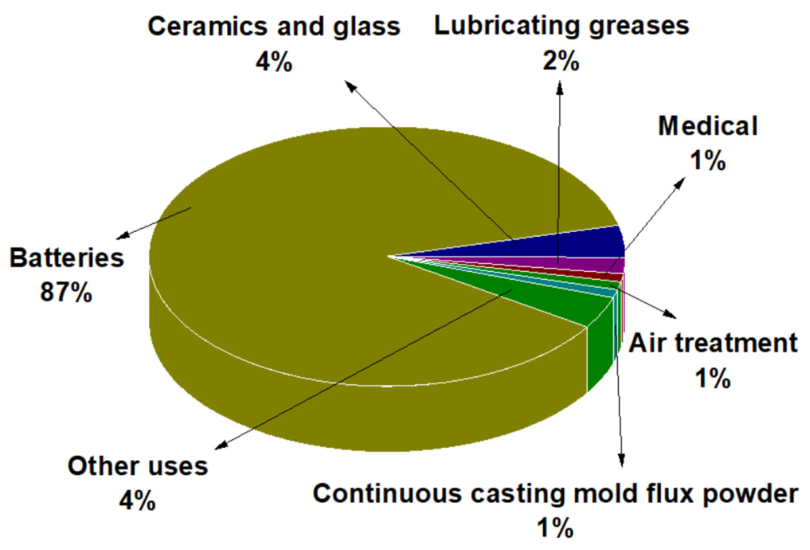
Figure 2.
Lithium reserves by countries as a percentage of global reserves in 2025, sourced from the USGS [6].
Figure 2.
Lithium reserves by countries as a percentage of global reserves in 2025, sourced from the USGS [6].
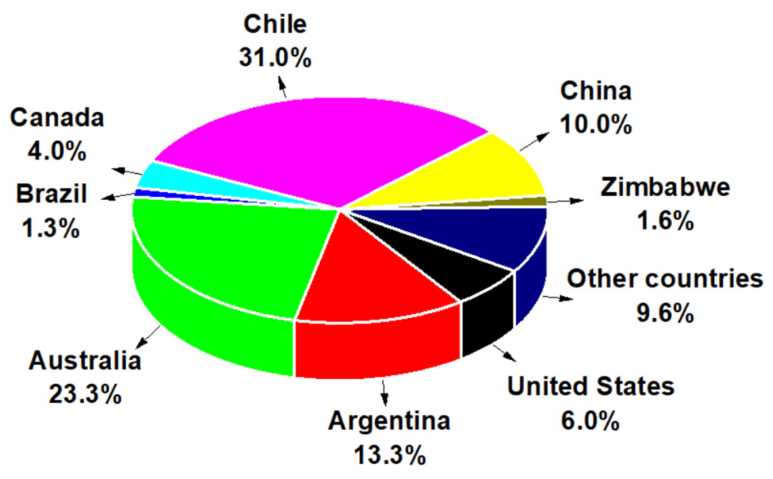
Figure 3.
Schematic illustration of (a) ion-exchange site in zeolites and (b) representative zeolite frameworks and their pore architectures. MR stands for membered-ring.
Figure 3.
Schematic illustration of (a) ion-exchange site in zeolites and (b) representative zeolite frameworks and their pore architectures. MR stands for membered-ring.
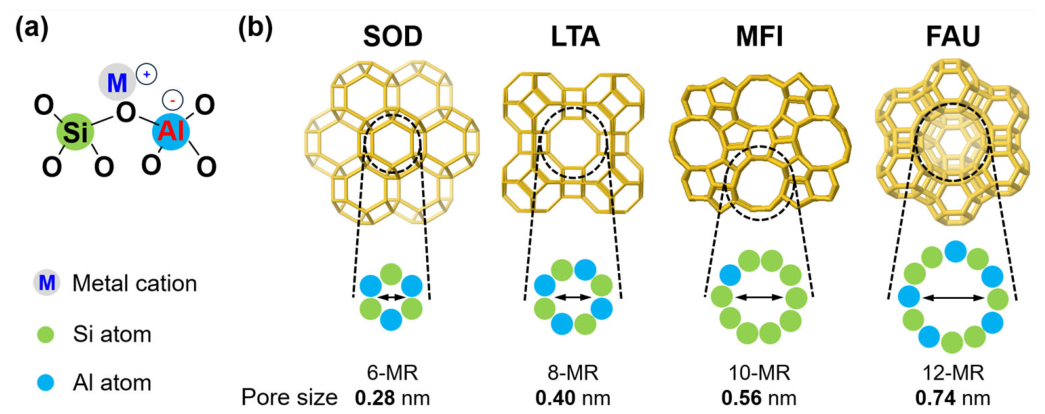
Figure 4.
Schematic of various synthesis pathways to produce zeolite materials.
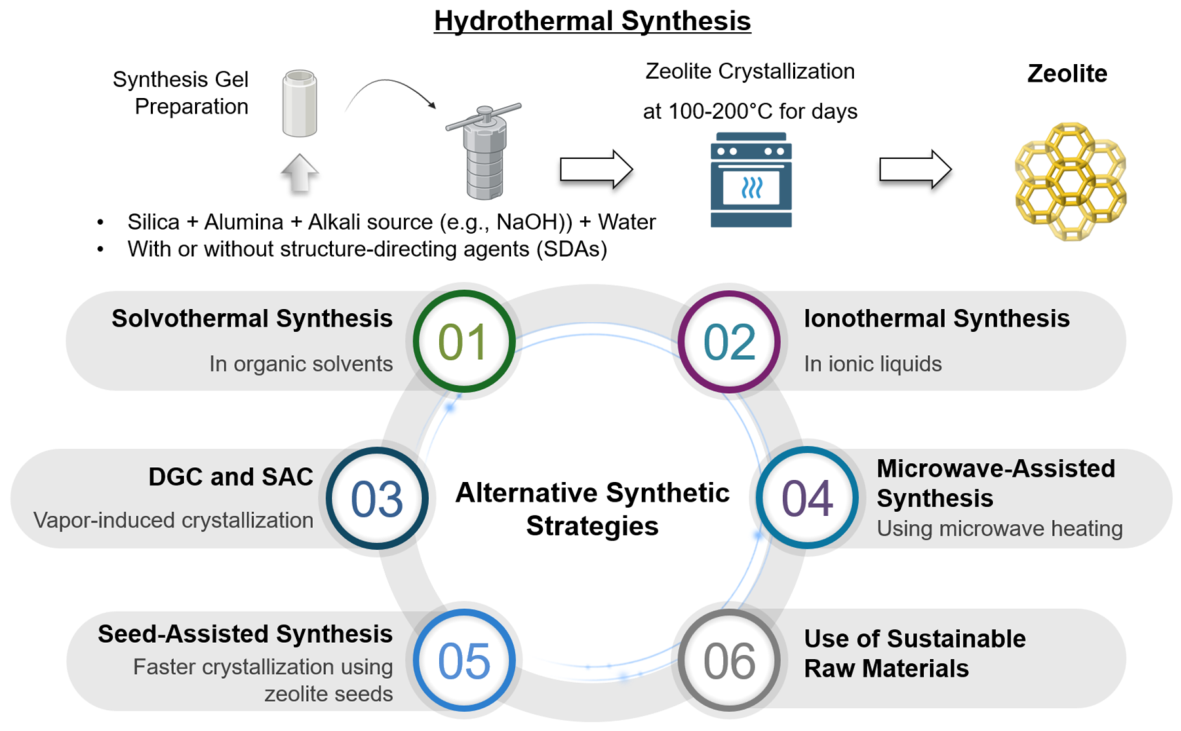
Figure 5.
Schematic of the five guiding principles for rationally designing zeolite-based adsorbents as next-generation materials for sustainable lithium recovery technologies.
Figure 5.
Schematic of the five guiding principles for rationally designing zeolite-based adsorbents as next-generation materials for sustainable lithium recovery technologies.
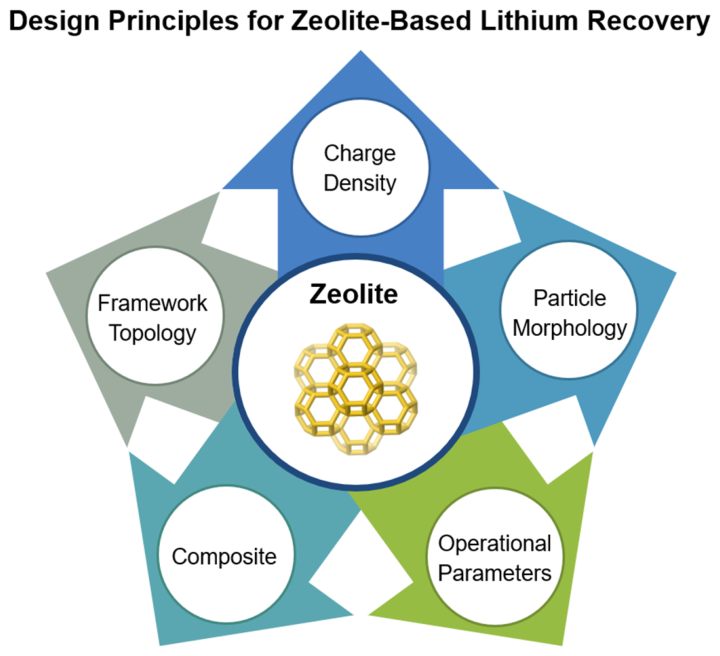
Figure 6.
Future research directions focused on advancing and optimizing the design of zeolite-based adsorption processes for sustainable lithium recovery.
Figure 6.
Future research directions focused on advancing and optimizing the design of zeolite-based adsorption processes for sustainable lithium recovery.
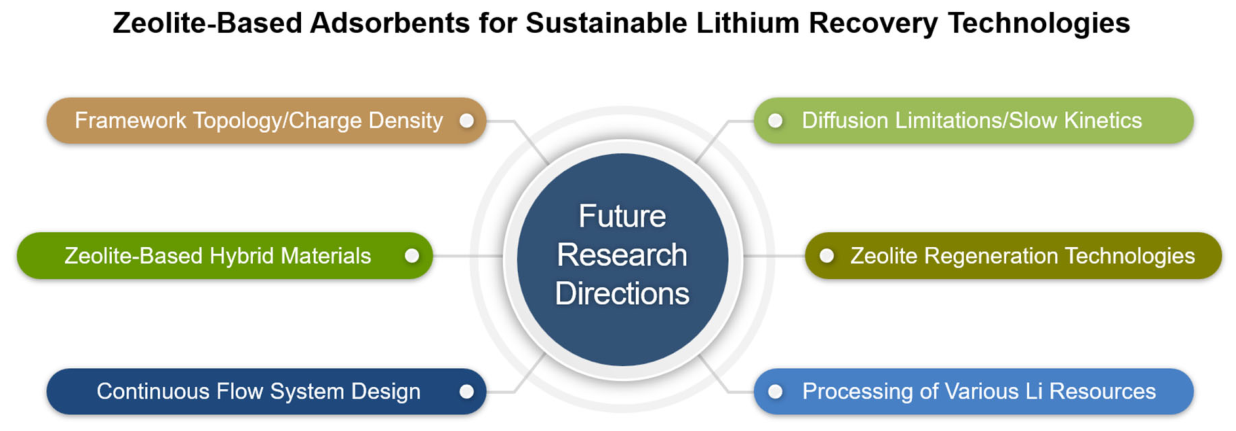

Table 1.
Lithium recovery performance of selected inorganic adsorbents.
| Adsorbent | Li Adsorption Conditions | Types of Li Solution | Li Uptake Capacity (mg g-1) | Equilibrium Time | Ref. |
|---|---|---|---|---|---|
| Li4Mn5O12 | 10 mL of 70 mg L-1 Li+ solution; 0.1 g adsorbent; 30°C; pH of 10.1 | Brine that contains multiple cations | 7.1 | 72 h | [21] |
| LiMn2O4 | 10 mL of 70 mg L-1 Li+ solution; 0.1 g adsorbent; 30°C; pH of 10.1 | Brine that contains multiple cations | 16.9 | 114 h | [22] |
| Li1.6Mn1.6O4 | 500 mL of 900 times concentrated seawater; 0.1 g adsorbent; 25°C; pH of 10.1 | Seawater | 10.5 | 48 h | [23] |
| LiNi0.5Mn1.5O4 LiAl0.5Mn1.5O4 LiTi0.5Mn1.5O4 |
50 mL of 347 mg L-1 Li+ solution; 0.1 g adsorbent; 25°C; pH of 13 | Li+-containing solution | 10.7 20.2 9.4 |
24 h | [24] |
| Granular Li4Mn5O12 | Qarhan salt lake brine (Li⁺ = 73 ppm); 25°C; pH of 8.5 | Salt lake brine | 4.9 | 5.5 h | [25] |
| O3-eluted HMn2O4 | 100 mL of LiOH solution with 100 ppm Li⁺; 0.1 g adsorbent; 25°C; pH of 11.5 | LiOH solution | 33.2 | 24 h | [26] |
| Mn-Ti-LIS | 100 ppm LiCl solution; adsorbent to solution ratio of 500 mL g-1; 40°C; pH of 12 | LiCl solution | 32.3 | 10 h | [27] |
| Li2TiO3 | 10 mL of 70 mg L-1 Li+ solution; 0.1 g adsorbent; 60°C; pH of 9.19 | Brine that contains multiple cations | 25.6 | 144 h | [28] |
| PVB Resin-H2TiO3 | 276.6 mg L-1 Li+ solution; 30°C; pH of 8.68 | Salt lake brine | 12.1 | 6 h | [29] |
| Li4Ti5O12 @Shell | 20 mL of 11.13 mg L-1 Li+ solution; 0.1 g adsorbent; 25°C; pH of 13.10 | Brine that contains multiple cations | 28.5 | 5 h | [30] |
| Li4Ti5O12 | 50 mL of 120 mg L-1 Li+ solution; 0.1 g adsorbent; 25°C; pH of 9.17 | Li+ ion-containing solution | 39.4 | 120 h | [31] |
| H2TiO3 | 50 mL of 0.1 ppm LiCl solution; 0.1 g adsorbent; 25°C; pH of 13 | LiCl solution | 55.1 | 24 h | [32] |
| H4Ti5O12 | 100 mL of 150 ppm LiCl solution; 100 mg adsorbent; 20°C; pH of 12 | Simulated brine | 32.1 | 8 h | [33] |
| Fe-doped H2TiO3 | 50 mL of 168 mg L-1 Li+ solution; 0.1 g adsorbent; 25°C; pH 12 | LiCl solution | 34.3 | 14 h | [34] |
| LiAl-LDHs | 60 mL of 399 mg L-1 Li+ solution; 1 g adsorbent; 30°C | Low-grade brine | 7.3 | 2 h | [35] |
| Magnetic LiAl-LDHs | 40 mL of 397 mg L-1 Li+ solution; 1 g adsorbent; 25°C | Low-grade brine with Mg/Li ratio of 284 | 6.0 | 4 h | [36] |
| Fe-doped LiAl-LDHs | 800 mg L-1 Li+ solution; 50°C | Simulated brine (LiCl/NaCl) | 11.3 | 1 h | [37] |
| LiZnAl-LDH | 20 g L-1 of adsorbents in brine solution; 25°C | Salt lake brine | 13.4 | 3 h | [38] |
| Li-Al-CO3 LDH | 800 ppm of Li⁺ solution; solid-liquid ratio of 1:40; 50°C | Simulated brine (LiCl/NaCl) | 18 | 3 h | [39] |
| PDMS@Li/ZnAl-LDH | 2 L of 100 mg L-1 Li+ solution (2 L brine); 70°C; pH of 7 | Salt lake brine | 9.4 | 2 h | [40] |
Table 2.
Structural properties of some zeolites.
| Name | Framework Topology | Pore Dimension | Extra-Framework Cation | Si/Al Ratio (SAR) |
|---|---|---|---|---|
| SOD | SOD | 6-MR (0.28 nm × 0.28 nm) | Na+ | 1.0 |
| GIS | GIS | 8-MR (0.31 nm × 0.45 nm); 8-MR (0.26 nm × 0.49 nm) | Na+ | 1.0-1.5 |
| 3A (KA) | LTA | 8-MR (~0.30 nm × ~0.30 nm) | Na+, K+ | 1.0 |
| 4A (NaA) | LTA | 8-MR (~0.40 nm × ~0.40 nm) | Na+ | 1.0 |
| 5A (CaA) | LTA | 8-MR (~0.50 nm × ~0.50 nm) | Na+, Ca2+ | 1.0 |
| ZSM-5 | MFI | 10-MR (0.53 nm × 0.56 nm) | Na+, NH4+, H+ | ≥ 12 |
| BEA | BEA | 12-MR (0.64 nm × 0.76 nm) | Na+, NH4+, H+ | ≥ 12 |
| 13X (NaX) | FAU | 12-MR (0.74 nm × 0.74 nm); Supercage (~1.2 nm) | Na+ | 1.0-1.5 |
| NaY | FAU | 12-MR (0.74 nm × 0.74 nm); Supercage (~1.2 nm) | Na+ | > 1.5 |
| Name | Framework Topology | Pore Dimension | Extra-Framework Cations | Si/Al Ratio (SAR) |
|---|---|---|---|---|
| Analcime | ANA | 8-MR (0.16 nm × 0.42 nm) | Na+ | 2.0-3.0 |
| Chabazite | CHA | 8-MR (0.38 nm × 0.38 nm) | Ca2+ | 1.4-4.2 |
| Clinoptilolite | HEU | 10-MR (0.31 nm × 0.75 nm); 8-MR (0.30 nm × 0.46 nm) |
Na+, K+ | 2.9-5.0 |
| Erionite | ERI | 8-MR (0.36 nm × 0.51 nm) | Na+, K+, Mg2+, Ca2+ | 3.0-4.0 |
| Ferrierite | FER | 10-MR (0.42 nm × 0.54 nm); 8-MR (0.34 nm × 0.54 nm) |
Na+, Mg2+ | 3.8-6.1 |
| Heulandite | HEU | 10-MR (0.31 nm × 0.75 nm); 8-MR (0.30 nm × 0.46 nm) |
Ca2+ | 2.9-4.3 |
| Hydroxycancrinite | CAN | 6-MR (0.59 nm × 0.59 nm) | Na+, K+, Ca2+ | 1.0-1.2 |
| Laumontite | LAU | 10-MR (0.40 nm × 053 nm); | Ca2+ | 2.0-2.3 |
| Mordenite | MOR | 12-MR (0.65 nm × 0.70 nm); 8-MR (0.26 nm × 0.57 nm) |
Na+ | 4.2-5.8 |
| Phillipsite | PHI | 8-MR (0.38 nm × 0.38 nm); 8-MR (0.30 nm × 0.43 nm) |
Na+, K+, Ca2+ | 1.5-2.9 |
Table 4.
Lithium recovery performance of zeolite-based adsorbents.
| Adsorbent | Li Adsorption Conditions | Types of Li Solution | Li Uptake Capacity (mg g-1) |
Equilibrium Time | Ref. |
|---|---|---|---|---|---|
| Clinoptilolite (Natural) | 10 mg L-1 Li+ solution; 25°C; pH of 9 | Geothermal water | 0.45 | 0.5 h | [43] |
| Na-X | 10 mg L-1 Li+ solution; 25°C; pH of 9 | Geothermal water | 0.45 | 0.5 h | [43] |
| Clinoptilolite (Natural) | 15 mL of 0-5205 mg L-1 Li+ solution; 2.5 g adsorbent; 25°C; pH of 6-8 | Brine that contains multiple cations | 3900 ppm Li+ recovered | - | [58] |
| SOD | 50 mL of 100 mg L-1 Li+ solution; 4 g/L adsorbent; 25°C; pH of 6 | Low-quality brine | 23.0 | 4 h | [59] |
| 13X (powder) | 100 mL of 500 mg L-1 Li+ solution; 1 g adsorbent; 40°C; pH of 9 | Synthetic solution and geothermal brine | 20.3 | 1 min | [44] |
| 13X (beads) | 100 mL of 300 mg/L L-1 Li+ solution; 1 g adsorbent; 60°C; pH of 9 | Synthetic solution and geothermal brine | 8.6 | 9 h | [44] |
| 13X | Simulated battery leachate containing 20 mg L-1 Li⁺; 12 g L-1 adsorbent; 25°C; pH of 6.5 | Spent battery leachates | ~70% of Li+ recovered | 60 min | [60] |
| 13X | Simulated battery leachate containing 20 mg L-1 Li⁺; 5 g L-1 adsorbent; 25°C; pH of 7-10 | Spent battery leachates | ~30% of Li+ recovered | 40 min | [61] |
| NaY | Simulated battery leachate containing 20 mg L-1 Li⁺; 5 g L-1 adsorbent; 25°C; pH of 7–10 | Spent battery leachates | ~30% of Li+ recovered | 40 min | [61] |
| GIS | 50 mL of battery leachate containing Co2+, Ni2+, Mn2+ and Li+; 4 mg L-1 adsorbent; 0°C | Spent battery leachate | >95% of Li+ recovered | 2 h | [62] |
| Hydroxycancrinite | 50 mL of 0.5 mol L-1 Li+ solution; 3 g adsorbent; 100°C | Synthetic solution that contain multiple cations | Li uptake corresponding to 4.5 wt% of Li2O on zeolites | 24 h | [63] |
| 5A (Na-form) | 100 mL of 10.0 mg L-1 Li+ solution; 1.0 g adsorbent; 40°C | Synthetic solution (LiCl) | 4.2 (at 40°C) 5.0 (at 50°C) |
~24 h | [64] |
| 5A (H-form) | 100 mL of 10.0 mg L-1 Li+ solution; 1.0 g adsorbent; 40°C | Synthetic solution (LiCl) | 2.1 | ~24 h | [64] |
| 13X (Na-form) | 100 mL of 10.0 mg L-1 Li+ solution; 1.0 g adsorbent; 40°C | Synthetic solution (LiCl) | 11.4 (at 40°C) 11.9 (at 50°C) |
~24 h | [64] |
| 13X (H-form) | 100 mL of 10.0 mg L-1 Li+ solution; 1.0 g adsorbent; 40°C | Synthetic solution (LiCl) | 7.7 | ~24 h | [64] |
| NaA | 50 mL of battery leachate containing Co2+ and Li+; 20 g L-1 adsorbent; 90°C; pH of 6 | Spent battery leachate | >95% of Co2+ recovered; no Li+ uptake | 30 min | [65] |
| NaA | Simulated battery leachate containing 0.1 mol L-1 Li⁺; 20-60°C; pH of 2-7 | Spent battery leachates | >95% of Li+ recovered | 4 h | [66] |
| NaA | battery leachate containing Co2+, Ni2+, Mn2+ and Li+; 2-16 g L-1 adsorbent; 0-60°C | Spent battery leachates | >95% of Li+ recovered | 10 h | [67] |
| Clinoptilolite-PAA composite | 10 mg L-1 Li+ solution; 25°C; pH of 5 | Geothermal water | Li+ uptake resulting in 5 mg L-1 Li+ solution | 3 h | [43] |
| Zeolite-hydrogel composite | 30 mL of 55 mg L-1 Li+ solution; 1 g of adsorbent; 25°C; pH of 6.12 | Geothermal waters | 0.09 | 24 h | [46] |
| Nanofiber containing zeolite carrier (PAN CE@SiO2/zeolite) | 50 mL of 100 mg L-1 Li+ solution; 25 mg adsorbent, 25°C; pH of 6 | Salt lake brine | 8.6 | 2.5 h | [47] |
| LiAl-LDHs/ZSM-5 Composite | Zeolite to Li+ ratio of 2; 10 g L-1 of adsorbent; 25°C; pH of 7 | Salt lake brine | 6.2 | 4 h | [45] |
Table 5.
Ionic radius, hydrated diameter, hydration free energy and hydrated ionic potential of metal cations [44,59,70,71,72,73,74].
| Cation | Ionic Radius (Å) |
Hydrated Diameter (Å) | Hydration Free Energy a,c (kJ mol-1) |
Hydrated Ionic Potential b,c (e Å-1) |
|---|---|---|---|---|
| Li⁺ | 0.74 | 6.92-7.60 | -515 | 0.294 |
| Na⁺ | 1.14 | 5.99 | -405 | 0.334 |
| K⁺ | 1.52 | 5.51 | -295 | 0.364 |
| Mg²⁺ | 0.72 | 8.56 | -1922 | 0.473 |
| Ca²⁺ | 1.15 | 8.25 | -1306 | 0.485 |
| Mn2+ | 0.80 | 8.76 | -1841 | 0.457 |
| Co2+ | 0.75 | 8.60 | -1995 | 0.470 |
| Sr²⁺ | 1.328 | 8.24 | -1443 | 0.485 |
| Ba²⁺ | 1.498 | 8.08 | -1305 | 0.495 |
Disclaimer/Publisher’s Note: The statements, opinions and data contained in all publications are solely those of the individual author(s) and contributor(s) and not of MDPI and/or the editor(s). MDPI and/or the editor(s) disclaim responsibility for any injury to people or property resulting from any ideas, methods, instructions or products referred to in the content. |
© 2026 by the authors. Licensee MDPI, Basel, Switzerland. This article is an open access article distributed under the terms and conditions of the Creative Commons Attribution (CC BY) license (http://creativecommons.org/licenses/by/4.0/).
Copyright: This open access article is published under a Creative Commons CC BY 4.0 license, which permit the free download, distribution, and reuse, provided that the author and preprint are cited in any reuse.


