

Submitted:
23 June 2026
Posted:
24 June 2026
You are already at the latest version
Abstract
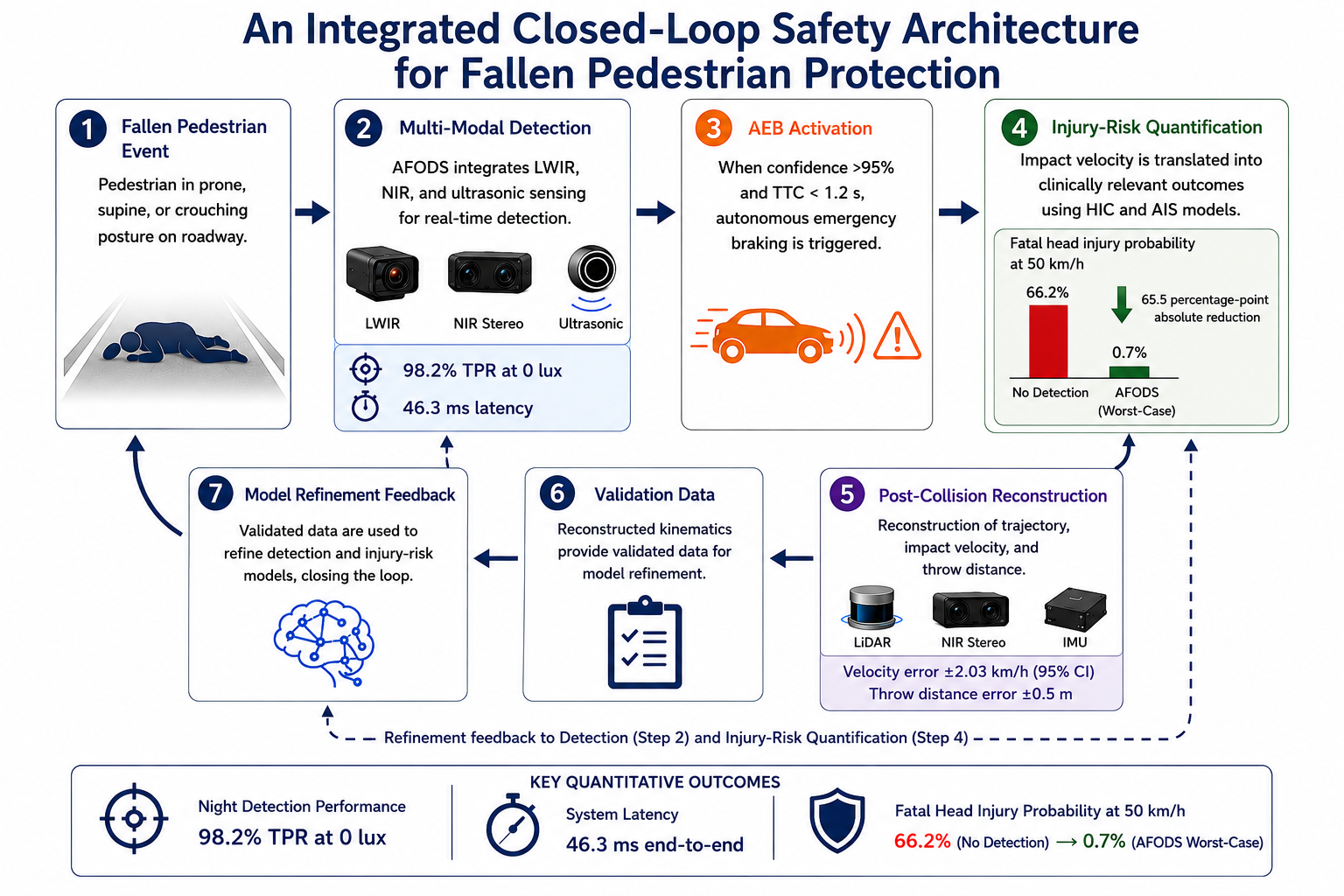
Fallen pedestrians—those lying prone, supine, or crouching on roadways—represent a critical and largely unaddressed vulnerability in contemporary Advanced Driver Assistance Systems (ADAS). Standard pedestrian detection systems achieve only 21.4% true positive rate (TPR) at night for non-upright subjects, compared with 98.2% for upright pedestrians, creating a 76.8 percentage-point detection gap with direct fatality consequences. This article synthesises three complementary peer-reviewed contributions into a unified closed-loop safety architecture: (1) real-time multi-modal detection via the Advanced Fallen Object Detection System (AFODS); (2) physics-grounded post-collision kinematic reconstruction; and (3) injury-risk quantification translating detection latency into Head Injury Criterion (HIC) and AIS-grade fatality probability. The integrated framework, which forms the technical basis of Japanese Patent Application No. 2025-167440 (PCT deadline: October 3, 2026), demonstrates that fatal head injury probability is reducible from 66.2% (no detection baseline at 50 km/h) to 0.7% under worst-case AFODS detection. A five-stage empirical validation roadmap is presented, culminating in regulatory conformance assessment to ISO 26262, ISO 21448 (SOTIF), and Euro NCAP 2026 Post-Crash Safety protocols. The article identifies critical open challenges and defines the trajectory toward prototype deployment, real-world forensic validation, and commercialisation.
Keywords:
fallen pedestrian detection
; sensor fusion
; injury biomechanics
; forensic reconstruction
; ISO 26262
; ADAS
; patent
; closed-loop safety
Copyright: This open access article is published under a Creative Commons CC BY 4.0 license, which permit the free download, distribution, and reuse, provided that the author and preprint are cited in any reuse.


