
Submitted:
24 June 2026
Posted:
25 June 2026
You are already at the latest version
Abstract
This paper develops a neutral-parent closure theory of the lowest baryonic mass read-outs. In this framework, particles are interpreted as persistent carrier defects whose observable identities arise only after internal return closure, carrier embedding, and Lorentz-covariant read-out. A key structural requirement is that such defects have a codimension-two carrier-facing form, so that a transverse linking loop can support phase holonomy and stable particle identity. Before read-out, the defect-internal space is treated as premetric and is described by finite Zn return closures rather than continuous gauge groups; after read-out, the effective descriptions are compatible with the usual SU(2) and SU(3) language of the Standard Model. The common scale used in the calculation is the first-resolution scale structurally fixed in the companion charged-lepton analysis, with the electron mass used only as the dimensional unit. The neutron is modeled as the lowest closed neutral read-out of the neutral-parent closure, while the proton is modeled as the lowest charged-boundary opening of the same closure. The resulting parameter-free formulas reproduce the neutron–electron and proton–electron mass ratios within about minus 0.92 and plus 0.35 standard deviations of the CODATA values, and imply a neutron–proton splitting within about 0.36 eV of observation. The paper also explains the Lorentz rest-mass read-out and the information-state meaning of chamber counting, while leaving a theorem-level derivation of the complete closure complex as an open task.
Keywords:
nucleon mass ratios
; proton–electron mass ratio
; neutron–electron mass ratio
; neutral parent
; first-resolution scale
; codimension-two defect
; U(1) holonomy
; finite Zn closure
; information-state counting
; carrier-defect theory
; closure invariants
; baryon mass
; lattice QCD
1. Introduction
The Standard Model describes particle interactions with extraordinary success. It treats the charged-lepton and quark masses as empirical Yukawa parameters, while quantum chromodynamics (QCD) explains hadron dynamics once the quark fields, gauge structure, couplings, and scale setting are specified. The present paper does not challenge this effective dynamical framework. Its question is different and structural: can the leading intrinsic mass ratios of the proton and neutron be read as closure invariants of a deeper neutral-parent carrier architecture?
A few terms must be fixed before they are used. The word "carrier” does not denote a material medium added inside spacetime, nor an additional substance beneath the Standard Model. It denotes the non-empty vacuum/spacetime continuum understood structurally: the effective support through which geometry, phase transport, orientation, field response, and localized excitations become physically meaningful. This usage is anchored in the Standard Model itself: electromagnetism is formulated as a local phase structure, with phases of the form , and closed-loop transport detects the corresponding holonomy [9,15,16].The carrier language treats this familiar vacuum/phase structure more structurally, as the support in which localized return defects can be continued, phase-compared, and read out, not as an additional medium. A "defect” is a localized persistent return structure in this carrier. It is particle-like only when its identity can be continued, phase-compared, and recovered under admissible return. An "embedding” is the way such an internal return structure is placed into a carrier-readable interface, so that some of its closure residues become externally visible. A "read-out” is the resulting physical manifestation after this embedding has become Lorentz-covariant. These terms are used only at this structural pre-read-out level; QCD and the Standard Model remain the effective field-theoretic descriptions after carrier read-out.
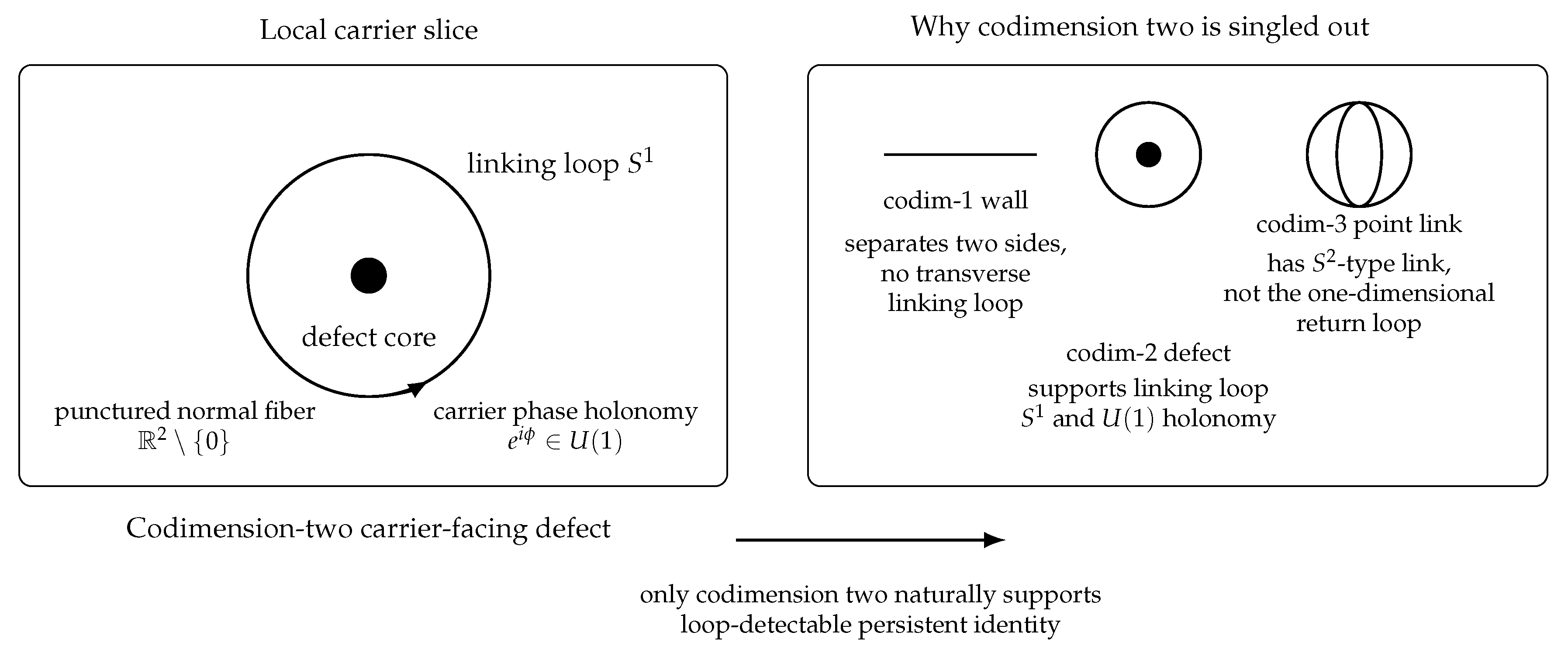
A persistent particle defect must have a codimension-two carrier-facing structure. In a local three-dimensional carrier slice, a codimension-two defect has a punctured normal fiber with an linking loop. This loop is the structure on which a carrier-supported U(1) phase can detect holonomy. It is therefore the minimal local structure through which a localized defect can have persistent, phase-readable identity under admissible continuation. A codimension-one wall separates two sides but does not generate a transverse phase loop, while a codimension-three point link gives an -type link rather than the one-dimensional return monodromy needed for U(1) holonomy. This codimension-two requirement is developed in the broader carrier-defect program and is used here as the structural reason why particle identity can be persistent, phase-readable, and chamber-counted [4,5,6,9]. Figure 1 illustrates why a persistent particle-like defect must be carrier-facing codimension two: only then does a transverse linking loop exist on which the carrier phase can detect holonomy and preserve return identity.
This also explains why the paper uses finite interfaces before invoking the continuous group language familiar from the Standard Model. Before carrier read-out, the defect-internal pocket is premetric: it does not yet have distances, differentiable coordinates, or infinitesimal generators. A continuous Lie-group description is therefore not the primitive internal description. What is primitive is a finite return rule. If T denotes an admissible internal continuation step, persistent identity requires closure of the form
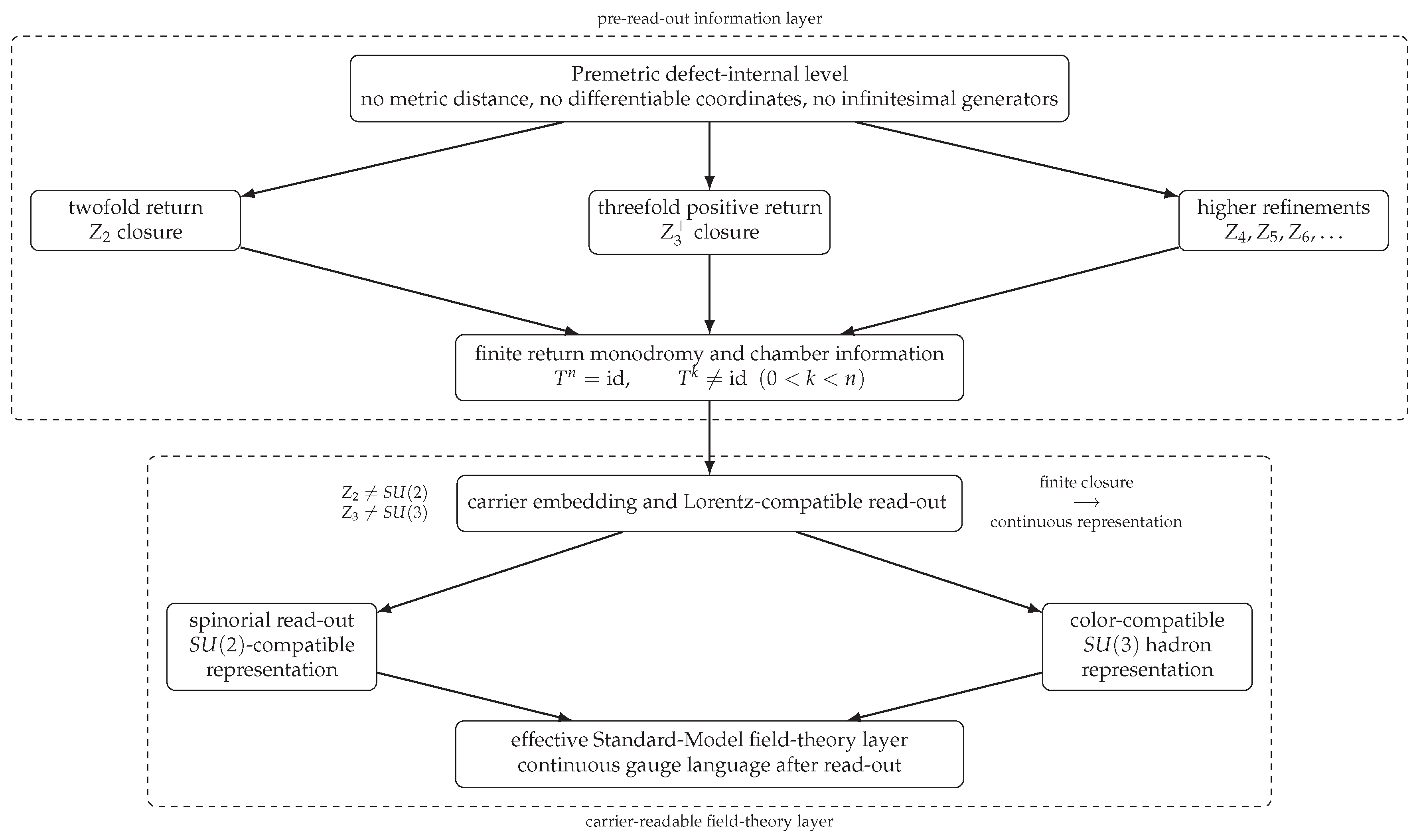
This is the sense in which the defect pocket carries a -type monodromy. After the defect is embedded into a Lorentz-readable carrier, these finite return closures may be represented by continuous effective structures such as spinorial read-out or color-compatible hadron read-out. Thus the finite symbols used below are not replacements for the Standard Model gauge groups; they denote premetric return-closure data whose physical representations appear only after read-out.
This level separation also gives the paper its information-theoretic framing. The chamber counts used below are not thermodynamic entropy counts. They are finite information-state counts over a premetric possibility space: before metric lengths, continuous fields, or dynamical weights are available, the admissible data are continuation states, return closure, protected identity, and carrier-facing residue. In this setting the equal-weight rule is the maximum-symmetry assignment on the undistinguished finite chamber space, in the same broad spirit in which information theory and maximum-entropy reasoning use symmetry and available constraints to determine an unbiased measure [7,8]. The proposed mass formulas are therefore read-outs of constrained closure information rather than thermodynamic entropy formulas.
The scale used below is also not a nucleon fitting scale. In the present framework, the neutral parent first resolves into opposing negative and positive two-branch structure,
This first opposition selects a common scale R. Deeper sector-specific structures arise when one of these branches embeds into further continuation layers such as . These deeper embeddings do not introduce a new leading scale; they supply tower-suppressed carrier-facing chamber refinements of the already selected scale.
The companion charged-lepton work structurally derives this first- resolution scale and uses the electron mass only as the dimensional unit [5]. Equivalently, in electron-mass units it gives
Here the muon–electron and tau–electron ratios are the structural charged-lepton outputs of the companion derivation, not fitted nucleon inputs. The present paper asks whether this same first-resolution scale is inherited by the positive baryonic branch. Thus the logical claim is not
but rather
followed by different read-outs,
The charged-lepton calculation reveals the scale especially cleanly; it does not make the lepton branch ontologically prior to the hadronic branch.
The resulting baryonic picture is simple. The neutron is interpreted as the lowest carrier-readable closed neutral realization of the neutral parent. It is not identified with the pre-read-out parent itself; rather, it is the first matter-level state in which the parent closure is readable while remaining externally neutral. The proton is interpreted as the lowest carrier-readable charged boundary opening of the same closure. Thus
This separation leads to structural formulas for both and , with the neutron and proton distinguished by closure counts rather than by treating the proton as the neutron minus electromagnetic self-energy.
The corresponding closure counts and overlap corrections are
and
The predicted mass ratios are then
Compared with the CODATA neutron–electron and proton–electron mass ratios, these differ by approximately and , respectively. The same formulas imply a neutron–proton splitting of
within about of the observed value.
The guiding level separation is important. Intrinsic rest-mass ratios and electromagnetic response constants are assigned to different structural levels. The fine-structure constant controls electromagnetic response, charged field dressing, scattering, magnetic moments, radiative corrections, and bound-state energies. It is therefore not used as an input to the intrinsic mass-ratio formulas below. This does not deny QED or electromagnetic effects; it assigns them to the response layer after the closure mass anchors have been selected.
The paper has five aims. First, it states the minimal carrier-defect and closure vocabulary needed for the calculation. Second, it explains why the common scale R should be regarded as the first-resolution scale, structurally derived in the companion charged-lepton work using the electron mass as the only dimensional input. Third, it separates the internal closure factor, the carrier localization map, and the Lorentz-covariant stress-energy read-out so that the calculated quantities can be compared with physical rest masses. Fourth, it computes , , and the neutron–proton splitting without fitting any nucleon mass. Fifth, it separates this structural mass-ratio calculation from QCD, lattice QCD, and electromagnetic response, thereby clarifying what is claimed and what remains open.
The structure of the paper is as follows. Section 2 summarizes the neutral-parent origin of the charged-lepton, neutrino, quark-like, and baryonic read-outs. Section 3 and 4 state the inputs, non-inputs, and minimal closure principles used in the calculation. Section 5 explains how the common first-resolution scale (R) is inherited from the opposing resolution rather than introduced as a nucleon parameter. Section 6 and 7 separate the internal closure calculus from Lorentz-covariant mass read-out and electromagnetic response. Section 8–10 derive the neutron–electron ratio, the proton–electron ratio, and the neutron–proton splitting. Section 11 summarizes the numerical results, Section 12 explains why the neutrino sector is latent rather than explicit in the static nucleon formulas, and Section 13 compares the proposal with Standard Model, QCD, lattice-QCD, and empirical mass-formula approaches. Section 14 and 15 state the scope, open derivational tasks, and conclusion. Appendices A–C provide the physical rest-mass read-out model, the hadron-side -to-gauge read-out dictionary, and the carrier-facing chamber-counting method used in the nucleon formulas.
Figure 1.
Codimension-two carrier-facing defect and holonomy detection. In a local carrier slice, a codimension-two defect has a punctured normal fiber with linking loop . This is the minimal local structure on which a carrier-supported phase can detect holonomy, allowing a localized defect to possess persistent, phase-readable identity under admissible continuation. By contrast, a codimension-one wall has no transverse linking loop, while a codimension-three point link has an -type link rather than the one-dimensional return loop required for the present closure calculus.
Figure 1.
Codimension-two carrier-facing defect and holonomy detection. In a local carrier slice, a codimension-two defect has a punctured normal fiber with linking loop . This is the minimal local structure on which a carrier-supported phase can detect holonomy, allowing a localized defect to possess persistent, phase-readable identity under admissible continuation. By contrast, a codimension-one wall has no transverse linking loop, while a codimension-three point link has an -type link rather than the one-dimensional return loop required for the present closure calculus.
2. Neutral-Parent Origin of Matter Read-Outs
The mass-ratio formulas below use the language of neutral-parent closure. This section gives the minimal structural picture needed for the derivation. The aim is not to replace the Standard Model by another catalogue of elementary particles. It is to describe a possible pre-read-out layer in which charged leptons, neutrinos, quark-like degrees of freedom, and baryons arise as different carrier-readable manifestations of one neutral closure architecture.
The basic object is a carrier-readable identity defect. The word “carrier” is used in an operational sense: it denotes the structured continuation support through which a localized defect can have return structure, phase comparison, orientation, and Lorentz-readable manifestation. It is not an ordinary material medium inside spacetime. A useful analogy is the non-empty vacuum of quantum field theory: the vacuum is not inert nothing, but the structured background relative to which fields, excitations, phases, condensates, and response coefficients are defined. The carrier is used here in a still more primitive sense: it is the support of admissible continuation from which the effective spacetime-field description is read out.
For such a defect to become a persistent particle identity, the relevant carrier-facing structure must be codimension two. In a local three-dimensional carrier slice, a codimension-two defect has a punctured normal fiber of the form , whose linking class is represented by an return loop. This loop is precisely the structure to which a carrier-supported U(1) phase can assign a holonomy. The particle is therefore not merely a localized disturbance; it is a loop-detectable identity defect. A codimension-one wall would separate two sides without producing a transverse phase loop, and a codimension-three point link would give an -type link rather than the one-dimensional return monodromy needed for U(1) phase detection. The codimension-two requirement is therefore the structural bridge between carrier U(1) holonomy and persistent particle identity [4,5,6,9].
A particle is interpreted as a persistent defect of this carrier. Such a defect cannot simply dissipate into the background or be removed by a smooth deformation, because it carries internal loop-detectable structure. Before read-out, this internal structure is not a metric space with ordinary distance, size, weight, or force. It is pregeometric: only return, monodromy, branching, and closure are meaningful. A closure is a completed admissible return structure: after following the allowed internal continuations, the defect returns to a stable identity without leaving an unresolved residue. At this level, equal-weight chamber counting and branch compatibility replace ordinary spacetime dynamics. Dynamics, propagation, and gauge fields enter only after the defect has been embedded into the carrier-facing spacetime description.
An embedding is the placement of a pre-read-out closure defect into the carrier so that some internal directions become externally readable. This is analogous in spirit to renormalization: a microscopic or pre-read-out structure is not observed directly, but through the effective variables, scales, and response coefficients that survive in a given description. The analogy is only structural; the present construction is not ordinary renormalization-group flow. A Lorentz read-out is the resulting carrier-facing manifestation as a spacetime particle or field degree of freedom.
This also explains why finite symbols such as , , and higher appear in the closure calculus. They are not proposed as replacements for the Standard Model gauge groups. They label finite internal return and branch structures before Lorentz read-out. In a pregeometric closure space the primitive question is not which continuous gauge rotation acts on a spacetime field, but how many distinct internal sheets or branches must return to produce a stable identity. Thus records the first charge-polarization branching, and records the first completed positive-side three-sheet closure relevant to confined hadronic read-out. After embedding and Lorentz read-out, the effective description is the familiar Standard Model one: weak interactions are described by electroweak gauge structure, and the resolved strong sector by QCD with its color gauge symmetry. The finite structures are therefore interpreted as pre-read-out closure data beneath the successful continuum Standard-Model description, not as a denial of it.
The first persistent matter-level organization is proposed to arise from a neutral parent . This is not an ordinary particle beside the known particles. It is an unresolved closure archetype whose different particle manifestations appear only after branch resolution, carrier embedding, and Lorentz read-out. The minimal resolution pattern is
The two terms are opposite charge-polarization ends of one neutral parent. Their net parent-level charge is zero, but they become readable only after the neutral parent resolves into complementary orientations.
The resolution must be asymmetric. A symmetric split into two equivalent branches would have no distinguished positive closure support and no stable exposed polarization. The two sides would recombine into the unresolved neutral parent, or annihilate as a readable matter pair, rather than persist as matter read-outs. The first persistent resolution therefore keeps one side as a transverse read-out while the other continues into nested positive closure:
This asymmetry is the structural origin, in the present framework, of the lepton–hadron distinction.
The negative branch gives the charged-lepton sector together with a neutral continuation channel:
Here denotes the transverse -visible charged read-out, while denotes the neutral continuation read-out. The symbols ⊥ and ‖ do not denote ordinary spatial directions inside a particle; they denote two carrier-readable roles of the same branch.
The positive branch supports nested closure:
Incomplete sectors may appear, after high-energy resolution, as quark-like degrees of freedom in the continuum QCD description, but they are not asymptotic carrier-readable particles by themselves. Carrier-readable hadronic states require completed -compatible closures. In this sense, color is interpreted at the closure level as confined sheet sectorality, while QCD remains the continuum dynamical envelope of the resolved strong-interaction sector.
The matter classification can therefore be summarized as
The first opposing resolution carries a common sector-power scale. This is the scale denoted by R in the formulas below. It should not be understood as a scale of the fully unresolved parent in an undifferentiated sense, nor as a scale owned by the charged-lepton branch. The scale becomes readable when the neutral parent first polarizes into opposite negative and positive ends. Their dominant sector-power magnitudes agree, while their later read-out orientations differ:
The charged-lepton sector reveals this first-resolution scale through the negative transverse branch; baryonic closure reads the same scale through the positive branch after it embeds into deeper layers such as . The use of in the nucleon formulas is therefore not an arbitrary export of a lepton scale. It is the central test of whether the scale structurally derived in the charged-lepton work is the common scale of the first neutral-parent opposition and is also inherited by baryonic closure read-outs.
The neutron and proton then have distinct structural meanings. The neutron is the lowest carrier-readable closed neutral realization of the whole neutral parent:
It is not identical to the unresolved parent ; it is the first physical matter state in which the parent closure becomes externally readable while preserving zero net electric charge. Its magnetic response is natural in this picture: it is neutral at the branch-charge level, but not empty at the loop-holonomy level.
The proton is instead the lowest carrier-readable charged boundary opening of the same closure:
It is not treated as the neutron minus electromagnetic self-energy. Rather, neutron and proton are two different closure read-outs of the same first-resolution scale: one closed and neutral, the other boundary-opened and charged.
This separation also clarifies the role of the fine-structure constant. Intrinsic rest-mass ratios are treated as closure invariants, whereas is an electromagnetic response invariant. It governs charged-field response, scattering, magnetic moments, radiative dressing, and binding after -visible read-out has occurred. It is not used as an input to the primary formulas for or .
Finally, the neutrino sector does not appear explicitly in the static nucleon mass formulas because those formulas describe closed or boundary rest-mass anchors, not weak-opening channels. The neutrino becomes explicit when a neutral-parent closure opens through the continuation direction, as in
Thus neutrinos are not absent; they are latent in the neutral-parent closure and become visible in weak read-out and mixing.
The present paper uses only this minimal neutral-parent picture. It does not require the reader to accept a complete reconstruction theory of spacetime or fields. The calculation below is formulated at the closure-calculus level: given the shared scale , the closed neutral-parent count for the neutron, and the charged-boundary opening count for the proton, the dimensionless ratios and follow. A theorem-level derivation of the full closure complex remains an open task.
Figure 2 summarizes the branch architecture used in the calculation and clarifies why the same scale (R) can appear in charged-lepton and baryonic formulas without being borrowed from one sector by the other.
3. Inputs, Non-Inputs, and Status of the Claim
The construction uses one dimensional unit, the electron mass, and three structural ingredients. The electron mass sets the unit in which all ratios are expressed. The scale is imported from the companion charged-lepton hierarchy result as a structural output, not as a hadronic fit. In that work the electron mass is the only dimensional input; the muon and tau ratios entering are structurally derived charged-lepton ratios. In the present paper R is interpreted as the common first-resolution scale of the neutral parent. The proton and neutron are then computed from integer and rational closure factors.
The following quantities are not used as inputs:
They are either outputs or irrelevant to the intrinsic mass-ratio calculation. The observed proton–electron and neutron–electron ratios are used only after the formulas are written, for comparison.

Table 1.
Inputs, non-inputs, and structural roles in the present nucleon mass-ratio calculation.
| Object | Role in this paper | Status |
|---|---|---|
| Unit of mass | Dimensional input | |
| Structural charged-lepton ratios used to determine | Outputs of companion lepton hierarchy derivation | |
| Common first-resolution scale | Fixed before the nucleon calculation; tested across sectors | |
| Closed neutral-parent closure count | Structural closure count | |
| Charged-boundary opening count | Structural closure count | |
| Nucleon mass ratios | Predictions / comparisons | |
| Nucleon splitting | Derived consistency check | |
| Electromagnetic response invariant | Not used as a mass-ratio input |
The status of the present paper should also be made explicit. It is not yet a full first-principles theorem deriving the entire neutral-parent closure complex from an underlying carrier Lagrangian. It is a self-contained structural derivation at the closure-calculus level. The rules are stated explicitly, the coefficients are fixed by the stated chamber and overlap counts, and the resulting formulas are tested against data. A complete theorem-level derivation of the closure complex and its correction expansion is an open task. This distinction is important: the paper aims to establish a precise and falsifiable structural mass-ratio proposal, not to claim that all deeper foundations have already been completed.
4. Minimal Structural Premises
The derivation is based on a small number of structural premises. These premises are intended to be self-contained enough for the present paper, while remaining compatible with the broader neutral-parent carrier-defect program.
Principle 4.1
(Mass ratios as closure invariants). Intrinsic rest-mass ratios are carrier-closure invariants. They are not derived from the fine-structure constant. Electromagnetic response, magnetic moments, scattering, radiative dressing, and binding energies belong to the α-dependent read-out layer after charged carrier-facing exposure.
Principle 4.2
(Information-state chamber counting). Before Lorentz read-out, the defect pocket is premetric and does not support metric volumes, continuous dynamical weights, or infinitesimal gauge rotations as primitive data. The available data are finite continuation states, return closure, protected identity, and carrier-facing residue. Chamber counts are therefore interpreted as finite information-state counts on a constrained possibility space, with equal weight assigned when no pre-read-out structure distinguishes one admissible chamber from another [7,8].
Principle 4.3
(First-resolution opposition scale). The scale R is selected by the first opposing resolution of the neutral parent, not by the charged-lepton side alone and not by an independent hadronic fit. The charged-lepton hierarchy reveals this scale through the negative branch, using the electron mass as the only dimensional input in the companion calculation. The nucleon anchors test whether the same first-resolution scale is inherited by the positive closure branch after deeper -embedding.
Principle 4.4
(Neutron as closed neutral read-out). The neutron is the lowest carrier-readable closed neutral realization of . It is not the unresolved neutral parent itself, but the lowest physical matter state in which the whole neutral-parent closure becomes readable while preserving zero external electric charge.
Principle 4.5
(Proton as charged boundary opening). The proton is the lowest carrier-readable charged boundary opening of the same neutral-parent closure. Its mass ratio is therefore a closure ratio, not an electromagnetic self-energy ratio.
Principle 4.6
(Latent neutral continuation). The neutrino sector is the neutral continuation channel of weak opening and mixing. It is latent in closed mass anchors and becomes explicit when a closure opens, for example in beta decay. It is not an explicit mass-building component in the static proton and neutron ratios.
These premises lead to a useful hierarchy:
followed by branch-specific embeddings,
and
The rest of the paper develops the corresponding closure factors.
5. First-Resolution Scale from the Charged-Lepton Derivation
The numerical scale used in the nucleon formulas is taken from the companion charged-lepton hierarchy calculation, but its interpretation is not lepton-specific. In that calculation the electron mass sets the unit, while the muon–electron and tau–electron ratios are structurally derived from the neutral-parent Koide geometry and endpoint hierarchy [5]. Thus the scale used here is not obtained by fitting proton or neutron masses, and it is not introduced as a new hadronic parameter.
Let the charged-lepton root vector be
The Koide condition can be written as equality of the quadratic weights of the democratic parent direction and the orthogonal splitting plane:
Equivalently,
In the present framework, this equality is interpreted as a balanced read-out of the first opposing resolution. The associated sector-power scale is
Using the structural charged-lepton ratios from the companion derivation,
and
one obtains
This number is the only mass scale used in the proton and neutron mass-ratio formulas. It is a first-resolution neutral-parent opposition scale, revealed by the charged-lepton calculation and tested here in the baryonic closure sector. If it were merely a charged-lepton numerical artifact, there would be no structural reason for it to organize both proton and neutron mass ratios. The nontrivial claim of the present paper is precisely this cross-sector inheritance of the same scale.
6. Physical Mass Read-Out and Lorentz Compatibility
The formulas used below are internal closure formulas, whereas the observed proton and neutron are Lorentz-covariant particles with physical rest masses. The distinction matters. A chamber count by itself is not a measured mass; it becomes a mass only after a carrier read-out maps the internal closure class to a localized stress-energy source.
The minimal read-out assumed in this paper is the following. A baryonic closure class C has a dimensionless signed closure factor . The common first-resolution scale R, selected at the opposing resolution, supplies the parent scale. The physical rest-mass scalar is then
For the two lowest baryonic read-outs,
After this scalar is selected, ordinary Lorentz kinematics applies. In a worldline description the effective action is
so that the observed excitation satisfies the usual mass-shell relation
Thus the closure calculus does not replace Lorentz invariance or QCD. It supplies a candidate structural origin for the Lorentz-scalar rest-mass parameter that the effective long-distance theory then uses.
Appendix A gives a more detailed read-out model, in the same style as the companion lepton analysis: it separates the internal closure factor, the carrier localization map, and the long-field stress-energy tensor. Appendix B then gives a hadron-side toy read-out dictionary for the embedded positive branch and its deeper refinement environments. The chamber-counting details used in the neutron and proton formulas are summarized separately in Appendix C.
7. Intrinsic Mass Ratios and Electromagnetic Response
The fine-structure constant controls electromagnetic response. It therefore belongs naturally to charged-field phenomena: scattering, bound-state energies, radiative corrections, magnetic moments, and long-range electromagnetic dressing. It should not be the primary source of intrinsic rest-mass ratios.
This distinction is physically important. The total energy of a charged configuration can depend on field energy, binding, and environment. But the rest-mass ratio of a free electron, proton, or neutron is an intrinsic particle property. If such ratios depended directly on a long-range field response parameter, the separation between intrinsic rest mass and environment-dependent electromagnetic energy would become unclear. The present framework avoids this by assigning
while
This does not mean that charged particles are unaffected by electromagnetism. It means that their leading intrinsic rest-mass ratios are selected before the electromagnetic response layer acts. In this sense may enter magnetic moments, atomic binding, scattering amplitudes, charge radii, or radiative dressing, but it does not enter the primary formulas for and below.
8. Neutron Mass Ratio as Closed Neutral-Parent Read-Out
The neutron is electrically neutral,
but it carries magnetic response. In the present framework this is not an anomaly. A neutral closure can have no net branch-level electric charge while retaining loop-readable internal magnetic holonomy. The neutron is therefore interpreted as the lowest carrier-readable closed neutral realization of .
The leading neutral closure count is proposed to be
The factors have the following structural interpretation. The factor is the neutral two-slot overlap count. The term is the non-protected ordered chamber count of the first completed exposure interface. The combination
represents two-sided first-exposure support together with one protected neutral spine. Thus
The leading closed-neutral mass factor is then
This gives
The residual relative to the observed neutron–electron ratio is about . The leading count is therefore already close on the hadronic scale, but a precision formula requires the first self-overlap correction.
The neutral closure can self-overlap inside the same two-slot neutral exposure space. The natural second-order suppression is
The protected neutral spine contributes the same neutral-chamber displacement that appears in the neutral compensation sector,
Thus the protected neutral self-overlap correction is
The resulting neutron formula is
Numerically,
The observed CODATA value is
so the residual is
or
In mass units this is approximately
9. Proton Mass Ratio as Charged-Boundary Opening
The proton is not treated as the neutron minus electromagnetic energy. It is treated as a distinct closure read-out: the lowest carrier-readable charged boundary opening of the same neutral-parent closure. Its mass ratio is therefore also alpha-free at the intrinsic level.
The leading charged-boundary count is proposed to be
Here is the completed five-slot charged opening count, is the non-protected first-exposure count, and the leading factor 2 records the two oriented charged boundary faces. Thus
The leading charged-boundary factor is
which gives
This is high by about , so the first boundary overlap correction is required.
The closed support has three internal sheets. After the closed support is removed from the neutral two-slot overlap count , the residual active boundary count is
This gives the second-order charged-boundary self-overlap coefficient
The second-order approximation is
This slightly over-subtracts, leaving a residual of about .
The third term restores the protected charged-boundary spine. The coefficient is
The numerator is the non-protected first-exposure chamber count, while the denominator combines the two charged boundary orientations, the three closed sheets, and the seven residual active boundary channels. Thus the proton formula is
Numerically,
The CODATA value is
so the residual is
or
In mass units this is about
Figure 3 summarizes how the same first-resolution scale R gives two distinct baryonic read-outs: the closed neutral neutron channel and the charged-boundary proton channel.
10. Combined Neutron–Proton Splitting
Although the neutron–proton splitting is not used as an input, it is an important derived consistency check. From the two mass-ratio formulas,
Using
this gives
The observed value is approximately
The residual is therefore
or about
This splitting is not fitted separately. It follows from the difference between the closed neutral-parent read-out and the charged boundary opening of the same closure.
11. Numerical Summary
The final neutron pull is approximately , and the final proton pull is approximately . The raw fractional residual for the proton–electron ratio is of order , while that for the neutron–electron ratio is of order . These figures are numerically notable, but they should not be confused with the theoretical status of mature precision-QED calculations, which possess controlled perturbative expansions, uncertainty budgets, and extensive independent tests. The present closure calculus is much less developed: its residuals are reported to make the proposal sharply testable, not to claim QED-level theoretical maturity.
Table 2.
Staged structural predictions for the neutron–electron and proton–electron mass ratios.
| Quantity | Structural formula | Value |
|---|---|---|
| Neutral-first-resolution scale | ||
| Neutron, leading | ||
| Neutron, final | ||
| Observed neutron ratio | CODATA comparison | |
| Proton, leading | ||
| Proton, second stage | ||
| Proton, final | ||
| Observed proton ratio | CODATA comparison |
12. Why the Neutrino Sector Does Not Enter Explicitly
The neutrino sector does not appear explicitly in the static formulas for and because those formulas compute closed or boundary rest-mass anchors, not weak-opening channels. In the neutral-parent framework, neutrinos are neutral continuation-direction read-outs:
They are not additional positive-side mass supports. They become explicit when a closed configuration opens through a weak transition.
For the neutron this is natural. The closed neutral read-out is
whereas beta decay exposes the charged-positive, charged-negative, and neutral-continuation channels:
The neutrino is therefore not absent from the theory. It is latent in the neutral-parent closure and becomes explicit when closure balance is carried through the weak continuation channel.
This distinction is important. Static intrinsic mass ratios are governed by closure counts. Weak processes and flavor mixing involve neutral continuation read-out. Electromagnetic phenomena involve . Thus the three sectors play different roles:
13. Relation to Standard and Structural Approaches
13.1. Standard Model Mass Parameters
The Standard Model is not replaced in this work. At the effective field level, charged-lepton and quark masses are encoded in Yukawa parameters, and the Higgs mechanism supplies the carrier-facing mass term after symmetry breaking. The present paper asks a prior structural question: why the dimensionless rest-mass ratios appearing after read-out should have the particular observed values. In this sense the closure formulas are intended as a proposed origin of selected dimensionless mass anchors, not as a replacement for the Standard Model Lagrangian.
The charged-lepton hierarchy enters only through the already-derived first-resolution scale . The proton and neutron formulas then test whether this scale extends beyond the charged-lepton branch into baryonic closure. The calculation therefore addresses a structural selection problem, while the Standard Model remains the effective dynamical theory of particle interactions.
13.2. QCD and Lattice QCD
The proposal is also not a replacement for QCD. QCD remains the continuum dynamical theory of resolved strong-interaction processes, including scattering, confinement dynamics, hadron structure, decay amplitudes, matrix elements, and nonperturbative bound-state behavior. Lattice QCD is the standard first-principles numerical method for such nonperturbative questions. Ab initio lattice calculations have computed light-hadron masses in agreement with experiment, and modern lattice reviews summarize a large body of results for hadron physics, quark masses, matrix elements, and scale setting [12,14].
The present calculation has a different target. It does not simulate the QCD bound-state wave function, compute correlation functions, or replace lattice scale setting. Instead, it proposes that the lowest intrinsic nucleon/electron mass ratios are static closure anchors selected before the continuum QCD envelope is applied. QCD then governs the dynamics, structure, and response of the resolved hadronic fields built on those anchors.
Thus the intended complementarity is
This separation is essential for avoiding an overclaim. The closure calculus does not explain hadron scattering, form factors, parton structure, excited baryon spectra, or decay amplitudes. Those remain in the domain of QCD and its effective and lattice realizations.
13.3. Neutron–Proton Splitting and QCD+QED Isospin Breaking
The neutron–proton mass difference has a well-established dynamical interpretation in QCD+QED as a competition between strong isospin breaking and electromagnetic effects. Lattice QCD+QED calculations have computed the splitting from quark-mass and electromagnetic contributions with controlled uncertainties [13]. The present paper does not dispute that dynamical decomposition.
The distinction is that the present splitting is not computed by adding a QED self-energy to a QCD mass. Instead, it appears as a consequence of two intrinsic closure anchors:
Their difference gives after both mass ratios have been selected. The result should therefore be read as a structural mass-ratio constraint that is complementary to the QCD+QED dynamical decomposition, not as a replacement for it.
13.4. Electromagnetic Response and the Role of
The absence of from the mass-ratio formulas does not deny electromagnetic effects. Electromagnetic energy contributes to bound systems and charged-response observables. The fine-structure constant remains essential for atomic spectra, scattering amplitudes, radiative corrections, magnetic moments, and electromagnetic binding. The present claim is only that is not the origin of the primary intrinsic nucleon/electron rest-mass ratios.
This assignment is consistent with the broader separation used in the paper:
13.5. Empirical Mass Formulas and Koide-Type Relations
The work is related in spirit to empirical mass relations, including Koide-type formulas, but differs in emphasis. A purely empirical formula records a numerical relation among masses. The present construction uses the first-resolution scale structurally derived in the charged-lepton analysis and then tests that scale in a different sector. The nontrivial claim is not only that the charged leptons satisfy a Koide-like geometry, but that the associated scale also organizes the lowest nucleon closure anchors.
This cross-sector use is what makes the proton and neutron results important. The hadron calculation does not independently prove the charged-lepton hierarchy, but it tests whether the scale revealed by the charged-lepton calculation has first-resolution neutral-parent meaning beyond that branch.
14. Scope and Open Derivations
The numerical agreement reported in this paper is striking, but it does not by itself complete the theory. Several derivational tasks remain. The information-state interpretation also remains conditional: this paper uses equal chamber weight as the symmetry-preserving measure on a finite premetric possibility space, but a deeper theory should derive the admissible chamber space and its measure from the carrier-defect orientation complex itself.
The physical read-out discussion in Section 6 and Appendices Appendix A–Appendix B should also be understood in this limited sense. It shows how a closure-selected scalar can become the rest mass in a standard relativistic mass shell, but it is not a replacement for QCD, a model of parton distributions, or a derivation of hadronic scattering dynamics.
First, the leading counts
and
should be derived from a precise neutral-parent closure complex. The present paper provides a structural derivation at the chamber-count level, but a complete theorem should specify the closure objects, protected channels, admissible openings, and ordering rules uniquely.
Second, the correction coefficients should be derived from a general overlap expansion rather than treated as isolated rules. The desired theorem-level targets are
A stronger theory should show that the signs, powers, and coefficients follow from one neutral-parent self-overlap and protected-restoration calculus.
Third, the first-resolution scale should ultimately be derived directly from the carrier-defect structure. The present paper uses the companion charged-lepton hierarchy as the cleanest available structural determination of that scale, with the electron mass serving only as the dimensional unit, and then tests the same scale in the hadron sector.
Fourth, broader baryon masses are not derived here. The present paper only addresses the two lowest nucleon mass ratios. Extending the method to the baryon octet and decuplet will require additional closure projection rules and a more careful interface with QCD dynamics.
Finally, the present paper gives no theory of decay rates, scattering amplitudes, parton distributions, nuclear binding, or hadron widths. Its domain is static intrinsic mass-ratio anchors. Dynamical observables belong to QCD, electroweak theory, nuclear effective theories, and future extensions of the carrier-readout framework.
15. Conclusion
This paper has presented a conditional structural derivation, at the closure-calculus level, of the proton–electron and neutron–electron mass ratios. The central principle is that intrinsic rest-mass ratios are closure invariants, while is an electromagnetic response invariant. The scale is interpreted as the common scale selected by the first opposing resolution of the neutral parent. It is structurally determined in the companion charged-lepton hierarchy calculation, with the electron mass used only as the dimensional unit, and is tested here in baryonic closure read-outs.
The neutron is identified as the lowest closed neutral-parent read-out, and the proton as the lowest charged boundary opening of the same closure. The resulting formulas give
They differ from the CODATA values by approximately and , respectively. The implied neutron–proton splitting is , within about of the observed value. No nucleon mass, nucleon splitting, or fine-structure constant is used as an input.
The result is significant because it connects three otherwise separate structures: the charged-lepton hierarchy, the first neutral-parent opposition, and the lowest baryonic mass anchors. The physical read-out appendix clarifies how a closure-selected scalar enters ordinary relativistic kinematics, the hadron-side Lorentz dictionary explains why the positive branch is read as an embedded closure rather than as a free isolated fragment, and the chamber-counting appendix makes explicit how the nucleon residues are counted. The additional information-state framing explains why equal-weight finite chamber counting is used before metric dynamics and continuous gauge representation become available.
A central falsifiability test of the present proposal is therefore cross-sector inheritance: the same first-resolution scale R, fixed before any nucleon data are used, must organize both the closed-neutral neutron formula and the charged-boundary proton formula. If the proton and neutron required independent scales, fitted offsets, or an explicit electromagnetic input such as to reproduce their mass ratios, the neutral-parent closure interpretation would fail in its present form.
The next step is theorem-level work. The closure counts and correction terms should be derived from a precise neutral-parent closure complex or carrier-readable closure groupoid. In particular, a complete theory should derive the admissible information-state chamber space, the protected identity subtraction, the signed residue coefficients, and the tower-suppressed overlap expansion from one orientation calculus. If this can be done, the proton and neutron mass ratios would become structurally derived nucleon anchors of the broader carrier-defect program.
Author Contributions
Bin Li is the sole author
Funding
This research received no external funding.
Data Availability Statement
No new data were created in this work.
Conflicts of Interest
Author Bin Li was employed by the company Silicon Minds, Inc. The company had no role in the design of the study; in the collection, analyses, or interpretation of data; in the writing of the manuscript; or in the decision to publish the results.
Appendix A. From Hadronic Closure Factors to Physical Rest Mass
This appendix clarifies the sense in which the neutron and proton mass ratios derived in the main text are ratios of physical rest masses rather than ratios of abstract internal labels. The distinction is important. The chamber-counting argument is formulated in a premetric internal closure space, whereas physical mass is measured as rest energy, inertial response, and long-field stress-energy. The purpose of this appendix is not to derive the complete microscopic carrier dynamics or QCD. Rather, it states the minimal read-out assumptions under which the closure factors computed in the paper become physical nucleon rest-mass ratios.
Appendix A.1. Three Levels of Description
We distinguish three levels.
First, the internal closure calculation assigns a dimensionless signed closure factor
to a baryonic closure class. In the present paper the two relevant classes are the closed neutral read-out and the charged-boundary opening . This level is premetric: it uses branch structure, protected identity chambers, carrier-facing residues, and towered refinements, but it does not yet describe an ordinary spacetime particle.
Second, a carrier read-out map embeds the internal closure class into a localized physical excitation. This step supplies the common first-resolution scale R selected by the opposing structure and converts the dimensionless closure factor into a localized rest-energy density.
Third, at distances large compared with the defect core, the localized excitation is described by an effective one-particle stress-energy tensor. The integrated rest energy is the physical rest mass [17].
The present paper derives the first-level closure factors and uses the minimal structure of the second and third levels to justify comparison with observed neutron–electron and proton–electron mass ratios [10,11]. The full microscopic carrier Lagrangian and the complete QCD realization of the resolved baryonic state are left for future work.
Appendix A.2. Minimal Read-Out Assumptions
Let C denote a baryonic closure class, with for the closed neutral read-out and for the charged-boundary opening. The minimal read-out assumptions are:
- 1.
- Common first-resolution scale. Both nucleon read-outs inherit the same scale R from the first opposing resolution of the neutral parent. The neutron and proton do not introduce independent nucleon-specific mass scales.
- 2.
-
Closure-factor energy read-out. The internal closure calculation assigns a dimensionless signed factor . The carrier converts this factor into the coefficient of a localized rest-energy density:The factor may contain negative correction terms because it is a signed carrier-facing residue relative to the common baseline; the total read-out mass remains positive for the physical closure classes considered here.
- 3.
-
Normalized localization. For each closure class, the carrier produces a localized rest-frame energy profile normalized byDifferences in short-distance profile shape are allowed, but they do not alter the integrated closure coefficient at the level of the mass ratios considered in this paper.
- 4.
Under these assumptions, the rest-frame energy density of closure class C has the schematic form
After integration over the localized core, derivative and profile details renormalize either the common scale or the normalized profile, while the closure-dependent coefficient is . Thus
Consequently,
This is the sense in which the closure factors are identified with physical nucleon–electron mass ratios. The paper does not declare a chamber number to be a mass by definition. Rather, it assumes a carrier read-out in which the signed closure factor controls the coefficient of the localized rest-energy density.
Appendix A.3. Why the Read-Out Gives a Scalar Rest Mass
The closure factor is an internal invariant of a completed closure class. It is not a spatial component, a direction of motion, or a frame-dependent energy. When multiplied by the common scale , it therefore supplies a Lorentz-scalar rest-mass coefficient:
After carrier read-out, the effective worldline action may be written as
Since is proper time, this action is Lorentz invariant. The corresponding four-momentum is
where is the four-velocity, and the excitation satisfies the usual mass-shell relation
The closure calculation therefore does not replace relativistic kinematics. It supplies the invariant mass parameter used by the long-wavelength relativistic description.
Appendix A.4. Relation to Stress-Energy and the Long-Field Limit
Physical mass is not only an internal energy label. In relativistic physics, rest mass is the invariant coefficient of a localized stress-energy source. For a localized excitation with worldline , the long-field effective stress-energy tensor takes the standard point-particle form [17]
In a local rest frame or asymptotically stationary long-field description, the integrated rest energy may be written schematically as
where is the relevant time-translation direction and is the unit normal to the spatial slice . Therefore, if the carrier read-out gives
then the same quantity is the inertial rest energy and the long-field gravitational source coefficient. The mass ratios computed from are therefore ratios of the same masses that appear in the long-wavelength inertial and gravitational descriptions.
Appendix A.5. Why Only Ratios Are Claimed
The present paper uses the electron mass as the dimensional unit and uses the companion charged-lepton derivation to determine
Thus the nucleon predictions are dimensionless ratios,
The electron mass supplies the unit of measurement. The neutron mass, proton mass, neutron–proton splitting, and fine-structure constant are not used as inputs. A complete future carrier theory should explain the absolute dimensional scale itself, but the present paper claims only the mass ratios obtained after the common scale has been fixed by the first-resolution charged-lepton derivation.
Appendix A.6. Comparison with Standard Hadron Language
In QCD, nucleon masses arise from nonperturbative strong dynamics, quark masses, confinement, and, for precision splittings, electromagnetic and isospin-breaking effects [12,13,14]. The present construction is not a substitute for that dynamical account. It is a structural proposal for the dimensionless intrinsic mass-ratio anchors:
At the effective field-theory level, QCD and QED still describe the fields, interactions, form factors, scattering, and radiative response of the resolved nucleons. The closure proposal concerns a prior question: why the lowest closed neutral and charged-boundary baryonic rest-mass anchors have the particular dimensionless values observed.
Appendix A.7. What Is not Claimed Here
Several difficult questions are not solved in this appendix. First, we do not derive the full microscopic carrier Lagrangian. Second, we do not derive QCD confinement dynamics or baryon wavefunctions. Third, we do not claim that all short-distance core profiles are identical. Fourth, we do not replace the effective long-distance description of a localized massive particle. The claim is narrower: the internal closure calculus fixes the relative scalar coefficients and ; the carrier read-out maps these coefficients to localized stress-energy; the integrated stress-energy is the physical rest mass; and the same mass appears in the Lorentz-invariant mass shell and long-field effective stress-energy tensor.
Appendix B. Hadron-Side Lorentz Read-Out of the Embedded Positive Branch
This appendix gives a hadron-side toy read-out dictionary for the embedded positive branch. It is adapted to the present nucleon paper and therefore omits the lepton-facing side. The purpose is not to derive the full Standard Model representation theory, QCD confinement, or the baryon spectrum. Rather, it shows why the finite internal structures used in the nucleon mass formulas can be read as a Lorentz-compatible positive closure after carrier embedding. It also explains why the finite hierarchy belongs to the premetric defect-internal level, whereas continuous and descriptions belong to the effective read-out layer.
Appendix B.1. Why Finite Z n Closure Precedes Continuous Gauge Read-Out
A possible source of confusion is the use of finite symbols such as in a paper that ultimately aims to describe ordinary hadrons, whose effective field-theory description uses continuous groups. In the present framework these descriptions occupy different levels. The finite structures are not proposed as low-energy gauge groups. They are pre-read-out return closures inside a defect pocket.
Before Lorentz-covariant carrier read-out, the defect-internal pocket is premetric. It is not yet a differentiable internal manifold carrying continuous transformations. It has no primitive metric distances, angles, or infinitesimal generators. The available data are instead continuation, adjacency, orientation, return, and closure. Therefore the minimal structure capable of supporting persistent identity is a finite return rule. If T denotes one admissible internal continuation step, an n-step return closure satisfies
This is the structural meaning of a -type monodromy in the present paper. It records how a defect identity closes under repeated internal continuation. Without such closure, the localized carrier disturbance would not persist as the same particle-like object.
After carrier embedding, the same finite closure data may acquire a continuous effective representation. A twofold return primitive can be represented by spinorial read-out: a spinor changes sign under a rotation and returns under a rotation, with the carrier-readable spin structure described by the double cover . Likewise, a threefold positive closure can become compatible with the color-singlet structure of baryonic read-out and the continuous language of QCD. The intended relation is therefore not
but rather
The finite structure supplies persistent internal identity and chamber exposure; the continuous group supplies the effective language used after the defect has become a Lorentz- and gauge-readable particle.
The relevant internal structure for the hadron side is not an isolated free fragment. The positive side becomes carrier-readable only through completion into the threefold positive closure
The carrier-facing positive object is therefore an embedded closure object,
This is the structural reason why the baryonic read-out is closure-based rather than a free isolated branch excitation.
Appendix B.2. Threefold Positive Closure
A minimal toy closure rule is the following. Let
denote three internal positive-side closure components. They are not assumed to be ordinary observed particles before carrier read-out. They are internal closure positions. A carrier-readable positive-side object must satisfy the threefold closure condition
or, equivalently at the level of internal phases,
In the simplest cyclic toy case one may take
The point is not that hadrons are literally phase products. The point is that the positive branch becomes carrier-readable only after a threefold internal closure has been completed.
This gives the qualitative confinement-like rule
but
After carrier read-out, such a threefold closure may be represented by a color-compatible effective description. Thus the relation is
Appendix B.3. Nested Lorentz-Readable Embeddings of the Positive Closure
The positive closure is not followed by a sequence of externally added independent layers. Rather, the completed positive closure is nested into larger carrier-readability environments:
Each embedding environment supplies additional ordered chambers in which the same completed positive closure may be exposed and refined. This use of ordered chambers and nested refinement is a structural counting assumption of the present framework, not a standard QCD construction.
At the first exposure level,
the ordered chamber space contains possible chamber orderings. One chamber is protected by the identity/closure condition and is not available for mass-producing exposure. Thus the first non-protected exposure count is
This is the structural origin of the basic four-slot exposure residue used in both nucleon counts.
At the next embedding level, the previously selected exposure is not reopened as a new independent leading channel. It is refined conditionally inside the larger environment. The neutron and proton formulas implement this principle differently. The closed neutral read-out uses
whereas the charged-boundary opening uses
The deeper corrections in and are then signed self-overlap, compensation, and restoration terms applied to the already selected closure class. They do not introduce a second leading scale.
The Lorentz read-out interpretation is therefore:
with deeper embeddings providing conditional carrier-facing refinements. Incomplete positive-side fragments are not treated as isolated free asymptotic particles in this toy dictionary.
Appendix B.4. A minimal Hadron-Side Read-Out Table
The toy read-out dictionary is summarized in Table A1. The table is not a replacement for the Standard Model or QCD. Its role is only to connect the finite closure data used in the mass formulas to the effective hadron-facing roles assumed in this paper.
Table A1 should be interpreted only as a toy read-out dictionary. It records the structural roles needed for the nucleon calculation: the positive side is an embedded closure, the higher structures are nested exposure environments, and neutron/proton masses differ because the same positive closure is read out as different signed carrier-facing closure classes.
Table A1.
Hadron-side toy read-out dictionary for the embedded positive branch. The entries describe how finite pre-read-out closure structures are used in the neutron and proton mass formulas after carrier embedding.
Table A1.
Hadron-side toy read-out dictionary for the embedded positive branch. The entries describe how finite pre-read-out closure structures are used in the neutron and proton mass formulas after carrier embedding.
| Internal structure | Primitive role | Toy carrier read-out | Use in this paper |
|---|---|---|---|
| Positive branch of the first opposition | Source side of the baryonic closure | Common scale R | |
| Threefold positive closure | Closed hadron-facing support | Baryonic source pocket | |
| First exposure environment | non-protected chambers | Basic exposure residue | |
| Closed neutral read-out | Protected neutral realization | Neutron count | |
| Charged boundary opening | Boundary-exposed positive realization | Proton count | |
| Deeper refinements | Conditional carrier-facing corrections | Signed self-overlap and restoration | Factors |
Appendix B.5. Scope of the Toy Dictionary
This appendix is deliberately limited. It does not derive the full Lorentz group, the Standard Model gauge representation, QCD confinement dynamics, parton distributions, the baryon spectrum, or decay amplitudes. It only shows that the finite positive-side structures used in the main text have a plausible Lorentz-readable carrier manifestation, and that the use of finite closure before read-out is compatible with the continuous and language used after read-out:
For the present argument, this is sufficient to justify the structural distinction needed in the nucleon calculation: the baryonic side is a closed positive branch whose higher structures are nested exposure environments, not a collection of independent free positive-side fragments.
Figure A1 summarizes why finite closure is used at the premetric defect-internal level, while continuous and descriptions appear only after carrier embedding and Lorentz-compatible read-out.
Figure A1.
Premetric finite closure and continuous gauge read-out. Before carrier read-out, the defect-internal pocket is premetric and supports finite return closure rather than continuous Lie-group transformations. The symbols , , and higher denote return monodromy and chamber information, not replacement gauge groups. After carrier embedding and Lorentz-compatible read-out, the same closure data may be represented by continuous effective structures such as spinorial -compatible behavior and color-compatible hadron structure. Thus the relation is not or , but finite closure data read out through continuous field-theoretic representations.
Figure A1.
Premetric finite closure and continuous gauge read-out. Before carrier read-out, the defect-internal pocket is premetric and supports finite return closure rather than continuous Lie-group transformations. The symbols , , and higher denote return monodromy and chamber information, not replacement gauge groups. After carrier embedding and Lorentz-compatible read-out, the same closure data may be represented by continuous effective structures such as spinorial -compatible behavior and color-compatible hadron structure. Thus the relation is not or , but finite closure data read out through continuous field-theoretic representations.
Appendix C. Hadronic Carrier-Facing Chamber Counting
This appendix summarizes the chamber-counting logic used specifically in the nucleon formulas. The purpose is pedagogical. The integers that enter the neutron and proton formulas should not be read as arbitrary numerical assignments. They are intended to count carrier-facing, non-protected residues produced when the first positive baryonic branch of the neutral parent is embedded into deeper finite continuation interfaces.
Appendix C.1. Source Pocket, Target Interface, and Exposed Residue
Three objects must be kept distinct. The first is the source pocket: the already selected branch whose return identity is being read out. In the present paper this is the positive baryonic branch inherited from the first neutral-parent opposition,
The scale R belongs to this first opposition. It is not introduced by the later hadronic chamber count.
The second object is the target continuation interface. This is a finite interface into which the source pocket is embedded. The notation does not mean increasing metric size. It means a finer finite resolution of the same codimension-two return loop. The positive branch first continues toward the completed threefold closure and can then be exposed or refined through interfaces such as and .
The third object is the carrier-facing exposed residue. This is not the whole target interface. It is the part of the embedded closure that remains externally readable after protected identity chambers, internal returns, cancellations, and over-closures have been removed. The mass formulas count these signed residues.
Schematically,
Only the final signed carrier-facing residue enters the mass read-out.
Appendix C.2. Codimension-Two Return and Persistent Baryon Identity
The chamber picture assumes that the particle-relevant defect is codimension two in a local carrier slice. Such a defect has a transverse linking loop of type . A carrier U(1) phase can detect holonomy around this loop, so the defect can carry persistent identity under admissible continuation. The finite interfaces used below are finite resolutions of this return loop, not independent spacetime objects added to QCD.
For the hadron calculation this matters because baryonic identity is not reduced to a bare point mass. The neutron and proton are treated as Lorentz-readable matter states whose internal closure classes are protected by loop-detectable carrier structure. Their different masses come from different carrier-facing residues of the positive branch, while standard Lorentz kinematics applies after the mass scalar has been read out.
Appendix C.3. Protected Identity and the Count 4!-1
A completed threefold positive closure can be exposed through the first four-slot interface . If the four slots are written as an ordered set,
then the ordered chamber space contains possible orderings. Among these orderings there is one protected identity chamber,
This chamber preserves the already closed return structure. It introduces no relative twist, no endpoint leakage, and no new carrier-facing burden. It is structurally present, but it is non-facing for mass read-out.
Therefore the non-protected exposure count associated with the first ordered four-slot interface is
This is the basic first-exposure number that appears in both nucleon counts. It counts nontrivial carrier-facing embeddings of a completed positive closure, not the total number of abstract slots in .
Appendix C.4. Neutron Count
The neutron is treated as the lowest closed neutral matter read-out of the neutral-parent architecture. It keeps the baryonic branch closed and externally neutral. The leading count used in the main text is
The factor is the neutral two-slot overlap count. It records the ways in which a closed neutral read-out can select a paired neutral support inside the five-slot closure environment.
The factor represents two opposed first-exposure supports of the completed positive closure. Each side contributes the non-protected four-slot exposure count . The additional is the protected neutral spine. It is not an exposed burden by itself, but it is required for the closed neutral realization to preserve the identity of the parent closure. Thus
and
The first neutron factor is therefore
The subtraction expresses that the closed neutral realization removes one unresolved self-overlap from the leading first-resolution scale.
The next neutron correction is a protected neutral self-overlap inside the same two-slot neutral exposure space. This gives
so that
The numerator represents the principal protected self-overlap plus the small neutral-chamber displacement of the protected spine.
Appendix C.5. Proton Count
The proton is treated as the lowest charged boundary opening of the same neutral-parent closure. It is not obtained by subtracting an -dependent electromagnetic self-energy from the neutron. Instead, it is a different carrier-facing opening of the positive branch. The leading count is
The factor counts the ordered five-slot charged opening of the positive branch. The term carries the inherited four-slot exposure structure, and the subtraction of one removes the protected identity chamber. The outer factor of 2 records the two boundary orientations of the charged opening. Thus
The first proton factor is
The proton has further signed boundary refinements. The second-order term is
and the third-order restoration term is
The signs are important. The second-order term reduces the charged boundary burden, while the third-order term restores the protected four-slot identity residue. Thus
Appendix C.6. Towered Refinement
The hierarchy is towered. A deeper interface does not introduce a new leading mass scale. It refines an already selected lower-level branch. In this paper the leading scale is selected at the first opposing resolution and is written as R. The hadronic corrections arise when the positive branch embeds into deeper layers such as , , and .
This is why the mass factors have the form
The scale is common, while is sector-specific. The neutron and proton differ because their closure classes have different signed carrier-facing residues:
The deeper chamber counts modify ; they do not create a new independent value of R.
Appendix C.7. Signed Residues
Carrier-facing exposure need not always increase the mass. The relevant object is a signed residue. An exposed chamber increases the mass when it produces an unpaired carrier-facing burden, such as an endpoint leakage, asymmetric boundary orientation, recoil burden, or open continuation exposure. It can reduce a mass factor when it cancels, screens, or over-closes a previous burden.
For this reason the correction coefficients in the neutron and proton formulas carry signs. Negative terms represent reductions of the unresolved carrier-facing burden relative to the baseline. Positive restoration terms represent protected residues that must be returned after an over-subtraction. This is the structural meaning of the signs in
and
Appendix C.8. Counting Recipe for This Paper
The hadronic chamber count can be summarized as follows. First, take R as the scale selected by the common opposition of the neutral parent. Second, choose the positive baryonic source pocket. Third, determine whether the read-out is the closed neutral realization or the charged boundary opening. Fourth, construct the relevant ordered chamber space. Fifth, remove protected identity chambers and internally non-facing turns. Sixth, assign signed corrections for self-overlap, compensation, and protected restoration. Finally, multiply the resulting factor by to obtain the Lorentz-scalar rest mass used in the read-out.
In short,
This appendix is not a complete theorem. It states the counting logic used in the main text and identifies the theorem-level targets for future work: a precise neutral-parent closure complex should derive the counts 470 and 286, the protected identity subtraction, and the signed self-overlap coefficients from a single carrier-readable orientation calculus.
References
- Koide, Y. A Fermion-Boson Composite Model of Quarks and Leptons. Phys. Lett. B 1981, 120, 161–165. [Google Scholar]
- Koide, Y. New View of Quark and Lepton Mass Hierarchy. Phys. Rev. D. 1983, 28, 252–254. [Google Scholar] [CrossRef]
- Foot, R. A Note on Koide’s Lepton Mass Relation. arXiv 1994, arXiv:hep. [Google Scholar]
- Li, B. Topological Classification of Admissible Reconstruction Operations. Int. J. Topol. 2026, 3, 8. [Google Scholar] [CrossRef]
- Li, B. A Structural Origin of the Charged-Lepton Hierarchy. (Currently under review at Symmetry). [CrossRef]
- Hatcher, A. Algebraic Topology; Cambridge University Press: Cambridge, UK, 2002. [Google Scholar]
- Shannon, C.E. A mathematical theory of communication. Bell Syst. Tech. J. 1948, 27, 379–423, 623–656. [Google Scholar] [CrossRef]
- Jaynes, E.T. Information theory and statistical mechanics. Phys. Rev. 1957, 106, 620–630. [Google Scholar] [CrossRef]
- Aharonov, Y.; Bohm, D. Significance of electromagnetic potentials in the quantum theory. Phys. Rev. 1959, 115, 485–491. [Google Scholar] [CrossRef]
- Particle Data Group. Review of Particle Physics. Phys. Rev. D. 2024, 110, 030001. [Google Scholar] [CrossRef]
- NIST CODATA recommended values, 2022 adjustment. Electron mass energy equivalent, proton–electron mass ratio, neutron–electron mass ratio, and neutron–proton mass difference. National Institute of Standards and Technology.
- Durr, S.; Fodor, Z.; Frison, J.; Hoelbling, C.; Hoffmann, R.; Katz, S.D.; Krieg, S.; Kurth, T.; Lellouch, L.; Lippert, T.; Szabo, K.K.; Vulvert, G. Ab initio determination of light hadron masses. Science 2008, 322, 1224–1227. [Google Scholar] [CrossRef] [PubMed]
- Borsanyi, S.; Durr, S.; Fodor, Z.; Hoelbling, C.; Katz, S.D.; Krieg, S.; Lellouch, L.; Lippert, T.; Portelli, A.; Szabo, K.K.; Toth, B.C. Ab initio calculation of the neutron-proton mass difference. Science 2015, 347, 1452–1455. [Google Scholar] [CrossRef] [PubMed]
- Aoki, Y.; Blum, T.; Collins, S.; Del Debbio, L.; Della Morte, M.; Dimopoulos, P.; Feng, X.; Golterman, M.; Gottlieb, S.; Gupta, R.; et al. FLAG Review 2024. arXiv arXiv:2411.04268.
- Peskin, M.E.; Schroeder, D.V. An Introduction to Quantum Field Theory; Addison-Wesley: Reading, MA, USA, 1995. [Google Scholar]
- Weinberg, S. The Quantum Theory of Fields, Vol. I: Foundations; Cambridge University Press: Cambridge, UK, 1995. [Google Scholar]
- Carroll, S.M. Spacetime and Geometry: An Introduction to General Relativity; Addison-Wesley: San Francisco, CA, USA, 2004. [Google Scholar]
- Weinberg, S. The Quantum Theory of Fields, Vol. II: Modern Applications; Cambridge University Press: Cambridge, UK, 1996. [Google Scholar]
- Georgi, H. Lie Algebras in Particle Physics, 2nd ed.; Westview Press: Boulder, CO, USA, 1999. [Google Scholar]
Figure 2.
Neutral-parent read-out architecture. The neutral parent first resolves into opposing branches, selecting the common first-resolution scale R. The negative branch gives the charged-lepton and neutral-continuation read-outs, while the positive branch embeds into and deeper closure environments, producing the baryonic read-outs. The charged-lepton sector reveals R cleanly, but the baryonic sector inherits it from the same first opposing resolution rather than from the lepton branch.
Figure 2.
Neutral-parent read-out architecture. The neutral parent first resolves into opposing branches, selecting the common first-resolution scale R. The negative branch gives the charged-lepton and neutral-continuation read-outs, while the positive branch embeds into and deeper closure environments, producing the baryonic read-outs. The charged-lepton sector reveals R cleanly, but the baryonic sector inherits it from the same first opposing resolution rather than from the lepton branch.
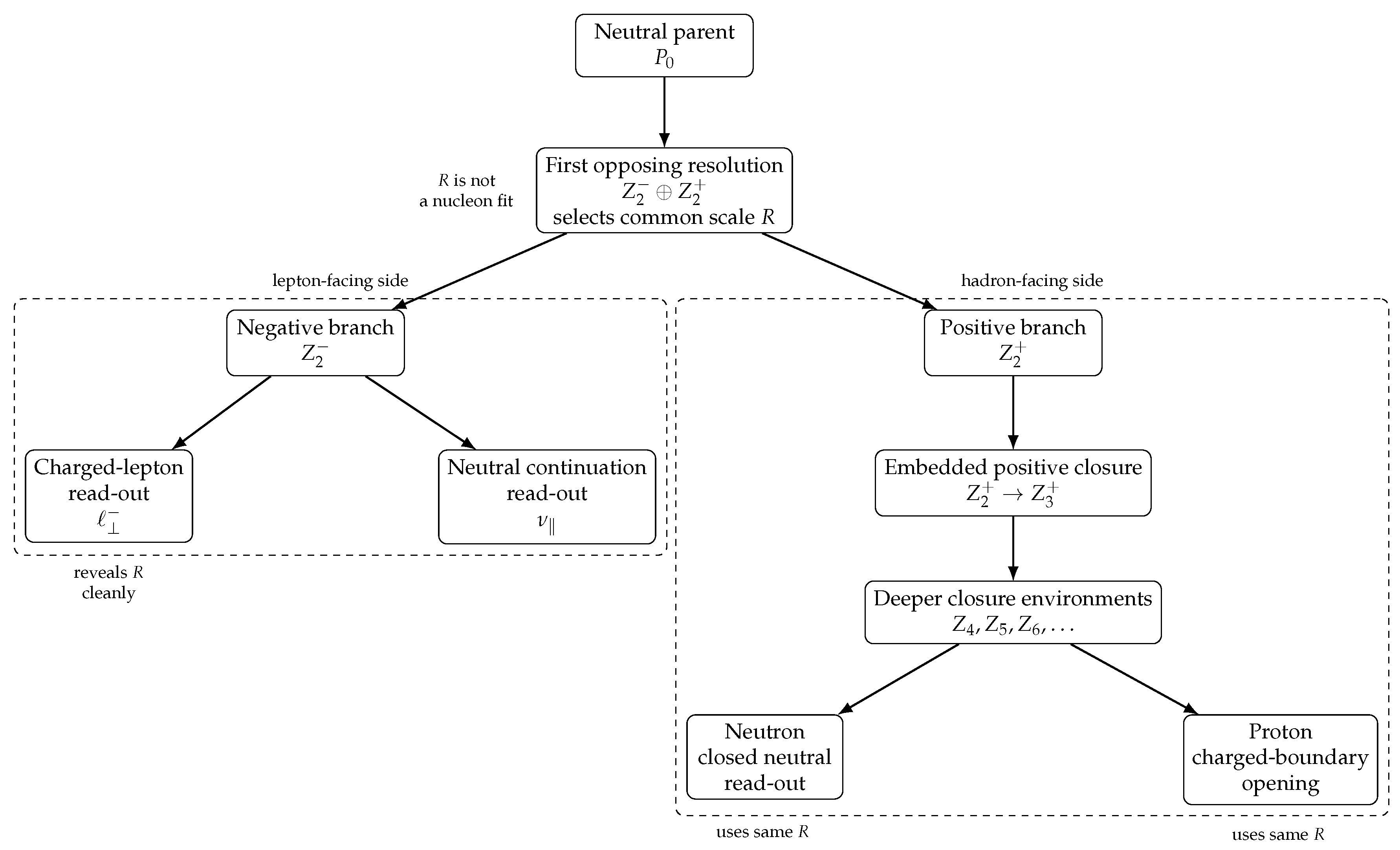
Figure 3.
Neutron and proton as distinct closure read-outs of the same first-resolution scale. The neutron is modeled as the lowest closed neutral read-out of the neutral-parent closure, with closure count . The proton is modeled as the lowest charged-boundary opening of the same closure, with boundary-opening count . Both formulas inherit the same first-resolution scale R, but differ by their carrier-facing chamber counts and overlap corrections. The neutron–proton splitting is then a derived consistency check rather than an independent input.
Figure 3.
Neutron and proton as distinct closure read-outs of the same first-resolution scale. The neutron is modeled as the lowest closed neutral read-out of the neutral-parent closure, with closure count . The proton is modeled as the lowest charged-boundary opening of the same closure, with boundary-opening count . Both formulas inherit the same first-resolution scale R, but differ by their carrier-facing chamber counts and overlap corrections. The neutron–proton splitting is then a derived consistency check rather than an independent input.
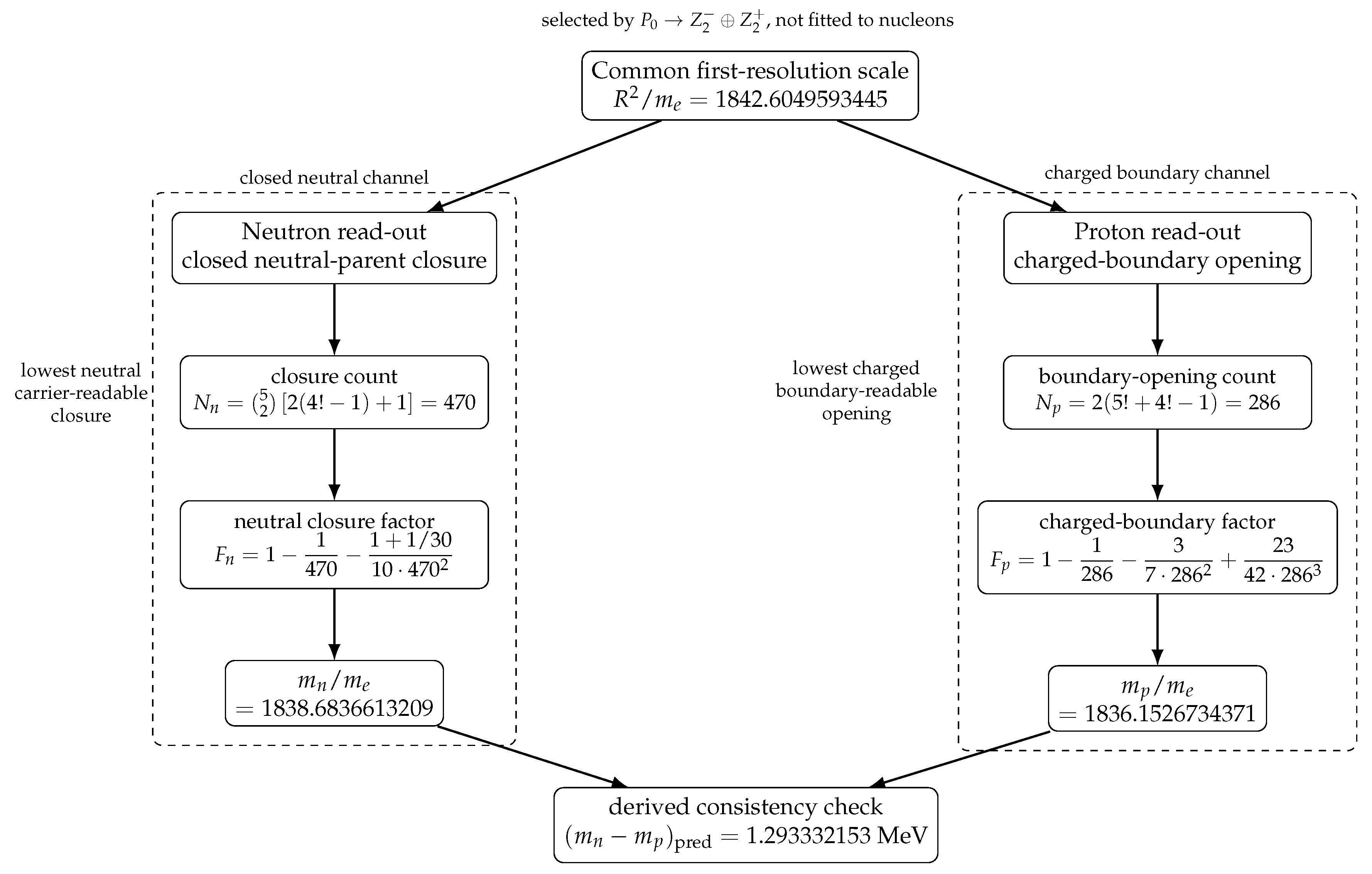
Disclaimer/Publisher’s Note: The statements, opinions and data contained in all publications are solely those of the individual author(s) and contributor(s) and not of MDPI and/or the editor(s). MDPI and/or the editor(s) disclaim responsibility for any injury to people or property resulting from any ideas, methods, instructions or products referred to in the content. |
© 2026 by the authors. Licensee MDPI, Basel, Switzerland. This article is an open access article distributed under the terms and conditions of the Creative Commons Attribution (CC BY) license (http://creativecommons.org/licenses/by/4.0/).
Copyright: This open access article is published under a Creative Commons CC BY 4.0 license, which permit the free download, distribution, and reuse, provided that the author and preprint are cited in any reuse.


