

Submitted:
26 May 2026
Posted:
24 June 2026
You are already at the latest version
Abstract
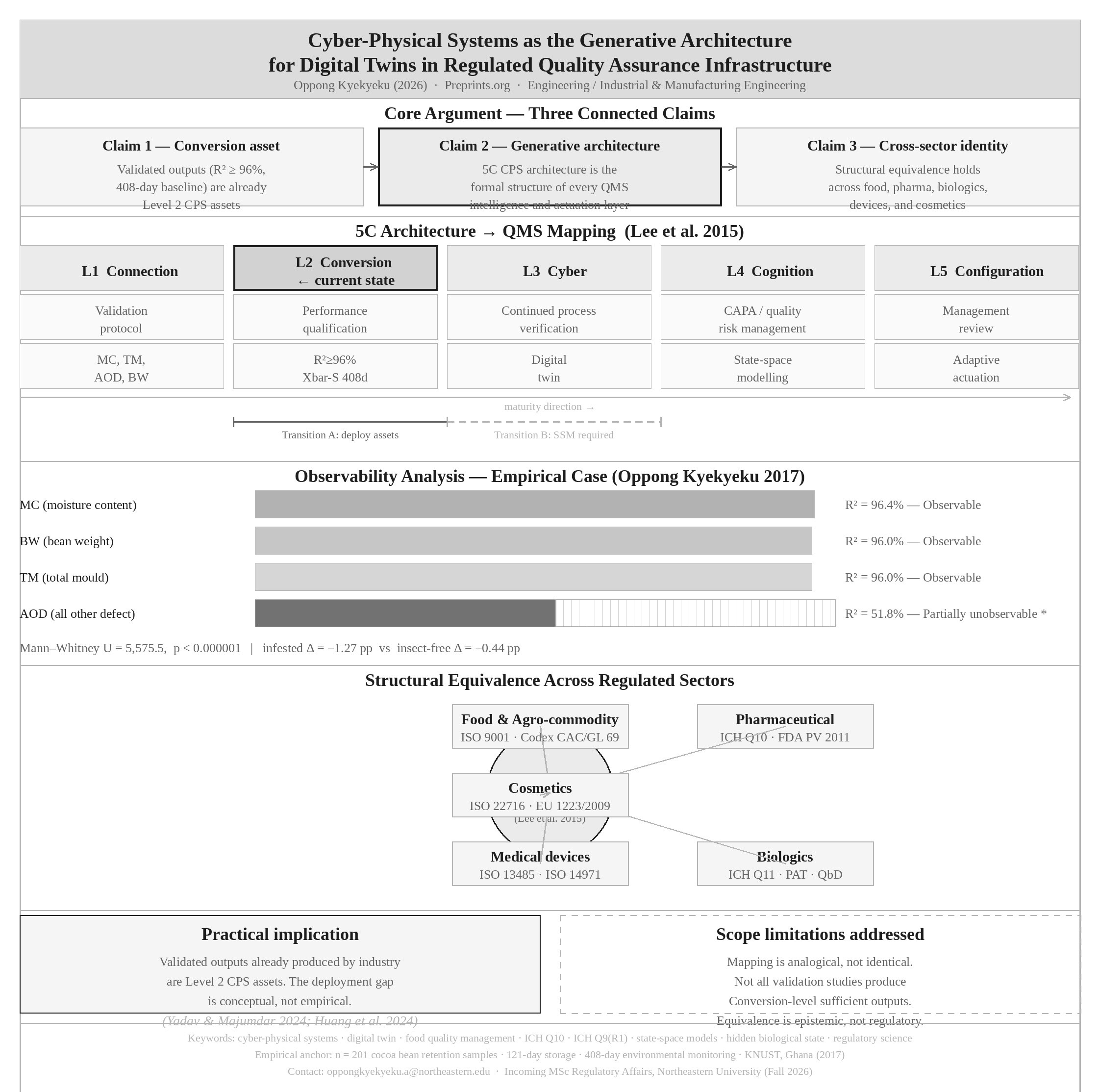
This perspective originates from an MSc thesis in Food Quality Management completed at Kwame Nkrumah University of Science and Technology (KNUST), Ghana, in 2017 (Oppong Kyekyeku 2017), which tested the performance of a closed-vessel storage system for dry cocoa beans against ISO 9001 requirements, establishing regression-based performance benchmarks across 201 retention samples over a 121-day storage period with 408 days of environmental monitoring. The present argument asks what those validated outputs imply beyond their original compliance purpose, and advances three connected claims. First, the parametric outputs of that performance qualification — regression benchmarks with R² ≥ 96.0% and a 408-day Xbar-S environmental baseline — constitute the Conversion-level model component that any digital twin requires as its performance baseline, resolving the primary modelling barrier to Cyber-level deployment. Second, the 5C cyber-physical systems architecture of Lee et al. (2015) is the generative architecture from which any digital twin in a regulated quality system must logically be derived: it is a formal description of what every Quality Management System requires in its intelligence and actuation dimensions, expressed in the vocabulary of control engineering rather than quality management. Third, this structural identity between QMS validation logic and the 5C CPS architecture holds uniformly across food, pharmaceutical, biologics, medical device, and cosmetics regulatory contexts, making the methods of performance qualification a transferable analytical competency across regulated industries. The perspective additionally reports new analysis of the motivating case infestation dataset (Mann–Whitney U = 5,575.5, p < 0.000001), which demonstrates that pre-storage biological state is a statistically significant predictor of post-storage defect outcome, with hidden biological state accounting for a minimum of 48.2% of unexplained variance in the All Other Defect variable. This finding is advanced as a concrete illustration of a class of observability problem — consequential latent variables undetectable by standard measurement protocols — that appears in structurally equivalent forms across all regulated sectors. Counterarguments to the generative claim are identified and addressed: the 5C framework was developed for industrial manufacturing health management rather than regulated quality assurance, and not all validation outputs meet the statistical criteria for Conversion-level sufficiency. These limitations delimit rather than invalidate the central argument.
Keywords:
cyber-physical systems
; digital twin
; food quality management
; storage system validation
; quality management systems
; ICH Q10
; ICH Q9(R1)
; GAMP 5
; ISO 13485
; state-space models
; hidden biological state
; statistical process control
; regulatory science
; process analytical technology
I. Introduction
The convergence of cyber-physical systems (CPS) theory, digital twin methodology, and IoT-enabled environmental monitoring has created the technical conditions for a fundamental transformation in how regulated quality systems operate: from retrospective measurement-and-document to real-time monitor-and-respond. Reviews published in leading food science journals have argued the case for digital twins in horticultural supply chains (Defraeye et al. 2021), confirmed their growing deployment in food processing (Bouras et al. 2025), and mapped the Industry 4.0 landscape of food quality management functions across monitoring, traceability, and process control (Peres et al. 2025; Bisht et al. 2025). Verdouw et al. (2021) demonstrated in five smart farming use cases how digital twins enable the decoupling of physical flows from planning and control, allowing remote monitoring and adaptive intervention — a precise description of the Cyber and Configuration levels that the 5C architecture of Lee et al. (2015) formalises. Huang et al. (2024), in a systematic review of 81 peer-reviewed papers on digital twin implementation in food supply chains, identified monitoring and real-time simulation as the core deployed capabilities, and confirmed that the primary implementation constraint is not technical capability but the absence of adequately parameterised physical models — the Conversion-level gap that performance qualification studies resolve. Parallel developments in pharmaceutical manufacturing under the FDA's Pharma 4.0 initiative, the second edition of GAMP 5 (ISPE 2022), and the emerging deployment of digital twins for bioprocess monitoring (Bhonsale et al. 2021) confirm that this transformation is not sector-specific. Regulatory milestones including ICH Q9(R1) (ICH 2023), ICH Q13 on continuous manufacturing, and ICH Q14 on analytical procedure development collectively signal a trajectory toward lifecycle-embedded, data-driven quality management across all regulated industries.
Against this backdrop, the present argument identifies and analyses a structural gap in the existing discourse. The parametric outputs that performance qualification studies generate — regression calibration functions, statistical process control baselines, threshold-bounded performance envelopes — are widely produced and filed as compliance artefacts, but are not systematically recognised for what they also constitute: a computational characterisation of system behaviour, and the necessary first prerequisite for deploying any validated system as a component of decision-capable quality infrastructure. Peres et al. (2025), reviewing 69 peer-reviewed Food Quality Management 4.0 studies, confirm that quality design — the function in which validation methodology belongs — remains the single most underrepresented domain in the food quality management literature, with quality control and quality assurance attracting the majority of Industry 4.0 technology applications. This finding extends the foundational argument of Luning and Marcelis (2007) that quality design is the single most consequential and most underinvested function in the food quality management disciplinary portfolio. The argument developed here applies with equal force to pharmaceutical, biologics, medical device, and cosmetics sectors, where validation outputs similarly reside in compliance archives rather than operational quality infrastructure.
The empirical foundation for this perspective is an MSc thesis in Food Quality Management completed at Kwame Nkrumah University of Science and Technology (KNUST), Kumasi, Ghana, in 2017 (Oppong Kyekyeku 2017). That thesis tested the performance of a closed-vessel retention sample storage system for dry cocoa beans against the requirements of ISO 9001, using a non-experimental, observational, cross-sectional study design to evaluate whether the system was fit for its intended purpose of maintaining initial sample quality after storage. Two hundred and one samples drawn from the 2015–2016 main crop and 2016 light crop seasons were stored in sterilised Kilner jars at controlled room temperature (20–25°C) for 121 days, with environmental monitoring conducted across a total period of 408 days using Testo 623 thermohygrometry and Xbar-S control charting in Minitab® 17 (Montgomery 2012). Standard quality assessment methods conforming to ISO 1114:1977 (cut test), ISO 2451:1973 (bean count), and the Aqua-boy KAM III moisture meter were applied before and after storage for moisture content (MC), total mould (TM), total slaty (TS), all other defect (AOD), and bean weight (BW). The study concluded a high-performance criterion for the storage system: 92.04% of samples maintained their initial quality grade, and regression benchmarks with R² ≥ 96.0% were developed for MC, TM, and BW as tools for future system verification. The present perspective does not repeat or extend those empirical findings. It asks a different question: what do those validated outputs imply beyond the compliance function they were designed to serve?
The perspective advances a generative claim: the 5C CPS architecture of Lee et al. (2015) is the generative architecture from which any digital twin in a regulated quality system must logically be derived, because it is a formal description of what every QMS requires in its intelligence and actuation dimensions. The sector-specific elaborations — ICH Q10 for pharmaceuticals, ICH Q11 for biologics, ISO 22716 for cosmetics, ISO 13485 for medical devices, and the Codex Alimentarius framework for food — are regulatory implementations of this general logic. Recognising this structural identity clarifies what investment is needed to deploy digital twins in regulated industries, and establishes that the knowledge and methods of performance qualification constitute the foundational layer of that investment. The article is structured as follows. Section II develops the theoretical framework and notes counterarguments. Section III establishes the qualification dataset as a Conversion-level CPS asset. Section IV develops the 5C conceptual model for regulated quality systems. Section V develops the core structural claim across all regulated sectors. Section VI identifies implications for research and practice. Section VII concludes.
II. Theoretical Framework
Quality Management Systems and the Logic of Performance Qualification
ISO 8402:1994 defines validation as confirmation by examination that requirements for a specific intended use are fulfilled (ISO 1994). This foundational definition — adopted across food, pharmaceutical, and device quality management standards, including ISO 9001:2015, ICH Q2(R2), and ISO 13485:2016 — is framed around the regulatory purpose of validation. That framing, while necessary for compliance governance, obscures a second yield that performance qualification studies produce: a computational characterisation of the system's behaviour that is not required for compliance but is essential for everything beyond it.
The QMS literature has consistently identified quality design as a distinct, higher-order function. Juran and Godfrey (1999) argued that quality planning — the function in which system characterisation belongs — is the upstream determinant of quality performance, and that deficiencies in quality planning cannot be corrected by more intensive inspection downstream. Deming (1986) established that quality must be designed into the producing system; it cannot be inspected into its outputs. Luning and Marcelis (2007), in a techno-managerial model of food quality management functions, identified quality design as the single most consequential and most underinvested function in the FQM disciplinary portfolio. These foundational arguments share a common implication: the outputs of a well-designed performance qualification study — regression benchmarks, environmental baselines, threshold-bounded performance envelopes — are quality design assets, not merely compliance artefacts.
The Codex Alimentarius Guidelines for the Validation of Food Safety Control Measures (CAC/GL 69-2008) define validation as obtaining evidence that a control measure, if properly implemented, is capable of controlling a hazard to a specified outcome (Codex Alimentarius Commission 2008). The FDA process validation guidance (FDA 2011) elaborates this through a three-stage lifecycle model: Stage 1 (process design), Stage 2 (process qualification), and Stage 3 (continued process verification). VanDuyse et al. (2021) demonstrate empirically that the release of ICH Q10 had a statistically significant positive impact (p < 0.0000) on pharmaceutical quality system enablers across five categories, with the most pronounced improvements in process monitoring systems and change management — precisely the elements that map to the Cyber and Configuration levels of the 5C architecture. The 2023 revision of ICH Q9 (ICH Q9(R1)) extends quality risk management scope to continuous, knowledge-driven, operationally embedded risk intelligence (ICH 2023), formally acknowledging that the gap between compliance documentation and decision-capable quality infrastructure must be closed.
The 5C Cyber-Physical Systems Architecture
Lee et al. (2015) proposed the 5C CPS architecture as a maturity framework for industrial cyber-physical systems: Connection, Conversion, Cyber, Cognition, Configuration. The framework was developed at the NSF Industry/University Cooperative Research Center on Intelligent Maintenance Systems at the University of Cincinnati as a step-by-step guideline for constructing a CPS from initial data acquisition through analytics to final value creation. It is selected here because its explicit Conversion level — the transformation of measurements into system performance models — maps precisely onto the outputs that performance qualification studies produce. Lee et al. describe the Conversion level as one that brings self-awareness to machines by calculating health values, estimated remaining useful life, and related performance indicators from raw sensor data; the QMS equivalent is the system's ability to compare current measurements against a validated performance baseline and flag assignable-cause deviations. Post-2015 CPS frameworks, including those that expand the cyber layer to accommodate artificial intelligence and Industrial IoT, are noted in the literature (Jagatheesaperumal et al. 2021), but the 5C model retains analytical utility because of this direct mapping.
Connection generates data: discrete measurements of physical variables under specified conditions. Conversion generates information: computational models of system behaviour. Cyber deploys those models in real time via the digital twin. Cognition infers unobservable system states. Configuration closes the feedback loop. The argument advanced here is that these five levels are not a novel engineering proposal but a formalisation of what QMS logic has always required, and that validated system outputs already constitute Level 2 assets — one architectural step from digital twin readiness (Figure 1).
This reading is consistent with the ICH Q8(R2) conception of quality by design, in which a fully characterised product and a well-defined process constitute the scientific foundation for regulatory flexibility (ICH 2009a). It is further consistent with the FDA PAT framework, which defines a process as well understood when variability between batches is explained, good runs are distinguishable from bad runs in advance, and all factors that can alter quality are accounted for and understood (FDA 2004). The Conversion level of the 5C architecture is precisely the condition the PAT framework calls process understanding; the Cyber level is the condition it calls real-time quality assurance.
State-Space Models and the Hidden State Problem in Biological Quality Systems
Biological quality systems introduce a complication that physical or chemical engineering systems do not: the presence of consequential unobservable variables — hidden state — that drive quality outcomes without being detectable by standard measurement protocols. The theoretical treatment of hidden state has two main bodies: observability theory in control engineering, formalised by Luenberger (1966), which asks whether the internal states of a system can be reconstructed from its measurable outputs; and state-space models (SSMs) in ecology and statistics, including Hidden Markov Models as their discrete-state special case (Auger-Méthé et al. 2021; McClintock et al. 2020).
Auger-Méthé et al. (2021) describe how SSMs formally disentangle the state process — the unobserved underlying dynamics of interest — from the observation process — how those hidden dynamics produce the imperfect measurements that are actually available. The Kalman filter (Kalman 1960) and its nonlinear extensions provide the mathematical machinery for continuous state estimation from available observables. The hidden biological state problem in agro-commodity storage is structurally isomorphic to latent variable problems encountered in biologics manufacturing, where the metabolic state of a cell culture, the viral clearance efficiency of a purification step, or the glycosylation trajectory of a therapeutic protein may be partially unobservable from available PAT instruments (Rathore et al. 2021). In pharmaceutical manufacturing, ICH Q9(R1) formally recognises that quality risks arising from partially unobservable process states require quantitative probabilistic modelling rather than qualitative ranking; the Bayesian and simulation-based methods it endorses are, in functional terms, the same state estimation apparatus that SSMs deploy (ICH 2023). In each regulated sector, the formal solution is identical: specify the hidden state, model its dynamics using available prior knowledge, and design the observation protocol to generate sufficient evidence for state estimation.
Counterarguments and Scope Limitations
Three substantive counterarguments to the generative claim advanced in this perspective merit explicit consideration. First, the 5C architecture was designed for industrial health management and prognostics, specifically for machine tools and manufacturing equipment, not for regulated quality assurance systems. The mapping proposed here is therefore an analogical extension, not a direct application. The response to this objection is not to deny it but to argue that the structural logic of the two domains is sufficiently parallel that the extension is warranted: both domains require measurement-to-model (Conversion), model-to-real-time-state (Cyber), unobservable-state-inference (Cognition), and state-to-actuation (Configuration). Whether that structural parallel is sufficient to justify describing the 5C architecture as generative for QMS digital twins is a theoretical question that this perspective advances as a claim, not demonstrates as a proof. Empirical validation of the mapping across multiple regulatory contexts would strengthen it considerably.
Second, not all performance qualification studies produce outputs that meet the statistical criteria for Conversion-level sufficiency. A validation study with small n, narrow environmental range, or a compliance-driven rather than modelling-driven analytical strategy may produce a pass-fail certificate rather than a parameterised computational description. The R² ≥ 96.0% benchmarks and 408-day environmental baseline in the motivating case reflect a study design that, whether or not intentionally, happened to generate Conversion-level outputs. The more common outcome in regulatory practice may be a validated system with inadequate computational characterisation. This limitation is real and delimits the scope of the argument: the claim is that where validation studies have been designed or happen to produce adequate Conversion-level outputs, no additional empirical work is needed to proceed to digital twin deployment. Where they have not, such work remains necessary.
Third, the cross-sector structural equivalence claimed in Table 2 may overstate the similarity between sectors with very different regulatory philosophies, risk profiles, and measurement technologies. The food sector operates under a hazard-based, Codex-aligned framework with significant latitude in validation methodology; the pharmaceutical sector operates under a prescriptive, ICH-harmonised framework with mandatory stage definitions; the medical device sector operates under design-input verification and post-market surveillance obligations that differ structurally from both. The structural identity argued here operates at the level of epistemic logic — characterise, model, monitor, infer, act — not at the level of regulatory requirement detail, and should be read accordingly.
III. Validated System Outputs as Conversion-Level Cps Assets
The Regression Benchmarks as Performance Model
In the motivating empirical case (Oppong Kyekyeku 2017), the Conversion-level outputs from the cocoa bean storage qualification included regression benchmarks in which pre-storage measurements were modelled as a function of post-storage measurements: MC(Before) = −0.0376 + 1.03 × MC(After) (R² = 96.4%); TM(Before) = −0.0566 + 0.988 × TM(After) (R² = 96.0%). This directionality — predicting before-storage state from after-storage measurements — is the operationally relevant function for retention sample re-testing: the question asked in trade arbitration is what quality the sample had at entry to storage, not what it will be after storage. Pearson correlations exceeded r = 0.980 for both MC and TM.
The operational significance of R² ≥ 96.0% is that at the mean before-storage MC of 6.876%, the 95% prediction interval is approximately ±0.3 percentage points — well within the 8.0% w/w Codex Alimentarius safety threshold for cocoa beans (Codex Alimentarius Commission 2006). The regression generates deviation flags with precision that is operationally meaningful: a measurement outside the predicted interval signals an assignable-cause event rather than common-cause variation, in the Montgomery (2012) sense. This is the functional criterion for Conversion-level sufficiency in a digital twin context — not R² as an abstract goodness-of-fit statistic but as a determinant of prediction interval width relative to the operational decision threshold. The limitation identified in Section II applies here directly: the sufficiency of R² ≥ 96.0% is specific to this system, these analytes, and this decision threshold. Other commodity systems may require different statistical thresholds before their validation outputs constitute adequate Conversion-level parameters.
The 408-day Xbar-S environmental monitoring record constitutes the second Conversion-level output: a statistical model of the system's environmental baseline. The process mean of 21.3°C with upper and lower control limits of 22.9°C and 19.7°C respectively, stable across all 20 monitoring subgroups, represents a system in statistical control (Montgomery 2012): its future behaviour is predictable within established limits. This is observability in the Luenberger (1966) sense — the system's relevant states can be reconstructed from its measurable outputs. GMP Annex 19 (European Commission 2006) mandates that reference and retention samples be stored in accordance with documented protocols and that their integrity be assessable should the need arise during the shelf life of the batch concerned. A Level 3 Cyber-capable system transforms this static compliance requirement into a dynamic auditable record: the continuous environmental monitoring stream documents actual system behaviour throughout each specific retention period, providing evidence that the conditions experienced by individual samples were within the validated envelope. ISO/IEC 17025:2017 and the Codex CAC/GL 69-2008 guidelines both point toward continuous, auditable performance records as the emerging standard of evidence in regulated quality contexts — a standard already operationalised in pharmaceutical GMP through 21 CFR Part 11 electronic record integrity.
Threshold Boundaries as Observable Quality Criteria
A critical feature of Conversion-level characterisation is the definition of threshold boundaries: the performance limits within which a system operates as validated, and beyond which quality integrity cannot be assured. In the motivating case, the critical MC threshold of 8.0% w/w, established through regression confidence intervals, Xbar-R control chart limits, and the Codex Alimentarius specification (Codex Alimentarius Commission 2006), identified three samples as boundary failures — out-of-control observations in SPC terminology (Montgomery 2012). With the validated model, these samples are diagnostically interpretable: their deviation pattern carries information about whether the failure is isolated or systemic, transient or persistent. The same logic applies, without modification to the underlying framework, to a temperature excursion in a pharmaceutical cold-chain storage system, a particle count anomaly in a GMP cleanroom, a dimensional deviation in a medical device manufacturing process, or a viscosity drift in a cosmetic batch. The structural logic of Conversion-level threshold definition is common across regulated sectors; its regulatory expression differs sector by sector.
IV. A Conceptual Model for Regulated Quality Systems
The 5C CPS architecture provides a technically grounded maturity model for regulated quality systems. Table 1 presents the adapted conceptual model, mapping the architecture to agro-commodity storage quality applications with observability status annotated for each level. Figure 1 illustrates the sequential structure of the architecture and marks the two principal architectural transitions argued in this perspective. The framework is proposed as a conceptual lens, not a prescriptive implementation guide.
Levels 1 and 2 as the Validated Baseline
Levels 1 and 2 correspond to the validated physical quality system as currently practised in regulated food and manufacturing contexts. Connection encompasses the instrumented measurement of quality variables under documented, reproducible conditions. Conversion encompasses the computational transformation of those measurements into system performance models. Level 2 outputs are what Tao et al. (2019) and Grieves and Vickers (2017) describe as the model component of a digital twin: the virtual representation of the physical system's behaviour that makes real-time state comparison possible. Grieves and Vickers (2017) define the digital twin as a set of virtual information constructs that fully describes a potential or actual physical system such that any information obtainable from inspecting the physical system can be obtained from its twin. The challenge identified consistently across the CPS and digital twin literature is not technical capability but the absence of adequately parameterised physical models to anchor the digital twin (Bouras et al. 2025; Huang et al. 2024; Yadav and Majumdar 2024). Storage and manufacturing system validation studies resolve this challenge for their specific domains; the argument of this perspective is that this resolution is structural and general, not case-specific.
Level 3 as the Digital Twin of the Quality Environment
Level 3 is the first transformative capability: the continuous synchronisation of a virtual representation of the quality system with real-time data from the physical environment. The primary modelling barrier to digital twin deployment is resolved by the validated outputs the qualification study already produced: the regression benchmarks serve as the twin's performance model; the validated control chart limits serve as the twin's alert thresholds; the 408-day environmental monitoring record serves as the twin's environmental baseline. Defraeye et al. (2021), analysing digital twins in postharvest supply chains of fresh horticultural produce, identify that the main developmental step for digital twin deployment lies not in sensor infrastructure — which is already commercially available — but in model setup and establishing the link with sensor data. This diagnosis applies directly to dry agro-commodity storage: the Connection-level infrastructure is accessible; the Conversion-level model has been generated by the qualification study; the remaining step is architectural deployment rather than additional empirical characterisation. Huang et al. (2024) confirm that monitoring and real-time simulation are the core deployed digital twin capabilities in food supply chains; dry agro-commodity retention sample storage represents an identified and achievable gap.
Level 4 and the Hidden Biological State Problem
Level 4 is where the architecture of biological quality systems diverges from physical or chemical engineering systems. The All Other Defect (AOD) variable in the motivating case exhibited only 51.8% explained variability between before- and after-storage measurements (Pearson r = 0.720), contrasting sharply with R² ≥ 96.0% for MC and BW. This is not a system performance deficit; it is an observability deficit. The system performs as designed for the variables it can observe. What it cannot observe — the pre-storage biological state of the sample — drives a substantial fraction of the quality outcome that the physical model cannot account for (Figure 2).
New analysis of the infestation dataset from the motivating case confirms this. A Mann–Whitney U test demonstrates that samples with detectable live insect presence before storage (n = 49; 24.4% of the population) showed a mean AOD change of −1.269 percentage points post-storage, compared to −0.435 percentage points for insect-free samples (n = 152; U = 5,575.5, p < 0.000001). Departure from normality was confirmed prior to test selection (Shapiro–Wilk: W = 0.81, p < 0.001 for infested samples; W = 0.89, p < 0.001 for insect-free samples). The observed effect of 0.834 percentage points is a lower bound on the true biological state effect: pre-storage infestation was classified by visual inspection, a protocol known to miss early-stage insect presence at commercially relevant densities (Biancolillo et al. 2019; Johnson 2020). Pre-storage biological state is therefore a consequential unobserved variable, and the 48.2% unexplained AOD variability is an information gap rather than system noise or model inadequacy.
The appropriate theoretical framework for addressing this gap is state-space modelling, which formally separates the hidden state process from the imperfect observation process (Auger-Méthé et al. 2021). For the food quality management case, this means specifying infestation status as the hidden state, modelling its dynamics using known insect biology, and identifying the minimum observable set — gas composition dynamics, NIR spectroscopic signatures, volatile compound profiles (Kendra et al. 2011; Biancolillo et al. 2019; Johnson 2020) — from which that state can be estimated with acceptable precision (Montanari et al. 2022). This requires neither fundamental methodological innovation nor new sensing principles; it requires the application of established state estimation methods to a domain where they have not yet been systematically applied.
Oxygen Depletion as a Naturally Occurring Observable Proxy
Live insect detection rates fell from 24.4% pre-storage to 6.0% post-storage in the hermetically sealed closed-vessel system — a 75% reduction consistent with oxygen depletion through modified atmosphere creation (Essien et al. 2010; Villers 2010). Donga and Baributsa (2023) demonstrated that oxygen depletion rates in hermetically sealed glass jars vary systematically with temperature and initial insect infestation level, confirming that O2/CO2 concentration dynamics are an observation variable with a known relationship to the hidden state of infestation level. The physiological mechanism is well established: oxygen limitation constrains respiratory activity, as demonstrated for lepidopteran eggs by Woods and Hill (2004) and confirmed across stored-product insect orders in hermetic storage contexts (Adler and Müller-Blenkle 2024; Donga and Baributsa 2023). Container integrity is a prerequisite for using this signal reliably; comprehensive reviews confirm that continuous O2/CO2 monitoring in sealed storage environments remains under-developed as a commercial quality assurance tool (Aouad et al. 2025).
Level 5 and Adaptive Environmental Response
Level 5 closes the feedback loop: system state knowledge directs actuation to maintain the system within defined quality bounds. The motivating case operated a passive form of Configuration: air conditioning maintained the storage environment within the validated temperature range, sufficient to maintain MC within acceptable bounds for 97.5% of samples. In biological quality systems, Configuration must respond to estimated hidden state signals rather than only directly observable ones. In the food quality management case, a rising CO2 trajectory in a hermetically sealed storage vessel — the observable proxy for infestation-driven oxygen depletion — can trigger modified atmosphere enhancement before defect levels escalate (Essien et al. 2010). The enabling logic is structurally identical across regulated sectors: in pharmaceutical manufacturing, PAT data streams indicating drift in a critical quality attribute trigger adaptive process interventions under ICH Q8(R2); in biologics bioprocessing, dissolved oxygen or pH trajectories deviating from validated ranges trigger feed or correction interventions before product quality is compromised (Rathore et al. 2021). Configuration responds to a state signal — observed or estimated — rather than waiting for the downstream quality measurement that confirms the failure has already occurred.
V. The QMS Body of Knowledge as the Generative Foundation for Cyber-Physical Digital Twins
The Structural Identity Between QMS Validation Logic and the 5C Architecture
The core validation logic of any QMS — whether ISO 9001:2015, ICH Q10, ISO 13485:2016, or Codex CAC/GL 69-2008 — follows an identical epistemic structure. A system is characterised under defined conditions (Connection and Conversion); its performance is compared against validated benchmarks on an ongoing basis (Cyber); its ability to produce acceptable outputs is monitored for drift or deviation (Cognition); and corrective and preventive actions are taken to maintain the system within its validated state (Configuration). What the QMS literature calls validation, qualification, process performance monitoring, CAPA, and management review are, in 5C terms, Connection, Conversion, Cyber, Cognition, and Configuration. The terminology differs; the logical structure is identical.
The FDA process validation lifecycle (FDA 2011) makes this identity explicit. Stage 1 (process design) corresponds to Conversion-level model generation. Stage 2 (process qualification) corresponds to Connection-level data collection producing a validated Conversion-level model. Stage 3 (continued process verification) is the Cyber level operating continuously against the Stage 2 validated model. ICH Q10 adds Cognition and Configuration through its Knowledge Management and CAPA elements (VanDuyse et al. 2021). GAMP 5 (ISPE 2022), the pharmaceutical industry's governing framework for computerised system validation, makes the same structural argument for software-mediated quality systems: the V-model from user requirements specification through performance qualification generates Conversion-level computational models of software system behaviour. ICH Q9(R1) (ICH 2023) extends this architecture to risk intelligence, requiring continuous, knowledge-driven, operationally embedded risk assessments — a Cognition-level function. The ICH Q11 guideline (ICH 2012) distinguishes a traditional approach — which produces a Level 2 asset — from an enhanced approach, which produces a Level 3-and-above asset; as McDonald and Ho (2012) note, ICH Q11 reconfirms that greater process understanding creates the basis for more flexible regulatory approaches.
Cross-Sector Evidence from Regulated Industries
Table 2 presents a cross-sector mapping of key QMS dimensions across five regulated sectors, with the CPS readiness implication identified for each. The mapping demonstrates that the structural parallel between QMS validation logic and the 5C CPS architecture holds across all five sectors at the level of epistemic logic, subject to the scope limitations identified in Section II.
Level 4 Observability Challenges Across Regulated Sectors
The Level 4 Cognition problem — inferring consequential system states that standard measurement protocols cannot directly observe — appears in structurally equivalent forms across all five sectors. In pharmaceutical manufacturing, the microbiological contamination state of a controlled production environment between scheduled environmental monitoring sessions is not continuously observable; risk-based monitoring frequency decisions under ICH Q9(R1) (ICH 2023) are, in formal terms, informal state estimation decisions. In biologics manufacturing, the metabolic state of a cell culture between offline sampling points is not directly observable from real-time measurements; PAT instruments measure surrogate variables from which cell culture state is inferred rather than directly read (Rathore et al. 2021). In medical device manufacturing, the fatigue or degradation state of a polymer component under cumulative stress is not directly visible; ISO 14971:2019 risk management and accelerated ageing protocols are attempts to estimate this hidden state through modelled proxies rather than direct observation (Sampath et al. 2022). In cosmetics, the microbiological challenge state of a preserved formulation throughout its shelf life is not observable without destructive sampling; Preservative Efficacy Testing and the EU Cosmetics Products Regulation (1223/2009) safety assessment framework are, structurally, periodic observation events from which ongoing hidden state is inferred (Coiffard et al. 2008). In each case, state-space modelling provides a more rigorous and principled foundation for Cognition-level quality intelligence than the informal inferential practices currently embedded in sector-specific guidance.
VI. Implications for Research and Practice
Validated System Confidence as Regulatory Evidence
Retention sample storage systems serve a specific evidentiary function: they preserve the quality state of a commodity or product at a defined point in time so that if quality is disputed downstream, the stored sample can be re-tested and the result compared against the original assessment. The evidentiary value depends entirely on whether the storage system maintained the sample's initial quality during the retention period, which is what validation demonstrates (European Commission 2006; ISO/IEC 2017). A validated Level 2 system provides static assurance: the system was shown to maintain quality under specified conditions. A Cyber-level Level 3 system provides a dynamic record: the system's actual behaviour throughout the specific retention period is documented, compared continuously against the validated baseline, and available as auditable evidence of storage integrity for that sample during that particular period.
This evidentiary logic has acquired new institutional force through the EU Deforestation Regulation (European Parliament and Council 2023), which requires operators placing cocoa and cocoa products on the EU market to provide verifiable documentation of product origin and handling conditions. The continuous storage quality record that a Level 3 validated system provides is the logical extension of the traceability infrastructure that systems such as the Ghana Cocoa Board's traceability programme initiate at farm-to-port level. In medical device regulation, the EU MDR 2017/745 post-market surveillance requirements and unique device identifier system create structurally equivalent demands for continuous, auditable quality records across a product's entire lifecycle (European Parliament and Council 2017). ISO/IEC 17025:2017 and Codex CAC/GL 69-2008 both point toward continuous, auditable performance records as the emerging standard of evidence in regulated quality contexts — a standard already operationalised in pharmaceutical GMP through batch record requirements and 21 CFR Part 11 electronic record integrity. CPS architecture is the natural vehicle for meeting these standards across all regulated sectors.
Redesigning Validation Studies for Conversion-Level Outputs
The reconceptualisation proposed in this perspective has direct consequences for how performance qualification studies are designed and reported. A Conversion-level framing emphasises model quality: does the study generate benchmarks with sufficient statistical power and narrow confidence intervals to function as reliable reference functions? Is the environmental monitoring record longitudinal enough to capture operational variation across seasons and conditions? The motivating case, with n = 201 retention samples and 408 days of environmental monitoring, happened to meet these requirements, yielding regression benchmarks with R² ≥ 96.0%. Luning and Marcelis (2007) identified quality design as a distinct managerial function requiring deliberate technical investment. Designing validation studies for Conversion-level utility is that activity: it requires deciding in advance what the study's outputs will be used for beyond compliance and designing the study accordingly. This argument applies across pharmaceutical process validation, medical device design verification, analytical method validation in food testing laboratories, and cosmetics process performance qualification.
Pre-Storage Biological State Characterisation as an Observability Problem
The most consequential research direction identified by this perspective is the reformulation of pre-storage quality assessment as a formal observability problem. Current protocols for dry agro-commodity quality assessment — ISO 1114:2023 cut test, moisture determination, bean weight — are Connection-level instruments: they measure the current observable state with no inference about the hidden biological state that will drive quality trajectories over the subsequent storage period. The 48.2% unexplained AOD variability and the highly significant infestation group effect (U = 5,575.5, p < 0.000001) quantify the operational cost of this information gap. Closing this gap requires specifying which biological state variables are most consequential for quality trajectory prediction; identifying the minimum observable set from which those hidden states can be estimated with acceptable precision (Luenberger 1966; Montanari et al. 2022); and developing or adapting sensing technologies — NIR spectroscopy, gas composition sensors, hyperspectral imaging — that can deliver those observables at commercial throughput and cost. The methodological precedent for this integration is available in biologics process characterisation (Rathore et al. 2021) and in published SSM applications to ecological time series (Auger-Méthé et al. 2021).
VII. Conclusion
This perspective has argued that validated system outputs are Conversion-level CPS assets and that the gap between Level 2 validation and Level 3 digital twin readiness is conceptual rather than technical. The 5C CPS architecture is the generative framework from which any sector-specific digital twin must logically be derived, because it is a formal description of what any QMS requires in its intelligence and actuation dimensions — a description that the regulatory vocabulary of food, pharmaceutical, biologics, medical device, and cosmetics governance encodes in sector-specific terms without naming the underlying structure. This claim is advanced as a theoretical proposition, subject to the scope limitations and counterarguments identified in Section II: the mapping is analogical, not identical; sufficiency of Conversion-level outputs is context-dependent; and the structural equivalence across sectors operates at the level of epistemic logic, not regulatory detail.
The structural identity demonstrated in Table 2 carries a practical implication: the validated system outputs that regulated industries have already generated — regression benchmarks, environmental monitoring baselines, SPC control charts, performance qualification records — are Level 2 assets, one architectural step from digital twin readiness. The deployment gap across all five sectors is the same, and so is its resolution: the institutional commitment to deploy those assets as active decision-capable infrastructure in the connectivity and data governance frameworks that the Cyber level requires. Yadav and Majumdar (2024) confirm that lack of technology infrastructure, technology immaturity, and high capital investment are the dominant causal barriers to digital twin adoption in agro-food supply chains — importantly, not the absence of a system performance model. This confirms the specific argument of this perspective: the modelling barrier, which the present paper addresses, is not the binding constraint; the deployment infrastructure barriers are, and they are well-defined and addressable.
The Level 4 Cognition problem — inferring consequential hidden state from imperfect observable proxies — is a formally tractable observability problem that appears in sector-specific forms across all regulated industries. In each case, state-space modelling provides the principled framework for separating what can be observed from what must be inferred, and for designing observation protocols that close the gap between them as efficiently as the available sensing technology permits. The regulatory context has sharpened significantly: EUDR compliance requirements, FDA Pharma 4.0 initiatives, EU MDR expanded post-market surveillance obligations, and ICH Q13 and Q14 harmonisation are creating convergent pressures toward continuous, auditable quality intelligence. The analytical competency that this transformation requires — performance qualification, regression-based benchmarking, SPC-based environmental monitoring, and risk-based hidden state characterisation — is the same competency, expressed in sector-specific vocabularies, that the QMS body of knowledge already encodes.
Author Contributions
Anthony Oppong Kyekyeku: Conceptualisation, Methodology, Formal analysis, Writing — original draft, Writing — review and editing, Visualisation.
Funding
This perspective draws on research completed as part of the MSc Food Quality Management programme at Kwame Nkrumah University of Science and Technology (KNUST), Kumasi, Ghana. No external funding was received for the preparation of this manuscript.
Data Availability Statement
The empirical dataset (n = 201 retention samples) was generated as part of the MSc thesis (Oppong Kyekyeku 2017) and is available from the corresponding author on reasonable request.
Conflicts of Interest
The author declares no conflict of interest.
References
- Codex Alimentarius Commission. Code of Practice for the Prevention and Reduction of Mycotoxin Contamination in Cereals (CAC/RCP 51-2003, Rev. 1-2006); FAO/WHO, 2006. [Google Scholar]
- Codex Alimentarius Commission. Guidelines for the Validation of Food Safety Control Measures (CAC/GL 69-2008); FAO/WHO, 2008. [Google Scholar]
- European Commission. GMP Guidelines Annex 19: Reference and Retention Samples; EudraLex, 2006; Volume 4. [Google Scholar]
- European Parliament and Council. Regulation (EC) No 1223/2009 on Cosmetic Products. Official Journal of the European Union. 2009.
- European Parliament and Council. Regulation (EU) 2017/745 on Medical Devices. Official Journal of the European Union. 2017.
- European Parliament and Council. Regulation (EU) 2023/1115 on the Making Available on the Union Market and the Export from the Union of Certain Commodities and Products Associated with Deforestation and Forest Degradation (EU Deforestation Regulation). Official Journal of the European Union. 2023.
- International Council for Harmonisation. ICH Q10: Pharmaceutical Quality System; ICH, 2008. [Google Scholar]
- International Council for Harmonisation. ICH Q8(R2): Pharmaceutical Development; ICH, 2009a. [Google Scholar]
- International Council for Harmonisation. ICH Q11: Development and Manufacture of Drug Substances; ICH, 2012. [Google Scholar]
- International Council for Harmonisation. ICH Q9(R1): Quality Risk Management, Final version adopted 18 January 2023; ICH, 2023. [Google Scholar]
- International Organization for Standardization. ISO 8402:1994; Quality Management and Quality Assurance — Vocabulary. ISO, 1994.
- International Organization for Standardization. ISO 22716:2007; Cosmetics — Good Manufacturing Practices. ISO, 2007.
- International Organization for Standardization. ISO 9001:2015; Quality Management Systems — Requirements. ISO, 2015.
- International Organization for Standardization. ISO 13485:2016; Medical Devices — Quality Management Systems — Requirements for Regulatory Purposes. ISO, 2016.
- International Organization for Standardization. ISO 14971:2019; Medical Devices — Application of Risk Management to Medical Devices. ISO, 2019.
- International Organization for Standardization. ISO 1114:2023; Cocoa Beans — Cut Test. ISO, 2023.
- International Organization for Standardization / International Electrotechnical Commission. ISO/IEC 17025:2017; General Requirements for the Competence of Testing and Calibration Laboratories. ISO, 2017.
- ISPE. GAMP 5: A Risk-Based Approach to Compliant GxP Computerised Systems, 2nd ed.; International Society for Pharmaceutical Engineering, 2022. [Google Scholar]
- U.S. Food and Drug Administration. Guidance for Industry: PAT — A Framework for Innovative Pharmaceutical Development, Manufacturing, and Quality Assurance; FDA, 2004.
- U.S. Food and Drug Administration. Process Validation: General Principles and Practices; FDA, 2011.
- Adler, C.; Müller-Blenkle, C. 'Increasing the Oxygen Consumption in Hermetic Grain Storage Using Grain Weevils (Sitophilus granarius). Insects 2024, 15(11), 845. [Google Scholar] [CrossRef] [PubMed]
- Aouad, L.; Mahoux, M.; Nuité, V.; Vandeghen, Z.; Bodson, B. 'Review of Monitoring Systems for Stored Grains in a Modified Atmosphere. Heliyon 2025, 11(3), e42329. [Google Scholar] [CrossRef] [PubMed]
- Auger-Méthé, M.; Newman, K.; Cole, D.; Empacher, F.; Gryba, R.; King, A. A.; Leos-Barajas, V.; Mills Flemming, J.; Nielsen, A.; Petris, G.; Thomas, L. 'A Guide to State-Space Modeling of Ecological Time Series. Ecol. Monogr. 2021, 91(4), e01470. [Google Scholar] [CrossRef]
- Bhonsale, S.; Telen, D.; Stokbroekx, B.; Van Impe, J. 'Digital Twin of a Continuous Pharmaceutical Manufacturing Process. IFAC-PapersOnLine 2021, 54(3), 255–260. [Google Scholar] [CrossRef]
- Biancolillo, A.; Bucci, R.; Magrì, A. L.; Magrì, A.; Marini, F. 'Determination of Insect Infestation on Stored Rice by Near Infrared (NIR) Spectroscopy. Microchem. J. 2019, 145, 252–258. [Google Scholar] [CrossRef]
- Bisht, B.; Rawat, K.; Vohat, A.; Jangid, N.; Singh, N.; Nishinari, K.; Vlaskin, M. S.; Kurbatova, A.; Kumar, V. 'Industry 4.0 Digital Transformation: Shaping the Future of Food Quality. Food Control 2025, 170, 111030. [Google Scholar] [CrossRef]
- Bouras, M.; Lu, Q.; Fei, F.; Wan, T.; Ning, H. 'Digital Twin Applications in the Food Industry: A Review. Front. Sustain. Food Syst. 2025, 9, 1538375. [Google Scholar] [CrossRef]
- Coiffard, L.; Fisher, A.; Gidoin, P.; Hamon, F.; Kouznetzoff, A. Cosmetics — Good Manufacturing Practices — Guidelines on GMP: The ISO 22716:2007 Standard — Questions and Answers. STP Pharma Prat. 2008, 18(4), 333–360. [Google Scholar]
- Defraeye, T.; Shrivastava, C.; Berry, T.; Verboven, P.; Onwude, D.; Schudel, S.; Bühlmann, A.; Cronje, P.; Rossi, R. M. 'Digital Twins Are Coming: Will We Need Them in Supply Chains of Fresh Horticultural Produce?'. Trends Food Sci. Technol. 2021, 109, 245–258. [Google Scholar] [CrossRef]
- Deming, W. E. Out of the Crisis; MIT Press: Cambridge, MA, 1986. [Google Scholar]
- Donga, T. K.; Baributsa, D. 'Effect of Temperature and Insect Infestation Levels on Oxygen Depletion in Hermetic Storage. Insects 2023, 14(7), 621. [Google Scholar] [CrossRef] [PubMed]
- Essien, J. P.; Navarro, S.; Villers, P. 'Hermetic Storage: A Novel Approach to the Protection of Cocoa Beans. Afr. Crop Sci. J. 2010, 18(2), 59–68. [Google Scholar]
- Grieves, M.; Vickers, J. 'Digital Twin: Mitigating Unpredictable, Undesirable Emergent Behavior in Complex Systems.'. In Transdisciplinary Perspectives on Complex Systems; Kahlen, F.-J., Flumerfelt, S., Alves, A., Eds.; Springer: Cham, 2017; pp. 85–113. [Google Scholar] [CrossRef]
- Huang, Y.; Ghadge, A.; Yates, N. 'Implementation of Digital Twins in the Food Supply Chain: A Review and Conceptual Framework. Int. J. Prod. Res. 2024, 62(17), 6400–6426. [Google Scholar] [CrossRef]
- Jagatheesaperumal, S. K.; Rahouti, M.; Ahmad, K.; Al-Fuqaha, A.; Guizani, M. 'The Duo of Artificial Intelligence and Big Data for Industry 4.0. IEEE Internet Things J. 2021, 9(15), 12861–12885. [Google Scholar] [CrossRef]
- Johnson, J. B. 'An Overview of Near-Infrared Spectroscopy (NIRS) for the Detection of Insect Pests in Stored Grains. J. Stored Prod. Res. 2020, 86, 101558. [Google Scholar] [CrossRef]
- Juran, J. M.; Godfrey, A. B. (Eds.) Juran's Quality Handbook, 5th ed.; McGraw-Hill: New York, 1999. [Google Scholar]
- Kalman, R. E. 'A New Approach to Linear Filtering and Prediction Problems. J. Basic Eng. 1960, 82(1), 35–45. [Google Scholar] [CrossRef]
- Kendra, P. E.; Roda, A. L.; Montgomery, W. S.; Schnell, E. Q.; Niogret, J.; Epsky, N. D.; Heath, R. R. 'Gas Chromatography for Detection of Citrus Infestation by Fruit Fly Larvae. Postharvest Biol. Technol. 2011, 59(2), 143–149. [Google Scholar] [CrossRef]
- Lee, J.; Bagheri, B.; Kao, H.-A. 'A Cyber-Physical Systems Architecture for Industry 4.0-Based Manufacturing Systems. Manuf. Lett. 2015, 3, 18–23. [Google Scholar] [CrossRef]
- Luenberger, D. G. 'Observers for Multivariable Systems. IEEE Trans. Autom. Control 1966, 11(2), 190–197. [Google Scholar] [CrossRef]
- Luning, P. A.; Marcelis, W. J. 'A Conceptual Model of Food Quality Management Functions Based on a Techno-Managerial Approach. Trends Food Sci. Technol. 2007, 18(3), 159–166. [Google Scholar] [CrossRef]
- McClintock, B. T.; Langrock, R.; Gimenez, O.; Cam, E.; Borchers, D. L.; Glennie, R.; Patterson, T. A. 'Uncovering Ecological State Dynamics with Hidden Markov Models. Ecol. Lett. 2020, 23(12), 1878–1903. [Google Scholar] [CrossRef] [PubMed]
- McDonald, K.; Ho, K. 'ICH Q11: Development and Manufacture of Drug Substances — Chemical and Biotechnological/Biological Entities. GaBI J. 2012, 1(3–4), 142–143. [Google Scholar] [CrossRef]
- Montgomery, D. C. Introduction to Statistical Quality Control, 7th ed.; Wiley: Hoboken, 2012. [Google Scholar]
- Montanari, A. N.; Duan, C.; Aguirre, L. A.; Motter, A. E. 'Functional Observability and Target State Estimation in Large-Scale Networks. Proc. Natl. Acad. Sci. 2022, 119(1), e2113750119. [Google Scholar] [CrossRef] [PubMed]
- Oppong Kyekyeku, A. Test of Performance for a Storage System of Raw Cocoa Beans. Unpublished MSc thesis, Kwame Nkrumah University of Science and Technology (KNUST), Kumasi, Ghana, 2017. [Google Scholar]
- Peres, F. A. P.; Bondarczuk, B. A.; Gomes, L. d. C.; Jardim, L. d. C.; Corrêa, R. G. d. F.; Baierle, I. C. 'Advances in Food Quality Management Driven by Industry 4.0: A Systematic Review-Based Framework. Foods 2025, 14(14), 2429. [Google Scholar] [CrossRef] [PubMed]
- Rathore, A. S.; Nikita, S.; Thakur, G.; Mishra, S. 'Artificial Intelligence and Machine Learning Applications in Biopharmaceutical Manufacturing. Trends Biotechnol. 2021, 41(4), 497–510. [Google Scholar] [CrossRef] [PubMed]
- Sampath, T.; Thamizharasan, S.; Shetty, K. V. K.; Timiri Shanmugam, P. S. 'ISO 14971 and ISO 24971: Medical Device Risk Management.'. In Medical Device Guidelines and Regulations Handbook; Timiri Shanmugam, P. S., et al., Eds.; Springer: Cham, 2022; pp. 31–50. [Google Scholar] [CrossRef]
- Tao, F.; Zhang, H.; Liu, A.; Nee, A. Y. C. 'Digital Twin in Industry: State-of-the-Art. IEEE Trans. Ind. Inform. 2019, 15(4), 2405–2415. [Google Scholar] [CrossRef]
- VanDuyse, S. A.; Fulford, M. J.; Bartlett, M. G. 'ICH Q10 Pharmaceutical Quality System Guidance: Understanding Its Impact on Pharmaceutical Quality. AAPS J. 2021, 23, 117. [Google Scholar] [CrossRef] [PubMed]
- Verdouw, C.; Tekinerdogan, B.; Beulens, A.; Wolfert, S. 'Digital Twins in Smart Farming. Agric. Syst. 2021, 189, 103046. [Google Scholar] [CrossRef]
- Villers, P. 'Hermetic Storage: A Novel Approach to the Protection of Cocoa Beans. Acta Hortic. 2010, 877, 59–68. [Google Scholar] [CrossRef]
- Woods, H. A.; Hill, R. I. 'Temperature-Dependent Oxygen Limitation in Insect Eggs. J. Exp. Biol. 2004, 207(13), 2267–2276. [Google Scholar] [CrossRef] [PubMed]
- Yadav, V. S.; Majumdar, A. 'What Impedes Digital Twin from Revolutionizing Agro-Food Supply Chain? Analysis of Barriers and Strategy Development for Mitigation. Oper. Manag. Res. 2024, 17, 711–727. [Google Scholar] [CrossRef]
Figure 1.
The 5C cyber-physical systems architecture (Lee et al. 2015) as a maturity model for regulated quality systems. Arrows indicate the sequential dependency of each level on the one below. The dashed vertical lines denote the two principal architectural transitions argued in this perspective.
Figure 1.
The 5C cyber-physical systems architecture (Lee et al. 2015) as a maturity model for regulated quality systems. Arrows indicate the sequential dependency of each level on the one below. The dashed vertical lines denote the two principal architectural transitions argued in this perspective.
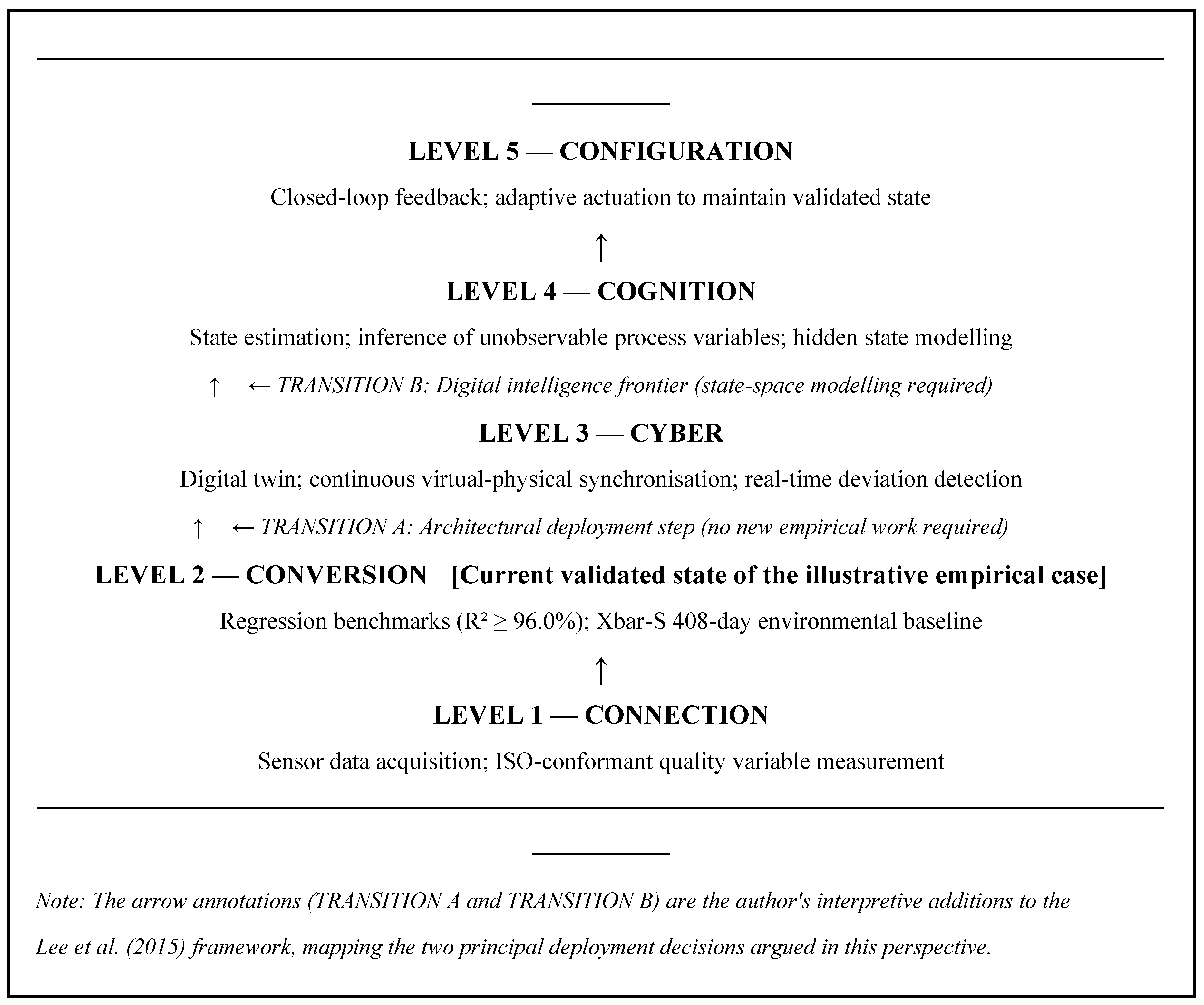
Figure 2.
Observability analysis of quality variables in the motivating empirical case (Oppong Kyekyeku 2017), illustrating the contrast between physically observable variables (MC, BW, TM) and the partially unobservable variable (AOD) whose variance is substantially driven by hidden biological state.
Figure 2.
Observability analysis of quality variables in the motivating empirical case (Oppong Kyekyeku 2017), illustrating the contrast between physically observable variables (MC, BW, TM) and the partially unobservable variable (AOD) whose variance is substantially driven by hidden biological state.
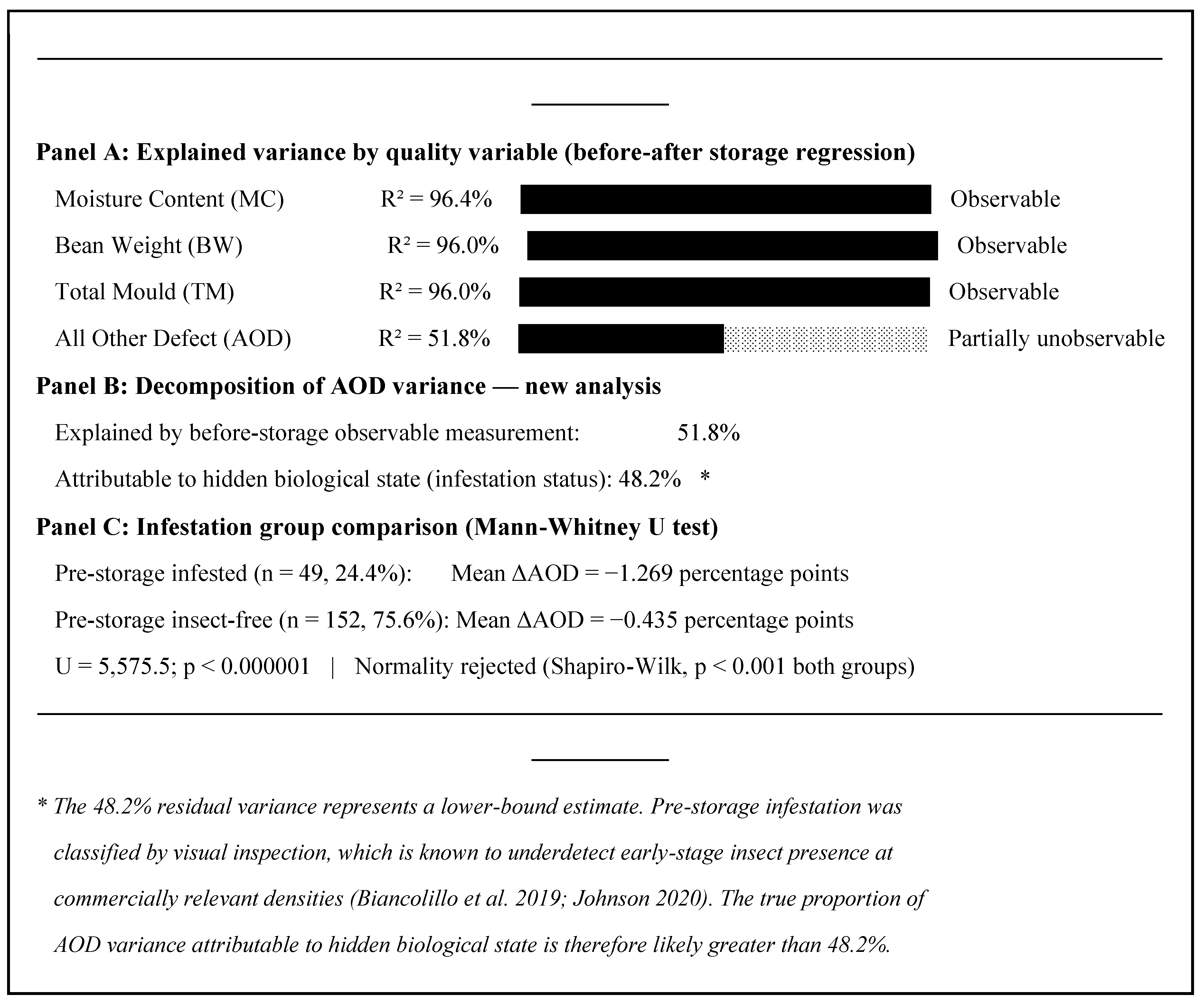

Table 1.
Conceptual model adapting the 5C cyber-physical systems architecture (Lee et al. 2015) to regulated quality systems, with observability status annotated for each level and representative citations provided for the illustrative case. MC = moisture content; TM = total mould; BW = bean weight; AOD = all other defect; SSM = state-space model; HMM = hidden Markov model.
Table 1.
Conceptual model adapting the 5C cyber-physical systems architecture (Lee et al. 2015) to regulated quality systems, with observability status annotated for each level and representative citations provided for the illustrative case. MC = moisture content; TM = total mould; BW = bean weight; AOD = all other defect; SSM = state-space model; HMM = hidden Markov model.
| Level | CPS Component | General Function | Regulated Quality System Application (Illustrative Case) | Observability Status |
|---|---|---|---|---|
| 1 | Connection | Sensor integration and data acquisition | Physical quality variables measured under validated conditions: MC, TM, BW, AOD; environmental data acquired per documented protocol (Oppong Kyekyeku 2017) | Fully observable — directly measured |
| 2 | Conversion | Data-to-information; computational system model | Regression benchmarks parameterise the system (R² ≥ 96.0%); threshold boundaries established; Xbar-S 408-day environmental baseline generated (Oppong Kyekyeku 2017; Montgomery 2012) | Observable — model-derived; system in statistical control |
| 3 | Cyber | Digital twin; virtual state synchronised with physical system in real time | Real-time environment represented digitally; deviations from validated benchmark detectable continuously via sensor streams (Tao et al. 2019; Grieves and Vickers 2017) | Observable — continuous; deviation flag generated automatically |
| 4 | Cognition | State estimation; inference of unobserved process variables | Pre-storage biological state estimated via indirect proxies — gas dynamics, NIR spectroscopy, volatile profiles; quality risk scored before storage event (Auger-Méthé et al. 2021; Montanari et al. 2022) | Partially observable — hidden state inferred via SSM, HMM, or proxy sensing |
| 5 | Configuration | Closed-loop actuation to maintain quality bounds | Environmental actuation — atmosphere modification, humidity, temperature — triggered by quality state signals; corrective action before defect onset (Essien et al. 2010) | Controllable — feedback loop from Cyber/Cognition to physical system |
Table 2.
Cross-sector mapping of Quality Management System dimensions across regulated industries, demonstrating structural equivalence and the common CPS readiness implication at each level. QMS = quality management system; ICH = International Council for Harmonisation; CFR = Code of Federal Regulations; MDR = Medical Device Regulation; PAT = process analytical technology; GAMP = Good Automated Manufacturing Practice; GSPR = general safety and performance requirements; DOE = design of experiments.
Table 2.
Cross-sector mapping of Quality Management System dimensions across regulated industries, demonstrating structural equivalence and the common CPS readiness implication at each level. QMS = quality management system; ICH = International Council for Harmonisation; CFR = Code of Federal Regulations; MDR = Medical Device Regulation; PAT = process analytical technology; GAMP = Good Automated Manufacturing Practice; GSPR = general safety and performance requirements; DOE = design of experiments.
| QMS Dimension | Food and Agro-Commodity | Pharmaceutical Manufacturing | Biologics | Medical Devices | Cosmetics |
|---|---|---|---|---|---|
| Governing standard(s) | ISO 9001:2015; Codex CAC/GL 69-2008; performance qualification of storage and testing systems | FDA Process Validation (2011); ICH Q10; ICH Q8(R2); lifecycle Stage 1–2–3 model | ICH Q11 drug substance development; FDA PAT guidance; QbD bioprocess characterisation | ISO 13485:2016; EU MDR 2017/745 Annex IX; ISO 14971:2019 risk management | ISO 22716:2007 GMP; EU Regulation 1223/2009 Article 8; process validation |
| System performance model (Conversion level) | Regression benchmarks; R² ≥ 96.0%; Xbar-S 408-day environmental baseline | Stage 3 continued process verification; SPC; process capability indices | DOE and multivariate data analysis; PAT-enabled real-time release testing | Design verification test protocols; measurement system analysis; design history file | Finished product specification testing; stability protocol data; trend models |
| Environmental monitoring | Xbar-S chart over 408 days; temperature and humidity; SPC-based alert thresholds | ICH Q1A stability chamber qualification; 21 CFR §211 environmental controls | Bioreactor controls: dissolved oxygen, pH, temperature as critical process parameters | ISO 13485 §7.5; GMP Annex 1 cleanroom particle and microbial monitoring | ISO 22716 Part 7 production environmental controls; GMP facility monitoring |
| Retention/reference samples | GMP Annex 19 storage; ISO/IEC 17025:2017 reference materials; trade arbitration | 21 CFR §211.170 reserve samples; ICH Q1A stability samples; GMP Annex 19 (2006) | Retained process samples for comparability; reference standards for biological assays | ISO 13485 §7.5.8 traceability; device history records; post-market sample retention | EU 1223/2009 Article 11 product information file; retained samples for adverse events |
| Risk-based approach (Cognition level) | Hidden infestation as consequential unobserved variable; 48.2% unexplained AOD variability | ICH Q9(R1) quality risk management (2023); FMEA and FMECA; risk-based inspection | Risk-based cell line characterisation; viral safety assessment; critical quality attribute ranking | ISO 14971:2019 risk management; FMEA in design and process; EU MDR Annex I GSPR | Hazard identification in cosmetic formulation; safety assessment under EU 1223/2009 Article 10 |
| CPS readiness assessment | Validated regression benchmarks and Xbar-S baseline are Level 2 assets — one architectural step from Level 3 digital twin deployment | Stage 3 SPC monitoring data and validated LIMS records are Level 2 baselines ready for Level 3 deployment | PAT sensor data streams with validated process models are already at Level 3; state-space modelling required for Level 4 | Design verification outputs and post-market surveillance data constitute Level 2 characterisation for device digital twin models | Stability data trend models and process performance records provide the Level 2 foundation for cosmetic supply chain digital twin deployment |
Disclaimer/Publisher’s Note: The statements, opinions and data contained in all publications are solely those of the individual author(s) and contributor(s) and not of MDPI and/or the editor(s). MDPI and/or the editor(s) disclaim responsibility for any injury to people or property resulting from any ideas, methods, instructions or products referred to in the content. |
© 2026 by the authors. Licensee MDPI, Basel, Switzerland. This article is an open access article distributed under the terms and conditions of the Creative Commons Attribution (CC BY) license (http://creativecommons.org/licenses/by/4.0/).
Copyright: This open access article is published under a Creative Commons CC BY 4.0 license, which permit the free download, distribution, and reuse, provided that the author and preprint are cited in any reuse.


