Preprint
Article

This version is not peer-reviewed.

Identification and Development of a Species-Specific Molecular Marker for Discriminating Between Abies koreana and Abies nephrolepis

A peer-reviewed version of this preprint was published in:
Conservation 2026, 6(3), 90. https://doi.org/10.3390/conservation6030090

Submitted:

24 June 2026

Posted:

24 June 2026

You are already at the latest version

Abstract

Abies koreana Wilson (Korean fir) and Abies nephrolepis (Trautv. Ex Maxim.) Maxim. (Khingan fir) are ecologically and economically significant coniferous species in East Asia. However, morphological similarities and hybridization complicate species identification, affecting conservation, forestry management, and commercial activities. Here, we developed a species-specific DNA marker using single nucleotide polymorphisms (SNPs) within the mitochondrial nad5 intron 1 region to discriminate between A. koreana and A. nephrolepis. In particular, PCR amplification and sequencing analyses of candidate drought and heat stress-responsive genes as well as mitochondrial nad5 intron 1 and nad5 intron 4 revealed a species-specific T-to-G substitution in nad5 intron 1. Allele-specific primers were designed, and competitive allele-specific labeled light emission technology was employed for SNP detection. The primers were validated using real-time PCR, achieving high specificity and reliability. Overall, the molecular diagnostic tool offers a practical solution for accurate species identification, aiding conservation efforts and sustainable resource management.

Keywords: 
;  ;  ;  ;  

1. Introduction

Industrialization has led to continuous and accelerated global warming through increased carbon dioxide emissions [1]. Various abnormal climate phenomena associated with global warming, such as heatwaves, droughts, rising sea levels, warmer winter temperatures, and the increased frequency and intensity of typhoons have led to extensive habitat loss [2]. Species inhabiting ecosystems that are particularly sensitive to warming, such as alpine regions, are at risk of habitat reduction and population declines, potentially leading to extinction [2]. Given the predicted significant decline in biodiversity due to climate change, there is a growing need for diverse research aimed at managing vulnerable species and ecosystems.
Abies koreana (Korean fir) and other Abies species inhabit vulnerable alpine regions [3]. A. koreana was first reported as an endemic species of Korea in 1920 and is distributed in high-altitude regions above 1,000 meters in southern areas, including Mts. Halla, Jiri, Deogyu, and Gaya [4,5]. However, the species rarely forms forests. It is typically limited to small areas or exists as scattered individual trees, except on Mt. Halla, where it makes up wide and pure forests, representing the only large-scale A. koreana forest in the world [5,6]. A. koreana is classified as endangered [EN B2ab(ii,iii,v)] by the International Union for Conservation of Nature (IUCN) owing to its restricted distribution and vulnerability to climate change [7,8]. The species plays a crucial role in maintaining subalpine ecosystem stability, particularly on Jeju Island, where it forms unique forest communities at elevations between 1,000 and 1,950 meters. Abies nephrolepis (Trautv. Ex Maxim.) Maxim. (Khingan fir) is more widely distributed across northeastern Asia and contributes significantly to forest ecosystem services and timber production in temperate regions [9,10]. Both species are valuable sources of bioactive compounds and essential oils, with applications in pharmaceutical and cosmetic industries [11,12]. However, rapid dieback has been observed due to environmental stresses, including biotic and abiotic stresses [13,14]. Therefore, conservation efforts are essential to protect vulnerable ecosystems in subalpine regions where the species are found.
However, the morphological similarities and potential hybridization between Abies species pose challenges for accurate identification, thereby hindering conservation efforts, forestry management, and commercial applications, particularly in seed production and seedling certification programs. Traditional identification methods based on subtle morphological traits, such as cone characteristics, needle arrangement, and bark patterns, are often unreliable due to environmental factors and phenotypic plasticity [15,16]. Misidentification in natural populations and cultivated specimens complicates conservation strategies and genetic resource management.
Molecular markers are highly informative for analyses of intra- and interspecific variation and can be determined regardless of phenotype, allowing for unbiased comparisons of adaptations, their genetic basis, and evolutionary processes [17]. Molecular markers have also emerged as powerful tools for resolving taxonomic ambiguities in closely related plant species. Among these markers, single nucleotide polymorphisms (SNPs) are particularly valuable owing to their high abundance and stability across genomes; they facilitate precise species identification and cultivar discrimination by detecting minor genetic variation [18,19]. The application of SNP markers has revolutionized genetic studies in forestry, enabling more accurate assessments of genetic diversity, population structure, and evolutionary relationships [20,21,22]. In the case of Abies nordmanniana (Nordmann fir), a large pool of SNPs was identified by exploiting a combination of approaches, including a significant number with potential downstream applications, including applications in pedigree reconstruction, clone identification, and genomic selection [23].
Despite the effectiveness of molecular marker methods, they often require complex laboratory procedures and specialized expertise, limiting their practical application in routine species identification. There is a need for a rapid, reliable, and user-friendly SNP detection system that can be easily adopted in various settings, including field conditions. To address this issue, various technologies have been developed for SNP detection, including Kompetitive Allele-Specific PCR (KASP) and Allele-Specific PCR (AS-PCR), each with its advantages in terms of sensitivity, throughput, and cost-effectiveness [19,24]. KASP is a homogeneous, fluorescence-based genotyping technology that allows for high-throughput and cost-efficient SNP analyses; it uses allele-specific primers and a FRET (Fluorescence Resonance Energy Transfer) quenching system to detect SNP variants, making it suitable for large-scale genotyping projects [19,25].
In this study, we developed a rapid and reliable species-specific DNA marker in the nad5 intron 1 region of mitochondrial DNA to discriminate between A. koreana and A. nephrolepis using Competitive Allele-specific Labeled Light Emission (CALLE) technology [26]. Mitochondrial DNA is maternally inherited and shows low levels of heteroplasmy, making it a stable and reliable genetic marker for species differentiation [27]. Allele-specific primers were designed to target these SNPs, introducing intentional mismatches to enhance specificity. The marker combines allele-specific amplification with labeled light emission, providing a straightforward and efficient method suitable for both laboratory and field applications.

2. Materials and Methods

2.1. Plant Materials and Sample Collection

The needles (leaves) of A. koreana and A. nephrolepis were selected as the plant materials for this study. These species were chosen based on their ecological significance and distinct geographical distributions within Korea. Samples of A. koreana were collected from Mt. Halla and outdoor fields of the National Institute of Ecology (NIE). A. nephrolepis samples were obtained from Mt. Seorak and outdoor fields of the NIE in Korea. Plants were collected from two sites per region. Detailed information about the collection sites, including geographic coordinates, is provided in Table 1. All collected samples were handled carefully and stored at -80°C to preserve their integrity. A subset of the samples was subsequently utilized for further experimental analyses.

2.2. DNA Extraction

Genomic DNA was extracted from fresh leaves (100 mg) of A. koreana and A. nephrolepis using the Beniprep® Super Plant Total Nucleic Acid Extraction Kit (Cat# IVT7006, Invirustech, Gwangju, South Korea) following the manufacturer's protocol, with minor modifications. Briefly, leaf samples were ground to a fine powder in liquid nitrogen and homogenized with 400 μL of PHB2A buffer containing 50 μL of Nuclease destroyer (Cat# IN4001, Invirustech, Gwangju, South Korea). After adding 450 μL of LYB buffer, the mixture was incubated at 55°C for 5 min. RNase A (1 μL, 1 mg/mL) was added to remove RNA contamination. The lysate was treated sequentially with 300 μL of SCP buffer and 400 μL of RLC buffer, with centrifugation steps (≥15,000 × g, 4°C) between treatments. The supernatant was loaded onto a binding column and washed successively with PW1, PW2, and PW3 buffers. Final DNA elution was performed with 50-100 μL of elution buffer. The quality and quantity of extracted DNA were assessed using a microplate spectrophotometer system (Biotek-Epoch, Winooski, VT, USA).

2.3. Selection of Candidate Genes and PCR Amplification

Candidate genes were identified based on a de novo RNA-seq assembly and comparative analysis. We have previously performed a transcriptomic analysis of A. koreana trees exposed to heat or drought stress for different time periods, respectively [28,29]. RNA-seq data provided insight into the genes related to the response to heat and drought stresses in A. koreana. In this study, we focused on genes whose expression increased by more than 2-fold under heat or drought stress. We isolated candidate genes using primers for A. koreana in A. nephrolepis. Four candidate genes displayed sequence differences between A. koreana and A. nephrolepis. In addition, mitochondrial DNAs of nad5 intron 1 and nad5 intron 4 were included as candidate genes for comparisons of nucleotide sequences between A. koreana and A. nephrolepis (NCBI GenBank accession No.;KT448846-KT449415) [15], for a total of six genes included in analyses.
Two genes showing differential expression in A. koreana following high-temperature treatment [28] and two genes showing differential expression after drought treatment [29] were selected. Candidate genes were evaluated for sequence differences between A. nephrolepis and A. koreana. The primers were designed with varying sizes to amplify variable regions of the genes, as shown in Table 2. In addition, primers targeting the nad5 intron 1 and intron 4 regions of mitochondrial DNA were used [15,30,31] (Table 2). PCR amplification was performed using BioFACT™ A-Star Taq DNA Polymerase (AT116-500, Biofact Co., Daejeon, South Korea) with the following thermal cycling conditions: initial denaturation at 95°C for 5 min, followed by 35 cycles of denaturation at 95°C for 30 sec, annealing at (Tm - 5°C) for 30 sec, and extension at 72°C for 30 sec. The PCR products were analyzed by electrophoresis on 1.5% agarose gels in 0.5× TBE buffer at 150 V for 30 min. Three microliters of each PCR product were loaded onto the gel, and the DNA bands were visualized under UV light after ethidium bromide staining. In addition, PCR products for the selected target genes were purified and subjected to Sanger sequencing with the bidirectional sequencing and quality-control procedure (ABI 3730XL, BigDyeⓇ Terminator v3.1Cycle Sequencing Kit) (Bionics Co., Seoul, South Korea). The obtained sequences were analyzed using MAFFT (Multiple Alignment using Fast Fourier Transform) software (version 7) [32]; in particular, a multiple sequence alignment was generated to identify species-specific variants. Sequence alignment files were visualized and analyzed using BioEdit software (version 7.2) to identify diagnostic SNPs.

2.4. Construction of a Pipeline for Species-Specific Marker Development

A pipeline for a species-specific marker development was used to design allele-specific primers [26]. SNP positions and allelic variants were identified from DNA sequences, and Primer3 was used for primer design. Forward primers were optimized for Tm (55-60°C) with mismatches introduced for allele specificity. Reverse primers were designed downstream of the SNP (Tm: 61-68°C), and amplicon sizes were limited to 300 bp. Python-based automation ensured precision, and experimental validation via real-time PCR confirmed the specificity and efficiency, enabling rapid SNP genotyping (https://github.com/Key-man-fromArchive/SNP_primer_design).

2.5. SNP Genotyping Using a Species-Specific Marker

The species-specific marker was used for rapid SNP-based differentiation of A. koreana and A. nephrolepis. PCRs (10 μL) were prepared using 2× master mix, primer mix, Q-FRET mix_V1 and 2 μL of DNA template (>10 ng/μL). The qRT-PCR was run under the following conditions: initial denaturation at 95°C for 2 min, followed by 10 cycles of 94°C for 10 sec and 56°C for 30 sec and then 26 cycles of 94°C for 10 sec, 61°C for 30 sec and 40°C for 15 sec. Fluorescent signals were read at 40°C for allelic discrimination using FAM (A. koreana) and HEX (A. nephrolepis) dyes. Results were analyzed using QuantStudio 3 (Applied Biosystems) and CFX Opus (Bio-Rad) real-time PCR platforms.

3. Results

3.1. Sampling Sites of A. koreana and A. nephrolepis in Korea

A. koreana and A. nephrolepis are coniferous trees that grow in temperate and subarctic regions of the Northern Hemisphere, including Korea. In this study, samples were collected from Mts. Halla, Seorak and an exhibition area of the NIE in Korea. Mt. Halla, located in the southernmost part of the Korean Peninsula, has an elevation of 1,950 meters above sea level, making it the tallest mountain in South Korea. It is also the region with the highest density of A. koreana habitats [16]. Mt. Seorak, located in the northeastern region of South Korea, is one of the country's most iconic mountains and harbors the largest colony of A. nephrolepis in South Korea [10]. The plants in each region were sampled and geographic coordinates were recorded (Table 1).

3.2. Amplification of Candidate Genes for a Species-Specific Marker Distinguishing A. koreana and A. nephrolepis

We performed electrophoresis and found that the amplification patterns showed no difference between A. koreana and A. nephrolepis (Figure 1). The single band was detected in nad5 intron 1 (Figure 1A). For nad5 intron 4, the product exhibited multiple bands, including a faint band in lane 4, and the bands were successfully produced in all samples (Figure 1B). The AkAnGCR2 gene was not amplified in any sample, and AkAnMYB123 showed multiple nonspecific bands (Figure 1C and D). AkAnEFP and AkAnATL78 clearly showed a single amplification product (Figure 1E and F). Finally, three loci, nad5 intron 1, AkAnEFP, and AkAnATL78, were selected for a DNA sequencing analyses.

3.3. SNPs in nad5 Intron 1 of A. koreana and A. nephrolepis

SNPs are one of the most prevalent forms of genetic variation, providing valuable information for species identification, phylogenetic studies, and evolutionary analyses. To evaluate SNPs, nucleotide sequence alignments of nad5 intron 1, AkAnEFP, and AkAnATL78 were generated for A. koreana and A. nephrolepis. Neither AkAnEFP nor AkAnATL78 showed sufficient sequence variation to differentiate between the two species (data not shown). Interestingly, there were distinct SNPs between A. koreana and A. nephrolepis in nad5 intron 1.
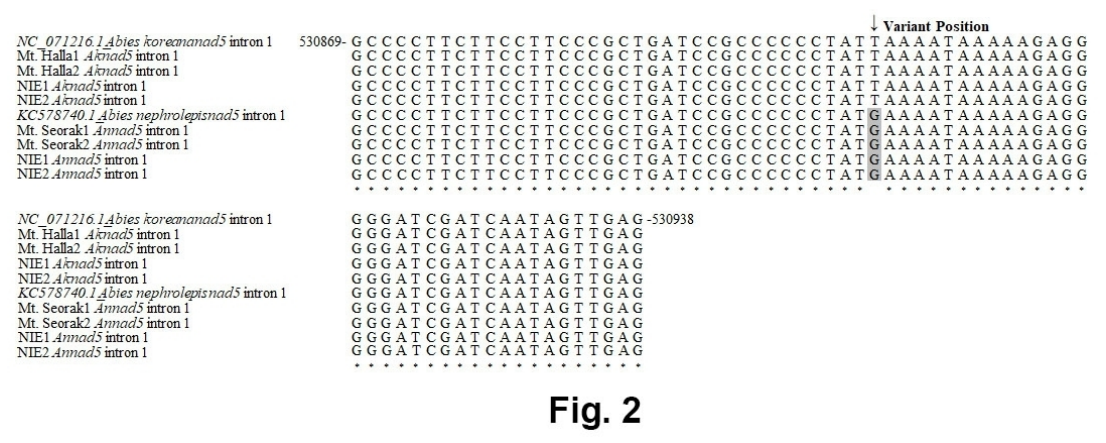
The mitochondrial nad5 gene encodes a subunit of NADH dehydrogenase subunit 5, a crucial part of complex I, which is the first and largest enzyme in the electron transport chain and plays an essential role in plant respiration and electron transport [33]. In addition, intronic regions, though non-coding, often contain conserved sequences and SNPs that can be useful for genetic differentiation. Therefore, the SNP sites in nad5 intron 1 at positions 530869 and 530938 were evaluated in each species using DNA samples from Mts. Halla, Seorak and the exhibition area of the NIE in Korea (Figure 2). Specifically, a T-to-G mutation was observed, with A. koreana exhibiting a T at the variant position 530904 and A. nephrolepis showing a G. These results suggest that nad5 intron 1 could serve as a candidate gene for a species-specific marker.

3.4. Development of nad5 Intron 1 as a Marker for Species Differentiation Between A. koreana and A. nephrolepis

To develop a species-specific marker using nad5 intron 1 for A. koreana and A. nephrolepis, we designed two allele-specific primers to detect single nucleotide variants (SNVs). The primers selectively amplified the T and G alleles, enabling effective differentiation between the two species (Table 3). The FAM_AkAnnad5 intron 1_T primer was designed to detect the T allele-specific sequence in A. koreana. An intentional mismatch (T → C) was introduced at the 3' end of the forward primer to enhance specificity. This primer was labeled with the FAM fluorophore for detection of the T allele. The HEX_AkAnnad 5 intron 1_G primer was designed to detect the G allele-specific sequence in A. nephrolepis. Similarly, an intentional mismatch (T → C) was introduced at the 3' end to increase marker specificity. This primer was labeled with the HEX fluorophore for the detection of the G allele. In addition, the Rev_AkAnnad 5 intron 1 primer served as a universal reverse primer, amplifying the nad 5 intron 1 region in both species. These primers could accurately detect species-specific SNVs, and the introduction of intentional mismatches at the 3' ends of the primers improves specificity.
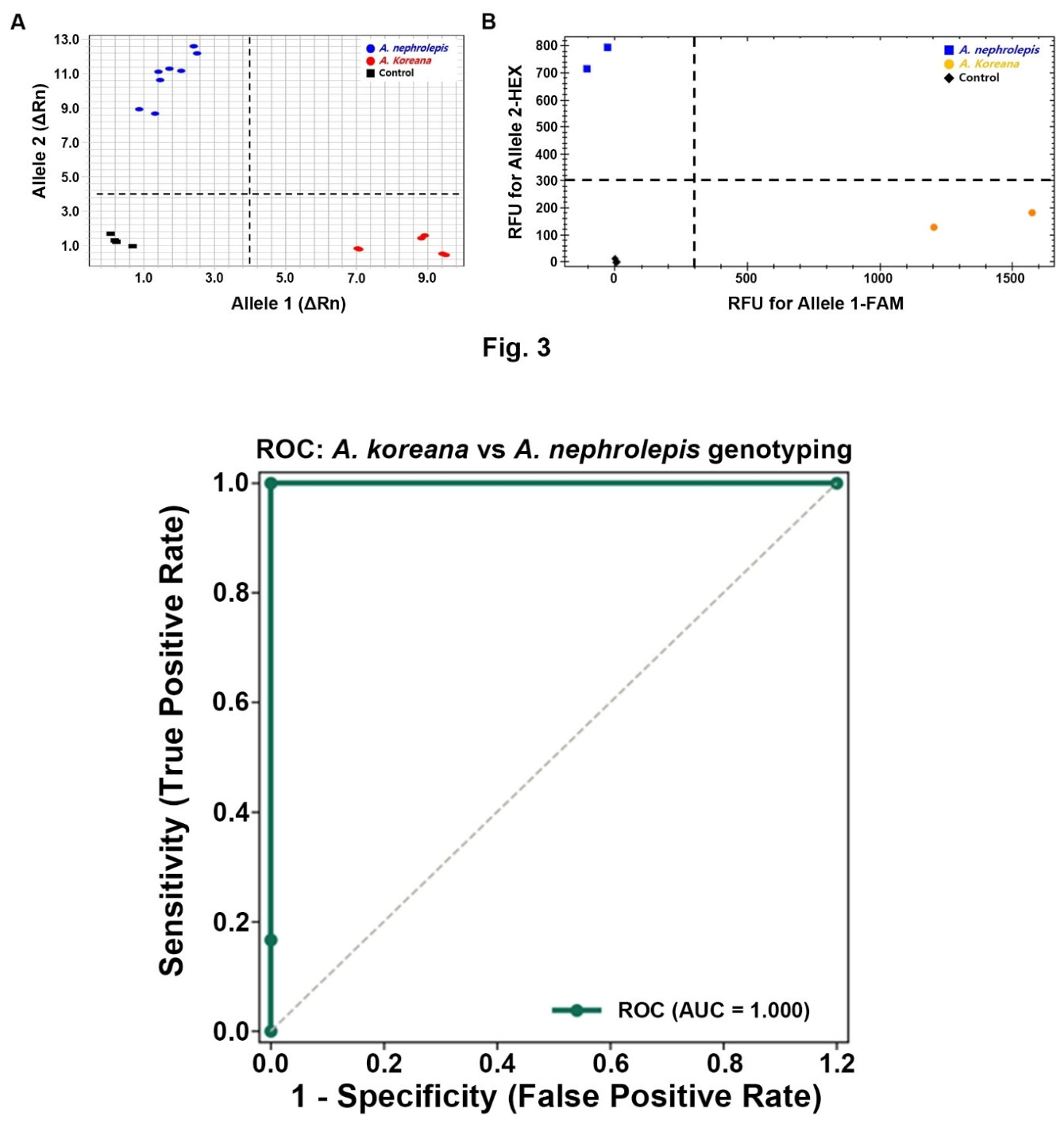
Finally, these primers were validated using real-time PCR systems, including the ABI QuantStudio 3 and Bio-Rad CFX Opus platforms (Figure 3). For ABI QuantStudio 3, seven samples (four A. koreana and three A. nephrolepis) were tested in triplicate. Fluorescence data, normalized to the ROX passive reference dye, confirmed clear separation of species-specific alleles. The FAM signal (Allele 1) corresponded to A. koreana, and the HEX signal (Allele 2) corresponded to A. nephrolepis (Figure 3A). In addition, the Bio-Rad CFX Opus system, using post-amplification fluorescence analysis at 40°C without a passive reference dye, confirmed species discrimination using four samples (two A. koreana and two A. nephrolepis) with three replication (Figure 3B). Both platforms showed clear differentiation of T (FAM) and G (HEX) alleles, consistent with the maternal inheritance of mitochondrial DNA and absence of heteroplasmy. Therefore, these results strongly demonstrate the establishment of a rapid and robust diagnostic method for distinguishing A. koreana and A. nephrolepis.

4. Discussion

Since the late 1990s, the increasing frequency of high temperatures and drought conditions due to global climate change has contributed to substantial forest mortality and tree dieback worldwide [34]. Widespread conifer mortality due to recurring droughts since the 1970’s has been observed, affecting up to 20% of coniferous forests in Switzerland, France, Poland, and Greece in Europe. In North America, there are increasing reports of extensive conifer dieback due to drought, particularly in the western United States, affecting pine, fir, and spruce forests across vast areas. In addition, extensive conifer mortality due to drought has been observed in China, Russia, and other regions. Extreme drought has led to the decline of A. koreana (20-50%) in South Korea. Alpine coniferous forests, in particular, have experienced severe declines, necessitating comprehensive research on the causes and conservation trends at a global scale. Understanding these patterns is crucial for establishing directions for conservation research focused on alpine vulnerable ecosystems in South Korea.
The genus Abies includes several coniferous species distributed across the Northern Hemisphere. Among them, A. koreana and A. nephrolepis are significant species in East Asia. Understanding their distinct characteristics and conservation requirements is essential for maintaining biodiversity and ecosystem stability [13,35]. A. nephrolepis has a relative wide range; however, A. koreana requires immediate intervention owing to its endangered status. A combined effort involving habitat protection, research, and public engagement is necessary to safeguard these valuable species for future generations [13,36]. A. koreana and A. nephrolepis are both subalpine conifer species found in South Korea; however, their distribution and climate adaptability differ significantly (Table 1). A. koreana is endemic to South Korea, primarily inhabiting subalpine regions, such as Mts. Halla, Jiri, and Deogyu at elevations of 1,000 to 1,900 meters. It thrives in cool-temperate to subalpine climates but is highly vulnerable to climate change, which has led to severe population decline and habitat loss [3]. By contrast, A. nephrolepis has a broader distribution, spanning northern and central Korea, Russia, China, and Japan. It grows at 1,200 to 2,000 meters in subalpine to boreal climates and is more resilient to colder temperatures. While the species is less affected by climate change compared with A. koreana, habitat destruction and warming trends could still pose risks [35].
It is essential to distinguish A. koreana and A. nephrolepis using molecular ecological methods. Traditional identification based on physical characteristics can be unreliable, especially in hybrid zones or areas where environmental variations affects phenotypic traits [37]. Therefore, molecular markers, such as chloroplast DNA (cpDNA) sequences, microsatellites (SSRs), and SNPs, could provide a precise and reproducible means of differentiation. These genetic tools enable accurate species identification, help in understanding evolutionary relationships, and support conservation efforts by identifying genetic diversity and potential threats, such as habitat loss or climate change. To develop a species-specific marker for A. koreana and A. nephrolepis, we evaluated four candidate genes related to the response to heat or drought stress in addition to mitochondrial nad5 intron 1 and 4 (Table 2). Finally, nad5 intron 1 was identified as a marker for differentiation between A. koreana and A. nephrolepis (Figure 2).
The mitochondrial nad5 gene (NADH dehydrogenase subunit 5) encodes a subunit of NADH:ubiquinone oxidoreductase, also known as Complex I of the mitochondrial respiratory chain, which functions as an electron transport chain component and in ATP production and energy metabolism [38]. Given its role in the electron transport chain, mutations or impairments in nad5 can affect metabolic processes and lead to various mitochondrial diseases [38]. Variation in intronic regions of the nad5 gene could be species-specific [31,39], and several properties of nad5 make it an ideal marker for distinguishing between A. koreana and A. nephrolepis.. For example, mitochondrial DNA is maternally inherited and is less prone to genetic variation caused by hybridization. Furthermore, because mitochondrial DNA is haploid and lacks heterozygous phenotypes, the nad5 intron 1 region provides a stable and consistent marker (Figure 2). Low heteroplasmy and the predictable inheritance of alleles also make this region a robust choice for molecular identification.
Finally, we developed a marker for differentiation between A. koreana and A. nephrolepis using allele-specific primers for nad5 intron 1 (Table 3). Real-time PCR technology enables rapid, precise quantification and clear allelic discrimination. The primers were validated using real-time PCR platforms (i.e., the ABI QuantStudio 3 and Bio-Rad CFX Opus systems) (Figure 3), demonstrating the utility of the developed primers for rapid species identification. The fluorescence signals corresponding to species-specific alleles facilitated clear discrimination, without the need for complex procedures or extensive equipment, making the method both efficient and practical. By offering a rapid and user-friendly method for distinguishing between A. koreana and A. nephrolepis, the marker could play a vital role in improving seedling authenticity and preventing misidentification in both conservation and commercial contexts.
Thus, the nad5 intron 1 region represents a robust genetic marker for differentiation between A. koreana and A. nephrolepis. The marker offers a practical and efficient tool, addressing critical needs in conservation, forestry management, and commercial applications. By enabling accurate and rapid identification, the marker supports the integrity of breeding programs, promotes sustainable utilization, and contributes to the conservation of these economically and ecologically significant species. Moreover, integrating additional SNP markers into the diagnostic pipeline will strengthen the reliability of the method and expand its applicability. These expanded markers could be used to generate detailed distribution maps for A. koreana and A. nephrolepis, which would serve as valuable tools for conservation planning and monitoring the effects of environmental changes on species distributions. It could be also instrumental in understanding how climate change, land-use changes, and other ecological factors affect the distribution and population dynamics of these species.

5. Conclusions

We developed a rapid and reliable SNP-based diagnostic method for distinguishing A. koreana and A. nephrolepis using the nad5 intron 1 region, despite the limited genomic resources available for these species. Leveraging the stability and maternal inheritance of mitochondrial DNA, the marker enables accurate species identification using allele-specific primers and real-time PCR. Compared with traditional methods, this approach is simpler, faster, and more accessible, making it highly applicable for forestry management, conservation, and commercial use. While the current research was limited to a small sample set, the results demonstrate the potential of molecular markers in resolving taxonomic ambiguities, even in species with limited genomic data. Further validation and expansion of SNP markers will enhance the practical utility of the approach and enable broader applications.

Supplementary Materials

Supplementary Figure S1. ROC curve of the ASQ genotyping assay for discriminating Abies koreana from Abies nephrolepis (n = 6 and n = 8, respectively). The assay showed perfect separation of the two species (AUC = 1.000). The dashed diagonal indicates random classification (AUC = 0.5).

Author Contributions

Conceptualization: HCP. Data curation: HCP. Formal analysis: HCP, DYL. Funding acquisition: HCP. Methodology: HCP. Project administration: HCP. Supervision: HCP. Validation: HCP, DYL. Visualization: HCP. Writing - original draft: HCP. Writing - review & editing: HCP, DYL. All authors have read and agreed to the published version of the manuscript.

Funding

This work was supported by a grant from the National Institute of Ecology (NIE), funded by the Ministry of Climate, Energy and Environment (MCEE) of the Republic of Korea (NIE-B-2026-15).

Data Availability Statement

The authors declare that the data collected for this project can be shared with other scientists.

Acknowledgments

The authors deeply appreciate Dr. Kibeom Park and Nam-Yeon Kim of Invirustech Co. for helps with data analyses and primer production for SNP detection. We also appreciate Dr. Baek-Jun Kim for a helpful advice.

Conflicts of Interest

The authors declare no conflicts of interest.

References

  1. Filonchyk, M.; Peterson, M.P.; Zhang, L.; Hurynovich, V. Greenhouse gases emissions and global climate change: Examining the influence of CO2, CH4, and N2O. Sci. Total Environ. 2024, 935, 173359. [Google Scholar] [CrossRef] [PubMed]
  2. Intergovernmental Panel on Climate Change Global warming of 1.5°C. 2018.
  3. Koo, K.A.; Kim, D.-B. Review forty-year studies of Korean fir(Abies koreana Wilson). Kor. J. Environ. Ecol. 2020, 34(5), 358–371. [Google Scholar] [CrossRef]
  4. Wilson, E.H. Four new conifers from Korea. J. Arnold Arbor. 1920, 1(3), 186–190. [Google Scholar] [CrossRef]
  5. Kong, W. Biogeography of native Korean pinaceae. J. Kor. Geogr. Soc. 2006, 41(1), 73–93. [Google Scholar] [CrossRef]
  6. Kim, G.T.; Choo, G.C.; Um, T.W. Studies on the structure of Abies koreana community at subalpine zone in Hallsan. Kor. J. Environ. Ecol. 2007, 21(2), 161–167. [Google Scholar]
  7. Kim, D.W.; Park, D.Y.; Jeong, D.Y.; Park, H.C. Identification of molecular markers for population diagnosis of Korean Fir (Abies koreana) vulnerable to climate change. Proc. Nat. Inst. Ecol. 2020, 1(1), 68–73. [Google Scholar] [CrossRef]
  8. Seo, H.-N.; Lim, H.-I. Material selection for restoration of genetic diversity of Abies koreana on Mt. Jirisan in South Korea. For. Sci. Technol. 2024, 20(2), 163–170. [Google Scholar] [CrossRef]
  9. Lim, C.-H.; Kim, H.-J. Machine learning application for identifying habitat suitability changes of indicator tree species against recent climate change. J. Clim. Change Res. 2020, 11(6-2), 793–805. [Google Scholar] [CrossRef]
  10. Lee, H.-Y.; Chung, B.-K.; Chun, Y.-M.; Oh, C.-H. The research on the phytosociological characteristics of Abies nephrolepis Maxim. Community in Mt. Seorak, Korea. Kor. J. Environ. Ecol. 2021, 35(1), 37–47. [Google Scholar] [CrossRef]
  11. Jeong, S.-I.; Lim, J.-P.; Jeon, H. Chemical composition and antibacterial activities of the essential oil from Abies koreana. Phyto. Res. 2007, 21, 1246–1250. [Google Scholar] [CrossRef] [PubMed]
  12. Ancuceanu, R.; Hovanet, M.V.; Miron, A.; Anghel, A.I.; Dinu, M. Phytochemistry, biological, and pharmacological properties of Abies alba Mill. Plant 2023, 12(15), 2860. [Google Scholar] [CrossRef] [PubMed]
  13. Lee, S.-J.; Shin, D.-B.; Byeon, J.-G.; Oh, S.-H. Climate change vulnerability assessment and ecological characteristics study of Abies nephrolepis in South Korea. Forests 2023, 14(4), 855. [Google Scholar] [CrossRef]
  14. Kim, H.; Kim, E.; Lee, S.; Cho, Y.-C. Abnormal winter drought-induced transient dieback of Korean fir in the montane forests of Mt. Jirisan, South Korea. J. Plant Biol. 2024, 67, 123–136. [Google Scholar] [CrossRef]
  15. Yang, J.-C.; Yi, D.-K.; Joo, M.-J.; Choi, K. Phylogeographic study of Abies koreana and Abies nephrolepis in Korea based on mitochondrial DNA. Kor. J. Pl. Taxon. 2015, 45(3), 254–261. [Google Scholar] [CrossRef]
  16. Kim, E.-S.; Lee, J.-W.; Choi, I.-J.; Lim, W.; Choi, J.; Oh, C.H.; Lee, S.-H.; Kim, Y.-S. Disturbance in seedling development of Korean fir (Abies koreana Wilson) tree species on higher altitude forests of Mt. Hallasan National Park, the central part of Jeju Island, Korea. J. Ecol. Environ. 2017, 41, 22. [Google Scholar] [CrossRef]
  17. Bachmann, K. Molecular markers in plant ecology. New phytol. 1994, 126(3), 403–547. [Google Scholar] [CrossRef] [PubMed]
  18. Mammadov, J.; Aggarwal, R.; Buyyarapu, R.; Kumpatla, S. SNP markers and their impact on plant breeding. Int. J. Pl. Genom. 2012, 728398, 11. [Google Scholar] [CrossRef] [PubMed]
  19. Semagn, K.; Babu, R.; Hearne, S.; Olsen, M. Single nucleotide polymorphism genotyping using Kompetitive Allele Specific PCR (KASP): overview of the technology and its application in crop improvement. Mol. Breed. 2014, 33, 1–14. [Google Scholar] [CrossRef]
  20. Xia, W.; Luo, T.; Zhang, W.; Mason, A.S.; Huang, D.; Huang, X.; Tang, W.; Dou, Y.; Zhang, C.; Xiao, Y. Development of high-density SNP markers and their application in evaluating genetic diversity and population structure in Elaeis guineensis. Front. Plant Sci. 2019, 10, 130. [Google Scholar] [CrossRef] [PubMed]
  21. Wang, C.; Lan, J.; Wang, J.; He, W.; Lu, W.; Lin, Y.; Luo, J. Population structure and genetic diversity in Eucalyptus pellita based on SNP markers. Front. Plant Sci. 2023, 14, 1278427. [Google Scholar] [CrossRef] [PubMed]
  22. Wu, B.; Wen, J.; Lu, R.; Zhou, W. Genetic diversity, population structure, and phylogenetic relationships of a widespread East Asia herb, Cryptotaenia japonica Hassk. (Apiaceae) based on genomic SNP data generated by dd-RAD sequencing. Front. Plant Sci. 2024, 15, 1368760. [Google Scholar] [CrossRef] [PubMed]
  23. Ousmael, K.; Whetten, R.W.; Xu, J.; Nielsen, U.B.; Lamour, K.; Hansen, O.K. Identification and high-throughput genotyping of single nucleotide polymorphism markers in a non-model conifer (Abies nordmanniana (Steven) Spach). Sci. Rep. 2023, 13, 22488. [Google Scholar] [CrossRef] [PubMed]
  24. Myakishev, M.V.; Khripin, Y.; Hu, S.; Hamer, D.H. High-throughput SNP genotyping by allele-specific PCR with universal energy-transfer-labeled primers. Genome Res. 2001, 11, 163–169. [Google Scholar] [CrossRef] [PubMed]
  25. Kumpatla, S.P.; Buyyarapu, R.; Abdurakhmonov, I.Y.; Mammadov, J.A. Genomics-assisted plant breeding in the 21st century: technological advances and progress; Abdurakhmonov, Plant Breeding Dr. Ibrokhim, Ed.; InTech, 2012; Available online: http://www.intechopen.com/books/plant-breeding/genomics-assisted-plant-breeding-in-the-21st-centurytechnological-advances-and-progressISBN 978-953-307-932-5.
  26. Invirustech. Q-prism® CALLE technology [Online]. 2020. Available online: www.invirustech.com.
  27. Parakatselaki, M.-E.; Ladoukakis, E.D. mtDNA heteroplasmy: origin, detection, significance, and evolutionary consequences. Life 2021, 11, 633. [Google Scholar] [CrossRef] [PubMed]
  28. Hwang, J.E.; Kim, Y.J.; Shin, M.H.; Hyun, H.J.; Bohnert, H.J.; Park, H.C. A comprehensive analysis of the Korean fir (Abies koreana) genes expressed under heat stress using transcriptome analysis. Sci. Rep. 2018, 8, 10233. [Google Scholar] [CrossRef] [PubMed]
  29. Park, H.C.; Hwang, J.E. Identification of drought stress-responsive genes in Korean fir (Abies koreana) through comparative RNA-seq analysis. Plant Biotechnol. Rep. 2024, 18, 927–938. [Google Scholar] [CrossRef]
  30. Wang, X.-Q.; Tank, D.C.; Sang, T. Phylogeny and divergence times in Pinaceae: evidence from three genomes. Mol. Biol. Evol. 2000, 17(5), 773–781. [Google Scholar] [CrossRef] [PubMed]
  31. Liepelt, S.; Bialozyt, R.; Ziegenhagen, B. Wind-dispersed pollen mediates postglacial gene flow among refugia. Proc. Natl. Acad. Sci. USA 2002, 99(22), 14590–14594. [Google Scholar] [CrossRef] [PubMed]
  32. Katoh, K.; Standley, D.M. MAFFT multiple sequence alignment software version 7: improvements in performance and usability. Mol. Biol. Evol. 2013, 30(4), 772–780. [Google Scholar] [CrossRef] [PubMed]
  33. Schertl, P.; Braun, H.-P. Respiratory electron transfer pathways in plant mitochondria. Front. Plant Sci. 2014, 5, 163. [Google Scholar] [CrossRef] [PubMed]
  34. Allen, C.D.; Macalady, A.K.; Chenchouni, H.; Bachelet, D.; McDowell, N.; Vennetier, M.; Kitzberger, T.; Rigling, A.; Breshears, D.D.; Hogg, E.H.; Gonzalez, P.; Fensham, R.; Zhang, Z.; Castro, J.; Demidova, N.; Lim, J.-H.; Allard, G.; Running, S.W.; Semerci, A.; Cobb, N. A global overview of drought and heat-indiced tree mortality reveals emerging climate change risks for forests. For. Eco. Manag. 2010, 259, 660–684. [Google Scholar] [CrossRef]
  35. Park, G.E.; Kim, E.-S.; Jung, S.-C.; Yun, C.-W.; Kim, J.-S.; Kim, J.-D.; Kim, J.; Lim, J.-H. Distribution and stand dynamics of subalpine conifer species (Abies nephrolepis, A. koreana, and Picea jezoensis) in Baekdudaegan protected area. J. Korean Soc. For. Sci. 2022, 111(1), 61–71. [Google Scholar] [CrossRef]
  36. Seo, H.-N.; Park, J.-H.; Lim, H.-I. Selection of Abies nephrolepis materials for restoration of genetic diversity in Mt. Gariwangsan degraded area. Sustainability 2023, 15(10), 7749. [Google Scholar] [CrossRef]
  37. Chang, C.-S.; Jeon, J.I.; Hyun, J.O. An analysis of morphological variation in Abies koreana Wilson and A. nephrolepis (Traut.) Maxim. Of Korea (Pinacea) and their phylogenetic problems. J. Korean For. Soc. 1997, 86(3), 378–390. [Google Scholar]
  38. de Souza, A.P.; Jubier, M.-F.; Lejeune, B. The higher plant nad5 mitochondrial gene: a conserved discontinuous transcription pattern. Curr. Genet. 1992, 22, 75–82. [Google Scholar] [CrossRef] [PubMed]
  39. Ziegenhagen, B.; Fady, B.; Kuhlenkamp, V.; Liepelt, S. Differentiating groups of Abies species with a simple molecular marker. Silvae Genet. 2005, 54(3), 123–126. [Google Scholar] [CrossRef]
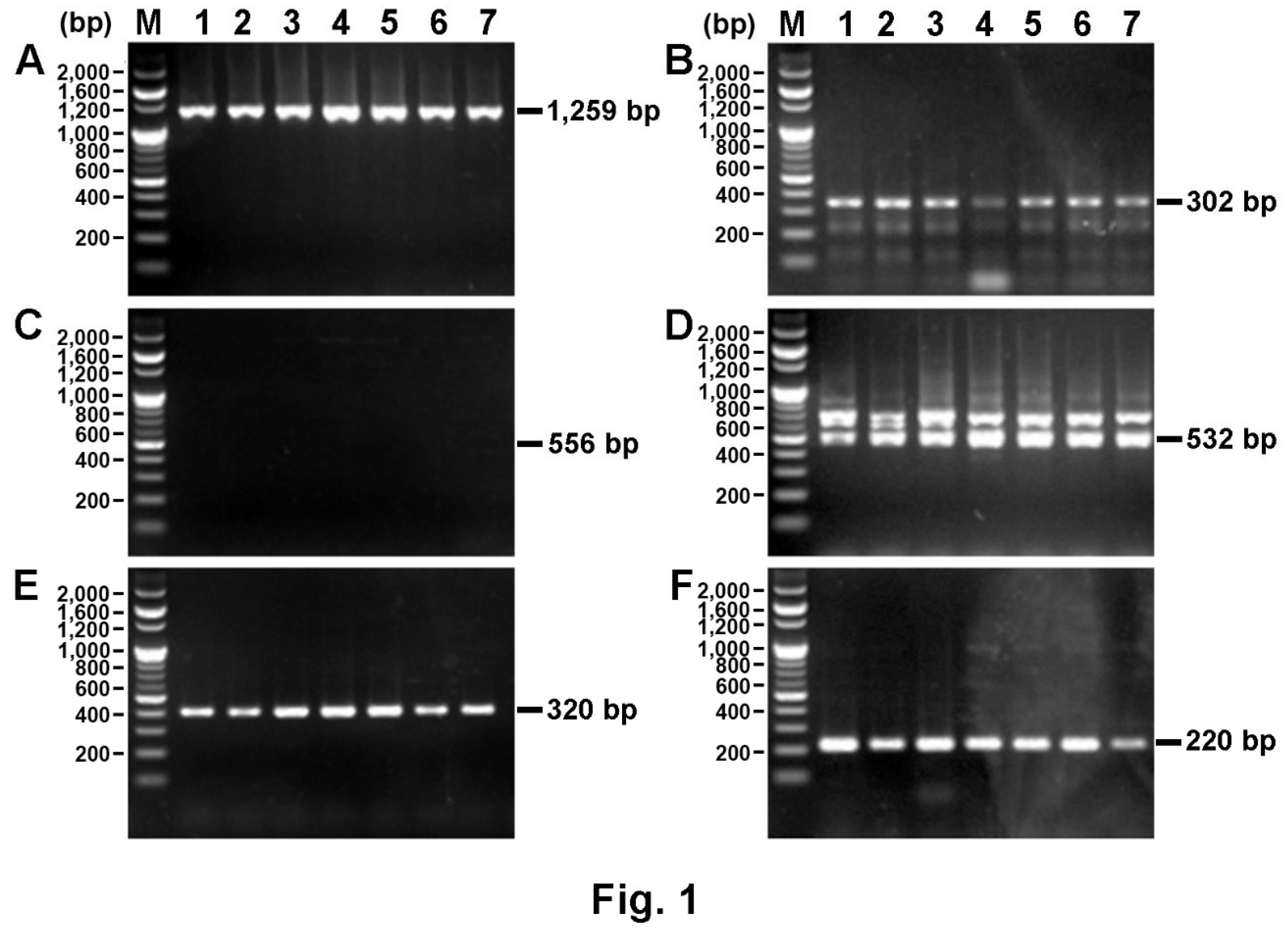
Figure 1. PCR amplification from Abies koreana and Abies nephrolepis samples. Lane M: 100 bp DNA Ladder (Enzynomics, Daejeon, Korea); Lanes 1-2: A. koreana samples from the National Institute of Ecology; Lanes 3-4: A. koreana samples from Mt. Halla; Lanes 5-6: A. nephrolepis samples from the National Institute of Ecology; Lane 7: A. nephrolepis sample from Mt. Seorak. PCR products were separated on 1.5% agarose gels at 150 V for 40 min. Panels: (A) nad5 intron 1 (~1259 bp), (B) nad5 intron 4 (302 bp), (C) AkAnGCR2 (556 bp), (D) AkAnMYB123 (532 bp), (E) AkAnEFP (320 bp), (F) AkAnATL78 (220 bp). The experiments were independently conducted in triplicate, and a representative image is shown.
Preprints 219967 g001
Figure 2. Validation of accession-specific single nucleotide polymorphisms (SNPs) in nad5 intron 1 regions of Abies koreana and Abies nephrolepis mitochondrial DNA. nad5 intron 1 region sequences of A. koreana and A. nephrolepis were compared to identify species-specific SNPs. Conserved and variable nucleotide positions are shown in the alignment. Variant positions are indicated with arrows, showing clear differentiation between A. koreana (NC_071216.1 and related sequences) and A. nephrolepis (KC578740.1 and related sequences). SNPs unique to each species are marked at positions 530869 and 530938. Asterisks (*) indicate conserved nucleotide positions across all accessions. The results were validated through resequencing, confirming the presence of species-specific SNPs critical for genetic identification and differentiation of the two species. The alignment is based on Sanger-derived consensus sequences.
Preprints 219967 g002
Figure 3. Allelic discrimination plots for species-specific nad5 intron 1 SNP markers in Abies koreana and Abies nephrolepis. (A) Results obtained using the ABI QuantStudio 3 system, utilizing pre-amplification and post-amplification fluorescence readings normalized with ROX passive reference dye. SNP discrimination is based on the relative fluorescence signal intensity for FAM (T allele) and HEX (G allele). Each sample was analyzed in duplicate. (B) Results obtained using the Bio-Rad CFX Opus system, without a passive reference dye. SNP discrimination was performed by lowering the temperature to 40°C post-amplification to monitor FRET-based fluorescence generation or quenching, yielding CT values for allele assignment. Both methods effectively differentiated A. koreana (FAM signal) and A. nephrolepis (HEX signal). The experiments were independently conducted in triplicate, and a representative image is shown. The dotted lines indicate threshold determination.
Preprints 219967 g003
Table 1. Geographic coordinates of Abies koreana and Abies nephrolepis sampling sites in Korea.
Taxon Altitude Sampling site Latitude Longitude
Abies koreana 1,663 m Mt. Halla1 33.357904 126.5237
1,664 m Mt. Halla2 33.357923 126.523713
6 m NIE1 36.037967 126.716567
5 m NIE2 36.038321 126.716565
Abies nephrolepis 1,463 m Mt. Seorak1 38.117005 128.401705
1,472 m Mt. Seorak2 38.116951 128.401352
6 m NIE1 36.038287 126.716578
6 m NIE2 36.038335 126.716573
Table 2. Primers used in this study.
Gene Direction Sequence (5' → 3') size (bp) Tm (°C) Reference
nad5 intron 1 Forward GGAAATGTTTGATGCTTCTTGGG 1,259 58 [15]
Reverse CTGATCCAAAATCACCTACTCG
nad5 intron 4 Forward CATCCCTCCCATTGCATTAT 302 58 [15]
Reverse GGACAATGACGATCCGAGATA
AkAnGCR2 Forward GCCTGAACTGTATTTCGTCAATAATC 556 60 [29]
Reverse CAGCCCATAGAAATCCTGCAC
AkAnMYB123 Forward CCGGAAGAAGAGGAGCTCG 532 60 [28]
Reverse CCTGCAATGTTTTACTTGGACTG
AkAnEFP Forward GCGCTGGACAAAGATCACAATG 320 60 [28]
Reverse GCGAACGCATCGATTTCAAAAG
AkAnATL78 Forward GCCGTCTGTTTGAATTCCATG 220 60 [29]
Reverse CTTCGGCGAACTCGGAGAG
Table 3. Allele-specific primers for nad5 intron 1 in Abies koreana and Abies nephrolepis.
Primer Sequence (5' → 3') Label Length (bp) Tm (°C) Function
FAM_AkAnnad5 intron 1_T TAG1-ATCGATCCCCCTCTTTTTATTC*TA FAM 24 55.5 Detects T allele (A. koreana)
HEX_AkAnnad5 intron 1_G TAG2-TCGATCCCCCTCTTTTTATTC*TC HEX 23 56.2 Detects G allele (A. nephrolepis)
Rev_AkAnnad5 intron 1 CTTCCTTCCCGCTGATCCGC Common Reverse 20 64.5 Common reverse primer for amplification
Notes: The asterisk (*) in the forward primer sequences indicates an intentional mismatch introduced to increase specificity. This mismatch is located at the third position from the 3' end (T → C). Proprietary sequences (TAG1 and TAG2) are internal technical details and used for performance optimization. This table provides details of allele-specific primers designed for detecting single nucleotide variations (SNVs) in the nad5 intron 1 region of A. koreana and A. nephrolepis. The FAM_AkAnnad5 intron 1_T primer identifies the T allele specific to A. koreana, while HEX_AkAnnad5 intron 1_G detects the G allele specific to A. nephrolepis. The Rev_AkAnnad5 intron 1 primer serves as a universal reverse primer.
Disclaimer/Publisher’s Note: The statements, opinions and data contained in all publications are solely those of the individual author(s) and contributor(s) and not of MDPI and/or the editor(s). MDPI and/or the editor(s) disclaim responsibility for any injury to people or property resulting from any ideas, methods, instructions or products referred to in the content.
Copyright: This open access article is published under a Creative Commons CC BY 4.0 license, which permit the free download, distribution, and reuse, provided that the author and preprint are cited in any reuse.