

Submitted:
23 June 2026
Posted:
24 June 2026
You are already at the latest version
Abstract
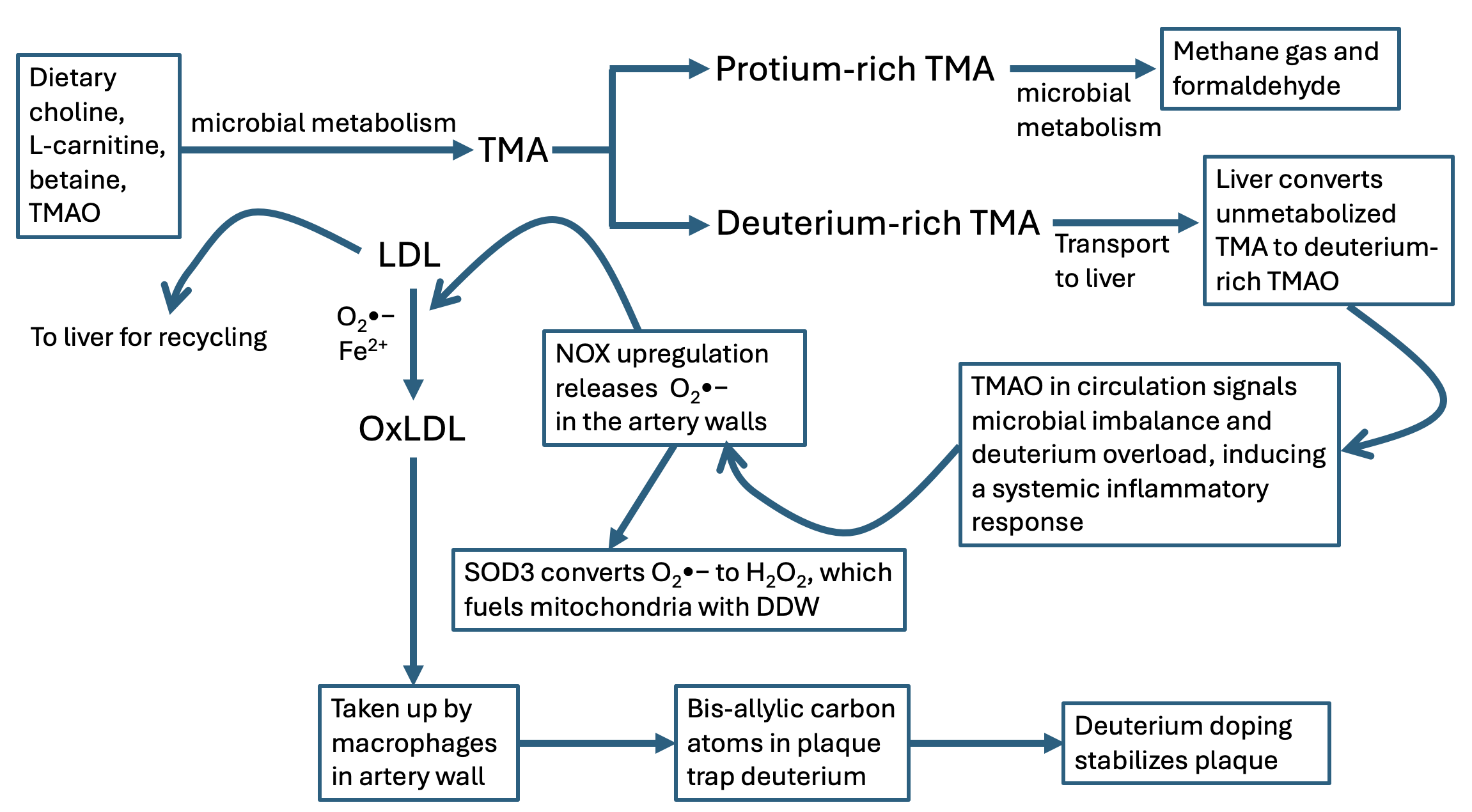
Atherosclerosis is the slow accumulation of oxidized lipids in the artery walls, eventually leading to heart attacks and stroke. It is the leading cause of death, worldwide. Despite much study, the underlying pathology remains poorly understood. This paper proposes a theory that atherosclerosis develops as a consequence of defective methylation pathways, and that the accumulation of lipids is a process to ameliorate the problem of deuterium overload in mitochondria, systemically. We show the critical role that gut microbes play in supplying deuterium depleted nutrients to the mitochondria, in large part through the supply of methyl groups as a source of 1H protons. Deuterium (2H) is a natural, pervasive element, which however is highly damaging to the ATPase nanomotors that produce ATP. Gut microbes exploit hydrogen gas recycling as a means to deplete deuterium in derived metabolites. Gut dysbiosis impairs this process. Polyunsaturated fatty acids (PUFAs) have a unique feature as a property of their bis-allylic carbon atoms, that allows them both to produce deuterium depleted water through the lipid peroxidation cascade, and to trap and sequester deuterium. A defective methylation system, reflected in high plasma trimethylamine oxide (TMAO), leads, through complex signaling processes, to the trapping of lipids in the artery wall and the induction of an inflammatory response to promote lipid peroxidation cascades. Deficiencies in aldehyde dehydrogenases lead to increased exposure to formaldehyde, acetaldehyde, and malondialdehyde, causing mitochondrial damage. Eventually, deuterium loading at the bis-allylic carbon atoms quenches the cascade, stabilizing the plaque. This theory can explain most of the markers associated with cardiovascular disease (CVD), including low-density lipoprotein (LDL), trimethylamine oxide (TMAO), homocysteine, psychological and emotional stress, dimethylglycine, and deficiencies in glutathione, zinc and B vitamins.
Keywords:
mitochondria
; deuterium
; atherosclerosis
; lipid peroxidation
; homocysteine
; methylation pathways
; gut dysbiosis
; formaldehyde
Copyright: This open access article is published under a Creative Commons CC BY 4.0 license, which permit the free download, distribution, and reuse, provided that the author and preprint are cited in any reuse.


