

Submitted:
23 June 2026
Posted:
24 June 2026
You are already at the latest version
Abstract
Type 2 diabetes mellitus (T2D) is increasingly recognized as a major risk factor for Alzheimer’s disease (AD), supporting the concept that neurodegeneration may arise, in part, from chronic metabolic dysfunction. Recent advances, Caveolin-1 (CAV-1), the principal structural protein of caveolae, has emerged as an important regulator of insulin signaling, lipid metabolism, mitochondrial homeostasis, neurovascular integrity, and amyloid precursor protein processing. Since our previous review published in 2020, substantial evidence has accumulated indicating that CAV-1 deficiency contributes to AD-related pathology under diabetic conditions through mechanisms involving endothelial dysfunction, impaired brain insulin signaling, disruption of mitochondria–endoplasmic reticulum contact sites (MERCS), neuroinflammation, and defective autophagy. Recent studies further demonstrate that restoration of neuronal or endothelial CAV-1 ameliorates cognitive decline, improves insulin signaling, preserves synaptic function, and attenuates amyloid pathology in experimental models. This review summarizes current advances in understanding CAV-1-dependent mechanisms linking T2D and AD and discusses the potential of CAV-1 as a biomarker and therapeutic target for diabetes-associated neurodegeneration.
Keywords:
caveolin-1
; Alzheimer’s disease
; diabetes mellitus
; insulin resistance
; mitochondria
; endoplasmic reticulum
; neurovascular unit
; amyloid beta
; tau
; neurodegeneration
1. Introduction
Alzheimer’s disease (AD) and type 2 diabetes mellitus (T2D) are among the most prevalent age-associated disorders worldwide and represent major public health challenges due to their increasing incidence in aging populations [1,2,3]. AD is the leading cause of dementia and is characterized by progressive cognitive decline accompanied by extracellular amyloid-β (Aβ) deposition, intracellular neurofibrillary tangles composed of hyperphosphorylated tau, synaptic dysfunction, and neurodegeneration. T2D, in turn, is a complex metabolic disease characterized by insulin resistance, hyperglycemia, and chronic low-grade inflammation. Accumulating epidemiological and experimental evidence indicates that these two disorders are closely interconnected, giving rise to the concept of AD as “type 3 diabetes” or a brain-specific insulin-resistant state [4,5,6].
Epidemiological studies consistently demonstrate that T2D increases the risk of cognitive impairment and dementia by approximately 1.5–2-fold [7,8]. Moreover, individuals with diabetes frequently exhibit accelerated cognitive decline, reduced hippocampal volume, and increased cerebral vascular pathology [9,10]. Recent longitudinal studies further suggest that diabetes accelerates components of the amyloid–tau–neurodegeneration (ATN) cascade during the prodromal stages of Alzheimer's disease, supporting the concept that metabolic dysfunction actively contributes to neurodegeneration rather than acting merely as a comorbidity [11].
These include impaired insulin signaling, chronic neuroinflammation, oxidative stress, mitochondrial dysfunction, vascular injury, lipid dysregulation, and altered autophagy [11]. Insulin resistance in the brain disrupts neuronal survival pathways and synaptic plasticity while promoting Aβ accumulation and tau hyperphosphorylation. Hyperglycemia and advanced glycation end products (AGEs) further exacerbate oxidative damage and inflammatory responses, leading to neuronal dysfunction and blood–brain barrier impairment [11,12,13]. Similarly, cerebrovascular abnormalities frequently observed in diabetes contribute to reduced cerebral perfusion and impaired clearance of neurotoxic proteins.
Increasing evidence positions caveolin-1 (CAV-1) as a critical integrator of these pathogenic pathways. CAV-1 is a 21–24 kDa scaffolding protein and the principal structural component of caveolae—specialized cholesterol-rich invaginations of the plasma membrane involved in signal transduction, endocytosis, lipid transport, and mechanosensing [14]. Through its scaffolding domain, CAV-1 interacts with numerous signaling molecules, including insulin receptors, endothelial nitric oxide synthase (eNOS), growth factor receptors, and inflammatory mediators, thereby orchestrating diverse cellular responses. CAV-1 is widely expressed in endothelial cells, adipocytes, fibroblasts, astrocytes, and subsets of neurons, placing it at strategic sites of metabolic and neurovascular regulation [15].
Dysregulation of CAV-1 has been implicated in both diabetes and neurodegenerative disorders. In peripheral tissues, altered CAV-1 expression contributes to adipose tissue dysfunction, and vascular complications of diabetes. In the central nervous system, CAV-1 modulates synaptic plasticity, neuroinflammation, mitochondrial function, and blood–brain barrier integrity [16]. Notably, experimental studies indicate that CAV-1 influences the processing and trafficking of amyloid precursor protein (APP), Aβ generation, tau phosphorylation, and neuronal survival. Reduced CAV-1 expression has been reported in aging and AD brains, whereas restoration of neuronal CAV-1 expression can improve synaptic function and cognitive outcomes in animal models [17,18].
The emerging role of CAV-1 as a molecular hub connecting metabolic dysfunction, vascular pathology, and neurodegeneration highlights its potential clinical significance. Beyond its mechanistic relevance, CAV-1 has attracted attention as a candidate biomarker for disease progression and as a promising therapeutic target [18,19,20,21]. Understanding how CAV-1 regulates the crosstalk between T2D and AD may provide new insights into disease pathogenesis and facilitate the development of innovative diagnostic and therapeutic strategies aimed at preventing or slowing neurodegeneration in metabolically vulnerable individuals [22,23].
In this review, we summarize recent advances in understanding the role of CAV-1 at the intersection of diabetes and AD, focusing on newly identified molecular mechanisms, biomarker potential, and emerging therapeutic opportunities. We propose that CAV-1 represents a key regulatory node linking systemic metabolic disturbances with brain aging and neurodegeneration.
2. Caveolin-1: Structure and Biological Functions
Through its scaffolding domain, CAV-1 interacts with numerous signaling proteins and regulates insulin receptor signaling, cholesterol trafficking, endocytosis, mitochondrial homeostasis, inflammatory pathways, autophagy, and synaptic plasticity [24].
The broad distribution of CAV-1 in endothelial cells, adipocytes, astrocytes, and neurons enables it to coordinate systemic metabolic homeostasis and brain function [25].
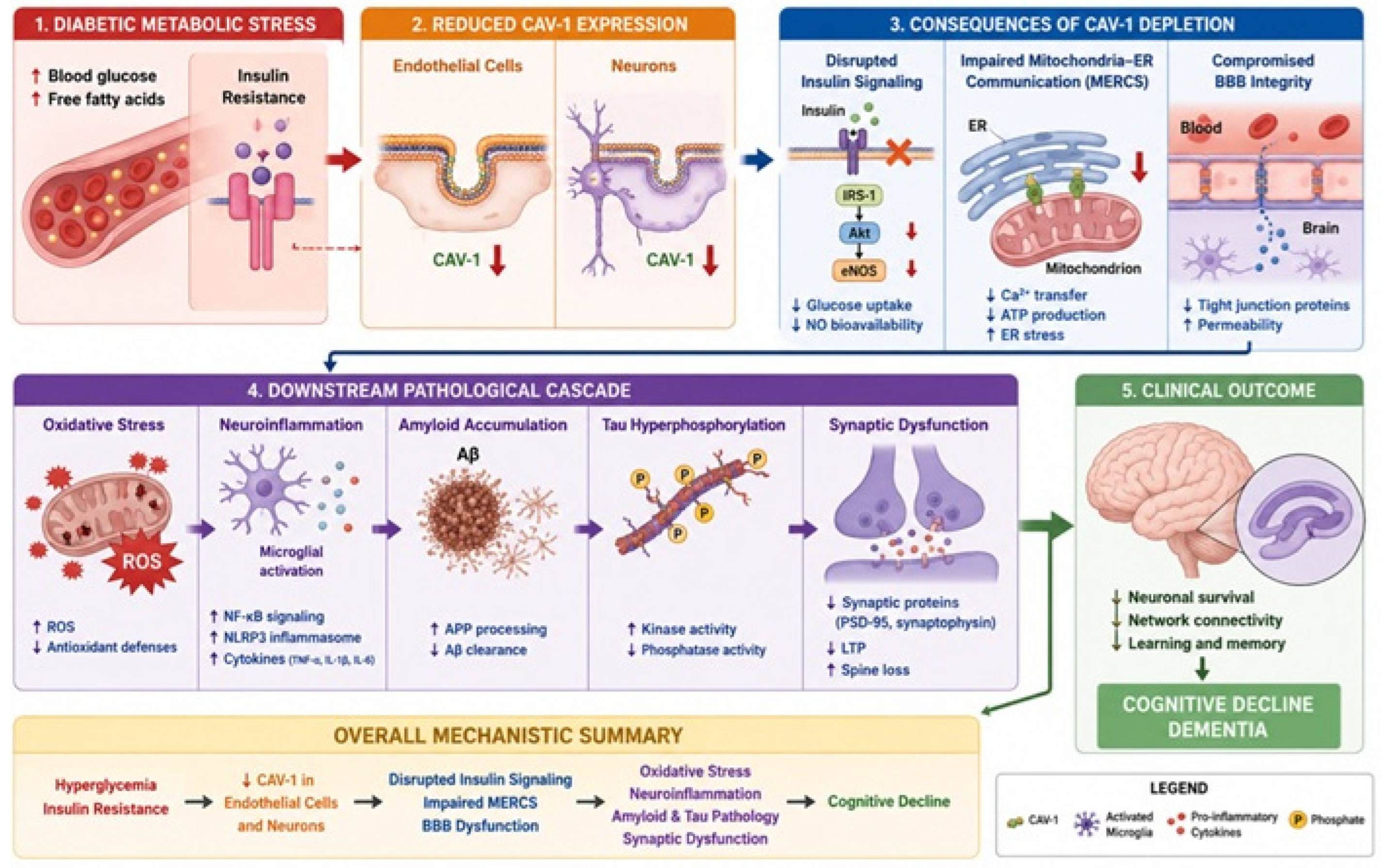
Figure 1.
Proposed mechanisms linking diabetes-associated caveolin-1 (CAV-1) depletion to Alzheimer's disease pathology. Hyperglycemia and insulin resistance reduce CAV-1 expression in endothelial cells and neurons. Decreased CAV-1 disrupts insulin signaling, mitochondria–ER contact sites (MERCS), and blood–brain barrier integrity, promoting oxidative stress, neuroinflammation, amyloid accumulation, tau hyperphosphorylation, synaptic dysfunction, and cognitive decline. Collectively, these mechanisms accelerate neurodegeneration and Alzheimer's disease progression.
Figure 1.
Proposed mechanisms linking diabetes-associated caveolin-1 (CAV-1) depletion to Alzheimer's disease pathology. Hyperglycemia and insulin resistance reduce CAV-1 expression in endothelial cells and neurons. Decreased CAV-1 disrupts insulin signaling, mitochondria–ER contact sites (MERCS), and blood–brain barrier integrity, promoting oxidative stress, neuroinflammation, amyloid accumulation, tau hyperphosphorylation, synaptic dysfunction, and cognitive decline. Collectively, these mechanisms accelerate neurodegeneration and Alzheimer's disease progression.
3. Evidence Linking CAV-1 to Diabetes and Alzheimer’s Disease
Bonds et al. first demonstrated that depletion of CAV-1 in diabetic db/db mice induces AD-like pathological changes, including increased APP processing, an elevated Aβ42/Aβ40 ratio, tau hyperphosphorylation, and memory impairment [26]. Restoration of CAV-1 rescued many of these abnormalities. Subsequent studies have strengthened these observations and further support the role of CAV-1 as a mechanistic link between metabolic dysfunction and neurodegeneration [23,27]. More recent findings indicate that diabetes may accelerate multiple components of the ATN cascade in humans, suggesting that metabolic dysfunction directly contributes to AD progression [28]."
4. Endothelial CAV-1 and Neurovascular Dysfunction
An important advance since 2020 concerns the role of endothelial CAV-1. Brain endothelial cells regulate blood–brain barrier (BBB) integrity and cerebral insulin transport [29].
Recent studies showed that endothelial CAV-1 deficiency in diabetic mice impairs cerebrovascular function and promotes neurodegeneration. Reduced endothelial CAV-1 contributes to BBB disruption, impaired insulin delivery to the brain, and enhanced amyloidogenic processing [30].
These findings place CAV-1 within the framework of the neurovascular hypothesis of AD [31].
5. CAV-1 and Mitochondria–ER Contact Sites (MERCS)
MERCS are increasingly recognized as critical regulators of calcium signaling, lipid transfer, autophagy, mitochondrial quality control, and apoptosis [32].
CAV-1 localizes to MERCS and regulates organelle communication. Disruption of MERCS contributes to diabetes, neurodegeneration, and aging. Recent studies identify MERCS as both sensors and regulators of disease progression.
Altered MERCS may help explain how metabolic stress associated with diabetes promotes mitochondrial dysfunction and AD-related pathology [33].
6. CAV-1, Mitophagy, and Cellular Quality Control
Impaired mitophagy is increasingly recognized as a common feature of both AD and T2D. MERCS coordinate mitophagy through tether proteins and signaling pathways. Recent evidence suggests that CAV-1 regulates mitochondrial quality control, and its depletion impairs mitophagy, increasing oxidative stress and neuronal vulnerability. Defective mitophagy may therefore represent a major mechanism linking CAV-1 deficiency with neurodegeneration [34].
7. Neuroinflammation and Immune Signaling
Chronic low-grade inflammation is a shared pathogenic mechanism underlying both T2D and AD. Persistent metabolic stress associated with hyperglycemia, insulin resistance, and dyslipidemia induces systemic inflammation that extends to the central nervous system, where it contributes to neurodegenerative processes [34]. Neuroinflammation is now considered not merely a consequence of AD pathology but an active driver of disease progression, influencing amyloid-β (Aβ) accumulation, tau hyperphosphorylation, synaptic dysfunction, and neuronal loss [36].
One major pathway regulated by CAV-1 is the nuclear factor kappa B (NF-κB) signaling pathway. NF-κB serves as a master transcriptional regulator of inflammatory responses and controls the expression of numerous cytokines, chemokines, and adhesion molecules. Hyperglycemia and oxidative stress activate NF-κB, leading to increased production of pro-inflammatory mediators such as tumor necrosis factor-α (TNF-α), interleukin-1β (IL-1β), and interleukin-6 (IL-6) [36]. Experimental studies indicate that CAV-1 negatively regulates NF-κB activation, whereas CAV-1 deficiency results in enhanced inflammatory signaling and increased susceptibility to tissue damage [37].
The emerging view of AD as a disorder of innate immunity places CAV-1 at a strategic intersection between metabolic signaling, inflammatory regulation, and neurodegeneration. Given its ability to modulate inflammatory pathways, mitochondrial function, and membrane receptor organization, CAV-1 may represent a key molecular link through which diabetes accelerates AD progression [38].
Collectively, these findings support a model in which CAV-1 dysfunction promotes chronic neuroinflammation by enhancing NF-κB signaling, activating the NLRP3 inflammasome, altering microglial phenotypes, and amplifying cytokine-mediated neuronal injury. Further investigation of CAV-1-dependent immune mechanisms may yield novel biomarkers and therapeutic strategies for patients at the intersection of diabetes and Alzheimer's disease [39].
Recent evidence implicates the NLRP3 inflammasome as a critical mediator linking metabolic dysfunction to neurodegeneration. Hyperglycemia, mitochondrial dysfunction, and oxidative stress promote NLRP3 activation, resulting in maturation and release of pro-inflammatory cytokines such as IL-1β and IL-18. Excessive inflammasome activation has been observed in both T2D and AD and contributes to synaptic dysfunction and neuronal loss. Emerging studies suggest that CAV-1 may modulate inflammasome signaling through its effects on membrane microdomains and NF-κB activation, although the underlying mechanisms remain incompletely understood [40].
8. Therapeutic Targeting of CAV-1
Recent studies demonstrate that neuron-targeted overexpression of CAV-1 attenuates cognitive decline and pathological transcriptomic changes in AD models [40]. Potential therapeutic strategies include: gene therapy targeting neuronal CAV-1; modulation of caveolae signaling; enhancement of MERCS homeostasis; mitochondrial protective therapies; insulin sensitizers; anti-inflammatory interventions [41].
Restoration of neuronal CAV-1 expression has been shown to improve neuroplasticity and support membrane-associated signaling pathways essential for learning and memory. Because CAV-1 occupies a central position at the intersection of metabolic regulation, insulin signaling, mitochondrial function, and neuroinflammation, it represents an attractive therapeutic target linking type 2 diabetes (T2D) and AD.
Several therapeutic strategies aimed at restoring CAV-1 function are currently being explored. Gene therapy approaches employing viral vectors to selectively increase neuronal CAV-1 expression have yielded promising results in preclinical models, improving synaptic function and reducing neurodegeneration [42,43,44,45]. Pharmacological modulation of caveolae signaling may also enhance membrane receptor organization and downstream insulin signaling pathways disrupted in both T2D and AD. In addition, interventions that stabilize mitochondria–ER contact sites (MERCS) could restore calcium homeostasis, mitochondrial bioenergetics, and autophagic flux, thereby limiting oxidative stress and neuronal injury.
Mitochondrial protective therapies, including antioxidants and agents that improve mitochondrial dynamics, may further counteract the deleterious consequences of CAV-1 deficiency. Insulin sensitizers, such as metformin and glucagon-like peptide-1 receptor agonists, have demonstrated neuroprotective properties and may indirectly restore CAV-1-associated signaling pathways. Furthermore, anti-inflammatory interventions targeting microglial activation and chronic neuroinflammation may interrupt the vicious cycle linking metabolic dysfunction to neurodegeneration [41]. Future therapeutic approaches may involve combination strategies that simultaneously target CAV-1 expression, insulin resistance, mitochondrial dysfunction, and neuroinflammatory pathways, thereby addressing multiple pathogenic mechanisms underlying diabetes-associated cognitive decline and AD progression.
9. Biomarker Potential of CAV-1
CAV-1 levels in plasma, cerebrospinal fluid, or extracellular vesicles may serve as biomarkers for early diabetic cognitive impairment, AD progression, and therapeutic response. Altered CAV-1 expression reflects dysregulation of membrane lipid raft signaling, neurovascular integrity, and neuroinflammatory status, all of which are early events in metabolic and neurodegenerative disease. In addition, extracellular vesicle–associated CAV-1 may provide a minimally invasive readout of neuronal and endothelial caveolae dysfunction, making it a promising candidate for liquid biopsy–based stratification and disease monitoring [43]. Future longitudinal studies are needed to validate clinical utility.
Recent evidence suggests that caveolin-containing extracellular vesicles participate in intercellular communication between endothelial, metabolic, and neural tissues and may reflect systemic disease burden before overt clinical manifestations become apparent [16]. Because CAV-1 regulates blood–brain barrier integrity, insulin transport, and inflammatory signaling, changes in circulating or extracellular vesicle–associated CAV-1 levels may provide insight into the progression of neurovascular dysfunction associated with both T2D and AD. Furthermore, incorporation of CAV-1 into multimodal biomarker panels together with established AD biomarkers, including Aβ42/40, phosphorylated tau, neurofilament light chain, and markers of endothelial injury, may improve risk stratification and facilitate early identification of individuals susceptible to diabetes-associated cognitive decline [16,29,30].
10. Future Directions
Key unresolved questions include the cell-type–specific roles of CAV-1 in neurons, glia, and endothelial cells, as well as its dynamic regulation at mitochondria–ER contact sites (MERCS) and within lipid raft microdomains. The mechanistic interplay between CAV-1 and major AD risk pathways, including APOE4 signaling, tau pathology, and sex-dependent susceptibility, remains insufficiently defined. In parallel, the extent to which CAV-1 integrates metabolic stress signals with neuroimmune activation across disease stages is still unclear.
Emerging evidence supports a conceptual shift toward viewing CAV-1 as a central membrane–organelle signaling hub linking metabolic dysfunction, inflammatory regulation, and neurodegeneration. Within this framework, diabetes-associated metabolic stress may promote maladaptive CAV-1 signaling states that converge on MERCS dysfunction, impaired mitochondrial homeostasis, and chronic innate immune activation, thereby accelerating AD progression. Addressing these questions will be essential for translating experimental findings into clinically effective interventions.
11. Conclusions
In summary, this review consolidates current evidence delineating the mechanistic landscape of association between AD and T2D], highlighting CAV-1 multifaceted roles in diseases initiation, progression, and therapeutic response. Across preclinical and clinical studies, converging data support the central involvement of CAV-1 in regulation downstream processes including inflammation, metabolic reprogramming, immune modulation, cellular stress responses, etc.. Importantly, these mechanisms do not operate in isolation but instead form an interconnected network that contributes to disease heterogeneity and variable treatment outcomes.
Despite substantial advances, the literature reveals several areas of apparent inconsistency. These discrepancies likely reflect differences in experimental models, disease stage, cellular context, and compensatory signaling pathways. Reconciling these findings suggests that CAV-1 functions as a dynamic rheostat rather than a binary switch, with its biological outcome determined by microenvironmental cues and temporal disease evolution.
Clinically, these mechanistic insights carry important implications. First, they support the rationale for stratified therapeutic approaches targeting signaling pathways, particularly in patient subgroups characterized by genetic variants and molecular signature. Second, they underscore the potential utility of biomarkers as a prognostic indicator and a predictor of therapeutic responsiveness. Third, emerging evidence suggests that combinatorial strategies may overcome compensatory resistance mechanisms and improve durable clinical outcomes.
Moving forward, translational efforts should prioritize validation of these mechanisms in well-characterized patient cohorts, integration of multi-omics datasets to resolve context-specific signaling dynamics, and development of intervention strategies that account for disease stage–dependent pathway plasticity. Standardization of experimental models and reporting frameworks will also be critical to reduce heterogeneity across studies and improve reproducibility.
Overall, while gaps in knowledge remain, the accumulated evidence positions CAV-1 and major AD risk pathways, including APOE4 signaling, as a central regulatory hub with significant diagnostic and therapeutic potential. Continued interdisciplinary investigation will be essential to translate these mechanistic insights into clinically effective interventions.
References
- World Health Organization. Dementia. Available online: https://www.who.int/news-room/fact-sheets/detail/dementia (accessed on 13 June 2026).
- Sun, H.; Saeedi, P.; Karuranga, S.; Pinkepank, M.; Ogurtsova, K.; Duncan, B.B.; Stein, C.; Basit, A.; Chan, J.C.N.; Mbanya, J.C.; et al. IDF Diabetes Atlas: Global, regional and country-level diabetes prevalence estimates for 2021 and projections for 2045. Diabetes Res. Clin. Pract. 2022, 183, 109119. [Google Scholar] [CrossRef] [PubMed]
- Scheltens, P.; De Strooper, B.; Kivipelto, M.; Holstege, H.; Chételat, G.; Teunissen, C.E.; Cummings, J.; van der Flier, W.M. Alzheimer's disease. Lancet 2021, 397, 1577–1590. [Google Scholar] [CrossRef] [PubMed]
- Gudala, K.; Bansal, D.; Schifano, F.; Bhansali, A. Diabetes mellitus and risk of dementia: A meta-analysis of prospective observational studies. J. Diabetes Investig. 2013, 4, 640–650. [Google Scholar] [CrossRef] [PubMed]
- Chatterjee, S.; Peters, S.A.E.; Woodward, M.; Mejia Arango, S.; Batty, G.D.; Beckett, N.; Beiser, A.; Borenstein, A.R.; Crane, P.K.; Haan, M.; et al. Type 2 diabetes as a risk factor for dementia in women compared with men: A pooled analysis of 2.3 million people comprising more than 100,000 cases of dementia. Diabetes Care 2016, 39, 300–307. [Google Scholar] [CrossRef] [PubMed]
- Arnold, S.E.; Arvanitakis, Z.; Macauley-Rambach, S.L.; Koenig, A.M.; Wang, H.Y.; Ahima, R.S.; Craft, S.; Gandy, S.; Buettner, C.; Stoeckel, L.E.; et al. Brain insulin resistance in type 2 diabetes and Alzheimer disease: Concepts and conundrums. Nat. Rev. Neurol. 2018, 14, 168–181. [Google Scholar] [CrossRef] [PubMed]
- Moran, C.; Phan, T.G.; Chen, J.; Blizzard, L.; Beare, R.; Venn, A.; et al. Brain atrophy in type 2 diabetes: Regional distribution and influence on cognition. Diabetes Care 2013, 36, 4036–4042. [Google Scholar] [CrossRef] [PubMed]
- Biessels, G.J.; Reagan, L.P. Cognitive decline and dementia in diabetes: A systematic review. Eur. J. Pharmacol. 2015, 763, 128–140. [Google Scholar] [CrossRef] [PubMed]
- van Harten, B.; de Leeuw, F.E.; Weinstein, H.C.; Scheltens, P.; Biessels, G.J. Brain imaging in patients with diabetes: A systematic review. Diabetes Care 2006, 29, 2539–2548. [Google Scholar] [CrossRef] [PubMed]
- Surguchov, A. Caveolin: A new link between diabetes and Alzheimer's disease. Cell. Mol. Neurobiol. 2020, 40, 1059–1066. [Google Scholar] [CrossRef]
- De Felice, F.G.; Ferreira, S.T. Inflammation, defective insulin signaling, and mitochondrial dysfunction as common molecular denominators connecting type 2 diabetes to Alzheimer disease. Diabetes 2014, 63, 2262–2272. [Google Scholar] [CrossRef] [PubMed]
- Harrison, J.R.; Ghosh, A. The role of early insulin resistance and Aβ pathology in Alzheimer's disease. Front. Aging Neurosci. 2019, 11, 305. [Google Scholar]
- Cohen, E.; et al. The effect of advanced glycation end products on neurodegeneration: Implications for Alzheimer's disease. Res. Alzheimer’s Dis. 2015, 6, 1–10. [Google Scholar]
- Zhao, Y.; Shao, Z. Caveolin-1 in health and disease: A mini-review. Front. Pharmacol. 2021, 12, 600684. [Google Scholar] [CrossRef]
- Gaudreault, S.B.; Dea, D.; Poirier, J. Increased caveolin-1 expression in Alzheimer's disease brain. Neurobiol. Aging 2004, 25, 753–759. [Google Scholar] [CrossRef] [PubMed]
- Meng, Z.; Sewell-Loftin, M.K.; Thomas, V.; et al. Caveolin in extracellular vesicles: Orchestrating interorgan communication in diabetes-associated cardiovascular disease. Curr. Opin. Physiol. 2025, 46, 100862. [Google Scholar] [CrossRef] [PubMed]
- Head, B.P.; Peart, J.N.; Panneerselvam, M.; et al. Loss of caveolin-1 accelerates neurodegeneration and aging. PLoS ONE 2010, 5, e15697. [Google Scholar] [CrossRef] [PubMed]
- Badiu, C.; et al. Caveolin-1 expression modulation as a potential therapeutic strategy in Alzheimer's disease. Curr. Alzheimer Res. 2020, 17, 271–286. [Google Scholar]
- Cohen, A.W.; et al. Caveolin-1 and caveolae in health and disease: A role in lipid metabolism. J. Lipid Res. 2009, 50, S395–S400. [Google Scholar]
- Mazzone, T.; et al. Caveolin-1 and the regulation of endothelial function. ANZ J. Surg. 2009, 79, 238–246. [Google Scholar]
- Harrison, J.R.; et al. The potential of caveolin-1 as a therapeutic target in cancer and metabolic disease. Biochem. Pharmacol. 2019, 162, 209–218. [Google Scholar]
- Kumar, S.; Dey, A. Caveolin-1: Crucial in linking insulin resistance and neurodegeneration. Biochim. Biophys. Acta Mol. Basis Dis. 2021, 1867, 166290. [Google Scholar] [CrossRef] [PubMed]
- Tang, W.; Li, Y.; Li, Y.; Wang, Q. Caveolin-1, a novel player in cognitive decline. Neurosci. Biobehav. Rev. 2021, 129, 95–106. [Google Scholar] [CrossRef] [PubMed]
- Buchanan, J.D.; Gibbons, G.F. Caveolin-1: A central player in cholesterol trafficking, insulin signaling, and autophagy. Cells 2022, 11, 143. [Google Scholar] [CrossRef] [PubMed]
- Hapke, E.; Rittie, L. The multifaceted roles of caveolin-1 in cancer and other diseases: Implications for therapy. Cancers 2017, 9, 42. [Google Scholar] [CrossRef] [PubMed]
- Bonds, J.A.; Shetti, A.; Bheri, V.; et al. Depletion of caveolin-1 in a type 2 diabetes model induces Alzheimer's disease pathology precursors and memory impairment. J. Neurosci. 2019, 39, 8576–8583. [Google Scholar] [CrossRef] [PubMed]
- Khan, A.A.; et al. The role of diabetes in the development of Alzheimer's disease: Epidemiological and biological support. Front. Aging Neurosci. 2020, 12, 122. [Google Scholar] [CrossRef]
- Zhao, W.; et al. Diabetes and Alzheimer's disease: The role of insulin signaling and glucose metabolism. J. Neurochem. 2020, 154, 487–507. [Google Scholar]
- Shetti, A.; et al. Reduced endothelial caveolin-1 underlies deficits in brain insulin signalling in vascular and non-vascular cells. Brain 2023, 146, 3014–3029. [Google Scholar] [PubMed]
- Yang, Y.; et al. Reduced endothelial caveolin-1 underlies deficits in brain insulin uptake and signaling in diabetes. Acta Neuropathol. Commun. 2023, 11, 18. [Google Scholar] [CrossRef] [PubMed]
- Zlokovic, B.V. Neurovascular pathways to neurodegeneration in Alzheimer's disease and other disorders. Nat. Rev. Neurosci. 2011, 12, 723–738. [Google Scholar] [CrossRef] [PubMed]
- Sassano, M.L.; Felipe-Abrio, B.; Agostinis, P. ER–mitochondria contact sites: A multifaceted factory for Ca2+ signaling and lipid transport. Front. Cell Dev. Biol. 2022, 10, 988014. [Google Scholar] [CrossRef] [PubMed]
- Paillusson, S.; Stoica, R.; Gomez-Suaga, P.; et al. There's something wrong with my MAM: The ER–mitochondria axis and neurodegenerative diseases. Trends Neurosci. 2016, 39, 146–157. [Google Scholar] [CrossRef] [PubMed]
- Wu, Q.; et al. Neuron-targeted overexpression of caveolin-1 alleviates diabetes-associated cognitive decline via regulating mitochondrial quality control. Cell Commun. Signal. 2023, 21, 347. [Google Scholar]
- Kamila, P.; Kar, K.; Chowdhury, S.; Chakraborty, P.; Dutta, R.; Singh, S.A.; Prajapati, B.G. Effect of neuroinflammation on the progression of Alzheimer's disease and its significant ramifications for novel anti-inflammatory treatments. IBRO Neurosci. Rep. 2025, 18, 771–782. [Google Scholar] [CrossRef] [PubMed]
- Suryavanshi, S.V.; Kulkarni, Y.A. NF-κB: A potential target in the management of vascular complications of diabetes. Front. Pharmacol. 2017, 8, 798. [Google Scholar] [CrossRef] [PubMed]
- Garrean, S.; Gao, X.P.; Brovkovych, V.; et al. Caveolin-1 regulates NF-κB activation and lung inflammatory response to sepsis induced by lipopolysaccharide. J. Immunol. 2006, 177, 4853–4860. [Google Scholar] [CrossRef] [PubMed]
- Ennerfelt, H.E.; Lukens, J.R. The role of innate immunity in Alzheimer's disease. Immunol. Rev. 2020, 297, 225–246. [Google Scholar] [CrossRef] [PubMed]
- Bauernfeind, F.G.; Horvath, G.; Stutz, A.; et al. NF-κB activating pattern of NLRP3 inflammasome priming. J. Immunol. 2009, 183, 787–793. [Google Scholar] [CrossRef]
- Wang, D.; Chernov, A.V.; Lam, R.; et al. Neuron-targeted caveolin-1 overexpression attenuates cognitive loss and pathological transcriptomic changes in symptomatic Alzheimer's disease models. Signal Transduct. Target. Ther. 2025, 10, 172. [Google Scholar] [CrossRef] [PubMed]
- Kovacs, D.M.; Head, B.P.; Patel, P.M. Physiological and pathological roles of caveolins in the central nervous system. Neurochem. Int. 2024, 181, 106005. [Google Scholar]
- Wang, S.; Schilling, J.M.; Hsu, M.; et al. Synapsin-caveolin-1 gene therapy preserves neuronal and synaptic morphology and hippocampal-dependent memory in Alzheimer's disease mice. Mol. Ther. Methods Clin. Dev. 2021, 21, 434–450. [Google Scholar] [CrossRef] [PubMed]
- Egawa, J.; Schilling, J.M.; Cui, W.; Posadas, E.; Sawada, A.; Alas, B.; et al. Neuron-targeted caveolin-1 promotes ultrastructural and functional hippocampal synaptic plasticity. Cereb. Cortex 2018, 28, 3255–3271. [Google Scholar] [CrossRef] [PubMed]
- Mandyam, C.D.; Schilling, J.M.; Cui, W.; Egawa, J.; Niesman, I.R.; Kellerhals, S.E.; et al. Neuron-targeted caveolin-1 improves molecular signaling, plasticity, and behavior dependent on the hippocampus in adult and aged mice. Biol. Psychiatry 2017, 81, 101–110. [Google Scholar] [CrossRef] [PubMed]
- Head, B.P.; Hu, Y.; Finley, J.C.; Saldana, M.D.; Bonds, J.A.; Miyanohara, A.; et al. Neuron-targeted caveolin-1 protein enhances signaling and promotes arborization of primary neurons. J. Biol. Chem. 2011, 286, 33310–33321. [Google Scholar] [CrossRef]
Disclaimer/Publisher’s Note: The statements, opinions and data contained in all publications are solely those of the individual author(s) and contributor(s) and not of MDPI and/or the editor(s). MDPI and/or the editor(s) disclaim responsibility for any injury to people or property resulting from any ideas, methods, instructions or products referred to in the content. |
© 2026 by the authors. Licensee MDPI, Basel, Switzerland. This article is an open access article distributed under the terms and conditions of the Creative Commons Attribution (CC BY) license (http://creativecommons.org/licenses/by/4.0/).
Copyright: This open access article is published under a Creative Commons CC BY 4.0 license, which permit the free download, distribution, and reuse, provided that the author and preprint are cited in any reuse.


