

Submitted:
23 June 2026
Posted:
24 June 2026
You are already at the latest version
Abstract
Expanded Polystyrene (EPS) offers a viable pathway for balancing the fresh and hardened properties of infrastructure with environmental sustainability. This study evaluated six concrete mixes with varying EPS Styrofoam aggregate ratios and three water-to-binder (w/b) ratios, all of which incorporated silica fume and a superplasticizer. Eight ML algorithms (SVM, GPR, ANN, etc.) and a deep-learning LSTM model were utilized to preliminarily predict trends in EPS concrete properties, with SHAP analysis quantifying feature contributions. The experimental results indicated that the fine aggregate replacement outperformed the coarse aggregate replacement, retaining approximately 76% of the density of the control mixture, along with other property reductions. The fine aggregate replacement resulted in a compressive strength reduction of up to 46.4%, with losses in tensile strength of 20.9% and an improvement in workability of 3.4%. Finally, various AI models identified trends in the predictions of EPS properties based on the mixing ratio within a limited experimental dataset. In addition, SHAP analysis revealed that the coarse aggregate replacement exerted a more significant negative impact on the mechanical properties and density than the fine aggregate replacement. Although these mixtures offer significant weight reduction, their use in structural applications requires further verification, as the reduction of nearly half of the compressive strength is significant. These findings provide strategies and a framework to facilitate the precise practical application of EPS concrete in nonstructural or lightly loaded applications.
Keywords:
aggregate ratio
; algorithms
; binder ratio
; expanded polystyrene
; explainable AI
1. Introduction
Global trade in polystyrene waste and scrap reached $191 million in 2023, highlighting the significant need for sustainable management [1]. In addition, the global need for lightweight construction materials has prompted extensive research on EPS concrete [2]. EPS concrete provides a promising solution by reducing landfill burden [3], offering economic and structural benefits [4], such as lower self-weight [5], enhanced energy absorption, low permeability, thermal insulation, and high electrical resistivity [6,7]. A study incorporating a stabilized polystyrene aggregate showed a density reduction of 8-52% compared to that of conventional concrete [8]. EPS concrete provides a lighter alternative (1,350-1,900 kg/m3) to traditional concrete (2,200–2,500 kg/m3) while maintaining a comparable compressive strength (>17 MPa) [9]. Therefore, a significant challenge remains in optimizing the delicate balance between achieving substantial weight reduction or workability and maintaining adequate mechanical properties, such as compressive strength, tensile strength [10,11,12], and modulus of rupture (MOR) [13,14].
Few studies have focused on mix designs to mitigate the reduction in concrete mechanical properties [15]. Lowering the water-to-binder (w/b) ratio, coating the Styrofoam ball surface [16], and adding supplementary cementitious materials such as silica fume (SF) [17,18] can further enhance its strength by improving the EPS-cement bond (potentially up to 15%) [19,20]. The incorporation of EPS can lead to increased drying shrinkage because of its low elastic modulus [21], however, studies have revealed that additives such as SF and fibers such as polypropylene (PP) can improve the shrinkage resistance and compressive strength of EPS concrete [22]. In addition, the EPS size and arrangement contribute significantly to the properties of lightweight concrete [4], and smaller EPS beads can also achieve adequate strength [23]. The EPS dosage is the most significant factor affecting the compressive strength, followed by the water-to-cement ratio [24]. Therefore, it is important to evaluate the replacement of natural aggregates with waste-derived alternatives [25,26] and the effect of different water-to-cement ratios [27] on the fresh and hardened mechanical properties of concrete [25,26,27].
Artificial intelligence (AI) is increasingly used in civil engineering for designing materials. AI has transformed concrete design by moving beyond traditional trial-and-error methods [28]. While machine learning (ML) applications in predicting concrete attributes, including those with special materials, are growing [29]. There is less focus on ML models specific to EPS concrete. ML algorithms such as Linear Regression (LR) [30], Decision Trees (DT), Ensemble Decision Trees (EDT), Gaussian Process Regression (GPR), Support Vector Machines (SVM), Artificial Neural Networks (ANNs) [31], Kernel Models (KMs), and Efficient Linear (EL) can be used to predict the mechanical and physical properties of EPS concrete; however, they have accuracy/interpretability trade-offs. Also, Long Short-Term Memory (LSTM) models are promising owing to their capacity to capture long-term dependencies and achieve high accuracy [32]. Although these models can optimize the predictions of concrete properties using multiple input features, Interpretable ML models, such as the SHapley Additive Explanations (SHAP) method, have been used to analyze the input features that influence predictive accuracy. This approach, called Explainable AI (XAI), enhances model interpretability [33], highlighting the importance of optimizing feature input and model configuration for improved predictions [34,35].
This study addresses these critical gaps by exploring the mix design of EPS Styrofoam concrete, with a specific focus on its impact on strength, density, and workability. First, this study made a preliminary screening to identify primary behavioral trends in EPS-modified concrete, given the focused experimental matrix of 18 mixture configurations. Second, this study aimed to leverage the evaluated AI techniques to explore their utility in characterizing the experimental data. Furthermore, this study employs machine learning and deep learning to evaluate potential indicators between the mix constituents and concrete performance, specifically identifying the algorithms that remain stable when applied to small, exploratory datasets. To achieve these objectives, six distinct concrete mixes with varying EPS aggregate replacement ratios and three different water-to-binder (w/b) ratios were experimentally tested. All mixes incorporated a silica fume and a superplasticizer to enhance their performance. The experimental results provided data on the compressive strength, splitting tensile strength, modulus of rupture, density, and workability. Building upon these experimentally observed patterns within the test domain, the predictive capacity of eight ML algorithms, including Linear Regression (LR), Decision Trees (DT), Support Vector Machines (SVM), Efficient Linear (EL), Ensemble Decision Trees (EDT), Gaussian Process Regression (GPR), Artificial Neural Networks (ANN), and Kernel Models (KM), were tested. In addition, LSTM was used as a benchmark to test whether the complexity of deep learning provided an advantage over static regression in this specific problem domain. Finally, to address the “black box” nature of ML models and enhance interpretability, post-hoc interpretation methods were employed, specifically SHAP [36]. SHAP values quantify the contribution of each feature to the model’s predictions, thereby revealing the influential features and their individual and interactive impacts [37]. Hence, this study integrates waste EPS reuse, lightweight concrete, and AI mixture assessment to develop a viable and sustainable pathway for construction materials.
2. Materials and Methods
2.1. Materials
This study utilized commercially available cement, fine and coarse aggregates, silica fume, water, superplasticizer, and expanded polystyrene (EPS) aggregates. Type I Portland cement conforming to [38] was used in this study. Commercially available silica fume (SF) [39] was incorporated at a 6% replacement rate by the weight of the cement. The chemical and physical properties of both Portland cement and silica fume are summarized in Table 1. Drinkable, impurity-free tap water from the laboratory supply was used to mix and cure the samples.
Siliceous sand meeting the ASTM C33 requirements was used as a fine aggregate [40]. Its properties included a fineness modulus of 2.61, an absorption rate of 1.01%, a specific gravity of 2.65, and a bulk density of 1682 kg/m³. Crushed dolomite with a maximum aggregate size of 10 mm (≤ 1/5 of the minimum sample dimension) was used in the study. Dolomite exhibited a dry bulk density of 1910 kg/m3, fineness modulus of 6.01, water absorption of 0.75%, and specific gravity of 2.7. The particle sieve analysis of the fine and coarse aggregates, directly compared against the upper and lower standard grading limits of ASTM C33, is shown in Figure 1
Addipor-55 EPS, manufactured by Chemicals for Modern Buildings (CMB), was used as a replacement for aggregates, as shown in Figure 2 [41]. These aggregates were produced by shredding waste polystyrene, resulting in a virtual density of 21 kg/m3. Morphologically, because these particles are derived from shredded waste rather than manufactured as virgin beads, they exhibit a highly irregular angular shape and rough, closed-cell surface texture. This unique morphology strongly influences the mechanical and fresh properties of concrete; the rough surface provides slightly better mechanical interlocking with the cement paste than a perfectly smooth spherical EPS [41]. The specified grain sizes mapped against the grading limits for natural aggregates are presented in Figure 1. MasterRheobuild1100, a high-range water-reducing superplasticizer from Master Builders Solutions, was used at a dosage of 2 L/100 kg of cement weight. This dark brown, chloride-free liquid is composed of synthetic polymers, with a specific gravity ranging from 1.19 to 1.26, maximum air entrainment of 1%, and a pH of 6-11.
2.2. Mix Proportions
Six distinct concrete mixtures were designed to investigate the non-, partial, and full replacement of sand (fine aggregate) and gravel (coarse aggregate) with EPS, adhering to relevant standards [42,43,44]. Fine aggregates constituted 40% of the coarse aggregates in the control mixture. The conventional concrete mix design, which served as the basis, was determined based on the described material properties, and five additional aggregate replacement configurations were established for this study. The first mix, labeled “C” (control), served as a conventional concrete mix with no EPS replacement. The second mix, “NF” (No Fine), involved 100% fine aggregate replacement with EPS and no coarse aggregate replacement. The mixes “R65/35,” “R50/50,” and “R35/65” used EPS to replace 65%, 50%, and 35% of fine aggregates and 35%, 50%, and 65% of coarse aggregates, respectively. The final mix, “M” (Mortar), involved replacing 100% of the coarse aggregate with EPS (No Coarse) and no fine aggregate replacement. The mixtures were systematically labeled “x-y,” where “x” denotes the aggregate replacement strategy and “y” represents the water-to-binder (w/b) ratio. Each of these six aggregate replacement configurations was tested using three water-to-binder (w/b) ratios: 0.35 (rich), 0.45 (moderate), and 0.55 (lean). A constant binder content (cement + silica fume) of 300 kg/m3 was maintained for all mixes. The detailed mixing proportions of all samples are listed in Table 2.
2.3. Test Methods
Concrete batching was performed using a 50-L open-pan mixer [45]. The mixing procedure involved: (i) Mixing fine and coarse aggregates, cement, and SF in a drum mixer for two minutes. (ii) Approximately 50% of the mixing water was gradually added, and mixing was continued for three minutes. (iii) The EPS particles were incorporated and mixed for one minute. (iv) The remaining 50% of the water, which was pre-mixed with the superplasticizer, was added to the mixture. (v) Mixing for an additional three to five minutes to ensure homogeneity.
First, the workability of the fresh concrete was assessed using a slump test [46]. The fresh density was determined by hand-compacting cylindrical samples in three layers with 25 blows per layer using a steel rod, as outlined by [47]. Second, the hardened concrete specimens were mechanically characterized after 28 days. For each mixture, triplicate 150 mm cubes, triplicate 150 mm diameter × 300 mm height cylinders, and a single 200 mm × 50 mm × 50 mm prism were cast. The total number of specimens tested included 54 cubes for compressive strength, 54 cylinders for splitting tensile strength, and 18 prisms for the modulus of rupture (MOR). The specimens were compacted, covered with plastic for 24 h, and immersed in water for seven days. Thereafter, the samples were stored at 24 ± 2 °C and 50 ± 5% relative humidity until testing at 28 days. Testing procedures were performed to characterize the compressive strength, splitting tensile strength, and MOR, following [48], [49], and [50], respectively, as shown in Figure 3.
2.4. Machine-Learning Models
This study evaluated the influence of AI modeling for predictive purposes of the fresh and hardened properties of EPS concrete. The analysis involved two main approaches: First, eight traditional ML regression algorithms were evaluated: Linear Regression (LR), Decision Trees (DT), Support Vector Machines (SVM), Efficient Linear (EL), Ensemble Decision Trees (EDT), Gaussian Process Regression (GPR), Artificial Neural Networks (ANN), and Kernel Models (KM). Utilizing the MATLAB R2024a environment, 28 distinct model configurations were developed to optimize performance by tuning hyperparameters (e.g., adjusting the kernel scale for Gaussian SVM models), as shown in Table S.1.
Second, a deep learning architecture was explored using a Long Short-Term Memory (LSTM) network, which is traditionally designed for sequential or time-series data to overcome long-term dependency limitations [51]. This study investigated the capacity of LSTM to map the complex and nonlinear relationships within EPS concrete mix designs, although the input variables, that is, fine/coarse aggregate replacement ratios and w/b ratios, are independent tabular observations. The BiLSTM (Bidirectional LSTM) variant was utilized to evaluate whether its dual-direction processing could enhance feature extraction and pattern recognition within this specific experimental domain [52]. The BiLSTM network was configured with 100 hidden layers, 1000 epochs, and a gradient threshold of 0.001. To ensure optimal convergence, the learning rate was systematically evaluated within the range of 0.025 to 0.08. Primary activation for the neurons was facilitated via sigmoid gate functions and tanh state functions.
In addition to the regression models previously described, an eXtreme Gradient Boosting (XGBoost) model was developed specifically to serve as the basis for the SHAP analysis. SHAP is model-agnostic, making it applicable to various ML algorithms, including linear regression, trees, forests, boosting, and neural networks. XGBoost was selected for this purpose because of its high performance with tabular data and compatibility with tree-based SHAP explainers [53,54]. The model was configured with a learning rate of 0.1, maximum depth of 3, and 100 estimators, which were optimized to prevent overfitting of the 18-point dataset. It is important to note that because the values of the local feature importance of each mixture variable are derived from a dataset of 18 mixture points, they represent the internal logic of the model and variable sensitivity within this specific experimental range, rather than universal causal material laws and mechanistic insights.
2.5. Data Preprocessing
The data collection involved 18 datasets, each corresponding to a specific concrete mix with one of three water-to-binder (w/b) ratios. The key input features selected for the ML models were fine aggregate replacement, coarse aggregate replacement, and water-to-binder (w/b) ratio, which served as potential indicators for the target EPS concrete properties: slump, density, compressive strength, splitting tensile strength, and modulus of rupture. To ensure model robustness with limited data, we restricted the number of input variables to three (fine aggregate replacement, coarse aggregate replacement, and water-to-binder ratio). This decision was a critical measure to balance the need for sufficient information with the risk of overfitting, and increased computational complexity can arise from an excessive number of features in small datasets [55].
To account for differences in variable units and prevent skewing of the results, min-max standardization was applied to scale all parameter values to a 0-1 range, preserving dimensionless expression, as shown in Table S.2 [56]. This standardization enhanced the numerical comparability and accuracy of the model. Each normalized dataset was split into training and validation subsets for further analysis. Cross-validation, specifically the k-fold approach, was employed to assess different parameter combinations and determine the optimal model settings [57]. This method involves randomly shuffling the dataset and dividing it into k-folds, with one fold designated as the validation set. An RBF kernel Support Vector Regression (SVR) in Python was used to explore k-fold configurations (k = 2-9) to optimize performance, as shown in Figure 4. This study used a systematic method to determine the optimal settings, which goes beyond the simple use of presets in MATLAB. The optimal k-fold configurations yielding the highest accuracies were identified for each target property: 46% (k=6) for slump, 96% (k=5) for density, 93% (k=5) for compressive strength, 94% (k=4) for tensile strength, and 97% (k=7) for MOR. These specific k-fold cases corresponded to validation sets comprising 16.6%, 16.6%, 16.6%, 22.2%, and 11.1% of the total dataset, respectively (indexed as [0; 1; 8], [6; 10; 14], [6; 10; 14], [6; 7; 10; 14], and [6; 14] for slump, density, compressive strength, tensile strength, and MOR, respectively).
2.6. Evaluation Metrics
The model performance was evaluated using three widely accepted metrics: the coefficient of determination (R2), mean absolute error (MAE), and root mean square error (RMSE). The coefficient of determination (R2) assesses the linear correlation between the experimental and predicted values of the model. An R2 value between 0.8 and 1 typically indicates a valid model [58]. The Mean Absolute Error (MAE) represents the average of the absolute differences between the actual and predicted values [59]. The Root Mean Square Error (RMSE) measures the magnitude of these differences, giving more weight to larger errors [60]. Lower RMSE and MAE values indicate reduced prediction errors, whereas a higher R2 value indicates greater model accuracy [61].
3. Results and Discussion
The integration of shredded EPS waste provides a potential pathway for the circular management of polymer waste in the construction sector. While this study focuses on the fresh and mechanical feasibility of such mixtures, it is important to note that a definitive environmental advantage remains to be demonstrated through: (1) Life Cycle Assessment (LCA): Quantifying the energy expenditure of mechanical shredding versus the carbon sequestration benefits of landfill diversion. (2) Durability and Environmental Exposure: Evaluating the long-term integrity of the ITZ and the risk of microplastic release under chemical or mechanical weathering conditions. (3) Fire and Safety: Investigating the fire-retardant requirements necessitated by the presence of polystyrene, as EPS in building envelopes poses specific thermal and toxicity risks during fire events.
3.1. Density and Strength Relationships
Figure 5a and Figure 5b show the variations in concrete density and compressive strength ratios across the EPS mixtures at a constant water-to-binder (w/b) ratio, relative to the control mixture. The mixture with 100% sand replacement (NF) exhibited the lowest density ratio (75-78%). NF, R65/35, and R35/65 also exhibited higher tensile-to-compressive strength ratios (10.9-11.4%, 9.7-10.3%, and 9.2-9.5%, respectively), suggesting that specific NF mix ratios provide an optimal strength-density balance. Also, Figure 5c presents the tensile-to-compressive strength ratios for each mixture, with the splitting tensile strength ranging from 6.3% to 11.4% of the 28-day cube compressive strength. Increasing the water-to-binder (w/b) ratio reduces the concrete density and strength owing to the lower specific gravity of water compared with that of the cementitious binder. Conversely, increasing the EPS particle content resulted in a less pronounced decrease in concrete density and tensile-to-compressive strength ratios compared to the more sharply declining trend observed for compressive strength. EPS particles weaken the cement-sand matrix, significantly reducing the compressive strength, similar to air voids in cellular concrete [62,63].
During the initial screening of experimental failures, the specimens exhibited localized failure around compressible EPS inclusions rather than catastrophic propagation through the load-bearing aggregate matrix. This preserves the tensile-to-compressive strength ratios observed in NF, R65/35, and R35/65, as EPS or fine aggregates generally exhibit weaker interfacial bonding. This observation may also be attributed to the hydrophobic nature and specific geometry of fine EPS particles, which may allow excess cementitious paste—enriched with silica fume—to form a denser interfacial transition zone (ITZ) around the remaining natural coarse aggregates. Many studies in the literature have focused on strategies for improving ITZ in lightweight systems. For instance, the use of carbonated recycled fine aggregates, rice husk ash, and oyster seashell powder has shown promise in enhancing both mechanical strength and spatial uniformity, suggesting that similar surface modification techniques could potentially mitigate the ITZ-related weaknesses observed in EPS-based mixtures [64,65].
Previous research indicates that using 5% EPS as fine aggregates reduces compressive strength, whereas increasing the EPS content to 10% significantly boosts the tensile strength by 43% [66]. Furthermore, although no direct microstructural analysis was conducted in this study, the existing literature theorizes that the specific surface area of aggregates strongly interacts with the paste matrix [67]. Scanning Electron Microscopy (SEM) analysis showed that the microstructure of the EPS mortar, characterized by EPS particles separated by thin, mostly air-filled cells, reduced compressive strength [68]. In the current study, the fine aggregate replacement preserved the load-bearing structure more effectively than the coarse aggregate replacement. This explains why the NF mixture maintained a better balance between the density reduction, compressive strength, and splitting tensile strength. This can be attributed to aggregate skeleton disruption, weak EPS-paste bonding, stress concentration, and localized debonding, which is technically sound according to the previous literature.
EPS concrete mixtures with water-to-binder (w/b) ratios of 0.35 (rich mixture), 0.45 (moderate mixture), and 0.55 (lean mixture) exhibited strong correlations (R2 > 0.8) between density and compressive strength, with density ranges of 1761-2017 kg/m3, 1516-1849 kg/m3, and 1365-1774 kg/m3, respectively. These relationships can be expressed using Eq. 1 (where y is the compressive strength in MPa, and x is the density in kg/m3). Babu et al, 2006 combined compressive strength and density data from other studies on lightweight high-strength EPS concrete, deriving the formula: y = 10.3 × x1.918 × 10−6 [69]. Both formula results, shown in Figure 5d, indicate that the compressive strength increased with density. To ensure physical clarity, this relationship was modeled using an exponential regression, in which the compressive strength in MPa increased exponentially as the concrete density in kg/m3 increased, which is consistent with the literature [69]. It should be noted that this relationship is strictly empirical and specific to the tested range of densities (1365 to 2017 kg/m³) and w/b ratios (0.35 to 0.55). Although separate trend lines are presented for each w/b ratio to enhance the graphical interpretation and visualize the performance sensitivity, these equations are not intended to be general design laws. These are valid only for the conditions tested and should not be extrapolated for structural engineering design or mixtures outside the parameters of this 18-point experimental data set.
3.2. Concrete Properties
3.2.1. Workability
Figure 6.a presents the 18 highest slump values (mm), revealing unique measurements of concrete workability, ranging from 115 mm to 125 mm. The highest value of 125 mm was recorded on two occasions. The second highest was 124 mm, followed by 122 mm, which occurred six times each. The value of 120 mm also appeared six times. Less frequent values included 119 mm (twice) and single occurrences of 118, 117, 116, and 115 mm. The observed slump values showed no strong correlation with the water-to-binder (w/b) ratio in isolation, suggesting that the complex interplay of all mix design parameters (e.g., aggregate type and content, EPS replacement, and superplasticizer dosage) collectively influenced the consistency and workability of the fresh concrete. Furthermore, Figure 7.a demonstrates no direct relationship between the EPS replacement levels and slump; the slump values changed by a maximum of 4.8% (R50/50), followed by 3.4% (NF), compared to the control mix. These results show that varying the w/b ratio combined with different EPS replacement percentages did not significantly affect the concrete workability. All mixes exhibited adequate cohesion, ease of manual compaction, and good finishing. The practical difficulties of field-scale implementation, including the tendency of EPS to segregate during vibration, distinguish our lab-controlled results from the potential real-world performance. In our experimental work, workability issues, such as segregation or floating, typically associated with lightweight EPS, were mitigated by employing sufficient cementitious binder and superplasticizer to counteract the EPS hydrophobicity, and controlling the EPS size, potentially reducing the chemical additives needed for the aggregates’ rounded shape [19,70,71].
3.2.2. Density
As shown in Figure 6.b, the EPS concrete mix densities ranged from 1365 to 2017 kg/m3, with no outliers. Increasing the EPS content by approximately 20% reduced the bulk density by 15-30%, depending on the aggregate replacement strategy. While a higher water-to-binder (w/b) ratio decreased the density of the EPS-free mixes, an increased EPS volume also reduced the density owing to its lightweight nature. However, varying the water-to-binder (w/b) ratio with different EPS replacement percentages did not significantly affect the lightweight concrete density, possibly because the increased EPS volume compensated for the water content changes or due to an optimized EPS-paste interface from the mix design [14]. As the EPS content increased, the bulk density decreased; the retained percentages were 76.24% (NF), 73.88% (R65/35), 67.19% (R50/50), 66.16% (R35/65), and 62.76% (M) of the control mixture density, as shown in Figure 7.b. In other words, reductions of 23.7%, 26.1%, 32.8%, 33.8%, and 37.2% were observed compared to the density of the control mix, for the NF, R65/35, R50/50, R35/65, and M mixtures, respectively. The literature indicates that increasing the coarse aggregate content in EPS mixes slightly increases the density, whereas EPS reduces the density [19,20]. Increasing the EPS and resin ratios decreased the density, strength, conductivity, and thermal properties, while increasing the porosity, indicating artificial pore formation that enhanced insulation. In addition, foam instability can also reduce the apparent density [10,72].
3.2.3. Compressive Strength
Concrete specimens with EPS aggregates exhibited a gradual longitudinal cracking failure mode under compression, unlike the brittle failure of conventional concrete specimens. Mechanical degradation in EPS concrete is not merely a volumetric phenomenon but results from the extreme mismatch in the elastic moduli between the rigid cementitious matrix and highly compressible EPS inclusions. This study hypothesized that stress concentrations occur at the ITZ owing to the hydrophobic nature of EPS, leading to localized microcracking. Unlike conventional mineral aggregates, which often experience trans-granular fractures, EPS concrete failure is dominated by the ‘debonding’ of the polymer phase from the paste, followed by the progressive compaction of the cellular EPS structure. This compressible failure allowed for post-failure load bearing, corroborating a high energy absorption capacity [73].
Figure 6.c shows the 28-day compressive strengths ranging from 15.11 MPa to 42.22 MPa. The compressive strength decreased as the water-to-binder (w/b) ratio increased. Increasing the EPS content from 3.8-4.2 kg/m3 to 8.4-9.2 kg/m3 in rich-to-lean mixtures reduced the compressive strength from 23.8-18.6 MPa to 20-15.1 MPa. Figure 7.c illustrates the inverse relationship between compressive strength and EPS content; the retained percentages were 53.59% (NF), 51.15% (R65/35), 49.49% (R50/50), 45.00% (R35/65), and 43.85% (M) of the control mixture’s compressive strength. In other words, compared to the control mix, reductions of 46.4%, 48.8%, 50.5%, 55%, and 56.1% were observed for the NF, R65/35, R50/50, R35/65, and M mixtures, respectively. The most pronounced decreases in strength and density were observed in the mixes with higher coarse aggregate replacement levels (e.g., R35/65 and M), which is consistent with the direct mechanical mechanism of replacing heavier and stronger coarse aggregates with lightweight EPS, thereby compromising the rigid internal skeleton of the mix. Thus, either a decreased water-to-binder (w/b) ratio or decreased EPS volume increases the compressive strength. Although lowering the w/b ratio and EPS volume individually enhanced the compressive strength, their combined effect across different EPS replacement percentages consistently. This is likely due to the reduced porosity within the EPS and surrounding cement paste matrix, which minimizes the degradation of mechanical properties [10,19]. Also, it is noted that the range of compressive strengths achieved indicates that many mix designs can provide similar results.
Wibowo et al., 2021 achieved 24.9 MPa with 60% EPS aggregate replacement [74], and Rosca, 2021 found 16 MPa compressive strength with 35% EPS replacement [75]. These values are in the current study comparable to the compressive strength of 22.67, 18.22, and 18.22 MPa observed in the R65/35 mixture for w/b ratios of 0.35, 0.45, and 0.55, respectively. Herki and Khatib, 2013 reported a 41% decrease in compressive strength with EPS replacement, a result comparable to the 48.8% reduction found in this study for the R65/35 mixture [76]. Chen et al., 2010 found that fine silica fume improved the compressive strength of EPS concrete by enhancing the bond between the cement paste and EPS beads [22]. The 56.1% compressive strength reduction in the M mixture was less than the 80% decrease reported by Maaroufi et al., 2021 for polystyrene mortar [68], possibly due to the different binding agents and the inclusion of silica fume. Variability in EPS quality, aggregate strength, EPS grading, and preparation further complicates the definitive comparisons. However, these results offer insights into the optimization of EPS lightweight concrete mixtures. Finally, these moderate-strength lightweight concrete (800-1,350 kg/m3 density, 7-17 MPa compressive strength) is suitable for load-bearing walls [77], whereas mixtures with higher density (1,350-1,900 kg/m3) and compressive strength (>17 MPa) can serve as structural lightweight concrete, as mentioned in [9].
3.2.4. Splitting Tensile Strength & Modulus of Rupture
Concrete cylinders and prisms with EPS aggregates exhibited a gradual failure mode, unlike the brittle failure observed in conventional concrete. The splitting tensile strength and MOR measurements are shown in Figure 6.d and Figure 6.e, respectively. Splitting strength (3.26-1.06 MPa) and MOR (1.35-0.38 MPa) both decreased with increasing water-to-binder (w/b) ratio and EPS volume. Among the 18 MOR values, 11 were unique, indicating that multiple mix designs achieved comparable flexural strength. This suggests that no single concrete mix design significantly outperformed the others in terms of MOR, thereby providing flexibility in the mix design based on cost or material availability.
Figure 7.d indicates an inverse relationship between EPS content and splitting strength; however, this relationship is not uniformly linear, showing varying degrees of reduction across different replacement strategies. The retained percentages were 79.01% (NF), 70.72% (R65/35), 50.11% (R50/50), 56.52% (R35/65), and 44.59% (M) of the control mixture’s splitting strength. In other words, compared with the control mix, the splitting strength reductions were lower for the NF (20.9%), R65/35 (29.2%), and R35/65 (43.4%) mixes, and higher for the R50/50 (49.8%) and M (55.4%) mixes. Interestingly, Figure 7.e did not reveal a consistently strong or clear inverse correlation between EPS content and MOR. Instead, the reduction in MOR varied depending on the replacement strategy, with retained percentages of 75.51% (NF), 65.31% (R65/35), 55.10% (R50/50), 61.22% (R35/65), and 42.86% (M) of the control mixture’s flexural strength. Chen and Liu, 2004 found a 77% reduction in splitting strength with 40% EPS aggregate replacement and 10% silica fume [20], and Ahmed et al., 2024 observed flexural strength reductions of 34-94% with 25-100% sand replacement by EPS [78].
The impact of the water-to-binder (w/b) ratio on the splitting tensile strength and MOR was consistent, regardless of the total EPS content in the mix. However, the influence of EPS on the splitting strength depended on whether sand or gravel was fully replaced or partially replaced. Crucially, full sand replacement (NF mix) resulted in a smaller reduction in both splitting tensile strength and MOR than the mixes with full or higher coarse-aggregate replacement. The less significant drop in splitting tensile strength and MOR in mixes with full sand replacement (NF) may be partly explained by the EPS’s lower surface area, which, by requiring less binder relative to its volume, could contribute to a more optimal paste-aggregate ratio for these specific properties. This aligns with the mechanistic interpretation that replacing fine aggregates preserves the interlocking skeletal structure of natural coarse gravel, thereby limiting the propagation of flexural microcracks. Ali et al., 2020 found that partial sand substitution with EPS decreased density, compressive strength, tensile strength, and MOR [73]. In addition, the density, compressive strength, and tensile strength values obtained in this study were higher than those reported by Nikbin et al., 2018, which decreased by 33%, 73%, and 71%, respectively, as the EPS volume increased from 0% to 40% for water-cement ratios of 0.4 and 0.5 [6].
In summary, the replacement of fine aggregates in concrete with EPS provides better performance with minimal mechanical property loss and reduced density compared to the replacement of coarse aggregates. This aligns with the findings that the compressive strength increases with larger normal aggregate sizes [19]. Current EPS concrete mixtures satisfy both the structural lightweight concrete density (1,350-1,900 kg/m3) and compressive strength (>17 MPa) requirements. Hence, analyzing the property relationships in mix designs enables balancing the desired strength and density. Although that satisfaction, its flexural and splitting tensile strengths are significantly affected, making it unsuitable for structural primary load-bearing members (e.g., columns and beams). However, it is well-suited for ceilings, flooring, bricks, panel walls, and partitions, reducing building weight and improving earthquake resistance, particularly in tall structures. In addition, the EPS solid brick compressive strength should meet minimum values of 13.1 MPa (load-bearing) and 4.1 MPa (non-load-bearing) [79,80]. Therefore, these mixtures are currently recommended specifically for nonstructural applications, such as lightweight partitions and insulation layers, where the density-to-strength ratio is prioritized over the brittle-load transfer capacity. Based on the density and compressive strength results, the developed EPS concrete mixtures are potentially applicable in scenarios where self-weight reduction is the primary design requirement. However, it must be emphasized that these results are limited to short-term mechanical metrics and need further long-term durability assessments regarding the long-term creep, shrinkage, and environmental durability (including freeze-thaw and fire resistance). Any intended use in primary load-bearing structural elements would require rigorous multifactor testing to ensure serviceability and safety compliance.
3.3. Model Prediction
This study also assessed predictive frameworks for static mix design data to identify preliminary trends in EPS concrete properties. The input dataset included fine aggregate replacement, coarse aggregate replacement, and water-to-binder (w/b) ratios, whereas the output variables were density, slump, compressive strength, tensile strength, and MOR. To compare their predictive capabilities, the performance was assessed using R², RMSE, and MAE. The performance of the deep learning BiLSTM model was evaluated against traditional ML algorithms using these three metrics. For comparative analysis, the LSTM and all ML models used identical training and validation sets trained with optimal parameters.
Table S.3 presents the performances of various ML models in predicting the properties of fresh and hardened EPS concrete. The results of the preliminary trends were then analyzed. Among the models tested, only LSTM, LR-L, and LR-RL, when tuned appropriately, achieved potential indicators of all EPS concrete hardened and fresh properties, consistently demonstrating R2 values greater than 0.8. The suitability of non-sequential algorithms effectively makes LSTM an auxiliary analysis rather than a core pillar of the predictive framework. Recognizing the straightforward nature of linear regression models (LR-L and LR-RL), for which optimal performance is often readily achievable, concentrated efforts were directed towards fine-tuning the learning rate of the deep-learning LSTM model, a critical hyperparameter for its convergence and performance, as depicted in Figure 8.
Unlike ML models, LSTM often requires larger sequential datasets to justify its complexity in maintaining computational efficiency. Hence, the ML models LR-L and LR-RL achieved values that closely matched experimental values. Their appeal lies in their simplicity, interpretability, rapid training, and memory efficiency. However, while LR models offer simplicity and interpretability, their performance can be adversely affected by noisy data or highly nonlinear relationships, which are often present in larger, more complex datasets. This characteristic contrasts with the strong performance observed on our relatively cleaner and smaller 18-point dataset.
Figure S.1 shows the validation performance of the LSTM model in predicting the properties of fresh and hardened EPS concrete. In addition, the normalized experimental observation values were plotted against the normalized predicted values, as shown in Figure S.2, for different validation datasets to show the errors between the predicted and experimental values of the LSTM models. Our results align with those of other studies in the field, suggesting that LSTM is a potential indicator for prediction models. Latif, 2021 demonstrated that an LSTM deep learning model was more accurate than SVM in predicting concrete compressive strength [81], a finding echoed by Chen et al., 2022 in their LSTM-based prediction of high-strength concrete compared to SVM [82].
Although the deep-learning algorithm LSTM performs well, it is not always the top model, and some ML techniques have occasionally surpassed it. Although BiLSTM proved highly effective in mapping the nonlinear relationship between EPS volume and mechanical strength, its performance did not significantly exceed that of simpler regression models. Given that the input parameters do not follow an ordered sequence or temporal pattern, the emphasis on BiLSTM has been reduced in favor of more stable ML results, which align more closely with the nature of static concrete mix design data.
Figures S.3 and S.4 illustrate the training and validation performances of the top models, respectively, for observing the patterns within the test domain. Therefore, careful model selection and interpretation are crucial, as different techniques excel at predicting specific properties. It is acknowledged that some ML models (ANN/SVM/GPR) developed here are interpolative and limited by the 18-point experimental matrix. The study’s assertion that research on applying these models to estimate the fresh and mechanical properties of EPS concrete remains limited highlights the novelty and contribution of this specific application of ML in the field. To provide a theoretical baseline, the compressive strength results were compared with the upper and lower bounds of the composite materials reported in the literature. The models performed within these bounds, suggesting that although the dataset was small, the predictions remained consistent with the established micromechanical composite theories.
The ANN-W model exhibited the best potential indicator for compressive strength (R² = 0.9978, RMSE = 0.0167, and MAE = 0.0175). Other models that demonstrated acceptable performance (R² > 0.95, RMSE < 0.0765, and MAE < 0.07) included KM-SVM, ANN-N, ANN-M, ANN-T, GPR-M, GPR-SE, GPR-RQ, ANN-B, LR-I, LR-RL, LR-L, LR-SL, GPR-E, EL-SVM, and SVM-C. For the splitting tensile strength, ANN-N achieved the highest performance (R² = 0.9527, RMSE = 0.0325, and MAE = 0.0458). In addition, the acceptable models (R² > 0.83, RMSE < 0.0848, and MAE < 0.0749) included SVM-L, SVM-Q, LR-L, LR-SL, LR-RL, SVM-MG, GPR-SE, GPR-RQ, GPR-M, EL-SVM, SVM-C, KM-SVM, and GPR-E. Our findings indicate that specific ANN hyperparameters can effectively indicate the compressive and splitting tensile strengths of EPS concrete, which is consistent with the experimental results. Tayfur et al., 2014 demonstrated that an ANN effectively predicts the compressive strength of high-strength concrete with varying SF ratios [83]. Chopra et al., 2018 confirmed the effectiveness of DT, random forest, and ANN for compressive strength prediction, with ANN performing optimally [84]. Young et al., 2019 used ANN to estimate compressive strength based on mixture proportions, achieving an average relative error below 10% [85]. DeRousseau et al., 2019 compared ML techniques for predicting the compressive strength of field-placed concrete and concluded that nonlinear models, such as ANN with ReLU activation, enhance learning [86].
The SVM-Q model demonstrated the best performance in predicting the MOR, achieving an R² of 0.9758, RMSE of 0.0269, and MAE of 0.0359. Several other models performed well (R² > 0.81, RMSE < 0.0984, and MAE < 0.0933), including the SVM-C, GPR-M, GPR-SE, GPR-RQ, KM-SVM, LR-I, GPR-E, LR-L, LR-SL, EL-SVM, ANN-W, LR-RL, ANN-M, and ANN-B. These findings align with previous research supporting the effectiveness of SVM in indicating material properties. Yan et al., 2013 demonstrated that SVM could effectively predict the results that closely matched experimental data [87]. Chou et al., 2014 noted that SVM outperformed others on certain datasets [88]. Mozumder et al., 2017 suggested that SVM is a viable prediction tool [89]. Nguyen-Sy et al., 2020 accurately predicted compressive strength with ANN and SVM models [90]. Latif, 2021 demonstrated that SVM accuracy may depend on the data input [91]. Wu and Zhou, 2022 used an optimized SVM model to predict the tensile and compressive strength of concrete, achieving accurate results [92,93]. Although SVM models often perform well, they are not consistently the top performers [94,95]. The LR-L model exhibited the highest accuracy in predicting the slump (R² = 0.9031, RMSE = 0.0881, and MAE = 0.0893). The LR-RL model also performed well (R² = 0.8806, RMSE = 0.0991, MAE = 0.0968). Prior studies have demonstrated the effectiveness of LR methods in predicting concrete parameters [95,96]. While more implemented techniques may offer greater accuracy, LR can still achieve respectable R² values [97]. The KM-SVM model achieved the highest performance in terms of indicating density, with an R² of 0.9906, an RMSE of 0.0242, and an MAE of 0.0303. Numerous other models also showed strong trending capabilities (R² > 0.94, RMSE < 0.0748, and MAE < 0.0514), namely ANN-N, GPR-E, GPR-M, GPR-SE, GPR-RQ, SVM-Q, SVM-C, ANN-W, LR-SL, LR-L, LR-RL, ANN-B, LR-I, EL-SVM, ANN-M, and ANN-T.
Given our constrained 18-point experimental matrix, the K-fold cross-validation protocol reveals that while specific models (e.g., ANN-W model for compressive strength) show high correlation within our test domain, the prediction uncertainty increases significantly when extrapolating outside the tested range of aggregate replacement ratios. Therefore, our results should be interpreted as localized sensitivity mappings rather than universal predictive laws, which is consistent with the cautious validation frameworks suggested in the literature. Recent studies have demonstrated the potential of hybrid AI architectures for concrete strength prediction; these models (e.g., ELM-GWO and ANN-GA) typically leverage large datasets to optimize complex hyperparameters [98,99].
3.4. Sensitivity Analysis of Input Variables
The current research demonstrated that AI models can potentially indicate the EPS properties for a given mix ratio without understanding the influence of each component. To address this issue, this study proposes a SHAP-based interpretability method to quantify the importance and positive/negative contributions of each input variable, thereby improving the model’s transparency. A positive SHAP value indicates that a feature increases the prediction, whereas a negative value indicates a decrease, with the magnitude reflecting the strength of influence. It is important to note that the SHAP analysis provided here describes the feature contribution patterns learned by the model within the constraints of our 18-point experimental matrix. The SHAP values should not be interpreted as an explanation of the physical causality of the EPS concrete behavior. Instead, these values represent the ranking of the internal sensitivity of the model to the input variables. The observed sensitivity patterns were consistent with the experimental trends recorded in this study, confirming that the predictive logic of the model was aligned with the performance variations observed during mechanical testing.
Figure 9 illustrates the average SHAP values, indicating the global feature importance of each input variable for the EPS concrete properties. Coarse aggregate replacement had the greatest influence on compressive strength, followed by fine aggregate replacement and the water-to-binder (w/b) ratio. In addition, coarse aggregate replacement had the greatest influence on the tensile strength, MOR, and density, followed by the water-to-binder (w/b) ratio and fine aggregate replacement. The SHAP summary plot indicates that, within the constraints of this study, the model shows high sensitivity to EPS volume fractions, which is consistent with our experimental observations. Anjum et al., 2022 also found a primary correlation between coarse-to-fine aggregate ratio and compressive strength loss using SHAP analysis [100]. However, the water-to-binder (w/b) ratio has the greatest influence on slump prediction, followed by fine aggregate replacement and coarse aggregate replacement, as confirmed by Javed et al., 2024 and Ali et al., 2025 [101,102].
Figure 10 further details the influence of local features via a beeswarm plot, with each point representing a feature and its corresponding SHAP value. The figure shows the impact of input variables on the property (SHAP value) on the X-axis, with features ranked by importance on the Y-axis. Higher eigenvalues indicate a greater influence. It was observed that increased coarse aggregate replacement, fine aggregate replacement, and water-to-binder (w/b) ratio negatively affected the compressive strength, tensile strength, MOR, and density, while positively affecting the slump.
4. Limitations and Future Work
This study offers valuable insights into EPS Styrofoam replacement in concrete and AI-driven predictive modeling. However, the narrow experimental matrix (based on 18 mixture points), fixed material variations in EPS, silica fume, and superplasticizers, along with aggregate type and gradation, limit the generalizability of the findings. In addition, the conclusions are only applicable within the tested mixture domains. The technical applicability of EPS concrete design necessitates additional mixtures, EPS sources, binder levels, durability tests, and microstructural analyses (e.g., SEM or XRD).
The small dataset size (18 mixes) also restricts the robustness of the ML model, despite data augmentation. To assess the performance of the regression models, a repeated 5-fold cross-validation (CV) procedure could be adopted in the future instead of a simple K-fold split to ensure that every data point is used for both training and validation, thereby reducing the risk of bias from a single split. The process can be repeated n times to evaluate the stability of the model performance across different folds. This approach provides a performance snapshot of our specific experimental domain. Owing to the dataset size, this study methodology does not yield a full statistical distribution of performance metrics (R2, RMSE, MAE); therefore, the results should be interpreted as localized model sensitivity indicators rather than broadly generalized predictive statistics.
Overall, our research on EPS waste contributes to the broader goal of circular construction materials by identifying potential pathways for polymer-based waste diversion to reduce the embodied carbon of civil infrastructure. This study provides a guide for EPS concrete mix design and inspires research into alternative polymer aggregates. Future research should focus on: (i) Long-term performance/durability via extended testing and microstructural analysis. (ii) Optimizing EPS characteristics/SCMs through particle modification, novel binders, fiber inclusion, and EPS surface treatments. (iii) Integration of AI for real-time optimization/lifecycle prediction using hybrid models and diverse datasets.
5. Conclusions
This study evaluated Expanded Polystyrene (EPS) concrete as a dual-purpose solution for waste management and the production of lightweight construction materials. This study differentiates between full fine and full coarse aggregate replacement and analyzes six aggregate replacement configurations across three water-to-binder ratios. The key findings are as follows:
- Aggregate Replacement Strategy: Fine aggregate replacement (NF series) yielded superior mechanical performance compared to coarse aggregate replacement. This approach effectively reduced the density while minimizing strength loss and improving the tensile-to-compressive strength ratio. The current results present the NF mixture more accurately as a better strength-density compromise compared with mixtures in which the coarse aggregate skeleton is more heavily replaced.
- NF Mixture Performance: Fine aggregate replacement better preserved the load-bearing structure than the coarse aggregate replacement, explaining why the NF mixture maintained a more favorable combination of density reduction, compressive strength, splitting tensile strength, and modulus of rupture. The 100% sand replacement (NF) mix achieved the most favorable balance between the lightweight properties and mechanical strength. Across water-to-binder (w/b) ratios of 0.35 (rich), 0.45 (moderate), and 0.55 (lean), the NF mixtures retained approximately 75–78% of the control density values. Furthermore, the NF series exhibited the highest tensile strength among all evaluated mixtures, with an average reduction of only 20.9% and an enhancement in workability of 3.4%.
- Predictive Modeling: Proposed AI models, including LSTM and various regression algorithms (LR-L, LR-RL), preliminary trends all selected properties of EPS concrete (R2 >0.8), while LR-L and LR-RL offered simpler, more stable hyperparameter spaces suited for small datasets compared to complex deep-learning networks. The modeling analysis demonstrates that for this limited dataset, complex architectures such as BiLSTM do not provide an advantage over simpler statistical methods, highlighting the importance of data-driven model selection. ANN-W exhibited the highest indication accuracy for compressive strength (R2 =0.9978), whereas ANN-N best indicated the splitting tensile strength (R2 = 0.9527), SVM-Q best indicated the MOR (R2 = 0.9758), LR-L best indicated the slump (R2 = 0.9031), and KM-SVM best indicated the density (R2 = 0.9906). Although these models successfully capture the underlying behavioral trends (high mean R2 values), they serve as exploratory proof-of-concept tools rather than generalized predictive frameworks. The sensitivity of the metrics to the limited dataset size highlights the need for further validation using larger and more diverse datasets.
- Interpretability via SHAP: For identifying the influence of the mixing parameters, SHAP analysis identified a higher coarse aggregate replacement as the most critical variable negatively impacting compressive strength, tensile strength, MOR, and density, whereas a higher water-to-binder (w/b) ratio was positively correlated with slump. The analysis provided a transparent view of the model’s decision-making process, which aligned with physical observations within this specific experimental domain.
- Practical Applications and Sustainability: The incorporation of EPS significantly modifies the properties of concrete, necessitating precise adjustments to the mix design to counterbalance its effects. Furthermore, the mixture had good workability and met the ASTM brick standards. In the absence of long-term durability data, such as creep, shrinkage, and fire resistance, these mixtures are currently recommended for non-structural or lightly loaded applications (e.g., partition blocks or lightweight fills). This research provides strategies, an indication tool, and a viable sustainability pathway, contributing to waste mitigation and the development of environmentally friendly materials and paving the way for the widespread and efficient adoption of EPS waste. Future studies should include comprehensive life cycle assessments (LCA) to fully quantify the environmental advantages of EPS adoption.
Author Contributions
Visualization, supervision, writing—review and editing, L.A.A.; validation, formal analysis, writing—original draft preparation, A.G.G.; resources, software, M.H.E.-F.; Visualization, resources E.D.; validation, formal analysis J.S.; writing—review and editing, investigation, D.K. All authors have read and agreed to the published version of the manuscript.
Data Availability Statement
Not applicable.
Acknowledgments
This work was supported by the research project VEGA 1/0324/26 of the Scientific Grant Agency, the Ministry of Education, Research, Development and Youth of the Slovak Republic and the Slovak Academy of Sciences.
Conflicts of Interest
The authors declare no conflict of interest.
Abbreviations
The following abbreviations are used in this manuscript:
| AI | Artificial Intelligence |
| ANNs | Artificial Neural Networks |
| BiLSTM | Bidirectional Long Short-Term Memory |
| R² | Coefficient of Determination |
| CNN | Convolutional Neural Network |
| DT | Decision Tree |
| EL | Efficient Linear |
| EDT | Ensemble Decision Trees |
| EPS | Expanded Polystyrene Styrofoam |
| GPR | Gaussian Process Regression |
| KMs | Kernel Models |
| AI | Artificial Intelligence |
| ANNs | Artificial Neural Networks |
| LR | Linear Regression |
| LSTM | Long Short-Term Memory |
| ML | Machine-Learning |
| MAE | Mean Absolute Error |
| MOR | Modulus of Rupture |
| RNN | Recurrent Neural Network |
| RMSE | Root Mean Square Error |
| SCMs | Supplementary Cementitious Materials |
| SEM | Scanning Electron Microscopy |
| SHAP | Shapley Additive Explanations |
| SVM | Support Vector Machine |
References
- Observatory-of-Economic-Complexity(OEC). Polystyrene waste or scrap. 2023. Available online: https://oec.world/en/profile/hs/polystyrene-waste-or-scrap.
- Sayadi, A.A.; et al. Effects of expanded polystyrene (EPS) particles on fire resistance, thermal conductivity and compressive strength of foamed concrete. Constr. Build. Mater. 2016, 112, 716–724. [Google Scholar] [CrossRef]
- Prasittisopin, L.; Termkhajornkit, P.; Kim, Y.H. Review of concrete with expanded polystyrene (EPS): Performance and environmental aspects. J. Clean. Prod. 2022. 366, 132919. [Google Scholar] [CrossRef]
- Chung, S.-Y.; Abd Elrahman, M.; Stephan, D. Effects of expanded polystyrene (EPS) sizes and arrangements on the properties of lightweight concrete. Mater. Struct. 2018, 51, 1–11. [Google Scholar] [CrossRef]
- Ahmed, M.I.; et al. Optimization and performance of expanded polystyrene concrete for sustainable infill wall construction using response surface methodology. Sci. Rep. 2025, 15(1), 21032. [Google Scholar] [CrossRef] [PubMed]
- Nikbin, I.M.; Golshekan, M. The effect of expanded polystyrene synthetic particles on the fracture parameters, brittleness and mechanical properties of concrete. Theor. Appl. Fract. Mech. 2018, 94, 160–172. [Google Scholar] [CrossRef]
- Mohammed, I.I.; et al. Post-Fire Mechanical Properties of Concrete Incorporating Waste EPS (Styrofoam) as Aggregate Replacement; CivilEng, 2023. [Google Scholar] [CrossRef]
- Herki, B.A.; Khatib, J.M. Valorisation of waste expanded polystyrene in concrete using a novel recycling technique. Eur. J. Environ. Civ. Eng. 2017, 21(11), 1384–1402. [Google Scholar] [CrossRef]
- ASTM-C330/C330M-23, Standard specification for lightweight aggregates for structural concrete; ASTM International, USA. 2023. Available online: https://standards.globalspec.com/std/14622169/astm-c330-c330m-23.
- Kaya, A.S.; Kar, F. Properties of concrete containing waste expanded polystyrene and natural resin. Constr. Build. Mater. 2016, 105, 572–578. [Google Scholar] [CrossRef]
- Mohammed, H.J.; Aayeel, O.K. Flexural behavior of reinforced concrete beams containing recycled expandable polystyrene particles. J. Build. Eng. 2020. [Google Scholar] [CrossRef]
- Abd-ElAziz, M.A.; Faried, A.S.; Kamel, M.M.A. Influence of silica fume incorporation on the fresh, thermal and mechanical properties of expanded polystyrene (EPS) foamed concrete. Am. J. Civ. Eng. 2017, 188. [Google Scholar] [CrossRef]
- Assaad, J.J.; Mir, A.E. Durability of polymer-modified lightweight flowable concrete made using expanded polystyrene. Constr. Build. Mater. 2020, 249, 118764. [Google Scholar] [CrossRef]
- Xu, Y.; et al. Effect of foam stabilization on the properties of foamed concrete modified by expanded polystyrene. J. Build. Eng. 2023. [Google Scholar] [CrossRef]
- de Souza, T.B.; et al. The influence of expanded polystyrene granules on the properties of foam concrete. Mater. Struct. 2023, 56, 1–15. [Google Scholar] [CrossRef]
- Herbudiman, B.; Desmaliana, E.; Irawan, A.M. Mechanical properties of concrete with substitution of coated styrofoam balls on coarse aggregate. MATEC Web of Conferences, 2019. [Google Scholar] [CrossRef]
- Zhang, Z.; Zhang, B.; Yan, P. Comparative study of effect of raw and densified silica fume in the paste, mortar and concrete. Constr. Build. Mater. 2016, 105, 82–93. [Google Scholar] [CrossRef]
- Shah, S.J.; et al. Experimental investigation of mechanical properties of concrete mix with lightweight expanded polystyrene and steel fibers. CivilEng 2024. [Google Scholar] [CrossRef]
- Babu, K.G.; Babu, D.S. Behaviour of lightweight expanded polystyrene concrete containing silica fume. Cem. Concr. Res. 2003, 33(5), 755–762. [Google Scholar] [CrossRef]
- Chen, B.; Liu, J. Properties of lightweight expanded polystyrene concrete reinforced with steel fiber. Cem. Concr. Res. 2004, 34, 1259–1263. [Google Scholar] [CrossRef]
- Maghfouri, M.; et al. Drying shrinkage properties of expanded polystyrene (EPS) lightweight aggregate concrete: A review. Case Stud. Constr. Mater. 2022, 16, e00919. [Google Scholar] [CrossRef]
- Chen, B.; Liu, J.; Chen, L.-z. Experimental study of lightweight expanded polystyrene aggregate concrete containing silica fume and polypropylene fibers. J. Shanghai Jiaotong Univ. (Science) 2010, 15(2), 129–137. [Google Scholar] [CrossRef]
- Liu, N.; Chen, B. Experimental study of the influence of EPS particle size on the mechanical properties of EPS lightweight concrete. Constr. Build. Mater. 2014, 68, 227–232. [Google Scholar] [CrossRef]
- Xu, Y.; et al. Mechanical properties of expanded polystyrene lightweight aggregate concrete and brick. Constr. Build. Mater. 2012, 27, 32–38. [Google Scholar] [CrossRef]
- Kim, J.; Grabiec, A.M.; Ubysz, A. An Experimental Study on Structural Concrete Containing Recycled Aggregates and Powder from Construction and Demolition Waste. Materials 2022, 15. [Google Scholar] [CrossRef] [PubMed]
- Sadagopan, M.; et al. Recycled Fine and Coarse Aggregates’ Contributions to the Fracture Energy and Mechanical Properties of Concrete. Materials 2023, 16. [Google Scholar] [CrossRef] [PubMed]
- Alqarni, A.S.; et al. Concrete Performance Produced Using Recycled Construction and By-Product Industrial Waste Coarse Aggregates. Materials 2022, 15. [Google Scholar] [CrossRef] [PubMed]
- Nyokum, T.; Tamut, Y. Artificial intelligence in civil engineering: emerging applications and opportunities. Front. Built Environ. 2025, 11–2025. [Google Scholar] [CrossRef]
- Lavercombe, A.; Huang, X.; Kaewunruen, S. Machine Learning Application to Eco-Friendly Concrete Design for Decarbonisation. Sustainability 2021, 13(24), 13663. [Google Scholar] [CrossRef]
- Akis, E.; Guven, G.; Lotfisadigh, B. Predictive models for mechanical properties of expanded polystyrene (EPS) geofoam using regression analysis and artificial neural networks. Neural Comput. Appl. 2022, 34(13), 10845–10884. [Google Scholar] [CrossRef]
- Salami, B.A.; et al. Estimating compressive strength of lightweight foamed concrete using neural, genetic and ensemble machine learning approaches. Cem. Concr. Compos. 2022, 133, 104721. [Google Scholar] [CrossRef]
- Malashin, I.; et al. Applications of Long Short-Term Memory (LSTM) Networks in Polymeric Sciences: A Review. Polymers 2024, 16(18), 2607. [Google Scholar] [CrossRef] [PubMed]
- Napa, K.K.; et al. Comparative analysis of explainable machine learning models for cardiovascular risk stratification using clinical data and shapley additive explanations. Intell.-Based Med. 2025. 12, 100286. [Google Scholar] [CrossRef]
- Meng, S.; et al. Exploring LightGBM-SHAP: Interpretable predictive modeling for concrete strength under high temperature conditions. Structures 2025. 71, 108134. [Google Scholar] [CrossRef]
- Elshaarawy, M.K.; Alsaadawi, M.M.; Hamed, A.K. Machine learning and interactive GUI for concrete compressive strength prediction. Sci. Rep. 2024, 14(1), 16694. [Google Scholar] [CrossRef] [PubMed]
- Saarela, M.; Podgorelec, V. Recent Applications of Explainable AI (XAI): A Systematic Literature Review. Appl. Sci. 2024, 14(19), 8884. [Google Scholar] [CrossRef]
- Lee, Y.-G.; et al. SHAP value-based feature importance analysis for short-term load forecasting. J. Electr. Eng. Technol. 2022, 18, 579–588. [Google Scholar] [CrossRef]
- ASTM-C150/C150M-22, Standard specification for portland cement; ASTM International, USA. 2022. Available online: https://standards.globalspec.com/std/14622134/astm-c150-c150m-22.
- ASTM-C1240-20, Standard specification for silica fume used in cementitious mixtures; American Society of Testing and Materials, ASTM International. West Conshohocken, Philadelphia, USA, 2020. Available online: https://standards.globalspec.com/std/14024014/astm-c1240-20.
- ASTM-C33/C33M-23, Standard specification for concrete aggregates; ASTM International, USA. 2023. Available online: https://standards.globalspec.com/std/14622103/astm-c33-c33m-23.
- CMB. Addipor 55 / foam grains for producing the multi – use light weight concrete / category: thermal and sound insulation. 2025. Available online: https://www.cmbegypt.com/cmb/en/product/addipor-55/.
- ACI-211.2, Standard practice for selecting proportions for structural lightweight concrete. American Concrete Institute ACI: Farmington Hills, United States, 1998; Available online: https://standards.globalspec.com/std/996743/aci-211-2.
- ACI-213R, Guide for structural lightweight-aggregate concrete. American Concrete Institute ACI: Farmington Hills, United States, 2014; Available online: https://standards.globalspec.com/std/10146154/aci-213r.
- ACI-318-19, Building code requirements for structural concrete (ACI 318-19) and Commentary (318R-19). 2019. Available online: https://standards.globalspec.com/std/14371505/aci-318.
- BS-EN-12390-2, Testing hardened concrete Part 2: Making and curing specimens for strength tests. British Standard Institution London, UK, 2019. Available online: https://standards.globalspec.com/std/13376847/bs-en-12390-2.
- BS-EN-12350-2, Testing fresh concrete Part 2: Slump test. British Standard Institution London, UK, 2019. Available online: https://standards.globalspec.com/std/13390825/bs-en-12350-2.
- BS-EN-1881-129; Testing concrete Part 129: Method for determination of density of partially compacted semi-dry fresh concrete. British Standard Institution London, UK, 2011. Available online: https://standards.globalspec.com/std/1395001/bs-1881-129.
- BS-EN-12390-3, Testing hardened concrete - Compressive strength of test specimens. British Standard Institution London, UK, 2019. Available online: https://standards.globalspec.com/std/13376131/bs-en-12390-3.
- BS-EN-12390-6; Testing hardened concrete Part 6: Tensile splitting strength of test specimens. British Standard Institution London, UK, 2023. Available online: https://standards.globalspec.com/std/14647114/bs-en-12390-6.
- BS-EN-12390-5; Testing hardened concrete Part 5: Flexural strength of test specimens. British Standard Institution London, UK, 2019. Available online: https://standards.globalspec.com/std/13376869/bs-en-12390-5.
- Li, Z.; et al. Emotion Recognition from EEG Using RASM and LSTM. In International conference on internet multimedia computing and service; 2017. [Google Scholar] [CrossRef]
- Liu, Y.; et al. Intelligent prediction of compressive strength of concrete based on CNN-BiLSTM-MA. Case Stud. Constr. Mater. 2025. 22, e04486. [Google Scholar] [CrossRef]
- Ponce-Bobadilla, A.V.; et al. Practical guide to SHAP analysis: Explaining supervised machine learning model predictions in drug development. Clin. Transl. Sci. 2024, 17. [Google Scholar] [CrossRef] [PubMed]
- Wang, W.; et al. Prediction of compressive strength of concrete specimens based on interpretable machine learning. Materials 2024, 17. [Google Scholar] [CrossRef] [PubMed]
- Domingos, P.M. A few useful things to know about machine learning. Commun. ACM 2012, 55, 78–87. [Google Scholar] [CrossRef]
- Kim, Y.-S.; et al. Investigating the impact of data normalization methods on predicting electricity consumption in a building using different artificial neural network models. Sustain. Cities Soc. 2025, 118, 105570. [Google Scholar] [CrossRef]
- Paudel, S.; et al. Compressive strength of concrete material using machine learning techniques. Clean. Eng. Technol. 2023, 15, 100661. [Google Scholar] [CrossRef]
- Gandomi, A.H.; et al. Novel approach to strength modeling of concrete under triaxial compression. J. Mater. Civ. Eng. 2012, 24, 1132–1143. [Google Scholar] [CrossRef]
- Khair, U.; et al. Forecasting error calculation with mean absolute deviation and mean absolute percentage error. J. Phys. Conf. Ser. 2017, 930(1), 012002. [Google Scholar] [CrossRef]
- Srinivasan, A.R.; et al. Beyond RMSE: Do machine-learned models of road user interaction produce human-like behavior? IEEE Trans. Intell. Transp. Syst. 2023, 24(7), 7166–7177. [Google Scholar] [CrossRef]
- Chicco, D.; Warrens, M.J.; Jurman, G. The coefficient of determination R-squared is more informative than SMAPE, MAE, MAPE, MSE and RMSE in regression analysis evaluation. Peerj Comput. Sci. 2021, e623. [Google Scholar] [CrossRef] [PubMed]
- Zhang, J.; et al. Influence of the porosity and pore size on the mechanical properties and energy dissipation of cellular concrete utilizing millimeter-size SAP. Constr. Build. Mater. 2024. 417, 135298. [Google Scholar] [CrossRef]
- Zhang, S.; et al. Influence of the porosity and pore size on the compressive and splitting strengths of cellular concrete with millimeter-size pores. Constr. Build. Mater. 2020, 235, 117508. [Google Scholar] [CrossRef]
- Li, C.; et al. Enhancement of the mechanical properties and spatial uniformity of lightweight expanded polystyrene concrete using carbonated recycled fine aggregate. Case Stud. Constr. Mater. 2026. 24, e05864. [Google Scholar] [CrossRef]
- Guo, Y.; et al. Eco-friendly cement mortar production using rice husk ash and oyster seashell powder: A comprehensive study of mechanical, durability and life cycle properties. Constr. Build. Mater. 2025. 481, 141590. [Google Scholar] [CrossRef]
- Assaad, J.; Chakar, E.; Zéhil, G.-P. Testing and modeling the behavior of sandwich lightweight panels against wind and seismic loads. Eng. Struct. 2018, 175, 457–466. [Google Scholar] [CrossRef]
- Singh, T.; Siddique, R.; Sharma, S. Strength and permeability of no-fines concrete made with supplementary cementitious materials. J. Mater. Civ. Eng. 2022, 34(1), 04021399. [Google Scholar] [CrossRef]
- Maaroufi, M.; et al. Full characterization of hygrothermal, mechanical and morphological properties of a recycled expanded polystyrene-based mortar. Constr. Build. Mater. 2021, 301, 124310. [Google Scholar] [CrossRef]
- Babu, D.S.; Babu, K. Ganesh; Tiong-Huan, W. Effect of polystyrene aggregate size on strength and moisture migration characteristics of lightweight concrete. Cem. Concr. Compos. 2006, 28(6), 520–527. [Google Scholar] [CrossRef]
- Le Roy, R.; Parant, E.; Boulay, C. Taking into account the inclusions’ size in lightweight concrete compressive strength prediction. Cem. Concr. Res. 2005, 35(4), 770–775. [Google Scholar] [CrossRef]
- Gesoğlu, M.; et al. Strength and transport properties of steam cured and water cured lightweight aggregate concretes. Constr. Build. Mater. 2013, 49, 417–424. [Google Scholar] [CrossRef]
- Arriagada, C.; Navarrete, I.; Lopez, M. Understanding the effect of porosity on the mechanical and thermal performance of glass foam lightweight aggregates and the influence of production factors. Constr. Build. Mater. 2019, 228, 116746. [Google Scholar] [CrossRef]
- Ali, Y.A.Y.; et al. Use of expanded polystyrene in developing solid brick masonry units. Constr. Build. Mater. 2020, 242, 118109. [Google Scholar] [CrossRef]
- Wibowo, A.P.; et al. The strength and water absorption of heated expanded polystyrene beads lightweight-concrete. Int. J. GEOMATE 2021, 21(83), 150–156. [Google Scholar] [CrossRef]
- Rosca, B. Comparative aspects regarding a novel lightweight concrete of structural grade containing brick aggregate as coarse particles and expanded polystyrene beads. Mater. Today Proc. 2021. 45, 4979–4986. [Google Scholar] [CrossRef]
- Herki, B.M.A.; Khatib, J.M. Lightweight concrete incorporating waste expanded polystyrene. Adv. Mater. Res. 2013, 787, 131–137. [Google Scholar] [CrossRef]
- ASTM-C331/C331M-23, Standard specification for lightweight aggregates for concrete masonry units; ASTM International, USA. 2023. Available online: https://standards.globalspec.com/std/14622170/astm-c331-c331m-23.
- Ahmed, S.A.; Ebrahem, E.; El-Feky, M.S. Achieving sustainable performance: synergistic effects of nano-silica and recycled expanded polystyrene in lightweight structural concrete. Sci. Rep. 2024, 14. [Google Scholar] [CrossRef] [PubMed]
- ASTM-C90-22, Standard specification for loadbearing concrete masonry units; ASTM International, USA. 2022. Available online: https://standards.globalspec.com/std/14622115/astm-c90-22.
- ASTM-C129-22, Standard specification for nonloadbearing concrete masonry units; ASTM International, USA. 2022. Available online: https://standards.globalspec.com/std/14622125/astm-c129-22.
- Latif, S.D. Concrete compressive strength prediction modeling utilizing deep learning long short-term memory algorithm for a sustainable environment. Environ. Sci. Pollut. Res. 2021, 28, 30294–30302. [Google Scholar] [CrossRef] [PubMed]
- Chen, H.; et al. Compressive strength prediction of high-strength concrete using long short-term memory and machine learning algorithms; Buildings, 2022. [Google Scholar] [CrossRef]
- Tayfur, G.; Erdem Tahir, K.; Kırca, Ö. Strength prediction of high-strength concrete by fuzzy logic and artificial neural networks. J. Mater. Civ. Eng. 2014, 26(11), 04014079. [Google Scholar] [CrossRef]
- Chopra, P.; et al. Comparison of machine learning techniques for the prediction of compressive strength of concrete. Adv. Civ. Eng. 2018, 2018(1), 5481705. [Google Scholar] [CrossRef]
- Young, B.A.; et al. Can the compressive strength of concrete be estimated from knowledge of the mixture proportions?: New insights from statistical analysis and machine learning methods. Cem. Concr. Res. 2019, 115, 379–388. [Google Scholar] [CrossRef]
- DeRousseau, M.A.; et al. A comparison of machine learning methods for predicting the compressive strength of field-placed concrete. Constr. Build. Mater. 2019, 228, 116661. [Google Scholar] [CrossRef]
- Yan, K.; et al. Prediction of splitting tensile strength from cylinder compressive strength of concrete by support vector machine. Adv. Mater. Sci. Eng. 2013, 2013(1), 597257. [Google Scholar] [CrossRef]
- Chou, J.-S.; et al. Machine learning in concrete strength simulations: Multi-nation data analytics. Constr. Build. Mater. 2014, 73, 771–780. [Google Scholar] [CrossRef]
- Mozumder, R.A.; Roy, B.; Laskar, A.I. Support vector regression approach to predict the strength of FRP confined concrete. Arab. J. Sci. Eng. 2017, 42, 1129–1146. [Google Scholar] [CrossRef]
- Nguyen-Sy, T.; et al. Predicting the compressive strength of concrete from its compositions and age using the extreme gradient boosting method. Constr. Build. Mater. 2020, 260, 119757. [Google Scholar] [CrossRef]
- Latif, S.D. Developing a boosted decision tree regression prediction model as a sustainable tool for compressive strength of environmentally friendly concrete. Environ. Sci. Pollut. Res. 2021, 28, 65935–65944. [Google Scholar] [CrossRef] [PubMed]
- Wu, Y.; Zhou, Y. Hybrid machine learning model and Shapley additive explanations for compressive strength of sustainable concrete. Constr. Build. Mater. 2022. [Google Scholar] [CrossRef]
- Wu, Y.; Zhou, Y. Splitting tensile strength prediction of sustainable high-performance concrete using machine learning techniques. Environ. Sci. Pollut. Res. 2022, 29, 89198–89209. [Google Scholar] [CrossRef] [PubMed]
- Güçlüer, K.; et al. A comparative investigation using machine learning methods for concrete compressive strength estimation. Mater. Today Commun. 2021, 27, 102278. [Google Scholar] [CrossRef]
- Hasanzadeh, A.; et al. Prediction of the mechanical properties of basalt fiber reinforced high-performance concrete using machine learning techniques. Materials 2022, 15(20). [Google Scholar] [CrossRef] [PubMed]
- Patil, S.V.; Rao, K. Balakrishna; Nayak, G. Prediction of recycled coarse aggregate concrete mechanical properties using multiple linear regression and artificial neural network. J. Eng. Des. Technol. 2023, 21(6), 1690–1709. [Google Scholar] [CrossRef]
- Nagaraju, T.V.; et al. Prediction of high strength ternary blended concrete containing different silica proportions using machine learning approaches. Results Eng. 2023, 17, 100973. [Google Scholar] [CrossRef]
- Shariati, M.; et al. A novel hybrid extreme learning machine–grey wolf optimizer (ELM-GWO) model to predict compressive strength of concrete with partial replacements for cement. Eng. With Comput. 2022, 38(1), 757–779. [Google Scholar] [CrossRef]
- Shariati, M.; et al. Prediction of concrete strength in presence of furnace slag and fly ash using Hybrid ANN-GA (Artificial Neural Network-Genetic Algorithm). Smart Struct. Syst. 2020, 25, 183. [Google Scholar] [CrossRef]
- Anjum, M.; et al. Application of ensemble machine learning methods to estimate the compressive strength of fiber-reinforced nano-silica modified concrete. Polymers 2022, 14(18), 3906. [Google Scholar] [CrossRef] [PubMed]
- Ali, T.; et al. Advanced and hybrid machine learning techniques for predicting compressive strength in palm oil fuel ash-modified concrete with SHAP analysis. Sci. Rep. 2025, 15(1), 4997. [Google Scholar] [CrossRef] [PubMed]
- Javed, M.F.; et al. Forecasting the strength of preplaced aggregate concrete using interpretable machine learning approaches. Sci. Rep. 2024, 14. [Google Scholar] [CrossRef] [PubMed]
Figure 1.
Particle size distribution (sieve analysis) of EPS & natural fine and coarse aggregates, plotted alongside their respective upper and lower standard grading limits of ASTM C33.
Figure 1.
Particle size distribution (sieve analysis) of EPS & natural fine and coarse aggregates, plotted alongside their respective upper and lower standard grading limits of ASTM C33.
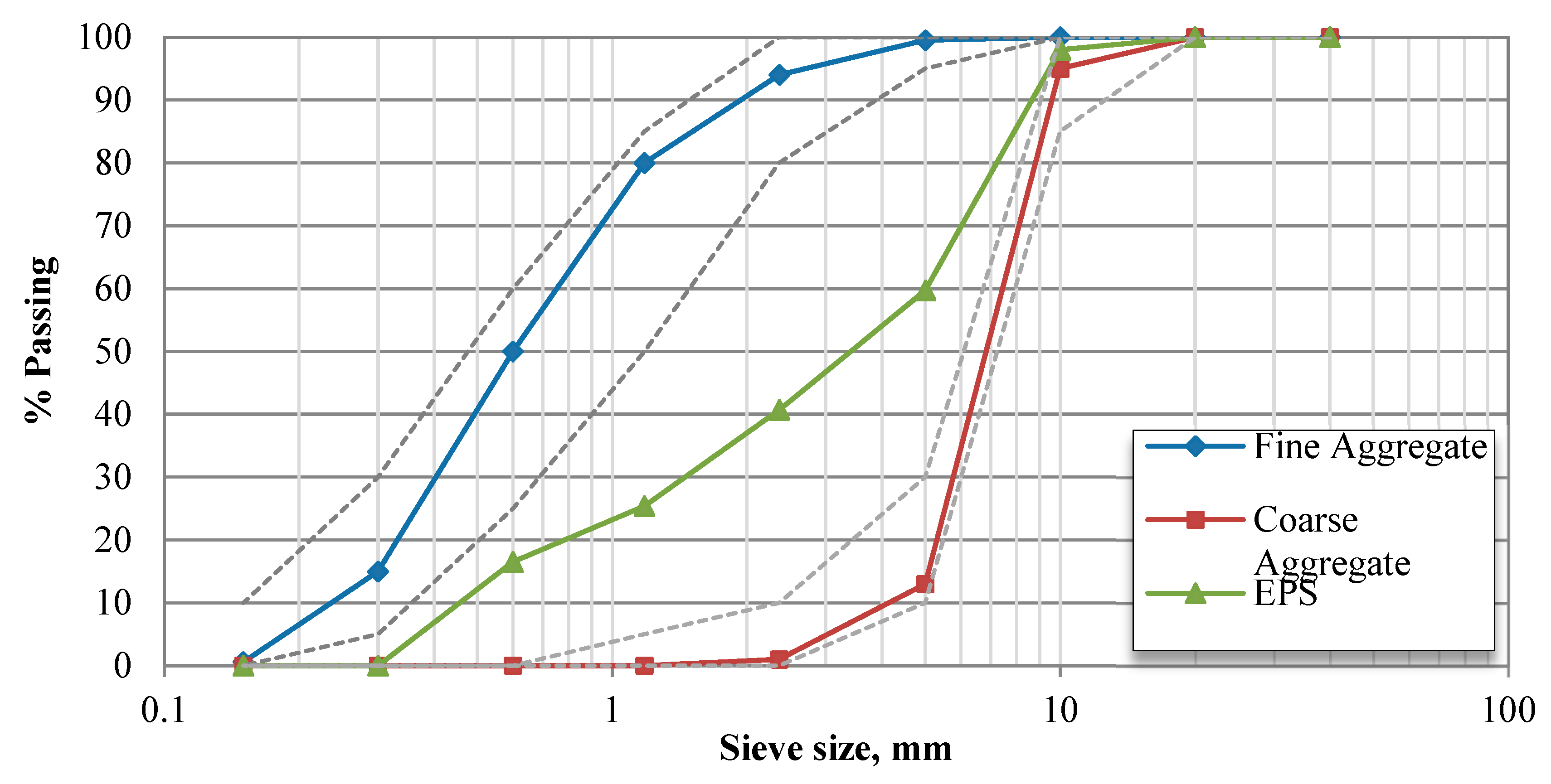
Figure 2.
Physical appearance of Addipor-55 expanded polystyrene (EPS) used as aggregate replacement.
Figure 2.
Physical appearance of Addipor-55 expanded polystyrene (EPS) used as aggregate replacement.
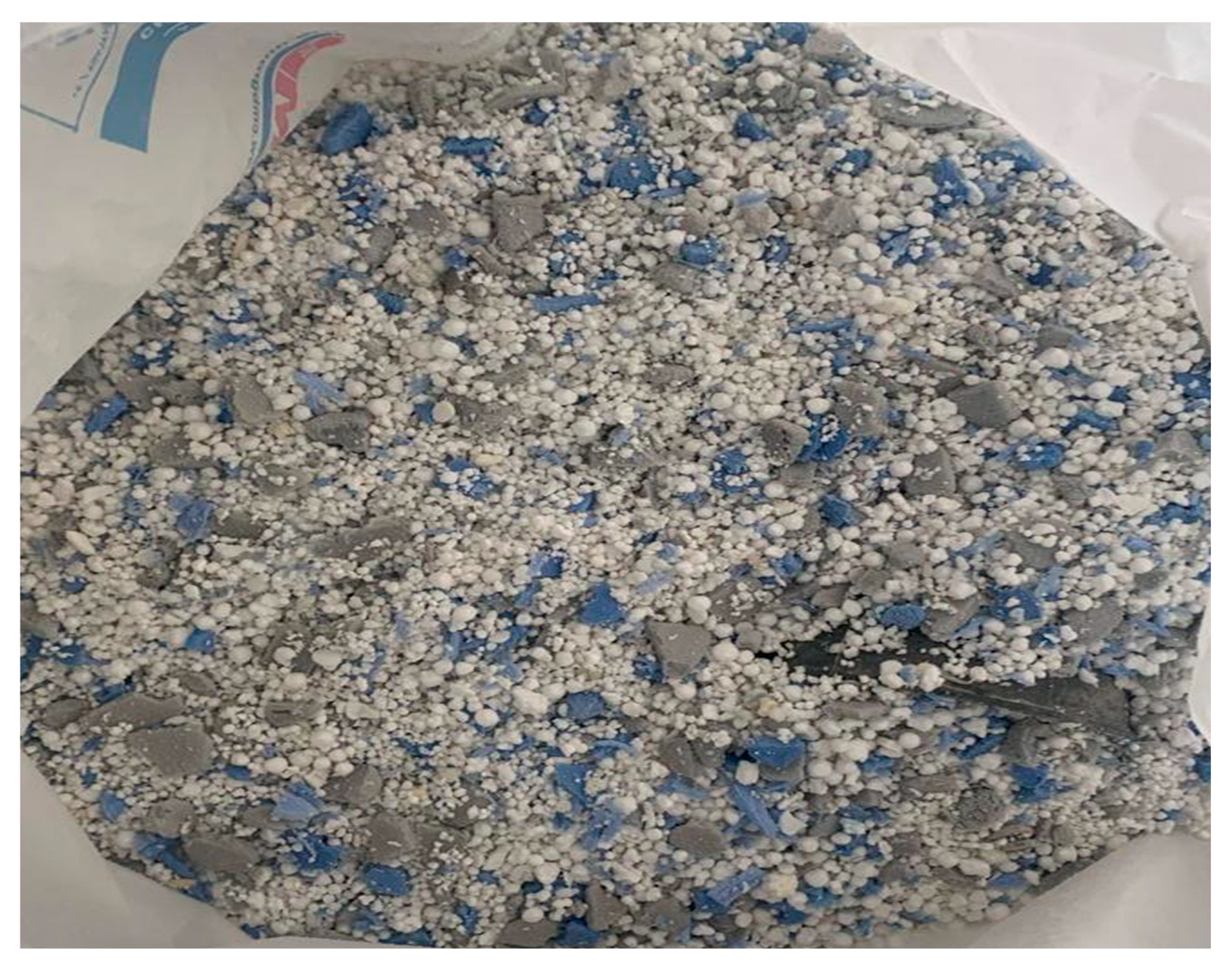
Figure 3.
Experimental setup for property testing of fresh and hardened concrete: (a) slump test; (b) compressive strength test; (c) splitting tensile strength test; and (d) modulus of rupture (MOR) test.
Figure 3.
Experimental setup for property testing of fresh and hardened concrete: (a) slump test; (b) compressive strength test; (c) splitting tensile strength test; and (d) modulus of rupture (MOR) test.
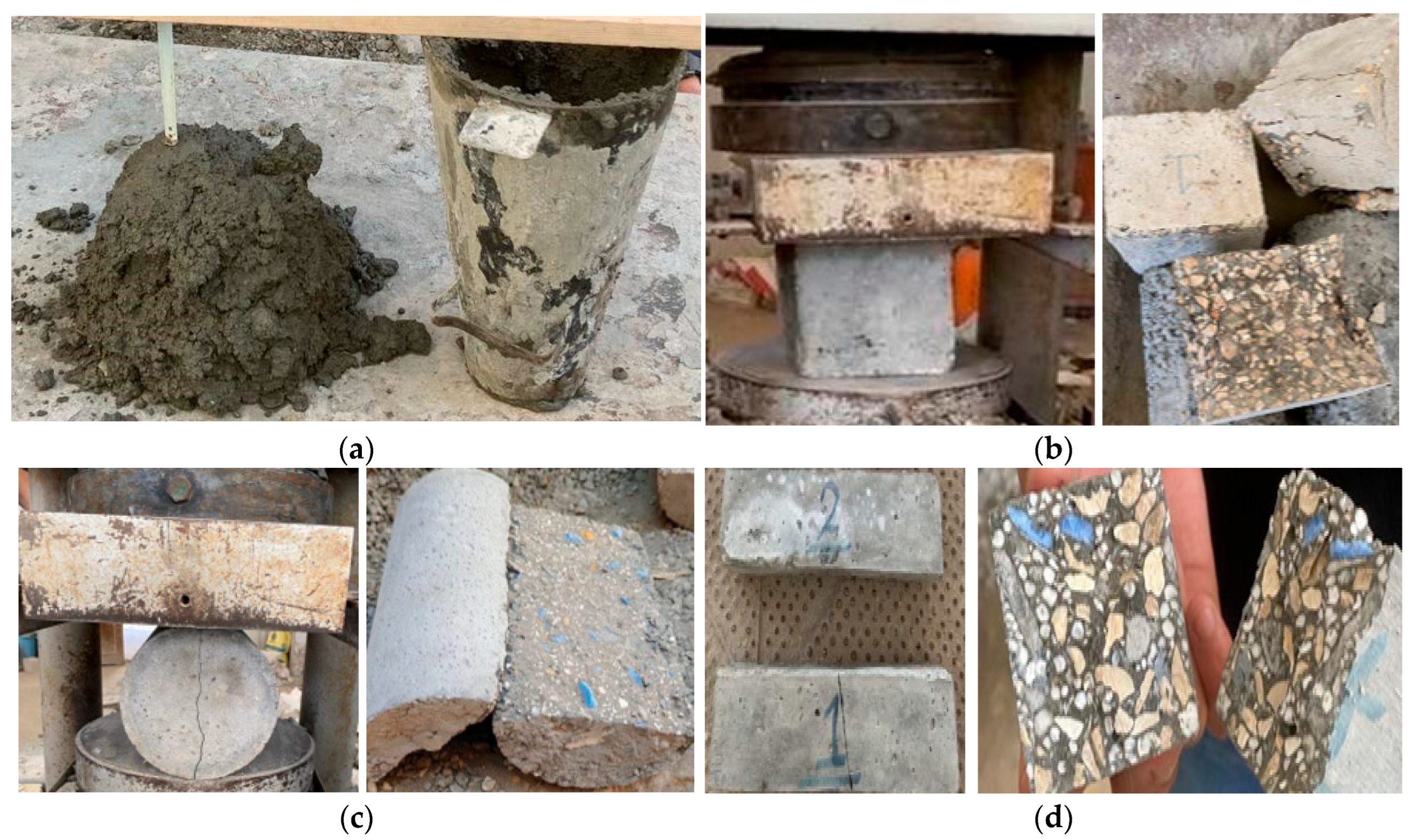
Figure 4.
Methodological framework for identifying optimal k-fold cross-validation configurations for model training and validation.
Figure 4.
Methodological framework for identifying optimal k-fold cross-validation configurations for model training and validation.
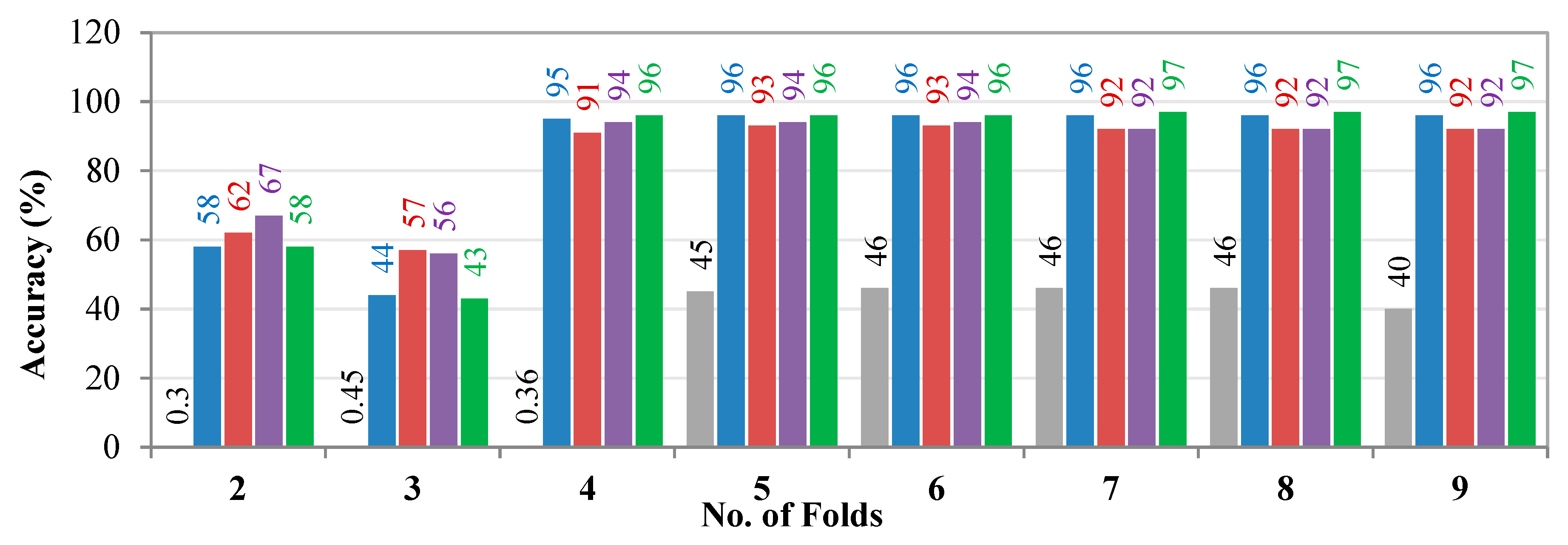
Figure 5.
Effects of EPS replacement levels on relative performance indices: (a) density ratio; (b) compressive strength ratio; (c) splitting tensile-to-compressive strength ratio; and (d) regression analysis of the density-strength relationship.
Figure 5.
Effects of EPS replacement levels on relative performance indices: (a) density ratio; (b) compressive strength ratio; (c) splitting tensile-to-compressive strength ratio; and (d) regression analysis of the density-strength relationship.
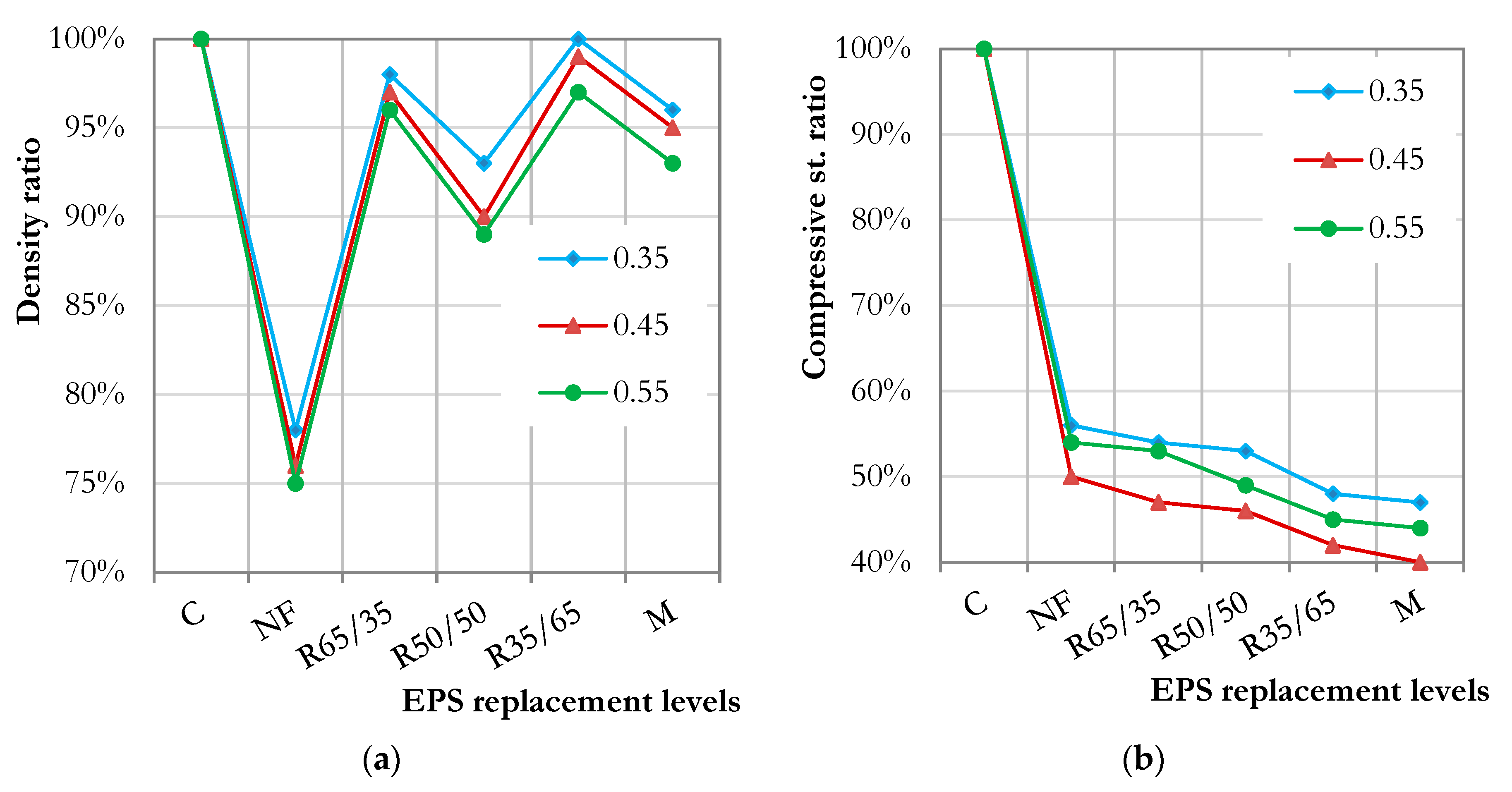
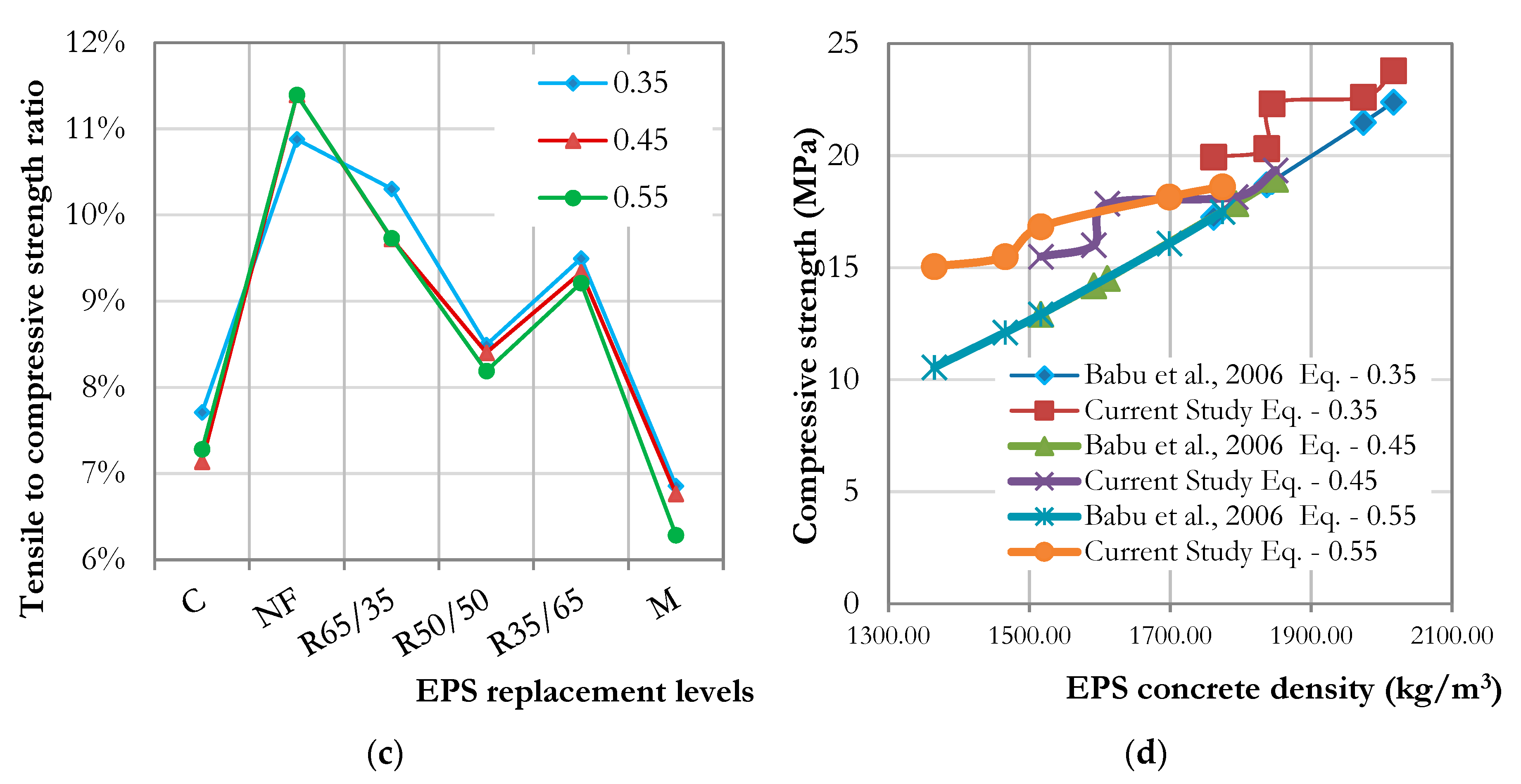
Figure 6.
Experimental results for concrete properties across varying water-to-binder (w/b) ratios and EPS replacement levels: (a) slump; (b) density; (c) compressive strength; (d) splitting tensile strength; and (e) modulus of rupture (MOR).
Figure 6.
Experimental results for concrete properties across varying water-to-binder (w/b) ratios and EPS replacement levels: (a) slump; (b) density; (c) compressive strength; (d) splitting tensile strength; and (e) modulus of rupture (MOR).
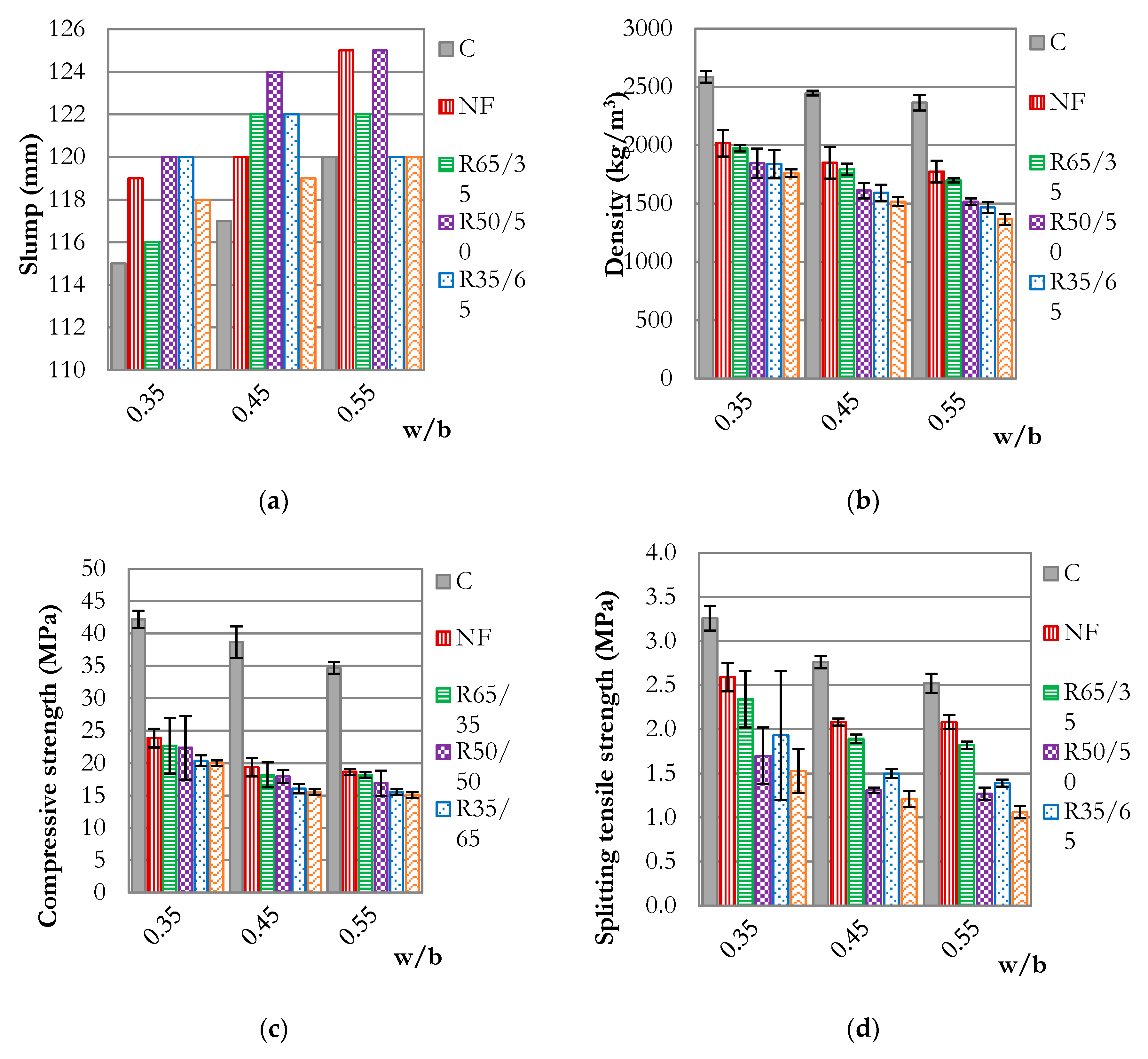
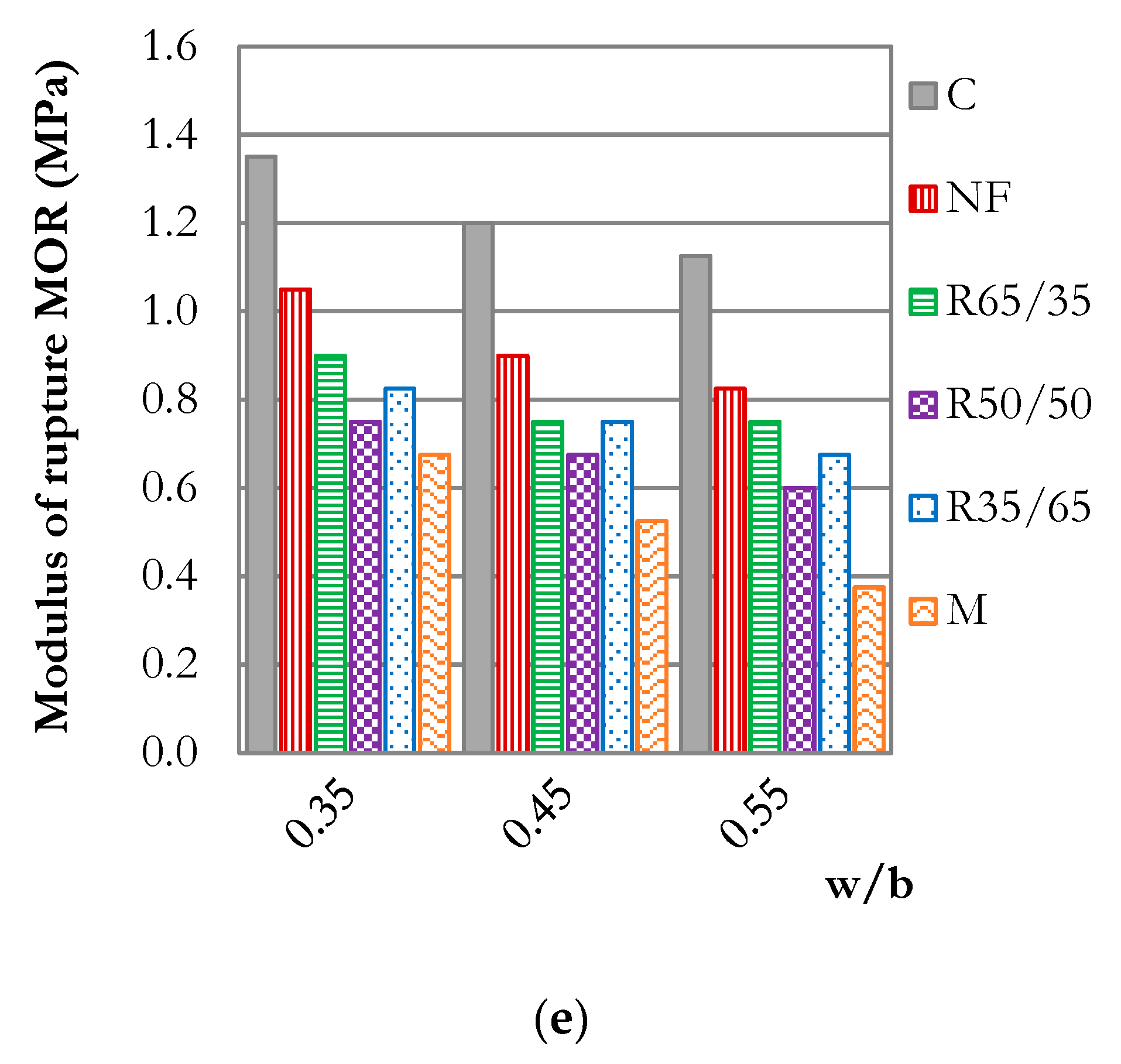
Figure 7.
Impact of EPS replacement levels on concrete properties: (a) slump; (b) density; (c) compressive strength; (d) splitting tensile strength; and (e) MOR.
Figure 7.
Impact of EPS replacement levels on concrete properties: (a) slump; (b) density; (c) compressive strength; (d) splitting tensile strength; and (e) MOR.
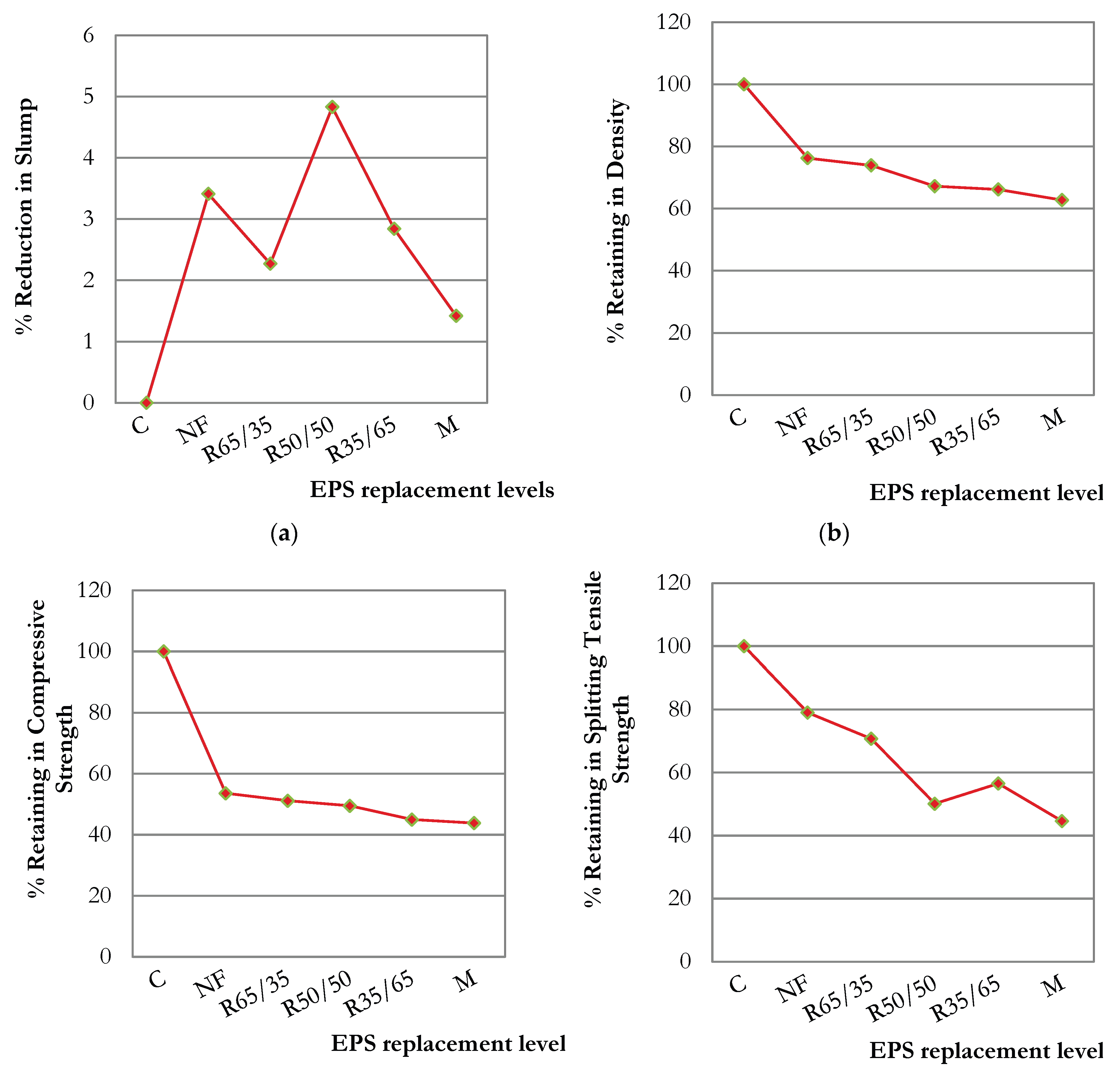
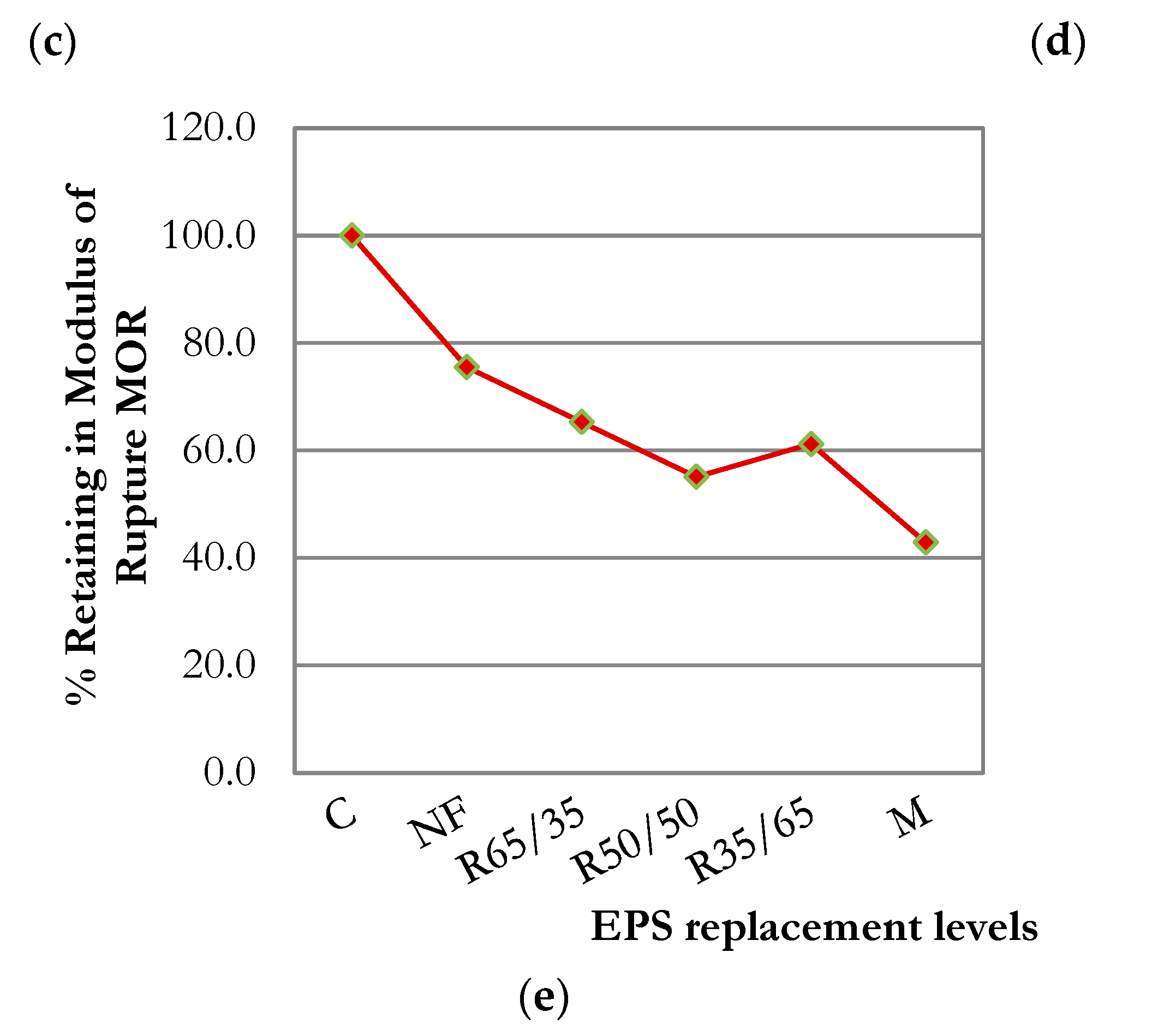
Figure 8.
Optimization of learning rates for the BiLSTM architecture across predictive performance metrics: (a) R²; (b) MAE; and (c) RMSE.
Figure 8.
Optimization of learning rates for the BiLSTM architecture across predictive performance metrics: (a) R²; (b) MAE; and (c) RMSE.
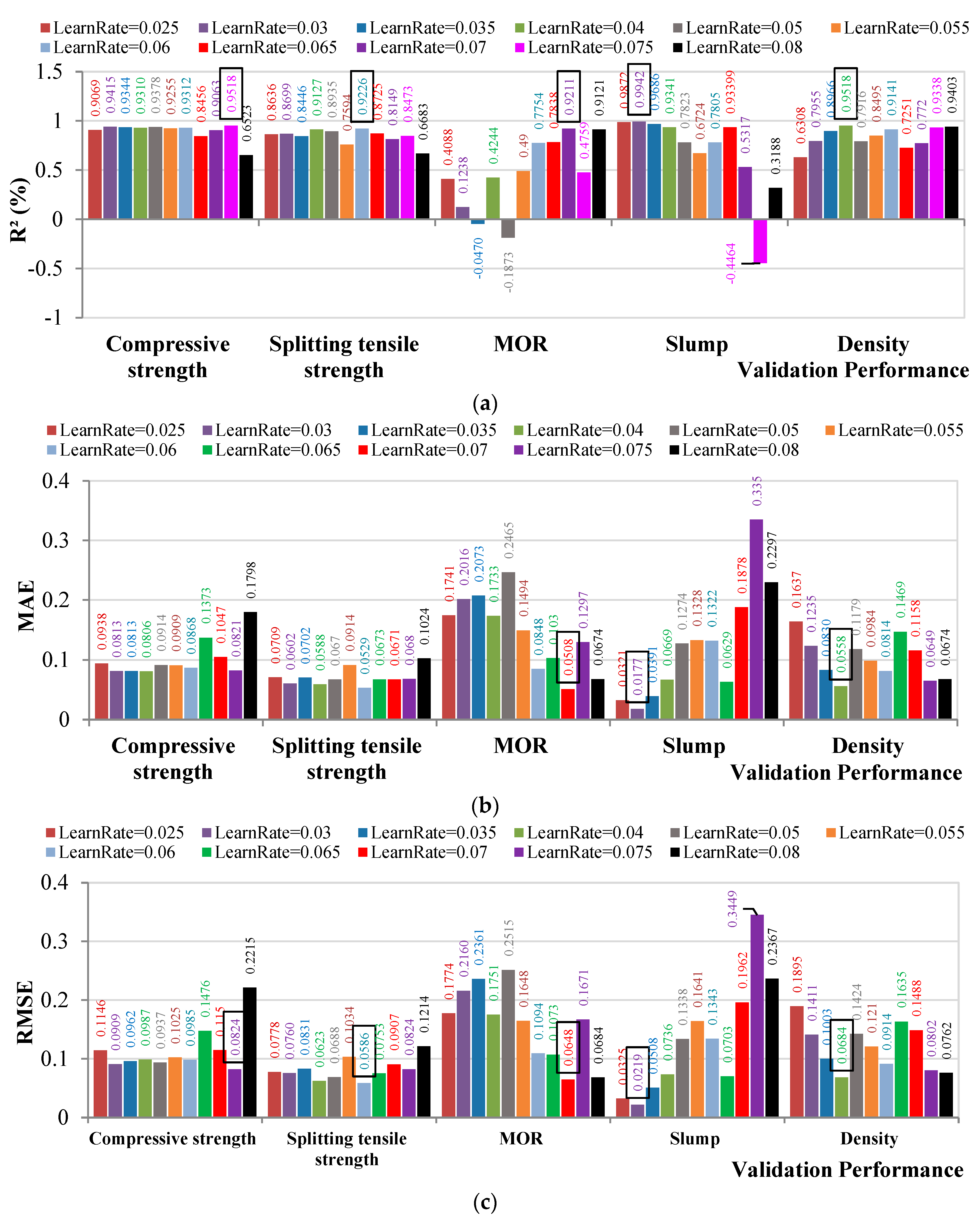
Figure 9.
Global feature importance ranking (bar plots) of mixture design variables for the prediction of: (a) compressive strength; (b) splitting tensile strength; (c) MOR; (d) slump; and (e) density.
Figure 9.
Global feature importance ranking (bar plots) of mixture design variables for the prediction of: (a) compressive strength; (b) splitting tensile strength; (c) MOR; (d) slump; and (e) density.
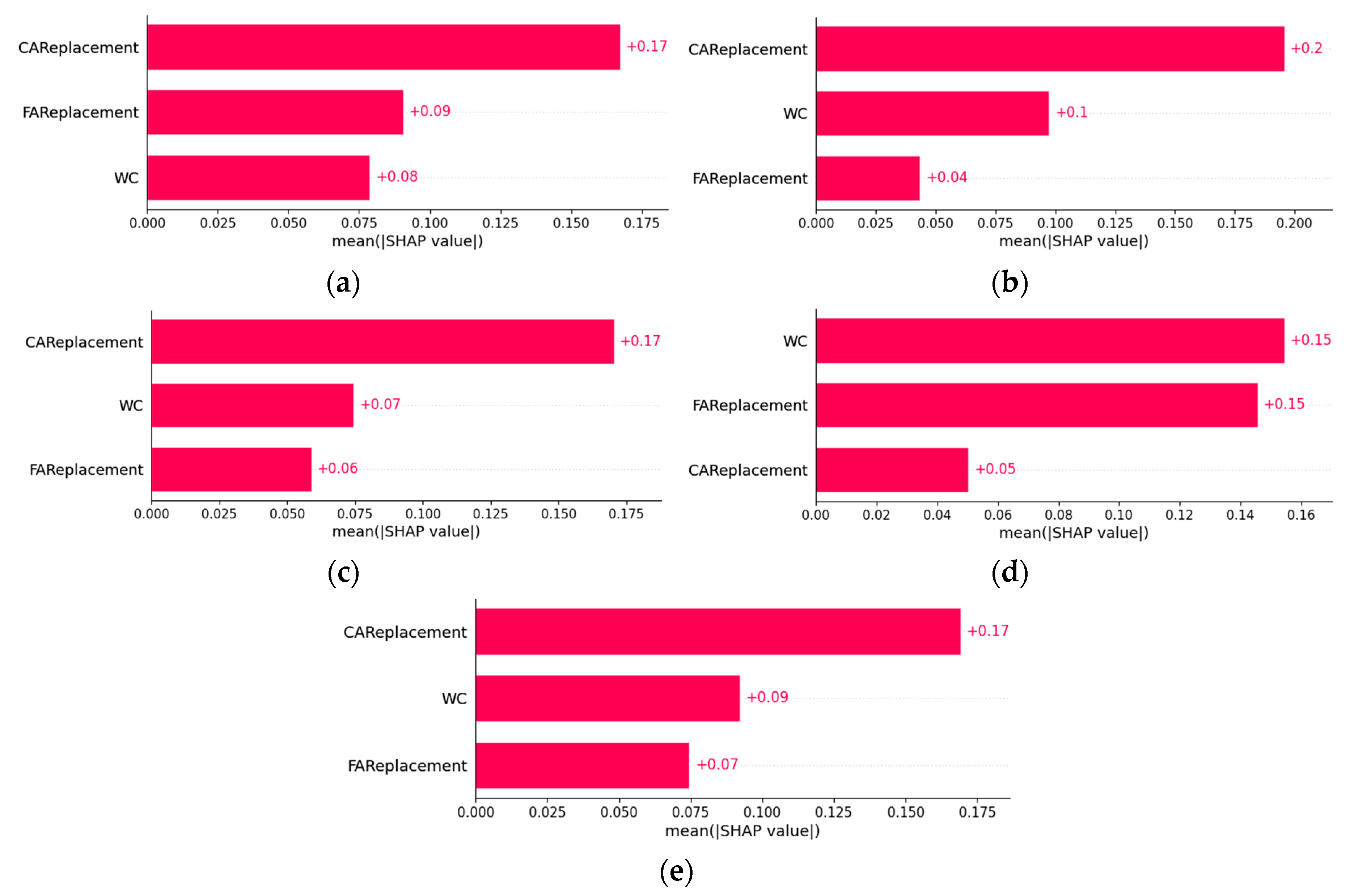
Figure 10.
SHAP beeswarm plots illustrating local feature sensitivity and variable importance for: (a) compressive strength; (b) splitting tensile strength; (c) MOR; (d) slump; and (e) density.
Figure 10.
SHAP beeswarm plots illustrating local feature sensitivity and variable importance for: (a) compressive strength; (b) splitting tensile strength; (c) MOR; (d) slump; and (e) density.
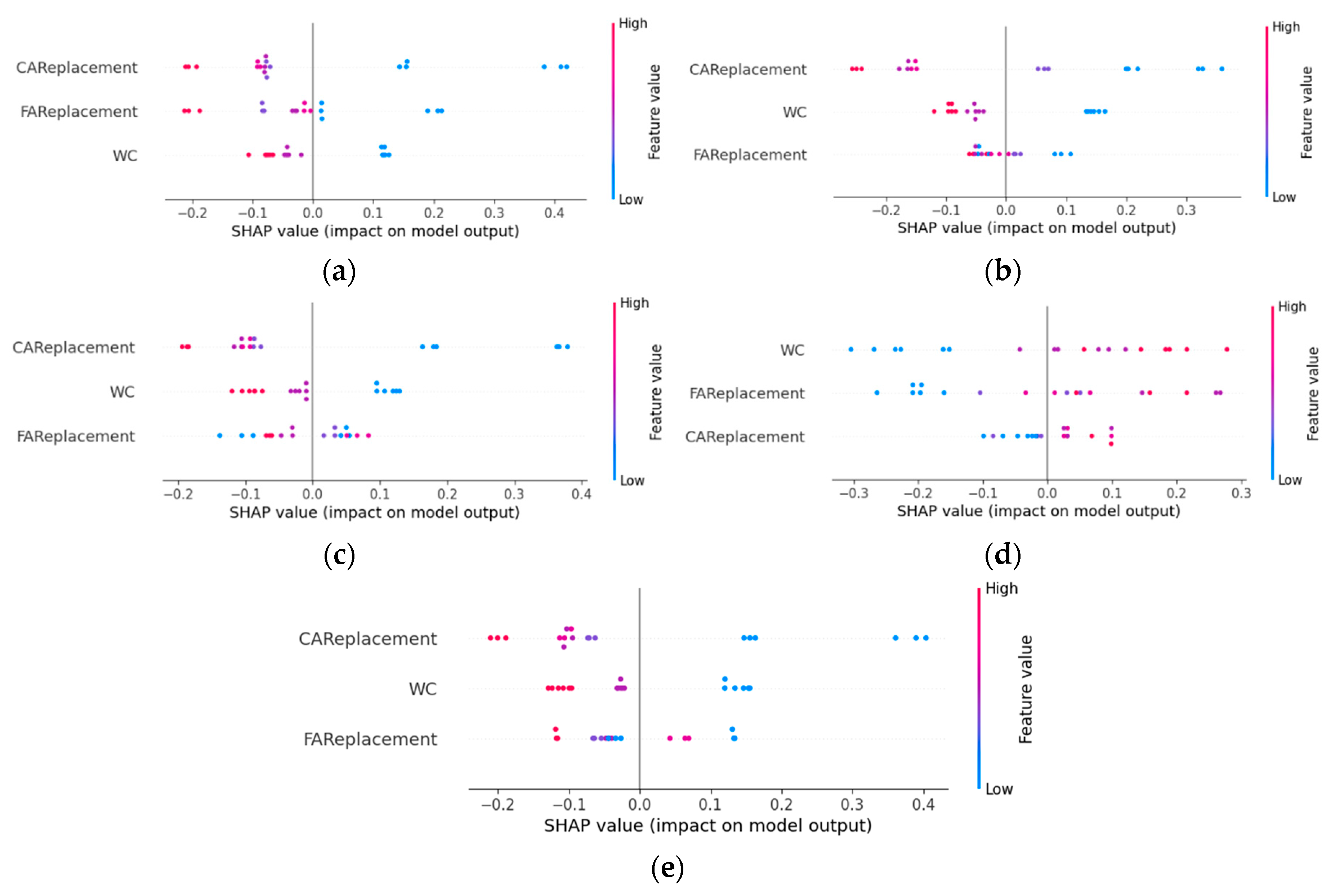

Table 1.
Chemical composition and physical properties of the binder materials.
| Parameter / Oxide | Portland Cement (Type I) | Silica Fume |
|---|---|---|
| Chemical Composition (wt. %): | ||
| Calcium Oxide (CaO) | 63.50% | 0.50% |
| Silicon Dioxide (SiO2) | 20.80% | 92.40% |
| Aluminum Oxide (Al2O3) | 5.20% | 0.60% |
| Iron Oxide (Fe2O3) | 3.40% | 1.20% |
| Magnesium Oxide (MgO) | 2.10% | 0.90% |
| Sulfur Trioxide (SO3) | 2.70% | 0.30% |
| Loss on Ignition (LOI) | 1.80% | 2.50% |
| Physical Properties: | ||
| Specific Gravity | 3.15 | 2.20 |
| Bulk Density (kg/m3) | 1440 | 300 |
| Median Particle Size (d50, μm) | 21.2 | 0.15 |
| Specific Surface Area (cm2/g) | 3750 (Blaine) | 215,000 (BET) |
Table 2.
Mix proportions for EPS concrete mixtures (kg/m3).
| Mix ID | Fine aggregate |
Coarse aggregate |
EPS | Cement | Silica fume |
Water | Superplasticizer | w/b |
|---|---|---|---|---|---|---|---|---|
| C-0.35 | 334.6 | 836.5 | 0.0 | 282 | 18 | 105 | 5.6 | 0.35 |
| NF-0.35 | 0.0 | 836.5 | 4.2 | |||||
| R65/35-0.35 | 117.1 | 543.7 | 5.9 | |||||
| R50/50-0.35 | 167.3 | 418.3 | 6.7 | |||||
| R35/65-0.35 | 217.5 | 292.8 | 7.4 | |||||
| M-0.35 | 334.6 | 0.0 | 9.2 | |||||
| C-0.45 | 320.0 | 800.1 | 0.0 | 282 | 18 | 135 | 5.6 | 0.45 |
| NF-0.45 | 0.0 | 800.1 | 4.0 | |||||
| R65/35-0.45 | 112.0 | 520.1 | 5.7 | |||||
| R50/50-0.45 | 160.0 | 400.0 | 6.4 | |||||
| R35/65-0.45 | 208.0 | 280.0 | 7.1 | |||||
| M-0.45 | 320.0 | 0.0 | 8.8 | |||||
| C-0.55 | 304.3 | 760.7 | 0.0 | 282 | 18 | 165 | 5.6 | 0.55 |
| NF-0.55 | 0.0 | 760.7 | 3.8 | |||||
| R65/35-0.55 | 106.5 | 494.4 | 5.4 | |||||
| R50/50-0.55 | 152.1 | 380.3 | 6.1 | |||||
| R35/65-0.55 | 197.8 | 266.2 | 6.8 | |||||
| M-0.55 | 304.3 | 0.0 | 8.4 |
Disclaimer/Publisher’s Note: The statements, opinions and data contained in all publications are solely those of the individual author(s) and contributor(s) and not of MDPI and/or the editor(s). MDPI and/or the editor(s) disclaim responsibility for any injury to people or property resulting from any ideas, methods, instructions or products referred to in the content. |
© 2026 by the authors. Licensee MDPI, Basel, Switzerland. This article is an open access article distributed under the terms and conditions of the Creative Commons Attribution (CC BY) license (http://creativecommons.org/licenses/by/4.0/).
Copyright: This open access article is published under a Creative Commons CC BY 4.0 license, which permit the free download, distribution, and reuse, provided that the author and preprint are cited in any reuse.


