

Submitted:
22 June 2026
Posted:
24 June 2026
You are already at the latest version
Abstract
Identifying mutations associated with both estrogen receptor (ER) status and patient survival may improve biomarker-based stratification in breast cancer. Here, we analyzed the TCGA-BRCA dataset to identify genes whose mutation status is linked to both ER phenotype and overall survival. In a screen of the top 20 candidate genes, most genes showed evidence for only one clinical association, whereas ASXL2 was significantly associated with both endpoints. A focused literature review suggested that ASXL2-specific survival analysis in breast cancer patients remains understudied, although the association is biologically plausible. ASXL2 encodes a chromatin-associated transcriptional regulator and has been linked to ERα-related biology, threrfore, its dual association may indicate a connection between epigenetic regulation, hormone-receptor phenotype, and clinical outcome. These findings support ASXL2 as a candidate prognostic and subtype-associated biomarker, although this result is dataset-limited and requires validation in independent breast cancer cohorts.
Keywords:
breast cancer
; estrogen receptor
; Kaplan-Meier survival analysis
; ASXL2
Introduction
A major practical challenge in breast cancer research is to identify biomarkers that improve patient stratification beyond standard categories. Estrogen receptor (ER) status is central to clinical classification, but it does not fully capture the heterogeneity of patient outcomes within ER-defined groups. Some patients with the same ER status nevertheless experience markedly different clinical courses. Mutated genes whose alterations are associated both with ER status and with survival may therefore be especially valuable biomarkers, because they can simultaneously reflect tumor subtype and prognostic risk. Identifying such genes could help divide broad ER-positive and ER-negative categories into clinically more informative subgroups and support more precise risk assessment in patient management.
This question is also important because overlap between ER association and survival association may highlight mutations with stronger biological relevance than subtype-associated or prognostic markers alone. Genes showing both patterns are plausible candidates for mechanisms linking hormone-related tumor biology to disease progression, making them attractive targets for follow-up functional study. In addition, these genes are relevant for statistical modeling. Since ER status is itself strongly associated with outcome, mutations correlated with both ER phenotype and survival can confound prognostic analyses if they are not modeled appropriately. Defining this class of genes can therefore improve survival modeling and interpretation of genomic predictors. Finally, such genes may be useful for therapeutic hypothesis generation. A mutation connected to both ER context and patient survival may indicate ER-dependent treatment sensitivity, resistance, or other context-specific clinical behavior. For these reasons, determining which mutated genes jointly correlate with ER status and survival is a practically important step toward more precise biomarker-based stratification in breast cancer.
Mutational associations with ER status have been extensively studied in breast cancer, but the relationship between ER-associated mutations and patient survival is more complex than simple subtype enrichment. Large-scale genomic analyses have shown that the somatic mutation landscape differs sharply between ER-positive and ER-negative tumors, with recurrent alterations in PIK3CA, GATA3, CDH1, MAP3K1, MAP2K4, and related luminal drivers enriched in ER-positive disease, whereas TP53 mutations are strongly associated with ER-negative and basal-like biology.1 These findings indicate that ER status is not only a receptor-defined clinical category but also a genomic context in which different driver events accumulate.
TP53 is the clearest example of a mutation with both ER-related and survival-related relevance. It was reported that TP53 mutations are markedly enriched in ER-negative breast cancer, yet several ER-stratified analyses indicate that TP53 mutation status can also identify clinically aggressive disease within ER-positive tumors [1]. This distinction is important because ER-positive breast cancer is clinically heterogeneous: many patients have favorable outcomes under endocrine therapy, but a subset experiences early relapse or poor survival. In this context, TP53 mutation may mark ER-positive tumors that have escaped the typical lower-risk luminal trajectory and acquired more aggressive biological features. MAP3K1 mutations are recurrent in luminal breast cancer and have been linked to ER-positive disease and better prognosis in stratified analyses.1 Together with TP53, MAP3K1 supports the broader concept that mutations can subdivide ER-positive breast cancer into prognostically divergent groups. GATA3 is another major ER-associated driver, but its prognostic interpretation is less stable. GATA3 mutations occur predominantly in ER-positive and luminal-like breast cancers and are consistent with the role of GATA3 in mammary epithelial differentiation and ER-related transcriptional programs.[1,2] However, survival analyses have produced context-dependent results. Some cohorts associate GATA3 mutation with favorable prognosis, whereas others report adverse or non-significant effects. This inconsistency likely reflects biological heterogeneity among GATA3 mutation classes and differences in clinical setting. Mutations affecting the second zinc finger, splice sites, truncating regions, or C-terminal extension variants may have distinct functional consequences and therefore distinct survival associations.[2,3,4,5] Additional studies suggest that the prognostic effect of GATA3 may also depend on treatment context, including endocrine monotherapy versus chemotherapy or endocrine therapy combined with CDK4/6 inhibition.[6,7,8] PIK3CA mutations similarly demonstrate the difference between ER association and prognostic robustness.[1] Its survival effect is inconsistent across studies. In the FinHER trial, PIK3CA mutation status was associated with ER-positive disease but did not produce a simple, globally adverse prognostic effect.[9] Other analyses suggest that the clinical meaning of PIK3CA mutation depends on intrinsic subtype, integrative genomic cluster, and co-mutation structure, especially interactions with TP53.[1] ESR1 mutations are directly connected to ER signaling and are particularly important in endocrine-treated or metastatic ER-positive breast cancer, where ligand-binding-domain alterations can promote endocrine resistance and worse clinical outcome.[10,11] ERBB2 mutations, distinct from ERBB2 amplification, appear especially relevant in ER-positive invasive lobular carcinoma and have been associated with poor survival in that histological context.[12] Rarer alterations in NF1, PIK3R1, and DDR1 have also been reported as potentially adverse in endocrine-treated or hormone-receptor-positive cohorts, although their low frequency makes independent validation difficult.[13] These examples show that ER-associated prognostic effects need further investigation.
Based on the literature review, we conclude that several breast cancer mutations are associated with ER status, but only a smaller subset also shows survival relevance. Even when both associations are present, the prognostic direction can vary across cohorts, mutation classes, endpoints, and treatment contexts. Robust biomarker discovery therefore requires dataset-specific testing of both properties: association with ER phenotype and separation of survival outcomes by mutation status. This provides the rationale for the present analysis, which asks whether any candidate gene mutation is simultaneously associated with ER status and overall survival within the same patient dataset, specifically TCGA-BRCA in this work.
Results
ASXL2 was the only top-20 gene whose mutation status was significantly associated with both ER status and overall survival in the TCGA-BRCA dataset. We carried out a screen of the top 20 candidate genes, and evaluated each gene for two clinically distinct but potentially connected phenotypes: association with ER status and association with overall survival. ER status was tested as a categorical clinical phenotype using a chi-square test, whereas survival differences between mutation-defined groups were evaluated using Kaplan-Meier survival analysis and a log-rank test. The results refer to the TCGA-BRCA Breast Invasive Carcinoma dataset.
Across the screened genes, most candidates showed evidence for only one of these two relationships. For example, TP53 and GATA3 showed highly significant associations with ER status, with chi-square p-values of 6.9∙10-38 and 3.9∙10-9, respectively, but neither gene showed a significant survival association in the corresponding log-rank analysis in the TCGA-BRCA dataset (Table 1). Conversely, NCOR1 and RB1 showed significant or near-significant survival associations, but did not show significant association with ER status. This separation suggests that many recurrently altered breast cancer genes may be linked either to tumor subtype or to patient outcome, but not necessarily to both within the same mutation-defined comparison. In contrast, ASXL2 was the only gene in the top-20 set that crossed the conventional significance threshold for both endpoints, with a chi-square p-value of 0.0079 for ER-status association and a log-rank p-value of 0.0096 for overall survival (Table 1, Figure 1).
This dual association makes ASXL2 distinct from genes that appear significant in only one clinical dimension for the TCGA-BRCA dataset. A mutation associated only with ER status may primarily mark subtype structure, while a mutation associated only with survival may reflect prognostic behavior independent of receptor phenotype or may arise from confounding clinical variables. Therefore, the result supports prioritizing ASXL2 not merely as another mutated gene in breast cancer, but as a candidate marker linking hormone-receptor biology with clinical outcome. This is particularly relevant because ASXL2 encodes a chromatin-associated transcriptional regulator. UniProt describes ASXL proteins as involved in chromatin recruitment and transcriptional activation, and previously cited breast cancer literature reports that ASXL2 can connect ERα biology with histone methylation and proliferation in ERα-positive breast cancer cells.
The observed pattern should be interpreted as a dataset-specific prioritization result rather than as proof of causality or as a universal statement about breast cancer. The analysis was performed on the TCGA-BRCA dataset. Therefore, the conclusion applies only to the specific candidate-gene set, mutation definitions, clinical annotations, and statistical tests used here. Other breast cancer cohorts, alternative TCGA-derived releases, larger meta-analytic datasets, subtype-restricted analyses, or different survival endpoints may reveal additional genes with similar dual associations. This dataset specificity is an important limitation of the present work.
Individual-gene survival analysis of ASXL2 mutations in breast cancer appears underreported. A focused review of prior studies did not identify a breast cancer patient analysis in which ASXL2 mutation status alone was used to stratify overall survival by Kaplan–Meier analysis. The closest breast cancer study is Langille et al. that performed survival analyses in human cohorts but defined a combined epigenetic-driver class rather than testing ASXL2 as an individual gene. In that analysis, “EpiDrivers” included alterations in ASXL2, BAP1, KDM6A, KMT2C, KMT2D, and SETD2, using mutations and/or homozygous deletions as the alteration definition.[14,15] Therefore, although this work supports the clinical relevance of epigenetic-regulator alterations in breast cancer, it does not determine whether ASXL2 mutations alone are associated with patient survival.
ASXL2-specific Kaplan–Meier-type analyses in the breast cancer literature appear mainly in mouse models, not in human patient cohorts. Langille et al. reported tumor-free survival analyses for mice with experimentally disrupted enzyme Asxl2 coded by ASXL2, including models based on sgAsxl2-mediated editing and conditional Asxl2 knockout.[14,15] These experiments are important mechanistically because they test whether loss of Asxl2 can affect breast tumor development in vivo. However, the endpoint is mouse tumor-free survival after engineered Asxl2 perturbation, rather than overall survival of breast cancer patients stratified by naturally occurring ASXL2 mutation status. Thus, these mouse data cannot substitute for a human ASXL2-mutant versus ASXL2-wildtype survival comparison.
Outside breast cancer, ASXL2 mutation status has been evaluated in survival analyses in other diseases, including acute myeloid leukemia and metastatic non-small cell lung cancer.[16,17,18] In AML, ASXL2 mutations have been studied particularly in cases with certain translocations, where outcome curves were stratified by ASXL2 and related mutation categories.[16,17] In metastatic NSCLC, ASXL2-wildtype cases were reported to have better overall survival than ASXL2-mutant cases.[18] Together, these studies show that ASXL2 mutation status can be clinically informative in human cancers, while the ASXL2-specific survival association reported here appears to represent a less explored feature of breast cancer genomics.
at estrogen-responsive promoters/enhancers: it is required for recruitment of LSD1 (H3K9 demethylase) and UTX/KDM6A (H3K27 demethylase) and associates with MLL2/KMT2D (H3K4 methyltransferase), shifting chromatin toward an active state (decreased repressive H3K9/H3K27 methylation; increased H3K4 methylation) and promoting ER target gene expression and E2-dependent proliferation and xenograft growth in ER+ MCF7 models.[19] Besides that, Asxl2 is also a component of the mammalian PR-DUB (BAP1 complex): BAP1 with core partners (e.g., HCFC1, OGT, FOXK1/2) plus one ASXL paralog (ASXL1/2/3). This complex deubiquitinates H2AK119ub1, a polycomb-linked repressive histone mark. PR-DUB activity restricts inappropriate H2AK119ub1 accumulation and helps maintain expression of genes important for cellular homeostasis.[20]
We could speculate several possible molecular mechanisms connecting ASXL2 mutations to ER status.
Mechanism A: Selection for intact ERα transcriptional circuitry in ER+ tumors. If Asxl2 is an important coactivator enabling ERα-driven transcription, then ER+ (luminal) tumorigenesis may be more dependent on functional Asxl2 -mediated recruitment of LSD1/UTX/MLL2 than ER− tumorigenesis. In this model, damaging ASXL2 mutations would be counterselected in strongly ER-dependent tumors (or would push tumors toward ER-low/ER− phenotypes), yielding an association between ASXL2 mutation status and ER status through functional dependency.[19] Specifically, ASXL2 loss would impair removal of repressive marks (H3K9/H3K27 methylation) and disturb H3K4 methylation dynamics at ER target loci, reducing expression of canonical ER target genes (e.g., TFF1, GREB1, CTSD) and potentially destabilizing luminal identity programs.[19]
Mechanism B: Uncoupling ER positivity from ER output (ER+ but ER-dysregulated). Some ASXL2 mutations may not abolish ER expression (IHC ER+) but may rewire ER transcriptional output by altering which cofactors are recruited, where Asxl2 binds, or how histone marks are interpreted (Asxl2 contains a PHD finger that preferentially interacts with H3K4me2). This yields a state where tumors remain ER+ yet have low/aberrant ER transcriptional signaling, a phenotype commonly linked to poorer outcomes in luminal disease. Because Asxl2–ERα binding is tamoxifen/OHT-sensitive, mutations could plausibly modulate endocrine therapy response by changing the stability or composition of the ER coactivator complex at chromatin.[19]
Mechanism C: Epigenetic-lineage plasticity that biases tumors into luminal-like/HR+ contexts. As previously mentioned, Langille et al. identify ASXL1/2 among epigenetic “EpiDrivers” that cooperate with oncogenic PIK3CA to promote basal-to-luminal-like lineage conversion and luminal-like tumor formation, alongside an aberrant alveolar/lactation-like differentiation program (“alveogenic mimicry”).[15] A plausible link to ER status is that such lineage conversion programs create tumors with luminal characteristics (and thus more likely ER positivity) even if the initiating cell state was not luminal. Supporting this hormone-receptor intersection, the same study reports that casein positivity is more frequent in hormone-receptor-positive DCIS and is associated with progesterone receptor positivity in premalignant lesions, consistent with a hormone-receptor-linked differentiation state being involved in this epigenetically driven plasticity.[15]
On the other hand, we could speculate about possible molecular mechanisms connecting ASXL2 mutations to overall survival.
Mechanism D: Endocrine resistance via chromatin cofactor dysfunction. Asxl2 directly participates in ERα activation and is required for recruitment of LSD1/UTX/MLL2 to E2-responsive promoters. Disrupting this axis could reduce dependence on estrogen signaling (decreasing endocrine sensitivity), or create compensatory transcriptional programs that sustain growth despite endocrine therapy. Either route can worsen survival in ER+ disease by accelerating recurrence under therapy, even if baseline ER positivity is retained. The tamoxifen-sensitive Asxl2–ERα interaction provides a concrete pharmacologic coupling point for this hypothesis.[19]
Mechanism E: PR-DUB dysfunction increases transcriptional instability and stress tolerance. PR-DUB counteracts H2AK119ub1 accumulation and helps maintain expression of “critical genes” (including metabolic/homeostatic programs). ASXL2 mutations that impair PR-DUB assembly or recruitment (via FOXK1/2) could cause widespread epigenetic drift (H2AK119ub1 gain) and misregulation of gene sets that influence proliferation, survival under stress, immune evasion, and metastasis. Such broad reprogramming is a credible mechanism for worse OS.[20]
Mechanism F: Prognosis emerges from co-mutation context and plasticity rather than ASXL2 alone. The EpiDriver framework emphasizes combinatorial effects: epigenetic regulator loss (including ASXL2) cooperates with oncogenic PIK3CA to accelerate tumor formation and increase phenotypic plasticity. If ASXL2 mutations are enriched in such cooperative contexts, the survival association could largely reflect a synthetic phenotype (plasticity-driven heterogeneity and therapy escape) rather than a single-gene effect.[15]
To test these hypothetical mechanisms, we could suggest the following experimental/clinical investigations. Mutation-class stratification could separate ASXL2 truncating vs missense vs in-frame variants; testing whether specific classes correlate with ER IHC positivity but reduced ER transcriptional signatures would check Mechanism B) Chromatin readouts in ASXL2-mutant vs WT ER+ models could assess whether ER cistrome is preserved but chromatin state changes.(relevant for Mechanisms A, B, E). Endocrine response phenotyping could measure tamoxifen/fulvestrant sensitivity in ASXL2-edited ER+ organoids/PDXs and connect to LSD1/UTX recruitment and ER target expression (relevant for Mechanism D). Finally, lineage tracing / scRNA-seq in PIK3CA ± ASXL2 loss models could quantify basal to luminal conversion, ER/PR acquisition, and heterogeneity; in this case, relating plasticity metrics to metastatic propensity and survival surrogates would be relevant for checking Mechanisms C, F. Overall, these results suggest plausible hypotheses on the molecular mechanisms implementing the correlations described in subsections 1, 2 of Results, and suggest possible ways to verify these hypotheses.
Discussion
The present analysis was motivated by the idea that genes associated with both ER status and survival may define a particularly informative class of breast cancer biomarkers. The Results support this rationale but also show that such dual associations are not common among the screened candidate genes in TCGA-BRCA. For this dataset, several genes showed strong association with ER status alone, most notably TP53 and GATA3, whereas others showed survival-associated patterns without a significant ER-status association. ASXL2 was the only top-20 candidate gene whose mutation status was significantly associated with both endpoints. This finding places ASXL2 in a narrower and potentially more clinically meaningful category than genes that simply mark receptor subtype or survival independently.
This result is especially interesting in light of the Introduction, where ER status was discussed as a central but incomplete clinical classifier. The lack of survival significance for strongly ER-associated genes such as TP53 and GATA3 in this specific analysis does not contradict their known biological relevance. Rather, it emphasizes that ER association and prognostic association are separable statistical properties. A mutation can be enriched in ER-positive or ER-negative tumors without separating overall survival curves in a given cohort. Conversely, a mutation can be associated with survival through mechanisms unrelated to ER phenotype. ASXL2 is notable because it bridges both categories within the same dataset, suggesting that it may capture a biological relationship between hormone-receptor state and disease progression that is not fully represented by ER status alone.
The ASXL2 finding is also consistent with the broader literature on epigenetic regulation in breast cancer. Prior work has implicated ASXL2 in ERα-related transcriptional regulation, including recruitment of histone-modifying enzymes to estrogen-responsive regulatory regions and promotion of estrogen-dependent proliferation in ER-positive breast cancer models.[19] This provides a plausible mechanistic basis for the observed association with ER status. If ASXL2 contributes to maintaining ERα-driven transcriptional programs, then ASXL2 mutations could either be selected differently across ER-defined tumor contexts or alter the functional output of ER signaling without necessarily abolishing ER expression. In this model, ASXL2 mutation status may identify tumors in which ER positivity, ER transcriptional activity, and endocrine responsiveness are no longer aligned.
The survival association can be interpreted through related but broader mechanisms. ASXL2 is also part of chromatin regulatory systems, including the PR-DUB complex, which participates in H2AK119ub1 deubiquitination and maintenance of gene-expression programs.[20] Disruption of this regulatory axis could plausibly increase transcriptional instability, lineage plasticity, stress tolerance, or therapy resistance. Previous studies further support the idea that alterations in epigenetic regulators, including ASXL2, can cooperate with oncogenic signaling to disrupt lineage integrity and promote breast tumor development.[15] Therefore, the survival effect observed here may not reflect a simple single-gene mechanism, but rather a combined phenotype involving altered chromatin regulation, ER signaling, lineage state, and co-mutation.
The AlphaFold visualization of ASXL2 provides an additional qualitative clue (Figure 2). The predicted protein contains extensive low-confidence regions, consistent with substantial intrinsic disorder or context-dependent folding. At the same time, experimentally determined 3D structures of Asxl2 are missing in the RCSB Protein Data Bank. This implies an intrinsically disordered nature of a significant part of the protein, compatible with a role as a chromatin-associated regulatory protein whose function depends on selective protein-protein interactions rather than a single rigid catalytic domain. In such proteins, mutations may have effects that are difficult to infer from static structure alone. They may alter interaction motifs, cofactor recruitment, chromatin binding, or regulatory complex assembly, all of which could influence ER-related transcription and tumor behavior.
The focused literature review suggests that ASXL2-specific survival analysis in human breast cancer has been underreported. Prior breast cancer work has examined ASXL2 within broader epigenetic-driver alteration classes or in mechanistic mouse models, but these analyses do not directly answer whether naturally occurring ASXL2 mutations stratify overall survival among human breast cancer patients. This distinction matters because pathway-level or combined-driver analyses can reveal important biology while obscuring gene-specific signals. The present analysis therefore adds a focused patient-level observation: within TCGA-BRCA, ASXL2 mutation status alone is associated with both ER phenotype and overall survival.
Several limitations of this work should be emphasized. First, the analysis was restricted to the TCGA-BRCA dataset and to a human-guided screen of the top 20 candidate genes. Other cohorts, larger meta-analyses, subtype-specific analyses, or alternative mutation-ranking strategies may identify additional genes with dual ER and survival associations. Second, all reported p-values were raw p-values, with no multiple-testing correction, so the finding should be treated as hypothesis-generating. Third, the survival analysis was univariate and did not adjust for stage, age, treatment, intrinsic subtype, tumor purity, or co-mutation structure. Fourth, ASXL2 mutations are relatively infrequent, so the mutant group is expected to be small, which increases uncertainty around effect-size estimates and survival-curve interpretation. These limitations do not invalidate the observation, but they define its appropriate interpretation: ASXL2 is a candidate biomarker, not yet a validated prognostic marker.
Future work should therefore test whether the ASXL2 signal remains significant in independent breast cancer cohorts and after adjustment for established clinical and molecular covariates. Mutation-class analysis would be especially important, because truncating, missense, splice-site, and in-frame variants may have different functional consequences. Integrating ASXL2 mutation status with ER transcriptional signatures, RNA-seq expression, RPPA protein data, endocrine-therapy response, and co-mutation patterns could clarify whether ASXL2-mutant tumors are truly ER-dysregulated, more plastic, or enriched for specific oncogenic backgrounds. Functional studies in ER-positive breast cancer models, organoids, or patient-derived xenografts could then test whether ASXL2 disruption changes ER target-gene expression, chromatin marks, tamoxifen or fulvestrant sensitivity, and tumor-growth behavior.
Taken together, the present study identifies ASXL2 as the only top-20 candidate gene in TCGA-BRCA whose mutation status is associated with both ER status and overall survival. This result directly addresses the central motivation of the study: finding mutations that may connect receptor-defined subtype with prognostic risk. The finding is preliminary and dataset-limited, but it is biologically plausible because ASXL2 is linked to ERα-associated chromatin regulation and broader epigenetic control. ASXL2 therefore emerges as a promising candidate for follow-up validation as a subtype-associated and prognostic biomarker in breast cancer.
Methods
Dataset selection and data acquisition. Breast cancer genomic and clinical data were obtained from the Cancer Research Data Commons (https://datacommons.cancer.gov/explore/datasets), brca_tcga dataset, in December 2025 (Figure 3). This cohort was selected because it provides matched somatic mutation, clinical annotation, receptor-status, overall-survival, RNA-seq, and protein-expression data for a large human breast cancer cohort. The brca_tcga cohort contains approximately 1,100 breast cancer cases.
Downloaded files included somatic mutation data (data_mutations.txt), MutSig results (data_mutsig.txt), clinical patient data (data_clinical_patient.txt), case lists including complete cases (case_lists/cases_complete.txt), RNA-seq expression data (data_mrna_seq_v2_rsem.txt), RNA-seq case lists, RPPA protein-expression data (data_rppa_zscores.txt), and RPPA case lists.
Candidate-gene selection. Candidate genes were selected from MutSig output. The file data_mutsig.txt was loaded as a tab-delimited table, sorted by MutSig q value, and the top 20 genes were inspected as the candidate set. For each candidate gene, mutation status was evaluated in relation to two endpoints: ER status and overall survival. The analysis was performed in a human-guided manner by iterating the Python workflow across candidate genes and recording the chi-square and log-rank p-values for each of the top genes (Table 1).
Definition of mutation status. Somatic mutation calls were loaded from data_mutations.txt. For each candidate gene, a sample was classified as mutant if it contained at least one qualifying non-silent mutation in that gene. The included mutation classes were missense mutation, nonsense mutation, frameshift deletion, frameshift insertion, splice-site mutation, in-frame deletion, and in-frame insertion. Synonymous mutations were excluded. Copy-number alterations, structural variants, fusions, and homozygous deletions were not included in the mutation-status definition. TCGA tumor sample barcodes were shortened to 16 characters to define sample identifiers, and patient identifiers were derived from the first 12 characters of the TCGA barcode. Mutation-status columns were created for each candidate gene using the format <GENE>_status, with samples labeled Mut or WT.
Clinical-data integration. Clinical patient data were loaded from data_clinical_patient.txt and merged with the mutation-status table by PATIENT_ID. Estrogen receptor status was taken from ER_STATUS_BY_IHC. Only cases annotated as ER-positive or ER-negative were retained for ER-status association testing; indeterminate, unknown, and missing ER-status values were excluded. Tumor-stage information was taken from AJCC_PATHOLOGIC_TUMOR_STAGE and used for descriptive cohort summaries and mutation-status comparisons.
Association between mutation status and ER status. For each candidate gene, the relationship between mutation status and ER status was evaluated using a contingency table of Mut versus WT by ER-positive versus ER-negative status. A chi-square test of independence was used as the primary statistical test, following the uploaded analysis workflow. Raw p-values were reported, and no multiple-testing correction was applied across the top-20 candidate genes.
Overall-survival analysis. Overall survival was analyzed for each candidate gene using OS_MONTHS and OS_STATUS from the clinical data. OS_MONTHS was converted to numeric values, and cases with missing survival time or survival status were removed. OS_STATUS was encoded as an event variable, with 1:DECEASED assigned event = 1 and 0:LIVING assigned event = 0. Kaplan-Meier survival curves were fitted separately for mutant and wild-type groups using the KaplanMeierFitter implementation from the lifelines Python package. Survival differences between groups were evaluated using a two-group log-rank test. For Table 1, the reported survival p-value corresponds to the raw log-rank p-value for each gene. No multiple-testing correction was applied.
Dataset and ASXL2 mutation-frequency summary. For Figure 3, the dataset was summarized using the cBioPortal study overview and the processed clinical/mutation tables (https://www.cbioportal.org/study/summary?id=brca_tcga_gdc).
ASXL2 protein-structure visualization. The Asxl2 protein-structure image shown in Figure 2 was obtained from the UniProt-linked AlphaFold prediction for UniProt Q76L83 / AlphaFold model AF-Q76L83-F1. The original website coloring was retained. The figure was used qualitatively to illustrate the predicted structural organization and confidence distribution of Asxl2, including the predominance of low-confidence regions consistent with substantial disorder. No new molecular-dynamics simulation, structure refinement, or independent structure prediction was performed.
Literature review. A focused literature review was performed to evaluate whether ASXL2 mutation status had previously been analyzed as an individual survival-stratifying variable in human breast cancer. Searches were conducted using the literature search tool from Kosmos (https://edisonscientific.com) and Google Scholar (https://scholar.google.com). The review prioritized studies linking ASXL2, epigenetic regulators, estrogen receptor biology, breast cancer, survival analysis, Kaplan-Meier analysis, and patient outcomes. Studies in non-breast cancers and mouse breast-cancer models were considered separately from human breast cancer patient-survival analyses.
Software and statistical reporting. Analyses were performed in Python using pandas, numpy, scipy, lifelines, matplotlib, and seaborn. Exact package versions can be found in requirements.txt file in the GitHub repository https://github.com/siyonabhagwat/MLBio. All p-values reported in the main analysis were raw p-values. Statistical significance was interpreted using a conventional threshold of p < 0.01. The analysis was performed on a single TCGA-BRCA release, using a limited candidate-gene set and unadjusted p-values, threrfore, the results should be interpreted as dataset-specific and hypothesis-generating rather than as independently validated prognostic evidence.
References
- Pereira, B.; Chin, S.F.; Rueda, O.M.; et al. The somatic mutation profiles of 2,433 breast cancers refines their genomic and transcriptomic landscapes. Nat. Commun. 2016, 7, 11479. [Google Scholar] [CrossRef] [PubMed]
- Jiang, Y.Z.; Yu, K.D.; Zuo, W.J.; Peng, W.T.; Shao, Z.M. GATA3 mutations define a unique subtype of luminal-like breast cancer with improved survival. Cancer 2014/5// 2014, 120(9), 1329–1337. [Google Scholar] [CrossRef] [PubMed]
- Afzaljavan, F.; Sadr, A.S.; Savas, S.; Pasdar, A. GATA3 somatic mutations are associated with clinicopathological featur es and expression profile in TCGA breast cancer patients. Sci. Rep. 2021/1// 2021, 11(1). [Google Scholar] [CrossRef] [PubMed]
- Mair, B.; Konopka, T.; Kerzendorfer, C.; et al. Gain- and Loss-of-Function Mutations in the Breast Cancer Gene GATA3 R esult in Differential Drug Sensitivity. PLoS Genet. 2016/9// 2016, 12(9), e1006279. [Google Scholar] [CrossRef] [PubMed]
- Takaku, M.; Grimm, S.A.; Roberts, J.D.; et al. GATA3 zinc finger 2 mutations reprogram the breast cancer transcriptio nal network. Nat. Commun. 2018/3// 2018, 9(1). [Google Scholar] [CrossRef] [PubMed]
- Hruschka, N.; Kalisz, M.; Subijana, M.; et al. The GATA3 X308_Splice breast cancer mutation is a hormone context-depe ndent oncogenic driver. Oncogene 2020/6// 2020, 39(32), 5455–5467. [Google Scholar] [CrossRef] [PubMed]
- Liu, J.; Smissen, WJCPv; Look, M.P.; et al. GATA3 mRNA expression, but not mutation, associates with longer progre ssion-free survival in ER-positive breast cancer patients treated with first-line tamoxifen for recurrent disease. Cancer Lett. 2016/6// 2016, 376 1, 104–9. [Google Scholar] [CrossRef] [PubMed]
- Medford, A.J.; Velimirovic, M.; Gefen, Y.; et al. Genomic and proteomic profiling of GATA3 mutant metastatic hormone rec eptor-positive breast cancer and impact on clinical outcomes. Breast Cancer Res. Treat. 2025/5// 2025, 212(3), 437–447. [Google Scholar] [CrossRef] [PubMed]
- Loi, S.; Michiels, S.; Lambrechts, D.; et al. Somatic mutation profiling and associations with prognosis and trastuzumab benefit in early breast cancer. J. Natl. Cancer Inst. 2013, 105(13), 960–7. [Google Scholar] [CrossRef] [PubMed]
- Meric-Bernstam, F.; Zheng, X.; Shariati, M.; et al. Survival Outcomes by. JCO Precis Oncol. 2018, 2018doi. [Google Scholar] [CrossRef] [PubMed]
- Dahlgren, M.; George, A.M.; Brueffer, C.; et al. Preexisting Somatic Mutations of Estrogen Receptor Alpha. JNCI Cancer Spectr. 2021, 5(2). [Google Scholar] [CrossRef] [PubMed]
- Kurozumi, S.; Alsaleem, M.; Monteiro, C.J.; et al. Targetable ERBB2 mutation status is an independent marker of adverse prognosis in estrogen receptor positive, ERBB2 non-amplified primary lobular breast carcinoma: a retrospective in silico analysis of public datasets. Breast Cancer Res. 2020, 22(1), 85. [Google Scholar] [CrossRef] [PubMed]
- Griffith, O.L.; Spies, N.C.; Anurag, M.; et al. The prognostic effects of somatic mutations in ER-positive breast cancer. Nat. Commun. 2018, 9(1), 3476. [Google Scholar] [CrossRef] [PubMed]
- Langille, E.R.; Al-Zahrani, K.N.; Ma, Z.; et al. Loss of epigenetic regulation disrupts lineage integrity, reactivates multipotency and promotes breast cancer. In bioRxiv 2021/10// 2021. [CrossRef]
- Langille, E.; Al-Zahrani, K.N.; Ma, Z.; et al. Loss of epigenetic regulation disrupts lineage integrity, induces aber rant alveogenesis and promotes breast cancer. Cancer Discov. 2022/9// 2022, 12(12), 2930–2953. [Google Scholar] [CrossRef] [PubMed]
- Micol, J.-B.; Duployez, N.; Boissel, N.; et al. Frequent ASXL2 mutations in acute myeloid leukemia patients with t(8;2 1)/RUNX1-RUNX1T1 chromosomal translocations. Blood 2014/8// 2014, 124 9(9), 1445–9. [Google Scholar] [CrossRef] [PubMed]
- Yamato, G.; Shiba, N.; Yoshida, K.; et al. ASXL2 mutations are frequently found in pediatric AML patients with t( 8;21)/ RUNX1-RUNX1T1 and associated with a better prognosis. Genes. 2017/5// 2017, 56(5), 382–393. [Google Scholar] [CrossRef] [PubMed]
- Wang, K.; Ye, M.; Mo, Z.; Huang, X.; Li, Y.; Wei, S. Comprehensive analysis of genomic alterations and novel prognostic bio markers, and establishment of prediction models of metastasis in metas tatic non …. Unkn. J. 2025. [Google Scholar]
- Park, U.-H.; Kang, M.; Kim, E.; et al. ASXL2 promotes proliferation of breast cancer cells by linking ERα to histone methylation. Oncogene 2016/7// 2016, 35(28), 3742–3752. [Google Scholar] [CrossRef] [PubMed]
- Kolovos, P.; Nishimura, K.; Sankar, A.; et al. PR-DUB maintains the expression of critical genes through FOXK1/2- and ASXL1/2/3-dependent recruitment to chromatin and H2AK119ub1 deubiquit ination. Genome Res. 2020/8// 2020, 30(8), 1119–1130. [Google Scholar] [CrossRef] [PubMed]
Figure 1.
ASXL2 mutation status is associated with both (a) estrogen receptor status and (b) overall survival in the TCGA-BRCA cohort. Interestingly, mutations in ASXL2 do not significantly affect (c) RNA or (d) protein expression levels.
Figure 1.
ASXL2 mutation status is associated with both (a) estrogen receptor status and (b) overall survival in the TCGA-BRCA cohort. Interestingly, mutations in ASXL2 do not significantly affect (c) RNA or (d) protein expression levels.
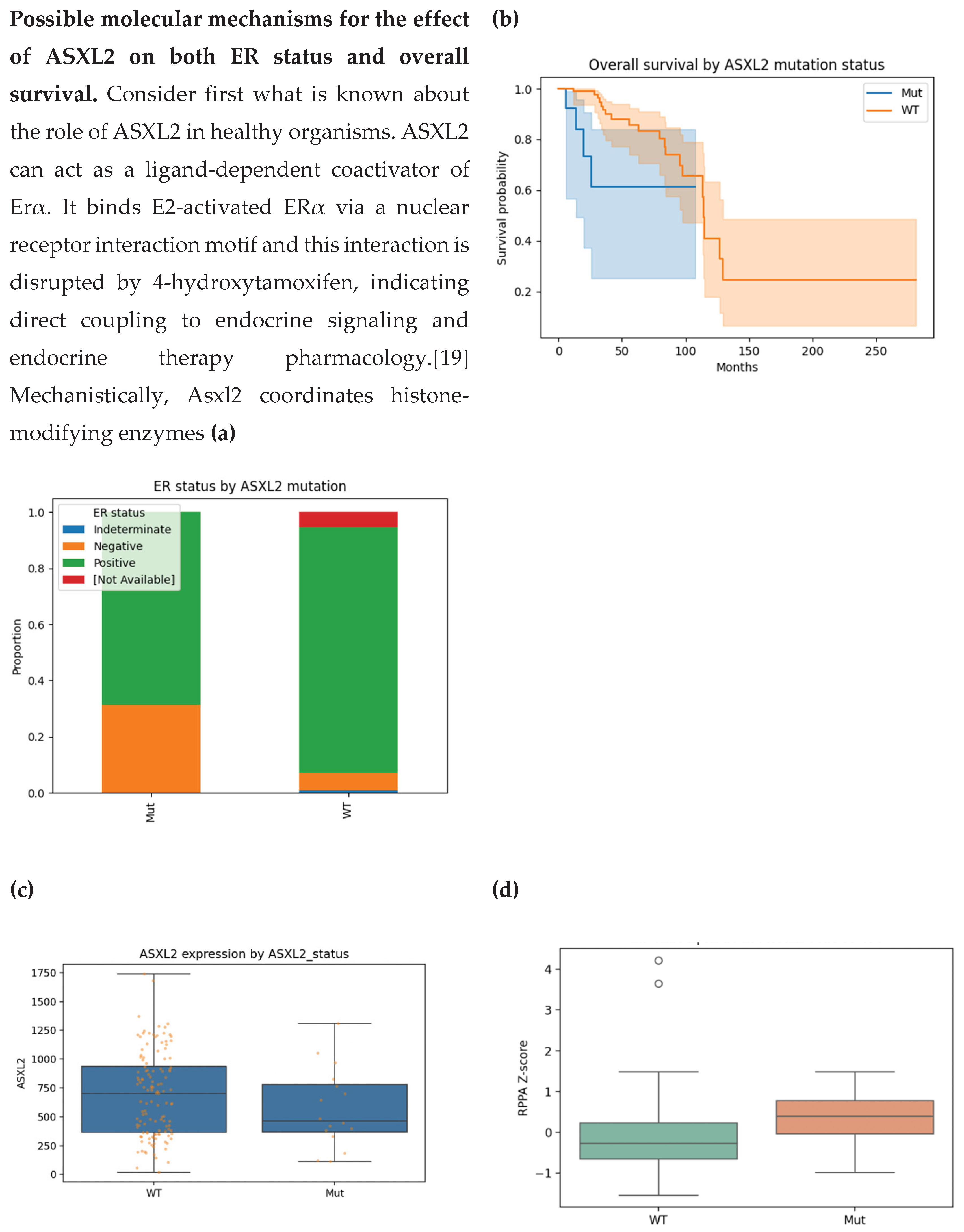
Figure 2.
AlphaFold prediction of the structure of the protein coded by the ASXL2 gene contains mostly fragments with very low confidence of prediction (pLDDT < 50), possibly pointing at disordered structure of the isolated protein and a major role of folding in its selective interactions with certain other proteins. (AlphaFold identifier AF-Q76L83-F1, amino acid residues 1-1435, UniProt entry Q76L83). Experimentally determined 3D structures of the protein are not available in the RCSB Protein Data Bank.
Figure 2.
AlphaFold prediction of the structure of the protein coded by the ASXL2 gene contains mostly fragments with very low confidence of prediction (pLDDT < 50), possibly pointing at disordered structure of the isolated protein and a major role of folding in its selective interactions with certain other proteins. (AlphaFold identifier AF-Q76L83-F1, amino acid residues 1-1435, UniProt entry Q76L83). Experimentally determined 3D structures of the protein are not available in the RCSB Protein Data Bank.
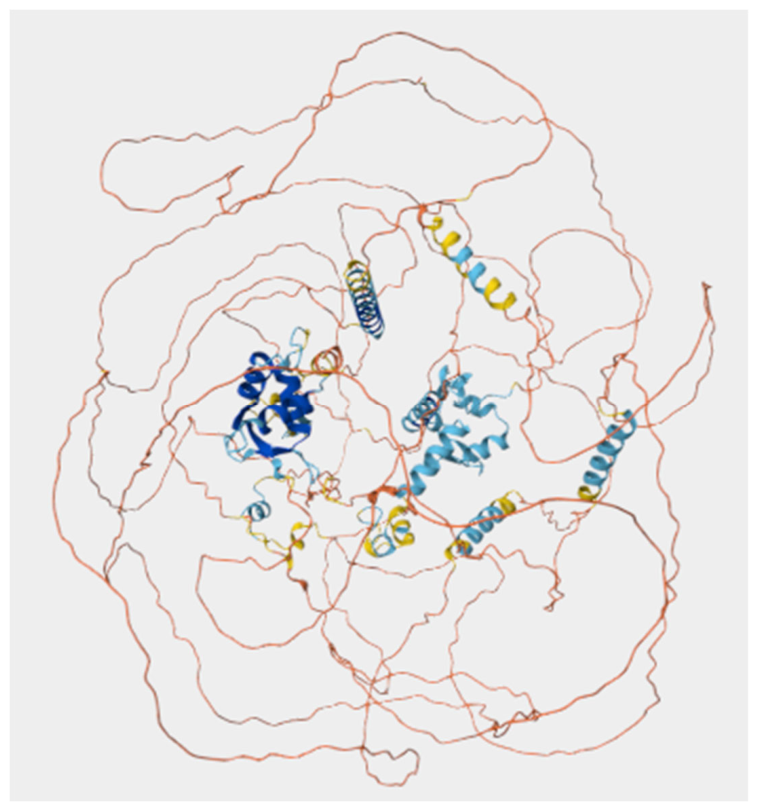
Figure 3.
Overview of the TCGA-BRCA dataset used for mutation, clinical, and survival analyses in this work (visualization generated in https://www.cbioportal.org/study/summary?id=brca_tcga).
Figure 3.
Overview of the TCGA-BRCA dataset used for mutation, clinical, and survival analyses in this work (visualization generated in https://www.cbioportal.org/study/summary?id=brca_tcga).
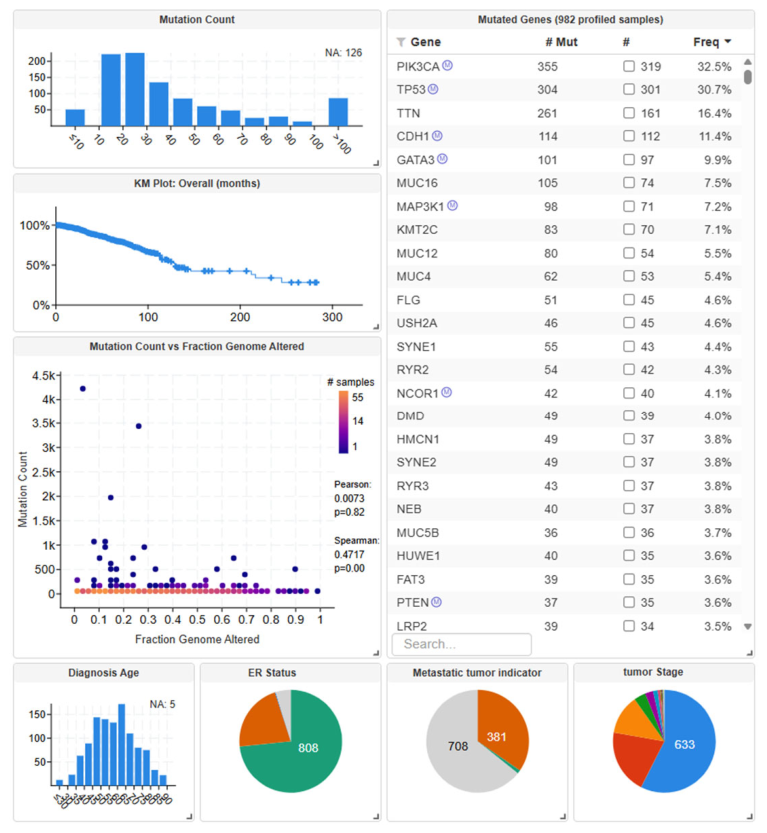

Table 1.
Associations between somatic gene mutations, ER status (chi2 p-values given), and survival outcomes (log-rank p-values given) in human breast cancer patients are statistically significant, based on the TCGA-BRCA dataset, for only one gene, ASXL2. Statistically significant p-values (p < 0.01) are shown in bold.
Table 1.
Associations between somatic gene mutations, ER status (chi2 p-values given), and survival outcomes (log-rank p-values given) in human breast cancer patients are statistically significant, based on the TCGA-BRCA dataset, for only one gene, ASXL2. Statistically significant p-values (p < 0.01) are shown in bold.
| Gene | log-rank p-value | chi2 p-value |
|---|---|---|
| TP53 | 6.9∙10-38 | 0.31 |
| GATA3 | 3.9∙10-9 | 0.77 |
| NCOR1 | 0.37 | 9.1∙10-3 |
| GPS2 | 0.88 | 0.82 |
| ACTL6B | 0.47 | 0.051 |
| RB1 | 0.99 | 5.5∙10-4 |
| KRAS | 0.66 | 0.71 |
| ZFP36L2 | 0.38 | 0.77 |
| ZFP36L1 | 0.19 | 0.81 |
| FAM86B1 | 0.64 | 0.71 |
| FBXW7 | 0.86 | 0.78 |
| TBL1XR1 | 0.38 | 0.062 |
| MYB | 0.17 | 0.47 |
| PTGER2 | 0.92 | 0.072 |
| CTCF | 0.10 | 0.99 |
| TCP10 | 0.15 | 0.17 |
| CASP8 | 0.63 | 0.48 |
| WSCD2 | 0.56 | 0.52 |
| ZP4 | 0.85 | 0.48 |
| ASXL2 | 7.9∙10-3 | 9.6∙10-3 |
Disclaimer/Publisher’s Note: The statements, opinions and data contained in all publications are solely those of the individual author(s) and contributor(s) and not of MDPI and/or the editor(s). MDPI and/or the editor(s) disclaim responsibility for any injury to people or property resulting from any ideas, methods, instructions or products referred to in the content. |
© 2026 by the authors. Licensee MDPI, Basel, Switzerland. This article is an open access article distributed under the terms and conditions of the Creative Commons Attribution (CC BY) license (http://creativecommons.org/licenses/by/4.0/).
Copyright: This open access article is published under a Creative Commons CC BY 4.0 license, which permit the free download, distribution, and reuse, provided that the author and preprint are cited in any reuse.


